US9302913B2 - Method for producing metal nitride - Google Patents

Method for producing metal nitride Download PDF

Info

Publication number
US9302913B2
US9302913B2 US13/812,721 US201113812721A US9302913B2 US 9302913 B2 US9302913 B2 US 9302913B2 US 201113812721 A US201113812721 A US 201113812721A US 9302913 B2 US9302913 B2 US 9302913B2
Authority
US
United States
Prior art keywords
nitride
temperature
hydride
metal nitride
hours
Prior art date
Legal status (The legal status is an assumption and is not a legal conclusion. Google has not performed a legal analysis and makes no representation as to the accuracy of the status listed.)
Active, expires
Application number
US13/812,721
Other versions
US20130129600A1 (en
Inventor
Kazuhiko Tokoyoda
Shoji Suzuki
Tomoki Hatsumori
Current Assignee (The listed assignees may be inaccurate. Google has not performed a legal analysis and makes no representation or warranty as to the accuracy of the list.)
Taiheiyo Cement Corp
Original Assignee
Taiheiyo Cement Corp
Priority date (The priority date is an assumption and is not a legal conclusion. Google has not performed a legal analysis and makes no representation as to the accuracy of the date listed.)
Filing date
Publication date
Application filed by Taiheiyo Cement Corp filed Critical Taiheiyo Cement Corp
Assigned to TAIHEIYO CEMENT CORPORATION reassignment TAIHEIYO CEMENT CORPORATION ASSIGNMENT OF ASSIGNORS INTEREST (SEE DOCUMENT FOR DETAILS). Assignors: HATSUMORI, TOMOKI, SUZUKI, SHOJI, TOKOYODA, KAZUHIKO
Publication of US20130129600A1 publication Critical patent/US20130129600A1/en
Application granted granted Critical
Publication of US9302913B2 publication Critical patent/US9302913B2/en
Active legal-status Critical Current
Adjusted expiration legal-status Critical

Links

Images

Classifications

    • CCHEMISTRY; METALLURGY
    • C01INORGANIC CHEMISTRY
    • C01BNON-METALLIC ELEMENTS; COMPOUNDS THEREOF; METALLOIDS OR COMPOUNDS THEREOF NOT COVERED BY SUBCLASS C01C
    • C01B21/00Nitrogen; Compounds thereof
    • C01B21/06Binary compounds of nitrogen with metals, with silicon, or with boron, or with carbon, i.e. nitrides; Compounds of nitrogen with more than one metal, silicon or boron
    • C01B21/0615Binary compounds of nitrogen with metals, with silicon, or with boron, or with carbon, i.e. nitrides; Compounds of nitrogen with more than one metal, silicon or boron with transition metals other than titanium, zirconium or hafnium
    • C01B21/0627Binary compounds of nitrogen with metals, with silicon, or with boron, or with carbon, i.e. nitrides; Compounds of nitrogen with more than one metal, silicon or boron with transition metals other than titanium, zirconium or hafnium with one or more rare earth metals
    • CCHEMISTRY; METALLURGY
    • C01INORGANIC CHEMISTRY
    • C01BNON-METALLIC ELEMENTS; COMPOUNDS THEREOF; METALLOIDS OR COMPOUNDS THEREOF NOT COVERED BY SUBCLASS C01C
    • C01B21/00Nitrogen; Compounds thereof
    • C01B21/06Binary compounds of nitrogen with metals, with silicon, or with boron, or with carbon, i.e. nitrides; Compounds of nitrogen with more than one metal, silicon or boron
    • CCHEMISTRY; METALLURGY
    • C01INORGANIC CHEMISTRY
    • C01BNON-METALLIC ELEMENTS; COMPOUNDS THEREOF; METALLOIDS OR COMPOUNDS THEREOF NOT COVERED BY SUBCLASS C01C
    • C01B21/00Nitrogen; Compounds thereof
    • C01B21/06Binary compounds of nitrogen with metals, with silicon, or with boron, or with carbon, i.e. nitrides; Compounds of nitrogen with more than one metal, silicon or boron
    • C01B21/0607Binary compounds of nitrogen with metals, with silicon, or with boron, or with carbon, i.e. nitrides; Compounds of nitrogen with more than one metal, silicon or boron with alkali metals
    • CCHEMISTRY; METALLURGY
    • C01INORGANIC CHEMISTRY
    • C01BNON-METALLIC ELEMENTS; COMPOUNDS THEREOF; METALLOIDS OR COMPOUNDS THEREOF NOT COVERED BY SUBCLASS C01C
    • C01B21/00Nitrogen; Compounds thereof
    • C01B21/06Binary compounds of nitrogen with metals, with silicon, or with boron, or with carbon, i.e. nitrides; Compounds of nitrogen with more than one metal, silicon or boron
    • C01B21/0607Binary compounds of nitrogen with metals, with silicon, or with boron, or with carbon, i.e. nitrides; Compounds of nitrogen with more than one metal, silicon or boron with alkali metals
    • C01B21/061Binary compounds of nitrogen with metals, with silicon, or with boron, or with carbon, i.e. nitrides; Compounds of nitrogen with more than one metal, silicon or boron with alkali metals with lithium
    • CCHEMISTRY; METALLURGY
    • C01INORGANIC CHEMISTRY
    • C01BNON-METALLIC ELEMENTS; COMPOUNDS THEREOF; METALLOIDS OR COMPOUNDS THEREOF NOT COVERED BY SUBCLASS C01C
    • C01B21/00Nitrogen; Compounds thereof
    • C01B21/06Binary compounds of nitrogen with metals, with silicon, or with boron, or with carbon, i.e. nitrides; Compounds of nitrogen with more than one metal, silicon or boron
    • C01B21/0612Binary compounds of nitrogen with metals, with silicon, or with boron, or with carbon, i.e. nitrides; Compounds of nitrogen with more than one metal, silicon or boron with alkaline-earth metals, beryllium or magnesium
    • CCHEMISTRY; METALLURGY
    • C01INORGANIC CHEMISTRY
    • C01PINDEXING SCHEME RELATING TO STRUCTURAL AND PHYSICAL ASPECTS OF SOLID INORGANIC COMPOUNDS
    • C01P2002/00Crystal-structural characteristics
    • C01P2002/70Crystal-structural characteristics defined by measured X-ray, neutron or electron diffraction data
    • C01P2002/72Crystal-structural characteristics defined by measured X-ray, neutron or electron diffraction data by d-values or two theta-values, e.g. as X-ray diagram

Definitions

  • the present invention relates to a method for producing a metal nitride, particularly an alkali metal nitride, an alkaline earth metal nitride or a lanthanoid metal nitride.
  • a metal nitride as a material such as a raw material of an aluminum nitride used for a semiconductor device, a metal sliding member, an electrode construction material and the like.
  • Many fluorescent materials using a metal nitride have also been found, and the demand as the raw material has also increased.
  • a high-purity product is required for the metal nitride used for the applications.
  • Examples of a conventional method for producing a metal nitride include a method for heating alkaline earth metals such as calcium in a nitrogen gas stream (Non Patent Literatures 1 and 2).
  • this method nitrides only the surfaces of a metal, and has difficulty in nitriding the inside thereof. Therefore, the metal nitride obtained by the method cannot be used for the above-mentioned application like a semiconductor device requiring a high-purity product.
  • Non Patent Literature 3 Another method is a method for heating calcium with ammonia, a problem of which method is production of a calcium hydride as a by-product (Non Patent Literature 3). Furthermore, yet another method is a method for heating tricalcium tetranitride to 250° C., problems of which are explosiveness and toxicity (Non Patent Literature 4).
  • Patent Literature 1 a method for reacting a molten zinc-calcium alloy with a heated and pressurized nitrogen jet to synthesize a calcium nitride.
  • Patent Literature 1 a method for reacting a molten zinc-calcium alloy with a heated and pressurized nitrogen jet to synthesize a calcium nitride.
  • each of the metal nitrides obtained by the conventional method had low purity, and could not be used for the application requiring the high-purity product.
  • the present inventors carried out diligent studies in view of the above-mentioned circumstances. As a result, the inventors found that a metal hydride is used as a raw material, and the hydride can merely be heated under a nitrogen gas or an ammonia gas to obtain a high-purity metal nitride with good yield, and completed the present invention.
  • the present invention provides a method for producing the metal nitride, the method including heating a metal hydride under a nitrogen gas or an ammonia gas.
  • the present invention provides a metal nitride produced by heating a metal hydride under a nitrogen gas or an ammonia gas.
  • the present invention can simply produce a high-purity metal nitride with good yield.
  • FIG. 1 shows the XRD results of lanthanum nitride obtained in Example 1.
  • FIG. 2 shows the XRD results of calcium nitride obtained in Example 2.
  • FIG. 3 shows the XRD results of lithium nitride obtained in Example 3.
  • FIG. 4 shows the XRD results of strontium nitride obtained in Example 4.
  • FIG. 5 shows the XRD results of barium nitride obtained in Example 5.
  • FIG. 6 shows the XRD results of barium nitride obtained in Example 6.
  • FIG. 7 shows the XRD results of barium nitride obtained in Example 7.
  • FIG. 8 shows the XRD results of lanthanum nitride obtained in Example 8.
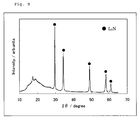
  • FIG. 9 shows the XRD results of lanthanum nitride obtained in Example 9.
  • FIG. 10 shows the XRD results of cerium nitride obtained in Example 10.
  • FIG. 11 shows the XRD results of magnesium nitride obtained in Example 11.
  • a metal hydride used for the present invention is preferably one or more kinds selected from an alkali metal hydride, an alkaline earth metal hydride, and a lanthanoid metal hydride.
  • the alkali metal hydride include LiH, NaH, and KH.
  • the alkaline earth metal hydride include BaH 2 , MgH 2 , CaH 2 , SrH 3 , and BaH 3 .
  • the lanthanoid metal hydride include LaH 3 , CeH 3 , and EuH 3 .
  • An alkali metal hydride as a raw material of the present invention can be produced by for example, a method for making hydrogen act on an alkali metal at a high temperature (“Kagaku Daijiten (Encyclopaedia Chimica)”, miniature edition, Kyoritsu Shuppan Co., Ltd., the paragraphs of lithium hydride and potassium hydride), and the like.
  • An alkaline earth metal hydride as a raw material of the present invention can be produced by, for example, a method for making hydrogen act on an alkaline earth metal at a high temperature (“Kagaku Daijiten (Encyclopaedia Chimica)”, miniature edition, Kyoritsu Shuppan Co., Ltd., the paragraphs of calcium hydride and barium hydride), and the like.
  • a lanthanoid metal hydride as a raw material of the present invention can be produced by, for example, a method for making hydrogen act on lanthanum (“Kagaku Daijiten (Encyclopaedia Chimica)”, miniature edition, Kyoritsu Shuppan Co., Ltd., the paragraph of lanthanum), and the like.
  • a metal nitride can be produced also from a metal hydride other than the alkali metal hydride, the alkaline earth metal hydride, and the lanthanoid metal hydride by a method of the present invention.
  • the metal hydride used for the present invention is desirably a powder.
  • a nitriding reaction is performed by heating the metal hydride under a nitrogen gas or an ammonia gas.
  • the nitrogen gas is preferably used.
  • a pressure thereof is not particularly limited.
  • the reaction is preferably performed at a normal pressure as being economical.
  • the reaction may be performed in a batch or continuous system. In the case of mass production, the reaction is advantageously performed in the continuous system.
  • a heating temperature is preferably 100° C. or more, more preferably 300° C. or more and even more preferably 500° C. or more.
  • the upper limit of the heating temperature is a temperature at which the produced metal nitride is not decomposed. However, the upper limit is preferably 1500° C. or less in views of a reactor and economical efficiency. Therefore, the heating temperature is preferably from 100 to 1500° C., more preferably from 300 to 1300° C. and even more preferably from 500 to 1200° C.
  • the heating temperature when the alkali metal hydride is used as a raw material in the present invention is preferably 100° C. or more, more preferably 300° C. or more, and even more preferably 400° C. or more.
  • the upper limit of the temperature is a temperature at which the produced alkali metal nitride is not decomposed. However, the upper limit is preferably 1500° C. or less in views of a reactor and economic efficiency. Therefore, the heating temperature when the alkali metal hydride is used is preferably from 100 to 1500° C., more preferably from 300 to 1000° C., and particularly preferably from 400 to 900° C. The heating temperature is most preferably from 600 to 800° C.
  • the heating temperature when the alkaline earth metal hydride is used as a raw material in the present invention is preferably 400° C. or more, more preferably 500° C. or more, and even more preferably 600° C. or more.
  • the upper limit of the temperature is a temperature at which the produced alkaline earth metal nitride is not decomposed. However, the upper limit is preferably 1500° C. or less in views of a reactor and economic efficiency. Therefore, the heating temperature when the alkaline earth metal hydride is used is preferably from 400 to 1500° C., more preferably from 500 to 1100° C., and particularly preferably from 600 to 1000° C.
  • the heating temperature is most preferably from 700 to 900° C.
  • the heating temperature when the lanthanoid metal hydride is used as a raw material in the present invention is preferably 500° C. or more, more preferably 600° C. or more, and even more preferably 700° C. or more.
  • the upper limit of the temperature is a temperature at which the produced lanthanoid metal nitride is not decomposed. However, the upper limit is preferably 1500° C. or less in views of a reactor and economic efficiency. Therefore, the heating temperature when the lanthanoid metal hydride is used is preferably from 500 to 1500° C., more preferably from 600 to 1300° C., and particularly preferably from 700 to 1200° C. The heating temperature is most preferably from 800 to 1000° C.
  • the reaction time may be suitably determined depending on the device, the reaction temperature, and the amount of a raw material.
  • the reaction time is preferably from 10 minutes to 48 hours, more preferably from 1 hour to 24 hours, and particularly preferably from 3 hours to 12 hours.
  • the reaction device may be a device capable of withstanding a temperature of about 1500° C.
  • a tubular furnace, an electric furnace, a batch kiln, and a rotary kiln may be used.
  • the metal nitride Because only the target metal nitride remains in a powdery state in the reaction device in the case of the batch system, for example, after completing the reaction, the metal nitride is extremely easily collected.
  • the alkali metal nitride, the alkaline earth metal nitride, and the lanthanoid metal nitride for example, Li 3 N, Na 3 N, K 3 N, Be 3 N 2 , Mg 3 N 2 , Ca 3 N 2 , Ca 2 N, Sr 3 N 2 , Sr 2 N, Ba 3 N 2 , Ba 2 N, LaN, CeN, and EuN are preferred.
  • the metal nitride obtained by the method of the present invention has high purity because the nitriding reaction proceeds easily to the inside thereof.
  • a 200 cc pressure tight container was charged with 40 g of metal lanthanum, then vacuum-exhausted and filled with 1.5 MPa of hydrogen, to perform a reaction at a reaction temperature of 100° C. for 18 hours, to thereby obtain lanthanum hydride as a starting material.
  • the obtained lanthanum hydride was used for the following test.
  • a producing test of a lanthanum nitride was performed under conditions of a temperature and a time (h) as shown in Table 1. That is, 3 g of a lanthanum hydride was placed in a furnace core tube (an inner diameter of 50 mm and a length of 600 mm) and the furnace core tube was sealed with a silicon cap in a glove box. The furnace core tube taken out from the glove box was set in a tubular furnace, and was heated in a nitrogen atmosphere.
  • Powder XRD analysis of the obtained LaN compound was performed.
  • the LaN results are shown in FIG. 1 .
  • the XRD of the LaH 2 as a raw material is also shown in FIG. 1 .
  • the XRD results show that a target high-purity lanthanum nitride is produced at high yield by heating from 500 to 1000° C.
  • the XRD results also show that the higher a reaction temperature is, the shorter the reaction time is.
  • the quantity of the lanthanum nitride obtained at 1000° C. was determined by a nitrogen-oxygen simultaneous analyzer. The N amount was 9.07 mass %, and the purity calculated from the theoretical amount (9.16 mass %) was 99.0%.
  • a 200 cc pressure tight container was charged with 40 g of metal calcium, then vacuum-exhausted and filled with 10 MPa of hydrogen, to perform a reaction at a reaction temperature of 150° C. for 24 hours, to thereby obtain calcium hydride as a starting material.
  • the same operation as that of Example 1 was performed by using 3 g of the obtained calcium hydride.
  • a temperature at which the operation was performed under a N 2 gas atmosphere was 800° C., and a reaction time thereof was 16 hours.
  • Powder XRD analysis of the obtained compound was performed.
  • the whole phase was calcium nitride (Ca 3 N 2 ) (see FIG. 2 ).
  • the quantity of the obtained calcium nitride was determined by a nitrogen-oxygen simultaneous analyzer.
  • the N amount was 18.40 mass %, and the purity calculated from the theoretical amount (18.90 mass %) was 97.4%.
  • a 200 cc pressure tight container was charged with 40 g of metal lithium, then vacuum-exhausted and filled with 10 MPa of hydrogen, to perform a reaction at a reaction temperature of 200° C. for 24 hours, to thereby obtain lithium hydride as a starting material.
  • the same operation as that of Example 1 was performed by using 3 g of the obtained lithium hydride.
  • a temperature at which the operation was performed under a N 2 gas atmosphere was 600° C., and a reaction time thereof was 16 hours.
  • Powder XRD analysis of the obtained compound was performed.
  • the whole phase was lithium nitride (Li 3 N) (see FIG. 3 ).
  • the quantity of the obtained lithium nitride was determined by a nitrogen-oxygen simultaneous analyzer.
  • the N amount was 39.20 mass %, and the purity calculated from the theoretical amount (40.21 mass %) was 97.5%.
  • Example 2 The same operation as that of Example 1 was performed by using 3 g of metal lanthanum. A temperature at which the operation was performed under a N 2 gas atmosphere was 1000° C., and a reaction time thereof was 16 hours. Powder XRD analysis of the obtained compound was performed. The whole phase was lanthanum (La).
  • Example 2 The same operation as that of Example 1 was performed by using 3 g of metal calcium. A temperature at which the operation was performed under a N 2 gas atmosphere was 800° C., and a reaction time thereof was 16 hours. Powder XRD analysis of the obtained compound was performed. The whole phase was calcium (Ca).
  • Example 2 The same operation as that of Example 1 was performed by using 3 g of metal lithium. A temperature at which the operation was performed under a N 2 gas atmosphere was 600° C., and a reaction time thereof was 16 hours. Powder XRD analysis of the obtained compound was performed. The whole phase was lithium (Li).
  • a 200 cc pressure tight container was charged with g of metal strontium, then vacuum-exhausted and filled with 0.9 MPa of hydrogen, to perform a reaction at a reaction temperature of 150° C. for 12 hours, to thereby obtain strontium hydride as a starting material.
  • the same operation as that of Example 1 was performed by using 3 g of the obtained strontium hydride.
  • a temperature at which the operation was performed under a N 2 gas atmosphere was 900° C., and a reaction time thereof was 4 hours.
  • Powder XRD analysis of the obtained compound was performed.
  • the whole phase was strontium nitride (Sr 3 N 2 ) ( FIG. 4 ).
  • the quantity of the obtained strontium nitride was determined by a nitrogen-oxygen simultaneous analyzer.
  • the N amount was 9.5 mass %, and the purity calculated from the theoretical amount (9.63 mass %) was 98.7%.
  • a 200 cc pressure tight container was charged with 40 g of metal barium, then vacuum-exhausted and filled with 0.9 MPa of hydrogen, to perform a reaction at a reaction temperature of 150° C. for 12 hours, to thereby obtain barium hydride as a starting material.
  • the same operation as that of Example 1 was performed by using 3 g of the obtained barium hydride.
  • a temperature at which the operation was performed under a N 2 gas atmosphere was 800° C., and a reaction time thereof was 4 hours.
  • Powder XRD analysis of the obtained compound was performed.
  • the whole phase was barium nitride (Ba 2 N) ( FIG. 5 ).
  • the quantity of the obtained barium nitride was determined by a nitrogen-oxygen simultaneous analyzer.
  • the N amount was 4.7 mass %, and the purity calculated from the theoretical amount (4.85 mass %) was 96.9%.
  • Example 2 The same operation as that of Example 1 was performed by using 3 g of the obtained barium hydride. A temperature at which the operation was performed under a N 2 gas atmosphere was 900° C., and a reaction time thereof was 4 hours. Powder XRD analysis of the obtained compound was performed. The whole phase was barium nitride (Ba 2 N) ( FIG. 6 ). The quantity of the obtained barium nitride was determined by a nitrogen-oxygen simultaneous analyzer. The N amount was 4.7 mass %, and the purity calculated from the theoretical amount (4.85 mass %) was 96.9%.
  • Example 2 The same operation as that of Example 1 was performed by using 3 g of the obtained barium hydride. A temperature at which the operation was performed under a N 2 gas atmosphere was 1000° C., and a reaction time thereof was 4 hours. Powder XRD analysis of the obtained compound was performed. The whole phase was barium nitride (Ba 2 N) ( FIG. 7 ). The quantity of the obtained barium nitride was determined by a nitrogen-oxygen simultaneous analyzer. The N amount was 4.8 mass %, and the purity calculated from the theoretical amount (4.85 mass %) was 98.9%.
  • a 200 cc pressure tight container was charged with g of metal lanthanum, then vacuum-exhausted and filled with 0.9 MPa of hydrogen, to perform a reaction at a reaction temperature of 150° C. for 12 hours, to thereby obtain lanthanum hydride as a starting material.
  • the same operation as that of Example 1 was performed by using 3 g of the obtained lanthanum hydride.
  • a temperature at which the operation was performed under a N 2 gas atmosphere was 1400° C., and a reaction time thereof was 4 hours.
  • Powder XRD analysis of the obtained compound was performed.
  • the whole phase was lanthanum nitride (LaN) ( FIG. 8 ).
  • the quantity of the obtained lanthanum nitride was determined by a nitrogen-oxygen simultaneous analyzer.
  • the N amount was 9.1 mass %, and the purity calculated from the theoretical amount (9.16 mass %) was 99.3%.
  • Example 2 The same operation as that of Example 1 was performed by using 3 g of the obtained lanthanum hydride. A temperature at which the operation was performed under a NH 3 gas atmosphere was 800° C., and a reaction time thereof was 4 hours. Powder XRD analysis of the obtained compound was performed. The whole phase was lanthanum nitride (LaN) ( FIG. 9 ). The quantity of the obtained lanthanum nitride was determined by a nitrogen-oxygen simultaneous analyzer. The N amount was 9.1 mass %, and the purity calculated from the theoretical amount (9.16 mass %) was 99.3%.
  • LaN lanthanum nitride
  • a 200 cc pressure tight container was charged with 40 g of metal cerium, then vacuum-exhausted and filled with 0.9 MPa of hydrogen to perform a reaction at a reaction temperature of 150° C. for 12 hours, to thereby obtain cerium hydride as a starting material.
  • the same operation as that of Example 1 was performed by using 3 g of the obtained cerium hydride.
  • a temperature at which the operation was performed under a N 2 gas atmosphere was 1000° C., and a reaction time thereof was 4 hours.
  • Powder XRD analysis of the obtained compound was performed.
  • the whole phase was cerium nitride (CeN) ( FIG. 10 ).
  • the quantity of the obtained cerium nitride was determined by a nitrogen-oxygen simultaneous analyzer.
  • the N amount was 8.9 mass %, and the purity calculated from the theoretical amount (9.09 mass %) was 97.9%.
  • Example 2 The same operation as that of Example 1 was performed by using 3 g of magnesium hydride as a starting material. A temperature at which the operation was performed under a N 2 gas atmosphere was 900° C., and a reaction time thereof was 6 hours. Powder XRD analysis of the obtained compound was performed. The whole phase was magnesium nitride (Mg 3 N 2 ) ( FIG. 11 ). The quantity of the obtained magnesium nitride was determined by a nitrogen-oxygen simultaneous analyzer. The N amount was 27.1 mass %, and the purity calculated from the theoretical amount (27.76 mass %) was 97.6%.
  • Mg 3 N 2 magnesium nitride

Landscapes

  • Chemical & Material Sciences (AREA)
  • Organic Chemistry (AREA)
  • Inorganic Chemistry (AREA)
  • Life Sciences & Earth Sciences (AREA)
  • General Life Sciences & Earth Sciences (AREA)
  • Geology (AREA)
  • Engineering & Computer Science (AREA)
  • Materials Engineering (AREA)
  • Crystallography & Structural Chemistry (AREA)
  • Catalysts (AREA)

Abstract

There is provided a method for producing a high-purity metal nitride by simple processes with good yield.
Specifically provided is a method for producing a metal nitride including heating a metal hydride under a nitrogen gas or an ammonia gas.

Description

CROSS REFERENCE TO RELATED APPLICATION
This application is a 371 of PCT/JP2011/068341, filed on Aug. 11, 2011, and claims priority to Japanese Patent Application No. 2010-179905, filed on Aug. 11, 2010.
TECHNICAL FIELD
The present invention relates to a method for producing a metal nitride, particularly an alkali metal nitride, an alkaline earth metal nitride or a lanthanoid metal nitride.
BACKGROUND ART
In recent years, attention has been directed to a metal nitride as a material such as a raw material of an aluminum nitride used for a semiconductor device, a metal sliding member, an electrode construction material and the like. Many fluorescent materials using a metal nitride have also been found, and the demand as the raw material has also increased. A high-purity product is required for the metal nitride used for the applications.
Examples of a conventional method for producing a metal nitride include a method for heating alkaline earth metals such as calcium in a nitrogen gas stream (Non Patent Literatures 1 and 2).
However, this method nitrides only the surfaces of a metal, and has difficulty in nitriding the inside thereof. Therefore, the metal nitride obtained by the method cannot be used for the above-mentioned application like a semiconductor device requiring a high-purity product.
Another method is a method for heating calcium with ammonia, a problem of which method is production of a calcium hydride as a by-product (Non Patent Literature 3). Furthermore, yet another method is a method for heating tricalcium tetranitride to 250° C., problems of which are explosiveness and toxicity (Non Patent Literature 4).
Furthermore, there is disclosed a method for reacting a molten zinc-calcium alloy with a heated and pressurized nitrogen jet to synthesize a calcium nitride (Patent Literature 1). However, this method requires a special device, and thus it is difficult to say that the method is an industrially advantageous method.
PRIOR ART LITERATURE Patent Literature
  • [Patent Literature 1] JP-A-2005-531483
Non Patent Literature
  • [Non Patent Literature 1] “Kagaku Daijiten (Encyclopedic Dictionary of Chemistry)”, first edition, edited by Michinori Oki et al., Tokyo Kagaku Dojin, first edition, p. 1413, 1989
  • [Non Patent Literature 2] “Shin Jikken Kagaku Koza 8, Muki Kagoubutsu no Gosei (I) (New Experimental Chemistry Course 8, Synthesis of Inorganic Compounds (I))”, edited by the Chemical Society of Japan, Maruzen Co., Ltd., p. 414, 1976,
  • [Non Patent Literature 3] “Kagaku Daijiten 5 (Encyclopaedia Chimica 5)”, miniature edition, Kyoritsu Shuppan Co., Ltd., p. 880, 1987
  • [Non Patent Literature 4] “Muki Kagoubutsu Sakutai Jiten (Dictionary of Inorganic Compounds and Complexes)”, Masayoshi Nakahara, Kodansha Ltd., p. 476, 1997
Summary of Invention Problem to be Solved by the Invention
However, each of the metal nitrides obtained by the conventional method had low purity, and could not be used for the application requiring the high-purity product.
It is an object of the present invention to provide a method for simply producing a high-purity metal nitride with good yield without causing the above-mentioned problems.
Means for Solving the Problem
The present inventors carried out diligent studies in view of the above-mentioned circumstances. As a result, the inventors found that a metal hydride is used as a raw material, and the hydride can merely be heated under a nitrogen gas or an ammonia gas to obtain a high-purity metal nitride with good yield, and completed the present invention.
That is, the present invention provides a method for producing the metal nitride, the method including heating a metal hydride under a nitrogen gas or an ammonia gas.
The present invention provides a metal nitride produced by heating a metal hydride under a nitrogen gas or an ammonia gas.
Advantageous Effect of Invention
The present invention can simply produce a high-purity metal nitride with good yield.
BRIEF DESCRIPTION OF DRAWINGS
FIG. 1 shows the XRD results of lanthanum nitride obtained in Example 1.
FIG. 2 shows the XRD results of calcium nitride obtained in Example 2.
FIG. 3 shows the XRD results of lithium nitride obtained in Example 3.
FIG. 4 shows the XRD results of strontium nitride obtained in Example 4.
FIG. 5 shows the XRD results of barium nitride obtained in Example 5.
FIG. 6 shows the XRD results of barium nitride obtained in Example 6.
FIG. 7 shows the XRD results of barium nitride obtained in Example 7.
FIG. 8 shows the XRD results of lanthanum nitride obtained in Example 8.
FIG. 9 shows the XRD results of lanthanum nitride obtained in Example 9.
FIG. 10 shows the XRD results of cerium nitride obtained in Example 10.
FIG. 11 shows the XRD results of magnesium nitride obtained in Example 11.
MODES FOR CARRYING OUT THE INVENTION
Particularly, a metal hydride used for the present invention is preferably one or more kinds selected from an alkali metal hydride, an alkaline earth metal hydride, and a lanthanoid metal hydride. Herein, examples of the alkali metal hydride include LiH, NaH, and KH. Examples of the alkaline earth metal hydride include BaH2, MgH2, CaH2, SrH3, and BaH3. Examples of the lanthanoid metal hydride include LaH3, CeH3, and EuH3.
An alkali metal hydride as a raw material of the present invention can be produced by for example, a method for making hydrogen act on an alkali metal at a high temperature (“Kagaku Daijiten (Encyclopaedia Chimica)”, miniature edition, Kyoritsu Shuppan Co., Ltd., the paragraphs of lithium hydride and potassium hydride), and the like.
An alkaline earth metal hydride as a raw material of the present invention can be produced by, for example, a method for making hydrogen act on an alkaline earth metal at a high temperature (“Kagaku Daijiten (Encyclopaedia Chimica)”, miniature edition, Kyoritsu Shuppan Co., Ltd., the paragraphs of calcium hydride and barium hydride), and the like.
A lanthanoid metal hydride as a raw material of the present invention can be produced by, for example, a method for making hydrogen act on lanthanum (“Kagaku Daijiten (Encyclopaedia Chimica)”, miniature edition, Kyoritsu Shuppan Co., Ltd., the paragraph of lanthanum), and the like.
A metal nitride can be produced also from a metal hydride other than the alkali metal hydride, the alkaline earth metal hydride, and the lanthanoid metal hydride by a method of the present invention.
The metal hydride used for the present invention is desirably a powder.
In the present invention, a nitriding reaction is performed by heating the metal hydride under a nitrogen gas or an ammonia gas. The nitrogen gas is preferably used. When the reaction is performed under the gas atmosphere, a pressure thereof is not particularly limited. However, the reaction is preferably performed at a normal pressure as being economical. The reaction may be performed in a batch or continuous system. In the case of mass production, the reaction is advantageously performed in the continuous system.
In the present invention, a heating temperature is preferably 100° C. or more, more preferably 300° C. or more and even more preferably 500° C. or more. The upper limit of the heating temperature is a temperature at which the produced metal nitride is not decomposed. However, the upper limit is preferably 1500° C. or less in views of a reactor and economical efficiency. Therefore, the heating temperature is preferably from 100 to 1500° C., more preferably from 300 to 1300° C. and even more preferably from 500 to 1200° C.
The heating temperature when the alkali metal hydride is used as a raw material in the present invention is preferably 100° C. or more, more preferably 300° C. or more, and even more preferably 400° C. or more. The upper limit of the temperature is a temperature at which the produced alkali metal nitride is not decomposed. However, the upper limit is preferably 1500° C. or less in views of a reactor and economic efficiency. Therefore, the heating temperature when the alkali metal hydride is used is preferably from 100 to 1500° C., more preferably from 300 to 1000° C., and particularly preferably from 400 to 900° C. The heating temperature is most preferably from 600 to 800° C.
The heating temperature when the alkaline earth metal hydride is used as a raw material in the present invention is preferably 400° C. or more, more preferably 500° C. or more, and even more preferably 600° C. or more. The upper limit of the temperature is a temperature at which the produced alkaline earth metal nitride is not decomposed. However, the upper limit is preferably 1500° C. or less in views of a reactor and economic efficiency. Therefore, the heating temperature when the alkaline earth metal hydride is used is preferably from 400 to 1500° C., more preferably from 500 to 1100° C., and particularly preferably from 600 to 1000° C. The heating temperature is most preferably from 700 to 900° C.
Furthermore, the heating temperature when the lanthanoid metal hydride is used as a raw material in the present invention is preferably 500° C. or more, more preferably 600° C. or more, and even more preferably 700° C. or more. The upper limit of the temperature is a temperature at which the produced lanthanoid metal nitride is not decomposed. However, the upper limit is preferably 1500° C. or less in views of a reactor and economic efficiency. Therefore, the heating temperature when the lanthanoid metal hydride is used is preferably from 500 to 1500° C., more preferably from 600 to 1300° C., and particularly preferably from 700 to 1200° C. The heating temperature is most preferably from 800 to 1000° C.
The reaction time may be suitably determined depending on the device, the reaction temperature, and the amount of a raw material. Usually, the reaction time is preferably from 10 minutes to 48 hours, more preferably from 1 hour to 24 hours, and particularly preferably from 3 hours to 12 hours.
The reaction device may be a device capable of withstanding a temperature of about 1500° C. For example, a tubular furnace, an electric furnace, a batch kiln, and a rotary kiln may be used.
Because only the target metal nitride remains in a powdery state in the reaction device in the case of the batch system, for example, after completing the reaction, the metal nitride is extremely easily collected.
On the other hand, when the rotary kiln filled with, for example, N2 is used in the case of the continuous system, the metal nitride is easily and continuously collected.
As the obtained metal nitride, the alkali metal nitride, the alkaline earth metal nitride, and the lanthanoid metal nitride, for example, Li3N, Na3N, K3N, Be3N2, Mg3N2, Ca3N2, Ca2N, Sr3N2, Sr2N, Ba3N2, Ba2N, LaN, CeN, and EuN are preferred.
The metal nitride obtained by the method of the present invention has high purity because the nitriding reaction proceeds easily to the inside thereof.
EXAMPLES
Hereinafter, the present invention will be further described in detail with reference to Examples. However, the present invention is not limited to these Examples.
Example 1
A 200 cc pressure tight container was charged with 40 g of metal lanthanum, then vacuum-exhausted and filled with 1.5 MPa of hydrogen, to perform a reaction at a reaction temperature of 100° C. for 18 hours, to thereby obtain lanthanum hydride as a starting material. The obtained lanthanum hydride was used for the following test.
A producing test of a lanthanum nitride was performed under conditions of a temperature and a time (h) as shown in Table 1. That is, 3 g of a lanthanum hydride was placed in a furnace core tube (an inner diameter of 50 mm and a length of 600 mm) and the furnace core tube was sealed with a silicon cap in a glove box. The furnace core tube taken out from the glove box was set in a tubular furnace, and was heated in a nitrogen atmosphere.
TABLE 1
Reaction conditions of lanthanum nitride
Reaction
temperature (° C.) Reaction time (h) Reaction product
1000 2 Lanthanum nitride
800 3 Lanthanum nitride
600 4 Lanthanum nitride
500 5 Lanthanum nitride
300 18  Lanthanum nitride,
lanthanum hydride
Powder XRD analysis of the obtained LaN compound was performed. The LaN results are shown in FIG. 1. For reference, the XRD of the LaH2 as a raw material is also shown in FIG. 1.
The XRD results show that a target high-purity lanthanum nitride is produced at high yield by heating from 500 to 1000° C. The XRD results also show that the higher a reaction temperature is, the shorter the reaction time is. The quantity of the lanthanum nitride obtained at 1000° C. was determined by a nitrogen-oxygen simultaneous analyzer. The N amount was 9.07 mass %, and the purity calculated from the theoretical amount (9.16 mass %) was 99.0%.
Example 2
A 200 cc pressure tight container was charged with 40 g of metal calcium, then vacuum-exhausted and filled with 10 MPa of hydrogen, to perform a reaction at a reaction temperature of 150° C. for 24 hours, to thereby obtain calcium hydride as a starting material. The same operation as that of Example 1 was performed by using 3 g of the obtained calcium hydride. A temperature at which the operation was performed under a N2 gas atmosphere was 800° C., and a reaction time thereof was 16 hours. Powder XRD analysis of the obtained compound was performed. The whole phase was calcium nitride (Ca3N2) (see FIG. 2). The quantity of the obtained calcium nitride was determined by a nitrogen-oxygen simultaneous analyzer. The N amount was 18.40 mass %, and the purity calculated from the theoretical amount (18.90 mass %) was 97.4%.
Example 3
A 200 cc pressure tight container was charged with 40 g of metal lithium, then vacuum-exhausted and filled with 10 MPa of hydrogen, to perform a reaction at a reaction temperature of 200° C. for 24 hours, to thereby obtain lithium hydride as a starting material. The same operation as that of Example 1 was performed by using 3 g of the obtained lithium hydride. A temperature at which the operation was performed under a N2 gas atmosphere was 600° C., and a reaction time thereof was 16 hours. Powder XRD analysis of the obtained compound was performed. The whole phase was lithium nitride (Li3N) (see FIG. 3). The quantity of the obtained lithium nitride was determined by a nitrogen-oxygen simultaneous analyzer. The N amount was 39.20 mass %, and the purity calculated from the theoretical amount (40.21 mass %) was 97.5%.
Comparative Example 1
The same operation as that of Example 1 was performed by using 3 g of metal lanthanum. A temperature at which the operation was performed under a N2 gas atmosphere was 1000° C., and a reaction time thereof was 16 hours. Powder XRD analysis of the obtained compound was performed. The whole phase was lanthanum (La).
Comparative Example 2
The same operation as that of Example 1 was performed by using 3 g of metal calcium. A temperature at which the operation was performed under a N2 gas atmosphere was 800° C., and a reaction time thereof was 16 hours. Powder XRD analysis of the obtained compound was performed. The whole phase was calcium (Ca).
Comparative Example 3
The same operation as that of Example 1 was performed by using 3 g of metal lithium. A temperature at which the operation was performed under a N2 gas atmosphere was 600° C., and a reaction time thereof was 16 hours. Powder XRD analysis of the obtained compound was performed. The whole phase was lithium (Li).
The above-mentioned Comparative Examples show that the nitriding hardly proceeds even when the nitriding of the metal is attempted under the nitrogen atmosphere.
Example 4
A 200 cc pressure tight container was charged with g of metal strontium, then vacuum-exhausted and filled with 0.9 MPa of hydrogen, to perform a reaction at a reaction temperature of 150° C. for 12 hours, to thereby obtain strontium hydride as a starting material. The same operation as that of Example 1 was performed by using 3 g of the obtained strontium hydride. A temperature at which the operation was performed under a N2 gas atmosphere was 900° C., and a reaction time thereof was 4 hours. Powder XRD analysis of the obtained compound was performed. The whole phase was strontium nitride (Sr3N2) (FIG. 4). The quantity of the obtained strontium nitride was determined by a nitrogen-oxygen simultaneous analyzer. The N amount was 9.5 mass %, and the purity calculated from the theoretical amount (9.63 mass %) was 98.7%.
Example 5
A 200 cc pressure tight container was charged with 40 g of metal barium, then vacuum-exhausted and filled with 0.9 MPa of hydrogen, to perform a reaction at a reaction temperature of 150° C. for 12 hours, to thereby obtain barium hydride as a starting material. The same operation as that of Example 1 was performed by using 3 g of the obtained barium hydride. A temperature at which the operation was performed under a N2 gas atmosphere was 800° C., and a reaction time thereof was 4 hours. Powder XRD analysis of the obtained compound was performed. The whole phase was barium nitride (Ba2N) (FIG. 5). The quantity of the obtained barium nitride was determined by a nitrogen-oxygen simultaneous analyzer. The N amount was 4.7 mass %, and the purity calculated from the theoretical amount (4.85 mass %) was 96.9%.
Example 6
The same operation as that of Example 1 was performed by using 3 g of the obtained barium hydride. A temperature at which the operation was performed under a N2 gas atmosphere was 900° C., and a reaction time thereof was 4 hours. Powder XRD analysis of the obtained compound was performed. The whole phase was barium nitride (Ba2N) (FIG. 6). The quantity of the obtained barium nitride was determined by a nitrogen-oxygen simultaneous analyzer. The N amount was 4.7 mass %, and the purity calculated from the theoretical amount (4.85 mass %) was 96.9%.
Example 7
The same operation as that of Example 1 was performed by using 3 g of the obtained barium hydride. A temperature at which the operation was performed under a N2 gas atmosphere was 1000° C., and a reaction time thereof was 4 hours. Powder XRD analysis of the obtained compound was performed. The whole phase was barium nitride (Ba2N) (FIG. 7). The quantity of the obtained barium nitride was determined by a nitrogen-oxygen simultaneous analyzer. The N amount was 4.8 mass %, and the purity calculated from the theoretical amount (4.85 mass %) was 98.9%.
Example 8
A 200 cc pressure tight container was charged with g of metal lanthanum, then vacuum-exhausted and filled with 0.9 MPa of hydrogen, to perform a reaction at a reaction temperature of 150° C. for 12 hours, to thereby obtain lanthanum hydride as a starting material. The same operation as that of Example 1 was performed by using 3 g of the obtained lanthanum hydride. A temperature at which the operation was performed under a N2 gas atmosphere was 1400° C., and a reaction time thereof was 4 hours. Powder XRD analysis of the obtained compound was performed. The whole phase was lanthanum nitride (LaN) (FIG. 8). The quantity of the obtained lanthanum nitride was determined by a nitrogen-oxygen simultaneous analyzer. The N amount was 9.1 mass %, and the purity calculated from the theoretical amount (9.16 mass %) was 99.3%.
Example 9
The same operation as that of Example 1 was performed by using 3 g of the obtained lanthanum hydride. A temperature at which the operation was performed under a NH3 gas atmosphere was 800° C., and a reaction time thereof was 4 hours. Powder XRD analysis of the obtained compound was performed. The whole phase was lanthanum nitride (LaN) (FIG. 9). The quantity of the obtained lanthanum nitride was determined by a nitrogen-oxygen simultaneous analyzer. The N amount was 9.1 mass %, and the purity calculated from the theoretical amount (9.16 mass %) was 99.3%.
Example 10
A 200 cc pressure tight container was charged with 40 g of metal cerium, then vacuum-exhausted and filled with 0.9 MPa of hydrogen to perform a reaction at a reaction temperature of 150° C. for 12 hours, to thereby obtain cerium hydride as a starting material. The same operation as that of Example 1 was performed by using 3 g of the obtained cerium hydride. A temperature at which the operation was performed under a N2 gas atmosphere was 1000° C., and a reaction time thereof was 4 hours. Powder XRD analysis of the obtained compound was performed. The whole phase was cerium nitride (CeN) (FIG. 10). The quantity of the obtained cerium nitride was determined by a nitrogen-oxygen simultaneous analyzer. The N amount was 8.9 mass %, and the purity calculated from the theoretical amount (9.09 mass %) was 97.9%.
Example 11
The same operation as that of Example 1 was performed by using 3 g of magnesium hydride as a starting material. A temperature at which the operation was performed under a N2 gas atmosphere was 900° C., and a reaction time thereof was 6 hours. Powder XRD analysis of the obtained compound was performed. The whole phase was magnesium nitride (Mg3N2) (FIG. 11). The quantity of the obtained magnesium nitride was determined by a nitrogen-oxygen simultaneous analyzer. The N amount was 27.1 mass %, and the purity calculated from the theoretical amount (27.76 mass %) was 97.6%.

Claims (14)

The invention claimed is:
1. A method for producing a metal nitride, the method comprising:
heating an alkaline earth metal hydride under a nitrogen gas or an ammonia gas and at a temperature of from 600 to 1000° C., thereby obtaining a metal nitride; or
heating an alkali metal hydride under a nitrogen gas or an ammonia gas and at a temperature of from 600 to 800° C., thereby obtaining a metal nitride,
wherein
said alkaline earth metal hydride is in the form of a powder,
said an alkali metal hydride is in the form of a powder, and
said metal nitride is at least one member selected from the group consisting of Be3N2, Mg3N2, Ca3N2, Ca2N, Sr3N2, Sr2N, Ba3N2, and Ba2N, or
is at least one member selected from the group consisting of Li3N, K3N, and Na3N.
2. The method according to claim 1, which comprises heating an alkaline earth metal hydride under a nitrogen gas or an ammonia gas and at a temperature of from 600 to 1000° C., thereby obtaining a metal nitride.
3. The method according to claim 1, wherein the alkaline earth metal hydride is heated at a temperature of from 700 to 900° C.
4. The method according to claim 1, wherein a reaction time is from 10 minutes to 48 hours.
5. The method according to claim 1, wherein a reaction time is from 1 hour to 24 hours.
6. The method according to claim 1, wherein a reaction time is from 3 to 12 hours.
7. The method according to claim 1, which comprises heating an alkali metal hydride under a nitrogen gas or an ammonia gas and at a temperature of from 600 to 800° C., thereby obtaining a metal nitride.
8. A method for producing a metal nitride, the method comprising:
heating an alkaline earth metal hydride under a nitrogen gas or an ammonia gas and at a temperature of from 600 to 1000° C., thereby obtaining a metal nitride; or
heating an alkali metal hydride under a nitrogen gas or an ammonia gas and at a temperature of from 600 to 800° C., thereby obtaining a metal nitride,
wherein
said alkaline earth metal hydride is in the form of a powder,
said an alkali metal hydride is in the form of a powder, and
said metal nitride is at least one member selected from the group consisting of Mg3N2, Ca3N2, Ca2N, Sr3N2, Sr2N, Ba3N2, and Ba2N, or is Li3N.
9. The method according to claim 8, which comprises heating an alkaline earth metal hydride under a nitrogen gas or an ammonia gas and at a temperature of from 600 to 1000° C., thereby obtaining a metal nitride.
10. The method according to claim 8, wherein the alkaline earth metal hydride is heated at a temperature of from 700 to 900° C.
11. The method according to claim 8, wherein a reaction time is from 10 minutes to 48 hours.
12. The method according to claim 8, wherein a reaction time is from 1 hour to 24 hours.
13. The method according to claim 8, wherein a reaction time is from 3 to 12 hours.
14. The method according to claim 8, which comprises heating an alkali metal hydride under a nitrogen gas or an ammonia gas and at a temperature of from 600 to 800° C., thereby obtaining a metal nitride.
US13/812,721 2010-08-11 2011-08-11 Method for producing metal nitride Active 2031-12-25 US9302913B2 (en)

Applications Claiming Priority (3)

Application Number Priority Date Filing Date Title
JP2010-179905 2010-08-11
JP2010179905 2010-08-11
PCT/JP2011/068341 WO2012020819A1 (en) 2010-08-11 2011-08-11 Method for producing metal nitride

Publications (2)

Publication Number Publication Date
US20130129600A1 US20130129600A1 (en) 2013-05-23
US9302913B2 true US9302913B2 (en) 2016-04-05

Family

ID=45567779

Family Applications (1)

Application Number Title Priority Date Filing Date
US13/812,721 Active 2031-12-25 US9302913B2 (en) 2010-08-11 2011-08-11 Method for producing metal nitride

Country Status (6)

Country Link
US (1) US9302913B2 (en)
JP (1) JP5825920B2 (en)
KR (1) KR20130098280A (en)
CN (1) CN102971256B (en)
TW (1) TWI580635B (en)
WO (1) WO2012020819A1 (en)

Families Citing this family (14)

* Cited by examiner, † Cited by third party
Publication number Priority date Publication date Assignee Title
JPH0630080Y2 (en) 1988-06-29 1994-08-17 東陶機器株式会社 Western style toilet device
JP5884101B2 (en) * 2012-07-26 2016-03-15 国立大学法人東京工業大学 Nitride electride and process for producing the same
JP6039474B2 (en) * 2013-03-19 2016-12-07 太平洋セメント株式会社 Method for producing alkaline earth metal imide
JP6190265B2 (en) * 2013-12-19 2017-08-30 太平洋セメント株式会社 Method for producing barium nitride particles and phosphor
US10415153B2 (en) 2014-04-02 2019-09-17 Franck Natali Doped rare earth nitride materials and devices comprising same
JP6388814B2 (en) * 2014-10-21 2018-09-12 太平洋セメント株式会社 Production method of lanthanum hydride
JP6366038B2 (en) * 2015-03-24 2018-08-01 太平洋セメント株式会社 Method for producing metal nitride
JP6487787B2 (en) * 2015-06-17 2019-03-20 太平洋セメント株式会社 Barium hydride particles and process for producing the same
CN106629634B (en) * 2016-12-30 2018-09-11 河北利福光电技术有限公司 A kind of high purity silicon nitride cerium powder and its preparation method and application
CN107010610B (en) * 2017-06-13 2023-09-19 王兆兵 High-efficiency energy-saving high-purity manganese nitride production system
JP6940778B2 (en) * 2019-02-27 2021-09-29 日亜化学工業株式会社 Nitride phosphor manufacturing method
JP7326183B2 (en) * 2020-02-13 2023-08-15 太平洋セメント株式会社 lanthanum nitride
CN115403043B (en) * 2022-08-19 2023-07-11 四川大学 Preparation method of rare earth element carbide, nitride or carbonitride powder
CN117842943A (en) * 2022-10-09 2024-04-09 中国科学院大连化学物理研究所 A kind of synthetic method of lithium carbodiimide

Citations (14)

* Cited by examiner, † Cited by third party
Publication number Priority date Publication date Assignee Title
US2461018A (en) * 1945-03-02 1949-02-08 Metal Hydrides Inc Production of titanium nitride
US2893862A (en) * 1955-09-26 1959-07-07 Bayer Ag Process for the production of alkalineearth metals
US3322510A (en) * 1962-07-04 1967-05-30 Commissariat Energie Atomique Process for the preparation of metallic nitrides
JPS49106499A (en) 1973-02-15 1974-10-09
JPS5590406A (en) 1979-10-09 1980-07-09 Sumitomo Electric Ind Ltd Preparation of nitride
US4321163A (en) * 1978-11-21 1982-03-23 Max-Planck-Gesellschaft Lithium nitride of increased conductivity, method for its preparation, and its use
JPS62108718A (en) 1985-11-07 1987-05-20 Denki Kagaku Kogyo Kk Production of sintered body of cubic boron nitride
JPS63256505A (en) 1986-04-15 1988-10-24 マ−チン・マリエツタ・コ−ポレ−シヨン Synthesis of nitride
JP2002293545A (en) * 2001-01-24 2002-10-09 Nichia Chem Ind Ltd Method for producing lithium composite metal nitride
US20050118087A1 (en) 2002-07-02 2005-06-02 Francois Lacoste Method for calcium nitride synthesis
CN101397129A (en) 2007-09-24 2009-04-01 辽宁师范大学 Nanometer size ytterbium nitride powder and preparation method
CN101613092A (en) 2008-06-27 2009-12-30 辽宁师范大学 A kind of nano-size samarium nitride powder and its preparation method
CN101618865A (en) 2008-07-02 2010-01-06 辽宁师范大学 Nanometer lanthanum nitride powder and preparation method thereof
JP2011052099A (en) 2009-09-01 2011-03-17 Mitsubishi Chemicals Corp Method for producing nitride phosphor

Family Cites Families (4)

* Cited by examiner, † Cited by third party
Publication number Priority date Publication date Assignee Title
JPS4815159B1 (en) * 1970-01-23 1973-05-12
JPS52117898A (en) * 1976-03-31 1977-10-03 Nippon Shinkinzoku Kk Process for peparing nitride
CN1044355C (en) * 1994-03-21 1999-07-28 中国科学院大连化学物理研究所 Synthesis of nm-sized magnesium nitride
JP2005008952A (en) * 2003-06-19 2005-01-13 Mitsubishi Materials Corp Method for producing metal nitride intercalated Fe-Co soft magnetic sintered alloy having a structure in which metal nitride intervenes at grain boundaries of Fe-Co soft magnetic alloy grains

Patent Citations (15)

* Cited by examiner, † Cited by third party
Publication number Priority date Publication date Assignee Title
US2461018A (en) * 1945-03-02 1949-02-08 Metal Hydrides Inc Production of titanium nitride
US2893862A (en) * 1955-09-26 1959-07-07 Bayer Ag Process for the production of alkalineearth metals
US3322510A (en) * 1962-07-04 1967-05-30 Commissariat Energie Atomique Process for the preparation of metallic nitrides
JPS49106499A (en) 1973-02-15 1974-10-09
US4321163A (en) * 1978-11-21 1982-03-23 Max-Planck-Gesellschaft Lithium nitride of increased conductivity, method for its preparation, and its use
JPS5590406A (en) 1979-10-09 1980-07-09 Sumitomo Electric Ind Ltd Preparation of nitride
JPS62108718A (en) 1985-11-07 1987-05-20 Denki Kagaku Kogyo Kk Production of sintered body of cubic boron nitride
JPS63256505A (en) 1986-04-15 1988-10-24 マ−チン・マリエツタ・コ−ポレ−シヨン Synthesis of nitride
JP2002293545A (en) * 2001-01-24 2002-10-09 Nichia Chem Ind Ltd Method for producing lithium composite metal nitride
US20050118087A1 (en) 2002-07-02 2005-06-02 Francois Lacoste Method for calcium nitride synthesis
JP2005531483A (en) 2002-07-02 2005-10-20 フランソワ、ラコステ Method for synthesizing calcium nitride
CN101397129A (en) 2007-09-24 2009-04-01 辽宁师范大学 Nanometer size ytterbium nitride powder and preparation method
CN101613092A (en) 2008-06-27 2009-12-30 辽宁师范大学 A kind of nano-size samarium nitride powder and its preparation method
CN101618865A (en) 2008-07-02 2010-01-06 辽宁师范大学 Nanometer lanthanum nitride powder and preparation method thereof
JP2011052099A (en) 2009-09-01 2011-03-17 Mitsubishi Chemicals Corp Method for producing nitride phosphor

Non-Patent Citations (13)

* Cited by examiner, † Cited by third party
Title
Chemical Society of Japan, New Experimental Chemistry Course 8 Inorganic Compound Synthesis I (Shin Jikken Kagaku Koza 8 Muki Kagobutsu Gosei I), Maruzen Co. Ltd., 1976, p. 416 with partial English translation.
Combined Chinese Office Action and Search Report issued Apr. 9, 2014, in Chinese Patent Application No. 201180033708.1 with English translation of category of cited documents.
David P. Schumacher et al.; Magnetic Characteristics of Some Lanthanide Nitrides, J., Inorg. Chem., US, Sep. 1966 vol. 5, No. 9, p. 1563.
Frenkel et al.; Conditions of Titanium and Vanadium Mononitride Particles After Nitriding and Heat Treatment; Poroshkovaya Metallurgiya; No. 7 (115), pp. 34-39; Jul. 1972. *
Goon; The Non-Stoichiometry of Lanthanum Hydride; J. Phys. Chem.; 63, pp. 2018-2021; 1959. *
International Search Report Issued Nov. 15, 2011 in PCT/JP11/68341 Filed Aug. 11, 2011.
Kagaku Daijiten 5, Encyclopedia Chimica, vol. 5, Reduced Edition, The 30th impression of the reduced edition, p. 880 (Feb. 15, 1987) (with partial English translation).
Kagaku Daijiten, Encyclopedic Dictionary of Chemistry, First Edition, p. 1413, (Oct. 20, 1989) (with partial English translation).
Ken-ichi Machida, et al., "Synthesis and Luminescence Properties of CaAlSiN3:Eu2+ using CaH2", 2010 spring, annual 57th Meeting of the Japan Society of Applied Physics and Related Societies "Meeting Proceedings", the Japan Society of Applied Physics, Mar. 3, 2010, pp. 14-230 with partial English translation.
Nakahara, M., Muki Kagoubutsu Sakutai Jiten, Dictionary of Inorganic Compounds & Complexes, p. 476, (Jun. 10, 1997) (with partial English translation).
Office Action issued Aug. 5, 2014, in Japanese Patent Application No. 2011-174790 with English translation.
Office Action issued Mar. 24, 2015 in Japanese Patent Application No. 2011-174790 (with English translation).
Shin Jikken Kagaku Koza 8, Muki Kagoubutsu no Gosei (I), New Experimental Chemistry Course 8, Synthesis I of Inorganic Compounds, p. 414, (Dec. 20, 1976) (with partial English translation).

Also Published As

Publication number Publication date
CN102971256A (en) 2013-03-13
CN102971256B (en) 2016-03-02
TWI580635B (en) 2017-05-01
WO2012020819A1 (en) 2012-02-16
US20130129600A1 (en) 2013-05-23
JP2012056834A (en) 2012-03-22
TW201210931A (en) 2012-03-16
KR20130098280A (en) 2013-09-04
JP5825920B2 (en) 2015-12-02

Similar Documents

Publication Publication Date Title
US9302913B2 (en) Method for producing metal nitride
US9309120B2 (en) Method for producing alkali metal nitride or alkaline earth metal nitride
US20170210703A1 (en) Method for preparation of ammonia gas and co2 for a urea synthesis process
US10046314B2 (en) Catalyst for ammonia synthesis and ammonia decomposition
CN106881132B (en) Catalyst for synthesizing ammonia
CN106881133B (en) Catalyst for synthesizing ammonia
JP4585043B1 (en) Method for producing metal nitride
JP5627105B2 (en) Method for producing alkaline earth metal nitride
JP5651493B2 (en) Method for producing various alkaline earth metal nitride composites
JP2010222213A (en) Metal amide production method and metal amide production apparatus
JP2014019644A (en) Method for manufacturing ethylene urea
EP2420471A2 (en) Method of producing (NH2(R2)) and/or hydrogen
JP6039474B2 (en) Method for producing alkaline earth metal imide
JP6969747B2 (en) Fluorescent material manufacturing method
CN1951902A (en) Preparation process of lactic acid oligomer
CN119430094A (en) A preparation method of lithium nitride containing p-zone elements and lithium nitride containing p-zone elements
CN117842943A (en) A kind of synthetic method of lithium carbodiimide
JP5918024B2 (en) Method for reducing tin oxide
Liu et al. Upgrade silicon powder prepared by SHS with acid leaching treatment
JP2007106623A (en) Metal amide composite and method for producing the same
JP2014172813A (en) Method of manufacturing metal nitride
EA047289B1 (en) METHOD FOR PRODUCING METAL BOROHYDRIDE AND MOLECULAR HYDROGEN

Legal Events

Date Code Title Description
AS Assignment

Owner name: TAIHEIYO CEMENT CORPORATION, JAPAN

Free format text: ASSIGNMENT OF ASSIGNORS INTEREST;ASSIGNORS:TOKOYODA, KAZUHIKO;SUZUKI, SHOJI;HATSUMORI, TOMOKI;REEL/FRAME:029727/0719

Effective date: 20121203

STCF Information on status: patent grant

Free format text: PATENTED CASE

MAFP Maintenance fee payment

Free format text: PAYMENT OF MAINTENANCE FEE, 4TH YEAR, LARGE ENTITY (ORIGINAL EVENT CODE: M1551); ENTITY STATUS OF PATENT OWNER: LARGE ENTITY

Year of fee payment: 4

MAFP Maintenance fee payment

Free format text: PAYMENT OF MAINTENANCE FEE, 8TH YEAR, LARGE ENTITY (ORIGINAL EVENT CODE: M1552); ENTITY STATUS OF PATENT OWNER: LARGE ENTITY

Year of fee payment: 8