US9300944B2 - Methods and systems for processing 3D video data - Google Patents
Methods and systems for processing 3D video data Download PDFInfo
- Publication number
- US9300944B2 US9300944B2 US14/046,797 US201314046797A US9300944B2 US 9300944 B2 US9300944 B2 US 9300944B2 US 201314046797 A US201314046797 A US 201314046797A US 9300944 B2 US9300944 B2 US 9300944B2
- Authority
- US
- United States
- Prior art keywords
- view pixels
- post
- video data
- pixels
- line buffers
- Prior art date
- Legal status (The legal status is an assumption and is not a legal conclusion. Google has not performed a legal analysis and makes no representation as to the accuracy of the status listed.)
- Active, expires
Links
- 238000000034 method Methods 0.000 title claims abstract description 34
- 238000012545 processing Methods 0.000 title claims abstract description 26
- 239000000872 buffer Substances 0.000 claims abstract description 57
- 238000012805 post-processing Methods 0.000 claims abstract description 47
- 238000012856 packing Methods 0.000 claims abstract description 25
- 230000006835 compression Effects 0.000 description 10
- 238000007906 compression Methods 0.000 description 10
- 230000008901 benefit Effects 0.000 description 4
- 238000010586 diagram Methods 0.000 description 4
- 230000009467 reduction Effects 0.000 description 3
- 230000005540 biological transmission Effects 0.000 description 2
- 230000006870 function Effects 0.000 description 2
- 230000008569 process Effects 0.000 description 2
- 230000007704 transition Effects 0.000 description 2
- 230000004075 alteration Effects 0.000 description 1
- 238000013459 approach Methods 0.000 description 1
- 238000012986 modification Methods 0.000 description 1
- 230000004048 modification Effects 0.000 description 1
- 230000002123 temporal effect Effects 0.000 description 1
Images



Classifications
-
- H04N13/0048—
-
- H—ELECTRICITY
- H04—ELECTRIC COMMUNICATION TECHNIQUE
- H04N—PICTORIAL COMMUNICATION, e.g. TELEVISION
- H04N13/00—Stereoscopic video systems; Multi-view video systems; Details thereof
- H04N13/10—Processing, recording or transmission of stereoscopic or multi-view image signals
- H04N13/106—Processing image signals
- H04N13/161—Encoding, multiplexing or demultiplexing different image signal components
-
- H04N13/0029—
-
- H—ELECTRICITY
- H04—ELECTRIC COMMUNICATION TECHNIQUE
- H04N—PICTORIAL COMMUNICATION, e.g. TELEVISION
- H04N13/00—Stereoscopic video systems; Multi-view video systems; Details thereof
- H04N13/10—Processing, recording or transmission of stereoscopic or multi-view image signals
- H04N13/106—Processing image signals
- H04N13/139—Format conversion, e.g. of frame-rate or size
Definitions
- This invention generally relates to video processing, and, in particular, to methods and systems for post-processing of 3D video data.
- Three-dimensional television (“3D TV”) and other 3D displays deliver multiple-views to a viewer to provide a 3D video or image.
- 3D televisions and displays display two views, one for the left eye and one for the right eye.
- Many different standards for compression and distribution are used for providing these multiple views to 3D TV's and 3D displays.
- MPEG Motion Picture Experts Group
- Other proprietary methods are known in the art for handling the transport and display of multiple views as well.
- Decoders and post-processors of these multiple views generally treat each of the multiple views independently from the other view during decoding and post-processing.
- Post-processing is an important element in order to display the 3D video data since it can increase sharpness, reduce noise, scalar, and so forth.
- noise may occur that may generate incorrect pixels. This noise may distort a video image and may interfere with viewing of the video image content. Noise may also create issues with regard to processing of video data.
- random noise may be introduced during transmission of the video data from one device to another.
- White noise may be generally characterized as a Gaussian distribution in spatial and/or temporal domains, other types of analog noises in the video signals may not be easily estimated.
- noise may comprise an artifact of image processing, for example, an artifact of image compression.
- MPEG compression may be lossy and, in some instances, it may distort the video content. In this regard, the more the video is compressed, that is, the higher the compression ratio, the less the reconstructed video resembles the original information.
- MPEG video distortion are a loss of texture, detail, and/or edges.
- MPEG compression may also result in ringing on sharper edges and/or discontinuities on block edges. Because MPEG compression techniques are based on defining blocks of video image samples for processing, MPEG compression may also result in visible “macroblocking” that may result due to bit errors.
- FIG. 1 illustrates a prior art block diagram for processing 3D video data.
- a bit stream of 3D video data can be decoded to generate left view pixels and right view pixels of the 3D video data for display.
- the generated left view pixels and the right view pixels are stored in a memory 10 of the respective system.
- the left view pixels and the right view pixels are separately processed.
- a post-processing block 12 can retrieve the left view pixels and post-process those pixels for enhancement, including noise reduction, sharpness enhancement, peak reduction, artifacts reduction, and other post-processing.
- a post processing block 14 can retrieve the right view pixels and post-process those pixels for enhancement.
- the post-processing block 12 outputs the post-processed left view pixels to the memory 10 for storage, and the post processing block 14 outputs the post-processed right view pixels to the memory 10 for storage.
- the left view pixels and the right view pixels are independently post-processed for enhancements.
- the post-processed left view pixels and the right view pixels are outputted to a reformatting block 18 .
- the reformatting block 18 arranges the post-processed left view pixels and the right view pixels for output to the display.
- the post-processing hardware e.g., line buffers
- the post-processing hardware is duplicated for each of the views.
- one set of the hardware can be used to decode and post-process the left view and another set of the hardware can be used to decode and post-process the right view.
- Drawbacks of such approach include duplication of hardware and wasted chip area to provide for the duplicated hardware. Therefore, it would be desirable to provide new systems and methods for 3D video data post-processing using shared line buffers.
- An object of this invention is to provide methods and systems for processing 3D video data to reduce noise, enhance sharpness (e.g., peaking), scalar or color enhancements (e.g., chroma transition improvements), and reduce other unwanted artifacts of pixels of the 3D video data.
- enhance sharpness e.g., peaking
- scalar or color enhancements e.g., chroma transition improvements
- Another object of this invention is to provide methods and systems for processing multiple views of 3D video data using shared line buffers to store pixels of the multiple views of the 3D video data.
- Yet another object of this invention is to provide low cost methods and systems for post-processing multiple views of 3D video data.
- the present invention discloses methods and systems for processing video data, comprising the steps of: decoding a stream of the video data; post-processing the decoded stream as a function of a video data packing format, wherein the decoded stream having first view pixels and second view pixels and wherein the first view pixels and the second view pixels are stored in line buffers according to the video data packing format; and outputting the post-processed stream to a display, wherein the line buffers output the first view pixels and the second view pixels to the display in a displayable format.
- An advantage of this invention is that methods and systems for processing 3D video data are provided to reduce noise, enhance sharpness (e.g., peaking), scalar or color enhancements (e.g., chroma transition improvements), and reduce other unwanted artifacts of pixels of the 3D video data.
- enhance sharpness e.g., peaking
- scalar or color enhancements e.g., chroma transition improvements
- Another advantage of this invention is that methods and systems for processing multiple views of 3D video data are provided using shared line buffers to store pixels of the multiple views of the 3D video data.
- Yet another advantage of this invention is that low cost methods and systems for post-processing multiple views of 3D video data are provided.
- FIG. 1 illustrates a prior art block diagram for processing 3D video data.
- FIG. 2 illustrates a block diagram of the present invention for processing of 3D video data.
- FIG. 3 illustrates a flow chart of the present invention for processing 3D video data.
- FIG. 4 illustrates a flow chart of the present invention for processing 3D video data according to its respective video data packing format.
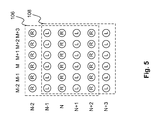
- FIG. 5 illustrates left view pixels and right view pixels stored in line buffers of the present invention in a row interlaced video data packing format.
- FIG. 6 illustrates left view pixels and right view pixels stored in line buffers of the present invention in a checkerboard video data packing format.
- FIG. 2 illustrates a block diagram of the present invention for processing of 3D video data.
- decoded left view pixels and decoded right view pixels of the 3D video data can be written to a memory 40 (not shown).
- the 3D video data can be retrieved from the memory 40 with the left view pixels and the right view pixels of the 3D video data.
- the retrieved left view pixels and the right view pixels can be stored in line buffers of the post-processing block 42 for post-processing.
- the post-processed pixels can be outputted to the display in a displayable format since the post-processing block 42 processes the right view pixels and the left view pixels in such format.
- an additional 3D video data demultiplexer (not shown) can receive the post-processed left view pixels and the right view pixels for output to the display using the display format of the display.
- FIG. 3 illustrates a flow chart of the present invention for processing 3D video data.
- a 3D video data can be transmitted in a multiple view stream.
- a receiver can receive the multiple view stream of the 3D video data 60 .
- the multiple view stream can then be decoded 62 to generate an interlaced right view pixels and left view pixels of the 3D video data.
- the generated left view pixels and the right view pixels can be post-processed in such interlaced format using a jump mode 64 .
- the interlaced right view pixels and the left view pixels can be received into line buffers of a post-processor of the present invention (now shown).
- the post-processor can perform enhancements to the left view pixels and the right view pixels.
- the left view pixels and the right view pixels can be both stored in the line buffers and processed together. For instance, the left view pixels can be processed first from the line buffers, momentarily ignoring the right view pixels. Once the left view pixels are processed, the right view pixels can be processed next in the line buffers, thereby ignoring the left view pixels.
- the line buffers of the post processor can be operated in a jump mode for post processing, meaning that certain rows and/or certain columns cane be specifically selected for applying post-processing methods for 3D video data enhancements on either the left view pixels or the right view pixels.
- This also means that the certain rows and/or certain column for the pixels not currently being post-processed are temporarily skipped, until it's that certain rows and/or certain columns turn for post-processing.
- An alternative implementation can be to replace another view's pixel with the current processing view's nearby pixels by either interpolation or duplication.
- left view pixels and right view pixels can be stored in the post-processor in the format to be outputted to a display.
- the finished, post-processed left view pixels and the right view pixels are outputted to a display 66 for viewing.
- FIG. 4 illustrates a flow chart of the present invention for processing 3D video data according to its respective video data packing format.
- post-processing can be performed as a function of the video data packing format.
- the data packing format can be known during the decoding of the 3D video data.
- that known format can be used to select the video data packing format for post-processing. For instance, if the data packing format is two-dimensional video data format, then there is a single view to be post-processed. The view of the video data can be post-processed 82 for enhancements. The post-processed view can then be outputted to a display 84 for viewing.
- the video data packing format for post-processing is a row interlace 3D video data format or a column interlace 3D video format
- a first view of the video data is post-processed 86
- a second view of the video data is post processed 88 .
- the post-processed views are outputted to a display 90 for viewing.
- line buffers can be used to store the first view pixels and the second view pixels for post-processing.
- the odd number rows of the line buffers can be the first view pixels (e.g., right view pixels) and the even number rows of the line buffers can be the second view pixels (e.g., left view pixels).
- the rows of the line buffers having the first view pixels can be post-processed for enhancements, while the rows of the line buffers having the second view pixels can be skipped until the respective system is ready to post-process the second view pixels.
- the rows of the line buffers having the second view pixels can be post-processed for enhancements, while the rows of the line buffers having the first view pixels can be skipped.
- line buffers can be used to store the first view pixels and the second view pixels for post-processing.
- the odd number columns of the line buffers can be the first view pixels (e.g., right view pixels) and the even number columns of the line buffers can be the second view pixels (e.g., left view pixels).
- the columns of the line buffers having the first view can be post-processed for enhancements, while the columns of the line buffers having the second view can be skipped until the respective system is ready to post-process the second view pixels.
- the columns of the line buffers having the second view pixels can be post-processed for enhancements, while the columns of the line buffers having the first view pixels can be skipped.
- the line buffers used in post-processing can have the first view pixels and the second view pixels in the same rows and columns. Missing pixels of the first view pixels can be interpolated for positions in the line buffers that have the second view 92 . Post-processing can be applied for the first view pixels in the line buffers and the interpolated first view pixels 94 . Missing pixels of the second view pixels can then be interpolated for positions in the line buffers that have the first view 96 . Post-processing can be applied for the second view pixels in the line buffers and the interpolated second view pixels 94 . Lastly, the post-processed view pixels can be outputted to the display 100 .
- FIG. 5 illustrates left view pixels and right view pixels stored in line buffers of the present invention in a row interlaced video data packing format.
- Line buffers for post-processing of the present invention can comprise rows of right view pixels (rows N ⁇ 2, N, and N+2) and left view pixels (rows N ⁇ 1 and N+1).
- Post-processing can be applied for a window 106 as detailed above.
- a next row (row N+3) can be inputted to the line buffers for further post-processing a new center row (N+1) as detailed above.
- a new window 108 can be processed for output to the display.
- the pixels can be outputted to the display in a raster scan mode.
- FIG. 6 illustrates left view pixels and right view pixels stored in line buffers of the present invention in a checkerboard video data packing format.
- Line buffers for post-processing of the present invention can comprise rows (row N ⁇ 2 to row N+2) and columns (column M ⁇ 2 to column M+3) having alternating pixels of a left view and a right view.
- Post-processing can be applied for a window 110 as detailed above. Once processing is finished, then the post-processed pixels (N,M) can be outputs to the display.
- the post-processed pixels can be sent to the display in an order of L(N,M), R(N, M+1), etc. Normally, the data can be placed in the same format as the display for viewing two views.
- the post-processing can be applied on the multiplexed 3D video.
Landscapes
- Engineering & Computer Science (AREA)
- Multimedia (AREA)
- Signal Processing (AREA)
- Testing, Inspecting, Measuring Of Stereoscopic Televisions And Televisions (AREA)
Abstract
Description
Claims (9)
Priority Applications (1)
| Application Number | Priority Date | Filing Date | Title |
|---|---|---|---|
| US14/046,797 US9300944B2 (en) | 2013-10-04 | 2013-10-04 | Methods and systems for processing 3D video data |
Applications Claiming Priority (1)
| Application Number | Priority Date | Filing Date | Title |
|---|---|---|---|
| US14/046,797 US9300944B2 (en) | 2013-10-04 | 2013-10-04 | Methods and systems for processing 3D video data |
Publications (2)
| Publication Number | Publication Date |
|---|---|
| US20150097926A1 US20150097926A1 (en) | 2015-04-09 |
| US9300944B2 true US9300944B2 (en) | 2016-03-29 |
Family
ID=52776631
Family Applications (1)
| Application Number | Title | Priority Date | Filing Date |
|---|---|---|---|
| US14/046,797 Active 2034-06-20 US9300944B2 (en) | 2013-10-04 | 2013-10-04 | Methods and systems for processing 3D video data |
Country Status (1)
| Country | Link |
|---|---|
| US (1) | US9300944B2 (en) |
Families Citing this family (1)
| Publication number | Priority date | Publication date | Assignee | Title |
|---|---|---|---|---|
| US10277904B2 (en) | 2015-08-28 | 2019-04-30 | Qualcomm Incorporated | Channel line buffer data packing scheme for video codecs |
Citations (2)
| Publication number | Priority date | Publication date | Assignee | Title |
|---|---|---|---|---|
| US20050008251A1 (en) * | 2003-05-17 | 2005-01-13 | Stmicroelectronics Asia Pacific Pte Ltd. | Edge enhancement process and system |
| US20150062295A1 (en) * | 2011-08-26 | 2015-03-05 | Aki Yoneda | Image processing system, transmitting device, receiving device, transmitting method, receiving method, and computer program |
-
2013
- 2013-10-04 US US14/046,797 patent/US9300944B2/en active Active
Patent Citations (2)
| Publication number | Priority date | Publication date | Assignee | Title |
|---|---|---|---|---|
| US20050008251A1 (en) * | 2003-05-17 | 2005-01-13 | Stmicroelectronics Asia Pacific Pte Ltd. | Edge enhancement process and system |
| US20150062295A1 (en) * | 2011-08-26 | 2015-03-05 | Aki Yoneda | Image processing system, transmitting device, receiving device, transmitting method, receiving method, and computer program |
Non-Patent Citations (1)
| Title |
|---|
| "A New Stereo Packing Format Based on Checkerboard Sub-Sampling for Efficient Stereo Video Coding", Jul. 12, 2012, Chiang et al, National Cheng Kung University, Taiwan. * |
Also Published As
| Publication number | Publication date |
|---|---|
| US20150097926A1 (en) | 2015-04-09 |
Similar Documents
| Publication | Publication Date | Title |
|---|---|---|
| US10390000B2 (en) | Systems and methods for providing closed captioning in three-dimensional imagery | |
| US9161023B2 (en) | Method and system for response time compensation for 3D video processing | |
| US8044994B2 (en) | Method and system for decoding and displaying 3D light fields | |
| US7916934B2 (en) | Method and system for acquiring, encoding, decoding and displaying 3D light fields | |
| US9077966B2 (en) | Apparatus and method for processing video content | |
| US8139081B1 (en) | Method for conversion between YUV 4:4:4 and YUV 4:2:0 | |
| CA2736105C (en) | Stereoscopic video delivery | |
| US9066025B2 (en) | Control of frequency lifting super-resolution with image features | |
| US8704932B2 (en) | Method and system for noise reduction for 3D video content | |
| US9161030B1 (en) | Graphics overlay system for multiple displays using compressed video | |
| US20120007951A1 (en) | System and format for encoding data and three-dimensional rendering | |
| US9521392B2 (en) | Method and system for frame rate conversion of 3D frames | |
| EP2309766A2 (en) | Method and system for rendering 3D graphics based on 3D display capabilities | |
| US9053752B1 (en) | Architecture for multiple graphics planes | |
| US20130322544A1 (en) | Apparatus and method for generating a disparity map in a receiving device | |
| US8483389B1 (en) | Graphics overlay system for multiple displays using compressed video | |
| US20090290789A1 (en) | Method and apparatus for reduced complexity video processing via special chroma handling | |
| US8165211B2 (en) | Method and apparatus of de-interlacing video | |
| US9300944B2 (en) | Methods and systems for processing 3D video data | |
| US7970056B2 (en) | Method and/or apparatus for decoding an intra-only MPEG-2 stream composed of two separate fields encoded as a special frame picture | |
| KR20210129210A (en) | Null Tile Coding in Video Coding | |
| EP1596595A1 (en) | Apparatus and method for image rendering | |
| US20140376644A1 (en) | Frame packing method, apparatus and system using a new 3d coding "frame compatible" format | |
| US8804036B1 (en) | Encoding for super resolution playback | |
| WO2011033706A1 (en) | Video signal processing device and video signal processing method. |
Legal Events
| Date | Code | Title | Description |
|---|---|---|---|
| AS | Assignment |
Owner name: AMLOGIC CO., LTD., CALIFORNIA Free format text: ASSIGNMENT OF ASSIGNORS INTEREST;ASSIGNORS:CHEN, XUYUN;ZHUANG, WEI;WANG, DONGJIAN;SIGNING DATES FROM 20131001 TO 20131004;REEL/FRAME:031406/0090 |
|
| AS | Assignment |
Owner name: AMLOGIC CO., LIMITED, HONG KONG Free format text: ASSIGNMENT OF ASSIGNORS INTEREST;ASSIGNOR:AMLOGIC CO., LTD.;REEL/FRAME:037953/0722 Effective date: 20151201 |
|
| STCF | Information on status: patent grant |
Free format text: PATENTED CASE |
|
| FEPP | Fee payment procedure |
Free format text: MAINTENANCE FEE REMINDER MAILED (ORIGINAL EVENT CODE: REM.); ENTITY STATUS OF PATENT OWNER: SMALL ENTITY |
|
| FEPP | Fee payment procedure |
Free format text: SURCHARGE FOR LATE PAYMENT, SMALL ENTITY (ORIGINAL EVENT CODE: M2554); ENTITY STATUS OF PATENT OWNER: SMALL ENTITY |
|
| MAFP | Maintenance fee payment |
Free format text: PAYMENT OF MAINTENANCE FEE, 4TH YR, SMALL ENTITY (ORIGINAL EVENT CODE: M2551); ENTITY STATUS OF PATENT OWNER: SMALL ENTITY Year of fee payment: 4 |
|
| MAFP | Maintenance fee payment |
Free format text: PAYMENT OF MAINTENANCE FEE, 8TH YR, SMALL ENTITY (ORIGINAL EVENT CODE: M2552); ENTITY STATUS OF PATENT OWNER: SMALL ENTITY Year of fee payment: 8 |