US9298430B2 - Method of compiling program to be executed on multi-core processor, and task mapping method and task scheduling method of reconfigurable processor - Google Patents

Method of compiling program to be executed on multi-core processor, and task mapping method and task scheduling method of reconfigurable processor Download PDF

Info

Publication number
US9298430B2
US9298430B2 US14/051,910 US201314051910A US9298430B2 US 9298430 B2 US9298430 B2 US 9298430B2 US 201314051910 A US201314051910 A US 201314051910A US 9298430 B2 US9298430 B2 US 9298430B2
Authority
US
United States
Prior art keywords
task
communication scheme
mapping
destination
scheduling
Prior art date
Legal status (The legal status is an assumption and is not a legal conclusion. Google has not performed a legal analysis and makes no representation as to the accuracy of the status listed.)
Active, expires
Application number
US14/051,910
Other versions
US20140109069A1 (en
Inventor
Jin-Hoo Lee
Moo-Kyoung CHUNG
Key-Young Choi
Yeon-gon Cho
Soo-jung Ryu
Current Assignee (The listed assignees may be inaccurate. Google has not performed a legal analysis and makes no representation or warranty as to the accuracy of the list.)
Samsung Electronics Co Ltd
SNU R&DB Foundation
Original Assignee
Samsung Electronics Co Ltd
Seoul National University R&DB Foundation
Priority date (The priority date is an assumption and is not a legal conclusion. Google has not performed a legal analysis and makes no representation as to the accuracy of the date listed.)
Filing date
Publication date
Application filed by Samsung Electronics Co Ltd, Seoul National University R&DB Foundation filed Critical Samsung Electronics Co Ltd
Assigned to SEOUL NATIONAL UNIVERSITY R&DB FOUNDATION, SAMSUNG ELECTRONICS CO., LTD. reassignment SEOUL NATIONAL UNIVERSITY R&DB FOUNDATION ASSIGNMENT OF ASSIGNORS INTEREST (SEE DOCUMENT FOR DETAILS). Assignors: CHO, YEON-GON, CHOI, KEY-YOUNG, CHUNG, MOO-KYOUNG, LEE, JIN-HOO, RYU, SOO-JUNG
Publication of US20140109069A1 publication Critical patent/US20140109069A1/en
Application granted granted Critical
Publication of US9298430B2 publication Critical patent/US9298430B2/en
Active legal-status Critical Current
Adjusted expiration legal-status Critical

Links

Images

Classifications

    • GPHYSICS
    • G06COMPUTING OR CALCULATING; COUNTING
    • G06FELECTRIC DIGITAL DATA PROCESSING
    • G06F8/00Arrangements for software engineering
    • G06F8/40Transformation of program code
    • GPHYSICS
    • G06COMPUTING OR CALCULATING; COUNTING
    • G06FELECTRIC DIGITAL DATA PROCESSING
    • G06F8/00Arrangements for software engineering
    • G06F8/40Transformation of program code
    • G06F8/41Compilation
    • GPHYSICS
    • G06COMPUTING OR CALCULATING; COUNTING
    • G06FELECTRIC DIGITAL DATA PROCESSING
    • G06F8/00Arrangements for software engineering
    • G06F8/40Transformation of program code
    • G06F8/41Compilation
    • G06F8/45Exploiting coarse grain parallelism in compilation, i.e. parallelism between groups of instructions
    • GPHYSICS
    • G06COMPUTING OR CALCULATING; COUNTING
    • G06FELECTRIC DIGITAL DATA PROCESSING
    • G06F9/00Arrangements for program control, e.g. control units
    • G06F9/06Arrangements for program control, e.g. control units using stored programs, i.e. using an internal store of processing equipment to receive or retain programs
    • G06F9/46Multiprogramming arrangements

Definitions

  • Apparatuses and methods consistent with the following description relate to a method for compiling a program to be executed on a multi-core processor, and task mapping and task scheduling of the multi-core processor.
  • Comparable programming for characteristics of a multicore architecture may improve the performance of multicore architecture.
  • mapping refers to a process of determining which processing elements to execute in terms of the tasks or individual parts of an application and representing the determination as a graph.
  • scheduling is a process that may follow the mapping process. Scheduling may determine an order and timing according to which the respective tasks are executed by the processing elements.
  • a multicore program executed on a multicore is so highly complex that manual writing of the program results in low programming productivity and/or low program quality. Further, the complexity of programming may be increased by the mapping and scheduling processes.
  • a method of compiling a program to be executed on a multicore processor including: generating an initial solution by mapping a task to a source processing element (PE) and a destination PE, and selecting a communication scheme for transmission of the task from the source PE to the destination PE; approximately optimizing the mapping and communication scheme included in the initial solution; and scheduling the task, wherein the communication scheme is designated in a compiling process.
  • PE source processing element
  • a method of mapping a task in a multi-core processor including: mapping the task to a first processing element from among multiple processing elements in the multi-core processor; moving the task from the first processing element to a second processing element at a first probability between 0 and 1; and replacing the task that has been moved to the second processing element at the first probability with another task mapped to a third processing element at a second probability between 0 and 1.
  • a method of scheduling tasks in a multi-core processor including: attempting to schedule two or more tasks within a first time period wherein the two or more tasks are to be executed on two or more processing elements of a multi-core processor; if the scheduling attempt fails due to one task overlapping another task, calculating a length of time during which the tasks are overlapping each other; and re-attempting to schedule the two or more tasks within a second time period which is equal to a sum of the first time period and the calculated length of time for which the tasks are overlapping.
  • FIGS. 1A and 1B are diagrams illustrating processing elements of a multicore processor, which communicate with each other using a shared memory;
  • FIGS. 2A and 2B are diagrams illustrating processing elements of a multicore processor, which communicate with each other by passing messages;
  • FIG. 3 is a flowchart illustrating a method of mapping tasks and determining a communication scheme according to an exemplary embodiment
  • FIG. 4 is a diagram illustrating in detail a step of changing an initial solution according to an exemplary embodiment
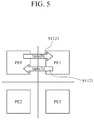
  • FIG. 5 is a diagram illustrating a case in which tasks are switched between processing elements at a probability of ⁇ according to an exemplary embodiment
  • FIG. 6 is a diagram illustrating a case in which a task is moved from one processing element to another processing element at a probability of (1 ⁇ ) according to an exemplary embodiment
  • FIG. 7 is a flowchart illustrating an optimization process according to an exemplary embodiment
  • FIG. 8 is a flowchart illustrating an instruction scheduling operation using a modulo algorithm according to an exemplary embodiment
  • FIG. 9 is a flowchart illustrating task scheduling operation using a modified modulo algorithm according to an exemplary embodiment
  • FIG. 10 is a flowchart illustrating a method of compiling a program to be executed on a reconfigurable processor according to an exemplary embodiment
  • FIG. 11 is a flowchart illustrating a method of compiling a program to be executed on a reconfigurable processor according to an exemplary embodiment
  • FIG. 12 is a flowchart illustrating a task mapping method performed by a reconfigurable processor according to an exemplary embodiment
  • FIG. 13 is a flowchart illustrating a task scheduling method performed by a reconfigurable processor according to an exemplary embodiment.
  • FIGS. 1A and 1B are diagrams illustrating processing elements of a multicore processor, which may communicate with each other using a shared memory 120 .
  • FIGS. 1A and 1B the same reference numerals represent the same elements.
  • Processing elements (PEs) 112 a and 112 b of a multicore processor may communicate with each other. Referring to FIGS. 1A and 1B , the processing elements communicate with each other with the help of and through the shared memory 120 .
  • the communication via the shared memory may be performed in stages, as follows:
  • a source PE 112 A may writes data to the shared memory 120 .
  • the shared memory 120 transmits an acknowledgement (ACK) to the source PE 112 a.
  • ACK acknowledgement
  • the source PE 112 a may transmit a synchronization (SYNC) packet to a destination PE 112 b.
  • SYNC synchronization
  • the destination PE 112 b may then transmit a read request to the shared memory 120 .
  • the shared memory 120 may transmit the data stored by the PE 112 a to the destination PE 112 b.
  • This method may be easy to program and facilitate multitasking.
  • a long path from the processing element 112 a to the shared memory 120 (labeled in FIG. 1B as “path(shared memory)”) may frequently occur.
  • the shared memory 120 in use may also have a large size and a slow operation speed. Further, there may exist drawbacks such as large power consumption and slow task execution speeds.
  • FIGS. 2A and 2B are diagrams illustrating processing elements 112 a and 112 b of a multicore processor, which may communicate with each other by transmitting messages.
  • processing elements (PEs) 112 a and 112 b may communicate with each other using a scratch-pad memory (SPM) that may be disposed in or near each processing element.
  • SPM scratch-pad memory
  • a source PE 112 a may therefore directly transmit data to a destination PE 112 b , rather than having to write the data to a shared memory 120 , which is commonly used by all processing elements of the multicore processor.
  • the data may be transmitted through the shortest path (illustrated in FIG.
  • path(SPM) from the source PE 112 a to the destination PE 112 b , and thus transmission time can be reduced, as compared to the path (“path(shared memory”) shown in FIG. 1B , which routes to and from the shared memory 120 .
  • path(shared memory) shown in FIG. 1B , which routes to and from the shared memory 120 .
  • an SPM may have a comparatively small capacity compared to a shared memory. Therefore, data transmission, called a “message passing method,” using an SPM may have the advantage of lower power consumption.
  • the benefits obtained from the application of the message passing method may vary depending on diverse factors, such as, a distance between two computers. Therefore, it may be proper to select a particular communication scheme between the shared memory-based communication scheme and the message passing-based communication scheme, during the mapping and/or scheduling processes.
  • FIG. 3 is a flowchart illustrating a method of mapping tasks and determining a communication scheme according to an exemplary embodiment.
  • task scheduling tasks are assigned to processing elements and a particular communication scheme is determined for transmission of each task between a source PE and a destination PE.
  • the method illustrated in FIG. 3 may be based on a simulated annealing (SA) algorithm that is a probabilistic algorithm.
  • SA simulated annealing
  • the new solution is better than the initial solution, replace the initial solution with the new solution, and if not, replace the initial solution with the new solution according to a predetermined probability r (r is greater than 0 and smaller than 1).
  • the SA algorithm can achieve a better solution than a local search algorithm.
  • the method shown in FIG. 3 may include two steps: generation of an initial solution (S 100 ) and change of the initial solution (S 110 ).
  • Each solution may include a task mapping state with respect to each PE and a particular communication scheme for transmission of each task between a source PE and a destination PE.
  • a new solution may be created by changing the task mapping state and communication scheme for each task.
  • FIG. 4 is a diagram illustrating in detail an operation step of changing an initial solution, similar to operation S 110 of FIG. 3 , according to an exemplary embodiment.
  • Operation S 110 may include task moving operation S 112 and communication scheme changing operation S 114 .
  • a task is moved to another PE with respect to the task mapped to a particular PE in the initial solution.
  • the task may be moved from the particular PE to another PE at a probability of a in S 1120 .
  • is a value between 0 and 1.
  • a probability of the task not moving is (1 ⁇ ) in S 1130 .
  • the task moving to the other PE may be switched with another task of a different PE at a probability of ⁇ in S 1121 .
  • is a value between 0 and 1.
  • FIG. 5 is a diagram illustrating a case in which tasks are switched between processing elements at a probability of ⁇ according to an exemplary embodiment.
  • task 0 is mapped to processing element PE0 and task 1 is mapped to processing element PE1.
  • the task 1 mapped to PE0 is moved to PE1 and the task 0 mapped to PE1 is moved to PE0 at a probability of ⁇ .
  • the task mapped to PE0 may be moved to yet another PE (PE2) at a probability of (1 ⁇ ).
  • FIG. 6 is a diagram illustrating a case in which a task is moved from one processing element to another processing element at a probability of (1 ⁇ ).
  • a current communication scheme may be changed to another communication scheme at a probability of ⁇ in S 1110 , S 1142 , and S 1144 .
  • a probability of changing the communication scheme using a shared memory is ⁇ .
  • is a value between 0 and 1.
  • the particular communication scheme may not be changed to another scheme at a probability of (1 ⁇ ) in S 1141 , S 1143 , and S 1145 .
  • optimization may need to be additionally performed on the changed solution.
  • a gain obtained from the use of the message passing-based communication scheme instead of a shared memory-based communication scheme, may vary depending on various factors, such as a communication distance between PEs, communication data traffic, or usage rate of SPM, etc. Therefore, it may be appropriate to preferentially apply the message passing-based communication scheme to a task that brings about more advantages from the message passing-based communication scheme than from the shared memory-based communication scheme.
  • a gain G(t) with respect to a task t between a source PE and a destination PE may be represented as equation (1) below.
  • G ( t ) ( L ⁇ A )/ T (1),
  • L represents a communication distance between a source PE and a destination PE
  • A represents data traffic between the source PE and the destination PE
  • B is the sum of SPM usage.
  • Heuristics more specifically, a greedy algorithm heuristic may be used for an optimization process.
  • the optimization process following the changing (S 110 ) of the initial solution can be considered as heuristic optimization.
  • FIG. 7 is a flowchart illustrating an optimization process according to an exemplary embodiment.
  • the optimization process includes the stages of: violation elimination (S 200 ) and utilization enhancement (S 210 ).
  • violation may be eliminated from mapping and/or communication schemes for each task included in the changed initial solution obtained in operation S 110 .
  • the mapping and communication schemes for each task which are included in the solution obtained after operation S 110 (change of the initial solution), may likely be associated with PEs transmitting data with sizes exceeding sizes of SPMs (hereinafter, the PEs are referred to as “violating” PEs).
  • the violation of the violating PEs may be eliminated.
  • the violating PEs are arranged in the order of data size that exceeds the size of SPM. Then, the message passing-based communication scheme designated to each task mapped to the arranged violating processing element(s) is changed to a shared memory-based communication scheme, until the violation is overcome (that is, until the data size of each violating PE does not exceed the size of SPM).
  • the communication scheme may be sequentially changed, starting from the task with the lowest gain which is obtained by Equation 1.
  • some PEs may have SPM with unused space that may be an excessively large. This may be because of either the initial solution or the change of the communication scheme of the task that requires a large memory capacity to the shared memory-based communication scheme in the violation elimination process.
  • the PEs containing SPM with unused space may be arranged in the order of an amount of the unused space of SPM. Then, the shared memory-based communication scheme that is designated for each task assigned to the arranged PEs is changed to the message passing-based communication scheme.
  • mapping is involved with how to determine PEs to which tasks are assigned
  • scheduling is a process to determine timing at which to execute each assigned task.
  • Modulo algorithm is a type of priority-based scheduling algorithm. Modulo algorithm estimates an initiation interval (II) which refers to a time interval between cycles of iterations, and then attempts to schedule all tasks within the estimated time interval. If the attempt to schedule the tasks fails, the iteration interval is gradually raised until an optimized II is found.
  • II initiation interval
  • FIG. 8 is a flowchart illustrating an instruction scheduling operation using a modulo algorithm according to an exemplary embodiment.
  • the modulo algorithm is an algorithm suited for scheduling instructions. For example, an iteration interval of a routine that is to be iteratively executed is assigned within the initiation interval (II) in operation S 300 . A condition may be applied such that scheduling is performed within a predetermined time period t in operation S 310 . The scheduling is repeatedly attempted in operation S 320 with the conditions of the iteration interval and the time period. When the scheduling attempt fails, the instruction scheduling attempts are made by increasing the time period by 1 (or unit time) in operation S 350 .
  • the initiation interval may be re-set to II+1 by increasing the initiation interval by 1 (or “unit time”) in operation S 360 .
  • the scheduling attempt starts from the predetermined time period (t).
  • this method may be appropriate for scheduling instructions, it may not be as conducive for task scheduling because it may take excessively large amounts of time to schedule tasks by using this method. Hence, the algorithm that is to be used for instruction scheduling may not be used in task scheduling.
  • FIG. 9 is a flowchart illustrating a task scheduling operation using a modified modulo algorithm according to an exemplary embodiment.
  • an iteration interval is assigned within an initiation interval, so as to schedule tasks with iteratively executed routines.
  • conditions are applied such that the scheduling is performed within a predetermined time period (t).
  • scheduling attempts are repeatedly made under the conditions of the iteration interval and the predetermined time period. When the scheduling attempt fails, scheduling is re-attempted in operation S 450 .
  • operation S 432 In the event of a failure of scheduling due to a particular task (task (a)) overlapping another task (task (b)), in operation S 432 , it calculates a length t overlap of a time period during which the tasks are overlapping.
  • the modified modulo algorithm differs from the general modulo algorithm in this respect.
  • operation S 450 a new time period (t+t overlap ) is set and the scheduling is attempted again within the new time period.
  • the modified modulo algorithm is different from the general modulo algorithm that increases the time period by a unit time (e.g., “1”) and re-attempts the scheduling within the new time period.
  • the iteration interval may be re-set by increasing the II in operation S 460 . In this case, the scheduling attempts are made again, starting from the predetermined time period (t).
  • the modified modulo algorithm calculates a minimum value (i.e., min(t overlap )) of the length t overlap of overlapping time period which is obtained based on the initiation interval (II) just before the re-setting of the iteration interval.
  • a minimum value i.e., min(t overlap )
  • the modified modulo algorithm calculates a minimum value (i.e., min(t overlap )) of the length t overlap of overlapping time period which is obtained based on the initiation interval (II) just before the re-setting of the iteration interval.
  • an attempt to schedule a task with the II set to II+min(t overlap ) is made. That is, the modified modulo algorithm is different from the general modulo algorithm in that the initiation interval (II) is increased by a unit time (e.g., “1”) and scheduling attempt is made again with the new initiation interval (II).
  • the execution time of task scheduling may be remarkably reduced when using the modified modulo algorithm, as compared to when using the general modulo algorithm. This is because, if the same number of re-attempts of scheduling are made, the modified modulo algorithm can make scheduling attempts with a time period that is longer than a time period set by the general modulo algorithm because t overlap and min (t overlap ) are each longer than a unit time.
  • the scheduling result of the modified modulo algorithm is not substantially lowered, as compared to the scheduling result of the general modulo algorithm.
  • FIG. 10 is a flowchart illustrating a method of compiling a program to be executed on a reconfigurable processor according to an exemplary embodiment.
  • the compiling method includes operations that include the generation of an initial solution (S 500 ), performing approximate optimization (S 510 ), and scheduling tasks (S 520 ).
  • an initial solution is generated as described above, such that a number of tasks are mapped to a plurality of processing elements using a probabilistic algorithm and a particular communication scheme for each task to be transmitted between a source processing element and a destination processing element is designated.
  • a probabilistic algorithm For example, a simulated annealing (SA) algorithm may be used as the probabilistic algorithm.
  • the particular communication scheme may be selected between a shared memory-based communication scheme and a scratch pad memory (SPM) utilizing message passing-based communication scheme. Reassignment of each task mapped to the processing element according to the initial solution and/or change of the communication scheme designated for each task may be performed on the basis of probabilities for each scheme.
  • mapping and communication schemes included in the initial solution are approximately optimized.
  • the approximate optimization may use heuristic as described above.
  • an optimization process may be performed to eliminate violation, such that the sum of sizes of data related to a task mapped to a particular processing element does not exceed the capacity of SPM.
  • the shared memory-based communication scheme designated to a task mapped to a processing element containing SPM with unused space is changed to a message passing-based communication scheme to enhance the degree of utilization of SPM.
  • Task scheduling may be performed by repeatedly performing the following operations: attempting to schedule the tasks within a predetermined time period, and when the scheduling attempt fails, calculating a length of a time period during which tasks are overlapping, then reattempting to schedule the tasks within a new time period that is obtained by adding the predetermined time period and the calculated overlapping time period.
  • FIG. 11 is a flowchart illustrating a method of compiling a program to be executed on a reconfigurable processor according to an exemplary embodiment.
  • Operations S 600 , S 610 and S 620 are substantially similar to operations S 500 , S 510 and S 520 of FIG. 10 , respectively.
  • the compiling method of FIG. 11 further includes evaluating (S 630 ) of a scheduling result after the scheduling operation S 620 . Based on the evaluation result from operation S 630 , a new solution that is better than an initial solution obtained in operation S 600 is generated in operation S 640 , and an approximate optimization operation S 610 and the following operations are performed on the new solution.
  • FIG. 12 is a flowchart illustrating a task mapping method performed by a reconfigurable processor according to an exemplary embodiment.
  • the task mapping method includes the operations of a relocating of tasks (S 700 ) and a changing of communication scheme (S 710 ).
  • a task mapped to one of multiple processing elements of a multicore processor is moved to another processing element at a first probability ranging between 0 and 1.
  • the task that has been moved to the other processing element at the first probability may be switched with a task mapped to a different processing element, at a second probability ranging between 0 and 1.
  • a communication scheme for each task to be transmitted between a source PE and a destination PE is changed at a third probability ranging between 0 and 1.
  • mapping results may be achieved.
  • FIG. 13 is a flowchart illustrating a task scheduling method performed by a reconfigurable processor according to another exemplary embodiment.
  • the task scheduling method includes operations of attempting to schedule tasks (S 800 ), calculating a length of an overlapping time period (S 810 ), calculating an iteration interval (S 820 ), and reattempting the scheduling (S 830 ).
  • a length of a time period during which the tasks are overlapping is calculated operation S 810 . Then, a second time period is obtained by adding the first time period S 820 and the calculated length of the overlapping time period and a new attempt to schedule the tasks with the second time period is made operation S 830 .
  • the task scheduling method of FIG. 13 may be applied to cyclic routines that are iteratively executed. Hence, if at least a part of a task is iteratively executed at a first iteration interval, a minimum value of an overlapping time period is obtained and a new iteration interval is set in operation S 820 by adding the current iteration interval and the obtained minimum value. Then, scheduling attempts are repeatedly made under the conditions of a second iteration interval and a second time period in operation S 830 .
  • the current embodiments can be implemented as computer readable codes in a computer readable record medium. Codes and code segments constituting the computer program can be easily inferred by a skilled computer programmer in the art.
  • the computer readable record medium includes all types of record media in which computer readable data are stored. Examples of the computer readable record medium include a ROM, a RAM, a CD-ROM, a magnetic tape, a floppy disk, and an optical data storage. Further, the record medium may be implemented in the form of a carrier wave such as Internet transmission. In addition, the computer readable record medium may be distributed to computer systems over a network, in which computer readable codes may be stored and executed in a distributed manner.

Landscapes

  • Engineering & Computer Science (AREA)
  • Theoretical Computer Science (AREA)
  • General Engineering & Computer Science (AREA)
  • Software Systems (AREA)
  • Physics & Mathematics (AREA)
  • General Physics & Mathematics (AREA)
  • Devices For Executing Special Programs (AREA)

Abstract

A method of compiling a program to be executed on a multicore processor is provided. The method may include generating an initial solution by mapping a task to a source processing element (PE) and a destination PE, and selecting a communication scheme for transmission of the task from the source PE to the destination PE, approximately optimizing the mapping and communication scheme included in the initial solution, and scheduling the task, wherein the communication scheme is designated in a compiling process.

Description

CROSS-REFERENCE TO RELATED APPLICATION
This application claims priority from Korean Patent Application No. 10-2012-0113103 filed in the Korean Intellectual Property Office on Oct. 11, 2012, the disclosure of which is incorporated herein by reference in its entirety.
BACKGROUND
1. Field
Apparatuses and methods consistent with the following description relate to a method for compiling a program to be executed on a multi-core processor, and task mapping and task scheduling of the multi-core processor.
2. Description of the Related Art
Comparable programming for characteristics of a multicore architecture may improve the performance of multicore architecture.
In programming using a multicore processor, mapping refers to a process of determining which processing elements to execute in terms of the tasks or individual parts of an application and representing the determination as a graph.
Further, scheduling is a process that may follow the mapping process. Scheduling may determine an order and timing according to which the respective tasks are executed by the processing elements.
However, a multicore program executed on a multicore is so highly complex that manual writing of the program results in low programming productivity and/or low program quality. Further, the complexity of programming may be increased by the mapping and scheduling processes.
In particular, due to the high degree of complexity of the program, significant difficulties may follow when a program developer individually designates a particular communication scheme for each core-mapped task to be processed between a source processing element and a destination processing element.
SUMMARY
According to an aspect of an exemplary embodiment, there is provided a method of compiling a program to be executed on a multicore processor, the method including: generating an initial solution by mapping a task to a source processing element (PE) and a destination PE, and selecting a communication scheme for transmission of the task from the source PE to the destination PE; approximately optimizing the mapping and communication scheme included in the initial solution; and scheduling the task, wherein the communication scheme is designated in a compiling process.
According to an aspect of another exemplary embodiment, there is provided a method of mapping a task in a multi-core processor, the method including: mapping the task to a first processing element from among multiple processing elements in the multi-core processor; moving the task from the first processing element to a second processing element at a first probability between 0 and 1; and replacing the task that has been moved to the second processing element at the first probability with another task mapped to a third processing element at a second probability between 0 and 1.
According to an aspect of another exemplary embodiment, there is provided a method of scheduling tasks in a multi-core processor, the method including: attempting to schedule two or more tasks within a first time period wherein the two or more tasks are to be executed on two or more processing elements of a multi-core processor; if the scheduling attempt fails due to one task overlapping another task, calculating a length of time during which the tasks are overlapping each other; and re-attempting to schedule the two or more tasks within a second time period which is equal to a sum of the first time period and the calculated length of time for which the tasks are overlapping.
BRIEF DESCRIPTION OF THE DRAWINGS
The above and/or other aspects will be more apparent by describing in detail exemplary embodiments, with reference to the accompanying drawings, in which:
FIGS. 1A and 1B are diagrams illustrating processing elements of a multicore processor, which communicate with each other using a shared memory;
FIGS. 2A and 2B are diagrams illustrating processing elements of a multicore processor, which communicate with each other by passing messages;
FIG. 3 is a flowchart illustrating a method of mapping tasks and determining a communication scheme according to an exemplary embodiment;
FIG. 4 is a diagram illustrating in detail a step of changing an initial solution according to an exemplary embodiment;
FIG. 5 is a diagram illustrating a case in which tasks are switched between processing elements at a probability of β according to an exemplary embodiment;
FIG. 6 is a diagram illustrating a case in which a task is moved from one processing element to another processing element at a probability of (1−β) according to an exemplary embodiment;
FIG. 7 is a flowchart illustrating an optimization process according to an exemplary embodiment;
FIG. 8 is a flowchart illustrating an instruction scheduling operation using a modulo algorithm according to an exemplary embodiment;
FIG. 9 is a flowchart illustrating task scheduling operation using a modified modulo algorithm according to an exemplary embodiment;
FIG. 10 is a flowchart illustrating a method of compiling a program to be executed on a reconfigurable processor according to an exemplary embodiment;
FIG. 11 is a flowchart illustrating a method of compiling a program to be executed on a reconfigurable processor according to an exemplary embodiment;
FIG. 12 is a flowchart illustrating a task mapping method performed by a reconfigurable processor according to an exemplary embodiment; and
FIG. 13 is a flowchart illustrating a task scheduling method performed by a reconfigurable processor according to an exemplary embodiment.
DETAILED DESCRIPTION
The following description is provided to assist the reader in gaining a comprehensive understanding of the methods, apparatuses, and/or systems described herein. Accordingly, various changes, modifications, and equivalents of the methods, apparatuses, and/or systems described herein will be suggested to those of ordinary skill in the art. Also, descriptions of well-known functions and constructions may be omitted for increased clarity and conciseness.
Throughout the drawings and the detailed description, unless otherwise described, the same drawing reference numerals will be understood to refer to the same elements, features, and structures. The relative size and depiction of these elements may be exaggerated for clarity, illustration, and convenience.
FIGS. 1A and 1B are diagrams illustrating processing elements of a multicore processor, which may communicate with each other using a shared memory 120.
In FIGS. 1A and 1B, the same reference numerals represent the same elements.
Processing elements (PEs) 112 a and 112 b of a multicore processor may communicate with each other. Referring to FIGS. 1A and 1B, the processing elements communicate with each other with the help of and through the shared memory 120.
The communication via the shared memory may be performed in stages, as follows:
A source PE 112A may writes data to the shared memory 120.
The shared memory 120 transmits an acknowledgement (ACK) to the source PE 112 a.
Once the data writing is complete, the source PE 112 a may transmit a synchronization (SYNC) packet to a destination PE 112 b.
The destination PE 112 b may then transmit a read request to the shared memory 120.
The shared memory 120 may transmit the data stored by the PE 112 a to the destination PE 112 b.
This method may be easy to program and facilitate multitasking. However, a long path from the processing element 112 a to the shared memory 120 (labeled in FIG. 1B as “path(shared memory)”) may frequently occur. Also, and the shared memory 120 in use may also have a large size and a slow operation speed. Further, there may exist drawbacks such as large power consumption and slow task execution speeds.
FIGS. 2A and 2B are diagrams illustrating processing elements 112 a and 112 b of a multicore processor, which may communicate with each other by transmitting messages. Referring to FIGS. 2A and 2B, processing elements (PEs) 112 a and 112 b may communicate with each other using a scratch-pad memory (SPM) that may be disposed in or near each processing element. A source PE 112 a may therefore directly transmit data to a destination PE 112 b, rather than having to write the data to a shared memory 120, which is commonly used by all processing elements of the multicore processor. In this case, the data may be transmitted through the shortest path (illustrated in FIG. 2B as “path(SPM)”) from the source PE 112 a to the destination PE 112 b, and thus transmission time can be reduced, as compared to the path (“path(shared memory”) shown in FIG. 1B, which routes to and from the shared memory 120. Further, generally an SPM may have a comparatively small capacity compared to a shared memory. Therefore, data transmission, called a “message passing method,” using an SPM may have the advantage of lower power consumption.
However, due to the small and limited capacity of the SPM, it may not be possible to transmit all messages using the message passing method.
The benefits obtained from the application of the message passing method may vary depending on diverse factors, such as, a distance between two computers. Therefore, it may be proper to select a particular communication scheme between the shared memory-based communication scheme and the message passing-based communication scheme, during the mapping and/or scheduling processes.
FIG. 3 is a flowchart illustrating a method of mapping tasks and determining a communication scheme according to an exemplary embodiment.
During task scheduling tasks are assigned to processing elements and a particular communication scheme is determined for transmission of each task between a source PE and a destination PE.
The method illustrated in FIG. 3 may be based on a simulated annealing (SA) algorithm that is a probabilistic algorithm.
The basic procedures of the SA algorithm are as follows:
Create an initial solution.
Obtain a new solution by randomly changing the initial solution.
If the new solution is better than the initial solution, replace the initial solution with the new solution, and if not, replace the initial solution with the new solution according to a predetermined probability r (r is greater than 0 and smaller than 1).
Through the procedures of (1) to (3), the SA algorithm can achieve a better solution than a local search algorithm.
The method shown in FIG. 3 may include two steps: generation of an initial solution (S100) and change of the initial solution (S110).
In S100, initial solutions are created. Each solution may include a task mapping state with respect to each PE and a particular communication scheme for transmission of each task between a source PE and a destination PE.
Then, a new solution may be created by changing the task mapping state and communication scheme for each task.
FIG. 4 is a diagram illustrating in detail an operation step of changing an initial solution, similar to operation S110 of FIG. 3, according to an exemplary embodiment.
Operation S110 may include task moving operation S112 and communication scheme changing operation S114.
In S112, it is determined whether a task is moved to another PE with respect to the task mapped to a particular PE in the initial solution. For example, the task may be moved from the particular PE to another PE at a probability of a in S1120. Here, α is a value between 0 and 1. A probability of the task not moving is (1−α) in S1130.
The task moving to the other PE may be switched with another task of a different PE at a probability of β in S1121. Here, β is a value between 0 and 1.
FIG. 5 is a diagram illustrating a case in which tasks are switched between processing elements at a probability of β according to an exemplary embodiment.
Referring to FIG. 5, task 0 is mapped to processing element PE0 and task 1 is mapped to processing element PE1. In S1121, the task 1 mapped to PE0 is moved to PE1 and the task 0 mapped to PE1 is moved to PE0 at a probability of β.
Referring back to FIG. 4, the task mapped to PE0 may be moved to yet another PE (PE2) at a probability of (1−β).
FIG. 6 is a diagram illustrating a case in which a task is moved from one processing element to another processing element at a probability of (1−β).
In S1122, task 0 mapped to PE0 is moved to processing element PE2.
Referring back to FIG. 4, in S114, it is determined whether a communication scheme of a source PE and destination PE for a particular task is changed or not.
For example, a current communication scheme may be changed to another communication scheme at a probability of γ in S1110, S1142, and S1144. If the current communication scheme is based on message passing, a probability of changing the communication scheme using a shared memory is γ. Here, γ is a value between 0 and 1.
In S114, the particular communication scheme may not be changed to another scheme at a probability of (1−γ) in S1141, S1143, and S1145.
In addition, after operation S110, optimization may need to be additionally performed on the changed solution.
When considering a fact that a size of SPM for use in a message passing-based communication scheme is limited, a PE attempting to achieve an optimized solution may need to make maximum use of SPM without exceeding the SPM's size.
In addition, a gain obtained from the use of the message passing-based communication scheme, instead of a shared memory-based communication scheme, may vary depending on various factors, such as a communication distance between PEs, communication data traffic, or usage rate of SPM, etc. Therefore, it may be appropriate to preferentially apply the message passing-based communication scheme to a task that brings about more advantages from the message passing-based communication scheme than from the shared memory-based communication scheme.
A gain G(t) with respect to a task t between a source PE and a destination PE may be represented as equation (1) below.
G(t)=(L×A)/T  (1),
where L represents a communication distance between a source PE and a destination PE, A represents data traffic between the source PE and the destination PE, and B is the sum of SPM usage.
Heuristics, more specifically, a greedy algorithm heuristic may be used for an optimization process. The optimization process following the changing (S110) of the initial solution can be considered as heuristic optimization.
FIG. 7 is a flowchart illustrating an optimization process according to an exemplary embodiment.
Referring to FIG. 7, the optimization process includes the stages of: violation elimination (S200) and utilization enhancement (S210). In operation S200, violation may be eliminated from mapping and/or communication schemes for each task included in the changed initial solution obtained in operation S110.
The mapping and communication schemes for each task, which are included in the solution obtained after operation S110 (change of the initial solution), may likely be associated with PEs transmitting data with sizes exceeding sizes of SPMs (hereinafter, the PEs are referred to as “violating” PEs). In operation S200, the violation of the violating PEs may be eliminated.
For example, the violating PEs are arranged in the order of data size that exceeds the size of SPM. Then, the message passing-based communication scheme designated to each task mapped to the arranged violating processing element(s) is changed to a shared memory-based communication scheme, until the violation is overcome (that is, until the data size of each violating PE does not exceed the size of SPM).
If there are many tasks whose communication scheme needs to be changed, the communication scheme may be sequentially changed, starting from the task with the lowest gain which is obtained by Equation 1.
Once the change of communication scheme of all tasks assigned to the violating PEs, starting from the PE with the smallest excess, is completed, a valid solution can be obtained.
In operation S210, a process for further utilizing an unused space of SPM in each PE is performed.
After the violation elimination operation, some PEs may have SPM with unused space that may be an excessively large. This may be because of either the initial solution or the change of the communication scheme of the task that requires a large memory capacity to the shared memory-based communication scheme in the violation elimination process.
In operation S210, the PEs containing SPM with unused space may be arranged in the order of an amount of the unused space of SPM. Then, the shared memory-based communication scheme that is designated for each task assigned to the arranged PEs is changed to the message passing-based communication scheme.
In the case that there are a number of tasks of which communication scheme are to be changed, it may be appropriate that the communication scheme of a task with higher gain is preferentially changed. The gain for each task is obtained by Equation 1.
Once the communication schemes of each task with respect to all PEs with available capacity of SPM is completed, starting from the PE with the largest unused space in SPM, the degree of utilization of SPM can be enhanced more than before. Thus, the solution is further optimized.
Scheduling process needs to follow the approximate optimization operation.
While mapping is involved with how to determine PEs to which tasks are assigned, scheduling is a process to determine timing at which to execute each assigned task.
An example described herein suggests a scheduling algorithm compatible with cyclic applications having backward dependency, as well as with acyclic applications. This algorithm will be referred to as a “modified modulo algorithm” for convenience of description.
Modulo algorithm is a type of priority-based scheduling algorithm. Modulo algorithm estimates an initiation interval (II) which refers to a time interval between cycles of iterations, and then attempts to schedule all tasks within the estimated time interval. If the attempt to schedule the tasks fails, the iteration interval is gradually raised until an optimized II is found.
FIG. 8 is a flowchart illustrating an instruction scheduling operation using a modulo algorithm according to an exemplary embodiment.
The modulo algorithm is an algorithm suited for scheduling instructions. For example, an iteration interval of a routine that is to be iteratively executed is assigned within the initiation interval (II) in operation S300. A condition may be applied such that scheduling is performed within a predetermined time period t in operation S310. The scheduling is repeatedly attempted in operation S320 with the conditions of the iteration interval and the time period. When the scheduling attempt fails, the instruction scheduling attempts are made by increasing the time period by 1 (or unit time) in operation S350. If a determination is made that it is not possible to schedule the instruction within a predetermined initiation interval (II) between iteration cycles of the instruction in operation S340, the initiation interval may be re-set to II+1 by increasing the initiation interval by 1 (or “unit time”) in operation S360. In this case, the scheduling attempt starts from the predetermined time period (t).
Though this method may be appropriate for scheduling instructions, it may not be as conducive for task scheduling because it may take excessively large amounts of time to schedule tasks by using this method. Hence, the algorithm that is to be used for instruction scheduling may not be used in task scheduling.
FIG. 9 is a flowchart illustrating a task scheduling operation using a modified modulo algorithm according to an exemplary embodiment.
Particularly, in operation S400, an iteration interval is assigned within an initiation interval, so as to schedule tasks with iteratively executed routines. In this case, in operation S410, conditions are applied such that the scheduling is performed within a predetermined time period (t). In operation S420, scheduling attempts are repeatedly made under the conditions of the iteration interval and the predetermined time period. When the scheduling attempt fails, scheduling is re-attempted in operation S450.
In the event of a failure of scheduling due to a particular task (task (a)) overlapping another task (task (b)), in operation S432, it calculates a length toverlap of a time period during which the tasks are overlapping. The modified modulo algorithm differs from the general modulo algorithm in this respect. In operation S450, a new time period (t+toverlap) is set and the scheduling is attempted again within the new time period. Hence, the modified modulo algorithm is different from the general modulo algorithm that increases the time period by a unit time (e.g., “1”) and re-attempts the scheduling within the new time period.
If a determination is made in operation S440 that it is not possible to perform scheduling within the initiation interval (II) that is predetermined between the iteration cycles, the iteration interval may be re-set by increasing the II in operation S460. In this case, the scheduling attempts are made again, starting from the predetermined time period (t).
Another difference between the modified modulo algorithm and the general modulo algorithm is that, in operation S442, the modified modulo algorithm calculates a minimum value (i.e., min(toverlap)) of the length toverlap of overlapping time period which is obtained based on the initiation interval (II) just before the re-setting of the iteration interval. In operation S460, an attempt to schedule a task with the II set to II+min(toverlap) is made. That is, the modified modulo algorithm is different from the general modulo algorithm in that the initiation interval (II) is increased by a unit time (e.g., “1”) and scheduling attempt is made again with the new initiation interval (II).
The execution time of task scheduling may be remarkably reduced when using the modified modulo algorithm, as compared to when using the general modulo algorithm. This is because, if the same number of re-attempts of scheduling are made, the modified modulo algorithm can make scheduling attempts with a time period that is longer than a time period set by the general modulo algorithm because toverlap and min (toverlap) are each longer than a unit time.
In addition, the scheduling result of the modified modulo algorithm is not substantially lowered, as compared to the scheduling result of the general modulo algorithm.
FIG. 10 is a flowchart illustrating a method of compiling a program to be executed on a reconfigurable processor according to an exemplary embodiment.
As shown in FIG. 10, the compiling method includes operations that include the generation of an initial solution (S500), performing approximate optimization (S510), and scheduling tasks (S520).
In operation S500, an initial solution is generated as described above, such that a number of tasks are mapped to a plurality of processing elements using a probabilistic algorithm and a particular communication scheme for each task to be transmitted between a source processing element and a destination processing element is designated. For example, a simulated annealing (SA) algorithm may be used as the probabilistic algorithm. The particular communication scheme may be selected between a shared memory-based communication scheme and a scratch pad memory (SPM) utilizing message passing-based communication scheme. Reassignment of each task mapped to the processing element according to the initial solution and/or change of the communication scheme designated for each task may be performed on the basis of probabilities for each scheme.
In operation S510, the mapping and communication schemes included in the initial solution are approximately optimized. The approximate optimization may use heuristic as described above.
For example, in operation S510, an optimization process may be performed to eliminate violation, such that the sum of sizes of data related to a task mapped to a particular processing element does not exceed the capacity of SPM.
In addition, the shared memory-based communication scheme designated to a task mapped to a processing element containing SPM with unused space is changed to a message passing-based communication scheme to enhance the degree of utilization of SPM.
In operation S520, scheduling of a number of tasks is performed.
Task scheduling may be performed by repeatedly performing the following operations: attempting to schedule the tasks within a predetermined time period, and when the scheduling attempt fails, calculating a length of a time period during which tasks are overlapping, then reattempting to schedule the tasks within a new time period that is obtained by adding the predetermined time period and the calculated overlapping time period.
FIG. 11 is a flowchart illustrating a method of compiling a program to be executed on a reconfigurable processor according to an exemplary embodiment.
Operations S600, S610 and S620 are substantially similar to operations S500, S510 and S520 of FIG. 10, respectively.
The compiling method of FIG. 11 further includes evaluating (S630) of a scheduling result after the scheduling operation S620. Based on the evaluation result from operation S630, a new solution that is better than an initial solution obtained in operation S600 is generated in operation S640, and an approximate optimization operation S610 and the following operations are performed on the new solution.
FIG. 12 is a flowchart illustrating a task mapping method performed by a reconfigurable processor according to an exemplary embodiment.
Referring to FIG. 12, the task mapping method includes the operations of a relocating of tasks (S700) and a changing of communication scheme (S710).
In operation S700, a task mapped to one of multiple processing elements of a multicore processor is moved to another processing element at a first probability ranging between 0 and 1.
Alternatively, the task that has been moved to the other processing element at the first probability may be switched with a task mapped to a different processing element, at a second probability ranging between 0 and 1.
In operation S710, a communication scheme for each task to be transmitted between a source PE and a destination PE is changed at a third probability ranging between 0 and 1.
Through the above operations of reassignment of tasks and change of communication scheme, more appropriate mapping results may be achieved.
FIG. 13 is a flowchart illustrating a task scheduling method performed by a reconfigurable processor according to another exemplary embodiment.
Referring to FIG. 13, the task scheduling method includes operations of attempting to schedule tasks (S800), calculating a length of an overlapping time period (S810), calculating an iteration interval (S820), and reattempting the scheduling (S830).
In operation S800, an attempt is made to schedule all tasks to be executed within a first time period.
If the task scheduling fails due to overlapping tasks, a length of a time period during which the tasks are overlapping is calculated operation S810. Then, a second time period is obtained by adding the first time period S820 and the calculated length of the overlapping time period and a new attempt to schedule the tasks with the second time period is made operation S830.
In addition, the task scheduling method of FIG. 13 may be applied to cyclic routines that are iteratively executed. Hence, if at least a part of a task is iteratively executed at a first iteration interval, a minimum value of an overlapping time period is obtained and a new iteration interval is set in operation S820 by adding the current iteration interval and the obtained minimum value. Then, scheduling attempts are repeatedly made under the conditions of a second iteration interval and a second time period in operation S830.
The current embodiments can be implemented as computer readable codes in a computer readable record medium. Codes and code segments constituting the computer program can be easily inferred by a skilled computer programmer in the art. The computer readable record medium includes all types of record media in which computer readable data are stored. Examples of the computer readable record medium include a ROM, a RAM, a CD-ROM, a magnetic tape, a floppy disk, and an optical data storage. Further, the record medium may be implemented in the form of a carrier wave such as Internet transmission. In addition, the computer readable record medium may be distributed to computer systems over a network, in which computer readable codes may be stored and executed in a distributed manner.
A number of examples have been described above. Nevertheless, it will be understood that various modifications may be made. For example, suitable results may be achieved if the described techniques are performed in a different order and/or if components in a described system, architecture, device, or circuit are combined in a different manner and/or replaced or supplemented by other components or their equivalents. Accordingly, other implementations are within the scope of the following claims.

Claims (24)

What is claimed is:
1. A method of compiling a program to be executed on a multicore processor, the method comprising:
generating an initial solution by mapping a task to a source processing element (PE) and a destination PE, and selecting a first communication scheme for transmission of the task from the source PE to the destination PE;
generating a new solution by changing the task mapping and selecting a second communication scheme, and determining whether to change the first communication scheme to the second communication scheme based on comparison of the new solution with the initial solution;
approximately optimizing at least one of the task mapping and the first communication scheme included in the initial solution, and the task mapping and the second communication scheme included in the new solution; and
scheduling task in the source PE and the destination PE,
wherein the communication scheme is designated in a compiling process, and
wherein the first communication scheme is a communication scheme that is based on a shared memory and the second communication scheme communication scheme that uses a scratch pad memory included in each of the source PE and the destination PE.
2. The method of claim 1, wherein the initial solution and the new solution are generated using a probabilistic algorithm.
3. The method of claim 2, wherein the probabilistic algorithm is a simulated annealing algorithm.
4. The method of claim 1, wherein the approximately optimizing of the mapping and communication scheme comprises:
reassigning the task mapped to the source PE and the destination PE.
5. The method of claim 4, wherein the reassigning of the task comprises:
remapping the task that has been mapped to the source PE and the destination PE to another PE at a first probability between 0 and 1.
6. The method of claim 5, wherein the remapping of the task comprises:
replacing the task that has been remapped to the another PE with a second task by mapping the second task to the source PE and destination PE at a second probability between 0and 1.
7. The method of claim 5, wherein the remapping of the task comprises:
changing the communication scheme designated for transmission of the task to a new communication scheme at a third probability between 0 and 1.
8. The method of claim 1, wherein the approximately optimizing of the mapping and communication scheme is performed using a greedy algorithm heuristic.
9. The method of claim 1, wherein the approximately optimizing of the mapping and communication scheme comprises:
eliminating violation, such that a size of data associated with the task mapped to the source PE and destination PE does not exceed a capacity of the scratch pad memory.
10. The method of claim 9, wherein the eliminating of the violation comprises:
changing the second communication scheme designated for the task mapped to the source PE and destination PE to the first communication scheme.
11. The method of claim 10, wherein the eliminating of the violation is performed until violation is eliminated with respect to at least the source PE and the destination PE.
12. The method of claim 11, wherein the eliminating of the violation is performed sequentially on processing elements, starting from a processing element, from among at least the source PE and the destination PE, with a largest excess of data that exceeds the associated scratch pad memory.
13. The method of claim 1, wherein the approximately optimizing of the mapping and communication schemes comprises:
enhancing a degree of utilization of the scratch pad memory with an unused space.
14. The method of claim 13, wherein the enhancing of the degree of utilization comprises:
changing the first communication scheme of the task to the second communication scheme.
15. The method of claim 1, wherein the scheduling of the task comprises:
attempting to schedule the task within a first time period;
calculating a length of time during which the task is overlapping with another task in response to the scheduling attempt failing due to the task overlapping the another task; and
re-attempting to schedule the task and the another task within a second time period which is equal to a sum of the first time period and the calculated length of time for which the task and the another task are overlapping.
16. The method of claim 15, wherein the scheduling of the two or more tasks comprises:
calculating a minimum value of the length of time for which tasks are overlapping in response to a part of the task being repeatedly executed at a first iteration interval; and
re-attempting to schedule the task to be repeatedly executed at a second iteration interval that is equal to a sum of the first iteration interval and the minimum value of the length of time for which tasks are overlapping.
17. The method of claim 1, further comprising:
evaluating a scheduling result subsequent to scheduling of the task.
18. The method of claim 17, further comprising:
re-generating the initial solution using the evaluation of the scheduling result.
19. The method of claim 1, wherein a second task is inversely mapped to the source PE and destination PE such that the second task will be switched with the task initially mapped, and
wherein the second communication scheme is selected for the transmission of the second task from the destination PE to the source PE.
20. A method of mapping a task in a multi-core processor, the method comprising:
mapping the task to a first processing element from among multiple processing elements in the multi-core processor;
moving the task from the first processing element to a second processing element at a first probability between 0 and 1;
replacing the task that has been moved to the second processing element at the first probability with another task mapped to a third processing element at a second probability between 0 and 1;
changing a first communication scheme designated for the task to a second communication scheme;
changing the selected communication scheme designated for the task to the first communication scheme or the second communication scheme which was previously unselected at a third probability between 0 and 1; and
changing the second communication scheme, when selected, of the task to the first communication scheme, such that a sum of data related to the task mapped to the particular processing element does not exceed capacity of a scratch pad memory of the particular processing element.
21. The method of claim 20,
wherein the task is designated with a communication scheme from at least one of a communication scheme that uses a shared memory and a communication scheme that uses at least one of scratch pad memory of the first processing element, a scratch pad memory of the second processing element, and a scratch pad memory of the third processing element.
22. The method of claim 20, further comprising:
changing the first communication scheme, when selected, of the task to the second communication scheme in response to a determination that the task is mapped to a processing element that contains a scratch pad memory with an unused space.
23. A method of scheduling tasks in a multi-core processor, the method comprising:
attempting to schedule two or more tasks within a first time period, wherein the two or more tasks are to be executed on two or more processing elements of a multi-core processor;
calculating a length of time during which the two or more tasks are overlapping each other in response to the scheduling attempt failing due to one task of the two or more tasks overlapping another task of the two or more tasks;
re-attempting to schedule the two or more tasks within a second time period that is equal to a sum of the first time period and the calculated length of time for which the tasks are overlapping;
calculating a minimum value of the length of time for which tasks are overlapping in response to a part of the task being repeatedly executed at a first iteration interval; and
re-attempting to schedule the task to be repeatedly executed at a second iteration interval that is equal to a sum of the first iteration interval and the minimum value of the length of time for which tasks are overlapping.
24. A method of mapping and scheduling a task on a multicore reconfigurable processor, the method comprising:
generating an initial solution for a task comprising a mapping, a communication scheme, and a scheduling;
changing the initial solution for the task by changing the mapping based on a first probability and changing the communication scheme according to a second probability;
rescheduling the task according to a calculated overlap value in response to a detection that the task overlaps with another task;
mapping the task to a source processing element (PE) and a destination PE;
selecting at least one of a shared memory communication scheme and a scratch pad memory communication scheme for transmitting the task from the source PE to the destination PE; and
scheduling a timing for the transmission of the task from the source PE to the destination PE,
wherein the communication scheme is designated in a compiling process.
US14/051,910 2012-10-11 2013-10-11 Method of compiling program to be executed on multi-core processor, and task mapping method and task scheduling method of reconfigurable processor Active 2034-04-15 US9298430B2 (en)

Applications Claiming Priority (2)

Application Number Priority Date Filing Date Title
KR1020120113103A KR101926464B1 (en) 2012-10-11 2012-10-11 Method for compiling program running on multi-core processor, task mapping method of multi-core processor and task scheduling method of reconfigurable processor
KR10-2012-0113103 2012-10-11

Publications (2)

Publication Number Publication Date
US20140109069A1 US20140109069A1 (en) 2014-04-17
US9298430B2 true US9298430B2 (en) 2016-03-29

Family

ID=49382262

Family Applications (1)

Application Number Title Priority Date Filing Date
US14/051,910 Active 2034-04-15 US9298430B2 (en) 2012-10-11 2013-10-11 Method of compiling program to be executed on multi-core processor, and task mapping method and task scheduling method of reconfigurable processor

Country Status (5)

Country Link
US (1) US9298430B2 (en)
EP (1) EP2720147B1 (en)
JP (1) JP6291209B2 (en)
KR (1) KR101926464B1 (en)
CN (1) CN103729228B (en)

Families Citing this family (8)

* Cited by examiner, † Cited by third party
Publication number Priority date Publication date Assignee Title
CN104641352B (en) * 2012-08-02 2018-06-29 西门子公司 For the pile line operation of cycle control system
CN103995744B (en) * 2014-05-22 2017-04-26 西安交通大学 Isomorphic calculation task grouping method used for eliminating memory access congestion
CN104572266B (en) * 2015-01-04 2018-03-06 华东师范大学 MPSoC task schedulings modeling based on UPPAAL SMC and appraisal procedure under process variation
CN107291548B (en) * 2016-03-31 2021-04-13 阿里巴巴集团控股有限公司 Task resource scheduling method and device
JP6873256B2 (en) 2017-09-27 2021-05-19 日立Astemo株式会社 In-vehicle multi-core control data transmission device and electronic control device
CN108108237B (en) * 2017-12-27 2021-09-28 电子科技大学 MILP-based heterogeneous multi-core mapping scheduling method for periodic associated tasks
US11128531B2 (en) * 2018-04-30 2021-09-21 Hewlett Packard Enterprise Development Lp Systems and methods for aggregate bandwidth and latency optimization
CN110514982B (en) * 2019-08-22 2022-03-22 上海兆芯集成电路有限公司 Performance Analysis System and Method

Citations (7)

* Cited by examiner, † Cited by third party
Publication number Priority date Publication date Assignee Title
CA2275826A1 (en) 1999-06-18 2000-12-18 Jia Xu A method of scheduling executions of periodic and asynchronous real-time processes having hard or soft deadlines
US20060161755A1 (en) * 2005-01-20 2006-07-20 Toshiba America Electronic Components Systems and methods for evaluation and re-allocation of local memory space
US20090213755A1 (en) 2008-02-26 2009-08-27 Yinghai Lu Method for establishing a routing map in a computer system including multiple processing nodes
US20100218190A1 (en) 2009-02-23 2010-08-26 International Business Machines Corporation Process mapping in parallel computing
US20100293312A1 (en) 2009-04-27 2010-11-18 Sonnier David P Network Communications Processor Architecture
US8020163B2 (en) 2003-06-02 2011-09-13 Interuniversitair Microelektronica Centrum (Imec) Heterogeneous multiprocessor network on chip devices, methods and operating systems for control thereof
US20120144401A1 (en) * 2010-12-03 2012-06-07 International Business Machines Corporation Data Communications For A Collective Operation In A Parallel Active Messaging Interface Of A Parallel Computer

Family Cites Families (12)

* Cited by examiner, † Cited by third party
Publication number Priority date Publication date Assignee Title
JP3364274B2 (en) * 1993-05-21 2003-01-08 松下電器産業株式会社 Task assignment device
JP3016359B2 (en) * 1995-07-21 2000-03-06 日本電気株式会社 Processor allocation device, processor allocation method, and medium storing processor allocation program in multiprocessor system
US7564847B2 (en) * 2004-12-13 2009-07-21 Intel Corporation Flow assignment
US8826228B2 (en) * 2006-03-27 2014-09-02 Coherent Logix, Incorporated Programming a multi-processor system
CN101165655A (en) * 2006-10-20 2008-04-23 国际商业机器公司 Multiple processor computation system and its task distribution method
JP2007188523A (en) * 2007-03-15 2007-07-26 Toshiba Corp Task execution method and multiprocessor system
CN102089752B (en) * 2008-07-10 2014-05-07 洛克泰克科技有限公司 Efficient parallel computation of dependency problems
CN101620526B (en) * 2009-07-03 2011-06-15 中国人民解放军国防科学技术大学 Method for reducing resource consumption of instruction memory on stream processor chip
KR101612780B1 (en) * 2009-11-13 2016-04-18 삼성전자주식회사 Computing system and method for controling memory of computing system
KR101565172B1 (en) * 2010-01-15 2015-11-02 삼성전자주식회사 Apparatus and method for processing data of massively parallel processor array system
KR101647817B1 (en) * 2010-03-31 2016-08-24 삼성전자주식회사 Apparatus and method for simulating reconfigrable processor
CN102087609B (en) * 2011-02-23 2013-06-05 中国人民解放军国防科学技术大学 Dynamic binary translation method under multi-processor platform

Patent Citations (7)

* Cited by examiner, † Cited by third party
Publication number Priority date Publication date Assignee Title
CA2275826A1 (en) 1999-06-18 2000-12-18 Jia Xu A method of scheduling executions of periodic and asynchronous real-time processes having hard or soft deadlines
US8020163B2 (en) 2003-06-02 2011-09-13 Interuniversitair Microelektronica Centrum (Imec) Heterogeneous multiprocessor network on chip devices, methods and operating systems for control thereof
US20060161755A1 (en) * 2005-01-20 2006-07-20 Toshiba America Electronic Components Systems and methods for evaluation and re-allocation of local memory space
US20090213755A1 (en) 2008-02-26 2009-08-27 Yinghai Lu Method for establishing a routing map in a computer system including multiple processing nodes
US20100218190A1 (en) 2009-02-23 2010-08-26 International Business Machines Corporation Process mapping in parallel computing
US20100293312A1 (en) 2009-04-27 2010-11-18 Sonnier David P Network Communications Processor Architecture
US20120144401A1 (en) * 2010-12-03 2012-06-07 International Business Machines Corporation Data Communications For A Collective Operation In A Parallel Active Messaging Interface Of A Parallel Computer

Non-Patent Citations (6)

* Cited by examiner, † Cited by third party
Title
Communication issued on Oct. 1, 2014 by the European Patent Office in related application No. 13188361.3.
Dimitroulakos et al., "Design space exploration of an optimized compiler approach for a generic reconfigurable array architecture", Feb. 24, 2007, The Journal of Supercomputing, vol. 40, Issue 2 , 31 pages. *
Dimitroulakos, Grigoris et al., "Design space exploration of an optimized compiler approach for a generic reconfigurable array architecture", The Journal of Supercomputing, vol. 40, No. 3, Feb. 24, 2007, total of 31 pages.
Galea et al., "A parallel simulated annealing approach for the mapping of large process networks", May 21-25, 2012, IEEE, IEEE 26th international, 6 pages. *
Lee et al., "A Task Remapping Technique for Reliable Multi-core Embedded Systems", Oct. 24-29, 2010, ACM, 10 pages. *
Suhendra et al., "Integrated Scratchpad Memory Optimization and Task Scheduling for MPSoc Architectures", Oct. 23-25, 2006, ACM, 10 pages. *

Also Published As

Publication number Publication date
EP2720147A2 (en) 2014-04-16
CN103729228A (en) 2014-04-16
JP6291209B2 (en) 2018-03-14
KR20140046897A (en) 2014-04-21
JP2014078239A (en) 2014-05-01
EP2720147B1 (en) 2020-06-17
KR101926464B1 (en) 2018-12-07
US20140109069A1 (en) 2014-04-17
EP2720147A3 (en) 2014-10-29
CN103729228B (en) 2018-05-11

Similar Documents

Publication Publication Date Title
US9298430B2 (en) Method of compiling program to be executed on multi-core processor, and task mapping method and task scheduling method of reconfigurable processor
US11748535B2 (en) System and method to generate a network-on-chip (NoC) description using incremental topology synthesis
US8195648B2 (en) Partitioned query execution in event processing systems
CN108681565B (en) Block chain data parallel processing method, device, equipment and storage medium
US9495206B2 (en) Scheduling and execution of tasks based on resource availability
CN114580653A (en) Machine learning calculation optimization method and compiler
US20130212594A1 (en) Method of optimizing performance of hierarchical multi-core processor and multi-core processor system for performing the method
US10423442B2 (en) Processing jobs using task dependencies
JP2011096247A (en) Device, method and computer program for affinity driven distributed scheduling of parallel computations (system and method for affinity driven distributed scheduling of parallel computations)
US9792132B2 (en) Code generator and method for generating extra code for a virtual machine
CN116467061B (en) Task execution method and device, storage medium and electronic equipment
US9471387B2 (en) Scheduling in job execution
KR20200136468A (en) Job scheduling
KR20110105615A (en) Terminal suitability application optimization device and method
US11226798B2 (en) Information processing device and information processing method
US20120017070A1 (en) Compile system, compile method, and storage medium storing compile program
US9262186B2 (en) Code rearranger and method for rearranging code for a virtual machine
US11513841B2 (en) Method and system for scheduling tasks in a computing system
CN116301874A (en) Code compiling method, electronic device and storage medium
Briceño et al. Robust static resource allocation of DAGs in a heterogeneous multicore system
CN107209680B (en) System and method for building distributed program
KR101332839B1 (en) Host node and memory management method for cluster system based on parallel computing framework
CN113260976A (en) Techniques for scheduling instructions in compiled source code
CN118034924A (en) Data processing method and device based on many-core system, electronic equipment and medium
CA2820230A1 (en) Data splitting for multi-instantiated objects

Legal Events

Date Code Title Description
AS Assignment

Owner name: SAMSUNG ELECTRONICS CO., LTD., KOREA, REPUBLIC OF

Free format text: ASSIGNMENT OF ASSIGNORS INTEREST;ASSIGNORS:LEE, JIN-HOO;CHUNG, MOO-KYOUNG;CHOI, KEY-YOUNG;AND OTHERS;REEL/FRAME:032029/0747

Effective date: 20140117

Owner name: SEOUL NATIONAL UNIVERSITY R&DB FOUNDATION, KOREA,

Free format text: ASSIGNMENT OF ASSIGNORS INTEREST;ASSIGNORS:LEE, JIN-HOO;CHUNG, MOO-KYOUNG;CHOI, KEY-YOUNG;AND OTHERS;REEL/FRAME:032029/0747

Effective date: 20140117

FEPP Fee payment procedure

Free format text: PAYOR NUMBER ASSIGNED (ORIGINAL EVENT CODE: ASPN); ENTITY STATUS OF PATENT OWNER: LARGE ENTITY

STCF Information on status: patent grant

Free format text: PATENTED CASE

MAFP Maintenance fee payment

Free format text: PAYMENT OF MAINTENANCE FEE, 4TH YEAR, LARGE ENTITY (ORIGINAL EVENT CODE: M1551); ENTITY STATUS OF PATENT OWNER: LARGE ENTITY

Year of fee payment: 4

MAFP Maintenance fee payment

Free format text: PAYMENT OF MAINTENANCE FEE, 8TH YEAR, LARGE ENTITY (ORIGINAL EVENT CODE: M1552); ENTITY STATUS OF PATENT OWNER: LARGE ENTITY

Year of fee payment: 8