US92854A - Improved device for raising- sunken vessels - Google Patents
Improved device for raising- sunken vessels Download PDFInfo
- Publication number
- US92854A US92854A US92854DA US92854A US 92854 A US92854 A US 92854A US 92854D A US92854D A US 92854DA US 92854 A US92854 A US 92854A
- Authority
- US
- United States
- Prior art keywords
- raising
- gas
- improved device
- sunken vessels
- balloons
- Prior art date
- Legal status (The legal status is an assumption and is not a legal conclusion. Google has not performed a legal analysis and makes no representation as to the accuracy of the status listed.)
- Expired - Lifetime
Links
- XEEYBQQBJWHFJM-UHFFFAOYSA-N Iron Chemical compound [Fe] XEEYBQQBJWHFJM-UHFFFAOYSA-N 0.000 description 6
- 239000000463 material Substances 0.000 description 4
- HCHKCACWOHOZIP-UHFFFAOYSA-N Zinc Chemical compound [Zn] HCHKCACWOHOZIP-UHFFFAOYSA-N 0.000 description 3
- 229910052742 iron Inorganic materials 0.000 description 3
- 238000000034 method Methods 0.000 description 3
- 239000011701 zinc Substances 0.000 description 3
- 229910052725 zinc Inorganic materials 0.000 description 3
- 244000286663 Ficus elastica Species 0.000 description 2
- UFHFLCQGNIYNRP-UHFFFAOYSA-N Hydrogen Chemical compound [H][H] UFHFLCQGNIYNRP-UHFFFAOYSA-N 0.000 description 2
- RRHGJUQNOFWUDK-UHFFFAOYSA-N Isoprene Chemical compound CC(=C)C=C RRHGJUQNOFWUDK-UHFFFAOYSA-N 0.000 description 2
- 239000002253 acid Substances 0.000 description 2
- 229920001195 polyisoprene Polymers 0.000 description 2
- 230000003405 preventing effect Effects 0.000 description 2
- XLYOFNOQVPJJNP-UHFFFAOYSA-N water Substances O XLYOFNOQVPJJNP-UHFFFAOYSA-N 0.000 description 2
- 241000272525 Anas platyrhynchos Species 0.000 description 1
- 229910001018 Cast iron Inorganic materials 0.000 description 1
- 101100075747 Drosophila melanogaster Lztr1 gene Proteins 0.000 description 1
- 241000596285 Gitana Species 0.000 description 1
- QAOWNCQODCNURD-UHFFFAOYSA-N Sulfuric acid Chemical compound OS(O)(=O)=O QAOWNCQODCNURD-UHFFFAOYSA-N 0.000 description 1
- 208000018747 cerebellar ataxia with neuropathy and bilateral vestibular areflexia syndrome Diseases 0.000 description 1
- 230000008878 coupling Effects 0.000 description 1
- 238000010168 coupling process Methods 0.000 description 1
- 238000005859 coupling reaction Methods 0.000 description 1
- 210000003414 extremity Anatomy 0.000 description 1
- 210000003141 lower extremity Anatomy 0.000 description 1
- 230000001105 regulatory effect Effects 0.000 description 1
- 239000000126 substance Substances 0.000 description 1
- 235000011149 sulphuric acid Nutrition 0.000 description 1
- 239000001117 sulphuric acid Substances 0.000 description 1
- 210000002105 tongue Anatomy 0.000 description 1
Images

Classifications
-
- B—PERFORMING OPERATIONS; TRANSPORTING
- B63—SHIPS OR OTHER WATERBORNE VESSELS; RELATED EQUIPMENT
- B63C—LAUNCHING, HAULING-OUT, OR DRY-DOCKING OF VESSELS; LIFE-SAVING IN WATER; EQUIPMENT FOR DWELLING OR WORKING UNDER WATER; MEANS FOR SALVAGING OR SEARCHING FOR UNDERWATER OBJECTS
- B63C7/00—Salvaging of disabled, stranded, or sunken vessels; Salvaging of vessel parts or furnishings, e.g. of safes; Salvaging of other underwater objects
- B63C7/06—Salvaging of disabled, stranded, or sunken vessels; Salvaging of vessel parts or furnishings, e.g. of safes; Salvaging of other underwater objects in which lifting action is generated in or adjacent to vessels or objects
- B63C7/12—Salvaging of disabled, stranded, or sunken vessels; Salvaging of vessel parts or furnishings, e.g. of safes; Salvaging of other underwater objects in which lifting action is generated in or adjacent to vessels or objects by bringing air or floating bodies or material into vessels or objects
Definitions
- This invention has for its object the raising of sunken vessels or material, also sustaining those-,Which are atloat.
- FIG. 1 shows 'a side view of a sunken vessel, with my generating-apparatus and some gas-receptacles or balloons affixed;
- Figure 2 shows View, partly in section and on a ⁇ largerscale, ofthe generator and balloon.
- D is sulphuric-acid jar.
- E isniron rod.
- l Fis stuffing-box for same.
- p G Vis height of vwater in generator.
- H is gas-supply pipe.
- I is strap, for holding same in position in gas-receptacle or balloon J.
- -K is the rope grommet, forming the open mouth of the balloon.
- 'L is rope netting or casing, having links M and toggle N at its lower extremity.
- the generator is made of cast-iron, havingoutward flanges around the top edge, made as shown, so as to receive an India-rubber washer, in order to form a water-tight joint when the top or cover'ls put on, and
- the pipe H must be flexible.
- the gas-receptacles, or balloons should be flexible, and must be made of waten-tight material. I propose to make them of three thicknesses of can-vas or duck, each to have two coats of melted India rubber. I also propose to cut the material into a circula-r shape,- say about twenty feet in diameter, and to pierce an eyelethole, at about the distance of a foot apart, around the circumferenee,- at about two vinches from the edge.
- IVhen about to commence operations for raising a Asunken vessel, I .first charge the generators with a sufcient amount of broken zinc, and about an equal weight of sulphmic acid, in a jar.
- the vessel will begin to rise, and as it rises, the water itself will act as a most-perfect safety-valve for the balloons, permitting of the escape of the gas in precise proportion to the lessening of the pressure upon them by reason of their approach tothe surface, and so prevent-ing their being burst.
- l may also state, that I have. found it convenient to use one generator to three balloons, supplying them simultaneously. byseparate'pipes, each connected to its own exit.
Landscapes
- Engineering & Computer Science (AREA)
- Mechanical Engineering (AREA)
- Ocean & Marine Engineering (AREA)
- Filling Or Discharging Of Gas Storage Vessels (AREA)
Description
'dinard gitana getest' emitir.
SAMUEL WILLIAM MAQUAY, 0F FOOTSCRAY, NEAR MELBOURNE,
VICTORIA.
Letters .Patent No. 92,854, dated July 20, 1869.
To all whom it may conce/rn Be it known that I, SAMUEL WmLIAM MAQUAY,
Aof Footscray, near Melbourne,v in the British Colonyof Victoria, electro-chemical'plater and gilder, have invented An Improved Method of Raising Sunken Vessels and Goods', and sustaining those which are afloat; and I do hereby declare that the following is a full and exact description thereof, reference being had to the accompanying drawings, and tothe letters of reference marked thereon. Y A
This invention has for its object the raising of sunken vessels or material, also sustaining those-,Which are atloat.
For this purpose I employ'hydrogengas, geuerated and applied in the manner and by the means hereinafter described.
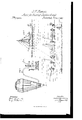
Referring to the drawings heretoannexed- Figure 1 shows 'a side view of a sunken vessel, with my generating-apparatus and some gas-receptacles or balloons affixed; and
Figure 2 shows View, partly in section and on a `largerscale, ofthe generator and balloon.
A-is the generator, in which is broken zinc C is wooden shelf.
D is sulphuric-acid jar. E isniron rod. l Fis stuffing-box for same. p G. Vis height of vwater in generator.
H is gas-supply pipe.
I is strap, for holding same in position in gas-receptacle or balloon J.
-K is the rope grommet, forming the open mouth of the balloon.
'L is rope netting or casing, having links M and toggle N at its lower extremity.
The generator is made of cast-iron, havingoutward flanges around the top edge, made as shown, so as to receive an India-rubber washer, in order to form a water-tight joint when the top or cover'ls put on, and
fastened toit by screws or otherwise.- There are also several perforated tongues or lugs projecting from the lower edge, in order to permit ofits being screwed down in any required place.
The pipe H must be flexible.
Above the stop-cock in the exit-pipe, to which this flexible tube is attached, there must be a valve opening upwards, for the piu'pose of preventing thewater from entering into the generator whenit is? not under pressure...
The gas-receptacles, or balloons, should be flexible, and must be made of waten-tight material. I propose to make them of three thicknesses of can-vas or duck, each to have two coats of melted India rubber. I also propose to cut the material into a circula-r shape,- say about twenty feet in diameter, and to pierce an eyelethole, at about the distance of a foot apart, around the circumferenee,- at about two vinches from the edge.
Through each of these eyelet-holes I pass a stout cord, and fasten them all to a circular rope grommet, about two and a half feet in diameter. N ow, in order to relieve the water-proof material from .the strain caused Aby the pressure of the gas, I construct a net-work of ropes, `(as shown,) suiieiently strong to bear a considerable margin of strain beyond that to which it is likely to be subjected. Theseropes all meet, and are fastened to one si'de of a triangle of round iron, to which are attached' three strong links, with a toggle at the end.
IVhen about to commence operations for raising a Asunken vessel, I .first charge the generators with a sufcient amount of broken zinc, and about an equal weight of sulphmic acid, in a jar.
I then place'the iron rod in the acid-jar, fill in the re'quisite quantity of Water, and fasten down the lid.
I then sink the generators, and fasten them in any convenient position on the deck of the vessel. The gas-receptacles, with their rope net-work casings, arev then sunk and fixed in position, the toggle being xed, say inside the port-holes or dead-lights.
vThe end of the pipe is'f'astened to the strap, on the inside of each of the balloons, before being'lowered, and I nowl attach the other extremity, by a coupling,
y .to the endv of the supply-exit in the generator.
All .being now ready, the `operator strikes the iron rods E, as nearly simultaneously as possible, so as to l break the acid-jars, and permit of .the generation of hydrogen-gas, which then passes through the pipes into the balloons.
As soon as the power of the gas exceeds the weight ofthe vessel and the strength of its adhesion to the bottom, the vessel will begin to rise, and as it rises, the water itself will act as a most-perfect safety-valve for the balloons, permitting of the escape of the gas in precise proportion to the lessening of the pressure upon them by reason of their approach tothe surface, and so prevent-ing their being burst.
It` will belnoticed, in iigrl of the drawing, that I have only shown a sufiicient numberef generators and balloons to illustrate the method of operation. Theil' size, number, and method of attachment, must be regulated by the circumstances of each' individual case.
It may be as well, perhaps, to state/that I. have found that generators of the size I have shown in my drawings, containing a hundred weight of acid, and a similar quantity,by' weight, of broken zinc, vn'll produce about' eight hundred feet of gas, at adeptll ofv seventy-two feet; but, of course, at a less .depthvit would produce a larger quantity, and of' a lss density. In any case, it requires about twenty-seven cubic feet of gas toraise one ton.
l may also state, that I have. found it convenient to use one generator to three balloons, supplying them simultaneously. byseparate'pipes, each connected to its own exit.
2. The gas-generating apparatus herein described,-
in combination with the balloon H, provided with the link M aud toggle N, as set forth, for the purpose speciiied.
The above specification of my invention signed by me, this day of 1866.
SAMUEL WILLIAM MAQUAY.
Witnesses:
EDWARD WATERS, J OHN ARTHUR.
Publications (1)
| Publication Number | Publication Date |
|---|---|
| US92854A true US92854A (en) | 1869-07-20 |
Family
ID=2162331
Family Applications (1)
| Application Number | Title | Priority Date | Filing Date |
|---|---|---|---|
| US92854D Expired - Lifetime US92854A (en) | Improved device for raising- sunken vessels |
Country Status (1)
| Country | Link |
|---|---|
| US (1) | US92854A (en) |
Cited By (1)
| Publication number | Priority date | Publication date | Assignee | Title |
|---|---|---|---|---|
| US2508800A (en) * | 1947-07-28 | 1950-05-23 | Rinne John | Equipment for salvaging submerged objects |
-
0
- US US92854D patent/US92854A/en not_active Expired - Lifetime
Cited By (1)
| Publication number | Priority date | Publication date | Assignee | Title |
|---|---|---|---|---|
| US2508800A (en) * | 1947-07-28 | 1950-05-23 | Rinne John | Equipment for salvaging submerged objects |
Similar Documents
| Publication | Publication Date | Title |
|---|---|---|
| US4087980A (en) | Safety submarine spherical air chamber | |
| US92854A (en) | Improved device for raising- sunken vessels | |
| US3086367A (en) | Offshore mooring platforms | |
| US3712070A (en) | Small portable underwater observation and communication chamber | |
| US719654A (en) | Marine life-preserver. | |
| US357657A (en) | Geoege sutherland dodmajst | |
| US579548A (en) | Device for locating sunken boats | |
| US1255512A (en) | Means for raising sunken objects. | |
| US1276826A (en) | Passenger life-buoy. | |
| US1348595A (en) | Apparatus for raising sunken vessels | |
| US317274A (en) | Ambeosb amieo | |
| US3992736A (en) | Expandable element check valve | |
| US515878A (en) | Device for floating vessels over bars | |
| US56858A (en) | Improved apparatus for buoying vessels | |
| US652412A (en) | Apparatus for locating and attaching raising means for sunken vessels. | |
| US906716A (en) | Means for raising sunken vessels. | |
| KR200299797Y1 (en) | A verify device sunken ship location | |
| US1206747A (en) | Bag and holding and releasing device. | |
| US1099814A (en) | Diving apparatus. | |
| US691713A (en) | Apparatus for raising sunken ships. | |
| US826342A (en) | Automatically-inflatable buoy. | |
| US1185386A (en) | Life-saving apparatus. | |
| US174655A (en) | Improvement in life-preservers | |
| US3682125A (en) | Anchor | |
| US659807A (en) | Life-preserver. |