US9285233B2 - Display control apparatus - Google Patents
Display control apparatus Download PDFInfo
- Publication number
- US9285233B2 US9285233B2 US14/127,713 US201214127713A US9285233B2 US 9285233 B2 US9285233 B2 US 9285233B2 US 201214127713 A US201214127713 A US 201214127713A US 9285233 B2 US9285233 B2 US 9285233B2
- Authority
- US
- United States
- Prior art keywords
- content
- area
- combination
- list
- value
- Prior art date
- Legal status (The legal status is an assumption and is not a legal conclusion. Google has not performed a legal analysis and makes no representation as to the accuracy of the status listed.)
- Active
Links
Images




Classifications
-
- G—PHYSICS
- G01—MEASURING; TESTING
- G01C—MEASURING DISTANCES, LEVELS OR BEARINGS; SURVEYING; NAVIGATION; GYROSCOPIC INSTRUMENTS; PHOTOGRAMMETRY OR VIDEOGRAMMETRY
- G01C21/00—Navigation; Navigational instruments not provided for in groups G01C1/00 - G01C19/00
- G01C21/26—Navigation; Navigational instruments not provided for in groups G01C1/00 - G01C19/00 specially adapted for navigation in a road network
- G01C21/34—Route searching; Route guidance
- G01C21/36—Input/output arrangements for on-board computers
- G01C21/3602—Input other than that of destination using image analysis, e.g. detection of road signs, lanes, buildings, real preceding vehicles using a camera
-
- G—PHYSICS
- G06—COMPUTING OR CALCULATING; COUNTING
- G06F—ELECTRIC DIGITAL DATA PROCESSING
- G06F3/00—Input arrangements for transferring data to be processed into a form capable of being handled by the computer; Output arrangements for transferring data from processing unit to output unit, e.g. interface arrangements
- G06F3/01—Input arrangements or combined input and output arrangements for interaction between user and computer
- G06F3/048—Interaction techniques based on graphical user interfaces [GUI]
- G06F3/0481—Interaction techniques based on graphical user interfaces [GUI] based on specific properties of the displayed interaction object or a metaphor-based environment, e.g. interaction with desktop elements like windows or icons, or assisted by a cursor's changing behaviour or appearance
-
- B—PERFORMING OPERATIONS; TRANSPORTING
- B60—VEHICLES IN GENERAL
- B60K—ARRANGEMENT OR MOUNTING OF PROPULSION UNITS OR OF TRANSMISSIONS IN VEHICLES; ARRANGEMENT OR MOUNTING OF PLURAL DIVERSE PRIME-MOVERS IN VEHICLES; AUXILIARY DRIVES FOR VEHICLES; INSTRUMENTATION OR DASHBOARDS FOR VEHICLES; ARRANGEMENTS IN CONNECTION WITH COOLING, AIR INTAKE, GAS EXHAUST OR FUEL SUPPLY OF PROPULSION UNITS IN VEHICLES
- B60K35/00—Instruments specially adapted for vehicles; Arrangement of instruments in or on vehicles
-
- B—PERFORMING OPERATIONS; TRANSPORTING
- B60—VEHICLES IN GENERAL
- B60K—ARRANGEMENT OR MOUNTING OF PROPULSION UNITS OR OF TRANSMISSIONS IN VEHICLES; ARRANGEMENT OR MOUNTING OF PLURAL DIVERSE PRIME-MOVERS IN VEHICLES; AUXILIARY DRIVES FOR VEHICLES; INSTRUMENTATION OR DASHBOARDS FOR VEHICLES; ARRANGEMENTS IN CONNECTION WITH COOLING, AIR INTAKE, GAS EXHAUST OR FUEL SUPPLY OF PROPULSION UNITS IN VEHICLES
- B60K35/00—Instruments specially adapted for vehicles; Arrangement of instruments in or on vehicles
- B60K35/20—Output arrangements, i.e. from vehicle to user, associated with vehicle functions or specially adapted therefor
- B60K35/21—Output arrangements, i.e. from vehicle to user, associated with vehicle functions or specially adapted therefor using visual output, e.g. blinking lights or matrix displays
- B60K35/22—Display screens
-
- B—PERFORMING OPERATIONS; TRANSPORTING
- B60—VEHICLES IN GENERAL
- B60K—ARRANGEMENT OR MOUNTING OF PROPULSION UNITS OR OF TRANSMISSIONS IN VEHICLES; ARRANGEMENT OR MOUNTING OF PLURAL DIVERSE PRIME-MOVERS IN VEHICLES; AUXILIARY DRIVES FOR VEHICLES; INSTRUMENTATION OR DASHBOARDS FOR VEHICLES; ARRANGEMENTS IN CONNECTION WITH COOLING, AIR INTAKE, GAS EXHAUST OR FUEL SUPPLY OF PROPULSION UNITS IN VEHICLES
- B60K35/00—Instruments specially adapted for vehicles; Arrangement of instruments in or on vehicles
- B60K35/20—Output arrangements, i.e. from vehicle to user, associated with vehicle functions or specially adapted therefor
- B60K35/28—Output arrangements, i.e. from vehicle to user, associated with vehicle functions or specially adapted therefor characterised by the type of the output information, e.g. video entertainment or vehicle dynamics information; characterised by the purpose of the output information, e.g. for attracting the attention of the driver
-
- B—PERFORMING OPERATIONS; TRANSPORTING
- B60—VEHICLES IN GENERAL
- B60K—ARRANGEMENT OR MOUNTING OF PROPULSION UNITS OR OF TRANSMISSIONS IN VEHICLES; ARRANGEMENT OR MOUNTING OF PLURAL DIVERSE PRIME-MOVERS IN VEHICLES; AUXILIARY DRIVES FOR VEHICLES; INSTRUMENTATION OR DASHBOARDS FOR VEHICLES; ARRANGEMENTS IN CONNECTION WITH COOLING, AIR INTAKE, GAS EXHAUST OR FUEL SUPPLY OF PROPULSION UNITS IN VEHICLES
- B60K35/00—Instruments specially adapted for vehicles; Arrangement of instruments in or on vehicles
- B60K35/20—Output arrangements, i.e. from vehicle to user, associated with vehicle functions or specially adapted therefor
- B60K35/29—Instruments characterised by the way in which information is handled, e.g. showing information on plural displays or prioritising information according to driving conditions
-
- B—PERFORMING OPERATIONS; TRANSPORTING
- B60—VEHICLES IN GENERAL
- B60K—ARRANGEMENT OR MOUNTING OF PROPULSION UNITS OR OF TRANSMISSIONS IN VEHICLES; ARRANGEMENT OR MOUNTING OF PLURAL DIVERSE PRIME-MOVERS IN VEHICLES; AUXILIARY DRIVES FOR VEHICLES; INSTRUMENTATION OR DASHBOARDS FOR VEHICLES; ARRANGEMENTS IN CONNECTION WITH COOLING, AIR INTAKE, GAS EXHAUST OR FUEL SUPPLY OF PROPULSION UNITS IN VEHICLES
- B60K35/00—Instruments specially adapted for vehicles; Arrangement of instruments in or on vehicles
- B60K35/80—Arrangements for controlling instruments
- B60K35/81—Arrangements for controlling instruments for controlling displays
-
- G—PHYSICS
- G01—MEASURING; TESTING
- G01C—MEASURING DISTANCES, LEVELS OR BEARINGS; SURVEYING; NAVIGATION; GYROSCOPIC INSTRUMENTS; PHOTOGRAMMETRY OR VIDEOGRAMMETRY
- G01C21/00—Navigation; Navigational instruments not provided for in groups G01C1/00 - G01C19/00
- G01C21/26—Navigation; Navigational instruments not provided for in groups G01C1/00 - G01C19/00 specially adapted for navigation in a road network
- G01C21/34—Route searching; Route guidance
- G01C21/36—Input/output arrangements for on-board computers
- G01C21/3626—Details of the output of route guidance instructions
- G01C21/3632—Guidance using simplified or iconic instructions, e.g. using arrows
-
- G—PHYSICS
- G01—MEASURING; TESTING
- G01C—MEASURING DISTANCES, LEVELS OR BEARINGS; SURVEYING; NAVIGATION; GYROSCOPIC INSTRUMENTS; PHOTOGRAMMETRY OR VIDEOGRAMMETRY
- G01C21/00—Navigation; Navigational instruments not provided for in groups G01C1/00 - G01C19/00
- G01C21/26—Navigation; Navigational instruments not provided for in groups G01C1/00 - G01C19/00 specially adapted for navigation in a road network
- G01C21/34—Route searching; Route guidance
- G01C21/36—Input/output arrangements for on-board computers
- G01C21/3626—Details of the output of route guidance instructions
- G01C21/3647—Guidance involving output of stored or live camera images or video streams
-
- G—PHYSICS
- G01—MEASURING; TESTING
- G01C—MEASURING DISTANCES, LEVELS OR BEARINGS; SURVEYING; NAVIGATION; GYROSCOPIC INSTRUMENTS; PHOTOGRAMMETRY OR VIDEOGRAMMETRY
- G01C21/00—Navigation; Navigational instruments not provided for in groups G01C1/00 - G01C19/00
- G01C21/26—Navigation; Navigational instruments not provided for in groups G01C1/00 - G01C19/00 specially adapted for navigation in a road network
- G01C21/34—Route searching; Route guidance
- G01C21/36—Input/output arrangements for on-board computers
- G01C21/3626—Details of the output of route guidance instructions
- G01C21/3658—Lane guidance
-
- G—PHYSICS
- G06—COMPUTING OR CALCULATING; COUNTING
- G06F—ELECTRIC DIGITAL DATA PROCESSING
- G06F3/00—Input arrangements for transferring data to be processed into a form capable of being handled by the computer; Output arrangements for transferring data from processing unit to output unit, e.g. interface arrangements
- G06F3/14—Digital output to display device ; Cooperation and interconnection of the display device with other functional units
- G06F3/1423—Digital output to display device ; Cooperation and interconnection of the display device with other functional units controlling a plurality of local displays, e.g. CRT and flat panel display
-
- G—PHYSICS
- G09—EDUCATION; CRYPTOGRAPHY; DISPLAY; ADVERTISING; SEALS
- G09G—ARRANGEMENTS OR CIRCUITS FOR CONTROL OF INDICATING DEVICES USING STATIC MEANS TO PRESENT VARIABLE INFORMATION
- G09G5/00—Control arrangements or circuits for visual indicators common to cathode-ray tube indicators and other visual indicators
- G09G5/14—Display of multiple viewports
-
- H—ELECTRICITY
- H04—ELECTRIC COMMUNICATION TECHNIQUE
- H04N—PICTORIAL COMMUNICATION, e.g. TELEVISION
- H04N21/00—Selective content distribution, e.g. interactive television or video on demand [VOD]
- H04N21/40—Client devices specifically adapted for the reception of or interaction with content, e.g. set-top-box [STB]; Operations thereof
- H04N21/43—Processing of content or additional data, e.g. demultiplexing additional data from a digital video stream; Elementary client operations, e.g. monitoring of home network or synchronising decoder's clock; Client middleware
- H04N21/431—Generation of visual interfaces for content selection or interaction; Content or additional data rendering
- H04N21/4312—Generation of visual interfaces for content selection or interaction; Content or additional data rendering involving specific graphical features, e.g. screen layout, special fonts or colors, blinking icons, highlights or animations
- H04N21/4314—Generation of visual interfaces for content selection or interaction; Content or additional data rendering involving specific graphical features, e.g. screen layout, special fonts or colors, blinking icons, highlights or animations for fitting data in a restricted space on the screen, e.g. EPG data in a rectangular grid
-
- H—ELECTRICITY
- H04—ELECTRIC COMMUNICATION TECHNIQUE
- H04N—PICTORIAL COMMUNICATION, e.g. TELEVISION
- H04N21/00—Selective content distribution, e.g. interactive television or video on demand [VOD]
- H04N21/40—Client devices specifically adapted for the reception of or interaction with content, e.g. set-top-box [STB]; Operations thereof
- H04N21/47—End-user applications
- H04N21/472—End-user interface for requesting content, additional data or services; End-user interface for interacting with content, e.g. for content reservation or setting reminders, for requesting event notification, for manipulating displayed content
-
- B60K2350/1096—
-
- B60K2350/352—
-
- B—PERFORMING OPERATIONS; TRANSPORTING
- B60—VEHICLES IN GENERAL
- B60K—ARRANGEMENT OR MOUNTING OF PROPULSION UNITS OR OF TRANSMISSIONS IN VEHICLES; ARRANGEMENT OR MOUNTING OF PLURAL DIVERSE PRIME-MOVERS IN VEHICLES; AUXILIARY DRIVES FOR VEHICLES; INSTRUMENTATION OR DASHBOARDS FOR VEHICLES; ARRANGEMENTS IN CONNECTION WITH COOLING, AIR INTAKE, GAS EXHAUST OR FUEL SUPPLY OF PROPULSION UNITS IN VEHICLES
- B60K2360/00—Indexing scheme associated with groups B60K35/00 or B60K37/00 relating to details of instruments or dashboards
- B60K2360/16—Type of output information
-
- B—PERFORMING OPERATIONS; TRANSPORTING
- B60—VEHICLES IN GENERAL
- B60K—ARRANGEMENT OR MOUNTING OF PROPULSION UNITS OR OF TRANSMISSIONS IN VEHICLES; ARRANGEMENT OR MOUNTING OF PLURAL DIVERSE PRIME-MOVERS IN VEHICLES; AUXILIARY DRIVES FOR VEHICLES; INSTRUMENTATION OR DASHBOARDS FOR VEHICLES; ARRANGEMENTS IN CONNECTION WITH COOLING, AIR INTAKE, GAS EXHAUST OR FUEL SUPPLY OF PROPULSION UNITS IN VEHICLES
- B60K2360/00—Indexing scheme associated with groups B60K35/00 or B60K37/00 relating to details of instruments or dashboards
- B60K2360/18—Information management
- B60K2360/186—Displaying information according to relevancy
-
- G—PHYSICS
- G06—COMPUTING OR CALCULATING; COUNTING
- G06F—ELECTRIC DIGITAL DATA PROCESSING
- G06F5/00—Methods or arrangements for data conversion without changing the order or content of the data handled
-
- G—PHYSICS
- G09—EDUCATION; CRYPTOGRAPHY; DISPLAY; ADVERTISING; SEALS
- G09G—ARRANGEMENTS OR CIRCUITS FOR CONTROL OF INDICATING DEVICES USING STATIC MEANS TO PRESENT VARIABLE INFORMATION
- G09G2340/00—Aspects of display data processing
- G09G2340/04—Changes in size, position or resolution of an image
- G09G2340/0464—Positioning
-
- G—PHYSICS
- G09—EDUCATION; CRYPTOGRAPHY; DISPLAY; ADVERTISING; SEALS
- G09G—ARRANGEMENTS OR CIRCUITS FOR CONTROL OF INDICATING DEVICES USING STATIC MEANS TO PRESENT VARIABLE INFORMATION
- G09G2340/00—Aspects of display data processing
- G09G2340/14—Solving problems related to the presentation of information to be displayed
Definitions
- the present disclosure relates to a display control apparatus for displaying vehicle information and the like in a display device prepared in the compartment of a vehicle so that the user can easily grasp the information.
- Information provided in the compartment of a vehicle is various. Examples of the information include vehicle speed, engine rotational speed, shift position, fuel, and water temperature indicative of the state of the vehicle. Other examples include a map for navigation, setting information of an air conditioner, and audio information. In recent years, a night view for driving assistance, information of a portable terminal carried in the vehicle, and the like are also provided.
- Various display devices for providing the information such as a head-up display and a liquid crystal display displaying a map for navigation and the like come to be mounted.
- Some meter panels displaying vehicle speed and the like can provide various information by employing liquid crystal or the like and can be said as a king of display devices.
- a display control apparatus controls a display device mounted in a vehicle.
- the display device includes a screen having a plurality of areas set as display regions.
- the display control apparatus controls the display device so as to assign a content to a corresponding area and to display the content.
- the display control apparatus includes: a content managing unit managing the content by associating content information as an attribute of the content with a corresponding content; an area managing unit managing the area by associating area information as an attribute of the area with a corresponding area; and a content assignment control unit determining a combination of the content managed by the content managing unit and the area managed by the area managing unit.
- the content assignment control unit executes: a content list generating process for generating a content list according to contents managed by the content managing unit; an area list generating process for generating an area list as an available combination of the areas managed by the area managing unit; a combination list extracting process for extracting a combination of the areas and the contents as a combination list based on the area list and the content list; an evaluation reference value calculating process for calculating an evaluation reference value of each combination list based on the content information and the area information; and a combination determining process for selecting the combination list and determining a combination of the contents and the areas based on the evaluation reference value of each combination list.
- one of combination lists is selected from extracted combination lists and a combination of a content and an area is determined. Consequently, a content and an area can be combined so as to be appropriate in total.
- a display control apparatus controls a display device mounted in a vehicle.
- the display device includes a screen having a plurality of areas set as display regions.
- the display control apparatus controls the display device so as to assign a content as an object to be displayed to at least one corresponding area.
- the display control apparatus includes: a content managing unit managing a content parameter associated with each content, each content parameter including at least a content evaluation value expressing a priority of display of the content or a content size expressing a size of display data; an assignment control unit generating a plurality of combination lists provided by the plurality of contents and the plurality of display areas; and an evaluation value obtaining unit obtaining a combination evaluation value corresponding to each combination list based on the content parameters.
- the assignment control unit selects one of the combination lists by comparing the combination evaluation value of each combination list.
- one of combination lists is selected from extracted combination lists and a combination of a content and an area is determined. Consequently, a content and an area can be combined so as to be appropriate in total.
- FIG. 1 is a block diagram illustrating a schematic configuration of a display control apparatus
- FIG. 2 is a diagram illustrating attributes associated with a content and an area
- FIGS. 3( a ) and 3 ( b ) are diagrams illustrating a hierarchical data structure in an area managing unit
- FIG. 4( a ) is a diagram illustrating a line-of-sight suitability table
- FIG. 4( b ) is a diagram illustrating an expression power suitability table
- FIG. 4( c ) is a diagram illustrating an operation suitability table
- FIGS. 5( a ) to 5 ( d ) are diagrams illustrating processes of an essential exclusive constraint equation specified by using a predetermined operator
- FIG. 6 is a flowchart illustrating the first-half part of a display control process
- FIG. 7 is a flowchart illustrating the latter half part of the display control process
- FIGS. 8( a ) to 8 ( c ) are diagrams concretely illustrating generation of an area list
- FIGS. 9( a ) and 9 ( b ) are diagrams concretely illustrating generation of an area list
- FIG. 10( a ) is a diagram illustrating an area list
- FIG. 10( b ) is a diagram illustrating a content list
- FIG. 10( c ) is a diagram illustrating assignment information
- FIG. 10( d ) is a diagram illustrating a combination list
- FIG. 11 is a flowchart illustrating a value changing process
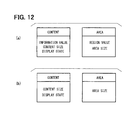
- FIGS. 12( a ) and 12 ( b ) are diagrams illustrating attributes associated with a content and an area in another embodiment
- FIGS. 13( a ) and 13 ( b ) are diagrams illustrating a concrete example of the display control process
- FIG. 14 is a diagram illustrating sections of areas set in a meter panel
- FIG. 15 is a diagram illustrating sections of areas set in a head-up display
- FIG. 16 is a diagram illustrating a hierarchical structure of areas in the meter panel and the head-up display
- FIG. 17 is a diagram illustrating content assigned to areas in the meter panel and the head-up display
- FIGS. 18( a ) and 18 ( b ) are diagrams illustrating a screen transition in the meter panel
- FIGS. 19( a ) and 19 ( b ) are diagrams illustrating priority of content
- FIGS. 20( a ) and 20 ( b ) are diagrams illustrating essential display of mail content.
- FIGS. 21( a ) and 21 ( b ) are diagrams illustrating a screen transition in the meter panel and the head-up display.
- FIG. 1 is a block diagram illustrating a schematic configuration of a display control apparatus 1 of an embodiment.
- the display control apparatus 1 is constructed mainly by a control unit 10 .
- a control unit 10 To the control unit 10 , three display devices 21 , 22 , and 23 and an input/output IF 30 are connected. To distinguish the three display devices 21 , 22 , and 23 , they will be described as “A display device 21 ”, “B display device 22 ”, and “C display device 23 ” as necessary.
- the three A, B, and C display devices 21 , 22 , and 23 are embodied as, for example, a head-up display, a meter panel, and a color liquid crystal display device for displaying a map and the like for navigation, respectively. However, they are not limited to the examples.
- the input/output IF 30 has a configuration for connection to a network in the vehicle (for example, CAN). Via the input/output IF 30 , the display control apparatus 1 is connected to a multimedia ECU 41 , a vehicle-speed ECU 42 , an engine rotational speed sensor 43 , various ECUs 44 , and various sensors 45 .
- the various ECUs 44 include, for example, a navigation ECU.
- the various sensors 45 include an ambient temperature sensor for detecting the temperature on the outside of the vehicle compartment and a water-temperature sensor for detecting the temperature of engine cooling water.
- the display control apparatus 1 can obtain various contents via a network.
- the contents include “audio information” obtained from the multimedia ECU 41 , “vehicle speed” obtained from the vehicle-speed ECU 42 , “engine rotational speed” obtained from the engine rotational speed sensor 43 , “map” obtained from the navigation ECU included in the various ECUs 44 , and “ambient temperature” obtained from the ambient temperature sensor included in the various sensors 45 .
- the control unit 10 has a content managing unit 11 , an area managing unit 12 , an assignment managing unit 13 , a content assignment control unit 14 , and a display layout control unit 15 .
- the content managing unit 11 has the function for managing the above-described contents and manages also contents in different categories.
- the content managing unit 11 has, as illustrated in FIG. 2 , a storing device storing four attributes (parameters) of “content value”, “content size”, “display state”, and “content characteristic” so as to be associated with a content.
- the content value in the embodiment indicates the value of a content for each display target person, that is, how useful the content is for a specific display target person in comparison to the other contents.
- display target persons are a driver, an assistant-driver-seat passenger, and a rear-seat passenger. That is, the value of a content various among the display target persons.
- contents such as “vehicle speed” and “engine rotational speed” are information which is valuable (useful) to the driver. Consequently, each content has three values of a content value (driver), a content value (assistant-driver-seat passenger), and a content value (rear-seat passenger).
- the content value is stored as a numerical value of “0” or larger.
- the display target persons are a driver, an assistant-driver-seat passenger, and a rear-seat passenger in the embodiment, further, rear-seat passengers may be discriminated as a left-side rear-seat passenger and a right-side rear-seat passenger or the content value may be set only for the driver as the display target person.
- the content size is the size of an area required to display the content and is expressed by, for example, the numbers of pixels in the vertical and horizontal directions.
- the display state is flag information indicating whether the content is a display target or not. Either an “active state” indicating that the content is a display target or an “inactive state” indicating that the content is not a display target is set.
- each content is switched between the “active state” and the “inactive state” in accordance with a vehicle state and a user operation. For example, when a shift range is R, a content of a “back monitor” based on information captured by a rear view camera is an “active state”. When the shift range is not R, the content of the “back monitor” is an “inactive state”. For example, when the user turns on an audio switch, the content of “audio information” of an audio control panel or the like becomes the “active state”. When the user turns off the audio switch, the content of “audio information” becomes the “inactive state”.
- the content characteristic is a characteristic the display area is required by the user to use the content.
- the three content characteristics such as the visual-line characteristic, the expression power characteristic, and the operation characteristic are associated with each content.
- the visual-line characteristic is set as an index expressing whether or not a content has to be disposed in a display area to which the driver does not have to move his/her visual line and which is easily seen by the driver, and is indicated in five levels “1” to “5”.
- the characteristic value increases as the degree that a content which does not permit the visual-line operation becomes higher.
- a content which does not permit the visual-line operation is a content the user has to frequently recognize and is, for example, “vehicle speed”.
- the visual-line characteristic is a characteristic to drivers.
- the expression power characteristic is set as an index expressing the degree of requiring the expression power (resolution, color, and the like) of the display area at the time of displaying a content in five levels “1” to “5”. The value increases as the degree that a content requires the expression power becomes higher.
- a content which requires the expression power is a content having a large amount of information and is, for example, a “map” for navigation.
- the operation characteristic is set as an index expressing the degree of necessity of an operation on a content in five levels “1” to “5”.
- the value increases as the degree of necessity of an operation for a content becomes higher.
- a content for which an operation is necessary is, for example, an “audio control panel” for a reason that an operation for, for example, selecting a music piece to be reproduced is necessary.
- each of the characteristics is expressed in the five levels “1” to “5” in the embodiment, the invention is not limited to the five levels. It is sufficient to express the characteristics in at least two levels.
- the area managing unit 12 has the function for managing a plurality of areas as display regions. Areas in the embodiment are set in the screen of the three display devices A 21 to C 23 .
- the area managing unit 12 similarly manages the areas in the three display devices A 21 to C 23 . That is, it manages the area in the display device A 21 and the area in the display device B 22 without distinction.
- the area managing unit 12 of the embodiment has a storing device for storing data so as to be associated with, as illustrated in FIG. 2 , the three attributes (parameters) of “area suitability”, “area size”, and “area characteristic” for each of the areas.
- the area suitability is an index expressing visibility of the area by the display target persons.
- the display target persons are a driver, an assistant-driver-seat passenger, and a rear-seat passenger. That is, the area suitability varies among the display target persons.
- the area of the meter panel has high area suitability for the driver.
- the area of a liquid crystal display device for displaying a map for navigation or the like has high area suitability for the driver and the assistant-driver-seat passenger. Consequently, each area has, although not limited, three values of suitability; area suitability (driver), area suitability (assistant-driver-seat passenger), and area suitability (rear-seat passenger).
- the area suitability will be indicated, although not limited, in ten levels “1” to “10”.
- the area size is the size of an area and is expressed by, for example, the number of pixels in the vertical and horizontal directions in a manner similar to the content size.
- the area characteristic is also a characteristic of an area corresponding to the content characteristics.
- three characteristics of the visual-line characteristic, the expression power characteristic, and the operation characteristic are associated with each area.
- the visual-line characteristic indicates whether a display target person has to move his/her visual line in five levels “1” to “5”.
- the characteristic value increases as the degree that a content which does not permit the visual-line operation becomes higher.
- a content which does not permit the visual-line operation is a content the user has to frequently recognize and is, for example, “vehicle speed”.
- the visual-line characteristic is a characteristic to drivers.
- the expression power characteristic expresses whether the expression power (resolution, color, and the like) of an area is high or not in five levels “1” to “5”. The higher the expression power of an area is, the larger the value is.
- An area having high expression power is, for example, the area of a liquid crystal display device displaying a “map” for navigation and the like.
- the operation characteristic expresses whether the operability of the area is high or not in five levels “1” to “5”. The higher the operability of the area is, the larger the value is.
- An area in which a complicated operation can be performed is, for example, the area of a liquid crystal display device integrated with a touch panel.
- the area characteristic is expressed in the five levels “1” to “5” in the embodiment, the invention is not limited to the five levels. It is sufficient to express the characteristics in at least two levels.
- the area managing unit 12 manages a plurality of areas which are set in the display devices A to C 21 to 23 by a hierarchical data structure.
- the area managing unit 12 has a storing device storing variables indicating hierarchical structure relations of the areas.
- the area of the A display device 21 will be described.
- the display screen of the A display device 21 can provide display areas a to g, and the storing device stores the inclusive relations of the areas.
- the inclusive relations of the areas are referred to at the time of extracting a combination of a content and an area, and areas included in areas already occupied are excluded from areas to which a content is assigned.
- the display regions of the A display device 21 are set as areas “d” and “e” obtained by dividing an area “b” into halves, and areas “f” and “g” obtained by dividing an area C into upper and lower parts.
- the area “a” is managed as the area in the highest hierarchy.
- the areas “b” and “c” are managed in the level just below the area “a”
- the areas “d” and “e” are managed in the level just below the area “b”
- the areas “f” and “g” are managed in the level just below the area “c”.
- the assignment managing unit 13 stores suitability tables for calculating the suitability based on the content characteristics and the area characteristics, an essential exclusion constraint equation which will be described later, and assignment information of a specific content for a specific area.
- the suitability tables include a visual-line suitability table (refer to FIG. 4( a )) for calculating visual-line suitability on the basis of the visual characteristics of a content and an area, an expression power suitability table (refer to FIG. 4( b )) for calculating expression power suitability for calculating expression power suitability on the basis of the expression power characteristics of a content and an area, and an operation suitability table (refer to FIG. 4( c )) for calculating operation suitability on the basis of the operation suitability on the basis of the operation characteristics of a content and an area.
- a visual-line suitability table for calculating visual-line suitability on the basis of the visual characteristics of a content and an area
- an expression power suitability table (refer to FIG. 4( b ))) for calculating expression power suitability for calculating expression power suitability on the basis of the expression power characteristics of a content and an area
- an operation suitability table (refer to FIG. 4( c )) for calculating operation suit
- the suitability is expressed in ten levels “1” to “10” in the suitability tables. The higher the suitability is, the larger the value is. Like the area suitability, the invention is not limited to the expression in the ten levels.
- the suitability by the characteristics is calculated from the content characteristic of each content and the area characteristics of each area. For example, it is assumed that a “map” for navigation having a large amount of information is a content requiring the expression power, so that its expression power characteristic is “5”, and the expression power characteristic of the area of the liquid crystal display device having high expression power is “5”. In this case, in the example of FIG. 4( b ), the expression power suitability is calculated as the maximum value “10”. It denotes that the expression power suitability at the time of combining the content “map” and the area of the liquid crystal display device is the maximum.
- the essential exclusion constraint equation is a constraint equation which is preliminarily determined so that, for example, a necessary content is properly assigned to an area, and overlapping contents are not redundantly displayed in a plurality of areas.
- the essential exclusive constraint equation in the embodiment is defined by five operators “&”, “
- the meaning of each of the operators is as shown in FIG. 5( a ). That is, in the case where both X and Y are active contents, X&Y denotes that both X and Y are displayed surely.
- Y denotes that at least one of X and Y is displayed.
- X ⁇ Y denotes that either X or Y is displayed.
- X/Y denotes that either X or Y is displayed or both X and Y are not displayed.
- X+Y denotes that both X and Y are displayed or both X and Y are not displayed.
- X/Y is expressed as “!(X&Y)” when an operator “!” having the meaning opposite to X&Y, that is, indicating negation, and X+Y is described as “!(X ⁇ Y)” having the meaning opposite to X ⁇ Y.
- a process for an operator is performed in a display control process which will be described later. To simplify the process, use of the operator “!” indicative of negation is avoided.
- assignment information of a specific content for a specific area indicates the correspondence relation between a predetermined specific area and a predetermined specific content. That is, in the embodiment, assignment of a content and an area is performed. By referring to the assignment information, a part of contents is assigned to a preliminarily designated area.
- the assignment information is as shown in FIG. 10( c ).
- the upper box in FIG. 10( c ) shows that the content X is assigned to the area “a” or “b”.
- the middle box indicates that the content Z is assigned to the area “a” or “c”.
- the lower box indicates that the content W is assigned to the area “b” or “d”.
- FIGS. 10( a ) to 10 ( e ) will be described later.
- the content assignment control unit 14 calculates evaluation values on all of combinations of contents and areas and stores the combinations of the contents and areas.
- the display layout control unit 15 displays a content on the basis of the combinations of the contents and the areas stored in the content assignment control unit 14 .
- FIG. 6 is a flowchart illustrating the first-half part of a display control process
- FIG. 7 is a flowchart illustrating the latter half part of the display control process.
- the content value and the area suitability will be collectively called “values”
- the content size and the area size will be collectively called “sizes”.
- first S 100 a value changing process is executed.
- the state of a vehicle in the embodiment, a driving state indicating whether the vehicle is driving or is stopped
- the content value of a content and the area suitability of an area are changed.
- the value changing process is executed in the embodiment, the process is not essential. Consequently, in another mode, the value changing process may be omitted. Another configuration that the process is executed only when a predetermined condition is satisfied may be employed.
- a content list is generated.
- the process is performed by extracting contents whose display state as an attribute of a content is “active state” and rearranging the extracted contents. For example, when there are contents X, Y, Z, and W, and contents which are in the “active state” are “X, Z, and W”, a content list of “X, Z, and W” is generated.
- step S 120 the essential exclusion constraint equation is processed.
- the essential exclusion constraint equation cannot be applied as it is to the contents in the content list because the content whose display state is the “inactive state” is also included in the essential exclusion constraint equation. In the embodiment, therefore, a process of changing the essential exclusion constraint equation including the content which is in the “inactive state” to an equivalent and simpler essential exclusion constraint equation is performed preliminarily.
- a syntax tree is generated from the essential exclusion constraint equation.
- the essential exclusion constraint equation of “(X&Y) ⁇ Z” is expressed as a syntax tree. It is assumed here that the contents X and Z are in the “active state”, and the content Y is in the “inactive state”. In this case, the content Y is deleted from the syntax tree and the operator “&” layered higher than Y is also deleted from the syntax tree (refer to reference character J). As a result, the syntax tree as illustrated in FIG. 5( c ) is obtained, and the indispensable exclusion constraint expression becomes “X ⁇ Z”.
- the method of deleting a content in the “inactive state” and the operator layered higher than the content is applied to the case where the higher layered operator is “&”, “
- An area list is a combination of usable areas.
- the area managing unit 12 stores the areas of the display devices A to C 21 to 23 in the hierarchical structure.
- the combination of usable areas is generated as an area list. For example, in the case where there is a hierarchical data structure as illustrated in FIG. 3( b ), the area “a” is extracted as one area list as illustrated in FIG. 8( a ). In the case where the area “a” is used, the other areas “b” to “g” cannot be used. As illustrated in FIG. 8( b ), the two areas “b” and “c” are extracted as one area list.
- the three areas “b”, “f”, and “g” are extracted as an area list as illustrated in FIG. 8( c )
- the three areas “c”, “d”, and “e” are extracted as an area list as illustrated in FIG. 9( a )
- the four areas “d”, “e”, “f”, and “g” are extracted as an area list as illustrated in FIG. 9( b ). That is, in the case based on the hierarchical data as illustrated in FIG. 3( b ), the five area lists “a”, “b, c”, “b, f, g”, “c, d, e”, and “d, e, f, g” are extracted (refer to FIG. 10( a )).
- a combination list is extracted.
- a combination of a content and an area is extracted as a combination list.
- a content list satisfying the essential constraint equation is generated (refer to FIG. 10( b )).
- an area list is generated (refer to FIG. 10( a )).
- the area lists and the content lists are extracted one by one, and a combination list is extracted on the basis of the assignment information, the size, and a flag indicating whether a content requires essential display or not.
- the area list “area a” in FIG. 10( a ) is extracted, and the content list “X, W” in FIG. 10( b ) is extracted.
- the assignment information illustrated in FIG. 10( c ) indicates assignment of the content X to the area “a” or “b”. Therefore, the combination “X-a” is realized.
- the content list is made of “X, W”, since only the area “a” exists in the area list, the combination is “X-a”. Since the content X which is requested to be essentially displayed is included, the combination list is “X-a” (refer to FIG. 10( d )).
- the area list “area a” in FIG. 10( a ) is extracted, and the content list “Z, W” in FIG. 10( b ) is extracted.
- the assignment information illustrated in FIG. 10( c ) indicates that the content Z is assigned to the area “a” or “c”. Therefore, the combination “Z-a” is realized.
- the content list is made of “Z, W”, since only the area “a” exists in the area list, the combination is “Z-a”. Since the content Z which is requested to be essentially displayed is included, the second combination list is “Z-a” (refer to FIG. 10( d )).
- the area list “areas b and c” in FIG. 10( a ) is extracted, and the content list “X, W” in FIG. 10( b ) is extracted.
- the assignment information illustrated in FIG. 10( c ) indicates that the content X is assigned to the area “a” or “b”. Therefore, the combination “X-b” is realized.
- the content W is extracted from the content list, and a combination with the area “c” is considered.
- the assignment information indicates that the content W is assigned to the area “b” or “d”. Therefore, the combination “W-c” is not realized, and the combination “X-b” is obtained. Since the content X which is requested to be essentially displayed is included, the third combination list is “X-b” (refer to FIG. 10( d )).
- the area list “areas b and c” in FIG. 10( a ) is extracted, and the content list “Z, W” in FIG. 10( b ) is extracted.
- the assignment information illustrated in FIG. 10( c ) indicates that the content Z is assigned to the area “a” or “c”. Therefore, the combination “X-c” is realized.
- the content W is extracted from the content list, and a combination with the area “b” is considered.
- the assignment information indicates that the content W is assigned to the area “b” or “d”. Therefore, the combination “W-b” is realized. That is, the combination “Z-c, W-b” is obtained. Since the content Z which is requested to be essentially displayed is included, the fourth combination list is “Z-c, W-b” (refer to FIG. 10( d )).
- the area lists are extracted one by one, and an area list which is effectively combined with each content list is extracted.
- the assignment information is used, and a combination of a content and an area which is not in the assignment information is excluded. There is an area which cannot be assigned from the viewpoint of size in relation between the content size and the area size, and such a combination is also excluded.
- a variable “m” indicative of a combination list is initialized as “1”. Each time the variable “m” is incremented, the combination list is processed in order like the first combination list, the second combination list, the third combination list, . . .
- a variable “n” indicative of a combination is initialized as “1”. Each time the variable “n” is incremented, the combination is processed in order like the first combination in the m-th combination list, the second combination in the m-th combination list, the third combination in the m-th combination list, . . .
- an evaluation value is calculated.
- an evaluation value on the n-th combination in the m-th combination list is calculated.
- the evaluation value is calculated by an object evaluation value and a characteristic evaluation value.
- the object evaluation values include a driver evaluation value (DE), an assistant-driver-seat passenger evaluation value (AE), and a rear-seat passenger evaluation value (RE).
- the characteristic evaluation values include a driver characteristic evaluation value (DCE), an assistant-driver-seat passenger characteristic evaluation value (ACE), and a rear-seat passenger characteristic evaluation value (RCE).
- DCE driver characteristic evaluation value
- ACE assistant-driver-seat passenger characteristic evaluation value
- RCE rear-seat passenger characteristic evaluation value
- K[D], K[A], and K[R] indicate the existence of a driver, an assistant-driver-seat passenger, and a rear-seat passenger, become “1” when a driver/passenger gets into a car, and are “0” when there is no driver/passenger in a car.
- K 1 to K 7 denote weighting coefficients.
- Evaluation value DE ⁇ DCE+AE ⁇ ACE+RE ⁇ RCE
- the processes from S 110 to S 250 are realized as the functions of the content assignment control unit 14 .
- the content is displayed.
- the process is performed to display the content in the combination of the content and the area read in S 250 in the area, and is realized as the function of the display layout control unit 15 .
- FIG. 11 is a flowchart illustrating the value changing process.
- the first S 101 whether a vehicle is driving or not is determined. The determination is made, for example, on the basis of “vehicle speed” transmitted from the vehicle-speed ECU 42 .
- the content value of the content is changed to a content value during driving in S 102
- the area suitability of the area is changed to area suitability during driving in S 103 and, after that, the value changing process is finished.
- the content values during driving/during stop for a content and the area suitability during driving/during stop for an area are predetermined. For example, it is considered that the value of a content obtained from the multimedia ECU 41 decreases during driving from the safety viewpoint or the like as compared with that during stop. For such a content, the content value during driving is set to be smaller than that during stop. It is also considered that the suitability of an area where the movement of the visual line becomes extremely smaller increases during driving. Therefore, for such an area, the area suitability during driving is set to be larger than that during stop.
- vehicle speed digital display of vehicle speed
- map map display for navigation
- areas as display objects are the area of “meter panel” and the area of the “liquid crystal display device” disposed in the center of the vehicle.
- the content values are expressed by the content value [driver], the content value [assistant-driver-seat passenger], and the content value [rear-seat passenger]. Those values will be described as C[D], C[A], and C[R].
- the content characteristics are expressed by the visual-line characteristic, the expression power characteristic, and the operation characteristic. Those characteristics will be described as EC, RC, and OC.
- the area suitability is expressed by area suitability [driver], area suitability [assistant-driver-seat passenger], and area suitability [rear-seat passenger].
- the suitability is expressed as A[D], A[A], and A[R].
- the area characteristics are expressed by the visual-line characteristic, the expression power characteristic, and the operation characteristic. Those characteristics will be described as EA, RA, and OA.
- Combination list A is made of “vehicle speed”-“meter panel”, “map”-“liquid crystal display device”.
- the combination list A is selected (S 240 in FIG. 7 ), the combination is read (S 250 ), and content display is performed (S 260 ) as illustrated in FIG. 13( a ).
- the combination list A is made of combinations of “vehicle speed”-“meter panel” and “map”-“liquid crystal display device”. It becomes “13179” as described above.
- the combination list B is made of combinations of “vehicle speed”-“liquid crystal display device” and “map”-“meter panel”. It becomes “9119” as described above.
- the combination list C is made of combinations of “vehicle speed”-“meter panel” and “back monitor”-“liquid crystal display device”.
- the combination list D is made of combinations of “vehicle speed”-“liquid crystal display device” and “back monitor”-“meter panel”.
- the combination list E is made of combinations of “map”-“meter panel” and “back monitor”-“liquid crystal display device”.
- the combination list F is made of combinations of “map”-“liquid crystal display device” and “back monitor”-“meter panel”.
- the combination list C is selected (S 240 in FIG. 7 ), the combination is read (S 250 ), and the content display is performed (S 260 ) as illustrated in FIG. 13( b ).
- a content list is generated from contents which are in the active state (S 110 in FIG. 6 ), the essential exclusion constraint equation is processed (S 120 ), and a content list satisfying the essential exclusion constraint equation is generated (S 130 ).
- an area list as a combination of usable areas is generated (S 140 ), and a combination of a content and an area is extracted as a combination list (S 150 ).
- An evaluation value based on a content value and area suitability is calculated for a combination included in the combination list (S 180 in FIG. 7 ), the evaluation value of each of combination lists is obtained as an evaluation reference value, and a combination list whose evaluation reference value is the maximum is selected (S 240 ), thereby determining a combination of a content and an area.
- a content list and an area list are generated first and, on the basis of both of the lists, a combination of an area and a content is extracted as a combination list. That is, a content whose value is large is not preferentially assigned to an area, but a best combination is selected from combinations.
- the content managing unit manages content parameters associated with a plurality of contents.
- the content parameters include at least a content evaluation value expressing priority of display of a content associated or a content size expressing size of display data.
- the assignment control unit generates a plurality of combination lists of a plurality of contents and a plurality of display areas.
- the evaluation value obtaining unit obtains combination evaluation values by the plurality of combination lists on the basis of the content parameters.
- the assignment control unit compares the combination evaluation values by the combination lists and selects a combination list.
- the evaluation value obtaining unit calculates a combination evaluation value from the content parameter and the area parameter. More specifically, the content parameter includes a content evaluation value, the area parameter includes an area evaluation value, the content evaluation value and the area evaluation value are set for each display target person as a display object in a vehicle, and the evaluation value obtaining unit calculates a combination evaluation including a target evaluation value of each display target person on the basis of the content evaluation value and the area evaluation value.
- the assignment control unit compares combination evaluation values by combination lists and selects a combination list having a higher combination evaluation value, thereby determining a combination of a content and an area.
- a combination list is selected from extracted combination lists and a combination of a content and an area is determined. Consequently, a content and an area can be combined so as to be appropriate in total.
- the display state is included in the attributes of a content (refer to FIG. 2 ), and a content list is generated by using contents whose display state is the “active state” (S 110 in FIG. 6 ). In such a manner, whether a content is set to a display object or not can be easily managed.
- an essential exclusion constraint equation as display information specifying essential exclusion display of a content is stored in the assignment managing unit 13 , and the content assignment control unit 14 processes the essential exclusion constraint equation (S 120 in FIG. 6 ), and generates a content list based on the essential exclusion constraint equation (S 130 ). In such a manner, a combination of a content and an area is determined including the essential exclusion display of the content, and more appropriate information display can be performed.
- the area managing unit 12 has a hierarchical data structure of areas (refer to FIGS. 3( a ) and 3 ( b )) and generates an area list as a combination of usable areas on the basis of the hierarchical structure (S 140 in FIG. 6) . In such a manner, the area list based on the hierarchical data structure can be generated.
- the assignment managing unit 13 preliminarily manages assignment information of a specific content to a specific area (refer to FIG. 10( c )) and extracts a combination list of a content and an area satisfying the assignment information (S 150 in FIG. 6) .
- a combination list in which the assignment information is considered is extracted, so that designability of the screen of the display device can be assured.
- a content desired by the user can be assigned to an area desired by the user.
- a content size is associated with a content
- an area size is associated with an area (refer to FIG. 2 ). While comparing the content size and the area size, a combination list is extracted so that the content lies within the area (S 150 in FIG. 6 ). As a result, without necessity of scrolling a content so as to be displayed or necessity of reducing the size of a content so as to be displayed, information can be displayed in a manner that it can be easily grasped by the user.
- a combination list is extracted so that a content required to be essentially displayed is included (S 150 in FIG. 6 ). Since a content required to be essentially displayed is included in a combination at a stage of extracting a combination list, the content can be displayed reliably.
- the content managing unit 11 manages a content so as to associate a content characteristic indicative of a characteristic of the content
- the area managing unit 12 manages an area so as to associate an area characteristic indicative of a characteristic of the area.
- the content association control unit 14 calculates an evaluation value in consideration of a characteristic evaluation value calculated on the basis of the content characteristic and the area characteristic (S 180 in FIG. 7 ) and determines a combination of a content and an area (S 240 ). By the operation, the combination of the content and the area is determined in consideration of the characteristics of the content and the area, the more appropriate combination of the content and the area can be determined.
- the visual line suitability based on the visual line characteristics of a content and an area is obtained, and a characteristic evaluation value is calculated.
- the expression power suitability based on the expression power characteristics of a content and an area is obtained, and a characteristic evaluation value is calculated.
- an operation suitability based on the operation characteristics of a content and an area is obtained, and a characteristic evaluation value is calculated.
- the content parameter includes a content characteristic which is at least one of a visual-line characteristic, an expression power characteristic, and an operation characteristic
- the area parameter includes an area characteristic corresponding to the content characteristic
- the evaluation value obtaining unit calculates the combination evaluation value including a characteristic evaluation value on the basis of the content characteristic and the area characteristic. In such a manner, the combination of a content and an area can be determined on the basis of the characteristic evaluation values on the visual line, expression power, and operability, and a proper combination of the content and the area can be determined.
- a suitability table which obtains suitability for calculating a characteristic evaluation value from a content characteristic and an area characteristic is stored (refer to FIGS. 4( a ) to 4 ( c )).
- the characteristic evaluation value can be derived relatively easily from the content characteristic and the area characteristic.
- the values of a content and an area are changed (S 100 in FIG. 6 ).
- the values are changed to the content value and area suitability during driving (S 102 and S 103 ).
- the values are changed to a content value and area suitability during stop (S 104 and S 105 ).
- the content can be assigned to a more appropriate area.
- various contents are obtained via a network in a vehicle (refer to FIG. 1 ).
- the content managing unit 11 similarly performs management by associating “content value”, “content size”, “display state”, and “content characteristic” to each of various contents (refer to FIG. 2 ).
- the content can be assigned to an area by the same algorism.
- “area suitability”, “area size”, and “area characteristic” are associated to a plurality of areas in the display devices A to C 21 to 23 , thereby managing the areas (refer to FIG. 2 ). Consequently, even when the display devices 21 to 23 are different, an area to which a content has to be assigned can be determined by the same algorithm.
- the content managing unit 11 manages a content by associating four attributes of “content value”, “content size”, “display state”, and “content characteristic” to the content.
- the area managing unit 12 manages, as illustrated in FIG. 2 , an area by associating three attributes of “area suitability”, “area size”, and “area characteristic” to the area. Consequently, an evaluation value including a target evaluation value calculated from the content value and the area suitability and a characteristic evaluation value calculated from the content characteristic and the area characteristic is calculated as an evaluation reference value.
- the content managing unit 11 may manage a content by associating three attributes of “information value”, “content size”, and “display state” to the content
- the area managing unit 12 may manage an area by associating two attributes of “region value” and “area size” to the area.
- the information value denotes the degree of importance of a content.
- the information value generally becomes higher as a content whose urgency such as “warning information” becomes higher and “vehicle speed”, “engine rotational speed”, and the like as contents regarding a driving state follow.
- Contents such as “map” and “audio information” for navigation have a relatively low information value.
- the region value indicates the degree of importance of an area. Generally, the more the visibility of an area is, the higher the region value is set. For example, the region value of the area of the head-up display using the windshield is high.
- one area list and one content list are taken out and a combination list is extracted on the basis of assignment information, size, and a flag indicating whether the content is a content required to be essentially displayed. Further, a combination in which the information value is larger than the region value is extracted. That is, a combination in which the information value is smaller than the region value is excluded.
- the area managing unit storing area parameters associated with the plurality of display areas and including an area evaluation value expressing assignment priority of the content or an area size expressing size of a display region of the area
- the area parameter includes the area evaluation value
- the assignment control unit compares the content evaluation value and the area evaluation value and determines a combination in which the content evaluation value is larger than the area evaluation value as an area in which the content can be displayed and to which the content can be assigned.
- the information value itself of a content in the n-th combination in the m-th combination list is obtained.
- a combination list having the largest total of the information values is selected. That is, the content parameters include a content evaluation value (in this case, the information value), and the evaluation value obtaining unit calculates a total value of content evaluation values in each combination list, compares the combination evaluation values of the combination lists, and selects the combination list having the largest combination evaluation value.
- the area managing unit 12 manages the areas in the display devices A 21 to C 23 by the hierarchical data structure.
- the areas of the display device A 21 are layered as illustrated in FIGS. 3( a ) and 3 ( b ).
- the area is partitioned as illustrated in FIG. 14 .
- a center area indicated by reference character A in the meter panel, a center area indicated by reference character A, a left-side area indicated by reference character B, a right-upper area indicated by reference character C, and the like are set.
- the center area is layered, and a plurality of contents can be assigned to the area.
- the area is partitioned as illustrated in FIG. 15 .
- An area indicated by reference character D is layered, and a plurality of contents can be assigned to the area.
- the area hierarchical structure in this case is as illustrated in FIG. 16 .
- a hierarchy structure is added as Plugin Layout Area as shown by a broken line.
- the contents include “night view”, “gadget L”, “speed (“vehicle speed” displayed in the meter panel”, “speed (“vehicle speed” displayed in the head-up display)”, “lane/turn-by-turn”, “tachometer”, “ACC (Adaptive Cruise Control)”, “energy flow”, “shift position”, “fuel gauge”, “outside air temperature”, “odometer”, “gadget Small”, “mail Small”, and “mail Large”.
- an information value and a content size are associated.
- the information value of the content “gadget Large” is “0” (S 102 in FIG. 11 ).
- the content of “night view” having the largest information value is displayed in the center area of the meter panel since the information value of “night view” is “130” as illustrated in FIG. 19( a ). Since the total of the contents “ACC” and “energy flow” is only “120”, in this case, the content of “night view” is singularly displayed in the center.
- the information value in the case of singularly displaying the content of “night view” in the center area of the meter panel and the information value in the case of displaying the three contents of “lane/turn by turn”, “ACC”, and “energy flow” in the center area are compared.
- the display mode of the center area of the meter panel is as illustrated in FIG. 18( b ).
- the content “mail Large” is to be moved out from the center area of the meter panel.
- the content “mail Small” has to be essentially displayed. Therefore, as illustrated in FIG. 20( b ), the content “mail Small” is displayed in the right upper area in the meter panel.
- the hierarchical structure is added as PluginLayoutArea (refer to FIG. 16 ).
- FIG. 21( a ) the contents of “lane/turn by turn” and “speed” are displayed in the area of the head-up display, and the content “energy flow” is displayed in the center area of the meter panel.
- the content “night view” becomes the active state, as illustrated in FIG. 21( b )
- the total of the information values becomes larger, so that the content “night view” is displayed in the center area of the meter panel in place of the content “energy flow”.
- the content managing unit 11 manages a content by associating two attributes of “content size” and “display state” to the content
- the area managing unit 12 manages an area by associating the attribute “area size” to the area.
- the assignment control unit compares the content size and the area size in each combination list and, in the case where the content size is smaller than the area size, determines that the content can be assigned to the area as the area in which the content can be displayed.
- the difference between the content size and the area size in the n-th combination in the m-th combination list is calculated. For example, the difference of pixel numbers in at least one of the vertical and horizontal directions is calculated. In the case of calculating differences in both of the vertical and horizontal directions, a difference correspondence value based on the two differences is calculated. For example, a value obtained by adding the two differences is set as the difference correspondence value.
- a combination list in which the total of differences (difference correspondence values) is the smallest is selected.
- an evaluation value is calculated with respect to all of combinations of contents and areas.
- the invention is not limited to the mode. It is also possible to obtain possible combinations and evaluations of only specific contents and specific areas and determine a combination of a content and an area on the basis of the obtained evaluation value.
- combinations of contents and areas are extracted as a list in the foregoing embodiment, the disclosure is not limited to the mode. Without extracting combinations by a data structure in the list form, combinations may be defined by variables such as pointers.
- the display device D 50 is a cellular phone such as a smartphone, an information terminal called a PDA, or the like.
- area information may be obtained from the display device D 50 itself.
- the content managing unit 11 may obtain contents from the display device D 50 .
- the value changing process is executed in the foregoing embodiment, since the process is not essential, the value changing process may be omitted. The process may be executed only when a predetermined condition is satisfied.
- a content value and area suitability are changed on the basis of a driving condition of a vehicle, which is whether the vehicle is driving or not in the embodiment, they may be changed according to finer driving conditions such as low-speed driving and high-speed driving. For example, using a system capable of calculating a load of a driver or the like, they may be changed in consideration of a load of the driver or the like.
- the suitability tables illustrated in FIGS. 4( a ) to 4 ( c ) may be changed on the basis of the driving state of a vehicle. In such a manner, a characteristic evaluation value according to the vehicle state can be derived, and a characteristic evaluation value becomes more appropriate.
- a content size and an area size are compared, and an area in which a content can lies is picked up.
- reduction display of contents or scroll display of contents is performed and a content is assigned to an area whose area size is smaller than the content size.
- an essential exclusion constraint equation is processed (S 120 in FIG. 6 ) and a content list based on the essential exclusion constraint equation is generated (S 130 ).
- an essential exclusion constraint equation can be specified and similarly processed.
- an area list can be generated with inclusion of an essential exclusion relation of areas.
- the essential exclusion constraint equation specifying the essential exclusion relation of areas corresponds to “area use information”.
- the assignment managing unit 13 corresponds to an “area use information storing unit”.
- the disclosure includes the following modes.
- a display control apparatus controls a display device mounted in a vehicle.
- the display device includes a screen having a plurality of areas set as display regions.
- the display control apparatus controls the display device so as to assign a content to a corresponding area and to display the content.
- the display control apparatus includes: a content managing unit managing the content by associating content information as an attribute of the content with a corresponding content; an area managing unit managing the area by associating area information as an attribute of the area with a corresponding area; and a content assignment control unit determining a combination of the content managed by the content managing unit and the area managed by the area managing unit.
- the content assignment control unit executes: a content list generating process for generating a content list according to contents managed by the content managing unit; an area list generating process for generating an area list as an available combination of the areas managed by the area managing unit; a combination list extracting process for extracting a combination of the areas and the contents as a combination list based on the area list and the content list; an evaluation reference value calculating process for calculating an evaluation reference value of each combination list based on the content information and the area information; and a combination determining process for selecting the combination list and determining a combination of the contents and the areas based on the evaluation reference value of each combination list.
- the content list generating process is performed to generate a content list from contents managed by the content managing unit.
- a content list is made of contents satisfying a predetermined condition.
- a plurality of content lists are generated.
- the area list generating process is to generate an area list as a usable combination of the areas managed by the area managing unit. Considering partition of areas as will be described later, there is a case that a plurality of patterns exist as usable area combinations. Therefore, there is a case that a plurality of area lists are generated.
- the combination list extracting process is to extract a combination of areas and contents as a combination list on the basis of an area list and a content list.
- the combination is extracted as one combination list.
- evaluation reference values are calculated by the combination lists on the basis of content information and area information.
- a combination list in which the evaluation reference value is maximum is selected to determine a combination between a content and an area.
- a content list and an area list are generated first and, on the basis of the lists, a combination of areas and contents is extracted as a combination list.
- a content having a large value is not preferentially assigned to an area, but a best combination is selected from the combinations.
- a combination list is selected from extracted combination lists, and a combination of contents and areas is determined. Consequently, a content and an area can be combined so as to be appropriate in total.
- the content information may include an information value indicative of a value of the content.
- the area information includes a region value indicative of a value of the area.
- the combination list extracting process the information value and the region value are compared with each other, and a combination, in which the information value is larger than the region value, is extracted as the combination list.
- the information value of a content having high urgency is relatively large.
- the region value is relatively large.
- the combination list extracting process an information value and a region value are compared, and a combination in which the information value is larger than the region value is extracted as a combination list. In such a manner, a combination list based on an information value and a region value is extracted. As a result, a proper combination of contents and areas can be determined.
- a total value of information values of the contents in each combination list may be calculated as the evaluation reference value.
- a combination list having a high information value is selected.
- a total value of evaluation values calculated from the content information and the area information may be calculated as the evaluation reference value.
- a combination list is selected by an evaluation value of a combination of contents and areas and, as a result, an appropriate combination of contents and areas can be determined.
- the content information may include a content value indicative of a value of information of each display target person.
- the area information includes an area suitability indicative of a suitability from a viewpoint of place of each display target person.
- a total value of the evaluation values including a target person evaluation value calculated from the content value and the area suitability is calculated as the evaluation reference value.
- examples of display target persons are a driver, an assistant-driver seat passenger, and a rear-seat passenger.
- the content value for a driver is relatively high.
- the area suitability for a driver is relatively high.
- a combination list is selected by evaluation values including a target evaluation value obtained from a content value and area suitability, so that an appropriate combination of contents and areas can be determined.
- the content information may include a content characteristic indicative of a characteristic of the content.
- the area information includes an area characteristic indicative of a characteristic of the area.
- a total value of the evaluation values including a characteristic evaluation value calculated from the content characteristic and the area characteristic is calculated as the evaluation reference value.
- a combination list is selected by evaluation values including a content characteristic and an area characteristic, so that an appropriate combination of contents and areas can be determined.
- the content characteristic may include a visual-line characteristic indicating whether a movement of a visual line of a driver is required or not.
- the area characteristic includes another visual-line characteristic indicating whether the movement of the visual line of the driver becomes larger or not.
- a content which has to be frequently visually recognized during driving such as “vehicle speed” is a content requiring the movement of the visual line of the driver.
- An area where the movement of the visual line of a driver during driving is small such as a head-up display is an area in which the movement of the visual line of a driver does not become large. In such a manner, a combination list is selected on the basis of characteristic evaluation values related to the movement of the visual line of a driver.
- the content characteristic may include an expression power characteristic indicating whether an expression power is required or not.
- the area characteristic includes another expression power characteristic indicating whether the expression power is large or not.
- a content having a large information amount such as a “map” for navigation is a content requiring expression power (such as resolution or color display).
- a combination list is selected on the basis of a characteristic evaluation value related to expression power.
- the content characteristic may include an operation characteristic indicating whether an operation is required or not.
- the area characteristic includes another operation characteristic indicating whether the operation is permissible or not.
- a content in which music piece selection or the like is performed like “audio information” is a content requiring operation.
- the area of the liquid crystal display device integrated with a touch panel is an area in which operation can be performed. In such a manner, a combination list is selected on the basis of a characteristic evaluation value related to operability.
- the display control apparatus may further include: a correspondence information storing unit storing correspondence information for deriving the characteristic evaluation value from the content characteristic and the area characteristic.
- the characteristic evaluation value is derived from the content characteristic and the area characteristic based on the correspondence information stored in the correspondence information storing unit.
- content characteristics and area characteristics are expressed step by step as numeric information, and a suitability table for obtaining suitability for deriving a characteristic evaluation value from both of the characteristic values is prepared as correspondence information. In such a manner, a characteristic evaluation value can be derived relatively easily from the content characteristic and the area characteristic.
- the correspondence information of the correspondence information storing unit may be changeable according to a vehicle condition.
- corresponding information for deriving a characteristic evaluation value is changed between a vehicle stop state and a vehicle driving state. In such a manner, a more appropriate characteristic evaluation value can be derived.
- the content information may include a content size as a size required for information display.
- the area information includes an area size as a size of the area.
- the combination list extracting process the area size and the content size are compared with each other, and a combination, in which the content fits in the area, is extracted as the combination list. In this case, it is unnecessary to display a content while being scrolled or to reduce the size of a content and display the size-reduced content, and information can be displayed so that it is easily grasped by the user.
- a total value of difference correspondence values obtained from a difference between the area size and the content size in each combination list may be calculated as the evaluation reference value.
- the difference correspondence value may be the difference itself or may be calculated on the basis of the difference.
- Some contents need to be essentially displayed or exclusively displayed.
- vehicle speed at least one of analog display (meter display) and digital display (numeric display) is essential.
- the display control apparatus may further include: a content display information storing unit storing content display information for specifying an essential exclusion relation of the contents.
- the content list is generated according to the content display information stored in the content display information storing unit. In this case, a combination of contents and areas is determined with inclusion of an essential exclusion relation of contents, so that information can be displayed more appropriately.
- the content display information may be an essential exclusion constraint equation indicating an essential exclusion relation of the contents expressed by predetermined operators.
- the content list is generated so as to satisfy the essential exclusion constraint equation.
- a combination of contents and areas can be determined with inclusion of the essential exclusion relation of contents.
- the display control apparatus may further include: an area use information storing unit storing area usage information for specifying an essential exclusion relation of the areas.
- the area list is generated according to the area usage information stored in the area use information storing unit. In this case, contents are assigned to areas with inclusion of the essential exclusion relation of the areas, so that information can be displayed more appropriately.
- the area usage information may be an essential exclusion constraint equation indicating an essential exclusion relation of the areas expressed by predetermined operators.
- the area list is generated so as to satisfy the essential exclusion constraint equation.
- a combination of contents and areas can be determined with inclusion of the essential exclusion relation of areas.
- the area managing unit may be capable of managing a predetermined area as a single area, is capable of managing the predetermined area as a plurality of area parts obtained by dividing the predetermined area, and has a hierarchical data structure, in which the plurality of area parts are positioned in a lower layer of the single area.
- usable areas are extracted based on the hierarchical data structure, so that the combination list is extracted. In this case, a parent-child relationship of areas can be easily determined.
- Content information of a content may be changed on the basis of a vehicle state.
- the content managing unit may be capable of changing the content information based on a vehicle condition.
- content information associated with a content is changed between a vehicle stop state and a vehicle driving state. In such a manner, a combination with a more appropriate area is determined.
- area information of an area may be changed on the basis of a vehicle state.
- the area managing unit may be capable of changing the area information based on a vehicle condition.
- area information associated with an area is changed between a vehicle stop state and a vehicle driving state. In such a manner, a combination with a more appropriate area is determined.
- the content managing unit may manage whether each content is an object to be displayed or not.
- the content list generating process the content list of contents as objects to be displayed is generated.
- a flag indicative of a state of display/non-display is associated with each content.
- Such a flag may be set or reset in accordance with, for example, a vehicle condition. It may be set or reset in accordance with a user operation. Further, it may be set or reset in accordance with the presence/absence of a display request from a content.
- a content list is generated from contents as objects to be displayed. In such a manner, whether a content is an object to be displayed or not can be easily managed.
- the display control apparatus may further include: an assignment information storing unit storing assignment information of a specific content to a specific area.
- assignment information may be preset or can be arbitrarily set by the user. In such a manner, a content can be assigned to a more appropriate area, and designability can be assured. A desired content can be assigned to an area desired by the user.
- the content managing unit may obtain the content via a network in the vehicle.
- the content managing unit may be capable of obtaining the content from an external device which is newly connected.
- examples of the external device include a cellular phone such as a smart phone and an information terminal called a PDA. That is, by managing a content while associating a content with content information, a combination of contents and areas can be determined by the same algorithm regardless of the kind of the content.
- the area managing unit may manage the areas in a plurality of display devices.
- the area managing unit may update the areas to be managed when a part of the display devices is attached or detached.
- area information of an area to be managed is updated.
- a display control apparatus controls a display device mounted in a vehicle.
- the display device includes a screen having a plurality of areas set as display regions.
- the display control apparatus controls the display device so as to assign a content as an object to be displayed to at least one corresponding area.
- the display control apparatus includes: a content managing unit managing a content parameter associated with each content, each content parameter including at least a content evaluation value expressing a priority of display of the content or a content size expressing a size of display data; an assignment control unit generating a plurality of combination lists provided by the plurality of contents and the plurality of display areas; and an evaluation value obtaining unit obtaining a combination evaluation value corresponding to each combination list based on the content parameters.
- the assignment control unit selects one of the combination lists by comparing the combination evaluation value of each combination list.
- a combination list is selected from extracted combination lists and a combination of contents and areas is determined. Consequently, a content and an area can be combined so as to be appropriate in total.
- the content parameter may include the content evaluation value.
- the evaluation value obtaining unit calculates, as the combination evaluation value, a total value of the content evaluation values corresponding to a plurality of contents for each of the combination lists.
- the assignment control unit compares the combination evaluation value of each combination list, and selects one of the combination lists having the largest combination evaluation value.
- the display control apparatus may further include: an area managing unit storing an area parameter associated with a plurality of display areas.
- the area parameter includes an area evaluation value expressing an assignment priority of the content or an area size expressing a size of a display region of the area.
- the area parameter may include the area evaluation value.
- the assignment control unit compares the content evaluation value with the area evaluation value. When a combination provides the content evaluation value larger than the area evaluation value, the assignment control unit determines that the content is capable of being displayed in the area and the content is capable of being assigned to the area.
- the content parameter may include the content size.
- the area parameter includes the area size.
- the assignment control unit compares the content size and the area size in each of the combination lists. When the content size is smaller than the area size, the assignment control unit determines that the content is capable of being displayed in the area, and the content is capable of being assigned to the area.
- the evaluation value obtaining unit calculates the combination evaluation value from the content parameter and the area parameter.
- the assignment control unit compares the combination evaluation value in each combination list.
- the assignment control unit determines a combination of the contents and the areas by selecting one of the combination lists having the highest combination evaluation value.
- the content parameter may include the content evaluation value.
- the area parameter includes the area evaluation value.
- the content evaluation value and the area evaluation value are set for each display target person as a display target in a compartment of the vehicle.
- the evaluation value obtaining unit calculates the combination evaluation value including a target evaluation value for each display target person based on the content evaluation value and the area evaluation value.
- the content parameter may include a content characteristic, which is provided by at least one of a visual-line characteristic, an expression power characteristic and an operation characteristic.
- the area parameter includes an area characteristic corresponding to the content characteristic.
- the evaluation value obtaining unit calculates the combination evaluation value including a characteristic evaluation value based on the content characteristic and the area characteristic.
- the content parameter may include the content evaluation value.
- the evaluation value obtaining unit calculates, as the combination evaluation value, a total value of the content evaluation values corresponding to a plurality of contents in each combination list.
- the assignment control unit compares the combination evaluation value of each combination list and selects one of the combination lists having a higher combination evaluation value.
- the assignment control unit may compare the combination evaluation value of each combination list, The assignment control unit determines a combination of the contents and the areas by selecting one of the combination lists having a higher combination evaluation value.
Landscapes
- Engineering & Computer Science (AREA)
- Remote Sensing (AREA)
- Radar, Positioning & Navigation (AREA)
- General Physics & Mathematics (AREA)
- Physics & Mathematics (AREA)
- Automation & Control Theory (AREA)
- Theoretical Computer Science (AREA)
- Mechanical Engineering (AREA)
- Chemical & Material Sciences (AREA)
- Transportation (AREA)
- Combustion & Propulsion (AREA)
- General Engineering & Computer Science (AREA)
- Multimedia (AREA)
- Human Computer Interaction (AREA)
- Signal Processing (AREA)
- Computer Hardware Design (AREA)
- Computer Vision & Pattern Recognition (AREA)
- Databases & Information Systems (AREA)
- User Interface Of Digital Computer (AREA)
Abstract
Description
DE=K[D]×content value[D]×area suitability[D]
AE=K[A]×content value[A]×area suitability[A]
RE=K[R]×content value[R]×area suitability[R]
DCE=(K1×visual-line suitability+K2×expression power suitability+K3×operation suitability)÷(K1+K2+K3)
ACE=(K4×expression power suitability+K5×operation suitability)÷(K4+K5)
RCE=(K6×expression power suitability+K7×operation suitability)÷(K6+K7)
Evaluation value=DE×DCE+AE×ACE+RE×RCE
DE=K[D]×C[D]×A[D]=1×50×10=500
AE=K[A]×C[A]×A[A]=1×10×2=20
RE=K[R]×C[R]×A[R]=1×10×2=20
DCE=(8+10+10)/3=9.333. . . .
ACE=(10+10)/2=10
RCE=(10+10)/2=10
DE=K[D]×C[D]×A[D]=1×40×7=280
AE=K[A]×C[A]×A[A]=1×40×10=400
RE=K[R]×C[R]×A[R]=1×30×5=150
DCE=(8+10+10)/3=9.333. . . .
ACE=(10+10)/2=10
RCE=(10+10)/2=10
DE=K[D]×C[D]×A[D]=1×50×7=350
AE=K[A]×C[A]×A[A]=1×10×10=100
RE=K[R]×C[R]×A[R]=1×10×5=50
DCE=(6+10+10)/3=8.666. . . .
ACE=(10+10)/2=10
RCE=(10+10)/2=10
DE=K[D]×C[D]×A[D]=1×40×10=400
AE=K[A]×C[A]×A[A]=1×40×2=80
RE=K[R]×C[R]×A[R]=1×30×2=60
DCE=(10+8+8)/3=8.666. . . .
ACE=(8+8)/2=8
RCE=(8+8)/2=8
DE=K[D]×C[D]×A[D]=1×45×7=315
AE=K[A]×C[A]×A[A]=1×40×10=400
RE=K[R]×C[R]×A[R]=1×30×5=150
DCE=(8+10+10)/3=9.333. . . .
ACE=(10+10)/2=10
RCE=(10+10)/2=10
DE=K[D]×C[D]×A[D]=1×45×10=450
AE=K[A]×C[A]×A[A]=1×40×2=80
RE=K[R]×C[R]×A[R]=1×30×2=60
DCE=(10+8+8)/3=8.666. . . .
ACE=(8+8)/2=8
RCE=(8+8)/2=8
Claims (37)
Applications Claiming Priority (17)
| Application Number | Priority Date | Filing Date | Title |
|---|---|---|---|
| JP2011-173033 | 2011-08-11 | ||
| JP2011176033 | 2011-08-11 | ||
| JP2011196098 | 2011-09-08 | ||
| JP2011-196098 | 2011-09-08 | ||
| JP2011288064 | 2011-12-28 | ||
| JP2011-288063 | 2011-12-28 | ||
| JP2011288063 | 2011-12-28 | ||
| JP2011-288064 | 2011-12-28 | ||
| JP2012164977 | 2012-07-25 | ||
| JP2012-164976 | 2012-07-25 | ||
| JP2012164976 | 2012-07-25 | ||
| JP2012-164977 | 2012-07-25 | ||
| JP2012-176321 | 2012-08-08 | ||
| JP2012176321A JP5742799B2 (en) | 2011-08-11 | 2012-08-08 | Display control device |
| JP2012176322A JP5942686B2 (en) | 2011-09-08 | 2012-08-08 | Display control device |
| JP2012-176322 | 2012-08-08 | ||
| PCT/JP2012/005080 WO2013021654A1 (en) | 2011-08-11 | 2012-08-09 | Display control device |
Publications (2)
| Publication Number | Publication Date |
|---|---|
| US20140114531A1 US20140114531A1 (en) | 2014-04-24 |
| US9285233B2 true US9285233B2 (en) | 2016-03-15 |
Family
ID=54292973
Family Applications (1)
| Application Number | Title | Priority Date | Filing Date |
|---|---|---|---|
| US14/127,713 Active US9285233B2 (en) | 2011-08-11 | 2012-08-09 | Display control apparatus |
Country Status (4)
| Country | Link |
|---|---|
| US (1) | US9285233B2 (en) |
| CN (1) | CN103748543B (en) |
| DE (1) | DE112012003327T5 (en) |
| WO (1) | WO2013021654A1 (en) |
Cited By (1)
| Publication number | Priority date | Publication date | Assignee | Title |
|---|---|---|---|---|
| US11059421B2 (en) | 2018-03-29 | 2021-07-13 | Honda Motor Co., Ltd. | Vehicle proximity system using heads-up display augmented reality graphics elements |
Families Citing this family (11)
| Publication number | Priority date | Publication date | Assignee | Title |
|---|---|---|---|---|
| JP5271300B2 (en) * | 2010-03-19 | 2013-08-21 | 株式会社小松製作所 | Construction machine display device |
| JP5796566B2 (en) | 2011-12-28 | 2015-10-21 | 株式会社デンソー | Display control device |
| KR102311882B1 (en) * | 2017-03-08 | 2021-10-14 | 삼성전자주식회사 | Display apparatus and information displaying method thereof |
| CN107585094A (en) * | 2017-08-10 | 2018-01-16 | 智车优行科技(上海)有限公司 | A kind of vehicle electronics display system and method |
| JP2019192001A (en) | 2018-04-26 | 2019-10-31 | 株式会社デンソー | Display arbitration control evaluating apparatus, evaluating method thereof, rule definition file generating apparatus, and generating method thereof |
| JP7115068B2 (en) | 2018-06-28 | 2022-08-09 | 株式会社デンソー | Display control device, display control method and display control program |
| CN109492163B (en) * | 2018-11-26 | 2021-12-10 | 北京字节跳动网络技术有限公司 | List display recording method and device, terminal equipment and storage medium |
| US11032576B2 (en) * | 2019-06-10 | 2021-06-08 | Microsoft Technology Licensing, Llc | Selectively enhancing compressed digital content |
| JP7121697B2 (en) * | 2019-07-02 | 2022-08-18 | 株式会社デンソー | CONTENT PRESENTATION CONTROL DEVICE, PRESENTATION CONTROL METHOD AND PRESENTATION CONTROL PROGRAM |
| JP7127626B2 (en) | 2019-08-09 | 2022-08-30 | 株式会社デンソー | CONTENT DISPLAY CONTROL DEVICE, DISPLAY CONTROL METHOD AND DISPLAY CONTROL PROGRAM |
| CN120950026B (en) * | 2025-08-06 | 2026-04-03 | 广州南翼信息科技有限公司 | A screen projection control method and an intelligent central control system for exhibition halls |
Citations (35)
| Publication number | Priority date | Publication date | Assignee | Title |
|---|---|---|---|---|
| US5757268A (en) | 1996-09-26 | 1998-05-26 | United Technologies Automotive, Inc. | Prioritization of vehicle display features |
| JPH10287188A (en) | 1997-04-14 | 1998-10-27 | Denso Corp | Information display device for vehicles |
| JPH10297319A (en) | 1997-05-01 | 1998-11-10 | Furukawa Electric Co Ltd:The | Instrument panel image creation apparatus and method |
| JPH11282834A (en) | 1998-03-27 | 1999-10-15 | Dainippon Screen Mfg Co Ltd | Article layout device |
| JPH11311545A (en) | 1998-04-28 | 1999-11-09 | Denso Corp | Display control device |
| US20020100058A1 (en) | 2001-01-19 | 2002-07-25 | Takako Hirose | Hypertext displaying apparatus and hypertext displaying program |
| US20030086619A1 (en) | 2001-07-13 | 2003-05-08 | Seiko Epson Corporation | Image-layout evaluation method, image-layout evaluation system, and image-layout-evaluation-processing program |
| JP2004042683A (en) | 2002-07-08 | 2004-02-12 | Mazda Motor Corp | Display device for vehicle, method for customizing display device for vehicle, and control program for customizing display device for vehicle |
| US6710789B1 (en) | 1998-05-28 | 2004-03-23 | Matsushita Electric Industrial Co., Ltd. | Device and method for authorizing use of a pre-coded display area |
| US20050179711A1 (en) | 2003-11-07 | 2005-08-18 | Seiko Epson Corporation | Printing method, printing system, printing apparatus, print-control method, and storage medium |
| US20050284984A1 (en) | 2002-08-13 | 2005-12-29 | De Lauzun Frederic | Visual display provided with secured electronic architecture |
| US7065712B2 (en) | 2000-09-01 | 2006-06-20 | Nippon Telegraph And Telephone Corp. | Scheme for posting advertisements on comprehensive information viewing device |
| JP2006285434A (en) | 2005-03-31 | 2006-10-19 | Xanavi Informatics Corp | Information display |
| US7136749B2 (en) | 2003-04-09 | 2006-11-14 | Pioneer Corporation | Navigation apparatus, navigation method, route data creation program, and server in navigation system |
| US20070113175A1 (en) | 2005-11-11 | 2007-05-17 | Shingo Iwasaki | Method of performing layout of contents and apparatus for the same |
| JP2007145137A (en) | 2005-11-25 | 2007-06-14 | Fujitsu Ten Ltd | Output processing apparatus and output processing method |
| JP2007299325A (en) | 2006-05-02 | 2007-11-15 | Seiko Epson Corp | User interface control method, user interface control device, and program |
| US20080211654A1 (en) | 2007-03-01 | 2008-09-04 | Fujitsu Ten Limited | Image display control apparatus |
| JP2008301264A (en) | 2007-05-31 | 2008-12-11 | Toshiba Corp | Image block layout method and image block layout system |
| US20090115592A1 (en) | 2005-09-28 | 2009-05-07 | Sharp Kabushiki Kaisha | Display system, display device, display program, display method, and computer-readable storage memory containing the display program |
| JP2009223061A (en) | 2008-03-17 | 2009-10-01 | Ricoh Co Ltd | Display control system, display control method, and display control program |
| JP2010015300A (en) | 2008-07-02 | 2010-01-21 | Ricoh Co Ltd | Display device and display program |
| US20100117810A1 (en) | 2007-11-14 | 2010-05-13 | Fujitsu Ten Limited | In-vehicle device and display control system |
| US20100164698A1 (en) | 2006-09-28 | 2010-07-01 | Sharp Kabushiki Kaisha | Display control device, information display system for moving object, module for driver's seat and moving object |
| US20100245071A1 (en) | 2006-03-31 | 2010-09-30 | Sharp Kabushiki Kaisha | Image information generation device, display control device using the same, information display system for travel body, module for driver seat, and travel body |
| US20110035145A1 (en) | 2008-04-17 | 2011-02-10 | Sanyo Electric Co., Ltd. | Navigation device |
| JP2011055343A (en) | 2009-09-03 | 2011-03-17 | Sharp Corp | Content playback apparatus, program, and recording medium |
| JP2011141699A (en) | 2010-01-06 | 2011-07-21 | Fujitsu Ltd | Component selecting method, component selecting device, cad device, and component selecting program |
| JP2011193040A (en) | 2010-03-11 | 2011-09-29 | Toyota Motor Corp | Input device for vehicle, and pointer display method |
| JP2011204023A (en) | 2010-03-25 | 2011-10-13 | Aisin Aw Co Ltd | Display device, display method, and display program |
| US20120215404A1 (en) | 2011-02-21 | 2012-08-23 | Denso Corporation | Display control apparatus |
| WO2013061577A1 (en) | 2011-10-24 | 2013-05-02 | 株式会社デンソー | Display control apparatus and display image assigning method |
| WO2013061576A1 (en) | 2011-10-24 | 2013-05-02 | 株式会社デンソー | Display control device |
| JP2013137643A (en) | 2011-12-28 | 2013-07-11 | Denso Corp | Display control unit |
| US8619092B2 (en) | 2004-04-22 | 2013-12-31 | Fujitsu Semiconductor Limited | Image processing apparatus and graphics memory unit |
Family Cites Families (2)
| Publication number | Priority date | Publication date | Assignee | Title |
|---|---|---|---|---|
| EP2700528A3 (en) * | 2008-03-19 | 2014-12-24 | Denso Corporation | Vehicular manipulation input apparatus |
| CN201736818U (en) * | 2010-06-24 | 2011-02-09 | 北汽福田汽车股份有限公司 | Vehicle control information display device and vehicle thereof |
-
2012
- 2012-08-09 WO PCT/JP2012/005080 patent/WO2013021654A1/en not_active Ceased
- 2012-08-09 CN CN201280039294.8A patent/CN103748543B/en not_active Expired - Fee Related
- 2012-08-09 US US14/127,713 patent/US9285233B2/en active Active
- 2012-08-09 DE DE112012003327.2T patent/DE112012003327T5/en not_active Withdrawn
Patent Citations (37)
| Publication number | Priority date | Publication date | Assignee | Title |
|---|---|---|---|---|
| US5757268A (en) | 1996-09-26 | 1998-05-26 | United Technologies Automotive, Inc. | Prioritization of vehicle display features |
| JPH10287188A (en) | 1997-04-14 | 1998-10-27 | Denso Corp | Information display device for vehicles |
| JPH10297319A (en) | 1997-05-01 | 1998-11-10 | Furukawa Electric Co Ltd:The | Instrument panel image creation apparatus and method |
| JPH11282834A (en) | 1998-03-27 | 1999-10-15 | Dainippon Screen Mfg Co Ltd | Article layout device |
| JPH11311545A (en) | 1998-04-28 | 1999-11-09 | Denso Corp | Display control device |
| US6710789B1 (en) | 1998-05-28 | 2004-03-23 | Matsushita Electric Industrial Co., Ltd. | Device and method for authorizing use of a pre-coded display area |
| US7065712B2 (en) | 2000-09-01 | 2006-06-20 | Nippon Telegraph And Telephone Corp. | Scheme for posting advertisements on comprehensive information viewing device |
| US20020100058A1 (en) | 2001-01-19 | 2002-07-25 | Takako Hirose | Hypertext displaying apparatus and hypertext displaying program |
| US20080250027A1 (en) | 2001-01-19 | 2008-10-09 | Takako Hirose | Hypertext displaying apparatus and hypertext displaying program |
| US20030086619A1 (en) | 2001-07-13 | 2003-05-08 | Seiko Epson Corporation | Image-layout evaluation method, image-layout evaluation system, and image-layout-evaluation-processing program |
| JP2004042683A (en) | 2002-07-08 | 2004-02-12 | Mazda Motor Corp | Display device for vehicle, method for customizing display device for vehicle, and control program for customizing display device for vehicle |
| US20050284984A1 (en) | 2002-08-13 | 2005-12-29 | De Lauzun Frederic | Visual display provided with secured electronic architecture |
| US7136749B2 (en) | 2003-04-09 | 2006-11-14 | Pioneer Corporation | Navigation apparatus, navigation method, route data creation program, and server in navigation system |
| US20050179711A1 (en) | 2003-11-07 | 2005-08-18 | Seiko Epson Corporation | Printing method, printing system, printing apparatus, print-control method, and storage medium |
| US8619092B2 (en) | 2004-04-22 | 2013-12-31 | Fujitsu Semiconductor Limited | Image processing apparatus and graphics memory unit |
| JP2006285434A (en) | 2005-03-31 | 2006-10-19 | Xanavi Informatics Corp | Information display |
| US20090115592A1 (en) | 2005-09-28 | 2009-05-07 | Sharp Kabushiki Kaisha | Display system, display device, display program, display method, and computer-readable storage memory containing the display program |
| US20070113175A1 (en) | 2005-11-11 | 2007-05-17 | Shingo Iwasaki | Method of performing layout of contents and apparatus for the same |
| JP2007145137A (en) | 2005-11-25 | 2007-06-14 | Fujitsu Ten Ltd | Output processing apparatus and output processing method |
| US20100245071A1 (en) | 2006-03-31 | 2010-09-30 | Sharp Kabushiki Kaisha | Image information generation device, display control device using the same, information display system for travel body, module for driver seat, and travel body |
| JP2007299325A (en) | 2006-05-02 | 2007-11-15 | Seiko Epson Corp | User interface control method, user interface control device, and program |
| US20100164698A1 (en) | 2006-09-28 | 2010-07-01 | Sharp Kabushiki Kaisha | Display control device, information display system for moving object, module for driver's seat and moving object |
| US20080211654A1 (en) | 2007-03-01 | 2008-09-04 | Fujitsu Ten Limited | Image display control apparatus |
| JP2008301264A (en) | 2007-05-31 | 2008-12-11 | Toshiba Corp | Image block layout method and image block layout system |
| US20100117810A1 (en) | 2007-11-14 | 2010-05-13 | Fujitsu Ten Limited | In-vehicle device and display control system |
| JP2009223061A (en) | 2008-03-17 | 2009-10-01 | Ricoh Co Ltd | Display control system, display control method, and display control program |
| US20110035145A1 (en) | 2008-04-17 | 2011-02-10 | Sanyo Electric Co., Ltd. | Navigation device |
| JP2010015300A (en) | 2008-07-02 | 2010-01-21 | Ricoh Co Ltd | Display device and display program |
| JP2011055343A (en) | 2009-09-03 | 2011-03-17 | Sharp Corp | Content playback apparatus, program, and recording medium |
| JP2011141699A (en) | 2010-01-06 | 2011-07-21 | Fujitsu Ltd | Component selecting method, component selecting device, cad device, and component selecting program |
| JP2011193040A (en) | 2010-03-11 | 2011-09-29 | Toyota Motor Corp | Input device for vehicle, and pointer display method |
| JP2011204023A (en) | 2010-03-25 | 2011-10-13 | Aisin Aw Co Ltd | Display device, display method, and display program |
| US8548677B2 (en) | 2011-02-21 | 2013-10-01 | Denso Corporation | Display control apparatus |
| US20120215404A1 (en) | 2011-02-21 | 2012-08-23 | Denso Corporation | Display control apparatus |
| WO2013061577A1 (en) | 2011-10-24 | 2013-05-02 | 株式会社デンソー | Display control apparatus and display image assigning method |
| WO2013061576A1 (en) | 2011-10-24 | 2013-05-02 | 株式会社デンソー | Display control device |
| JP2013137643A (en) | 2011-12-28 | 2013-07-11 | Denso Corp | Display control unit |
Non-Patent Citations (33)
| Title |
|---|
| Amendment in PCT/JP2012/005079 received by the JPO on May 8, 2013 (with English translation). |
| Amendment of PCT/JP2012/005079. |
| International Preliminary Examination Report mailed Sep. 10, 2013 in the related international application No. PCT/JP2012/006775 (with English translation). |
| International Preliminary Examination Report of PCT/JP2012/005079 dated Nov. 26, 2013 (and English translation). |
| International Search Report and Written Opinion of PCT/JP2012/005079 dated Nov. 13, 2012 (and English translation). |
| International Search Report mailed Nov. 27, 2012 in a related PCT application No. PCT/JP2012/006776 (with English Translation). |
| International Search Report of the International Searching Authority mailed Apr. 9, 2013 in related international application No. PCT/JP2012/008262. (with English translation). |
| International Search Report of the International Searching Authority mailed Nov. 13, 2012 for the corresponding international application No. PCT/JP2012/005080 (with English translation). |
| International Search Report of the International Searching Authority mailed Nov. 27, 2012 for the related international application No. PCT/JP2012/006775 (with English translation). |
| Office Action issued by U.S. Patent Office on Nov. 16, 2015 in connection with related U.S. Appl. No. 14/353,372. |
| Office Action mailed Dec. 17, 2013 in related JP Application No. 2012-187564 (with English translation). |
| Office Action mailed Feb. 24, 2015 issued in corresponding JP patent application No. 2012-271465 (and English translation). |
| Office Action mailed Mar. 12, 2015 in the related U.S. Appl. No. 14/235,187 (US 2014/0152433). |
| Office Action mailed May 12, 2015 issued in corresponding JP patent application No. 2012-271465 (and English translation). |
| Office Action mailed May 7, 2014 in the related JP application No. 2012-187564 (with English translation). |
| Office Action mailed Nov. 12, 2013 in related JP Application No. 2012-187566 (with English translation). |
| Office Action mailed Nov. 20, 2015 in the related U.S. Appl. No. 14/1361,737. |
| Office Action mailed Nov. 26, 2013 in related JP Application No. 2012-230960 (with English translation). |
| Office Action mailed Oct. 6, 2015 in the corresponding JP application No. 2012-176322 (with English translation). |
| Office Action mailed on Jan. 27, 2015 in corresponding JP application No. 2012-176322 (with English translation). |
| Reply of PCT/JP2012/005079. |
| U.S. Appl. No. 14/235,187, filed Jan. 27, 2014, Sugiyama et al. |
| U.S. Appl. No. 14/353,154, filed Apr. 21, 2014, Ueda et al. |
| U.S. Appl. No. 14/353,372, filed Apr. 22, 2014, Ueda et al. |
| U.S. Appl. No. 14/361,737, filed May 30, 2014, Ueda et al. |
| Written Opinion mailed Apr. 9, 2013 in related PCT application No. PCT/JP2012/008262. (with English translation). |
| Written Opinion mailed Nov. 27, 2012 in a related PCT application No. PCT/JP2012/006776 (with English Translation). |
| Written Opinion of International Preliminary Examining Authority PCT/JP2012/005079 dated Jun. 25, 2013 (and English translation). |
| Written Opinion of the International Preliminary Examination Authority mailed Jun. 25, 2013 for the corresponding international application No. PCT/JP2012/005080 (with English translation). |
| Written Opinion of the International Preliminary Examination Authority mailed Nov. 27, 2012 for the related international application No. PCT/JP2012/006775 (with English translation). |
| Written Opinion of the International Searching Authority mailed Nov. 13, 2012 for the corresponding international application No. PCT/JP2012/005080 (with English translation). |
| Written Reply dated Nov. 13, 2012 for the corresponding international application No. PCT/JP2012/005080 (with English translation). |
| Written Reply in PCT/JP2012/005079 received by the JPO on May 8, 2013 (with English translation). |
Cited By (1)
| Publication number | Priority date | Publication date | Assignee | Title |
|---|---|---|---|---|
| US11059421B2 (en) | 2018-03-29 | 2021-07-13 | Honda Motor Co., Ltd. | Vehicle proximity system using heads-up display augmented reality graphics elements |
Also Published As
| Publication number | Publication date |
|---|---|
| US20140114531A1 (en) | 2014-04-24 |
| DE112012003327T5 (en) | 2014-05-08 |
| CN103748543A (en) | 2014-04-23 |
| WO2013021654A1 (en) | 2013-02-14 |
| CN103748543B (en) | 2016-10-19 |
Similar Documents
| Publication | Publication Date | Title |
|---|---|---|
| US20140114531A1 (en) | Display control apparatus | |
| US9140571B2 (en) | Display control apparatus | |
| US8548677B2 (en) | Display control apparatus | |
| US9415686B2 (en) | Display control apparatus | |
| US9452677B2 (en) | Display control apparatus | |
| US10140956B2 (en) | Display control apparatus | |
| US20110209079A1 (en) | Graphical display with hierarchical gauge placement | |
| KR102015688B1 (en) | Information providing device for vehicle | |
| EP2397357A1 (en) | Vehicle display | |
| JP5742799B2 (en) | Display control device | |
| JP5799800B2 (en) | Display control device | |
| JP2014041392A5 (en) | ||
| JP5867164B2 (en) | Display control device | |
| JP5942686B2 (en) | Display control device | |
| JP6113006B2 (en) | Vehicle information display control device | |
| CA2694543A1 (en) | Graphical display with hierarchical gauge placement | |
| JP5621820B2 (en) | Display control device | |
| JP5948869B2 (en) | Display control device | |
| JP2013114188A (en) | Display control device | |
| NZ760269B2 (en) | Post-drive summary with tutorial |
Legal Events
| Date | Code | Title | Description |
|---|---|---|---|
| AS | Assignment |
Owner name: DENSO CORPORATION, JAPAN Free format text: ASSIGNMENT OF ASSIGNORS INTEREST;ASSIGNORS:SUGIYAMA, HITOSHI;KATO, SHIGEO;UEDA, YOSHIHIRO;REEL/FRAME:031820/0741 Effective date: 20131216 |
|
| STCF | Information on status: patent grant |
Free format text: PATENTED CASE |
|
| MAFP | Maintenance fee payment |
Free format text: PAYMENT OF MAINTENANCE FEE, 4TH YEAR, LARGE ENTITY (ORIGINAL EVENT CODE: M1551); ENTITY STATUS OF PATENT OWNER: LARGE ENTITY Year of fee payment: 4 |
|
| MAFP | Maintenance fee payment |
Free format text: PAYMENT OF MAINTENANCE FEE, 8TH YEAR, LARGE ENTITY (ORIGINAL EVENT CODE: M1552); ENTITY STATUS OF PATENT OWNER: LARGE ENTITY Year of fee payment: 8 |