US9246165B2 - Cathode composite material and lithium ion battery using the same - Google Patents
Cathode composite material and lithium ion battery using the same Download PDFInfo
- Publication number
- US9246165B2 US9246165B2 US13/691,518 US201213691518A US9246165B2 US 9246165 B2 US9246165 B2 US 9246165B2 US 201213691518 A US201213691518 A US 201213691518A US 9246165 B2 US9246165 B2 US 9246165B2
- Authority
- US
- United States
- Prior art keywords
- cathode
- active material
- composite material
- cathode active
- coating layer
- Prior art date
- Legal status (The legal status is an assumption and is not a legal conclusion. Google has not performed a legal analysis and makes no representation as to the accuracy of the status listed.)
- Active, expires
Links
Images




Classifications
-
- H—ELECTRICITY
- H01—ELECTRIC ELEMENTS
- H01M—PROCESSES OR MEANS, e.g. BATTERIES, FOR THE DIRECT CONVERSION OF CHEMICAL ENERGY INTO ELECTRICAL ENERGY
- H01M4/00—Electrodes
- H01M4/02—Electrodes composed of, or comprising, active material
- H01M4/36—Selection of substances as active materials, active masses, active liquids
- H01M4/48—Selection of substances as active materials, active masses, active liquids of inorganic oxides or hydroxides
- H01M4/50—Selection of substances as active materials, active masses, active liquids of inorganic oxides or hydroxides of manganese
- H01M4/505—Selection of substances as active materials, active masses, active liquids of inorganic oxides or hydroxides of manganese of mixed oxides or hydroxides containing manganese for inserting or intercalating light metals, e.g. LiMn2O4 or LiMn2OxFy
-
- H—ELECTRICITY
- H01—ELECTRIC ELEMENTS
- H01M—PROCESSES OR MEANS, e.g. BATTERIES, FOR THE DIRECT CONVERSION OF CHEMICAL ENERGY INTO ELECTRICAL ENERGY
- H01M4/00—Electrodes
- H01M4/02—Electrodes composed of, or comprising, active material
- H01M4/36—Selection of substances as active materials, active masses, active liquids
- H01M4/362—Composites
- H01M4/366—Composites as layered products
-
- H—ELECTRICITY
- H01—ELECTRIC ELEMENTS
- H01M—PROCESSES OR MEANS, e.g. BATTERIES, FOR THE DIRECT CONVERSION OF CHEMICAL ENERGY INTO ELECTRICAL ENERGY
- H01M4/00—Electrodes
- H01M4/02—Electrodes composed of, or comprising, active material
- H01M4/36—Selection of substances as active materials, active masses, active liquids
- H01M4/48—Selection of substances as active materials, active masses, active liquids of inorganic oxides or hydroxides
- H01M4/52—Selection of substances as active materials, active masses, active liquids of inorganic oxides or hydroxides of nickel, cobalt or iron
- H01M4/525—Selection of substances as active materials, active masses, active liquids of inorganic oxides or hydroxides of nickel, cobalt or iron of mixed oxides or hydroxides containing iron, cobalt or nickel for inserting or intercalating light metals, e.g. LiNiO2, LiCoO2 or LiCoOxFy
-
- H—ELECTRICITY
- H01—ELECTRIC ELEMENTS
- H01M—PROCESSES OR MEANS, e.g. BATTERIES, FOR THE DIRECT CONVERSION OF CHEMICAL ENERGY INTO ELECTRICAL ENERGY
- H01M4/00—Electrodes
- H01M4/02—Electrodes composed of, or comprising, active material
- H01M4/62—Selection of inactive substances as ingredients for active masses, e.g. binders, fillers
- H01M4/624—Electric conductive fillers
-
- H—ELECTRICITY
- H01—ELECTRIC ELEMENTS
- H01M—PROCESSES OR MEANS, e.g. BATTERIES, FOR THE DIRECT CONVERSION OF CHEMICAL ENERGY INTO ELECTRICAL ENERGY
- H01M4/00—Electrodes
- H01M4/02—Electrodes composed of, or comprising, active material
- H01M4/36—Selection of substances as active materials, active masses, active liquids
- H01M4/48—Selection of substances as active materials, active masses, active liquids of inorganic oxides or hydroxides
- H01M4/50—Selection of substances as active materials, active masses, active liquids of inorganic oxides or hydroxides of manganese
- H01M4/502—Selection of substances as active materials, active masses, active liquids of inorganic oxides or hydroxides of manganese for non-aqueous cells
-
- Y—GENERAL TAGGING OF NEW TECHNOLOGICAL DEVELOPMENTS; GENERAL TAGGING OF CROSS-SECTIONAL TECHNOLOGIES SPANNING OVER SEVERAL SECTIONS OF THE IPC; TECHNICAL SUBJECTS COVERED BY FORMER USPC CROSS-REFERENCE ART COLLECTIONS [XRACs] AND DIGESTS
- Y02—TECHNOLOGIES OR APPLICATIONS FOR MITIGATION OR ADAPTATION AGAINST CLIMATE CHANGE
- Y02E—REDUCTION OF GREENHOUSE GAS [GHG] EMISSIONS, RELATED TO ENERGY GENERATION, TRANSMISSION OR DISTRIBUTION
- Y02E60/00—Enabling technologies; Technologies with a potential or indirect contribution to GHG emissions mitigation
- Y02E60/10—Energy storage using batteries
-
- Y02E60/122—
Definitions
- the present disclosure relates to cathode active materials used in rechargeable lithium ion batteries and, particularly, to a cathode composite material, and a rechargeable lithium ion battery using the same.
- Lithium ion batteries can experience capacity loss during charging and discharging cycles and a poor cycling life due to the capacity loss.
- One reason for the capacity loss during the cycling is an un-reversible change of an intrinsic structure of a cathode active material that occurs during cycling.
- Another reason for the capacity loss during the cycling is a cathode active material loss caused by a reaction between the cathode active material and the organic solvent that occurs when the cathode active material is in a lithium ion deintercalation state and thus has a high oxidability. Therefore, how to improve the stability of the cathode active material during cycling of the battery and decrease unwanted reactions in the battery is crucial in improving the cycling life of the lithium ion battery.
- a common method to improve the conductive properties of cathode active materials of lithium batteries is to treat the surface of the materials. For example, compared to untreated LiFePO 4 , the carbon coated LiFePO 4 particles has improved conductivity. However, the stability improving problem during the cycling of the lithium ion battery has not been properly solved.
- FIG. 1 is a view of an embodiment of a cathode composite material of a lithium ion battery.
- FIG. 2 is a view of an embodiment of a method for making the cathode composite material of the lithium ion battery.
- FIG. 3 is a view of an embodiment of a method for making a composite precursor in the method for making the cathode composite material of the lithium ion battery.
- FIG. 4 shows an XRD pattern of Ni doped Li 2 TiO 3 coated LiNi 0.5 Mn 1.5 O 4 of Example 1.
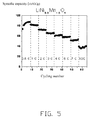
- FIG. 5 is a graph showing cycle performance testing results in different current rates of the lithium ion battery of Example 1.
- FIG. 6 is a graph showing cycle performance testing results in different current rates of the lithium ion battery of Comparative Example 1.
- FIG. 7 is a cross-sectional view of an embodiment of a lithium ion battery.
- a cathode composite material 10 of a lithium ion battery includes a cathode active material particle 12 and a coating layer 14 coated on a surface of the cathode active material particle 12 .
- the cathode active material particle 12 can be any commonly used cathode active material of lithium ion battery.
- the material of the cathode active material particle 12 can be a lithium transition metal oxide.
- the transition metal of the lithium transition metal oxide can be at least one of cobalt (Co), nickel (Ni), and manganese (Mn).
- the lithium transition metal oxide can have a crystal structure of spinel type, layered type, or olivine type.
- the lithium transition metal oxide can be a spinel type lithium nickel manganese oxide.
- L represents at least one of the chemical elements of alkali metal elements, alkaline-earth metal elements, Group-13 elements, Group-14 elements, transition metal elements, and rare-earth elements.
- L represents at least one of the chemical elements of Co, chromium (Cr), vanadium (V), titanium (Ti), tin (Sn), copper (Cu), aluminum (Al), iron (Fe), boron (B), strontium (Sr), calcium (Ca), gallium (Ga), neodymium (Nd), and magnesium (Mg).
- cathode active material particle 12 is not limited and can be sphere shape, rod shape, needle shape, sheet shape, tube shape, or irregular shape.
- a cathode electrode of a lithium ion battery can include a plurality of cathode active material particles 12 in a powder form.
- the size of a single cathode active material particle 12 can be chosen according to need and can be in a range from about 1 micron to about 500 microns.
- the coating layer 14 can be an in situ formed layer on the surface of the cathode active material particle 12 and can be a continuous material layer having a uniform thickness.
- the material of the coating layer 14 can be a lithium metal oxide having a crystal structure belonging to C2/c space group of the monoclinic crystal system.
- a general chemical formula of the lithium metal oxide can be Li 2 AO 3 , wherein A represents a metal element which has a +4 valence.
- the A of the Li 2 AO 3 can be selected from at least one of Ti, Sn, Mn, lead (Pb), tellurium (Te), ruthenium (Ru), hafnium (Hf), and zirconium (Zr).
- the lithium metal oxide can be at least one of Li 2 TiO 3 , Li 2 MnO 3 , Li 2 SnO 3 , Li 2 PbO 3 , Li 2 TeO 3 , Li 2 RuO 3 , Li 2 HfO 3 , and Li 2 ZrO 3 .
- the lithium metal oxide can be undoped, or doped with doping chemical elements.
- the transition metal atoms of the cathode active material 12 can diffuse into the coating layer 14 to form the doped lithium metal oxide.
- the lithium metal oxide can also be represented by a general formula of [Li 1-2a M a ⁇ a ][Li 1/3-2b-c M b N 3c A 2/3-2c ⁇ b ]O 2 , wherein M and N represent doping chemical elements, “ ⁇ ” represents an atom vacancy, which occupies a Li site in the [Li][Li 1/3 A 2/3 ]O 2 , 0 ⁇ 2a ⁇ 1, 0 ⁇ 2b+c ⁇ 1 ⁇ 3, and 0 ⁇ 2c ⁇ 2 ⁇ 3.
- atoms of Li 1-2a M a ⁇ a are located on inter-plane octahedral sites
- atoms of Li 1/3-2b-c M b N 3c A 2/3-2c ⁇ b are located on in-plane octahedral sites.
- the undoped Li 2 AO 3 can also be represented by the chemical formula of [Li] ⁇ [Li 1/3 A 2/3 ] ⁇ O 2 , which is a transform of the formula Li 2 AO 3 , wherein [ ] ⁇ represents that the atoms in the [ ] ⁇ are located on the inter-plane octahedral sites, which are occupied by Li, and [ ] ⁇ represents that the atoms in the [ ] ⁇ are located on the in-plane octahedral sites, which are occupied by Li and A in a molar ratio of 1 ⁇ 3:2 ⁇ 3.
- the ions of the doping element M replace an amount of Li + located on the inter-plane octahedral sites and in-plane octahedral sites, an equal amount of atom vacancies ( ⁇ ) are also generated.
- the atom vacancies ( ⁇ ) are helpful for Li + moving in the coating layer 14 .
- the ions of the doping element N can replace an amount of Li + and A 4+ of the Li 1/3 A 2/3 located on the in-plane octahedral sites.
- M and N respectively represent at least one of the chemical elements of alkali metal elements, alkaline-earth metal elements, Group-13 elements, Group-14 elements, transition metal elements, and rare-earth elements.
- M and N respectively represent at least one of the chemical elements of Co, Mn, Ni, Cr, V, Ti, Sn, Cu, Al, Fe, B, Sr, Ca, Ga, Nd, and Mg.
- At least one of M and N can come from the lithium transition metal oxide of the cathode active material particle 12 .
- the lithium transition metal oxide is the lithium nickel manganese oxide
- at least one of M and N can be Mn or Ni.
- M is Ni
- the general formula of the material of the coating layer can be [Li 1-2a Ni a ⁇ a ][Li 1/3-2b Ni b A 2/3 ⁇ b ]O 2 .
- A is Ti
- the general formula of the material of the coating layer can be [Li 1-2a Ni a ⁇ a ][Li 1/3-2b Ni b Ti 2/3 ⁇ b ]O 2 .
- a mass percentage of the coating layer 14 to the cathode composite material 10 can be in a range from about 0.05% to about 7%. In one embodiment, the mass percentage of the coating layer 14 is about 5%.
- a thickness of the coating layer 14 can be in a range from about 2 nanometers (nm) to about 20 nm.
- the cathode electrode of the lithium ion battery can include a plurality of cathode active material particles 12 .
- the coating layer 14 can be individually coated on the individual cathode active material particle 12 .
- the cathode electrode of the lithium ion battery can include a plurality of core-shell structures. Each core-shell structure has one cathode active material particle 12 as the core and one coating layer 14 as the shell. In one embodiment, each of the plurality of cathode active material particles 12 in the cathode electrode has the coating layer 14 coated thereon.
- the coating layer 14 can completely coat an entire outer surface of the individual cathode active material particle 12 .
- the coating layer 14 can have a uniform thickness, and thus the cathode composite material 10 can have a sphere shape, rod shape, needle shape, sheet shape, tube shape, or irregular shape corresponding to the shape of the cathode active material particle 12 .
- the cathode active material precursor is capable of having a chemical reaction with the lithium source chemical compound to produce the cathode active material.
- the cathode active material precursor is capable of having a chemical reaction with the lithium source chemical compound to produce the spinel type lithium nickel manganese oxide.
- the cathode active material precursor is used both as a manganese source and a nickel source.
- the material of the cathode active material precursor can include both an oxygen compound of the manganese and an oxygen compound of nickel.
- the oxygen compound can be at least one of hydroxides, oxysalts, and oxides.
- the oxysalt is a salt of an oxyacid.
- the oxysalt can be at least one of oxalates, carbonates, acetates, and oxyhydroxides (i.e., oxide-hydroxides).
- the oxysalt of the nickel can be at least one of nickel hydroxide (Ni(OH) 2 ), nickel oxalate (NiC 2 O 4 .2H 2 O), nickel carbonate (NiCO 3 ), nickel acetate (Ni(CH 3 COO) 2 .4H 2 O), and nickel oxide-hydroxide (NiOOH).
- the oxysalt of the manganese can be at least one of manganese hydroxide (Mn(OH) 2 ), manganese oxalate (MnC 2 O 4 .2H 2 O), manganese carbonate (MnCO 3 ), manganese acetate (Mn(CH 3 COO) 2 .4H 2 O), and manganese oxide-hydroxide (MnOOH).
- the material of the cathode active material precursor can also be an oxygen composite compound including both nickel and manganese elements, such as nickel manganese composite hydroxide (Ni i-n Mn j-m (OH) 4 ) and nickel manganese composite carbonate (Ni i-n Mn j-m (CO 3 ) 2 ).
- the oxygen compound can be with or without the crystallization water.
- the material of the coating layer precursor can be hydroxides or oxides of the metal element which has the +4 valence.
- the material of the coating layer precursor can be at least one of titanium dioxide (TiO 2 ), stannic dioxide (SnO 2 ), manganese dioxide (MnO 2 ), lead dioxide (PbO 2 ), tellurium dioxide (TeO 2 ), ruthenium dioxide (RuO 2 ), hafnium dioxide (HfO 2 ), and zirconium dioxide (ZrO 2 ).
- the material of the lithium source chemical compound can be at least one of lithium hydroxide, lithium chloride, lithium sulfate, lithium nitrate, lithium acetate, lithium dihydrogen orthophosphate.
- the composite precursor 100 can include the coating layer precursor 140 and the cathode active material precursor 120 .
- the coating layer precursor 140 is coated on the cathode active material precursor 120 .
- the coating layer precursor 140 is capable of having a chemical reaction with the lithium source chemical compound to produce the coating layer 14 . That is to say, the coating layer precursor 140 is a chemical compound which can have a chemical reaction with the lithium source chemical compound to produce the lithium metal oxide having a crystal structure belonging to the C2/c space group of the monoclinic crystal system.
- the cathode active material precursor 120 is capable of having a chemical reaction with the lithium source chemical compound to produce the cathode active material particle 12 .
- the coating layer precursor 140 is a continuous layer shaped structure, which is in-situ formed on the outer surface of the cathode active material precursor 120 .
- the lithium source chemical compound 160 can simultaneously react with the cathode active material precursor 120 and the coating layer precursor 140 , to produce the cathode active material particle 12 and the coating layer 14 coated on the cathode active material particle 12 .
- the cathode active material precursor 120 can have a particle shape. In one embodiment, a plurality of cathode active material precursors 120 are provided, and the coating layer precursor 140 is individually coated on the individual cathode active material precursor 120 .
- step S 1 can further include steps of:
- the liquid solvent can only be an organic solvent (i.e., without water).
- the hydroxides, oxysalts, or the crystallization water can generate water in the solid-liquid mixture due to the heating step.
- the water reacts with the coating substance.
- the organic solvent can be a commonly used solvent such as methanol, ethanol, propanol, isopropanol, ethylene glycol, acetone, dichloroethane, and chloroform.
- the coating substance can be a liquid state substance, a liquid solution, or a substance that is soluble to the liquid solvent.
- the coating substance can include at least one of metal halides and metal esters.
- the metal element in the metal halides and metal esters has the +4 valence.
- the coating substance can be at least one of diethyl titanate, tetrabutyl titanate, zirconium n-butoxide, tetrabutyl orthostannate, titanium tetrachloride (TiCl 4 ), zirconium tetrachloride (ZrCl 4 ), stannic tetrachloride (SnCl 4 ), lead tetrachloride (PbCl 4 ), tellurium tetrachloride (TeCl 4 ), ruthenium tetrachloride (RuCl 4 ), hafnium tetrachloride (HfCl 4 ), manganese tetrachloride (MnCl 4 ).
- TiCl 4 titanium tetrachloride
- ZrCl 4 zirconium tetrachloride
- SnCl 4 stannic tetrachloride
- PbCl 4 lead tetrachlor
- the plurality of cathode active material precursor can be uniformly dissolved in the liquid solvent through an ultrasonic vibration or a mechanical stirring method.
- a molar ratio of the coating substance to the cathode active material precursor can be in a range from about 0.1:100 to about 20:100.
- the coating substance can be uniformly mixed with the solid-liquid mixture through an ultrasonic vibration or a mechanical stirring method.
- the liquid-solid mixture having the coating substance added therein can be directly heated in an open environment in air or heated by using a hydrothermal synthesis method in an autoclave, which is sealed and has a pressure larger than 1 atm therein during the heating.
- the heating temperature can be decided according to the pressure and the material of the coating substance. In one embodiment, the heating temperature can be in a range from about 80° C. to about 200° C.
- the heating time can be decided according to the heating temperature and the amount of the coating substance. In one embodiment, the heating time can be in a range from about 10 minutes to about 20 hours.
- the coating substance can have a hydrolysis reaction to produce the coating layer precursor on the outer surface of the cathode active material precursor.
- the crystallization water can escape from the cathode active material precursor 120 to form a liquid state water.
- the liquid state water can have a reaction with the coating substance 144 to form the coating layer precursor 140 coated on the surface of the crystallization water removed cathode active material precursor 120 ′.
- the reaction between the water and the coating substance is easier to be controlled and the morphology of the coating layer precursor can be formed well. Accordingly, the uniformity of the coating layer precursor can be improved.
- step S 1 can include steps of:
- the steps S 11 ′ to S 13 ′ is similar to the steps S 11 to S 13 , except that when the cathode active material precursor 120 itself does not carries the crystallization water, an additional step of reacting the coating substance with an added water can be used to hydrolyses the coating substance.
- the liquid solvent can be a mixture of the organic solvent and a small amount of water. A volume ratio between the water and the organic solvent can be equal to or smaller than 1:10 (in some embodiments is smaller than 1:50).
- the step S 13 ′ can further include a step of adding water into the solid-liquid mixture. The amount of the added water can be decided by the amount of the coating substance. Overall, the solid-liquid mixture can include a small amount of water. The amount of the water can be decided by the amount of the coating substance.
- the composite precursor is reacted with the lithium source chemical compound, the cathode active material precursor and the coating layer precursor can both be lithiated.
- a high-temperature solid-state reaction can be used to react the composite precursor with the lithium source chemical compound. More specifically, the step S 2 can include steps of uniformly mixing the composite precursor with the lithium source chemical compound to form a solid-solid mixture and heating the solid-solid mixture, under a solid-state reaction temperature.
- the composite precursor and the lithium source chemical compound can be mixed through a mechanical stirring method or a ball milling method.
- the solid-state reaction temperature can be decided according to the material of the composite precursor. In one embodiment, the solid-state reaction temperature can be in a range from about 400° C. to about 900° C., and the heating time can be in a range from about 2 hours to about 12 hours.
- an additional step of pre-heating the solid-solid mixture under a relatively low temperature can be processed for fully decomposing the composite precursor.
- the relatively low temperature can be in a range from about 350° C. to about 400° C.
- the pre-heating time can be in a range from about 0.5 hours to about 1 hour.
- the solid-solid mixture can be directly heated to reach the solid-state reaction temperature without a cooling step.
- An amount of the lithium source chemical compound can be decided by the amount of the composite precursor. More specifically, the amount of the lithium source chemical compound can be calculated from the lithium amount required for lithiating the cathode active material precursor and the coating layer precursor. Moreover, for the reason that the lithium is apt to be volatilized in a high temperature, the lithium source chemical compound can be excess for the composite precursor. In one embodiment, the stoichiometric ratio between the lithium source chemical compound and the composite precursor can be in a range from about 1:1 to about 1.2:1. During the lithiation of the cathode active material precursor to produce the cathode active material, the lithium source chemical compound also reacts with the coating layer precursor, and directly forms the coating layer on the surface of the formed cathode active material.
- the coating layer precursor and the cathode active material precursor are simultaneously heated at the solid state reaction temperature, and both form the lithiated substances; thus, there is a strong chemical bonding force between the formed cathode active material and the coating layer, to make the coating layer continuously, tightly and uniformly coated on the surface of the cathode active material.
- the coating substance can include more than one metal elements which having the +4 valence.
- the finally formed coating layer 14 can include more than one lithium metal oxide mixed with each other.
- the cathode active material precursor can also include more than one oxygen compounds of the transition metals.
- the finally formed cathode active material particle 12 can include more than one transition metal elements.
- the cathode active material precursor can also include at least one of the above mentioned doping elements L and R.
- the finally formed cathode active material particle 12 can be a doped lithium transition metal oxide, for example, a doped spinel type lithium nickel manganese oxide.
- the cathode composite material of the present disclosure includes the coating layer coated on the cathode active material to avoid a direct contact between the cathode active material and the electrolyte solution.
- the material of the coating layer can be a lithium metal oxide having a crystal structure belonging to C2/c space group of the monoclinic crystal system.
- the lithium metal oxide has a one dimensional lithium ion transferring path along a crystal axis c of the crystal structure of the lithium metal oxide. Therefore, the coating layer can prevent an electron migration between the electrolyte and the cathode active material and allow the lithium ions to pass therethrough.
- the side reaction during the charge and discharge of the lithium ion battery between the electrolyte and the cathode active material can be suppressed. Therefore, the cathode composite material has improved chemical and thermal stabilities, even at a relatively high or low charge/discharge voltage, or a high rate.
- a composite precursor having a core-shell structure is previously prepared, and then the core and the shell of the core-shell structure are simultaneously lithiated, to form the cathode composite material and the cathode active material at the same time.
- the in situ formed coating layer is an integrated and continuous material layer having uniform thickness, not just a plurality of particles loosely stacked on the cathode active material.
- the coating layer and the cathode active material have a tight combination, which effectively decreases the dislocation and increase the lithium ion mobility in the coating layer. Therefore, the lithium ion battery using the cathode composite material has a relatively good cycle performance.
- a lithium ion battery 1 includes a cathode electrode 2 , an anode electrode 3 spaced from the cathode electrode 2 , and a non-aqueous electrolyte 8 disposed between the cathode electrode 2 and the anode electrode 3 .
- the cathode electrode 2 can include a cathode current collector 24 and a cathode material layer 22 .
- the cathode current collector 24 is used for supporting the cathode material layer 22 and conducting current.
- a shape of the cathode current collector 24 can be a continuous sheet or a network.
- a material of the cathode current collector 24 can be metal or alloy, such as aluminum, titanium, or stainless steel.
- the cathode material layer 22 is disposed on at least one surface of the cathode current collector 24 .
- the cathode material layer 22 includes the above described cathode composite material 10 and can further include a conductive agent and a binder.
- the cathode composite material 10 , conductive agent, and the binder can be uniformly mixed with each other.
- the anode electrode 3 can include an anode current collector 34 and an anode material layer 32 .
- the anode current collector 34 is used for supporting the anode material layer 32 and conducting current.
- a shape of the anode current collector 34 can be a continuous sheet or a network.
- a material of the anode current collector 34 can be metal or alloy, such as copper, nickel, or stainless steel.
- the anode material layer 32 is disposed on at least one surface of the anode current collector 34 .
- the anode material layer 32 includes an anode active material and can further include a conductive agent and a binder.
- the anode active material, conductive agent, and the binder can be uniformly mixed with each other.
- the anode active material particle can be lithium titanate (e.g., Li 4 Ti 5 O 12 ), graphite, acetylene black, organic cracking carbon, mesocarbon microbeads (MCMB), or any combination thereof.
- the anode material layer 32 faces the cathode material layer 22 . Both the anode material layer 32 and the cathode material layer 22 are in contact with the electrolyte.
- the electrolyte 8 can be a solid electrolyte film or a liquid non-aqueous electrolyte solution. The solid electrolyte film can be sandwiched between the anode electrode 3 and the cathode electrode 2 . If the lithium ion battery 1 uses the liquid non-aqueous electrolyte solution, the cathode electrode 2 and the anode electrode 3 are both disposed in the liquid non-aqueous electrolyte solution.
- the lithium ion battery 1 can further include a separator 4 disposed between the anode material layer 32 and the cathode material layer 22 , to electrically insulate them from each other.
- the separator 4 is capable of having the lithium ions pass therethrough.
- the liquid non-aqueous electrolyte solution includes an organic solvent and a lithium salt dissolved in the organic solvent.
- the organic solvent can be selected from cyclic carbonates, linear carbonates, cyclic ethers, linear ethers, nitriles, and amides, and can be at least one of ethylene carbonate (EC), propylene carbonate (PC), ethylmethyl carbonate (EMC), diethyl carbonate (DEC), dimethyl carbonate (DMC), butylenes carbonate, vinylene carbonate, methylethyl carbonate, methyl acetate, ethyl acetate, propyl acetate, methyl propionate, ethyl propionate, y-butyrolactone, 1,2dimethoxyethane, 1,2-diethoxyethane, tetrahydrofuran, 1,2-dioxane, 2-methyltetrahydrofuran, acetonitrile, and dimethylformamide.
- EC ethylene carbonate
- PC propylene carbonate
- EMC ethylmethyl carbonate
- DEC dieth
- the lithium salt may be at least one of LiPF 6 , LiBOB, LiBF 4 , LiSbF 6 , LiAsF 6 , LiClO 4 , LiCF 3 SO 3 , Li(CF 3 SO 2 ) 2 N, LiC 4 F 9 SO 3 , LiSbF 6 , LiAlO 4 , LiAlCl 4 , LiCl, and LiI.
- the separator 4 can be a porous membrane.
- the material of the separator can be polyolefins, such as polypropylene (PP) or polyethylene (PE), or inorganic material such as porous ceramics.
- the conductive agents and the binders in the anode material layer 32 and the cathode material layer 22 can be the same.
- the conductive agent can be a carbonaceous material such as carbon black, acetylene black, conductive polymers, carbon fibers, carbon nanotubes, graphene, and graphite.
- the binder can be at least one of polyvinylidene fluoride (PVDF), polytetrafluoroethylene (PTFE), and styrene-butadiene rubber (SBR).
- the materials of the anode current collector 34 , the cathode current collector 24 , the conductive agent, the binder, the electrolyte, and the separator 4 are not limited by the above listed materials, and can be selected from other known materials.
- the lithium ion battery 1 can further include an exterior encapsulating structure, such as a hard battery case 5 sealed by a sealing member 6 , or a soft encapsulating bag, having the cathode electrode 2 , the anode electrode 3 , the separator 4 , the electrolyte 8 located therein.
- the lithium ion battery 1 can further include a connecting component achieving an electrical connection between the current collector of the lithium ion battery 1 and the external circuit.
- Example 1 0.25 g Ni 0.5 Mn 1.5 (OH) 4 is ultrasonically dispersed in 10 mL of ethanol to achieve the solid-liquid mixture. Then, the tetrabutyl titanate is added into the solid-liquid mixture. A molar percentage of the tetrabutyl titanate to the Ni 0.5 Mn 1.5 (OH) 4 is about 5%. After adding the tetrabutyl titanate, the solid-liquid mixture is continuously ultrasonically vibrated to uniformly mix the tetrabutyl titanate and the Ni 0.5 Mn 1.5 (OH) 4 in the ethanol. After that, the solid-liquid mixture is transferred into a dry and clean hydrothermal autoclave and reacted at about 150° C. for about 3 hours.
- the amorphous TiO 2 layer can be formed on the surface of the Ni 0.5 Mn 1.5 (OH) 4 , to form the composite precursor.
- the composite precursor and the LiOH.H 2 O are mixed in the stoichiometric ratio and are dried to remove the residual ethanol. Then the mixture of the composite precursor and the LiOH.H 2 O are heated to about 800° C. at a temperature increasing rate of about 3° C./min, and is heated at the 800° C. for about 5 hours.
- the cathode composite material is naturally cooled down to room temperature.
- the cathode composite material is the core-shell structure having LiNi 0.5 Mn 1.5 O 4 as the core and Ni doped Li 2 TiO 3 as the shell.
- the cathode composite material An XRD analysis is conducted on the cathode composite material.
- the XRD pattern of the cathode composite material shows that a pure phase LiNi 0.5 Mn 1.5 O 4 exits in the cathode composite material.
- the peak of the Li 2 TiO 3 disappears, which means that Ni ions are doped in the Li 2 TiO 3 .
- the XPS analysis is conducted on the cathode composite material to measure the content of the element on the surface of the cathode composite material.
- the XPS analysis result shows that the molar percentage of Ti element is about 11.2%, which is much larger than 5%. That is, Ti element mainly exists on the surface of the cathode composite material.
- Ni element only exists on an outer surface layer having a thickness of about 10 nm of the cathode composite material.
- the XPS analysis result also shows that the molar percentage of Ni element is about 41%, which is much larger than the Ni element in the LiNi 0.5 Mn 1.5 O 4 (i.e., about 25%). That is, Ni element dopes the Li 2 TiO 3 coating layer.
- a lithium ion battery is assembled using the cathode composite material of the Example 1 in the cathode electrode.
- a lithium ion battery is assembled according to the same conditions as in Example 1, except that the cathode composite material formed in Example 1 is replaced by the bare LiNi 0.5 Mn 1.5 O 4 without any coating layer coated thereon.
- the two lithium ion batteries of the Example 1 and Comparative Example 1 are galvanostatic cycled using the current rates of 0.5 C, 1 C, 2 C, 3 C, 4 C, 5 C, 7 C, and 10 C.
- the discharge specific capacity of the lithium ion battery of the Comparative Example 1 dramatically decreases.
- the discharge capacity of the lithium ion battery of the Comparative Example 1 is only about 40 mAh/g.
- the lithium ion battery in the Example 1 having the LiNi 0.5 Mn 1.5 O 4 coated by the Ni doped Li 2 TiO 3 coating layer has a much better rating performance.
- the discharge specific capacity of the lithium ion battery of the Example 1 does not decrease much.
- the discharge specific capacity of the lithium ion battery of the Example 1 is still about 60 mAh/g.
- Example 2 the cathode composite material is prepared using the same method as in Example 1, except that the tetrabutyl titanate is replaced by zirconium n-butoxide.
- the amorphous ZrO 2 layer can be formed on the surface of the Ni 0.5 Mn 1.5 (OH) 4 , to form the composite precursor.
- the cathode composite material is the core-shell structure having LiNi 0.5 Mn 1.5 O 4 as the core and Ni doped Li 2 ZrO 3 as the shell.
- Example 3 the cathode composite material is prepared using the same method as in Example 1, except that the tetrabutyl titanate is replaced by tetrabutyl orthostannate.
- the amorphous SnO 2 layer can be formed on the surface of the Ni 0.5 Mn 1.5 (OH) 4 , to form the composite precursor.
- the cathode composite material is the core-shell structure having LiNi 0.5 Mn 1.5 O 4 as the core and Ni doped Li 2 SnO 3 as the shell.
- Example 4 the cathode composite material is prepared using the same method as in Example 1, except that the tetrabutyl titanate is replaced by PbCl 4 .
- the amorphous PbO 2 layer can be formed on the surface of the Ni 0.5 Mn 1.5 (OH) 4 , to form the composite precursor.
- the cathode composite material is the core-shell structure having LiNi 0.5 Mn 1.5 O 4 as the core and Ni doped Li 2 PbO 3 as the shell.
- Example 5 the cathode composite material is prepared using the same method as in Example 1, except that the tetrabutyl titanate is replaced by TeCl 4 .
- the amorphous TeO 2 layer can be formed on the surface of the Ni 0.5 Mn 1.5 (OH) 4 , to form the composite precursor.
- the cathode composite material is the core-shell structure having LiNi 0.5 Mn 1.5 O 4 as the core and Ni doped Li 2 TeO 3 as the shell.
- Example 6 the cathode composite material is prepared using the same method as in Example 1, except that the tetrabutyl titanate is replaced by RuCl 4 .
- the amorphous RuO 2 layer can be formed on the surface of the Ni 0.5 Mn 1.5 (OH) 4 , to form the composite precursor.
- the cathode composite material is the core-shell structure having LiNi 0.5 Mn 1.5 O 4 as the core and Ni doped Li 2 RuO 3 as the shell.
- Example 7 the cathode composite material is prepared using the same method as in Example 1, except that the tetrabutyl titanate is replaced by HfCl 4 .
- the amorphous HfO 2 layer can be formed on the surface of the Ni 0.5 Mn 1.5 (OH) 4 , to form the composite precursor.
- the cathode composite material is the core-shell structure having LiNi 0.5 Mn 1.5 O 4 as the core and Ni doped Li 2 HfO 3 as the shell.
- the cathode composite material is prepared using the same method as in Example 1, except that the tetrabutyl titanate is replaced by MnCl 4 .
- the amorphous MnO 2 layer can be formed on the surface of the Ni 0.5 Mn 1.5 (OH) 4 , to form the composite precursor.
- the cathode composite material is the core-shell structure having LiNi 0.5 Mn 1.5 O 4 as the core and Ni doped Li 2 MnO 3 as the shell.
- the cathode composite material is prepared using the same method as in Example 1, except that an amount of hydroxide of the doping element L is added with the Ni 0.5 Mn 1.5 (OH) 4 .
- the doping elements L and R are respectively Co, Cr, V, I, Sn, Cu, Al, Fe, B, Sr, Ca, Ga, Nd, and Mg each in one example.
- a molar ratio of the doping element L and the Ni 0.5 Mn 1.5 (OH) 4 is about n: (0.5 ⁇ n).
- a molar ratio of the doping element R and the Ni 0.5 Mn 1.5 (OH) 4 is about m: (1.5 ⁇ m).
- the cathode composite material is the core-shell structure having LiNi 0.5-n Mn 1.5-m L n R m O 4 as the core and Ni doped Li 2 TiO 3 as the shell, wherein 0 ⁇ m ⁇ 0.2, 0 ⁇ n ⁇ 0.2, 0 ⁇ 0.5 ⁇ n ⁇ 2, 0 ⁇ 1.5 ⁇ m ⁇ 2, L and R are respectively Co, Cr, V, I, Sn, Cu, Al, Fe, B, Sr, Ca, Ga, Nd, and Mg each in one example.
Landscapes
- Chemical & Material Sciences (AREA)
- Chemical Kinetics & Catalysis (AREA)
- Electrochemistry (AREA)
- General Chemical & Material Sciences (AREA)
- Inorganic Chemistry (AREA)
- Composite Materials (AREA)
- Battery Electrode And Active Subsutance (AREA)
Abstract
Description
-
- S1, forming a composite precursor including a cathode active material precursor and a coating layer precursor coated on a surface of the cathode active material precursor;
- S2, reacting the composite precursor with a lithium source chemical compound, to lithiate both the cathode active material precursor and the coating layer precursor in the composite precursor.
Claims (15)
Applications Claiming Priority (2)
| Application Number | Priority Date | Filing Date | Title |
|---|---|---|---|
| CN201210369027.9A CN103700832B (en) | 2012-09-27 | 2012-09-27 | Anode composite material of lithium ion battery |
| CN2012103690279 | 2012-09-27 |
Publications (2)
| Publication Number | Publication Date |
|---|---|
| US20140087259A1 US20140087259A1 (en) | 2014-03-27 |
| US9246165B2 true US9246165B2 (en) | 2016-01-26 |
Family
ID=50339170
Family Applications (1)
| Application Number | Title | Priority Date | Filing Date |
|---|---|---|---|
| US13/691,518 Active 2033-09-16 US9246165B2 (en) | 2012-09-27 | 2012-11-30 | Cathode composite material and lithium ion battery using the same |
Country Status (3)
| Country | Link |
|---|---|
| US (1) | US9246165B2 (en) |
| CN (1) | CN103700832B (en) |
| TW (1) | TWI600201B (en) |
Families Citing this family (11)
| Publication number | Priority date | Publication date | Assignee | Title |
|---|---|---|---|---|
| CN103413930B (en) * | 2013-07-30 | 2015-09-09 | 南京航空航天大学 | The LiNi1/2Mn3/2O4 positive electrode of lithium ion conductor Li2MO3 (M=Ti, Si, Zr) coating modification and preparation method |
| CN103840153B (en) * | 2014-03-05 | 2016-10-05 | 芜湖凯尔电气科技有限公司 | A kind of High-nickel-base lithium ion battery anode material and preparation method thereof |
| JP6470070B2 (en) * | 2014-08-25 | 2019-02-13 | 株式会社東芝 | Positive electrode and non-aqueous electrolyte battery |
| CN108878795B (en) * | 2017-05-15 | 2021-02-02 | 宁德时代新能源科技股份有限公司 | Modified positive electrode active material, preparation method thereof and electrochemical energy storage device |
| CN107946551B (en) * | 2017-10-20 | 2020-07-17 | 合肥国轩高科动力能源有限公司 | Doped lithium nickel manganate material, modified lithium nickel manganate cathode material and preparation method thereof |
| EP3790846A1 (en) * | 2018-05-09 | 2021-03-17 | Haldor Topsøe A/S | Doped lithium positive electrode active material and process for manufacture thereof |
| KR102824704B1 (en) * | 2019-11-13 | 2025-06-25 | 주식회사 엘지에너지솔루션 | Positive electrode active material for lithium secondary battery and method for preparing the same |
| CN111435747B (en) * | 2020-01-17 | 2022-11-22 | 蜂巢能源科技有限公司 | Cobalt-free layered positive electrode material and preparation method thereof, lithium ion battery |
| TWI735366B (en) * | 2020-10-29 | 2021-08-01 | 國立成功大學 | High entropy composite oxide, its manufacturing method, and anode materials comprising the same |
| CN114292088B (en) * | 2021-12-30 | 2022-10-11 | 安徽大学 | A kind of tritium-neutron composite breeder lithium lead-acid eutectic ceramic pellet and preparation method |
| WO2025047391A1 (en) * | 2023-08-31 | 2025-03-06 | 日産自動車株式会社 | Positive electrode for lithium secondary batteries and lithium secondary battery using same |
Citations (13)
| Publication number | Priority date | Publication date | Assignee | Title |
|---|---|---|---|---|
| US20020070374A1 (en) * | 1996-12-09 | 2002-06-13 | Jeremy Barker | Stabilized electrochemical cell active material |
| CN1399364A (en) | 2001-06-14 | 2003-02-26 | 三星Sdi株式会社 | Active material for battery and its prepn process |
| US20040201948A1 (en) * | 2003-04-11 | 2004-10-14 | Sony Corporation | Positive electrode active material and non-aqueous electrolyte secondary battery containing the same |
| CN1787254A (en) | 2004-12-09 | 2006-06-14 | 比亚迪股份有限公司 | Lithium ion cell positive electrode actived material and preparation method thereof |
| US20080067972A1 (en) * | 2006-09-15 | 2008-03-20 | Norio Takami | Power supply system and motor car |
| US20080107968A1 (en) * | 2005-08-25 | 2008-05-08 | Commissariat A L'energie Atomique | High-voltage positive electrode material having a spinel structure based on nickel and manganese for lithium cell batteries |
| TW200830604A (en) | 2006-09-12 | 2008-07-16 | Sumitomo Chemical Co | Lithium composite metal oxide and nonaqueous electrolyte secondary battery |
| US20090200509A1 (en) | 2008-02-13 | 2009-08-13 | Tdk Corporation | Active material, electrode, and methods of manufacture thereof |
| CN101997113A (en) | 2009-08-17 | 2011-03-30 | 北京当升材料科技股份有限公司 | Multicomponent material with multilayer coating structure for lithium ion battery and preparation method thereof |
| US20110229763A1 (en) * | 2008-11-24 | 2011-09-22 | Li Lu | cathode material for a battery with improved cycle performance at a high current density |
| CN102623694A (en) | 2012-03-19 | 2012-08-01 | 宁德新能源科技有限公司 | High-voltage lithium ion battery and cathode material thereof |
| CN102664253A (en) | 2012-05-09 | 2012-09-12 | 奇瑞汽车股份有限公司 | Lithium-rich material and preparation method thereof and lithium ion battery containing same |
| US8802290B2 (en) * | 2012-09-27 | 2014-08-12 | Tsinghua University | Cathode composite material, method for making the same, and lithium ion battery using the same |
Family Cites Families (1)
| Publication number | Priority date | Publication date | Assignee | Title |
|---|---|---|---|---|
| CN102201573A (en) * | 2011-04-13 | 2011-09-28 | 北京工业大学 | Rich-lithium positive electrode material of lithium ion battery having coreshell structure and preparation method of rich-lithium positive electrode material |
-
2012
- 2012-09-27 CN CN201210369027.9A patent/CN103700832B/en active Active
- 2012-10-15 TW TW101138001A patent/TWI600201B/en active
- 2012-11-30 US US13/691,518 patent/US9246165B2/en active Active
Patent Citations (16)
| Publication number | Priority date | Publication date | Assignee | Title |
|---|---|---|---|---|
| US20020070374A1 (en) * | 1996-12-09 | 2002-06-13 | Jeremy Barker | Stabilized electrochemical cell active material |
| CN1399364A (en) | 2001-06-14 | 2003-02-26 | 三星Sdi株式会社 | Active material for battery and its prepn process |
| US20030082448A1 (en) | 2001-06-14 | 2003-05-01 | Cho Jae-Phil | Active material for battery and method of preparing the same |
| US20040201948A1 (en) * | 2003-04-11 | 2004-10-14 | Sony Corporation | Positive electrode active material and non-aqueous electrolyte secondary battery containing the same |
| CN1787254A (en) | 2004-12-09 | 2006-06-14 | 比亚迪股份有限公司 | Lithium ion cell positive electrode actived material and preparation method thereof |
| US20080107968A1 (en) * | 2005-08-25 | 2008-05-08 | Commissariat A L'energie Atomique | High-voltage positive electrode material having a spinel structure based on nickel and manganese for lithium cell batteries |
| US20090280412A1 (en) | 2006-09-12 | 2009-11-12 | Sumitomo Chemical Company, Limited | Lithium composite metal oxide and nonaqueous electrolyte secondary battery |
| TW200830604A (en) | 2006-09-12 | 2008-07-16 | Sumitomo Chemical Co | Lithium composite metal oxide and nonaqueous electrolyte secondary battery |
| US20080067972A1 (en) * | 2006-09-15 | 2008-03-20 | Norio Takami | Power supply system and motor car |
| US20090200509A1 (en) | 2008-02-13 | 2009-08-13 | Tdk Corporation | Active material, electrode, and methods of manufacture thereof |
| CN101510608A (en) | 2008-02-13 | 2009-08-19 | Tdk株式会社 | Active material, electrode, and methods of manufacture thereof |
| US20110229763A1 (en) * | 2008-11-24 | 2011-09-22 | Li Lu | cathode material for a battery with improved cycle performance at a high current density |
| CN101997113A (en) | 2009-08-17 | 2011-03-30 | 北京当升材料科技股份有限公司 | Multicomponent material with multilayer coating structure for lithium ion battery and preparation method thereof |
| CN102623694A (en) | 2012-03-19 | 2012-08-01 | 宁德新能源科技有限公司 | High-voltage lithium ion battery and cathode material thereof |
| CN102664253A (en) | 2012-05-09 | 2012-09-12 | 奇瑞汽车股份有限公司 | Lithium-rich material and preparation method thereof and lithium ion battery containing same |
| US8802290B2 (en) * | 2012-09-27 | 2014-08-12 | Tsinghua University | Cathode composite material, method for making the same, and lithium ion battery using the same |
Also Published As
| Publication number | Publication date |
|---|---|
| CN103700832B (en) | 2016-06-15 |
| CN103700832A (en) | 2014-04-02 |
| US20140087259A1 (en) | 2014-03-27 |
| TW201414062A (en) | 2014-04-01 |
| TWI600201B (en) | 2017-09-21 |
Similar Documents
| Publication | Publication Date | Title |
|---|---|---|
| US8802291B2 (en) | Cathode composite material and lithium ion battery using the same | |
| US8808911B2 (en) | Cathode composite material and lithium ion battery using the same | |
| US8802290B2 (en) | Cathode composite material, method for making the same, and lithium ion battery using the same | |
| US8906449B2 (en) | Method for making cathode composite material for lithium ion batteries | |
| US8795892B2 (en) | Cathode composite material and lithium ion battery using the same | |
| US9246165B2 (en) | Cathode composite material and lithium ion battery using the same | |
| JP6108141B2 (en) | Positive electrode active material for lithium secondary battery, positive electrode for lithium secondary battery, and lithium secondary battery | |
| JP6726102B2 (en) | Positive electrode active material for lithium secondary battery, positive electrode for lithium secondary battery, and lithium secondary battery | |
| US11569492B2 (en) | Positive-electrode active material and battery | |
| JP6462250B2 (en) | Positive electrode active material for lithium secondary battery, production method thereof, and positive electrode for lithium secondary battery and lithium secondary battery including the same | |
| CN101188295B (en) | Positive electrode active mater, method for producing the same, and non-aqueous electrolyte secondary battery | |
| JP7672170B2 (en) | Positive electrode active material, its manufacturing method, and lithium secondary battery including positive electrode containing the same | |
| JP2004319105A (en) | Positive electrode active material and non-aqueous electrolyte secondary battery using the same | |
| JP6857482B2 (en) | Manufacturing method of positive electrode active material for lithium secondary battery | |
| CN110048087A (en) | Positive active material and battery | |
| KR20160049337A (en) | Positive active material for rechargeable lithium battery, method of preparing the same, and rechargeable lithium battery including the same | |
| US9088044B2 (en) | Cathode composite material and lithium ion battery using the same | |
| CN105375026B (en) | Positive electrode active material, method of manufacturing same, and rechargeable lithium battery including same | |
| JPWO2013024621A1 (en) | Lithium ion battery | |
| KR20150144613A (en) | Positive active material for rechargeable lithium battery, method of preparing the same, and rechargeable lithium battery including the same | |
| US10833317B2 (en) | Positive-electrode active material and battery | |
| US20140287312A1 (en) | Positive active material for a rechargeable lithium battery and rechargeable lithium battery including the same | |
| JP6360374B2 (en) | Method for producing lithium-containing composite metal oxide |
Legal Events
| Date | Code | Title | Description |
|---|---|---|---|
| AS | Assignment |
Owner name: TSINGHUA UNIVERSITY, CHINA Free format text: ASSIGNMENT OF ASSIGNORS INTEREST;ASSIGNORS:LI, YA-DONG;LU, JUN;LIU, XIANG-WEN;AND OTHERS;REEL/FRAME:029388/0713 Effective date: 20121126 Owner name: HON HAI PRECISION INDUSTRY CO., LTD., TAIWAN Free format text: ASSIGNMENT OF ASSIGNORS INTEREST;ASSIGNORS:LI, YA-DONG;LU, JUN;LIU, XIANG-WEN;AND OTHERS;REEL/FRAME:029388/0713 Effective date: 20121126 |
|
| STCF | Information on status: patent grant |
Free format text: PATENTED CASE |
|
| MAFP | Maintenance fee payment |
Free format text: PAYMENT OF MAINTENANCE FEE, 4TH YEAR, LARGE ENTITY (ORIGINAL EVENT CODE: M1551); ENTITY STATUS OF PATENT OWNER: LARGE ENTITY Year of fee payment: 4 |
|
| MAFP | Maintenance fee payment |
Free format text: PAYMENT OF MAINTENANCE FEE, 8TH YEAR, LARGE ENTITY (ORIGINAL EVENT CODE: M1552); ENTITY STATUS OF PATENT OWNER: LARGE ENTITY Year of fee payment: 8 |