US9243098B2 - Compound, polymer, cross-linked compound of polymer, and optical element including cross-linked compound - Google Patents
Compound, polymer, cross-linked compound of polymer, and optical element including cross-linked compound Download PDFInfo
- Publication number
- US9243098B2 US9243098B2 US14/235,437 US201214235437A US9243098B2 US 9243098 B2 US9243098 B2 US 9243098B2 US 201214235437 A US201214235437 A US 201214235437A US 9243098 B2 US9243098 B2 US 9243098B2
- Authority
- US
- United States
- Prior art keywords
- formulae
- bonded
- formula
- cross
- denote
- Prior art date
- Legal status (The legal status is an assumption and is not a legal conclusion. Google has not performed a legal analysis and makes no representation as to the accuracy of the status listed.)
- Active
Links
- 0 [1*]C1([2*])C2CC(C3C4/C=C\C(C4)C32)C1([3*])C(=O)OCOOCC([4*])=C Chemical compound [1*]C1([2*])C2CC(C3C4/C=C\C(C4)C32)C1([3*])C(=O)OCOOCC([4*])=C 0.000 description 25
- PWYJZBWJPXZGLJ-UHFFFAOYSA-N CC1=CC=C2CCC2=C1C Chemical compound CC1=CC=C2CCC2=C1C PWYJZBWJPXZGLJ-UHFFFAOYSA-N 0.000 description 19
- BRAVGJIHGKFKOX-UHFFFAOYSA-N *.*.*.*.*.*.*.*.*.*.*.*.*.*.*.*.*.*.*.*.*.*.C.C.C.C.C.C.C.C.C.C.C.C.C.C.C.C.C.C.CCC.CCC1=CC=C(CC)C=C1.CCC1=CC=CC(CC)=C1.CCC1=CC=CC=C1CC.CCNC(=O)CC.CCNC(=O)OCC.CCOC(=O)CC.CCOC(=O)OCC.CCOCC.CC[Si](C)(C)CC.CC[Si](CC)(CC)CC Chemical compound *.*.*.*.*.*.*.*.*.*.*.*.*.*.*.*.*.*.*.*.*.*.C.C.C.C.C.C.C.C.C.C.C.C.C.C.C.C.C.C.CCC.CCC1=CC=C(CC)C=C1.CCC1=CC=CC(CC)=C1.CCC1=CC=CC=C1CC.CCNC(=O)CC.CCNC(=O)OCC.CCOC(=O)CC.CCOC(=O)OCC.CCOCC.CC[Si](C)(C)CC.CC[Si](CC)(CC)CC BRAVGJIHGKFKOX-UHFFFAOYSA-N 0.000 description 7
- YSYBSCYWAKLUEB-UHFFFAOYSA-N C=CC1CC(C)C(C=C)C1.C=CC1CC(C=C)C2C(=O)N(C)C(=O)C12.C=CC1CC(C=C)C2C3CC(CC3C)C12.CC1CC2CC1C(C)C2C.CC1CC2CC1C1C3CC(C(C)C3C)C21.CCC1CC(C)C(CC)C1.CCC1CC(CC)C2C(=O)N(C)C(=O)C12.CCC1CC(CC)C2C3CC(CC3C)C12 Chemical compound C=CC1CC(C)C(C=C)C1.C=CC1CC(C=C)C2C(=O)N(C)C(=O)C12.C=CC1CC(C=C)C2C3CC(CC3C)C12.CC1CC2CC1C(C)C2C.CC1CC2CC1C1C3CC(C(C)C3C)C21.CCC1CC(C)C(CC)C1.CCC1CC(CC)C2C(=O)N(C)C(=O)C12.CCC1CC(CC)C2C3CC(CC3C)C12 YSYBSCYWAKLUEB-UHFFFAOYSA-N 0.000 description 3
- HBADXYAMGZPNJQ-UHFFFAOYSA-N C=CC1CC(C=C)C(CC)C1.CCC1CC(CC)C(CC)C1.CCC1CC2CC1C(C)C2C Chemical compound C=CC1CC(C=C)C(CC)C1.CCC1CC(CC)C(CC)C1.CCC1CC2CC1C(C)C2C HBADXYAMGZPNJQ-UHFFFAOYSA-N 0.000 description 3
- MYGVQIFRLCXNAW-UHFFFAOYSA-N C=CC1CC(C=C)C2(CC(=O)N(C)C2=O)C1.CC1C(C)C2CC1C1C(=O)N(C)C(=O)C21.CC1C2CC(C1C)C1(CC(=O)N(C)C1=O)C2.CCC1CC(CC)C2(CC(=O)N(C)C2=O)C1 Chemical compound C=CC1CC(C=C)C2(CC(=O)N(C)C2=O)C1.CC1C(C)C2CC1C1C(=O)N(C)C(=O)C21.CC1C2CC(C1C)C1(CC(=O)N(C)C1=O)C2.CCC1CC(CC)C2(CC(=O)N(C)C2=O)C1 MYGVQIFRLCXNAW-UHFFFAOYSA-N 0.000 description 3
- YHRFYNOFCBVENI-UHFFFAOYSA-K C=CC1CC(C=C)C2C(=O)N([V]C)C(=O)C12.CCC1CC(CC)C2C(=O)N([V]C)C(=O)C12.C[V]N1C(=O)C2C3CC(C(C)C3C)C2C1=O Chemical compound C=CC1CC(C=C)C2C(=O)N([V]C)C(=O)C12.CCC1CC(CC)C2C(=O)N([V]C)C(=O)C12.C[V]N1C(=O)C2C3CC(C(C)C3C)C2C1=O YHRFYNOFCBVENI-UHFFFAOYSA-K 0.000 description 3
- SIQLVDWJFJNUCT-UHFFFAOYSA-N C=CC1CC(C=C)C2C3CC(CC3[W][Hf])C12.CC1C(C)C2CC1C1C3CC([W][Hf])C(C3)C21.CCC1CC(CC)C2C3CC(CC3[W][Hf])C12 Chemical compound C=CC1CC(C=C)C2C3CC(CC3[W][Hf])C12.CC1C(C)C2CC1C1C3CC([W][Hf])C(C3)C21.CCC1CC(CC)C2C3CC(CC3[W][Hf])C12 SIQLVDWJFJNUCT-UHFFFAOYSA-N 0.000 description 3
- LPUMXHFUJGIDTN-UHFFFAOYSA-N CC1=C(C)C(C)=C2CCC3=C(C)C(C)=C(C)C(C)=C3CCC2=C1C Chemical compound CC1=C(C)C(C)=C2CCC3=C(C)C(C)=C(C)C(C)=C3CCC2=C1C LPUMXHFUJGIDTN-UHFFFAOYSA-N 0.000 description 3
- ATUGHFGVRPHAAJ-UHFFFAOYSA-N C1=CC2CC1CC2C1=CC=C2CCC2=C1 Chemical compound C1=CC2CC1CC2C1=CC=C2CCC2=C1 ATUGHFGVRPHAAJ-UHFFFAOYSA-N 0.000 description 1
- BCFFXFFEQZFGIY-ULDSSAIZSA-N C=CC1CC(/C=C\C2CC(C=C)C3CC=CC23)CC1C1=CC=C2CCC2=C1.C=CC1CC(C=C)C(C2=CC=C3CCC3=C2)C1.CCC1CC(CC)C(C2=CC=C3CCC3=C2)C1 Chemical compound C=CC1CC(/C=C\C2CC(C=C)C3CC=CC23)CC1C1=CC=C2CCC2=C1.C=CC1CC(C=C)C(C2=CC=C3CCC3=C2)C1.CCC1CC(CC)C(C2=CC=C3CCC3=C2)C1 BCFFXFFEQZFGIY-ULDSSAIZSA-N 0.000 description 1
- HEMDUZZNHLGJTP-JOCZSTLJSA-N C=CC1CC(/C=C\C2CC(C=C)C3CC=CC23)CC1C1=CC=C2CCC3=CC=C(C4CC(/C=C\C5CC(C=C)C6CC=CC56)CC4C=C)C=C3CCC2=C1.C=CC1CC(C=C)C(C2=CC=C3CCC4=CC(C5CC(C=C)CC5C=C)=CC=C4CCC3=C2)C1.CCC1CC(CC)C(C2=CC=C3CCC4=CC(C5CC(CC)CC5CC)=CC=C4CCC3=C2)C1 Chemical compound C=CC1CC(/C=C\C2CC(C=C)C3CC=CC23)CC1C1=CC=C2CCC3=CC=C(C4CC(/C=C\C5CC(C=C)C6CC=CC56)CC4C=C)C=C3CCC2=C1.C=CC1CC(C=C)C(C2=CC=C3CCC4=CC(C5CC(C=C)CC5C=C)=CC=C4CCC3=C2)C1.CCC1CC(CC)C(C2=CC=C3CCC4=CC(C5CC(CC)CC5CC)=CC=C4CCC3=C2)C1 HEMDUZZNHLGJTP-JOCZSTLJSA-N 0.000 description 1
- KKWGSLDJFYSAQZ-UHFFFAOYSA-N C=CC1CC(C=C)C(C2=CC=C3CCC4=CC(C5CC(C=C)CC5C=C)=CC=C4CCC3=C2)C1.C=CC1CC(C=C)C(OC(=O)CC2=CC=C3CCC4=CC(C5CC(C=C)CC5C=C)=CC=C4CCC3=C2)C1.C=CC1CC(C=C)C2C(=O)N(C3=CC=C4CCC5=CC(N6C(=O)C7C(C=C)CC(C=C)C7C6=O)=CC=C5CCC4=C3)C(=O)C12 Chemical compound C=CC1CC(C=C)C(C2=CC=C3CCC4=CC(C5CC(C=C)CC5C=C)=CC=C4CCC3=C2)C1.C=CC1CC(C=C)C(OC(=O)CC2=CC=C3CCC4=CC(C5CC(C=C)CC5C=C)=CC=C4CCC3=C2)C1.C=CC1CC(C=C)C2C(=O)N(C3=CC=C4CCC5=CC(N6C(=O)C7C(C=C)CC(C=C)C7C6=O)=CC=C5CCC4=C3)C(=O)C12 KKWGSLDJFYSAQZ-UHFFFAOYSA-N 0.000 description 1
- OGERGONMQGQQAJ-UHFFFAOYSA-N C=CC1CC(C=C)C(OC(=O)CC2=CC=C3CCC4=CC(CC(=O)OC5CC(C=C)CC5C=C)=CC=C4CCC3=C2)C1 Chemical compound C=CC1CC(C=C)C(OC(=O)CC2=CC=C3CCC4=CC(CC(=O)OC5CC(C=C)CC5C=C)=CC=C4CCC3=C2)C1 OGERGONMQGQQAJ-UHFFFAOYSA-N 0.000 description 1
- PBLBUUVZSMICNS-UHFFFAOYSA-N C=CC1CC(C=C)C2C3CCC(C3)C12.C=CC1CC(C=C)C2CC=CC12.C=CC1CC(C=C)C2CCCC12.C=CC1CCC(C=C)C1.CCC1CC(CC)C2=C1C=CC=C2.CCC1CC(CC)C2C3CCC(C3)C12.CCC1CC(CC)C2CCCC12.CCC1CCC(CC)C1.CCCC Chemical compound C=CC1CC(C=C)C2C3CCC(C3)C12.C=CC1CC(C=C)C2CC=CC12.C=CC1CC(C=C)C2CCCC12.C=CC1CCC(C=C)C1.CCC1CC(CC)C2=C1C=CC=C2.CCC1CC(CC)C2C3CCC(C3)C12.CCC1CC(CC)C2CCCC12.CCC1CCC(CC)C1.CCCC PBLBUUVZSMICNS-UHFFFAOYSA-N 0.000 description 1
- YEVPVVOICAWAKI-UHFFFAOYSA-N CC1C(=O)N(C2=CC=C3CCC3=C2)C(=O)C1C.CCC(C)C(=O)NC1=CC=C2CCC2=C1.CCC(C)C(=O)OCC1=CC=C2CCC2=C1.CCC(C)C1=CC=C2CCC2=C1 Chemical compound CC1C(=O)N(C2=CC=C3CCC3=C2)C(=O)C1C.CCC(C)C(=O)NC1=CC=C2CCC2=C1.CCC(C)C(=O)OCC1=CC=C2CCC2=C1.CCC(C)C1=CC=C2CCC2=C1 YEVPVVOICAWAKI-UHFFFAOYSA-N 0.000 description 1
- PZCGZFBDHJPYTJ-UHFFFAOYSA-N CC1CC2C=CC1C2.CC1CC2CC1C1C3C=CC(C3)C21 Chemical compound CC1CC2C=CC1C2.CC1CC2CC1C1C3C=CC(C3)C21 PZCGZFBDHJPYTJ-UHFFFAOYSA-N 0.000 description 1
- FDMHDEUZMWTALN-UHFFFAOYSA-N CCC1CC(CC)C(C2=CC=C3CCC4=CC(C(C)CC)=CC=C4CCC3=C2)C1 Chemical compound CCC1CC(CC)C(C2=CC=C3CCC4=CC(C(C)CC)=CC=C4CCC3=C2)C1 FDMHDEUZMWTALN-UHFFFAOYSA-N 0.000 description 1
- AFANITXDZAPUBE-UHFFFAOYSA-N CN1C(=O)C2C3C=CC(C3)C2C1=O.CN1C(=O)CC2(CC3C=CC2C3)C1=O Chemical compound CN1C(=O)C2C3C=CC(C3)C2C1=O.CN1C(=O)CC2(CC3C=CC2C3)C1=O AFANITXDZAPUBE-UHFFFAOYSA-N 0.000 description 1
- HVKWROXMEONYFF-UHFFFAOYSA-N Nc(c(CC1)c1cc1)c1I Chemical compound Nc(c(CC1)c1cc1)c1I HVKWROXMEONYFF-UHFFFAOYSA-N 0.000 description 1
Images


Classifications
-
- C—CHEMISTRY; METALLURGY
- C08—ORGANIC MACROMOLECULAR COMPOUNDS; THEIR PREPARATION OR CHEMICAL WORKING-UP; COMPOSITIONS BASED THEREON
- C08F—MACROMOLECULAR COMPOUNDS OBTAINED BY REACTIONS ONLY INVOLVING CARBON-TO-CARBON UNSATURATED BONDS
- C08F232/00—Copolymers of cyclic compounds containing no unsaturated aliphatic radicals in a side chain, and having one or more carbon-to-carbon double bonds in a carbocyclic ring system
- C08F232/08—Copolymers of cyclic compounds containing no unsaturated aliphatic radicals in a side chain, and having one or more carbon-to-carbon double bonds in a carbocyclic ring system having condensed rings
-
- C—CHEMISTRY; METALLURGY
- C07—ORGANIC CHEMISTRY
- C07C—ACYCLIC OR CARBOCYCLIC COMPOUNDS
- C07C13/00—Cyclic hydrocarbons containing rings other than, or in addition to, six-membered aromatic rings
- C07C13/02—Monocyclic hydrocarbons or acyclic hydrocarbon derivatives thereof
- C07C13/06—Monocyclic hydrocarbons or acyclic hydrocarbon derivatives thereof with a four-membered ring
-
- C—CHEMISTRY; METALLURGY
- C07—ORGANIC CHEMISTRY
- C07C—ACYCLIC OR CARBOCYCLIC COMPOUNDS
- C07C13/00—Cyclic hydrocarbons containing rings other than, or in addition to, six-membered aromatic rings
- C07C13/28—Polycyclic hydrocarbons or acyclic hydrocarbon derivatives thereof
- C07C13/32—Polycyclic hydrocarbons or acyclic hydrocarbon derivatives thereof with condensed rings
- C07C13/39—Polycyclic hydrocarbons or acyclic hydrocarbon derivatives thereof with condensed rings with a bicyclo ring system containing seven carbon atoms
- C07C13/42—Polycyclic hydrocarbons or acyclic hydrocarbon derivatives thereof with condensed rings with a bicyclo ring system containing seven carbon atoms with a bicycloheptene ring structure
-
- C—CHEMISTRY; METALLURGY
- C07—ORGANIC CHEMISTRY
- C07C—ACYCLIC OR CARBOCYCLIC COMPOUNDS
- C07C13/00—Cyclic hydrocarbons containing rings other than, or in addition to, six-membered aromatic rings
- C07C13/28—Polycyclic hydrocarbons or acyclic hydrocarbon derivatives thereof
- C07C13/32—Polycyclic hydrocarbons or acyclic hydrocarbon derivatives thereof with condensed rings
- C07C13/44—Polycyclic hydrocarbons or acyclic hydrocarbon derivatives thereof with condensed rings with a bicyclo ring system containing eight carbon atoms
-
- C—CHEMISTRY; METALLURGY
- C07—ORGANIC CHEMISTRY
- C07D—HETEROCYCLIC COMPOUNDS
- C07D209/00—Heterocyclic compounds containing five-membered rings, condensed with other rings, with one nitrogen atom as the only ring hetero atom
- C07D209/02—Heterocyclic compounds containing five-membered rings, condensed with other rings, with one nitrogen atom as the only ring hetero atom condensed with one carbocyclic ring
- C07D209/52—Heterocyclic compounds containing five-membered rings, condensed with other rings, with one nitrogen atom as the only ring hetero atom condensed with one carbocyclic ring condensed with a ring other than six-membered
-
- C—CHEMISTRY; METALLURGY
- C07—ORGANIC CHEMISTRY
- C07D—HETEROCYCLIC COMPOUNDS
- C07D209/00—Heterocyclic compounds containing five-membered rings, condensed with other rings, with one nitrogen atom as the only ring hetero atom
- C07D209/56—Ring systems containing three or more rings
- C07D209/96—Spiro-condensed ring systems
-
- C—CHEMISTRY; METALLURGY
- C08—ORGANIC MACROMOLECULAR COMPOUNDS; THEIR PREPARATION OR CHEMICAL WORKING-UP; COMPOSITIONS BASED THEREON
- C08F—MACROMOLECULAR COMPOUNDS OBTAINED BY REACTIONS ONLY INVOLVING CARBON-TO-CARBON UNSATURATED BONDS
- C08F132/00—Homopolymers of cyclic compounds containing no unsaturated aliphatic radicals in a side chain, and having one or more carbon-to-carbon double bonds in a carbocyclic ring system
- C08F132/08—Homopolymers of cyclic compounds containing no unsaturated aliphatic radicals in a side chain, and having one or more carbon-to-carbon double bonds in a carbocyclic ring system having condensed rings
-
- C—CHEMISTRY; METALLURGY
- C08—ORGANIC MACROMOLECULAR COMPOUNDS; THEIR PREPARATION OR CHEMICAL WORKING-UP; COMPOSITIONS BASED THEREON
- C08F—MACROMOLECULAR COMPOUNDS OBTAINED BY REACTIONS ONLY INVOLVING CARBON-TO-CARBON UNSATURATED BONDS
- C08F32/00—Homopolymers and copolymers of cyclic compounds having no unsaturated aliphatic radicals in a side chain, and having one or more carbon-to-carbon double bonds in a carbocyclic ring system
- C08F32/08—Homopolymers and copolymers of cyclic compounds having no unsaturated aliphatic radicals in a side chain, and having one or more carbon-to-carbon double bonds in a carbocyclic ring system having two condensed rings
-
- C—CHEMISTRY; METALLURGY
- C08—ORGANIC MACROMOLECULAR COMPOUNDS; THEIR PREPARATION OR CHEMICAL WORKING-UP; COMPOSITIONS BASED THEREON
- C08G—MACROMOLECULAR COMPOUNDS OBTAINED OTHERWISE THAN BY REACTIONS ONLY INVOLVING UNSATURATED CARBON-TO-CARBON BONDS
- C08G61/00—Macromolecular compounds obtained by reactions forming a carbon-to-carbon link in the main chain of the macromolecule
- C08G61/02—Macromolecular compounds containing only carbon atoms in the main chain of the macromolecule, e.g. polyxylylenes
- C08G61/04—Macromolecular compounds containing only carbon atoms in the main chain of the macromolecule, e.g. polyxylylenes only aliphatic carbon atoms
- C08G61/06—Macromolecular compounds containing only carbon atoms in the main chain of the macromolecule, e.g. polyxylylenes only aliphatic carbon atoms prepared by ring-opening of carbocyclic compounds
- C08G61/08—Macromolecular compounds containing only carbon atoms in the main chain of the macromolecule, e.g. polyxylylenes only aliphatic carbon atoms prepared by ring-opening of carbocyclic compounds of carbocyclic compounds containing one or more carbon-to-carbon double bonds in the ring
-
- C—CHEMISTRY; METALLURGY
- C08—ORGANIC MACROMOLECULAR COMPOUNDS; THEIR PREPARATION OR CHEMICAL WORKING-UP; COMPOSITIONS BASED THEREON
- C08L—COMPOSITIONS OF MACROMOLECULAR COMPOUNDS
- C08L23/00—Compositions of homopolymers or copolymers of unsaturated aliphatic hydrocarbons having only one carbon-to-carbon double bond; Compositions of derivatives of such polymers
- C08L23/02—Compositions of homopolymers or copolymers of unsaturated aliphatic hydrocarbons having only one carbon-to-carbon double bond; Compositions of derivatives of such polymers not modified by chemical after-treatment
- C08L23/18—Homopolymers or copolymers of hydrocarbons having four or more carbon atoms
-
- G—PHYSICS
- G02—OPTICS
- G02B—OPTICAL ELEMENTS, SYSTEMS OR APPARATUS
- G02B1/00—Optical elements characterised by the material of which they are made; Optical coatings for optical elements
- G02B1/04—Optical elements characterised by the material of which they are made; Optical coatings for optical elements made of organic materials, e.g. plastics
-
- C07C2102/06—
-
- C07C2102/42—
-
- C—CHEMISTRY; METALLURGY
- C07—ORGANIC CHEMISTRY
- C07C—ACYCLIC OR CARBOCYCLIC COMPOUNDS
- C07C2602/00—Systems containing two condensed rings
- C07C2602/02—Systems containing two condensed rings the rings having only two atoms in common
- C07C2602/04—One of the condensed rings being a six-membered aromatic ring
- C07C2602/06—One of the condensed rings being a six-membered aromatic ring the other ring being four-membered
-
- C—CHEMISTRY; METALLURGY
- C07—ORGANIC CHEMISTRY
- C07C—ACYCLIC OR CARBOCYCLIC COMPOUNDS
- C07C2602/00—Systems containing two condensed rings
- C07C2602/36—Systems containing two condensed rings the rings having more than two atoms in common
- C07C2602/42—Systems containing two condensed rings the rings having more than two atoms in common the bicyclo ring system containing seven carbon atoms
-
- C—CHEMISTRY; METALLURGY
- C08—ORGANIC MACROMOLECULAR COMPOUNDS; THEIR PREPARATION OR CHEMICAL WORKING-UP; COMPOSITIONS BASED THEREON
- C08F—MACROMOLECULAR COMPOUNDS OBTAINED BY REACTIONS ONLY INVOLVING CARBON-TO-CARBON UNSATURATED BONDS
- C08F2500/00—Characteristics or properties of obtained polyolefins; Use thereof
- C08F2500/25—Cycloolefine
-
- C—CHEMISTRY; METALLURGY
- C08—ORGANIC MACROMOLECULAR COMPOUNDS; THEIR PREPARATION OR CHEMICAL WORKING-UP; COMPOSITIONS BASED THEREON
- C08F—MACROMOLECULAR COMPOUNDS OBTAINED BY REACTIONS ONLY INVOLVING CARBON-TO-CARBON UNSATURATED BONDS
- C08F2810/00—Chemical modification of a polymer
- C08F2810/20—Chemical modification of a polymer leading to a crosslinking, either explicitly or inherently
-
- C—CHEMISTRY; METALLURGY
- C08—ORGANIC MACROMOLECULAR COMPOUNDS; THEIR PREPARATION OR CHEMICAL WORKING-UP; COMPOSITIONS BASED THEREON
- C08G—MACROMOLECULAR COMPOUNDS OBTAINED OTHERWISE THAN BY REACTIONS ONLY INVOLVING UNSATURATED CARBON-TO-CARBON BONDS
- C08G2261/00—Macromolecular compounds obtained by reactions forming a carbon-to-carbon link in the main chain of the macromolecule
- C08G2261/10—Definition of the polymer structure
- C08G2261/13—Morphological aspects
- C08G2261/135—Cross-linked structures
-
- C—CHEMISTRY; METALLURGY
- C08—ORGANIC MACROMOLECULAR COMPOUNDS; THEIR PREPARATION OR CHEMICAL WORKING-UP; COMPOSITIONS BASED THEREON
- C08G—MACROMOLECULAR COMPOUNDS OBTAINED OTHERWISE THAN BY REACTIONS ONLY INVOLVING UNSATURATED CARBON-TO-CARBON BONDS
- C08G2261/00—Macromolecular compounds obtained by reactions forming a carbon-to-carbon link in the main chain of the macromolecule
- C08G2261/10—Definition of the polymer structure
- C08G2261/14—Side-groups
- C08G2261/148—Side-chains having aromatic units
-
- C—CHEMISTRY; METALLURGY
- C08—ORGANIC MACROMOLECULAR COMPOUNDS; THEIR PREPARATION OR CHEMICAL WORKING-UP; COMPOSITIONS BASED THEREON
- C08G—MACROMOLECULAR COMPOUNDS OBTAINED OTHERWISE THAN BY REACTIONS ONLY INVOLVING UNSATURATED CARBON-TO-CARBON BONDS
- C08G2261/00—Macromolecular compounds obtained by reactions forming a carbon-to-carbon link in the main chain of the macromolecule
- C08G2261/30—Monomer units or repeat units incorporating structural elements in the main chain
- C08G2261/33—Monomer units or repeat units incorporating structural elements in the main chain incorporating non-aromatic structural elements in the main chain
- C08G2261/332—Monomer units or repeat units incorporating structural elements in the main chain incorporating non-aromatic structural elements in the main chain containing only carbon atoms
- C08G2261/3324—Monomer units or repeat units incorporating structural elements in the main chain incorporating non-aromatic structural elements in the main chain containing only carbon atoms derived from norbornene
-
- C—CHEMISTRY; METALLURGY
- C08—ORGANIC MACROMOLECULAR COMPOUNDS; THEIR PREPARATION OR CHEMICAL WORKING-UP; COMPOSITIONS BASED THEREON
- C08G—MACROMOLECULAR COMPOUNDS OBTAINED OTHERWISE THAN BY REACTIONS ONLY INVOLVING UNSATURATED CARBON-TO-CARBON BONDS
- C08G2261/00—Macromolecular compounds obtained by reactions forming a carbon-to-carbon link in the main chain of the macromolecule
- C08G2261/40—Polymerisation processes
- C08G2261/41—Organometallic coupling reactions
- C08G2261/418—Ring opening metathesis polymerisation [ROMP]
-
- C—CHEMISTRY; METALLURGY
- C08—ORGANIC MACROMOLECULAR COMPOUNDS; THEIR PREPARATION OR CHEMICAL WORKING-UP; COMPOSITIONS BASED THEREON
- C08G—MACROMOLECULAR COMPOUNDS OBTAINED OTHERWISE THAN BY REACTIONS ONLY INVOLVING UNSATURATED CARBON-TO-CARBON BONDS
- C08G2261/00—Macromolecular compounds obtained by reactions forming a carbon-to-carbon link in the main chain of the macromolecule
- C08G2261/70—Post-treatment
- C08G2261/76—Post-treatment crosslinking
Definitions
- the present invention relates to a novel compound, a polymer, a cross-linked compound of the polymer, and an optical element including the cross-linked compound.
- cyclic olefin polymers have high transparency and are useful as materials for optical elements, such as lenses, it is known that cyclic olefin polymers have high linear expansion coefficients.
- PTL 1 discloses the cross-link of a cross-linkable cyclic olefin polymer having the following formula (1).
- n 1 denotes 1 or 2
- n 2 denotes an integer of 1 or more and 12 or less
- R 1 , R 2 , and R 3 independently denote a hydrogen atom or a hydrocarbon group having 1 or more and 10 or less carbon atoms
- R 4 denotes a hydrogen atom or a methyl group.
- the cyclic olefin polymer having the formula (1) disclosed in PTL 1 has a low glass transition temperature and a slightly high linear expansion coefficient.
- a compound according to an embodiment of the present invention has the following general formula (I): A-Z—B ⁇ (I)
- A has the following formula (a)
- B ⁇ has the following formula (b1) or (b2)
- Z denotes a direct bond (z1) or has one of the formulae (z2) to (z12)
- *1 and *2 denote a bonding arm, one of *1 and *2 is bonded to Z of the formula (I), and the other of *1 and *2 not bonded to Z of the formula (I) is bonded to a hydrogen atom.
- a compound according to another embodiment of the present invention has the following general formula (II): C ⁇ -Y-D (II)
- C ⁇ has the following formula (c)
- D has one of the following formulae, (d1) and (d2)
- Y is a direct bond (y1) or has one of the formulae (y2) to (y12).
- *3 and *4 denote a bonding arm, one of *3 and *4 is bonded to Y of the formula (II), and the other of *3 and *4 not bonded to Y of the formula (II) is bonded to a hydrogen atom.
- a polymer according to an embodiment of the present invention has a constitutional repeating unit represented by one of the formulae (e1) to (e3).
- F ⁇ has the following formula (f), and X is a direct bond (x1) or has one of the formulae (x2) to (x12).
- *5 and *6 denote a bonding arm, one of *5 and *6 is bonded to X of the formulae (e1) to (e3), and the other of *5 and *6 not bonded to X of the formulae (e1) to (e3) is bonded to a hydrogen atom.
- a polymer according to still another embodiment of the present invention has a constitutional repeating unit represented by one of the formulae (g1) to (g3).
- H ⁇ has the following formula (h), and W is a direct bond (w1) or has one of the formulae (w2) to (w12).
- *7 and *8 denote a bonding arm, one of *7 and *8 is bonded to W of the formulae (g1) to (g3), and the other of *7 and *8 not bonded to W of the formulae (g1) to (g3) is bonded to a hydrogen atom.
- a polymer according to still another embodiment of the present invention has a constitutional repeating unit represented by one of the formulae (i1) to (i3).
- J has the following formula (j), and V is a direct bond (v1) or has one of the formulae (v2) to (v12).
- *9 and *10 denote a bonding arm, one of *9 and *10 is bonded to V of the formulae (i1) to (i3), and the other of *9 and *10 not bonded to V of the formulae (i1) to (i3) is bonded to a hydrogen atom.
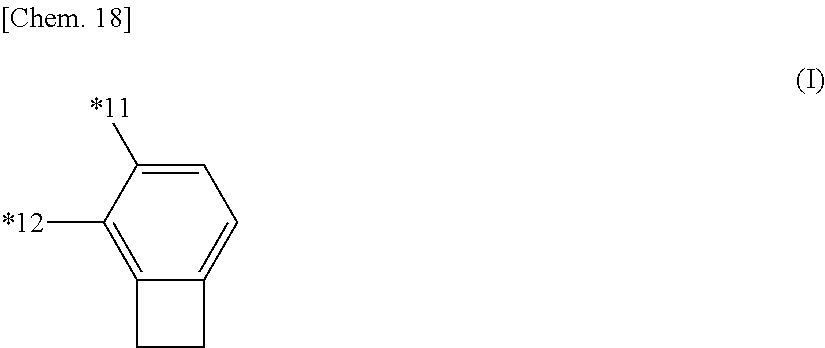
- a polymer according to still another embodiment of the present invention has a constitutional repeating unit represented by one of the formulae (k1) to (k3).
- L has the following formula (l), and U is a direct bond (u1) or has one of the formulae (u2) to (u12).
- *11 and *12 denote a bonding arm, one of *11 and *12 is bonded to U of the formulae (k1) to (k3), and the other of *11 and *12 not bonded to U of the formulae (k1) to (k3) is bonded to a hydrogen atom.
- a cross-linked compound according to an embodiment of the present invention has the general formula (III). M-R-T-R′-M′ (III)
- M and M′ are polymers having a constitutional repeating unit represented by one of the formulae (m1) to (m12), each of R and R′ is a direct bond (r1) or has one of the formulae (r2) to (r12), and T has the formula (t).
- *13 to *20 denote a bonding arm, one of *13 to *16 and one of *17 to *20 are bonded to M and M′ of the formula (III), and the remainder of *13 to *20 not bonded to M or M′ of the formula (III) are bonded to a hydrogen atom.
- FIG. 1 is a reaction scheme in a method for producing a compound according to an embodiment of the present invention.
- FIGS. 2A and 2B are reaction schemes in a method for producing a compound according to an embodiment of the present invention.
- FIGS. 3A and 3B are reaction schemes in a method for producing a compound according to an embodiment of the present invention.
- FIGS. 4A and 4B are schematic views of an optical element according to an embodiment of the present invention.
- C denotes a carbon atom
- N denotes a nitrogen atom
- H denotes a hydrogen atom
- O denotes an oxygen atom
- S denotes a sulfur atom
- Si denotes a silicon atom.
- a compound according to an embodiment of the present invention has the following general formula (I): A-Z—B ⁇ (I)
- A has the following formula (a)
- B ⁇ has the following formula (b1) or (b2)
- Z denotes a direct bond (z1) or has one of the formulae (z2) to (z12).
- *1 and *2 denote a bonding arm of a carbon atom of a phenyl ring in the formula (a), one of *1 and *2 is bonded to Z of the formula (I), and the other of *1 and *2 not bonded to Z of the formula (I) is bonded to a hydrogen atom.
- a compound according to another embodiment of the present invention has the following general formula (II): C ⁇ -Y-D (H)
- C ⁇ has the following formula (c)
- D has one of the following formulae (d1) and (d2)
- Y is a direct bond (y1) or has one of the formulae (y2) to (y12).
- *3 and *4 denote a bonding arm of a carbon atom of a phenyl ring in the formula (c), one of *3 and *4 is bonded to Y of the formula (II), and the other of *3 and *4 not bonded to Y of the formula (II) is bonded to a hydrogen atom.
- a compound according to the present embodiment has one of the formulae (b1), (b2), (d1), and (d2) and can be polymerized to produce a polymer described below.
- the polymer can be heated to produce a cross-linked compound.
- the cross-linked compound has a sufficiently low linear expansion coefficient of 60 ppm/° C. or less. Because of its small dimensional change with temperature, the cross-linked compound can be suitably used as a material for optical elements and electric circuit boards.
- cross-linking of the polymer described below does not produce by-products, such as ethylene.
- the polymer can be formed into a product without air bubbles.
- the cross-linking of the polymer does not require a cross-linker or a cross-linking aid.
- the direct bond (z1), the moieties having the formulae (z2) to (z5), the formula (z10), the formula (z11), the direct bond (y1), the formulae (y2) to (y5), the formula (y10), and the formula (y11) have no oxygen atom, resulting in low water absorbency.
- the moieties having the formulae (z6) to (z12) and the formulae (y6) to (y12) have a heteroatom, resulting in good adhesion with a substrate made of a metal, such as copper, or glass.
- a polymer according to an embodiment of the present invention has a constitutional repeating unit represented by one of the formulae (e1) to (e3).
- F ⁇ has the following formula (f), and X is a direct bond (x1) or has one of the formulae (x2) to (x12).
- *5 and *6 denote a bonding arm of a carbon atom of a phenyl ring in the formula (f), one of *5 and *6 is bonded to X of the formulae (e1) to (e3), and the other of *5 and *6 not bonded to X of the formulae (e1) to (e3) is bonded to a hydrogen atom.
- Another polymer according to the present embodiment has a constitutional repeating unit represented by one of the formulae (g1) to (g3).
- H ⁇ has the following formula (h), and W is a direct bond (w1) or has one of the formulae (w2) to (w12).
- *7 and *8 denote a bonding arm of a carbon atom of a phenyl ring in the formula (h), one of *7 and *8 is bonded to W of the formulae (g1) to (g3), and the other of *7 and *8 not bonded to W of the formulae (g1) to (g3) is bonded to a hydrogen atom.
- Still another polymer according to the present embodiment has a constitutional repeating unit represented by one of the formulae (i1) to (i3).
- J has the following formula (j), and V is a direct bond (v1) or has one of the formulae (v2) to (v12).
- *9 and *10 denote a bonding arm of a carbon atom of a phenyl ring in the formula (j), one of *9 and *10 is bonded to V of the formulae (i1) to (i3), and the other of *9 and *10 not bonded to V of the formulae (i1) to (i3) is bonded to a hydrogen atom.
- Still another polymer according to the present embodiment has a constitutional repeating unit represented by one of the formulae (k1) to (k3).
- L has the following formula (l), and U is a direct bond (u1) or has one of the formulae (u2) to (u12).
- *11 and *12 denote a bonding arm of a carbon atom of a phenyl ring in the formula (l), one of *11 and *12 is bonded to U of the formulae (k1) to (k3), and the other of *11 and *12 not bonded to U of the formulae (k1) to (k3) is bonded to a hydrogen atom.
- a polymer according to the present embodiment has a benzocyclobutene structure and can be heated to produce a cross-linked compound.
- the cross-linked compound has a sufficiently low linear expansion coefficient of 60 ppm/° C. or less. Because of its small dimensional change with temperature, the cross-linked compound can be suitably used as a material for optical elements and electric circuit boards.
- the cross-linking of a polymer according to the present embodiment does not produce by-products, such as ethylene.
- the polymer can be formed into a product without air bubbles.
- the cross-linking of a polymer according to the present embodiment does not require a cross-linker or a cross-linking aid.
- the molecular weight of a polymer according to the present embodiment is, but not limited to, 1000 or more and 1,000,000 or less, preferably 3000 or more and 500,000 or less, more preferably 3000 or more and 7000 or less, in terms of weight-average molecular weight (Mw).
- Mw weight-average molecular weight
- the molecular weight is a polystyrene equivalent as measured by gel permeation chromatography (GPC).
- the moieties having the direct bond (x1), the formulae (x2) to (x5), the formula (x10), the formula (x11), the direct bond (w1), the formulae (w2) to (w5), the formula (w10), the formula (w11), the direct bond (v1), the formulae (v2) to (v5), the formula (v10), the formula (v11), the direct bond (u1) the formulae (u2) to (u5), the formula (u10), and the formula (u11) have no oxygen atom, resulting in low water absorbency.
- the moieties having the formulae (x6) to (x12), the formulae (w6) to (w12), the formulae (v6) to (v12), and the formulae (u6) to (u12) have a heteroatom, resulting in good adhesion with a substrate made of a metal, such as copper, or glass.
- a polymer according to the present embodiment may be a copolymer that has a second constitutional repeating unit other than the constitutional repeating unit described above provided that the advantages of the present invention are secured.
- Examples of the second constitutional repeating unit are as follows:
- the molar ratio of the constitutional repeating unit represented by one of the formulae (e1) to (e3), the formulae (g1) to (g3), the formulae (i1) to (i3), the formulae (k1) to (k3) to the second constitutional repeating unit represented by one of the formulae (3-1) to (3-15) is preferably in the range of 5:95 to 95:5, more preferably 30:70 to 40:60.
- the optical properties, such as transmittance, refractive index, and Abbe number, can be controlled by the percentage of the second constitutional repeating unit having one of the formulae (3-1) to (3-15) in a polymer according to the present embodiment.
- a copolymer according to the present embodiment may be a random copolymer, a block copolymer, or an alternating copolymer.
- a cross-linked compound according to the present embodiment has the following general formula (III). M-R-T-R′-M′ (III)
- M and M′ are polymers having a constitutional repeating unit represented by one of the formulae (m1) to (m12), each of R and R′ is a direct bond (r1) or has one of the formulae (r2) to (r12), and T has the formula (t).
- *13 to *20 denote a bonding arm, one of *13 to *16 and one of *17 to *20 are bonded to M and M′ of the formula (III), and the remainder of *13 to *20 not bonded to M or M′ of the formula (III) are bonded to a hydrogen atom.
- a cross-linked compound according to the present embodiment has a sufficiently low linear expansion coefficient of 60 ppm/° C. or less. Because of its small dimensional change with temperature, the cross-linked compound can be suitably used as a material for optical elements and electric circuit boards. As described above, a cross-linked compound according to the present embodiment can be produced by heating, and the production of the cross-linked compound requires no cross-linker or cross-linking aid. The production of a cross-linked compound according to the present embodiment does not produce by-products, such as ethylene. Thus, the cross-linked compound provides a product without air bubbles.
- the moieties having the direct bond (r1), the formulae (r2) to (r5), the formula (r10), and the formula (r11) have no oxygen atom, resulting in low water absorbency.
- the moieties having the formulae (r6) to (r12) have a heteroatom, resulting in good adhesion with a substrate made of a metal, such as copper, or glass.
- a cross-linked compound according to the present embodiment can be suitably used as a material for optical elements, such as lenses, light guide plates, protective films, deflection films, retardation films, and touch panels, transparent electrode substrates, optical recording substrates, such as CDs, MDs, and DVDs, electric circuit boards, such as TFT substrates, and electronic components, such as color filter substrate sealants, prepregs, resin-coated copper foil, printed wiring boards, insulating sheets, interlayer insulating films, antenna substrates, electromagnetic wave absorbers, and electromagnetic shields.
- optical elements such as lenses, light guide plates, protective films, deflection films, retardation films, and touch panels, transparent electrode substrates, optical recording substrates, such as CDs, MDs, and DVDs, electric circuit boards, such as TFT substrates, and electronic components, such as color filter substrate sealants, prepregs, resin-coated copper foil, printed wiring boards, insulating sheets, interlayer insulating films, antenna substrates, electromagnetic wave absorbers, and electromagnetic shields.
- the cross-linked structure of a cross-linked compound according to the present embodiment can be identified by a known method. More specifically, the cross-linked compound can be subjected to infrared (IR) spectroscopy to observe a peak of a benzocyclobutene skeleton around 1470 cm ⁇ 1 , which is reduced by a cross-linking reaction, and a peak around 1500 cm ⁇ 1 , which appears due to the cross-linking reaction.
- IR infrared
- a cross-linked compound according to the present embodiment may be a cross-linked compound between the polymer described above and another polymer having a benzocyclobutene ring.
- the polymer having a benzocyclobutene ring is not particularly limited and may have the following constitutional repeating unit.
- a compound according to the present embodiment can be easily synthesized by the following methods.
- a compound having the general formula (I) can be synthesized by a Diels-Alder reaction between cyclopentadiene and a benzocyclobutene having a vinyl group.
- the reaction can be directed to the formula (b1) or the formula (b2) depending on the amount of cyclopentadiene ( FIG. 1 ).
- a compound having the general formula (II) in which d is (d1) can be synthesized by an imidization reaction between 5-norbornene-2,3-dicarboxylic anhydride and a benzocyclobutene having an amino group ( FIG. 2A ) or a Diels-Alder reaction between cyclopentadiene and a benzocyclobutene having a N-substituted maleimide group ( FIG. 2B ).
- a compound having the general formula (II) in which d is (d2) can be synthesized by an imidization reaction between a cyclopentadiene-itaconic anhydride adduct and a benzocyclobutene having an amino group ( FIG. 3A ) or a Diels-Alder reaction between cyclopentadiene and a benzocyclobutene having a N-substituted itaconic acid imide group ( FIG. 3B ).
- a method for producing a polymer according to the present embodiment involves (i) ring-opening metathesis polymerization, (ii) ring-opening metathesis polymerization and subsequent hydrogenation reaction, or (iii) addition polymerization of the compound described above.
- the compound described above is brought into contact with a ring-opening metathesis polymerization catalyst.
- the ring-opening metathesis polymerization catalyst may be any catalyst that can promote the ring-opening metathesis polymerization of the compound.
- ring-opening metathesis polymerization catalyst examples include (a) group 4-8 transition metal carbene complex catalysts and (b) combinations of a transition metal compound and an alkylating agent or Lewis acid functioning as a promoter.
- the catalyst (a) include tungsten alkylidene complexes, such as W(N-2,6-i-Pr 2 C 6 H 3 )(CH-t-Bu) (O-t-Bu) 2 , W(N-2,6-i-Pr 2 C 6 H 3 )(CH-t-Bu)(OCMe 2 CF 3 ) 2 , W(N-2,6-i-Pr 2 C 6 H 3 )(CH-t-Bu)(OCMe(CF 3 ) 2 ) 2 , W(N-2,6-i-Pr 2 C 6 H 3 )(CHCMe 2 Ph)(O-t-Bu) 2 , W(N-2,6-i-Pr 2 C 6 H 3 )(CHCMe 2 Ph)(OCMe 2 CF 3 ) 2 , and W(N-2,6-i-Pr 2 C 6 H 3 )(CHCMe 2 Ph)) OCMe (CF 3 ) 2 ) 2 , molybdenum
- transition metal compound in (b) include MoCl 4 , MoBr 2 , MoBr 3 , MoBr 4 , WCl 2 , WBr 2 , WCl 4 , WBr 4 , WCl 5 , and WBr 5 .
- Examples of the alkylating agent functioning as a promoter in (b) include methyl lithium, ethyl lithium, n-butyl lithium, methyl magnesium chloride, and methyl magnesium bromide.
- Examples of the Lewis acid functioning as a promoter in (b) include trimethyl aluminum, triethyl aluminum, triisopropyl aluminum, tetramethyl tin, tetraethyl tin, and tetrabutyl tin.
- Group 4-8 transition metal carbene complex catalysts in particular, ruthenium carbene complex catalysts have high catalytic activity.
- the molar ratio of the ring-opening metathesis polymerization catalyst to the compound is generally in the range of 1:100 to 1:1,000,000, preferably 1:1000 to 1:500,000. An excessively large amount of polymerization catalyst is difficult to remove. An excessively small amount of polymerization catalyst results in insufficient polymerization activity.
- the polymerization temperature is generally, but not limited to, ⁇ 30° C. or more and 200° C. or less, preferably 0° C. or more and 180° C. or less.
- the polymerization time is generally, but not limited to, 1 minute or more and 50 hours or less.
- the ring-opening metathesis polymerization reaction may be performed in the absence of solvent, it may be performed in the presence of an organic solvent so as to reduce an increase in viscosity during the polymerization reaction.
- organic solvent examples include aliphatic hydrocarbon solvents, such as pentane, hexane, and heptane, alicyclic hydrocarbon solvents, such as cyclopentane, cyclohexane, methylcyclohexane, dimethylcyclohexane, trimethylcyclohexane, ethylcyclohexane, diethylcyclohexane, decahydronaphthalene, bicycloheptane, tricyclodecane, hexahydroindene, and cyclooctane, aromatic hydrocarbon solvents, such as benzene, toluene, and xylene, nitrogen-containing hydrocarbon solvents, such as nitromethane, nitrobenzene, and acetonitrile, and ether solvents, such as diethyl ether and tetrahydrofuran.
- aliphatic hydrocarbon solvents such as pentane, hexane
- the concentration of the cyclic olefin monomer is preferably 1% by mass or more and 60% by mass or less, more preferably 5% by mass or more and 40% by mass or less, of the organic solvent.
- concentration of the cyclic olefin monomer is less than 1% by mass, this results in low productivity.
- the concentration of the cyclic olefin monomer is more than 60% by mass, this results in an increased viscosity of the solution after polymerization, resulting in poor handleability.
- a molecular weight modifier may be used to control the molecular weight of the polymer.
- the molecular weight modifier include ⁇ -olefins, such as 1-butene, 1-pentene, 1-hexene, and 1-octene; styrenes, such as styrene and vinyltoluene; ethers, such as ethyl vinyl ether, i-butyl vinyl ether, and allyl glycidyl ether; halogen-containing vinyl compounds, such as allyl chloride; oxygen-containing vinyl compounds, such as allyl acetate, allyl alcohol, and glycidyl methacrylate; and nitrogen-containing vinyl compounds, such as acrylamide.
- ⁇ -olefins such as 1-butene, 1-pentene, 1-hexene, and 1-octene
- styrenes such as styrene and vinyltoluene
- ethers such as ethy
- the amount of molecular weight modifier may be 0% by mole or more and 100% by mole or less of the compound.
- the ring-opening metathesis polymerization is described above. After the ring-opening metathesis polymerization of the compound, a hydrogenation reaction is performed in the presence of a hydrogenation catalyst and hydrogen to hydrogenate a carbon-carbon double bond of the resulting polymer. A product of the hydrogenation reaction is referred to as a hydrogenated product.
- the hydrogenation catalyst may be any catalyst generally used in hydrogenation reactions of olefins and aromatic compounds.
- Specific examples of the hydrogenation catalyst include (a) supported metal catalysts, for example, a transition metal, such as palladium, platinum, nickel, rhodium, or ruthenium, supported on a carrier, such as carbon, alumina, silica, or diatomaceous earth, (b) homogeneous catalysts composed of an organic transition metal compound containing titanium, cobalt, or nickel and an organic metal compound containing lithium, magnesium, aluminum, or tin, and (c) homogeneous catalysts composed of a metal complex catalyst containing rhodium or ruthenium.
- a transition metal such as palladium, platinum, nickel, rhodium, or ruthenium
- hydrogenation catalyst (a) examples include nickel/silica, nickel/diatomaceous earth, nickel/alumina, palladium/carbon, palladium/silica, palladium/diatomaceous earth, palladium/alumina, platinum/silica, platinum/alumina, rhodium/silica, rhodium/alumina, ruthenium/silica, and ruthenium/alumina.
- hydrogenation catalyst (b) examples include cobalt acetate/triethyl aluminum, nickel acetylacetonate/triisobutyl aluminum, titanocene dichloride/n-butyl lithium, zirconocene dichloride/sec-butyl lithium, and tetrabutoxy titanate/dimethyl magnesium.
- hydrogenation catalyst (c) examples include dihydridotetra(triphenylphosphine)ruthenium, dihydrido(acetonitrile)tris(triphenylphosphine)ruthenium, and dihydrido(tetrahydrofuran)tris(triphenylphosphine)ruthenium.
- the conditions suitable for the hydrogenation reaction depend on the type of hydrogenation catalyst.
- the hydrogenation temperature is generally ⁇ 20° C. or more and 250° C. or less, preferably 0° C. or more and 220° C. or less, more preferably 20° C. or more and 200° C. or less.
- the hydrogen pressure is generally 0.01 MPa or more and 10 MPa or less, preferably 0.05 MPa or more and 7 MPa or less, more preferably 0.1 MPa or more and 5 MPa or less.
- An excessively low hydrogenation temperature results in a low reaction rate, and an excessively high hydrogenation temperature induces a side reaction.
- An excessively low hydrogen pressure results in a low hydrogenation rate, and an excessively high hydrogen pressure requires a high-pressure reaction apparatus.
- the hydrogenation reaction time is generally, but not limited to, in the range of 1 minute to 50 hours.
- the hydrogenation reaction is generally performed in an inert organic solvent.
- organic solvent depends on the solubility of a hydrogenated product.
- the solvent include aromatic hydrocarbons, such as benzene and toluene; aliphatic hydrocarbons, such as n-pentane and n-hexane; alicyclic hydrocarbons, such as cyclohexane and decalin; and ethers, such as tetrahydrofuran and ethylene glycol dimethyl ether.
- Examples of a solvent having excellent solubility for a hydrogenated product of cyclic olefin ring-opening polymerization used in the present invention include hydrocarbon solvents and ethers, typically alicyclic hydrocarbon solvents.
- the organic solvent may generally be the same as the polymerization reaction solvent.
- a hydrogenation catalyst may be directly added to the polymerization reaction solution.
- the hydrogenation catalyst may be removed by the following methods.
- a homogeneous catalyst an oxidizing agent or a basic compound and a poor solvent for the reaction solution, such as water or methanol, are added to the reaction solution after polymerization to convert the homogeneous catalyst into a metal oxide or a metal salt, the metal oxide or the metal salt is extracted into the poor solvent, and the homogeneous catalyst is removed by filtration or centrifugation.
- the homogeneous catalyst is removed by adsorption on an adsorbent or extraction into an aqueous solution of an acid, such as hydrochloric acid.
- a supported hydrogenation catalyst In the case of a supported hydrogenation catalyst, it can be easily removed by centrifugation or filtration.
- the compound described above is brought into contact with an addition polymerization catalyst.
- the addition polymerization catalyst may be any catalyst that can promote the addition polymerization of the compound.
- addition polymerization catalyst examples include (a) group 4-6 transition metal catalysts and (b) group 8-10 transition metal catalysts.
- addition polymerization catalyst (a) examples include Ziegler-Natta catalysts containing TiCl 3 or TiCl 4 ; metallocene catalysts containing an organometallic complex, such as (C 5 H 5 ) 2 TiCl 2 , (C 5 H 5 ) 2 ZrCl 2 , or (C 5 H 5 ) 2 Zr(CH 3 ) 2 ; and half-metallocene catalysts containing an organic metal, such as (C 5 H 4 Si(CH 3 ) 3 )Sc(Si(CH 3 ) 3 ) 2 .
- addition polymerization catalyst (b) include cobalt compounds, such as cobalt (II) acetate, cobalt (II) acetylacetonate, cobalt (II) tetrafluoroborate, cobalt chloride, and cobalt (II) benzoate; nickel compounds, such as nickel acetate, nickel acetylacetonate, nickel carbonate, nickel chloride, nickel ethylhexanoate, nickelocene, NiCl 2 [P(C 6 H 5 ) 3 ] 2 , bisallyl nickel, and nickel oxide; and palladium compounds, such as palladium chloride, palladium bromide, palladium oxide, PdCl 2 [P(C 6 H 5 ) 3 ] 2 , PdCl 2 (C 6 H 5 CN) 2 , PdCl 2 (CH 3 CN) 2 , [Pd(CH 3 CN) 4 ][BF 4 ] 2 , [Pd((CH 3
- These catalysts may be used in combination with a promoter.
- the promoter include aluminoxanes, such as methylaluminoxane and polyisobutylaluminoxane; boron compounds, such as B(C 6 F 5 ) 3 , BF 3 .(C 2 H 5 ) 2 O, [C 6 H 5 NH(CH 3 ) 2 ] + [B(C 6 F 5 ) 4 ] ⁇ , [(C 6 H 5 ) 3 C] + [B(C 6 F 5 ) 4 ] ⁇ , Li + [B(C 6 F 5 ) 4 ] ⁇ , and Na + [B(3,5-(CF 3 ) 2 C 6 H 3 )] 4 ⁇ ; phosphine compounds, such as tricyclopentylphosphine, dicyclopentyl(isopropyl)phosphine, dicyclopentylphenylphosphine, dicyclopentylcyclooctyl
- the molar ratio of the addition polymerization catalyst to the compound described above is generally in the range of 1:100 to 1:1,000,000, preferably 1:1000 to 1:500,000. An excessively large amount of addition polymerization catalyst is difficult to remove. An excessively small amount of addition polymerization catalyst results in insufficient polymerization activity.
- the polymerization temperature is generally, but not limited to, ⁇ 30° C. or more and 200° C. or less, preferably 0° C. or more and 180° C. or less.
- the polymerization time is generally, but not limited to, 1 minute or more and 50 hours or less.
- addition polymerization reaction may be performed in the absence of solvent, it may be performed in the presence of an organic solvent so as to reduce an increase in viscosity during the polymerization reaction.
- organic solvent examples include aliphatic hydrocarbon solvents, such as pentane, hexane, and heptane, alicyclic hydrocarbon solvents, such as cyclopentane, cyclohexane, methylcyclohexane, dimethylcyclohexane, trimethylcyclohexane, ethylcyclohexane, diethylcyclohexane, decahydronaphthalene, bicycloheptane, tricyclodecane, hexahydroindene, and cyclooctane, aromatic hydrocarbon solvents, such as benzene, toluene, and xylene, nitrogen-containing hydrocarbon solvents, such as nitromethane, nitrobenzene, and acetonitrile, and ether solvents, such as diethyl ether and tetrahydrofuran.
- aliphatic hydrocarbon solvents such as pentane, hexane
- the concentration of the compound described above is preferably 1% by mass or more and 60% by mass or less, more preferably 5% by mass or more and 40% by mass or less, of the organic solvent.
- concentration of the compound is less than 1% by mass, this results in low productivity.
- concentration of the compound is more than 60% by mass, this results in an increased viscosity of the solution after polymerization, resulting in poor handleability.
- a molecular weight modifier may be used to control the molecular weight of the polymer.
- the molecular weight modifier include ⁇ -olefins, such as ethylene, propene, 1-butene, 1-pentene, 1-hexene, 1-octene, 1-nonene, and 1-decene; compounds having a cyclopentene ring, such as cyclopentene, 3-methylcyclopentene, 3-ethylcyclopentene, 3-isopropylcyclopentene, 3-n-propylcyclopentene, 4-methylcyclopentene, 4-ethylcyclopentene, 4-isopropylcyclopentene, and 4-phenylcyclopentene; and compounds having a cycloalkane diene ring, such as cycloocta-1,5-diene, 3-methylcycloocta-1,5-diene, 3-ethylcycloocta-1,5-diene, cycloocta-1
- the amount of molecular weight modifier may be 0% by mole or more and 100% by mole or less of the compound.
- a method for producing a cross-linked compound according to the present embodiment involves heat treatment and/or microwave irradiation treatment of the polymer described above.
- the heating temperature of the heat treatment may be any temperature at which the benzocyclobutene ring of the polymer opens and is preferably 180° C. or more and 400° C. or less, more preferably 200° C. or more and 300° C. or less.
- a cross-linking temperature of 180° C. or more results in sufficient cross-linking and a sufficiently low linear expansion coefficient.
- a cross-linking temperature of 400° C. or less can reduce the thermal decomposition of the polymer and the cross-linked compound.
- the frequency of a microwave in the microwave irradiation treatment may be any frequency at which the benzocyclobutene ring of the polymer opens, for example, 2.45 or 5.8 GHz. More specifically, the frequency of the microwave may be 2,450 ⁇ 50 MHz in the 2.45 GHz band or 5,800 ⁇ 75 MHz in the 5.8 GHz band, both of which are the industrial, scientific, and medical (ISM) bands.
- the microwave irradiation may be performed more than once under different conditions.
- the microwave irradiation temperature is preferably, but not limited to, 50° C. or more and 400° C. or less, more preferably 80° C. or more and 300° C. or less, particularly preferably 100° C. or more and 200° C. or less.
- the heat treatment and the microwave irradiation treatment may be performed simultaneously or sequentially (in any order).
- the time of the heat treatment and the microwave irradiation treatment is not particularly limited provided that the polymer can be cross-linked, for example, 1 minute or more and 10 hours or less.
- a cross-linking time of less than 1 minute may result in insufficient cross-linking, thus reducing the advantages of the present invention.
- a cross-linking time of more than 10 hours may result in low productivity or, in the heat treatment, the degradation of the cross-linked compound.
- the heat treatment and/or the microwave irradiation treatment may be performed in an inert atmosphere, such as an argon, helium, or nitrogen atmosphere.
- FIG. 4A illustrates an optical element, such as a convex lens, that includes an organic transparent member 101 containing the cross-linked compound described above.
- FIG. 4B illustrates an optical element that includes an organic transparent member 102 on a substrate 103 .
- the organic transparent member 102 contains the cross-linked compound, and the substrate 103 contains an inorganic material, such as glass.
- An optical element according to the present embodiment contains a cross-linked compound having a low linear expansion coefficient of 60 ppm/° C. or less and exhibits a small dimensional change with temperature.
- An optical element according to the present embodiment has a cyclic olefin polymer structure that includes a constitutional repeating unit represented by one of the formulae (m1) to (m12) and therefore has high visible light transmittance and low water absorbency.
- the organic transparent members 101 and 102 may contain an antioxidant and/or a light stabilizer depending on the type of cross-linked compound.
- the antioxidant may be any antioxidant that can prevent the oxidative degradation of the cross-linked compound, for example, a phenol antioxidant, such as an alkyl-substituted phenol antioxidant, a phosphite antioxidant, or a sulfur antioxidant.
- a phenol antioxidant such as an alkyl-substituted phenol antioxidant, a phosphite antioxidant, or a sulfur antioxidant.
- the antioxidant can prevent coloring or strength reduction resulting from oxidative degradation during a forming process without causing deterioration in transparency and heat resistance.
- the light stabilizer may be any light stabilizer that can prevent photodegradation of the cross-linked compound, for example, a benzophenone light stabilizer, a benzotriazole light stabilizer, or a hindered amine light stabilizer.
- a hindered amine light stabilizer provides excellent transparency and anti-coloring.
- Examples of an optical element according to the present embodiment include optical lenses and optical prisms, such as image pickup lenses for cameras, lenses for microscopes, endoscopes, and telescopes, and transmission lenses, including spectacle lenses; pickup lenses for optical disks, such as CDs, CD-ROMs, write-once read-many (WORM) optical disks, magneto-optical (MO) disks, MiniDisc (MD, Trade name), and digital versatile disks (DVD); and lenses for scanning optical systems, such as lenses for laser scanning systems, including f ⁇ lenses and sensor lenses for laser beam printers, and prismatic lenses for camera finders.
- Other examples of an optical element according to the present embodiment include light guide plates for liquid crystal displays; optical films, such as polarizing films, retardation films, and light diffusion films; light diffusion plates; optical cards; and liquid crystal display element substrates.
- An optical element according to the present embodiment may be one of the lenses described above.
- the lens may have an anti-reflection film on its surface and an intermediate layer between the anti-reflection film and the optical element.
- the anti-reflection film is not particularly limited and may have a refractive index close to the refractive index of the lens.
- the intermediate layer is not particularly limited and may have a refractive index between the refractive index of the lens and the refractive index of the anti-reflection film.
- a film that is opaque in an operating wavelength region may be formed on a portion that blocks light, typically the lens edge.
- the organic transparent members 101 and 102 may contain a generally available resin.
- the generally available resin include commercially available resins, such as polyethylenes, polyisoprenes, polystyrenes, polyacrylates, polycarbonates, polyesters, polyethers, polyamides, and cycloolefin polymers.
- the organic transparent members 101 and 102 may contain a filler so as to improve the mechanical characteristics, electrical characteristics, and optical properties of the cross-linked compound.
- the filler may be an inorganic substance or an organic substance.
- the inorganic substance may be a silicon oxide, a metal oxide, a carbon compound, a metal multiple oxide, a metal sulfide, a metal compound semiconductor, or a metal.
- the metal oxide include aluminum oxide, titanium oxide, niobium oxide, tantalum oxide, zirconium oxide, zinc oxide, magnesium oxide, tellurium oxide, yttrium oxide, indium oxide, tin oxide, and indium tin oxide.
- the carbon compound include diamond, carbon nanotube, graphite, and fullerene.
- the metal multiple oxide include lithium niobate, potassium niobate, and lithium tantalate.
- the metal compound semiconductor examples include metal sulfides, such as zinc sulfide and cadmium sulfide, zinc selenide, cadmium selenide, zinc telluride, and cadmium telluride.
- the metal examples include gold.
- the inorganic substance may be a core-shell inorganic substance in which an inorganic substance is coated with another inorganic component.
- the inorganic substance may be of any shape, such as spherical, elliptical, flat, or rod-shaped.
- the inorganic substance preferably has an average primary particle size of 30 nm or less, more preferably 10 nm or less, so as to prevent light scattering.
- average primary particle size refers to a particle size measured with a transmission electron microscope (TEM).
- organic substance examples include wood flour, starch, organic pigments, polystyrene, nylon, polyolefins, such as polyethylene and polypropylene, vinyl chloride, elastomers, and waste plastics.
- Examples of the filler include the inorganic and organic substances described above and short and long fibers, such as chopped strands and milled fibers.
- Examples of the fibers include inorganic fibers, such as glass fibers, carbon fibers, and metal fibers; and organic fibers, such as aramid fibers, nylon fibers, jute fibers, kenaf fibers, bamboo fibers, polyethylene fibers, drawn polyethylene fibers, polypropylene fibers, and drawn polypropylene fibers.
- the filler may be a flame retardant.
- the flame retardant include flame retardants containing an inorganic substance, such as a metal hydroxide, and flame retardants containing an organic substance, such as a phosphorus-containing compound, a halogen-containing compound, or a nitrogen-containing compound. Flame retardants containing a metal hydroxide have a reduced load on the environment. Examples of the flame retardants containing a metal hydroxide include aluminum hydroxide, magnesium hydroxide, basic magnesium oxide, and dawsonite.
- a cross-linked compound according to the present embodiment may contain common additive agents, such as an antioxidant, a neutralizing agent, a lubricant, an antistatic agent, a whitening agent, a heat stabilizer, a light stabilizer, a plasticizer, a colorant, an impact modifier, an extender, a mold-release agent, a foaming agent, and/or a processing aid.
- additive agents such as an antioxidant, a neutralizing agent, a lubricant, an antistatic agent, a whitening agent, a heat stabilizer, a light stabilizer, a plasticizer, a colorant, an impact modifier, an extender, a mold-release agent, a foaming agent, and/or a processing aid.
- additive agents such as an antioxidant, a neutralizing agent, a lubricant, an antistatic agent, a whitening agent, a heat stabilizer, a light stabilizer, a plasticizer, a colorant, an impact modifier, an extender, a mold-release agent, a foaming
- additive agent Any additive agent may be used provided that it does not inhibit a cross-linking reaction in a cross-linking process described below. These additive agents may be used alone or in combination.
- An optical element may be manufactured by (a) preparing a cross-linked compound and shaping the cross-linked compound or by (b) the bulk polymerization and cross-linking of the compound in a lens-shaped mold.
- the shaping is not particularly limited and may be performed by any method suitable for the shaping of the optical element.
- a shaping method include injection molding, transfer molding, blow molding, rotational molding, vacuum forming, extrusion molding, calendering, solution casting, heat press forming, inflation, and solvent casting.
- the optical element may take the shape of a sphere, rod, plate, cylinder, pipe, tube, fiber, film, or sheet.
- An optical lens is manufactured by a process of forming the cross-linked compound into a desired lens shape and a process of cross-linking the formed product.
- the process of forming a desired lens shape is not particularly limited.
- Melt formed products have low birefringence, high mechanical strength, and high dimensional accuracy.
- melt forming include commercially available press forming, commercially available extrusion molding, and commercially available injection molding.
- Injection molding has excellent formability and high productivity.
- the molding conditions depend on the intended use or the forming method.
- the temperature of a polymer in injection molding may be any temperature at which the polymer is not cross-linked, for example, 100° C. or more and 300° C. or less.
- the molding may be performed in an inert gas or under vacuum.
- the polymer has moderate flowability during the molding, and the formed product does not have sink marks or strain, has a reduced number of silver streaks caused by the thermal decomposition of the polymer, and is resistant to yellowing. In an inert gas or under vacuum, the degradation or yellowing of the formed product can be significantly reduced.
- the polymer is injected into a lens-shaped forming die and is preferably heated to a temperature of 180° C. or more and 400° C. or less, more preferably 200° C. or more and 300° C. or less, to open the benzocyclobutene ring of the polymer.
- the cross-linking time of the formed product is not particularly limited and may be 1 minute or more and 10 hours or less. A cross-linking time of less than 1 minute may result in insufficient cross-linking, thus reducing the advantages of the present invention. A cross-linking time of more than 10 hours may result in low productivity or the degradation of the cross-linked compound.
- the forming die may be pressed.
- the pressure is generally 0.1 MPa or more and 50 MPa or less, preferably 3 MPa or more and 20 MPa or less.
- the cross-linking process may be performed in an inert gas or under vacuum.
- An excessively low cross-linking temperature results in insufficient cross-linking and a slightly high linear expansion coefficient.
- An excessively high cross-linking temperature results in the degradation of the polymer and the cross-linked compound. In an inert gas or under vacuum, the degradation or yellowing of the cross-linked compound can be significantly reduced.
- a lens-shaped forming die is charged with the compound and a polymerization catalyst, and optionally a polymerization modifier, a chain transfer agent, an antioxidant, and a filler, and is heated to a predetermined temperature.
- the polymerization modifier can control polymerization activity and improve the degree of polymerization.
- Specific examples of the polymerization modifier include trialkoxy aluminum, triphenoxy aluminum, dialkoxyalkyl aluminum, alkoxydialkyl aluminum, trialkyl aluminum, dialkoxy aluminum chloride, alkoxyalkyl aluminum chloride, dialkyl aluminum chloride, trialkoxy scandium, tetraalkoxy titanium, tetraalkoxy tin, and tetraalkoxy zirconium. These polymerization modifiers may be used alone or in combination.
- the predetermined temperature may be any polymerization or cross-linking temperature of the compound and may be 20° C. or more and 200° C. or less for polymerization and 200° C. or more and 300° C. or less for cross-linking.
- the forming die may be pressed.
- the pressure is generally 0.5 MPa or more and 50 MPa or less, preferably 3 MPa or more and 20 MPa or less.
- the polymerization and cross-linking process may be performed in an inert gas or under vacuum.
- the polymerization time may be 1 minute or more and 50 hours or less. A polymerization time of less than 1 minute may result in a low conversion, thus reducing the advantages of the present invention. A polymerization time of more than 50 hours may result in low productivity.
- the cross-linking time of the polymer is not particularly limited and may be 1 minute or more and 10 hours or less. A cross-linking time of less than 1 minute may result in insufficient cross-linking, thus reducing the advantages of the present invention. A cross-linking time of more than 10 hours may result in low productivity or the degradation of the cross-linked compound.
- the present invention will be further described in the following examples, the present invention is not limited to these examples.
- the identification of a compound, the molar ratio of constitutional repeating units of a polymer, the hydrogenation percentage, the number-average molecular weight (Mn) and the weight-average molecular weight (Mw), the glass transition temperature, the linear expansion coefficient, and the identification of a cross-linked structure were performed or measured by the following methods.
- the number-average molecular weight (Mn) and the weight-average molecular weight (Mw) were measured at 40° C. with a gel permeation chromatography (GPC) apparatus (manufactured by Waters Corp.) using two Shodex LF-804 columns (manufactured by Showa Denko K.K.) in series and a developing solvent THF and with a refractive index (RI) detector.
- the number-average molecular weight (Mn) and the weight-average molecular weight (Mw) were based on polystyrene standards.
- the glass transition temperature (Tg) was measured with a differential scanning calorimeter (DSC7020 manufactured by SII NanoTechnology Inc.) in accordance with JIS K 7121 at a temperature initially of from ⁇ 30° C. to 170° C. and then from ⁇ 30° C. to 300° C. at a heating rate of 10° C./min.
- DSC7020 manufactured by SII NanoTechnology Inc.
- thermomechanical analysis JIS K 7197
- a hardened product was cut into a strip of test specimen having a length of 1 cm, the test specimen was placed in a thermomechanical analysis apparatus (Thermo Plus EVO TMA8310 manufactured by Rigaku Corp.) and was subjected to two cycles of heating and cooling between ⁇ 40° C. and 150° C. at a heating rate of 5° C./min in a nitrogen stream (100 mL/min), and the mean linear expansion coefficient at a temperature in the range of 0° C. to 40° C. was measured during heating in the second cycle.
- a thermomechanical analysis apparatus Thermo Plus EVO TMA8310 manufactured by Rigaku Corp.
- the cross-linked structure of a cross-linked compound was identified with a Fourier transform infrared spectrometer (Spectrum One manufactured by PerkinElmer, Inc.) by an ATR (attenuated total reflection) method by determining a decrease in the absorbance of a peak around 1470 cm ⁇ 1 and an increase in the absorbance of a peak around 1500 cm ⁇ 1 by the cross-linking reaction.
- a Fourier transform infrared spectrometer Spectrum One manufactured by PerkinElmer, Inc.
- ATR attenuated total reflection
- a 100-ml autoclave with an agitator was charge with 10 g (77 mmol) of 4-vinylbenzocyclobutene, 4.6 g (35 mmol) of dicyclopentadiene, and 438 mg (2.6 mmol) of 4-tert-butylcatechol and was then tightly closed.
- the reactants were allowed to react at 170° C. for two hours while stirring at 300 rpm.
- the product was then cooled and removed from the autoclave.
- the product was diluted with toluene, and the resulting polyvinylbenzocyclobutene was precipitated in methanol. Polyvinylbenzocyclobutene was filtered out, and the solvent was removed. The residue was transferred to a distillation apparatus.
- a nitrogen-purged pressure-resistant ampule with a stirring bar was charged with 1.0 g (5.1 mmol) of 5-(4-benzocyclobutenyl)-2-norbornene, 10 mg (0.95 mmol) of 1-hexene, and 10 ml of THF.
- the pressure-resistant ampule was immersed in an oil bath at 70° C.
- a solution of 1.0 mg of benzylidene(1,3-dimesitylimidazolidine-2-ylidene)(tricyclohexylphosphine)ruthenium dichloride in 3.0 ml of THF was added to the ampule while the solution in the ampule was stirred, thereby initiating polymerization.
- a nitrogen-purged pressure-resistant ampule with a stirring bar was charged with 1.0 g (5.1 mmol) of 5-(4-benzocyclobutenyl)-2-norbornene, 1.0 g (7.6 mmol) of dicyclopentadiene, 10 mg (0.95 mmol) of 1-hexene, and 20 ml of THF.
- the pressure-resistant ampule was immersed in an oil bath at 70° C.
- P2 was collected by filtration. P2 was dried in a vacuum dryer at 50° C. overnight to yield 1.8 g (yield 90%) of white P2.
- P2 had molecular weights of Mn 6.6 ⁇ 10 3 and Mw 1.4 ⁇ 10 4 .
- a 100-ml autoclave with an agitator was charge with 4.0 g of P2 prepared in Example 1 and 50 ml of toluene and was then tightly closed. The autoclave was purged with nitrogen several times.
- a 10-ml recovery flask was charged with 10 mg (1.2 ⁇ 10 ⁇ 2 mmol) of benzylidene(1,3-dimesitylimidazolidine-2-ylidene)(tricyclohexylphosphine)ruthenium dichloride, was purged with nitrogen, and was then charged with 3 ml of toluene and 80 mg (1.1 mmol) of ethyl vinyl ether. The solution was stirred at room temperature for 10 minutes.
- the solution in the flask was pneumatically transported into the autoclave.
- the autoclave was then purged with hydrogen several times.
- a hydrogenation reaction was then performed at a hydrogen pressure of 4.5 MPa at a temperature of 150° C. for 6 hours.
- the reaction solution was cooled, was transferred into a beaker, and was diluted with 350 ml of toluene.
- the diluted reaction solution was poured into 2 L of methanol while vigorous stirring to precipitate P3.
- P3 was collected by filtration.
- the hydrogenated polymer P3 was dried in a vacuum dryer at 50° C. overnight to yield 3.9 g (yield 98%) of white P3.
- P3 had molecular weights of Mn 4.2 ⁇ 10 3 and Mw 8.9 ⁇ 10 3 .
- Example 2 200 mg of P1 prepared in Example 2 was charged into a cylindrical metal mold (diameter 10 mm ⁇ height 1.2 mm) and was cross-linked at a pressure of 20 MPa at 280° C. for one hour. IR spectroscopy showed the presence of a cross-linked structure.
- the cross-linked compound had no Tg observed and a linear expansion coefficient of 31 ppm/° C.
- the cross-linked compound was prepared without using a cross-linker or a cross-linking aid.
- the cross-linked compound had no air bubble when visually inspected.
- Example 5 The procedures of Example 5 were performed except that P1 was replaced with P2. IR spectroscopy showed the presence of a cross-linked structure.
- the cross-linked compound had no Tg observed and a linear expansion coefficient of 53 ppm/° C.
- the cross-linked compound was prepared without using a cross-linker or a cross-linking aid.
- the cross-linked compound had no air bubble when visually inspected.
- Example 5 The procedures of Example 5 were performed except that P1 was replaced with P3. IR spectroscopy showed the presence of a cross-linked structure.
- the cross-linked compound was prepared without using a cross-linker or a cross-linking aid.
- the cross-linked compound had no air bubble when visually inspected.
- the cross-linked compound had no Tg observed and a linear expansion coefficient of 45 ppm/° C.
- Example 5 The procedures of Example 5 were performed except that the cross-linking temperature was 160° C. IR spectroscopy showed the absence of a cross-linked structure. The formed product had a Tg of 95° C. and a linear expansion coefficient of 77 ppm/° C.
- Example 6 The procedures of Example 6 were performed except that the cross-linking temperature was 160° C. IR spectroscopy showed the absence of a cross-linked structure. The formed product had a Tg of 117° C. and a linear expansion coefficient of 79 ppm/° C.
- Example 7 The procedures of Example 7 were performed except that the cross-linking temperature was 160° C. IR spectroscopy showed the absence of a cross-linked structure. The formed product had a Tg of 70° C. and a linear expansion coefficient of 77 ppm/° C.
- Example 5 The procedures of Example 5 were performed except that P1 was ZEONEX E48R manufactured by Zeon Corp. IR spectroscopy showed the absence of a cross-linked structure. The formed product had a Tg of 135° C. and a linear expansion coefficient of 72 ppm/° C.
- Table 1 shows the results of Examples 5 to 7 and Comparative Examples 1 to 3.
- the cross-linked compounds according to the present examples had a small linear expansion coefficient of 60 ppm/° C. or less.
- the non-crosslinked compounds according to the comparative examples had a large linear expansion coefficient of more than 60 ppm/° C.
- the embodiments and examples show that a cross-linked compound of a polymer produced by the polymerization of a compound according to the present invention has a small linear expansion coefficient.
Landscapes
- Chemical & Material Sciences (AREA)
- Organic Chemistry (AREA)
- Health & Medical Sciences (AREA)
- Chemical Kinetics & Catalysis (AREA)
- Medicinal Chemistry (AREA)
- Polymers & Plastics (AREA)
- Physics & Mathematics (AREA)
- General Physics & Mathematics (AREA)
- Optics & Photonics (AREA)
- Polyoxymethylene Polymers And Polymers With Carbon-To-Carbon Bonds (AREA)
- Addition Polymer Or Copolymer, Post-Treatments, Or Chemical Modifications (AREA)
- Organic Low-Molecular-Weight Compounds And Preparation Thereof (AREA)
Abstract

Description

A-Z—Bφ (I)


Cφ-Y-D (II)


M-R-T-R′-M′ (III)


A-Z—Bφ (I)


Cφ-Y-D (H)


Polymer


Cross-Linked Compound
M-R-T-R′-M′ (III)


Method for Producing Compounds
| TABLE 1 | ||||||
| Forming | Detection | Linear | ||||
| tem- | of cross- | expansion | ||||
| perature | linked | coefficient | ||||
| Polymer | (° C.) | structure | Tg (° C.) | (ppm/° C.) | ||
| Example 5 | P1 | 280 | Yes | Not detected | 31 |
| Example 6 | P2 | 280 | Yes | Not detected | 53 |
| Example 7 | P3 | 280 | Yes | Not detected | 45 |
| Comparative | P1 | 160 | No | 93 | 77 |
| example 1 | |||||
| Comparative | P2 | 160 | No | 116 | 79 |
| example 2 | |||||
| Comparative | P3 | 160 | No | 68 | 77 |
| example 3 | |||||
| Comparative | E48R | 280 | No | 135 | 72 |
| example 4 | |||||
Claims (8)
A-Z—Bφ (I)


Cφ-Y-D (II)



M-R-T-R′-M′ (III)


Applications Claiming Priority (3)
| Application Number | Priority Date | Filing Date | Title |
|---|---|---|---|
| JP2011-166969 | 2011-07-29 | ||
| JP2011166969A JP5791418B2 (en) | 2011-07-29 | 2011-07-29 | Novel compound, polymer, cross-linked product thereof, and optical element having the same |
| PCT/JP2012/069533 WO2013018817A1 (en) | 2011-07-29 | 2012-07-25 | Novel compound, polymer, cross-linked compound of polymer, and optical element including cross-linked compound |
Publications (2)
| Publication Number | Publication Date |
|---|---|
| US20140163175A1 US20140163175A1 (en) | 2014-06-12 |
| US9243098B2 true US9243098B2 (en) | 2016-01-26 |
Family
ID=47629336
Family Applications (1)
| Application Number | Title | Priority Date | Filing Date |
|---|---|---|---|
| US14/235,437 Active US9243098B2 (en) | 2011-07-29 | 2012-07-25 | Compound, polymer, cross-linked compound of polymer, and optical element including cross-linked compound |
Country Status (3)
| Country | Link |
|---|---|
| US (1) | US9243098B2 (en) |
| JP (1) | JP5791418B2 (en) |
| WO (1) | WO2013018817A1 (en) |
Cited By (1)
| Publication number | Priority date | Publication date | Assignee | Title |
|---|---|---|---|---|
| EP4008749A1 (en) * | 2020-12-02 | 2022-06-08 | SHPP Global Technologies B.V. | Composition, method for the manufacture thereof, and articles prepared therefrom |
Families Citing this family (2)
| Publication number | Priority date | Publication date | Assignee | Title |
|---|---|---|---|---|
| GB2528092A (en) * | 2014-07-09 | 2016-01-13 | Cambridge Display Tech Ltd | Material, composition and method |
| JP6791124B2 (en) * | 2015-03-26 | 2020-11-25 | 日本ゼオン株式会社 | Separation method of polymer solution and water |
Citations (6)
| Publication number | Priority date | Publication date | Assignee | Title |
|---|---|---|---|---|
| US4724260A (en) * | 1984-08-27 | 1988-02-09 | The Dow Chemical Company | Unsaturated alkyl monoarylcyclobutane monomers |
| WO2004073018A2 (en) | 2003-02-05 | 2004-08-26 | Dow Global Technologies Inc. | Sacrificial benzocyclobutene/norbornene polymers for making air gaps within semiconductor devices |
| JP2006172822A (en) | 2004-12-14 | 2006-06-29 | Nippon Soda Co Ltd | Composition for solid polyelectrolyte, solid polyelectrolyte, and copolymer and cross-linked polymer having ring-opening ability |
| JP2007314668A (en) | 2006-05-26 | 2007-12-06 | Jsr Corp | Cyclic olefin ring-opening polymer hydride and method for producing the same, and crosslinked polymer and method for producing the same |
| US20090124773A1 (en) * | 2007-11-08 | 2009-05-14 | Yonghua Zhou | Crosslinked Polyolefins For Biomedical Applicatios And Method of Making Same |
| JP2011074293A (en) | 2009-09-30 | 2011-04-14 | Nippon Zeon Co Ltd | Alicyclic monoolefin carboxylic acid (meth)acryloyloxyalkyl ester, and production method and application of the same |
-
2011
- 2011-07-29 JP JP2011166969A patent/JP5791418B2/en active Active
-
2012
- 2012-07-25 WO PCT/JP2012/069533 patent/WO2013018817A1/en not_active Ceased
- 2012-07-25 US US14/235,437 patent/US9243098B2/en active Active
Patent Citations (8)
| Publication number | Priority date | Publication date | Assignee | Title |
|---|---|---|---|---|
| US4724260A (en) * | 1984-08-27 | 1988-02-09 | The Dow Chemical Company | Unsaturated alkyl monoarylcyclobutane monomers |
| WO2004073018A2 (en) | 2003-02-05 | 2004-08-26 | Dow Global Technologies Inc. | Sacrificial benzocyclobutene/norbornene polymers for making air gaps within semiconductor devices |
| US20060246681A1 (en) * | 2003-02-05 | 2006-11-02 | Youngfu Li | Sacrificial benzocyclobutene/norbornene polymers for making air gap semiconductor devices |
| JP2006172822A (en) | 2004-12-14 | 2006-06-29 | Nippon Soda Co Ltd | Composition for solid polyelectrolyte, solid polyelectrolyte, and copolymer and cross-linked polymer having ring-opening ability |
| JP2007314668A (en) | 2006-05-26 | 2007-12-06 | Jsr Corp | Cyclic olefin ring-opening polymer hydride and method for producing the same, and crosslinked polymer and method for producing the same |
| US20090124773A1 (en) * | 2007-11-08 | 2009-05-14 | Yonghua Zhou | Crosslinked Polyolefins For Biomedical Applicatios And Method of Making Same |
| JP2011503290A (en) | 2007-11-08 | 2011-01-27 | イノビア,リミティド ライアビリティー カンパニー | Crosslinked polyolefin for biomedical applications and process for producing the same |
| JP2011074293A (en) | 2009-09-30 | 2011-04-14 | Nippon Zeon Co Ltd | Alicyclic monoolefin carboxylic acid (meth)acryloyloxyalkyl ester, and production method and application of the same |
Non-Patent Citations (1)
| Title |
|---|
| Watabe, Chemistry Letters, pp. 1791-1974, vol. 13, No. 10, 2006. * |
Cited By (2)
| Publication number | Priority date | Publication date | Assignee | Title |
|---|---|---|---|---|
| EP4008749A1 (en) * | 2020-12-02 | 2022-06-08 | SHPP Global Technologies B.V. | Composition, method for the manufacture thereof, and articles prepared therefrom |
| WO2022118137A3 (en) * | 2020-12-02 | 2022-07-14 | Shpp Global Technologies B.V. | Composition, method for the manufacture thereof, and articles prepared therefrom |
Also Published As
| Publication number | Publication date |
|---|---|
| JP2013028758A (en) | 2013-02-07 |
| JP5791418B2 (en) | 2015-10-07 |
| US20140163175A1 (en) | 2014-06-12 |
| WO2013018817A1 (en) | 2013-02-07 |
Similar Documents
| Publication | Publication Date | Title |
|---|---|---|
| JP6674156B2 (en) | Tetracyclododecene-based hydrogenated ring-opening polymer and method for producing the same | |
| TWI675870B (en) | Resin film and method for producing resin film | |
| CN101512397B (en) | Retardation film, and liquid crystal display device using the same | |
| TW200535149A (en) | Process for producing cycloolefin addition polymer | |
| US9243098B2 (en) | Compound, polymer, cross-linked compound of polymer, and optical element including cross-linked compound | |
| US10605972B2 (en) | Long film and method for producing same | |
| CN102687047A (en) | Phase difference film, organic EL display device and liquid crystal display using the same | |
| US8084563B2 (en) | Cyclic olefin addition copolymer, process for production thereof, and retardation film obtained from the copolymer | |
| US10759917B2 (en) | Conductive film and method for producing same | |
| KR101401880B1 (en) | Retardation film | |
| US11807712B2 (en) | Hydrogenated norbornene ring-opened polymer, and method of producing the same | |
| CN113557258A (en) | Hydrogenated ring-opening polymer, resin composition, and molded article | |
| TWI533015B (en) | An optical component formed by injection molding and an optical component forming resin composition formed by injection molding | |
| JP5494718B2 (en) | Cyclic olefin copolymer and use thereof | |
| KR20160031412A (en) | Block copolymer and method for producing the same and film | |
| JP2025151736A (en) | Cyclic olefin copolymer and optical component | |
| JP2008266599A (en) | Method for producing cyclic olefin polymer and cyclic olefin polymer | |
| KR20150107294A (en) | Cyclic Olefin Polymer Compound and Method for Preparing the Same | |
| WO2007077771A1 (en) | Ring-opening polymerization polymer of cycloolefin, optical part comprising ring-opening polymerization polymer of cycloolefin, film, and use thereof |
Legal Events
| Date | Code | Title | Description |
|---|---|---|---|
| AS | Assignment |
Owner name: CANON KABUSHIKI KAISHA, JAPAN Free format text: ASSIGNMENT OF ASSIGNORS INTEREST;ASSIGNORS:OKADA, SEIJI;OGAWA, RYO;SIGNING DATES FROM 20131227 TO 20140114;REEL/FRAME:032151/0173 |
|
| STCF | Information on status: patent grant |
Free format text: PATENTED CASE |
|
| MAFP | Maintenance fee payment |
Free format text: PAYMENT OF MAINTENANCE FEE, 4TH YEAR, LARGE ENTITY (ORIGINAL EVENT CODE: M1551); ENTITY STATUS OF PATENT OWNER: LARGE ENTITY Year of fee payment: 4 |
|
| MAFP | Maintenance fee payment |
Free format text: PAYMENT OF MAINTENANCE FEE, 8TH YEAR, LARGE ENTITY (ORIGINAL EVENT CODE: M1552); ENTITY STATUS OF PATENT OWNER: LARGE ENTITY Year of fee payment: 8 |