US9243028B2 - Facile amide formation via S-nitroso thioacid intermediates - Google Patents

Facile amide formation via S-nitroso thioacid intermediates Download PDF

Info

Publication number
US9243028B2
US9243028B2 US13/359,372 US201213359372A US9243028B2 US 9243028 B2 US9243028 B2 US 9243028B2 US 201213359372 A US201213359372 A US 201213359372A US 9243028 B2 US9243028 B2 US 9243028B2
Authority
US
United States
Prior art keywords
thioacid
solution
nta
nitrosation
reagent
Prior art date
Legal status (The legal status is an assumption and is not a legal conclusion. Google has not performed a legal analysis and makes no representation as to the accuracy of the status listed.)
Expired - Fee Related, expires
Application number
US13/359,372
Other versions
US20120190820A1 (en
Inventor
Ming Xian
Jia Pan
Current Assignee (The listed assignees may be inaccurate. Google has not performed a legal analysis and makes no representation or warranty as to the accuracy of the list.)
Washington State University WSU
Original Assignee
Washington State University WSU
Priority date (The priority date is an assumption and is not a legal conclusion. Google has not performed a legal analysis and makes no representation as to the accuracy of the date listed.)
Filing date
Publication date
Application filed by Washington State University WSU filed Critical Washington State University WSU
Priority to US13/359,372 priority Critical patent/US9243028B2/en
Assigned to WASHINGTON STATE UNIVERSITY reassignment WASHINGTON STATE UNIVERSITY ASSIGNMENT OF ASSIGNORS INTEREST (SEE DOCUMENT FOR DETAILS). Assignors: PAN, Jia, XIAN, MING
Publication of US20120190820A1 publication Critical patent/US20120190820A1/en
Priority to US14/272,523 priority patent/US20140343734A1/en
Application granted granted Critical
Publication of US9243028B2 publication Critical patent/US9243028B2/en
Assigned to NATIONAL INSTITUTES OF HEALTH (NIH), U.S. DEPT. OF HEALTH AND HUMAN SERVICES (DHHS), U.S. GOVERNMENT reassignment NATIONAL INSTITUTES OF HEALTH (NIH), U.S. DEPT. OF HEALTH AND HUMAN SERVICES (DHHS), U.S. GOVERNMENT CONFIRMATORY LICENSE (SEE DOCUMENT FOR DETAILS). Assignors: WASHINGTON STATE UNIVERSITY
Expired - Fee Related legal-status Critical Current
Adjusted expiration legal-status Critical

Links

Images

Classifications

    • CCHEMISTRY; METALLURGY
    • C07ORGANIC CHEMISTRY
    • C07KPEPTIDES
    • C07K1/00General methods for the preparation of peptides, i.e. processes for the organic chemical preparation of peptides or proteins of any length
    • C07K1/02General methods for the preparation of peptides, i.e. processes for the organic chemical preparation of peptides or proteins of any length in solution
    • CCHEMISTRY; METALLURGY
    • C07ORGANIC CHEMISTRY
    • C07CACYCLIC OR CARBOCYCLIC COMPOUNDS
    • C07C231/00Preparation of carboxylic acid amides
    • C07C231/10Preparation of carboxylic acid amides from compounds not provided for in groups C07C231/02 - C07C231/08
    • CCHEMISTRY; METALLURGY
    • C07ORGANIC CHEMISTRY
    • C07CACYCLIC OR CARBOCYCLIC COMPOUNDS
    • C07C233/00Carboxylic acid amides
    • C07C233/64Carboxylic acid amides having carbon atoms of carboxamide groups bound to carbon atoms of six-membered aromatic rings
    • C07C233/65Carboxylic acid amides having carbon atoms of carboxamide groups bound to carbon atoms of six-membered aromatic rings having the nitrogen atoms of the carboxamide groups bound to hydrogen atoms or to carbon atoms of unsubstituted hydrocarbon radicals
    • CCHEMISTRY; METALLURGY
    • C07ORGANIC CHEMISTRY
    • C07CACYCLIC OR CARBOCYCLIC COMPOUNDS
    • C07C233/00Carboxylic acid amides
    • C07C233/64Carboxylic acid amides having carbon atoms of carboxamide groups bound to carbon atoms of six-membered aromatic rings
    • C07C233/81Carboxylic acid amides having carbon atoms of carboxamide groups bound to carbon atoms of six-membered aromatic rings having the nitrogen atom of at least one of the carboxamide groups bound to a carbon atom of a hydrocarbon radical substituted by carboxyl groups
    • C07C233/82Carboxylic acid amides having carbon atoms of carboxamide groups bound to carbon atoms of six-membered aromatic rings having the nitrogen atom of at least one of the carboxamide groups bound to a carbon atom of a hydrocarbon radical substituted by carboxyl groups with the substituted hydrocarbon radical bound to the nitrogen atom of the carboxamide group by an acyclic carbon atom
    • C07C233/83Carboxylic acid amides having carbon atoms of carboxamide groups bound to carbon atoms of six-membered aromatic rings having the nitrogen atom of at least one of the carboxamide groups bound to a carbon atom of a hydrocarbon radical substituted by carboxyl groups with the substituted hydrocarbon radical bound to the nitrogen atom of the carboxamide group by an acyclic carbon atom of an acyclic saturated carbon skeleton
    • CCHEMISTRY; METALLURGY
    • C07ORGANIC CHEMISTRY
    • C07CACYCLIC OR CARBOCYCLIC COMPOUNDS
    • C07C233/00Carboxylic acid amides
    • C07C233/64Carboxylic acid amides having carbon atoms of carboxamide groups bound to carbon atoms of six-membered aromatic rings
    • C07C233/81Carboxylic acid amides having carbon atoms of carboxamide groups bound to carbon atoms of six-membered aromatic rings having the nitrogen atom of at least one of the carboxamide groups bound to a carbon atom of a hydrocarbon radical substituted by carboxyl groups
    • C07C233/82Carboxylic acid amides having carbon atoms of carboxamide groups bound to carbon atoms of six-membered aromatic rings having the nitrogen atom of at least one of the carboxamide groups bound to a carbon atom of a hydrocarbon radical substituted by carboxyl groups with the substituted hydrocarbon radical bound to the nitrogen atom of the carboxamide group by an acyclic carbon atom
    • C07C233/87Carboxylic acid amides having carbon atoms of carboxamide groups bound to carbon atoms of six-membered aromatic rings having the nitrogen atom of at least one of the carboxamide groups bound to a carbon atom of a hydrocarbon radical substituted by carboxyl groups with the substituted hydrocarbon radical bound to the nitrogen atom of the carboxamide group by an acyclic carbon atom of a carbon skeleton containing six-membered aromatic rings
    • CCHEMISTRY; METALLURGY
    • C07ORGANIC CHEMISTRY
    • C07CACYCLIC OR CARBOCYCLIC COMPOUNDS
    • C07C269/00Preparation of derivatives of carbamic acid, i.e. compounds containing any of the groups, the nitrogen atom not being part of nitro or nitroso groups
    • C07C269/06Preparation of derivatives of carbamic acid, i.e. compounds containing any of the groups, the nitrogen atom not being part of nitro or nitroso groups by reactions not involving the formation of carbamate groups
    • CCHEMISTRY; METALLURGY
    • C07ORGANIC CHEMISTRY
    • C07CACYCLIC OR CARBOCYCLIC COMPOUNDS
    • C07C271/00Derivatives of carbamic acids, i.e. compounds containing any of the groups, the nitrogen atom not being part of nitro or nitroso groups
    • C07C271/06Esters of carbamic acids
    • C07C271/08Esters of carbamic acids having oxygen atoms of carbamate groups bound to acyclic carbon atoms
    • C07C271/10Esters of carbamic acids having oxygen atoms of carbamate groups bound to acyclic carbon atoms with the nitrogen atoms of the carbamate groups bound to hydrogen atoms or to acyclic carbon atoms
    • C07C271/12Esters of carbamic acids having oxygen atoms of carbamate groups bound to acyclic carbon atoms with the nitrogen atoms of the carbamate groups bound to hydrogen atoms or to acyclic carbon atoms to hydrogen atoms or to carbon atoms of unsubstituted hydrocarbon radicals
    • CCHEMISTRY; METALLURGY
    • C07ORGANIC CHEMISTRY
    • C07CACYCLIC OR CARBOCYCLIC COMPOUNDS
    • C07C271/00Derivatives of carbamic acids, i.e. compounds containing any of the groups, the nitrogen atom not being part of nitro or nitroso groups
    • C07C271/06Esters of carbamic acids
    • C07C271/08Esters of carbamic acids having oxygen atoms of carbamate groups bound to acyclic carbon atoms
    • C07C271/10Esters of carbamic acids having oxygen atoms of carbamate groups bound to acyclic carbon atoms with the nitrogen atoms of the carbamate groups bound to hydrogen atoms or to acyclic carbon atoms
    • C07C271/22Esters of carbamic acids having oxygen atoms of carbamate groups bound to acyclic carbon atoms with the nitrogen atoms of the carbamate groups bound to hydrogen atoms or to acyclic carbon atoms to carbon atoms of hydrocarbon radicals substituted by carboxyl groups
    • CCHEMISTRY; METALLURGY
    • C07ORGANIC CHEMISTRY
    • C07CACYCLIC OR CARBOCYCLIC COMPOUNDS
    • C07C381/00Compounds containing carbon and sulfur and having functional groups not covered by groups C07C301/00 - C07C337/00
    • CCHEMISTRY; METALLURGY
    • C07ORGANIC CHEMISTRY
    • C07DHETEROCYCLIC COMPOUNDS
    • C07D207/00Heterocyclic compounds containing five-membered rings not condensed with other rings, with one nitrogen atom as the only ring hetero atom
    • C07D207/02Heterocyclic compounds containing five-membered rings not condensed with other rings, with one nitrogen atom as the only ring hetero atom with only hydrogen or carbon atoms directly attached to the ring nitrogen atom
    • C07D207/04Heterocyclic compounds containing five-membered rings not condensed with other rings, with one nitrogen atom as the only ring hetero atom with only hydrogen or carbon atoms directly attached to the ring nitrogen atom having no double bonds between ring members or between ring members and non-ring members
    • C07D207/10Heterocyclic compounds containing five-membered rings not condensed with other rings, with one nitrogen atom as the only ring hetero atom with only hydrogen or carbon atoms directly attached to the ring nitrogen atom having no double bonds between ring members or between ring members and non-ring members with hetero atoms or with carbon atoms having three bonds to hetero atoms with at the most one bond to halogen, e.g. ester or nitrile radicals, directly attached to ring carbon atoms
    • CCHEMISTRY; METALLURGY
    • C07ORGANIC CHEMISTRY
    • C07DHETEROCYCLIC COMPOUNDS
    • C07D209/00Heterocyclic compounds containing five-membered rings, condensed with other rings, with one nitrogen atom as the only ring hetero atom
    • C07D209/02Heterocyclic compounds containing five-membered rings, condensed with other rings, with one nitrogen atom as the only ring hetero atom condensed with one carbocyclic ring
    • C07D209/04Indoles; Hydrogenated indoles
    • C07D209/10Indoles; Hydrogenated indoles with substituted hydrocarbon radicals attached to carbon atoms of the hetero ring
    • C07D209/18Radicals substituted by carbon atoms having three bonds to hetero atoms with at the most one bond to halogen, e.g. ester or nitrile radicals
    • C07D209/20Radicals substituted by carbon atoms having three bonds to hetero atoms with at the most one bond to halogen, e.g. ester or nitrile radicals substituted additionally by nitrogen atoms, e.g. tryptophane
    • CCHEMISTRY; METALLURGY
    • C07ORGANIC CHEMISTRY
    • C07DHETEROCYCLIC COMPOUNDS
    • C07D295/00Heterocyclic compounds containing polymethylene-imine rings with at least five ring members, 3-azabicyclo [3.2.2] nonane, piperazine, morpholine or thiomorpholine rings, having only hydrogen atoms directly attached to the ring carbon atoms
    • C07D295/16Heterocyclic compounds containing polymethylene-imine rings with at least five ring members, 3-azabicyclo [3.2.2] nonane, piperazine, morpholine or thiomorpholine rings, having only hydrogen atoms directly attached to the ring carbon atoms acylated on ring nitrogen atoms
    • C07D295/18Heterocyclic compounds containing polymethylene-imine rings with at least five ring members, 3-azabicyclo [3.2.2] nonane, piperazine, morpholine or thiomorpholine rings, having only hydrogen atoms directly attached to the ring carbon atoms acylated on ring nitrogen atoms by radicals derived from carboxylic acids, or sulfur or nitrogen analogues thereof
    • C07D295/182Radicals derived from carboxylic acids
    • C07D295/185Radicals derived from carboxylic acids from aliphatic carboxylic acids
    • CCHEMISTRY; METALLURGY
    • C07ORGANIC CHEMISTRY
    • C07DHETEROCYCLIC COMPOUNDS
    • C07D295/00Heterocyclic compounds containing polymethylene-imine rings with at least five ring members, 3-azabicyclo [3.2.2] nonane, piperazine, morpholine or thiomorpholine rings, having only hydrogen atoms directly attached to the ring carbon atoms
    • C07D295/16Heterocyclic compounds containing polymethylene-imine rings with at least five ring members, 3-azabicyclo [3.2.2] nonane, piperazine, morpholine or thiomorpholine rings, having only hydrogen atoms directly attached to the ring carbon atoms acylated on ring nitrogen atoms
    • C07D295/18Heterocyclic compounds containing polymethylene-imine rings with at least five ring members, 3-azabicyclo [3.2.2] nonane, piperazine, morpholine or thiomorpholine rings, having only hydrogen atoms directly attached to the ring carbon atoms acylated on ring nitrogen atoms by radicals derived from carboxylic acids, or sulfur or nitrogen analogues thereof
    • C07D295/182Radicals derived from carboxylic acids
    • C07D295/192Radicals derived from carboxylic acids from aromatic carboxylic acids

Definitions

  • Particular aspects relate generally to amide or peptide bond formation, and more particularly to amide or peptide bond formation using thioacid and amine starting materials, wherein the reaction is mediated by very reactive S-nitroso thioacid (NTA) intermediates enabling extremely fast reactions under mild conditions, providing for broad applications including but not limited to amide bond formation, peptide coupling/ligation, and selective acylation with a high degree of selectivity toward amines over hydroxyls.
  • NTA S-nitroso thioacid
  • Amide or peptide bond formation is an active area in organic chemistry due to the importance of these reactions in biology and drug discovery.
  • a number of new strategies for the construction of amide bonds have been discovered in the past decade. 1
  • thioacid or thioester derivatives are attractive starting materials.
  • Recent studies have revealed some unique reactivity of these sulfur-based compounds and demonstrated some advantages of them compared to carboxylic acid derivatives in amide and peptide bond forming sequences. 2
  • the present applicants in recent efforts to develop new methods for the detection of S-nitrosothiols, have discovered a series of new reactions of S-nitroso compounds.
  • NTA S-nitroso thioacid
  • this sulfur-oxidation process activates thioacids and leads to a facile acylation with nucleophiles (e.g., including but not limited to primary and/or secondary amines).
  • nucleophiles e.g., including but not limited to primary and/or secondary amines.
  • the S-nitroso thioacid (NTA) intermediates are of broad general utility, including but not limited to amide bond formation, peptide coupling/ligation, and selective acylation with a high degree of selectivity toward amines over hydroxyls.
  • this thioacid activation via oxidation provides an effective and selective route to amide bond formation.
  • the methods have substantial utility for peptide coupling/ligation reactions, and for polypeptide and protein synthesis.
  • NTA nitrosation reagents
  • HCl/NaNO 2 HCl/NaNO 2
  • organonitrites like amyl nitrite
  • NTA-mediated reaction is of a particular utility in protein syntheses because it substantially reduces or eliminates the need to use protecting groups on the amino acid residues bearing carboxylic acids or alcohols.
  • This method can further be used in solid-support (e.g., resins) implementations (without side-chain protection) for modular peptide synthesis.
  • the nitrosation agent comprises a nitrosonium salt, including for example but not limited to NOBF 4 and/or NOClO 4 .
  • the side-chain protection-free capability enables native ligation for large peptide synthesis or protein synthesis; that is, in particular ligation embodiments, this method can be used to selectively couple polypeptide fragments to yield large synthetic biomolecules.
  • Native chemical ligation methods are described, for example, in PCT/EP2006/005815, published as WO 2006/133962 A1, incorporated by reference herein in its entirety.
  • NTA-mediated coupling can be carried out in aqueous buffer systems, which are particularly useful for handling and synthesis of larger polypeptides and/or proteins.
  • the methods disclosed herein can be carried out in either aqueous, organic or aqueous/organic mixtures, and the nature of the solvent and resulting solution does not interfere with the underlying chemistry (see, e.g., table 3 below).
  • the solution is an aqueous solution.
  • aqueous/organic or even organic solutions may be utilized.
  • FIGS. 1A , B and C show, according to Example 1 herein, UV spectra of S-nitroso thiobenzoic acid 2 in CH 3 CN.
  • FIG. 2 shows, in gray scale, the color of S-nitroso thiobenzoic acid 1.
  • the cuvette at the left of the figure (thiobenzoic acid, 83 mM) shows, in gray scale, the characteristic color (yellow) of thiobenzoic acid, whereas the cuvette on the right of the figure (thiobenzoic acid (83 mM)+iso-amyl nitrite (167 mM) shows, in gray scale, a color (deep green), which is the characteristic color of tertiary S-nitrosothiols.
  • Particular aspects relate generally to amide or peptide bond formation, and more particularly to amide or peptide bond formation using thioacid and amine starting materials, wherein the reaction is mediated by very reactive S-nitroso thioacid (NTA) intermediates enabling extremely fast reactions under mild conditions, providing for broad applications including by not limited to amide bond formation, peptide coupling/ligation, and selective acylation with a high degree of selectivity toward amines over hydroxyls.
  • NTA S-nitroso thioacid
  • R 1 comprises an amino acid or polypeptide (less the carboxylic acid on the c-terminus).
  • R 3 and R 4 are independently selected from H, an amino acid (less the NH) or a polypeptide (less the N-terminus.
  • the amino acid (or those contained in a polypeptide) may be naturally occurring or synthetic.
  • R 2 comprises an organic group (e.g., methyl, ethyl, propyl.
  • Example 1 herein describes and demonstrates that the S-nitroso thioacid (NTA) intermediate formed by treating thiobenzoic acid 2 with organonitrite (RONO; e.g., amyl nitrite) or HCl/NaNO 2 in organic solution at room temperature (rt) or at 0° C. can be trapped in situ with a nucleophile such as a nucleophilic amine, whereas, alcohols (such as benzyl alcohol, phenol, and N-hydroxysuccinimide) did not react with NTA to form esters (see Scheme 2 of Example 1). According to particular aspects, therefore, the presently disclosed methods provide for selective acylation with a high degree of selectivity toward amines over hydroxyls.
  • NTA S-nitroso thioacid
  • Example 2 herein describes optimization of the conditions for the disclosed NTA-mediated coupling between thioacids and amines.
  • the best mode procedure for reacting thiobenzoic acid 1 and ⁇ -methyl benzylamine was to mix the thioacid (1.0 equivalent) and the amine (1.1 equivalents) at 0° C., followed by dropwise addition of amyl nitrite (2.0 equivalents) into the solution. The formation of the desired amide product was observed immediately and in high yields.
  • Example 3 herein shows control experiments that were carried out by applicants to prove that the acylation was mediated by NTA (see Scheme 4-A of Example 3 for details). Additionally, Applicants attempted to capture the unstable NTA intermediates using the reductive ligation, 3a which is a specific reaction of SNO groups. After several attempts, we were able to obtain the desired ligation product 6 using substrate 1a (Scheme 4-B). Although the yield of 6 was only 23%, the formation of this sulfenamide product strongly supported the presence of NTA intermediate in the reaction.
  • Example 4 herein shows data obtained with series of thioacids and amines that were employed under the optimized conditions to demonstrate the broad generality/applicability of applicants' NTA mediated reaction methods.
  • the reaction proved to be effective with both exemplary primary and exemplary secondary amines (entries 1-8).
  • Amino acids derivatives also proved to be good substrates in the reaction and the corresponding dipeptide products were obtained in good yields (entries 9-13).
  • free hydroxyl group did not interfere with the reaction. In all the cases, the reaction was able to complete in 10 minutes at 0° C.
  • Particular exemplary aspects therefore, provide a novel amide bond formation strategy based on use of simple thioacids and amines.
  • the disclosed process is mediated by very reactive S-nitroso thioacid (NTA) intermediates enabling extremely fast reactions under mild conditions, providing for broad applications including by not limited to amide bond formation, peptide coupling/ligation, and selective acylation with a high degree of selectivity toward amines over hydroxyls.
  • NTA S-nitroso thioacid
  • this method has substantial and broad utility for selective acylation, peptide synthesis and protein synthesis.
  • NTA reactive S-nitroso thioacid
  • a nitrosation reagent e.g., at least one selected from the group consisting of an organonitrite (RONO), HCl/NaNO 2 , and a nitrosonium salt
  • the thioacid is selected from a compound having formula I:
  • the solution comprises an aqueous solution.
  • the solution comprises an aqueous-organic mixture.
  • the solution comprises an organic solution.
  • the organonitrite comprises amyl nitrite.
  • Additional aspects provide a method for acylating a nucleophile, comprising: nitrosation of a thioacid with a nitrosation reagent (e.g., at least one selected from the group consisting of an organonitrite (RONO), HCl/NaNO 2 , and a nitrosonium salt) in solution to form a reactive S-nitroso thioacid (NTA) intermediate; and contacting the NTA intermediate with a nucleophile to provide for acylation of the nucleophile.
  • a nitrosation reagent e.g., at least one selected from the group consisting of an organonitrite (RONO), HCl/NaNO 2 , and a nitrosonium salt
  • NTA reactive S-nitroso thioacid
  • the thioacid is selected from a compound having formula I:
  • R 1 is selected from essentially any appropriate moiety or group, including but not limited to an amino acid or polypeptide (less the carboxylic acid on the c-terminus), or any moiety or group shown in the exemplary thioacid structures of Table 1 or of the exemplary working examples herein, or as described herein.
  • the nucleophile is selected from a primary or secondary amine.
  • the solution comprises an aqueous solution.
  • the solution comprises an aqueous-organic mixture.
  • the solution comprises an organic solution.
  • the organonitrite comprises amyl nitrite.
  • Additional aspects provide a method for forming an amide bond, comprising: nitrosation of a thioacid with a nitrosation reagent (e.g., at least one selected from the group consisting of an organonitrite (RONO), HCl/NaNO 2 , and a nitrosonium salt) in solution to form a reactive S-nitroso thioacid (NTA) intermediate; and contacting the NTA intermediate with an amine to provide for forming an amide bond.
  • a nitrosation reagent e.g., at least one selected from the group consisting of an organonitrite (RONO), HCl/NaNO 2 , and a nitrosonium salt
  • NTA reactive S-nitroso thioacid
  • the thioacid is selected from a compound having formula I:
  • R 1 is selected from essentially any appropriate moiety or group, including but not limited to an amino acid or polypeptide (less the carboxylic acid on the c-terminus), or any moiety or group shown in the exemplary thioacid structures of Table 1 or of the exemplary working examples herein, or as described herein.
  • the amine is selected from a primary or secondary amine.
  • the solution comprises an aqueous solution.
  • the solution comprises an aqueous-organic mixture.
  • the solution comprises an organic solution.
  • the organonitrite comprises amyl nitrite.
  • a method for forming an dipeptide or polypeptide comprising: nitrosation of a thioacid with a nitrosation reagent (e.g., at least one selected from the group consisting of an organonitrite (RONO), HCl/NaNO 2 , and a nitrosonium salt) in solution to form a reactive S-nitroso thioacid (NTA) intermediate; and contacting the NTA intermediate with an amine to provide for forming a dipeptide or polypeptide.
  • a nitrosation reagent e.g., at least one selected from the group consisting of an organonitrite (RONO), HCl/NaNO 2 , and a nitrosonium salt
  • NTA reactive S-nitroso thioacid
  • the thioacid is selected from a compound having formula I:
  • R 1 is selected from essentially any appropriate moiety or group, including but not limited to an amino acid or polypeptide (less the carboxylic acid on the c-terminus), or any moiety or group shown in the exemplary thioacid structures of Table 1 or of the exemplary working examples herein, or as described herein.
  • the nucleophile is selected from a primary or secondary amine.
  • the solution comprises an aqueous solution.
  • the solution comprises an aqueous-organic mixture.
  • the solution comprises an organic solution.
  • the organonitrite comprises amyl nitrite.
  • a method for ligating two polypeptides to form a larger polypeptide comprising: nitrosation of a thioacid derivative of a first polypeptide with a nitrosation reagent (e.g., at least one selected from the group consisting of an organonitrite (RONO), HCl/NaNO 2 , and a nitrosonium salt) in solution to form a reactive S-nitroso thioacid (NTA) intermediate; and contacting the NTA intermediate with an amine group of a second polypeptide to provide for forming a larger, ligated polypeptide.
  • a nitrosation reagent e.g., at least one selected from the group consisting of an organonitrite (RONO), HCl/NaNO 2 , and a nitrosonium salt
  • NTA reactive S-nitroso thioacid
  • the first and the second polypeptides comprise contiguous amino acid subregions of a desired larger polypeptide.
  • this sulfur-oxidation process activates thioacids and leads to a facile acylation with nucleophiles (e.g., including but not limited to primary and/or secondary amines).
  • nucleophiles e.g., including but not limited to primary and/or secondary amines.
  • R 1 is selected from essentially any appropriate moiety or group, including but not limited to an amino acid or polypeptide (less the carboxylic acid on the c-terminus), or any moiety or group shown in the exemplary thioacid structures of Table 1 or of the exemplary working examples herein; and/or
  • R 1 , R 3 , R 4 are the same or different and independently selected from an amino acid side chain moiety or derivative thereof, the remainder of the molecule, a linker and a solid support, and stereoisomers thereof.
  • R 1 , R 3 , R 4 are independently selected from the group consisting of aminoC 2-5 alkyl, guanidineC 2-5 alkyl, C 1-4 alkylguanidinoC 2-5 alkyl, diC 1-4 alkylguanidino-C 2-5 alkyl, amidinoC 2-5 alkyl, C 1-4 alkylamidino C 2-5 alkyl, diC 1-4 alkylamidinoC 2-5 alkyl, C 1-3 alkoxy, Phenyl, substituted phenyl (where the substituents are independently selected from one or more of amino, amidino, guanidino, hydrazino, amidrazonyl, C 1-4 alkylamino, C 1-4 dialkylamino, halogen, perfluoro C 1-4 alkyl, C 1-4 alkyl, C 1-3 alkoxy, nitro, carboxy, cyano, sulfuryl or hydroxyl), benzyl, substituted benzyl (where
  • the term “remainder of the compound” means any moiety, agent, compound, support, molecule, linker, amino acid, peptide or protein covalently attached to the structure at R 1 , R 3 , and/or R 4 positions. This term also includes amino acid side chain moieties and derivatives thereof.
  • amino acid side chain moiety represents any amino acid side chain moiety present in naturally occurring proteins including (but not limited to) the naturally occurring amino acid side chain moieties identified in Table 1.
  • Other naturally occurring amino acid side chain moieties of this invention include (but are not limited to) the side chain moieties of 3,5-dibromotyrosine, 3,5-diiodotyrosine, hydroxylysine, ⁇ -carboxyglutamate, phosphotyrosine and phosphoserine.
  • glycosylated amino acid side chains may also be used in the practice of this invention, including (but not limited to) glycosylated threonine, serine and asparagine.
  • amino acid side chains as defined herein are linked to the carbonyl carbon of the thioacid via an alpha carbon atom, which itself may be substituted (e.g., —NH 2 , or as described herein for substituted amino acid side chains).
  • Amino Acid Side Chain Moieties Amino Acid Side Chain Moiety
  • amino acid side chain moieties of the present invention also include various derivatives thereof.
  • a “derivative” of an amino acid side chain moiety includes modifications and/or variations to naturally occurring amino acid side chain moieties.
  • the amino acid side chain moieties of alanine, valine, leucine, isoleucine and pheylalanine may generally be classified as lower chain alkyl, aryl, or arylalkyl moieties.
  • amino acid side chain moieties include other straight chain or branched, cyclic or noncyclic, substitutes or unsubstituted, saturated or unsaturated lower chain alkyl, aryl or arylalkyl moieties.
  • amino acid side chain derivative is selected from a C 1-12 alkyl, a C 6-12 aryl and a C 7-12 arylalkyl, and in a more preferred embodiment, from a C 1-7 alkyl, a C 6-10 aryl and a C 7-11 arylalkyl.
  • Amino side chain derivatives of this invention further include substituted derivatives of lower chain alkyl, aryl, and arylalkyl moieties, wherein the substituent is selected from (but are not limited to) one or more of the following chemical moieties: —OH, —OR, —COOH, —COOR, —CONH 2 , —NH 2 , —NHR, —NRR, —SH, —SR, —SO 2 R, —SO 2 H, —SOR and halogen (including F, Cl, Br and I), wherein each occurrence of R is independently selected from straight chain or branched, cyclic or noncyclic, substituted or unsubstituted, saturated or unsaturated lower chain alkyl, aryl, and aralkyl moieties.
  • substituent is selected from (but are not limited to) one or more of the following chemical moieties: —OH, —OR, —COOH, —COOR, —CONH 2 ,
  • cyclic lower chain alkyl, aryl and arylalkyl moieties of this invention include naphthalene, as well as heterocyclic compounds such as thiophene, pyrrole, furan, imidazole, oxazole, thiazole, pyrazole, 3-pyrroline, pyrrolidine, pyridine, pyrimidine, purine, quinoline, isoquinoline and carbazole.
  • Amino acid side chain derivatives further include heteroalkyl derivatives of the alkyl portion of the lower chain alkyl and aralkyl moieties, including (but not limited to) alkyl and aralkyl phosphonates and silanes.
  • R 1 , R 3 , and/or R 4 may be a linker facilitating the linkage of the compound to another moiety or compound.
  • the compounds of this invention may be linked to one or more known compounds, such as biotin, for use in diagnostic or screening assay.
  • R 1 , R 3 , and/or R 4 may be a linker joining the compound to a solid support (such as a support used in solid phase peptide synthesis) or alternatively, may be the support itself.
  • linkage to another moiety or compound, or to a solid support is preferable at the R 1 position.
  • the UV spectra of NTA 2 are shown in FIGS. 1A , 1 B and 1 C.
  • These three UV-vis absorption bands of compound 2 are very similar to the characteristic UV-vis bands of S-nitrosothiols. [1-3]
  • NTA 2 appeared to be unstable as the green color readily faded when we attempted to isolate compound 2.
  • the final isolated product was disulfide 3, which is the expected decomposition product from S-nitrosothiols.
  • NTA 2 was unstable, applicants tested the idea to trap NTA in situ with some nucleophiles. Amines proved to be excellent substrates, and the formation of amide bonds were achieved in a very effective way (see TABLE 1 below).
  • alcohols such as benzyl alcohol, phenol, and N-hydroxysuccinimide did not react with NTA to form esters.
  • Thiobenzoic acid 1 was purchased from Aldrich. Other thioacids (i.e. 1a-1d) were prepared from known procedures. [4,5]
  • These three UV-vis absorption bands of 2 are very similar to the characteristic UV-vis bands of S-nitrosothiols. [1-3]
  • FIG. 2 compares the color of thiobenzoic acid (1, yellow) with that of S-nitroso thiobenzoic acid (2, dark green)
  • the cuvette on the left contained thiobenzoic acid (83 mM in CH 3 CN), which was yellow, whereas the cuvette on the right contained thiobenzoic acid (83 mM in CH 3 CN) plus iso-amyl nitrite (167 mM), which was a dark green color.

Landscapes

  • Chemical & Material Sciences (AREA)
  • Organic Chemistry (AREA)
  • Analytical Chemistry (AREA)
  • Health & Medical Sciences (AREA)
  • Life Sciences & Earth Sciences (AREA)
  • Biochemistry (AREA)
  • Biophysics (AREA)
  • General Health & Medical Sciences (AREA)
  • Genetics & Genomics (AREA)
  • Medicinal Chemistry (AREA)
  • Molecular Biology (AREA)
  • Proteomics, Peptides & Aminoacids (AREA)
  • Chemical Kinetics & Catalysis (AREA)
  • Organic Low-Molecular-Weight Compounds And Preparation Thereof (AREA)
  • Peptides Or Proteins (AREA)

Abstract

Provided are methods for forming a reactive S-nitroso thioacid (NTA), comprising nitrosation of a thioacid with a nitrosation reagent. Also provided are methods for: acylating a nucleophile including selective acylation with a high degree of selectivity toward amines over hydroxyls; amide or peptide bond formation; forming a dipeptide or polypeptide; and peptide coupling/ligation, comprising use of thioacid and amine starting materials, wherein the reactions are mediated by very reactive S-nitroso thioacid (NTA) intermediates enabling extremely fast reactions under mild conditions, providing for broad applications.

Description

CROSS-REFERENCE TO RELATED APPLICATIONS
This application claims the benefit of priority to U.S. Provisional Patent Application No. 61/436,533 filed 26 Jan. 2011 and entitled “FACILE AMIDE FORMATION VIA S-NITROSO THIOACID INTERMEDIATES,” which is incorporated herein by reference in its entirety.
FEDERAL FUNDING ACKNOWLEDGEMENT
This invention was made with government support under Grant/Contract No R01GM088226 awarded by the National Institute of Health, and CAREER award No. 0844931 from the National Science Foundation (NSF). The government has certain rights in the invention.
FIELD OF THE INVENTION
Particular aspects relate generally to amide or peptide bond formation, and more particularly to amide or peptide bond formation using thioacid and amine starting materials, wherein the reaction is mediated by very reactive S-nitroso thioacid (NTA) intermediates enabling extremely fast reactions under mild conditions, providing for broad applications including but not limited to amide bond formation, peptide coupling/ligation, and selective acylation with a high degree of selectivity toward amines over hydroxyls.
BACKGROUND
Amide or peptide bond formation is an active area in organic chemistry due to the importance of these reactions in biology and drug discovery. A number of new strategies for the construction of amide bonds have been discovered in the past decade.1 In particular, thioacid or thioester derivatives are attractive starting materials. Recent studies have revealed some unique reactivity of these sulfur-based compounds and demonstrated some advantages of them compared to carboxylic acid derivatives in amide and peptide bond forming sequences.2 The present applicants, in recent efforts to develop new methods for the detection of S-nitrosothiols, have discovered a series of new reactions of S-nitroso compounds.3 As appreciated in the art, S-nitrosothiols are unstable moieties, and their chemistry, especially synthetically useful reactions, have not been well studied.4 S-nitroso thioacids (NTA) type molecules have never been clearly identified, although such compounds may be involved in some thiyl radical formation process.5
SUMMARY OF ASPECTS OF THE INVENTION
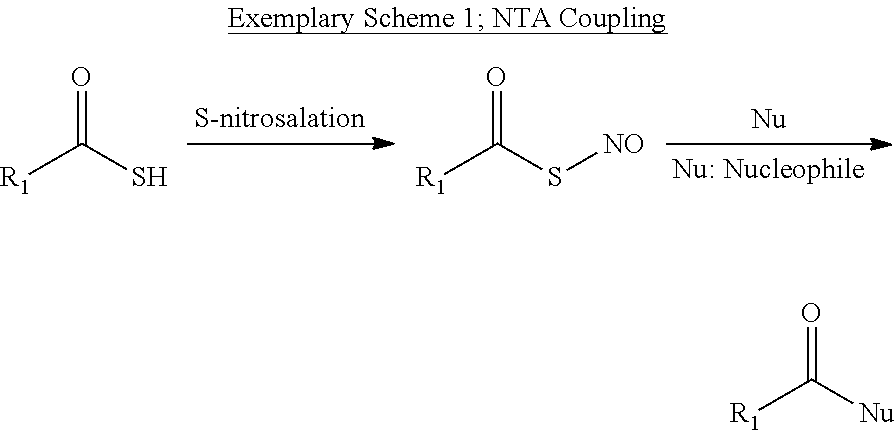
Particular aspects provide S-nitroso thioacid (NTA) intermediates by subjecting thioacids to nitrosation (Scheme 1), to yield the corresponding NTA.
Figure US09243028-20160126-C00001
According to additional aspects, this sulfur-oxidation process activates thioacids and leads to a facile acylation with nucleophiles (e.g., including but not limited to primary and/or secondary amines).
Figure US09243028-20160126-C00002
According to further aspects, the S-nitroso thioacid (NTA) intermediates are of broad general utility, including but not limited to amide bond formation, peptide coupling/ligation, and selective acylation with a high degree of selectivity toward amines over hydroxyls. In particular aspects, this thioacid activation via oxidation provides an effective and selective route to amide bond formation. In particular embodiments, the methods have substantial utility for peptide coupling/ligation reactions, and for polypeptide and protein synthesis.
In particular aspects, a new thioacid activation strategy via S-nitrosation is described herein. NTA, while unstable species, can rapidly and very effectively react with amines (both primary and secondary) under very mild conditions to form amides. The only reagent needed in this reaction is nitrosation reagents, e.g., HCl/NaNO2 or organonitrites like amyl nitrite, which are relatively cheap and readily available from commercial sources. As disclosed herein, many amino acid side-chain functionalities such as hydroxyl (e.g., for serine, threonine, or tyrosine), carboxyl (e.g., aspartic acid, glutamic acid), and indole (for tryptophan) do not interfere with the reaction. Therefore, the disclosed NTA-mediated reaction is of a particular utility in protein syntheses because it substantially reduces or eliminates the need to use protecting groups on the amino acid residues bearing carboxylic acids or alcohols. This method can further be used in solid-support (e.g., resins) implementations (without side-chain protection) for modular peptide synthesis.
In particular aspects, the nitrosation agent comprises a nitrosonium salt, including for example but not limited to NOBF4 and/or NOClO4.
Moreover, according to further aspects, the side-chain protection-free capability enables native ligation for large peptide synthesis or protein synthesis; that is, in particular ligation embodiments, this method can be used to selectively couple polypeptide fragments to yield large synthetic biomolecules. Native chemical ligation methods are described, for example, in PCT/EP2006/005815, published as WO 2006/133962 A1, incorporated by reference herein in its entirety.
As demonstrated in Applicants' studies herein, aqueous buffers did not affect the reaction. According to particular aspects, therefore, NTA-mediated coupling can be carried out in aqueous buffer systems, which are particularly useful for handling and synthesis of larger polypeptides and/or proteins.
The methods disclosed herein, therefore, can be carried out in either aqueous, organic or aqueous/organic mixtures, and the nature of the solvent and resulting solution does not interfere with the underlying chemistry (see, e.g., table 3 below). In preferred embodiments, the solution is an aqueous solution. Depending on the hydrophobic or hydrophilic nature of the reagents, however, aqueous/organic or even organic solutions may be utilized.
BRIEF DESCRIPTION OF THE DRAWINGS
FIGS. 1A, B and C show, according to Example 1 herein, UV spectra of S-nitroso thiobenzoic acid 2 in CH3CN.
FIG. 2 shows, in gray scale, the color of S-nitroso thiobenzoic acid 1. The cuvette at the left of the figure (thiobenzoic acid, 83 mM) shows, in gray scale, the characteristic color (yellow) of thiobenzoic acid, whereas the cuvette on the right of the figure (thiobenzoic acid (83 mM)+iso-amyl nitrite (167 mM) shows, in gray scale, a color (deep green), which is the characteristic color of tertiary S-nitrosothiols.
DETAILED DESCRIPTION
Particular aspects relate generally to amide or peptide bond formation, and more particularly to amide or peptide bond formation using thioacid and amine starting materials, wherein the reaction is mediated by very reactive S-nitroso thioacid (NTA) intermediates enabling extremely fast reactions under mild conditions, providing for broad applications including by not limited to amide bond formation, peptide coupling/ligation, and selective acylation with a high degree of selectivity toward amines over hydroxyls.
Exemplary scheme 2 provides a generalized overview of the methods as described herein applied to and nucleophillic amines. In the preferred embodiment R1, comprises an amino acid or polypeptide (less the carboxylic acid on the c-terminus). R3 and R4 are independently selected from H, an amino acid (less the NH) or a polypeptide (less the N-terminus. The amino acid (or those contained in a polypeptide) may be naturally occurring or synthetic. R2 comprises an organic group (e.g., methyl, ethyl, propyl. butyl, pentyl, cyclopentyl, hexyl, cyclohexyl, amyl, aryl, and branched derivatives thereof that may contain one or more functional groups (e.g., —OH, —CO2H, —CO, —O—).
Example 1 herein describes and demonstrates that the S-nitroso thioacid (NTA) intermediate formed by treating thiobenzoic acid 2 with organonitrite (RONO; e.g., amyl nitrite) or HCl/NaNO2 in organic solution at room temperature (rt) or at 0° C. can be trapped in situ with a nucleophile such as a nucleophilic amine, whereas, alcohols (such as benzyl alcohol, phenol, and N-hydroxysuccinimide) did not react with NTA to form esters (see Scheme 2 of Example 1). According to particular aspects, therefore, the presently disclosed methods provide for selective acylation with a high degree of selectivity toward amines over hydroxyls.
Example 2 herein describes optimization of the conditions for the disclosed NTA-mediated coupling between thioacids and amines. The best mode procedure for reacting thiobenzoic acid 1 and α-methyl benzylamine was to mix the thioacid (1.0 equivalent) and the amine (1.1 equivalents) at 0° C., followed by dropwise addition of amyl nitrite (2.0 equivalents) into the solution. The formation of the desired amide product was observed immediately and in high yields.
As shown in Scheme 3 (entries 1-4) of this Example, this reaction worked nicely in a number of common solvents including THF, DCM, DMF, and CH3CN. Water seemed to have little effect on the coupling, as the reaction gave similar results in aqueous buffer-containing systems (entries 5 and 6). This process proved to be a very fast process as in all the solvents the reaction completed in minutes at 0° C.
Example 3 herein shows control experiments that were carried out by applicants to prove that the acylation was mediated by NTA (see Scheme 4-A of Example 3 for details). Additionally, Applicants attempted to capture the unstable NTA intermediates using the reductive ligation,3a which is a specific reaction of SNO groups. After several attempts, we were able to obtain the desired ligation product 6 using substrate 1a (Scheme 4-B). Although the yield of 6 was only 23%, the formation of this sulfenamide product strongly supported the presence of NTA intermediate in the reaction.
Example 4 herein shows data obtained with series of thioacids and amines that were employed under the optimized conditions to demonstrate the broad generality/applicability of applicants' NTA mediated reaction methods. The reaction proved to be effective with both exemplary primary and exemplary secondary amines (entries 1-8). Amino acids derivatives also proved to be good substrates in the reaction and the corresponding dipeptide products were obtained in good yields (entries 9-13). As shown in entry 10, free hydroxyl group did not interfere with the reaction. In all the cases, the reaction was able to complete in 10 minutes at 0° C.
Particular exemplary aspects, therefore, provide a novel amide bond formation strategy based on use of simple thioacids and amines. The disclosed process, as shown by the data presented herein, is mediated by very reactive S-nitroso thioacid (NTA) intermediates enabling extremely fast reactions under mild conditions, providing for broad applications including by not limited to amide bond formation, peptide coupling/ligation, and selective acylation with a high degree of selectivity toward amines over hydroxyls. This work supports the concept that thioacids can become highly effective acyl donors upon oxidative activation.2b,2i,6
According to particular aspects, given the fast reaction rate and very mild reaction conditions, this method has substantial and broad utility for selective acylation, peptide synthesis and protein synthesis.
Particular aspects provide a method for forming a reactive S-nitroso thioacid (NTA), comprising nitrosation of a thioacid with a nitrosation reagent (e.g., at least one selected from the group consisting of an organonitrite (RONO), HCl/NaNO2, and a nitrosonium salt) in solution. In certain embodiments, the thioacid is selected from a compound having formula I:
Figure US09243028-20160126-C00003

wherein R1 is selected from essentially any appropriate moiety or group, including but not limited to an amino acid or polypeptide (less the carboxylic acid on the c-terminus), or any moiety or group shown in the exemplary thioacid structures of Table 1 or of the exemplary working examples herein, or as described herein. In certain aspects, the solution comprises an aqueous solution. In particular embodiments, the solution comprises an aqueous-organic mixture. In certain aspects, the solution comprises an organic solution. In particular embodiments, the organonitrite comprises amyl nitrite.
Additional aspects provide a method for acylating a nucleophile, comprising: nitrosation of a thioacid with a nitrosation reagent (e.g., at least one selected from the group consisting of an organonitrite (RONO), HCl/NaNO2, and a nitrosonium salt) in solution to form a reactive S-nitroso thioacid (NTA) intermediate; and contacting the NTA intermediate with a nucleophile to provide for acylation of the nucleophile. In particular aspects, the thioacid is selected from a compound having formula I:
Figure US09243028-20160126-C00004
wherein R1 is selected from essentially any appropriate moiety or group, including but not limited to an amino acid or polypeptide (less the carboxylic acid on the c-terminus), or any moiety or group shown in the exemplary thioacid structures of Table 1 or of the exemplary working examples herein, or as described herein. In certain embodiments, the nucleophile is selected from a primary or secondary amine. In certain aspects, the solution comprises an aqueous solution. In particular embodiments, the solution comprises an aqueous-organic mixture. In certain aspects, the solution comprises an organic solution. In particular embodiments, the organonitrite comprises amyl nitrite.
Additional aspects provide a method for forming an amide bond, comprising: nitrosation of a thioacid with a nitrosation reagent (e.g., at least one selected from the group consisting of an organonitrite (RONO), HCl/NaNO2, and a nitrosonium salt) in solution to form a reactive S-nitroso thioacid (NTA) intermediate; and contacting the NTA intermediate with an amine to provide for forming an amide bond. In particular aspects, the thioacid is selected from a compound having formula I:
Figure US09243028-20160126-C00005
wherein R1 is selected from essentially any appropriate moiety or group, including but not limited to an amino acid or polypeptide (less the carboxylic acid on the c-terminus), or any moiety or group shown in the exemplary thioacid structures of Table 1 or of the exemplary working examples herein, or as described herein. In certain embodiments, the amine is selected from a primary or secondary amine. In certain aspects, the solution comprises an aqueous solution. In particular embodiments, the solution comprises an aqueous-organic mixture. In certain aspects, the solution comprises an organic solution. In particular embodiments, the organonitrite comprises amyl nitrite.
Yet additional aspects provide a method for forming an dipeptide or polypeptide, comprising: nitrosation of a thioacid with a nitrosation reagent (e.g., at least one selected from the group consisting of an organonitrite (RONO), HCl/NaNO2, and a nitrosonium salt) in solution to form a reactive S-nitroso thioacid (NTA) intermediate; and contacting the NTA intermediate with an amine to provide for forming a dipeptide or polypeptide. In particular aspects, the thioacid is selected from a compound having formula I:
Figure US09243028-20160126-C00006
wherein R1 is selected from essentially any appropriate moiety or group, including but not limited to an amino acid or polypeptide (less the carboxylic acid on the c-terminus), or any moiety or group shown in the exemplary thioacid structures of Table 1 or of the exemplary working examples herein, or as described herein. In certain embodiments, the nucleophile is selected from a primary or secondary amine. In certain aspects, the solution comprises an aqueous solution. In particular embodiments, the solution comprises an aqueous-organic mixture. In certain aspects, the solution comprises an organic solution. In particular embodiments, the organonitrite comprises amyl nitrite.
Further aspects provide a method for ligating two polypeptides to form a larger polypeptide, comprising: nitrosation of a thioacid derivative of a first polypeptide with a nitrosation reagent (e.g., at least one selected from the group consisting of an organonitrite (RONO), HCl/NaNO2, and a nitrosonium salt) in solution to form a reactive S-nitroso thioacid (NTA) intermediate; and contacting the NTA intermediate with an amine group of a second polypeptide to provide for forming a larger, ligated polypeptide. In particular aspects, the first and the second polypeptides comprise contiguous amino acid subregions of a desired larger polypeptide.
According to particular preferred aspects, this sulfur-oxidation process activates thioacids and leads to a facile acylation with nucleophiles (e.g., including but not limited to primary and/or secondary amines).
Figure US09243028-20160126-C00007
wherein R1 is selected from essentially any appropriate moiety or group, including but not limited to an amino acid or polypeptide (less the carboxylic acid on the c-terminus), or any moiety or group shown in the exemplary thioacid structures of Table 1 or of the exemplary working examples herein; and/or
wherein, for example, R1, R3, R4 are the same or different and independently selected from an amino acid side chain moiety or derivative thereof, the remainder of the molecule, a linker and a solid support, and stereoisomers thereof.
In particular aspects, R1, R3, R4 are independently selected from the group consisting of aminoC2-5alkyl, guanidineC2-5alkyl, C1-4alkylguanidinoC2-5alkyl, diC1-4alkylguanidino-C2-5alkyl, amidinoC2-5alkyl, C1-4alkylamidino C2-5alkyl, diC1-4alkylamidinoC2-5alkyl, C1-3alkoxy, Phenyl, substituted phenyl (where the substituents are independently selected from one or more of amino, amidino, guanidino, hydrazino, amidrazonyl, C1-4alkylamino, C1-4dialkylamino, halogen, perfluoro C1-4alkyl, C1-4alkyl, C1-3alkoxy, nitro, carboxy, cyano, sulfuryl or hydroxyl), benzyl, substituted benzyl (where the substituents on the benzyl are independently selected from one or more of amino, amidino, guanidino, hydrazino, amidrazonyl, C1-4alkylamino, C1-4dialkylamino, halogen, perfluoro C1-4alkyl, C1-3alkyl, nitro, carboxy, cyano, sulfuryl or hydroxyl), naphthyl, substituted naphthyl (where the substituents are independently selected from one or more of amino, amidino, guanidino, hydrazino, amidrazonyl, C1-4alkylamino, C1-4dialkylamino, halogen, perfluoro C1-4alkyl, C1-4alkyl, C1-3alkoxy, nitro, carboxy, cyano, sulfuryl or hydroxyl), bisphenyl methyl, substituted bis-phenyl methyl (where the substituents are independently selected from one or more of amino, amidino, guanidino, hydrazino, amidrazonyl, C1-4alkylamino, C1-4dialkylamino, halogen, perfluoro C1-4alkyl, C1-4alkyl, C1-3alkoxy, nitro, carboxy, cyano, sulfuryl or hydroxyl), pyridyl, substituted pyridyl, (where the substituents are independently selected from one or more of amino, amidino, guanidino, hydrazino, amidrazonyl, C1-4alkylamino, C1-4dialkylamino, halogen, perfluoro C1-4alkyl, C1-4alkyl, C1-3alkoxy, nitro, carboxy, cyano, sulfuryl or hydroxyl), pyridylC1-4alkyl, substituted pyridylC1-4alkyl (where the pyridine substituents are independently selected from one or more of amino, amidino, guanidino, hydrazino, amidrazonyl, C1-4alkylamino, C1-4dialkylamino, halogen, perfluoro C1-4alkyl, C1-4alkyl, C1-3alkoxy, nitro, carboxy, cyano, sulfuryl or hydroxyl), pyrimidylC1-4alkyl, substituted pyrimidylC1-4alkyl (where the pyrimidine substituents are independently selected from one or more of amino, amidino, guanidino, hydrazino, amidrazonyl, C1-4alkylamino, C1-4dialkylamino, halogen, perfluoro C1-4alkyl, C1-4alkyl, C1-3alkoxy, nitro, carboxy, cyano, sulfuryl or hydroxyl), triazin-2-yl-C1-4alkyl, substituted triazin-2-yl-C1-4alkyl (where the triazine substituents are independently selected from one or more of amino, amidino, guanidino, hydrazino, amidrazonyl, C1-4alkylamino, C1-4dialkylamino, halogen, perfluoro C1-4alkyl, C1-4alkyl, C1-3alkoxy, nitro, carboxy, cyano, sulfuryl or hydroxyl), imidazoC1-4alkyl, substituted imidazol C1-4alkyl (where the imidazole substituents are independently selected from one or more of amino, amidino, guanidino, hydrazino, amidrazonyl, C1-4alkylamino, C1-4dialkylamino, halogen, perfluoro C1-4alkyl, C1-4alkyl, C1-3alkoxy, nitro, carboxy, cyano, sulfuryl or hydroxyl), imidazolinylCalkyl, N-amidinopiperazinyl-N—C0-4alkyl, hydroxyC2-5alkyl, C1-5alkylaminoC2-5alkyl, hydroxyC2-5alkyl, C1-5alkylaminoC2-5alkyl, C1-5dialkylamino C2-5alkyl, N-amidinopiperidinylC1-4alkyl and 4-aminocyclohexylC0-2alkyl.
As used herein, the term “remainder of the compound” means any moiety, agent, compound, support, molecule, linker, amino acid, peptide or protein covalently attached to the structure at R1, R3, and/or R4 positions. This term also includes amino acid side chain moieties and derivatives thereof.
As used herein, the term “amino acid side chain moiety” represents any amino acid side chain moiety present in naturally occurring proteins including (but not limited to) the naturally occurring amino acid side chain moieties identified in Table 1. Other naturally occurring amino acid side chain moieties of this invention include (but are not limited to) the side chain moieties of 3,5-dibromotyrosine, 3,5-diiodotyrosine, hydroxylysine, γ-carboxyglutamate, phosphotyrosine and phosphoserine. In addition, glycosylated amino acid side chains may also be used in the practice of this invention, including (but not limited to) glycosylated threonine, serine and asparagine. In particular aspects, the amino acid side chains as defined herein are linked to the carbonyl carbon of the thioacid via an alpha carbon atom, which itself may be substituted (e.g., —NH2, or as described herein for substituted amino acid side chains).
TABLE 1
Amino Acid Side Chain Moieties
Amino Acid Side Chain Moiety Amino Acid
—H Glycine
—CH3 Alanine
—CH(CH3)2 Valine
—CH2CH(CH3)2 Leucine
—CH(CH3)CH2CH3 Isoleucine
—(CH2)4NH3 + Lysine
—(CH2)3NHC(NH2)NH2 + Arginine
Histidine
—CH2COO Aspartic acid
—CH2CH2COO Glutamic acid
—CH2CONH2 Asparagine
—CH2CH2CONH2 Glutamine
Phenylalanine
Tyrosine
Tryptophan
—CH2SH Cysteine
—CH2CH2SCH3 Methionine
—CH2OH Serine
—CH(OH)CH3 Threonine
Proline
Hydroxyproline
In addition to naturally occurring amino acid side chain moieties, the amino acid side chain moieties of the present invention also include various derivatives thereof. As used herein, a “derivative” of an amino acid side chain moiety includes modifications and/or variations to naturally occurring amino acid side chain moieties. For example, the amino acid side chain moieties of alanine, valine, leucine, isoleucine and pheylalanine may generally be classified as lower chain alkyl, aryl, or arylalkyl moieties. Derivatives of amino acid side chain moieties include other straight chain or branched, cyclic or noncyclic, substitutes or unsubstituted, saturated or unsaturated lower chain alkyl, aryl or arylalkyl moieties.
As used herein, “lower chain alkyl moieties” contain from 1-12 carbon atoms, “lower chain aryl moieties” contain from 6-12 carbon atoms and “lower chain aralkyl moieties” contain from 7-12 carbon atoms. Thus, in one embodiment, the amino acid side chain derivative is selected from a C1-12 alkyl, a C6-12 aryl and a C7-12 arylalkyl, and in a more preferred embodiment, from a C1-7 alkyl, a C6-10 aryl and a C7-11 arylalkyl.
Amino side chain derivatives of this invention further include substituted derivatives of lower chain alkyl, aryl, and arylalkyl moieties, wherein the substituent is selected from (but are not limited to) one or more of the following chemical moieties: —OH, —OR, —COOH, —COOR, —CONH2, —NH2, —NHR, —NRR, —SH, —SR, —SO2R, —SO2H, —SOR and halogen (including F, Cl, Br and I), wherein each occurrence of R is independently selected from straight chain or branched, cyclic or noncyclic, substituted or unsubstituted, saturated or unsaturated lower chain alkyl, aryl, and aralkyl moieties. Moreover, cyclic lower chain alkyl, aryl and arylalkyl moieties of this invention include naphthalene, as well as heterocyclic compounds such as thiophene, pyrrole, furan, imidazole, oxazole, thiazole, pyrazole, 3-pyrroline, pyrrolidine, pyridine, pyrimidine, purine, quinoline, isoquinoline and carbazole. Amino acid side chain derivatives further include heteroalkyl derivatives of the alkyl portion of the lower chain alkyl and aralkyl moieties, including (but not limited to) alkyl and aralkyl phosphonates and silanes.
In a further embodiment, and in addition to being an amino acid side chain moiety or derivative thereof (or the remainder of the compound in the case of R1, R3, and/or R4 may be a linker facilitating the linkage of the compound to another moiety or compound. For example, the compounds of this invention may be linked to one or more known compounds, such as biotin, for use in diagnostic or screening assay. Furthermore, R1, R3, and/or R4 may be a linker joining the compound to a solid support (such as a support used in solid phase peptide synthesis) or alternatively, may be the support itself. In this embodiment, linkage to another moiety or compound, or to a solid support, is preferable at the R1 position.
EXAMPLE 1 Formation of NTA Intermediates, and the Reactions of NTA Intermediates were Tested
The preparation of NTA was tested in this example. An exemplary reaction scheme using thiobenzoic acid 1 is shown in Scheme 2 below. Compound 1 (thiobenzoic acid) was treated with organonitrite (RONO; e.g., amyl nitrite) or HCl/NaNO2 in organic solutions at room temperature (rt) or at 0° C.
The resulted species, presumably NTA 2, showed a deep green color, which is the characteristic color of tertiary S-nitrosothiols (FIG. 2).
The UV spectra of NTA 2 are shown in FIGS. 1A, 1B and 1C.
Specifically, FIGS. 1A, 1B and 1C show, according to particular aspects, UV-vis spectra of S-nitroso thiobenzoic acid 2 in CH3CN at three different wavelengths: A) 213-268 nm region (39 μM, ε=1.14×10⁴ M−1 cm−1), attributed to the it π→π* transition[1]; B) 315-385 nm region (460 μM, ε=9.67×10² M−1 cm−1), attributed to the n0→π* transition[2]; and C) 531-633 nm region (27 mM, ε=13.2 M−1 cm−1), attributed to the forbidden nN→π* transition (this band determines the compound's color)[3]. These three UV-vis absorption bands of compound 2 are very similar to the characteristic UV-vis bands of S-nitrosothiols.[1-3]
The NTA 2 appeared to be unstable as the green color readily faded when we attempted to isolate compound 2. The final isolated product was disulfide 3, which is the expected decomposition product from S-nitrosothiols. Although NTA 2 was unstable, applicants tested the idea to trap NTA in situ with some nucleophiles. Amines proved to be excellent substrates, and the formation of amide bonds were achieved in a very effective way (see TABLE 1 below). However, alcohols (such as benzyl alcohol, phenol, and N-hydroxysuccinimide) did not react with NTA to form esters.
Figure US09243028-20160126-C00008
EXAMPLE 2 The Conditions for NTA Mediated Coupling Between Thioacids and Amines were Optimized
In this Example, the conditions for this NTA mediated coupling between thioacids and amines were optimized. The best mode procedure was to mix the thioacid (1.0 eq) and the amine (1.1 eq) at 0° C., followed by dropwise addition of amyl nitrite (2.0 eq) into the solution. The formation of the desired amide product was observed immediately and in high yields, as monitored by thin layer chromatography (TLC).
As shown in Scheme 3 (entries 1-4) below, this reaction worked nicely in a number of common solvents including THF, DCM, DMF, and CH3CN. Water seemed to have little effect on the coupling, as the reaction gave similar results in aqueous buffer-containing systems (entries 5 and 6). This process proved to be a very fast process as in all the solvents the reaction completed in minutes at 0° C.
Scheme 3 Solvent Effects of NTA Mediated Amide Formation
Figure US09243028-20160126-C00009
Figure US09243028-20160126-C00010
Figure US09243028-20160126-C00011
entry solvent reaction time yield of 4a
1 THF 5 min 96%
2 DCM 10 min 82%
3 DMF 10 min 75%
4 CH3CN 5 min 94%
5 THF/PBS buffer 10 min 95%
(3/1)
6 DMF/PBS buffer 20 min 71%
(1/1)
EXAMPLE 3 Control Experiments Showed that the Acylation was Mediated by NTA Intermediates
In this Example, to prove the reaction was indeed involving NTA, several control experiments (Scheme 4) were carried out. The reaction between thioacid 1 and α-methyl-benzylamine only led to the formation of amide 4a in trace amount at room temperature, even when the amine was used in large access (10 eq). A previous report by Liu and Orgel, 1997, also suggested that thioacids should not directly react with amines to form amides.2i We also attempted to capture the unstable NTA intermediates using the reductive ligation,3a which is a specific reaction of SNO groups. After several attempts, we were able to obtain the desired ligation product 6 using substrate 1a (Scheme 4-B). Although the yield of 6 was only 23%, the formation of this sulfenamide product strongly supported the presence of NTA intermediate in the reaction.
Figure US09243028-20160126-C00012

Reductive ligation reaction to produce Compound 6.
Figure US09243028-20160126-C00013
To a solution of 1a (36 mg, 0.16 mmol) in THF/CH3CN/H2O (1.5 mL/1.5 mL/1.0 mL) was added amyl nitrite (64 μL, 0.47 mmol) at 0° C. The resulting green solution was stirred for ˜5 min at 0° C. Then, phosphine 5 (114 mg, 0.30 mmol, in 1.0 mL THF) was added into the solution. The reaction was stirred for additional 5 min. The reaction mixture was diluted with ethyl acetate (15 mL) and washed with an aqueous solution of 5% H2O2 (3 mL), saturated NaHSO3 (3 mL) and brine. The organic layer was dried over Na2SO4 and concentrated. The crude product was purified by flash column chromatography (MeOH:DCM/1:200) to give 6 in 23% yield. 1H NMR (600 MHz, CDCl3) δ 9.92 (s, 1H), 8.07-8.06 (m, 1H), 7.66-7.61 (m, 5H), 7.57-7.55 (m, 2H), 7.47-7.44 (m, 5H), 7.30-7.26 (m, 10H), 7.16-7.13 (m, 1H); 13C NMR (150 MHz, CDCl3) 196.9, 168.2, 139.1(d), 137.2, 133.4(d), 132.7(d), 132.6(d), 132.5(d), 132.4(d), 131.9(d), 131.8, 130.7, 130.0, 129.0, 128.9, 128.8(d), 128.7(d), 128.6, 127.6, 61.3; 31P NMR (121 Hz, CDCl3) 36.6. IR (thin film) cm−1 3061, 2923, 2855, 1715, 1682, 1589, 1495, 1437, 1252, 1168, 1120, 725, 695; HRMS m/z, 548.1449 [M+H]; calcd for C33H27NO3PS, 548.1449.
EXAMPLE 4 A Series of Thioacids and Amines were Employed Under Optimized Conditions to Demonstrate the Broad Generality/Applicability of Applicants' NTA Mediated Reaction Methods
The results of the above Examples indicate that NTA acts as an effective activating group to facilitate amide formation. In this Example, to test the broad generality of this reaction, a series of exemplary thioacids and exemplary amines were employed under optimized conditions (see Table 2 below). The reaction proved to be highly effective with both exemplary primary and exemplary secondary amines (entries 1-8). Amino acids derivatives also proved to be good substrates in the reaction and the corresponding dipeptide products were obtained in good yields (entries 9-13). As shown in entry 10, free hydroxyl group did not interfere with the reaction. In all the cases, the reaction was complete within 10 minutes at 0° C.
TABLE 2
NTA Mediated Amide Coupling
Figure US09243028-20160126-C00014
entry thioacid amine product/yield
1
Figure US09243028-20160126-C00015
BnNH2
Figure US09243028-20160126-C00016
2
Figure US09243028-20160126-C00017
Figure US09243028-20160126-C00018
3
Figure US09243028-20160126-C00019
Figure US09243028-20160126-C00020
4 Bn2NH
Figure US09243028-20160126-C00021
5
Figure US09243028-20160126-C00022
Figure US09243028-20160126-C00023
6
Figure US09243028-20160126-C00024
Figure US09243028-20160126-C00025
7
Figure US09243028-20160126-C00026
BnNH2
Figure US09243028-20160126-C00027
8
Figure US09243028-20160126-C00028
Figure US09243028-20160126-C00029
9
Figure US09243028-20160126-C00030
Figure US09243028-20160126-C00031
10
Figure US09243028-20160126-C00032
Figure US09243028-20160126-C00033
11
Figure US09243028-20160126-C00034
Figure US09243028-20160126-C00035
Figure US09243028-20160126-C00036
12
Figure US09243028-20160126-C00037
Figure US09243028-20160126-C00038
13
Figure US09243028-20160126-C00039
Figure US09243028-20160126-C00040
Figure US09243028-20160126-C00041
EXAMPLE 5 Materials and Methods
Materials and Methods. All solvents were reagent grade. Tetrahydrofuran (THF) was freshly distilled from sodium/benzophenone under argon. Reactions were magnetically stirred and monitored by thin layer chromatography (TLC) with 0.25 mm pre-coated silica gel plates. Flash chromatography was performed with silica gel 60 (particle size 0.040-0.062 mm). Yields refer to chromatographically and spectroscopically pure compounds, unless otherwise stated. Proton and carbon-13 NMR spectra were recorded on a 300 MHz spectrometer. Chemical shifts are reported relative to chloroform (δ 7.26) for 1H NMR and chloroform (δ 77.0) for 13C NMR. Absorption spectra were recorded on a Lambda 20 UV/Vis spectrophotometer using 1 cm quartz cells.
Thiobenzoic acid 1 was purchased from Aldrich. Other thioacids (i.e. 1a-1d) were prepared from known procedures.[4,5]
Experimental Procedures and Compound Characterization Data. FIGS. 1A, 1B and 1C show, according to particular aspects, UV-vis spectra of S-nitroso thiobenzoic acid 2 in CH3CN at three different wavelengths: A) 213-268 nm region (39 μM, ε=1.14×10⁴ M−1 cm−1), attributed to the π→π* transition[1]; B) 315-385 nm region (460 μM, ε=9.67×10² M−1 cm−1), attributed to the n0→π* transition[2]; and C) 531-633 nm region (27 mM, ε=13.2 M−1 cm−1), attributed to the forbidden nN→π* transition (this band determines the compound's color)[3]. These three UV-vis absorption bands of 2 are very similar to the characteristic UV-vis bands of S-nitrosothiols.[1-3]
Color of S-Nitroso Thiobenzoic Acid 2. FIG. 2 compares the color of thiobenzoic acid (1, yellow) with that of S-nitroso thiobenzoic acid (2, dark green) The cuvette on the left contained thiobenzoic acid (83 mM in CH3CN), which was yellow, whereas the cuvette on the right contained thiobenzoic acid (83 mM in CH3CN) plus iso-amyl nitrite (167 mM), which was a dark green color.
EXAMPLE 6 General Procedure of NTA Mediated Amide Formation
Figure US09243028-20160126-C00042
To a stirred solution of thioacid 1 (69 mg, 0.5 mmol) and α-methyl benzylamine (67 mg, 0.55 mmol) in THF (5 mL) at 0° C. in darkness, amyl nitrite (117 mg, 1 mmol) was slowly added (dropwise). The reaction was stirred at 0° C. for 5 minutes, and the reaction mixture then diluted with CH2Cl2 (20 mL) and washed with water and brine. The organic layer was dried with anhydrous Na2SO4. The solvent was then removed under reduced pressure. The crude product was purified by flash column chromatography (hexane/ethyl acetate, 10/1) to afford the desired product 4a (108 mg, 96%).
Figure US09243028-20160126-C00043
Yield 96%; white solid, m.p. 120-121° C.; 1H NMR (300 MHz, CDCl3): δ 7.66 (2H, d, J=7.8 Hz), 7.37-7.12 (8H, m), 6.70 (1H, d, J=7.2 Hz), 5.21 (1H, dt, J=7.2 Hz), 1.46 (3H, d, J=6.9 Hz); 13C NMR (75 MHz, CDCl3): δ 167.0, 143.5, 134.8, 131.7, 128.9, 128.7, 127.6, 127.3, 126.5, 49.5, 22.0; IR (thin film) cm−1 3341, 3067, 2974, 1633, 1579, 1530, 1491, 1449, 1322, 1276, 1210, 1148, 1029, 872, 802, 762, 698; MS m/z 248.1 [M+Na+].
EXAMPLE 7 Preparation of Compound 4B
Compound 4b. Preparation: see general procedures under Example 6 for reaction conditions.
Figure US09243028-20160126-C00044
Yield 100%; white solid, m.p. 101-102° C.; 1H NMR (300 MHz, CDCl3): δ 7.80 (2H, d, J=6.9 Hz), 7.46 (1H, tt, J1=7.5 Hz, J2=1.5 Hz), 7.37-7.23 (8H, m), 4.55 (2H, d, J=6.0 Hz); 13C NMR (75 MHz, CDCl3): δ 167.9, 138.7, 134.6, 131.7, 128.9, 128.7, 128.0, 127.6, 127.4, 44.2; IR (thin film) cm−1 3323, 3060, 2930, 2856, 1643, 1604, 1578, 1547, 1490, 1453, 1419, 1362, 1313, 1260, 1158, 1080, 1058, 1029, 990, 928, 805, 794, 728, 696, 666; MS m/z 212.1 [M+Na+].
EXAMPLE 8 Preparation of Compound 4c
Compound 4c. Preparation: see general procedures under Example 6 for reaction conditions.
Figure US09243028-20160126-C00045
Yield 97%; white solid, m.p. 131-132° C.; 1H NMR (300 MHz, CDCl3): δ 7.68 (2H, d, J=7.5 Hz), 7.41-7.29 (3H, m), 6.14 (1H, s), 1.42 (9H, s); 13C NMR (75 MHz, CDCl3): δ 167.2, 136.1, 131.2, 128.6, 127.0, 51.8, 29.0; IR (thin film) cm−1 3317, 2965, 1632, 1578, 1534, 1492, 1450, 1364, 1312, 1218, 1078, 936, 877, 720, 694; MS m/z 178.0 [M+H+].
EXAMPLE 9 Preparation of Compound 4d
Compound 4d. Preparation: see general procedures under Example 6 for reaction conditions.
Figure US09243028-20160126-C00046
Yield 80%; colorless oil; 1H NMR (300 MHz, CDCl3): δ 7.48-7.44 (2H, m), 7.36-7.31 (3H, m), 3.59 (2H, t, J=6.9 Hz), 3.36 (2H, t, J=6.6 Hz), 1.95-1.76 (4H, m); 13C NMR (75 MHz, CDCl3): δ 169.9, 137.4, 129.9, 128.4, 127.3, 49.8, 46.3, 26.6, 24.7; IR (thin film) cm−1 2971, 2877, 1626, 1575, 1447, 1422, 719, 700, 658; MS m/z 198.1 [M+Na+].
EXAMPLE 10 Preparation of Compound 4e
Compound 4e. Preparation: see general procedures under Example 6 for reaction conditions.
Figure US09243028-20160126-C00047
Yield 88%; white solid, m.p. 96-97° C.; 1H NMR (300 MHz, CDCl3): δ 7.55-7.52 (2H, m), 7.41-7.32 (11H, m), 7.18-7.16 (2H, m), 4.74 (2H, s), 4.43 (2H, s); 13C NMR (75 MHz, CDCl3): δ 172.5, 137.2, 136.7, 136.7, 136.4, 129.9, 129.1, 129.0, 128.8, 128.7, 127.9, 127.8, 127.3, 127.0, 51.8, 47.1; IR (thin film) cm−1 3028, 2924, 1632, 1602, 1495, 1450, 1422, 1365, 1307, 1259, 1204, 1142, 1077, 1028, 992, 731, 698; MS m/z 302.2 [M+H+].
EXAMPLE 11 Preparation of Compound 4f
Compound 4f. Preparation: see general procedures under Example 6 for reaction conditions.
Figure US09243028-20160126-C00048
Yield 89%; colorless oil; 1H NMR (300 MHz, CDCl3): δ 7.80 (2H, dt, J1=6.6 Hz, J2=1.5 Hz), 7.49 (1H, tt, J1=7.5 Hz, J2=1.5 Hz), 7.42-7.37 (2H, m), 6.95 (1H, s), 4.21 (2H, d, J=5.1 Hz), 3.76 (3H, s); 13C NMR (75 MHz, CDCl3): δ 170.8, 167.9, 133.8, 132.0, 128.8, 127.3, 52.7, 41.9; IR (thin film) cm−1 3331, 3063, 2953, 1754, 1650, 1536, 1491, 1439, 1408, 1371, 1314, 1211, 1183, 1080, 1006, 976, 719, 693; HRMS m/z 194.0811 [M+H]+; calcd for C10H12NO3: 194.0812.
EXAMPLE 12 Preparation of Compound 4g
Compound 4g. Preparation: see general procedures under Example 6 for reaction conditions.
Figure US09243028-20160126-C00049
Yield 77%; colorless oil 1H NMR (300 MHz, CDCl3): δ 7.72 (2H, dt, J1=6.6 Hz, J2=1.5 Hz), 7.50 (1H, tt, J1=7.5 Hz, J2=1.5 Hz), 7.44-7.38 (2H, m), 7.33-7.25 (3H, m), 7.15-7.12 (2H, m), 6.65 (1H, d, J=7.2 Hz), 5.12-5.06 (1H, m), 3.76 (3H, s), 3.33-3.19 (2H, m); 13C NMR (75 MHz, CDCl3): δ 172.2, 167.1, 136.1, 134.1, 132.0, 129.6, 128.9, 127.4, 127.2, 53.8, 52.7, 38.1; IR (thin film) cm−1 3319, 3030, 2952, 1745, 1643, 1603, 1580, 1537, 1490, 1437, 1360, 1217, 1098, 1028, 912, 701; HRMS m/z 284.1294 [M+H]+; calcd for C17H18NO3: 284.1281.
EXAMPLE 13 Preparation of Compound 4h
Compound 4h. Preparation: see general procedures under Example 6 for reaction conditions.
Figure US09243028-20160126-C00050
Yield 86%; white solid, m.p. 107-108° C.; 1H NMR (300 MHz, CDCl3): δ 7.35-7.21 (10H, m), 6.78 (1H, s), 5.75 (1H, s), 5.03 (2H, s), 4.38 (2H, d, J=5.7 Hz), 3.84 (2H, d, J=5.4 Hz); 13C NMR (75 MHz, CDCl3): δ 169.3, 156.9, 138.0, 136.3, 128.9, 128.8, 128.7, 128.5, 128.3, 127.9, 127.8, 67.4, 44.8, 43.7; IR (thin film) cm−1 3321, 3062, 2925, 1693, 1666, 1548, 1537, 1454, 1427, 1360, 1287, 1246, 1164, 1068, 1006, 736, 696; HRMS m/z 299.1384 [M+H]+; calcd for C17H19N2O3: 299.1390.
EXAMPLE 14 Preparation of Compound 4i
Compound 4i. Preparation: see general procedures under Example 6 for reaction conditions.
Figure US09243028-20160126-C00051
Yield 87%; white solid, m.p. 62-63° C.; 1H NMR (300 MHz, CDCl3): δ 7.37-7.30 (5H, m), 5.79-5.78 (1H, m), 5.12 (2H, s), 3.94 (2H, d, J=4.2 Hz), 3.49 (2H, t, J=6.6 Hz), 3.37 (2H, t, J=6.6 Hz), 2.03-1.94 (2H, m), 1.92-1.82 (2H, m); 13C NMR (75 MHz, CDCl3): δ 166.5, 156.5, 136.7, 128.7, 128.3, 128.3, 67.1, 46.2, 45.6, 43.7, 26.2, 24.4; IR (thin film) cm−1 3539, 3487, 3279, 2957, 1696, 1628, 1549, 1452, 1412, 1333, 1266, 1173, 1052, 981, 763, 704; HRMS m/z 263.1379 [M+H]+; calcd for C14H19N2O3: 263.1390.
EXAMPLE 15 Preparation of Compound 4j
Compound 4j. Preparation: see general procedures under Example 6 for reaction conditions.
Figure US09243028-20160126-C00052
Yield 89%; colorless oil 1H NMR (300 MHz, CDCl3): δ 7.33-7.32 (5H, m), 7.28-7.18 (3H, m), 7.08 (2H, d, J=6.0 Hz), 6.85 (1H, d, J=7.8 Hz), 5.73 (1H, t, J=5.4 Hz), 5.09 (2H, s), 4.87 (1H, dd, J1=13.8 Hz, J2=6.0 Hz), 3.83-3.81 (2H, m), 3.67 (3H, s), 3.14-3.00 (2H, m); 13C NMR (75 MHz, CDCl3): δ 172.1, 169.1, 156.8, 136.4, 135.9, 129.5, 128.8, 128.8, 128.4, 128.3, 127.4, 67.3, 53.4, 52.6, 44.5, 38.1, 31.8, 22.9, 14.4; IR (thin film) cm−1 3319, 3031, 2952, 1728, 1674, 1530, 1454, 1351, 1216, 1178, 1118, 1049, 988, 912, 737, 700; HRMS m/z 371.1600 [M+H]+; calcd for C20H23N2O5: 371.1601.
EXAMPLE 16 Preparation of Compound 4k
Compound 4k. Preparation: see general procedures under Example 6 for reaction conditions.
Figure US09243028-20160126-C00053
Yield 81%; white solid, m.p. 90-91° C.; 1H NMR (300 MHz, CDCl3): δ 7.37-7.31 (5H, m), 7.29-7.28 (1H, m), 5.86 (1H, t, J=5.4 Hz), 5.09 (2H, s), 4.65-4.61 (1H, m), 3.97-3.82 (4H, m), 3.73 (3H, s), 3.62 (1H, t, J=4.8 Hz); 13C NMR (75 MHz, CDCl3): δ 171.2, 169.9, 157.2, 136.3, 128.8, 128.5, 128.3, 67.5, 62.8, 54.9, 53.0, 44.5; IR (thin film) cm−1 3331, 2954, 1726, 1710, 1666, 1547, 1530, 1441, 1345, 1236, 1134, 1052, 738, 698; HRMS m/z 311.1233 [M+H]+; calcd for C14H19N2O6: 311.1238.
EXAMPLE 17 Preparation of Compound 4l
Compound 4l. Preparation: see general procedures under Example 6 for reaction conditions.
Figure US09243028-20160126-C00054
Yield 86%; white solid, m.p. 157-158° C.; 1H NMR (300 MHz, CDCl3): δ 7.77 (2H, d, J=7.5 Hz), 7.59 (2H, d, J=7.2 Hz), 7.41 (2H, t, J=7.2 Hz), 7.32 (2H, dt, J1=7.2 Hz, J2=1.2 Hz), 7.21 (3H, t, J=7.5 Hz), 7.07 (2H, t, J=3.6 Hz), 6.38 (1H, d, J=7.5 Hz), 5.28 (1H, d, J=6.9 Hz), 4.89-4.83 (1H, m), 4.44-4.31 (2H, m), 4.25-4.19 (2H, m), 3.72 (3H, s), 3.20-3.04 (2H, m), 1.36 (3H, d, J=6.9 Hz); 13C NMR (75 MHz, CDCl3): δ 171.9, 171.8, 144.0, 141.5, 135.8, 129.4, 128.2, 128.0, 127.4, 127.3, 125.3, 125.3, 120.2, 67.4, 53.4, 52.7, 50.6, 47.3, 38.0; IR (thin film) cm−1 3303, 3063, 2951, 1742, 1711, 1661, 1530, 1450, 1252, 1215, 1118, 1080, 1046, 759, 740, 701; HRMS m/z 473.2071 [M+H]+; calcd for C28H29N2O5: 473.2071.
EXAMPLE 18 Preparation of Compound 4m
Compound 4m. Preparation: see general procedures under Example 6 for reaction conditions.
Figure US09243028-20160126-C00055
Yield 80%; white solid, m.p. 49-50° C.; 1H NMR (300 MHz, CDCl3): δ 7.76 (2H, d, J=7.5 Hz), 7.59 (2H, d, J=7.2 Hz), 7.42-7.28 (9H, m), 5.72 (1H, d, J=8.1 Hz), 5.22, 5.12 (2H, AB, J=12.3 Hz), 4.63-4.58 (1H, m), 4.56-4.48 (1H, m), 4.34 (2H, d, J=7.2 Hz), 4.21 (1H, t, J=7.2 Hz), 3.77-3.57 (2H, m), 2.27-2.19 (1H, m), 2.11-1.94 (3H, m), 1.36 (3H, d, J=6.9 Hz); 13C NMR (75 MHz, CDCl3): δ 171.8, 171.5, 155.8, 144.1, 144.0, 141.5, 135.7, 128.8, 128.6, 128.4, 127.9, 127.3, 125.4, 120.2, 67.2, 59.1, 48.5, 47.3, 47.1, 29.2, 25.2, 18.6; IR (thin film) cm−1 3286, 3064, 2978, 2881, 1742, 1721, 1642, 1530, 1501, 1451, 1379, 1248, 1172, 1044, 910, 759, 739, 699; HRMS m/z 499.2230 [M+H]+; calcd for C30H31N2O5: 499.2227.
EXAMPLE 19 Preparation of Compound 4n
Compound 4n. Preparation: see general procedures under Example 6 for reaction conditions.
Figure US09243028-20160126-C00056
Yield 87%; colorless oil; 1H NMR (300 MHz, CDCl3): δ 7.29-7.18 (5H, m), 6.77 (1H, t, J=4.8 Hz), 5.23 (1H, d, J=5.1 Hz), 4.45 (1H, d, J=6.0 Hz), 4.05-3.88 (2H, m), 3.70 (3H, s), 3.12 (1H, dd, J1=13.8 Hz, J2=4.8 Hz), 3.03-2.96 (1H, m), 1.36 (9H, s); 13C NMR (75 MHz, CDCl3): δ 172.0, 170.2, 155.7, 136.9, 129.5, 128.8, 127.1, 80.3, 55.8, 53.7, 52.5, 41.4, 38.6, 28.4; IR (thin film) cm−1 3314, 2978, 1754, 1665, 1530, 1501, 1440, 1367, 1250, 1211, 1170, 1022, 856, 700; HRMS m/z 337.1756 [M+H]+; calcd for C17H25N2O5: 337.1758.
EXAMPLE 20 Preparation of Compound 4o
Compound 4o. Preparation: see general procedures under Example 6 for reaction conditions.
Figure US09243028-20160126-C00057
Product yield: 71%. 1H NMR (300 MHz, CDCl3) δ 8.25 (s, 1H), 7.48 (d, J=7.8 Hz, 2H), 7.35-7.27 (m, 7H), 7.11 (t, J=7.2 Hz, 1H), 5.70 (s, 1H), 5.15 (s, 2H), 4.02 (d, J=5.1 Hz, 2H); 13C NMR (75 MHz, CDCl3) 167.2, 156.9, 137.3, 135.9, 129.0, 128.6, 128.3, 128.1, 124.6, 120.0, 67.4, 45.5; IR (thin film) cm−1 3330.7, 1693.6, 1673.7, 1601.5, 1541.4, 1444.0, 1291.2, 1251.4, 1202.5, 1162.4, 1054.4, 738.1, 692.5; Mass (m/z), 285.0 [M+H].
EXAMPLES 21-24 Preparation of Compounds 4p-4-s Preparation: See General Procedures Under Example 6 for Reaction Conditions
Figure US09243028-20160126-C00058
Figure US09243028-20160126-C00059
EXAMPLE 25 Preparation of Compound 5a
Compound 5a. Preparation: see general procedures under Example 6 for reaction conditions.
Figure US09243028-20160126-C00060
Yield 86%; white solid, m.p. 170-171° C.; 1H NMR (300 MHz, CDCl3): δ 8.07 (1H, s), 7.78 (2H, d, J=7.5 Hz), 7.56 (2H, t, J=7.2 Hz), 7.52 (1H, d, J=9.9 Hz), 7.41 (2H, t, J=7.5 Hz), 7.15-7.04 (4H, m), 6.90 (2H, d, J=2.1 Hz), 6.67 (1H, d, J=7.2 Hz), 5.39 (1H, d, J=7.8 Hz), 4.92 (1H, m), 4.37-4.13 (4H, m), 3.65 (3H, s), 3.5 (2H, d, J=5.4 Hz), 1.32 (3H, d, J=6.9 Hz); 13C NMR (75 MHz, CDCl3): δ 171.3, 156.1, 144.0, 141.5, 136.2, 128.0, 127.7, 127.3, 125.4, 125.3, 122.4, 120.3, 119.8, 118.6, 111.6, 109.8, 67.3, 53.1, 52.7, 50.6, 47.2, 31.8, 27.7, 22.9, 18.9, 14.4; IR (thin film) cm−1 3303, 3063, 2951, 1742, 1711, 1661, 1530, 1450, 1252, 1215, 1118, 1080, 1046, 759, 740, 701; MS m/z 534.3 [M+Na]+; calcd for C30H29N3NaO5: 534.2.
EXAMPLE 26 Preparation of Compound 5b
Compound 5b. Preparation: see general procedures under Example 6 for reaction conditions.
Figure US09243028-20160126-C00061
Data of the product: yield 88%; colorless oil; 138-139° C.; 1H NMR (300 MHz, CDCl3): δ 7.70 (1H, d, J=7.8 Hz), 7.29-7.20 (10H, m), 6.10 (2H, d, J=16.2 Hz), 5.91 (1H, s), 5.12 (2H, s), 5.05 (2H, s), 4.80 (1H, s), 3.85 (2H, s), 2.86 (1H, d, J=15.0 Hz), 2.71 (1H, d, J=15.0 Hz); 13C NMR (75 MHz, CDCl3): δ 172.8, 171.2, 169.8, 169.8, 156.9, 136.5, 135.5, 128.8, 128.6, 128.4, 128.3, 67.7, 67.3, 49.3, 44.3, 37.0; MS m/z 414.2 [M+H]+; calcd for C21H24N3O6: 414.1.
EXAMPLE 27 Preparation of Compound 5c
Compound 5c. Preparation: see general procedures under Example 6 for reaction conditions.
Figure US09243028-20160126-C00062
Data of the product: yield 80%; colorless oil; 1H NMR (300 MHz, CDCl3): δ 7.70 (1H, d, J=7.8 Hz), 7.29-7.20 (10H, m), 6.10 (2H, d, J=16.2 Hz), 5.91 (1H, s), 5.12 (2H, s), 5.05 (2H, s), 4.80 (1H, s), 3.85 (2H, s), 2.86 (1H, d, J=15.0 Hz), 2.71 (1H, d, J=15.0 Hz); 13C NMR (75 MHz, CDCl3): δ 172.2, 172.0, 170.8, 170.7, 157.8, 156.3, 144.1, 141.4, 130.1, 127.6, 127.2, 127.0, 125.1, 119.8, 115.1, 67.0, 54.3, 54.2, 51.5, 43.5, 36.5, 36.5; MS m/z 475.2 [M+H]+; calcd for C27H27N2O6: 475.2.
EXAMPLE 28 Preparation of Compound 5d
Compound 5d. Preparation: see general procedures under Example 6 for reaction conditions.
Figure US09243028-20160126-C00063
Data of the product: Yield 80%; colorless oil; 1H NMR (300 MHz, CDCl3): δ 7.70 (1H, d, J=7.8 Hz), 7.29-7.20 (10H, m), 6.10 (2H, d, J=16.2 Hz), 5.91 (1H, s), 5.12 (2H, s), 5.05 (2H, s), 4.80 (1H, s), 3.85 (2H, s), 2.86 (1H, d, J=15.0 Hz), 2.71 (1H, d, J=15.0 Hz); 13C NMR (75 MHz, CDCl3): δ 172.8, 171.2, 169.8, 169.8, 156.9, 136.5, 135.5, 128.8, 128.6, 128.4, 128.3, 67.7, 67.3, 49.3, 44.3, 37.0; MS m/z 475.2 [M+H]+; calcd for C27H27N2O6: 475.2.
EXAMPLE 29 Preparation of Compound 5e
Compound 5e. Preparation: see general procedures under Example 6 for reaction conditions.
Figure US09243028-20160126-C00064
Data of the product: Yield 79%; colorless oil; 1H NMR (300 MHz, CDCl3): δ 7.34-7.30 (10H, m), 5.72 (1H, s), 5.16 (2H, s), 5.08 (2H, s), 4.89 (1H, t, J=1.5 Hz), 3.99-3.92 (1H, m), 3.85 (1H, dd, J1=8.4 Hz, J2=2.4 Hz), 3.05 (1H, dd, J1=8.7 Hz, J2=2.1 Hz), 2.87 (1H, dd, J1=8.7 Hz, J2=1.8 Hz); 13C NMR (75 MHz, CDCl3): δ 174.0, 170.6, 169.7, 157.1, 136.2, 135.2, 128.8, 128.8, 128.7, 128.5, 128.4, 128.3, 68.0, 67.6, 67.6, 48.9, 44.3, 36.1; MS m/z 415.1 [M+H]+; calcd for C21H23N2O7: 415.2.
EXAMPLE 30 Preparation of Compound 5f
Compound 5f. Preparation: see general procedures under Example 6 for reaction conditions.
Figure US09243028-20160126-C00065
Data of the product: Yield 75%; white solid, m.p. 206-208° C.; 1H NMR (300 MHz, DMSO-d6): δ 8.46 (1H, d, J=6.9 Hz), 8.00 (1H, d, J=8.4 Hz), 7.89 (2H, d, J=7.2 Hz), 7.20 (2H, q, J=3.6 Hz), 7.41 (2H, t, J=7.2 Hz), 7.32 (3H, t, J=7.5 Hz), 7.26-7.21 (4H, m), 7.14 (1H, d, J=5.4 Hz), 4.63-4.56 (1H, m), 4.33-4.21 (4H, m), 3.79 (1H, t, J=8.1 Hz), 3.60 (3H, s), 3.02 (1H, dd, J1=13.8 Hz, J2=4.2 Hz), 2.77 (1H, dd, J1=13.8 Hz, J2=9.6 Hz), 1.86 (1H, m), 1.27 (3H, d, J=7.2 Hz), 0.72 (6H, dd, J1=12.0 Hz, J2=6.9 Hz); 13C NMR (75 MHz, CDCl3): δ 172.8, 171.0, 170.9, 155.9, 143.9, 143.7, 140.7, 137.5, 129.2, 127.9, 127.6, 127.0, 127.0, 126.2, 125.3, 120.1, 65.6, 60.4, 53.2, 51.8, 47.6, 46.7, 37.5, 30.4, 19.0, 18.2, 16.8; MS m/z 572.2 [M+H]+; calcd for C33H38N3O6: 572.3.
EXAMPLE 31 Preparation of Compound 5g
Compound 5g. Preparation: see general procedures under Example 6 for reaction conditions.
Figure US09243028-20160126-C00066
Data of the product: Yield 76%; white solid, m.p. 217-219° C.; 1H NMR (300 MHz, DMSO-d6): δ 8.44 (1H, d, J=6.3 Hz), 7.66 (1H, d, J=9.0 Hz), 7.52 (1H, d, J=7.8 Hz), 7.34 (5H, q, J=3.6 Hz), 5.01 (2H, s), 4.27-4.18 (2H, m), 4.11 (1H, t, J=7.5 Hz), 3.60 (3H, s), 1.98-1.89 (1H, m), 1.27 (3H, d, J=7.2 Hz), 1.18 (3H, d, J=7.2 Hz), 0.85 (6H, dd, J1=12.9 Hz, J2=6.6 Hz; 13C NMR (75 MHz, CDCl3): δ 172.9, 172.3, 170.8, 155.6, 137.0, 128.3, 127.8, 127.7, 65.3, 56.8, 51.7, 50.1, 47.6, 31.1, 19.0, 18.1, 17.9, 16.7; MS m/z 408.1 [M+H]+; calcd for C20H30N3O6: 408.2.
REFERENCES Incorporated Herein by Reference in their Entireties, and Particularly for their Respectively Chemical Synthetic and Structural Teachings
  • [1] Mason, J. B. J. Chem. Soc. A. 1969, 1587.
  • [2] Williams, D. L. H. Chem. Commun. 1996, 1085.
  • [3] Wang, P. G.; Xian, M.; Tang, X.; Wu, X.; Wen, Z.; Cai, T.; Janczuk, J. J. Chem. Rev. 2002, 102, 1091.
  • [4] Goldstein, A. S.; Gelb, M. H. Tetrahedron Lett. 2000, 41, 2797.
  • [5] Crich, D.; Sharma, I. Angew. Chem. Int. Ed. 2009, 48, 2355.
REFERENCES Incorporated Herein by Reference in their Entireties, and Particularly for their Respectively Chemical Synthetic and Strurctural Teachings
  • 1 For selected reviews, see (a) Bode, J. W. Curr. Opin. Drug Discovery Dev. 2006, 9, 765. (b) Han, S.; Kim, Y. Tetrahedron 2004, 60, 2447. (c) Nilsson, B. L.; Soellner, M. B.; Raines, R. T. Annu. Rev. Biophys. Biomol. Struct. 2005, 34, 91. (d) Kimmerlin, T.; Seebach, D. J. Peptide Res. 2005, 65, 229.
  • 2 For selected examples, see (a) Bao, Y.; Li, X.; Danishefsky, S. J. J. Am. Chem. Soc. 2009, 131, 12924. (b) Wang, P.; Danishefsky, S. J. J. Am. Chem. Soc. 2010, 132, 17045. (c) Crich, D.; Sasaki, K. Org. Lett. 2009, 11, 3514. (d) Crich, D.; Sharma, I. Angew. Chem. Int. Ed. 2009, 48, 2355. (e) Crich, D.; Sharma, I. Angew. Chem. Int. Ed. 2009, 48, 7591. (f) Crich, D.; Sana, K.; Guo, S. Org. Lett. 2007, 9, 4423. (g) Dawson, P. E.; Muir, T. W.; Clark-Lewis, I.; Kent, S. B. H. Science 1994, 266, 776. (h) Dawson, P. E.; Churchill, Ghadiri, M. R.; Kent, S. B. H. J. Am. Chem. Soc. 1997, 119, 4325. (i) Liu, R.; Orgel, L. E. Nature 1997, 389, 52. (j) Shangguan, N.; Katukojvala, S.; Greenberg, R.; Williams, L. J. J. Am. Chem. Soc. 2003, 125, 7754.
  • 3 (a) Wang, H.; Xian, M. Angew Chem. Int. Ed. 2008, 47, 6598. (b) Zhang, J.; Wang, H.; Xian, M. J. Am. Chem. Soc. 2009, 131, 3854. (c) Wang, H.; Xian, M. J. Am. Chem. Soc. 2009, 131, 13238. (d) Zhang, J.; Li, S.; Zhang, D.; Wang, H.; Whorton, A. R.; Xian, M. Org. Lett. 2010, 12, 4208. (d) Zhang, D.; Devarie-Baez, N. O.; Pan, J.; Wang, H.; Xian, M. Org. Lett. 2010, 12, 5674. (e) Devarie-Baez, N. O.; Xian, M. Org. Lett. 2010, 12, 752.
  • 4 For selected reviews on S-nitrosothiols, see (a) Williams, D. L. H. Acc. Chem. Res. 1999, 32, 869. (b) Szacilowski, K.; Stasicka, Z. Prog. React. Kinet. Mech. 2000, 26, 1. (c) Al-Sadoni, H. H.; Ferro, A. Current Med. Chem. 2004, 11, 2679. (d) Wang, P. G.; Xian, M.; Tang, X.; Wu, X.; Wen, Z.; Cai, T.; Janczuk, A. J. Chem. Rev. 2002, 102, 1091.
  • 5 Potapenko, D. I.; Bagryanskaya, E. G.; Tsentalovich, Y. P.; Reznikov, V. A.; Clanton, T. L.; Khramtsov, V. V. J. Phys. Chem. B 2004, 108, 9315.
  • 6 Sheehan, J. C.; Johnson, D. A. J. Am. Chem. Soc. 1952, 74, 4726.

Claims (31)

The invention claimed is:
1. A method for forming a reactive S-nitroso thioacid (NTA), comprising nitrosation of a thioacid with a nitrosation reagent in solution to form a reactive S-nitroso thioacid (NTA) intermediate wherein the thio moiety of the thioacid is nitrosated by the nitrosation reagent, wherein the thioacid is selected from a compound having formula I:
Figure US09243028-20160126-C00067
wherein R1 is selected from any moiety or group.
2. The method of claim 1, wherein the solution comprises an aqueous solution.
3. The method of claim 1, wherein the solution comprises an aqueous-organic mixture.
4. The method of claim 1, wherein the solution comprises an organic solution.
5. The method of claim 1, wherein the nitrosation reagent comprises at least one reagent selected from the group consisting of an organonitrite (RONO), HCl/NaNO2, and a nitrosonium salt.
6. The method of claim 5, wherein the organonitrite comprises amyl nitrite.
7. A method for acylating a nucleophile, comprising: nitrosation of a thioacid with a nitrosation reagent in solution to form a reactive S-nitroso thioacid (NTA) intermediate wherein the thio moiety of the thioacid is nitrosated by the nitrosation reagent; and contacting the NTA intermediate with a nucleophile to provide for acylation of the nucleophile, wherein the thioacid is selected from a compound having formula I:
Figure US09243028-20160126-C00068
wherein R1 is selected from any moiety or group.
8. The method of claim 7, wherein the nucleophile is selected from a primary or secondary amine.
9. The method of claim 7, wherein the solution comprises an aqueous solution.
10. The method of claim 7, wherein the solution comprises an aqueous-organic mixture.
11. The method of claim 7, wherein the solution comprises an organic solution.
12. The method of claim 7, wherein the nitrosation reagent comprises at least one reagent selected from the group consisting of an organonitrite (RONO), HCl/NaNO2, and a nitrosonium salt.
13. The method of claim 12, wherein the organonitrite comprises amyl nitrite.
14. A method for forming an amide bond, comprising: nitrosation of a thioacid with nitrosation reagent in solution to form a reactive S-nitroso thioacid (NTA) intermediate wherein the thio moiety of the thioacid is nitrosated by the nitrosation reagent; and contacting the NTA intermediate with an amine to provide for forming an amide bond, wherein the thioacid is selected from a compound having formula I:
Figure US09243028-20160126-C00069
wherein R1 is selected from any moiety or group.
15. The method of claim 14, wherein the solution comprises an aqueous solution.
16. The method of claim 14, wherein the solution comprises an aqueous-organic mixture.
17. The method of claim 14, wherein the solution comprises an organic solution.
18. The method of claim 14, wherein the amine is selected from a primary and/or secondary amine.
19. The method of claim 14, wherein the nitrosation reagent comprises at least one reagent selected from the group consisting of an organonitrite (RONO), HCl/NaNO2, and a nitrosonium salt.
20. The method of claim 19, wherein the organonitrite comprises amyl nitrite.
21. The method of claim 14, wherein contacting the NTA intermediate with an amine to provide for forming an amide bond comprises forming a dipeptide or polypeptide.
22. The method of claim 21, wherein the solution comprises an aqueous solution.
23. The method of claim 21, wherein the solution comprises an aqueous-organic mixture.
24. The method of claim 21, wherein the solution comprises an organic solution.
25. The method of claim 17, wherein the amine is selected from a primary and/or secondary amine.
26. The method of claim 17, wherein the nitrosation reagent comprises at least one reagent selected from the group consisting of an organonitrite (RONO), HCl/NaNO2, and a nitrosonium salt.
27. The method of claim 26, wherein the organonitrite comprises amyl nitrite.
28. The method of claim 21, further comprising nitrosation of a thioacid derivative of the dipeptide or the polypeptide with a nitrosation reagent in solution to form a reactive S-nitroso thioacid (NTA) intermediate; and contacting the NTA intermediate with an amine group of a second polypeptide to provide for forming a larger, ligated polypeptide.
29. The method of claim 23, wherein the first and the second polypeptides comprise contiguous amino acid subregions of a desired larger polypeptide.
30. The method of claim 28, wherein the nitrosation reagent comprises at least one reagent selected from the group consisting of an organonitrite (RONO), HCl/NaNO2, and a nitrosonium salt.
31. The method of claim 30, wherein the organonitrite comprises amyl nitrite.
US13/359,372 2011-01-26 2012-01-26 Facile amide formation via S-nitroso thioacid intermediates Expired - Fee Related US9243028B2 (en)

Priority Applications (2)

Application Number Priority Date Filing Date Title
US13/359,372 US9243028B2 (en) 2011-01-26 2012-01-26 Facile amide formation via S-nitroso thioacid intermediates
US14/272,523 US20140343734A1 (en) 2012-01-26 2014-05-08 Substance control system

Applications Claiming Priority (2)

Application Number Priority Date Filing Date Title
US201161436533P 2011-01-26 2011-01-26
US13/359,372 US9243028B2 (en) 2011-01-26 2012-01-26 Facile amide formation via S-nitroso thioacid intermediates

Related Child Applications (1)

Application Number Title Priority Date Filing Date
US14/272,523 Continuation-In-Part US20140343734A1 (en) 2012-01-26 2014-05-08 Substance control system

Publications (2)

Publication Number Publication Date
US20120190820A1 US20120190820A1 (en) 2012-07-26
US9243028B2 true US9243028B2 (en) 2016-01-26

Family

ID=46544644

Family Applications (1)

Application Number Title Priority Date Filing Date
US13/359,372 Expired - Fee Related US9243028B2 (en) 2011-01-26 2012-01-26 Facile amide formation via S-nitroso thioacid intermediates

Country Status (1)

Country Link
US (1) US9243028B2 (en)

Cited By (1)

* Cited by examiner, † Cited by third party
Publication number Priority date Publication date Assignee Title
EP3590951A4 (en) * 2017-03-02 2021-01-06 Glytech, Inc. Production method for amino-acid polymer

Families Citing this family (1)

* Cited by examiner, † Cited by third party
Publication number Priority date Publication date Assignee Title
WO2020130119A1 (en) * 2018-12-20 2020-06-25 学校法人京都薬科大学 Wnt signaling pathway inhibitor

Citations (1)

* Cited by examiner, † Cited by third party
Publication number Priority date Publication date Assignee Title
WO2006133962A1 (en) * 2005-06-16 2006-12-21 Amylin Pharmaceuticals, Inc. Side-chain extended ligation

Patent Citations (1)

* Cited by examiner, † Cited by third party
Publication number Priority date Publication date Assignee Title
WO2006133962A1 (en) * 2005-06-16 2006-12-21 Amylin Pharmaceuticals, Inc. Side-chain extended ligation

Non-Patent Citations (31)

* Cited by examiner, † Cited by third party
Title
Al-Sa'Doni, Haitham; Ferro, Albert. (2004). "S-Nitrosothiols as Nitric Oxide-Donors: Chemistry, Biology and Possible Future Therapeutic Applications." Current Medicinal Chemistry. vol. 11, No. 20, pp. 2679-2690.
Bode, Jeffrey W. (2006). "Emerging methods in amide- and peptide-bond formation." Current Opinion in Drug Discovery & Development. vol. 9, No. 6, pp. 765-775.
Crich et al. Angew Chem. Int. Ed., 2009, 48, 2355-58. *
Crich, David and Sasaki, Kaname. (2009). "On the Reaction of Thioacids with Isocyanates: A Convenient Amide Ligation Process." Organic Letters. vol. 11, No. 15, pp. 3514-3517.
Crich, David and Sharma, Indrajeet. (2009). "Epimerization-Free Block Synthesis of Peptides from Thioacids and Amines with the Sanger and Mukaiyama Reagents." Angewandte Chemie International Edition. vol. 48, pp. 2355-2358.
Crich, David and Sharma, Indrajeet. (2009). "Triblock Peptide and Peptide Thioester Synthesis With Reactivity-Differentiated Sulfonamides and Peptidyl Thioacids." Angewandte Chemie International Edition. vol. 48, pp. 7591-7594.
Crich, et al. (2007). "Amino Acid and Peptide Synthesis and Functionalization by the Reaction of Thioacids with 2,4-Dinitrobenzenesulfonamides." Organic Letters. vol. 9, No. 22, pp. 4423-4426.
Davarie et al., Organic Letters, 2010, 12(4) 752-754. *
Dawson, et al. (1994). "Synthesis of Proteins by Native Chemical Ligation." Science. vol. 266, pp. 776-779.
Dawson, et al. (1997). "Modulation of Reactivity in Native Chemical Ligation through the use of Thiol Additives." Journal of the American Chemical Society. vol. 119, No. 19, pp. 4325-4329.
Goldstein, Alex S. and Gelb, Michael H. (2000). "An alternate preparation of thioester resin linkers for solid-phase synthesis of peptide C-terminal thioacids." Tetrahedron Letters. vol. 41, pp. 2797-2800.
Han, So-Yeop and Kim, Young-Ah. (2004). "Recent development of peptide coupling reagents in organic synthesis." Tetrahedron. vol. 60, pp. 2447-2467.
Kimmerlin, T. and Seebach, D. (2005). "'100 years of peptide synthesis': ligation methods for peptide and protein synthesis with applications to beta-peptide assemblies." J. Peptide Res. vol. 65, pp. 229-260.
Kimmerlin, T. and Seebach, D. (2005). "'100 years of peptide synthesis': ligation methods for peptide and protein synthesis with applications to β-peptide assemblies." J. Peptide Res. vol. 65, pp. 229-260.
Liu, Rihe and Orgel, Leslie E. (1997). "Oxidative acylation using thioacids." Nature. vol. 389, pp. 52-54.
Mason, Joan (Banus). (1969). "Trifluoromethyl Thionitrite." Journal of the Chemical Society A. pp. 1587-1592.
Nilsson, et al. (2005). "Chemical Synthesis of Proteins." Annual Review of Biophysics and Biomolecular Structure. vol. 43, pp. 91-118. (Author Manuscript version submitted herein).
Potapenko, et al. (2004). "Reversible Reactions of Thiols and Thiyl Radicals with Nitrone Spine Traps." The Journal of Physical Chemistry B. vol. 108, pp. 9315-9324.
Rao, et al. (2009). "Thio FCMA Intermediates as Strong Acyl Donors: A General Solution to the Formation of Complex Amid Bonds." Journal of the American Chemical Society (Communications). vol. 131, pp. 12924-12926.
Shangguan, et al. (2003). "The Reaction of Thio Acids with Azides: A New Mechanism and New Synthetic Applications." Journal of the American Chemical Society. vol. 125, pp. 7754-7755.
Sheehan, John. C. And Johnson, David a. "The Synthesis and Reactions of N-ACYL Thiol Amino Acids." Journal of the American Chemical Society. vol. 74, pp. 4726-4727.
Szacilowski, Konrad and Stasicka, Zofia. (2000). "S-Nitrosothiols: Materials, Reactivity and Mechanisms." Progress in Reaction Kinetics and Mechanism. vol. 26, pp. 1-58.
Wang, Hua and Xian, Ming. (2008). "Fast Reductive Ligation of S-Nitrosothiols." Angewandte Chemie International Edition. vol. 47, pp. 6598-6601.
Wang, Hua, et al. (2009). "Facile Formation of Dehydroalanine From SNitrosocysteines." Journal of the American Chemical Society. vol. 131, pp. 13238-13239.
Wang, Peng George, et al. (2002). "Nitric Oxide Donors: Chemical Activities and Biological Applications." Chemical Reviews. vol. 102, No. 4, pp. 1091-1134.
Wang, Ping and Danishefsky, Samuel J. (2010). "A Promising General Solution to the Problem of Ligating Peptides and Glycopeptides." Journal of the American Chemical Society. vol. 132, pp. 17045-17051. (Author Manuscript version submitted herein).
Williams, D. Lyn. H. (1996). The mechanism of nitric oxide formation from S-nitrosothiols (thionitrites). Chemical Communications. Issue 10, pp. 1085-1091.
Williams, D. Lyn. H. (1999). "The Chemistry of S-Nitrosothiols." Accounts of Chemical Research. vol. 32, No. 10, pp. 869-876.
Zhang et al., Organic Letters, 2010, 12(24) 5674-5676. *
Zhang, Jiming, et al. (2009). "An Unexpected Bis-ligation of S-Nitrosothiols." Journal of the American Chemical Society. vol. 131, pp. 3854-3855.
Zhang, Jiming, et al. (2010). "Reductive Ligation Mediated One-Step Disulfide Formation of S-Nitrosothiols." Organic Letters. vol. 12, No. 18, pp. 4208-4211.

Cited By (3)

* Cited by examiner, † Cited by third party
Publication number Priority date Publication date Assignee Title
EP3590951A4 (en) * 2017-03-02 2021-01-06 Glytech, Inc. Production method for amino-acid polymer
RU2757050C2 (en) * 2017-03-02 2021-10-11 Глитек, Инк. Method for producing amino acid polymer
US11214592B2 (en) 2017-03-02 2022-01-04 Glytech, Inc. Production method for amino-acid polymer

Also Published As

Publication number Publication date
US20120190820A1 (en) 2012-07-26

Similar Documents

Publication Publication Date Title
US10494339B2 (en) Method of preparing (3R,4S)-3-acetamido-4-allyl-N-(tert-butyl)pyrrolidine-3-carboxamide
US11091423B2 (en) Reagents and methods for esterification
Rivera et al. Rapid generation of macrocycles with natural-product-like side chains by multiple multicomponent macrocyclizations (MiBs)
US12240797B2 (en) Method of preparing a DON prodrug from L-glutamic acid
US9243028B2 (en) Facile amide formation via S-nitroso thioacid intermediates
Denoël et al. Stereoselective synthesis of lanthionine derivatives in aqueous solution and their incorporation into the peptidoglycan of Escherichia coli
US20160326212A1 (en) Chemical Modification of Proteins
Namelikonda et al. Sulfo-click reaction via in situ generated thioacids and its application in kinetic target-guided synthesis
US6229041B1 (en) Preparation of S-aryl-cysteine and its derivatives
Xu et al. The first synthesis of optically active 1‐substituted taurines
US20180079715A1 (en) Method for producing alkylamine derivative and its production intermediate of alkylamine derivative
WO2018104962A1 (en) Hemiaminal-tag for protein labeling and purification
EP0665229B1 (en) Process for the production of nucleic acid base derivatives
US20170129863A1 (en) Iminosydnone derivatives for conjugation and release of compounds of interest
US20220177426A1 (en) Process for preparing alpha-carboxamide pyrrolidine derivatives
US6765109B1 (en) Preparation of S-aryl-cysteine and its derivatives
CN106573895A (en) Novel 5-acylsulfanyl-histidine compounds as precursors to the corresponding 5-sulfanylhistidines and their disulfides
TW202330571A (en) Compounds and conjugates having photocleavable moieties and screening methods using the same
Bernard et al. Technical scale synthesis of a new and highly potent thrombin inhibitor
Nagasaki et al. Useful synthesis of various thiazole and poly-thiazolyl derivatives from thiocarboxamide and β-bromoacyl compound
Phillips et al. Synthesis and study of glutaryl-S-(. omega.-aminoalkyl)-L-cysteinylglycines as inhibitors of glyoxalase I
Räber et al. A Novel Heterospirocyclic 2H-Azirin-3-amine as Synthon for 3-Aminothiolane-3-carboxylic Acid.
US20070276142A1 (en) Catalytic Asymmetric Synthesis of Optically Active Alpha-Halo-Carbonyl Compounds
Srinivas Synthesis of hybrid peptides from unnatural aminoacids
US7091378B2 (en) Preparation of hydroxamic acids from esters in solution and on the solid phase

Legal Events

Date Code Title Description
AS Assignment

Owner name: WASHINGTON STATE UNIVERSITY, WASHINGTON

Free format text: ASSIGNMENT OF ASSIGNORS INTEREST;ASSIGNORS:XIAN, MING;PAN, JIA;SIGNING DATES FROM 20120319 TO 20120321;REEL/FRAME:027999/0001

STCF Information on status: patent grant

Free format text: PATENTED CASE

AS Assignment

Owner name: NATIONAL INSTITUTES OF HEALTH (NIH), U.S. DEPT. OF

Free format text: CONFIRMATORY LICENSE;ASSIGNOR:WASHINGTON STATE UNIVERSITY;REEL/FRAME:042456/0069

Effective date: 20170502

FEPP Fee payment procedure

Free format text: MAINTENANCE FEE REMINDER MAILED (ORIGINAL EVENT CODE: REM.); ENTITY STATUS OF PATENT OWNER: SMALL ENTITY

LAPS Lapse for failure to pay maintenance fees

Free format text: PATENT EXPIRED FOR FAILURE TO PAY MAINTENANCE FEES (ORIGINAL EVENT CODE: EXP.); ENTITY STATUS OF PATENT OWNER: SMALL ENTITY

STCH Information on status: patent discontinuation

Free format text: PATENT EXPIRED DUE TO NONPAYMENT OF MAINTENANCE FEES UNDER 37 CFR 1.362

FP Expired due to failure to pay maintenance fee

Effective date: 20200126