US9242974B2 - Processes for the preparation of 2-fluoro 6-11 bicyclic erythromycin derivatives - Google Patents
Processes for the preparation of 2-fluoro 6-11 bicyclic erythromycin derivatives Download PDFInfo
- Publication number
- US9242974B2 US9242974B2 US14/019,604 US201314019604A US9242974B2 US 9242974 B2 US9242974 B2 US 9242974B2 US 201314019604 A US201314019604 A US 201314019604A US 9242974 B2 US9242974 B2 US 9242974B2
- Authority
- US
- United States
- Prior art keywords
- substituted
- formula
- compound
- group
- unsubstituted
- Prior art date
- Legal status (The legal status is an assumption and is not a legal conclusion. Google has not performed a legal analysis and makes no representation as to the accuracy of the status listed.)
- Active, expires
Links
- 238000000034 method Methods 0.000 title claims abstract description 77
- 230000008569 process Effects 0.000 title claims abstract description 54
- -1 bicyclic erythromycin derivatives Chemical class 0.000 title abstract description 66
- 238000002360 preparation method Methods 0.000 title abstract description 34
- 150000001875 compounds Chemical class 0.000 claims abstract description 247
- 239000003153 chemical reaction reagent Substances 0.000 claims description 38
- NFHFRUOZVGFOOS-UHFFFAOYSA-N palladium;triphenylphosphane Chemical group [Pd].C1=CC=CC=C1P(C=1C=CC=CC=1)C1=CC=CC=C1.C1=CC=CC=C1P(C=1C=CC=CC=1)C1=CC=CC=C1.C1=CC=CC=C1P(C=1C=CC=CC=1)C1=CC=CC=C1.C1=CC=CC=C1P(C=1C=CC=CC=1)C1=CC=CC=C1 NFHFRUOZVGFOOS-UHFFFAOYSA-N 0.000 claims description 31
- 125000000623 heterocyclic group Chemical group 0.000 claims description 30
- 125000002723 alicyclic group Chemical group 0.000 claims description 29
- 125000003118 aryl group Chemical group 0.000 claims description 28
- 125000001072 heteroaryl group Chemical group 0.000 claims description 23
- 125000001931 aliphatic group Chemical group 0.000 claims description 22
- 239000003863 metallic catalyst Substances 0.000 claims description 20
- 239000003960 organic solvent Substances 0.000 claims description 19
- RIOQSEWOXXDEQQ-UHFFFAOYSA-N triphenylphosphine Chemical compound C1=CC=CC=C1P(C=1C=CC=CC=1)C1=CC=CC=C1 RIOQSEWOXXDEQQ-UHFFFAOYSA-N 0.000 claims description 18
- 125000004122 cyclic group Chemical group 0.000 claims description 17
- 239000001257 hydrogen Substances 0.000 claims description 15
- 229910052739 hydrogen Inorganic materials 0.000 claims description 15
- ATJFFYVFTNAWJD-UHFFFAOYSA-N Tin Chemical compound [Sn] ATJFFYVFTNAWJD-UHFFFAOYSA-N 0.000 claims description 13
- 229910052799 carbon Inorganic materials 0.000 claims description 12
- FYSNRJHAOHDILO-UHFFFAOYSA-N thionyl chloride Chemical group ClS(Cl)=O FYSNRJHAOHDILO-UHFFFAOYSA-N 0.000 claims description 12
- RUCZFWMEACWFER-UHFFFAOYSA-N (5-bromopyridin-2-yl)methanol Chemical compound OCC1=CC=C(Br)C=N1 RUCZFWMEACWFER-UHFFFAOYSA-N 0.000 claims description 11
- 239000003795 chemical substances by application Substances 0.000 claims description 11
- 125000003107 substituted aryl group Chemical group 0.000 claims description 11
- OKTJSMMVPCPJKN-UHFFFAOYSA-N Carbon Chemical group [C] OKTJSMMVPCPJKN-UHFFFAOYSA-N 0.000 claims description 10
- JGFZNNIVVJXRND-UHFFFAOYSA-N N,N-Diisopropylethylamine (DIPEA) Chemical group CCN(C(C)C)C(C)C JGFZNNIVVJXRND-UHFFFAOYSA-N 0.000 claims description 8
- 230000003301 hydrolyzing effect Effects 0.000 claims description 8
- BAVYZALUXZFZLV-UHFFFAOYSA-N mono-methylamine Natural products NC BAVYZALUXZFZLV-UHFFFAOYSA-N 0.000 claims description 8
- 239000012320 chlorinating reagent Substances 0.000 claims description 7
- CCRMAATUKBYMPA-UHFFFAOYSA-N trimethyltin Chemical group C[Sn](C)C.C[Sn](C)C CCRMAATUKBYMPA-UHFFFAOYSA-N 0.000 claims description 7
- 239000007864 aqueous solution Substances 0.000 claims description 6
- 125000000250 methylamino group Chemical group [H]N(*)C([H])([H])[H] 0.000 claims description 4
- 230000002140 halogenating effect Effects 0.000 claims description 3
- VVWRJUBEIPHGQF-UHFFFAOYSA-N propan-2-yl n-propan-2-yloxycarbonyliminocarbamate Chemical compound CC(C)OC(=O)N=NC(=O)OC(C)C VVWRJUBEIPHGQF-UHFFFAOYSA-N 0.000 claims description 2
- 150000002431 hydrogen Chemical group 0.000 claims 4
- 239000000543 intermediate Substances 0.000 abstract description 15
- 239000011541 reaction mixture Substances 0.000 description 58
- 238000006243 chemical reaction Methods 0.000 description 57
- XEKOWRVHYACXOJ-UHFFFAOYSA-N Ethyl acetate Chemical compound CCOC(C)=O XEKOWRVHYACXOJ-UHFFFAOYSA-N 0.000 description 54
- YMWUJEATGCHHMB-UHFFFAOYSA-N Dichloromethane Chemical compound ClCCl YMWUJEATGCHHMB-UHFFFAOYSA-N 0.000 description 50
- OKKJLVBELUTLKV-UHFFFAOYSA-N Methanol Chemical compound OC OKKJLVBELUTLKV-UHFFFAOYSA-N 0.000 description 48
- WYURNTSHIVDZCO-UHFFFAOYSA-N Tetrahydrofuran Chemical compound C1CCOC1 WYURNTSHIVDZCO-UHFFFAOYSA-N 0.000 description 42
- LFQSCWFLJHTTHZ-UHFFFAOYSA-N Ethanol Chemical compound CCO LFQSCWFLJHTTHZ-UHFFFAOYSA-N 0.000 description 40
- KDLHZDBZIXYQEI-UHFFFAOYSA-N Palladium Chemical compound [Pd] KDLHZDBZIXYQEI-UHFFFAOYSA-N 0.000 description 39
- 239000000243 solution Substances 0.000 description 38
- 0 *C1C(=O)N(C)C(=O)C1B Chemical compound *C1C(=O)N(C)C(=O)C1B 0.000 description 36
- 239000000203 mixture Substances 0.000 description 30
- WEVYAHXRMPXWCK-UHFFFAOYSA-N Acetonitrile Chemical compound CC#N WEVYAHXRMPXWCK-UHFFFAOYSA-N 0.000 description 28
- YXFVVABEGXRONW-UHFFFAOYSA-N Toluene Chemical compound CC1=CC=CC=C1 YXFVVABEGXRONW-UHFFFAOYSA-N 0.000 description 25
- WFDIJRYMOXRFFG-UHFFFAOYSA-N Acetic anhydride Chemical compound CC(=O)OC(C)=O WFDIJRYMOXRFFG-UHFFFAOYSA-N 0.000 description 24
- 239000000010 aprotic solvent Substances 0.000 description 23
- 235000019439 ethyl acetate Nutrition 0.000 description 23
- ULGZDMOVFRHVEP-RWJQBGPGSA-N Erythromycin Chemical class O([C@@H]1[C@@H](C)C(=O)O[C@@H]([C@@]([C@H](O)[C@@H](C)C(=O)[C@H](C)C[C@@](C)(O)[C@H](O[C@H]2[C@@H]([C@H](C[C@@H](C)O2)N(C)C)O)[C@H]1C)(C)O)CC)[C@H]1C[C@@](C)(OC)[C@@H](O)[C@H](C)O1 ULGZDMOVFRHVEP-RWJQBGPGSA-N 0.000 description 21
- 239000002585 base Substances 0.000 description 21
- 239000003054 catalyst Substances 0.000 description 20
- VLKZOEOYAKHREP-UHFFFAOYSA-N n-Hexane Chemical compound CCCCCC VLKZOEOYAKHREP-UHFFFAOYSA-N 0.000 description 20
- 239000002904 solvent Substances 0.000 description 19
- XLYOFNOQVPJJNP-UHFFFAOYSA-N water Substances O XLYOFNOQVPJJNP-UHFFFAOYSA-N 0.000 description 19
- VEXZGXHMUGYJMC-UHFFFAOYSA-N Hydrochloric acid Chemical compound Cl VEXZGXHMUGYJMC-UHFFFAOYSA-N 0.000 description 17
- ZMXDDKWLCZADIW-UHFFFAOYSA-N N,N-Dimethylformamide Chemical compound CN(C)C=O ZMXDDKWLCZADIW-UHFFFAOYSA-N 0.000 description 17
- ZMANZCXQSJIPKH-UHFFFAOYSA-N Triethylamine Chemical compound CCN(CC)CC ZMANZCXQSJIPKH-UHFFFAOYSA-N 0.000 description 17
- 239000007787 solid Substances 0.000 description 17
- IJGRMHOSHXDMSA-UHFFFAOYSA-N Atomic nitrogen Chemical compound N#N IJGRMHOSHXDMSA-UHFFFAOYSA-N 0.000 description 16
- SECXISVLQFMRJM-UHFFFAOYSA-N N-Methylpyrrolidone Chemical compound CN1CCCC1=O SECXISVLQFMRJM-UHFFFAOYSA-N 0.000 description 16
- 125000002887 hydroxy group Chemical group [H]O* 0.000 description 16
- QMMFVYPAHWMCMS-UHFFFAOYSA-N Dimethyl sulfide Chemical compound CSC QMMFVYPAHWMCMS-UHFFFAOYSA-N 0.000 description 15
- 229940002612 prodrug Drugs 0.000 description 15
- 239000000651 prodrug Substances 0.000 description 15
- HEDRZPFGACZZDS-MICDWDOJSA-N Trichloro(2H)methane Chemical compound [2H]C(Cl)(Cl)Cl HEDRZPFGACZZDS-MICDWDOJSA-N 0.000 description 14
- 229960003276 erythromycin Drugs 0.000 description 14
- 238000004128 high performance liquid chromatography Methods 0.000 description 14
- 125000004435 hydrogen atom Chemical group [H]* 0.000 description 14
- UIIMBOGNXHQVGW-UHFFFAOYSA-M Sodium bicarbonate Chemical compound [Na+].OC([O-])=O UIIMBOGNXHQVGW-UHFFFAOYSA-M 0.000 description 13
- 125000006239 protecting group Chemical group 0.000 description 13
- 150000003839 salts Chemical class 0.000 description 13
- RTZKZFJDLAIYFH-UHFFFAOYSA-N Diethyl ether Chemical compound CCOCC RTZKZFJDLAIYFH-UHFFFAOYSA-N 0.000 description 12
- HEMHJVSKTPXQMS-UHFFFAOYSA-M Sodium hydroxide Chemical compound [OH-].[Na+] HEMHJVSKTPXQMS-UHFFFAOYSA-M 0.000 description 12
- 229910052757 nitrogen Inorganic materials 0.000 description 12
- 239000007800 oxidant agent Substances 0.000 description 12
- 229930006677 Erythromycin A Natural products 0.000 description 11
- 229910052763 palladium Inorganic materials 0.000 description 11
- 229920006395 saturated elastomer Polymers 0.000 description 11
- YLQBMQCUIZJEEH-UHFFFAOYSA-N tetrahydrofuran Natural products C=1C=COC=1 YLQBMQCUIZJEEH-UHFFFAOYSA-N 0.000 description 11
- IAZDPXIOMUYVGZ-UHFFFAOYSA-N Dimethylsulphoxide Chemical compound CS(C)=O IAZDPXIOMUYVGZ-UHFFFAOYSA-N 0.000 description 10
- DKGAVHZHDRPRBM-UHFFFAOYSA-N Tert-Butanol Chemical compound CC(C)(C)O DKGAVHZHDRPRBM-UHFFFAOYSA-N 0.000 description 10
- 239000003120 macrolide antibiotic agent Substances 0.000 description 10
- 125000004400 (C1-C12) alkyl group Chemical group 0.000 description 9
- 239000003835 ketolide antibiotic agent Substances 0.000 description 9
- QTBSBXVTEAMEQO-UHFFFAOYSA-N Acetic acid Chemical compound CC(O)=O QTBSBXVTEAMEQO-UHFFFAOYSA-N 0.000 description 8
- HEDRZPFGACZZDS-UHFFFAOYSA-N Chloroform Chemical compound ClC(Cl)Cl HEDRZPFGACZZDS-UHFFFAOYSA-N 0.000 description 8
- 125000004432 carbon atom Chemical group C* 0.000 description 8
- 229940093499 ethyl acetate Drugs 0.000 description 8
- SHFJWMWCIHQNCP-UHFFFAOYSA-M hydron;tetrabutylazanium;sulfate Chemical compound OS([O-])(=O)=O.CCCC[N+](CCCC)(CCCC)CCCC SHFJWMWCIHQNCP-UHFFFAOYSA-M 0.000 description 8
- 229910052760 oxygen Inorganic materials 0.000 description 8
- 125000002924 primary amino group Chemical group [H]N([H])* 0.000 description 8
- 239000002002 slurry Substances 0.000 description 8
- DYHSDKLCOJIUFX-UHFFFAOYSA-N tert-butoxycarbonyl anhydride Chemical compound CC(C)(C)OC(=O)OC(=O)OC(C)(C)C DYHSDKLCOJIUFX-UHFFFAOYSA-N 0.000 description 8
- 239000002253 acid Substances 0.000 description 7
- 239000003638 chemical reducing agent Substances 0.000 description 7
- 239000000047 product Substances 0.000 description 7
- 125000000999 tert-butyl group Chemical group [H]C([H])([H])C(*)(C([H])([H])[H])C([H])([H])[H] 0.000 description 7
- CYPYTURSJDMMMP-WVCUSYJESA-N (1e,4e)-1,5-diphenylpenta-1,4-dien-3-one;palladium Chemical compound [Pd].[Pd].C=1C=CC=CC=1\C=C\C(=O)\C=C\C1=CC=CC=C1.C=1C=CC=CC=1\C=C\C(=O)\C=C\C1=CC=CC=C1.C=1C=CC=CC=1\C=C\C(=O)\C=C\C1=CC=CC=C1 CYPYTURSJDMMMP-WVCUSYJESA-N 0.000 description 6
- VHYFNPMBLIVWCW-UHFFFAOYSA-N 4-Dimethylaminopyridine Chemical compound CN(C)C1=CC=NC=C1 VHYFNPMBLIVWCW-UHFFFAOYSA-N 0.000 description 6
- DLFVBJFMPXGRIB-UHFFFAOYSA-N Acetamide Chemical compound CC(N)=O DLFVBJFMPXGRIB-UHFFFAOYSA-N 0.000 description 6
- CSCPPACGZOOCGX-UHFFFAOYSA-N Acetone Chemical compound CC(C)=O CSCPPACGZOOCGX-UHFFFAOYSA-N 0.000 description 6
- XTHFKEDIFFGKHM-UHFFFAOYSA-N Dimethoxyethane Chemical compound COCCOC XTHFKEDIFFGKHM-UHFFFAOYSA-N 0.000 description 6
- KFZMGEQAYNKOFK-UHFFFAOYSA-N Isopropanol Chemical compound CC(C)O KFZMGEQAYNKOFK-UHFFFAOYSA-N 0.000 description 6
- AFVFQIVMOAPDHO-UHFFFAOYSA-N Methanesulfonic acid Chemical compound CS(O)(=O)=O AFVFQIVMOAPDHO-UHFFFAOYSA-N 0.000 description 6
- BZLVMXJERCGZMT-UHFFFAOYSA-N Methyl tert-butyl ether Chemical compound COC(C)(C)C BZLVMXJERCGZMT-UHFFFAOYSA-N 0.000 description 6
- LRHPLDYGYMQRHN-UHFFFAOYSA-N N-Butanol Chemical compound CCCCO LRHPLDYGYMQRHN-UHFFFAOYSA-N 0.000 description 6
- XYFCBTPGUUZFHI-UHFFFAOYSA-N Phosphine Chemical compound P XYFCBTPGUUZFHI-UHFFFAOYSA-N 0.000 description 6
- FAPWRFPIFSIZLT-UHFFFAOYSA-M Sodium chloride Chemical compound [Na+].[Cl-] FAPWRFPIFSIZLT-UHFFFAOYSA-M 0.000 description 6
- QAOWNCQODCNURD-UHFFFAOYSA-N Sulfuric acid Chemical compound OS(O)(=O)=O QAOWNCQODCNURD-UHFFFAOYSA-N 0.000 description 6
- KBFDWJUKJRUAKI-WFVSFCRTSA-N [2H]C1C(=O)N(C2=CSC(C)=N2)C(=O)C1C Chemical compound [2H]C1C(=O)N(C2=CSC(C)=N2)C(=O)C1C KBFDWJUKJRUAKI-WFVSFCRTSA-N 0.000 description 6
- IYHKGCNWXHLGNZ-UICOGKGYSA-N [2H]C1C(=O)N(C2=CSC(C3=CC=C(CON4C(=O)C(B)C(C)C4=O)N=C3)=N2)C(=O)C1C Chemical compound [2H]C1C(=O)N(C2=CSC(C3=CC=C(CON4C(=O)C(B)C(C)C4=O)N=C3)=N2)C(=O)C1C IYHKGCNWXHLGNZ-UICOGKGYSA-N 0.000 description 6
- 239000000654 additive Substances 0.000 description 6
- 125000003236 benzoyl group Chemical group [H]C1=C([H])C([H])=C(C([H])=C1[H])C(*)=O 0.000 description 6
- 229910052751 metal Inorganic materials 0.000 description 6
- 239000002184 metal Substances 0.000 description 6
- BDAGIHXWWSANSR-UHFFFAOYSA-N methanoic acid Natural products OC=O BDAGIHXWWSANSR-UHFFFAOYSA-N 0.000 description 6
- 239000012044 organic layer Substances 0.000 description 6
- 230000001590 oxidative effect Effects 0.000 description 6
- 150000003003 phosphines Chemical class 0.000 description 6
- BWHMMNNQKKPAPP-UHFFFAOYSA-L potassium carbonate Chemical compound [K+].[K+].[O-]C([O-])=O BWHMMNNQKKPAPP-UHFFFAOYSA-L 0.000 description 6
- 229910000030 sodium bicarbonate Inorganic materials 0.000 description 6
- 238000003786 synthesis reaction Methods 0.000 description 6
- BCJVBDBJSMFBRW-UHFFFAOYSA-N 4-diphenylphosphanylbutyl(diphenyl)phosphane Chemical compound C=1C=CC=CC=1P(C=1C=CC=CC=1)CCCCP(C=1C=CC=CC=1)C1=CC=CC=C1 BCJVBDBJSMFBRW-UHFFFAOYSA-N 0.000 description 5
- UYEIXSAJSSIYIT-UHFFFAOYSA-N COCC1=CC=C(C2=NC(N)=CS2)C=N1 Chemical compound COCC1=CC=C(C2=NC(N)=CS2)C=N1 UYEIXSAJSSIYIT-UHFFFAOYSA-N 0.000 description 5
- 125000002777 acetyl group Chemical group [H]C([H])([H])C(*)=O 0.000 description 5
- 150000007513 acids Chemical class 0.000 description 5
- 125000002252 acyl group Chemical group 0.000 description 5
- 125000000217 alkyl group Chemical group 0.000 description 5
- 238000005804 alkylation reaction Methods 0.000 description 5
- 125000004429 atom Chemical group 0.000 description 5
- QVGXLLKOCUKJST-UHFFFAOYSA-N atomic oxygen Chemical compound [O] QVGXLLKOCUKJST-UHFFFAOYSA-N 0.000 description 5
- 230000015572 biosynthetic process Effects 0.000 description 5
- 239000013078 crystal Substances 0.000 description 5
- 238000002425 crystallisation Methods 0.000 description 5
- 230000008025 crystallization Effects 0.000 description 5
- 239000012025 fluorinating agent Substances 0.000 description 5
- 125000005843 halogen group Chemical group 0.000 description 5
- 239000010410 layer Substances 0.000 description 5
- 229940041033 macrolides Drugs 0.000 description 5
- 125000002496 methyl group Chemical group [H]C([H])([H])* 0.000 description 5
- 239000001301 oxygen Substances 0.000 description 5
- 239000003444 phase transfer catalyst Substances 0.000 description 5
- 125000001997 phenyl group Chemical group [H]C1=C([H])C([H])=C(*)C([H])=C1[H] 0.000 description 5
- 230000035484 reaction time Effects 0.000 description 5
- 125000006413 ring segment Chemical group 0.000 description 5
- 239000000126 substance Substances 0.000 description 5
- 125000000026 trimethylsilyl group Chemical group [H]C([H])([H])[Si]([*])(C([H])([H])[H])C([H])([H])[H] 0.000 description 5
- GQHTUMJGOHRCHB-UHFFFAOYSA-N 2,3,4,6,7,8,9,10-octahydropyrimido[1,2-a]azepine Chemical compound C1CCCCN2CCCN=C21 GQHTUMJGOHRCHB-UHFFFAOYSA-N 0.000 description 4
- 238000005675 Corey-Kim oxidation reaction Methods 0.000 description 4
- LYCAIKOWRPUZTN-UHFFFAOYSA-N Ethylene glycol Chemical compound OCCO LYCAIKOWRPUZTN-UHFFFAOYSA-N 0.000 description 4
- 238000006751 Mitsunobu reaction Methods 0.000 description 4
- JRNVZBWKYDBUCA-UHFFFAOYSA-N N-chlorosuccinimide Chemical compound ClN1C(=O)CCC1=O JRNVZBWKYDBUCA-UHFFFAOYSA-N 0.000 description 4
- 229910019142 PO4 Inorganic materials 0.000 description 4
- NBIIXXVUZAFLBC-UHFFFAOYSA-N Phosphoric acid Chemical compound OP(O)(O)=O NBIIXXVUZAFLBC-UHFFFAOYSA-N 0.000 description 4
- 230000000996 additive effect Effects 0.000 description 4
- 125000003277 amino group Chemical group 0.000 description 4
- 125000001797 benzyl group Chemical group [H]C1=C([H])C([H])=C(C([H])=C1[H])C([H])([H])* 0.000 description 4
- 239000011203 carbon fibre reinforced carbon Substances 0.000 description 4
- 229960001701 chloroform Drugs 0.000 description 4
- 239000012043 crude product Substances 0.000 description 4
- CSJLBAMHHLJAAS-UHFFFAOYSA-N diethylaminosulfur trifluoride Chemical compound CCN(CC)S(F)(F)F CSJLBAMHHLJAAS-UHFFFAOYSA-N 0.000 description 4
- 238000001914 filtration Methods 0.000 description 4
- 229910052736 halogen Inorganic materials 0.000 description 4
- 238000002955 isolation Methods 0.000 description 4
- 230000004048 modification Effects 0.000 description 4
- 238000012986 modification Methods 0.000 description 4
- RLKHFSNWQCZBDC-UHFFFAOYSA-N n-(benzenesulfonyl)-n-fluorobenzenesulfonamide Chemical compound C=1C=CC=CC=1S(=O)(=O)N(F)S(=O)(=O)C1=CC=CC=C1 RLKHFSNWQCZBDC-UHFFFAOYSA-N 0.000 description 4
- CTSLXHKWHWQRSH-UHFFFAOYSA-N oxalyl chloride Chemical compound ClC(=O)C(Cl)=O CTSLXHKWHWQRSH-UHFFFAOYSA-N 0.000 description 4
- 230000003647 oxidation Effects 0.000 description 4
- 238000007254 oxidation reaction Methods 0.000 description 4
- VLTRZXGMWDSKGL-UHFFFAOYSA-N perchloric acid Chemical compound OCl(=O)(=O)=O VLTRZXGMWDSKGL-UHFFFAOYSA-N 0.000 description 4
- 235000021317 phosphate Nutrition 0.000 description 4
- AQSJGOWTSHOLKH-UHFFFAOYSA-N phosphite(3-) Chemical class [O-]P([O-])[O-] AQSJGOWTSHOLKH-UHFFFAOYSA-N 0.000 description 4
- JQWHASGSAFIOCM-UHFFFAOYSA-M sodium periodate Chemical compound [Na+].[O-]I(=O)(=O)=O JQWHASGSAFIOCM-UHFFFAOYSA-M 0.000 description 4
- 239000007858 starting material Substances 0.000 description 4
- 229910052717 sulfur Inorganic materials 0.000 description 4
- AKEJUJNQAAGONA-UHFFFAOYSA-N sulfur trioxide Chemical compound O=S(=O)=O AKEJUJNQAAGONA-UHFFFAOYSA-N 0.000 description 4
- 230000002194 synthesizing effect Effects 0.000 description 4
- LMBFAGIMSUYTBN-MPZNNTNKSA-N teixobactin Chemical compound C([C@H](C(=O)N[C@@H]([C@@H](C)CC)C(=O)N[C@@H](CO)C(=O)N[C@H](CCC(N)=O)C(=O)N[C@H]([C@@H](C)CC)C(=O)N[C@@H]([C@@H](C)CC)C(=O)N[C@@H](CO)C(=O)N[C@H]1C(N[C@@H](C)C(=O)N[C@@H](C[C@@H]2NC(=N)NC2)C(=O)N[C@H](C(=O)O[C@H]1C)[C@@H](C)CC)=O)NC)C1=CC=CC=C1 LMBFAGIMSUYTBN-MPZNNTNKSA-N 0.000 description 4
- YONPGGFAJWQGJC-UHFFFAOYSA-K titanium(iii) chloride Chemical compound Cl[Ti](Cl)Cl YONPGGFAJWQGJC-UHFFFAOYSA-K 0.000 description 4
- QAEDZJGFFMLHHQ-UHFFFAOYSA-N trifluoroacetic anhydride Chemical compound FC(F)(F)C(=O)OC(=O)C(F)(F)F QAEDZJGFFMLHHQ-UHFFFAOYSA-N 0.000 description 4
- 125000002221 trityl group Chemical group [H]C1=C([H])C([H])=C([H])C([H])=C1C([*])(C1=C(C(=C(C(=C1[H])[H])[H])[H])[H])C1=C([H])C([H])=C([H])C([H])=C1[H] 0.000 description 4
- KYTWXIARANQMCA-RWJQBGPGSA-N (3r,4s,5s,6r,7r,9r,11s,12r,13s,14r)-6-[(2s,3r,4s,6r)-4-(dimethylamino)-3-hydroxy-6-methyloxan-2-yl]oxy-14-ethyl-7,12,13-trihydroxy-10-hydroxyimino-4-[(2r,4r,5s,6s)-5-hydroxy-4-methoxy-4,6-dimethyloxan-2-yl]oxy-3,5,7,9,11,13-hexamethyl-oxacyclotetradecan-2 Chemical compound O([C@@H]1[C@@H](C)C(=O)O[C@@H]([C@@]([C@H](O)[C@@H](C)C(=NO)[C@H](C)C[C@@](C)(O)[C@H](O[C@H]2[C@@H]([C@H](C[C@@H](C)O2)N(C)C)O)[C@H]1C)(C)O)CC)[C@H]1C[C@@](C)(OC)[C@@H](O)[C@H](C)O1 KYTWXIARANQMCA-RWJQBGPGSA-N 0.000 description 3
- 125000004169 (C1-C6) alkyl group Chemical group 0.000 description 3
- 125000006710 (C2-C12) alkenyl group Chemical group 0.000 description 3
- OZAIFHULBGXAKX-UHFFFAOYSA-N 2-(2-cyanopropan-2-yldiazenyl)-2-methylpropanenitrile Chemical compound N#CC(C)(C)N=NC(C)(C)C#N OZAIFHULBGXAKX-UHFFFAOYSA-N 0.000 description 3
- OSWFIVFLDKOXQC-UHFFFAOYSA-N 4-(3-methoxyphenyl)aniline Chemical compound COC1=CC=CC(C=2C=CC(N)=CC=2)=C1 OSWFIVFLDKOXQC-UHFFFAOYSA-N 0.000 description 3
- 229960000549 4-dimethylaminophenol Drugs 0.000 description 3
- AVXURJPOCDRRFD-UHFFFAOYSA-N Hydroxylamine Chemical compound ON AVXURJPOCDRRFD-UHFFFAOYSA-N 0.000 description 3
- LFTLOKWAGJYHHR-UHFFFAOYSA-N N-methylmorpholine N-oxide Chemical compound CN1(=O)CCOCC1 LFTLOKWAGJYHHR-UHFFFAOYSA-N 0.000 description 3
- OFOBLEOULBTSOW-UHFFFAOYSA-N Propanedioic acid Natural products OC(=O)CC(O)=O OFOBLEOULBTSOW-UHFFFAOYSA-N 0.000 description 3
- XBDQKXXYIPTUBI-UHFFFAOYSA-N Propionic acid Chemical class CCC(O)=O XBDQKXXYIPTUBI-UHFFFAOYSA-N 0.000 description 3
- 229960000583 acetic acid Drugs 0.000 description 3
- 230000002378 acidificating effect Effects 0.000 description 3
- 125000004423 acyloxy group Chemical group 0.000 description 3
- 150000001408 amides Chemical class 0.000 description 3
- 150000001412 amines Chemical class 0.000 description 3
- 229940024606 amino acid Drugs 0.000 description 3
- 235000001014 amino acid Nutrition 0.000 description 3
- 125000000539 amino acid group Chemical group 0.000 description 3
- 125000003710 aryl alkyl group Chemical group 0.000 description 3
- 230000008901 benefit Effects 0.000 description 3
- 125000001584 benzyloxycarbonyl group Chemical group C(=O)(OCC1=CC=CC=C1)* 0.000 description 3
- 239000012267 brine Substances 0.000 description 3
- 125000003178 carboxy group Chemical group [H]OC(*)=O 0.000 description 3
- KRKNYBCHXYNGOX-UHFFFAOYSA-N citric acid Chemical compound OC(=O)CC(O)(C(O)=O)CC(O)=O KRKNYBCHXYNGOX-UHFFFAOYSA-N 0.000 description 3
- 125000000753 cycloalkyl group Chemical group 0.000 description 3
- 125000000113 cyclohexyl group Chemical group [H]C1([H])C([H])([H])C([H])([H])C([H])(*)C([H])([H])C1([H])[H] 0.000 description 3
- 125000001559 cyclopropyl group Chemical group [H]C1([H])C([H])([H])C1([H])* 0.000 description 3
- 238000010511 deprotection reaction Methods 0.000 description 3
- 230000000694 effects Effects 0.000 description 3
- 125000004185 ester group Chemical group 0.000 description 3
- 150000002148 esters Chemical class 0.000 description 3
- 239000000706 filtrate Substances 0.000 description 3
- 235000019253 formic acid Nutrition 0.000 description 3
- 125000002541 furyl group Chemical group 0.000 description 3
- 125000004446 heteroarylalkyl group Chemical group 0.000 description 3
- 125000005842 heteroatom Chemical group 0.000 description 3
- GNOIPBMMFNIUFM-UHFFFAOYSA-N hexamethylphosphoric triamide Chemical compound CN(C)P(=O)(N(C)C)N(C)C GNOIPBMMFNIUFM-UHFFFAOYSA-N 0.000 description 3
- 150000002430 hydrocarbons Chemical group 0.000 description 3
- 230000007062 hydrolysis Effects 0.000 description 3
- 238000006460 hydrolysis reaction Methods 0.000 description 3
- RAXXELZNTBOGNW-UHFFFAOYSA-N imidazole Natural products C1=CNC=N1 RAXXELZNTBOGNW-UHFFFAOYSA-N 0.000 description 3
- 238000011065 in-situ storage Methods 0.000 description 3
- LZWQNOHZMQIFBX-UHFFFAOYSA-N lithium;2-methylpropan-2-olate Chemical compound [Li+].CC(C)(C)[O-] LZWQNOHZMQIFBX-UHFFFAOYSA-N 0.000 description 3
- 125000001160 methoxycarbonyl group Chemical group [H]C([H])([H])OC(*)=O 0.000 description 3
- 125000004184 methoxymethyl group Chemical group [H]C([H])([H])OC([H])([H])* 0.000 description 3
- 125000004092 methylthiomethyl group Chemical group [H]C([H])([H])SC([H])([H])* 0.000 description 3
- 125000001624 naphthyl group Chemical group 0.000 description 3
- SBEPYMNPQFGOTR-UHFFFAOYSA-N o-[[5-(4-amino-1,3-thiazol-2-yl)pyridin-2-yl]methyl]hydroxylamine Chemical compound C1=NC(CON)=CC=C1C1=NC(N)=CS1 SBEPYMNPQFGOTR-UHFFFAOYSA-N 0.000 description 3
- 239000012285 osmium tetroxide Substances 0.000 description 3
- 229910000489 osmium tetroxide Inorganic materials 0.000 description 3
- 238000007248 oxidative elimination reaction Methods 0.000 description 3
- 238000005949 ozonolysis reaction Methods 0.000 description 3
- MUJIDPITZJWBSW-UHFFFAOYSA-N palladium(2+) Chemical class [Pd+2] MUJIDPITZJWBSW-UHFFFAOYSA-N 0.000 description 3
- YJVFFLUZDVXJQI-UHFFFAOYSA-L palladium(ii) acetate Chemical compound [Pd+2].CC([O-])=O.CC([O-])=O YJVFFLUZDVXJQI-UHFFFAOYSA-L 0.000 description 3
- UYWQUFXKFGHYNT-UHFFFAOYSA-N phenylmethyl ester of formic acid Natural products O=COCC1=CC=CC=C1 UYWQUFXKFGHYNT-UHFFFAOYSA-N 0.000 description 3
- 229910000073 phosphorus hydride Inorganic materials 0.000 description 3
- 229910000027 potassium carbonate Inorganic materials 0.000 description 3
- 238000000746 purification Methods 0.000 description 3
- 125000004076 pyridyl group Chemical group 0.000 description 3
- 239000011780 sodium chloride Substances 0.000 description 3
- HPALAKNZSZLMCH-UHFFFAOYSA-M sodium;chloride;hydrate Chemical compound O.[Na+].[Cl-] HPALAKNZSZLMCH-UHFFFAOYSA-M 0.000 description 3
- 235000000346 sugar Nutrition 0.000 description 3
- 125000003718 tetrahydrofuranyl group Chemical group 0.000 description 3
- VZCYOOQTPOCHFL-UHFFFAOYSA-N trans-butenedioic acid Natural products OC(=O)C=CC(O)=O VZCYOOQTPOCHFL-UHFFFAOYSA-N 0.000 description 3
- 238000005406 washing Methods 0.000 description 3
- HTGOSXAJNIXZSO-UHFFFAOYSA-N (5-trimethylstannylpyridin-2-yl)methanol Chemical compound C[Sn](C)(C)C1=CC=C(CO)N=C1 HTGOSXAJNIXZSO-UHFFFAOYSA-N 0.000 description 2
- 125000006273 (C1-C3) alkyl group Chemical group 0.000 description 2
- 125000004191 (C1-C6) alkoxy group Chemical group 0.000 description 2
- 125000006711 (C2-C12) alkynyl group Chemical group 0.000 description 2
- KZPYGQFFRCFCPP-UHFFFAOYSA-N 1,1'-bis(diphenylphosphino)ferrocene Chemical compound [Fe+2].C1=CC=C[C-]1P(C=1C=CC=CC=1)C1=CC=CC=C1.C1=CC=C[C-]1P(C=1C=CC=CC=1)C1=CC=CC=C1 KZPYGQFFRCFCPP-UHFFFAOYSA-N 0.000 description 2
- XGCDBGRZEKYHNV-UHFFFAOYSA-N 1,1-bis(diphenylphosphino)methane Chemical compound C=1C=CC=CC=1P(C=1C=CC=CC=1)CP(C=1C=CC=CC=1)C1=CC=CC=C1 XGCDBGRZEKYHNV-UHFFFAOYSA-N 0.000 description 2
- 125000006033 1,1-dimethyl-2-propenyl group Chemical group 0.000 description 2
- WSLDOOZREJYCGB-UHFFFAOYSA-N 1,2-Dichloroethane Chemical compound ClCCCl WSLDOOZREJYCGB-UHFFFAOYSA-N 0.000 description 2
- RYHBNJHYFVUHQT-UHFFFAOYSA-N 1,4-Dioxane Chemical compound C1COCCO1 RYHBNJHYFVUHQT-UHFFFAOYSA-N 0.000 description 2
- 125000000453 2,2,2-trichloroethyl group Chemical group [H]C([H])(*)C(Cl)(Cl)Cl 0.000 description 2
- NOGFHTGYPKWWRX-UHFFFAOYSA-N 2,2,6,6-tetramethyloxan-4-one Chemical compound CC1(C)CC(=O)CC(C)(C)O1 NOGFHTGYPKWWRX-UHFFFAOYSA-N 0.000 description 2
- NTNYHTZYSZBNOC-UHFFFAOYSA-N 2-(2-bromo-1,3-thiazol-4-yl)isoindole-1,3-dione Chemical compound S1C(Br)=NC(N2C(C3=CC=CC=C3C2=O)=O)=C1 NTNYHTZYSZBNOC-UHFFFAOYSA-N 0.000 description 2
- 125000003821 2-(trimethylsilyl)ethoxymethyl group Chemical group [H]C([H])([H])[Si](C([H])([H])[H])(C([H])([H])[H])C([H])([H])C(OC([H])([H])[*])([H])[H] 0.000 description 2
- OJFNXZUQLZWTKH-UHFFFAOYSA-N 2-[(5-bromopyridin-2-yl)methoxy]isoindole-1,3-dione Chemical compound N1=CC(Br)=CC=C1CON1C(=O)C2=CC=CC=C2C1=O OJFNXZUQLZWTKH-UHFFFAOYSA-N 0.000 description 2
- FPBXOIAXKZEQGQ-UHFFFAOYSA-N 2-[(5-trimethylstannylpyridin-2-yl)methoxy]isoindole-1,3-dione Chemical compound N1=CC([Sn](C)(C)C)=CC=C1CON1C(=O)C2=CC=CC=C2C1=O FPBXOIAXKZEQGQ-UHFFFAOYSA-N 0.000 description 2
- CFMZSMGAMPBRBE-UHFFFAOYSA-N 2-hydroxyisoindole-1,3-dione Chemical compound C1=CC=C2C(=O)N(O)C(=O)C2=C1 CFMZSMGAMPBRBE-UHFFFAOYSA-N 0.000 description 2
- JFFYKITVXPZLQS-UHFFFAOYSA-N 2-methylidenepropane-1,3-diol Chemical compound OCC(=C)CO JFFYKITVXPZLQS-UHFFFAOYSA-N 0.000 description 2
- 125000003903 2-propenyl group Chemical group [H]C([*])([H])C([H])=C([H])[H] 0.000 description 2
- 125000006032 3-methyl-3-butenyl group Chemical group 0.000 description 2
- YDXPFHGVFYBITC-UHFFFAOYSA-N 5-bromo-2-(chloromethyl)pyridine;hydrochloride Chemical compound Cl.ClCC1=CC=C(Br)C=N1 YDXPFHGVFYBITC-UHFFFAOYSA-N 0.000 description 2
- HBAQYPYDRFILMT-UHFFFAOYSA-N 8-[3-(1-cyclopropylpyrazol-4-yl)-1H-pyrazolo[4,3-d]pyrimidin-5-yl]-3-methyl-3,8-diazabicyclo[3.2.1]octan-2-one Chemical class C1(CC1)N1N=CC(=C1)C1=NNC2=C1N=C(N=C2)N1C2C(N(CC1CC2)C)=O HBAQYPYDRFILMT-UHFFFAOYSA-N 0.000 description 2
- XKRFYHLGVUSROY-UHFFFAOYSA-N Argon Chemical compound [Ar] XKRFYHLGVUSROY-UHFFFAOYSA-N 0.000 description 2
- CIWBSHSKHKDKBQ-JLAZNSOCSA-N Ascorbic acid Chemical compound OC[C@H](O)[C@H]1OC(=O)C(O)=C1O CIWBSHSKHKDKBQ-JLAZNSOCSA-N 0.000 description 2
- YNKNFSNVPQNVOV-UHFFFAOYSA-N BC1C(=O)N(OCC2=CC=C(Br)C=N2)C(=O)C1C Chemical compound BC1C(=O)N(OCC2=CC=C(Br)C=N2)C(=O)C1C YNKNFSNVPQNVOV-UHFFFAOYSA-N 0.000 description 2
- 125000000882 C2-C6 alkenyl group Chemical group 0.000 description 2
- 125000003601 C2-C6 alkynyl group Chemical group 0.000 description 2
- HYOBIUULDPLKIE-UHFFFAOYSA-N CC1=CC=C(CO)N=C1 Chemical compound CC1=CC=C(CO)N=C1 HYOBIUULDPLKIE-UHFFFAOYSA-N 0.000 description 2
- JFTFIPSATYUJLB-UHFFFAOYSA-N CCC1=CC=C(Br)C=N1 Chemical compound CCC1=CC=C(Br)C=N1 JFTFIPSATYUJLB-UHFFFAOYSA-N 0.000 description 2
- FEWJPZIEWOKRBE-JCYAYHJZSA-N Dextrotartaric acid Chemical compound OC(=O)[C@H](O)[C@@H](O)C(O)=O FEWJPZIEWOKRBE-JCYAYHJZSA-N 0.000 description 2
- QOSSAOTZNIDXMA-UHFFFAOYSA-N Dicylcohexylcarbodiimide Chemical compound C1CCCCC1N=C=NC1CCCCC1 QOSSAOTZNIDXMA-UHFFFAOYSA-N 0.000 description 2
- UFHFLCQGNIYNRP-UHFFFAOYSA-N Hydrogen Chemical compound [H][H] UFHFLCQGNIYNRP-UHFFFAOYSA-N 0.000 description 2
- MHAJPDPJQMAIIY-UHFFFAOYSA-N Hydrogen peroxide Chemical compound OO MHAJPDPJQMAIIY-UHFFFAOYSA-N 0.000 description 2
- 241001465754 Metazoa Species 0.000 description 2
- FXHOOIRPVKKKFG-UHFFFAOYSA-N N,N-Dimethylacetamide Chemical compound CN(C)C(C)=O FXHOOIRPVKKKFG-UHFFFAOYSA-N 0.000 description 2
- IMNFDUFMRHMDMM-UHFFFAOYSA-N N-Heptane Chemical compound CCCCCCC IMNFDUFMRHMDMM-UHFFFAOYSA-N 0.000 description 2
- 229910002651 NO3 Inorganic materials 0.000 description 2
- 239000007832 Na2SO4 Substances 0.000 description 2
- NHNBFGGVMKEFGY-UHFFFAOYSA-N Nitrate Chemical compound [O-][N+]([O-])=O NHNBFGGVMKEFGY-UHFFFAOYSA-N 0.000 description 2
- CBENFWSGALASAD-UHFFFAOYSA-N Ozone Chemical compound [O-][O+]=O CBENFWSGALASAD-UHFFFAOYSA-N 0.000 description 2
- JUJWROOIHBZHMG-UHFFFAOYSA-N Pyridine Chemical compound C1=CC=NC=C1 JUJWROOIHBZHMG-UHFFFAOYSA-N 0.000 description 2
- 229910007161 Si(CH3)3 Inorganic materials 0.000 description 2
- VYPSYNLAJGMNEJ-UHFFFAOYSA-N Silicium dioxide Chemical compound O=[Si]=O VYPSYNLAJGMNEJ-UHFFFAOYSA-N 0.000 description 2
- PMZURENOXWZQFD-UHFFFAOYSA-L Sodium Sulfate Chemical compound [Na+].[Na+].[O-]S([O-])(=O)=O PMZURENOXWZQFD-UHFFFAOYSA-L 0.000 description 2
- QAOWNCQODCNURD-UHFFFAOYSA-L Sulfate Chemical compound [O-]S([O-])(=O)=O QAOWNCQODCNURD-UHFFFAOYSA-L 0.000 description 2
- NINIDFKCEFEMDL-UHFFFAOYSA-N Sulfur Chemical group [S] NINIDFKCEFEMDL-UHFFFAOYSA-N 0.000 description 2
- 238000006859 Swern oxidation reaction Methods 0.000 description 2
- DTQVDTLACAAQTR-UHFFFAOYSA-N Trifluoroacetic acid Chemical compound OC(=O)C(F)(F)F DTQVDTLACAAQTR-UHFFFAOYSA-N 0.000 description 2
- RCYNJSVVMONMFO-RAMDWTOOSA-N [2H]C1C(=O)N(C2=CSC(C3=CC=C(CC)N=C3)=N2)C(=O)C1C Chemical compound [2H]C1C(=O)N(C2=CSC(C3=CC=C(CC)N=C3)=N2)C(=O)C1C RCYNJSVVMONMFO-RAMDWTOOSA-N 0.000 description 2
- WETWJCDKMRHUPV-UHFFFAOYSA-N acetyl chloride Chemical compound CC(Cl)=O WETWJCDKMRHUPV-UHFFFAOYSA-N 0.000 description 2
- 239000012346 acetyl chloride Substances 0.000 description 2
- 238000006640 acetylation reaction Methods 0.000 description 2
- 229910052784 alkaline earth metal Inorganic materials 0.000 description 2
- 150000001336 alkenes Chemical class 0.000 description 2
- 125000003342 alkenyl group Chemical group 0.000 description 2
- 125000005907 alkyl ester group Chemical group 0.000 description 2
- 208000026935 allergic disease Diseases 0.000 description 2
- 229910000147 aluminium phosphate Inorganic materials 0.000 description 2
- 150000001413 amino acids Chemical class 0.000 description 2
- PASDCCFISLVPSO-UHFFFAOYSA-N benzoyl chloride Chemical compound ClC(=O)C1=CC=CC=C1 PASDCCFISLVPSO-UHFFFAOYSA-N 0.000 description 2
- HSDAJNMJOMSNEV-UHFFFAOYSA-N benzyl chloroformate Chemical compound ClC(=O)OCC1=CC=CC=C1 HSDAJNMJOMSNEV-UHFFFAOYSA-N 0.000 description 2
- UCMIRNVEIXFBKS-UHFFFAOYSA-N beta-alanine Chemical compound NCCC(O)=O UCMIRNVEIXFBKS-UHFFFAOYSA-N 0.000 description 2
- UORVGPXVDQYIDP-UHFFFAOYSA-N borane Chemical compound B UORVGPXVDQYIDP-UHFFFAOYSA-N 0.000 description 2
- 125000001246 bromo group Chemical group Br* 0.000 description 2
- PFKFTWBEEFSNDU-UHFFFAOYSA-N carbonyldiimidazole Chemical compound C1=CN=CN1C(=O)N1C=CN=C1 PFKFTWBEEFSNDU-UHFFFAOYSA-N 0.000 description 2
- 150000001732 carboxylic acid derivatives Chemical group 0.000 description 2
- 230000003197 catalytic effect Effects 0.000 description 2
- 125000001309 chloro group Chemical group Cl* 0.000 description 2
- 125000002668 chloroacetyl group Chemical group ClCC(=O)* 0.000 description 2
- AJSDVNKVGFVAQU-BIIVOSGPSA-N cladinose Chemical group O=CC[C@@](C)(OC)[C@@H](O)[C@H](C)O AJSDVNKVGFVAQU-BIIVOSGPSA-N 0.000 description 2
- 238000003776 cleavage reaction Methods 0.000 description 2
- 239000012141 concentrate Substances 0.000 description 2
- 235000008504 concentrate Nutrition 0.000 description 2
- 238000003381 deacetylation reaction Methods 0.000 description 2
- 238000013461 design Methods 0.000 description 2
- 125000004663 dialkyl amino group Chemical group 0.000 description 2
- JXTHNDFMNIQAHM-UHFFFAOYSA-N dichloroacetic acid Chemical compound OC(=O)C(Cl)Cl JXTHNDFMNIQAHM-UHFFFAOYSA-N 0.000 description 2
- FAMRKDQNMBBFBR-BQYQJAHWSA-N diethyl azodicarboxylate Substances CCOC(=O)\N=N\C(=O)OCC FAMRKDQNMBBFBR-BQYQJAHWSA-N 0.000 description 2
- 238000005906 dihydroxylation reaction Methods 0.000 description 2
- MOTZDAYCYVMXPC-UHFFFAOYSA-N dodecyl hydrogen sulfate Chemical compound CCCCCCCCCCCCOS(O)(=O)=O MOTZDAYCYVMXPC-UHFFFAOYSA-N 0.000 description 2
- 229940043264 dodecyl sulfate Drugs 0.000 description 2
- 229940079593 drug Drugs 0.000 description 2
- 239000003814 drug Substances 0.000 description 2
- 125000001495 ethyl group Chemical group [H]C([H])([H])C([H])([H])* 0.000 description 2
- 238000003682 fluorination reaction Methods 0.000 description 2
- 125000002485 formyl group Chemical group [H]C(*)=O 0.000 description 2
- 125000000524 functional group Chemical group 0.000 description 2
- BTCSSZJGUNDROE-UHFFFAOYSA-N gamma-aminobutyric acid Chemical compound NCCCC(O)=O BTCSSZJGUNDROE-UHFFFAOYSA-N 0.000 description 2
- FFUAGWLWBBFQJT-UHFFFAOYSA-N hexamethyldisilazane Chemical compound C[Si](C)(C)N[Si](C)(C)C FFUAGWLWBBFQJT-UHFFFAOYSA-N 0.000 description 2
- WGCNASOHLSPBMP-UHFFFAOYSA-N hydroxyacetaldehyde Natural products OCC=O WGCNASOHLSPBMP-UHFFFAOYSA-N 0.000 description 2
- 238000001727 in vivo Methods 0.000 description 2
- 230000007794 irritation Effects 0.000 description 2
- 125000005928 isopropyloxycarbonyl group Chemical group [H]C([H])([H])C([H])(OC(*)=O)C([H])([H])[H] 0.000 description 2
- 150000002576 ketones Chemical class 0.000 description 2
- 150000002596 lactones Chemical group 0.000 description 2
- 239000003446 ligand Substances 0.000 description 2
- 150000002678 macrocyclic compounds Chemical class 0.000 description 2
- VZCYOOQTPOCHFL-UPHRSURJSA-N maleic acid Chemical compound OC(=O)\C=C/C(O)=O VZCYOOQTPOCHFL-UPHRSURJSA-N 0.000 description 2
- NUJOXMJBOLGQSY-UHFFFAOYSA-N manganese dioxide Chemical compound O=[Mn]=O NUJOXMJBOLGQSY-UHFFFAOYSA-N 0.000 description 2
- 230000004060 metabolic process Effects 0.000 description 2
- 229940098779 methanesulfonic acid Drugs 0.000 description 2
- 125000004170 methylsulfonyl group Chemical group [H]C([H])([H])S(*)(=O)=O 0.000 description 2
- 125000002950 monocyclic group Chemical group 0.000 description 2
- 230000007935 neutral effect Effects 0.000 description 2
- 231100000252 nontoxic Toxicity 0.000 description 2
- 230000003000 nontoxic effect Effects 0.000 description 2
- 125000003261 o-tolyl group Chemical group [H]C1=C([H])C(*)=C(C([H])=C1[H])C([H])([H])[H] 0.000 description 2
- 238000005580 one pot reaction Methods 0.000 description 2
- 150000007524 organic acids Chemical class 0.000 description 2
- 239000012074 organic phase Substances 0.000 description 2
- 150000002923 oximes Chemical class 0.000 description 2
- LXNAVEXFUKBNMK-UHFFFAOYSA-N palladium(II) acetate Substances [Pd].CC(O)=O.CC(O)=O LXNAVEXFUKBNMK-UHFFFAOYSA-N 0.000 description 2
- 239000012071 phase Substances 0.000 description 2
- NBIIXXVUZAFLBC-UHFFFAOYSA-K phosphate Chemical compound [O-]P([O-])([O-])=O NBIIXXVUZAFLBC-UHFFFAOYSA-K 0.000 description 2
- 239000010452 phosphate Substances 0.000 description 2
- OJMIONKXNSYLSR-UHFFFAOYSA-N phosphorous acid Chemical class OP(O)O OJMIONKXNSYLSR-UHFFFAOYSA-N 0.000 description 2
- 230000000704 physical effect Effects 0.000 description 2
- VVWRJUBEIPHGQF-MDZDMXLPSA-N propan-2-yl (ne)-n-propan-2-yloxycarbonyliminocarbamate Chemical compound CC(C)OC(=O)\N=N\C(=O)OC(C)C VVWRJUBEIPHGQF-MDZDMXLPSA-N 0.000 description 2
- WYVAMUWZEOHJOQ-UHFFFAOYSA-N propionic anhydride Chemical compound CCC(=O)OC(=O)CC WYVAMUWZEOHJOQ-UHFFFAOYSA-N 0.000 description 2
- 125000001567 quinoxalinyl group Chemical group N1=C(C=NC2=CC=CC=C12)* 0.000 description 2
- 239000000376 reactant Substances 0.000 description 2
- 230000009257 reactivity Effects 0.000 description 2
- 238000006722 reduction reaction Methods 0.000 description 2
- 238000010992 reflux Methods 0.000 description 2
- 238000012552 review Methods 0.000 description 2
- 230000007017 scission Effects 0.000 description 2
- 239000000741 silica gel Substances 0.000 description 2
- 229910002027 silica gel Inorganic materials 0.000 description 2
- 238000010898 silica gel chromatography Methods 0.000 description 2
- WRIKHQLVHPKCJU-UHFFFAOYSA-N sodium bis(trimethylsilyl)amide Chemical compound C[Si](C)(C)N([Na])[Si](C)(C)C WRIKHQLVHPKCJU-UHFFFAOYSA-N 0.000 description 2
- LPXPTNMVRIOKMN-UHFFFAOYSA-M sodium nitrite Chemical compound [Na+].[O-]N=O LPXPTNMVRIOKMN-UHFFFAOYSA-M 0.000 description 2
- 229910052938 sodium sulfate Inorganic materials 0.000 description 2
- GEHJYWRUCIMESM-UHFFFAOYSA-L sodium sulfite Chemical compound [Na+].[Na+].[O-]S([O-])=O GEHJYWRUCIMESM-UHFFFAOYSA-L 0.000 description 2
- 239000012265 solid product Substances 0.000 description 2
- 238000003756 stirring Methods 0.000 description 2
- 125000001424 substituent group Chemical group 0.000 description 2
- 238000006467 substitution reaction Methods 0.000 description 2
- KDYFGRWQOYBRFD-UHFFFAOYSA-N succinic acid Chemical compound OC(=O)CCC(O)=O KDYFGRWQOYBRFD-UHFFFAOYSA-N 0.000 description 2
- 239000006188 syrup Substances 0.000 description 2
- 235000020357 syrup Nutrition 0.000 description 2
- 125000005931 tert-butyloxycarbonyl group Chemical group [H]C([H])([H])C(OC(*)=O)(C([H])([H])[H])C([H])([H])[H] 0.000 description 2
- CIHOLLKRGTVIJN-UHFFFAOYSA-N tert‐butyl hydroperoxide Chemical compound CC(C)(C)OO CIHOLLKRGTVIJN-UHFFFAOYSA-N 0.000 description 2
- JRMUNVKIHCOMHV-UHFFFAOYSA-M tetrabutylammonium bromide Chemical compound [Br-].CCCC[N+](CCCC)(CCCC)CCCC JRMUNVKIHCOMHV-UHFFFAOYSA-M 0.000 description 2
- NHGXDBSUJJNIRV-UHFFFAOYSA-M tetrabutylammonium chloride Chemical compound [Cl-].CCCC[N+](CCCC)(CCCC)CCCC NHGXDBSUJJNIRV-UHFFFAOYSA-M 0.000 description 2
- VEPTXBCIDSFGBF-UHFFFAOYSA-M tetrabutylazanium;fluoride;trihydrate Chemical compound O.O.O.[F-].CCCC[N+](CCCC)(CCCC)CCCC VEPTXBCIDSFGBF-UHFFFAOYSA-M 0.000 description 2
- UMGDCJDMYOKAJW-UHFFFAOYSA-N thiourea Chemical compound NC(N)=S UMGDCJDMYOKAJW-UHFFFAOYSA-N 0.000 description 2
- JOXIMZWYDAKGHI-UHFFFAOYSA-N toluene-4-sulfonic acid Chemical compound CC1=CC=C(S(O)(=O)=O)C=C1 JOXIMZWYDAKGHI-UHFFFAOYSA-N 0.000 description 2
- 125000003944 tolyl group Chemical group 0.000 description 2
- 230000001988 toxicity Effects 0.000 description 2
- 231100000419 toxicity Toxicity 0.000 description 2
- 230000009466 transformation Effects 0.000 description 2
- 238000000844 transformation Methods 0.000 description 2
- DBGVGMSCBYYSLD-UHFFFAOYSA-N tributylstannane Chemical compound CCCC[SnH](CCCC)CCCC DBGVGMSCBYYSLD-UHFFFAOYSA-N 0.000 description 2
- 125000004044 trifluoroacetyl group Chemical group FC(C(=O)*)(F)F 0.000 description 2
- 125000000025 triisopropylsilyl group Chemical group C(C)(C)[Si](C(C)C)(C(C)C)* 0.000 description 2
- CYTQBVOFDCPGCX-UHFFFAOYSA-N trimethyl phosphite Chemical compound COP(OC)OC CYTQBVOFDCPGCX-UHFFFAOYSA-N 0.000 description 2
- YWWDBCBWQNCYNR-UHFFFAOYSA-N trimethylphosphine Chemical compound CP(C)C YWWDBCBWQNCYNR-UHFFFAOYSA-N 0.000 description 2
- HVLLSGMXQDNUAL-UHFFFAOYSA-N triphenyl phosphite Chemical compound C=1C=CC=CC=1OP(OC=1C=CC=CC=1)OC1=CC=CC=C1 HVLLSGMXQDNUAL-UHFFFAOYSA-N 0.000 description 2
- LSPHULWDVZXLIL-UHFFFAOYSA-N (+/-)-Camphoric acid Chemical compound CC1(C)C(C(O)=O)CCC1(C)C(O)=O LSPHULWDVZXLIL-UHFFFAOYSA-N 0.000 description 1
- OGNSCSPNOLGXSM-UHFFFAOYSA-N (+/-)-DABA Natural products NCCC(N)C(O)=O OGNSCSPNOLGXSM-UHFFFAOYSA-N 0.000 description 1
- KYTWXIARANQMCA-PGYIPVOXSA-N (3r,4s,5s,6r,7r,9r,10z,11s,12r,13s,14r)-6-[(2s,3r,4s,6r)-4-(dimethylamino)-3-hydroxy-6-methyloxan-2-yl]oxy-14-ethyl-7,12,13-trihydroxy-10-hydroxyimino-4-[(2r,4r,5s,6s)-5-hydroxy-4-methoxy-4,6-dimethyloxan-2-yl]oxy-3,5,7,9,11,13-hexamethyl-oxacyclotetradec Chemical compound O([C@@H]1[C@@H](C)C(=O)O[C@@H]([C@@]([C@H](O)[C@@H](C)C(=N\O)/[C@H](C)C[C@@](C)(O)[C@H](O[C@H]2[C@@H]([C@H](C[C@@H](C)O2)N(C)C)O)[C@H]1C)(C)O)CC)[C@H]1C[C@@](C)(OC)[C@@H](O)[C@H](C)O1 KYTWXIARANQMCA-PGYIPVOXSA-N 0.000 description 1
- 239000001211 (E)-4-phenylbut-3-en-2-one Substances 0.000 description 1
- MIOPJNTWMNEORI-GMSGAONNSA-N (S)-camphorsulfonic acid Chemical compound C1C[C@@]2(CS(O)(=O)=O)C(=O)C[C@@H]1C2(C)C MIOPJNTWMNEORI-GMSGAONNSA-N 0.000 description 1
- HCUOEKSZWPGJIM-YBRHCDHNSA-N (e,2e)-2-hydroxyimino-6-methoxy-4-methyl-5-nitrohex-3-enamide Chemical compound COCC([N+]([O-])=O)\C(C)=C\C(=N/O)\C(N)=O HCUOEKSZWPGJIM-YBRHCDHNSA-N 0.000 description 1
- UKAUYVFTDYCKQA-UHFFFAOYSA-N -2-Amino-4-hydroxybutanoic acid Natural products OC(=O)C(N)CCO UKAUYVFTDYCKQA-UHFFFAOYSA-N 0.000 description 1
- ZKWQSBFSGZJNFP-UHFFFAOYSA-N 1,2-bis(dimethylphosphino)ethane Chemical compound CP(C)CCP(C)C ZKWQSBFSGZJNFP-UHFFFAOYSA-N 0.000 description 1
- QFMZQPDHXULLKC-UHFFFAOYSA-N 1,2-bis(diphenylphosphino)ethane Chemical compound C=1C=CC=CC=1P(C=1C=CC=CC=1)CCP(C=1C=CC=CC=1)C1=CC=CC=C1 QFMZQPDHXULLKC-UHFFFAOYSA-N 0.000 description 1
- WNXJIVFYUVYPPR-UHFFFAOYSA-N 1,3-dioxolane Chemical group C1COCO1 WNXJIVFYUVYPPR-UHFFFAOYSA-N 0.000 description 1
- 125000004972 1-butynyl group Chemical group [H]C([H])([H])C([H])([H])C#C* 0.000 description 1
- YCQANBSROMMIQP-UHFFFAOYSA-N 1-chloropyrrolidine-2,5-dione;methylsulfanylmethane Chemical compound CSC.ClN1C(=O)CCC1=O YCQANBSROMMIQP-UHFFFAOYSA-N 0.000 description 1
- 125000000530 1-propynyl group Chemical group [H]C([H])([H])C#C* 0.000 description 1
- YBYIRNPNPLQARY-UHFFFAOYSA-N 1H-indene Natural products C1=CC=C2CC=CC2=C1 YBYIRNPNPLQARY-UHFFFAOYSA-N 0.000 description 1
- OISVCGZHLKNMSJ-UHFFFAOYSA-N 2,6-Lutidine Substances CC1=CC=CC(C)=N1 OISVCGZHLKNMSJ-UHFFFAOYSA-N 0.000 description 1
- OJAGYBAUDZKIIC-UHFFFAOYSA-N 2-[2-[6-(hydroxymethyl)pyridin-3-yl]-1,3-thiazol-4-yl]isoindole-1,3-dione Chemical compound C1=NC(CO)=CC=C1C1=NC(N2C(C3=CC=CC=C3C2=O)=O)=CS1 OJAGYBAUDZKIIC-UHFFFAOYSA-N 0.000 description 1
- RVHOBHMAPRVOLO-UHFFFAOYSA-N 2-ethylbutanedioic acid Chemical class CCC(C(O)=O)CC(O)=O RVHOBHMAPRVOLO-UHFFFAOYSA-N 0.000 description 1
- 229940080296 2-naphthalenesulfonate Drugs 0.000 description 1
- 125000000094 2-phenylethyl group Chemical group [H]C1=C([H])C([H])=C(C([H])=C1[H])C([H])([H])C([H])([H])* 0.000 description 1
- BRMWTNUJHUMWMS-UHFFFAOYSA-N 3-Methylhistidine Natural products CN1C=NC(CC(N)C(O)=O)=C1 BRMWTNUJHUMWMS-UHFFFAOYSA-N 0.000 description 1
- BMYNFMYTOJXKLE-UHFFFAOYSA-N 3-azaniumyl-2-hydroxypropanoate Chemical compound NCC(O)C(O)=O BMYNFMYTOJXKLE-UHFFFAOYSA-N 0.000 description 1
- ZRPLANDPDWYOMZ-UHFFFAOYSA-N 3-cyclopentylpropionic acid Chemical compound OC(=O)CCC1CCCC1 ZRPLANDPDWYOMZ-UHFFFAOYSA-N 0.000 description 1
- XMIIGOLPHOKFCH-UHFFFAOYSA-M 3-phenylpropionate Chemical compound [O-]C(=O)CCC1=CC=CC=C1 XMIIGOLPHOKFCH-UHFFFAOYSA-M 0.000 description 1
- PXACTUVBBMDKRW-UHFFFAOYSA-M 4-bromobenzenesulfonate Chemical compound [O-]S(=O)(=O)C1=CC=C(Br)C=C1 PXACTUVBBMDKRW-UHFFFAOYSA-M 0.000 description 1
- MBVFRSJFKMJRHA-UHFFFAOYSA-N 4-fluoro-1-benzofuran-7-carbaldehyde Chemical compound FC1=CC=C(C=O)C2=C1C=CO2 MBVFRSJFKMJRHA-UHFFFAOYSA-N 0.000 description 1
- SPXOTSHWBDUUMT-UHFFFAOYSA-M 4-nitrobenzenesulfonate Chemical compound [O-][N+](=O)C1=CC=C(S([O-])(=O)=O)C=C1 SPXOTSHWBDUUMT-UHFFFAOYSA-M 0.000 description 1
- FHVDTGUDJYJELY-UHFFFAOYSA-N 6-{[2-carboxy-4,5-dihydroxy-6-(phosphanyloxy)oxan-3-yl]oxy}-4,5-dihydroxy-3-phosphanyloxane-2-carboxylic acid Chemical compound O1C(C(O)=O)C(P)C(O)C(O)C1OC1C(C(O)=O)OC(OP)C(O)C1O FHVDTGUDJYJELY-UHFFFAOYSA-N 0.000 description 1
- ZCYVEMRRCGMTRW-UHFFFAOYSA-N 7553-56-2 Chemical compound [I] ZCYVEMRRCGMTRW-UHFFFAOYSA-N 0.000 description 1
- OZAIFHULBGXAKX-VAWYXSNFSA-N AIBN Substances N#CC(C)(C)\N=N\C(C)(C)C#N OZAIFHULBGXAKX-VAWYXSNFSA-N 0.000 description 1
- QGZKDVFQNNGYKY-UHFFFAOYSA-O Ammonium Chemical compound [NH4+] QGZKDVFQNNGYKY-UHFFFAOYSA-O 0.000 description 1
- 241000894006 Bacteria Species 0.000 description 1
- 208000035143 Bacterial infection Diseases 0.000 description 1
- BTBUEUYNUDRHOZ-UHFFFAOYSA-N Borate Chemical compound [O-]B([O-])[O-] BTBUEUYNUDRHOZ-UHFFFAOYSA-N 0.000 description 1
- WKBOTKDWSSQWDR-UHFFFAOYSA-N Bromine atom Chemical compound [Br] WKBOTKDWSSQWDR-UHFFFAOYSA-N 0.000 description 1
- FERIUCNNQQJTOY-UHFFFAOYSA-M Butyrate Chemical compound CCCC([O-])=O FERIUCNNQQJTOY-UHFFFAOYSA-M 0.000 description 1
- FERIUCNNQQJTOY-UHFFFAOYSA-N Butyric acid Natural products CCCC(O)=O FERIUCNNQQJTOY-UHFFFAOYSA-N 0.000 description 1
- OBQQOEJLWFNGMH-VWRFBIMYSA-N C.C.CCC(=O)/N=C1/[C@H](C)[C@H]2OCC(=NOCC3=CC=C(C4=NC(N)=CS4)C=N3)CO[C@](C)(C[C@H]1C)[C@H](O[C@@H]1O[C@H](C)C[C@H](N(C)C)[C@H]1O)[C@@H](C)C(=O)[C@](C)(F)C(=O)O[C@H](CC)[C@@]2(C)O.CC[C@H]1OC(=O)[C@@](C)(F)C(=O)[C@H](C)[C@@H](O[C@@H]2O[C@H](C)C[C@H](N(C)C)[C@H]2OC)[C@@]2(C)C[C@@H](C)/C(=N\C)[C@H](C)[C@@H](OCC(=O)CO2)[C@]1(C)O.CI.NOCC1=CC=C(C2=NC(N)=CS2)C=N1 Chemical compound C.C.CCC(=O)/N=C1/[C@H](C)[C@H]2OCC(=NOCC3=CC=C(C4=NC(N)=CS4)C=N3)CO[C@](C)(C[C@H]1C)[C@H](O[C@@H]1O[C@H](C)C[C@H](N(C)C)[C@H]1O)[C@@H](C)C(=O)[C@](C)(F)C(=O)O[C@H](CC)[C@@]2(C)O.CC[C@H]1OC(=O)[C@@](C)(F)C(=O)[C@H](C)[C@@H](O[C@@H]2O[C@H](C)C[C@H](N(C)C)[C@H]2OC)[C@@]2(C)C[C@@H](C)/C(=N\C)[C@H](C)[C@@H](OCC(=O)CO2)[C@]1(C)O.CI.NOCC1=CC=C(C2=NC(N)=CS2)C=N1 OBQQOEJLWFNGMH-VWRFBIMYSA-N 0.000 description 1
- KDGYYYCEHWFRQL-CLNQKJDLSA-N C=C1CO[C@@H]2[C@@H](C)/C(=N/O)[C@H](C)C[C@@](C)(OC1)[C@H](O[C@@H]1O[C@H](C)C[C@H](N(C)C)[C@H]1OC(C)=O)[C@@H](C)[C@H](O)[C@@H](C)C(=O)O[C@H](CC)[C@@]2(C)O Chemical compound C=C1CO[C@@H]2[C@@H](C)/C(=N/O)[C@H](C)C[C@@](C)(OC1)[C@H](O[C@@H]1O[C@H](C)C[C@H](N(C)C)[C@H]1OC(C)=O)[C@@H](C)[C@H](O)[C@@H](C)C(=O)O[C@H](CC)[C@@]2(C)O KDGYYYCEHWFRQL-CLNQKJDLSA-N 0.000 description 1
- MFIJBZWKDHBKMJ-YRAFPTLNSA-N C=C1CO[C@@H]2[C@@H](C)/C(=N/OC(C)=O)[C@H](C)C[C@@](C)(OC1)[C@H](O[C@@H]1O[C@H](C)C[C@H](N(C)C)[C@H]1OC(C)=O)[C@@H](C)[C@H](O[C@H]1C[C@@](C)(OC)[C@@H](OC)[C@H](C)O1)[C@@H](C)C(=O)O[C@H](CC)[C@@]2(C)O Chemical compound C=C1CO[C@@H]2[C@@H](C)/C(=N/OC(C)=O)[C@H](C)C[C@@](C)(OC1)[C@H](O[C@@H]1O[C@H](C)C[C@H](N(C)C)[C@H]1OC(C)=O)[C@@H](C)[C@H](O[C@H]1C[C@@](C)(OC)[C@@H](OC)[C@H](C)O1)[C@@H](C)C(=O)O[C@H](CC)[C@@]2(C)O MFIJBZWKDHBKMJ-YRAFPTLNSA-N 0.000 description 1
- ZBQXCKOLUIQSFZ-ZANVMNTGSA-N CCC(=O)/N=C1/[C@H](C)[C@H]2OCC(=N)CO[C@](C)(C[C@H]1C)[C@H](O[C@@H]1O[C@H](C)C[C@H](N(C)C)[C@H]1O)[C@@H](C)C(=O)[C@](C)(F)C(=O)O[C@H](CC)[C@@]2(C)O.COCC1=CC=C(C2=NC(N)=CS2)C=N1 Chemical compound CCC(=O)/N=C1/[C@H](C)[C@H]2OCC(=N)CO[C@](C)(C[C@H]1C)[C@H](O[C@@H]1O[C@H](C)C[C@H](N(C)C)[C@H]1O)[C@@H](C)C(=O)[C@](C)(F)C(=O)O[C@H](CC)[C@@]2(C)O.COCC1=CC=C(C2=NC(N)=CS2)C=N1 ZBQXCKOLUIQSFZ-ZANVMNTGSA-N 0.000 description 1
- WIRCOTDXPVXPKA-DHPLBRFYSA-N CCC(=O)/N=C1/[C@H](C)[C@H]2OCC(=NOCC3=CC=C(C4=NC(N)=CS4)C=N3)CO[C@](C)(C[C@H]1C)[C@H](O[C@@H]1O[C@H](C)C[C@H](N(C)C)[C@H]1O)[C@@H](C)C(=O)[C@](C)(F)C(=O)O[C@H](CC)[C@@]2(C)O Chemical compound CCC(=O)/N=C1/[C@H](C)[C@H]2OCC(=NOCC3=CC=C(C4=NC(N)=CS4)C=N3)CO[C@](C)(C[C@H]1C)[C@H](O[C@@H]1O[C@H](C)C[C@H](N(C)C)[C@H]1O)[C@@H](C)C(=O)[C@](C)(F)C(=O)O[C@H](CC)[C@@]2(C)O WIRCOTDXPVXPKA-DHPLBRFYSA-N 0.000 description 1
- SGQTWSFMHQWRES-JFANGFQGSA-N CC[C@H]1OC(=O)[C@@](C)(F)C(=O)[C@H](C)[C@@H](O[C@@H]2O[C@H](C)C[C@H](N(C)C)[C@H]2OC)[C@@]2(C)C[C@@H](C)/C(=N\C)[C@H](C)[C@@H](OCC(=O)CO2)[C@]1(C)O Chemical compound CC[C@H]1OC(=O)[C@@](C)(F)C(=O)[C@H](C)[C@@H](O[C@@H]2O[C@H](C)C[C@H](N(C)C)[C@H]2OC)[C@@]2(C)C[C@@H](C)/C(=N\C)[C@H](C)[C@@H](OCC(=O)CO2)[C@]1(C)O SGQTWSFMHQWRES-JFANGFQGSA-N 0.000 description 1
- YMGJKRQLBGFBFQ-RDYVIZBKSA-N CC[C@H]1OC(=O)[C@H](C)C(C)[C@H](C)[C@@H](O[C@@H]2O[C@H](C)C[C@H](N(C)C)[C@H]2OC)[C@](C)(O)C[C@@H](C)/C(=N\C)[C@H](C)[C@@H](O)[C@]1(C)O Chemical compound CC[C@H]1OC(=O)[C@H](C)C(C)[C@H](C)[C@@H](O[C@@H]2O[C@H](C)C[C@H](N(C)C)[C@H]2OC)[C@](C)(O)C[C@@H](C)/C(=N\C)[C@H](C)[C@@H](O)[C@]1(C)O YMGJKRQLBGFBFQ-RDYVIZBKSA-N 0.000 description 1
- BKGWUHRDLVGDBI-HZLGROLTSA-N CC[C@H]1OC(=O)[C@H](C)[C@@H](O[C@H]2C[C@@](C)(OC)[C@@H](OC(C)=O)[C@H](C)O2)[C@H](C)[C@@H](O[C@@H]2O[C@H](C)C[C@H](N(C)C)[C@H]2OC(C)=O)[C@](C)(O)C[C@@H](C)/C(=N\OC(C)=O)[C@H](C)[C@@H](O)[C@]1(C)O Chemical compound CC[C@H]1OC(=O)[C@H](C)[C@@H](O[C@H]2C[C@@](C)(OC)[C@@H](OC(C)=O)[C@H](C)O2)[C@H](C)[C@@H](O[C@@H]2O[C@H](C)C[C@H](N(C)C)[C@H]2OC(C)=O)[C@](C)(O)C[C@@H](C)/C(=N\OC(C)=O)[C@H](C)[C@@H](O)[C@]1(C)O BKGWUHRDLVGDBI-HZLGROLTSA-N 0.000 description 1
- WCZITOYRHZCJSW-NNYUYHANSA-N CO[C@]1(C)C[C@H](OC(C)C)O[C@@H](C)[C@@H]1C Chemical compound CO[C@]1(C)C[C@H](OC(C)C)O[C@@H](C)[C@@H]1C WCZITOYRHZCJSW-NNYUYHANSA-N 0.000 description 1
- OYPRJOBELJOOCE-UHFFFAOYSA-N Calcium Chemical compound [Ca] OYPRJOBELJOOCE-UHFFFAOYSA-N 0.000 description 1
- KXDHJXZQYSOELW-UHFFFAOYSA-M Carbamate Chemical compound NC([O-])=O KXDHJXZQYSOELW-UHFFFAOYSA-M 0.000 description 1
- BVKZGUZCCUSVTD-UHFFFAOYSA-L Carbonate Chemical compound [O-]C([O-])=O BVKZGUZCCUSVTD-UHFFFAOYSA-L 0.000 description 1
- ZAMOUSCENKQFHK-UHFFFAOYSA-N Chlorine atom Chemical compound [Cl] ZAMOUSCENKQFHK-UHFFFAOYSA-N 0.000 description 1
- KRKNYBCHXYNGOX-UHFFFAOYSA-K Citrate Chemical compound [O-]C(=O)CC(O)(CC([O-])=O)C([O-])=O KRKNYBCHXYNGOX-UHFFFAOYSA-K 0.000 description 1
- RGHNJXZEOKUKBD-SQOUGZDYSA-M D-gluconate Chemical compound OC[C@@H](O)[C@@H](O)[C@H](O)[C@@H](O)C([O-])=O RGHNJXZEOKUKBD-SQOUGZDYSA-M 0.000 description 1
- 238000006646 Dess-Martin oxidation reaction Methods 0.000 description 1
- 241000192125 Firmicutes Species 0.000 description 1
- PXGOKWXKJXAPGV-UHFFFAOYSA-N Fluorine Chemical compound FF PXGOKWXKJXAPGV-UHFFFAOYSA-N 0.000 description 1
- BDAGIHXWWSANSR-UHFFFAOYSA-M Formate Chemical compound [O-]C=O BDAGIHXWWSANSR-UHFFFAOYSA-M 0.000 description 1
- VZCYOOQTPOCHFL-OWOJBTEDSA-N Fumaric acid Chemical compound OC(=O)\C=C\C(O)=O VZCYOOQTPOCHFL-OWOJBTEDSA-N 0.000 description 1
- LCWXJXMHJVIJFK-UHFFFAOYSA-N Hydroxylysine Natural products NCC(O)CC(N)CC(O)=O LCWXJXMHJVIJFK-UHFFFAOYSA-N 0.000 description 1
- PMMYEEVYMWASQN-DMTCNVIQSA-N Hydroxyproline Chemical compound O[C@H]1CN[C@H](C(O)=O)C1 PMMYEEVYMWASQN-DMTCNVIQSA-N 0.000 description 1
- DGAQECJNVWCQMB-PUAWFVPOSA-M Ilexoside XXIX Chemical compound C[C@@H]1CC[C@@]2(CC[C@@]3(C(=CC[C@H]4[C@]3(CC[C@@H]5[C@@]4(CC[C@@H](C5(C)C)OS(=O)(=O)[O-])C)C)[C@@H]2[C@]1(C)O)C)C(=O)O[C@H]6[C@@H]([C@H]([C@@H]([C@H](O6)CO)O)O)O.[Na+] DGAQECJNVWCQMB-PUAWFVPOSA-M 0.000 description 1
- AHLPHDHHMVZTML-BYPYZUCNSA-N L-Ornithine Chemical compound NCCC[C@H](N)C(O)=O AHLPHDHHMVZTML-BYPYZUCNSA-N 0.000 description 1
- CKLJMWTZIZZHCS-REOHCLBHSA-N L-aspartic acid Chemical compound OC(=O)[C@@H](N)CC(O)=O CKLJMWTZIZZHCS-REOHCLBHSA-N 0.000 description 1
- RHGKLRLOHDJJDR-BYPYZUCNSA-N L-citrulline Chemical compound NC(=O)NCCC[C@H]([NH3+])C([O-])=O RHGKLRLOHDJJDR-BYPYZUCNSA-N 0.000 description 1
- FFFHZYDWPBMWHY-VKHMYHEASA-N L-homocysteine Chemical compound OC(=O)[C@@H](N)CCS FFFHZYDWPBMWHY-VKHMYHEASA-N 0.000 description 1
- UKAUYVFTDYCKQA-VKHMYHEASA-N L-homoserine Chemical compound OC(=O)[C@@H](N)CCO UKAUYVFTDYCKQA-VKHMYHEASA-N 0.000 description 1
- UCUNFLYVYCGDHP-BYPYZUCNSA-N L-methionine sulfone Chemical compound CS(=O)(=O)CC[C@H](N)C(O)=O UCUNFLYVYCGDHP-BYPYZUCNSA-N 0.000 description 1
- JVTAAEKCZFNVCJ-UHFFFAOYSA-M Lactate Chemical compound CC(O)C([O-])=O JVTAAEKCZFNVCJ-UHFFFAOYSA-M 0.000 description 1
- WHXSMMKQMYFTQS-UHFFFAOYSA-N Lithium Chemical compound [Li] WHXSMMKQMYFTQS-UHFFFAOYSA-N 0.000 description 1
- FYYHWMGAXLPEAU-UHFFFAOYSA-N Magnesium Chemical compound [Mg] FYYHWMGAXLPEAU-UHFFFAOYSA-N 0.000 description 1
- OFOBLEOULBTSOW-UHFFFAOYSA-L Malonate Chemical compound [O-]C(=O)CC([O-])=O OFOBLEOULBTSOW-UHFFFAOYSA-L 0.000 description 1
- JDHILDINMRGULE-LURJTMIESA-N N(pros)-methyl-L-histidine Chemical compound CN1C=NC=C1C[C@H](N)C(O)=O JDHILDINMRGULE-LURJTMIESA-N 0.000 description 1
- FFDGPVCHZBVARC-UHFFFAOYSA-N N,N-dimethylglycine Chemical class CN(C)CC(O)=O FFDGPVCHZBVARC-UHFFFAOYSA-N 0.000 description 1
- RHGKLRLOHDJJDR-UHFFFAOYSA-N Ndelta-carbamoyl-DL-ornithine Natural products OC(=O)C(N)CCCNC(N)=O RHGKLRLOHDJJDR-UHFFFAOYSA-N 0.000 description 1
- PVNIIMVLHYAWGP-UHFFFAOYSA-N Niacin Chemical compound OC(=O)C1=CC=CN=C1 PVNIIMVLHYAWGP-UHFFFAOYSA-N 0.000 description 1
- AHLPHDHHMVZTML-UHFFFAOYSA-N Orn-delta-NH2 Natural products NCCCC(N)C(O)=O AHLPHDHHMVZTML-UHFFFAOYSA-N 0.000 description 1
- UTJLXEIPEHZYQJ-UHFFFAOYSA-N Ornithine Natural products OC(=O)C(C)CCCN UTJLXEIPEHZYQJ-UHFFFAOYSA-N 0.000 description 1
- MUBZPKHOEPUJKR-UHFFFAOYSA-N Oxalic acid Chemical compound OC(=O)C(O)=O MUBZPKHOEPUJKR-UHFFFAOYSA-N 0.000 description 1
- OAICVXFJPJFONN-UHFFFAOYSA-N Phosphorus Chemical compound [P] OAICVXFJPJFONN-UHFFFAOYSA-N 0.000 description 1
- ZLMJMSJWJFRBEC-UHFFFAOYSA-N Potassium Chemical compound [K] ZLMJMSJWJFRBEC-UHFFFAOYSA-N 0.000 description 1
- XBDQKXXYIPTUBI-UHFFFAOYSA-M Propionate Chemical compound CCC([O-])=O XBDQKXXYIPTUBI-UHFFFAOYSA-M 0.000 description 1
- 229910006074 SO2NH2 Inorganic materials 0.000 description 1
- BLRPTPMANUNPDV-UHFFFAOYSA-N Silane Chemical compound [SiH4] BLRPTPMANUNPDV-UHFFFAOYSA-N 0.000 description 1
- KEAYESYHFKHZAL-UHFFFAOYSA-N Sodium Chemical compound [Na] KEAYESYHFKHZAL-UHFFFAOYSA-N 0.000 description 1
- 241000862969 Stella Species 0.000 description 1
- FEWJPZIEWOKRBE-UHFFFAOYSA-N Tartaric acid Natural products [H+].[H+].[O-]C(=O)C(O)C(O)C([O-])=O FEWJPZIEWOKRBE-UHFFFAOYSA-N 0.000 description 1
- ZMZDMBWJUHKJPS-UHFFFAOYSA-M Thiocyanate anion Chemical compound [S-]C#N ZMZDMBWJUHKJPS-UHFFFAOYSA-M 0.000 description 1
- XSQUKJJJFZCRTK-UHFFFAOYSA-N Urea Natural products NC(N)=O XSQUKJJJFZCRTK-UHFFFAOYSA-N 0.000 description 1
- HCHKCACWOHOZIP-UHFFFAOYSA-N Zinc Chemical compound [Zn] HCHKCACWOHOZIP-UHFFFAOYSA-N 0.000 description 1
- SORGEQQSQGNZFI-UHFFFAOYSA-N [azido(phenoxy)phosphoryl]oxybenzene Chemical compound C=1C=CC=CC=1OP(=O)(N=[N+]=[N-])OC1=CC=CC=C1 SORGEQQSQGNZFI-UHFFFAOYSA-N 0.000 description 1
- 150000001242 acetic acid derivatives Chemical class 0.000 description 1
- RBYGDVHOECIAFC-UHFFFAOYSA-L acetonitrile;palladium(2+);dichloride Chemical compound [Cl-].[Cl-].[Pd+2].CC#N.CC#N RBYGDVHOECIAFC-UHFFFAOYSA-L 0.000 description 1
- 239000012345 acetylating agent Substances 0.000 description 1
- 230000021736 acetylation Effects 0.000 description 1
- 125000003668 acetyloxy group Chemical group [H]C([H])([H])C(=O)O[*] 0.000 description 1
- 239000003377 acid catalyst Substances 0.000 description 1
- 238000005903 acid hydrolysis reaction Methods 0.000 description 1
- 150000001252 acrylic acid derivatives Chemical class 0.000 description 1
- WNLRTRBMVRJNCN-UHFFFAOYSA-L adipate(2-) Chemical compound [O-]C(=O)CCCCC([O-])=O WNLRTRBMVRJNCN-UHFFFAOYSA-L 0.000 description 1
- 238000012382 advanced drug delivery Methods 0.000 description 1
- 238000013019 agitation Methods 0.000 description 1
- 229940072056 alginate Drugs 0.000 description 1
- 235000010443 alginic acid Nutrition 0.000 description 1
- 229920000615 alginic acid Polymers 0.000 description 1
- 150000007933 aliphatic carboxylic acids Chemical class 0.000 description 1
- 239000003513 alkali Substances 0.000 description 1
- 125000003545 alkoxy group Chemical group 0.000 description 1
- 125000004453 alkoxycarbonyl group Chemical group 0.000 description 1
- 125000003282 alkyl amino group Chemical group 0.000 description 1
- 230000029936 alkylation Effects 0.000 description 1
- 125000000304 alkynyl group Chemical group 0.000 description 1
- HSFWRNGVRCDJHI-UHFFFAOYSA-N alpha-acetylene Natural products C#C HSFWRNGVRCDJHI-UHFFFAOYSA-N 0.000 description 1
- AWUCVROLDVIAJX-UHFFFAOYSA-N alpha-glycerophosphate Natural products OCC(O)COP(O)(O)=O AWUCVROLDVIAJX-UHFFFAOYSA-N 0.000 description 1
- PNEYBMLMFCGWSK-UHFFFAOYSA-N aluminium oxide Inorganic materials [O-2].[O-2].[O-2].[Al+3].[Al+3] PNEYBMLMFCGWSK-UHFFFAOYSA-N 0.000 description 1
- 125000003368 amide group Chemical group 0.000 description 1
- 150000008064 anhydrides Chemical class 0.000 description 1
- 230000000844 anti-bacterial effect Effects 0.000 description 1
- 239000011260 aqueous acid Substances 0.000 description 1
- 239000008346 aqueous phase Substances 0.000 description 1
- 229910052786 argon Inorganic materials 0.000 description 1
- 150000008378 aryl ethers Chemical class 0.000 description 1
- 125000005228 aryl sulfonate group Chemical group 0.000 description 1
- 229940072107 ascorbate Drugs 0.000 description 1
- 235000010323 ascorbic acid Nutrition 0.000 description 1
- 239000011668 ascorbic acid Substances 0.000 description 1
- 229940009098 aspartate Drugs 0.000 description 1
- KWYKSRAECRPMIS-UHFFFAOYSA-N azane;hydrazine Chemical compound N.NN KWYKSRAECRPMIS-UHFFFAOYSA-N 0.000 description 1
- MQTOSJVFKKJCRP-BICOPXKESA-N azithromycin Chemical compound O([C@@H]1[C@@H](C)C(=O)O[C@@H]([C@@]([C@H](O)[C@@H](C)N(C)C[C@H](C)C[C@@](C)(O)[C@H](O[C@H]2[C@@H]([C@H](C[C@@H](C)O2)N(C)C)O)[C@H]1C)(C)O)CC)[C@H]1C[C@@](C)(OC)[C@@H](O)[C@H](C)O1 MQTOSJVFKKJCRP-BICOPXKESA-N 0.000 description 1
- 229960004099 azithromycin Drugs 0.000 description 1
- 208000022362 bacterial infectious disease Diseases 0.000 description 1
- ISFLYIRWQDJPDR-UHFFFAOYSA-L barium chlorate Chemical compound [Ba+2].[O-]Cl(=O)=O.[O-]Cl(=O)=O ISFLYIRWQDJPDR-UHFFFAOYSA-L 0.000 description 1
- 229940077388 benzenesulfonate Drugs 0.000 description 1
- SRSXLGNVWSONIS-UHFFFAOYSA-M benzenesulfonate Chemical compound [O-]S(=O)(=O)C1=CC=CC=C1 SRSXLGNVWSONIS-UHFFFAOYSA-M 0.000 description 1
- 125000003785 benzimidazolyl group Chemical group N1=C(NC2=C1C=CC=C2)* 0.000 description 1
- 229940050390 benzoate Drugs 0.000 description 1
- WPYMKLBDIGXBTP-UHFFFAOYSA-N benzoic acid Chemical compound OC(=O)C1=CC=CC=C1 WPYMKLBDIGXBTP-UHFFFAOYSA-N 0.000 description 1
- 125000005872 benzooxazolyl group Chemical group 0.000 description 1
- 229930008407 benzylideneacetone Natural products 0.000 description 1
- 229940000635 beta-alanine Drugs 0.000 description 1
- XMIIGOLPHOKFCH-UHFFFAOYSA-N beta-phenylpropanoic acid Natural products OC(=O)CCC1=CC=CC=C1 XMIIGOLPHOKFCH-UHFFFAOYSA-N 0.000 description 1
- 125000002619 bicyclic group Chemical group 0.000 description 1
- 230000004071 biological effect Effects 0.000 description 1
- 210000004369 blood Anatomy 0.000 description 1
- 239000008280 blood Substances 0.000 description 1
- 229910000085 borane Inorganic materials 0.000 description 1
- GDTBXPJZTBHREO-UHFFFAOYSA-N bromine Substances BrBr GDTBXPJZTBHREO-UHFFFAOYSA-N 0.000 description 1
- 229910052794 bromium Inorganic materials 0.000 description 1
- 150000004648 butanoic acid derivatives Chemical class 0.000 description 1
- 125000004369 butenyl group Chemical group C(=CCC)* 0.000 description 1
- WXMZPPIDLJRXNK-UHFFFAOYSA-N butyl(diphenyl)phosphane Chemical compound C=1C=CC=CC=1P(CCCC)C1=CC=CC=C1 WXMZPPIDLJRXNK-UHFFFAOYSA-N 0.000 description 1
- 239000006227 byproduct Substances 0.000 description 1
- 239000011575 calcium Substances 0.000 description 1
- 229910052791 calcium Inorganic materials 0.000 description 1
- FATUQANACHZLRT-KMRXSBRUSA-L calcium glucoheptonate Chemical compound [Ca+2].OC[C@@H](O)[C@@H](O)[C@H](O)[C@@H](O)C(O)C([O-])=O.OC[C@@H](O)[C@@H](O)[C@H](O)[C@@H](O)C(O)C([O-])=O FATUQANACHZLRT-KMRXSBRUSA-L 0.000 description 1
- MIOPJNTWMNEORI-UHFFFAOYSA-N camphorsulfonic acid Chemical compound C1CC2(CS(O)(=O)=O)C(=O)CC1C2(C)C MIOPJNTWMNEORI-UHFFFAOYSA-N 0.000 description 1
- 150000001715 carbamic acids Chemical class 0.000 description 1
- 150000001721 carbon Chemical group 0.000 description 1
- RBHJBMIOOPYDBQ-UHFFFAOYSA-N carbon dioxide;propan-2-one Chemical compound O=C=O.CC(C)=O RBHJBMIOOPYDBQ-UHFFFAOYSA-N 0.000 description 1
- 150000004653 carbonic acids Chemical class 0.000 description 1
- 125000002915 carbonyl group Chemical group [*:2]C([*:1])=O 0.000 description 1
- 150000003857 carboxamides Chemical class 0.000 description 1
- 150000007942 carboxylates Chemical class 0.000 description 1
- 125000002843 carboxylic acid group Chemical group 0.000 description 1
- 150000001735 carboxylic acids Chemical class 0.000 description 1
- 210000003169 central nervous system Anatomy 0.000 description 1
- 239000000460 chlorine Substances 0.000 description 1
- 229910052801 chlorine Inorganic materials 0.000 description 1
- FOCAUTSVDIKZOP-UHFFFAOYSA-N chloroacetic acid Chemical compound OC(=O)CCl FOCAUTSVDIKZOP-UHFFFAOYSA-N 0.000 description 1
- 229940106681 chloroacetic acid Drugs 0.000 description 1
- 238000004587 chromatography analysis Methods 0.000 description 1
- 229960002173 citrulline Drugs 0.000 description 1
- 235000013477 citrulline Nutrition 0.000 description 1
- 229960002626 clarithromycin Drugs 0.000 description 1
- AGOYDEPGAOXOCK-KCBOHYOISA-N clarithromycin Chemical compound O([C@@H]1[C@@H](C)C(=O)O[C@@H]([C@@]([C@H](O)[C@@H](C)C(=O)[C@H](C)C[C@](C)([C@H](O[C@H]2[C@@H]([C@H](C[C@@H](C)O2)N(C)C)O)[C@H]1C)OC)(C)O)CC)[C@H]1C[C@@](C)(OC)[C@@H](O)[C@H](C)O1 AGOYDEPGAOXOCK-KCBOHYOISA-N 0.000 description 1
- 238000004440 column chromatography Methods 0.000 description 1
- 238000001816 cooling Methods 0.000 description 1
- 239000013058 crude material Substances 0.000 description 1
- 125000004093 cyano group Chemical group *C#N 0.000 description 1
- 125000001995 cyclobutyl group Chemical group [H]C1([H])C([H])([H])C([H])(*)C1([H])[H] 0.000 description 1
- NXQGGXCHGDYOHB-UHFFFAOYSA-L cyclopenta-1,4-dien-1-yl(diphenyl)phosphane;dichloropalladium;iron(2+) Chemical compound [Fe+2].Cl[Pd]Cl.[CH-]1C=CC(P(C=2C=CC=CC=2)C=2C=CC=CC=2)=C1.[CH-]1C=CC(P(C=2C=CC=CC=2)C=2C=CC=CC=2)=C1 NXQGGXCHGDYOHB-UHFFFAOYSA-L 0.000 description 1
- 125000001511 cyclopentyl group Chemical group [H]C1([H])C([H])([H])C([H])([H])C([H])(*)C1([H])[H] 0.000 description 1
- 238000000354 decomposition reaction Methods 0.000 description 1
- 230000003247 decreasing effect Effects 0.000 description 1
- 239000012024 dehydrating agents Substances 0.000 description 1
- YSMODUONRAFBET-UHFFFAOYSA-N delta-DL-hydroxylysine Natural products NCC(O)CCC(N)C(O)=O YSMODUONRAFBET-UHFFFAOYSA-N 0.000 description 1
- 238000001212 derivatisation Methods 0.000 description 1
- NKLCNNUWBJBICK-UHFFFAOYSA-N dess–martin periodinane Chemical compound C1=CC=C2I(OC(=O)C)(OC(C)=O)(OC(C)=O)OC(=O)C2=C1 NKLCNNUWBJBICK-UHFFFAOYSA-N 0.000 description 1
- WMKGGPCROCCUDY-PHEQNACWSA-N dibenzylideneacetone Chemical compound C=1C=CC=CC=1\C=C\C(=O)\C=C\C1=CC=CC=C1 WMKGGPCROCCUDY-PHEQNACWSA-N 0.000 description 1
- 229960005215 dichloroacetic acid Drugs 0.000 description 1
- 150000001993 dienes Chemical class 0.000 description 1
- PHBAAFDKJNNRNJ-UHFFFAOYSA-N dimethoxymethoxy(dimethoxy)methane Chemical compound COC(OC)OC(OC)OC PHBAAFDKJNNRNJ-UHFFFAOYSA-N 0.000 description 1
- MKRTXPORKIRPDG-UHFFFAOYSA-N diphenylphosphoryl azide Chemical compound C=1C=CC=CC=1P(=O)(N=[N+]=[N-])C1=CC=CC=C1 MKRTXPORKIRPDG-UHFFFAOYSA-N 0.000 description 1
- PMMYEEVYMWASQN-UHFFFAOYSA-N dl-hydroxyproline Natural products OC1C[NH2+]C(C([O-])=O)C1 PMMYEEVYMWASQN-UHFFFAOYSA-N 0.000 description 1
- POULHZVOKOAJMA-UHFFFAOYSA-M dodecanoate Chemical compound CCCCCCCCCCCC([O-])=O POULHZVOKOAJMA-UHFFFAOYSA-M 0.000 description 1
- 238000012377 drug delivery Methods 0.000 description 1
- 238000009510 drug design Methods 0.000 description 1
- 238000009509 drug development Methods 0.000 description 1
- 238000001035 drying Methods 0.000 description 1
- 230000007071 enzymatic hydrolysis Effects 0.000 description 1
- 238000006047 enzymatic hydrolysis reaction Methods 0.000 description 1
- YSMODUONRAFBET-UHNVWZDZSA-N erythro-5-hydroxy-L-lysine Chemical compound NC[C@H](O)CC[C@H](N)C(O)=O YSMODUONRAFBET-UHNVWZDZSA-N 0.000 description 1
- CCIVGXIOQKPBKL-UHFFFAOYSA-M ethanesulfonate Chemical compound CCS([O-])(=O)=O CCIVGXIOQKPBKL-UHFFFAOYSA-M 0.000 description 1
- 229960004756 ethanol Drugs 0.000 description 1
- 150000002170 ethers Chemical class 0.000 description 1
- 125000003754 ethoxycarbonyl group Chemical group C(=O)(OCC)* 0.000 description 1
- FAMRKDQNMBBFBR-UHFFFAOYSA-N ethyl n-ethoxycarbonyliminocarbamate Chemical compound CCOC(=O)N=NC(=O)OCC FAMRKDQNMBBFBR-UHFFFAOYSA-N 0.000 description 1
- 125000002534 ethynyl group Chemical group [H]C#C* 0.000 description 1
- 230000029142 excretion Effects 0.000 description 1
- 239000011737 fluorine Substances 0.000 description 1
- 229910052731 fluorine Inorganic materials 0.000 description 1
- 239000006260 foam Substances 0.000 description 1
- 150000004675 formic acid derivatives Chemical class 0.000 description 1
- 238000009472 formulation Methods 0.000 description 1
- 239000012458 free base Substances 0.000 description 1
- 229960003692 gamma aminobutyric acid Drugs 0.000 description 1
- 239000007789 gas Substances 0.000 description 1
- 239000012362 glacial acetic acid Substances 0.000 description 1
- 239000011521 glass Substances 0.000 description 1
- 229940050410 gluconate Drugs 0.000 description 1
- 229940093915 gynecological organic acid Drugs 0.000 description 1
- 150000004820 halides Chemical class 0.000 description 1
- 150000008282 halocarbons Chemical class 0.000 description 1
- 150000002367 halogens Chemical class 0.000 description 1
- MNWFXJYAOYHMED-UHFFFAOYSA-N heptanoic acid Chemical compound CCCCCCC(O)=O MNWFXJYAOYHMED-UHFFFAOYSA-N 0.000 description 1
- 150000002391 heterocyclic compounds Chemical class 0.000 description 1
- 125000000592 heterocycloalkyl group Chemical group 0.000 description 1
- IPCSVZSSVZVIGE-UHFFFAOYSA-M hexadecanoate Chemical compound CCCCCCCCCCCCCCCC([O-])=O IPCSVZSSVZVIGE-UHFFFAOYSA-M 0.000 description 1
- FUZZWVXGSFPDMH-UHFFFAOYSA-N hexanoic acid Chemical compound CCCCCC(O)=O FUZZWVXGSFPDMH-UHFFFAOYSA-N 0.000 description 1
- BHEPBYXIRTUNPN-UHFFFAOYSA-N hydridophosphorus(.) (triplet) Chemical class [PH] BHEPBYXIRTUNPN-UHFFFAOYSA-N 0.000 description 1
- 229930195733 hydrocarbon Natural products 0.000 description 1
- XMBWDFGMSWQBCA-UHFFFAOYSA-N hydrogen iodide Chemical compound I XMBWDFGMSWQBCA-UHFFFAOYSA-N 0.000 description 1
- ZMZDMBWJUHKJPS-UHFFFAOYSA-N hydrogen thiocyanate Natural products SC#N ZMZDMBWJUHKJPS-UHFFFAOYSA-N 0.000 description 1
- QAOWNCQODCNURD-UHFFFAOYSA-M hydrogensulfate Chemical compound OS([O-])(=O)=O QAOWNCQODCNURD-UHFFFAOYSA-M 0.000 description 1
- XLYOFNOQVPJJNP-UHFFFAOYSA-M hydroxide Chemical compound [OH-] XLYOFNOQVPJJNP-UHFFFAOYSA-M 0.000 description 1
- 125000004356 hydroxy functional group Chemical group O* 0.000 description 1
- QJHBJHUKURJDLG-UHFFFAOYSA-N hydroxy-L-lysine Natural products NCCCCC(NO)C(O)=O QJHBJHUKURJDLG-UHFFFAOYSA-N 0.000 description 1
- 229960002591 hydroxyproline Drugs 0.000 description 1
- 125000002632 imidazolidinyl group Chemical group 0.000 description 1
- 125000002636 imidazolinyl group Chemical group 0.000 description 1
- 125000002883 imidazolyl group Chemical group 0.000 description 1
- 150000002466 imines Chemical class 0.000 description 1
- 239000012535 impurity Substances 0.000 description 1
- 125000003392 indanyl group Chemical group C1(CCC2=CC=CC=C12)* 0.000 description 1
- 125000003454 indenyl group Chemical group C1(C=CC2=CC=CC=C12)* 0.000 description 1
- 239000012442 inert solvent Substances 0.000 description 1
- 238000002347 injection Methods 0.000 description 1
- 239000007924 injection Substances 0.000 description 1
- 239000011630 iodine Substances 0.000 description 1
- 229910052740 iodine Inorganic materials 0.000 description 1
- 125000002346 iodo group Chemical group I* 0.000 description 1
- 238000005342 ion exchange Methods 0.000 description 1
- 150000002500 ions Chemical class 0.000 description 1
- SUMDYPCJJOFFON-UHFFFAOYSA-N isethionic acid Chemical compound OCCS(O)(=O)=O SUMDYPCJJOFFON-UHFFFAOYSA-N 0.000 description 1
- 125000000959 isobutyl group Chemical group [H]C([H])([H])C([H])(C([H])([H])[H])C([H])([H])* 0.000 description 1
- JMMWKPVZQRWMSS-UHFFFAOYSA-N isopropanol acetate Natural products CC(C)OC(C)=O JMMWKPVZQRWMSS-UHFFFAOYSA-N 0.000 description 1
- 229940011051 isopropyl acetate Drugs 0.000 description 1
- 125000001449 isopropyl group Chemical group [H]C([H])([H])C([H])(*)C([H])([H])[H] 0.000 description 1
- 125000002183 isoquinolinyl group Chemical group C1(=NC=CC2=CC=CC=C12)* 0.000 description 1
- 125000004628 isothiazolidinyl group Chemical group S1N(CCC1)* 0.000 description 1
- GWYFCOCPABKNJV-UHFFFAOYSA-N isovaleric acid Chemical compound CC(C)CC(O)=O GWYFCOCPABKNJV-UHFFFAOYSA-N 0.000 description 1
- 125000003965 isoxazolidinyl group Chemical group 0.000 description 1
- 229940001447 lactate Drugs 0.000 description 1
- 229940099584 lactobionate Drugs 0.000 description 1
- JYTUSYBCFIZPBE-AMTLMPIISA-N lactobionic acid Chemical compound OC(=O)[C@H](O)[C@@H](O)[C@@H]([C@H](O)CO)O[C@@H]1O[C@H](CO)[C@H](O)[C@H](O)[C@H]1O JYTUSYBCFIZPBE-AMTLMPIISA-N 0.000 description 1
- 238000011031 large-scale manufacturing process Methods 0.000 description 1
- 229940070765 laurate Drugs 0.000 description 1
- ACKFDYCQCBEDNU-UHFFFAOYSA-J lead(2+);tetraacetate Chemical compound [Pb+2].CC([O-])=O.CC([O-])=O.CC([O-])=O.CC([O-])=O ACKFDYCQCBEDNU-UHFFFAOYSA-J 0.000 description 1
- 229910052744 lithium Inorganic materials 0.000 description 1
- 239000012280 lithium aluminium hydride Substances 0.000 description 1
- 210000004324 lymphatic system Anatomy 0.000 description 1
- 239000011777 magnesium Substances 0.000 description 1
- 229910052749 magnesium Inorganic materials 0.000 description 1
- 229940049920 malate Drugs 0.000 description 1
- 239000011976 maleic acid Substances 0.000 description 1
- BJEPYKJPYRNKOW-UHFFFAOYSA-N malic acid Chemical compound OC(=O)C(O)CC(O)=O BJEPYKJPYRNKOW-UHFFFAOYSA-N 0.000 description 1
- 229940099594 manganese dioxide Drugs 0.000 description 1
- 238000004519 manufacturing process Methods 0.000 description 1
- 239000000463 material Substances 0.000 description 1
- 230000002503 metabolic effect Effects 0.000 description 1
- 238000006140 methanolysis reaction Methods 0.000 description 1
- 229940073584 methylene chloride Drugs 0.000 description 1
- 150000007522 mineralic acids Chemical class 0.000 description 1
- 125000002757 morpholinyl group Chemical group 0.000 description 1
- KADXVMRYQRCLAH-UHFFFAOYSA-N n'-iodobutanediamide Chemical compound NC(=O)CCC(=O)NI KADXVMRYQRCLAH-UHFFFAOYSA-N 0.000 description 1
- PSHKMPUSSFXUIA-UHFFFAOYSA-N n,n-dimethylpyridin-2-amine Chemical compound CN(C)C1=CC=CC=N1 PSHKMPUSSFXUIA-UHFFFAOYSA-N 0.000 description 1
- 125000001298 n-hexoxy group Chemical group [H]C([H])([H])C([H])([H])C([H])([H])C([H])([H])C([H])([H])C([H])([H])O* 0.000 description 1
- KVBGVZZKJNLNJU-UHFFFAOYSA-M naphthalene-2-sulfonate Chemical compound C1=CC=CC2=CC(S(=O)(=O)[O-])=CC=C21 KVBGVZZKJNLNJU-UHFFFAOYSA-M 0.000 description 1
- 235000001968 nicotinic acid Nutrition 0.000 description 1
- 239000011664 nicotinic acid Substances 0.000 description 1
- 125000000449 nitro group Chemical group [O-][N+](*)=O 0.000 description 1
- 125000004433 nitrogen atom Chemical group N* 0.000 description 1
- QJGQUHMNIGDVPM-UHFFFAOYSA-N nitrogen group Chemical group [N] QJGQUHMNIGDVPM-UHFFFAOYSA-N 0.000 description 1
- 230000000269 nucleophilic effect Effects 0.000 description 1
- 238000010534 nucleophilic substitution reaction Methods 0.000 description 1
- QIQXTHQIDYTFRH-UHFFFAOYSA-N octadecanoic acid Chemical compound CCCCCCCCCCCCCCCCCC(O)=O QIQXTHQIDYTFRH-UHFFFAOYSA-N 0.000 description 1
- 229940049964 oleate Drugs 0.000 description 1
- ZQPPMHVWECSIRJ-KTKRTIGZSA-N oleic acid Chemical compound CCCCCCCC\C=C/CCCCCCCC(O)=O ZQPPMHVWECSIRJ-KTKRTIGZSA-N 0.000 description 1
- 230000003287 optical effect Effects 0.000 description 1
- 235000005985 organic acids Nutrition 0.000 description 1
- 238000006053 organic reaction Methods 0.000 description 1
- 229960003104 ornithine Drugs 0.000 description 1
- 125000001715 oxadiazolyl group Chemical group 0.000 description 1
- 125000000160 oxazolidinyl group Chemical group 0.000 description 1
- 125000002971 oxazolyl group Chemical group 0.000 description 1
- 125000004043 oxo group Chemical group O=* 0.000 description 1
- 125000004430 oxygen atom Chemical group O* 0.000 description 1
- WURFKUQACINBSI-UHFFFAOYSA-M ozonide Chemical group [O]O[O-] WURFKUQACINBSI-UHFFFAOYSA-M 0.000 description 1
- PENAXHPKEVTBLF-UHFFFAOYSA-L palladium(2+);prop-1-ene;dichloride Chemical compound [Pd+]Cl.[Pd+]Cl.[CH2-]C=C.[CH2-]C=C PENAXHPKEVTBLF-UHFFFAOYSA-L 0.000 description 1
- UVBXZOISXNZBLY-UHFFFAOYSA-L palladium(2+);triphenylphosphane;diacetate Chemical compound [Pd+2].CC([O-])=O.CC([O-])=O.C1=CC=CC=C1P(C=1C=CC=CC=1)C1=CC=CC=C1.C1=CC=CC=C1P(C=1C=CC=CC=1)C1=CC=CC=C1 UVBXZOISXNZBLY-UHFFFAOYSA-L 0.000 description 1
- PIBWKRNGBLPSSY-UHFFFAOYSA-L palladium(II) chloride Chemical compound Cl[Pd]Cl PIBWKRNGBLPSSY-UHFFFAOYSA-L 0.000 description 1
- 244000052769 pathogen Species 0.000 description 1
- 230000035515 penetration Effects 0.000 description 1
- KHIWWQKSHDUIBK-UHFFFAOYSA-N periodic acid Chemical compound OI(=O)(=O)=O KHIWWQKSHDUIBK-UHFFFAOYSA-N 0.000 description 1
- JRKICGRDRMAZLK-UHFFFAOYSA-L peroxydisulfate Chemical compound [O-]S(=O)(=O)OOS([O-])(=O)=O JRKICGRDRMAZLK-UHFFFAOYSA-L 0.000 description 1
- 239000008194 pharmaceutical composition Substances 0.000 description 1
- 125000005541 phosphonamide group Chemical group 0.000 description 1
- 150000003014 phosphoric acid esters Chemical class 0.000 description 1
- 229910052698 phosphorus Inorganic materials 0.000 description 1
- 239000011574 phosphorus Substances 0.000 description 1
- 229940075930 picrate Drugs 0.000 description 1
- OXNIZHLAWKMVMX-UHFFFAOYSA-M picrate anion Chemical compound [O-]C1=C([N+]([O-])=O)C=C([N+]([O-])=O)C=C1[N+]([O-])=O OXNIZHLAWKMVMX-UHFFFAOYSA-M 0.000 description 1
- 125000004193 piperazinyl group Chemical group 0.000 description 1
- 125000003386 piperidinyl group Chemical group 0.000 description 1
- 229950010765 pivalate Drugs 0.000 description 1
- IUGYQRQAERSCNH-UHFFFAOYSA-N pivalic acid Chemical compound CC(C)(C)C(O)=O IUGYQRQAERSCNH-UHFFFAOYSA-N 0.000 description 1
- 239000004033 plastic Substances 0.000 description 1
- 229920001515 polyalkylene glycol Polymers 0.000 description 1
- 229920000768 polyamine Polymers 0.000 description 1
- 229920001184 polypeptide Chemical group 0.000 description 1
- 239000011591 potassium Substances 0.000 description 1
- 229910052700 potassium Inorganic materials 0.000 description 1
- TYJJADVDDVDEDZ-UHFFFAOYSA-M potassium hydrogencarbonate Chemical compound [K+].OC([O-])=O TYJJADVDDVDEDZ-UHFFFAOYSA-M 0.000 description 1
- 239000012286 potassium permanganate Substances 0.000 description 1
- LPNYRYFBWFDTMA-UHFFFAOYSA-N potassium tert-butoxide Chemical compound [K+].CC(C)(C)[O-] LPNYRYFBWFDTMA-UHFFFAOYSA-N 0.000 description 1
- 239000002243 precursor Substances 0.000 description 1
- 108090000765 processed proteins & peptides Chemical group 0.000 description 1
- 102000004196 processed proteins & peptides Human genes 0.000 description 1
- BDERNNFJNOPAEC-UHFFFAOYSA-N propan-1-ol Chemical compound CCCO BDERNNFJNOPAEC-UHFFFAOYSA-N 0.000 description 1
- 125000004368 propenyl group Chemical group C(=CC)* 0.000 description 1
- 235000019260 propionic acid Nutrition 0.000 description 1
- 239000008213 purified water Substances 0.000 description 1
- 125000003373 pyrazinyl group Chemical group 0.000 description 1
- 125000003072 pyrazolidinyl group Chemical group 0.000 description 1
- 125000002755 pyrazolinyl group Chemical group 0.000 description 1
- 125000003226 pyrazolyl group Chemical group 0.000 description 1
- UMJSCPRVCHMLSP-UHFFFAOYSA-N pyridine Natural products COC1=CC=CN=C1 UMJSCPRVCHMLSP-UHFFFAOYSA-N 0.000 description 1
- ZDYVRSLAEXCVBX-UHFFFAOYSA-N pyridinium p-toluenesulfonate Chemical compound C1=CC=[NH+]C=C1.CC1=CC=C(S([O-])(=O)=O)C=C1 ZDYVRSLAEXCVBX-UHFFFAOYSA-N 0.000 description 1
- 125000006513 pyridinyl methyl group Chemical group 0.000 description 1
- 125000000714 pyrimidinyl group Chemical group 0.000 description 1
- 125000000719 pyrrolidinyl group Chemical group 0.000 description 1
- 125000000168 pyrrolyl group Chemical group 0.000 description 1
- 125000001453 quaternary ammonium group Chemical group 0.000 description 1
- 238000010791 quenching Methods 0.000 description 1
- IUVKMZGDUIUOCP-BTNSXGMBSA-N quinbolone Chemical compound O([C@H]1CC[C@H]2[C@H]3[C@@H]([C@]4(C=CC(=O)C=C4CC3)C)CC[C@@]21C)C1=CCCC1 IUVKMZGDUIUOCP-BTNSXGMBSA-N 0.000 description 1
- 125000002943 quinolinyl group Chemical group N1=C(C=CC2=CC=CC=C12)* 0.000 description 1
- 238000011084 recovery Methods 0.000 description 1
- 238000001953 recrystallisation Methods 0.000 description 1
- 230000009467 reduction Effects 0.000 description 1
- 150000003333 secondary alcohols Chemical class 0.000 description 1
- 239000012363 selectfluor Substances 0.000 description 1
- 229910000077 silane Inorganic materials 0.000 description 1
- AWUCVROLDVIAJX-GSVOUGTGSA-N sn-glycerol 3-phosphate Chemical compound OC[C@@H](O)COP(O)(O)=O AWUCVROLDVIAJX-GSVOUGTGSA-N 0.000 description 1
- 239000011734 sodium Substances 0.000 description 1
- 229910052708 sodium Inorganic materials 0.000 description 1
- 235000017557 sodium bicarbonate Nutrition 0.000 description 1
- 239000012312 sodium hydride Substances 0.000 description 1
- 229910000104 sodium hydride Inorganic materials 0.000 description 1
- HYHCSLBZRBJJCH-UHFFFAOYSA-M sodium hydrosulfide Chemical compound [Na+].[SH-] HYHCSLBZRBJJCH-UHFFFAOYSA-M 0.000 description 1
- 235000010288 sodium nitrite Nutrition 0.000 description 1
- 235000010265 sodium sulphite Nutrition 0.000 description 1
- 241000894007 species Species 0.000 description 1
- 238000001228 spectrum Methods 0.000 description 1
- 238000003860 storage Methods 0.000 description 1
- 125000005017 substituted alkenyl group Chemical group 0.000 description 1
- 125000004426 substituted alkynyl group Chemical group 0.000 description 1
- KDYFGRWQOYBRFD-UHFFFAOYSA-L succinate(2-) Chemical compound [O-]C(=O)CCC([O-])=O KDYFGRWQOYBRFD-UHFFFAOYSA-L 0.000 description 1
- 239000001384 succinic acid Substances 0.000 description 1
- 150000008163 sugars Chemical class 0.000 description 1
- 229940124530 sulfonamide Drugs 0.000 description 1
- 150000003456 sulfonamides Chemical class 0.000 description 1
- BDHFUVZGWQCTTF-UHFFFAOYSA-M sulfonate Chemical compound [O-]S(=O)=O BDHFUVZGWQCTTF-UHFFFAOYSA-M 0.000 description 1
- 150000003871 sulfonates Chemical class 0.000 description 1
- 150000003460 sulfonic acids Chemical class 0.000 description 1
- 239000011593 sulfur Chemical group 0.000 description 1
- 150000003467 sulfuric acid derivatives Chemical class 0.000 description 1
- 239000011975 tartaric acid Substances 0.000 description 1
- 235000002906 tartaric acid Nutrition 0.000 description 1
- 229940095064 tartrate Drugs 0.000 description 1
- 125000001981 tert-butyldimethylsilyl group Chemical group [H]C([H])([H])[Si]([H])(C([H])([H])[H])[*]C(C([H])([H])[H])(C([H])([H])[H])C([H])([H])[H] 0.000 description 1
- DPKBAXPHAYBPRL-UHFFFAOYSA-M tetrabutylazanium;iodide Chemical compound [I-].CCCC[N+](CCCC)(CCCC)CCCC DPKBAXPHAYBPRL-UHFFFAOYSA-M 0.000 description 1
- RSHBFZCIFFBTEW-UHFFFAOYSA-M tetrabutylazanium;thiocyanate Chemical compound [S-]C#N.CCCC[N+](CCCC)(CCCC)CCCC RSHBFZCIFFBTEW-UHFFFAOYSA-M 0.000 description 1
- 125000001712 tetrahydronaphthyl group Chemical group C1(CCCC2=CC=CC=C12)* 0.000 description 1
- 125000001113 thiadiazolyl group Chemical group 0.000 description 1
- AYEKOFBPNLCAJY-UHFFFAOYSA-O thiamine pyrophosphate Chemical compound CC1=C(CCOP(O)(=O)OP(O)(O)=O)SC=[N+]1CC1=CN=C(C)N=C1N AYEKOFBPNLCAJY-UHFFFAOYSA-O 0.000 description 1
- 125000001984 thiazolidinyl group Chemical group 0.000 description 1
- 125000000335 thiazolyl group Chemical group 0.000 description 1
- 125000001544 thienyl group Chemical group 0.000 description 1
- 150000003568 thioethers Chemical class 0.000 description 1
- CMWCOKOTCLFJOP-UHFFFAOYSA-N titanium(3+) Chemical compound [Ti+3] CMWCOKOTCLFJOP-UHFFFAOYSA-N 0.000 description 1
- BWHOZHOGCMHOBV-BQYQJAHWSA-N trans-benzylideneacetone Chemical compound CC(=O)\C=C\C1=CC=CC=C1 BWHOZHOGCMHOBV-BQYQJAHWSA-N 0.000 description 1
- XTTGYFREQJCEML-UHFFFAOYSA-N tributyl phosphite Chemical compound CCCCOP(OCCCC)OCCCC XTTGYFREQJCEML-UHFFFAOYSA-N 0.000 description 1
- DCYZJWQNRQWYCJ-UHFFFAOYSA-M tributyl(5-phenylpentyl)azanium;chloride Chemical compound [Cl-].CCCC[N+](CCCC)(CCCC)CCCCCC1=CC=CC=C1 DCYZJWQNRQWYCJ-UHFFFAOYSA-M 0.000 description 1
- TUQOTMZNTHZOKS-UHFFFAOYSA-N tributylphosphine Chemical compound CCCCP(CCCC)CCCC TUQOTMZNTHZOKS-UHFFFAOYSA-N 0.000 description 1
- 125000006168 tricyclic group Chemical group 0.000 description 1
- FICPQAZLPKLOLH-UHFFFAOYSA-N tricyclohexyl phosphite Chemical compound C1CCCCC1OP(OC1CCCCC1)OC1CCCCC1 FICPQAZLPKLOLH-UHFFFAOYSA-N 0.000 description 1
- WLPUWLXVBWGYMZ-UHFFFAOYSA-N tricyclohexylphosphine Chemical compound C1CCCCC1P(C1CCCCC1)C1CCCCC1 WLPUWLXVBWGYMZ-UHFFFAOYSA-N 0.000 description 1
- UPWXXWXICHRHEN-UHFFFAOYSA-N tricyclopropylphosphane Chemical compound C1CC1P(C1CC1)C1CC1 UPWXXWXICHRHEN-UHFFFAOYSA-N 0.000 description 1
- BDZBKCUKTQZUTL-UHFFFAOYSA-N triethyl phosphite Chemical compound CCOP(OCC)OCC BDZBKCUKTQZUTL-UHFFFAOYSA-N 0.000 description 1
- RXJKFRMDXUJTEX-UHFFFAOYSA-N triethylphosphine Chemical compound CCP(CC)CC RXJKFRMDXUJTEX-UHFFFAOYSA-N 0.000 description 1
- DMEUUKUNSVFYAA-UHFFFAOYSA-N trinaphthalen-1-ylphosphane Chemical compound C1=CC=C2C(P(C=3C4=CC=CC=C4C=CC=3)C=3C4=CC=CC=C4C=CC=3)=CC=CC2=C1 DMEUUKUNSVFYAA-UHFFFAOYSA-N 0.000 description 1
- RPTJJQDTMCDDNN-UHFFFAOYSA-N tripyridin-3-yl phosphite Chemical compound C=1C=CN=CC=1OP(OC=1C=NC=CC=1)OC1=CC=CN=C1 RPTJJQDTMCDDNN-UHFFFAOYSA-N 0.000 description 1
- HAEUOUZZVSHGKX-UHFFFAOYSA-N tripyridin-3-ylphosphane Chemical compound C1=CN=CC(P(C=2C=NC=CC=2)C=2C=NC=CC=2)=C1 HAEUOUZZVSHGKX-UHFFFAOYSA-N 0.000 description 1
- ZDPHROOEEOARMN-UHFFFAOYSA-N undecanoic acid Chemical compound CCCCCCCCCCC(O)=O ZDPHROOEEOARMN-UHFFFAOYSA-N 0.000 description 1
- NQPDZGIKBAWPEJ-UHFFFAOYSA-N valeric acid Chemical class CCCCC(O)=O NQPDZGIKBAWPEJ-UHFFFAOYSA-N 0.000 description 1
- 125000000391 vinyl group Chemical group [H]C([*])=C([H])[H] 0.000 description 1
- 239000011701 zinc Substances 0.000 description 1
- 229910052725 zinc Inorganic materials 0.000 description 1
Classifications
-
- C—CHEMISTRY; METALLURGY
- C07—ORGANIC CHEMISTRY
- C07D—HETEROCYCLIC COMPOUNDS
- C07D417/00—Heterocyclic compounds containing two or more hetero rings, at least one ring having nitrogen and sulfur atoms as the only ring hetero atoms, not provided for by group C07D415/00
- C07D417/02—Heterocyclic compounds containing two or more hetero rings, at least one ring having nitrogen and sulfur atoms as the only ring hetero atoms, not provided for by group C07D415/00 containing two hetero rings
- C07D417/04—Heterocyclic compounds containing two or more hetero rings, at least one ring having nitrogen and sulfur atoms as the only ring hetero atoms, not provided for by group C07D415/00 containing two hetero rings directly linked by a ring-member-to-ring-member bond
-
- C—CHEMISTRY; METALLURGY
- C07—ORGANIC CHEMISTRY
- C07D—HETEROCYCLIC COMPOUNDS
- C07D417/00—Heterocyclic compounds containing two or more hetero rings, at least one ring having nitrogen and sulfur atoms as the only ring hetero atoms, not provided for by group C07D415/00
- C07D417/14—Heterocyclic compounds containing two or more hetero rings, at least one ring having nitrogen and sulfur atoms as the only ring hetero atoms, not provided for by group C07D415/00 containing three or more hetero rings
-
- C—CHEMISTRY; METALLURGY
- C07—ORGANIC CHEMISTRY
- C07D—HETEROCYCLIC COMPOUNDS
- C07D493/00—Heterocyclic compounds containing oxygen atoms as the only ring hetero atoms in the condensed system
- C07D493/02—Heterocyclic compounds containing oxygen atoms as the only ring hetero atoms in the condensed system in which the condensed system contains two hetero rings
- C07D493/08—Bridged systems
Definitions
- the present invention relates to processes and intermediates useful in the preparation of 2-fluoro 6,11-bridged erythromycin derivatives.
- Macrolide antibiotics play a therapeutically important role, particularly with the emergence of new pathogens. Structural differences are related to the size of the lactone ring and to the number and nature (neutral or basic) of the sugars. Macrolides are classified according to the size of the lactone ring (12, 14, 15 or 16 atoms).
- the macrolide antibiotic family (14-, 15- and 16-membered ring derivatives) shows a wide range of characteristics (antibacterial spectrum, side-effects and bioavailability).
- erythromycin clarithromycin
- azithromycin are commonly used macrolides.
- Macrolides possessing a 3-oxo moiety in place of the 3-cladinose sugar are known as ketolides and have shown enhanced activity towards gram-negative bacteria and macrolide resistant gram-positive bacteria.
- the present invention provides methods for preparing bridged macrocyclic compounds.
- an erythromycin derivative of formula I is reacted with a compound of formula II in the presence of a palladium (0) catalyst.
- the invention further relates to increasing product yield and decreasing process steps for intermediate and large scale production of bridged macrolides.
- the processes of the present invention are suitable for synthesizing 2-fluoro 6-11 bicyclic erythromycin and ketolide derivatives, or pharmaceutically acceptable salts thereof.
- the invention provides for a process of preparing a compound of formula (XI):
- the chlorinating agent is thionyl chloride; and/or for step b, the base is N,N-diisopropylethylamine; and/or for step c, the tin reagent is hexamethylditin, the metallic catalyst is tetrakis(triphenylphosphine)palladium(0); and/or for step d, the metallic catalyst is tetrakis(triphenylphosphine)palladium(0); and/or for step e, the base is methylamine.
- the invention provides for a process of preparing a compound of formula (XI):
- the tin reagent is hexamethylditin and/or the metallic catalyst is tetrakis(triphenylphosphine)palladium(0); and/or for step b, the metallic catalyst is tetrakis(triphenylphosphine)palladium(0); and/or for step c, the dehydrating agents (a type of Mitsunobu reaction) are triphenylphosphine together with DIAD; and/or for step d, the base is methylamine.
- the invention further provides processes which are suitable for synthesizing 2-fluoro 6-11-bicyclic erythromycin and ketolide derivatives, or pharmaceutically acceptable salts thereof.
- the process comprises the step of reacting a compound of formula (I):
- Each R 1 is independently selected from hydrogen, acyl, silane, a substituted or unsubstituted, saturated or unsaturated aliphatic group, a substituted or unsubstituted, saturated or unsaturated alicyclic group, a substituted or unsubstituted aromatic group, a substituted or unsubstituted heteroaromatic group, saturated or unsaturated heterocyclic group;
- Each of R 3 and R 4 is independently selected from hydrogen, acyl, a substituted or unsubstituted, saturated or unsaturated aliphatic group, a substituted or unsubstituted, saturated or unsaturated alicyclic group, a substituted or unsubstituted aromatic group, a substituted or unsubstituted heteroaromatic group, saturated or unsaturated heterocyclic group; or can be taken together with the nitrogen atom to which they are attached to form a substituted or unsubstituted heterocyclic or heteroaromatic ring;
- Q is independently selected from R 1 , OR 1 , or OC(O)R 1 ;
- Z is selected from R 1 , OR 1 , OC(O)R 1 , OC(O)NR 3 R 4 , OS(O) n R 1 , or
- one of J or G is hydrogen and the other is selected from R 1 , OR 1 , or NR 3 R 4 ;
- J and G taken together with the carbon atom to which they are attached, are selected from C ⁇ O, C ⁇ NR 1 , C ⁇ NOR 1 , C ⁇ NO(CH 2 ) m R 1 , C ⁇ NNHR 1 , C ⁇ NNHCOR 1 , C ⁇ NNHCONR 3 R 4 , C ⁇ NNHS(O) n R 1 , or C ⁇ N—N ⁇ CHR 1 ;
- R 11 is independently selected from R 1 ;
- R p is independently selected from R 1 ;
- n is an integer, preferably from 0 to 8.
- n 0, 1, or 2.
- the compound of Formula I is a compound of formula (I-c):
- Preferred embodiments of the compound of formula II are compounds wherein R 11 is hydrogen and/or R 1 is tert-butyl.
- Preferred embodiments of the compound of formula IV are compounds of formulas (IV-a) and (IV-b):
- a most preferred embodiment of the compounds of formula (IV) is a compound of formula (IV-c):
- Another embodiment of the present invention is a process comprising the step of hydrolyzing a compound of formula (III) with aqueous acid to provide a compound of formula (IV).
- Preferred embodiments of the compounds of formula (V) are compounds of formulas (V-a) and (V-b):
- Yet a further embodiment of the present invention is a process comprising the step of reducing a compound of formula (IV) with a reducing agent to provide a compound of formula (V).
- Preferred embodiments of the compounds of formula (VI) are compounds of formula (VI-a) and (VI-b):
- Yet another embodiment of the present invention is a process comprising the step of acylating a compound of formula (V) with an acylating agent to provide a compound of formula (VI).
- Preferred embodiments of the compounds of formula (VII) are compounds of formulas (VII-a) and (VII-b):
- Yet another embodiment of the present invention is a process which comprises the step of oxidizing a compound of formula (VI) with an oxidizing agent or agents to provide a compound of formula (VII).
- Preferred embodiments of the compound of formula (VIII) are compounds of formulas (VIII-a), (VIII-b) and (VIII-c):
- Yet another embodiment of the present invention is a process which comprises the step of fluorinating a compound of formula (VII) with a fluorinating agent or agents in the presence of a base to provide a compound of formula (VIII).
- Preferred embodiments of the compounds of formula (VIII) are compounds of formulas (IX-a) and (IX-b):
- Yet a further embodiment of the present invention is a process comprising the step of oxidatively cleaving a compound of formula (VIII) with a cleaving reagent or reagents which are capable of performing oxidative cleavage to provide a compound of formula (IX).
- Preferred embodiments of the compounds of formula (X) are compounds of formulas (X-a) and (X-b):
- a most preferred embodiment of the compound of formula (X) is a compound of formula (X-c):
- a further embodiment of the present invention is a process as described above in combination with the step of reacting a compound of formula (IX) with a compound of formula (XI): R 1 —O—NH 2 (XI) to provide a compound of formula (X).
- a compound of formula (IX) is treated with a compound of formula (XI):
- a compound of formula (XI) is a particularly useful intermediate in the process of the present invention and can be prepared by the process comprising the steps of:
- a compound of formula (XI) can be prepared by the process comprising the steps of:
- an “aliphatic group” is non-aromatic moiety that may contain any combination of carbon atoms, hydrogen atoms, halogen atoms, oxygen, nitrogen or other atoms, and optionally contain one or more units of unsaturation, e.g., double and/or triple bonds.
- An aliphatic group may be straight chained, branched or cyclic and preferably contains between about 1 and about 24 carbon atoms, more typically between about 1 and about 12 carbon atoms.
- aliphatic groups include, for example, polyalkoxyalkyls, such as polyalkylene glycols, polyamines, and polyimines, for example. Such aliphatic groups may be further substituted.
- Suitable aliphatic or aromatic substituents include, but are not limited to, —F, —Cl, —Br, —I, —OH, protected hydroxy, aliphatic ethers, aromatic ethers, oxo, —NO 2 , —CN, —C 1 -C 12 -alkyl optionally substituted with halogen (such as perhaloalkyls), C 2 -C 12 -alkenyl optionally substituted with halogen, —C 2 -C 12 -alkynyl optionally substituted with halogen, —NH 2 , protected amino, —NH -C 1 -C 12 -alkyl, —NH -C 2 -C 12 -alkenyl, —NH -C 2 -C 12 -alkenyl, —NH -C 3 -C 12 -cycloalkyl, —NH -aryl, —NH -heteroaryl, —NH
- C 2 -C 12 alkenyl or “C 2 -C 6 alkenyl,” as used herein, denote a monovalent group derived from a hydrocarbon moiety containing from two to twelve or two to six carbon atoms having at least one carbon-carbon double bond by the removal of a single hydrogen atom.
- Alkenyl groups include, but are not limited to, for example, ethenyl, propenyl, butenyl, 1-methyl-2-buten-1-yl, alkadienes and the like.
- substituted alkenyl refers to a “C 2 -C 12 alkenyl” or “C 2 -C 6 alkenyl” group as previously defined, substituted by one, two, three or more aliphatic substituents.
- C 2 -C 12 alkynyl or “C 2 -C 6 alkynyl,” as used herein, denote a monovalent group derived from a hydrocarbon moiety containing from two to twelve or two to six carbon atoms having at least one carbon-carbon triple bond by the removal of a single hydrogen atom.
- Representative alkynyl groups include, but are not limited to, for example, ethynyl, 1-propynyl, 1-butynyl, and the like.
- substituted alkynyl refers to a “C 2 -C 12 alkynyl” or “C 2 -C 6 alkynyl” group as previously defined, substituted by one, two, three or more aliphatic substituents.
- C 1 -C 6 alkoxy refers to a C 1 -C 6 alkyl group, as previously defined, attached to the parent molecular moiety through an oxygen atom.
- Examples of C 1 -C 6 -alkoxy include, but are not limited to, methoxy, ethoxy, propoxy, isopropoxy, n-butoxy, sec-butoxy, tert-butoxy, n-pentoxy, neopentoxy and n-hexoxy.
- halo and “halogen,” as used herein, refer to an atom selected from fluorine, chlorine, bromine and iodine.
- aryl or “aromatic” as used herein, refer to a mono- or bicyclic carbocyclic ring system having one or two aromatic rings including, but not limited to, phenyl, naphthyl, tetrahydronaphthyl, indanyl, indenyl and the like.
- substituted aryl or “substituted aromatic,” as used herein, refer to an aryl or aromatic group substituted by one, two, three or more aromatic substituents.
- arylalkyl refers to an aryl group attached to the parent compound via a C 1 -C 3 alkyl or C 1 -C 6 alkyl residue. Examples include, but are not limited to, benzyl, phenethyl and the like.
- substituted arylalkyl refers to an arylalkyl group, as previously defined, substituted by one, two, three or more aromatic substituents.
- heteroaryl or “heteroaromatic,” as used herein, refer to a mono-, bi-, or tri-cyclic aromatic radical or ring having from five to ten ring atoms of which at least one ring atom is selected from S, O and N; zero, one or two ring atoms are additional heteroatoms independently selected from S, O and N; and the remaining ring atoms are carbon, wherein any N or S contained within the ring may be optionally oxidized.
- Heteroaryl includes, but is not limited to, pyridinyl, pyrazinyl, pyrimidinyl, pyrrolyl, pyrazolyl, imidazolyl, thiazolyl, oxazolyl, isooxazolyl, thiadiazolyl, oxadiazolyl, thiophenyl, furanyl, quinolinyl, isoquinolinyl, benzimidazolyl, benzooxazolyl, quinoxalinyl, and the like.
- the heteroaromatic ring may be bonded to the chemical structure through a carbon or hetero atom.
- substituted heteroaryl or “substituted heteroaromatic,” as used herein, refer to a heteroaryl or heteroaromatic group, substituted by one, two, three, or more aromatic substituents.
- alicyclic denotes a monovalent group derived from a monocyclic or bicyclic saturated carbocyclic ring compound by the removal of a single hydrogen atom. Examples include, but not limited to, cyclopropyl, cyclobutyl, cyclopentyl, cyclohexyl, bicyclo[2.2.1]heptyl, and bicyclo[2.2.2]octyl.
- substituted alicyclic refers to an alicyclic group substituted by one, two, three or more aliphatic substituents.
- heterocyclic refers to a non-aromatic 5-, 6- or 7-membered ring or a bi- or tri-cyclic group fused system, where (i) each ring contains between one and three heteroatoms independently selected from oxygen, sulfur and nitrogen, (ii) each 5-membered ring has 0 to 1 double bonds and each 6-membered ring has 0 to 2 double bonds, (iii) the nitrogen and sulfur heteroatoms may optionally be oxidized, (iv) the nitrogen heteroatom may optionally be quaternized, (v) any of the above rings may be fused to a benzene ring, and (vi) the remaining ring atoms are carbon atoms which may be optionally oxo-substituted.
- heterocycloalkyl groups include, but are not limited to, [1,3]dioxolane, pyrrolidinyl, pyrazolinyl, pyrazolidinyl, imidazolinyl, imidazolidinyl, piperidinyl, piperazinyl, oxazolidinyl, isoxazolidinyl, morpholinyl, thiazolidinyl, isothiazolidinyl, quinoxalinyl, pyridazinonyl, and tetrahydrofuryl.
- substituted heterocyclic refers to a heterocyclic group, as previously defined, substituted by one, two, three or more aliphatic substituents.
- heteroarylalkyl to an heteroaryl group attached to the parent compound via a C 1 -C 3 alkyl or C 1 -C 6 alkyl residue. Examples include, but are not limited to, pyridinylmethyl, pyrimidinylethyl and the like.
- substituted heteroarylalkyl refers to a heteroarylalkyl group, as previously defined, substituted by independent replacement of one, two, or three or more aromatic substituents.
- alkylamino refers to a group having the structure —NH(C 1 -C 12 alkyl).
- dialkylamino refers to a group having the structure —N(C 1 -C 12 alkyl) (C 1 -C 12 alkyl), where C 1 -C 12 alkyl is as previously defined.
- Examples of dialkylamino are, but not limited to, dimethylamino, diethylamino, methylethylamino, piperidino, and the like.
- alkoxycarbonyl represents an ester group, i.e., an alkoxy group, attached to the parent molecular moiety through a carbonyl group such as methoxycarbonyl, ethoxycarbonyl, and the like.
- carboxydehyde refers to a group of formula —CHO.
- carboxyamide refers to a group of formula —C(O)NH(C 1 -C 12 alkyl) or —C(O)N(C 1 -C 12 alkyl) (C 1 -C 12 alkyl), —C(O)NH 2 , NHC(O)(C 1 -C 12 alkyl), N(C 1 -C 12 alkyl)C(O)(C 1 -C 12 alkyl) and the like.
- hydroxy protecting group refers to a labile chemical moiety which is known in the art to protect a hydroxyl group against undesired reactions during synthetic procedures. After said synthetic procedure(s) the hydroxy protecting group as described herein may be selectively removed. Hydroxy protecting groups as known in the are described generally in T. H. Greene and P. G. M. Wuts, Protective Groups in Organic Synthesis, 3rd edition, John Wiley & Sons, New York (1999).
- hydroxyl protecting groups include benzyloxycarbonyl, 4-nitrobenzyloxycarbonyl, 4-bromobenzyloxycarbonyl, 4-methoxybenzyloxycarbonyl, methoxycarbonyl, tert-butoxycarbonyl, isopropoxycarbonyl, diphenylmethoxycarbonyl, 2,2,2-trichloroethoxycarbonyl, 2-(trimethylsilyl)ethoxycarbonyl, 2-furfuryloxycarbonyl, allyloxycarbonyl, acetyl, formyl, chloroacetyl, trifluoroacetyl, methoxyacetyl, phenoxyacetyl, benzoyl, methyl, t-butyl, 2,2,2-trichloroethyl, 2-trimethylsilyl ethyl, 1,1-dimethyl-2-propenyl, 3-methyl-3-butenyl, allyl, benzyl, para-methoxybenzyldip
- Preferred hydroxyl protecting groups for the present invention are acetyl (Ac or —C(O)CH 3 ), benzoyl (Bz or —C(O)C 6 H 5 ), and trimethylsilyl (TMS or —Si(CH 3 ) 3 ).
- protected hydroxy refers to a hydroxy group protected with a hydroxy protecting group, as defined above, including benzyloxycarbonyl, 4-nitrobenzyloxycarbonyl, 4-bromobenzyloxycarbonyl, 4-methoxybenzyloxycarbonyl, methoxycarbonyl, tert-butoxycarbonyl, isopropoxycarbonyl, diphenylmethoxycarbonyl, 2,2,2-trichloroethoxycarbonyl, 2-(trimethylsilyl)ethoxycarbonyl, 2-furfuryloxycarbonyl, allyloxycarbonyl, acetyl, formyl, chloroacetyl, trifluoroacetyl, methoxyacetyl, phenoxyacetyl, benzoyl, methyl, t-butyl, 2,2,2-trichloroethyl, 2-trimethylsilyl ethyl, 1,1-dimethyl-2-propenyl
- Preferred hydroxyl protecting groups for the present invention are acetyl (Ac or —C(O)CH 3 ), benzoyl (Bz or —C(O)C 6 H 5 ), and trimethylsilyl (TMS or —Si(CH 3 ) 3 ).
- amino protecting group refers to a labile chemical moiety which is known in the art to protect an amino group against undesired reactions during synthetic procedures. After said synthetic procedure(s) the amino protecting group as described herein may be selectively removed.
- Amino protecting groups as known in the are described generally in T. H. Greene and P. G. M. Wuts, Protective Groups in Organic Synthesis, 3rd edition, John Wiley & Sons, New York (1999). Examples of amino protecting groups include, but are not limited to, t-butoxycarbonyl, 9-fluorenylmethoxycarbonyl, benzyloxycarbonyl, and the like.
- protected amino refers to an amino group protected with an amino protecting group as defined above.
- acyl includes residues derived from acids, including but not limited to carboxylic acids, carbamic acids, carbonic acids, sulfonic acids, and phosphorous acids. Examples include aliphatic carbonyls, aromatic carbonyls, aliphatic sulfonyls, aromatic sulfinyls, aliphatic sulfinyls, aromatic phosphates and aliphatic phosphates.
- aprotic solvent refers to a solvent that is relatively inert to proton activity, i.e., not acting as a proton-donor.
- examples include, but are not limited to, hydrocarbons, such as hexane and toluene, for example, halogenated hydrocarbons, such as, for example, methylene chloride, ethylene chloride, chloroform, and the like, heterocyclic compounds, such as, for example, tetrahydrofuran and N-methylpyrrolidinone, and ethers such as diethyl ether, bis-methoxymethyl ether.
- leaving group means a functional group or atom which can be displaced by another functional group or atom in a substitution reaction, such as a nucleophilic substitution reaction.
- representative leaving groups include chloro, bromo and iodo groups; sulfonic ester groups, such as mesylate, tosylate, brosylate, nosylate and the like; and acyloxy groups, such as acetoxy, trifluoroacetoxy and the like.
- protogenic organic solvent refers to a solvent that tends to provide protons, such as an alcohol, for example, methanol, ethanol, propanol, isopropanol, butanol, t-butanol, and the like.
- solvents are well known to those skilled in the art, and it will be obvious to those skilled in the art that individual solvents or mixtures thereof may be preferred for specific compounds and reaction conditions, depending upon such factors as the solubility of reagents, reactivity of reagents and preferred temperature ranges, for example.
- Oxidizing agent(s), refers to reagents useful for oxidizing the 3-hydroxyl of the macrolide ring to the 3-carbonyl.
- Oxidizing agents suitable in the present process are either Swern oxidation reagents (dimethyl sulfoxide and an electrophilic compound selected from dicyclohexylcarbodiimide, acetic anhydride, trifluoroacetic anhydride, oxalyl chloride, or sulfur trioxide), Dess Martin oxidation reagents, or Corey-Kim oxidation reagents.
- a preferred method of oxidation is the use of the Corey-Kim oxidation reagents N-chlorosuccinimide-dimethyl sulfide complex.
- palladium catalyst refers to optionally supported palladium(0) such as palladium metal, palladium on carbon, palladium on acidic, basic, or neutral alumina, and the like; palladium(0) complexes such as tetrakis(triphenylphosphine)palladium(0) tris(dibenzylideneacetone)dipalladium(0); palladium(II) salts such as palladium acetate or palladium chloride; and palladium(II) complexes such as allylpalladium(II) chloride dimer, (1,1′-bis(diphenylphosphino)ferrocene)-dichloropalladium(II), bis(acetato)bis(triphenylphosphine)palladium(II), and bis(acetonitrile)dichloropalladium(II).
- palladium(0) complexes such as tetrakis(triphenylphosphine)palladium
- the synthesized compounds can be separated from a reaction mixture and further purified by a method such as column chromatography, high pressure liquid chromatography, or recrystallization.
- a method such as column chromatography, high pressure liquid chromatography, or recrystallization.
- further methods of synthesizing the compounds of the formulae herein will be evident to those of ordinary skill in the art. Additionally, the various synthetic steps may be performed in an alternate sequence or order to give the desired compounds.
- Synthetic chemistry transformations and protecting group methodologies (protection and deprotection) useful in synthesizing the compounds described herein are known in the art and include, for example, those such as described in R. Larock, Comprehensive Organic Transformations , VCH Publishers (1989); T. W. Greene and P. G. M.
- the compounds of this invention may be modified by appending appropriate functionalities to enhance selective biological properties.
- modifications are known in the art and may include those which increase biological penetration into a given biological system (e.g., blood, lymphatic system, central nervous system), increase oral availability, increase solubility to allow administration by injection, alter metabolism and alter rate of excretion.
- the compounds described herein contain one or more asymmetric centers and thus give rise to enantiomers, diastereomers, and other stereoisomeric forms that may be defined, in terms of absolute stereochemistry, as (R)- or (S)-, or as (D)- or (L)- for amino acids.
- the present invention is meant to include all such possible isomers, as well as their racemic and optically pure forms.
- Optical isomers may be prepared from their respective optically active precursors by the procedures described above, or by resolving the racemic mixtures. The resolution can be carried out in the presence of a resolving agent, by chromatography or by repeated crystallization or by some combination of these techniques which are known to those skilled in the art.
- any carbon-carbon double bond appearing herein is selected for convenience only and is not intended to designate a particular configuration unless the text so states; thus a carbon-carbon double bond or carbon-heteroatom double bond depicted arbitrarily herein as trans may be cis, trans, or a mixture of the two in any proportion.
- the term “pharmaceutically acceptable salt” refers to those salts which are, within the scope of sound medical judgment, suitable for use in contact with the tissues of humans and lower animals without undue toxicity, irritation, allergic response and the like, and are commensurate with a reasonable benefit/risk ratio.
- Pharmaceutically acceptable salts are well known in the art. For example, S. M. Berge, et al. describes pharmaceutically acceptable salts in detail in J. Pharmaceutical Sciences, 66: 1-19 (1977).
- the salts can be prepared in situ during the final isolation and purification of the compounds of the invention, or separately by reacting the free base function with a suitable organic acid.
- nontoxic acid addition salts are salts of an amino group formed with inorganic acids such as hydrochloric acid, hydrobromic acid, phosphoric acid, sulfuric acid and perchloric acid or with organic acids such as acetic acid, maleic acid, tartaric acid, citric acid, succinic acid or malonic acid or by using other methods used in the art such as ion exchange.
- salts include, but are not limited to, adipate, alginate, ascorbate, aspartate, benzenesulfonate, benzoate, bisulfate, borate, butyrate, camphorate, camphorsulfonate, citrate, cyclopentanepropionate, digluconate, dodecylsulfate, ethanesulfonate, formate, fumarate, glucoheptonate, glycerophosphate, gluconate, hemisulfate, heptanoate, hexanoate, hydroiodide, 2-hydroxy-ethanesulfonate, lactobionate, lactate, laurate, lauryl sulfate, malate, maleate, malonate, methanesulfonate, 2-naphthalenesulfonate, nicotinate, nitrate, oleate, oxalate, palmitate, pamo
- alkali or alkaline earth metal salts include sodium, lithium, potassium, calcium, magnesium, and the like.
- Further pharmaceutically acceptable salts include, when appropriate, nontoxic ammonium, quaternary ammonium, and amine cations formed using counterions such as halide, hydroxide, carboxylate, sulfate, phosphate, nitrate, alkyl having from 1 to 6 carbon atoms, sulfonate and aryl sulfonate.
- ester refers to esters which hydrolyze in vivo and include those that break down readily in the human body to leave the parent compound or a salt thereof.
- Suitable ester groups include, for example, those derived from pharmaceutically acceptable aliphatic carboxylic acids, particularly alkanoic, alkenoic, cycloalkanoic and alkanedioic acids, in which each alkyl or alkenyl moiety advantageously has not more than 6 carbon atoms.
- esters include, but are not limited to, formates, acetates, propionates, butyrates, acrylates and ethylsuccinates.
- prodrugs refers to those prodrugs of the compounds of the present invention which are, within the scope of sound medical judgment, suitable for use in contact with the tissues of humans and lower animals with undue toxicity, irritation, allergic response, and the like, commensurate with a reasonable benefit/risk ratio, and effective for their intended use, as well as the zwitterionic forms, where possible, of the compounds of the present invention.
- Prodrug as used herein means a compound which is convertible in vivo by metabolic means (e.g. by hydrolysis) to a compound of Formula I.
- prodrugs are known in the art, for example, as discussed in Bundgaard, (ed.), Design of Prodrugs, Elsevier (1985); Widder, et al. (ed.), Methods in Enzymology, vol. 4, Academic Press (1985); Krogsgaard-Larsen, et al., (ed). “Design and Application of Prodrugs, Textbook of Drug Design and Development, Chapter 5, 113-191 (1991); Bundgaard, et al., Journal of Drug Deliver Reviews, 8:1-38 (1992); Bundgaard, J. of Pharmaceutical Sciences, 77:285 et seq.
- This invention also encompasses pharmaceutical compositions containing, and methods of treating bacterial infections through administering, pharmaceutically acceptable prodrugs of compounds of the formula I.
- compounds of formula I having free amino, amido, hydroxy or carboxylic groups can be converted into prodrugs.
- Prodrugs include compounds wherein an amino acid residue, or a polypeptide chain of two or more (e.g., two, three or four) amino acid residues is covalently joined through an amide or ester bond to a free amino, hydroxy or carboxylic acid group of compounds of formula I.
- the amino acid residues include but are not limited to the 20 naturally occurring amino acids commonly designated by three letter symbols and also includes 4-hydroxyproline, hydroxylysine, demosine, isodemosine, 3-methylhistidine, norvalin, beta-alanine, gamma-aminobutyric acid, citrulline homocysteine, homoserine, ornithine and methionine sulfone. Additional types of prodrugs are also encompassed. For instance, free carboxyl groups can be derivatized as amides or alkyl esters.
- Free hydroxy groups may be derivatized using groups including but not limited to hemisuccinates, phosphate esters, dimethylaminoacetates, and phosphoryloxymethyloxycarbonyls, as outlined in Advanced Drug Delivery Reviews, 1996, 19, 115.
- Carbamate prodrugs of hydroxy and amino groups are also included, as are carbonate prodrugs, sulfonate esters and sulfate esters of hydroxy groups.
- acyl group may be an alkyl ester, optionally substituted with groups including but not limited to ether, amine and carboxylic acid functionalities, or where the acyl group is an amino acid ester as described above, are also encompassed.
- Prodrugs of this type are described in J. Med. Chem. 1996, 39, 10. Free amines can also be derivatized as amides, sulfonamides or phosphonamides. All of these prodrug moieties may incorporate groups including but not limited to ether, amine and carboxylic acid functionalities.
- Suitable concentrations of reactants is 0.01M to 10M, typically 0.1M to 1M.
- Suitable temperatures include -10° C. to 250° C., typically -78° C. to 150° C., more typically -78° C. to 100° C., still more typically 0° C. to 100° C.
- Reaction vessels are preferably made of any material which does not substantial interfere with the reaction. Examples include glass, plastic, and metal.
- the pressure of the reaction can advantageously be operated at atmospheric pressure.
- the atmospheres includes, for example, air, for oxygen and water insensitive reactions, or nitrogen or argon, for oxygen or water sensitive reactions.
- situ refers to use of an intermediate in the solvent or solvents in which the intermediate was prepared without removal of the solvent.
- Erythromycins can be protected as 9-oximes of formula (I-a) as described in U.S. Pat. Nos. 4,990,602; 4,331,803; 4,680,386; and 4,670,549. Reaction of erythromycin A with hydroxylamine and formic acid in methanol provides a compound of formula (I) wherein Q is OH and Z is
- the preferred amount of hydroxylamine is about 7 to about 10 molar equivalents per molar equivalent of erythromycin A. From about 2 to about 5 molar equivalents of formic acid are used for each molar equivalent of erythromycin A.
- the 2′- and 4′′-hydroxyl groups as well as the hydroxyl of the 9-oxime of compounds of formula (I-a) can be protected sequentially or simultaneously by reaction with a suitable hydroxyl-protecting reagent in an aprotic solvent, optionally in the presence of catalytic amounts of base, such as DMAP and/or TEA, as described in U.S. Pat. No. 5,892,008, to provide a compound of formula (I-b).
- a suitable hydroxyl-protecting reagent in an aprotic solvent, optionally in the presence of catalytic amounts of base, such as DMAP and/or TEA, as described in U.S. Pat. No. 5,892,008, to provide a compound of formula (I-b).
- Typical hydroxyl-protecting reagents include acetylating agents and silylating agents such as acetyl chloride, acetic anhydride, benzoyl chloride, benzoic anhydride, benzyl chloroformate, hexamethyldisilazane, and trialkylsilyl chlorides.
- a preferred hydroxyl-protecting reagent of the present invention is acetic anhydride.
- Compounds of formula II useful in the preparation of compounds of formula III, are prepared by treating 2-methylene-1,3-propanediol with di-tert-butyl dicarbonate in an aprotic solvent, in the presence of a phase transfer catalyst (PTC) and an aqueous base.
- PTC phase transfer catalyst
- PTCs suitable for the present process include, but are not limited to, tetrabutylammonium bromide, tetrabutylammonium bromide, tetrabutylammonium chloride, tetrabutylammonium fluoride trihydrate, tetrabutylammonium hydrogen sulfate, tetrabutylammonium iodide, tetrabutylammonium thiocyanate, tetrabutylammonium tetrafluoroborate, benzyltetrabutylammonium chloride, and the like; the preferred of which is tetrabutylammonium hydrogen sulfate.
- the aprotic solvent is dichloromethane
- the aqueous base is 4M to 8M NaOH.
- step A erythromycin derivatives of formula (I-b) are converted in the present invention to compounds of formula (III-a) by the treatment of the former with compounds of formula (II):
- R 1 is tert-butyl, isopropyl, or isobutyl and R 11 is hydrogen.
- the conversion takes place in an aprotic solvent, at a temperature range of between 30° C. and 100° C., in the presence of a palladium catalyst and an additive for a period of less than about 12 hours.
- Alkylation of a compound of formula (I-b) with a compound of formula (II) preferably takes place in the presence of a palladium catalyst.
- a palladium catalyst Most palladium (0) catalysts are expected be effective in this process.
- Some palladium (II) catalysts, such as palladium (II) acetate, which are converted into a palladium (0) species in-situ by a phosphine, will be effective as well. See, for example, Beller et al. Angew. Chem. Int. Ed. Engl., 1995, 34 (17), 1848.
- a suitable palladium catalyst for this reaction includes, but is not limited to, palladium (II) acetate, tetrakis(triphenylphospine)palladium (0), tris(dibenzylideneacetone)dipalladium(0) (Pd 2 (dba) 3 ), tetradi(benzylideneacetone)dipalladium and the like.
- Palladium on carbon and palladium (II) halide catalysts are less preferred than other palladium catalysts for this process.
- a preferred palladium catalyst for this process is a palladium(0) catalyst.
- a particularly preferred palladium catalyst for this process is Pd 2 (dba) 3 .
- the process is preferably performed in the presence of an additive.
- preferred additives include monodentate phosphorus-containing ligands of formulas P(R C ) 3 (phosphines) and P(OR D ) 3 (phosphites), wherein each R C is independently hydrogen; alkyl such as methyl, ethyl, and tert-butyl; cycloalkyl such as cyclopropyl and cyclohexyl; optionally substituted aryl, such as phenyl, naphthyl, and ortho-tolyl; and optionally substituted heteroaryl such as furyl and pyridyl; and wherein each R D is independently alkyl such as methyl, ethyl, and tert-butyl; cycloalkyl, such as cyclopropyl and cyclohexyl; optionally substituted aryl, such as phenyl, naphthyl, and ortho-tolyl; and optionally substituted
- additives include, but are not limited to, tri(alkyl)phosphines such as trimethylphosphine, triethylphosphine, tributylphosphine, and the like; tri(cycloalkryl)phosphines such as tricyclopropylphosphine, tricyclohexylphosphine, and the like; tri(aryl)phosphines such as triphenylphosphine, trinaphthylphosphine, and the like; tri(heteroaryl)phosphines such as tri(fury-2-yl)phosphine, tri(pyrid-3-yl)phosphine, and the like; tri(alkyl)phosphites such as trimethylphosphite, triethylphosphite, tributylphosphite, and the like; tri(cycloalkyl)-phosphites such as tricyelopropylphosphin
- additive also refers to bidentate phosphines such as 1,4-bis(diphenylphosphino)butane (dppb), 1,2-bis(diphenyl-phosphino)ethane (dppe), 1,1-bis(diphenylphosphino)methane (dppm), 1,2-bis(dimethyl-phosphino)ethane (dmpe), 1,1′-bis(diphenylphosphino)ferrocene (dppf), and the like.
- a particularly preferred additive of the instant process is 1,4-bis(diphenylphosphino)butane (dppb).
- Suitable aprotic solvents include, but are not limited to, tetrahydrofuran, N,N-dimethylformamide, dimethyl sulfoxide, N-methyl-2-pyrrolidone, hexamethylphosphoric triamide, 1,2-dimethoxyethane, methyl-tert-butyl ether, heptane, acetonitrile, isopropyl acetate and ethyl acetate.
- Preferred aprotic solvents are tetrahydrofuran or toluene.
- the instant conversion is performed preferably at an elevated temperature between 30 and 100° C.
- a particularly preferred temperature range is between 55° C. and 85° C.
- a most preferred temperature range for the instant alkylation process is between 60° C. and 75° C.
- the instant alkylation process is generally conducted until at least 50% completion, preferably at least about 70% completion, typically until at least 95% completion. Generally, the reaction time will be less than about 12 hours. A preferred reaction time range for the present alkylation process is less than about 8 hours. A most preferred reaction time range for the present alkylation process is less than about 7 hours.
- a compound of formula (III-a), wherein R 6 and R p are as previously defined, are converted to a compound of formula (IV-b), wherein R p is as previously defined, via the process illustrated in Scheme 1, step B.
- the removal of the cladinose moiety may be achieved either by mild acid hydrolysis or by enzymatic hydrolysis, at a temperature range of between ⁇ 10° C. and 80° C., for a time period of from 0.5 to 24 hours, to afford a compound of formula (IV-b).
- Representative acids include dilute hydrochloric acid, sulfuric acid, perchloric acid, chloroacetic acid, dichloroacetic acid or trifluoroacetic acid.
- Suitable solvents for the reaction include water, methanol, ethanol, isopropanol, butanol and the like.
- the removal of the cladinose moiety is achieved by treatment with aqueous hydrochloric acid, for a period of 1 to 2 hours, at a temperature between 50° C. and 70° C.
- 1M aqueous hydrochloric acid is used at a temperature of about 60° C.
- Step A conversion of a compound of formula (IV-a) to a compound of formula (V), may be achieved by treating the former with a reducing agent.
- Reducing agents suitable for this conversion include, but are not limited to, lithium aluminum hydride, titanium(III)chloride, borane, and various sulfides such as sodium hydrogen sulfide and sodium nitrite.
- oxime reduction reaction see J. March in “Advanced Organic Chemistry” 4 th ed., Wiley & Son, Inc, 1992.
- a compound of formula (IV-a) is treated with a titanium(III) reducing agent (preferably titanium(III)chloride), under acidic conditions, typically in a protogenic organic solvent.
- Preferred acids include, but are not limited to, acetic acid, formic acid, dilute hydrochloric acid, dilute phosphoric acid, dilute sulfuric acid, and the like.
- a particularly preferred acid for the present conversion is aqueous hydrochloric acid.
- Protogenic organic solvents suitable in this preferred embodiment include, but are not limited to, mixtures of water and methanol, ethanol, isopropanol, or butanol.
- a particularly preferred protogenic organic solvent for the present conversion is ethanol.
- the conversion is carried out between 10° C. and 110° C. (preferably between about 20° C. and 50° C.) and over a period of less than about 10 hours (preferably between 2 to 4 hours).
- Step B compounds of formula (V-a) can be converted to compounds of formula (VI) by treating the former with an acylating agent.
- the conversion is carried out in an aprotic solvent.
- Acylating agents suitable for the instant conversion include, but are not limited to, acetyl chloride, acetic anhydride, propionic anhydride, benzoyl chloride, benzoic anhydride, and benzyl chloroformate.
- Aprotic solvents suitable for the present conversion are dichloromethane, chloroform, tetrahydrofuran, N-methylpyrrolidinone, dimethylsulfoxide, N,N-dimethylformamide, N,N-dimethylacetamide, hexamethylphosphoric triamide, a mixture thereof or a mixture of one of these solvents with ether, tetrahydrofuran, 1,2-dimethoxyethane, 1,2-dichloroethane, acetonitrile, ethyl acetate, acetone, and the like.
- a preferred aprotic solvent of the present process is selected from dichloromethane, chloroform, N,N-dimethylformamide, tetrahydrofuran, N-methylpyrrolidinone or mixtures thereof.
- a particularly preferred aprotic solvent is dichloromethane.
- Scheme 3 illustrates the process converting a compound of formula (VI) into a compound of formula (VII) by oxidation of the 3-position alcohol using an oxidizing agent or agents.
- Oxidizing agents suitable in the present process are either Swern oxidation reagents (dimethyl sulfoxide and an electrophilic compound selected from dicyclohexylcarbodiimide, acetic anhydride, trifluoroacetic anhydride, oxalyl chloride, or sulfur trioxide), Dess-Martin periodane, or Corey-Kim oxidation reagents.
- a preferred method of oxidation is the use of the Corey-Kim oxidation reagents N-chlorosuccinimide and dimethyl sulfide.
- the reaction typically takes place in an aprotic solvent at a temperature of between about ⁇ 78° to 25° C.
- the reaction time typically is less than 12 hours.
- conversion of a compound of formula (VII) to a compound of formula (VIII) may be achieved by treating the former with a fluorinating agent in the presence of a base.
- bases include, but are not limited to, lithium tert-butoxide, potassium tert-butoxide, and sodium hydride.
- a particularly preferred base is lithium tert-butoxide.
- Suitable fluorinating agents include, but are not limited to, N-fluorobenzenesulfonimide (NFSI), Selectfluor®, and diethylaminosulfur trifluoride (DAST).
- a particularly preferred fluorinating agent is NFSI.
- Organic solvents suitable in this preferred embodiment include, but are not limited to, tetrahydrofuran, N-methylpyrrolidinone, dimethylsulfoxide, N,N-dimethylformamide, N,N-dimethylacetamide, hexamethylphosphoric triamide, tert-butanol, or a mixture thereof.
- a particularly preferred solvent is a mixture of tert-butanol and NMP.
- the reaction typically takes place at a temperature of between about ⁇ 78° to 25° C. The reaction time typically is less than 12 hours.
- a compound of formula (IX) may be prepared by treating a compound of formula (VIII) with a reagent or reagents capable of performing oxidative cleavage.
- Oxidative cleavage may be performed by, for example, ozonolysis or by treatment with an oxidant followed by a cleaving reagent.
- Ozonolysis may be achieved by treating the alkene of a compound of formula (VIII) with ozone followed by decomposition of the ozonide with the appropriate reducing agent.
- Suitable reducing agents for this process include, but are not limited to, dimethyl sulfide, zinc, trivalent phosphorous compounds, sodium sulfite, and the like.
- the reaction is typically carried out in an inert solvent such as, but not limited to, methanol, ethanol, ethyl acetate, glacial acetic acid, chloroform, methylene chloride or hexanes or mixtures thereof, preferably methanol, preferably at about ⁇ 78° to ⁇ 20° C.
- Preferred reducing agents include, but are not limited to, triphenylphosphine, trimethyl phosphite, thiourea, and dimethyl sulfide, preferably triphenylphosphine.
- An alternative method for the preparation of a compound of formula (IX) involves dihydroxylation of a compound of formula (VIII) by an oxidant followed by treatment with a cleaving reagent.
- the glycol is first prepared by reacting alkene with an oxidant.
- Suitable oxidants for the present process include, but are not limited to, permanganate ion and osmium tetroxide.
- the process may utilize stoichiometric amounts of osmium tetroxide, or, if in the presence of an additional oxidant such as hydrogen peroxide, tert-butyl hydroperoxide, N-methylmorpholine-N-oxide, or barium chlorate only catalytic amounts of osmium tetroxide are necessary.
- Dihydroxylation reactions can be carried out in a variety of solvents including: 1,4-dioxane, tetrahydrofuran, tert-butanol and diethyl ether, preferably at a temperature of between ⁇ 15° C. and 15° C.
- the resulting glycol can be cleaved by a variety of cleaving reagents including, but not limited to, periodic acid, lead tetraacetate, manganesedioxide, potassium permanganate, sodium metaperiodate, and N-iodosuccinamide.
- the cleavage reagent is sodium periodate
- the solvent is preferably a mixture of acetone, THF, ethanol, methanol or 1,4-dioxane and water at a temperature of between 0° to 80° C.
- a compound of formula (IX-a) represents a useful intermediate which can be further functionalized in a variety of ways.
- Scheme 4 details a procedure for the conversion of a compound of formula (IX-a) into an oxime compound of formula (X-c), by first treating with hydroxylamine of formula (XI) followed by 2′-deacetylation.
- Oxime formation can be accomplished under either acidic or basic conditions in a variety of solvents.
- Representative acids include, but are not limited to, hydrochloric, camphorsulfonic acid, phosphoric, sulfuric, para-toluenesulfonic, and pyridinium p-toluene sulfonate.
- bases which are useful include, but are not limited to, triethylamine, pyridine, diisopropylethyl amine, 1,5-lutidine, imidazole, and the like.
- Appropriate solvents include, but are not limited to, methanol, ethanol, water, tetrahydrofuran, 1,2-dimethoxyethane, and ethyl acetate.
- the reaction is run in ethanol using hydrochloric acid as the acid catalyst.
- the reaction temperature is generally ⁇ 40° C. to 50° C. and the duration of the reaction is less than 12 hours.
- the deprotection can be achieved by for example methanolysis.
- Step A a compound of formula (XI-a) is prepared by reacting 5-bromo-2-hydroxymethyl-pyridine with a chlorinating reagent.
- a compound of formula (XI-b) is prepared by adding a compound of formula (5-2), to a compound of formula (XI-a), as illustrated in Step B, wherein A and B are as previously defined.
- the present conversion preferably takes place in an aprotic solvent in the presence of a base.
- a compound of formula (XI-c) is prepared, as illustrated in Step C of Scheme 5, wherein Y is an aliphatic group as previously defined, by reacting compound (XI-b) with a tin reagent in the presence of a catalyst, such as palladium(0) salt or other metal derivatives in organic solvent, preferably in an aprotic solvent.
- a catalyst such as palladium(0) salt or other metal derivatives in organic solvent, preferably in an aprotic solvent.
- the reaction temperature is between 75° C. and 200° C. and the duration of the reaction is 6 to 48 hours.
- the tin reagent is hexamethylditin
- the catalyst is tetrakis(triphenylphosphine)palladium(0)
- the aprotic solvent is toluene.
- a compound of formula (XI-d) is prepared by reacting compound (XI-c) with a compound of formula (5-3) in the presence of a catalyst, such as palladium(0) salt or other metal derivatives in organic solvent, preferably in an aprotic solvent.
- a catalyst such as palladium(0) salt or other metal derivatives in organic solvent, preferably in an aprotic solvent.
- the reaction temperature is between 75° C. and 200° C. and the duration of the reaction is 6 to 48 hours.
- the catalyst is tetrakis(triphenylphosphine)palladium(0) and the aprotic solvent is toluene.
- a compound of formula (XI) is prepared, as illustrated in Step E of Scheme 5, by hydrolyzing the compound of formula (XI-d) with a base in a protogenic organic solvent or an aqueous mixture thereof.
- a base is either hydrazine ammonia, or methylamine.
- a compound of formula (XI-f) is prepared by reacting 5-bromo-2-hydroxymethyl-pyridine (6-1) with a tin reagent in the presence of a catalyst, such as palladium(0) salt or other metal derivatives in organic solvent, preferably in an aprotic solvent.
- a catalyst such as palladium(0) salt or other metal derivatives in organic solvent, preferably in an aprotic solvent.
- the present conversion preferably takes place in the same conditions as described in Scheme 5, Step C, with different starting material of formula (6-1).
- a compound of formula (XI-g) is prepared by reacting compound (XI-f) with a compound of formula (6-2) in the presence of a catalyst, such as palladium(0) salt or other metal derivatives in organic solvent, preferably in an aprotic solvent.
- a catalyst such as palladium(0) salt or other metal derivatives in organic solvent, preferably in an aprotic solvent.
- the present conversion preferably takes place in the same conditions as described in Scheme 5, Step D, with different starting material of formula (XI-f).
- a compound of formula (XI-d) is prepared by reacting compound (XI-g) with a compound of formula (6-3) in the presence of dehydrating agents (a type of Mitsunobu reaction) in organic solvent, preferably in an aprotic solvent.
- dehydrating agents a type of Mitsunobu reaction
- the reaction temperature is between 0° C. and 80° C. and the duration of the reaction is 1 to 24 hours.
- the dehydrating agent is triphenylphosphine together with diisopropyl azodicarboxylate and the aprotic solvent is tetrahydrofuran.
- a compound of formula (XI-d) is prepared as illustrated in Step C, by reacting compound (XI-g) with a chlorinating reagent and then adding a compound of formula (6-3) as illustrated in Scheme 5, Step B, wherein A, B, C and D are as previously defined.
- the present conversion preferably takes place in the same conditions as described in Scheme 5, Step A and B, with different starting material of formula (XI-g).
- a compound of formula (XI) may be prepared from a compound of formula (XI-d) as outlined in Scheme 5.
- phase transfer catalyst tetrabutylammonium hydrogensulfate (0.064 kg, 10% of the initial amount), di-tert-butyl dicarbonate (0.66 kg, 10% of the initial amount), and methylene chloride (2.0 L, 2 volumes) was added to the remaining organic reaction mixture.
- 6M aqueous sodium hydroxide solution (1.32 L, 10% of the initial amount) over a period of about 0.5 to 1 hr, while controlling the temperature between 25 to 30° C.
- the resulting two-phase reaction mixture was then agitated at about 25° C. for additional 3 to 4 hr.
- the reaction mixture was diluted with EtOAc (6 volumes), quenched with aqueous NaHCO 3 solution 3.0 L (3 volumes), and agitated for 5-10 min at about 25° C. The aqueous phase was then discarded. The remaining organic mixture was washed with aqueous NaHCO 3 solution (3.0 L, 3 volumes) and 15% aqueous brine (3.0 L, 3 volumes), and concentrated in vacuo. The concentrated solution was then taken up in acetonitrile (4.0 L, 4 volumes) and concentrated in vacuo two times until crystallization occurs. Upon formation of crystals, the slurry was agitated at 10° C. to 15° C. for at least 2 hr and the crystals were collected and dried under vacuum to afford white crystalline product with a typical yield of 70-80%.
- the degassed reaction mixture was then heated, while being agitated, to reflux [typically, reflux begins at about 65° C.] over the period of about 1 to 2 hrs and then held at a temperature of 67° C. to 69° C., while being agitated, for a period of 6 hr. After the 6 hr period, the reaction mixture was allowed to cool to about 25° C. over the period of 2 to 3 hrs and the reaction mixture was analyzed for completion by HPLC.
- reflux typically, reflux begins at about 65° C.
- 6 hr the reaction mixture was allowed to cool to about 25° C. over the period of 2 to 3 hrs and the reaction mixture was analyzed for completion by HPLC.
- reaction was then filtered through a short pad (about 2 inches thick) of silica gel 0.25-0.5 kg to remove the palladium catalyst, phosphine ligand, and other polar impurities.
- the reaction vessel was then rinsed with reagent-grade THF (2.0 L, 2 volumes), agitate/wash for 10 min, and filtered through the short pad of silica gel, combining with filtrate from the reaction mixture.
- the combined filtrate was then concentrated in vacuo to afford the title compound in THF solution.
- the final remaining volume of the THF solution of the title compound was approximately 2-3 L (2-3 volumes) and was used directly in the following step without isolation.
- reaction mixture was cooled to about 25° C. over the period of about 3 hrs.
- the aqueous reaction mixture was then washed with methyl tert-butyl ether (MTBE) (4.0 L ⁇ 2, 4 volumes ⁇ 2) while agitating at 25° C. for 10 min, keeping the aqueous layer.
- MTBE methyl tert-butyl ether
- saturated aqueous K 2 CO 3 solution about 0.8 kg of solid potassium carbonate in water
- the resulting aqueous reaction mixture was then extracted EtOAc (4.0 L ⁇ 2, 4 volumes ⁇ 2) while agitating at 25° C. for 10 min, keeping the upper organic layer.
- the combined organic phase was then washed with water (4.0 L, 4 volumes) and subsequently concentrated in vacuo to a volume of 2-2.5 L.
- acetonitrile 4.0 L, 4 volumes
- acetonitrile 2.0 L, 2 volumes
- concentrate in vacuo until less than 2 L ( ⁇ 2 volumes) remains.
- the concentrated solution was removed from reduced pressure and agitated at 45° C. until crystallization began.
- the resulting slurry was then cooled to a temperature of 0-5° C. over a period of 4-5 hr and held at said temperature for an additional 2 hrs prior to collecting, washing, and drying the crystalline form of the title compound.
- the typical yield for this two-step one pot process (Pd-catalyzed bridge formation and sugar cleavage) is 40-45%.
- Example 4 To an agitating solution of the title compound of Example 4 (1.00 kg) in ethanol (2 L, 2 volumes) was added 20% titanium (III) chloride solution in aqueous 3% hydrochloric acid (2.847 kg or 2.33 L) over the period of about 1 hr via an addition funnel, while adjusting the addition rate to control maintain the temperature between 25 to 35° C. After adding all of the titanium(III) chloride solution, the reaction mixture was then agitated for an additional 3 hrs at a temperature between 25° C. and 30° C. until the reaction was completed (by HPLC). To the reaction mixture was then added pre-chilled purified water (15 L, 15 volumes).
- aqueous reaction mixture was added a solution of sodium hydroxide (50%, w/w, 0.466 L) over a period of 0.5-1 hr, while adjusting the addition rate to maintain a temperature between 25 to 35° C., until the reaction mixture had reached a pH of between 6 to 7.
- the reaction mixture was then treated with saturated aqueous potassium carbonate solution (0.666 L) at 25 to 35° C. over a period of 1 to 2 hrs until the resulting reaction mixture was pH 9 to 10.
- the basic aqueous reaction mixture was then extracted five times with methylene chloride (5.0 L ⁇ 5, 5 volumes ⁇ 5) and the combined organic extract is concentrated in vacuo until about 5 L remain.
- To the concentrated reaction mixture was then added additional methylene chloride (5.0 L) and removed in vacuo to azeotropically remove water until about 5 L remain.
- the resulting methylene chloride solution was directly used in the subsequent step without isolation.
- Acetic anhydride (0.30 kg) is added to the concentrated solution from Step 5a and the resulting mixture was agitated at 25 to 30° C. for 1.5 hrs. After the acetylation reaction had gone to completion as evidenced by HPLC, the reaction mixture was concentrated in vacuo until approximately 2 L remained in the vessel. The remaining solution was then diluted with EtOAc (4.0 L, 4 volumes) and concentrated in vacuo until about 3 L remain. An additional amount of EtOAc (4.0 L, 4 volumes) was added to the concentrate and the diluted solution was concentrated once again in vacuo until crystallization began (about 1.5 L remaining) To the remaining slurry was added n-hexane (1.5 L, 1.5 volumes) while maintaining the temperature of the solution at about 45° C.
- Triethylamine (0.882 L, 6.33 mol, 1.5 eq) was added and the reaction mixture was agitated at ⁇ 15° C. for 1 hour.
- the reaction mixture was warmed up to 5° C. and diluted with EtOAc (18 vols), and then it was washed with aq. sat. NAHCO 3 (4 vols ⁇ 2) and with aq. half-sat. NaCl (4 vols).
- the organic layer was separated and concentrated under reduced pressure to as low volume as possible.
- Acetonitrile (4 vols) was added and the solution was concentrated until about 2.5 to 3 remaining vols. Slowly cool down to about 5° C. and hold the slurry at this temperature for 2 hrs. Filter and wash with chilled MeCN (0.1 vol). Vacuum dry at 50° C. for 24 hrs or until constant weight afforded the titled compound 2.13 kg (71.2% yield), 97.2% purity by HPLC.
- Step 7a Preparation of 3-Decladinose-6,11-O,O-Bridged Erythromycin A 9-Imine Acetamide-2-fluoro-2′-Acetate 3-ketolide (Compound of Formula (VIII))
- Step 9a Addition of O-[5-(4-Amino-thiazol-2-yl)-pyridin-2-ylmethyl]-hydroxylamine (Compound of Formula (XI))
Landscapes
- Chemical & Material Sciences (AREA)
- Organic Chemistry (AREA)
- Pharmaceuticals Containing Other Organic And Inorganic Compounds (AREA)
Abstract
The present invention relates to processes and intermediates for the preparation of 2-fluoro 6-11 bicyclic erythromycin derivatives. In particular, the present invention relates to processes and intermediates for the preparation of a compound of formula (X-c):

Description
This application is a Divisional of U.S. application Ser. No. 12/463,140, filed May 8, 2009, which claims the benefit of U.S. Provisional Application No. 61/051,857, filed on May 9, 2008, U.S. Provisional Application No. 61/051,862, filed on May 9, 2008, U.S. Provisional Application No. 61/076,208, filed on Jun. 27, 2008, U.S. Provisional Application No. 61/076,213, filed on Jun. 27, 2008 and U.S. Provisional Application No. 61/095,100, filed on Sep. 8, 2008. The entire teachings of the above applications are incorporated herein by reference.
The present invention relates to processes and intermediates useful in the preparation of 2-fluoro 6,11-bridged erythromycin derivatives.
Macrolide antibiotics play a therapeutically important role, particularly with the emergence of new pathogens. Structural differences are related to the size of the lactone ring and to the number and nature (neutral or basic) of the sugars. Macrolides are classified according to the size of the lactone ring (12, 14, 15 or 16 atoms). The macrolide antibiotic family (14-, 15- and 16-membered ring derivatives) shows a wide range of characteristics (antibacterial spectrum, side-effects and bioavailability). Among the commonly used macrolides are erythromycin, clarithromycin, and azithromycin. Macrolides possessing a 3-oxo moiety in place of the 3-cladinose sugar are known as ketolides and have shown enhanced activity towards gram-negative bacteria and macrolide resistant gram-positive bacteria. The search for macrolide compounds which are active against MLSB-resistant strains (MLSB=Macrolides-Lincosamides-type B Streptogramines) has become a major goal, together with retaining the overall profile of the macrolides in terms of stability, tolerance and pharmacokinetics.
The present invention provides methods for preparing bridged macrocyclic compounds. In one embodiment of the invention, an erythromycin derivative of formula I is reacted with a compound of formula II in the presence of a palladium (0) catalyst. The invention further relates to increasing product yield and decreasing process steps for intermediate and large scale production of bridged macrolides.
The processes of the present invention are suitable for synthesizing 2-fluoro 6-11 bicyclic erythromycin and ketolide derivatives, or pharmaceutically acceptable salts thereof.
In one embodiment, the invention provides for a process of preparing a compound of formula (XI):

the process comprising the steps of:
-
- (a) halogenating (5-bromo-pyridin-2-yl)-methanol with a chlorinating reagent to form a compound of formulae (XI-a), infra;
- (b) treating compound (XI-a) with

-
- wherein A and B are each independently hydrogen, a substituted or unsubstituted aliphatic group, a substituted or unsubstituted cyclic group, a substituted or unsubstituted heterocyclic group, a substituted or unsubstituted aryl group, a substituted or unsubstituted alicyclic group, or a substituted or unsubstituted heteroaryl group; or A and B taken together with the carbon to which they are attached form a cyclic moiety selected from: aryl, substituted aryl, heterocyclic, substituted heterocyclic, alicyclic, or substituted alicyclic, in the presence of a base to yield compounds of formulae (XI-b), infra;
- (c) treating compound (XI-b) with a tin reagent in the presence of a metallic catalyst to provide compounds of formula (XI-c), infra;
- (d) reacting compound (XI-c) with

-
- wherein C and D are each independently hydrogen, a substituted or unsubstituted aliphatic group, a substituted or unsubstituted cyclic group, a substituted or unsubstituted heterocyclic group, a substituted or unsubstituted aryl group, a substituted or unsubstituted alicyclic group, or a substituted or unsubstituted heteroaryl group; or A and B taken together with the carbon to which they are attached form a cyclic moiety selected from: aryl, substituted aryl, heterocyclic, substituted heterocyclic, alicyclic, or substituted alicyclic and wherein X is a leaving group, in the presence of a metallic catalyst to provide compounds of formula (XI-d):

-
- and
- (e) hydrolyzing the compound of formula (XI-d) with a base in a protogenic organic solvent or aqueous solution.
Preferably, for step a, the chlorinating agent is thionyl chloride; and/or for step b, the base is N,N-diisopropylethylamine; and/or for step c, the tin reagent is hexamethylditin, the metallic catalyst is tetrakis(triphenylphosphine)palladium(0); and/or for step d, the metallic catalyst is tetrakis(triphenylphosphine)palladium(0); and/or for step e, the base is methylamine.
In another embodiment, the invention provides for a process of preparing a compound of formula (XI):

the process comprising the steps of:
-
- (a) treating (5-bromo-pyridin-2-yl)-methanol with a tin reagent in the presence of a metallic catalyst to provide compounds of formula (XI-f), infra;
- (b) reacting compound (XI-f) with

-
- wherein C and D are as previously defined and X is a leaving group in the presence of a metallic catalyst to provide compounds of formula (XI-g), infra;
- (c) treating compound (XI-g) with compounds of formula

-
- wherein A and B are as previously defined, in the presence of dehydrating agents (a type of Mitsunobu reaction) to yield compounds of formulae (XI-d):

-
- and
- (d) hydrolyzing the compound of formula (XI-d) with a base in a protogenic organic solvent or aqueous solution.
Preferably, for step a, the tin reagent is hexamethylditin and/or the metallic catalyst is tetrakis(triphenylphosphine)palladium(0); and/or for step b, the metallic catalyst is tetrakis(triphenylphosphine)palladium(0); and/or for step c, the dehydrating agents (a type of Mitsunobu reaction) are triphenylphosphine together with DIAD; and/or for step d, the base is methylamine.
The invention further provides processes which are suitable for synthesizing 2-fluoro 6-11-bicyclic erythromycin and ketolide derivatives, or pharmaceutically acceptable salts thereof. In one embodiment, the process comprises the step of reacting a compound of formula (I):

or a pharmaceutically acceptable salt thereof with a compound of formula II:

to produce a compound of formula III:

optionally in the presence of a palladium catalyst,
wherein,
Each R1 is independently selected from hydrogen, acyl, silane, a substituted or unsubstituted, saturated or unsaturated aliphatic group, a substituted or unsubstituted, saturated or unsaturated alicyclic group, a substituted or unsubstituted aromatic group, a substituted or unsubstituted heteroaromatic group, saturated or unsaturated heterocyclic group;
Each of R3 and R4 is independently selected from hydrogen, acyl, a substituted or unsubstituted, saturated or unsaturated aliphatic group, a substituted or unsubstituted, saturated or unsaturated alicyclic group, a substituted or unsubstituted aromatic group, a substituted or unsubstituted heteroaromatic group, saturated or unsaturated heterocyclic group; or can be taken together with the nitrogen atom to which they are attached to form a substituted or unsubstituted heterocyclic or heteroaromatic ring;
Q is independently selected from R1, OR1, or OC(O)R1;
Z is selected from R1, OR1, OC(O)R1, OC(O)NR3R4, OS(O)nR1, or

one of J or G is hydrogen and the other is selected from R1, OR1, or NR3R4;
or, J and G, taken together with the carbon atom to which they are attached, are selected from C═O, C═NR1, C═NOR1, C═NO(CH2)mR1, C═NNHR1, C═NNHCOR1, C═NNHCONR3R4, C═NNHS(O)nR1, or C═N—N═CHR1;
R11 is independently selected from R1;
Rp is independently selected from R1;
m is an integer, preferably from 0 to 8; and
n is 0, 1, or 2.
Preferred embodiments of the compound of Formula I are the compounds of Formulas I-a and I-b:

In a most preferred embodiment, the compound of Formula I is a compound of formula (I-c):

Although compounds of formula I are preferred, other macrocyclic compounds which contain two or more nucleophilic moieties (e.g. —OH, —NH2, —NH—, etc.) may be substituted for the starting material of formula I.
Preferred embodiments of the compound of formula II are compounds wherein R11 is hydrogen and/or R1 is tert-butyl.
Compounds of formula (II) that are useful in the preparation of compounds of formula (III), are prepared by the process comprising the step of reacting a compound of formula (II-a):

with a C1-C6 alkyl anhydride in the presence of a phase transfer catalyst.
Preferred embodiments of compounds of Formula III include the compounds of Formulas III-a and III-b:

A most preferred embodiment of the compound of Formula III is the compound of Formula III-c:

Compounds of formula (III) are useful as intermediates in the preparation of compounds of formula (IV):

Preferred embodiments of the compound of formula IV are compounds of formulas (IV-a) and (IV-b):
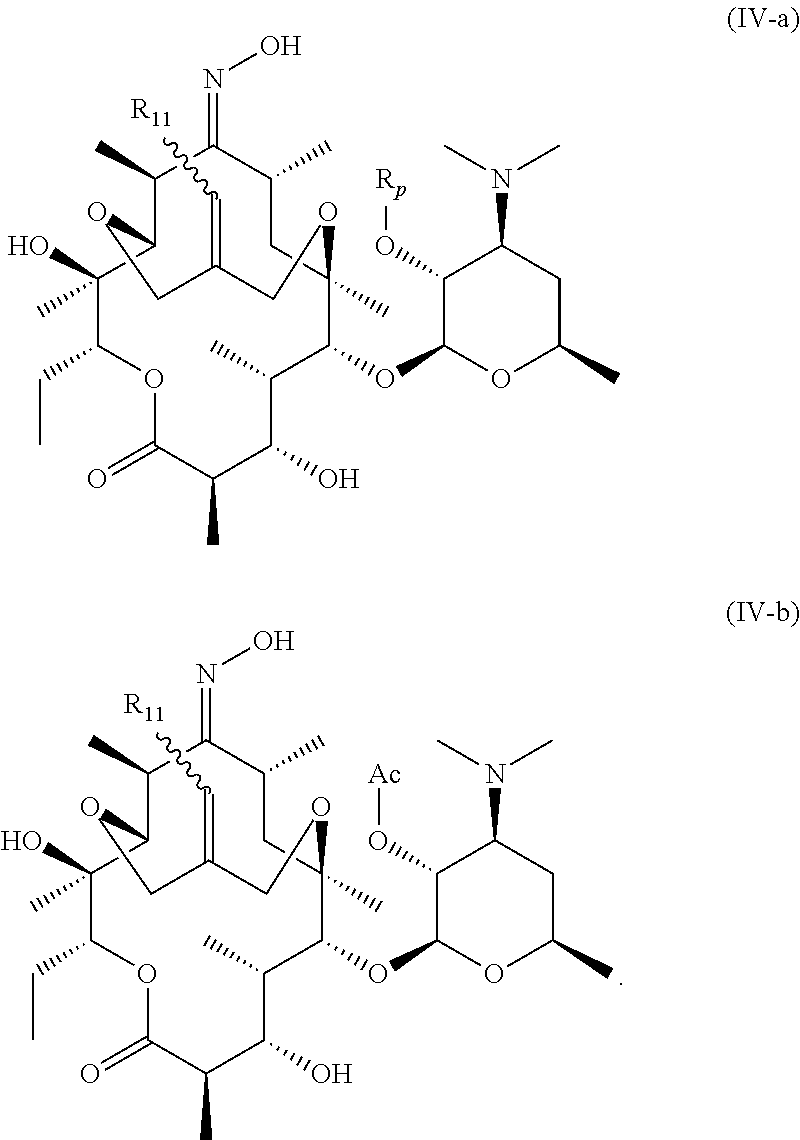
A most preferred embodiment of the compounds of formula (IV) is a compound of formula (IV-c):

Another embodiment of the present invention, therefore, is a process comprising the step of hydrolyzing a compound of formula (III) with aqueous acid to provide a compound of formula (IV).
Compounds of formula (IV) are useful as intermediates in preparing compounds of formula (V):

Preferred embodiments of the compounds of formula (V) are compounds of formulas (V-a) and (V-b):

Yet a further embodiment of the present invention, therefore, is a process comprising the step of reducing a compound of formula (IV) with a reducing agent to provide a compound of formula (V).
Compounds of formula (V) are useful as intermediates in the preparation of compounds of formula (VI):

Preferred embodiments of the compounds of formula (VI) are compounds of formula (VI-a) and (VI-b):

Yet another embodiment of the present invention, therefore, is a process comprising the step of acylating a compound of formula (V) with an acylating agent to provide a compound of formula (VI).
Compounds of formula (VI) are useful as intermediates in the preparation of compounds of formula (VII):

Preferred embodiments of the compounds of formula (VII) are compounds of formulas (VII-a) and (VII-b):

Yet another embodiment of the present invention, therefore, is a process which comprises the step of oxidizing a compound of formula (VI) with an oxidizing agent or agents to provide a compound of formula (VII).
Compounds of formula (VII) are useful as intermediates in the preparation of compounds of formula (VIII):

Preferred embodiments of the compound of formula (VIII) are compounds of formulas (VIII-a), (VIII-b) and (VIII-c):

Yet another embodiment of the present invention, therefore, is a process which comprises the step of fluorinating a compound of formula (VII) with a fluorinating agent or agents in the presence of a base to provide a compound of formula (VIII).
Compounds of formula (VIII) are useful as intermediates in the preparation of compounds of formula (IX):

Preferred embodiments of the compounds of formula (VIII) are compounds of formulas (IX-a) and (IX-b):

Yet a further embodiment of the present invention, therefore, is a process comprising the step of oxidatively cleaving a compound of formula (VIII) with a cleaving reagent or reagents which are capable of performing oxidative cleavage to provide a compound of formula (IX).
Compounds of formula (IX) are useful as intermediates in the synthesis of compounds of formula (X):

Preferred embodiments of the compounds of formula (X) are compounds of formulas (X-a) and (X-b):

A most preferred embodiment of the compound of formula (X) is a compound of formula (X-c):

A further embodiment of the present invention, therefore, is a process as described above in combination with the step of reacting a compound of formula (IX) with a compound of formula (XI): R1—O—NH2(XI) to provide a compound of formula (X). In a preferred embodiment of this process, a compound of formula (IX) is treated with a compound of formula (XI):

to provide a compound of formula (X-c).
A compound of formula (XI) is a particularly useful intermediate in the process of the present invention and can be prepared by the process comprising the steps of:
- (a) halogenating (5-bromo-pyridin-2-yl)-methanol with a chlorinating reagent to form a compound of formulae (XI-a):

- (b) treating compound (XI-a) with

- in the presence of base to yield compounds of formulae (XI-b):

- wherein A and B are each independently hydrogen, a substituted or unsubstituted aliphatic group, a substituted or unsubstituted cyclic group, a substituted or unsubstituted heterocyclic group, a substituted or unsubstituted aryl group, a substituted or unsubstituted alicyclic group, or a substituted or unsubstituted heteroaryl group; or A and B taken together with the carbon to which they are attached form a cyclic moiety selected from: aryl, substituted aryl, heterocyclic, substituted heterocyclic, alicyclic, or substituted alicyclic;
- (c) treating compound (XI-b) with a tin reagent in the presence of a metallic catalyst to provide compounds of formula (XI-c):

where Y is an aliphatic group;
- (d) reacting compound (XI-c) with

- wherein X is a leaving group in the presence of a metallic catalyst to provide compounds of formula (XI-d):

- wherein C and D are each independently hydrogen, a substituted or unsubstituted aliphatic group, a substituted or unsubstituted cyclic group, a substituted or unsubstituted heterocyclic group, a substituted or unsubstituted aryl group, a substituted or unsubstituted alicyclic group, or a substituted or unsubstituted heteroaryl group; or A and B taken together with the carbon to which they are attached form a cyclic moiety selected from: aryl, substituted aryl, heterocyclic, substituted heterocyclic, alicyclic, or substituted alicyclic;
- (e) hydrolyzing the compound of formula (XI-d) with a base in a protogenic organic solvent or aqueous solution.
In yet another embodiment of the invention a compound of formula (XI) can be prepared by the process comprising the steps of:
- (a) treating (5-bromo-pyridin-2-yl)-methanol with a tin reagent in the presence of a metallic catalyst to provide compounds of formula (XI-f):

where Y is an aliphatic group;
- (b) reacting compound (XI-f) with

- wherein C and D are as previously defined and X is a leaving group in the presence of a metallic catalyst to provide compounds of formula (XI-g):

- (c) treating compound (XI-g) with compounds of formula

- wherein A and B are as previously defined in the presence of dehydrating agents (a type of Mitsunobu reaction) to yield compounds of formulae (XI-d):

- (d) hydrolyzing the compound of formula (XI-d) with a base in a protogenic organic solvent or aqueous solution.
Listed below are definitions of various terms used to describe this invention. These definitions apply to the terms as they are used throughout this specification and claims, unless otherwise limited in specific instances, either individually or as part of a larger group.
An “aliphatic group” is non-aromatic moiety that may contain any combination of carbon atoms, hydrogen atoms, halogen atoms, oxygen, nitrogen or other atoms, and optionally contain one or more units of unsaturation, e.g., double and/or triple bonds. An aliphatic group may be straight chained, branched or cyclic and preferably contains between about 1 and about 24 carbon atoms, more typically between about 1 and about 12 carbon atoms. In addition to aliphatic hydrocarbon groups, aliphatic groups include, for example, polyalkoxyalkyls, such as polyalkylene glycols, polyamines, and polyimines, for example. Such aliphatic groups may be further substituted.
Suitable aliphatic or aromatic substituents include, but are not limited to, —F, —Cl, —Br, —I, —OH, protected hydroxy, aliphatic ethers, aromatic ethers, oxo, —NO2, —CN, —C1-C12-alkyl optionally substituted with halogen (such as perhaloalkyls), C2-C12-alkenyl optionally substituted with halogen, —C2-C12-alkynyl optionally substituted with halogen, —NH2, protected amino, —NH -C1-C12-alkyl, —NH -C2-C12-alkenyl, —NH -C2-C12-alkenyl, —NH -C3-C12-cycloalkyl, —NH -aryl, —NH -heteroaryl, —NH -heterocycloalkyl, -dialkylamino, -diarylamino, -diheteroarylamino, —O—C1-C12-alkyl, —O—C2-C12-alkenyl, —O—C2-C12-alkynyl, —O—C3-C12-cycloalkyl, —O-aryl, —O-heteroaryl, —O-heterocycloalkyl, —C(O)—C1-C12-alkyl, —C(O)—C2-C12-alkenyl, —C(O)—C2-C12-alkynyl, —C(O)—C3-C12-cycloalkyl, —C(O)-aryl, —C(O)-heteroaryl, —C(O)-heterocycloalkyl, —CONH2, —CONH—C1-C12-alkyl, —CONH—C2-C12-alkenyl, —CONH—C2-C12-alkynyl, —CONH—C3-C12-cycloalkyl, —CONH-aryl, —CONH-heteroaryl, —CONH-heterocycloalkyl, —CO2—C1-C12-alkyl, —CO2—C2-C12-alkenyl, —CO2—C2-C12-alkynyl, —CO2—C3-C12-cycloalkyl, —CO2-aryl, —CO2-heteroaryl, —CO2-heterocycloalkyl, —OCO2—C1-C12-alkyl, —OCO2—C2-C12-alkenyl, —OCO2—C2-C12-alkynyl, —OCO2—C3-C12-cycloalkyl, —OCO2-aryl, —OCO2-heteroaryl, —OCO2-heterocycloalkyl, —OCONH2, —OCONH—C1-C12-alkyl, —OCONH—C2-C12-alkenyl, —OCONH—C2-C12-alkynyl, —OCONH—C3-C12-cycloalkyl, —OCONH-aryl, —OCONH-heteroaryl, —OCONH-heterocycloalkyl, —NHC(O)—C1-C12-alkyl, —NHC(O)—C2-C12-alkenyl, —NHC(O)—C2-C12-alkynyl, —NHC(O)—C3-C12-cycloalkyl, —NHC(O)-aryl, —NHC(O)-heteroaryl, —NHC(O)-heterocycloalkyl, —NHCO2—C1-C12-alkyl, —NHCO2—C2-C12-alkenyl, —NHCO2—C2-C12-alkynyl, —NHCO2—C3-C12-cycloalkyl, —NHCO2-aryl, —NHCO2—-heteroaryl, —NHCO2—-heterocycloalkyl, —NHC(O)NH2, NHC(O)NH—C1-C12-alkyl, —NHC(O)NH—C2-C12-alkenyl, —NHC(O)NH—C2-C12-alkynyl, —NHC(O)NH—C3-C12-cycloalkyl, —NHC(O)NH-aryl, —NHC(O)NH-heteroaryl, —NHC(O)NH-heterocycloalkyl, NHC(S)NH2, NHC(S)NH—C1-C12-alkyl, —NHC(S)NH—C2-C12-alkenyl, —NHC(S)NH—C2-C12-alkynyl, —NHC(S)NH—C3-C12-cycloalkyl, —NHC(S)NH-aryl, —NHC(S)NH-heteroaryl, —NHC(S)NH-heterocycloalkyl, —NHC(NH)NH2, NHC(NH)NH—C1-C12-alkyl, —NHC(NH)NH—C2-C12-alkenyl, —NHC(NH)NH—C2-C12-alkynyl, —NHC(NH)NH—C3-C12-cycloalkyl, —NHC(NH)NH-aryl, —NHC(NH)NH-heteroaryl, —NHC(NH)NH-heterocycloalkyl, NHC(NH)—C1-C12-alkyl, —NHC(NH)—C2-C12-alkenyl, —NHC(NH)—C2-C12-alkynyl, —NHC(NH)—C3-C12-cycloalkyl, —NHC(NH)-aryl, —NHC(NH)-heteroaryl, —NHC(NH)-heterocycloalkyl, —C(NH)NH—C1-C12-alkyl, —C(NH)NH—C2-C12-alkenyl, —C(NH)NH—C2-C12-alkynyl, —C(NH)NH—C3-C12-cycloalkyl, —C(NH)NH-aryl, —C(NH)NH-heteroaryl, —C(NH)NH-heterocycloalkyl, —S(O)—C1-C12-alkyl, —S(O)—C2-C12-alkenyl, —S(O)—C2-C12-alkynyl, —S(O)—C3-C12-cycloalkyl, —S(O)-aryl, —S(O)-heteroaryl, —S(O)-heterocycloalkyl-SO2NH2, —SO2NH—C1-C12-alkyl, —SO2NH—C2-C12-alkenyl, —SO2NH—C2-C12-alkynyl, —SO2NH-C3-C12-cycloalkyl, —SO2NH-aryl, —SO2NH-heteroaryl, —SO2NH-heterocycloalkyl, —NHSO2—C1-C12-alkyl, —NHSO2—C2-C12-alkenyl, —NHSO2—C2-C12-alkynyl, —NHSO2—C3-C12-cycloalkyl, —NHSO2-aryl, —NHSO2-heteroaryl, —NHSO2-heterocycloalkyl, —CH2NH2, —CH2SO2CH3, -aryl, -arylalkyl, -heteroaryl, -heteroarylalkyl, -heterocycloalkyl, —C3-C12-cycloalkyl, polyalkoxyalkyl, polyalkoxy, -methoxymethoxy, -methoxyethoxy, —SH, —S—C1-C12-alkyl, —S—C2-C12-alkenyl, —S—C2-C12-alkynyl, —S—C3-C12-cycloalkyl, —S-aryl, —S-heteroaryl, —S-heterocycloalkyl, or methylthiomethyl. It is understood that the aryls, heteroaryls, alkyls and the like can be further substituted.
The terms “C2-C12 alkenyl” or “C2-C6 alkenyl,” as used herein, denote a monovalent group derived from a hydrocarbon moiety containing from two to twelve or two to six carbon atoms having at least one carbon-carbon double bond by the removal of a single hydrogen atom. Alkenyl groups include, but are not limited to, for example, ethenyl, propenyl, butenyl, 1-methyl-2-buten-1-yl, alkadienes and the like.
The term “substituted alkenyl,” as used herein, refers to a “C2-C12 alkenyl” or “C2-C6 alkenyl” group as previously defined, substituted by one, two, three or more aliphatic substituents.
The terms “C2-C12 alkynyl” or “C2-C6 alkynyl,” as used herein, denote a monovalent group derived from a hydrocarbon moiety containing from two to twelve or two to six carbon atoms having at least one carbon-carbon triple bond by the removal of a single hydrogen atom. Representative alkynyl groups include, but are not limited to, for example, ethynyl, 1-propynyl, 1-butynyl, and the like.
The term “substituted alkynyl,” as used herein, refers to a “C2-C12 alkynyl” or “C2-C6 alkynyl” group as previously defined, substituted by one, two, three or more aliphatic substituents.
The term “C1-C6 alkoxy,” as used herein, refers to a C1-C6 alkyl group, as previously defined, attached to the parent molecular moiety through an oxygen atom. Examples of C1-C6-alkoxy include, but are not limited to, methoxy, ethoxy, propoxy, isopropoxy, n-butoxy, sec-butoxy, tert-butoxy, n-pentoxy, neopentoxy and n-hexoxy.
The terms “halo” and “halogen,” as used herein, refer to an atom selected from fluorine, chlorine, bromine and iodine.
The terms “aryl” or “aromatic” as used herein, refer to a mono- or bicyclic carbocyclic ring system having one or two aromatic rings including, but not limited to, phenyl, naphthyl, tetrahydronaphthyl, indanyl, indenyl and the like.
The terms “substituted aryl” or “substituted aromatic,” as used herein, refer to an aryl or aromatic group substituted by one, two, three or more aromatic substituents.
The term “arylalkyl,” as used herein, refers to an aryl group attached to the parent compound via a C1-C3 alkyl or C1-C6 alkyl residue. Examples include, but are not limited to, benzyl, phenethyl and the like.
The term “substituted arylalkyl,” as used herein, refers to an arylalkyl group, as previously defined, substituted by one, two, three or more aromatic substituents.
The terms “heteroaryl” or “heteroaromatic,” as used herein, refer to a mono-, bi-, or tri-cyclic aromatic radical or ring having from five to ten ring atoms of which at least one ring atom is selected from S, O and N; zero, one or two ring atoms are additional heteroatoms independently selected from S, O and N; and the remaining ring atoms are carbon, wherein any N or S contained within the ring may be optionally oxidized. Heteroaryl includes, but is not limited to, pyridinyl, pyrazinyl, pyrimidinyl, pyrrolyl, pyrazolyl, imidazolyl, thiazolyl, oxazolyl, isooxazolyl, thiadiazolyl, oxadiazolyl, thiophenyl, furanyl, quinolinyl, isoquinolinyl, benzimidazolyl, benzooxazolyl, quinoxalinyl, and the like. The heteroaromatic ring may be bonded to the chemical structure through a carbon or hetero atom.
The terms “substituted heteroaryl” or “substituted heteroaromatic,” as used herein, refer to a heteroaryl or heteroaromatic group, substituted by one, two, three, or more aromatic substituents.
The term “alicyclic,” as used herein, denotes a monovalent group derived from a monocyclic or bicyclic saturated carbocyclic ring compound by the removal of a single hydrogen atom. Examples include, but not limited to, cyclopropyl, cyclobutyl, cyclopentyl, cyclohexyl, bicyclo[2.2.1]heptyl, and bicyclo[2.2.2]octyl.
The term “substituted alicyclic,” as used herein, refers to an alicyclic group substituted by one, two, three or more aliphatic substituents.
The term “heterocyclic,” as used herein, refers to a non-aromatic 5-, 6- or 7-membered ring or a bi- or tri-cyclic group fused system, where (i) each ring contains between one and three heteroatoms independently selected from oxygen, sulfur and nitrogen, (ii) each 5-membered ring has 0 to 1 double bonds and each 6-membered ring has 0 to 2 double bonds, (iii) the nitrogen and sulfur heteroatoms may optionally be oxidized, (iv) the nitrogen heteroatom may optionally be quaternized, (v) any of the above rings may be fused to a benzene ring, and (vi) the remaining ring atoms are carbon atoms which may be optionally oxo-substituted. Representative heterocycloalkyl groups include, but are not limited to, [1,3]dioxolane, pyrrolidinyl, pyrazolinyl, pyrazolidinyl, imidazolinyl, imidazolidinyl, piperidinyl, piperazinyl, oxazolidinyl, isoxazolidinyl, morpholinyl, thiazolidinyl, isothiazolidinyl, quinoxalinyl, pyridazinonyl, and tetrahydrofuryl.
The term “substituted heterocyclic,” as used herein, refers to a heterocyclic group, as previously defined, substituted by one, two, three or more aliphatic substituents.
The term “heteroarylalkyl,” as used herein, to an heteroaryl group attached to the parent compound via a C1-C3 alkyl or C1-C6 alkyl residue. Examples include, but are not limited to, pyridinylmethyl, pyrimidinylethyl and the like.
The term “substituted heteroarylalkyl,” as used herein, refers to a heteroarylalkyl group, as previously defined, substituted by independent replacement of one, two, or three or more aromatic substituents.
The term “alkylamino” refers to a group having the structure —NH(C1-C12 alkyl).
The term “dialkylamino” refers to a group having the structure —N(C1-C12 alkyl) (C1-C12 alkyl), where C1-C12 alkyl is as previously defined. Examples of dialkylamino are, but not limited to, dimethylamino, diethylamino, methylethylamino, piperidino, and the like.
The term “alkoxycarbonyl” represents an ester group, i.e., an alkoxy group, attached to the parent molecular moiety through a carbonyl group such as methoxycarbonyl, ethoxycarbonyl, and the like.
The term “carboxaldehyde,” as used herein, refers to a group of formula —CHO.
The term “carboxy,” as used herein, refers to a group of formula —COOH.
The term “carboxamide,” as used herein, refers to a group of formula —C(O)NH(C1-C12 alkyl) or —C(O)N(C1-C12 alkyl) (C1-C12 alkyl), —C(O)NH2, NHC(O)(C1-C12 alkyl), N(C1-C12 alkyl)C(O)(C1-C12 alkyl) and the like.
The term “hydroxy protecting group,” as used herein, refers to a labile chemical moiety which is known in the art to protect a hydroxyl group against undesired reactions during synthetic procedures. After said synthetic procedure(s) the hydroxy protecting group as described herein may be selectively removed. Hydroxy protecting groups as known in the are described generally in T. H. Greene and P. G. M. Wuts, Protective Groups in Organic Synthesis, 3rd edition, John Wiley & Sons, New York (1999). Examples of hydroxyl protecting groups include benzyloxycarbonyl, 4-nitrobenzyloxycarbonyl, 4-bromobenzyloxycarbonyl, 4-methoxybenzyloxycarbonyl, methoxycarbonyl, tert-butoxycarbonyl, isopropoxycarbonyl, diphenylmethoxycarbonyl, 2,2,2-trichloroethoxycarbonyl, 2-(trimethylsilyl)ethoxycarbonyl, 2-furfuryloxycarbonyl, allyloxycarbonyl, acetyl, formyl, chloroacetyl, trifluoroacetyl, methoxyacetyl, phenoxyacetyl, benzoyl, methyl, t-butyl, 2,2,2-trichloroethyl, 2-trimethylsilyl ethyl, 1,1-dimethyl-2-propenyl, 3-methyl-3-butenyl, allyl, benzyl, para-methoxybenzyldiphenylmethyl, triphenylmethyl (trityl), tetrahydrofuryl, methoxymethyl, methylthiomethyl, benzyloxymethyl, 2,2,2-triehloroethoxymethyl, 2-(trimethylsilyl)ethoxymethyl, methanesulfonyl, para-toluenesulfonyl, trimethylsilyl, triethylsilyl, triisopropylsilyl, and the like. Preferred hydroxyl protecting groups for the present invention are acetyl (Ac or —C(O)CH3), benzoyl (Bz or —C(O)C6H5), and trimethylsilyl (TMS or —Si(CH3)3).
The term “protected hydroxy,” as used herein, refers to a hydroxy group protected with a hydroxy protecting group, as defined above, including benzyloxycarbonyl, 4-nitrobenzyloxycarbonyl, 4-bromobenzyloxycarbonyl, 4-methoxybenzyloxycarbonyl, methoxycarbonyl, tert-butoxycarbonyl, isopropoxycarbonyl, diphenylmethoxycarbonyl, 2,2,2-trichloroethoxycarbonyl, 2-(trimethylsilyl)ethoxycarbonyl, 2-furfuryloxycarbonyl, allyloxycarbonyl, acetyl, formyl, chloroacetyl, trifluoroacetyl, methoxyacetyl, phenoxyacetyl, benzoyl, methyl, t-butyl, 2,2,2-trichloroethyl, 2-trimethylsilyl ethyl, 1,1-dimethyl-2-propenyl, 3-methyl-3-butenyl, allyl, benzyl, para-methoxybenzyldiphenylmethyl, triphenylmethyl (trityl), tetrahydrofuryl, methoxymethyl, methylthiomethyl, benzyloxymethyl, 2,2,2-triehloroethoxymethyl, 2-(trimethylsilyl)ethoxymethyl, methanesulfonyl, para-toluenesulfonyl, trimethylsilyl, triethylsilyl, triisopropylsilyl, and the like. Preferred hydroxyl protecting groups for the present invention are acetyl (Ac or —C(O)CH3), benzoyl (Bz or —C(O)C6H5), and trimethylsilyl (TMS or —Si(CH3)3).
The term “amino protecting group,” as used herein, refers to a labile chemical moiety which is known in the art to protect an amino group against undesired reactions during synthetic procedures. After said synthetic procedure(s) the amino protecting group as described herein may be selectively removed. Amino protecting groups as known in the are described generally in T. H. Greene and P. G. M. Wuts, Protective Groups in Organic Synthesis, 3rd edition, John Wiley & Sons, New York (1999). Examples of amino protecting groups include, but are not limited to, t-butoxycarbonyl, 9-fluorenylmethoxycarbonyl, benzyloxycarbonyl, and the like.
The term “protected amino,” as used herein, refers to an amino group protected with an amino protecting group as defined above.
The term “acyl” includes residues derived from acids, including but not limited to carboxylic acids, carbamic acids, carbonic acids, sulfonic acids, and phosphorous acids. Examples include aliphatic carbonyls, aromatic carbonyls, aliphatic sulfonyls, aromatic sulfinyls, aliphatic sulfinyls, aromatic phosphates and aliphatic phosphates.
The term “aprotic solvent,” as used herein, refers to a solvent that is relatively inert to proton activity, i.e., not acting as a proton-donor. Examples include, but are not limited to, hydrocarbons, such as hexane and toluene, for example, halogenated hydrocarbons, such as, for example, methylene chloride, ethylene chloride, chloroform, and the like, heterocyclic compounds, such as, for example, tetrahydrofuran and N-methylpyrrolidinone, and ethers such as diethyl ether, bis-methoxymethyl ether. Such compounds are well known to those skilled in the art, and it will be obvious to those skilled in the art that individual solvents or mixtures thereof may be preferred for specific compounds and reaction conditions, depending upon such factors as the solubility of reagents, reactivity of reagents and preferred temperature ranges, for example. Further discussions of aprotic solvents may be found in organic chemistry textbooks or in specialized monographs, for example: Organic Solvents Physical Properties and Methods of Purification, 4th ed., edited by John A. Riddick et al., Vol. II, in the Techniques of Chemistry Series, John Wiley & Sons, NY, 1986.
The term “leaving group”, as used herein, means a functional group or atom which can be displaced by another functional group or atom in a substitution reaction, such as a nucleophilic substitution reaction. By way of example, representative leaving groups include chloro, bromo and iodo groups; sulfonic ester groups, such as mesylate, tosylate, brosylate, nosylate and the like; and acyloxy groups, such as acetoxy, trifluoroacetoxy and the like.
The term “protogenic organic solvent,” as used herein, refers to a solvent that tends to provide protons, such as an alcohol, for example, methanol, ethanol, propanol, isopropanol, butanol, t-butanol, and the like. Such solvents are well known to those skilled in the art, and it will be obvious to those skilled in the art that individual solvents or mixtures thereof may be preferred for specific compounds and reaction conditions, depending upon such factors as the solubility of reagents, reactivity of reagents and preferred temperature ranges, for example. Further discussions of protogenic solvents may be found in organic chemistry textbooks or in specialized monographs, for example: Organic Solvents Physical Properties and Methods of Purification, 4th ed., edited by John A. Riddick et al., Vol. II, in the Techniques of Chemistry Series, John Wiley & Sons, NY, 1986.
The term “oxidizing agent(s),” as used herein, refers to reagents useful for oxidizing the 3-hydroxyl of the macrolide ring to the 3-carbonyl. Oxidizing agents suitable in the present process are either Swern oxidation reagents (dimethyl sulfoxide and an electrophilic compound selected from dicyclohexylcarbodiimide, acetic anhydride, trifluoroacetic anhydride, oxalyl chloride, or sulfur trioxide), Dess Martin oxidation reagents, or Corey-Kim oxidation reagents. A preferred method of oxidation is the use of the Corey-Kim oxidation reagents N-chlorosuccinimide-dimethyl sulfide complex.
The term “palladium catalyst,” as used herein, refers to optionally supported palladium(0) such as palladium metal, palladium on carbon, palladium on acidic, basic, or neutral alumina, and the like; palladium(0) complexes such as tetrakis(triphenylphosphine)palladium(0) tris(dibenzylideneacetone)dipalladium(0); palladium(II) salts such as palladium acetate or palladium chloride; and palladium(II) complexes such as allylpalladium(II) chloride dimer, (1,1′-bis(diphenylphosphino)ferrocene)-dichloropalladium(II), bis(acetato)bis(triphenylphosphine)palladium(II), and bis(acetonitrile)dichloropalladium(II).
Combinations of substituents and variables envisioned by this invention are only those that result in the formation of stable compounds. The term “stable”, as used herein, refers to compounds which possess stability sufficient to allow manufacture and which maintains the integrity of the compound for a sufficient period of time to be useful for the purposes detailed herein.
The synthesized compounds can be separated from a reaction mixture and further purified by a method such as column chromatography, high pressure liquid chromatography, or recrystallization. As can be appreciated by the skilled artisan, further methods of synthesizing the compounds of the formulae herein will be evident to those of ordinary skill in the art. Additionally, the various synthetic steps may be performed in an alternate sequence or order to give the desired compounds. Synthetic chemistry transformations and protecting group methodologies (protection and deprotection) useful in synthesizing the compounds described herein are known in the art and include, for example, those such as described in R. Larock, Comprehensive Organic Transformations, VCH Publishers (1989); T. W. Greene and P. G. M. Wuts, Protective Groups in Organic Synthesis, 2d. Ed., John Wiley and Sons (1991); L. Fieser and M. Fieser, Fieser and Fieser's Reagents for Organic Synthesis, John Wiley and Sons (1994); and L. Paquette, ed., Encyclopedia of Reagents for Organic Synthesis, John Wiley and Sons (1995).
The compounds of this invention may be modified by appending appropriate functionalities to enhance selective biological properties. Such modifications are known in the art and may include those which increase biological penetration into a given biological system (e.g., blood, lymphatic system, central nervous system), increase oral availability, increase solubility to allow administration by injection, alter metabolism and alter rate of excretion.
The compounds described herein contain one or more asymmetric centers and thus give rise to enantiomers, diastereomers, and other stereoisomeric forms that may be defined, in terms of absolute stereochemistry, as (R)- or (S)-, or as (D)- or (L)- for amino acids. The present invention is meant to include all such possible isomers, as well as their racemic and optically pure forms. Optical isomers may be prepared from their respective optically active precursors by the procedures described above, or by resolving the racemic mixtures. The resolution can be carried out in the presence of a resolving agent, by chromatography or by repeated crystallization or by some combination of these techniques which are known to those skilled in the art. Further details regarding resolutions can be found in Jacques, et al., Enantiomers, Racemates, and Resolutions (John Wiley & Sons, 1981). When the compounds described herein contain olefinic double bonds, other unsaturation, or other centers of geometric asymmetry, and unless specified otherwise, it is intended that the compounds include both E and Z geometric isomers or cis- and trans- isomers. Likewise, all tautomeric forms are also intended to be included. The configuration of any carbon-carbon double bond appearing herein is selected for convenience only and is not intended to designate a particular configuration unless the text so states; thus a carbon-carbon double bond or carbon-heteroatom double bond depicted arbitrarily herein as trans may be cis, trans, or a mixture of the two in any proportion.
As used herein, the term “pharmaceutically acceptable salt” refers to those salts which are, within the scope of sound medical judgment, suitable for use in contact with the tissues of humans and lower animals without undue toxicity, irritation, allergic response and the like, and are commensurate with a reasonable benefit/risk ratio. Pharmaceutically acceptable salts are well known in the art. For example, S. M. Berge, et al. describes pharmaceutically acceptable salts in detail in J. Pharmaceutical Sciences, 66: 1-19 (1977). The salts can be prepared in situ during the final isolation and purification of the compounds of the invention, or separately by reacting the free base function with a suitable organic acid. Examples of pharmaceutically acceptable include, but are not limited to, nontoxic acid addition salts are salts of an amino group formed with inorganic acids such as hydrochloric acid, hydrobromic acid, phosphoric acid, sulfuric acid and perchloric acid or with organic acids such as acetic acid, maleic acid, tartaric acid, citric acid, succinic acid or malonic acid or by using other methods used in the art such as ion exchange. Other pharmaceutically acceptable salts include, but are not limited to, adipate, alginate, ascorbate, aspartate, benzenesulfonate, benzoate, bisulfate, borate, butyrate, camphorate, camphorsulfonate, citrate, cyclopentanepropionate, digluconate, dodecylsulfate, ethanesulfonate, formate, fumarate, glucoheptonate, glycerophosphate, gluconate, hemisulfate, heptanoate, hexanoate, hydroiodide, 2-hydroxy-ethanesulfonate, lactobionate, lactate, laurate, lauryl sulfate, malate, maleate, malonate, methanesulfonate, 2-naphthalenesulfonate, nicotinate, nitrate, oleate, oxalate, palmitate, pamoate, pectinate, persulfate, 3-phenylpropionate, phosphate, picrate, pivalate, propionate, stearate, succinate, sulfate, tartrate, thiocyanate, p-toluenesulfonate, undecanoate, valerate salts, and the like. Representative alkali or alkaline earth metal salts include sodium, lithium, potassium, calcium, magnesium, and the like. Further pharmaceutically acceptable salts include, when appropriate, nontoxic ammonium, quaternary ammonium, and amine cations formed using counterions such as halide, hydroxide, carboxylate, sulfate, phosphate, nitrate, alkyl having from 1 to 6 carbon atoms, sulfonate and aryl sulfonate.
As used herein, the term “pharmaceutically acceptable ester” refers to esters which hydrolyze in vivo and include those that break down readily in the human body to leave the parent compound or a salt thereof. Suitable ester groups include, for example, those derived from pharmaceutically acceptable aliphatic carboxylic acids, particularly alkanoic, alkenoic, cycloalkanoic and alkanedioic acids, in which each alkyl or alkenyl moiety advantageously has not more than 6 carbon atoms. Examples of particular esters include, but are not limited to, formates, acetates, propionates, butyrates, acrylates and ethylsuccinates.
The term “pharmaceutically acceptable prodrugs” as used herein refers to those prodrugs of the compounds of the present invention which are, within the scope of sound medical judgment, suitable for use in contact with the tissues of humans and lower animals with undue toxicity, irritation, allergic response, and the like, commensurate with a reasonable benefit/risk ratio, and effective for their intended use, as well as the zwitterionic forms, where possible, of the compounds of the present invention. “Prodrug”, as used herein means a compound which is convertible in vivo by metabolic means (e.g. by hydrolysis) to a compound of Formula I. Various forms of prodrugs are known in the art, for example, as discussed in Bundgaard, (ed.), Design of Prodrugs, Elsevier (1985); Widder, et al. (ed.), Methods in Enzymology, vol. 4, Academic Press (1985); Krogsgaard-Larsen, et al., (ed). “Design and Application of Prodrugs, Textbook of Drug Design and Development, Chapter 5, 113-191 (1991); Bundgaard, et al., Journal of Drug Deliver Reviews, 8:1-38 (1992); Bundgaard, J. of Pharmaceutical Sciences, 77:285 et seq. (1988); Higuchi and Stella (eds.) Prodrugs as Novel Drug Delivery Systems, American Chemical Society (1975); and Bernard Testa & Joachim Mayer, “Hydrolysis In Drug And Prodrug Metabolism: Chemistry, Biochemistry And Enzymology,” John Wiley and Sons, Ltd. (2002).
This invention also encompasses pharmaceutical compositions containing, and methods of treating bacterial infections through administering, pharmaceutically acceptable prodrugs of compounds of the formula I. For example, compounds of formula I having free amino, amido, hydroxy or carboxylic groups can be converted into prodrugs. Prodrugs include compounds wherein an amino acid residue, or a polypeptide chain of two or more (e.g., two, three or four) amino acid residues is covalently joined through an amide or ester bond to a free amino, hydroxy or carboxylic acid group of compounds of formula I. The amino acid residues include but are not limited to the 20 naturally occurring amino acids commonly designated by three letter symbols and also includes 4-hydroxyproline, hydroxylysine, demosine, isodemosine, 3-methylhistidine, norvalin, beta-alanine, gamma-aminobutyric acid, citrulline homocysteine, homoserine, ornithine and methionine sulfone. Additional types of prodrugs are also encompassed. For instance, free carboxyl groups can be derivatized as amides or alkyl esters. Free hydroxy groups may be derivatized using groups including but not limited to hemisuccinates, phosphate esters, dimethylaminoacetates, and phosphoryloxymethyloxycarbonyls, as outlined in Advanced Drug Delivery Reviews, 1996, 19, 115. Carbamate prodrugs of hydroxy and amino groups are also included, as are carbonate prodrugs, sulfonate esters and sulfate esters of hydroxy groups. Derivatization of hydroxy groups as (acyloxy)methyl and (acyloxy)ethyl ethers wherein the acyl group may be an alkyl ester, optionally substituted with groups including but not limited to ether, amine and carboxylic acid functionalities, or where the acyl group is an amino acid ester as described above, are also encompassed. Prodrugs of this type are described in J. Med. Chem. 1996, 39, 10. Free amines can also be derivatized as amides, sulfonamides or phosphonamides. All of these prodrug moieties may incorporate groups including but not limited to ether, amine and carboxylic acid functionalities.
Suitable concentrations of reactants is 0.01M to 10M, typically 0.1M to 1M. Suitable temperatures include -10° C. to 250° C., typically -78° C. to 150° C., more typically -78° C. to 100° C., still more typically 0° C. to 100° C. Reaction vessels are preferably made of any material which does not substantial interfere with the reaction. Examples include glass, plastic, and metal. The pressure of the reaction can advantageously be operated at atmospheric pressure. The atmospheres includes, for example, air, for oxygen and water insensitive reactions, or nitrogen or argon, for oxygen or water sensitive reactions.
The term “in situ,” as used herein, refers to use of an intermediate in the solvent or solvents in which the intermediate was prepared without removal of the solvent.
Unless otherwise defined, all technical and scientific terms used herein are accorded the meaning commonly known to one with ordinary skill in the art. All publications, patents, published patent applications, and other references mentioned herein are hereby incorporated by reference in their entirety.
Abbreviations which may be used in the descriptions of the scheme and the examples that follow are:
Ac for acetyl;
AIBN for azobisisobutyronitrile;
Bu3SnH for tributyltin hydride;
CDI for carbonyldiimidazole;
dba for dibenzylidene acetone;
dppb for diphenylphosphino butane or 1,4-bis(diphenylphosphino)butane;
DBU for 1,8-diazabicyclo[5.4.0]undec-7-ene;
DEAD for diethylazodicarboxylate;
DMAP for dimethylaminopyridine;
DMF for dimethyl formamide;
DPPA for diphenylphosphoryl azide;
EtOAc for ethyl acetate;
HPLC for high-pressure liquid chromatography;
MeOH for methanol;
NaN(TMS)2 for sodium bis(trimethylsilyl)amide;
NMMO for N-methylmorpholine N-oxide;
TEA for triethylamine;
THF for tetrahydrofuran;
TPP or PPh3 for triphenylphosphine;
MOM for methoxymethyl;
Boc for t-butoxycarbonyl;
Bz for benzyl;
Ph for phenyl;
POPd for dihydrogen dichlorobis(di-tert-butylphosphinito-κP)palladate(II);
TBS for tert-butyl dimethylsilyl; or
TMS for trimethylsilyl.
All other abbreviations used herein, which are not specifically delineated above, shall be accorded the meaning which one of ordinary skill in the art would attach.
The present invention will be better understood in connection with Schemes 1-6. It will be readily apparent to one of ordinary skill in the art that the process of the present invention can be practiced by substitution of the appropriate reactants and that the order of the steps themselves can be varied.
Erythromycins can be protected as 9-oximes of formula (I-a) as described in U.S. Pat. Nos. 4,990,602; 4,331,803; 4,680,386; and 4,670,549. Reaction of erythromycin A with hydroxylamine and formic acid in methanol provides a compound of formula (I) wherein Q is OH and Z is

which can be further derivatized without isolation. The preferred amount of hydroxylamine is about 7 to about 10 molar equivalents per molar equivalent of erythromycin A. From about 2 to about 5 molar equivalents of formic acid are used for each molar equivalent of erythromycin A.
The 2′- and 4″-hydroxyl groups as well as the hydroxyl of the 9-oxime of compounds of formula (I-a) can be protected sequentially or simultaneously by reaction with a suitable hydroxyl-protecting reagent in an aprotic solvent, optionally in the presence of catalytic amounts of base, such as DMAP and/or TEA, as described in U.S. Pat. No. 5,892,008, to provide a compound of formula (I-b). Typical hydroxyl-protecting reagents include acetylating agents and silylating agents such as acetyl chloride, acetic anhydride, benzoyl chloride, benzoic anhydride, benzyl chloroformate, hexamethyldisilazane, and trialkylsilyl chlorides. A preferred hydroxyl-protecting reagent of the present invention is acetic anhydride.
Compounds of formula II, useful in the preparation of compounds of formula III, are prepared by treating 2-methylene-1,3-propanediol with di-tert-butyl dicarbonate in an aprotic solvent, in the presence of a phase transfer catalyst (PTC) and an aqueous base. PTCs suitable for the present process include, but are not limited to, tetrabutylammonium bromide, tetrabutylammonium bromide, tetrabutylammonium chloride, tetrabutylammonium fluoride trihydrate, tetrabutylammonium hydrogen sulfate, tetrabutylammonium iodide, tetrabutylammonium thiocyanate, tetrabutylammonium tetrafluoroborate, benzyltetrabutylammonium chloride, and the like; the preferred of which is tetrabutylammonium hydrogen sulfate. In a preferred embodiment of the present conversion, the aprotic solvent is dichloromethane, the aqueous base is 4M to 8M NaOH.


As illustrated in Scheme 1, step A, erythromycin derivatives of formula (I-b) are converted in the present invention to compounds of formula (III-a) by the treatment of the former with compounds of formula (II):

preferably where R1 is tert-butyl, isopropyl, or isobutyl and R11 is hydrogen. In a preferred embodiment, the conversion takes place in an aprotic solvent, at a temperature range of between 30° C. and 100° C., in the presence of a palladium catalyst and an additive for a period of less than about 12 hours.
Alkylation of a compound of formula (I-b) with a compound of formula (II) preferably takes place in the presence of a palladium catalyst. Most palladium (0) catalysts are expected be effective in this process. Some palladium (II) catalysts, such as palladium (II) acetate, which are converted into a palladium (0) species in-situ by a phosphine, will be effective as well. See, for example, Beller et al. Angew. Chem. Int. Ed. Engl., 1995, 34 (17), 1848. A suitable palladium catalyst for this reaction includes, but is not limited to, palladium (II) acetate, tetrakis(triphenylphospine)palladium (0), tris(dibenzylideneacetone)dipalladium(0) (Pd2(dba)3), tetradi(benzylideneacetone)dipalladium and the like. Palladium on carbon and palladium (II) halide catalysts are less preferred than other palladium catalysts for this process. A preferred palladium catalyst for this process is a palladium(0) catalyst. A particularly preferred palladium catalyst for this process is Pd2(dba)3.
In addition, the process is preferably performed in the presence of an additive. Examples of preferred additives include monodentate phosphorus-containing ligands of formulas P(RC)3 (phosphines) and P(ORD)3 (phosphites), wherein each RC is independently hydrogen; alkyl such as methyl, ethyl, and tert-butyl; cycloalkyl such as cyclopropyl and cyclohexyl; optionally substituted aryl, such as phenyl, naphthyl, and ortho-tolyl; and optionally substituted heteroaryl such as furyl and pyridyl; and wherein each RD is independently alkyl such as methyl, ethyl, and tert-butyl; cycloalkyl, such as cyclopropyl and cyclohexyl; optionally substituted aryl, such as phenyl, naphthyl, and ortho-tolyl; and optionally substituted heteroaryl, such as furyl and pyridyl. Specific examples of additives include, but are not limited to, tri(alkyl)phosphines such as trimethylphosphine, triethylphosphine, tributylphosphine, and the like; tri(cycloalkryl)phosphines such as tricyclopropylphosphine, tricyclohexylphosphine, and the like; tri(aryl)phosphines such as triphenylphosphine, trinaphthylphosphine, and the like; tri(heteroaryl)phosphines such as tri(fury-2-yl)phosphine, tri(pyrid-3-yl)phosphine, and the like; tri(alkyl)phosphites such as trimethylphosphite, triethylphosphite, tributylphosphite, and the like; tri(cycloalkyl)-phosphites such as tricyelopropylphosphite, tricyclohexylphosphite, and the like; tri(aryl)phosphites such as triphenylphosphite, trinaphthylphosphite, and the like; and tri(heteroaryl)phosphites such as tri(fury-2-yl)phosphite, tri(pyrid-3-yl)phosphite, and the like. The term “additive,” as used herein, also refers to bidentate phosphines such as 1,4-bis(diphenylphosphino)butane (dppb), 1,2-bis(diphenyl-phosphino)ethane (dppe), 1,1-bis(diphenylphosphino)methane (dppm), 1,2-bis(dimethyl-phosphino)ethane (dmpe), 1,1′-bis(diphenylphosphino)ferrocene (dppf), and the like. A particularly preferred additive of the instant process is 1,4-bis(diphenylphosphino)butane (dppb).
The process is carried out in an aprotic solvent. Suitable aprotic solvents include, but are not limited to, tetrahydrofuran, N,N-dimethylformamide, dimethyl sulfoxide, N-methyl-2-pyrrolidone, hexamethylphosphoric triamide, 1,2-dimethoxyethane, methyl-tert-butyl ether, heptane, acetonitrile, isopropyl acetate and ethyl acetate. Preferred aprotic solvents are tetrahydrofuran or toluene.
The instant conversion is performed preferably at an elevated temperature between 30 and 100° C. A particularly preferred temperature range is between 55° C. and 85° C. A most preferred temperature range for the instant alkylation process is between 60° C. and 75° C.
The instant alkylation process is generally conducted until at least 50% completion, preferably at least about 70% completion, typically until at least 95% completion. Generally, the reaction time will be less than about 12 hours. A preferred reaction time range for the present alkylation process is less than about 8 hours. A most preferred reaction time range for the present alkylation process is less than about 7 hours.
A compound of formula (III-a), wherein R6 and Rp are as previously defined, are converted to a compound of formula (IV-b), wherein Rp is as previously defined, via the process illustrated in Scheme 1, step B. The removal of the cladinose moiety may be achieved either by mild acid hydrolysis or by enzymatic hydrolysis, at a temperature range of between −10° C. and 80° C., for a time period of from 0.5 to 24 hours, to afford a compound of formula (IV-b). Representative acids include dilute hydrochloric acid, sulfuric acid, perchloric acid, chloroacetic acid, dichloroacetic acid or trifluoroacetic acid. Suitable solvents for the reaction include water, methanol, ethanol, isopropanol, butanol and the like. In a preferred embodiment, the removal of the cladinose moiety is achieved by treatment with aqueous hydrochloric acid, for a period of 1 to 2 hours, at a temperature between 50° C. and 70° C. In a most preferred embodiment, 1M aqueous hydrochloric acid is used at a temperature of about 60° C.

As illustrated in Scheme 2, Step A, conversion of a compound of formula (IV-a) to a compound of formula (V), may be achieved by treating the former with a reducing agent. Reducing agents suitable for this conversion include, but are not limited to, lithium aluminum hydride, titanium(III)chloride, borane, and various sulfides such as sodium hydrogen sulfide and sodium nitrite. For a more detailed account of oxime reduction reaction, see J. March in “Advanced Organic Chemistry” 4th ed., Wiley & Son, Inc, 1992. In a particularly preferred embodiment, a compound of formula (IV-a) is treated with a titanium(III) reducing agent (preferably titanium(III)chloride), under acidic conditions, typically in a protogenic organic solvent. Preferred acids include, but are not limited to, acetic acid, formic acid, dilute hydrochloric acid, dilute phosphoric acid, dilute sulfuric acid, and the like. A particularly preferred acid for the present conversion is aqueous hydrochloric acid. Protogenic organic solvents suitable in this preferred embodiment include, but are not limited to, mixtures of water and methanol, ethanol, isopropanol, or butanol. A particularly preferred protogenic organic solvent for the present conversion is ethanol. The conversion is carried out between 10° C. and 110° C. (preferably between about 20° C. and 50° C.) and over a period of less than about 10 hours (preferably between 2 to 4 hours).
As illustrated in Scheme 2, Step B, compounds of formula (V-a) can be converted to compounds of formula (VI) by treating the former with an acylating agent.
In a preferred embodiment, the conversion is carried out in an aprotic solvent. Acylating agents suitable for the instant conversion include, but are not limited to, acetyl chloride, acetic anhydride, propionic anhydride, benzoyl chloride, benzoic anhydride, and benzyl chloroformate.
Aprotic solvents suitable for the present conversion are dichloromethane, chloroform, tetrahydrofuran, N-methylpyrrolidinone, dimethylsulfoxide, N,N-dimethylformamide, N,N-dimethylacetamide, hexamethylphosphoric triamide, a mixture thereof or a mixture of one of these solvents with ether, tetrahydrofuran, 1,2-dimethoxyethane, 1,2-dichloroethane, acetonitrile, ethyl acetate, acetone, and the like. A preferred aprotic solvent of the present process is selected from dichloromethane, chloroform, N,N-dimethylformamide, tetrahydrofuran, N-methylpyrrolidinone or mixtures thereof. A particularly preferred aprotic solvent is dichloromethane.

Scheme 3 illustrates the process converting a compound of formula (VI) into a compound of formula (VII) by oxidation of the 3-position alcohol using an oxidizing agent or agents. Oxidizing agents suitable in the present process are either Swern oxidation reagents (dimethyl sulfoxide and an electrophilic compound selected from dicyclohexylcarbodiimide, acetic anhydride, trifluoroacetic anhydride, oxalyl chloride, or sulfur trioxide), Dess-Martin periodane, or Corey-Kim oxidation reagents. A preferred method of oxidation is the use of the Corey-Kim oxidation reagents N-chlorosuccinimide and dimethyl sulfide. The reaction typically takes place in an aprotic solvent at a temperature of between about −78° to 25° C. The reaction time typically is less than 12 hours. A more thorough discussion of the state of the art regarding oxidation of secondary alcohols can be found in J. March in “Advanced Organic Chemistry” 4th ed., Wiley & Son, Inc, 1992.
As illustrated in Scheme 3, conversion of a compound of formula (VII) to a compound of formula (VIII) may be achieved by treating the former with a fluorinating agent in the presence of a base. Suitable bases include, but are not limited to, lithium tert-butoxide, potassium tert-butoxide, and sodium hydride. A particularly preferred base is lithium tert-butoxide. Suitable fluorinating agents include, but are not limited to, N-fluorobenzenesulfonimide (NFSI), Selectfluor®, and diethylaminosulfur trifluoride (DAST). A particularly preferred fluorinating agent is NFSI. Organic solvents suitable in this preferred embodiment include, but are not limited to, tetrahydrofuran, N-methylpyrrolidinone, dimethylsulfoxide, N,N-dimethylformamide, N,N-dimethylacetamide, hexamethylphosphoric triamide, tert-butanol, or a mixture thereof. A particularly preferred solvent is a mixture of tert-butanol and NMP. The reaction typically takes place at a temperature of between about −78° to 25° C. The reaction time typically is less than 12 hours. A more thorough discussion of the state of the art regarding fluorination of ketones can be found in J. March in “Advanced Organic Chemistry” 5th ed., Wiley & Son, Inc, 2001.
A compound of formula (IX) may be prepared by treating a compound of formula (VIII) with a reagent or reagents capable of performing oxidative cleavage. Oxidative cleavage may be performed by, for example, ozonolysis or by treatment with an oxidant followed by a cleaving reagent. Ozonolysis may be achieved by treating the alkene of a compound of formula (VIII) with ozone followed by decomposition of the ozonide with the appropriate reducing agent. Suitable reducing agents for this process include, but are not limited to, dimethyl sulfide, zinc, trivalent phosphorous compounds, sodium sulfite, and the like. The reaction is typically carried out in an inert solvent such as, but not limited to, methanol, ethanol, ethyl acetate, glacial acetic acid, chloroform, methylene chloride or hexanes or mixtures thereof, preferably methanol, preferably at about −78° to −20° C. Preferred reducing agents include, but are not limited to, triphenylphosphine, trimethyl phosphite, thiourea, and dimethyl sulfide, preferably triphenylphosphine. A more thorough discussion of ozonolysis and the conditions there for can be found in J. March “Advanced Organic Chemistry” 4th ed., a , Wiley & Son, Inc, 1992.
An alternative method for the preparation of a compound of formula (IX) involves dihydroxylation of a compound of formula (VIII) by an oxidant followed by treatment with a cleaving reagent. The glycol is first prepared by reacting alkene with an oxidant. Suitable oxidants for the present process include, but are not limited to, permanganate ion and osmium tetroxide. The process may utilize stoichiometric amounts of osmium tetroxide, or, if in the presence of an additional oxidant such as hydrogen peroxide, tert-butyl hydroperoxide, N-methylmorpholine-N-oxide, or barium chlorate only catalytic amounts of osmium tetroxide are necessary. Dihydroxylation reactions can be carried out in a variety of solvents including: 1,4-dioxane, tetrahydrofuran, tert-butanol and diethyl ether, preferably at a temperature of between −15° C. and 15° C.
The resulting glycol can be cleaved by a variety of cleaving reagents including, but not limited to, periodic acid, lead tetraacetate, manganesedioxide, potassium permanganate, sodium metaperiodate, and N-iodosuccinamide. Preferably the cleavage reagent is sodium periodate, the solvent is preferably a mixture of acetone, THF, ethanol, methanol or 1,4-dioxane and water at a temperature of between 0° to 80° C.

A compound of formula (IX-a) represents a useful intermediate which can be further functionalized in a variety of ways. Scheme 4 details a procedure for the conversion of a compound of formula (IX-a) into an oxime compound of formula (X-c), by first treating with hydroxylamine of formula (XI) followed by 2′-deacetylation. Oxime formation can be accomplished under either acidic or basic conditions in a variety of solvents. Representative acids include, but are not limited to, hydrochloric, camphorsulfonic acid, phosphoric, sulfuric, para-toluenesulfonic, and pyridinium p-toluene sulfonate. Likewise bases which are useful include, but are not limited to, triethylamine, pyridine, diisopropylethyl amine, 1,5-lutidine, imidazole, and the like. Appropriate solvents include, but are not limited to, methanol, ethanol, water, tetrahydrofuran, 1,2-dimethoxyethane, and ethyl acetate. Preferably the reaction is run in ethanol using hydrochloric acid as the acid catalyst. The reaction temperature is generally −40° C. to 50° C. and the duration of the reaction is less than 12 hours. The deprotection can be achieved by for example methanolysis.

As outlined in Scheme 5, Step A, a compound of formula (XI-a) is prepared by reacting 5-bromo-2-hydroxymethyl-pyridine with a chlorinating reagent.
A compound of formula (XI-b) is prepared by adding a compound of formula (5-2), to a compound of formula (XI-a), as illustrated in Step B, wherein A and B are as previously defined. The present conversion preferably takes place in an aprotic solvent in the presence of a base.
A compound of formula (XI-c) is prepared, as illustrated in Step C of Scheme 5, wherein Y is an aliphatic group as previously defined, by reacting compound (XI-b) with a tin reagent in the presence of a catalyst, such as palladium(0) salt or other metal derivatives in organic solvent, preferably in an aprotic solvent. In a preferred embodiment of the reaction, the reaction temperature is between 75° C. and 200° C. and the duration of the reaction is 6 to 48 hours. In a particularly preferred embodiment of the reaction, the tin reagent is hexamethylditin, the catalyst is tetrakis(triphenylphosphine)palladium(0) and the aprotic solvent is toluene.
As illustrated in Step D, wherein A, B, C and D are as previously defined and X is a leaving group, a compound of formula (XI-d) is prepared by reacting compound (XI-c) with a compound of formula (5-3) in the presence of a catalyst, such as palladium(0) salt or other metal derivatives in organic solvent, preferably in an aprotic solvent. In a preferred embodiment of the reaction, the reaction temperature is between 75° C. and 200° C. and the duration of the reaction is 6 to 48 hours. In a particularly preferred embodiment of the reaction, the catalyst is tetrakis(triphenylphosphine)palladium(0) and the aprotic solvent is toluene.
A compound of formula (XI) is prepared, as illustrated in Step E of Scheme 5, by hydrolyzing the compound of formula (XI-d) with a base in a protogenic organic solvent or an aqueous mixture thereof. Preferably the base is either hydrazine ammonia, or methylamine.

As outlined in Scheme 6, Step A, wherein Y is an aliphatic group as previously defined, a compound of formula (XI-f) is prepared by reacting 5-bromo-2-hydroxymethyl-pyridine (6-1) with a tin reagent in the presence of a catalyst, such as palladium(0) salt or other metal derivatives in organic solvent, preferably in an aprotic solvent. The present conversion preferably takes place in the same conditions as described in Scheme 5, Step C, with different starting material of formula (6-1).
As illustrated in Step B, wherein C and D are as previously defined and X is a leaving group, a compound of formula (XI-g) is prepared by reacting compound (XI-f) with a compound of formula (6-2) in the presence of a catalyst, such as palladium(0) salt or other metal derivatives in organic solvent, preferably in an aprotic solvent. The present conversion preferably takes place in the same conditions as described in Scheme 5, Step D, with different starting material of formula (XI-f).
As illustrated in Step C, wherein A, B, C and D are as previously defined, a compound of formula (XI-d) is prepared by reacting compound (XI-g) with a compound of formula (6-3) in the presence of dehydrating agents (a type of Mitsunobu reaction) in organic solvent, preferably in an aprotic solvent. In a preferred embodiment of the reaction, the reaction temperature is between 0° C. and 80° C. and the duration of the reaction is 1 to 24 hours. In a particularly preferred embodiment of the reaction, the dehydrating agent is triphenylphosphine together with diisopropyl azodicarboxylate and the aprotic solvent is tetrahydrofuran.
In another embodiment of Scheme 6, a compound of formula (XI-d) is prepared as illustrated in Step C, by reacting compound (XI-g) with a chlorinating reagent and then adding a compound of formula (6-3) as illustrated in Scheme 5, Step B, wherein A, B, C and D are as previously defined. The present conversion preferably takes place in the same conditions as described in Scheme 5, Step A and B, with different starting material of formula (XI-g).
A compound of formula (XI) may be prepared from a compound of formula (XI-d) as outlined in Scheme 5.
All references cited herein, whether in print, electronic, computer readable storage media or other form, are expressly incorporated by reference in their entirety, including but not limited to, abstracts, articles, journals, publications, texts, treatises, internet web sites, databases, patents, and patent publications.
The compounds and processes of the present invention will be better understood in connection with the following examples, which are intended as an illustration only and not limiting of the scope of the invention. Various changes and modifications to the disclosed embodiments will be apparent to those skilled in the art and such changes and modifications including, without limitation, those relating to the chemical structures, substituents, derivatives, formulations and/or methods of the invention may be made without departing from the spirit of the invention and the scope of the appended claims.
To a solution of di-tert-butyl dicarbonate (6.6 kg) in methylene chloride (15.0 L, 15 volumes) was added 2-methylene-1,3-propanediol (1.00 kg) and phase transfer catalyst tetrabutylammonium hydrogensulfate (0.641 kg). The resulting reaction mixture was then agitated vigorously at about 15° C. while adding over a 2 hr period, 6M aqueous sodium hydroxide solution (13.2 L) and controlling the temperature between 25 to 30° C. The resulting two-phase reaction mixture was subsequently agitated for a period of 2-3 hrs at 25° C.
The aqueous layer was discarded and additional phase transfer catalyst tetrabutylammonium hydrogensulfate (0.064 kg, 10% of the initial amount), di-tert-butyl dicarbonate (0.66 kg, 10% of the initial amount), and methylene chloride (2.0 L, 2 volumes) was added to the remaining organic reaction mixture. To the reaction mixture was also added 6M aqueous sodium hydroxide solution (1.32 L, 10% of the initial amount) over a period of about 0.5 to 1 hr, while controlling the temperature between 25 to 30° C. The resulting two-phase reaction mixture was then agitated at about 25° C. for additional 3 to 4 hr. Allowing more than 3 hrs of agitation time is often required to complete the hydrolysis of the excess di-tert-butyl dicarbonate. The aqueous layer was discarded. The resulting organic phase was washed with water (3×8.0 L), diluted with EtOAc (6 L, 6 volumes), and distilled to an oil foam with quantitative yield.
1H (500 MHz, CDCl3) δ 5.15, 4.98, 4.79, 4.68, 4.68, 4.33, 4.31, 3.89, 3.77, 3.67, 3.45, 3.35, 3.19, 2.88, 2.78, 2.74, 2.42, 2.17, 2.11, 2.06, 1.95, 1.72, 1.66, 1.51, 1.48, 1.43, 1.34, 1.27, 1.19, 1.19, 1.18, 1.14, 1.13, 1.11, 0.95, 0.85.
To a solution of erythromycin A oxime (1.0 kg) in EtOAc (4 L, 4 volumes) was added TEA (0.744 L) and DMAP (48.9 g). While agitating and maintaining a temperature of less than 40° C., to the resulting reaction mixture was added acetic anhydride (0.441 L) over a period of 1-5 hrs. The reaction mixture was then agitated for an additional 1-5 hr period at about 25° C. Additional TEA (0.0744 L, 10% of initial amount) was then added to the reaction mixture, and subsequently additional acetic anhydride (0.0441 L, 10% of initial amount) was added over the course of 30 min while maintaining a temperature of less than 35° C. This mixture was then further agitated for 1.5-2 hr at about 25° C.
After the reaction had gone to completion, the reaction mixture was diluted with EtOAc (6 volumes), quenched with aqueous NaHCO3 solution 3.0 L (3 volumes), and agitated for 5-10 min at about 25° C. The aqueous phase was then discarded. The remaining organic mixture was washed with aqueous NaHCO3 solution (3.0 L, 3 volumes) and 15% aqueous brine (3.0 L, 3 volumes), and concentrated in vacuo. The concentrated solution was then taken up in acetonitrile (4.0 L, 4 volumes) and concentrated in vacuo two times until crystallization occurs. Upon formation of crystals, the slurry was agitated at 10° C. to 15° C. for at least 2 hr and the crystals were collected and dried under vacuum to afford white crystalline product with a typical yield of 70-80%.
1H (500 MHz, CDCl3) δ 5.15, 4.98, 4.79, 4.68, 4.68, 4.33, 4.31, 3.89, 3.77, 3.67, 3.45, 3.35, 3.19, 2.88, 2.78, 2.74, 2.42, 2.17, 2.11, 2.06, 1.95, 1.72, 1.66, 1.51, 1.48, 1.43, 1.34, 1.27, 1.19, 1.19, 1.18, 1.14, 1.13, 1.11, 0.95, 0.85.
13C (125 MHz, CDCl3) δ 178.7, 175.4, 170.4, 170.0, 168.3, 100.6, 96.3, 83.4, 79.4, 79.0, 77.4, 74.9, 74.0, 72.6, 72.2, 70.1, 67.7, 63.6, 63.4, 49.5, 45.0, 40.7, 39.2, 37.4, 35.7, 34.5, 31.5, 28.6, 26.8, 21.8, 21.7, 21.5, 21.3, 21.1, 20.0, 18.7, 18.4, 16.7, 16.1, 14.9, 10.9, 9.2.
To a solution of the title compound of Example 2 (1.00 kg) in anhydrous THF (5.0 L, 5 volumes) was added a solution of the title compound of Example 1 (0.62 kg) in anhydrous THF (2.0 L, 2 volumes) while agitating. The resulting reaction mixture was subsequently degassed twice by application under reduced pressure and placed under nitrogen. To the degassed reaction mixture was added 1,4-bis(diphenylphosphino)butane (dppb) (19.5 g), and tris(dibenzylideneacetone)dipalladium(0) [Pd2(dba)3] (20.8 g), after which the resulting reaction mixture was immediately degassed twice as previously described.
The degassed reaction mixture was then heated, while being agitated, to reflux [typically, reflux begins at about 65° C.] over the period of about 1 to 2 hrs and then held at a temperature of 67° C. to 69° C., while being agitated, for a period of 6 hr. After the 6 hr period, the reaction mixture was allowed to cool to about 25° C. over the period of 2 to 3 hrs and the reaction mixture was analyzed for completion by HPLC.
Once it had been determined that the reaction had gone to completion, the reaction was then filtered through a short pad (about 2 inches thick) of silica gel 0.25-0.5 kg to remove the palladium catalyst, phosphine ligand, and other polar impurities. The reaction vessel was then rinsed with reagent-grade THF (2.0 L, 2 volumes), agitate/wash for 10 min, and filtered through the short pad of silica gel, combining with filtrate from the reaction mixture. The combined filtrate was then concentrated in vacuo to afford the title compound in THF solution. The final remaining volume of the THF solution of the title compound was approximately 2-3 L (2-3 volumes) and was used directly in the following step without isolation.
To the concentrated solution of the title compound of Example 3 was added 1M hydrochloric acid solution in water (8.0 L, 8 volumes). The resulting reaction mixture was subsequently agitated and heated to 60° C. over a period of 1-2 hr and then held at said temperature for an additional 2 hr.
After the reaction had gone to completion (determined by HPLC), the reaction mixture was cooled to about 25° C. over the period of about 3 hrs. The aqueous reaction mixture was then washed with methyl tert-butyl ether (MTBE) (4.0 L×2, 4 volumes×2) while agitating at 25° C. for 10 min, keeping the aqueous layer. To the aqueous reaction mixture was then added saturated aqueous K2CO3 solution (about 0.8 kg of solid potassium carbonate in water) at 20 to 30° C. over the period of 1 to 2 hrs until the mixture is pH 9.5.
The resulting aqueous reaction mixture was then extracted EtOAc (4.0 L×2, 4 volumes×2) while agitating at 25° C. for 10 min, keeping the upper organic layer. The combined organic phase was then washed with water (4.0 L, 4 volumes) and subsequently concentrated in vacuo to a volume of 2-2.5 L. To the concentrated solution was added acetonitrile (4.0 L, 4 volumes) and concentrated in vacuo again until about 2 to 2.5 L (2 to 2.5 volumes) remained. Once again, to the concentrated solution was added acetonitrile (2.0 L, 2 volumes) and concentrate in vacuo until less than 2 L (<2 volumes) remains. The concentrated solution was removed from reduced pressure and agitated at 45° C. until crystallization began. The resulting slurry was then cooled to a temperature of 0-5° C. over a period of 4-5 hr and held at said temperature for an additional 2 hrs prior to collecting, washing, and drying the crystalline form of the title compound. The typical yield for this two-step one pot process (Pd-catalyzed bridge formation and sugar cleavage) is 40-45%.
1H (500 MHz, CDCl3) δ 5.09, 4.98, 4.97, 4.78, 4.74, 4.43, 4.39, 4.07, 3.90, 3.84, 3.74, 3.67, 3.50, 3.43, 2.82, 2.79, 2.73, 2.62, 2.43, 2.31, 2.08, 2.03, 1.77, 1.59, 1.46, 1.38, 1.35, 1.32, 1.24, 1.23, 1.22, 1.22, 0.97, 0.97, 0.89.
13C (125 MHz, CDCl3) δ 175.3, 170.2, 166.5, 143.7, 119.2, 99.7, 82.3, 79.5, 78.2, 78.1, 77.6, 77.3, 77.0, 76.1, 74.0, 71.7, 69.0, 65.6, 63.4, 43.9, 40.9, 37.5, 36.0, 34.3, 31.2, 25.7, 23.4, 21.7, 21.4, 20.0, 19.6, 17.11, 15.7, 14.8, 12.0, 7.9.
To an agitating solution of the title compound of Example 4 (1.00 kg) in ethanol (2 L, 2 volumes) was added 20% titanium (III) chloride solution in aqueous 3% hydrochloric acid (2.847 kg or 2.33 L) over the period of about 1 hr via an addition funnel, while adjusting the addition rate to control maintain the temperature between 25 to 35° C. After adding all of the titanium(III) chloride solution, the reaction mixture was then agitated for an additional 3 hrs at a temperature between 25° C. and 30° C. until the reaction was completed (by HPLC). To the reaction mixture was then added pre-chilled purified water (15 L, 15 volumes).
To the resulting aqueous reaction mixture was added a solution of sodium hydroxide (50%, w/w, 0.466 L) over a period of 0.5-1 hr, while adjusting the addition rate to maintain a temperature between 25 to 35° C., until the reaction mixture had reached a pH of between 6 to 7. The reaction mixture was then treated with saturated aqueous potassium carbonate solution (0.666 L) at 25 to 35° C. over a period of 1 to 2 hrs until the resulting reaction mixture was pH 9 to 10.
The basic aqueous reaction mixture was then extracted five times with methylene chloride (5.0 L×5, 5 volumes×5) and the combined organic extract is concentrated in vacuo until about 5 L remain. To the concentrated reaction mixture was then added additional methylene chloride (5.0 L) and removed in vacuo to azeotropically remove water until about 5 L remain. The resulting methylene chloride solution was directly used in the subsequent step without isolation.
Acetic anhydride (0.30 kg) is added to the concentrated solution from Step 5a and the resulting mixture was agitated at 25 to 30° C. for 1.5 hrs. After the acetylation reaction had gone to completion as evidenced by HPLC, the reaction mixture was concentrated in vacuo until approximately 2 L remained in the vessel. The remaining solution was then diluted with EtOAc (4.0 L, 4 volumes) and concentrated in vacuo until about 3 L remain. An additional amount of EtOAc (4.0 L, 4 volumes) was added to the concentrate and the diluted solution was concentrated once again in vacuo until crystallization began (about 1.5 L remaining) To the remaining slurry was added n-hexane (1.5 L, 1.5 volumes) while maintaining the temperature of the solution at about 45° C. After the addition of n-hexanes was complete, cool the solution to 0 to 5° C. over the period of about 3 hr and agitate the resulting slurry at this temperature for at least 2 hr before filtration. The crystals were then filtered and washed with chilled (<5° C.) ethyl acetate/hexane (1:2) (0.3 L, 0.3 volume). The collected crystals of the title compound were then dried under a vacuum at a temperature of about 40-45° C. until a constant weight was observed. The typical yield for this two-step one pot process (reduction and acetylation) is 80-89%.
1H (500 MHz, CDCl3) δ 5.18, 4.93, 4.75, 4.74, 4.59, 4.52, 4.13, 1.08, 3.74, 3.60, 3.48, 3.43, 2.84, 2.73, 2.72, 2.66, 2.55, 2.43, 2.26, 2.02, 1.73, 1.69, 1.46, 1.39, 1.33, 1.31, 1.26, 1.23, 1.23, 1.23, 1.10, 0.97, 0.91.
13C (125 MHz, CDCl3) δ 184.9, 178.0, 174.9, 170.1, 142.1, 122.4, 99.8, 81.6, 79.1, 78.2, 77.5, 77.3, 77.0, 76.3, 76.2, 73.8, 71.9, 69.1, 65.9, 63.4, 43.8, 40.9, 40.0, 38.4, 36.3, 35.7, 31.1, 25.7, 23.3, 21.7, 21.4, 20.0, 19.7, 17.2, 16.0, 14.7, 12.0, 7.9.
A solution of NCS (0.789 kg, 5.908 mol, 1.4 eq) in CH2Cl2 (water=20 ppm, 9 L) was cooled to −15° C. Dimethylsulfide (0.590 L, 8.018 mol, 1.9 eq) was added and the reaction mixture was agitated at −15° C. for 15 to 20 min. A solution of the title compound of Example 5 (3.0 kg, 4.220 mol, 1.0 eq) in CH2Cl2 (6 to 8 L) at −20° C. and the reaction mixture was agitated at −20° C. for 3 hours. Triethylamine (0.882 L, 6.33 mol, 1.5 eq) was added and the reaction mixture was agitated at −15° C. for 1 hour. The reaction mixture was warmed up to 5° C. and diluted with EtOAc (18 vols), and then it was washed with aq. sat. NAHCO3 (4 vols×2) and with aq. half-sat. NaCl (4 vols). The organic layer was separated and concentrated under reduced pressure to as low volume as possible. Acetonitrile (4 vols) was added and the solution was concentrated until about 2.5 to 3 remaining vols. Slowly cool down to about 5° C. and hold the slurry at this temperature for 2 hrs. Filter and wash with chilled MeCN (0.1 vol). Vacuum dry at 50° C. for 24 hrs or until constant weight afforded the titled compound 2.13 kg (71.2% yield), 97.2% purity by HPLC. MS-ESI m/z 709.37 (M+H)+.
A clear solution of the title compound of Example 6 (1.3 kg, 1.834 mol, 1 eq) in N-methylpyrrolidinone (anhydrous, 7.28 L, 5.6 vols) and t-BuOH (1.82 L, 1.4 vols) was cooled to −15° C. t-BuOLi solid (0.184 kg, 2.293 mol, 1.25 eq) was added in one portion and the reaction mixture was agitated for 1 hour. The reaction mixture was cooled to −30° C. and NFSI (0.566 kg, 1.797 mol, 0.98 eq) was added in less than 5 min. The reaction mixture was agitated for 25 mins and then poured into a stirring mixture of EtOAc (11 vols) and half-saturated aq. NaHCO3 (6 vols). The aqueous layer was separated and extracted with EtOAc (3 vols). The organic layers were combined, washed with aq. sat. NaHCO3 (4 vols) and with aq. half-sat. NaCl (4 vols), and then dried with Na2SO4 (1 kg) overnight. The mixture was concentrated to dryness to afford a thick oil. Vacuum dry at 40° C. for 24 h afforded a thick light brown syrup, yield=1.4 kg (105% yield due to residual NMP), HPLC purity=86%. MS-ESI m/z 727.37 (M+H)+.
To a clear solution of the crude product from step 7a (syrup, ˜86% purity by HPLC, 1.4 kg, 1.834 mol maximum) in absolute EtOH (5.6 L) was charged methanesulfonic acid (0.5 L, 4 eq). The reaction mixture was agitated at 50° C. for 2 hours and then cooled to 20° C. The reaction mixture was poured in to EtOAc (20 vols), washed subsequently with 10 wt % aq. K2CO3 (6 vols). sat. aq. NaHCO3 (8 vols) and half-sat. aq. NaCl (6 vols). The organic solution was dried with Na2SO4 (2 kg) overnight and then concentrated to a very small remaining volume (˜1 vol) at which point the crystallization of the product occurs. The slurry was slowly cooled down to ca. 0° C. and held at this temperature for 1 h. The crystals were filtered and washed with EtOAc (0.3 L). Vacuum dry at 30° C. for 24 h afforded a white solid product, purity=97% by HPLC, yield=0.8 kg (64% for 2-fluorination and 9-deacetylation). MS-ESI m/z 685.48 (M+H)+.
To a clear solution of the product from step 7b (0.8 kg, 1.168 mol) in CH2Cl2 (6 L, 7.5 vols) was charged propionic anhydride (165 ml, 1.285 mol, 1.1 eq). The reaction mixture was agitated at 20° C. for 5 hours and then concentrated to dryness to leave a thick oil. Vacuum dry at 30° C. for 24 hrs afforded an off-white amorphous solid, purity=96% by HPLC, yield=0.89 kg (103% yield due to excess anhydride and propionic acid by-product). MS-ESI m/z 741.67 (M+H)+.
A solution of the titled compound of Example 7 (96% by HPLC, 120 g) in methylene chloride (200 ml, 1.7 vols) was cooled with dry ice-acetone bath. Methanesulfonic acid (11.6 ml, 1.1 eq) was added followed by MeOH (400 ml, 3.4 vols). O3 gas from the ozone generator was bubbled into the reaction mixture until a light blue color stayed. Oxygen was bubbled in for about 5 to 10 minutes to blow away excess O3. Dimethyl sulfide (15.5 mL, 1.3 eq.) was added to quench the reaction. The cooling bath was removed and the reaction mixture was slowly warmed up to about ˜5 to 0° C. EtOAc (25 vols) was added and the reaction mixture was washed subsequently with saturated aqueous sodium bicarbonate (10 vols) and half-saturated aq. brine (10 vols). The organic layer was concentrated to dryness to leave a stick oil. Absolute EtOH (3 vols) was added and the solution was concentrated to ca. 0.3 to 0.5 vol. The slurry was slowly cooled down to ca. 10° C. and held at this temperature for 1 h before filtration and washing with EtOH (0.2 vol). Vacuum dry at 30° C. for 12 to 24 h afforded a white solid product, purity=93% by HPLC, yield=˜70 g (60% yield). MS-ESI m/z 743.38 (M+H)+.
A solution of O-[5-(4-Amino-thiazol-2-yl)-pyridin-2-ylmethyl]-hydroxylamine (Compound of formula (XI) in EtOH (22 L, 11 vols) was cooled to −35° C. The titled compound of Example 8 (2.3 Kg) was added. Aqueous HCl (1.5N, 4.44 L, 2.15 eq) was added slowly within 1 h (maintain inner temperature<−30° C., reaction mixture pH˜3.5). The reaction mixture was agitated at <−30° C. for 1 h. The cold reaction mixture was poured into a stirring mixture of EtOAc (38 vols), saturated sodium bicarbonate (13 vols) and water (4 vols). The organic layer was separated and the aqueous layer was extracted with EtOAc (7 vols). The organic layers were combined and washed with brine (8 vols). The organic solution was concentrated to dryness and vacuum dried at 30° C. for 20 h to afford dark brown amorphous solid, purity (E isomer)=˜53% (E/Z=4.1:1), yield=3.438 Kg (117%, contains 13-18% 2′-deacetylated product). MS-ESI m/z 947.47 (M+H)+, 474.17 (M+2H)2+.
The crude product from step 9a (1.01 Kg, 70.4% purity for 2′-OAc+2′-OH) was dissolved in MeOH (10 L, 10 vols) and agitated at room temperature for 19 h. The reaction mixture was concentrated to about 2.5 remaining volumes (2.5 L) and held at room temperature for 2 h before filtration and washing with MeOH (0.5 L) Vacuum dry at 25° C. for 20 h afforded a yellow solid, purity=90.9% (E/Z=39:1), yield=0.518 Kg (52%). The crude product was dissolved CH2Cl2 (4 vols) and filtered. The filtrate was concentrated to about 1.85 vols. MeOH (8.6 vols) was added and the mixture was concentrated to about 4-4.5 remaining volumes. The slurry was held at 15-18° C. for 3 h before filtration and wash with MeOH (0.5 L). Vacuum dry at 30° C. for 20 h afforded the title compound, purity=94.5%, recovery yield=86.5%. MS-ESI m/z 905.28 (M+H)+, 453.08 (M+2H)2+.
A mixture of (5-bromo-pyridin-2-yl)-methanol (104 g, 0.66 mol) in methylene chloride (833 mL) in two neck flask was placed in water bath. Thionyl chloride (80.5 mL, 1.33 mol) was dropwise added to the reaction mixture using dropping funnel and stirred at room temperature for 1.5 hr. Then, thionyl chloride (20 mL, 0.33 mol) was additionally added to the reaction mixture and stirred for 2.5 hr. After completion of the reaction, the reaction mixture was transferred to a round bottom flask. Methylene chloride and thionyl chloride were evaporated off. Toluene (2×100 mL) was added to the residue and azeotropically removed all the residual thionyl chloride. The residue was dried on vacuum for overnight to give the title compound (129.6 g, 96%) as a pink solid. MS-ESI m/z 207.91 (M+H)+.
To a mixture of 5-Bromo-2-chloromethyl-pyridine hydrochloride (63.7 g, 0.262 mol) and N-hydroxylphthalimide (64 g, 0.393 mol) in acetonitrile (400 mL) was placed in water bath and added N,N-diisopropylethylamine (182 mL, 1.05 mol) using dropping funnel for 10 min. It was heated at 65° C. for 4 hrs and evaporated off the solvent and extra base. Then, water (100 mL) was added to the reaction mixture and stirred for overnight. The resulting solid was filtered, washed with water (2×50 mL) and acetonitrile (100 mL). The white solid was dried on vacuum pump to provide the title compound (84.2 g, 84%) as a white solid. MS-ESI m/z 334.95 (M+H)+.
A mixture of 2-(5-bromo-pyridin-2-ylmethoxy)-isoindole-1,3-dione (50 g, 0.15 mol), hexamethylditin (54.17 g, 0.165 mol) in toluene (300 mL) was degassed (3 times) and filled with nitrogen. Tetrakis(triphenylphosphine)palladium(0) (3.47 g, 3.0 mmol) was added to the reaction mixture, which was degassed again. The reaction was heated at 90° C. for 18 hrs. After removal of solvent, the crude product was purified with silica gel column chromatography using 0-35% ethylacetate in hexane to provide the title compound (47.6 g, 76%) as a pale yellow solid. MS-ESI m/z 418.96 (M+H)+.
A mixture of 2-(2 bromothiazol-4-yl)-isoindole-1.3-dione (927 mg, 3.0 mmol), 2-(5-trimethylstannyl-pyridin-2-ylmethoxy)-isoindole-1,3-dione (1.25 g, 3.0 mmol) and tetrakis(triphenylphosphine)palladium(0) (173 mg, 0.15 mmol) in toluene (15 mL) was placed in sealed tube, degassed and filled with nitrogen three times. It was heated at 160° C. for 60 min (×3) in microwave. After being cooled, it was filtered, washed with acetonitrile and dried on vacuum to afford the title compound (1.08 g, 74%) as a yellow solid. MS-ESI m/z 483.08 (M+H)+.
To a mixture of the product from Example 13 (400 mg, 0.83 mmol) and methanol (4 mL) was added 33% methylamine in ethanol (2 mL). It was heated at 60° C. for 45 min. After being cooled, it was filtered and evaporated to give the title compound (>95% pure) as a yellow solid. MS-ESI m/z 223.11 (M+H)+.
A mixture of (5-bromo-pyridin-2-yl)-methanol (2.5 g, 13.3 mmol) and hexamethylditin (2.8 mL, 13.3 mmol) in abs. THF (10 mL) was cooled to −78° C. and degassed and filled with nitrogen. Tetrakis(triphenylphosphine)palladium(0) (231 mg, 0.1995 mmol) was added to the reaction mixture, which was degassed. The reaction mixture was allowed to warm to room temperature and heated in microwave at 120° C. for 20 min. After removal of solvent, the crude material was purified with silica gel column chromatography using 30-70% ethylacetate in hexane to provide the title compound (2.91 g, 80%) as a pale yellow solid. MS-ESI m/z 274.03 (M+H)+.
A mixture of 2-(2 bromothiazol-4-yl)-isoindole-1.3-dione (10.0 g, 32.3 mmol) and (5-trimethylstannyl-pyridin-2-yl)-methanol (12.2 g, 26.9 mmol) in abs. toluene (50 mL) was placed in sealed tube, degassed and filled with tetrakis(triphenylphosphine)palladium(0) (932 mg, 0.8 mmol). The reaction mixture was heated at 160° C. for 1.5 hr and filtered while the reaction mixture was hot. After being cooled to room temperature for 2 hr, a solid was filtered through fritted funnel, washed with toluene (30 mL) and dried on vacuum to provide the title compound (6.2 g, 75%) as a pale yellow solid. MS-ESI m/z 338.02 (M+H)+.
A mixture of the product from Example 16 (7.375 g, 21.88 mmol), N-hydroxyphthalimide (4.159 g, 25.52 mmol) and triphenylphosphine (7.46 g, 28.45 mmol) in freshly distilled THF (44 mL) was stirred at room temperature for 10 min and located in water bath. Then, DIAD (5.6 mL, 28.45 mmol) was dropwise added to the reaction mixture for 6 min and stirred for 3 hrs. A solid was filtered through a fritted funnel, washed with 50% THF in hexane (30 mL) and dried on vacuum pump to give the title compound (7.34 g, 70%) as a yellow solid. MS-ESI m/z 483.09 (M+H)+.
Although the invention has been described in detail with respect to various preferred embodiments it is not intended to be limited thereto, but rather those skilled in the art will recognize that variations and modifications may be made therein which are within the spirit of the invention and the scope of the appended claims.
Claims (11)
1. A process of preparing a compound of formula (XI):

the process comprising the steps of:
(a) halogenating (5-bromo-pyridin-2-yl)-methanol with a chlorinating reagent to produce a compound of formula (XI-a)
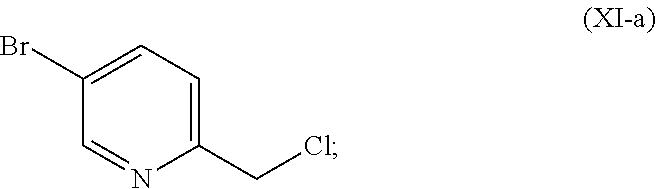
(b) reacting the compound of formula (XI-a) with

in the presence of a base, to produce a compound of formula (XI-b):

wherein A and B are each independently hydrogen, a substituted or unsubstituted aliphatic group, a substituted or unsubstituted cyclic group, a substituted or unsubstituted heterocyclic group, a substituted or unsubstituted aryl group, a substituted or unsubstituted alicyclic group, or a substituted or unsubstituted heteroaryl group; or A and B taken together with the carbon to which they are attached form a cyclic moiety selected from: aryl, substituted aryl, heterocyclic, substituted heterocyclic, alicyclic, or substituted alicyclic;
(c) reacting the compound of Formula (XI-b) with a tin reagent in the presence of a metallic catalyst to produce a compound of formula (XI-c):

where Y is an aliphatic group;
(d) reacting the compound of formula (XI-c) with a compound of the formula

in the presence of a metallic catalyst to produce a compound of formula (XI-d):

wherein C and D are each independently hydrogen, a substituted or unsubstituted aliphatic group, a substituted or unsubstituted cyclic group, a substituted or unsubstituted heterocyclic group, a substituted or unsubstituted aryl group, a substituted or unsubstituted alicyclic group, or a substituted or unsubstituted heteroaryl group; or C and D taken together with the carbon to which they are attached form a cyclic moiety selected from: aryl, substituted aryl, heterocyclic, substituted heterocyclic, alicyclic, or substituted alicyclic and wherein X is a leaving group; and
(e) hydrolyzing the compound of formula (XI-d) with a base in a protogenic organic solvent or aqueous solution, thereby producing the compound of formula (XI).
2. The process of claim 1 , wherein in step (a), the chlorinating agent is thionyl chloride.
3. The process of claim 1 , wherein in step (b), the base is N,N-diisopropylethylamine.
4. The process of claim 1 , wherein in step (c), the tin reagent is hexamethylditin and and the metallic catalyst is tetrakis(triphenylphosphine)palladium(0).
5. The process of claim 1 , wherein in step (d), the metallic catalyst is tetrakis(triphenylphosphine)palladium(0).
6. The process of claim 1 , wherein in step (e), the base is methylamine.
7. A process of preparing a compound of formula (XI):

the process comprising the steps of:
(a) reacting (5-bromo-pyridin-2-yl)-methanol with a tin reagent in the presence of a metallic catalyst to produce a compound of formula (XI-f):

where Y is an aliphatic group;
(b) reacting the compound of formula (XI-f) with a compound of the formula

in the presence of a metallic catalyst to produce a compound of formula (XI-g):

wherein C and D are each independently hydrogen, a substituted or unsubstituted aliphatic group, a substituted or unsubstituted cyclic group, a substituted or unsubstituted heterocyclic group, a substituted or unsubstituted aryl group, a substituted or unsubstituted alicyclic group, or a substituted or unsubstituted heteroaryl group; or C and D taken together with the carbon to which they are attached form a cyclic moiety selected from: aryl, substituted aryl, heterocyclic, substituted heterocyclic, alicyclic, or substituted alicyclic and wherein X is a leaving group;
(c) reacting the compound of formula (XI-g) with a compound of the formula

in the presence of dehydrating agents to produce a compound of formulae (XI-d):

wherein A and B are each independently hydrogen, a substituted or unsubstituted aliphatic group, a substituted or unsubstituted cyclic group, a substituted or unsubstituted heterocyclic group, a substituted or unsubstituted aryl group, a substituted or unsubstituted alicyclic group, or a substituted or unsubstituted heteroaryl group; or A and B taken together with the carbon to which they are attached form a cyclic moiety selected from: aryl, substituted aryl, heterocyclic, substituted heterocyclic, alicyclic, or substituted alicyclic; and
(d) hydrolyzing the compound of formula (XI-d) with a base in a protogenic organic solvent or aqueous solution, thereby producing the compound of formula (XI).
8. The process of claim 7 , wherein in step (a), the tin reagent is hexamethylditin and the metallic catalyst is tetrakis(triphenylphosphine)palladium(0).
9. The process of claim 7 , wherein in step (b), the metallic catalyst is tetrakis(triphenylphosphine)palladium(0).
10. The process of claim 7 , wherein in step (c), the dehydrating agents are triphenylphosphine together with diisopropyl azodicarboxylate.
11. The process of claim 7 , wherein in step (d), the base is methylamine.
Priority Applications (1)
| Application Number | Priority Date | Filing Date | Title |
|---|---|---|---|
| US14/019,604 US9242974B2 (en) | 2008-05-09 | 2013-09-06 | Processes for the preparation of 2-fluoro 6-11 bicyclic erythromycin derivatives |
Applications Claiming Priority (7)
| Application Number | Priority Date | Filing Date | Title |
|---|---|---|---|
| US5186208P | 2008-05-09 | 2008-05-09 | |
| US5185708P | 2008-05-09 | 2008-05-09 | |
| US7620808P | 2008-06-27 | 2008-06-27 | |
| US7621308P | 2008-06-27 | 2008-06-27 | |
| US9510008P | 2008-09-08 | 2008-09-08 | |
| US12/463,140 US8552162B2 (en) | 2008-05-09 | 2009-05-08 | Processes for the preparation of 2 fluoro 6-11 bicyclic erythromycin derivatives |
| US14/019,604 US9242974B2 (en) | 2008-05-09 | 2013-09-06 | Processes for the preparation of 2-fluoro 6-11 bicyclic erythromycin derivatives |
Related Parent Applications (1)
| Application Number | Title | Priority Date | Filing Date |
|---|---|---|---|
| US12/463,140 Division US8552162B2 (en) | 2008-05-09 | 2009-05-08 | Processes for the preparation of 2 fluoro 6-11 bicyclic erythromycin derivatives |
Publications (2)
| Publication Number | Publication Date |
|---|---|
| US20140073797A1 US20140073797A1 (en) | 2014-03-13 |
| US9242974B2 true US9242974B2 (en) | 2016-01-26 |
Family
ID=41265034
Family Applications (2)
| Application Number | Title | Priority Date | Filing Date |
|---|---|---|---|
| US12/463,140 Expired - Fee Related US8552162B2 (en) | 2008-05-09 | 2009-05-08 | Processes for the preparation of 2 fluoro 6-11 bicyclic erythromycin derivatives |
| US14/019,604 Active 2030-03-27 US9242974B2 (en) | 2008-05-09 | 2013-09-06 | Processes for the preparation of 2-fluoro 6-11 bicyclic erythromycin derivatives |
Family Applications Before (1)
| Application Number | Title | Priority Date | Filing Date |
|---|---|---|---|
| US12/463,140 Expired - Fee Related US8552162B2 (en) | 2008-05-09 | 2009-05-08 | Processes for the preparation of 2 fluoro 6-11 bicyclic erythromycin derivatives |
Country Status (2)
| Country | Link |
|---|---|
| US (2) | US8552162B2 (en) |
| WO (1) | WO2009137787A1 (en) |
Families Citing this family (2)
| Publication number | Priority date | Publication date | Assignee | Title |
|---|---|---|---|---|
| WO2012076989A1 (en) | 2010-12-09 | 2012-06-14 | Wockhardt Limited | Ketolide compounds |
| KR102298607B1 (en) * | 2015-02-17 | 2021-09-06 | 삼성전자주식회사 | Resistive Memory Device, Resistive Memory System and Operating Method thereof |
Citations (12)
| Publication number | Priority date | Publication date | Assignee | Title |
|---|---|---|---|---|
| US6124269A (en) | 1997-10-29 | 2000-09-26 | Abbott Laboratories | 2-Halo-6-O-substituted ketolide derivatives |
| US6440941B1 (en) | 1998-11-24 | 2002-08-27 | Aventis Pharma S.A. | Derivatives of erythromycin, their preparation process and their use as medicaments |
| US6878691B2 (en) | 2002-05-13 | 2005-04-12 | Enanta Pharmaceuticals, Inc. | 6-11 bicyclic ketolide derivatives |
| US7022679B2 (en) | 2002-05-13 | 2006-04-04 | Enanta Pharmaceuticals, Inc. | Processes for the preparation of 6-11 bicyclic erythromycin derivatives |
| US7129221B2 (en) | 2002-05-13 | 2006-10-31 | Enanta Pharmaceuticals, Inc. | 6,11-bicyclic erythromycin derivatives |
| US20060247440A1 (en) | 2005-05-02 | 2006-11-02 | Datong Tang | Processes for the preparation of O-(6-pyrazol-1-yl-pyridin-3-ylmethyl)-hydroxylamine |
| US20060252712A1 (en) | 2005-05-04 | 2006-11-09 | Guoqiang Wang | 6-11 Bridged oxime erythromycin derivatives |
| US20070207972A1 (en) | 2006-03-02 | 2007-09-06 | Guoyou Xu | Processes for the preparation of 0-(2-aminobenzo[d]oxazol-5-yl)methyl hydroxylamine for the synthesis of 6,11-bicyclic erythromycin derivative EDP-182 |
| US20090075915A1 (en) | 2007-09-17 | 2009-03-19 | In Jong Kim | 6,11-bicyclolides: bridged biaryl macrolide derivatives |
| US20090264380A1 (en) | 2007-09-17 | 2009-10-22 | In Jong Kim | 6,11-bridged biaryl macrolides |
| US20090270457A1 (en) | 2007-09-17 | 2009-10-29 | In Jong Kim | 6,11-bicyclolides: bridged biaryl macrolide derivatives |
| US20090281324A1 (en) | 2008-05-09 | 2009-11-12 | Datong Tang | Processes for the preparation of o-[5-(4-amino-thiazol-2-yl)-pyridin-2-ylmethyl]-hydroxylamine |
-
2009
- 2009-05-08 WO PCT/US2009/043329 patent/WO2009137787A1/en not_active Ceased
- 2009-05-08 US US12/463,140 patent/US8552162B2/en not_active Expired - Fee Related
-
2013
- 2013-09-06 US US14/019,604 patent/US9242974B2/en active Active
Patent Citations (14)
| Publication number | Priority date | Publication date | Assignee | Title |
|---|---|---|---|---|
| US6124269A (en) | 1997-10-29 | 2000-09-26 | Abbott Laboratories | 2-Halo-6-O-substituted ketolide derivatives |
| US6440941B1 (en) | 1998-11-24 | 2002-08-27 | Aventis Pharma S.A. | Derivatives of erythromycin, their preparation process and their use as medicaments |
| US6878691B2 (en) | 2002-05-13 | 2005-04-12 | Enanta Pharmaceuticals, Inc. | 6-11 bicyclic ketolide derivatives |
| US7022679B2 (en) | 2002-05-13 | 2006-04-04 | Enanta Pharmaceuticals, Inc. | Processes for the preparation of 6-11 bicyclic erythromycin derivatives |
| US7129221B2 (en) | 2002-05-13 | 2006-10-31 | Enanta Pharmaceuticals, Inc. | 6,11-bicyclic erythromycin derivatives |
| US20060247440A1 (en) | 2005-05-02 | 2006-11-02 | Datong Tang | Processes for the preparation of O-(6-pyrazol-1-yl-pyridin-3-ylmethyl)-hydroxylamine |
| US20060252712A1 (en) | 2005-05-04 | 2006-11-09 | Guoqiang Wang | 6-11 Bridged oxime erythromycin derivatives |
| US20070207972A1 (en) | 2006-03-02 | 2007-09-06 | Guoyou Xu | Processes for the preparation of 0-(2-aminobenzo[d]oxazol-5-yl)methyl hydroxylamine for the synthesis of 6,11-bicyclic erythromycin derivative EDP-182 |
| US20090075915A1 (en) | 2007-09-17 | 2009-03-19 | In Jong Kim | 6,11-bicyclolides: bridged biaryl macrolide derivatives |
| US20090118506A1 (en) | 2007-09-17 | 2009-05-07 | In Jong Kim | 6,11-bridged biaryl macrolides |
| US20090264380A1 (en) | 2007-09-17 | 2009-10-22 | In Jong Kim | 6,11-bridged biaryl macrolides |
| US20090270457A1 (en) | 2007-09-17 | 2009-10-29 | In Jong Kim | 6,11-bicyclolides: bridged biaryl macrolide derivatives |
| US20090281324A1 (en) | 2008-05-09 | 2009-11-12 | Datong Tang | Processes for the preparation of o-[5-(4-amino-thiazol-2-yl)-pyridin-2-ylmethyl]-hydroxylamine |
| US7842813B2 (en) | 2008-05-09 | 2010-11-30 | Enanta Pharmaceuticals, Inc. | Processes for the preparation of O-[5-(4-amino-thiazol-2-yl)-pyridin-2-ylmethyl]-hydroxylamine |
Non-Patent Citations (1)
| Title |
|---|
| Niu, et al., Synthesis and Antibacterial Activities of Novel 2-Fluoro-6, 11-Bridged Oxime Ketolides, 43d Interscience Conference on Antimicrobial Agents and Chemotherapy, 2003, Poster F-1196. |
Also Published As
| Publication number | Publication date |
|---|---|
| US20090281293A1 (en) | 2009-11-12 |
| WO2009137787A1 (en) | 2009-11-12 |
| US8552162B2 (en) | 2013-10-08 |
| US20140073797A1 (en) | 2014-03-13 |
Similar Documents
| Publication | Publication Date | Title |
|---|---|---|
| US7022679B2 (en) | Processes for the preparation of 6-11 bicyclic erythromycin derivatives | |
| US8354383B2 (en) | 6,11-bridged biaryl macrolides | |
| US7135573B2 (en) | Processes for the preparation of O-(6-Pyrazol-1-yl-pyridin-3-ylmethyl)-hydroxylamine | |
| KR101223158B1 (en) | 6,11bridged biaryl macrolides | |
| US7919627B2 (en) | Processes for the preparation of hydroxylamines | |
| US7910558B2 (en) | Bridged macrocyclic compounds and processes for the preparation thereof | |
| AU2005314124B2 (en) | 3, 6-bicyclolides | |
| US9242974B2 (en) | Processes for the preparation of 2-fluoro 6-11 bicyclic erythromycin derivatives | |
| US7563877B2 (en) | Processes for the preparation of 0-(2-aminobenzo[d]oxazol-5-yl)methyl hydroxylamine for the synthesis of 6,11-bicyclic erythromycin derivative EDP-182 | |
| US8273720B2 (en) | 6,11-bicyclolides: bridged biaryl macrolide derivatives | |
| US7842813B2 (en) | Processes for the preparation of O-[5-(4-amino-thiazol-2-yl)-pyridin-2-ylmethyl]-hydroxylamine | |
| CN1910171B (en) | Method for preparation of 6-11 bicyclo erythromycin derivant | |
| US20040254126A1 (en) | 11-12 Bicyclic erythromycin derivatives | |
| US20080039406A1 (en) | 3,6-bridged tylosin derivatives | |
| CN102088848B (en) | Antibacterial Activity of 9-Hydroxy Derivatives of 6,11-Bicyclics | |
| WO2004108745A2 (en) | 11-12 bicyclic erythromycin derivatives |
Legal Events
| Date | Code | Title | Description |
|---|---|---|---|
| STCF | Information on status: patent grant |
Free format text: PATENTED CASE |
|
| MAFP | Maintenance fee payment |
Free format text: PAYMENT OF MAINTENANCE FEE, 4TH YEAR, LARGE ENTITY (ORIGINAL EVENT CODE: M1551); ENTITY STATUS OF PATENT OWNER: LARGE ENTITY Year of fee payment: 4 |
|
| MAFP | Maintenance fee payment |
Free format text: PAYMENT OF MAINTENANCE FEE, 8TH YEAR, LARGE ENTITY (ORIGINAL EVENT CODE: M1552); ENTITY STATUS OF PATENT OWNER: LARGE ENTITY Year of fee payment: 8 |