US9239486B2 - Polymer dispersed liquid crystal film, method of preparing the same, and display apparatus comprising the same - Google Patents
Polymer dispersed liquid crystal film, method of preparing the same, and display apparatus comprising the same Download PDFInfo
- Publication number
- US9239486B2 US9239486B2 US14/378,223 US201314378223A US9239486B2 US 9239486 B2 US9239486 B2 US 9239486B2 US 201314378223 A US201314378223 A US 201314378223A US 9239486 B2 US9239486 B2 US 9239486B2
- Authority
- US
- United States
- Prior art keywords
- liquid crystal
- polymer dispersed
- substrate
- transparent conductive
- dispersed liquid
- Prior art date
- Legal status (The legal status is an assumption and is not a legal conclusion. Google has not performed a legal analysis and makes no representation as to the accuracy of the status listed.)
- Expired - Fee Related
Links
Images




Classifications
-
- G—PHYSICS
- G02—OPTICS
- G02F—OPTICAL DEVICES OR ARRANGEMENTS FOR THE CONTROL OF LIGHT BY MODIFICATION OF THE OPTICAL PROPERTIES OF THE MEDIA OF THE ELEMENTS INVOLVED THEREIN; NON-LINEAR OPTICS; FREQUENCY-CHANGING OF LIGHT; OPTICAL LOGIC ELEMENTS; OPTICAL ANALOGUE/DIGITAL CONVERTERS
- G02F1/00—Devices or arrangements for the control of the intensity, colour, phase, polarisation or direction of light arriving from an independent light source, e.g. switching, gating or modulating; Non-linear optics
- G02F1/01—Devices or arrangements for the control of the intensity, colour, phase, polarisation or direction of light arriving from an independent light source, e.g. switching, gating or modulating; Non-linear optics for the control of the intensity, phase, polarisation or colour
- G02F1/13—Devices or arrangements for the control of the intensity, colour, phase, polarisation or direction of light arriving from an independent light source, e.g. switching, gating or modulating; Non-linear optics for the control of the intensity, phase, polarisation or colour based on liquid crystals, e.g. single liquid crystal display cells
- G02F1/133—Constructional arrangements; Operation of liquid crystal cells; Circuit arrangements
- G02F1/1333—Constructional arrangements; Manufacturing methods
- G02F1/1334—Constructional arrangements; Manufacturing methods based on polymer dispersed liquid crystals, e.g. microencapsulated liquid crystals
-
- C—CHEMISTRY; METALLURGY
- C09—DYES; PAINTS; POLISHES; NATURAL RESINS; ADHESIVES; COMPOSITIONS NOT OTHERWISE PROVIDED FOR; APPLICATIONS OF MATERIALS NOT OTHERWISE PROVIDED FOR
- C09K—MATERIALS FOR MISCELLANEOUS APPLICATIONS, NOT PROVIDED FOR ELSEWHERE
- C09K19/00—Liquid crystal materials
- C09K19/04—Liquid crystal materials characterised by the chemical structure of the liquid crystal components, e.g. by a specific unit
- C09K19/06—Non-steroidal liquid crystal compounds
- C09K19/08—Non-steroidal liquid crystal compounds containing at least two non-condensed rings
- C09K19/10—Non-steroidal liquid crystal compounds containing at least two non-condensed rings containing at least two benzene rings
- C09K19/12—Non-steroidal liquid crystal compounds containing at least two non-condensed rings containing at least two benzene rings at least two benzene rings directly linked, e.g. biphenyls
-
- C—CHEMISTRY; METALLURGY
- C09—DYES; PAINTS; POLISHES; NATURAL RESINS; ADHESIVES; COMPOSITIONS NOT OTHERWISE PROVIDED FOR; APPLICATIONS OF MATERIALS NOT OTHERWISE PROVIDED FOR
- C09K—MATERIALS FOR MISCELLANEOUS APPLICATIONS, NOT PROVIDED FOR ELSEWHERE
- C09K19/00—Liquid crystal materials
- C09K19/52—Liquid crystal materials characterised by components which are not liquid crystals, e.g. additives with special physical aspect: solvents, solid particles
- C09K19/54—Additives having no specific mesophase characterised by their chemical composition
- C09K19/542—Macromolecular compounds
- C09K19/544—Macromolecular compounds as dispersing or encapsulating medium around the liquid crystal
-
- G—PHYSICS
- G02—OPTICS
- G02F—OPTICAL DEVICES OR ARRANGEMENTS FOR THE CONTROL OF LIGHT BY MODIFICATION OF THE OPTICAL PROPERTIES OF THE MEDIA OF THE ELEMENTS INVOLVED THEREIN; NON-LINEAR OPTICS; FREQUENCY-CHANGING OF LIGHT; OPTICAL LOGIC ELEMENTS; OPTICAL ANALOGUE/DIGITAL CONVERTERS
- G02F1/00—Devices or arrangements for the control of the intensity, colour, phase, polarisation or direction of light arriving from an independent light source, e.g. switching, gating or modulating; Non-linear optics
- G02F1/01—Devices or arrangements for the control of the intensity, colour, phase, polarisation or direction of light arriving from an independent light source, e.g. switching, gating or modulating; Non-linear optics for the control of the intensity, phase, polarisation or colour
- G02F1/13—Devices or arrangements for the control of the intensity, colour, phase, polarisation or direction of light arriving from an independent light source, e.g. switching, gating or modulating; Non-linear optics for the control of the intensity, phase, polarisation or colour based on liquid crystals, e.g. single liquid crystal display cells
- G02F1/133—Constructional arrangements; Operation of liquid crystal cells; Circuit arrangements
- G02F1/1333—Constructional arrangements; Manufacturing methods
- G02F1/1337—Surface-induced orientation of the liquid crystal molecules, e.g. by alignment layers
-
- C—CHEMISTRY; METALLURGY
- C09—DYES; PAINTS; POLISHES; NATURAL RESINS; ADHESIVES; COMPOSITIONS NOT OTHERWISE PROVIDED FOR; APPLICATIONS OF MATERIALS NOT OTHERWISE PROVIDED FOR
- C09K—MATERIALS FOR MISCELLANEOUS APPLICATIONS, NOT PROVIDED FOR ELSEWHERE
- C09K19/00—Liquid crystal materials
- C09K19/04—Liquid crystal materials characterised by the chemical structure of the liquid crystal components, e.g. by a specific unit
- C09K19/06—Non-steroidal liquid crystal compounds
- C09K19/08—Non-steroidal liquid crystal compounds containing at least two non-condensed rings
- C09K19/10—Non-steroidal liquid crystal compounds containing at least two non-condensed rings containing at least two benzene rings
- C09K19/12—Non-steroidal liquid crystal compounds containing at least two non-condensed rings containing at least two benzene rings at least two benzene rings directly linked, e.g. biphenyls
- C09K2019/121—Compounds containing phenylene-1,4-diyl (-Ph-)
- C09K2019/123—Ph-Ph-Ph
-
- C—CHEMISTRY; METALLURGY
- C09—DYES; PAINTS; POLISHES; NATURAL RESINS; ADHESIVES; COMPOSITIONS NOT OTHERWISE PROVIDED FOR; APPLICATIONS OF MATERIALS NOT OTHERWISE PROVIDED FOR
- C09K—MATERIALS FOR MISCELLANEOUS APPLICATIONS, NOT PROVIDED FOR ELSEWHERE
- C09K19/00—Liquid crystal materials
- C09K19/04—Liquid crystal materials characterised by the chemical structure of the liquid crystal components, e.g. by a specific unit
- C09K19/06—Non-steroidal liquid crystal compounds
- C09K19/08—Non-steroidal liquid crystal compounds containing at least two non-condensed rings
- C09K19/10—Non-steroidal liquid crystal compounds containing at least two non-condensed rings containing at least two benzene rings
- C09K19/20—Non-steroidal liquid crystal compounds containing at least two non-condensed rings containing at least two benzene rings linked by a chain containing carbon and oxygen atoms as chain links, e.g. esters or ethers
- C09K19/2007—Non-steroidal liquid crystal compounds containing at least two non-condensed rings containing at least two benzene rings linked by a chain containing carbon and oxygen atoms as chain links, e.g. esters or ethers the chain containing -COO- or -OCO- groups
- C09K2019/2042—Ph-Ph-COO-Ph
Definitions
- Embodiments of the present invention relate to a polymeric dispersed liquid crystal film, a method of preparing the same, and a display apparatus comprising the same.
- Polymer Dispersed Liquid Crystal refers to a material formed by: mixing a low molecular weight liquid crystal with a low molecular weight pre-polymer; allowing the low molecular weight pre-polymer to undergo polymerization to form a polymer in which the liquid crystal is homogeneously dispersed; and producing a material having an electronic-optical characteristic by means of electric anisotropy of the liquid crystal without using a polarizing plate.
- the optical characteristics of PDLC films depend to a great extent on the matching of effective refractive index of the liquid crystal with the polymer.
- the existing PDLC films comprise only one-axis nematic liquid crystals so that they cannot scatter light to a desired extent in the absence of electric field, thereby reducing the contrast of the PDLC films and deteriorating the customs' feelings.
- embodiments of the present invention provides a polymer dispersed liquid crystal film exhibiting an improved contrast of PDLC films.
- An embodiment of the present invention provides a polymer dispersed liquid crystal film comprising: a first substrate and a second substrate arranged opposing to each other; a first transparent conductive film and a second transparent conductive film arranged on opposing surfaces of the first and the second substrates, respectively; and a polymer dispersed liquid crystal layer located between the first and the second transparent conductive films, wherein the polymer dispersed liquid crystal layer comprises homogeneously distributed bi-axis liquid crystal and polymer.
- the bi-axis liquid crystal When no voltage is applied between the first and the second transparent conductive films, the bi-axis liquid crystal exhibits random arrangement, and the bi-axis liquid crystal has a perpendicular refractive index and a parallel refractive index, wherein the perpendicular refractive index and the parallel refractive index are not equal to each other, and neither of them matches the refractive index of the polymer.
- the bi-axis liquid crystal is constituted of a rod-like liquid crystal and a discotic liquid crystal, wherein the mass ratio of the rod-like liquid crystal to the discotic liquid crystal ranges from 1:1 to 5:3.
- the mass ratio of the rod-like liquid crystal to the discotic liquid crystal can be 5:4.
- the polymer dispersed liquid crystal film further comprises a first alignment layer arranged on the surface of the first transparent conductive film facing the bi-axis liquid crystal layer and/or a second alignment layer arranged on the surface of the second transparent conductive film facing the bi-axis liquid crystal layer.
- the polymer dispersed liquid crystal layer comprises homogeneously dispersed bi-axis liquid crystal and polymer.
- the method prior to the forming the polymer dispersed liquid crystal layer between the first substrate and the second substrate, the method further comprises:
- first alignment layer on the first transparent conductive film and/or depositing a second alignment layer on the second transparent conductive film.
- the method prior to the forming the polymer dispersed liquid crystal layer between the first substrate and the second substrate, the method further comprises:
- Still another embodiment of the present invention provides a display apparatus comprising the polymer dispersed liquid crystal film as described above or prepared in accordance with the method as described above.
- FIG. 1 is the first structural schematic view of the polymer dispersed liquid crystals film of embodiments of the present invention
- FIG. 2 is the second structural schematic view of the polymer dispersed liquid crystals film of embodiments of the present invention.
- FIG. 3 is the third structural schematic view of the polymer dispersed liquid crystals film of embodiments of the present invention.
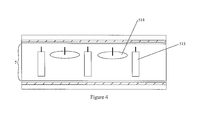
- FIG. 4 is the fourth structural schematic view of the polymer dispersed liquid crystals film of embodiments of the present invention.
- FIG. 5 is the first flowchart the method of preparing the the polymer dispersed liquid crystals film of embodiments of the present invention.
- FIG. 6 is the second flowchart the method of preparing the the polymer dispersed liquid crystals film of embodiments of the present invention.
- FIG. 7 is the third flowchart the method of preparing the the polymer dispersed liquid crystals film of embodiments of the present invention.
- an embodiment of the present invention provides a polymer dispersed liquid crystal film comprising: a first substrate 1 and a second substrate 2 arranged opposing to each other; a first transparent conductive film 3 and a second transparent conductive film 4 arranged on opposing surfaces of the first substrate 1 and the second substrate 2 , respectively; and a polymer dispersed liquid crystal layer 5 located between the first transparent conductive film 3 and the second transparent conductive film 4 .
- the polymer dispersed liquid crystal layer 5 comprises homogeneously dispersed bi-axis liquid crystal 51 and polymer 52 . When no voltage is applied between the first transparent conductive film 3 and the second transparent conductive film 4 , the bi-axis liquid crystal 51 exhibits a random arrangement.
- the bi-axis liquid crystal 51 have perpendicular refractive index and the parallel refractive index, wherein the perpendicular refractive index and the parallel refractive index are not equal, and neither of them matches the refractive index of the polymer.
- the full name of the bi-axis liquid crystal 51 comprised in the polymer dispersed liquid crystal layer is bi-axis nematic liquid crystals.
- the bi-axis liquid crystal 51 comprises two directing axis perpendicular to each other, which are known as perpendicular axes 511 and the parallel axes 512 , respectively.
- the perpendicular axes 511 and the parallel axes 512 have perpendicular refractive index n 1 and the parallel refractive index n 2 , respectively, and n 1 ⁇ n 2 .
- neither of the perpendicular refractive index n 1 and the parallel refractive index n 2 matches the refractive index of the polymer n p , namely, n 1 ⁇ n 2 ⁇ n p .
- the bi-axis liquid crystal 51 exhibits a random arrangement.
- the perpendicular refractive index n 1 and the parallel refractive index n 2 are not equal, and neither of them matches the refractive index of the polymer n p ; thus, as compared with the existing polymer dispersed liquid crystal layer, the polymer dispersed liquid crystal layer of the embodiments of the present invention exhibits enhanced light-scattering capacity and lower light transmission, thereby increasing the contrast of the polymer dispersed liquid crystal film and improving the consumers' feeling.
- the perpendicular axes 511 of the bi-axis liquid crystal 51 are parallel to the direction of the electric field lines within the polymer dispersed liquid crystal layer 5
- the parallel axes 512 of the bi-axis liquid crystal 51 are perpendicular to the perpendicular axes (namely, perpendicular to the electric field lines), and all of them are randomly arranged.
- the parallel refractive index n 2 ⁇ n p namely, the polymer dispersed liquid crystal layer 5 still scatters the incident light, has a relatively lower light transmission, and exhibits semi- or non-transparent.
- the perpendicular axes 511 of the bi-axis liquid crystal 51 are still parallel to the electric field lines within the polymer dispersed liquid crystal layer 5
- the parallel axes 512 of the bi-axis liquid crystal 51 are perpendicular to perpendicular axes 511 , and all of them direct to the same direction.
- all the parallel axes 512 of bi-axis liquid crystal 51 direct to left side.
- the perpendicular refractive index n 1 matches refractive index of the polymer n p
- the parallel refractive index n 2 matches refractive index of the polymer n p , too.
- the refractive indite within the polymer dispersed liquid crystal layer 5 are consistent, and there is not a clear interface inside the layer
- the incident light will not be scattered, and can pass through the polymer dispersed liquid crystals film.
- the polymer dispersed liquid crystals film exhibits transparent.
- the bi-axis liquid crystal 51 are constituted of a rod-like liquid crystal 513 and the a discotic liquid crystal 514 , wherein the mass ratio of the a rod-like liquid crystal 513 to the a discotic liquid crystal 514 ranges from 1:1 to 5:3, and wherein the perpendicular axes 511 of the bi-axis liquid crystal 51 are the directing axis of the a rod-like liquid crystal 513 , and the parallel axes 512 of the bi-axis liquid crystal 51 are the directing axis of the a discotic liquid crystal 514 .
- Controlling the mass ratio of the a rod-like liquid crystal 513 to the a discotic liquid crystal 514 can provide the bi-axis liquid crystal 51 having desired perpendicular refractive index n 1 and the parallel refractive index n 2 .
- the a rod-like liquid crystal 513 have rod-like molecular conformation; and the a discotic liquid crystal 514 have discotic molecular conformation.
- the mass ratio of the a rod-like liquid crystal 513 to the a discotic liquid crystal 514 is in a range of from 1:1 to 5:3, such as, 5:4.
- the electric field may further function to destroy the acting force between the a rod-like liquid crystal 513 and the a discotic liquid crystal 514 within the bi-axis liquid crystal 51 so that the a rod-like liquid crystal 513 cannot be combined with the a discotic liquid crystal 514 to form bi-axis liquid crystals. As shown in FIG.
- the directing axes of the a rod-like liquid crystal 513 are parallel to the direction of the electric field within the polymer dispersed liquid crystal layer 5
- the directing axes 512 of the a discotic liquid crystal are parallel to the direction of the electric field within the polymer dispersed liquid crystal layer 5 , too, so that the refractive index of the a discotic liquid crystal n 3 and the refractive index of the a rod-like liquid crystal n 4 match the refractive index of the polymer n p , thereby enabling the incident light to pass through the polymer dispersed liquid crystal layer 5 without scattering inside of the layer.
- the polymer dispersed liquid crystals film exhibits transparent.
- the polymer dispersed liquid crystal film further comprises first alignment layer 6 arranged on the surface of the first transparent conductive film 3 facing the polymer dispersed liquid crystal layer 5 , wherein the alignment of the first alignment layer 6 is not particularly limited herein, and can be determined depending on the molecular natures of the bi-axis liquid crystal 51 , as well as the desired perpendicular refractive index n 1 and the desired parallel refractive index n 2 of the bi-axis liquid crystal 51 .
- a second alignment layer 7 can be further arranged on the surface of the second transparent conductive film 4 facing the bi-axis liquid crystal layer.
- the polymer dispersed liquid crystal film can comprise only one of the first alignment layer 6 and the second alignment layer 7 as described above, as long as the perpendicular refractive index n 1 and the parallel refractive index n 2 of the bi-axis liquid crystal 51 can satisfy the practical requirement.
- Arranging the first alignment layer 6 and/or the second alignment layer 7 in combination with controlling the mass ratio of the a rod-like liquid crystal 513 to the a discotic liquid crystal 514 within the bi-axis liquid crystal 51 facilitates to obtain the desired refractive index of the perpendicular axes n 1 and the desired refractive index of the parallel axes n 2 within the bi-axis liquid crystal 51 .
- the second transparent conductive film 4 can be at earth potential. In this case, it is not required to control the potential of the second transparent conductive film 4 , but only to provide an appropriate potential to the first transparent conductive film 3 , so that an appropriate voltage is applied between the first transparent conductive film 3 and the second transparent conductive film 4 . Namely, an electric field having an appropriate intensity of electric filed can be obtained to properly modify the arrangement mode of the bi-axis liquid crystals 51 .
- the polymer 52 can be conventional polymers, such as, epoxy resins, acrylic resins, or the like.
- the polymer dispersed liquid crystal film of embodiments of the present invention comprises homogeneously dispersed bi-axis liquid crystal and polymer in the polymer dispersed liquid crystal layer therein.
- the perpendicular refractive index and the parallel refractive index of the bi-axis liquid crystal are not equal, and neither of them matches the refractive index of the polymer.
- such polymer dispersed liquid crystal film have better light-scattering capacity and lower light transmission, thereby increasing the contrast of the polymer dispersed liquid crystal film and improving the customers' feeling.
- the polymer dispersed liquid crystal film provided in the embodiments of the present invention can be used in liquid crystal display panel, optical modulator, thermosensitive and pressure-sensitive devices, switchable glass, light valve, projection display, electronic book, and the like.
- another embodiment of the present invention provides a method of preparing a polymer dispersed liquid crystal film comprising:
- Step S 101 forming a first transparent conductive film on a surface of a first substrate and a second transparent conductive film on a surface of a second substrate, respectively;
- Step S 102 forming a polymer dispersed liquid crystal layer between the first substrate and the second substrate so that the polymer dispersed liquid crystal layer is directly located between the first and the second transparent conductive films, wherein the polymer dispersed liquid crystal layer comprises homogeneously dispersed bi-axis liquid crystal and polymer, wherein: in Step S 101 , the first and the second transparent conductive films can be formed by means of coating, depositing, or sputtering.
- Step S 102 can comprise:
- Step S 201 instilling an homogeneous mixture of a bi-axis liquid crystal, a polymerizable monomer, and a photoinitiator onto the first transparent conductive film or the second transparent conductive film;
- Step S 202 assembling the first substrate and the second substrate together so that the first and the second transparent conductive films oppose to each other directly, thereby allowing the homogeneous mixture to be located between the first and the second transparent conductive films; and Step S 203 : conducting a UV radiation so that polymerizable monomer is polymerized in the presence of the photoinitiator to for a polymer, thereby forming the polymer dispersed liquid crystal layer, wherein, in Step S 201 , based on the total weight of the bi-axis liquid crystal, the polymerizable monomer, and the photoinitiator, the mass percent of the bi-axis liquid crystal is preferably 80%, the mass percent of the polymerizable monomer is preferably 19% to 19.4%, and the mass percent of the photoinitiator is preferably 0.6% to 1%, and wherein the polymerizable monomer can comprise monomers, such as, epoxy resins, acrylic resins, or the like, and the photoinitiator can be 1-hydroxycyclohe
- Step S 102 can comprise:
- Step S 301 assembling the first substrate and the second substrate together so that the first and the second transparent conductive films oppose to each other;
- Step S 302 instilling an homogeneous mixture of a bi-axis liquid crystal, a polymerizable monomer, and a photoinitiator onto the first substrate and the second substrate;
- Step S 303 conducting a UV radiation so that the polymerizable monomer is polymerized in the presence of the photoinitiator to form a polymer, thereby forming the polymer dispersed liquid crystal layer,
- Step S 301 the assembling the first substrate and the second substrate together so that the first and the second transparent conductive films oppose to each other facilitates forming an electric field having parallel electric field lines within the polymer dispersed liquid crystal film; and in Step S 303 , based on the total weight of the bi-axis liquid crystal, the polymerizable monomer, and the photoinitiator, the mass percent of the bi-axis liquid crystal is preferably 80%, the mass percent of the polymerizable monomer is preferably 19% to 19.4%, and the mass ratio of the photoinitiator is preferably 0.6% to 1%, and wherein the polymerizable monomer can comprise monomers, such as, epoxy resins, acrylic resins, or the like, and the photoinitiator can be 1-hydroxycyclohexylphenylketone (HCPK).
- HCPK 1-hydroxycyclohexylphenylketone
- the bi-axis liquid crystal in the bi-axis liquid crystal layer can comprise a rod-like liquid crystal and a discotic liquid crystal.
- the bi-axis liquid crystal can be prepared by means of mixing a rod-like liquid crystal with a discotic liquid crystal at any mass ratio in a range of 1:1 to 5:3.
- it can be prepared by means of mixing the rod-like liquid crystal with the discotic liquid crystal at a mass ratio of 5:4 and stirring the mixture homogeneously to for the bi-axis liquid crystal, which is then degassed.
- the method can further comprise: prior to Step S 101 :
- the method can further comprise, prior to Step 102 :
- the first alignment layer 6 can be orientated depending on the molecular characteristics of the bi-axis liquid crystal 51 , as well as the perpendicular refractive index n 1 and the parallel refractive index n 2 of the bi-axis liquid crystal 51 to be obtained. If the perpendicular refractive index n 1 and the parallel refractive index n 2 cannot yet satisfy the practical requirements after the arrangement of the first alignment layer 6 , a second alignment layer 6 can be further arranged on a surface of the second transparent conductive film 4 facing the bi-axis liquid crystal layer.
- the method of preparing the polymer dispersed liquid crystal film provided in the embodiments of the present inventions have advantages including ease of handling, high pass yield, and the like. In the absence of external voltage, the produced polymer dispersed liquid crystal film exhibits a relatively high contrast, thereby improving the consumers' feeling.
- Still another embodiment of the present invention further discloses a display apparatus comprising the polymer dispersed liquid crystal film of the embodiments of the present invention or prepared in accordance with the method of the embodiments of the present invention.
- the display apparatus can be any products or parts having display functions, such as, liquid crystal panels, electronic papers, OLED panels, mobile phones, tablet computers, televisions, displays, digital frames, navigators, and the like.
- the glass of the substrates has a dimension of 180 mm ⁇ 140 mm ⁇ 0.5 mm, and the ITO film (i.e., the transparent conductive film) thereon has a thickness of 400 ⁇ .
- 4-cyano-4′-pentyl-para-terphenyl (a rod-like liquid crystal) and 4′-p-n-lauryloxybenzoyloxybiphenyl (a discotic liquid crystal) were homogeneously mixed at a mass ratio of 5:4.
- the resultant mixture was just the bi-axis liquid crystal used in the present invention, which has a birefractive index of 0.122.
- the bi-axis liquid crystal, together with 3,5,5-trimethylhexyl acrylate (a polymerizable monomer) and 1-hydroxycyclohexylphenylketone (HCPK, a photoinitiator) were homogeneously mixed at a mass ratio of 80:19.5:0.5. 2 g of the homogeneous mixture was instilled onto the first transparent conductive film of the first substrate. Then, the first and the second substrates were assembled together so that the gap between the substrates was 10 ⁇ m. The instilled homogeneous mixture was directly located between the first and the second transparent conductive films and filled the gap therebetween.
- the first and the second substrates assembled together and the homogeneous mixture located therebetween were subject to a UV radiation at a wavelength of 365 nm at room temperature for 5 minutes with the radiation intensity of 1.45 mW/cm 2 so that the mixture was cured to form a polymer dispersed liquid crystal layer, thereby producing the desired polymer dispersed liquid crystal film.
- PET membranes having a dimension of 500 mm ⁇ 300 mm ⁇ 0.1 mm were used as the first and the second substrates.
- An IZO film with a thickness of 500 ⁇ was applied thereon as the first and the second transparent conductive films.
- 4-cyano-4′-pentyl-p-terphenyl and 4′-p-n-lauryloxybenzoyloxybiphenyl were homogeneously mixed as a mass ratio of 5:4.
- the resultant mixture was just the bi-axis liquid crystal used in this example, which has a birefractive index of 0.122.
- the bi-axis liquid crystal, together with 3,5,5-trimethylhexyl acrylate and HCPK were homogeneously mixed at a mass ratio of 80:19.5:0.5.
- the first and the second substrates were assembled together so that the first and the second transparent conductive films opposed to each other together, and the gap between the substrates was 10 ⁇ m.
- 10 g of the homogeneous mixture was instilled between the first and the second transparent conductive films so that the homogeneous mixture was directly located between the first and the second transparent conductive films and filled the gap therebetween.
- the first and the second substrates assembled together and the homogeneous mixture therebetween were subject to a UV radiation at a wavelength of 365 nm at room temperature for 5 minutes with a radiation intensity of 1.45 mW/cm 2 so that the mixture was cured to form a polymer dispersed liquid crystal layer, thereby producing the desired polymer dispersed liquid crystal film
- the glass of the substrate has a dimension of 180 mm ⁇ 140 mm ⁇ 0.5 mm, and the ITO film thereon has a thickness of 400 ⁇ .
- a polyimide layer having a thickness of 600 nm is printed onto the first transparent conductive film of the first substrate.
- the polyimide layer was polymerized at 230° C. for 20 minutes to form an alignment layer.
- the bi-axis liquid crystal, together with 3,5,5-trimethylhexyl acrylate and HCPK were homogeneously mixed at a mass ratio of 80:19.5:0.5. 2 g of the homogeneous mixture was instilled onto the second transparent conductive film of the second substrate. Then, the first and the second substrates were assembled together so that the gap between the substrates was 10 ⁇ m. The homogeneous mixture was directly located between the first and the second transparent conductive films and filled the gap therebetween.
- the first and the second substrates assembled together and the homogeneous mixture therebetween were subject to a UV radiation at a wavelength of 365 nm at room temperature for 5 minutes with a radiation intensity of 1.45 mW/cm 2 so that the mixture was cured to form a polymer dispersed liquid crystal layer, thereby producing the desired polymer dispersed liquid crystal film.
- a conventional polymer dispersed liquid crystal film was prepared in accordance with the same method as Example 1, except that only 4-cyano-4′-pentyl-p-terphenyl was used as the liquid crystals component.
- the polymer dispersed liquid crystal films of Examples 1 to 3 and Comparative Example 1 were used to produce liquid crystal panels, respectively, which were test for the light transmissions at scattering state and transparent state.
- the ratio of the light transmission at scattering state to the light transmission at transparent state was calculated and recorded as contrast. The results are listed in Table 1 below.
- the display produced by using the polymer dispersed liquid crystal film of embodiments of the present invention exhibits a contrast of >100; while the display produced by using a conventional polymer dispersed liquid crystal film exhibits only a contrast of around 70.
- a display apparatus comprising the polymer dispersed liquid crystal film of the embodiments of the present invention, he/she can obtain better feeling.
Landscapes
- Chemical & Material Sciences (AREA)
- Physics & Mathematics (AREA)
- Crystallography & Structural Chemistry (AREA)
- Nonlinear Science (AREA)
- General Physics & Mathematics (AREA)
- Organic Chemistry (AREA)
- Mathematical Physics (AREA)
- Materials Engineering (AREA)
- Engineering & Computer Science (AREA)
- Optics & Photonics (AREA)
- Dispersion Chemistry (AREA)
- Liquid Crystal (AREA)
- Spectroscopy & Molecular Physics (AREA)
Abstract
Description
- 1—first substrate;
- 2—second substrate;
- 3—first transparent conductive film;
- 4—second transparent conductive film;
- 5—polymer dispersed liquid crystal layer;
- 51—bi-axis liquid crystal;
- 511—perpendicular axes;
- 512—parallel axes;
- 513—a rod-like liquid crystal;
- 514—a discotic liquid crystal;
- 52—polymer;
- 6—first alignment layer;
- 7—second alignment layer.
wherein:
in Step S101, the first and the second transparent conductive films can be formed by means of coating, depositing, or sputtering.
Step S203: conducting a UV radiation so that polymerizable monomer is polymerized in the presence of the photoinitiator to for a polymer, thereby forming the polymer dispersed liquid crystal layer,
wherein, in Step S201, based on the total weight of the bi-axis liquid crystal, the polymerizable monomer, and the photoinitiator, the mass percent of the bi-axis liquid crystal is preferably 80%, the mass percent of the polymerizable monomer is preferably 19% to 19.4%, and the mass percent of the photoinitiator is preferably 0.6% to 1%, and wherein the polymerizable monomer can comprise monomers, such as, epoxy resins, acrylic resins, or the like, and the photoinitiator can be 1-hydroxycyclohexylphenylketone (HCPK);
in Step S202, the first substrate and the second substrate is arranged opposing to each other so that the first and the second transparent conductive films oppose to each other directly, thereby forming a polymer dispersed liquid crystal layer between the first substrate and the second substrate; and
in Step S203, the first transparent conductive film and the second transparent conductive film opposing to each other facilitates forming an electric field having parallel electric field lines within the polymer dispersed liquid crystal film.
in Step S303, based on the total weight of the bi-axis liquid crystal, the polymerizable monomer, and the photoinitiator, the mass percent of the bi-axis liquid crystal is preferably 80%, the mass percent of the polymerizable monomer is preferably 19% to 19.4%, and the mass ratio of the photoinitiator is preferably 0.6% to 1%, and wherein the polymerizable monomer can comprise monomers, such as, epoxy resins, acrylic resins, or the like, and the photoinitiator can be 1-hydroxycyclohexylphenylketone (HCPK).
| TABLE 1 |
| Test Results of Contrasts of Liquid Crystal Panels Comprising |
| the Polymer Dispersed Liquid Crystal Films of |
| Examples and Comparative Examples of the Present Invention |
| No. of the Polymer Dispersed | |
| Liquid Crystal Film | Contrast |
| Example 1 | >100 |
| Example 2 | >100 |
| Example 3 | >100 |
| Comparative Example 1 | Up to 70 |
Claims (12)
Applications Claiming Priority (4)
| Application Number | Priority Date | Filing Date | Title |
|---|---|---|---|
| CN201310257881 | 2013-06-26 | ||
| CN201310257881.0A CN103323973B (en) | 2013-06-26 | 2013-06-26 | Polymer dispersed liquid crystal film and preparation method thereof, display device |
| CN201310257881.0 | 2013-06-26 | ||
| PCT/CN2013/090546 WO2014206049A1 (en) | 2013-06-26 | 2013-12-26 | Polymer dispersed liquid crystal film, method of preparing same, and display apparatus comprising same |
Publications (2)
| Publication Number | Publication Date |
|---|---|
| US20150338688A1 US20150338688A1 (en) | 2015-11-26 |
| US9239486B2 true US9239486B2 (en) | 2016-01-19 |
Family
ID=49192812
Family Applications (1)
| Application Number | Title | Priority Date | Filing Date |
|---|---|---|---|
| US14/378,223 Expired - Fee Related US9239486B2 (en) | 2013-06-26 | 2013-12-26 | Polymer dispersed liquid crystal film, method of preparing the same, and display apparatus comprising the same |
Country Status (3)
| Country | Link |
|---|---|
| US (1) | US9239486B2 (en) |
| CN (1) | CN103323973B (en) |
| WO (1) | WO2014206049A1 (en) |
Families Citing this family (3)
| Publication number | Priority date | Publication date | Assignee | Title |
|---|---|---|---|---|
| CN103323973B (en) * | 2013-06-26 | 2015-12-02 | 京东方科技集团股份有限公司 | Polymer dispersed liquid crystal film and preparation method thereof, display device |
| CN107300726A (en) * | 2017-07-17 | 2017-10-27 | 南方科技大学 | All-solid-state reflecting film and preparation method thereof |
| CN112946950A (en) * | 2021-04-13 | 2021-06-11 | 中南大学 | Ultraviolet screen and photocuring 3D printer |
Citations (5)
| Publication number | Priority date | Publication date | Assignee | Title |
|---|---|---|---|---|
| US20030137624A1 (en) | 2002-01-21 | 2003-07-24 | Seung-Gon Kang | Reflective liquid crystal display and projection system including the same |
| CN102464983A (en) | 2010-11-12 | 2012-05-23 | 京东方科技集团股份有限公司 | Display, polymer dispersion liquid crystal film and manufacturing method and driving method of display |
| JP2012128001A (en) | 2010-12-13 | 2012-07-05 | Japan Display Central Co Ltd | Liquid crystal display device |
| CN103033985A (en) | 2012-12-10 | 2013-04-10 | 京东方科技集团股份有限公司 | Liquid crystal display device and preparation method thereof |
| CN103323973A (en) | 2013-06-26 | 2013-09-25 | 京东方科技集团股份有限公司 | Polymer dispersed liquid crystal film and preparation method thereof and display device |
Family Cites Families (1)
| Publication number | Priority date | Publication date | Assignee | Title |
|---|---|---|---|---|
| CN100537705C (en) * | 2007-08-15 | 2009-09-09 | 江苏森然化工有限公司 | A kind of preparation method of polymer dispersed liquid-crystal film |
-
2013
- 2013-06-26 CN CN201310257881.0A patent/CN103323973B/en not_active Expired - Fee Related
- 2013-12-26 WO PCT/CN2013/090546 patent/WO2014206049A1/en not_active Ceased
- 2013-12-26 US US14/378,223 patent/US9239486B2/en not_active Expired - Fee Related
Patent Citations (5)
| Publication number | Priority date | Publication date | Assignee | Title |
|---|---|---|---|---|
| US20030137624A1 (en) | 2002-01-21 | 2003-07-24 | Seung-Gon Kang | Reflective liquid crystal display and projection system including the same |
| CN102464983A (en) | 2010-11-12 | 2012-05-23 | 京东方科技集团股份有限公司 | Display, polymer dispersion liquid crystal film and manufacturing method and driving method of display |
| JP2012128001A (en) | 2010-12-13 | 2012-07-05 | Japan Display Central Co Ltd | Liquid crystal display device |
| CN103033985A (en) | 2012-12-10 | 2013-04-10 | 京东方科技集团股份有限公司 | Liquid crystal display device and preparation method thereof |
| CN103323973A (en) | 2013-06-26 | 2013-09-25 | 京东方科技集团股份有限公司 | Polymer dispersed liquid crystal film and preparation method thereof and display device |
Non-Patent Citations (3)
| Title |
|---|
| Chinese Office Action of Chinese Application No. 201310257881.0, mailed Mar. 27, 2015 with English translation. |
| International Search Report, International Preliminary Report on Patentability and Written Opinion of the International Searching Authority of PCT/CN2013/090546 in Chinese, mailed Mar. 27, 2014. |
| Second Chinese Office Action of Chinese Application No. 201310257881.0, mailed Jul. 24, 2015 with English translation. |
Also Published As
| Publication number | Publication date |
|---|---|
| CN103323973B (en) | 2015-12-02 |
| CN103323973A (en) | 2013-09-25 |
| WO2014206049A1 (en) | 2014-12-31 |
| US20150338688A1 (en) | 2015-11-26 |
Similar Documents
| Publication | Publication Date | Title |
|---|---|---|
| US8493526B2 (en) | Lighting device and display device | |
| US10564337B2 (en) | Optical film | |
| TW466354B (en) | Wide viewing angle polarizing plane and liquid crystal display | |
| US11586068B2 (en) | Display apparatus | |
| JP2018510383A (en) | Liquid crystal element | |
| CN205176423U (en) | Liquid crystal display module with peep -proof and electromagnetic shielding function | |
| KR101474668B1 (en) | Transparent display | |
| WO2014034481A1 (en) | Liquid crystal display device | |
| TW200538788A (en) | Liquid crystal display and method of manufacturing the same | |
| JP2018510382A (en) | Liquid crystal element | |
| KR101280830B1 (en) | Blue phase mode liquid crystal display device including optical retardation film | |
| JPWO2019035464A1 (en) | Dimmer | |
| CN110673411A (en) | Display panel and display device | |
| US9239486B2 (en) | Polymer dispersed liquid crystal film, method of preparing the same, and display apparatus comprising the same | |
| TW201316040A (en) | Optical filter | |
| WO2017208914A1 (en) | Liquid crystal panel, switchable mirror panel and switchable mirror display | |
| JP2020129055A (en) | Viewing angle control film, backlight unit and liquid crystal display device | |
| US9164322B2 (en) | Display unit | |
| KR20170040564A (en) | Optical Film | |
| JP7322101B2 (en) | liquid crystal display | |
| KR101521961B1 (en) | Composition of liquid crystal, security screen comprising the same, and manufacturing method thereof | |
| WO2022030296A1 (en) | Viewing angle control film, backlight unit, and liquid crystal display device | |
| KR102354935B1 (en) | Light modulation element | |
| KR20120038649A (en) | Prepolymer composition for a polymer dispersed liquid crystal and composite membrane and film being formed by using the same | |
| CN116991004A (en) | Display module, manufacturing method and display device thereof |
Legal Events
| Date | Code | Title | Description |
|---|---|---|---|
| AS | Assignment |
Owner name: BOE TECHNOLOGY GROUP CO., LTD., CHINA Free format text: ASSIGNMENT OF ASSIGNORS INTEREST;ASSIGNOR:KASHIMA, MIKI;REEL/FRAME:033517/0420 Effective date: 20140615 |
|
| STCF | Information on status: patent grant |
Free format text: PATENTED CASE |
|
| MAFP | Maintenance fee payment |
Free format text: PAYMENT OF MAINTENANCE FEE, 4TH YEAR, LARGE ENTITY (ORIGINAL EVENT CODE: M1551); ENTITY STATUS OF PATENT OWNER: LARGE ENTITY Year of fee payment: 4 |
|
| FEPP | Fee payment procedure |
Free format text: MAINTENANCE FEE REMINDER MAILED (ORIGINAL EVENT CODE: REM.); ENTITY STATUS OF PATENT OWNER: LARGE ENTITY |
|
| LAPS | Lapse for failure to pay maintenance fees |
Free format text: PATENT EXPIRED FOR FAILURE TO PAY MAINTENANCE FEES (ORIGINAL EVENT CODE: EXP.); ENTITY STATUS OF PATENT OWNER: LARGE ENTITY |
|
| STCH | Information on status: patent discontinuation |
Free format text: PATENT EXPIRED DUE TO NONPAYMENT OF MAINTENANCE FEES UNDER 37 CFR 1.362 |
|
| FP | Lapsed due to failure to pay maintenance fee |
Effective date: 20240119 |