US9234976B2 - Device and method for removal of multiples from seismic data vintages - Google Patents
Device and method for removal of multiples from seismic data vintages Download PDFInfo
- Publication number
- US9234976B2 US9234976B2 US13/739,107 US201313739107A US9234976B2 US 9234976 B2 US9234976 B2 US 9234976B2 US 201313739107 A US201313739107 A US 201313739107A US 9234976 B2 US9234976 B2 US 9234976B2
- Authority
- US
- United States
- Prior art keywords
- vintages
- seismic data
- multiples
- norm
- differences
- Prior art date
- Legal status (The legal status is an assumption and is not a legal conclusion. Google has not performed a legal analysis and makes no representation as to the accuracy of the status listed.)
- Active, expires
Links
- 238000000034 method Methods 0.000 title claims abstract description 60
- 238000012545 processing Methods 0.000 claims description 24
- 238000007405 data analysis Methods 0.000 claims description 7
- 238000003384 imaging method Methods 0.000 claims description 6
- 230000000875 corresponding effect Effects 0.000 description 18
- 230000003044 adaptive effect Effects 0.000 description 14
- 230000006870 function Effects 0.000 description 13
- 238000013508 migration Methods 0.000 description 11
- 238000010586 diagram Methods 0.000 description 8
- 230000005012 migration Effects 0.000 description 8
- XLYOFNOQVPJJNP-UHFFFAOYSA-N water Substances O XLYOFNOQVPJJNP-UHFFFAOYSA-N 0.000 description 6
- 238000003908 quality control method Methods 0.000 description 5
- 230000015654 memory Effects 0.000 description 4
- 238000013459 approach Methods 0.000 description 3
- 230000001427 coherent effect Effects 0.000 description 3
- 238000007796 conventional method Methods 0.000 description 3
- 230000000694 effects Effects 0.000 description 3
- 230000008030 elimination Effects 0.000 description 3
- 238000003379 elimination reaction Methods 0.000 description 3
- 229910052704 radon Inorganic materials 0.000 description 3
- SYUHGPGVQRZVTB-UHFFFAOYSA-N radon atom Chemical compound [Rn] SYUHGPGVQRZVTB-UHFFFAOYSA-N 0.000 description 3
- 238000012360 testing method Methods 0.000 description 3
- 230000006978 adaptation Effects 0.000 description 2
- 230000008901 benefit Effects 0.000 description 2
- 239000011159 matrix material Substances 0.000 description 2
- 230000008569 process Effects 0.000 description 2
- 238000007493 shaping process Methods 0.000 description 2
- 230000008859 change Effects 0.000 description 1
- 238000004590 computer program Methods 0.000 description 1
- 238000012937 correction Methods 0.000 description 1
- 230000002596 correlated effect Effects 0.000 description 1
- 230000007812 deficiency Effects 0.000 description 1
- 238000013213 extrapolation Methods 0.000 description 1
- 230000006872 improvement Effects 0.000 description 1
- 238000012986 modification Methods 0.000 description 1
- 230000004048 modification Effects 0.000 description 1
- 230000003287 optical effect Effects 0.000 description 1
- 230000000149 penetrating effect Effects 0.000 description 1
- 238000003672 processing method Methods 0.000 description 1
- 239000011435 rock Substances 0.000 description 1
- 238000011410 subtraction method Methods 0.000 description 1
- 239000002352 surface water Substances 0.000 description 1
- 238000012876 topography Methods 0.000 description 1
Images


Classifications
-
- G—PHYSICS
- G01—MEASURING; TESTING
- G01V—GEOPHYSICS; GRAVITATIONAL MEASUREMENTS; DETECTING MASSES OR OBJECTS; TAGS
- G01V1/00—Seismology; Seismic or acoustic prospecting or detecting
- G01V1/28—Processing seismic data, e.g. for interpretation or for event detection
- G01V1/36—Effecting static or dynamic corrections on records, e.g. correcting spread; Correlating seismic signals; Eliminating effects of unwanted energy
-
- G—PHYSICS
- G01—MEASURING; TESTING
- G01V—GEOPHYSICS; GRAVITATIONAL MEASUREMENTS; DETECTING MASSES OR OBJECTS; TAGS
- G01V1/00—Seismology; Seismic or acoustic prospecting or detecting
- G01V1/38—Seismology; Seismic or acoustic prospecting or detecting specially adapted for water-covered areas
-
- G—PHYSICS
- G01—MEASURING; TESTING
- G01V—GEOPHYSICS; GRAVITATIONAL MEASUREMENTS; DETECTING MASSES OR OBJECTS; TAGS
- G01V1/00—Seismology; Seismic or acoustic prospecting or detecting
- G01V1/28—Processing seismic data, e.g. for interpretation or for event detection
- G01V1/36—Effecting static or dynamic corrections on records, e.g. correcting spread; Correlating seismic signals; Eliminating effects of unwanted energy
- G01V1/364—Seismic filtering
-
- G—PHYSICS
- G01—MEASURING; TESTING
- G01V—GEOPHYSICS; GRAVITATIONAL MEASUREMENTS; DETECTING MASSES OR OBJECTS; TAGS
- G01V2210/00—Details of seismic processing or analysis
- G01V2210/50—Corrections or adjustments related to wave propagation
- G01V2210/56—De-ghosting; Reverberation compensation
Definitions
- Embodiments of the subject matter disclosed herein generally relate to methods and systems for eliminating multiples from seismic data acquired at different times at the same location (4D seismic surveys), thereby achieving a clearer image of real changes occurring in time in the subsurface.
- a widely used technique for searching for oil or gas is the seismic exploration of subsurface (i.e., geophysical structure).
- the seismic exploration consists of generating seismic waves directed toward the subsurface, gathering data on reflections of the generated seismic waves at interfaces between layers of the subsurface, and analyzing the data to generate a profile (image) of the geophysical structure, i.e., the layers of the investigated subsurface.
- the seismic exploration is used both on land and for exploring the subsurface under the sea floor.
- a vessel 10 tows an array of seismic receivers 12 provided on cables 14 that form streamers 16 .
- the streamers may be disposed horizontally, i.e., lying at a constant depth Z 1 relative to a surface 18 of the ocean. However, the streamers may also be towed slanted or bent.
- the vessel 10 also tows a seismic source assembly 20 that is configured to generate pressure waves (also known as seismic or acoustic waves), such as the wave 22 a .
- the wave 22 a propagates downward toward the sea floor 24 and penetrates the subsurface under the sea floor 24 until eventually reflecting (R) at an interface 26 between layers of the subsurface.
- the reflected wave 22 b then propagates upward until it is detected by a receiver 12 .
- the receiver 12 records data related to the reflected wave 22 b (e.g., time of arrival relative to time when the wave 22 a was generated, energy, etc).
- Data gathered by the multiple receivers 12 is then processed for generating an image of the geophysical structure under the sea floor 24 (i.e., the subsurface).
- the signal recorded by a seismic receiver varies in time, having energy peaks that may correspond to reflectors between layers.
- some of the peaks correspond to multiple reflections or spurious reflections that should be eliminated before the geophysical structure can be correctly imaged.
- Primary waves suffer only one reflection from an interface between layers of the subsurface. Waves other than primary waves are known as multiples.
- a seismic source 30 produces a wave 32 that splits into a primary wave 34 penetrating inside the subsurface 25 under the sea floor 24 , and a multiple wave 36 that travels back toward the sea surface 18 .
- the primary wave 34 is reflected only once at an interface 26 between different layers in the subsurface 25 and travels back to a receiver R 40 .
- the multiple wave 36 also reaches the receiver R 40 at a different time, after being reflected two more times: once at the surface 18 and a second time at the sea floor 24 .
- a received signal includes a first energy peak 50 corresponding to the primary wave 34 and a second peak 60 corresponding to the multiple wave 36 that suffered multiple reflections.
- the columns 52 and 62 illustrate the layers traveled by the primary wave 34 and by the multiple wave 36 , respectively, from the source to the receiver.
- the primary wave travels through water and a first layer, and it is reflected at an interface between the first layer and a second layer of the subsurface under the sea floor.
- the multiple wave 36 illustrated in FIGS. 2 and 3 travels only through water. However, other multiples may also travel through the subsurface.
- a number of seismic processing methods are currently used to remove the multiples from the seismic data, for example: T-x domain predictive deconvolution, Tau-p deconvolution (linear RADON), parabolic RADON, 2D and 3D surface-related multiple elimination (SRME).
- Some of these methods consist of modeling multiple reflections in order to subtract (or adaptively subtract) them from seismic data and, thus, to keep only useful seismic data (i.e., the primary waves) to image the subsurface.
- the model-driven wave-equation multiple prediction requires knowledge about the near-surface water velocity model, the water bottom topography, and subsurface velocities.
- Data-driven surface-related multiple prediction requires that the source and receiver are co-located, the source signatures are consistent, and that the near offset traces are not missing, as described in “An improved adaptive multiple subtraction method” (by Guangkai, M. et al, in 2009 in 79 th SEG Annual International Meeting, Expanded Abstract, 3163-3167).
- variations in the acquisition wavelet, cable feathering, boundary effect, and limited offset range can also introduce time shifts or amplitude artifacts into the predicted multiples. In practice, therefore, the predicted multiples need to be adapted to the data prior to subtraction.
- the remaining peaks in the data are estimated primaries.
- At least two seismic data vintages representing time-lapse seismic data for the same subsurface are gathered. It is desirable for the process of removing the multiples to be optimum for all seismic data vintages.
- the time-lapse acquisition of seismic data adds complexity to the problem of extracting multiples because the seismic data vintages are gathered potentially with different data acquisition configurations, different offset ranges and cable length, non-identical sources and departures from the ideal geometry (i.e., feathering), etc.
- adaptive non-stationary operators are designed to subtract the predicted multiples for each seismic data vintage individually.
- this approach neglects the key time-lapse product which is, of course, the 4D difference; that is, the real changes in the substructure that have occurred in the time interval(s) between the times when the seismic data vintages were acquired.
- the complexity of extracting multiples increases factorially with the number of seismic data vintages. For example, with three seismic data vintages, there are six quantities (three seismic data vintages and three differences) to be optimized. For four seismic data vintages, there are ten quantities (four seismic data vintages and six differences) to be optimized.
- each seismic data vintage is processed separately (the base at 410-420-430, monitor 1 at 440-450-460 and monitor N at 470-480-490) and independently to optimally remove the multiples in each data set (i.e., the base and each of the monitors separately), and the remaining estimated primaries are then compared to identify 4-D differences at 500.
- the purpose of analyzing multiple seismic data vintages is to identify the actual changes (e.g., due to exploitation of the reservoir) in the subsurface. These actual changes are essentially changes in the primaries.
- conventional processing yields “leaky” differences between multiples 510 , which are spurious effects that may obscure the real differences in the primaries.
- the leakage may appear because for both data sets (i.e., the base and the monitor), the adaptive subtraction may be suboptimal. This leaves residual (small) multiple energy in the data.
- the residual multiple energies for both data sets remain in the 4D difference because they are different (i.e., not the same residual multiple energy).
- Various embodiments yield an enhanced image of actual changes of subsurface under the sea floor, by analyzing seismic data vintages acquired at different times and surveying the same subsurface, avoiding residual multiple energies for the vintages to remain in the 4D difference by performing the adaptive subtraction such as to reduce this type of leakage.
- a method for generating an image of a subsurface based on seismic data includes collecting seismic data vintages corresponding to at least two different times, for a same surveyed area.
- the method further includes minimizing a cost function which is a sum over the seismic data vintages of a norm of differences between data and model predicted multiples, subject to minimizing residual multiples that are differences of corresponding multiples belonging to different vintages among the seismic data vintages.
- a computer-readable medium non-transitory storing executable codes that when executed on a computer make the computer perform a method for generating an image of a subsurface based on seismic data.
- the method includes collecting seismic data vintages, corresponding to at least two different times, for a same surveyed area.
- the method further includes minimizing a cost function which is a sum over the seismic data vintages of a norm of differences between data and model predicted multiples, subject to minimizing residual multiples that are differences of corresponding multiples belonging to different vintages among the seismic data vintages.
- a seismic data analysis apparatus including a data input interface and a data processing unit.
- the data input interface is configured to collect seismic data vintages, corresponding to at least two different times, for a same surveyed area.
- the data processing unit is configured to minimize a cost function, which is a sum over the seismic data vintages of a norm of differences between data and model predicted multiples, subject to minimizing residual multiples that are differences of corresponding multiples belonging to different vintages among the seismic data vintages.
- FIG. 1 is a schematic diagram of a seismic data acquisition setup
- FIG. 2 is a diagram illustrating a primary signal and a multiple reflection multiple signal detected at a receiver
- FIG. 3 is a time versus energy graph illustrating a primary signal and a multiple reflection multiple signal
- FIG. 4 is a block diagram illustrating a conventional method of analyzing multiple seismic data vintages
- FIG. 5 is a time versus energy graph illustrating a deficiency of the conventional methods
- FIG. 6 illustrates a conventional workflow for analyzing two seismic data vintages
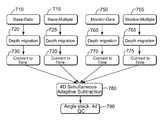
- FIG. 7 illustrates a workflow for analyzing two seismic data vintages (base and monitor) according to an exemplary embodiment
- FIG. 8 is a comparison between a 4D difference obtained using conventional processing (left) and a 4D difference obtained using the method according to an exemplary embodiment (right);
- FIG. 9 is a flow diagram of a method for generating an image of a subsurface based on seismic data, according to an exemplary embodiment
- FIG. 10 is a block diagram of a seismic data analysis apparatus according to another exemplary embodiment.
- FIG. 11 is a flow diagram of another method for processing seismic data.
- m is the multiple convolution matrix (i.e., a multiple model)
- f is an adaptive operator or shaping filter
- d is the data
- W is a weighting matrix which makes it possible to flexibly choose an appropriate norm, p, in an iterative least-square algorithm.
- a matching filter is estimated to shape the predicted multiples to approximate the true multiples.
- the L2-norm method is widely used for matching the filter, assuming that the primaries have minimum energy.
- L2-norm has some shortcomings, as discussed in “Adaptive subtraction of multiples using L1-norm” by Guitton, A. and Verschuur, D. J., published in 2004 in Geophysical Prospecting, 52, 27-38.
- the L1-norm or hybrid norms may be used.
- p indicates that the norm used for the cost function may be an L2-norm, an L1-norm or a hybrid norm.
- these alternatives types of norms are exemplary and not intended to be limiting.
- the steps of adapting and subtracting the predicted multiples are performed over all the seismic data vintages simultaneously such that a cost function (CF) is to be minimized:
- q is the norm for the constraints.
- the norm p used for subtracting the predicted multiples and the norm q for the constraints may be the same or different and may be any one of an L2-norm, an L1-norm or a hybrid norm, or any other norm (e.g., curvelet domain subtraction).
- a similar multiple wave may be recorded in two seismic data vintages, but they are not exactly the same due to slightly changed conditions, so when subtracted there is a non-zero residual of these multiples that correspond to the same sequence of reflections.
- the index i indicates one (first) seismic data vintage and the index j indicates another (second) seismic data vintage (which is different from the first seismic data vintage).
- the inputs to the data processing are the data and the multiple models for all vintages.
- a user parameter, lambda controls how much the adaptive subtraction is coupled (i.e., zero means not at all and do everything as in the conventional data processing).
- the outputs of the data processing are filters to be applied to the input multiple models.
- the adapted multiple models which are actually subtracted are obtained when the filters are applied to the multiple models. This method then also yields the final primary models for all vintages. It is also possible to create primary models upfront (for example, from an independent adaptive subtraction on each vintage); these may also be incorporated in an adaptive simultaneous subtraction scheme.
- FIG. 6 For illustrating the differences between the conventional methods and embodiments of the above-described method, a conventional workflow for analyzing two seismic data vintages (base and monitor) is illustrated in FIG. 6 .
- FIG. 7 A workflow for analyzing two seismic data vintages (base and monitor) according to an exemplary embodiment is illustrated in FIG. 7 .
- the migration can be either time-migration or depth migration; if the migration is a simple time-migration, converting back to time is no longer necessary.
- QC is used generically and may represent different ways of inspecting the data, for example, stacking only part of it or separating it in frequency bands, etc.
- the migration can be a simple time-migration (instead of depth migration), in which case, converting back to time is no longer necessary.
- the remaining quantities corresponding to the base seismic data vintage and to the monitor seismic data vintage are compared at 690 to obtain images of actual changes in the subsurface.
- a 4D adaptive subtraction is performed simultaneously on all the vintages while minimizing the cost function and the residual multiples thereof at 780 .
- the method mathematically expressed by equations (2)-(4) may be used in 1D, 2D, 3D or multi-dimensions and may be calculated/applied in time domain (t ⁇ x), frequency domain (f ⁇ x), tau-p or any other appropriate domain, as necessary.
- the method is also applicable to pre-imaging or post-imaging multiple subtraction. That is, seismic data (the energy and timing of the reflection in the subsurface) are recorded at an “arbitrary” location on the surface (as the receiver travels through the water being towed behind a vessel). The energy is generally not in the correct location (because we do not know how the energy propagates once in the earth).
- the process of “imaging” moves (“migrates”) the data to the correct location and this then gives a true image of the subsurface (as if you were standing in front of the rock surface).
- the multiple model can be derived from different methods, either data-driven (SRME, tau-p deconvolution) or model-driven (wave-equation extrapolation).
- SRME data-driven
- tau-p deconvolution model-driven
- wave-equation extrapolation wave-equation extrapolation
- One of the advantages of some embodiments is that an optimized solution for the multiple subtraction is achieved in each seismic data vintage, and simultaneously, the residual multiple leakage in the 4D difference is minimized.
- equations (2) and (3) may be combined in a single function:
- ⁇ stands for Langrange multipliers.
- the second term in this function is designed to match the multiple models prior to subtraction. This term should lead to less multiple leakage on the 4D differences. This technique is valid for an arbitrary number of seismic data vintages.
- the above-described methods may be used for subtraction of multiples from an arbitrary number ( ⁇ 2) of seismic data vintages, where multiple models can be predicted using various algorithms (e.g., data-driven or model-driven).
- FIG. 8 a comparison is illustrated in FIG. 8 where on the left side it is the 4D difference obtained using conventional processing and the right side is the 4D difference obtained using the novel method according to an exemplary embodiment.
- the portions 810 and 820 surrounded by dashed lines correspond to an area where a significant decrease of 4D residual is obtained, while the circled portions 815 and 825 correspond to areas where an actual change is observed.
- FIG. 9 A flow diagram of a method 900 for generating an image of a subsurface based on seismic data is illustrated in FIG. 9 .
- the method 900 includes collecting seismic data vintages corresponding to at least two different times, for a same surveyed subsurface, at S 910 .
- the collecting may refer to retrieving the data from a memory or a remote computer-readable media.
- the collecting may also include compiling the data of different seismic data vintages to a common format and/or applying corrections related to data acquisition conditions as deemed necessary.
- the collecting results in making available the data in a form suitable for the next step.
- the method 900 further includes minimizing a cost function, which is a sum over the seismic data vintages of a norm of differences between data and model predicted multiples, subject to minimizing residual multiples that are differences of corresponding multiples belonging to different vintages among the seismic data vintages, at S 920 .
- the method may be applied to perform simultaneously de-noising and de-convolution of the data.
- a seismic data vintage is a set of data corresponding to signals acquired by receivers towed behind a towing vessel surveying a predetermined area, the signals being correlated to pressure waves generated by a seismic source (that may be similarly towed by the towing vessel).
- the data may be collected by a seismic data acquisition setup as illustrated in FIG. 1 , but the illustrated setup is exemplary, not limiting.
- the method 900 may be executed by a seismic data analysis apparatus 1000 whose schematic diagram is illustrated in FIG. 10 .
- the seismic data analysis apparatus 1000 includes a data input interface 1010 configured to collect seismic data vintages, corresponding to at least two different times, for a same surveyed area.
- the seismic data analysis apparatus 1000 further includes a data processing unit 1020 configured to minimize a cost function, which is a sum over the seismic data vintages of a norm of differences between data and model predicted multiples, subject to minimizing across the seismic data vintages of differences between corresponding multiples.
- the data analysis apparatus 1000 may also include a memory 1030 , which is a computer-readable medium non-transitory storing executable codes.
- a memory 1030 is a computer-readable medium non-transitory storing executable codes.
- the stored executable codes are executed on the data processing unit 1020 or another computer, the effect is making the data processing unit 1020 or the other computer perform a method for generating an image of a subsurface based on seismic data, such as (but not limited to) the method 900 .
- the exemplary embodiments may take the form of an entirely hardware embodiment or an embodiment combining hardware and software aspects.
- exemplary embodiments may take the form of a computer program product (i.e., executable codes) stored on a computer-readable storage medium having computer-readable instructions embodied in the medium.
- Any suitable computer-readable medium may be utilized including hard disks, CD-ROMs, digital versatile disc (DVD), optical storage devices, or magnetic storage devices such a floppy disk or magnetic tape.
- Other non-limiting examples of computer readable media include flash-type memories or other known memories.
- the disclosed exemplary embodiments provide a method, an apparatus and a computer-readable medium for generating an image of a subsurface based on seismic data, while minimizing a cost function (which is a sum over the seismic data vintages of a norm of differences between data and model predicted multiples) subject to minimizing across the seismic data vintages of differences between corresponding multiples.
- a cost function which is a sum over the seismic data vintages of a norm of differences between data and model predicted multiples
- FIG. 11 A similar method is illustrated in FIG. 11 .
- the 4D processing of the data proceeds in a known manner, but simultaneously additional coherent noise adaptation and subtraction are performed for all processed vintages (only two vintages are tracked in FIG. 11 , but the method may be used for more than two vintages).
- the seismic data is processed for each vintage (i) while applying as many noise attenuation methods as possible and/or required (e.g., S 1110 -S 1160 ) to obtain signal models (s i ).
- noise models (n i ) contain noise originally removed from the data, (i.e., surface related multiples, internal multiples, and possibly any kind of coherent and predictable noise).
- a noise model (n i ) for a vintage (i) is adapted to its corresponding data (d i ) in an explicit manner as in the SRME case or in an implicit manner as in the Radon or deconvolution case.
- a cost function (E) is then minimized (in 4D Adaptation at S 1170 ) to derive filters (f i ) that simultaneously reshape the noise models for all vintages, where the 4D differences between vintages act as regularization constraints.
Landscapes
- Life Sciences & Earth Sciences (AREA)
- Physics & Mathematics (AREA)
- Engineering & Computer Science (AREA)
- Remote Sensing (AREA)
- Geology (AREA)
- Environmental & Geological Engineering (AREA)
- Acoustics & Sound (AREA)
- General Life Sciences & Earth Sciences (AREA)
- General Physics & Mathematics (AREA)
- Geophysics (AREA)
- Oceanography (AREA)
- Geophysics And Detection Of Objects (AREA)
- Lift-Guide Devices, And Elevator Ropes And Cables (AREA)
Abstract
Description
-
- 1. sorting the data into an optimal domain (e.g., receiver gather sorting)—subject to testing;
- 2. predicting multiples with a given demultiple method—subject to testing; and
- 3. adaptively subtracting one or more multiple models from the data in the domain—subject to testing.
∥W(d−mf)∥p p→min (1)
where m is the multiple convolution matrix (i.e., a multiple model), f is an adaptive operator or shaping filter, d is the data, and W is a weighting matrix which makes it possible to flexibly choose an appropriate norm, p, in an iterative least-square algorithm. For adaptive multiple subtraction, a matching filter is estimated to shape the predicted multiples to approximate the true multiples. The L2-norm method is widely used for matching the filter, assuming that the primaries have minimum energy. Using the L2-norm has some shortcomings, as discussed in “Adaptive subtraction of multiples using L1-norm” by Guitton, A. and Verschuur, D. J., published in 2004 in Geophysical Prospecting, 52, 27-38. For example, if the multiples and the primaries are not orthogonal, primaries do not have a minimum energy in the L2-norm sense, and there may be a strong primary in the original data that can be missed. To alleviate these problems, the L1-norm or hybrid norms may be used. Thus, p indicates that the norm used for the cost function may be an L2-norm, an L1-norm or a hybrid norm. However, these alternatives types of norms are exemplary and not intended to be limiting.
subject to minimal residual of the multiples from the 4D difference
where q is the norm for the constraints. The norm p used for subtracting the predicted multiples and the norm q for the constraints may be the same or different and may be any one of an L2-norm, an L1-norm or a hybrid norm, or any other norm (e.g., curvelet domain subtraction). A residual multiple is a difference between corresponding multiples that belong to different seismic data vintages i and j:
residual multiple=multi−multj (4)
For example, referring back to the multiple wave 36 in
where λ stands for Langrange multipliers. The second term in this function is designed to match the multiple models prior to subtraction. This term should lead to less multiple leakage on the 4D differences. This technique is valid for an arbitrary number of seismic data vintages.
n i =d i −s i (6)
where (N) is the number of processed vintages and (λ) is a weighting parameter that controls the ratio between noise model matching and 4D differences. In this method, the filters (fi) are no longer considered matching filters that, for example, harshly adapt SRME models to data, which can differ significantly in amplitude and character. These filters are now mild shaping filters that readjust the noise models to fit the data while honouring the repeatability of different vintages. The newly estimated signal models (si′), which are used for imaging (which is preceded by migration S1180), are:
s i ′=d i −f i *n i. (8)
Claims (20)
Priority Applications (1)
| Application Number | Priority Date | Filing Date | Title |
|---|---|---|---|
| US13/739,107 US9234976B2 (en) | 2012-01-13 | 2013-01-11 | Device and method for removal of multiples from seismic data vintages |
Applications Claiming Priority (2)
| Application Number | Priority Date | Filing Date | Title |
|---|---|---|---|
| US201261586328P | 2012-01-13 | 2012-01-13 | |
| US13/739,107 US9234976B2 (en) | 2012-01-13 | 2013-01-11 | Device and method for removal of multiples from seismic data vintages |
Publications (2)
| Publication Number | Publication Date |
|---|---|
| US20130182534A1 US20130182534A1 (en) | 2013-07-18 |
| US9234976B2 true US9234976B2 (en) | 2016-01-12 |
Family
ID=47757854
Family Applications (1)
| Application Number | Title | Priority Date | Filing Date |
|---|---|---|---|
| US13/739,107 Active 2034-01-26 US9234976B2 (en) | 2012-01-13 | 2013-01-11 | Device and method for removal of multiples from seismic data vintages |
Country Status (4)
| Country | Link |
|---|---|
| US (1) | US9234976B2 (en) |
| FR (1) | FR2985832B1 (en) |
| GB (1) | GB2499503B (en) |
| NO (1) | NO345221B1 (en) |
Cited By (1)
| Publication number | Priority date | Publication date | Assignee | Title |
|---|---|---|---|---|
| US11474268B2 (en) | 2019-02-20 | 2022-10-18 | Pgs Geophysical As | Noise mitigation for time-lapse surveys |
Families Citing this family (8)
| Publication number | Priority date | Publication date | Assignee | Title |
|---|---|---|---|---|
| AU2014201148A1 (en) * | 2013-03-04 | 2014-09-18 | Cgg Services Sa | Method and device for calculating time-shifts and time-strains in seismic data |
| US10768327B2 (en) | 2013-11-01 | 2020-09-08 | Cgg Services Sas | Method and device for deblending seismic data using self-adapting and/or selective radon interpolation |
| AU2014343360B2 (en) * | 2013-11-01 | 2016-05-26 | Cgg Services Sa | Hybrid deblending method and apparatus |
| US10407629B2 (en) | 2014-02-25 | 2019-09-10 | Saudi Basic Industries Corporation | Process and installation for the conversion of crude oil to petrochemicals having an improved ethylene and BTX yield |
| CN109655916B (en) * | 2017-10-12 | 2021-05-11 | 中国石油化工股份有限公司 | Method and system for separating effective waves and multiples in seismic data |
| GB2590177B (en) * | 2019-11-21 | 2023-11-01 | Cgg Services Sas | Methods and devices performing adaptive subtraction of multiples |
| CN112147693B (en) * | 2020-08-18 | 2022-07-05 | 中国石油天然气股份有限公司 | Method and device for suppressing residual multiples with near offset distance |
| CN117607968B (en) * | 2024-01-23 | 2024-04-16 | 中国海洋大学 | Multiple suppression method, medium and equipment based on complex curved wave domain coefficient matching |
Citations (1)
| Publication number | Priority date | Publication date | Assignee | Title |
|---|---|---|---|---|
| US6662147B1 (en) * | 1999-04-16 | 2003-12-09 | Fournier Frederique | Method allowing to obtain an optimum model of a physical characteristic in a heterogeneous medium such as the subsoil |
Family Cites Families (1)
| Publication number | Priority date | Publication date | Assignee | Title |
|---|---|---|---|---|
| US6906982B2 (en) * | 2002-04-16 | 2005-06-14 | Shell Oil Company | Marine time-lapse seismic surveying |
-
2013
- 2013-01-11 GB GB1300507.9A patent/GB2499503B/en active Active
- 2013-01-11 FR FR1350281A patent/FR2985832B1/en active Active
- 2013-01-11 US US13/739,107 patent/US9234976B2/en active Active
- 2013-01-11 NO NO20130065A patent/NO345221B1/en unknown
Patent Citations (1)
| Publication number | Priority date | Publication date | Assignee | Title |
|---|---|---|---|---|
| US6662147B1 (en) * | 1999-04-16 | 2003-12-09 | Fournier Frederique | Method allowing to obtain an optimum model of a physical characteristic in a heterogeneous medium such as the subsoil |
Non-Patent Citations (8)
| Title |
|---|
| Fomel, S., "Adaptive multiple subtraction using regularized nonstationary regression," Geophysics, vol. 74, No. 1, Jan.-Feb. 2009, pp. V25-V33. |
| Guangkai, M., et al., "An improved adaptive multiple subtraction method," 79th SEG Annual International Meeting, Expanded Abstract, Houston Texas, Oct. 25-30, 2009, pp. 3163-3167. |
| Guitton, A., et al., "Adaptive subtraction of multiples using L1-norm" Geophysical Prospecting, 52, 2004, European Association of Geoscientists & Engineers, pp. 27-38. |
| Lu, W., "Adaptive multiple subtraction using independent component analysis," Geophysics, vol. 71, No. 5, Sep.-Oct. 2006, pp. S179-S184. |
| Verschuur, D. J., et al., "Estimation of multiple scattering by iterative inversion: Part II: Practical aspects and examples," Geophysics, vol. 62, No. 5, Sep.-Oct. 1997 pp. 1596-1611. |
| Wiggins, J. W., "Attenuation of complex water-bottom multiples by wave-equation-based prediction and subtraction," Geophysics, vol. 53, No. 12, Dec. 1988, pp. 1527-1539. |
| Zabihi Naeini, E., et al., "Simultaneous multi-vintage multi-parameter time lapse matching," 72nd EAGE Conference & Exhibition, Expanded Abstract, Barcelona, Spain, Jun. 14-17, 2010, B038. * |
| Zabihi Naeini, E., et al., "Simultaneous multi-vintage time shift estimation," Geophysics, vol. 74, No. 5, Sep.-Oct. 2009, pp. V109-V121. |
Cited By (1)
| Publication number | Priority date | Publication date | Assignee | Title |
|---|---|---|---|---|
| US11474268B2 (en) | 2019-02-20 | 2022-10-18 | Pgs Geophysical As | Noise mitigation for time-lapse surveys |
Also Published As
| Publication number | Publication date |
|---|---|
| FR2985832B1 (en) | 2017-02-24 |
| GB2499503A (en) | 2013-08-21 |
| NO345221B1 (en) | 2020-11-09 |
| US20130182534A1 (en) | 2013-07-18 |
| GB201300507D0 (en) | 2013-02-27 |
| NO20130065A1 (en) | 2013-07-15 |
| FR2985832A1 (en) | 2013-07-19 |
| GB2499503B (en) | 2017-12-27 |
Similar Documents
| Publication | Publication Date | Title |
|---|---|---|
| US9234976B2 (en) | Device and method for removal of multiples from seismic data vintages | |
| EP3339910B1 (en) | Device and method for model-based deblending | |
| US9864084B2 (en) | Coherent noise attenuation method | |
| US10429530B2 (en) | Deghosting with adaptive operators | |
| US10224900B2 (en) | Systems and methods for de-noising seismic data | |
| US8077544B2 (en) | Dual-wavefield multiple attenuation | |
| Yang et al. | Viscoacoustic least-squares reverse time migration using a time-domain complex-valued wave equation | |
| EP2999978B1 (en) | Hybrid deblending method and apparatus | |
| US9448315B2 (en) | Device and method for denoising ocean bottom data | |
| EP3345020B1 (en) | Method for attenuating multiples | |
| US20140078860A1 (en) | Interference noise attenuation method and apparatus | |
| CA2845963A1 (en) | Method and device for attenuating random noise in seismic data | |
| AU2013201072B2 (en) | Method and apparatus for automated noise removal from seismic data | |
| Xu et al. | Radon-domain interferometric interpolation for reconstruction of the near-offset gap in marine seismic data | |
| US9201154B2 (en) | Device and method for denoising ocean bottom data | |
| US10330809B2 (en) | Device and method for optimization of 4D and 3D seismic data | |
| Tylor-Jones et al. | Processing Essentials | |
| Cao et al. | Multiple prediction and subtraction from apparent slowness relations in 2D synthetic and field ocean-bottom cable data | |
| Wang et al. | Coding-based receiver deghosting for marine streamer data | |
| da Silva et al. | Deghosting via Warping |
Legal Events
| Date | Code | Title | Description |
|---|---|---|---|
| AS | Assignment |
Owner name: CGGVERITAS SERVICES SA, FRANCE Free format text: ASSIGNMENT OF ASSIGNORS INTEREST;ASSIGNORS:ZABIHI NAEINI, EHSAN;HOEBER, HENNING;REEL/FRAME:029647/0187 Effective date: 20130110 |
|
| FEPP | Fee payment procedure |
Free format text: PAYOR NUMBER ASSIGNED (ORIGINAL EVENT CODE: ASPN); ENTITY STATUS OF PATENT OWNER: LARGE ENTITY |
|
| STCF | Information on status: patent grant |
Free format text: PATENTED CASE |
|
| MAFP | Maintenance fee payment |
Free format text: PAYMENT OF MAINTENANCE FEE, 4TH YEAR, LARGE ENTITY (ORIGINAL EVENT CODE: M1551); ENTITY STATUS OF PATENT OWNER: LARGE ENTITY Year of fee payment: 4 |
|
| MAFP | Maintenance fee payment |
Free format text: PAYMENT OF MAINTENANCE FEE, 8TH YEAR, LARGE ENTITY (ORIGINAL EVENT CODE: M1552); ENTITY STATUS OF PATENT OWNER: LARGE ENTITY Year of fee payment: 8 |