US9233933B2 - 4,4-disubstituted-1,4-dihydropyrimidines and the use thereof as medicaments for the treatment of hepatitis B - Google Patents
4,4-disubstituted-1,4-dihydropyrimidines and the use thereof as medicaments for the treatment of hepatitis B Download PDFInfo
- Publication number
- US9233933B2 US9233933B2 US14/370,118 US201314370118A US9233933B2 US 9233933 B2 US9233933 B2 US 9233933B2 US 201314370118 A US201314370118 A US 201314370118A US 9233933 B2 US9233933 B2 US 9233933B2
- Authority
- US
- United States
- Prior art keywords
- mmol
- compound
- concentrated
- reaction mixture
- minutes
- Prior art date
- Legal status (The legal status is an assumption and is not a legal conclusion. Google has not performed a legal analysis and makes no representation as to the accuracy of the status listed.)
- Expired - Fee Related
Links
- 0 [1*]C1=NC(C)(C2=C(C)C=CC=C2)C([3*])=C([2*])N1.[4*]C.[5*]C Chemical compound [1*]C1=NC(C)(C2=C(C)C=CC=C2)C([3*])=C([2*])N1.[4*]C.[5*]C 0.000 description 31
- PUUGSNWIWQLWDB-UHFFFAOYSA-N CCOC(=O)C1=C(C)NC(C2=NC=CC=C2)=NC1(C)C1=CC=C(F)C=C1 Chemical compound CCOC(=O)C1=C(C)NC(C2=NC=CC=C2)=NC1(C)C1=CC=C(F)C=C1 PUUGSNWIWQLWDB-UHFFFAOYSA-N 0.000 description 7
- YKBAGNSFASOCGA-UHFFFAOYSA-N CCOC(=O)C1=C(CN2CCOCC2)NC(C2=NC=CC=C2)=NC1(C)C1=CC=C(F)C=C1 Chemical compound CCOC(=O)C1=C(CN2CCOCC2)NC(C2=NC=CC=C2)=NC1(C)C1=CC=C(F)C=C1 YKBAGNSFASOCGA-UHFFFAOYSA-N 0.000 description 4
- OTWOJCVCHSDHRW-UHFFFAOYSA-N CCOC(=O)C1=C(C#N)NC(C2=NC=CC=C2)=NC1(C)C1=CC=C(F)C=C1 Chemical compound CCOC(=O)C1=C(C#N)NC(C2=NC=CC=C2)=NC1(C)C1=CC=C(F)C=C1 OTWOJCVCHSDHRW-UHFFFAOYSA-N 0.000 description 3
- NOMDSFLDANXWBA-UHFFFAOYSA-N CCOC(=O)C1=C(CN2CCOCC2)NC(C2=NC=CC=C2)=NC1(C)C1=CC=C(F)C(Cl)=C1 Chemical compound CCOC(=O)C1=C(CN2CCOCC2)NC(C2=NC=CC=C2)=NC1(C)C1=CC=C(F)C(Cl)=C1 NOMDSFLDANXWBA-UHFFFAOYSA-N 0.000 description 3
- LRSZGMWSLQEVEV-UHFFFAOYSA-N CCOC(=O)C1=C(CN2CCSCC2)NC(C2=NC=CC=C2)=NC1(C)C1=CC=C(F)C=C1 Chemical compound CCOC(=O)C1=C(CN2CCSCC2)NC(C2=NC=CC=C2)=NC1(C)C1=CC=C(F)C=C1 LRSZGMWSLQEVEV-UHFFFAOYSA-N 0.000 description 3
- LZOPKSODQSKLRJ-UHFFFAOYSA-N COC(=O)C1=C(C)NC(C2=C(F)C=C(F)C=N2)=NC12C1=C(C=CC=C1)CC2(F)F Chemical compound COC(=O)C1=C(C)NC(C2=C(F)C=C(F)C=N2)=NC12C1=C(C=CC=C1)CC2(F)F LZOPKSODQSKLRJ-UHFFFAOYSA-N 0.000 description 3
- YLRXENKONBPOPY-UHFFFAOYSA-N COC(=O)C1=C(C)NC(C2=NC=CC=C2F)=NC1(C)C1=CC=C(F)C(F)=C1 Chemical compound COC(=O)C1=C(C)NC(C2=NC=CC=C2F)=NC1(C)C1=CC=C(F)C(F)=C1 YLRXENKONBPOPY-UHFFFAOYSA-N 0.000 description 3
- JSJKIYPNSHYGSL-UHFFFAOYSA-N COC(=O)C1=C(C)NC(C2=NC=CS2)=NC12C(F)=C(F)C1=C2C=CC(F)=C1 Chemical compound COC(=O)C1=C(C)NC(C2=NC=CS2)=NC12C(F)=C(F)C1=C2C=CC(F)=C1 JSJKIYPNSHYGSL-UHFFFAOYSA-N 0.000 description 3
- UUHXDAZDJRVSDO-UHFFFAOYSA-N COC(=O)C1=C(C)NC(C2=NC=CS2)=NC12C(F)=CC1=C2C=CC(F)=C1F Chemical compound COC(=O)C1=C(C)NC(C2=NC=CS2)=NC12C(F)=CC1=C2C=CC(F)=C1F UUHXDAZDJRVSDO-UHFFFAOYSA-N 0.000 description 3
- UHCPRHHADLUJNG-UHFFFAOYSA-N COC(=O)C1=C(CN2CCOCC2)NC(C2=C(F)C=C(F)C=N2)=NC12CC(C)(C)C1=C/C=C\C=C\12 Chemical compound COC(=O)C1=C(CN2CCOCC2)NC(C2=C(F)C=C(F)C=N2)=NC12CC(C)(C)C1=C/C=C\C=C\12 UHCPRHHADLUJNG-UHFFFAOYSA-N 0.000 description 3
- FBZNQZVZGITVQR-UHFFFAOYSA-N COC(=O)C1=C(CN2CCOCC2)NC(C2=CC=CC=N2)=NC12C(F)=C(F)C1=C2C=CC(F)=C1 Chemical compound COC(=O)C1=C(CN2CCOCC2)NC(C2=CC=CC=N2)=NC12C(F)=C(F)C1=C2C=CC(F)=C1 FBZNQZVZGITVQR-UHFFFAOYSA-N 0.000 description 3
- ZOZGHAPHEKYXNE-UHFFFAOYSA-N COC(=O)C1=C(CN2CCOCC2)NC(C2=NC=C(F)C=C2F)=NC1(C)C1=CC=C(F)C(Cl)=C1 Chemical compound COC(=O)C1=C(CN2CCOCC2)NC(C2=NC=C(F)C=C2F)=NC1(C)C1=CC=C(F)C(Cl)=C1 ZOZGHAPHEKYXNE-UHFFFAOYSA-N 0.000 description 3
- CIJGIBWKOLZEEY-UHFFFAOYSA-N COC(=O)C1=C(CN2CCOCC2)NC(C2=NC=CC=C2)=NC1(C)C1=CC=CC(F)=C1 Chemical compound COC(=O)C1=C(CN2CCOCC2)NC(C2=NC=CC=C2)=NC1(C)C1=CC=CC(F)=C1 CIJGIBWKOLZEEY-UHFFFAOYSA-N 0.000 description 3
- LJDPNUWQULHXCG-SNAWJCMRSA-N COC/C=C/C1=C(C(=O)OC)C(C)(C2=CC(F)=C(F)C=C2)N=C(C2=NC=C(F)C=C2F)N1 Chemical compound COC/C=C/C1=C(C(=O)OC)C(C)(C2=CC(F)=C(F)C=C2)N=C(C2=NC=C(F)C=C2F)N1 LJDPNUWQULHXCG-SNAWJCMRSA-N 0.000 description 3
- PJFCCJISLNNTFY-UHFFFAOYSA-N N#CC1=C(CN2CCOCC2)NC(C2=CC=CC=N2)=NC12CCCC1=CC=CC=C12 Chemical compound N#CC1=C(CN2CCOCC2)NC(C2=CC=CC=N2)=NC12CCCC1=CC=CC=C12 PJFCCJISLNNTFY-UHFFFAOYSA-N 0.000 description 3
- XTAUXOJYXNDKKR-UHFFFAOYSA-N C=CC1=C(C(=O)OC)C(C)(C2=CC=C(F)C(F)=C2)N=C(C2=NC=C(F)C=C2F)N1 Chemical compound C=CC1=C(C(=O)OC)C(C)(C2=CC=C(F)C(F)=C2)N=C(C2=NC=C(F)C=C2F)N1 XTAUXOJYXNDKKR-UHFFFAOYSA-N 0.000 description 2
- FOYYEDLRXORMJS-UHFFFAOYSA-N CC1(C)CCC2(N=C(C3=CC=CC=N3)NC(CN3CCOCC3)=C2C#N)C2=CC=CC=C21 Chemical compound CC1(C)CCC2(N=C(C3=CC=CC=N3)NC(CN3CCOCC3)=C2C#N)C2=CC=CC=C21 FOYYEDLRXORMJS-UHFFFAOYSA-N 0.000 description 2
- OHLJIRBQJKJQSA-UHFFFAOYSA-N CC1(c(cc2)cc(F)c2Cl)N=C(c(c(F)c2)ncc2F)NC(C)=C1C(OC)=O Chemical compound CC1(c(cc2)cc(F)c2Cl)N=C(c(c(F)c2)ncc2F)NC(C)=C1C(OC)=O OHLJIRBQJKJQSA-UHFFFAOYSA-N 0.000 description 2
- UKAGIRNLPCWXOM-UHFFFAOYSA-N CC1(c2cc(F)c(C)cc2)N=C(c(c(F)c2)ncc2F)NC(C)=C1C(OC)=O Chemical compound CC1(c2cc(F)c(C)cc2)N=C(c(c(F)c2)ncc2F)NC(C)=C1C(OC)=O UKAGIRNLPCWXOM-UHFFFAOYSA-N 0.000 description 2
- NDARXOFNFTZJDJ-UHFFFAOYSA-N CCOC(=O)C1=C(C)NC(C2=CC=CC=N2)=NC12CCC1=C2C=CC(F)=C1 Chemical compound CCOC(=O)C1=C(C)NC(C2=CC=CC=N2)=NC12CCC1=C2C=CC(F)=C1 NDARXOFNFTZJDJ-UHFFFAOYSA-N 0.000 description 2
- WEVPUNRHHKZVBG-UHFFFAOYSA-N CCOC(=O)C1=C(C)NC(C2=NC=CC=C2)=NC1(C)C1=CC=C(F)C(Cl)=C1 Chemical compound CCOC(=O)C1=C(C)NC(C2=NC=CC=C2)=NC1(C)C1=CC=C(F)C(Cl)=C1 WEVPUNRHHKZVBG-UHFFFAOYSA-N 0.000 description 2
- GVRKPUBLGITPNN-UHFFFAOYSA-N CCOC(=O)C1=C(C)NC(C2=NC=CS2)=NC1(C)C1=CC=C(F)C(Cl)=C1 Chemical compound CCOC(=O)C1=C(C)NC(C2=NC=CS2)=NC1(C)C1=CC=C(F)C(Cl)=C1 GVRKPUBLGITPNN-UHFFFAOYSA-N 0.000 description 2
- JGXNQDGOHHFGRC-UHFFFAOYSA-N CCOC(=O)C1=C(CN2CCCC2)NC(C2=NC=CC=C2)=NC1(C)C1=CC=C(F)C=C1 Chemical compound CCOC(=O)C1=C(CN2CCCC2)NC(C2=NC=CC=C2)=NC1(C)C1=CC=C(F)C=C1 JGXNQDGOHHFGRC-UHFFFAOYSA-N 0.000 description 2
- GPSZRBQOEOMLPV-UHFFFAOYSA-N CCOC(=O)C1=C(CN2CCCCC2)NC(C2=NC=CC=C2)=NC1(C)C1=CC=C(F)C=C1 Chemical compound CCOC(=O)C1=C(CN2CCCCC2)NC(C2=NC=CC=C2)=NC1(C)C1=CC=C(F)C=C1 GPSZRBQOEOMLPV-UHFFFAOYSA-N 0.000 description 2
- YMRVNZQXCJHVKQ-UHFFFAOYSA-N CCOC(=O)C1=C(CN2CCOCC2)NC(C2=CC=CC=N2)=NC1(C)C1=CC=C(F)C=C1Cl Chemical compound CCOC(=O)C1=C(CN2CCOCC2)NC(C2=CC=CC=N2)=NC1(C)C1=CC=C(F)C=C1Cl YMRVNZQXCJHVKQ-UHFFFAOYSA-N 0.000 description 2
- KDABLCJIMVHDFM-UHFFFAOYSA-N CCOC(=O)C1=C(CN2CCOCC2)NC(C2=CC=CC=N2)=NC1(C)C1=CC=C(F)C=C1F Chemical compound CCOC(=O)C1=C(CN2CCOCC2)NC(C2=CC=CC=N2)=NC1(C)C1=CC=C(F)C=C1F KDABLCJIMVHDFM-UHFFFAOYSA-N 0.000 description 2
- CMZIKUYWJRWDBE-UHFFFAOYSA-N CCOC(=O)C1=C(CN2CCOCC2)NC(C2=CC=CC=N2)=NC12CCC(C)(C)C1=CC=CC=C12 Chemical compound CCOC(=O)C1=C(CN2CCOCC2)NC(C2=CC=CC=N2)=NC12CCC(C)(C)C1=CC=CC=C12 CMZIKUYWJRWDBE-UHFFFAOYSA-N 0.000 description 2
- ZRBVXDHSMCIFNZ-UHFFFAOYSA-N CCOC(=O)C1=C(CN2CCOCC2)NC(C2=CC=CC=N2)=NC12CCC1=C2C=CC(F)=C1 Chemical compound CCOC(=O)C1=C(CN2CCOCC2)NC(C2=CC=CC=N2)=NC12CCC1=C2C=CC(F)=C1 ZRBVXDHSMCIFNZ-UHFFFAOYSA-N 0.000 description 2
- LNELDIITRGOPOY-UHFFFAOYSA-N CCOC(=O)C1=C(CN2CCOCC2)NC(C2=CC=CC=N2)=NC12CCCC1=CC=C(F)C=C12 Chemical compound CCOC(=O)C1=C(CN2CCOCC2)NC(C2=CC=CC=N2)=NC12CCCC1=CC=C(F)C=C12 LNELDIITRGOPOY-UHFFFAOYSA-N 0.000 description 2
- YTBCLDXLBNIMLX-UHFFFAOYSA-N CCOC(=O)C1=C(CN2CCOCC2)NC(C2=NC=C(F)C=C2F)=NC1(C)C1=CC=C(F)C=C1 Chemical compound CCOC(=O)C1=C(CN2CCOCC2)NC(C2=NC=C(F)C=C2F)=NC1(C)C1=CC=C(F)C=C1 YTBCLDXLBNIMLX-UHFFFAOYSA-N 0.000 description 2
- JVTSTYMMFCSSAB-UHFFFAOYSA-N CCOC(=O)C1=C(Cl)NC(C2=CC=CC=N2)=NC12CCCC1=CC=C(F)C=C12 Chemical compound CCOC(=O)C1=C(Cl)NC(C2=CC=CC=N2)=NC12CCCC1=CC=C(F)C=C12 JVTSTYMMFCSSAB-UHFFFAOYSA-N 0.000 description 2
- ZZPCNCRBUWUTAB-UHFFFAOYSA-N CCOC(=O)C1=C(Cl)NC(C2=NC=CC=C2)=NC1(C)C1=CC=C(F)C=C1 Chemical compound CCOC(=O)C1=C(Cl)NC(C2=NC=CC=C2)=NC1(C)C1=CC=C(F)C=C1 ZZPCNCRBUWUTAB-UHFFFAOYSA-N 0.000 description 2
- OUCRAGIJGVIBLQ-UHFFFAOYSA-N CCOC(=O)C1C(=O)NC(C2=NC=CC=C2)=NC1(C)C1=CC=C(F)C=C1 Chemical compound CCOC(=O)C1C(=O)NC(C2=NC=CC=C2)=NC1(C)C1=CC=C(F)C=C1 OUCRAGIJGVIBLQ-UHFFFAOYSA-N 0.000 description 2
- DZBPGSIVNMXXPX-UHFFFAOYSA-N COC(=O)C1=C(C#N)NC(C2=NC=C(F)C=C2F)=NC1(C)C1=CC=C(F)C(F)=C1 Chemical compound COC(=O)C1=C(C#N)NC(C2=NC=C(F)C=C2F)=NC1(C)C1=CC=C(F)C(F)=C1 DZBPGSIVNMXXPX-UHFFFAOYSA-N 0.000 description 2
- HJKSLKKWLNEYHW-UHFFFAOYSA-N COC(=O)C1=C(C)NC(C2=C(F)C=C(F)C=N2)=NC12C(=O)N(C)C1=C2C=CC(F)=C1 Chemical compound COC(=O)C1=C(C)NC(C2=C(F)C=C(F)C=N2)=NC12C(=O)N(C)C1=C2C=CC(F)=C1 HJKSLKKWLNEYHW-UHFFFAOYSA-N 0.000 description 2
- IMSODDVSNWHSKA-UHFFFAOYSA-N COC(=O)C1=C(C)NC(C2=C(F)C=C(F)C=N2)=NC12C1=C(C=CC=C1)OC2(F)F Chemical compound COC(=O)C1=C(C)NC(C2=C(F)C=C(F)C=N2)=NC12C1=C(C=CC=C1)OC2(F)F IMSODDVSNWHSKA-UHFFFAOYSA-N 0.000 description 2
- MEQNDCQFGQJZEK-UHFFFAOYSA-N COC(=O)C1=C(C)NC(C2=C(F)C=C(F)C=N2)=NC12CC(C)(C)C1=CC=CC=C12 Chemical compound COC(=O)C1=C(C)NC(C2=C(F)C=C(F)C=N2)=NC12CC(C)(C)C1=CC=CC=C12 MEQNDCQFGQJZEK-UHFFFAOYSA-N 0.000 description 2
- YQHYHUJDRVIRPY-UHFFFAOYSA-N COC(=O)C1=C(C)NC(C2=C(F)C=C(F)C=N2)=NC12CCC1=C(F)/C(F)=C\C=C\12 Chemical compound COC(=O)C1=C(C)NC(C2=C(F)C=C(F)C=N2)=NC12CCC1=C(F)/C(F)=C\C=C\12 YQHYHUJDRVIRPY-UHFFFAOYSA-N 0.000 description 2
- DFEWQEJAXMZUOI-UHFFFAOYSA-N COC(=O)C1=C(C)NC(C2=CC=CC=N2)=NC12C1=C(C=CC=C1)CC2(F)F Chemical compound COC(=O)C1=C(C)NC(C2=CC=CC=N2)=NC12C1=C(C=CC=C1)CC2(F)F DFEWQEJAXMZUOI-UHFFFAOYSA-N 0.000 description 2
- HIMAHKMGPJVGCX-UHFFFAOYSA-N COC(=O)C1=C(C)NC(C2=CC=CC=N2)=NC12CCC1=C/C=C\C=C\12 Chemical compound COC(=O)C1=C(C)NC(C2=CC=CC=N2)=NC12CCC1=C/C=C\C=C\12 HIMAHKMGPJVGCX-UHFFFAOYSA-N 0.000 description 2
- KQJDOGRDCGJTKE-UHFFFAOYSA-N COC(=O)C1=C(C)NC(C2=CC=CC=N2)=NC12CCOC1=C/C=C\C=C\12 Chemical compound COC(=O)C1=C(C)NC(C2=CC=CC=N2)=NC12CCOC1=C/C=C\C=C\12 KQJDOGRDCGJTKE-UHFFFAOYSA-N 0.000 description 2
- PDGNQKZWVUCIJD-UHFFFAOYSA-N COC(=O)C1=C(C)NC(C2=NC=C(F)C=C2)=NC1(C)C1=CC=C(F)C(F)=C1 Chemical compound COC(=O)C1=C(C)NC(C2=NC=C(F)C=C2)=NC1(C)C1=CC=C(F)C(F)=C1 PDGNQKZWVUCIJD-UHFFFAOYSA-N 0.000 description 2
- ZFFAYDAYUWUGIR-UHFFFAOYSA-N COC(=O)C1=C(C)NC(C2=NC=C(F)C=C2C)=NC1(C)C1=CC=C(F)C(F)=C1 Chemical compound COC(=O)C1=C(C)NC(C2=NC=C(F)C=C2C)=NC1(C)C1=CC=C(F)C(F)=C1 ZFFAYDAYUWUGIR-UHFFFAOYSA-N 0.000 description 2
- YCYLUWGBCITPQI-UHFFFAOYSA-N COC(=O)C1=C(C)NC(C2=NC=C(F)C=C2F)=NC1(C)C1=CC=C(F)C(F)=C1 Chemical compound COC(=O)C1=C(C)NC(C2=NC=C(F)C=C2F)=NC1(C)C1=CC=C(F)C(F)=C1 YCYLUWGBCITPQI-UHFFFAOYSA-N 0.000 description 2
- LCQJEDWSMISSRM-UHFFFAOYSA-N COC(=O)C1=C(C)NC(C2=NC=C(F)C=C2F)=NC1(C)C1=CC=C(F)C=C1 Chemical compound COC(=O)C1=C(C)NC(C2=NC=C(F)C=C2F)=NC1(C)C1=CC=C(F)C=C1 LCQJEDWSMISSRM-UHFFFAOYSA-N 0.000 description 2
- SYGZHQSQPVNQBF-UHFFFAOYSA-N COC(=O)C1=C(C)NC(C2=NC=C(F)C=C2F)=NC1(C1=CC=C(F)C(F)=C1)C(F)F Chemical compound COC(=O)C1=C(C)NC(C2=NC=C(F)C=C2F)=NC1(C1=CC=C(F)C(F)=C1)C(F)F SYGZHQSQPVNQBF-UHFFFAOYSA-N 0.000 description 2
- LUACWEZEQRQTJV-UHFFFAOYSA-N COC(=O)C1=C(C)NC(C2=NC=C(F)C=C2F)=NC12C(=O)N(CC1=CC=C(OC)C=C1)C1=C2C=CC(F)=C1 Chemical compound COC(=O)C1=C(C)NC(C2=NC=C(F)C=C2F)=NC12C(=O)N(CC1=CC=C(OC)C=C1)C1=C2C=CC(F)=C1 LUACWEZEQRQTJV-UHFFFAOYSA-N 0.000 description 2
- KSMRIYZNUBBPNP-UHFFFAOYSA-N COC(=O)C1=C(C)NC(C2=NC=C(F)C=C2F)=NC12C(=O)NC1=C2C=CC(F)=C1 Chemical compound COC(=O)C1=C(C)NC(C2=NC=C(F)C=C2F)=NC12C(=O)NC1=C2C=CC(F)=C1 KSMRIYZNUBBPNP-UHFFFAOYSA-N 0.000 description 2
- DCIIZAHPWXYNGK-UHFFFAOYSA-N COC(=O)C1=C(C)NC(C2=NC=CC=C2)=NC1(C)C1=CC=CC(F)=C1 Chemical compound COC(=O)C1=C(C)NC(C2=NC=CC=C2)=NC1(C)C1=CC=CC(F)=C1 DCIIZAHPWXYNGK-UHFFFAOYSA-N 0.000 description 2
- VRWLTKRXCRVBJB-UHFFFAOYSA-N COC(=O)C1=C(C)NC(C2=NC=CC=N2)=NC1(C)C1=CC=C(F)C(F)=C1 Chemical compound COC(=O)C1=C(C)NC(C2=NC=CC=N2)=NC1(C)C1=CC=C(F)C(F)=C1 VRWLTKRXCRVBJB-UHFFFAOYSA-N 0.000 description 2
- BYHCWXUAXPNXFM-UHFFFAOYSA-N COC(=O)C1=C(C)NC(C2=NC=CN2C)=NC1(C)C1=CC=C(F)C(F)=C1 Chemical compound COC(=O)C1=C(C)NC(C2=NC=CN2C)=NC1(C)C1=CC=C(F)C(F)=C1 BYHCWXUAXPNXFM-UHFFFAOYSA-N 0.000 description 2
- XHBVPGHPNZPOMS-UHFFFAOYSA-N COC(=O)C1=C(C)NC(C2=NC=CN=C2)=NC1(C)C1=CC=C(F)C(F)=C1 Chemical compound COC(=O)C1=C(C)NC(C2=NC=CN=C2)=NC1(C)C1=CC=C(F)C(F)=C1 XHBVPGHPNZPOMS-UHFFFAOYSA-N 0.000 description 2
- OQQHIFZVKVYHNB-UHFFFAOYSA-N COC(=O)C1=C(C)NC(C2=NC=CS2)=NC1(C)C1=CC=C(F)C(F)=C1 Chemical compound COC(=O)C1=C(C)NC(C2=NC=CS2)=NC1(C)C1=CC=C(F)C(F)=C1 OQQHIFZVKVYHNB-UHFFFAOYSA-N 0.000 description 2
- DEPYMFVZYOMRFL-UHFFFAOYSA-N COC(=O)C1=C(C)NC(SC)=NC1(C)C1=CC=C(F)C(F)=C1 Chemical compound COC(=O)C1=C(C)NC(SC)=NC1(C)C1=CC=C(F)C(F)=C1 DEPYMFVZYOMRFL-UHFFFAOYSA-N 0.000 description 2
- OBALOLHATAURSD-UHFFFAOYSA-N COC(=O)C1=C(C2CC2)NC(C2=C(F)C=C(F)C=N2)=NC1(C)C1=CC=C(F)C(F)=C1 Chemical compound COC(=O)C1=C(C2CC2)NC(C2=C(F)C=C(F)C=N2)=NC1(C)C1=CC=C(F)C(F)=C1 OBALOLHATAURSD-UHFFFAOYSA-N 0.000 description 2
- DFQJLMCDHLWTBZ-UHFFFAOYSA-N COC(=O)C1=C(CN2CCOCC2)NC(C2=C(F)C=C(F)C=N2)=NC12CCC1=C(F)/C(F)=C\C=C\12 Chemical compound COC(=O)C1=C(CN2CCOCC2)NC(C2=C(F)C=C(F)C=N2)=NC12CCC1=C(F)/C(F)=C\C=C\12 DFQJLMCDHLWTBZ-UHFFFAOYSA-N 0.000 description 2
- CVMSLGADCIBDJG-UHFFFAOYSA-N COC(=O)C1=C(CN2CCOCC2)NC(C2=CC=CC=N2)=NC12C(F)=CC1=C2C=CC=C1 Chemical compound COC(=O)C1=C(CN2CCOCC2)NC(C2=CC=CC=N2)=NC12C(F)=CC1=C2C=CC=C1 CVMSLGADCIBDJG-UHFFFAOYSA-N 0.000 description 2
- HZLZVDVIOSAZGK-UHFFFAOYSA-N COC(=O)C1=C(CN2CCOCC2)NC(C2=CC=CC=N2)=NC12C1=C(C=C(F)C=C1)C(F)C2(F)F Chemical compound COC(=O)C1=C(CN2CCOCC2)NC(C2=CC=CC=N2)=NC12C1=C(C=C(F)C=C1)C(F)C2(F)F HZLZVDVIOSAZGK-UHFFFAOYSA-N 0.000 description 2
- DHTPJDZAJWSEGE-UHFFFAOYSA-N COC(=O)C1=C(CN2CCOCC2)NC(C2=CC=CC=N2)=NC12C1=C(C=CC=C1)CC2(F)F Chemical compound COC(=O)C1=C(CN2CCOCC2)NC(C2=CC=CC=N2)=NC12C1=C(C=CC=C1)CC2(F)F DHTPJDZAJWSEGE-UHFFFAOYSA-N 0.000 description 2
- ODJYXQBJLGYXEO-UHFFFAOYSA-N COC(=O)C1=C(CN2CCOCC2)NC(C2=CC=CC=N2)=NC12C1=C(C=CC=C1)OC2(F)F Chemical compound COC(=O)C1=C(CN2CCOCC2)NC(C2=CC=CC=N2)=NC12C1=C(C=CC=C1)OC2(F)F ODJYXQBJLGYXEO-UHFFFAOYSA-N 0.000 description 2
- GRGLZWAGIASYIO-UHFFFAOYSA-N COC(=O)C1=C(CN2CCOCC2)NC(C2=CC=CC=N2)=NC12C=CC1=C2/C=C\C(F)=C/1 Chemical compound COC(=O)C1=C(CN2CCOCC2)NC(C2=CC=CC=N2)=NC12C=CC1=C2/C=C\C(F)=C/1 GRGLZWAGIASYIO-UHFFFAOYSA-N 0.000 description 2
- RRINICUZLLHZTP-UHFFFAOYSA-N COC(=O)C1=C(CN2CCOCC2)NC(C2=CC=CC=N2)=NC12CC(=O)C1=C2C=CC(F)=C1 Chemical compound COC(=O)C1=C(CN2CCOCC2)NC(C2=CC=CC=N2)=NC12CC(=O)C1=C2C=CC(F)=C1 RRINICUZLLHZTP-UHFFFAOYSA-N 0.000 description 2
- SRLKCUCYHVPMCY-UHFFFAOYSA-N COC(=O)C1=C(CN2CCOCC2)NC(C2=CC=CC=N2)=NC12CC(O)C1=C2C=CC(F)=C1 Chemical compound COC(=O)C1=C(CN2CCOCC2)NC(C2=CC=CC=N2)=NC12CC(O)C1=C2C=CC(F)=C1 SRLKCUCYHVPMCY-UHFFFAOYSA-N 0.000 description 2
- CRSFQTXKYHRUAI-UHFFFAOYSA-N COC(=O)C1=C(CN2CCOCC2)NC(C2=CC=CC=N2)=NC12CCC(C)(C)C1=C/C=C\C=C\12 Chemical compound COC(=O)C1=C(CN2CCOCC2)NC(C2=CC=CC=N2)=NC12CCC(C)(C)C1=C/C=C\C=C\12 CRSFQTXKYHRUAI-UHFFFAOYSA-N 0.000 description 2
- YYRICIMAEAXSIX-UHFFFAOYSA-N COC(=O)C1=C(CN2CCOCC2)NC(C2=CC=CC=N2)=NC12CCC1=C/C=C\C=C\12 Chemical compound COC(=O)C1=C(CN2CCOCC2)NC(C2=CC=CC=N2)=NC12CCC1=C/C=C\C=C\12 YYRICIMAEAXSIX-UHFFFAOYSA-N 0.000 description 2
- QIFORYWBBHBHDB-UHFFFAOYSA-N COC(=O)C1=C(CN2CCOCC2)NC(C2=CC=CC=N2)=NC12CCC1=C2C=CC(F)=C1 Chemical compound COC(=O)C1=C(CN2CCOCC2)NC(C2=CC=CC=N2)=NC12CCC1=C2C=CC(F)=C1 QIFORYWBBHBHDB-UHFFFAOYSA-N 0.000 description 2
- LCVRDMSBMQDPKA-UHFFFAOYSA-N COC(=O)C1=C(CN2CCOCC2)NC(C2=CC=CC=N2)=NC12CCC1=C\C=C(F)/C=C\12 Chemical compound COC(=O)C1=C(CN2CCOCC2)NC(C2=CC=CC=N2)=NC12CCC1=C\C=C(F)/C=C\12 LCVRDMSBMQDPKA-UHFFFAOYSA-N 0.000 description 2
- OJEAPLSYJNVALW-UHFFFAOYSA-N COC(=O)C1=C(CN2CCOCC2)NC(C2=CC=CC=N2)=NC12CCCC1=C/C(F)=C\C=C\12 Chemical compound COC(=O)C1=C(CN2CCOCC2)NC(C2=CC=CC=N2)=NC12CCCC1=C/C(F)=C\C=C\12 OJEAPLSYJNVALW-UHFFFAOYSA-N 0.000 description 2
- ADZPSVCRZBWZEI-UHFFFAOYSA-N COC(=O)C1=C(CN2CCOCC2)NC(C2=CC=CC=N2)=NC12CCOC1=C/C=C\C=C\12 Chemical compound COC(=O)C1=C(CN2CCOCC2)NC(C2=CC=CC=N2)=NC12CCOC1=C/C=C\C=C\12 ADZPSVCRZBWZEI-UHFFFAOYSA-N 0.000 description 2
- BSYNDUIWVNMELR-UHFFFAOYSA-N COC(=O)C1=C(CN2CCOCC2)NC(C2=NC=C(F)C=C2F)=NC1(C)C1=CC(Cl)=CC(F)=C1 Chemical compound COC(=O)C1=C(CN2CCOCC2)NC(C2=NC=C(F)C=C2F)=NC1(C)C1=CC(Cl)=CC(F)=C1 BSYNDUIWVNMELR-UHFFFAOYSA-N 0.000 description 2
- NVJVCTSFQBHMBB-UHFFFAOYSA-N COC(=O)C1=C(CN2CCOCC2)NC(C2=NC=CC=C2)=NC1(C)C1=CC(Cl)=CC(F)=C1 Chemical compound COC(=O)C1=C(CN2CCOCC2)NC(C2=NC=CC=C2)=NC1(C)C1=CC(Cl)=CC(F)=C1 NVJVCTSFQBHMBB-UHFFFAOYSA-N 0.000 description 2
- WMBHVPRGXSXMRW-UHFFFAOYSA-N COC(=O)C1=C(CN2CCOCC2)NC(C2=NC=CC=C2)=NC1(C)C1=CC=C(F)C=C1 Chemical compound COC(=O)C1=C(CN2CCOCC2)NC(C2=NC=CC=C2)=NC1(C)C1=CC=C(F)C=C1 WMBHVPRGXSXMRW-UHFFFAOYSA-N 0.000 description 2
- ZPKORHRKKAYVBE-UHFFFAOYSA-N COC(=O)C1=C(CN2CCOCC2)NC(C2=NC=CC=C2)=NC1(C)C1=CC=CC=C1Cl Chemical compound COC(=O)C1=C(CN2CCOCC2)NC(C2=NC=CC=C2)=NC1(C)C1=CC=CC=C1Cl ZPKORHRKKAYVBE-UHFFFAOYSA-N 0.000 description 2
- YSLMUWRWGMJPLO-UHFFFAOYSA-N COC(=O)C1=C(CN2CCOCC2)NC(C2=NC=CC=C2)=NC12CC(C)C1=C\C(F)=C/C=C\12 Chemical compound COC(=O)C1=C(CN2CCOCC2)NC(C2=NC=CC=C2)=NC12CC(C)C1=C\C(F)=C/C=C\12 YSLMUWRWGMJPLO-UHFFFAOYSA-N 0.000 description 2
- VYHFMXMVOUUKQE-UHFFFAOYSA-N COC(=O)C1=C(CN2CCOCC2)NC(C2=NC=CC=C2)=NC12CCC1=C2C=CC=C1F Chemical compound COC(=O)C1=C(CN2CCOCC2)NC(C2=NC=CC=C2)=NC12CCC1=C2C=CC=C1F VYHFMXMVOUUKQE-UHFFFAOYSA-N 0.000 description 2
- UUEWJKAHSACFCS-UHFFFAOYSA-N COC(=O)C1=C(Cl)NC(C2=C(F)C=C(F)C=N2)=NC12CCCC1=C/C(F)=C\C=C\12 Chemical compound COC(=O)C1=C(Cl)NC(C2=C(F)C=C(F)C=N2)=NC12CCCC1=C/C(F)=C\C=C\12 UUEWJKAHSACFCS-UHFFFAOYSA-N 0.000 description 2
- SPKAZBIOMUSNQO-UHFFFAOYSA-N COC(=O)C1C(=O)NC(C2=NC=C(F)C=C2F)=NC1(C)C1=CC=C(F)C(F)=C1 Chemical compound COC(=O)C1C(=O)NC(C2=NC=C(F)C=C2F)=NC1(C)C1=CC=C(F)C(F)=C1 SPKAZBIOMUSNQO-UHFFFAOYSA-N 0.000 description 2
- JNPNWBZEUGSHPD-UHFFFAOYSA-N COCC1=C(C(=O)OC)C(C)(C2=CC=C(F)C(F)=C2)N=C(C2=NC=C(F)C=C2F)N1 Chemical compound COCC1=C(C(=O)OC)C(C)(C2=CC=C(F)C(F)=C2)N=C(C2=NC=C(F)C=C2F)N1 JNPNWBZEUGSHPD-UHFFFAOYSA-N 0.000 description 2
- YTPRBNPAZZFWKZ-UHFFFAOYSA-N N#CC1=C(CN2CCOCC2)NC(C2=CC=CC=N2)=NC12CCC1=CC=CC=C12 Chemical compound N#CC1=C(CN2CCOCC2)NC(C2=CC=CC=N2)=NC12CCC1=CC=CC=C12 YTPRBNPAZZFWKZ-UHFFFAOYSA-N 0.000 description 2
- XNJJUJNPYRKZEA-UHFFFAOYSA-N N#CC1=C(CN2CCOCC2)NC(C2=CC=CC=N2)=NC12CCCC1=CC(F)=CC=C12 Chemical compound N#CC1=C(CN2CCOCC2)NC(C2=CC=CC=N2)=NC12CCCC1=CC(F)=CC=C12 XNJJUJNPYRKZEA-UHFFFAOYSA-N 0.000 description 2
- BBNSZZBLLZZKQZ-UHFFFAOYSA-N N#CC1=C(CN2CCOCC2)NC(C2=CC=CC=N2)=NC12CCCC1=CC=C(F)C=C12 Chemical compound N#CC1=C(CN2CCOCC2)NC(C2=CC=CC=N2)=NC12CCCC1=CC=C(F)C=C12 BBNSZZBLLZZKQZ-UHFFFAOYSA-N 0.000 description 2
- QOYPLIRZWSIBHY-HYBUGGRVSA-N [H][C@@]1(F)CC2=C(C=CC(F)=C2)[C@@]12N=C(C1=CC=CC=N1)NC(CN1CCOCC1)=C2C(=O)OC Chemical compound [H][C@@]1(F)CC2=C(C=CC(F)=C2)[C@@]12N=C(C1=CC=CC=N1)NC(CN1CCOCC1)=C2C(=O)OC QOYPLIRZWSIBHY-HYBUGGRVSA-N 0.000 description 2
- HLTTWUXCUWVRTK-UHFFFAOYSA-N C#Cc(cccc1)c1NI Chemical compound C#Cc(cccc1)c1NI HLTTWUXCUWVRTK-UHFFFAOYSA-N 0.000 description 1
- GOEOUZBHQJEFQQ-UHFFFAOYSA-N CC1(C)CCC2(N=C(C3=CC=CC=N3)NC(=O)C2C#N)C2=CC=CC=C21 Chemical compound CC1(C)CCC2(N=C(C3=CC=CC=N3)NC(=O)C2C#N)C2=CC=CC=C21 GOEOUZBHQJEFQQ-UHFFFAOYSA-N 0.000 description 1
- QGYRHBFERYEPMV-UHFFFAOYSA-N CC1(C)CCC2(N=C(C3=CC=CC=N3)NC(Cl)=C2C#N)C2=CC=CC=C21 Chemical compound CC1(C)CCC2(N=C(C3=CC=CC=N3)NC(Cl)=C2C#N)C2=CC=CC=C21 QGYRHBFERYEPMV-UHFFFAOYSA-N 0.000 description 1
- LACOVRIFLWFHBN-OWBHPGMISA-N CCOC(/C(/C#N)=C(/CCC1)\c2c1ccc(F)c2)=O Chemical compound CCOC(/C(/C#N)=C(/CCC1)\c2c1ccc(F)c2)=O LACOVRIFLWFHBN-OWBHPGMISA-N 0.000 description 1
- DPWJPGAEGDCSOE-YPKPFQOOSA-N CCOC(/C(/C#N)=C1\c2ccccc2CCC1)=O Chemical compound CCOC(/C(/C#N)=C1\c2ccccc2CCC1)=O DPWJPGAEGDCSOE-YPKPFQOOSA-N 0.000 description 1
- ICZYLEOZKCVRDR-UHFFFAOYSA-N CCOC(=O)C(C#N)=C1CC/C2=C\C=C/C=C\12 Chemical compound CCOC(=O)C(C#N)=C1CC/C2=C\C=C/C=C\12 ICZYLEOZKCVRDR-UHFFFAOYSA-N 0.000 description 1
- ATENHAOPIXBONF-UHFFFAOYSA-N CCOC(=O)C(C#N)=C1CCC(C)(C)C2=CC=CC=C21 Chemical compound CCOC(=O)C(C#N)=C1CCC(C)(C)C2=CC=CC=C21 ATENHAOPIXBONF-UHFFFAOYSA-N 0.000 description 1
- CBKYVUNPQDUXJK-UHFFFAOYSA-N CCOC(=O)C(C#N)=C1CCC2=CC(F)=CC=C21 Chemical compound CCOC(=O)C(C#N)=C1CCC2=CC(F)=CC=C21 CBKYVUNPQDUXJK-UHFFFAOYSA-N 0.000 description 1
- ULBUETWAYJMLPK-UHFFFAOYSA-N CCOC(=O)C(C#N)=C1CCCC2=CC(F)=CC=C21 Chemical compound CCOC(=O)C(C#N)=C1CCCC2=CC(F)=CC=C21 ULBUETWAYJMLPK-UHFFFAOYSA-N 0.000 description 1
- LACOVRIFLWFHBN-UHFFFAOYSA-N CCOC(=O)C(C#N)=C1CCCC2=CC=C(F)C=C21 Chemical compound CCOC(=O)C(C#N)=C1CCCC2=CC=C(F)C=C21 LACOVRIFLWFHBN-UHFFFAOYSA-N 0.000 description 1
- DPWJPGAEGDCSOE-UHFFFAOYSA-N CCOC(=O)C(C#N)=C1CCCC2=CC=CC=C21 Chemical compound CCOC(=O)C(C#N)=C1CCCC2=CC=CC=C21 DPWJPGAEGDCSOE-UHFFFAOYSA-N 0.000 description 1
- HPHZYXVTSBIRAS-UHFFFAOYSA-N CCOC(=O)C(C#N)=C1CCOC2=CC=CC=C21 Chemical compound CCOC(=O)C(C#N)=C1CCOC2=CC=CC=C21 HPHZYXVTSBIRAS-UHFFFAOYSA-N 0.000 description 1
- JBJUBEHZVZRSSY-UHFFFAOYSA-N CCOC(=O)C(C(=O)OCC)=C(C)C1=CC=C(F)C(Cl)=C1 Chemical compound CCOC(=O)C(C(=O)OCC)=C(C)C1=CC=C(F)C(Cl)=C1 JBJUBEHZVZRSSY-UHFFFAOYSA-N 0.000 description 1
- SFXNJNVSEDEIRS-UHFFFAOYSA-N CCOC(=O)C(C(=O)OCC)=C1CCC2=C1C=CC=C2F Chemical compound CCOC(=O)C(C(=O)OCC)=C1CCC2=C1C=CC=C2F SFXNJNVSEDEIRS-UHFFFAOYSA-N 0.000 description 1
- ZFJRMKLFUJRPRO-UHFFFAOYSA-N CCOC(=O)C(C(=O)OCC)=C1CCC2=CC(F)=CC=C21 Chemical compound CCOC(=O)C(C(=O)OCC)=C1CCC2=CC(F)=CC=C21 ZFJRMKLFUJRPRO-UHFFFAOYSA-N 0.000 description 1
- CQOQNQWKHCEIPC-UHFFFAOYSA-N CCOC(=O)C1=C(C)NC(C2=NC=CC=C2)=NC1(C)C1=CC=C(F)C=C1.CCOC(=O)C1=C(C)NC(C2=NC=CC=C2)=NC1(C)C1=CC=C(F)C=C1 Chemical compound CCOC(=O)C1=C(C)NC(C2=NC=CC=C2)=NC1(C)C1=CC=C(F)C=C1.CCOC(=O)C1=C(C)NC(C2=NC=CC=C2)=NC1(C)C1=CC=C(F)C=C1 CQOQNQWKHCEIPC-UHFFFAOYSA-N 0.000 description 1
- AXMPVDRVRGTZEZ-UHFFFAOYSA-N CCOC(=O)C1=C(Cl)NC(C2=CC=CC=N2)=NC12CCC(C)(C)C1=CC=CC=C12 Chemical compound CCOC(=O)C1=C(Cl)NC(C2=CC=CC=N2)=NC12CCC(C)(C)C1=CC=CC=C12 AXMPVDRVRGTZEZ-UHFFFAOYSA-N 0.000 description 1
- VTUSCHIYENEMIB-UHFFFAOYSA-N CCOC(=O)C1=C(Cl)NC(C2=NC=C(F)C=C2F)=NC1(C)C1=CC=C(F)C=C1 Chemical compound CCOC(=O)C1=C(Cl)NC(C2=NC=C(F)C=C2F)=NC1(C)C1=CC=C(F)C=C1 VTUSCHIYENEMIB-UHFFFAOYSA-N 0.000 description 1
- CAXYKACCLILKPX-UHFFFAOYSA-N CCOC(=O)C1=C(Cl)NC(C2=NC=CC=C2)=NC1(C)C1=CC=C(F)C(Cl)=C1 Chemical compound CCOC(=O)C1=C(Cl)NC(C2=NC=CC=C2)=NC1(C)C1=CC=C(F)C(Cl)=C1 CAXYKACCLILKPX-UHFFFAOYSA-N 0.000 description 1
- DVKMQUQWLYGXOF-UHFFFAOYSA-N CCOC(=O)C1=C(Cl)NC(C2=NC=CC=C2)=NC12CCC1=CC(F)=CC=C12 Chemical compound CCOC(=O)C1=C(Cl)NC(C2=NC=CC=C2)=NC12CCC1=CC(F)=CC=C12 DVKMQUQWLYGXOF-UHFFFAOYSA-N 0.000 description 1
- BURVCQUJJPNMCQ-UHFFFAOYSA-N CCOC(=O)C1=C(Cl)NC(C2=NC=CS2)=NC1(C)C1=CC=C(F)C(Cl)=C1 Chemical compound CCOC(=O)C1=C(Cl)NC(C2=NC=CS2)=NC1(C)C1=CC=C(F)C(Cl)=C1 BURVCQUJJPNMCQ-UHFFFAOYSA-N 0.000 description 1
- ZXQJMMVCZAJSTE-UHFFFAOYSA-N CCOC(=O)C1C(=O)NC(C2=CC=CC=N2)=NC12CCC(C)(C)C1=CC=CC=C12 Chemical compound CCOC(=O)C1C(=O)NC(C2=CC=CC=N2)=NC12CCC(C)(C)C1=CC=CC=C12 ZXQJMMVCZAJSTE-UHFFFAOYSA-N 0.000 description 1
- ABRSXYHEUYRDEH-UHFFFAOYSA-N CCOC(=O)C1C(=O)NC(C2=NC=C(F)C=C2F)=NC1(C)C1=CC=C(F)C=C1 Chemical compound CCOC(=O)C1C(=O)NC(C2=NC=C(F)C=C2F)=NC1(C)C1=CC=C(F)C=C1 ABRSXYHEUYRDEH-UHFFFAOYSA-N 0.000 description 1
- TVKYQTLSENFSGY-UHFFFAOYSA-N CCOC(=O)C1C(=O)NC(C2=NC=CC=C2)=NC1(C)C1=CC=C(F)C(Cl)=C1 Chemical compound CCOC(=O)C1C(=O)NC(C2=NC=CC=C2)=NC1(C)C1=CC=C(F)C(Cl)=C1 TVKYQTLSENFSGY-UHFFFAOYSA-N 0.000 description 1
- ZGIQPEUCUCISKR-UHFFFAOYSA-N CCOC(=O)C1C(=O)NC(C2=NC=CC=C2)=NC12CCC1=C2C=CC=C1F Chemical compound CCOC(=O)C1C(=O)NC(C2=NC=CC=C2)=NC12CCC1=C2C=CC=C1F ZGIQPEUCUCISKR-UHFFFAOYSA-N 0.000 description 1
- OWLPIMAXIBBGPB-UHFFFAOYSA-N CCOC(=O)C1C(=O)NC(C2=NC=CC=C2)=NC12CCC1=CC(F)=CC=C12 Chemical compound CCOC(=O)C1C(=O)NC(C2=NC=CC=C2)=NC12CCC1=CC(F)=CC=C12 OWLPIMAXIBBGPB-UHFFFAOYSA-N 0.000 description 1
- HKRYYCCZPJJASA-UHFFFAOYSA-N CCOC(=O)C1C(=O)NC(C2=NC=CS2)=NC1(C)C1=CC=C(F)C(Cl)=C1 Chemical compound CCOC(=O)C1C(=O)NC(C2=NC=CS2)=NC1(C)C1=CC=C(F)C(Cl)=C1 HKRYYCCZPJJASA-UHFFFAOYSA-N 0.000 description 1
- HADDTFOHXBNYSN-UHFFFAOYSA-N CCOC(C1=C(CN2CCOCC2)NC(c2ncccc2)=NC1(C(F)(F)F)c(cc1)ccc1F)=O Chemical compound CCOC(C1=C(CN2CCOCC2)NC(c2ncccc2)=NC1(C(F)(F)F)c(cc1)ccc1F)=O HADDTFOHXBNYSN-UHFFFAOYSA-N 0.000 description 1
- ZWMMFBOFIRBQKI-UHFFFAOYSA-N COC(=O)C(C(=O)OC)=C(C)C1=CC=C(F)C(F)=C1 Chemical compound COC(=O)C(C(=O)OC)=C(C)C1=CC=C(F)C(F)=C1 ZWMMFBOFIRBQKI-UHFFFAOYSA-N 0.000 description 1
- OBGLEWXBEXKCHT-UHFFFAOYSA-N COC(=O)C(C(=O)OC)=C(C)C1=CC=C(F)C=C1 Chemical compound COC(=O)C(C(=O)OC)=C(C)C1=CC=C(F)C=C1 OBGLEWXBEXKCHT-UHFFFAOYSA-N 0.000 description 1
- BQWKVOZPCFNVRP-UHFFFAOYSA-N COC(=O)C(C(=O)OC)=C(C)C1=CC=CC=C1Cl Chemical compound COC(=O)C(C(=O)OC)=C(C)C1=CC=CC=C1Cl BQWKVOZPCFNVRP-UHFFFAOYSA-N 0.000 description 1
- WRIBSPMSVNXXBE-UHFFFAOYSA-N COC(=O)C(C(=O)OC)=C1C2=CC=C(F)C=C2C(F)C1(F)F Chemical compound COC(=O)C(C(=O)OC)=C1C2=CC=C(F)C=C2C(F)C1(F)F WRIBSPMSVNXXBE-UHFFFAOYSA-N 0.000 description 1
- IMZJXJPNOGTTME-UHFFFAOYSA-N COC(=O)C(C(=O)OC)=C1C2=CC=CC=C2CC1(F)F Chemical compound COC(=O)C(C(=O)OC)=C1C2=CC=CC=C2CC1(F)F IMZJXJPNOGTTME-UHFFFAOYSA-N 0.000 description 1
- CGASMVGPENUVKW-UHFFFAOYSA-N COC(=O)C(C(=O)OC)=C1C2=CC=CC=C2OC1(F)F Chemical compound COC(=O)C(C(=O)OC)=C1C2=CC=CC=C2OC1(F)F CGASMVGPENUVKW-UHFFFAOYSA-N 0.000 description 1
- TXXGWKZPQLEIRY-UHFFFAOYSA-N COC(=O)C(C(=O)OC)=C1CCC2=C1C=CC(F)=C2F Chemical compound COC(=O)C(C(=O)OC)=C1CCC2=C1C=CC(F)=C2F TXXGWKZPQLEIRY-UHFFFAOYSA-N 0.000 description 1
- VMSYVIRKMHXHNF-UHFFFAOYSA-N COC(=O)C(C(=O)OC)=C1CCC2=CC(F)=CC=C21 Chemical compound COC(=O)C(C(=O)OC)=C1CCC2=CC(F)=CC=C21 VMSYVIRKMHXHNF-UHFFFAOYSA-N 0.000 description 1
- NMYWLUNDIPWHGM-UHFFFAOYSA-N COC(=O)C(C(C)=O)=C1C2=CC=C(F)C(F)=C2CC1(F)F Chemical compound COC(=O)C(C(C)=O)=C1C2=CC=C(F)C(F)=C2CC1(F)F NMYWLUNDIPWHGM-UHFFFAOYSA-N 0.000 description 1
- LLPDTTCVUWFEBM-UHFFFAOYSA-N COC(=O)C1=C(C)NC(=O)NC12C(=O)N(C)C1=C2C=CC(F)=C1 Chemical compound COC(=O)C1=C(C)NC(=O)NC12C(=O)N(C)C1=C2C=CC(F)=C1 LLPDTTCVUWFEBM-UHFFFAOYSA-N 0.000 description 1
- YQUBSWPDJRABRW-UHFFFAOYSA-N COC(=O)C1=C(C)NC(=O)NC12C(=O)N(CC1=CC=C(OC)C=C1)C1=C2C=CC(F)=C1 Chemical compound COC(=O)C1=C(C)NC(=O)NC12C(=O)N(CC1=CC=C(OC)C=C1)C1=C2C=CC(F)=C1 YQUBSWPDJRABRW-UHFFFAOYSA-N 0.000 description 1
- GQUOSEUDNCVGSE-UHFFFAOYSA-N COC(=O)C1=C(C)NC(=O)NC12C(=O)NC1=C2C=CC(F)=C1 Chemical compound COC(=O)C1=C(C)NC(=O)NC12C(=O)NC1=C2C=CC(F)=C1 GQUOSEUDNCVGSE-UHFFFAOYSA-N 0.000 description 1
- KEJDQIDBPRGVNC-UHFFFAOYSA-N COC(=O)C1=C(C)NC(C2=C(C)C=C(F)C=N2)=NC12CCCC1=C/C(F)=C\C=C\12.COC(=O)C1=C(C)NC(C2=C(F)C=C(F)C=N2)=NC12CCCC1=C/C(F)=C\C=C\12 Chemical compound COC(=O)C1=C(C)NC(C2=C(C)C=C(F)C=N2)=NC12CCCC1=C/C(F)=C\C=C\12.COC(=O)C1=C(C)NC(C2=C(F)C=C(F)C=N2)=NC12CCCC1=C/C(F)=C\C=C\12 KEJDQIDBPRGVNC-UHFFFAOYSA-N 0.000 description 1
- CWNHUKQPBDMNSB-UHFFFAOYSA-N COC(=O)C1=C(C)NC(C2=C(C)C=C(F)C=N2)=NC12CCCC1=CC(F)=CC=C12 Chemical compound COC(=O)C1=C(C)NC(C2=C(C)C=C(F)C=N2)=NC12CCCC1=CC(F)=CC=C12 CWNHUKQPBDMNSB-UHFFFAOYSA-N 0.000 description 1
- RXBALPCLPHOYNW-UHFFFAOYSA-N COC(=O)C1=C(C)NC(C2=C(F)C=C(F)C=N2)=NC12CCCC1=CC(F)=CC=C12 Chemical compound COC(=O)C1=C(C)NC(C2=C(F)C=C(F)C=N2)=NC12CCCC1=CC(F)=CC=C12 RXBALPCLPHOYNW-UHFFFAOYSA-N 0.000 description 1
- GJMUHCKHYQFNDJ-UHFFFAOYSA-N COC(=O)C1=C(C)NC(C2=NC=C(F)C=C2F)=NC1(C)C1=CC=C(C)C(F)=C1.COC(=O)C1=C(C)NC(C2=NC=C(F)C=C2F)=NC1(C)C1=CC=C(Cl)C(F)=C1 Chemical compound COC(=O)C1=C(C)NC(C2=NC=C(F)C=C2F)=NC1(C)C1=CC=C(C)C(F)=C1.COC(=O)C1=C(C)NC(C2=NC=C(F)C=C2F)=NC1(C)C1=CC=C(Cl)C(F)=C1 GJMUHCKHYQFNDJ-UHFFFAOYSA-N 0.000 description 1
- ZAJYADHNQJHQEH-UHFFFAOYSA-N COC(=O)C1=C(C)NC(C2=NC=C(F)C=C2F)=NC1(C)C1=CC=C(F)C(C)=C1 Chemical compound COC(=O)C1=C(C)NC(C2=NC=C(F)C=C2F)=NC1(C)C1=CC=C(F)C(C)=C1 ZAJYADHNQJHQEH-UHFFFAOYSA-N 0.000 description 1
- GJZGWCXQIONEEL-UHFFFAOYSA-N COC(=O)C1=C(C)NC(C2=NC=C(F)C=C2F)=NC1(C)C1=CC=C(F)C(C)=C1.COC(=O)C1=C(C)NC(C2=NC=C(F)C=C2F)=NC1(C)C1=CC=C(F)C(Cl)=C1 Chemical compound COC(=O)C1=C(C)NC(C2=NC=C(F)C=C2F)=NC1(C)C1=CC=C(F)C(C)=C1.COC(=O)C1=C(C)NC(C2=NC=C(F)C=C2F)=NC1(C)C1=CC=C(F)C(Cl)=C1 GJZGWCXQIONEEL-UHFFFAOYSA-N 0.000 description 1
- WQAPCVIKTWSWHH-UHFFFAOYSA-N COC(=O)C1=C(C)NC(C2=NC=C(F)C=C2F)=NC1(C)C1=CC=C(F)C(Cl)=C1 Chemical compound COC(=O)C1=C(C)NC(C2=NC=C(F)C=C2F)=NC1(C)C1=CC=C(F)C(Cl)=C1 WQAPCVIKTWSWHH-UHFFFAOYSA-N 0.000 description 1
- RWOOKKUDVMHITH-UHFFFAOYSA-N COC(=O)C1=C(C)NC(C2=NC=CS2)=NC12C1=C(CC2(F)F)C(F)=C(F)C=C1 Chemical compound COC(=O)C1=C(C)NC(C2=NC=CS2)=NC12C1=C(CC2(F)F)C(F)=C(F)C=C1 RWOOKKUDVMHITH-UHFFFAOYSA-N 0.000 description 1
- WDRMBOKIUXQSQL-UHFFFAOYSA-N COC(=O)C1=C(C)NC(Cl)=NC12C(=O)N(C)C1=C2C=CC(F)=C1 Chemical compound COC(=O)C1=C(C)NC(Cl)=NC12C(=O)N(C)C1=C2C=CC(F)=C1 WDRMBOKIUXQSQL-UHFFFAOYSA-N 0.000 description 1
- VKYIYAJSRDHIST-UHFFFAOYSA-N COC(=O)C1=C(C)NC(Cl)=NC12C(=O)N(CC1=CC=C(OC)C=C1)C1=C2C=CC(F)=C1 Chemical compound COC(=O)C1=C(C)NC(Cl)=NC12C(=O)N(CC1=CC=C(OC)C=C1)C1=C2C=CC(F)=C1 VKYIYAJSRDHIST-UHFFFAOYSA-N 0.000 description 1
- CQESEYRUMNRSNJ-UHFFFAOYSA-N COC(=O)C1=C(C)NC(SC)=NC12C1=C(CC2(F)F)C(F)=C(F)C=C1 Chemical compound COC(=O)C1=C(C)NC(SC)=NC12C1=C(CC2(F)F)C(F)=C(F)C=C1 CQESEYRUMNRSNJ-UHFFFAOYSA-N 0.000 description 1
- IECQLLCAPSQVFS-UHFFFAOYSA-N COC(=O)C1=C(C2CC2)N(C(=O)OC(C)(C)C)C(C2=NC=C(F)C=C2F)=NC1(C)C1=CC=C(F)C(F)=C1 Chemical compound COC(=O)C1=C(C2CC2)N(C(=O)OC(C)(C)C)C(C2=NC=C(F)C=C2F)=NC1(C)C1=CC=C(F)C(F)=C1 IECQLLCAPSQVFS-UHFFFAOYSA-N 0.000 description 1
- IKSYEVCTXDGICJ-UHFFFAOYSA-N COC(=O)C1=C(Cl)N(C(=O)OC(C)(C)C)C(C2=NC=C(F)C=C2F)=NC1(C)C1=CC=C(F)C(F)=C1 Chemical compound COC(=O)C1=C(Cl)N(C(=O)OC(C)(C)C)C(C2=NC=C(F)C=C2F)=NC1(C)C1=CC=C(F)C(F)=C1 IKSYEVCTXDGICJ-UHFFFAOYSA-N 0.000 description 1
- MWRGUESQOULBLE-UHFFFAOYSA-N COC(=O)C1=C(Cl)NC(C2=C(F)C=C(F)C=N2)=NC12C1=C(C=CC=C1)CC2(F)F Chemical compound COC(=O)C1=C(Cl)NC(C2=C(F)C=C(F)C=N2)=NC12C1=C(C=CC=C1)CC2(F)F MWRGUESQOULBLE-UHFFFAOYSA-N 0.000 description 1
- KMFMHVRLXAVOPU-UHFFFAOYSA-N COC(=O)C1=C(Cl)NC(C2=C(F)C=C(F)C=N2)=NC12C1=C(C=CC=C1)OC2(F)F Chemical compound COC(=O)C1=C(Cl)NC(C2=C(F)C=C(F)C=N2)=NC12C1=C(C=CC=C1)OC2(F)F KMFMHVRLXAVOPU-UHFFFAOYSA-N 0.000 description 1
- MQAFUKCYMFKLPN-UHFFFAOYSA-N COC(=O)C1=C(Cl)NC(C2=C(F)C=C(F)C=N2)=NC12CC(C)(C)C1=C/C=C\C=C\12 Chemical compound COC(=O)C1=C(Cl)NC(C2=C(F)C=C(F)C=N2)=NC12CC(C)(C)C1=C/C=C\C=C\12 MQAFUKCYMFKLPN-UHFFFAOYSA-N 0.000 description 1
- JBMWLYIQWDEZGT-UHFFFAOYSA-N COC(=O)C1=C(Cl)NC(C2=C(F)C=C(F)C=N2)=NC12CCC1=C(F)/C(F)=C\C=C\12 Chemical compound COC(=O)C1=C(Cl)NC(C2=C(F)C=C(F)C=N2)=NC12CCC1=C(F)/C(F)=C\C=C\12 JBMWLYIQWDEZGT-UHFFFAOYSA-N 0.000 description 1
- MKCMLKZKFYLDHQ-UHFFFAOYSA-N COC(=O)C1=C(Cl)NC(C2=CC=CC=N2)=NC12C1=C(C=C(F)C=C1)C(F)C2(F)F Chemical compound COC(=O)C1=C(Cl)NC(C2=CC=CC=N2)=NC12C1=C(C=C(F)C=C1)C(F)C2(F)F MKCMLKZKFYLDHQ-UHFFFAOYSA-N 0.000 description 1
- SLSHZWWAJYNRDB-UHFFFAOYSA-N COC(=O)C1=C(Cl)NC(C2=CC=CC=N2)=NC12C1=C(C=CC=C1)CC2(F)F Chemical compound COC(=O)C1=C(Cl)NC(C2=CC=CC=N2)=NC12C1=C(C=CC=C1)CC2(F)F SLSHZWWAJYNRDB-UHFFFAOYSA-N 0.000 description 1
- PTFNBGAREXEYSO-UHFFFAOYSA-N COC(=O)C1=C(Cl)NC(C2=CC=CC=N2)=NC12CCC(C)(C)C1=CC=CC=C12 Chemical compound COC(=O)C1=C(Cl)NC(C2=CC=CC=N2)=NC12CCC(C)(C)C1=CC=CC=C12 PTFNBGAREXEYSO-UHFFFAOYSA-N 0.000 description 1
- QDOLISGTDCQSOK-UHFFFAOYSA-N COC(=O)C1=C(Cl)NC(C2=CC=CC=N2)=NC12CCC1=C/C=C\C=C\12 Chemical compound COC(=O)C1=C(Cl)NC(C2=CC=CC=N2)=NC12CCC1=C/C=C\C=C\12 QDOLISGTDCQSOK-UHFFFAOYSA-N 0.000 description 1
- KROPCCIQDWMYHE-UHFFFAOYSA-N COC(=O)C1=C(Cl)NC(C2=CC=CC=N2)=NC12CCC1=C\C=C(F)/C=C\12 Chemical compound COC(=O)C1=C(Cl)NC(C2=CC=CC=N2)=NC12CCC1=C\C=C(F)/C=C\12 KROPCCIQDWMYHE-UHFFFAOYSA-N 0.000 description 1
- KLALDQHPXNLBTI-UHFFFAOYSA-N COC(=O)C1=C(Cl)NC(C2=CC=CC=N2)=NC12CCOC1=C/C=C\C=C\12 Chemical compound COC(=O)C1=C(Cl)NC(C2=CC=CC=N2)=NC12CCOC1=C/C=C\C=C\12 KLALDQHPXNLBTI-UHFFFAOYSA-N 0.000 description 1
- LAQVGHHYMOYHSR-UHFFFAOYSA-N COC(=O)C1=C(Cl)NC(C2=NC=C(F)C=C2F)=NC1(C)C1=CC(Cl)=CC(F)=C1 Chemical compound COC(=O)C1=C(Cl)NC(C2=NC=C(F)C=C2F)=NC1(C)C1=CC(Cl)=CC(F)=C1 LAQVGHHYMOYHSR-UHFFFAOYSA-N 0.000 description 1
- HIBZNLMAYDQEAL-UHFFFAOYSA-N COC(=O)C1=C(Cl)NC(C2=NC=C(F)C=C2F)=NC1(C)C1=CC=C(F)C(F)=C1 Chemical compound COC(=O)C1=C(Cl)NC(C2=NC=C(F)C=C2F)=NC1(C)C1=CC=C(F)C(F)=C1 HIBZNLMAYDQEAL-UHFFFAOYSA-N 0.000 description 1
- GMTFKXRQIUBERA-UHFFFAOYSA-N COC(=O)C1=C(Cl)NC(C2=NC=C(F)C=C2F)=NC1(C)C1=CC=C(F)C=C1 Chemical compound COC(=O)C1=C(Cl)NC(C2=NC=C(F)C=C2F)=NC1(C)C1=CC=C(F)C=C1 GMTFKXRQIUBERA-UHFFFAOYSA-N 0.000 description 1
- CJLGZASSGJRMMS-UHFFFAOYSA-N COC(=O)C1=C(Cl)NC(C2=NC=CC=C2)=NC12CC(=O)C1=CC(F)=CC=C12 Chemical compound COC(=O)C1=C(Cl)NC(C2=NC=CC=C2)=NC12CC(=O)C1=CC(F)=CC=C12 CJLGZASSGJRMMS-UHFFFAOYSA-N 0.000 description 1
- ITUTXXDNOPLJSB-UHFFFAOYSA-N COC(=O)C1=C(Cl)NC(C2=NC=CC=C2)=NC12CCC1=C2C=CC=C1F Chemical compound COC(=O)C1=C(Cl)NC(C2=NC=CC=C2)=NC12CCC1=C2C=CC=C1F ITUTXXDNOPLJSB-UHFFFAOYSA-N 0.000 description 1
- ZDPGUXHMCLWQTD-UHFFFAOYSA-N COC(=O)C1=C(Cl)NC(C2=NC=CC=C2)=NC12CCC1=CC(F)=CC=C12 Chemical compound COC(=O)C1=C(Cl)NC(C2=NC=CC=C2)=NC12CCC1=CC(F)=CC=C12 ZDPGUXHMCLWQTD-UHFFFAOYSA-N 0.000 description 1
- RXMOWMQLMNKPEK-UHFFFAOYSA-N COC(=O)C1C(=O)NC(C2=C(F)C=C(F)C=N2)=NC12C1=C(C=CC=C1)CC2(F)F Chemical compound COC(=O)C1C(=O)NC(C2=C(F)C=C(F)C=N2)=NC12C1=C(C=CC=C1)CC2(F)F RXMOWMQLMNKPEK-UHFFFAOYSA-N 0.000 description 1
- NNWXILDKWRVFNP-UHFFFAOYSA-N COC(=O)C1C(=O)NC(C2=C(F)C=C(F)C=N2)=NC12C1=C(C=CC=C1)OC2(F)F Chemical compound COC(=O)C1C(=O)NC(C2=C(F)C=C(F)C=N2)=NC12C1=C(C=CC=C1)OC2(F)F NNWXILDKWRVFNP-UHFFFAOYSA-N 0.000 description 1
- SLZNPJIDPTZCFL-UHFFFAOYSA-N COC(=O)C1C(=O)NC(C2=C(F)C=C(F)C=N2)=NC12CC(C)(C)C1=C/C=C\C=C\12 Chemical compound COC(=O)C1C(=O)NC(C2=C(F)C=C(F)C=N2)=NC12CC(C)(C)C1=C/C=C\C=C\12 SLZNPJIDPTZCFL-UHFFFAOYSA-N 0.000 description 1
- WOKAXHXICNJOQS-UHFFFAOYSA-N COC(=O)C1C(=O)NC(C2=C(F)C=C(F)C=N2)=NC12CCC1=C(F)/C(F)=C\C=C\12 Chemical compound COC(=O)C1C(=O)NC(C2=C(F)C=C(F)C=N2)=NC12CCC1=C(F)/C(F)=C\C=C\12 WOKAXHXICNJOQS-UHFFFAOYSA-N 0.000 description 1
- ZOGFGRFXZNRZPJ-UHFFFAOYSA-N COC(=O)C1C(=O)NC(C2=C(F)C=C(F)C=N2)=NC12CCCC1=C/C(F)=C\C=C\12 Chemical compound COC(=O)C1C(=O)NC(C2=C(F)C=C(F)C=N2)=NC12CCCC1=C/C(F)=C\C=C\12 ZOGFGRFXZNRZPJ-UHFFFAOYSA-N 0.000 description 1
- MHRIQEDZEANZDB-UHFFFAOYSA-N COC(=O)C1C(=O)NC(C2=CC=CC=N2)=NC12C1=C(C=CC=C1)CC2(F)F Chemical compound COC(=O)C1C(=O)NC(C2=CC=CC=N2)=NC12C1=C(C=CC=C1)CC2(F)F MHRIQEDZEANZDB-UHFFFAOYSA-N 0.000 description 1
- CGPJACBUWXNZFB-UHFFFAOYSA-N COC(=O)C1C(=O)NC(C2=CC=CC=N2)=NC12CCC(C)(C)C1=CC=CC=C12 Chemical compound COC(=O)C1C(=O)NC(C2=CC=CC=N2)=NC12CCC(C)(C)C1=CC=CC=C12 CGPJACBUWXNZFB-UHFFFAOYSA-N 0.000 description 1
- QUMCWZFUNNLOTL-UHFFFAOYSA-N COC(=O)C1C(=O)NC(C2=CC=CC=N2)=NC12CCC1=C/C=C\C=C\12 Chemical compound COC(=O)C1C(=O)NC(C2=CC=CC=N2)=NC12CCC1=C/C=C\C=C\12 QUMCWZFUNNLOTL-UHFFFAOYSA-N 0.000 description 1
- BROVWMKHVATBPK-UHFFFAOYSA-N COC(=O)C1C(=O)NC(C2=CC=CC=N2)=NC12CCC1=C\C=C(F)/C=C\12 Chemical compound COC(=O)C1C(=O)NC(C2=CC=CC=N2)=NC12CCC1=C\C=C(F)/C=C\12 BROVWMKHVATBPK-UHFFFAOYSA-N 0.000 description 1
- UYFYDBIAFDJINL-UHFFFAOYSA-N COC(=O)C1C(=O)NC(C2=CC=CC=N2)=NC12CCCC1=C/C(F)=C\C=C\12 Chemical compound COC(=O)C1C(=O)NC(C2=CC=CC=N2)=NC12CCCC1=C/C(F)=C\C=C\12 UYFYDBIAFDJINL-UHFFFAOYSA-N 0.000 description 1
- ZDVLKIMWODFUDX-UHFFFAOYSA-N COC(=O)C1C(=O)NC(C2=CC=CC=N2)=NC12CCOC1=C/C=C\C=C\12 Chemical compound COC(=O)C1C(=O)NC(C2=CC=CC=N2)=NC12CCOC1=C/C=C\C=C\12 ZDVLKIMWODFUDX-UHFFFAOYSA-N 0.000 description 1
- ODOKWMZRZIIFGF-UHFFFAOYSA-N COC(=O)C1C(=O)NC(C2=NC=C(F)C=C2F)=NC1(C)C1=CC(Cl)=CC(F)=C1 Chemical compound COC(=O)C1C(=O)NC(C2=NC=C(F)C=C2F)=NC1(C)C1=CC(Cl)=CC(F)=C1 ODOKWMZRZIIFGF-UHFFFAOYSA-N 0.000 description 1
- JPXWBYNEANOHQI-UHFFFAOYSA-N COC(=O)C1C(=O)NC(C2=NC=C(F)C=C2F)=NC1(C)C1=CC=C(F)C=C1 Chemical compound COC(=O)C1C(=O)NC(C2=NC=C(F)C=C2F)=NC1(C)C1=CC=C(F)C=C1 JPXWBYNEANOHQI-UHFFFAOYSA-N 0.000 description 1
- KIXOBPIHXIEOMU-UHFFFAOYSA-N COC(=O)C1C(=O)NC(C2=NC=CC=C2)=NC1(C)C1=CC(Cl)=CC(F)=C1 Chemical compound COC(=O)C1C(=O)NC(C2=NC=CC=C2)=NC1(C)C1=CC(Cl)=CC(F)=C1 KIXOBPIHXIEOMU-UHFFFAOYSA-N 0.000 description 1
- HDPNTOMWNKQFOS-UHFFFAOYSA-N COC(=O)C1C(=O)NC(C2=NC=CC=C2)=NC12CCC1=C2C=CC=C1F Chemical compound COC(=O)C1C(=O)NC(C2=NC=CC=C2)=NC12CCC1=C2C=CC=C1F HDPNTOMWNKQFOS-UHFFFAOYSA-N 0.000 description 1
- OFKZDRINBRHATG-UHFFFAOYSA-N COC(=O)C1C(=O)NC(C2=NC=CC=C2)=NC12CCC1=CC(F)=CC=C12 Chemical compound COC(=O)C1C(=O)NC(C2=NC=CC=C2)=NC12CCC1=CC(F)=CC=C12 OFKZDRINBRHATG-UHFFFAOYSA-N 0.000 description 1
- HQSMWMGHGXPXJE-UHFFFAOYSA-N N#CC1=C(CN2CCOCC2)NC(C2=CC=CC=N2)=NC12CCC1=C(F)C=CC=C12 Chemical compound N#CC1=C(CN2CCOCC2)NC(C2=CC=CC=N2)=NC12CCC1=C(F)C=CC=C12 HQSMWMGHGXPXJE-UHFFFAOYSA-N 0.000 description 1
- RGJLDWHYKKBMAF-UHFFFAOYSA-N N#CC1=C(CN2CCOCC2)NC(C2=CC=CC=N2)=NC12CCC1=CC(F)=CC=C12 Chemical compound N#CC1=C(CN2CCOCC2)NC(C2=CC=CC=N2)=NC12CCC1=CC(F)=CC=C12 RGJLDWHYKKBMAF-UHFFFAOYSA-N 0.000 description 1
- HTECPIUUOZIYAO-UHFFFAOYSA-N N#CC1=C(Cl)NC(C2=CC=CC=N2)=NC12CCC1=C(F)C=CC=C12 Chemical compound N#CC1=C(Cl)NC(C2=CC=CC=N2)=NC12CCC1=C(F)C=CC=C12 HTECPIUUOZIYAO-UHFFFAOYSA-N 0.000 description 1
- RWPLJSWDRVYXOJ-UHFFFAOYSA-N N#CC1=C(Cl)NC(C2=CC=CC=N2)=NC12CCCC1=CC(F)=CC=C12 Chemical compound N#CC1=C(Cl)NC(C2=CC=CC=N2)=NC12CCCC1=CC(F)=CC=C12 RWPLJSWDRVYXOJ-UHFFFAOYSA-N 0.000 description 1
- AXFSWQRZCLJPDC-UHFFFAOYSA-N N#CC1=C(Cl)NC(C2=CC=CC=N2)=NC12CCCC1=CC=C(F)C=C12 Chemical compound N#CC1=C(Cl)NC(C2=CC=CC=N2)=NC12CCCC1=CC=C(F)C=C12 AXFSWQRZCLJPDC-UHFFFAOYSA-N 0.000 description 1
- MHXKNOZJUPUFRB-UHFFFAOYSA-N N#CC1=C(Cl)NC(C2=CC=CC=N2)=NC12CCCC1=CC=CC=C12 Chemical compound N#CC1=C(Cl)NC(C2=CC=CC=N2)=NC12CCCC1=CC=CC=C12 MHXKNOZJUPUFRB-UHFFFAOYSA-N 0.000 description 1
- GEDOGVNDYGGHNP-UHFFFAOYSA-N N#CC1C(=O)NC(C2=C(F)C=C(F)C=N2)=NC12CCCC1=C/C(F)=C\C=C\12 Chemical compound N#CC1C(=O)NC(C2=C(F)C=C(F)C=N2)=NC12CCCC1=C/C(F)=C\C=C\12 GEDOGVNDYGGHNP-UHFFFAOYSA-N 0.000 description 1
- UGUKDIYDNWDCAW-UHFFFAOYSA-N N#CC1C(=O)NC(C2=CC=CC=N2)=NC12CCC1=CC=CC=C12 Chemical compound N#CC1C(=O)NC(C2=CC=CC=N2)=NC12CCC1=CC=CC=C12 UGUKDIYDNWDCAW-UHFFFAOYSA-N 0.000 description 1
- UPWWHSGVCCPECJ-UHFFFAOYSA-N N#CC1C(=O)NC(C2=CC=CC=N2)=NC12CCCC1=CC(F)=CC=C12 Chemical compound N#CC1C(=O)NC(C2=CC=CC=N2)=NC12CCCC1=CC(F)=CC=C12 UPWWHSGVCCPECJ-UHFFFAOYSA-N 0.000 description 1
- TYWZZNXTNDERJY-UHFFFAOYSA-N N#CC1C(=O)NC(C2=CC=CC=N2)=NC12CCCC1=CC=C(F)C=C12 Chemical compound N#CC1C(=O)NC(C2=CC=CC=N2)=NC12CCCC1=CC=C(F)C=C12 TYWZZNXTNDERJY-UHFFFAOYSA-N 0.000 description 1
- DABIPONIERMVLV-UHFFFAOYSA-N N#CC1C(=O)NC(C2=CC=CC=N2)=NC12CCCC1=CC=CC=C12 Chemical compound N#CC1C(=O)NC(C2=CC=CC=N2)=NC12CCCC1=CC=CC=C12 DABIPONIERMVLV-UHFFFAOYSA-N 0.000 description 1
- CGXUNYCRSQXALQ-UHFFFAOYSA-N N#CC1C(=O)NC(C2=CC=CC=N2)=NC12CCOC1=C/C=C\C=C\12 Chemical compound N#CC1C(=O)NC(C2=CC=CC=N2)=NC12CCOC1=C/C=C\C=C\12 CGXUNYCRSQXALQ-UHFFFAOYSA-N 0.000 description 1
- KEULYIULPSLLAB-UHFFFAOYSA-N O=C1C2=C(C=C(F)C=C2)C(F)C1(F)F Chemical compound O=C1C2=C(C=C(F)C=C2)C(F)C1(F)F KEULYIULPSLLAB-UHFFFAOYSA-N 0.000 description 1
- POSRRTDZFSGTSX-UHFFFAOYSA-N O=C1C2=C(CC1(F)F)C(F)=C(F)C=C2 Chemical compound O=C1C2=C(CC1(F)F)C(F)=C(F)C=C2 POSRRTDZFSGTSX-UHFFFAOYSA-N 0.000 description 1
- ZSHKLERLFCSYKK-UHFFFAOYSA-N O=C1C2=CC=CC=C2OC1(F)F Chemical compound O=C1C2=CC=CC=C2OC1(F)F ZSHKLERLFCSYKK-UHFFFAOYSA-N 0.000 description 1
Classifications
-
- C—CHEMISTRY; METALLURGY
- C07—ORGANIC CHEMISTRY
- C07D—HETEROCYCLIC COMPOUNDS
- C07D239/00—Heterocyclic compounds containing 1,3-diazine or hydrogenated 1,3-diazine rings
- C07D239/02—Heterocyclic compounds containing 1,3-diazine or hydrogenated 1,3-diazine rings not condensed with other rings
- C07D239/20—Heterocyclic compounds containing 1,3-diazine or hydrogenated 1,3-diazine rings not condensed with other rings having two double bonds between ring members or between ring members and non-ring members
- C07D239/22—Heterocyclic compounds containing 1,3-diazine or hydrogenated 1,3-diazine rings not condensed with other rings having two double bonds between ring members or between ring members and non-ring members with hetero atoms directly attached to ring carbon atoms
-
- A—HUMAN NECESSITIES
- A61—MEDICAL OR VETERINARY SCIENCE; HYGIENE
- A61K—PREPARATIONS FOR MEDICAL, DENTAL OR TOILETRY PURPOSES
- A61K31/00—Medicinal preparations containing organic active ingredients
- A61K31/33—Heterocyclic compounds
- A61K31/395—Heterocyclic compounds having nitrogen as a ring hetero atom, e.g. guanethidine or rifamycins
- A61K31/495—Heterocyclic compounds having nitrogen as a ring hetero atom, e.g. guanethidine or rifamycins having six-membered rings with two or more nitrogen atoms as the only ring heteroatoms, e.g. piperazine or tetrazines
- A61K31/505—Pyrimidines; Hydrogenated pyrimidines, e.g. trimethoprim
-
- A—HUMAN NECESSITIES
- A61—MEDICAL OR VETERINARY SCIENCE; HYGIENE
- A61K—PREPARATIONS FOR MEDICAL, DENTAL OR TOILETRY PURPOSES
- A61K31/00—Medicinal preparations containing organic active ingredients
- A61K31/33—Heterocyclic compounds
- A61K31/395—Heterocyclic compounds having nitrogen as a ring hetero atom, e.g. guanethidine or rifamycins
- A61K31/495—Heterocyclic compounds having nitrogen as a ring hetero atom, e.g. guanethidine or rifamycins having six-membered rings with two or more nitrogen atoms as the only ring heteroatoms, e.g. piperazine or tetrazines
- A61K31/505—Pyrimidines; Hydrogenated pyrimidines, e.g. trimethoprim
- A61K31/506—Pyrimidines; Hydrogenated pyrimidines, e.g. trimethoprim not condensed and containing further heterocyclic rings
-
- A—HUMAN NECESSITIES
- A61—MEDICAL OR VETERINARY SCIENCE; HYGIENE
- A61K—PREPARATIONS FOR MEDICAL, DENTAL OR TOILETRY PURPOSES
- A61K31/00—Medicinal preparations containing organic active ingredients
- A61K31/33—Heterocyclic compounds
- A61K31/395—Heterocyclic compounds having nitrogen as a ring hetero atom, e.g. guanethidine or rifamycins
- A61K31/495—Heterocyclic compounds having nitrogen as a ring hetero atom, e.g. guanethidine or rifamycins having six-membered rings with two or more nitrogen atoms as the only ring heteroatoms, e.g. piperazine or tetrazines
- A61K31/505—Pyrimidines; Hydrogenated pyrimidines, e.g. trimethoprim
- A61K31/513—Pyrimidines; Hydrogenated pyrimidines, e.g. trimethoprim having oxo groups directly attached to the heterocyclic ring, e.g. cytosine
-
- A—HUMAN NECESSITIES
- A61—MEDICAL OR VETERINARY SCIENCE; HYGIENE
- A61K—PREPARATIONS FOR MEDICAL, DENTAL OR TOILETRY PURPOSES
- A61K31/00—Medicinal preparations containing organic active ingredients
- A61K31/33—Heterocyclic compounds
- A61K31/395—Heterocyclic compounds having nitrogen as a ring hetero atom, e.g. guanethidine or rifamycins
- A61K31/495—Heterocyclic compounds having nitrogen as a ring hetero atom, e.g. guanethidine or rifamycins having six-membered rings with two or more nitrogen atoms as the only ring heteroatoms, e.g. piperazine or tetrazines
- A61K31/505—Pyrimidines; Hydrogenated pyrimidines, e.g. trimethoprim
- A61K31/527—Pyrimidines; Hydrogenated pyrimidines, e.g. trimethoprim spiro-condensed
-
- A—HUMAN NECESSITIES
- A61—MEDICAL OR VETERINARY SCIENCE; HYGIENE
- A61K—PREPARATIONS FOR MEDICAL, DENTAL OR TOILETRY PURPOSES
- A61K31/00—Medicinal preparations containing organic active ingredients
- A61K31/33—Heterocyclic compounds
- A61K31/395—Heterocyclic compounds having nitrogen as a ring hetero atom, e.g. guanethidine or rifamycins
- A61K31/535—Heterocyclic compounds having nitrogen as a ring hetero atom, e.g. guanethidine or rifamycins having six-membered rings with at least one nitrogen and one oxygen as the ring hetero atoms, e.g. 1,2-oxazines
- A61K31/5375—1,4-Oxazines, e.g. morpholine
- A61K31/5377—1,4-Oxazines, e.g. morpholine not condensed and containing further heterocyclic rings, e.g. timolol
-
- A—HUMAN NECESSITIES
- A61—MEDICAL OR VETERINARY SCIENCE; HYGIENE
- A61K—PREPARATIONS FOR MEDICAL, DENTAL OR TOILETRY PURPOSES
- A61K31/00—Medicinal preparations containing organic active ingredients
- A61K31/33—Heterocyclic compounds
- A61K31/395—Heterocyclic compounds having nitrogen as a ring hetero atom, e.g. guanethidine or rifamycins
- A61K31/54—Heterocyclic compounds having nitrogen as a ring hetero atom, e.g. guanethidine or rifamycins having six-membered rings with at least one nitrogen and one sulfur as the ring hetero atoms, e.g. sulthiame
- A61K31/541—Non-condensed thiazines containing further heterocyclic rings
-
- A—HUMAN NECESSITIES
- A61—MEDICAL OR VETERINARY SCIENCE; HYGIENE
- A61K—PREPARATIONS FOR MEDICAL, DENTAL OR TOILETRY PURPOSES
- A61K45/00—Medicinal preparations containing active ingredients not provided for in groups A61K31/00 - A61K41/00
- A61K45/06—Mixtures of active ingredients without chemical characterisation, e.g. antiphlogistics and cardiaca
-
- A—HUMAN NECESSITIES
- A61—MEDICAL OR VETERINARY SCIENCE; HYGIENE
- A61P—SPECIFIC THERAPEUTIC ACTIVITY OF CHEMICAL COMPOUNDS OR MEDICINAL PREPARATIONS
- A61P31/00—Antiinfectives, i.e. antibiotics, antiseptics, chemotherapeutics
- A61P31/12—Antivirals
- A61P31/20—Antivirals for DNA viruses
-
- A—HUMAN NECESSITIES
- A61—MEDICAL OR VETERINARY SCIENCE; HYGIENE
- A61P—SPECIFIC THERAPEUTIC ACTIVITY OF CHEMICAL COMPOUNDS OR MEDICINAL PREPARATIONS
- A61P43/00—Drugs for specific purposes, not provided for in groups A61P1/00-A61P41/00
-
- C—CHEMISTRY; METALLURGY
- C07—ORGANIC CHEMISTRY
- C07D—HETEROCYCLIC COMPOUNDS
- C07D401/00—Heterocyclic compounds containing two or more hetero rings, having nitrogen atoms as the only ring hetero atoms, at least one ring being a six-membered ring with only one nitrogen atom
- C07D401/02—Heterocyclic compounds containing two or more hetero rings, having nitrogen atoms as the only ring hetero atoms, at least one ring being a six-membered ring with only one nitrogen atom containing two hetero rings
- C07D401/04—Heterocyclic compounds containing two or more hetero rings, having nitrogen atoms as the only ring hetero atoms, at least one ring being a six-membered ring with only one nitrogen atom containing two hetero rings directly linked by a ring-member-to-ring-member bond
-
- C—CHEMISTRY; METALLURGY
- C07—ORGANIC CHEMISTRY
- C07D—HETEROCYCLIC COMPOUNDS
- C07D403/00—Heterocyclic compounds containing two or more hetero rings, having nitrogen atoms as the only ring hetero atoms, not provided for by group C07D401/00
- C07D403/02—Heterocyclic compounds containing two or more hetero rings, having nitrogen atoms as the only ring hetero atoms, not provided for by group C07D401/00 containing two hetero rings
- C07D403/04—Heterocyclic compounds containing two or more hetero rings, having nitrogen atoms as the only ring hetero atoms, not provided for by group C07D401/00 containing two hetero rings directly linked by a ring-member-to-ring-member bond
-
- C—CHEMISTRY; METALLURGY
- C07—ORGANIC CHEMISTRY
- C07D—HETEROCYCLIC COMPOUNDS
- C07D417/00—Heterocyclic compounds containing two or more hetero rings, at least one ring having nitrogen and sulfur atoms as the only ring hetero atoms, not provided for by group C07D415/00
- C07D417/02—Heterocyclic compounds containing two or more hetero rings, at least one ring having nitrogen and sulfur atoms as the only ring hetero atoms, not provided for by group C07D415/00 containing two hetero rings
- C07D417/04—Heterocyclic compounds containing two or more hetero rings, at least one ring having nitrogen and sulfur atoms as the only ring hetero atoms, not provided for by group C07D415/00 containing two hetero rings directly linked by a ring-member-to-ring-member bond
-
- C—CHEMISTRY; METALLURGY
- C07—ORGANIC CHEMISTRY
- C07D—HETEROCYCLIC COMPOUNDS
- C07D471/00—Heterocyclic compounds containing nitrogen atoms as the only ring hetero atoms in the condensed system, at least one ring being a six-membered ring with one nitrogen atom, not provided for by groups C07D451/00 - C07D463/00
- C07D471/02—Heterocyclic compounds containing nitrogen atoms as the only ring hetero atoms in the condensed system, at least one ring being a six-membered ring with one nitrogen atom, not provided for by groups C07D451/00 - C07D463/00 in which the condensed system contains two hetero rings
- C07D471/10—Spiro-condensed systems
-
- C—CHEMISTRY; METALLURGY
- C07—ORGANIC CHEMISTRY
- C07D—HETEROCYCLIC COMPOUNDS
- C07D487/00—Heterocyclic compounds containing nitrogen atoms as the only ring hetero atoms in the condensed system, not provided for by groups C07D451/00 - C07D477/00
- C07D487/02—Heterocyclic compounds containing nitrogen atoms as the only ring hetero atoms in the condensed system, not provided for by groups C07D451/00 - C07D477/00 in which the condensed system contains two hetero rings
- C07D487/10—Spiro-condensed systems
-
- C—CHEMISTRY; METALLURGY
- C07—ORGANIC CHEMISTRY
- C07D—HETEROCYCLIC COMPOUNDS
- C07D491/00—Heterocyclic compounds containing in the condensed ring system both one or more rings having oxygen atoms as the only ring hetero atoms and one or more rings having nitrogen atoms as the only ring hetero atoms, not provided for by groups C07D451/00 - C07D459/00, C07D463/00, C07D477/00 or C07D489/00
- C07D491/02—Heterocyclic compounds containing in the condensed ring system both one or more rings having oxygen atoms as the only ring hetero atoms and one or more rings having nitrogen atoms as the only ring hetero atoms, not provided for by groups C07D451/00 - C07D459/00, C07D463/00, C07D477/00 or C07D489/00 in which the condensed system contains two hetero rings
- C07D491/10—Spiro-condensed systems
- C07D491/107—Spiro-condensed systems with only one oxygen atom as ring hetero atom in the oxygen-containing ring
Definitions
- the Hepatitis B virus is an enveloped, partially double-stranded DNA (dsDNA) virus of the Hepadnavirus family (Hepadnaviridae). Its genome contains 4 overlapping reading frames: the precore/core gene; the polymerase gene; the L, M, and S genes, which encode for the 3 envelope proteins; and the X gene.
- the partially double-stranded DNA genome (the relaxed circular DNA; rcDNA) is converted to a covalently closed circular DNA (cccDNA) in the nucleus of the host cell and the viral mRNAs are transcribed.
- the pregenomic RNA (pgRNA), which also codes for core protein and Pol, serves as the template for reverse transcription, which regenerates the partially dsDNA genome (rcDNA) in the nucleocapsid.
- HBV has caused epidemics in parts of Asia and Africa, and it is endemic in China.
- HBV has infected approximately 2 billion people worldwide of which approximately 350 million people have developed chronic infections.
- the virus causes the disease hepatitis B and chronic infection is correlated with a strongly increased risk for the development cirrhosis and hepatocellular carcinoma.
- Transmission of hepatitis B virus results from exposure to infectious blood or body fluids, while viral DNA has been detected in the saliva, tears, and urine of chronic carriers with high titer DNA in serum.
- HAPs heteroaryldihydropyrimidines
- a number of patents and patent applications disclose compounds with HBV inhibitory activity, in particular dihydropyrimidine derivatives, including WO00/058302, WO01/68642 and WO2010/069147.
- HBV direct antivirals may encounter are toxicity, mutagenicity, lack of selectivity, poor efficacy, poor bioavailability, racemisation of chiral centers and difficulty of synthesis.
- HBV inhibitors that may overcome at least one of these disadvantages.
- the present invention provides compounds, which can be represented by the formula I:
- B is selected from the group comprising C 1 -C 3 alkyl optionally substituted with one or more Fluoro atoms
- Z is selected from H or halogen; Or B and Z together with the carbons to which they are attached form a 4-7 membered ring, optionally containing one or more heteroatoms, wherein the 4-7 membered ring optionally is substituted with one or more substituents selected from the group comprising C 1 -C 3 alkyl, oxo, OH and halogen
- R 1 is selected from the group comprising heteroaryl and phenyl, optionally substituted with one or more substituents selected from the group comprising halogen and C 1 -C 3 alkyl
- R 2 is selected from the group comprising —R 6 -R 7 , C ⁇ N, cyclopropyl, and CF 3
- R 3 is selected from the group comprising C 1 -C 3 alkoxycarbonyl, and C
- B is selected from the group comprising C 1 -C 3 alkyl optionally substituted with one or more Fluoro atoms;
- Z is selected from H or halogen
- R 1 is selected from the group comprising heteroaryl and phenyl, optionally substituted with one or more substituents selected from the group comprising halogen and C 1 -C 3 alkyl
- R 2 is selected from the group comprising —R 6 -R 7 , C ⁇ N, cyclopropyl, and CF 3
- R 3 is selected from the group comprising C 1 -C 3 alkoxycarbonyl, and C ⁇ N
- R 4 and R 5 independently are selected from the group comprising H and halogen
- R 6 is C 1 -C 3 alkyl, optionally substituted with Fluoro
- R 7 is selected from the group comprising hydrogen, a hetero C 3-7
- the invention further relates to a pharmaceutical composition
- a pharmaceutical composition comprising a compound of Formula I, and a pharmaceutically acceptable carrier.
- the invention also relates to the compounds of formula I for use as a medicament, preferably for use in the prevention or treatment of an HBV infection in a mammal.
- the invention relates to a combination of a compound of formula I, and another HBV inhibitor.
- the invention relates to a compound according to formula V
- the invention further relates to the use of a compound of formula V in the synthesis of a compound according to formula I.
- C 1-3 alkyl refers to a hydrocarbyl radical of Formula C n H 2n+1 wherein n is a number ranging from 1 to 3. In case C 1-3 alkyl is coupled to a further radical, it refers to a Formula C n H 2n .
- C 1-3 alkyl groups comprise from 1 to 3 carbon atoms, more preferably 1 to 2 carbon atoms.
- C 1-3 alkyl includes all linear, or branched alkyl groups with between 1 and 3 carbon atoms, and thus includes such as for example methyl, ethyl, n-propyl, and i-propyl.
- C 2-4 alkenyl as a group or part of a group defines straight and branched chained saturated hydrocarbon radicals having from 2 to 4 carbon atoms containing at least one double bond such as, for example, vinyl, propenyl, butenyl, and the like.
- C 1-3 alkyloxy or C 1-3 alkoxy as a group or part of a group refers to a radical having the Formula —OR′ wherein R c is C 1-3 alkyl.
- suitable C 1-3 alkyloxy include methyloxy (also methoxy), ethyloxy (also ethoxy), propyloxy and isopropyloxy.
- carbonyl or “( ⁇ O)” or “oxo” forms a carbonyl moiety when attached to a carbon atom. It should be noted that an atom can only be substituted with an oxo group when the valency of that atom so permits.
- hetero C 3-7 cycloalkyl means saturated cyclic hydrocarbon group as defined for “hetero C 3-7 cycloalkyl” wherein at least one carbon atom is replaced by a heteroatom selected from N, O and S, in particular from N and O.
- hetero C 3-7 cycloalkyl include tetrahydro-2H-pyranyl, piperidinyl, tetrahydrofuranyl, morpholinyl and pyrrolidinyl.
- heteroaryl means a monocyclic- or polycyclic aromatic ring comprising carbon atoms, hydrogen atoms, and one or more heteroatoms, preferably, 1 to 3 heteroatoms, independently selected from nitrogen, oxygen, and sulfur.
- a heteroaryl group need only have some degree of aromatic character.
- heteroaryl groups include, but are not limited to, pyridyl, pyridazinyl, pyrimidyl, pyrazyl, triazinyl, pyrrolyl, pyrazolyl, imidazolyl, (1,2,3,)- and (1,2,4)-triazolyl, pyrazinyl, pyrimidinyl, tetrazolyl, furyl, thienyl, isoxazolyl, thiazolyl, isoxazolyl, and oxazolyl.
- a heteroaryl group can be unsubstituted or substituted with one or two suitable substituents.
- a heteroaryl group is a monocyclic ring, wherein the ring comprises 2 to 5 carbon atoms and 1 to 3 heteroatoms, referred to herein as “(C 2 -C 5 )heteroaryl”.
- pyrrolyl may be 1H-pyrrolyl or 2H-pyrrolyl.
- halo is generic to fluoro, chloro, bromo or iodo.
- radical positions on any molecular moiety used in the definitions may be anywhere on such moiety as long as it is chemically stable.
- pyridyl includes 2-pyridyl, 3-pyridyl and 4-pyridyl
- pentyl includes 1-pentyl, 2-pentyl and 3-pentyl.
- B and Z together with the carbons to which they are attached form a 4-7 membered ring indicates that B and Z together form a bridge consisting of 1, 2, 3 or 4 atoms.
- B and Z may together represent one atom.
- B and Z may be coupled via a direct saturated or unsaturated bond, or B and Z may be coupled via 1 or 2 additional atoms via saturated or unsaturated bonds.
- this is represented below by the following structural formulas (I)4, (I)5, (I)6 and (I)7, wherein R 1 -R 5 have the meaning as defined in the present application and X, B and Z represent a carbon or heteroatom, preferably carbon or oxygen:
- the salts of the compounds of formula (I) are those wherein the counter ion is pharmaceutically or physiologically acceptable.
- salts having a pharmaceutically unacceptable counter ion may also find use, for example, in the preparation or purification of a pharmaceutically acceptable compound of formula (I). All salts, whether pharmaceutically acceptable or not are included within the ambit of the present invention.
- the pharmaceutically acceptable or physiologically tolerable addition salt forms which the compounds of the present invention are able to form can conveniently be prepared using the appropriate acids, such as, for example, inorganic acids such as hydrohalic acids, e.g. hydrochloric or hydrobromic acid; sulfuric; hemisulphuric, nitric; phosphoric and the like acids; or organic acids such as, for example, acetic, aspartic, dodecyl-sulphuric, heptanoic, hexanoic, nicotinic, propanoic, hydroxyacetic, lactic, pyruvic, oxalic, malonic, succinic, maleic, fumaric, malic, tartaric, citric, methanesulfonic, ethanesulfonic, benzenesulfonic, p-toluenesulfonic, cyclamic, salicylic, p-amino-salicylic, pamoic and the like acids.
- salts also comprises the hydrates and the solvent addition forms that the compounds of the present invention are able to form. Examples of such forms are e.g. hydrates, alcoholates and the like.
- present compounds may also exist in their tautomeric forms
- tautomeric forms of amide (—C( ⁇ O)—NH—) groups are iminoalcohols (—C(OH) ⁇ N—).
- Tautomeric forms although not explicitly indicated in the structural formulae represented herein, are intended to be included within the scope of the present invention.
- stereochemically isomeric forms of compounds of the present invention defines all possible compounds made up of the same atoms bonded by the same sequence of bonds but having different three-dimensional structures which are not interchangeable, which the compounds of the present invention may possess.
- chemical designation of a compound encompasses the mixture of all possible stereochemically isomeric forms which said compound may possess. Said mixture may contain all diastereomers and/or enantiomers of the basic molecular structure of said compound.
- All stereochemically isomeric forms of the compounds of the present invention both in pure form or in admixture with each other are intended to be embraced within the scope of the present invention.
- stereoisomerically pure concerns compounds or intermediates having a stereoisomeric excess of at least 80% (i.e. minimum 90% of one isomer and maximum 10% of the other possible isomers) up to a stereoisomeric excess of 100% (i.e.
- Pure stereoisomeric forms of the compounds and intermediates of this invention may be obtained by the application of art-known procedures.
- enantiomers may be separated from each other by the selective crystallization of their diastereomeric salts with optically active acids or bases. Examples thereof are tartaric acid, dibenzoyl-tartaric acid, ditoluoyltartaric acid and camphosulfonic acid.
- enantiomers may be separated by chromatographic techniques using chiral stationary phases.
- Said pure stereochemically isomeric forms may also be derived from the corresponding pure stereochemically isomeric forms of the appropriate starting materials, provided that the reaction occurs stereospecifically.
- a specific stereoisomer is desired, said compound will be synthesized by stereospecific methods of preparation. These methods will advantageously employ enantiomerically pure starting materials.
- the diastereomeric racemates of formula (I) can be obtained separately by conventional methods.
- Appropriate physical separation methods that may advantageously be employed are, for example, selective crystallization and chromatography, e.g. column chromatography.
- the present invention is also intended to include all isotopes of atoms occurring on the present compounds.
- Isotopes include those atoms having the same atomic number but different mass numbers.
- isotopes of hydrogen include tritium and deuterium.
- isotopes of carbon include C-13 and C-14.
- the present invention provides compounds, which can be represented by formula I:
- B is selected from the group comprising C 1 -C 3 alkyl optionally substituted with one or more Fluoro atoms
- Z is selected from H or halogen; Or B and Z together with the carbons to which they are attached form a 4-7 membered ring, optionally containing one or more heteroatoms, wherein the 4-7 membered ring optionally is substituted with one or more substituents selected from the group comprising C 1 -C 3 alkyl, oxo, OH and halogen
- R 1 is selected from the group comprising heteroaryl and phenyl, optionally substituted with one or more substituents selected from the group comprising halogen and C 1 -C 3 alkyl
- R 2 is selected from the group comprising —R 6 -R 7 , C ⁇ N, cyclopropyl, and CF 3 ;
- R 3 is selected from the group comprising C 1 -C 3 alkoxycarbonyl, and C ⁇ N;
- R 4 and R 5 independently are selected from the group comprising H, methyl and halogen
- R 6 is C 1 -C 3 alkyl, C 2 -C 3 alkenyl, both optionally substituted with one or more Fluor;
- R 7 is selected from the group comprising hydrogen, a hetero C 3-7 cycloalkyl, cyclopropyl, C 1 -C 3 alkoxy and CF 3 ;
- B is selected from the group comprising C 1 -C 3 alkyl optionally substituted with one or more Fluoro atoms;
- Z is selected from H or halogen
- R 1 is selected from the group comprising heteroaryl and phenyl, optionally substituted with 1 or more halogen atoms
- R 2 is selected from the group comprising —R 6 -R 7 , C ⁇ N, cyclopropyl, and CF 3
- R 3 is selected from the group comprising C 1 -C 3 alkoxycarbonyl, and C ⁇ N
- R 4 and R 5 independently are selected from the group comprising H and halogen
- R 6 is C 1 -C 3 alkyl, optionally substituted with Fluoro
- R 7 is selected from the group comprising hydrogen, a hetero C 3-7 cycloalkyl, cyclopropyl and CF 3 ;
- B and Z together with the carbons to which they are attached form a 5- or 6-membered ring, optionally containing one or more heteroatoms, wherein the 5- or 6-membered ring optionally is substituted with one or more substituents selected from the group comprising C 1 -C 3 alkyl, oxo and halogen;
- R 1 is heteroaryl, optionally substituted with 1 or more halogen atoms;
- R 2 is selected from the group comprising —R 6 -R 7 , C ⁇ N, cyclopropyl, and CF 3 ;
- R 3 is selected from the group comprising C 1 -C 3 alkoxycarbonyl, and C ⁇ N;
- R 4 and R 5 independently are selected from the group comprising H and halogen;
- R 6 is C 1 -C 3 alkyl, optionally substituted with Fluoro;
- R 7 is selected from the group comprising hydrogen, a hetero C 3-7 cycloalkyl or CF 3 ;
- a particular group of compounds are those compounds of formula (I) wherein the heteroaryl of R 1 comprises a nitrogen atom adjacent to the carbon attached to the 4,4-disubstituted-1,4-dihydropyrimidine (e.g. R 1 is 2-pyridinyl or 2-thiazolyl).
- Another particular group of compounds are those compounds of formula (I) wherein —R 6 -R 7 represents Methyl.
- B and Z together with the carbons to which they are attached form a 5 or 6 membered ring, optionally substituted with one or more CH 3 or Fluoro substituents;
- R 1 is selected from pyridinyl or thiazolyl
- R 2 is selected from the group comprising —R 6 -R 7 , C ⁇ N, cyclopropyl, and CF 3 ;
- R 3 is C 1 - or C 2- alkyloxycarbonyl, preferably C 1 -alkyloxycarbonyl;
- R 6 is CH 2
- R 7 is selected from hydrogen, morpholinyl or piperidinyl
- R 4 and R 5 independently are selected from the group H and Fluoro.
- a preferred subgroup of the present invention is a compound according to formula Ia
- B is selected from the group comprising C 1 -C 3 alkyl optionally substituted with one or more Fluoro atoms
- Z is selected from H or halogen; Or B and Z together with the carbons to which they are attached form a 4-7 membered ring, optionally containing one or more heteroatoms, wherein the 4-7 membered ring optionally is substituted with one or more substituents selected from the group comprising C 1 -C 3 alkyl, oxo and halogen
- R 1 is selected from the group comprising heteroaryl and phenyl, optionally substituted with one or more substituents selected from the group comprising halogen and C 1 -C 3 alkyl
- R 2 is selected from the group comprising —R 6 -R 7 , cyclopropyl, and CF 3
- R 3 is selected from the group comprising C 1 -C 3 alkoxycarbonyl, and C ⁇ N;
- B is selected from the group comprising C 1 -C 3 alkyl optionally substituted with one or more Fluoro atoms;
- Z is selected from H or halogen
- R 1 is selected from the group comprising heteroaryl and phenyl, optionally substituted with 1 or more halogen atoms
- R 2 is selected from the group comprising —R 6 -R 7 , C ⁇ N, cyclopropyl, and CF 3
- R 3 is selected from the group comprising C 1 -C 3 alkoxycarbonyl, and C ⁇ N
- R 4 and R 5 independently are selected from the group comprising H and halogen
- R 6 is C 1 -C 3 alkyl, optionally substituted with Fluoro
- R 7 is selected from the group comprising hydrogen, a hetero C 3-7 cycloalkyl, cyclopropyl and CF 3 ; or a pharmaceutically acceptable salt or
- B and Z together with the carbons to which they are attached form a 5- or 6-membered ring, optionally containing one or more heteroatoms, wherein the 5- or 6-membered ring optionally is substituted with one or more substituents selected from the group comprising C 1 -C 3 alkyl, oxo and halogen;
- R 1 is heteroaryl, optionally substituted with 1 or more halogen atoms;
- R 2 is selected from the group comprising —R 6 -R 7 , C ⁇ N and CF 3 ;
- R 3 is selected from the group comprising C 1 -C 3 alkoxycarbonyl, and C ⁇ N;
- R 4 and R 5 independently are selected from the group comprising H and halogen;
- R 6 is C 1 -C 3 alkyl, optionally substituted with Fluoro;
- R 7 is selected from the group comprising hydrogen, a hetero C 3-7 cycloalkyl or CF 3 ;
- a particular group of compounds are those compounds of formula (Ia) wherein the heteroaryl of R 1 comprises a nitrogen atom adjacent to the carbon attached to the 4,4-disubstituted-1,4-dihydropyrimidine (e.g. R 1 is 2-pyridinyl or 2-thiazolyl)
- Another particular group of compounds are those compounds of formula (Ia) wherein —R 6 -R 7 represents Methyl.
- B and Z together with the carbons to which they are attached form a 5 or 6 membered ring, optionally substituted with one or more CH 3 or Fluoro substituents;
- R 1 is selected from pyridinyl or thiazolyl
- R 2 is selected from the group comprising —R 6 -R 7 , C ⁇ N, cyclopropyl, and CF 3 ;
- R 3 is C 1 - or C 2 -alkyloxycarbonyl, preferably C 1 -alkyloxycarbonyl;
- R 6 is CH 2
- R 7 is selected from hydrogen, morpholinyl or piperidinyl
- R 4 and R 5 independently are selected from the group H and Fluoro.
- the present invention concerns a pharmaceutical composition
- a pharmaceutical composition comprising a therapeutically or prophylactically effective amount of a compound of formula I as specified herein, including the additional compounds of Formula (I) wherein R 1 is S-Methyl, and a pharmaceutically acceptable carrier.
- a prophylactically effective amount in this context is an amount sufficient to prevent HBV infection in subjects being at risk of being infected.
- a therapeutically effective amount in this context is an amount sufficient to stabilize HBV infection, to reduce HBV infection, or to eradicate HBV infection, in infected subjects.
- this invention relates to a process of preparing a pharmaceutical composition as specified herein, which comprises intimately mixing a pharmaceutically acceptable carrier with a therapeutically or prophylactically effective amount of a compound of formula I, including the additional compounds of Formula (I) wherein R 1 is S-Methyl, as specified herein.
- the compounds of the present invention including the additional compounds of Formula (I) wherein R 1 is S-Methyl, or any subgroup thereof may be formulated into various pharmaceutical forms for administration purposes.
- compositions there may be cited all compositions usually employed for systemically administering drugs.
- an effective amount of the particular compound, optionally in addition salt form, as the active ingredient is combined in intimate admixture with a pharmaceutically acceptable carrier, which carrier may take a wide variety of forms depending on the form of preparation desired for administration.
- a pharmaceutically acceptable carrier which carrier may take a wide variety of forms depending on the form of preparation desired for administration.
- These pharmaceutical compositions are desirable in unitary dosage form suitable, particularly, for administration orally, rectally, percutaneously, or by parenteral injection.
- any of the usual pharmaceutical media may be employed such as, for example, water, glycols, oils, alcohols and the like in the case of oral liquid preparations such as suspensions, syrups, elixirs, emulsions and solutions; or solid carriers such as starches, sugars, kaolin, lubricants, binders, disintegrating agents and the like in the case of powders, pills, capsules, and tablets.
- solid pharmaceutical carriers are employed.
- the carrier will usually comprise sterile water, at least in large part, though other ingredients, for example, to aid solubility, may be included.
- Injectable solutions may be prepared in which the carrier comprises saline solution, glucose solution or a mixture of saline and glucose solution.
- Injectable suspensions may also be prepared in which case appropriate liquid carriers, suspending agents and the like may be employed. Also included are solid form preparations intended to be converted, shortly before use, to liquid form preparations.
- the carrier optionally comprises a penetration enhancing agent and/or a suitable wetting agent, optionally combined with suitable additives of any nature in minor proportions, which additives do not introduce a significant deleterious effect on the skin.
- the compounds of the present invention may also be administered via oral inhalation or insufflation in the form of a solution, a suspension or a dry powder using any art-known delivery system.
- Unit dosage form refers to physically discrete units suitable as unitary dosages, each unit containing a predetermined quantity of active ingredient calculated to produce the desired therapeutic effect in association with the required pharmaceutical carrier.
- unit dosage forms are tablets (including scored or coated tablets), capsules, pills, suppositories, powder packets, wafers, injectable solutions or suspensions and the like, and segregated multiples thereof.
- the compounds of formula I including the additional compounds of Formula (I) wherein R 1 is S-Methyl, are active as inhibitors of the HBV replication cycle and can be used in the treatment and prophylaxis of HBV infection or diseases associated with HBV.
- the latter include progressive liver fibrosis, inflammation and necrosis leading to cirrhosis, end-stage liver disease, and hepatocellular carcinoma.
- the compounds of formula I are useful in the inhibition of the HBV replication cycle, in particular in the treatment of warm-blooded animals, in particular humans, infected with HBV, and for the prophylaxis of HBV infections.
- the present invention furthermore relates to a method of treating a warm-blooded animal, in particular human, infected by HBV, or being at risk of infection by HBV, said method comprising the administration of a therapeutically effective amount of a compound of formula I including the additional compounds of Formula (I) wherein R 1 is S-Methyl.
- the compounds of formula I, as specified herein, including the additional compounds of Formula (I) wherein R 1 is S-Methyl, may therefore be used as a medicine, in particular as medicine to treat or prevent HBV infection.
- Said use as a medicine or method of treatment comprises the systemic administration to HBV infected subjects or to subjects susceptible to HBV infection of an amount effective to combat the conditions associated with HBV infection or an amount effective to prevent HBV infection.
- the present invention also relates to the use of the present compounds in the manufacture of a medicament for the treatment or the prevention of HBV infection.
- an antiviral effective daily amount would be from about 0.01 to about 50 mg/kg, or about 0.01 to about 30 mg/kg body weight. It may be appropriate to administer the required dose as two, three, four or more sub-doses at appropriate intervals throughout the day. Said sub-doses may be formulated as unit dosage forms, for example, containing about 1 to about 500 mg, or about 1 to about 300 mg, or about 1 to about 100 mg, or about 2 to about 50 mg of active ingredient per unit dosage form.
- the present invention also concerns combinations of a compound of formula (I), including the additional compounds of Formula (I) wherein R 1 is S-Methyl, or any subgroup thereof, as specified herein with other anti-HBV agents.
- the term “combination” may relate to a product or kit containing (a) a compound of formula I, including the additional compounds of Formula (I) wherein R 1 is S-Methyl, as specified above, and (b) at least one other compound capable of treating HBV infection (herein designated as anti-HBV agent), as a combined preparation for simultaneous, separate or sequential use in treatment of HBV infections.
- the invention concerns combination of a compound of formula (I), including the additional compounds of Formula (I) wherein R 1 is S-Methyl or any subgroup thereof with at least one anti-HBV agent.
- the invention concerns combination of a compound of formula (I), including the additional compounds of Formula (I) wherein R 1 is S-Methyl or any subgroup thereof with at least two anti-HBV agents.
- the invention concerns combination of a compound of formula (I), including the additional compounds of Formula (I) wherein R 1 is S-Methyl, or any subgroup thereof with at least three anti-HBV agents.
- the invention concerns combination of a compound of formula (I), including the additional compounds of Formula (I) wherein R 1 is S-Methyl, or any subgroup thereof with at least four anti-HBV agents.
- anti-HBV agents such as interferon- ⁇ (IFN- ⁇ ), pegylated interferon- ⁇ , 3TC, adefovir or a combination thereof, and, a compound of formula (I) or any subgroup thereof can be used as a medicine in a combination therapy.
- IFN- ⁇ interferon- ⁇
- pegylated interferon- ⁇ 3TC
- adefovir a compound of formula (I) or any subgroup thereof
- a compound of formula (I) or any subgroup thereof can be used as a medicine in a combination therapy.
- the invention relates to a compound according to formula V
- R 1 , R 3 , R 4 , and R 5 are defined as above for Formula I and Ia.
- the invention further relates to the use of a compound of formula V in the synthesis of a compound according to formula I.
- the general synthesis is shown in Scheme 1 below. Examples of suitable reaction conditions are shown in the general synthetic methods part and in more detail in the experimental section.
- R 1 is heteroaryl, optionally substituted with 1 or more halogen atoms
- R 2 is selected from the group comprising —R 6 -R 7 , C ⁇ N and CF 3 ;
- R 3 is selected from the group comprising C 1 -C 3 alkoxycarbonyl, and C ⁇ N;
- R 4 and R 5 independently are selected from the group comprising H and halogen;
- R 6 is C 1 -C 3 alkyl, optionally substituted with Fluoro;
- R 7 is selected from the group comprising hydrogen, a hetero C 3-7 cycloalkyl or CF 3 ;
- a particular group of compounds are those compounds of formula (V) wherein the heteroaryl of R 1 comprises a nitrogen atom adjacent to the carbon attached
- B and Z together with the carbons to which they are attached form a 5- or 6-membered ring, optionally. substituted with one or more CH 3 substituents;
- R 1 is selected from pyridinyl or thiazolyl
- R 3 is C 1 - or C 2- alkyloxycarbonyl, preferably C 1 -alkyloxycarbonyl;
- R 6 is CH 2
- R 7 is selected from hydrogen, morpholinyl or piperidinyl
- R 4 and R 5 independently are selected from the group H and Fluoro.
- a compound of general formula II is reacted with an amidine compound of general formula III, possibly in the presence of a base (for example Na 2 CO 3 , KOtBu or NaHCO 3 ) resulting in a cyclic compound of general formula IV.
- This compound of general formula IV can be chlorinated to a compound of general formula V, for example by heating in POCl 3 .
- the compound of general formula V can then be transformed to compounds of general formula I, for example by a Suzuki type coupling in case R 2 equals —CH 2 -Het, wherein het represents a hetero-C 3-7 cycloalkyl or cyclopropyl; a Stille type coupling in case R 2 equals Me; a substitution in case R 2 equals CN or as exemplified in the experimental section.
- one of the two amidine-nitrogens in compound V can be protected with for example a Boc-group, after which for example a Suzuki or Stille coupling can be performed, followed by deprotection of the nitrogen, resulting in compound I.
- compound of general formula IIb can be synthesized as described in Scheme 2b, via a Suzuki type reaction of a boronic acid (or other boron derivative) of general formula IX and a vinylic chloride of general formula VIII (prepared as described in literature, conditions similar to Organic Syntheses, Coll. Vol. 8, p. 247 (1993); Vol. 66, p. 173 (1988)) as described in Journal of Organic Chemistry 2004, 69, 20, 6920-6922.
- a compound of general formula XII may be transformed to a compound of general formula XIII as described in Scheme 4, for example by heating in POCl 3 .
- the compound of formula XIII can then be transformed in a compound of general formula I by a transition metal catalyzed reaction, for example a Stille-type coupling with R 1 Sn(Bu) 3 and a catalyst like bis(tri-tert-butylphosphine)palladium (0).
- a protecting group strategy can be used in case functional groups are not compatible with the conditions used, for example a p-Methoxybenzyl protection on a NH functionality.
- a compound of formula XIIa can be synthesized as described in Scheme 5, according to conditions described in Synthetic Communications, 41(19), 2899-2904; 2011.
- R 9 is R 8 or H
- XV can be further transformed to a compound with general structure Ib for example by using a transition metal catalyzed C—C bond formation, like for example coupling with R 1 —Sn(Bu) 3 in the presence of palladium(II) acetate/butyldi-1-adamantylphosphine and copper (I) bromide-dimethyl sulfide at 140° C. by microwave irradiation.
- a transition metal catalyzed C—C bond formation like for example coupling with R 1 —Sn(Bu) 3 in the presence of palladium(II) acetate/butyldi-1-adamantylphosphine and copper (I) bromide-dimethyl sulfide at 140° C. by microwave irradiation.
- condensation of compound VI and a C 1 -C 3 alkyl-3-oxobutanoate under Lehnnert conditions result in a compound of general formula XIV.
- suitable compounds represented by VI in this case are 2,2-difluoro-2,3-dihydro-1H-inden-1-one derivatives.
- the LC measurement was performed using an Acquity UPLC (Waters) system.
- Reversed phase UPLC Ultra Performance Liquid Chromatography
- BEH bridged ethylsiloxane/silica hybrid
- Waters Acquity Two mobile phases (10 mM ammonium acetate in H 2 O/acetonitrile 95/5; mobile phase B: acetonitrile) were used to run a gradient condition from 95% A and 5% B to 5% A and 95% B in 1.3 minutes and hold for 0.3 minutes.
- An injection volume of 0.5 ⁇ l was used.
- Cone voltage was 10 V for positive ionization mode.
- the LC measurement was performed using an Acquity UPLC (Waters) system.
- Reversed phase UPLC Ultra Performance Liquid Chromatography
- BEH bridged ethylsiloxane/silica hybrid
- Waters Acquity Two mobile phases (mobile phase A: 10 mM ammonium acetate in H 2 O/acetonitrile 95/5; mobile phase B: acetonitrile) were used to run a gradient condition from 95% A and 5% B to 5% A and 95% B in 1.3 minutes and hold for 0.2 minutes.
- An injection volume of 0.5 ⁇ l was used.
- Cone voltage was 10 V for positive ionization mode.
- the LC measurement was performed using an Acquity UPLC (Waters) system.
- Reversed phase UPLC Ultra Performance Liquid Chromatography
- BEH bridged ethylsiloxane/silica hybrid
- Waters Acquity Two mobile phases (10 mM ammonium acetate in H 2 O/acetonitrile 95/5; mobile phase B: acetonitrile) were used to run a gradient condition from 95% A and 5% B to 5% A and 95% B in 1.3 minutes and hold for 0.3 minutes.
- An injection volume of 0.5 ⁇ l was used.
- the HPLC measurement was performed using an Alliance HT 2790 (Waters) system. Reversed phase HPLC was carried out on an Xterra MS C18 column (3.5 ⁇ m, 4.6 ⁇ 100 mm) with a flow rate of 1.6 mL/min. Three mobile phases (mobile phase A: 95% 25 mM ammoniumacetate+5% acetonitrile; mobile phase B: acetonitrile; mobile phase C: methanol) were employed to run a gradient condition from 100% A to 1% A, 49% B and 50% C in 6.5 minutes, to 1% A and 99% B in 1 minute and hold these conditions for 1 minute and reequilibrate with 100% A for 1.5 minutes. An injection volume of 10 ⁇ l was used. Cone voltage was 10 V for positive ionization mode and 20 V for negative ionization mode.
- YMC-PACK ODS-AQ 50 ⁇ 2.0 mm, 5 ⁇ m
- mobile phase A H 2 O (0.1% TFA; B:CH 3 CN (0.05% TFA) Stop Time: 10 min; gradient time(min) [% A/% B] 0.0 [90/10] to 0.8 [90/10] to 4.5 [20/80] to 7.5 [20/80] to 8.0 [90/10]; flow: 0.8 mL/min; column temp.: 50° C.
- YMC-PACK ODS-AQ 50 ⁇ 2.0 mm, 5 ⁇ m
- mobile phase A H 2 O (0.1% TFA; B:CH 3 CN (0.05% TFA) Stop Time: 10 min; gradient time(min) [% A/% B] 0.0 [100/0] to 1 [100/0] to 5 [40/60] to 7.5 [40/60] to 8.0 [100/0]; flow: 0.8 mL/min; column temp.: 50° C.
- the LC measurement was performed using an Acquity UPLC (Waters) system comprising a binary pump, a sample organizer, a column heater (set at 55° C.), a diode-array detector (DAD).
- Reversed phase UPLC Ultra Performance Liquid Chromatography was carried out on a Acquity UPLC HSS T3 column (1.8 ⁇ m, 2.1 ⁇ 100 mm; Waters Acquity) with a flow rate of 0.8 mL/min.
- Two mobile phases (A: 10 mM ammonium acetate in H 2 O/acetonitrile 95/5; mobile phase B: acetonitrile) were used to run a gradient condition from 95% A and 5% B to 0% A and 100% B in 2.5 minutes and subsequently to 5% A and 95% B in 0.5 minutes.
- An injection volume of 1 ⁇ l was used.
- Cone voltage was 30 V for positive ionization mode and 30 V for negative ionization mode.
- the LC measurement was performed using an Acquity UPLC (Waters) system comprising a binary pump, a sample organizer, a column heater (set at 55° C.), a diode-array detector (DAD).
- Reversed phase UPLC Ultra Performance Liquid Chromatography was carried out on a Acquity UPLC HSS T3 column (1.8 ⁇ m, 2.1 ⁇ 100 mm; Waters Acquity) with a flow rate of 0.8 ml/min.
- Two mobile phases (A: 10 mM ammonium acetate in H 2 O/acetonitrile 95/5; mobile phase B: acetonitrile) were used to run a gradient condition from 100% A and 0% B to 5% A and 95% B in 2.1 minutes and subsequently to 0% A and 100% B in 0.9 minutes to 5% A and 95% B in 0.5 min.
- An injection volume of 1 ⁇ l was used.
- Cone voltage was 30 V for positive ionization mode and 30 V for negative ionization mode.
- a pressure tube was charged with xylene (30 mL), diethyl malonate (13.3 g, 83.3 mmol), indium chloride (368.2 mg, 1.66 mmol) and 4-fluorophenylacetylene (15 g, 125 mmol). The tube was flushed with nitrogen, closed and stirred in an oil bath at 135° C. for 17 hours. The reaction mixture was cooled to room temperature and the solution was used as such below.
- a pressure tube was charged with Pyridine-2-carboximidamide hydrochloride (14.2 g, 90.3 mmol) and 1-Methyl-2-pyrrolidinone (NMP, 100 mL).
- the resulting reaction mixture was diluted with water and extracted with CH 2 Cl 2 (3 ⁇ 100 mL). The combined extracts were dried (MgSO 4 ), filtered and concentrated in vacuo yielding a residue as a mixture of a methyl ester (major) and ethyl ester (minor). This mixture and phosphorus oxychloride (2 mL, 21.5 mmol) was refluxed for 1 hour. The mixture was concentrated in vacuo. The resulting residue was taken up in CH 2 Cl 2 and washed with NaHCO 3 (sat/aq). The organic layer was dried using (MgSO4), concentrated in vacuo yielding a mixture of the methyl ester (major) and the ethyl ester (minor).
- a 10 mL microwave tube was loaded with a stirring bar, potassium (morpholin-4-yl)-methyltrifluoroborate (665 mg, 3.05 mmol), compound 3 (obtained via condition B, 600 mg, 1.53 mmol), cesium carbonate (2.98 g, 9.15 mmol), distilled water (826 ⁇ l, 45.7 mmol) and 1,2-dimethoxyethane (7.92 mL, 76.2 mmol) and nitrogen gas was bubbled through during 10 minutes. Under Nitrogen atmosphere palladium(II) acetate (34.5 mg, 0.152 mmol) and butyldi-1-adamantylphosphine (87.5 mg, 0.244 mmol) were added and the reaction mixture was stirred at 140° C.
- a 10 mL microwave tube was loaded with a stirring bar, potassium (morpholin-4-yl)-methyltrifluoroborate (144 mg, 1.18 mmol), compound 3 (obtained via condition B 170 mg, 0.455 mmol), cesium carbonate (889 mg, 2.73 mmol), distilled water (200 ⁇ L, 11.1 mmol) and toluene (2 mL, 18.8 mmol) and nitrogen gas was bubbled through for 10 minutes. Under Nitrogen atmosphere palladium(II) acetate (20.6 mg, 0.0910 mmol) and butyldi-1-adamantylphosphine (52.2 mg, 0.146 mmol) were added and the reaction mixture was stirred at 100° C.
- potassium (morpholin-4-yl)-methyltrifluoroborate 144 mg, 1.18 mmol
- compound 3 obtained via condition B 170 mg, 0.455 mmol
- cesium carbonate 889 mg, 2.73 mmol
- distilled water 200 ⁇ L,
- the reaction mixture was stirred at 125° C. for 10 hours in microwave oven under nitrogen atmosphere.
- the reaction mixture was diluted with dichloromethane (100 mL) and washed with saturated aqueous sodium carbonate (2 ⁇ 20 mL) and water (20 mL).
- the organic layer was dried over an isolute HM-N cartridge and concentrated to dryness to afford a brown sticky residue, which was purified using silica gel column chromatography (gradient elution; methanol:dichloromethane 0 to 7%) to afford a dark yellow sticky powder which was dissolved in diethyl ether (2 mL) and petroleum ether (10 mL) was added.
- a 10 mL microwave tube was loaded with a stirring bar, potassium (pyrrolidin-1-yl)methyltrifluoroborate (204 mg, 1.07 mmol), compound 3 (obtained via condition A, 200 mg, 0.535 mmol), cesium carbonate (1.05 g, 3.21 mmol), distilled water (290 ⁇ l, 16.1 mmol) and 1,2-dimethoxyethane (2.78 mL, 26.8 mmol) and nitrogen gas was bubbled through for 10 minutes.
- potassium (pyrrolidin-1-yl)methyltrifluoroborate 204 mg, 1.07 mmol
- compound 3 obtained via condition A, 200 mg, 0.535 mmol
- cesium carbonate (1.05 g, 3.21 mmol
- distilled water 290 ⁇ l, 16.1 mmol
- 1,2-dimethoxyethane 2.78 mL, 26.8 mmol
- a 10 mL microwave tube was loaded with a stirring bar, potassium (thiomorpholin-4-yl)methyltrifluoroborate (227 mg, 1.02 mmol), compound 3 (obtained via condition B, 200 mg, 0.508 mmol), cesium carbonate (994 mg, 3.05 mmol), distilled water (275 ⁇ l, 15.2 mmol) and 1,2-dimethoxyethane (2.64 mL, 25.4 mmol) and nitrogen gas was bubbled through during 10 minutes.
- a 10 mL microwave tube was loaded with a stirring bar, potassium (thiomorpholin-4-yl)methyltrifluoroborate (227 mg, 1.02 mmol), compound 3 (obtained via condition B, 200 mg, 0.508 mmol), cesium carbonate (994 mg, 3.05 mmol), distilled water (275 ⁇ l, 15.2 mmol) and 1,2-dimethoxyethane (2.64 mL) and nitrogen gas was bubbled through during 10 minutes. Under Nitrogen atmosphere palladium(II) acetate (11.5 mg, 0.0508 mmol) and butyldi-1-adamantylphosphine (29.2 mg, 0.0813 mmol) were added and the reaction mixture was stirred at 140° C.
- a pressure tube was charged with a stirring bar, dimethyl malonate (4.03 g, 30.5 mmol), 1-chloro-2-ethynylbenzene (5.00 g, 36.6 mmol), indium(III) chloride (162 mg, 0.731 mmol), xylene (15 mL) and flushed with nitrogen and closed.
- the reaction mixture was then stirred at 135° C. for 17 hours and allowed to reach room temperature.
- Indium(III) chloride (405 mg, 1.83 mmol) was added to the reaction mixture and flushed with nitrogen and closed.
- the reaction mixture was then stirred at 130° C. for 16 hours and allowed to reach room temperature and evaporated to dryness.
- the residue was purified using silica gel column chromatography (gradient elution; 20 to 80% dichloromethane in heptane) resulting in compound 12 (1.26 g) as an oil.
- POPd (582 mg, 1.16 mmol) was added to a N 2 -purged stirring mixture of diethyl 2-(1-chloroethylidene)malonate (3.00 g, 13.6 mmol), 3-chloro-4-fluorophenylboronic acid (3.55 g, 20.4 mmol), and potassium carbonate (5.64 g, 40.8 mmol) in tetrahydrofurane (16 mL) and water (3 mL) in a microwave tube and sealed with a silicon septum. The reaction mixture was subjected to microwave irradiation for 30 minutes at 100° C.
- reaction vessel was allowed to reach room temperature and diluted with dichloromethane (150 mL) and washed with water, saturated aqueous sodium carbonate and water (3 ⁇ 40 mL) dried (Na 2 SO 4 ) and the solvents were removed. The residue was purified using silica gel column chromatography (gradient elution, 0 to 15% ethyl acetate in heptane) resulting in compound 14 (1.89 g).
- reaction mixture was further conventionally heated at 120° C. for 24 hours, cooled to room temperature, diluted with CH 2 Cl 2 (40 mL) and washed with saturated aqueous sodium carbonate (2 ⁇ 5 mL) and water (5 mL).
- the organic layer was dried over an isolute HMN cartridge and concentrated to dryness to afford a brown sticky residue which was purified using silica gel column chromatography (gradient elution, 0-5% methanol: in dichloromethane) resulting in compound 17 (94 mg).
- a 10 mL microwave tube was loaded with a stirring bar, potassium (morpholin-4-yl)methyltrifluoroborate (159 mg, 0.767 mmol), compound 16 (222 mg, 0.511 mmol), cesium carbonate (500 mg, 1.53 mmol), water (417 ⁇ l, 23.1 mmol) and toluene (3 mL) and purged with nitrogen for 5 minutes.
- palladium (II) acetate (11.6 mg, 0.051 mmol) and butyldi-1-adamantylphosphine (29.3 mg, 0.082 mmol) were added and the reaction mixture was stirred at 115° C. for 1 hour under a nitrogen atmosphere.
- a microwave vial was charged with toluene (4 mL) and water (4004) and this was purged with nitrogen for 5 minutes. Then compound 20 (100 mg) was added followed by cesium carbonate (944 mg, 2.9 mmol) and potassium methyltrifluoroborate (153 mg, 1.26 mmol) and the reaction mixture was purged for another two minutes. Then palladium(II) acetate (10.9 mg, 0.048 mmol) and butyldi-1-adamantylphosphine (27.7 mg, 0.077 mmol) were added and the reaction mixture was purged for another two minutes. The microwave vial was flushed with nitrogen and capped. The reaction mixture was heated under microwave irradiation to 140° C.
- a pressure tube was charged with a stirring bar, diethyl malonate (15.4 g, 96.1 mmol), 4-fluorophenylacetylene (15.0 g, 125 mmol), indium(III) chloride (1.06 g, 4.80 mmol) and o-Xylene (35 mL) and flushed with nitrogen and closed.
- the reaction mixture was then stirred in an oil bath at 135° C. for 17 hours and cooled to room temperature. The reaction mixture was used as such in the next step.
- a pressure tube was charged with 3,5-fluoro-Pyridine-2-carboximidamide (2.91 g, 15.0 mmol), NMP (16.6 mL, 173 mmol) and Potassium tert-butoxide (3.06 g, 27.3 mmol) under a nitrogen atmosphere and the reaction mixture was stirred for 30 minutes. Then part of the above obtained reaction mixture in o-xylene (13.6 mmol, 5 mL reaction mixture in o-xylene) was added and the reaction mixture was heated and stirred in an oil bath at 80° C. for 3 hours. After cooling to room temperature, the reaction mixture was concentrated in vacuo to remove o-xylene.
- a microwave tube was charged with a stirring bar, dimethyl malonate (0.712 g, 5.39 mmol), 3-chloro-5-fluorophenylacetylene (1.00 g, 6.47 mmol), indium(III) chloride (71.5 mg, 0.324 mmol), xylene (3 mL) and flushed with nitrogen and closed. The reaction mixture was then stirred at 135° C. for 17 hours and allowed to cool to room temperature. Indium(III) chloride (71.5 mg, 0.324 mmol) was added and the reaction mixture was stirred at 135° C. for 17 hours and next cooled to room temperature. The reaction mixture was used as such.
- bis(tri-t-butylphosphine)palladium(0)(0.16 g, 0.31 mmol) was added and the reaction mixture was heated in a microwave at 140° C. during 30 minutes. The reaction mixture was concentrated, dissolved in water and CH 2 Cl 2 . The organic layer wad dried over an HM-N cartridge and concentrated.
- the obtained residue was purified by silica gel column chromatography using gradient elution 10 to 50% EtOAc in heptane. The product fractions were collected and concentrated to dryness. The residue was purified again by silica gel column chromatography using CH 2 Cl 2 as eluent. The product fractions were collected and concentrated. The resulting residue was purified by Prep HPLC on (RP SunFire Prep C18 OBD-10 ⁇ m, 30 ⁇ 150 mm). Mobile phase (0.25% NH 4 HCO 3 solution in water, CH 3 CN), resulting in compound 35 (36 mg). Method E; Rt: 1.19 min.
- the filtrate was washed with brine (2 ⁇ 200 mL) and dried over Na 2 SO 4 .
- the solvent was removed under high vacuum.
- the residue was purified by silica gel chromatography (gradient eluent:petroleum ether:ethyl acetate: from 100:0 to 10:1) resulting in a residue (9.8 g).
- the obtained product was further purified by high-performance liquid chromatography (C18, eluent: CH 3 CN/H 2 O from 15/85 to 45/55 with 0.1% HCl as buffer).
- the volatiles were removed in vacuo.
- the aqueous layer was extracted with ethyl acetate (200 mL).
- the organic layer was washed with brine and dried over Na 2 SO 4 .
- the solvent was removed in vacuo, resulting in compound 36 (5 g).
- reaction was repeated in total 5 times, the separated reaction vessels were allowed to cool to room temperature, the reaction mixtures were combined, diluted with heptane (600 mL) and washed with sodium carbonate (2 ⁇ 100 mL), water (1 ⁇ 50 mL) and Brine (50 mL). After drying (MgSO 4 ) the solvents were removed in vacuo. The residue was purified using silica gel column chromatography by gradient elution with 0 to 6% ethyl acetate in heptane resulting in diethyl 2-(1-(2-chloro-4-fluoro-phenyl)ethylidene)malonate as a liquid (860 mg).
- a pressure tube with a magnetic stirring bar, pyridine-2-carboximidamide hydrochloride (0.594 g, 3.77 mmol) and N-Methyl-2-Pyrrolidone (10 mL) under a nitrogen atmosphere was cooled to 0° C.
- Potassium tert-butoxide (0.564 g, 5.03 mmol) was added under a nitrogen atmosphere and the reaction mixture was stirred for 15 minutes at room temperature.
- POPd (582 mg, 1.16 mmol) was added to a nitrogen purged stirred mixture of diethyl 2-(1-chloroethylidene)malonate (3.00 g, 13.6 mmol), 2,4-difluorophenylboronic acid (3.22 g, 20.4 mmol), potassium carbonate (5.64 g, 40.8 mmol), tetrahydrofuran (16.0 mL) and water (3.00 mL) in a microwave tube. The reaction mixture was sealed and subjected to microwave irradiation for 1 hour at 100° C.
- a pressure tube was charged with a magnetic stirring bar, pyridine-2-carboximidamide hydrochloride (268 mg, 1.70 mmol), N,N-Dimethylformamide (13.2 mL), potassium tert-butoxide (382 mg, 3.41 mmol) and diethyl 2-(1-(2,4-difluorophenyl)ethylidene)malonate (508 mg, 1.70 mmol).
- a 10 mL microwave tube was loaded with a stirring bar, potassium (morpholin-4-yl)-methyltrifluoroborate (381 mg, 1.84 mmol), ethyl 6-chloro-4-(2,4-difluorophenyl)-4-methyl-2-(pyridin-2-yl)-1,4-dihydropyrimidine-5-carboxylate (154 mg, 0.354 mmol), cesium carbonate (1.38 g, 4.25 mmol), distilled water (300 ⁇ L) and toluene (3 mL).
- potassium (morpholin-4-yl)-methyltrifluoroborate 381 mg, 1.84 mmol
- ethyl 6-chloro-4-(2,4-difluorophenyl)-4-methyl-2-(pyridin-2-yl)-1,4-dihydropyrimidine-5-carboxylate 154 mg, 0.354 mmol
- cesium carbonate (1.38 g, 4.25 mmol
- a microwave vial was charged with compound 50 (0.1 g, 0.244 mmol), Cs 2 CO 3 (0.477 g, 1.464 mmol), potassium (morpholin-4-yl)methyltrifluoroborate (0.101 g, 0.488 mmol), water (0.13 mL, 7.32 mmol) and DME (1.3 mL, 12.2 mmol). This mixture was purged with nitrogen for 5 minutes. Then palladium(II) acetate (0.0055 g, 0.0244 mmol) and butyldi-1-adamantylphosphine (0.014 g, 0.039 mmol) was added and the reaction mixture was purged for another 2 minutes.
- the residue was purified using silica gel column chromatography with ethyl acetate in heptane in a gradient from 0 to 100%.
- the desired fractions were concentrated in vacuo and the residue was purified using silica gel column chromatography with ethyl acetate in heptane 30%.
- the desired fractions were concentrated in vacuo and the residue was purified using silica gel column chromatography with dichloromethane 100% resulting in compound 63 (430 mg)
- a microwave vial was charged with compound 88 (0.3 g, 0.81 mmol), cesium carbonate (1.57 g, 4.83 mmol), potassium (morpholin-4-yl)methyltrifluoroborate (0.33 g, 1.61 mmol), water (distilled, 0.44 mL) and 1,2-dimethoxyethane (4.2 mL). This mixture was purged with nitrogen for 5 minutes. Then palladium(II) acetate (0.018 g, 0.081 mmol) and butyldi-1-adamantylphosphine (0.046 g, 0.13 mmol) were added and the reaction mixture was purged for another 2 minutes. The vial was capped and heated under microwave irradiation at 140° C.
- a tube was charged with a stirring bar, dimethyl 2-(3,3-dimethyl-2,3-dihydro-1H-inden-1-ylidene)malonate (2.50 g, 9.11 mmol; Prepared from 3,3-dimethylindan-1-one and dimethylmalonate similar as exemplified for compound 62. Formed crystals after work-up and evaporation of solvent were filtered and washed with petroleum ether), 3,5-difluoropyridine-2-carboxamidine (1.72 g, 10.9 mmol), and 1,4-dioxane (100 mL) under nitrogen atmosphere and the reaction mixture was heated at 50° C. for 24 hours and at 60° C. for 5 hours.
- Compound 96 was purified by preperative SFC on (Chiralcel Diacel OD 20 ⁇ 250 mm). Mobile phase (CO 2 , methanol with 0.2% iPrNH 2 ), the desired fractions were collected, evaporated, solved in methanol and evaporated again yielding compound 96a and 96b as light yellow powder.
- reaction mixture was cooled to room temperature.
- the water layer was extracted with dichloromethane (10 mL) and the organic layers were combined and washed with saturated aqueous sodium carbonate (2 ⁇ 5 mL) and brine (5 mL).
- the organic layer was dried (Na 2 SO 4 ) and concentrated to dryness.
- the residue was purified using silica gel column chromatography (ethyl acetate in heptane in a gradient from 5 to 50%) resulting in compound 101 (3.2 mg) as a yellow powder after concentration and drying in vacuo.
- Titanium(IV) chloride was added drop wise to a solution of 2,2-difluoroindan-1-one (compound 102; 3.18 g) and dimethyl malonate (2.5 mL, 21.8 mmol) in THF (60 mL) cooled in an ice bath (0° C.). Then pyridine (5.8 mL, 73 mmol) was added drop wise and the reaction mixture was stirred at 0° C. for 2.5 hours and then at room temperature for 64 hours. Water (100 mL) was added to the reaction mixture followed by an extraction with CH 2 Cl 2 (2 ⁇ 300 mL). The organic layers are combined and dried (Na 2 SO 4 ).
- the reaction mixture was heated under microwave irradiation at 140° C. for 30 minutes and allowed to reach room temperature.
- the reaction mixture was filtered and the filtrate was evaporated to dryness.
- the residue was mixed with methanol (40 mL), filtered and the filtrate was evaporated to dryness to afford an orange sticky residue (635 mg).
- 540 mg of the residue was purified using silica gel column chromatography (gradient ethyl acetate in heptane from 5 to 30%). The desired fractions were combined and evaporated to keep 100 mL of the solvent.
- the solids were filtered and washed with heptane and dried in vacuum oven at 50° C. for 2 hours to afford compound 106 (32 mg) as light yellow powder.
- the reaction mixture was concentrated in vacuo and the obtained residue taken up in CH 2 Cl 2 (50 mL) and water (50 mL). The organic layer was dried over an HM-N cartridge and concentrated. The residue was purified by column chromatography on silica using a gradient from 5 till 100% EtOAc in heptane. The procedure was repeated on the concentrated product fractions with a gradient from 0 till 10% methanol in dichloromethane. The product fractions were combined, concentrated and dried in vacuo yielding compound III (54 mg).
- 6-fluoroindoline-2,3-dione (15.05 g, 91.1 mmol), urea (5.47 g, 91.1 mmol), p-TSA (7.85 g, 45.57 mmol) and methyl acetoacetate (10.6 g, 91.1 mmol) in acetonitrile (500 mL) was refluxed overweekend.
- the reaction mixture was allowed to cool to room temperature.
- the precipitate was filtered off.
- the precipitate was taken up in CH 2 Cl 2 (1 L) and saturated NaHCO 3 solution (500 mL). The mixture was stirred vigorously during 15 minutes.
- the precipitate was filtered off and dried in vacuo, resulting in compound 119 as a beige powder (9.25 g).
- Trifluoromethanesulfonic acid (0.1 mL) was added to a solution of compound 122 (23 mg) in dichloromethane (10 mL) and stirred at room temperature during 150 minutes. saturated NaHCO 3 (30 mL) solution was added and the mixture stirred vigorously during 10 minutes. The organic layer was dried over an HM-N cartridge and concentrated. The residue was purified by column chromatography on silica using a gradient from 0.5 till 10% CH 3 OH in dichloromethane.
- a tube was charged with a stirring bar, dimethyl malonate (9.56 mL, 83.2 mmol), 4-fluorophenylacetylene (10 g, 83.2 mmol) and indium (III) chloride (550 mg, 2.49 mmol) and closed.
- the reaction mixture was then stirred in an oil bath at 130° C. for 18 hours and allowed to reach room temperature. The obtained reaction mixture was used as such in the next step.
- a tube was charged with a stirring bar, dimethyl malonate (8.32 mL, 72.4 mmol), 3,4-fluorophenylacetylene (10.0 g, 72.4 mmol) and indium (III) chloride (479 mg, 2.16 mmol) and closed.
- the reaction mixture was then stirred at 130° C. for 18 hours and allowed to reach room temperature.
- the crude reaction mixture was used as such in the next reaction.
- a tube was loaded with a stirring bar, compound 130 (8.64 g) and phosphorous oxychloride (30 mL, 323 mmol) and the reaction mixture was heated at 110° C. for 2.5 hours and at room temperature for 18 hours. The reaction mixture was evaporated to dryness, toluene was added and the mixture was evaporated to afford a dark brown residue. The residue was dissolved in dichloromethane (200 mL) and washed with saturated aqueous sodium bicarbonate (150 mL). The water layer was extracted with dichloromethane (2 ⁇ 200 mL). The combined organic layers were washed with brine, dried (Na 2 SO 4 ) and evaporated to dryness to afford dark brown oil.
- Racemix mixture 132 (230 mg) was separated in its enantiomers 132a and 132b, by preparative SFC (Chiralcel Diacel OJ 20 ⁇ 250 mm). Mobile phase (CO 2 , Ethanol with 0.2% iPrNH 2 ), yielding compound 132a (79 mg) and compound 132b (83 mg) as sticky resins. Columns: OJ-H 250 mm ⁇ 4.6 mm; Flow: 3 mL/min; Mobile phase: 3% EtOH (containing 0.2% iPrNH 2 ) hold 15.00 min; Temperature: 30° C.; Compound 132a Rt: 7.2 min; Compound 132b Rt: 8.7 min.
- a microwave vial was loaded with a stirring bar, compound 92 (80 mg, 0.191 mmol) and DMF (dry) (1.22 mL, 15.7 mmol). Nitrogen was bubbled through for 10 minutes. Then tetramethyltin (39.8 ⁇ L, 0.287 mmol) was added followed by bis(tri-t-butylphosphine) palladium (0) (29.4 mg, 0.0574 mmol) and the vial was flushed with nitrogen and capped. The reaction mixture was heated under microwave irradiation at 140° C. for 10 minutes and allowed to reach room temperature. Nitrogen was bubbled through for 10 minutes.
- the cake was dissolved in ethyl acetate (800 mL), the suspension was stirred for 5 mins and filtered. The filtrate was concentrated in vacuo and ethyl acetate (800 mL) was added. The precipitate was filtered off. The filtrate was washed with brine (200 mL) and dried over Na 2 SO 4 . The solvent was removed under high vacuum. The residue was dissolved in DMSO (400 mL) filtered on filter paper, and next on a filter membrane (0.45 um). The obtained filtrate was purified by high-performance liquid chromatography (C18, eluent: CH 3 CN/H 2 O from 15/85 to 45/55 with 0.1% HCl as buffer).
- a tube was loaded with compound 140 (335 mg, 0.652 mmol), 1,4-dioxane (10 mL) and saturated aqueous potassium carbonate solution (5 mL).
- the reaction mixture was purged with nitrogen gas for 10 minutes and cyclopropyl trifluoroborate potassium salt (144 mg, 0.978 mmol) and dichloro[1,1′-bis(diphenylphosphino) ferrocene]palladium II dichloromethane adduct (26.6 mg, 0.0326 mmol) were added.
- the reaction mixture was flushed with nitrogen gas and the tube was closed, heated at 80° C. for 20 hours and allowed to reach room temperature.
- Dichloromethane 50 mL was added to the reaction mixture.
- a microwave vial was charged with methyl 6-chloro-4-(3-chloro-4-fluorophenyl)-2-(3,5-difluoropyridin-2-yl)-4-methyl-1,4-dihydropyrimidine-5-carboxylate (478 mg, 1.11 mmol), cesium carbonate (2.18 g, 6.68 mmol), potassium (morpholin-4-yl)methyltrifluoroborate (276.5 mg, 1.34 mmol), distilled water (1 mL) and 1,2-dimethoxyethane (3 mL). The mixture was purged with nitrogen for 5 minutes.
- Titanium tetrachloride (11.4 mL, 104.1 mmol) in dichloromethane (28 mL) was added dropwise to a flask containing tetrahydrofuran (205 mL) under a nitrogen atmosphere, cooled in icebath. Then 1-(3,4-difluorophenyl)-2,2-difluoro-ethanone (10 g, 52 mmol) and dimethyl malonate (5.93 mL, 52 mmol) were added both at once. The resulting mixture was stirred under nitrogen atmosphere for 60 minutes while cooling was continued.
- the obtained crude was purified by silica gel chromatography using gradient elution (heptanes-dichloromethane 100:0 to 25:75) yielding methyl 6-chloro-4-(difluoromethyl)-4-(3,4-difluorophenyl)-2-(3,5-difluoropyridin-2-yl)-1,4-dihydropyrimidine-5-carboxylate (1.95 g) as a slightly yellow solid which was used as such.
- Methyl 6-chloro-4-(difluoromethyl)-4-(3,4-difluorophenyl)-2-(3,5-difluoropyridin-2-yl)-1,4-dihydropyrimidine-5-carboxylate 450 mg, 1 mmol
- N,N-dimethylformamide 6.4 mL
- tetramethyltin 0.21 mL, 1.5 mmol
- bis(tri-t-butylphosphine)palladium(0) 51 mg, 0.1 mmol
- the mixture was heated by microwave irradiation at 140° C. for 10 minutes.
- the mixture was concentrated in vacuo and co-evaporated with toluene (2 ⁇ 20 mL).
- the obtained residue was taken up in water-dichloromethane (30 mL-30 mL) and the water layer was extracted another two times (2 ⁇ 30 mL dichloromethane).
- the combined extract were dried on Na 2 SO 4 , filtered and concentrated under reduced pressure.
- the residue was purified by Prep HPLC (Hypersyl C 18 BDS-3 ⁇ m, 100 ⁇ 4.6 mm) Mobile phase (NaHCO 3 0.5% in water, CH 3 CN).
- the desired fractions were concentrated and co-evaporated with methanol (2 ⁇ 10 mL).
- Racemic mixture 151 was separated in enantiomers 151a and 151b using preparative SFC (Stationary phase: Chiralcel Diacel OJ 20 ⁇ 250 mm/mobile phase: CO 2 , EtOH with 0.2% iPrNH 2 ) yielding Compound 151a (93 mg) as a yellow sticky solid and compound 151b (100 mg) as a yellow sticky solid.
- a tube was loaded with compound 140 (150 mg, 0.277 mmol), 1,4-dioxane (4 mL) and saturated aqueous potassium carbonate solution (3 mL).
- the reaction mixture was purged with nitrogen gas for 10 minutes and potassium vinyltrifluoroborate (55.7 mg, 0.416 mmol) and dichloro[1,1′-bis(diphenylphosphino) ferrocene]palladium II dichloromethane adduct (11.3 mg, 0.0139 mmol) were added.
- the reaction mixture was flushed with nitrogen gas and the tube was closed and heated at 80° C. for 20 hours and allowed to reach room temperature.
- Dichloromethane 25 mL was added to the reaction mixture.
- Racemic mixture 155 was separated in enantiomers 155a and 155b by Prep SFC (Stationary phase: Chiralpak Diacel AD 30 ⁇ 250 mm), Mobile phase: CO 2 , Ethanol), yielding compound 155a (54 mg) and compound 155b (50 mg).
- Racemic mixture 158 (135 mg) was separated in enantiomers 158a and 158b by Prep SFC on (Chiralpak Diacel AD 30 ⁇ 250 mm). Mobile phase (CO 2 , Ethanol), the desired fractions were collected, evaporated, dissolved in methanol and evaporated again, yielding compound 158a and compound 158b.
- reaction mixture was stirred and purged with nitrogen for 10 minutes, bis(tri-t-butylphosphine) palladium (0) (121 mg, 0.238 mmol) was added and the vial was flushed with nitrogen and capped.
- the reaction mixture was heated by microwave irradiation at 145° C. for 30 minutes and allowed to reach room temperature.
- the reaction mixture was concentrated in vacuo.
- the obtained residue was mixed with dichloromethane (100 mL) and the orange precipitate was filtered off. The filtrate was washed with water (2 ⁇ 20 mL), dried (Na 2 SO 4 ) and concentrated in vacuo.
- Racemix mixture 159 was purified by Prep SFC (Stationary phase: Chiralpak Diacel AD 30 ⁇ 250 mm), Mobile phase: CO 2 , Ethanol), yielding compound 159a and 159b as yellow powders.
- a high pressure tube was charged methyl acetoacetate (54.6 mL, 507 mmol), 3,4-fluorophenylacetylene (70.0 g, 507 mmol) and indium (III) chloride (5.61 g, 25.3 mmol) and closed.
- the reaction mixture was stirred at 130° C. for 18 hours and next cooled to room temperature.
- the reaction mixture containing methyl 2-acetyl-3-(3,4-difluorophenyl)but-2-enoate was used as such in the next step.
- Racemic mixture 160 (20 g) was separated into its enantiomers 160a and 160b by Prep SFC (Stationary phase: Chiralcel Diacel OJ 20 ⁇ 250 mm), Mobile phase: CO 2 , iPrOH), yielding compound 160a (9.1 g) and 160b (8.6 g after further purification using silica gel column chromatography (ethyl acetate in heptane 15%)).
- a microwave vial was charged with compound 160b (200 mg, 0.613 mmol), copper (I) bromide-dimethyl sulfide (504 mg, 2.45 mmol), 2-(tributylstannyl)thiazole (688 mg, 1.8 mmol) and 1,2-dimethoxyethane (6 mL).
- the reaction mixture was purged with nitrogen and stirred for 10 minutes and palladium(II) acetate (7 mg, 0.0306 mmol) and butyldi-1-adamantylphosphine (22.0 mg, 0.0613 mmol) were added.
- the vial was flushed with nitrogen and capped. The mixture was stirred and heated by microwave irradiation at 140° C. for 30 minutes.
- a microwave-vial was charged with 1,2-dimethoxyethane (9 mL), compound 160 (295 mg, 0.9 mmol), 2-(tributylstannyl)pyrazine (854 ⁇ L, 2.71 mmol), copper(I) bromide-dimethyl sulfide (743 mg, 3.61 mmol) and this was purged with nitrogen and stirred for 10 minutes. Then palladium(II) acetate (10 mg, 0.045 mmol) and butyldi-1-adamantylphosphine (32 mg, 0.09 mmol) were added and the vial was flushed with nitrogen and capped. This mixture was stirred and heated by microwave-irradiation at 140° C. for 30 minutes.
- the obtained crude was purified using silica gel column chromatography (gradient elution: dichloromethane-methanol: 100:0 to 99:1). The desired fractions were collected and concentrated under reduced pressure yielding a yellow oil.
- This oil was purified by Prep HPLC on (RP SunFire Prep C18 OBD-10 ⁇ m, 30 ⁇ 150 mm). Mobile phase (0.25% NH 4 HCO 3 solution in water, MeOH). The collected fractions were concentrated under reduced pressure and co-evaporated using methanol (2 ⁇ 20 mL). The obtained residue was dried in vacuo at 55° C. yielding compound 162 as a yellow oil (21 mg).
- Buthyllithium (49.5 mL, 1.6M in hexanes) was added during 30 minutes at ⁇ 70° C. to a solution of 3-(2-bromo-5-fluoro-phenyl)-2,2,3-trifluoro-N-methoxy-N-methylpropanamide (25.9 g, 75.4 mmol) in dry THF (225 mL). The mixture was stirred 30 minutes and then allowed to reach room temperature during 90 minutes. The reaction mixture was quenched with HCl (1M, 100 mL) and diluted with diisopropylether (250 mL). The water layer was extracted twice with CH 2 Cl 2 (250 mL). The combined organic layers were dried over sodium sulphate, filtered and concentrated.
- Titaniumtetrachloride (16.29 mL) dissolved in CH 2 Cl 2 (25 mL) was added dropwise, over 10 minutes, to a solution of compound 164 (2,2,3,5-tetrafluoroindan-1-one; 12.6 g, 61.5 mmol) and dimethylmalonate (12.2 g, 92.3 mmol) in dry THF (100 mL) and dichloromethane (100 mL) in an icebath.
- the reaction mixture was stirred 10 minutes
- pyridine (21.8 mL) was added during 5 minutes and the reaction mixture was allowed to reach room temperature overnight with stirring.
- the reaction mixture was quenched with water (400 mL) and diluted with CH 2 Cl 2 (500 mL).
- the racemic mixture 166 was separated in enantiomers by Prep SFC (Stationary phase:Chiralcel Diacel OD 20 ⁇ 250 mm), Mobile phase: CO 2 , Isopropanol), the desired fractions were collected, evaporated, dissolved in MeOH and evaporated again resulting in compound 166a (103 mg) and compound 166b (96 mg) as yellow oils.
- N-butyl-4,5-difluoro-indan-1-imine (28.2 g, part of the above crude mixture) was dissolved in dry acetonitrile (500 mL) sodium sulfate (8.46 g, 59.6 mmol) was added followed by 1-chloromethyl-4-fluoro-1,4-diazoniabicyclo[2.2.2]octane bis(tetrafluoroborate) (60.1 g, 169.7 mmol).
- the reaction mixture was refluxed and stirred during 3 hours.
- the reaction mixture was allowed to cool 5 minutes, then HCl 37% (45 mL) was added portionwise while stirring.
- the mixture was stirred 10 minutes and then concentrated in vacuo.
- Titanium tetrachloride (7.94 g, 68.4 mmol) dissolved in CH 2 Cl 2 (25 mL) was added dropwise during 10 minutes to a solution of 2,2,4,5-tetrafluoroindan-1-one (11 mL, 99 mmol) and methyl acetoacetate (6.98 g, 34.2 mmol) in THF (150 mL) and dichloromethane (150 mL) in an icebath.
- the reaction mixture was stirred 10 minutes.
- pyridine (13.5 mL, 167.5 mmol) was added over 5 minutes.
- the reaction mixture was allowed to reach room temperature while stirring and was further stirred during 5 days.
- (bis(tri-tert-butylphosphine)palladium(0) (290 mg, 0.257 mmol) was added and the reaction mixture was irradiated in the microwave at 140° C. during 30 minutes. The mixtures were poured in ammonia in water (500 mL, 25%) and extracted 3 times with ether (250 mL).
- the anti-HBV activity was measured using a stable transfected cell line, HepG2.2.15. This cell line was described to secrete relatively consistent high levels of HBV virion particles, which have been shown to cause both acute and chronic infection and disease in chimpanzees.
- antiviral activity was determined by quantification of purified HBV DNA from secreted virions using realtime PCR and an HBV specific primer set and probe.
- the anti HBV activity was also measured using the HepG2.117 cell line, a stable, inducibly HBV producing cell line, which replicates HBV in the absence of doxicycline (Tet-off system).
- HBV replication was induced, followed by a treatment with serially diluted compound in 96-well plates in duplicate. After 3 days of treatment, the antiviral activity was determined by quantification of intracellular HBV DNA using realtime PCR and an HBV specific primer set and probe.
Landscapes
- Chemical & Material Sciences (AREA)
- Organic Chemistry (AREA)
- Health & Medical Sciences (AREA)
- Life Sciences & Earth Sciences (AREA)
- General Health & Medical Sciences (AREA)
- Medicinal Chemistry (AREA)
- Pharmacology & Pharmacy (AREA)
- Animal Behavior & Ethology (AREA)
- Public Health (AREA)
- Veterinary Medicine (AREA)
- Epidemiology (AREA)
- Virology (AREA)
- Nuclear Medicine, Radiotherapy & Molecular Imaging (AREA)
- Chemical Kinetics & Catalysis (AREA)
- General Chemical & Material Sciences (AREA)
- Engineering & Computer Science (AREA)
- Bioinformatics & Cheminformatics (AREA)
- Molecular Biology (AREA)
- Communicable Diseases (AREA)
- Oncology (AREA)
- Biotechnology (AREA)
- Pharmaceuticals Containing Other Organic And Inorganic Compounds (AREA)
- Nitrogen Condensed Heterocyclic Rings (AREA)
- Plural Heterocyclic Compounds (AREA)
- Medicines That Contain Protein Lipid Enzymes And Other Medicines (AREA)
- Heterocyclic Carbon Compounds Containing A Hetero Ring Having Nitrogen And Oxygen As The Only Ring Hetero Atoms (AREA)
- Acyclic And Carbocyclic Compounds In Medicinal Compositions (AREA)
Abstract

Description

including any possible stereoisomers or tautomeric forms thereof, wherein:
B is selected from the group comprising C1-C3 alkyl optionally substituted with one or more Fluoro atoms;
Z is selected from H or halogen;
Or B and Z together with the carbons to which they are attached form a 4-7 membered ring, optionally containing one or more heteroatoms, wherein the 4-7 membered ring optionally is substituted with one or more substituents selected from the group comprising C1-C3 alkyl, oxo, OH and halogen;
R1 is selected from the group comprising heteroaryl and phenyl, optionally substituted with one or more substituents selected from the group comprising halogen and C1-C3 alkyl;
R2 is selected from the group comprising —R6-R7, C≡N, cyclopropyl, and CF3;
R3 is selected from the group comprising C1-C3alkoxycarbonyl, and C≡N;
R4 and R5 independently are selected from the group comprising H, methyl and halogen;
R6 is C1-C3 alkyl, C2-C3alkenyl, both optionally substituted with one or more Fluoro;
R7 is selected from the group comprising hydrogen, a hetero C3-7cycloalkyl, cyclopropyl, C1-C3alkoxy and CF3;
or a pharmaceutically acceptable salt or a solvate thereof.
R1 is selected from the group comprising heteroaryl and phenyl, optionally substituted with one or more substituents selected from the group comprising halogen and C1-C3 alkyl;
R2 is selected from the group comprising —R6-R7, C≡N, cyclopropyl, and CF3;
R3 is selected from the group comprising C1-C3alkoxycarbonyl, and C≡N;
R4 and R5 independently are selected from the group comprising H and halogen;
R6 is C1-C3 alkyl, optionally substituted with Fluoro;
And R7 is selected from the group comprising hydrogen, a hetero C3-7cycloalkyl, cyclopropyl and CF3;
In a particular group of compounds of Formula I according to the invention, B is selected from the group comprising C1-C3 alkyl optionally substituted with one or more Fluoro atoms;
Z is selected from H or halogen;
Or B and Z together with the carbons to which they are attached form a 4-7 membered ring, optionally containing one or more heteroatoms, wherein the 4-7 membered ring optionally is substituted with one or more substituents selected from the group comprising C1-C3 alkyl;
R1 is selected from the group comprising heteroaryl and phenyl, optionally substituted with 1 or more halogen atoms;

wherein B, Z, R1, R3, R4, and R5 are defined as above.


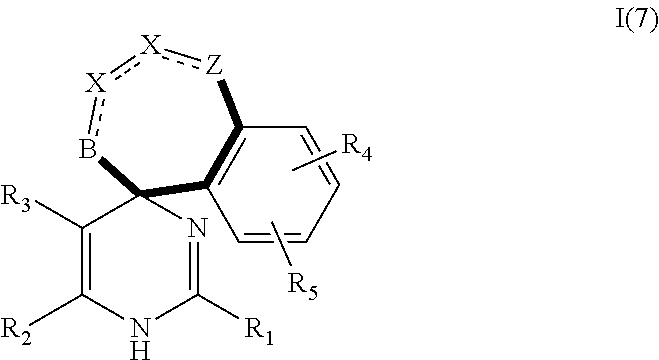

or “the present compounds” or similar term is meant to include the compounds of general formula (I), salts, stereoisomeric forms and racemic mixtures or any subgroups thereof.

including any possible stereoisomers or tautomeric forms thereof, wherein:
B is selected from the group comprising C1-C3 alkyl optionally substituted with one or more Fluoro atoms;
Z is selected from H or halogen;
Or B and Z together with the carbons to which they are attached form a 4-7 membered ring, optionally containing one or more heteroatoms, wherein the 4-7 membered ring optionally is substituted with one or more substituents selected from the group comprising C1-C3 alkyl, oxo, OH and halogen;
R1 is selected from the group comprising heteroaryl and phenyl, optionally substituted with one or more substituents selected from the group comprising halogen and C1-C3 alkyl;
R2 is selected from the group comprising —R6-R7, C≡N, cyclopropyl, and CF3;
R1 is selected from the group comprising heteroaryl and phenyl, optionally substituted with 1 or more halogen atoms;
R2 is selected from the group comprising —R6-R7, C≡N, cyclopropyl, and CF3;
R3 is selected from the group comprising C1-C3alkoxycarbonyl, and C≡N;
R4 and R5 independently are selected from the group comprising H and halogen;
R6 is C1-C3 alkyl, optionally substituted with Fluoro;
R7 is selected from the group comprising hydrogen, a hetero C3-7cycloalkyl, cyclopropyl and CF3;
R1 is heteroaryl, optionally substituted with 1 or more halogen atoms;
R2 is selected from the group comprising —R6-R7, C≡N, cyclopropyl, and CF3;
R3 is selected from the group comprising C1-C3alkoxycarbonyl, and C≡N;
R4 and R5 independently are selected from the group comprising H and halogen;
R6 is C1-C3 alkyl, optionally substituted with Fluoro;
R7 is selected from the group comprising hydrogen, a hetero C3-7cycloalkyl or CF3;
In an embodiment of this subgroup, B and Z together with the carbons to which they are attached form a 5-6 membered ring, optionally containing one or more heteroatoms, wherein the 5-6 membered ring optionally is substituted with one or more substituents selected from the group comprising C1-C3 alkyl.

including any possible stereoisomers or tautomeric forms thereof, wherein:
B is selected from the group comprising C1-C3 alkyl optionally substituted with one or more Fluoro atoms;
Z is selected from H or halogen;
Or B and Z together with the carbons to which they are attached form a 4-7 membered ring, optionally containing one or more heteroatoms, wherein the 4-7 membered ring optionally is substituted with one or more substituents selected from the group comprising C1-C3 alkyl, oxo and halogen;
R1 is selected from the group comprising heteroaryl and phenyl, optionally substituted with one or more substituents selected from the group comprising halogen and C1-C3 alkyl;
R2 is selected from the group comprising —R6-R7, cyclopropyl, and CF3;
R3 is selected from the group comprising C1-C3alkoxycarbonyl, and C≡N;
R4 and R5 independently are selected from the group comprising H and halogen;
R6 is C1-C3 alkyl, optionally substituted with Fluoro;
R7 is selected from the group comprising hydrogen, a hetero C3-7cycloalkyl, cyclopropyl and CF3;
or a pharmaceutically acceptable salt or a solvate thereof.
R1 is selected from the group comprising heteroaryl and phenyl, optionally substituted with 1 or more halogen atoms;
R2 is selected from the group comprising —R6-R7, C≡N, cyclopropyl, and CF3;
R3 is selected from the group comprising C1-C3alkoxycarbonyl, and C≡N;
R4 and R5 independently are selected from the group comprising H and halogen;
R6 is C1-C3 alkyl, optionally substituted with Fluoro;
R7 is selected from the group comprising hydrogen, a hetero C3-7cycloalkyl, cyclopropyl and CF3;
or a pharmaceutically acceptable salt or a solvate thereof.
R1 is heteroaryl, optionally substituted with 1 or more halogen atoms;
R2 is selected from the group comprising —R6-R7, C≡N and CF3;
R3 is selected from the group comprising C1-C3alkoxycarbonyl, and C≡N;
R4 and R5 independently are selected from the group comprising H and halogen;
R6 is C1-C3 alkyl, optionally substituted with Fluoro;
R7 is selected from the group comprising hydrogen, a hetero C3-7cycloalkyl or CF3;
In an embodiment of this subgroup, B and Z together with the carbons to which they are attached form a 5-6 membered ring, optionally containing one or more heteroatoms, wherein the 5-6 membered ring optionally is substituted with one or more substituents selected from the group comprising C1-C3 alkyl.

wherein R1, R3, R4, and R5 are defined as above for Formula I and Ia.
R1 is heteroaryl, optionally substituted with 1 or more halogen atoms;
R2 is selected from the group comprising —R6-R7, C≡N and CF3;
R3 is selected from the group comprising C1-C3alkoxycarbonyl, and C≡N;
R4 and R5 independently are selected from the group comprising H and halogen;
R6 is C1-C3 alkyl, optionally substituted with Fluoro;
R7 is selected from the group comprising hydrogen, a hetero C3-7cycloalkyl or CF3;
A particular group of compounds are those compounds of formula (V) wherein the heteroaryl of R1 comprises a nitrogen atom adjacent to the carbon attached to the 4,4-disubstituted-1,4-dihydropyrimidine (e.g. R1 is 2-pyridinyl or 2-thiazolyl)


- NMP: 1-Methyl-2-pyrrolidinone
- DME: 1,2-dimethoxyethane
- POPd: [(t-Bu)2P(OH)]2PdCl2
- Isolute® HMN: Disposable liquid-liquid extraction columns containing a modified form of diatomaceous earth
- PEPPSI™-IPr: [1,3-Bis(2,6-Diisopropylphenyl)imidazol-2-ylidene](3-chloro-pyridyl)palladium(II) dichloride


Condition A:

Enantiomers of racemic compound 4: compound 4a and compound 4b


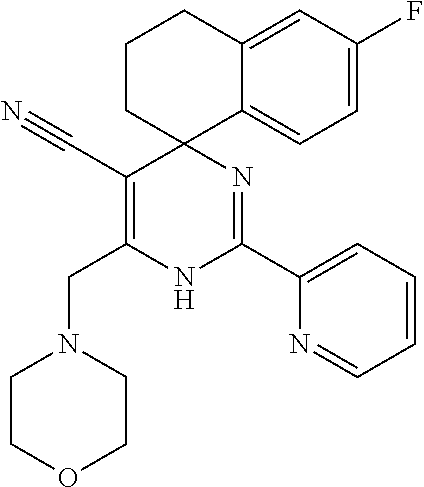


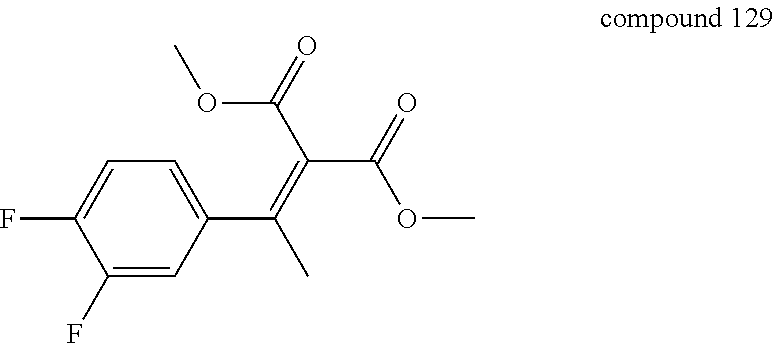

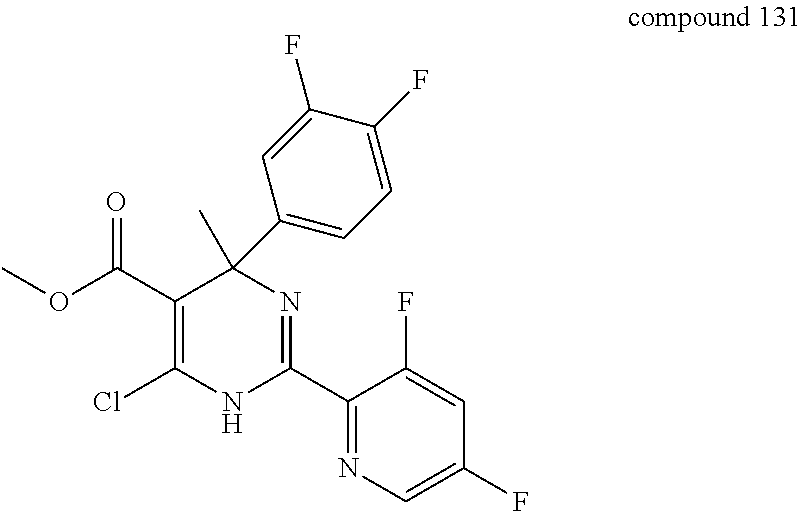


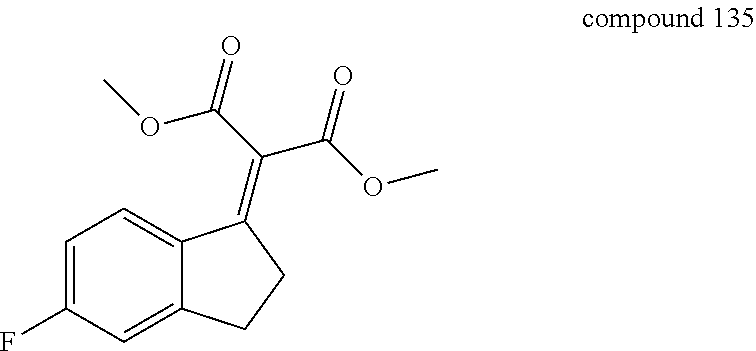


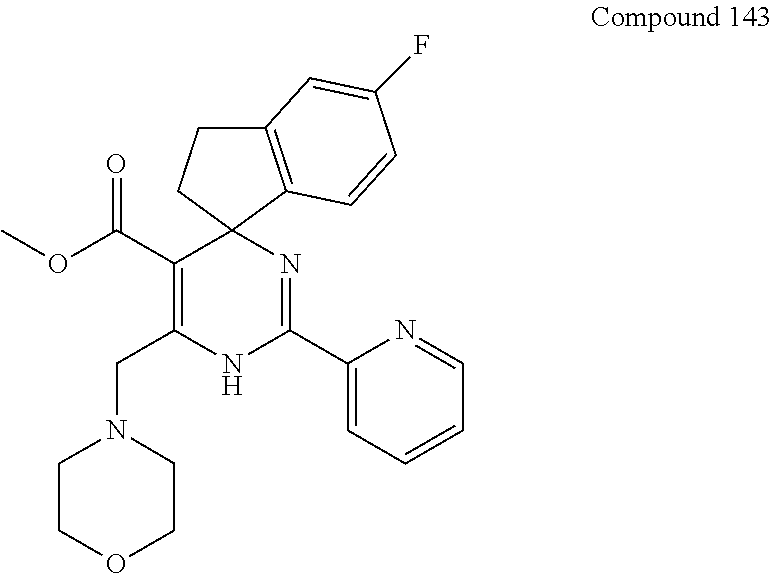


| TABLE 1 |
| anti-HBV activity of compounds of formula I |
| HBV- | |||||
| HepG2 | HepG2 | HepG2 | HepG2 | ||
| Com- | 2.15 | 6 days | 117 | 4 days | |
| pound | EC50 | CC50 | EC50 | CC50 | |
| STRUCTURE | nr. | (μM) | (μM) | (μM) | (μM) |
 |
2 | 0.669 | >100 | 0.25 | >50 |
 |
4 | 1.92 | 51.1 | 0.66 | >25 |
| 4a | >100 | 92.0 | |||
| 4b | 0.643 | 92.4 | 0.76 | >50 | |
 |
5 | >100 | >100 | ||
 |
6 | >25 | >25 | ||
 |
7 | >100 | 13.4 | ||
 |
8 | 14.8 | 54.3 | 3.3 | >50 |
 |
9 | >100 | 62.4 | ||
 |
10 | >10 | >10 | >10 | >10 |
 |
11 | >100 | >100 | ||
 |
13 | 9.34 | >100 | 3.9 | >100 |
 |
17 | >50 | 39.9 | 21.0 | >25 |
 |
18 | 3.92 | 36.5 | 1.6 | >50 |
 |
21 | 12.7 | 17.5 | ||
 |
24 | 0.319 | 37.9 | 0.16 | >25 |
 |
27 | 1.83 | >100 | 0.63 | >25 |
 |
29 | 6.32 | 47.4 | 3.0 | >25 |
 |
30 | 0.941 | >100 | 0.29 | >25 |
 |
31 | 72.4 | >100 | 40.6 | >50 |
 |
34 | 16.2 | 20 | ||
| 34a | >100 | 30.9 | |||
| 34b | 8.23 | 41.6 | |||
 |
35 | >100 | 68.1 | ||
 |
39 | 0.405 | 62.9 | 0.41 | >100 |
 |
40 | 14.0 | 77.0 | ||
 |
41 | 7.39 | >50 | 4.5 | >25 |
 |
42 | 3.07 | 57.7 | 1.29 | >50 |
 |
56 | 35.2 | 36.4 | 52.6 | >100 |
 |
57 | >100 | 87.4 | >25 | >25 |
 |
58 | >100 | >100 | >25 | >25 |
 |
59 | 59.5 | 68.9 | 46.7 | >100 |
 |
60 | 2.83 | >100 | 2.5 | >25 |
| 60a | >100 | >100 | >100 | >100 | |
| 60b | 2.26 | >100 | 1.28 | >100 | |
 |
61 | 18.0 | >100 | ||
 |
66 | 0.207 | 89.3 | 0.17 | >25 |
| 66a | <0.391 | >100 | 0.066 | >100 | |
| 66b | 35.1 | >100 | 48.9 | >100 | |
 |
69 | 2.21 | >100 | 1.65 | >100 |
 |
72 | 54.0 | 71.1 | 72.0 | >100 |
 |
74 | 2.06 | 78.3 | 1.33 | >100 |
 |
76 | 8.48 | >100 | 3.65 | >100 |
 |
80 | 51.1 | 25.1 | >50 | |
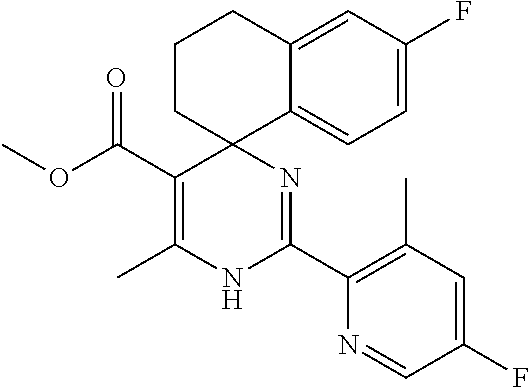 |
81 | 19.9 | >50 | ||
 |
85 | >100 | >100 | >50 | >50 |
 |
86 | 8.64 | >100 | 5.49 | >100 |
 |
89 | 0.604 | >100 | 0.470 | >100 |
 |
90 | 5.82 | >50 | 22.7 | >50 |
 |
93 | 53.4 | 41.5 | 81.2 | >100 |
 |
96 | 0.954 | >100 | 0.94 | 97.0 |
| 96a | 0.650 | >100 | 0.30 | >100 | |
| 96b | 30.3 | >100 | 18.7 | >100 | |
 |
100 | 0.546 | >100 | 0.506 | >100 |
 |
101 | <0.098 | >25 | 0.073 | >50 |
 |
106 | 98.4 | >100 | >25 | >25 |
| 106a | >100 | >100 | >50 | >50 | |
| 106b | 29.4 | >100 | >25 | >25 | |
 |
110 | 10.7 | >100 | 6.14 | >50 |
 |
111 | 81.8 | >100 | >50 | >50 |
 |
112 | 0.624 | >100 | 0.410 | >50 |
 |
115 | >100 | >100 | >25 | >25 |
 |
118 | 40.7 | >100 | >50 | >50 |
 |
123 | >100 | >25 | >25 | |
 |
124 | 13.0 | 48.4 | 2.41 | >25 |
 |
128 | 9.10 | 63.8 | 2.47 | >50 |
 |
132 | 2.03 | 0.88 | >25 | |
| 132a | >100 | >25 | 21.1 | ||
| 132b | 0.784 | 0.474 | >25 | ||
| 132b | |||||
| •MsOH | 0.694 | 0.803 | >25 | ||
| 132b | |||||
| (−)- | 0.489 | ||||
| camphanic | |||||
| acid | |||||
 |
133 | 17.3 | 4.33 | >25 | |
 |
134 | ||||
| 134a | 91.2 | 53.0 | >50 | >50 | |
| 134b | 41.9 | 35.8 | >50 | >50 | |
 |
139 •TFA | 0.99 | 0.707 | >25 | |
 |
142 | 11.5 | 3.37 | >25 | |
 |
143 | 0.222 | >25 | ||
 |
144 | 4.94 | >10 | ||
 |
145 | 0.360 | 0.620 | >25 | |
 |
146 | 1.36 | 2.62 | >25 | |
 |
147 | 2.73 | 3.17 | >25 | |
 |
148 | >25 | 17.2 | ||
 |
149 | 23.8 | 3.26 | >25 | |
 |
150 | 1.35 | 0.694 | >25 | |
 |
151 | ||||
| 151a | >100 | >25 | >25 | ||
| 151b | 4.25 | 3.68 | >25 | ||
 |
152 | 3.38 | 2.88 | >25 | |
 |
153 | 12.9 | 3.31 | >25 | |
 |
154 | 27.5 | 17.6 | >25 | |
 |
155 | 0.744 | 14.0 | >25 | |
| 155a | 0.983 | 17.1 | >25 | ||
| 155b | >100 | >25 | >25 | ||
 |
156 | 1.11 | 0.669 | >25 | |
| 156 | |||||
| •MsOH | 1.93 | 1.09 | >25 | ||
 |
157 | 9.52 | 3.06 | >25 | |
 |
158 | 4.56 | >25 | ||
| 158a | 2.44 | >25 | |||
| 158b | >100 | >25 | >25 | ||
 |
159 | ||||
| 159a | 37.5 | 25.0 | >25 | ||
| 159b | >100 | >25 | >25 | ||
 |
160 | 0.717 | 23.7 | >25 | |
| 160a | >50 | >25 | >25 | ||
| 160b | 0.451 | 10.5 | >25 | ||
 |
161 | >25 | |||
 |
162 | >25 | >25 | >25 | |
 |
163 | ||||
| 163a | 69.5 | >25 | >25 | ||
| 163b | >100 | >25 | >25 | ||
 |
166 | 0.24 | 14.2 | >25 | |
| 166a | >50 | >25 | >25 | ||
| 166b | 0.197 | 15.5 | >25 | ||
 |
168 | ||||
| 168A | 9.64 | 3.51 | >25 | ||
| 168B | 5.73 | 1.49 | >25 | ||
 |
169 | 0.137 | >25 | ||
 |
174 | 13.4 | >25 | ||
| 174a | 8.97 | >25 | |||
| 174b | >25 | >25 | |||
 |
175 | <0.195 | 0.146 | >25 | |
Claims (13)


Applications Claiming Priority (7)
| Application Number | Priority Date | Filing Date | Title |
|---|---|---|---|
| EP12150384.1 | 2012-01-06 | ||
| EP12150384 | 2012-01-06 | ||
| EP12150384 | 2012-01-06 | ||
| EP12167065 | 2012-05-08 | ||
| EP12167065.7 | 2012-05-08 | ||
| EP12167065 | 2012-05-08 | ||
| PCT/EP2013/050095 WO2013102655A1 (en) | 2012-01-06 | 2013-01-04 | 4,4-disubstituted-1,4-dihydropyrimidines and the use thereof as medicaments for the treatment of hepatitis b |
Publications (2)
| Publication Number | Publication Date |
|---|---|
| US20150005295A1 US20150005295A1 (en) | 2015-01-01 |
| US9233933B2 true US9233933B2 (en) | 2016-01-12 |
Family
ID=47520114
Family Applications (1)
| Application Number | Title | Priority Date | Filing Date |
|---|---|---|---|
| US14/370,118 Expired - Fee Related US9233933B2 (en) | 2012-01-06 | 2013-01-04 | 4,4-disubstituted-1,4-dihydropyrimidines and the use thereof as medicaments for the treatment of hepatitis B |
Country Status (12)
| Country | Link |
|---|---|
| US (1) | US9233933B2 (en) |
| EP (1) | EP2800742B1 (en) |
| JP (1) | JP6162144B2 (en) |
| KR (1) | KR102056665B1 (en) |
| CN (1) | CN104302626B (en) |
| AR (1) | AR089671A1 (en) |
| AU (1) | AU2013207205B2 (en) |
| CA (1) | CA2858647C (en) |
| EA (1) | EA026977B1 (en) |
| ES (1) | ES2581489T3 (en) |
| UY (1) | UY34566A (en) |
| WO (1) | WO2013102655A1 (en) |
Cited By (4)
| Publication number | Priority date | Publication date | Assignee | Title |
|---|---|---|---|---|
| US9498479B2 (en) | 2013-11-19 | 2016-11-22 | Sunshine Lake Pharma Co., Ltd. | Dihydropyrimidine compounds and their application in pharmaceuticals |
| US9573941B2 (en) | 2013-11-27 | 2017-02-21 | Sunshine Lake Pharma Co., Ltd. | Processes for preparing dihydropyrimidine derivatives and intermediates thereof |
| US9771358B2 (en) | 2014-03-28 | 2017-09-26 | Sunshine Lake Pharma Co., Ltd. | Dihydropyrimidine compounds and their application in pharmaceuticals |
| US10098889B2 (en) | 2015-02-07 | 2018-10-16 | Sunshine Lake Pharma Co., Ltd. | Complexes and salts of dihydropyrimidine derivatives and their application in pharmaceuticals |
Families Citing this family (83)
| Publication number | Priority date | Publication date | Assignee | Title |
|---|---|---|---|---|
| EA037918B1 (en) | 2011-12-21 | 2021-06-07 | Новира Терапьютикс, Инк. | Hepatitis b antiviral agents |
| MX2014011749A (en) * | 2012-03-31 | 2015-01-22 | Hoffmann La Roche | Novel 4-methyl-dihydropyrimidines for the treatment and prophylaxis of hepatitis b virus infection. |
| US20130267517A1 (en) | 2012-03-31 | 2013-10-10 | Hoffmann-La Roche Inc. | Novel 4-methyl-dihydropyrimidines for the treatment and prophylaxis of hepatitis b virus infection |
| PL2888241T3 (en) | 2012-08-24 | 2017-12-29 | Sunshine Lake Pharma Co., Ltd. | 2,4,5,6-Substituted 3,6-dihydropyrimidine derivatives as hepatitis B virus (HBV) polymerase inhibitors for the treatment of e.g. chronic hepatitis |
| HK1208465A1 (en) | 2012-08-28 | 2016-03-04 | Janssen Sciences Ireland Uc | Sulfamoyl-arylamides and the use thereof as medicaments for the treatment of hepatitis b |
| JP6113285B2 (en) * | 2012-09-10 | 2017-04-12 | エフ.ホフマン−ラ ロシュ アーゲーF. Hoffmann−La Roche Aktiengesellschaft | 6-amino acid heteroaryl dihydropyrimidines for the treatment and prevention of hepatitis B virus infection |
| DK2961732T3 (en) | 2013-02-28 | 2017-07-10 | Janssen Sciences Ireland Uc | SULFAMOYLARYLAMIDS AND USE THEREOF AS MEDICINES TO TREAT HEPATITIS B |
| US8993771B2 (en) | 2013-03-12 | 2015-03-31 | Novira Therapeutics, Inc. | Hepatitis B antiviral agents |
| WO2014161888A1 (en) | 2013-04-03 | 2014-10-09 | Janssen R&D Ireland | N-phenyl-carboxamide derivatives and the use thereof as medicaments for the treatment of hepatitis b |
| JO3603B1 (en) | 2013-05-17 | 2020-07-05 | Janssen Sciences Ireland Uc | Sulfamoyl pyrolamide derivatives and their use as medicines to treat hepatitis B |
| ES2774749T3 (en) | 2013-07-25 | 2020-07-22 | Janssen Sciences Ireland Unlimited Co | Glyoxamide-substituted pyrrolamide derivatives and their use as medicines for the treatment of hepatitis B |
| KR102290189B1 (en) | 2013-10-23 | 2021-08-17 | 얀센 사이언시즈 아일랜드 언리미티드 컴퍼니 | Carboxamide derivatives and the use thereof as medicaments for the treatment of hepatitis b |
| US9181288B2 (en) | 2014-01-16 | 2015-11-10 | Novira Therapeutics, Inc. | Azepane derivatives and methods of treating hepatitis B infections |
| US10392349B2 (en) | 2014-01-16 | 2019-08-27 | Novira Therapeutics, Inc. | Azepane derivatives and methods of treating hepatitis B infections |
| US9169212B2 (en) | 2014-01-16 | 2015-10-27 | Novira Therapeutics, Inc. | Azepane derivatives and methods of treating hepatitis B infections |
| KR20160128305A (en) | 2014-02-05 | 2016-11-07 | 노비라 테라퓨틱스, 인코포레이티드 | Combination therapy for treatment of hbv infections |
| DK3102572T3 (en) | 2014-02-06 | 2019-02-04 | Janssen Sciences Ireland Uc | SULFAMOYLPYRROLAMIDE DERIVATIVES AND THEIR USE AS MEDICINES TO TREAT HEPATITIS B |
| MX363600B (en) | 2014-03-13 | 2019-03-28 | Univ Indiana Res & Tech Corp | Hepatitis b core protein allosteric modulators. |
| US9400280B2 (en) | 2014-03-27 | 2016-07-26 | Novira Therapeutics, Inc. | Piperidine derivatives and methods of treating hepatitis B infections |
| WO2016149581A1 (en) | 2015-03-19 | 2016-09-22 | Novira Therapeutics, Inc. | Azocane and azonane derivatives and methods of treating hepatitis b infections |
| US10442788B2 (en) | 2015-04-01 | 2019-10-15 | Enanta Pharmaceuticals, Inc. | Hepatitis B antiviral agents |
| US10738035B2 (en) | 2015-05-13 | 2020-08-11 | Enanta Pharmaceuticals, Inc. | Hepatitis B antiviral agents |
| US10875876B2 (en) | 2015-07-02 | 2020-12-29 | Janssen Sciences Ireland Uc | Cyclized sulfamoylarylamide derivatives and the use thereof as medicaments for the treatment of hepatitis B |
| WO2017011552A1 (en) | 2015-07-13 | 2017-01-19 | Enanta Pharmaceuticals, Inc. | Hepatitis b antiviral agents |
| US10301255B2 (en) | 2015-07-22 | 2019-05-28 | Enanta Pharmaceuticals, Inc. | Hepatitis B antiviral agents |
| TWI721016B (en) | 2015-09-15 | 2021-03-11 | 美商艾森伯利生物科學公司 | Hepatitis b core protein modulators |
| HK1259410A1 (en) | 2015-09-29 | 2019-11-29 | 诺维拉治疗公司 | Crystalline forms of a hepatitis b antiviral agent |
| US10280175B2 (en) | 2016-02-02 | 2019-05-07 | Enanta Pharmaceuticals, Inc. | Hepatitis B antiviral agents |
| BR112018067964B1 (en) | 2016-03-07 | 2024-01-16 | Enanta Pharmaceuticals, Inc | COMPOUND, PHARMACEUTICAL COMPOSITION COMPRISING IT AND USE OF SAID COMPOUND |
| EP3442524A2 (en) | 2016-04-15 | 2019-02-20 | Novira Therapeutics Inc. | Combinations and methods comprising a capsid assembly inhibitor |
| MX2018015315A (en) | 2016-06-10 | 2019-04-25 | Enanta Pharm Inc | Hepatitis b antiviral agents. |
| US10987360B2 (en) | 2016-09-15 | 2021-04-27 | Assembly Biosciences, Inc. | Hepatitis B core protein modulators |
| ES2898217T3 (en) | 2017-03-02 | 2022-03-04 | Assembly Biosciences Inc | Cyclic sulfonamide compounds and methods of using the same |
| WO2019001420A1 (en) * | 2017-06-27 | 2019-01-03 | Janssen Pharmaceutica Nv | Heteroaryldihydropyrimidine derivatives and methods of treating hepatitis b infections |
| IL272941B2 (en) | 2017-08-28 | 2023-03-01 | Enanta Pharm Inc | Hepatitis b antiviral agents |
| CN111527087A (en) | 2017-11-02 | 2020-08-11 | 艾库里斯有限及两合公司 | Novel highly active pyrazolo-piperidine substituted indole-2-carboxamides with anti-hepatitis B virus (HBV) activity |
| GEP20227373B (en) | 2017-11-02 | 2022-04-25 | Aicuris Gmbh & Co Kg | Novel, highly active amino-thiazole substituted indole-2-carboxamides active against the hepatitis b virus (hbv) |
| TW201927789A (en) * | 2017-12-06 | 2019-07-16 | 美商因那塔製藥公司 | Hepatitis B antiviral agents |
| TW201936192A (en) | 2017-12-06 | 2019-09-16 | 美商因那塔製藥公司 | Hepatitis B antiviral agents |
| US11058678B2 (en) | 2018-01-22 | 2021-07-13 | Enanta Pharmaceuticals, Inc. | Substituted heterocycles as antiviral agents |
| EA202092171A1 (en) | 2018-03-14 | 2020-12-01 | Янссен Сайенсиз Айрлэнд Анлимитед Компани | DOSING SCHEME OF THE MODULATOR ASSEMBLY OF CAPSIDE |
| WO2019191166A1 (en) | 2018-03-29 | 2019-10-03 | Enanta Pharmaceuticals, Inc. | Hepatitis b antiviral agents |
| EP3790866A4 (en) * | 2018-05-08 | 2022-03-02 | Janssen Sciences Ireland Unlimited Company | Dihydropyrimidine derivatives and uses thereof in the treatment of hbv infection or of hbv-induced diseases |
| US11053235B2 (en) | 2018-08-09 | 2021-07-06 | Janssen Sciences Ireland Unlimited Company | Substituted 1,4-dihydropyrimidines for the treatment of HBV infection or HBV-induced diseases |
| WO2020061435A1 (en) | 2018-09-21 | 2020-03-26 | Enanta Pharmaceuticals, Inc. | Functionalized heterocycles as antiviral agents |
| EP3870296A1 (en) | 2018-10-22 | 2021-09-01 | Assembly Biosciences, Inc. | 5-membered heteroaryl carboxamide compounds for treatment of hbv |
| AU2019373090B2 (en) | 2018-10-31 | 2023-05-25 | The University Of Sydney | Compositions and methods for treating viral infections |
| UY38435A (en) | 2018-11-02 | 2020-05-29 | Aicuris Gmbh & Co Kg | NEW UREA 6,7-DIHIDRO-4H-PIRAZOL [1,5-A] PIRAZINAS ACTIVE AGAINST THE VIRUS OF HEPATITIS B (HBV) |
| UY38434A (en) | 2018-11-02 | 2020-05-29 | Aicuris Gmbh & Co Kg | NEW 6,7-DIHYDRO-4H-PYRAZOLE [1,5-A] PIRAZIN INDOL-2-CARBOXAMIDES ACTIVE AGAINST THE HEPATITIS B VIRUS (HBV) |
| AR116946A1 (en) | 2018-11-02 | 2021-06-30 | Aicuris Gmbh & Co Kg | DERIVATIVES OF UREA 6,7-DIHIDRO-4H-PIRAZOLO [4,3-C] PYRIDINES ACTIVE AGAINST THE VIRUS OF HEPATITIS B (HBV) |
| PY1991603A (en) | 2018-11-02 | 2020-09-17 | Aicuris Gmbh & Co Kg | NEW 6,7-DIHYDRO-4H-PYRAZOLE [1,5-A] PYRAZINE INDOLE -2-CARBOXAMIDES ACTIVE AGAINST HEPATITIS B VIRUS (HBV) |
| CA3118339A1 (en) | 2018-11-02 | 2020-05-07 | Aicuris Gmbh & Co. Kg | Novel urea 6,7-dihydro-4h-thiazolo[5,4-c]pyridines active against the hepatitis b virus (hbv) |
| UY38437A (en) | 2018-11-02 | 2020-05-29 | Aicuris Gmbh & Co Kg | NEW UREA 6,7-DIHIDRO-4H-PIRAZOLO [1,5-A] PYRAZINES ACTIVE AGAINST THE HEPATITIS B VIRUS (HBV) |
| KR102819704B1 (en) | 2018-11-21 | 2025-06-11 | 이난타 파마슈티칼스, 인코포레이티드 | Functionalized heterocycles as antiviral agents |
| KR20210106421A (en) | 2018-12-20 | 2021-08-30 | 얀센 파마슈티카 엔.브이. | Heteroaryldihydropyrimidine derivatives and methods of treatment of hepatitis B infection |
| MA55020A (en) | 2019-02-22 | 2021-12-29 | Janssen Sciences Ireland Unlimited Co | AMIDE DERIVATIVES USEFUL IN THE TREATMENT OF HEPATITIS B VIRUS INFECTION OR DISEASES INDUCED BY HEPATITIS B VIRUS |
| BR112021021580A2 (en) | 2019-04-30 | 2022-01-04 | Aicuris Gmbh & Co Kg | Innovative phenyl and pyridyl ureas active against hepatitis b virus (hbv) |
| BR112021021652A2 (en) | 2019-04-30 | 2021-12-21 | Aicuris Gmbh & Co Kg | Innovative oxalyl piperazines active against hepatitis B virus (HBV) |
| EP3962914A1 (en) | 2019-04-30 | 2022-03-09 | AiCuris GmbH & Co. KG | Novel indole-2-carboxamides active against the hepatitis b virus (hbv) |
| JP2022533007A (en) | 2019-04-30 | 2022-07-21 | アイクリス ゲゼルシャフト ミット ベシュレンクテル ハフツング ウント コンパニー コマンディトゲゼルシャフト | A novel indolizine-2-carboxamide that is active against hepatitis B virus (HBV) |
| BR112021021454A2 (en) | 2019-05-06 | 2021-12-21 | Janssen Sciences Ireland Unlimited Co | Amide derivatives useful in the treatment of HBV infection or HBV-induced diseases |
| BR112021023622A2 (en) | 2019-05-24 | 2022-04-19 | Assembly Biosciences Inc | Pharmaceutical compositions for the treatment of hbv |
| US11236111B2 (en) | 2019-06-03 | 2022-02-01 | Enanta Pharmaceuticals, Inc. | Hepatitis B antiviral agents |
| US11472808B2 (en) | 2019-06-04 | 2022-10-18 | Enanta Pharmaceuticals, Inc. | Substituted pyrrolo[1,2-c]pyrimidines as hepatitis B antiviral agents |
| US11760755B2 (en) | 2019-06-04 | 2023-09-19 | Enanta Pharmaceuticals, Inc. | Hepatitis B antiviral agents |
| WO2020255016A1 (en) | 2019-06-18 | 2020-12-24 | Janssen Sciences Ireland Unlimited Company | Combination of hepatitis b virus (hbv) vaccines and dihydropyrimidine derivatives as capsid assembly modulators |
| US11738019B2 (en) | 2019-07-11 | 2023-08-29 | Enanta Pharmaceuticals, Inc. | Substituted heterocycles as antiviral agents |
| WO2021055425A2 (en) | 2019-09-17 | 2021-03-25 | Enanta Pharmaceuticals, Inc. | Functionalized heterocycles as antiviral agents |
| WO2021188414A1 (en) | 2020-03-16 | 2021-09-23 | Enanta Pharmaceuticals, Inc. | Functionalized heterocyclic compounds as antiviral agents |
| WO2021216660A1 (en) | 2020-04-22 | 2021-10-28 | Assembly Biosciences, Inc. | 5-membered heteroaryl carboxamide compounds for treatment of hbv |
| WO2021216661A1 (en) | 2020-04-22 | 2021-10-28 | Assembly Biosciences, Inc. | Pyrazole carboxamide compounds for treatment of hbv |
| CN121248511A (en) | 2020-04-22 | 2026-01-02 | 组装生物科学股份有限公司 | 5-Membered heteroaryl carboxamides for the treatment of HBV |
| EP4139000A1 (en) | 2020-04-22 | 2023-03-01 | Assembly Biosciences, Inc. | Pyrazole carboxamide compounds for treatment of hbv |
| CN113754563B (en) * | 2020-06-03 | 2023-09-19 | 浙江省化工研究院有限公司 | A kind of 2-cyanoacrylate compound, its preparation method and application |
| WO2023069547A1 (en) | 2021-10-20 | 2023-04-27 | Assembly Biosciences, Inc. | 5-membered heteroaryl carboxamide compounds for treatment of hbv |
| WO2023069544A1 (en) | 2021-10-20 | 2023-04-27 | Assembly Biosciences, Inc. | 5-membered heteroaryl carboxamide compounds for treatment of hbv |
| WO2023069545A1 (en) | 2021-10-20 | 2023-04-27 | Assembly Biosciences, Inc. | 5-membered heteroaryl carboxamide compounds for treatment of hbv |
| WO2023164179A1 (en) | 2022-02-25 | 2023-08-31 | Assembly Biosciences, Inc. | Benzothia(dia)zepine compounds for treatment of hbv and hdv |
| WO2023164181A1 (en) | 2022-02-25 | 2023-08-31 | Assembly Biosciences, Inc. | Benzothia(dia)zepine compounds for treatment of hbv and hdv |
| WO2023164186A1 (en) | 2022-02-25 | 2023-08-31 | Assembly Biosciences, Inc. | Benzothia(dia)zepine compounds for treatment of hbv and hdv |
| WO2023164183A1 (en) | 2022-02-25 | 2023-08-31 | Assembly Biosciences, Inc. | Benzothia(dia)zepine compounds for treatment of hbv and hdv |
| WO2025043094A1 (en) | 2023-08-23 | 2025-02-27 | Assembly Biosciences, Inc. | Benzothia(dia)zepine compounds for treatment of hbv and hdv |
| WO2026038156A1 (en) | 2024-08-15 | 2026-02-19 | Assembly Biosciences, Inc. | Novel crystalline forms |
Citations (9)
| Publication number | Priority date | Publication date | Assignee | Title |
|---|---|---|---|---|
| JPS50137987A (en) * | 1974-04-25 | 1975-11-01 | ||
| WO2000058302A1 (en) | 1999-03-25 | 2000-10-05 | Bayer Aktiengesellschaft | Dihydropyrimidines and their use in the treatment of hepatitis b |
| CN1297449A (en) | 1998-04-18 | 2001-05-30 | 拜尔公司 | Novel 2-heterocyclic substituted dihydropyrimidines |
| WO2001045712A1 (en) | 1999-12-22 | 2001-06-28 | Bayer Aktiengesellschaft | Combinations of medicaments for treating viral diseases |
| DE19962010A1 (en) | 1999-12-22 | 2001-06-28 | Bayer Ag | Antiviral combination based on dihydropyrimidine derivatives and non-dihydropyrimidine HBV antiviral agents, are useful for treatment of HBV infections |
| WO2001068642A1 (en) | 2000-03-16 | 2001-09-20 | Bayer Aktiengesellschaft | Dihydropyrimidines and the use thereof as medicaments for the treatment of hepatitis b |
| US7074784B2 (en) | 2000-03-16 | 2006-07-11 | Siegfried Goldmann | Medicaments against viral diseases |
| WO2008154817A1 (en) | 2007-06-18 | 2008-12-24 | Zhang, Zhongneng | Bromo-phenyl substituted thiazolyl dihydropyrimidines |
| WO2010069147A1 (en) | 2008-12-17 | 2010-06-24 | 张中能 | Dihydropyrimidine derivatives, compositions thereof and their use |
Family Cites Families (1)
| Publication number | Priority date | Publication date | Assignee | Title |
|---|---|---|---|---|
| MX2014011749A (en) * | 2012-03-31 | 2015-01-22 | Hoffmann La Roche | Novel 4-methyl-dihydropyrimidines for the treatment and prophylaxis of hepatitis b virus infection. |
-
2013
- 2013-01-04 AU AU2013207205A patent/AU2013207205B2/en not_active Ceased
- 2013-01-04 EP EP13700017.0A patent/EP2800742B1/en active Active
- 2013-01-04 EA EA201491329A patent/EA026977B1/en unknown
- 2013-01-04 CA CA2858647A patent/CA2858647C/en not_active Expired - Fee Related
- 2013-01-04 KR KR1020147021096A patent/KR102056665B1/en not_active Expired - Fee Related
- 2013-01-04 UY UY0001034566A patent/UY34566A/en unknown
- 2013-01-04 JP JP2014550706A patent/JP6162144B2/en not_active Expired - Fee Related
- 2013-01-04 WO PCT/EP2013/050095 patent/WO2013102655A1/en not_active Ceased
- 2013-01-04 CN CN201380012514.2A patent/CN104302626B/en not_active Expired - Fee Related
- 2013-01-04 AR ARP130100044A patent/AR089671A1/en unknown
- 2013-01-04 US US14/370,118 patent/US9233933B2/en not_active Expired - Fee Related
- 2013-01-04 ES ES13700017.0T patent/ES2581489T3/en active Active
Patent Citations (11)
| Publication number | Priority date | Publication date | Assignee | Title |
|---|---|---|---|---|
| JPS50137987A (en) * | 1974-04-25 | 1975-11-01 | ||
| CN1297449A (en) | 1998-04-18 | 2001-05-30 | 拜尔公司 | Novel 2-heterocyclic substituted dihydropyrimidines |
| US6503913B1 (en) | 1998-04-18 | 2003-01-07 | Bayer Aktiengesellschaft | 2-heterocyclically substituted dihydropyrimidines |
| WO2000058302A1 (en) | 1999-03-25 | 2000-10-05 | Bayer Aktiengesellschaft | Dihydropyrimidines and their use in the treatment of hepatitis b |
| WO2001045712A1 (en) | 1999-12-22 | 2001-06-28 | Bayer Aktiengesellschaft | Combinations of medicaments for treating viral diseases |
| DE19962010A1 (en) | 1999-12-22 | 2001-06-28 | Bayer Ag | Antiviral combination based on dihydropyrimidine derivatives and non-dihydropyrimidine HBV antiviral agents, are useful for treatment of HBV infections |
| WO2001068642A1 (en) | 2000-03-16 | 2001-09-20 | Bayer Aktiengesellschaft | Dihydropyrimidines and the use thereof as medicaments for the treatment of hepatitis b |
| US7074784B2 (en) | 2000-03-16 | 2006-07-11 | Siegfried Goldmann | Medicaments against viral diseases |
| WO2008154817A1 (en) | 2007-06-18 | 2008-12-24 | Zhang, Zhongneng | Bromo-phenyl substituted thiazolyl dihydropyrimidines |
| US8343969B2 (en) | 2007-06-18 | 2013-01-01 | Sunshine Lake Pharma Co., Ltd. | Bromo-phenyl substituted thiazolyl dihydropyrimidines |
| WO2010069147A1 (en) | 2008-12-17 | 2010-06-24 | 张中能 | Dihydropyrimidine derivatives, compositions thereof and their use |
Non-Patent Citations (17)
Cited By (6)
| Publication number | Priority date | Publication date | Assignee | Title |
|---|---|---|---|---|
| US9498479B2 (en) | 2013-11-19 | 2016-11-22 | Sunshine Lake Pharma Co., Ltd. | Dihydropyrimidine compounds and their application in pharmaceuticals |
| US9573941B2 (en) | 2013-11-27 | 2017-02-21 | Sunshine Lake Pharma Co., Ltd. | Processes for preparing dihydropyrimidine derivatives and intermediates thereof |
| US9617252B2 (en) | 2013-11-27 | 2017-04-11 | Sunshine Lake Pharma Co., Ltd. | Processes for preparing dihydropyrimidine derivatives and intermediates thereof |
| US9643962B2 (en) | 2013-11-27 | 2017-05-09 | Sunshine Lake Pharma Co., Ltd. | Processes for preparing dihydropyrimidine derivatives and intermediates thereof |
| US9771358B2 (en) | 2014-03-28 | 2017-09-26 | Sunshine Lake Pharma Co., Ltd. | Dihydropyrimidine compounds and their application in pharmaceuticals |
| US10098889B2 (en) | 2015-02-07 | 2018-10-16 | Sunshine Lake Pharma Co., Ltd. | Complexes and salts of dihydropyrimidine derivatives and their application in pharmaceuticals |
Also Published As
| Publication number | Publication date |
|---|---|
| CA2858647A1 (en) | 2013-07-11 |
| AR089671A1 (en) | 2014-09-10 |
| EA201491329A1 (en) | 2014-10-30 |
| EP2800742B1 (en) | 2016-04-06 |
| CN104302626B (en) | 2016-09-07 |
| CA2858647C (en) | 2020-03-31 |
| KR20150000871A (en) | 2015-01-05 |
| WO2013102655A1 (en) | 2013-07-11 |
| CN104302626A (en) | 2015-01-21 |
| EA026977B1 (en) | 2017-06-30 |
| JP2015508402A (en) | 2015-03-19 |
| AU2013207205A1 (en) | 2014-07-03 |
| JP6162144B2 (en) | 2017-07-19 |
| EP2800742A1 (en) | 2014-11-12 |
| KR102056665B1 (en) | 2019-12-17 |
| US20150005295A1 (en) | 2015-01-01 |
| AU2013207205B2 (en) | 2017-02-02 |
| ES2581489T3 (en) | 2016-09-06 |
| UY34566A (en) | 2013-07-31 |
Similar Documents
| Publication | Publication Date | Title |
|---|---|---|
| US9233933B2 (en) | 4,4-disubstituted-1,4-dihydropyrimidines and the use thereof as medicaments for the treatment of hepatitis B | |
| US12264147B2 (en) | Substituted carboxamides as inhibitors of WDR5 protein-protein binding | |
| US12202826B2 (en) | N-pyridinyl acetamide derivatives as inhibitors of the Wnt signaling pathway | |
| KR102148237B1 (en) | Fused bicyclic sulfamoyl derivatives and the use thereof as medicaments for the treatment of hepatitis B | |
| US11078193B2 (en) | Sulphamoylpyrrolamide derivatives and the use thereof as medicaments for the treatment of hepatitis B | |
| KR101985984B1 (en) | Benzonitrile derivatives as kinase inhibitors | |
| US8188101B2 (en) | Dihydropyridopyrimidines for the treatment of AB-related pathologies | |
| RU2540332C2 (en) | Bicyclic nitrogen-containing heterocyclic compounds, useful in treatment of hepatitis c | |
| US20240190844A1 (en) | Pyridazinones as parp7 inhibitors | |
| JP2019532984A (en) | Novel tetrahydropyridopyrimidine for treatment and prevention of hepatitis B virus infection | |
| WO2016051193A1 (en) | Compounds useful as csf1 modulators | |
| JP6283688B2 (en) | Novel pyrazole-substituted imidazopyrazine as casein kinase 1D / E inhibitor | |
| CN102131805A (en) | Imidazopyridine and imidazopyrazine compounds useful as kinase inhibitors | |
| KR20200101389A (en) | Exo-Aza spiro inhibitor of menin-MLL interaction | |
| US20120122843A1 (en) | Compounds and Their Use for Treatment of Amyloid Beta-Related Diseases | |
| US12552785B2 (en) | Pyrazolo[1,5-α]pyridine derivative, preparation method therefor, and composition and use thereof | |
| CN108069938A (en) | 2,4- disubstituted pyridines and its preparation method and application | |
| TW201341371A (en) | 4,4-disubstituted-1,4-dihydropyrimidines and the use thereof as medicaments for the treatment of hepatitis B |
Legal Events
| Date | Code | Title | Description |
|---|---|---|---|
| AS | Assignment |
Owner name: JANSSEN PHARMACEUTICA NV, BELGIUM Free format text: ASSIGNMENT OF ASSIGNORS INTEREST;ASSIGNOR:ROMBOUTS, GEERT;REEL/FRAME:033262/0247 Effective date: 20120106 Owner name: JANSSEN INFECTIOUS DISEASES-DIAGNOSTICS BVBA, BELG Free format text: ASSIGNMENT OF ASSIGNORS INTEREST;ASSIGNOR:HACHE, GEERWIN YVONNE PAUL;REEL/FRAME:033261/0483 Effective date: 20120106 Owner name: JANSSEN R & D IRELAND, IRELAND Free format text: ASSIGNMENT OF ASSIGNORS INTEREST;ASSIGNOR:JANSSEN PHARMACEUTICA NV;REEL/FRAME:033264/0806 Effective date: 20120106 Owner name: JANSSEN INFECTIOUS DISEASES-DIAGNOSTICS BVBA, BELG Free format text: ASSIGNMENT OF ASSIGNORS INTEREST;ASSIGNOR:RABOISSON, PIERRE JEAN-MARIE BERNARD;REEL/FRAME:033261/0552 Effective date: 20120106 Owner name: JANSSEN R & D IRELAND, IRELAND Free format text: ASSIGNMENT OF ASSIGNORS INTEREST;ASSIGNOR:JANSSEN INFECTIOUS DISEASES--DIAGNOSTICS BVBA;REEL/FRAME:033264/0791 Effective date: 20120106 Owner name: JANSSEN INFECTIOUS DISEASES-DIAGNOSTICS BVBA, BELG Free format text: ASSIGNMENT OF ASSIGNORS INTEREST;ASSIGNOR:VERSCHUEREN, WIM GASTON;REEL/FRAME:033264/0402 Effective date: 20120106 Owner name: JANSSEN INFECTIOUS DISEASES-DIAGNOSTICS BVBA, BELG Free format text: ASSIGNMENT OF ASSIGNORS INTEREST;ASSIGNOR:VANDYCK, KOEN;REEL/FRAME:033264/0226 Effective date: 20120106 |
|
| AS | Assignment |
Owner name: JANSSEN SCIENCES IRELAND UC, IRELAND Free format text: ASSIGNMENT OF ASSIGNORS INTEREST;ASSIGNOR:JANSSEN R & D IRELAND;REEL/FRAME:035496/0382 Effective date: 20141229 |
|
| STCF | Information on status: patent grant |
Free format text: PATENTED CASE |
|
| MAFP | Maintenance fee payment |
Free format text: PAYMENT OF MAINTENANCE FEE, 4TH YEAR, LARGE ENTITY (ORIGINAL EVENT CODE: M1551); ENTITY STATUS OF PATENT OWNER: LARGE ENTITY Year of fee payment: 4 |
|
| FEPP | Fee payment procedure |
Free format text: MAINTENANCE FEE REMINDER MAILED (ORIGINAL EVENT CODE: REM.); ENTITY STATUS OF PATENT OWNER: LARGE ENTITY |
|
| LAPS | Lapse for failure to pay maintenance fees |
Free format text: PATENT EXPIRED FOR FAILURE TO PAY MAINTENANCE FEES (ORIGINAL EVENT CODE: EXP.); ENTITY STATUS OF PATENT OWNER: LARGE ENTITY |
|
| STCH | Information on status: patent discontinuation |
Free format text: PATENT EXPIRED DUE TO NONPAYMENT OF MAINTENANCE FEES UNDER 37 CFR 1.362 |
|
| FP | Lapsed due to failure to pay maintenance fee |
Effective date: 20240112 |