US9233920B2 - Process for the preparation of dihydropyrrole derivatives - Google Patents
Process for the preparation of dihydropyrrole derivatives Download PDFInfo
- Publication number
- US9233920B2 US9233920B2 US13/703,630 US201113703630A US9233920B2 US 9233920 B2 US9233920 B2 US 9233920B2 US 201113703630 A US201113703630 A US 201113703630A US 9233920 B2 US9233920 B2 US 9233920B2
- Authority
- US
- United States
- Prior art keywords
- substituted
- formula
- compound
- phenyl
- alkyl
- Prior art date
- Legal status (The legal status is an assumption and is not a legal conclusion. Google has not performed a legal analysis and makes no representation as to the accuracy of the status listed.)
- Expired - Fee Related, expires
Links
- 0 [1*]C([2*])=CC(=O)P.[1*][C@@]([2*])(CC(=O)P)C[N+](=O)[O-].[1*][C@@]1([2*])CC(P)=N(=C)C1 Chemical compound [1*]C([2*])=CC(=O)P.[1*][C@@]([2*])(CC(=O)P)C[N+](=O)[O-].[1*][C@@]1([2*])CC(P)=N(=C)C1 0.000 description 219
- YPNIJJDUDQZZBP-UHFFFAOYSA-N CC(=O)CCC(C)(C)C Chemical compound CC(=O)CCC(C)(C)C YPNIJJDUDQZZBP-UHFFFAOYSA-N 0.000 description 18
- HQFOHLNQGLAOBG-UHFFFAOYSA-N CC(C)(C)CCC(=O)C1CC1 Chemical compound CC(C)(C)CCC(=O)C1CC1 HQFOHLNQGLAOBG-UHFFFAOYSA-N 0.000 description 18
- SUNJTFXJZPZWDS-UHFFFAOYSA-N CC(C)(C)CCC(=O)CC(F)(F)F Chemical compound CC(C)(C)CCC(=O)CC(F)(F)F SUNJTFXJZPZWDS-UHFFFAOYSA-N 0.000 description 18
- AEKITXOGZSNKNJ-UHFFFAOYSA-N CC(C)C(=O)CCC(C)(C)C Chemical compound CC(C)C(=O)CCC(C)(C)C AEKITXOGZSNKNJ-UHFFFAOYSA-N 0.000 description 18
- LZILNQYBCXIMGZ-UHFFFAOYSA-N CCC(=O)CCC(C)(C)C Chemical compound CCC(=O)CCC(C)(C)C LZILNQYBCXIMGZ-UHFFFAOYSA-N 0.000 description 18
- BVKXDIRJISMUEZ-UHFFFAOYSA-N CS(=O)CC(=O)CCC(C)(C)C Chemical compound CS(=O)CC(=O)CCC(C)(C)C BVKXDIRJISMUEZ-UHFFFAOYSA-N 0.000 description 18
- SQEWCXCJOKBISV-UHFFFAOYSA-N CSCC(=O)CCC(C)(C)C Chemical compound CSCC(=O)CCC(C)(C)C SQEWCXCJOKBISV-UHFFFAOYSA-N 0.000 description 18
- WDLMVWWESIOWDU-UHFFFAOYSA-N CC(C)(C)CCC(=O)CS(C)(=O)=O Chemical compound CC(C)(C)CCC(=O)CS(C)(=O)=O WDLMVWWESIOWDU-UHFFFAOYSA-N 0.000 description 17
- ZFADTFGDZJAKFQ-UHFFFAOYSA-N CC(C)(C)N1C=C(Cl)C=N1 Chemical compound CC(C)(C)N1C=C(Cl)C=N1 ZFADTFGDZJAKFQ-UHFFFAOYSA-N 0.000 description 7
- LJDOWONNVUOBCM-FNORWQNLSA-N CO/N=C/C(C)(C)C Chemical compound CO/N=C/C(C)(C)C LJDOWONNVUOBCM-FNORWQNLSA-N 0.000 description 7
- JSGJYMFTXDVDNN-UHFFFAOYSA-N CC(C)(C)C1CCCO1 Chemical compound CC(C)(C)C1CCCO1 JSGJYMFTXDVDNN-UHFFFAOYSA-N 0.000 description 6
- WMYMXHHKZGPKBB-UHFFFAOYSA-N CC(C)(C)CC(=O)NCC(F)(F)F Chemical compound CC(C)(C)CC(=O)NCC(F)(F)F WMYMXHHKZGPKBB-UHFFFAOYSA-N 0.000 description 6
- KNDJNVWEKSLWOV-UHFFFAOYSA-N CC(C)(C)CC1=CC=CC=N1 Chemical compound CC(C)(C)CC1=CC=CC=N1 KNDJNVWEKSLWOV-UHFFFAOYSA-N 0.000 description 6
- HWLQDAFYWZVFTG-UHFFFAOYSA-N CC(C)(C)CC1=CSC=N1 Chemical compound CC(C)(C)CC1=CSC=N1 HWLQDAFYWZVFTG-UHFFFAOYSA-N 0.000 description 6
- FJFANJQWWXNHES-UHFFFAOYSA-N CC(C)(C)CCS(C)(=O)=O Chemical compound CC(C)(C)CCS(C)(=O)=O FJFANJQWWXNHES-UHFFFAOYSA-N 0.000 description 6
- MPAMGIZXDRTXEW-UHFFFAOYSA-N CC(C)(C)N1C=C(C#N)C=N1 Chemical compound CC(C)(C)N1C=C(C#N)C=N1 MPAMGIZXDRTXEW-UHFFFAOYSA-N 0.000 description 6
- SYSPFCNPTLPQTA-UHFFFAOYSA-N CC(C)(C)N1C=C(F)C=N1 Chemical compound CC(C)(C)N1C=C(F)C=N1 SYSPFCNPTLPQTA-UHFFFAOYSA-N 0.000 description 6
- RMEWUNSSPFOXLH-UHFFFAOYSA-N CC(C)(C)N1C=NC=N1 Chemical compound CC(C)(C)N1C=NC=N1 RMEWUNSSPFOXLH-UHFFFAOYSA-N 0.000 description 6
- XSXUYNMVELMNOW-UHFFFAOYSA-N CC(CC(=O)C1CC1)C(C)(C)C Chemical compound CC(CC(=O)C1CC1)C(C)(C)C XSXUYNMVELMNOW-UHFFFAOYSA-N 0.000 description 6
- PGYYBQBMRXPKGO-UHFFFAOYSA-N CC(CC(=O)CC(F)(F)F)C(C)(C)C Chemical compound CC(CC(=O)CC(F)(F)F)C(C)(C)C PGYYBQBMRXPKGO-UHFFFAOYSA-N 0.000 description 6
- HPQWSAQYOXKGMG-SOFGYWHQSA-N CCO/N=C/C(C)(C)C Chemical compound CCO/N=C/C(C)(C)C HPQWSAQYOXKGMG-SOFGYWHQSA-N 0.000 description 6
- UOGJRCQIXOKBGB-UHFFFAOYSA-N CS(=O)CCC(C)(C)C Chemical compound CS(=O)CCC(C)(C)C UOGJRCQIXOKBGB-UHFFFAOYSA-N 0.000 description 6
- KGKNTQSTLKJVGQ-UHFFFAOYSA-N CSCCC(C)(C)C Chemical compound CSCCC(C)(C)C KGKNTQSTLKJVGQ-UHFFFAOYSA-N 0.000 description 6
- SIPDNGABPLZSKV-UHFFFAOYSA-N CC(=O)P Chemical compound CC(=O)P SIPDNGABPLZSKV-UHFFFAOYSA-N 0.000 description 4
- QRGFCVZBAWMVHI-UHFFFAOYSA-N COC(=O)C/N=C(/[Y])[W] Chemical compound COC(=O)C/N=C(/[Y])[W] QRGFCVZBAWMVHI-UHFFFAOYSA-N 0.000 description 4
- BNYPMOKOVJUJNL-UHFFFAOYSA-N CC.CC.CC.CC.CC.CC.CC.CC(C)(C)N1C=CC=C1.CC(C)(C)N1C=CC=N1.CC(C)(C)N1C=CN=C1.CC(C)(C)N1C=CN=N1.CC(C)(C)N1C=NC=N1.CC(C)(C)N1C=NN=C1.CC(C)(C)N1N=CC=N1.CC1=NN(C(C)(C)C)N=N1.CC1=NN=NN1C(C)(C)C Chemical compound CC.CC.CC.CC.CC.CC.CC.CC(C)(C)N1C=CC=C1.CC(C)(C)N1C=CC=N1.CC(C)(C)N1C=CN=C1.CC(C)(C)N1C=CN=N1.CC(C)(C)N1C=NC=N1.CC(C)(C)N1C=NN=C1.CC(C)(C)N1N=CC=N1.CC1=NN(C(C)(C)C)N=N1.CC1=NN=NN1C(C)(C)C BNYPMOKOVJUJNL-UHFFFAOYSA-N 0.000 description 3
- VNLRXGOQQJKSRT-UHFFFAOYSA-N CC1=C2C=CC=CC2=C(C(C)(C)C)C=C1.CC1=CC=C(C(C)(C)C)C=C1 Chemical compound CC1=C2C=CC=CC2=C(C(C)(C)C)C=C1.CC1=CC=C(C(C)(C)C)C=C1 VNLRXGOQQJKSRT-UHFFFAOYSA-N 0.000 description 3
- RLFNBNCVGJWEEI-QFIPXVFZSA-N CC1=CC(C2=NC[C@@](C3=CC(Cl)=CC(Cl)=C3)(C(F)(F)F)C2)=CC=C1C(=O)OC(C)(C)C Chemical compound CC1=CC(C2=NC[C@@](C3=CC(Cl)=CC(Cl)=C3)(C(F)(F)F)C2)=CC=C1C(=O)OC(C)(C)C RLFNBNCVGJWEEI-QFIPXVFZSA-N 0.000 description 3
- ZCCXIQSITAYOPB-UHFFFAOYSA-N C1=CC2=C(C=C1)OCO2.CC Chemical compound C1=CC2=C(C=C1)OCO2.CC ZCCXIQSITAYOPB-UHFFFAOYSA-N 0.000 description 1
- MGFJLLUXCOHAKW-KSRDTQIKSA-N C1=CC2=C(C=C1)[C@@H]1N=C(C/C3=N/[C@H]4C5=C(C=CC=C5)C[C@H]4O3)O[C@@H]1C2.C1=CC=C([C@H]2COC(CC3=N[C@@H](C4=CC=CC=C4)CO3)=N2)C=C1 Chemical compound C1=CC2=C(C=C1)[C@@H]1N=C(C/C3=N/[C@H]4C5=C(C=CC=C5)C[C@H]4O3)O[C@@H]1C2.C1=CC=C([C@H]2COC(CC3=N[C@@H](C4=CC=CC=C4)CO3)=N2)C=C1 MGFJLLUXCOHAKW-KSRDTQIKSA-N 0.000 description 1
- GWRNSEVWBNBBKZ-ROYNJIPFSA-N C1=CC=C(C2C[C@@H](C3=CC=CC=C3)[C@H](C3=CC=CC=C3)N2)C=C1.C1=CC=C([C@@H]2CCN[C@H]2C2=CC=CC=C2)C=C1.CC1(C)C[C@@H](C2=CC=CC=C2)[C@H](C2=CC=CC=C2)N1.CCOC(=O)C1(C(=O)OCC)C[C@@H](C2=CC=CC=C2)[C@H](C2=CC=CC=C2)N1.CN1C[C@H](C2=CC=CC=C2)NC1O.CN1C[C@H](CC2=CC=CC=C2)NC1C(=O)O.O=C(O)C1C[C@@H](C2=CC=CC=C2)[C@H](C2=CC=CC=C2)N1 Chemical compound C1=CC=C(C2C[C@@H](C3=CC=CC=C3)[C@H](C3=CC=CC=C3)N2)C=C1.C1=CC=C([C@@H]2CCN[C@H]2C2=CC=CC=C2)C=C1.CC1(C)C[C@@H](C2=CC=CC=C2)[C@H](C2=CC=CC=C2)N1.CCOC(=O)C1(C(=O)OCC)C[C@@H](C2=CC=CC=C2)[C@H](C2=CC=CC=C2)N1.CN1C[C@H](C2=CC=CC=C2)NC1O.CN1C[C@H](CC2=CC=CC=C2)NC1C(=O)O.O=C(O)C1C[C@@H](C2=CC=CC=C2)[C@H](C2=CC=CC=C2)N1 GWRNSEVWBNBBKZ-ROYNJIPFSA-N 0.000 description 1
- GCSIIAQHFHXSCJ-VIFPVBQESA-N C1=CC=C(OC[C@@H]2CCCN2)N=C1 Chemical compound C1=CC=C(OC[C@@H]2CCCN2)N=C1 GCSIIAQHFHXSCJ-VIFPVBQESA-N 0.000 description 1
- BTUJFFHWTJKQMU-TZTOXQGXSA-N C1=CC=C([C@@H]2CC[C@@H](C3=CC=CC=C3)N2)C=C1.C1CN[C@H](CN2CCCC2)C1 Chemical compound C1=CC=C([C@@H]2CC[C@@H](C3=CC=CC=C3)N2)C=C1.C1CN[C@H](CN2CCCC2)C1 BTUJFFHWTJKQMU-TZTOXQGXSA-N 0.000 description 1
- CVOCSRFCTPMKOP-YITAGVRQSA-N C1CN[C@@H](C2=NN=NN2)C1.C1CN[C@@H](CC2=NN=NN2)C1.O=C(O)[C@H]1CCCN1 Chemical compound C1CN[C@@H](C2=NN=NN2)C1.C1CN[C@@H](CC2=NN=NN2)C1.O=C(O)[C@H]1CCCN1 CVOCSRFCTPMKOP-YITAGVRQSA-N 0.000 description 1
- KRCGPGUDMURNKF-UHFFFAOYSA-N CC(C(C)(C)C)NC(CC(F)(F)F)=O Chemical compound CC(C(C)(C)C)NC(CC(F)(F)F)=O KRCGPGUDMURNKF-UHFFFAOYSA-N 0.000 description 1
- FWPAJQLFQDRKME-IKKUFEJKSA-L CC(C)(C)C1=CC2=C(O[AlH2]34OC5=C(C(C)(C)C)C=C(C(C)(C)C)C=C5/C=N\3[C@H]3CCCC[C@@H]3/N4=C/2)C(C(C)(C)C)=C1 Chemical compound CC(C)(C)C1=CC2=C(O[AlH2]34OC5=C(C(C)(C)C)C=C(C(C)(C)C)C=C5/C=N\3[C@H]3CCCC[C@@H]3/N4=C/2)C(C(C)(C)C)=C1 FWPAJQLFQDRKME-IKKUFEJKSA-L 0.000 description 1
- STVZXUFEMOFCIB-UHFFFAOYSA-N CC(C)(C)CNC(CSC)=O Chemical compound CC(C)(C)CNC(CSC)=O STVZXUFEMOFCIB-UHFFFAOYSA-N 0.000 description 1
- SCTFJLDTUUMPJG-UFUMLNQFSA-N CC(C)(C)OC(=O)C[C@H](CC(=S)C[C@@H](C1=CC=CC=C1)[C@@H](N)C1=CC=CC=C1)C(=O)OC(C)(C)C.CN(C)[C@H]1CCCC[C@@H]1CC(=S)CC1=CC=CC=C1.N[C@@H](C1=CC=CC=C1)[C@@H](CC(=S)CC1=CC(C(F)(F)F)=CC(C(F)(F)F)=C1)C1=CC=CC=C1.N[C@H]1CCCC[C@@H]1CC(=S)CC1=CC(C(F)(F)F)=CC(C(F)(F)F)=C1.N[C@H]1CCCC[C@@H]1CC(=S)CC1=CC=CC=C1 Chemical compound CC(C)(C)OC(=O)C[C@H](CC(=S)C[C@@H](C1=CC=CC=C1)[C@@H](N)C1=CC=CC=C1)C(=O)OC(C)(C)C.CN(C)[C@H]1CCCC[C@@H]1CC(=S)CC1=CC=CC=C1.N[C@@H](C1=CC=CC=C1)[C@@H](CC(=S)CC1=CC(C(F)(F)F)=CC(C(F)(F)F)=C1)C1=CC=CC=C1.N[C@H]1CCCC[C@@H]1CC(=S)CC1=CC(C(F)(F)F)=CC(C(F)(F)F)=C1.N[C@H]1CCCC[C@@H]1CC(=S)CC1=CC=CC=C1 SCTFJLDTUUMPJG-UFUMLNQFSA-N 0.000 description 1
- VDQMVRFHUYAKJL-UHFFFAOYSA-N CC(C)CNC(C)=O Chemical compound CC(C)CNC(C)=O VDQMVRFHUYAKJL-UHFFFAOYSA-N 0.000 description 1
- WIVSLKNLIDJPJC-UHFFFAOYSA-N CC(C)CNC(CSC)=O Chemical compound CC(C)CNC(CSC)=O WIVSLKNLIDJPJC-UHFFFAOYSA-N 0.000 description 1
- WYPBCYUXRCQBIC-UHFFFAOYSA-N CC(C)[n]1ncc(F)c1 Chemical compound CC(C)[n]1ncc(F)c1 WYPBCYUXRCQBIC-UHFFFAOYSA-N 0.000 description 1
- GGBATTJJZVCAQU-UHFFFAOYSA-N CC1=CC(C(=O)CC(C2=CC(Cl)=CC(Cl)=C2)(C(N=C(C2=CC=CC=C2)C2=CC=CC=C2)C(=O)OC(C)(C)C)C(F)(F)F)=CC=C1C(=O)OC(C)(C)C Chemical compound CC1=CC(C(=O)CC(C2=CC(Cl)=CC(Cl)=C2)(C(N=C(C2=CC=CC=C2)C2=CC=CC=C2)C(=O)OC(C)(C)C)C(F)(F)F)=CC=C1C(=O)OC(C)(C)C GGBATTJJZVCAQU-UHFFFAOYSA-N 0.000 description 1
- YUGPWUVTEFNSQG-JOCHJYFZSA-N CC1=CC(C(=O)C[C@@](C[N+](=O)[O-])(C2=CC(Cl)=CC(Cl)=C2)C(F)(F)F)=CC=C1C(=O)OC(C)(C)C Chemical compound CC1=CC(C(=O)C[C@@](C[N+](=O)[O-])(C2=CC(Cl)=CC(Cl)=C2)C(F)(F)F)=CC=C1C(=O)OC(C)(C)C YUGPWUVTEFNSQG-JOCHJYFZSA-N 0.000 description 1
- NYRXAZMKZIEEFJ-QHCPKHFHSA-N CC1=CC(C(=O)C[C@](C#N)(C2=CC(Cl)=CC(Cl)=C2)C(F)(F)F)=CC=C1C(=O)CC1(C)CSC1 Chemical compound CC1=CC(C(=O)C[C@](C#N)(C2=CC(Cl)=CC(Cl)=C2)C(F)(F)F)=CC=C1C(=O)CC1(C)CSC1 NYRXAZMKZIEEFJ-QHCPKHFHSA-N 0.000 description 1
- CXZYKYYBVDASEZ-NRFANRHFSA-N CC1=CC(C(=O)C[C@](C#N)(C2=CC(Cl)=CC(Cl)=C2)C(F)(F)F)=CC=C1C(=O)NCC(=O)NCC(F)(F)F Chemical compound CC1=CC(C(=O)C[C@](C#N)(C2=CC(Cl)=CC(Cl)=C2)C(F)(F)F)=CC=C1C(=O)NCC(=O)NCC(F)(F)F CXZYKYYBVDASEZ-NRFANRHFSA-N 0.000 description 1
- APUYMHMBYZHNAY-QFIPXVFZSA-N CC1=CC(C(=O)C[C@](C#N)(C2=CC(Cl)=CC(Cl)=C2)C(F)(F)F)=CC=C1C(=O)OC(C)(C)C Chemical compound CC1=CC(C(=O)C[C@](C#N)(C2=CC(Cl)=CC(Cl)=C2)C(F)(F)F)=CC=C1C(=O)OC(C)(C)C APUYMHMBYZHNAY-QFIPXVFZSA-N 0.000 description 1
- FWCWTWUDEJMXLA-QHCPKHFHSA-N CC1=CC(C(=O)C[C@](C[N+](=O)[O-])(C2=CC(Cl)=CC(Cl)=C2)C(F)(F)F)=CC=C1C(=O)CC1(C)CSC1 Chemical compound CC1=CC(C(=O)C[C@](C[N+](=O)[O-])(C2=CC(Cl)=CC(Cl)=C2)C(F)(F)F)=CC=C1C(=O)CC1(C)CSC1 FWCWTWUDEJMXLA-QHCPKHFHSA-N 0.000 description 1
- YUGPWUVTEFNSQG-QFIPXVFZSA-N CC1=CC(C(=O)C[C@](C[N+](=O)[O-])(C2=CC(Cl)=CC(Cl)=C2)C(F)(F)F)=CC=C1C(=O)OC(C)(C)C Chemical compound CC1=CC(C(=O)C[C@](C[N+](=O)[O-])(C2=CC(Cl)=CC(Cl)=C2)C(F)(F)F)=CC=C1C(=O)OC(C)(C)C YUGPWUVTEFNSQG-QFIPXVFZSA-N 0.000 description 1
- IBSPKRRDEOFVEP-VQCQRNETSA-N CC1=CC(C(F)(F)F)=CC(C(O[Si](C)(C)C)(C2=CC(C(F)(F)F)=CC(C(F)(F)F)=C2)[C@H]2CCCN2)=C1 Chemical compound CC1=CC(C(F)(F)F)=CC(C(O[Si](C)(C)C)(C2=CC(C(F)(F)F)=CC(C(F)(F)F)=C2)[C@H]2CCCN2)=C1 IBSPKRRDEOFVEP-VQCQRNETSA-N 0.000 description 1
- IWCLKVDBCBLOPY-UHFFFAOYSA-N CC1=CC(C2=NC(C(=O)OC(C)(C)C)C(C3=CC(Cl)=CC(Cl)=C3)(C(F)(F)F)C2)=CC=C1C(=O)OC(C)(C)C Chemical compound CC1=CC(C2=NC(C(=O)OC(C)(C)C)C(C3=CC(Cl)=CC(Cl)=C3)(C(F)(F)F)C2)=CC=C1C(=O)OC(C)(C)C IWCLKVDBCBLOPY-UHFFFAOYSA-N 0.000 description 1
- OUJMPGHDFIAPLG-UHFFFAOYSA-N CC1=CC(C2=NCC(C3=CC(Cl)=CC(Cl)=C3)(C(F)(F)F)C2)=CC=C1C(=O)O Chemical compound CC1=CC(C2=NCC(C3=CC(Cl)=CC(Cl)=C3)(C(F)(F)F)C2)=CC=C1C(=O)O OUJMPGHDFIAPLG-UHFFFAOYSA-N 0.000 description 1
- QXQYVBOQMXZJHW-XHBOBUFASA-N CC1=CC(C2=NC[C@@](C3=CC(Cl)=CC(Cl)=C3)(C(F)(F)F)C2)=CC=C1C(=O)O.CC1=CC(C2=NC[C@@](C3=CC(Cl)=CC(Cl)=C3)(C(F)(F)F)C2)=CC=C1C(=O)OC(C)(C)C Chemical compound CC1=CC(C2=NC[C@@](C3=CC(Cl)=CC(Cl)=C3)(C(F)(F)F)C2)=CC=C1C(=O)O.CC1=CC(C2=NC[C@@](C3=CC(Cl)=CC(Cl)=C3)(C(F)(F)F)C2)=CC=C1C(=O)OC(C)(C)C QXQYVBOQMXZJHW-XHBOBUFASA-N 0.000 description 1
- YZRHDBPUIZAORN-QFIPXVFZSA-N CC1=CC(C2=[N+]([O-])C[C@@](C3=CC(Cl)=CC(Cl)=C3)(C(F)(F)F)C2)=CC=C1C(=O)OC(C)(C)C Chemical compound CC1=CC(C2=[N+]([O-])C[C@@](C3=CC(Cl)=CC(Cl)=C3)(C(F)(F)F)C2)=CC=C1C(=O)OC(C)(C)C YZRHDBPUIZAORN-QFIPXVFZSA-N 0.000 description 1
- QTVUDNOFBZLOHM-UHFFFAOYSA-N CCC(NCC(C)C)=O Chemical compound CCC(NCC(C)C)=O QTVUDNOFBZLOHM-UHFFFAOYSA-N 0.000 description 1
- CRYCDUCNKJTPNO-WYDLTDSDSA-N CN1C(=NC2=[N+](C)[C@@H](C3=CC=CC=C3)[C@H](C3=CC=CC=C3)N2C)N(C)[C@@H](C2=CC=CC=C2)[C@@H]1C1=CC=CC=C1.[CH3-] Chemical compound CN1C(=NC2=[N+](C)[C@@H](C3=CC=CC=C3)[C@H](C3=CC=CC=C3)N2C)N(C)[C@@H](C2=CC=CC=C2)[C@@H]1C1=CC=CC=C1.[CH3-] CRYCDUCNKJTPNO-WYDLTDSDSA-N 0.000 description 1
- RAFFEHDNCQXIQG-DSITVLBTSA-N CN1C(=N[C@@H](CO)CC2=CC=CC=C2)N(C)[C@@H](C2=CC=CC=C2)[C@@H]1C1=CC=CC=C1 Chemical compound CN1C(=N[C@@H](CO)CC2=CC=CC=C2)N(C)[C@@H](C2=CC=CC=C2)[C@@H]1C1=CC=CC=C1 RAFFEHDNCQXIQG-DSITVLBTSA-N 0.000 description 1
- NQHRDPMJNWQISK-NUHJPDEHSA-N CN1C[C@H](CC2=CC=CC=C2)NC1C1=NN=NN1 Chemical compound CN1C[C@H](CC2=CC=CC=C2)NC1C1=NN=NN1 NQHRDPMJNWQISK-NUHJPDEHSA-N 0.000 description 1
- OUJMPGHDFIAPLG-SFHVURJKSA-N Cc1cc(C(C2)=NC[C@]2(C(F)(F)F)c2cc(Cl)cc(Cl)c2)ccc1C(O)=O Chemical compound Cc1cc(C(C2)=NC[C@]2(C(F)(F)F)c2cc(Cl)cc(Cl)c2)ccc1C(O)=O OUJMPGHDFIAPLG-SFHVURJKSA-N 0.000 description 1
- CIUAHLGBACCEJG-IBGZPJMESA-N N#CC1=CC(C(=O)C[C@](C[NH+]([O-])O)(C2=CC(Cl)=CC(Cl)=C2)C(F)(F)F)=CC=C1N1C=NC=N1 Chemical compound N#CC1=CC(C(=O)C[C@](C[NH+]([O-])O)(C2=CC(Cl)=CC(Cl)=C2)C(F)(F)F)=CC=C1N1C=NC=N1 CIUAHLGBACCEJG-IBGZPJMESA-N 0.000 description 1
- SUSWYGPHNHGOQD-VWLOTQADSA-N O=C(C[C@](CN(=O)=O)(C1=CC(Cl)=CC(Cl)=C1)C(F)(F)F)C1=CC=C(CN2C(=O)C3=C(C=CC=C3)C2=O)C(Br)=C1 Chemical compound O=C(C[C@](CN(=O)=O)(C1=CC(Cl)=CC(Cl)=C1)C(F)(F)F)C1=CC=C(CN2C(=O)C3=C(C=CC=C3)C2=O)C(Br)=C1 SUSWYGPHNHGOQD-VWLOTQADSA-N 0.000 description 1
- IZSPPDGANIPWBL-XRNUYEFPSA-N O=C1O[Ru]23(N[C@H]1C1=CC=CC=C1)(N[C@@H](C1=CC=CC=C1)C(=O)O2)[PH]([Ar])([Ar])C1=CC=C2C=CC=CC2=C1C1=C(C=CC2=CC=CC=C21)[PH]3([Ar])[Ar] Chemical compound O=C1O[Ru]23(N[C@H]1C1=CC=CC=C1)(N[C@@H](C1=CC=CC=C1)C(=O)O2)[PH]([Ar])([Ar])C1=CC=C2C=CC=CC2=C1C1=C(C=CC2=CC=CC=C21)[PH]3([Ar])[Ar] IZSPPDGANIPWBL-XRNUYEFPSA-N 0.000 description 1
- GCODQWRGMQYWQG-FCABFOFOSA-N [CH3-].[CH3-].[CH3-].[CH3-].[CH3-].[H]C1(C(O)C2=C3C=C(OC)C=CC3=NC=C2)CC2CC[N+]1(CC1=CC=CC3=C1C=CC=C3)CC2CC.[H]C1([C@H](O)C2=C3C=C(OC)C=CC3=NC=C2)CC2CC[N+]1(C/C1=C3\C=CC=C\C3=C\C3=CC=CC=C31)CC2C=C.[H]C1([C@H](O)C2=C3C=C(OC)C=CC3=NC=C2)CC2CC[N+]1(C/C1=C3\C=CC=C\C3=C\C3=CC=CC=C31)CC2CC.[H]C1([C@H](OC)C2=C3C=C(OC)C=CC3=NC=C2)CC2CC[N+]1(C/C1=C3\C=CC=C\C3=C\C3=CC=CC=C31)CC2C=C.[H]C1([C@H](OCC2=CC=CC=C2)C2=C3C=C(OC)C=CC3=NC=C2)CC2CC[N+]1(C/C1=C3\C=CC=C\C3=C\C3=CC=CC=C31)CC2C=C Chemical compound [CH3-].[CH3-].[CH3-].[CH3-].[CH3-].[H]C1(C(O)C2=C3C=C(OC)C=CC3=NC=C2)CC2CC[N+]1(CC1=CC=CC3=C1C=CC=C3)CC2CC.[H]C1([C@H](O)C2=C3C=C(OC)C=CC3=NC=C2)CC2CC[N+]1(C/C1=C3\C=CC=C\C3=C\C3=CC=CC=C31)CC2C=C.[H]C1([C@H](O)C2=C3C=C(OC)C=CC3=NC=C2)CC2CC[N+]1(C/C1=C3\C=CC=C\C3=C\C3=CC=CC=C31)CC2CC.[H]C1([C@H](OC)C2=C3C=C(OC)C=CC3=NC=C2)CC2CC[N+]1(C/C1=C3\C=CC=C\C3=C\C3=CC=CC=C31)CC2C=C.[H]C1([C@H](OCC2=CC=CC=C2)C2=C3C=C(OC)C=CC3=NC=C2)CC2CC[N+]1(C/C1=C3\C=CC=C\C3=C\C3=CC=CC=C31)CC2C=C GCODQWRGMQYWQG-FCABFOFOSA-N 0.000 description 1
- NHUPPSZJTMUQCH-ZUQFLOFRSA-N [CH3-].[CH3-].[CH3-].[CH3-].[CH3-].[H]C1([C@@H](O)C2=C3C=CC=CC3=NC=C2)CC2CC[N+]1(CC1=C/C3=C(C=CC=C3)/C=C\1)CC2C=C.[H]C1([C@@H](O)C2=C3C=CC=CC3=NC=C2)CC2CC[N+]1(CC1=C/C3=C(C=CC=C3)/C=C\1)CC2C=C.[H]C1([C@H](O)C2=C3C=C(OC)C=CC3=NC=C2)CC2CC[N+]1(CC1=CC=C(C(F)(F)F)C=C1)CC2C=C.[H]C1([C@H](O)C2=C3C=C(OC)C=CC3=NC=C2)CC2CC[N+]1(CC1=CC=CC=C1)CC2C=C.[H]C1([C@H](O)C2=C3C=C(OC)C=CC3=NC=C2)CC2CC[N+]1(CC1=CC=CC=C1)CC2C=C Chemical compound [CH3-].[CH3-].[CH3-].[CH3-].[CH3-].[H]C1([C@@H](O)C2=C3C=CC=CC3=NC=C2)CC2CC[N+]1(CC1=C/C3=C(C=CC=C3)/C=C\1)CC2C=C.[H]C1([C@@H](O)C2=C3C=CC=CC3=NC=C2)CC2CC[N+]1(CC1=C/C3=C(C=CC=C3)/C=C\1)CC2C=C.[H]C1([C@H](O)C2=C3C=C(OC)C=CC3=NC=C2)CC2CC[N+]1(CC1=CC=C(C(F)(F)F)C=C1)CC2C=C.[H]C1([C@H](O)C2=C3C=C(OC)C=CC3=NC=C2)CC2CC[N+]1(CC1=CC=CC=C1)CC2C=C.[H]C1([C@H](O)C2=C3C=C(OC)C=CC3=NC=C2)CC2CC[N+]1(CC1=CC=CC=C1)CC2C=C NHUPPSZJTMUQCH-ZUQFLOFRSA-N 0.000 description 1
- OTWHMCHPVCGNCM-AMMVBQORSA-N [CH3-].[CH3-].[CH3-].[CH3-].[CH3-].[H]C1([C@H](O)C2=C3C=C(OC)C=CC3=NC=C2)CC2CC[N+]1(C/C1=C3\C=CC=C\C3=C\C3=CC=CC=C31)CC2C=C.[H]C1([C@H](O)C2=C3C=C(OC)C=CC3=NC=C2)CC2CC[N+]1(CC1=CC3=C(C=CC=C3)C=C1)CC2C=C.[H]C1([C@H](O)C2=C3C=C(OC)C=CC3=NC=C2)CC2CC[N+]1(CC1=CC3=C(C=CC=C3)C=C1)CC2C=C.[H]C1([C@H](O)C2=C3C=C(OC)C=CC3=NC=C2)CC2CC[N+]1(CC1=CC=C(C)C=C1)CC2C=C.[H]C1([C@H](O)C2=C3C=C(OC)C=CC3=NC=C2)CC2CC[N+]1(CC1=CC=CC=C1F)CC2C=C Chemical compound [CH3-].[CH3-].[CH3-].[CH3-].[CH3-].[H]C1([C@H](O)C2=C3C=C(OC)C=CC3=NC=C2)CC2CC[N+]1(C/C1=C3\C=CC=C\C3=C\C3=CC=CC=C31)CC2C=C.[H]C1([C@H](O)C2=C3C=C(OC)C=CC3=NC=C2)CC2CC[N+]1(CC1=CC3=C(C=CC=C3)C=C1)CC2C=C.[H]C1([C@H](O)C2=C3C=C(OC)C=CC3=NC=C2)CC2CC[N+]1(CC1=CC3=C(C=CC=C3)C=C1)CC2C=C.[H]C1([C@H](O)C2=C3C=C(OC)C=CC3=NC=C2)CC2CC[N+]1(CC1=CC=C(C)C=C1)CC2C=C.[H]C1([C@H](O)C2=C3C=C(OC)C=CC3=NC=C2)CC2CC[N+]1(CC1=CC=CC=C1F)CC2C=C OTWHMCHPVCGNCM-AMMVBQORSA-N 0.000 description 1
- DXUKXMLQSCMNKQ-YBKSNKRVSA-N [CH3-].[CH3-].[CH3-].[CH3-].[CH3-].[H]C1([C@H](O)C2=C3C=C(OC)C=CC3=NC=C2)CC2CC[N+]1(C/C1=C3\C=CC=C\C3=C\C3=CC=CC=C31)CC2CC.[H]C1([C@H](O)C2=C3C=C(OC)C=CC3=NC=C2)CC2CC[N+]1(CC1=CC(C(F)(F)F)=CC=C1)CC2C=C.[H]C1([C@H](O)C2=C3C=C(OC)C=CC3=NC=C2)CC2CC[N+]1(CC1=CC([N+](=O)[O-])=CC=C1)CC2C=C.[H]C1([C@H](O)C2=C3C=C(OC)C=CC3=NC=C2)CC2CC[N+]1(CC1=CC=C(OC)C=C1)CC2C=C.[H]C1([C@H](OCC2=CC=CC=C2)C2=C3C=CC=CC3=NC=C2)CC2CC[N+]1(C/C1=C3\C=CC=C\C3=C\C3=CC=CC=C31)CC2C=C Chemical compound [CH3-].[CH3-].[CH3-].[CH3-].[CH3-].[H]C1([C@H](O)C2=C3C=C(OC)C=CC3=NC=C2)CC2CC[N+]1(C/C1=C3\C=CC=C\C3=C\C3=CC=CC=C31)CC2CC.[H]C1([C@H](O)C2=C3C=C(OC)C=CC3=NC=C2)CC2CC[N+]1(CC1=CC(C(F)(F)F)=CC=C1)CC2C=C.[H]C1([C@H](O)C2=C3C=C(OC)C=CC3=NC=C2)CC2CC[N+]1(CC1=CC([N+](=O)[O-])=CC=C1)CC2C=C.[H]C1([C@H](O)C2=C3C=C(OC)C=CC3=NC=C2)CC2CC[N+]1(CC1=CC=C(OC)C=C1)CC2C=C.[H]C1([C@H](OCC2=CC=CC=C2)C2=C3C=CC=CC3=NC=C2)CC2CC[N+]1(C/C1=C3\C=CC=C\C3=C\C3=CC=CC=C31)CC2C=C DXUKXMLQSCMNKQ-YBKSNKRVSA-N 0.000 description 1
- UUDNOUJWHUEIGN-IOWDJWCWSA-N [CH3-].[CH3-].[CH3-].[CH3-].[CH3-].[H]C1([C@H](O)C2=C3C=C(OC)C=CC3=NC=C2)CC2CC[N+]1(CC1=C(Cl)C(Cl)=C(OC)C=C1)CC2C=C.[H]C1([C@H](O)C2=C3C=C(OC)C=CC3=NC=C2)CC2CC[N+]1(CC1=C(F)C(F)=C(F)C(F)=C1F)CC2C=C.[H]C1([C@H](O)C2=C3C=C(OC)C=CC3=NC=C2)CC2CC[N+]1(CC1=C(F)C(F)=C(F)C=C1)CC2C=C.[H]C1([C@H](O)C2=C3C=C(OC)C=CC3=NC=C2)CC2CC[N+]1(CC1=C3C=CC=CC3=C3C=CC=CC3=C1C)CC2C=C.[H]C1([C@H](O)C2=C3C=C(OC)C=CC3=NC=C2)CC2CC[N+]1(CC1=CC=C(C(C)(C)C)C=C1)CC2C=C Chemical compound [CH3-].[CH3-].[CH3-].[CH3-].[CH3-].[H]C1([C@H](O)C2=C3C=C(OC)C=CC3=NC=C2)CC2CC[N+]1(CC1=C(Cl)C(Cl)=C(OC)C=C1)CC2C=C.[H]C1([C@H](O)C2=C3C=C(OC)C=CC3=NC=C2)CC2CC[N+]1(CC1=C(F)C(F)=C(F)C(F)=C1F)CC2C=C.[H]C1([C@H](O)C2=C3C=C(OC)C=CC3=NC=C2)CC2CC[N+]1(CC1=C(F)C(F)=C(F)C=C1)CC2C=C.[H]C1([C@H](O)C2=C3C=C(OC)C=CC3=NC=C2)CC2CC[N+]1(CC1=C3C=CC=CC3=C3C=CC=CC3=C1C)CC2C=C.[H]C1([C@H](O)C2=C3C=C(OC)C=CC3=NC=C2)CC2CC[N+]1(CC1=CC=C(C(C)(C)C)C=C1)CC2C=C UUDNOUJWHUEIGN-IOWDJWCWSA-N 0.000 description 1
- DCZAIYHOJFINFC-NSEKALEMSA-N [CH3-].[CH3-].[CH3-].[CH3-].[CH3-].[H]C1([C@H](O)C2=C3C=C(OC)C=CC3=NC=C2)CC2CC[N+]1(CC1=C(Cl)C=C3OCOC3=C1)CC2C=C.[H]C1([C@H](O)C2=C3C=C(OC)C=CC3=NC=C2)CC2CC[N+]1(CC1=C(F)C=C(F)C=C1F)CC2C=C.[H]C1([C@H](O)C2=C3C=C(OC)C=CC3=NC=C2)CC2CC[N+]1(CC1=C(F)C=C(F)C=C1F)CC2C=C.[H]C1([C@H](O)C2=C3C=C(OC)C=CC3=NC=C2)CC2CC[N+]1(CC1=CC(F)=CC(F)=C1)CC2C=C.[H]C1([C@H](O)C2=C3C=C(OC)C=CC3=NC=C2)CC2CC[N+]1(CC1=CC=NC=C1)CC2C=C Chemical compound [CH3-].[CH3-].[CH3-].[CH3-].[CH3-].[H]C1([C@H](O)C2=C3C=C(OC)C=CC3=NC=C2)CC2CC[N+]1(CC1=C(Cl)C=C3OCOC3=C1)CC2C=C.[H]C1([C@H](O)C2=C3C=C(OC)C=CC3=NC=C2)CC2CC[N+]1(CC1=C(F)C=C(F)C=C1F)CC2C=C.[H]C1([C@H](O)C2=C3C=C(OC)C=CC3=NC=C2)CC2CC[N+]1(CC1=C(F)C=C(F)C=C1F)CC2C=C.[H]C1([C@H](O)C2=C3C=C(OC)C=CC3=NC=C2)CC2CC[N+]1(CC1=CC(F)=CC(F)=C1)CC2C=C.[H]C1([C@H](O)C2=C3C=C(OC)C=CC3=NC=C2)CC2CC[N+]1(CC1=CC=NC=C1)CC2C=C DCZAIYHOJFINFC-NSEKALEMSA-N 0.000 description 1
- SBKFOZMUFQDYEZ-FDCCTKBLSA-N [CH3-].[CH3-].[CH3-].[CH3-].[CH3-].[H]C1([C@H](O)C2=C3C=C(OC)C=CC3=NC=C2)CC2CC[N+]1(CC1=C(F)C(F)=C(F)C(F)=C1F)CC2C=C.[H]C1([C@H](O)C2=C3C=C(OC)C=CC3=NC=C2)CC2CC[N+]1(CC1=C3C=CC=CC3=CC=C1)CC2C=C.[H]C1([C@H](O)C2=C3C=C(OC)C=CC3=NC=C2)CC2CC[N+]1(CC1=CC(OC)=C(OC)C(OC)=C1)CC2C=C.[H]C1([C@H](O)C2=C3C=C(OC)C=CC3=NC=C2)CC2CC[N+]1(CC1=CC(OC)=CC=C1)CC2C=C.[H]C1([C@H](O)C2=C3C=C(OC)C=CC3=NC=C2)CC2CC[N+]1(CC1=CC=C(F)C=C1F)CC2C=C Chemical compound [CH3-].[CH3-].[CH3-].[CH3-].[CH3-].[H]C1([C@H](O)C2=C3C=C(OC)C=CC3=NC=C2)CC2CC[N+]1(CC1=C(F)C(F)=C(F)C(F)=C1F)CC2C=C.[H]C1([C@H](O)C2=C3C=C(OC)C=CC3=NC=C2)CC2CC[N+]1(CC1=C3C=CC=CC3=CC=C1)CC2C=C.[H]C1([C@H](O)C2=C3C=C(OC)C=CC3=NC=C2)CC2CC[N+]1(CC1=CC(OC)=C(OC)C(OC)=C1)CC2C=C.[H]C1([C@H](O)C2=C3C=C(OC)C=CC3=NC=C2)CC2CC[N+]1(CC1=CC(OC)=CC=C1)CC2C=C.[H]C1([C@H](O)C2=C3C=C(OC)C=CC3=NC=C2)CC2CC[N+]1(CC1=CC=C(F)C=C1F)CC2C=C SBKFOZMUFQDYEZ-FDCCTKBLSA-N 0.000 description 1
- QUPFAIQEDRGMPG-SAHUVGIZSA-N [CH3-].[CH3-].[CH3-].[CH3-].[H]C1([C@H](O)C2=C3C=C(OC)C=CC3=NC=C2)CC2CC[N+]1(CC1=C(F)C=CC=C1F)CC2C=C.[H]C1([C@H](O)C2=C3C=C(OC)C=CC3=NC=C2)CC2CC[N+]1(CC1=C(N(=O)[O-])C=C(OC)C(OC)=C1)[CH-]C2C=C.[H]C1([C@H](O)C2=C3C=C(OC)C=CC3=NC=C2)CC2CC[N+]1(CC1=CC=C(C3=CC=CC=C3)C=C1)CC2C=C.[H]C1([C@H](O)C2=C3C=C(OC)C=CC3=NC=C2)CC2CC[N+]1(CC1=CC=C(OC(F)(F)F)C=C1)CC2C=C.[H]C1([C@H](O)C2=C3C=C(OC)C=CC3=NC=C2)CC2CC[N+]1(CC1=CN=CC=C1)CC2C=C Chemical compound [CH3-].[CH3-].[CH3-].[CH3-].[H]C1([C@H](O)C2=C3C=C(OC)C=CC3=NC=C2)CC2CC[N+]1(CC1=C(F)C=CC=C1F)CC2C=C.[H]C1([C@H](O)C2=C3C=C(OC)C=CC3=NC=C2)CC2CC[N+]1(CC1=C(N(=O)[O-])C=C(OC)C(OC)=C1)[CH-]C2C=C.[H]C1([C@H](O)C2=C3C=C(OC)C=CC3=NC=C2)CC2CC[N+]1(CC1=CC=C(C3=CC=CC=C3)C=C1)CC2C=C.[H]C1([C@H](O)C2=C3C=C(OC)C=CC3=NC=C2)CC2CC[N+]1(CC1=CC=C(OC(F)(F)F)C=C1)CC2C=C.[H]C1([C@H](O)C2=C3C=C(OC)C=CC3=NC=C2)CC2CC[N+]1(CC1=CN=CC=C1)CC2C=C QUPFAIQEDRGMPG-SAHUVGIZSA-N 0.000 description 1
- UTIDVSGKAFEUTI-ZDEZREPKSA-N [CH3-].[CH3-].[CH3-].[CH3-].[H]C1([C@H](O)C2=C3C=C(OC)C=CC3=NC=C2)CC2CC[N+]1(CC1=CC(Cl)=NC(C)=N1)CC2C=C.[H]C1([C@H](O)C2=C3C=C(OC)C=CC3=NC=C2)CC2CC[N+]1(CC1=CC(Cl)=NC(Cl)=C1)CC2C=C.[H]C1([C@H](O)C2=C3C=C(OC)C=CC3=NC=C2)CC2CC[N+]1(CC1=CC(OCC)=NC(C3CC3)=N1)CC2C=C.[H]C1([C@H](O)C2=C3C=C(OC)C=CC3=NC=C2)CC2CC[N+]1(CC1=CC(OCC)=NC(OCC)=N1)CC2C=C Chemical compound [CH3-].[CH3-].[CH3-].[CH3-].[H]C1([C@H](O)C2=C3C=C(OC)C=CC3=NC=C2)CC2CC[N+]1(CC1=CC(Cl)=NC(C)=N1)CC2C=C.[H]C1([C@H](O)C2=C3C=C(OC)C=CC3=NC=C2)CC2CC[N+]1(CC1=CC(Cl)=NC(Cl)=C1)CC2C=C.[H]C1([C@H](O)C2=C3C=C(OC)C=CC3=NC=C2)CC2CC[N+]1(CC1=CC(OCC)=NC(C3CC3)=N1)CC2C=C.[H]C1([C@H](O)C2=C3C=C(OC)C=CC3=NC=C2)CC2CC[N+]1(CC1=CC(OCC)=NC(OCC)=N1)CC2C=C UTIDVSGKAFEUTI-ZDEZREPKSA-N 0.000 description 1
- LOUPRKONTZGTKE-WGFDLZGGSA-N [H]C1([C@H](O)C2=C3C=C(OC)C=CC3=NC=C2)CC2CCN1CC2C=C Chemical compound [H]C1([C@H](O)C2=C3C=C(OC)C=CC3=NC=C2)CC2CCN1CC2C=C LOUPRKONTZGTKE-WGFDLZGGSA-N 0.000 description 1
- WYUPFFPAXNZTFM-DSHVSNTBSA-N [H][C@@]1([C@@H](NC(=S)NC2=CC(C)=CC(C)=C2)C2=C3C=C(OC)C=CC3=NC=C2)CC2CCN1CC2C=C.[H][C@@]1([C@@H](NC(=S)NC2=CC(C)=CC(C)=C2)C2=C3C=C(OC)C=CC3=NC=C2)CC2CCN1CC2CC.[H][C@@]1([C@@H](NC(=S)NC2CCCCC2)C2=C3C=C(OC)C=CC3=NC=C2)CC2CCN1CC2C=C.[H][C@@]1([C@@H](NC(=S)NC2CCCCC2)C2=C3C=C(OC)C=CC3=NC=C2)CC2CCN1CC2CC.[H][C@@]1([C@@H](NC(=S)N[C@H]2CCCC[C@@H]2N)C2=C3C=C(OC)C=CC3=NC=C2)CC2CCN1CC2C=C.[H][C@@]1([C@@H](NC(=S)N[C@H]2CCCC[C@@H]2N)C2=C3C=C(OC)C=CC3=NC=C2)CC2CCN1CC2CC Chemical compound [H][C@@]1([C@@H](NC(=S)NC2=CC(C)=CC(C)=C2)C2=C3C=C(OC)C=CC3=NC=C2)CC2CCN1CC2C=C.[H][C@@]1([C@@H](NC(=S)NC2=CC(C)=CC(C)=C2)C2=C3C=C(OC)C=CC3=NC=C2)CC2CCN1CC2CC.[H][C@@]1([C@@H](NC(=S)NC2CCCCC2)C2=C3C=C(OC)C=CC3=NC=C2)CC2CCN1CC2C=C.[H][C@@]1([C@@H](NC(=S)NC2CCCCC2)C2=C3C=C(OC)C=CC3=NC=C2)CC2CCN1CC2CC.[H][C@@]1([C@@H](NC(=S)N[C@H]2CCCC[C@@H]2N)C2=C3C=C(OC)C=CC3=NC=C2)CC2CCN1CC2C=C.[H][C@@]1([C@@H](NC(=S)N[C@H]2CCCC[C@@H]2N)C2=C3C=C(OC)C=CC3=NC=C2)CC2CCN1CC2CC WYUPFFPAXNZTFM-DSHVSNTBSA-N 0.000 description 1
- QNELLYDRXMFVRX-UHFFFAOYSA-K [Li]O1C2=C(C3=CC=CC=C3C=C2)C2=C3C=CC=CC3=CC=C2O[AlH2]12OC1=CC=C3C=CC=CC3=C1/C1=C(/C=C\C3=CC=CC=C31)O2 Chemical compound [Li]O1C2=C(C3=CC=CC=C3C=C2)C2=C3C=CC=CC3=CC=C2O[AlH2]12OC1=CC=C3C=CC=CC3=C1/C1=C(/C=C\C3=CC=CC=C31)O2 QNELLYDRXMFVRX-UHFFFAOYSA-K 0.000 description 1
Classifications
-
- C—CHEMISTRY; METALLURGY
- C07—ORGANIC CHEMISTRY
- C07D—HETEROCYCLIC COMPOUNDS
- C07D207/00—Heterocyclic compounds containing five-membered rings not condensed with other rings, with one nitrogen atom as the only ring hetero atom
- C07D207/02—Heterocyclic compounds containing five-membered rings not condensed with other rings, with one nitrogen atom as the only ring hetero atom with only hydrogen or carbon atoms directly attached to the ring nitrogen atom
- C07D207/30—Heterocyclic compounds containing five-membered rings not condensed with other rings, with one nitrogen atom as the only ring hetero atom with only hydrogen or carbon atoms directly attached to the ring nitrogen atom having two double bonds between ring members or between ring members and non-ring members
- C07D207/34—Heterocyclic compounds containing five-membered rings not condensed with other rings, with one nitrogen atom as the only ring hetero atom with only hydrogen or carbon atoms directly attached to the ring nitrogen atom having two double bonds between ring members or between ring members and non-ring members with hetero atoms or with carbon atoms having three bonds to hetero atoms with at the most one bond to halogen, e.g. ester or nitrile radicals, directly attached to ring carbon atoms
- C07D207/36—Oxygen or sulfur atoms
-
- C—CHEMISTRY; METALLURGY
- C07—ORGANIC CHEMISTRY
- C07D—HETEROCYCLIC COMPOUNDS
- C07D207/00—Heterocyclic compounds containing five-membered rings not condensed with other rings, with one nitrogen atom as the only ring hetero atom
- C07D207/46—Heterocyclic compounds containing five-membered rings not condensed with other rings, with one nitrogen atom as the only ring hetero atom with hetero atoms directly attached to the ring nitrogen atom
-
- A—HUMAN NECESSITIES
- A01—AGRICULTURE; FORESTRY; ANIMAL HUSBANDRY; HUNTING; TRAPPING; FISHING
- A01N—PRESERVATION OF BODIES OF HUMANS OR ANIMALS OR PLANTS OR PARTS THEREOF; BIOCIDES, e.g. AS DISINFECTANTS, AS PESTICIDES OR AS HERBICIDES; PEST REPELLANTS OR ATTRACTANTS; PLANT GROWTH REGULATORS
- A01N43/00—Biocides, pest repellants or attractants, or plant growth regulators containing heterocyclic compounds
- A01N43/34—Biocides, pest repellants or attractants, or plant growth regulators containing heterocyclic compounds having rings with one nitrogen atom as the only ring hetero atom
- A01N43/36—Biocides, pest repellants or attractants, or plant growth regulators containing heterocyclic compounds having rings with one nitrogen atom as the only ring hetero atom five-membered rings
-
- A—HUMAN NECESSITIES
- A01—AGRICULTURE; FORESTRY; ANIMAL HUSBANDRY; HUNTING; TRAPPING; FISHING
- A01N—PRESERVATION OF BODIES OF HUMANS OR ANIMALS OR PLANTS OR PARTS THEREOF; BIOCIDES, e.g. AS DISINFECTANTS, AS PESTICIDES OR AS HERBICIDES; PEST REPELLANTS OR ATTRACTANTS; PLANT GROWTH REGULATORS
- A01N43/00—Biocides, pest repellants or attractants, or plant growth regulators containing heterocyclic compounds
- A01N43/34—Biocides, pest repellants or attractants, or plant growth regulators containing heterocyclic compounds having rings with one nitrogen atom as the only ring hetero atom
- A01N43/40—Biocides, pest repellants or attractants, or plant growth regulators containing heterocyclic compounds having rings with one nitrogen atom as the only ring hetero atom six-membered rings
-
- A—HUMAN NECESSITIES
- A01—AGRICULTURE; FORESTRY; ANIMAL HUSBANDRY; HUNTING; TRAPPING; FISHING
- A01N—PRESERVATION OF BODIES OF HUMANS OR ANIMALS OR PLANTS OR PARTS THEREOF; BIOCIDES, e.g. AS DISINFECTANTS, AS PESTICIDES OR AS HERBICIDES; PEST REPELLANTS OR ATTRACTANTS; PLANT GROWTH REGULATORS
- A01N43/00—Biocides, pest repellants or attractants, or plant growth regulators containing heterocyclic compounds
- A01N43/34—Biocides, pest repellants or attractants, or plant growth regulators containing heterocyclic compounds having rings with one nitrogen atom as the only ring hetero atom
- A01N43/46—Biocides, pest repellants or attractants, or plant growth regulators containing heterocyclic compounds having rings with one nitrogen atom as the only ring hetero atom rings with more than six members
-
- B—PERFORMING OPERATIONS; TRANSPORTING
- B01—PHYSICAL OR CHEMICAL PROCESSES OR APPARATUS IN GENERAL
- B01J—CHEMICAL OR PHYSICAL PROCESSES, e.g. CATALYSIS OR COLLOID CHEMISTRY; THEIR RELEVANT APPARATUS
- B01J31/00—Catalysts comprising hydrides, coordination complexes or organic compounds
- B01J31/02—Catalysts comprising hydrides, coordination complexes or organic compounds containing organic compounds or metal hydrides
-
- C—CHEMISTRY; METALLURGY
- C07—ORGANIC CHEMISTRY
- C07D—HETEROCYCLIC COMPOUNDS
- C07D207/00—Heterocyclic compounds containing five-membered rings not condensed with other rings, with one nitrogen atom as the only ring hetero atom
- C07D207/02—Heterocyclic compounds containing five-membered rings not condensed with other rings, with one nitrogen atom as the only ring hetero atom with only hydrogen or carbon atoms directly attached to the ring nitrogen atom
- C07D207/18—Heterocyclic compounds containing five-membered rings not condensed with other rings, with one nitrogen atom as the only ring hetero atom with only hydrogen or carbon atoms directly attached to the ring nitrogen atom having one double bond between ring members or between a ring member and a non-ring member
- C07D207/20—Heterocyclic compounds containing five-membered rings not condensed with other rings, with one nitrogen atom as the only ring hetero atom with only hydrogen or carbon atoms directly attached to the ring nitrogen atom having one double bond between ring members or between a ring member and a non-ring member with only hydrogen atoms, hydrocarbon or substituted hydrocarbon radicals, directly attached to ring carbon atoms
-
- C—CHEMISTRY; METALLURGY
- C07—ORGANIC CHEMISTRY
- C07D—HETEROCYCLIC COMPOUNDS
- C07D401/00—Heterocyclic compounds containing two or more hetero rings, having nitrogen atoms as the only ring hetero atoms, at least one ring being a six-membered ring with only one nitrogen atom
- C07D401/02—Heterocyclic compounds containing two or more hetero rings, having nitrogen atoms as the only ring hetero atoms, at least one ring being a six-membered ring with only one nitrogen atom containing two hetero rings
- C07D401/04—Heterocyclic compounds containing two or more hetero rings, having nitrogen atoms as the only ring hetero atoms, at least one ring being a six-membered ring with only one nitrogen atom containing two hetero rings directly linked by a ring-member-to-ring-member bond
-
- C—CHEMISTRY; METALLURGY
- C07—ORGANIC CHEMISTRY
- C07D—HETEROCYCLIC COMPOUNDS
- C07D413/00—Heterocyclic compounds containing two or more hetero rings, at least one ring having nitrogen and oxygen atoms as the only ring hetero atoms
- C07D413/02—Heterocyclic compounds containing two or more hetero rings, at least one ring having nitrogen and oxygen atoms as the only ring hetero atoms containing two hetero rings
- C07D413/12—Heterocyclic compounds containing two or more hetero rings, at least one ring having nitrogen and oxygen atoms as the only ring hetero atoms containing two hetero rings linked by a chain containing hetero atoms as chain links
-
- C—CHEMISTRY; METALLURGY
- C07—ORGANIC CHEMISTRY
- C07D—HETEROCYCLIC COMPOUNDS
- C07D413/00—Heterocyclic compounds containing two or more hetero rings, at least one ring having nitrogen and oxygen atoms as the only ring hetero atoms
- C07D413/14—Heterocyclic compounds containing two or more hetero rings, at least one ring having nitrogen and oxygen atoms as the only ring hetero atoms containing three or more hetero rings
-
- C—CHEMISTRY; METALLURGY
- C07—ORGANIC CHEMISTRY
- C07D—HETEROCYCLIC COMPOUNDS
- C07D417/00—Heterocyclic compounds containing two or more hetero rings, at least one ring having nitrogen and sulfur atoms as the only ring hetero atoms, not provided for by group C07D415/00
- C07D417/14—Heterocyclic compounds containing two or more hetero rings, at least one ring having nitrogen and sulfur atoms as the only ring hetero atoms, not provided for by group C07D415/00 containing three or more hetero rings
Definitions
- the present invention relates to the synthesis of substituted dihydro-pyrrole derivatives and in particular to the stereoselective synthesis of substituted dihydro-pyrrole derivatives.
- the present invention relates more particularly to the stereoselective synthesis of substituted dihydro-pyrrole derivatives that have pesticidal activity.
- dihydro-pyrrole derivatives with insecticidal properties are disclosed in, for example, JP 2007/091708, JP 2008/133273, JP 2010/254629, WO09097992, WO09072621 and WO2010/020522.
- Such dihydro-pyrrole derivatives include at least one chiral centre at one of the ring members of the dihydro-pyrrole moiety.
- the present invention provides a process for selectively synthesizing enantiomers of such compounds as well as intermediates that can be used in the synthesis of such compounds.
- the invention provides a process for the preparation of the compound of formula I
- P is phenyl, naphthyl, a 6-membered heteroaryl group containing one or two nitrogen atoms as ring members, or a 10-membered bicyclic heteroaryl group containing one or two nitrogen atoms as ring members, and wherein the phenyl, naphthyl and heteroaryl groups are optionally substituted;
- R 1 is chlorodifluoromethyl or trifluoromethyl;
- R 2 is optionally substituted aryl or optionally substituted heteroaryl;
- n is 0 or 1; comprising (a-i) reacting a compound of formula II
- W is hydrogen or optionally substituted aryl
- Y is optionally substituted aryl
- Z is optionally substituted alkyl or optionally substituted arylalkylene
- the invention provides a process for the preparation of the compound of formula I comprising performing steps (a-i) and (a-ii). In another embodiment the invention provides a process for the preparation of the compound of formula I wherein n is 0 comprising performing steps (b-i) and (b-ii). In another embodiment the invention provides a process for the preparation of the compound of formula I wherein n is 0, comprising performing steps (c-i), (c-ii) and (c-iii). In another embodiment the invention provides a process for the preparation of the compound of formula I comprising performing steps (d-i) and (d-ii). Processes (a) and (b) are preferred.
- the invention provides a process for the preparation of a mixture comprising the compounds of formula I and IA
- R 1 is chlorodifluoromethyl or trifluoromethyl;
- R 2 is optionally substituted aryl or optionally substituted heteroaryl;
- P is phenyl, naphthyl, a 6-membered heteroaryl group containing one or two nitrogen atoms as ring members, or a 10-membered bicyclic heteroaryl group containing one or two nitrogen atoms as ring members, and wherein the phenyl, naphthyl and heteroaryl groups are optionally substituted;
- n is 0 or 1; wherein the mixture is enriched for the compound of formula I; comprising performing steps (a-i) and (a-ii) or steps (b-i) and (b-ii), or steps (c-i), (c-ii) and (c-iii), or steps (d-i) and (d-ii) above.
- the preferred definitions of R 1 , R 2 , P and n as defined for the compound of formula I also apply to the compound
- R 1 is chlorodifluoromethyl or trifluoromethyl
- R 2 is optionally substituted aryl or optionally substituted heteroaryl
- P is phenyl, naphthyl, a 6-membered heteroaryl group containing one or two nitrogen atoms as ring members, or a 10-membered bicyclic heteroaryl group containing one or two nitrogen atoms as ring members, and wherein the phenyl, naphthyl and heteroaryl groups are optionally substituted
- n is 0 or 1.
- the invention provides a mixture comprising a compound of formula I and a compound of formula IA
- R 1 is chlorodifluoromethyl or trifluoromethyl;
- R 2 is optionally substituted aryl or optionally substituted heteroaryl;
- P is phenyl, naphthyl, a 6-membered heteroaryl group containing one or two nitrogen atoms as ring members, or a 10-membered bicyclic heteroaryl group containing one or two nitrogen atoms as ring members, and wherein the phenyl, naphthyl and heteroaryl groups are optionally substituted;
- n is 0 or 1; wherein the mixture is enriched for the compound of formula I.
- R 1 , R 2 and P are as defined for the compound of formula I.
- the preferred definitions of R 1 , R 2 and P as defined for the compound of formula I also apply to the compound of formula III.
- the invention provides a mixture comprising a compound of formula III and a compound of formula IIIA
- R 1 and R 2 are as defined for the compound of formula I; wherein the mixture is enriched for the compound of formula III.
- the preferred definitions of R 1 , R 2 and P as defined for the compound of formula I also apply to the compound of formula III and IIIA.
- R 1 and R 2 are as defined for the compound of formula I.
- the preferred definitions of R 1 , R 2 and P as defined for the compound of formula I also apply to the compound of formula IV.
- the invention provides a mixture comprising a compound of formula IV and a compound of formula IVA
- R 1 , R 2 and P are as defined for the compound of formula I; wherein the mixture is enriched for the compound of formula IV.
- the preferred definitions of R 1 , R 2 and P as defined for the compound of formula I also apply to the compound of formula IV and IVA.
- R 1 and R 2 are as defined for the compound of formula I, wherein Y is hydrogen or optionally substituted aryl, W is optionally substituted aryl, and Z is optionally substituted alkyl or optionally substituted arylalkylene.
- the preferred definitions of R 1 , R 2 and P as defined for the compound of formula I also apply to the compound of formula XXIII.
- Y and W are preferably independently hydrogen or phenyl, more preferably at least one of Y and W is phenyl, even more preferably both Y and W are phenyl.
- Z is preferably C 1 -C 8 alkyl or phenyl-C 1 -C 6 alkylene, more preferably C 1 -C 8 alkyl or benzyl.
- the invention provides a mixture comprising a compound of formula XXIII and a compound of formula XXIIIA
- R 1 , R 2 and P are as defined for the compound of formula I, wherein Y is hydrogen or optionally substituted aryl, W is optionally substituted aryl, and Z is optionally substituted alkyl or optionally substituted arylalkylene, wherein the mixture is enriched for the compound of formula XXIII.
- the preferred definitions of R 1 , R 2 , and P as defined for the compound of formula I also apply to the compounds of formula I.
- Y and W are preferably independently hydrogen or phenyl, more preferably at least one of Y and W is phenyl, even more preferably both Y and W are phenyl.
- Z is preferably C 1 -C 8 alkyl or phenyl-C 1 -C 6 alkylene, more preferably C 1 -C 8 alkyl or benzyl.
- R 1 and R 2 are as defined for the compound of formula I, and Z is optionally substituted alkyl or optionally substituted arylalkylene.
- R 1 , R 2 and P as defined for the compound of formula I also apply to the compound of formula XXIII.
- Z is preferably C 1 -C 8 alkyl or phenyl-C 1 -C 6 alkylene, more preferably C 1 -C 8 alkyl or benzyl.
- the invention provides a mixture comprising a compound of formula XXIV and a compound of formula XXIVA
- R 1 , R 2 and P are as defined for the compound of formula I, and Z is optionally substituted alkyl or optionally substituted arylalkylene, wherein the mixture is enriched for the compound of formula XXIV.
- the preferred definitions of R 1 , R 2 , and P as defined for the compound of formula I also apply to the compounds of formula I.
- Z is preferably C 1 -C 8 alkyl or phenyl-C 1 -C 6 alkylene, more preferably C 1 -C 8 alkyl or benzyl.
- the molar proportion of the enriched compound in the mixture compared to the total amount of both enantiomers is for example greater than 50%, e.g. at least 55, 60, 65, 70, 75, 80, 85, 90, 95, 96, 97, 98, or at least 99%.
- Alkyl groups can be in the form of a straight or branched chain and are, for example, methyl, ethyl, propyl, prop-2-yl, butyl, but-2-yl, 2-methyl-prop-1-yl or 2-methyl-prop-2-yl.
- the alkyl groups are, unless indicated to the contrary, preferably C 1 -C 6 , more preferably C 1 -C 4 , most preferably C 1 -C 3 alkyl groups.
- Alkylene groups can be in the form of a straight or branched chain and are, for example, —CH 2 —, —CH 2 —CH 2 —, —CH(CH 3 )—, —CH 2 —CH 2 —CH 2 —, —CH(CH 3 )—CH 2 —, or —CH(CH 2 CH 3 )—.
- the alkylene groups are, unless indicated to the contrary, preferably C 1 -C 3 , more preferably C 1 -C 2 , most preferably C 1 alkylene groups.
- Alkenyl groups can be in the form of straight or branched chains, and can be, where appropriate, of either the (E)- or (Z)-configuration. Examples are vinyl and allyl.
- the alkenyl groups are, unless indicated to the contrary, preferably C 2 -C 6 , more preferably C 2 -C 4 , most preferably C 2 -C 3 alkenyl groups.
- Alkynyl groups can be in the form of straight or branched chains. Examples are ethynyl and propargyl.
- the alkynyl groups are, unless indicated to the contrary, preferably C 2 -C 6 , more preferably C 2 -C 4 , most preferably C 2 -C 3 alkynyl groups.
- Halogen is fluorine, chlorine, bromine or iodine.
- Haloalkyl groups are alkyl groups which are substituted by one or more of the same or different halogen atoms and are, for example, difluoromethyl, trifluoromethyl, chlorodifluoromethyl or 2,2,2-trifluoro-ethyl.
- Haloalkenyl groups are alkenyl groups which are substituted by one or more of the same or different halogen atoms and are, for example, 2,2-difluoro-vinyl or 1,2-dichloro-2-fluoro-vinyl.
- Haloalkynyl groups are alkynyl groups which are substituted by one or more of the same or different halogen atoms and are, for example, 1-chloro-prop-2-ynyl.
- Cycloalkyl groups can be in mono- or bi-cyclic form and are, for example, cyclopropyl, cyclobutyl, cyclohexyl and bicyclo[2.2.1]heptan-2-yl.
- the cycloalkyl groups are, unless indicated to the contrary, preferably C 3 -C 8 , more preferably C 3 -C 6 cycloalkyl groups.
- Aryl groups are aromatic ring systems which can be in mono-, bi- or tricyclic form. Examples of such rings include phenyl, naphthyl, anthracenyl, indenyl or phenanthrenyl. Preferred aryl groups are phenyl and naphthyl, phenyl being most preferred. Where an aryl moiety is said to be substituted, the aryl moiety is, unless indicated to the contrary, preferably substituted by one to four substituents, most preferably by one to three substituents.
- Heteroaryl groups are aromatic ring system containing at least one heteroatom and consisting either of a single ring or of two or more fused rings.
- single rings will contain up to three heteroatoms and bicyclic systems up to four heteroatoms which will preferably be chosen from nitrogen, oxygen and sulfur.
- monocyclic groups include pyridyl, pyridazinyl, pyrimidinyl, pyrazinyl, pyrrolyl, pyrazolyl, imidazolyl, triazolyl, furanyl, thiophenyl, oxazolyl, isoxazolyl, oxadiazolyl, thiazolyl, isothiazolyl and thiadiazolyl.
- bicyclic groups include quinolinyl, cinnolinyl, quinoxalinyl, indolyl, indazolyl, benzimidazolyl, benzothiophenyl and benzothiazolyl.
- Monocyclic heteroaryl groups are preferred, pyridyl being most preferred.
- the heteroaryl moiety is, unless indicated to the contrary, preferably substituted by one to four substituents, most preferably by one to three substituents.
- Heterocyclyl groups are defined to include heteroaryl groups and in addition their unsaturated or partially unsaturated analogues.
- monocyclic groups include thietanyl, pyrrolidinyl, tetrahydrofuranyl, [1,3]dioxolanyl, piperidinyl, piperazinyl, [1,4]dioxanyl, and morpholinyl or their oxidised versions such as 1-oxo-thietanyl and 1,1-dioxo-thietanyl.
- bicyclic groups examples include 2,3-dihydro-benzofuranyl, benzo[1,3]dioxolanyl, and 2,3-dihydro-benzo[1,4]dioxinyl.
- a heterocyclyl moiety is said to be substituted, the heterocyclyl moiety is, unless indicated to the contrary, preferably substituted by one to four substituents, most preferably by one to three substituents.
- the invention otherwise includes all isomers of compounds of formula I, salts and N-oxides thereof, including enantiomers, diastereomers and tautomers.
- Tautomers of the compounds of formula I include the enamine form, for example. These are covered by the invention.
- Preferred substituent values in compounds of formula I are as follows, which may be combined in any order. These preferred substituent values also apply to other compounds of the invention in which the same substituents are present.
- R 1 is preferably trifluoromethyl.
- R 2 is aryl or aryl substituted by one to five R 3 , or heteroaryl or heteroaryl substituted by one to five R 3 .
- R 2 is phenyl or phenyl substituted by one to three R 3 .
- Each R 3 is independently halogen, cyano, nitro, C 1 -C 8 alkyl, C 1 -C 8 haloalkyl, C 2 -C 8 alkenyl, C 2 -C 8 haloalkenyl, C 2 -C 8 alkynyl, C 2 -C 8 haloalkynyl, hydroxy, C 1 -C 8 alkylamino, C 1 -C 8 alkoxy, C 1 -C 8 haloalkoxy, mercapto, C 1 -C 8 alkylthio, C 1 -C 8 haloalkylthio, C 1 -C 8 alkylsulfinyl, C 1 -C 8 haloalkylsulfinyl, C 1 -C 8 alkylsulfonyl, C 1 -C 8 haloalkylsulfonyl, C 1 -C 8 alkylcarbonyl, C 1 -C 8 alkoxycarbon
- each R 3 is independently halogen, cyano, C 1 -C 8 alkyl, C 1 -C 8 haloalkyl, C 1 -C 8 alkoxy or C 1 -C 8 haloalkoxy, more preferably bromo, chloro, fluoro, cyano, methyl, trifluoromethyl, methoxy or trifluoromethoxy, preferably bromo, chloro or trifluoromethyl, most preferably bromo or chloro.
- P is P1 or P2
- P is P3
- a 1 , A 2 , A 3 , and A 4 are independently of each other C—H, C—R 5 or nitrogen, provided that no more than two of A 1 , A 2 , A 3 , and A 4 are nitrogen.
- a 1 is C—R 5 .
- a 2 is C—H.
- a 3 and A 4 are C—H, or one of A 3 and A 4 is C—H and the other is nitrogen. More preferably, A 3 and A 4 are C—H.
- a 1′ , A 2′ , A 3′ , A 4′ , A 5′ and A 6′ are independently of each other C—H, C—R 5 or nitrogen provided that no more than two of A 1′ , A 2′ , A 3′ , A 4′ , A 5′ and A 6′ are nitrogen.
- a 1′ , A 2′ , A 3′ , A 4′ , A 5′ and A 6′ are C—H.
- the ring formed by A 1 , A 2 , A 3 and A 4 , or A 1′ , A 2′ , A 3′ , A 4′ , A 5′ and A 6′ may, for example, be phenyl, pyridyl, pyrimidine, pyrazine, pyridazine, naphthyl or quinoline.
- Each R 5 is independently halogen, cyano, nitro, C 1 -C 8 alkyl, C 1 -C 8 haloalkyl, C 2 -C 8 alkenyl, C 2 -C 8 haloalkenyl, C 2 -C 8 alkynyl, C 2 -C 8 haloalkynyl, C 3 -C 10 cycloalkyl, C 1 -C 8 alkoxy, C 1 -C 8 haloalkoxy, C 1 -C 8 alkylthio, C 1 -C 8 haloalkylthio, C 1 -C 8 alkylsulfinyl, C 1 -C 8 haloalkylsulfinyl, C 1 -C 8 alkylsulfonyl or C 1 -C 8 haloalkylsulfonyl.
- each R 5 is independently halogen, C 1 -C 8 alkyl, C 1 -C 8 haloalkyl or C 2 -C 8 alkenyl. More preferably, each R 5 is independently bromo, chloro, fluoro, methyl, trifluoromethyl or vinyl, most preferably each R 5 is methyl.
- R 5a is hydrogen and R 5b is methyl or R 5a and R 5b together form a —CH ⁇ CH—CH ⁇ CH— bridge.
- Q is hydrogen, halogen, nitro, NH 2 , cyano, C 1 -C 8 alkyl, C 1 -C 8 haloalkyl, C 2 -C 8 alkenyl, C 2 -C 8 haloalkenyl, C 2 -C 8 alkynyl, C 3 -C 8 haloalkynyl, C 3 -C 10 cycloalkyl, C 1 -C 8 alkylthio, C 1 -C 8 haloalkylthio, C 1 -C 8 alkylsulfinyl, C 1 -C 8 haloalkylsulfinyl, C 1 -C 8 alkylsulfonyl, C 1 -C 8 haloalkylsulfonyl, arylsulfonyl or arylsulfonyl substituted by one to five groups independently selected from C 1 -C 4 alkyl and nitro, —N(R 6
- Q is cyano, halogen, nitro, NH 2 , arylsulfonyl or arylsulfonyl substituted by one to five groups independently selected from C 1 -C 4 alkyl and nitro, heterocyclyl or heterocyclyl substituted by one to five Z 1 , —OR 14 , —C( ⁇ O)N(R 6 )R 7 , —C( ⁇ O)OR 7a , —C( ⁇ O)R 13 , or —C(R 15 )(R 16 )N(R 17 )R 18 .
- Q is cyano, halogen, nitro, NH 2 , phenylsulfonyl or phenylsulfonyl substituted by one to five groups independently selected from C 1 -C 4 alkyl and nitro, —OR 14 , —C( ⁇ O)N(R 6 )R 7 , —C( ⁇ O)OR 7a , —C( ⁇ O)R 13 , —C(R 15 )(R 16 )N(R 17 )R 18 , or a heterocycle selected from H1 to H9
- Q is cyano, halogen, nitro, NH 2 , C 1 -C 8 alkoxy, phenylsulfonyl or phenylsulfonyl substituted by one to five groups independently selected from C 1 -C 4 alkyl and nitro, —C( ⁇ O)N(R 6 )R 7 , —C( ⁇ O)OR 7a , —C( ⁇ O)R 13 , —C(R 15 )(R 16 )N(R 17 )R 18 , or a heterocycle selected from H1 to H9.
- k is 0, 1, or 2, preferably 0.
- R 6 is hydrogen, C 1 -C 8 alkyl, C 1 -C 8 alkoxy, C 2 -C 8 alkenyl, C 2 -C 8 alkynyl, C 3 -C 10 cycloalkyl, C 3 -C 10 cycloalkyl-C 1 -C 4 alkylene, C 1 -C 8 alkylcarbonyl or C 1 -C 8 alkoxycarbonyl.
- R 6 is hydrogen, C 1 -C 8 alkyl, C 1 -C 8 alkoxy, C 1 -C 8 alkylcarbonyl, or C 1 -C 8 alkoxycarbonyl. More preferably, R 6 is hydrogen, methyl, ethyl, methylcarbonyl or methoxycarbonyl, more preferably hydrogen, methyl or ethyl, most preferably hydrogen.
- R 7 is hydrogen, alkyl or alkyl substituted by one to five R 8 , alkenyl or alkenyl substituted by one to five R 8 , alkynyl or alkynyl substituted by one to five R 8 , C 3 -C 10 cycloalkyl or C 3 -C 10 cycloalkyl substituted by one to five R 9 , C 3 -C 10 cycloalkyl-C 1 -C 4 alkylene or C 3 -C 10 cycloalkyl-C 1 -C 4 alkylene wherein the cycloalkyl moiety is substituted by one to five R 9 , C 1 -C 8 alkyl-N(R 6 )—C( ⁇ O)—C 1 -C 4 alkylene, C 1 -C 8 haloalkyl-N(R 6 )—C( ⁇ O)—C 1 -C 4 alkylene, C 3 -C 8 cycloalkyl-aminocarbonyl-C
- R 7 is hydrogen, C 1 -C 8 alkyl or C 1 -C 8 alkyl substituted by one to five R 8 , C 3 -C 10 cycloalkyl or C 3 -C 10 cycloalkyl substituted by one to five R 9 , aryl-C 1 -C 6 alkylene or aryl-C 1 -C 6 alkylene wherein the aryl moiety is substituted by one to five R 10 , heterocyclyl-C 1 -C 6 alkylene or heterocyclyl-C 1 -C 6 alkylene wherein the heterocyclyl moiety is substituted by one to five R 10 and wherein each heterocyclyl moiety contains one or more ring members independently selected from O, N, C ⁇ O, C ⁇ N—OR 12 , N—R 12 , S, SO, SO 2 , S ⁇ N—R 12 and SO ⁇ N—R 12 , aryl or aryl substituted by one to five R 10 , heterocyclyl or heterocycl
- R 7 is hydrogen, C 1 -C 8 alkyl, C 1 -C 8 haloalkyl, phenyl-C 1 -C 6 alkylene or phenyl-C 1 -C 6 alkylene wherein the phenyl moiety is substituted by one to five R 10 , pyridyl-C 1 -C 6 alkylene or pyridyl-C 1 -C 6 alkylene wherein the pyridyl moiety is substituted by one to four R 10 , thiazolyl-C 1 -C 6 alkylene or thiazolyl-C 1 -C 6 alkylene wherein the thiazolyl moiety is substituted by one or two R 10 , phenyl or phenyl substituted by one to five R 10 , pyridyl or pyridyl substituted by one to four R 10 , thiazolyl or thiazolyl substituted by one or two R 10 , C 3 -
- L is a single bond or C 1 -C 6 alkylene
- Y 1 , Y 2 and Y 3 are independently of another O, CR 21 R 22 , C ⁇ O, C ⁇ N—OR 12 , N—R 12 , S, SO, SO 2 , S ⁇ N—R 12 or SO ⁇ N—R 12 , provided that at least one of Y 1 , Y 2 or Y 3 is not CR 21 R 22 , C ⁇ O or C ⁇ N—OR 12 .
- Y 1 , Y 2 and Y 3 are CR 21 R 22 , and the other is O, N—R 12 , S, SO, SO 2 , S ⁇ N—R 12 or SO ⁇ N—R 12 , more preferably two of Y 1 , Y 2 and Y 3 are CH 2 and the other is S, SO or SO 2 .
- L is a bond
- Y 1 and Y 3 are preferably CH 2 and Y 2 is S, SO, SO 2 , S ⁇ N—R 12 or SO ⁇ N—R 12 .
- Y 1 is preferably S, SO, SO 2 , S ⁇ N—R 12 or SO ⁇ N—R 12 and Y 2 and Y 3 are CH 2 .
- R 7a is hydrogen, alkyl or alkyl substituted by one to five R 8 , alkenyl or alkenyl substituted by one to five R 8 , alkynyl or alkynyl substituted by one to five R 8 , cycloalkyl or cycloalkyl substituted by one to five R 9 , aryl-alkylene or aryl-alkylene wherein the aryl moiety is substituted by one to five R 10 , heteroaryl-alkylene or heteroaryl-alkylene wherein the heteroaryl moiety is substituted by one to five R 10 , aryl or aryl substituted by one to five R 10 , or heteroaryl or heteroaryl substituted by one to five R 10 .
- R 7a is hydrogen, C 1 -C 15 alkyl or C 1 -C 15 alkyl substituted by one to five R 8 , C 2 -C 15 alkenyl or C 2 -C 15 alkenyl substituted by one to five R 8 , C 2 -C 15 alkynyl or C 2 -C 15 alkynyl substituted by one to five R 8 , C 3 -C 10 cycloalkyl or C 3 -C 10 cycloalkyl substituted by one to five R 9 , aryl-C 1 -C 6 alkylene or aryl-C 1 -C 6 alkylene wherein the aryl moiety is substituted by one to five R 10 , heteroaryl-C 1 -C 6 alkylene or heteroaryl-C 1 -C 6 alkylene wherein the heteroaryl moiety is substituted by one to five R 10 , or heteroaryl or heteroaryl substituted by one to five R 10 .
- R 7a is hydrogen, C 1 -C 15 alkyl, C 1 -C 15 haloalkyl C 2 -C 15 alkenyl, C 2 -C 15 haloalkenyl, C 2 -C 15 alkynyl, C 2 -C 15 haloalkynyl, phenyl-C 1 -C 4 alkylene or phenyl-C 1 -C 4 alkylene wherein the phenyl moiety is substituted by one to five halogen, pyridyl-C 1 -C 4 alkyl or pyridyl-C 1 -C 4 alkyl wherein the pyridyl moiety is substituted by one to four halogen, pyridyl or pyridyl substituted by one to four R 10 , most preferably R 7a is C 1 -C 15 alkyl, C 1 -C 15 haloalkyl, C 2 -C 15 alkenyl, C 2 -
- R 7b is hydrogen, alkyl, haloalkyl, alkenyl, haloalkenyl, alkynyl, haloalkynyl cycloalkyl, halocycloalkyl, alkylcarbonyl, haloalkylcarbonyl, alkoxycarbonyl, haloalkoxycarbonyl, or benzyl, more preferably R 7b is hydrogen, C 1 -C 15 alkyl, C 3 -C 15 haloalkyl, C 2 -C 15 alkenyl, C 2 -C 15 haloalkenyl, C 2 -C 15 alkynyl, C 2 -C 15 haloalkynyl, C 3 -C 10 cycloalkyl, C 1 -C 15 alkylcarbonyl or C 1 -C 15 alkoxycarbonyl; most preferably R 7b is C 1 -C 15 alkyl, C 1 -C 15 haloalkyl, C
- Each R 8 is independently halogen, cyano, nitro, hydroxy, NH 2 , mercapto, C 1 -C 8 haloalkyl, C 1 -C 8 alkoxy, C 1 -C 8 haloalkoxy, C 1 -C 8 alkylthio, C 1 -C 8 haloalkylthio, C 1 -C 8 alkylsulfinyl, C 1 -C 8 haloalkylsulfinyl, C 1 -C 8 alkylsulfonyl, C 1 -C 8 haloalkylsulfonyl, C 1 -C 8 alkylamino, C 2 -C 8 dialkylamino, C 3 -C 8 cycloalkylamino, C 1 -C 8 alkylcarbonyl, C 1 -C 8 alkoxycarbonyl, C 1 -C 8 alkylaminocarbonyl, C 1 -C 8 dialkylaminocarbon
- each R 8 is independently halogen, cyano, nitro, hydroxy, C 1 -C 8 alkoxy, C 1 -C 8 haloalkoxy, C 1 -C 8 alkylcarbonyl, C 1 -C 8 alkoxycarbonyl, mercapto, C 1 -C 8 alkylthio, C 1 -C 8 haloalkylthio, C 1 -C 8 alkylsulfinyl, C 1 -C 8 haloalkylsulfinyl, C 1 -C 8 alkylsulfonyl.
- each R 8 is independently halogen, cyano, nitro, hydroxy, C 1 -C 8 alkoxy, C 1 -C 8 haloalkoxy, mercapto, C 1 -C 8 alkylthio, C 1 -C 8 haloalkylthio, more preferably bromo, chloro, fluoro, methoxy, or methylthio, most preferably chloro, fluoro, or methoxy.
- Each R 9 is independently halogen or C 1 -C 8 alkyl. Preferably, each R 9 is independently chloro, fluoro or methyl, most preferably each R 9 methyl.
- Each R 10 is independently halogen, cyano, nitro, C 1 -C 8 alkyl, C 1 -C 8 haloalkyl, C 2 -C 8 alkenyl, C 2 -C 8 haloalkenyl, C 2 -C 8 alkynyl, C 2 -C 8 haloalkynyl, hydroxy, C 1 -C 8 alkoxy, C 1 -C 8 haloalkoxy, mercapto, C 1 -C 8 alkylthio, C 1 -C 8 haloalkylthio, C 1 -C 8 alkylsulfinyl, C 1 -C 8 haloalkylsulfinyl, C 1 -C 8 alkylsulfonyl, C 1 -C 8 haloalkylsulfonyl, C 1 -C 8 alkylcarbonyl, C 1 -C 8 alkoxycarbonyl, aryl or aryl substituted
- each R 10 is independently halogen, cyano, nitro, C 1 -C 8 alkyl, C 1 -C 8 haloalkyl, C 1 -C 8 alkoxy, C 1 -C 8 haloalkoxy, more preferably bromo, chloro, fluoro, cyano, nitro, methyl, ethyl, trifluoromethyl, methoxy, difluoromethoxy, or trifluoromethoxy, most preferably bromo, chloro, fluoro, cyano or methyl.
- Each R 4 and R 11 is independently halogen, cyano, nitro, C 1 -C 8 alkyl, C 1 -C 8 haloalkyl, C 1 -C 8 alkoxy, C 1 -C 8 haloalkoxy or C 1 -C 8 alkoxycarbonyl; more preferably each R 4 and R 11 is independently bromo, chloro, fluoro, cyano, nitro, methyl, ethyl, trifluoromethyl, methoxy, difluoromethoxy or trifluoromethoxy, more preferably bromo, chloro, fluoro, nitro or methyl, most preferably each R 4 and R 11 is independently chloro, fluoro or methyl.
- Each R 12 is independently hydrogen, cyano, cyano-C 1 -C 8 alkyl, C 1 -C 8 alkyl, C 1 -C 8 haloalkyl, C 3 -C 8 cycloalkyl, C 3 -C 8 cycloalkyl where one carbon atom is replaced by O, S, S(O) or SO 2 , or C 3 -C 8 cycloalkyl-C 1 -C 8 alkylene, C 3 -C 8 cycloalkyl-C 1 -C 8 alkylene where one carbon atom in the cycloalkyl group is replaced by O, S, S(O) or SO 2 , or C 3 -C 8 cycloalkyl-C 1 -C 8 haloalkylene, C 1 -C 8 hydroxyalkyl, C 1 -C 8 alkoxy-C 1 -C 8 alkylene, C 2 -C 8 alkenyl, C 2 -C 8 haloalkenyl,
- each R 12 is independently hydrogen, cyano, C 1 -C 8 alkyl, C 1 -C 8 haloalkyl, C 1 -C 8 alkylcarbonyl, C 1 -C 8 haloalkylcarbonyl, C 1 -C 8 alkoxycarbonyl, C 1 -C 8 haloalkoxycarbonyl, C 1 -C 8 alkylsulfonyl, C 1 -C 8 haloalkylsulfonyl, aryl-C 1 -C 4 alkylene or aryl-C 1 -C 4 alkylene where the aryl moiety is substituted by one to three R 11 , or heteroaryl-C 1 -C 4 alkylene or heteroaryl-C 1 -C 4 alkylene where the heteroaryl moiety is substituted by one to three R 11 .
- each R 12 is independently hydrogen, cyano, C 1 -C 8 alkyl, C 1 -C 8 haloalkyl, C 1 -C 8 alkylcarbonyl, C 1 -C 8 haloalkylcarbonyl, C 1 -C 8 alkoxycarbonyl, C 1 -C 8 haloalkoxycarbonyl, C 1 -C 8 alkylsulfonyl, C 1 -C 8 haloalkylsulfonyl, phenyl-C 1 -C 4 alkylene or phenyl-C 1 -C 4 alkylene where the phenyl moiety is substituted by one to three R 11 , or pyridyl-C 1 -C 4 alkylene or pyridyl-C 1 -C 4 alkylene where the pyridyl moiety is substituted by one to three R 11 .
- R 13 is halogen or imidazole, preferably chloro, fluoro or bromo.
- Each R 14 is independently hydrogen, C 1 -C 8 alkyl, C 2 -C 8 alkenyl, C 2 -C 8 alkynyl, C 3 -C 10 cycloalkyl, C 1 -C 6 alkyl-C 3 -C 8 cycloalkyl, C 3 -C 8 cycloalkyl-C 1 -C 6 alkylene, C 1 -C 10 alkylcarbonyl, C 1 -C 8 alkoxycarbonyl, C 1 -C 8 alkylsulfonyl, C 1 -C 8 haloalkylsulfonyl, or arylsulfonyl or arylsulfonyl substituted by one to five groups independently selected from C 1 -C 4 alkyl and nitro; more preferably each R 14 is independently hydrogen, C 1 -C 8 alkyl, phenylsulfonyl or phenylsulfonyl substituted by one to five groups independently selected from
- R 15 and R 16 are each independently hydrogen, C 1 -C 12 alkyl or C 1 -C 12 alkyl substituted by one to five R 8 , C 3 -C 8 cycloalkyl or C 3 -C 8 cycloalkyl substituted by one to five R 9 , C 2 -C 12 alkenyl or C 2 -C 12 alkenyl substituted by one to five R 8 , C 2 -C 12 alkynyl or C 2 -C 12 alkynyl substituted by one to five R 8 , cyano, C 1 -C 12 alkoxycarbonyl or C 1 -C 12 alkoxycarbonyl substituted by one to five R 8 , C 1 -C 12 alkoxythiocarbonyl or C 1 -C 12 alkoxythiocarbonyl substituted by one to five R 8 , or R 15 and R 16 together with the carbon atom to which they are attached may form a 3 to 6-membered carbocyclic ring.
- R 15 and R 16 are each independently hydrogen, C 1 -C 12 alkyl, C 1 -C 12 haloalkyl, C 3 -C 8 cycloalkyl, C 3 -C 8 halocycloalkyl, C 2 -C 12 alkenyl or C 2 -C 12 haloalkenyl, C 2 -C 12 alkynyl, C 2 -C 12 haloalkynyl cyano, C 1 -C 12 alkoxycarbonyl, C 1 -C 12 haloalkoxycarbonyl, C 1 -C 12 alkoxythiocarbonyl, C 1 -C 12 haloalkoxythiocarbonyl, or R 15 and R 16 together with the carbon atom to which they are attached may form a 3 to 6-membered carbocyclic ring.
- R 15 and R 16 are each independently hydrogen, halogen, cyano, C 1 -C 4 alkyl or C 1 -C 4
- R 17 is hydrogen, NH 2 , hydroxyl, C 1 -C 12 alkoxy or C 1 -C 12 alkoxy substituted by one to five R 8 , C 1 -C 12 alkylcarbonylamino or C 1 -C 12 alkylcarbonylamino wherein the alkyl is substituted by one to five R 8 , C 1 -C 12 alkylamino or C 1 -C 12 alkylamino wherein the alkyl is substituted by one to five R 8 , C 1 -C 12 alkyl or C 1 -C 12 alkyl substituted by one to five R 8 , C 3 -C 8 cycloalkyl or C 3 -C 8 cycloalkyl substituted by one to five R 9 , cyano, C 2 -C 12 alkenyl or C 2 -C 12 alkenyl substituted by one to five R 8 , C 2 -C 12 alkynyl or C 2 -C 12 alkynyl substituted by
- R 17 is hydrogen, NH 2 , hydroxyl, C 1 -C 12 alkoxy, C 1 -C 12 haloalkoxy, C 1 -C 12 alkylcarbonylamino, C 1 -C 12 haloalkylcarbonylamino, C 1 -C 12 alkylamino, C 1 -C 12 haloalkylamino, C 1 -C 12 alkyl, C 1 -C 12 haloalkyl, C 3 -C 8 cycloalkyl, C 3 -C 8 halocycloalkyl, cyano, C 1 -C 12 alkenyl, C 1 -C 12 haloalkenyl, C 2 -C 12 alkynyl, C 2 -C 12 haloalkynyl, C 1 -C 12 alkylcarbonyl, C 1 -C 12 haloalkylcarbonyl, C 1 -C 8 alkoxycarbonyl, or C 1 -
- R 18 is hydrogen, cyano, carbonyl, thiocarbonyl, C 1 -C 12 alkylcarbonyl or C 1 -C 12 alkylcarbonyl substituted by one to five R 8 , C 1 -C 12 alkylthiocarbonyl or C 1 -C 12 alkylthiocarbonyl substituted by one to five R 8 , C 1 -C 12 alkylaminocarbonyl or C 1 -C 12 alkylaminocarbonyl wherein the alkyl is substituted by one to five R 8 , C 1 -C 12 alkylaminothiocarbonyl or C 1 -C 12 alkylaminothiocarbonyl wherein the alkyl is substituted by one to five R 8 , C 2 -C 24 (total carbon number) dialkylaminocarbonyl or C 2 -C 24 (total carbon number) dialkylaminocarbonyl wherein one or both alkyl is substituted by one to five R 8 , C 2 -
- R 18 is hydrogen, cyano, carbonyl, thiocarbonyl, C 1 -C 12 alkylcarbonyl, C 1 -C 12 haloalkylcarbonyl, C 1 -C 12 alkylthiocarbonyl, C 1 -C 12 haloalkylthiocarbonyl, C 1 -C 12 alkylaminocarbonyl, C 1 -C 12 alkylaminothiocarbonyl, C 2 -C 24 (total carbon number) dialkylaminocarbonyl, C 2 -C 24 (total carbon number) dialkylaminothiocarbonyl, C 1 -C 12 alkoxyaminocarbonyl, C 1 -C 12 alkoxyaminothiocarbonyl, C 1 -C 12 alkoxycarbonyl, C 1 -C 12 haloalkoxycarbonyl, C 1 -C 12 alkoxythiocarbonyl, C 1 -C 12 haloalkoxythiocarbonyl,
- R 18 is C 1 -C 4 alkylcarbonyl or C 1 -C 4 alkylcarbonyl substituted by one to five R 8 , C 3 -C 6 cycloalkylcarbonyl or C 3 -C 6 cycloalkylcarbonyl wherein the cycloalkyl is substituted by one to five R 9 ; even more Preferably, R 18 is C 1 -C 4 alkylcarbonyl, C 1 -C 4 haloalkylcarbonyl, C 3 -C 6 cycloalkylcarbonyl or C 3 -C 6 halocycloalkylcarbonyl.
- R 17 and R 18 together with the nitrogen atom to which they are bound may form a 3- to 6-membered heterocyclic ring which may be substituted by one to five R 11 , or may be substituted with a keto, thioketo or nitroimino group.
- R 19 is aryl or aryl substituted by one to five R 11 , heterocyclyl or heterocyclyl substituted by one to five R 11 .
- the aryl is preferably phenyl and the heterocyclyl is preferably pyridyl.
- R 20 is hydrogen or C 1 -C 8 alkyl.
- Each R 21 and R 22 is independently hydrogen, halogen, C 1 -C 8 alkyl or C 1 -C 8 haloalkyl.
- Each Z 1 is independently halogen, C 1 -C 12 alkyl or C 1 -C 12 alkyl substituted by one to five R 8 , nitro, C 1 -C 12 alkoxy or C 1 -C 12 alkoxy substituted by one to five R 8 , cyano, C 1 -C 12 alkylsulfinyl, C 1 -C 12 alkylsulfonyl, C 1 -C 12 haloalkylsulfinyl, C 1 -C 12 haloalkylsulfonyl, hydroxyl or thiol.
- each Z 1 is independently halogen, cyano, C 1 -C 4 alkyl, C 1 -C 4 haloalkyl, C 1 -C 4 alkoxy, or C 1 -C 4 haloalkoxy, more preferably each Z 1 is independently hydrogen, halogen, methyl, halomethyl, methoxy or halomethoxy.
- Each W 5 is independently O or S. Preferably, each W 5 is O.
- Y and W are preferably independently hydrogen or phenyl, more preferably at least one of Y and W is phenyl, even more preferably both Y and W are phenyl.
- Z is preferably C 1 -C 8 alkyl or phenyl-C 1 -C 6 alkylene, more preferably C 1 -C 8 alkyl or benzyl.
- R 2 is aryl or aryl substituted by one to five R 3 , or heteroaryl or heteroaryl substituted by one to five R 3 ;
- each R 3 is independently halogen, cyano, nitro, C 1 -C 8 alkyl, C 1 -C 8 haloalkyl, C 2 -C 8 alkenyl, C 2 -C 8 haloalkenyl, C 2 -C 8 alkynyl, C 2 -C 8 haloalkynyl, hydroxy, C 1 -C 8 alkylamino, C 1 -C 8 alkoxy, C 1 -C 8 haloalkoxy, mercapto, C 1 -C 8 alkylthio, C 1 -C 8 haloalkylthio, C 1 -C 8 alkylsulfinyl, C 1 -C 8 haloalkylsulfinyl, C 1 -C 8 alkylsulfonyl, C 1 -C 8 haloalkylsulfonyl, C 1 -C 8 alkylcarbonyl, C 1 -C 8 alkoxycarbon
- a 1 , A 2 , A 3 , A 4 are independently of each other C—H, C—R 5 or nitrogen, provided that no more than two of A 1 , A 2 , A 3 , A 4 are nitrogen;
- a 1′ , A 2′ , A 3′ , A 4′ , A 5′ and A 6′ are independently of each other C—H, C—R 5 or nitrogen, provided that no more than two of A 1′ , A 2′ , A 3′ , A 4′ , A 5′ and A 6′ are nitrogen;
- each R 5 is independently halogen, cyano, nitro, C 1 -C 8 alkyl, C 1 -C 8 haloalkyl, C 2 -C 8 alkenyl, C 2 -C 8 haloalkenyl, C 2 -C 8 alkynyl, C 2 -C 8 haloalkynyl, C 3 -C 10 cycloalkyl, C 1 -C 8 alkoxy, C 1
- R 2 is phenyl or phenyl substituted by one to five R 3 ;
- Q is cyano, halogen, nitro, NH 2 , arylsulfonyl or arylsulfonyl substituted by one to five groups independently selected from C 1 -C 4 alkyl and nitro, heterocyclyl or heterocyclyl substituted by one to five Z 1 , —OR 14 , —C( ⁇ O)N(R 6 )R 7 , —C( ⁇ O)OR 7a , —C( ⁇ O)R 13 , or —C(R 15 )(R 16 )N(R 17 )R 18 .
- a 3 and A 4 are C—H, or one of A 3 and A 4 is C—H and the other is nitrogen;
- R 5a is hydrogen;
- R 5b is methyl; or
- R 5a and R 5b together form a —CH ⁇ CH—CH ⁇ CH— bridge;
- Q is cyano, halogen, nitro, NH 2 , phenylsulfonyl or phenylsulfonyl substituted by one to five groups independently selected from C 1 -C 4 alkyl and nitro, —OR 14 , —C( ⁇ O)N(R 6 )R 7 , —C( ⁇ O)OR 7a , —C( ⁇ )R 13 , —C(R 15 )(R 16 )N(R 17 )R 18 or a heterocycle selected from H1 to H9
- k is 0, 1 or 2;
- R 6 is hydrogen, C 1 -C 8 alkyl, C 1 -C 8 alkoxy, C 1 -C 8 alkylcarbonyl, or C 1 -C 8 alkoxycarbonyl;
- R 7 is hydrogen, C 1 -C 8 alkyl or C 1 -C 8 alkyl substituted by one to five R 8 , C 3 -C 10 cycloalkyl or C 3 -C 10 cycloalkyl substituted by one to five R 9 , aryl-C 1 -C 6 alkylene or aryl-C 1 -C 6 alkylene wherein the aryl moiety is substituted by one to five R 10 , heterocyclyl-C 1 -C 6 alkylene or heterocyclyl-C 1 -C 6 alkylene wherein the heterocyclyl moiety is substituted by one to five R 10 and wherein each heterocyclyl moiety contains one or more ring members independently selected from O, N, C ⁇ O,
- Q is cyano, halogen, nitro, NH 2 , C 1 -C 8 alkoxy, phenylsulfonyl or phenylsulfonyl substituted by one to five groups independently selected from C 1 -C 4 alkyl and nitro, —C( ⁇ O)N(R 6 )R 7 , —C( ⁇ O)OR 7a , —C( ⁇ O)R 13 , —C(R 15 )(R 16 )N(R 17 )R 18 , or a heterocycle selected from H1 to H9;
- R 6 is hydrogen, C 1 -C 8 alkyl, C 1 -C 8 alkoxy, C 1 -C 8 alkylcarbonyl, or C 1 -C 8 alkoxycarbonyl;
- R 7 is hydrogen, C 1 -C 8 alkyl, C 1 -C 8 haloalkyl, phenyl-C 1 -C 6 alkylene or phenyl-C 1
- L is a single bond or C 1 -C 6 alkylene;
- Y 1 , Y 2 and Y 3 are independently of another CR 21 R 22 , C ⁇ O, C ⁇ N—OR 12 , N—R 12 , S, SO, SO 2 , S ⁇ N—R 12 or SO ⁇ N—R 12 , provided that at least one of Y 1 , Y 2 or Y 3 is not CR 21 R 22 , C ⁇ O or C ⁇ N—OR 12 ; each R 8 is independently halogen, cyano, nitro, hydroxy, C 1 -C 8 alkoxy, C 1 -C 8 haloalkoxy, C 1 -C 8 alkylcarbonyl, C 1 -C 8 alkoxycarbonyl, mercapto, C 1 -C 8 alkylthio, C 1 -C 8 haloalkylthio, C 1 -C 8 alkylsulfinyl, C 1 -C 8 haloalkylsulfin
- In one group of compounds Q is —C( ⁇ O)N(R 6 )R 7 , —C(R 15 )(R 16 )N(R 17 )R 18 or a heterocycle selected from H1 to H9.
- These compounds are described in WO2010/020522 (and GB 0910768.1 to which WO2010/020522 claims priority), PCT/EP2010/058207, WO2009/097992 and EP2172448 as being biologically active, namely as insecticides, acaricides and or nematicides.
- Accordingly in another group of compounds Q is —C( ⁇ O)N(R 6 )R 7 .
- R 7 is a group of formula A.
- R 7 is a group of formula A.
- R 7 is a group of compounds Q.
- R 15 is —C(R 15 )(R 16 )N(R 17 )R 18 .
- R 7 is a heterocycle selected from H1 to H9.
- R 7 is halogen, C 1 -C 8 alkoxy, C 1 -C 8 alkylsulfonyloxy, C 1 -C 8 haloalkylsulfonyloxy, —C( ⁇ O)OR 7a or —C( ⁇ O)R 13 .
- Compounds in the latter group can be useful as intermediates to make compounds that are biologically active.
- R 7 is not a group of formula A.
- the compounds of formula I include intermediates that are useful for preparing biologically active compounds.
- Such intermediates include compounds of formula V
- R 1 , R 2 , A 3 , A 4 , R 5a , R 5b and n are as defined for the compound of formula I, and R is halogen, OH or C 1 -C 15 alkoxy.
- R 1 , R 2 , A 3 , A 4 , R 5a , R 5b and n are as defined for the compound of formula I also apply to the compound of formula V.
- Such intermediates also include compounds of formula VI
- R 1 , R 2 , A 3 , A 4 , R 5a , R 5b and n are as defined for the compound of formula I and X B is a leaving group such as a halogen, C 1 -C 8 alkoxy, C 1 -C 8 alkylsulfonyloxy, C 1 -C 8 haloalkylsulfonyloxy, C 1 -C 8 arylsulfonyloxy, optionally substituted C 1 -C 8 arylsulfonyloxy (aryl is preferably phenyl), diazonium salts (e.g.
- X B is —N 2 + Cl ⁇ , —N 2 + BF 4 ⁇ , —N 2 + Br ⁇ , —N 2 + PF 6 ⁇ ), phosphonate esters (e.g. —OP(O)(OR) 2 , wherein R is methyl or ethyl), preferably bromo, iodo, chloro, trifluoromethylsulfoxy, p-toluenesulfoxy, diazonium chloride.
- R 1 , R 2 , A 3 , A 4 , R 5a , R 5b and n are as defined for the compound of formula I also apply to the compound of formula VI.
- chiral catalysts include chiral cinchona alkaloid derivatives, chiral thiourea derivatives, chiral urea derivatives, chiral aza-crown ether derivatives, chiral metal complexes, chiral amidine and guanidine derivatives, chiral pyrrolidine and imidazolidine derivatives, chiral scandium III complexes, chiral naphthyl phase transfer catalysts, chiral galodinium or strontium catalysts, chiral crown ether derivatives and chiral ligands for alkaline earth metals.
- Chiral cinchona alkaloid derivatives are preferred and include alkaloid derivatives of the quaternary ammonium salts, tertiary amine derivatives, urea derivatives, thiourea derivatives and squaramide derivatives.
- chiral cinchona alkaloid derivatives may overlap with the terms “chiral thiourea derivative” and “chiral urea derivative”. Accordingly, the term “Chiral cinchona alkaloid derivatives” may in some embodiments exclude chiral thiourea derivatives and chiral urea derivatives. However, unless explicitly indicated the term “Chiral cinchona alkaloid derivatives” will include the relevant chiral thiourea derivatives and chiral urea derivatives.
- the chiral catalysts are thiourea derivatives and chiral urea derivatives, in particular those that contain in the molecule a basic nitrogen atom in addition to the two nitrogen atoms of the urea or thiourea moiety, e.g. a primary, secondary or tertiary amine.
- Examples include chiral cinchona alkaloid thiourea derivatives, chiral cinchona alkaloid urea derivatives, thiourea derivatives of cyclohexanediamine and urea derivatives of cyclohexanediamine. Chiral cinchona alkaloid thiourea derivatives and thiourea derivatives of cyclohexanediamine are preferred.
- the preferred chiral catalysts are cinchona alkaloid derivatives, chiral thiourea derivatives and chiral metal complexes. These catalysts include those from groups 1, 2, 3, 4, 5, 7 and 11 below.
- Particularly preferred catalysts for process (a) are chiral cinchona alkaloid derivatives, particularly cinchona alkaloid derivatives of quaternary ammonium salts, cinchona alkaloid urea derivatives, cinchona alkaloid thiourea derivatives, and cinchona alkaloid squaramide derivatives. Even more preferred are cinchona alkaloid urea derivatives, cinchona alkaloid thiourea derivatives, most preferred being cinchona alkaloid thiourea derivatives.
- the preferred catalysts are cinchona alkaloid derivatives, chiral ruthenium catalysts as well as gadolinium and strontium catalysts. These catalysts include those from groups 1, 2, 3, 4, 7 and 13. Most preferred catalysts are derivatives of cinchona alkaloid quaternary ammonium salts.
- the preferred catalysts are chiral cinchona alkaloid derivatives, particularly quaternary ammonium salt derivatives, chiral guanidines and guanidine salts, chiral phase transfer agents as well as alkaline earth metal containing catalysts. These catalysts include those from groups 1, 8, 12 and 15. Catalysts from groups 1 and 15 are preferred, with cinchona alkaloid quaternary ammonium salts most preferred.
- the preferred are chiral cinchona alkaloid derivatives, particularly cinchona alkaloid urea derivatives, cinchona alkaloid thiourea derivatives, cichona alkaloid squaramide derivatives, thioureas of cyclohexanediamines or of diamines and pyrrolidine derivatives.
- These catalysts include those from groups 3, 4, 5 and 9.
- Examples of cinchona alkaloid quaternary ammonium salt derivatives include compounds of formula VII (group 1)
- W 1 is ethyl or vinyl;
- R 30 is hydrogen or C 1 -C 4 alkoxy;
- R 31 is hydroxyl, C 1 -C 4 alkoxy, C 2 -C 4 alkenyloxy or optionally substituted benzyloxy;
- R 32 is optionally substituted aryl or optionally substituted heteroaryl;
- X is an anion.
- W 1 is vinyl
- R 30 is methoxy
- R 31 is hydroxyl, C 1 -C 4 alkoxy, C 2 -C 4 alkenyloxy or benzyloxy, more preferably hydroxyl or benzyloxy, most preferably hydroxyl.
- R 31 is C 2 -C 4 alkenyloxy or benzyloxy and R 30 is hydrogen or C 1 -C 4 alkoxy.
- X is a halogen, more preferably chloride or bromide.
- R 32 is phenyl or phenyl substituted by one to five R 33 , naphthyl or naphthyl substituted by one to five R 33 , anthracenyl or anthracenyl substituted by one to five R 33 , or heteroaryl or heteroaryl substituted by one to four R 33 ; more preferably R 32 is phenyl or phenyl substituted by one to five R 33 , naphthyl or naphthyl substituted by one to five R 33 , anthracenyl or anthracenyl substituted by one to five R 33 , pyrimidinyl or pyrimidinyl substituted by one to three R 33 , or pyridyl or pyridyl substituted by one to four R 33 ; more preferably phenyl or phenyl substituted by one to five R 33 , naphthyl or naph
- Each R 33 is independently halogen, cyano, nitro, C 1 -C 8 alkyl, C 1 -C 8 haloalkyl, C 1 -C 8 alkoxy, C 1 -C 8 haloalkoxy, C 3 -C 8 cycloalkyl, phenyl or phenyl substituted by one to five halogen, and wherein two R 33 substituents on adjacent carbon atoms may together form a partially saturated 5-7 membered ring containing one or two heteroatoms independently selected from O, N(R 34 ) and S; and each R 34 is independently hydrogen or C 1 -C 4 alkyl.
- each R 33 is independently halogen, cyano, nitro, C 1 -C 4 alkyl, C 1 -C 4 haloalkyl, C 1 -C 4 alkoxy, or C 1 -C 4 haloalkoxy, and wherein any two R 33 substituents on adjacent carbon atoms may together form a partially saturated 5 membered ring containing one or two O atoms, more preferably each R 33 is independently halogen, methyl, halomethyl, methoxy or halomethoxy, and wherein any two R 33 substituents on adjacent carbon atoms may together form a partially saturated 5 membered ring containing one or two O atoms, more preferably each R 33 is independently halogen, methyl or methoxy, most preferably each R 33 is independently fluorine, methyl or methoxy.
- X is an anion, preferably halogen, more preferably chloride or bromide.
- Examples of cinchona alkaloid tertiary amine derivatives include compounds of formula VIII (group 2)
- W 2 is ethyl or vinyl;
- R 35 is hydrogen or C 1 -C 4 alkoxy;
- R 36 is hydroxyl, C 1 -C 4 alkoxy, C 2 -C 4 alkenyloxy or optionally substituted benzyloxy.
- W 2 is vinyl
- R 35 is methoxy
- R 36 is hydroxyl, C 1 -C 4 alkoxy, C 2 -C 4 alkenyloxy or benzyloxy, most preferably hydroxyl.
- Examples include:
- Examples of cinchona alkaloid urea and thiourea derivatives include compounds of formula IX (group 3)
- Y is S or O, W 3 is ethyl or vinyl; R 37 is hydrogen or C 1 -C 4 alkoxy; R 38 is optionally substituted aryl or optionally substituted C 3 -C 10 cycloalkyl.
- Y is S.
- W 3 is vinyl or ethyl.
- R 37 is methoxy
- R 38 is phenyl optionally substituted by one to five R 39 or C 5 -C 6 cycloalkyl optionally substituted by R 40 , more preferably phenyl optionally substituted by one to five R 39 .
- R 39 is halogen, cyano, C 1 -C 4 alkyl, C 1 -C 4 haloalkyl, C 1 -C 4 alkoxy, C 1 -C 4 haloalkoxy, preferably C 1 -C 4 haloalkyl, more preferably C 1 -C 4 haloalkyl.
- R 40 is NH 2 , halogen, cyano, C 1 -C 4 alkyl, C 1 -C 4 haloalkyl, C 1 -C 4 alkoxy, C 1 -C 4 haloalkoxy, preferably NH 2 .
- squaramide catalysts examples include compound of formula X (group 4)
- W 4 is ethyl or vinyl; R 54 is hydrogen or C 1 -C 4 alkoxy; R 55 is optionally substituted aryl.
- W 4 is vinyl
- R 54 is methoxy
- R 55 is phenyl optionally substituted by one to five R 56 or C 5 -C 6 cycloalkyl optionally substituted by R 40 .
- R 56 is halogen, cyano, C 1 -C 4 alkyl, C 1 -C 4 haloalkyl, C 1 -C 4 alkoxy, C 1 -C 4 haloalkoxy, preferably C 1 -C 4 haloalkyl.
- R 54 is H or OMe and R 55 is 4-CF 3 —C 6 H 4 or 3,5-(CF 3 ) 2 —C 6 H 3 as described in Yang, W.; Du, D. Org. Lett., 2010, 12 (23), 5450-5453.
- thiourea derivatives of cyclohexanediamine or diamines include the following
- Examples of thiourea derivatives of cyclohexanediamine are described in K. Mei, M. Jin, S. Zhang, P. Li, W. Liu, X. Chen, F. Xue, W. Duan, W. Wang, Org. Lett. 2009, 11, 2864, and B. Vakulya, S. Varga, T. Soós, J. Org. Chem. 2008, 73, 3475.
- Examples of thiourea derivatives of diamines are described in He, Tianxiong; Qian, Jing-Ying; Song, Hong-Liang; Wu, Xin-Yan Synlett 2009, 19, 3195-319 and Kokotos, C. G.; Kokotos, G., Advanced Synthesis & Catalysis 2009, 351(9), 1355-1362.
- Examples of aza-crown ethers include compound of formula XI
- R 41 is hydrogen, C 1 -C 10 alkyl, C 1 -C 10 hydroxyalkyl C 1 -C 8 alkoxy-C 1 -C 8 alkyl, C 1 -C 8 alkoxycarbonyl, C 1 -C 8 alkyl optionally substituted aryl, aryl-C 1 -C 4 alkyl wherein the aryl is optionally substituted, (aryl) 2 P(O)C 1 -C 4 alkyl wherein each aryl is optionally substituted.
- R 41 is hydrogen, C 1 -C 10 alkyl, C 1 -C 10 hydroxyalkyl, C 1 -C 8 alkoxy-C 1 -C 8 alkyl, C 1 -C 8 alkoxycarbonyl-C 1 -C 8 alkyl, phenyl, phenyl-C 1 -C 4 alkyl, (phenyl) 2 P(O)C 1 -C 4 alkyl.
- aza crown ethers include those wherein R 41 is C 6 H 5 , CH 2 C 6 H 5 , CH 3 —(CH 2 ) 3 , CH 3 —(CH 2 ) 9 , CH 2 CH 2 OH, C 6 H 11 , CH 2 CO 2 CH 3 , hydrogen, CH 2 CH 2 OCH 3 , (CH 2 ) 4 P(O)Ph 2 .
- chiral metal complexes include the following
- Examples of chiral amidines and guanidines include compounds of formula XII
- each R 42 is C(H)Ph 2 , or CH 2 OR 43 , wherein R 43 is t-BuPh 2 Si, H or benzyl, e.g. as described in A. P. Davis, K. J. Dempsey, Tetrahedron: Asymmetry 1995, 6, 2829;
- X is a halogen or BF 4 of PF 6 , most preferably chloride as described in Ma, T.; Fu, X.; Kee, C. W.; Zong, L.; Pan, Y.; Huang, K.; Tan, C. J. Am. Chem. Soc. 2011, 133, 2828 and
- R 44 and R 45 are independently C 1 -C 4 alkyl, C 1 -C 4 alkoxy-C 1 -C 4 alkyl, TBDMS-C 1 -C 4 alkyl or TBDPS-C 1 -C 4 alkyl, preferably both R 44 and R 45 are either hydroxymethyl, TMDMS-methyl or TBDPS-methyl, and wherein X is an anion, preferably halogen or BF 4 ⁇ , more preferably chloride or BF 4 ⁇ , e.g. as described in M. T. Allingham, A. Howard-Jones, P. J. Murphy, D. A. Thomas, P. W. R. Caulkett, Tetrahedron Lett. 2003, 44, 8677.
- Examples of the pyrrolidine derivatives as chiral catalysts (group 9) include proline, e.g. in combination with trans-2,5-dimethylpiperazine as described in S. Hanessian, V. Pham, Org. Lett. 2000, 2, 2975;
- chiral imidazoline catalysts (group 10) include
- Examples of chiral N,N′-dioxide-scandium III complexes include ligand-Sc(OTf) 3 complexes wherein the ligand is a compound of formula XIII or XIV
- R 46 and R 47 are phenyl optionally substituted by one to five halogen, C 1 -C 4 alkyl, C 1 -C 4 haloalkyl, C 1 -C 4 alkoxy, C 1 -C 4 haloalkoxy and wherein n is 1 or 2; Examples include those wherein n is 1 and R 46 is 2,6-iPr 2 C 6 H 3 ; n is 1 and R 46 is C 6 H 5 ; n is 1 and R 46 is 2-MeC 6 H 4 ; n is 2 and R 46 is 2,6-iPr 2 C 6 H 3 ; R 47 is 2,6-iPr 2 -C 6 H 3 ; as described in L. Wang, Q. Zhang, X. Zhou, X. Liu, L. Lin, B. Qin, X. Feng, Chemistry—A European Journal, 2010, 16, (26), 7696-7699,
- Chiral binaphthyl phase transfer catalysts include compounds of formula XV, XVI, XVII and XVIII
- R 48 , R 29 , R 50 and R 52 are each independently phenyl or naphthyl optionally substituted by one to five halogen, C 1 -C 4 alkyl, C 1 -C 4 haloalkyl, C 1 -C 4 alkoxy, C 1 -C 4 haloalkoxy; each R 51 is C 1 -C 8 alkyl or C 1 -C 8 haloalkyl, R 53 is a bond or C 1 -C 8 alkylene and X is an anion, e.g. a halogen, preferably chlorine or bromine.
- each R 48 is 3,5-(CF 3 ) 2 (C 6 H 3 ); each R 48 is 3,4,5-F 3 C 6 H 2 ; each R 49 is 3,5-(CF 3 ) 2 (C 6 H 3 ); each R 49 is 3,4,5-F 3 C 6 H 2 ; each R 50 is 3,5-(CF 3 ) 2 (C 6 H 3 ); each R 50 is 3,4,5-F 3 C 6 H 2 ; each R 51 is n-butyl; each R 52 is H and R 53 is a bond; each R 52 is H and R 53 is ethylene; each R 52 is H and R 53 is propylene; each R 52 is phenyl and R 53 is a bond; each R 52 is phenyl and R 53 is ethylene; each R 52 is phenyl and R 53 is propylene; each R 52 is 3,4,5-F 3 C 6 H 2 and R 53 is a bond; each R 52 is 3,4,5-F 3 C 6 H 2 and R 53 is ethylene; each R 52 is 3,4,5-F 3 C 6 H 2 and R
- ligands for galodinium or strontium catalysis include compounds of formula XIX and XX
- R 57 is CN or F
- R 58 is H or F
- each R 59 is phenyl or p-tolyl
- R 60 is OH, OMe or Oi-Bu as described in Tanaka, Y.; Kanai, M.; Shibasaki, M. J. Am. Chem. Soc. 2008, 130, 6072; Tanaka, Y.; Kanai, M.; Shibasaki, M. J. Am. Chem. Soc. 2010, 132, 8862.
- crown ether phase transfer catalysis examples include compounds of formula XXI
- each R 61 is H or benzyl as described in Dehmlow, D. E.; Sauerbier, C. Liebigs Ann. Chem. 1989, 181-185.
- ligands for alkaline earth metal catalysis include
- Processes (c) and (d) may also be used to produce racemic mixtures of compounds of formula I e.g. by omitting the chiral catalyst. These novel processes are further aspects of the invention.
- the invention provides a process for the preparation of the compound of formula Ir
- P is phenyl, naphthyl, a 6-membered heteroaryl group containing one or two nitrogen atoms as ring members, or a 10-membered bicyclic heteroaryl group containing one or two nitrogen atoms as ring members, and wherein the phenyl, naphthyl and heteroaryl groups are optionally substituted;
- R 1 is chlorodifluoromethyl or trifluoromethyl;
- R 2 is optionally substituted aryl or optionally substituted heteroaryl;
- n is 0 or 1; comprising (cr-i) reacting a compound of formula II
- W is hydrogen or optionally substituted aryl
- Y is optionally substituted aryl
- Z is optionally substituted alkyl or optionally substituted arylalkylene
- the invention provides a process for the preparation of the compound of formula Ir
- P is phenyl, naphthyl, a 6-membered heteroaryl group containing one or two nitrogen atoms as ring members, or a 10-membered bicyclic heteroaryl group containing one or two nitrogen atoms as ring members, and wherein the phenyl, naphthyl and heteroaryl groups are optionally substituted;
- R 1 is chlorodifluoromethyl or trifluoromethyl;
- R 2 is optionally substituted aryl or optionally substituted heteroaryl;
- n is 0 or 1; comprising (dr-i) reacting a compound of formula XXV
- R 1 and R 2 are as defined for the compound of formula I, wherein W is hydrogen or optionally substituted aryl, Y is optionally substituted aryl, and Z is optionally substituted alkyl or optionally substituted arylalkylene.
- the preferred definitions of R 1 , R 2 and P as defined for the compound of formula I also apply to the compound of formula XXIIIr.
- Y and W are preferably independently hydrogen or phenyl, more preferably at least one of Y and W is phenyl, even more preferably both Y and W are phenyl.
- Z is preferably C 1 -C 8 alkyl or phenyl-C 1 -C 6 alkylene, more preferably C 1 -C 8 alkyl or benzyl.
- R 1 and R 2 are as defined for the compound of formula I, and Z is optionally substituted alkyl or optionally substituted arylalkylene.
- R 1 , R 2 and P as defined for the compound of formula I also apply to the compound of formula XXIV.
- Z is preferably C 1 -C 8 alkyl or phenyl-C 1 -C 6 alkylene, more preferably C 1 -C 8 alkyl or benzyl.
- the compound of formula II is a compound of formula IIA.
- Tables 1 to 55 provide preferred compounds of the invention.
- Table X represents Table 1 when X is 1, Table 2 when X is 2, Table 3 when X is 3, Table 4 when X is 4, Table 5 when X is 5, Table 6 when X is 6, Table 7 when X is 7, Table 8 when X is 8, Table 9 when X is 9, Table 10 when X is 10, Table 11 when X is 11, Table 12 when X is 12, Table 13 when X is 13, Table 14 when X is 14, Table 15 when X is 15, Table 16 when X is 16, Table 17 when X is 17, Table 18 when X is 18, Table 19 when X is 19, Table 20 when X is 20, Table 21 when X is 21, Table 22 when X is 22, Table 23 when X is 23, Table 24 when X is 24, Table 25 when X is 25, Table 26 when X is 26, Table 27 when X is 27, Table 28 when X is 28, Table 29 when X is 29, Table 30 when X is 30, Table 31 when X is 31, Table 32 when X is 32, Table 33 when X is 33, Table 34 when X is 34, Table 35 when X is 35, Table
- Table 17 discloses compounds 17.1 to 17.138 of the formula II-a2
- Table 19 discloses compounds 19.1 to 19.138 of the formula II-b2
- Table 20 discloses compounds 20.1 to 20.138 of the formula II-c1
- Table 21 discloses compounds 21.1 to 21.138 of the formula II-c2
- Table 22 discloses compounds 22.1 to 22.138 of the formula II-d1
- Table 23 discloses compounds 23.1 to 23.138 of the formula II-d2
- Table 24 discloses compounds 24.1 to 24.138 of the formula II-e1
- Table 25 discloses compounds 25.1 to 25.138 of the formula II-e2
- Table 26 discloses compounds 26.1 to 26.138 of the formula XXIII-a1
- Table 39 discloses compounds 39.1 to 39.138 of the formula XXIII-d3
- Table Y represents Table 56 when Y is 56, Table 57 when Y is 57, Table 58 when Y is 58, Table 59 when Y is 59, Table 60 when Y is 60, Table 61 when Y is 61, Table 62 when Y is 62, Table 63 when Y is 63, Table 64 when Y is 64, Table 65 when Y is 65, and Table 66 when Y is 66.
- Table 57 discloses compounds 57.1 to 57.180 of the formula III-f
- Table 60 discloses compounds 60.1 to 60.180 of the formula II-f2
- Table 61 discloses compounds 61.1 to 61.180 of the formula XXIII-f1
- Table 63 discloses compounds 63.1 to 63.180 of the formula XXIII-f3
- Table Z represents Table 67 when Z is 67, Table 68 when Z is 68, Table 69 when Z is 69, Table 70 when Z is 70, Table 71 when Z is 71, Table 72 when Z is 72, Table 73 when Z is 73, Table 74 when Z is 74, Table 75 when Z is 75, Table 76 when Z is 76, Table 77 when Z is 77, Table 78 when Z is 78, Table 79 when Z is 79, Table 80 when Z is 80, Table 81 when Z is 81, Table 82 when Z is 82, Table 83 when Z is 83, Table 84 when Z is 84 and Table 85 when Z is 85, Table 86 when Z is 86, Table 87 when Z is 87, Table 88 when Z is 88, Table 89 when Z is 89, Table 90 when Z is 90, Table 91 when Z is 91, Table 92 when Z is 69, Table 70 when Z is 70, Table 71 when Z is 71, Table 72 when Z is 72, Table 73 when Z is
- Table 69 discloses compounds 69.1 to 69.149 of the formula I-cc
- Table 71 discloses compounds 71.1 to 71.149 of the formula I-ee
- Table 73 discloses compounds 73.1 to 73.149 of the formula III-bb
- Table 76 discloses compounds 76.1 to 76.149 of the formula III-ee
- Table 77 discloses compounds 77.1 to 77.149 of the formula IV-aa
- Table 79 discloses compounds 79.1 to 79.149 of the formula IV-cc
- Table 81 discloses compounds 81.1 to 81.149 of the formula IV-ee
- Table 82 discloses compounds 82.1 to 82.149 of the formula II-aa1
- Table 83 discloses compounds 83.1 to 837.149 of the formula II-aa2
- Table 84 discloses compounds 84.1 to 84.149 of the formula II-bb1
- Table 85 discloses compounds 85.1 to 85.149 of the formula II-bb2
- Table 87 discloses compounds 87.1 to 87.149 of the formula II-cc2
- Table 90 discloses compounds 90.1 to 90.149 of the formula II-ee1
- Table 91 discloses compounds 91.1 to 91.149 of the formula II-ee2
- Table 92 discloses compounds 92.1 to 92.138 of the formula XXIII-aa1
- Table 93 discloses compounds 93.1 to 93.138 of the formula XXIII-bb1
- Table 94 discloses compounds 94.1 to 94.138 of the formula XXIII-cc1
- Table 95 discloses compounds 95.1 to 95.138 of the formula XXIII-dd1
- Table 96 discloses compounds 96.1 to 96.138 of the formula XXIII-ee1
- Table 97 discloses compounds 97.1 to 97.138 of the formula XXIII-aa2
- Table 98 discloses compounds 98.1 to 98.138 of the formula XXIII-bb2
- Table 100 discloses compounds 100.1 to 100.138 of the formula XXIII-dd2
- Table 102 discloses compounds 102.1 to 102.138 of the formula XXIII-aa3
- Table 103 discloses compounds 103.1 to 103.138 of the formula XXIII-bb3
- Table 104 discloses compounds 104.1 to 104.138 of the formula XXIII-cc3
- Table 105 discloses compounds 105.1 to 105.138 of the formula XXIII-dd3
- Table 106 discloses compounds 106.1 to 106.138 of the formula XXIII-ee3
- Table 107 discloses compounds 107.1 to 107.138 of the formula XXIV-aa1
- Table 108 discloses compounds 108.1 to 108.138 of the formula XXIV-bb1
- Table 109 discloses compounds 109.1 to 109.138 of the formula XXIV-cc1
- Table 110 discloses compounds 110.1 to 110.138 of the formula XXIV-dd1
- Table 111 discloses compounds 111.1 to 111.138 of the formula XXIV-ee1
- Table 112 discloses compounds 112.1 to 112.138 of the formula XXIV-aa2
- Table 113 discloses compounds 113.1 to 113.138 of the formula XXIV-bb2
- Table 114 discloses compounds 114.1 to 114.138 of the formula XXIV-cc2
- Table 115 discloses compounds 115.1 to 115.138 of the formula XXIV-dd2
- Table 116 discloses compounds 116.1 to 116.138 of the formula XXIV-ee2
- Table 117 discloses compounds 117.1 to 117.138 of the formula XXIV-aa3
- Table 118 discloses compounds 118.1 to 118.138 of the formula XXIV-bb3
- Table 119 discloses compounds 119.1 to 119.138 of the formula XXIV-cc3
- Table 120 discloses compounds 120.1 to 120.138 of the formula XXIV-dd3
- Table 121 discloses compounds 121.1 to 121.138 of the formula XXIV-ee3
- Scheme 1 illustrates process (a).
- Enantioenriched compounds of formula (III) can be prepared by reacting a compound of formula (II) with nitromethane in the presence of a chiral catalyst. In most cases it is advantageous to conduct the reaction using nitromethane as a solvent at dilution between 0.1 M to 1 M, preferably 0.3 M to 0.5 M.
- suitable organic solvents could be used, for example toluene, 1,2-dichloroethane, dichloromethane, tetrahydrofuran, methanol or ethyl acetate at a temperature from 0° C. to 100° C., preferably between 40 and 100° C., and at dilution of e.g. between 0.1 M to 1 M.
- the reaction time is usually between 12 and 96 hours, preferably between 24 and 72 hours.
- the amount of catalyst is usually between 0.02 and 0.2 molar equivalents, preferably between 0.05 and 0.1 molar equivalents. If a solvent other than nitromethane is used, the amount of nitromethane added is between 1.5 and 20 molar equivalents, preferably between 1.5 and 5 molar equivalents. Reaction with some chiral catalysts, notably bifunctional thiourea or urea catalysts, do not require any additives. In most other cases, however, it is necessary or useful to add a base to the reaction media.
- Suitable bases include amines, such as triethylamine, 2,5-dimethylpiperazine, tetramethylpiperidine, 4-dimethylamino pyridine, metal alkoxides, such as sodium t-butoxide, metal carbonates, such as potassium carbonate or metal fluorides, such as cesium fluoride or cesium chloride. In some instances an additional proton source such as 4-nitrophenol or t-butanol is needed or useful. If phase transfer catalysts of group I are used, the addition of small amounts of water (1-4 molar equivalents) is often beneficial.
- Compounds of formula (I) can be prepared by reducing and cyclizing compounds of formula (III).
- Suitable reducing agents include iron and zinc in the presence of a strong acid, Raney nickel under the atmosphere of hydrogen or a mixture of titanium (IV) chloride with zinc or titanium (III) chloride.
- a reduction with Raney nickel is performed in suitable alcoholic solvents, such as methanol or ethanol, at temperatures from 20° C. to 60° C.
- Hydrogen pressure used is from 1 bar to 20 bar and the amount of catalyst used is between 5 and 20 weight percent.
- the reaction time is usually between 10 min and 6 hours, preferably between 30 min and 2 hours. The extent of reduction could potentially be controlled by varying temperature and pressure of hydrogen.
- a reduction with zinc and acid is carried out in suitable polar solvents, such as dimethylformamide, which are miscible with water.
- suitable polar solvents such as dimethylformamide, which are miscible with water.
- the pH of a solution is kept at 1-2 and the amount of zinc powder used is between 2 and 10 molar equivalents, preferably between 2 and 4 molar equivalents.
- the reaction time is usually between 30 min and 4 hours, preferably between 30 min and 2 hours.
- Compounds of formula (Ib) could be formed by partial reduction followed by cyclization of compounds of formula (III).
- a suitable method is a reduction with nickel borohydride made in situ from sodium borohydride and nickel (II) chloride or a reduction with zinc powder in the presence of a mild acid.
- a reduction with nickel borohydride is carried out by adding sodium borohydride to a solution of compound of formula (III) and nickel (II) chloride in a suitable protic solvent, such as methanol.
- the amount of nickel chloride used is between 1 and 2 molar equivalents, preferably 1 molar equivalent.
- the amount of sodium borohydride used is between 3 and 15 molar equivalents, preferably between 3 and 8 molar equivalents.
- the reaction temperature is kept between ⁇ 20° C. and +20° C., preferably 0° C.
- the reaction time is between 10 min and 1 hour, preferably between 10 min and 20 min.
- the reduction with zinc and acid is carried out in suitable polar solvents, such as dimethylformamide, which are miscible with water.
- suitable polar solvents such as dimethylformamide, which are miscible with water.
- the pH of a solution is kept at 4-7 and the amount of zinc powder used is between 2 and 10 molar equivalents, preferably between 2 and 4 molar equivalents.
- the reaction time is usually between 30 min and 4 hours, preferably between 30 min and 2 hours.
- Compounds of formula (Ia) could be formed by a reduction of compounds of formula (Ib).
- Suitable reagents for this transformation include trialkyl phosphines, for example tributylphosphine; or benzyltriethylammonium tetrathiomolybdate.
- Other suitable reducing agents include iron and zinc in the presence of a strong acid, Raney nickel under the atmosphere of hydrogen or a mixture of titanium (IV) or titanium (III) chloride with zinc.
- the reduction with trialkyl phosphines is carried out by adding a trialkylphosphine, such as tributylphosphine, to a solution of compound of formula (Ib) in a suitable polar solvent, such as THF or diethylether.
- a suitable polar solvent such as THF or diethylether.
- the reaction times are usually between 6 hours and 72 hours and the reaction temperature is between 20° C. and 70° C.
- the amount of trialkylphosphine used is between 1 and 3 molar equivalents, preferably 1 molar equivalent.
- a reduction with zinc and acid is carried out in suitable polar solvents, such as dimethylformamide, which are miscible with water.
- the pH of a solution is kept at 1-2 and the amount of zinc powder used is between 2 and 5 molar equivalents, preferably between 2 and 3 molar equivalents.
- the reaction time is usually between 30 min and 4 hours, preferably between 30 min and 2 hours.
- a reduction with benzyltriethylammonium tetrathiomolybdate is carried out by adding the reducing agent to compound of formula (Ib) in a suitable polar organic solvent, such as acetonitrile.
- the amount of benzyltriethylammonium tetrathiomolybdate used is between 1 and 2 molar equivalents, preferably 1 molar equivalent.
- the reaction is usually conducted at ambient temperature and the reaction time is usually between 12 and 90 hours.
- Scheme 2 illustrates process (b).
- Enantioenriched compounds of formula (XXXI) can be prepared by reacting a compound of formula (XXX) with a suitable cyanide source in the presence of a chiral catalyst.
- suitable cyanide sources include, but are not limited to alkali metal cyanides, trimethylsilyl and tert-butyldimethylsilyl cyanides, hydrogen cyanide, CNCO 2 Et and acetone cyanohydrin.
- suitable solvents include dioxane, tetrahydrofuran, dichloromethane, t-butylmethyl ether, 1,2-dichloroethane, dimethoxyethane, xylenes and toluene.
- additives such as cesium fluoride, cesium chloride, lithium phenolate or 2,6-dimethylphenol are often required.
- a suitable solvent at dilution between 0.1 M to 1 M, preferably 0.3 M to 0.5 M.
- the reaction temperature could be from ⁇ 40° C. to 100° C., preferably between ⁇ 20° C. and 50° C.
- the reaction time is usually between 1 hour and 96 hours, preferably between 6 hours and 24 hours.
- the amount of catalyst is usually between 0.02 and 0.2 molar equivalents, preferably between 0.05 and 0.1 molar equivalents.
- Certain catalysts require a presence of a Lewis acid, such as galodinium trifluoromethansulfonate or strontium trifluoromethanesulfonate.
- chiral phase transfer catalysts of group I are used the addition of small amounts of water (between one and four molar equivalents) is often beneficial. Conducting the reaction in a biphasic system (water/suitable organic solvent) is, however, usually detrimental to chemical reactivity.
- Enantioenriched compounds of formula (Ic) can be prepared by reaction of compounds of formula (XXXI) with a suitable reducing reagent.
- the most suitable, but not exclusive, method is hydrogenation in the presence of Raney Ni.
- the most useful solvents are alcohols such as methanol or ethanol and in most cases it is advantageous to conduct the reaction at dilution between 0.1 M to 1 M, preferably 0.3 M to 0.5 M.
- the amount of catalyst added is usually between 1 molar equivalent and 50 molar equivalents and the reaction time in most cases is between 1 hour and 6 hours.
- scheme 2 depicts synthesis of compounds of formula (Ic), the skilled person will understand that the conditions described in paragraphs 5 and 6 are also applicable for synthesis of compounds of formula (I) according to process (b) as described in the claims.
- Scheme 3 illustrates process (c).
- Enantioenriched compounds of formula (XXIII) wherein P, R 1 and R 2 are as defined for the compound of formula I, and Y and W are as defined above, can be prepared by reacting a compound of formula (II) with a glycine Schiff base of formula (XXII), in the presence of a chiral catalyst. In most cases it is advantageous to conduct the reaction using a solvent at a dilution of 0.1 M to 1 M, preferably 0.3 M to 0.5 M. Suitable organic solvents could be used, for example toluene, 1,2-dichloroethane, dichloromethane, tetrahydrofuran, methanol or ethyl acetate. The reaction temperature is usually between 0° C.
- the reacants are usually at a dilution of e.g. between 0.1 M to 1 M.
- the reaction time is usually between 12 and 96 hours, preferably between 24 and 72 hours.
- the amount of catalyst is usually between 0.02 and 0.2 molar equivalents, preferably between 0.05 and 0.1 molar equivalents. Reaction with some chiral catalysts, notably bifunctional thiourea or urea catalysts, do not require any additives. In most other cases, however, it is necessary or useful to add a base to the reaction media.
- Suitable bases include amines, such as triethylamine, 2,5-dimethylpiperazine, tetramethylpiperidine, 4-dimethylamino pyridine, potassium carbonate, metal alkoxides, such as sodium t-butoxide or metal fluorides, such as cesium fluoride. In some instances an additional proton source such as 4-nitrophenol or t-butanol is needed or useful.
- process (c) is used to produce racemic mixtures of compounds of formula (I). No chiral catalyst need be used.
- Compounds of formula (XXIV) can be prepared by deprotecting and cyclizing compounds of formula (XXIII).
- Suitable conditions for this transformation include acidic conditions, for instance the presence of strong acids such as trifluoroacetic acid, sulfonic acid or hydrochloric acid.
- Suitable solvents can be used, for example acetone, dimethylsulfoxide, dimethylformamide, toluene, xylenes, 1,2-dichloroethane, dichloromethane, tetrahydrofuran, methanol ethanol, tert-butanol, water or ethyl acetate at a temperature from 0° C. to 140° C., preferably between 0° C. and 80° C., and at dilution of e.g. between 0.1 M to 1 M.
- the reaction time is usually between 1 and 24 hours, preferably between 1 and 6 hours.
- compounds of formula (I) can be prepared by decarboxylating compounds of formula (XXIV). Suitable conditions for this transformation involve heating the compounds in a suitable media, which depending on the group Z may include some standard additives known by a person skilled in the art. Suitable solvents can be used, for example acetone, dimethylsulfoxide, dimethylformamide, toluene, xylenes, 1,2-dichloroethane, dichloromethane, tetrahydrofuran, methanol ethanol, tert-butanol, water or ethyl acetate. The temperature is usually between 0° C. and 200° C., preferably between 50 and 180° C.
- the reactants are usually at dilution of e.g. between 0.1 M to 1M.
- the reaction time is usually between 12 and 96 hours, preferably between 24 and 72 hours.
- the reaction can also be performed under microwave conditions, preferably between 40 and 100° C., In some cases, however, it is necessary or useful to add an additive, such as a metal halide, for instance sodium chloride or potassium iodide, or a metal cyanide, such as sodium cyanide to the reaction media, or a base (e.g. when group Z is alkyl).
- suitable deprotection conditions include hydrogenation conditions.
- the most useful solvents are alcohols such as methanol or ethanol and in most cases it is advantageous to conduct the reaction at dilution between 0.1 M to 1 M, preferably 0.3 M to 0.5 M.
- the amount of catalyst, such as palladium on charcoal added is usually between 1 molar equivalent and 50 molar equivalents and the reaction time in most cases is between 1 hour and 6 hours.
- Compounds of formula (I) can be prepared by deprotecting, decarboxylating and cyclizing compounds of formula (XXIII) according to a one-pot stepwise procedure without isolating the intermediates.
- Suitable conditions for this transformation include acidic conditions, for instance the presence of strong acids such as trifluoroacetic acid or hydrochloric acid, or basic conditions, depending on the group Z.
- Suitable solvents could be used, for example acetone, dimethylsulfoxide, dimethylformamide, toluene, xylenes, 1,2-dichloroethane, dichloromethane, tetrahydrofuran, methanol ethanol, tert-butanol, water or ethyl acetate.
- the temperature is usually between 0° C. and 200° C., preferably between 50 and 180° C. Where a solvent is used the reactants are usually at dilution of e.g. between 0.1 M to 1M.
- the reaction time is usually between 1 and 96 hours, preferably between 1 and 12 hours.
- the reaction can also be performed under microwave conditions, preferably between 40 and 100° C., In some cases, however, it is necessary or useful to add an additive, such as a metal halide, for instance sodium chloride or potassium iodide, or a metal cyanide, such as sodium cyanide to the reaction media.
- an additive such as a metal halide, for instance sodium chloride or potassium iodide, or a metal cyanide, such as sodium cyanide to the reaction media.
- Scheme 4 illustrates process (d).
- Enantioenriched compounds of formula (III) can be prepared by reacting a compound of formula (XXV) with an acetophenone of formula (XXVI) in the presence of a chiral catalyst.
- Compound of formula (XXV) are known in the literature or can be prepared using methods known to a person skilled in the art (see for example Journal of the American Chemical Society (2008), 130(42), 13862-13863) and compounds of formula (XXVI) are known in the literature or can be prepared using methods known to a person skilled in the art (see for example WO2009/080250).
- the temperature is usually between 0° C. and 100° C., preferably between 40 and 100° C. Where a solvent is used the reactants are usually at a dilution of e.g. between 0.1 M to 1 M.
- the reaction time is usually between 1 and 96 hours, preferably between 1 and 24 hours.
- the amount of catalyst is usually between 0.02 and 0.2 molar equivalents, preferably between 0.05 and 0.1 molar equivalents.
- Reaction with some chiral catalysts do not require any additives. In some cases, however, it is necessary or useful to add an acid to the reaction media. Suitable acids are benzoic acids. In some instances an additional proton source such as 4-nitrophenol, phenols, naphthalenol or t-butanol is needed or useful.
- process (d) is used to produce racemic mixtures of compounds of formula (I) no chiral catalyst need be used.
- Scheme 5 indicates the utility of compounds of formula V and VI in the preparation of biologically active compounds.
- R When R is OH such reactions are usually carried out in the presence of a coupling reagent, such as N,N′-dicyclohexylcarbodiimide (“DCC”), 1-ethyl-3-(3-dimethyl-amino-propyl)carbodiimide hydrochloride (“EDC”) or bis(2-oxo-3-oxazolidinyl)phosphonic chloride (“BOP—Cl”), in the presence of a base, and optionally in the presence of a nucleophilic catalyst, such as hydroxybenzotriazole (“HOBT”).
- DCC N,N′-dicyclohexylcarbodiimide
- EDC 1-ethyl-3-(3-dimethyl-amino-propyl)carbodiimide hydrochloride
- BOP—Cl bis(2-oxo-3-oxazolidinyl)phosphonic chloride
- R When R is Cl, such reactions are usually carried out in the presence of a base, and
- a biphasic system comprising an organic solvent, preferably ethyl acetate, and an aqueous solvent, preferably a solution of sodium hydrogen carbonate.
- R is C 1 -C 6 alkoxy it is sometimes possible to convert the ester directly to the amide by heating the ester and amine together in a thermal process.
- Suitable bases include pyridine, triethylamine, 4-(dimethylamino)-pyridine (“DMAP”) or diisopropylethylamine (Hunig's base).
- Preferred solvents are N,N-dimethylacetamide, tetrahydrofuran, dioxane, 1,2-dimethoxyethane, ethyl acetate and toluene.
- the reaction is carried out at a temperature of from 0° C. to 100° C., preferably from 15° C. to 30° C., in particular at ambient temperature.
- Amines of formula (XXXII) are known in the literature or can be prepared using methods known to a person skilled in the art (see for example WO2010/020522).
- Acid halides of formula (V), wherein R is Cl, F or Br may be made from carboxylic acids of formula (V), wherein R is OH, under standard conditions, such as treatment with thionyl chloride or oxalyl chloride.
- a preferred solvent is dichloromethane. The reaction is carried out at a temperature of from 0° C. to 100° C., preferably from 15° C. to 30° C., in particular at ambient temperature.
- Carboxylic acids of formula (V), wherein R is OH may be formed from esters of formula (V) and R is C 1 -C 6 alkoxy. It is known to a person skilled in the art that there are many methods for the hydrolysis of such esters depending on the nature of the alkoxy group.
- One widely used method to achieve such a transformation is the treatment of the ester with an alkali hydroxide, such as lithium hydroxide, sodium hydroxide or potassium hydroxide, in a solvent, such as ethanol or tetrahydrofuran, in the presence of water.
- Another is the treatment of the ester with an acid, such as trifluoroacetic acid, in a solvent, such as dichloromethane, followed by addition of water.
- the reaction is carried out at a temperature of from 0° C. to 150° C., preferably from 15° C. to 100° C., in particular at 50° C.
- Compounds of formula (V) wherein R is C 1 -C 6 alkoxy can be prepared by reacting a compound of formula (VI) wherein X B is a leaving group, for example a halogen, such as bromo, with carbon monoxide and an alcohol of formula R—OH, such as ethanol, in the presence of a catalyst, such as bis(triphenylphosphine)palladium(II) dichloride, and a base, such as pyridine, triethylamine, 4-(dimethylamino)-pyridine (“DMAP”) or diisopropyl-ethylamine (Hunig's base).
- the reaction is carried out at a temperature of from 50° C. to 200° C., preferably from 100° C. to 150° C., in particular at 115° C.
- the reaction is carried out at a pressure of from 50 to 200 bar, preferably from 100 to 150 bar, in particular at 120 bar.
- compounds of formula (Id) can be prepared by reacting a compound of formula (VI) wherein X B is a leaving group, for example a halogen, such as bromo, with carbon monoxide and an amine of formula (XXXII), in the presence of a catalyst, such as palladium(II) acetate or bis(triphenylphosphine)palladium(II) dichloride, optionally in the presence of a ligand, such as triphenylphosphine, and a base, such as sodium carbonate, pyridine, triethylamine, 4-(dimethylamino)-pyridine (“DMAP”) or diisopropylethylamine (Hunig's base), in a solvent, such as water, N,N-dimethylformamide or tetrahydrofuran.
- a catalyst such as palladium(II) acetate or bis(triphenylphosphine)palladium(II) dichloride,
- reaction condition e.g. temperature, time, concentration
- range e.g. value X to value Y
- Compounds of formula (I) include biologically active compounds (e.g. when Q is —C( ⁇ O)N(R 6 )R 7 , —C(R 15 )(R 16 )N(R 17 )R 18 , or a heterocycle selected from H1 to H9).
- Such compounds can be used to control infestations of insect pests such as Lepidoptera, Diptera, Hemiptera, Thysanoptera, Orthoptera, Dictyoptera, Coleoptera, Siphonaptera, Hymenoptera and Isoptera and also other invertebrate pests, for example, acarine, nematode and mollusc pests.
- pests Insects, acarines, nematodes and molluscs are hereinafter collectively referred to as pests.
- the pests which may be controlled by the use of the invention compounds include those pests associated with agriculture (which term includes the growing of crops for food and fiber products), horticulture and animal husbandry, companion animals, forestry and the storage of products of vegetable origin (such as fruit, grain and timber); those pests associated with the damage of man-made structures and the transmission of diseases of man and animals; and also nuisance pests (such as flies).
- the biologically active compounds of the invention may be used for example on turf, ornamentals, such as flowers, shrubs, broad-leaved trees or evergreens, for example conifers, as well as for tree injection, pest management and the like.
- pest species which may be controlled by the biologically active compounds of formula (I) include: Myzus persicae (aphid), Aphis gossypii (aphid), Aphis fabae (aphid), Lygus spp. (capsids), Dysdercus spp. (capsids), Nilaparvata lugens (planthopper), Nephotettixc incticeps (leafhopper), Nezara spp. (stinkbugs), Euschistus spp. (stinkbugs), Leptocorisa spp. (stinkbugs), Frankliniella occidentalis (thrip), Thrips spp.
- the invention therefore provides a method of controlling insects, acarines, nematodes or molluscs which comprises applying an insecticidally, acaricidally, nematicidally or molluscicidally effective amount of a compound of formula (I) (when Q is —C( ⁇ O)N(R 6 )R 7 , —C(R 15 )(R 16 )N(R 17 )R 18 , or a heterocycle selected from H1 to H9) or a composition containing such a compound of formula (I), including mixtures comprising a compound of formula I and a compound of formula IA that is enriched in the compound of formula I, to a pest, a locus of pest, preferably a plant, or to a plant susceptible to attack by a pest.
- the compounds of formula (I) are preferably used against insects or acarines.
- the compounds of the invention may also be used for controlling insects that are resistant to known insecticides.
- plant as used herein includes seedlings, bushes and trees.
- Crops are to be understood as also including those crops which have been rendered tolerant to herbicides or classes of herbicides (e.g. ALS-, GS-, EPSPS-, PPO- and HPPD-inhibitors) by conventional methods of breeding or by genetic engineering.
- herbicides or classes of herbicides e.g. ALS-, GS-, EPSPS-, PPO- and HPPD-inhibitors
- An example of a crop that has been rendered tolerant to imidazolinones, e.g. imazamox, by conventional methods of breeding is Clearfield® summer rape (canola).
- crops that have been rendered tolerant to herbicides by genetic engineering methods include e.g. glyphosate- and glufosinate-resistant maize varieties commercially available under the trade names RoundupReady® and LibertyLink®.
- Crops are also to be understood as being those which have been rendered resistant to harmful insects by genetic engineering methods, for example Bt maize (resistant to European corn borer), Bt cotton (resistant to cotton boll weevil) and also Bt potatoes (resistant to Colorado beetle).
- Bt maize are the Bt 176 maize hybrids of NK® (Syngenta Seeds).
- Examples of transgenic plants comprising one or more genes that code for an insecticidal resistance and express one or more toxins are KnockOut® (maize), Yield Gard® (maize), NuCOTIN33B® (cotton), Bollgard® (cotton), NewLeaf® (potatoes), NatureGard® and Protexcta®.
- Plant crops or seed material thereof can be both resistant to herbicides and, at the same time, resistant to insect feeding (“stacked” transgenic events).
- seed can have the ability to express an insecticidal Cry3 protein while at the same time being tolerant to glyphosate.
- Crops are also to be understood as being those which are obtained by conventional methods of breeding or genetic engineering and contain so-called output traits (e.g. improved storage stability, higher nutritional value and improved flavor).
- output traits e.g. improved storage stability, higher nutritional value and improved flavor.
- a compound of formula (I) is usually formulated into a composition which includes, in addition to the compound of formula (I), a suitable inert diluent or carrier and, optionally, a surface active agent (SFA).
- SFAs are chemicals which are able to modify the properties of an interface (for example, liquid/solid, liquid/air or liquid/liquid interfaces) by lowering the interfacial tension and thereby leading to changes in other properties (for example dispersion, emulsification and wetting).
- compositions both solid and liquid formulations
- the composition is generally used for the control of pests such that a compound of formula (I) is applied at a rate of from 0.1 g to 10 kg per hectare, preferably from 1 g to 6 kg per hectare, more preferably from 1 g to 1 kg per hectare.
- a compound of formula (I) When used in a seed dressing, a compound of formula (I) is used at a rate of 0.0001 g to 10 g (for example 0.001 g or 0.05 g), preferably 0.005 g to 10 g, more preferably 0.005 g to 4 g, per kilogram of seed.
- the present invention provides an insecticidal, acaricidal, nematicidal or molluscicidal composition
- an insecticidal, acaricidal, nematicidal or molluscicidal composition comprising an insecticidally, acaricidally, nematicidally or molluscicidally effective amount of a compound of formula (I) and for example a suitable carrier or diluent therefor.
- the composition is preferably an insecticidal or acaricidal composition.
- compositions can be chosen from a number of formulation types, including dustable powders (DP), soluble powders (SP), water soluble granules (SG), water dispersible granules (WG), wettable powders (WP), granules (GR) (slow or fast release), soluble concentrates (SL), oil miscible liquids (OL), ultra low volume liquids (UL), emulsifiable concentrates (EC), dispersible concentrates (DC), emulsions (both oil in water (EW) and water in oil (EO)), micro-emulsions (ME), suspension concentrates (SC), aerosols, fogging/smoke formulations, capsule suspensions (CS) and seed treatment formulations.
- the formulation type chosen in any instance will depend upon the particular purpose envisaged and the physical, chemical and biological properties of the compound of formula (I).
- Dustable powders may be prepared by mixing a compound of formula (I) with one or more solid diluents (for example natural clays, kaolin, pyrophyllite, bentonite, alumina, montmorillonite, kieselguhr, chalk, diatomaceous earths, calcium phosphates, calcium and magnesium carbonates, sulfur, lime, flours, talc and other organic and inorganic solid carriers) and mechanically grinding the mixture to a fine powder.
- solid diluents for example natural clays, kaolin, pyrophyllite, bentonite, alumina, montmorillonite, kieselguhr, chalk, diatomaceous earths, calcium phosphates, calcium and magnesium carbonates, sulfur, lime, flours, talc and other organic and inorganic solid carriers
- Soluble powders may be prepared by mixing a compound of formula (I) with one or more water-soluble inorganic salts (such as sodium bicarbonate, sodium carbonate or magnesium sulfate) or one or more water-soluble organic solids (such as a polysaccharide) and, optionally, one or more wetting agents, one or more dispersing agents or a mixture of said agents to improve water dispersibility/solubility. The mixture is then ground to a fine powder. Similar compositions may also be granulated to form water soluble granules (SG).
- water-soluble inorganic salts such as sodium bicarbonate, sodium carbonate or magnesium sulfate
- water-soluble organic solids such as a polysaccharide
- WP Wettable powders
- WG Water dispersible granules
- Granules may be formed either by granulating a mixture of a compound of formula (I) and one or more powdered solid diluents or carriers, or from pre-formed blank granules by absorbing a compound of formula (I) (or a solution thereof, in a suitable agent) in a porous granular material (such as pumice, attapulgite clays, fuller's earth, kieselguhr, diatomaceous earths or ground corn cobs) or by adsorbing a compound of formula (I) (or a solution thereof, in a suitable agent) on to a hard core material (such as sands, silicates, mineral carbonates, sulfates or phosphates) and drying if necessary.
- a hard core material such as sands, silicates, mineral carbonates, sulfates or phosphates
- Agents which are commonly used to aid absorption or adsorption include solvents (such as aliphatic and aromatic petroleum solvents, alcohols, ethers, ketones and esters) and sticking agents (such as polyvinyl acetates, polyvinyl alcohols, dextrins, sugars and vegetable oils).
- solvents such as aliphatic and aromatic petroleum solvents, alcohols, ethers, ketones and esters
- sticking agents such as polyvinyl acetates, polyvinyl alcohols, dextrins, sugars and vegetable oils.
- One or more other additives may also be included in granules (for example an emulsifying agent, wetting agent or dispersing agent).
- DC Dispersible Concentrates
- a compound of formula (I) may be prepared by dissolving a compound of formula (I) in water or an organic solvent, such as a ketone, alcohol or glycol ether.
- organic solvent such as a ketone, alcohol or glycol ether.
- surface active agent for example to improve water dilution or prevent crystallization in a spray tank.
- Emulsifiable concentrates or oil-in-water emulsions (EW) may be prepared by dissolving a compound of formula (I) in an organic solvent (optionally containing one or more wetting agents, one or more emulsifying agents or a mixture of said agents).
- Suitable organic solvents for use in ECs include aromatic hydrocarbons (such as alkylbenzenes or alkylnaphthalenes, exemplified by SOLVESSO 100, SOLVESSO 150 and SOLVESSO 200; SOLVESSO is a Registered Trade Mark), ketones (such as cyclohexanone or methylcyclohexanone) and alcohols (such as benzyl alcohol, furfuryl alcohol or butanol), N-alkylpyrrolidones (such as N-methylpyrrolidone or N-octylpyrrolidone), dimethyl amides of fatty acids (such as C 8 -C 10 fatty acid dimethylamide) and chlorinated hydrocarbons.
- aromatic hydrocarbons such as alkylbenzenes or alkylnaphthalenes, exemplified by SOLVESSO 100, SOLVESSO 150 and SOLVESSO 200; SOLVESSO is a Registered Trade Mark
- ketones such as cycl
- An EC product may spontaneously emulsify on addition to water, to produce an emulsion with sufficient stability to allow spray application through appropriate equipment.
- Preparation of an EW involves obtaining a compound of formula (I) either as a liquid (if it is not a liquid at room temperature, it may be melted at a reasonable temperature, typically below 70° C.) or in solution (by dissolving it in an appropriate solvent) and then emulsifying the resultant liquid or solution into water containing one or more SFAs, under high shear, to produce an emulsion.
- Suitable solvents for use in EWs include vegetable oils, chlorinated hydrocarbons (such as chlorobenzenes), aromatic solvents (such as alkylbenzenes or alkylnaphthalenes) and other appropriate organic solvents which have a low solubility in water.
- Microemulsions may be prepared by mixing water with a blend of one or more solvents with one or more SFAs, to produce spontaneously a thermodynamically stable isotropic liquid formulation.
- a compound of formula (I) is present initially in either the water or the solvent/SFA blend.
- Suitable solvents for use in MEs include those hereinbefore described for use in ECs or in EWs.
- An ME may be either an oil-in-water or a water-in-oil system (which system is present may be determined by conductivity measurements) and may be suitable for mixing water-soluble and oil-soluble pesticides in the same formulation.
- An ME is suitable for dilution into water, either remaining as a microemulsion or forming a conventional oil-in-water emulsion.
- SC Suspension concentrates
- SCs may comprise aqueous or non-aqueous suspensions of finely divided insoluble solid particles of a compound of formula (I).
- SCs may be prepared by ball or bead milling the solid compound of formula (I) in a suitable medium, optionally with one or more dispersing agents, to produce a fine particle suspension of the compound.
- One or more wetting agents may be included in the composition and a suspending agent may be included to reduce the rate at which the particles settle.
- a compound of formula (I) may be dry milled and added to water, containing agents hereinbefore described, to produce the desired end product.
- Aerosol formulations comprise a compound of formula (I) and a suitable propellant (for example n-butane).
- a compound of formula (I) may also be dissolved or dispersed in a suitable medium (for example water or a water miscible liquid, such as n-propanol) to provide compositions for use in non-pressurized, hand-actuated spray pumps.
- a compound of formula (I) may be mixed in the dry state with a pyrotechnic mixture to form a composition suitable for generating, in an enclosed space, a smoke containing the compound.
- Capsule suspensions may be prepared in a manner similar to the preparation of EW formulations but with an additional polymerization stage such that an aqueous dispersion of oil droplets is obtained, in which each oil droplet is encapsulated by a polymeric shell and contains a compound of formula (I) and, optionally, a carrier or diluent therefor.
- the polymeric shell may be produced by either an interfacial polycondensation reaction or by a coacervation procedure.
- the compositions may provide for controlled release of the compound of formula (I) and they may be used for seed treatment.
- a compound of formula (I) may also be formulated in a biodegradable polymeric matrix to provide a slow, controlled release of the compound.
- a composition may include one or more additives to improve the biological performance of the composition (for example by improving wetting, retention or distribution on surfaces; resistance to rain on treated surfaces; or uptake or mobility of a compound of formula (I)).
- additives include surface active agents, spray additives based on oils, for example certain mineral oils or natural plant oils (such as soy bean and rape seed oil), and blends of these with other bio-enhancing adjuvants (ingredients which may aid or modify the action of a compound of formula (I)).
- a compound of formula (I) may also be formulated for use as a seed treatment, for example as a powder composition, including a powder for dry seed treatment (DS), a water soluble powder (SS) or a water dispersible powder for slurry treatment (WS), or as a liquid composition, including a flowable concentrate (FS), a solution (LS) or a capsule suspension (CS).
- DS powder for dry seed treatment
- SS water soluble powder
- WS water dispersible powder for slurry treatment
- CS capsule suspension
- the preparations of DS, SS, WS, FS and LS compositions are very similar to those of, respectively, DP, SP, WP, SC and DC compositions described above.
- Compositions for treating seed may include an agent for assisting the adhesion of the composition to the seed (for example a mineral oil or a film-forming barrier).
- Wetting agents, dispersing agents and emulsifying agents may be surface SFAs of the cationic, anionic, amphoteric or non-ionic type.
- Suitable SFAs of the cationic type include quaternary ammonium compounds (for example cetyltrimethyl ammonium bromide), imidazolines and amine salts.
- Suitable anionic SFAs include alkali metals salts of fatty acids, salts of aliphatic monoesters of sulfuric acid (for example sodium lauryl sulfate), salts of sulfonated aromatic compounds (for example sodium dodecylbenzenesulfonate, calcium dodecylbenzenesulfonate, butylnaphthalene sulfonate and mixtures of sodium di-isopropyl- and tri-isopropyl-naphthalene sulfonates), ether sulfates, alcohol ether sulfates (for example sodium laureth-3-sulfate), ether carboxylates (for example sodium laureth-3-carboxylate), phosphate esters (products from the reaction between one or more fatty alcohols and phosphoric acid (predominately mono-esters) or phosphorus pentoxide (predominately di-esters), for example the reaction between lauryl alcohol and te
- Suitable SFAs of the amphoteric type include betaines, propionates and glycinates.
- Suitable SFAs of the non-ionic type include condensation products of alkylene oxides, such as ethylene oxide, propylene oxide, butylene oxide or mixtures thereof, with fatty alcohols (such as oleyl alcohol or cetyl alcohol) or with alkylphenols (such as octylphenol, nonylphenol or octylcresol); partial esters derived from long chain fatty acids or hexitol anhydrides; condensation products of said partial esters with ethylene oxide; block polymers (comprising ethylene oxide and propylene oxide); alkanolamides; simple esters (for example fatty acid polyethylene glycol esters); amine oxides (for example lauryl dimethyl amine oxide); and lecithins.
- alkylene oxides such as ethylene oxide, propylene oxide, butylene oxide or mixtures thereof
- fatty alcohols such as oleyl alcohol or cetyl alcohol
- alkylphenols such as octylphenol, nonyl
- Suitable suspending agents include hydrophilic colloids (such as polysaccharides, polyvinylpyrrolidone or sodium carboxymethylcellulose) and swelling clays (such as bentonite or attapulgite).
- hydrophilic colloids such as polysaccharides, polyvinylpyrrolidone or sodium carboxymethylcellulose
- swelling clays such as bentonite or attapulgite
- a compound of formula (I) may be applied by any of the known means of applying pesticidal compounds. For example, it may be applied, formulated or unformulated, to the pests or to a locus of the pests (such as a habitat of the pests, or a growing plant liable to infestation by the pests) or to any part of the plant, including the foliage, stems, branches or roots, to the seed before it is planted or to other media in which plants are growing or are to be planted (such as soil surrounding the roots, the soil generally, paddy water or hydroponic culture systems), directly or it may be sprayed on, dusted on, applied by dipping, applied as a cream or paste formulation, applied as a vapor or applied through distribution or incorporation of a composition (such as a granular composition or a composition packed in a water-soluble bag) in soil or an aqueous environment.
- a locus of the pests such as a habitat of the pests, or a growing plant liable to infestation by the pests
- a compound of formula (I) may also be injected into plants or sprayed onto vegetation using electrodynamic spraying techniques or other low volume methods, or applied by land or aerial irrigation systems.
- compositions for use as aqueous preparations are generally supplied in the form of a concentrate containing a high proportion of the active ingredient, the concentrate being added to water before use.
- These concentrates which may include DCs, SCs, ECs, EWs, MEs, SGs, SPs, WPs, WGs and CSs, are often required to withstand storage for prolonged periods and, after such storage, to be capable of addition to water to form aqueous preparations which remain homogeneous for a sufficient time to enable them to be applied by conventional spray equipment.
- Such aqueous preparations may contain varying amounts of a compound of formula (I) (for example 0.0001 to 10%, by weight) depending upon the purpose for which they are to be used.
- a compound of formula (I) may be used in mixtures with fertilizers (for example nitrogen-, potassium- or phosphorus-containing fertilizers). Suitable formulation types include granules of fertilizer. The mixtures preferably contain up to 25% by weight of the compound of formula (I).
- fertilizers for example nitrogen-, potassium- or phosphorus-containing fertilizers.
- Suitable formulation types include granules of fertilizer.
- the mixtures preferably contain up to 25% by weight of the compound of formula (I).
- the invention therefore also provides a fertilizer composition comprising a fertilizer and a compound of formula (I).
- compositions of this invention may contain other compounds having biological activity, for example micronutrients or compounds having fungicidal activity or which possess plant growth regulating, herbicidal, insecticidal, nematicidal or acaricidal activity.
- the biologically active compounds of formula (I) may be the sole active ingredient of the composition or it may be admixed with one or more additional active ingredients such as a pesticide, fungicide, synergist, herbicide or plant growth regulator where appropriate.
- An additional active ingredient may: provide a composition having a broader spectrum of activity or increased persistence at a locus; synergize the activity or complement the activity (for example by increasing the speed of effect or overcoming repellency) of the compound of formula (I); or help to overcome or prevent the development of resistance to individual components.
- the particular additional active ingredient will depend upon the intended utility of the composition.
- the weight ratio of the biologically active compound of formula I to an additional active ingredient may for example be between 1000:1 and 1:1000.
- suitable pesticides include the following:
- a) Pyrethroids such as permethrin, cypermethrin, fenvalerate, esfenvalerate, deltamethrin, cyhalothrin (in particular lambda-cyhalothrin and gamma cyhalothrin), bifenthrin, fenpropathrin, cyfluthrin, tefluthrin, fish safe pyrethroids (for example ethofenprox), natural pyrethrin, tetramethrin, S-bioallethrin, fenfluthrin, prallethrin or 5-benzyl-3-furylmethyl-(E)-(1R,3S)-2,2-dimethyl-3-(2-oxothiolan-3-ylidenemethyl)cyclopropane carboxylate; b) Organophosphates, such as profenofos, sulprofos, acep
- pesticides having particular targets may be employed in the composition, if appropriate for the intended utility of the composition.
- selective insecticides for particular crops for example stemborer specific insecticides (such as cartap) or hopper specific insecticides (such as buprofezin) for use in rice may be employed.
- insecticides or acaricides specific for particular insect species/stages may also be included in the compositions (for example acaricidal ovo-larvicides, such as clofentezine, flubenzimine, hexythiazox or tetradifon; acaricidal motilicides, such as dicofol or propargite; acaricides, such as bromopropylate or chlorobenzilate; or growth regulators, such as hydramethylnon, cyromazine, methoprene, chlorfluazuron or diflubenzuron).
- acaricidal ovo-larvicides such as clofentezine, flubenzimine, hexythiazox or tetradifon
- acaricidal motilicides such as dicofol or propargite
- acaricides such as bromopropylate or chlorobenzilate
- growth regulators such
- fungicidal compounds which may be included in the composition of the invention are (E)-N-methyl-2-[2-(2,5-dimethylphenoxymethyl)phenyl]-2-methoxy-iminoacetamide (SSF-129), 4-bromo-2-cyano-N,N-dimethyl-6-trifluoromethylbenzimidazole-1-sulfonamide, ⁇ -[N-(3-chloro-2,6-xylyl)-2-methoxyacetamido]- ⁇ -butyrolactone, 4-chloro-2-cyano-N,N-dimethyl-5-p-tolylimidazole-1-sulfonamide (IKF-916, cyamidazosulfamid), 3-5-dichloro-N-(3-chloro-1-ethyl-1-methyl-2-oxopropyl)-4-methylbenzamide (RH-7281, zoxamide), N-allyl-4,5,-di
- acibenzolar-5-methyl alanycarb, aldimorph, anilazine, azaconazole, azoxystrobin, benalaxyl, benomyl, benthiavalicarb, biloxazol, bitertanol, bixafen, blasticidin S, boscalid, bromuconazole, bupirimate, captafol, captan, carbendazim, carbendazim chlorhydrate, carboxin, carpropamid, carvone, CGA41396, CGA41397, chinomethionate, chlorothalonil, chlorozolinate, clozylacon, copper containing compounds such as copper oxychloride, copper oxyquinolate, copper sulfate, copper tallate and Bordeaux mixture, cyclufenamid, cymoxanil, cyproconazole, cyprodinil, debacarb, di-2-pyridyl disulfide 1,
- the biologically active compounds of formula (I) may be mixed with soil, peat or other rooting media for the protection of plants against seed-borne, soil-borne or foliar fungal diseases.
- synergists for use in the compositions include piperonyl butoxide, sesamex, safroxan and dodecyl imidazole.
- Suitable herbicides and plant-growth regulators for inclusion in the compositions will depend upon the intended target and the effect required.
- An example of a rice selective herbicide which may be included is propanil.
- An example of a plant growth regulator for use in cotton is PIXTM.
- Some mixtures may comprise active ingredients which have significantly different physical, chemical or biological properties such that they do not easily lend themselves to the same conventional formulation type.
- other formulation types may be prepared.
- one active ingredient is a water insoluble solid and the other a water insoluble liquid
- the resultant composition is a suspoemulsion (SE) formulation.
- MS ZQ Mass Spectrometer from Waters single quadrupole mass spectrometer
- ionization method electrospray, polarity: nega- tive ionization, capillary (kV) 3.00, cone (V) 45.00, source temperature (° C.) 100, desolvation temperature (° C.) 250, cone gas flow (L/Hr) 50, desolvation gas flow (L/Hr) 400, mass range: 150 to 1000 Da.
- reaction could be conducted under otherwise identical conditions, but using nitromethane as a solvent instead of toluene.
- 4-[(R)-3-(3,5-Dichloro-phenyl)-4,4,4-trifluoro-3-nitromethyl-butyryl]-2-methyl-benzoic acid tert-butyl ester was obtained in 71% yield and chiral HPLC analysis (Method as described above) indicated that the reaction proceeded with 25% enantioselectivity.
- reaction could be conducted under otherwise identical conditions, but using 2,3,4,5,6-pentafluorophenyl-methyl quininium bromide (0.2 molar equivalents) as a catalyst (toluene as a solvent).
- 2,3,4,5,6-pentafluorophenyl-methyl quininium bromide 0.2 molar equivalents
- the title compound can be obtained by carrying out the following experiment: To a vigorously stirred solution of 4-[(R)-3-Cyano-3-(3,5-dichloro-phenyl)-4,4,4-trifluoro-butyryl]-2-methyl-benzoic acid tert-butyl ester (150 mg) in ethanol (9 mL) was added Raney Nickel (1.44 g, 50% suspension in water, previously washed with dry ethanol) and the reaction was stirred at room temperature under hydrogen (1 atm) for 2 hours then under arong overnight. Then the solution was filtered over celite, and the resulting filtrate was concentrated in vacuo to give the title compound (138 mg) as a pale yellow oil.
- reaction could be conducted under otherwise identical conditions, but using 2,3,4,5,6-pentafluorophenyl-methyl quininium bromide (0.2 molar equivalents) as a catalyst.
- 2,3,4,5,6-pentafluorophenyl-methyl quininium bromide 0.2 molar equivalents
- 4-[(R)-3-Cyano-3-(3,5-dichloro-phenyl)-4,4,4-trifluoro-butyryl]-2-methyl-benzoic acid tert-butyl ester was obtained in 79% yield and chiral HPLC analysis (method as described above) indicated that the reaction proceeded with 95% enantioselectivity.
- reaction could be conducted under otherwise identical conditions, but using 3,4,5-trimethoxyphenyl-methyl quininium chloride (0.2 molar equivalents) as a catalyst.
- 3,4,5-trimethoxyphenyl-methyl quininium chloride 0.2 molar equivalents
- 4-[(R)-3-Cyano-3-(3,5-dichloro-phenyl)-4,4,4-trifluoro-butyryl]-2-methyl-benzoic acid tert-butyl ester was obtained in 42% yield and chiral HPLC analysis (method as described above) indicated that the reaction proceeded with 91% enantioselectivity.
- reaction could be conducted under otherwise identical conditions, but using only potassium cyanide as a cyanide source.
- 4-[(R)-3-Cyano-3-(3,5-dichloro-phenyl)-4,4,4-trifluoro-butyryl]-2-methyl-benzoic acid tert-butyl ester was obtained in 28% yield and chiral HPLC analysis (method as described above) indicated that the reaction proceeded with 96% enantioselectivity.
- reaction could be conducted under otherwise identical conditions, but using potassium carbonate (1.1 molar equivalents) in place of potassium cyanide and cesium chloride.
- potassium carbonate 1.1 molar equivalents
- 4-[(R)-3-Cyano-3-(3,5-dichloro-phenyl)-4,4,4-trifluoro-butyryl]-2-methyl-benzoic acid tert-butyl ester was obtained in 68% yield and chiral HPLC analysis (method as described above) indicated that the reaction proceeded with 84% enantioselectivity.
- reaction could be conducted under otherwise identical conditions, but using antracen-9-yl-methyl quininium chloride (0.25 molar equivalents) as a catalyst.
- antracen-9-yl-methyl quininium chloride (0.25 molar equivalents)
- 4-[(R)-3-Cyano-3-(3,5-dichloro-phenyl)-4,4,4-trifluoro-butyryl]-2-methyl-N-(3-methyl-thietan-3-yl)-benzamide was obtained in 38% yield and chiral HPLC analysis (method as described above) indicated that the reaction proceeded with 64% enantioselectivity.
- reaction could be conducted under otherwise identical conditions, but using antracen-9-yl-methyl quininium chloride (0.25 molar equivalents) as a catalyst and potassium carbonate in place of potassium cyanide.
- antracen-9-yl-methyl quininium chloride (0.25 molar equivalents)
- potassium carbonate in place of potassium cyanide.
- 4-[(R)-3-Cyano-3-(3,5-dichloro-phenyl)-4,4,4-trifluoro-butyryl]-2-methyl-N-(3-methyl-thietan-3-yl)-benzamide was obtained in 62% yield and chiral HPLC analysis (method as described above) indicated that the reaction proceeded with 70% enantioselectivity.
- reaction could be conducted under otherwise identical conditions, but using antracen-9-yl-methyl quininium chloride (0.25 molar equivalents) as a catalyst and adding cesium chloride (0.1 molar equivalents) as an additive.
- cesium chloride 0.1 molar equivalents
- 4-[(R)-3-Cyano-3-(3,5-dichloro-phenyl)-4,4,4-trifluoro-butyryl]-2-methyl-N-(3-methyl-thietan-3-yl)-benzamide was obtained in 38% yield and chiral HPLC analysis (method as described above) indicated that the reaction proceeded with 77% enantioselectivity.
- the crude product (100 mg) from the previous reaction (P13) was dissolved in dimethylsulfoxide (4 mL) and water (0.031 mL). The solution was heated under microwave conditions: two times at 160° C. for 15 minutes, then at 160° C. for 10 minutes.
- the reaction mixture was diluted with ethyl acetate and washed with saturated sodium hydrogenocarbonate.
- the suspension was filtered and the solution was evaporated to give a crude residue. This residue was dissolved again in dimethylsulfoxide (4 mL) and water (0.031 mL).
- the solution was heated under microwave conditions: four times at 160° C. for 15 minutes.
- the reaction mixture was diluted with ethyl acetate and washed with saturated sodium hydrogenocarbonate.
- the suspension was filtered and the solution was evaporated to give a crude residue.
- Eggs (0-24 h old) were placed in 24-well microtiter plate on artificial diet and treated with test solutions at an application rate of 12.5 ppm (concentration in well 18 ppm) by pipetting. After an incubation period of 4 days, samples were checked for egg mortality, larval mortality, and growth regulation.
- MTP microtiter plate
- test solutions at an application rate of 12.5 ppm (concentration in well 18 ppm) by pipetting. After drying, the MTP's were infested with L2 larvae (6-10 per well). After an incubation period of 5 days, samples were checked for larval mortality and growth regulation.
- Sunflower leaf discs were placed on agar in a 24-well microtiter plate and sprayed with test solutions at an application rate of 50 ppm. After drying, the leaf discs were infested with an aphid population of mixed ages. After an incubation period of 7 days, samples were checked for mortality.
Landscapes
- Chemical & Material Sciences (AREA)
- Organic Chemistry (AREA)
- Life Sciences & Earth Sciences (AREA)
- Engineering & Computer Science (AREA)
- Wood Science & Technology (AREA)
- Plant Pathology (AREA)
- Health & Medical Sciences (AREA)
- Pest Control & Pesticides (AREA)
- Dentistry (AREA)
- General Health & Medical Sciences (AREA)
- Agronomy & Crop Science (AREA)
- Zoology (AREA)
- Environmental Sciences (AREA)
- Materials Engineering (AREA)
- Chemical Kinetics & Catalysis (AREA)
- Plural Heterocyclic Compounds (AREA)
- Low-Molecular Organic Synthesis Reactions Using Catalysts (AREA)
- Pharmaceuticals Containing Other Organic And Inorganic Compounds (AREA)
- Nitrogen Condensed Heterocyclic Rings (AREA)
- Agricultural Chemicals And Associated Chemicals (AREA)
- Pyrrole Compounds (AREA)
- Organic Low-Molecular-Weight Compounds And Preparation Thereof (AREA)
Abstract

Description

wherein
P is phenyl, naphthyl, a 6-membered heteroaryl group containing one or two nitrogen atoms as ring members, or a 10-membered bicyclic heteroaryl group containing one or two nitrogen atoms as ring members, and wherein the phenyl, naphthyl and heteroaryl groups are optionally substituted;
R1 is chlorodifluoromethyl or trifluoromethyl;
R2 is optionally substituted aryl or optionally substituted heteroaryl;
n is 0 or 1;
comprising
(a-i) reacting a compound of formula II

wherein P, R1 and R2 are as defined for the compound of formula I;
with nitromethane in the presence a chiral catalyst to give a compound of formula III

wherein P, R1 and R2 are as defined for the compound of formula I; and
(a-ii) reductively cyclising the compound of formula III to give the compound of formula I;
or
(b-i) reacting a compound of formula II

wherein P, R1 and R2 are as defined for the compound of formula I;
with a source of cyanide in the presence of a chiral catalyst to give a compound of formula IV

wherein P, R1 and R2 are as defined for the compound of formula I; and
(b-ii) reductively cyclising the compound of formula IV to give the compound of formula I, wherein n is 0;
or
(c-i) reacting a compound of formula II

wherein P, R1 and R2 are as defined for the compound of formula I;
with a compound of formula XXII

wherein W is hydrogen or optionally substituted aryl, Y is optionally substituted aryl, and Z is optionally substituted alkyl or optionally substituted arylalkylene;
in the presence a chiral catalyst to give a compound of formula XXIII

wherein P, R1 and R2 are as defined for the compound of formula I, and Y, W and Z are as defined for the compound of formula XXII;
(c-ii) treating the compound of formula XXIII with a suitable acid or a suitable base to release Y—C(═O)—W and give the compound of formula XXIV

wherein P, R1 and R2 are as defined for the compound of formula I and Z is as defined for the compound of formula XXII; and
(c-iii) decarboxylating the compound XXIV to give the compound of formula I, wherein n is 0;
or
(d-i) reacting a compound of formula XXV

wherein R1 and R2 are as defined for the compound of formula I;
with a compound of formula XXVI

wherein P is as defined for the compound of formula I;
in the presence a chiral catalyst to give a compound of formula III

wherein P, R1 and R2 are as defined for the compound of formula I; and
(d-ii) reductively cyclising the compound of formula III to give the compound of formula I.

wherein
R1 is chlorodifluoromethyl or trifluoromethyl;
R2 is optionally substituted aryl or optionally substituted heteroaryl;
P is phenyl, naphthyl, a 6-membered heteroaryl group containing one or two nitrogen atoms as ring members, or a 10-membered bicyclic heteroaryl group containing one or two nitrogen atoms as ring members, and wherein the phenyl, naphthyl and heteroaryl groups are optionally substituted;
n is 0 or 1;
wherein the mixture is enriched for the compound of formula I;
comprising performing steps (a-i) and (a-ii) or steps (b-i) and (b-ii), or steps (c-i), (c-ii) and (c-iii), or steps (d-i) and (d-ii) above.
The preferred definitions of R1, R2, P and n as defined for the compound of formula I also apply to the compound of formula IA.

wherein
R1 is chlorodifluoromethyl or trifluoromethyl;
R2 is optionally substituted aryl or optionally substituted heteroaryl;
P is phenyl, naphthyl, a 6-membered heteroaryl group containing one or two nitrogen atoms as ring members, or a 10-membered bicyclic heteroaryl group containing one or two nitrogen atoms as ring members, and wherein the phenyl, naphthyl and heteroaryl groups are optionally substituted;
n is 0 or 1.

wherein
R1 is chlorodifluoromethyl or trifluoromethyl;
R2 is optionally substituted aryl or optionally substituted heteroaryl;
P is phenyl, naphthyl, a 6-membered heteroaryl group containing one or two nitrogen atoms as ring members, or a 10-membered bicyclic heteroaryl group containing one or two nitrogen atoms as ring members, and wherein the phenyl, naphthyl and heteroaryl groups are optionally substituted;
n is 0 or 1;
wherein the mixture is enriched for the compound of formula I.

wherein R1, R2 and P are as defined for the compound of formula I.
The preferred definitions of R1, R2 and P as defined for the compound of formula I also apply to the compound of formula III.

wherein P, R1 and R2 are as defined for the compound of formula I;
wherein the mixture is enriched for the compound of formula III.
The preferred definitions of R1, R2 and P as defined for the compound of formula I also apply to the compound of formula III and IIIA.

wherein P, R1 and R2 are as defined for the compound of formula I.
The preferred definitions of R1, R2 and P as defined for the compound of formula I also apply to the compound of formula IV.

wherein R1, R2 and P are as defined for the compound of formula I;
wherein the mixture is enriched for the compound of formula IV.
The preferred definitions of R1, R2 and P as defined for the compound of formula I also apply to the compound of formula IV and IVA.

wherein P, R1 and R2 are as defined for the compound of formula I, wherein Y is hydrogen or optionally substituted aryl, W is optionally substituted aryl, and Z is optionally substituted alkyl or optionally substituted arylalkylene. The preferred definitions of R1, R2 and P as defined for the compound of formula I also apply to the compound of formula XXIII. Y and W are preferably independently hydrogen or phenyl, more preferably at least one of Y and W is phenyl, even more preferably both Y and W are phenyl. Z is preferably C1-C8 alkyl or phenyl-C1-C6alkylene, more preferably C1-C8 alkyl or benzyl.

wherein R1, R2 and P are as defined for the compound of formula I, wherein Y is hydrogen or optionally substituted aryl, W is optionally substituted aryl, and Z is optionally substituted alkyl or optionally substituted arylalkylene, wherein the mixture is enriched for the compound of formula XXIII. The preferred definitions of R1, R2, and P as defined for the compound of formula I also apply to the compounds of formula I. Y and W are preferably independently hydrogen or phenyl, more preferably at least one of Y and W is phenyl, even more preferably both Y and W are phenyl. Z is preferably C1-C8 alkyl or phenyl-C1-C6alkylene, more preferably C1-C8 alkyl or benzyl.

wherein P, R1 and R2 are as defined for the compound of formula I, and Z is optionally substituted alkyl or optionally substituted arylalkylene. The preferred definitions of R1, R2 and P as defined for the compound of formula I also apply to the compound of formula XXIII. Z is preferably C1-C8 alkyl or phenyl-C1-C6alkylene, more preferably C1-C8 alkyl or benzyl.

wherein R1, R2 and P are as defined for the compound of formula I, and Z is optionally substituted alkyl or optionally substituted arylalkylene, wherein the mixture is enriched for the compound of formula XXIV. The preferred definitions of R1, R2, and P as defined for the compound of formula I also apply to the compounds of formula I. Z is preferably C1-C8 alkyl or phenyl-C1-C6alkylene, more preferably C1-C8 alkyl or benzyl.


Even more preferably, Q is cyano, halogen, nitro, NH2, C1-C8alkoxy, phenylsulfonyl or phenylsulfonyl substituted by one to five groups independently selected from C1-C4 alkyl and nitro, —C(═O)N(R6)R7, —C(═O)OR7a, —C(═O)R13, —C(R15)(R16)N(R17)R18, or a heterocycle selected from H1 to H9.

L is a single bond or C1-C6alkylene;
P is P1 or P2

A1, A2, A3, A4 are independently of each other C—H, C—R5 or nitrogen, provided that no more than two of A1, A2, A3, A4 are nitrogen;
A1′, A2′, A3′, A4′, A5′ and A6′ are independently of each other C—H, C—R5 or nitrogen, provided that no more than two of A1′, A2′, A3′, A4′, A5′ and A6′ are nitrogen;
each R5 is independently halogen, cyano, nitro, C1-C8alkyl, C1-C8haloalkyl, C2-C8alkenyl, C2-C8haloalkenyl, C2-C8alkynyl, C2-C8haloalkynyl, C3-C10cycloalkyl, C1-C8alkoxy, C1-C8haloalkoxy, C1-C8alkylthio, C1-C8haloalkylthio, C1-C8alkylsulfinyl, C1-C8haloalkylsulfinyl, C1-C8alkylsulfonyl or C1-C8haloalkylsulfonyl;
Q is hydrogen, halogen, nitro, NH2, cyano, C1-C8alkyl, C1-C8haloalkyl, C2-C8alkenyl, C2-C8haloalkenyl, C2-C8alkynyl, C3-C8haloalkynyl, C3-C10cycloalkyl, C1-C8alkylthio, C1-C8haloalkylthio, C1-C8alkylsulfinyl, C1-C8haloalkylsulfinyl, C1-C8alkylsulfonyl, C1-C8haloalkylsulfonyl, arylsulfonyl or arylsulfonyl substituted by one to five groups independently selected from C1-C4 alkyl and nitro, —N(R6)R7b, —C(═W5)N(R6)R7, —C(R15)(R16)N(R17)R18, —C(═W5)OR7a, —C(═W5)R13, —OR14, aryl or aryl substituted by one to five Z1, heterocyclyl or heterocyclyl substituted by one to five Z1;
R6 is hydrogen, C1-C8alkyl, C1-C8alkoxy, C2-C8alkenyl, C2-C8alkynyl, C3-C10cycloalkyl, C3-C10cycloalkyl-C1-C4alkylene, C1-C8alkylcarbonyl or C1-C8alkoxycarbonyl;
R7 is hydrogen, alkyl or alkyl substituted by one to five R8, alkenyl or alkenyl substituted by one to five R8, alkynyl or alkynyl substituted by one to five R8, C3-C10cycloalkyl or C3-C10cycloalkyl substituted by one to five R9, C3-C10cycloalkyl-C1-C4alkylene or C3-C10cycloalkyl-C1-C4 alkylene wherein the cycloalkyl moiety is substituted by one to five R9, C1-C8alkyl-N(R6)—C(═O)—C1-C4alkylene, C1-C8haloalkyl-N(R6)—C(═O)—C1-C4alkylene, C3-C8cycloalkyl-aminocarbonyl-C1-C4alkylene, C1-C6 alkyl-O—N═CH—, C1-C6haloalkyl-O—N═CH—, aryl-C1-C6alkylene or aryl-C1-C6alkylene wherein the aryl moiety is substituted by one to five R10, heterocyclyl-C1-C6alkylene or heterocyclyl-C1-C6alkylene wherein the heterocyclyl moiety is substituted by one to five R10 and wherein the heterocyclyl moiety contains one or more ring members independently selected from O, N, C═O, C═N—OR12, N—R12, S, SO, SO2, S═N—R12 and SO═N—R12; aryl or aryl substituted by one to five R10, heterocyclyl or heterocyclyl substituted by one to five R10 and wherein the heterocyclyl moiety contains one or more ring members independently selected from O, N, C═O, C═N—OR12, N—R12, S, SO, SO2, S═N—R12 and SO═N—R12;
R7a is hydrogen, alkyl or alkyl substituted by one to five R8, alkenyl or alkenyl substituted by one to five R8, alkynyl or alkynyl substituted by one to five R8, cycloalkyl or cycloalkyl substituted by one to five R9, aryl-alkylene or aryl-alkylene wherein the aryl moiety is substituted by one to five R10, heteroaryl-alkylene or heteroaryl-alkylene wherein the heteroaryl moiety is substituted by one to five R10, aryl or aryl substituted by one to five R10, or heteroaryl or heteroaryl substituted by one to five R10;
R7b is hydrogen, alkyl, haloalkyl, alkenyl, haloalkenyl, alkynyl, haloalkynyl cycloalkyl, halocycloalkyl, alkylcarbonyl, haloalkylcarbonyl, alkoxycarbonyl, haloalkoxycarbonyl, or benzyl;
each R8 is independently halogen, cyano, nitro, hydroxy, NH2, mercapto, C1-C8alkyl, C1-C8haloalkyl, C1-C8alkoxy, C1-C8haloalkoxy, C1-C8alkylthio, C1-C8haloalkylthio, C1-C8 alkylsulfinyl, C1-C8haloalkylsulfinyl, C1-C8alkylsulfonyl, C1-C8haloalkylsulfonyl, C1-C8alkylamino, C2-C8dialkylamino, C3-C8cycloalkylamino, C1-C8alkylcarbonyl, C1-C8alkoxycarbonyl, C1-C8alkylamino carbonyl, C1-C8dialkylaminocarbonyl, C1-C8haloalkylcarbonyl, C1-C8haloalkoxycarbonyl, C1-C8haloalkylaminocarbonyl, C1-C8halodialkylaminocarbonyl;
each R9 is independently halogen or C1-C8alkyl;
each R10 is independently halogen, cyano, nitro, C1-C8alkyl, C1-C8haloalkyl, C2-C8alkenyl, C2-C8haloalkenyl, C2-C8alkynyl, C2-C8haloalkynyl, hydroxy, C1-C8alkoxy, C1-C8haloalkoxy, mercapto, C1-C8alkylthio, C1-C8haloalkylthio, C1-C8alkylsulfinyl, C1-C8haloalkylsulfinyl, C1-C8alkylsulfonyl, C1-C8haloalkylsulfonyl, C1-C8alkylcarbonyl, C1-C8alkoxycarbonyl, aryl or aryl substituted by one to five R11, or heterocyclyl or heterocyclyl substituted by one to five R11;
each R4 and R11 is independently halogen, cyano, nitro, C1-C8alkyl, C1-C8haloalkyl, C1-C8alkoxy, C1-C8haloalkoxy or C1-C8alkoxycarbonyl;
each R12 is independently hydrogen, cyano, cyano-C1-C8alkyl, C1-C8alkyl, C1-C8haloalkyl, C3-C8cycloalkyl, C3-C8cycloalkyl where one carbon atom is replaced by O, S, S(O) or SO2, or C3-C8cycloalkyl-C1-C8alkylene, C3-C8cycloalkyl-C1-C8alkylene where one carbon atom in the cycloalkyl group is replaced by O, S, S(O) or SO2, or C3-C8cycloalkyl-C1-C8haloalkylene, C1-C8hydroxyalkyl, C1-C8alkoxyC1-C8alkylene, C2-C8alkenyl, C2-C8haloalkenyl, C2-C8alkynyl, C2-C8haloalkynyl, aryl or aryl substituted by one to three R11, C1-C8alkylcarbonyl, C1-C8haloalkylcarbonyl, C1-C8alkoxycarbonyl, C1-C8haloalkoxycarbonyl, C1-C8alkylsulfonyl, C1-C8haloalkylsulfonyl, aryl-C1-C4alkylene or aryl-C1-C4alkylene where the aryl moiety is substituted by one to three R11, or heteroaryl-C1-C4alkylene or heteroaryl-C1-C4alkylene where the heteroaryl moiety is substituted by one to three R11, or C1-C4alkyl-(C1-C4alkyl-O—N═)C—CH2—;
R13 is halogen or imidazole;
each RN is independently hydrogen, C1-C8alkyl, C2-C8alkenyl, C2-C8alkynyl, C3-C10cycloalkyl, C1-C6alkyl-C3-C8cycloalkyl, C3-C8cycloalkyl-C1-C6alkylene, C1-C10alkylcarbonyl, C1-C8alkoxycarbonyl, C1-C8alkylsulfonyl, C1-C8haloalkylsulfonyl, or arylsulfonyl or arylsulfonyl substituted by one to five groups independently selected from C1-C4alkyl and nitro;
each R15 and R16 is independently hydrogen, C1-C12alkyl or C1-C12alkyl substituted by one to five R8, C3-C8cycloalkyl or C3-C8cycloalkyl substituted by one to five R9, C2-C12alkenyl or C2-C12alkenyl substituted by one to five R8, C2-C12alkynyl or C2-C12alkynyl substituted by one to five R8, cyano, C1-C12alkoxycarbonyl or C1-C12alkoxycarbonyl substituted by one to five R8, C1-C12alkoxythiocarbonyl or C1-C12alkoxythiocarbonyl substituted by one to five R8, or R15 and R16 together with the carbon atom to which they are attached may form a 3 to 6-membered carbocyclic ring;
R17 is hydrogen, NH2, hydroxyl, C1-C12alkoxy or C1-C12alkoxy substituted by one to five R8, C1-C12alkylcarbonylamino or C1-C12alkylcarbonylamino wherein the alkyl is substituted by one to five R8, C1-C12alkylamino or C1-C12alkylamino wherein the alkyl is substituted by one to five R8, C1-C12alkyl or C1-C12alkyl substituted by one to five R8, C3-C8cycloalkyl or C3-C8cycloalkyl substituted by one to five R9, cyano, C2-C12alkenyl or C2-C12alkenyl substituted by one to five R8, C2-C12alkynyl or C2-C12alkynyl substituted by one to five R8, C1-C12alkylcarbonyl or C1-C12alkylcarbonyl substituted by one to five R8, C1-C12alkoxycarbonyl or C1-C12alkoxycarbonyl substituted by one to five R8, or is selected from CH2—R19, C(═O)R19 and C(═S)R19;
R18 is hydrogen, cyano, carbonyl, thiocarbonyl, C1-C12alkylcarbonyl or C1-C12alkylcarbonyl substituted by one to five R8, C1-C12alkylthiocarbonyl or C1-C12alkylthiocarbonyl substituted by one to five R8, C1-C12alkylaminocarbonyl or C1-C12alkylaminocarbonyl wherein the alkyl is substituted by one to five R8, C1-C12alkylaminothiocarbonyl or C1-C12alkylaminothiocarbonyl wherein the alkyl is substituted by one to five R8, C2-C24 (total carbon number) dialkylaminocarbonyl or C2-C24 (total carbon number) dialkylaminocarbonyl wherein one or both alkyl is substituted by one to five R8, C2-C24 (total carbon number) dialkylaminothiocarbonyl or C2-C24 (total carbon number) dialkylaminothiocarbonyl wherein one or both alkyl is substituted by one to five R8, C1-C12alkoxyaminocarbonyl or C1-C12alkoxyaminocarbonyl wherein the alkoxy is substituted by one to five R8, C1-C12alkoxyaminothiocarbonyl or C1-C12alkoxyaminothiocarbonyl wherein the alkoxy is substituted by one to five R8, C1-C12alkoxycarbonyl or C1-C12alkoxycarbonyl substituted by one to five R8, C1-C12alkoxythiocarbonyl or C1-C12alkoxythiocarbonyl substituted by one to five R8, C1-C12thioalkoxycarbonyl or C1-C12thioalkoxycarbonyl substituted by one to five R8, C1-C12thioalkoxythiocarbonyl or C1-C12thioalkoxythiocarbonyl substituted by one to five R8, C1-C12alkylsulfonyl or C1-C12alkylsulfonyl substituted by one to five R8, C3-C12cycloalkylcarbonyl or C3-C12cycloalkylcarbonyl substituted by one to five R9, C2-C12alkenylcarbonyl or C2-C12alkenylcarbonyl substituted by one to five R8, C2-C12alkynylcarbonyl or C2-C12alkynylcarbonyl substituted by one to five R8, C3-C12cycloalkyl-C1-C12alkylcarbonyl or C3-C12cycloalkyl-C1-C12alkylcarbonyl substituted by one to five R9, C1-C12alkylsulfenyl-C1-C12alkylcarbonyl or C1-C12alkylsulfenyl-C1-C12alkylcarbonyl substituted by one to five R8, C1-C12alkylsulfinyl-C1-C12alkylcarbonyl or C1-C12 alkylsulfinyl-C1-C12alkylcarbonyl substituted by one to five R8, C1-C12 alkylsulfonyl-C1-C12alkylcarbonyl or C1-C12alkylsulfonyl-C1-C12alkylcarbonyl substituted by one to five R8, C1-C12alkylcarbonyl-C1-C12alkylcarbonyl or C1-C12alkylcarbonyl-C1-C12alkylcarbonyl substituted by one to five R8, C3-C12 cycloalkylaminocarbonyl or C3-C12cycloalkylaminocarbonyl wherein the cycloalkyl is substituted by one to five R9, C2-C12alkenylaminocarbonyl or C2-C12alkenylaminocarbonyl wherein the alkenyl is substituted by one to five R8, C2-C12alkynylaminocarbonyl or C2-C12alkynylaminocarbonyl wherein the alkynyl is substituted by one to five R8, or is selected from C(═O)R19 and C(═S)R19; or R17 and R18 together with the nitrogen atom to which they are bound, form a 3- to 6-membered heterocyclic ring which may be substituted by one to five R11, or may be substituted with a keto, thioketo or nitroimino group;
R19 is aryl or aryl substituted by one to five R11, heterocyclyl or heterocyclyl substituted by one to five R11;
each Z1 is independently halogen, C1-C12alkyl or C1-C12alkyl substituted by one to five R8 nitro, C1-C12alkoxy or C1-C12alkoxy substituted by one to five R8, cyano, C1-C12alkylsulfinyl, C1-C12alkylsulfonyl, C1-C12haloalkylsulfinyl, C1-C12haloalkylsulfonyl, hydroyl or thiol

A3 and A4 are C—H, or one of A3 and A4 is C—H and the other is nitrogen;
R5a is hydrogen;
R5b is methyl;
or R5a and R5b together form a —CH═CH—CH═CH— bridge;
Q is cyano, halogen, nitro, NH2, phenylsulfonyl or phenylsulfonyl substituted by one to five groups independently selected from C1-C4 alkyl and nitro, —OR14, —C(═O)N(R6)R7, —C(═O)OR7a, —C(═)R13, —C(R15)(R16)N(R17)R18 or a heterocycle selected from H1 to H9

k is 0, 1 or 2;
R6 is hydrogen, C1-C8alkyl, C1-C8alkoxy, C1-C8alkylcarbonyl, or C1-C8alkoxycarbonyl;
R7 is hydrogen, C1-C8alkyl or C1-C8alkyl substituted by one to five R8, C3-C10cycloalkyl or C3-C10cycloalkyl substituted by one to five R9, aryl-C1-C6alkylene or aryl-C1-C6alkylene wherein the aryl moiety is substituted by one to five R10, heterocyclyl-C1-C6alkylene or heterocyclyl-C1-C6alkylene wherein the heterocyclyl moiety is substituted by one to five R10 and wherein each heterocyclyl moiety contains one or more ring members independently selected from O, N, C═O, C═N—OR12, N—R12, S, SO, SO2, S═N—R12 and SO═N—R12, aryl or aryl substituted by one to five R10, heterocyclyl or heterocyclyl substituted by one to five R10, wherein each heterocyclyl moiety contains one or more ring members independently selected from O, N, C═O, C═N—OR12, N—R12, S, SO, SO2, S═N—R12 and SO═N—R12, C1-C8alkyl-N(R6)—C(═O)—C1-C4alkylene, C1-C8haloalkyl-N(R6)—C(═O)—C1-C4alkylene, C3-C8cycloalkyl-aminocarbonyl-C1-C4alkylene, C1-C6alkyl-O—N═CH—, C1-C6haloalkyl-O—N═CH—;
R7a is C1-C15alkyl, C1-C15haloalkyl, C2-C15 alkenyl, C2-C15 haloalkenyl, pyridyl or benzyl.
R6 is hydrogen, C1-C8alkyl, C1-C8alkoxy, C1-C8alkylcarbonyl, or C1-C8alkoxycarbonyl;
R7 is hydrogen, C1-C8alkyl, C1-C8haloalkyl, phenyl-C1-C6alkylene or phenyl-C1-C6alkylene wherein the phenyl moiety is substituted by one to five R10, pyridyl-C1-C6alkylene or pyridyl-C1-C6alkylene wherein the pyridyl moiety is substituted by one to four R10, thiazolyl-C1-C6alkylene or thiazolyl-C1-C6alkylene wherein the thiazolyl moiety substituted by one or two R10, phenyl or phenyl substituted by one to five R10, pyridyl or pyridyl substituted by one to four R10, thiazolyl or thiazolyl substituted by one or two R10, C3-C6cycloalkyl or C3-C6cycloalkyl wherein one ring atom is replaced by O or S, C1-C4alkyl-O—N═CH—, C1-C4haloalkyl-O—N═CH—, C1-C4alkyl-N(R6)—C(═O)—CH2—, C1-C4haloalkyl-N(R6)—C(═O)—CH2—, or a group of formula (A)

L is a single bond or C1-C6alkylene;
Y1, Y2 and Y3 are independently of another CR21R22, C═O, C═N—OR12, N—R12, S, SO, SO2, S═N—R12 or SO═N—R12, provided that at least one of Y1, Y2 or Y3 is not CR21R22, C═O or C═N—OR12;
each R8 is independently halogen, cyano, nitro, hydroxy, C1-C8alkoxy, C1-C8haloalkoxy, C1-C8alkylcarbonyl, C1-C8alkoxycarbonyl, mercapto, C1-C8alkylthio, C1-C8haloalkylthio, C1-C8alkylsulfinyl, C1-C8haloalkylsulfinyl, C1-C8alkylsulfonyl-;
each R12 is independently hydrogen, cyano, C1-C8alkyl, C1-C8haloalkyl, C1-C8alkylcarbonyl, C1-C8haloalkylcarbonyl, C1-C8alkoxycarbonyl, C1-C8haloalkoxycarbonyl, C1-C8alkylsulfonyl, C1-C8haloalkylsulfonyl, aryl-C1-C4alkylene or aryl-C1-C4alkylene where the aryl moiety is substituted by one to three R11, or heteroaryl-C1-C4alkylene or heteroaryl-C1-C4alkylene where the heteroaryl moiety is substituted by one to three R11;
R15 and R16 are independently selected from hydrogen, halogen, cyano, C1-C4alkyl, C1-C4haloalkyl;
R17 is hydrogen, C1-C8alkyl, C1-C8alkoxy, C1-C8alkylcarbonyl, or C1-C8alkoxycarbonyl;
R18 is C1-C4alkylcarbonyl or C1-C4alkylcarbonyl substituted by one to five R8, C3-C6 cycloalkylcarbonyl or C3-C6cycloalkylcarbonyl wherein the cycloalkyl is substituted by one to five R9;
R20 is hydrogen or C1-C8alkyl;
each R21 and R22 is independently hydrogen, halogen, C1-C8alkyl or C1-C8haloalkyl;
each Z1 is independently halogen, cyano, C1-C4alkyl, C1-C4haloalkyl, C1-C4alkoxy, C1-C4haloalkoxy.

wherein R1, R2, A3, A4, R5a, R5b and n are as defined for the compound of formula I, and R is halogen, OH or C1-C15alkoxy. The preferred definitions of R1, R2, A3, A4, R5a, R5b and n are as defined for the compound of formula I also apply to the compound of formula V.

wherein R1, R2, A3, A4, R5a, R5b and n are as defined for the compound of formula I and XB is a leaving group such as a halogen, C1-C8alkoxy, C1-C8alkylsulfonyloxy, C1-C8 haloalkylsulfonyloxy, C1-C8arylsulfonyloxy, optionally substituted C1-C8arylsulfonyloxy (aryl is preferably phenyl), diazonium salts (e.g. XB is —N2 +Cl−, —N2 +BF4 −, —N2 +Br−, —N2 +PF6 −), phosphonate esters (e.g. —OP(O)(OR)2, wherein R is methyl or ethyl), preferably bromo, iodo, chloro, trifluoromethylsulfoxy, p-toluenesulfoxy, diazonium chloride. The preferred definitions of R1, R2, A3, A4, R5a, R5b and n are as defined for the compound of formula I also apply to the compound of formula VI.

wherein

or group B substituted by one to four substituents independently selected from halogen, methyl and methoxy, even more preferably phenyl substituted by one to five substituents independently selected from halogen methyl and methoxy, anthracenyl or anthracenyl substituted by one to five substituents independently selected from halogen, methyl and methoxy or pyridyl or pyridyl substituted by one to four halogen atoms, even more preferably phenyl substituted by one to five substituents independently selected from halogen methyl and methoxy or anthracenyl. Each R33 is independently halogen, cyano, nitro, C1-C8alkyl, C1-C8haloalkyl, C1-C8alkoxy, C1-C8haloalkoxy, C3-C8cycloalkyl, phenyl or phenyl substituted by one to five halogen, and wherein two R33 substituents on adjacent carbon atoms may together form a partially saturated 5-7 membered ring containing one or two heteroatoms independently selected from O, N(R34) and S; and each R34 is independently hydrogen or C1-C4 alkyl. Preferably each R33 is independently halogen, cyano, nitro, C1-C4alkyl, C1-C4haloalkyl, C1-C4alkoxy, or C1-C4haloalkoxy, and wherein any two R33 substituents on adjacent carbon atoms may together form a partially saturated 5 membered ring containing one or two O atoms, more preferably each R33 is independently halogen, methyl, halomethyl, methoxy or halomethoxy, and wherein any two R33 substituents on adjacent carbon atoms may together form a partially saturated 5 membered ring containing one or two O atoms, more preferably each R33 is independently halogen, methyl or methoxy, most preferably each R33 is independently fluorine, methyl or methoxy.


wherein X is an anion, preferably halogen, more preferably chloride or bromide.

W2 is ethyl or vinyl; R35 is hydrogen or C1-C4alkoxy; R36 is hydroxyl, C1-C4alkoxy, C2-C4alkenyloxy or optionally substituted benzyloxy.

as described in A. Latvala, S. Stanchev, A. Linden, M. Hesse, Tet. Asym. 1993, 2, 173.

Y is S or O, W3 is ethyl or vinyl; R37 is hydrogen or C1-C4alkoxy; R38 is optionally substituted aryl or optionally substituted C3-C10cycloalkyl.

as described in B. Vakulya, S. Varga, A. Csámpai, T. Soós, Org. Lett. 2005, 7, 1967; B. Vakulya, S. Varga, T. Soós, J. Org. Chem. 2008, 73, 3475; P. Li, Y. Wang, X. Liang, J. Ye, Chem. Commun. 2008, 3302; and C. Oliva, A. Silva, F. Paz, J. Calvaleiro, Synlett, 2010, 7, 1123-1127.

wherein W4 is ethyl or vinyl; R54 is hydrogen or C1-C4alkoxy; R55 is optionally substituted aryl.

Examples of thiourea derivatives of cyclohexanediamine are described in K. Mei, M. Jin, S. Zhang, P. Li, W. Liu, X. Chen, F. Xue, W. Duan, W. Wang, Org. Lett. 2009, 11, 2864, and B. Vakulya, S. Varga, T. Soós, J. Org. Chem. 2008, 73, 3475.
Examples of thiourea derivatives of diamines are described in He, Tianxiong; Qian, Jing-Ying; Song, Hong-Liang; Wu, Xin-Yan Synlett 2009, 19, 3195-319 and Kokotos, C. G.; Kokotos, G., Advanced Synthesis & Catalysis 2009, 351(9), 1355-1362.

R41 is hydrogen, C1-C10alkyl, C1-C10hydroxyalkyl C1-C8alkoxy-C1-C8alkyl, C1-C8alkoxycarbonyl, C1-C8alkyl optionally substituted aryl, aryl-C1-C4alkyl wherein the aryl is optionally substituted, (aryl)2P(O)C1-C4 alkyl wherein each aryl is optionally substituted. Preferably R41 is hydrogen, C1-C10alkyl, C1-C10hydroxyalkyl, C1-C8alkoxy-C1-C8alkyl, C1-C8alkoxycarbonyl-C1-C8alkyl, phenyl, phenyl-C1-C4alkyl, (phenyl)2P(O)C1-C4 alkyl.


as described in G. Sundararajan, N. Prabagaran, Org. Lett. 2001, 3, 389;

as described in Kurono, N.; Nii, N.; Sakaguchi, Y.; Uemura, M.; Ohkuma, T. Angew. Chem. Int. Ed. 2011, 50, DOI: 10.1002/anie.201100939

as described in. Keller, N. Veldman, A. L. Spek, B. L. Feringa, Tetrahedron: Asymmetry 1997, 8, 3403; LaK3-tris((R)-binaphthoxide)) as described in K. Funabashi, Y. Saida, M. Kanai, T. Arai, H. Sasai, M. Shibasaki, Tetrahedron Lett. 1998, 39, 7557; and

variations thereof include [(S,S)-(salen)Al]2O, (S,S)-(salen)AlMe, (S,S)-(salen)AlCl and are described in M. S. Taylor, D. N. Zalatan, A. M. Lerchner, E. N. Jacobsen, J. Am. Chem. Soc. 2005, 127, 1313;

in combination with an achiral amine, e.g. 2,2,6,6-tetramethylpiperidine, as described in K. Itoh, S. Kanemasa, J. Am. Chem. Soc. 2002, 124, 13394.

wherein each R42 is C(H)Ph2, or CH2OR43, wherein R43 is t-BuPh2Si, H or benzyl, e.g. as described in A. P. Davis, K. J. Dempsey, Tetrahedron: Asymmetry 1995, 6, 2829;

as described in Zhang, G.; Kumamoto, T.; Heima, T.; Ishikawa, T. Tetrahedron Lett. 2010, 51, 3927.

Where X is a halogen or BF4 of PF6, most preferably chloride as described in Ma, T.; Fu, X.; Kee, C. W.; Zong, L.; Pan, Y.; Huang, K.; Tan, C. J. Am. Chem. Soc. 2011, 133, 2828 and

wherein R44 and R45 are independently C1-C4 alkyl, C1-C4 alkoxy-C1-C4 alkyl, TBDMS-C1-C4 alkyl or TBDPS-C1-C4 alkyl, preferably both R44 and R45 are either hydroxymethyl, TMDMS-methyl or TBDPS-methyl, and wherein X is an anion, preferably halogen or BF4 −, more preferably chloride or BF4 −, e.g. as described in M. T. Allingham, A. Howard-Jones, P. J. Murphy, D. A. Thomas, P. W. R. Caulkett, Tetrahedron Lett. 2003, 44, 8677.

as described in C. E. T. Mitchell, S. E. Brenner and S. V. Ley, Chem. Commun., 2005, 5346 and C. E. T. Mitchell, S. E. Brenner, J. Garcia-Fortanet and S. V. Ley, Org. Biomol. Chem., 2006, 4, 2039;

as described in N. Halland, R. G. Hazell, K. A. Jorgensen, J. Org. Chem. 2002, 67, 8331;

as described in C. Oliva, A. Silva, F. Paz, J. Calvaleiro, Synlett, 2010, 7, 1123-1127; and

as described in Xu, D.; Shi, S.; Wang, Y. European Journal of Organic Chemistry 2009, (28), 4848-4853.

as described in N. Halland, R. G. Hazell, K. A. Jørgensen, J. Org. Chem. 2002, 67, 8331; and

as described in A. Prieto, N. Halland, K. A. Jørgensen, Org. Lett. 2005, 7, 3897.

wherein R46 and R47 are phenyl optionally substituted by one to five halogen, C1-C4 alkyl, C1-C4 haloalkyl, C1-C4 alkoxy, C1-C4 haloalkoxy and wherein n is 1 or 2;
Examples include those wherein n is 1 and R46 is 2,6-iPr2C6H3; n is 1 and R46 is C6H5; n is 1 and R46 is 2-MeC6H4; n is 2 and R46 is 2,6-iPr2C6H3; R47 is 2,6-iPr2-C6H3; as described in L. Wang, Q. Zhang, X. Zhou, X. Liu, L. Lin, B. Qin, X. Feng, Chemistry—A European Journal, 2010, 16, (26), 7696-7699,

wherein R48, R29, R50 and R52 are each independently phenyl or naphthyl optionally substituted by one to five halogen, C1-C4 alkyl, C1-C4 haloalkyl, C1-C4 alkoxy, C1-C4 haloalkoxy; each R51 is C1-C8 alkyl or C1-C8 haloalkyl, R53 is a bond or C1-C8 alkylene and X is an anion, e.g. a halogen, preferably chlorine or bromine. Examples include those wherein each R48 is 3,5-(CF3)2(C6H3); each R48 is 3,4,5-F3C6H2; each R49 is 3,5-(CF3)2(C6H3); each R49 is 3,4,5-F3C6H2; each R50 is 3,5-(CF3)2(C6H3); each R50 is 3,4,5-F3C6H2; each R51 is n-butyl; each R52 is H and R53 is a bond; each R52 is H and R53 is ethylene; each R52 is H and R53 is propylene; each R52 is phenyl and R53 is a bond; each R52 is phenyl and R53 is ethylene; each R52 is phenyl and R53 is propylene; each R52 is 3,4,5-F3C6H2 and R53 is a bond; each R52 is 3,4,5-F3C6H2 and R53 is ethylene; each R52 is 3,4,5-F3C6H2 and R53 is propylene; each R52 is ,5-(CF3)2C6H2 and R53 is a bond; each R52 is ,5-(CF3)2C6H2 and R53 is ethylene; each R52 is 3,5-(CF3)2C6H2 and R53 is propylene; each R48 is 2-naphthyl as described in M. Hua, H. Cui, L. Wang, J. Nie, J. Ma, Angew. Chem. 2010, 122, 2832 and T. Ooi, K. Maruoka, Acc. Chem. Res. 2004, 37, 526.

wherein R57 is CN or F, R58 is H or F; each R59 is phenyl or p-tolyl; R60 is OH, OMe or Oi-Bu as described in Tanaka, Y.; Kanai, M.; Shibasaki, M. J. Am. Chem. Soc. 2008, 130, 6072; Tanaka, Y.; Kanai, M.; Shibasaki, M. J. Am. Chem. Soc. 2010, 132, 8862.

wherein each R61 is H or benzyl as described in Dehmlow, D. E.; Sauerbier, C. Liebigs Ann. Chem. 1989, 181-185.

as described in Saito, S.; Tsubogo, T.; Kobayashi, S. J. Am. Chem. Soc. 2007, 129, 5364; Tsubogo, T.; Saibo, S.; Seki, K.; Yamashita, Y.; Kobayashi, S. J. Am. Chem. Soc. 2008, 130, 13321; Kobayashi, S.; Tsubogo, T.; Saito, S.; Yamashita, Y. Org. Lett. 2008, 10, 807


wherein
P is phenyl, naphthyl, a 6-membered heteroaryl group containing one or two nitrogen atoms as ring members, or a 10-membered bicyclic heteroaryl group containing one or two nitrogen atoms as ring members, and wherein the phenyl, naphthyl and heteroaryl groups are optionally substituted;
R1 is chlorodifluoromethyl or trifluoromethyl;
R2 is optionally substituted aryl or optionally substituted heteroaryl;
n is 0 or 1;
comprising
(cr-i) reacting a compound of formula II

wherein P, R1 and R2 are as defined for the compound of formula I;
with a compound of formula XXII

wherein W is hydrogen or optionally substituted aryl, Y is optionally substituted aryl, and Z is optionally substituted alkyl or optionally substituted arylalkylene;
to give a compound of formula XXIIIr

wherein P, R1 and R2 are as defined for the compound of formula I, and Y, W and Z are as defined for the compound of formula XXII;
(cr-ii) treating the compound of formula XXIIIr with a suitable acid or a suitable base to release Y—C(═O)—W and give the compound of formula XXIVr

wherein P, R1 and R2 are as defined for the compound of formula I and Z is as defined for the compound of formula XXII; and
(cr-iii) decarboxylating the compound XXIVr to give the compound I, wherein n is 0;

wherein
P is phenyl, naphthyl, a 6-membered heteroaryl group containing one or two nitrogen atoms as ring members, or a 10-membered bicyclic heteroaryl group containing one or two nitrogen atoms as ring members, and wherein the phenyl, naphthyl and heteroaryl groups are optionally substituted;
R1 is chlorodifluoromethyl or trifluoromethyl;
R2 is optionally substituted aryl or optionally substituted heteroaryl;
n is 0 or 1;
comprising
(dr-i) reacting a compound of formula XXV

wherein R1 and R2 are as defined for the compound of formula I;
with a compound of formula XXVI

wherein P is as defined for the compound of formula I;
to give a compound of formula IIIr

wherein P, R1 and R2 are as defined for the compound of formula I; and
(dr-ii) reductively cyclising the compound of formula IIIr to give the compound of formula I.

wherein P, R1 and R2 are as defined for the compound of formula I, wherein W is hydrogen or optionally substituted aryl, Y is optionally substituted aryl, and Z is optionally substituted alkyl or optionally substituted arylalkylene. The preferred definitions of R1, R2 and P as defined for the compound of formula I also apply to the compound of formula XXIIIr. Y and W are preferably independently hydrogen or phenyl, more preferably at least one of Y and W is phenyl, even more preferably both Y and W are phenyl. Z is preferably C1-C8 alkyl or phenyl-C1-C6alkylene, more preferably C1-C8 alkyl or benzyl.

wherein P, R1 and R2 are as defined for the compound of formula I, and Z is optionally substituted alkyl or optionally substituted arylalkylene. The preferred definitions of R1, R2 and P as defined for the compound of formula I also apply to the compound of formula XXIV. Z is preferably C1-C8 alkyl or phenyl-C1-C6alkylene, more preferably C1-C8 alkyl or benzyl.
Preferably the compound of formula II is a compound of formula IIA.
| No. | R2 | R7 |
| X.1 | 3,5-dichloro-phenyl | 1,1-dioxo-thietan-3-yl- |
| X.2 | 3,5-dichloro-phenyl | 3-methyl-thietan-3-yl- |
| X.3 | 3,5-dichloro-phenyl | 1-oxo-thietan-3-yl- |
| X.4 | 3,5-dichloro-phenyl | thietan-3-yl- |
| X.5 | 3,5-dichloro-phenyl | 1-oxo-cyclobutan-3-yl |
| X.6 | 3,5-dichloro-phenyl | cyclobutanone O-methyl- |
| oxime-3-yl | ||
| X.7 | 3,5-dichloro-phenyl | cyclobutanone O-benzyl- |
| oxime-3-yl | ||
| X.8 | 3,5-dichloro-phenyl | thietan-2-yl-methyl- |
| X.9 | 3,5-dichloro-phenyl | 1-oxo-thietan-2-yl-methyl- |
| X.10 | 3,5-dichloro-phenyl | 1,1-dioxo-thietan-2-yl-methyl- |
| X.11 | 3,5-dichloro-phenyl |  |
| X.12 | 3,5-dichloro-phenyl |  |
| X.13 | 3,5-dichloro-phenyl |  |
| X.14 | 3,5-dichloro-phenyl |  |
| X.15 | 3,5-dichloro-phenyl | —CH2—CF3 |
| X.16 | 3,5-dichloro-phenyl | benzyl |
| X.17 | 3,5-dichloro-phenyl |  |
| X.18 | 3,5-Bis trifluoro methyl-phenyl | 1,1-dioxo-thietan-3-yl- |
| X.19 | 3,5-Bis trifluoro methyl-phenyl | 3-methyl-thietan-3-yl- |
| X.20 | 3,5-Bis trifluoro methyl-phenyl | 1-oxo-thietan-3-yl- |
| X.21 | 3,5-Bis trifluoro methyl-phenyl | thietan-3-yl- |
| X.22 | 3,5-Bis trifluoro methyl-phenyl | 1-oxo-cyclobutan-3-yl |
| X.23 | 3,5-Bis trifluoro methyl-phenyl | cyclobutanone O-methyl- |
| oxime-3-yl | ||
| X.24 | 3,5-Bis trifluoro methyl-phenyl | cyclobutanone O-benzyl- |
| oxime-3-yl | ||
| X.25 | 3,5-Bis trifluoro methyl-phenyl | thietan-2-yl-methyl- |
| X.26 | 3,5-Bis trifluoro methyl-phenyl | 1-oxo-thietan-2-yl-methyl- |
| X.27 | 3,5-Bis trifluoro methyl-phenyl | 1,1-dioxo-thietan-2-yl-methyl- |
| X.28 | 3,5-Bis trifluoro methyl-phenyl | 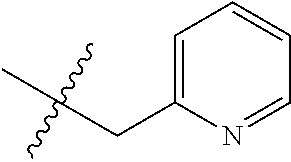 |
| X.29 | 3,5-Bis trifluoro methyl-phenyl |  |
| X.30 | 3,5-Bis trifluoro methyl-phenyl | 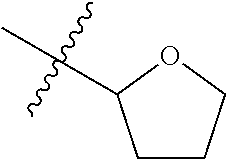 |
| X.31 | 3,5-Bis trifluoro methyl-phenyl |  |
| X.32 | 3,5-Bis trifluoro methyl-phenyl | —CH2—CF3 |
| X.33 | 3,5-Bis trifluoro methyl-phenyl | benzyl |
| X.34 | 3,5-Bis trifluoro methyl-phenyl |  |
| X.35 | 3,4,5-Trichloro-phenyl | 1,1-dioxo-thietan-3-yl- |
| X.36 | 3,4,5-Trichloro-phenyl | 3-methyl-thietan-3-yl- |
| X.37 | 3,4,5-Trichloro-phenyl | 1-oxo-thietan-3-yl- |
| X.38 | 3,4,5-Trichloro-phenyl | thietan-3-yl- |
| X.39 | 3,4,5-Trichloro-phenyl | 1-oxo-cyclobutan-3-yl |
| X.40 | 3,4,5-Trichloro-phenyl | cyclobutanone O-methyl- |
| oxime-3-yl | ||
| X.41 | 3,4,5-Trichloro-phenyl | cyclobutanone O-benzyl- |
| oxime-3-yl | ||
| X.42 | 3,4,5-Trichloro-phenyl | thietan-2-yl-methyl- |
| X.43 | 3,4,5-Trichloro-phenyl | 1-oxo-thietan-2-yl-methyl- |
| X.44 | 3,4,5-Trichloro-phenyl | 1,1-dioxo-thietan-2-yl-methyl- |
| X.45 | 3,4,5-Trichloro-phenyl |  |
| X.46 | 3,4,5-Trichloro-phenyl |  |
| X.47 | 3,4,5-Trichloro-phenyl |  |
| X.48 | 3,4,5-Trichloro-phenyl |  |
| X.49 | 3,4,5-Trichloro-phenyl | —CH2—CF3 |
| X.50 | 3,4,5-Trichloro-phenyl | benzyl |
| X.51 | 3,4,5-Trichloro-phenyl |  |
| X.52 | 3,5-dichloro-4-fluoro-phenyl | 1,1-dioxo-thietan-3-yl- |
| X.53 | 3,5-dichloro-4-fluoro-phenyl | 3-methyl-thietan-3-yl- |
| X.54 | 3,5-dichloro-4-fluoro-phenyl | 1-oxo-thietan-3-yl- |
| X.55 | 3,5-dichloro-4-fluoro-phenyl | thietan-3-yl- |
| X.56 | 3,5-dichloro-4-fluoro-phenyl | 1-oxo-cyclobutan-3-yl |
| X.57 | 3,5-dichloro-4-fluoro-phenyl | cyclobutanone O-methyl- |
| oxime-3-yl | ||
| X.58 | 3,5-dichloro-4-fluoro-phenyl | cyclobutanone O-benzyl- |
| oxime-3-yl | ||
| X.59 | 3,5-dichloro-4-fluoro-phenyl | thietan-2-yl-methyl- |
| X.60 | 3,5-dichloro-4-fluoro-phenyl | 1-oxo-thietan-2-yl-methyl- |
| X.61 | 3,5-dichloro-4-fluoro-phenyl | 1,1-dioxo-thietan-2-yl-methyl- |
| X.62 | 3,5-dichloro-4-fluoro-phenyl |  |
| X.63 | 3,5-dichloro-4-fluoro-phenyl |  |
| X.64 | 3,5-dichloro-4-fluoro-phenyl |  |
| X.65 | 3,5-dichloro-4-fluoro-phenyl |  |
| X.66 | 3,5-dichloro-4-fluoro-phenyl | —CH2—CF3 |
| X.67 | 3,5-dichloro-4-fluoro-phenyl | benzyl |
| X.68 | 3,5-dichloro-4-fluoro-phenyl |  |
| X.69 | 3-chloro-5-trifluoro methyl- | 1,1-dioxo-thietan-3-yl- |
| phenyl | ||
| X.70 | 3-chloro-5-trifluoro methyl- | 3-methyl-thietan-3-yl- |
| phenyl | ||
| X.71 | 3-chloro-5-trifluoro methyl- | 1-oxo-thietan-3-yl- |
| phenyl | ||
| X.72 | 3-chloro-5-trifluoro methyl- | thietan-3-yl- |
| phenyl | ||
| X.73 | 3-chloro-5-trifluoro methyl- | 1-oxo-cyclobutan-3-yl |
| phenyl | ||
| X.74 | 3-chloro-5-trifluoro methyl- | cyclobutanone O-methyl- |
| phenyl | oxime-3-yl | |
| X.75 | 3-chloro-5-trifluoro methyl- | cyclobutanone O-benzyl- |
| phenyl | oxime-3-yl | |
| X.76 | 3-chloro-5-trifluoro methyl- | thietan-2-yl-methyl- |
| phenyl | ||
| X.77 | 3-chloro-5-trifluoro methyl- | 1-oxo-thietan-2-yl-methyl- |
| phenyl | ||
| X.78 | 3-chloro-5-trifluoro methyl- | 1,1-dioxo-thietan-2-yl-methyl- |
| phenyl | ||
| X.79 | 3-chloro-5-trifluoro methyl- phenyl |  |
| X.80 | 3-chloro-5-trifluoro methyl- phenyl |  |
| X.81 | 3-chloro-5-trifluoro methyl- phenyl |  |
| X.82 | 3-chloro-5-trifluoro methyl- phenyl |  |
| X.83 | 3-chloro-5-trifluoro methyl- | —CH2—CF3 |
| phenyl | ||
| X.84 | 3-chloro-5-trifluoro methyl- | benzyl |
| phenyl | ||
| X.85 | 3-chloro-5-trifluoro methyl- phenyl |  |
| X.86 | 3-chloro-5-bromo-phenyl | 1,1-dioxo-thietan-3-yl- |
| X.87 | 3-chloro-5-bromo-phenyl | 3-methyl-thietan-3-yl- |
| X.88 | 3-chloro-5-bromo-phenyl | 1-oxo-thietan-3-yl- |
| X.89 | 3-chloro-5-bromo-phenyl | thietan-3-yl- |
| X.90 | 3-chloro-5-bromo-phenyl | 1-oxo-cyclobutan-3-yl |
| X.91 | 3-chloro-5-bromo-phenyl | cyclobutanone O-methyl- |
| oxime-3-yl | ||
| X.92 | 3-chloro-5-bromo-phenyl | cyclobutanone O-benzyl- |
| oxime-3-yl | ||
| X.93 | 3-chloro-5-bromo-phenyl | thietan-2-yl-methyl- |
| X.94 | 3-chloro-5-bromo-phenyl | 1-oxo-thietan-2-yl-methyl- |
| X.95 | 3-chloro-5-bromo-phenyl | 1,1-dioxo-thietan-2-yl-methyl- |
| X.96 | 3-chloro-5-bromo-phenyl |  |
| X.97 | 3-chloro-5-bromo-phenyl |  |
| X.98 | 3-chloro-5-bromo-phenyl |  |
| X.99 | 3-chloro-5-bromo-phenyl | 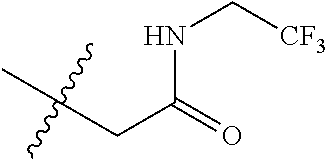 |
| X.100 | 3-chloro-5-bromo-phenyl | —CH2—CF3 |
| X.101 | 3-chloro-5-bromo-phenyl | benzyl |
| X.102 | 3-chloro-5-bromo-phenyl |  |
| X.103 | 3,5-dichloro-phenyl | cyclobutyl |
| X.104 | 3,5-dichloro-phenyl | cyclobutanone O-trifluoroethyl- |
| oxime-3-yl | ||
| X.105 | 3,5-dichloro-phenyl |  |
| X.106 | 3,5-dichloro-phenyl |  |
| X.107 | 3,5-dichloro-phenyl |  |
| X.108 | 3,5-dichloro-phenyl |  |
| X.109 | 3,5-Bis trifluoro methyl-phenyl | cyclobutyl |
| X.110 | 3,5-Bis trifluoro methyl-phenyl | cyclobutanone O-trifluoroethyl- |
| oxime-3-yl | ||
| X.111 | 3,5-Bis trifluoro methyl-phenyl |  |
| X.112 | 3,5-Bis trifluoro methyl-phenyl |  |
| X.113 | 3,5-Bis trifluoro methyl-phenyl |  |
| X.114 | 3,5-Bis trifluoro methyl-phenyl |  |
| X.115 | 3,4,5-Trichloro-phenyl | cyclobutyl |
| X.116 | 3,4,5-Trichloro-phenyl | cyclobutanone O-trifluoroethyl- |
| oxime-3-yl | ||
| X.117 | 3,4,5-Trichloro-phenyl |  |
| X.118 | 3,4,5-Trichloro-phenyl |  |
| X.119 | 3,4,5-Trichloro-phenyl |  |
| X.120 | 3,4,5-Trichloro-phenyl |  |
| X.121 | 3,5-dichloro-4-fluoro-phenyl | cyclobutyl |
| X.122 | 3,5-dichloro-4-fluoro-phenyl | cyclobutanone O-trifluoroethyl- |
| oxime-3-yl | ||
| X.123 | 3,5-dichloro-4-fluoro-phenyl |  |
| X.124 | 3,5-dichloro-4-fluoro-phenyl |  |
| X.125 | 3,5-dichloro-4-fluoro-phenyl |  |
| X.126 | 3,5-dichloro-4-fluoro-phenyl |  |
| X.127 | 3-chloro-5-trifluoro methyl- | cyclobutyl |
| phenyl | ||
| X.128 | 3-chloro-5-trifluoro methyl- | cyclobutanone O-trifluoroethyl- |
| phenyl | oxime-3-yl | |
| X.129 | 3-chloro-5-trifluoro methyl- phenyl |  |
| X.130 | 3-chloro-5-trifluoro methyl- phenyl |  |
| X.131 | 3-chloro-5-trifluoro methyl- phenyl |  |
| X.132 | 3-chloro-5-trifluoro methyl- phenyl |  |
| X.133 | 3-chloro-5-bromo-phenyl | cyclobutyl |
| X.134 | 3-chloro-5-bromo-phenyl | cyclobutanone O-trifluoroethyl- |
| oxime-3-yl | ||
| X.135 | 3-chloro-5-bromo-phenyl |  |
| X.136 | 3-chloro-5-bromo-phenyl |  |
| X.137 | 3-chloro-5-bromo-phenyl |  |
| X.138 | 3-chloro-5-bromo-phenyl |  |
Table 1
Table 1 discloses compounds 1.1 to 1.138 of the formula I-a

wherein R2 and R7 have the values given in the Table
Table 2
Table 2 discloses compounds 2.1 to 2.138 of the formula I-b

wherein R2 and R7 have the values given in the Table
Table 3
Table 3 discloses compounds 3.1 to 3.138 of the formula I-c

wherein R2 and R7 have the values given in the Table
Table 4
Table 4 discloses compounds 4.1 to 4.138 of the formula I-d

wherein R2 and R7 have the values given in the Table
Table 5
Table 5 discloses compounds 5.1 to 5.138 of the formula I-e

wherein R2 and R7 have the values given in the Table
Table 6
Table 6 discloses compounds 6.1 to 6.138 of the formula III-a

wherein R2 and R7 have the values given in the Table
Table 7
Table 7 discloses compounds 7.1 to 7.138 of the formula III-b

wherein R2 and R7 have the values given in the Table
Table 8
Table 8 discloses compounds 8.1 to 8.138 of the formula III-c

wherein R2 and R7 have the values given in the Table
Table 9
Table 9 discloses compounds 9.1 to 9.138 of the formula III-d

wherein R2 and R7 have the values given in the Table
Table 10
Table 10 discloses compounds 10.1 to 10.138 of the formula III-e

wherein R2 and R7 have the values given in the Table
Table 11
Table 11 discloses compounds 11.1 to 11.138 of the formula IV-a

wherein R2 and R7 have the values given in the Table
Table 12
Table 12 discloses compounds 12.1 to 12.138 of the formula IV-b

wherein R2 and R7 have the values given in the Table
Table 13
Table 13 discloses compounds 13.1 to 13.138 of the formula IV-c

wherein R2 and R7 have the values given in the Table
Table 14
Table 14 discloses compounds 14.1 to 14.138 of the formula IV-d

wherein R2 and R7 have the values given in the Table
Table 15
Table 15 discloses compounds 15.1 to 15.138 of the formula IV-e

wherein R2 and R7 have the values given in the Table
Table 16
Table 16 discloses compounds 16.1 to 16.138 of the formula II-a1

wherein R2 and R7 have the values given in the Table and R1 is CF3
Table 17
Table 17 discloses compounds 17.1 to 17.138 of the formula II-a2

wherein R2 and R7 have the values given in the Table and R1 is CF3
Table 18
Table 18 discloses compounds 18.1 to 18.138 of the formula II-b1

wherein R2 and R7 have the values given in the Table and R1 is CF3
Table 19
Table 19 discloses compounds 19.1 to 19.138 of the formula II-b2

wherein R2 and R7 have the values given in the Table and R1 is CF3
Table 20
Table 20 discloses compounds 20.1 to 20.138 of the formula II-c1

wherein R2 and R7 have the values given in the Table and R1 is CF3
Table 21
Table 21 discloses compounds 21.1 to 21.138 of the formula II-c2

Table 22
Table 22 discloses compounds 22.1 to 22.138 of the formula II-d1
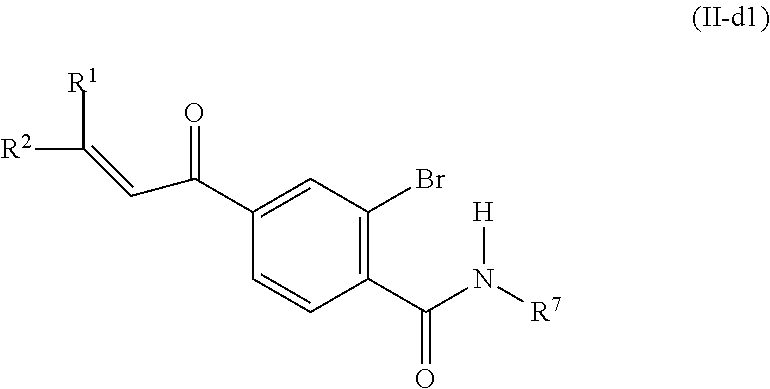
wherein R2 and R7 have the values given in the Table and R1 is CF3
Table 23
Table 23 discloses compounds 23.1 to 23.138 of the formula II-d2

wherein R2 and R7 have the values given in the Table and R1 is CF3
Table 24
Table 24 discloses compounds 24.1 to 24.138 of the formula II-e1

wherein R2 and R7 have the values given in the Table and R1 is CF3
Table 25
Table 25 discloses compounds 25.1 to 25.138 of the formula II-e2

wherein R2 and R7 have the values given in the Table and R1 is CF3.
Table 26
Table 26 discloses compounds 26.1 to 26.138 of the formula XXIII-a1

wherein R2 and R7 have the values given in the Table
Table 27
Table 27 discloses compounds 27.1 to 27.138 of the formula XXIII-b1

wherein R2 and R7 have the values given in the Table
Table 28
Table 28 discloses compounds 28.1 to 28.138 of the formula XXIII-c1

wherein R2 and R7 have the values given in the Table
Table 29
Table 29 discloses compounds 29.1 to 29.138 of the formula XXIII-d1

wherein R2 and R7 have the values given in the Table
Table 30
Table 30 discloses compounds 30.1 to 30.138 of the formula XXIII-e1

wherein R2 and R7 have the values given in the Table
Table 31
Table 31 discloses compounds 31.1 to 31.138 of the formula XXIII-a2

wherein R2 and R7 have the values given in the Table
Table 32
Table 32 discloses compounds 32.1 to 32.138 of the formula XXIII-b2

wherein R2 and R7 have the values given in the Table
Table 33
Table 33 discloses compounds 33.1 to 33.138 of the formula XXIII-c2

wherein R2 and R7 have the values given in the Table
Table 34
Table 34 discloses compounds 34.1 to 34.138 of the formula XXIII-d2

wherein R2 and R7 have the values given in the Table
Table 35
Table 35 discloses compounds 35.1 to 35.138 of the formula XXIII-e2

wherein R2 and R7 have the values given in the Table
Table 36
Table 36 discloses compounds 36.1 to 36.138 of the formula XXIII-a3

wherein R2 and R7 have the values given in the Table
Table 37
Table 37 discloses compounds 37.1 to 37.138 of the formula XXIII-b3

wherein R2 and R7 have the values given in the Table
Table 38
Table 38 discloses compounds 38.1 to 38.138 of the formula XXIII-c3

wherein R2 and R7 have the values given in the Table
Table 39
Table 39 discloses compounds 39.1 to 39.138 of the formula XXIII-d3

wherein R2 and R7 have the values given in the Table
Table 40
Table 40 discloses compounds 40.1 to 40.138 of the formula XXIII-e3

wherein R2 and R7 have the values given in the Table
Table 41
Table 41 discloses compounds 41.1 to 41.138 of the formula XXIV-a1

wherein R2 and R7 have the values given in the Table
Table 42
Table 42 discloses compounds 42.1 to 42.138 of the formula XXIV-b1

wherein R2 and R7 have the values given in the Table
Table 43
Table 43 discloses compounds 43.1 to 43.138 of the formula XXIV-c1

wherein R2 and R7 have the values given in the Table
Table 44
Table 44 discloses compounds 44.1 to 44.138 of the formula XXIV-d1

wherein R2 and R7 have the values given in the Table
Table 45
Table 45 discloses compounds 45.1 to 45.138 of the formula XXIV-e1

wherein R2 and R7 have the values given in the Table
Table 46
Table 46 discloses compounds 46.1 to 46.138 of the formula XXIV-a2

wherein R2 and R7 have the values given in the Table
Table 47
Table 47 discloses compounds 47.1 to 47.138 of the formula XXIV-b2

wherein R2 and R7 have the values given in the Table
Table 48
Table 48 discloses compounds 48.1 to 48.138 of the formula XXIV-c2

wherein R2 and R7 have the values given in the Table
Table 49
Table 49 discloses compounds 49.1 to 49.138 of the formula XXIV-d2

wherein R2 and R7 have the values given in the Table
Table 50
Table 50 discloses compounds 50.1 to 50.138 of the formula XXIV-e2

wherein R2 and R7 have the values given in the Table
Table 51
Table 51 discloses compounds 51.1 to 51.138 of the formula XXIV-a3

wherein R2 and R7 have the values given in the Table
Table 52
Table 52 discloses compounds 52.1 to 52.138 of the formula XXIV-b3

wherein R2 and R7 have the values given in the Table
Table 53
Table 53 discloses compounds 53.1 to 53.138 of the formula XXIV-c3

wherein R2 and R7 have the values given in the Table
Table 54
Table 54 discloses compounds 54.1 to 54.138 of the formula XXIV-d3

wherein R2 and R7 have the values given in the Table
Table 55
Table 55 discloses compounds 55.1 to 55.138 of the formula XXIV-e3

wherein R2 and R7 have the values given in the Table
Tables 56 to 66 provide further preferred compounds of the invention.
Table Y represents Table 56 when Y is 56, Table 57 when Y is 57, Table 58 when Y is 58, Table 59 when Y is 59, Table 60 when Y is 60, Table 61 when Y is 61, Table 62 when Y is 62, Table 63 when Y is 63, Table 64 when Y is 64, Table 65 when Y is 65, and Table 66 when Y is 66.
| No. | R2 | R5 | R |
| Y.1 | 3,5-dichloro-phenyl | CN |  |
| Y.2 | 3,5-dichloro-phenyl | CN |  |
| Y.3 | 3,5-dichloro-phenyl | CN |  |
| Y.4 | 3,5-dichloro-phenyl | CN |  |
| Y.5 | 3,5-dichloro-phenyl | H |  |
| Y.6 | 3,5-dichloro-phenyl | H |  |
| Y.7 | 3,5-dichloro-phenyl | Cl |  |
| Y.8 | 3,5-dichloro-phenyl | Cl |  |
| Y.9 | 3,5-dichloro-phenyl | Cl |  |
| Y.10 | 3,5-dichloro-phenyl | Cl |  |
| Y.11 | 3,5-dichloro-phenyl | Cl |  |
| Y.12 | 3,5-dichloro-phenyl | Cl |  |
| Y.13 | 3,5-dichloro-phenyl | Cl |  |
| Y.14 | 3,5-dichloro-phenyl | Cl |  |
| Y.15 | 3,5-dichloro-phenyl | Br |  |
| Y.16 | 3,5-dichloro-phenyl | Br |  |
| Y.17 | 3,5-dichloro-phenyl | Br |  |
| Y.18 | 3,5-dichloro-phenyl | Br |  |
| Y.19 | 3,5-dichloro-phenyl | Br |  |
| Y.20 | 3,5-dichloro-phenyl | Br |  |
| Y.21 | 3,5-dichloro-phenyl | Br |  |
| Y.22 | 3,5-dichloro-phenyl | Br |  |
| Y.23 | 3,5-dichloro-phenyl | CF3 |  |
| Y.24 | 3,5-dichloro-phenyl | CF3 |  |
| Y.25 | 3,5-dichloro-phenyl | CF3 |  |
| Y.26 | 3,5-dichloro-phenyl | CF3 |  |
| Y.27 | 3,5-dichloro-phenyl | CF3 |  |
| Y.28 | 3,5-dichloro-phenyl | CF3 |  |
| Y.29 | 3,5-dichloro-phenyl | CF3 |  |
| Y.30 | 3,5-dichloro-phenyl | CF3 |  |
| Y.31 | 3,5-Bis trifluoro methyl- phenyl | CN |  |
| Y.32 | 3,5-Bis trifluoro methyl- phenyl | CN |  |
| Y.33 | 3,5-Bis trifluoro methyl- phenyl | CN |  |
| Y.34 | 3,5-Bis trifluoro methyl- phenyl | CN |  |
| Y.35 | 3,5-Bis trifluoro methyl- phenyl | H |  |
| Y.36 | 3,5-Bis trifluoro methyl- phenyl | H |  |
| Y.37 | 3,5-Bis trifluoro methyl- phenyl | Cl |  |
| Y.38 | 3,5-Bis trifluoro methyl- phenyl | Cl |  |
| Y.39 | 3,5-Bis trifluoro methyl- phenyl | Cl |  |
| Y.40 | 3,5-Bis trifluoro methyl- phenyl | Cl |  |
| Y.41 | 3,5-Bis trifluoro methyl- phenyl | Cl |  |
| Y.42 | 3,5-Bis trifluoro methyl- phenyl | Cl |  |
| Y.43 | 3,5-Bis trifluoro methyl- phenyl | Cl |  |
| Y.44 | 3,5-Bis trifluoro methyl- phenyl | Cl |  |
| Y.45 | 3,5-Bis trifluoro methyl- phenyl | Br |  |
| Y.46 | 3,5-Bis trifluoro methyl- phenyl | Br |  |
| Y.47 | 3,5-Bis trifluoro methyl- phenyl | Br |  |
| Y.48 | 3,5-Bis trifluoro methyl- phenyl | Br |  |
| Y.49 | 3,5-Bis trifluoro methyl- phenyl | Br |  |
| Y.50 | 3,5-Bis trifluoro methyl- phenyl | Br |  |
| Y.51 | 3,5-Bis trifluoro methyl- phenyl | Br |  |
| Y.52 | 3,5-Bis trifluoro methyl- phenyl | Br | 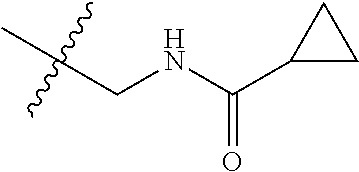 |
| Y.53 | 3,5-Bis trifluoro methyl- phenyl | CF3 |  |
| Y.54 | 3,5-Bis trifluoro methyl- phenyl | CF3 |  |
| Y.55 | 3,5-Bis trifluoro methyl- phenyl | CF3 |  |
| Y.56 | 3,5-Bis trifluoro methyl- phenyl | CF3 |  |
| Y.57 | 3,5-Bis trifluoro methyl- phenyl | CF3 |  |
| Y.58 | 3,5-Bis trifluoro methyl- phenyl | CF3 |  |
| Y.59 | 3,5-Bis trifluoro methyl- phenyl | CF3 |  |
| Y.60 | 3,5-Bis trifluoro methyl- phenyl | CF3 |  |
| Y.61 | 3,4,5-Trichloro-phenyl | CN |  |
| Y.62 | 3,4,5-Trichloro-phenyl | CN |  |
| Y.63 | 3,4,5-Trichloro-phenyl | CN |  |
| Y.64 | 3,4,5-Trichloro-phenyl | CN |  |
| Y.65 | 3,4,5-Trichloro-phenyl | H |  |
| Y.66 | 3,4,5-Trichloro-phenyl | H |  |
| Y.67 | 3,4,5-Trichloro-phenyl | Cl |  |
| Y.68 | 3,4,5-Trichloro-phenyl | Cl |  |
| Y.69 | 3,4,5-Trichloro-phenyl | Cl |  |
| Y.70 | 3,4,5-Trichloro-phenyl | Cl |  |
| Y.71 | 3,4,5-Trichloro-phenyl | Cl |  |
| Y.72 | 3,4,5-Trichloro-phenyl | Cl |  |
| Y.73 | 3,4,5-Trichloro-phenyl | Cl |  |
| Y.74 | 3,4,5-Trichloro-phenyl | Cl |  |
| Y.75 | 3,4,5-Trichloro-phenyl | Br |  |
| Y.76 | 3,4,5-Trichloro-phenyl | Br |  |
| Y.77 | 3,4,5-Trichloro-phenyl | Br |  |
| Y.78 | 3,4,5-Trichloro-phenyl | Br |  |
| Y.79 | 3,4,5-Trichloro-phenyl | Br |  |
| Y.80 | 3,4,5-Trichloro-phenyl | Br |  |
| Y.81 | 3,4,5-Trichloro-phenyl | Br |  |
| Y.82 | 3,4,5-Trichloro-phenyl | Br |  |
| Y.83 | 3,4,5-Trichloro-phenyl | CF3 |  |
| Y.84 | 3,4,5-Trichloro-phenyl | CF3 |  |
| Y.85 | 3,4,5-Trichloro-phenyl | CF3 |  |
| Y.86 | 3,4,5-Trichloro-phenyl | CF3 |  |
| Y.87 | 3,4,5-Trichloro-phenyl | CF3 |  |
| Y.88 | 3,4,5-Trichloro-phenyl | CF3 |  |
| Y.89 | 3,4,5-Trichloro-phenyl | CF3 |  |
| Y.90 | 3,4,5-Trichloro-phenyl | CF3 |  |
| Y.91 | 3,5-dichloro-4-fluoro- phenyl | CN |  |
| Y.92 | 3,5-dichloro-4-fluoro- phenyl | CN |  |
| Y.93 | 3,5-dichloro-4-fluoro- phenyl | CN |  |
| Y.94 | 3,5-dichloro-4-fluoro- phenyl | CN |  |
| Y.95 | 3,5-dichloro-4-fluoro- phenyl | H |  |
| Y.96 | 3,5-dichloro-4-fluoro- phenyl | H |  |
| Y.97 | 3,5-dichloro-4-fluoro- phenyl | Cl | 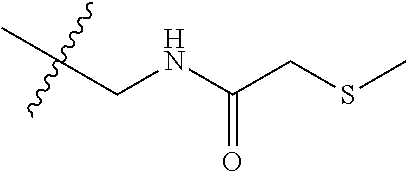 |
| Y.98 | 3,5-dichloro-4-fluoro- phenyl | Cl |  |
| Y.99 | 3,5-dichloro-4-fluoro- phenyl | Cl |  |
| Y.100 | 3,5-dichloro-4-fluoro- phenyl | Cl |  |
| Y.101 | 3,5-dichloro-4-fluoro- phenyl | Cl |  |
| Y.102 | 3,5-dichloro-4-fluoro- phenyl | Cl |  |
| Y.103 | 3,5-dichloro-4-fluoro- phenyl | Cl |  |
| Y.104 | 3,5-dichloro-4-fluoro- phenyl | Cl |  |
| Y.105 | 3,5-dichloro-4-fluoro- phenyl | Br |  |
| Y.106 | 3,5-dichloro-4-fluoro- phenyl | Br |  |
| Y.107 | 3,5-dichloro-4-fluoro- phenyl | Br |  |
| Y.108 | 3,5-dichloro-4-fluoro- phenyl | Br |  |
| Y.109 | 3,5-dichloro-4-fluoro- phenyl | Br |  |
| Y.110 | 3,5-dichloro-4-fluoro- phenyl | Br |  |
| Y.111 | 3,5-dichloro-4-fluoro- phenyl | Br |  |
| Y.112 | 3,5-dichloro-4-fluoro- phenyl | Br |  |
| Y.113 | 3,5-dichloro-4-fluoro- phenyl | CF3 |  |
| Y.114 | 3,5-dichloro-4-fluoro- phenyl | CF3 |  |
| Y.115 | 3,5-dichloro-4-fluoro- phenyl | CF3 |  |
| Y.116 | 3,5-dichloro-4-fluoro- phenyl | CF3 |  |
| Y.117 | 3,5-dichloro-4-fluoro- phenyl | CF3 |  |
| Y.118 | 3,5-dichloro-4-fluoro- phenyl | CF3 |  |
| Y.119 | 3,5-dichloro-4-fluoro- phenyl | CF3 |  |
| Y.120 | 3,5-dichloro-4-fluoro- phenyl | CF3 |  |
| Y.121 | 3-chloro-5- trifluoro methyl-phenyl | CN |  |
| Y.122 | 3-chloro-5- trifluoro methyl-phenyl | CN |  |
| Y.123 | 3-chloro-5- trifluoro methyl-phenyl | CN |  |
| Y.124 | 3-chloro-5- trifluoro methyl-phenyl | CN |  |
| Y.125 | 3-chloro-5- trifluoro methyl-phenyl | H |  |
| Y.126 | 3-chloro-5- trifluoro methyl-phenyl | H |  |
| Y.127 | 3-chloro-5- trifluoro methyl-phenyl | Cl |  |
| Y.128 | 3-chloro-5- trifluoro methyl-phenyl | Cl |  |
| Y.129 | 3-chloro-5- trifluoro methyl-phenyl | Cl |  |
| Y.130 | 3-chloro-5- trifluoro methyl-phenyl | Cl |  |
| Y.131 | 3-chloro-5- trifluoro methyl-phenyl | Cl |  |
| Y.132 | 3-chloro-5- trifluoro methyl-phenyl | Cl |  |
| Y.133 | 3-chloro-5- trifluoro methyl-phenyl | Cl |  |
| Y.134 | 3-chloro-5- trifluoro methyl-phenyl | Cl |  |
| Y.135 | 3-chloro-5- trifluoro methyl-phenyl | Br |  |
| Y.136 | 3-chloro-5- trifluoro methyl-phenyl | Br |  |
| Y.137 | 3-chloro-5- trifluoro methyl-phenyl | Br |  |
| Y.138 | 3-chloro-5- trifluoro methyl-phenyl | Br |  |
| Y.139 | 3-chloro-5- trifluoro methyl-phenyl | Br |  |
| Y.140 | 3-chloro-5- trifluoro methyl-phenyl | Br |  |
| Y.141 | 3-chloro-5- trifluoro methyl-phenyl | Br |  |
| Y.142 | 3-chloro-5- trifluoro methyl-phenyl | Br |  |
| Y.143 | 3-chloro-5- trifluoro methyl-phenyl | CF3 |  |
| Y.144 | 3-chloro-5- trifluoro methyl-phenyl | CF3 |  |
| Y.145 | 3-chloro-5- trifluoro methyl-phenyl | CF3 |  |
| Y.146 | 3-chloro-5- trifluoro methyl-phenyl | CF3 |  |
| Y.147 | 3-chloro-5- trifluoro methyl-phenyl | CF3 |  |
| Y.148 | 3-chloro-5- trifluoro methyl-phenyl | CF3 |  |
| Y.149 | 3-chloro-5- trifluoro methyl-phenyl | CF3 |  |
| Y.150 | 3-chloro-5- trifluoro methyl-phenyl | CF3 |  |
| Y.151 | 3-chloro-5-bromo-phenyl | CN |  |
| Y.152 | 3-chloro-5-bromo-phenyl | CN |  |
| Y.153 | 3-chloro-5-bromo-phenyl | CN |  |
| Y.154 | 3-chloro-5-bromo-phenyl | CN |  |
| Y.155 | 3-chloro-5-bromo-phenyl | H |  |
| Y.156 | 3-chloro-5-bromo-phenyl | H |  |
| Y.157 | 3-chloro-5-bromo-phenyl | Cl |  |
| Y.158 | 3-chloro-5-bromo-phenyl | Cl |  |
| Y.159 | 3-chloro-5-bromo-phenyl | Cl |  |
| Y.160 | 3-chloro-5-bromo-phenyl | Cl |  |
| Y.161 | 3-chloro-5-bromo-phenyl | Cl |  |
| Y.162 | 3-chloro-5-bromo-phenyl | Cl |  |
| Y.163 | 3-chloro-5-bromo-phenyl | Cl |  |
| Y.164 | 3-chloro-5-bromo-phenyl | Cl |  |
| Y.165 | 3-chloro-5-bromo-phenyl | Br |  |
| Y.166 | 3-chloro-5-bromo-phenyl | Br |  |
| Y.167 | 3-chloro-5-bromo-phenyl | Br |  |
| Y.168 | 3-chloro-5-bromo-phenyl | Br |  |
| Y.169 | 3-chloro-5-bromo-phenyl | Br |  |
| Y.170 | 3-chloro-5-bromo-phenyl | Br |  |
| Y.171 | 3-chloro-5-bromo-phenyl | Br |  |
| Y.172 | 3-chloro-5-bromo-phenyl | Br |  |
| Y.173 | 3-chloro-5-bromo-phenyl | CF3 |  |
| Y.174 | 3-chloro-5-bromo-phenyl | CF3 |  |
| Y.175 | 3-chloro-5-bromo-phenyl | CF3 |  |
| Y.176 | 3-chloro-5-bromo-phenyl | CF3 |  |
| Y.177 | 3-chloro-5-bromo-phenyl | CF3 |  |
| Y.178 | 3-chloro-5-bromo-phenyl | CF3 |  |
| Y.179 | 3-chloro-5-bromo-phenyl | CF3 |  |
| Y.180 | 3-chloro-5-bromo-phenyl | CF3 |  |
Table 56
Table 26 discloses compounds 56.1 to 56.180 of the formula I-f

wherein R2, R5 and R have the values given in the Table
Table 57
Table 57 discloses compounds 57.1 to 57.180 of the formula III-f

wherein R2, R5 and R have the values given in the Table
Table 58
Table 58 discloses compounds 58.1 to 58.180 of the formula IV-f

wherein R2, R5 and R have the values given in the Table
Table 59
Table 59 discloses compounds 59.1 to 59.180 of the formula II-f1

wherein R2, R5 and R have the values given in the Table and R1 is CF3
Table 60
Table 60 discloses compounds 60.1 to 60.180 of the formula II-f2

wherein R2, R5 and R have the values given in the Table and R1 is CF3
Table 61
Table 61 discloses compounds 61.1 to 61.180 of the formula XXIII-f1

wherein R2, R5 and R have the values given in the Table
Table 62
Table 62 discloses compounds 62.1 to 62.180 of the formula XXIII-f2

wherein R2, R5 and R have the values given in the Table
Table 63
Table 63 discloses compounds 63.1 to 63.180 of the formula XXIII-f3

wherein R2, R5 and R have the values given in the Table
Table 64
Table 64 discloses compounds 64.1 to 64.180 of the formula XXIV-f1

wherein R2, R5 and R have the values given in the Table
Table 65
Table 65 discloses compounds 65.1 to 65.180 of the formula XXIV-f2

wherein R2, R5 and R have the values given in the Table
Table 66
Table 66 discloses compounds 66.1 to 66.180 of the formula XXIV-f3

wherein R2, R5 and R have the values given in the Table
Tables 67 to 121 provide further preferred compounds of the invention.
Table Z represents Table 67 when Z is 67, Table 68 when Z is 68, Table 69 when Z is 69, Table 70 when Z is 70, Table 71 when Z is 71, Table 72 when Z is 72, Table 73 when Z is 73, Table 74 when Z is 74, Table 75 when Z is 75, Table 76 when Z is 76, Table 77 when Z is 77, Table 78 when Z is 78, Table 79 when Z is 79, Table 80 when Z is 80, Table 81 when Z is 81, Table 82 when Z is 82, Table 83 when Z is 83, Table 84 when Z is 84 and Table 85 when Z is 85, Table 86 when Z is 86, Table 87 when Z is 87, Table 88 when Z is 88, Table 89 when Z is 89, Table 90 when Z is 90, Table 91 when Z is 91, Table 92 when Z is 92, Table 93 when Z is 93, Table 94 when Z is 94, Table 95 when Z is 95, Table 96 when Z is 96, Table 97 when Z is 97, Table 98 when Z is 98, Table 99 when Z is 99, Table 100 when Z is 100, Table 101 when Z is 101, Table 102 when Z is 102, Table 103 when Z is 103, Table 104 when Z is 104 and Table 105 when Z is 105, Table 106 when Z is 106, Table 107 when Z is 107, Table 108 when Z is 108, Table 109 when Z is 109, Table 110 when Z is 110, Table 111 when Z is 111, Table 112 when Z is 112, Table 113 when Z is 113, Table 114 when Z is 114 and Table 115 when Z is 115, Table 116 when Z is 116, Table 117 when Z is 117, Table 118 when Z is 118, Table 119 when Z is 119, Table 120 when Z is 120, and Table 121 when Z is 121.
| No. | R2 | Q |
| Z.1 | 3,5-dichloro-phenyl | Cl |
| Z.2 | 3,5-dichloro-phenyl | Br |
| Z.3 | 3,5-dichloro-phenyl | I |
| Z.4 | 3,5-dichloro-phenyl | F |
| Z.5 | 3,5-dichloro-phenyl | NO2 |
| Z.6 | 3,5-dichloro-phenyl | NH2 |
| Z.7 | 3,5-dichloro-phenyl | Cyano |
| Z.8 | 3,5-dichloro-phenyl | —OMe |
| Z.9 | 3,5-dichloro-phenyl | —OEt |
| Z.10 | 3,5-dichloro-phenyl | —OSO2Me |
| Z.11 | 3,5-dichloro-phenyl | —OSO2CF3 |
| Z.12 | 3,5-dichloro-phenyl | —OSO2(p-tolyl) |
| Z.13 | 3,5-dichloro-phenyl | —C(═O)Cl |
| Z.14 | 3,5-dichloro-phenyl | —C(═O)F |
| Z.15 | 3,5-dichloro-phenyl | —C(═O)OH |
| Z.16 | 3,5-dichloro-phenyl | —C(═O)OMe |
| Z.17 | 3,5-dichloro-phenyl | —C(═O)OEt |
| Z.18 | 3,5-dichloro-phenyl | —C(═O)On-Pr |
| Z.19 | 3,5-dichloro-phenyl | —C(═O)Oi-Pr |
| Z.20 | 3,5-dichloro-phenyl | —C(═O)On-Bu |
| Z.21 | 3,5-dichloro-phenyl | —C(═O)Oi-Bu |
| Z.22 | 3,5-dichloro-phenyl | —C(═O)Ot-Bu |
| Z.23 | 3,5-dichloro-phenyl | —C(═O)Oallyl |
| Z.24 | 3,5-dichloro-phenyl | —C(═O)O-benzyl |
| Z.25 | 3,5-dichloro-phenyl | —C(═O)O-(2-pyridine). |
| Z.26 | 3,5-Bis trifluoro methyl-phenyl | Cl |
| Z.27 | 3,5-Bis trifluoro methyl-phenyl | Br |
| Z.28 | 3,5-Bis trifluoro methyl-phenyl | I |
| Z.29 | 3,5-Bis trifluoro methyl-phenyl | F |
| Z.30 | 3,5-Bis trifluoro methyl-phenyl | NO2 |
| Z.31 | 3,5-Bis trifluoro methyl-phenyl | NH2 |
| Z.32 | 3,5-Bis trifluoro methyl-phenyl | Cyano |
| Z.33 | 3,5-Bis trifluoro methyl-phenyl | —OMe |
| Z.34 | 3,5-Bis trifluoro methyl-phenyl | —OEt |
| Z.35 | 3,5-Bis trifluoro methyl-phenyl | —OSO2Me |
| Z.36 | 3,5-Bis trifluoro methyl-phenyl | —OSO2CF3 |
| Z.37 | 3,5-Bis trifluoro methyl-phenyl | —OSO2(p-tolyl) |
| Z.38 | 3,5-Bis trifluoro methyl-phenyl | —C(═O)Cl |
| Z.39 | 3,5-Bis trifluoro methyl-phenyl | —C(═O)F |
| Z.40 | 3,5-Bis trifluoro methyl-phenyl | —C(═O)OH |
| Z.41 | 3,5-Bis trifluoro methyl-phenyl | —C(═O)OMe |
| Z.42 | 3,5-Bis trifluoro methyl-phenyl | —C(═O)OEt |
| Z.43 | 3,5-Bis trifluoro methyl-phenyl | —C(═O)On-Pr |
| Z.44 | 3,5-Bis trifluoro methyl-phenyl | —C(═O)Oi-Pr |
| Z.45 | 3,5-Bis trifluoro methyl-phenyl | —C(═O)On-Bu |
| Z.46 | 3,5-Bis trifluoro methyl-phenyl | —C(═O)Oi-Bu |
| Z.47 | 3,5-Bis trifluoro methyl-phenyl | —C(═O)Ot-Bu |
| Z.48 | 3,5-Bis trifluoro methyl-phenyl | —C(═O)Oallyl |
| Z.49 | 3,5-Bis trifluoro methyl-phenyl | —C(═O)O-benzyl |
| Z.50 | 3,5-Bis trifluoro methyl-phenyl | —C(═O)O-(2-pyridine) |
| Z.51 | 3,4,5-Trichloro-phenyl | Cl |
| Z.52 | 3,4,5-Trichloro-phenyl | Br |
| Z.53 | 3,4,5-Trichloro-phenyl | I |
| Z.54 | 3,4,5-Trichloro-phenyl | F |
| Z.55 | 3,4,5-Trichloro-phenyl | NO2 |
| Z.56 | 3,4,5-Trichloro-phenyl | NH2 |
| Z.57 | 3,4,5-Trichloro-phenyl | Cyano |
| Z.58 | 3,4,5-Trichloro-phenyl | —OMe |
| Z.59 | 3,4,5-Trichloro-phenyl | —OEt |
| Z.60 | 3,4,5-Trichloro-phenyl | —OSO2Me |
| Z.61 | 3,4,5-Trichloro-phenyl | —OSO2CF3 |
| Z.62 | 3,4,5-Trichloro-phenyl | —OSO2(p-tolyl) |
| Z.63 | 3,4,5-Trichloro-phenyl | —C(═O)Cl |
| Z.64 | 3,4,5-Trichloro-phenyl | —C(═O)F |
| Z.65 | 3,4,5-Trichloro-phenyl | —C(═O)OH |
| Z.66 | 3,4,5-Trichloro-phenyl | —C(═O)OMe |
| Z.67 | 3,4,5-Trichloro-phenyl | —C(═O)OEt |
| Z.68 | 3,4,5-Trichloro-phenyl | —C(═O)On-Pr |
| Z.69 | 3,4,5-Trichloro-phenyl | —C(═O)Oi-Pr |
| Z.70 | 3,4,5-Trichloro-phenyl | —C(═O)On-Bu |
| Z.71 | 3,4,5-Trichloro-phenyl | —C(═O)Oi-Bu |
| Z.72 | 3,4,5-Trichloro-phenyl | —C(═O)Ot-Bu |
| Z.73 | 3,4,5-Trichloro-phenyl | —C(═O)Oallyl |
| Z.74 | 3,4,5-Trichloro-phenyl | —C(═O)O-benzyl |
| Z.75 | 3,4,5-Trichloro-phenyl | —C(═O)O-(2-pyridine) |
| Z.76 | 3,5-dichloro-4-fluoro-phenyl | Cl |
| Z.77 | 3,5-dichloro-4-fluoro-phenyl | Br |
| Z.78 | 3,5-dichloro-4-fluoro-phenyl | I |
| Z.79 | 3,5-dichloro-4-fluoro-phenyl | F |
| Z.80 | 3,5-dichloro-4-fluoro-phenyl | NO2 |
| Z.81 | 3,5-dichloro-4-fluoro-phenyl | NH2 |
| Z.82 | 3,5-dichloro-4-fluoro-phenyl | Cyano |
| Z.83 | 3,5-dichloro-4-fluoro-phenyl | —OMe |
| Z.84 | 3,5-dichloro-4-fluoro-phenyl | —OEt |
| Z.85 | 3,5-dichloro-4-fluoro-phenyl | —OSO2Me |
| Z.86 | 3,5-dichloro-4-fluoro-phenyl | —OSO2CF3 |
| Z.87 | 3,5-dichloro-4-fluoro-phenyl | —OSO2(p-tolyl) |
| Z.88 | 3,5-dichloro-4-fluoro-phenyl | —C(═O)Cl |
| Z.89 | 3,5-dichloro-4-fluoro-phenyl | —C(═O)F |
| Z.90 | 3,5-dichloro-4-fluoro-phenyl | —C(═O)OH |
| Z.91 | 3,5-dichloro-4-fluoro-phenyl | —C(═O)OMe |
| Z.92 | 3,5-dichloro-4-fluoro-phenyl | —C(═O)OEt |
| Z.93 | 3,5-dichloro-4-fluoro-phenyl | —C(═O)On-Pr |
| Z.94 | 3,5-dichloro-4-fluoro-phenyl | —C(═O)Oi-Pr |
| Z.95 | 3,5-dichloro-4-fluoro-phenyl | —C(═O)On-Bu |
| Z.96 | 3,5-dichloro-4-fluoro-phenyl | —C(═O)Oi-Bu |
| Z.97 | 3,5-dichloro-4-fluoro-phenyl | —C(═O)Ot-Bu |
| Z.98 | 3,5-dichloro-4-fluoro-phenyl | —C(═O)Oallyl |
| Z.99 | 3,5-dichloro-4-fluoro-phenyl | —C(═O)O-benzyl |
| Z.100 | 3,5-dichloro-4-fluoro-phenyl | —C(═O)O-(2-pyridine) |
| Z.101 | 3-chloro-5-trifluoro methyl-phenyl | Cl |
| Z.102 | 3-chloro-5-trifluoro methyl-phenyl | Br |
| Z.103 | 3-chloro-5-trifluoro methyl-phenyl | I |
| Z.104 | 3-chloro-5-trifluoro methyl-phenyl | F |
| Z.105 | 3-chloro-5-trifluoro methyl-phenyl | NO2 |
| Z.106 | 3-chloro-5-trifluoro methyl-phenyl | NH2 |
| Z.107 | 3-chloro-5-trifluoro methyl-phenyl | Cyano |
| Z.108 | 3-chloro-5-trifluoro methyl-phenyl | —OMe |
| Z.109 | 3-chloro-5-trifluoro methyl-phenyl | —OEt |
| Z.110 | 3-chloro-5-trifluoro methyl-phenyl | —OSO2Me |
| Z.111 | 3-chloro-5-trifluoro methyl-phenyl | —OSO2CF3 |
| Z.112 | 3-chloro-5-trifluoro methyl-phenyl | —OSO2(p-tolyl) |
| Z.113 | 3-chloro-5-trifluoro methyl-phenyl | —C(═O)Cl |
| Z.114 | 3-chloro-5-trifluoro methyl-phenyl | —C(═O)F |
| Z.115 | 3-chloro-5-trifluoro methyl-phenyl | —C(═O)OH |
| Z.116 | 3-chloro-5-trifluoro methyl-phenyl | —C(═O)OMe |
| Z.117 | 3-chloro-5-trifluoro methyl-phenyl | —C(═O)OEt |
| Z.118 | 3-chloro-5-trifluoro methyl-phenyl | —C(═O)On-Pr |
| Z.119 | 3-chloro-5-trifluoro methyl-phenyl | —C(═O)Oi-Pr |
| Z.120 | 3-chloro-5-trifluoro methyl-phenyl | —C(═O)On-Bu |
| Z.121 | 3-chloro-5-trifluoro methyl-phenyl | —C(═O)Oi-Bu |
| Z.122 | 3-chloro-5-trifluoro methyl-phenyl | —C(═O)Ot-Bu |
| Z.123 | 3-chloro-5-trifluoro methyl-phenyl | —C(═O)Oallyl |
| Z.124 | 3-chloro-5-trifluoro methyl-phenyl | —C(═O)O-benzyl |
| Z.125 | 3-chloro-5-trifluoro methyl-phenyl | —C(═O)O-(2-pyridine) |
| Z.126 | 3-chloro-5-bromo-phenyl | Cl |
| Z.127 | 3-chloro-5-bromo-phenyl | Br |
| Z.128 | 3-chloro-5-bromo-phenyl | I |
| Z.129 | 3-chloro-5-bromo-phenyl | F |
| Z.130 | 3-chloro-5-bromo-phenyl | NO2 |
| Z.131 | 3-chloro-5-bromo-phenyl | NH2 |
| Z.132 | 3-chloro-5-bromo-phenyl | Cyano |
| Z.133 | 3-chloro-5-bromo-phenyl | —OMe |
| Z.134 | 3-chloro-5-bromo-phenyl | —OEt |
| Z.135 | 3-chloro-5-bromo-phenyl | —OSO2Me |
| Z.136 | 3-chloro-5-bromo-phenyl | —OSO2CF3 |
| Z.137 | 3-chloro-5-bromo-phenyl | —OSO2(p-tolyl) |
| Z.138 | 3-chloro-5-bromo-phenyl | —C(═O)Cl |
| Z.139 | 3-chloro-5-bromo-phenyl | —C(═O)F |
| Z.140 | 3-chloro-5-bromo-phenyl | —C(═O)OH |
| Z.141 | 3-chloro-5-bromo-phenyl | —C(═O)OMe |
| Z.142 | 3-chloro-5-bromo-phenyl | —C(═O)OEt |
| Z.142 | 3-chloro-5-bromo-phenyl | —C(═O)On-Pr |
| Z.143 | 3-chloro-5-bromo-phenyl | —C(═O)Oi-Pr |
| Z.144 | 3-chloro-5-bromo-phenyl | —C(═O)On-Bu |
| Z.145 | 3-chloro-5-bromo-phenyl | —C(═O)Oi-Bu |
| Z.146 | 3-chloro-5-bromo-phenyl | —C(═O)Ot-Bu |
| Z.147 | 3-chloro-5-bromo-phenyl | —C(═O)Oallyl |
| Z.148 | 3-chloro-5-bromo-phenyl | —C(═O)O-benzyl |
| Z.149 | 3-chloro-5-bromo-phenyl | —C(═O)O-(2-pyridine) |
Table 67
Table 67 discloses compounds 671.1 to 67.149 of the formula I-aa

wherein R2 and Q have the values given in the Table
Table 68
Table 68 discloses compounds 68.1 to 68.149 of the formula I-bb

wherein R2 and Q have the values given in the Table
Table 69
Table 69 discloses compounds 69.1 to 69.149 of the formula I-cc

wherein R2 and Q have the values given in the Table
Table 70
Table 70 discloses compounds 70.1 to 70.149 of the formula I-dd

wherein R2 and Q have the values given in the Table
Table 71
Table 71 discloses compounds 71.1 to 71.149 of the formula I-ee

wherein R2 and Q have the values given in the Table
Table 72
Table 72 discloses compounds 72.1 to 72.149 of the formula III-aa

wherein R2 and Q have the values given in the Table
Table 73
Table 73 discloses compounds 73.1 to 73.149 of the formula III-bb

wherein R2 and Q have the values given in the Table
Table 74
Table 74 discloses compounds 74.1 to 74.149 of the formula III-cc

wherein R2 and Q have the values given in the Table
Table 759
Table 75 discloses compounds 75.1 to 75.149 of the formula III-dd

wherein R2 and Q have the values given in the Table
Table 76
Table 76 discloses compounds 76.1 to 76.149 of the formula III-ee

wherein R2 and Q have the values given in the Table
Table 77
Table 77 discloses compounds 77.1 to 77.149 of the formula IV-aa

wherein R2 and Q have the values given in the Table
Table 78
Table 78 discloses compounds 78.1 to 78.149 of the formula IV-bb

wherein R2 and Q have the values given in the Table
Table 79
Table 79 discloses compounds 79.1 to 79.149 of the formula IV-cc

wherein R2 and Q have the values given in the Table
Table 80
Table 80 discloses compounds 80.1 to 80.149 of the formula IV-dd

wherein R2 and Q have the values given in the Table
Table 81
Table 81 discloses compounds 81.1 to 81.149 of the formula IV-ee

wherein R2 and Q have the values given in the Table
Table 82
Table 82 discloses compounds 82.1 to 82.149 of the formula II-aa1

wherein R2 and Q have the values given in the Table and R1 is CF3
Table 83
Table 83 discloses compounds 83.1 to 837.149 of the formula II-aa2

wherein R2 and Q have the values given in the Table and R1 is CF3
Table 84
Table 84 discloses compounds 84.1 to 84.149 of the formula II-bb1

wherein R2 and Q have the values given in the Table and R1 is CF3
Table 85
Table 85 discloses compounds 85.1 to 85.149 of the formula II-bb2

wherein R2 and Q have the values given in the Table and R1 is CF3
Table 86
Table 50 discloses compounds 86.1 to 86.149 of the formula II-cc1

wherein R2 and Q have the values given in the Table and R1 is CF3
Table 87
Table 87 discloses compounds 87.1 to 87.149 of the formula II-cc2

wherein R2 and Q have the values given in the Table and R1 is CF3
Table 88
Table 88 discloses compounds 88.1 to 88.149 of the formula II-dd1

wherein R2 and Q have the values given in the Table and R1 is CF3
Table 89
Table 89 discloses compounds 89.1 to 89.149 of the formula II-dd2

wherein R2 and Q have the values given in the Table and R1 is CF3
Table 90
Table 90 discloses compounds 90.1 to 90.149 of the formula II-ee1

wherein R2 and Q have the values given in the Table and R1 is CF3
Table 91
Table 91 discloses compounds 91.1 to 91.149 of the formula II-ee2

wherein R2 and Q have the values given in the Table and R1 is CF3
Table 92
Table 92 discloses compounds 92.1 to 92.138 of the formula XXIII-aa1

wherein R2 and Q have the values given in the Table
Table 93
Table 93 discloses compounds 93.1 to 93.138 of the formula XXIII-bb1

wherein R2 and Q have the values given in the Table
Table 94
Table 94 discloses compounds 94.1 to 94.138 of the formula XXIII-cc1

wherein R2 and Q have the values given in the Table
Table 95
Table 95 discloses compounds 95.1 to 95.138 of the formula XXIII-dd1

wherein R2 and Q have the values given in the Table
Table 96
Table 96 discloses compounds 96.1 to 96.138 of the formula XXIII-ee1

wherein R2 and Q have the values given in the Table
Table 97
Table 97 discloses compounds 97.1 to 97.138 of the formula XXIII-aa2

wherein R2 and Q have the values given in the Table
Table 98
Table 98 discloses compounds 98.1 to 98.138 of the formula XXIII-bb2

wherein R2 and Q have the values given in the Table
Table 99
Table 99 discloses compounds 99.1 to 99.138 of the formula XXIII-cc2

wherein R2 and Q have the values given in the Table
Table 100
Table 100 discloses compounds 100.1 to 100.138 of the formula XXIII-dd2

wherein R2 and Q have the values given in the Table
Table 101
Table 101 discloses compounds 101.1 to 101.138 of the formula XXIII-ee2
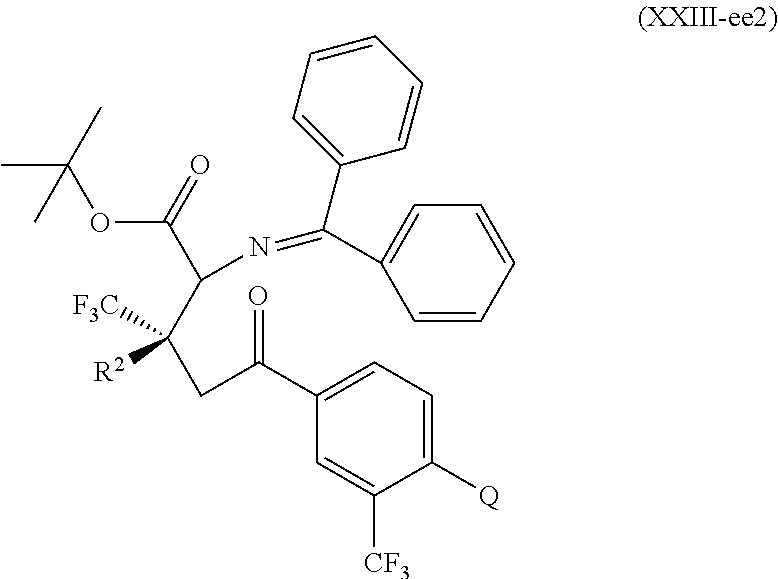
wherein R2 and Q have the values given in the Table
Table 102
Table 102 discloses compounds 102.1 to 102.138 of the formula XXIII-aa3

wherein R2 and Q have the values given in the Table
Table 103
Table 103 discloses compounds 103.1 to 103.138 of the formula XXIII-bb3

wherein R2 and Q have the values given in the Table
Table 104
Table 104 discloses compounds 104.1 to 104.138 of the formula XXIII-cc3

wherein R2 and Q have the values given in the Table
Table 105
Table 105 discloses compounds 105.1 to 105.138 of the formula XXIII-dd3

wherein R2 and Q have the values given in the Table
Table 106
Table 106 discloses compounds 106.1 to 106.138 of the formula XXIII-ee3

wherein R2 and Q have the values given in the Table
Table 107
Table 107 discloses compounds 107.1 to 107.138 of the formula XXIV-aa1

wherein R2 and Q have the values given in the Table
Table 108
Table 108 discloses compounds 108.1 to 108.138 of the formula XXIV-bb1

wherein R2 and Q have the values given in the Table
Table 109
Table 109 discloses compounds 109.1 to 109.138 of the formula XXIV-cc1

wherein R2 and Q have the values given in the Table
Table 110
Table 110 discloses compounds 110.1 to 110.138 of the formula XXIV-dd1

wherein R2 and Q have the values given in the Table
Table 111
Table 111 discloses compounds 111.1 to 111.138 of the formula XXIV-ee1

wherein R2 and Q have the values given in the Table
Table 112
Table 112 discloses compounds 112.1 to 112.138 of the formula XXIV-aa2

wherein R2 and Q have the values given in the Table
Table 113
Table 113 discloses compounds 113.1 to 113.138 of the formula XXIV-bb2

wherein R2 and Q have the values given in the Table
Table 114
Table 114 discloses compounds 114.1 to 114.138 of the formula XXIV-cc2

wherein R2 and Q have the values given in the Table
Table 115
Table 115 discloses compounds 115.1 to 115.138 of the formula XXIV-dd2

wherein R2 and Q have the values given in the Table
Table 116
Table 116 discloses compounds 116.1 to 116.138 of the formula XXIV-ee2

wherein R2 and Q have the values given in the Table
Table 117
Table 117 discloses compounds 117.1 to 117.138 of the formula XXIV-aa3

wherein R2 and R7 have the values given in the Table
Table 118

wherein R2 and Q have the values given in the Table
Table 119
Table 119 discloses compounds 119.1 to 119.138 of the formula XXIV-cc3

wherein R2 and Q have the values given in the Table
Table 120
Table 120 discloses compounds 120.1 to 120.138 of the formula XXIV-dd3

wherein R2 and Q have the values given in the Table
Table 121
Table 121 discloses compounds 121.1 to 121.138 of the formula XXIV-ee3

wherein R2 and Q have the values given in the Table


b) Organophosphates, such as profenofos, sulprofos, acephate, methyl parathion, azinphos-methyl, demeton-s-methyl, heptenophos, thiometon, fenamiphos, monocrotophos, profenofos, triazophos, methamidophos, dimethoate, phosphamidon, malathion, chlorpyrifos, phosalone, terbufos, fensulfothion, fonofos, phorate, phoxim, pirimiphos-methyl, pirimiphos-ethyl, fenitrothion, fosthiazate or diazinon;
c) Carbamates (including aryl carbamates), such as pirimicarb, triazamate, cloethocarb, carbofuran, furathiocarb, ethiofencarb, aldicarb, thiofurox, carbosulfan, bendiocarb, fenobucarb, propoxur, methomyl or oxamyl;
d) Benzoyl ureas, such as diflubenzuron, triflumuron, hexaflumuron, flufenoxuron, lufeneron or chlorfluazuron;
e) Organic tin compounds, such as cyhexatin, fenbutatin oxide or azocyclotin;
f) Pyrazoles, such as tebufenpyrad and fenpyroximate;
g) Macrolides, such as avermectins or milbemycins, for example abamectin, emamectin benzoate, ivermectin, milbemycin, spinosad, azadirachtin or spinetoram;
h) Hormones or pheromones;
i) Organochlorine compounds, such as endosulfan (in particular alpha-endosulfan), benzene hexachloride, DDT, chlordane or dieldrin;
j) Amidines, such as chlordimeform or amitraz;
k) Fumigant agents, such as chloropicrin, dichloropropane, methyl bromide or metam;
l) Neonicotinoid compounds, such as imidacloprid, thiacloprid, acetamiprid, nitenpyram, dinotefuran, thiamethoxam, clothianidin, nithiazine or flonicamid;
m) Diacylhydrazines, such as tebufenozide, chromafenozide or methoxyfenozide;
n) Diphenyl ethers, such as diofenolan or pyriproxifen;
o) Indoxacarb;
p) Chlorfenapyr;
q) Pymetrozine;
r) Spirotetramat, spirodiclofen or spiromesifen;
s) Diamides, such as flubendiamide, chlorantraniliprole (Rynaxypyr®) or cyantraniliprole;
t) Sulfoxaflor; or
u) Metaflumizone;
v) Fipronil and Ethiprole;
w) Pyrifluquinazon;
x) buprofezin; or
y) 4-[(6-Chloro-pyridin-3-ylmethyl)-(2,2-difluoro-ethyl)-amino]-5H-furan-2-one (DE 102006015467).
| MS | ZQ Mass Spectrometer from Waters (single quadrupole mass |
| spectrometer), ionization method: electrospray, polarity: nega- | |
| tive ionization, capillary (kV) 3.00, cone (V) 45.00, source | |
| temperature (° C.) 100, desolvation temperature (° C.) 250, | |
| cone gas flow (L/Hr) 50, desolvation gas flow (L/Hr) 400, | |
| mass range: 150 to 1000 Da. | |
| LC | HP 1100 HPLC from Agilent: solvent degasser, binary pump, |
| heated column compartment and diode-array detector. | |
| Column: Phenomenex Gemini C18, length (mm) 30, internal | |
| diameter (mm) 3, particle size (μm) 3, temperature (° C.) 60, | |
| DAD wavelength range (nm): 200 to 500, solvent gradient: | |
| A = 0.05% v/v formic acid in water and B = 0.04% v/v formic | |
| acid in acetonitrile/methanol (4:1). | |
| Time (min) | A % | B % | Flow (ml/min) | |
| 0.0 | 95 | 5.0 | 1.7 | |
| 2.0 | 0.0 | 100 | 1.7 | |
| 2.8 | 0.0 | 100 | 1.7 | |
| 2.9 | 95 | 5.0 | 1.7 | |
| 3.1 | 95 | 5 | 1.7 | |

- 1-((1S,2S)-2-Amino-cyclohexyl)-3-phenyl-thiourea and 1-((1S,2S)-2-amino-cyclohexyl)-3-(3,5-bis-trifluoromethyl-phenyl)-thiourea (as described in Mei, K.; Jin, M.; Zhang, S.; Li, P.;
- Liu, W.; Chen, X.; Xue, F.; Duan, W.; Wang, W. Org. Lett. 2009, 11, 2864)
- L-proline with 2,5-dimethylpiperazine as a base (as described in Hanessian, S.; Pham, V. Org. Lett. 2000, 2, 2975)
- (S)-5-Pyrrolidin-2-yl-1H-tetrazole (as described in Mitchell, C. E. T.; Brenner, S. E.; Ley, S. V Chem. Commun. 2005, 5346
- Jacobsen's (S,S)-(salen)Al catalyst (as described in Taylor, S. M; Zalatan, D. N.; Lercher, A. M.; Jacobsen, E. N. J. Am. Chem. Soc. 2005, 127, 1313)


| TABLE A |
| Table A provides compounds of formula (Ix) where R1 is |
| trifluoromethyl, R2 is 3,5-dichloro-phenyl-, R5b is methyl, |
| and R6 and R7 have the values listed in the table below. |
| (Ix) |
 |
| Compound | ||||
| No. | R6 | R7 | RT (min) | [M + H]+ |
| A1 | H | Thietan-3-yl | 1.88 | 487.28 |
| A2 | H | 1-Oxo-thietan-3-yl | 1.59 | 503.21 |
| A3 | H | 3-Methyl-thietan-3-yl | 1.97 | 501.25 |
| A4 | H | N-(2,2,2-trifluoro-ethyl)-acetamide | 1.76 | 554.26 |
| A5 | H | thietan-3-ylmethyl | 1.88 | 501.26 |
| A6 | H | oxetan-3-yl | 2.12 | 471.31 |
| A7 | H | 3-(2,2,2- | ||
| trifluoroethoxyimino)cyclobutyl | 1.97 | 580.18 | ||
| A8 | H | thietan-2-ylmethyl | 1.9 | 501.25 |
| A9 | H | (1,1-dioxothietan-2-yl)methyl | 1.68 | 533.23 |
| A10 | H | 2-(thietan-3-yl)ethyl | 1.93 | 515.2 |
| A11 | H | 2-(1,1-dioxothietan-3-yl)ethyl | 1.68 | 547.2 |
| A12 | H | 2,2,2-Trifluoro-ethyl | 1.9 | 497.23 |
| A13 | H | butyl | 1.96 | 471.3 |
| A14 | H | 3,3,3-trifluoroprop-1-yl | 1.91 | 511.25 |
| A15 | H | benzyl | 1.97 | 505.24 |
| A16 | H | (2-fluorophenyl)-methyl | 1.98 | 523.27 |
| A17 | H | (4-methoxyphenyl)-methyl | 1.95 | 535.28 |
| A18 | H | 3-fluorophenyl | 2.07 | 509.24 |
| A19 | H | 2-pyridylmethyl | 1.64 | 506.27 |
| A20 | H | Cyclobutyl | 1.91 | 469.29 |
| A21 | H | 2-methylsulfanylethyl | 1.86 | 489.32 |
| A22 | H | tetrahydrothiophen-3-yl | 1.89 | 501.24 |
Corresponding LC/MS Method
| MS | ACQUITY SQD Mass Spectrometer from Waters (Single quad- |
| rupole mass spectrometer) | |
| Ionisation method: Electrospray | |
| Polarity: positive ions | |
| Capillary (kV) 3.00, Cone (V) 20.00, Extractor (V) 3.00, Source | |
| Temperature (° C.) 150, Desolvation Temperature (° C.) 400, | |
| Cone Gas Flow (L/Hr) 60, Desolvation Gas Flow (L/Hr) 700 | |
| Mass range: 100 to 800 Da | |
| DAD Wavelength range (nm): 210 to 400 | |
| LC | Method Waters ACQUITY UPLC with the following HPLC |
| gradient conditions (Solvent A: Water/Methanol 9:1, 0.1% formic | |
| acid and Solvent B: Acetonitrile, 0.1% formic acid ) | |
| Time (minutes) | A (%) | B (%) | Flow rate (ml/min) | |
| 0 | 100 | 0 | 0.75 | |
| 2.5 | 0 | 100 | 0.75 | |
| 2.8 | 0 | 100 | 0.75 | |
| 3.0 | 100 | 0 | 0.75 | |
| Type of column: Waters ACQUITY UPLC HSS T3; Column | |
| length: 30 mm; Internal diameter of column: 2.1 mm; Particle | |
| Size: 1.8 micron; Temperature: 60° C. | |
| Insects: | % Control at | % Control at | ||
| Heliothis virescens | 200 ppm | 12.5 ppm | ||
| Compound A23 | 100 | 100 | ||
| Compound A24 | 100 | 50 | ||
Diabrotica balteata (Corn Root Worm):
| Insects: | % Control at | % Control at | ||
| Diabrotica balteata | 200 ppm | 12.5 ppm | ||
| Compound A23 | 100 | 100 | ||
| Compound A24 | 100 | 0 | ||
Thrips tabaci (Onion Thrips):
| Insects: | % Control at | % Control at | ||
| Thrips tabaci | 200 ppm | 12.5 ppm | ||
| Compound A23 | 100 | 100 | ||
| Compound A24 | 100 | 40 | ||
Claims (16)


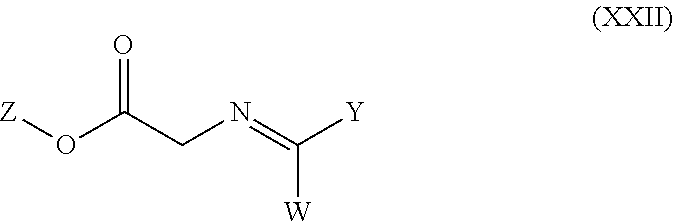


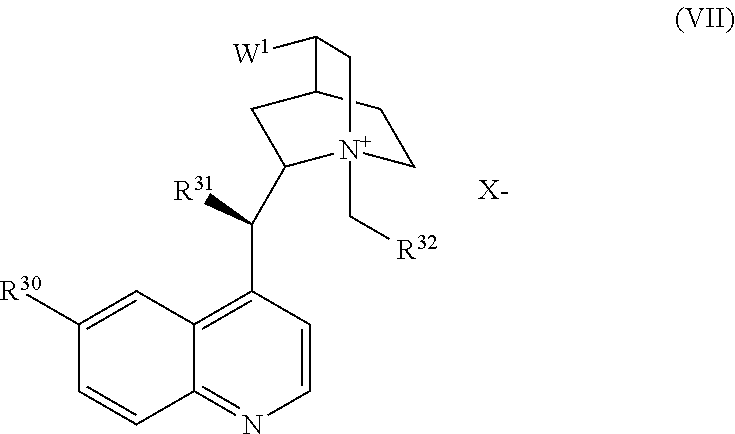


Applications Claiming Priority (7)
| Application Number | Priority Date | Filing Date | Title |
|---|---|---|---|
| EPPCT/EP2010/058207 | 2010-06-11 | ||
| PCT/EP2010/058207 WO2010149506A1 (en) | 2009-06-22 | 2010-06-11 | Insecticidal compounds |
| WOPCT/EP2010/058207 | 2010-06-11 | ||
| EP10196633.1 | 2010-12-22 | ||
| EP10196633 | 2010-12-22 | ||
| EP10196633 | 2010-12-22 | ||
| PCT/EP2011/059823 WO2011154555A1 (en) | 2010-06-11 | 2011-06-14 | Process for the preparation of dihydropyrrole derivatives |
Publications (2)
| Publication Number | Publication Date |
|---|---|
| US20130237583A1 US20130237583A1 (en) | 2013-09-12 |
| US9233920B2 true US9233920B2 (en) | 2016-01-12 |
Family
ID=44627703
Family Applications (1)
| Application Number | Title | Priority Date | Filing Date |
|---|---|---|---|
| US13/703,630 Expired - Fee Related US9233920B2 (en) | 2010-06-11 | 2011-06-14 | Process for the preparation of dihydropyrrole derivatives |
Country Status (15)
| Country | Link |
|---|---|
| US (1) | US9233920B2 (en) |
| EP (1) | EP2580211B1 (en) |
| JP (2) | JP2013529594A (en) |
| KR (1) | KR20130132726A (en) |
| CN (1) | CN102939288B (en) |
| AU (1) | AU2011263655B2 (en) |
| BR (1) | BR112012031406A2 (en) |
| CA (1) | CA2800114A1 (en) |
| CL (1) | CL2012003491A1 (en) |
| CO (1) | CO6640266A2 (en) |
| MX (1) | MX2012014410A (en) |
| PH (1) | PH12012502363A1 (en) |
| RU (1) | RU2013100441A (en) |
| TW (1) | TW201211057A (en) |
| WO (1) | WO2011154555A1 (en) |
Families Citing this family (14)
| Publication number | Priority date | Publication date | Assignee | Title |
|---|---|---|---|---|
| WO2012156400A1 (en) | 2011-05-18 | 2012-11-22 | Syngenta Participations Ag | Insecticidal compounds based on arylthioacetamide derivatives |
| US9204648B2 (en) * | 2011-08-25 | 2015-12-08 | Syngenta Participations Ag | Process for the preparation of thietane derivatives |
| WO2013026929A1 (en) * | 2011-08-25 | 2013-02-28 | Syngenta Participations Ag | Dihydropyrrole derivatives as insecticidal compounds |
| KR20140054302A (en) | 2011-08-25 | 2014-05-08 | 신젠타 파티서페이션즈 아게 | Isoxazoline derivatives as insecticidal compounds |
| EP3896058A3 (en) * | 2011-10-03 | 2022-01-12 | Syngenta Participations Ag | Enantionselective processes to insecticidal 3-aryl-3-trifluoromethyl-substituted pyrrolidines |
| US9469633B2 (en) | 2011-10-03 | 2016-10-18 | Syngenta Participations Ag | Processes for the preparation of pyrrolidine intermediates |
| MX336431B (en) | 2012-05-09 | 2016-01-18 | Zoetis Services Llc | Azetidine derivatives as antiparasitic agents. |
| CN104520287A (en) | 2012-08-03 | 2015-04-15 | 先正达参股股份有限公司 | Methods of controlling insects |
| CN103772233B (en) * | 2014-01-06 | 2015-06-10 | 华东师范大学 | Multi-halothane five-member cyclic nitrone derivative and preparation method thereof |
| CA3047724A1 (en) * | 2016-12-21 | 2018-06-28 | Fmc Corporation | Nitrone herbicides |
| GB201800894D0 (en) * | 2018-01-19 | 2018-03-07 | Syngenta Participations Ag | Improvements in or relating to organic compounds |
| CN118076600A (en) * | 2022-09-21 | 2024-05-24 | 青岛康乔药业集团有限公司 | Compounds containing five-membered heterocycles and preparation methods and applications thereof |
| CN120774881A (en) * | 2024-04-01 | 2025-10-14 | 山东康乔生物科技有限公司 | Preparation method of isoxazoline compound containing sulfone five-membered heterocyclic group |
| CN119504491B (en) * | 2024-11-25 | 2025-11-18 | 哈尔滨理工大学 | An efficient method for preparing optically pure β-cyanoketone and its application |
Citations (2)
| Publication number | Priority date | Publication date | Assignee | Title |
|---|---|---|---|---|
| WO2009072621A1 (en) * | 2007-12-07 | 2009-06-11 | Nissan Chemical Industries, Ltd. | Substituted dihydroazole compound and pest control agent |
| WO2011128299A1 (en) * | 2010-04-13 | 2011-10-20 | Bayer Cropscience Ag | Process for the preparation of pyrrolines from gamma-nitroketones. use of the gamma-nitroketones as pesticidal agents |
Family Cites Families (14)
| Publication number | Priority date | Publication date | Assignee | Title |
|---|---|---|---|---|
| US102011A (en) * | 1870-04-19 | Improvement in dovetailing-machine | ||
| US62009A (en) * | 1867-02-12 | Charles t | ||
| JP5007788B2 (en) | 2005-05-16 | 2012-08-22 | 日産化学工業株式会社 | Dihydroazole-substituted benzamide compounds and pest control agents |
| UY30090A1 (en) | 2006-01-16 | 2007-08-31 | Syngenta Participations Ag | NEW INSECTICIDES |
| DE102006015467A1 (en) | 2006-03-31 | 2007-10-04 | Bayer Cropscience Ag | New cyclic enamine ketone derivatives useful for controlling pests, especially insects |
| JP5164525B2 (en) | 2006-11-01 | 2013-03-21 | 日本曹達株式会社 | Nitrogen-containing heterocyclic compounds and pest control agents |
| WO2009005015A1 (en) | 2007-06-29 | 2009-01-08 | Nissan Chemical Industries, Ltd. | Substituted isoxazoline or enone oxime compound, and pest control agent |
| TWI556741B (en) * | 2007-08-17 | 2016-11-11 | 英特威特國際股份有限公司 | Isoxazoline compositions and their use as antiparasitics |
| TWI411395B (en) | 2007-12-24 | 2013-10-11 | Syngenta Participations Ag | Insecticidal compounds |
| ES2530064T3 (en) * | 2008-02-07 | 2015-02-26 | Bayer Cropscience Ag | Insecticide arylpyrrolines |
| EP2331536B1 (en) * | 2008-08-22 | 2013-08-21 | Syngenta Participations AG | Insecticidal compounds |
| CN101519335A (en) * | 2009-04-10 | 2009-09-02 | 北京化工大学 | Method for improving selectivity of heterogeneous asymmetric catalytic reaction enantiomer |
| JP2010254629A (en) | 2009-04-27 | 2010-11-11 | Bayer Cropscience Ag | Optically active azoline derivative |
| JP5684802B2 (en) * | 2009-06-22 | 2015-03-18 | シンジェンタ パーティシペーションズ アクチェンゲゼルシャフト | Insecticidal compounds |
-
2011
- 2011-06-10 TW TW100120275A patent/TW201211057A/en unknown
- 2011-06-14 AU AU2011263655A patent/AU2011263655B2/en not_active Ceased
- 2011-06-14 US US13/703,630 patent/US9233920B2/en not_active Expired - Fee Related
- 2011-06-14 WO PCT/EP2011/059823 patent/WO2011154555A1/en not_active Ceased
- 2011-06-14 MX MX2012014410A patent/MX2012014410A/en unknown
- 2011-06-14 CA CA2800114A patent/CA2800114A1/en not_active Abandoned
- 2011-06-14 JP JP2013513716A patent/JP2013529594A/en active Pending
- 2011-06-14 PH PH1/2012/502363A patent/PH12012502363A1/en unknown
- 2011-06-14 RU RU2013100441/04A patent/RU2013100441A/en not_active Application Discontinuation
- 2011-06-14 BR BR112012031406A patent/BR112012031406A2/en not_active IP Right Cessation
- 2011-06-14 KR KR1020137000733A patent/KR20130132726A/en not_active Withdrawn
- 2011-06-14 EP EP11728598.1A patent/EP2580211B1/en not_active Not-in-force
- 2011-06-14 CN CN201180028707.8A patent/CN102939288B/en not_active Expired - Fee Related
-
2012
- 2012-12-10 CO CO12223249A patent/CO6640266A2/en not_active Application Discontinuation
- 2012-12-10 CL CL2012003491A patent/CL2012003491A1/en unknown
-
2016
- 2016-05-12 JP JP2016096424A patent/JP2016210779A/en not_active Abandoned
Patent Citations (3)
| Publication number | Priority date | Publication date | Assignee | Title |
|---|---|---|---|---|
| WO2009072621A1 (en) * | 2007-12-07 | 2009-06-11 | Nissan Chemical Industries, Ltd. | Substituted dihydroazole compound and pest control agent |
| US8268754B2 (en) * | 2007-12-07 | 2012-09-18 | Nissan Chemical Industries, Ltd. | Substituted dihydroazole compound and pest control agent |
| WO2011128299A1 (en) * | 2010-04-13 | 2011-10-20 | Bayer Cropscience Ag | Process for the preparation of pyrrolines from gamma-nitroketones. use of the gamma-nitroketones as pesticidal agents |
Non-Patent Citations (1)
| Title |
|---|
| Matoba, et al., Angew. Chem. Int. Ed., 49:5762 (Jul. 7, 2010). * |
Also Published As
| Publication number | Publication date |
|---|---|
| CA2800114A1 (en) | 2011-12-15 |
| RU2013100441A (en) | 2014-07-20 |
| EP2580211B1 (en) | 2015-08-19 |
| KR20130132726A (en) | 2013-12-05 |
| TW201211057A (en) | 2012-03-16 |
| US20130237583A1 (en) | 2013-09-12 |
| BR112012031406A2 (en) | 2015-09-22 |
| CN102939288B (en) | 2015-09-30 |
| CO6640266A2 (en) | 2013-03-22 |
| AU2011263655A1 (en) | 2012-12-13 |
| EP2580211A1 (en) | 2013-04-17 |
| JP2013529594A (en) | 2013-07-22 |
| MX2012014410A (en) | 2013-03-12 |
| CL2012003491A1 (en) | 2013-05-24 |
| CN102939288A (en) | 2013-02-20 |
| AU2011263655B2 (en) | 2014-07-03 |
| JP2016210779A (en) | 2016-12-15 |
| PH12012502363A1 (en) | 2013-02-11 |
| WO2011154555A1 (en) | 2011-12-15 |
Similar Documents
| Publication | Publication Date | Title |
|---|---|---|
| US9233920B2 (en) | Process for the preparation of dihydropyrrole derivatives | |
| US10364235B2 (en) | Insecticidal compounds | |
| US8980892B2 (en) | Insecticidal compounds | |
| US9282742B2 (en) | Insecticidal compounds | |
| EP2331515B1 (en) | Insceticidal compounds | |
| US9216973B2 (en) | Insecticidal compounds | |
| US20110288131A1 (en) | Insecticidal compounds | |
| US20140080877A1 (en) | Insecticidal compounds | |
| US8193362B2 (en) | Insecticidal compounds | |
| US8455399B2 (en) | N-(4-perfluoroalkyl-phenyl)-4-triazolyl-benzamides as insecticides | |
| US20160073631A1 (en) | Process for the preparation of dihydropyrrole derivatives | |
| HK1163694B (en) | Insecticidal compounds |
Legal Events
| Date | Code | Title | Description |
|---|---|---|---|
| AS | Assignment |
Owner name: SYNGENTA LIMITED, UNITED KINGDOM Free format text: ASSIGNMENT OF ASSIGNORS INTEREST;ASSIGNORS:EL QACEMI, MYRIEM;SMITS, HELMARS;CASSAYRE, JEROME YVES;AND OTHERS;REEL/FRAME:032542/0749 Effective date: 20110613 Owner name: SYNGENTA PARTICIPATIONS AG, SWITZERLAND Free format text: ASSIGNMENT OF ASSIGNORS INTEREST;ASSIGNORS:EL QACEMI, MYRIEM;SMITS, HELMARS;CASSAYRE, JEROME YVES;AND OTHERS;REEL/FRAME:032542/0749 Effective date: 20110613 |
|
| STCF | Information on status: patent grant |
Free format text: PATENTED CASE |
|
| FEPP | Fee payment procedure |
Free format text: MAINTENANCE FEE REMINDER MAILED (ORIGINAL EVENT CODE: REM.); ENTITY STATUS OF PATENT OWNER: LARGE ENTITY |
|
| LAPS | Lapse for failure to pay maintenance fees |
Free format text: PATENT EXPIRED FOR FAILURE TO PAY MAINTENANCE FEES (ORIGINAL EVENT CODE: EXP.); ENTITY STATUS OF PATENT OWNER: LARGE ENTITY |
|
| STCH | Information on status: patent discontinuation |
Free format text: PATENT EXPIRED DUE TO NONPAYMENT OF MAINTENANCE FEES UNDER 37 CFR 1.362 |
|
| FP | Lapsed due to failure to pay maintenance fee |
Effective date: 20200112 |