US9229319B2 - Photoacid-generating copolymer and associated photoresist composition, coated substrate, and method of forming an electronic device - Google Patents
Photoacid-generating copolymer and associated photoresist composition, coated substrate, and method of forming an electronic device Download PDFInfo
- Publication number
- US9229319B2 US9229319B2 US14/527,961 US201414527961A US9229319B2 US 9229319 B2 US9229319 B2 US 9229319B2 US 201414527961 A US201414527961 A US 201414527961A US 9229319 B2 US9229319 B2 US 9229319B2
- Authority
- US
- United States
- Prior art keywords
- copolymer
- monomer
- photoresist composition
- photoacid
- acid
- Prior art date
- Legal status (The legal status is an assumption and is not a legal conclusion. Google has not performed a legal analysis and makes no representation as to the accuracy of the status listed.)
- Active
Links
- 0 [1*]/C([2*])=C(/[3*])C[Ar] Chemical compound [1*]/C([2*])=C(/[3*])C[Ar] 0.000 description 21
- PPXAHQRRLKQYTG-UHFFFAOYSA-N C=C(C)C(=O)OC(C)(C)C1=CC=CC=C1 Chemical compound C=C(C)C(=O)OC(C)(C)C1=CC=CC=C1 PPXAHQRRLKQYTG-UHFFFAOYSA-N 0.000 description 3
- WNFADAUSCLYOJV-UHFFFAOYSA-N C=C(C)C(=O)OC(C)C1=CC=CC=C1.C=C(C)C(=O)OCC1=C(F)C(F)=C(F)C(F)=C1F.C=C(C)C(=O)OCC1=CC=CC=C1.C=C(C)C1=CC=C2C=CC=CC2=C1.C=C(C)C1=CC=CC=C1.CC.CC.CC.CC Chemical compound C=C(C)C(=O)OC(C)C1=CC=CC=C1.C=C(C)C(=O)OCC1=C(F)C(F)=C(F)C(F)=C1F.C=C(C)C(=O)OCC1=CC=CC=C1.C=C(C)C1=CC=C2C=CC=CC2=C1.C=C(C)C1=CC=CC=C1.CC.CC.CC.CC WNFADAUSCLYOJV-UHFFFAOYSA-N 0.000 description 3
- QSUJHKWXLIQKEY-UHFFFAOYSA-N C=C(C)C(=O)OC1CCOC1=O Chemical compound C=C(C)C(=O)OC1CCOC1=O QSUJHKWXLIQKEY-UHFFFAOYSA-N 0.000 description 3
- JEMFVJGVBCTALE-UHFFFAOYSA-I C1=CC=C([S+](C2=CC=CC=C2)C2=CC=CC=C2)C=C1.C1=CC=C([S+]2C3=C(C=CC=C3)C3=C2C=CC=C3)C=C1.C=C(C)C(=O)OCC(F)(F)S(=O)(=O)[O-].C=C(C)C(=O)OCC(F)(F)S(=O)(=O)[O-].C=C(C)C(=O)OCC(F)(F)S(=O)(=O)[O-].C=C(C)C(=O)OCC(F)(F)S(=O)(=O)[O-].C=C(C)C(=O)OCC(F)(F)S(=O)(=O)[O-].CC(C)(C)C1=CC=C([S+]2C3=C(C=CC=C3)C3=C2C=CC=C3)C=C1.CCC1(OC(=O)COC2=C(C)C=C([S+]3C4=C(C=CC=C4)C4=C3C=CC=C4)C=C2C)CCCC1 Chemical compound C1=CC=C([S+](C2=CC=CC=C2)C2=CC=CC=C2)C=C1.C1=CC=C([S+]2C3=C(C=CC=C3)C3=C2C=CC=C3)C=C1.C=C(C)C(=O)OCC(F)(F)S(=O)(=O)[O-].C=C(C)C(=O)OCC(F)(F)S(=O)(=O)[O-].C=C(C)C(=O)OCC(F)(F)S(=O)(=O)[O-].C=C(C)C(=O)OCC(F)(F)S(=O)(=O)[O-].C=C(C)C(=O)OCC(F)(F)S(=O)(=O)[O-].CC(C)(C)C1=CC=C([S+]2C3=C(C=CC=C3)C3=C2C=CC=C3)C=C1.CCC1(OC(=O)COC2=C(C)C=C([S+]3C4=C(C=CC=C4)C4=C3C=CC=C4)C=C2C)CCCC1 JEMFVJGVBCTALE-UHFFFAOYSA-I 0.000 description 2
- QCGVORUTFMHEMA-UHFFFAOYSA-K C1=CC=C([S+](C2=CC=CC=C2)C2=CC=CC=C2)C=C1.C=C(C)C(=O)OCC(F)(F)S(=O)(=O)[O-].C=C(C)C(=O)OCC(F)(F)S(=O)(=O)[O-].C=C(C)C(=O)OCC(F)(F)S(=O)(=O)[O-].C=C(C)C(=O)OCCC(F)(F)C(C)(F)F.CC(C)(C)C1=CC=C([I+]C2=CC=C(C(C)(C)C)C=C2)C=C1.CC(C)(C)C1=CC=C([I+]C2=CC=CC=C2)C=C1.CC1=CC([S+]2C3=C(C=CC=C3)C3=C2C=CC=C3)=CC(C)=C1OCC(=O)OC1(C)C2CC3CC(C2)CC1C3.COC1=C(C(CC(=O)OC2(C)C3CC4CC(C3)CC2C4)C(=O)OCC(=O)CC2(C)C3CC4CC(C3)CC2C4)C=C([S+]2C3=C(C=CC=C3)C3=C2C=CC=C3)C=C1 Chemical compound C1=CC=C([S+](C2=CC=CC=C2)C2=CC=CC=C2)C=C1.C=C(C)C(=O)OCC(F)(F)S(=O)(=O)[O-].C=C(C)C(=O)OCC(F)(F)S(=O)(=O)[O-].C=C(C)C(=O)OCC(F)(F)S(=O)(=O)[O-].C=C(C)C(=O)OCCC(F)(F)C(C)(F)F.CC(C)(C)C1=CC=C([I+]C2=CC=C(C(C)(C)C)C=C2)C=C1.CC(C)(C)C1=CC=C([I+]C2=CC=CC=C2)C=C1.CC1=CC([S+]2C3=C(C=CC=C3)C3=C2C=CC=C3)=CC(C)=C1OCC(=O)OC1(C)C2CC3CC(C2)CC1C3.COC1=C(C(CC(=O)OC2(C)C3CC4CC(C3)CC2C4)C(=O)OCC(=O)CC2(C)C3CC4CC(C3)CC2C4)C=C([S+]2C3=C(C=CC=C3)C3=C2C=CC=C3)C=C1 QCGVORUTFMHEMA-UHFFFAOYSA-K 0.000 description 2
- OPCQIBSSPNPWEN-UHFFFAOYSA-N C1=CC=C([SH]2C3=CC=CC=C3C3=C2C=CC=C3)C=C1.C=C(C)C(=O)OCCC(F)(F)C(C)(F)F Chemical compound C1=CC=C([SH]2C3=CC=CC=C3C3=C2C=CC=C3)C=C1.C=C(C)C(=O)OCCC(F)(F)C(C)(F)F OPCQIBSSPNPWEN-UHFFFAOYSA-N 0.000 description 2
- QJKRTFUSNYBEFB-UHFFFAOYSA-N C=C(C)C(=O)OC(C)(C)C12CC3CC(CC(C3)C1)C2.C=C(C)C(=O)OC(C)(C)C1=CC=CC=C1.C=C(C)C(=O)OC1(C(C)C)C2CC3CC(C2)CC1C3.C=C(C)C(=O)OC1(C)C2CC3CC(C2)CC1C3.C=C(C)C(=O)OC1(C)CCCC1.C=C(C)C(=O)OC1(CC)C2CC3CC(C2)CC1C3.C=C(C)C(=O)OC1(CC)CCCC1.C=C(C)C(=O)OC1(CC)CCCCC1.C=C(C)C(=O)OC1(CC)CCCCCC1.C=C(C)C(=O)OC1(CC)CCCCCCC1 Chemical compound C=C(C)C(=O)OC(C)(C)C12CC3CC(CC(C3)C1)C2.C=C(C)C(=O)OC(C)(C)C1=CC=CC=C1.C=C(C)C(=O)OC1(C(C)C)C2CC3CC(C2)CC1C3.C=C(C)C(=O)OC1(C)C2CC3CC(C2)CC1C3.C=C(C)C(=O)OC1(C)CCCC1.C=C(C)C(=O)OC1(CC)C2CC3CC(C2)CC1C3.C=C(C)C(=O)OC1(CC)CCCC1.C=C(C)C(=O)OC1(CC)CCCCC1.C=C(C)C(=O)OC1(CC)CCCCCC1.C=C(C)C(=O)OC1(CC)CCCCCCC1 QJKRTFUSNYBEFB-UHFFFAOYSA-N 0.000 description 2
- XCIZXLHTHGFREH-UHFFFAOYSA-N C=C(C)C(=O)OC1CC(C(C)(C)O)CC(C(C)(O)C(F)(F)F)C1 Chemical compound C=C(C)C(=O)OC1CC(C(C)(C)O)CC(C(C)(O)C(F)(F)F)C1 XCIZXLHTHGFREH-UHFFFAOYSA-N 0.000 description 2
- RHPMQCONVLOTCS-UHFFFAOYSA-M C=C(C)C(=O)OCC(F)(F)S(=O)(=O)[O-].CC(C)(C)C1=CC=C([S+]2C3=C(C=CC=C3)C3=C2/C=C\C=C/3)C=C1 Chemical compound C=C(C)C(=O)OCC(F)(F)S(=O)(=O)[O-].CC(C)(C)C1=CC=C([S+]2C3=C(C=CC=C3)C3=C2/C=C\C=C/3)C=C1 RHPMQCONVLOTCS-UHFFFAOYSA-M 0.000 description 2
- JCOZIBCNVVMDAH-UHFFFAOYSA-N C=CC1=CC(C(C)(O)C(F)(F)F)=CC(C(C)(O)C(F)(F)F)=C1 Chemical compound C=CC1=CC(C(C)(O)C(F)(F)F)=CC(C(C)(O)C(F)(F)F)=C1 JCOZIBCNVVMDAH-UHFFFAOYSA-N 0.000 description 2
- XYPSFLPBDQFEBC-UHFFFAOYSA-N C.C.C.C.CC(C)(COCC(C)(CO)COCCF)COCC(C)(CO)COCCF.FC(F)(F)F.FC(F)(F)F Chemical compound C.C.C.C.CC(C)(COCC(C)(CO)COCCF)COCC(C)(CO)COCCF.FC(F)(F)F.FC(F)(F)F XYPSFLPBDQFEBC-UHFFFAOYSA-N 0.000 description 1
- RHJDUKMQTDOMJB-UHFFFAOYSA-M C1=CC=C([S+]2C3=CC=CC=C3C3=C2C=CC=C3)C=C1.C=C(C)C(=O)OCCF.O=S(=O)([O-])F Chemical compound C1=CC=C([S+]2C3=CC=CC=C3C3=C2C=CC=C3)C=C1.C=C(C)C(=O)OCCF.O=S(=O)([O-])F RHJDUKMQTDOMJB-UHFFFAOYSA-M 0.000 description 1
- UDPYWRHDBHRUGD-UHFFFAOYSA-N C1=CC=C([SH]2C3=CC=CC=C3C3=C2C=CC=C3)C=C1.CCC1(OC(=O)COC2=C(C)C=C([SH]3C4=CC=CC=C4C4=C3C=CC=C4)C=C2C)CCCC1.O=C(OCCC(F)(F)C(F)(F)S(=O)(=O)O)C12CC3CC(CC(O)(C3)C1)C2.O=C(OCCC(F)(F)C(F)(F)S(=O)(=O)O)C12CC3CC(CC(O)(C3)C1)C2 Chemical compound C1=CC=C([SH]2C3=CC=CC=C3C3=C2C=CC=C3)C=C1.CCC1(OC(=O)COC2=C(C)C=C([SH]3C4=CC=CC=C4C4=C3C=CC=C4)C=C2C)CCCC1.O=C(OCCC(F)(F)C(F)(F)S(=O)(=O)O)C12CC3CC(CC(O)(C3)C1)C2.O=C(OCCC(F)(F)C(F)(F)S(=O)(=O)O)C12CC3CC(CC(O)(C3)C1)C2 UDPYWRHDBHRUGD-UHFFFAOYSA-N 0.000 description 1
- HMESHPJDRXFXPH-UHFFFAOYSA-N C=C(C)C(=O)OC(C)(CCC)C1=CC=CC=C1 Chemical compound C=C(C)C(=O)OC(C)(CCC)C1=CC=CC=C1 HMESHPJDRXFXPH-UHFFFAOYSA-N 0.000 description 1
- QTGRHCKKKXYAMX-UHFFFAOYSA-N C=C(C)C(=O)OC(C)C1=CC=CC=C1.C=C(C)C(=O)OCC1=C(F)C(F)=C(F)C(F)=C1F.C=C(C)C(=O)OCC1=CC=CC=C1.C=C(C)C1=CC=C2C=CC=CC2=C1.CC.CC.CC Chemical compound C=C(C)C(=O)OC(C)C1=CC=CC=C1.C=C(C)C(=O)OCC1=C(F)C(F)=C(F)C(F)=C1F.C=C(C)C(=O)OCC1=CC=CC=C1.C=C(C)C1=CC=C2C=CC=CC2=C1.CC.CC.CC QTGRHCKKKXYAMX-UHFFFAOYSA-N 0.000 description 1
- OGAVSGFYHMNOQP-UHFFFAOYSA-N C=C(C)C(=O)OC(C)CC(C)(C)O.C=C(C)C(=O)OC(CC(C)C)CC(C)(C)O.C=C(C)C(=O)OC1=CC(C(O)(C(F)(F)F)C(F)(F)F)=CC(C(C)(O)C(F)(F)F)=C1.C=C(C)C(=O)OC1=CC=C(O)C(C(C)(C(F)(F)F)C(F)(F)F)=C1.C=C(C)C(=O)OC1CC(C(C)(C)O)C(O)C(C(C)(O)C(F)(F)F)C1.C=C(C)C(=O)OC1CC(C(C)(C)O)CC(C(C)(O)C(F)(F)F)C1.C=C(C)C(=O)OC1CCC(O)C(C(C)(C)O)C1.C=C(C)C(=O)OCCNS(=C)(C)=O.C=CC1=CC(O)=C(C(O)(C(F)(F)F)C(F)(F)F)C=C1 Chemical compound C=C(C)C(=O)OC(C)CC(C)(C)O.C=C(C)C(=O)OC(CC(C)C)CC(C)(C)O.C=C(C)C(=O)OC1=CC(C(O)(C(F)(F)F)C(F)(F)F)=CC(C(C)(O)C(F)(F)F)=C1.C=C(C)C(=O)OC1=CC=C(O)C(C(C)(C(F)(F)F)C(F)(F)F)=C1.C=C(C)C(=O)OC1CC(C(C)(C)O)C(O)C(C(C)(O)C(F)(F)F)C1.C=C(C)C(=O)OC1CC(C(C)(C)O)CC(C(C)(O)C(F)(F)F)C1.C=C(C)C(=O)OC1CCC(O)C(C(C)(C)O)C1.C=C(C)C(=O)OCCNS(=C)(C)=O.C=CC1=CC(O)=C(C(O)(C(F)(F)F)C(F)(F)F)C=C1 OGAVSGFYHMNOQP-UHFFFAOYSA-N 0.000 description 1
- YHUBHHMGIQDRCL-UHFFFAOYSA-N C=C(C)C(=O)OC(C)CC(C)(C)O.C=C(C)C(=O)OC(CC(C)C)CC(C)(C)O.C=C(C)C(=O)OC1=CC(C(O)(C(F)(F)F)C(F)(F)F)=CC(C(C)(O)C(F)(F)F)=C1.C=C(C)C(=O)OC1=CC=C(O)C(C(C)(C(F)(F)F)C(F)(F)F)=C1.C=C(C)C(=O)OC1CC(C(C)(C)O)C(O)C(C(C)(O)C(F)(F)F)C1.C=C(C)C(=O)OC1CC(C(C)(C)O)CC(C(C)(O)C(F)(F)F)C1.C=C(C)C(=O)OC1CCC(O)C(C(C)(C)O)C1.C=C(C)C(=O)OCCNS(=C)(C)=O.C=CC1=CC=C(C(O)(C(F)(F)F)C(F)(F)F)C=C1 Chemical compound C=C(C)C(=O)OC(C)CC(C)(C)O.C=C(C)C(=O)OC(CC(C)C)CC(C)(C)O.C=C(C)C(=O)OC1=CC(C(O)(C(F)(F)F)C(F)(F)F)=CC(C(C)(O)C(F)(F)F)=C1.C=C(C)C(=O)OC1=CC=C(O)C(C(C)(C(F)(F)F)C(F)(F)F)=C1.C=C(C)C(=O)OC1CC(C(C)(C)O)C(O)C(C(C)(O)C(F)(F)F)C1.C=C(C)C(=O)OC1CC(C(C)(C)O)CC(C(C)(O)C(F)(F)F)C1.C=C(C)C(=O)OC1CCC(O)C(C(C)(C)O)C1.C=C(C)C(=O)OCCNS(=C)(C)=O.C=CC1=CC=C(C(O)(C(F)(F)F)C(F)(F)F)C=C1 YHUBHHMGIQDRCL-UHFFFAOYSA-N 0.000 description 1
- YFBHDDQZYOLWGQ-UHFFFAOYSA-N C=C(C)C(=O)OC(C1COC(C)(C)O1)C1COC(C)(C)O1.C=C(C)C(=O)OC(C1COC2(CCCC2)O1)C1COC2(CCCC2)O1.C=C(C)C(=O)OCC(=O)C(C1COC(C)(C)O1)C1COC(C)(C)O1.C=C(C)C(=O)OCC1COC(C)(C)O1.C=C(C)C(=O)OCC1COC2(CCCC2)O1.C=C(C)C(=O)OCCC(=O)OC(C1COC(C)(C)O1)C1COC(C)(C)O1.C=C(C)C(=O)OCCC(=O)OCC1COC(C)(C)O1.C=C(COC(=O)C(=C)C)CC1COC(C)(C)O1 Chemical compound C=C(C)C(=O)OC(C1COC(C)(C)O1)C1COC(C)(C)O1.C=C(C)C(=O)OC(C1COC2(CCCC2)O1)C1COC2(CCCC2)O1.C=C(C)C(=O)OCC(=O)C(C1COC(C)(C)O1)C1COC(C)(C)O1.C=C(C)C(=O)OCC1COC(C)(C)O1.C=C(C)C(=O)OCC1COC2(CCCC2)O1.C=C(C)C(=O)OCCC(=O)OC(C1COC(C)(C)O1)C1COC(C)(C)O1.C=C(C)C(=O)OCCC(=O)OCC1COC(C)(C)O1.C=C(COC(=O)C(=C)C)CC1COC(C)(C)O1 YFBHDDQZYOLWGQ-UHFFFAOYSA-N 0.000 description 1
- XQQRMXVHJPUSCE-UHFFFAOYSA-N C=C(C)C(=O)OC(C1COC(C)O1)C1COC(C)O1.C=C(C)C(=O)OCC(=C)C(C1COC(C)O1)C1COC(C)O1.C=C(C)C(=O)OCC1COC(C)O1.C=C(C)C(=O)OCCC(=O)OC(C1CCC(C)O1)C1COC(C)O1.C=C(CCOC(=O)C(=C)C)OCC1COC(C)O1.C=C(COC(=O)C(=C)C)CC1COC(C)O1 Chemical compound C=C(C)C(=O)OC(C1COC(C)O1)C1COC(C)O1.C=C(C)C(=O)OCC(=C)C(C1COC(C)O1)C1COC(C)O1.C=C(C)C(=O)OCC1COC(C)O1.C=C(C)C(=O)OCCC(=O)OC(C1CCC(C)O1)C1COC(C)O1.C=C(CCOC(=O)C(=C)C)OCC1COC(C)O1.C=C(COC(=O)C(=C)C)CC1COC(C)O1 XQQRMXVHJPUSCE-UHFFFAOYSA-N 0.000 description 1
- RMVLQOOHYNTLDH-UHFFFAOYSA-N C=C(C)C(=O)OC1C2CC3C(=O)OC1C3C2.C=C(C)C(=O)OC1CC2OC1C1C(=O)OCC21.C=C(C)C(=O)OC1CCOC1=O.C=C(C)C(=O)OC1COC(=O)C1 Chemical compound C=C(C)C(=O)OC1C2CC3C(=O)OC1C3C2.C=C(C)C(=O)OC1CC2OC1C1C(=O)OCC21.C=C(C)C(=O)OC1CCOC1=O.C=C(C)C(=O)OC1COC(=O)C1 RMVLQOOHYNTLDH-UHFFFAOYSA-N 0.000 description 1
- TYCUFTDSJZEZNO-UHFFFAOYSA-N C=C(C)C(=O)OC1CC(C(C)(O)C(F)(F)F)CC(C(C)(O)C(F)(F)F)C1 Chemical compound C=C(C)C(=O)OC1CC(C(C)(O)C(F)(F)F)CC(C(C)(O)C(F)(F)F)C1 TYCUFTDSJZEZNO-UHFFFAOYSA-N 0.000 description 1
- AIBUIGCUNALWCA-UHFFFAOYSA-N C=C(C)C(=O)OCC(=O)C(C1COC2(CCCC2)O1)C1COC2(CCCC2)O1.C=C(C)C(=O)OCCC(=O)OC(C1COC2(CCCC2)O1)C1COC2(CCCC2)O1.C=C(CCOC(=O)C(=C)C)OCC1COC2(CCCC2)O1.C=C(COC(=O)C(=C)C)CC1COC2(CCCC2)O1 Chemical compound C=C(C)C(=O)OCC(=O)C(C1COC2(CCCC2)O1)C1COC2(CCCC2)O1.C=C(C)C(=O)OCCC(=O)OC(C1COC2(CCCC2)O1)C1COC2(CCCC2)O1.C=C(CCOC(=O)C(=C)C)OCC1COC2(CCCC2)O1.C=C(COC(=O)C(=C)C)CC1COC2(CCCC2)O1 AIBUIGCUNALWCA-UHFFFAOYSA-N 0.000 description 1
- IDNDBZMCTVQNCN-UHFFFAOYSA-M C=C(C)C(=O)OCC(F)(F)S(=O)(=O)[O-] Chemical compound C=C(C)C(=O)OCC(F)(F)S(=O)(=O)[O-] IDNDBZMCTVQNCN-UHFFFAOYSA-M 0.000 description 1
- DSESELHEBRQXBA-UHFFFAOYSA-N C=C(C)C(=O)OCC1=C(F)C(F)=C(F)C(F)=C1F Chemical compound C=C(C)C(=O)OCC1=C(F)C(F)=C(F)C(F)=C1F DSESELHEBRQXBA-UHFFFAOYSA-N 0.000 description 1
- AOJOEFVRHOZDFN-UHFFFAOYSA-N C=C(C)C(=O)OCC1=CC=CC=C1 Chemical compound C=C(C)C(=O)OCC1=CC=CC=C1 AOJOEFVRHOZDFN-UHFFFAOYSA-N 0.000 description 1
- SCTGZYZHHTWDTQ-UHFFFAOYSA-M C=C(C)C(=O)OCCF.CC(C)(C)C1=CC=C([S+]2C3=CC=CC=C3C3=C2C=CC=C3)C=C1.O=S(=O)([O-])F Chemical compound C=C(C)C(=O)OCCF.CC(C)(C)C1=CC=C([S+]2C3=CC=CC=C3C3=C2C=CC=C3)C=C1.O=S(=O)([O-])F SCTGZYZHHTWDTQ-UHFFFAOYSA-M 0.000 description 1
- VJGMNFVJTDEUFM-UHFFFAOYSA-M C=C(C)C(=O)OCCF.CCC1(OC(=O)COC2=C(C)C=C([S+]3C4=CC=CC=C4C4=C3C=CC=C4)C=C2C)CCCC1.O=S(=O)([O-])F Chemical compound C=C(C)C(=O)OCCF.CCC1(OC(=O)COC2=C(C)C=C([S+]3C4=CC=CC=C4C4=C3C=CC=C4)C=C2C)CCCC1.O=S(=O)([O-])F VJGMNFVJTDEUFM-UHFFFAOYSA-M 0.000 description 1
- MHNNAWXXUZQSNM-UHFFFAOYSA-N C=C(C)CC Chemical compound C=C(C)CC MHNNAWXXUZQSNM-UHFFFAOYSA-N 0.000 description 1
- PPBRXRYQALVLMV-UHFFFAOYSA-N C=CC1=CC=CC=C1 Chemical compound C=CC1=CC=CC=C1 PPBRXRYQALVLMV-UHFFFAOYSA-N 0.000 description 1
- ICURIFUTRQEJPA-UHFFFAOYSA-N CC(C(OC(CC(C1)C(C(F)(F)F)(C(F)(F)F)O)CC1C(C(F)(F)F)(C(F)(F)F)O)=O)=C Chemical compound CC(C(OC(CC(C1)C(C(F)(F)F)(C(F)(F)F)O)CC1C(C(F)(F)F)(C(F)(F)F)O)=O)=C ICURIFUTRQEJPA-UHFFFAOYSA-N 0.000 description 1
- JXKOUBZHRIUEGF-UHFFFAOYSA-N CC(C)(C)C1=CC=C([S+]2C3=C(C=CC=C3)C3=C2C=CC=C3)C=C1 Chemical compound CC(C)(C)C1=CC=C([S+]2C3=C(C=CC=C3)C3=C2C=CC=C3)C=C1 JXKOUBZHRIUEGF-UHFFFAOYSA-N 0.000 description 1
- XBTLFBFKHLKQLP-UHFFFAOYSA-N CC(C)(C)C1=CC=C([S+]2C3=C(C=CC=C3)C3=C2C=CC=C3)C=C1.O=C(O)C12CC3CC(CC(O)(C3)C1)C2 Chemical compound CC(C)(C)C1=CC=C([S+]2C3=C(C=CC=C3)C3=C2C=CC=C3)C=C1.O=C(O)C12CC3CC(CC(O)(C3)C1)C2 XBTLFBFKHLKQLP-UHFFFAOYSA-N 0.000 description 1
- AWNRYWAHNVMSEA-XQWKUGTKSA-M CC(C)(C)C1=CC=C([S+]2C3=C(C=CC=C3)C3=C2C=CC=C3)C=C1.[H][C@]12CC(=O)[C@]3(C)[C@@H]([C@H](C)CCC(=O)OCCC(F)(F)C(F)(F)S(=O)(=O)[O-])CC[C@@]3([H])[C@]1([H])C(=O)CC1CC(=O)CC[C@@]12C Chemical compound CC(C)(C)C1=CC=C([S+]2C3=C(C=CC=C3)C3=C2C=CC=C3)C=C1.[H][C@]12CC(=O)[C@]3(C)[C@@H]([C@H](C)CCC(=O)OCCC(F)(F)C(F)(F)S(=O)(=O)[O-])CC[C@@]3([H])[C@]1([H])C(=O)CC1CC(=O)CC[C@@]12C AWNRYWAHNVMSEA-XQWKUGTKSA-M 0.000 description 1
- MTGYOEWTHUJXOH-UHFFFAOYSA-N CC(F)(F)C(F)(F)CCOC(=O)C12CC3CC(CC(O)(C3)C1)C2.COC1=C(C(CC(=O)OC2(C)C3CC4CC(C3)CC2C4)C(=O)OCC(=O)OC2(C)C3CC4CC(C3)CC2C4)C=C([S+]2C3=C(C=CC=C3)C3=C2C=CC=C3)C=C1 Chemical compound CC(F)(F)C(F)(F)CCOC(=O)C12CC3CC(CC(O)(C3)C1)C2.COC1=C(C(CC(=O)OC2(C)C3CC4CC(C3)CC2C4)C(=O)OCC(=O)OC2(C)C3CC4CC(C3)CC2C4)C=C([S+]2C3=C(C=CC=C3)C3=C2C=CC=C3)C=C1 MTGYOEWTHUJXOH-UHFFFAOYSA-N 0.000 description 1
- NSOXQYCFHDMMGV-UHFFFAOYSA-N CC(O)CN(CCN(CC(C)O)CC(C)O)CC(C)O Chemical compound CC(O)CN(CCN(CC(C)O)CC(C)O)CC(C)O NSOXQYCFHDMMGV-UHFFFAOYSA-N 0.000 description 1
- YGSDEFSMJLZEOE-UHFFFAOYSA-N OC(c(cccc1)c1O)=O Chemical compound OC(c(cccc1)c1O)=O YGSDEFSMJLZEOE-UHFFFAOYSA-N 0.000 description 1
Images


Classifications
-
- G—PHYSICS
- G03—PHOTOGRAPHY; CINEMATOGRAPHY; ANALOGOUS TECHNIQUES USING WAVES OTHER THAN OPTICAL WAVES; ELECTROGRAPHY; HOLOGRAPHY
- G03F—PHOTOMECHANICAL PRODUCTION OF TEXTURED OR PATTERNED SURFACES, e.g. FOR PRINTING, FOR PROCESSING OF SEMICONDUCTOR DEVICES; MATERIALS THEREFOR; ORIGINALS THEREFOR; APPARATUS SPECIALLY ADAPTED THEREFOR
- G03F7/00—Photomechanical, e.g. photolithographic, production of textured or patterned surfaces, e.g. printing surfaces; Materials therefor, e.g. comprising photoresists; Apparatus specially adapted therefor
- G03F7/004—Photosensitive materials
-
- C—CHEMISTRY; METALLURGY
- C08—ORGANIC MACROMOLECULAR COMPOUNDS; THEIR PREPARATION OR CHEMICAL WORKING-UP; COMPOSITIONS BASED THEREON
- C08F—MACROMOLECULAR COMPOUNDS OBTAINED BY REACTIONS ONLY INVOLVING CARBON-TO-CARBON UNSATURATED BONDS
- C08F220/00—Copolymers of compounds having one or more unsaturated aliphatic radicals, each having only one carbon-to-carbon double bond, and only one being terminated by only one carboxyl radical or a salt, anhydride ester, amide, imide or nitrile thereof
- C08F220/02—Monocarboxylic acids having less than ten carbon atoms; Derivatives thereof
- C08F220/10—Esters
- C08F220/26—Esters containing oxygen in addition to the carboxy oxygen
- C08F220/28—Esters containing oxygen in addition to the carboxy oxygen containing no aromatic rings in the alcohol moiety
- C08F220/283—Esters containing oxygen in addition to the carboxy oxygen containing no aromatic rings in the alcohol moiety and containing one or more carboxylic moiety in the chain, e.g. acetoacetoxyethyl(meth)acrylate
-
- G—PHYSICS
- G03—PHOTOGRAPHY; CINEMATOGRAPHY; ANALOGOUS TECHNIQUES USING WAVES OTHER THAN OPTICAL WAVES; ELECTROGRAPHY; HOLOGRAPHY
- G03F—PHOTOMECHANICAL PRODUCTION OF TEXTURED OR PATTERNED SURFACES, e.g. FOR PRINTING, FOR PROCESSING OF SEMICONDUCTOR DEVICES; MATERIALS THEREFOR; ORIGINALS THEREFOR; APPARATUS SPECIALLY ADAPTED THEREFOR
- G03F7/00—Photomechanical, e.g. photolithographic, production of textured or patterned surfaces, e.g. printing surfaces; Materials therefor, e.g. comprising photoresists; Apparatus specially adapted therefor
- G03F7/004—Photosensitive materials
- G03F7/0045—Photosensitive materials with organic non-macromolecular light-sensitive compounds not otherwise provided for, e.g. dissolution inhibitors
-
- G—PHYSICS
- G03—PHOTOGRAPHY; CINEMATOGRAPHY; ANALOGOUS TECHNIQUES USING WAVES OTHER THAN OPTICAL WAVES; ELECTROGRAPHY; HOLOGRAPHY
- G03F—PHOTOMECHANICAL PRODUCTION OF TEXTURED OR PATTERNED SURFACES, e.g. FOR PRINTING, FOR PROCESSING OF SEMICONDUCTOR DEVICES; MATERIALS THEREFOR; ORIGINALS THEREFOR; APPARATUS SPECIALLY ADAPTED THEREFOR
- G03F7/00—Photomechanical, e.g. photolithographic, production of textured or patterned surfaces, e.g. printing surfaces; Materials therefor, e.g. comprising photoresists; Apparatus specially adapted therefor
- G03F7/004—Photosensitive materials
- G03F7/0046—Photosensitive materials with perfluoro compounds, e.g. for dry lithography
-
- G—PHYSICS
- G03—PHOTOGRAPHY; CINEMATOGRAPHY; ANALOGOUS TECHNIQUES USING WAVES OTHER THAN OPTICAL WAVES; ELECTROGRAPHY; HOLOGRAPHY
- G03F—PHOTOMECHANICAL PRODUCTION OF TEXTURED OR PATTERNED SURFACES, e.g. FOR PRINTING, FOR PROCESSING OF SEMICONDUCTOR DEVICES; MATERIALS THEREFOR; ORIGINALS THEREFOR; APPARATUS SPECIALLY ADAPTED THEREFOR
- G03F7/00—Photomechanical, e.g. photolithographic, production of textured or patterned surfaces, e.g. printing surfaces; Materials therefor, e.g. comprising photoresists; Apparatus specially adapted therefor
- G03F7/004—Photosensitive materials
- G03F7/039—Macromolecular compounds which are photodegradable, e.g. positive electron resists
- G03F7/0392—Macromolecular compounds which are photodegradable, e.g. positive electron resists the macromolecular compound being present in a chemically amplified positive photoresist composition
-
- G—PHYSICS
- G03—PHOTOGRAPHY; CINEMATOGRAPHY; ANALOGOUS TECHNIQUES USING WAVES OTHER THAN OPTICAL WAVES; ELECTROGRAPHY; HOLOGRAPHY
- G03F—PHOTOMECHANICAL PRODUCTION OF TEXTURED OR PATTERNED SURFACES, e.g. FOR PRINTING, FOR PROCESSING OF SEMICONDUCTOR DEVICES; MATERIALS THEREFOR; ORIGINALS THEREFOR; APPARATUS SPECIALLY ADAPTED THEREFOR
- G03F7/00—Photomechanical, e.g. photolithographic, production of textured or patterned surfaces, e.g. printing surfaces; Materials therefor, e.g. comprising photoresists; Apparatus specially adapted therefor
- G03F7/004—Photosensitive materials
- G03F7/039—Macromolecular compounds which are photodegradable, e.g. positive electron resists
- G03F7/0392—Macromolecular compounds which are photodegradable, e.g. positive electron resists the macromolecular compound being present in a chemically amplified positive photoresist composition
- G03F7/0397—Macromolecular compounds which are photodegradable, e.g. positive electron resists the macromolecular compound being present in a chemically amplified positive photoresist composition the macromolecular compound having an alicyclic moiety in a side chain
-
- G—PHYSICS
- G03—PHOTOGRAPHY; CINEMATOGRAPHY; ANALOGOUS TECHNIQUES USING WAVES OTHER THAN OPTICAL WAVES; ELECTROGRAPHY; HOLOGRAPHY
- G03F—PHOTOMECHANICAL PRODUCTION OF TEXTURED OR PATTERNED SURFACES, e.g. FOR PRINTING, FOR PROCESSING OF SEMICONDUCTOR DEVICES; MATERIALS THEREFOR; ORIGINALS THEREFOR; APPARATUS SPECIALLY ADAPTED THEREFOR
- G03F7/00—Photomechanical, e.g. photolithographic, production of textured or patterned surfaces, e.g. printing surfaces; Materials therefor, e.g. comprising photoresists; Apparatus specially adapted therefor
- G03F7/20—Exposure; Apparatus therefor
- G03F7/2002—Exposure; Apparatus therefor with visible light or UV light, through an original having an opaque pattern on a transparent support, e.g. film printing, projection printing; by reflection of visible or UV light from an original such as a printed image
- G03F7/2004—Exposure; Apparatus therefor with visible light or UV light, through an original having an opaque pattern on a transparent support, e.g. film printing, projection printing; by reflection of visible or UV light from an original such as a printed image characterised by the use of a particular light source, e.g. fluorescent lamps or deep UV light
-
- C—CHEMISTRY; METALLURGY
- C08—ORGANIC MACROMOLECULAR COMPOUNDS; THEIR PREPARATION OR CHEMICAL WORKING-UP; COMPOSITIONS BASED THEREON
- C08F—MACROMOLECULAR COMPOUNDS OBTAINED BY REACTIONS ONLY INVOLVING CARBON-TO-CARBON UNSATURATED BONDS
- C08F220/00—Copolymers of compounds having one or more unsaturated aliphatic radicals, each having only one carbon-to-carbon double bond, and only one being terminated by only one carboxyl radical or a salt, anhydride ester, amide, imide or nitrile thereof
- C08F220/02—Monocarboxylic acids having less than ten carbon atoms; Derivatives thereof
- C08F220/10—Esters
- C08F220/12—Esters of monohydric alcohols or phenols
- C08F220/16—Esters of monohydric alcohols or phenols of phenols or of alcohols containing two or more carbon atoms
- C08F220/18—Esters of monohydric alcohols or phenols of phenols or of alcohols containing two or more carbon atoms with acrylic or methacrylic acids
-
- C—CHEMISTRY; METALLURGY
- C08—ORGANIC MACROMOLECULAR COMPOUNDS; THEIR PREPARATION OR CHEMICAL WORKING-UP; COMPOSITIONS BASED THEREON
- C08F—MACROMOLECULAR COMPOUNDS OBTAINED BY REACTIONS ONLY INVOLVING CARBON-TO-CARBON UNSATURATED BONDS
- C08F220/00—Copolymers of compounds having one or more unsaturated aliphatic radicals, each having only one carbon-to-carbon double bond, and only one being terminated by only one carboxyl radical or a salt, anhydride ester, amide, imide or nitrile thereof
- C08F220/02—Monocarboxylic acids having less than ten carbon atoms; Derivatives thereof
- C08F220/10—Esters
- C08F220/12—Esters of monohydric alcohols or phenols
- C08F220/16—Esters of monohydric alcohols or phenols of phenols or of alcohols containing two or more carbon atoms
- C08F220/18—Esters of monohydric alcohols or phenols of phenols or of alcohols containing two or more carbon atoms with acrylic or methacrylic acids
- C08F220/1809—C9-(meth)acrylate
-
- C—CHEMISTRY; METALLURGY
- C08—ORGANIC MACROMOLECULAR COMPOUNDS; THEIR PREPARATION OR CHEMICAL WORKING-UP; COMPOSITIONS BASED THEREON
- C08F—MACROMOLECULAR COMPOUNDS OBTAINED BY REACTIONS ONLY INVOLVING CARBON-TO-CARBON UNSATURATED BONDS
- C08F220/00—Copolymers of compounds having one or more unsaturated aliphatic radicals, each having only one carbon-to-carbon double bond, and only one being terminated by only one carboxyl radical or a salt, anhydride ester, amide, imide or nitrile thereof
- C08F220/02—Monocarboxylic acids having less than ten carbon atoms; Derivatives thereof
- C08F220/10—Esters
- C08F220/22—Esters containing halogen
- C08F220/24—Esters containing halogen containing perhaloalkyl radicals
-
- C—CHEMISTRY; METALLURGY
- C08—ORGANIC MACROMOLECULAR COMPOUNDS; THEIR PREPARATION OR CHEMICAL WORKING-UP; COMPOSITIONS BASED THEREON
- C08F—MACROMOLECULAR COMPOUNDS OBTAINED BY REACTIONS ONLY INVOLVING CARBON-TO-CARBON UNSATURATED BONDS
- C08F220/00—Copolymers of compounds having one or more unsaturated aliphatic radicals, each having only one carbon-to-carbon double bond, and only one being terminated by only one carboxyl radical or a salt, anhydride ester, amide, imide or nitrile thereof
- C08F220/02—Monocarboxylic acids having less than ten carbon atoms; Derivatives thereof
- C08F220/10—Esters
- C08F220/26—Esters containing oxygen in addition to the carboxy oxygen
- C08F220/28—Esters containing oxygen in addition to the carboxy oxygen containing no aromatic rings in the alcohol moiety
-
- C—CHEMISTRY; METALLURGY
- C08—ORGANIC MACROMOLECULAR COMPOUNDS; THEIR PREPARATION OR CHEMICAL WORKING-UP; COMPOSITIONS BASED THEREON
- C08F—MACROMOLECULAR COMPOUNDS OBTAINED BY REACTIONS ONLY INVOLVING CARBON-TO-CARBON UNSATURATED BONDS
- C08F220/00—Copolymers of compounds having one or more unsaturated aliphatic radicals, each having only one carbon-to-carbon double bond, and only one being terminated by only one carboxyl radical or a salt, anhydride ester, amide, imide or nitrile thereof
- C08F220/02—Monocarboxylic acids having less than ten carbon atoms; Derivatives thereof
- C08F220/10—Esters
- C08F220/38—Esters containing sulfur
-
- C—CHEMISTRY; METALLURGY
- C08—ORGANIC MACROMOLECULAR COMPOUNDS; THEIR PREPARATION OR CHEMICAL WORKING-UP; COMPOSITIONS BASED THEREON
- C08F—MACROMOLECULAR COMPOUNDS OBTAINED BY REACTIONS ONLY INVOLVING CARBON-TO-CARBON UNSATURATED BONDS
- C08F220/00—Copolymers of compounds having one or more unsaturated aliphatic radicals, each having only one carbon-to-carbon double bond, and only one being terminated by only one carboxyl radical or a salt, anhydride ester, amide, imide or nitrile thereof
- C08F220/02—Monocarboxylic acids having less than ten carbon atoms; Derivatives thereof
- C08F220/10—Esters
- C08F220/38—Esters containing sulfur
- C08F220/382—Esters containing sulfur and containing oxygen, e.g. 2-sulfoethyl (meth)acrylate
Definitions
- the present invention relates to photoacid-generating copolymers useful as components of photoresist compositions.
- Photoacid generators Chemical compounds that decompose to generate acids when exposed to electron beam or extreme ultraviolet radiation, also known as photoacid generators, are the basis for chemically amplified deprotection or crosslinking of polymers in chemically amplified photoresist compositions for microelectronics fabrication.
- the photoacid generators are incorporated into photoresist compositions as separate compounds, or as repeat units within copolymers.
- Existing photoresist compositions provide a useful balance of radiation sensitivity, resolution, and line width roughness.
- One embodiment is a copolymer comprising repeat units derived from an acid-labile monomer; an aliphatic, lactone-containing monomer; a base-soluble monomer comprising a 1,1,1,3,3,3-hexafluoro-2-hydroxyprop-2-yl substituent or a —NH—S(O) 2 —R b substituent wherein R b is C 1-4 perfluoroalkyl; a photoacid-generating monomer comprising an aliphatic anion; and a neutral aromatic monomer having the formula
- R 1 , R 2 , and R 3 are each independently hydrogen, halogen, C 1-6 alkyl, or halogenated C 1-6 alkyl; m is 0 or 1; X is —O—, —C(O)—, —C(O)—O—, —S—, —S(O)—, —S(O) 2 —, —S(O) 2 —N(R 4 )—, —N(R 4 )—S(O) 2 —, C 1-12 hydrocarbylene, —O—(C 1-12 hydrocarbylene)-, —(C 1-12 hydrocarbylene)-O—, or —C(O)—O—(C 1-12 hydrocarbylene)-, wherein R 4 is C 1-6 alkyl; and Ar is an unsubstituted or substituted C 6-24 aryl, wherein when Ar is a substituted C 6-24 aryl, it is substituted with one or more groups selected from the group consisting of
- Another embodiment is a photoresist composition comprising the any of the copolymers described herein.
- Another embodiment is a coated substrate comprising: (a) a substrate having one or more layers to be patterned on a surface thereof; and (b) a layer of the photoresist composition of claim 9 over the one or more layers to be patterned.
- Another embodiment is a method of forming an electronic device, comprising: (a) applying a layer of the photoresist composition on a substrate; (b) pattern-wise exposing the photoresist composition layer to extreme ultraviolet or electron beam activating radiation; and (c) developing the exposed photoresist composition layer to provide a resist relief image.
- FIG. 1 shows 24 nanometer contact hole and 22 nanometer and 17 nanometer (half-pitch) line/space performance for the photoresist compositions of Comparative Examples 1 and 2, respectively.
- FIG. 2 is a plot of dissolution rate as a function of exposure dose for the photoresist compositions of Comparative Examples 1 and 2.
- FIG. 3 shows top-down scanning electron microscopy (SEM) images for Comparative Example 3 at 26 nanometer critical dimension, and Comparative Examples 6 and 7, and Examples 1, 5, and 7, all at 21 nanometer critical dimension, after extreme ultraviolet (EUV) patterning.
- SEM scanning electron microscopy
- FIG. 4 on the left side, shows 26 nanometer line/space performance for the inventive photoresist compositions of Examples 2 and 4 and the comparative photoresist composition of Comparative Example 8; on the right side are corresponding plots of critical dimension (CD; nm) versus focus as a function of dose (mJ/cm 2 ) symbolized with different line types.
- FIG. 5 on the left side, shows 22 nanometer line/space performance for Examples 2, 4, and 6, and Comparative Example 8; on the right side are corresponding plots of critical dimension (CD; nm) versus focus as a function of dose (mJ/cm 2 ).
- the present inventors have determined that the copolymers described herein provide photoresist compositions with increased ultimate resolution, reduced mottling (top roughness), and increased depth of focus without substantially compromising radiation sensitivity and/or line width roughness.
- One embodiment is a copolymer comprising repeat units derived from an acid-labile monomer; an aliphatic, lactone-containing monomer; a C 1-12 alkyl(meth)acrylate in which the C 1-12 alkyl group comprises a 1,1,1,3,3,3-hexafluoro-2-hydroxyprop-2-yl substituent or a —NH—S(O) 2 —R b substituent wherein R b is C 1 perfluoroalkyl; a photoacid-generating monomer comprising an aliphatic anion; and a neutral aromatic monomer having the formula
- R 1 , R 2 , and R 3 are each independently hydrogen, halogen, C 1-6 alkyl, or halogenated C 1-6 alkyl; m is 0 or 1; X is —O—, —C(O)—, —C(O)—O—, —S—, —S(O)—, —S(O) 2 —, —S(O) 2 —N(R 4 )—, —N(R 4 )—S(O) 2 —, C 1-12 hydrocarbylene, —O—(C 1-12 hydrocarbylene)-, —(C 1-12 hydrocarbylene)-O—, or —C(O)—O—(C 1-12 hydrocarbylene)-, wherein R 4 is C 1-6 alkyl; and Ar is an unsubstituted or substituted C 6-24 aryl, wherein when Ar is a substituted C 6-24 aryl, it is substituted with one or more groups selected from the group consisting of
- substituted shall be understood to mean including at least one substituent such as a halogen (i.e., F, Cl, Br, I), hydroxyl, amino, thiol, carboxyl, carboxylate, ester (including acrylates, methacrylates, and lactones), amide, nitrile, sulfide, disulfide, nitro, C 1-18 alkyl, C 1-18 alkenyl (including norbornenyl), C 1-18 alkoxyl, C 2-18 alkenoxyl (including vinyl ether), C 6-18 aryl, C 6-18 aryloxyl, C 7-18 alkylaryl, or C 7-18 alkylaryloxyl.
- a halogen i.e., F, Cl, Br, I
- hydroxyl i.e., F, Cl, Br, I
- amino amino
- thiol carboxyl
- carboxyl carboxylate
- ester including acrylates, methacrylates, and lactones
- substituted shall be understood to mean substituted with one or more groups selected from the group consisting of halogen, C 1-12 hydrocarbyl, and halogenated C 1-12 hydrocarbyl.
- Fluorinated shall be understood to mean having one or more fluorine atoms incorporated into the group.
- the fluoroalkyl group can include one or more fluorine atoms, for example, a single fluorine atom, two fluorine atoms (e.g., as a 1,1-difluoroethyl group), three fluorine atoms (e.g., as a 2,2,2-trifluoroethyl group), or fluorine atoms at each free valence of carbon (e.g., as a perfluorinated group such as —CF 3 , —C 2 F 5 , —C 3 F 7 , or —C 4 F 9 ).
- alkyl includes linear alkyl, branched alkyl, cyclic alkyl, and alkyl groups combining two-way and three-way combinations of linear, branched, and cyclic groups.
- the alkyl groups can be unsubstituted or substituted.
- alkyl groups include methyl, ethyl, 1-propyl, 2-propyl, cyclopropyl, 1-butyl, 2-butyl, 2-methyl-1-propyl, tertiary-butyl, cyclobutyl, 1-methylcyclopropyl, 2-methylcyclopropyl, 1-pentyl, 2-pentyl, 3-pentyl, 2-methyl-1-butyl, 3-methyl-1-butyl, 2-methyl-2-butyl, 3-methyl-2-butyl, 2,2-dimethyl-1-propyl(neopentyl), cyclopentyl, 1-methylcyclobutyl, 2-methylcyclobutyl, 3-methylcyclobutyl, 1,2-dimethylcyclopropyl, 2,2-dimethylcyclopropyl, 2,3-dimethylcyclopropyl, 1-hexyl, 2-hexyl, 3-hexyl, 2-methyl-1-pentyl, 3-methyl-1-pentyl, 4-
- the copolymer comprises repeat units derived from an acid-labile monomer.
- acid-labile means that the monomer is reactive with acid derived from photoacid generator.
- Acid-labile monomers include carboxylic acid esters, acetals, and ketals.
- Illustrative acid-labile carboxylic acid esters include the following unsubstituted and substituted tertiary hydrocarbyl(meth)acrylates
- R a is —H, —F, —CH 3 , or —CF 3 .
- Illustrative acid-labile acetal- and ketal-substituted monomers include
- R a is —H, —F, —CH 3 , or —CF 3 .
- the copolymer comprises repeat units derived from the acid-labile monomer in an amount of 5 to 40 weight percent, specifically 10 to 35 weight percent, more specifically 10 to 30 weight percent, based on the total weight of the copolymer.
- the copolymer comprises an aliphatic, lactone-containing monomer.
- aliphatic, lactone-containing monomers include
- R a is —H, —F, —CH 3 , or —CF 3 .
- the copolymer comprises repeat units derived from the aliphatic, lactone-containing monomer in an amount of 10 to 70 weight percent, specifically 20 to 60 weight percent, more specifically 25 to 50 weight percent, based on the total weight of the copolymer.
- the copolymer further comprises repeat units derived from a base-soluble monomer comprising a 1,1,1,3,3,3-hexafluoro-2-hydroxyprop-2-yl substituent or a —NH—S(O) 2 —R b substituent wherein R b is C 1-4 perfluoroalkyl.
- a base-soluble monomer comprising a 1,1,1,3,3,3-hexafluoro-2-hydroxyprop-2-yl substituent or a —NH—S(O) 2 —R b substituent wherein R b is C 1-4 perfluoroalkyl.
- R b is C 1-4 perfluoroalkyl
- R a is —H, —F, —CH 3 , or —CF 3 ; and R b is C 1-4 perfluoroalkyl.
- the copolymer comprises the repeat units derived from the base-soluble monomer in an amount of 3 to 40 weight percent, specifically 5 to 35 weight percent, more specifically 10 to 30 weight percent, based on the total weight of the copolymer.
- the copolymer further comprises repeat units derived from a photoacid-generating monomer comprising an aliphatic anion.
- the photoacid-generating monomer is of the formula
- R a is —H, —F, —CH 3 , or —CF 3 ;
- Q is ester-containing or non-ester-containing, fluorinated or non-fluorinated C 1-20 alkylene, or C 3-20 cycloalkylene;
- Z ⁇ is an anionic moiety comprising sulfonate, sulfonamidate (anion of sulfonamide), or sulfonimidate (anion of sulfonamide); and
- G + is a sulfonium or iodonium cation.
- R a is —H, —F, —CH 3 , or —CF 3 .
- the copolymer comprises the repeat units derived from the photoacid-generating monomer in an amount of 2 to 30 weight percent, specifically 2 to 28 weight percent, more specifically 3 to 25 weight percent, based on the total weight of the copolymer.
- the copolymer further comprises repeat units derived from a neutral aromatic monomer having the formula
- R 1 , R 2 , and R 3 are each independently hydrogen, halogen, C 1-6 alkyl, or halogenated C 1-6 alkyl; m is 0 or 1; X is —O—, —C(O)—, —C(O)—O—, —S—, —S(O)—, —S(O) 2 —, —S(O) 2 —N(R 4 )—, —N(R 4 )—S(O) 2 —, C 1-12 hydrocarbylene, —O—(C 1-12 hydrocarbylene)-, —(C 1-12 hydrocarbylene)-O—, or —C(O)—O—(C 1-12 hydrocarbylene)-, wherein R 4 is C 1-6 alkyl; and Ar is an unsubstituted or substituted C 6-24 aryl, wherein when Ar is a substituted C 6-24 aryl, it is substituted with one or more groups selected from the group consisting of
- the neutral aromatic monomer has a calculated Log P (cLogP) value of 2.5 to 6. Within this range the cLogP value can be 2.5 to 5. P is the partition ratio of the monomer between 1-octanol and water. cLogP values can be calculated with, for example, MOLINSPIRATION CHEMINFORMATICS (http://www.molinspiration.com).
- the “neutral aromatic monomer” can be referred to as the “aromatic monomer” for brevity.
- the structure of the aromatic monomer has been defined such that it is free of groups that become protonated or react in an acidic medium, and free of groups that become ionized or react in a basic medium.
- the copolymer repeat unit derived from the aromatic monomer will be substantially electrically neutral and chemically unreactive in the presence of photogenerated acid, and in an alkaline developer such as 2.38 weight percent tetramethylammonium hydroxide.
- R 1 and R 2 are hydrogen;
- R 3 is —H, —F, —CH 3 , or —CF 3 ;
- X is —O—, —C(O)—O—, —(C 1-12 hydrocarbylene)-, —O—(C 1-12 hydrocarbylene)-, —(C 1-12 hydrocarbylene)-O—, or —C(O)—O—(C 1-12 hydrocarbylene)-; and
- Ar is unsubstituted or substituted phenyl, or unsubstituted or substituted naphthyl.
- aromatic monomers include N-(2-aminoethyl)-2-aminoethyl-N-(2-aminoethyl)-2-aminoethyl-N-(2-aminoethyl)-2-aminoethyl-N-(2-aminoethyl)-2-aminoethyl-N-(2-aminoethyl)-2-aminoethyl-N-oethyl-N-(2-aminoethyl)-2-aminoethyl-N-(2-aminoethyl)-2-aminoethyl-N-(2-aminoethyl)-2-aminoethyl-N-(2-aminoethyl)-2-aminoethyl-N-(2-aminoethyl)-2-aminoethyl-N-(2-aminoethyl)-2-aminoethyl
- R a is —H, —F, —CH 3 , or —CF 3 ; each occurrence of R c is independently halogen, C 1-12 hydrocarbyl, C 2-10 alkenyl, C 1-6 perfluoroalkyl, or C 3-6 perfluorocycloalkyl; R d is C 1-10 alkyl, C 3-10 cycloalkyl, C 1-6 perfluoroalkyl, C 3-6 perfluorocycloalkyl, C 1-10 alkenyl, C 3-10 cycloalkenyl, or C 6-12 aryl; each occurrence of R e is independently C 1-10 alkylene or C 3-10 cycloalkylene; n is 0 or 1; and q is 0, 1, 2, 3, 4, or 5.
- the copolymer comprises the repeat units derived from the neutral aromatic monomer in an amount of 1 to 30 weight percent, specifically 2 to 25 weight percent, more specifically 2 to 20 weight percent, based on the total weight of the copolymer.
- the monomers used to form the copolymer comprise no more than 55 mole percent of monomers comprising an aromatic group.
- the content of monomers comprising an aromatic group can be 5 to 55 mole percent, more specifically 10 to 50 mole percent, specifically 10 to 45 mole percent.
- the monomers used to prepare the copolymer exclude monomers comprising fluorenyl ester groups.
- Such monomers are described in U.S. Pat. No. 8,450,042 B2 to Hatakeyama et al.
- the monomers used to prepare the copolymer exclude monomers having both an acid-labile group that generates a base-soluble group (e.g., tertiary-alkyl(meth)acrylate ester), and a base-labile group that generates a group having increased solubility in alkali developer (e.g., a lactone-substituted alkyl(meth)acrylate).
- a base-soluble group e.g., tertiary-alkyl(meth)acrylate ester
- a base-labile group that generates a group having increased solubility in alkali developer e.g., a lactone-substituted alkyl(meth)acrylate.
- the copolymer has a weight average molecular weight of 1,000 to 50,000 atomic mass units, specifically 2,000 to 30,000 atomic mass units, more specifically 3,000 to 20,000 atomic mass units, still more specifically 3,000 to 10,000 atomic mass units.
- the dispersity of the copolymer which is the ratio of weight average molecular weight to number average molecular weight is 1.1 to 3, specifically 1.1 to 2. Molecular weight values are determined by gel permeation chromatography using polystyrene standards.
- the acid-labile monomer comprises
- the aliphatic, lactone-containing (meth)acrylate ester comprises
- the C 1-12 alkyl(meth)acrylate in which the C 1-12 alkyl group comprises a 1,1,1,3,3,3-hexafluoro-2-hydroxyprop-2-yl substituent or a —NH—S(O) 2 —R b substituent comprises
- the photoacid-generating monomer comprises
- R a is —H, —F, —CH 3 , or —CF 3 ;
- R c is halogen, C 1-12 hydrocarbyl, C 1-6 perfluoroalkyl, C 3-6 perfluorocycloalkyl;
- R d is C 1-10 alkyl, C 3-10 cycloalkyl, C 1-6 perfluoroalkyl, C 3-6 perfluorocycloalkyl, C 1-10 alkenyl, C 3-10 cycloalkenyl, or C 6-12 aryl;
- R e is C 1-10 alkylene or C 3-10 cycloalkylene;
- One embodiment is a photoresist composition comprising the copolymer in any of its above-described variations.
- the photoresist composition can contain the copolymer is an amount of 50 to 99.9 weight percent, based on the total weight of solids (excluding solvent) in the photoresist composition. Within this range, the copolymer content of the photoresist can be 55 to 99.9 weight percent, specifically 65 to 99.9 weight percent.
- the photoresist composition can further include one or more photoactive components such as photoacid generators, photobase generators, photoinitiators, additional (meth)acrylate-based polymers with or without bound photoacid generators, hydroxystyrene-based polymers with or without bound photoacid generators, and combinations thereof.
- the photoresist composition can further comprise polymers other than (meth)acrylate-based polymers and hydroxystyrene-based polymers such as, for example, the aromatic polyacetals described in U.S. Nonprovisional patent application Ser. No. 13/943,169, filed 16 Jul. 2013.
- Photoacid generators can produce an acid when exposed to activating radiation, such as EUV radiation (e.g., at 193 nanometers), e-beam radiation, and other radiation sources.
- Photoacid generators generally include those photoacid generators suitable for the purpose of preparing photoresists. Photoacid generators include, for example, non-ionic oximes and various onium ion salts.
- Onium ions include, for example, unsubstituted and substituted ammonium ions, unsubstituted and substituted phosphonium ions, unsubstituted and substituted arsonium ions, unsubstituted and substituted stibonium ions, unsubstituted and substituted bismuthonium ions, unsubstituted and substituted oxonium ions, unsubstituted and substituted sulfonium ions, unsubstituted and substituted selenonium ions, unsubstituted and substituted telluronium ions, unsubstituted and substituted fluoronium ions, unsubstituted and substituted chloronium ions, unsubstituted and substituted bromonium ions, unsubstituted and substituted iodonium ions, unsubstituted and substituted aminodiazonium ions (substituted hydrogen azide), unsubstituted and substituted
- the onium ion is selected from unsubstituted and substituted mono- or diaryiodonium ions, and unsubstituted and substituted mono-, di-, and triarylsulfonium ions.
- suitable onium salts can be found in U.S. Pat. No. 4,442,197 to Crivello et al., U.S. Pat. No. 4,603,101 to Crivello, and U.S. Pat. No. 4,624,912 to Zweifel et al.
- Suitable photoacid generators are known in the art of chemically amplified photoresists and include, for example: onium salts, for example, triphenylsulfonium trifluoromethanesulfonate, (p-tert-butoxyphenyl)diphenylsulfonium trifluoromethanesulfonate, tris(p-tert-butoxyphenyl)sulfonium trifluoromethanesulfonate, triphenylsulfonium p-toluenesulfonate; nitrobenzyl derivatives, for example, 2-nitrobenzyl-p-toluenesulfonate, 2,6-dinitrobenzyl-p-toluenesulfonate, and 2,4-dinitrobenzyl-p-toluenesulfonate; sulfonic acid esters, for example, 1,2,3-tris(methanesulfonyloxy)benzen
- Suitable sulfonate PAGS include sulfonated esters and sulfonyloxy ketones. See J. of Photopolymer Science and Technology, 4(3):337-340 (1991), for disclosure of suitable sulfonate PAGS, including benzoin tosylate, t-butylphenyl ⁇ -(p-toluenesulfonyloxy)-acetate and t-butyl ⁇ -(p-toluenesulfonyloxy)-acetate.
- Preferred sulfonate PAGs are also disclosed in U.S. Pat. No. 5,344,742 to Sinta et al.
- photoacid generators include the family of nitrobenzyl esters, and the s-triazine derivatives. Suitable s-triazine photoacid generators are disclosed, for example, in U.S. Pat. No. 4,189,323.
- Photoacid generators further include photo-destroyable bases.
- Photo-destroyable bases include photo-decomposable cations, and preferably those useful for preparing PAGs, paired with an anion of a weak (pK a >2) acid such as, for example, a C 1-20 carboxylic acid.
- a weak (pK a >2) acid such as, for example, a C 1-20 carboxylic acid.
- carboxylic acids include formic acid, acetic acid, propionic acid, tartaric acid, succinic acid, cyclohexylcarboxylic acid, benzoic acid, salicylic acid, and other such carboxylic acids.
- Exemplary photo-destroyable bases include those combining cations and anions of the following structures where the cation is triphenylsulfonium or one of the following:
- R is independently H, a C 1-20 alkyl, a C 6-20 aryl, or a C 6-20 alkyl aryl, and the anion is
- R is independently H, a C 1-20 alkyl, a C 1-20 alkoxyl, a C 6-20 aryl, or a C 6-20 alkyl aryl.
- the photoresist can include a photobase generator, including those based on non-ionic photo-decomposing chromophores such as, for example, 2-nitrobenzyl groups and benzoin groups.
- a photobase generator is ortho-nitrobenzyl carbamate.
- the photoresist can include a photoinitiator.
- Photoinitiators are used in the photoresist composition for initiating polymerization of the cross-linking agents by generation of free-radicals.
- Suitable free radical photoinitiators include, for example, azo compounds, sulfur containing compounds, metallic salts and complexes, oximes, amines, polynuclear compounds, organic carbonyl compounds and mixtures thereof as described in U.S. Pat. No.
- photoinitiators include vicinal ketaldonyl alcohols, such as benzoin, pivaloin, acyloin ethers, e.g., benzoin methyl and ethyl ethers; and alpha-hydrocarbon-substituted aromatic acyloins, including alpha-methylbenzoin, alpha-allylbenzoin, and alpha-phenylbenzoin.
- Photoreducible dyes and reducing agents disclosed in U.S. Pat. Nos.
- the photoresist composition can further include a surfactant.
- Illustrative surfactants include fluorinated and non-fluorinated surfactants, and are preferably non-ionic.
- Exemplary fluorinated non-ionic surfactants include perfluoro C 4 surfactants such as FC-4430 and FC-4432 surfactants, available from 3M Corporation; and fluorodiols such as POLYFOXTM PF-636, PF-6320, PF-656, and PF-6520 fluorosurfactants from Omnova.
- the photoresist composition can further include quenchers that are non-photo-destroyable bases. These include, for example, those based on hydroxides, carboxylates, amines, imines and amides. Such quenchers include C 1-30 organic amines, imines or amides, C 1-30 quaternary ammonium salts of strong bases (e.g., a hydroxide or alkoxide) or a weak base (e.g., a carboxylate).
- quenchers include C 1-30 organic amines, imines or amides, C 1-30 quaternary ammonium salts of strong bases (e.g., a hydroxide or alkoxide) or a weak base (e.g., a carboxylate).
- Exemplary quenchers include amines such as tripropylamine, dodecylamine, tris(2-hydroxypropyl)amine, tetrakis(2-hydroxypropyl)ethylenediamine; aryl amines such as diphenylamine, triphenylamine, aminophenol, and 2-(4-aminophenyl)-2-(4-hydroxyphenyl)propane, Troger's base; hindered amines such as diazabicycloundecene (DBU), diazabicyclononene (DBN), and tetrahydroxy isopropyl diamine and tert-butyl-4-hydroxy-1-piperidiene carboxylate; ionic quenchers including quaternary alkyl ammonium salts such as tetrabutylammonium hydroxide (TBAH), tetramethylammonium 2-hydroxybenzoic acid (TMA OHBA), and tetrabutylammonium lactate.
- the photoresist components are typically dissolved in a solvent for dispensing and coating.
- solvents include anisole; alcohols including 1-methoxy-2-propanol, and 1-ethoxy-2 propanol; esters including n-butyl acetate, ethyl lactate, 1-methoxy-2-propyl acetate, methoxyethoxy propionate, ethoxyethoxy propionate, and methyl 2-hydroxyisobutyrate; ketones including cyclohexanone and 2-heptanone; and combinations thereof.
- the solvent amount can be, for example, 70 to 99 weight percent, specifically 85 to 98 weight percent, based on the total weight of the photoresist composition.
- Photoresist compositions of the invention also may contain other materials.
- other optional additives include actinic and contrast dyes, anti-striation agents, plasticizers, speed enhancers and sensitizers. Such optional additives typically will be present in minor concentration in a photoresist composition.
- the photoresist composition in solution comprises the polymer in an amount of 50 to 99.9 weight percent, specifically 55 to 99.9 weight percent, more specifically 65 to 99.9 weight percent, based on the total weight of solids.
- polymer used in this context of a component in a photoresist may mean only the copolymer disclosed herein, or a combination of the copolymer with another polymer useful in a photoresist.
- the photo-destroyable base may be present in the photoresist in an amount of 0.01 to 5 weight percent, specifically 0.1 to 4 weight percent, more specifically 0.2 to 3 weight percent, based on the total weight of solids.
- a surfactant may be included in an amount of 0.01 to 5 weight percent, specifically 0.1 to 4 weight percent, more specifically 0.2 to 3 weight percent, based on the total weight of solids.
- a photoacid generator is included in the amounts of 0 to 50 weight percent, specifically 1.5 to 45 weight percent, more specifically 2 to 40 weight percent, based on the total weight of solids.
- a quencher may be included in relatively small amounts of for example, from 0.03 to 5 weight percent based on the total weight of solids.
- Other additives may be included in amounts of less than or equal to 50 weight percent, specifically less than or equal to 35 weight percent, or more specifically less than or equal to 25 weight percent, based on the total weight of solids.
- the total solids content for the photoresist composition may be 0.5 to 50 weight percent, specifically 1 to 45 weight percent, more specifically 2 to 40 weight percent, and still more specifically 5 to 30 weight percent. It will be understood that total solids includes polymer, photo-destroyable base, quencher, surfactant, any added PAG, and any optional additives, exclusive of solvent.
- Another embodiment is a negative tone photoresist comprising the copolymer.
- Preferred negative-acting compositions comprise a mixture of materials that will cure, crosslink, or harden upon exposure to acid, and one, two, or more photoacid generators as disclosed herein.
- Preferred negative acting compositions comprise a polymer binder such as a phenolic or non-aromatic polymer, a crosslinker component and a photoactive component of the invention.
- Such compositions and the use thereof have been disclosed in European Patent Application No. EP0164248 A2 of Feely, and U.S. Pat. No. 5,128,232 to Thackeray et al.
- Preferred phenolic polymers for use as the polymer binder component include novolaks and poly(vinylphenol)s.
- Preferred crosslinkers include amine-based materials, including melamine, glycolurils, benzoguanamine-based materials, and urea-based materials. Melamine-formaldehyde polymers are often particularly suitable. Such crosslinkers are commercially available, e.g. the melamine polymers, glycoluril polymers, urea-based polymer and benzoguanamine polymers, such as those sold by Cytec under tradenames CYMELTM 301, 303, 1170, 1171, 1172, 1123 and 1125 and BEETLETM 60, 65 and 80.
- Another embodiment is a coated substrate comprising: (a) a substrate having one or more layers to be patterned on a surface thereof; and (b) a layer of the photoresist composition over the one or more layers to be patterned.
- the substrate can be of a material such as a semiconductor, such as silicon or a compound semiconductor (e.g., III-V or II-VI), glass, quartz, ceramic, copper and the like.
- a semiconductor such as silicon or a compound semiconductor (e.g., III-V or II-VI), glass, quartz, ceramic, copper and the like.
- the substrate is a semiconductor wafer, such as single crystal silicon or compound semiconductor wafer, having one or more layers and patterned features formed on a surface thereof.
- the underlying base substrate material itself may be patterned, for example, when it is desired to form trenches in the base substrate material.
- Layers formed over the base substrate material may include, for example, one or more conductive layers such as layers of aluminum, copper, molybdenum, tantalum, titanium, tungsten, and alloys, nitrides or silicides of such metals, doped amorphous silicon or doped polysilicon, one or more dielectric layers such as layers of silicon oxide, silicon nitride, silicon oxynitride or metal oxides, semiconductor layers, such as single-crystal silicon, underlayers, antireflective layers such as a bottom antireflective layers, and combinations thereof.
- conductive layers such as layers of aluminum, copper, molybdenum, tantalum, titanium, tungsten, and alloys, nitrides or silicides of such metals, doped amorphous silicon or doped polysilicon
- dielectric layers such as layers of silicon oxide, silicon nitride, silicon oxynitride or metal oxides
- semiconductor layers such as single-crystal silicon
- the layers can be formed by various techniques, for example, chemical vapor deposition (CVD) such as plasma-enhanced CVD, low-pressure CVD or epitaxial growth, physical vapor deposition (PVD) such as sputtering or evaporation, electroplating or spin-coating.
- CVD chemical vapor deposition
- PVD physical vapor deposition
- the invention further includes a method of forming an electronic device, comprising: (a) applying a layer of any of the photoresist compositions described herein on a substrate; (b) pattern-wise exposing the photoresist composition layer to activating (e.g., ultraviolet or electron beam) radiation; (c) developing the exposed photoresist composition layer to provide a resist relief image.
- the method can, optionally, further include (d) etching the resist relief pattern into the underlying substrate.
- Applying the photoresist composition to the substrate can be accomplished by any suitable method, including spin coating, spray coating, dip coating, and doctor blading.
- applying the layer of photoresist composition is accomplished by spin coating the photoresist in solvent using a coating track, in which the photoresist composition is dispensed on a spinning wafer.
- the wafer can be spun at a speed of up to 4,000 rotations per minute (rpm), specifically 500 to 3,000 rpm, and more specifically 1,000 to 2,500 rpm.
- the coated wafer is spun to remove solvent, and baked on a hot plate to remove residual solvent and free volume from the film to make it uniformly dense.
- Pattern-wise exposure is then carried out using an exposure tool such as a stepper, in which the film is irradiated through a pattern mask and thereby is exposed pattern-wise.
- the method uses advanced exposure tools generating activating radiation at wavelengths capable of high resolution including extreme-ultraviolet (EUV) or electron-beam (e-beam) radiation.
- EUV extreme-ultraviolet
- e-beam electron-beam
- exposure using the activating radiation decomposes the PAG in the exposed areas and generates acid and decomposition by-products, and that the acid then effects a chemical change in the polymer (deblocking the acid sensitive groups to generate a base-soluble group, or alternatively, catalyzing a cross-linking reaction in the exposed areas) during the post exposure bake (PEB) step.
- the resolution of such exposure tools can be less than 30 nanometers.
- Developing the exposed photoresist layer is then accomplished by treating the exposed layer with a suitable developer capable of selectively removing the exposed portions of the film (where the photoresist is positive tone) or removing the unexposed portions of the film (where the photoresist is crosslinkable in the exposed regions, i.e., negative tone).
- the photoresist is positive tone based on a polymer having acid-sensitive (deprotectable) groups
- the developer is preferably a metal-ion-free tetraalkylammonium hydroxide solution, such as, for example, aqueous 0.26 Normal tetramethylammonium hydroxide.
- NTD negative tone development
- NTD results in the removal of unexposed regions of the photoresist layer, leaving behind exposed regions due to polarity reversal of those regions.
- Suitable NTD developers include, for example, ketones, esters, ethers, hydrocarbons, and mixtures thereof. Other suitable solvents include those used in the photoresist composition.
- the developer is 2-heptanone or a butyl acetate such as n-butyl acetate. Whether the development is positive tone or negative tone, a pattern forms by developing.
- the photoresist can, when used in one or more such a pattern-forming processes, be used to fabricate electronic and optoelectronic devices such as memory devices, processor chips (including central processing units or CPUs), graphics chips, and other such devices.
- electronic and optoelectronic devices such as memory devices, processor chips (including central processing units or CPUs), graphics chips, and other such devices.
- a feed solution was made by dissolving PPMA (41.2 grams), ⁇ -GBLMA (45.35 grams), DiHFA (28.48 grams) and TBP PDBTS-F 2 (13.96 grams) in 130.8 grams of a 30:70 (v/v) mixture of ethyl lactate and gamma-butyrolactone.
- a heel solution was prepared by dissolving PPMA (2.69 grams), ⁇ -GBLMA (2.24 grams), DiHFA (3.92 grams) and TBPPDBTS-F 2 (2.13 grams) in 86.5 grams of a 30:70 (v/v) mixture of ethyl lactate and gamma-butyrolactone.
- An initiator solution was prepared by dissolving 14.6 grams of the azo initiator 2,2′-azobis(2,4-dimethyl valeronitrile) (obtained as V-65 from Wako Pure Chemical Industries, Ltd.) in 14.6 grams of a 2:1 (v/v) mixture of acetonitrile and tetrahydrofuran (THF).
- the polymerization was carried out in a 2-liter, 3-neck round bottom flask fitted with a water condenser and a thermometer to monitor the reaction in the flask.
- the contents were stirred using an overhead stirrer.
- the reactor was charged with the heel solution and the contents were heated to 75° C.
- the feed solution and the initiator solution were fed into the reactor using syringe pumps over a 4 hour time period.
- the contents were then stirred for additional 2 hours, after which the reaction was quenched using hydroquinone (2.0 grams).
- Copolymer 1 The contents were cooled to room temperature, diluted with THF to 25 weight percent, and precipitated twice out of 10-fold (by weight) of a 95:5 (w/w) mixture of diisopropyl ether (IPE) and methanol (MeOH). After each precipitation step, the polymer obtained was dried under vacuum at 50° C. for 24 hours to yield 99 grams of a PPMA/ ⁇ -GBLMA/DiHFA/TBPPDBT-F2 copolymer having the respective repeat units in a 34:50:10:6 mole ratio and a weight average molecular weight of 5,300 atomic mass units. This copolymer is designated Copolymer 1.
- Copolymer 2 A similar procedure was used to prepare a CF3PPMA/ ⁇ -GBLMA/DiHFA/PDBT-F2 copolymer having the respective repeat units in a 36:47:11:6 mole ratio and a weight average molecular weight of 5,000 atomic mass units. This copolymer is designated Copolymer 2.
- Table 2 summarizes the compositions and processing conditions for photoresists incorporating the PPMA/ ⁇ -GBLMA/DiHFA/TBPPDBT-F2 and CF3PPMA/ ⁇ -GBLMA/DiHFA/PDBT-F2 copolymers.
- component amounts are expressed in weight percent based on total solids excluding solvents.
- the photoacid generator DiMADMeOAC PDBT-ADOH has the chemical structure
- PDQ is photodecomposable quencher.
- the PDQ TBPPDBT-ADCA has the chemical structure
- the quencher THIPDA has the chemical structure
- the surfactant POLYFOXTM PF-656 obtained from OMNOVA SOLUTIONS INC., has the chemical structure
- EL is ethyl lactate
- HBM is methyl 2-hydroxybutyrate
- FIG. 1 shows contact hole and line/space performance for the Comparative Example 1 photoresist, which was optimized for contact hole exposures, and the Comparative Example 2 photoresist, which was optimized for line exposures.
- Comparative Example 1 30 nanometer contact holes were well printed at 51 millijoules/centimeter 2 with a critical dimension uniformity (CDU) of 2.82 nanometers ( FIG. 1( a )).
- CDU critical dimension uniformity
- the above photoresist compositions were analyzed by monitoring the dissolution rate (DR) in tetramethylammonium hydroxide developer (0.26 Normal tetramethylammonium hydroxide, a standard developer used in the positive tone development) under 248 nanometer exposure.
- the dissolution rate data plotted in FIG. 2 were generated using a dissolution rate monitoring tool, LTJ ARM 800, employing a 470 nanometer monitoring wavelength.
- DR dissolution rate
- the x-axis is exposure dose, expressed in units of millijoules/centimeter 2 and plotted on a log scale
- the y-axis is dissolution rate, expressed in units of nanometers/second and plotted on a log scale.
- the Comparative Example 1 photoresist exhibits a higher R max value (about 7586 nanometers/second) and a steep contrast (Tan ⁇ ).
- the Comparative Example 2 photoresist was characterized by a much shallower dissolution contrast and lower R max and R min . The difference in performance of these resists is consistent with the difference in dissolution rates.
- Photoresist compositions containing Copolymers 3-5 were formulated as summarized in Table 4, where component amounts are based on total solids, excluding solvents.
- Copolymers were synthesized to explore the effects of incorporating the neutral aromatic monomers, styrene, PFBzMA, and BzMA.
- the copolymer compositions are summarized in Table 6.
- Polymer 8 was synthesized as follows. A feed solution was made by dissolving PPMA (0.37 grams), ⁇ -GBLMA (0.31 grams), DiHFA (0.54 grams) and TBPPDBT-F2 (0.3 grams) in 14 grams of a 70:30 (v/v) mixture of gamma-butyrolactone and ethyl lactate.
- a heel solution was prepared by dissolving PPMA (4.14 grams), ⁇ -GBLMA (6.51 grams), DiHFA (4.34 grams), styrene (0.88 grams) and TBPPDBT-F2 (2.04 grams) in 18.13 grams of a 70:30 (v/v) mixture of gamma-butyrolactone and ethyl lactate.
- An initiator solution was prepared by dissolving 2.1 gram of the azo initiator 2,2′-azobis(2,4-dimethyl valeronitrile) (obtained from Wako Pure Chemical Industries, Ltd.) in 2.01 g of 2:1 (v/v) mixture of acetonitrile and tetrahydrofuran.
- the polymerization was carried out in a 300 milliliter, 3-neck round-bottom flask fitted with a water condenser and a thermometer to monitor the reaction temperature in the flask.
- the reactor was charged with the heel solution and the contents were heated to 75° C.
- the feed solution and heel solution were fed into the reactor using syringe pumps over a period of 4 hours
- the contents were then stirred for an additional 2 hours, after which the reaction was quenched using hydroquinone (0.2 grams).
- the contents were cooled to room temperature, diluted with THF to 25 weight percent, and precipitated twice out of 10 fold (by weight) of a 95:5 (w/w) mixture of IPE and MeOH.
- the polymer obtained after each precipitation step was dried under vacuum at 50° C.
- Photoresist compositions containing Copolymers 6-12 were formulated as summarized in Table 7, where component amounts are based on total solids, excluding solvents.
- the photoacid generator TBPPDBT DHC has the chemical structure
- Photolithographic results are summarized in Table 8 for the photoresist compositions of Table 7.
- EUV Es is the sizing energy, expressed in millijoules/centimeter 2 , at 26 nanometer critical dimension using extreme ultraviolet exposure.
- the inventive photoresists of Examples 1, 3, 5, and 7 incorporated a copolymer with repeat units derived from a neutral aromatic monomer.
- the Example 1, 3, and 7 and Comparative Example 6 and 7 photoresists were evaluated for line/space performance at the Lawrence Berkeley National Laboratory (LBNL) eMET tool.
- the photoresists were coated at a 50 nanometer thickness on a silicon wafer that had been pre-coated at a 25 nanometer thickness with a Si-based antireflective layer.
- the Example 2, 4, and 6 and Comparative Example 8 photoresists were evaluated for line/space performance at the Albany eMET tool.
- the photoresists were coated at a 40 nanometer thickness on a silicon wafer that had been pre-coated at a 25 nanometer thickness with a polyester-based antireflective layer.
- the resist was pre-baked at 110° C.
- FIG. 3 shows the 26 nanometer line/space performance for the inventive photoresists of Examples 1, 5, and 7 and comparative photoresists of Comparative Examples 6 and 7.
- the top-down scanning electron micrographs of the inventive photoresists of examples 1, 5, and 7 exhibit a reduction in mottling at overexposure.
- FIG. 4 shows the 26 nanometer line/space performance for the inventive photoresists of Examples 2 and 4 and the comparative photoresist of Comparative Example 8.
- the inventive photoresists of Examples 2 and 4 exhibit a reduction in mottling and increase in depth of focus.
- FIG. 5 shows the 22 nanometer line/space performance for Examples 2, 4, and 6, and Comparative Example 8.
- the inventive photoresists of Examples 2, 4, and 6 exhibit a reduction in mottling and increase in depth of focus.
Landscapes
- Physics & Mathematics (AREA)
- Spectroscopy & Molecular Physics (AREA)
- General Physics & Mathematics (AREA)
- Chemical & Material Sciences (AREA)
- Health & Medical Sciences (AREA)
- Chemical Kinetics & Catalysis (AREA)
- Medicinal Chemistry (AREA)
- Polymers & Plastics (AREA)
- Organic Chemistry (AREA)
- Materials For Photolithography (AREA)
- Addition Polymer Or Copolymer, Post-Treatments, Or Chemical Modifications (AREA)
Abstract

wherein R1, R2, R3, X, m, and Ar are defined herein. The copolymer is used as a component of a photoresist composition. A coated substrate including a layer of the photoresist composition, and a method of forming an electronic device using the coated substrate are described.
Description

wherein R1, R2, and R3 are each independently hydrogen, halogen, C1-6 alkyl, or halogenated C1-6 alkyl; m is 0 or 1; X is —O—, —C(O)—, —C(O)—O—, —S—, —S(O)—, —S(O)2—, —S(O)2—N(R4)—, —N(R4)—S(O)2—, C1-12 hydrocarbylene, —O—(C1-12 hydrocarbylene)-, —(C1-12 hydrocarbylene)-O—, or —C(O)—O—(C1-12 hydrocarbylene)-, wherein R4 is C1-6 alkyl; and Ar is an unsubstituted or substituted C6-24 aryl, wherein when Ar is a substituted C6-24 aryl, it is substituted with one or more groups selected from the group consisting of halogen, C1-12 hydrocarbyl, and halogenated C1-12 hydrocarbyl; wherein the repeat units are derived from monomers comprising no more than 55 mole percent of monomers comprising an aromatic group.
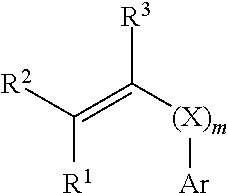
wherein R1, R2, and R3 are each independently hydrogen, halogen, C1-6 alkyl, or halogenated C1-6 alkyl; m is 0 or 1; X is —O—, —C(O)—, —C(O)—O—, —S—, —S(O)—, —S(O)2—, —S(O)2—N(R4)—, —N(R4)—S(O)2—, C1-12 hydrocarbylene, —O—(C1-12 hydrocarbylene)-, —(C1-12 hydrocarbylene)-O—, or —C(O)—O—(C1-12 hydrocarbylene)-, wherein R4 is C1-6 alkyl; and Ar is an unsubstituted or substituted C6-24 aryl, wherein when Ar is a substituted C6-24 aryl, it is substituted with one or more groups selected from the group consisting of halogen, C1-12 hydrocarbyl, and halogenated C1-12 hydrocarbyl.

and combinations thereof, wherein Ra is —H, —F, —CH3, or —CF3.


and combinations thereof, wherein Ra is —H, —F, —CH3, or —CF3.

and combinations thereof, wherein Ra is —H, —F, —CH3, or —CF3.


and combinations thereof, wherein Ra is —H, —F, —CH3, or —CF3; and Rb is C1-4 perfluoroalkyl.

wherein Ra is —H, —F, —CH3, or —CF3; Q is ester-containing or non-ester-containing, fluorinated or non-fluorinated C1-20 alkylene, or C3-20 cycloalkylene; Z− is an anionic moiety comprising sulfonate, sulfonamidate (anion of sulfonamide), or sulfonimidate (anion of sulfonamide); and G+ is a sulfonium or iodonium cation.


and combinations thereof, wherein Ra is —H, —F, —CH3, or —CF3.

wherein R1, R2, and R3 are each independently hydrogen, halogen, C1-6 alkyl, or halogenated C1-6 alkyl; m is 0 or 1; X is —O—, —C(O)—, —C(O)—O—, —S—, —S(O)—, —S(O)2—, —S(O)2—N(R4)—, —N(R4)—S(O)2—, C1-12 hydrocarbylene, —O—(C1-12 hydrocarbylene)-, —(C1-12 hydrocarbylene)-O—, or —C(O)—O—(C1-12 hydrocarbylene)-, wherein R4 is C1-6 alkyl; and Ar is an unsubstituted or substituted C6-24 aryl, wherein when Ar is a substituted C6-24 aryl, it is substituted with one or more groups selected from the group consisting of halogen, C1-12 hydrocarbyl, and halogenated C1-12 hydrocarbyl. In some embodiments, the neutral aromatic monomer has a calculated Log P (cLogP) value of 2.5 to 6. Within this range the cLogP value can be 2.5 to 5. P is the partition ratio of the monomer between 1-octanol and water. cLogP values can be calculated with, for example, MOLINSPIRATION CHEMINFORMATICS (http://www.molinspiration.com). The “neutral aromatic monomer” can be referred to as the “aromatic monomer” for brevity. The structure of the aromatic monomer has been defined such that it is free of groups that become protonated or react in an acidic medium, and free of groups that become ionized or react in a basic medium. Thus, the copolymer repeat unit derived from the aromatic monomer will be substantially electrically neutral and chemically unreactive in the presence of photogenerated acid, and in an alkaline developer such as 2.38 weight percent tetramethylammonium hydroxide.

and combinations thereof, wherein Ra is —H, —F, —CH3, or —CF3; each occurrence of Rc is independently halogen, C1-12 hydrocarbyl, C2-10 alkenyl, C1-6 perfluoroalkyl, or C3-6 perfluorocycloalkyl; Rd is C1-10 alkyl, C3-10 cycloalkyl, C1-6 perfluoroalkyl, C3-6 perfluorocycloalkyl, C1-10 alkenyl, C3-10 cycloalkenyl, or C6-12 aryl; each occurrence of Re is independently C1-10 alkylene or C3-10 cycloalkylene; n is 0 or 1; and q is 0, 1, 2, 3, 4, or 5.

the aliphatic, lactone-containing (meth)acrylate ester comprises

the C1-12 alkyl(meth)acrylate in which the C1-12 alkyl group comprises a 1,1,1,3,3,3-hexafluoro-2-hydroxyprop-2-yl substituent or a —NH—S(O)2—Rb substituent comprises

the photoacid-generating monomer comprises

and
the neutral aromatic monomer comprises

or a combination thereof, wherein Ra is —H, —F, —CH3, or —CF3; Rc is halogen, C1-12 hydrocarbyl, C1-6 perfluoroalkyl, C3-6 perfluorocycloalkyl; Rd is C1-10 alkyl, C3-10 cycloalkyl, C1-6 perfluoroalkyl, C3-6 perfluorocycloalkyl, C1-10 alkenyl, C3-10 cycloalkenyl, or C6-12 aryl; Re is C1-10 alkylene or C3-10 cycloalkylene; n is 0 or 1; and q is 0, 1, 2, 3, 4, or 5.


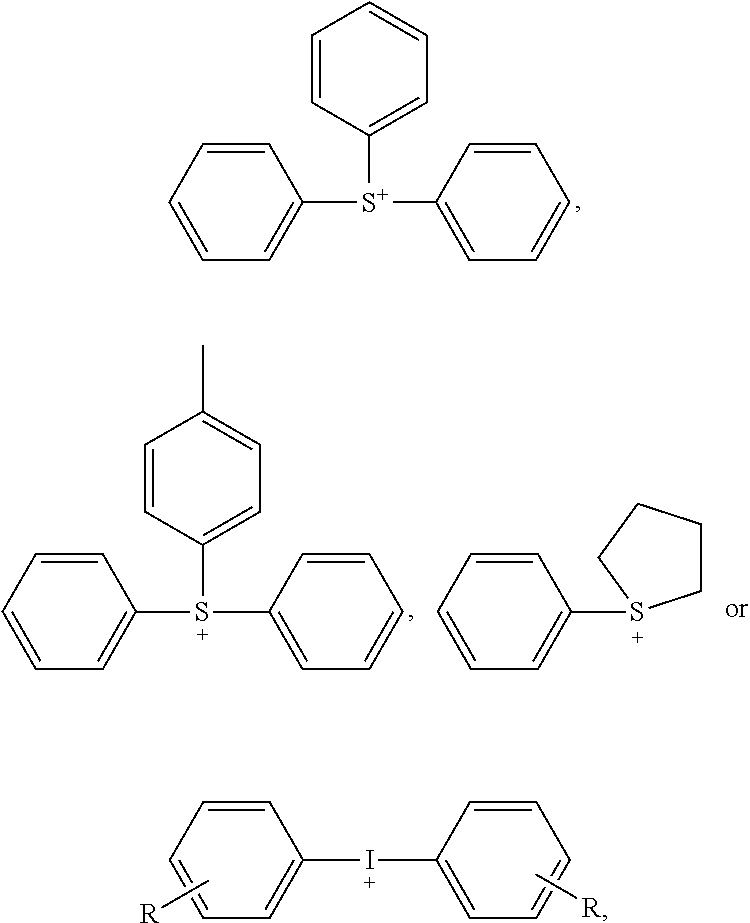
where R is independently H, a C1-20 alkyl, a C6-20 aryl, or a C6-20 alkyl aryl, and the anion is

RC(═O)—O−, or −OH,
where R is independently H, a C1-20 alkyl, a C1-20 alkoxyl, a C6-20 aryl, or a C6-20 alkyl aryl.
| TABLE 1 | |
| Monomer | |
| Acronym | Monomer Structure |
| α-GBLMA |
 |
| CF3PPMA |
 |
| DiHFA |
 |
| ECP PDBT- F2 |
 |
| PDBT-F2 |
 |
| PPMA |
 |
| TBPPDBT- F2 |
 |
| Styrene |
 |
| PFBzMA |
 |
| BzMA |
 |


where x+y is, on average, about 6. “EL” is ethyl lactate, “HBM” is methyl 2-hydroxybutyrate.
| TABLE 2 | |||
| Comparative Example 1 | Comparative Example 2 | ||
| Copolymer | 75.02 |
99.75 |
| PAG | 23.67% DiMADMeOAC | none |
| PDBT-ADOH | ||
| PDQ, | 1.0016% TBPPDBT- | 0.149% THIPDA |
| Quencher | ADCA, 0.225% THIPDA | |
| Surfactant | 0.075% POLYFOX ™ | 0.0998% POLYFOX ™ |
| solution | PF-656 in 70:30 | PF-656 in 70:30 |
| (w/w) EL/HBM | (w/w) EL/HBM | |
| Soft bake | 110° C. for 90 |
130° C. for 90 seconds |
| conditions | ||
| Post-exposure | 100° C. for 60 |
100° C. for 60 seconds |
| bake | ||
| conditions | ||
| TABLE 3 | |||
| Copolymer | | Monomer Ratio | |
| 3 | PPMA/α-GBLMA/DiHFA/PDBT-F2 | 36:48:11:5 | |
| 4 | PPMA/α-GBLMA/DiHFA/PDBT-F2 | 26:57:11:6 | |
| 5 | PPMA/α-GBLMA/DiHFA/PDBT-F2 | 21:63:8:8 | |
| TABLE 4 | |||
| Photoresist | C. Ex. 3 | C. Ex. 4 | C. Ex. 5 |
| Copolymer | 99.75% Copolym. | 99.75% Copolym. | 99.75% Copolym. |
| 3 | 4 | 5 | |
| Quencher | 0.15% THIPDA | 0.15% THIPDA | 0.15% THIPDA |
| Surfactant | 0.0998% | 0.0998% | 0.0998% |
| solution | POLYFOX ™ | POLYFOX ™ | POLYFOX ™ |
| PF-656 in 70:30 | PF-656 in 70:30 | PF-656 in 70:30 | |
| (w/w) EL/HBM | (w/w) EL/HBM | (w/w) EL/HBM | |
| Soft-bake | 110° C. for 90 | 110° C. for 90 | 110° C. for 90 |
| conditions | seconds | seconds | seconds |
| Post-exposure | 100° C. for 60 | 100° C. for 60 | 100° C. for 60 |
| bake | seconds | seconds | seconds |
| conditions | |||
| TABLE 5 | ||||||
| UFTL | Rmin | Rmax | 248 nm E0 | |||
| Photoresist | (Å) | (nm/s) | (nm/s) | (mJ/cm2) | ||
| C. Ex. 3 | 8 | 0.005 | 6930 | 27 | ||
| C. Ex. 4 | 29 | 0.03 | 3376 | 24 | ||
| C. Ex. 5 | 54 | 0.04 | 1935 | 24 | ||
| TABLE 6 | |||
| Copolymer | | Monomer Ratio | |
| 6 | PPMA/α-GBLMA/DiHFA/TBPPDBT- |
35/48/12/5 |
| 7 | PPMA/α-GBLMA/DiHFA/TBPPDBT- |
26/58/11/5 |
| 8 | PPMA/α-GBLMA/DiHFA/TBPPDBT-F2/ | 26/47/12/5/10 |
| Styrene | ||
| 9 | PPMA/α-GBLMA/DiHFA/TBPPDBT-F2/ | 16/47/12/5/20 |
| |
||
| 10 | PPMA/α-GBLMA/DiHFA/TBPPDBT-F2/ | 36/47/12/5 |
| PFBzMA | ||
| 11 | PPMA/α-GBLMA/DiHFA/TBPPDBT-F2/ | 36/47/12/5 |
| |
||
| 12 | PPMA/α-GBLMA/DiHFA/ECPPDBT- |
36/47/12/5 |

| TABLE 7 | ||||
| Photoresist | Copolymer | Quencher | PAG | surfactant |
| C. Ex. 6 | 99.75% | 0.149% | none | 0.099 |
| Copolymer | ||||
| 6 | THIPDA | POLYFOX ™ | ||
| PF-656 | ||||
| C. Ex. 7 | 99.75% | 0.149% | none | 0.099 |
| Copolymer | ||||
| 7 | THIPDA | POLYFOX ™ | ||
| PF-656 | ||||
| Ex. 1 | 99.75% | 0.149% | none | 0.099 |
| Copolymer | ||||
| 8 | THIPDA | POLYFOX ™ | ||
| PF-656 | ||||
| Ex. 2 | 72.56% | 0.82% | 26.5% | 0.072 |
| Copolymer | ||||
| 8 | THIPDA | TBPPDBT | POLYFOX ™ | |
| DHC | PF-656 | |||
| Ex. 3 | 99.75% | 0.15% | none | 0.099% |
| Copolymer 9 | THIPDA | POLYFOX ™ | ||
| PF-656 | ||||
| Ex. 4 | 72.56% | 0.82% | 26.5% | 0.072% |
| Copolymer 9 | THIPDA | TBPPDBT | POLYFOX ™ | |
| DHC | PF-656 | |||
| Ex. 5 | 99.75% | 0.15% | none | 0.099 |
| Copolymer | ||||
| 10 | THIPDA | POLYFOX ™ | ||
| PF-656 | ||||
| Ex. 6 | 72.53% | 0.87% | 26.5% | 0.072 |
| Copolymer | ||||
| 10 | TIPA* | TBPPDBT | POLYFOX ™ | |
| DHC | PF-656 | |||
| Ex. 7 | 99.75% | 0.15% | none | 0.099% |
| Copolymer 11 | THIPDA | POLYFOX ™ | ||
| PF-656 | ||||
| C. Ex. 8 | 72.37% | 1.085% | 26.4% | 0.072 |
| Copolymer | ||||
| 12 | TIPA | TBPPDBT | POLYFOX ™ | |
| DHC | PF-656 | |||
| *TIPA = triisopropylamine | ||||
| TABLE 8 | ||||||
| EUV Es | ||||||
| 248 |
26 nm CD | UFTL | Rmin | Rmax | ||
| Photoresist | (mJ/cm2) | (mJ/cm2) | (Å) | (nm/s) | (nm/s) | Tanθ |
| C. Ex. 6 | 38 | 15.29 | 4 | 0.005 | 4500 | 12 |
| C. Ex. 7 | 45 | 15.29 | 16 | 0.01 | 2400 | 12 |
| Ex. 1 | 44 | 18.68 | 3 | 0.007 | 1750 | 10 |
| Ex. 3 | 63 | 22.08 | 7 | 0.01 | 212 | 7 |
| Ex. 5 | 57 | 22.28 | 1 | 0.007 | 1140 | 11 |
| Ex. 7 | 49 | 18.44 | 2 | 0.007 | 1670 | 14 |
| C. Ex. 8 | 36 | 14 | 13 | 0.01 | 7374 | 18 |
| Ex. 2 | 38 | 17.6 | 20 | 0.014 | 2189 | 12 |
| Ex. 4 | 52 | 20.7 | 40 | 0.03 | 775 | 8 |
| Ex. 6 | 37 | 19.0 | 15 | 0.012 | 1006 | 12 |
Claims (11)


Priority Applications (1)
| Application Number | Priority Date | Filing Date | Title |
|---|---|---|---|
| US14/527,961 US9229319B2 (en) | 2013-12-19 | 2014-10-30 | Photoacid-generating copolymer and associated photoresist composition, coated substrate, and method of forming an electronic device |
Applications Claiming Priority (2)
| Application Number | Priority Date | Filing Date | Title |
|---|---|---|---|
| US201361918163P | 2013-12-19 | 2013-12-19 | |
| US14/527,961 US9229319B2 (en) | 2013-12-19 | 2014-10-30 | Photoacid-generating copolymer and associated photoresist composition, coated substrate, and method of forming an electronic device |
Publications (2)
| Publication Number | Publication Date |
|---|---|
| US20150177613A1 US20150177613A1 (en) | 2015-06-25 |
| US9229319B2 true US9229319B2 (en) | 2016-01-05 |
Family
ID=53399869
Family Applications (1)
| Application Number | Title | Priority Date | Filing Date |
|---|---|---|---|
| US14/527,961 Active US9229319B2 (en) | 2013-12-19 | 2014-10-30 | Photoacid-generating copolymer and associated photoresist composition, coated substrate, and method of forming an electronic device |
Country Status (5)
| Country | Link |
|---|---|
| US (1) | US9229319B2 (en) |
| JP (1) | JP6697219B2 (en) |
| KR (1) | KR101704477B1 (en) |
| CN (1) | CN104725557B (en) |
| TW (1) | TWI587088B (en) |
Families Citing this family (10)
| Publication number | Priority date | Publication date | Assignee | Title |
|---|---|---|---|---|
| US9581901B2 (en) | 2013-12-19 | 2017-02-28 | Rohm And Haas Electronic Materials Llc | Photoacid-generating copolymer and associated photoresist composition, coated substrate, and method of forming an electronic device |
| JP6428495B2 (en) * | 2014-08-12 | 2018-11-28 | 信越化学工業株式会社 | Positive resist material and pattern forming method using the same |
| US9957339B2 (en) | 2015-08-07 | 2018-05-01 | Rohm And Haas Electronic Materials Llc | Copolymer and associated layered article, and device-forming method |
| US9815930B2 (en) * | 2015-08-07 | 2017-11-14 | Rohm And Haas Electronic Materials Llc | Block copolymer and associated photoresist composition and method of forming an electronic device |
| US11613519B2 (en) | 2016-02-29 | 2023-03-28 | Rohm And Haas Electronic Materials Llc | Photoacid-generating monomer, polymer derived therefrom, photoresist composition including the polymer, and method of forming a photoresist relief image using the photoresist composition |
| TWI683801B (en) | 2017-11-30 | 2020-02-01 | 美商羅門哈斯電子材料有限公司 | Zwitterion compounds and photoresists comprising same |
| TWI708760B (en) | 2017-11-30 | 2020-11-01 | 美商羅門哈斯電子材料有限公司 | Salts and photoresists comprising same |
| CN115079517B (en) | 2017-11-30 | 2026-03-13 | 杜邦电子材料国际有限责任公司 | Salt and photoresist containing it |
| CN115960298A (en) * | 2021-10-12 | 2023-04-14 | 上海新阳半导体材料股份有限公司 | Resin and ArF dry-process photoresist composition containing same |
| CN114262416B (en) * | 2022-03-03 | 2022-05-20 | 甘肃华隆芯材料科技有限公司 | Polymer resin for 193nm water immersion lithography, water-resistant coating composition, water-resistant coating and preparation method thereof |
Citations (38)
| Publication number | Priority date | Publication date | Assignee | Title |
|---|---|---|---|---|
| US2760863A (en) | 1951-08-20 | 1956-08-28 | Du Pont | Photographic preparation of relief images |
| US2850445A (en) | 1955-01-19 | 1958-09-02 | Oster Gerald | Photopolymerization |
| US2875047A (en) | 1955-01-19 | 1959-02-24 | Oster Gerald | Photopolymerization with the formation of coherent plastic masses |
| US3427161A (en) | 1965-02-26 | 1969-02-11 | Agfa Gevaert Nv | Photochemical insolubilisation of polymers |
| US3479185A (en) | 1965-06-03 | 1969-11-18 | Du Pont | Photopolymerizable compositions and layers containing 2,4,5-triphenylimidazoyl dimers |
| US3549367A (en) | 1968-05-24 | 1970-12-22 | Du Pont | Photopolymerizable compositions containing triarylimidazolyl dimers and p-aminophenyl ketones |
| US4189323A (en) | 1977-04-25 | 1980-02-19 | Hoechst Aktiengesellschaft | Radiation-sensitive copying composition |
| US4343885A (en) | 1978-05-09 | 1982-08-10 | Dynachem Corporation | Phototropic photosensitive compositions containing fluoran colorformer |
| US4442197A (en) | 1982-01-11 | 1984-04-10 | General Electric Company | Photocurable compositions |
| EP0164248A2 (en) | 1984-06-01 | 1985-12-11 | Rohm And Haas Company | Photosensitive coating compositions, thermally stable coatings prepared from them, and the use of such coatings in forming thermally stable polymer images |
| US4603101A (en) | 1985-09-27 | 1986-07-29 | General Electric Company | Photoresist compositions containing t-substituted organomethyl vinylaryl ether materials |
| US4624912A (en) | 1984-02-10 | 1986-11-25 | Ciba-Geigy Corporation | Thermally transferable layers of radiation sensitive epoxy resins used to prepare protective coatings and relief images |
| US5128232A (en) | 1989-05-22 | 1992-07-07 | Shiply Company Inc. | Photoresist composition with copolymer binder having a major proportion of phenolic units and a minor proportion of non-aromatic cyclic alcoholic units |
| US5344742A (en) | 1993-04-21 | 1994-09-06 | Shipley Company Inc. | Benzyl-substituted photoactive compounds and photoresist compositions comprising same |
| US20060147836A1 (en) | 2005-01-06 | 2006-07-06 | Shin-Etsu Chemical Co., Ltd. | Resist composition and patterning process using the same |
| US20070172761A1 (en) | 2006-01-24 | 2007-07-26 | Fujifilm Corporation | Positive photosensitive composition and method of forming pattern using the same |
| JP2009080160A (en) | 2007-09-25 | 2009-04-16 | Fujifilm Corp | Photosensitive composition, pattern forming method using the photosensitive composition, and compound in the photosensitive composition |
| US20090317741A1 (en) | 2006-07-14 | 2009-12-24 | Tokyo Ohka Kogyo Co., Ltd. | Compound, acid generator, resist composition and method of forming resist pattern |
| US20110159429A1 (en) * | 2009-12-31 | 2011-06-30 | Rohm And Haas Electronic Materials Llc | Photosensitive compositions |
| US20110183263A1 (en) | 2010-01-27 | 2011-07-28 | Fujifilm Corporation | Actinic-ray- or radiation-sensitive resin composition and method of forming pattern using the composition |
| US20120076997A1 (en) | 2010-09-28 | 2012-03-29 | Fujifilm Corporation | Actinic-ray- or radiation-sensitive resin composition, actinic-ray- or radiation-sensitive film therefrom and method of forming pattern |
| US20120082939A1 (en) | 2010-10-05 | 2012-04-05 | Fujifilm Corporation | Active light ray sensitive or radioactive ray sensitive resin composition, and active light ray sensitive or radioactive ray sensitive film and pattern forming method using the same |
| US20120129105A1 (en) * | 2010-11-17 | 2012-05-24 | Rohm And Haas Electronic Materials Llc | Photosensitive copolymer and photoresist composition |
| US20120141939A1 (en) | 2010-11-30 | 2012-06-07 | Thackeray James W | Photoacid generators |
| US20120156618A1 (en) | 2009-08-31 | 2012-06-21 | Fujifilm Corporation | Actinic-ray- or radiation-sensitive resin composition and method of forming pattern using the composition |
| US20120171616A1 (en) | 2010-12-31 | 2012-07-05 | Thackeray James W | Polymerizable photoacid generators |
| EP2474323A2 (en) | 2008-03-26 | 2012-07-11 | Novartis AG | Imidazoquinolines and pyrimidine derivatives as potent modulators of vegf-driven angiogenic processes |
| US8288076B2 (en) | 2009-05-29 | 2012-10-16 | Shin-Etsu Chemical Co., Ltd. | Chemically amplified resist composition and pattern forming process |
| US8329379B2 (en) | 2009-03-30 | 2012-12-11 | Fujifilm Corporation | Actinic ray-sensitive or radiation-sensitive resin composition, resist film, and pattern-forming method using the same |
| US20130011783A1 (en) | 2010-12-31 | 2013-01-10 | Dow Global Technologies Llc | Monomers, polymers, photoresist compositions and methods of forming photolithographic patterns |
| US8431325B2 (en) | 2009-09-02 | 2013-04-30 | Sumitomo Chemical Company, Limited | Compound, resin, resist composition and method for producing resist pattern |
| US8440385B2 (en) | 2010-01-05 | 2013-05-14 | Tokyo Ohka Kogyo Co., Ltd. | Positive resist composition, method of forming resist pattern and polymeric compound |
| US8450042B2 (en) | 2009-03-09 | 2013-05-28 | Shin-Etsu Chemical Co., Ltd. | Positive resist composition and patterning process |
| US8501384B2 (en) | 2010-01-08 | 2013-08-06 | Shin-Etsu Chemical Co., Ltd. | Positive resist composition and patterning process |
| US8507174B2 (en) | 2007-08-10 | 2013-08-13 | Fujifilm Corporation | Positive resist composition, pattern forming method using the composition, and compound for use in the composition |
| US20140080062A1 (en) | 2012-09-15 | 2014-03-20 | Rohm And Haas Electronic Materials Llc | Photoresists comprising multiple acid generator compounds |
| US20150025278A1 (en) | 2013-07-16 | 2015-01-22 | Dow Global Technologies Llc | Aromatic polyacetals and articles comprising them |
| US20150177615A1 (en) | 2013-12-19 | 2015-06-25 | Rohm And Haas Electronic Materials Llc | Photoacid-generating copolymer and associated photoresist composition, coated substrate, and method of forming an electronic device |
Family Cites Families (4)
| Publication number | Priority date | Publication date | Assignee | Title |
|---|---|---|---|---|
| JP4893580B2 (en) * | 2006-10-27 | 2012-03-07 | 信越化学工業株式会社 | Sulfonium salt and polymer compound having polymerizable anion, resist material and pattern forming method |
| JP5401910B2 (en) * | 2008-10-17 | 2014-01-29 | セントラル硝子株式会社 | Fluorine-containing sulfone salts having a polymerizable anion and method for producing the same, fluorine-containing resin, resist composition, and pattern forming method using the same |
| US10025181B2 (en) * | 2011-06-27 | 2018-07-17 | Dow Global Technologies Llc | Polymer composition and photoresist comprising same |
| US9182662B2 (en) * | 2012-02-15 | 2015-11-10 | Rohm And Haas Electronic Materials Llc | Photosensitive copolymer, photoresist comprising the copolymer, and articles formed therefrom |
-
2014
- 2014-10-30 US US14/527,961 patent/US9229319B2/en active Active
- 2014-12-05 JP JP2014247280A patent/JP6697219B2/en active Active
- 2014-12-18 CN CN201410800170.8A patent/CN104725557B/en active Active
- 2014-12-18 KR KR1020140183253A patent/KR101704477B1/en active Active
- 2014-12-19 TW TW103144459A patent/TWI587088B/en active
Patent Citations (39)
| Publication number | Priority date | Publication date | Assignee | Title |
|---|---|---|---|---|
| US2760863A (en) | 1951-08-20 | 1956-08-28 | Du Pont | Photographic preparation of relief images |
| US2850445A (en) | 1955-01-19 | 1958-09-02 | Oster Gerald | Photopolymerization |
| US2875047A (en) | 1955-01-19 | 1959-02-24 | Oster Gerald | Photopolymerization with the formation of coherent plastic masses |
| US3097096A (en) | 1955-01-19 | 1963-07-09 | Oster Gerald | Photopolymerization with the formation of relief images |
| US3427161A (en) | 1965-02-26 | 1969-02-11 | Agfa Gevaert Nv | Photochemical insolubilisation of polymers |
| US3479185A (en) | 1965-06-03 | 1969-11-18 | Du Pont | Photopolymerizable compositions and layers containing 2,4,5-triphenylimidazoyl dimers |
| US3549367A (en) | 1968-05-24 | 1970-12-22 | Du Pont | Photopolymerizable compositions containing triarylimidazolyl dimers and p-aminophenyl ketones |
| US4189323A (en) | 1977-04-25 | 1980-02-19 | Hoechst Aktiengesellschaft | Radiation-sensitive copying composition |
| US4343885A (en) | 1978-05-09 | 1982-08-10 | Dynachem Corporation | Phototropic photosensitive compositions containing fluoran colorformer |
| US4442197A (en) | 1982-01-11 | 1984-04-10 | General Electric Company | Photocurable compositions |
| US4624912A (en) | 1984-02-10 | 1986-11-25 | Ciba-Geigy Corporation | Thermally transferable layers of radiation sensitive epoxy resins used to prepare protective coatings and relief images |
| EP0164248A2 (en) | 1984-06-01 | 1985-12-11 | Rohm And Haas Company | Photosensitive coating compositions, thermally stable coatings prepared from them, and the use of such coatings in forming thermally stable polymer images |
| US4603101A (en) | 1985-09-27 | 1986-07-29 | General Electric Company | Photoresist compositions containing t-substituted organomethyl vinylaryl ether materials |
| US5128232A (en) | 1989-05-22 | 1992-07-07 | Shiply Company Inc. | Photoresist composition with copolymer binder having a major proportion of phenolic units and a minor proportion of non-aromatic cyclic alcoholic units |
| US5344742A (en) | 1993-04-21 | 1994-09-06 | Shipley Company Inc. | Benzyl-substituted photoactive compounds and photoresist compositions comprising same |
| US20060147836A1 (en) | 2005-01-06 | 2006-07-06 | Shin-Etsu Chemical Co., Ltd. | Resist composition and patterning process using the same |
| US20070172761A1 (en) | 2006-01-24 | 2007-07-26 | Fujifilm Corporation | Positive photosensitive composition and method of forming pattern using the same |
| US20090317741A1 (en) | 2006-07-14 | 2009-12-24 | Tokyo Ohka Kogyo Co., Ltd. | Compound, acid generator, resist composition and method of forming resist pattern |
| US8507174B2 (en) | 2007-08-10 | 2013-08-13 | Fujifilm Corporation | Positive resist composition, pattern forming method using the composition, and compound for use in the composition |
| JP2009080160A (en) | 2007-09-25 | 2009-04-16 | Fujifilm Corp | Photosensitive composition, pattern forming method using the photosensitive composition, and compound in the photosensitive composition |
| EP2474323A2 (en) | 2008-03-26 | 2012-07-11 | Novartis AG | Imidazoquinolines and pyrimidine derivatives as potent modulators of vegf-driven angiogenic processes |
| US8450042B2 (en) | 2009-03-09 | 2013-05-28 | Shin-Etsu Chemical Co., Ltd. | Positive resist composition and patterning process |
| US8329379B2 (en) | 2009-03-30 | 2012-12-11 | Fujifilm Corporation | Actinic ray-sensitive or radiation-sensitive resin composition, resist film, and pattern-forming method using the same |
| US8288076B2 (en) | 2009-05-29 | 2012-10-16 | Shin-Etsu Chemical Co., Ltd. | Chemically amplified resist composition and pattern forming process |
| US20120156618A1 (en) | 2009-08-31 | 2012-06-21 | Fujifilm Corporation | Actinic-ray- or radiation-sensitive resin composition and method of forming pattern using the composition |
| US8431325B2 (en) | 2009-09-02 | 2013-04-30 | Sumitomo Chemical Company, Limited | Compound, resin, resist composition and method for producing resist pattern |
| US20110159429A1 (en) * | 2009-12-31 | 2011-06-30 | Rohm And Haas Electronic Materials Llc | Photosensitive compositions |
| US8440385B2 (en) | 2010-01-05 | 2013-05-14 | Tokyo Ohka Kogyo Co., Ltd. | Positive resist composition, method of forming resist pattern and polymeric compound |
| US8501384B2 (en) | 2010-01-08 | 2013-08-06 | Shin-Etsu Chemical Co., Ltd. | Positive resist composition and patterning process |
| US20110183263A1 (en) | 2010-01-27 | 2011-07-28 | Fujifilm Corporation | Actinic-ray- or radiation-sensitive resin composition and method of forming pattern using the composition |
| US20120076997A1 (en) | 2010-09-28 | 2012-03-29 | Fujifilm Corporation | Actinic-ray- or radiation-sensitive resin composition, actinic-ray- or radiation-sensitive film therefrom and method of forming pattern |
| US20120082939A1 (en) | 2010-10-05 | 2012-04-05 | Fujifilm Corporation | Active light ray sensitive or radioactive ray sensitive resin composition, and active light ray sensitive or radioactive ray sensitive film and pattern forming method using the same |
| US20120129105A1 (en) * | 2010-11-17 | 2012-05-24 | Rohm And Haas Electronic Materials Llc | Photosensitive copolymer and photoresist composition |
| US20120141939A1 (en) | 2010-11-30 | 2012-06-07 | Thackeray James W | Photoacid generators |
| US20130011783A1 (en) | 2010-12-31 | 2013-01-10 | Dow Global Technologies Llc | Monomers, polymers, photoresist compositions and methods of forming photolithographic patterns |
| US20120171616A1 (en) | 2010-12-31 | 2012-07-05 | Thackeray James W | Polymerizable photoacid generators |
| US20140080062A1 (en) | 2012-09-15 | 2014-03-20 | Rohm And Haas Electronic Materials Llc | Photoresists comprising multiple acid generator compounds |
| US20150025278A1 (en) | 2013-07-16 | 2015-01-22 | Dow Global Technologies Llc | Aromatic polyacetals and articles comprising them |
| US20150177615A1 (en) | 2013-12-19 | 2015-06-25 | Rohm And Haas Electronic Materials Llc | Photoacid-generating copolymer and associated photoresist composition, coated substrate, and method of forming an electronic device |
Non-Patent Citations (2)
| Title |
|---|
| Non-Final Office Action dated Aug. 4, 2015; U.S. Appl. No. 14/528,096; filed Oct. 30, 2014 (25 pages). |
| Onishi et al., "Acid Catalyzed Resist for KrF Excimer Laser Lithography", Journal of Photopolymer Science and Technology, 4(3), pp. 337-340 (1991). |
Also Published As
| Publication number | Publication date |
|---|---|
| JP6697219B2 (en) | 2020-05-20 |
| CN104725557A (en) | 2015-06-24 |
| CN104725557B (en) | 2017-04-26 |
| JP2015117377A (en) | 2015-06-25 |
| US20150177613A1 (en) | 2015-06-25 |
| KR101704477B1 (en) | 2017-02-08 |
| KR20150072365A (en) | 2015-06-29 |
| TWI587088B (en) | 2017-06-11 |
| TW201537288A (en) | 2015-10-01 |
Similar Documents
| Publication | Publication Date | Title |
|---|---|---|
| US9581901B2 (en) | Photoacid-generating copolymer and associated photoresist composition, coated substrate, and method of forming an electronic device | |
| US9229319B2 (en) | Photoacid-generating copolymer and associated photoresist composition, coated substrate, and method of forming an electronic device | |
| US11947258B2 (en) | Photoacid-generating monomer, polymer derived therefrom, photoresist composition including the polymer, and method of forming a photoresist relief image using the photoresist composition | |
| US10539870B2 (en) | Photoresists comprising carbamate component | |
| US11960206B2 (en) | Photoresist composition, coated substrate including the photoresist composition, and method of forming electronic device | |
| US9256125B2 (en) | Acid generators and photoresists comprising same | |
| US10221131B2 (en) | Acid generator compounds and photoresists comprising same | |
| US9063420B2 (en) | Photoresist composition, coated substrate, and method of forming electronic device | |
| US9182669B2 (en) | Copolymer with acid-labile group, photoresist composition, coated substrate, and method of forming an electronic device | |
| US10274824B2 (en) | Photobase generators and photoresist compositions comprising same | |
| US9758610B2 (en) | Acid-labile hyperbranched copolymer and associated photoresist composition and method of forming an electronic device | |
| US20200377713A1 (en) | Polymers, photoresist compositions and pattern formation methods | |
| US10317795B2 (en) | Photoacid generator |
Legal Events
| Date | Code | Title | Description |
|---|---|---|---|
| AS | Assignment |
Owner name: ROHM AND HAAS ELECTRONIC MATERIALS LLC, MASSACHUSE Free format text: ASSIGNMENT OF ASSIGNORS INTEREST;ASSIGNORS:JAIN, VIPUL;ONGAYI, OWENDI;THACKERAY, JAMES W;AND OTHERS;SIGNING DATES FROM 20140610 TO 20140616;REEL/FRAME:034104/0660 |
|
| STCF | Information on status: patent grant |
Free format text: PATENTED CASE |
|
| MAFP | Maintenance fee payment |
Free format text: PAYMENT OF MAINTENANCE FEE, 4TH YEAR, LARGE ENTITY (ORIGINAL EVENT CODE: M1551); ENTITY STATUS OF PATENT OWNER: LARGE ENTITY Year of fee payment: 4 |
|
| MAFP | Maintenance fee payment |
Free format text: PAYMENT OF MAINTENANCE FEE, 8TH YEAR, LARGE ENTITY (ORIGINAL EVENT CODE: M1552); ENTITY STATUS OF PATENT OWNER: LARGE ENTITY Year of fee payment: 8 |
|
| AS | Assignment |
Owner name: DUPONT ELECTRONIC MATERIALS INTERNATIONAL, LLC, MASSACHUSETTS Free format text: CHANGE OF NAME;ASSIGNOR:ROHM & HAAS ELECTRONIC MATERIALS LLC;REEL/FRAME:069272/0383 Effective date: 20240401 |
|
| AS | Assignment |
Owner name: JPMORGAN CHASE BANK, N.A., AS COLLATERAL AGENT, NEW YORK Free format text: SECURITY INTEREST;ASSIGNOR:QNITY ELECTRONICS, INC.;REEL/FRAME:073515/0243 Effective date: 20251101 Owner name: U.S. BANK TRUST COMPANY, NATIONAL ASSOCIATION, AS NOTES COLLATERAL AGENT, NEW JERSEY Free format text: SECURITY INTEREST;ASSIGNOR:QNITY ELECTRONICS, INC.;REEL/FRAME:073517/0298 Effective date: 20251101 |