US9227962B2 - Heterocyclic substituted-3-heteroarylidenyl-2-indolinone derivative - Google Patents
Heterocyclic substituted-3-heteroarylidenyl-2-indolinone derivative Download PDFInfo
- Publication number
- US9227962B2 US9227962B2 US14/208,289 US201414208289A US9227962B2 US 9227962 B2 US9227962 B2 US 9227962B2 US 201414208289 A US201414208289 A US 201414208289A US 9227962 B2 US9227962 B2 US 9227962B2
- Authority
- US
- United States
- Prior art keywords
- optionally substituted
- alkyl
- amino
- hydrogen
- compound
- Prior art date
- Legal status (The legal status is an assumption and is not a legal conclusion. Google has not performed a legal analysis and makes no representation as to the accuracy of the status listed.)
- Expired - Fee Related
Links
- 0 *C.*C.CC.CC(C)C.[1*]C([7*])=C1C(=O)N([2*])c2c([3*])c([4*])c([5*])c([6*])c21.[Y] Chemical compound *C.*C.CC.CC(C)C.[1*]C([7*])=C1C(=O)N([2*])c2c([3*])c([4*])c([5*])c([6*])c21.[Y] 0.000 description 77
- BQFAGUOOUDSISJ-UHFFFAOYSA-N B.B.CC(=O)N([Rb])[RaH].CC(=O)O.CI.CI.CI.COC.COC.[Rb]N[RaH] Chemical compound B.B.CC(=O)N([Rb])[RaH].CC(=O)O.CI.CI.CI.COC.COC.[Rb]N[RaH] BQFAGUOOUDSISJ-UHFFFAOYSA-N 0.000 description 1
- UWBZXGBOJBPEGT-COHMLODCSA-N BrC1=NC(C2=CC=CC=C2)=CS1.CCN(CC)CCNC(=O)C1=C(C)NC(/C=C2\C(=O)NC3=CC=C(B4OC(C)(C)C(C)(C)O4)C=C32)=C1C.CCN(CC)CCNC(=O)C1=C(C)NC(/C=C2\C(=O)NC3=CC=C(C4=NC(C5=CC=CC=C5)=CS4)C=C32)=C1C Chemical compound BrC1=NC(C2=CC=CC=C2)=CS1.CCN(CC)CCNC(=O)C1=C(C)NC(/C=C2\C(=O)NC3=CC=C(B4OC(C)(C)C(C)(C)O4)C=C32)=C1C.CCN(CC)CCNC(=O)C1=C(C)NC(/C=C2\C(=O)NC3=CC=C(C4=NC(C5=CC=CC=C5)=CS4)C=C32)=C1C UWBZXGBOJBPEGT-COHMLODCSA-N 0.000 description 1
- WQUCWGNMAPIEGW-CPULAUEASA-N C.C1CCOC1.CC1(C)OB(C2=CC=C3NC(=O)CC3=C2)OC1(C)C.CCN(CC)CCNC(=O)C1=C(C)NC(/C=C2\C(=O)NC3=CC=C(B4OC(C)(C)C(C)(C)O4)C=C32)=C1C.CCN(CC)CCNC(=O)C1=C(C)NC(OC)=C1C Chemical compound C.C1CCOC1.CC1(C)OB(C2=CC=C3NC(=O)CC3=C2)OC1(C)C.CCN(CC)CCNC(=O)C1=C(C)NC(/C=C2\C(=O)NC3=CC=C(B4OC(C)(C)C(C)(C)O4)C=C32)=C1C.CCN(CC)CCNC(=O)C1=C(C)NC(OC)=C1C WQUCWGNMAPIEGW-CPULAUEASA-N 0.000 description 1
- YAQFDKYDPFSEAQ-JHCLQAMQSA-N C.CC(=O)N1CCC(N2CCC(C3=CC=C4NC(=O)/C(=C\C5=C(C)C(C(=O)N6CCN(C)CC6)=C(C)N5)C4=C3)CC2)CC1.CC1=C(C(=O)N2CCN(C)CC2)C(C)=C(/C=C2\C(=O)NC3=C(C4=CSC(C5=CC=CC=C5)=N4)C=CC=C32)N1.CCN(CC)CCCC(=O)C1=C(C)NC(/C=C2\C(=O)NC3=C(C4=CSC(C5=CC=CC=C5)=N4)C=CC=C32)=C1C.CCN(CC)CCCC(=O)C1=C(C)NC(/C=C2\C(=O)NC3=CC=C(C4CCN(C5=NC=CC=N5)CC4)C=C32)=C1C.CCN(CC)CCCC(=O)C1=C(C)NC(/C=C2\C(=O)NC3=CC=C(C4CCN(C5CCN(C(C)=O)CC5)CC4)C=C32)=C1C Chemical compound C.CC(=O)N1CCC(N2CCC(C3=CC=C4NC(=O)/C(=C\C5=C(C)C(C(=O)N6CCN(C)CC6)=C(C)N5)C4=C3)CC2)CC1.CC1=C(C(=O)N2CCN(C)CC2)C(C)=C(/C=C2\C(=O)NC3=C(C4=CSC(C5=CC=CC=C5)=N4)C=CC=C32)N1.CCN(CC)CCCC(=O)C1=C(C)NC(/C=C2\C(=O)NC3=C(C4=CSC(C5=CC=CC=C5)=N4)C=CC=C32)=C1C.CCN(CC)CCCC(=O)C1=C(C)NC(/C=C2\C(=O)NC3=CC=C(C4CCN(C5=NC=CC=N5)CC4)C=C32)=C1C.CCN(CC)CCCC(=O)C1=C(C)NC(/C=C2\C(=O)NC3=CC=C(C4CCN(C5CCN(C(C)=O)CC5)CC4)C=C32)=C1C YAQFDKYDPFSEAQ-JHCLQAMQSA-N 0.000 description 1
- HKIFHJZMTFZLJP-DZWJYVLZSA-N C.CC1=C(C(=O)CCCN2CCCC2)C(C)=C(/C=C2\C(=O)NC3=CC=C(C4=CN(C5=CC=CC=N5)N=C4)C=C32)N1.CC1=C(C(=O)N2CCN(C)CC2)C(C)=C(/C=C2\C(=O)NC3=CC=C(C4=CN(C5=CC=CC=C5)N=C4)C=C32)N1.CC1=C(C(=O)N2CCN(C)CC2)C(C)=C(/C=C2\C(=O)NC3=CC=C(C4=CN(C5=CC=CC=N5)N=C4)C=C32)N1.CCN(CC)CCCC(=O)C1=C(C)NC(/C=C2\C(=O)NC3=CC=C(C4=CN(C5=CC=CC=C5)N=C4)C=C32)=C1C.CCN(CC)CCCC(=O)C1=C(C)NC(/C=C2\C(=O)NC3=CC=C(C4=CN(C5=CC=CC=N5)N=C4)C=C32)=C1C Chemical compound C.CC1=C(C(=O)CCCN2CCCC2)C(C)=C(/C=C2\C(=O)NC3=CC=C(C4=CN(C5=CC=CC=N5)N=C4)C=C32)N1.CC1=C(C(=O)N2CCN(C)CC2)C(C)=C(/C=C2\C(=O)NC3=CC=C(C4=CN(C5=CC=CC=C5)N=C4)C=C32)N1.CC1=C(C(=O)N2CCN(C)CC2)C(C)=C(/C=C2\C(=O)NC3=CC=C(C4=CN(C5=CC=CC=N5)N=C4)C=C32)N1.CCN(CC)CCCC(=O)C1=C(C)NC(/C=C2\C(=O)NC3=CC=C(C4=CN(C5=CC=CC=C5)N=C4)C=C32)=C1C.CCN(CC)CCCC(=O)C1=C(C)NC(/C=C2\C(=O)NC3=CC=C(C4=CN(C5=CC=CC=N5)N=C4)C=C32)=C1C HKIFHJZMTFZLJP-DZWJYVLZSA-N 0.000 description 1
- MSQHYXKTBCQETI-PPEKDLCWSA-N C.CC1=C(C(=O)N2CCCCC2)C(C)=C(/C=C2\C(=O)NC3=CC=C(C4=CN(C5=CC=CC=N5)N=C4)C=C32)N1.CC1=C(C(=O)N2CCN(C)CC2)C(C)=C(/C=C2\C(=O)NC3=CC=C(C4CCN(C5CCOCC5)CC4)C=C32)N1.CCN(CC)CCCC(=O)C1=C(C)NC(/C=C2\C(=O)NC3=CC=C(C4=CN(C5CCOCC5)N=C4)C=C32)=C1C.CCN(CC)CCCC(=O)C1=C(C)NC(/C=C2\C(=O)NC3=CC=C(C4CCN(C5=CC=CC=C5)CC4)C=C32)=C1C.CCN(CC)CCCC(=O)C1=C(C)NC(/C=C2\C(=O)NC3=CC=C(C4CCN(C5CCOCC5)CC4)C=C32)=C1C Chemical compound C.CC1=C(C(=O)N2CCCCC2)C(C)=C(/C=C2\C(=O)NC3=CC=C(C4=CN(C5=CC=CC=N5)N=C4)C=C32)N1.CC1=C(C(=O)N2CCN(C)CC2)C(C)=C(/C=C2\C(=O)NC3=CC=C(C4CCN(C5CCOCC5)CC4)C=C32)N1.CCN(CC)CCCC(=O)C1=C(C)NC(/C=C2\C(=O)NC3=CC=C(C4=CN(C5CCOCC5)N=C4)C=C32)=C1C.CCN(CC)CCCC(=O)C1=C(C)NC(/C=C2\C(=O)NC3=CC=C(C4CCN(C5=CC=CC=C5)CC4)C=C32)=C1C.CCN(CC)CCCC(=O)C1=C(C)NC(/C=C2\C(=O)NC3=CC=C(C4CCN(C5CCOCC5)CC4)C=C32)=C1C MSQHYXKTBCQETI-PPEKDLCWSA-N 0.000 description 1
- FRGMCGRTSVFMBV-BSLXQTDGSA-N C.CCN(CC)CCCC(=O)C1=C(C)NC(/C=C2\C(=O)NC3=CC(C4=C(C)N=C(C5=CC=CC=C5)O4)=CC=C32)=C1C.CCN(CC)CCCC(=O)C1=C(C)NC(/C=C2\C(=O)NC3=CC(C4=CSC(C5=CC=CC=C5)=N4)=CC=C32)=C1C Chemical compound C.CCN(CC)CCCC(=O)C1=C(C)NC(/C=C2\C(=O)NC3=CC(C4=C(C)N=C(C5=CC=CC=C5)O4)=CC=C32)=C1C.CCN(CC)CCCC(=O)C1=C(C)NC(/C=C2\C(=O)NC3=CC(C4=CSC(C5=CC=CC=C5)=N4)=CC=C32)=C1C FRGMCGRTSVFMBV-BSLXQTDGSA-N 0.000 description 1
- YLXBHAMCSSXMSH-UHFFFAOYSA-M C.Cl.N=C(N)C1=CC=CC=C1.O=C1CC2=CC(C(=O)CCl)=CC=C2N1.O=C1CC2=CC(C3=CN=C(C4=CC=CC=C4)N3)=CC=C2N1.O=COO[K].OC1CCCO1.[KH] Chemical compound C.Cl.N=C(N)C1=CC=CC=C1.O=C1CC2=CC(C(=O)CCl)=CC=C2N1.O=C1CC2=CC(C3=CN=C(C4=CC=CC=C4)N3)=CC=C2N1.O=COO[K].OC1CCCO1.[KH] YLXBHAMCSSXMSH-UHFFFAOYSA-M 0.000 description 1
- WZCXNFMVWNHAKI-UHFFFAOYSA-N CC(=O)C1=CC=C2NC(=O)CC2=C1.N#CC1=CC=CC=C1.NNC(=O)C1=CC=C2NC(=O)CC2=C1.O=C1CC2=CC(C3=NN=C(C4=CC=CC=C4)N3)=CC=C2N1 Chemical compound CC(=O)C1=CC=C2NC(=O)CC2=C1.N#CC1=CC=CC=C1.NNC(=O)C1=CC=C2NC(=O)CC2=C1.O=C1CC2=CC(C3=NN=C(C4=CC=CC=C4)N3)=CC=C2N1 WZCXNFMVWNHAKI-UHFFFAOYSA-N 0.000 description 1
- FFAMPRWCQVWOFX-RRAHZORUSA-N CC(=O)N1CCC(N2CCC(C3=CC=C4NC(=O)/C(=C\C5=C(C)C(C(=O)N6CCN(C)CC6)=C(C)N5)C4=C3)CC2)CC1 Chemical compound CC(=O)N1CCC(N2CCC(C3=CC=C4NC(=O)/C(=C\C5=C(C)C(C(=O)N6CCN(C)CC6)=C(C)N5)C4=C3)CC2)CC1 FFAMPRWCQVWOFX-RRAHZORUSA-N 0.000 description 1
- LHIPMQHRYWTYCN-CROLVZNBSA-N CC(=O)N1CCC(N2CCC(C3=CC=C4NC(=O)/C(=C\C5=C(C)C(C(=O)N6CCN(C)CC6)=C(C)N5)C4=C3)CC2)CC1.CC1=C(C(=O)N2CCN(C)CC2)C(C)=C(/C=C2\C(=O)NC3=CC=C(C4CCN(C5CCOCC5)CC4)C=C32)N1.CCN(CC)CCCC(=O)C1=C(C)NC(/C=C2\C(=O)NC3=CC=C(C4CCN(C5=CC=CC=C5)CC4)C=C32)=C1C.CCN(CC)CCCC(=O)C1=C(C)NC(/C=C2\C(=O)NC3=CC=C(C4CCN(C5=NC=CC=N5)CC4)C=C32)=C1C.CCN(CC)CCCC(=O)C1=C(C)NC(/C=C2\C(=O)NC3=CC=C(C4CCN(C5CCN(C(C)=O)CC5)CC4)C=C32)=C1C.CCN(CC)CCCC(=O)C1=C(C)NC(/C=C2\C(=O)NC3=CC=C(C4CCN(C5CCOCC5)CC4)C=C32)=C1C Chemical compound CC(=O)N1CCC(N2CCC(C3=CC=C4NC(=O)/C(=C\C5=C(C)C(C(=O)N6CCN(C)CC6)=C(C)N5)C4=C3)CC2)CC1.CC1=C(C(=O)N2CCN(C)CC2)C(C)=C(/C=C2\C(=O)NC3=CC=C(C4CCN(C5CCOCC5)CC4)C=C32)N1.CCN(CC)CCCC(=O)C1=C(C)NC(/C=C2\C(=O)NC3=CC=C(C4CCN(C5=CC=CC=C5)CC4)C=C32)=C1C.CCN(CC)CCCC(=O)C1=C(C)NC(/C=C2\C(=O)NC3=CC=C(C4CCN(C5=NC=CC=N5)CC4)C=C32)=C1C.CCN(CC)CCCC(=O)C1=C(C)NC(/C=C2\C(=O)NC3=CC=C(C4CCN(C5CCN(C(C)=O)CC5)CC4)C=C32)=C1C.CCN(CC)CCCC(=O)C1=C(C)NC(/C=C2\C(=O)NC3=CC=C(C4CCN(C5CCOCC5)CC4)C=C32)=C1C LHIPMQHRYWTYCN-CROLVZNBSA-N 0.000 description 1
- QITDQBRIBLAJMR-OTJYQHNOSA-N CC(=O)N1CCC(N2CCC(C3=CC=C4NC(=O)/C(=C\C5=C(C)C(C(=O)N6CCN(C)CC6)=C(C)N5)C4=C3)CC2)CC1.CCN(CC)CCCC(=O)C1=C(C)NC(/C=C2\C(=O)NC3=C(C4=CSC(C5=CC=CC=C5)=N4)C=CC=C32)=C1C.CCN(CC)CCCC(=O)C1=C(C)NC(/C=C2\C(=O)NC3=CC=C(C4CCN(C5=NC=CC=N5)CC4)C=C32)=C1C.CCN(CC)CCCC(=O)C1=C(C)NC(/C=C2\C(=O)NC3=CC=C(C4CCN(C5CCN(C(C)=O)CC5)CC4)C=C32)=C1C Chemical compound CC(=O)N1CCC(N2CCC(C3=CC=C4NC(=O)/C(=C\C5=C(C)C(C(=O)N6CCN(C)CC6)=C(C)N5)C4=C3)CC2)CC1.CCN(CC)CCCC(=O)C1=C(C)NC(/C=C2\C(=O)NC3=C(C4=CSC(C5=CC=CC=C5)=N4)C=CC=C32)=C1C.CCN(CC)CCCC(=O)C1=C(C)NC(/C=C2\C(=O)NC3=CC=C(C4CCN(C5=NC=CC=N5)CC4)C=C32)=C1C.CCN(CC)CCCC(=O)C1=C(C)NC(/C=C2\C(=O)NC3=CC=C(C4CCN(C5CCN(C(C)=O)CC5)CC4)C=C32)=C1C QITDQBRIBLAJMR-OTJYQHNOSA-N 0.000 description 1
- FRMMXBYDIDVXBB-UHFFFAOYSA-N CC(=O)N1CCC(N2CCC(C3=CC=C4NC(=O)CC4=C3)CC2)CC1 Chemical compound CC(=O)N1CCC(N2CCC(C3=CC=C4NC(=O)CC4=C3)CC2)CC1 FRMMXBYDIDVXBB-UHFFFAOYSA-N 0.000 description 1
- UVNQCGFREQQVGA-UHFFFAOYSA-N CC1(C)OB(C2=CC=C3NC(=O)CC3=C2)OC1(C)C.O=C1CC2=CC(C3CCN(C4=CC=CC=C4)CC3)=CC=C2N1.O=C1CCN(C2=CC=CC=C2)CC1.O=S(=O)(OC1=CCN(C2=CC=CC=C2)CC1)C(F)(F)F Chemical compound CC1(C)OB(C2=CC=C3NC(=O)CC3=C2)OC1(C)C.O=C1CC2=CC(C3CCN(C4=CC=CC=C4)CC3)=CC=C2N1.O=C1CCN(C2=CC=CC=C2)CC1.O=S(=O)(OC1=CCN(C2=CC=CC=C2)CC1)C(F)(F)F UVNQCGFREQQVGA-UHFFFAOYSA-N 0.000 description 1
- KYIKXBCUSINICI-UQQQWYQISA-N CC1=C(C(=O)CCCN2CCCC2)C(C)=C(/C=C2\C(=O)NC3=CC=C(C4=CN(C5=CC=CC=N5)N=C4)C=C32)N1 Chemical compound CC1=C(C(=O)CCCN2CCCC2)C(C)=C(/C=C2\C(=O)NC3=CC=C(C4=CN(C5=CC=CC=N5)N=C4)C=C32)N1 KYIKXBCUSINICI-UQQQWYQISA-N 0.000 description 1
- JCRITCHQIBEHPM-QZNCVYJGSA-N CC1=C(C(=O)CCCN2CCCC2)C(C)=C(/C=C2\C(=O)NC3=CC=C(C4=CN(C5=CC=CC=N5)N=C4)C=C32)N1.CC1=C(C(=O)N2CCN(C)CC2)C(C)=C(/C=C2\C(=O)NC3=CC=C(C4=CN(C5=CC=CC=C5)N=C4)C=C32)N1.CC1=C(C(=O)N2CCN(C)CC2)C(C)=C(/C=C2\C(=O)NC3=CC=C(C4=CN(C5=CC=CC=N5)N=C4)C=C32)N1.CC1=C(C(=O)N2CCOCC2)C(C)=C(/C=C2\C(=O)NC3=CC=C(C4=CN(C5=CC=CC=N5)N=C4)C=C32)N1.CCN(CC)CCCC(=O)C1=C(C)NC(/C=C2\C(=O)NC3=CC=C(C4=CN(C5=CC=CC=C5)N=C4)C=C32)=C1C.CCN(CC)CCCC(=O)C1=C(C)NC(/C=C2\C(=O)NC3=CC=C(C4=CN(C5=CC=CC=N5)N=C4)C=C32)=C1C.CCN(CC)CCCC(=O)C1=C(C)NC(/C=C2\C(=O)NC3=CC=C(C4=CN(C5CCOCC5)N=C4)C=C32)=C1C Chemical compound CC1=C(C(=O)CCCN2CCCC2)C(C)=C(/C=C2\C(=O)NC3=CC=C(C4=CN(C5=CC=CC=N5)N=C4)C=C32)N1.CC1=C(C(=O)N2CCN(C)CC2)C(C)=C(/C=C2\C(=O)NC3=CC=C(C4=CN(C5=CC=CC=C5)N=C4)C=C32)N1.CC1=C(C(=O)N2CCN(C)CC2)C(C)=C(/C=C2\C(=O)NC3=CC=C(C4=CN(C5=CC=CC=N5)N=C4)C=C32)N1.CC1=C(C(=O)N2CCOCC2)C(C)=C(/C=C2\C(=O)NC3=CC=C(C4=CN(C5=CC=CC=N5)N=C4)C=C32)N1.CCN(CC)CCCC(=O)C1=C(C)NC(/C=C2\C(=O)NC3=CC=C(C4=CN(C5=CC=CC=C5)N=C4)C=C32)=C1C.CCN(CC)CCCC(=O)C1=C(C)NC(/C=C2\C(=O)NC3=CC=C(C4=CN(C5=CC=CC=N5)N=C4)C=C32)=C1C.CCN(CC)CCCC(=O)C1=C(C)NC(/C=C2\C(=O)NC3=CC=C(C4=CN(C5CCOCC5)N=C4)C=C32)=C1C JCRITCHQIBEHPM-QZNCVYJGSA-N 0.000 description 1
- QRMGCIONVMEGMS-OUGIJJLYSA-N CC1=C(C(=O)CCCN2CCCC2)C(C)=C(/C=C2\C(=O)NC3=CC=C(C4=CN(C5=CC=CC=N5)N=C4)C=C32)N1.CC1=C(C(=O)N2CCN(C)CC2)C(C)=C(/C=C2\C(=O)NC3=CC=C(C4=CN(C5=CC=CC=C5)N=C4)C=C32)N1.CC1=C(C(=O)N2CCN(C)CC2)C(C)=C(/C=C2\C(=O)NC3=CC=C(C4=CN(C5=CC=CC=N5)N=C4)C=C32)N1.CCN(CC)CCCC(=O)C1=C(C)NC(/C=C2\C(=O)NC3=CC=C(C4=CN(C5=CC=CC=C5)N=C4)C=C32)=C1C.CCN(CC)CCCC(=O)C1=C(C)NC(/C=C2\C(=O)NC3=CC=C(C4=CN(C5=CC=CC=N5)N=C4)C=C32)=C1C Chemical compound CC1=C(C(=O)CCCN2CCCC2)C(C)=C(/C=C2\C(=O)NC3=CC=C(C4=CN(C5=CC=CC=N5)N=C4)C=C32)N1.CC1=C(C(=O)N2CCN(C)CC2)C(C)=C(/C=C2\C(=O)NC3=CC=C(C4=CN(C5=CC=CC=C5)N=C4)C=C32)N1.CC1=C(C(=O)N2CCN(C)CC2)C(C)=C(/C=C2\C(=O)NC3=CC=C(C4=CN(C5=CC=CC=N5)N=C4)C=C32)N1.CCN(CC)CCCC(=O)C1=C(C)NC(/C=C2\C(=O)NC3=CC=C(C4=CN(C5=CC=CC=C5)N=C4)C=C32)=C1C.CCN(CC)CCCC(=O)C1=C(C)NC(/C=C2\C(=O)NC3=CC=C(C4=CN(C5=CC=CC=N5)N=C4)C=C32)=C1C QRMGCIONVMEGMS-OUGIJJLYSA-N 0.000 description 1
- KLANLBXARIECSL-KQWNVCNZSA-N CC1=C(C(=O)N2CCN(C)CC2)C(C)=C(/C=C2\C(=O)NC3=C(C4=CSC(C5=CC=CC=C5)=N4)C=CC=C32)N1 Chemical compound CC1=C(C(=O)N2CCN(C)CC2)C(C)=C(/C=C2\C(=O)NC3=C(C4=CSC(C5=CC=CC=C5)=N4)C=CC=C32)N1 KLANLBXARIECSL-KQWNVCNZSA-N 0.000 description 1
- MHGFSVIKCVZDDC-KBRWNBHFSA-N CC1=C(C(=O)N2CCN(C)CC2)C(C)=C(/C=C2\C(=O)NC3=C(C4=CSC(C5=CC=CC=C5)=N4)C=CC=C32)N1.CCN(CC)CCCC(=O)C1=C(C)NC(/C=C2\C(=O)NC3=C(C4=CSC(C5=CC=CC=C5)=N4)C=CC=C32)=C1C.CCN(CC)CCCC(=O)C1=C(C)NC(/C=C2\C(=O)NC3=CC(C4=C(C)N=C(C5=CC=CC=C5)O4)=CC=C32)=C1C.CCN(CC)CCCC(=O)C1=C(C)NC(/C=C2\C(=O)NC3=CC(C4=CSC(C5=CC=CC=C5)=N4)=CC=C32)=C1C Chemical compound CC1=C(C(=O)N2CCN(C)CC2)C(C)=C(/C=C2\C(=O)NC3=C(C4=CSC(C5=CC=CC=C5)=N4)C=CC=C32)N1.CCN(CC)CCCC(=O)C1=C(C)NC(/C=C2\C(=O)NC3=C(C4=CSC(C5=CC=CC=C5)=N4)C=CC=C32)=C1C.CCN(CC)CCCC(=O)C1=C(C)NC(/C=C2\C(=O)NC3=CC(C4=C(C)N=C(C5=CC=CC=C5)O4)=CC=C32)=C1C.CCN(CC)CCCC(=O)C1=C(C)NC(/C=C2\C(=O)NC3=CC(C4=CSC(C5=CC=CC=C5)=N4)=CC=C32)=C1C MHGFSVIKCVZDDC-KBRWNBHFSA-N 0.000 description 1
- RREVHLVQFJYPLO-QNTBWUJASA-N CC1=C(C(=O)N2CCN(C)CC2)C(C)=C(/C=C2\C(=O)NC3=C(C4=CSC(C5=CC=CC=C5)=N4)C=CC=C32)N1.CCN(CC)CCCC(=O)C1=C(C)NC(/C=C2\C(=O)NC3=CC(C4=C(C)N=C(C5=CC=CC=C5)O4)=CC=C32)=C1C.CCN(CC)CCCC(=O)C1=C(C)NC(/C=C2\C(=O)NC3=CC(C4=CSC(C5=CC=CC=C5)=N4)=CC=C32)=C1C Chemical compound CC1=C(C(=O)N2CCN(C)CC2)C(C)=C(/C=C2\C(=O)NC3=C(C4=CSC(C5=CC=CC=C5)=N4)C=CC=C32)N1.CCN(CC)CCCC(=O)C1=C(C)NC(/C=C2\C(=O)NC3=CC(C4=C(C)N=C(C5=CC=CC=C5)O4)=CC=C32)=C1C.CCN(CC)CCCC(=O)C1=C(C)NC(/C=C2\C(=O)NC3=CC(C4=CSC(C5=CC=CC=C5)=N4)=CC=C32)=C1C RREVHLVQFJYPLO-QNTBWUJASA-N 0.000 description 1
- JVGVPCAEURBLKO-MOHJPFBDSA-N CC1=C(C(=O)N2CCN(C)CC2)C(C)=C(/C=C2\C(=O)NC3=CC(C4=CC=C(C5=CC=CC=C5)S4)=CC=C32)N1 Chemical compound CC1=C(C(=O)N2CCN(C)CC2)C(C)=C(/C=C2\C(=O)NC3=CC(C4=CC=C(C5=CC=CC=C5)S4)=CC=C32)N1 JVGVPCAEURBLKO-MOHJPFBDSA-N 0.000 description 1
- QXDFCBDHGCUCOC-KQWNVCNZSA-N CC1=C(C(=O)N2CCN(C)CC2)C(C)=C(/C=C2\C(=O)NC3=CC(C4=CSC(C5=CC=CC=C5)=N4)=CC=C32)N1 Chemical compound CC1=C(C(=O)N2CCN(C)CC2)C(C)=C(/C=C2\C(=O)NC3=CC(C4=CSC(C5=CC=CC=C5)=N4)=CC=C32)N1 QXDFCBDHGCUCOC-KQWNVCNZSA-N 0.000 description 1
- KMIZDLJUMTWDFW-UQQQWYQISA-N CC1=C(C(=O)N2CCN(C)CC2)C(C)=C(/C=C2\C(=O)NC3=CC=C(C4=C(C)N(C5=CC=CC=C5)N=C4)C=C32)N1 Chemical compound CC1=C(C(=O)N2CCN(C)CC2)C(C)=C(/C=C2\C(=O)NC3=CC=C(C4=C(C)N(C5=CC=CC=C5)N=C4)C=C32)N1 KMIZDLJUMTWDFW-UQQQWYQISA-N 0.000 description 1
- RGWQEKHIOXGCNJ-MOHJPFBDSA-N CC1=C(C(=O)N2CCN(C)CC2)C(C)=C(/C=C2\C(=O)NC3=CC=C(C4=CC=C(C5=CC=CC=C5)S4)C=C32)N1 Chemical compound CC1=C(C(=O)N2CCN(C)CC2)C(C)=C(/C=C2\C(=O)NC3=CC=C(C4=CC=C(C5=CC=CC=C5)S4)C=C32)N1 RGWQEKHIOXGCNJ-MOHJPFBDSA-N 0.000 description 1
- GYCJIGYHTJSBAX-UQQQWYQISA-N CC1=C(C(=O)N2CCN(C)CC2)C(C)=C(/C=C2\C(=O)NC3=CC=C(C4=CC=NN4C4=CC=C(C#N)C=C4)C=C32)N1 Chemical compound CC1=C(C(=O)N2CCN(C)CC2)C(C)=C(/C=C2\C(=O)NC3=CC=C(C4=CC=NN4C4=CC=C(C#N)C=C4)C=C32)N1 GYCJIGYHTJSBAX-UQQQWYQISA-N 0.000 description 1
- SOSWHKBUEPJZCA-MOHJPFBDSA-N CC1=C(C(=O)N2CCN(C)CC2)C(C)=C(/C=C2\C(=O)NC3=CC=C(C4=CC=NN4C4=CC=CC=C4)C=C32)N1 Chemical compound CC1=C(C(=O)N2CCN(C)CC2)C(C)=C(/C=C2\C(=O)NC3=CC=C(C4=CC=NN4C4=CC=CC=C4)C=C32)N1 SOSWHKBUEPJZCA-MOHJPFBDSA-N 0.000 description 1
- JLEKGHANVLWCRU-XYGWBWBKSA-N CC1=C(C(=O)N2CCN(C)CC2)C(C)=C(/C=C2\C(=O)NC3=CC=C(C4=CN(C5=CC=CC=C5)N=C4)C=C32)N1 Chemical compound CC1=C(C(=O)N2CCN(C)CC2)C(C)=C(/C=C2\C(=O)NC3=CC=C(C4=CN(C5=CC=CC=C5)N=C4)C=C32)N1 JLEKGHANVLWCRU-XYGWBWBKSA-N 0.000 description 1
- KDAYSUGGPVINDV-HAHDFKILSA-N CC1=C(C(=O)N2CCN(C)CC2)C(C)=C(/C=C2\C(=O)NC3=CC=C(C4=CN(C5=CC=CC=N5)N=C4)C=C32)N1 Chemical compound CC1=C(C(=O)N2CCN(C)CC2)C(C)=C(/C=C2\C(=O)NC3=CC=C(C4=CN(C5=CC=CC=N5)N=C4)C=C32)N1 KDAYSUGGPVINDV-HAHDFKILSA-N 0.000 description 1
- RJHUKULOQZOAIA-KQWNVCNZSA-N CC1=C(C(=O)N2CCN(C)CC2)C(C)=C(/C=C2\C(=O)NC3=CC=C(C4=CN=C(C5=CC=CC=C5)N4)C=C32)N1 Chemical compound CC1=C(C(=O)N2CCN(C)CC2)C(C)=C(/C=C2\C(=O)NC3=CC=C(C4=CN=C(C5=CC=CC=C5)N4)C=C32)N1 RJHUKULOQZOAIA-KQWNVCNZSA-N 0.000 description 1
- TXPAETLBONTRSC-KQWNVCNZSA-N CC1=C(C(=O)N2CCN(C)CC2)C(C)=C(/C=C2\C(=O)NC3=CC=C(C4=CN=C(C5=CC=CC=C5)O4)C=C32)N1 Chemical compound CC1=C(C(=O)N2CCN(C)CC2)C(C)=C(/C=C2\C(=O)NC3=CC=C(C4=CN=C(C5=CC=CC=C5)O4)C=C32)N1 TXPAETLBONTRSC-KQWNVCNZSA-N 0.000 description 1
- QMBYNZAUKIKTBK-KQWNVCNZSA-N CC1=C(C(=O)N2CCN(C)CC2)C(C)=C(/C=C2\C(=O)NC3=CC=C(C4=NC=C(C5=CC=CC=C5)O4)C=C32)N1 Chemical compound CC1=C(C(=O)N2CCN(C)CC2)C(C)=C(/C=C2\C(=O)NC3=CC=C(C4=NC=C(C5=CC=CC=C5)O4)C=C32)N1 QMBYNZAUKIKTBK-KQWNVCNZSA-N 0.000 description 1
- FEXXIXITPXJPRC-JWGURIENSA-N CC1=C(C(=O)N2CCN(C)CC2)C(C)=C(/C=C2\C(=O)NC3=CC=C(C4=NN=C(C5=CC=CC=C5)S4)C=C32)N1 Chemical compound CC1=C(C(=O)N2CCN(C)CC2)C(C)=C(/C=C2\C(=O)NC3=CC=C(C4=NN=C(C5=CC=CC=C5)S4)C=C32)N1 FEXXIXITPXJPRC-JWGURIENSA-N 0.000 description 1
- NBICNAQIKXLTLD-XHPQRKPJSA-N CC1=C(C(=O)N2CCN(C)CC2)C(C)=C(/C=C2\C(=O)NC3=CC=C(C4CCN(C5CCOCC5)CC4)C=C32)N1 Chemical compound CC1=C(C(=O)N2CCN(C)CC2)C(C)=C(/C=C2\C(=O)NC3=CC=C(C4CCN(C5CCOCC5)CC4)C=C32)N1 NBICNAQIKXLTLD-XHPQRKPJSA-N 0.000 description 1
- DNFLQUZPYHFASG-JAXOBARCSA-N CC1=C(C(=O)N2CCN(C)CC2)C(C)=C(/C=C2\C(=O)NC3=CC=C(C4CCN(C5CCOCC5)CC4)C=C32)N1.CC1=C(C(=O)N2CCOCC2)C(C)=C(/C=C2\C(=O)NC3=CC=C(C4=CN(C5=CC=CC=N5)N=C4)C=C32)N1.CCN(CC)CCCC(=O)C1=C(C)NC(/C=C2\C(=O)NC3=CC=C(C4=CN(C5CCOCC5)N=C4)C=C32)=C1C.CCN(CC)CCCC(=O)C1=C(C)NC(/C=C2\C(=O)NC3=CC=C(C4CCN(C5=CC=CC=C5)CC4)C=C32)=C1C.CCN(CC)CCCC(=O)C1=C(C)NC(/C=C2\C(=O)NC3=CC=C(C4CCN(C5CCOCC5)CC4)C=C32)=C1C Chemical compound CC1=C(C(=O)N2CCN(C)CC2)C(C)=C(/C=C2\C(=O)NC3=CC=C(C4CCN(C5CCOCC5)CC4)C=C32)N1.CC1=C(C(=O)N2CCOCC2)C(C)=C(/C=C2\C(=O)NC3=CC=C(C4=CN(C5=CC=CC=N5)N=C4)C=C32)N1.CCN(CC)CCCC(=O)C1=C(C)NC(/C=C2\C(=O)NC3=CC=C(C4=CN(C5CCOCC5)N=C4)C=C32)=C1C.CCN(CC)CCCC(=O)C1=C(C)NC(/C=C2\C(=O)NC3=CC=C(C4CCN(C5=CC=CC=C5)CC4)C=C32)=C1C.CCN(CC)CCCC(=O)C1=C(C)NC(/C=C2\C(=O)NC3=CC=C(C4CCN(C5CCOCC5)CC4)C=C32)=C1C DNFLQUZPYHFASG-JAXOBARCSA-N 0.000 description 1
- ANIREFAKZUCNTQ-JCMHNJIXSA-N CC1=C(C(=O)N2CCOCC2)C(C)=C(/C=C2\C(=O)NC3=CC(C4=CSC(C5=CC=CC=C5)=N4)=CC=C32)N1 Chemical compound CC1=C(C(=O)N2CCOCC2)C(C)=C(/C=C2\C(=O)NC3=CC(C4=CSC(C5=CC=CC=C5)=N4)=CC=C32)N1 ANIREFAKZUCNTQ-JCMHNJIXSA-N 0.000 description 1
- BFXFYWVIYMBAOV-JLPGSUDCSA-N CC1=C(C(=O)N2CCOCC2)C(C)=C(/C=C2\C(=O)NC3=CC=C(C4=C(C)N(C5=CC=CC=C5)N=C4)C=C32)N1 Chemical compound CC1=C(C(=O)N2CCOCC2)C(C)=C(/C=C2\C(=O)NC3=CC=C(C4=C(C)N(C5=CC=CC=C5)N=C4)C=C32)N1 BFXFYWVIYMBAOV-JLPGSUDCSA-N 0.000 description 1
- QONJVFAKXYDDGN-QJOMJCCJSA-N CC1=C(C(=O)N2CCOCC2)C(C)=C(/C=C2\C(=O)NC3=CC=C(C4=CC=C(C5=CC=CC=C5)S4)C=C32)N1 Chemical compound CC1=C(C(=O)N2CCOCC2)C(C)=C(/C=C2\C(=O)NC3=CC=C(C4=CC=C(C5=CC=CC=C5)S4)C=C32)N1 QONJVFAKXYDDGN-QJOMJCCJSA-N 0.000 description 1
- ZTCVZCBMANFMHY-HMAPJEAMSA-N CC1=C(C(=O)N2CCOCC2)C(C)=C(/C=C2\C(=O)NC3=CC=C(C4=CN(C5=CC=CC=N5)N=C4)C=C32)N1 Chemical compound CC1=C(C(=O)N2CCOCC2)C(C)=C(/C=C2\C(=O)NC3=CC=C(C4=CN(C5=CC=CC=N5)N=C4)C=C32)N1 ZTCVZCBMANFMHY-HMAPJEAMSA-N 0.000 description 1
- GXNDSZKKEQVTBR-JCMHNJIXSA-N CC1=C(C(=O)N2CCOCC2)C(C)=C(/C=C2\C(=O)NC3=CC=C(C4=NC=C(C5=CC=CC=C5)O4)C=C32)N1 Chemical compound CC1=C(C(=O)N2CCOCC2)C(C)=C(/C=C2\C(=O)NC3=CC=C(C4=NC=C(C5=CC=CC=C5)O4)C=C32)N1 GXNDSZKKEQVTBR-JCMHNJIXSA-N 0.000 description 1
- MKVSYSYLVOKFBA-ITYLOYPMSA-N CC1=C(C(=O)NCCN2CCCC2)C(C)=C(/C=C2\C(=O)NC3=CC=C(C4=C(C)N(C5=CC=CC=C5)N=C4)C=C32)N1 Chemical compound CC1=C(C(=O)NCCN2CCCC2)C(C)=C(/C=C2\C(=O)NC3=CC=C(C4=C(C)N(C5=CC=CC=C5)N=C4)C=C32)N1 MKVSYSYLVOKFBA-ITYLOYPMSA-N 0.000 description 1
- XXIRZGYGUVYGSA-PLRJNAJWSA-N CC1=C(C(=O)NCCN2CCCC2)C(C)=C(/C=C2\C(=O)NC3=CC=C(C4=CC=C(C5=CC=CC=C5)S4)C=C32)N1 Chemical compound CC1=C(C(=O)NCCN2CCCC2)C(C)=C(/C=C2\C(=O)NC3=CC=C(C4=CC=C(C5=CC=CC=C5)S4)C=C32)N1 XXIRZGYGUVYGSA-PLRJNAJWSA-N 0.000 description 1
- WHFSMZKXLXPCLA-ULJHMMPZSA-N CC1=C(C2=CC=C3C(=C2)NC(=O)/C3=C\C2=C(C)C(C(=O)N3CCN(C)CC3)=C(C)N2)OC(C2=CC=CC=C2)=N1 Chemical compound CC1=C(C2=CC=C3C(=C2)NC(=O)/C3=C\C2=C(C)C(C(=O)N3CCN(C)CC3)=C(C)N2)OC(C2=CC=CC=C2)=N1 WHFSMZKXLXPCLA-ULJHMMPZSA-N 0.000 description 1
- LBGAHOCGKOKKCE-UHFFFAOYSA-N CC1=C(C2=CC=C3CC(=O)NC3=C2)OC(C2=CC=CC=C2)=N1 Chemical compound CC1=C(C2=CC=C3CC(=O)NC3=C2)OC(C2=CC=CC=C2)=N1 LBGAHOCGKOKKCE-UHFFFAOYSA-N 0.000 description 1
- LASXCHMBOFDVBE-ULJHMMPZSA-N CC1=C(C2=CC=C3NC(=O)/C(=C\C4=C(C)C(C(=O)N5CCN(C)CC5)=C(C)N4)C3=C2)OC(C2=CC=CC=C2)=N1 Chemical compound CC1=C(C2=CC=C3NC(=O)/C(=C\C4=C(C)C(C(=O)N5CCN(C)CC5)=C(C)N4)C3=C2)OC(C2=CC=CC=C2)=N1 LASXCHMBOFDVBE-ULJHMMPZSA-N 0.000 description 1
- GJVAGQVMTMYCHV-BWAHOGKJSA-N CC1=C(C2=CC=C3NC(=O)/C(=C\C4=C(C)C(C(=O)NCCN5CCCC5)=C(C)N4)C3=C2)OC(C2=CC=CC=C2)=N1 Chemical compound CC1=C(C2=CC=C3NC(=O)/C(=C\C4=C(C)C(C(=O)NCCN5CCCC5)=C(C)N4)C3=C2)OC(C2=CC=CC=C2)=N1 GJVAGQVMTMYCHV-BWAHOGKJSA-N 0.000 description 1
- DPGNLPWVKWVYMA-UHFFFAOYSA-N CC1=C(C2=CC=C3NC(=O)CC3=C2)C=NN1C1=CC=CC=C1 Chemical compound CC1=C(C2=CC=C3NC(=O)CC3=C2)C=NN1C1=CC=CC=C1 DPGNLPWVKWVYMA-UHFFFAOYSA-N 0.000 description 1
- ATNBYQNFNHPWCN-UHFFFAOYSA-N CC1=C(C2=CC=C3NC(=O)CC3=C2)OC(C2=CC=CC=C2)=N1 Chemical compound CC1=C(C2=CC=C3NC(=O)CC3=C2)OC(C2=CC=CC=C2)=N1 ATNBYQNFNHPWCN-UHFFFAOYSA-N 0.000 description 1
- SRTOJEUVLKLAGK-UHFFFAOYSA-N CC1=NC(C(C)C)=CS1 Chemical compound CC1=NC(C(C)C)=CS1 SRTOJEUVLKLAGK-UHFFFAOYSA-N 0.000 description 1
- OEVDURQHWIQALG-BWAHOGKJSA-N CCN(CC)CCCC(=O)C1=C(C)NC(/C=C2\C(=O)NC3=CC=C(C4=CC=C(C5=CC=CN=C5)S4)C=C32)=C1C Chemical compound CCN(CC)CCCC(=O)C1=C(C)NC(/C=C2\C(=O)NC3=CC=C(C4=CC=C(C5=CC=CN=C5)S4)C=C32)=C1C OEVDURQHWIQALG-BWAHOGKJSA-N 0.000 description 1
- ALPWJMOKFIOSGE-NKFKGCMQSA-N CCN(CC)CCCC(=O)C1=C(C)NC(/C=C2\C(=O)NC3=CC=C(C4=CC=C(C5=CC=CS5)S4)C=C32)=C1C Chemical compound CCN(CC)CCCC(=O)C1=C(C)NC(/C=C2\C(=O)NC3=CC=C(C4=CC=C(C5=CC=CS5)S4)C=C32)=C1C ALPWJMOKFIOSGE-NKFKGCMQSA-N 0.000 description 1
- URSRVVMAWYDUBD-DIBXZPPDSA-N CCN(CC)CCCC(=O)C1=C(C)NC(/C=C2\C(=O)NC3=CC=C(C4=CC=NN4C4=CC=C(C#N)C=C4)C=C32)=C1C Chemical compound CCN(CC)CCCC(=O)C1=C(C)NC(/C=C2\C(=O)NC3=CC=C(C4=CC=NN4C4=CC=C(C#N)C=C4)C=C32)=C1C URSRVVMAWYDUBD-DIBXZPPDSA-N 0.000 description 1
- AESVCXGUTFOUJM-QOMWVZHYSA-N CCN(CC)CCCC(=O)C1=C(C)NC(/C=C2\C(=O)NC3=CC=C(C4=CC=NN4C4=CC=CC=C4)C=C32)=C1C Chemical compound CCN(CC)CCCC(=O)C1=C(C)NC(/C=C2\C(=O)NC3=CC=C(C4=CC=NN4C4=CC=CC=C4)C=C32)=C1C AESVCXGUTFOUJM-QOMWVZHYSA-N 0.000 description 1
- DOMYMUGXTAHLQJ-IMRQLAEWSA-N CCN(CC)CCCC(=O)C1=C(C)NC(/C=C2\C(=O)NC3=CC=C(C4=CN(C5=CC=CC=C5)N=C4)C=C32)=C1C Chemical compound CCN(CC)CCCC(=O)C1=C(C)NC(/C=C2\C(=O)NC3=CC=C(C4=CN(C5=CC=CC=C5)N=C4)C=C32)=C1C DOMYMUGXTAHLQJ-IMRQLAEWSA-N 0.000 description 1
- DCTFUADHOZTGLZ-UQQQWYQISA-N CCN(CC)CCCC(=O)C1=C(C)NC(/C=C2\C(=O)NC3=CC=C(C4=CN(C5=CC=CC=N5)N=C4)C=C32)=C1C Chemical compound CCN(CC)CCCC(=O)C1=C(C)NC(/C=C2\C(=O)NC3=CC=C(C4=CN(C5=CC=CC=N5)N=C4)C=C32)=C1C DCTFUADHOZTGLZ-UQQQWYQISA-N 0.000 description 1
- UDPMCZDCUAXAJT-MOHJPFBDSA-N CCN(CC)CCCC(=O)C1=C(C)NC(/C=C2\C(=O)NC3=CC=C(C4=NN=C(C5=CC=CC=C5)O4)C=C32)=C1C Chemical compound CCN(CC)CCCC(=O)C1=C(C)NC(/C=C2\C(=O)NC3=CC=C(C4=NN=C(C5=CC=CC=C5)O4)C=C32)=C1C UDPMCZDCUAXAJT-MOHJPFBDSA-N 0.000 description 1
- DQGUCKUWTMEXLP-MOHJPFBDSA-N CCN(CC)CCCC(=O)C1=C(C)NC(/C=C2\C(=O)NC3=CC=C(C4=NN=C(C5=CC=CC=C5)S4)C=C32)=C1C Chemical compound CCN(CC)CCCC(=O)C1=C(C)NC(/C=C2\C(=O)NC3=CC=C(C4=NN=C(C5=CC=CC=C5)S4)C=C32)=C1C DQGUCKUWTMEXLP-MOHJPFBDSA-N 0.000 description 1
- ZEZLVTQGCAGEQM-ULJHMMPZSA-N CCN(CC)CCNC(=O)C1=C(C)NC(/C=C2\C(=O)NC3=C(C4=CSC(C5=CC=CC=C5)=N4)C=CC=C32)=C1C Chemical compound CCN(CC)CCNC(=O)C1=C(C)NC(/C=C2\C(=O)NC3=C(C4=CSC(C5=CC=CC=C5)=N4)C=CC=C32)=C1C ZEZLVTQGCAGEQM-ULJHMMPZSA-N 0.000 description 1
- HOVCYYRMDBTXLB-ULJHMMPZSA-N CCN(CC)CCNC(=O)C1=C(C)NC(/C=C2\C(=O)NC3=C2C=C(C2=CN(C4=CC=CC=C4)N=N2)C=C3)=C1C Chemical compound CCN(CC)CCNC(=O)C1=C(C)NC(/C=C2\C(=O)NC3=C2C=C(C2=CN(C4=CC=CC=C4)N=N2)C=C3)=C1C HOVCYYRMDBTXLB-ULJHMMPZSA-N 0.000 description 1
- CCROBBUGKQLYBN-ULJHMMPZSA-N CCN(CC)CCNC(=O)C1=C(C)NC(/C=C2\C(=O)NC3=C2C=C(N2C=C(C4=CC=CC=C4)N=N2)C=C3)=C1C Chemical compound CCN(CC)CCNC(=O)C1=C(C)NC(/C=C2\C(=O)NC3=C2C=C(N2C=C(C4=CC=CC=C4)N=N2)C=C3)=C1C CCROBBUGKQLYBN-ULJHMMPZSA-N 0.000 description 1
- NBBMZTLXNSCOJF-BWAHOGKJSA-N CCN(CC)CCNC(=O)C1=C(C)NC(/C=C2\C(=O)NC3=CC(C4=C(C)N=C(C5=CC=CC=C5)O4)=CC=C32)=C1C Chemical compound CCN(CC)CCNC(=O)C1=C(C)NC(/C=C2\C(=O)NC3=CC(C4=C(C)N=C(C5=CC=CC=C5)O4)=CC=C32)=C1C NBBMZTLXNSCOJF-BWAHOGKJSA-N 0.000 description 1
- YOIMPMCLORTJBY-PLRJNAJWSA-N CCN(CC)CCNC(=O)C1=C(C)NC(/C=C2\C(=O)NC3=CC(C4=CC=C(C5=CC=CC=C5)S4)=CC=C32)=C1C Chemical compound CCN(CC)CCNC(=O)C1=C(C)NC(/C=C2\C(=O)NC3=CC(C4=CC=C(C5=CC=CC=C5)S4)=CC=C32)=C1C YOIMPMCLORTJBY-PLRJNAJWSA-N 0.000 description 1
- HLJVUCQIIHAUDE-ULJHMMPZSA-N CCN(CC)CCNC(=O)C1=C(C)NC(/C=C2\C(=O)NC3=CC(C4=CSC(C5=CC=CC=C5)=N4)=CC=C32)=C1C Chemical compound CCN(CC)CCNC(=O)C1=C(C)NC(/C=C2\C(=O)NC3=CC(C4=CSC(C5=CC=CC=C5)=N4)=CC=C32)=C1C HLJVUCQIIHAUDE-ULJHMMPZSA-N 0.000 description 1
- ACIZXFRPRWXYDN-IEGXFWGOSA-N CCN(CC)CCNC(=O)C1=C(C)NC(/C=C2\C(=O)NC3=CC=C(Br)C=C32)=C1C.CCN(CC)CCNC(=O)C1=C(C)NC(/C=C2\C(=O)NC3=CC=C(C4=CC=C(C5=CC=CC=C5)O4)C=C32)=C1C.OB(O)C1=CC=C(C2=CC=CC=C2)O1 Chemical compound CCN(CC)CCNC(=O)C1=C(C)NC(/C=C2\C(=O)NC3=CC=C(Br)C=C32)=C1C.CCN(CC)CCNC(=O)C1=C(C)NC(/C=C2\C(=O)NC3=CC=C(C4=CC=C(C5=CC=CC=C5)O4)C=C32)=C1C.OB(O)C1=CC=C(C2=CC=CC=C2)O1 ACIZXFRPRWXYDN-IEGXFWGOSA-N 0.000 description 1
- WSOWGYZBLRZJPY-GYMWKSPMSA-N CCN(CC)CCNC(=O)C1=C(C)NC(/C=C2\C(=O)NC3=CC=C(Br)C=C32)=C1C.CCN(CC)CCNC(=O)C1=C(C)NC(OC)=C1C.O=C1CC2=CC(Br)=CC=C2N1 Chemical compound CCN(CC)CCNC(=O)C1=C(C)NC(/C=C2\C(=O)NC3=CC=C(Br)C=C32)=C1C.CCN(CC)CCNC(=O)C1=C(C)NC(OC)=C1C.O=C1CC2=CC(Br)=CC=C2N1 WSOWGYZBLRZJPY-GYMWKSPMSA-N 0.000 description 1
- ANMQCMXVLNVXKT-ITYLOYPMSA-N CCN(CC)CCNC(=O)C1=C(C)NC(/C=C2\C(=O)NC3=CC=C(C4=C(C)N(C5=CC=CC=C5)N=C4)C=C32)=C1C Chemical compound CCN(CC)CCNC(=O)C1=C(C)NC(/C=C2\C(=O)NC3=CC=C(C4=C(C)N(C5=CC=CC=C5)N=C4)C=C32)=C1C ANMQCMXVLNVXKT-ITYLOYPMSA-N 0.000 description 1
- RIZKXROOBAFLJT-BWAHOGKJSA-N CCN(CC)CCNC(=O)C1=C(C)NC(/C=C2\C(=O)NC3=CC=C(C4=C(C)N=C(C5=CC=CC=C5)O4)C=C32)=C1C Chemical compound CCN(CC)CCNC(=O)C1=C(C)NC(/C=C2\C(=O)NC3=CC=C(C4=C(C)N=C(C5=CC=CC=C5)O4)C=C32)=C1C RIZKXROOBAFLJT-BWAHOGKJSA-N 0.000 description 1
- RZSUQYUYWLZLOQ-BWAHOGKJSA-N CCN(CC)CCNC(=O)C1=C(C)NC(/C=C2\C(=O)NC3=CC=C(C4=CC(C5=CC=CC=C5)=NN4C)C=C32)=C1C Chemical compound CCN(CC)CCNC(=O)C1=C(C)NC(/C=C2\C(=O)NC3=CC=C(C4=CC(C5=CC=CC=C5)=NN4C)C=C32)=C1C RZSUQYUYWLZLOQ-BWAHOGKJSA-N 0.000 description 1
- FLPBFTLGBQQXIK-SYYPWROCSA-N CCN(CC)CCNC(=O)C1=C(C)NC(/C=C2\C(=O)NC3=CC=C(C4=CC=C(C5=CC=CC=C5)S4)C=C32)=C1C.CCN(CC)CCNC(=O)C1=C(C)NC(OC)=C1C.O=C1CC2=CC(C3=CC=C(C4=CC=CC=C4)S3)=CC=C2N1 Chemical compound CCN(CC)CCNC(=O)C1=C(C)NC(/C=C2\C(=O)NC3=CC=C(C4=CC=C(C5=CC=CC=C5)S4)C=C32)=C1C.CCN(CC)CCNC(=O)C1=C(C)NC(OC)=C1C.O=C1CC2=CC(C3=CC=C(C4=CC=CC=C4)S3)=CC=C2N1 FLPBFTLGBQQXIK-SYYPWROCSA-N 0.000 description 1
- PVFJPKMFIOGIEC-XYGWBWBKSA-N CCN(CC)CCNC(=O)C1=C(C)NC(/C=C2\C(=O)NC3=CC=C(C4=CN(C5CCOCC5)N=C4)C=C32)=C1C Chemical compound CCN(CC)CCNC(=O)C1=C(C)NC(/C=C2\C(=O)NC3=CC=C(C4=CN(C5CCOCC5)N=C4)C=C32)=C1C PVFJPKMFIOGIEC-XYGWBWBKSA-N 0.000 description 1
- MKKNDYHZIUGUPL-ULJHMMPZSA-N CCN(CC)CCNC(=O)C1=C(C)NC(/C=C2\C(=O)NC3=CC=C(C4=CN=C(C5=CC=CC=C5)N4)C=C32)=C1C Chemical compound CCN(CC)CCNC(=O)C1=C(C)NC(/C=C2\C(=O)NC3=CC=C(C4=CN=C(C5=CC=CC=C5)N4)C=C32)=C1C MKKNDYHZIUGUPL-ULJHMMPZSA-N 0.000 description 1
- YESGBPOKGYFIJN-ULJHMMPZSA-N CCN(CC)CCNC(=O)C1=C(C)NC(/C=C2\C(=O)NC3=CC=C(C4=CN=C(C5=CC=CC=C5)O4)C=C32)=C1C Chemical compound CCN(CC)CCNC(=O)C1=C(C)NC(/C=C2\C(=O)NC3=CC=C(C4=CN=C(C5=CC=CC=C5)O4)C=C32)=C1C YESGBPOKGYFIJN-ULJHMMPZSA-N 0.000 description 1
- SYNFRCFGVPOLIR-ULJHMMPZSA-N CCN(CC)CCNC(=O)C1=C(C)NC(/C=C2\C(=O)NC3=CC=C(C4=CN=C(C5=CC=CC=C5)S4)C=C32)=C1C Chemical compound CCN(CC)CCNC(=O)C1=C(C)NC(/C=C2\C(=O)NC3=CC=C(C4=CN=C(C5=CC=CC=C5)S4)C=C32)=C1C SYNFRCFGVPOLIR-ULJHMMPZSA-N 0.000 description 1
- IATSNOJYINNSSS-QJOMJCCJSA-N CCN(CC)CCNC(=O)C1=C(C)NC(/C=C2\C(=O)NC3=CC=C(C4=NC(C5=CC=CC=C5)=NN4)C=C32)=C1C Chemical compound CCN(CC)CCNC(=O)C1=C(C)NC(/C=C2\C(=O)NC3=CC=C(C4=NC(C5=CC=CC=C5)=NN4)C=C32)=C1C IATSNOJYINNSSS-QJOMJCCJSA-N 0.000 description 1
- QOEJAZLXBYUXMF-ULJHMMPZSA-N CCN(CC)CCNC(=O)C1=C(C)NC(/C=C2\C(=O)NC3=CC=C(C4=NC=C(C5=CC=CC=C5)O4)C=C32)=C1C Chemical compound CCN(CC)CCNC(=O)C1=C(C)NC(/C=C2\C(=O)NC3=CC=C(C4=NC=C(C5=CC=CC=C5)O4)C=C32)=C1C QOEJAZLXBYUXMF-ULJHMMPZSA-N 0.000 description 1
- FLHCHKRRLCEHFJ-HFTWOUSFSA-N CCN(CC)CCNC(=O)C1=C(C)NC(/C=C2\C(=O)NC3=CC=C(C4CCN(C5=CC=CC=C5)CC4)C=C32)=C1C Chemical compound CCN(CC)CCNC(=O)C1=C(C)NC(/C=C2\C(=O)NC3=CC=C(C4CCN(C5=CC=CC=C5)CC4)C=C32)=C1C FLHCHKRRLCEHFJ-HFTWOUSFSA-N 0.000 description 1
- TXFSJTQZBXDEEH-PLRJNAJWSA-N CCN(CC)CCNC(=O)C1=C(C)NC(/C=C2\C(=O)NC3=CC=C(C4CCN(C5=NC=CC=N5)CC4)C=C32)=C1C Chemical compound CCN(CC)CCNC(=O)C1=C(C)NC(/C=C2\C(=O)NC3=CC=C(C4CCN(C5=NC=CC=N5)CC4)C=C32)=C1C TXFSJTQZBXDEEH-PLRJNAJWSA-N 0.000 description 1
- XUVYXWZGNUIRBK-ANYBSYGZSA-N CCN(CC)CCNC(=O)C1=C(C)NC(/C=C2\C(=O)NC3=CC=C(C4CCN(C5CCN(C(C)=O)CC5)CC4)C=C32)=C1C Chemical compound CCN(CC)CCNC(=O)C1=C(C)NC(/C=C2\C(=O)NC3=CC=C(C4CCN(C5CCN(C(C)=O)CC5)CC4)C=C32)=C1C XUVYXWZGNUIRBK-ANYBSYGZSA-N 0.000 description 1
- JZZKTJXDYRSUIH-OOAXWGSJSA-N CCN(CC)CCNC(=O)C1=C(C)NC(/C=C2\C(=O)NC3=CC=C(C4CCN(C5CCOCC5)CC4)C=C32)=C1C Chemical compound CCN(CC)CCNC(=O)C1=C(C)NC(/C=C2\C(=O)NC3=CC=C(C4CCN(C5CCOCC5)CC4)C=C32)=C1C JZZKTJXDYRSUIH-OOAXWGSJSA-N 0.000 description 1
- DOEHUSFZUKEOLE-ITYLOYPMSA-N CCN(CC)CCNC(c1c(C)[nH]c(/C=C(/c(cc(cc2)-c3ccn[n]3-c(cc3)ccc3C#N)c2N2)\C2=O)c1C)=O Chemical compound CCN(CC)CCNC(c1c(C)[nH]c(/C=C(/c(cc(cc2)-c3ccn[n]3-c(cc3)ccc3C#N)c2N2)\C2=O)c1C)=O DOEHUSFZUKEOLE-ITYLOYPMSA-N 0.000 description 1
- CTMPAXTZRLKTKT-ONUIUJJFSA-N CCN(CC)CCNC(c1c(C)[nH]c(/C=C(/c2cc(-c3c[n](-c4ccccc4)nc3)ccc2N2)\C2=O)c1C)=O Chemical compound CCN(CC)CCNC(c1c(C)[nH]c(/C=C(/c2cc(-c3c[n](-c4ccccc4)nc3)ccc2N2)\C2=O)c1C)=O CTMPAXTZRLKTKT-ONUIUJJFSA-N 0.000 description 1
- QAMNNEYKWKMRRQ-UHFFFAOYSA-N CCOC(C)C#CC1=CC2=C(C=C1)NC(=O)C2.O=C1CC2=C(C=CC(C3=CC=NN3C3=CC=CC=C3)=C2)N1.O=C1CC2=C(C=CC(I)=C2)N1 Chemical compound CCOC(C)C#CC1=CC2=C(C=C1)NC(=O)C2.O=C1CC2=C(C=CC(C3=CC=NN3C3=CC=CC=C3)=C2)N1.O=C1CC2=C(C=CC(I)=C2)N1 QAMNNEYKWKMRRQ-UHFFFAOYSA-N 0.000 description 1
- ISQLCRCAMAMLQQ-UHFFFAOYSA-N C[Si](C)(C)C#CC1=CC2=C(C=C1)NC(=O)C2.O=C1CC2=C(C=CC(C3=CN(C4=CC=CC=C4)NN3)=C2)N1.O=C1CC2=C(C=CC(I)=C2)N1 Chemical compound C[Si](C)(C)C#CC1=CC2=C(C=C1)NC(=O)C2.O=C1CC2=C(C=CC(C3=CN(C4=CC=CC=C4)NN3)=C2)N1.O=C1CC2=C(C=CC(I)=C2)N1 ISQLCRCAMAMLQQ-UHFFFAOYSA-N 0.000 description 1
- XWZCKKRFHPDDTK-UHFFFAOYSA-N N#CC1=CC=C(N2N=CC=C2C2=CC=C3NC(=O)CC3=C2)C=C1 Chemical compound N#CC1=CC=C(N2N=CC=C2C2=CC=C3NC(=O)CC3=C2)C=C1 XWZCKKRFHPDDTK-UHFFFAOYSA-N 0.000 description 1
- YEJMBZRDRQAWEM-UHFFFAOYSA-N O=C(C1)Nc2c1cc(C(CC1)CCN1c1ncccn1)cc2 Chemical compound O=C(C1)Nc2c1cc(C(CC1)CCN1c1ncccn1)cc2 YEJMBZRDRQAWEM-UHFFFAOYSA-N 0.000 description 1
- MRNWEMVMKSENLJ-UHFFFAOYSA-N O=C1CC2=C(C=CC(Br)=C2)N1.O=C1CC2=C(C=CC(N3C=C(C4=CC=CC=C4)NN3)=C2)N1 Chemical compound O=C1CC2=C(C=CC(Br)=C2)N1.O=C1CC2=C(C=CC(N3C=C(C4=CC=CC=C4)NN3)=C2)N1 MRNWEMVMKSENLJ-UHFFFAOYSA-N 0.000 description 1
- SKLPRJARDDITAU-UHFFFAOYSA-N O=C1CC2=CC(Br)=CC=C2N1.O=C1CC2=CC(C3=CC=C(C4=CC=CC=C4)S3)=CC=C2N1.OB(O)C1=CC=C(C2=CC=CC=C2)S1 Chemical compound O=C1CC2=CC(Br)=CC=C2N1.O=C1CC2=CC(C3=CC=C(C4=CC=CC=C4)S3)=CC=C2N1.OB(O)C1=CC=C(C2=CC=CC=C2)S1 SKLPRJARDDITAU-UHFFFAOYSA-N 0.000 description 1
- LKUUEKMMYATUGX-UHFFFAOYSA-N O=C1CC2=CC(Br)=CC=C2N1.O=C1CC2=CC(C3CCCCC3)=CC=C2N1.O=C1CC2=CC(C3CCN(C4CCOCC4)CC3)=CC=C2N1 Chemical compound O=C1CC2=CC(Br)=CC=C2N1.O=C1CC2=CC(C3CCCCC3)=CC=C2N1.O=C1CC2=CC(C3CCN(C4CCOCC4)CC3)=CC=C2N1 LKUUEKMMYATUGX-UHFFFAOYSA-N 0.000 description 1
- ZXIMJJFHLDPZRZ-UHFFFAOYSA-N O=C1CC2=CC(C(=O)CCl)=CC=C2N1.O=C1CC2=CC(C3=CN=C(C4=CC=CC=C4)O3)=CC=C2N1.[N-]=[N+]=NCC(=O)C1=CC=C2NC(=O)CC2=C1 Chemical compound O=C1CC2=CC(C(=O)CCl)=CC=C2N1.O=C1CC2=CC(C3=CN=C(C4=CC=CC=C4)O3)=CC=C2N1.[N-]=[N+]=NCC(=O)C1=CC=C2NC(=O)CC2=C1 ZXIMJJFHLDPZRZ-UHFFFAOYSA-N 0.000 description 1
- RGTAUKUCFJSWRA-UHFFFAOYSA-N O=C1CC2=CC(C(=O)NCC(=O)C3=CC=CC=C3)=CC=C2N1.O=C1CC2=CC(C(=O)O)=CC=C2N1.O=C1CC2=CC(C3=NC=C(C4=CC=CC=C4)O3)=CC=C2N1 Chemical compound O=C1CC2=CC(C(=O)NCC(=O)C3=CC=CC=C3)=CC=C2N1.O=C1CC2=CC(C(=O)O)=CC=C2N1.O=C1CC2=CC(C3=NC=C(C4=CC=CC=C4)O3)=CC=C2N1 RGTAUKUCFJSWRA-UHFFFAOYSA-N 0.000 description 1
- LAUPBULGDDEEDT-UHFFFAOYSA-N O=C1CC2=CC(C3=CC=C(C4=CC=CN=C4)S3)=CC=C2N1 Chemical compound O=C1CC2=CC(C3=CC=C(C4=CC=CN=C4)S3)=CC=C2N1 LAUPBULGDDEEDT-UHFFFAOYSA-N 0.000 description 1
- WNJKEILIVGZFRD-UHFFFAOYSA-N O=C1CC2=CC(C3=CC=C(C4=CC=CS4)S3)=CC=C2N1 Chemical compound O=C1CC2=CC(C3=CC=C(C4=CC=CS4)S3)=CC=C2N1 WNJKEILIVGZFRD-UHFFFAOYSA-N 0.000 description 1
- MFYCNISFAFAKNE-UHFFFAOYSA-N O=C1CC2=CC(C3=CN(C4=CC=CC=C4)N=C3)=CC=C2N1 Chemical compound O=C1CC2=CC(C3=CN(C4=CC=CC=C4)N=C3)=CC=C2N1 MFYCNISFAFAKNE-UHFFFAOYSA-N 0.000 description 1
- AWGPAVQQBQXSBX-UHFFFAOYSA-N O=C1CC2=CC(C3=CN(C4=CC=CC=N4)N=C3)=CC=C2N1 Chemical compound O=C1CC2=CC(C3=CN(C4=CC=CC=N4)N=C3)=CC=C2N1 AWGPAVQQBQXSBX-UHFFFAOYSA-N 0.000 description 1
- ZXIUFULMQSJZPC-UHFFFAOYSA-N O=C1CC2=CC(C3=CN(C4CCOCC4)N=C3)=CC=C2N1 Chemical compound O=C1CC2=CC(C3=CN(C4CCOCC4)N=C3)=CC=C2N1 ZXIUFULMQSJZPC-UHFFFAOYSA-N 0.000 description 1
- LEUJBIGKOZAOIC-UHFFFAOYSA-N O=C1CC2=CC(C3CCN(C4=NC=CC=N4)CC3)=CC=C2N1.O=C1CC2=CC(C3CCNCC3)=CC=C2N1 Chemical compound O=C1CC2=CC(C3CCN(C4=NC=CC=N4)CC3)=CC=C2N1.O=C1CC2=CC(C3CCNCC3)=CC=C2N1 LEUJBIGKOZAOIC-UHFFFAOYSA-N 0.000 description 1
- ZHIAFLBZYLLBFK-UHFFFAOYSA-N O=C1CC2=CC=C(C3=CC=C(C4=CC=CC=C4)S3)C=C2N1 Chemical compound O=C1CC2=CC=C(C3=CC=C(C4=CC=CC=C4)S3)C=C2N1 ZHIAFLBZYLLBFK-UHFFFAOYSA-N 0.000 description 1
- PSYTWAIYHYGRBX-UHFFFAOYSA-N O=C1CC2=CC=C(C3=CSC(C4=CC=CC=C4)=N3)C=C2N1 Chemical compound O=C1CC2=CC=C(C3=CSC(C4=CC=CC=C4)=N3)C=C2N1 PSYTWAIYHYGRBX-UHFFFAOYSA-N 0.000 description 1
- ORDYTUZQTKUNBZ-UHFFFAOYSA-N O=C1CC2=CC=CC(C3=CSC(C4=CC=CC=C4)=N3)=C2N1 Chemical compound O=C1CC2=CC=CC(C3=CSC(C4=CC=CC=C4)=N3)=C2N1 ORDYTUZQTKUNBZ-UHFFFAOYSA-N 0.000 description 1
- KDXNDXHXRHUPIL-UHFFFAOYSA-N O=C1Nc2ccc(C3CCNCC3)cc2C1 Chemical compound O=C1Nc2ccc(C3CCNCC3)cc2C1 KDXNDXHXRHUPIL-UHFFFAOYSA-N 0.000 description 1
Classifications
-
- C—CHEMISTRY; METALLURGY
- C07—ORGANIC CHEMISTRY
- C07D—HETEROCYCLIC COMPOUNDS
- C07D417/00—Heterocyclic compounds containing two or more hetero rings, at least one ring having nitrogen and sulfur atoms as the only ring hetero atoms, not provided for by group C07D415/00
- C07D417/14—Heterocyclic compounds containing two or more hetero rings, at least one ring having nitrogen and sulfur atoms as the only ring hetero atoms, not provided for by group C07D415/00 containing three or more hetero rings
-
- C—CHEMISTRY; METALLURGY
- C07—ORGANIC CHEMISTRY
- C07D—HETEROCYCLIC COMPOUNDS
- C07D401/00—Heterocyclic compounds containing two or more hetero rings, having nitrogen atoms as the only ring hetero atoms, at least one ring being a six-membered ring with only one nitrogen atom
- C07D401/14—Heterocyclic compounds containing two or more hetero rings, having nitrogen atoms as the only ring hetero atoms, at least one ring being a six-membered ring with only one nitrogen atom containing three or more hetero rings
-
- C—CHEMISTRY; METALLURGY
- C07—ORGANIC CHEMISTRY
- C07D—HETEROCYCLIC COMPOUNDS
- C07D403/00—Heterocyclic compounds containing two or more hetero rings, having nitrogen atoms as the only ring hetero atoms, not provided for by group C07D401/00
- C07D403/14—Heterocyclic compounds containing two or more hetero rings, having nitrogen atoms as the only ring hetero atoms, not provided for by group C07D401/00 containing three or more hetero rings
-
- C—CHEMISTRY; METALLURGY
- C07—ORGANIC CHEMISTRY
- C07D—HETEROCYCLIC COMPOUNDS
- C07D405/00—Heterocyclic compounds containing both one or more hetero rings having oxygen atoms as the only ring hetero atoms, and one or more rings having nitrogen as the only ring hetero atom
- C07D405/14—Heterocyclic compounds containing both one or more hetero rings having oxygen atoms as the only ring hetero atoms, and one or more rings having nitrogen as the only ring hetero atom containing three or more hetero rings
-
- C—CHEMISTRY; METALLURGY
- C07—ORGANIC CHEMISTRY
- C07D—HETEROCYCLIC COMPOUNDS
- C07D409/00—Heterocyclic compounds containing two or more hetero rings, at least one ring having sulfur atoms as the only ring hetero atoms
- C07D409/14—Heterocyclic compounds containing two or more hetero rings, at least one ring having sulfur atoms as the only ring hetero atoms containing three or more hetero rings
-
- C—CHEMISTRY; METALLURGY
- C07—ORGANIC CHEMISTRY
- C07D—HETEROCYCLIC COMPOUNDS
- C07D413/00—Heterocyclic compounds containing two or more hetero rings, at least one ring having nitrogen and oxygen atoms as the only ring hetero atoms
- C07D413/14—Heterocyclic compounds containing two or more hetero rings, at least one ring having nitrogen and oxygen atoms as the only ring hetero atoms containing three or more hetero rings
Definitions
- the present invention relates to novel heterocyclic substituted-3-heteroarylidenyl-2-indolinone derivative, or a pharmaceutically acceptable salts thereof which modulate the activity of protein kinases (“PKs”).
- PKs protein kinases
- the present invention also relates to pharmaceutical composition comprising heterocyclic substituted-3-heteroarylidenyl-2-indolinone derivative, or a pharmaceutically acceptable salts thereof.
- the present invention also relates to a therapeutic or preventive agent or method for treating disorders related to abnormal PK activity.
- the protein kinases represent a large family of proteins, which plays a central role of in the regulation of wide variety of cellular processes and maintaining control over cellular function as enzymes that catalyze the phosphorylation of hydroxyl groups on tyrosine, serine and threonine residues of protein.
- a partial, non-limiting, list of these kinases include: receptor tyrosine kinases such as platelet-derived growth factor receptor kinase (PDGFR), insulin-like growth factor receptor (IGFR), the nerve growth factor receptor, TrkB, Met, and the fibroblast growth factor receptor, FGFR-3; non-receptor tyrosine kinase such as Abl and the function kinase Bcr-Abl, Lck, Csk, Fes, Bmx, and Src; and serine/threonint kinases such as B-Raf, C-Raf, Sgk, MAP kinases (e.g., MKK4, MKK6, etc.) and SAPK2a, SAPK2b and SAPK3.
- PDGFR platelet-derived growth factor receptor kinase
- IGFR insulin-like growth factor receptor
- TrkB the nerve growth factor receptor
- Met the nerve growth factor receptor
- FGFR-3 fibro
- Patent Document 1 mutant ligands
- Patent Document 2 soluble receptors and antibodies
- Patent Document 3. tyrosine kinase inhibitors
- Patent Document 4 bis-monocyclic, bicyclic and heterocyclic aryl compounds
- Patent Document 5 vinylene azaindole derivatives
- Patent Document 5 vinylene azaindole derivatives
- Patent Document 6 PK inhibitors
- Patent Document 7 4-phenyl- or 4-pyridyl indolinone derivatives
- Patent Document 8 5-(thiazol-4-yl)indolin-2-one derivatives
- heterocyclic substituted-3-heteroarylidenyl-2-indolinone derivatives structurally characterized by specific group substituted the five-membered heteroaryl groups or heteroalicyclic group at 5 th , 6 th , or 7 th position on indolinone have potent CSCPKs inhibitory activity.
- the derivatives have suitable properties essential for a medicament, including solubility, membrane permeability, metabolic stability, bioavailability, safety for heart (such as hERG), as well as CSCPKs inhibitory activity, and achieved the present invention.
- the present invention is as follows.
- R 1 is optionally substituted heteroaryl, or optionally substituted heteroalicyclic
- R 2 is hydrogen, optionally substituted alkyl, optionally substituted alkylcarbonyl, optionally substituted alkoxycarbonyl, or optionally substituted aminocarbonyl
- R 3 and R 4 are each independently hydrogen, halogen, cyano, nitro, hydroxy, optionally substituted alkyl, optionally substituted alkoxy, optionally substituted amino, optionally substituted alkoxycarbonyl, optionally substituted alkyl carbonyl, optionally substituted aminocarbonyl, or the following group:
- R 8a is optionally substituted aryl, optionally substituted heteroaryl, or optionally substituted heteroalicyclic
- R 8b and R 8c are each independently hydrogen, alkyl, halogen, cyano, amino, nitro, hydroxy, trifluoromethyl, optionally substituted aryl, optionally substituted heteroaryl, or optionally substituted heteroalicyclic, and n is the integral 0 to 2
- R 5 is hydrogen, halogen, cyano, nitro, hydroxy, optionally substituted alkyl, optionally substituted alkoxy, optionally substituted amino, optionally substituted alkoxycarbonyl, optionally substituted alkylcarbonyl, optionally substituted aminocarbonyl, or the following group:
- Y is optionally substituted five membered heteroaryl(provided that the five membered heteroaryl is not the following group:
- R 9a is same as the above definition
- R 9a is optionally substituted aryl, optionally substituted heteroaryl, or optionally substituted heteroalicyclic
- R 9b and R 9c are each dependently hydrogen, alkyl, halogen, cyano, amino, nitro, hydroxy, trifluoromethyl
- m is the integral 0 to 2)
- at least one of R 3 , R 4 and R 5 is the following group:
- R 6 is hydrogen, halogen, cyano, nitro, hydroxy, amino, optionally substituted alkyl, optionally substituted alkoxy, optionally substituted amino, optionally substituted alkoxy carbonyl, optionally substituted alkyl carbonyl, or optionally substituted aminocarbonyl
- R 7 is hydrogen, optionally substituted alkyl, or optionally substituted cycloalkyl.
- R 1 is optionally substituted heteroaryl, or optionally substituted heteroalicyclic,
- heteroaryl is selected from the group consisting of pyrrole, furan, thiophene, pyridine, pyrimidine, pyrazine, pyridazine, indole, and pyrrolopyridinone, and
- heteroalicyclic is selected from the group consisting of pyridone, pyrrolidine, and piperidine.
- R 1 is optionally substituted heteroaryl, or optionally substituted heteroalicyclic,
- heteroaryl is pyrrole, or pyrrolopyridinone, and heteroalicyclic is pyridone.
- the substituent of optionally substituted heteroaryl and optionally substituted heteroalicyclic in R 1 is one or more substituent(s) selected from the group consisting of halogen, alkyl, optionally substituted alkoxy, optionally substituted amino, optionally substituted alkoxy carbonyl, optionally substituted alkylcarbonyl, or optionally substituted aminocarbonyl.
- R 1 is one of the group selected from the following group:
- R 10 is hydroxyl, optionally substituted alkyl, optionally substituted alkoxy, or optionally substituted amino).
- R 10 is hydroxy, mono-substituted alkyl amino (said alkyl is substituted by di-substituted alkyl amino, or heteroalicyclic), piperazynyl, homopiperazynyl, or morphorinyl . . . .
- R 10 is hydroxy, ethyl amino (said ethyl is substituted by di-ethyl amino, 1-pyrrolidino), or 4-piperazinyl (said piperazinyl is substituted with alkyl).
- R 10 is hydroxy, 2-(di-ethyl amino)ethyl amino, 2-pyrrolidino ethyl amino, 4-methyl piperazinyl, or morpholino.
- R 2 is hydrogen, or optionally substituted alkoxy carbonyl.
- R 2 is hydrogen
- R 3 and R 4 are each independently
- alkyl, alkoxy, amino, alkylcarbonyl, alkoxycarbonyl, and aminocarbonyl are optionally substituted with one or more substitutent(s) selected from the group consisting of
- R 3 and R 4 are each independently
- alkyl(said alkyl is optionally substituted with one or more substituent(s) selected from the group consisting of
- R 3 and R 4 are each independently hydrogen, or the following group:
- X is pyrrole, furan, thiophene, imidazole, pyrazole, oxazole, isoxazole, thiazole, isothiazole, triazole, thiadiazole, oxadiazole, pyrrolidine, piperidine, azepane, tetrahydrofuran, oxane, or oxepane.
- X is pyrrole, furan, thiophene, imidazole, pyrazole, oxazole, isoxazole, thiazole, isothiazole, triazole, thiadiazole, or oxadiazole.
- X is thiophene, pyrazole, oxazole, thiazole, thiadiazole, or oxadiazole.
- X is pyrazole, thiazole, or oxazole.
- X is piperidine.
- R 8a , R 8b and R 8c are each independently hydrogen, alkyl, halogen, cyano, amino, nitro, hydroxy, trifluoromethyl, phenyl, or pyridyl.
- R 8a , R 8b and R 8c are each dependently hydrogen, alkyl, phenyl, or pyridyl.
- n is the integra 0.
- X is selected from the group consisting of the following group:
- R 8a is piperidinyl, pyranyl, phenyl, thiophenyl, pyrazinyl, pyrimidinyl, pyridazinyl, or pyridyl (said piperidinyl, pyranyl, phenyl, thiophenyl, pyrazinyl, pyrimidinyl, pyridazinyl, or pyridyl are optionally substituted with halogen, hydroxy, cyano, amino, nitro, alkyl, alkoxy, alkoxycarbonyl, alkylcarbonyl, or aminocarbonyl), and
- R 8b is alkyl
- X is selected from the group consisting of the following group:
- R 8a is 4-piperazinyl (said piperidinyl is substituted with alkyl or alkylcarbonyl), 4-tetrahydropyranyl, phenyl, pyrazinyl, pyrimidinyl, pyridazinyl, or pyridiyl (said phenyl, pyrazinyl, pyrimidinyl, pyridazinyl, or pyridyl are optionally substituted with halogen, hydroxy, cyano, amino, nitro, alkyl, alkoxy, alkoxycarbonyl, alkylcarbonyl, or aminocarbonyl).
- R 3 and R 4 are hydrogen.
- alkyl, alkoxy, amino, alkylcarbonyl, alkoxycarbonyl, and aminocarbonyl are optionally substituted with one or more substituent(s) selected from the group consisting of
- R 5 is hydrogen, or the following group:
- Y is pyrrole, furan, thiophene, imidazole, pyrazole, oxazole, isoxazole, thiazole, isothiazole, triazole, thiadiazole, oxadiazole, pyrrolidine, piperidine, azepane, tetrahydrofuran, oxane, or oxepane.
- Y is pyrrole, furan, thiophene, imidazole, pyrazole, oxazole, isoxazole, thiazole, isothiazole, triazole, thiadiazole, or oxadiazole.
- Y is furan, thiophene, imidazole, pyrazole, oxazole, thiazole, triazole, thiadiazole, oxadiazole,
- Y is piperidine
- R 9a is piperidinyl, pyranyl, phenyl, thiophenyl, or pyridyl(said pheny and pyridyl are optionally substituted with hydroxy, amino, nitro, cyano, alkyl, alkoxyl, trifluoromethyl, and halogen).
- R 9b and R 9c are each dependently hydrogen, methyl, ethyl, halogen, cyano, amino, nitro, hydroxy, or trifluoromethyl.
- R 9b is each dependently hydrogen, methyl, ethyl, halogen, cyano, amino, nitro, hydroxy, or trifluoromethyl.
- R 5 is selected from the group consisting of the following group:
- R 9a is piperidinyl, pyranyl, phenyl, thiophenyl, pyrazinyl, pyrimidinyl, pyridazinyl, or pyridyl (said piperidinyl, pyranyl, phenyl, thiophenyl, pyrazinyl, pyrimidinyl, pyridazinyl, or pyridyl are optionally substituted with halogen, hydroxy, cyano, amino, nitro, alkyl, alkoxy, alkoxycarbonyl, alkylcarbonyl, or aminocarbonyl), and R 9b is alkyl.
- R 5 is selected from the group consisting of the following group:
- R 9a is 4-piperazinyl (said piperidinyl is substituted with alkyl, or alkylcarbonyl), pyrazinyl, pyrimidinyl, pyridazinyl, or pyridiyl (said phenyl, pyrazinyl, pyrimidinyl, pyridazinyl, or pyridyl are optionally substituted with halogen, hydroxy, cyano, amino, nitro, alkyl, alkoxy, alkoxycarbonyl, alkylcarbonyl, or aminocarbonyl).
- R 6 is hydrogen, halogen, methyl, ethyl, n-propyl, isopropyl, trifluoromethyl, optionally substituted alkoxy, optionally substituted amino, optionally substituted alkoxycarbonyl, optionally substituted alkylcarbonyl, or optionally substituted aminocarbonyl.
- R 7 is hydrogen, methyl, ethyl, n-propyl, or isopropyl.
- R 3 is the following group:
- R 4 is hydrogen
- R 5 is hydrogen
- R 3 is hydrogen
- R 4 is the following group:
- R 5 is hydrogen
- R 3 is hydrogen
- R 4 is hydrogen
- R 5 is the following group:
- Item46 The compound according to Item1, or pharmaceutically acceptable salt thereof, selected from the group consisting of:
- Item47 A pharmaceutical composition comprising the compound anyone of Items 1-46, or pharmaceutically acceptable salt thereof.
- Item48 The pharmaceutical composition according to Item 47, for treating cancer in a mammal, comprising to the mammal in need thereof a therapeutically effective amount of said pharmaceutical composition.
- Item49 The pharmaceutical composition according to Item 48, wherein the cancer is selected from the group consisting of lung cancer, bladder cancer, head and neck cancer, melanoma, ovarian cancer, prostate cancer, breast cancer, small-cell lung cancer, glioma, colorectal cancer, non-small cell lung cancer, genitourinary cancer, pancreatic cancer, thyroid cancer, Hodgkin's lymphoma, non-Hodgkin's lymphoma, gastrointestinal cancer, gastric cancer, hepatoma, gastrointestinal stromal tumor, squamous cell carcinoma, renal cell carcinoma, astrocytoma, Kaposi's sarcoma, chronic myelogenous leukemia, acute myelogenous leukemia, myeloproliferative disorders, and glioblastoma.
- the cancer is selected from the group consisting of lung cancer, bladder cancer, head and neck cancer, melanoma, ovarian cancer, prostate cancer, breast cancer, small-cell lung cancer, glio
- Item50 A method for treating cancer in a mammal, comprising administering to the mammal in need thereof a therapeutically effective amount of the active ingredient the compound of any one of Items 1-46, or pharmaceutically acceptable salt thereof.
- Item51 A method for treating cancer in a mammal according to Item 50, wherein the cancer is selected from the group consisting of lung cancer, bladder cancer, head and neck cancer, melanoma, ovarian cancer, prostate cancer, breast cancer, small-cell lung cancer, glioma, colorectal cancer, non-small cell lung cancer, genitourinary cancer, pancreatic cancer, thyroid cancer, Hodgkin's lymphoma, non-Hodgkin's lymphoma, gastrointestinal cancer, gastric cancer, hepatoma, gastrointestinal stromal tumor, squamous cell carcinoma, renal cell carcinoma, astrocytoma, Kaposi's sarcoma, chronic myelogenous leukemia, acute myelogenous leukemia, myeloproliferative disorders, and glioblastoma.
- the cancer is selected from the group consisting of lung cancer, bladder cancer, head and neck cancer, melanoma, ovarian cancer, prostate cancer, breast cancer, small
- a compound of formula (1), or a pharmaceutically acceptable salt thereof is useful a CSCPKs inhibitor to inhibit, reduce or diminish cancer stem cell survival and/or proliferation in a mammal.
- a compound of formula (1), or a pharmaceutically acceptable salt thereof is also useful an anti cancer agent.
- group refers to a monovalent group.
- alkyl group refers to a monovalent saturated hydrocarbon group.
- group is sometimes omitted in the explanation of substituents in the specification.
- alkyl refers to a straight or branched chain alkane (hydrocarbon) radical containing from 1 to 12 carbon atoms, preferably 1 to 6 carbon atoms, more preferably 1 to 4 carbon atoms.
- alkyl groups include methyl, ethyl, propyl, isopropyl, n-butyl, t-butyl, isobutyl pentyl, hexyl, isohexyl, heptyl, 4,4-dimethylpentyl, octyl, 2,2,4-trimethylpentyl, nonyl, decyl, undecyl, dodecyl, and the like.
- “Optionally substituted alkyl” refers to an alkyl group optionally substituted with one or more substituents, preferably 1 to 4 substituents, at any available point of attachment.
- the substituents include, but are not limited to, one or more of the following groups: hydrogen, halogen, cyano, nitro, amino, cycloalkyl, alkenyl, cycloalkenyl, alkynyl, heteroalicyclic, aryl, heteroaryl, alkoxy, thioxo, sulfoxide, alkoxysulfonyl, aminosulfonyl, alkoxycarbonyl optionally substituted with hydroxyl or amino, alkylcarbonyl optionally substituted amino, or aminocarbonyl optionally substituted with hydroxyl or amino.
- substituents are selected from the group consisting of alkyl, alkenyl, alkynyl, hydroxy, amino, nitro, cyano, halogen, alkoxy, alkylcarbonyl, alkoxycarbonyl, aminocarbonyl, aryl, heteroaryl, cycloalkyl, and heteroalicyclic.
- alkenyl refers to a straight or branched chain hydrocarbon radical containing from 2 to 12 carbon atoms and at least one carbon-carbon double bond.
- the such groups include, for example, ethenyl or allyl.
- alkynyl refers to a straight or branched chain hydrocarbon radical containing from 2 to 12 carbon atoms and at least one carbon to carbon triple bond. Examples of such group include, for example, ethinyl.
- cycloalkyl refers to a fully saturated cyclic hydrocarbon group containing from 1 to 4 rings and 3 to 8 carbons per ring. Examples of such group include, for example, cyclopropyl, cyclobutyl, cyclopentyl, cyclohexyl, or cycloheptyl.
- Optionally substituted cycloalkyl refers to a cycloalkyl group substituted with one or more substituents, preferably 1 to 4 substituents, at any available point of attachment.
- substituent in optionally substituted cycloalkyl include, but are not limited to, nitro, cyano, or alkyl optionally substituted with hydroxy or alkoxy.
- alkyl moiety of “alkoxy” has the same meaning as defined in the “alkyl”.
- Preferable one is a straight or branched chain alkoxy radical containing from 1 to 12 carbon atoms, preferably 1 to 6 carbon atoms, more preferably 1 to 4 carbon atoms.
- alkoxy include methoxy, ethoxy, propoxy, isopropoxy, butoxy, isobutoxy, sec-butoxy, or tert-butoxy.
- Optionally substituted alkoxy refers to an alkoxy group optionally substituted with one or more substituents, preferably 1 to 4 substituents, at any available point of attachment.
- the substituents include, but are not limited to, one or more of the following groups: hydrogen, halogen, cyano, nitro, amino, cycloalkyl, alkenyl, cycloalkenyl, alkynyl, heteroalicyclic, aryl, heteroaryl, alkoxy, thioxo, sulfoxide, alkoxysulfonyl, aminosulfonyl, alkoxycarbonyl optionally substituted with hydroxyl or amino, alkylcarbonyl optionally substituted amino, or aminocarbonyl optionally substituted with hydroxyl or amino.
- substituents are selected form the groups consisting of alkyl, alkenyl, alkynyl, hydroxy, amino, nitro, cyano, halogen, alkoxy, alkylcarbonyl, alkoxycarbonyl, aminocarbonyl, aryl, heteroaryl, cycloalkyl, and heteroalicyclic
- aryl refers to cyclic, aromatic hydrocarbon groups that have 1 to 5 aromatic rings, especially monocyclic or bicyclic groups such as phenyl, biphenyl or naphthyl.
- the aromatic rings of the aryl group may be joined at a single point (e.g., biphenyl), or fused (e.g., naphthyl, phenanthrenyl and the like).
- Optionally substituted aryl refers to an aryl group substituted by one or more substituents, preferably 1 to 3 substituents, at any point of attachment.
- substituent examples include, but are not limited to, halogen, hydroxy, cyano, amino, nitro, optionally substituted with alkyl, optionally substituted with alkenyl, optionally substituted with alkynyl, optionally substituted with alkoxy, alkoxycarbonyl, alkylcarbonyl, or aminocarbonyl.
- substituents are selected from the groups consisting of hydroxy, cyano, amino, nitro, alkyl, alkenyl, alkynyl, alkoxy, alkoxycarbonyl, alkylcarbonyl, and aminocarbonyl.
- heteroaryl refers to 5 to 12-membered mono- or poly-cyclic aromatic group, and comprises the same or different and one or more (e.g., 1 to 4) heteroatoms selected from nitrogen atom, sulfur atom or oxygen atom.
- a preferable “polycyclic heteroaryl” is bi- or tri-cyclic group, more preferably bicyclic group.
- the polycyclic heteroaryl includes a condensed ring of the above monocyclic heteroaryl with an aromatic ring (including benzene, pyridine) or a non-aromatic ring (including cyclohexyl).
- the term “five membered heteroaryl” refers to 5-membered mono-cyclic aromatic group, and comprises the same or different and one or more (e.g., 1 to 4) heteroatoms selected from nitrogen atom, sulfur atom or oxygen atom.
- heteroaryl examples include, but not limited to, pyrrole, furan, thiophene, imidazole, pyrazole, oxazole, isoxazole, thiazole, isothiazole, triazole, thiadiazole, oxadiazole, pyrrolidine, piperidine, azepane, tetrahydrofuran, oxane, or oxepane.
- Optionally substituted heteroaryl and “optionally substituted five membered heteroaryl” refer to an heteroaryl group substituted by one or more substituents, preferably 1 to 3 substituents, at any point of attachment, more preferably 1 or 2.
- substituent examples include, but are not limited to, halogen, hydroxy, cyano, amino, nitro, optionally substituted with alkyl, optionally substituted with alkenyl, optionally substituted with alkynyl, optionally substituted with alkoxy, alkoxycarbonyl, alkylcarbonyl, or aminocarbonyl.
- substituents are selected from the groups consisting of hydroxy, cyano, amino, nitro, alkyl, alkenyl, alkynyl, alkoxy, alkoxycarbonyl, alkylcarbonyl, and aminocarbonyl.
- heteroalicyclic refers to fully saturated, or partially or fully unsaturated, including aromatic (i.e., “heteroaryl”) cyclic groups (for example, 4 to 7 membered monocyclic, 7 to 11 membered bicyclic, or 8 to 16 membered tricyclic ring systems) which have at least one heteroatom in at least one carbon atom-containing ring.
- aromatic i.e., “heteroaryl”
- heterocyclic groups for example, 4 to 7 membered monocyclic, 7 to 11 membered bicyclic, or 8 to 16 membered tricyclic ring systems
- Each ring of the heterocyclic group containing a heteroatom may have 1, 2, 3, or 4 heteroatoms selected from nitrogen atoms, oxygen atoms and/or sulfur atoms, where the nitrogen and sulfur heteroatoms may optionally be oxidized and the nitrogen heteroatoms may optionally be quaternized.
- heteroarylium refers to a heteroaryl group bearing a quaternary nitrogen atom and thus a positive charge.
- the heterocyclic group may be attached to the remainder of the molecule at any heteroatom or carbon atom of the ring or ring system.
- Examples of monocyclic heteroalicyclic group include azetidinyl, pyrrolidinyl, pyrrolyl, pyrazolyl, oxetanyl, pyrazolinyl, imidazolyl, imidazolinyl, imidazolidinyl, oxazolyl, oxazolidinyl, isoxazolinyl, isoxazolyl, thiazolyl, thiadiazolyl, thiazolidinyl, isothiazolyl, isothiazolidinyl, furyl, tetrahydrofuryl, thienyl, oxadiazolyl, piperidinyl, piperazinyl, 2-oxopiperazinyl, 2-oxopiperidinyl, 2-oxopyrrolodinyl, 2-oxoazepinyl, azepinyl, hexahydrodiazepinyl, 4-piperidonyl, pyrid
- bicyclic heteroalicyclic group examples include indolyl, isoindolyl, benzothiazolyl, benzoxazolyl, benzoxadiazolyl, benzothienyl, benzo[d][1,3]dioxolyl, 2,3-dihydrobenzo[b][1,4]dioxinyl, quinuclidinyl, quinolinyl, tetrahydroisoquinolinyl, isoquinolinyl, benzimidazolyl, benzopyranyl, indolizinyl, benzofuryl, benzofurazanyl, chromonyl, coumarinyl, benzopyranyl, cinnolinyl, quinoxalinyl, indazolyl, pyrrolopyridyl, furopyridinyl (such as furo[2,3-c]pyridinyl, furo[3,2-b]pyridinyl] or furo[2,
- Optionally substituted heteroalicyclic refers to heteroalicyclic groups substituted with one or more substituents, preferably 1 to 4 substituents, at any available point of attachment.
- substituent examples include, but are not limited to, halogen, hydroxy, cyano, amino, nitro, optionally substituted with alkyl, optionally substituted with alkenyl, optionally substituted with alkynyl, optionally substituted with alkoxy, alkoxycarbonyl, alkylcarbonyl, or aminocarbonyl.
- substituents are selected from the groups consisting of hydroxy, cyano, amino, nitro, alkyl, alkenyl, alkynyl, alkoxy, alkoxycarbonyl, alkylcarbonyl, and amino carbonyl.
- halogen or “halo” refer to chlorine, bromine, fluorine or iodine.
- alkoxycarbonyl is a group wherein the “alkoxy” binds to carbonyl.
- alkoxycarbonyl is the group having 1 to 12 carbon atoms, preferably 1 to 6 carbon atoms, more preferably 1 to 4 carbon atoms.
- it includes methoxycarbonyl, ethoxycarbonyl, propoxycarbonyl, 2-propoxycarbonyl, or tert-butoxycarbonyl.
- Optionally substituted alkoxycarbonyl refers to an alkoxy group optionally substituted with one or more substituents, preferably 1 to 2 substituents, at any available point of attachment.
- the substituents include, but are not limited to, one or more of the following groups: hydrogen, halogen, cyano, nitro, amino, cycloalkyl, alkenyl, cycloalkenyl, alkynyl, heteroalicyclic, aryl, heteroaryl, alkoxy, thioxo, sulfoxide, alkoxysulfonyl, aminosulfonyl, alkoxycarbonyl optionally substituted with hydroxyl or amino, alkylcarbonyl optionally substituted amino, or aminocarbonyl optionally substituted with hydroxyl or amino.
- substituents are selected form the groups consisting of alkyl, alkenyl, alkynyl, hydroxy, amino, nitro, cyano, halogen, alkoxy, alkylcarbonyl, alkoxycarbonyl, aminocarbonyl, aryl, heteroaryl, cycloalkyl, and heteroalicyclic
- alkylcarbonyl means a group wherein the “alkyl” binds to carbonyl.
- alkylcarbonyl is the group having 1 to 12 carbon atoms, preferably 1 to 6 carbon atoms, more preferably 1 to 4 carbon atoms.
- acetyl includes acetyl, propionyl or butyryl.
- Optionally substituted alkylcarbonyl refers to an alkoxy group optionally substituted with one or more substituents, preferably 1 to 2 substituents, at any available point of attachment.
- the substituents include, but are not limited to, one or more of the following groups: hydrogen, halogen, cyano, nitro, amino, cycloalkyl, alkenyl, cycloalkenyl, alkynyl, heteroalicyclic, aryl, heteroaryl, alkoxy, thioxo, sulfoxide, alkoxysulfonyl, aminosulfonyl, alkoxycarbonyl optionally substituted with hydroxyl or amino, alkylcarbonyl optionally substituted amino, or aminocarbonyl optionally substituted with hydroxyl or amino.
- substituents are selected from the groups consisting of alkyl, alkenyl, alkynyl, hydroxy, amino, nitro, cyano, halogen, alkoxy, alkylcarbonyl, alkoxycarbonyl, aminocarbonyl, aryl, heteroaryl, cycloalkyl, and heteroalicyclic
- substituent of “optionally substituted amino” refers to an amino group optionally substituted with one or more substituents, preferably 1 or 2 substituent(s), at any available point of attachment.
- the substituents include, but are not limited to, one or more of the following groups: halogen, cyano, nitro, amino, cycloalkyl, alkenyl, cycloalkenyl, alkynyl, heteroalicyclic, aryl, heteroaryl, alkoxy, thioxo, sulfoxide, alkoxysulfonyl, aminosulfonyl, alkoxycarbonyl optionally substituted with hydroxyl or amino, alkylcarbonyl optionally substituted amino, or aminocarbonyl optionally substituted with hydroxyl or amino.
- substituents are selected form the groups consisting of alkyl, alkenyl, alkynyl, hydroxy, amino, nitro, cyano, halogen, alkoxy, alkylcarbonyl, alkoxycarbonyl, aminocarbonyl, aryl, heteroaryl, cycloalkyl, and heteroalicyclic.
- R 1 is preferably optionally substituted heteroaryl, or optionally substituted heteroalicyclic,
- heteroaryl is selected from the group consisting of pyrrole, furan, thiophene, pyridine, pyrimidine, pyrazine, pyridazine, indole, and pyrrolopyridinone, and
- heteroalicyclic is selected from the group consisting of pyridone, pyrrolidine, and piperidine, more preferably,
- heteroaryl is pyrrole, or pyrrolopyridinone
- heteroalicyclic is pyridine.
- R 1 is more preferably one of the group selected from the following group:
- R 10 is preferably hydroxy, mono-substituted alkyl amino (said alkyl is substituted by di-substituted alkyl amino, or heteroalicyclic), piperazynyl, homopiperazynyl or morphorinyl, more preferably,
- R 2 is preferably hydrogen, or optionally substituted alkyl, more preferably, hydrogen.
- R 3 , and R 4 are preferably each independently
- alkyl, alkoxy, amino, alkylcarbonyl, alkoxycarbonyl, and aminocarbonyl are optionally substituted with one or more substitutent(s) selected from the group consisting of (a) alkyl, (b) alkenyl, (c) alkynyl, (d) hydroxy, (e) amino, (f) nitro, (g) cyano, (h) halogen, (i) alkoxy, (j) alkylcarbonyl, (k) alkoxycarbonyl, (l) aminocarbonyl, (m) aryl, (n) heteroaryl, (o) cycloalkyl, and (p) heteroalicyclic),
- R 3 , and R 4 are each independently 1: hydrogen, 2: halogen, 3: alkyl(said alkyl is optionally substituted with one or more substituent(s) selected from the group consisting of (a) alkyl, (b) alkenyl, (c) alkynyl, (d) hydroxy, (e) amino, (f) nitro, (g) cyano, (h) halogen, (i) alkoxy, (j) alkylcarbonyl, (k) alkoxycarbonyl, (l) aminocarbonyl, (m) aryl, (n) heteroaryl, (l) ocycloalkyl, and (o) heteroalicyclic), or
- R 3 , and R 4 are each independently hydrogen, or the following group:
- X is preferably thiophene, pyrazole, oxazole, thiazole, thiadiazole, or oxadiazole,
- X is pyrazole, thiazole, or oxazole.
- X is preferably piperidine.
- R 8a , R 8b and R 8c are preferably each independently hydrogen, alkyl, halogen, cyano, amino, nitro, hydroxy, trifluoromethyl, phenyl, or pyridyl,
- R 8a , R 8b and R 8c are each dependently hydrogen, alkyl, phenyl, or pyridyl.
- n is preferably the integra 0.
- X is selected from the group consisting of the following group:
- R 8a is preferably piperidinyl, pyranyl, phenyl, thiophenyl, pyrazinyl, pyrimidinyl, pyridazinyl, or pyridyl (said piperidinyl, pyranyl, phenyl, thiophenyl pyrazinyl, pyrimidinyl, pyridazinyl, or pyridyl are optionally substituted with halogen, hydroxy, cyano, amino, nitro, alkyl, alkoxy, alkoxycarbonyl, alkylcarbonyl, or aminocarbonyl), and
- R 8b is preferably alkyl.
- X is selected from the group consisting of the following group:
- R 8a is preferably 4-piperazinyl (said piperidinyl is substituted with alkyl or alkylcarbonyl), 4-tetrahydropyranyl, phenyl, pyrazinyl, pyrimidinyl, pyridazinyl, or pyridiyl (said phenyl, pyrazinyl, pyrimidinyl, pyridazinyl, or pyridyl are optionally substituted with halogen, hydroxy, cyano, amino, nitro, alkyl, alkoxy, alkoxycarbonyl, alkylcarbonyl, or aminocarbonyl).
- R 5 is 1: hydrogen, 2: halgen, 3: cyano, 4: nitoro, 5: hydroxy, 6: alkyl, 7: alkoxy, 8: amino, 9: alkylcarbonyl, 10: alkoxycarbonyl, 11: aminocarbonyl, and 12: the following group:
- alkyl, alkoxy, amino, alkylcarbonyl, alkoxycarbonyl, and aminocarbonyl are optionally substituted with one or more substituent(s) selected from the group consisting of (a) alkyl, (b) alkenyl, (c) alkynyl, (d) hydroxy, (e) amino, (f) nitro, (g) cyano, (h) halogen, (i) alkoxy, (j) alkylcarbonyl, (k) alkoxycarbonyl, (l) aminocarbonyl, (m) aryl, (n) heteroaryl, (l) cycloalkyl, and (o) heteroalicyclic, more preferably,
- R 5 is hydrogen, or the following group:
- Y is preferably pyrrole, furan, thiophene, imidazole, pyrazole, oxazole, isoxazole, thiazole, isothiazole, triazole, thiadiazole, or oxadiazole,
- Y is furan, thiophene, imidazole, pyrazole, oxazole, thiazole, triazole, thiadiazole, oxadiazole.
- Y is preferably piperidine.
- R 9a is preferably phenyl or pyridyl(said pheny and pyridyl are optionally substituted with hydroxy, amino, nitro, cyano, alkyl, alkoxyl, trifluoromethyl, and halogen.
- R 9b and R 9c are preferably each dependently hydrogen, methyl, ethyl, halogen, cyano, amino, nitro, hydroxy, or trifluoromethyl.
- R 9b is preferably each dependently hydrogen, methyl, ethyl, halogen, cyano, amino, nitro, hydroxy, or trifluoromethyl.
- m is preferably the integra 0.
- R 5 is selected from the group consisting of the following group:
- R 9a is preferably piperidinyl, pyranyl, phenyl, thiophenyl, pyrazinyl, pyrimidinyl, pyridazinyl or pyridyl (said piperidinyl, pyranyl, phenyl, thiophenyl pyrazinyl, pyrimidinyl, pyridazinyl, or pyridyl are optionally substituted with halogen, hydroxy, cyano, amino, nitro, alkyl, alkoxy, alkoxycarbonyl, alkylcarbonyl, or aminocarbonyl), and
- R 9b is preferably alkyl.
- Y is selected from the group consisting of the following group:
- R 9a is 4-piperazinyl (said piperidinyl is substituted with alkyl or alkylcarbonyl), 4-tetrahydropyranyl, phenyl, pyrazinyl, pyrimidinyl, pyridazinyl, or pyridiyl (said phenyl, pyrazinyl, pyrimidinyl, pyridazinyl, or pyridyl are optionally substituted with halogen, hydroxy, cyano, amino, nitro, alkyl, alkoxy, alkoxycarbonyl, alkylcarbonyl, or aminocarbonyl).
- R 6 is preferably hydrogen halogen cyano, or optionally substituted alkyl, more
- R 6 is hydrogen
- R 7 is hydrogen, methyl, ethyl, n-propyl, or isopropyl
- R 7 is hydrogen
- Preferable compound in the present invention is the compound selected the group consisting of the following:
- R 3 and R 4 are each hydrogen
- R 5 is the following group:
- R 3 is the following group:
- R 4 and R 5 are each hydrogen;
- R 3 is hydrogen
- R 4 is the following group:
- R 5 is hydrogen
- a compound of formula (1) is preferably compounds explained in the following (1) to (4). Each definition in these compounds is the same as defined above. A preferable embodiment of the definition is also the same as defined above.
- the starting materials and the intermediates of the reaction may be isolated and purified if desired using conventional techniques, including but not limited to filtration, distillation, crystallization, chromatography and the like.
- the materials of invention can be characterized by using conventional means including but not limited to physical constants and spectral data.
- the reactions are performed in solvents appropriate to the reagents and materials employed and are suitable for transformations being effected.
- the representative examples include, but are not limited to, tetrahyrdofuran, dimethylforamide, methanol, ethanol, water, dimethylforamide, chloroform, dichloromethane, hexane, toluene, 1,4-dioxane or ethyl acetate.
- any methods can be used which depends on reagent and target material.
- the representative examples include, but are not limited to, water bath, oil bath, water bath, or microwave reactor.
- the compound of formula (1) in the present invention may be prepared from known compounds by optionally combining the method of the following Preparation methods I to II, similar methods to the following Preparation methods, or synthetic known to a skilled person.
- a compound of formula (1) may be synthesized by the following method.
- R 1 , R 2 , R 3 , R 4 , R 5 , R 6 and R 7 are as defined in the above item 1.
- A is optionally substituted heteroaryl group in R 3 , R 4 and R 5 in the above item 1.
- X is metal containing group such as boronic acid, boronic acid pinacol ester, trifluoro boran, organic tin, zinc halide, magnesium halide, organic silicon, and organic lithium.
- Y is leaving group such as Cl, Br, I, and OTf.
- a compound of formula (1) may be synthesized by the following method.
- Compound 1-3 or a pharmaceutically acceptable salt thereof is prepared by the following method.
- R 1 , R 2 , and R 7 are as defined in the above item 1.
- A is optionally substituted heteroaryl group in R 3 , R 4 and R 5 in the above item 1.
- X is metal containing group such as boronic acid, boronic acid pinacol ester, trifluoro boran, organic tin, zinc halide, magnesium halide, organic silicon, and organic lithium.
- Y is leaving group such as Cl, Br, I, and OTf.
- a compound of formula 1-1 can react with a compound of formula 1-2 in the presence of transition metal catalyst (representative examples include, but are not limited to tetrakis(triphenylphosphine)palladium(0), [1,1′-bis(diphenylphosphino)ferrocene]palladium(II) dichloride, palladium carbon, dichlorobis(triphenylphosphine)nickel(II), or bis(triphenylphosphine)palladium(II) dichloride.), alkali metal carbonate (representative examples include, but are not limited to potassium carbonate, sodium carbonate, or cesium carbonate.) or other alkali metal salt (sodium hydroxide, potassium hydroxide, dodium ethoxide, sodium methoxide, sodium tert-butoxide, potassium tert-butoxide, sodium hydride, sodium phosphate, potassium phosphate.) and appropriate solvent or without solvent to give a compound of formula 1-3.
- a compound I-1 may be prepared from a compound II-2.
- a compound of formula II-1 can react with a compound of formula II-2 in the presence of a base (representative examples include, but are not limited to pyrrolidine and piperidine) or an acid (representative examples include, but are not limited to hydrochloric acid, acetic acid, trifluoroacetic acid), and appropriate solvent or without solvent to give a compound of formula I-1.
- a base represented by, but are not limited to pyrrolidine and piperidine
- an acid representedative examples include, but are not limited to hydrochloric acid, acetic acid, trifluoroacetic acid
- a compound 1-3 may be prepared from a compound III-1.
- a compound of formula III-1 can react with a compound of formula III-2 in the presence of transition metal catalyst (representative examples include, but are not limited to, tetrakis(triphenylphosphine)palladium(0), [1,1′-bis(diphenylphosphino)ferrocene]palladium(II) dichloride, palladium carbon, dichlorobis(triphenylphosphine)nickel(II), or bis(triphenylphosphine)palladium(II) dichloride.), alkali metal carbonate (representative examples include, but are not limited to, potassium carbonate, sodium carbonate, or cesium carbonate.) or other alkali metal salt (sodium hydroxide, potassium hydroxide, dodium ethoxide, sodium methoxide, sodium tert-butoxide, potassium tert-butoxide, sodium hydride, sodium phosphate, potassium phosphate.), and appropriate solvent or without solvent to give a compound of formula I
- a compound III-1 may be prepared from a compound IV-1.
- a compound of formula IV-1 can react with a compound of formula II-2 in the presence of a base (representative examples include, but are not limited to pyrrolidine and piperidine) or an acid (representative examples include, but are not limited to hydrochloric acid, acetic acid, trifluoroacetic acid), and appropriate solvent or without solvent to give a compound of formula III-1.
- a base represented by, but are not limited to pyrrolidine and piperidine
- an acid representedative examples include, but are not limited to hydrochloric acid, acetic acid, trifluoroacetic acid
- a compound of formula III-1 may be prepared from a compound I-1.
- a compound of formula I-1 can react with a compound of boron reagent (representative examples include, but are not limited to, bis(pinacolato)diboron, bis(neopentyl Glycolato)diboron, or bis(catecholato)diboron.) in the presence of transition metal catalyst (representative examples include, but are not limited to, dichloro[1,1′-bis(diphenylphosphino)ferrocene]palladium, [1,1′-bis(diphenylphosphino)ferrocene]palladium(II) dichloride, or bis(triphenylphosphine)palladium(II) dichloride.), alkali metal carbonate or alkali metal acetate (representative examples include, but are not limited to, potassium carbonate, sodium carbonate, cesium carbonate, or potassium acetate.), and appropriate solvent or without solvent to give a compound of formula III-1.
- boron reagent include, but
- a compound of formula I-3 may be prepared from a compound VI-1.
- a compound of formula VI-1 can react with a compound of formula II-2 in the presence of a base (representative examples include, but are not limited to pyrrolidine and piperidine) or an acid (representative examples include, but are not limited to hydrochloric acid, acetic acid, trifluoroacetic acid), and appropriate solvent or without solvent to give a compound of formula I-3.
- a base represented by, but are not limited to pyrrolidine and piperidine
- an acid representedative examples include, but are not limited to hydrochloric acid, acetic acid, trifluoroacetic acid
- a compound of formula VI-1 may be prepared from a compound of formula II-1.
- a compound of formula II-1 can react with a compound of formula I-2 in the presence of transition metal catalyst (representative examples include, but are not limited to, tetrakis(triphenylphosphine)palladium(0), [1,1′-bis(diphenylphosphino)ferrocene]palladium(II) dichloride, palladium carbon, dichlorobis(triphenylphosphine)nickel(II), or bis(triphenylphosphine)palladium(II) dichloride.), alkali metal carbonate (representative examples include, but are not limited to, potassium carbonate, sodium carbonate, or cesium carbonate.) or other alkali metal salt (sodium hydroxide, potassium hydroxide, dodium ethoxide, sodium methoxide, sodium tert-butoxide, potassium tert-butoxide, sodium hydride, sodium phosphate, potassium phosphate.), and appropriate solvent or without solvent to give a compound of formula VI
- a compound of formula VI-1 may be prepared from a compound of formula IV-1.
- a compound of formula IV-1 can react with a compound of formula III-2 in the presence of transition metal catalyst (representative examples include, but are not limited to, tetrakis(triphenylphosphine)palladium(0), [1,1′-bis(diphenylphosphino)ferrocene]palladium(II) dichloride, palladium carbon, dichlorobis(triphenylphosphine)nickel(II), or bis(triphenylphosphine)palladium(II) dichloride), alkali metal carbonate (representative examples include, but are not limited to, potassium carbonate, sodium carbonate, or cesium carbonate) or other alkali metal salt (sodium hydroxide, potassium hydroxide, dodium ethoxide, sodium methoxide, sodium tert-butoxide, potassium tert-butoxide, sodium hydride, sodium phosphate, potassium phosphate), and appropriate solvent or without solvent to give a compound of formula VI-1.
- a compound of formula IX-3 may be prepared from a compound of formula IX-1.
- R a and R b are each independently halogen, cyano, nitro, amino, cycloalkyl, alkenyl, cycloalkenyl, alkynyl, heteroalicyclic, aryl, heteroaryl, alkoxy, thioxo, sulfoxide, alkoxysulfonyl, aminosulfonyl, alkoxycarbonyl optionally substituted with hydroxyl or amino, alkylcarbonyl optionally substituted amino, or aminocarbonyl optionally substituted with hydroxyl or amino, B is optionally substituted heteroaryl group or optionally substituted heteroalicyclic group.
- a compound of formula IX-1 can react with a compound of formula IX-2 (representative examples include, but are not limited to, N 1 ,N 1 -diethylethane-1,2-diamine, N 1 ,N 1 -dimethylethane-1,2-diamine, 2-(pyrrolidin-1-yl)ethanamine, N-methyl-piperazine, N-methyl-homopiperazine, 2-morpholinoethanamine, or morpholine.) in the presence of coupling reagent (representative examples include, but are not limited to, N,N′-dicyclohexylcarbodiimide, N,N′-diisopropylcarbodiimide, or 1-ethyl-3-(3-dimethylaminopropyl) carbodiimide hydrochloride.), and appropriate solvent or without solvent to give a compound of formula IX-3.
- This amide formation reaction can be performed in the presence of appropriate additives (representative examples include, but are
- a compound of formula X-5 and X-6 may be prepared from a compound of formula IV-1.
- R 2 , X and Y are same as the above definition.
- C is optionally substituted heteroalicyclic group (said heteroalicyclic group is unsaturated, and one of double bond is attached to X or Y).
- D is optionally substituted heteroalicyclic group (wherein heteroalicyclic group is saturated.).
- E is optionally substituted hetero alicyclic.
- F is optionally substituted heteroaryl or optionally substituted hetero alicyclic group.
- a compound of formula IV-1 can react with a compound of formula X-1 in the presence of transition metal catalyst (representative examples include, but are not limited to, tetrakis(triphenylphosphine)palladium(0), [1,1′-bis(diphenylphosphino)ferrocene]palladium(II) dichloride, palladium carbon, dichlorobis(triphenylphosphine)nickel(II), or bis(triphenylphosphine)palladium(II) dichloride.), alkali metal carbonate (representative examples include, but are not limited to, potassium carbonate, sodium carbonate, or cesium carbonate) or other alkali metal salt (sodium hydroxide, potassium hydroxide, dodium ethoxide, sodium methoxide, sodium tert-butoxide, potassium tert-butoxide, sodium hydride, sodium phosphate, potassium phosphate), and appropriate solvent or without solvent to give a compound of formula X
- a compound of formula X-2 can further react in the presence of transition metal catalyst (representative examples include, but are not limited to, palladium carbon, platinum carbon or rhodium carbon.), and appropriate solvent or without solvent under hydrogen atmosphere to give a compound of formula X-3.
- transition metal catalyst represented include, but are not limited to, palladium carbon, platinum carbon or rhodium carbon.
- the reaction can be performed in any hydrogen pressure which depends on reagent and target material. However, preferable pressure is between 1 to 10 atm, and even more preferably between 1 to 5 atm.
- a compound of formula X-3 can react with a compound of formula X-4 in the presence of reducing reagent (representative examples include, but are not limited to, sodium triacetoxyborohydride, tetramethyl triacetoxyborohydride, picolyl borane, or sodium cyanoborohydride.), acid (representative examples include, but are not limited to acetic acid, or trifluoroacetic acid), and appropriate solvent or without solvent to give a compound of formula X-5.
- reducing reagent include, but are not limited to, sodium triacetoxyborohydride, tetramethyl triacetoxyborohydride, picolyl borane, or sodium cyanoborohydride.
- acid represent, but are not limited to acetic acid, or trifluoroacetic acid
- a compound of formula X-3 can react with a compound of formula X-6 (wherein Z is leaving group representative examples include, but are not limited to, chloro, bromo, iodo, trifluoromethanesulfonyl, or p-tosyl) in the presence of tertiary amine (representative examples include, but are not limited to, diisopyropylethylamine, triethylamine, or pyridine), and appropriate solvent or without solvent to give a compound of formula X-7.
- Z is leaving group representative examples include, but are not limited to, chloro, bromo, iodo, trifluoromethanesulfonyl, or p-tosyl
- tertiary amine represent, but are not limited to, diisopyropylethylamine, triethylamine, or pyridine
- appropriate solvent or without solvent to give a compound of formula X-7.
- a compound of formula X-2 may be prepared from a compound of formula II-2.
- a compound of formula II-1 can react with a compound of formula XI-1 in the presence of transition metal catalyst (representative examples include, but are not limited to, tetrakis(triphenylphosphine)palladium(0), [1,1′-bis(diphenylphosphino)ferrocene]palladium(II) dichloride, palladium carbon, dichlorobis(triphenylphosphine)nickel(II) or bis(triphenylphosphine)palladium(II) dichloride.), alkali metal carbonate (potassium carbonate, sodium carbonate, or cesium carbonate) or other alkali metal salt (sodium hydroxide, potassium hydroxide, dodium ethoxide, sodium methoxide, sodium tert-butoxide, potassium tert-butoxide, sodium hydride, sodium phosphate, potassium phosphate), and appropriate solvent or without solvent to give a compound of formula X-2.
- transition metal catalyst include,
- a compound of formula XII-4 may be prepared from a compound of formula XII-1.
- R 2 is same as the above definition.
- G is defined as R 8a or R 9a .
- a compound of formula XII-1 can react with a compound of formula XII-2 in the presence of coupling reagent (representative examples include, but are not limited to, N,N′-dicyclohexylcarbodiimide, N,N′-diisopropylcarbodiimide, or 1-ethyl-3-(3-dimethylaminopropyl.), primary or secondary amine (representative examples include, but are not limited to, 2-amino-1-phenylethanone, 2-amino-1-p-tolylethanone, 2-amino-1-(4-chlorophenyl)ethanone, 2-amino-1-(4-methoxyphenyl)ethanone, or 2-amino-1-(pyridin-4-yl)ethanone.), and appropriate solvent or without solvent to give a compound of formula XII-3.
- This amide formation reaction can be performed in the presence of appropriate additives (representative examples include, but are not limited
- a compound of formula XII-3 can further react in the presence of acid (representative examples include, but are not limited to, trifluoroacetic acid, methanesulfonic acid, p-toluenesulfonic acid, benzenesulfonic acid, or sulfuric acid) to give compound of formula XII-4.
- acid represented include, but are not limited to, trifluoroacetic acid, methanesulfonic acid, p-toluenesulfonic acid, benzenesulfonic acid, or sulfuric acid
- a compound of formula XIII-6 may be prepared from a compound of formula XIII-1.
- a compound of formula XIII-1 can react with azide salt (representative examples include, but are not limited to, sodium azide.), and appropriate solvent or without solvent to give a compound of formula XIII-2. This reaction can be preformed in the presence of additive (representative examples include, but are not limited to, potassium iodide, or tetrabutylammonium iodide).
- a compound of formula XIII-2 can further react in the presence of metal catalyst (representative examples include, but are not limited to, palladium carbon, or platinum carbon.), and appropriate solvent or without solvent under hydrogen atmosphere to give a compound of formula XIII-3.
- metal catalyst represented include, but are not limited to, palladium carbon, or platinum carbon.
- the reaction can be performed in any hydrogen pressure which depends on reagent and target material. However, preferable pressure is between 1 to 10 atm, and even more preferably between 1 to 5 atm.
- a compound of formula XIII-3 can further react with a compound of formula XIII-4 (wherein “Z” is defined as leaving group such as Cl, Br and the likes.
- Representative examples include, but are not limited to, benzoyl chloride, benzoyl bromide, 4-chlorobenzoyl chloride, 4-methoxybenzoyl chloride, 4-methylbenzoyl chloride, isonicotinoyl chloride, nicotinoyl chloride, picolinoyl chloride, or tetrahydro-2H-pyran-4-carbonyl chloride.), and appropriate solvent or without solvent to give a compound of formula XIII-5.
- This reaction can be preformed in the presence of additive (representative examples include, but are not limited to, diisopropylethylamine, pyridine, or triethylamine.).
- a compound of formula XIII-5 can further react in the presence of acids (representative examples include, but are not limited to, trifluoroacetic acid, methanesulfonic acid, p-toluenesulfonic acid, benzenesulfonic acid, or sulfuric acid.), and appropriate solvent or without solvent to give a compound of formula XIII-6.
- acids include, but are not limited to, trifluoroacetic acid, methanesulfonic acid, p-toluenesulfonic acid, benzenesulfonic acid, or sulfuric acid.
- a compound of formula XIV-4 may be prepared from a compound of formula XIV-1.
- R is alkyl.
- the symbols have the same meaning as defined above.
- a compound of formula XIV-1 can react with hydrazine (representative examples include, but are not limited to, hydrazine hydrate, or hydrazine) in the presence of solvent or without solvent to give a compound of formula XIV-2.
- hydrazine represented include, but are not limited to, hydrazine hydrate, or hydrazine
- a compound of formula XIV-2 can react with aryl nitrile (representative examples include, but are not limited to, benzonitrile, 4-methylbenzonitrile, 4-chlorobenzonitrile, 4-methoxybenzonitrile, 3-methylbenzonitrile, isonicotinonitrile, or tetrahydro-2H-pyran-4-carbonitrile.) in the presence of alkali metal carbonate (representative examples include, but are not limited to, potassium carbonate, sodium carbonate, or cesium carbonate.) and appropriate solvent or without solvent to give a compound of formula XIV-4.
- aryl nitrile representedative examples include, but are not limited to, benzonitrile, 4-methylbenzonitrile, 4-chlorobenzonitrile, 4-methoxybenzonitrile, 3-methylbenzonitrile, isonicotinonitrile, or tetrahydro-2H-pyran-4-carbonitrile.
- alkali metal carbonate represent, but are not limited to,
- a compound of formula XV-2 may be prepared from a compound of formula XIII-1.
- a compound of formula XIII-1 can react with a compound of formula XV-1 (representative examples include, but are not limited to, benzimidamide, substituted benzimidamide, or isonicotinimidamide.), and appropriate solvent or without solvent to give a compound of formula XV-2.
- This reaction can be preformed in the presence of additive (representative examples include, but are not limited to, sodium iodide or potassium iodide.).
- a compound of formula XVI-2 may be prepared from a compound of formula XIII-1.
- a compound of formula XIII-1 can react with a compound of formula XVI-1 (representative examples include, but are not limited to, benzothioamide, 4-methylbenzothioamide, 4-chlorobenzothioamide, 4-methoxybenzothioamide, 3-methylbenzothioamide, pyridine-4-carbothioamide, pyridine-3-carbothioamide, pyridine-2-carbothioamide or tert-butyl 4-carbamothioylpiperidine-1-carboxylate.), and appropriate solvent or without solvent to give a compound of formula XVI-2.
- a compound of formula XVII-3 may be prepared from a compound of formula IV-1.
- a compound of formula IV-1 can react with azide salt (representative examples include, but are not limited to, sodium azide, or hydrogen azide.) and a compound of formula XVII-2 (representative examples include, but are not limited to, phenyl acetylene, 1-ethynyl-4-methylbenzene, 4-chloro-1-ethynyl-benzene, or 4-ethynylpyridine.) in the presence of alkali base carbonate (representative examples include, but are not limited to, sodium carbonate, potassium carbonate, or cesium carbonate.), copper salt (representative examples include, but are not limited to, copper chloride (I), copper bromide (I), or copper iodide (I).), ascorbate (representative examples include, but are not limited to, sodium ascorbate, or potassium ascorbate.), amine (representative examples include, but are not limited to, N,N′-dimethylethylenediamine) and appropriate solvent or without solvent
- a compound of formula XVIII-4 and XVIII-6 may be prepared from a compound of formula IV-1.
- a compound of formula IV-1 (wherein R is alkyl, or trialkyl silyl) can react with a compound of formula XVIII-1 (representative examples include, but are not limited to, phenylacetylene, prop-1-yne, or 3,3-diethoxyprop-1-yne.) in the presence of transition metal catalyst (representative examples include, but are not limited to, tetrakis(triphenylphosphine)palladium(0), [1,1′-bis(diphenylphosphino)ferrocene]palladium(II) dichloride, or bis(triphenylphosphine)palladium(II) dichloride.), copper catalyst (representative examples include, but are not limited to, copper chloride (I), copper bromide (I), or copper iodide (I).), organic base (representative examples include, but are not limited to, diisopropylethyamine, or triethylamine.), and appropriate solvent or without
- a compound of formula XVIII-2 can further react with a compound of formula XVIII-3 (representative examples include, but are not limited to, phenylazide, 1-azido-4-methylbenzene, 1-azido-4-chlorobenzene, or 4-azidopyridine.) in the presence of copper catalyst (representative examples include, but are not limited to, copper chloride (I), copper bromide (I), or copper iodide (I).), alkali metal carbonate (representative examples include, but are not limited to, sodium carbonate, potassium carbonate, or cesium carbonate.), amine (representative examples include, but are not limited to, N,N′-dimethylethylenediamine.) and appropriate solvent or without solvent to give a compound of formula XVIII-4.
- copper catalyst include, but are not limited to, copper chloride (I), copper bromide (I), or copper iodide (I).
- alkali metal carbonate represent, but are not limited to
- a compound of formula XVIII-2 (wherein R contains ketone, aldehyde or their equivalent (representative examples include, but are not limited to, 5-(3,3-diethoxyprop-1-ynyl)indolin-2-one, or 5-(3,3-diethoxybut-1-ynyl)indolin-2-one.) next to triple bond) can react with a compound of formula XVIII-5 (representative examples include, but are not limited to, phenylhydrazine, p-tolylhydrazine, or p-cyanophenylhydrazine.) in the presence of appropriate solvent or without solvent to give a compound of formula XVIII-6.
- This reaction can be performed in the presence of acid (representative examples include, but are not limited to, sulfuric acid, p-toluenesulfonyl acid, or methanesulfonyl acid.).
- the present invention encompasses a compound of formula (1) or a prodrug thereof, or a pharmaceutically acceptable salt thereof. It also encompasses a solvate thereof such as a hydrate or an ethanolate, etc. Further, the present invention encompasses every tautomer, every existing stereoisomer and every crystalline form of the compound of the present invention (1).
- prodrug of a compound of formula (1) herein means a compound which is converted to a compound of formula (1) by reaction(s) by enzyme or gastric acid, etc. under the physiological condition in vivo, e.g. a compound which is converted to a compound of formula (1) by enzymatic oxidization, reduction, hydrolysis, etc.; a compound which is converted to a compound of formula (1) by hydrolysis by gastric acid, etc.
- the compounds of the present invention which contain a basic moiety may form salts with a variety of organic and inorganic acids.
- Exemplary acid addition salts include acetates (such as those formed with acetic acid or trihaloacetic acid, for example, trifluoroacetic acid), adipates, alginates, ascorbates, aspartates, benzoates, benzenesulfonates, bisulfates, borates, butyrates, citrates, camphorates, camphorsulfonates, cyclopentanepropionates, digluconates, dodecylsulfates, ethane sulfonates, fumarates, glucoheptonoates, glycerophosphates, hemisulfates, heptanoates, hexanoates, hydrochlorides, hydrobromides, hydroiodides, hydroxyethanethanethanes, hydroxyethanethane, acetates,
- the compounds of the present invention which contain an acidic moiety may form salts with a variety of organic and inorganic bases.
- Exemplary basic salts include ammonium salts, alkali metal salts such as sodium, lithium and potassium salts, alkaline earth metal salts such as calcium and magnesium salts, salts with organic bases (for example, organic amines) such as benzathines, dicyclohexylamines, hydrabamines (formed with N,N-bis(dehydroabietyl)ethylenediamine), N-methyl-D-glucamines, N-methyl-D-glycamides, t-butyl amines, and salts with amino acids such as arginine, lysine and the like.
- Basic nitrogen-containing groups may be quaternized with agents such as lower alkyl halides ⁇ e.g. methyl, ethyl, propyl, and butyl chlorides, bromides and iodides), dialkyl sulfates (e.g. dimethyl, diethyl, dibutyl, and diamyl sulfates), long chain halides (e.g. decyl, lauryl, myristyl and stearyl chlorides, bromides and iodides), aralkyl halides (e.g. benzyl and phenethyl bromides), and others.
- lower alkyl halides ⁇ e.g. methyl, ethyl, propyl, and butyl chlorides, bromides and iodides
- dialkyl sulfates e.g. dimethyl, diethyl, dibutyl, and diamyl sulfates
- Solvates of the compounds of the invention are also contemplated herein.
- Solvates of the compounds of the present invention include, for example, hydrates.
- the compounds of the present invention may form salts which are also within the scope of this invention.
- Reference to a compound of the present invention herein is understood to include reference to salts thereof, unless otherwise indicated.
- the term “salt(s)”, as employed herein, denotes acidic and/or basic salts formed with inorganic and/or organic acids and bases.
- zwitterions inner salts may be formed and are included within the term “salt(s)” as used herein.
- “Pharmaceutically acceptable salts” are preferred, although other salts are also useful, e.g., in isolation or purification steps which may be employed during preparation. Salts of the compounds of the present invention may be formed, for example, by reacting a compound I, II or III with an amount of acid or base, such as an equivalent amount, in a medium such as one in which the salt precipitates or in an aqueous medium followed by lyophilization.
- All stereoisomers of the compounds of the present invention are contemplated within the scope of this invention.
- Individual stereoisomers of the compounds of the invention may, for example, be substantially free of other isomers (e.g., as a pure or substantially pure optical isomer having a specified activity), or may be admixed, for example, as racemates or with all other, or other selected, stereoisomers.
- the chiral centers of the present invention may have the S or R configuration as defined by the IUPAC 1974 Recommendations.
- racemic forms can be resolved by physical methods, such as, for example, fractional crystallization, separation or crystallization of diastereomeric derivatives or separation by chiral column chromatography.
- the individual optical isomers can be obtained from the racemates by any suitable method, including without limitation, conventional methods, such as, for example, salt formation with an optically active acid followed by crystallization.
- Compounds of the present invention are, subsequent to their preparation, preferably isolated and purified to obtain a composition containing an amount by weight equal to or greater than 95% (“substantially pure” compound I), which is then used or formulated as described herein. In certain embodiments, the compounds of the present invention are more than 99% pure.
- the present invention also provides, in part, a method of treating, preventing or ameliorating a protein kinase related disorder in a mammal, comprising administering to the mammal in need thereof a therapeutically effective amount of a pharmaceutical composition comprising a compound of the present invention as described hereinabove.
- the mammal may be in need of the treatment or the treatment may be administered prophylactically for prevention or for amelioration of the protein kinase related disorder.
- a “protein kinase related disorder” is any disease or deleterious condition in which a protein kinase plays a role. Examples include a serine-threonine kinase related disorder, a receptor tyrosine kinase related disorder, a non-receptor tyrosine kinase related disorder, an EGFR related disorder, an IGFR related disorder, a PDGFR related disorder and a flk related disorder. The compounds of the present invention may be used for any of these protein kinase related disorders.
- the protein kinase related disorder is a cancer such as lung cancer, bladder cancer, head and neck cancer, melanoma, ovarian cancer, prostate cancer, breast cancer, small-cell lung cancer, glioma, colorectal cancer, non-small cell lung cancer, genitourinary cancer, pancreatic cancer, thyroid cancer, Hodgkin's lymphoma, non-Hodgkin's lymphoma, gastrointestinal cancer, gastric cancer, hepatoma, gastrointestinal stromal tumor, squamous cell carcinoma, renal cell carcinoma, astrocytoma, Kaposi's sarcoma, chronic myelogenous leukemia, acute myelogenous leukemia, myeloproliferative disorders, and glioblastoma.
- a cancer such as lung cancer, bladder cancer, head and neck cancer, melanoma, ovarian cancer, prostate cancer, breast cancer, small-cell lung cancer, glioma, colorectal cancer, non-small cell lung
- cancer stem cell or “cancer stem cells” (“CSCs”) refer to a minute population of cancer cells that have self-renewal capability and are tumorigenic. They are also called “Cancer Initiating Cells”, “Tumor Initiating Cells”, “Cancer Stem-Like Cells”, “Stem-Like Cancer Cells”, “aggressive cancer cells”, and “super malignant cancer cells”, etc.
- the methods of isolating these cells include but not limited to enrichment by their ability of efflux Hoechst 33342, enrichment of surface markers such as CD133, CD44, and others, and enrichment by their tumorigenic property.
- CSCPK protein kinase(s) that are essential for cancer stem cell survival or self-renewal.
- the protein kinase is CSCPK.
- the compounds of the present invention are particularly useful for the treatment, prevention or amelioration of cancer, such as lung cancer, bladder cancer, head and neck cancer, melanoma, ovarian cancer, prostate cancer, breast cancer, small-cell lung cancer, glioma, colorectal cancer, non-small-cell lung cancer, genitourinary cancer, pancreatic cancer, thyroid cancer, Hodgkin's lymphoma, non-Hodgkin's lymphoma, gastrointestinal cancer, gastric cancer, hepatoma, gastrointestinal stromal tumor, squamous cell carcinoma, renal cell carcinoma, astrocytoma, Kaposi's sarcoma, chronic myelogenous leukemia, acute myelogenous leukemia, myeloproliferative disorders, and glioblastoma, by inhibiting CSCPKs.
- cancer such as lung cancer, bladder cancer, head and neck cancer, melanoma, ovarian cancer, prostate
- the protein kinase includes serine-threonine kinases, receptor tyrosine kinases and non-receptor tyrosine kinases.
- the protein kinase related disorder includes diabetes, an autoimmune disorder, a hyperproliferation disorder, angiogenesis, an inflammatory disorder, an immunological disorder, a cardiovascular disorder, restenosis, fibrosis, psoriasis, von Heppel-Lindau disease, osteoarthritis, neurodegeneration, infection, and rheumatoid arthritis.
- the present invention provides, in part, a method of inhibiting/reducing/diminishing cancer stem cell survival and/or proliferation, self-renewal in a mammal by inhibiting or decreasing unwanted activity of several kinases including CSCPK.
- the present invention also provides, in part, a method of inhibiting cancer stem cell niche, or stromal cell signaling by targeting CSCPKs.
- the present invention further provides, in part, a method of treating cancer, inhibiting/reducing/diminishing cancer stem cell survival and/or proliferation.
- the present invention also provides, in part, a method of modulating the catalytic activity of a protein kinase.
- the method comprises contacting said protein kinase with a compound of the present invention, or a pharmaceutically-acceptable salt thereof.
- the protein kinase includes a serine-threonine kinase, a receptor tyrosine kinase and a non-receptor tyrosine kinase.
- the present invention also provides, in part, a pharmaceutical composition
- a pharmaceutical composition comprising a compound of the present invention as described hereinabove, or an enantiomer, diastereomer, tautomer, or pharmaceutically acceptable salt, solvate or prodrugs thereof, and a pharmaceutically-acceptable excipient, carrier, or diluent.
- Formulations of the present invention include those suitable for oral, nasal, topical (including buccal and sublingual), rectal, vaginal and/or parenteral administration.
- the formulations may conveniently be presented in unit dosage form and may be prepared by any methods well known in the art of pharmacy.
- the amount of active ingredient which can be combined with a carrier material to produce a single dosage form will vary depending upon the mammal being treated and the particular mode of administration.
- the amount of active ingredient, which can be combined with a carrier material to produce a single dosage form will generally be that amount of the compound which produces a therapeutic effect. Generally, out of 100%, this amount will range, for example, from about 0.1% to about 25% of active ingredient.
- compositions or formulations of the invention suitable for oral administration may be in the form of capsules, cachets, pills, tablets, lozenges (using a flavored basis, usually sucrose and acacia or tragacanth), powders, granules, or as a solution or a suspension in an aqueous or non-aqueous liquid, or as an oil-in-water or water-in-oil liquid emulsion, or as an elixir or syrup, or as pastilles (using an inert base, such as gelatin and glycerin, or sucrose and acacia) and/or as mouth washes and the like, each containing a predetermined amount of a compound of the present invention as an active ingredient.
- a compound of the present invention may also be administered as a bolus, electuary or paste.
- the alcohol or inhibitor according to the invention is mixed with one or more pharmaceutically-acceptable carriers, such as sodium citrate or dicalcium phosphate, and/or any of the following: fillers or extenders, such as starches, lactose, sucrose, glucose, mannitol, and/or silicic acid; binders, such as, for example, carboxymethylcellulose, alginates, gelatin, polyvinyl pyrrolidone, sucrose and/or acacia; humectants, such as glycerol; disintegrating agents, such as agar-agar, calcium carbonate, potato or tapioca starch, alginic acid, certain silicates, sodium carbonate, and sodium starch glycolate; solution retarding agents, such as paraffin; absorption accelerators, such as quaternary ammonium compounds; wetting agents, such as, for example,
- compositions may also comprise buffering agents.
- Solid compositions of a similar type may also be employed as fillers in soft and hard-filled gelatin capsules using such excipients as lactose or milk sugars, as well as high molecular weight polyethylene glycols and the like.
- Liquid dosage forms for oral administration of the compounds of the invention include pharmaceutically acceptable emulsions, micro-emulsions, solutions, suspensions, syrups and elixirs.
- the liquid dosage forms may contain inert diluents commonly used in the art, such as, for example, water or other solvents, solubilizing agents and emulsifiers, such as ethyl alcohol, isopropyl alcohol, ethyl carbonate, ethyl acetate, benzyl alcohol, benzyl benzoate, propylene glycol, 1,3-butylene glycol, oils (in particular, cottonseed, groundnut, corn, germ, olive, castor and sesame oils), glycerol, tetrahydrofuryl alcohol, polyethylene glycols and fatty acid esters of sorbitan, and mixtures thereof.
- cyclodextrins for example, hydroxypropyl-beta-cyclodextrin
- the oral compositions can also include adjuvants such as wetting agents, emulsifying and suspending agents, sweetening, flavoring, coloring, perfuming and preservative agents.
- Suspensions in addition to the alcohols or inhibitors according to the invention, may contain suspending agents as, for example, ethoxylated isostearyl alcohols, polyoxyethylene sorbitol and sorbitan esters, microcrystalline cellulose, aluminum metahydroxide, bentonite, agar-agar and tragacanth, and mixtures thereof.
- Formulations of the pharmaceutical compositions of the invention for rectal or vaginal administration may be presented as a suppository, which may be prepared by mixing one or more alcohols or inhibitors according to the invention, with one or more suitable nonirritating excipients or carriers comprising, for example, cocoa butter, polyethylene glycol, a suppository wax or a salicylate, and which is solid at room temperature, but liquid at body temperature and, therefore, will melt in the rectum or vaginal cavity and release the active pharmaceutical agents of the invention.
- Formulations of the present invention which are suitable for vaginal administration also include pessaries, tampons, creams, gels, pastes, foams or spray formulations containing such carriers as are known in the art to be appropriate.
- Dosage forms for the topical or transdermal administration of an alcohol or other inhibitor according to the invention include powders, sprays, ointments, pastes, creams, lotions, gels, solutions, patches and inhalants.
- the active compound may be mixed under sterile conditions with a pharmaceutically-acceptable carrier, and with any preservatives, buffers, or propellants which may be required.
- the ointments, pastes, creams and gels may contain, in addition to an alcohol or other inhibitor according to the invention, excipients, such as animal and vegetable fats, oils, waxes, paraffins, starch, tragacanth, cellulose derivatives, polyethylene glycols, silicones, bentonites, silicic acid, talc and zinc oxide, or mixtures thereof.
- excipients such as animal and vegetable fats, oils, waxes, paraffins, starch, tragacanth, cellulose derivatives, polyethylene glycols, silicones, bentonites, silicic acid, talc and zinc oxide, or mixtures thereof.
- Powders and sprays can contain, in addition to a compound of this invention, excipients such as lactose, talc, silicic acid, aluminum hydroxide, calcium silicates and polyamide powder, or mixtures of these substances.
- Sprays can additionally contain customary propellants, such as chlorofluorohydrocarbons and volatile unsubstituted hydrocarbons, such as butane and propane.
- Ophthalmic formulations are also contemplated as being within the scope of this invention.
- compositions of this invention suitable for parenteral administration comprise one or more alcohols or inhibitors according to the invention in combination with one or more pharmaceutically-acceptable sterile isotonic aqueous or nonaqueous solutions, dispersions, suspensions or emulsions, or sterile powders which may be reconstituted into sterile injectable solutions or dispersions just prior to use, which may contain antioxidants, buffers, bacteriostats, solutes which render the formulation isotonic with the blood of the intended recipient or suspending or thickening agents.
- the absorption of the alcohol or inhibitor in order to prolong the effect of the alcohol or inhibitor according to the invention, it is desirable to slow the absorption of the alcohol or inhibitor from subcutaneous or intramuscular injection. This may be accomplished by the use of a liquid suspension of crystalline or amorphous material having poor water solubility. The rate of absorption of the drug then depends upon its rate of dissolution, which, in turn, may depend upon crystal size and crystalline form. Alternatively, delayed absorption of a parenterally-administered composition is accomplished by dissolving or suspending the alcohol or inhibitor in an oil vehicle.
- One strategy for depot injections includes the use of polyethylene oxide-polypropylene oxide copolymers wherein the vehicle is fluid at room temperature and solidifies at body temperature.
- the pharmaceutical compounds of this invention may be administered alone, or simultaneously, subsequently or sequentially with one or more active agents, other pharmaceutical agents, or with other anti-cancer or cytotoxic agent as described hereinabove, as well as in combination with a pharmaceutically-acceptable excipient, carrier, or diluent as described above.
- the amount of pharmacological agent in the oral unit dosage form is an amount that is effective for treating a neurological disorder.
- the precise dose to be employed will depend on a variety of factors, examples of which include the condition itself, the seriousness of the condition being treated, the particular composition used, as well as various physical factors related to the individual being treated. In vitro or in vivo assays can optionally be employed to help identify optimal dosage ranges.
- the compounds of the invention will normally be administered in a daily dosage regimen (for an adult patient) of, for example, an oral dose of between 1 mg and 2000 mg, preferably between 30 mg and 1000 mg, e.g. between 10 and 250 mg or an intravenous, subcutaneous, or intramuscular dose of between 0.1 mg and 100 mg, preferably between 0.1 mg and 50 mg, e.g. between 1 and 25 mg of the compounds of the invention or a pharmaceutically acceptable salt thereof calculated as the free base, the compound being administered 1 to 4 times per day.
- the compounds will be administered for a period of continuous therapy, for example for a week or more.
- the synthesized compounds are identified by NMR, LCMS, IR, melting point, HPLC and so on.
- FaDu ATCC, Manassas, Va.
- DMEM Dulbecco's Modified Eagle Medium
- FBS fetal bovine serum
- penicillin/streptomycin/amphotercin B Invitrogen
- Cell Viability Determination For colony formation assay, cells were plated in 6 well plates at 2000 cells per well. Twenty-four hours after plating, cells were treated with compound. Colonies were allowed to develop for 7-10 days, at which they were stained with modified Giemsa stain (Sigma). Stained colonies were then counted to determine IC 50 .
- CSC isolation with surface markers Sorting tumor cells based primarily upon the differential expression of the surface marker(s), such as CD44 or CD133, have accounted for the majority of the highly tumorigenic CSCs described to date.
- CD44 high cells were isolated by FACS according to the methods described in Ponti et al, with slight modification [Ponti, D., et al, Isolation and in vitro propagation of tumorigenic breast cancer cells with stem/progenitor cell properties . Cancer Res, 2005. 65(13); p. 5506-11.], Briefly, after trypsinization and recovery of cells for 30 minutes at 37° C.
- cells were pelleted at 400 ⁇ g and were resuspended in PBS with 2% FBS and ImM EDTA at 1 ⁇ 10 6 cells/mL. Cells were then incubated on ice with a 1:100 dilution of CD44-FITC (BD Biosicences, San Diego, Calif.) for 15 minutes. Alternatively, CD24-PE (BD Bioscences, San Diego, Calif.) (1:100) was utilized for negative selection. After washing three times, cells were resuspended at 2 ⁇ 10 VmL and passed through a 40 .mu.M mesh before sorting.
- CD44-FITC BD Biosicences, San Diego, Calif.
- CD24-PE BD Bioscences, San Diego, Calif.
- Sphere assay A reliable method of measuring the self-renewal capacity of cell population if the ability to be cultured as spheres in the absence of serum or attachment.
- CD44 high FaDu cancer stem cells were cultured in ultra low attachment plates in cancer stem cell media (DMEM/F12, B27 Neurobasal supplement, 20 ng/ml EGF, 10 ng/rnl FGF, 4 .mu.g/ml insulin, and 0.4% BSA) to allow spheres formation.
- DMEM/F12, B27 Neurobasal supplement 20 ng/ml EGF, 10 ng/rnl FGF, 4 .mu.g/ml insulin, and 0.4% BSA
- sphere formation was evaluated by microscopy after 10-14 days in culture and spheres with >50 cells were scored.
- a compound of formula (1), or a pharmaceutically acceptable salt thereof is useful a CSCPKs inhibitor to inhibit, reduce or diminish cancer stem cell survival and/or proliferation in a mammal.
- a compound of formula (1), or a pharmaceutically acceptable salt thereof is also useful an anti cancer agent.
Landscapes
- Chemical & Material Sciences (AREA)
- Organic Chemistry (AREA)
- Pharmaceuticals Containing Other Organic And Inorganic Compounds (AREA)
- Plural Heterocyclic Compounds (AREA)
Abstract

Description
- [Patent Document 1] U.S. Pat. No. 4,966,849
- [Patent Document 2] WO94/10202 pamphlet
- [Patent Document 3] WO92/21660 pamphlet
- [Patent Document 4] WO92/20642 pamphlet
- [Patent Document 5] WO94/14808 pamphlet
- [Patent Document 6] U.S. Pat. No. 5,792,783
- [Patent Document 7] WO02/02551 pamphlet
- [Patent Document 8] WO2009/033033 pamphlet

or pharmaceutically acceptable salt thereof,
R1 is optionally substituted heteroaryl, or optionally substituted heteroalicyclic;
R2 is hydrogen, optionally substituted alkyl, optionally substituted alkylcarbonyl, optionally substituted alkoxycarbonyl, or optionally substituted aminocarbonyl;
R3 and R4 are each independently hydrogen, halogen, cyano, nitro, hydroxy, optionally substituted alkyl, optionally substituted alkoxy, optionally substituted amino, optionally substituted alkoxycarbonyl, optionally substituted alkyl carbonyl, optionally substituted aminocarbonyl, or the following group:

(wherein
X is optionally substituted five membered heteroaryl or optionally substituted heteroalicyclic,
R8a is optionally substituted aryl, optionally substituted heteroaryl, or optionally substituted heteroalicyclic,
R8b and R8c are each independently hydrogen, alkyl, halogen, cyano, amino, nitro, hydroxy, trifluoromethyl, optionally substituted aryl, optionally substituted heteroaryl, or optionally substituted heteroalicyclic, and
n is the integral 0 to 2),
R5 is hydrogen, halogen, cyano, nitro, hydroxy, optionally substituted alkyl, optionally substituted alkoxy, optionally substituted amino, optionally substituted alkoxycarbonyl, optionally substituted alkylcarbonyl, optionally substituted aminocarbonyl, or the following group:

(wherein
Y is optionally substituted five membered heteroaryl(provided that the five membered heteroaryl is not the following group:

wherein R9a is same as the above definition),
R9a is optionally substituted aryl, optionally substituted heteroaryl, or optionally substituted heteroalicyclic,
R9b and R9c are each dependently hydrogen, alkyl, halogen, cyano, amino, nitro, hydroxy, trifluoromethyl, and
m is the integral 0 to 2), and
at least one of R3, R4 and R5 is the following group:

(X, R8a, R8b, R8c and n are same as the above definition), or the following group:

(Y, R9a, R9b, R9c and m are same as the above definition);
R6 is hydrogen, halogen, cyano, nitro, hydroxy, amino, optionally substituted alkyl, optionally substituted alkoxy, optionally substituted amino, optionally substituted alkoxy carbonyl, optionally substituted alkyl carbonyl, or optionally substituted aminocarbonyl; and
R7 is hydrogen, optionally substituted alkyl, or optionally substituted cycloalkyl.

(wherein R10 is hydroxyl, optionally substituted alkyl, optionally substituted alkoxy, or optionally substituted amino).

(wherein X, R8a, R8b, R8c, and n are same as the above definition),
wherein said alkyl, alkoxy, amino, alkylcarbonyl, alkoxycarbonyl, and aminocarbonyl are optionally substituted with one or more substitutent(s) selected from the group consisting of

(wherein X, R8a, R8b, R8c, and n are same as the above definition).

(wherein X, R8a, R8b, R8c, and n are same as the above definition).

R8a is piperidinyl, pyranyl, phenyl, thiophenyl, pyrazinyl, pyrimidinyl, pyridazinyl, or pyridyl (said piperidinyl, pyranyl, phenyl, thiophenyl, pyrazinyl, pyrimidinyl, pyridazinyl, or pyridyl are optionally substituted with halogen, hydroxy, cyano, amino, nitro, alkyl, alkoxy, alkoxycarbonyl, alkylcarbonyl, or aminocarbonyl), and

and
R8a is 4-piperazinyl (said piperidinyl is substituted with alkyl or alkylcarbonyl), 4-tetrahydropyranyl, phenyl, pyrazinyl, pyrimidinyl, pyridazinyl, or pyridiyl (said phenyl, pyrazinyl, pyrimidinyl, pyridazinyl, or pyridyl are optionally substituted with halogen, hydroxy, cyano, amino, nitro, alkyl, alkoxy, alkoxycarbonyl, alkylcarbonyl, or aminocarbonyl).

(wherein Y, R9a, R9b, R9c, and m are same as the above definition),
wherein said alkyl, alkoxy, amino, alkylcarbonyl, alkoxycarbonyl, and aminocarbonyl are optionally substituted with one or more substituent(s) selected from the group consisting of

(wherein Y, R9a, R9b, R9c, and m are same as the above definition).

R9a is piperidinyl, pyranyl, phenyl, thiophenyl, pyrazinyl, pyrimidinyl, pyridazinyl, or pyridyl (said piperidinyl, pyranyl, phenyl, thiophenyl, pyrazinyl, pyrimidinyl, pyridazinyl, or pyridyl are optionally substituted with halogen, hydroxy, cyano, amino, nitro, alkyl, alkoxy, alkoxycarbonyl, alkylcarbonyl, or aminocarbonyl), and
R9b is alkyl.

and
R9a is 4-piperazinyl (said piperidinyl is substituted with alkyl, or alkylcarbonyl), pyrazinyl, pyrimidinyl, pyridazinyl, or pyridiyl (said phenyl, pyrazinyl, pyrimidinyl, pyridazinyl, or pyridyl are optionally substituted with halogen, hydroxy, cyano, amino, nitro, alkyl, alkoxy, alkoxycarbonyl, alkylcarbonyl, or aminocarbonyl).

(wherein X, R8a, R8b, R8c, and n are same as the above definition),
R4 is hydrogen, and R5 is hydrogen.

(wherein X, R8a, R8b, R8c, and n are same as the above definition), and
R5 is hydrogen.

(Y, R9a, R9b, R9c, and m are same as the above definition).

(wherein R7, Y, R9a, R9b, R9c, m, and R10 are same as the above definition).

(wherein R7, R9a, and R10 are same as the above definition).

(wherein R7, X, R8a, R8b, R8c, n, and R10 are same as the above definition).

(wherein R7, X, R8a, R8b, R8c, n, and R10 are same as the above definition).


(wherein R10 is same as the above definition).

(wherein X, R8a, R8b, R8c, and n are same as the above definition),
wherein said alkyl, alkoxy, amino, alkylcarbonyl, alkoxycarbonyl, and aminocarbonyl are optionally substituted with one or more substitutent(s) selected from the group consisting of (a) alkyl, (b) alkenyl, (c) alkynyl, (d) hydroxy, (e) amino, (f) nitro, (g) cyano, (h) halogen, (i) alkoxy, (j) alkylcarbonyl, (k) alkoxycarbonyl, (l) aminocarbonyl, (m) aryl, (n) heteroaryl, (o) cycloalkyl, and (p) heteroalicyclic),

(wherein X, R8a, R8b, R8c, and n are same as the above definition),

(wherein X, R8a, R8b, R8c, and n are same as the above definition).


and

(wherein Y, R9a, R9b, R9c, and m are same as the above definition),
wherein said alkyl, alkoxy, amino, alkylcarbonyl, alkoxycarbonyl, and aminocarbonyl are optionally substituted with one or more substituent(s) selected from the group consisting of (a) alkyl, (b) alkenyl, (c) alkynyl, (d) hydroxy, (e) amino, (f) nitro, (g) cyano, (h) halogen, (i) alkoxy, (j) alkylcarbonyl, (k) alkoxycarbonyl, (l) aminocarbonyl, (m) aryl, (n) heteroaryl, (l) cycloalkyl, and (o) heteroalicyclic, more preferably,

(wherein Y, R9a, R9b, R9c, and m are same as the above definition).


and


(wherein Y, R9a, R9b, R9c, and m are same as the above definition); or

(wherein X, R8a, R8b, R8c, and n are same as the above definition), and

(wherein X, R8a, R8b, R8c, and n are same as the above definition), and

(2) A compound of the following formula (1-b), or a pharmaceutically acceptable salt thereof.

(3) A compound of the following formula (1-c), or a pharmaceutically acceptable salt thereof.

(4) A compound of the following formula (1-d), or a pharmaceutically acceptable salt thereof.

(5) A compound of the following formula (1-e), or a pharmaceutically acceptable salt thereof.

(6) A compound of the following formula (1-f), or a pharmaceutically acceptable salt thereof.

(7) A compound of the following formula (1-g), or a pharmaceutically acceptable salt thereof.

(8) A compound of the following formula (1-h), or a pharmaceutically acceptable salt thereof.


[In the scheme, R1, R2, R3, R4, R5, R6 and R7 are as defined in the above item 1. A is optionally substituted heteroaryl group in R3, R4 and R5 in the above item 1. X is metal containing group such as boronic acid, boronic acid pinacol ester, trifluoro boran, organic tin, zinc halide, magnesium halide, organic silicon, and organic lithium. Y is leaving group such as Cl, Br, I, and OTf.]
Preparation of Method I

[In the scheme, R1, R2, and R7 are as defined in the above item 1. A is optionally substituted heteroaryl group in R3, R4 and R5 in the above item 1. X is metal containing group such as boronic acid, boronic acid pinacol ester, trifluoro boran, organic tin, zinc halide, magnesium halide, organic silicon, and organic lithium. Y is leaving group such as Cl, Br, I, and OTf.]

[In the scheme, the symbols have the same meaning as defined above.]

[In the scheme, the symbols have the same meaning as defined above.]

[In the scheme, the symbols have the same meaning as defined above.]

[In the scheme, the symbols have the same meaning as defined above.]

[In the scheme, the symbols have the same meaning as defined above.]

[In the scheme, the symbols have the same meaning as defined above.]

[In the scheme, the symbols have the same meaning as defined above.]

[In the scheme, Ra and Rb are each independently halogen, cyano, nitro, amino, cycloalkyl, alkenyl, cycloalkenyl, alkynyl, heteroalicyclic, aryl, heteroaryl, alkoxy, thioxo, sulfoxide, alkoxysulfonyl, aminosulfonyl, alkoxycarbonyl optionally substituted with hydroxyl or amino, alkylcarbonyl optionally substituted amino, or aminocarbonyl optionally substituted with hydroxyl or amino, B is optionally substituted heteroaryl group or optionally substituted heteroalicyclic group.]

[In the scheme, R2, X and Y are same as the above definition. C is optionally substituted heteroalicyclic group (said heteroalicyclic group is unsaturated, and one of double bond is attached to X or Y). D is optionally substituted heteroalicyclic group (wherein heteroalicyclic group is saturated.). E is optionally substituted hetero alicyclic. F is optionally substituted heteroaryl or optionally substituted hetero alicyclic group.]

[In the scheme, the symbols have the same meaning as defined above.]

[In the scheme, R2 is same as the above definition. G is defined as R8a or R9a.]

[In the scheme, the symbols have the same meaning as defined above.]

[In the scheme, R is alkyl. The symbols have the same meaning as defined above.]

[In the scheme, the symbols have the same meaning as defined above.]

[In the scheme, the symbols have the same meaning as defined above.]

[In the scheme, the symbols have the same meaning as defined above.]

[In the scheme, the symbols have the same meaning as defined above.]

| TABLE 1 | ||
| Reference | ||
| Example | structure | Spectral data |
| 2 |
 |
LCMS m/z 290.3 (M + H) |
| 3 |
 |
300 MHz 1H-NMR (DMSO-d6, δ) 10.48 (s, 1H), 8.12 (s, 1H), 8.03-7.98 (m, 2H), 7.65-7.49 (m, 5H), 7.29 (d, 1H, J = 7.7 Hz), 3.52 (s, 2H) |
| 4 |
 |
300 MHz 1H-NMR (DMSO-d6, δ) 9.97 (s, 1H), 8.20 (s, 1H), 8.06-8.00 (m, 2H), 7.75 (d, 1H, J = 7.5 Hz), 7.61-7.50 (m, 3H), 7.25 (d, 1H, J = 7.2 Hz), 7.06 (dd, 1H, J = 7.2, 7.5 Hz), 3.60 (s, 2H) |
| 5 |
 |
LCMS m/z 298.2 (M + H) |
| 6 |
 |
LCMS m/z 292.4 (M + H) |
| 7 |
 |
LCMS m/z 291.3 (M + H) |
| 8 |
 |
LCMS m/z 291.3 (M + H) |

| TABLE 2 | ||
| Reference | ||
| Example | structure | Spectral data |
| 10 |
 |
LCMS m/z 276.3 (M + H) |
| 11 |
 |
LCMS m/z 293.2 (M + H) |
| 12 |
 |
LCMS m/z 277.3 (M + H) |
| 13 |
 |
300 MHz 1H-NMR (CDCl3, δ) 7.61 (s, 1H), 7.46 (s, 1H), 4.40-4.30 (m, 1H), 4.33-4.09 (m, 2H), 3.50 (d, 2H, J = 2.4, 8.8 Hz), 2.11-1.93 (m, 2H). |
| 14 |
 |
400 MHz 1H-NMR (CDCl3, δ) 8.58 (brs, 1H), 7.78 (d, 1H, J = 1.8 Hz), 7.65 (dd, 2H, J = 1.9, 6.8 Hz), 7.47 (dd, 2H, J = 1.9, 6.8 Hz), 7.16 (s, 1H), 7.09 (dd, 1H, J = 1.6, 8.1 Hz), 6.88 (d, 1H, J = 1.6, 8.1 Hz), 6.50 (d, 1H, J = 1.8 Hz), 3.56 (s, 2H). |


| TABLE 3 | ||
| Reference | ||
| Example | structure | Spectral data |
| 23 |
 |
300 MHz 1H-NMR (DMSO-d6, δ) 10.24 (s, 1H), 7.06 (s, 1H), 7.00 (d, 1H, J = 8.1 Hz), 6.69 (d, 1H, J = 8.1 Hz), 4.42-4.34 (m, 1H), 3.91-3.77 (m, 2H), 3.72-3.56 (m, 2H), 3.40 (s, 2H), 3.16-3.07 (m, 1H), 3.01-2.86 (m, 4H), 2.45-2.30 (m, 1H), 2.27-2.16 (m, 2H), 1.96 (s, 3H), 1.79-1.45 (m, 3H), 1.45-1.13 (m, 2H). |


| TABLE 4 | ||
| Ex- | ||
| ample | structure | Spectral data |
| 2 |
 |
300 MHz 1H-NMR (CDCl3, δ) 13.29 (s, 1H), 8.48 (s, 1H), 8.19 (d, 1H), 7.99-7.96 (m, 1H), 7.66 (dd, 1H, J = 8.4, 1.8 Hz), 7.48-7.45 (m, 5H), 6.95 (d, 1H, J = 8.1 Hz), 3.74-3.47 (brs, 4H), 2.38-2.24 (m, 13H) |
| 3 |
 |
300 MHz 1H-NMR (DMSO-d6, δ) 13.62 (s, 1H), 11.02 (s, 1H), 8.17 (s, 1H), 7.80 (s, 1H), 7.70-7.68 (m, 2H), 7.55-7.51 (m, 2H), 7.45-7.41 (m, 3H), 7.32-7.29 (m, 1H), 6.94-6.92 (m, 1H), 3.47-3.42 (m, 4H), 2.49 (s, 3H), 2.32 (s, 3H), 2.30-2.27 (m, 4H), 2.19 (s, 3H) |
| 4 |
 |
300 MHz 1H-NMR (CDCl3, δ) 13.29 (s, 1H), 8.53 (s, 1H), 7.67 (d, 2H, J = 8.4 Hz), 7.50 (s, 1H), 7.40 (t, 2H, J = 7.8 Hz), 7.30-7.23 (m, 3H), 6.83 (d, 1H, J = 7.8 Hz), 6.70 (brs, 1H), 3.48 (d, 2H, J = 5.4 Hz), 2.68-2.57 (m, 6H), 2.49 (s, 3H), 2.39 (s, 3H), 1.02 (t, 6H, J = 6.9 Hz) |
| 5 |
 |
300 MHz 1H-NMR (CDCl3, δ) 13.63 (s, 1H), 8.14 (s, 1H), 7.78 (s, 1H), 7.45-7.42 (m, 4H), 7.40-7.36 (m, 2H), 7.24-7.17 (m, 2H), 6.95-6.92 (m, 1H), 3.74-3.72 (m, 4H), 2.63-2.56 (m, 4H), 2.42 (s, 3H), 2.38 (s, 3H), 2.32 (s, 3H), 2.30 (s, 3H) |
| 6 |
 |
300 MHz 1H-NMR (CDCl3, δ) 13.34 (s, 1H), 8.15 (s, 1H), 7.98 (s, 1H), 7.73 (d, 2H, J = 7.5 Hz), 7.60 (s, 1H), 7.46-7.41 (m, 3H), 7.32 (t, 2H, J = 7.5 Hz), 6.90 (d, 1H, J = 7.8 Hz), 3.69 (brs, 4H), 2.42-2.33 (m, 14H) |
| 7 |
 |
300 MHz 1H-NMR (DMSO-d6, δ) 13.63 (s, 1H), 11.01 (s, 1H), 8.15 (s, 1H), 8.05-8.00 (m, 2H), 7.87 (d, 1H, J = 8.1 Hz), 7.72-7.68 (m, 2H), 7.58-7.50 (m, 2H), 7.46-7.41 (m, 1H), 3.38-3.25 (m, 4H), 2.60-2.47 (m, 4H), 2.45 (s, 3H), 2.43 (s, 3H), 0.98 (t, 6H, J = 7.0 Hz) |
| 8 |
 |
300 MHz 1H-NMR (DMSO-d6, δ) 13.57 (s, 1H), 11.01 (s, 1H), 8.15 (s, 1H), 8.04-8.00 (m, 2H), 7.86 (d, 1H, J = 8.1 Hz), 7.70 (dd, 1H, J = 1.5, 6.6 Hz), 7.66 (s, 1H), 7.58-7.51 (m, 5H), 3.55-3.35 (m, 4H), 2.37-2.23 (m, 4H), 2.29 (s, 3H), 2.27 (s, 3H), 2.18 (s, 3H) |
| 9 |
 |
300 MHz 1H-NMR (DMSO-d6, δ) 13.65 (s, 1H), 10.41 (s, 1H), 8.24 (s, 1H), 8.08-8.04 (m, 2H), 7.87 (d, 1H, J = 7.5 Hz), 7.75 (s, 1H), 7.72 (d, 1H, J = 8.3 Hz), 7.62-7.54 (m, 3H), 7.47-7.43 (m, 1H), 7.14 (dd, 1H, J = 7.7, 7.9 Hz), 3.36-3.23 (m, 4H), 2.56-2.45 (m, 4H), 2.46 (s, 3H), 2.44 (s, 3H), 0.97 (t, 6H, J = 7.1 Hz) |
| 10 |
 |
300 MHz 1H-NMR (DMSO-d6, δ) 13.60 (s, 1H), 10.41 (s, 1H), 8.25 (s, 1H), 8.08-8.05 (m, 2H), 7.86 (d, 1H, J = 7.7 Hz), 7.73 (s. 1H), 7.71 (d, 1H, J = 8.8 Hz), 7.62-7.54 (m, 3H), 7.14 (t, 1H, J = 7.6 Hz), 3.57-3.37 (m, 4H), 2.32-2.25 (m, 4H), 2.30 (s, 3H), 2.28 (s, 3H), 2.18 (s, 3H) |
| 11 |
 |
300 MHz 1H-NMR (DMSO-d6, δ) 13.62 (s, 1H), 11.02 (s, 1H), 8.17 (s, 1H), 7.80 (s, 1H), 7.70-7.67 (m, 2H), 7.53-7.49 (m, 2H), 7.49-7.42 (m, 3H), 7.32-7.30 (m, 1H), 6.94-6.91 (m, 1H), 3.60-3.30 (m, 8H), 2.30 (s, 3H), 2.28 (s, 3H) |
| 12 |
 |
300 MHz 1H-NMR (DMSO-d6, δ) 13.66 (s, 1H), 10.77 (s, 1H), 7.75 (s, 1H), 7.67 (s, 1H), 7.38 (t, 1H, J = 5.5 Hz), 6.96 (brd, 1H, J = 7.9 Hz), 6.75 (d, 1H, J = 7.9 Hz), 3.92-3.85 (m, 2H), 3.34-3.22 (m, 6H), 3.03-2.97 (m, 2H), 2.57-2.39 (m, 6H), 2.42 (s, 3H), 2.42 (s, 3H), 2.23-2.12 (m 2H), 1.76-1.65 (m, 6H), 1.52-1.36 (m, 2H), 0.97 (t, 6H, J = 7.2 Hz) |
| 13 |
 |
300 MHz 1H-NMR (CDCl3, δ) 13.35 (s, 1H), 8.14-8.11 (m, 1H), 7.74 (s, 1H), 7.51-7.45 (m, 4H), 7.42-7.38 (m, 2H), 7.29-7.21 (m, 2H), 6.96-6.90 (m, 1H), 3.80-3.40 (m, 8H), 2.43 (s, 3H), 2.40 (s, 3H), 2.24 (s, 3H) |
| 14 |
 |
300 MHz 1H-NMR (DMSO-d6, δ) 13.66 (s, 1H), 11.02 (s, 1H), 8.19 (s, 1H), 7.81 (s, 1H), 7.70-7.67 (m, 2H), 7.45-7.42 (m, 2H), 7.40-7.32 (m, 3H), 7.30-7.27 (m, 1H), 6.93-6.91 (m, 1H), 3.60-3.30 (m, 4H), 2.71-2.65 (m, 4H), 2.50 (s, 3H), 2.49 (s, 3H), 1.70-1.60 (m, 4H) |
| 15 |
 |
LCMS m/z 539.70 (M + H) |
| 16 |
 |
300 MHz 1H-NMR (CDCl3, δ) 13.37 (s, 1H), 8.70 (s, 1H), 7.77 (s, 1H), 7.49-7.47 (m, 4H), 7.40-7.36 (m, 2H), 7.20-7.17 (m, 1H), 6.94-6.85 (m, 2H), 3.58-3.56 (m, 2H), 2.78-2.71 (m, 6H), 2.56 (s, 3H), 2.42 (s, 3H), 2.41 (s, 3H), 1.12-1.08 (m, 6H) |
| 17 |
 |
400 MHz 1H-NMR (DMSO-d6, δ) 13.67 (s, 1H), 11.11 (br, 1H), 8.29 (d, 1H, J = 1.5 Hz), 8.15-8.10 (m, 2H), 7.83 (s, 1H), 7.73 (s, 1H), 7.65-7.43 (m, 5H), 7.00 (d, 1H, J = 8.1 Hz), 3.35-3.26 (m, 4H), 2.58-2.45 (m, 10H), 0.98 (t, 6H, J = 7.1 Hz) |
| 18 |
 |
400 MHz 1H-NMR (DMSO-d6, δ) 13.61 (s, 1H), 11.10 (br, 1H), 7.81 (s, 1H), 7.73 (s, 1H), 7.65-7.51 (m, 4H), 7.00 (d, 1H, J = 8.1 Hz), 3.7-3.3 (m, 4H), 2.35-2.22 (m, 4H), 2.34 (s, 3H), 2.31 (s, 3H), 2.19 (s, 3H) |
| 19 |
 |
400 MHz 1H-NMR (CDCl3, δ) 13.35 (s, 1H), 8.36 (br, 1H), 8.20 (d, 1H, J = 1.4 Hz), 7.93 (dd, 1H, J = 8.1, 1.4 Hz), 7.75-7.70 (m, 2H), 7.52 (s, 1H), 7.48-7.30 (m, 4H), 6.99 (d, 1H, J = 8.1 Hz), 6.62 (br, 1H), 3.52 (m, 2H), 2.70 (t, 2H, J = 5.8 Hz), 2.62 (q, 4H, J = 7.1 Hz), 2.59 (s, 3H), 2.48 (s, 3H), 1.06 (t, 6H, J = 7.1 Hz) |
| 20 |
 |
400 MHz 1H-NMR (CDCl3, δ) 13.32 (s, 1H), 8.22 (d, 1H, J = 1.6 Hz), 8.14 (br, 1H), 7.93 (dd, 1H, J = 8.1, 1.6 Hz), 7.76-7.72 (m, 2H), 7.52 (s, 1H), 7.49-7.32 (m, 4H), 7.00 (d, 1H, J = 8.1 Hz), 4.0-3.3 (m, 4H), 2.6-2.3 (m, 4H), 2.40 (s, 3H), 2.34 (s, 3H), 2.33 (s, 3H) |
| 21 |
 |
400 MHz 1H-NMR (CDCl3, δ) 13.34 (s, 1H), 8.24 (br, 1H), 7.96-7.91 (m, 2H), 7.77-7.72 (m, 2H), 7.53 (s, 1H), 7.49-7.32 (m, 4H), 7.00 (d, 1H, J = 8.1 Hz), 4.0-3.3 (m, 8H), 2.41 (s, 3H), 2.36 (s, 3H) |
| 22 |
 |
400 MHz 1H-NMR (CDCl3, δ) 13.26 (s, 1H), 7.69 (s, 1H), 7.67 (d, 1H, J = 1.8 Hz), 7.30-7.23 (m, 6H), 7.17 (s, 1H), 6.90 (dd, 1H, J = 1.6, 8.1 Hz), 6.73 (d, 1H, J = 8.1 Hz), 6.47 (d, 1H, J = 1.8 Hz), 3.55-3.40 (m, 2H), 2.73-2.47 (m, 6H), 2.53 (s, 3H), 2.39 (s, 3H), 1.09-0.91 (m, 6H). |
| 23 |
 |
400 MHz 1H-NMR (CDCl3, δ) 13.27 (s, 1H), 8.05 (s, 1H), 7.76 (d, 1H, J = 1.8 Hz), 7.39-7.31 (m, 6H), 7.21 (s, 1H), 6.99 (dd, 1H, J = 1.6, 8.1 Hz), 6.81 (d, 1H, J = 8.1 Hz), 6.55 (d, 1H, J = 1.8 Hz), 3.95-3.37 (br, 4H), 2.56-2.30 (m, 4H), 2.41 (s, 3H), 2.35 (s, 3H), 2.27 (s, 3H). |
| 24 |
 |
400 MHz 1H-NMR (CDCl3, δ) 13.22 (s, 1H), 7.84 (s, 1H), 7.71 (d, 1H, J = 1.8 Hz), 7.55 (dt, 2H, J = 1.9, 8.7 Hz), 7.41 (dt, 2H, J = 1.9, 8.7 Hz), 7.35 (1H, d, J = 1.5 Hz), 7.22 (s, 1H), 6.84 (dd, 1H, J = 1.5, 8.0 Hz), 6.78 (d, 1H, J = 8.0 Hz), 6.48 (d, 1H, J = 1.8 Hz), 3.90-3.30 (br, 4H), 2.47-2.20 (m, 4H), 2.33 (s, 3H), 2.27 (s, 3H), 2.17 (s, 3H). |
| 25 |
 |
400 MHz 1H-NMR (CDCl3, δ) 13.30 (s, 1H), 7.96 (s, 1H), 7.71 (d, 1H, J = 1.8 Hz), 7.55 (dt, 2H, J = 2.1, 8.7 Hz), 7.41 (dt, 2H, J = 2.1, 8.7 Hz), 7.36 (1H, d, J = 1.5 Hz), 7.26 (s, 1H), 6.83 (dd, 1H, J = 1.5, 8.0 Hz), 6.78 (d, 1H, J = 8.0 Hz), 6.48 (d, 1H, J = 1.8 Hz), 3.47-3.40 (m, 2H), 2.65-2.49 (m, 6H), 2.53 (s, 3H), 2.38 (s, 3H), 0.98 (t, 6H, J = 6.9 Hz). |
| 26 |
 |
300 MHz 1H-NMR (CDCl3, δ) 13.38 (s, 1H), 8.86 (s, 1H), 8.48 (d, 1H, J = 4.5 Hz), 8.21 (s, 1H), 7.84 (d, 1H, J = 7.5 Hz), 7.63 (s, 1H), 7.43-7.34 (m, 2H), 7.30-7.25 (m, 2H), 6.92 (d, 1H, J = 8.1 Hz), 3.72 (brs, 2H), 3.03-2.92 (m, 6H), 2.59 (s, 3H), 2.52 (s, 3H), 1.26 (d, 6H, J = 5.1 Hz) |
| 27 |
 |
400 MHz 1H-NMR (CDCl3, δ) 13.33 (s, 1H), 7.80 (s, 1H), 7.60 (d, 1H, J = 1.6 Hz), 7.40 (s, 1H), 7.35 (dd, 1H, J = 1.7, 8.1 Hz), 7.16- 7.12 (m, 3H), 7.08 (d, 1H, J = 3.7 Hz), 6.97 (dd, 1H, J = 3.7, 5.1 Hz), 6.84 (d, 1H, J = 8.1 Hz), 3.69-3.63 (m, 2H), 3.54-3.40 (m, 2H), 2.72-2.49 (m, 4H), 2.54 (s, 3H), 2.47 (s, 3H), 1.08-0.95 (m, 6H). |
| 28 |
 |
300 MHz 1H-NMR (CDCl3, δ) 13.22 (s, 1H), 9.63 (s, 1H), 7.76 (s, 1H), 7.46-7.37 (m, 5H), 7.19-7.11 (m, 3H), 6.90-6.88 (m, 1H), 3.69-3.60 (m, 2H), 3.05-2.80 (m, 6H), 2.51 (s, 3H), 2.41 (s, 3H), 2.21 (s, 3H), 2.02-1.91 (m, 4H) |
| 29 |
 |
LCMS m/z 523.66 (M + H) |
| 30 |
 |
300 MHz 1H-NMR (CDCl3, δ) 13.34 (s, 1H), 8.82 (s, 1H), 8.43 (d, 1H, J = 4.2 Hz), 8.01 (t, 2H, J = 3.6 Hz), 7.86-7.81 (m, 2H), 7.67 (s, 1H), 7.42-7.37 (m, 2H), 7.20 (t, 1H, J = 6.3 Hz), 6.91 (d, 1H, J = 7.8 Hz), 3.69 (brs, 8H), 2.89 (s, 3H), 2.36 (s, 3H) |
| 31 |
 |
300 MHz 1H-NMR (DMSO-d6, δ) 13.61 (s, 1H), 10.93 (s, 1H), 9.09 (s, 1H), 8.50 (d, 1H, J = 4.8 Hz), 8.32 (s, 1H), 8.25 (s, 1H), 8.00-7.95 (m, 2H), 7.78 (s, 1H), 7.54 (d, 1H, J = 8.4 Hz), 7.37 (t, 1H, J = 5.4 Hz), 6.89 (d, 1H, J = 7.8 Hz), 3.47 (brs, 4H), 2.32-2.26 (m, 13H) |
| 32 |
 |
300 MHz 1H-NMR (CDCl3, δ) 13.38 (s, 1H), 8.79 (s, 1H), 8.42 (d, 1H, J = 3.6 Hz), 8.11 (s, 1H), 8.00-7.97 (m, 2H), 7.81 (t, 1H, J = 6.9 Hz), 7.64 (s, 1H), 7.42 (s, 1H), 7.19 (d, 1H, J = 6.6 Hz), 6.91 (d, 1H, J = 7.8 Hz), 3.56 (brs, 4H), 2.79-2.70 (m, 6H), 2.58 (s, 3H), 2.51 (s, 3H), |
| 33 |
 |
300 MHz 1H-NMR (CDCl3, δ) 13.34 (s, 1H), 8.78 (s, 1H), 8.40 (d, 1H, J = 3.9 Hz), 8.30 (s, 1H), 7.99-7.95 (m, 2H), 7.80 (t, 1H, J = 7.5 Hz), 7.62 (s, 1H), 7.38-7.35 (m, 2H), 7.18 (d, 1H, J = 7.2 Hz), 6.89 (d, 1H, J = 7.8 Hz), 3.70 (brs, 2H), 3.02 (brs, 6H), 2.56 (s, 3H), 2.47 (s, 3H), 1.96 (brs, 4H) |
| 34 |
 |
300 MHz 1H-NMR (DMSO-d6, δ) 13.71 (s, 1H), 11.09 (s, 1H), 8.10-8.07 (m, 3H), 7.82 (s, 1H), 7.53-7.45 (m, 5H), 7.03-7.00 (m, 1H), 3.34-3.27 (m, 7H), 2.45-2.39 (m, 10H), 0.99-0.94 (m, 6H) |
| 35 |
 |
300 MHz 1H-NMR (DMSO-d6, δ) 13.64 (s, 1H), 11.86 (s, 1H), 8.12-8.07 (m, 2H), 7.81 (s, 1H), 7.58-7.48 (m, 5H), 7.09-7.03 (m, 1H), 3.96-3.45 (m, 7H), 2.50-2.47 (m, 4H), 2.34 (s, 3H), 2.27 (s, 3H), 2.14 (s, 3H) |
| 36 |
 |
300 MHz 1H-NMR (DMSO-d6, δ) 13.59 (s, 1H), 11.02 (s, 1H), 8.15 (s, 1H), 8.05-8.00 (m, 2H), 7.87 (d, 1H, J = 8.3 Hz), 7.72-7.67 (m, 2H), 7.58-7.53 (m, 4H), 3.65-3.53 (m, 4H), 2.31 (s, 3H), 2.29 (s, 3H) |
| 37 |
 |
LCMS m/z 538.65 (M + H) |
| 38 |
 |
LCMS m/z 522.61 (M + H) |
| 39 |
 |
LCMS m/z 536.64 (M + H) |
| 40 |
 |
300 MHz 1H-NMR (DMSO-d6, δ) 13.60 (s, 1H), 10.76 (s, 1H), 7.73 (s, 1H), 7.65 (s, 1H), 6.96 (dd, 1H, J = 7.9, 8.4 Hz), 6.75 (d, 1H, J = 7.9 Hz), 3.92-3.84 (m, 2H), 3.57-3.35 (m, 4H), 3.04-2.96 (m, 2H), 2.52-2.35 (m, 3H), 2.32-2.15 (m, 7H), 2.26 (s, 3H), 2.26 (s, 3H), 2.18 (s, 3H), 1.78-1.64 (m, 6H), 1.52-1.37 (m, 2H) |
| 41 |
 |
300 MHz 1H-NMR (DMSO-d6, δ) 13.68 (s, 1H), 12.61 (s, 1H), 10.93 (s, 1H), 8.18 (s, 1H), 8.03-8.01 (m, 2H), 7.78-7.70 (m, 2H), 7.51-7.44 (m, 2H), 7.32-7.37 (m, 1H), 6.91-6.89 (m, 1H), 3.34-3.30 (m, 4H), 2.64-2.60 (m, 4H), 2.50-2.48 (m, 6H), 0.99-0.96 (m, 6H) |
| 42 |
 |
300 MHz 1H-NMR (DMSO-d6, δ) 13.68 (s, 1H), 10.80 (s, 1H), 7.78 (s, 1H), 7.68 (s, 1H), 7.24-7.19 (m, 2H), 7.04-6.95 (m, 3H), 6.80-6.74 (m, 2H), 3.84-3.76 (m, 2H), 3.35-3.22 (m, 3H), 2.78-2.53 (m, 6H), 2.50-2.36 (m, 2H), 2.43 (s, 3H), 2.42 (s, 3H), 1.91-1.81 (m, 4H), 1.01 (brs, 6H) |
| 43 |
 |
300 MHz 1H-NMR (DMSO-d6, δ) 13.66 (s, 1H), 10.79 (s, 1H), 8.36 (s, 1H), 8.34 (s, 1H), 7.73 (s, 1H), 7.65 (s, 1H), 7.40-7.36 (m, 1H), 6.99 (brd, 1H, J = 7.9 Hz), 6.77 (d, 1H, J = 7.9 Hz), 6.58 (t, 1H, J = 4.6 Hz), 4.90-4.80 (m, 2H), 3.30-3.20 (m, 2H), 2.98-2.86 (m, 2H), 2.86-2.69 (m, 1H), 2.56-2.44 (m, 6H), 2.42 (s, 3H), 2.40 (s, 3H), 1.89-1.78 (m, 2H), 1.72-1.55 (m, 2H), 0.96 (t, 6H, J = 7.0 Hz) |
| 44 |
 |
300 MHz 1H-NMR (DMSO-d6, δ) 13.62 (s, 1H), 12.60 (s, 1H), 10.90 (s, 1H), 8.14 (s, 1H), 8.02-7.99 (m, 2H), 7.71-7.67 (m, 2H), 7.51-7.44 (m, 2H), 7.37-7.32 (m, 1H), 6.90-6.87 (m, 1H), 3.45-3.33 (m, 4H), 2.50-2.48 (m, 4H), 2.29 (s, 3H), 2.19 (s, 3H), 2.14 (s, 3H) |
| 45 |
 |
300 MHz 1H-NMR (DMSO-d6, δ) 13.66 (s, 1H), 10.77 (s, 1H), 7.75 (s, 1H), 7.67 (s, 1H), 7.38 (t, 1H, J = 5.6 Hz), 6.96 (brd, 1H, J = 7.9 Hz), 6.75 (d, 1H, J = 7.9 Hz), 4.43-4.36 (m, 1H), 3.86-3.80 (m, 1H), 3.35-3.23 (m, 4H), 2.98-2.93 (m, 2H), 2.55-2.38 (m, 8H), 2.42 (s, 3H), 2.42 (s, 3H), 2.30-2.15 (m, 2H), 1.98 (s, 3H), 1.70-1.64 (m, 6H), 1.48-1.15 (m, 2H), 0.96 (t, 6H, J = 7.2 Hz) |
| 46 |
 |
300 MHz 1H-NMR (DMSO-d6, δ) 13.60 (s, 1H), 10.77 (s, 1H), 7.73 (s, 1H), 7.65 (s, 1H), 6.96 (d, 1H, J = 7.9 Hz), 6.75 (brd, 1H, J = 7.9 Hz), 4.43-4.35 (m, 1H), 3.88-3.78 (m, 1H), 3.60-3.38 (m, 4H), 3.04-2.90 (m, 2H), 2.56-2.20 (m, 8H), 2.26 (s, 3H), 2.26(s, 3H), 2.19 (s, 3H), 2.00-1.91 (m, 2H), 1.98 (s, 3H), 1.70-1.65 (m, 6H), 1.48-1.18 (m, 2H) |
| 47 |
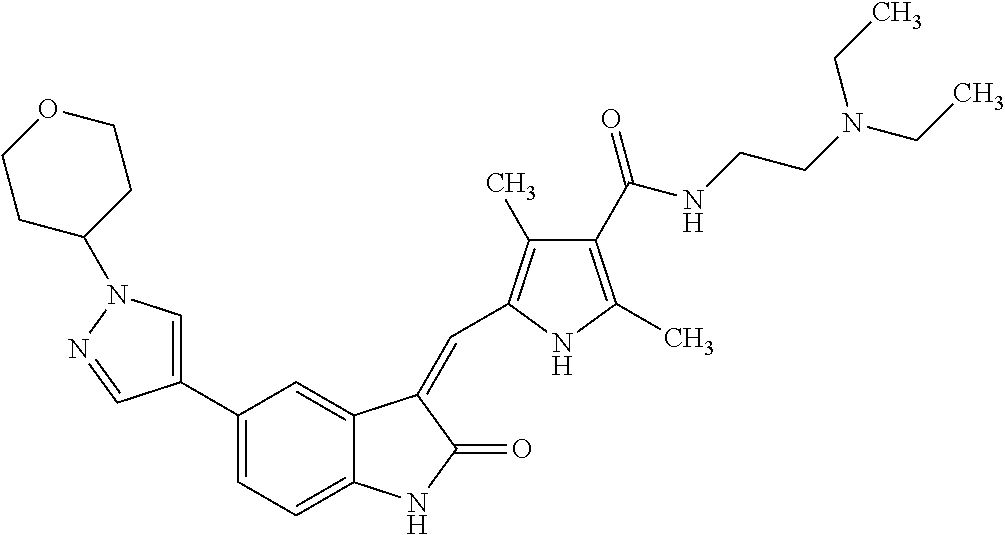 |
300 MHz 1H-NMR (DMSO-d6, δ) 13.64 (s, 1H), 10.88 (s, 1H), 8.19 (s, 1H), 8.00 (s, 1H), 7.90 (s, 1H), 7.68 (s, 1H), 7.45-7.38 (m, 1H), 7.35 (d, 1H, J = 7.9 Hz), 6.85 (d, 1H, J = 7.9 Hz), 4.44-4.33 (m, 1H), 4.02-3.91 (m, 2H), 3.52-3.43 (m, 2H), 3.32-3.24 (m, 2H), 2.58-2.48 (m, 6H), 2.44 (s, 3H), 2.44 (s, 3H), 2.06-1.89 (m, 4H), 0.97 (t, 6H, J = 7.0 Hz) |
| 48 |
 |
300 MHz 1H-NMR (DMSO-d6, δ) 13.64 (s, 1H), 11.06 (s, 1H), 9.18 (s, 1H), 8.30 (s, 1H), 7.96 (d, 2H, J = 9 Hz), 7.75-7.45 (m, 6H), 7.00 (d, 1H, J = 9 Hz), 3.39-3.26 (m, 4H), 2.56-2.45 (m, 10H), and 0.97 (t, J = 7.5 Hz). |
| 49 |
 |
LCMS m/z 524.5 (M + H) |
| 50 |
 |
300 MHz 1H-NMR (DMSO-d6, δ) 13.64 (s, 1H), 11.14 (s, 1H), 8.41 (s, 1H), 8.12-8.11 (m, 2H), 7.87-7.85 (m, 1H), 7.84 (s, 1H), 7.55-7.48 (m, 4H), 7.03-7.01 (m, 1H), 3.34-3.25 (m, 4H), 2.54-2.45 (m, 10H), 0.99-0.95 (m, 6H) |

| TABLE 5 | ||
| Example | structure | Spectral data |
| 52 |
 |
300 MHz 1H-NMR (CDCl3, δ) 13.24 (s, 1H), 8.03 (s, 1H), 7.89 (t, 1H, J = 3.3 Hz), 7.83 (s, 1H), 7.58 (t, 1H, J = 9.0 Hz), 7.41-7.27 (m, 4H), 6.91-6.82 (m, 1H), 3.62 (brs, 2H), 2.93-2.82 (m, 6H), 2.62-2.36 (m, 6H), 1.18-1.15 (m, 6H) |
| 53 |
 |
300 MHz 1H-NMR (CD3OD, δ) 8.34 (s, 1H), 8.16 (d, 2H, J = 7.8 Hz), 7.92 (d, 1H, J = 8.4 Hz), 7.65-7.60 (m, 5H), 7.08 (d, 1H, J = 8.1 Hz), 3.59 (t, 2H, J = 6.6 Hz), 2.99-2.88 (m, 6H), 2.52 (s, 3H), 2.50 (s, 3H), 1.22 (t, 6H, J = 7.2 Hz) |
| 54 |
 |
300 MHz 1H-NMR (DMSO-d6, δ) 13.64 (s, 1H), 11.07 (s, 1H), 8.28 (s, 1H), 8.23 (s, 1H), 7.96-7.94 (m, 2H), 7.83 (s, 1H), 7.55-7.42 (m, 4H), 6.97-6.94 (m, 1H), 3.38-3.25 (m, 4H), 2.56-2.40 (m, 10H), 0.99-0.95 (m, 6H) |
| 55 |
 |
300 MHz 1H-NMR (DMSO-d6, δ) 13.65 (s, 1H), 11.25 (s, 1H), 7.86 (s, 1H), 7.75 (s, 1H), 7.55 (s, 1H), 7.44-7.41 (m, 3H), 7.27-7.21 (m, 3H), 6.91-6.89 (m, 1H), 6.78-6.75 (m, 1H), 3.96 (s, 3H), 3.34-3.28 (m, 4H), 2.55-2.50 (m, 4H), 2,45 (s, 3H), 2.34 (s, 3H), 0.99-0.97 (m, 6H) |

| TABLE 5 | ||
| colonyformation | sphere | |
| Example | IC50 (μM) | IC50 (μM) |
| 4 | 6.3 | 0.6 |
| 6 | 3.6 | 0.3 |
| 7 | 1.8 | 0.6 |
| 9 | 3.8 | 1.3 |
| 10 | 5.4 | 3 |
| 12 | 24 | >50 |
| 30 | >100 | 8.9 |
| 31 | 3.7 | 0.2 |
| 32 | 0.5 | 0.05 |
| 33 | 2.5 | 1.7 |
| 38 | 6.2 | 2 |
| 42 | 1.9 | 1.3 |
| 43 | 6.5 | 1.9 |
| 45 | 22 | >50 |
| 47 | 6.2 | 9.1 |
| TABLE 6 | ||
| pH 1.2 | pH 7.4 | |
| Example | (mg/mL) | (mg/mL) |
| 12 | >0.2000 | >0.2000 |
| 26 | >0.2000 | <0.0005 |
| 41 | 0.186 | 0.0003 |
| 42 | >0.2000 | 0.011 |
| 43 | 0.163 | 0.0004 |
| 48 | 0.147 | <0.0003 |
| 49 | 0.109 | 0.013 |
| 50 | 0.154 | 0.007 |
| 51 | >0.2000 | <0.0005 |
| 52 | 0.163 | 0.004 |
| 53 | >0.2000 | 0.061 |
| 55 | 0.043 | 0.0005 |
Claims (18)


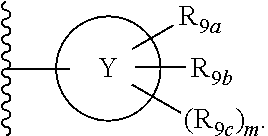


Priority Applications (3)
| Application Number | Priority Date | Filing Date | Title |
|---|---|---|---|
| US14/208,289 US9227962B2 (en) | 2013-03-13 | 2014-03-13 | Heterocyclic substituted-3-heteroarylidenyl-2-indolinone derivative |
| US14/950,347 US20160075697A1 (en) | 2013-03-13 | 2015-11-24 | Heterocyclic substituted-3-heteroarylidenyl-2-indolinone derivative |
| US16/157,370 US20190241550A1 (en) | 2013-03-13 | 2018-10-11 | Heterocyclic substituted-3-heteroarylidenyl-2-indolinone derivative |
Applications Claiming Priority (2)
| Application Number | Priority Date | Filing Date | Title |
|---|---|---|---|
| US201361780263P | 2013-03-13 | 2013-03-13 | |
| US14/208,289 US9227962B2 (en) | 2013-03-13 | 2014-03-13 | Heterocyclic substituted-3-heteroarylidenyl-2-indolinone derivative |
Related Child Applications (1)
| Application Number | Title | Priority Date | Filing Date |
|---|---|---|---|
| US14/950,347 Continuation US20160075697A1 (en) | 2013-03-13 | 2015-11-24 | Heterocyclic substituted-3-heteroarylidenyl-2-indolinone derivative |
Publications (2)
| Publication Number | Publication Date |
|---|---|
| US20140275076A1 US20140275076A1 (en) | 2014-09-18 |
| US9227962B2 true US9227962B2 (en) | 2016-01-05 |
Family
ID=51529945
Family Applications (3)
| Application Number | Title | Priority Date | Filing Date |
|---|---|---|---|
| US14/208,289 Expired - Fee Related US9227962B2 (en) | 2013-03-13 | 2014-03-13 | Heterocyclic substituted-3-heteroarylidenyl-2-indolinone derivative |
| US14/950,347 Abandoned US20160075697A1 (en) | 2013-03-13 | 2015-11-24 | Heterocyclic substituted-3-heteroarylidenyl-2-indolinone derivative |
| US16/157,370 Abandoned US20190241550A1 (en) | 2013-03-13 | 2018-10-11 | Heterocyclic substituted-3-heteroarylidenyl-2-indolinone derivative |
Family Applications After (2)
| Application Number | Title | Priority Date | Filing Date |
|---|---|---|---|
| US14/950,347 Abandoned US20160075697A1 (en) | 2013-03-13 | 2015-11-24 | Heterocyclic substituted-3-heteroarylidenyl-2-indolinone derivative |
| US16/157,370 Abandoned US20190241550A1 (en) | 2013-03-13 | 2018-10-11 | Heterocyclic substituted-3-heteroarylidenyl-2-indolinone derivative |
Country Status (1)
| Country | Link |
|---|---|
| US (3) | US9227962B2 (en) |
Cited By (1)
| Publication number | Priority date | Publication date | Assignee | Title |
|---|---|---|---|---|
| US20160031888A1 (en) * | 2013-03-13 | 2016-02-04 | Boston Biomedical, Inc. | 3-(aryl or heteroaryl) methyleneindolin-2-one derivatives as inhibitors of cancer stem cell pathway kinases for the treatment of cancer |
Families Citing this family (6)
| Publication number | Priority date | Publication date | Assignee | Title |
|---|---|---|---|---|
| US9187454B2 (en) | 2013-03-13 | 2015-11-17 | Boston Biomedical, Inc. | Inhibitors of kinases and cancer stem cells, and methods of preparation and use thereof |
| EP3932914A1 (en) | 2015-03-13 | 2022-01-05 | Valo Health, Inc. | Alpha-cinnamide compounds and compositions as hdac8 inhibitors |
| TWI826690B (en) * | 2019-05-23 | 2023-12-21 | 美商基利科學股份有限公司 | Substituted eneoxindoles and uses thereof |
| US12435059B2 (en) | 2019-07-03 | 2025-10-07 | The Regents Of The University Of Colorado, A Body Corporate | AMP-activated protein kinase inhibitors and methods of making and using the same |
| CN111072546B (en) * | 2019-12-30 | 2022-03-11 | 阿里生物新材料(常州)有限公司 | Synthesis method of 5-ethynylindoline-2, 3-diketone |
| WO2025010294A2 (en) * | 2023-07-03 | 2025-01-09 | Blossomhill Therapeutics, Inc. | Macrocyclic compounds and use as tyk2 inhibitors |
Citations (7)
| Publication number | Priority date | Publication date | Assignee | Title |
|---|---|---|---|---|
| WO2004000300A1 (en) | 2002-06-25 | 2003-12-31 | Nicox S.A. | Cyclooxygenase-2 inhibitors |
| US7026330B2 (en) | 2002-05-30 | 2006-04-11 | The Children's Hospital Of Philadelphia | Methods for treatment of acute lymphocytic leukemia |
| US20060094674A1 (en) | 2002-07-05 | 2006-05-04 | Neel Benjamin G | Combination of mtor inhibitor and a tyrosine kinase inhibitor for the treatment of neoplasms |
| US7176234B2 (en) | 2002-07-01 | 2007-02-13 | Cytovia, Inc. | Derivatives of gambogic acid and analogs as activators of caspases and inducers of apoptosis |
| US7342016B2 (en) | 2000-08-30 | 2008-03-11 | Schering Corporation | Farnesyl protein transferase inhibitors as antitumor agents |
| WO2009033033A2 (en) | 2007-09-06 | 2009-03-12 | Boston Biomedical, Inc. | Compositions of kinase inhibitors and their use for treatment of cancer and other diseases related to kinases |
| US20140275033A1 (en) | 2013-03-13 | 2014-09-18 | Boston Biomedical, Inc. | Inhibitors of kinases and cancer stem cells, and methods of preparation and use thereof |
-
2014
- 2014-03-13 US US14/208,289 patent/US9227962B2/en not_active Expired - Fee Related
-
2015
- 2015-11-24 US US14/950,347 patent/US20160075697A1/en not_active Abandoned
-
2018
- 2018-10-11 US US16/157,370 patent/US20190241550A1/en not_active Abandoned
Patent Citations (7)
| Publication number | Priority date | Publication date | Assignee | Title |
|---|---|---|---|---|
| US7342016B2 (en) | 2000-08-30 | 2008-03-11 | Schering Corporation | Farnesyl protein transferase inhibitors as antitumor agents |
| US7026330B2 (en) | 2002-05-30 | 2006-04-11 | The Children's Hospital Of Philadelphia | Methods for treatment of acute lymphocytic leukemia |
| WO2004000300A1 (en) | 2002-06-25 | 2003-12-31 | Nicox S.A. | Cyclooxygenase-2 inhibitors |
| US7176234B2 (en) | 2002-07-01 | 2007-02-13 | Cytovia, Inc. | Derivatives of gambogic acid and analogs as activators of caspases and inducers of apoptosis |
| US20060094674A1 (en) | 2002-07-05 | 2006-05-04 | Neel Benjamin G | Combination of mtor inhibitor and a tyrosine kinase inhibitor for the treatment of neoplasms |
| WO2009033033A2 (en) | 2007-09-06 | 2009-03-12 | Boston Biomedical, Inc. | Compositions of kinase inhibitors and their use for treatment of cancer and other diseases related to kinases |
| US20140275033A1 (en) | 2013-03-13 | 2014-09-18 | Boston Biomedical, Inc. | Inhibitors of kinases and cancer stem cells, and methods of preparation and use thereof |
Non-Patent Citations (2)
| Title |
|---|
| Guan et al., Bioorganic & Medicinal Chemistry Letters (2004), 14(1), 187-190. |
| Li, et al. Document No. 150:306636, retrieved from STN; Mar. 12, 2009. * |
Cited By (1)
| Publication number | Priority date | Publication date | Assignee | Title |
|---|---|---|---|---|
| US20160031888A1 (en) * | 2013-03-13 | 2016-02-04 | Boston Biomedical, Inc. | 3-(aryl or heteroaryl) methyleneindolin-2-one derivatives as inhibitors of cancer stem cell pathway kinases for the treatment of cancer |
Also Published As
| Publication number | Publication date |
|---|---|
| US20160075697A1 (en) | 2016-03-17 |
| US20140275076A1 (en) | 2014-09-18 |
| US20190241550A1 (en) | 2019-08-08 |
Similar Documents
| Publication | Publication Date | Title |
|---|---|---|
| US20190241569A1 (en) | 3-(aryl or heteroaryl) methyleneindolin-2-one derivatives as inhibitors of cancer stem cell pathway kinases for the treatment of cancer | |
| US20190241550A1 (en) | Heterocyclic substituted-3-heteroarylidenyl-2-indolinone derivative | |
| JP2016513656A5 (en) | ||
| CN101883764B (en) | Pyrazole derivatives and use thereof as inhibitors of cyclin dependent kinases | |
| AU2008247668B2 (en) | Pyrimidine derivatives and compositions as c-kit and PDGFR kinase inhibitors | |
| CA2832865C (en) | Aminopyrimidine kinase inhibitors | |
| CA2659512C (en) | Novel piperazines, pharmaceutical compositions and methods of use thereof | |
| CN115872979A (en) | Pyrimidine derivatives and their application in medicine | |
| US12421228B2 (en) | Naphthyridine derivatives as PRC2 inhibitors | |
| US9187454B2 (en) | Inhibitors of kinases and cancer stem cells, and methods of preparation and use thereof | |
| JP2009510086A (en) | Diarylamine-containing compounds and compositions and their use as modulators of C-KIT receptors | |
| CN104024246A (en) | Substituted Pyrimidine Derivative As Aurora Kinase Inhibitor | |
| US20150315187A1 (en) | Inhibitors of lysine specific demethylase-1 | |
| EP2057124A2 (en) | Compounds and compositions as itpkb inhibitors | |
| US7662965B2 (en) | Anabaseine derivatives, pharmaceutical compositions and method of use thereof | |
| IL305046A (en) | Pyridopyrimidinone derivative, preparation method therefor, and use thereof | |
| US20120122843A1 (en) | Compounds and Their Use for Treatment of Amyloid Beta-Related Diseases | |
| CA3167785A1 (en) | Heterocyclic compounds for modulating nr2f6 | |
| KR20070091007A (en) | Indenyl derivatives and their use for the treatment of neurological disorders | |
| US12344600B2 (en) | c-Myc mRNA translation modulators and uses thereof in the treatment of cancer | |
| US12404283B2 (en) | c-MYC mRNA translation modulators and uses thereof in the treatment of cancer | |
| CN120858099A (en) | CDK inhibitors | |
| HK1134285A (en) | Thiophene-carboxamides useful as inhibitors or protein kinases |
Legal Events
| Date | Code | Title | Description |
|---|---|---|---|
| AS | Assignment |
Owner name: BOSTON BIOMEDICAL, INC., MASSACHUSETTS Free format text: ASSIGNMENT OF ASSIGNORS INTEREST;ASSIGNOR:DAINIPPON SUMITOMO PHARMA CO., LTD.;REEL/FRAME:035818/0837 Effective date: 20150526 |
|
| ZAAA | Notice of allowance and fees due |
Free format text: ORIGINAL CODE: NOA |
|
| ZAAB | Notice of allowance mailed |
Free format text: ORIGINAL CODE: MN/=. |
|
| STCF | Information on status: patent grant |
Free format text: PATENTED CASE |
|
| MAFP | Maintenance fee payment |
Free format text: PAYMENT OF MAINTENANCE FEE, 4TH YEAR, LARGE ENTITY (ORIGINAL EVENT CODE: M1551); ENTITY STATUS OF PATENT OWNER: LARGE ENTITY Year of fee payment: 4 |
|
| FEPP | Fee payment procedure |
Free format text: MAINTENANCE FEE REMINDER MAILED (ORIGINAL EVENT CODE: REM.); ENTITY STATUS OF PATENT OWNER: LARGE ENTITY |
|
| LAPS | Lapse for failure to pay maintenance fees |
Free format text: PATENT EXPIRED FOR FAILURE TO PAY MAINTENANCE FEES (ORIGINAL EVENT CODE: EXP.); ENTITY STATUS OF PATENT OWNER: LARGE ENTITY |
|
| STCH | Information on status: patent discontinuation |
Free format text: PATENT EXPIRED DUE TO NONPAYMENT OF MAINTENANCE FEES UNDER 37 CFR 1.362 |
|
| FP | Lapsed due to failure to pay maintenance fee |
Effective date: 20240105 |