US9224453B2 - Write-assisted memory with enhanced speed - Google Patents

Write-assisted memory with enhanced speed Download PDF

Info

Publication number
US9224453B2
US9224453B2 US13/799,532 US201313799532A US9224453B2 US 9224453 B2 US9224453 B2 US 9224453B2 US 201313799532 A US201313799532 A US 201313799532A US 9224453 B2 US9224453 B2 US 9224453B2
Authority
US
United States
Prior art keywords
power supply
write
sram cell
charge
accessed
Prior art date
Legal status (The legal status is an assumption and is not a legal conclusion. Google has not performed a legal analysis and makes no representation as to the accuracy of the status listed.)
Active, expires
Application number
US13/799,532
Other versions
US20140269018A1 (en
Inventor
Peng Jin
Mohamed Hassan Abu-Rahma
Fahad Ahmed
Current Assignee (The listed assignees may be inaccurate. Google has not performed a legal analysis and makes no representation or warranty as to the accuracy of the list.)
Qualcomm Inc
Original Assignee
Qualcomm Inc
Priority date (The priority date is an assumption and is not a legal conclusion. Google has not performed a legal analysis and makes no representation as to the accuracy of the date listed.)
Filing date
Publication date
Application filed by Qualcomm Inc filed Critical Qualcomm Inc
Priority to US13/799,532 priority Critical patent/US9224453B2/en
Assigned to QUALCOMM INCORPORATED reassignment QUALCOMM INCORPORATED ASSIGNMENT OF ASSIGNORS INTEREST (SEE DOCUMENT FOR DETAILS). Assignors: AHMED, Fahad, JIN, PENG, ABU-RAHMA, MOHAMED HASSAN
Priority to EP14713011.6A priority patent/EP2973578B1/en
Priority to PCT/US2014/022752 priority patent/WO2014159262A1/en
Priority to KR1020157027927A priority patent/KR101676724B1/en
Priority to JP2016501054A priority patent/JP5922320B2/en
Priority to CN201480013370.7A priority patent/CN105144295B/en
Publication of US20140269018A1 publication Critical patent/US20140269018A1/en
Publication of US9224453B2 publication Critical patent/US9224453B2/en
Application granted granted Critical
Active legal-status Critical Current
Adjusted expiration legal-status Critical

Links

Images

Classifications

    • GPHYSICS
    • G11INFORMATION STORAGE
    • G11CSTATIC STORES
    • G11C11/00Digital stores characterised by the use of particular electric or magnetic storage elements; Storage elements therefor
    • G11C11/21Digital stores characterised by the use of particular electric or magnetic storage elements; Storage elements therefor using electric elements
    • G11C11/34Digital stores characterised by the use of particular electric or magnetic storage elements; Storage elements therefor using electric elements using semiconductor devices
    • G11C11/40Digital stores characterised by the use of particular electric or magnetic storage elements; Storage elements therefor using electric elements using semiconductor devices using transistors
    • G11C11/41Digital stores characterised by the use of particular electric or magnetic storage elements; Storage elements therefor using electric elements using semiconductor devices using transistors forming static cells with positive feedback, i.e. cells not needing refreshing or charge regeneration, e.g. bistable multivibrator or Schmitt trigger
    • G11C11/413Auxiliary circuits, e.g. for addressing, decoding, driving, writing, sensing, timing or power reduction
    • G11C11/417Auxiliary circuits, e.g. for addressing, decoding, driving, writing, sensing, timing or power reduction for memory cells of the field-effect type
    • G11C11/419Read-write [R-W] circuits
    • GPHYSICS
    • G11INFORMATION STORAGE
    • G11CSTATIC STORES
    • G11C5/00Details of stores covered by group G11C11/00
    • G11C5/14Power supply arrangements, e.g. power down, chip selection or deselection, layout of wirings or power grids, or multiple supply levels
    • GPHYSICS
    • G11INFORMATION STORAGE
    • G11CSTATIC STORES
    • G11C5/00Details of stores covered by group G11C11/00
    • G11C5/14Power supply arrangements, e.g. power down, chip selection or deselection, layout of wirings or power grids, or multiple supply levels
    • G11C5/147Voltage reference generators, voltage or current regulators; Internally lowered supply levels; Compensation for voltage drops
    • GPHYSICS
    • G11INFORMATION STORAGE
    • G11CSTATIC STORES
    • G11C5/00Details of stores covered by group G11C11/00
    • G11C5/14Power supply arrangements, e.g. power down, chip selection or deselection, layout of wirings or power grids, or multiple supply levels
    • G11C5/148Details of power up or power down circuits, standby circuits or recovery circuits

Definitions

  • This application relates to a write-assisted memory, and more particularly to a write-assisted memory including a pre-charge assist circuit.
  • SRAM static random access memory
  • An SRAM memory cell comprises a pair of cross-coupled inverters. If a first one of the cross-coupled inverters is driving out a stored data value Q, that value is inverted by the remaining second cross-coupled inverter as the complementary value Q . But the second cross-coupled inverter drives Q as the input to the first cross-coupled inverter, which reinforces its Q output, which in turn reinforces the Q output of the second cross-coupled inverter. An SRAM memory cell thus latches the desired Q value into the pair of cross-coupled inverters and robustly holds this latched value.
  • Each cross-coupled inverter comprises a serial stack of a pull-up PMOS transistor and a pull-down NMOS transistor.
  • the pull-up PMOS transistors are also denoted as the load transistors.
  • an SRAM cell drives out its stored memory cell value through the resulting gain in the powered transistors.
  • a dynamic random access memory (DRAM) memory cell has no such active drive. Instead, a DRAM memory cell has a passive capacitor for storing the memory cell value. For this reason, SRAM operation is much faster than for a comparable DRAM.
  • DRAM dynamic random access memory
  • the supply voltage to an SRAM memory cell may be lowered during a write operation to the SRAM memory cell.
  • the lowered supply voltage weakens the pull-up PMOS transistors so that the write operation may invert (if necessary) the binary state of the stored memory cell value.
  • this write-assist technique is successful to address write failure, the write frequency suffers because the memory cell supply voltage must recover to its default value after completion of the write-assisted write operation.
  • a write-assist circuit that assists a pre-charge of a power supply voltage on a power supply lead for an accessed memory cell upon completion of a write-assist period or duration.
  • the pre-charge assist circuit assists the pre-charge by coupling charge from power supply leads for the non-accessed memory cells to the power supply lead for the accessed memory cell.
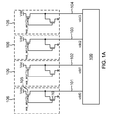
  • FIG. 1A is a schematic diagram of the write-assist circuits and corresponding power supply leads for a bit-line multiplexed group of memory cells.
  • FIG. 1B is a waveform for the power supply voltage of a write-assisted memory cell.
  • FIG. 2 is a schematic diagram of a first pre-charge assist circuit and corresponding write-assist circuits for a bit-line-multiplexed group of memory cells.
  • FIG. 3 is a schematic diagram of a second pre-charge assist circuit and corresponding write-assist circuits for a bit-line-multiplexed group of memory cells.
  • FIG. 4 is a flowchart of a method of operation for a pre-charge assist circuit and corresponding write-assist circuits for a bit-line multiplexed group of memory cells.
  • a bit-line-multiplexed memory is configured to share charge during the pre-charge recovery from a write-assisted write operation.
  • the charge sharing exploits the bit-line-multiplexing architecture of modern memory designs as is known in the arts.
  • a memory cell such as an SRAM memory cell is constructed from transistors that fully exploit the small dimensions available in advanced process nodes.
  • the sense amplifier for sensing the stored memory cell value cannot be formed from such small transistors in that a sense amplifier requires sufficient gain to quickly make the bit decisions.
  • the relatively large transistors for a sense amplifier cannot be arranged within the bit-line pitch for a single memory cell.
  • the memory cells and their associated bit lines are thus multiplexed in bit-line multiplexed groups, each group being served by a corresponding sense amplifier.
  • the number of multiplexed bit lines (and corresponding memory cells) per each sense amplifier determines the resulting aspect ratio of the memory.
  • a common group size for such multiplexing is four, eight, or sixteen memory cells.
  • the following discussion concerns a 4:1 bit-line multiplexing scheme but it will be appreciated that the pre-charge assist circuits and techniques discussed herein are widely applicable to other multiplexing groupings.
  • the memory cells in a 4:1 bit-line multiplexed group are denoted herein as a multiplexed bitcell.
  • each memory cell is powered through a corresponding write-assist circuit.
  • a memory cell receives power from a power supply lead controlled by its write-assist circuit.
  • the write-assist circuit couples between its memory cell's power supply lead and a power supply node.
  • the power supply node supplies the default power supply voltage vdd. Because of the bit-line multiplexing, only one memory cell in a multiplexed bitcell is accessed in any given write operation.
  • the remaining memory cells in a bit-line multiplexed group (the remaining memory cells in the multiplexed bitcell) are non-accessed memory cells for that particular write operation.
  • the write-assist circuits for the non-accessed memory cells maintain the power supply voltages on the power supply leads to the non-accessed memory cells at the undiminished default power supply value vdd.
  • the write-assist circuit for the accessed memory cell lowers the supply voltage to the accessed memory cell while the accessed memory cell is written to in a write-assisted write operation.
  • FIG. 1A illustrates an example 4:1 bit-line multiplexed group of memory cells (a multiplexed bitcell) 100 .
  • Each memory cell in multiplexed bitcell 100 has its own power supply input or lead. Because bit-line multiplexing is well known in the memory arts, the memory cells and their corresponding bit lines within multiplexed bitcell 100 are not illustrated. Since multiplexed bitcell 100 includes four SRAM cells, there are four separate power supply leads to multiplexed bitcell 100 .
  • a power supply input or lead 101 provides a supply voltage vdd 0 to the first memory cell
  • a power supply lead 102 provides a supply voltage vdd 1 to a second memory cell
  • a power supply lead 103 provides a supply voltage vdd 2 to a third memory cell
  • a power supply lead 104 provides a supply voltage to a fourth memory cell vdd 3 .
  • Each power supply lead is powered through a corresponding write-assist circuit 106 .
  • a first memory cell receives power supply voltage vdd 0 through power supply lead 101 as controlled by a corresponding write-assist circuit 106 .
  • Each write-assist circuit 106 includes a head switch 105 and a pull down device 110 .
  • head switches 105 are PMOS transistors whereas pull down devices 110 are NMOS transistors.
  • the gates of the corresponding PMOS transistor 105 and NMOS transistor 110 are controlled by a corresponding write-assist enable signal.
  • a write-assist enable signal wa_en ⁇ 0 > controls the voltage vdd 0 on power supply lead 101
  • a write-assist enable signal wa_en ⁇ 1 > controls the voltage vdd 1 on power supply lead 102
  • a write-assist enable signal wa_en ⁇ 3 > controls the voltage vdd 3 on power supply lead 104
  • all the write assist enable signals are de-asserted so that all PMOS transistors 105 are on whereas all NMOS transistors 110 are off.
  • Each PMOS transistor 105 has a source coupled to a power supply node providing the default power supply voltage vdd.
  • each PMOS transistor 105 has a drain coupled to the corresponding power supply lead. Since the PMOS transistors 105 are all on in the default state, the power supply voltages vdd 0 through vdd 3 thus all equal the default value vdd. Each memory cell supply voltage is controlled to equal the default value vdd unless the corresponding memory cell is being written to during a write-assist period. Such a memory call may also be denoted as an accessed memory cell.
  • a memory cell is to be accessed during a write operation, the voltage on the appropriate memory cell power supply input is lowered from the default value vdd by a sufficient voltage amount ⁇ v. For example, suppose the first memory cell is selected to be the accessed memory cell for a write operation. Corresponding write-assist enable signal wa_en ⁇ 0 > would then be temporarily asserted for a write-assist duration or period. In response, PMOS transistor 105 coupled to power supply lead 101 would thus turn off whereas NMOS transistor 110 coupled to this lead would turn on. Each NMOS transistor 110 couples between the corresponding power supply lead and ground. When NMOS transistor 110 coupled to power supply lead 101 is conducting, charge on power supply lead 101 may then conduct into ground.
  • FIG. 1B illustrates the power supply voltage dip for the vdd 0 voltage during the write-assist period, which begins at time t 1 and ends at time t 2 .
  • the desired logical value has been written into the first memory cell.
  • the lowered supply voltage vdd 0 needs to be restored to the default voltage level, vdd.
  • This recovery of the write-assist-lowered supply voltage to an accessed memory cell is denoted as the pre-charge period and extends between time t 2 and t 3 in FIG. 1B .
  • the pre-charge operation is performed by a memory cell's write-assist circuit 106 .
  • the corresponding write-assist enable signal such as we_en ⁇ 0 > is thus brought low at time t 2 (the write-assist enable signals for the remaining non-accessed memory cells having been maintained low in the default state).
  • PMOS transistor 105 then pulls up the voltage on the corresponding power supply lead. But because of the bit line pitch, PMOS transistor 105 cannot be made large and correspondingly strong to quickly pull-up the memory cell supply voltage. Thus, the prior-art pre-charge duration or period was relatively long due to the necessary weakness of PMOS transistors 105 .
  • the pre-charge operation disclosed herein is advantageously faster through charge sharing from the non-accessed memory cells' power supply leads through a pre-charge assist circuit. It is denoted as an “assist” circuit in that write-assist circuits 106 continue to act as they did in the prior art with regard to the pre-charging process. But additional charge is supplied to the power supply lead for an accessed memory cell through the pre-charge assist circuits disclosed herein. In this fashion, write-assisted memories including a pre-charge assist circuit have advantageously faster operation through the shortened pre-charge durations.
  • FIG. 2 A first embodiment for a pre-charge assist circuit 200 is shown in FIG. 2 .
  • the memory cells in bit-line multiplexed group 100 and write-assist circuits 106 are constructed and function as discussed with regard to FIG. 1A .
  • each write-assist circuit 106 controls the voltage on its power supply lead responsive to a write enable signal.
  • Pre-charge assist circuit 200 enables a rapid pre-charge of a write-assist-lowered supply voltage to an accessed memory cell.
  • Pre-charge assist circuit 200 includes a plurality of pre-charge switches such as PMOS transistors 215 and also a common node 225 . The gates of PMOS transistors 215 are controlled by a pre-charge enable signal 220 .
  • a first drain/source terminal for each PMOS transistors 215 couples to common node 225 , which may comprise a conductor in a metal layer distinct from a metal layer supporting the bit lines for the memory cells in group 100 .
  • a second drain/source terminal for each PMOS transistor 215 couples to the corresponding power supply lead.
  • a second terminal for a first PMOS transistor 215 couples to power supply lead 101 for the first memory cell.
  • Each power supply lead thus couples to the second terminal of a corresponding PMOS transistor 215 .
  • pre-charge enable signal 220 In a default state (no write operation occurring), pre-charge enable signal 220 is asserted (held low) such that all PMOS transistors 215 are on. Common node 225 thus is charged to the power supply voltage vdd in the default state. But if a write-assist operation is to be conducted for a selected one of the memory cells in multiplexed bitcell 100 , pre-charge enable signal 220 is de-asserted (brought high) such that PMOS transistors 215 are all switched off. Common node 225 then floats during the write-assist operation. Upon completion of the write-assist period (corresponding to time t 2 in FIG. 1B ), the pre-charge enable signal 220 is again asserted low.
  • the default value for the individual memory cell power supply voltages vdd 0 through vdd 3 is vdd. Only one of these memory cell supply voltages will be write-assist lowered in any given write operation. For example, suppose vdd 0 has just been lowered such that the write-assist duration has ended. When pre-charge enable signal 220 is asserted, the charge on leads 102 , 103 , and 104 resulting from their default voltage vdd will flow through the corresponding PMOS transistors 215 to charge common node 225 to vdd (to the extent of whether common node 225 had discharged slightly while it was floating).
  • the charge on common node 225 will flow through the PMOS transistor 215 coupled to lead 101 to pull the first memory cell power supply voltage vdd 0 to the default value vdd. Since PMOS transistors 105 are also on at this time, a write-assist-lowered memory cell supply voltage such as that just described for voltage vdd 0 is quickly pulled to the default value vdd.
  • FIG. 3 An alternative embodiment for a pre-charge assist circuit 300 is shown in FIG. 3 .
  • Three pre-charge switches are coupled between power supply inputs 101 through 104 such as PMOS transistors 301 , 305 , and 310 .
  • PMOS transistor 301 has one drain/source terminal tied to lead 101 and a remaining drain/source terminal tied to lead 102 .
  • PMOS transistor 305 has one source/drain terminal tied to lead 102 and a remaining drain/source terminal tied to lead 103 .
  • PMOS transistor 310 has one source/drain terminal tied to lead 103 and a remaining drain/source terminal tied to lead 104 .
  • the gates of transistors 301 , 305 , and 310 are driven by pre-charge enable signal 220 .
  • Pre-charge enable signal 220 is controlled in the same manner as discussed with regard to FIG. 1 .
  • pre-charge enable signal 220 is de-asserted (brought high since it is an active low signal) during the write-assist operation.
  • Power supply leads 101 , 102 , 103 , and 104 are thus isolated from each other during the write-assist period since PMOS transistors 301 , 305 , and 310 are off.
  • pre-charge enable signal 220 is asserted (brought low).
  • This default state begins at the beginning of the pre-charge period, whereupon PMOS transistors 301 , 305 , and 310 are turned on.
  • the terminals for these transistors are each referred to as “drain/source” because the operation of one as a drain or as a source depends upon the particular memory cell being write-assisted and then pre-charged. For example, suppose supply voltage vdd 0 on power supply lead 101 has been write-assist lowered.
  • charge from power supply lead 102 as supplied by that lead's write-assist circuit 106 will flow through PMOS transistor 301 to assist in the pre-charging of voltage vdd 0 back to the default value vdd.
  • Charge from power supply leads 103 and 104 would also assist in this pre-charging as well.
  • charge from power supply lead 103 flows through PMOS transistor 305 and PMOS transistor 301 to assist in the pre-charging of the first memory cell supply voltage vdd 0 .
  • charge from power supply lead 104 flows through PMOS transistors 310 , 305 , and 301 to assist in the pre-charging of the first memory cell supply voltage vdd 0 .
  • a given source/drain terminal for PMOS transistors 301 , 305 , and 310 can act as either a source or a drain.
  • the first and second terminals for transistors 215 of pre-charge assist circuit 200 were also denoted as source/drain terminals.
  • pre-charge assist circuit 300 may be modified to accommodate any ratio of bit line multiplexing.
  • the memory cells and their corresponding power supply inputs or leads may be considered to be arranged from a first memory cell and first power supply input to a last memory cell and a last power supply input.
  • Each power supply input ranging from the first power supply input through a next-to-last one of the power supply inputs would have its own pre-charge circuit switch.
  • Each pre-charge switch couples between its corresponding power supply input and a power supply input for a subsequent one of the memory cells.
  • the resulting pre-charge assist significantly increases the recovery of the memory cell voltage.
  • simulation results indicate that the pre-charge assist circuits disclosed herein reduces the pre-charging duration by approximately 50%. In this fashion, a write-assisted memory with a pre-charge assist circuit may operate at significantly enhanced speeds.
  • FIG. 4 is a flowchart for an example pre-charge assist method.
  • a step 400 comprise writing to a first memory cell in a bit-line multiplexed group of memory cells while lowering the first memory cell's power supply voltage from a default value over a first write-assist duration in a first write operation, a remainder of the memory cells in the group being first non-accessed memory cells for the first write operation, wherein each memory cell receives its power supply voltage over a corresponding power supply lead.
  • a step 405 occurs during the first write-assist period and comprises maintaining the power supply voltages for the first non-accessed memory cells at the default value.
  • a final step 410 occurs after the first write-assist duration has ended and comprises pre-charging the power supply voltage on the power supply lead for the first memory cell back to the default value using charge from the power supply leads for the first non-accessed memory cells.

Landscapes

  • Engineering & Computer Science (AREA)
  • Power Engineering (AREA)
  • Microelectronics & Electronic Packaging (AREA)
  • Computer Hardware Design (AREA)
  • Static Random-Access Memory (AREA)

Abstract

A write-assisted memory includes a pre-charge assist circuit that assists the pre-charge of the power supply voltage on a power supply lead for an accessed memory cell in a bit-line-multiplexed group of memory cells subsequent to a write-assist period by coupling charge from the power supply leads for the remaining non-accessed memory cells in the bit-line-multiplexed group of memory cells.

Description

TECHNICAL FIELD
This application relates to a write-assisted memory, and more particularly to a write-assisted memory including a pre-charge assist circuit.
BACKGROUND
As nanometer technology nodes advance more and more into the deep sub-micron regimes, static random access memory (SRAM) design must face increasingly stringent requirements. As the devices are scaled down, the supply voltage must also be scaled lower to reduce power consumption. The successful design of SRAMs with the resulting minimum-size transistors at the reduced power supply voltages is quite challenging. For example, write failure becomes an issue in such highly-scaled memories. In a write failure, the write operation is unsuccessful at flipping the stored value in the memory cell.
Some basic SRAM operation concepts will now be discussed to better illustrate the challenges of scaling SRAM into the advanced process nodes. An SRAM memory cell comprises a pair of cross-coupled inverters. If a first one of the cross-coupled inverters is driving out a stored data value Q, that value is inverted by the remaining second cross-coupled inverter as the complementary value Q. But the second cross-coupled inverter drives Q as the input to the first cross-coupled inverter, which reinforces its Q output, which in turn reinforces the Q output of the second cross-coupled inverter. An SRAM memory cell thus latches the desired Q value into the pair of cross-coupled inverters and robustly holds this latched value.
Each cross-coupled inverter comprises a serial stack of a pull-up PMOS transistor and a pull-down NMOS transistor. The pull-up PMOS transistors are also denoted as the load transistors. Because the stacked PMOS and NMOS transistors are powered by a power supply, an SRAM cell drives out its stored memory cell value through the resulting gain in the powered transistors. In contrast, a dynamic random access memory (DRAM) memory cell has no such active drive. Instead, a DRAM memory cell has a passive capacitor for storing the memory cell value. For this reason, SRAM operation is much faster than for a comparable DRAM.
Although this cross-coupled interaction in an SRAM memory cell is one of its strengths, it also becomes a problem in the advanced process nodes. For example, an SRAM memory cell is accessed in a read or write operation through a pair of NMOS access transistors. These NMOS access transistors cannot be too strong compared to the pull-up PMOS transistors or a read operation would destroy the stored memory cell value. In advanced process nodes, however, the pull-up PMOS transistors become too strong as compared to the NMOS access transistors. The write operation can thus fail to flip the stored memory cell value at advanced process nodes.
Several techniques have been developed to address this write failure. For example, the supply voltage to an SRAM memory cell may be lowered during a write operation to the SRAM memory cell. The lowered supply voltage weakens the pull-up PMOS transistors so that the write operation may invert (if necessary) the binary state of the stored memory cell value. Although this write-assist technique is successful to address write failure, the write frequency suffers because the memory cell supply voltage must recover to its default value after completion of the write-assisted write operation.
Accordingly, there is a need in the art for improved write-assisted memories having faster operation speeds.
SUMMARY
In a bit-line multiplexed group of memory cells, when a given one of the memory cells in the group is accessed by being written to in a write operation, the remaining memory cells in the group are non-accessed memory cells. In this fashion, only one memory cell in the group is accessed in any given write operation. To achieve faster operation speeds for a write-assisted bit-line multiplexed group of memory cells, a write-assist circuit is provided that assists a pre-charge of a power supply voltage on a power supply lead for an accessed memory cell upon completion of a write-assist period or duration. The pre-charge assist circuit assists the pre-charge by coupling charge from power supply leads for the non-accessed memory cells to the power supply lead for the accessed memory cell.
BRIEF DESCRIPTION OF THE DRAWINGS
FIG. 1A is a schematic diagram of the write-assist circuits and corresponding power supply leads for a bit-line multiplexed group of memory cells.
FIG. 1B is a waveform for the power supply voltage of a write-assisted memory cell.
FIG. 2 is a schematic diagram of a first pre-charge assist circuit and corresponding write-assist circuits for a bit-line-multiplexed group of memory cells.
FIG. 3 is a schematic diagram of a second pre-charge assist circuit and corresponding write-assist circuits for a bit-line-multiplexed group of memory cells.
FIG. 4 is a flowchart of a method of operation for a pre-charge assist circuit and corresponding write-assist circuits for a bit-line multiplexed group of memory cells.
DETAILED DESCRIPTION
To meet the need in the art for greater recovery speed in write-assisted memories, a bit-line-multiplexed memory is configured to share charge during the pre-charge recovery from a write-assisted write operation. The charge sharing exploits the bit-line-multiplexing architecture of modern memory designs as is known in the arts. With regard to such multiplexing, a memory cell such as an SRAM memory cell is constructed from transistors that fully exploit the small dimensions available in advanced process nodes. But the sense amplifier for sensing the stored memory cell value cannot be formed from such small transistors in that a sense amplifier requires sufficient gain to quickly make the bit decisions. The relatively large transistors for a sense amplifier cannot be arranged within the bit-line pitch for a single memory cell. The memory cells and their associated bit lines are thus multiplexed in bit-line multiplexed groups, each group being served by a corresponding sense amplifier.
The number of multiplexed bit lines (and corresponding memory cells) per each sense amplifier determines the resulting aspect ratio of the memory. A common group size for such multiplexing is four, eight, or sixteen memory cells. The following discussion concerns a 4:1 bit-line multiplexing scheme but it will be appreciated that the pre-charge assist circuits and techniques discussed herein are widely applicable to other multiplexing groupings. The memory cells in a 4:1 bit-line multiplexed group are denoted herein as a multiplexed bitcell.
As known in the write-assisted memory arts, each memory cell is powered through a corresponding write-assist circuit. A memory cell receives power from a power supply lead controlled by its write-assist circuit. The write-assist circuit couples between its memory cell's power supply lead and a power supply node. The power supply node supplies the default power supply voltage vdd. Because of the bit-line multiplexing, only one memory cell in a multiplexed bitcell is accessed in any given write operation. The remaining memory cells in a bit-line multiplexed group (the remaining memory cells in the multiplexed bitcell) are non-accessed memory cells for that particular write operation. Thus, the write-assist circuits for the non-accessed memory cells maintain the power supply voltages on the power supply leads to the non-accessed memory cells at the undiminished default power supply value vdd. But the write-assist circuit for the accessed memory cell lowers the supply voltage to the accessed memory cell while the accessed memory cell is written to in a write-assisted write operation.
FIG. 1A illustrates an example 4:1 bit-line multiplexed group of memory cells (a multiplexed bitcell) 100. Each memory cell in multiplexed bitcell 100 has its own power supply input or lead. Because bit-line multiplexing is well known in the memory arts, the memory cells and their corresponding bit lines within multiplexed bitcell 100 are not illustrated. Since multiplexed bitcell 100 includes four SRAM cells, there are four separate power supply leads to multiplexed bitcell 100. A power supply input or lead 101 provides a supply voltage vdd0 to the first memory cell, a power supply lead 102 provides a supply voltage vdd1 to a second memory cell, a power supply lead 103 provides a supply voltage vdd2 to a third memory cell, and a power supply lead 104 provides a supply voltage to a fourth memory cell vdd3.
These individual supply voltages power the pull-up PMOS transistors and pull-down NMOS transistors in their respective memory cells. Each power supply lead is powered through a corresponding write-assist circuit 106. For example, a first memory cell receives power supply voltage vdd0 through power supply lead 101 as controlled by a corresponding write-assist circuit 106.
Each write-assist circuit 106 includes a head switch 105 and a pull down device 110. In write-assist circuits 106, head switches 105 are PMOS transistors whereas pull down devices 110 are NMOS transistors. Within a given write-assist circuit 106, the gates of the corresponding PMOS transistor 105 and NMOS transistor 110 are controlled by a corresponding write-assist enable signal. For example, a write-assist enable signal wa_en<0> controls the voltage vdd0 on power supply lead 101, a write-assist enable signal wa_en<1> controls the voltage vdd1 on power supply lead 102, and so on such that a write-assist enable signal wa_en<3> controls the voltage vdd3 on power supply lead 104. In a default state, all the write assist enable signals are de-asserted so that all PMOS transistors 105 are on whereas all NMOS transistors 110 are off. Each PMOS transistor 105 has a source coupled to a power supply node providing the default power supply voltage vdd. In addition, each PMOS transistor 105 has a drain coupled to the corresponding power supply lead. Since the PMOS transistors 105 are all on in the default state, the power supply voltages vdd0 through vdd3 thus all equal the default value vdd. Each memory cell supply voltage is controlled to equal the default value vdd unless the corresponding memory cell is being written to during a write-assist period. Such a memory call may also be denoted as an accessed memory cell.
If a memory cell is to be accessed during a write operation, the voltage on the appropriate memory cell power supply input is lowered from the default value vdd by a sufficient voltage amount Δv. For example, suppose the first memory cell is selected to be the accessed memory cell for a write operation. Corresponding write-assist enable signal wa_en<0> would then be temporarily asserted for a write-assist duration or period. In response, PMOS transistor 105 coupled to power supply lead 101 would thus turn off whereas NMOS transistor 110 coupled to this lead would turn on. Each NMOS transistor 110 couples between the corresponding power supply lead and ground. When NMOS transistor 110 coupled to power supply lead 101 is conducting, charge on power supply lead 101 may then conduct into ground. The power supply voltage vdd0 for the first memory cell would thus dip temporarily below vdd to weaken the strength of the pull-up PMOS transistors in the first memory cell. FIG. 1B illustrates the power supply voltage dip for the vdd0 voltage during the write-assist period, which begins at time t1 and ends at time t2. At time t2, the desired logical value has been written into the first memory cell. At this point, the lowered supply voltage vdd0 needs to be restored to the default voltage level, vdd. This recovery of the write-assist-lowered supply voltage to an accessed memory cell is denoted as the pre-charge period and extends between time t2 and t3 in FIG. 1B.
In the prior art, the pre-charge operation is performed by a memory cell's write-assist circuit 106. The corresponding write-assist enable signal such as we_en<0> is thus brought low at time t2 (the write-assist enable signals for the remaining non-accessed memory cells having been maintained low in the default state). PMOS transistor 105 then pulls up the voltage on the corresponding power supply lead. But because of the bit line pitch, PMOS transistor 105 cannot be made large and correspondingly strong to quickly pull-up the memory cell supply voltage. Thus, the prior-art pre-charge duration or period was relatively long due to the necessary weakness of PMOS transistors 105. But the pre-charge operation disclosed herein is advantageously faster through charge sharing from the non-accessed memory cells' power supply leads through a pre-charge assist circuit. It is denoted as an “assist” circuit in that write-assist circuits 106 continue to act as they did in the prior art with regard to the pre-charging process. But additional charge is supplied to the power supply lead for an accessed memory cell through the pre-charge assist circuits disclosed herein. In this fashion, write-assisted memories including a pre-charge assist circuit have advantageously faster operation through the shortened pre-charge durations.
A first embodiment for a pre-charge assist circuit 200 is shown in FIG. 2. The memory cells in bit-line multiplexed group 100 and write-assist circuits 106 are constructed and function as discussed with regard to FIG. 1A. Thus, each write-assist circuit 106 controls the voltage on its power supply lead responsive to a write enable signal. Pre-charge assist circuit 200 enables a rapid pre-charge of a write-assist-lowered supply voltage to an accessed memory cell. Pre-charge assist circuit 200 includes a plurality of pre-charge switches such as PMOS transistors 215 and also a common node 225. The gates of PMOS transistors 215 are controlled by a pre-charge enable signal 220. A first drain/source terminal for each PMOS transistors 215 couples to common node 225, which may comprise a conductor in a metal layer distinct from a metal layer supporting the bit lines for the memory cells in group 100. A second drain/source terminal for each PMOS transistor 215 couples to the corresponding power supply lead. For example, a second terminal for a first PMOS transistor 215 couples to power supply lead 101 for the first memory cell. Each power supply lead thus couples to the second terminal of a corresponding PMOS transistor 215.
In a default state (no write operation occurring), pre-charge enable signal 220 is asserted (held low) such that all PMOS transistors 215 are on. Common node 225 thus is charged to the power supply voltage vdd in the default state. But if a write-assist operation is to be conducted for a selected one of the memory cells in multiplexed bitcell 100, pre-charge enable signal 220 is de-asserted (brought high) such that PMOS transistors 215 are all switched off. Common node 225 then floats during the write-assist operation. Upon completion of the write-assist period (corresponding to time t2 in FIG. 1B), the pre-charge enable signal 220 is again asserted low. As discussed previously, the default value for the individual memory cell power supply voltages vdd0 through vdd3 is vdd. Only one of these memory cell supply voltages will be write-assist lowered in any given write operation. For example, suppose vdd0 has just been lowered such that the write-assist duration has ended. When pre-charge enable signal 220 is asserted, the charge on leads 102, 103, and 104 resulting from their default voltage vdd will flow through the corresponding PMOS transistors 215 to charge common node 225 to vdd (to the extent of whether common node 225 had discharged slightly while it was floating). In turn, the charge on common node 225 will flow through the PMOS transistor 215 coupled to lead 101 to pull the first memory cell power supply voltage vdd0 to the default value vdd. Since PMOS transistors 105 are also on at this time, a write-assist-lowered memory cell supply voltage such as that just described for voltage vdd0 is quickly pulled to the default value vdd.
An alternative embodiment for a pre-charge assist circuit 300 is shown in FIG. 3. Three pre-charge switches are coupled between power supply inputs 101 through 104 such as PMOS transistors 301, 305, and 310. PMOS transistor 301 has one drain/source terminal tied to lead 101 and a remaining drain/source terminal tied to lead 102. Similarly, PMOS transistor 305 has one source/drain terminal tied to lead 102 and a remaining drain/source terminal tied to lead 103. In the same fashion, PMOS transistor 310 has one source/drain terminal tied to lead 103 and a remaining drain/source terminal tied to lead 104. The gates of transistors 301, 305, and 310 are driven by pre-charge enable signal 220. Pre-charge enable signal 220 is controlled in the same manner as discussed with regard to FIG. 1. Thus, pre-charge enable signal 220 is de-asserted (brought high since it is an active low signal) during the write-assist operation. Power supply leads 101, 102, 103, and 104 are thus isolated from each other during the write-assist period since PMOS transistors 301, 305, and 310 are off.
In the default state, pre-charge enable signal 220 is asserted (brought low). This default state begins at the beginning of the pre-charge period, whereupon PMOS transistors 301, 305, and 310 are turned on. The terminals for these transistors are each referred to as “drain/source” because the operation of one as a drain or as a source depends upon the particular memory cell being write-assisted and then pre-charged. For example, suppose supply voltage vdd0 on power supply lead 101 has been write-assist lowered. When pre-charge enable signal 220 is asserted, charge from power supply lead 102 as supplied by that lead's write-assist circuit 106 will flow through PMOS transistor 301 to assist in the pre-charging of voltage vdd0 back to the default value vdd. Charge from power supply leads 103 and 104 would also assist in this pre-charging as well. For example, charge from power supply lead 103 flows through PMOS transistor 305 and PMOS transistor 301 to assist in the pre-charging of the first memory cell supply voltage vdd0. Similarly, charge from power supply lead 104 flows through PMOS transistors 310, 305, and 301 to assist in the pre-charging of the first memory cell supply voltage vdd0. But if the second memory cell supply voltage vdd1 had been lowered instead of vdd0, charge from lead 101 would flow in the opposite direction through PMOS transistor 301 to assist in the pre-charging of voltage vdd1 back to its default value vdd. Thus, a given source/drain terminal for PMOS transistors 301, 305, and 310 can act as either a source or a drain. For the same reason, the first and second terminals for transistors 215 of pre-charge assist circuit 200 were also denoted as source/drain terminals.
Just like pre-charge assist circuit 200, pre-charge assist circuit 300 may be modified to accommodate any ratio of bit line multiplexing. In that regard, the memory cells and their corresponding power supply inputs or leads may be considered to be arranged from a first memory cell and first power supply input to a last memory cell and a last power supply input. Each power supply input ranging from the first power supply input through a next-to-last one of the power supply inputs would have its own pre-charge circuit switch. Each pre-charge switch couples between its corresponding power supply input and a power supply input for a subsequent one of the memory cells.
Regardless of the embodiment used to assist in the pre-charging a write-assist-lowered memory cell supply voltage, the resulting pre-charge assist significantly increases the recovery of the memory cell voltage. For example, simulation results indicate that the pre-charge assist circuits disclosed herein reduces the pre-charging duration by approximately 50%. In this fashion, a write-assisted memory with a pre-charge assist circuit may operate at significantly enhanced speeds.
FIG. 4 is a flowchart for an example pre-charge assist method. In a step 400 comprise writing to a first memory cell in a bit-line multiplexed group of memory cells while lowering the first memory cell's power supply voltage from a default value over a first write-assist duration in a first write operation, a remainder of the memory cells in the group being first non-accessed memory cells for the first write operation, wherein each memory cell receives its power supply voltage over a corresponding power supply lead. A step 405 occurs during the first write-assist period and comprises maintaining the power supply voltages for the first non-accessed memory cells at the default value. A final step 410 occurs after the first write-assist duration has ended and comprises pre-charging the power supply voltage on the power supply lead for the first memory cell back to the default value using charge from the power supply leads for the first non-accessed memory cells.
As those of some skill in this art will by now appreciate and depending on the particular application at hand, many modifications, substitutions and variations can be made in and to the materials, apparatus, configurations and methods of use of the devices of the present disclosure without departing from the spirit and scope thereof. In light of this, the scope of the present disclosure should not be limited to that of the particular embodiments illustrated and described herein, as they are merely by way of some examples thereof, but rather, should be fully commensurate with that of the claims appended hereafter and their functional equivalents.

Claims (20)

What is claimed is:
1. A memory, comprising:
a plurality of SRAM cells
a plurality of power supply leads corresponding to the plurality of SRAM cells, each SRAM cell coupled to its corresponding power supply lead to receive power;
a plurality of write assist circuits corresponding to the plurality of power supply leads, wherein each power supply lead couples to a power supply node through its corresponding write assist circuit, each write assist circuit being configured to lower a power supply voltage on its corresponding power supply lead during a write operation on the corresponding SRAM cell; and
a pre-charge assist circuit including a plurality of pre-charge switches configured to couple the plurality of power supply leads together to share charge subsequent to each write operation.
2. The memory of claim 1, wherein each write-assist circuit is configured to control the power supply voltage on its corresponding power supply lead for the corresponding SRAM cell so as to maintain the power supply voltage at a default value while the corresponding SRAM cell is a non-accessed SRAM cell and so as to lower the power supply voltage from the default value during a write-assist period while the corresponding SRAM cell is an accessed SRAM cell in a write operation.
3. The memory of claim 2, wherein the pre-charge assist circuit includes a common node, and wherein the pre-charge assist circuit is further configured to assist in a pre-charge by coupling charge from the common node to the accessed SRAM cell's power supply lead upon completion of the write-assist period.
4. The memory of claim 3, further comprising a plurality of multiplexed bit lines comprising conductors in a first metal layer, and wherein the common node comprises a conductor in a second metal layer.
5. The memory of claim 3, wherein each pre-charge switch is coupled between the common node and the corresponding SRAM cell's power supply lead, the pre-charge switches being configured to be open during the write-assist period and to be closed during the pre-charge of the power supply voltage for the accessed SRAM cell.
6. The memory of claim 5, wherein each pre-charge switch comprises a pre-charge PMOS transistor having a gate driven by a pre-charge enable signal configured to be pulled to ground in a default state outside of the write-assist period and to be raised to a voltage equaling the default value during the write-assist period.
7. The memory of claim 5, wherein each write-assist circuit comprises a head switch coupled between the power supply node and the corresponding SRAM cell's power supply lead, and wherein each head switch is configured to be closed in a default state while the corresponding SRAM cell is a non-accessed SRAM cells and to be open during the write-assist period while the corresponding SRAM cell is the accessed SRAM cell during a write operation.
8. The memory of claim 7, wherein each write-assist circuit further comprises a pull-down switch coupled between the corresponding SRAM cell's power supply lead and ground, and wherein each pull-down switch is configured to be open in a default state while the corresponding SRAM cell is one of the non-accessed SRAM cells during a write operation and to be closed during the write-assist period while the corresponding SRAM cell is the accessed SRAM cell during a write operation.
9. The memory of claim 1, wherein the plurality of SRAM cells are arranged from a first SRAM cell an nth SRAM cell, n being a plural integer, and wherein the plurality of pre-charge switches comprises a plurality of (n−1) pre-charge switches corresponding to the first SRAM cell through an (n−1)th SRAM cell, each pre-charge switch being coupled between its corresponding SRAM cell's power supply lead and a subsequent SRAM cell's power supply lead, and wherein each pre-charge switch is configured to be open during a write assist period and to be closed at least during a pre-charge of the power supply voltage for the accessed SRAM cell.
10. The memory of claim 9, wherein each pre-charge switch comprises a PMOS transistor having a gate driven by a pre-charge enable signal configured to be pulled to ground in a default state outside of the write-assist period and to be raised to a default voltage during the write-assist period.
11. The memory of claim 9, wherein each write-assist circuit comprises a head switch coupled between the power supply node and the corresponding SRAM cell's power supply lead, and wherein each head switch is configured to be closed in a default state while the corresponding SRAM cell is one of the non-accessed SRAM cells during a write operation and to be open during the write-assist period while the corresponding SRAM cell is the accessed SRAM cell during a write operation, and wherein each write-assist circuit further comprises a pull-down switch coupled between the corresponding SRAM cell's power supply lead and ground, and wherein each pull-down switch is configured to be open in a default state while the corresponding SRAM cell is one of the non-accessed SRAM cells during a write operation and to be closed during the write-assist period while the corresponding SRAM cell is the accessed SRAM cell during a write operation.
12. A method, comprising:
writing to a first SRAM cell in a bit-line multiplexed group of SRAM cells while lowering a power supply voltage for the first SRAM cell from a default value over a first write-assist period in a first write operation, a remainder of the SRAM cells in the group of SRAM cells being first non-accessed SRAM cells for the first write operation, wherein each SRAM cell receives its power supply voltage over a corresponding power supply lead;
during the first write-assist period, maintaining the power supply voltages for the first non-accessed SRAM cells at the default value; and
after the first write-assist period has ended, pre-charging the power supply voltage on the power supply lead for the first SRAM cell back to the default value using charge from the power supply leads for the first non-accessed SRAM cells.
13. The method of claim 12, further comprising:
writing to a second one of the SRAM cells in the group while lowering the second SRAM cell's power supply voltage from the default value over a second write-assist period in a second write operation, a remainder of the SRAM cells in the group of SRAM cells being second non-accessed SRAM cells for the second write operation;
during the second write-assist period, maintaining the power supply voltages for the second non-accessed SRAM cells at the default value; and
after the second write-assist period has ended, pre-charging the power supply voltage for the second SRAM cell to the default value using charge from the power supply leads to the second non-accessed SRAM cells.
14. The method of claim 12, further comprising:
prior to the first write-assist period, charging each of the power supply leads to a voltage equaling the default value while each power supply lead couples to a common node,
during the first write-assist period, isolating each power supply lead from the common node; and
during the pre-charge of the power supply voltage on the power supply lead for the first SRAM cell, again coupling each power supply lead to the common node.
15. The method of claim 12, further comprising:
prior to the first write-assist period, charging each of the power supply leads to a voltage equaling the default value; and
during the pre-charge of the power supply voltage on the power supply lead for the first SRAM cell, coupling the power supply lead for the first SRAM cell to the power supply leads for the first non-accessed SRAM cells.
16. The method of claim 14, wherein coupling each power supply lead to the common node comprises coupling each power supply lead through a corresponding switch to the common node.
17. The method of claim 15, wherein coupling the power supply lead for the first SRAM cell to the power supply leads for the first-non-accessed SRAM cells comprises coupling the power supply lead for the first SRAM cell through a first switch to a power supply lead for a neighboring one of the first non-accessed SRAM cells.
18. A memory, comprising:
a bit-line multiplexed group of memory cells configured such that while a memory cell in the group is accessed in a write-assisted write operation, a remainder of the memory cells in the group are non-accessed memory cells; and
means for assisting a pre-charge of a power supply voltage on a power supply lead for an accessed one of the memory cells upon completion of a write-assist period by coupling charge from power supply leads for the non-accessed memory cells to the accessed memory cell's power supply lead.
19. The memory of claim 18, wherein the memory cells are SRAM memory cells.
20. The memory of claim 18, wherein the means comprises a plurality of switches coupled to the power supply leads.
US13/799,532 2013-03-13 2013-03-13 Write-assisted memory with enhanced speed Active 2033-07-19 US9224453B2 (en)

Priority Applications (6)

Application Number Priority Date Filing Date Title
US13/799,532 US9224453B2 (en) 2013-03-13 2013-03-13 Write-assisted memory with enhanced speed
JP2016501054A JP5922320B2 (en) 2013-03-13 2014-03-10 Memory with write assist with increased speed
PCT/US2014/022752 WO2014159262A1 (en) 2013-03-13 2014-03-10 Write-assisted memory with enhanced speed
KR1020157027927A KR101676724B1 (en) 2013-03-13 2014-03-10 Write-assisted memory with enhanced speed
EP14713011.6A EP2973578B1 (en) 2013-03-13 2014-03-10 Write-assisted memory with enhanced speed
CN201480013370.7A CN105144295B (en) 2013-03-13 2014-03-10 Write-assist memory with enhanced speed

Applications Claiming Priority (1)

Application Number Priority Date Filing Date Title
US13/799,532 US9224453B2 (en) 2013-03-13 2013-03-13 Write-assisted memory with enhanced speed

Publications (2)

Publication Number Publication Date
US20140269018A1 US20140269018A1 (en) 2014-09-18
US9224453B2 true US9224453B2 (en) 2015-12-29

Family

ID=50382748

Family Applications (1)

Application Number Title Priority Date Filing Date
US13/799,532 Active 2033-07-19 US9224453B2 (en) 2013-03-13 2013-03-13 Write-assisted memory with enhanced speed

Country Status (6)

Country Link
US (1) US9224453B2 (en)
EP (1) EP2973578B1 (en)
JP (1) JP5922320B2 (en)
KR (1) KR101676724B1 (en)
CN (1) CN105144295B (en)
WO (1) WO2014159262A1 (en)

Cited By (5)

* Cited by examiner, † Cited by third party
Publication number Priority date Publication date Assignee Title
US9940999B2 (en) 2016-06-22 2018-04-10 Darryl G. Walker Semiconductor devices, circuits and methods for read and/or write assist of an SRAM circuit portion based on voltage detection and/or temperature detection circuits
US10163524B2 (en) 2016-06-22 2018-12-25 Darryl G. Walker Testing a semiconductor device including a voltage detection circuit and temperature detection circuit that can be used to generate read assist and/or write assist in an SRAM circuit portion and method therefor
US10885954B2 (en) 2017-04-11 2021-01-05 Samsung Electronics Co., Ltd. Memory devices comprising a write assist circuit
US11568924B2 (en) 2020-10-27 2023-01-31 Samsung Electronics Co., Ltd. Static random access memory (SRAM) devices and methods of operating the same
US11955171B2 (en) 2021-09-15 2024-04-09 Mavagail Technology, LLC Integrated circuit device including an SRAM portion having end power select circuits

Families Citing this family (22)

* Cited by examiner, † Cited by third party
Publication number Priority date Publication date Assignee Title
US8958232B2 (en) * 2012-04-02 2015-02-17 Taiwan Semiconductor Manufacturing Co., Ltd. Method and apparatus for read assist to compensate for weak bit
US9741413B2 (en) 2014-09-25 2017-08-22 Kilopass Technology, Inc. Methods of reading six-transistor cross-coupled thyristor-based SRAM memory cells
US9564441B2 (en) 2014-09-25 2017-02-07 Kilopass Technology, Inc. Two-transistor SRAM semiconductor structure and methods of fabrication
US9530482B2 (en) 2014-09-25 2016-12-27 Kilopass Technology, Inc. Methods of retaining and refreshing data in a thyristor random access memory
US9564199B2 (en) 2014-09-25 2017-02-07 Kilopass Technology, Inc. Methods of reading and writing data in a thyristor random access memory
US9613968B2 (en) * 2014-09-25 2017-04-04 Kilopass Technology, Inc. Cross-coupled thyristor SRAM semiconductor structures and methods of fabrication
US9460771B2 (en) 2014-09-25 2016-10-04 Kilopass Technology, Inc. Two-transistor thyristor SRAM circuit and methods of operation
US20160093624A1 (en) 2014-09-25 2016-03-31 Kilopass Technology, Inc. Thyristor Volatile Random Access Memory and Methods of Manufacture
US9449669B2 (en) 2014-09-25 2016-09-20 Kilopass Technology, Inc. Cross-coupled thyristor SRAM circuits and methods of operation
US9251875B1 (en) * 2014-09-26 2016-02-02 Qualcomm Incorporated Register file circuit and method for improving the minimum operating supply voltage
US9449680B2 (en) * 2015-01-06 2016-09-20 Mediatek Inc. Write assist circuit and memory cell
US10026456B2 (en) 2015-02-23 2018-07-17 Qualcomm Incorporated Bitline positive boost write-assist circuits for memory bit cells employing a P-type Field-Effect transistor (PFET) write port(s), and related systems and methods
US9947406B2 (en) 2015-02-23 2018-04-17 Qualcomm Incorporated Dynamic tag compare circuits employing P-type field-effect transistor (PFET)-dominant evaluation circuits for reduced evaluation time, and related systems and methods
US10163490B2 (en) 2015-02-23 2018-12-25 Qualcomm Incorporated P-type field-effect transistor (PFET)-based sense amplifiers for reading PFET pass-gate memory bit cells, and related memory systems and methods
US9741452B2 (en) 2015-02-23 2017-08-22 Qualcomm Incorporated Read-assist circuits for memory bit cells employing a P-type field-effect transistor (PFET) read port(s), and related memory systems and methods
US9570156B1 (en) 2015-08-21 2017-02-14 Globalfoundries Inc. Data aware write scheme for SRAM
KR101986415B1 (en) 2017-07-18 2019-06-05 연세대학교 산학협력단 Static random access memory including assist circuit
CN109712651B (en) * 2018-12-30 2021-05-28 成都海光微电子技术有限公司 Auxiliary write circuit, write circuit and method, static memory and electronic equipment
US11170844B1 (en) 2020-07-07 2021-11-09 Aril Computer Corporation Ultra-low supply-voltage static random-access memory (SRAM) with 8-transistor cell with P and N pass gates to same bit lines
CN112992203B (en) * 2021-03-24 2022-05-17 长鑫存储技术有限公司 Sense amplifier, memory and control method
CN112992202B (en) 2021-03-24 2022-08-05 长鑫存储技术有限公司 Sense amplifier, memory and control method
CN116745846A (en) * 2021-05-08 2023-09-12 华为技术有限公司 An input and output module and memory

Citations (9)

* Cited by examiner, † Cited by third party
Publication number Priority date Publication date Assignee Title
US5777935A (en) 1997-03-12 1998-07-07 Motorola, Inc. Memory device with fast write recovery and related write recovery method
US6771550B2 (en) 2001-09-24 2004-08-03 Hynix Semiconductor Inc. Semiconductor memory device with stable precharge voltage level of data lines
US6785179B1 (en) 2003-06-19 2004-08-31 Arm Limited Charge sharing between bit lines within a memory circuit to increase recharge speed
US7313032B2 (en) * 2005-11-29 2007-12-25 International Business Machines Corporation SRAM voltage control for improved operational margins
US20090303819A1 (en) 2008-06-05 2009-12-10 Sun Microsystems, Inc. Write and read assist circuit for sram with power recycling
US20100290269A1 (en) 2009-05-18 2010-11-18 Kabushiki Kaisha Toshiba Static random access memory
US8130579B2 (en) * 2009-12-21 2012-03-06 Stmicroelectronics Pvt. Ltd. Memory device and method of operation thereof
US20120147686A1 (en) 2010-12-09 2012-06-14 Elpida Memory, Inc. Semiconductor device having hierarchical bit line structure and control method thereof
US20130021839A1 (en) * 2010-05-21 2013-01-24 Panasonic Corporation Semiconductor memory

Family Cites Families (12)

* Cited by examiner, † Cited by third party
Publication number Priority date Publication date Assignee Title
US4627033A (en) * 1984-08-02 1986-12-02 Texas Instruments Incorporated Sense amplifier with reduced instantaneous power
US5740116A (en) * 1995-12-22 1998-04-14 Townsend And Townsend And Crew, Llp Current limiting during block writes of memory circuits
JP4485971B2 (en) * 2005-02-14 2010-06-23 日本電信電話株式会社 Memory circuit
JP2007172715A (en) * 2005-12-20 2007-07-05 Fujitsu Ltd Semiconductor memory device and control method thereof
JP2007317316A (en) * 2006-05-26 2007-12-06 Toshiba Corp Semiconductor memory device
US7440313B2 (en) * 2006-11-17 2008-10-21 Freescale Semiconductor, Inc. Two-port SRAM having improved write operation
US7606076B2 (en) * 2007-04-05 2009-10-20 Sandisk Corporation Sensing in non-volatile storage using pulldown to regulated source voltage to remove system noise
US20090103354A1 (en) * 2007-10-17 2009-04-23 Qualcomm Incorporated Ground Level Precharge Bit Line Scheme for Read Operation in Spin Transfer Torque Magnetoresistive Random Access Memory
US7613052B2 (en) * 2007-11-01 2009-11-03 Arm Limited Memory device and method of operating such a memory device
US8223567B2 (en) * 2007-12-15 2012-07-17 Qualcomm Incorporated Memory read stability using selective precharge
US7719902B2 (en) * 2008-05-23 2010-05-18 Sandisk Corporation Enhanced bit-line pre-charge scheme for increasing channel boosting in non-volatile storage
US7881137B2 (en) * 2008-10-23 2011-02-01 Qualcomm Incorporated Read assist for memory circuits with different precharge voltage levels for bit line pair

Patent Citations (9)

* Cited by examiner, † Cited by third party
Publication number Priority date Publication date Assignee Title
US5777935A (en) 1997-03-12 1998-07-07 Motorola, Inc. Memory device with fast write recovery and related write recovery method
US6771550B2 (en) 2001-09-24 2004-08-03 Hynix Semiconductor Inc. Semiconductor memory device with stable precharge voltage level of data lines
US6785179B1 (en) 2003-06-19 2004-08-31 Arm Limited Charge sharing between bit lines within a memory circuit to increase recharge speed
US7313032B2 (en) * 2005-11-29 2007-12-25 International Business Machines Corporation SRAM voltage control for improved operational margins
US20090303819A1 (en) 2008-06-05 2009-12-10 Sun Microsystems, Inc. Write and read assist circuit for sram with power recycling
US20100290269A1 (en) 2009-05-18 2010-11-18 Kabushiki Kaisha Toshiba Static random access memory
US8130579B2 (en) * 2009-12-21 2012-03-06 Stmicroelectronics Pvt. Ltd. Memory device and method of operation thereof
US20130021839A1 (en) * 2010-05-21 2013-01-24 Panasonic Corporation Semiconductor memory
US20120147686A1 (en) 2010-12-09 2012-06-14 Elpida Memory, Inc. Semiconductor device having hierarchical bit line structure and control method thereof

Non-Patent Citations (2)

* Cited by examiner, † Cited by third party
Title
International Search Report and Written Opinion-PCT/US2014/022752-ISA/EPO-Jun. 18, 2014.
Ohbayashi S., et al., "A 65-nm SoC Embedded 6T-SRAM Designed for Manufacturability With Read and Write Operation Stabilizing Circuits", IEEE Journal of Solid-State Circuits, IEEE Service Center, Piscataway, NJ, USA, vol. 42, No. 4, 1 Apr. 1, 2007,pp. 820-829, XP011175868, ISSN: 0018-9200, DOI:10.1109/JSSC.2007.891648.

Cited By (10)

* Cited by examiner, † Cited by third party
Publication number Priority date Publication date Assignee Title
US9940999B2 (en) 2016-06-22 2018-04-10 Darryl G. Walker Semiconductor devices, circuits and methods for read and/or write assist of an SRAM circuit portion based on voltage detection and/or temperature detection circuits
US10014049B2 (en) 2016-06-22 2018-07-03 Darryl G. Walker Semiconductor devices, circuits and methods for read and/or write assist of an SRAM circuit portion based on voltage detection and/or temperature detection circuits
US10049727B2 (en) 2016-06-22 2018-08-14 Darryl G. Walker Semiconductor devices, circuits and methods for read and/or write assist of an SRAM circuit portion based on voltage detection and/or temperature detection circuits
US10163524B2 (en) 2016-06-22 2018-12-25 Darryl G. Walker Testing a semiconductor device including a voltage detection circuit and temperature detection circuit that can be used to generate read assist and/or write assist in an SRAM circuit portion and method therefor
US10403384B2 (en) 2016-06-22 2019-09-03 Darryl G. Walker Testing a semiconductor device including a voltage detection circuit and temperature detection circuit that can be used to generate read assist and/or write assist in an SRAM circuit portion and method therefor
US10497430B2 (en) 2016-06-22 2019-12-03 Samsung Electronics Co., Ltd. Semiconductor devices, circuits and methods for read and/or write assist of an SRAM circuit portion based on power supply voltage detection circuits
US10885954B2 (en) 2017-04-11 2021-01-05 Samsung Electronics Co., Ltd. Memory devices comprising a write assist circuit
US11568924B2 (en) 2020-10-27 2023-01-31 Samsung Electronics Co., Ltd. Static random access memory (SRAM) devices and methods of operating the same
US11955171B2 (en) 2021-09-15 2024-04-09 Mavagail Technology, LLC Integrated circuit device including an SRAM portion having end power select circuits
US11972793B2 (en) 2021-09-15 2024-04-30 Mavagail Technology, LLC Integrated circuit device including an SRAM portion having end power select circuits

Also Published As

Publication number Publication date
KR101676724B1 (en) 2016-11-16
CN105144295A (en) 2015-12-09
JP5922320B2 (en) 2016-05-24
JP2016511501A (en) 2016-04-14
EP2973578A1 (en) 2016-01-20
KR20150128871A (en) 2015-11-18
WO2014159262A1 (en) 2014-10-02
CN105144295B (en) 2017-11-17
EP2973578B1 (en) 2016-10-05
US20140269018A1 (en) 2014-09-18

Similar Documents

Publication Publication Date Title
US9224453B2 (en) Write-assisted memory with enhanced speed
US10431295B2 (en) Static random access memory and method of controlling the same
US8570791B2 (en) Circuit and method of word line suppression
US11527282B2 (en) SRAM with burst mode operation
US9042193B2 (en) Sense amplifier scheme
CN100552818C (en) Semiconductor memory
US9286970B2 (en) Memory circuit for pre-charging and write driving
CN105340018A (en) Semiconductor storage device
US9449681B2 (en) Pre-charging a data line
US8982657B2 (en) Semiconductor device having line self-boosting scheme
US9330731B2 (en) Circuits in strap cell regions
US10811086B1 (en) SRAM write yield enhancement with pull-up strength modulation
US8437204B2 (en) Memory array with corresponding row and column control signals
US20230317150A1 (en) Memory with Bitcell Power Boosting
TWI699764B (en) Memory write operation apparatus and method
US8565030B2 (en) Read boost circuit for memory device
US8050120B2 (en) Sensing delay circuit and semiconductor memory device using the same
US11437091B2 (en) SRAM with robust charge-transfer sense amplification
JP3315315B2 (en) Semiconductor integrated circuit device
US20150235681A1 (en) Pseudo-differential read scheme for dual port ram

Legal Events

Date Code Title Description
AS Assignment

Owner name: QUALCOMM INCORPORATED, CALIFORNIA

Free format text: ASSIGNMENT OF ASSIGNORS INTEREST;ASSIGNORS:JIN, PENG;ABU-RAHMA, MOHAMED HASSAN;AHMED, FAHAD;SIGNING DATES FROM 20130904 TO 20130923;REEL/FRAME:031271/0743

FEPP Fee payment procedure

Free format text: PAYOR NUMBER ASSIGNED (ORIGINAL EVENT CODE: ASPN); ENTITY STATUS OF PATENT OWNER: LARGE ENTITY

STCF Information on status: patent grant

Free format text: PATENTED CASE

MAFP Maintenance fee payment

Free format text: PAYMENT OF MAINTENANCE FEE, 4TH YEAR, LARGE ENTITY (ORIGINAL EVENT CODE: M1551); ENTITY STATUS OF PATENT OWNER: LARGE ENTITY

Year of fee payment: 4

MAFP Maintenance fee payment

Free format text: PAYMENT OF MAINTENANCE FEE, 8TH YEAR, LARGE ENTITY (ORIGINAL EVENT CODE: M1552); ENTITY STATUS OF PATENT OWNER: LARGE ENTITY

Year of fee payment: 8