US9223307B1 - Method for scheduling single-arm cluster tools with wafer revisiting and residency time constraints - Google Patents
Method for scheduling single-arm cluster tools with wafer revisiting and residency time constraints Download PDFInfo
- Publication number
- US9223307B1 US9223307B1 US14/639,980 US201514639980A US9223307B1 US 9223307 B1 US9223307 B1 US 9223307B1 US 201514639980 A US201514639980 A US 201514639980A US 9223307 B1 US9223307 B1 US 9223307B1
- Authority
- US
- United States
- Prior art keywords
- wafer
- denotes
- moving
- robot
- time
- Prior art date
- Legal status (The legal status is an assumption and is not a legal conclusion. Google has not performed a legal analysis and makes no representation as to the accuracy of the status listed.)
- Expired - Fee Related
Links
Images




Classifications
-
- G—PHYSICS
- G05—CONTROLLING; REGULATING
- G05B—CONTROL OR REGULATING SYSTEMS IN GENERAL; FUNCTIONAL ELEMENTS OF SUCH SYSTEMS; MONITORING OR TESTING ARRANGEMENTS FOR SUCH SYSTEMS OR ELEMENTS
- G05B19/00—Program-control systems
- G05B19/02—Program-control systems electric
- G05B19/418—Total factory control, i.e. centrally controlling a plurality of machines, e.g. direct or distributed numerical control [DNC], flexible manufacturing systems [FMS], integrated manufacturing systems [IMS] or computer integrated manufacturing [CIM]
- G05B19/41865—Total factory control, i.e. centrally controlling a plurality of machines, e.g. direct or distributed numerical control [DNC], flexible manufacturing systems [FMS], integrated manufacturing systems [IMS] or computer integrated manufacturing [CIM] characterised by job scheduling, process planning, material flow
-
- B—PERFORMING OPERATIONS; TRANSPORTING
- B25—HAND TOOLS; PORTABLE POWER-DRIVEN TOOLS; MANIPULATORS
- B25J—MANIPULATORS; CHAMBERS PROVIDED WITH MANIPULATION DEVICES
- B25J9/00—Program-controlled manipulators
- B25J9/0084—Program-controlled manipulators comprising a plurality of manipulators
- B25J9/009—Program-controlled manipulators comprising a plurality of manipulators being mechanically linked with one another at their distal ends
-
- G06F17/5013—
-
- G—PHYSICS
- G06—COMPUTING OR CALCULATING; COUNTING
- G06F—ELECTRIC DIGITAL DATA PROCESSING
- G06F30/00—Computer-aided design [CAD]
- G06F30/20—Design optimisation, verification or simulation
- G06F30/22—Design optimisation, verification or simulation using Petri net models
-
- H—ELECTRICITY
- H10—SEMICONDUCTOR DEVICES; ELECTRIC SOLID-STATE DEVICES NOT OTHERWISE PROVIDED FOR
- H10P—GENERIC PROCESSES OR APPARATUS FOR THE MANUFACTURE OR TREATMENT OF DEVICES COVERED BY CLASS H10
- H10P72/00—Handling or holding of wafers, substrates or devices during manufacture or treatment thereof
- H10P72/30—Handling or holding of wafers, substrates or devices during manufacture or treatment thereof for conveying, e.g. between different workstations
- H10P72/33—Handling or holding of wafers, substrates or devices during manufacture or treatment thereof for conveying, e.g. between different workstations into and out of processing chamber
- H10P72/3304—Handling or holding of wafers, substrates or devices during manufacture or treatment thereof for conveying, e.g. between different workstations into and out of processing chamber characterised by movements or sequence of movements of transfer devices
-
- G—PHYSICS
- G05—CONTROLLING; REGULATING
- G05B—CONTROL OR REGULATING SYSTEMS IN GENERAL; FUNCTIONAL ELEMENTS OF SUCH SYSTEMS; MONITORING OR TESTING ARRANGEMENTS FOR SUCH SYSTEMS OR ELEMENTS
- G05B2219/00—Program-control systems
- G05B2219/30—Nc systems
- G05B2219/32—Operator till task planning
- G05B2219/32245—Reentrant scheduling, workpiece can return to same machine
-
- G—PHYSICS
- G05—CONTROLLING; REGULATING
- G05B—CONTROL OR REGULATING SYSTEMS IN GENERAL; FUNCTIONAL ELEMENTS OF SUCH SYSTEMS; MONITORING OR TESTING ARRANGEMENTS FOR SUCH SYSTEMS OR ELEMENTS
- G05B2219/00—Program-control systems
- G05B2219/30—Nc systems
- G05B2219/45—Nc applications
- G05B2219/45032—Wafer manufacture; interlock, load-lock module
Definitions
- the present invention relates to a method for scheduling single-arm cluster tools. More particularly, the present invention relates to a method for scheduling single-arm cluster tools with wafer revisiting and residency time constraints.
- a typical cluster tool has several process modules (PMs), two loadlocks, and a wafer handling robot with a radical layout as shown in FIG. 1 . Equipped with one or two arms for the robot, the corresponding tool is called a single or dual-arm cluster tool.
- Cassettes with lots of raw wafers are loaded into or unloaded from a cluster tool through the loadlocks.
- a wafer is unloaded from the loadlock by the robot and delivered to one or more PMs for processing in a pre-specified order decided by a recipe.
- the wafers in a cassette have an identical recipe.
- a wafer should stay in a PM for a minimum time to be processed.
- Cluster tools are a kind of robotic cells and a robotic cell is a flow-shop with blocking [Pinedo, 1995]. Extensive work has been done for the operation of a robotic cell [Brauner, 2008; Crama et al., 1997 and 2000; Dawande et al., 2002, 2007 and 2009; Geismar et al., 2006 and 2008; Sechi et al., 1992 and 2001]. They mainly focus on a flow-shop operation mode with one part type to be processed and a processed part can stay at a machine for an unlimited time.
- Some wafer fabrication processes impose strict wafer residency time constraints in a PM, which requires that a processed wafer be removed from the PM within a limited time, otherwise it suffers from serious quality problem [Kim et al., 2003; Lee and Park, 2005]. With such constraints, the scheduling problem of cluster tools becomes very complicated and challenging. Methods are developed in [Kim et al., 2003; Lee and Park, 2005] to schedule dual-arm cluster tools with wafer residency time constraints for cyclic scheduling. With Petri net models and robot waiting concept, much more efficient techniques are presented in [Wu et al., 2008; and Wu and Zhou, 2010a] for scheduling both single and dual-arm cluster tools.
- ALD Atomic layer deposition
- An aspect of the present invention is to provide a computer implemented method for scheduling a single-arm cluster tool with wafer revisiting process and residency time constraints.
- a computer implemented method for scheduling a single-arm cluster tool with wafer revisiting process and residency time constraints comprises: obtaining, by a processor, a wafer processing time, a wafer residency time, a robot task time for loading/unloading a wafer, and a robot task time for robot's moving; determining, by a processor, a cycle time for the wafer revisiting process based on the wafer processing time, the robot task time for loading/unloading the wafer, and the robot task time for robot's moving; determining, by a processor, a cycle time of system based on the wafer processing time, the robot task time for loading/unloading the wafer, and the robot task time for robot's moving; determining, by a processor, a case of an algorithm from a plurality of defined cases of algorithms based on the wafer processing time, the determined cycle time for the wafer revisiting process, and the determined cycle time of system; determining, by a processor, a robot scheduling strategy based
- the present invention makes the following contributions: 1) schedulability conditions under which a feasible cyclic schedule exists are proposed; and 2) If schedulable, closed-form algorithms are developed to find the optimal schedule.
- the present invention solves such a scheduling problem for single-arm cluster tools with wafer flow pattern (PM1, (PM2, PM3) 2 ).
- PM1, (PM2, PM3) 2 wafer flow pattern
- PM1, (PM2, PM3) 2 wafer flow pattern
- schedulability analysis is conducted and schedulability conditions are established. If schedulable, scheduling algorithms are proposed such that a feasible and optimal schedule is swiftly found.
- the method of the present invention represents a significant advancement in this research field.
- FIG. 1 shows cluster tools: (a) single-arm tool, and (b) dual-arm tool;
- FIG. 2 illustrates an ALD process (k>1)
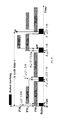
- FIG. 3 depicts a Gantt chart for the schedule of wafer revisiting process (PM2, PM3) 2 ;
- FIG. 4 depicts a Gantt chart of sequence A 2 23 A 01 A 12 A 30 A 1 23 A 32 with ⁇ 2 ⁇ 3 ;
- FIG. 5 depicts a wafer sojourn time at different steps in different cases
- FIG. 6 depicts a Gantt chart of sequence A 2 23 A 12 A 01 A 30 A 1 23 A 32 with ⁇ 2 ⁇ 3 ;
- FIG. 7 depicts a Gantt chart of sequence A 2 23 A 12 A 30 A 1 23 A 01 A 32 with ⁇ 2 ⁇ 3 ;
- FIG. 8 depicts a Gantt chart of sequence A 2 23 A 12 A 30 A 1 23 A 32 A 01 with ⁇ 2 ⁇ 3 ;
- FIG. 9 depicts a Gantt chart of sequence A 2 23 A 12 A 01 A 30 A 1 23 A 32 with ⁇ 2 > ⁇ 3 ;
- FIG. 10 depicts a Gantt chart of sequence A 2 23 A 12 A 30 A 01 A 1 23 A 32 with ⁇ 2 > ⁇ 3 ;
- FIG. 11 depicts a Gantt chart of sequence A 2 23 A 12 A 30 A 1 23 A 01 A 32 with ⁇ 2 > ⁇ 3 ;
- FIG. 12 depicts a Gantt chart of sequence A 2 23 A 12 A 30 A 1 23 A 32 A 01 with ⁇ 2 > ⁇ 3 ;
- FIG. 13 depicts a Gantt chart of sequence A 2 23 A 30 A 12 A 01 A 1 23 A 32 ;
- FIG. 14 depicts a Gantt chart of sequence A 2 23 A 12 A 01 A 30 A 1 23 A 32 .
- Section A briefly introduces the ALD process and presents the robot task sequencing strategies. Based on them, schedulability conditions and scheduling algorithms are derived in Section B. Illustrative examples are used to show the obtained results in Section C.
- ALD controls the deposition film thickness by adjusting the number of repeating times such that a mono-atomic layer precision can be obtained. Furthermore, it uses much lower processing temperature, i.e., 100° C.-400° C., rather than 550° C.-800° C. for chemical vapor deposition. Hence, ALD is increasingly used in the semiconductor industry.
- a wafer visits Step 1 first, then Step 2 and followed by Step 3 . After that, it goes back to Step 2 and then Step 3 again and this process is performed for a total of k( ⁇ 2) times, where k is decided by a process plan.
- multiple PMs may be configured for some steps to balance the workload among the steps.
- the same processing environment is required as the wafer visits the prior step.
- An embodiment of the present invention focuses on the ALD process with one PM being configured for each step.
- PM1-PM3 be the PMs for Steps 1 - 3 , respectively.
- the wafer flow pattern of an ALD process can be denoted as (PM1, (PM2, PM3) k ) with (PM2, PM3) k being a k-revisiting process.
- PM1, (PM2, PM3) k being a k-revisiting process.
- PM1, (PM2, PM3) 2 the wafer flow pattern is (PM1, (PM2, PM3) 2 ).
- the loadlocks in a cluster tool can be treated as a processing step, as denoted by PM 0 .
- the robot tasks include: unloading a processed wafer from a PM, moving from one PM to another with a wafer, loading a wafer into a PM for processing, moving from one PM to another without a wafer, and waiting.
- the key to schedule a cluster tool is to schedule its robot tasks.
- the temporal aspect for each robot activity is described as follows.
- the time taken for robot tasks u i and l i is identical and denoted by ⁇ ; and the time taken for m ij except m 23 , i,j ⁇ 3 , m 1 23 , and m 2 23 is also same and denoted by ⁇ .
- Let ⁇ i,j , i,j ⁇ 3 , except ⁇ 23 denote the time taken for the robot's waiting before unloading a wafer from PM i to move to PM j and, ⁇ 1 23 and ⁇ 2 23 the time for its waiting before unloading the same wafer from PM 2 to move to PM 3 for the first and second time, respectively.
- ⁇ i ⁇ [ ⁇ i , ⁇ i + ⁇ i ] denote the wafer sojourn time in PM i .
- the time duration for each activity is listed in Table I. In practice, as the robot task time is much shorter than wafer processing time, it is reasonable to assume that ⁇ i ⁇ 5( ⁇ + ⁇ ), i ⁇ N 3 .
- a ij u i ⁇ m ij ⁇ l j and it is denoted as A ij ⁇ m ii ⁇ to indicate that m ii takes no time.
- a 1 23 and A 2 23 are defined in a similar way. With them, one can describe a schedule by presenting the robot task sequence with no robot waiting being taken into consideration.
- the optimal one-wafer cyclic schedule for (PM2, PM3) 2 is deterministic and unique and such a schedule can be described as A 2 23 A 12 A 30 A 1 23 A 32 .
- W d (q) in PM i , d ⁇ 1, 2, 3, . . . ⁇ , q ⁇ N 2 , and i ⁇ N 3 denote the d-th wafer being processed in PM i for the q-th time.
- the Gantt chart for the optimal one-wafer cyclic schedule of wafer revisiting process (PM2, PM3) 2 is illustrated in FIG. 3 . In FIG.
- a 12 (2 ⁇ +2 ⁇ ) means that A 12 is performed and it takes 2 ⁇ +2 ⁇ time units.
- the meaning of “A 1 23 (2 ⁇ +2 ⁇ )”, “A 32 (2 ⁇ + ⁇ )”, “A 2 23 (2 ⁇ + ⁇ )”, and “A 30 ⁇ m 33 ⁇ (2 ⁇ + ⁇ )” is similar. From FIG. 3 , one can observe that after A 12 (2 ⁇ +2 ⁇ ) is performed, the robot comes to PM 3 by performing m 23 immediately, and the time taken by A 12 together with m 23 is 2 ⁇ +3 ⁇ . As 2 ⁇ +3 ⁇ 3 , when W 1 (2) is processed in PM 3 , the robot is already at Step 3 . In other words, at time T 1 , m 23 in A 30 has been already performed.
- the task performed is A 30 ⁇ m 33 ⁇ with 2 ⁇ + ⁇ time units being taken.
- ⁇ be the cycle time of the whole system.
- T 1 be the time instant when a wafer is just loaded into a PM
- T u be the time instant when the robot begins to unload a wafer from a PM.
- the wafer residency time constraints are satisfied for both of them.
- This case can be illustrated by the time taken for processing the wafers in a PM shown in FIG. 5 .
- ⁇ d (q) in PM i , d, q ⁇ N 2 , and i ⁇ N 3 denote the sojourn time of the d-th wafer visiting PM i for the q-th time.
- ⁇ d (q) ⁇ [ ⁇ i , ⁇ i + ⁇ i ] should hold. It follows from FIG. 5 that it is true for every step and every case. Therefore, for all cases, the wafer residency time constraints are satisfied.
- a schedule can be obtained as shown in FIG. 8 .
- W 3 (1) W 2 (1) that are processed in PM 1 and PM 2 , respectively.
- W 3 (1) is unloaded at time instant ⁇ + ⁇ , one presents the following algorithm to schedule the system.
- ⁇ ij 's are set as follows to obtain a one-wafer cyclic schedule if it exists.
- a schedule can be obtained as shown in FIG. 11 .
- a schedule can be obtained as depicted in FIG. 12 .
- the wafer residency time constraints can be violated for only W 3 (1) being processed in PM 1 .
- the following algorithm is used to set the robot waiting time.
- ⁇ ij 's are set as follows to obtain a one-wafer cyclic schedule if it exists.
- Theorem 9 Assume that: 1) the cycle time of the system is ⁇ > ⁇ and ⁇ 1 ⁇ 6 ⁇ +3 ⁇ +2( ⁇ 2 + ⁇ 3 ), 2) robot scheduling strategy A 2 23 A 30 A 12 A 01 A 1 23 A 32 is applied, and 3) the robot waiting time is set by Algorithm 9. Then, the obtained one-wafer cyclic schedule is feasible.
- ⁇ m n must fall within [0, ⁇ m ].
- ⁇ m n cannot be decided independently and a method is necessary to do so.
- Algorithm 10 If ⁇ > ⁇ and robot scheduling strategy A 2 23 A 12 A 01 A 30 A 1 23 A 32 is applied, ⁇ ij 's are set as follows to obtain a one-wafer cyclic schedule if it exists.
- Theorem 10 Assume that: 1) the cycle time of the system is ⁇ > ⁇ , 2) robot scheduling strategy A 2 23 A 12 A 01 A 30 A 1 23 A 32 is applied, and 3) the robot waiting time is set by Algorithm 10. Then, the obtained one-wafer cyclic schedule is feasible.
- Theorem 11 A schedule obtained by Algorithms 1-10 is optimal in terms of cycle time.
- the wafer flow pattern is (PM 1 , (PM 2 , PM 3 ) 2 ).
- strategy A 2 23 A 12 A 30 A 1 23 A 32 A 01 is applied, it results in a schedule such that ⁇ > ⁇ .
- Algorithm 4 is excluded.
- ⁇ 01 0
- the embodiments disclosed herein may be implemented using general purpose or specialized computing devices, computer processors, or electronic circuitries including but not limited to digital signal processors (DSP), application specific integrated circuits (ASIC), field programmable gate arrays (FPGA), and other programmable logic devices configured or programmed according to the teachings of the present disclosure.
- DSP digital signal processors
- ASIC application specific integrated circuits
- FPGA field programmable gate arrays
- Computer instructions or software codes running in the general purpose or specialized computing devices, computer processors, or programmable logic devices can readily be prepared by practitioners skilled in the software or electronic art based on the teachings of the present disclosure.
- the present invention includes computer storage media having computer instructions or software codes stored therein which can be used to program computers or microprocessors to perform any of the processes of the present invention.
- the storage media can include, but is not limited to, floppy disks, optical discs, Blu-ray Disc, DVD, CD-ROMs, and magneto-optical disks, ROMs, RAMs, flash memory devices, or any type of media or devices suitable for storing instructions, codes, and/or data.
Landscapes
- Engineering & Computer Science (AREA)
- Physics & Mathematics (AREA)
- General Engineering & Computer Science (AREA)
- General Physics & Mathematics (AREA)
- Automation & Control Theory (AREA)
- Quality & Reliability (AREA)
- Manufacturing & Machinery (AREA)
- Theoretical Computer Science (AREA)
- Robotics (AREA)
- Mechanical Engineering (AREA)
- Computer Hardware Design (AREA)
- Evolutionary Computation (AREA)
- Geometry (AREA)
- Container, Conveyance, Adherence, Positioning, Of Wafer (AREA)
- General Factory Administration (AREA)
Abstract
Description
- N. Brauner, “Identical part production in cyclic robotic cells: Concepts, overview and open questions,” Discrete Appl. Math., vol. 156, no. 13, pp. 2480-2492, 2008.
- W. K. Chan, J. G. Yi, and S. W. Ding, “Optimal Scheduling of Multi-cluster Tools with Constant Robot Moving Times, Part I: Two-Cluster Analysis,” IEEE Transactions on Automation Science and Engineering, vol. 8, no. 1, pp. 5-16, 2011a.
- W. K. Chan, J. G. Yi, S. W. Ding, and D. Z. Song, “Optimal Scheduling of Multi-cluster Tools with Constant Robot Moving Times, Part II: Tree-Like Topology Configurations,” IEEE Transactions on Automation Science and Engineering, vol. 8, no. 1, pp. 17-28, 2011b.
- Y. Crama, V. Kats, J. van de Klundert, and E. Levner, “Cyclic scheduling in robotic flowshops,” Ann. Oper. Res.: Math. Ind. Syst., vol. 96, no. 1-4, pp. 97-124, 2000.
- Y. Crama and J. van de Klundert, “Cyclic scheduling of identical parts in a robotic cell,” Oper. Res., vol. 45, no. 6, pp. 952-965, 1997.
- M. Dawande, N. Geismar, M. Pinedo, and C. Sriskandarajah, “Throughput optimization in dual-gripper interval robotic cells,” IIE Trans., vol. 42, no. 1, pp. 1-15, January 2010.
- M. Dawande, H. N. Geismar, S. P. Sethi, and C. Sriskandarajah, Throughput Optimization in Robotic Cells. New York: Springer, 2007.
- M. Dawande, C. Sriskandarajah, and C. S. Sethi, “On throughput maximization in constant travel-time robotic cells,” Manuf. Serv. Oper. Manage., vol. 4, no. 4, pp. 296-312, 2002.
- H. N. Geismar, L. M. A. Chan, M. Dawande, and C. Sriskandarajah, “Approximations to optimal k-unit cycles for single- and dual-gripper robotic cells,” Prod. Oper. Manage H. N. Geismar, L. M. A. Chan, M. Dawande, and C. Sriskandarajah, “Approximations to optimal k-unit cycles for single- and dual-gripper robotic cells,” Prod. Oper. Manage., vol. 17, no. 5, pp. 551-563, 2008.
- H. N. Geismar, M. Dawande, and C. Sriskandarajah, “Throughput optimization in constant travel-time dual-gripper robotic cells with parallel machines,” Prod. Oper. Manage., vol. 15, no. 2, pp. 311-328, 2006.
- J.-H. Kim, T.-E. Lee, H.-Y. Lee, and D.-B. Park, Scheduling analysis of timed-constrained dual-armed cluster tools, IEEE Transactions on Semiconductor Manufacturing, vol. 16, no. 3, 521-534, 2003.
- T.-E. Lee and S.-H. Park, “An extended event graph with negative places and tokens for timed window constraints,” IEEE Transactions on Automation Science and Engineering, vol. 2, no. 4, 319-332, 2005.
- H.-Y. Lee and T.-E. Lee. Scheduling single-arm cluster tools with reentrant wafer flows. IEEE transactions on Semiconductor Manufacturing, vol.19, no.2, 226-240, 2006.
- T.-E. Lee, H.-Y. Lee, and Y.-H. Shin, Workload balancing and scheduling of a single-armed cluster tool, in Proceedings of the 5th APIEMS Conference, Gold Coast, Australia, 1-15, 2004.
- M.-J. Lopez and S.-C. Wood, Systems of multiple cluster tools—configuration, reliability, and performance, IEEE Transactions on Semiconductor Manufacturing, vol. 16, no. 2, 170-178, 2003.
- M., Pinedo, Scheduling: Theory, Algorithms, and Systems, Prentice Hall, Englewood Cliffs, N.J., 1995.
- T. L. Perkinson, R. S. Gyurcsik, and P. K. MacLarty, “Single-wafer cluster tool performance: An analysis of the effects of redundant chambers and revisitations sequences on throughput,” IEEE Transactions on Semiconductor Manufacturing, vol. 9, no. 3, 384-400, 1996.
- T. L. Perkinson, P. K. MacLarty, R. S. Gyurcsik, and R. K. Cavin, III, “Single-wafer cluster tool performance: An analysis of throughput,” IEEE Transactions on Semiconductor Manufacturing, vol. 7, no. 3, 369-373, 1994.
- Y. Qiao, N. Q. Wu, and M. C. Zhou, A Petri net-based novel scheduling approach and its cycle time analysis for dual-arm cluster tools with wafer revisiting, IEEE Transactions on Semiconductor manufacturing, vol. 26, no. 1, 100-110, 2013.
- Y. Qiao, N. Q. Wu, and M. C. Zhou, Scheduling of dual-arm cluster tools with wafer revisiting and residency time constraints, IEEE Transactions on Industrial Informatics, vol. 10, no. 1, 286-300, 2014a.
- Y. Qiao, N. Q. Wu, and M. C. Zhou, Schedulability and scheduling analysis of dual-arm cluster tools with wafer revisiting and residency time constraints based on a novel schedule, IEEE Transactions on Systems, Man, & Cybernetics: Systems, in press, 2014b.
- S. Sechi, J. Sidney, and C. Sriskandarajah, “Scheduling in dual-gripper robotic cells for productivity gains,” IEEE Trans. Robot. Autom., vol.17, no. 3, pp. 324-341, 2001.
- S. Sechi, C. Sriskandarajah, G. Sorger, J. Blazewicz, and W. Kubiak, “Sequencing of parts and robot moves in a robotic cell,” Int. J. Flexible Manuf. Syst., vol. 4, no. 3-4, pp. 331-358, 1992.
- S. Venkatesh, R. Davenport, P. Foxhoven, and J. Nulman, “A steady state throughput analysis of cluster tools: Dual-blade versus single-blade robots”, IEEE Trans. Semiconduct. Manuf ., vol.10, no. 4, pp. 418-424, 1997.
- N. Q. Wu, F. Chu, C. Chu, and M. Zhou, “Petri Net-Based Scheduling of Single-Arm Cluster Tools With Reentrant Atomic Layer Deposition Processes,” IEEE Transactions on Automation Science and Engineering, vol. 8, no. 1, pp. 42-55, 2011.
- N. Q. Wu, F. Chu, C. B. Chu, and M. C. Zhou, “Petri net modeling and cycle time analysis of dual-arm cluster tools with wafer revisiting,” IEEE Transactions on Systems, Man, & Cybernetics: Systems, vol. 43, no. 1, pp. 196-207, 2013a.
- N. Q. Wu and M. Zhou, “Analysis of wafer sojourn time in dual-arm cluster tools with residency time constraint and activity time variation,” IEEE Transactions on Semiconductor Manufacturing, vol. 23, no. 1, pp. 53-64, 2010a.
- N. Q. Wu and M. C. Zhou, “A closed-form solution for schedulability and optimal scheduling of dual-arm cluster tools based on steady schedule analysis,” IEEE Transactions on Automation Science and Engineering, vol. 7, no. 2, 303-315, 2010b.
- N. Q. Wu and M. C. Zhou, Colored timed Petri nets for modeling and analysis of cluster tools, Asian Journal of Control, vol. 12, no. 3, 253-266, 2010c.
- N. Q. Wu and M. C. Zhou, “Modeling, analysis and control of dual-arm cluster tools with residency time constraint and activity time variation based on Petri nets,” IEEE Transactions on Automation Science and Engineering, vol. 9, no. 2, 446-454, 2012a.
- N. Q. Wu and M. C. Zhou, “Schedulability analysis and optimal scheduling of dual-arm cluster tools with residency time constraint and activity time variation,” IEEE Transactions on Automation Science and Engineering, vol. 9, no. 1, 203-209, 2012b.
- N. Q. Wu, M. C. Zhou, F. Chu, and C. B. Chu, A Petri-net-based scheduling strategy for dual-arm cluster tools with wafer revisiting, IEEE Transactions on Systems, Man, & Cybernetics: Systems, vol. 43, no. 5, 1182-1194, 2013b.
- W. M. Zuberek, “Timed Petri nets in modeling and analysis of cluster tools,” IEEE Transactions on Robotics Automation, vol. 17, no. 5, pp. 562-575, October 2001.
- W. M. Zuberek, “Cluster tools with chamber revisiting—modeling and analysis using timed Petri nets”, IEEE Transactions on Semiconductor Manufacturing, vol. 17, no. 3, 333-344, 2004.
| TABLE 1 |
| THE TIME DURATIONS ASSOCIATED WITH EACH ACTIVITY |
| Symbol | Action | Time |
| ui/li | The robot unloads/loads a wafer from/into Step i , i ε | λ |
| Ω3 | ||
| mij | The robot's moving from Steps i to j with or without | μ |
| carrying a wafer, i, j ε Ω3 | ||
| m1 23 and | The robot's moving from |
μ |
| m2 23 | wafer hold for the first and second time, respectively | |


ψ11=12λ+9μ (1)
ψ21=12λ+10μ (2)
ψ31=12λ+9μ (3)
ψ41=12λ+11μ (4)
ψ51=12λ+11μ (5)
ψ61=12λ+9μ (6)
ψ71=12λ+10μ (7)

-
- 2.1. ω01=0, ω12=α3−α2−2λ−μ, ω30=α3−4λ−4μ−ω12, ω1 23=0, ω32=α3, and ω2 23=α2;
- 2.2. Go to Step vi.
-
- 3.1. ω01=0, ω12=α1, ω30=α3−4λ−4μ−ω12, ω1 23=0, ω32=α3, and ω2 23=α2;
- 3.2. Go to Step vi.
-
- 4.1. ω01=0, ω12=α1+δ1, ω30=α3−4λ−4μ−ω12, ω1 23=0, ω32=α3, and ω2 23=α2;
- 4.2. Go to Step vi.
-
- 5.1. ω01=α3−(α1+α2+2λ+μ+δ1+δ2);
- 5.2. If ω01>α3−4λ−4μ−α1−δ1, Q=0 and go to Step vi;
- 5.3. Otherwise, ω12=α1+δ1, ω30=α3−4λ−4μ−ω12−ω01, ω1 23=0, ω32=α3, and ω2 23=α2;
- 5.4. Go to Step vi.
-
- 2.1. If 4λ+4μ+α1≦ζ+μ≦4λ+4μ+α1+δ1, ω01=0, ω30=α3−4λ−5μ, ω1 23=0, ω32=α3, and ω2 23=α2, go to Step iv;
- 2.2. If 4λ+4μ+α1+δ1<ζ+μ, ω 01=ζ+μ−(4λ+4μ+α1+δ1);
- 2.3. If ω01>α3−4λ−5μ, Q=0 and go to Step iv, otherwise, ω30=α3−4λ−5μ−ω01, ω1 23=0, ω32=α3, and ω2 23=α2;
- 2.4. Go to Step iv.
-
- 3.1. If ω12+4λ+4μ+α1≦ζ+μ≦ω12+4λ+4μ+α1+δ1, ω01=0, ω30=α3−4λ−5μ−ω12, ω1 23=0, ω32=α3, and ω2 23=α2, go to Step iv;
- 3.2. If ω12+4λ+4μ+α1+δ1<ζ+μ, ω 01=ζ+μ−(ω12+4λ+4μ+α1+δ1);
- 3.3. If ω01>α3−4λ−5μ−ω12, Q=0 and go to Step iv, otherwise, ω30=α3−4λ−5μ−ω12−ω01, ω1 23=0, ω32=α3, and ω2 23=α2;
- 3.4. Go to Step iv.
-
- 2.1. If α3+6λ+5μ+α1≦ζ+μ≦α3+6λ+5μ+α1+δ1, ω01=0, ω32 =α3−2λ−3μ, ω2 23=α2, and go to Step iv;
- 2.2. If α3+6λ+5μ+α1+δ1<ζ+μ, ω01=ζ+μ−(α3+6λ+5μ+α1+δ1);
- 2.3. If ω01>α3−2λ−3μ, Q=0, otherwise, ω32=α3−2λ−3μ−ω01 and ω2 23=α2;
- 2.4. Go to Step iv.
-
- 3.1. If ω12>α3−2λ−3μ, Q=0 and go to Step iv;
- 3.2. Otherwise, ω30=α3−2λ−3μ−ω12 and ω1 23=0
- 3.2.1. If α3+6λ+5μ+α1≦ζ+μ≦α3+6λ+5μ+α1+δ1, ω01=0, ω32=α3−2λ−3μ, ω2 23=α2, and go to Step iv;
- 3.2.2. If α3+6λ+5μ+α1+δ1<ζ+μ, ω01=ζ+μ−(α3+6λ+5μ+α1+δ1);
- 3.2.3. If ω01>α3−2λ−3μ, Q=0, otherwise, ω32=α3−2λ−3μ−ω01 and ω2 23=α2;
- 3.2.4. Go to Step iv;
-
- 2.1. If 2α3+8λ+6μ+α1≦ζ+μ≦2α3+8λ+6μ+α1+δ1, ω01=0, ω2 23=α2−2λ−3μ, and go to Step iv;
- 2.2. If 2α3+8λ+6μ+α1+δ1<ζ+μ, ω01=ζ+μ−(2α3+8λ+6μ+α1+δ1);
- 2.3. If ω01>α3−2λ−3μ, Q=0, otherwise, ω2 23=α2−2λ−3μ−ω01;
- 2.4. Go to Step iv.
-
- 3.1. If ω12>α3−2λ−3μ, Q=0 and go to Step iv;
- 3.2. Otherwise, ω30=α3−2λ−3μ−ω12, ω1 23=0, and ω32=α3
- 3.2.1. If 2α3+8λ+6μ+α1≦ζ+μ≦2α3+8λ+6μ+α1+δ1, ω01=0, ω2 23=α2−2λ−3μ, and go to Step iv;
- 3.2.2. If 2α3+8λ+6μ+α1+δ1<ζ+μ, ω01=ζ+μ−(2α3+8λ+6μ+α1+δ1);
- 3.2.3. If ω01>α3−2λ−3μ, Q=0, otherwise ω2 23=α2−2λ−3μ−ω01;
- 3.2.4. Go to Step iv.
-
- 2.1. ω010, ω30=α3−4λ−5μ, ω1 23=α2−α3, ω32=α3, and ω2 23 =α2, go to Step iv.
-
- 3.1. ω01=ζ+μ−(4λ+4μ+α1+δ1);
- 3.2.If ω01>α3−4λ−5μ, Q=0 and go to Step iv;
- 3.3. Otherwise, ω30=α3−4λ−5μ−ω01, ω1 23=α2−α3, ω32=α3, ω2 23=α2, and go to Step iv.
-
- 2.1. ω12=0, ω30=α3−2λ−3μ, ω01=0, ω1 23=α2−α3−2λ−μ, ω32=α3, ω2 23=α2, and go to Step iv.
-
- 3.1. ω12=0, ω30=α3−2λ−3μ, and ω01=ζ+μ−(4λ+2μ+α3+α1+δ1);
- 3.2. If ω01>α2−α3−2λ−μ, Q=0, and go to Step iv;
- 3.3. Otherwise, ω1 23=α2−α3−2λ−μ−ω01, ω32=α3, ω2 23=α2, and go to Step iv.
-
- 2.1. ω12=0, ω30=α3−2λ−3μ, ω1 23=α2−α3, ω01=0, ω32=α3−2λ−3μ, ω2 23=α2, and go to Step iv.
-
- 3.1. ω12=0, ω30=α3−2λ−3μ, ω1 23=α2−α3, and ω01=ζ+μ−(α2+6λ+5μ+α1+δ1);
- 3.2. If ω01>α3−2λ−3μ, Q=0, and go to Step iv;
- 3.3. Otherwise, ω32=α3−2λ−3μ−ω01, ω2 23=α2, and go to Step iv.
-
- 2.1. ω1=0, ω30=α3−2λ−3μ, ω1 23=α2−α3, ω32=α3, ω01=0, ω2 23=α2−2λ−3μ, and go to Step iv.
-
- 3.1. ω12=0, ω30=α3−2λ−3μ, ω1 23=α2−α3, ω32=α3, and ω01=ζ+μ−(α2+α3+8λ+6μ+α1+δ1);
- 3.2. If ω01>α2−2λ−3μ, Q=0 and go to Step iv;
- 3.3. Otherwise, ω2 23=α2−2λ−3μ−ω01 and go to Step iv.
- 1) ω30=α3 and ω01=0;
- 2) ω1 23=α2−2λ−3μ;
- 3) ω32=α3, ω2 23=α2;
- 4) ω12=α1−6λ−3μ−2(α2+α3).
- 1) Determine, χm δ2 1, δ2 2, δ3 1, and δ3 2 by solving Problem (8);
- 2) ω12=χ−2λ−2μ, ω01=0, ω30=α3+δ3 2−2λ−3μ−χ;
- 3) ω1 23=χ+α2+δ2 1=α3−δ3 2−2λ−2μ, ω32=α3+δ3 1, and ω2 23=α2+δ2 2.
Claims (20)
ζ=8λ+5μ+α2+α3+Max{α2, α3};
Θ=α1+4λ+3μ;
if Θ=ζ with α1+α2+2λ+μ≦α3;
if Θ=ζ with α2≦α3.
ω01=ζ+μ−(α3+6λ+5μ+α1+δ1);
ζ=8λ+5μ+α2+α3+Max{α2, α3};
Θ=α1+4λ+3μ;
if Θ=ζ with α1+α2+2λ+μ≦α3;
if Θ=ζ with α2≦3.
ω01=ζ+μ−(α3+6λ+5μ+α1+δ1);
Priority Applications (1)
| Application Number | Priority Date | Filing Date | Title |
|---|---|---|---|
| US14/639,980 US9223307B1 (en) | 2015-01-12 | 2015-03-05 | Method for scheduling single-arm cluster tools with wafer revisiting and residency time constraints |
Applications Claiming Priority (2)
| Application Number | Priority Date | Filing Date | Title |
|---|---|---|---|
| US201562102112P | 2015-01-12 | 2015-01-12 | |
| US14/639,980 US9223307B1 (en) | 2015-01-12 | 2015-03-05 | Method for scheduling single-arm cluster tools with wafer revisiting and residency time constraints |
Publications (1)
| Publication Number | Publication Date |
|---|---|
| US9223307B1 true US9223307B1 (en) | 2015-12-29 |
Family
ID=52629136
Family Applications (1)
| Application Number | Title | Priority Date | Filing Date |
|---|---|---|---|
| US14/639,980 Expired - Fee Related US9223307B1 (en) | 2015-01-12 | 2015-03-05 | Method for scheduling single-arm cluster tools with wafer revisiting and residency time constraints |
Country Status (2)
| Country | Link |
|---|---|
| US (1) | US9223307B1 (en) |
| AU (1) | AU2015100138A4 (en) |
Cited By (10)
| Publication number | Priority date | Publication date | Assignee | Title |
|---|---|---|---|---|
| CN106292613A (en) * | 2016-10-12 | 2017-01-04 | 江西理工大学 | A kind of unit equipment stable state dispatching method of multi items wafer hybrid process |
| US20170080563A1 (en) * | 2015-09-20 | 2017-03-23 | Macau University Of Science And Technology | Scheduling Start-up Process for Time-constrained Single-arm Cluster Tools |
| US20170083008A1 (en) * | 2015-09-20 | 2017-03-23 | Macau University Of Science And Technology | Optimal One-Wafer Scheduling of Single-Arm Multi-Cluster Tools with Tree-Like Topology |
| US20170083010A1 (en) * | 2015-09-20 | 2017-03-23 | Macau University Of Science And Technology | Optimally Scheduling of Close-down Process for Single-arm Cluster Tools with Wafer Residency Time Constraints |
| US20170083009A1 (en) * | 2015-09-20 | 2017-03-23 | Macau University Of Science And Technology | Petri Net-Based Optimal One-Wafer Cyclic Scheduling of Treelike Hybrid Multi-Cluster Tools |
| US10295979B2 (en) * | 2015-09-15 | 2019-05-21 | Applied Materials, Inc. | Scheduling in manufacturing environments |
| CN113467401A (en) * | 2021-07-19 | 2021-10-01 | 江苏天芯微半导体设备有限公司 | Scheduling method of multi-cavity plasma reaction equipment, computing equipment and medium |
| WO2023059740A1 (en) * | 2021-10-06 | 2023-04-13 | Applied Materials, Inc. | Time constraint management at a manufacturing system |
| CN117196132A (en) * | 2023-11-07 | 2023-12-08 | 宁波润华全芯微电子设备有限公司 | A wafer handling scheduling method, system, device and medium based on SWAP strategy |
| CN118192464A (en) * | 2024-03-25 | 2024-06-14 | 华南理工大学 | An intelligent decision-making end-to-end scheduling method for combined equipment processing multi-variety wafers |
Citations (5)
| Publication number | Priority date | Publication date | Assignee | Title |
|---|---|---|---|---|
| US6738681B2 (en) * | 2002-04-26 | 2004-05-18 | Trecenti Technologies, Inc. | Method for manufacturing semiconductor device, semiconductor manufacturing apparatus, and method for controlling transfer in production line |
| US20050137734A1 (en) * | 2003-12-23 | 2005-06-23 | Asml Netherlands B.V. | Method of operating a lithographic apparatus or lithographic processsing cell, lithographic apparatus and lithographic processing cell |
| US8160736B2 (en) * | 2007-01-31 | 2012-04-17 | Globalfoundries Singapore Pte. Ltd. | Methods and apparatus for white space reduction in a production facility |
| US20140099176A1 (en) * | 2012-10-10 | 2014-04-10 | Hitachi High-Technologies Corporation | Vacuum processing apparatus and vacuum processing method |
| US20140294555A1 (en) * | 2013-03-29 | 2014-10-02 | Hitachi High-Technologies Corporation | Operation method for vacuum processing apparatus |
-
2015
- 2015-02-07 AU AU2015100138A patent/AU2015100138A4/en not_active Ceased
- 2015-03-05 US US14/639,980 patent/US9223307B1/en not_active Expired - Fee Related
Patent Citations (5)
| Publication number | Priority date | Publication date | Assignee | Title |
|---|---|---|---|---|
| US6738681B2 (en) * | 2002-04-26 | 2004-05-18 | Trecenti Technologies, Inc. | Method for manufacturing semiconductor device, semiconductor manufacturing apparatus, and method for controlling transfer in production line |
| US20050137734A1 (en) * | 2003-12-23 | 2005-06-23 | Asml Netherlands B.V. | Method of operating a lithographic apparatus or lithographic processsing cell, lithographic apparatus and lithographic processing cell |
| US8160736B2 (en) * | 2007-01-31 | 2012-04-17 | Globalfoundries Singapore Pte. Ltd. | Methods and apparatus for white space reduction in a production facility |
| US20140099176A1 (en) * | 2012-10-10 | 2014-04-10 | Hitachi High-Technologies Corporation | Vacuum processing apparatus and vacuum processing method |
| US20140294555A1 (en) * | 2013-03-29 | 2014-10-02 | Hitachi High-Technologies Corporation | Operation method for vacuum processing apparatus |
Non-Patent Citations (3)
| Title |
|---|
| Kim et al., "Schedule Restoration for Single-Armed Cluster Tools", IEEE Transactions on Semiconductor Manufacturing, 2014, vol. 27, Issue: 3, pp. 388-399. * |
| Wu et al., "Petri Net-Based Scheduling of Single-Arm Cluster Tools With Reentrant Atomic Layer Deposition Processes", IEEE Transactions on Automation Science and Engineering, 2011, vol. 8, Issue: 1, pp. 42-55. * |
| Yi et al., "Steady-State Throughput and Scheduling Analysis of Multi-Cluster Tools for Semiconductor Manufacturing: A Decomposition Approach", Proceedings of the 2005 IEEE International Conference on Robotics and Automation, 2005, pp. 292-298. * |
Cited By (15)
| Publication number | Priority date | Publication date | Assignee | Title |
|---|---|---|---|---|
| US10295979B2 (en) * | 2015-09-15 | 2019-05-21 | Applied Materials, Inc. | Scheduling in manufacturing environments |
| US20170083010A1 (en) * | 2015-09-20 | 2017-03-23 | Macau University Of Science And Technology | Optimally Scheduling of Close-down Process for Single-arm Cluster Tools with Wafer Residency Time Constraints |
| US10073444B2 (en) * | 2015-09-20 | 2018-09-11 | Macau University Of Science And Technology | Petri net-based optimal one-wafer cyclic scheduling of treelike hybrid multi-cluster tools |
| US20170080563A1 (en) * | 2015-09-20 | 2017-03-23 | Macau University Of Science And Technology | Scheduling Start-up Process for Time-constrained Single-arm Cluster Tools |
| US20170083009A1 (en) * | 2015-09-20 | 2017-03-23 | Macau University Of Science And Technology | Petri Net-Based Optimal One-Wafer Cyclic Scheduling of Treelike Hybrid Multi-Cluster Tools |
| US9618930B1 (en) * | 2015-09-20 | 2017-04-11 | Macau University Of Science And Technology | Scheduling start-up process for time-constrained single-arm cluster tools |
| US10001772B2 (en) * | 2015-09-20 | 2018-06-19 | Macau University Of Science And Technology | Optimally scheduling of close-down process for single-arm cluster tools with wafer residency time constraints |
| US10001773B2 (en) * | 2015-09-20 | 2018-06-19 | Macau University Of Science And Technology | Optimal one-wafer scheduling of single-arm multi-cluster tools with tree-like topology |
| US20170083008A1 (en) * | 2015-09-20 | 2017-03-23 | Macau University Of Science And Technology | Optimal One-Wafer Scheduling of Single-Arm Multi-Cluster Tools with Tree-Like Topology |
| CN106292613A (en) * | 2016-10-12 | 2017-01-04 | 江西理工大学 | A kind of unit equipment stable state dispatching method of multi items wafer hybrid process |
| CN113467401A (en) * | 2021-07-19 | 2021-10-01 | 江苏天芯微半导体设备有限公司 | Scheduling method of multi-cavity plasma reaction equipment, computing equipment and medium |
| WO2023059740A1 (en) * | 2021-10-06 | 2023-04-13 | Applied Materials, Inc. | Time constraint management at a manufacturing system |
| CN117196132A (en) * | 2023-11-07 | 2023-12-08 | 宁波润华全芯微电子设备有限公司 | A wafer handling scheduling method, system, device and medium based on SWAP strategy |
| CN117196132B (en) * | 2023-11-07 | 2024-02-09 | 宁波润华全芯微电子设备有限公司 | A wafer handling scheduling method, system, device and medium based on SWAP strategy |
| CN118192464A (en) * | 2024-03-25 | 2024-06-14 | 华南理工大学 | An intelligent decision-making end-to-end scheduling method for combined equipment processing multi-variety wafers |
Also Published As
| Publication number | Publication date |
|---|---|
| AU2015100138A4 (en) | 2015-03-05 |
Similar Documents
| Publication | Publication Date | Title |
|---|---|---|
| US9223307B1 (en) | Method for scheduling single-arm cluster tools with wafer revisiting and residency time constraints | |
| US9227318B1 (en) | Optimal buffer space configuration and scheduling for single-arm multi-cluster tools | |
| Lee et al. | Scheduling cluster tools for concurrent processing of two wafer types | |
| Pan et al. | Scheduling cluster tools in semiconductor manufacturing: Recent advances and challenges | |
| Wu et al. | Petri net modeling and cycle-time analysis of dual-arm cluster tools with wafer revisiting | |
| Wu et al. | A Petri-net-based scheduling strategy for dual-arm cluster tools with wafer revisiting | |
| US10001772B2 (en) | Optimally scheduling of close-down process for single-arm cluster tools with wafer residency time constraints | |
| Yang et al. | Petri net-based polynomially complex approach to optimal one-wafer cyclic scheduling of hybrid multi-cluster tools in semiconductor manufacturing | |
| Yang et al. | Optimal one-wafer cyclic scheduling of single-arm multicluster tools with two-space buffering modules | |
| Lee et al. | Makespan analysis of lot switching period in cluster tools | |
| US9333645B1 (en) | Optimization of start-up transient processes for dual-armed cluster tools with wafer revisiting | |
| Lee et al. | Completion time analysis of wafer lots in single-armed cluster tools with parallel processing modules | |
| Kim et al. | Scheduling in-line multiple cluster tools | |
| US10001773B2 (en) | Optimal one-wafer scheduling of single-arm multi-cluster tools with tree-like topology | |
| Kim et al. | Non-cyclic scheduling of a wet station | |
| Lee et al. | The impact of processing time variations on swap sequence performance in dual-armed cluster tools | |
| Ahn et al. | A novel mixed integer programming model with precedence relation-based decision variables for non-cyclic scheduling of cluster tools | |
| Kim et al. | Cyclic scheduling of cluster tools with nonidentical chamber access times between parallel chambers | |
| US9618930B1 (en) | Scheduling start-up process for time-constrained single-arm cluster tools | |
| Li et al. | Optimal K-unit cycle scheduling of two-cluster tools with residency constraints and general robot moving times | |
| US10073444B2 (en) | Petri net-based optimal one-wafer cyclic scheduling of treelike hybrid multi-cluster tools | |
| Zhu et al. | Scheduling of single-arm multi-cluster tools to achieve the minimum cycle time | |
| Zhu et al. | Scheduling single-arm multi-cluster tools with lower bound cycle time via Petri nets | |
| Lu et al. | An effective scheduling method to single-arm cluster tools for processing multiple wafer types. | |
| Kim et al. | Cyclic scheduling of sequentially connected cluster tools with a single I/O module |
Legal Events
| Date | Code | Title | Description |
|---|---|---|---|
| AS | Assignment |
Owner name: MACAU UNIVERSITY OF SCIENCE AND TECHNOLOGY, MACAU Free format text: ASSIGNMENT OF ASSIGNORS INTEREST;ASSIGNORS:WU, NAIQI;YANG, FAJUN;QIAO, YAN;AND OTHERS;REEL/FRAME:035098/0086 Effective date: 20150302 |
|
| STCF | Information on status: patent grant |
Free format text: PATENTED CASE |
|
| MAFP | Maintenance fee payment |
Free format text: PAYMENT OF MAINTENANCE FEE, 4TH YR, SMALL ENTITY (ORIGINAL EVENT CODE: M2551); ENTITY STATUS OF PATENT OWNER: SMALL ENTITY Year of fee payment: 4 |
|
| FEPP | Fee payment procedure |
Free format text: MAINTENANCE FEE REMINDER MAILED (ORIGINAL EVENT CODE: REM.); ENTITY STATUS OF PATENT OWNER: SMALL ENTITY |
|
| LAPS | Lapse for failure to pay maintenance fees |
Free format text: PATENT EXPIRED FOR FAILURE TO PAY MAINTENANCE FEES (ORIGINAL EVENT CODE: EXP.); ENTITY STATUS OF PATENT OWNER: SMALL ENTITY |
|
| STCH | Information on status: patent discontinuation |
Free format text: PATENT EXPIRED DUE TO NONPAYMENT OF MAINTENANCE FEES UNDER 37 CFR 1.362 |
|
| FP | Lapsed due to failure to pay maintenance fee |
Effective date: 20231229 |