US9206200B2 - N-linked lactam M1 receptor positive allosteric mogulators - Google Patents
N-linked lactam M1 receptor positive allosteric mogulators Download PDFInfo
- Publication number
- US9206200B2 US9206200B2 US14/117,341 US201214117341A US9206200B2 US 9206200 B2 US9206200 B2 US 9206200B2 US 201214117341 A US201214117341 A US 201214117341A US 9206200 B2 US9206200 B2 US 9206200B2
- Authority
- US
- United States
- Prior art keywords
- methyl
- dihydro
- hydroxycyclohexyl
- quinolin
- pyrrolo
- Prior art date
- Legal status (The legal status is an assumption and is not a legal conclusion. Google has not performed a legal analysis and makes no representation as to the accuracy of the status listed.)
- Active
Links
- DLTWBMHADAJAAZ-IUCAKERBSA-N CC(C)(C)[C@H]1CCCC[C@@H]1O Chemical compound CC(C)(C)[C@H]1CCCC[C@@H]1O DLTWBMHADAJAAZ-IUCAKERBSA-N 0.000 description 143
- 0 *N([2*])CC1=CC2=C(C3=CC=CC=C13)C([3*])([4*])N([1*])C2=O Chemical compound *N([2*])CC1=CC2=C(C3=CC=CC=C13)C([3*])([4*])N([1*])C2=O 0.000 description 14
- IZDBPMKLXGTGMI-UHFFFAOYSA-N CC(C)(C)CN1CCC(C#N)(C2=NC=CC=C2)CC1 Chemical compound CC(C)(C)CN1CCC(C#N)(C2=NC=CC=C2)CC1 IZDBPMKLXGTGMI-UHFFFAOYSA-N 0.000 description 11
- NRRZTTKNLJIXKQ-UHFFFAOYSA-N CC(C)(C)CN1CCC(F)(C#N)CC1 Chemical compound CC(C)(C)CN1CCC(F)(C#N)CC1 NRRZTTKNLJIXKQ-UHFFFAOYSA-N 0.000 description 9
- PHXIXGREOFLNTE-YUMQZZPRSA-N CC(C)(C)[C@H]1CCOC[C@@H]1O Chemical compound CC(C)(C)[C@H]1CCOC[C@@H]1O PHXIXGREOFLNTE-YUMQZZPRSA-N 0.000 description 9
- SCTVDBIUKNCOBH-UHFFFAOYSA-N CC(C)(C)CN1CCC(F)(F)CC1 Chemical compound CC(C)(C)CN1CCC(F)(F)CC1 SCTVDBIUKNCOBH-UHFFFAOYSA-N 0.000 description 8
- HTXLOWMASLJTKN-UHFFFAOYSA-N CC1=CC(C2(C#N)CCN(CC(C)(C)C)CC2)=NC=C1 Chemical compound CC1=CC(C2(C#N)CCN(CC(C)(C)C)CC2)=NC=C1 HTXLOWMASLJTKN-UHFFFAOYSA-N 0.000 description 8
- WNYAKUYQWIPBJH-UHFFFAOYSA-N CN1C=C(N2CCN(CC(C)(C)C)CC2)C=N1 Chemical compound CN1C=C(N2CCN(CC(C)(C)C)CC2)C=N1 WNYAKUYQWIPBJH-UHFFFAOYSA-N 0.000 description 8
- SEOMMYGICIHJHP-UHFFFAOYSA-N CC(C)(C)C1=C(F)C=CC=C1 Chemical compound CC(C)(C)C1=C(F)C=CC=C1 SEOMMYGICIHJHP-UHFFFAOYSA-N 0.000 description 6
- FRLZOLDFDALJGH-UHFFFAOYSA-N CC(C)(C)CN1CCN(C2=CC=CC=C2)CC1 Chemical compound CC(C)(C)CN1CCN(C2=CC=CC=C2)CC1 FRLZOLDFDALJGH-UHFFFAOYSA-N 0.000 description 6
- KDQYXXLLQRWCCP-UHFFFAOYSA-N CC(C)(C)CN1CCN(C2=NC=CC=C2)CC1 Chemical compound CC(C)(C)CN1CCN(C2=NC=CC=C2)CC1 KDQYXXLLQRWCCP-UHFFFAOYSA-N 0.000 description 6
- LJJNTDUURQXFSK-UHFFFAOYSA-N C#CC1(F)CCN(CC(C)(C)C)CC1 Chemical compound C#CC1(F)CCN(CC(C)(C)C)CC1 LJJNTDUURQXFSK-UHFFFAOYSA-N 0.000 description 4
- JKCWALBRDFMSLE-UHFFFAOYSA-N CC(C)(C)CN1CCC(C#N)(C2=CC=CC=C2)CC1 Chemical compound CC(C)(C)CN1CCC(C#N)(C2=CC=CC=C2)CC1 JKCWALBRDFMSLE-UHFFFAOYSA-N 0.000 description 4
- KCTJVKMKGGWIDG-UHFFFAOYSA-N CC(C)(C)CN1CCC(C#N)CC1 Chemical compound CC(C)(C)CN1CCC(C#N)CC1 KCTJVKMKGGWIDG-UHFFFAOYSA-N 0.000 description 4
- GXAWOTJEXZEKFS-UHFFFAOYSA-N CC(C)(C)CN1CCC(C2=CC=CC=C2)CC1 Chemical compound CC(C)(C)CN1CCC(C2=CC=CC=C2)CC1 GXAWOTJEXZEKFS-UHFFFAOYSA-N 0.000 description 4
- WXIODRDSQNFEEJ-UHFFFAOYSA-N CC(C)(C)CN1CCC(F)CC1 Chemical compound CC(C)(C)CN1CCC(F)CC1 WXIODRDSQNFEEJ-UHFFFAOYSA-N 0.000 description 4
- DERZSFIPHNSMEV-UHFFFAOYSA-N CC(C)(C)CN1CCN(C2=CC=C(F)C=C2)CC1 Chemical compound CC(C)(C)CN1CCN(C2=CC=C(F)C=C2)CC1 DERZSFIPHNSMEV-UHFFFAOYSA-N 0.000 description 4
- UFUHHCSUEMRCHS-UHFFFAOYSA-N CC(C)(C)CN1CCN(C2=CN=CC=C2)CC1 Chemical compound CC(C)(C)CN1CCN(C2=CN=CC=C2)CC1 UFUHHCSUEMRCHS-UHFFFAOYSA-N 0.000 description 4
- FDSFKVDCCFYTTA-UHFFFAOYSA-N COC1=CC=C(N2CCN(CC(C)(C)C)CC2)C=C1 Chemical compound COC1=CC=C(N2CCN(CC(C)(C)C)CC2)C=C1 FDSFKVDCCFYTTA-UHFFFAOYSA-N 0.000 description 4
- AHULPMFRTVKZQX-UHFFFAOYSA-N COC1=CC=CC(C2(C#N)CCN(CC(C)(C)C)CC2)=N1 Chemical compound COC1=CC=CC(C2(C#N)CCN(CC(C)(C)C)CC2)=N1 AHULPMFRTVKZQX-UHFFFAOYSA-N 0.000 description 4
- CYEKUDPFXBLGHH-UHFFFAOYSA-N CC(C)(C)C1=CC(O)=CC=C1 Chemical compound CC(C)(C)C1=CC(O)=CC=C1 CYEKUDPFXBLGHH-UHFFFAOYSA-N 0.000 description 3
- DVUKAROOLHKKBC-UHFFFAOYSA-N CC(C)(C)C1CCOCC1 Chemical compound CC(C)(C)C1CCOCC1 DVUKAROOLHKKBC-UHFFFAOYSA-N 0.000 description 3
- PLAYMGWAMIFNFM-UHFFFAOYSA-N CC(C)(C)CN1CCC(C2=CC=NC=C2)CC1 Chemical compound CC(C)(C)CN1CCC(C2=CC=NC=C2)CC1 PLAYMGWAMIFNFM-UHFFFAOYSA-N 0.000 description 3
- VPISEDWPECADAC-UHFFFAOYSA-N CC(C)(C)CN1CCC(F)(C2=NC=CC=C2)CC1 Chemical compound CC(C)(C)CN1CCC(F)(C2=NC=CC=C2)CC1 VPISEDWPECADAC-UHFFFAOYSA-N 0.000 description 3
- MZJKOSMGFXMZAH-UHFFFAOYSA-N CC(C)(C)CN1CCN(C2=CC=NC=C2)CC1 Chemical compound CC(C)(C)CN1CCN(C2=CC=NC=C2)CC1 MZJKOSMGFXMZAH-UHFFFAOYSA-N 0.000 description 3
- DLTWBMHADAJAAZ-BDAKNGLRSA-N CC(C)(C)[C@@H]1CCCC[C@@H]1O Chemical compound CC(C)(C)[C@@H]1CCCC[C@@H]1O DLTWBMHADAJAAZ-BDAKNGLRSA-N 0.000 description 3
- UJTCCKBBRTYCPW-UHFFFAOYSA-N C#CC1CCN(CC(C)(C)C)CC1 Chemical compound C#CC1CCN(CC(C)(C)C)CC1 UJTCCKBBRTYCPW-UHFFFAOYSA-N 0.000 description 2
- INPHPLLXXSYIJE-UHFFFAOYSA-N CC#CC1(F)CCN(CC(C)(C)C)CC1 Chemical compound CC#CC1(F)CCN(CC(C)(C)C)CC1 INPHPLLXXSYIJE-UHFFFAOYSA-N 0.000 description 2
- RUNUCWUOQZICCG-UHFFFAOYSA-N CC(C)(C)C1CCCOC1 Chemical compound CC(C)(C)C1CCCOC1 RUNUCWUOQZICCG-UHFFFAOYSA-N 0.000 description 2
- DDSRUZNYXUZYDG-UHFFFAOYSA-N CC(C)(C)CN1CCC(C#N)(C2=CC=NC=C2)CC1 Chemical compound CC(C)(C)CN1CCC(C#N)(C2=CC=NC=C2)CC1 DDSRUZNYXUZYDG-UHFFFAOYSA-N 0.000 description 2
- DIXSGVMURKGSMT-UHFFFAOYSA-N CC(C)(C)CN1CCC(C(F)(F)F)CC1 Chemical compound CC(C)(C)CN1CCC(C(F)(F)F)CC1 DIXSGVMURKGSMT-UHFFFAOYSA-N 0.000 description 2
- KXTSYOYALZHFMO-UHFFFAOYSA-N CC(C)(C)CN1CCC(C)(C)CC1 Chemical compound CC(C)(C)CN1CCC(C)(C)CC1 KXTSYOYALZHFMO-UHFFFAOYSA-N 0.000 description 2
- ATOBDHLHWRPHBQ-UHFFFAOYSA-N CC(C)(C)CN1CCC(C2CC2)CC1 Chemical compound CC(C)(C)CN1CCC(C2CC2)CC1 ATOBDHLHWRPHBQ-UHFFFAOYSA-N 0.000 description 2
- UQXVNXCJRRPPEA-UHFFFAOYSA-N CC(C)(C)CN1CCC(F)(F)C1 Chemical compound CC(C)(C)CN1CCC(F)(F)C1 UQXVNXCJRRPPEA-UHFFFAOYSA-N 0.000 description 2
- PDTBTCGCCSNSRD-UHFFFAOYSA-N CC(C)(C)CN1CCC(O)(C2=CC=NC=C2)CC1 Chemical compound CC(C)(C)CN1CCC(O)(C2=CC=NC=C2)CC1 PDTBTCGCCSNSRD-UHFFFAOYSA-N 0.000 description 2
- DRRJWLHROKKBLS-UHFFFAOYSA-N CC(C)(C)CN1CCC(O)CC1 Chemical compound CC(C)(C)CN1CCC(O)CC1 DRRJWLHROKKBLS-UHFFFAOYSA-N 0.000 description 2
- UUNMODCFAOZKTG-UHFFFAOYSA-N CC(C)(C)CN1CCC2(CC1)COC1=C2C=CC=C1 Chemical compound CC(C)(C)CN1CCC2(CC1)COC1=C2C=CC=C1 UUNMODCFAOZKTG-UHFFFAOYSA-N 0.000 description 2
- IAROFJBLSNXJNN-UHFFFAOYSA-N CC(C)(C)CN1CCC2(CC1)COC2 Chemical compound CC(C)(C)CN1CCC2(CC1)COC2 IAROFJBLSNXJNN-UHFFFAOYSA-N 0.000 description 2
- YXAUQNWZDLLAIT-UHFFFAOYSA-N CC(C)(C)CN1CCCC(F)(F)C1 Chemical compound CC(C)(C)CN1CCCC(F)(F)C1 YXAUQNWZDLLAIT-UHFFFAOYSA-N 0.000 description 2
- PGDJUHGLHRMLAG-UHFFFAOYSA-N CC(C)(C)CN1CCCC(F)C1 Chemical compound CC(C)(C)CN1CCCC(F)C1 PGDJUHGLHRMLAG-UHFFFAOYSA-N 0.000 description 2
- GNOUFBFWWBCKIT-UHFFFAOYSA-N CC(C)(C)CN1CCCC1 Chemical compound CC(C)(C)CN1CCCC1 GNOUFBFWWBCKIT-UHFFFAOYSA-N 0.000 description 2
- KYLPAEZXVAIKOQ-UHFFFAOYSA-N CC(C)(C)CN1CCCCC1 Chemical compound CC(C)(C)CN1CCCCC1 KYLPAEZXVAIKOQ-UHFFFAOYSA-N 0.000 description 2
- VUUHIJIAWPMTNE-UHFFFAOYSA-N CC(C)(C)CN1CCOCC1 Chemical compound CC(C)(C)CN1CCOCC1 VUUHIJIAWPMTNE-UHFFFAOYSA-N 0.000 description 2
- IDQCGLQMUNTQTI-QMMMGPOBSA-N CC(C)(C)CN1CC[C@H](F)C1 Chemical compound CC(C)(C)CN1CC[C@H](F)C1 IDQCGLQMUNTQTI-QMMMGPOBSA-N 0.000 description 2
- DLTWBMHADAJAAZ-RKDXNWHRSA-N CC(C)(C)[C@@H]1CCCC[C@H]1O Chemical compound CC(C)(C)[C@@H]1CCCC[C@H]1O DLTWBMHADAJAAZ-RKDXNWHRSA-N 0.000 description 2
- WXEFXFPAGKSFDE-UHFFFAOYSA-N CC.CC.CC1(C)CCN(CC2=CC3=C(CN(C4=CC=CC=C4)C3=O)C3=CC=CC=C23)CC1 Chemical compound CC.CC.CC1(C)CCN(CC2=CC3=C(CN(C4=CC=CC=C4)C3=O)C3=CC=CC=C23)CC1 WXEFXFPAGKSFDE-UHFFFAOYSA-N 0.000 description 2
- ZFUKEJPWDPZZQF-FHQKXDIASA-N CC.CC.O=C1C2=C(CN1C1CCCC[C@@H]1O)C1=CC=CC=C1C(CN1CCCCC1)=C2.O=C1C2=C(CN1C1CCOC[C@@H]1O)C1=CC=CC=C1C(CN1CCCCC1)=C2 Chemical compound CC.CC.O=C1C2=C(CN1C1CCCC[C@@H]1O)C1=CC=CC=C1C(CN1CCCCC1)=C2.O=C1C2=C(CN1C1CCOC[C@@H]1O)C1=CC=CC=C1C(CN1CCCCC1)=C2 ZFUKEJPWDPZZQF-FHQKXDIASA-N 0.000 description 2
- NJGPIFMXPVIOPE-UHFFFAOYSA-N CC1CCN(CC(C)(C)C)CC1 Chemical compound CC1CCN(CC(C)(C)C)CC1 NJGPIFMXPVIOPE-UHFFFAOYSA-N 0.000 description 2
- MKKKRWJGXDFVIN-UHFFFAOYSA-N CC1CN(CC(C)(C)C)CCN1C1=CC=CC=C1 Chemical compound CC1CN(CC(C)(C)C)CCN1C1=CC=CC=C1 MKKKRWJGXDFVIN-UHFFFAOYSA-N 0.000 description 2
- CJXRFEACYKDEKK-UHFFFAOYSA-N CN(C)C(=O)OC1=CC=CC(C(C)(C)C)=C1 Chemical compound CN(C)C(=O)OC1=CC=CC(C(C)(C)C)=C1 CJXRFEACYKDEKK-UHFFFAOYSA-N 0.000 description 2
- HNVWKALDLOSEPL-UHFFFAOYSA-N COC1=CC=C(N2CCN(CC(C)(C)C)C(C)C2)C=C1 Chemical compound COC1=CC=C(N2CCN(CC(C)(C)C)C(C)C2)C=C1 HNVWKALDLOSEPL-UHFFFAOYSA-N 0.000 description 2
- LABBAJVICHKDDI-FOZQGOHWSA-N C.C=CB(F)(F)F.C=CC1=CC2=C(C3=CC=CC=C13)C(C)N([C@H]1CCCC[C@@H]1O[Si](C)(C)C(C)(C)C)C2=O.CC(C)(C)[Si](C)(C)O[C@H]1CCCC[C@@H]1N1CC2=C(C=C(Br)C3=CC=CC=C32)C1=O.CC1C2=C(C=C(Br)C3=CC=CC=C32)C(=O)N1[C@H]1CCCC[C@@H]1O[Si](C)(C)C(C)(C)C.CC1C2=C(C=C(C=O)C3=CC=CC=C32)C(=O)N1[C@H]1CCCC[C@@H]1O[Si](C)(C)C(C)(C)C.CC1C2=C(C=C(CN3CCC(C#N)(C4=NC=CC=C4)CC3)C3=CC=CC=C32)C(=O)N1[C@H]1CCCC[C@@H]1O.CC1C2=C(C=C(CN3CCC(C#N)(C4=NC=CC=C4)CC3)C3=CC=CC=C32)C(=O)N1[C@H]1CCCC[C@@H]1O.CC1C2=C(C=C(CN3CCC(C#N)(C4=NC=CC=C4)CC3)C3=CC=CC=C32)C(=O)N1[C@H]1CCCC[C@@H]1O[Si](C)(C)C(C)(C)C.CI.N#CC1(C2=NC=CC=C2)CCNCC1.O=C1C2=C(CN1[C@H]1CCCC[C@@H]1O)C1=CC=CC=C1C(Br)=C2.[KH] Chemical compound C.C=CB(F)(F)F.C=CC1=CC2=C(C3=CC=CC=C13)C(C)N([C@H]1CCCC[C@@H]1O[Si](C)(C)C(C)(C)C)C2=O.CC(C)(C)[Si](C)(C)O[C@H]1CCCC[C@@H]1N1CC2=C(C=C(Br)C3=CC=CC=C32)C1=O.CC1C2=C(C=C(Br)C3=CC=CC=C32)C(=O)N1[C@H]1CCCC[C@@H]1O[Si](C)(C)C(C)(C)C.CC1C2=C(C=C(C=O)C3=CC=CC=C32)C(=O)N1[C@H]1CCCC[C@@H]1O[Si](C)(C)C(C)(C)C.CC1C2=C(C=C(CN3CCC(C#N)(C4=NC=CC=C4)CC3)C3=CC=CC=C32)C(=O)N1[C@H]1CCCC[C@@H]1O.CC1C2=C(C=C(CN3CCC(C#N)(C4=NC=CC=C4)CC3)C3=CC=CC=C32)C(=O)N1[C@H]1CCCC[C@@H]1O.CC1C2=C(C=C(CN3CCC(C#N)(C4=NC=CC=C4)CC3)C3=CC=CC=C32)C(=O)N1[C@H]1CCCC[C@@H]1O[Si](C)(C)C(C)(C)C.CI.N#CC1(C2=NC=CC=C2)CCNCC1.O=C1C2=C(CN1[C@H]1CCCC[C@@H]1O)C1=CC=CC=C1C(Br)=C2.[KH] LABBAJVICHKDDI-FOZQGOHWSA-N 0.000 description 1
- KARKXORDGZIOEH-JYKGEOJVSA-N C.FC1(F)CCNCC1.O=C/C1=C/C2=C(/CN([C@H]3CCOC[C@@H]3O)C2=O)C2=NC=CC=C21.O=C1C2=C(\CN1[C@H]1CCOC[C@@H]1O)C1=NC=CC=C1/C(CN1CCC(F)(F)CC1)=C\2.O=C1C2=C(\CN1[C@H]1CCOC[C@@H]1O)C1=NC=CC=C1/C(CN1CCC(F)(F)CC1)=C\2 Chemical compound C.FC1(F)CCNCC1.O=C/C1=C/C2=C(/CN([C@H]3CCOC[C@@H]3O)C2=O)C2=NC=CC=C21.O=C1C2=C(\CN1[C@H]1CCOC[C@@H]1O)C1=NC=CC=C1/C(CN1CCC(F)(F)CC1)=C\2.O=C1C2=C(\CN1[C@H]1CCOC[C@@H]1O)C1=NC=CC=C1/C(CN1CCC(F)(F)CC1)=C\2 KARKXORDGZIOEH-JYKGEOJVSA-N 0.000 description 1
- JBAFJQAVBZNUNF-JYKGEOJVSA-N C.FC1(F)CCNCC1.O=C/C1=C/C2=C(/CN([C@H]3COCC[C@@H]3O)C2=O)C2=NC=CC=C21.O=C1C2=C(\CN1[C@H]1COCC[C@@H]1O)C1=NC=CC=C1/C(CN1CCC(F)(F)CC1)=C\2.O=C1C2=C(\CN1[C@H]1COCC[C@@H]1O)C1=NC=CC=C1/C(CN1CCC(F)(F)CC1)=C\2 Chemical compound C.FC1(F)CCNCC1.O=C/C1=C/C2=C(/CN([C@H]3COCC[C@@H]3O)C2=O)C2=NC=CC=C21.O=C1C2=C(\CN1[C@H]1COCC[C@@H]1O)C1=NC=CC=C1/C(CN1CCC(F)(F)CC1)=C\2.O=C1C2=C(\CN1[C@H]1COCC[C@@H]1O)C1=NC=CC=C1/C(CN1CCC(F)(F)CC1)=C\2 JBAFJQAVBZNUNF-JYKGEOJVSA-N 0.000 description 1
- DWDUMASENLDKNA-YFEHQXOSSA-N C=CBr[MgH].C=CC1(F)CCN(C/C2=C/C3=C(/CN([C@H]4CCCC[C@@H]4O)C3=O)C3=NC=CC=C32)CC1.C=CC1(F)CCN(C/C2=C/C3=C(/CN([C@H]4CCCC[C@@H]4O)C3=O)C3=NC=CC=C32)CC1.C=CC1(F)CCNCC1.CC(C)(C)OC(=O)N1CCC(=O)CC1.O=C/C1=C/C2=C(/CN([C@H]3CCCC[C@@H]3O)C2=O)C2=NC=CC=C21 Chemical compound C=CBr[MgH].C=CC1(F)CCN(C/C2=C/C3=C(/CN([C@H]4CCCC[C@@H]4O)C3=O)C3=NC=CC=C32)CC1.C=CC1(F)CCN(C/C2=C/C3=C(/CN([C@H]4CCCC[C@@H]4O)C3=O)C3=NC=CC=C32)CC1.C=CC1(F)CCNCC1.CC(C)(C)OC(=O)N1CCC(=O)CC1.O=C/C1=C/C2=C(/CN([C@H]3CCCC[C@@H]3O)C2=O)C2=NC=CC=C21 DWDUMASENLDKNA-YFEHQXOSSA-N 0.000 description 1
- KDDZDDOBYHUPMC-GLWDRRBQSA-N C=CC1=CC=CC(C2(C#N)CCN(C/C3=C/C4=C(/CN([C@H]5CCCC[C@@H]5O)C4=O)C4=CC=CC=C43)CC2)=N1.CCC1=CC=CC(C2(C#N)CCN(C/C3=C/C4=C(/CN([C@H]5CCCC[C@@H]5O)C4=O)C4=CC=CC=C43)CC2)=N1.CCC1=CC=CC(C2(C#N)CCN(C/C3=C/C4=C(/CN([C@H]5CCCC[C@@H]5O)C4=O)C4=CC=CC=C43)CC2)=N1 Chemical compound C=CC1=CC=CC(C2(C#N)CCN(C/C3=C/C4=C(/CN([C@H]5CCCC[C@@H]5O)C4=O)C4=CC=CC=C43)CC2)=N1.CCC1=CC=CC(C2(C#N)CCN(C/C3=C/C4=C(/CN([C@H]5CCCC[C@@H]5O)C4=O)C4=CC=CC=C43)CC2)=N1.CCC1=CC=CC(C2(C#N)CCN(C/C3=C/C4=C(/CN([C@H]5CCCC[C@@H]5O)C4=O)C4=CC=CC=C43)CC2)=N1 KDDZDDOBYHUPMC-GLWDRRBQSA-N 0.000 description 1
- LKQDEHYIAKBPHS-UHFFFAOYSA-N CC(=O)N1CCN(CC(C)(C)C)CC1 Chemical compound CC(=O)N1CCN(CC(C)(C)C)CC1 LKQDEHYIAKBPHS-UHFFFAOYSA-N 0.000 description 1
- JAVLYMFPFDDRPH-ATCSSPAHSA-N CC(=O)OB[Na].CC(=O)OOC(C)=O.FC1(C2=NC=CC=C2)CCNCC1.O=C/C1=C/C2=C(/CN([C@H]3CCCC[C@@H]3O)C2=O)C2=CC=CC=C21.O=C1C2=C(\CN1[C@H]1CCCC[C@@H]1O)C1=CC=CC=C1/C(CN1CCC(F)(C3=NC=CC=C3)CC1)=C\2.O=C1C2=C(\CN1[C@H]1CCCC[C@@H]1O)C1=CC=CC=C1/C(CN1CCC(F)(C3=NC=CC=C3)CC1)=C\2.OC1(C2=NC=CC=C2)CCNCC1 Chemical compound CC(=O)OB[Na].CC(=O)OOC(C)=O.FC1(C2=NC=CC=C2)CCNCC1.O=C/C1=C/C2=C(/CN([C@H]3CCCC[C@@H]3O)C2=O)C2=CC=CC=C21.O=C1C2=C(\CN1[C@H]1CCCC[C@@H]1O)C1=CC=CC=C1/C(CN1CCC(F)(C3=NC=CC=C3)CC1)=C\2.O=C1C2=C(\CN1[C@H]1CCCC[C@@H]1O)C1=CC=CC=C1/C(CN1CCC(F)(C3=NC=CC=C3)CC1)=C\2.OC1(C2=NC=CC=C2)CCNCC1 JAVLYMFPFDDRPH-ATCSSPAHSA-N 0.000 description 1
- VUWMBWJDHJGVOS-UHFFFAOYSA-N CC(C)(C)CN1CC(O)C(F)C1 Chemical compound CC(C)(C)CN1CC(O)C(F)C1 VUWMBWJDHJGVOS-UHFFFAOYSA-N 0.000 description 1
- CGFVCYWWMJGVJN-UHFFFAOYSA-N CC(C)(C)CN1CCC(C#N)(C2=C(Cl)C=CC=C2)CC1 Chemical compound CC(C)(C)CN1CCC(C#N)(C2=C(Cl)C=CC=C2)CC1 CGFVCYWWMJGVJN-UHFFFAOYSA-N 0.000 description 1
- TVBZFCHSXVOUBO-UHFFFAOYSA-N CC(C)(C)CN1CCC(C#N)(C2=C(F)C=CC=C2)CC1 Chemical compound CC(C)(C)CN1CCC(C#N)(C2=C(F)C=CC=C2)CC1 TVBZFCHSXVOUBO-UHFFFAOYSA-N 0.000 description 1
- AEOJZZGPXKRPEY-UHFFFAOYSA-N CC(C)(C)CN1CCC(C#N)(C2=CN=CC=C2)CC1 Chemical compound CC(C)(C)CN1CCC(C#N)(C2=CN=CC=C2)CC1 AEOJZZGPXKRPEY-UHFFFAOYSA-N 0.000 description 1
- KMHAVWBCAGFZSV-UHFFFAOYSA-N CC(C)(C)CN1CCC(C#N)(C2=NC(Cl)=CC=C2)CC1 Chemical compound CC(C)(C)CN1CCC(C#N)(C2=NC(Cl)=CC=C2)CC1 KMHAVWBCAGFZSV-UHFFFAOYSA-N 0.000 description 1
- YGIGWNPPQKNLNO-UHFFFAOYSA-N CC(C)(C)CN1CCC(C#N)(C2=NC=CN=C2)CC1 Chemical compound CC(C)(C)CN1CCC(C#N)(C2=NC=CN=C2)CC1 YGIGWNPPQKNLNO-UHFFFAOYSA-N 0.000 description 1
- XPTIYWJYUBTHGH-UHFFFAOYSA-N CC(C)(C)CN1CCC(C#N)(C2=NC=NC=C2)CC1 Chemical compound CC(C)(C)CN1CCC(C#N)(C2=NC=NC=C2)CC1 XPTIYWJYUBTHGH-UHFFFAOYSA-N 0.000 description 1
- IGURBNDEKXCDCK-UHFFFAOYSA-N CC(C)(C)CN1CCC(C#N)(C2=NN=CC=C2)CC1 Chemical compound CC(C)(C)CN1CCC(C#N)(C2=NN=CC=C2)CC1 IGURBNDEKXCDCK-UHFFFAOYSA-N 0.000 description 1
- YGCKFTWPGURSLS-UHFFFAOYSA-N CC(C)(C)CN1CCC(C#N)(CC2=CC=NC=C2)CC1 Chemical compound CC(C)(C)CN1CCC(C#N)(CC2=CC=NC=C2)CC1 YGCKFTWPGURSLS-UHFFFAOYSA-N 0.000 description 1
- MTKWCOGQITYFBH-UHFFFAOYSA-N CC(C)(C)CN1CCC(C)(F)CC1 Chemical compound CC(C)(C)CN1CCC(C)(F)CC1 MTKWCOGQITYFBH-UHFFFAOYSA-N 0.000 description 1
- FCGRPZPNRYXKBM-UHFFFAOYSA-N CC(C)(C)CN1CCC(C)(O)CC1 Chemical compound CC(C)(C)CN1CCC(C)(O)CC1 FCGRPZPNRYXKBM-UHFFFAOYSA-N 0.000 description 1
- RPLCDETYGTUVAC-UHFFFAOYSA-N CC(C)(C)CN1CCC(CF)C1 Chemical compound CC(C)(C)CN1CCC(CF)C1 RPLCDETYGTUVAC-UHFFFAOYSA-N 0.000 description 1
- DHVXDHBJRSNMOL-UHFFFAOYSA-N CC(C)(C)CN1CCC(F)(C#CC2CC2)CC1 Chemical compound CC(C)(C)CN1CCC(F)(C#CC2CC2)CC1 DHVXDHBJRSNMOL-UHFFFAOYSA-N 0.000 description 1
- ZABLJBQMJUNVAV-UHFFFAOYSA-N CC(C)(C)CN1CCC(F)(C2=CC=CC=C2)CC1 Chemical compound CC(C)(C)CN1CCC(F)(C2=CC=CC=C2)CC1 ZABLJBQMJUNVAV-UHFFFAOYSA-N 0.000 description 1
- NXTBSOBVIPLPDA-UHFFFAOYSA-N CC(C)(C)CN1CCC(F)(CC2=CC=CC=C2)CC1 Chemical compound CC(C)(C)CN1CCC(F)(CC2=CC=CC=C2)CC1 NXTBSOBVIPLPDA-UHFFFAOYSA-N 0.000 description 1
- KWVREBURRGUCKE-UHFFFAOYSA-N CC(C)(C)CN1CCC2=C(C=CC=C2)C1C1=CC=NC=C1 Chemical compound CC(C)(C)CN1CCC2=C(C=CC=C2)C1C1=CC=NC=C1 KWVREBURRGUCKE-UHFFFAOYSA-N 0.000 description 1
- GWVDADGQRIXEFI-UHFFFAOYSA-N CC(C)(C)CN1CCN(C2=CC=C(S(C)(=O)=O)C=C2)CC1 Chemical compound CC(C)(C)CN1CCN(C2=CC=C(S(C)(=O)=O)C=C2)CC1 GWVDADGQRIXEFI-UHFFFAOYSA-N 0.000 description 1
- GPVHAGJCEVRHRJ-UHFFFAOYSA-N CC(C)(C)CN1CCN(C2=CC=C3N=CSC3=C2)CC1 Chemical compound CC(C)(C)CN1CCN(C2=CC=C3N=CSC3=C2)CC1 GPVHAGJCEVRHRJ-UHFFFAOYSA-N 0.000 description 1
- QTNQZXZQWWHNCY-UHFFFAOYSA-N CC(C)(C)CN1CCN(C2=NC=C3C=CC=CC3=C2)CC1 Chemical compound CC(C)(C)CN1CCN(C2=NC=C3C=CC=CC3=C2)CC1 QTNQZXZQWWHNCY-UHFFFAOYSA-N 0.000 description 1
- ZHGAQELTFUCZIB-UHFFFAOYSA-N CC(C)(C)CN1CCN(CC(F)(F)F)CC1 Chemical compound CC(C)(C)CN1CCN(CC(F)(F)F)CC1 ZHGAQELTFUCZIB-UHFFFAOYSA-N 0.000 description 1
- SZLZDIMWIZYEFL-UHFFFAOYSA-N CC(C)(C)CN1CCN(S(C)(=O)=O)CC1 Chemical compound CC(C)(C)CN1CCN(S(C)(=O)=O)CC1 SZLZDIMWIZYEFL-UHFFFAOYSA-N 0.000 description 1
- LSVNCGNMLHANDC-YUMQZZPRSA-N CC(C)(C)CN1C[C@H](F)[C@@H](F)C1 Chemical compound CC(C)(C)CN1C[C@H](F)[C@@H](F)C1 LSVNCGNMLHANDC-YUMQZZPRSA-N 0.000 description 1
- WKEMNOMYTPVHHU-ZQYBDHIUSA-N CC(C)(C)OC(=O)N1CCC(C#N)(C2=NC(Cl)=CC=C2)CC1.COC1=CC=CC(C2(C#N)CCN(C/C3=C/C4=C(/CN([C@H]5CCCC[C@@H]5O)C4=O)C4=CC=CC=C43)CC2)=N1.COC1=CC=CC(C2(C#N)CCN(C/C3=C/C4=C(/CN([C@H]5CCCC[C@@H]5O)C4=O)C4=CC=CC=C43)CC2)=N1.N#CC1(C2=NC(Cl)=CC=C2)CCNCC1.O=C/C1=C/C2=C(/CN([C@H]3CCCC[C@@H]3O)C2=O)C2=CC=CC=C21 Chemical compound CC(C)(C)OC(=O)N1CCC(C#N)(C2=NC(Cl)=CC=C2)CC1.COC1=CC=CC(C2(C#N)CCN(C/C3=C/C4=C(/CN([C@H]5CCCC[C@@H]5O)C4=O)C4=CC=CC=C43)CC2)=N1.COC1=CC=CC(C2(C#N)CCN(C/C3=C/C4=C(/CN([C@H]5CCCC[C@@H]5O)C4=O)C4=CC=CC=C43)CC2)=N1.N#CC1(C2=NC(Cl)=CC=C2)CCNCC1.O=C/C1=C/C2=C(/CN([C@H]3CCCC[C@@H]3O)C2=O)C2=CC=CC=C21 WKEMNOMYTPVHHU-ZQYBDHIUSA-N 0.000 description 1
- BBVLREARABKXOG-UHFFFAOYSA-N CC(C)(C)OC(=O)N1CCC(C#N)CC1.FC1=NC=CC=C1.N#CC1(C2=NC=CC=C2)CCNCC1 Chemical compound CC(C)(C)OC(=O)N1CCC(C#N)CC1.FC1=NC=CC=C1.N#CC1(C2=NC=CC=C2)CCNCC1 BBVLREARABKXOG-UHFFFAOYSA-N 0.000 description 1
- NTPLLNUUBSAZOM-GPRFBUQKSA-N CC(C)(C)O[Na].CO.CO.COC1(C)CCOCC1=O.COC1(C)CCOCC1O.COC1(C)CCOC[C@@H]1O.COC1(C)CCOC[C@@H]1OCC1=CC=CC=C1.N[C@H]1CCOC[C@@H]1O.N[C@H]1CCOC[C@@H]1OCC1=CC=CC=C1.O=C1CCOCC1.O=C1CCOC[C@@H]1OCC1=CC=CC=C1 Chemical compound CC(C)(C)O[Na].CO.CO.COC1(C)CCOCC1=O.COC1(C)CCOCC1O.COC1(C)CCOC[C@@H]1O.COC1(C)CCOC[C@@H]1OCC1=CC=CC=C1.N[C@H]1CCOC[C@@H]1O.N[C@H]1CCOC[C@@H]1OCC1=CC=CC=C1.O=C1CCOCC1.O=C1CCOC[C@@H]1OCC1=CC=CC=C1 NTPLLNUUBSAZOM-GPRFBUQKSA-N 0.000 description 1
- OIUXOAZCYGURDD-YUMQZZPRSA-N CC(C)(C)[C@H]1COCC[C@@H]1O Chemical compound CC(C)(C)[C@H]1COCC[C@@H]1O OIUXOAZCYGURDD-YUMQZZPRSA-N 0.000 description 1
- NDVWOBYBJYUSMF-MLWJPKLSSA-N CC(CCCC1)[C@H]1O Chemical compound CC(CCCC1)[C@H]1O NDVWOBYBJYUSMF-MLWJPKLSSA-N 0.000 description 1
- GAVFCOGBWUXGQS-ZLSPZLCTSA-N CC.CC.CC1(C)CCN(CC2=CC3=C(CN(C4CCCC[C@@H]4O)C3=O)C3=CC=CC=C23)CC1.CC1(C)CCN(CC2=CC3=C(CN(C4CCOC[C@@H]4O)C3=O)C3=CC=CC=C23)CC1 Chemical compound CC.CC.CC1(C)CCN(CC2=CC3=C(CN(C4CCCC[C@@H]4O)C3=O)C3=CC=CC=C23)CC1.CC1(C)CCN(CC2=CC3=C(CN(C4CCOC[C@@H]4O)C3=O)C3=CC=CC=C23)CC1 GAVFCOGBWUXGQS-ZLSPZLCTSA-N 0.000 description 1
- GBHJCYPITLUQEN-UHFFFAOYSA-N CC1=C(C2(C#N)CCN(CC(C)(C)C)CC2)C=CC=C1 Chemical compound CC1=C(C2(C#N)CCN(CC(C)(C)C)CC2)C=CC=C1 GBHJCYPITLUQEN-UHFFFAOYSA-N 0.000 description 1
- CWNKYWILCAIICS-UHFFFAOYSA-N CC1=CC=C(C#CC2(F)CCN(CC(C)(C)C)CC2)C=C1 Chemical compound CC1=CC=C(C#CC2(F)CCN(CC(C)(C)C)CC2)C=C1 CWNKYWILCAIICS-UHFFFAOYSA-N 0.000 description 1
- SJLCARIFARZNOY-AWRCGKDDSA-N CC1=CC=CC(C2(C#N)CCN(CC3=CC4=C(CN([C@H]5CCCC[C@@H]5O)C4=O)C4=CC=CC=C34)CC2)=N1.CC1=CC=CC(C2(C#N)CCN(CC3=CC4=C(CN([C@H]5CCCC[C@@H]5O)C4=O)C4=CC=CC=C34)CC2)=N1.N#CC1(C2=NC(Cl)=CC=C2)CCN(CC2=CC3=C(CN([C@H]4CCCC[C@@H]4O)C3=O)C3=CC=CC=C23)CC1 Chemical compound CC1=CC=CC(C2(C#N)CCN(CC3=CC4=C(CN([C@H]5CCCC[C@@H]5O)C4=O)C4=CC=CC=C34)CC2)=N1.CC1=CC=CC(C2(C#N)CCN(CC3=CC4=C(CN([C@H]5CCCC[C@@H]5O)C4=O)C4=CC=CC=C34)CC2)=N1.N#CC1(C2=NC(Cl)=CC=C2)CCN(CC2=CC3=C(CN([C@H]4CCCC[C@@H]4O)C3=O)C3=CC=CC=C23)CC1 SJLCARIFARZNOY-AWRCGKDDSA-N 0.000 description 1
- RXHGIAKAHIRNSE-UHFFFAOYSA-N CC1CCCN(CC(C)(C)C)C1 Chemical compound CC1CCCN(CC(C)(C)C)C1 RXHGIAKAHIRNSE-UHFFFAOYSA-N 0.000 description 1
- HWNJJOFSCYGOIH-UHFFFAOYSA-N CC1CCCN1CC(C)(C)C Chemical compound CC1CCCN1CC(C)(C)C HWNJJOFSCYGOIH-UHFFFAOYSA-N 0.000 description 1
- MFIDOLGYMHZPOS-UHFFFAOYSA-N CCCC#CC1(F)CCN(CC(C)(C)C)CC1 Chemical compound CCCC#CC1(F)CCN(CC(C)(C)C)CC1 MFIDOLGYMHZPOS-UHFFFAOYSA-N 0.000 description 1
- TYMAWXRCUDNHPS-UHFFFAOYSA-N CCN(CC)CC(C)(C)C Chemical compound CCN(CC)CC(C)(C)C TYMAWXRCUDNHPS-UHFFFAOYSA-N 0.000 description 1
- LLZWIINHNPUMBP-UHFFFAOYSA-N CCOC(=O)C1(F)CCN(CC(C)(C)C)CC1 Chemical compound CCOC(=O)C1(F)CCN(CC(C)(C)C)CC1 LLZWIINHNPUMBP-UHFFFAOYSA-N 0.000 description 1
- HKONYHNMUYSRMW-UHFFFAOYSA-N CN(C)C(=O)Cl.CN(C)C(=O)OC1=CC=CC(N2CC3=C(C=C(CN4CCC(F)(F)CC4)C4=CC=CN=C43)C2=O)=C1.CN(C)C(=O)OC1=CC=CC(N2CC3=C(C=C(CN4CCC(F)(F)CC4)C4=CC=CN=C43)C2=O)=C1.O=C1C2=C(CN1C1=CC(O)=CC=C1)C1=NC=CC=C1C(CN1CCC(F)(F)CC1)=C2 Chemical compound CN(C)C(=O)Cl.CN(C)C(=O)OC1=CC=CC(N2CC3=C(C=C(CN4CCC(F)(F)CC4)C4=CC=CN=C43)C2=O)=C1.CN(C)C(=O)OC1=CC=CC(N2CC3=C(C=C(CN4CCC(F)(F)CC4)C4=CC=CN=C43)C2=O)=C1.O=C1C2=C(CN1C1=CC(O)=CC=C1)C1=NC=CC=C1C(CN1CCC(F)(F)CC1)=C2 HKONYHNMUYSRMW-UHFFFAOYSA-N 0.000 description 1
- AJGLFRJMVRQXSZ-UHFFFAOYSA-N CN1CCN(CC(C)(C)C)CC1 Chemical compound CN1CCN(CC(C)(C)C)CC1 AJGLFRJMVRQXSZ-UHFFFAOYSA-N 0.000 description 1
- MTCXLZYZFMBZRZ-UHFFFAOYSA-N CN1CCN(CC(C)(C)C)CC1=O Chemical compound CN1CCN(CC(C)(C)C)CC1=O MTCXLZYZFMBZRZ-UHFFFAOYSA-N 0.000 description 1
- UKTYIFGBSDAWLE-BSWNTSABSA-N COC1(C)CCOCC1=O.COC1(C)CCOC[C@@H]1N.N[C@H]1COCC[C@@H]1O.O=C(C[C@H]1COCCC1=O)OCC1=CC=CC=C1.O=C(C[C@H]1COCC[C@@H]1O)OCC1=CC=CC=C1 Chemical compound COC1(C)CCOCC1=O.COC1(C)CCOC[C@@H]1N.N[C@H]1COCC[C@@H]1O.O=C(C[C@H]1COCCC1=O)OCC1=CC=CC=C1.O=C(C[C@H]1COCC[C@@H]1O)OCC1=CC=CC=C1 UKTYIFGBSDAWLE-BSWNTSABSA-N 0.000 description 1
- BVQAMTSJQRGJMM-UHFFFAOYSA-N COC1=CC=C(N2CC3CC2CN3CC(C)(C)C)C=C1 Chemical compound COC1=CC=C(N2CC3CC2CN3CC(C)(C)C)C=C1 BVQAMTSJQRGJMM-UHFFFAOYSA-N 0.000 description 1
Classifications
-
- C—CHEMISTRY; METALLURGY
- C07—ORGANIC CHEMISTRY
- C07D—HETEROCYCLIC COMPOUNDS
- C07D519/00—Heterocyclic compounds containing more than one system of two or more relevant hetero rings condensed among themselves or condensed with a common carbocyclic ring system not provided for in groups C07D453/00 or C07D455/00
-
- C—CHEMISTRY; METALLURGY
- C07—ORGANIC CHEMISTRY
- C07D—HETEROCYCLIC COMPOUNDS
- C07D209/00—Heterocyclic compounds containing five-membered rings, condensed with other rings, with one nitrogen atom as the only ring hetero atom
- C07D209/56—Ring systems containing three or more rings
- C07D209/58—[b]- or [c]-condensed
- C07D209/62—Naphtho [c] pyrroles; Hydrogenated naphtho [c] pyrroles
- C07D209/64—Naphtho [c] pyrroles; Hydrogenated naphtho [c] pyrroles with an oxygen atom in position 1
-
- C—CHEMISTRY; METALLURGY
- C07—ORGANIC CHEMISTRY
- C07D—HETEROCYCLIC COMPOUNDS
- C07D401/00—Heterocyclic compounds containing two or more hetero rings, having nitrogen atoms as the only ring hetero atoms, at least one ring being a six-membered ring with only one nitrogen atom
- C07D401/02—Heterocyclic compounds containing two or more hetero rings, having nitrogen atoms as the only ring hetero atoms, at least one ring being a six-membered ring with only one nitrogen atom containing two hetero rings
- C07D401/06—Heterocyclic compounds containing two or more hetero rings, having nitrogen atoms as the only ring hetero atoms, at least one ring being a six-membered ring with only one nitrogen atom containing two hetero rings linked by a carbon chain containing only aliphatic carbon atoms
-
- C—CHEMISTRY; METALLURGY
- C07—ORGANIC CHEMISTRY
- C07D—HETEROCYCLIC COMPOUNDS
- C07D401/00—Heterocyclic compounds containing two or more hetero rings, having nitrogen atoms as the only ring hetero atoms, at least one ring being a six-membered ring with only one nitrogen atom
- C07D401/02—Heterocyclic compounds containing two or more hetero rings, having nitrogen atoms as the only ring hetero atoms, at least one ring being a six-membered ring with only one nitrogen atom containing two hetero rings
- C07D401/08—Heterocyclic compounds containing two or more hetero rings, having nitrogen atoms as the only ring hetero atoms, at least one ring being a six-membered ring with only one nitrogen atom containing two hetero rings linked by a carbon chain containing alicyclic rings
-
- C—CHEMISTRY; METALLURGY
- C07—ORGANIC CHEMISTRY
- C07D—HETEROCYCLIC COMPOUNDS
- C07D401/00—Heterocyclic compounds containing two or more hetero rings, having nitrogen atoms as the only ring hetero atoms, at least one ring being a six-membered ring with only one nitrogen atom
- C07D401/14—Heterocyclic compounds containing two or more hetero rings, having nitrogen atoms as the only ring hetero atoms, at least one ring being a six-membered ring with only one nitrogen atom containing three or more hetero rings
-
- C—CHEMISTRY; METALLURGY
- C07—ORGANIC CHEMISTRY
- C07D—HETEROCYCLIC COMPOUNDS
- C07D403/00—Heterocyclic compounds containing two or more hetero rings, having nitrogen atoms as the only ring hetero atoms, not provided for by group C07D401/00
- C07D403/02—Heterocyclic compounds containing two or more hetero rings, having nitrogen atoms as the only ring hetero atoms, not provided for by group C07D401/00 containing two hetero rings
- C07D403/06—Heterocyclic compounds containing two or more hetero rings, having nitrogen atoms as the only ring hetero atoms, not provided for by group C07D401/00 containing two hetero rings linked by a carbon chain containing only aliphatic carbon atoms
-
- C—CHEMISTRY; METALLURGY
- C07—ORGANIC CHEMISTRY
- C07D—HETEROCYCLIC COMPOUNDS
- C07D403/00—Heterocyclic compounds containing two or more hetero rings, having nitrogen atoms as the only ring hetero atoms, not provided for by group C07D401/00
- C07D403/02—Heterocyclic compounds containing two or more hetero rings, having nitrogen atoms as the only ring hetero atoms, not provided for by group C07D401/00 containing two hetero rings
- C07D403/08—Heterocyclic compounds containing two or more hetero rings, having nitrogen atoms as the only ring hetero atoms, not provided for by group C07D401/00 containing two hetero rings linked by a carbon chain containing alicyclic rings
-
- C—CHEMISTRY; METALLURGY
- C07—ORGANIC CHEMISTRY
- C07D—HETEROCYCLIC COMPOUNDS
- C07D405/00—Heterocyclic compounds containing both one or more hetero rings having oxygen atoms as the only ring hetero atoms, and one or more rings having nitrogen as the only ring hetero atom
- C07D405/14—Heterocyclic compounds containing both one or more hetero rings having oxygen atoms as the only ring hetero atoms, and one or more rings having nitrogen as the only ring hetero atom containing three or more hetero rings
-
- C—CHEMISTRY; METALLURGY
- C07—ORGANIC CHEMISTRY
- C07D—HETEROCYCLIC COMPOUNDS
- C07D417/00—Heterocyclic compounds containing two or more hetero rings, at least one ring having nitrogen and sulfur atoms as the only ring hetero atoms, not provided for by group C07D415/00
- C07D417/02—Heterocyclic compounds containing two or more hetero rings, at least one ring having nitrogen and sulfur atoms as the only ring hetero atoms, not provided for by group C07D415/00 containing two hetero rings
- C07D417/08—Heterocyclic compounds containing two or more hetero rings, at least one ring having nitrogen and sulfur atoms as the only ring hetero atoms, not provided for by group C07D415/00 containing two hetero rings linked by a carbon chain containing alicyclic rings
-
- C—CHEMISTRY; METALLURGY
- C07—ORGANIC CHEMISTRY
- C07D—HETEROCYCLIC COMPOUNDS
- C07D471/00—Heterocyclic compounds containing nitrogen atoms as the only ring hetero atoms in the condensed system, at least one ring being a six-membered ring with one nitrogen atom, not provided for by groups C07D451/00 - C07D463/00
- C07D471/02—Heterocyclic compounds containing nitrogen atoms as the only ring hetero atoms in the condensed system, at least one ring being a six-membered ring with one nitrogen atom, not provided for by groups C07D451/00 - C07D463/00 in which the condensed system contains two hetero rings
- C07D471/04—Ortho-condensed systems
-
- C—CHEMISTRY; METALLURGY
- C07—ORGANIC CHEMISTRY
- C07D—HETEROCYCLIC COMPOUNDS
- C07D471/00—Heterocyclic compounds containing nitrogen atoms as the only ring hetero atoms in the condensed system, at least one ring being a six-membered ring with one nitrogen atom, not provided for by groups C07D451/00 - C07D463/00
- C07D471/02—Heterocyclic compounds containing nitrogen atoms as the only ring hetero atoms in the condensed system, at least one ring being a six-membered ring with one nitrogen atom, not provided for by groups C07D451/00 - C07D463/00 in which the condensed system contains two hetero rings
- C07D471/08—Bridged systems
-
- C—CHEMISTRY; METALLURGY
- C07—ORGANIC CHEMISTRY
- C07D—HETEROCYCLIC COMPOUNDS
- C07D487/00—Heterocyclic compounds containing nitrogen atoms as the only ring hetero atoms in the condensed system, not provided for by groups C07D451/00 - C07D477/00
- C07D487/02—Heterocyclic compounds containing nitrogen atoms as the only ring hetero atoms in the condensed system, not provided for by groups C07D451/00 - C07D477/00 in which the condensed system contains two hetero rings
- C07D487/08—Bridged systems
-
- C—CHEMISTRY; METALLURGY
- C07—ORGANIC CHEMISTRY
- C07D—HETEROCYCLIC COMPOUNDS
- C07D491/00—Heterocyclic compounds containing in the condensed ring system both one or more rings having oxygen atoms as the only ring hetero atoms and one or more rings having nitrogen atoms as the only ring hetero atoms, not provided for by groups C07D451/00 - C07D459/00, C07D463/00, C07D477/00 or C07D489/00
- C07D491/02—Heterocyclic compounds containing in the condensed ring system both one or more rings having oxygen atoms as the only ring hetero atoms and one or more rings having nitrogen atoms as the only ring hetero atoms, not provided for by groups C07D451/00 - C07D459/00, C07D463/00, C07D477/00 or C07D489/00 in which the condensed system contains two hetero rings
- C07D491/10—Spiro-condensed systems
Definitions
- the invention is directed to a class of N-linked lactam compounds, their salts, pharmaceutical compositions comprising them and their use in therapy of the human body.
- the invention is directed to a class of N-linked lactam compounds which are muscarinic M1 receptor positive allosteric modulators, and hence are useful in the treatment of Alzheimer's Disease and other diseases mediated by the muscarinic M1 receptor.
- Alzheimer's Disease is a common neurodegenerative disease affecting the elderly, resulting in progressive memory impairment, loss of language and visuospatial skills, and behavior deficits. Characteristics of the disease include degeneration of cholinergic neurons in the cerebral cortex, hippocampus, basal forebrain, and other regions of the brain, neurofibrillary tangles, and accumulation of the amyloid ⁇ peptide (A ⁇ ).
- a ⁇ is a 39-43 amino acid produced in the brain by processing of the beta-amyloid precursor protein (APP) by the beta-amyloid protein cleaving enzyme (“beta secretase” or “BACE”) and gamma-secretase. The processing leads to accumulation of A ⁇ in the brain.
- APP beta-amyloid precursor protein
- BACE beta-amyloid protein cleaving enzyme
- Cholinergic neurotransmission involves the binding of acetylcholine either to the nicotinic acetylcholine receptor (nAChR) or to the muscarinic acetylcholine receptor (mAChR). It has been hypothesized that cholinergic hypofunction contributes to the cognitive deficits of patients suffering from Alzheimer's Disease. Consequently, acetyl cholinesterase inhibitors, which inhibit acetylcholine hydrolysis, have been approved in the United States for use in the treatment of the cognitive impairments of Alzheimer's Disease patients. While acetyl cholinesterase inhibitors have provided some cognitive enhancement in Alzheimer's Disease patients, the therapy has not been shown to change the underlying disease pathology.
- nAChR nicotinic acetylcholine receptor
- mAChR muscarinic acetylcholine receptor
- a second potential pharmacotherapeutic target to counteract cholinergic hypofunction is the activation of muscarinic receptors.
- Muscarinic receptors are prevalent throughout the body. Five distinct muscarinic receptors (M1-M5) have been identified in mammals. In the central nervous system, muscarinic receptors are involved in cognitive, behavior, sensory, motor and autonomic functions. The muscarinic M1 receptor, which is prevalent in the cerebral cortex, hippocampus and striatum, has been found to have a major role in cognitive processing and is believed to have a role in the pathophysiology of Alzheimer's Disease. See Eglen et al, TRENDS in Pharmacological Sciences, 2001, 22:8, 409-414.
- M1 agonists also have the potential to treat the underlying disease mechanism of Alzheimer's Disease.
- the cholinergic hypothesis of Alzheimer's Disease is linked to both ⁇ -amyloid and hyperphosphorylated tau protein. Formation of ⁇ -amyloid may impair the coupling of the muscarinic receptor with G-proteins. Stimulation of the M1 muscarinic receptor has been shown to increase formation of the neuroprotective ⁇ APPs fragment, thereby preventing the formation of the A ⁇ peptide.
- M1 agonists may alter APP processing and enhance ⁇ APPs secretion. See Fisher, Jpn J Pharmacol, 2000, 84:101-112.
- M1 ligands which have been developed and studied for Alzheimer's Disease have produced side effects common to other muscarinic receptor ligands, such as sweating, nausea and diarrhea. See Spalding et al, Mol Pharmacol, 2002, 61:6, 1297-1302. See also WO2005056552, WO2005030188 and WO2007067489.
- the muscarinic receptors are known to contain one or more allosteric sites, which may alter the affinity with which muscarinic ligands bind to the primary binding or orthosteric sites. See, e.g., S. Lazareno et al, Mol Pharmacol, 2002, 62:6, 1491-1505; S. Lazareno et al, Mol Pharmacol, 2000, 58, 194-207.
- the compounds of the invention which are muscarinic M1 receptor positive allosteric modulators, are believed to be useful in the treatment of Alzheimer's Disease and other diseases mediated by the muscarinic M1 receptor.
- the present invention is directed to novel N-linked lactam compounds of generic formula (I) described below, or a pharmaceutically acceptable salt thereof, which is useful as an M1 receptor positive allosteric modulator.
- the invention is further directed to methods of treating a patient (preferably a human) for diseases or disorders in which the M1 receptor is involved, such as Alzheimer's disease, cognitive impairment, schizophrenia, pain disorders and sleep disorders, by administering to the patient a therapeutically effective amount of a compound of general formula (I), or a pharmaceutically acceptable salt thereof.
- a patient preferably a human
- diseases or disorders in which the M1 receptor is involved such as Alzheimer's disease, cognitive impairment, schizophrenia, pain disorders and sleep disorders
- the invention is also directed to pharmaceutical compositions which include an effective amount of a compound of formula (I), or a pharmaceutically acceptable salt thereof, and a pharmaceutically acceptable carrier, and the use of the compounds and pharmaceutical compositions of the invention in the treatment of such diseases.
- the invention is directed to N-linked lactam compounds of general formula (I)
- R 1 represents C 3-10 cycloalkyl, C 6-10 aryl and C 5-10 heterocyclyl, said cycloalkyl, aryl and heterocyclyl optionally substituted with 1 to 3 groups of R a , R 2 and R 2a independently represent H, and C 1-6 alkyl, said alkyl optionally substituted with 1 to 3 groups of R a , or R 2 and R 2a together with the nitrogen to which they are attached combined to form a C 3-10 heterocyclic ring wherein 1 to 2 carbon atoms on the ring are optionally interrupted by 1 to 2 heteroatoms selected from N, O and S, said heterocyclic ring optionally substituted with 1 to 3 groups of R a , R 3 and R 4 independently represent:
- X is N and all other variables are as originally described.
- X is CH and all other variables are as originally described.
- R 3 and R 4 are both hydrogen or one of R 3 and R 4 is hydrogen and the other is methyl and all other variables are as originally described.
- R 1 is optionally substituted C 6-10 aryl and all other variables are as originally described.
- a subembodiment of this invention is realized when R 1 is optionally substituted phenyl.
- R 1 is optionally substituted C 5-10 heterocyclyl and all other variables are as originally described.
- a subembodiment of this invention is realized when R 1 is optionally substituted pyrrolyl.
- R 1 is optionally substituted C 3-10 cycloalkyl and all other variables are as originally described.
- a subembodiment of this invention is realized when R 1 is optionally substituted cyclohexyl.
- R 2 and R 2a independently represent hydrogen and C 1-6 alkyl, said alkyl optionally substituted with 1 to 3 groups of R a .
- R 2 and R a are both C 1-6 alkyl, preferably methyl or ethyl.
- R 2 and R 2a together with the nitrogen to which they are attached combined to form a C 3-10 heterocyclic ring wherein 1 to 2 carbon atoms on the ring are optionally interrupted by 1 to 2 heteroatoms selected from N, O and S, said heterocyclic ring optionally substituted with 1 to 3 groups of R a .
- a subembodiment of this invention is realized when R 2 and R 2a combine to form optionally substituted piperidinyl, piperazinyl, morpholinyl, pyrrolidinyl, or benzpiperidinyl.
- Another subembodiment of this invention is realized when said piperidinyl, piperazinyl, morpholinyl, pyrrolidinyl, or benzpiperidinyl are substituted with 1 to 3 groups, preferably 1 to 2 groups, of R a selected from the group consisting of C 1-6 alkyl, CN, halo, (CH 2 ) n CF 3 , OH, (CH 2 ) n phenyl, (CH 2 ) n pyridyl, piperazinyl, pyrimidinyl, pyrazolyl, and C 2-6 alkynyl.
- R a selected from the group consisting of C 1-6 alkyl, CN, halo, (CH 2 ) n CF 3 , OH, (CH 2 ) n phenyl, (CH 2 ) n pyridyl, piperazinyl, pyrimidinyl, pyrazolyl, and C 2-6 alkynyl
- Still another subembodiment of this invention is realized when R 2 and R 2a combine to form a substituted C 3-10 heterocyclic ring which is substituted with 2 adjacent R a groups that combine with the atoms to which they are attached to form a 3-10 carbocyclic ring with 1 to 2 carbons atoms on the ring optionally interrupted by 1 to 2 heteroatoms selected from N, O, and S, said carbocyclic ring optionally substituted with 1 to 3 groups of R b .
- R a is selected from the group consisting of methyl, ethyl, halo, CN, OH, (CH 2 ) n CF 3 , cyclopropyl, (CH 2 ) n phenyl, (CH 2 ) n pyridyl, piperazinyl, pyrimidinyl, pyrazolyl, and C 2-6 alkynyl, or 2 adjacent R a groups that combine with the atoms to which they are attached to form a 3-10 carbocyclic ring with 1 to 2 carbons atoms on the ring optionally interrupted by 1 to 2 heteroatoms selected from N, O, and S, said carbocyclic ring optionally substituted with 1 to 3 groups of R b .
- Still another embodiment of the compounds of formula (I) is represented by structural formula Ia:
- R 3 , R 4 , R 2 , and R a are as originally described and A is selected from the group consisting of optionally substituted cyclohexyl, and pyranyl.
- a subembodiment of formula Ia is realized when the cyclohexyl, and pyranyl is substituted with one R a that is hydroxyl.
- Another subembodiment of formula Ia is realized when the hydroxyl substituent is ortho or meta relative to the point of ring attachment.
- Still another subembodiment of formula Ia is realized when A is hydroxycyclohexyl.
- Yet another subembodiment of formula Ia is realized when A is hydroxypyranyl.
- Another subembodiment of formula Ia is realized when X is N. Another subembodiment of formula Ia is realized when X is CH. Another subembodiment of formula Ia is realized when R 2 and R 2a are C 1-6 alkyl. Another subembodiment of formula Ia is realized when R 2 and R 2a combine to form optionally substituted piperidinyl, piperazinyl, morpholinyl, pyrrolidinyl, or benzpiperidinyl.
- Another subembodiment of this invention is realized when said piperidinyl, piperazinyl, morpholinyl, pyrrolidinyl, or benzpiperidinyl are substituted with 1 to 3 groups, preferably 1 to 2 groups, of R a selected from the group consisting of C 1-6 alkyl, CN, halo, (CH 2 ) n CF 3 , OH, (CH 2 ) n phenyl, (CH 2 ) n pyridyl, piperazinyl, pyrimidinyl, pyrazolyl, and C 2-6 alkynyl, said R a groups when possible optionally substituted with 1-3 groups of R b .
- R a groups when possible optionally substituted with 1-3 groups of R b .
- Still another subembodiment of formula Ia′ is realized when R 3 and R 4 are both hydrogen, or one is hydrogen and the other is methyl.
- Another subembodiment of formula Ia is realized when A is selected from the group consisting of cyclohexyl, pyranyl, hydroxycyclohexyl, and hydroxypyranyl, X is N, R 2 and R 2a are C 1-6 alkyl, or R 2 and R 2a .
- R a selected from the group consisting of C 1-6 alkyl, CN, halo, (CH 2 ) n CF 3 , OH, (CH 2 ) n phenyl, (CH 2 ) n pyridyl, piperazinyl, pyrimidinyl, pyrazolyl, and C 2-6 alkynyl and R 3 and R 4 are both hydrogen, or one of R 3 and R 4 is hydrogen and the other is methyl.
- A is selected from the group consisting of cyclohexyl, pyranyl, hydroxycyclohexyl, and hydroxypyranyl
- X is CH
- R 2 and R 2a are C 1-6 alkyl, or R 2 and R 2a .
- R a selected from the group consisting of C 1-6 alkyl, CN, halo, (CH 2 ) n CF 3 , OH, (CH 2 ) n phenyl, (CH 2 ) n pyridyl, piperazinyl, pyrimidinyl, pyrazolyl, and C 2-6 alkynyl and R 3 and R 4 are both hydrogen, or one of R 3 and R 4 is hydrogen and the other is methyl.
- Still another embodiment of the compounds of formula (I) is represented by structural formula Ia′:
- R 3 , R 4 , R 2 , and R a are as originally described.
- Another subembodiment of formula Ia is realized when X is N.
- Another subembodiment of formula Ia is realized when X is CH.
- Another subembodiment of formula Ia′ is realized when R 2 and R 2a are C 1-6 alkyl.
- Another subembodiment of formula Ia′ is realized when R 2 and R 2a combine to form optionally substituted piperidinyl, piperazinyl, morpholinyl, pyrrolidinyl, or benzpiperidinyl, preferably piperidinyl and piperazinyl.
- Another subembodiment of this invention is realized when said piperidinyl, piperazinyl, morpholinyl, pyrrolidinyl, or benzpiperidinyl are substituted with 1 to 3 groups, preferably 1 to 2 groups, of R a selected from the group consisting of C 1-6 alkyl, CN, halo, (CH 2 ) n CF 3 , OH, (CH 2 ) n phenyl, (CH 2 ) n pyridyl, piperazinyl, pyrimidinyl, pyrazolyl, and C 2-6 alkynyl, said R a groups when possible optionally substituted with 1 to 3 groups of R b .
- R a groups when possible optionally substituted with 1 to 3 groups of R b .
- Still another subembodiment of formula Ia′ is realized when R 3 and R 4 are both hydrogen, or one is hydrogen and the other is methyl.
- Another subembodiment of formula Ia is realized when X is N, R 2 and R 2a are C 1-6 alkyl, or R 2 and R 2a combine to form piperidinyl, piperazinyl, morpholinyl, pyrrolidinyl, or benzpiperidinyl, said piperidinyl, piperazinyl, morpholinyl, pyrrolidinyl, or benzpiperidinyl optionally substituted with 1 to 3 groups of R a selected from the group consisting of C 1-6 alkyl, CN, halo, (CH 2 ) n CF 3 , OH, (CH 2 ) n phenyl, (CH 2 ) n pyridyl, piperazinyl, pyrimidinyl, pyrazolyl, and C 2-6 alkynyl
- R 2 and R 2a are C 1-6 alkyl, or R 2 and R 2a combine to form optionally substituted piperidinyl, piperazinyl, morpholinyl, pyrrolidinyl, or benzpiperidinyl, said piperidinyl, piperazinyl, morpholinyl, pyrrolidinyl, or benzpiperidinyl optionally substituted with 1 to 3 groups of R a selected from the group consisting of C 1-6 alkyl, CN, halo, (CH 2 ) n CF 3 , OH, (CH 2 ) n phenyl, (CH 2 ) n pyridyl, piperazinyl, pyrimidinyl, pyrazolyl, and C 2-6 alkynyl and R 3 and R 4 are both hydrogen, or one of R 3 and R 4 is hydrogen and the other is methyl.
- R a , R 3 , R 4 , X and X 1 are as originally described, A is selected from the group consisting of optionally substituted cyclohexyl and pyranyl, n is 0 or 1, and R a2 is R a .
- a subembodiment of formula Ib is realized when X 1 is CH.
- a subembodiment of formula Ib is realized when X 1 is N.
- Another subembodiment of formula Ib is realized when X is CH.
- Another subembodiment of formula Ib is realized when X is N.
- Another subembodiment of formula Ib is realized when n is 0.
- Another subembodiment of formula Ib is realized when n is 1.
- a subembodiment of formula Ib is realized when the cyclohexyl, and pyranyl is substituted with one R a that is hydroxyl.
- Another subembodiment of formula Ib is realized when the hydroxyl substituent is ortho or meta relative to the point of ring attachment.
- Still another subembodiment of formula Ib is realized when A is hydroxycyclohexyl.
- Yet another subembodiment of formula Ib is realized when A is hydroxypyranyl.
- R a2 are selected from the group consisting of methyl, ethyl, propyl, butyl, fluorine, chlorine, bromine, —O—, OH, CN, (CH 2 ) n CF 3 , CH 2 F, C 2-4 alkenyl, C 2-4 alkynyl, C 2-4 alkynylphenyl, (CH 2 ) n pyridyl, methxoxy, SO 2 Me, COOEt, cyclopropyl, (CH 2 ) n phenyl, pyrimidinyl, pyrazinyl, pyridazinyl, benzypiperidinyl, pyrazolyl, benzothiazolyl, quinolinyl, or two adjacent R a2 groups combine to form benzotetrahydrofuranyl, oxetanyl, said alkyl, aryl and heterocyclyl groups of R a2 groups combine to form benzotetrahydrofuranyl
- R 3 and R 4 are both hydrogen or one of R 3 and R 4 is hydrogen and the other is methyl
- up to 2 R a2 are selected from the group consisting of methyl, ethyl, fluorine, chlorine, OH, CN, (CH 2 ) n CF 3 , C 2-4 alkynyl, (CH 2 ) n pyridyl, methxoxy, SO 2 Me, (CH 2 ) n phenyl, pyrazolyl, said methyl, ethyl, phenyl, pyrazolyl and pyridyl when possible optionally substituted with 1 to 3 groups of R b selected from the group consisting of methyl, ethyl, methoxy, C 2-4 alkenyl and SO 2 Me.
- Still another subembodiment of formula Ib is realized when A is selected from the group consisting of cyclohexyl, pyranyl, hydroxycyclohexyl, hydroxypyranyl, n is 0 or 1, X is CH. X 1 is CH.
- R a2 are selected from the group consisting of methyl, ethyl, propyl, butyl, fluorine, chlorine, bromine, —O—, OH, CN, (CH 2 ) n CF 3 , CH 2 F, C 2-4 alkenyl, C 2-4 alkynyl, C 2-4 alkynylphenyl, (CH 2 ) n pyridyl, methxoxy, SO 2 Me, COOEt, cyclopropyl, (CH 2 ) n phenyl, pyrimidinyl, pyrazinyl, pyridazinyl, benzypiperidinyl, pyrazolyl, benzothiazolyl, quinolinyl, or two adjacent R a2 groups combine to form benzotetrahydrofuranyl, oxetanyl, said alkyl, aryl and heterocyclyl groups of R a2 when possible optionally substituted with 1 to
- R a2 is 0-2 and is selected from the group consisting of methyl, ethyl, propyl, butyl, fluorine, chlorine, bromine, —O—, OH, CN, (CH 2 ) n CF 3 , CH 2 F, C 2-4 alkenyl, C 2-4 alkynyl, C 2-4 alkynylphenyl, (CH 2 ) n pyridyl, methxoxy, SO 2 Me, COOEt, cyclopropyl, (CH 2 ) n phenyl, pyrimidinyl, pyrazinyl, pyridazinyl, benzypiperidinyl, pyrazolyl, benzothiazolyl, quinolinyl, or two adjacent R a2 groups combine to form benzotetrahydrofuranyl, oxetanyl, said alkyl, aryl and heterocyclyl groups of R a2 optionally substituted with 1 to
- the invention is directed to methods of treating a patient (preferably a human) for diseases in which the M1 receptor is involved, such as Alzheimer's Disease, cognitive impairment, schizophrenia, pain disorders and sleep disorders, by administering to the patient a therapeutically effective amount of a compound of general formula (I).
- a patient preferably a human
- diseases in which the M1 receptor is involved such as Alzheimer's Disease, cognitive impairment, schizophrenia, pain disorders and sleep disorders
- the invention is also directed to the use of a compound of formula (I) for treating diseases or disorders in which the M1 receptor is involved, such as Alzheimer's disease, cognitive impairment, schizophrenia, pain disorders and sleep disorders.
- the invention is also directed to medicaments or pharmaceutical compositions for treating diseases or disorders in which the M1 receptor is involved, such as Alzheimer's disease, cognitive impairment, schizophrenia, pain disorders and sleep disorders, which comprise a compound of formula (I), or a pharmaceutically acceptable salt thereof, and a pharmaceutically acceptable carrier.
- diseases or disorders in which the M1 receptor is involved such as Alzheimer's disease, cognitive impairment, schizophrenia, pain disorders and sleep disorders, which comprise a compound of formula (I), or a pharmaceutically acceptable salt thereof, and a pharmaceutically acceptable carrier.
- the invention is further directed to a method for the manufacture of a medicament or a composition for treating diseases or disorders in which the M1 receptor is involved, such as Alzheimer's disease, cognitive impairment, schizophrenia, pain disorders and sleep disorders, comprising combining a compound of formula (I) with one or more pharmaceutically acceptable carriers.
- the invention is also directed to methods of treating a patient (preferably a human) for diseases or disorders in which the M1 receptor is involved, such as Alzheimer's Disease, cognitive impairment, schizophrenia, pain disorders and sleep disorders, by administering to the patient a therapeutically effective amount of a compound of formula (I), or a pharmaceutically acceptable salt thereof.
- a patient preferably a human
- diseases or disorders in which the M1 receptor is involved such as Alzheimer's Disease, cognitive impairment, schizophrenia, pain disorders and sleep disorders
- the invention is also directed to the use of a compound of formula (I), for treating a disease or disorder in which the M1 receptor is involved, such as Alzheimer's Disease, cognitive impairment, schizophrenia, pain disorders and sleep disorders, by administering to the patient a compound of formula (I), or a pharmaceutically acceptable salt thereof.
- a disease or disorder in which the M1 receptor is involved such as Alzheimer's Disease, cognitive impairment, schizophrenia, pain disorders and sleep disorders
- the invention is also directed to medicaments or pharmaceutical compositions for the treatment of diseases or disorders in a patient (preferably a human) in which the M1 receptor is involved, such as Alzheimer's Disease, cognitive impairment, schizophrenia, pain disorders, and sleep disorders, which comprise a compound of formula (I), or a pharmaceutically acceptable salt thereof, and a pharmaceutically acceptable carrier.
- diseases or disorders in a patient (preferably a human) in which the M1 receptor is involved, such as Alzheimer's Disease, cognitive impairment, schizophrenia, pain disorders, and sleep disorders, which comprise a compound of formula (I), or a pharmaceutically acceptable salt thereof, and a pharmaceutically acceptable carrier.
- the invention is also directed to a method for the manufacture of a medicament or a pharmaceutical composition for treating diseases in which M1 receptor is involved, such as Alzheimer's Disease, cognitive impairment, schizophrenia, pain disorders, and sleep disorders, comprising combining a compound of formula (I), or a pharmaceutically acceptable salt thereof, with a pharmaceutically acceptable carrier.
- diseases in which M1 receptor is involved such as Alzheimer's Disease, cognitive impairment, schizophrenia, pain disorders, and sleep disorders, comprising combining a compound of formula (I), or a pharmaceutically acceptable salt thereof, with a pharmaceutically acceptable carrier.
- variable e.g. aryl, heterocycle, R 1 , R 5 etc.
- its definition on each occurrence is independent at every other occurrence.
- combinations of substituents/or variables are permissible only if such combinations result in stable compounds.
- R a is —O— and attached to a carbon it is referred to as a carbonyl group and when it is attached to a nitrogen (e.g., nitrogen atom on a pyridyl group) or sulfur atom it is referred to a N-oxide and sulfoxide group, respectively.
- a nitrogen e.g., nitrogen atom on a pyridyl group
- sulfur atom it is referred to a N-oxide and sulfoxide group, respectively.
- alkyl encompasses groups having the prefix “alk” such as, for example, alkoxy, alkanoyl, alkenyl, and alkynyl and means carbon chains which may be linear or branched or combinations thereof. Examples of alkyl groups include methyl, ethyl, propyl, isopropyl, butyl, sec- and tert-butyl, pentyl, hexyl, and heptyl. “Alkenyl” refers to a hydrocarbon radical straight, branched or cyclic containing from 2 to 10 carbon atoms and at least one carbon to carbon double bond.
- alkenyl groups include ethenyl, propenyl, butenyl and cyclohexenyl.
- alkenyl is C 2 -C 6 alkenyl.
- Preferred alkynyl are C 2 -C 6 alkynyl.
- Alkenyl “alkynyl” and other like terms include carbon chains containing at least one unsaturated C—C bond.
- fluoroalkyl refers to an alkyl substituent as described herein containing at least one fluorine substituent.
- cycloalkyl refers to a saturated hydrocarbon containing one ring having a specified number of carbon atoms.
- examples of cycloalkyl include cyclopropyl, cyclobutyl, cyclopentyl, and cyclohexyl.
- C 1-6 includes alkyls containing 6, 5, 4, 3, 2, or 1 carbon atoms
- alkoxy as used herein, alone or in combination, includes an alkyl group connected to the oxy connecting atom.
- alkoxy also includes alkyl ether groups, where the term ‘alkyl’ is defined above, and ‘ether’ means two alkyl groups with an oxygen atom between them.
- suitable alkoxy groups include methoxy, ethoxy, n-propoxy, i-propoxy, n-butoxy, s-butoxy, t-butoxy, methoxymethane (also referred to as ‘dimethyl ether’), and methoxyethane (also referred to as ‘ethyl methyl ether’).
- aryl is intended to mean any stable monocyclic or bicyclic carbon ring of up to 7 members in each ring, wherein at least one ring is aromatic. Examples of such aryl elements include phenyl, napthyl, tetrahydronapthyl, indanyl, or biphenyl.
- heterocycle, heterocyclyl, or heterocyclic represents a stable 5- to 7-membered monocyclic or stable 8- to 11-membered bicyclic heterocyclic ring which is either saturated or unsaturated, and which consists of carbon atoms and from one to four heteroatoms selected from the group consisting of N, O, and S, and including any bicyclic group in which any of the above-defined heterocyclic rings is fused to a benzene ring.
- the heterocyclic ring may be attached at any heteroatom or carbon atom which results in the creation of a stable structure.
- heterocycle or heterocyclic includes heteroaryl moieties.
- heterocyclic elements include, but are not limited to, azepinyl, benzimidazolyl, benzisoxazolyl, benzofurazanyl, benzopyranyl, benzothiopyranyl, benzofuryl, benzothiazolyl, benzothienyl, benzoxazolyl, chromanyl, cinnolinyl, dihydrobenzofuryl, dihydrobenzothienyl, dihydrobenzothiopyranyl, dihydrobenzothiopyranyl sulfone, 1,3-dioxolanyl, furyl, imidazolidinyl, imidazolinyl, imidazolyl, indolinyl, indolyl, isochromanyl, isoindolinyl, isoquinolinyl, isothiazolidinyl, isothiazolyl, isothiazolidinyl, morpholinyl, naphthyrid
- the heterocyclic group is a heteroaryl group.
- heteroaryl represents a stable 5- to 7-membered monocyclic- or stable 9- to 10-membered fused bicyclic heterocyclic ring system which contains an aromatic ring, any ring of which may be saturated, such as piperidinyl, partially saturated, or unsaturated, such as pyridinyl, and which consists of carbon atoms and from one to four heteroatoms selected from the group consisting of N, O and S, and wherein the nitrogen and sulfur heteroatoms may optionally be oxidized, and the nitrogen heteroatom may optionally be quaternized, and including any bicyclic group in which any of the above-defined heterocyclic rings is fused to a benzene ring.
- the heterocyclic ring may be attached at any heteroatom or carbon atom which results in the creation of a stable structure.
- heteroaryl groups include, but are not limited to, benzimidazole, benzisothiazole, benzisoxazole, benzofuran, benzothiazole, benzothiophene, benzotriazole, benzoxazole, carboline, cinnoline, furan, furazan, imidazole, indazole, indole, indolizine, isoquinoline, isothiazole, isoxazole, naphthyridine, oxadiazole, oxazole, phthalazine, pteridine, purine, pyran, pyrazine, pyrazole, pyridazine, pyridine, pyrimidine, pyrrole, quinazoline, quinoline, quinoxaline, tetrazole, thiadiazole, thiazole,
- the heterocyclic group is fused to an aryl or heteroaryl group.
- fused heterocycles include, without limitation, tetrahydroquinolinyl and dihydrobenzofuranyl.
- heterocycloalkyl as used herein except where noted, repressents a non-aromatic cyclic or polycyclic group having from five to twelve ring atoms selected from C, O, N or S, at least one of which is O, N or S.
- heterocycloalkyls include azetidinyl, pyrrolidinyl, piperidinyl, piperazinyl, morpholinyl, pyranyl, tetrahydrofuranyl, imidazolinyl, pyrrolidin-2-one, piperidin-2-one, and thiomorpholinyl.
- heteroatom means O, S or N, selected on an independent basis.
- a moiety that is substituted is one in which one or more hydrogens have been independently replaced with another chemical substituent.
- substituted phenyls include 2-fluorophenyl, 3,4-dichlorophenyl, 3-chloro-4-fluoro-phenyl, 2,4-difluoro-3-propylphenyl.
- substituted n-octyls include 2,4 dimethyl-5-ethyl-octyl and 3-cyclopentyloctyl. Included within this definition are methylenes (—CH 2 —) substituted with oxygen to form carbonyl (—CO—).
- a moiety e.g., cycloalkyl, hydrocarbyl, aryl, alkyl, heteroaryl, heterocyclic, urea, etc.
- a moiety e.g., cycloalkyl, hydrocarbyl, aryl, alkyl, heteroaryl, heterocyclic, urea, etc.
- the group optionally has from one to four, preferably from one to three, more preferably one or two, non-hydrogen substituents.
- Suitable substituents include, without limitation, halo, hydroxy, oxo (e.g., an annular —CH— substituted with oxo is —C(O)—), nitro, halohydrocarbyl, hydrocarbyl, aryl, aralkyl, alkoxy, aryloxy, amino, acylamino, alkylcarbamoyl, arylcarbamoyl, aminoalkyl, acyl, carboxy, hydroxyalkyl, alkanesulfonyl, arenesulfonyl, alkanesulfonamido, arenesulfonamido, aralkylsulfonamido, alkylcarbonyl, acyloxy, cyano, and ureido groups.
- Preferred substituents, which are themselves not further substituted are:
- Halogen or “halo” refers to fluorine, chlorine, bromine and iodine.
- mammal “mammalian” or “mammals” includes humans, as well as animals, such as dogs, cats, horses, pigs and cattle.
- the compounds of the invention may have one or more asymmetric centers.
- Compounds with asymmetric centers give rise to enantiomers (optical isomers), diastereomers (configurational isomers) or both, and it is intended that all of the possible enantiomers and diastereomers in mixtures and as pure or partially purified compounds are included within the scope of this invention.
- the present invention is meant to encompass all such isomeric forms of the compounds of formula (I).
- Formula (I) are shown above without a definite stereochemistry.
- the present invention includes all stereoisomers of formula (I), and pharmaceutically acceptable salts thereof.
- racemic mixtures of the compounds may be separated so that the individual enantiomers or diastereomers are isolated.
- the separation can be carried out by methods well known in the art, such as the coupling of a racemic mixture of compounds to an enantiomerically pure compound to form a diastereomeric mixture, followed by separation of the individual diastereomers by standard methods, such as fractional crystallization or chromatography.
- the coupling reaction is often the formation of salts using an enantiomerically pure acid or base.
- the diastereomeric derivatives may then be converted to the pure enantiomers by cleavage of the added chiral residue.
- the racemic mixture of the compounds can also be separated directly by chromatographic methods using chiral stationary phases, which methods are well known in the art.
- any enantiomer or diastereomer of a compound may be obtained by stereoselective synthesis using optically pure starting materials or reagents of known configuration by methods well known in the art.
- the atoms may exhibit their natural isotopic abundances, or one or more of the atoms may be artificially enriched in a particular isotope having the same atomic number, but an atomic mass or mass number different from the atomic mass or mass number predominantly found in nature.
- the present invention is meant to include all suitable isotopic variations of the compounds of generic Formula I.
- different isotopic forms of hydrogen (H) include protium ( 1 H) and deuterium ( 2 H).
- Protium is the predominant hydrogen isotope found in nature. Enriching for deuterium may afford certain therapeutic advantages, such as increasing in vivo half-life or reducing dosage requirements, or may provide a compound useful as a standard for characterization of biological samples.
- Isotopically-enriched compounds within generic Formula I can be prepared without undue experimentation by conventional techniques well known to those skilled in the art or by processes analogous to those described in the Schemes and Examples herein using appropriate isotopically-enriched reagents and/or intermediates.
- the compounds of the invention may be prepared according to the following reaction Schemes, in which variables are as defined before or are derived, using readily available starting materials, from reagents and conventional synthetic procedures. It is also possible to use variants which are themselves known to those of ordinary skill in organic synthesis art, but are not mentioned in greater detail.
- the present invention also provides a method for the synthesis of compounds useful as intermediates in the preparation of compounds of the invention.
- any of the above synthetic sequences it may be necessary or desirable to protect sensitive or reactive groups on any of the molecules concerned. This may be achieved by means of conventional protecting groups, such as those described in Protective Groups in Organic Chemistry , ed. J. F. W. McOmie, Plenum Press, 1973, and T. W. Greene & P/G. M. Wuts, Protective Groups in Organic Synthesis , John Wiley & Sons, 1999.
- the protecting groups may be removed at a convenient sequent stage using methods known from the art.
- substantially pure means that the isolated material is at least 90% pure, and preferably 95% pure, and even more preferably 99% pure as assayed by analytical techniques known in the art.
- muscarinic M1 receptor refers to one of the five subtypes of the muscarinic acetylcholine receptor, which is from the superfamily of G-protein coupled receptors.
- the family of muscarinic receptors is described, for example, in Pharmacol Ther, 1993, 58:319-379; Eur J Pharmacol, 1996, 295:93-102, and Mol Pharmacol, 2002, 61:1297-1302.
- the muscarinic receptors are known to contain one or more allosteric sites, which may alter the affinity with which muscarinic ligands bind to the primary binding or orthosteric sites. See, e.g., S. Lazareno et al, Mol Pharmacol, 2002, 62:6, 1491-1505.
- the terms “positive allosteric modulator” and “allosteric potentiator” are used interchangeably, and refer to a ligand which interacts with an allosteric site of a receptor to activate the primary binding site.
- the compounds of the invention are positive allosteric modulators of the muscarinic M1 receptor.
- a modulator or potentiator may directly or indirectly augment the response produced by the endogenous ligand (such as acetylcholine or xanomeline) at the orthosteric site of the muscarinic M1 receptor in an animal, in particular, a human.
- the actions of ligands at allosteric receptor sites may also be understood according to the “allosteric ternary complex model,” as known by those skilled in the art.
- the allosteric ternary complex model is described with respect to the family of muscarinic receptors in Birdsall et al, Life Sciences, 2001, 68:2517-2524.
- Christopoulos Nature Reviews: Drug Discovery, 2002, 1:198-210.
- the compounds of the invention bind to an allosteric binding site that is distinct from the orthosteric acetylcholine site of the muscarinic M1 receptor, thereby augmenting the response produced by the endogenous ligand acetylcholine at the orthosteric site of the M1 receptor. It is also believed that the compounds of the invention bind to an allosteric site which is distinct from the xanomeline site of the muscarinic M1 receptor, thereby augmenting the response produced by the endogenous ligand xanomeline at the orthosteric site of the M1 receptor.
- pharmaceutically acceptable salts refers to salts prepared from pharmaceutically acceptable non-toxic bases or acids including inorganic or organic bases and inorganic or organic acids.
- the compounds of the invention may be mono, di or tris salts, depending on the number of acid functionalities present in the free base form of the compound.
- Free bases and salts derived from inorganic bases include aluminum, ammonium, calcium, copper, ferric, ferrous, lithium, magnesium, manganic salts, manganous, potassium, sodium, zinc, and the like.
- Salts in the solid form may exist in more than one crystal structure, and may also be in the form of hydrates.
- Salts derived from pharmaceutically acceptable organic non-toxic bases include salts of primary, secondary, and tertiary amines, substituted amines including naturally occurring substituted amines, cyclic amines, and basic ion exchange resins, such as arginine, betaine, caffeine, choline, N,N′-dibenzylethylene-diamine, diethylamine, 2-diethylaminoethanol, 2-dimethylaminoethanol, ethanolamine, ethylenediamine, N-ethylmorpholine, N-ethylpiperidine, glucamine, glucosamine, histidine, hydrabamine, isopropylamine, lysine, methylglucamine, morpholine, piperazine, piperidine, polyamine resins, procaine, purines, theobromine, triethylamine, trimethyl
- salts may be prepared from pharmaceutically acceptable non-toxic acids, including inorganic and organic acids.
- acids include acetic, trifluoroacetic, benzenesulfonic, benzoic, camphorsulfonic, citric, ethanesulfonic, fumaric, gluconic, glutamic, hydrobromic, hydrochloric, isethionic, lactic, maleic, malic, mandelic, methanesulfonic, mucic, nitric, pamoic, pantothenic, phosphoric, succinic, sulfuric, tartaric, para-toluenesulfonic acid, and the like.
- Suitable pharmaceutically acceptable salts include ammonium, sodium, potassium, hydrochloride, hydrobromide and fumarate.
- the present invention is directed to the use of the compounds of formula (I) disclosed herein as M1 allosteric modulators in a patient or subject such as a mammal in need of such activity, comprising the administration of an effective amount of the compound.
- M1 allosteric modulators in a patient or subject such as a mammal in need of such activity, comprising the administration of an effective amount of the compound.
- a variety of other mammals can be treated according to the method of the present invention.
- the compounds of the present invention may have utility in treating or ameliorating Alzheimer's disease.
- the compounds may also be useful in treating or ameliorating other diseases mediated by the muscarinic M1 receptor, such as schizophrenia, sleep disorders, pain disorders (including acute pain, inflammatory pain and neuropathic pain) and cognitive disorders (including mild cognitive impairment).
- Parkinson's Disease pulmonary hypertension
- chronic obstructive pulmonary disease COPD
- asthma urinary incontinence
- glaucoma schizophrenia, Trisomy 21 (Down Syndrome), cerebral amyloid angiopathy, degenerative dementia, Hereditary Cerebral Hemorrhage with Amyloidosis of the Dutch-Type (HCHWA-D), Creutzfeld-Jakob disease, prion disorders, amyotrophic lateral sclerosis, progressive supranuclear palsy, head trauma, stroke, pancreatitis, inclusion body myositis, other peripheral amyloidoses, diabetes, autism and atherosclerosis.
- the compounds of the invention may be useful in treating Alzheimer's Disease, cognitive disorders, schizophrenia, pain disorders and sleep disorders.
- the compounds may be useful for the prevention of dementia of the Alzheimer's type, as well as for the treatment of early stage, intermediate stage or late stage dementia of the Alzheimer's type.
- schizophrenia or psychosis including schizophrenia (paranoid, disorganized, catatonic or undifferentiated), schizophreniform disorder, schizoaffective disorder, delusional disorder, brief psychotic disorder, shared psychotic disorder, psychotic disorder due to a general medical condition and substance-induced or drug-induced (phencyclidine, ketanine and other dissociative anaesthetics, amphetamine and other psychostimulants and cocaine) psychosispsychotic disorder, psychosis associated with affective disorders, brief reactive psychosis, schizoaffective psychosis, “schizophrenia-spectrum” disorders such as schizoid or schizotypal personality disorders, or illness associated with psychosis (such as major depression, manic depressive (bipolar) disorder, Alzheimer's disease and post-traumatic stress syndrome), including both the positive and the negative symptoms of schizophrenia and other psychoses; cognitive disorders including dementia (associated with Alzheimer's disease,
- the compounds of the present invention may be useful as a method for treating schizophrenia or psychosis comprising administering to a patient in need thereof an effective amount of a compound of the present invention.
- DSM-IV-TR Diagnostic and Statistical Manual of Mental Disorders
- the text revision of the fourth edition of the Diagnostic and Statistical Manual of Mental Disorders (DSM-IV-TR) (2000, American Psychiatric Association, Washington D.C.) provides a diagnostic tool that includes paranoid, disorganized, catatonic or undifferentiated schizophrenia and substance-induced psychotic disorder.
- DSM-IV-TR Diagnostic and Statistical Manual of Mental Disorders
- the term “schizophrenia or psychosis” includes treatment of those mental disorders as described in DSM-IV-TR.
- schizophrenia or psychosis is intended to include like disorders that are described in other diagnostic sources.
- Potential sleep conditions or disorders for which the compounds of the invention may be useful include enhancing sleep quality; improving sleep quality; augmenting sleep maintenance; increasing the value which is calculated from the time that a subject sleeps divided by the time that a subject is attempting to sleep; decreasing sleep latency or onset (the time it takes to fall asleep); decreasing difficulties in falling asleep; increasing sleep continuity; decreasing the number of awakenings during sleep; decreasing nocturnal arousals; decreasing the time spent awake following the initial onset of sleep; increasing the total amount of sleep; reducing the fragmentation of sleep; altering the timing, frequency or duration of REM sleep bouts; altering the timing, frequency or duration of slow wave (i.e.
- Pain disorders for which the compounds of the invention may be useful include neuropathic pain (such as postherpetic neuralgia, nerve injury, the “dynias”, e.g., vulvodynia, phantom limb pain, root avulsions, painful diabetic neuropathy, painful traumatic mononeuropathy, painful polyneuropathy); central pain syndromes (potentially caused by virtually any lesion at any level of the nervous system); postsurgical pain syndromes (eg, postmastectomy syndrome, postthoracotomy syndrome, stump pain); bone and joint pain (osteoarthritis), repetitive motion pain, dental pain, cancer pain, myofascial pain (muscular injury, fibromyalgia); perioperative pain (general surgery, gynecological), chronic pain, dysmennorhea, as well as pain associated with angina, and inflammatory pain of varied origins (e.g.
- osteoarthritis rheumatoid arthritis, rheumatic disease, teno-synovitis and gout
- headache migraine and cluster headache, headache, primary hyperalgesia, secondary hyperalgesia, primary allodynia, secondary allodynia, or other pain caused by central sensitization.
- Compounds of the invention may also be used to treat or prevent dyskinesias. Furthermore, compounds of the invention may be used to decrease tolerance and/or dependence to opioid treatment of pain, and for treatment of withdrawal syndrome of e.g., alcohol, opioids, and cocaine.
- the compounds of the present invention may be used in combination with one or more other drugs in the treatment of diseases or conditions for which the compounds of the present invention have utility, where the combination of the drugs together are safer or more effective than either drug alone. Additionally, the compounds of the present invention may be used in combination with one or more other drugs that treat, prevent, control, ameliorate, or reduce the risk of side effects or toxicity of the compounds of the present invention. Such other drugs may be administered, by a route and in an amount commonly used therefor, contemporaneously or sequentially with the compounds of the present invention. Accordingly, the pharmaceutical compositions of the present invention include those that contain one or more other active ingredients, in addition to the compounds of the present invention. The combinations may be administered as part of a unit dosage form combination product, or as a kit or treatment protocol wherein one or more additional drugs are administered in separate dosage forms as part of a treatment regimen.
- combinations of the compounds of the present invention include combinations with anti-Alzheimer's Disease agents, for example beta-secretase inhibitors; alpha 7 nicotinic agonists, such as ABT089, SSR180711 and MEM63908; ADAM 10 ligands or activators; gamma-secretase inhibitors, such as LY450139 and TAK 070; gamma secretase modulators; tau phosphorylation inhibitors; glycine transport inhibitors; LXR ⁇ agonists; ApoE4 conformational modulators; NR2B antagonists; androgen receptor modulators; blockers of A ⁇ oligomer formation; 5-HT4 agonists, such as PRX-03140; 5-HT6 antagonists, such as GSK 742467, SGS-518, FK-962, SL-65.0155, SRA-333 and xaliproden; 5-HT1a antagonists, such as lecozotan; p25/CDK5 inhibitors
- combinations of the compounds include combinations with agents for the treatment of schizophrenia, for example in combination with sedatives, hypnotics, anxiolytics, antipsychotics, antianxiety agents, cyclopyrrolones, imidazopyridines, pyrazolopyrimidines, minor tranquilizers, melatonin agonists and antagonists, melatonergic agents, benzodiazepines, barbiturates, 5HT-2 antagonists, and the like, such as: adinazolam, allobarbital, alonimid, aiprazolam, amisulpride, amitriptyline, amobarbital, amoxapine, aripiprazole, bentazepam, benzoctamine, brotizolam, bupropion, busprione, butabarbital, butalbital, capuride, carbocloral, chloral betaine, chloral hydrate, clomipramine, clonazepam, cloperidon
- the subject compound may be employed in combination with levodopa (with or without a selective extracerebral decarboxylase inhibitor such as carbidopa or benserazide), anticholinergics such as biperiden (optionally as its hydrochloride or lactate salt) and trihexyphenidyl (benzhexyl)hydrochloride, COMT inhibitors such as entacapone, MOA-B inhibitors, antioxidants, A2a adenosine receptor antagonists, cholinergic agonists, NMDA receptor antagonists, serotonin receptor antagonists and dopamine receptor agonists such as alentemol, bromocriptine, fenoldopam, lisuride, naxagolide, pergolide and pramipexole.
- levodopa with or without a selective extracerebral decarboxylase inhibitor such as carbidopa or benserazide
- anticholinergics such as biperi
- the dopamine agonist may be in the form of a pharmaceutically acceptable salt, for example, alentemol hydrobromide, bromocriptine mesylate, fenoldopam mesylate, naxagolide hydrochloride and pergolide mesylate.
- a pharmaceutically acceptable salt for example, alentemol hydrobromide, bromocriptine mesylate, fenoldopam mesylate, naxagolide hydrochloride and pergolide mesylate.
- the subject compound may be employed in combination with a compound from the phenothiazine, thioxanthene, heterocyclic dibenzazepine, butyrophenone, diphenylbutylpiperidine and indolone classes of neuroleptic agent.
- phenothiazines include chlorpromazine, mesoridazine, thioridazine, acetophenazine, fluphenazine, perphenazine and trifluoperazine.
- Suitable examples of thioxanthenes include chlorprothixene and thiothixene.
- An example of a dibenzazepine is clozapine.
- An example of a butyrophenone is haloperidol.
- An example of a diphenylbutylpiperidine is pimozide.
- An example of an indolone is molindolone.
- Other neuroleptic agents include loxapine, sulpiride and risperidone.
- the neuroleptic agents when used in combination with the subject compound may be in the form of a pharmaceutically acceptable salt, for example, chlorpromazine hydrochloride, mesoridazine besylate, thioridazine hydrochloride, acetophenazine maleate, fluphenazine hydrochloride, flurphenazine enathate, fluphenazine decanoate, trifluoperazine hydrochloride, thiothixene hydrochloride, haloperidol decanoate, loxapine succinate and molindone hydrochloride.
- a pharmaceutically acceptable salt for example, chlorpromazine hydrochloride, mesoridazine besylate, thioridazine hydrochloride, acetophenazine maleate, fluphenazine hydrochloride, flurphenazine enathate, fluphenazine decanoate, trifluoperazine hydrochloride, thiothixen
- Perphenazine, chlorprothixene, clozapine, haloperidol, pimozide and risperidone are commonly used in a non-salt form.
- the subject compound may be employed in combination with acetophenazine, alentemol, aripiprazole, amisuipride, benzhexyl, bromocriptine, biperiden, chlorpromazine, chlorprothixene, clozapine, diazepam, fenoldopam, fluphenazine, haloperidol, levodopa, levodopa with benserazide, levodopa with carbidopa, lisuride, loxapine, mesoridazine, molindolone, naxagolide, olanzapine, pergolide, perphenazine, pimozide, pramipexole, quetiapine, r
- combinations of the compounds include combinations with agents for the treatment of pain, for example non-steroidal anti-inflammatory agents, such as aspirin, diclofenac, duflunisal, fenoprofen, flurbiprofen, ibuprofen, indomethacin, ketoprofen, ketorolac, naproxen, oxaprozin, piroxicam, sulindac and tolmetin; COX-2 inhibitors, such as celecoxib, rofecoxib, valdecoxib, 406381 and 644784; CB-2 agonists, such as 842166 and SAB378; VR-1 antagonists, such as AMG517, 705498, 782443, PAC20030, V114380 and A425619; bradykinin B1 receptor antagonists, such as SSR240612 and NVPSAA164; sodium channel blockers and antagonists, such as VX409 and SPI860; nitric oxide synthase (
- the compounds of the present invention may be administered in combination with compounds useful for enhancing sleep quality and preventing and treating sleep disorders and sleep disturbances, including e.g., sedatives, hypnotics, anxiolytics, antipsychotics, antianxiety agents, antihistamines, benzodiazepines, barbiturates, cyclopyrrolones, orexin antagonists, alpha-1 antagonists, GABA agonists, 5HT-2 antagonists including 5HT-2A antagonists and 5HT-2A/2C antagonists, histamine antagonists including histamine H3 antagonists, histamine H3 inverse agonists, imidazopyridines, minor tranquilizers, melatonin agonists and antagonists, melatonergic agents, other orexin antagonists, orexin agonists, prokineticin agonists and antagonists, pyrazolopyrimidines, T-type calcium channel antagonists, triazolopyridines, and the like, such as: adinazolam, allo
- the subject or patient to whom the compounds of the present invention is administered is generally a human being, male or female, in whom M1 allosteric modulation is desired, but may also encompass other mammals, such as dogs, cats, mice, rats, cattle, horses, sheep, rabbits, monkeys, chimpanzees or other apes or primates, for which treatment of the above noted disorders is desired.
- composition as used herein is intended to encompass a product comprising specified ingredients in predetermined amounts or proportions, as well as any product which results, directly or indirectly, from combination of the specified ingredients in the specified amounts.
- This term in relation to pharmaceutical compositions is intended to encompass a product comprising one or more active ingredients, and an optional carrier comprising inert ingredients, as well as any product which results, directly or indirectly, from combination, complexation or aggregation of any two or more of the ingredients, or from dissociation of one or more of the ingredients, or from other types of reactions or interactions of one or more of the ingredients.
- compositions are prepared by uniformly and intimately bringing the active ingredient into association with a liquid carrier or a finely divided solid carrier or both, and then, if necessary, shaping the product into the desired formulation.
- the active compound which is a compound of formula (I) is included in an amount sufficient to produce the desired effect upon the process or condition of diseases.
- the pharmaceutical compositions of the present invention encompass any composition made by admixing a compound of the present invention and a pharmaceutically acceptable carrier.
- the carrier may take a wide variety of forms depending on the form of preparation desired for administration, e.g., oral or parenteral (including intravenous).
- the pharmaceutical compositions of the present invention can be presented as discrete units suitable for oral administration such as capsules, cachets or tablets each containing a predetermined amount of the active ingredient.
- the compositions can be presented as a powder, as granules, as a solution, as a suspension in an aqueous liquid, as a non-aqueous liquid, as an oil-in-water emulsion or as a water-in-oil liquid emulsion.
- the compounds of the invention, or pharmaceutically acceptable salts thereof may also be administered by controlled release means and/or delivery devices.
- compositions intended for oral use may be prepared according to any method known to the art for the manufacture of pharmaceutical compositions and such compositions may contain one or more agents selected from the group consisting of sweetening agents, flavoring agents, coloring agents and preserving agents in order to provide pharmaceutically elegant and palatable preparations.
- Tablets may contain the active ingredient in admixture with non-toxic pharmaceutically acceptable excipients which are suitable for the manufacture of tablets.
- excipients may be, for example, inert diluents, such as calcium carbonate, sodium carbonate, lactose, calcium phosphate or sodium phosphate; granulating and disintegrating agents, for example, corn starch, or alginic acid; binding agents, for example starch, gelatin or acacia, and lubricating agents, for example magnesium stearate, stearic acid or talc.
- the tablets may be uncoated or they may be coated by known techniques to delay disintegration and absorption in the gastrointestinal tract and thereby provide a sustained action over a longer period.
- a tablet containing the composition of this invention may be prepared by compression or molding, optionally with one or more accessory ingredients or adjuvants.
- Compressed tablets may be prepared by compressing, in a suitable machine, the active ingredient in a free-flowing form such as powder or granules, optionally mixed with a binder, lubricant, inert diluent, surface active or dispersing agent. Molded tablets may be made by molding in a suitable machine, a mixture of the powdered compound moistened with an inert liquid diluent.
- Each tablet preferably contains from about 0.1 mg to about 500 mg of the active ingredient and each cachet or capsule preferably containing from about 0.1 mg to about 500 mg of the active ingredient.
- compositions for oral use may also be presented as hard gelatin capsules wherein the active ingredient is mixed with an inert solid diluent, for example, calcium carbonate, calcium phosphate or kaolin, or as soft gelatin capsules wherein the active ingredient is mixed with water or an oil medium, for example peanut oil, liquid paraffin, or olive oil.
- an inert solid diluent for example, calcium carbonate, calcium phosphate or kaolin
- water or an oil medium for example peanut oil, liquid paraffin, or olive oil.
- compositions include aqueous suspensions, which contain the active materials in admixture with excipients suitable for the manufacture of aqueous suspensions.
- oily suspensions may be formulated by suspending the active ingredient in a vegetable oil, for example arachis oil, olive oil, sesame oil or coconut oil, or in a mineral oil such as liquid paraffin. Oily suspensions may also contain various excipients.
- the pharmaceutical compositions of the invention may also be in the form of oil-in-water emulsions, which may also contain excipients such as sweetening and flavoring agents.
- the pharmaceutical compositions may be in the form of a sterile injectable aqueous or oleaginous suspension, or in the form of sterile powders for the extemporaneous preparation of such sterile injectable solutions or dispersions.
- the final injectable form must be sterile and must be effectively fluid for easy syringability.
- the pharmaceutical compositions must be stable under the conditions of manufacture and storage; thus, preferably should be preserved against the contaminating action of microorganisms such as bacteria and fungi.
- compositions of the present invention can be in a form suitable for topical use such as, for example, an aerosol, cream, ointment, lotion, dusting powder, or the like. Further, the compositions can be in a form suitable for use in transdermal devices. These formulations may be prepared via conventional processing methods. As an example, a cream or ointment is prepared by mixing hydrophilic material and water, together with about 5 wt % to about 10 wt % of the compound, to produce a cream or ointment having a desired consistency.
- compositions of this invention can also be in a form suitable for rectal administration wherein the carrier is a solid. It is preferable that the mixture forms unit dose suppositories.
- suitable carriers include cocoa butter and other materials commonly used in the art.
- pharmaceutically acceptable it is meant the carrier, diluent or excipient must be compatible with the other ingredients of the formulation and not deleterious to the recipient thereof.
- administering should be understood to mean providing a compound of the invention to the individual in need of treatment in a form that can be introduced into that individual's body in a therapeutically useful form and therapeutically useful amount, including, but not limited to: oral dosage forms, such as tablets, capsules, syrups, suspensions, and the like; injectable dosage forms, such as IV, IM, or IP, and the like; transdermal dosage forms, including creams, jellies, powders, or patches; buccal dosage forms; inhalation powders, sprays, suspensions, and the like; and rectal suppositories.
- oral dosage forms such as tablets, capsules, syrups, suspensions, and the like
- injectable dosage forms such as IV, IM, or IP, and the like
- transdermal dosage forms including creams, jellies, powders, or patches
- buccal dosage forms inhalation powders, sprays, suspensions, and the like
- rectal suppositories rectal suppositories.
- an effective amount or “therapeutically effective amount” means the amount of the subject compound that will elicit the biological or medical response of a tissue, system, animal or human that is being sought by the researcher, veterinarian, medical doctor or other clinician.
- treatment means any administration of a compound of the present invention and includes (1) inhibiting the disease in an animal that is experiencing or displaying the pathology or symptomatology of the diseased (i.e., arresting further development of the pathology and/or symptomatology), or (2) ameliorating the disease in an animal that is experiencing or displaying the pathology or symptomatology of the diseased (i.e., reversing the pathology and/or symptomatology).
- compositions containing compounds of the present invention may conveniently be presented in unit dosage form and may be prepared by any of the methods well known in the art of pharmacy.
- unit dosage form is taken to mean a single dose wherein all active and inactive ingredients are combined in a suitable system, such that the patient or person administering the drug to the patient can open a single container or package with the entire dose contained therein, and does not have to mix any components together from two or more containers or packages.
- Typical examples of unit dosage forms are tablets or capsules for oral administration, single dose vials for injection, or suppositories for rectal administration. This list of unit dosage forms is not intended to be limiting in any way, but merely to represent typical examples of unit dosage forms.
- compositions containing compounds of the present invention may conveniently be presented as a kit, whereby two or more components, which may be active or inactive ingredients, carriers, diluents, and the like, are provided with instructions for preparation of the actual dosage form by the patient or person administering the drug to the patient.
- kits may be provided with all necessary materials and ingredients contained therein, or they may contain instructions for using or making materials or components that must be obtained independently by the patient or person administering the drug to the patient.
- the compounds of the present invention are administered at a daily dosage of from about 0.1 mg to about 100 mg per kg of animal body weight, preferably given as a single daily dose or in divided doses two to six times a day, or in sustained release form.
- the total daily dosage is from about 1.0 mg to about 2000 mg, preferably from about 0.1 mg to about 20 mg per kg of body weight. In the case of a 70 kg adult human, the total daily dose will generally be from about 7 mg to about 1,400 mg. This dosage regimen may be adjusted to provide the optimal therapeutic response.
- the compounds may be administered on a regimen of 1 to 4 times per day, preferably once or twice per day.
- the amount of active ingredient that may be combined with the carrier materials to produce a single dosage form will vary depending upon the host treated and the particular mode of administration.
- a formulation intended for the oral administration to humans may conveniently contain from about 0.005 mg to about 2.5 g of active agent, compounded with an appropriate and convenient amount of carrier material.
- Unit dosage forms will generally contain between from about 0.005 mg to about 1000 mg of the active ingredient, typically 0.005, 0.01 mg, 0.05 mg, 0.25 mg, 1 mg, 5 mg, 25 mg, 50 mg, 100 mg, 200 mg, 300 mg, 400 mg, 500 mg, 600 mg, 800 mg or 1000 mg, administered once, twice or three times a day.
- N-bromosuccinimide 0.23 g, 4.62 mmol
- benzoyl peroxide 0.056 g, 0.231 mmoL
- the title compound was prepared employing the procedures described for the construction of 1-( ⁇ 2-[(1S,2S)-2-hydroxycyclohexyl]-3-oxo-2,3-dihydro-1H-benzo[e]isoindol-5-yl ⁇ methyl)-4-(pyridine-2-yl)piperidine-4-carbonitrile in Example 1, substituting 2-(4-fluoropiperidin-4-yl)pyridine for 4-pyridin-2-ylpiperidine-4-carbonitrile.
- the mixture was irradiated in a microwave reactor at 125° C. for 1 hr, cooled to ambient temperature and extracted 2 ⁇ with dichloromethane.
- the combined organic extracts were dried with magnesium sulfate, filtered, and concentrated in vacuo.
- tert-Butyl 4-(6-chloropyridin-2-yl)-4-cyanopiperidine-1-carboxylate was prepared employing the procedures described for the construction of tert-butyl 4-cyano-4-pyridin-2-ylpiperidine-1-carboxylate in Example 1, substituting 2-chloro-6-fluoropyridine for 2-fluoropyridine.
- the titled compound was prepared employing the procedures described for the construction of 1-( ⁇ 2-[(1S,2S)-2-hydroxycyclohexyl]-3-oxo-2,3-dihydro-1H-benzo[d]isoindol-5-yl ⁇ methyl)-4-(pyridine-2-yl)piperidine-4-carbonitrile in Example 1, substituting tert-butyl 4-cyano-4-methoxypyridin-2-yl)piperidine-1-carboxylate for tert-butyl 4-cyano-4-pyridin-2-ylpiperidine-1-carboxylate.
- a jacketed flask equipped with an overhead stirrer and a thermocouple was charged with 23.0 L of MeOH, and cooled to 5° C.
- Potassium hydroxide (1.574 kg, 28.05 mol) was added to the flask, and the resulting solution was aged until homogeneous and recooled to 5° C.
- Tetrahydro-4H-pyran-4-one (1.00 kg, 10.0 mol) was then added at a steady rate over 20 min, and the resulting solution was aged for 20-30 min.
- a solution of iodine (2.778 kg, 10.95 mol) in 18.5 L of MeOH was then added via mechanical pump at a steady rate over 90-100 minutes.
- thermocouple To a 2 L RB flask with overhead stirring, thermocouple, heating mantle and N 2 inlet was added a solution of the above compound (72.0 g, 0.444 mol) in 750 mL of THF. After 15 h, sodium tert-butoxide (48.3 g, 492 mmol) was added in one portion, and the mixture was heated to 35° C. for 1 h, and aged at 22° C. for 1 hr. Tetrabutylammonium iodide (8.19 g, 22.2 mmol) and benzyl bromide (56.5 ml, 466 mmol) were added, and the mixture was heated to 50° C. for 2 h.
- the titled compound was prepared employing the procedures described for the construction of 1-( ⁇ 2-[(1S,2S)-2-hydroxycyclohexyl]-3-oxo-2,3-dihydro-1H-benzo[e]isoindol-5-yl ⁇ methyl)-4-(pyridine-2-yl)piperidine-4-carbonitrile in Example 1, substituting 4,4-difluoropiperidine for 4-pyridin-2-ylpiperidine-4-carbonitrile, and substituting 5-bromo-8-[(1S,2S)-2-hydrocyclohexyl]-3,9-dihydro-7H-pyrrolo[3,4-h]quinolin-7-one for 2-[(1S,2S)-2-hydroxycyclohexyl]-3-oxo-2,3-dihydro-1H-benzo[d]isoindole-5-carbaldehyde.
- the titled compound was prepared employing the procedures described for the construction of 1,5-anhydro-2,3-dideoxy-3- ⁇ 5-[(4,4-difluoropiperidin-1-yl)methyl]-3-oxo-1,3-dihydro-2H-benzo[e]isoindol-2-yl ⁇ -L-threo-pentitol in Example 7, substituting (3S,4S)-3-aminotetrahydro-2H-pyran-4-ol for (3R,4S)-4-aminotetrahydro-2H-pyran-3-ol.
- the titled compound was prepared employing the procedures described for the construction of 1-( ⁇ 2-[(1S,2S)-2-hydroxycyclohexyl]-3-oxo-2,3-dihydro-1H-benzo[e]isoindol-5-yl ⁇ methyl)-4-(pyridine-2-yl)piperidine-4-carbonitrile in Example 1, substituting tert-butyl 4-cyclopropyl-4-fluoropiperidine-1-carboxylate for tert-butyl 4-cyano-4-pyridin-2-ylpiperidine-1-carboxylate, and substituting 5-bromo-8-[(1S,2S)-2-hydrocyclohexyl]-3,9-dihydro-7H-pyrrolo[3,4-h]quinolin-7-one for 2-[(1S,2S)-2-hydroxycyclohexyl]-3-oxo-2,3-dihydro-1H-benzo[e]isoindole-5-car
- the assay is designed to select compounds that possess modulator activity at the acetylcholine muscarinic M1 receptor or other muscarinic receptors expressed in CHOnfat cells by measuring the intracellular calcium with a FLIPR 384 Fluorometric Imaging Plate Reader System.
- the assay studies the effect of one or several concentrations of test compounds on basal or acetylcholine-stimulated Ca 2+ levels using FLIPR.
- Compounds are prepared and subjected to a preincubation period of 4 mM. Thereafter, a single EC 20 concentration of acetylcholine is added to each well (3 nM final). The intracellular Ca 2+ level of each sample is measured and compared to an acetylcholine control to determine any modulatory activity.
- CHOnfat/hM1, hM2, hM3 or hM4 cells are plated 24 hr before the assay at a density of 18,000 cells/well (100 ⁇ L) in a 384 well plate.
- CHOnfat/hM1 and CHOnfat/hM3 Growth Medium 90% DMEM (Hi Glucose); 10% HI FBS; 2 mM L-glutamine; 0.1 mM NEAA; Pen-Strep; and 1 mg/ml Geneticin, are added.
- M2Gqi5CHOnfat and M4Gqi5CHOnfat cells an additional 600 ug/ml hygromycin is added.
- Assay Buffer Hanks Balanced Salt Solution, with 20 mM Hepes, 2.5 mM Probenecid (Sigma P-8761) first dissolved in 1 N NaOH, 1% Bovine Serum Albumin (Sigma A-9647).
- Dye Loading Buffer Assay Buffer plus 1% Fetal Bovine Serum and Fluo-4AM/Pluronic Acid Mixture. 2 mM Fluo-4AM ester stock in DMSO (Molecular Probes F-14202) Concentration of 2 ⁇ M in buffer for a final concentration of 1 ⁇ M in Assay. 20% Pluronic Acid Solution stock, with concentration of 0.04% in Buffer, 0.02% in Assay.
- Screening Plate Compounds are titrated in 96-well plates (columns 2-11), 100% DMSO, started at a concentration of 15 mM (150 ⁇ stock concentration), and 3-fold serial dilutions using Genesis Freedom200 System.
- Four 96-well plates are combined into a 384-well plate using Mosquito Nanolitre Pipetting System by transferring 1 ⁇ l of serial diluted compounds to each well, and 1 mM acetylcholine (100 ⁇ stock concentration) were added as a control.
- Temo 49 ⁇ l assay buffer is added to each well of the 384-well plate right before assay.
- the cells are washed three times with 100 ⁇ L of buffer, leaving 30 ⁇ L of buffer in each well.
- the cell plate, screening plate, and agonist addition plates are placed on the platform in the FLIPR and the door closed.
- a signal test to check background fluorescence and basal fluorescence signal is performed. Laser intensity is adjusted if necessary.
- the compounds of the following examples had activity in the aforementioned assay, generally with an IP (inflection point) of 10 ⁇ M (10,000 nM) or less.
- IP inflection point
- the inflection point is calculated from the FLIPR values, and is a measure of activity. Such a result is indicative of the intrinsic activity of the compounds in use as M1 allosteric modulators.
- IP values from the aforementioned assay for representative exemplary compounds of the invention are provided below in Table 3 below:
Landscapes
- Chemical & Material Sciences (AREA)
- Organic Chemistry (AREA)
- Pharmaceuticals Containing Other Organic And Inorganic Compounds (AREA)
Abstract

Description

and pharmaceutically acceptable salts thereof, wherein
X=CH or N
R1 represents C3-10cycloalkyl, C6-10 aryl and C5-10 heterocyclyl, said cycloalkyl, aryl and heterocyclyl optionally substituted with 1 to 3 groups of Ra,
R2 and R2a independently represent H, and C1-6 alkyl, said alkyl optionally substituted with 1 to 3 groups of Ra,
or R2 and R2a together with the nitrogen to which they are attached combined to form a C3-10 heterocyclic ring wherein 1 to 2 carbon atoms on the ring are optionally interrupted by 1 to 2 heteroatoms selected from N, O and S, said heterocyclic ring optionally substituted with 1 to 3 groups of Ra,
R3 and R4 independently represent:
-
- (1) hydrogen,
- (2) —C1-6alkyl, optionally substituted with 1 to 3 groups of Ra,
- (3) C3-10 cycloalkyl,
- (4) C(O)OR3,
or R3 and R4 can combine with the atom to which they are attached to form a 3 to 6 spirocyclalkyl ring,
Ra represents: - (1) hydroxyl,
- (2) halogen,
- (3) C1-6alkyl,
- (4) (CH2)nC6-10aryl, which is unsubstituted or substituted with 1 to 3 groups of Rb,
- (5) (CH2)nheterocyclyl, which is unsubstituted or substituted with 1 to 3 groups of Rb, and
- (6) —CN,
- (7) —O—,
- (8) (CH2)nC1-4haloalkyl,
- (9) COOR3,
- (10) C3-10cycloalkyl,
- (11) C(O)C1-6alkyl,
- (12) S(O)2C1-6alkyl,
- (13) C2-4alkynyl,
- (14) C2-4alkenyl, and
- (15) 2 or more adjacent Ra groups may combine with the atoms to which they are attached to form a C3-10 carbocyclic ring with 1 to 2 carbons atoms on the ring optionally interrupted by 1 to 2 heteroatoms selected from N, O, and S,
wherein said alkyl, aryl, heterocyclyl, cycloalkyl, alkynyl, alkenyl, and carbocyclic ring are optionally substituted with 1 to 3 groups of Rb,
Rb represents: - (1) hydroxyl,
- (2) halogen,
- (3) C1-6alkyl, and
- (4) C1-4haloalkyl,
- (5) —OC1-6alkyl,
- (6) C3-10cycloalkyl,
- (7) C2-6alkenyl, and
- (8) S(O)2C1-6alkyl,
n is 0-4.

or a pharmaceutically acceptable salt thereof wherein R3, R4, R2, and Ra are as originally described and A is selected from the group consisting of optionally substituted cyclohexyl, and pyranyl. A subembodiment of formula Ia is realized when the cyclohexyl, and pyranyl is substituted with one Ra that is hydroxyl. Another subembodiment of formula Ia is realized when the hydroxyl substituent is ortho or meta relative to the point of ring attachment. Still another subembodiment of formula Ia is realized when A is hydroxycyclohexyl. Yet another subembodiment of formula Ia is realized when A is hydroxypyranyl. Another subembodiment of formula Ia is realized when X is N. Another subembodiment of formula Ia is realized when X is CH. Another subembodiment of formula Ia is realized when R2 and R2a are C1-6 alkyl. Another subembodiment of formula Ia is realized when R2 and R2a combine to form optionally substituted piperidinyl, piperazinyl, morpholinyl, pyrrolidinyl, or benzpiperidinyl. Another subembodiment of this invention is realized when said piperidinyl, piperazinyl, morpholinyl, pyrrolidinyl, or benzpiperidinyl are substituted with 1 to 3 groups, preferably 1 to 2 groups, of Ra selected from the group consisting of C1-6alkyl, CN, halo, (CH2)nCF3, OH, (CH2)nphenyl, (CH2)npyridyl, piperazinyl, pyrimidinyl, pyrazolyl, and C2-6alkynyl, said Ra groups when possible optionally substituted with 1-3 groups of Rb. Still another subembodiment of formula Ia′ is realized when R3 and R4 are both hydrogen, or one is hydrogen and the other is methyl. Another subembodiment of formula Ia is realized when A is selected from the group consisting of cyclohexyl, pyranyl, hydroxycyclohexyl, and hydroxypyranyl, X is N, R2 and R2a are C1-6 alkyl, or R2 and R2a. combine to form piperidinyl, piperazinyl, morpholinyl, pyrrolidinyl, or benzpiperidinyl, said piperidinyl, piperazinyl, morpholinyl, pyrrolidinyl, or benzpiperidinyl optionally substituted with 1 to 3 groups Ra selected from the group consisting of C1-6alkyl, CN, halo, (CH2)nCF3, OH, (CH2)nphenyl, (CH2)npyridyl, piperazinyl, pyrimidinyl, pyrazolyl, and C2-6alkynyl and R3 and R4 are both hydrogen, or one of R3 and R4 is hydrogen and the other is methyl. Another subembodiment of formula Ia is realized when A is selected from the group consisting of cyclohexyl, pyranyl, hydroxycyclohexyl, and hydroxypyranyl, X is CH, R2 and R2a are C1-6 alkyl, or R2 and R2a. combine to form piperidinyl, piperazinyl, morpholinyl, pyrrolidinyl, or benzpiperidinyl, said piperidinyl, piperazinyl, morpholinyl, pyrrolidinyl, or benzpiperidinyl optionally substituted with 1 to 3 groups Ra selected from the group consisting of C1-6alkyl, CN, halo, (CH2)nCF3, OH, (CH2)nphenyl, (CH2)npyridyl, piperazinyl, pyrimidinyl, pyrazolyl, and C2-6alkynyl and R3 and R4 are both hydrogen, or one of R3 and R4 is hydrogen and the other is methyl.

or a pharmaceutically acceptable salt thereof wherein R3, R4, R2, and Ra are as originally described. Another subembodiment of formula Ia is realized when X is N. Another subembodiment of formula Ia is realized when X is CH. Another subembodiment of formula Ia′ is realized when R2 and R2a are C1-6 alkyl. Another subembodiment of formula Ia′ is realized when R2 and R2a combine to form optionally substituted piperidinyl, piperazinyl, morpholinyl, pyrrolidinyl, or benzpiperidinyl, preferably piperidinyl and piperazinyl. Another subembodiment of this invention is realized when said piperidinyl, piperazinyl, morpholinyl, pyrrolidinyl, or benzpiperidinyl are substituted with 1 to 3 groups, preferably 1 to 2 groups, of Ra selected from the group consisting of C1-6alkyl, CN, halo, (CH2)nCF3, OH, (CH2)nphenyl, (CH2)npyridyl, piperazinyl, pyrimidinyl, pyrazolyl, and C2-6alkynyl, said Ra groups when possible optionally substituted with 1 to 3 groups of Rb. Still another subembodiment of formula Ia′ is realized when R3 and R4 are both hydrogen, or one is hydrogen and the other is methyl. Another subembodiment of formula Ia is realized when X is N, R2 and R2a are C1-6 alkyl, or R2 and R2a combine to form piperidinyl, piperazinyl, morpholinyl, pyrrolidinyl, or benzpiperidinyl, said piperidinyl, piperazinyl, morpholinyl, pyrrolidinyl, or benzpiperidinyl optionally substituted with 1 to 3 groups of Ra selected from the group consisting of C1-6alkyl, CN, halo, (CH2)nCF3, OH, (CH2)nphenyl, (CH2)npyridyl, piperazinyl, pyrimidinyl, pyrazolyl, and C2-6alkynyl and R3 and R4 are both hydrogen, or one of R3 and R4 is hydrogen and the other is methyl. Another subembodiment of formula Ia is realized when X is CH, R2 and R2a are C1-6 alkyl, or R2 and R2a combine to form optionally substituted piperidinyl, piperazinyl, morpholinyl, pyrrolidinyl, or benzpiperidinyl, said piperidinyl, piperazinyl, morpholinyl, pyrrolidinyl, or benzpiperidinyl optionally substituted with 1 to 3 groups of Ra selected from the group consisting of C1-6alkyl, CN, halo, (CH2)nCF3, OH, (CH2)nphenyl, (CH2)npyridyl, piperazinyl, pyrimidinyl, pyrazolyl, and C2-6alkynyl and R3 and R4 are both hydrogen, or one of R3 and R4 is hydrogen and the other is methyl.

wherein X and Ra are as originally described and X1 is X.

or a pharmaceutically acceptable salt thereof wherein Ra, R3, R4, X and X1 are as originally described, A is selected from the group consisting of optionally substituted cyclohexyl and pyranyl, n is 0 or 1, and Ra2 is Ra. A subembodiment of formula Ib is realized when X1 is CH. A subembodiment of formula Ib is realized when X1 is N. Another subembodiment of formula Ib is realized when X is CH. Another subembodiment of formula Ib is realized when X is N. Another subembodiment of formula Ib is realized when n is 0. Another subembodiment of formula Ib is realized when n is 1. A subembodiment of formula Ib is realized when the cyclohexyl, and pyranyl is substituted with one Ra that is hydroxyl. Another subembodiment of formula Ib is realized when the hydroxyl substituent is ortho or meta relative to the point of ring attachment. Still another subembodiment of formula Ib is realized when A is hydroxycyclohexyl. Yet another subembodiment of formula Ib is realized when A is hydroxypyranyl. Another subembodiment of formula Ib is realized when up to 2 Ra2 are selected from the group consisting of methyl, ethyl, propyl, butyl, fluorine, chlorine, bromine, —O—, OH, CN, (CH2)nCF3, CH2F, C2-4 alkenyl, C2-4 alkynyl, C2-4 alkynylphenyl, (CH2)npyridyl, methxoxy, SO2Me, COOEt, cyclopropyl, (CH2)nphenyl, pyrimidinyl, pyrazinyl, pyridazinyl, benzypiperidinyl, pyrazolyl, benzothiazolyl, quinolinyl, or two adjacent Ra2 groups combine to form benzotetrahydrofuranyl, oxetanyl, said alkyl, aryl and heterocyclyl groups of Ra2 when possible optionally substituted with 1 to 3 groups of Rb. Another subembodiment of formula Ib is realized when n is 1, R3 and R4 are both hydrogen or one of R3 and R4 is hydrogen and the other is methyl, and up to 2 Ra2 are selected from the group consisting of methyl, ethyl, fluorine, chlorine, OH, CN, (CH2)nCF3, C2-4 alkynyl, (CH2)npyridyl, methxoxy, SO2Me, (CH2)nphenyl, pyrazolyl, said methyl, ethyl, phenyl, pyrazolyl and pyridyl when possible optionally substituted with 1 to 3 groups of Rb selected from the group consisting of methyl, ethyl, methoxy, C2-4alkenyl and SO2Me. Still another subembodiment of formula Ib is realized when A is selected from the group consisting of cyclohexyl, pyranyl, hydroxycyclohexyl, hydroxypyranyl, n is 0 or 1, X is CH. X1 is CH. or N, up to 2 Ra2 are selected from the group consisting of methyl, ethyl, propyl, butyl, fluorine, chlorine, bromine, —O—, OH, CN, (CH2)nCF3, CH2F, C2-4 alkenyl, C2-4 alkynyl, C2-4 alkynylphenyl, (CH2)npyridyl, methxoxy, SO2Me, COOEt, cyclopropyl, (CH2)nphenyl, pyrimidinyl, pyrazinyl, pyridazinyl, benzypiperidinyl, pyrazolyl, benzothiazolyl, quinolinyl, or two adjacent Ra2 groups combine to form benzotetrahydrofuranyl, oxetanyl, said alkyl, aryl and heterocyclyl groups of Ra2 when possible optionally substituted with 1 to 3 groups of Rb, and R3 and R4 are both hydrogen or one of R3 and R4 is hydrogen and the other is methyl. Yet another subembodiment of formula Ib is realized when A is selected from the group consisting of cyclohexyl, pyranyl, hydroxycyclohexyl, hydroxypyranyl, n is 0 or 1, X is N, X1 is CH. or N, Ra2 is 0-2 and is selected from the group consisting of methyl, ethyl, propyl, butyl, fluorine, chlorine, bromine, —O—, OH, CN, (CH2)nCF3, CH2F, C2-4 alkenyl, C2-4 alkynyl, C2-4 alkynylphenyl, (CH2)npyridyl, methxoxy, SO2Me, COOEt, cyclopropyl, (CH2)nphenyl, pyrimidinyl, pyrazinyl, pyridazinyl, benzypiperidinyl, pyrazolyl, benzothiazolyl, quinolinyl, or two adjacent Ra2 groups combine to form benzotetrahydrofuranyl, oxetanyl, said alkyl, aryl and heterocyclyl groups of Ra2 optionally substituted with 1 to 3 groups of Rb, and R3 and R4 are both hydrogen or one of R3 and R4 is hydrogen and the other is methyl.

wherein X, X1 and Ra2 is as originally described. Still another subembodiment of formula Ib is represented by structural formula Ib′″ or Ib″″:

- 1-({2-[(1S,2S)-2-hydroxycyclohexyl]-3-oxo-2,3-dihydro-1H-benzo[e]isoindol-5-yl}methyl)-4-(pyridine-2-yl)piperidine-4-carbonitrile,
- 5-{[4-Fluoro-4-(pyridine-2-yl)piperidine-1-yl]methyl}-2-[(1S,2S)-2-hydroxycyclohexyl]-1,2-dihydro-3H-benzo[e]isoindol-3-one,
- 1-({2-[(1S,2S)-2-Hydroxycyclohexyl]-1-methyl-3-oxo-2,3-dihydro-1H-benzo[e]isoindol-5-yl}methyl)-4-(pyridine-2-yl)piperidine-4-carbonitrile,
- 1-({2-[(1S,2S)-2-Hydroxycyclohexyl]-3-oxo-2,3-dihydro-1H-benzo[e]isoindol-5-yl}methyl)-4-(6-methylpyridin-2-yl)piperidine-4-carbonitrile,
- 4-(6-Ethylpyridin-2-yl)-1-({2-[(1S,2S)-hydroxycyclohexyl]-3-oxo-2,3-dihydro-1H-benzo[e]isoindol-5-yl}methyl)piperidine-4-carbonitrile,
- 1-({2-[(1S,2S)-2-Hydroxycyclohexyl]-3-oxo-2,3-dihydro-1H-benzo[e]isoindol-5-yl}methyl)-4-(6-methoxypyridin-2-yl)piperidine-4-carbonitrile,
- 1,5-Anhydro-2,3-dideoxy-3-{5-[(4,4-difluoropiperidin-1-yl)methyl]-7-oxo-7,9-dihydro-8H-pyrrolo[3,4-h]quinolin-8-yl}-L-threo-pentitol,
- 1,5-Anhydro-2,4-dideoxy-2-{5-[(4,4-difluoropiperidin-1-yl)methyl]-7-oxo-7,9-dihydro-8H-pyrrolo[3,4-h]quinolin-8-yl}-L-threo-pentitol,
- 5-[(4-Ethenyl-4-fluoropiperidin-1-yl)methyl]-8-[(1S,2S)-2-hydroxycyclohexyl]-8,9-dihydro-7H-pyrrolo[3,4-h]quinolin-7-one,
- 3-{5-[(4,4-Difluoropiperidin-1-yl)methyl]-7-oxo-7,9-dihydro-8H-pyrrolo[3,4-h]quinolin-8-yl}phenyl dimethylcarbamate,
- 2-(2-Hydroxycyclohexyl)-5-(piperidin-1-ylmethyl)-1,2-dihydro-3H-benzo[e]isoindol-3-one,
- 2-[(1S,2S)-2-hydroxycyclohexyl]-5-[(4-methylpiperazin-1-yl)methyl]-1,2-dihydro-3H-benzo[e]isoindol-3-one,
- 2-[(1S,2S)-2-hydroxycyclohexyl]-5-[(4-methyl-3-oxopiperazin-1-yl)methyl]-1,2-dihydro-3H-benzo[e]isoindol-3-one,
- 5-[(4-acetylpiperazin-1-yl)methyl]-2-(2-hydroxycyclohexyl)-1,2-dihydro-3H-benzo[e]isoindol-3-one,
- 2-(2-hydroxycyclohexyl)-5-{[4-(methylsulfonyl)piperazin-1-yl]methyl}-1,2-dihydro-3H-benzo[e]isoindol-3-one,
- 2-(2-hydroxycyclohexyl)-5-[(3-methylpiperidin-1-yl)methyl]-1,2-dihydro-3H-benzo[e]isoindol-3-one,
- 5-[(3-fluoropiperidin-1-yl)methyl]-2-(2-hydroxycyclohexyl)-1,2-dihydro-3H-benzo[e]isoindol-3-one,
- 5-[(3,3-difluoropiperidin-1-yl)methyl]-2-(2-hydroxycyclohexyl)-1,2-dihydro-3H-benzo[e]isoindol-3-one,
- 4-fluoro-1-({2-[(1S,2S)-2-hydroxycyclohexyl]-3-oxo-2,3-dihydro-1H-benzo[e]isoindol-5-yl}methyl)piperidine-4-carbonitrile,
- 1-({2-[(1S,2S)-2-hydroxycyclohexyl]-3-oxo-2,3-dihydro-1H-benzo[e]isoindol-5-yl}methyl)piperidine-4-carbonitrile,
- 2-[(1S,2S)-2-hydroxycyclohexyl]-5-[(4-methylpiperidin-1-yl)methyl]-1,2-dihydro-3H-benzo[e]isoindol-3-one,
- 2-(2-hydroxycyclohexyl)-5-[(4-hydroxypiperidin-1-yl)methyl]-1,2-dihydro-3H-benzo[e]isoindol-3-one,
- 2-(2-Hydroxycyclohexyl)-5-(pyrrolidin-1-ylmethyl)-1,2-dihydro-3H-benzo[e]isoindol-3-one,
- 2-(2-hydroxycyclohexyl)-5-(morpholin-4-ylmethyl)-1,2-dihydro-3H-benzo[e]isoindol-3-one,
- 5-[(4,4-difluoropiperidin-1-yl)methyl]-2-(2-hydroxycyclohexyl)-1,2-dihydro-3H-benzo[e]isoindol-3-one,
- 5-[(4-fluoropiperidin-1-yl)methyl]-2-(2-hydroxycyclohexyl)-1,2-dihydro-3H-benzo[e]isoindol-3-one,
- 2-(2-hydroxycyclohexyl)-5-{[4-(trifluoromethyl)piperidin-1-yl]methyl}-1,2-dihydro-3H-benzo[e]isoindol-3-one,
- 5-[(3-fluoro-4-hydroxypyrrolidin-1-yl)methyl]-2-(2-hydroxycyclohexyl)-1,2-dihydro-3H-benzo[e]isoindol-3-one,
- 5-{[trans-3,4-difluoropyrrolidin-1-yl]methyl}-2-(2-hydroxycyclohexyl)-1,2-dihydro-3H-benzo[e]isoindol-3-one,
- 2-(2-hydroxycyclohexyl)-5-{[2-(trifluoromethyl)pyrrolidin-1-yl]methyl}-1,2-dihydro-3H-benzo[e]isoindol-3-one,
- 5-{[3-(fluoromethyl)pyrrolidin-1-yl]methyl}-2-(2-hydroxycyclohexyl)-1,2-dihydro-3H-benzo[e]isoindol-3-one,
- 5-{[(3S)-3-fluoropyrrolidin-1-yl]methyl}-2-(2-hydroxycyclohexyl)-1,2-dihydro-3H-benzo[e]isoindol-3-one,
- 5-[(3,3-difluoropyrrolidin-1-yl)methyl]-2-(2-hydroxycyclohexyl)-1,2-dihydro-3H-benzo[e]isoindol-3-one,
- 2-(2-hydroxycyclohexyl)-5-{[4-(2,2,2-trifluoroethyl)piperazin-1-yl]methyl}-1,2-dihydro-3H-benzo[e]isoindol-3-one,
- ethyl 4-fluoro-1-{[2-(2-hydroxycyclohexyl)-3-oxo-2,3-dihydro-1H-benzo[e]isoindol-5-yl]methyl}piperidine-4-carboxylate,
- 2-(2-hydroxycyclohexyl)-5-(2-oxa-7-azaspiro[3.5]non-7-ylmethyl)-1,2-dihydro-3H-benzo[e]isoindol-3-one,
- 2-(2-hydroxycyclohexyl)-5-[(4-hydroxy-4-methylpiperidin-1-yl)methyl]-1,2-dihydro-3H-benzo[e]isoindol-3-one,
- 5-[(4,4-dimethylpiperidin-1-yl)methyl]-2-(2-hydroxycyclohexyl)-1,2-dihydro-3H-benzo[e]isoindol-3-one,
- 5-[(4-cyclopropylpiperidin-1-yl)methyl]-2-(2-hydroxycyclohexyl)-1,2-dihydro-3H-benzo[e]isoindol-3-one,
- 2-(2-hydroxycyclohexyl)-5-(1′H-spiro[1-benzofuran-3,4′-piperidin]-1′-ylmethyl)-1,2-dihydro-3H-benzo[e]isoindol-3-one,
- 2-(2-hydroxycyclohexyl)-5-[(4-phenylpiperidin-1-yl)methyl]-1,2-dihydro-3H-benzo[e]isoindol-3-one,
- 2-(2-hydroxycyclohexyl)-5-[(4-(4-pyridinyl)piperidin-1-yl)methyl]-1,2-dihydro-3H-benzo[e]isoindol-3-one,
- 2-(2-hydroxycyclohexyl)-5-[(4-hydroxy-4-pyridin-4-ylpiperidin-1-yl)methyl]-1,2-dihydro-3H-benzo[e]isoindol-3-one,
- 1-({2-[(1S,2S)-2-hydroxycyclohexyl]-1-methyl-3-oxo-2,3-dihydro-1H-benzo[e]isoindol-5-yl}methyl)-4-(pyridin-2-yl)piperidine-4-carbonitrile,
- 1-({2-[(1R,2R)-2-hydroxycyclohexyl]-3-oxo-2,3-dihydro-1H-benzo[e]isoindol-5-yl}methyl)-4-pyridin-2-ylpiperidine-4-carbonitrile,
- 1-({2-[(1R,2S)-2-hydroxycyclohexyl]-3-oxo-2,3-dihydro-1H-benzo[e]isoindol-5-yl}methyl)-4-pyridin-2-ylpiperidine-4-carbonitrile,
- 4-(6-chloropyridin-2-yl)-1-({2-[(1S,2S)-2-hydroxycyclohexyl]-3-oxo-2,3-dihydro-1H-benzo[e]isoindol-5-yl}methyl)piperidine-4-carbonitrile, 4-(6-ethenylpyridin-2-yl)-1-({2-[(1S,2S)-2-hydroxycyclohexyl]-3-oxo-2,3-dihydro-1H-benzo[e]isoindol-5-yl}methyl)piperidine-4-carbonitrile,
- 4-(6-ethenylpyridin-2-yl)-1-({2-[(1S,2S)-2-hydroxycyclohexyl]-3-oxo-2,3-dihydro-1H-benzo[e]isoindol-5-yl}methyl)piperidine-4-carbonitrile,
- 1-({2-[(1S,2S)-2-hydroxycyclohexyl]-3-oxo-2,3-dihydro-1H-benzo[e]isoindol-5-yl}methyl)-4-(pyrazin-2-yl)piperidine-4-carbonitrile,
- 1-({2-[(1S,2S)-2-hydroxycyclohexyl]-3-oxo-2,3-dihydro-1H-benzo[e]isoindol-5-yl}methyl)-4-(pyrimidin-4-yl)piperidine-4-carbonitrile,
- 1-({2-[(1S,2S)-2-hydroxycyclohexyl]-3-oxo-2,3-dihydro-1H-benzo[e]isoindol-5-yl}methyl)-4-(pyridazin-3-yl)piperidine-4-carbonitrile, 5-[(4-fluoro-4-phenylpiperidin-1-yl)methyl]-2
- [(1R,2R)-2-hydroxycyclohexyl]-1,2-dihydro-3H-benzo[e]isoindol-3-one,
- 1-{[3-oxo-2-(tetrahydro-2H-pyran-4-yl)-2,3-dihydro-1H-benzo[e]isoindol-5-yl]methyl}-4-pyridin-2-ylpiperidine-4-carbonitrile,
- 1-{[3-oxo-2-(tetrahydro-2H-pyran-3-yl)-2,3-dihydro-1H-benzo[e]isoindol-5-yl]methyl}-4-pyridin-2-ylpiperidine-4-carbonitrile,
- 1-({2-[(1S,2S)-2-hydroxycyclohexyl]-3-oxo-2,3-dihydro-1H-benzo[e]isoindol-5-yl}methyl)-4-phenylpiperidine-4-carbonitrile,
- 1-({2-[(1S,2S)-2-hydroxycyclohexyl]-3-oxo-2,3-dihydro-1H-benzo[e]isoindol-5-yl}methyl)-4-pyridin-3-ylpiperidine-4-carbonitrile,
- 1-({2-[(1S,2S)-2-hydroxycyclohexyl]-3-oxo-2,3-dihydro-1H-benzo[e]isoindol-5-yl}methyl)-4-pyridin-4-ylpiperidine-4-carbonitrile,
- 4-(2-chlorophenyl)-1-({2-[(1S,2S)-2-hydroxycyclohexyl]-3-oxo-2,3-dihydro-1H-benzo[e]isoindol-5-yl}methyl)piperidine-4-carbonitrile,
- 4-(2-fluorophenyl)-1-({2-[(1R,2S)-2-hydroxycyclohexyl]-3-oxo-2,3-dihydro-1H-benzo[e]isoindol-5-yl}methyl)piperidine-4-carbonitrile,
- 1-({2-[(1R,2S)-2-hydroxycyclohexyl]-3-oxo-2,3-dihydro-1H-benzo[e]isoindol-5-yl}methyl)-4-(2-methylphenyl)piperidine-4-carbonitrile,
- 1-{[2-(2-fluorophenyl)-3-oxo-2,3-dihydro-1H-benzo[e]isoindol-5-yl]methyl}-4-pyridin-2-ylpiperidine-4-carbonitrile,
- 1-({2-[(1S,2S)-2-hydroxycyclohexyl]-3-oxo-2,3-dihydro-1H-benzo[e]isoindol-5-yl}methyl)-4-(4-methylpyridin-2-yl)piperidine-4-carbonitrile,
- 5-{[4-(4-fluorophenyl)piperazin-1-yl]methyl}-2-[(1S,2S)-2-hydroxycyclohexyl]-1,2-dihydro-3H-benzo[e]isoindol-3-one,
- 2-[(1S,2S)-2-hydroxycyclohexyl]-5-{[4-(methylsulfonyl)phenyl]piperazin-1-yl}methyl)-1,2-dihydro-3H-benzo[e]isoindol-3-one,
- 2-[(1S,2S)-2-hydroxycyclohexyl]-5-{[4-(4-methoxyphenyl)piperazin-1-yl]methyl}-1,2-dihydro-3H-benzo[e]isoindol-3-one,
- 2-[(1S,2S)-2-hydroxycyclohexyl]-5-{[4-(4-methoxyphenyl)-2-methylpiperazin-1-yl]methyl}-1,2-dihydro-3H-benzo[e]isoindol-3-one,
- 2-[(1S,2S)-2-hydroxycyclohexyl]-5-{[5-(4-methoxyphenyl)-2,5-diazabicyclo[2.2.1]hept-2-yl]methyl}-1,2-dihydro-3H-benzo[e]isoindol-3-one,
- 2-[(1S,2S)-2-hydroxycyclohexyl]-5-[(4-phenylpiperazin-1-yl)methyl]-1,2-dihydro-3H-benzo[e]isoindol-3-one,
- 2-[(1R,2S)-2-hydroxycyclohexyl]-1-methyl-5-[(4-phenylpiperazin-1-yl)methyl]-1,2-dihydro-3H-benzo[e]isoindol-3-one,
- 2-[(1S,2S)-2-hydroxycyclohexyl]-5-[(4-pyridin-2-ylpiperazin-1-yl)methyl]-1,2-dihydro-3H-benzo[e]isoindol-3-one,
- 2-[(1S,2S)-2-hydroxycyclohexyl]-5-[(4-pyridin-3-ylpiperazin-1-yl)methyl]-1,2-dihydro-3H-benzo[e]isoindol-3-one,
- 2-[(1S,2S)-2-hydroxycyclohexyl]-5-[(4-pyridin-4-ylpiperazin-1-yl)methyl]-1,2-dihydro-3H-benzo[e]isoindol-3-one,
- 2-[(1S,2S)-2-hydroxycyclohexyl]-5-[(3-methyl-4-phenylpiperazin-1-yl)methyl]-1,2-dihydro-3H-benzo[e]isoindol-3-one,
- 2-[(1S,2S)-2-hydroxycyclohexyl]-5-{[4-(1-methyl-1H-pyrazol-4-yl)piperazin-1-yl]methyl}-1,2-dihydro-3H-benzo[e]isoindol-3-one,
- 2-[(1S,2S)-2-hydroxycyclohexyl]-5-{[4-(1-methyl-1H-pyrazol-4-yl)piperazin-1-yl]methyl}-1,2-dihydro-3H-benzo[e]isoindol-3-one,
- 2-[(1R,2R)-2-hydroxycyclohexyl]-5-{[4-(1-methyl-1H-pyrazol-4-yl)piperazin-1-yl]methyl}-1,2-dihydro-3H-benzo[e]isoindol-3-one,
- 5-{[4-(1-methyl-1H-pyrazol-4-yl)piperazin-1-yl]methyl}-2-(tetrahydro-2H-pyran-4-yl)-1,2-dihydro-3H-benzo[e]isoindol-3-one,
- 5-{[4-(1-methyl-1H-pyrazol-4-yl)piperazin-1-yl]methyl}-2-(tetrahydro-2H-pyran-3-yl)-1,2-dihydro-3H-benzo[e]isoindol-3-one,
- 2-(2-fluorophenyl)-5-[(4-isoquinolin-3-ylpiperazin-1-yl)methyl]-1,2-dihydro-3H-benzo[e]isoindol-3-one,
- 5-{[4-(1,3-benzothiazol-6-yl)piperazin-1-yl]methyl}-2-(2-fluorophenyl)-1,2-dihydro-3H-benzo[e]isoindol-3-one,
- 8-[(1S,2S)-2-hydroxycyclohexyl]-5-(piperidin-1-ylmethyl)-8,9-dihydro-7H-pyrrolo[3,4-h]quinolin-7-one,
- 8-[(1S,2S)-2-hydroxycyclohexyl]-5-[(4-methylpiperidin-1-yl)methyl]-8,9-dihydro-7H-pyrrolo[3,4-h]quinolin-7-one,
- 5-[(diethylamino)methyl]-8-(2-hydroxycyclohexyl)-8,9-dihydro-7H-pyrrolo[3,4-h]quinolin-7-one,
- 8-(2-hydroxycyclohexyl)-5-[(4-hydroxypiperidin-1-yl)methyl]-8,9-dihydro-7H-pyrrolo[3,4-h]quinolin-7-one,
- 5-[(4-cyclopropylpiperidin-1-yl)methyl]-8-(2-hydroxycyclohexyl)-8,9-dihydro-7H-pyrrolo[3,4-h]quinolin-7-one,
- 5-[(4-fluoropiperidin-1-yl)methyl]-8-(2-hydroxycyclohexyl)-8,9-dihydro-7H-pyrrolo[3,4-h]quinolin-7-one,
- 1-({8-[(1S,2S)-2-hydroxycyclohexyl]-7-oxo-8,9-dihydro-7H-pyrrolo[3,4-h]quinolin-5-yl}methyl)piperidine-4-carbonitrile,
- 5-[(4-fluoropiperidin-1-yl)methyl]-8-[(1S,2S)-2-hydroxycyclohexyl]-9-methyl-8,9-dihydro-7H-pyrrolo[3,4-h]quinolin-7-one,
- 1-({8-[(1S,2S)-2-hydroxycyclohexyl]-7-oxo-8,9-dihydro-7H-pyrrolo[3,4-h]quinolin-5-yl}methyl)piperidine-4-carbonitrile,
- 8-(2-hydroxycyclohexyl)-5-(1′H-spiro[1-benzofuran-3,4′-piperidin]-1′-ylmethyl)-8,9-dihydro-7H-pyrrolo[3,4-h]quinolin-7-one,
- 8-(2-hydroxycyclohexyl)-5-(2-oxa-7-azaspiro[3.5]non-7-ylmethyl)-8,9-dihydro-7H-pyrrolo[3,4-h]quinolin-7-one,
- 8-(2-hydroxycyclohexyl)-5-(pyrrolidin-1-ylmethyl)-8,9-dihydro-7H-pyrrolo[3,4-h]quinolin-7-one,
- 5-[(3,3-difluoropyrrolidin-1-yl)methyl]-8-(2-hydroxycyclohexyl)-8,9-dihydro-7H-pyrrolo[3,4-h]quinolin-7-one,
- 8-(2-hydroxycyclohexyl)-5-(morpholin-4-ylmethyl)-8,9-dihydro-7H-pyrrolo[3,4-h]quinolin-7-one,
- 5-[(4,4-dimethylpiperidin-1-yl)methyl]-8-(2-hydroxycyclohexyl)-8,9-dihydro-7H-pyrrolo[3,4-h]quinolin-7-one.
- 8-(2-hydroxycyclohexyl)-5-[(4-hydroxy-4-methylpiperidin-1-yl)methyl]-8,9-dihydro-7H-pyrrolo[3,4-h]quinolin-7-one,
- 5-[(4-fluoro-4-methylpiperidin-1-yl)methyl]-8-[(1S,2S)-2-hydroxycyclohexyl]-8,9-dihydro-7H-pyrrolo[3,4-h]quinolin-7-one,
- 5-[(4-ethynyl-4-fluoropiperidin-1-yl)methyl]-8-[(1S,2S)-2-hydroxycyclohexyl]-8,9-dihydro-7H-pyrrolo[3,4-h]quinolin-7-one,
- 5-[(4,4-difluoropiperidin-1-yl)methyl]-8-[(1R,2S)-2-hydroxycyclohexyl]-9-methyl-8,9-dihydro-7H-pyrrolo[3,4-h]quinolin-7-one,
- 5-[(4,4-difluoropiperidin-1-yl)methyl]-9-ethyl-8-[(1R,2S)-2-hydroxycyclohexyl]-8,9-dihydro-7H-pyrrolo[3,4-h]quinolin-7-one,
- 1,5-anhydro-2,4-dideoxy-4-{5-[(4,4-difluoropiperidin-1-yl)methyl]-9-methyl-7-oxo-7,9-dihydro-8H-pyrrolo[3,4-h]quinolin-8-yl}-D-erythro-pentitol,
- 1,5-anhydro-3,4-dideoxy-3-{5-[(4,4-difluoropiperidin-1-yl)methyl]-9-methyl-7-oxo-7,9-dihydro-8H-pyrrolo[3,4-h]quinolin-8-yl}-D-erythro-pentitol,
- 1,5-anhydro-3-{5-[(4-cyano-4-pyridin-2-ylpiperidin-1-yl)methyl]-9-methyl-7-oxo-7,9-dihydro-8H-pyrrolo[3,4-h]quinolin-8-yl}-2,3-dideoxypentitol,
- 1,5-anhydro-3-(5-{[4-cyano-4-(4-methylpyridin-2-yl)piperidin-1-yl]methyl}-9-methyl-7-oxo-7,9-dihydro-8H-pyrrolo[3,4-h]quinolin-8-yl)-2,3-dideoxypentitol,
- 1,5-anhydro-3-{5-[(4-cyano-4-fluoropiperidin-1-yl)methyl]-9-methyl-7-oxo-7,9-dihydro-8H-pyrrolo[3,4-h]quinolin-8-yl}-2,3-dideoxypentitol,
- 1,5-anhydro-3-{5-[(4-fluoropiperidin-1-yl)methyl]-9-methyl-7-oxo-7,9-dihydro-8H-pyrrolo[3,4-h]quinolin-8-yl}-2,3-dideoxypentitol,
- 1,5-anhydro-3-{5-[(4-cyanopiperidin-1-yl)methyl]-9-methyl-7-oxo-7,9-dihydro-8H-pyrrolo[3,4-h]quinolin-8-yl}-2,3-dideoxypentitol,
- 1,5-anhydro-2,3-dideoxy-3-{5-[(4-ethynylpiperidin-1-yl)methyl]-9-methyl-7-oxo-7,9-dihydro-8H-pyrrolo[3,4-h]quinolin-8-yl}pentitol,
- 1,5-anhydro-2,3-dideoxy-3-{5-[(4-ethynyl-4-fluoropiperidin-1-yl)methyl]-9-methyl-7-oxo-7,9-dihydro-8H-pyrrolo[3,4-h]quinolin-8-yl}pentitol,
- 1,5-anhydro-2,3-dideoxy-3-{5-[(4-fluoro-4-prop-1-yn-1-ylpiperidin-1-yl)methyl]-9-methyl-7-oxo-7,9-dihydro-8H-pyrrolo[3,4-h]quinolin-8-yl}pentitol,
- 5-[(4,4-difluoropiperidin-1-yl)methyl]-8-(2-hydroxycyclohexyl)-8,9-dihydro-7H-pyrrolo[3,4-h]quinolin-7-one,
- 4-fluoro-1-({8-[(1S,2S)-2-hydroxycyclohexyl]-7-oxo-8,9-dihydro-7H-pyrrolo[3,4-h]quinolin-5-yl}methyl)piperidine-4-carbonitrile,
- 4-fluoro-1-{[8-(2-hydroxycyclohexyl)-9-methyl-7-oxo-8,9-dihydro-7H-pyrrolo[3,4-h]quinolin-5-yl]methyl}piperidine-4-carbonitrile,
- 4-fluoro-1-{[8-(2-hydroxycyclohexyl)-9-methyl-7-oxo-8,9-dihydro-7H-pyrrolo[3,4-h]quinolin-5-yl]methyl}piperidine-4-carbonitrile,
- 1-({9-ethyl-8-[(1R,2S)-2-hydroxycyclohexyl]-7-oxo-8,9-dihydro-7H-pyrrolo[3,4-h]quinolin-5-yl}methyl)-4-fluoropiperidine-4-carbonitrile,
- 5-[(3-fluoropiperidin-1-yl)methyl]-8-(2-hydroxycyclohexyl)-8,9-dihydro-7H-pyrrolo[3,4-h]quinolin-7-one,
- 5-[(3,3-difluoropiperidin-1-yl)methyl]-8-(2-hydroxycyclohexyl)-8,9-dihydro-7H-pyrrolo[3,4-h]quinolin-7-one,
- 8-(2-hydroxycyclohexyl)-5-{[4-(trifluoromethyl)piperidin-1-yl]methyl}-8,9-dihydro-7H-pyrrolo[3,4-h]quinolin-7-one,
- 5-[(4-ethynylpiperidin-1-yl)methyl]-8-(2-hydroxycyclohexyl)-8,9-dihydro-7H-pyrrolo[3,4-h]quinolin-7-one,
- 5-[(4-fluoro-4-pent-1-yn-1-ylpiperidin-1-yl)methyl]-8-[(1S,2S)-2-hydroxycyclohexyl]-8,9-dihydro-7H-pyrrolo[3,4-h]quinolin-7-one,
- 4-fluoro-1-{[8-(3-hydroxyphenyl)-7-oxo-8,9-dihydro-7H-pyrrolo[3,4-h]quinolin-5-yl]methyl}piperidine-4-carbonitrile,
- 5-[(4-ethynyl-4-fluoropiperidin-1-yl)methyl]-8-(3-hydroxyphenyl)-8,9-dihydro-7H-pyrrolo[3,4-h]quinolin-7-one,
- 3-{5-[(4-cyano-4-fluoropiperidin-1-yl)methyl]-7-oxo-7,9-dihydro-8H-pyrrolo[3,4-h]quinolin-8-yl}phenyl dimethylcarbamate,
- 3-{5-[(4-ethynyl-4-fluoropiperidin-1-yl)methyl]-7-oxo-7,9-dihydro-8H-pyrrolo[3,4-h]quinolin-8-yl}phenyl dimethylcarbamate,
- 5-[(4-fluoro-4-prop-1-yn-1-ylpiperidin-1-yl)methyl]-8-[(1S,2S)-2-hydroxycyclohexyl]-8,9-dihydro-7H-pyrrolo[3,4-h]quinolin-7-one,
- 5-{[4-(cyclopropylethynyl)-4-fluoropiperidin-1-yl]methyl}-8-[(1S,2S)-2-hydroxycyclo-hexyl]-8,9-dihydro-7H-pyrrolo[3,4-h]quinolin-7-one,
- 5-({4-fluoro-4-[(4-fluorophenyl)ethynyl]piperidin-1-yl}methyl)-8-(2-hydroxycyclo-hexyl)-8,9-dihydro-7H-pyrrolo[3,4-h]quinolin-7-one,
- 5-[(4-benzyl-4-fluoropiperidin-1-yl)methyl]-8-(2-hydroxycyclohexyl)-8,9-dihydro-7H-pyrrolo[3,4-h]quinolin-7-one,
- 1-{[8-(2-hydroxycyclohexyl)-7-oxo-8,9-dihydro-7H-pyrrolo[3,4-h]quinolin-5-yl]methyl}-4-(pyridin-4-ylmethyl)piperidine-4-carbonitrile,
- 1-{8-[(1S,2S)-2-hydroxycyclohexyl]-7-oxo-8,9-dihydro-7H-pyrrolo[3,4-h]quinolin-5-yl}methyl)-4-phenylpiperidine-4-carbonitrile,
- 1-{[8-(2-hydroxycyclohexyl)-9-methyl-7-oxo-8,9-dihydro-7H-pyrrolo[3,4-h]quinolin-5-yl]methyl}-4-phenylpiperidine-4-carbonitrile,
- 8-(2-hydroxycyclohexyl)-5-[(4-phenylpiperidin-1-yl)methyl]-8,9-dihydro-7H-pyrrolo[3,4-h]quinolin-7-one,
- 8-(2-hydroxycyclohexyl)-9-methyl-5-[(4-phenylpiperidin-1-yl)methyl]-8,9-dihydro-7H-pyrrolo[3,4-h]quinolin-7-one,
- 8-(2-hydroxycyclohexyl)-5-[(4-pyridin-4-ylpiperidin-1-yl)methyl]-8,9-dihydro-7H-pyrrolo[3,4-h]quinolin-7-one,
- 8-(2-hydroxycyclohexyl)-5-[(4-hydroxy-4-pyridin-4-ylpiperidin-1-yl)methyl]-8,9-dihydro-7H-pyrrolo[3,4-h]quinolin-7-one,
- 8-(2-hydroxycyclohexyl)-9-methyl-5-[(4-pyridin-4-ylpiperidin-1-yl)methyl]-8,9-dihydro-7H-pyrrolo[3,4-h]quinolin-7-one,
- 1-({8-[(1S,2S)-2-hydroxycyclohexyl]-7-oxo-8,9-dihydro-7H-pyrrolo[3,4-h]quinolin-5-yl}methyl)-4-pyridin-2-ylpiperidine-4-carbonitrile,
- 5-[(4-fluoro-4-pyridin-2-ylpiperidin-1-yl)methyl]-8-(2-hydroxycyclohexyl)-8,9-dihydro-7H-pyrrolo[3,4-h]quinolin-7-one,
- 5-[(4-fluoro-4-pyridin-2-ylpiperidin-1-yl)methyl]-8-[(1R,2S)-2-hydroxycyclohexyl]-9-methyl-8,9-dihydro-7H-pyrrolo[3,4-h]quinolin-7-one,
- 1-{[8-(2-hydroxycyclohexyl)-7-oxo-8,9-dihydro-7H-pyrrolo[3,4-h]quinolin-5-yl]methyl}-4-(4-methylpyridin-2-yl)piperidine-4-carbonitrile,
- 1-({(9R)-8-[(1S,2S)-2-hydroxycyclohexyl]-9-methyl-7-oxo-8,9-dihydro-7H-pyrrolo[3,4-h]quinolin-5-yl}methyl)-4-pyridin-2-ylpiperidine-4-carbonitrile,
- 1-({(9R)-8-[(1S,2S)-2-hydroxycyclohexyl]-9-methyl-7-oxo-8,9-dihydro-7H-pyrrolo[3,4-h]quinolin-5-yl}methyl)-4-pyridin-2-ylpiperidine-4-carbonitrile,
- 1-({(9R)-8-[(1S,2S)-2-hydroxycyclohexyl]-9-methyl-7-oxo-8,9-dihydro-7H-pyrrolo[3,4-h]quinolin-5-yl}methyl)-4-(4-methylpyridin-2-yl)piperidine-4-carbonitrile,
- 1-({(9R)-8-[(1S,2S)-2-hydroxycyclohexyl]-9-methyl-7-oxo-8,9-dihydro-7H-pyrrolo[3,4-h]quinolin-5-yl}methyl)-4-(4-methylpyridin-2-yl)piperidine-4-carbonitrile,
- (9R)-5-[(4-fluoro-4-pyridin-2-ylpiperidin-1-yl)methyl]-8-[(1S,2S)-2-hydroxycyclohexyl]-9-methyl-8,9-dihydro-7H-pyrrolo[3,4-h]quinolin-7-one,
- 1-({8-[(1S,2S)-2-hydroxycyclohexyl]-7-oxo-8,9-dihydro-7H-pyrrolo[3,4-h]quinolin-5-yl}methyl)-4-(6-methoxypyridin-2-yl)piperidine-4-carbonitrile,
- 1-({8-[(1S,2S)-2-hydroxycyclohexyl]-7-oxo-8,9-dihydro-7H-pyrrolo[3,4-h]quinolin-5-yl}methyl)-4-(6-methoxypyridin-2-yl)piperidine-4-carbonitrile,
- 1-({8-[(1S,2S)-2-hydroxycyclohexyl]-7-oxo-8,9-dihydro-7H-pyrrolo[3,4-h]quinolin-5-yl}methyl)-4-(6-methoxypyridin-2-yl)piperidine-4-carbonitrile,
- 8-[(1S,2S)-2-hydroxycyclohexyl]-5-{[4-(1-methyl-1H-pyrazol-4-yl)piperazin-1-yl]methyl}-8,9-dihydro-7H-pyrrolo[3,4-h]quinolin-7-one,
- 8-(2-hydroxycyclohexyl)-9-methyl-5-{[4-(1-methyl-1H-pyrazol-4-yl)piperazin-1-yl]methyl}-8,9-dihydro-7H-pyrrolo[3,4-h]quinolin-7-one,
- 8-(2-hydroxycyclohexyl)-5-[(4-pyridin-4-ylpiperazin-1-yl)methyl]-8,9-dihydro-7H-pyrrolo[3,4-h]quinolin-7-one,
- 8-(2-hydroxycyclohexyl)-9-methyl-5-[(4-pyridin-4-ylpiperidin-1-yl)methyl]-8,9-dihydro-7H-pyrrolo[3,4-h]quinolin-7-one,
- 8-(2-hydroxycyclohexyl)-5-[(4-pyridin-3-ylpiperazin-1-yl)methyl]-8,9-dihydro-7H-pyrrolo[3,4-h]quinolin-7-one,
- 8-(2-hydroxycyclohexyl)-9-methyl-5-[(4-pyridin-3-ylpiperazin-1-yl)methyl]-8,9-dihydro-7H-pyrrolo[3,4-h]quinolin-7-one,
- 8-(2-hydroxycyclohexyl)-9-methyl-5-[(4-pyridin-3-ylpiperazin-1-yl)methyl]-8,9-dihydro-7H-pyrrolo[3,4-h]quinolin-7-one,
- 8-(2-hydroxycyclohexyl)-5-[(4-pyridin-2-ylpiperazin-1-yl)methyl]-8,9-dihydro-7H-pyrrolo[3,4-h]quinolin-7-one,
- 8-(2-hydroxycyclohexyl)-9-methyl-5-[(4-pyridin-2-ylpiperazin-1-yl)methyl]-8,9-dihydro-7H-pyrrolo[3,4-h]quinolin-7-one,
- 8-(2-hydroxycyclohexyl)-9-methyl-5-[(4-pyridin-2-ylpiperazin-1-yl)methyl]-8,9-dihydro-7H-pyrrolo[3,4-h]quinolin-7-one,
- 8-(2-hydroxycyclohexyl)-5-{[4-(4-methoxyphenyl)piperazin-1-yl]methyl}-8,9-dihydro-7H-pyrrolo[3,4-h]quinolin-7-one,
- 8-(2-hydroxycyclohexyl)-5-{[4-(4-methoxyphenyl)piperazin-1-yl]methyl}-9-methyl-8,9-dihydro-7H-pyrrolo[3,4-h]quinolin-7-one,
- 8-(2-hydroxycyclohexyl)-5-{[4-(4-methoxyphenyl)piperazin-1-yl]methyl}-9-methyl-8,9-dihydro-7H-pyrrolo[3,4-h]quinolin-7-one,
- 5-{[4-(4-fluorophenyl)piperazin-1-yl]methyl}-8-(2-hydroxycyclohexyl)-8,9-dihydro-7H-pyrrolo[3,4-h]quinolin-7-one,
- 5-{[4-(4-fluorophenyl)piperazin-1-yl]methyl}-8-(2-hydroxycyclohexyl)-9-methyl-8,9-dihydro-7H-pyrrolo[3,4-h]quinolin-7-one,
- 5-{[4-(4-fluorophenyl)piperazin-1-yl]methyl}-8-(2-hydroxycyclohexyl)-9-methyl-8,9-dihydro-7H-pyrrolo[3,4-h]quinolin-7-one,
- 8-(2-hydroxycyclohexyl)-5-[(4-phenylpiperazin-1-yl)methyl]-8,9-dihydro-7H-pyrrolo[3,4-h]quinolin-7-one,
- 8-(2-hydroxycyclohexyl)-9-methyl-5-[(4-phenylpiperazin-1-yl)methyl]-8,9-dihydro-7H-pyrrolo[3,4-h]quinolin-7-one,
- 8-(2-hydroxycyclohexyl)-9-methyl-5-[(4-phenylpiperazin-1-yl)methyl]-8,9-dihydro-7H-pyrrolo[3,4-h]quinolin-7-one
- 1-({2-[(1S,2S)-2-hydroxycyclohexyl]-1-methyl-3-oxo-2,3-dihydro-1H-benzo[e]isoindol-5-yl}methyl)-4-(pyridin-2-yl)piperidine-4-carbonitrile,
- 1-{[2-(2-fluorophenyl)-3-oxo-2,3-dihydro-1H-benzo[e]isoindol-5-yl]methyl}-4-(4-methylpyridin-2-yl)piperidine-4-carbonitrile,
- 2-(2-fluorophenyl)-5-{[1-(pyridin-4-yl)-3,4-dihydroisoquinolin-2(1H)-yl]methyl}-1,2-dihydro-3H-benzo[e]isoindol-3-one,
- 2-(2-fluorophenyl)-5-{[4-(pyridin-2-yl)piperazin-1-yl]methyl}-1,2-dihydro-3H-benzo[e]isoindol-3-one,
- 2-(2-fluorophenyl)-5-{[4-(pyridin-2-yl)piperazin-1-yl]methyl}-1,2-dihydro-3H-benzo[e]isoindol-3-one,
- and pharmaceutically acceptable salts thereof.
-
- (a) halo, cyano, oxo, carboxy, formyl, nitro, amino, amidino, guanidino, and
- (b) C1-C6 alkyl or alkenyl or arylalkyl imino, carbamoyl, azido, carboxamido, mercapto, hydroxy, hydroxyalkyl, alkylaryl, arylalkyl, C1-C8 alkyl, SO2CF3, CF3, SO2Me, C1-C8 alkenyl, C1-C8 alkoxy, C1-C8 alkoxycarbonyl, aryloxycarbonyl, C2-C8 acyl, C2-C8 acylamino, C1-C8 alkylthio, arylalkylthio, arylthio, C1-C8alkylsulfinyl, arylalkylsulfnyl, arylsulfnyl, C1-C8 alkylsulfonyl, arylalkylsulfonyl, arylsulfonyl, C0-C6 N-alkylcarbamoyl, C2-C15 N,N dialkylcarbamoyl, C3-C7 cycloalkyl, aroyl, aryloxy, arylalkyl ether, aryl, aryl fused to a cycloalkyl or heterocycle or another aryl ring, C3-C7 heterocycle, or any of these rings fused or spiro-fused to a cycloalkyl, heterocyclyl, or aryl, wherein each of the foregoing is further optionally substituted with one more moieties listed in (a), above.
-
- Me: methyl
- Et: ethyl
- t-Bu: tert-butyl
- Ar: aryl
- Ph: phenyl
- Bn: benzyl
- DCE: dichloroethylene
- HMDS: hexamethyldisilazane
- DMF: dimethylformamide
- DMFDMA: N,N-dimethylformamide dimethylacetal
- THF: tetrahydrofuran
- BOP: benzotriazolyloxytris(dimethylamino) phosphonium hexafluorophosphate
- Boc: tert-butyloxycarbonyl
- TBS: tert-butyldimethylsilyl
- TEA: triethylamine
- TPAP: tetra-n-propyl ammonium perruthenate
- NMO: N-methyl morpholine N-oxide
- ClZn: Chlorozinc
- dppf: diphenylphosphorousferrocenyl
- PMB: p-methoxybenzyl
- Ms: mesyl
- Ac: acetyl
- DMSO: dimethylsulfoxide
- DCM: dichloromethane
- m-CPBA: meta-chloroperoxybenzoic acid
- DMEM: Dulbecco's Modified Eagle Medium (High Glucose)
- FBS: fetal bovine serum
- rt: room temperature
- aq: aqueous
- HPLC: high performance liquid chromatography
- MS: mass spectrometry
- CDX TA P1G5 **
- GDH-103 **
- KRED-130 ** **Codex Transaminase panel enzyme P1 G5 (commercially available from Codex (Redwood City, Calif., USA) panel products.


| TABLE 1 |
 |
| Compd | R3, | M1 | Compound | HRMS/ | Meth- | ||
| # | R1 | R2 | R4 | Pot. | Name | LRMS | od |
| 11 |
 |
 |
H, H | 4900 | 2-(2- Hydroxycyclohexyl)- 5-piperidin-1- ylmethyl)-1,2- dihydro-3H- benzo[e]isoindol-3- one | C24H31N2O2 Obs. 379.2374 Calc 379.2380 | Ex 1 |
| 12 |
 |
 |
H, H | 1300 | 2-[(1S,2S)-2- hydroxycyclohexyl]- 5-[(4- methylpiperazin-1- yl)methyl]-1,2- dihydro-3H- benzo[e]isoindol-3- one | C24H32N3O2 Obs. 394.2489 Calc 394.2489 | Ex 1 |
| 13 |
 |
 |
H, H | 560 | 2-[(1S,2S)-2- hydroxycyclohexyl]- 5-[(4-methyl-3- oxopiperazin-1- yl)methyl]-1,2- dihydro-3H- benzo[e]isoindol-3- one | C24H29N3O3 Obs. 408.2273 Calc 404.2282 | Ex 1 |
| 14 |
 |
 |
H, H | 2600 | 5-[(4-acetylpiperazin- 1-yl)methyl]-2-(2- hydroxycyclohexyl)- 1,2-dihydro-3H- benzo[e]isoindol-3- one | C25H32N3O3 Obs. 422.2429 Calc 422.2438 | Ex 1 |
| 15 |
 |
 |
H, H | 720 | 2-(2- hydroxycyclohexyl)- 5-{[4- (methylsulfonyl) piperazin-1-yl]methyl}- 1,2-dihydro-3H- benzo[e]isoindol-3- one | C24H32N3O4S Obs. 458.2096 Calc 458.2108 | Ex 1 |
| 16 |
 |
 |
H, H | 7800 | 2-(2- hydroxycyclohexyl)- 5-[(3- methylpiperidin-1- yl)methyl]-1,2- dihydro-3H- benzo[e]isoindol-3- one | C25H33N2O2 Obs. 393.2527 Calc 393.2537 | Ex 1 |
| 17 |
 |
 |
H, H | 320 | 5-[(3-fluoropiperidin- 1-yl)methyl]-2-(2- hydroxycyclohexyl)- 1,2-dihydro-3H- benzo[e]isoindol-3- one | C24H30FN2O2 Obs. 397.2282 Calc 397.2286 | Ex 1 |
| 18 |
 |
 |
H, H | 160 | 5-[(3,3- difluoropiperidin-1- yl)methyl]-2-(2- hydroxycyclohexyl)- 1,2-dihydro-3H- benzo[e]isoindol-3- one | C24H29F2N2O2 Obs. 415.2188 Calc 415.2192 | Ex 1 |
| 19 |
 |
 |
H, H | 37 | 4-fluoro-1-({2- [(1S,2S)-2- hydroxycyclohexyl]- 3-oxo-2,3-dihydro- 1H-benzo[e]isoindol- 5- yl}methyl)piperidine- 4-carbonitrile | C25H29FN3O2 Obs. 422.2230 Calc 422.2238 | Ex 9 |
| 20 |
 |
 |
H, H | 93 | 1-({2-[(1S,2S)-2- hydroxycyclohexyl]- 3-oxo-2,3-dihydro- 1H-benzo[e]isoindol- 5- yl}methyl)piperidine- 4-carbonitriIe | C25H30N3O2 Obs. 404.2326 Calc 404.2333 | Ex 1 |
| 21 |
 |
 |
H, H | 1500 | 2-[(1S,2S)-2- hydroxycyclohexyl]- 5-[(4- methylpiperidin-1- yl)methyl]-1,2- dihydro-3H- benzo[e]isoindol-3- one | C25H33N2O2 Obs. 393.2538 Calc 393.2537 | Ex 1 |
| 22 |
 |
 |
H, H | 480 | 2-(2- hydroxycyclohexyl)- 5-[(4- hydroxypiperidin-1- yl)methyl]-1,2- dihydro-3H- benzo[e]isoindol-3- one | C29H32N5O2 Obs 395.2329 Calc 395.2329 | Ex 1 |
| 23 |
 |
 |
H, H | 3800 | 2-(2- Hydroxycyclohexyl)- 5-(pyrrolidin-1- ylmethyl)-1,2- dihydro-3H- benzo[e]isoindol-3- one | C23H29N2O2 Obs 365.2222 Calc 365.2224 | Ex 1 |
| 24 |
 |
 |
H, H | 150 | 2-(2- hydroxycyclohexyl)- 5-(morpholin-4- ylmethyl)-1,2- dihydro-3H- benzo[e]isoindol-3- one | C23H29N2O3 Obs 381.2174 Calc 381.2173 | Ex 1 |
| 25 |
 |
 |
H, H | 12 | 5-[(4,4- difluoropiperidin-1- yl)methyl]-2-(2- hydroxycyclohexyl)- 1,2-dihydro-3H- benzo[e]isoindol-3- one | C24H29F2N2O2 Obs 415.2195 Calc 415.2192 | Ex 1 |
| 26 |
 |
 |
H, H | 160 | 5-[(4-fluoropiperidin- 1-yl)methyl]-2-(2- hydroxycyclohexyl)- 1,2-dihydro-3H- benzo[e]isoindol-3- one | C24H30FN2O2 Obs 397.2288 Calc 397.2286 | Ex 1 |
| 27 |
 |
 |
H, H | 360 | 2-(2- hydroxycyclohexyl)- 5-{[4- (trifluoromethyl) piperidin-1-yl]methyl}- 1,2-dihydro-3H- benzo[e]isoindol-3- one | C25H30F3N2O2 Obs 447.2257 Calc 447.2254 | Ex 1 |
| 28 |
 |
 |
H, H | 1200 | 5-[(3-fluoro-4- hydroxypyrrolidin-1- yl)methyl]-2-(2- hydroxycyclohexyl)- 1,2-dihydro-3H- benzo[e]isoindol-3- one | C23H28FN2O3 Obs 399.2073 Calc 399.2078 | Ex 1 |
| 29 |
 |
 |
H, H | 240 | 5-{[trans-3,4- difluoropyrrolidin-1- yl]methyl}-2-(2- hydroxycyclohexyl)- 1,2-dihydro-3H- benzo[e]isoindol-3- one | C23H27F2N2O2 Obs 401.2035 Calc 401.2035 | Ex 1 |
| 30 |
 |
 |
H, H | 2700 | 2-(2- hydroxycyclohexyl)- 5-{[2- (trifluoromethyl) pyrrolidin- 1-yl]methyl}- 1,2-dihydro-3H- benzo[e]isoindol-3- one | C24H28F3N2O2 Obs 433.2102 Calc 433.2097 | Ex 1 |
| 31 |
 |
 |
H, H | 2300 | 5-{[3- (fluoromethyl) pyrrolidin-1-yl] methyl}-2-(2- hydroxycyclohexyl)- 1,2-dihydro-3H- benzo[e]isoindol-3- one | C24H30FN2O2 Obs 397.2285 Calc 397.2286 | Ex 1 |
| 32 |
 |
 |
H, H | 1800 | 5-{[(3S)-3- fluoropyrrolidin-1- yl]methyl}-2-(2- hydroxycyclohexyl) 1,2-dihydro-3H- benzo[e]isoindol-3- one | C23H28FN2O2 Obs 383.2128 Calc 383.2129 | Ex 1 |
| 33 |
 |
 |
H, H | 240 | 5-[(3,3- difluoropyrrolidin-1- yl)methyl]-2-(2- hydroxycyclohexyl)- 1,2-dihydro-3H- benzo[e]isoindol-3- one | C23H27F2N2O2 Obs 401.2034 Calc 401.2035 | Ex 1 |
| 34 |
 |
 |
H, H | 1900 | 2-(2- hydroxycyclohexyl)- 5-{[4-(2,2,2- trifluoroethyl) piperazin- 1-yl]methyl}-1,2- dihydro-3H- benzo[e]isoindol-3- one | C25H31F3N3O2 Obs 462.2367 Calc 462.2363 | Ex 1 |
| 35 |
 |
 |
H, H | 240 | ethyl 4-fluoro-1-{[2- (2- hydroxycyclohexyl)- 3-oxo-2,3-dihydro- 1H-benzo[e]isoindol- 5- yl]methyl}piperidine- 4-carboxylate | C27H34N2O3 Obs 469.2500 Calc 469.2497 | Ex 1 |
| 36 |
 |
 |
H, H | 840 | 2-(2- hydroxycyclohexyl)- 5-(2-oxa-7- azaspiro[3.5]non-7- ylmethyl)-1,2- dihydro-3H- benzo[e]isoindol-3- one | C26H34FN2O4 Obs 421.2489 Calc 421.2486 | Ex 1 |
| 37 |
 |
 |
H, H | >1100 | 2-(2- hydroxycyclohexyl)- 5-[(4-hydroxy-4- methylpiperidin-1- yl)methyl]-1,2- dihydro-3H- benzo[e]isoindol-3- one | C25H33N2O3 Obs 409.2484 Calc 409.2486 | Ex 1 |
| 38 |
 |
 |
H, H | 670 | 5-[(4,4- dimethylpiperidin-1- yl)methyl]-2-(2- hydroxycyclohexyl)- 1,2-dihydro-3H- benzo[e]isoindol-3- one | C26H35N2O2 Obs 407.2693 Calc 407.2693 | Ex 1 |
| 39 |
 |
 |
H, H | 5300 | 5-[(4- cyclopropylpiperidin- 1-yl)methyl]-2-(2- hydroxycyclohexyl)- 1,2-dihydro-3H- benzo[e]isoindol-3- one | C27H35N2O2 Obs 419.2695 Calc 419.2693 | Ex 1 |
| 40 |
 |
 |
H, H | 720 | 2-(2- hydroxycyclohexyl)- 5-(1′H-spiro[1- benzofuran-3,4′- piperidin]-1′- ylmethyl)-1,2- dihydro-3H- benzo[e]isoindol-3- one | C31H35N2O3 Obs 483.2640 Calc 483.2642 | Ex 1 |
| 41 |
 |
 |
H, H | 1400 | 2-(2- hydroxycyclohexyl)- 5-[(4- phenylpiperidin-1- yl)methyl]-1,2- dihydro-3H- benzo[e]isoindol-3- one | C30H35N2O2 Obs 455.2379 Calc 455.2693 | Ex 1 |
| 42 |
 |
 |
H, H | 240 | 2-(2- hydroxycyclohexyl)- 5-[(4-(4- pyridinyl)piperidin-1- yl)methyl]-1,2- dihydro-3H- benzo[e]isoindol-3- one | C29H35N3O2 Obs 456.2639 Calc 456.2646 | Ex 1 |
| 43 |
 |
 |
H, H | 830 | 2-(2- hydroxycyclohexyl)- 5-[(4-hydroxy-4- pyridin-4-ylpiperidin- 1-yl)methyl]-1,2- dihydro-3H- benzo[e]isoindol-3- one | C29H34N3O3 Obs 472.2596 Calc 472.2595 | Ex 1 |
| 44 |
 |
 |
Me, H | 9.6 | 1-({2-[(1S,2S)-2- hydroxycyclohexyl]- 1-methyl-3-oxo-2,3- dihydro-1H- benzo[e]isoindol-5- yl}methyl)-4- (pyridin-2- yl)piperidine-4- carbonitrile | C31H35N4O2 Obs 495.2756 Calc 495.2755 | Ex 3 |
| 45 |
 |
 |
Me, H | 272 | 1-({2-[(1S,2S)-2- hydroxycyclohexyl]- 1-methyl-3-oxo-2,3- dihydro-1H- benzo[e]isoindol-5- yl}methyl)-4- (pyridin-2- yl)piperidine-4- carbonitrile | 495.2755 Calc 495.2755 C31H35N4O2 | Ex 3 |
| 46 |
 |
 |
H, H | 539 | 1-({2-[(1R,2R)-2- hydroxycyclohexyl]- 3-oxo-2,3-dihydro- 1H-benzo[e]isoindol- 5-yl}methyl)-4- pyridin-2- ylpiperidine-4- carbonitrile | C30H32N4O2 Obs 481.5 Calc'd 481.3 | Ex 1 |
| 47 |
 |
 |
H, H | 147 | 1-({2-[(1R,2S)-2- hydroxycyclohexyl]- 3-oxo-2,3-dihydro- 1H-benzo[e]isoindol- 5-yl}methyl)-4- pyridin-2- ylpiperidine-4- carbonitrile | C30H32N4O2 Obs 481.5 Calc'd 481.3 | Ex 1 |
| 48 |
 |
 |
H, H | 53 | 4-(6-chloropyridin-2- yl)-1-{2-[(1S,2S)-2- hydroxycyclohexyl]- 3-oxo-2,3-dihydro- 1H-benzo[e]isoindol- 5- yl}methyl)piperidine- 4-carbonitrile | C30H32ClN4O2 Obs 515.2221 Calc 515.2208 | Ex 1 |
| 49 |
 |
 |
H, H | 114 | 4-(6-ethenylpyridin- 2-yl)-1-({2-[(1S,2S)- 2- hydroxycyclohexyl]- 3-oxo-2,3-dihydro- 1H-benzo[e]isoindol- 5- yl}methyl)piperidine- 4-carbonitrile | C32H35N4O2 Obs 507.2758 Calc 507.2755 | Ex 4 |
| 50 |
 |
 |
H, H | 31 | 1-({2-[(1S,2S)-2- hydroxycyclohexyl]- 3-oxo-2,3-dihydro- 1H-benzo[e]isoindol- 5-yl}methyl)-4- (pyrazin-2- yl)piperidine-4- carbonitrile | C29H32N5O2 Obs 482.2555 Calc 482.2551 | Ex 1 |
| 51 |
 |
 |
H, H | 17 | 1-({2-[(1S,2S)-2- hydroxycyclohexyl]- 3-oxo-2,3-dihydro- 1H-benzo[e]isoindol- 5-yl}methyl)-4- (pyrimidin-4- yl)piperidine-4- carbonitrile | C29H32N5O2 Obs 482.2555 Calc 482.2551 | Ex 1 |
| 52 |
 |
 |
H, H | 27 | 1-({2-[(1S,2S)-2- hydroxycyclohexyl]- 3-oxo-2,3-dihydro- 1H-benzo[e]isoindol- 5-yl}methyl)-4- (pyridazin-3- yl)piperidine-4- carbonitrile | C29H32N5O2 Obs 482.2555 Calc 482.2551 | Ex 1 |
| 53 |
 |
 |
H, H | 248 | 5-[(4-fluoro-4- phenylpiperidin-1- yl)methyl]-2- [(1R,2R)-2- hydroxycyclohexyl]- 1,2-dihydro-3H- benzo[e]isoindol-3- one | C30H34FN2O2 Obs 473.2601 Calc 473.2599 | Ex 2 |
| 54 |
 |
 |
H, H | 279 | 1-{[3-oxo-2- (tetrahydro-2H- pyran-4-yl)-2,3- dihydro-1H- benzo[e]isoindol-5- yl]methyl}-4-pyridin- 2-ylpiperidine-4- carbonitrile | C29H31N4O2 Obs 467.2447 Calc 467.2442 | Ex 1 |
| 55 |
 |
 |
H, H | 1497 | 1-{[3-oxo-2- (tetrahydro-2H- pyran-3-yl)-2,3- dihydro-1H- benzo[e]isoindol-5- yl]methyl}-4-pyridin- 2-ylpiperidine-4- carbonitrile | C29H31N4O2 Obs 467.2449 Calc 467.2442 | Ex 1 |
| 56 |
 |
 |
H, H | 83 | 1-({2-[(1S,2S)-2- hydroxycyclohexyl]- 3-oxo-2,3-dihydro- 1H-benzo[e]isoindol- 5-yl}methyl)-4- phenylpiperidine-4- carbonitrile | C31H34N3O2 Obs 480.2657 Calc 480.2646 | Ex 1 |
| 57 |
 |
 |
H, H | 22 | 1-{2-[(1S,2S)-2- hydroxycyclohexyl]- 3-oxo-2,3-dihydro- 1H-benzo[e]isoindol- 5-yl}methyl)-4- pyridin-3- ylpiperidine-4- carbonitrile | C30H33N4O2 Obs 481.2600 Calc 481.2598 | Ex 1 |
| 58 |
 |
 |
H, H | 21 | 1-({2-[(1S,2S)-2- hydroxycyclohexyl]- 3-oxo-2,3-dihydro- 1H-benzo[e]isoindol- 5-yl}methyl)-4- pyridin-4- ylpiperidine-4- carbonitrile | C30H33N4O2 Obs 481.2602 Calc 481.2598 | Ex 1 |
| 59 |
 |
 |
H, H | 46 | 4-(2-chlorophenyl)-1- ({2-[(1S,2S)-2- hydroxycyclohexyl]- 3-oxo-2,3-dihydro- 1H-benzo[e]isoindol- 5- yl}methyl)piperidine- 4-carbonitrile | C31H33ClN3O2 Obs 514.2256 Calc 514.2256 | Ex 1 |
| 60 |
 |
 |
H, H | 44 | 4-(2-fluorophenyl)-1- ({2-[(1R,2S)-2- hydroxycyclohexyl]- 3-oxo-2,3-dihydro- 1H-benzo[e]isoindol- 5- yl}methyl)piperidine- 4-carbonitrile | C31H33FN3O2 Obs 498.2569 Calc 498.2551 | Ex 1 |
| 61 |
 |
 |
H, H | 107 | 1-({2-[(1R,2S)-2- hydroxycyclohexyl]- 3-oxo-2,3-dihydro- 1H-benzo[e]isoindol- 5-yl}methyl)-4-(2- methylphenyl) piperidine- 4-carbonitrile | C32H36N3O2 Obs 494.2809 Calc 494.2802 | Ex 1 |
| 62 |
 |
 |
H, H | 650 | 1-{[2-(2- fluorophenyl)-3-oxo- 2,3-dihydro-1H- benzo[e]isoindol-5- yl]methyl}-4-pyridin- 2-ylpiperidine-4- carbonitrile | C30H25FN4O Obs 76.9 Calc 477.2 | Ex 1 |
| 63 |
 |
 |
H, H | 545 | 1-{[2-(2- fluorophenyl)-3-oxo- 2,3-dihydro-1H- benzo[e]isoindol-5- yl]methyl}-4-(4- methylpyridin-2- yl)piperidine-4- carbonitrile | — | Ex 1 |
| 64 |
 |
 |
H, H | 9.7 | 1-({2-[(1S,2S)-2- hydroxycyclohexyl]- 3-oxo-2,3-dihydro- 1H-benzo[e]isoindol- 5-yl}methyl)-4-(4- methylpyridin-2- yl)piperidine-4- carbonitrile | C31H35N4O2 Obs 495.2762 Calc 495.2755 | Ex 1 |
| 65 |
 |
 |
H, H | 1367 | 2-(2-fluorophenyl)-5- {[1-(pyridin-4-yl)- 3,4- dihydroisoquinolin- 2(1H)-yl]methyl}- 1,2-dihydro-3H- benzo[e]isoindol-3- one | — | Ex 1 |
| 66 |
 |
 |
H, H | 273 | 2-(2-fluorophenyl)-5- {[4-(1-methyl-1H- pyrazol-4- yl)piperazin-1- yl]methyl}-1,2- dihydro-3H- benzo[e]isoindol-3- one | — | Ex 1 |
| 67 |
 |
 |
H, H | 67 | 5-{[4-(4- fluorophenyl)piperazin- 1-yl]methyl}-2- [(1S,2S)-2- hydroxycyclohexyl]- 1,2-dihydro-3H- benzo[e]isoindol-3- one | C29H33FN3O2 Obs 474.2555 Calc 474.2551 | Ex 1 |
| 68 |
 |
 |
H, H | 47 | 2-[(1S,2S)-2- hydroxycyclohexyl]- 5-({4-[4- (methylsulfonyl) phenyl]piperazin-1- yl}methyl)-1,2- dihydro-3H- benzo[e]isoindol-3- one | C30H36N3O4S Obs 534.2434 Calc 534.2421 | Ex 1 |
| 69 |
 |
 |
H, H | 49 | 2-[(1S,2S)-2- hydroxycyclohexyl]- 5-{[4-(4- methoxyphenyl) piperazin-1-yl]methyl}- 1,2-dihydro-3H- benzo[e]isoindol-3- one | C30H36N3O2 Obs 486.2758 Calc 486.2751 | Ex 1 |
| 70 |
 |
 |
H, H | 150 | 2-[(1S,2S)-2- hydroxycyclohexyl] 5-{[4-(4- methoxyphenyl)-2- methylpiperazin-1- yl]methyl}-1,2- dihydro-3H- benzo[e]isoindol-3- one | C31H38N3O3 Obs 500.2910 Calc 500.2908 | Ex 1 |
| 71 |
 |
 |
H, H | 315 | 2-[(1S,2S)-2- hydroxycyclohexyl]- 5-{[5-(4- methoxyphenyl)-2,5- diazabicyclo[2.2.1] hept-2-yl]methy]}-1,2- dihydro-3H- benzo[e]isoindol-3- one | C31H36N3O3 Obs 498.2759 Calc 498.2751 | Ex 1 |
| 72 |
 |
 |
H, H | 72 | 2-[(1S,2S)-2- hydroxycyclohexyl]- 5-[(4- phenylpiperazin-1- yl)methyl]-1,2- dihydro-3H- benzo[e]isoindol-3- one | C29H34N3O2 Obs 456.2651 Calc 456.2646 | Ex 1 |
| 73 |
 |
 |
H, Me | 198 | 2-[(1R,2S)-2- hydroxycyclohexyl]- 1-methyl-5-[(4- phenylpiperazin-1- yl)methyl]-1,2- dihydro-3H- benzo[e]isoindol-3- one | C30H36N3O2 Obs 470.2818 Calc 470.2802 | Ex 3 |
| 74 |
 |
 |
H, H | 46 | 2-[(1S,2S)-2- hydroxycyclohexyl]- 5-[(4-pyridin-2- ylpiperazin-1- yl)methyl]-1,2- dihydro-3H- benzo[e]isoindol-3- one | C28H33N4O2 Obs 457.2599 Calc 457.2598 | Ex 1 |
| 75 |
 |
 |
H, Me | 78 | 2-(2- fluorophenyl)-5- {[4-(pyridin-2- yl)piperazin-1- yl]methyl}-1,2- dihydro-3H- benzo[e]isoindol- 3-one | — | Ex 3 |
| 76 |
 |
 |
H, H | 37 | 2-[(1S,2S)-2- hydroxycyclohexyl]- 5-[(4-pyridin-3- ylpiperazin-1- yl)methyl]-1,2- dihydro-3H- benzo[e]isoindol-3- one | C28H33N4O2 Obs 457.2599 Calc 457.2598 | Ex 1 |
| 77 |
 |
 |
H, H | 213 | 2-[(1S,2S)-2- hydroxycyclohexyl]- 5-[(4-pyridin-4- ylpiperazin-1- yl)methyl]-1,2- dihydro-3H- benzo[e]isoindol-3- one | C28H33N4O2 Obs 457.2600 Calc 457.2598 | Ex 1 |
| 78 |
 |
 |
H, H | 370 | 2-[(1S,2S)-2- hydroxycyclohexyl]- 5-[(3-methyl-4- phenylpiperazin-1- yl)methyl]-1,2- dihydro-3H- benzo[e]isoindol-3- one | C30H36N3O2 Obs 470.2808 Calc 470.2802 | Ex 1 |
| 79 |
 |
 |
H, H | 56 | 2-[(1S,2S)-2- hydroxycyclohexyl]- 5-{[4-(1-methyl-1H- pyrazol-4- yl)piperazin-1- yl]methyl}-1,2- dihydro-3H- benzo[e]isoindol-3- one | C27H33N5O2 Obs 460.5 Calc 460.3 | Ex 1 |
| 80 |
 |
 |
H, H | 1625 | 2-[(1S,2S)-2- hydroxycyclohexyl]- 5-{[4-(1-methyl-1H- pyrazol-4- yl)piperazin-1- yl]methyl}-1,2- dihydro-3H- benzo[e]isoindol-3- one | C27H33N5O2 Obs 460.5 Calc 460.3 | Ex 1 |
| 81 |
 |
 |
H, H | 496 | 2-[(1R,2R)-2- hydroxycyclohexyl]- 5-{[4-(1-methyl-1H- pyrazol-4- yl)piperazin-1- yl]methyl}-1,2- dihydro-3H- benzo[e]isoindol-3- one | C27H33N5O2 Obs 460.5 Calc 460.3 | Ex 1 |
| 82 |
 |
 |
H, H | 1587 | 5-{[4-(1-methyl-1H- pyrazol-4- yl)piperazin-1- yl]methyl}-2- (tetrahydro-2H- pyran-4-yl)-1,2- dihydro-3H- benzo[e]isoindol-3- one | C26H32N5O2 Obs 446.2555 Calc 446.2551 | Ex 1 |
| 83 |
 |
 |
H, H | 3873 | 5-{[4-(1-methyl-1H- pyrazol-4- yl)piperazin-1- yl]methyl}-2- (tetrahydro-2H- pyran-3-yl)-1,2- dihydro-3H- benzo[e]isoindol-3- one | C26H32N5O2 Obs. 446.2555 Calc 446.2551 | Ex 1 |
| 84 |
 |
 |
H, H | 3273 | 2-(2-fluorophenyl)-5- [(4-isoquinolin-3- ylpiperazin-1- yl)methyl]-1,2- dihydro-3H- benzo[e]isoindol-3- one | C32H27FN4O Obs 507.2 Calc 503.2 | Ex 1 |
| 85 |
 |
 |
H, H | 1141 | 5-{[4-(1,3- benzothiazol-6- yl)piperazin-1- yl]methyl}-2-(2- fluorophenyl)-1,2- dihydro-3H- benzo[e]isoindol-3- one | C30H25FN4OS Obs 514.2 Calc 509.2 | Ex 1 |
| TABLE 2 |
 |
| Compd | R3, | M1 | Compound | HRMS/ | Meth- | ||
| # | R1 | R2 | R4 | Pot. | Name | LRMS | od |
| 86 |  |  | H, H | 2900 | 8-[(1S,2S)- 2- hydroxy- cyclo- hexyl]-5- (piperidin-1- ylmethyl)- 8,9- dihydro-7H- pyrrolo[3,4- h]quinolin- 7-one | C23H30N3O2 Obs 380.2329 Calc 380.2333 | Ex 1 |
| 87 |  | 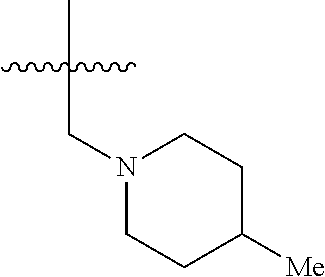 | H, H | 200 | 8-[(1S,2S)- 2- hydroxy- cyclo- hexyl]-5-[(4- methyl- piperidin- 1-yl)methyl]- 8,9-dihydro- 1H- pyrrolo[3,4- h]quinolin- 7-one | C24H32N3O2 Obs 394.2479 Calc 394.2489 | Ex 1 |
| 88 |  |  | H, H | 4000 | 5- [(diethyl- amino) methyl]-8- (2- hydroxy- cyclo- hexyl)-8,9- dihydro-7H- pyrrolo[3,4- h]quinolin- 7-one | C22H30N3O2 Obs 368.2335 Calc 368.2333 | Ex 1 |
| 89 |  |  | H, H | 290 | 8-(2- hydroxy- cyclo- hexyl)-5- [(4- hydroxy- piperidin- 1- yl)methyl]- 8,9- dihydro-7H- pyrrolo[3,4- h]quinolin- 7-one | C23H30N3O3 Obs 396.2281 Calc 396.2282 | Ex 1 |
| 90 |  |  | H, H | 1196 | 5-[(4- cyclo- propyl- piperidin-1- yl)methyl]- 8-(2- hydroxy- cyclo- hexyl)-8,9- dihydro-7H- pyrrolo[3,4- h]quinolin- 7-one | C26H34N3O2 Obs 420.2647 Calc 420.2646 | Ex 1 |
| 91 |  |  | H, H | 88 | 5-[(4- fluoro- piperidin- 1-yl) methyl]- 8-(2- hydroxy- cyclo- hexyl)-8,9- dihydro-7H- pyrrolo[3,4- h]quinolin- 7-one | C23H29FN3O2 Obs 398.2241 Calc 398.2238 | Ex 1 |
| 92 |  |  | H, H | 72 | 1-({8- [(1S,2S)- 2- hydroxy- cyclo- hexyl]-7- oxo-8,9- dihydro- 7H- pyrrolo[3,4- h]quinolin- 5- yl}methyl) piperidine- 4- carbonitrile | C24H29N4O2 Obs 405.2276 Calc 405.2285 | Ex 1 |
| 93 |  |  | H, Me | 70 | 5-[(4- fluoro- piperidin- 1-yl) methyl]- 8-[(1S, 2S)-2- hydroxy- cyclo- hexyl]-9- methyl- 8,9-dihydro- 7H- pyrrolo [3,4- h]quinolin- 7-one | C24H31FN3O2 Obs 412.4 Calc 412.2 | Ex 3 |
| 94 |  |  | H, Me | 51 | 1-({8- [(1S,2S)- 2- hydroxy- cyclo- hexyl]- 7-oxo- 8,9- dihydro- 7H- pyrrolo [3,4- h]quinolin- 5- yl}methyl) piperidine- 4- carbonitrile | C25H31N4O2 Obs 419.4 Calc 420.2 | Ex 3 |
| 95 |  |  | H, H | 290 | 8-(2- hydroxy- cyclo- hexyl)-5- (1′H- spiro[1- benzofuran- 3,4′- piperidin]- 1′- ylmethyl)- 8,9- dihydro- 7H- pyrrolo[3,4- h]quinolin- 7-one | C30H34N3O3 Obs 484.2591 Calc 484.2595 | Ex 1 |
| 96 |  |  | H, H | 620 | 8-(2- hydroxy- cyclo- hexyl)-5- (2-oxa-7- azaspiro [3.5]non- 7- ylmethyl)- 8,9- dihydro- 7H- pyrrolo[3,4- h]quinolin- 7-one | C25H32N3O2 Obs 422.2440 Calc 422.2438 | Ex 1 |
| 97 |  |  | H, H | 5200 | 8-(2- hydroxy- cyclo- hexyl)-5- (pyrrolidin- 1- ylmethyl)- 8,9- dihydro-7H- pyrrolo[3,4- h]quinolin- 7-one | C22H28N3O2 Obs 366.2180 Calc 366.2176 | Ex 1 |
| 98 |  |  | H, H | 151 | 5-[(3,3- difluoro- pyrrolidin- 1- yl)methyl]- 8-(2- hydroxy- cyclo- hexyl)-8,9- dihydro-7H- pyrrolo[3,4- h]quinolin- 7-one | C22H26F2N3O2 Obs 402.1993 Calc 402.1988 | Ex 1 |
| 99 |  |  | H, H | 150 | 8-(2- hydroxy- cyclo- hexyl)-5- (morpholin- 4- ylmethyl)- 8,9- dihydro- 7H- pyrrolo [3,4- h]quinolin- 7-one | C22H28N3O3 Obs 382.2128 Calc 382.2125 | Ex 1 |
| 100 |  |  | H, H | 430 | 5-[(4,4- dimethyl- piperidin-1- yl)methyl]- 8-(2- hydroxy- cyclo- hexyl)-8,9- dihydro- 7H- pyrrolo[3,4- h]quinolin- 7-one | C25H34N3O2 Obs 408.2650 Calc 408.2646 | Ex 1 |
| 101 |  |  | H, H | 930 | 8-(2- hydroxy- cyclo- hexyl)-5-[(4- hydroxy-4- methyl- piperidin- 1-yl) methyl]- 8,9- dihydro- 7H- pyrrolo[3,4- h]quinolin- 7-one | C24H32N3O3 Obs 410.2443 Calc 410.2438 | Ex 1 |
| 102 |  |  | H, H | 250 | 5-[(4- fluoro- 4-methyl- piperidin- 1-yl) methyl]- 8-[(1S,2S)- 2- hydroxy- cyclo- hexyl]-8,9- dihydro-7H- pyrrolo[3,4- h]quinolin- 7-one | C24H31FN3O2 Obs 412.2389 Calc 412.2395 | Ex 9 |
| 103 |  |  | H, H | 11 | 5-[(4- ethynyl- 4- fluoro- piperidin- 1-yl) methyl]- 8-[(1S,2S)- 2- hydroxy- cyclo- hexyl]-8,9- dihydro- 7H- pyrrolo [3,4- h]quinolin- 7-one | C25H29FN3O2 Obs 422.2231 Calc 411.2238 | Ex 9 |
| 104 |  |  | H, Me | 15 | 5-[(4,4- difluoro- piperidin- 1-yl) methyl]- 8-[(1R, 2S)-2- hydroxy- cyclo- hexyl]-9- methyl- 8,9- dihydro- 7H- pyrrolo [3,4- h]quinolin- 7-one | C24H30F2N3O2 Obs 430.2308 Calc 430.2301 | Ex 3 |
| 105 |  |  | H, Et | 9.9 | 5-[(4,4- difluoro- piperidin- 1-yl) methyl]- 9-ethyl-8- [(1R,2S)-2- hydroxy- cyclo- hexyl]-8,9- dihydro- 7H- pyrrolo[3,4- h]quinolin- 7-one | C25H32F2N3O2 Obs 444.2468 Calc 444.2457 | Ex 3 |
| 106 |  |  | H, Me | 110 | 1,5- anhydro- 2,4- dideoxy- 4- {5-[(4,4- difluoro- piperidin- 1-yl) methyl]- 9-methyl- 7- oxo-7,9- dihydro- 8H- pyrrolo[3,4- h]quinolin- 8-yl}-D- erythro- pentitol | C23H28F2N3O3 Obs 432.2103 Calc 432.2093 | Exs 3 and 8 |
| 107 |  |  | H, Me | 12 | 1,5- anhydro- 3,4- dideoxy-3- {5-[(4,4- difluoro- piperidin- 1-yl) methyl]- 9-methyl-7- oxo-7,9- dihydro-8H- pyrrolo[3,4- h]quinolin- 8-yl}-D- erythro- pentitol | C23H28F2N3O3 Obs 432.2098 Calc 432.2093 | Exs 3 and 7 |
| 108 |  |  | H, Me | 1,5- anhydro- 3-{5-[(4- cyano-4- pyridin-2- ylpiperidin- 1- yl)methyl]- 9- methyl- 7-oxo- 7,9-dihydro- 8H- pyrrolo[3,4- h]quinolin- 8-yl}-2,3- dideoxy- pentitol | C29H31N5O3 [M + H] calc. 498.25 obs. 498.2519 | Exs 3 and 7 | |
| 109 |  |  | H, Me | 1,5- anhydro-3- (5-{[4- cyano-4- (4- methyl- pyridin- 2-yl) piperidin- 1-yl] methyl}-9- methyl- 7-oxo- 7,9- dihydro-8H- pyrrolo[3,4- h]quinolin- 8-yl)-2,3- dideoxy- pentitol | C30H33N5O3 [M + H] calc. 512.2656 obs. 512.2669 | Exs 3 and 7 | |
| 110 |  |  | H, Me | 1,5- anhydro-3- {5-[(4- cyano-4- fluoro- piperidin- 1-yl) methyl]- 9-methyl-7- oxo-7,9- dihydro- 8H- pyrrolo [3,4- h]quinolin- 8-yl}-2,3- dideoxy- pentitol | C24H27FN4O3 [M + H] calc. 439.214 obs. 439.2148 | Exs 3 and 7 | |
| 111 |  |  | H, Me | 1,5- anhydro-3- {5-[(4- fluoro- piperidin- 1-yl) methyl]- 9-methyl-7- oxo-7,9- dihydro- 8H- pyrrolo [3,4- h]quinolin- 8-yl}-2,3- dideoxy- pentitol | C23H28FN3O3 [M + H] calc. 414.2187 obs. 414.2195 | Exs 3 and 7 | |
| 112 |  |  | H, Me | 1,5- anhydro-3- {5-[(4- cyano- piperidin- 1-yl) methyl]-9- methyl-7- oxo- 7,9- dihydro- 8H- pyrrolo[3,4- h]quinolin- 8-yl}-2,3- dideoxy- pentitol | C24H28N4O3 [M + H] calc. 421.2234 obs. 421.224 | Exs 3 and 7 | |
| 113 |  |  | H, Me | 1,5- anhydro- 2,3-dideoxy- 3-{5-[(4- ethynyl- piperidin- 1-yl) methyl]- 9-methyl- 7- oxo-7,9- dihydro- 8H- pyrrolo[3,4- h]quinolin- 8- yl}pentitol | C25H29N3O3 [M + H] calc. 420.2282 obs. 420.2288 | Exs 3 and 7 | |
| 114 |  |  | H, Me | 1,5- anhydro- 2,3- dideoxy- 3- {5-[(4- ethynyl- 4- fluoro- piperidin- 1-yl) methyl]- 9-methyl-7- oxo-7,9- dihydro- 8H- pyrrolo[3,4- h]quinolin- 8- yl}pentitol | C25H28FN3O3 [M + H] calc. 438.2187 obs. 438.2197 | Exs 3 and 7 | |
| 115 |  |  | H, Me | 1,5- anhydro- 2,3- dideoxy-3- {5-[(4- fluoro- 4-prop- 1-yn-1- ylpiperidin- 1- yl)methyl]- 9-methyl- 7-oxo- 7,9- dihydro- 8H- pyrrolo[3,4- h]quinolin- 8- yl}pentitol | C26H30FN3O3 [M + H] calc. 452.2344 obs. 452.2354 | Exs 3 and 7 | |
| 116 |  |  | H, H | 21 | 5-[(4,4- difluoro- piperidin- 1-yl) methyl]- 8-(2- hydroxy- cyclo- hexyl)-8,9- dihydro- 7H- pyrrolo[3,4- h]quinolin- 7-one | C23H28F2N3O2 Obs 416.2141 Calc 416.2144 | Ex 1 |
| 117 |  |  | H, H | 38 | 4-fluoro- 1-({8- [(1S,2S)-2- hydroxy- cyclo- hexyl]- 7-oxo- 8,9- dihydro- 7H- pyrrolo[3,4- h]quinolin- 5- yl}methyl) piperidine- 4- carbonitrile | C24H28FN4O2 Obs 423.2191 Calc 423.2191 | Ex 9 |
| 118 |  |  | H, Me | 450 | 4-fluoro- 1-{[8- (2- hydroxy- cyclo- hexyl)-9- methyl- 7-oxo-8,9- dihydro- 7H- pyrrolo[3,4- h]quinolin- 5- yl]methyl} piperidine- 4- carbonitrile | C25H30FN4O2 Obs 437.2384 Calc 437.2347 | Exs 3 and 9 |
| 119 |  |  | H, Me | 44 | 4-fluoro- 1-{[8- (2- hydroxy- cyclo- hexyl)-9- methyl- 7-oxo-8,9- dihydro- 7H- pyrrolo[3,4- h]quinolin- 5- yl]methyl} piperidine- 4- carbonitrile | C25H30FN4O2 Obs 437.2341 Calc 437.2347 | Exs 3 and 9 |
| 120 |  |  | H, Et | 21 | 1-({9- ethyl-8- [(1R,2S)-2- hydroxy- cyclo- hexyl]- 7-oxo- 8,9- dihydro- 7H- pyrrolo[3,4- h]quinolin- 5-yl} methyl)-4- fluoro- piperidine- 4- carbonitrile | C26H32FN4O2 Obs 451.2505 Calc 451.2504 | Exs 3 and 9 |
| 121 |  |  | H, H | 108 | 5-[(3- fluoro- piperidin- 1-yl) methyl]- 8-(2- hydroxy- cyclo- hexyl)-8,9- dihydro- 7H- pyrrolo [3,4- h]quinolin- 7-one | C23H29FN3O2 Obs 398.2245 Calc 398.2238 | Ex 1 |
| 122 |  |  | H, H | 86 | 5-[(3,3- difluoro- piperidin- 1-yl) methyl]- 8-(2- hydroxy- cyclo- hexyl)-8,9- dihydro- 7H- pyrrolo [3,4- h]quinolin- 7-one | C23H28F2N3O2 Obs 416.2148 Calc 416.2144 | Ex 1 |
| 123 |  |  | H, H | 97 | 8-(2- hydroxy- cyclo- hexyl)- 5-{[4- (trifluoro- methyl) piperidin- 1-yl] methyl}- 8,9- dihydro- 7H- pyrrolo[3,4- h]quinolin- 7-one | C24H29F3N3O2 Obs 448.2211 Calc 448.2206 | Ex 1 |
| 124 |  |  | H, H | 44 | 5-[(4- ethynyl- piperidin- 1-yl) methyl]- 8-(2- hydroxy- cyclo- hexyl)-8,9- dihydro- 7H- pyrrolo[3,4- h]quinolin- 7-one | C25H30N3O2 Obs 404.2337 Calc 404.2333 | Ex 1 |
| 125 |  |  | H, H | 130 | 5-[(4- fluoro-4- pent-1- yn-1- ylpiperidin- 1- yl)methyl]- 8- [(1S,2S)-2- hydroxy- cyclo- hexyl]-8,9- dihydro- 7H- pyrrolo[3,4- h]quinolin- 7-one | C28H35FN3O2 Obs 464.2710 Calc 464.2708 | Ex 10 |
| 126 |  |  | H, H | 1382 | 2-(2- fluoro- phenyl)- 5-{[4- (pyridin- 2-yl) piperazin- 1-yl] methyl}- 1,2- dihydro- 3H- benzo[e] isoindol- 3-one | LRMS: 451.3 MW: 409.44 | Ex 1 |
| 127 |  |  | H, H | 44 | 4-fluoro- 1-{[8- (3- hydroxy- phenyl)- 7-oxo-8,9- dihydro- 7H- pyrrolo[3,4- h]quinolin- 5- yl]methyl} piperidine- 4- carbonitrile | C24H22FN4O2 Obs 417.1718 Calc 417.1721 | Ex 9 |
| 128 |  |  | H, H | 843 | 5-[(4- ethynyl- 4- fluoro- piperidin- 1-yl) methyl]- 8-(3- hydroxy- phenyl)- 8,9- dihydro- 7H- pyrrolo[3,4- h]quinolin- 7-one | C25H23FN3O2 Obs 416.1768 Calc 416.1769 | Ex 9 |
| 129 |  |  | H, H | 2167 | 3-{5-[(4- cyano-4- fluoro- piperidin- 1-yl) methyl]- 7-oxo-7,9- dihydro- 8H- pyrrolo[3,4- h]quinolin- 8- yl}phenyl dimethyl carbamate | C27H27FN5O3 Obs 488.2099 Calc 488.2092 | Ex 10 |
| 130 |  |  | H, H | 1428 | 3-{5-[(4- ethynyl-4- fluoro- piperidin- 1-yl) methyl]- 7-oxo-7,9- dihydro- 8H- pyrrolo [3,4- h]quinolin- 8- yl}phenyl dimethyl- carbamate | C28H28FN4O3 Obs 487.2139 Calc 487.2140 | Exs 9 and 10 |
| 131 |  |  | H, H | 33 | 5-[(4- fluoro-4- prop-1- yn-1- ylpiperidin- 1- yl)methyl]- 8- [(1S,2S)-2- hydroxy- cyclo- hexyl]-8,9- dihydro- 7H- pyrrolo [3,4- h]quinolin- 7-one | C26H31FN3O2 Obs 436.2397 Calc 436.22395 | Ex 9 |
| 132 |  |  | H, H | 246 | 5-{[4- (cyclo- propyl- ethynyl)-4- fluoro- piperidin- 1-yl] methyl}- 8-[(1S, 2S)-2- hydroxy- cyclo- hexyl]-8,9- dihydro-7H- pyrrolo[3,4- h]quinolin- 7-one | C28H33FN3O2 Obs 462.2549 Calc 462.2551 | Ex 9 |
| 133 |  |  | H, H | 129 | 5-({4- fluoro-4- [(4- fluorophenyl) ethynyl] piperidin- 1-yl}methyl)- 8-(2- hydroxy- cyclo- hexyl)-8,9- dihydro-7H- pyrrolo[3,4- h]quinolin- 7-one | C31H32F2N3O2 Obs 516.2470 Calc 516.2457 | Ex 9 |
| 134 |  |  | H, H | 207 | 5-[(4- benzyl-4- fluoro- piperidin- 1-yl) methyl]- 8-(2- hydroxy- cyclo- hexyl)-8,9- dihydro-7H- pyrrolo[3,4- h]quinolin- 7-one | C30H35FN3O2 Obs 488.2714 Calc 488.2708 | Ex 1 |
| 135 |  |  | H, H | 156 | 1-{[8-(2- hydroxy- cyclo- hexyl)-7- oxo- 8,9-dihydro- 7H- pyrrolo[3,4- h]quinolin-5- yl]methyl}- 4- (pyridin-4- ylmethyl) piperidine-4- carbonitrile | C30H34N5O2 Obs 496.2710 Calc 496.2707 | Ex 1 |
| 136 |  |  | H, H | 14 | 1-({8- [(1S,2S)- 2- hydroxy- cyclo- hexyl]-7-oxo- 8,9-dihydro- 7H- pyrrolo[3,4- h]quinolin-5- yl}methyl)- 4-phenyl- piperidine- 4-carbonitrile | C30H33N4O2 Obs 481.2587 Calc 481.2598 | Ex 1 |
| 137 |  |  | H, Me | 480 | 1-{[8-(2- hydroxy- cyclo- hexyl)-9- methyl- 7-oxo-8,9- dihydro-7H- pyrrolo[3,4- h]quinolin-5- yl]methyl}- 4-phenyl- piperidine- 4-carbonitrile | C31H35N4O2 Obs 495.2744 Calc 495.2755 | Ex 3 |
| 138 |  |  | H, Me | 69 | 1-{[8-(2- hydroxy- cyclo- hexyl)-9- methyl- 7-oxo-8,9- dihydro-7H- pyrrolo[3,4- h]quinolin-5- yl]methyl}- 4- phenyl- piperidine- 4-carbonitrile | C31H36N4O2 Obs 495.2766 Calc 495.2755 | Ex 1 |
| 139 |  |  | H, H | 85 | 8-(2- hydroxy- cyclo- hexyl)-5-[(4- phenyl- piperidin- 1-yl)methyl]- 8,9-dihydro- 7H- pyrrolo[3,4- h]quinolin- 7-one | C29H34N3O2 Obs 456.2641 Calc 456.2646 | Ex 1 |
| 140 |  |  | H, Me | 3200 | 8-(2- hydroxy- cyclo- hexyl)-9- methyl- 5-[(4- phenyl- piperidin- 1-yl)methyl]- 8,9-dihydro- 7H- pyrrolo[3,4- h]quinolin- 7-one | C30H36N3O2 Obs 470.2810 Calc 470.2802 | Ex 3 |
| 141 |  |  | H, Me | 490 | 8-(2- hydroxy- cyclo- hexyl)-9- methyl- 5-[(4- phenyl- piperidin- 1-yl)methyl]- 8,9-dihydro- 7H- pyrrolo[3,4- h]quinolin- 7-one | C30H36N3O2 Obs 470.2807 Calc 470.2802 | Ex 3 |
| 142 |  |  | H, H | 51 | 8-(2- hydroxy- cyclo- hexyl)-5-[(4- pyridin-4- ylpiperidin-1- yl)methyl]- 8,9- dihydro-7H- pyrrolo[3,4- h]quinolin- 7-one | C28H34N4O2 Obs 457.2597 Calc 457.2598 | Ex 1 |
| 143 | 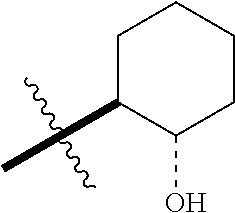 |  | H, Me | 89 | 8-(2- hydroxy- cyclo- hexyl)-9- methyl- 5-[(4-pyridin- 4-ylpiperidin- 1-yl)methyl]- 8,9-dihydro- 7H- pyrrolo[3,4- h]quinolin- 7-one | C29H35N4O2 Obs 471.2757 Calc 471.2755 | Ex 3 |
| 144 |  |  | H, H | 510 | 8-(2- hydroxy- cyclo- hexyl)-5-[(4- hydroxy-4- pyridin-4- ylpiperidin-1- yl)methyl]- 8,9- dihydro-7H- pyrrolo[3,4- h]quinolin- 7-one | C28H33N4O3 Obs 473.2549 Calc 473.2547 | Ex 1 |
| 145 |  |  | H, H | 7.6 | 1-({8- [(1S,2S)- 2- hydroxy- cyclo- hexyl]-7-oxo- 8,9-dihydro- 7H- pyrrolo[3,4- h]quinolin-5- yl}methyl)- 4- pyridin-2- ylpiperidine- 4- carbonitrile | C29H32N5O2 Obs 482.2555 Calc 482.2551 | Ex 1 |
| 146 |  |  | H, H | 11 | 5-[(4- fluoro-4- pyridin-2- ylpiperidin- 1- yl)methyl]- 8-(2- hydroxy- cyclo- hexyl)-8,9- dihydro-7H- pyrrolo[3,4- h]quinolin- 7-one | C28H33FN4O2 Obs 475.2497 Calc 475.2504 | Ex 2 |
| 147 |  |  | H, Me | 70 | 5-[(4- fluoro-4- pyridin-2- ylpiperidin- 1- yl)methyl]-8- [(1R,2S)-2- hydroxy- cyclo- hexyl]-9- methyl- 8,9-dihydro- 7H- pyrrolo[3,4- h]quinolin- 7-one | C29H34FN4O2 Obs 489.2661 Calc 489.3 | Exs 2 and 3 |
| 148 |  |  | H, H | 4.7 | 1-{[8-(2- hydroxy- cyclo- hexyl)-7- oxo- 8,9-dihydro- 7H- pyrrolo[3,4- h]quinolin-5- yl]methyl}- 4-(4- methyl- pyridin- 2-yl) piperidine- 4-carbonitrile | C30H35N5O2 Obs 496.2705 Calc 496.2707 | Ex 1 |
| 149 |  |  | H, Me | 6.0 | 1-({(9R)-8- [(1S,2S)-2- hydroxy- cyclo- hexyl]-9- methyl- 7-oxo-8,9- dihydro-7H- pyrrolo[3,4- h]quinolin- 5- yl}methyl)- 4- pyridin-2- ylpiperidine- 4- carbonitrile | C30H34N5O2 Obs 496.2695 Calc 496.2707 | Ex 3 |
| 150 |  |  | H, Me | 54 | 1-({(9R)-8- [(1S,2S)-2- hydroxy- cyclo- hexyl]-9- methyl- 7-oxo-8,9- dihydro-7H- pyrrolo[3,4- h]quinolin-5- yl}methyl)- 4- pyridin-2- ylpiperidine- 4- carbonitrile | C30H34N5O2 Obs 496.2724 Calc 469.2707 | Ex 3 |
| 151 |  |  | H, Me | 3.5 | 1-({(9R)-8- [(1S,2S)-2- hydroxy- cyclo- hexyl]-9- methyl- 7-oxo-8,9- dihydro-7H- pyrrolo[3,4- h]quinolin- 5- yl}methyl)- 4-(4- methyl- pyridin- 2-yl) piperidine- 4-carbonitrile | C31H35N5O2 Obs 510.2882 Calc 510.2864 | Ex 3 |
| 152 |  |  | H, Me | 14 | 1-({(9R)-8- [(1S,2S)-2- hydroxy- cyclo- hexyl]-9- methyl- 7-oxo-8,9- dihydro-7H- pyrrolo[3,4- h]quinolin- 5- yl}methyl)- 4-(4- methyl- pyridin- 2-yl) piperidine- 4- carbonitrile | C31H35N5O2 Obs 510.2882 Calc 510.2864 C31H35N5O2 | Ex 3 |
| 153 |  |  | H, Me | 8.0 | (9R)-5-[(4- fluoro-4- pyridin-2- ylpiperidin- 1- yl)methyl]-8- [(1S,2S)-2- hydroxy- cyclo- hexyl]-9- methyl- 8,9-dihydro- 7H- pyrrolo[3,4- h]quinolin- 7-one | C29H34FN4O2 Obs 489.2646 Calc 489.2660 | Exs 2 and 3 |
| 154 |  |  | H, H | 19 | 1-({8- [(1S,2S)- 2- hydroxy- cyclo- hexyl]-7-oxo- 8,9-dihydro- 7H- pyrrolo[3,4- h]quinolin- 5- yl}methyl)- 4-(6- methoxy- pyridin-2- yl) piperidine- 4- carbonitrile | C30H34N5O3 Obs 512.2642 Calc 512.2656 | Ex 6 |
| 155 |  |  | H, Me | 520 | 1-({8- [(1S,2S)- 2- hydroxy- cyclo- hexyl]-7- oxo- 8,9-dihydro- 7H- pyrrolo[3,4- h]quinolin-5- yl}methyl)- 4-(6- methoxy- pyridin-2- yl)piperidine- 4- carbonitrile | C31H36N5O3 Obs 526.2813 Calc 526.2813 | Exs 3 and 6 |
| 156 |  |  | H, Me | 57 | 1-({8- [(1S,2S)- 2- hydroxy- cyclo- hexyl]-7- oxo- 8,9-dihydro- 7H- pyrrolo[3,4- h]quinolin- 5- yl}methyl)- 4-(6- methoxy- pyridin-2- yl) piperidine- 4- carbonitrile | C31H37N5O3 Obs 526.2817 Calc 526.2813 | Exs 3 and 6 |
| 157 |  |  | H, H | 42 | 8-[(1S,2S)-2- hydroxy- cyclo- hexyl]-5- {[4-(1- methyl-1H- pyrazol-4- yl)piperazin- 1- yl]methyl}- 8,9- dihydro-7H- pyrrolo[3,4- h]quinolin- 7-one | C26H33N6O2 Obs 461.2649 Calc 461.2660 | Ex 1 |
| 158 |  |  | H, Me | 70 | 8-(2- hydroxy- cyclo- hexyl)-9- methyl- 5-{[4-(1- methyl-1H- pyrazol-4- yl)piperazin- 1- yl]methyl}- 8,9- dihydro-7H- pyrrolo[3,4- h]quinolin- 7-one | C27H35N6O2 Obs 475.2818 Calc 475.2816 | Ex 3 |
| 160 |  |  | H, H | 110 | 8-(2- hydroxy- cyclo- hexyl)-5-[(4- pyridin-4- ylpiperazin- 1- yl)methyl]- 8,9- dihydro-7H- pyrrolo[3,4- h]quinolin- 7-one | C27H33N5O2 Obs 458.2543 Calc 458.2551 | Ex 1 |
| 161 |  |  | H, Me | 650 | 8-(2- hydroxy- cyclo- hexyl)-9- methyl- 5-[(4- pyridin- 4-ylpiperidin- 1-yl) methyl]- 8,9-dihydro- 7H- pyrrolo[3,4- h]quinolin- 7-one | C29H35N4O2 Obs 471.2753 Calc 471.2755 | Ex 3 |
| 162 |  |  | H, H | 28 | 8-(2- hydroxy- cyclo- hexyl)-5-[(4- pyridin-3- ylpiperazin- 1- yl)methyl]- 8,9- dihydro-7H- pyrrolo[3,4- h]quinolin- 7-one | C27H33N5O2 Obs 458.2544 Calc 458.2551 | Ex 1 |
| 163 |  |  | H, Me | 520 | 8-(2- hydroxy- cyclo- hexyl)-9- methyl- 5-[(4- pyridin- 3-yl- piperazin- 1-yl) methyl]- 8,9-dihydro- 7H- pyrrolo[3,4- h]quinolin- 7-one | C28H34N5O2 Obs 472.2705 Calc 472.2707 | Ex 3 |
| 164 |  |  | H, Me | 36 | 8-(2- hydroxy- cyclo- hexyl)-9- methyl- 5-[(4-pyridin- 3-yl- piperazin- 1-yl)methyl]- 8,9-dihydro- 7H- pyrrolo[3,4- h]quinolin- 7-one | C28H34N5O2 Obs 472.2709 Calc 472.2707 | Ex 3 |
| 165 |  |  | H, H | 15 | 8-(2- hydroxy- cyclo- hexyl)-5-[(4- pyridin-2- ylpiperazin- 1- yl)methyl]- 8,9- dihydro-7H- pyrrolo[3,4- h]quinolin- 7-one | C27H33N5O2 Obs 458.2546 Calc 458.2551 | Ex 1 |
| 166 |  |  | H, Me | 580 | 8-(2- hydroxy- cyclo- hexyl)-9- methyl- 5-[(4- pyridin- 2-yl- piperazin- 1-yl) methyl]- 8,9-dihydro- 7H- pyrrolo[3,4- h]quinolin- 7-one | C28H34N5O2 Obs 472.2708 Calc 472.2707 | Ex 3 |
| 167 |  |  | H, Me | 59 | 8-(2- hydroxy- cyclo- hexyl)-9- methyl- 5-[(4- pyridin- 2-yl- piperazin- 1-yl) methyl]- 8,9-dihydro 7H- pyrrolo[3,4- h]quinolin- 7-one | C28H34N5O2 Obs 472.2711 Calc 472.2707 | Ex 3 |
| 168 |  |  | H, H | 24 | 8-(2- hydroxy- cyclo- hexyl)-5- {[4-(4- methoxy- phenyl) piperazin-1- yl]methyl}- 8,9- dihydro- 7H- pyrrolo[3,4- h]quinolin- 7-one | C29H36N4O3 Obs 487.2696 Calc 487.2704 | Ex 1 |
| 169 |  |  | H, Me | 590 | 8-(2- hydroxy- cyclo- hexyl)-5- {[4-(4- methoxy- phenyl) piperazin-1- yl]methyl}- 9- methyl- 8,9- dihydro- 7H- pyrrolo[3,4- h]quinolin- 7-one | C30H37N4O3 Obs 501.2860 Calc 501.2860 | Ex 3 |
| 170 |  |  | H, Me | 100 | 8-(2- hydroxy- cyclo- hexyl)-5- {[4-(4- methoxy- phenyl) piperazin-1- yl]methyl}- 9- methyl- 8,9- dihydro- 7H- pyrrolo[3,4- h]quinolin- 7-one | C30H37N4O3 Obs 501.2865 Calc 501.2860 | Ex 3 |
| 171 |  |  | H, H | 23 | 5-{[4-(4- fluoro- phenyl) piperazin-1- yl]methyl}- 8-(2- hydroxy- cyclo- hexyl)-8,9- dihydro- 7H- pyrrolo[3,4- h]quinolin- 7-one | C28H33FN4O2 Obs 475.2493 Calc 475.2504 | Ex 1 |
| 172 |  |  | H, Me | 480 | 5-{[4-(4- fluoro- phenyl) piperazin-1- yl]methyl}- 8-(2- hydroxy- cyclo- hexyl)-9- methyl- 8,9- dihydro- 7H- pyrrolo[3,4- h]quinolin- 7-one | C29H34FN4O2 Obs 489.2667 Calc 489.2660 | Ex 3 |
| 173 |  |  | H, Me | 100 | 5-{[4-(4- fluoro- phenyl) piperazin-1- yl]methyl}- 8-(2- hydroxy- cyclo- hexyl)-9- methyl- 8,9- dihydro- 7H- pyrrolo[3,4- h]quinolin- 7-one | C29H34FN4O2 Obs 489.2665 Calc 489.2660 | Ex 3 |
| 174 |  |  | H, H | 18 | 8-(2- hydroxy- cyclo- hexyl)-5-[(4- phenyl- piperazin- 1-yl) methyl]- 8,9- dihydro- 7H- pyrrolo[3,4- h]quinolin- 7-one | C28H34N4O2 Obs 457.2599 Calc 457.2598 | Ex 1 |
| 175 |  |  | H, Me | 490 | 8-(2- hydroxy- cyclo- hexyl)-9- methyl- 5-[(4- phenyl- piperazin- 1-yl) methyl]- 8,9- dihydro- 7H- pyrrolo [3,4- h]quinolin- 7-one | C29H35N4O2 Obs 471.2754 Calc 471.2755 | Ex 3 |
| 176 |  |  | H, Me | 93 | 8-(2- hydroxy- cyclo- hexyl)-9- methyl- 5-[(4- phenyl- piperazin- 1-yl) methyl]- 8,9- dihydro- 7H- pyrrolo[3,4- h]quinolin- 7-one | C29H35N4O2 Obs 471.2759 Calc 471.2755 | Ex 3 |
The utility of the compounds as M1 receptor positive allosteric modulators may be demonstrated by methodology known in the art, including by the assay described below. The assay is designed to select compounds that possess modulator activity at the acetylcholine muscarinic M1 receptor or other muscarinic receptors expressed in CHOnfat cells by measuring the intracellular calcium with a FLIPR384 Fluorometric Imaging Plate Reader System. The assay studies the effect of one or several concentrations of test compounds on basal or acetylcholine-stimulated Ca2+ levels using FLIPR.
| Example | IP Value (nM) | ||
| 1 | 10 | ||
| 2 | 58 | ||
| 3 | 19 | ||
| 4 | 27 | ||
| 5 | 55 | ||
| 6 | 65 | ||
| 7 | 147 | ||
| 8 | 41 | ||
| 9 | 420 | ||
| 10 | 2258 | ||
Claims (13)


Priority Applications (1)
| Application Number | Priority Date | Filing Date | Title |
|---|---|---|---|
| US14/117,341 US9206200B2 (en) | 2011-05-17 | 2012-05-11 | N-linked lactam M1 receptor positive allosteric mogulators |
Applications Claiming Priority (3)
| Application Number | Priority Date | Filing Date | Title |
|---|---|---|---|
| US201161487070P | 2011-05-17 | 2011-05-17 | |
| PCT/US2012/037410 WO2012158475A1 (en) | 2011-05-17 | 2012-05-11 | N-linked lactam m1 receptor positive allosteric modulators |
| US14/117,341 US9206200B2 (en) | 2011-05-17 | 2012-05-11 | N-linked lactam M1 receptor positive allosteric mogulators |
Publications (2)
| Publication Number | Publication Date |
|---|---|
| US20150065498A1 US20150065498A1 (en) | 2015-03-05 |
| US9206200B2 true US9206200B2 (en) | 2015-12-08 |
Family
ID=47177272
Family Applications (1)
| Application Number | Title | Priority Date | Filing Date |
|---|---|---|---|
| US14/117,341 Active US9206200B2 (en) | 2011-05-17 | 2012-05-11 | N-linked lactam M1 receptor positive allosteric mogulators |
Country Status (3)
| Country | Link |
|---|---|
| US (1) | US9206200B2 (en) |
| EP (1) | EP2709451B1 (en) |
| WO (1) | WO2012158475A1 (en) |
Families Citing this family (11)
| Publication number | Priority date | Publication date | Assignee | Title |
|---|---|---|---|---|
| GB201317363D0 (en) | 2013-10-01 | 2013-11-13 | Eisai Ltd | Novel compounds |
| DK3134386T3 (en) * | 2014-04-23 | 2020-08-17 | Takeda Pharmaceuticals Co | ISOINDOLIN-1-ON DERIVATIVES WITH CHOLINERG MUSCARIN-M1 RECEPTOR-POSITIVE ALLOSTERIC MODULATOR ACTIVITY FOR THE TREATMENT OF ALZHEIMER'S DISEASE |
| EP3144308B1 (en) | 2014-05-16 | 2020-06-24 | Takeda Pharmaceutical Company Limited | Nitrogen-containing heterocyclic compound |
| WO2017099969A1 (en) * | 2015-12-10 | 2017-06-15 | Merck Sharp & Dohme Corp. | Tetrahydroquinoxaline m1 receptor positive allosteric modulators |
| WO2017151449A1 (en) * | 2016-03-04 | 2017-09-08 | Merck Sharp & Dohme Corp. | M1 receptor positive allosteric modulator compounds and methods of use thereof |
| WO2018005249A1 (en) * | 2016-06-28 | 2018-01-04 | Merck Sharp & Dohme Corp. | Benzoisoquinolinone m1 receptor positive allosteric modulators |
| US10513515B2 (en) | 2017-08-25 | 2019-12-24 | Biotheryx, Inc. | Ether compounds and uses thereof |
| US12156871B2 (en) * | 2017-11-23 | 2024-12-03 | Suven Life Sciences Limited | Substituted azacycles as muscarinic M1 receptor positive allosteric modulators |
| CA3106239A1 (en) | 2018-07-27 | 2020-01-30 | Biotheryx, Inc. | Bifunctional compounds as cdk modulators |
| WO2021222150A2 (en) | 2020-04-28 | 2021-11-04 | Anwita Biosciences, Inc. | Interleukin-2 polypeptides and fusion proteins thereof, and their pharmaceutical compositions and therapeutic applications |
| WO2025231255A1 (en) * | 2024-05-01 | 2025-11-06 | Vanderbilt University | Positive allosteric modulators of the muscarinic acetylcholine receptor m1 |
Citations (6)
| Publication number | Priority date | Publication date | Assignee | Title |
|---|---|---|---|---|
| WO2004073639A2 (en) | 2003-02-19 | 2004-09-02 | Merck & Co. Inc. | Treatment of psychosis with a muscarinic m1 receptor ectopic activator |
| WO2005030188A2 (en) | 2003-09-26 | 2005-04-07 | Vertex Pharmaceuticals Incorporated | Phenyl-piperazine derivatives as modulators of muscarinic receptors |
| WO2005056552A1 (en) | 2003-12-09 | 2005-06-23 | Vertex Pharmaceuticals Incorporated | Naphthyridine derivatives and their use as modulators of muscarinic receptors |
| WO2007067489A1 (en) | 2005-12-05 | 2007-06-14 | Merck & Co., Inc. | Quinolone m1 receptor positive allosteric modulators |
| WO2011049731A1 (en) | 2009-10-21 | 2011-04-28 | Merck Sharp & Dohme Corp. | Quinolinone-pyrazolone m1 receptor positive allosteric modulators |
| WO2012003147A1 (en) * | 2010-07-01 | 2012-01-05 | Merck Sharp & Dohme Corp. | Isoindolone m1 receptor positive allosteric modulators |
-
2012
- 2012-05-11 WO PCT/US2012/037410 patent/WO2012158475A1/en not_active Ceased
- 2012-05-11 EP EP12784890.1A patent/EP2709451B1/en not_active Not-in-force
- 2012-05-11 US US14/117,341 patent/US9206200B2/en active Active
Patent Citations (7)
| Publication number | Priority date | Publication date | Assignee | Title |
|---|---|---|---|---|
| WO2004073639A2 (en) | 2003-02-19 | 2004-09-02 | Merck & Co. Inc. | Treatment of psychosis with a muscarinic m1 receptor ectopic activator |
| WO2005030188A2 (en) | 2003-09-26 | 2005-04-07 | Vertex Pharmaceuticals Incorporated | Phenyl-piperazine derivatives as modulators of muscarinic receptors |
| WO2005056552A1 (en) | 2003-12-09 | 2005-06-23 | Vertex Pharmaceuticals Incorporated | Naphthyridine derivatives and their use as modulators of muscarinic receptors |
| WO2007067489A1 (en) | 2005-12-05 | 2007-06-14 | Merck & Co., Inc. | Quinolone m1 receptor positive allosteric modulators |
| WO2011049731A1 (en) | 2009-10-21 | 2011-04-28 | Merck Sharp & Dohme Corp. | Quinolinone-pyrazolone m1 receptor positive allosteric modulators |
| WO2012003147A1 (en) * | 2010-07-01 | 2012-01-05 | Merck Sharp & Dohme Corp. | Isoindolone m1 receptor positive allosteric modulators |
| US8697690B2 (en) * | 2010-07-01 | 2014-04-15 | Merck Sharp & Dohme Corp. | Isoindolone M1 receptor positive allosteric modulators |
Non-Patent Citations (10)
| Title |
|---|
| Abraham Fisher, Therapeutic Strategies in Alzheimer's Disease: M1 Muscarinic Agonists, Jpn. J. Pharmacol., 2000, pp. 101-112, 84. |
| Birdsall, Multiple Allosteric Sites on Muscarinic Receptors, NPL-Birdsall-2001-2517, 2001, 2517-2524, 58, Life Science. |
| Brauner-Osborne, Pharmacology of Muscarinic Acetylcholine Receptor Subtypes (ml-m5): High Throughout Assays in Mammalian Cells, E. Journal of Pharmacology, 1996, 93-102, 295. |
| Christopoulos, Allosteric Binding Sites on Cell-Surface Receptors: Novel Targets for Drug Discovery, Nature, 2002, 198-210, 1. |
| Eglen, Therapeutic Opportunties from Muscarinic Receptor Research, Trends in Pharmacological Sciences, Aug. 2001, 409-414, 8. |
| Espinoza-Fonesca et al., Idenfication of Multiple Allosteric Sites on the M1 Muscarinic Acetylcholine Receptor, FEBS Letters, 2005, 6726-6732, 579, Elsevier. |
| Lazareno, Analogs of WIN 62,577 Define a Second Allsoteric Site on Muscarinic Receptors, Molecular Pharmacology, 2002, 1492-1505, 62. |
| Lazereno, Allosteric Interactions of Staurosporine and Other Indolocarbazoles with N-[Methyl-3H]Scopolamine and Acetylcholine at Muscarinic Receptor Subtypes: Identification of a Second Allosteric Site, Molecular Pharmacology, Mar. 22, 2000, 194-207, 58. |
| Peng et al., The Predicted 3D Structures of the Human M1 Muscarinic Acetylcholine Receptor with Agonist or Antagonist Bound,, Chem Med Chem, 2006, pp. 878-890, 1. |
| Spalding et al., Discovery of an Ectopic Activation Site on the M1 Muscarinic Receptor, Site on the M1 Muscarinic Receptor, 2002, pp. 1297-1302, 61, Molecular Pharmacology, US. |
Also Published As
| Publication number | Publication date |
|---|---|
| EP2709451A1 (en) | 2014-03-26 |
| EP2709451B1 (en) | 2015-12-30 |
| US20150065498A1 (en) | 2015-03-05 |
| WO2012158475A1 (en) | 2012-11-22 |
| EP2709451A4 (en) | 2014-10-15 |
Similar Documents
| Publication | Publication Date | Title |
|---|---|---|
| US8697690B2 (en) | Isoindolone M1 receptor positive allosteric modulators | |
| US9206200B2 (en) | N-linked lactam M1 receptor positive allosteric mogulators | |
| US8815902B2 (en) | Tetrahydroquinoline amide M1 receptor positive allosteric modulators | |
| US8664234B2 (en) | Dihydrobenzoquinazolinone M1 receptor positive allosteric modulators | |
| US8883810B2 (en) | Aryl methyl benzoquinazolinone M1 receptor positive allosteric modulators | |
| US9260418B2 (en) | Pyranyl aryl methyl benzoquinolinone M1 receptor positive allosteric modulators | |
| US8557992B2 (en) | Heterocyclic fused phenanthrolinone M1 receptor positive allosteric modulators | |
| US8664387B2 (en) | Pyridoquinazolinone M1 receptor positive allosteric modulators | |
| US8846702B2 (en) | Pyranyl aryl methyl benzoquinazolinone M1 receptor positive allosteric modulators | |
| US8383638B2 (en) | Aminobenzoquinazolinone M1 receptor positive allosteric modulators | |
| US8940765B2 (en) | N-linked quinolineamide M1 receptor positive allosteric modulators | |
| US8507494B2 (en) | Heterocyclic quinolizine derived M1 receptor positive allosteric modulators | |
| US8258135B2 (en) | Quinolizidinone M1 receptor positive allosteric modulators | |
| US9284312B2 (en) | N-methyl tetrahydroquinoline M1 receptor positive allosteric modulators | |
| WO2017123482A1 (en) | Dihydropyrido quinazoline m1 receptor positive allosteric modulators | |
| WO2017160670A1 (en) | M1 receptor positive allosteric modulators and methods of use thereof |
Legal Events
| Date | Code | Title | Description |
|---|---|---|---|
| AS | Assignment |
Owner name: MERCK SHARP & DOHME CORP., NEW JERSEY Free format text: ASSIGNMENT OF ASSIGNORS INTEREST;ASSIGNORS:YANG, ZHI-QIANG;PITTS, DANIEL;SHU, YOUHENG;AND OTHERS;SIGNING DATES FROM 20120726 TO 20120928;REEL/FRAME:032618/0271 |
|
| STCF | Information on status: patent grant |
Free format text: PATENTED CASE |
|
| MAFP | Maintenance fee payment |
Free format text: PAYMENT OF MAINTENANCE FEE, 4TH YEAR, LARGE ENTITY (ORIGINAL EVENT CODE: M1551); ENTITY STATUS OF PATENT OWNER: LARGE ENTITY Year of fee payment: 4 |
|
| AS | Assignment |
Owner name: MERCK SHARP & DOHME LLC, NEW JERSEY Free format text: MERGER;ASSIGNOR:MERCK SHARP & DOHME CORP.;REEL/FRAME:061102/0145 Effective date: 20220407 |
|
| MAFP | Maintenance fee payment |
Free format text: PAYMENT OF MAINTENANCE FEE, 8TH YEAR, LARGE ENTITY (ORIGINAL EVENT CODE: M1552); ENTITY STATUS OF PATENT OWNER: LARGE ENTITY Year of fee payment: 8 |