US9199829B2 - Assembly and a method for lifting a module of a lithography system in a vertical direction and a lithography system comprising such assembly - Google Patents
Assembly and a method for lifting a module of a lithography system in a vertical direction and a lithography system comprising such assembly Download PDFInfo
- Publication number
- US9199829B2 US9199829B2 US13/610,392 US201213610392A US9199829B2 US 9199829 B2 US9199829 B2 US 9199829B2 US 201213610392 A US201213610392 A US 201213610392A US 9199829 B2 US9199829 B2 US 9199829B2
- Authority
- US
- United States
- Prior art keywords
- module
- support
- ramp
- liftable
- track
- Prior art date
- Legal status (The legal status is an assumption and is not a legal conclusion. Google has not performed a legal analysis and makes no representation as to the accuracy of the status listed.)
- Active, expires
Links
Images




Classifications
-
- B—PERFORMING OPERATIONS; TRANSPORTING
- B66—HOISTING; LIFTING; HAULING
- B66F—HOISTING, LIFTING, HAULING OR PUSHING, NOT OTHERWISE PROVIDED FOR, e.g. DEVICES WHICH APPLY A LIFTING OR PUSHING FORCE DIRECTLY TO THE SURFACE OF A LOAD
- B66F7/00—Lifting frames, e.g. for lifting vehicles; Platform lifts
-
- B—PERFORMING OPERATIONS; TRANSPORTING
- B62—LAND VEHICLES FOR TRAVELLING OTHERWISE THAN ON RAILS
- B62B—HAND-PROPELLED VEHICLES, e.g. HAND CARTS OR PERAMBULATORS; SLEDGES
- B62B3/00—Hand carts having more than one axis carrying transport wheels; Steering devices therefor; Equipment therefor
- B62B3/02—Hand carts having more than one axis carrying transport wheels; Steering devices therefor; Equipment therefor involving parts being adjustable, collapsible, attachable, detachable or convertible
-
- B—PERFORMING OPERATIONS; TRANSPORTING
- B82—NANOTECHNOLOGY
- B82Y—SPECIFIC USES OR APPLICATIONS OF NANOSTRUCTURES; MEASUREMENT OR ANALYSIS OF NANOSTRUCTURES; MANUFACTURE OR TREATMENT OF NANOSTRUCTURES
- B82Y10/00—Nanotechnology for information processing, storage or transmission, e.g. quantum computing or single electron logic
-
- B—PERFORMING OPERATIONS; TRANSPORTING
- B82—NANOTECHNOLOGY
- B82Y—SPECIFIC USES OR APPLICATIONS OF NANOSTRUCTURES; MEASUREMENT OR ANALYSIS OF NANOSTRUCTURES; MANUFACTURE OR TREATMENT OF NANOSTRUCTURES
- B82Y40/00—Manufacture or treatment of nanostructures
-
- G—PHYSICS
- G03—PHOTOGRAPHY; CINEMATOGRAPHY; ANALOGOUS TECHNIQUES USING WAVES OTHER THAN OPTICAL WAVES; ELECTROGRAPHY; HOLOGRAPHY
- G03F—PHOTOMECHANICAL PRODUCTION OF TEXTURED OR PATTERNED SURFACES, e.g. FOR PRINTING, FOR PROCESSING OF SEMICONDUCTOR DEVICES; MATERIALS THEREFOR; ORIGINALS THEREFOR; APPARATUS SPECIALLY ADAPTED THEREFOR
- G03F7/00—Photomechanical, e.g. photolithographic, production of textured or patterned surfaces, e.g. printing surfaces; Materials therefor, e.g. comprising photoresists; Apparatus specially adapted therefor
- G03F7/70—Microphotolithographic exposure; Apparatus therefor
- G03F7/70691—Handling of masks or workpieces
- G03F7/70733—Handling masks and workpieces, e.g. exchange of workpiece or mask, transport of workpiece or mask
-
- G—PHYSICS
- G03—PHOTOGRAPHY; CINEMATOGRAPHY; ANALOGOUS TECHNIQUES USING WAVES OTHER THAN OPTICAL WAVES; ELECTROGRAPHY; HOLOGRAPHY
- G03F—PHOTOMECHANICAL PRODUCTION OF TEXTURED OR PATTERNED SURFACES, e.g. FOR PRINTING, FOR PROCESSING OF SEMICONDUCTOR DEVICES; MATERIALS THEREFOR; ORIGINALS THEREFOR; APPARATUS SPECIALLY ADAPTED THEREFOR
- G03F7/00—Photomechanical, e.g. photolithographic, production of textured or patterned surfaces, e.g. printing surfaces; Materials therefor, e.g. comprising photoresists; Apparatus specially adapted therefor
- G03F7/70—Microphotolithographic exposure; Apparatus therefor
- G03F7/708—Construction of apparatus, e.g. environment aspects, hygiene aspects or materials
-
- G—PHYSICS
- G03—PHOTOGRAPHY; CINEMATOGRAPHY; ANALOGOUS TECHNIQUES USING WAVES OTHER THAN OPTICAL WAVES; ELECTROGRAPHY; HOLOGRAPHY
- G03F—PHOTOMECHANICAL PRODUCTION OF TEXTURED OR PATTERNED SURFACES, e.g. FOR PRINTING, FOR PROCESSING OF SEMICONDUCTOR DEVICES; MATERIALS THEREFOR; ORIGINALS THEREFOR; APPARATUS SPECIALLY ADAPTED THEREFOR
- G03F7/00—Photomechanical, e.g. photolithographic, production of textured or patterned surfaces, e.g. printing surfaces; Materials therefor, e.g. comprising photoresists; Apparatus specially adapted therefor
- G03F7/70—Microphotolithographic exposure; Apparatus therefor
- G03F7/708—Construction of apparatus, e.g. environment aspects, hygiene aspects or materials
- G03F7/70808—Construction details, e.g. housing, load-lock, seals or windows for passing light in or out of apparatus
- G03F7/70833—Mounting of optical systems, e.g. mounting of illumination system, projection system or stage systems on base-plate or ground
-
- G—PHYSICS
- G03—PHOTOGRAPHY; CINEMATOGRAPHY; ANALOGOUS TECHNIQUES USING WAVES OTHER THAN OPTICAL WAVES; ELECTROGRAPHY; HOLOGRAPHY
- G03F—PHOTOMECHANICAL PRODUCTION OF TEXTURED OR PATTERNED SURFACES, e.g. FOR PRINTING, FOR PROCESSING OF SEMICONDUCTOR DEVICES; MATERIALS THEREFOR; ORIGINALS THEREFOR; APPARATUS SPECIALLY ADAPTED THEREFOR
- G03F7/00—Photomechanical, e.g. photolithographic, production of textured or patterned surfaces, e.g. printing surfaces; Materials therefor, e.g. comprising photoresists; Apparatus specially adapted therefor
- G03F7/70—Microphotolithographic exposure; Apparatus therefor
- G03F7/708—Construction of apparatus, e.g. environment aspects, hygiene aspects or materials
- G03F7/70975—Assembly, maintenance, transport or storage of apparatus
-
- H—ELECTRICITY
- H01—ELECTRIC ELEMENTS
- H01J—ELECTRIC DISCHARGE TUBES OR DISCHARGE LAMPS
- H01J37/00—Discharge tubes with provision for introducing objects or material to be exposed to the discharge, e.g. for the purpose of examination or processing thereof
- H01J37/02—Details
- H01J37/023—Means for mechanically adjusting components not otherwise provided for
-
- H—ELECTRICITY
- H01—ELECTRIC ELEMENTS
- H01J—ELECTRIC DISCHARGE TUBES OR DISCHARGE LAMPS
- H01J37/00—Discharge tubes with provision for introducing objects or material to be exposed to the discharge, e.g. for the purpose of examination or processing thereof
- H01J37/30—Electron-beam or ion-beam tubes for localised treatment of objects
- H01J37/3002—Details
- H01J37/3007—Electron or ion-optical systems
-
- H—ELECTRICITY
- H01—ELECTRIC ELEMENTS
- H01J—ELECTRIC DISCHARGE TUBES OR DISCHARGE LAMPS
- H01J37/00—Discharge tubes with provision for introducing objects or material to be exposed to the discharge, e.g. for the purpose of examination or processing thereof
- H01J37/30—Electron-beam or ion-beam tubes for localised treatment of objects
- H01J37/317—Electron-beam or ion-beam tubes for localised treatment of objects for changing properties of the objects or for applying thin layers thereon, e.g. for ion implantation
- H01J37/3174—Particle-beam lithography, e.g. electron beam lithography
- H01J37/3177—Multi-beam, e.g. fly's eye, comb probe
Definitions
- the invention relates to an assembly and a method for lifting a module of a lithography system in a vertical direction and a lithography system comprising such device.
- Lithography systems for processing a target such as a wafer with a patterning beam are known in the art. Such systems usually comprise modules for generating and projecting a patterning beam on a target or wafer and modules for moving the target with respect to the patterning beam.
- a device such as an electric or pneumatic crane may be used for lifting one or more modules.
- Such a device may be provided inside the lithography system itself or may be provided external from lithography system, in which case it has to be brought into the proximity of the lithography system.
- cranes and the like known lifting tools come with such amount of handling time that downtime of the machine may be unreasonably extended.
- crane and the like lifting tools may require subsequent handling and/or removing of connections with the item to be lifted, which is considered undesired in view of the expensive and sometimes vulnerable modules that need to be lifted.
- Such known tools may also disadvantageously come with a requirement to subsequently lift the module to allow removal of a tool lifting part.
- the object of the invention is achieved by providing an assembly for lifting a module of a lithography system from its support in a vertical direction, comprising:
- a body provided with a first and a second wheel, both wheels extending vertically from a central horizontal plane of the body, wherein the first wheel vertically extends further from said horizontal surface of the body than the second;
- a track provided on the module or on said support and arranged for contacting the first and the second wheel of said body and for guiding the body between the module and the support, wherein the track comprises a ramp
- a (liftable) module of a lithography system that is in contact with the body may thus also be translated vertically.
- the first wheel vertically extends a distance h further from said central horizontal plane of the body than the second wheel and an axis of the first wheel is positioned in the horizontal direction at a distance D from an axis of the second wheel.
- the track comprises a first and a second ramp, the first ramp being direct congruent with the second ramp, wherein a start of the first ramp is positioned at said distance D from a start of the second ramp in the horizontal direction and at said distance h from the start of the second ramp in the vertical direction.
- first and second wheel may be replaced by a first and a second gliding device.
- Each gliding device may comprise a curved surface or a spike for contacting the track at a respective contact point of said surface or said spike.
- the first gliding device may vertically extends a distance h further from said central horizontal plane of the body than the second gliding device and the contact point of the first gliding device may be positioned in the horizontal direction at a distance D from the contact point of the second gliding device.
- the body comprises a horizontal surface, wherein the horizontal surface is arranged opposite to the first and second wheel with respect to the central horizontal plane.
- the horizontal surface of the body When the body is advanced over the track and inserted between the module and the support, the horizontal surface of the body will be translated both horizontally and vertically, but the horizontal surface will remain horizontal, i.e. the horizontal surface of the body will not be rotated. This effect is caused by the shape and the location of the first and the second ramp and a corresponding location of the first and second wheel with respect to the horizontal surface.
- the liftable module of a lithography system that is in contact with the body may thus also be translated vertical while it is not rotated.
- An advantage of the assembly may be that it occupies less space in comparison with a crane or such, either when in the system, or when stored outside the system, e.g. in so-called fab space. It enables the lifting of heavy modules with a relatively limited force, depending on the slope of the ramps.
- a user may apply the device by pushing the body over the track, e.g. manually in case of a human user. In this way, modules may be lifted that would otherwise not or difficult be able to be easily and well controlled lifted without the assembly, certainly in case of human users such as maintenance staff. Since the body may be quickly inserted, the assembly may enable a quick replacement of modules. This is even more the case, when the assembly enables that a lifted module is transferred onto a moveable cart.
- the height of the ramp defines the height the module can be lifted. In this way, the height that the module is lifted is accurately controlled in a straight-forward manner, which may minimize the risk of damage of vulnerable system parts.
- the height of the first and the second ramp correspond to a distance h, wherein the first wheel vertically extends said distance h further from said horizontal surface of the body than the second wheel and wherein a start of the first ramp is positioned at said distance h from the start of the second ramp in the vertical direction.
- the distance D may be defined parallel to an insertion direction of the body, i.e. the direction in which the body is inserted between the module and the support.
- distance D all the distances that are referred to as “distance D” are equal, while all the distance that are referred to as “distance h” are also equal.
- the track may be provided on the support of the liftable module.
- the body may be inserted between the liftable module and the track that is provided on the support.
- the horizontal surface will then contact the liftable module, while the first and the second wheel contact the track. This configuration is referred to as the normal configuration.
- the track may also be provided on the liftable module or more particular on a downside of the liftable module.
- the body may be inserted between the track and the support. The first and the second wheel will then contact the track provided on the liftable module, while the horizontal surface will then contact the support. This configuration is referred to as the upside-down configuration.
- the axis of the first wheels and the axis of the second wheel are parallel with respect to each other and/or with respect to the horizontal surface.
- the axis of the first wheels and the axis of the second wheel may each be arranged perpendicular to an insertion direction of the body.
- the body is further provided with guiding wheels, wherein said guiding wheels preferably define said horizontal surface.
- the first wheel and the second wheel may extend vertically from one side of the body.
- the guiding wheels may be provided at an opposite side of the body.
- the axes of the guiding wheels may be arranged parallel with the axes of the first wheels and the second wheel.
- the guiding wheels may guide the body when it is inserted between the module and the support.
- the guiding wheels may be arranged for contacting the liftable module in the normal configuration. In this way, none or less horizontal forces may be applied on the liftable module. A horizontal movement may thus be prevented.
- the guiding wheels In the upside-down configuration the guiding wheels may be arranged for contacting the support.
- the track further comprises a first and a second horizontal plateau; a start of the first plateau is positioned at the distance D from a start of the second plateau in the horizontal direction and at the distance h from the start of the second plateau in the vertical direction; and, the first plateau is arranged between the first and second ramp.
- An advantage of providing a first and a second horizontal plateau is that they enable placing the body in a resting position on these plateaus after lifting the liftable module.
- the track further comprises a third horizontal plateau, connected to the start of the first ramp.
- the third horizontal plateau may guide or contact the body when it is inserted between the liftable module and the support before lifting takes place.
- the first ramp is connected to the second ramp and the first and the second ramp form together a single ramp.
- the start of the second ramp may be connected to the end of the first ramp. This would yield a single ramp that comprises the first and the second ramp.
- first wheel and the second wheel are extending in a vertically downwards direction from the central horizontal plane of the body.
- first wheel and the second wheel may extend from a down side of the body and the body may be arranged for the normal configuration, as described above.
- first and the second wheels are extending in a vertically upwards direction from the central horizontal plane of the body.
- the first wheel and the second wheel may extend from an up side of the body and the body may be arranged for the upside-down configuration, as described above.
- the assembly further comprises a movable cart for carrying the module, wherein the cart comprises:
- adjusters for adjusting the position and/or the orientation of the guiding wheels in order to align the guiding wheels of the cart with the guiding wheels of the body.
- An advantage of providing such a moveable cart is that is enables moving the liftable module away from the support.
- the lifted body may be horizontally moved along the guiding wheels of body and the guiding wheels of the cart onto the cart.
- the movable cart, that is supporting the module may be moved away.
- the axes of guiding wheels of the cart may be arranged parallel with the guiding wheels of the body.
- the slope of the first ramp and the second ramp is in the range of 1:50-1:200, or about 1:100.
- the assembly further comprises connectors for releasably connecting the body with the support.
- An advantage of the connectors may be that they prevent the body from moving after the module has been lifted. This may prevent the body from going back, down the track, after insertion.
- the object of the invention is also achieved by providing a lithography system for processing a target with a patterning beam, the lithography system comprising:
- a set of modules for providing the patterning beam and for moving the target with respect to the patterning beam, wherein said set comprises a liftable module
- any of claims 1 - 9 for lifting said liftable module in the vertical direction, wherein the liftable module is supported by a support, the support being the frame or another module of said set; wherein the track of the assembly is arranged on the support or on the liftable module and the body of the assembly is arranged to be inserted between the liftable module and the support.
- a groove is provided in the support or in the liftable module and is arranged for guiding the body during insertion of the body between the liftable module and the support, and the track is provided in the groove.
- the body having a first wheel and a second wheel may not be balanced, i.e. it may fall to one side when it is placed on a horizontal area.
- An advantage of providing a groove may be that the groove prevents the body from falling or that the groove maintains the upright orientation of the body. Furthermore, the groove may guide the body when it is inserted, such that it follows the track.
- the lithography system further comprises a restrictor arranged for restricting a movement of the module in an insertion direction of the body.
- the object of the invention is also achieved by providing a method for lifting a module of a lithography system from its support in a vertical direction, comprising the steps of:
- the method further comprises the step of:
- a method for exchanging a module of lithography system comprising the steps of:
- step d) further comprises:
- the method further comprises the steps of:
- step f) further comprises:
- the movable cart and the other movable cart are the same cart.
- the effects and advantages of the embodiments of the method according to the invention may be in accordance with the effects and advantages of the embodiments of the assembly and the lithography system as explained above.
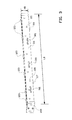
- FIG. 1 schematically shows an assembly according to an embodiment of the invention
- FIG. 2 schematically shows an assembly according to another embodiment of the invention
- FIG. 3 schematically shows a body of an assembly according to another embodiment of the invention.
- FIG. 4 schematically shows a part of a lithography system according to an embodiment of the invention.
- FIG. 5 schematically shows an overview of a part of a lithography system according to an embodiment of the invention.
- FIG. 1 an assembly according to an embodiment of the invention is schematically shown.
- a track 110 is provided with a first ramp 111 and a second ramp 112 .
- the first ramp 111 is direct congruent with the second ramp 112 , which indicates that their orientation, height (distance h) and length l and slope h/l are the same.
- a start 114 of the first ramp is positioned at a distance h from a start 115 of the second ramp in a vertical direction (or z-direction) and at a distance D in a horizontal direction (or x-direction).
- a body 116 is provided with a first wheel 117 and a second wheel 118 .
- the body 116 comprises a central horizontal plane 130 .
- the body may comprise a horizontal surface 119 , which is arranged parallel with the central horizontal plane 130 of the body and opposite to the first wheel 117 and second wheel 118 with respect to the central horizontal plane 130 .
- the first wheel 117 extends a distance h further in the vertical direction from the central horizontal plane 130 than the second wheel 118 .
- An axis 120 of the first wheel is positioned at a distance D from an axis 121 of the second wheel in the horizontal direction.
- the body may also be provided with rollers or any other gliding device, which would enable the body to follow the track 110 , while the rollers or other gliding devices remain in contact with the track 110 and the horizontal surface is translating vertically without any rotational movement.
- each gliding device may comprise a curved surface or a spike.
- Each curved surface or spike is arranged for contacting the track 110 at a respective contact point.
- the first gliding device may vertically extends a distance h further from said central horizontal plane of the body than the second gliding device and the contact point of the first gliding device may be positioned in the horizontal direction at a distance D from the contact point of the second gliding device.
- the body 116 has been depicted above the track 110 for clarity reasons, but in use the first wheel and the second wheel are in contact with the track 110 .
- the body When the body is advanced over the track, the body will translate both in the vertical direction as in the horizontal direction without any rotation. This implies that a liftable module 122 that is contact with the body may also be translated in a vertical direction, i.e. it may be lifted. The liftable module may be lifted by a distance h.
- a liftable module may be described as a module that is arranged for being lifted by the body 116 , when the body is inserted between said module and its support. It may be understood that the liftable module may also be arranged for being lowered by the body 116 , when the body is removed between said module and its support.
- FIG. 1 schematically shows an embodiment in the so-called normal configuration. However, it may be understood that FIG. 1 may also be turned upside down and that FIG. 1 then schematically shows an embodiment in the so-called upside-down configuration.
- Reference number 122 may then refer to the support and the track 110 may then be provided on the down side of a liftable module.
- the body may be provided with guiding wheels 123 , wherein said guiding wheels may define the horizontal surface 119 .
- the guiding wheels may contact the liftable module 122 (in the normal configuration) or the support (in the upside-down configuration).
- the contact surfaces of the guiding wheels (the surface of a guiding wheel that is, in use, in contact with the liftable module or the support may be referred to as a contact surface of a guiding wheel) may together define the horizontal surface 119 .
- the body may also be provided with guiding rollers or any other guiding devices, which would decrease friction between the body 116 and the liftable module 122 (in the normal configuration) or between the body 116 and the support (in the upside-down configuration).
- the axes of the first and the second wheel may be arranged parallel with respect to each other, the central horizontal plane 130 and/or with respect to the horizontal surface 119 . Said axes may be arranged perpendicular to the insertion direction of the body. The same may apply to the axes of the guiding wheels 123 .
- the track may further comprise a first horizontal plateau 124 and a second horizontal plateau 125 .
- a start 126 of the first plateau 124 is positioned at the distance D from a start 127 of the second plateau 125 in the horizontal direction and at the distance h from the start 127 of the second plateau 125 in the vertical direction and the first plateau 124 is arranged between the first ramp 111 and the second ramp 112 .
- the track may further comprise a third horizontal plateau 128 , which is connected to the start 114 of the first ramp.
- the start 115 of the second ramp 112 may be connected to the end 129 of the first ramp 111 .
- the first horizontal plateau 124 may then be omitted.
- the first ramp and the second ramp form together a single ramp, while the first ramp and the second ramp each have a length D.
- the slope (h/l) of the first ramp and the second ramp may be in the range of 1:50-1:200, or about 1:100.
- the distance h may be in the range of 0.1-1.0 mm or about 0.5 mm.
- FIG. 2 an assembly according to another embodiment of the invention is schematically shown.
- a movable cart 201 is provided.
- the cart 201 may comprise guiding wheels 202 for guiding and supporting the module 122 .
- the movable cart may further comprise adjusters 203 for adjusting the position and/or the orientation of the guiding wheels.
- the cart 201 may be provided with wheels 204 , enabling the cart to be moved towards and from the support of the liftable module.
- the position and/or the orientation of the guiding wheels 202 may be adjusted in order to align them with the guiding wheels 123 of the body.
- the cart 201 and the body 116 may be provided with a docking interface 205 in order to connect the cart 201 with the body 116 .
- the liftable module 122 After the liftable module 122 is lifted, it may be moved along the guiding wheels of both the body 116 and the cart 201 onto the cart 201 . The module 122 may then be moved away, while being carried by the movable cart 201 .
- FIG. 3 schematically shows a body of an assembly according to another embodiment of the invention.
- the body may be provided with the first wheel 117 , the second wheel 118 , the guiding wheels 123 and/or the docking interface 205 .
- the body may have an elongated shape.
- the length of the body LB may be around 900 mm and the height of the body HB may be around 50 mm.
- the body 116 may be provided with sliding means 301 for reducing friction between the body and the support.
- the assembly further comprises another (or a second) body and another (or a second track). What has been described with respect to the (first) body and the (first) track may also apply to the other (or second) body and the other (or second) track respectively.
- the liftable module may thus lifted by two body-track combinations that are preferably spaced apart from each other.
- FIG. 4 schematically shows a part of a lithography system according to an embodiment of the invention.
- the lithography system may comprise a set of modules for providing the patterning beam and for moving the target with respect to the patterning beam. At least one of these modules may be a liftable module.
- the lithography system may further comprise a frame for supporting the set of modules.
- a liftable module 122 is supported by its support 401 .
- Support 401 may be (a part of a) the frame or another module.
- a groove 402 may be provided in the support 401 .
- the shape of the groove 402 may correspond to the shape of the body 116 .
- the groove 402 and the body 116 may each have an elongated shape.
- the track 110 may be provided inside the groove 402 (not shown in FIG. 4 ) on the support.
- the groove 402 may also be provided in the liftable module 122 , while the track 110 is provided on the support.
- two grooves 402 are provided, indicating that the assembly may comprise two bodies 116 and two tracks 110 .
- the two bodies 116 may be connected to each other, for example by a rod. This would enable the simultaneous insertion of the bodies 116 .
- connectors may be provided, which may comprise bolts or clamps.
- FIG. 5 schematically shows an overview of a part of a lithography system according to an embodiment of the invention.
- the lithography system 500 is preferably designed in a modular fashion to permit ease of maintenance.
- Major subsystems are preferably constructed in self-contained and removable modules, so that they can be removed from the lithography machine with as little disturbance to other subsystems as possible. This is particularly advantageous for a lithography machine enclosed in a vacuum chamber, where access to the machine is limited. Thus, a faulty subsystem may be removed and replaced quickly, without unnecessarily disconnecting or disturbing other systems.
- these modular subsystems may include:
- an illumination optics module 501 which may comprise a beam source 502 and a beam collimating system 503 ,
- an aperture array and condenser lens module 504 which may include an aperture array and condenser lens array, together indicated by 506 ,
- a beam switching module 507 which may include beamlet blanker array 508 ;
- a projection optics module 509 which may include a beam stop array, beam deflector array and projection lens array, together indicated by 510 ;
- long stroke module 519 arranged for moving the target 530 along relatively large distances with relatively large positioning errors
- a short stroke module 518 arranged for moving the target or wafer 530 along relatively small distances with relatively small positioning errors
- a chuck module 531 arranged for supporting a wafer table 532 .
- the modules may be designed to slide in and out from a frame. Also combinations of modular subsystem may be designed to form one module together, which may slide in and out from a frame together.
- the frame may comprise an alignment inner subframe 513 , an alignment outer subframe 514 and a main frame 515 .
- the main frame 515 may support the alignment subframes 513 and 514 via vibration damping mounts 516 .
- the system may rests on base plate 522 and may be supported by frame members 523 .
- a wafer table 532 may support wafer 530 , while the wafer table is mounted on chuck 531 .
- Chuck 531 may be positioned on a stage short stroke 518 and long stroke 519 .
- the beam source 502 may provide a patterning beam, comprising a light beam or a charged particle beam such as an electron beam.
- the patterning beam from the beam source 502 may be collimated by collimator lens system 503 .
- the collimated beam may impinge on an aperture array, which may block a part of the collimated beam, in order to create a plurality of beamlets, for example at least two beamlets.
- a lithography system according to an embodiment of the invention may be arranged for generating a large number of beamlets, preferably about 10,000 to 1,000,000 beamlets.
- the beamlets may pass through a condenser lens array 506 , which may focus the beamlets in the plane of a beam blanker array, comprising a plurality of blankers for deflecting one or more of the beamlets.
- the deflected and undeflected beamlets may arrive at beam stop array, which may have a plurality of apertures.
- the beamlet blanker array and beam stop array may operate together to block or let pass the beamlets. If the beamlet blanker array deflects a beamlet, it will not pass through the corresponding aperture in the beam stop array, but instead it will be blocked. But, when the beamlet blanker array does not deflect a beamlet, it will pass through the corresponding aperture in the beam stop array, and through the beam deflector array and the projection lens arrays.
- the beam deflector array may provide for deflection of each beamlet in the x- and/or y-direction (for example in a plane parallel with the target surface), substantially perpendicular to the z-direction of the undeflected beamlets, to scan the beamlets across the surface of the target.
- the beamlets may pass through projection lens arrays and may be projected onto the wafer 530 .
- the projection lens array preferably provides a demagnification in the order of 25 to 500 times (depending of the specific electron-optical lay out).
- the beamlets may impinge on the surface of the wafer.
- wafer is usually provided with a charged-particle sensitive layer or resist layer.
- the lithography system may operate at least partly in a vacuum environment.
- a vacuum may be desired to remove particles which may be ionized by the patterning beams and become attracted to the beam source and may dissociate and be deposited onto the machine components and may disperse the patterning beams or beamlets.
- the lithography system may comprise a vacuum chamber 520 , which may include a metal shielding layer or layers 521 . All of the major elements of the lithography system are preferably housed in the vacuum chamber, such as beam source, the optical column and the moveable chuck.
- Each modular subsystem may require a large number of electrical signals and/or optical signals, and electrical power for its operation.
- the modular subsystems inside the vacuum chamber 520 may receive these signals from a processor unit 524 which is preferably located outside of the chamber.
- grooves 402 with tracks 110 have been provided in the frame, or more particular in the main frame 515 .
- the liftable module may be the long stroke module 119 .
- bodies 116 may be inserted between the frame and the liftable module, or more particular, the bodies 116 may be inserted in the grooves 402 , as is explained above.
- the assembly may be provided in its normal configuration.
- grooves 402 with tracks 110 have been provided in the illumination optics module 501 , which may be the liftable module in this case.
- the illumination optics module 501 may be the liftable module in this case.
- the module 501 may be lifted.
- the assembly may be provided in its upside-down configuration.
- a method for lifting a module of a lithography system from its support in a vertical direction comprising the steps of providing a lithography system according to any of the embodiments described in this document and inserting the body between the liftable module and the support.
- the method may further comprise the step of horizontally moving the liftable with respect to its support, preferably onto a movable cart.
- embodiments of the invention may also be used for positioning a liftable module on its support. Instead of inserting the body between the module and the support, the body may removed, causing the module to be lowered or positioned on the support.
- a module of a lithography system may be exchanged, by first removing a first liftable module from its support (steps a-d below) and then positioning a second liftable module on the support (steps e-g below).
- a method for exchanging a module of lithography system can thus be described by the steps of:
- the method may comprise adjusting the position and/or the orientation of guiding wheels of the movable cart in order to align the guiding wheels of said cart with guiding wheels of the body.
- the liftable module may be horizontally moved with respect to its support onto the guiding wheels of the movable cart.
- an other liftable module may be positioned on the support, using the following steps e-g:
- the method may comprise adjusting the position and/or the orientation of guiding wheels of the other movable cart in order to align the guiding wheels of said cart with guiding wheels of the body.
- the liftable module may be horizontally moved with respect to the card onto the guiding wheels of body.
- the same cart that is provided in step b) may be used.
- the movable cart and the other movable cart may be the same cart.
- any described embodiment of a lithography system using an electron beam to pattern a target may also be applied to a lithography system using a light beam to pattern a target, mutatis mutandis.
Landscapes
- Engineering & Computer Science (AREA)
- Chemical & Material Sciences (AREA)
- Physics & Mathematics (AREA)
- General Physics & Mathematics (AREA)
- Nanotechnology (AREA)
- Health & Medical Sciences (AREA)
- Analytical Chemistry (AREA)
- Public Health (AREA)
- Epidemiology (AREA)
- Environmental & Geological Engineering (AREA)
- Mechanical Engineering (AREA)
- Crystallography & Structural Chemistry (AREA)
- Geology (AREA)
- Structural Engineering (AREA)
- Life Sciences & Earth Sciences (AREA)
- Transportation (AREA)
- Combustion & Propulsion (AREA)
- Mathematical Physics (AREA)
- Theoretical Computer Science (AREA)
- Condensed Matter Physics & Semiconductors (AREA)
- Manufacturing & Machinery (AREA)
- Container, Conveyance, Adherence, Positioning, Of Wafer (AREA)
- Exposure And Positioning Against Photoresist Photosensitive Materials (AREA)
- Electron Beam Exposure (AREA)
- Exposure Of Semiconductors, Excluding Electron Or Ion Beam Exposure (AREA)
Abstract
Description
Claims (29)
Priority Applications (1)
| Application Number | Priority Date | Filing Date | Title |
|---|---|---|---|
| US13/610,392 US9199829B2 (en) | 2011-09-12 | 2012-09-11 | Assembly and a method for lifting a module of a lithography system in a vertical direction and a lithography system comprising such assembly |
Applications Claiming Priority (4)
| Application Number | Priority Date | Filing Date | Title |
|---|---|---|---|
| US201161533321P | 2011-09-12 | 2011-09-12 | |
| NL2007401 | 2011-09-12 | ||
| NL2007401A NL2007401C2 (en) | 2011-09-12 | 2011-09-12 | Assembly and a method for lifting a module of a lithography system in a vertical direction and a lithography system comprising such assembly. |
| US13/610,392 US9199829B2 (en) | 2011-09-12 | 2012-09-11 | Assembly and a method for lifting a module of a lithography system in a vertical direction and a lithography system comprising such assembly |
Publications (2)
| Publication Number | Publication Date |
|---|---|
| US20130088702A1 US20130088702A1 (en) | 2013-04-11 |
| US9199829B2 true US9199829B2 (en) | 2015-12-01 |
Family
ID=47883514
Family Applications (1)
| Application Number | Title | Priority Date | Filing Date |
|---|---|---|---|
| US13/610,392 Active 2034-03-08 US9199829B2 (en) | 2011-09-12 | 2012-09-11 | Assembly and a method for lifting a module of a lithography system in a vertical direction and a lithography system comprising such assembly |
Country Status (5)
| Country | Link |
|---|---|
| US (1) | US9199829B2 (en) |
| JP (2) | JP2014530481A (en) |
| NL (2) | NL2007401C2 (en) |
| TW (1) | TW201312296A (en) |
| WO (1) | WO2013039386A1 (en) |
Families Citing this family (5)
| Publication number | Priority date | Publication date | Assignee | Title |
|---|---|---|---|---|
| WO2015148175A1 (en) * | 2014-03-26 | 2015-10-01 | Zoetis Services Llc | Egg support assembly, and associated device and method |
| US20180155126A1 (en) | 2015-04-22 | 2018-06-07 | Integrated Dynamics Engineering Gmbh | Service cart |
| EP3220413B1 (en) | 2016-03-15 | 2022-01-26 | Integrated Dynamics Engineering GmbH | Service device |
| DE102016120820A1 (en) * | 2016-11-02 | 2018-05-03 | Integrated Dynamics Engineering Gmbh | Plant for the processing of semiconductor devices and lifting device |
| CN107134728A (en) * | 2017-05-23 | 2017-09-05 | 国网四川省电力公司阿坝供电公司 | It is easy to mobile DC power system |
Citations (8)
| Publication number | Priority date | Publication date | Assignee | Title |
|---|---|---|---|---|
| US3220331A (en) | 1965-01-27 | 1965-11-30 | Kulicke And Soffa Mfg Company | Contact printing mask alignment apparatus for semiconductor wafer geometry |
| US4256213A (en) * | 1976-06-04 | 1981-03-17 | Gordon A. Brewer | Flexible mobile conveyor |
| US5285909A (en) * | 1993-02-04 | 1994-02-15 | Slater Robert C | Pallet storage rack |
| US6688819B1 (en) * | 2001-07-02 | 2004-02-10 | The United States Of America As Represented By The Secretary Of The Navy | Modular, multi-function vehicle interface system |
| US20040259364A1 (en) | 2003-06-16 | 2004-12-23 | Sumitomo Heavy Industries, Ltd. | Stage base, substrate processing apparatus, and maintenance method for stage |
| US20050018161A1 (en) | 2003-07-23 | 2005-01-27 | Canon Kabushiki Kaisha | Positioning method, and positioning apparatus |
| US20100051832A1 (en) * | 2008-08-29 | 2010-03-04 | Toshihiro Nishisaka | Extreme ultraviolet light source apparatus |
| US20100193711A1 (en) | 2009-01-14 | 2010-08-05 | Yukio Watanabe | Extreme ultraviolet light source system |
Family Cites Families (6)
| Publication number | Priority date | Publication date | Assignee | Title |
|---|---|---|---|---|
| JP2000058420A (en) * | 1998-08-11 | 2000-02-25 | Ushio Inc | Mounting structure of mask stage in exposure equipment |
| JP3830041B2 (en) * | 2003-06-20 | 2006-10-04 | 住友重機械工業株式会社 | Stage base and substrate processing apparatus |
| JP4467369B2 (en) * | 2004-06-29 | 2010-05-26 | Necエレクトロニクス株式会社 | Transport cart |
| JP5280064B2 (en) * | 2008-02-20 | 2013-09-04 | 株式会社ニューフレアテクノロジー | Electron beam drawing device |
| JP2010016066A (en) * | 2008-07-01 | 2010-01-21 | Shimadzu Corp | Substrate inspection apparatus |
| JP2011040540A (en) * | 2009-08-10 | 2011-02-24 | Nikon Corp | Method for maintenance of substrate processing apparatus, substrate processing apparatus, and device manufacturing method |
-
2011
- 2011-09-12 NL NL2007401A patent/NL2007401C2/en not_active IP Right Cessation
-
2012
- 2012-09-07 WO PCT/NL2012/050628 patent/WO2013039386A1/en not_active Ceased
- 2012-09-07 JP JP2014529636A patent/JP2014530481A/en not_active Withdrawn
- 2012-09-11 US US13/610,392 patent/US9199829B2/en active Active
- 2012-09-12 TW TW101133273A patent/TW201312296A/en unknown
-
2013
- 2013-03-11 NL NL2010417A patent/NL2010417C2/en not_active IP Right Cessation
-
2017
- 2017-06-13 JP JP2017116055A patent/JP6367430B2/en active Active
Patent Citations (8)
| Publication number | Priority date | Publication date | Assignee | Title |
|---|---|---|---|---|
| US3220331A (en) | 1965-01-27 | 1965-11-30 | Kulicke And Soffa Mfg Company | Contact printing mask alignment apparatus for semiconductor wafer geometry |
| US4256213A (en) * | 1976-06-04 | 1981-03-17 | Gordon A. Brewer | Flexible mobile conveyor |
| US5285909A (en) * | 1993-02-04 | 1994-02-15 | Slater Robert C | Pallet storage rack |
| US6688819B1 (en) * | 2001-07-02 | 2004-02-10 | The United States Of America As Represented By The Secretary Of The Navy | Modular, multi-function vehicle interface system |
| US20040259364A1 (en) | 2003-06-16 | 2004-12-23 | Sumitomo Heavy Industries, Ltd. | Stage base, substrate processing apparatus, and maintenance method for stage |
| US20050018161A1 (en) | 2003-07-23 | 2005-01-27 | Canon Kabushiki Kaisha | Positioning method, and positioning apparatus |
| US20100051832A1 (en) * | 2008-08-29 | 2010-03-04 | Toshihiro Nishisaka | Extreme ultraviolet light source apparatus |
| US20100193711A1 (en) | 2009-01-14 | 2010-08-05 | Yukio Watanabe | Extreme ultraviolet light source system |
Also Published As
| Publication number | Publication date |
|---|---|
| NL2010417C2 (en) | 2013-11-12 |
| JP2017201403A (en) | 2017-11-09 |
| NL2010417A (en) | 2013-05-16 |
| NL2007401C2 (en) | 2013-04-09 |
| WO2013039386A1 (en) | 2013-03-21 |
| JP6367430B2 (en) | 2018-08-01 |
| US20130088702A1 (en) | 2013-04-11 |
| TW201312296A (en) | 2013-03-16 |
| JP2014530481A (en) | 2014-11-17 |
Similar Documents
| Publication | Publication Date | Title |
|---|---|---|
| JP6367430B2 (en) | Assembly and method for vertically lifting a module of a lithography system and a lithography system having such an assembly | |
| JP7822408B2 (en) | Interchangeable modules for charged particle devices | |
| US9362084B2 (en) | Electro-optical element for multiple beam alignment | |
| US8895943B2 (en) | Lithography system and method of processing substrates in such a lithography system | |
| JP6117149B2 (en) | Charged particle beam lithography system and target positioning apparatus | |
| US8957395B2 (en) | Charged particle beam lithography system and target positioning device | |
| US9383662B2 (en) | Lithography system for processing at least a part of a target | |
| EP2672502B1 (en) | electron beam optical system comprising high brightness electron gun with moving axis condenser lens | |
| WO2023280551A1 (en) | Charged particle apparatus and method | |
| EP4576154A1 (en) | Source module and charged particle-optical device | |
| WO2025131453A1 (en) | Module and charged particle-optical device | |
| EP3971938A1 (en) | Replaceable module for a charged particle apparatus |
Legal Events
| Date | Code | Title | Description |
|---|---|---|---|
| AS | Assignment |
Owner name: MAPPER LITHOGRAPHY IP B.V., NETHERLANDS Free format text: ASSIGNMENT OF ASSIGNORS INTEREST;ASSIGNOR:PEIJSTER, JERRY JOHANNES MARTINUS;REEL/FRAME:029486/0253 Effective date: 20120924 |
|
| STCF | Information on status: patent grant |
Free format text: PATENTED CASE |
|
| CC | Certificate of correction | ||
| AS | Assignment |
Owner name: WITTEKAMP, J.J., NETHERLANDS Free format text: COURT APPOINTMENT;ASSIGNORS:MAPPER LITHOGRAPHY HOLDING B.V.;MAPPER LITHOGRAPHY IP B.V.;MAPPER LITHOGRAPHY B.V.;REEL/FRAME:049104/0734 Effective date: 20181228 Owner name: ASML NETHERLANDS B.V., NETHERLANDS Free format text: ASSIGNMENT OF ASSIGNORS INTEREST;ASSIGNOR:WITTEKAMP, J.J.;REEL/FRAME:049296/0606 Effective date: 20190206 |
|
| MAFP | Maintenance fee payment |
Free format text: PAYMENT OF MAINTENANCE FEE, 4TH YR, SMALL ENTITY (ORIGINAL EVENT CODE: M2551); ENTITY STATUS OF PATENT OWNER: SMALL ENTITY Year of fee payment: 4 |
|
| FEPP | Fee payment procedure |
Free format text: ENTITY STATUS SET TO UNDISCOUNTED (ORIGINAL EVENT CODE: BIG.); ENTITY STATUS OF PATENT OWNER: LARGE ENTITY |
|
| MAFP | Maintenance fee payment |
Free format text: PAYMENT OF MAINTENANCE FEE, 8TH YEAR, LARGE ENTITY (ORIGINAL EVENT CODE: M1552); ENTITY STATUS OF PATENT OWNER: LARGE ENTITY Year of fee payment: 8 |