US9191785B2 - Group communication method and apparatus - Google Patents

Group communication method and apparatus Download PDF

Info

Publication number
US9191785B2
US9191785B2 US13/814,252 US201113814252A US9191785B2 US 9191785 B2 US9191785 B2 US 9191785B2 US 201113814252 A US201113814252 A US 201113814252A US 9191785 B2 US9191785 B2 US 9191785B2
Authority
US
United States
Prior art keywords
base station
group call
group
idle mode
zone
Prior art date
Legal status (The legal status is an assumption and is not a legal conclusion. Google has not performed a legal analysis and makes no representation as to the accuracy of the status listed.)
Expired - Fee Related, expires
Application number
US13/814,252
Other versions
US20130130736A1 (en
Inventor
Sung Kyung Kim
Sung Cheol Chang
Eunkyung Kim
Hyun Lee
Chul Sik Yoon
Current Assignee (The listed assignees may be inaccurate. Google has not performed a legal analysis and makes no representation or warranty as to the accuracy of the list.)
Electronics and Telecommunications Research Institute ETRI
Original Assignee
Electronics and Telecommunications Research Institute ETRI
Priority date (The priority date is an assumption and is not a legal conclusion. Google has not performed a legal analysis and makes no representation as to the accuracy of the date listed.)
Filing date
Publication date
Application filed by Electronics and Telecommunications Research Institute ETRI filed Critical Electronics and Telecommunications Research Institute ETRI
Priority claimed from PCT/KR2011/007230 external-priority patent/WO2012044109A2/en
Assigned to ELECTRONICS AND TELECOMMUNICATIONS RESEARCH INSTITUTE reassignment ELECTRONICS AND TELECOMMUNICATIONS RESEARCH INSTITUTE ASSIGNMENT OF ASSIGNORS INTEREST (SEE DOCUMENT FOR DETAILS). Assignors: CHANG, SUNG CHEOL, KIM, EUNKYUNG, KIM, SUNG KYUNG, LEE, HYUN, YOON, CHUL SIK
Publication of US20130130736A1 publication Critical patent/US20130130736A1/en
Application granted granted Critical
Publication of US9191785B2 publication Critical patent/US9191785B2/en
Expired - Fee Related legal-status Critical Current
Adjusted expiration legal-status Critical

Links

Images

Classifications

    • HELECTRICITY
    • H04ELECTRIC COMMUNICATION TECHNIQUE
    • H04WWIRELESS COMMUNICATION NETWORKS
    • H04W4/00Services specially adapted for wireless communication networks; Facilities therefor
    • H04W4/06Selective distribution of broadcast services, e.g. multimedia broadcast multicast service [MBMS]; Services to user groups; One-way selective calling services
    • H04W4/08User group management
    • HELECTRICITY
    • H04ELECTRIC COMMUNICATION TECHNIQUE
    • H04WWIRELESS COMMUNICATION NETWORKS
    • H04W4/00Services specially adapted for wireless communication networks; Facilities therefor
    • H04W4/06Selective distribution of broadcast services, e.g. multimedia broadcast multicast service [MBMS]; Services to user groups; One-way selective calling services
    • H04W4/10Push-to-Talk [PTT] or Push-On-Call services
    • HELECTRICITY
    • H04ELECTRIC COMMUNICATION TECHNIQUE
    • H04WWIRELESS COMMUNICATION NETWORKS
    • H04W52/00Power management, e.g. Transmission Power Control [TPC] or power classes
    • H04W52/02Power saving arrangements
    • H04W52/0209Power saving arrangements in terminal devices
    • H04W52/0212Power saving arrangements in terminal devices managed by the network, e.g. network or access point is leader and terminal is follower
    • H04W52/0216Power saving arrangements in terminal devices managed by the network, e.g. network or access point is leader and terminal is follower using a pre-established activity schedule, e.g. traffic indication frame
    • HELECTRICITY
    • H04ELECTRIC COMMUNICATION TECHNIQUE
    • H04WWIRELESS COMMUNICATION NETWORKS
    • H04W52/00Power management, e.g. Transmission Power Control [TPC] or power classes
    • H04W52/02Power saving arrangements
    • H04W52/0209Power saving arrangements in terminal devices
    • H04W52/0212Power saving arrangements in terminal devices managed by the network, e.g. network or access point is leader and terminal is follower
    • H04W52/0219Power saving arrangements in terminal devices managed by the network, e.g. network or access point is leader and terminal is follower where the power saving management affects multiple terminals
    • HELECTRICITY
    • H04ELECTRIC COMMUNICATION TECHNIQUE
    • H04WWIRELESS COMMUNICATION NETWORKS
    • H04W60/00Affiliation to network, e.g. registration; Terminating affiliation with the network, e.g. de-registration
    • HELECTRICITY
    • H04ELECTRIC COMMUNICATION TECHNIQUE
    • H04WWIRELESS COMMUNICATION NETWORKS
    • H04W8/00Network data management
    • H04W8/18Processing of user or subscriber data, e.g. subscribed services, user preferences or user profiles; Transfer of user or subscriber data
    • H04W8/186Processing of subscriber group data
    • YGENERAL TAGGING OF NEW TECHNOLOGICAL DEVELOPMENTS; GENERAL TAGGING OF CROSS-SECTIONAL TECHNOLOGIES SPANNING OVER SEVERAL SECTIONS OF THE IPC; TECHNICAL SUBJECTS COVERED BY FORMER USPC CROSS-REFERENCE ART COLLECTIONS [XRACs] AND DIGESTS
    • Y02TECHNOLOGIES OR APPLICATIONS FOR MITIGATION OR ADAPTATION AGAINST CLIMATE CHANGE
    • Y02DCLIMATE CHANGE MITIGATION TECHNOLOGIES IN INFORMATION AND COMMUNICATION TECHNOLOGIES [ICT], I.E. INFORMATION AND COMMUNICATION TECHNOLOGIES AIMING AT THE REDUCTION OF THEIR OWN ENERGY USE
    • Y02D30/00Reducing energy consumption in communication networks
    • Y02D30/70Reducing energy consumption in communication networks in wireless communication networks

Definitions

  • the present invention relates to a group communication method and apparatus.
  • a downlink multicast-based or broadcast-based communication connection as well as a unicast connection, can be used. Therefore, for a cellular based wireless access system using the group communication service, a conventional broadcast service technology, for example, a multicast broadcast service (MBS) technology or terminal-based unicast service technology, can be taken into consideration.
  • MBS multicast broadcast service
  • a conventional idle mode scheme to a group communication terminal is inefficient because the conventional art is designed for a unicast service terminal or broadcast service terminal. Particularly, if there are a large number of users currently participating in group communication, and most of the users are participating in the service for the purpose of listening, uplink traffic may be limited to some specific users. Moreover, call duration of a group communication such as push-to-talk (PTT) may be substantially long, unlike a one-to-one voice service in a general public network, and a deactivation interval of voice traffic may continue for a considerably long period of time. Accordingly, if the users move and spread over many cells, unnecessary handover is performed to maintain a bidirectional connection establishment even if no group communication traffic occurs. Further, a base station maintains an unnecessary connection establishment and continuously manages information of each terminal, resulting in low efficiency and higher power consumption of a terminal.
  • PTT push-to-talk
  • Embodiments of the present invention provide a group communication method and apparatus for performing an idle mode operation that is suitable for group communication.
  • An embodiment of the present invention provides a group communication method of a terminal.
  • the method includes establishing a group call connection with a first base station belonging to a group call zone, receiving group call data from the first base station, moving to a coverage area of a second base station belonging to the group call zone, and receiving group call data from the second base station without re-registering with the second base station.
  • the method may further include assigning a group ID for a group call in the group call zone from the first base station.
  • the terminal may also use the group ID at the second base station.
  • Receiving the group call data from the first base station may include entering an idle mode, and receiving the group call data from the first base station in the idle mode.
  • Entering the idle mode may include exchanging a deregistration request message and a deregistration response message on the deregistration request message with the first base station.
  • Moving to the coverage area of the second base station may include moving to the coverage area of the second base station in the idle mode.
  • Receiving the group call data from the second base station may include receiving the group call data from the second base station in an idle mode.
  • the method may further include entering an idle mode, moving to a third base station not belonging to the group call zone in the idle mode, receiving broadcast information from the third base station, and acquiring group call information on a group call zone to which the third base station belongs from the broadcast information.
  • the method may further include receiving broadcast information including group call information from the third base station, and recognizing moving across the group call zone based on the broadcast information.
  • Another embodiment of the present invention provides a group communication method of a terminal.
  • the method includes establishing a group call connection with a first base station, receiving group call data from the first base station; entering an idle mode, and receiving group call data from the first base station in the idle mode.
  • Entering the idle mode may include exchanging a deregistration request message and a deregistration response message on the deregistration request message with the first base station.
  • the method may further include moving to a second base station belonging to the same group call zone as the first base station, and receiving group call data from the second base station without re-registering with the second base station.
  • the g method may further include moving to a second base station belonging to a different group call zone from that of the first base station, receiving broadcast information from the second base station, and acquiring group call information on a group call zone to which the second base station belongs from the broadcast information.
  • the method may further include, when a group call zone changes in the idle mode, performing a location update with the second base station of a changed group call zone.
  • Performing the location update may include receiving information regarding the changed group call zone from the second base station in unicast.
  • Yet another embodiment of the present invention provides a terminal including a controller and a receiver.
  • the controller establishes a group call connection with a first base station belonging to a group call zone.
  • the receiver receives group call data from the first base station, and upon moving to a coverage area of a second base station belonging to the group call zone, receives group call data from the second base station without re-registering with the second base station.
  • the controller may be assigned a group ID for a group call in the group call zone from the first base station, and may also use the group ID in the second base station.
  • the terminal may further include an idle mode controller configured to enter an idle mode.
  • the receiver may receive group call data from the first base station in the idle mode.
  • the terminal may continue to receive a group call service by the group call zone.
  • the terminal may continue to receive a group call service.
  • FIG. 1 to FIG. 4 show a group communication system according to an embodiment of the present invention.
  • FIG. 5 to FIG. 7 show a group communication method in a group communication system according to an embodiment of the present invention.
  • FIG. 8 is a block diagram of a group communication apparatus according to an embodiment of the present invention.
  • a terminal may indicate a mobile terminal (MT), a mobile station (MS), an advanced mobile station (AMS), a high reliability mobile station (HR-MS), a subscriber station (SS), a portable subscriber station (PSS), an access terminal (AT), and user equipment (UE), and it may include entire or partial functions of the MT, the MS, the AMS, the HR-MS, the SS, the PSS, the AT, and the UE.
  • MT mobile terminal
  • MS mobile station
  • AMS advanced mobile station
  • HR-MS high reliability mobile station
  • SS subscriber station
  • PSS portable subscriber station
  • AT access terminal
  • UE user equipment
  • a base station may indicate an advanced base station (ABS), a high reliability base station (HR-BS), a node B, an evolved node B (eNodeB), an access point (AP), a radio access station (RAS), a base transceiver station (BTS), a mobile multihop relay (MMR)-BS, a relay station (RS) serving as a base station, and a high reliability relay station (HR-RS) serving as a base station, and it may include entire or partial functions of the ABS, the HR-BS, the node B, the eNodeB, the AP, the RAS, the BTS, the MMR-BS, the RS, and the HR-RS.
  • ABS advanced base station
  • HR-BS high reliability base station
  • eNodeB evolved node B
  • AP access point
  • RAS radio access station
  • BTS base transceiver station
  • MMR mobile multihop relay
  • RS relay station
  • HR-RS high reliability relay station
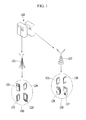
  • FIG. 1 to FIG. 4 show a group communication system according to an embodiment of the present invention.
  • traffic is transmitted from a node 110 to at least one of base stations 121 and 122 for a group communication.
  • the node may be a call server 110 , for example, an upper node such as a PTT server.
  • the PTT server 110 may be connected to the base stations 121 and 122 via a router (not shown) and a control station (not shown).
  • the base stations 121 and 122 establishes a group call connection in a wireless access interval, and respectively transmit traffic to terminals 131 to 134 and 135 to 138 , which belong to their coverage area, of a user group 130 in multicast.
  • the group communication system may be divided into three types according to an operation scheme of a base station.
  • the group communication system shown in FIG. 2 uses a single BS group call service.
  • each base station manages terminals belonging to their cell coverage area. Accordingly, even if a plurality of terminals belong to the same user group, each terminal is assigned a group identifier (ID) depending on a cell to which it belongs. That is, the group ID for identifying the group call is unique only for the corresponding base station.
  • Group call connectivity of a terminal is available only for a serving base station.
  • a target base station Upon handover of the terminal, a target base station establishes a connection for the group call, and the terminal is assigned a group ID.
  • the group communication system shown in FIG. 3 uses a macro BS group call service.
  • a group call zone is defined over a plurality of base stations, and a connection establishment for a group call is managed within the group call zone. Accordingly, a group ID for identifying the group call is unique in the same group call zone. That is, the unique group ID is assigned for each group call zone.
  • a group call service is provided in a corresponding cell regardless of the presence or absence of a group call terminal in an active state within a corresponding base station.
  • the group call zone may be dynamically defined, focusing on an area where a group communication takes place, and may be identified by a group call zone ID.
  • Information about the group call zone may be determined in a group call establishment procedure, or determined in advance in a procedure of configuring a user group for a group call. Furthermore, the same group call establishment may be performed in different group call zones. Group call connection establishment information and resource allocation for a group call may differ according to different group call zones.
  • the group communication system shown in FIG. 4 uses an MS-positioned group call service.
  • the group communication system of FIG. 4 is similar to the group communication system shown in FIG. 3 in that a plurality of base stations share a group call connection establishment, they are different in that a group call zone consists only of base stations in a cell coverage area where terminals in the user group are in the active state to thus provide the group call service. Accordingly, the unique group ID is assigned for each service.
  • the group communication system described in FIG. 3 and FIG. 4 may further include a controller for managing a group call zone and a group ID.
  • the controller may be mounted in a group call server ( 110 of FIG. 1 ), or may be constructed as a separate server.
  • FIG. 5 to FIG. 7 show a group communication method in a group communication system according to an embodiment of the present invention.
  • a terminal 10 belonging to a user group for group communication establishes a group call connection, i.e., a multicast connection, with a serving base station 21 (S 510 ).
  • the terminal 10 continuously receives group call data through the serving base station (S 520 ).
  • the base station 21 transmits the group call data to the terminals of the user group belonging to its coverage area in multicast.
  • the terminal may enter the idle mode while receiving the group call data (S 530 ). For example, if there is no data to be sent for a predetermined time, or no connection establishment other than the group call connection establishment exists, the terminal 10 may enter the idle mode. To enter the idle mode, the terminal 10 and the serving base station 21 may exchange a deregistration request (DREG-REQ) message for a unicast connection establishment and a deregistration response (DREG-RSP) message on the DREG-REQ message. In the idle mode, the terminal 10 periodically repeats a paging listening interval and a paging unavailable interval. Moreover, the terminal 10 can receive the group call data within the group call zone via the multicast connection for the group call even in the idle mode (S 540 ).
  • DREG-REQ deregistration request
  • DREG-RSP deregistration response
  • the terminal 10 continuously receives group call data through the base station 22 without changing group call connection establishment information because the two base stations 21 and 22 belong to the same group call zone (S 560 ). That is, the terminal 10 can continuously receive the group call data without re-registering to the base station 22 .
  • the group call zone to which the terminal 10 belongs may be changed while the terminal 10 is receiving a group call service.
  • the terminal 10 receives broadcast information of a base station 23 belonging to a changed group call zone (S 610 ), and recognizes the group call zone change based on the received broadcast information (S 620 ).
  • the broadcast information may include group call information
  • the group call information may include a group call zone ID and a group ID.
  • the terminal 10 recognizes the group call zone change, and acquires wireless connection information of the same group call as the group ID corresponding to a group call desired to be serviced (S 630 ). Accordingly, the terminal 10 continues to receive group call data from the base station 23 (S 640 ).
  • the terminal 10 may perform a location update for the corresponding group call zone.
  • the terminal 10 and the base station 23 may exchange group call information of the changed group call zone in unicast during the location update procedure.
  • the terminal 10 may move from the group call zone of the base station 21 to another base station 24 (S 750 ).
  • the terminal 10 periodically receives broadcast information from the base station 24 (S 760 ).
  • the broadcast information may include group call information
  • the group call information may include a group call zone ID and a group ID.
  • the terminal 10 acquires the group call information of the group call zone to which the base station 24 belongs from the broadcast information, finishes the idle mode if the broadcast information does not include any information about the received group call, and performs a network entry procedure via the base station 24 (S 770 ).
  • the terminal 10 may perform the network entry procedure by exchanging a ranging request (RNG-REQ) message and a ranging response (RNG-RSP) message with the base station 230 .
  • RNG-REQ ranging request
  • RNG-RSP ranging response
  • the terminal 10 performs a group call connection establishment with the base station 24 (S 780 ), and receives a group call service again (S 790 ).
  • the base station 24 may be included in a group call zone and operated by exchanging information with a controller that manages the group call zone, or may maintain its own group call connection establishment.
  • a terminal can continue to receive a group call service by the group call zone even if the terminal moves to another base station, and the terminal being serviced with the group call can also continue to receive the group call service even if it enters the idle mode.
  • the group call connection may be deregistered.
  • the base station may page the terminals belonging to the user group with a multicast paging message.
  • the base station may use a multicast deregistration ID (DID) or group ID that is pre-assigned to the user group.
  • network entry priorities may differ according to the class of the terminals in order to control excessive delay and collision caused by the ranging procedure when terminals of the user group enter a network by the paging.
  • a terminal group that does not require confirmation of the presence of a terminal when establishing a group call may initiate a group communication service in the listening mode without a network entry procedure.
  • Such a terminal may attempt network entry at a point of time when an uplink connection establishment is required or network entry overload is eliminated.
  • FIG. 8 is a block diagram of a group communication apparatus according to an embodiment of the present invention.
  • a group communication apparatus 800 may include a controller 810 , a receiver 820 , and an idle mode controller 830 .
  • the group communication apparatus 800 may be formed in the terminal 10 , or may be the terminal 10 itself.
  • the receiver 820 receives group call data and broadcast information transmitted from a base station.
  • the controller 810 establishes a group call connection with the base station, and, upon movement, checks based on broadcast information whether the current base station belongs to the current group call zone or not.
  • the controller 810 is assigned a group ID from the base station, and uses the same group ID in the same group call zone.
  • the idle mode controller 830 controls the operation of the terminal 10 in the idle mode.

Landscapes

  • Engineering & Computer Science (AREA)
  • Computer Networks & Wireless Communication (AREA)
  • Signal Processing (AREA)
  • Multimedia (AREA)
  • Databases & Information Systems (AREA)
  • Mobile Radio Communication Systems (AREA)

Abstract

A group communication method of a terminal is provided. The terminal establishes a group call connection with a first base station belonging to a group call zone, and receives group call data from the first base station. When moving to the coverage area of a second base station belonging to the group call zone, the terminal receives group call data from the second base station.

Description

TECHNICAL FIELD
The present invention relates to a group communication method and apparatus.
BACKGROUND ART
Because a group communication service in which a plurality of users participate in a call simultaneously transmits the same downlink traffic to all users in a group, a downlink multicast-based or broadcast-based communication connection, as well as a unicast connection, can be used. Therefore, for a cellular based wireless access system using the group communication service, a conventional broadcast service technology, for example, a multicast broadcast service (MBS) technology or terminal-based unicast service technology, can be taken into consideration.
Application of a conventional idle mode scheme to a group communication terminal is inefficient because the conventional art is designed for a unicast service terminal or broadcast service terminal. Particularly, if there are a large number of users currently participating in group communication, and most of the users are participating in the service for the purpose of listening, uplink traffic may be limited to some specific users. Moreover, call duration of a group communication such as push-to-talk (PTT) may be substantially long, unlike a one-to-one voice service in a general public network, and a deactivation interval of voice traffic may continue for a considerably long period of time. Accordingly, if the users move and spread over many cells, unnecessary handover is performed to maintain a bidirectional connection establishment even if no group communication traffic occurs. Further, a base station maintains an unnecessary connection establishment and continuously manages information of each terminal, resulting in low efficiency and higher power consumption of a terminal.
DISCLOSURE Technical Problem
Embodiments of the present invention provide a group communication method and apparatus for performing an idle mode operation that is suitable for group communication.
Technical Solution
An embodiment of the present invention provides a group communication method of a terminal. The method includes establishing a group call connection with a first base station belonging to a group call zone, receiving group call data from the first base station, moving to a coverage area of a second base station belonging to the group call zone, and receiving group call data from the second base station without re-registering with the second base station.
The method may further include assigning a group ID for a group call in the group call zone from the first base station. The terminal may also use the group ID at the second base station.
Receiving the group call data from the first base station may include entering an idle mode, and receiving the group call data from the first base station in the idle mode.
Entering the idle mode may include exchanging a deregistration request message and a deregistration response message on the deregistration request message with the first base station.
Moving to the coverage area of the second base station may include moving to the coverage area of the second base station in the idle mode.
Receiving the group call data from the second base station may include receiving the group call data from the second base station in an idle mode.
The method may further include entering an idle mode, moving to a third base station not belonging to the group call zone in the idle mode, receiving broadcast information from the third base station, and acquiring group call information on a group call zone to which the third base station belongs from the broadcast information.
The method may further include receiving broadcast information including group call information from the third base station, and recognizing moving across the group call zone based on the broadcast information.
Another embodiment of the present invention provides a group communication method of a terminal. The method includes establishing a group call connection with a first base station, receiving group call data from the first base station; entering an idle mode, and receiving group call data from the first base station in the idle mode.
Entering the idle mode may include exchanging a deregistration request message and a deregistration response message on the deregistration request message with the first base station.
The method may further include moving to a second base station belonging to the same group call zone as the first base station, and receiving group call data from the second base station without re-registering with the second base station.
The g method may further include moving to a second base station belonging to a different group call zone from that of the first base station, receiving broadcast information from the second base station, and acquiring group call information on a group call zone to which the second base station belongs from the broadcast information.
The method may further include, when a group call zone changes in the idle mode, performing a location update with the second base station of a changed group call zone.
Performing the location update may include receiving information regarding the changed group call zone from the second base station in unicast.
Yet another embodiment of the present invention provides a terminal including a controller and a receiver. The controller establishes a group call connection with a first base station belonging to a group call zone. The receiver receives group call data from the first base station, and upon moving to a coverage area of a second base station belonging to the group call zone, receives group call data from the second base station without re-registering with the second base station.
The controller may be assigned a group ID for a group call in the group call zone from the first base station, and may also use the group ID in the second base station.
The terminal may further include an idle mode controller configured to enter an idle mode. The receiver may receive group call data from the first base station in the idle mode.
Advantageous Effects
According to an embodiment of the present invention, even if the terminal moves to another base station, the terminal may continue to receive a group call service by the group call zone.
According to another embodiment of the present invention, even if the terminal being serviced with a group call enters the idle mode, the terminal may continue to receive a group call service.
DESCRIPTION OF DRAWINGS
FIG. 1 to FIG. 4 show a group communication system according to an embodiment of the present invention.
FIG. 5 to FIG. 7 show a group communication method in a group communication system according to an embodiment of the present invention.
FIG. 8 is a block diagram of a group communication apparatus according to an embodiment of the present invention.
MODE FOR INVENTION
In the following detailed description, only certain embodiments of the present invention have been shown and described, simply by way of illustration. As those skilled in the art would realize, the described embodiments may be modified in various different ways, all without departing from the spirit or scope of the present invention. Accordingly, the drawings and description are to be regarded as illustrative in nature and not restrictive. Like reference numerals designate like elements throughout the specification.
In the specification, a terminal may indicate a mobile terminal (MT), a mobile station (MS), an advanced mobile station (AMS), a high reliability mobile station (HR-MS), a subscriber station (SS), a portable subscriber station (PSS), an access terminal (AT), and user equipment (UE), and it may include entire or partial functions of the MT, the MS, the AMS, the HR-MS, the SS, the PSS, the AT, and the UE.
In the specification, a base station (BS) may indicate an advanced base station (ABS), a high reliability base station (HR-BS), a node B, an evolved node B (eNodeB), an access point (AP), a radio access station (RAS), a base transceiver station (BTS), a mobile multihop relay (MMR)-BS, a relay station (RS) serving as a base station, and a high reliability relay station (HR-RS) serving as a base station, and it may include entire or partial functions of the ABS, the HR-BS, the node B, the eNodeB, the AP, the RAS, the BTS, the MMR-BS, the RS, and the HR-RS.
FIG. 1 to FIG. 4 show a group communication system according to an embodiment of the present invention.
Referring to FIG. 1, traffic is transmitted from a node 110 to at least one of base stations 121 and 122 for a group communication. The node may be a call server 110, for example, an upper node such as a PTT server. The PTT server 110 may be connected to the base stations 121 and 122 via a router (not shown) and a control station (not shown). The base stations 121 and 122 establishes a group call connection in a wireless access interval, and respectively transmit traffic to terminals 131 to 134 and 135 to 138, which belong to their coverage area, of a user group 130 in multicast.
As shown in FIG. 2 to FIG. 4, the group communication system may be divided into three types according to an operation scheme of a base station.
The group communication system shown in FIG. 2 uses a single BS group call service. For a group call for group communication, each base station manages terminals belonging to their cell coverage area. Accordingly, even if a plurality of terminals belong to the same user group, each terminal is assigned a group identifier (ID) depending on a cell to which it belongs. That is, the group ID for identifying the group call is unique only for the corresponding base station. Group call connectivity of a terminal is available only for a serving base station. Upon handover of the terminal, a target base station establishes a connection for the group call, and the terminal is assigned a group ID.
The group communication system shown in FIG. 3 uses a macro BS group call service. A group call zone is defined over a plurality of base stations, and a connection establishment for a group call is managed within the group call zone. Accordingly, a group ID for identifying the group call is unique in the same group call zone. That is, the unique group ID is assigned for each group call zone. In the macro BS group call service, a group call service is provided in a corresponding cell regardless of the presence or absence of a group call terminal in an active state within a corresponding base station.
The group call zone may be dynamically defined, focusing on an area where a group communication takes place, and may be identified by a group call zone ID. Information about the group call zone may be determined in a group call establishment procedure, or determined in advance in a procedure of configuring a user group for a group call. Furthermore, the same group call establishment may be performed in different group call zones. Group call connection establishment information and resource allocation for a group call may differ according to different group call zones.
The group communication system shown in FIG. 4 uses an MS-positioned group call service. Although the group communication system of FIG. 4 is similar to the group communication system shown in FIG. 3 in that a plurality of base stations share a group call connection establishment, they are different in that a group call zone consists only of base stations in a cell coverage area where terminals in the user group are in the active state to thus provide the group call service. Accordingly, the unique group ID is assigned for each service.
The group communication system described in FIG. 3 and FIG. 4 may further include a controller for managing a group call zone and a group ID. The controller may be mounted in a group call server (110 of FIG. 1), or may be constructed as a separate server.
Next, a group communication method for a terminal in a group communication system in which a group call zone is defined will be described with reference to FIG. 5 to FIG. 7.
FIG. 5 to FIG. 7 show a group communication method in a group communication system according to an embodiment of the present invention.
Referring to FIG. 5, a terminal 10 belonging to a user group for group communication establishes a group call connection, i.e., a multicast connection, with a serving base station 21 (S510). The terminal 10 continuously receives group call data through the serving base station (S520). The base station 21 transmits the group call data to the terminals of the user group belonging to its coverage area in multicast.
The terminal may enter the idle mode while receiving the group call data (S530). For example, if there is no data to be sent for a predetermined time, or no connection establishment other than the group call connection establishment exists, the terminal 10 may enter the idle mode. To enter the idle mode, the terminal 10 and the serving base station 21 may exchange a deregistration request (DREG-REQ) message for a unicast connection establishment and a deregistration response (DREG-RSP) message on the DREG-REQ message. In the idle mode, the terminal 10 periodically repeats a paging listening interval and a paging unavailable interval. Moreover, the terminal 10 can receive the group call data within the group call zone via the multicast connection for the group call even in the idle mode (S540).
Next, if the terminal 10 moves from the base station 21 to another base station 22 belonging to the same group call zone as the base station 21 (S550), the terminal 10 continuously receives group call data through the base station 22 without changing group call connection establishment information because the two base stations 21 and 22 belong to the same group call zone (S560). That is, the terminal 10 can continuously receive the group call data without re-registering to the base station 22.
Meanwhile, as shown in FIG. 5, the group call zone to which the terminal 10 belongs may be changed while the terminal 10 is receiving a group call service. As shown in FIG. 6, the terminal 10 receives broadcast information of a base station 23 belonging to a changed group call zone (S610), and recognizes the group call zone change based on the received broadcast information (S620). The broadcast information may include group call information, and the group call information may include a group call zone ID and a group ID. The terminal 10 recognizes the group call zone change, and acquires wireless connection information of the same group call as the group ID corresponding to a group call desired to be serviced (S630). Accordingly, the terminal 10 continues to receive group call data from the base station 23 (S640). In the case of the group call zone change, the terminal 10 may perform a location update for the corresponding group call zone. The terminal 10 and the base station 23 may exchange group call information of the changed group call zone in unicast during the location update procedure.
Next, referring to FIG. 7, after establishing a group call connection to the base station 21 to receive a group call service and entering the idle mode (S710, S720, S730, and S740), as described in FIG. 5, the terminal 10 may move from the group call zone of the base station 21 to another base station 24 (S750). The terminal 10 periodically receives broadcast information from the base station 24 (S760). The broadcast information may include group call information, and the group call information may include a group call zone ID and a group ID. The terminal 10 acquires the group call information of the group call zone to which the base station 24 belongs from the broadcast information, finishes the idle mode if the broadcast information does not include any information about the received group call, and performs a network entry procedure via the base station 24 (S770). The terminal 10 may perform the network entry procedure by exchanging a ranging request (RNG-REQ) message and a ranging response (RNG-RSP) message with the base station 230. Next, the terminal 10 performs a group call connection establishment with the base station 24 (S780), and receives a group call service again (S790). The base station 24 may be included in a group call zone and operated by exchanging information with a controller that manages the group call zone, or may maintain its own group call connection establishment.
As described above, according to an embodiment of the present invention, a terminal can continue to receive a group call service by the group call zone even if the terminal moves to another base station, and the terminal being serviced with the group call can also continue to receive the group call service even if it enters the idle mode.
Meanwhile, if there is no group call data for a predetermined time after the terminal enters the idle mode, the group call connection may be deregistered. In this case, when group call data is generated, the base station may page the terminals belonging to the user group with a multicast paging message. To page the user group, the base station may use a multicast deregistration ID (DID) or group ID that is pre-assigned to the user group. By using a multicast paging message, it is possible to prevent overload of paging signaling that may occur when individually paging the terminals in the user group.
Furthermore, network entry priorities may differ according to the class of the terminals in order to control excessive delay and collision caused by the ranging procedure when terminals of the user group enter a network by the paging. Alternatively, a terminal group that does not require confirmation of the presence of a terminal when establishing a group call may initiate a group communication service in the listening mode without a network entry procedure. Such a terminal may attempt network entry at a point of time when an uplink connection establishment is required or network entry overload is eliminated.
Next, a group communication apparatus for performing a group communication method according to an embodiment of the present invention will be described with reference to FIG. 8.
FIG. 8 is a block diagram of a group communication apparatus according to an embodiment of the present invention.
Referring to FIG. 8, a group communication apparatus 800 may include a controller 810, a receiver 820, and an idle mode controller 830. The group communication apparatus 800 may be formed in the terminal 10, or may be the terminal 10 itself.
As described with reference to FIG. 5 to FIG. 7, the receiver 820 receives group call data and broadcast information transmitted from a base station.
As described with reference to FIG. 5 to FIG. 7, the controller 810 establishes a group call connection with the base station, and, upon movement, checks based on broadcast information whether the current base station belongs to the current group call zone or not. In addition, the controller 810 is assigned a group ID from the base station, and uses the same group ID in the same group call zone.
As described with reference to FIG. 5 to FIG. 7, the idle mode controller 830 controls the operation of the terminal 10 in the idle mode.
While this invention has been described in connection with what is presently considered to be practical embodiments, it is to be understood that the invention is not limited to the disclosed embodiments, but, on the contrary, is intended to cover various modifications and equivalent arrangements included within the spirit and scope of the appended claims.

Claims (13)

The invention claimed is:
1. A group communication method of a terminal, the method comprising:
establishing a group call connection with a first base station belonging to a group call zone;
receiving group call data from the first base station;
moving to a coverage area of a second base station belonging to the group call zone; and
receiving group call data from the second base station without re-registering with the second base station;
wherein receiving the group call data from the first base station comprises:
entering an idle mode by exchanging a deregistration request message and a deregistration response message on the deregistration request message with the first base station; and
receiving the group call data from the first base station in the idle mode.
2. The method of claim 1, further comprising assigning a group ID for a group call in the group call zone from the first base station,
wherein the terminal also uses the group ID at the second base station.
3. The method of claim 1, wherein moving to the coverage area of the second base station comprises moving to the coverage area of the second base station in an idle mode.
4. The method of claim 3, wherein receiving the group call data from the second base station comprises receiving the group call data from the second base station in the idle mode.
5. The method of claim 1, further comprising:
entering an idle mode;
moving to a third base station not belonging to the group call zone in the idle mode;
receiving broadcast information from the third base station; and
acquiring group call information on a group call zone to which the third base station belongs, from the broadcast information.
6. The method of claim 1, further comprising:
receiving broadcast information including group call information from a third base station; and
recognizing moving across the group call zone based on the broadcast information.
7. A group communication method of a terminal, the method comprising:
establishing a group call connection with a first base station;
receiving group call data from the first base station;
entering an idle mode; and
receiving group call data from the first base station in the idle mode;
wherein entering the idle mode comprises exchanging a deregistration request message and a deregistration response message on the deregistration request message with the first base station.
8. The method of claim 7, further comprising:
moving to a second base station belonging to the same group call zone as the first base station; and
receiving group call data from the second base station without re-registering with the second base station.
9. The method of claim 7, further comprising:
moving to a second base station belonging to a different group call zone from that of the first base station;
receiving broadcast information from the second base station; and
acquiring group call information on a group call zone to which the second base station belongs, from the broadcast information.
10. The method of claim 7, further comprising, when a group call zone changes in the idle mode, performing a location update with the second base station of a changed group call zone.
11. The method of claim 10, wherein performing the location update comprises receiving information regarding the changed group call zone from the second base station in unicast.
12. A group communication apparatus, the apparatus comprising:
a controller configured to establish a group call connection with a first base station belonging to a group call zone;
a receiver configured to receive group call data from the first base station, and upon moving to a coverage area of a second base station belonging to the group call zone, receive group call data from the second base station without re-registering with the second base station; and
an idle mode controller configured to enter an idle mode by exchanging a deregistration request message and a deregistration response message on the deregistration request message with the first base station,
wherein the receiver receives group call data from the first base station in the idle mode.
13. The apparatus of claim 12, wherein the controller is assigned a group ID for a group call in the group call zone from the first base station, and also uses the group ID in the second base station.
US13/814,252 2010-09-30 2011-09-30 Group communication method and apparatus Expired - Fee Related US9191785B2 (en)

Applications Claiming Priority (5)

Application Number Priority Date Filing Date Title
KR20100095478 2010-09-30
KR10-2010-0095478 2010-09-30
KR10-2011-0099397 2011-09-29
KR1020110099397A KR20120034037A (en) 2010-09-30 2011-09-29 Group communication method and apparatus
PCT/KR2011/007230 WO2012044109A2 (en) 2010-09-30 2011-09-30 Group communication method and apparatus

Publications (2)

Publication Number Publication Date
US20130130736A1 US20130130736A1 (en) 2013-05-23
US9191785B2 true US9191785B2 (en) 2015-11-17

Family

ID=46136621

Family Applications (1)

Application Number Title Priority Date Filing Date
US13/814,252 Expired - Fee Related US9191785B2 (en) 2010-09-30 2011-09-30 Group communication method and apparatus

Country Status (2)

Country Link
US (1) US9191785B2 (en)
KR (1) KR20120034037A (en)

Cited By (1)

* Cited by examiner, † Cited by third party
Publication number Priority date Publication date Assignee Title
US11290853B2 (en) 2019-02-15 2022-03-29 Volkswagen Aktiengesellschaft System, transportation vehicle, apparatuses, methods, and computer programs for user equipment and for a base station in a mobile communication system

Families Citing this family (1)

* Cited by examiner, † Cited by third party
Publication number Priority date Publication date Assignee Title
WO2018233453A1 (en) * 2017-06-20 2018-12-27 华为技术有限公司 De-registration method, and session processing method and device

Citations (2)

* Cited by examiner, † Cited by third party
Publication number Priority date Publication date Assignee Title
US5797100A (en) * 1995-02-16 1998-08-18 Siemens Aktiengesellschaft Method for setting up a call connection for a group call to a group of mobile radio subscribers in a mobile radio network
US20090170488A1 (en) * 2007-12-28 2009-07-02 Joerg Becker Group Call Management

Patent Citations (3)

* Cited by examiner, † Cited by third party
Publication number Priority date Publication date Assignee Title
US5797100A (en) * 1995-02-16 1998-08-18 Siemens Aktiengesellschaft Method for setting up a call connection for a group call to a group of mobile radio subscribers in a mobile radio network
US20090170488A1 (en) * 2007-12-28 2009-07-02 Joerg Becker Group Call Management
US20130184027A1 (en) * 2007-12-28 2013-07-18 Apple Inc. Group Call Management

Non-Patent Citations (4)

* Cited by examiner, † Cited by third party
Title
Eunkyung Kim et al., "Proposed Text on the E-MBS Operation in Idle State in IEEE P802.16m (16.9.2.3 and 16.2.8.2.10.2)", IEEE 802.16 Broadband Wireless Access Working Group, IEEE C802.16m-10/0915, Jul. 9, 2010.
Giwon Park et al., Proposed Text for mobility information in AAI-RNG-REQ/AAI-DREG-REQ message (16.2.3), IEEE 802.16 Broadband Wireless Access Working Group, IEEE C802.16m-10/0796r1, Jul. 13, 2010.
IEEE P802.16m/D6 May 2010, "Draft Amendment to IEEE Standard for Local and metropolitan area networks. Part 16: Air Interface for Fixed and Mobile Broadband Wireless Access Systems", IEEE Computer Society, May 22, 2010.
Nan Li et al., "Text Clean up for E-MBS Connection Establishment in IEEE 802.16m (16.9.2.1)", IEEE 802.16 Broadband Wireless Access Working Group, IEEE C80216m-10-0599r1, May 11, 2010.

Cited By (1)

* Cited by examiner, † Cited by third party
Publication number Priority date Publication date Assignee Title
US11290853B2 (en) 2019-02-15 2022-03-29 Volkswagen Aktiengesellschaft System, transportation vehicle, apparatuses, methods, and computer programs for user equipment and for a base station in a mobile communication system

Also Published As

Publication number Publication date
KR20120034037A (en) 2012-04-09
US20130130736A1 (en) 2013-05-23

Similar Documents

Publication Publication Date Title
CN102318407B (en) Controlling cell activation in a radio communication network
US9071930B2 (en) Method and mobile device for transmitting and receiving paging messages
EP2987373B1 (en) Telecommunications apparatus and method
US8483723B2 (en) Method of location update in a wireless communication system
US10624057B2 (en) Telecommunications apparatus and methods
KR101199389B1 (en) Method for paging in Wireless Access System
AU2010241936B2 (en) Method for initiating a communication while participating in another communication
KR20100080288A (en) Method of location update
US12495282B2 (en) Communication method and apparatus
US8995319B2 (en) Terminal of supporting direct communication using infra communication and direct communication method of the same
CN102118355B (en) Method for processing multicast broadcasting service information
US9942412B1 (en) Use of contention-free random-access preamble in paging process
US20120224522A1 (en) Method and apparatus for managing multicast service
US8798621B2 (en) Method and apparatus for performing idle-mode operation using mobility information
KR102571290B1 (en) System and method for tracking the mobility of user equipment
KR20100083088A (en) Method of transmitting and receiving a paging message
CN103581833B (en) A kind of method and system of active multi-media broadcast/multicast service (MBMS) business transmission
US9191785B2 (en) Group communication method and apparatus
KR20120070335A (en) Apparatus and method for paging in wireless communication system
KR101567830B1 (en) Method and apparatus for performing idle mode operation using mobility information
US8824348B2 (en) Method for controlling power saving mode in group communication
CN114846824B (en) Counting devices
WO2012044109A2 (en) Group communication method and apparatus
KR20100045900A (en) A method for transmitting mbs considering idle mode mobile stations
KR20100080346A (en) Method for performing and supporting an idle mode operation

Legal Events

Date Code Title Description
AS Assignment

Owner name: ELECTRONICS AND TELECOMMUNICATIONS RESEARCH INSTIT

Free format text: ASSIGNMENT OF ASSIGNORS INTEREST;ASSIGNORS:KIM, SUNG KYUNG;CHANG, SUNG CHEOL;KIM, EUNKYUNG;AND OTHERS;REEL/FRAME:029752/0324

Effective date: 20130131

STCF Information on status: patent grant

Free format text: PATENTED CASE

FEPP Fee payment procedure

Free format text: PAYOR NUMBER ASSIGNED (ORIGINAL EVENT CODE: ASPN); ENTITY STATUS OF PATENT OWNER: SMALL ENTITY

FEPP Fee payment procedure

Free format text: MAINTENANCE FEE REMINDER MAILED (ORIGINAL EVENT CODE: REM.); ENTITY STATUS OF PATENT OWNER: SMALL ENTITY

LAPS Lapse for failure to pay maintenance fees

Free format text: PATENT EXPIRED FOR FAILURE TO PAY MAINTENANCE FEES (ORIGINAL EVENT CODE: EXP.); ENTITY STATUS OF PATENT OWNER: SMALL ENTITY

STCH Information on status: patent discontinuation

Free format text: PATENT EXPIRED DUE TO NONPAYMENT OF MAINTENANCE FEES UNDER 37 CFR 1.362

FP Lapsed due to failure to pay maintenance fee

Effective date: 20191117