US9181116B2 - Organophosphorus derivatives and use thereof as uncoupling agents - Google Patents

Organophosphorus derivatives and use thereof as uncoupling agents Download PDF

Info

Publication number
US9181116B2
US9181116B2 US13/497,133 US201013497133A US9181116B2 US 9181116 B2 US9181116 B2 US 9181116B2 US 201013497133 A US201013497133 A US 201013497133A US 9181116 B2 US9181116 B2 US 9181116B2
Authority
US
United States
Prior art keywords
present
aqueous system
amount
uncoupling agent
uncoupling
Prior art date
Legal status (The legal status is an assumption and is not a legal conclusion. Google has not performed a legal analysis and makes no representation as to the accuracy of the status listed.)
Expired - Fee Related, expires
Application number
US13/497,133
Other versions
US20120238527A1 (en
Inventor
Philippe Marchal
Vincent Schanen
Stephane Carret-Troncy
Mickael Berard
Luc Louvel
Agnes Pilas-Begue
Current Assignee (The listed assignees may be inaccurate. Google has not performed a legal analysis and makes no representation or warranty as to the accuracy of the list.)
Rhodia Operations SAS
Original Assignee
Rhodia Operations SAS
Priority date (The priority date is an assumption and is not a legal conclusion. Google has not performed a legal analysis and makes no representation as to the accuracy of the date listed.)
Filing date
Publication date
Application filed by Rhodia Operations SAS filed Critical Rhodia Operations SAS
Assigned to RHODIA OPERATIONS reassignment RHODIA OPERATIONS ASSIGNMENT OF ASSIGNORS INTEREST (SEE DOCUMENT FOR DETAILS). Assignors: BERARD, MICKAEL, CARRET-TRONCY, STEPHANE, LOUVEL, LUC, MARCHAL, PHILIPPE, SCHANEN, VINCENT, PILAS-BEGUE, AGNES
Publication of US20120238527A1 publication Critical patent/US20120238527A1/en
Application granted granted Critical
Publication of US9181116B2 publication Critical patent/US9181116B2/en
Expired - Fee Related legal-status Critical Current
Adjusted expiration legal-status Critical

Links

Classifications

    • CCHEMISTRY; METALLURGY
    • C02TREATMENT OF WATER, WASTE WATER, SEWAGE, OR SLUDGE
    • C02FTREATMENT OF WATER, WASTE WATER, SEWAGE, OR SLUDGE
    • C02F3/00Biological treatment of water, waste water, or sewage
    • C02F3/006Regulation methods for biological treatment
    • AHUMAN NECESSITIES
    • A01AGRICULTURE; FORESTRY; ANIMAL HUSBANDRY; HUNTING; TRAPPING; FISHING
    • A01NPRESERVATION OF BODIES OF HUMANS OR ANIMALS OR PLANTS OR PARTS THEREOF; BIOCIDES, e.g. AS DISINFECTANTS, AS PESTICIDES OR AS HERBICIDES; PEST REPELLANTS OR ATTRACTANTS; PLANT GROWTH REGULATORS
    • A01N57/00Biocides, pest repellants or attractants, or plant growth regulators containing organic phosphorus compounds
    • A01N57/18Biocides, pest repellants or attractants, or plant growth regulators containing organic phosphorus compounds having phosphorus-to-carbon bonds
    • A01N57/20Biocides, pest repellants or attractants, or plant growth regulators containing organic phosphorus compounds having phosphorus-to-carbon bonds containing acyclic or cycloaliphatic radicals
    • CCHEMISTRY; METALLURGY
    • C07ORGANIC CHEMISTRY
    • C07FACYCLIC, CARBOCYCLIC OR HETEROCYCLIC COMPOUNDS CONTAINING ELEMENTS OTHER THAN CARBON, HYDROGEN, HALOGEN, OXYGEN, NITROGEN, SULFUR, SELENIUM OR TELLURIUM
    • C07F9/00Compounds containing elements of Groups 5 or 15 of the Periodic Table
    • C07F9/02Phosphorus compounds
    • C07F9/28Phosphorus compounds with one or more P—C bonds
    • C07F9/50Organo-phosphines
    • C07F9/5004Acyclic saturated phosphines
    • CCHEMISTRY; METALLURGY
    • C07ORGANIC CHEMISTRY
    • C07FACYCLIC, CARBOCYCLIC OR HETEROCYCLIC COMPOUNDS CONTAINING ELEMENTS OTHER THAN CARBON, HYDROGEN, HALOGEN, OXYGEN, NITROGEN, SULFUR, SELENIUM OR TELLURIUM
    • C07F9/00Compounds containing elements of Groups 5 or 15 of the Periodic Table
    • C07F9/02Phosphorus compounds
    • C07F9/28Phosphorus compounds with one or more P—C bonds
    • C07F9/54Quaternary phosphonium compounds
    • C07F9/5407Acyclic saturated phosphonium compounds
    • CCHEMISTRY; METALLURGY
    • C02TREATMENT OF WATER, WASTE WATER, SEWAGE, OR SLUDGE
    • C02FTREATMENT OF WATER, WASTE WATER, SEWAGE, OR SLUDGE
    • C02F2209/00Controlling or monitoring parameters in water treatment
    • C02F2209/001Upstream control, i.e. monitoring for predictive control
    • CCHEMISTRY; METALLURGY
    • C02TREATMENT OF WATER, WASTE WATER, SEWAGE, OR SLUDGE
    • C02FTREATMENT OF WATER, WASTE WATER, SEWAGE, OR SLUDGE
    • C02F2209/00Controlling or monitoring parameters in water treatment
    • C02F2209/36Biological material, e.g. enzymes or ATP

Definitions

  • the invention relates to organophosphonium derivatives, to their preparation method and to their use as uncoupling agents.
  • the invention relates to these uncoupling agents with view to use within the scope of control of bacterial biomass in aqueous systems, in particular in a waste water treatment plant, as well as to the use of these agents and to a method for using these agents.
  • the uncoupling activity of a molecule consists in acting on the bacterial cell energetics so as to reduce the biomass production of waste waters while keeping the purifying activity of the bacterial cell by biological degradation of organic molecules.
  • the details of the biochemistry and of the mechanisms involved in the respiration of cells are for example discussed in the publication “Biochemistry”, 3 rd edition, author: Lubert Stryer, editor: W. H. Freemen & Company, New York, USA, 1998 and also in the publication “General Microbiology”, 3 rd edition, authors: Roger Y. Stanier, Michael Doudoroff and Edward A. Adelberg, editor: Macmillan, 1971.
  • the uncoupling activity of a molecule on bacterial growth is in fine expressed by overconsumption of oxygen induced by unbalance of the bacterial energetics.
  • This uncoupling activity of a molecule is of interest for an application in a waste water treatment plant, designated subsequently by the French abbreviation STEP, in the case when it allows significant reduction at the source of the production of activated sludges.
  • the uncoupling corresponds to the inhibition of the formation of energy supplies in the form of ATP.
  • An uncoupling agent reduces the energetic yield of the combustion of carbon while increasing the proportion of carbon oxidized into CO 2 . The uncoupling is therefore expressed by less production of biomass and by greater consumption of oxygen.
  • the bacterial biomass produced during waste water treatment is expensive to remove and therefore a decrease in the biomass leads to a reduction in the costs of removal.
  • An aim of the present invention is to propose uncoupling molecules, for which the efficiency is measured by a drop in the production of biological sludges at the source, i.e. in aeration tanks of urban waste water treatment plants, by at least 30%.
  • Another object of the present invention is to propose uncoupling molecules, for which the efficiency is substantially equivalent, or even greater than that of the reference molecule THPS (Tetrakis Hydroxymethyl Phosphonium), the efficiency of which on the reduction of biological sludge production has been shown in patent application WO 2004/113236.
  • THPS Tetrakis Hydroxymethyl Phosphonium
  • Another object of the present invention is to propose alternative uncoupling molecules to THPS, for which abiotic and biotic degradability is less rapid than that of THPS without however, said molecules be non-degradable which would pose environment issues.
  • Another object of the present invention is to propose uncoupling molecules, for which the toxicological and ecotoxicological profile is satisfactory and adequate for the use of the latter in STEP.
  • n is a number comprised between 4 and 20 preferably between 5 and 10,
  • n is a number comprised between 0 and 10, preferably between 0 and 1, and
  • Y is an anion, preferably a chloride, sulfate, phosphate or bromide anion.
  • n is comprised between 5 and 10
  • n 8 and
  • m 0 or 1.
  • the present invention also relates to a method for preparing an organophosphonium derivative as defined above, comprising the following steps:
  • X, Y, n and m have the meaning given for formula (1) above.
  • the present invention is also directed to a method for controlling the growth of the bacterial biomass in an aqueous system comprising adding to the aqueous system, or contacting with the aqueous system, an effective amount of an uncoupling agent selected from an organophosphonium derivative of the average general formula (1):
  • n is a number comprised between 4 and 20, preferably between 5 and 10,
  • n is a number, comprised between 0 and 10, preferably between 0 and 1, and
  • Y is an anion, preferably selected from the group constituted by chloride, sulfate, phosphate, acetate and bromide ions.
  • n 8 and m is 0 or 1.
  • the invention is also directed to a method for controlling the growth of bacterial biomass in an aqueous system comprising adding to the aqueous system, or contacting with the aqueous system, an effective amount of an uncoupling agent selected from an organophosphonium derivative as defined above.
  • the effective amount of organophosphonium derivative added to the aqueous system can represent up to 100 mg/l, for example up to 50 mg/l, such as up to 30 mg/l.
  • the effective amount of organophosphonium derivative added to the aqueous system represents from 0.0001 mg/l to 100 mg/l, from 0.005 mg/l to 50 mg/l, for example from 0.01 mg/l to 30 mg/l, such as from 0.05 mg/l to 10 mg/l. More preferably, the effective amount of organophosphonium derivative represents from 0.1 to 10 mg/l, for example from 0.5 mg/l to 7.5 mg/l, such as from 1 to 5 mg/l.
  • the organophosphonium derivative in the uncoupling agent application may be formulated with one or more of the following chemicals conventionally used in the treatment of waste waters:
  • the aqueous system will be a waste water treatment plant which is used for treating industrial or municipal effluents.
  • This installation recovers waste waters from industrial processes (for example, paper production, food industry, chemical industry) and/or from dwellings and institutional buildings and similar installations, by using micro-organisms in aerobic, anoxic processes (for example denitrification), for consuming organic pollutants and making the water suitable with view to its reuse or its discarding into the environment.
  • the present invention therefore provides a method for controlling the growth of bacterial biomass in an aqueous system comprising adding to, or contacting with, the aqueous system, an effective amount of an uncoupling agent as defined above.
  • the present invention provides a method for controlling the growth of bacterial biomass in an aqueous system, which method comprises contacting an effective amount of an uncoupling agent as defined above directly with the bacterial biomass.
  • a method for controlling the growth of bacterial biomass in an aqueous system comprises contacting an effective amount of an uncoupling agent as defined above directly with the bacterial biomass.
  • it is recommended to put within a limited time a maximum volume of activated sludge into contact with the uncoupling agent so as to obtain optimum efficiency from the latter.
  • the direct contact of the uncoupling agent in water with the bacterial biomass is designated by the expression “instantaneous dosage” or “instantaneous mixing” called flash mixing.
  • the effective amount of said organophosphonium derivative may represent from 0.1 to 100 mg per gram of solids (expressed as dry materials or DM) present in the sludges in the aqueous system, preferably from 0.5 to 100 mg/g for example from 1 to 50 mg/g, such as from 2 to 10 mg/g.
  • the mixture is cooled to 5-15° C.
  • reaction mixture is maintained at 10° C. for 12 hours;
  • the formaldehyde formed is removed by distillation of a water/formaldehyde mixture at a temperature of 15-30° C. and at a pressure ⁇ 10 mbars;
  • the reaction mass prepared in Example 1 is introduced into a perfectly stirred reactor equipped for vacuum distillation, inertized beforehand.
  • the reaction medium is biphasic and precipitation of salts is observed (NaI/NaCl).
  • THPC tetrakis(hydromethyl)phosphonium chloride
  • the mixture is cooled to 5-15° C.;
  • the formaldehyde formed is removed by distillation of a water/formaldehyde mixture at a temperature of 15-30° C. and at a pressure of less than 10 mbars;
  • Example 3 The reaction mass prepared in Example 3 is introduced into a perfectly stirred reactor equipped for vacuum distillation, inertized beforehand, with control of the temperature at 45-55° C.;
  • the obtained reaction medium is biphasic and precipitation of salts is observed (NaI/NaCl);
  • the temperature of the reaction mixture is maintained at 50° C. for 30 hours with presence of 15% THPC;
  • the temperature is set to 40° C.
  • the reaction medium is maintained at 50° C. for 12 hours;
  • reaction mixture is cooled to 10° C., and then filtered on a frit of porosity 3;
  • the formaldehyde formed is removed by distillation of a water/formaldehyde mixture at a temperature of 15-30° C. and at a pressure ⁇ 10 mbars;
  • reaction medium is cooled to 10° C. and then filtered on a frit of porosity 3;
  • the formaldehyde formed is removed by distillation of a water/formaldehyde mixture at a temperature of 15-30° C. and at a pressure ⁇ 10 mbars; and then
  • the obtained product is a pale yellow limpid solution from which a mass of 327.7 g is drawn off;
  • the oxytop® test technique In order to evaluate the reduction in sludge production by an uncoupling chemical agent in respirometry (in order to measure oxygen overconsumption, a characteristic signature of the effects of an uncoupling agent), the oxytop® test technique is used containing a synthetic medium and bacterial strains particularly sensitive to uncoupling agents. These model bacterial strains (notably the strain Schinella granule ) are particularly representative of activated sludges of STEP since they are isolated from the latter in aeration tanks.
  • Example 3 of WO 2004/113236 cited as a reference.
  • the strain Schinella granuli was used as an inoculum in this methodology (which differs from Example 3 of WO 2004/113236 which used activated sludge).
  • This concentration range often shows activation of the decoupling effect at low concentrations followed by a slight inhibition and then toxicity obtained around 5 ppm (rated concentration).
  • Tests on biological pilots continuously fed with synthetic effluent dealt with the molecule of Ex2 show significant uncoupling effects on the reduction of sludge production.
  • the biological pilots have a volume of 5 liters and are continuously aerated; a purge of the latter is made everyday (except on weekends) in order to obtain a sludge age of about 7 days.
  • the biological pilots were seeded with activated sludge from the urban STEP of St-Fons (France). After a short acclimatization period of the sludge, the treatment with the molecule Ex2 was carried out according to the flash mixing method also described in Example 1 of WO 2004/113236 cited as a reference.
  • Compound EX22 shows good efficiency on the reduction of sludge production of 27.6% and a reduction in the growth rate of 26% (which confirms that at this concentration, it does not alter the purifying capacity of sludges).

Landscapes

  • Life Sciences & Earth Sciences (AREA)
  • Chemical & Material Sciences (AREA)
  • Organic Chemistry (AREA)
  • Health & Medical Sciences (AREA)
  • General Health & Medical Sciences (AREA)
  • Molecular Biology (AREA)
  • Engineering & Computer Science (AREA)
  • Biochemistry (AREA)
  • Plant Pathology (AREA)
  • Water Supply & Treatment (AREA)
  • Biodiversity & Conservation Biology (AREA)
  • Agronomy & Crop Science (AREA)
  • Pest Control & Pesticides (AREA)
  • Hydrology & Water Resources (AREA)
  • Dentistry (AREA)
  • Microbiology (AREA)
  • Wood Science & Technology (AREA)
  • Zoology (AREA)
  • Environmental Sciences (AREA)
  • Environmental & Geological Engineering (AREA)
  • Micro-Organisms Or Cultivation Processes Thereof (AREA)
  • Activated Sludge Processes (AREA)
  • Agricultural Chemicals And Associated Chemicals (AREA)

Abstract

The present invention relates to an organophosphonium derivative of the mean general formula (1), where n is a number comprised between 4 and 20, preferably between 5 and 10, m is a number between 0 and 10, preferably between 0 and 1, and Y is an anion.
The invention also relates to a method for preparing same, and to a method for controlling the growth of bacterial biomass in an aqueous system, including adding to said aqueous system or contacting said aqueous system with an efficient amount of an uncoupling agent selected from an organophosphonium derivative as defined above.

Description

BACKGROUND OF THE INVENTON
1. Field of the Invention
The invention relates to organophosphonium derivatives, to their preparation method and to their use as uncoupling agents. The invention relates to these uncoupling agents with view to use within the scope of control of bacterial biomass in aqueous systems, in particular in a waste water treatment plant, as well as to the use of these agents and to a method for using these agents. The uncoupling activity of a molecule consists in acting on the bacterial cell energetics so as to reduce the biomass production of waste waters while keeping the purifying activity of the bacterial cell by biological degradation of organic molecules. The details of the biochemistry and of the mechanisms involved in the respiration of cells are for example discussed in the publication “Biochemistry”, 3rd edition, author: Lubert Stryer, editor: W. H. Freemen & Company, New York, USA, 1998 and also in the publication “General Microbiology”, 3rd edition, authors: Roger Y. Stanier, Michael Doudoroff and Edward A. Adelberg, editor: Macmillan, 1971.
2. Description of the Related Art
The uncoupling activity of a molecule on bacterial growth is in fine expressed by overconsumption of oxygen induced by unbalance of the bacterial energetics.
This uncoupling activity of a molecule is of interest for an application in a waste water treatment plant, designated subsequently by the French abbreviation STEP, in the case when it allows significant reduction at the source of the production of activated sludges.
The production of biomass and therefore of activated sludges in the treatment of waste waters, originates from the consumption of nutrients in the waste waters. By a respiratory process, the nutrients are oxidized and this releases energy which may be used by micro-organisms within the scope of cell division. Now, the consumption of nutrients induces a flow of protons at the bacterial membrane by the phenomenon of oxidative phosphorylation; this flow will establish a proton gradient which itself operates proton pumps which allow synthesis of ATP (Adenosine TriPhosphate) from ADP+P. ATP provides energy to the cell during cell processes (including cell division).
If this energy release could be avoided, this would lead to a decrease in biomass generation by inhibiting energy production. The uncoupling corresponds to the inhibition of the formation of energy supplies in the form of ATP. An uncoupling agent reduces the energetic yield of the combustion of carbon while increasing the proportion of carbon oxidized into CO2. The uncoupling is therefore expressed by less production of biomass and by greater consumption of oxygen.
The bacterial biomass produced during waste water treatment is expensive to remove and therefore a decrease in the biomass leads to a reduction in the costs of removal.
BRIEF SUMMARY OF THE INVENTION
An aim of the present invention is to propose uncoupling molecules, for which the efficiency is measured by a drop in the production of biological sludges at the source, i.e. in aeration tanks of urban waste water treatment plants, by at least 30%.
Another object of the present invention is to propose uncoupling molecules, for which the efficiency is substantially equivalent, or even greater than that of the reference molecule THPS (Tetrakis Hydroxymethyl Phosphonium), the efficiency of which on the reduction of biological sludge production has been shown in patent application WO 2004/113236.
Another object of the present invention is to propose alternative uncoupling molecules to THPS, for which abiotic and biotic degradability is less rapid than that of THPS without however, said molecules be non-degradable which would pose environment issues.
DETAILED DESCRIPTION OF THE INVENTION
Finally, another object of the present invention is to propose uncoupling molecules, for which the toxicological and ecotoxicological profile is satisfactory and adequate for the use of the latter in STEP.
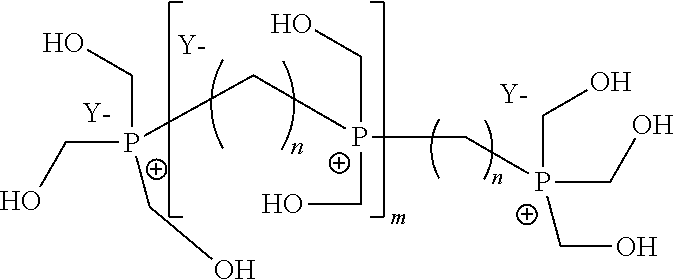
These objectives and other ones are achieved by the present invention which indeed relates to an organophosphonium derivative of the average general formula (1):
Figure US09181116-20151110-C00001
wherein:
n is a number comprised between 4 and 20 preferably between 5 and 10,
m is a number comprised between 0 and 10, preferably between 0 and 1, and
Y is an anion, preferably a chloride, sulfate, phosphate or bromide anion.
For the preferred compounds of the invention, n is comprised between 5 and 10,
m is 0 or 1; and Y is a chloride, sulfate, phosphate or bromide anion.
For still further preferred compounds of the invention, n is 8 and
m is 0 or 1.
The present invention also relates to a method for preparing an organophosphonium derivative as defined above, comprising the following steps:
    • a) tetrakis(hydromethyl)phosphonium chloride is reacted on a strong base such as soda, under an inert atmosphere in order to obtain trishydroxymethyl phosphine with removal of formaldehyde according to the reaction scheme below:
Figure US09181116-20151110-C00002
wherein x represents an anion;
    • b) an alpha, omega, dihalogeno-alkylene is reacted on the reaction mass obtained in Example a), and the corresponding alkylene diphosphonium is obtained.
Figure US09181116-20151110-C00003
    • c) optionally the alkylene diphosphonium obtained in step b) reacts on an excess of dihalogeno-alkylene and of trishydroxymethyl phosphine in order to give a tri- or poly-phosphonium with release of formaldehyde according to the reaction scheme above:
Figure US09181116-20151110-C00004
X, Y, n and m have the meaning given for formula (1) above.
The present invention is also directed to a method for controlling the growth of the bacterial biomass in an aqueous system comprising adding to the aqueous system, or contacting with the aqueous system, an effective amount of an uncoupling agent selected from an organophosphonium derivative of the average general formula (1):
Figure US09181116-20151110-C00005
wherein:
n is a number comprised between 4 and 20, preferably between 5 and 10,
m is a number, comprised between 0 and 10, preferably between 0 and 1, and
Y is an anion, preferably selected from the group constituted by chloride, sulfate, phosphate, acetate and bromide ions.
Still more preferably n is 8 and m is 0 or 1.
The invention is also directed to a method for controlling the growth of bacterial biomass in an aqueous system comprising adding to the aqueous system, or contacting with the aqueous system, an effective amount of an uncoupling agent selected from an organophosphonium derivative as defined above.
The effective amount of organophosphonium derivative added to the aqueous system can represent up to 100 mg/l, for example up to 50 mg/l, such as up to 30 mg/l. Preferably, the effective amount of organophosphonium derivative added to the aqueous system represents from 0.0001 mg/l to 100 mg/l, from 0.005 mg/l to 50 mg/l, for example from 0.01 mg/l to 30 mg/l, such as from 0.05 mg/l to 10 mg/l. More preferably, the effective amount of organophosphonium derivative represents from 0.1 to 10 mg/l, for example from 0.5 mg/l to 7.5 mg/l, such as from 1 to 5 mg/l.
The organophosphonium derivative in the uncoupling agent application may be formulated with one or more of the following chemicals conventionally used in the treatment of waste waters:
a surfactant;
an anti-foam agent;
a scale inhibitor;
a corrosion inhibitor;
a biocide;
a flocculant;
an agent facilitating solid/water separation; and
a dispersant.
Preferably, the aqueous system will be a waste water treatment plant which is used for treating industrial or municipal effluents. This installation recovers waste waters from industrial processes (for example, paper production, food industry, chemical industry) and/or from dwellings and institutional buildings and similar installations, by using micro-organisms in aerobic, anoxic processes (for example denitrification), for consuming organic pollutants and making the water suitable with view to its reuse or its discarding into the environment.
The present invention therefore provides a method for controlling the growth of bacterial biomass in an aqueous system comprising adding to, or contacting with, the aqueous system, an effective amount of an uncoupling agent as defined above.
In a preferred embodiment, the present invention provides a method for controlling the growth of bacterial biomass in an aqueous system, which method comprises contacting an effective amount of an uncoupling agent as defined above directly with the bacterial biomass. In order to apply this method, it is recommended to put within a limited time a maximum volume of activated sludge into contact with the uncoupling agent so as to obtain optimum efficiency from the latter.
Thus, for biological pilot tests in the laboratory, the direct contact of the uncoupling agent in water with the bacterial biomass is designated by the expression “instantaneous dosage” or “instantaneous mixing” called flash mixing.
It was discovered that if the uncoupling agent is simply added directly to a bioreactor containing sludges, then the efficiency of the agent is substantially decreased since the uncoupling agent is capable of interacting with the other materials present in the bioreactor and the action of the organophosphonium derivative is substantially reduced.
Moreover, the effective amount of said organophosphonium derivative may represent from 0.1 to 100 mg per gram of solids (expressed as dry materials or DM) present in the sludges in the aqueous system, preferably from 0.5 to 100 mg/g for example from 1 to 50 mg/g, such as from 2 to 10 mg/g.
The following examples illustrate the invention without limiting the scope thereof.
EXAMPLE 1 Step a) Synthesis of a Trishydroxymethyl Phosphine Solution
In a perfectly stirred reactor equipped for vacuum distillation, inertized beforehand under nitrogen, is loaded:
a solution titrating 80% THPC (tetrakis(hydromethyl)phosphonium chloride) and containing 150 g of THPC (0.63 mol);
the mixture is cooled to 5-15° C.;
385 g of an 8% soda solution are poured within 3 hours and with control of the temperature at 5-15° C.;
at the end of the pouring, the reaction mixture is maintained at 10° C. for 12 hours;
the formaldehyde formed is removed by distillation of a water/formaldehyde mixture at a temperature of 15-30° C. and at a pressure <10 mbars;
970 g of ethanol are added and distillation is performed under the same conditions in order to use up the formaldehyde;
precipitation of NaCl is observed and after distillation the reaction mass is analyzed:
Analyses: 93.5% of THP/3% THPO/3.5% THPC
EXAMPLE 2 Steps b) and c): Synthesis of Phosphonium (Formula (1) with n=8, m=0 or 1)
The reaction mass prepared in Example 1 is introduced into a perfectly stirred reactor equipped for vacuum distillation, inertized beforehand.
While controlling the temperature at 45-55° C., 111.8 g of 1,8-di-iodoctane are poured within 30 minutes.
The reaction medium is biphasic and precipitation of salts is observed (NaI/NaCl).
After being maintained at 50° C. for 50 hours, the reaction medium is filtered and the obtained product is a pale yellow limpid solution from which a mass of 665 g is extracted having the following NMR analysis (nuclear magnetic resonance):
    • 31P NMR analysis
    • 3% THPO
    • 3% THP
    • 14% THPC
    • 78% of phosphonium derivatives according to a following molar composition of the di-phosphonium and tri-phosphonium:
Figure US09181116-20151110-C00006
n=8
87%
Figure US09181116-20151110-C00007
n=8
13%
EXAMPLE 3 Step a) Synthesis of a Trishydroxymethyl Phosphine Solution:
In a perfectly stirred reactor, equipped for vacuum distillation, inertized beforehand under nitrogen, a solution titrating 80% THPC (tetrakis(hydromethyl)phosphonium chloride) with 100 g of THPC (0.42 mol) and water (50 g) is loaded;
The mixture is cooled to 5-15° C.;
228 g of the 8% soda NaOH solution are poured within 3 hours and with control of the temperature at 5-15° C.;
At the end of the pouring, 10° C. is maintained for 12 hours;
The formaldehyde formed is removed by distillation of a water/formaldehyde mixture at a temperature of 15-30° C. and at a pressure of less than 10 mbars;
786 g of ethanol are added and the reaction mixture is distilled under the same conditions in order to use up the formaldehyde;
Precipitation of NaCl is observed.
EXAMPLE 4 Steps b) and c): Synthesis of Phosphonium (Formula (1) with n=6, m=0 or 1)
The reaction mass prepared in Example 3 is introduced into a perfectly stirred reactor equipped for vacuum distillation, inertized beforehand, with control of the temperature at 45-55° C.;
111.8 g of 1,6-diiodohexane are poured with 30 minutes and the temperature is controlled at 45-55° C.;
The obtained reaction medium is biphasic and precipitation of salts is observed (NaI/NaCl);
The temperature of the reaction mixture is maintained at 50° C. for 30 hours with presence of 15% THPC;
At a temperature of 10° C., 30 g of 8% NaOH are added;
The temperature is set to 40° C.;
14.5 g of 1,6-diiodohexane are poured in;
The reaction medium is maintained at 50° C. for 12 hours;
The reaction mixture is cooled to 10° C., and then filtered on a frit of porosity 3;
The formaldehyde formed is removed by distillation of a water/formaldehyde mixture at a temperature of 15-30° C. and at a pressure <10 mbars; and
400 g of ethanol are added and distilled under the same conditions in order to use up the formaldehyde.
At a temperature of 10° C., 15 g of 8% NaOH are added;
Temperature is set to 40%;
10 g of 1,6-diiodohexane are poured in while maintaining the reaction mixture at 50° C. for 12 hours;
The reaction medium is cooled to 10° C. and then filtered on a frit of porosity 3;
The formaldehyde formed is removed by distillation of a water/formaldehyde mixture at a temperature of 15-30° C. and at a pressure <10 mbars; and then
350 g of water are added and distilled under the same conditions in order to use up the formaldehyde;
The obtained product is a pale yellow limpid solution from which a mass of 327.7 g is drawn off;
The drawn-off aqueous phase is washed with 3 washings with ethyl acetate (AcOEt 350 g)
The washed aqueous phase is desolvated in the rotary evaporator and 284 g of a pale yellow solution are obtained, having the following nuclear magnetic resonance analysis:
31P NMR analysis
1.6% THPO
3% THPC
95% phosphonium derivatives of composition:
Figure US09181116-20151110-C00008
n=6
60%
Figure US09181116-20151110-C00009
n=6
40%
EXAMPLE 5 Detecting the Reduction of Activated Sludge by an Organophosphonium Derivative in an Oxytop® Screening Test:
In order to evaluate the reduction in sludge production by an uncoupling chemical agent in respirometry (in order to measure oxygen overconsumption, a characteristic signature of the effects of an uncoupling agent), the oxytop® test technique is used containing a synthetic medium and bacterial strains particularly sensitive to uncoupling agents. These model bacterial strains (notably the strain Schinella granule) are particularly representative of activated sludges of STEP since they are isolated from the latter in aeration tanks.
The method and the apparatus used are those described in Example 3 of WO 2004/113236 cited as a reference. The strain Schinella granuli was used as an inoculum in this methodology (which differs from Example 3 of WO 2004/113236 which used activated sludge).
The obtained results in the screening test are gathered in Table 1 below. They are expressed as an uncoupling percentage relatively to the control (not comprising any uncoupling agent). This means that for Ex2 at 0.05 mg/l, we have an oxygen overconsumption of 18% relatively to the control not comprising any uncoupling agent. THPS (tetrakis(hydromethyl)phosphonium sulfate) produces uncoupling effects in the oxitop® respirometry tests of 16±8% for a rated concentration of 3 ppm, the 95% confidence interval of THPS in terms of uncoupling factor being [10-22], values computed from results obtained in 26 Oxitop® tests.
TABLE 1
Concentration in ppm
Product 0.05 0.1 0.5 1 2 3 4 5
Ex. 2 18% 12%-16% 15%-8%-14% 15%-16%-15% 10%-9%
THPS 16 ± 8%
A rather narrow concentration range in which these derivatives show good efficiency is observed on the phosphonium derivatives synthesized in Example 2.
This concentration range often shows activation of the decoupling effect at low concentrations followed by a slight inhibition and then toxicity obtained around 5 ppm (rated concentration).
Uncoupling effects are observed of the same order of magnitude as the ones obtained with THPS (16±8%, average value obtained over 26 Oxitop® tests with 3 ppm of THPS). The mixture of triphosphonium and diphosphonium of Example 2. gives repeatable and significant uncoupling effects on the relatively low concentration range comprised between 0.1 and 2 ppm. The optimum concentration seems to be located at 1 ppm with effects of the order of 15%.
EXAMPLE 6
Detection of the reduction of activated sludge by an organophosphonium derivative in a Chemostat® biological pilot.
Tests on biological pilots continuously fed with synthetic effluent dealt with the molecule of Ex2 (Example 2 above), show significant uncoupling effects on the reduction of sludge production. The biological pilots have a volume of 5 liters and are continuously aerated; a purge of the latter is made everyday (except on weekends) in order to obtain a sludge age of about 7 days. The biological pilots were seeded with activated sludge from the urban STEP of St-Fons (France). After a short acclimatization period of the sludge, the treatment with the molecule Ex2 was carried out according to the flash mixing method also described in Example 1 of WO 2004/113236 cited as a reference.
An experiment, for which the total period of injection of the uncoupling product according to the flash mixing method lasted for 3 months, gave the following results:
Reduction in Growth rate (in Reduction
sludge g of MLSS/g of in growth
Treatment production removed COD) rate
Control (untreated) / 0.188 /
THPS 2.9 ppm 13.6% 0.171 9.0%
Compound Ex2, 1.1 ppm 14.9% 0.182 3.2%
Compound Ex2, 2.3 ppm 20.2% 0.160 14.9% 
Good efficiency of the compound Ex2 on the reduction of sludge production, notably at 2.3 ppm, is observed with a reduction slightly greater than 20% in comparison with the untreated control.
A complementary experiment, this time using two different grades of the compound Ex2 of Example 2 above, designated as EX21 and EX22a hereafter, gave the following results over a 1 month injection period:
Reduction in Growth rate (in Reduction
sludge g of MLSS/g of in the
Treatment production removed COD) growth rate
Control (untreated) / 0.174 /
Compound EX21, 2.3 ppm 37.4% 0.113 35.1%
Compound EX22, 2.3 ppm 24.3% 0.135 22.5%
Compound EX22, 5.7 ppm 27.6% 0.129 26.0%
Compound EX22 shows good efficiency on the reduction of sludge production of 27.6% and a reduction in the growth rate of 26% (which confirms that at this concentration, it does not alter the purifying capacity of sludges).

Claims (14)

The invention claimed is:
1. A method for controlling growth of bacterial biomass in an aqueous system comprising adding to the aqueous system or contacting with the aqueous system, an uncoupling agent selected from an organophosphonium derivative of the average general formula (1):
Figure US09181116-20151110-C00010
Wherein:
n is a number comprised between 4 and 20,
m is a number comprised between 0 and 10, and
Y is an anion.
2. The method according to claim 1, wherein the uncoupling agent is present in an amount between 0.001 and 100 mg/I.
3. The method according to claim 2, wherein the uncoupling agent is present in an amount between 0.005 and 50 mg/I.
4. The method according to claim 3, wherein the uncoupling agent is present in an amount between 0.01 mg/I to 30 mg/I.
5. The method according to claim 4, wherein the uncoupling agent is present in an amount between 0.1 mg/I to 10 mg/I.
6. The method according to claim 5, wherein the uncoupling agent is present in an amount between 0.5 mg/I to 7.5 mg/I.
7. The method according to claim 6 wherein the uncoupling agent is present in an amount between 1 mg/I to 5 mg/I.
8. The method according to claim 1, wherein the uncoupling agent is present in an amount between 0.1 mg to 100 mg per g of solids, expressed as dry material, present in sludges in the aqueous system.
9. The method according to claim 8, wherein the uncoupling agent is present in an amount between 1 mg to 50 mg per g of solids present in the sludges in the aqueous system.
10. The method according to claim 9, wherein the uncoupling agent is present in an amount between 2 mg to 10 mg per g of solids present in the sludges in the aqueous system.
11. The method according to claim 1, wherein the aqueous system is a waste water treatment plant for treating industrial or municipal effluents.
12. A method for preparing an organophosphonium derivative of the average general formula (1):
Figure US09181116-20151110-C00011
Wherein:
n is a number comprised between 4 and 20,
m is a number comprised between 0 and 10, and
Y is an anion, comprising the following steps:
a) tetrakis(hydromethyl)phosphonium chloride is reacted on a strong base like soda, under an inert atmosphere in order to obtain trishydroxymethyl phosphine with removal of formaldehyde according to the reaction scheme below:
Figure US09181116-20151110-C00012
wherein x represents an anion;
b) an alpha, omega, dihalogeno-alkylene is reacted on the reaction mass obtained in Example a) and the corresponding alkylene diphosphonium is obtained
Figure US09181116-20151110-C00013
 c) optionally the alkylene diphosphonium obtained in step b) reacts on an excess of dihalogeno alkylene and of trishydroxymethyl phosphine in order to give tri or polyphosphonium with release of formaldehyde according to the reaction scheme above:
Figure US09181116-20151110-C00014
X, Y, n and m having the meaning given in formula (1) above.
13. The method of claim 1 wherein n is comprised between 5 and 10, m is 0 or 1, and Y is an anion selected from a group of anions consisting of chloride, sulfate, phosphate or bromide anions.
14. The method of claim 1 wherein n is 8 and m is 0 or 1.
US13/497,133 2009-09-22 2010-09-08 Organophosphorus derivatives and use thereof as uncoupling agents Expired - Fee Related US9181116B2 (en)

Applications Claiming Priority (3)

Application Number Priority Date Filing Date Title
FR0904510 2009-09-22
FR0904510A FR2950348B1 (en) 2009-09-22 2009-09-22 ORGANOPHOSPHORUS DERIVATIVES AND THEIR USE AS DECOUPLING AGENTS.
PCT/EP2010/063140 WO2011036052A1 (en) 2009-09-22 2010-09-08 Organophosphorus derivatives and use thereof as uncoupling agents

Publications (2)

Publication Number Publication Date
US20120238527A1 US20120238527A1 (en) 2012-09-20
US9181116B2 true US9181116B2 (en) 2015-11-10

Family

ID=42154566

Family Applications (1)

Application Number Title Priority Date Filing Date
US13/497,133 Expired - Fee Related US9181116B2 (en) 2009-09-22 2010-09-08 Organophosphorus derivatives and use thereof as uncoupling agents

Country Status (7)

Country Link
US (1) US9181116B2 (en)
EP (1) EP2480558B1 (en)
JP (1) JP5933439B2 (en)
KR (1) KR20120100931A (en)
CN (1) CN102666558B (en)
FR (1) FR2950348B1 (en)
WO (1) WO2011036052A1 (en)

Families Citing this family (2)

* Cited by examiner, † Cited by third party
Publication number Priority date Publication date Assignee Title
EP2851370B1 (en) 2013-09-19 2016-03-09 Magpie Polymers Method for preparing trishydroxymethyl phosphine
CN114805437A (en) * 2022-06-01 2022-07-29 山东科兴化工有限责任公司 Oilfield sewage bactericide and preparation method thereof

Citations (2)

* Cited by examiner, † Cited by third party
Publication number Priority date Publication date Assignee Title
US2937207A (en) 1957-01-30 1960-05-17 Hoechst Ag Process for the manufacture of quaternary organic phosphorus compounds
EP0380359A1 (en) 1989-01-27 1990-08-01 Albright &amp; Wilson Limited Biocidal compositions and treatments

Family Cites Families (2)

* Cited by examiner, † Cited by third party
Publication number Priority date Publication date Assignee Title
CA2514798C (en) * 2003-02-05 2009-06-16 Pulp And Paper Research Institute Of Canada Bleaching and brightness stabilization of lignocellulosic materials with water-soluble phosphines or phosphonium compounds
AU2004249501B2 (en) 2003-06-20 2007-11-29 Rhodia Uk Ltd Uncoupling agents

Patent Citations (2)

* Cited by examiner, † Cited by third party
Publication number Priority date Publication date Assignee Title
US2937207A (en) 1957-01-30 1960-05-17 Hoechst Ag Process for the manufacture of quaternary organic phosphorus compounds
EP0380359A1 (en) 1989-01-27 1990-08-01 Albright &amp; Wilson Limited Biocidal compositions and treatments

Also Published As

Publication number Publication date
JP2013505279A (en) 2013-02-14
FR2950348A1 (en) 2011-03-25
EP2480558B1 (en) 2014-03-05
WO2011036052A1 (en) 2011-03-31
EP2480558A1 (en) 2012-08-01
KR20120100931A (en) 2012-09-12
FR2950348B1 (en) 2012-08-10
CN102666558B (en) 2015-04-22
US20120238527A1 (en) 2012-09-20
CN102666558A (en) 2012-09-12
JP5933439B2 (en) 2016-06-08

Similar Documents

Publication Publication Date Title
Kim et al. A novel biomonitoring system using microbial fuel cells
Wang et al. Stoichiometric and kinetic characterization of an acid-tolerant ammonia oxidizer ‘Candidatus Nitrosoglobus’
CN111219168B (en) Solid corrosion-inhibiting antiscaling agent and its processing method
JP2010090125A (en) Uncoupling agent
US11964892B2 (en) Phosphorus control for waste streams from glyphosate manufacturing processes
Gutwiński et al. Startup of the anammox process in a membrane bioreactor (AnMBR) from conventional activated sludge
US9181116B2 (en) Organophosphorus derivatives and use thereof as uncoupling agents
RU2353587C2 (en) Enhancing silt quality
Gani et al. Role of treatment configuration in simultaneous removal of priority phthalic acid esters and nitrogen in a post anoxic integrated biofilm activated sludge system
Delanghe et al. Biological denitrification with ethanol in a membrane bioreactor
Zheng et al. The nitritation performance of biofilm reactor for treating domestic wastewater under high dissolved oxygen
Ju et al. Phosphorus release in aerobic sludge digestion
Shannon et al. Partial nitritation ANAMMOX in submerged attached growth bioreactors with smart aeration at 20 C
EP2291333B1 (en) Process for reducing bulking sludge in activated sludge wastewater treatment
US20130005810A1 (en) Organic uncoupling agents
Kim et al. Analysis of free ammonia inhibition of nitrite oxidizing bacteria using a dissolved oxygen respirometer
KR20090108306A (en) Toxicity detection device and method using thiosulfate
CN110862811B (en) Compound low-phosphorus corrosion inhibitor suitable for oil field system and preparation method thereof
CN119751379B (en) Nitrification inhibitor and application thereof
Azevedo The effect of ammonial loading, solids retention time and operating temperature on the biological nitrification and denitrification of high ammonia landfill leachate
CN109748407B (en) Method for treating circulating cooling water
Geiling Removal of the micropollutants DEET and DEP in biological grey water treatment and the effect of DEP on microbiological processes
TW202508987A (en) Treatment of Methanol-Containing Wastewater
Greene et al. Wastewater treatment of a batch chemical plant effluent with a membrane biological reactor
Olmez et al. Research Article Evaluation of Municipal and Industrial Wastewater Treatment Sludge Stabilization in Istanbul

Legal Events

Date Code Title Description
AS Assignment

Owner name: RHODIA OPERATIONS, FRANCE

Free format text: ASSIGNMENT OF ASSIGNORS INTEREST;ASSIGNORS:MARCHAL, PHILIPPE;SCHANEN, VINCENT;CARRET-TRONCY, STEPHANE;AND OTHERS;SIGNING DATES FROM 20120320 TO 20120417;REEL/FRAME:028315/0481

STCF Information on status: patent grant

Free format text: PATENTED CASE

FEPP Fee payment procedure

Free format text: MAINTENANCE FEE REMINDER MAILED (ORIGINAL EVENT CODE: REM.); ENTITY STATUS OF PATENT OWNER: LARGE ENTITY

LAPS Lapse for failure to pay maintenance fees

Free format text: PATENT EXPIRED FOR FAILURE TO PAY MAINTENANCE FEES (ORIGINAL EVENT CODE: EXP.); ENTITY STATUS OF PATENT OWNER: LARGE ENTITY

STCH Information on status: patent discontinuation

Free format text: PATENT EXPIRED DUE TO NONPAYMENT OF MAINTENANCE FEES UNDER 37 CFR 1.362

FP Expired due to failure to pay maintenance fee

Effective date: 20191110