US9156859B2 - Boron containing vegetable oil based antiwear/antifriction additive and their preparation - Google Patents
Boron containing vegetable oil based antiwear/antifriction additive and their preparation Download PDFInfo
- Publication number
- US9156859B2 US9156859B2 US13/241,572 US201113241572A US9156859B2 US 9156859 B2 US9156859 B2 US 9156859B2 US 201113241572 A US201113241572 A US 201113241572A US 9156859 B2 US9156859 B2 US 9156859B2
- Authority
- US
- United States
- Prior art keywords
- group
- formula
- hydrocarbons
- branched
- straight
- Prior art date
- Legal status (The legal status is an assumption and is not a legal conclusion. Google has not performed a legal analysis and makes no representation as to the accuracy of the status listed.)
- Active, expires
Links
- 0 *OC(C)=O Chemical compound *OC(C)=O 0.000 description 27
- ZYAASFGEPDJZMF-UHFFFAOYSA-N CCB(CC)(OC)OCCC(C)C(C)C Chemical compound CCB(CC)(OC)OCCC(C)C(C)C ZYAASFGEPDJZMF-UHFFFAOYSA-N 0.000 description 7
- GKRJWTITJMCUSJ-UHFFFAOYSA-N CCCOB(CC)(CC)OC Chemical compound CCCOB(CC)(CC)OC GKRJWTITJMCUSJ-UHFFFAOYSA-N 0.000 description 6
- LGKNPMZTNJGNJA-UHFFFAOYSA-N CCB(CC)(OC)OCCC(C)C(C)[Y] Chemical compound CCB(CC)(OC)OCCC(C)C(C)[Y] LGKNPMZTNJGNJA-UHFFFAOYSA-N 0.000 description 4
- PQXKWPLDPFFDJP-UHFFFAOYSA-N CC1OC1C Chemical compound CC1OC1C PQXKWPLDPFFDJP-UHFFFAOYSA-N 0.000 description 3
- IMJUPQPIRUDPED-UHFFFAOYSA-N CCCCB(CC)(OC)OCCC Chemical compound CCCCB(CC)(OC)OCCC IMJUPQPIRUDPED-UHFFFAOYSA-N 0.000 description 2
- BASAKUFIWLJHHM-UHFFFAOYSA-N CCCCB(CCCC)(OCC[Hs])OCCC(C)C(C)C Chemical compound CCCCB(CCCC)(OCC[Hs])OCCC(C)C(C)C BASAKUFIWLJHHM-UHFFFAOYSA-N 0.000 description 2
- OXMIDRBAFOEOQT-UHFFFAOYSA-N CC1CCC(C)O1 Chemical compound CC1CCC(C)O1 OXMIDRBAFOEOQT-UHFFFAOYSA-N 0.000 description 1
- RVRKQBMQPLBBFG-UHFFFAOYSA-N CCB(C)(O)OCCCC(C)C Chemical compound CCB(C)(O)OCCCC(C)C RVRKQBMQPLBBFG-UHFFFAOYSA-N 0.000 description 1
- FWRZTDRJGJVSPN-UHFFFAOYSA-N CCB(C)(OC)OCCCC(C)C Chemical compound CCB(C)(OC)OCCCC(C)C FWRZTDRJGJVSPN-UHFFFAOYSA-N 0.000 description 1
- UEILBKVBVQTNOK-UHFFFAOYSA-N CCB(CCCC(C)C(C)C)(OC)OCCC(C)C(C)C Chemical compound CCB(CCCC(C)C(C)C)(OC)OCCC(C)C(C)C UEILBKVBVQTNOK-UHFFFAOYSA-N 0.000 description 1
- DRQQDXALYXIICA-UHFFFAOYSA-N CCC(C)CCCB(C)(O)OCCCC(C)C Chemical compound CCC(C)CCCB(C)(O)OCCCC(C)C DRQQDXALYXIICA-UHFFFAOYSA-N 0.000 description 1
- AVVSNLOPTVCGBX-UHFFFAOYSA-N CCC(C)CCCB(O)(CC)OCCC(C)C(C)C Chemical compound CCC(C)CCCB(O)(CC)OCCC(C)C(C)C AVVSNLOPTVCGBX-UHFFFAOYSA-N 0.000 description 1
- AOPICRLWVGNDBG-UHFFFAOYSA-N CCC(C)CCCB(O)(CC)OCCCC(C)C Chemical compound CCC(C)CCCB(O)(CC)OCCCC(C)C AOPICRLWVGNDBG-UHFFFAOYSA-N 0.000 description 1
- ZMDOCYISUVBCHA-UHFFFAOYSA-N CCCCB(CCCC)(OCC)OCCC Chemical compound CCCCB(CCCC)(OCC)OCCC ZMDOCYISUVBCHA-UHFFFAOYSA-N 0.000 description 1
- QJLMQINYTPBFFJ-UHFFFAOYSA-N CCCCB(CCCC)(OCCC)OCCC Chemical compound CCCCB(CCCC)(OCCC)OCCC QJLMQINYTPBFFJ-UHFFFAOYSA-N 0.000 description 1
- NVOLHFRSEAPELF-UHFFFAOYSA-N CCCCB(CCCC)(OCCC)OCCC(C)C(C)C Chemical compound CCCCB(CCCC)(OCCC)OCCC(C)C(C)C NVOLHFRSEAPELF-UHFFFAOYSA-N 0.000 description 1
- SJQZJJOXMMIZDL-UHFFFAOYSA-N CCCCB(CCCC)(OCCC)OCC[Hs] Chemical compound CCCCB(CCCC)(OCCC)OCC[Hs] SJQZJJOXMMIZDL-UHFFFAOYSA-N 0.000 description 1
- BWBWXPPLMWHYHM-UHFFFAOYSA-N CCCCOB(CC)(CC)OC.CC[Y] Chemical compound CCCCOB(CC)(CC)OC.CC[Y] BWBWXPPLMWHYHM-UHFFFAOYSA-N 0.000 description 1
- DSVWCMYPBZGVJR-UHFFFAOYSA-N CCOB(CC)(CC)OC Chemical compound CCOB(CC)(CC)OC DSVWCMYPBZGVJR-UHFFFAOYSA-N 0.000 description 1
- BULAXQFAPCUYGX-UHFFFAOYSA-N CN[B](N)(NC)[U]C Chemical compound CN[B](N)(NC)[U]C BULAXQFAPCUYGX-UHFFFAOYSA-N 0.000 description 1
Images


Classifications
-
- C—CHEMISTRY; METALLURGY
- C07—ORGANIC CHEMISTRY
- C07F—ACYCLIC, CARBOCYCLIC OR HETEROCYCLIC COMPOUNDS CONTAINING ELEMENTS OTHER THAN CARBON, HYDROGEN, HALOGEN, OXYGEN, NITROGEN, SULFUR, SELENIUM OR TELLURIUM
- C07F5/00—Compounds containing elements of Groups 3 or 13 of the Periodic Table
- C07F5/02—Boron compounds
- C07F5/04—Esters of boric acids
-
- C—CHEMISTRY; METALLURGY
- C10—PETROLEUM, GAS OR COKE INDUSTRIES; TECHNICAL GASES CONTAINING CARBON MONOXIDE; FUELS; LUBRICANTS; PEAT
- C10M—LUBRICATING COMPOSITIONS; USE OF CHEMICAL SUBSTANCES EITHER ALONE OR AS LUBRICATING INGREDIENTS IN A LUBRICATING COMPOSITION
- C10M139/00—Lubricating compositions characterised by the additive being an organic non-macromolecular compound containing atoms of elements not provided for in groups C10M127/00 - C10M137/00
-
- C—CHEMISTRY; METALLURGY
- C10—PETROLEUM, GAS OR COKE INDUSTRIES; TECHNICAL GASES CONTAINING CARBON MONOXIDE; FUELS; LUBRICANTS; PEAT
- C10M—LUBRICATING COMPOSITIONS; USE OF CHEMICAL SUBSTANCES EITHER ALONE OR AS LUBRICATING INGREDIENTS IN A LUBRICATING COMPOSITION
- C10M159/00—Lubricating compositions characterised by the additive being of unknown or incompletely defined constitution
- C10M159/12—Reaction products
-
- C—CHEMISTRY; METALLURGY
- C10—PETROLEUM, GAS OR COKE INDUSTRIES; TECHNICAL GASES CONTAINING CARBON MONOXIDE; FUELS; LUBRICANTS; PEAT
- C10M—LUBRICATING COMPOSITIONS; USE OF CHEMICAL SUBSTANCES EITHER ALONE OR AS LUBRICATING INGREDIENTS IN A LUBRICATING COMPOSITION
- C10M2201/00—Inorganic compounds or elements as ingredients in lubricant compositions
- C10M2201/087—Boron oxides, acids or salts
-
- C—CHEMISTRY; METALLURGY
- C10—PETROLEUM, GAS OR COKE INDUSTRIES; TECHNICAL GASES CONTAINING CARBON MONOXIDE; FUELS; LUBRICANTS; PEAT
- C10M—LUBRICATING COMPOSITIONS; USE OF CHEMICAL SUBSTANCES EITHER ALONE OR AS LUBRICATING INGREDIENTS IN A LUBRICATING COMPOSITION
- C10M2207/00—Organic non-macromolecular hydrocarbon compounds containing hydrogen, carbon and oxygen as ingredients in lubricant compositions
- C10M2207/02—Hydroxy compounds
- C10M2207/021—Hydroxy compounds having hydroxy groups bound to acyclic or cycloaliphatic carbon atoms
- C10M2207/022—Hydroxy compounds having hydroxy groups bound to acyclic or cycloaliphatic carbon atoms containing at least two hydroxy groups
-
- C—CHEMISTRY; METALLURGY
- C10—PETROLEUM, GAS OR COKE INDUSTRIES; TECHNICAL GASES CONTAINING CARBON MONOXIDE; FUELS; LUBRICANTS; PEAT
- C10M—LUBRICATING COMPOSITIONS; USE OF CHEMICAL SUBSTANCES EITHER ALONE OR AS LUBRICATING INGREDIENTS IN A LUBRICATING COMPOSITION
- C10M2207/00—Organic non-macromolecular hydrocarbon compounds containing hydrogen, carbon and oxygen as ingredients in lubricant compositions
- C10M2207/10—Carboxylix acids; Neutral salts thereof
- C10M2207/24—Epoxidised acids; Ester derivatives thereof
-
- C—CHEMISTRY; METALLURGY
- C10—PETROLEUM, GAS OR COKE INDUSTRIES; TECHNICAL GASES CONTAINING CARBON MONOXIDE; FUELS; LUBRICANTS; PEAT
- C10N—INDEXING SCHEME ASSOCIATED WITH SUBCLASS C10M RELATING TO LUBRICATING COMPOSITIONS
- C10N2030/00—Specified physical or chemical properties which is improved by the additive characterising the lubricating composition, e.g. multifunctional additives
- C10N2030/06—Oiliness; Film-strength; Anti-wear; Resistance to extreme pressure
-
- C10N2230/06—
-
- C10N2260/14—
Definitions
- the invention relates to novel boron-containing fatty ester derivatives and a process for their preparation.
- Antiwear/antifriction lubricants typically comprise a base oil that has been blended with any number of additives that enhance the ability of the base oil to withstand the mechanical stresses of interacting working surfaces under boundary lubrication conditions.
- Most of the lubricants and many of the additives currently in daily use originate from petroleum base stocks that are toxic to environment, making it increasingly difficult for safe and easy disposal.
- Vegetable oils are readily biodegradable, safe to handle, environmentally friendly, non toxic fluids that are also readily renewable resources [Salunkhe, D. K. et al., World Oil Seed Chemistry, Technology and Utilization, Van Nostrand Reinhold, New York, (1992) pp. 1-8; Bockish, M. (ed.) Fats and Oils Handbook, AOCS Press, Champaign, (1998) 838].
- the triacylglycerol structure of vegetable oil which is also amphiphilic in character, give it an excellent potential as a candidate for use as a lubricant or functional fluid [Zaher, F. A.
- Triacylglycerol molecules orient themselves with the polar end at the solid surface making a close packed monomolecular [Brockway, L. O., J. Colloid Sci., 2:277-289 (1947)] or multimolecular layer [Fuks, G. I., Research in surface forces, A. B. V. Deryagin (ed.) Consultants Bureau, New York (1963) 29-88] resulting in a surface film on the material being lubricated.
- the vegetable oil structure provides sites for additional functionalization, offering opportunities for improving on the existing technical properties such as thermo-oxidative, low temperature stability and lubricity. These properties make them very attractive for industrial applications that have potential for environmental contact through accidental leakage, dripping, or generation of large quantities of after-use waste materials requiring costly disposal [Randles, S. J., et al., J. Syn. Lubr., 9:145-161 (1992); Dick, R. M., Process, 41:339-365 (1994)].
- the antiwear properties of commercial additives are derived from a variety of elements capable of reacting with the metal surface and establish a stable protective film.
- Phosphorus, sulfur, nitrogen and zinc constitute the active element in most mineral oil based commercial antiwear additives.
- phosphorus may eventually be phased out from usage in the automotive industry because it has been implicated with catalyst deactivation fitted in catalytic converters [Wei, Dan-ping, Lubr. Sci., 7:365-377 (1995)].
- X is selected from —O— (oxy), —N(H)— (amine), —C(O)O— (carboxyl), —S— (thiol), —C ⁇ N (cyano), —N ⁇ C ⁇ O (isocyanate), —N ⁇ C (isocyano), and a borate of the formula:
- R 1 is selected from aryl, and straight, branched, cyclic or heterocyclic hydrocarbons or substituted hydrocarbons.
- the oxirane ring is opened, and forms a boron-containing fatty acid derivative comprising one or more derivatized methylene groups of the formula:
- R is an H, branched or straight chain alkyl or alkenyl group, aromatic-containing group, glycerol or glyceride (including O-monoglyceride or O-diglyceride), and R′′ is a C3 to C29 aliphatic chain comprising one or more of the above-mentioned derivatized methylene groups.
- the fatty acid derivatives so produced have utility as antiwear/antifriction additives for industrial oils, fuels, and automotive applications.
- Another object of the invention is to introduce a new use for triglyceride oils and to expand the market for an agricultural commodity.
- a further object of the invention is to produce industrial fluids that reduce the demand on petroleum resources and that are biodegradable.
- Yet another object of the invention to provide a synthetic route for converting epoxidized sites of unsaturation in fatty acids and triglyceride fatty esters to borate functionalities.
- FIG. 1 shows the reaction of epoxidized soybean oil (ESO) with two borate esters, having either an alcohol or alkoxy epoxide reactive moiety.
- ESO epoxidized soybean oil
- the ESO is modified via nucleophilic ring opening of the epoxide with the alcohol or alkoxy group of the borate reactants and subsequent trapping of the ring opened species with the borate esters.
- the boron nucleus of the first borate ester is charged and H + serves as a counter ion, while the boron nucleus of the second borate ester is uncharged.
- Titanium (IV) isopropoxide, Ti(OR) 4 serves as the Lewis acid catalyst for the reaction.
- Acetic anhydride, Ac 2 O is added as a capping reagent to cap any unreacted hydroxyl groups on the borate-derivatized product.
- FIG. 2 shows the reaction of ESO with an organic alcohol (2-ethyl hexanol) followed by trapping of ring opened product with one of the borate esters of FIG. 1 using the same acid catalyst.
- the boron nucleus of the borate ester is uncharged.
- FIG. 3 shows the reaction of ESO with isopropyl alcohol followed by trapping with hexyleneglycol biborate and acetic anhydride capping reagent using the same acid catalyst as in FIG. 1 .
- the boron nucleus of the borate ester is uncharged.
- FIG. 4 shows the reaction of ESO with 3,9-diisopropoxy-2,4,8,10-tetraoxa-3,9-dibora-spiro[5,5]undecane, where the epoxy ring reacted with 2-ethyl hexanol followed by reaction with boron compound using the same acid catalyst as in FIG. 1 .
- the boron nucleus of the borate ester is uncharged.
- FIG. 5 shows the reaction of ESO with a borate ester having two alcohols as epoxide reactive moieties, with acetic anhydride used as a capping reagent and an acid catalyst. As shown, the boron nucleus of the borate ester is charged and an amine serves as a counter ion.
- FIG. 6 shows the reaction of ESO with a borate ester having a single alcoholic as epoxide reactive moiety, using the same acid catalyst as in FIG. 1 , but without a capping reagent. As shown, the boron nucleus of the borate ester is charged and H + serves as a counter ion.
- FIG. 7 shows the reaction of epoxidized soybean oil (ESO) with 2-[4,6-bis-(2-amino-ethoxy)-cyclotriboroxan-2-yloxy]-ethylamine (having amine as epoxide reactive moieties) and one of the borate esters of FIG. 1 , using an acid catalyst.
- the boron nucleus of each of the borate esters is uncharged.
- FIG. 8 shows the reaction of ESO with a borate ester having a single alcoholic epoxide reactive moiety, using the same acid catalyst as in FIG. 1 , but without a capping reagent. As shown, the boron nucleus of the borate ester is charged and H + serves as a counter ion.
- FIG. 9 shows the reaction of ESO with 2-ethyl hexanol followed by trapping with a borate ester having a single carboxylic group as epoxide reactive moiety, using the same acid catalyst as in FIG. 1 . As shown, the boron nucleus of the borate ester is charged and H + serves as a counter ion.
- fatty acid ester derivatives may be formed from the epoxides of a variety of unsaturated fatty acids (olefins), including vegetable oils, animal fats, or alkyl esters of vegetable oil or animal fat. These epoxides may be produced as described below or obtained from commercial sources.
- the starting unsaturated fatty acid is not critical, and any ⁇ 3 to ⁇ 17 unsaturated fatty acid (i.e. having a double bond between ⁇ 3 and ⁇ 17 inclusive) containing from 4 to 30 carbon atoms or longer may be used.
- starting fatty acids include fatty acids of the formula R′—COOR wherein R′ is a straight or branched chain olefin, and R is H, branched or straight chain alkyl or alkenyl groups, aromatic containing groups, or glycerides (including mono-, di- or triglycerides).
- Preferred starting fatty acids include, but are not limited to free and esterified, unsaturated ⁇ 3 to ⁇ 17 unsaturated fatty acid containing from 4 to 22 carbon atoms, more particularly free and esterified unsaturated ⁇ 3 to ⁇ 17 unsaturated fatty acid containing from 8 to 22 carbon atoms, and most particularly free and esterified unsaturated ⁇ 9 to ⁇ 15 unsaturated fatty acid containing from 8 to 22 carbon atoms.
- Examples of particularly preferred unsaturated fatty acids which may be used herein include free and esterified palmitoleic acid (16:1, ⁇ 9 ), oleic acid (18:1, ⁇ 9 ), linoleic acid (18:2, ⁇ 9,12 ), erucic acid (22:1, ⁇ 13 ), and linolenic acid (18:3, ⁇ 9,12,15 ), 5-eicosenoic acid (20:1, ⁇ 5 ), 5-docosenoioc acid (22:1, ⁇ 5 ), 5,13-docosadienoic acid (22:2, ⁇ 5,13 ), petroselinic acid (16:1, ⁇ 6 ), elaidic acid (18:1, ⁇ 9 ), and trans isomers of any of the above.
- Unsaturated fatty acids are naturally occurring in a variety of plant oils or animal fats and may be conveniently obtained for use therefrom.
- oils which may be used as sources include soybean, cottonseed, corn, olive, peanut, palm, sesame, sunflower, canola, castor, safflower, linseed, grapeseed, oiticia, tung, rice, crambe, vernonia (ironweed), algae, animal fat, high erucic rape, and high oleic canola oils, with soybean oil being particularly preferred.
- the unsaturated fatty acids may be provided in substantially pure form or, in the alternative, they may be provided as a mixture or in impure form.
- the unsaturated fatty acids may be free acids, the reaction may also be conducted using fatty acids which are esterified with aliphatic alcohols such as methanol, ethanol, isopropanol, or branched chain alcohols such as 2-ethyl hexanol or Guerbet alcohols, or with glycerol as mono-, di- or triglycerides.
- fatty acids occur predominantly as triglycerides in triglyceride oils
- the above-mentioned naturally occurring oils are preferably used directly in the reaction, thereby foregoing the need for any preliminary fatty acid synthesis and isolation of the oil.
- the oils principally contemplated herein include what are normally referred to as the triglyceride drying oils.
- the vegetable triglyceride drying oils include plant oils and plant source-like synthetic and semi-synthetic triglycerides that can be transformed into hard, resinous materials [see Encyclopedia of Polymer Science and Technology, H. F. Monk et al., eds., John Wiley & Sons, (1966), pp. 216-234].
- drying oils is generic to both true drying oils, which dry (harden) at normal atmospheric conditions, and semidrying oils, which must be baked at elevated temperatures in order to harden.
- drying oil will be used herein in its broadest sense to refer to both types of drying oil.
- the unsaturated fatty acids (e.g., linoleic or linolenic) residues of a drying or semidrying oil comprise double bonds that are readily available for entering into an oxidative reaction, or other reactions involved in the drying process. These oils may also include oleic fatty acid residues.
- Common sources of drying oils include cottonseed oil, castor oil, canola oil, linseed oil, oiticica oil, safflower oil, soybean oil, sunflower oil, corn oil, and tung oil.
- Non-drying oils substantially comprise saturated and/or monounsaturated fatty acid residues, such as those characteristic of palmitic, stearic and oleic acid.
- Exemplary nondrying oils include palm, peanut, olive, and grapeseed oils.
- soybean oil Because of ready availability and low cost, the preferred vegetable oil use herein is soybean oil.
- the generic chemical structure of triglyceride oils for use in the invention is represented by the formula, below:
- R 1 ′, R 2 ′ and R 3 ′ are independently selected from C3 to C29 aliphatic fatty acid residues, that may be completely saturated or have sites of unsaturation and/or hydroxylation, provided that R 1 ′, R 2 ′ and R 3 ′ collectively have at least 1 but preferably more sites of unsaturation.
- the triglyceride esters are composed of C18 and C16 fatty acids, and accordingly R 1 ′, R 2 ′ and R 3 ′ are C17 or C15.
- the oils may first be hydrolyzed to obtain free fatty acids for use as starting materials in the reaction. Hydrolysis of the oils to the fatty acids may be achieved using conventional splitting techniques or alkali splitting of fats. Suitable alkali splitting techniques include, for example, treatment with sodium methoxide, or sodium or potassium hydroxide [see “A.O.C.S. Tentative Method Ca 6b-53”, in: Official and Tentative Methods of the American Oil Chemist's Society, third edition, AOCS, Chicago, Ill., (1973)]. Other conventional techniques including splitting with steam under pressure are also effective.
- the free or esterified unsaturated fatty acids are reacted under conditions and for a period of time effective to at least partially, but preferably completely, epoxidize the carbon/carbon double bonds therein.
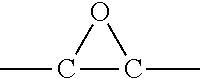
- These epoxidized fatty acids will contain one or more oxirane rings (which may also be referred to as epoxidized methylene groups):
- Suitable techniques include those described by Qureshi et al. (Polymer Science and Technology, Vol. 17, Plenum Press, p. 250), Croco et al. (U.S. Pat. No. 5,166,372), Nowak et al. (U.S. Pat. No. 6,740,763 or 6,734,315), and preferably Bunker and Wool (Synthesis and characterization of monomers and polymers for adhesives from methyl oleate. J. Polym. Sci., Part A: Polym. Chem.
- epoxidation is effected by reaction of the unsaturated fatty acid with a combination of a peroxide and a carboxylic acid or its anhydride, or by reaction with a peroxy-carboxylic acid such as peroxy-benzoic acid.
- Suitable peroxides include hydrogen peroxide or any organic peroxides which will form a peracid with a carboxylic acid or its anhydride.
- preferred epoxidation reagents include hydrogen peroxide with either formic acid, benzoic acid, acetic acid, or acetic anhydride.
- the order of addition is not critical, and the peroxide and carboxylic acid may be combined prior reacting with the fatty acid, or they may be added separately to the fatty acid, or all of the peroxide, carboxylic acid, and fatty acid may be combined concurrently.
- the reaction is preferably conducted at low temperatures, more preferably between about 0 and about 30° C., most preferably between about 0 and about 25° C. Because the reaction is exothermic, the temperature is preferably controlled such as by cooling. Temperature control is particularly preferred when reacting free, non-esterified fatty acids to prevent reaction of the acid moiety and polymerization. In a particularly preferred embodiment reaction is initiated at a temperature of approximately 0° C. and maintained at this temperature for about 1 hour, before the temperature is allowed to increase to room temperature. The reaction is typically completed in approximately 3 to 6 hours.
- epoxidized fatty acids or their esters As an alternative to producing the epoxidized fatty acids or their esters, it is understood that many of these same epoxidized fatty acids and fatty acid esters (e.g., mono-, di- and triglycerides) may be obtained in pure form or as mixtures from commercial sources. In this embodiment, the epoxidation reaction is thereby unnecessary and the invention may proceed directly with the ring opening reaction of epoxy soybean oil with borates described herein. The final products will of course be the same.
- the fatty acid epoxide produced or otherwise obtained as described above is reacted with a borate compound to form a fatty acid derivative wherein the oxirane ring (epoxide) is opened via a nucleophilic ring opening with an epoxide reactive moiety on the borate compound and subsequent trapping of the ring opened species with the borate esters.
- a variety of borates are suitable reactants in the reaction.
- preferred borate reactants include those in FIGS. 1-9 .
- borate reactants include but are not limited to compounds having one or more BO 3 and/or BO 4 cores, as well as heterocyclic borate cores.
- the borate compound will also possess an oxirane ring (epoxide) reactive moiety which reacts with one of the carbon atoms of the methylene group at the site of the opened epoxide.
- Epoxide reactive moieties include hydroxides, ethers, amines, carboxyls, esters, thiols, nitriles, isonitriles, and borates.
- the borate reactants of this invention may be shown by the general formula:
- m, n, p and w are independently selected from 0 and 1;
- X is selected from —O— (oxy), —N(H)— (amine), —C(O)O— (carboxyl), —S— (thiol), —C ⁇ N (cyano), —N ⁇ C ⁇ O (isocyanate), —N ⁇ C (isocyano), and a borate of the formula:
- R 1 is selected from aryl, and straight, branched, cyclic or heterocyclic hydrocarbons or substituted hydrocarbons (i.e., any of the hydrocarbons may be optionally substituted).
- the H v —X n —(R 1 ) m —O— portion of the borate reactant functions as an oxirane ring (epoxide) reactive moiety.
- epoxide oxirane ring
- w is 0 when X is —C ⁇ N or —N ⁇ C ⁇ O.
- borate reactants wherein two or more of the oxygens directly linked to the boron are joined in a heterocylic ring exhibit increased stability (a reduced capacity to cross-link with other epoxides) and are preferred.
- the borate reactant may be charged or uncharged, as shown in the Figures, and the borate nucleus is typically negatively charged in compounds comprising four oxygens linked to each boron.
- nucleophiles or counter ions may be added therewith, including but not limited to H + , Li + (e.g., alkyl or other hydrocarbons linked to lithium), and R 4 N + (amines).
- the particular nucleophile selected may affect the derivatized methylene group in the product.
- Suitable catalysts should be capable of opening the oxirane ring of the epoxide, and a variety of catalysts may be used, including ionic liquids, mineral acids, Lewis acids, acidic metal oxides, acidic resins, and enzymes, with ionic liquids, mineral acids, Lewis acids or acidic metal oxides being preferred, and titanium isopropoxide, titanium ethoxide, and titanium butoxide being particularly preferred.
- Non-aqueous catalysts are preferred to maintain product stability.
- catalysts include H 2 SO 4 , H 3 PO 4 , BF 3 etherate, CeCl 3 , ZnCl 2 , InCl 3 , SbCl 3 , AlCl 3 , Zn(ClO 4 ) 2 , Cu(ClO 4 ) 2 , choline chloride/urea, acidic resins such as AMBERLYST-15 (Rohm Haas), and enzymes such as lipases.
- the amount of the catalyst may vary somewhat with the particular catalyst selected, although even very small amounts are effective.
- the catalyst will be added at a concentration of about 0.5 mole % or higher, preferably at a concentration of about 1 to 10 mole %, and most preferably at a concentration of about 1 mole %.
- a solvent is optional, the reaction is preferably conducted in the presence of a non-aqueous solvent to facilitate mixing and removal of any by-products.
- Organic solvents such as heptanes, hexane, toluene or other hydrocarbons, or acetone may be used.
- the reaction pH is not critical, although when reacting epoxidized glycerides, extremely acidic or basic conditions should be avoided to minimize their saponification.
- reaction temperature is not critical, and the reaction is typically conducted at a temperature below about 160° C., preferably between about 60 to 140° C.
- Reaction time may vary with temperature and catalyst concentration, and the reaction typically reaches completion in less than about 2 hours at 105° C. with 5 mole % catalyst, and about 8-24 hours at 60° C.
- the catalyst may be recovered and recycled and the solvents may be removed and recovered by distillation. Because some boron-containing fatty acid derivatives may be subject to decomposition when stored for extended periods in the presence of moisture, the recovered products are preferably stored in an inert atmosphere in the absence of moisture.
- reaction of the epoxidized fatty acid or its ester with the borate reactant occurs in a single step, with the oxirane ring opening, and forming a boron-containing fatty acid derivative comprising one or more derivatized methylene groups of the formula:
- R is an H, branched or straight chain alkyl or alkenyl group, aromatic containing group, glycerol, or glyceride (including O-monoglyceride or O-diglyceride), and R′ is a C3 to C29 aliphatic chain hydrocarbon comprising one or more of the oxirane rings, the resultant boron containing fatty acid derivative formed is:
- R′′ is a C3 to C29 aliphatic chain hydrocarbon comprising one or more of the above-mentioned derivatized methylene groups.
- the remaining carbon of the methylene group formed from the epoxide (the left-most C as illustrated in the formula) will typically form an hydroxide (such as shown in FIGS. 6 and 8 ) or react with another borate molecule (such as shown in FIGS. 1 and 7 ).
- the derivatized methylene group produced is of the formula:
- Y is —OH or a borate of the formula:
- Y is of the formula:
- R 1 ′′, R 2 ′′ and R 3 ′′ are independently selected from C3 to C29 aliphatic fatty acid residues comprising one or more of the derivatized methylene groups of formula (4) described above.
- the borate reactant comprises two of the above-mentioned epoxide reactive moieties, such as shown in FIGS. 1 , 4 , 5 , and 7 , providing for cross-linking between two fatty acids (which may be in the same or different glycerides).
- the borate compound of formula (2) may be shown by the formula:
- X′ is also independently selected from —O—, —N(H)—, —C(O)O—, —S—, —C ⁇ N, —N ⁇ C ⁇ O, —N ⁇ C, and a borate of the formula:
- R 2 is selected from aryl, and straight, branched, cyclic or heterocyclic hydrocarbons or substituted hydrocarbons (any of the hydrocarbons may be optionally substituted).
- two or more of the oxygens directly linked to the boron in the borate reactant of formula (2) are joined in a heterocylic ring, such as shown in FIGS. 1-6 , 8 , and 9 .
- these reactants exhibit increased stability (a reduced capacity to cross-link with other epoxides).
- the borate compound of formula (2) may be shown by any of the formulas:
- q, r, and s are independently selected from of 0 and 1; X and X′ are as described above; and R 2 and R 3 are independently selected from aryl, and straight, branched, cyclic or heterocyclic hydrocarbons or substituted hydrocarbons (any of which hydrocarbons may be optionally substituted).
- the resultant derivatized methylene groups which are formed are of the formulas:
- the oxygens directly linked to the boron in the borate reactant of formula (2) need not be joined in a heterocylic ring.
- the borate compound of formula (2) may be shown by the formula:
- one carbon of the methylene group formed from the epoxide will typically form an hydroxide (“Y” in the formula).
- the boron containing fatty acid derivatives produced may be further reacted with a “capping” reagent which is effective to react with free hydroxyls on the derivatized methylene groups. These capped products generally exhibit improved solubility and stability. These capping reactions are preferably conducted following completion of the reaction between the epoxidized fatty acid or an ester thereof and the borate reactant.
- capping reagents include, but are not limited to, alcohols, anhydrides, and organic silicon hydroxides, with anhydrides such as acetic anhydride (Ac 2 O) and alcohols such as 2-ethyl hexanol or isopropyl alcohol being particularly preferred, such as shown in FIGS. 1-5 and 9 .
- anhydrides such as acetic anhydride (Ac 2 O)
- alcohols such as 2-ethyl hexanol or isopropyl alcohol being particularly preferred, such as shown in FIGS. 1-5 and 9 .
- anhydrides such as acetic anhydride (Ac 2 O)
- alcohols such as 2-ethyl hexanol or isopropyl alcohol
- R 4 is selected from the group consisting of aryl, and straight, branched, cyclic or heterocyclic hydrocarbons or substituted hydrocarbons (any of the hydrocarbons may be optionally substituted).
- Y′′ is a silicon derivative of the formula Si(OR 5 ) u (R 5 ) v O—, u and v are integers between 0 and 3 such that the sum of u plus v is 3, and R 5 is selected from aryl and straight, branched, cyclic or heterocyclic hydrocarbons or substituted hydrocarbons (again, any of the hydrocarbons may be optionally substituted).
- the derivatized methylene group may comprise a hydroxy borate ester such as shown in formula (9) (with Y as —OH) and in FIGS. 6 and 8 .
- the hydrocarbon moiety may become linked to the derivatized methylene group.
- R 5 is selected from aryl and straight, branched, cyclic or heterocyclic hydrocarbons or substituted hydrocarbons (any of the hydrocarbons may be optionally substituted).
- the reaction of the epoxidized fatty acid or an ester thereof with the borate compound may be conducted in the presence of a halogen acid.
- the halogen may become linked to the derivatized methylene group.
- the halogen acid is of the formula HY′
- the derivatized methylene groups formed are of the formula:
- the boron-containing fatty acid derivatives of this invention have superior properties which render them useful as additives to base stocks for biodegradable lubricant applications, such as crankcase oils, transmission fluids, two-cycle engine oils, marine engine oils, greases, hydraulic fluids, drilling fluids, metal cutting oils, and the like.
- Base stocks useful in the lubricant formulations contemplated by the invention are typically high molecular weight hydrocarbons, and may be of mineral, vegetable, or synthetic origin, or mixtures thereof. Exemplary base oils are described in Erickson et al. (U.S. Pat. No. 5,023,312, the contents of which are incorporated herein by reference).
- the objectives of the invention to maximize the biodegradability of the lubricant system would be achieved with a vegetable oil base stock.
- the boron-containing fatty acid derivatives may also be used as an additive to hydrocarbon-based fuels such as gasoline, jet fuel or diesel fuel, to improve their anti-wear properties.
- formulations of base stocks with the boron-containing fatty acid derivatives of the invention meet or exceed many, if not all, specifications for lubricant end-use applications, it is contemplated that other additives may be used in conjunction with the boron-containing fatty acid derivatives in order to enhance the properties of the base stock.
- additives are detergents, antiwear agents, antioxidants, viscosity index adjusters, pour point depressants, corrosion protectors, friction coefficient modifiers, colorants and the like as well-known in the art.
- the amount of boron-containing fatty acid derivatives additive formulated with a base oil will of course depend upon the end-use application of the formulation. For most of the end-uses indicated above, the concentration of additive will be in the range of about 1-12% (w/w), typically at least about 4% (w/w), and preferably in the range of about 5-8% (w/w).
- Epoxidized soybean oil was reacted with a variety of charged and uncharged borate esters. Reactions were conducted with titanium (IV) isopropoxide catalyst, with and without Ac 2 O capping reagents. The reactions and products are shown in FIGS. 1-9 .
Landscapes
- Chemical & Material Sciences (AREA)
- Organic Chemistry (AREA)
- Chemical Kinetics & Catalysis (AREA)
- General Chemical & Material Sciences (AREA)
- Oil, Petroleum & Natural Gas (AREA)
- Lubricants (AREA)
Abstract

wherein R is an H, branched or straight chain alkyl or alkenyl group, aromatic-containing group, glycerol, or glyceride, R″ is a C3 to C29 aliphatic chain comprising one or more of the derivatized methylene groups of the formula:

wherein
- m, n, and p are independently selected from 0 and 1;
- X is selected from O, NH, C(O)O, S, —C≡N, —N═C═O, —N≡C; and a borate of the formula:

and R1 is selected from aryl, and straight, branched, cyclic or heterocyclic hydrocarbons or substituted hydrocarbons. These fatty acid derivatives have utility as antiwear/antifriction additives for industrial oils, fuels, and automotive applications.
Description

is reacted with a borate compound possessing a core of the formula

wherein m, n, p and w are independently selected from 0 and 1;
X is selected from —O— (oxy), —N(H)— (amine), —C(O)O— (carboxyl), —S— (thiol), —C≡N (cyano), —N═C═O (isocyanate), —N≡C (isocyano), and a borate of the formula:

and R1 is selected from aryl, and straight, branched, cyclic or heterocyclic hydrocarbons or substituted hydrocarbons. In the reaction, the oxirane ring is opened, and forms a boron-containing fatty acid derivative comprising one or more derivatized methylene groups of the formula:

Thus, the resultant fatty acid derivatives of this invention are of the formula:

wherein R is an H, branched or straight chain alkyl or alkenyl group, aromatic-containing group, glycerol or glyceride (including O-monoglyceride or O-diglyceride), and R″ is a C3 to C29 aliphatic chain comprising one or more of the above-mentioned derivatized methylene groups. The fatty acid derivatives so produced have utility as antiwear/antifriction additives for industrial oils, fuels, and automotive applications.

wherein R1′, R2′ and R3′ are independently selected from C3 to C29 aliphatic fatty acid residues, that may be completely saturated or have sites of unsaturation and/or hydroxylation, provided that R1′, R2′ and R3′ collectively have at least 1 but preferably more sites of unsaturation. In most of the common triglyceride oils listed above, the triglyceride esters are composed of C18 and C16 fatty acids, and accordingly R1′, R2′ and R3′ are C17 or C15.

or the equivalent formula:

A variety of techniques for the epoxidation of olefins are known in the art and are suitable for use herein. For example, without being limited thereto, suitable techniques include those described by Qureshi et al. (Polymer Science and Technology, Vol. 17, Plenum Press, p. 250), Croco et al. (U.S. Pat. No. 5,166,372), Nowak et al. (U.S. Pat. No. 6,740,763 or 6,734,315), and preferably Bunker and Wool (Synthesis and characterization of monomers and polymers for adhesives from methyl oleate. J. Polym. Sci., Part A: Polym. Chem. 2002, 40, 451-458), the contents of each of which are incorporated by reference herein. In accordance with the preferred embodiment, epoxidation is effected by reaction of the unsaturated fatty acid with a combination of a peroxide and a carboxylic acid or its anhydride, or by reaction with a peroxy-carboxylic acid such as peroxy-benzoic acid. Suitable peroxides include hydrogen peroxide or any organic peroxides which will form a peracid with a carboxylic acid or its anhydride. However, preferred epoxidation reagents include hydrogen peroxide with either formic acid, benzoic acid, acetic acid, or acetic anhydride. The order of addition is not critical, and the peroxide and carboxylic acid may be combined prior reacting with the fatty acid, or they may be added separately to the fatty acid, or all of the peroxide, carboxylic acid, and fatty acid may be combined concurrently. The reaction is preferably conducted at low temperatures, more preferably between about 0 and about 30° C., most preferably between about 0 and about 25° C. Because the reaction is exothermic, the temperature is preferably controlled such as by cooling. Temperature control is particularly preferred when reacting free, non-esterified fatty acids to prevent reaction of the acid moiety and polymerization. In a particularly preferred embodiment reaction is initiated at a temperature of approximately 0° C. and maintained at this temperature for about 1 hour, before the temperature is allowed to increase to room temperature. The reaction is typically completed in approximately 3 to 6 hours.

wherein:
m, n, p and w are independently selected from 0 and 1;
X is selected from —O— (oxy), —N(H)— (amine), —C(O)O— (carboxyl), —S— (thiol), —C≡N (cyano), —N═C═O (isocyanate), —N≡C (isocyano), and a borate of the formula:

and R1 is selected from aryl, and straight, branched, cyclic or heterocyclic hydrocarbons or substituted hydrocarbons (i.e., any of the hydrocarbons may be optionally substituted). As represented in this formula, the Hv—Xn—(R1)m—O— portion of the borate reactant functions as an oxirane ring (epoxide) reactive moiety. For example, when n and m are 0, the epoxide reactive moiety will comprise an —OH linked directly to the B atom, while the epoxide reactive moiety may comprise an ether when n is 0 and m is 1. Further, w is 0 when X is —C≡N or —N═C═O. However, borate reactants wherein two or more of the oxygens directly linked to the boron are joined in a heterocylic ring exhibit increased stability (a reduced capacity to cross-link with other epoxides) and are preferred. The borate reactant may be charged or uncharged, as shown in the Figures, and the borate nucleus is typically negatively charged in compounds comprising four oxygens linked to each boron. When using charged borate reactants, a variety of nucleophiles or counter ions may be added therewith, including but not limited to H+, Li+ (e.g., alkyl or other hydrocarbons linked to lithium), and R4N+ (amines). As will be shown in greater detail hereinbelow, the particular nucleophile selected may affect the derivatized methylene group in the product.

wherein n, m, p, X and R1 are the same as described above. Thus, if the epoxidized fatty acid or ester is represented by the formula:

wherein R is an H, branched or straight chain alkyl or alkenyl group, aromatic containing group, glycerol, or glyceride (including O-monoglyceride or O-diglyceride), and R′ is a C3 to C29 aliphatic chain hydrocarbon comprising one or more of the oxirane rings, the resultant boron containing fatty acid derivative formed is:

wherein R″ is a C3 to C29 aliphatic chain hydrocarbon comprising one or more of the above-mentioned derivatized methylene groups.

wherein
Y is —OH or a borate of the formula:

and m, n, p, X, and R1 is independently as described above (with X bonded to the C of the methylene group). In the example shown in


respectively, wherein R1″, R2″ and R3″ are independently selected from C3 to C29 aliphatic fatty acid residues comprising one or more of the derivatized methylene groups of formula (4) described above.

and reacts with two epoxidized fatty acids or esters thereof (the X′ reacts with an oxirane ring on a second epoxidized fatty acid or an ester thereof) to form a boron-containing fatty acid derivative of the formula:

between (crosslinking) each of the two fatty acids or esters thereof. As with X in the first epoxide reactive moiety, X′ is also independently selected from —O—, —N(H)—, —C(O)O—, —S—, —C≡N, —N═C═O, —N≡C, and a borate of the formula:

and R2 is selected from aryl, and straight, branched, cyclic or heterocyclic hydrocarbons or substituted hydrocarbons (any of the hydrocarbons may be optionally substituted).

wherein q, r, and s are independently selected from of 0 and 1;
X and X′ are as described above; and R2 and R3 are independently selected from aryl, and straight, branched, cyclic or heterocyclic hydrocarbons or substituted hydrocarbons (any of which hydrocarbons may be optionally substituted). The resultant derivatized methylene groups which are formed are of the formulas:

respectively.

and forms derivatized methylene groups of the formula:

wherein q, r, s, X′, R2 and R3 are as described above.

wherein t is 0 or 1 (t=0 when capping with R4—OH and t=1 when capping with an anhydride); and R4 is selected from the group consisting of aryl, and straight, branched, cyclic or heterocyclic hydrocarbons or substituted hydrocarbons (any of the hydrocarbons may be optionally substituted). Alternatively, when adding an organic silicon hydroxide capping reagent of the formula Si(OR5)u(R5)vOH, the resultant derivatized methylene groups are of the formula:

wherein Y″ is a silicon derivative of the formula Si(OR5)u(R5)vO—, u and v are integers between 0 and 3 such that the sum of u plus v is 3, and R5 is selected from aryl and straight, branched, cyclic or heterocyclic hydrocarbons or substituted hydrocarbons (again, any of the hydrocarbons may be optionally substituted).

wherein R5 is selected from aryl and straight, branched, cyclic or heterocyclic hydrocarbons or substituted hydrocarbons (any of the hydrocarbons may be optionally substituted).

wherein Y′ is the halogen.
Claims (47)


Priority Applications (2)
| Application Number | Priority Date | Filing Date | Title |
|---|---|---|---|
| US13/241,572 US9156859B2 (en) | 2010-09-30 | 2011-09-23 | Boron containing vegetable oil based antiwear/antifriction additive and their preparation |
| PCT/US2011/053672 WO2012044681A2 (en) | 2010-09-30 | 2011-09-28 | Boron containing vegetable oil based antiwear/antifriction additive and their preparation |
Applications Claiming Priority (2)
| Application Number | Priority Date | Filing Date | Title |
|---|---|---|---|
| US38810310P | 2010-09-30 | 2010-09-30 | |
| US13/241,572 US9156859B2 (en) | 2010-09-30 | 2011-09-23 | Boron containing vegetable oil based antiwear/antifriction additive and their preparation |
Publications (2)
| Publication Number | Publication Date |
|---|---|
| US20120083433A1 US20120083433A1 (en) | 2012-04-05 |
| US9156859B2 true US9156859B2 (en) | 2015-10-13 |
Family
ID=45890323
Family Applications (1)
| Application Number | Title | Priority Date | Filing Date |
|---|---|---|---|
| US13/241,572 Active 2033-10-18 US9156859B2 (en) | 2010-09-30 | 2011-09-23 | Boron containing vegetable oil based antiwear/antifriction additive and their preparation |
Country Status (2)
| Country | Link |
|---|---|
| US (1) | US9156859B2 (en) |
| WO (1) | WO2012044681A2 (en) |
Families Citing this family (7)
| Publication number | Priority date | Publication date | Assignee | Title |
|---|---|---|---|---|
| US8546617B1 (en) | 2012-03-23 | 2013-10-01 | Empire Technology Development Llc | Dioxaborinanes and uses thereof |
| WO2014021845A1 (en) * | 2012-07-31 | 2014-02-06 | Empire Technology Development Llc | Polymerizable organoboron alkyd resin anti fouling coatings |
| CN104120025B (en) * | 2014-07-31 | 2016-05-25 | 长春金宝特生物化工有限公司 | A kind of hydraulic fluid compositions |
| CN110951517B (en) * | 2019-12-10 | 2020-11-03 | 中国科学院兰州化学物理研究所 | Halogen-free choline chelated boron ionic liquid lubricating additive and application thereof |
| CN117925301A (en) * | 2022-10-26 | 2024-04-26 | 中国石油化工股份有限公司 | Vehicle gear oil composition and preparation method thereof |
| CN119264964B (en) * | 2023-07-04 | 2025-09-26 | 中国石油天然气股份有限公司 | A boronated fatty acid glyceride anti-wear additive and preparation method thereof |
| CN119931741B (en) * | 2023-11-02 | 2025-10-17 | 中国石油天然气股份有限公司 | Composite boronated glycerate extreme pressure and anti-wear additive, preparation method and application |
Citations (6)
| Publication number | Priority date | Publication date | Assignee | Title |
|---|---|---|---|---|
| US3150157A (en) * | 1961-03-06 | 1964-09-22 | Standard Oil Co | Fatty acid and naphthenic acid acylated borates |
| US3256310A (en) * | 1962-11-08 | 1966-06-14 | Fmc Corp | Spirocyclic borate esters |
| US3625899A (en) * | 1967-04-13 | 1971-12-07 | Olin Mathieson | Water-insensitive hydraulic fluids containing borate esters |
| US3723361A (en) * | 1970-09-24 | 1973-03-27 | Shell Oil Co | Cyano-substituted polyepoxides |
| US4410438A (en) | 1981-12-11 | 1983-10-18 | Mobil Oil Corporation | Borated epoxides and lubricants containing same |
| US20090215657A1 (en) * | 2005-06-29 | 2009-08-27 | The Lubrizol Corporation | Zinc-Free Farm Tractor Fluid |
Family Cites Families (2)
| Publication number | Priority date | Publication date | Assignee | Title |
|---|---|---|---|---|
| US4440656A (en) * | 1981-11-23 | 1984-04-03 | Mobil Oil Corporation | Borated alkoxylated alcohols and lubricants and liquid fuels containing same |
| US4741848A (en) * | 1986-03-13 | 1988-05-03 | The Lubrizol Corporation | Boron-containing compositions, and lubricants and fuels containing same |
-
2011
- 2011-09-23 US US13/241,572 patent/US9156859B2/en active Active
- 2011-09-28 WO PCT/US2011/053672 patent/WO2012044681A2/en not_active Ceased
Patent Citations (6)
| Publication number | Priority date | Publication date | Assignee | Title |
|---|---|---|---|---|
| US3150157A (en) * | 1961-03-06 | 1964-09-22 | Standard Oil Co | Fatty acid and naphthenic acid acylated borates |
| US3256310A (en) * | 1962-11-08 | 1966-06-14 | Fmc Corp | Spirocyclic borate esters |
| US3625899A (en) * | 1967-04-13 | 1971-12-07 | Olin Mathieson | Water-insensitive hydraulic fluids containing borate esters |
| US3723361A (en) * | 1970-09-24 | 1973-03-27 | Shell Oil Co | Cyano-substituted polyepoxides |
| US4410438A (en) | 1981-12-11 | 1983-10-18 | Mobil Oil Corporation | Borated epoxides and lubricants containing same |
| US20090215657A1 (en) * | 2005-06-29 | 2009-08-27 | The Lubrizol Corporation | Zinc-Free Farm Tractor Fluid |
Non-Patent Citations (2)
| Title |
|---|
| Sharma, B.K., et al., "One-Pot Synthesis of Chemically Modified Vegetable Oils", J. Agric. Food Chem., 2008, 56, pp. 3049-3056. |
| Spelberg, J. H. L., et al., Hydrolysis and formation of Epoxidies, 2012, Wiley-VCH, Enzyme Catalysis in Organic Synthesis, 3rd Edition, edited by Drauz, K., et al., pp. 381 (4 pages). * |
Also Published As
| Publication number | Publication date |
|---|---|
| WO2012044681A2 (en) | 2012-04-05 |
| WO2012044681A3 (en) | 2012-07-05 |
| US20120083433A1 (en) | 2012-04-05 |
Similar Documents
| Publication | Publication Date | Title |
|---|---|---|
| US20120083433A1 (en) | Boron Containing Vegetable Oil Based Antiwear/Antifriction Additive and Their Preparation | |
| Salimon et al. | Synthesis, reactivity and application studies for different biolubricants | |
| US7256162B2 (en) | Fatty acid esters and uses thereof | |
| JP7101198B2 (en) | Compounds containing polyamine functional groups, acidic functional groups and boron functional groups, and their use as lubricant additives. | |
| US9290715B2 (en) | Grease composition | |
| US8304574B2 (en) | Biolubricant esters from the alcohols of unsaturated fatty acids | |
| US8822712B1 (en) | Process to prepare a phosphorous containing vegetable oil based lubricant additive | |
| US8841470B1 (en) | Process for preparation of nitrogen-containing vegetable oil-based lubricant additive | |
| US4440656A (en) | Borated alkoxylated alcohols and lubricants and liquid fuels containing same | |
| US7279448B2 (en) | Poly(hydroxy thioether) vegetable oil derivatives useful as lubricant additives | |
| US4376060A (en) | Process for preparing lithium soap greases containing borate salt with high dropping point | |
| EP4134413B1 (en) | Ionic liquid including fluorine-containing phosphate ester anions, and lubricating oil composition | |
| CN115895752B (en) | An anti-wear additive, its preparation method and application in oil products | |
| EP2444388A1 (en) | Asymmetric esters of fatty acids useful as lubricants | |
| CN115304485B (en) | An oil anti-rust additive, preparation method thereof and oil composition | |
| Prathiba et al. | Synthesis of hydroxyl ether based biolubricant from poultry waste and to evaluate the friction performance with titania nanoparticles | |
| CN111073735A (en) | A method for preparing low pour point biological lubricating oil from green modified vegetable-based derivative oil | |
| AU2013288213B2 (en) | A process for the preparation of karanja oil-based epoxy and acyloxy compounds as lubricant basestocks | |
| WO2001042405A9 (en) | Water soluble vegetable oil esters for industrial applications | |
| CN112745980A (en) | Lubricating grease composition and preparation method thereof | |
| US6689908B1 (en) | Polyalkoxylated superamides optionally functionalized, use as emulsifiers | |
| Sharma et al. | Sustainable lubricant formulations from natural oils: A short review | |
| Mukherjee et al. | Lubricant from Waste Cooking Oil: In‐Depth Analysis | |
| Hambali et al. | Optimization of green enzymatic synthesis of palm-based NPG diester biolubricant for electric vehicle applications | |
| Devi et al. | Ionic liquids in the production of biodiesel and other oleochemicals |
Legal Events
| Date | Code | Title | Description |
|---|---|---|---|
| AS | Assignment |
Owner name: THE PENN STATE RESEARCH FOUNDATION, PENNSYLVANIA Free format text: ASSIGNMENT OF ASSIGNORS INTEREST;ASSIGNOR:SHARMA, BRAJENDRA K.;REEL/FRAME:032905/0322 Effective date: 20111025 Owner name: THE UNITED STATES OF AMERICA AS REPRESENTED BY THE Free format text: ASSIGNMENT OF ASSIGNORS INTEREST;ASSIGNOR:ERHAN, SEVIM Z.;REEL/FRAME:032904/0381 Effective date: 20120530 |
|
| STCF | Information on status: patent grant |
Free format text: PATENTED CASE |
|
| FEPP | Fee payment procedure |
Free format text: SURCHARGE FOR LATE PAYMENT, LARGE ENTITY (ORIGINAL EVENT CODE: M1554); ENTITY STATUS OF PATENT OWNER: LARGE ENTITY |
|
| MAFP | Maintenance fee payment |
Free format text: PAYMENT OF MAINTENANCE FEE, 4TH YEAR, LARGE ENTITY (ORIGINAL EVENT CODE: M1551); ENTITY STATUS OF PATENT OWNER: LARGE ENTITY Year of fee payment: 4 |
|
| MAFP | Maintenance fee payment |
Free format text: PAYMENT OF MAINTENANCE FEE, 8TH YEAR, LARGE ENTITY (ORIGINAL EVENT CODE: M1552); ENTITY STATUS OF PATENT OWNER: LARGE ENTITY Year of fee payment: 8 |