US9153454B2 - Method of fabricating high voltage device - Google Patents

Method of fabricating high voltage device Download PDF

Info

Publication number
US9153454B2
US9153454B2 US13/918,993 US201313918993A US9153454B2 US 9153454 B2 US9153454 B2 US 9153454B2 US 201313918993 A US201313918993 A US 201313918993A US 9153454 B2 US9153454 B2 US 9153454B2
Authority
US
United States
Prior art keywords
layer
conductive layer
dielectric layer
high voltage
substrate
Prior art date
Legal status (The legal status is an assumption and is not a legal conclusion. Google has not performed a legal analysis and makes no representation as to the accuracy of the status listed.)
Active, expires
Application number
US13/918,993
Other versions
US20140370680A1 (en
Inventor
Yi-Hao Chen
Wen-Yu Lee
Hsiao-wen Liu
Jung-Ching Chen
Current Assignee (The listed assignees may be inaccurate. Google has not performed a legal analysis and makes no representation or warranty as to the accuracy of the list.)
United Microelectronics Corp
Original Assignee
United Microelectronics Corp
Priority date (The priority date is an assumption and is not a legal conclusion. Google has not performed a legal analysis and makes no representation as to the accuracy of the date listed.)
Filing date
Publication date
Application filed by United Microelectronics Corp filed Critical United Microelectronics Corp
Priority to US13/918,993 priority Critical patent/US9153454B2/en
Assigned to UNITED MICROELECTRONICS CORP. reassignment UNITED MICROELECTRONICS CORP. ASSIGNMENT OF ASSIGNORS INTEREST (SEE DOCUMENT FOR DETAILS). Assignors: CHEN, JUNG-CHING, CHEN, YI-HAO, LEE, WEN-YU, LIU, HSIAO-WEN
Publication of US20140370680A1 publication Critical patent/US20140370680A1/en
Application granted granted Critical
Publication of US9153454B2 publication Critical patent/US9153454B2/en
Active legal-status Critical Current
Adjusted expiration legal-status Critical

Links

Images

Classifications

    • HELECTRICITY
    • H01ELECTRIC ELEMENTS
    • H01LSEMICONDUCTOR DEVICES NOT COVERED BY CLASS H10
    • H01L21/00Processes or apparatus adapted for the manufacture or treatment of semiconductor or solid state devices or of parts thereof
    • H01L21/02Manufacture or treatment of semiconductor devices or of parts thereof
    • H01L21/04Manufacture or treatment of semiconductor devices or of parts thereof the devices having potential barriers, e.g. a PN junction, depletion layer or carrier concentration layer
    • H01L21/18Manufacture or treatment of semiconductor devices or of parts thereof the devices having potential barriers, e.g. a PN junction, depletion layer or carrier concentration layer the devices having semiconductor bodies comprising elements of Group IV of the Periodic Table or AIIIBV compounds with or without impurities, e.g. doping materials
    • H01L21/30Treatment of semiconductor bodies using processes or apparatus not provided for in groups H01L21/20 - H01L21/26
    • H01L21/302Treatment of semiconductor bodies using processes or apparatus not provided for in groups H01L21/20 - H01L21/26 to change their surface-physical characteristics or shape, e.g. etching, polishing, cutting
    • H01L21/306Chemical or electrical treatment, e.g. electrolytic etching
    • H01L21/308Chemical or electrical treatment, e.g. electrolytic etching using masks
    • H01L21/3083Chemical or electrical treatment, e.g. electrolytic etching using masks characterised by their size, orientation, disposition, behaviour, shape, in horizontal or vertical plane
    • H10P50/693
    • H01L29/66598
    • HELECTRICITY
    • H10SEMICONDUCTOR DEVICES; ELECTRIC SOLID-STATE DEVICES NOT OTHERWISE PROVIDED FOR
    • H10DINORGANIC ELECTRIC SEMICONDUCTOR DEVICES
    • H10D30/00Field-effect transistors [FET]
    • H10D30/01Manufacture or treatment
    • H10D30/021Manufacture or treatment of FETs having insulated gates [IGFET]
    • H10D30/0223Manufacture or treatment of FETs having insulated gates [IGFET] having source and drain regions or source and drain extensions self-aligned to sides of the gate
    • H10D30/0227Manufacture or treatment of FETs having insulated gates [IGFET] having source and drain regions or source and drain extensions self-aligned to sides of the gate having both lightly-doped source and drain extensions and source and drain regions self-aligned to the sides of the gate, e.g. lightly-doped drain [LDD] MOSFET or double-diffused drain [DDD] MOSFET
    • H10D30/0229Manufacture or treatment of FETs having insulated gates [IGFET] having source and drain regions or source and drain extensions self-aligned to sides of the gate having both lightly-doped source and drain extensions and source and drain regions self-aligned to the sides of the gate, e.g. lightly-doped drain [LDD] MOSFET or double-diffused drain [DDD] MOSFET forming drain regions and lightly-doped drain [LDD] simultaneously, e.g. using implantation through a T-shaped mask
    • H10P50/71
    • H01L29/7833
    • HELECTRICITY
    • H10SEMICONDUCTOR DEVICES; ELECTRIC SOLID-STATE DEVICES NOT OTHERWISE PROVIDED FOR
    • H10DINORGANIC ELECTRIC SEMICONDUCTOR DEVICES
    • H10D30/00Field-effect transistors [FET]
    • H10D30/60Insulated-gate field-effect transistors [IGFET]
    • H10D30/601Insulated-gate field-effect transistors [IGFET] having lightly-doped drain or source extensions, e.g. LDD IGFETs or DDD IGFETs 

Definitions

  • the present invention relates to a method for fabricating a semiconductor device, and more particularly to a method for fabricating a high voltage transistor.
  • Every electrical device has a particular working voltage and frequency condition; therefore, electrical devices and related passive elements utilized in the electrical devices, such as inductors, capacitors, resistors and transformers, act as a switch to determine the value of the voltage and the type of current thereof.
  • High voltage transistors may also function as switches and are broadly utilized in CPU power supplies, power management systems, AC/DC converters, LCD/plasma TV drivers, automobile electronic components, PC peripheral devices, small DC motor controllers, and other consumer electronic devices.
  • a high-voltage transistor may include a gate, a channel formed under the gate, source/drain regions formed on both sides of the channel, and a drift region for distributing an electric field applied to the source/drain regions at the time a device is driven.
  • the transistor In high voltage applications, the transistor is designed to withstand high voltages. Due to their structural design, however, a current leakage problem may occur through the gate dielectric layer.
  • the high voltage transistor can be conventionally integrated using well known integrated device processes.
  • a method of fabricating a high voltage device includes the steps of providing a substrate having a dielectric layer, a conductive layer and a photoresist layer disposed on the substrate from bottom to top.
  • the photoresist layer is patterned to form a patterned photoresist layer having a first width.
  • a first patterning step is performed to pattern the conductive layer and the dielectric layer by taking the patterned photoresist layer as a first mask. Later, the first width of the patterned photoresist layer is shrunk to a second width.
  • a second patterning step is performed to pattern the conductive layer and the dielectric layer by taking the shrunk photoresist layer as a second mask so as to form the dielectric layer into a step profile. Finally, the shrunk photoresist layer is removed.
  • a method of fabricating a high voltage device includes the steps of providing a substrate having a dielectric layer, a conductive layer and a first photoresist layer disposed on the substrate from bottom to top.
  • the first photoresist layer is patterned to form a first patterned photoresist layer by utilizing a photo mask and a first exposure energy.
  • a first patterning step is performed to pattern the conductive layer and the dielectric layer by taking the first patterned photoresist layer as a first mask. Later, the first patterned photoresist layer is removed.
  • a second photoresist layer is formed on the conductive layer.
  • the second photoresist layer is patterned to form a second patterned photoresist layer by utilizing the photo mask and a second exposure energy.
  • a second patterning step is performed to pattern the conductive layer and the dielectric layer by taking the second patterned photoresist layer as a second mask so as to form the dielectric layer into a step profile.
  • the second patterned photoresist layer is removed.
  • FIGS. 1 to 4 and 6 are schematic cross-sectional views illustrating a process of manufacturing a high-voltage transistor according to a first embodiment of the present invention.
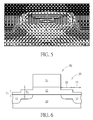
  • FIG. 5 is a SEM picture showing the shrunk photoresist on the conductive layer after the shrinking step, according to the present invention.
  • FIG. 7 is a SEM picture showing the conductive layer and the step profile obtained by the method according to the first embodiment of the present invention.
  • FIG. 8 is a SEM picture showing a magnified view of the step profile in FIG. 7 .
  • FIGS. 9 to 11 are schematic cross-sectional views illustrating a process of manufacturing a high-voltage transistor according to a second embodiment of the present invention.
  • FIGS. 1 to 4 and 6 are schematic cross-sectional views illustrating a process of manufacturing a high-voltage transistor according to a first embodiment of the present invention.
  • a substrate 10 is provided.
  • the substrate 10 may be a bulk silicon substrate, a germanium substrate, a gallium arsenide substrate, a silicon germanium substrate, an indium phosphide substrate, a gallium nitride substrate, a silicon carbide substrate, or a silicon on insulator (SOI) substrate.
  • a dielectric layer 12 and a conductive layer 14 are formed on the substrate 10 from bottom to top.
  • the dielectric layer 12 may be silicon nitride, silicon oxide or other insulating layer.
  • the conductive layer 14 may be doped polysilicon, metal or other conductive materials.
  • a photoresist 16 may be applied onto the conductive layer 14 .
  • the thickness of the photoresist 16 may be 4 to 5 micrometers, but the invention is not limited herein.
  • the thickness of the photoresist 16 can be adjusted duo to different product requirements.
  • the photoresist 16 may be patterned by using a photo mask 18 to form a patterned photoresist 16 ′ having a first width W 1 to cover part of the conductive layer 14 , and the other part of the conductive layer 14 is exposed.
  • the thickness of the patterned photoresist 16 ′ can be adjusted due to different product requirements.
  • a first patterning step is performed by taking the patterned photoresist 16 ′ as a mask.
  • the exposed part of the conductive layer 14 is removed and a first portion 22 of the dielectric layer 12 which is originally under the exposed conductive layer 14 is exposed.
  • the first patterning step continues to remove the first portion 22 of the dielectric layer 12 until the first portion 22 of the dielectric layer 12 has a first thickness T 1 .
  • the first patterning step may be an etch process.
  • N-type dopants or P-type dopants may be optionally ion-implanted in to the substrate 10 to form two lightly doped source/drains 24 in the substrate 10 at two sides of the conductive layer 14 respectively.
  • the implantation energy for N-type dopants such as phosphorous or arsenic is about 1 to 20 Kev, and dosage is about 1E11/cm 2 to 5E15/cm 2 .
  • the implant energy for P-type dopants such as boron is about 1 to 20 Kev, and dosage is about 1E11/cm 2 to 5E15/cm 2 .
  • the implantation dosage and energy herein are only for exemplary purposes. Based on different product requirements, the implantation dosage and energy can be adjusted.
  • the first thickness T 1 of the dielectric layer 12 is one of the parameters to control the depth of the lightly doped source/drain regions 24 .
  • the patterned photoresist 16 ′ is shrunk to forma shrunk photoresist 16 ′′ having a second width W 2 .
  • the shrinking step is accomplished by plasma.
  • the second width W 2 is smaller than the first width W 1
  • the thickness of the shrunk photoresist 16 ′′ is preferably 1 to 2 micrometers, but the invention is not limited herein.
  • the thickness of the shrunk photoresist 16 ′′ can be adjusted due to different product requirements.
  • part of the conductive layer 14 and the first portion 22 of the dielectric layer 12 are exposed through the shrunk photoresist 16 ′′.
  • FIG. 5 is a SEM picture showing the shrunk photoresist on the conductive layer after the shrinking step according to the present invention. The topmost layer is the shrunk photoresist, and the conductive layer is directly under the shrunk photoresist.
  • a second patterning step is performed to remove the exposed portion of the conductive layer 14 by taking the shrunk photoresist 16 ′′ as a mask.
  • the second patterning step is preferably performed by an etching step.
  • the first portion 22 of the dielectric layer 12 is also etched to a third thickness T 3 .
  • a second portion 28 of the dielectric layer 12 originally under the exposed portion of conductive layer 14 is exposed.
  • the second patterning step continues to remove the second portion 28 of the dielectric layer 12 until the second portion 28 of the dielectric layer 12 has a second thickness T 2 , which is larger than a third thickness T 3 .
  • the shrunk photoresist 16 ′′ is removed.
  • the first portion 22 of the dielectric layer 12 , the second portion 28 of the dielectric layer 12 and the dielectric layer 12 directly under the conductive layer 14 forms a step profile 30 .
  • the step profile 30 goes upwardly from the first portion 22 to the second portion 28 .
  • the dielectric layer 12 directly under the conductive layer 14 serves as a gate electric layer, and the conductive layer 14 serves as a gate.
  • the first portion 22 of the dielectric layer 12 extends from the second portion 28 of the dielectric layer 12 , and the second portion 28 is nearer to the conductive layer 14 than the first portion 22 .
  • N-type dopants or P-type dopants may be ion-implanted into the substrate 10 to form two source/drain regions 32 in the substrate 10 at two sides of the conductive layer 14 respectively.
  • the implant energy for N-type dopants such as phosphorous or arsenic is about 20 to 100 Kev, and dosage is about 1E13/cm 2 to 5E16/cm 2 .
  • the implant energy for P-type dopants such as boron is about 20 to 100 Kev, and dosage is about 1E13/cm 2 to 5E16/cm 2 .
  • the source/drain regions 32 will overlap with the lightly doped source/drain regions 24 .
  • the implantation dosage and energy herein are only for giving an example. Based on different product requirements, the implantation dosage and energy can be adjusted. Because the first portion and the second portion of the dielectric layer have different thicknesses, the depths of the dopants may vary corresponding to the different thicknesses. At this point, a high voltage device 50 such as a high voltage transistor is completed.
  • FIG. 7 is a SEM picture showing the conductive layer and the step profile obtained by the method according to the first embodiment of the present invention.
  • FIG. 8 is a SEM picture showing a magnified view of the step profile.
  • the high voltage device 50 is completed by using one photo mask 18 , and one photoresist layer 16 .
  • the width of the photoresist layer 16 is changed by the shrinking step so as to form the step profile 30 on the dielectric layer 12 .
  • FIGS. 1 , 6 , 9 , 10 and 11 are schematic cross-sectional views illustrating a process of manufacturing a high-voltage transistor according to a second embodiment of the present invention, wherein elements which are substantially the same as those in the first embodiment are denoted by the same reference numerals; an accompanying explanation is therefore omitted, and unless otherwise specified, elements denoted by the same reference numerals are formed by the same method as those in the first embodiment. Please refer to the corresponding paragraphs for details.
  • a substrate 10 is provided. Then a dielectric layer 12 , a conductive layer 14 and a photoresist layer 16 are formed on the substrate 10 from bottom to top. As shown in FIG. 9 , the photoresist layer 16 is patterned by utilizing a photo mask 118 and a first exposure energy to formed a patterned photoresist 116 having a third width W 3 to cover part of the conductive layer 14 , and the other part of the conductive layer 14 is exposed. As shown in FIG. 10 , a first patterning step is performed by taking the patterned photoresist 116 as a mask.
  • part of the conductive layer 14 is removed, and a first portion 22 of the dielectric layer 12 is etched to a first thickness T 1 .
  • the patterned photoresist 116 is removed.
  • two lightly doped source/drain regions 24 are optionally formed in the substrate 10 at two sides of the conductive layer 14 respectively.
  • another photoresist layer (not shown) is formed on the conductive layer 14 .
  • the photoresist layer is patterned to form a patterned photoresist layer 216 having a fourth width W 4 by using the aforesaid photo mask 118 accompanied with a second exposure energy.
  • the second exposure energy is different from the first exposure energy.
  • the second exposure energy is greater than the first exposure energy.
  • the fourth width W 4 of the patterned photoresist layer 216 is smaller than the third width W 3 patterned photoresist layer 116 .
  • a second patterning step is performed to remove part of the conductive layer 14 by taking the patterned photoresist 216 as a mask.
  • the first portion 22 of the dielectric layer 12 is also etched to a third thickness T 3 .
  • a second portion 28 of the dielectric layer 12 originally under the conductive layer 14 is exposed.
  • the second patterning step continues to remove the second portion 28 of the dielectric layer 12 until the second portion 28 of the dielectric layer 12 has a second thickness T 2 , which is larger than a third thickness T 3 .
  • the patterned photoresist 216 is removed.
  • the first portion 22 of the dielectric layer 12 , the second portion 28 of the dielectric layer 12 and the dielectric layer 12 directly under the conductive layer 14 forms a step profile 30 .
  • the first portion 22 of the dielectric layer 12 extends from the second portion 28 of the dielectric layer 12 , and the second portion 28 is nearer to the conductive layer 14 than the first portion 22 . Later, two source/drain regions 32 are formed in the substrate 10 at two sides of the conductive layer 14 respectively.
  • a high voltage device 50 such as a high voltage transistor is completed.
  • the high voltage device is completed by using one photo mask 118 , and two photoresist layers 116 / 216 .
  • the width of the photoresist layers 116 / 216 can be adjusted by the exposure energy.

Landscapes

  • Engineering & Computer Science (AREA)
  • Physics & Mathematics (AREA)
  • Condensed Matter Physics & Semiconductors (AREA)
  • General Physics & Mathematics (AREA)
  • Manufacturing & Machinery (AREA)
  • Computer Hardware Design (AREA)
  • Microelectronics & Electronic Packaging (AREA)
  • Power Engineering (AREA)
  • Thin Film Transistor (AREA)
  • Metal-Oxide And Bipolar Metal-Oxide Semiconductor Integrated Circuits (AREA)

Abstract

A method of fabricating a high voltage device includes the step of forming a patterned photoresist layer on a conductive layer and a dielectric below the conductive. The conductive layer and the dielectric layer are patterned by taking the patterned photoresist layer as a mask. Subsequently the patterned photoresist layer is shrunk. The conductive layer and the dielectric layer are then patterned by taking the shrunk photoresist layer as a mask.

Description

BACKGROUND OF THE INVENTION
1. Field of the Invention
The present invention relates to a method for fabricating a semiconductor device, and more particularly to a method for fabricating a high voltage transistor.
2. Description of the Prior Art
Every electrical device has a particular working voltage and frequency condition; therefore, electrical devices and related passive elements utilized in the electrical devices, such as inductors, capacitors, resistors and transformers, act as a switch to determine the value of the voltage and the type of current thereof. High voltage transistors may also function as switches and are broadly utilized in CPU power supplies, power management systems, AC/DC converters, LCD/plasma TV drivers, automobile electronic components, PC peripheral devices, small DC motor controllers, and other consumer electronic devices.
A high-voltage transistor may include a gate, a channel formed under the gate, source/drain regions formed on both sides of the channel, and a drift region for distributing an electric field applied to the source/drain regions at the time a device is driven.
In high voltage applications, the transistor is designed to withstand high voltages. Due to their structural design, however, a current leakage problem may occur through the gate dielectric layer.
SUMMARY OF THE INVENTION
In this regard, there is a need for a high voltage transistor with low current leakage. The high voltage transistor can be conventionally integrated using well known integrated device processes.
According to a first embodiment of the present invention, a method of fabricating a high voltage device includes the steps of providing a substrate having a dielectric layer, a conductive layer and a photoresist layer disposed on the substrate from bottom to top. The photoresist layer is patterned to form a patterned photoresist layer having a first width. Subsequently, a first patterning step is performed to pattern the conductive layer and the dielectric layer by taking the patterned photoresist layer as a first mask. Later, the first width of the patterned photoresist layer is shrunk to a second width. Thereafter, a second patterning step is performed to pattern the conductive layer and the dielectric layer by taking the shrunk photoresist layer as a second mask so as to form the dielectric layer into a step profile. Finally, the shrunk photoresist layer is removed.
According to a second embodiment of the present invention, a method of fabricating a high voltage device includes the steps of providing a substrate having a dielectric layer, a conductive layer and a first photoresist layer disposed on the substrate from bottom to top. The first photoresist layer is patterned to form a first patterned photoresist layer by utilizing a photo mask and a first exposure energy. After that, a first patterning step is performed to pattern the conductive layer and the dielectric layer by taking the first patterned photoresist layer as a first mask. Later, the first patterned photoresist layer is removed.
Subsequently, a second photoresist layer is formed on the conductive layer. The second photoresist layer is patterned to form a second patterned photoresist layer by utilizing the photo mask and a second exposure energy. Thereafter, a second patterning step is performed to pattern the conductive layer and the dielectric layer by taking the second patterned photoresist layer as a second mask so as to form the dielectric layer into a step profile. Finally, the second patterned photoresist layer is removed.
These and other objectives of the present invention will no doubt become obvious to those of ordinary skill in the art after reading the following detailed description of the preferred embodiment that is illustrated in the various figures and drawings.
BRIEF DESCRIPTION OF THE DRAWINGS
FIGS. 1 to 4 and 6 are schematic cross-sectional views illustrating a process of manufacturing a high-voltage transistor according to a first embodiment of the present invention.
FIG. 5 is a SEM picture showing the shrunk photoresist on the conductive layer after the shrinking step, according to the present invention.
FIG. 7 is a SEM picture showing the conductive layer and the step profile obtained by the method according to the first embodiment of the present invention.
FIG. 8 is a SEM picture showing a magnified view of the step profile in FIG. 7.
FIGS. 9 to 11 are schematic cross-sectional views illustrating a process of manufacturing a high-voltage transistor according to a second embodiment of the present invention.
DETAILED DESCRIPTION
FIGS. 1 to 4 and 6 are schematic cross-sectional views illustrating a process of manufacturing a high-voltage transistor according to a first embodiment of the present invention.
First, as illustrated in FIG. 1, a substrate 10 is provided. The substrate 10 may be a bulk silicon substrate, a germanium substrate, a gallium arsenide substrate, a silicon germanium substrate, an indium phosphide substrate, a gallium nitride substrate, a silicon carbide substrate, or a silicon on insulator (SOI) substrate. A dielectric layer 12 and a conductive layer 14 are formed on the substrate 10 from bottom to top. The dielectric layer 12 may be silicon nitride, silicon oxide or other insulating layer. The conductive layer 14 may be doped polysilicon, metal or other conductive materials.
A photoresist 16 may be applied onto the conductive layer 14. The thickness of the photoresist 16 may be 4 to 5 micrometers, but the invention is not limited herein. The thickness of the photoresist 16 can be adjusted duo to different product requirements. As shown in FIG. 2, the photoresist 16 may be patterned by using a photo mask 18 to form a patterned photoresist 16′ having a first width W1 to cover part of the conductive layer 14, and the other part of the conductive layer 14 is exposed. The thickness of the patterned photoresist 16′ can be adjusted due to different product requirements.
As shown in FIG. 3, a first patterning step is performed by taking the patterned photoresist 16′ as a mask. During the first patterning step, the exposed part of the conductive layer 14 is removed and a first portion 22 of the dielectric layer 12 which is originally under the exposed conductive layer 14 is exposed. The first patterning step continues to remove the first portion 22 of the dielectric layer 12 until the first portion 22 of the dielectric layer 12 has a first thickness T1. The first patterning step may be an etch process. Subsequently, N-type dopants or P-type dopants may be optionally ion-implanted in to the substrate 10 to form two lightly doped source/drains 24 in the substrate 10 at two sides of the conductive layer 14 respectively. The implantation energy for N-type dopants such as phosphorous or arsenic is about 1 to 20 Kev, and dosage is about 1E11/cm2 to 5E15/cm2. The implant energy for P-type dopants such as boron is about 1 to 20 Kev, and dosage is about 1E11/cm2 to 5E15/cm2. The implantation dosage and energy herein are only for exemplary purposes. Based on different product requirements, the implantation dosage and energy can be adjusted.
Because the dopants need to penetrate the first portion 22 of the dielectric layer 12 before entering the substrate 10, the first thickness T1 of the dielectric layer 12 is one of the parameters to control the depth of the lightly doped source/drain regions 24.
As shown in FIG. 4, the patterned photoresist 16′ is shrunk to forma shrunk photoresist 16″ having a second width W2. Preferably, the shrinking step is accomplished by plasma. The second width W2 is smaller than the first width W1, and the thickness of the shrunk photoresist 16″ is preferably 1 to 2 micrometers, but the invention is not limited herein. The thickness of the shrunk photoresist 16″ can be adjusted due to different product requirements. At this point, part of the conductive layer 14 and the first portion 22 of the dielectric layer 12 are exposed through the shrunk photoresist 16″. FIG. 5 is a SEM picture showing the shrunk photoresist on the conductive layer after the shrinking step according to the present invention. The topmost layer is the shrunk photoresist, and the conductive layer is directly under the shrunk photoresist.
As shown in FIG. 6, a second patterning step is performed to remove the exposed portion of the conductive layer 14 by taking the shrunk photoresist 16″ as a mask. The second patterning step is preferably performed by an etching step. During the removal of the exposed portion of the conductive layer 14, the first portion 22 of the dielectric layer 12 is also etched to a third thickness T3. Later, a second portion 28 of the dielectric layer 12 originally under the exposed portion of conductive layer 14 is exposed. The second patterning step continues to remove the second portion 28 of the dielectric layer 12 until the second portion 28 of the dielectric layer 12 has a second thickness T2, which is larger than a third thickness T3. Thereafter, the shrunk photoresist 16″ is removed. At this point, the first portion 22 of the dielectric layer 12, the second portion 28 of the dielectric layer 12 and the dielectric layer 12 directly under the conductive layer 14 forms a step profile 30. The step profile 30 goes upwardly from the first portion 22 to the second portion 28. The dielectric layer 12 directly under the conductive layer 14 serves as a gate electric layer, and the conductive layer 14 serves as a gate. The first portion 22 of the dielectric layer 12 extends from the second portion 28 of the dielectric layer 12, and the second portion 28 is nearer to the conductive layer 14 than the first portion 22. Finally, N-type dopants or P-type dopants may be ion-implanted into the substrate 10 to form two source/drain regions 32 in the substrate 10 at two sides of the conductive layer 14 respectively. The implant energy for N-type dopants such as phosphorous or arsenic is about 20 to 100 Kev, and dosage is about 1E13/cm2 to 5E16/cm2. The implant energy for P-type dopants such as boron is about 20 to 100 Kev, and dosage is about 1E13/cm2 to 5E16/cm2. The source/drain regions 32 will overlap with the lightly doped source/drain regions 24.
The implantation dosage and energy herein are only for giving an example. Based on different product requirements, the implantation dosage and energy can be adjusted. Because the first portion and the second portion of the dielectric layer have different thicknesses, the depths of the dopants may vary corresponding to the different thicknesses. At this point, a high voltage device 50 such as a high voltage transistor is completed.
FIG. 7 is a SEM picture showing the conductive layer and the step profile obtained by the method according to the first embodiment of the present invention. FIG. 8 is a SEM picture showing a magnified view of the step profile. According to the first embodiment of the present invention, the high voltage device 50 is completed by using one photo mask 18, and one photoresist layer 16. The width of the photoresist layer 16 is changed by the shrinking step so as to form the step profile 30 on the dielectric layer 12.
FIGS. 1, 6, 9, 10 and 11 are schematic cross-sectional views illustrating a process of manufacturing a high-voltage transistor according to a second embodiment of the present invention, wherein elements which are substantially the same as those in the first embodiment are denoted by the same reference numerals; an accompanying explanation is therefore omitted, and unless otherwise specified, elements denoted by the same reference numerals are formed by the same method as those in the first embodiment. Please refer to the corresponding paragraphs for details.
As shown in FIG. 1, a substrate 10 is provided. Then a dielectric layer 12, a conductive layer 14 and a photoresist layer 16 are formed on the substrate 10 from bottom to top. As shown in FIG. 9, the photoresist layer 16 is patterned by utilizing a photo mask 118 and a first exposure energy to formed a patterned photoresist 116 having a third width W3 to cover part of the conductive layer 14, and the other part of the conductive layer 14 is exposed. As shown in FIG. 10, a first patterning step is performed by taking the patterned photoresist 116 as a mask. After the first patterning step, part of the conductive layer 14 is removed, and a first portion 22 of the dielectric layer 12 is etched to a first thickness T1. Subsequently, the patterned photoresist 116 is removed. Thereafter, two lightly doped source/drain regions 24 are optionally formed in the substrate 10 at two sides of the conductive layer 14 respectively.
As shown in FIG. 11, another photoresist layer (not shown) is formed on the conductive layer 14. The photoresist layer is patterned to form a patterned photoresist layer 216 having a fourth width W4 by using the aforesaid photo mask 118 accompanied with a second exposure energy. The second exposure energy is different from the first exposure energy. Preferably the second exposure energy is greater than the first exposure energy. Moreover, the fourth width W4 of the patterned photoresist layer 216 is smaller than the third width W3 patterned photoresist layer 116. As shown in FIG. 6, a second patterning step is performed to remove part of the conductive layer 14 by taking the patterned photoresist 216 as a mask. During the removal of the exposed portion of the conductive layer 14, the first portion 22 of the dielectric layer 12 is also etched to a third thickness T3. Later, a second portion 28 of the dielectric layer 12 originally under the conductive layer 14 is exposed. The second patterning step continues to remove the second portion 28 of the dielectric layer 12 until the second portion 28 of the dielectric layer 12 has a second thickness T2, which is larger than a third thickness T3. Thereafter, the patterned photoresist 216 is removed. At this point, the first portion 22 of the dielectric layer 12, the second portion 28 of the dielectric layer 12 and the dielectric layer 12 directly under the conductive layer 14 forms a step profile 30. The first portion 22 of the dielectric layer 12 extends from the second portion 28 of the dielectric layer 12, and the second portion 28 is nearer to the conductive layer 14 than the first portion 22. Later, two source/drain regions 32 are formed in the substrate 10 at two sides of the conductive layer 14 respectively. At this point, a high voltage device 50 such as a high voltage transistor is completed. According to the second embodiment of the present invention, the high voltage device is completed by using one photo mask 118, and two photoresist layers 116/216. The width of the photoresist layers 116/216 can be adjusted by the exposure energy.
Those skilled in the art will readily observe that numerous modifications and alterations of the device and method may be made while retaining the teachings of the invention. Accordingly, the above disclosure should be construed as limited only by the metes and bounds of the appended claims.

Claims (8)

What is claimed is:
1. A method of fabricating a high voltage device, comprising:
providing a substrate having a dielectric layer, a conductive layer and a photoresist layer disposed on the substrate from bottom to top;
patterning the photoresist layer to form a patterned photoresist layer having a first width;
performing a first patterning step to pattern the conductive layer and the dielectric layer by taking the patterned photoresist layer as a first mask;
forming two lightly doped source/drain regions in the substrate at two sides of the conductive layer by implanting dopants into the substrate, and wherein dopants penetrate the dielectric layer before entering the substrate;
after forming the lightly doped source/drain regions, shrinking the first width of the patterned photoresist layer to a second width;
performing a second patterning step to pattern the conductive layer and the dielectric layer by taking the shrunk photoresist layer as a second mask so as to form the dielectric layer into a step profile; and
removing the shrunk photoresist layer.
2. The method of fabricating a high voltage device claim 1, further comprising:
after removing the shrunk photoresist layer, forming two source/drain regions in the substrate at two sides of the conductive layer.
3. The method of fabricating a high voltage device claim 1, wherein the shrinking step is performed by using plasma.
4. The method of fabricating a high voltage device claim 1, wherein the step profile comprises a second portion of the dielectric layer adjacent to the conductive layer and a first portion of the dielectric layer extending from the second portion, and the second portion has a second thickness greater than a third thickness of the first portion.
5. The method of fabricating a high voltage device claim 1, wherein the second width is smaller than the first width.
6. The method of fabricating a high voltage device claim 1, wherein during the first patterning step, part of the conductive layer is removed and a first portion of the dielectric layer is etched to a first thickness.
7. The method of fabricating a high voltage device claim 1, wherein during the second patterning step, another part of the conductive layer is removed, a second portion of the dielectric layer is etched to a second thickness, and the first portion is etched to a third thickness, wherein the second thickness is larger than the third thickness.
8. The method of fabricating a high voltage device claim 7, wherein the second portion is nearer to the conductive layer than the first portion.
US13/918,993 2013-06-17 2013-06-17 Method of fabricating high voltage device Active 2033-07-04 US9153454B2 (en)

Priority Applications (1)

Application Number Priority Date Filing Date Title
US13/918,993 US9153454B2 (en) 2013-06-17 2013-06-17 Method of fabricating high voltage device

Applications Claiming Priority (1)

Application Number Priority Date Filing Date Title
US13/918,993 US9153454B2 (en) 2013-06-17 2013-06-17 Method of fabricating high voltage device

Publications (2)

Publication Number Publication Date
US20140370680A1 US20140370680A1 (en) 2014-12-18
US9153454B2 true US9153454B2 (en) 2015-10-06

Family

ID=52019565

Family Applications (1)

Application Number Title Priority Date Filing Date
US13/918,993 Active 2033-07-04 US9153454B2 (en) 2013-06-17 2013-06-17 Method of fabricating high voltage device

Country Status (1)

Country Link
US (1) US9153454B2 (en)

Families Citing this family (3)

* Cited by examiner, † Cited by third party
Publication number Priority date Publication date Assignee Title
FR3069376B1 (en) 2017-07-21 2020-07-03 Stmicroelectronics (Rousset) Sas TRANSISTOR INCLUDING AN ENLARGED GRID
FR3069377B1 (en) * 2017-07-21 2020-07-03 Stmicroelectronics (Rousset) Sas DOUBLE GRID BLOCK MOS TRANSISTOR WITH INCREASED BREAKDOWN VOLTAGE
FR3069374B1 (en) 2017-07-21 2020-01-17 Stmicroelectronics (Rousset) Sas REDUCED BOSS EFFECT MOS TRANSISTOR

Citations (2)

* Cited by examiner, † Cited by third party
Publication number Priority date Publication date Assignee Title
US20030104670A1 (en) * 2001-12-05 2003-06-05 Yi-Ting Wu Method for fabricating buried bit lines of a mask rom
US20130029490A1 (en) * 2011-07-25 2013-01-31 Kyeong Tae Lee High lateral to vertical ratio etch process for device manufacturing

Patent Citations (2)

* Cited by examiner, † Cited by third party
Publication number Priority date Publication date Assignee Title
US20030104670A1 (en) * 2001-12-05 2003-06-05 Yi-Ting Wu Method for fabricating buried bit lines of a mask rom
US20130029490A1 (en) * 2011-07-25 2013-01-31 Kyeong Tae Lee High lateral to vertical ratio etch process for device manufacturing

Also Published As

Publication number Publication date
US20140370680A1 (en) 2014-12-18

Similar Documents

Publication Publication Date Title
US10204996B2 (en) Metal-oxide-semiconductor transistor and method of forming gate layout
US7767546B1 (en) Low cost fabrication of double box back gate silicon-on-insulator wafers with built-in shallow trench isolation in back gate layer
TWI515904B (en) Semiconductor device, fin field effect transistor device and method of manufacturing same
US7361534B2 (en) Method for fabricating SOI device
US9859399B2 (en) Lateral diffused semiconductor device with ring field plate
US9099321B2 (en) Method for fabricating power semiconductor device
TW201515070A (en) Semiconductor component and method of manufacturing same
CN104979390A (en) High voltage metal oxide semiconductor transistor and manufacturing method thereof
US9502564B2 (en) Fully depleted device with buried insulating layer in channel region
KR101531882B1 (en) Semiconductor device and manufacturing method thereof
KR20160149167A (en) Method for manufacturing a high-resistivity semiconductor-on-insulator substrate
KR102449211B1 (en) Semiconductor devices including field effect transistors
US8502326B2 (en) Gate dielectric formation for high-voltage MOS devices
KR102228655B1 (en) High-voltage integrated device and method of fabricating the same
US7867862B2 (en) Semiconductor structure including high voltage device
US9153454B2 (en) Method of fabricating high voltage device
US20150137230A1 (en) Laterally diffused metal oxide semiconductor and manufacturing method thereof
US9093554B2 (en) Methods of forming semiconductor devices with embedded semiconductor material as source/drain regions using a reduced number of spacers
US20110049625A1 (en) Asymmetrical transistor device and method of fabrication
US8716799B2 (en) Mosfet
US9806150B2 (en) High voltage device and method of fabricating the same
KR20160030074A (en) Method to fabricate self-aligned isolation in gallium nitride devices and integrated circuits
US9553143B2 (en) Semiconductor device and method for fabricating the same
US20150035067A1 (en) Low rdson device and method of manufacturing the same
US7927952B2 (en) Method of manufacturing semiconductor devices

Legal Events

Date Code Title Description
AS Assignment

Owner name: UNITED MICROELECTRONICS CORP., TAIWAN

Free format text: ASSIGNMENT OF ASSIGNORS INTEREST;ASSIGNORS:CHEN, YI-HAO;LEE, WEN-YU;LIU, HSIAO-WEN;AND OTHERS;REEL/FRAME:030620/0181

Effective date: 20130610

STCF Information on status: patent grant

Free format text: PATENTED CASE

MAFP Maintenance fee payment

Free format text: PAYMENT OF MAINTENANCE FEE, 4TH YEAR, LARGE ENTITY (ORIGINAL EVENT CODE: M1551); ENTITY STATUS OF PATENT OWNER: LARGE ENTITY

Year of fee payment: 4

MAFP Maintenance fee payment

Free format text: PAYMENT OF MAINTENANCE FEE, 8TH YEAR, LARGE ENTITY (ORIGINAL EVENT CODE: M1552); ENTITY STATUS OF PATENT OWNER: LARGE ENTITY

Year of fee payment: 8