US9141480B2 - Handling failed transaction peers in a distributed hash table - Google Patents
Handling failed transaction peers in a distributed hash table Download PDFInfo
- Publication number
- US9141480B2 US9141480B2 US14/035,913 US201314035913A US9141480B2 US 9141480 B2 US9141480 B2 US 9141480B2 US 201314035913 A US201314035913 A US 201314035913A US 9141480 B2 US9141480 B2 US 9141480B2
- Authority
- US
- United States
- Prior art keywords
- storage node
- storage
- request
- nodes
- node
- Prior art date
- Legal status (The legal status is an assumption and is not a legal conclusion. Google has not performed a legal analysis and makes no representation as to the accuracy of the status listed.)
- Active, expires
Links
Images



Classifications
-
- G—PHYSICS
- G06—COMPUTING OR CALCULATING; COUNTING
- G06F—ELECTRIC DIGITAL DATA PROCESSING
- G06F11/00—Error detection; Error correction; Monitoring
- G06F11/07—Responding to the occurrence of a fault, e.g. fault tolerance
- G06F11/14—Error detection or correction of the data by redundancy in operations
- G06F11/1402—Saving, restoring, recovering or retrying
- G06F11/1405—Saving, restoring, recovering or retrying at machine instruction level
- G06F11/141—Saving, restoring, recovering or retrying at machine instruction level for bus or memory accesses
-
- G06F11/1412—
-
- G—PHYSICS
- G06—COMPUTING OR CALCULATING; COUNTING
- G06F—ELECTRIC DIGITAL DATA PROCESSING
- G06F11/00—Error detection; Error correction; Monitoring
- G06F11/07—Responding to the occurrence of a fault, e.g. fault tolerance
- G06F11/14—Error detection or correction of the data by redundancy in operations
- G06F11/1402—Saving, restoring, recovering or retrying
- G06F11/1415—Saving, restoring, recovering or retrying at system level
- G06F11/142—Reconfiguring to eliminate the error
- G06F11/1425—Reconfiguring to eliminate the error by reconfiguration of node membership
-
- G—PHYSICS
- G06—COMPUTING OR CALCULATING; COUNTING
- G06F—ELECTRIC DIGITAL DATA PROCESSING
- G06F11/00—Error detection; Error correction; Monitoring
- G06F11/07—Responding to the occurrence of a fault, e.g. fault tolerance
- G06F11/0703—Error or fault processing not based on redundancy, i.e. by taking additional measures to deal with the error or fault not making use of redundancy in operation, in hardware, or in data representation
- G06F11/0706—Error or fault processing not based on redundancy, i.e. by taking additional measures to deal with the error or fault not making use of redundancy in operation, in hardware, or in data representation the processing taking place on a specific hardware platform or in a specific software environment
- G06F11/0709—Error or fault processing not based on redundancy, i.e. by taking additional measures to deal with the error or fault not making use of redundancy in operation, in hardware, or in data representation the processing taking place on a specific hardware platform or in a specific software environment in a distributed system consisting of a plurality of standalone computer nodes, e.g. clusters, client-server systems
-
- G—PHYSICS
- G06—COMPUTING OR CALCULATING; COUNTING
- G06F—ELECTRIC DIGITAL DATA PROCESSING
- G06F11/00—Error detection; Error correction; Monitoring
- G06F11/30—Monitoring
- G06F11/3003—Monitoring arrangements specially adapted to the computing system or computing system component being monitored
- G06F11/3006—Monitoring arrangements specially adapted to the computing system or computing system component being monitored where the computing system is distributed, e.g. networked systems, clusters, multiprocessor systems
-
- G—PHYSICS
- G06—COMPUTING OR CALCULATING; COUNTING
- G06F—ELECTRIC DIGITAL DATA PROCESSING
- G06F16/00—Information retrieval; Database structures therefor; File system structures therefor
- G06F16/10—File systems; File servers
- G06F16/13—File access structures, e.g. distributed indices
- G06F16/137—Hash-based
-
- G06F17/30097—
-
- G—PHYSICS
- G06—COMPUTING OR CALCULATING; COUNTING
- G06F—ELECTRIC DIGITAL DATA PROCESSING
- G06F11/00—Error detection; Error correction; Monitoring
- G06F11/07—Responding to the occurrence of a fault, e.g. fault tolerance
- G06F11/16—Error detection or correction of the data by redundancy in hardware
- G06F11/1658—Data re-synchronization of a redundant component, or initial sync of replacement, additional or spare unit
- G06F11/1662—Data re-synchronization of a redundant component, or initial sync of replacement, additional or spare unit the resynchronized component or unit being a persistent storage device
Definitions
- This disclosure relates to data stored in a data storage system and an improved architecture and method for storing data to and retrieving data from a data storage system made up of a large number of nodes and reliant upon a distributed hash table.
- a file system is used to store and organize computer data stored as electronic files.
- File systems allow files to be found, read, deleted, and otherwise accessed.
- File systems store files on one or more storage devices.
- File systems store files on storage media such as hard disk drives and solid-state storage devices.
- Various applications may store large numbers of documents, images, audio, videos and other data as objects using a distributed data storage system in which data is stored in multiple locations.
- DHT Distributed hash tables
- a hashing function is used to point the request to a particular location (or locations) within the group of servers.
- prior art systems have enforced a blocking system in which data elements may not be written to when others are in the process of accessing those data elements.
- the DHT may point a request to a non-existent server within the group of servers.
- the pointers or other references must be updated once a determination is made that a server has failed.
- CHORD and ETNA DHT systems maintain a so-called key successor relationship with one other server local to that server.
- the key successor server typically within one Internet “hop” away, fills the gap and is the next server looked-to by the system when using the CHORD or ETNA DHT.
- This approach has the unfortunate result of failing when a portion of the network serving the server and its key successor server goes down. While the servers may both have the appropriate data sets, they are inaccessible. Other portions of the network of the group of servers, if available, must be accessed in order to find the data sets.
- utilizing a key successor relationship results in placing the rectification load on the single key successor rather than distributing the load associated with rectification throughout the system.
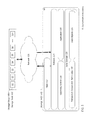
- FIG. 1 is a block diagram of a series of storage nodes in a network.
- FIG. 2 is an abstraction of a jumbo transaction group S.
- FIG. 3 is an abstraction of a plurality of jumbo transaction group tables S through S Max.
- FIG. 4 is an abstraction of a transaction group matrix gathered by a single node.
- FIG. 5 is a flow chart of a method of storage node removal of non-responsive members of a group of servers.
- One elegant solution for maintaining a large data set in a distributed way is to distribute the data according to a distributed hash table.
- a hashing algorithm or similar “hash” is applied to any read, write, or other access request for data stored in the DHT system. This hash will point the request to the right portion of the distributed data and enable read, write and other requests to take place in an orderly fashion.
- Such a distributed hash table system is described in earlier filed co-pending patent application Ser. No. 14/028,292.
- the system described herein requires that writes be completed in the order they were requested and requires that each write request of the same data set occur at substantially the same time for a group of nodes. This has numerous benefits, including ensuring data integrity and ensuring that subsequent write requests for a data item only overwrite older data. Ensuring that write requests only proceed in order also enables the servers to collectively and quickly determine when one or more servers are non-responsive, to quickly remove non-responsive servers, to determine the location of additional copies of the data stored on non-responsive servers, to perform data rectification, and to perform the hashing necessary to identify the new location of data previously on the now-removed server.
- FIG. 1 is a block diagram of a series of storage nodes in a network.
- the nodes S 0 110 , S 1 102 through Sm, of which only S 0 110 and S 1 102 are labeled, may make up a storage group 100 .
- These storage nodes S 0 110 , S 1 102 and all those making up storage group 100 may be server computers with central processing units, memory, non-volatile storage, network connectivity and various input and output systems.
- the storage group 100 may be interconnected by a network, such as network 130 .
- Data is written to the network from other nodes, such as storage node S 0 110 through a hash 112 .
- This hash 112 may be or include an algorithm, a seed, or any other form of data that may be used to derive the location of a particular data object within the DHT system. All or a portion of the “hash” may be stored on each storage node, as necessary.
- a “data object,” as used herein means data stored within the DHT system in the form of files, file fragments, raw binary data and data in various other forms.
- a “request” as used herein means an attempted access of a data object. A request may be, for example, an attempt to write or an attempt to read a data object.
- Nodes may interact with storage node 110 through a network adaptor 114 .
- An operating system 116 and application layer 118 may also be present on each node.
- Data storage 120 may store transaction groups and matrix data 112 (discussed below) along with data objects 124 .
- FIG. 2 is an abstraction of a jumbo transaction group (JTG) S 200 .
- a jumbo transaction group such as jumbo transaction group S 200 , is a plurality of batched operations designated for a plurality of storage node peers—for example, other storage nodes within a storage group 100 .
- the word “peer” within this patent refers to storage nodes within a particular storage node's storage group or jumbo transaction group.
- FIG. 2 is an abstraction of the jumbo transaction group batching process in table form for illustrative purposes.
- Jumbo transaction groups may be used, for example, to batch a series of data object requests together so that a given storage node may make requests of its peer storage nodes in groups, rather than as each request comes into the storage node. In this way, the volume of data traffic across all of the storage nodes can be minimized, while ensuring that the traffic that does occur is substantive. This helps to avoid situations in which the network is flooded with millions of requests to access, read or write tiny amounts of data (bytes or kilobytes).
- the JTG group S 200 includes columns dedicated to each of a plurality of storage nodes involved n the JTG.
- the total number of storage nodes involved in a given JTG may vary from one to many. A typical scenario involves more than five.
- the rows of the JTG group S 200 are demonstrative of a two-stage commit protocol for transactions amongst the storage nodes.
- the first stage is made up of a “filled” request, a “delivered” request, and a “delivery acknowledgement” “Filled” means that the group of requests has been filled to capacity and is ready for the JTG to begin the delivery process.
- Delivery means that the request has been sent to the appropriate storage node.
- Delivery acknowledgement means that the request has been acknowledged, in a manner similar to a TCP/IP “ACK”, by the intended recipient storage node.
- the final stage is made up of a “commit” and a “commit acknowledge.”
- the “commit” is a command to fulfill the request, for example to write it to the storage node(s).
- the “commit acknowledge” is a response that the request has been completed.
- peer 0 202 appears to have completed all processes up to the “commit acknowledge” stage. All other peers, except for peer 3 204 , have completed the process up to this stage. Because peer 3 204 has not yet responded, this may be indicative that peer 3 204 is non-responsive. This may be seen in block 206 which, for purposes of illustration, is unfilled. Situations where a storage node is non-responsive must be dealt with quickly in order to ensure that other JTG processes can continue. Until peer 3 204 responds, this JTG will not be able to complete, leaving the “commit acknowledge” phases to be completed.
- FIG. 3 an abstraction of a plurality of jumbo transaction groups S through S Max is shown.
- a given storage node is only allotted a pre-determined number of open JTGs.
- JTGs must be completed in the order in which they were requested. This, among other things, ensures that older data is written before newer data and that newer data always overwrites older data. It also enables discovery of non-responsive storage nodes.
- FIG. 3 shows the JTGs subsequent to the one shown in FIG. 2 .
- Jumbo transaction group S 300 may be the same as JTG S 204 shown in FIG. 2 . As can be seen, block 306 is not filled in, indicating that peer 3 has not yet responded with a “commit acknowledge.” Similarly, subsequent JTGs, such as JTG Max 310 have not proceeded beyond a “filed” status with regard to peer 3 . This may be seen by an unfilled portion of the JTG Max 310 in block 314 .
- This predetermined maximum number of uncompleted JTGs may be called a “pool” or “JTG pool.”
- a storage node's exhaustion of the JTG pool may be referred to as a “live lock” scenario.
- a “live lock” scenario he storage node is still functioning, but cannot proceed because at least one other storage node has stopped responding to its requests.
- FIG. 4 an abstraction of a transaction group matrix 400 gathered by a single storage node is shown.
- the matrix includes source 402 nodes and target 404 nodes.
- Each JTG includes a transaction identification number that is generated by a monotonic logical clock, relative to every earlier transaction by a given storage node. Because of the interdependence of the storage nodes, the logical clocks for each of the storage nodes are typically in close numerical proximity to one another.
- the transaction group matrix 400 is a table generated through interactions with and, in some cases, a request to obtain, the logical clock data associated with each of the peer storage nodes with which the storage node that generated the matrix 400 is in communication. Whatever the source of the logical clock data, it is represented with respect to each node and that node's communication with other nodes. For example, node n's last communication (at 406 in FIG. 4 ) to node 0 bore a logical timestamp of 587 indicating, in this example, that the communication was the 587 th communication originating from node n.
- the diamonds in FIG. 4 represent committed transactions, while the circles represent acknowledged transactions. Communications shown as from node 0 to node 0 , for example, are the last transaction identification associated with a commit operation on node 0 .
- Transaction group matrix 400 may be generated by a storage node, for example, when the storage node is presented with a “live lock” scenario in which it has exhausted all available outstanding JTGs and is unable to continue processing requests.
- the matrix 400 shows that the last commit was up to 100 requested transactions ago, bearing a logical timestamp from 499 to 512 , while the acknowledged transactions vary in timestamp from 482 to 610 . Accordingly, it is likely that sometime around the 499 to 512 transaction identification, that the “live lock” scenario began.
- FIG. 5 a flow chart of a method of storage node removal of non-responsive members of a group of servers is shown.
- the process has a start 505 and an end 595 but may be cyclical.
- more than one instance of the process on one or more storage nodes may simultaneously be at various stages.
- the first storage node makes a request to another storage node at 510 .
- This request may be a part of a JTG, such as JTG S 200 of FIG. 2 , in which a plurality of requests are being made to multiple storage nodes at once. Many requests may be made to any number of storage nodes from the first storage node. One of the requests made by the first storage node to another storage node at 510 may result in no response from the other storage node.
- the first storage node halts responses 520 .
- the time necessary to exhaust a pool of available JTGs is variable dependent upon the pool of JTGs available and the speed at which the overall storage system is making requests of one another. During that time, the first storage node continues to respond to later requests. Because the logical clock is monotonic, these later requests bear transaction identification numbers that are all later than that involving the node that has failed to respond.
- any node determines that it is in a “live lock” situation at 535 in which all JTGs are exhausted and in which at least one storage node has failed to respond to an outstanding request, it will enter a service mode at 540 in order to resolve the situation.
- a storage node determines that it is not in “live lock” it will continue to make requests, including requests involving the first storage node 530 until it does reach a “live lock” situation.
- a storage node may request data sufficient to fill a transaction group matrix, such as the transaction group matrix 400 of FIG. 4 . Because the requests (such as the JTGs in this case) are each labeled with a logical clock timestamp, the oldest, pending request may be ascertained. For example, in FIG. 4 , the oldest request associated with node 1 involves node 3 because it has a logical timestamp of 512 . Similarly, the oldest request associated with node 4 also involves node 3 because it bears a logical timestamp of 511 .
- the storage nodes may, then, begin the process of removal of the non-responsive storage node. Before a removal vote can occur, the storage nodes determine collectively that removal is possible at 555 . If removal is not possible, the process ends without removal of the non-responsive node.
- rules regarding the status of other servers may require that there be adequate replication available in the storage group to compensate for the loss of a particular storage node.
- One example of such a rule is a requirement that the vote to remove must exceed the total number of available storage nodes minus the number of failed storage nodes from which recovery of the storage group is possible. For example, if there were a total of 1000 storage nodes currently available, one has failed, and recovery is possible if 500 nodes are still functioning, removal is possible. Similarly, the vote necessary to remove must exceed the total number of nodes necessary to effect a recover or, in this example, 500 nodes. If there are currently only 400 functioning nodes under the same scenario, removal is not possible.
- one of the nodes requests a removal vote to request removal of the node with the oldest timestamp from the storage group at 560 .
- the requesting storage node is most likely the first storage node that experienced the “live lock” situation, but may be any of the nodes. This request, utilizing communication protocols outside of the JTG process will take place across all nodes.
- Those nodes that are also experiencing a “live lock” situation gather the same transaction group matrix 400 and vote accordingly. If the storage node that is the subject of the vote appears to be the source of the “live lock” for those nodes, the nodes will vote to approve the removal of the target storage node from the storage group. When the nodes are unable to determine the source of the “live lock” or when they are not yet in a “live lock” situation; they may vote not to remove the target storage node. If the vote is unsuccessful at 565 , the process returns to an evaluation of whether the removal is possible at 555 , and the process will continue with subsequent removal votes likely once other storage nodes have been effected.
- the target node will be removed from the storage group at 570 .
- the storage group replicates the data that was stored on that storage node within the remainder of the storage group at 580 .
- This process requires the next highest ranked storage node to oversee the replication of each data portion to a still higher ranked server.
- storage nodes are ranked through the use of the hash key for priority for each data object. So, for each data object, a successor list is automatically generated.
- the storage nodes ranked either above or below that storage node for a given data object receive a copy of that data object to as to maintain a set level of redundancy. Requests for a data object are given, using the hash key, to the available storage node with the highest priority.
- the next-highest priority node for that data object is identified automatically through the use of the hash key.
- This ranking for a given data object though not maintained as an explicit table or listing, but reliant upon the operation of the hash key, may be called a successor list.
- a storage node with a ranking of priority ⁇ 1 in the existing successor list relative to a data object in the now-removed node would bear responsibility to copy the data object to the priority +1 in the successor list.
- Subsequent requests made for the data object will be directed, by operation of the hash key, to other storage nodes in the successor list. So, when incoming requests determine that the now-removed node has been removed, the hash key will refer those requests to other storage nodes in the successor list priority +/ ⁇ 1 to obtain the data object. Earlier requests that refer to the now-removed storage node will timeout and be re-requested. The new requests will refer to one of the successor nodes. All requests made to the now-removed node are handled similarly.
- the server exits service mode at 590 .
- Any potential data object access conflicts may be resolved using the transaction identification numbers by relying on the higher numbers as relating to more-recent data. All outstanding requests that were pending before the beginning of service mode may be re-requested or the pending JTGs may be handled in the order they were previously entered with the successor storage node standing in for the now-removed storage node.
- the process ends at 595 .
- a “set” of items may include one or more of such items.
Landscapes
- Engineering & Computer Science (AREA)
- Theoretical Computer Science (AREA)
- Physics & Mathematics (AREA)
- General Engineering & Computer Science (AREA)
- General Physics & Mathematics (AREA)
- Quality & Reliability (AREA)
- Computing Systems (AREA)
- Data Mining & Analysis (AREA)
- Databases & Information Systems (AREA)
- Mathematical Physics (AREA)
- Computer Hardware Design (AREA)
- Information Retrieval, Db Structures And Fs Structures Therefor (AREA)
Abstract
Description
Claims (18)
Priority Applications (1)
| Application Number | Priority Date | Filing Date | Title |
|---|---|---|---|
| US14/035,913 US9141480B2 (en) | 2012-10-17 | 2013-09-24 | Handling failed transaction peers in a distributed hash table |
Applications Claiming Priority (2)
| Application Number | Priority Date | Filing Date | Title |
|---|---|---|---|
| US201261715242P | 2012-10-17 | 2012-10-17 | |
| US14/035,913 US9141480B2 (en) | 2012-10-17 | 2013-09-24 | Handling failed transaction peers in a distributed hash table |
Publications (2)
| Publication Number | Publication Date |
|---|---|
| US20140108863A1 US20140108863A1 (en) | 2014-04-17 |
| US9141480B2 true US9141480B2 (en) | 2015-09-22 |
Family
ID=50476572
Family Applications (1)
| Application Number | Title | Priority Date | Filing Date |
|---|---|---|---|
| US14/035,913 Active 2034-03-09 US9141480B2 (en) | 2012-10-17 | 2013-09-24 | Handling failed transaction peers in a distributed hash table |
Country Status (1)
| Country | Link |
|---|---|
| US (1) | US9141480B2 (en) |
Cited By (1)
| Publication number | Priority date | Publication date | Assignee | Title |
|---|---|---|---|---|
| US10341347B1 (en) * | 2015-12-30 | 2019-07-02 | Terdata US, Inc. | Non-responsive node activity avoidance in a network storage system |
Families Citing this family (15)
| Publication number | Priority date | Publication date | Assignee | Title |
|---|---|---|---|---|
| US8671265B2 (en) | 2010-03-05 | 2014-03-11 | Solidfire, Inc. | Distributed data storage system providing de-duplication of data using block identifiers |
| US9054992B2 (en) | 2011-12-27 | 2015-06-09 | Solidfire, Inc. | Quality of service policy sets |
| US9838269B2 (en) | 2011-12-27 | 2017-12-05 | Netapp, Inc. | Proportional quality of service based on client usage and system metrics |
| US9697226B1 (en) * | 2013-06-28 | 2017-07-04 | Sanmina Corporation | Network system to distribute chunks across multiple physical nodes |
| US20150006846A1 (en) | 2013-06-28 | 2015-01-01 | Saratoga Speed, Inc. | Network system to distribute chunks across multiple physical nodes with disk support for object storage |
| US20150244795A1 (en) | 2014-02-21 | 2015-08-27 | Solidfire, Inc. | Data syncing in a distributed system |
| JP2016057876A (en) * | 2014-09-10 | 2016-04-21 | 富士通株式会社 | Information processing apparatus, input / output control program, and input / output control method |
| US9477551B1 (en) | 2014-12-01 | 2016-10-25 | Datadirect Networks, Inc. | Method and system for data migration between high performance computing architectures and file system using distributed parity group information structures with non-deterministic data addressing |
| US9378088B1 (en) | 2014-12-30 | 2016-06-28 | Datadirect Networks, Inc. | Method and system for reclamation of distributed dynamically generated erasure groups for data migration between high performance computing architectures and data storage using non-deterministic data addressing |
| US20160328162A1 (en) * | 2015-05-07 | 2016-11-10 | Pure Storage, Inc. | Logical arrays running on physical hardware where reserve physical capacity is available |
| US9959062B1 (en) | 2016-02-05 | 2018-05-01 | Datadirect Networks, Inc. | Low latency and reduced overhead data storage system and method for sharing multiple storage devices by high performance computing architectures |
| US10929022B2 (en) | 2016-04-25 | 2021-02-23 | Netapp. Inc. | Space savings reporting for storage system supporting snapshot and clones |
| US10642763B2 (en) | 2016-09-20 | 2020-05-05 | Netapp, Inc. | Quality of service policy sets |
| KR20220058918A (en) | 2019-08-30 | 2022-05-10 | 아우리스 헬스, 인코포레이티드 | Instrument image reliability system and method |
| CN120494470B (en) * | 2025-07-17 | 2025-09-16 | 江苏零浩网络科技有限公司 | Dynamic process processing method and system based on multi-module collaboration in smart logistics scenarios |
Citations (2)
| Publication number | Priority date | Publication date | Assignee | Title |
|---|---|---|---|---|
| US20130031414A1 (en) * | 2011-07-27 | 2013-01-31 | Cleversafe, Inc. | Identifying an error cause within a dispersed storage network |
| US20130325820A1 (en) * | 2010-11-01 | 2013-12-05 | Cleversafe, Inc. | Verifying data integrity utilizing dispersed storage |
-
2013
- 2013-09-24 US US14/035,913 patent/US9141480B2/en active Active
Patent Citations (2)
| Publication number | Priority date | Publication date | Assignee | Title |
|---|---|---|---|---|
| US20130325820A1 (en) * | 2010-11-01 | 2013-12-05 | Cleversafe, Inc. | Verifying data integrity utilizing dispersed storage |
| US20130031414A1 (en) * | 2011-07-27 | 2013-01-31 | Cleversafe, Inc. | Identifying an error cause within a dispersed storage network |
Non-Patent Citations (2)
| Title |
|---|
| Muthitacharoen et al., Etna: a Fault-tolerant Algorithm for Atomic Mutable DHT Data, Journal, MIT Computer Science and ArtiPcial Intelligence Laboratory, Issued Jun. 15, 2005. http://hdl.handle.net/1721.1/30555, pp. 1-10. |
| Stoica et al., Chord: A Scalable Peer-to-peer Lookup Service for Internet Applications, Journal, http://pdos.csail.mit.edu/papers/chord:sigcomm01/chord-sigcomm.pdf, accessed Sep. 24, 2013, pp. 1-12. |
Cited By (1)
| Publication number | Priority date | Publication date | Assignee | Title |
|---|---|---|---|---|
| US10341347B1 (en) * | 2015-12-30 | 2019-07-02 | Terdata US, Inc. | Non-responsive node activity avoidance in a network storage system |
Also Published As
| Publication number | Publication date |
|---|---|
| US20140108863A1 (en) | 2014-04-17 |
Similar Documents
| Publication | Publication Date | Title |
|---|---|---|
| US20140108863A1 (en) | Handling failed transaction peers in a distributed hash table | |
| US8090683B2 (en) | Managing workflow communication in a distributed storage system | |
| US9152649B2 (en) | Maintaining order and fault-tolerance in a distributed hash table system | |
| US7840536B1 (en) | Methods and apparatus for dynamic journal expansion | |
| US8301589B2 (en) | System and method for assignment of unique identifiers in a distributed environment | |
| US9047331B2 (en) | Scalable row-store with consensus-based replication | |
| RU2208834C2 (en) | Method and system for recovery of database integrity in system of bitslice databases without resource sharing using shared virtual discs and automated data medium for them | |
| EP4213038A1 (en) | Data processing method and apparatus based on distributed storage, device, and medium | |
| KR101914019B1 (en) | Fast crash recovery for distributed database systems | |
| EP2434729A2 (en) | Method for providing access to data items from a distributed storage system | |
| EP2330519A1 (en) | Distributed file system and data block consistency managing method thereof | |
| US10983981B1 (en) | Acid transaction for distributed, versioned key-value databases | |
| US11003550B2 (en) | Methods and systems of operating a database management system DBMS in a strong consistency mode | |
| CN107656834A (en) | Recover main frame based on transaction journal to access | |
| GB2515501A (en) | Replication for on-line hot-standby database | |
| WO2008053372A2 (en) | Scalable distributed object management in a distributed fixed content storage system | |
| WO2016118429A1 (en) | System for efficient processing of transaction requests related to an account in a database | |
| KR101296778B1 (en) | Method of eventual transaction processing on nosql database | |
| CN110830582B (en) | Cluster owner selection method and device based on server | |
| US20130006920A1 (en) | Record operation mode setting | |
| EP3377970B1 (en) | Multi-version removal manager | |
| US10970177B2 (en) | Methods and systems of managing consistency and availability tradeoffs in a real-time operational DBMS | |
| US11522966B2 (en) | Methods, devices and systems for non-disruptive upgrades to a replicated state machine in a distributed computing environment | |
| JP2011070636A (en) | Data synchronization system, data synchronization method, information processor, information processing method and program | |
| KR102303895B1 (en) | Database Replication System With Improved Database Replication |
Legal Events
| Date | Code | Title | Description |
|---|---|---|---|
| AS | Assignment |
Owner name: DATADIRECT NETWORKS, INC., CALIFORNIA Free format text: ASSIGNMENT OF ASSIGNORS INTEREST;ASSIGNORS:NOWOCZYNSKI, PAUL;COPE, JASON MICAH;MANNING, GORDON;AND OTHERS;SIGNING DATES FROM 20130920 TO 20130923;REEL/FRAME:031275/0837 |
|
| STCF | Information on status: patent grant |
Free format text: PATENTED CASE |
|
| AS | Assignment |
Owner name: TRIPLEPOINT CAPITAL LLC, CALIFORNIA Free format text: SECURITY INTEREST;ASSIGNOR:DATADIRECT NETWORKS, INC.;REEL/FRAME:047228/0734 Effective date: 20181003 |
|
| FEPP | Fee payment procedure |
Free format text: SURCHARGE FOR LATE PAYMENT, LARGE ENTITY (ORIGINAL EVENT CODE: M1554); ENTITY STATUS OF PATENT OWNER: LARGE ENTITY |
|
| MAFP | Maintenance fee payment |
Free format text: PAYMENT OF MAINTENANCE FEE, 4TH YEAR, LARGE ENTITY (ORIGINAL EVENT CODE: M1551); ENTITY STATUS OF PATENT OWNER: LARGE ENTITY Year of fee payment: 4 |
|
| MAFP | Maintenance fee payment |
Free format text: PAYMENT OF MAINTENANCE FEE, 8TH YEAR, LARGE ENTITY (ORIGINAL EVENT CODE: M1552); ENTITY STATUS OF PATENT OWNER: LARGE ENTITY Year of fee payment: 8 |
|
| AS | Assignment |
Owner name: DATADIRECT NETWORKS, INC., CALIFORNIA Free format text: RELEASE OF SECURITY INTEREST;ASSIGNOR:TRIPLEPOINT CAPITAL LLC;REEL/FRAME:075478/0178 Effective date: 20260409 |