US9109174B2 - Advanced cellulosic renewable fuels - Google Patents
Advanced cellulosic renewable fuels Download PDFInfo
- Publication number
- US9109174B2 US9109174B2 US13/237,533 US201113237533A US9109174B2 US 9109174 B2 US9109174 B2 US 9109174B2 US 201113237533 A US201113237533 A US 201113237533A US 9109174 B2 US9109174 B2 US 9109174B2
- Authority
- US
- United States
- Prior art keywords
- water
- membrane
- cuo
- feed
- ethanol
- Prior art date
- Legal status (The legal status is an assumption and is not a legal conclusion. Google has not performed a legal analysis and makes no representation as to the accuracy of the status listed.)
- Active, expires
Links
- GEKXVDOMSINZRD-UHFFFAOYSA-N CC.CC(=O)O.CC(=O)O.CC(=O)O.CC(C)=O.CC=O.CCO.CCO.CCOC(C)=O.O.O.O.O.O=C=O.[HH].[HH].[HH] Chemical compound CC.CC(=O)O.CC(=O)O.CC(=O)O.CC(C)=O.CC=O.CCO.CCO.CCOC(C)=O.O.O.O.O.O=C=O.[HH].[HH].[HH] GEKXVDOMSINZRD-UHFFFAOYSA-N 0.000 description 1
Images


Classifications
-
- C—CHEMISTRY; METALLURGY
- C10—PETROLEUM, GAS OR COKE INDUSTRIES; TECHNICAL GASES CONTAINING CARBON MONOXIDE; FUELS; LUBRICANTS; PEAT
- C10G—CRACKING HYDROCARBON OILS; PRODUCTION OF LIQUID HYDROCARBON MIXTURES, e.g. BY DESTRUCTIVE HYDROGENATION, OLIGOMERISATION, POLYMERISATION; RECOVERY OF HYDROCARBON OILS FROM OIL-SHALE, OIL-SAND, OR GASES; REFINING MIXTURES MAINLY CONSISTING OF HYDROCARBONS; REFORMING OF NAPHTHA; MINERAL WAXES
- C10G45/00—Refining of hydrocarbon oils using hydrogen or hydrogen-generating compounds
- C10G45/58—Refining of hydrocarbon oils using hydrogen or hydrogen-generating compounds to change the structural skeleton of some of the hydrocarbon content without cracking the other hydrocarbons present, e.g. lowering pour point; Selective hydrocracking of normal paraffins
-
- C—CHEMISTRY; METALLURGY
- C10—PETROLEUM, GAS OR COKE INDUSTRIES; TECHNICAL GASES CONTAINING CARBON MONOXIDE; FUELS; LUBRICANTS; PEAT
- C10L—FUELS NOT OTHERWISE PROVIDED FOR; NATURAL GAS; SYNTHETIC NATURAL GAS OBTAINED BY PROCESSES NOT COVERED BY SUBCLASSES C10G OR C10K; LIQUIFIED PETROLEUM GAS; USE OF ADDITIVES TO FUELS OR FIRES; FIRE-LIGHTERS
- C10L1/00—Liquid carbonaceous fuels
- C10L1/04—Liquid carbonaceous fuels essentially based on blends of hydrocarbons
-
- C—CHEMISTRY; METALLURGY
- C10—PETROLEUM, GAS OR COKE INDUSTRIES; TECHNICAL GASES CONTAINING CARBON MONOXIDE; FUELS; LUBRICANTS; PEAT
- C10L—FUELS NOT OTHERWISE PROVIDED FOR; NATURAL GAS; SYNTHETIC NATURAL GAS OBTAINED BY PROCESSES NOT COVERED BY SUBCLASSES C10G OR C10K; LIQUIFIED PETROLEUM GAS; USE OF ADDITIVES TO FUELS OR FIRES; FIRE-LIGHTERS
- C10L1/00—Liquid carbonaceous fuels
- C10L1/10—Liquid carbonaceous fuels containing additives
- C10L1/14—Organic compounds
- C10L1/18—Organic compounds containing oxygen
-
- C—CHEMISTRY; METALLURGY
- C10—PETROLEUM, GAS OR COKE INDUSTRIES; TECHNICAL GASES CONTAINING CARBON MONOXIDE; FUELS; LUBRICANTS; PEAT
- C10G—CRACKING HYDROCARBON OILS; PRODUCTION OF LIQUID HYDROCARBON MIXTURES, e.g. BY DESTRUCTIVE HYDROGENATION, OLIGOMERISATION, POLYMERISATION; RECOVERY OF HYDROCARBON OILS FROM OIL-SHALE, OIL-SAND, OR GASES; REFINING MIXTURES MAINLY CONSISTING OF HYDROCARBONS; REFORMING OF NAPHTHA; MINERAL WAXES
- C10G3/00—Production of liquid hydrocarbon mixtures from oxygen-containing organic materials, e.g. fatty oils, fatty acids
- C10G3/42—Catalytic treatment
- C10G3/44—Catalytic treatment characterised by the catalyst used
-
- C—CHEMISTRY; METALLURGY
- C10—PETROLEUM, GAS OR COKE INDUSTRIES; TECHNICAL GASES CONTAINING CARBON MONOXIDE; FUELS; LUBRICANTS; PEAT
- C10G—CRACKING HYDROCARBON OILS; PRODUCTION OF LIQUID HYDROCARBON MIXTURES, e.g. BY DESTRUCTIVE HYDROGENATION, OLIGOMERISATION, POLYMERISATION; RECOVERY OF HYDROCARBON OILS FROM OIL-SHALE, OIL-SAND, OR GASES; REFINING MIXTURES MAINLY CONSISTING OF HYDROCARBONS; REFORMING OF NAPHTHA; MINERAL WAXES
- C10G3/00—Production of liquid hydrocarbon mixtures from oxygen-containing organic materials, e.g. fatty oils, fatty acids
- C10G3/42—Catalytic treatment
- C10G3/44—Catalytic treatment characterised by the catalyst used
- C10G3/45—Catalytic treatment characterised by the catalyst used containing iron group metals or compounds thereof
-
- C—CHEMISTRY; METALLURGY
- C10—PETROLEUM, GAS OR COKE INDUSTRIES; TECHNICAL GASES CONTAINING CARBON MONOXIDE; FUELS; LUBRICANTS; PEAT
- C10G—CRACKING HYDROCARBON OILS; PRODUCTION OF LIQUID HYDROCARBON MIXTURES, e.g. BY DESTRUCTIVE HYDROGENATION, OLIGOMERISATION, POLYMERISATION; RECOVERY OF HYDROCARBON OILS FROM OIL-SHALE, OIL-SAND, OR GASES; REFINING MIXTURES MAINLY CONSISTING OF HYDROCARBONS; REFORMING OF NAPHTHA; MINERAL WAXES
- C10G3/00—Production of liquid hydrocarbon mixtures from oxygen-containing organic materials, e.g. fatty oils, fatty acids
- C10G3/50—Production of liquid hydrocarbon mixtures from oxygen-containing organic materials, e.g. fatty oils, fatty acids in the presence of hydrogen, hydrogen donors or hydrogen generating compounds
-
- C—CHEMISTRY; METALLURGY
- C10—PETROLEUM, GAS OR COKE INDUSTRIES; TECHNICAL GASES CONTAINING CARBON MONOXIDE; FUELS; LUBRICANTS; PEAT
- C10G—CRACKING HYDROCARBON OILS; PRODUCTION OF LIQUID HYDROCARBON MIXTURES, e.g. BY DESTRUCTIVE HYDROGENATION, OLIGOMERISATION, POLYMERISATION; RECOVERY OF HYDROCARBON OILS FROM OIL-SHALE, OIL-SAND, OR GASES; REFINING MIXTURES MAINLY CONSISTING OF HYDROCARBONS; REFORMING OF NAPHTHA; MINERAL WAXES
- C10G2300/00—Aspects relating to hydrocarbon processing covered by groups C10G1/00 - C10G99/00
- C10G2300/10—Feedstock materials
- C10G2300/1011—Biomass
- C10G2300/1014—Biomass of vegetal origin
-
- C—CHEMISTRY; METALLURGY
- C10—PETROLEUM, GAS OR COKE INDUSTRIES; TECHNICAL GASES CONTAINING CARBON MONOXIDE; FUELS; LUBRICANTS; PEAT
- C10L—FUELS NOT OTHERWISE PROVIDED FOR; NATURAL GAS; SYNTHETIC NATURAL GAS OBTAINED BY PROCESSES NOT COVERED BY SUBCLASSES C10G OR C10K; LIQUIFIED PETROLEUM GAS; USE OF ADDITIVES TO FUELS OR FIRES; FIRE-LIGHTERS
- C10L1/00—Liquid carbonaceous fuels
- C10L1/10—Liquid carbonaceous fuels containing additives
- C10L1/14—Organic compounds
- C10L1/18—Organic compounds containing oxygen
- C10L1/182—Organic compounds containing oxygen containing hydroxy groups; Salts thereof
-
- C—CHEMISTRY; METALLURGY
- C10—PETROLEUM, GAS OR COKE INDUSTRIES; TECHNICAL GASES CONTAINING CARBON MONOXIDE; FUELS; LUBRICANTS; PEAT
- C10L—FUELS NOT OTHERWISE PROVIDED FOR; NATURAL GAS; SYNTHETIC NATURAL GAS OBTAINED BY PROCESSES NOT COVERED BY SUBCLASSES C10G OR C10K; LIQUIFIED PETROLEUM GAS; USE OF ADDITIVES TO FUELS OR FIRES; FIRE-LIGHTERS
- C10L2200/00—Components of fuel compositions
- C10L2200/04—Organic compounds
- C10L2200/0461—Fractions defined by their origin
- C10L2200/0469—Renewables or materials of biological origin
-
- C—CHEMISTRY; METALLURGY
- C10—PETROLEUM, GAS OR COKE INDUSTRIES; TECHNICAL GASES CONTAINING CARBON MONOXIDE; FUELS; LUBRICANTS; PEAT
- C10L—FUELS NOT OTHERWISE PROVIDED FOR; NATURAL GAS; SYNTHETIC NATURAL GAS OBTAINED BY PROCESSES NOT COVERED BY SUBCLASSES C10G OR C10K; LIQUIFIED PETROLEUM GAS; USE OF ADDITIVES TO FUELS OR FIRES; FIRE-LIGHTERS
- C10L2270/00—Specifically adapted fuels
- C10L2270/02—Specifically adapted fuels for internal combustion engines
- C10L2270/023—Specifically adapted fuels for internal combustion engines for gasoline engines
-
- C—CHEMISTRY; METALLURGY
- C10—PETROLEUM, GAS OR COKE INDUSTRIES; TECHNICAL GASES CONTAINING CARBON MONOXIDE; FUELS; LUBRICANTS; PEAT
- C10L—FUELS NOT OTHERWISE PROVIDED FOR; NATURAL GAS; SYNTHETIC NATURAL GAS OBTAINED BY PROCESSES NOT COVERED BY SUBCLASSES C10G OR C10K; LIQUIFIED PETROLEUM GAS; USE OF ADDITIVES TO FUELS OR FIRES; FIRE-LIGHTERS
- C10L2290/00—Fuel preparation or upgrading, processes or apparatus therefore, comprising specific process steps or apparatus units
- C10L2290/54—Specific separation steps for separating fractions, components or impurities during preparation or upgrading of a fuel
-
- C—CHEMISTRY; METALLURGY
- C10—PETROLEUM, GAS OR COKE INDUSTRIES; TECHNICAL GASES CONTAINING CARBON MONOXIDE; FUELS; LUBRICANTS; PEAT
- C10L—FUELS NOT OTHERWISE PROVIDED FOR; NATURAL GAS; SYNTHETIC NATURAL GAS OBTAINED BY PROCESSES NOT COVERED BY SUBCLASSES C10G OR C10K; LIQUIFIED PETROLEUM GAS; USE OF ADDITIVES TO FUELS OR FIRES; FIRE-LIGHTERS
- C10L2290/00—Fuel preparation or upgrading, processes or apparatus therefore, comprising specific process steps or apparatus units
- C10L2290/54—Specific separation steps for separating fractions, components or impurities during preparation or upgrading of a fuel
- C10L2290/548—Membrane- or permeation-treatment for separating fractions, components or impurities during preparation or upgrading of a fuel
-
- Y—GENERAL TAGGING OF NEW TECHNOLOGICAL DEVELOPMENTS; GENERAL TAGGING OF CROSS-SECTIONAL TECHNOLOGIES SPANNING OVER SEVERAL SECTIONS OF THE IPC; TECHNICAL SUBJECTS COVERED BY FORMER USPC CROSS-REFERENCE ART COLLECTIONS [XRACs] AND DIGESTS
- Y02—TECHNOLOGIES OR APPLICATIONS FOR MITIGATION OR ADAPTATION AGAINST CLIMATE CHANGE
- Y02P—CLIMATE CHANGE MITIGATION TECHNOLOGIES IN THE PRODUCTION OR PROCESSING OF GOODS
- Y02P30/00—Technologies relating to oil refining and petrochemical industry
-
- Y—GENERAL TAGGING OF NEW TECHNOLOGICAL DEVELOPMENTS; GENERAL TAGGING OF CROSS-SECTIONAL TECHNOLOGIES SPANNING OVER SEVERAL SECTIONS OF THE IPC; TECHNICAL SUBJECTS COVERED BY FORMER USPC CROSS-REFERENCE ART COLLECTIONS [XRACs] AND DIGESTS
- Y02—TECHNOLOGIES OR APPLICATIONS FOR MITIGATION OR ADAPTATION AGAINST CLIMATE CHANGE
- Y02P—CLIMATE CHANGE MITIGATION TECHNOLOGIES IN THE PRODUCTION OR PROCESSING OF GOODS
- Y02P30/00—Technologies relating to oil refining and petrochemical industry
- Y02P30/20—Technologies relating to oil refining and petrochemical industry using bio-feedstock
Definitions
- This invention relates to a process for the manufacture advanced cellulosic gasoline.
- dilute organic acids derived from biomass are converted to their corresponding alcohols in a stand-alone hydrodeoxygenation unit followed by a membrane pervaporation step to remove water.
- the alcohol product is blended directly into a neat hydrocarbon fuel basestock to make unadditized gasoline.
- Biomass is any carbon containing material derived from living or formerly living organisms, such as wood, wood waste, crops, crop waste, waste, and animal waste.
- Biomass can be processed using several techniques.
- One increasingly popular technique for processing wood-based feedstocks Pyrolysis, which is the thermal decomposition of a substance into its elemental components and/or smaller molecules, is used in various methods developed for producing hydrocarbons, including but not limited to hydrocarbon fuels, from biomass. Pyrolysis requires moderate to high temperatures, generally greater than about 325° C., such that the feed material is sufficiently decomposed to produce products which may be used as hydrocarbon building blocks.
- biomass produces four primary products, namely water, “bio-oil,” also known as “pyrolysis oil,” char, and various gases (H 2 , CO, CO 2 , CH 4 , and other light hydrocarbons) that do not condense, except under extreme conditions.
- bio-oil also known as “pyrolysis oil”
- char various gases (H 2 , CO, CO 2 , CH 4 , and other light hydrocarbons) that do not condense, except under extreme conditions.
- gases H 2 , CO, CO 2 , CH 4 , and other light hydrocarbons
- Fast pyrolysis is one method for the conversion of biomass to bio-oil with high yields.
- Fast pyrolysis is the rapid thermal decomposition of organic compounds in the absence of atmospheric or added oxygen to produce liquids, char, and gas.
- fast pyrolysis uses dry ( ⁇ 10% moisture) feedstock of biomass comminuted into small particles ( ⁇ about 3 mm), moderate temperatures (325-750° C.), and short residence times (0.5-2 seconds). This pyrolysis reaction may be followed by rapid quenching to avoid further decomposition of the pyrolysis products and secondary reactions amongst the pyrolysis products.
- Bio-oil yields typically range from 50-75% the mass of input biomass and are heavily feedstock dependent.
- known methods of bio-oil production result in bio-oil with high oxygen (>50 wt %) and water content (>30%); such oxygen and water content may result in storage instability and phase-separation issues.
- the pyrolysis of a wood based biomass will produce a mixture of organic compounds such as lignin fragments, aldehydes, carboxylic acids, phenols, furfurals, alcohols, and ketones, as well as water.
- organic compounds such as lignin fragments, aldehydes, carboxylic acids, phenols, furfurals, alcohols, and ketones, as well as water.
- compounds such as the aldehydes and acids may react with other components of the bio-oil, creating instability, corrosiveness, and poor combustion characteristics.
- Bio-oil typically requires additional upgrading in the presence of a catalyst and/or hydrogen to be used in transportation fuel applications. These upgrading steps can be integrated into the existing pyrolysis unit or used in post-treatment schemes.
- Shabtai, et al., U.S. Pat. No. 5,959,167 use a catalytic reaction process to produce a reformulated hydrocarbon gasoline product.
- Marker and Petri, U.S. Pat. No. 7,578,927 convert pyrolytic lignin material into naphtha and diesel boiling range components, having low acidity and ultra-low sulfur content.
- Upgrading pyrolysis oils is difficult due to acidity of the pyrolysis oil, contamination with other compounds, and the tendency to form coke by-products. Damaging costly cracking catalysts is expensive and removes any profit margins from processing biomass and pyrolysis oil to high value hydrocarbons. Therefore, it would be desirable to have a method of cracking biomass, decreasing acidity by removing the organic acids and upgrading pyrolysis oil into useful products in a cost effective manner.
- a process to manufacture advanced cellulosic gasoline is described.
- Dilute organic acids derived from pyrolized biomass are converted to their corresponding alcohols in a stand-alone hydrodeoxygenation unit followed by membrane pervaporation step to remove water.
- the alcohol product is blended directly into a neat hydrocarbon fuel basestock to make unadditized gasoline.
- a system for producing a renewable gasoline from cellulosic biomass where a cellulosic feedstream is separated via an ionic separator (ISEP) into a sugar/polyol stream and a water/carboxylate stream.
- the polyol stream system is hydrotreated to generate hydrocarbons from sugars and polyols, and isomerized (ISOM) to generate isomerized gasoline range hydrocarbons.
- the carboxylate stream system is hydrodeoxygenated (HDO) generating gasoline from the carboxylate stream and hydrogen. A portion of the hydrocarbon stream, is cold separated to separate alcohols, water, and hydrogen, and a membrane separated to remove water from alcohol.
- the gasoline range hydrocarbons are mixed with alcohols to produce a renewable gasoline.
- a method for producing a renewable gasoline from cellulosic biomass where a cellulosic feedstream is separated using an ionic separator (ISEP) to generate a sugar/polyol stream and a water/carboxylate stream.
- Hydrocarbons are generated from the sugars and polyols using a hydrotreating (HT) reactor and converting the hydrocarbons to isomerized gasoline range hydrocarbons using an isomerization (ISOM) reactor.
- Alcohols are generated from the carboxylate stream (b), hydrocarbons (i) and recycled hydrogen in a hydrodeoxygenation (HDO) reactor.
- Alcohol, water, and hydrogen are separated using a cold separator, and water is removed using a membrane separator.
- Product streams are produced comprising alcohol and gasoline range hydrocarbons.
- a renewable gasoline is produced from cellulosic biomass by feeding a cellulosic feedstream; using a separator (ISEP) to generate a polyol stream and a water/carboxylate stream: generating hydrocarbons from polyols using a hydrodesulfurization (HDS) reactor and converting the hydrocarbons to isomerized gasoline range hydrocarbons using an isomerization (ISOM) reactor; generating alcohol from the carboxylate stream (b), hydrocarbons (i) and recycled hydrogen in a hydrodeoxygenation (HDO) reactor, separating alcohol, water, and hydrogen using a cold separator, and removing water using a membrane separator; and producing a renewable gasoline by blending alcohol and gasoline range hydrocarbons.
- a separator IRP
- the renewable gasoline may be a premium, E10, E20, E85, or other blended gasoline product.
- the HDO reactor may contain CuO, ZnO, Fe 2 O 3 , CuO/ZnO, CuO/Fe 2 O 3 , ZnO/Fe 2 O 3 , CuO/ZnO/Fe 2 O 3 , CuO/ZnO/Al 2 O 3 , CuO/Al 2 O 3 /SiO 2 , CuO/Fe 2 O 3 /Al 2 O 3 /SiO 2 , catalysts and combinations of those catalysts.
- the pervaporation membrane may have a hydrophilic, hydrophobic, organophillic, polydimethylsiloxane (PDMS), polyvinyl alcohol (PVA), polyimide, ceramic, zeolite, amorphous silica, hybrid membranes, or combinations of membranes.
- PDMS polydimethylsiloxane
- PVA polyvinyl alcohol
- polyimide polyimide
- ceramic zeolite
- amorphous silica amorphous silica
- hybrid membranes or combinations of membranes.
- FIG. 1 Overview of the Advanced Cellulosic Gasoline Process.
- FIG. 2 Pyrolysis Oil Advanced Cellulosic Gasoline Process
- FIG. 8 Schematics of a pervaporation membrane.
- A) A pervaporation membrane with an ethanol/water feed.
- FIG. 9 A) Trend in water flux as a function of time. Feed: Ethanol/water (90/10 wt %) mixture at 80° C. B) Concentration of water in feed as a function of time.
- FIG. 10 A) Concentration of ethanol in permeate as a function of time. B) Water flux is plotted as a function of the driving force. The slope of the trend line gives the permeance across the membrane. The fugacity (Pa) of water in the feed is highest at the start of the experiment and decreases as the experiment proceeds (from the right to the left on X axis). Note: Runs 1-5 have been plotted with the same symbol to describe a linear overall trend.
- FIG. 11 A) Ethanol flux is plotted as a function of the fugacity of ethanol in feed. The fugacity of ethanol in the feed is lowest at the start of the experiment and increases as the experiment proceeds (from the left to the right on X axis). B) Effect of fugacity of water in feed on ethanol flux. The fugacity of water in the feed is highest at the start of the experiment and decreases as the experiment proceeds (from the right to the left on X axis).
- FIG. 12 Selectivity of water over ethanol as a function of water concentration in feed.
- the pyrolysis method of upgrading biomass into motor fuel feedstocks produces aqueous streams containing roughly 50% of the total carbon content of the original substrate.
- Light organic acids eg. formic, acetic, and propanoic acid
- Another sizable portion of this aqueous carbon is contained in various sugar molecules.
- the corrosive nature and high acid content of the stream prohibits many traditional upgrading routes, yet as it is a reasonable amount of the pyrolysis product, it is desirable to seek methods of converting the stream into products.
- Any renewable fuel product from the conversion of the acids in the aqueous stream could potentially fall into the category of an “Advanced Biofuel” or “Cellulosic Biofuel” assuming the reduction of baseline greenhouse gas emissions requirement is met.
- the Advanced Biofuel classification requires a 50% reduction of the baseline lifecycle greenhouse gas emissions (BLGGE) of the new fuel over that being replaced, and Cellulosic requires a 60% reduction.
- Hydrodeoxygenation (HDO) of the acids to the corresponding alcohols and decarbonylation or dehydration of these alcohols to gaseous products are techniques use to upgrade bio-oil to hydrocarbon fuels. Aspects of these techniques are advantageous and disadvantageous.
- HDO of the acids to alcohols yields products which have appealing physical properties for direct blending into motor fuels (eg. ethanol, propanol, etc.)
- the process consumes a substantial amount of hydrogen which could prohibit the classification of the product as a Cellulosic or Advanced Biofuel.
- the CO 2 footprint of the fuel could be reduced if a low-CO 2 or CO 2 -free H 2 source is used leaving this as a viable option for upgrading. Assuming the greenhouse qualification is met, this could potentially compete with cellulosic ethanol, a highly discussed product being explored by other groups in the field which is produced by the fermentation of carbohydrates obtained by acid hydrolysis of cellulose.
- dilute stream of organic acids is converted to oxygenated gasoline blending components in high yields thus eliminating the need for traditional evaporators and distillation columns.
- the process involves three main steps (in the following ordered sequence): 1.) HDO of the dilute organic acid feedstream to alcohol followed by 2) Membrane separation of the produced water in step 1. and 3) co-blending with hydrocarbons to form the final fuel product. Additional hydrocarbons used in the final blending step can come from the sugars in the original waste stream and/or any other source of neat hydrocarbons. Therefore, the final blend can be partially or completely renewable.
- An example is illustrated in the attached FIG. 1 .
- dilute acetic acid produced from the pyrolysis of corn fiber is separated from the sugar fraction. Hydrogen is added to this stream.
- the resulting product stream consisting of mainly ethanol, water, H 2 , with small amounts of ethyl acetate is sent to a high pressure, cold separator to remove some of the water and flash-off the hydrogen-rich light-gases for recyling.
- the remaining hydrous stream rich ethanol is sent to a pervaporation unit containing a hydrophilic material to completely separate out the water.
- the concentrated ethanol stream is blended with hydrocarbons and sent directly to storage as unadditized E85 or blended with sugar-alcohol derived hexane isomers to make unadditized E10 or E20 gasoline.
- Dilute, “waste” organic acid streams are converted in a HDO reactor loaded with a novel catalyst that requires no sulfiding pre-treatment or sulfiding agents, and works at mild temperatures ⁇ 600° F. and lower H 2 pressures, ⁇ 800 psig.
- the water is removed from the product stream using pervaporation technology. So, there is no need for high temperature, azeotropic, molecular sieve based fractionation.
- a final membrane separation step allows for the alcohol product stream to be “ready for fuel blending” by drying and removing any remaining water.
- Dilute organic acid streams may be any biologically derived organic acid stream including, but not limited to, natural fermentation products, pyrolysis products, and other sources of biological acids.
- Cellulosic pyrolysis product as used herein may be pyrolysis product from any natural biological source including but not limited to plant materials, cellulosic biomass, wood pulp, waste paper products, wood chips, cotton byproducts, cotton wastes, corn fibers, grasses, cellodextrins, polysaccharides, hemp, switchgrass, Miscanthus, Salix (willow), and Populus (poplar), as well as lignins, insoluble starches, glycogens, and other biological solids.
- Hydrodeoxygenation catalyst as used herein includes a copper (Cu) or iron (Fe) catalyst that catalyzes the reduction of carboxyl functional groups in organic acids.
- a supported CuO catalyst is used that may include any solid support with CuO precipitated.
- the CuO catalyst may contain a promoter or additional catalytic metals.
- a bulk CuO/ZnO/Al 2 O 3 syn-gas conversion catalyst is used.
- a Fe 2 O 3 catalyst is used including but not limited to CuO/Fe 2 O 3 /Al 2 O 3 /SiO 2 .
- Other catalysts may also be available that selectively reduce carboxyl functions in organic acids to produce hydroxyl functions in alcohols.
- Organic acids may include acetic acid, propionic acid, butyric acid and the like.
- the membrane cell contains (i) sintered disk, (ii) fleece, (iii) flat sheet membrane, and (iv) O-ring.
- the activity coefficient ( ⁇ i ) is calculated from Gibbs free energy models like NRTL-RK for the corresponding feed composition and temperature.
- the operating feed pressures for pervaporation are low enough to assume ideal gas behavior.
- the feed pressure (P) in Eq. 4 is typically close to atmospheric pressure.
- the fugacity coefficient term ( ⁇ i sat ) can be approximated as equal to 1.
- the Poynting correction factor is significantly different from 1 only if the pressure differential (Eq. 4) is high. As an example, for water, Poynting correction factor is 1.007 for a pressure differential of 10 atm Therefore, for pervaporation the exponential term can be regarded as equal to 1.
- ⁇ i / j ( y i / y j ) ( x i / x j ) ( 7 )
- the key variables to ascertain membrane performance, i.e., permeability and selectivity can thus be determined experimentally.
- the maximum permeate pressure to achieve separation is given by the fugacity of the permeating components on the feed side. If the fugacity on the permeate side becomes higher than or equal to the one on the feed side, then there will be no flux. For industrial scale operation, high vacuum levels obtained at lab-scale may not be achievable. This can be compensated by increasing the membrane area. Also, for commercial membranes the selective layer of membrane is relatively thinner (1-2 microns) resulting in higher flux.
- Pervaporation Membrane as used herein is a membrane or membrane system that can be used to perform pervaporation to separate water and alcohols. Pervaporation is a process that facilitates the separation of two or more species via simultaneous porous diffusion and evaporation. The membrane material is selected to maximize the separation required and different pervaporation membranes may be used for different separtations. A hydrophilic membrane is used for dehydration of organic solvents. A hydrophobic membrane is used for the removal of volatile organics. An organophilic membrane is used for the separation of aromatics hydrocarbons from aliphatics. The membrane material can be altered to obtain the right combination of flux and selectivity. Numerous hydrophobic membranes are available including polydimethylsiloxane (PDMS).
- PDMS polydimethylsiloxane
- Hydrophilic membranes including polyvinyl alcohol (PVA), polyimide, ceramic, zeolite, and other membranes with hydrophilic properties.
- PVA polyvinyl alcohol
- amorphous silica membranes have been manufactured using sol-gel chemical processes to tailor membrane selectivity.
- Hybrid membranes including organic-inorganic hybrids may also be used to further tailor pervaporation selectivity.
- Membranes may be supported membranes or hollow fiber membranes.
- HYBSI® hybrid silica membranes may be used under hydrothermal and/or acidic conditions.
- the Pervap 2200® is a hydrophilic PVA membrane with a polyacrylonitrile (PAN) support used to separate water from organics.
- PAN polyacrylonitrile
- membranes are available from PERVATECHTM, SULZERTM, Jiangsu Jiuwu High-Tech Co., Ltd., King Membrane Energy Technology Inc., Fortune International Tech Materials Inc., and others, including thin film membranes described in WO/2010/145901, poly(1-trimethylsilyl-1-propyne) (PTMSP) membranes and other pervaporation membranes. Because membranes are selected based on the properties of the retentate and permeate, it is possible to select one or more membranes for a separation dependent upon the system, temperatures, flux, and other properties, to achieve a high level of separation.
- PTMSP poly(1-trimethylsilyl-1-propyne)
- Feed composition as described herein is the mixture of two or more components in a feedstock.
- Feedstocks may include a variety of oxygenates, organic acids, polyols, alcohols, hydrocarbons, water, salts, and byproducts found in pyrolysis oil, HDO intermediates and HDO products.
- the composition influences the membrane performance and type of membrane chosen. The selectivity of a membrane decreases as the number of components in the feed mixture increase and is affected by the concentrations of those components. Although some examples are provided there is a wide range of feed compositions that cannot be enumerated here.
- the feed composition will typically be raw feed stream produced from the HDO reaction that may or may not be processed to remove contaminants.
- the feed stream may contain any concentration of alcohol and water along with other contaminants, intermediates and byproducts.
- the feed stream may contain anywhere from 1 to 99% alcohol and inversely may contain anywhere from 99 to 1% water.
- the feed stream comprises 90% ethanol and 10% water.
- the feed stream comprises approximately 1:9 alcohol:water; approximately 2:8 alcohol:water; approximately 3:7 alcohol:water; approximately 4:6 alcohol:water; approximately 5:5 alcohol:water; approximately 6:4 alcohol:water; approximately 7:3 alcohol:water; approximately 8:2 alcohol:water or approximately 9:1 alcohol:water.
- the ratio of alcohol to water may be controlled for the purpose of making model preparations and baseline testing, but the raw feed from the HDO may have a variety of alcohol, water and contaminant concentrations that are affected by the amount of water in the biological feed stream, water added during processing and water separated using other methods. Thus the pervaporation feed stream may have an unknown concentration of alcohol, water and other byproducts.
- a hydrophilic membrane may be used making water the permeate and alcohol the retentate. Feed streams may be subjected to one or more membrane pervaporations to increase alcohol concentrations. Final concentrations for dried alcohol may have less than 0.1 wt % water.
- Feed temperature as used herein is the temperature of the feed stream. In pervaporation, it is desired to have the feed temperature as high as possible to increase the vapor pressure of the components. This is typically determined by the maximum temperature at which the membrane is stable. In one embodiment a PVA membrane is stable to about 100° C., but may increase or decrease in various feed stream compositions, preparation and/or treatment of the membrane, and/or source of the membrane. In another embodiment feed temperature is 80° C. Feed temperatures may range from slightly above water's freezing point to near boiling and are dependent upon the feed composition, temperature and pressure of the system. Feed temperatures may be between approximately 0° C.
- feed temperatures may simply be the temperature at which the alcohol/water mixture is produced from the previous production step.
- Feed flow rate as used herein is the volumetric rate of fluid flow of the feed stream.
- the flow rate is kept at maximum rate such that the entire membrane area experiences the same temperature and concentration of feed.
- the flow rate is maintained at 140 liters/hr.
- Permeate pressure as described herein is the pressure on the permeate side of the membrane.
- the permeate pressure is less than the feed/retentate pressure to drive permeate across the membrane.
- the permeate pressure should be lower than the vapor pressure of the component to be separated.
- the permeate pressure is kept as low as possible to allow the maximum driving force for separation (Eq. 1 & 2).
- the vacuum on the permeate side is maintained at approximately 3 mbar.
- Light organic acids compose a major portion of the pyrolysis oil (up to 10 wt %) product used for producing biofuels. These organic acids generally appear in low concentrations within the aqueous fractions of the pyrolysis oil. Reconstitution of pyrolysis oil from essentially these aqueous waste streams into biofuels is accomplished by HDO. HDO produces alcohols from this organic acids which may be directly blended into conventional fuels.
- Several catalysts were identified and examined for their relative activity in converting a model stream of acetic acid to ethanol.
- One catalyst (CuO/ZnO/Al 2 O 3 ) was selected to carry-out HDO, and a matrix of designed experiments were performed to model the conversion over a range of conditions. CuO/ZnO/Al 2 O 3 produced a variety of products at high conversion (94% conversion), and a high yield, 75%, of ethanol.
- CuO/ZnO/Al 2 O 3 synthesis gas conversion catalyst with a MgO promoter was prepared via coprecipitation (nominally 67.3% CuO, 22.8% ZnO, 8.9% Al 2 O 3 , 1.0% MgO).
- a solution containing the desired ratio of copper nitrate, zinc nitrate, aluminum nitrate, and magnesium nitrate was precipitated at a pH of 9.5 using a 2 molar sodium carbonate solution to maintain pH. The solution was digested at 70° C. for 60 minutes under continuous stirring. Samples were filtered and washed with DI water, dried, and calcined at 350° C. for 6 hours. Catalyst was sieved to ⁇ 40/+100 mesh. Catalyst samples were reduced at 300° C. prior to use.
- CuO/Fe 2 O 3 /Al 2 O 3 /SiO 2 was prepared by the incipient wetness technique using dried silica as a support (5% CuO, 50% Fe 2 O 3 , 10% Al 2 O 3 , 35% SiO 2 ).
- Al 2 O 3 was loaded first onto the support by dissolving the desired amount of aluminum nitrate in the volume of water which the particles were capable of absorbing.
- the catalyst was dried overnight and calcined at 635° C. for 2 hours. Iron citrate and copper nitrate were then added to the catalyst in the desired loadings using the same method.
- the final catalysts were again dried and calcined at 635° C. for 2 hours. Catalyst samples were reduced at 480° C. in pure H 2 prior to use.
- CuO/Al 2 O 3 /SiO 2 was prepared similarly, but without the addition of iron (5% CuO, 10% Al 2 O 3 , 85% SiO 2 ).
- Catalytic data were acquired using a 1 ⁇ 2′′, downflow reactor.
- An alundum bed was used above the catalyst bed to assist in flashing the feed to reaction temperature prior to contacting the catalyst.
- Catalysts were diluted in alundum to a constant bed volume.
- the reactor was heated using a three-zone furnace with independent temperature control for each zone.
- Gaseous carriers and reagents were delivered using mass flow controllers.
- Liquid feed was delivered to the system by a high-pressure syringe pump. The system pressure was controlled by a backpressure regulator.
- Catalysts were reduced in-situ for 2 hours in 500 sccm H 2 at 400 psig prior to each run at the temperatures specified earlier. Runs were performed at a constant liquid feed rate of 15 mL/hr, using a nominally 10.4 wt % acetic acid in water feed. The H 2 :HC ratio was 51.5, and the H 2 O:HC was 28.8 for all HDO runs.
- FIGS. 4 and 5 illustrate how the equilibrium yield of ethanol and acetaldehyde are affected by changing individual run conditions.
- ethanol's limited yield decreases due to the positive entropy of the reaction.
- Increasing pressure increases the limited yield due to LeChatlier's Principle as the ⁇ n gas for the overall reaction (acetic acid ⁇ acetaldehyde ⁇ ethanol) is ⁇ 1.
- LeChatlier's Principle as the ⁇ n gas for the overall reaction (acetic acid ⁇ acetaldehyde ⁇ ethanol) is ⁇ 1. It is important to point out that while it seems that increasing the pressure and decreasing the temperature would be the optimum way of converting the stream (assuming a catalyst was available to reach equilibrium), one must also be cognizant of the liquid-vapor phase transition along the P-T curve. As mentioned previously, condensing the acid in the catalyst bed would result in dissolution of the media.
- FIG. 6 contains the saturation pressure for acetic acid as a function of temperature. From the diagram, operation at 275° C. has a saturation
- HDO's alcohol products compete directly with cellulosic ethanol given renewable H 2 and heating sources. If high H 2 /HC ratios limit increase costs due to compression of the hydrogen, concentration of the acetic acid feedstream is a straight-forward method of reducing the hydrogen requirement.
- Pervaporation is a membrane-based technique used for separation of liquid mixtures and in particular for challenging separation of azeotropes and close-boiling components. For example, binary mixtures of water and ethanol form an azeotrope at 95% ethanol. With the anticipated need for reducing the carbon footprint in an operation, pervaporation can provide an alternative to certain distillation steps thus making refinery operations more energy efficient.
- a pervaporation membrane testing unit ( FIG. 8B ) and its validation using commercial membranes is described. It illustrates the basics of pervaporation, the experimental procedure and analysis required to assess membrane performance. In one embodiment, 80% of the water is removed from a 90/10 wt % ethanol/water mixture using a hydrophilic (SULZER PERVAP2200®) membrane. In addition to 90/10 ethanol/water separation, commercial grade pervaporation systems can be used to separate hydrocarbon mixtures on a commercial scale. These membrane-based refinery configurations decrease CO 2 emissions.
- a pervaporation membrane unit has been developed that can process alcohol/water solutions to selectively separate alcohol from water ( FIG. 8 ).
- an ethanol/water (90/10) wt % mixture was separated using a SULZER PERVAP2200® membrane.
- the process shows good reproducibility with sufficient scalability.
- Regression analysis shows that the data is within 95% confidence limits ( FIG. 10B ) with an error of ⁇ 4.68 mole/m 2 hr in the prediction of water flux.
- the pervaporation experiments are carried out on a lab-scale unit manufactured by SULZER Chemtech. A schematic and photograph of the unit are shown in FIG. 8B .
- the stainless steel units used in the experiments are suitable to handle hydrocarbon mixtures.
- the feed is introduced via a centrifugal pump from a 2 liter capacity, heated storage tank across a vertically aligned flat sheet membrane (effective area of 165 cm 2 ).
- the permeate vapors drawn via a vacuum pump are collected in two glass condensers placed in series. The condensers are placed in dewars filled with liquid N 2 to ensure complete condensation of the permeate vapors.
- the membrane cell is arranged with a sintered disk, fleece sheet (to protect the membrane), membrane (with the selective layer facing the feed) and an O-ring (to have a good vacuum seal).
- the membrane cell is mounted vertically, in one configuration, but dependent upon the feed stream, surface area and membrane cell geometry, the system may be assembled in various orientations.
- Commercial membrane cells may be manufactured with a variety of configurations that depend upon both the membrane design and the process design.
- an an ethanol/water (90/10 wt %) feed at 80° C. is separated using a hydrophilic membrane (SULZER PERVAP 2200®).
- the membrane has a polyvinyl alcohol (PVA) selective layer ( ⁇ 4 micron thick) on a polyacrylonitrile (PAN) support (70-100 microns).
- PVA polyvinyl alcohol
- PAN polyacrylonitrile
- a hydrophilic membrane is fed a 90/10 wt % ethanol/water feed composition at 100° C., with a 140 liter/hr flow rate, permeate pressure is maintained at 3 mbar. Conditions are maintained at constant to gauge the experimental errors and repeatability of membrane performance. Other conditions like feed temperature, flow rate and permeate pressure may adjust to changes in membrane type, feedstock composition or flux rate.
- Feed samples are collected after a period of time on stream. For commercial membranes with a thin selective layer ( ⁇ 1-4 microns), the time required to achieve concentration stabilization may be less (on the order of a few minutes). For the next interval, more feed is collected. This will be the first feed sample after achieving steady-state at the required temperature.
- concentration of feed used for the second interval will be based on the moving average of previous time intervals to account for any feed concentration variation in a batch process.
- the condensers are weighed after reaching room temperature to calculate the mass of permeate collected. The mass of permeate divided by the membrane area and time interval gives the total flux across the membrane.
- Feed and permeate samples are analyzed in a gas chromatograph (GC) to determine their respective concentrations. Selectivity across the membrane may be calculated using Eq. 7. Samples may be collected at 1-hour time intervals through a given period. The feed is typically changed for a repeat run the next time period (24 hr, 8 hr, or other time period). The runs are repeated until the curves of flux versus average concentration data coincide.
- GC gas chromatograph
- FIG. 9A shows a gradual decrease in water flux over the duration of the batch experiment. This result follows directly from Eq. 2, as water continues to permeate through the membrane, the water concentration in the feed should decrease correspondingly. This decreases the fugacity or the driving force for pervaporation. Hence, there is a drop in the water flux over time. This observation is further confirmed by the GC analysis of the feed water at various intervals during the experiment.
- FIG. 9B a plot of water concentration versus time, shows a 40% drop in water concentration from 10% to 6% in feed during an 8 hour run and subsequent drop to 4% during an extended run (Run 5). This shows that the hydrophilic PVA membrane is applicable for water permeation. In contrast, ethanol gets enriched in the feed that is re-circulated. Analysis of the permeate ( FIG. 10A ) shows a small loss of ethanol ( ⁇ 5%) into the permeate stream.
- the flux and ethanol loss values observed in Table 4 are better than the expected values calculated from the flux model in Eq. 2.
- the data obtained shows a higher flux and a corresponding lower ethanol loss into the permeate. Given the variables associated with the experiment (e.g. uniform feed temperature, high vacuum on permeate side etc) and the propagation of errors, the results obtained are statistically equivalent with the expected values.
- a pervaporation system has been demonstrated that can dehydrate alcohol compositions for use in hydrocarbon fuels.
- Use of a pervaporation system will reduce CO 2 emissions and decrease the carbon footprint for producing renewable fuels. This improves the advanced cellulosic fuel production process by decreasing CO 2 production for renewable fuels produced using this system. Decreasing CO 2 is essential to achieve the appropriate carbon reduction for an advanced cellulosic renewable fuel.
- a complete system and method of producing advanced cellulosic renewable fuels has been developed that uses an biomass source with high levels of oxygenate and converts the oxygenated biomass to ethanol and blended ethanol renewable gasoline fuels.
- Oxygenates, including soluble carbohydrates, organic acids, polyols, and alcohols are produced from biomass through a variety of reactions including acid hydrolysis, pyrolysis, fermentation and other conventional biomass conversions.
- the oxygen rich aqueous solutions are difficult to process because of the corrosive nature of oxygenate containing solutions and subsequent coking propensity of these mixtures inside reactors.
- the system developed ( FIG. 1 ) produces gasoline range fuels and fuel grade alcohols ready to blend as advanced cellulosic renewable fuels that are fungible with current gasoline products. This method demonstrates the production of a neat fuel product blend that can be synthesized from 100% renewable material and integrated without any deleterious effects on the current hydrocarbon transportation pipeline infrastructure and vehicle powertrains.
- incoming dilute aqueous oxygenate solutions are separated into an organic acid fraction and a polyol fraction using one or more ionic separations (ISEP) as required by the composition of the incoming oxygenate solution.
- the polyol fraction is transferred to a traditional hydrotreating (HT) reactor.
- the hydrotreating (HT) reactor produces various alkanes, water, light hydrocarbon byproducts and intermediates.
- the alkanes produced by from hydrotreating can be isomerized in to various fuel range products in an isomerization reactor.
- the organic acids and hydrogen are fed to a hydrodeoxygenation (HDO) reactor to produce various alcohols from the mixed organic acids.
- HDO hydrodeoxygenation
- the aqueous alcohol solutions produced are separated using cold separation into an aqueous fraction and an alcohol fraction.
- the alcohol fraction containing between 50 and 99% wt % alcohol are dehydrated using pervaporation to produce fuel grade alcohol with less than 500 ppm water.
- the dehydrated alcohol is blended with the isomerized fuel products to produce commercial grade E85 fuel with up to 85% alcohol, E10 fuel with up to 10% alcohol, E20 with up to 20% alcohol and premium fuel with an octane rating between 97 and 103 octane.
- pyrolysis oil containing organic acids including acetic acid and polyols including sorbitol are upgraded to advanced cellulosic renewable fuels.
- An aqueous pyrolysis oil feedstock is separated into an acetic acid fraction and a sorbitol fraction through ionic separation.
- the sorbitol fraction is converted with naphtha and hydrogen to produce n-hexane through hydrodesulferization.
- Hexane is separated from water and H 2 S to produce dry hexane.
- the dry hexane is isomerized to produce any number of fuel range hydrocarbons including aromatics, paraffins, naphthas, and the like, dependent upon the temperatures and length of isomeriziation reaction.
- a portion of the hexane is mixed with the acetic acid solution and hydrogen for HDO.
- Ethanol and water from HDO are cold separated to remove water.
- Produced ethanol between 50 and 90% wt % ethanol is dehydrated by one or more pervaporation steps to produce ethanol with less than 500 ppm water.
- Ethanol may contain less than 200 ppm water after pervaporation. In one embodiment, ethanol contains less than 100 ppm water.
- Ethanol and fuel range hydrocarbons are blended to produce E85, E20, E10, and/or premium gasoline range fuel products.
- Advanced cellulosic renewable fuels are produced from biomass oxygenate solutions.
- the system described produces both renewable alcohols and renewable fuel range hydrocarbons that can be blended with or without non-renewable hydrocarbons. This demonstrates a 100% renewable fuel product with very low CO 2 production.
- the renewable fuel product can be incorporated into existing fuel systems without modification.
Landscapes
- Chemical & Material Sciences (AREA)
- Oil, Petroleum & Natural Gas (AREA)
- Engineering & Computer Science (AREA)
- Chemical Kinetics & Catalysis (AREA)
- General Chemical & Material Sciences (AREA)
- Organic Chemistry (AREA)
- Crystallography & Structural Chemistry (AREA)
- Health & Medical Sciences (AREA)
- Emergency Medicine (AREA)
- Organic Low-Molecular-Weight Compounds And Preparation Thereof (AREA)
- Separation Using Semi-Permeable Membranes (AREA)
Abstract
Description
Where (Pm i/l) is permeance across the membrane. The driving force in pervaporation is the fugacity difference across the membrane, i.e., the difference in the fugacity of the liquid feed (fi L) and the permeate in the vapor form (fi P). Therefore, from Eq. 1 we get:
Flux=Permeance·Driving Force
For the sake of simplicity, a high vacuum is assumed to be applied on the permeate side rendering the fugacity of the permeate (fi P) insignificant in comparison to the fugacity of the feed. Hence, fi P tends to zero. Eq. 1 can thus be simplified to:
In pervaporation, the fugacity of the liquid feed inclusive of all the non-ideality effects is given by the relation:
The exponential term in Eq. 3 is known as the Poynting correction factor. For temperatures quite less than the critical temperature the variation in the liquid phase molar volume (Vi) with pressure is negligible.3 Calculating Vi at saturation condition gives the generalized form of fugacity:
f i L=γi x i P i sat (5)
Where the vapor pressure is obtained using the Antoine Equation at the feed temperature while the mole fraction (xi) is calculated from a composition analysis of the feed using a Gas Chromatograph. The flux is obtained from the amount of permeate collected across the membrane in a stipulated time. Thus, a pervaporation experiment provides the flux of the component though the membrane and the compositions of the feed and permeate.
Selectivity (αi/j) of component i is calculated from the feed and permeate concentrations by the following relation:
Selectivity, in a pervaporation process, is a combination of the relative volatility (αVLE) of the species and the intrinsic membrane selectivity (α0) as shown by the following relation:
αi/j=αVLE·α0 (8)
The key variables to ascertain membrane performance, i.e., permeability and selectivity can thus be determined experimentally.
| TABLE 3 |
| Comparison of Catalysts for HDO Activity(1) |
| Catalyst | % Conversion | % Selectivity(2) | ||
| CuO/ZnO/Al2O3 (3) | 94.2% | 76.2% | ||
| CuO/Al2O3/SiO2 | <1% | ~0% | ||
| CuO/Fe2O3/Al2O3/SiO2 | 5.8% | 17.5% | ||
| (1)Reactions at 350° C., 400 psig, and 7.5 h−1 LHSV. | ||||
| (2)Selectivities are given to ethanol. | ||||
| (3)CuO/ZnO/Al2O3 reaction at 325° C. to reduce the possibility of sintering. | ||||
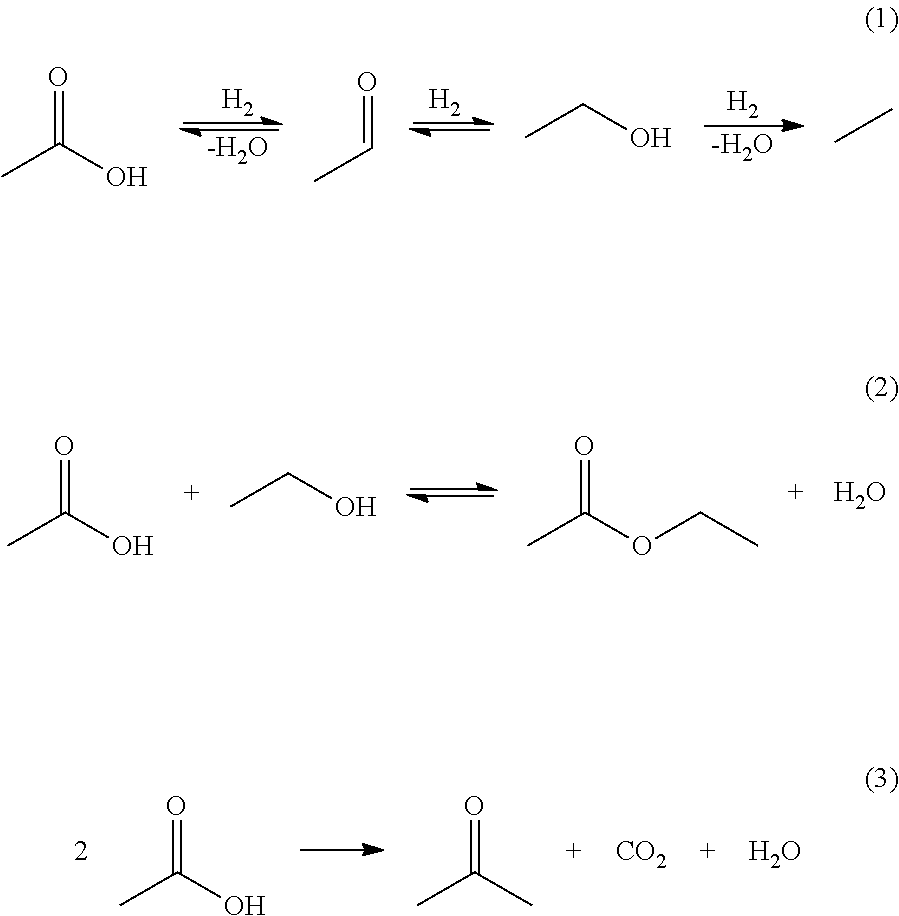
CuO/Fe2O3/Al2O3/SiO2 did not produce any appreciable amount of acetone nor CO2.
| TABLE 4 |
| Comparison of COP and SULZER pervaporation membrane performance |
| data. Values expressed are average values for ethanol/water (90/10) wt % |
| mixture at 80° C. |
| Pervaporation | Expected | ||
| Total Flux (kg/m2 · hr) | 0.62 | 0.45 | ||
| Ethanol Loss (wt %) | 3.5% | <5% | ||
- 1. U.S. Pat. No. 1,302,011, Christiansen, (1919).
- 2. U.S. Pat. No. 1,605,093, Bouvier and Blanc, (1926).
- 3. U.S. Pat. No. 1,971,742, Berisch, H., (1934).
- 4. U.S. Pat. No. 2,079,414, Lazier, (1937).
- 5. U.S. Pat. No. 2,091,800, Adkins, et al., (1937).
- 6. U.S. Pat. No. 2,093,159, Schmidt, (1937).
- 7. U.S. Pat. No. 2,322,095, Schmidt, (1943).
- 8. U.S. Pat. No. 2,322,096, Schmidt, (1943).
- 9. U.S. Pat. No. 2,322,097, Schmidt, (1943).
- 10. U.S. Pat. No. 2,549,416, Brooks, (1951).
- 11. U.S. Pat. No. 2,607,807, Ford, (1952).
- 12. U.S. Pat. No. 2,782,243, Hess and Schulz, (1957).
- 13. U.S. Pat. No. 3,197,418, Maebashi and Yamo, (1965).
- 14. U.S. Pat. No. 3,361,832, Pine and Ellert, (1968).
- 15. U.S. Pat. No. 3,363,009, Schuman, (1968).
- 16. U.S. Pat. No. 3,478,112, Adam, et al., (1969).
- 17. U.S. Pat. No. 4,113,662, Wall, (1978).
- 18. U.S. Pat. No. 4,149,021, Wall, (1979).
- 19. U.S. Pat. No. 4,220,803, Marcinkowsky and Henry, (1980).
- 20. U.S. Pat. No. 4,282,323, Yates, (1981).
- 21. U.S. Pat. No. 4,283,581, Wilkes, (1981).
- 22. U.S. Pat. No. 4,359,404, Grey and Pez, (1982).
- 23. U.S. Pat. No. 4,398,039, Pesa, et al., (1983).
- 24. U.S. Pat. No. 4,421,939, Kiff and Schreck, (1983).
- 25. U.S. Pat. No. 4,443,639, Pesa, et al., (1984).
- 26. U.S. Pat. No. 4,456,775, Travers, et al., (1984).
- 27. U.S. Pat. No. 4,517,391, Ludwig, et al., (1985).
- 28. U.S. Pat. No. 4,611,085, Kitson, (1986).
- 29. U.S. Pat. No. 4,628,130, Bournonville, et al., (1986).
- 30. U.S. Pat. No. 4,762,817, Logsdon, et al., (1988).
- 31. U.S. Pat. No. 4,777,303, Kitson and P. S. Williams, 1988.
- 32. U.S. Pat. No. 4,804,791, Kitson and Williams, (1989).
- 33. U.S. Pat. No. 4,826,795, Kitson and Williams, (1989).
- 34. U.S. Pat. No. 4,918,248, Hattori, et al., (1990).
- 35. U.S. Pat. No. 4,929,777, Irick, et al., (1990).
- 36. U.S. Pat. No. 4,973,717, Williams, (1990).
- 37. U.S. Pat. No. 4,985,572, Kitson and Williams, (1991).
- 38. U.S. Pat. No. 5,008,235, Wegman and Bryant, (1991).
- 39. U.S. Pat. No. 5,142,067, Wegman and Bryant, (1992.
- 40. U.S. Pat. No. 5,149,680, Kitson and Williams, (1990).
- 41. U.S. Pat. No. 5,155,086, Thakur, et al., (1992).
- 42. U.S. Pat. No. 5,345,005, Thakur, et al., (1994).
- 43. U.S. Pat. No. 5,387,753, Scarlett, et al., (1995).
- 44. U.S. Pat. No. 5,403,962, Schneider, et al., (1995).
- 45. U.S. Pat. No. 5,478,952, Schwartz, (1995).
- 46. U.S. Pat. No. 5,475,159, Singleton and Murray, (1995).
- 47. U.S. Pat. No. 5,959,167, WO9910450, Shabtai, et al., (1999).
- 48. U.S. Pat. No. 6,008,384, Bockrath, et al., (1999).
- 49. U.S. Pat. No. 6,054,627, Thakur, et al., (2000).
- 50. U.S. Pat. No. 6,140,545, Merger, et al., (2000).
- 51. U.S. Pat. No. 6,403,844, Zhang, et al., (2002).
- 52. U.S. Pat. No. 6,455,464, Chen, (2002).
- 53. U.S. Pat. No. 6,509,180, Verser and Eggeman, (2003).
- 54. U.S. Pat. No. 6,765,118, Fischer, et al., (2004).
- 55. U.S. Pat. No. 7,119,237, Prinz, et al., (2006).
- 56. U.S. Pat. No. 7,351,559, Verser and Eggeman, (2008).
- 57. U.S. Pat. No. 7,578,927, US2008053870, WO2008027699, Marker and Petri, “Gasoline and Diesel Production from Pyrolytic Lignin Produced from Pyrolysis of Cellulosic Waste” (2008).
- 58. US2008050792, WO2006119357, Zmierczak and Miller, “Processes for Catalytic Conversion of Lignin To Liquid Bio-Fuels And Novel Bio-Fuels” (2006)
- 59. US2008092435, WO2008051984, Bzdek and Pellegrino, “Methods of Purifying Biodiesel Fuels” (2008)
- 60. WO2008113492, Baldiraghi, et al., “Hydrocarbon Composition Useful as a Fuel and Fuel Oil Containing a Petroleum Component and a Component of a Biological Origin” (2008)
- 61. WO2010145901, Vandezande, et al., “Thin Film Pervaporation Membranes.” (2010).
- 62. EP0175558, Moy, (1986).
- 63. EP0198681, Kitson and Williams, (1986).
- 64. EP0285420, Kitson and Sefton, (1988).
- 65. EP0953560, Tustin, e al., (1999).
- 66. Baker, “Pervaporation, in Membrane technology and applications.” Wiley. p. 355-392 (2004).
- 67. Benaissa, H., et al., “Heteropoly Compounds as Catalysts for Hydrogenation of Propanoic Acid.” J. Catalysis 253:244-252 (2008).
- 68. Holman and Gajda, “Analysis of experimental data, in Experimental methods for engineers.” McGraw-Hill New York. p. 46-94 (1994).
- 69. Kleinert, et al., “Optimizing solvolysis conditions for integrated depolymerisation and hydrodeoxygenation of lignin to produce liquid biofuels.” J. Analytical and Applied Pyrolysis 85:108-117 (2009).
- 70. Mulder and Smolders, “On the mechanism of separation of ethanol/water mixtures by pervaporation. I: Calculations of concentration profiles.” J. Membrane Sci., 17:289-307 (1984).
- 71. Nagayama, et al., “Direct Hydrogenation of Carboxylic Acids Corresponding Aldehydes Catalyzed by Palladium Complexes.” Bull. Chem. Soc. Jpn., 74:1803-15 (2001).
- 72. Natal Santiago, et al., “Catalytic Reduction of Acetic Acid, Methyl Acetate, Ethyl Acetate over Silica-Supported Copper.” Journal of Catalysis, 193:16-28 (2000).
- 73. Pan and Habgood, “Gas separation by permeation Part II: Effect of permeate pressure drop and choice of permeate pressure.” Canadian J. Chem. Eng., 56:210-217 (2009).
- 74. Peng, et al., “Recent advances in VOCs removal from water by pervaporation.” J. Hazardous Materials, 98:69-90 (2003).
- 75. Pestman, et al., “Selective Hydrogenation of Acetic Acid Towards Acetaldehyde.” J. Royal Netherlands Chem. Soc., 113:426-30 (1994).
- 76. Pestman, et al., Reactions of Carboxylic Acids on Oxides: 1. Selective Hydrogenation of Acetic Acid to Acetaldehyde. J. Catalysis, 168:255-264 (1997).
- 77. Pestman, et al., “Identification of the Active Sites in the Selective Hydrogenation of Acetic Acid to Acetaldehyde on Iron Oxide Catalysts.” J. Catalysis, 174:142-52 (1998).
- 78. Rachmady and Vannice, “Acetic Acid Hydrogenation over Supported Platinum Catalysts.” J. Catalysis, 192:322-34 (2000).
- 79. Rachmady and Vannice, “Acetic Acid Reduction to Acetaldehyde over Iron Catalysts.” J. Catalysis, 208:158-69 (2002).
- 80. Rachmady and Vannice, “Acetic Acid Reduction by H2 on Bimetallic PtFe Catalysts.” J. Catalysis, 209:87-98 (2002).
- 81. Ribeiro and Borges, “Using pervaporation data in the calculation of vapour permeation hollow-fibre modules for aroma recovery.” Brazilian J. Chem. Eng., 21:629-640 (2004).
- 82. Ribeiro, et al., “A combined gas-stripping vapour permeation process for aroma recovery.” J. Membrane Science 238:9-19 (2004).
- 83. Shih and Keng, “Kinetics of the Ruthenium-Catalyzed Hydrogenation of Acetic Acid to Ethanol.” J. Chin. Chem. Soc., 32:29-34 (1985).
- 84. Smith, et al., “Introduction to chemical engineering thermodynamics.” McGraw-Hill Science/Engineering/Math (2005).
- 85. Tahara, et al., “Liquid-Phase Hydrogenation of Carboxylic Acid on Supported Bimetallic Ru—Sn-Alumina Catalysts.” Appl. Catal. A:General, 154:75-86 (1997).
- 86. Toba, et al., “Synthesis of Alcohols and Dials by Hydrogenation of Carboxylic Acids and Esters over Ru—Sn—Al2O3 Catalysts.” Appl. Catal. A:General, 189:243-50 (1999).
- 87. Vane, “A review of pervaporation for product recovery from biomass fermentation processes.” J. Chem. Tech. Biotech. 80:603-629 (2005).
- 88. Yokoyama and Yamagata, “Hydrogenation of Carboxylic Acids to the Corresponding Aldehydes.” Appl. Catal. A:General, 221:227-39 (2001).
- 89. Yokoyama and Fujita, “Hydrogenation of Aliphatic Carboxylic Acids to Corresponding Aldehydes over Cr203-based Catalysts.” Appl. Catal. A:General, 276:179-85 (2004).
Claims (3)
Priority Applications (2)
| Application Number | Priority Date | Filing Date | Title |
|---|---|---|---|
| US13/237,533 US9109174B2 (en) | 2011-09-20 | 2011-09-20 | Advanced cellulosic renewable fuels |
| US14/796,496 US9447344B2 (en) | 2011-09-20 | 2015-07-10 | Advanced cellulosic renewable fuels |
Applications Claiming Priority (1)
| Application Number | Priority Date | Filing Date | Title |
|---|---|---|---|
| US13/237,533 US9109174B2 (en) | 2011-09-20 | 2011-09-20 | Advanced cellulosic renewable fuels |
Related Child Applications (1)
| Application Number | Title | Priority Date | Filing Date |
|---|---|---|---|
| US14/796,496 Division US9447344B2 (en) | 2011-09-20 | 2015-07-10 | Advanced cellulosic renewable fuels |
Publications (2)
| Publication Number | Publication Date |
|---|---|
| US20130067803A1 US20130067803A1 (en) | 2013-03-21 |
| US9109174B2 true US9109174B2 (en) | 2015-08-18 |
Family
ID=47879282
Family Applications (2)
| Application Number | Title | Priority Date | Filing Date |
|---|---|---|---|
| US13/237,533 Active 2033-10-27 US9109174B2 (en) | 2011-09-20 | 2011-09-20 | Advanced cellulosic renewable fuels |
| US14/796,496 Active US9447344B2 (en) | 2011-09-20 | 2015-07-10 | Advanced cellulosic renewable fuels |
Family Applications After (1)
| Application Number | Title | Priority Date | Filing Date |
|---|---|---|---|
| US14/796,496 Active US9447344B2 (en) | 2011-09-20 | 2015-07-10 | Advanced cellulosic renewable fuels |
Country Status (1)
| Country | Link |
|---|---|
| US (2) | US9109174B2 (en) |
Families Citing this family (19)
| Publication number | Priority date | Publication date | Assignee | Title |
|---|---|---|---|---|
| EP3252128B1 (en) | 2006-04-03 | 2019-01-02 | Pharmatherm Chemicals Inc. | Thermal extraction method for producing a taxane extract |
| US20110284359A1 (en) | 2010-05-20 | 2011-11-24 | Uop Llc | Processes for controlling afterburn in a reheater and for controlling loss of entrained solid particles in combustion product flue gas |
| US8499702B2 (en) | 2010-07-15 | 2013-08-06 | Ensyn Renewables, Inc. | Char-handling processes in a pyrolysis system |
| US9441887B2 (en) | 2011-02-22 | 2016-09-13 | Ensyn Renewables, Inc. | Heat removal and recovery in biomass pyrolysis |
| US9347005B2 (en) | 2011-09-13 | 2016-05-24 | Ensyn Renewables, Inc. | Methods and apparatuses for rapid thermal processing of carbonaceous material |
| US10400175B2 (en) | 2011-09-22 | 2019-09-03 | Ensyn Renewables, Inc. | Apparatuses and methods for controlling heat for rapid thermal processing of carbonaceous material |
| US9109177B2 (en) | 2011-12-12 | 2015-08-18 | Ensyn Renewables, Inc. | Systems and methods for renewable fuel |
| US20130175218A1 (en) * | 2011-12-16 | 2013-07-11 | The Research Foundation Of State University Of New York | Polymeric nanofibrous composite membranes for energy efficient ethanol dehydration |
| US9670413B2 (en) | 2012-06-28 | 2017-06-06 | Ensyn Renewables, Inc. | Methods and apparatuses for thermally converting biomass |
| EP3492559A1 (en) | 2013-06-26 | 2019-06-05 | Ensyn Renewables, Inc. | Methods for renewable fuel |
| CN104607073B (en) * | 2014-12-26 | 2016-11-16 | 清华大学 | A membrane for desorbing CO2 from a solution containing CO2 and its preparation method |
| EP3337966B1 (en) | 2015-08-21 | 2021-12-15 | Ensyn Renewables, Inc. | Liquid biomass heating system |
| CN106268332B (en) * | 2016-08-30 | 2018-11-23 | 淮阴师范学院 | Polyvinyl alcohol/graphite phase carbon nitride pervaporation hybrid membrane preparation method |
| MY193949A (en) | 2016-12-29 | 2022-11-02 | Ensyn Renewables Inc | Demetallization Of Liquid Biomass |
| CN111871230B (en) * | 2019-09-26 | 2022-09-30 | 南开大学 | Friction-resistant and pollution-resistant super-hydrophobic membrane for membrane distillation process and preparation method thereof |
| CN114466691A (en) | 2019-09-26 | 2022-05-10 | 沙特基础工业全球技术公司 | Start-up procedure for rapidly achieving optimum steady state performance in membrane separations |
| CN111054217B (en) * | 2019-12-16 | 2021-09-21 | 华南理工大学 | Method for dehydrating and separating biological oil by using T-shaped zeolite membrane and regenerating membrane thereof |
| CN114009731B (en) * | 2021-11-05 | 2024-01-02 | 恒枫食品科技有限公司 | Tea flavor base material and preparation method and application thereof |
| CN114874805B (en) * | 2022-05-26 | 2023-12-05 | 大庆中蓝石化有限公司 | Tail gas emission recovery system of gasoline sweetening production device |
Citations (61)
| Publication number | Priority date | Publication date | Assignee | Title |
|---|---|---|---|---|
| US1302011A (en) | 1918-12-06 | 1919-04-29 | Jens Anton Christiansen | Method of producing methyl alcohol from alkyl formates. |
| US1605093A (en) | 1923-08-07 | 1926-11-02 | Ste Chim Usines Rhone | Process for the reduction of alkyl esters |
| US1971742A (en) | 1929-09-23 | 1934-08-28 | American Hyalsol Corp | Production of primary alcohols |
| US2079414A (en) | 1932-08-20 | 1937-05-04 | Du Pont | Process for producing alcohols from esters of nonaromatic carboxylic acids |
| US2091800A (en) | 1931-09-15 | 1937-08-31 | Rohm & Haas | Method of hydrogenating esters |
| US2093159A (en) | 1925-11-20 | 1937-09-14 | Ig Farbenindustrie Ag | Catalytic hydrogenation of esters of aliphatic carboxylic acids |
| US2322096A (en) | 1931-04-01 | 1943-06-15 | Gen Aniline & Film Corp | Catalytic hydrogenation of high molecular aliphatic carboxylic acids |
| US2322097A (en) | 1931-04-01 | 1943-06-15 | Gen Aniline & Film Corp | Catalytic hydrogenation of aliphatic carboxylic acid anhydrides |
| US2322095A (en) | 1925-11-20 | 1943-06-15 | Gen Aniline & Film Corp | Catalytic hydrogenation of organic compounds |
| US2549416A (en) | 1948-02-04 | 1951-04-17 | Du Pont | Preparation of alcohols |
| US2607807A (en) | 1950-02-24 | 1952-08-19 | Du Pont | Preparation of alcohols from carboxylic acids |
| US2782243A (en) | 1954-03-29 | 1957-02-19 | Union Carbide & Carbon Corp | Hydrogenation of esters |
| US3197418A (en) | 1959-02-02 | 1965-07-27 | Asahi Denka Kogyo Kk | Method for producing copper-containing hydrogenation catalysts |
| US3361832A (en) | 1963-08-13 | 1968-01-02 | Exxon Research Engineering Co | Conversion of acids to alcohols |
| US3363009A (en) | 1964-06-08 | 1968-01-09 | Hydrocarbon Research Inc | Continuous process for producing detergent grade alcohols and glycerine |
| US3478112A (en) | 1964-03-17 | 1969-11-11 | Basf Ag | Production of alcohols by catalytic hydrogenation of carboxylic acids |
| US4113662A (en) | 1976-08-05 | 1978-09-12 | Chevron Research Company | Catalyst for ester hydrogenation |
| US4149021A (en) | 1977-04-25 | 1979-04-10 | Chevron Research Company | Ester hydrogenation using cobalt, zinc and copper oxide catalyst |
| US4220803A (en) | 1978-06-27 | 1980-09-02 | Union Carbide Corporation | Catalytic dehydrogenation of ethanol for the production of acetaldehyde and acetic acid |
| US4282323A (en) | 1979-10-09 | 1981-08-04 | E. I. Du Pont De Nemours And Company | Removal and concentration of lower molecular weight organic acids from dilute solutions |
| US4283581A (en) | 1978-02-24 | 1981-08-11 | Chevron Research Company | Hydrogenation process |
| US4359404A (en) | 1980-03-24 | 1982-11-16 | Allied Corporation | Hydrogenation of esters using alkali doped heterogeneous Group VIII transition metal catalysts |
| US4398039A (en) | 1981-05-18 | 1983-08-09 | The Standard Oil Company | Hydrogenation of carboxylic acids |
| US4421939A (en) | 1982-10-15 | 1983-12-20 | Union Carbide Corporation | Production of ethanol from acetic acid |
| US4443639A (en) | 1981-05-18 | 1984-04-17 | The Standard Oil Company (Indiana) | Hydrogenation of carboxylic acids |
| US4456775A (en) | 1982-05-24 | 1984-06-26 | Institut Francais Du Petrole | Catalytic process for manufacturing alcohols by hydrogenolysis of carboxylic acid esters |
| US4517391A (en) | 1982-06-04 | 1985-05-14 | Basf Aktiengesellschaft | Continuous preparation of ethanol |
| EP0175558A1 (en) | 1984-09-17 | 1986-03-26 | EASTMAN KODAK COMPANY (a New Jersey corporation) | Process for the vapor phase hydrogenation of carboxylic acids to esters and alcohols |
| US4611085A (en) | 1983-04-21 | 1986-09-09 | The British Petroleum Company P.L.C. | Vapour phase hydrogenation of esters |
| EP0198681A2 (en) | 1985-04-13 | 1986-10-22 | BP Chemicals Limited | Alcohols production by hydrogenation of carboxylic acids |
| US4628130A (en) | 1984-08-08 | 1986-12-09 | Institut Francais Du Petrole | Process for producing alcohols by hydrogenolysis of carboxylic acid esters in the presence of a catalyst containing nickel and tin, germanium or lead |
| US4762817A (en) | 1986-11-03 | 1988-08-09 | Union Carbide Corporation | Aldehyde hydrogenation catalyst |
| EP0285420A1 (en) | 1987-03-31 | 1988-10-05 | The British Petroleum Company p.l.c. | The catalysed hydrogenation of carboxylic acids and their anhydrides to alcohols and/or esters |
| US4918248A (en) | 1988-06-02 | 1990-04-17 | Kao Corporation | Process for preparation of alcohols |
| US4929777A (en) | 1989-02-13 | 1990-05-29 | Eastman Kodak Company | Catalyst compositions and the use thereof in the hydrogenation of carboxylic acid esters |
| US4973717A (en) | 1988-05-10 | 1990-11-27 | Bp Chemicals Limited | Production of alcohols and ethers by the catalysed hydrogenation of esters |
| US5008235A (en) | 1989-12-21 | 1991-04-16 | Union Carbide Chemicals And Plastics Technology Corporation | Catalysts of Cu-Al-third metal for hydrogenation |
| US5142067A (en) | 1989-12-21 | 1992-08-25 | Union Carbide Chemicals & Plastics Technology Corporation | Hydrogenation with Cu-Al-X catalysts |
| US5149680A (en) | 1987-03-31 | 1992-09-22 | The British Petroleum Company P.L.C. | Platinum group metal alloy catalysts for hydrogenation of carboxylic acids and their anhydrides to alcohols and/or esters |
| US5155086A (en) | 1989-09-12 | 1992-10-13 | Engelhard Corporation | Hydrogenation catalyst, process for preparing and process of using said catalyst |
| US5345005A (en) | 1989-09-12 | 1994-09-06 | Engelhard Corporation | Hydrogenation catalyst, process for preparing and process of using said catalyst |
| US5387753A (en) | 1993-12-02 | 1995-02-07 | Eastman Chemical Company | Process for the preparation of alcohols and diols |
| US5403962A (en) | 1991-12-13 | 1995-04-04 | Sud-Chemie Ag | Chromium-free catalyst for the hydrogenation of organic compounds |
| US5475159A (en) | 1994-11-07 | 1995-12-12 | Shell Oil Company | Process for the direct hydrogenation of methyl esters |
| US5478952A (en) | 1995-03-03 | 1995-12-26 | E. I. Du Pont De Nemours And Company | Ru,Re/carbon catalyst for hydrogenation in aqueous solution |
| US5959167A (en) | 1997-08-25 | 1999-09-28 | The University Of Utah Research Foundation | Process for conversion of lignin to reformulated hydrocarbon gasoline |
| EP0953560A1 (en) | 1998-04-30 | 1999-11-03 | Eastman Chemical Company | Method, catalyst and apparatus for producing acetaldehyde from acetic acid |
| US6008384A (en) | 1998-03-03 | 1999-12-28 | E. I. Du Pont De Nemours And Company | Method and Ru,Re,Sn/carbon catalyst for hydrogenation in aqueous solution |
| US6054627A (en) | 1991-05-22 | 2000-04-25 | Engelhard Corporation | Hydrogenation catalyst, process for preparing and process of using said catalyst |
| US6140545A (en) | 1998-02-20 | 2000-10-31 | Basf Aktiengesellschaft | Preparation of alcohols |
| US6403844B1 (en) | 1998-11-24 | 2002-06-11 | Board Of Trustees Of Michigan State University | Condensed phase catalytic hydrogenation of lactic acid to propylene glycol |
| US6455464B1 (en) | 1996-03-21 | 2002-09-24 | Engelhard Corporation | Preparation and use of non-chrome catalysts for Cu/Cr catalyst applications |
| US6509180B1 (en) | 1999-03-11 | 2003-01-21 | Zeachem Inc. | Process for producing ethanol |
| US6765118B2 (en) | 2000-03-24 | 2004-07-20 | Basf Aktiengesellschaft | Method for the production of alcohols on rhenium-containing activated charcoal supported catalysts |
| US7119237B2 (en) | 2002-02-22 | 2006-10-10 | Bayer Aktiengesellschaft | Process and catalyst for preparing alcohols |
| US20080050792A1 (en) | 2005-05-02 | 2008-02-28 | Zmierczak Wlodzimierz W | Processes for catalytic conversion of lignin to liquid bio-fuels and novel bio-fuels |
| US20080092435A1 (en) | 2006-10-23 | 2008-04-24 | Justin Bzdek | Methods of purifying biodiesel fuels |
| WO2008113492A1 (en) | 2007-03-16 | 2008-09-25 | Eni S.P.A | Hydrocarbon composition useful as a fuel and fuel oil containing a petroleum component and a component of a biological origin |
| US7578927B2 (en) | 2006-08-31 | 2009-08-25 | Uop Llc | Gasoline and diesel production from pyrolytic lignin produced from pyrolysis of cellulosic waste |
| WO2010145901A1 (en) | 2009-05-18 | 2010-12-23 | Vito N.V. | Thin film pervaporation membranes |
| US20110046423A1 (en) * | 2009-08-24 | 2011-02-24 | Conocophillips Company | Hydrotreating carbohydrates |
-
2011
- 2011-09-20 US US13/237,533 patent/US9109174B2/en active Active
-
2015
- 2015-07-10 US US14/796,496 patent/US9447344B2/en active Active
Patent Citations (68)
| Publication number | Priority date | Publication date | Assignee | Title |
|---|---|---|---|---|
| US1302011A (en) | 1918-12-06 | 1919-04-29 | Jens Anton Christiansen | Method of producing methyl alcohol from alkyl formates. |
| US1605093A (en) | 1923-08-07 | 1926-11-02 | Ste Chim Usines Rhone | Process for the reduction of alkyl esters |
| US2322095A (en) | 1925-11-20 | 1943-06-15 | Gen Aniline & Film Corp | Catalytic hydrogenation of organic compounds |
| US2093159A (en) | 1925-11-20 | 1937-09-14 | Ig Farbenindustrie Ag | Catalytic hydrogenation of esters of aliphatic carboxylic acids |
| US1971742A (en) | 1929-09-23 | 1934-08-28 | American Hyalsol Corp | Production of primary alcohols |
| US2322096A (en) | 1931-04-01 | 1943-06-15 | Gen Aniline & Film Corp | Catalytic hydrogenation of high molecular aliphatic carboxylic acids |
| US2322097A (en) | 1931-04-01 | 1943-06-15 | Gen Aniline & Film Corp | Catalytic hydrogenation of aliphatic carboxylic acid anhydrides |
| US2091800A (en) | 1931-09-15 | 1937-08-31 | Rohm & Haas | Method of hydrogenating esters |
| US2079414A (en) | 1932-08-20 | 1937-05-04 | Du Pont | Process for producing alcohols from esters of nonaromatic carboxylic acids |
| US2549416A (en) | 1948-02-04 | 1951-04-17 | Du Pont | Preparation of alcohols |
| US2607807A (en) | 1950-02-24 | 1952-08-19 | Du Pont | Preparation of alcohols from carboxylic acids |
| US2782243A (en) | 1954-03-29 | 1957-02-19 | Union Carbide & Carbon Corp | Hydrogenation of esters |
| US3197418A (en) | 1959-02-02 | 1965-07-27 | Asahi Denka Kogyo Kk | Method for producing copper-containing hydrogenation catalysts |
| US3361832A (en) | 1963-08-13 | 1968-01-02 | Exxon Research Engineering Co | Conversion of acids to alcohols |
| US3478112A (en) | 1964-03-17 | 1969-11-11 | Basf Ag | Production of alcohols by catalytic hydrogenation of carboxylic acids |
| US3363009A (en) | 1964-06-08 | 1968-01-09 | Hydrocarbon Research Inc | Continuous process for producing detergent grade alcohols and glycerine |
| US4113662A (en) | 1976-08-05 | 1978-09-12 | Chevron Research Company | Catalyst for ester hydrogenation |
| US4149021A (en) | 1977-04-25 | 1979-04-10 | Chevron Research Company | Ester hydrogenation using cobalt, zinc and copper oxide catalyst |
| US4283581A (en) | 1978-02-24 | 1981-08-11 | Chevron Research Company | Hydrogenation process |
| US4220803A (en) | 1978-06-27 | 1980-09-02 | Union Carbide Corporation | Catalytic dehydrogenation of ethanol for the production of acetaldehyde and acetic acid |
| US4282323A (en) | 1979-10-09 | 1981-08-04 | E. I. Du Pont De Nemours And Company | Removal and concentration of lower molecular weight organic acids from dilute solutions |
| US4359404A (en) | 1980-03-24 | 1982-11-16 | Allied Corporation | Hydrogenation of esters using alkali doped heterogeneous Group VIII transition metal catalysts |
| US4398039A (en) | 1981-05-18 | 1983-08-09 | The Standard Oil Company | Hydrogenation of carboxylic acids |
| US4443639A (en) | 1981-05-18 | 1984-04-17 | The Standard Oil Company (Indiana) | Hydrogenation of carboxylic acids |
| US4456775A (en) | 1982-05-24 | 1984-06-26 | Institut Francais Du Petrole | Catalytic process for manufacturing alcohols by hydrogenolysis of carboxylic acid esters |
| US4517391A (en) | 1982-06-04 | 1985-05-14 | Basf Aktiengesellschaft | Continuous preparation of ethanol |
| US4421939A (en) | 1982-10-15 | 1983-12-20 | Union Carbide Corporation | Production of ethanol from acetic acid |
| US4611085A (en) | 1983-04-21 | 1986-09-09 | The British Petroleum Company P.L.C. | Vapour phase hydrogenation of esters |
| US4628130A (en) | 1984-08-08 | 1986-12-09 | Institut Francais Du Petrole | Process for producing alcohols by hydrogenolysis of carboxylic acid esters in the presence of a catalyst containing nickel and tin, germanium or lead |
| EP0175558A1 (en) | 1984-09-17 | 1986-03-26 | EASTMAN KODAK COMPANY (a New Jersey corporation) | Process for the vapor phase hydrogenation of carboxylic acids to esters and alcohols |
| US4804791A (en) | 1985-04-13 | 1989-02-14 | Bp Chemicals Limited | Alcohols production by hydrogenation of carboxylic acids |
| US4777303A (en) | 1985-04-13 | 1988-10-11 | Bp Chemicals Limited | Alcohols production by hydrogenation of carboxylic acids |
| EP0198681A2 (en) | 1985-04-13 | 1986-10-22 | BP Chemicals Limited | Alcohols production by hydrogenation of carboxylic acids |
| US4826795A (en) | 1985-04-13 | 1989-05-02 | Bp Chemicals Limited | Catalyst for the production of an alcohol and/or a carboxylic acid ester by hydrogenation of a carboxylic acid |
| US4762817A (en) | 1986-11-03 | 1988-08-09 | Union Carbide Corporation | Aldehyde hydrogenation catalyst |
| EP0285420A1 (en) | 1987-03-31 | 1988-10-05 | The British Petroleum Company p.l.c. | The catalysed hydrogenation of carboxylic acids and their anhydrides to alcohols and/or esters |
| US4985572A (en) | 1987-03-31 | 1991-01-15 | The British Petroleum Company, P.L.C. | Catalyzed hydrogenation of carboxylic acids and their anhydrides to alcohols and/or esters |
| US5149680A (en) | 1987-03-31 | 1992-09-22 | The British Petroleum Company P.L.C. | Platinum group metal alloy catalysts for hydrogenation of carboxylic acids and their anhydrides to alcohols and/or esters |
| US4973717A (en) | 1988-05-10 | 1990-11-27 | Bp Chemicals Limited | Production of alcohols and ethers by the catalysed hydrogenation of esters |
| US4918248A (en) | 1988-06-02 | 1990-04-17 | Kao Corporation | Process for preparation of alcohols |
| US4929777A (en) | 1989-02-13 | 1990-05-29 | Eastman Kodak Company | Catalyst compositions and the use thereof in the hydrogenation of carboxylic acid esters |
| US5155086A (en) | 1989-09-12 | 1992-10-13 | Engelhard Corporation | Hydrogenation catalyst, process for preparing and process of using said catalyst |
| US5345005A (en) | 1989-09-12 | 1994-09-06 | Engelhard Corporation | Hydrogenation catalyst, process for preparing and process of using said catalyst |
| US5142067A (en) | 1989-12-21 | 1992-08-25 | Union Carbide Chemicals & Plastics Technology Corporation | Hydrogenation with Cu-Al-X catalysts |
| US5008235A (en) | 1989-12-21 | 1991-04-16 | Union Carbide Chemicals And Plastics Technology Corporation | Catalysts of Cu-Al-third metal for hydrogenation |
| US6054627A (en) | 1991-05-22 | 2000-04-25 | Engelhard Corporation | Hydrogenation catalyst, process for preparing and process of using said catalyst |
| US5403962A (en) | 1991-12-13 | 1995-04-04 | Sud-Chemie Ag | Chromium-free catalyst for the hydrogenation of organic compounds |
| US5387753A (en) | 1993-12-02 | 1995-02-07 | Eastman Chemical Company | Process for the preparation of alcohols and diols |
| US5475159A (en) | 1994-11-07 | 1995-12-12 | Shell Oil Company | Process for the direct hydrogenation of methyl esters |
| US5478952A (en) | 1995-03-03 | 1995-12-26 | E. I. Du Pont De Nemours And Company | Ru,Re/carbon catalyst for hydrogenation in aqueous solution |
| US6455464B1 (en) | 1996-03-21 | 2002-09-24 | Engelhard Corporation | Preparation and use of non-chrome catalysts for Cu/Cr catalyst applications |
| US5959167A (en) | 1997-08-25 | 1999-09-28 | The University Of Utah Research Foundation | Process for conversion of lignin to reformulated hydrocarbon gasoline |
| US6140545A (en) | 1998-02-20 | 2000-10-31 | Basf Aktiengesellschaft | Preparation of alcohols |
| US6008384A (en) | 1998-03-03 | 1999-12-28 | E. I. Du Pont De Nemours And Company | Method and Ru,Re,Sn/carbon catalyst for hydrogenation in aqueous solution |
| EP0953560A1 (en) | 1998-04-30 | 1999-11-03 | Eastman Chemical Company | Method, catalyst and apparatus for producing acetaldehyde from acetic acid |
| US6403844B1 (en) | 1998-11-24 | 2002-06-11 | Board Of Trustees Of Michigan State University | Condensed phase catalytic hydrogenation of lactic acid to propylene glycol |
| US7351559B2 (en) | 1999-03-11 | 2008-04-01 | Zeachem, Inc. | Process for producing ethanol |
| US6509180B1 (en) | 1999-03-11 | 2003-01-21 | Zeachem Inc. | Process for producing ethanol |
| US6765118B2 (en) | 2000-03-24 | 2004-07-20 | Basf Aktiengesellschaft | Method for the production of alcohols on rhenium-containing activated charcoal supported catalysts |
| US7119237B2 (en) | 2002-02-22 | 2006-10-10 | Bayer Aktiengesellschaft | Process and catalyst for preparing alcohols |
| US20080050792A1 (en) | 2005-05-02 | 2008-02-28 | Zmierczak Wlodzimierz W | Processes for catalytic conversion of lignin to liquid bio-fuels and novel bio-fuels |
| US7578927B2 (en) | 2006-08-31 | 2009-08-25 | Uop Llc | Gasoline and diesel production from pyrolytic lignin produced from pyrolysis of cellulosic waste |
| US20080092435A1 (en) | 2006-10-23 | 2008-04-24 | Justin Bzdek | Methods of purifying biodiesel fuels |
| WO2008113492A1 (en) | 2007-03-16 | 2008-09-25 | Eni S.P.A | Hydrocarbon composition useful as a fuel and fuel oil containing a petroleum component and a component of a biological origin |
| US20110239532A1 (en) * | 2007-03-16 | 2011-10-06 | Eni S.P.A. | Hydrocarbon composition useful as a fuel and fuel oil containing a petroleum component and a component of a biological origin |
| WO2010145901A1 (en) | 2009-05-18 | 2010-12-23 | Vito N.V. | Thin film pervaporation membranes |
| US20120061319A1 (en) * | 2009-05-18 | 2012-03-15 | Vito Nv | Thin film pervaporation membranes |
| US20110046423A1 (en) * | 2009-08-24 | 2011-02-24 | Conocophillips Company | Hydrotreating carbohydrates |
Non-Patent Citations (22)
Also Published As
| Publication number | Publication date |
|---|---|
| US20150329792A1 (en) | 2015-11-19 |
| US20130067803A1 (en) | 2013-03-21 |
| US9447344B2 (en) | 2016-09-20 |
Similar Documents
| Publication | Publication Date | Title |
|---|---|---|
| US9447344B2 (en) | Advanced cellulosic renewable fuels | |
| US8183422B2 (en) | Hydrocarbons from pyrolysis oil | |
| Bagnato et al. | Recent catalytic advances in hydrotreatment processes of pyrolysis bio-oil | |
| CN111836874B (en) | Process for upgrading oxygen-containing renewable oils | |
| US8629310B2 (en) | Transportation fuels from biomass oxygenates | |
| Dimitriadis et al. | Bio-based refinery intermediate production via hydrodeoxygenation of fast pyrolysis bio-oil | |
| WO2010033789A2 (en) | Production of hydrogen, liquid fuels, and chemicals from catalytic processing of bio-oils | |
| Dimitriadis et al. | Biomass conversion via ablative fast pyrolysis and hydroprocessing towards refinery integration: Industrially relevant scale validation | |
| AU2013262762A1 (en) | Methods and systems for processing biomass material | |
| Chen et al. | Controlling Transformation of Sorbitol into 1-Hexanol over Ru-MoO x/Mo2C Catalyst via Aqueous-Phase Hydrodeoxygenation | |
| Hafenstine et al. | Single-phase catalysis for reductive etherification of diesel bioblendstocks | |
| MX2013013611A (en) | Methods and catalysts for deoxygenating biomass-derived pyrolysis oil. | |
| Yuan et al. | Multifunctional WO3–ZrO2-supported platinum catalyst for remarkably efficient hydrogenolysis of esters to alkanes | |
| Elkasabi et al. | Aqueous extractive upgrading of bio-oils created by tail-gas reactive pyrolysis to produce pure hydrocarbons and phenols | |
| US11718799B2 (en) | Process for upgrading renewable liquid hydrocarbons | |
| Janosik et al. | Derivatizing of fast pyrolysis bio-oil and coprocessing in fixed bed hydrotreater | |
| EP2774972B1 (en) | Process for modifying bio-oil | |
| CN104870406A (en) | Process for producing renewable biofuels from hydrotreated streams of condensed oxygenates | |
| Tirumareddy et al. | Enhanced Hydrodeoxygenation of Biocrude using NiMo carbide catalysts | |
| WO2012082398A9 (en) | Fuel compositions and methods based on biomass pyrolysis | |
| Ardiyanti et al. | Catalytic hydrotreatment of fast pyrolysis oils using supported metal catalysts | |
| US11649410B2 (en) | Bioderived fuels and methods of making the same | |
| Santander et al. | Partial deoxygenation of pyrolysis intermediates toward fossil fuel miscible bioliquids | |
| AU2022305031B2 (en) | A process for the conversion of glycerol to propanols | |
| Bagnato et al. | Recent Catalytic Advances in Hydrotreatment Processes of Pyrolysis Bio-Oil. Catalysts 2021, 11, 157 |
Legal Events
| Date | Code | Title | Description |
|---|---|---|---|
| AS | Assignment |
Owner name: CONOCOPHILLIPS COMPANY, TEXAS Free format text: ASSIGNMENT OF ASSIGNORS INTEREST;ASSIGNORS:KALAKKUNNATH, SUMOD;TRUITT, MATTHEW J.;BAE, JAEHOON;AND OTHERS;REEL/FRAME:026936/0871 Effective date: 20110825 |
|
| AS | Assignment |
Owner name: PHILLIPS 66 COMPANY, TEXAS Free format text: ASSIGNMENT OF ASSIGNORS INTEREST;ASSIGNOR:CONOCOPHILLIPS COMPANY;REEL/FRAME:028213/0824 Effective date: 20120426 |
|
| STCF | Information on status: patent grant |
Free format text: PATENTED CASE |
|
| MAFP | Maintenance fee payment |
Free format text: PAYMENT OF MAINTENANCE FEE, 4TH YEAR, LARGE ENTITY (ORIGINAL EVENT CODE: M1551); ENTITY STATUS OF PATENT OWNER: LARGE ENTITY Year of fee payment: 4 |
|
| MAFP | Maintenance fee payment |
Free format text: PAYMENT OF MAINTENANCE FEE, 8TH YEAR, LARGE ENTITY (ORIGINAL EVENT CODE: M1552); ENTITY STATUS OF PATENT OWNER: LARGE ENTITY Year of fee payment: 8 |