US9096306B2 - Aircraft system carrier element - Google Patents
Aircraft system carrier element Download PDFInfo
- Publication number
- US9096306B2 US9096306B2 US12/997,497 US99749709A US9096306B2 US 9096306 B2 US9096306 B2 US 9096306B2 US 99749709 A US99749709 A US 99749709A US 9096306 B2 US9096306 B2 US 9096306B2
- Authority
- US
- United States
- Prior art keywords
- aircraft
- carrier element
- system carrier
- compartment
- basic body
- Prior art date
- Legal status (The legal status is an assumption and is not a legal conclusion. Google has not performed a legal analysis and makes no representation as to the accuracy of the status listed.)
- Expired - Fee Related, expires
Links
- 238000004378 air conditioning Methods 0.000 claims abstract description 48
- 239000011810 insulating material Substances 0.000 claims abstract description 3
- 230000003746 surface roughness Effects 0.000 claims description 5
- 239000006260 foam Substances 0.000 claims description 4
- 238000012423 maintenance Methods 0.000 abstract description 4
- 230000007613 environmental effect Effects 0.000 abstract description 2
- 238000009413 insulation Methods 0.000 description 12
- 239000006261 foam material Substances 0.000 description 7
- QVGXLLKOCUKJST-UHFFFAOYSA-N atomic oxygen Chemical compound [O] QVGXLLKOCUKJST-UHFFFAOYSA-N 0.000 description 6
- 229910052760 oxygen Inorganic materials 0.000 description 6
- 239000001301 oxygen Substances 0.000 description 6
- 239000011248 coating agent Substances 0.000 description 5
- 238000000576 coating method Methods 0.000 description 5
- 238000010276 construction Methods 0.000 description 4
- 239000000463 material Substances 0.000 description 4
- 238000004519 manufacturing process Methods 0.000 description 3
- 230000000694 effects Effects 0.000 description 2
- 239000004033 plastic Substances 0.000 description 2
- 229920003023 plastic Polymers 0.000 description 2
- 229920007790 polymethacrylimide foam Polymers 0.000 description 2
- 239000004814 polyurethane Substances 0.000 description 2
- 239000002023 wood Substances 0.000 description 2
- KXGFMDJXCMQABM-UHFFFAOYSA-N 2-methoxy-6-methylphenol Chemical compound [CH]OC1=CC=CC([CH])=C1O KXGFMDJXCMQABM-UHFFFAOYSA-N 0.000 description 1
- 229920005830 Polyurethane Foam Polymers 0.000 description 1
- 239000000853 adhesive Substances 0.000 description 1
- 230000001070 adhesive effect Effects 0.000 description 1
- 230000006735 deficit Effects 0.000 description 1
- 230000009970 fire resistant effect Effects 0.000 description 1
- 239000011888 foil Substances 0.000 description 1
- 239000011491 glass wool Substances 0.000 description 1
- 239000002184 metal Substances 0.000 description 1
- 239000005011 phenolic resin Substances 0.000 description 1
- 229920001568 phenolic resin Polymers 0.000 description 1
- 229920002635 polyurethane Polymers 0.000 description 1
- 230000001681 protective effect Effects 0.000 description 1
- 238000007789 sealing Methods 0.000 description 1
- 239000000779 smoke Substances 0.000 description 1
Images




Classifications
-
- B—PERFORMING OPERATIONS; TRANSPORTING
- B64—AIRCRAFT; AVIATION; COSMONAUTICS
- B64C—AEROPLANES; HELICOPTERS
- B64C1/00—Fuselages; Constructional features common to fuselages, wings, stabilising surfaces or the like
- B64C1/06—Frames; Stringers; Longerons ; Fuselage sections
- B64C1/066—Interior liners
-
- B—PERFORMING OPERATIONS; TRANSPORTING
- B64—AIRCRAFT; AVIATION; COSMONAUTICS
- B64C—AEROPLANES; HELICOPTERS
- B64C1/00—Fuselages; Constructional features common to fuselages, wings, stabilising surfaces or the like
- B64C2001/0054—Fuselage structures substantially made from particular materials
- B64C2001/0072—Fuselage structures substantially made from particular materials from composite materials
-
- Y—GENERAL TAGGING OF NEW TECHNOLOGICAL DEVELOPMENTS; GENERAL TAGGING OF CROSS-SECTIONAL TECHNOLOGIES SPANNING OVER SEVERAL SECTIONS OF THE IPC; TECHNICAL SUBJECTS COVERED BY FORMER USPC CROSS-REFERENCE ART COLLECTIONS [XRACs] AND DIGESTS
- Y02—TECHNOLOGIES OR APPLICATIONS FOR MITIGATION OR ADAPTATION AGAINST CLIMATE CHANGE
- Y02T—CLIMATE CHANGE MITIGATION TECHNOLOGIES RELATED TO TRANSPORTATION
- Y02T50/00—Aeronautics or air transport
- Y02T50/40—Weight reduction
-
- Y02T50/433—
Definitions
- the invention relates to a system carrier element that is provided for use in an aircraft both to mount lines needed to supply an aircraft compartment and as aircraft compartment insulation.
- System lines such as for example electric lines, oxygen lines or pipes of the air conditioning system, that are needed to supply an aircraft compartment, for example a crew rest compartment, are currently conventionally fastened with the aid of so-called inserts to the outer surfaces of the aircraft compartment walls.
- inserts which are generally made of metal and provided with an internal thread, are disposed individually in corresponding receivers that are formed in the panels forming the aircraft compartment walls. The inserts may then be used to screw-fasten to the panels suitable fastening devices for fastening the system lines to the panels forming the aircraft compartment walls.
- the sound insulation of the aircraft compartment is conventionally effected with the aid of so-called heavy foils which, prior to mounting of the fastening devices for fastening the system lines to the panels forming the aircraft compartment walls, are glued in a separate operation onto the outer surfaces of the panels forming the aircraft compartment walls.
- the heat insulation of the aircraft compartment is finally realized by means of glass wool packs, which are mounted likewise in a separate operation on the panels forming the aircraft compartment walls and having the system lines fastened thereto.
- a substantial drawback of fastening the system lines with the aid of inserts is that the positioning of the inserts is usually effected in a customized manner. Consequently, panels and insert layouts that are individually designed for each customer have to be generated. Furthermore, the system lines mounted on the outer surfaces of the panels forming the aircraft compartment walls are relatively unprotected. Electric supply lines and oxygen lines therefore often have to be installed in the interior of the compartment and provided with appropriate protective covers, this complicating and slowing down the mounting and maintenance of the lines. Finally, mounting the sound- and heat insulation of the aircraft compartment in separate operations is very time-consuming and therefore costly.
- the underlying object of the present invention is to provide an aircraft system carrier element that enables easy and rapid mounting of lines needed to supply an aircraft compartment and of aircraft compartment insulation.
- an aircraft system carrier element comprises a basic body made of a sound- and heat-insulating material. Formed in the basic body is an air conditioning duct, which is connectable to an, which is connectable to an aircraft air conditioning system and is provided for supplying an aircraft compartment, and a line duct for receiving lines provided for supplying aircraft compartments.
- the aircraft system carrier according to the invention therefore not only comprises an integrated air conditioning duct and a line duct for receiving the system lines needed to supply the aircraft compartment but also functions as sound- and heat insulation for the aircraft compartment.
- the aircraft system carrier element according to the invention is preferably mounted on an outer surface of an aircraft compartment wall.
- only one air conditioning duct and only one line duct may be formed.
- a substantial advantage of the system carrier element according to the invention is that there is no longer any need to fasten the system lines for supplying the aircraft compartment individually with the aid of inserts, which are to be individually positioned, to a panel forming an aircraft compartment wall.
- the aircraft system carrier element may first be preassembled with the lines provided for supplying the aircraft compartment to form an assembly capable of independent handling and then be fastened to a panel forming an aircraft compartment wall.
- the number of connection points, which are to be provided on a panel forming an aircraft compartment wall and may take the form of inserts or other suitable mounting devices, may therefore be considerably reduced.
- a further advantage of the aircraft system carrier element according to the invention is that through the use of the aircraft system carrier element, it is possible to dispense with separate sound- and heat insulation to the aircraft compartment. Furthermore, the system lines accommodated in the line duct are well protected against external effects. It is therefore no longer necessary for sensitive system lines, such as for example electric lines or oxygen lines, to be installed in the interior of the aircraft compartment and provided with separate covers.
- sensitive system lines such as for example electric lines or oxygen lines
- the aircraft system carrier element according to the invention may be used for example in connection with a crew rest compartment.
- a crew rest compartment has to be air-conditioned with the aid of the aircraft air conditioning system and a large number of system lines, such as for example electric lines and oxygen lines, is moreover needed to supply the crew rest compartment
- the aircraft system carrier element according to the invention may in a particularly advantageous manner considerably simplify the mounting of these components.
- the system carrier element according to the invention moreover provides the desired sound- and heat insulation of the crew rest compartment.
- the aircraft system carrier element according to the invention may however also be used in connection with other aircraft compartments that may be disposed in an upper or underfloor region of the aircraft, but also in the region of an aircraft passenger cabin.
- the basic body of the aircraft system carrier element according to the invention is made preferably of a sound- and heat-insulating foam.
- the foam material of the basic body may be selected application-specifically as a function of the required sound- and heat-insulating properties of the aircraft system carrier element.
- a foam material suitable for manufacturing the basic body of the aircraft system carrier element according to the invention it is however necessary to take account of the high safety requirements that apply to aircraft construction.
- a foam material suitable for manufacturing the basic body of the aircraft system carrier element according to the invention is required to be extremely fire-resistant and to lead in the event of fire to only a low development of smoke.
- the basic body of the aircraft system carrier element according to the invention may be manufactured from a PU (polyurethane), a PF (phenolic resin) or a PMI (polymethacrylimide) foam material or from a wood material, such as for example Baltek®. Besides its good sound- and heat-insulating effect, a basic body made of a foam material is notable for its low weight.
- PU polyurethane
- PF phenolic resin
- PMI polymethacrylimide
- a basic body made of a foam material is notable for its low weight.
- the basic body of the aircraft system carrier element according to the invention may be of a multi-part construction and preferably comprises a rear wall, which is provided for being fastened to an outer surface of an aircraft compartment wall, i.e. to an outer surface of a panel forming the aircraft compartment wall or to outer surfaces of a plurality of panels forming the aircraft compartment wall.
- the basic body of the aircraft system carrier element according to the invention may further comprise a line duct cover that is fastened detachably to the rear wall.
- a line duct cover fastened detachably to the rear wall allows rapid access to the system lines accommodated in the line duct, thereby considerably simplifying the maintenance of these lines.
- the basic body may further comprise an air-conditioning duct cover that is connectable to the rear wall.
- an air-conditioning duct cover that is connectable to the rear wall.
- both the rear wall and the air-conditioning duct cover are provided with suitable adhesive surfaces so that the air-conditioning duct cover may be glued in a simple and convenient manner to the rear wall.
- a three-part basic body comprising a rear wall, a line duct cover and an air-conditioning duct cover is relatively easy to manufacture.
- the basic body may however also be of a single- or two-part construction.
- a component forming the rear wall and the air-conditioning duct cover of the basic body may be of a single-part construction.
- At least one leadthrough is formed for leading a line provided for supplying the aircraft compartment out of the aircraft system carrier element into the aircraft compartment.
- the leadthrough is situated preferably in the region of the line duct formed in the basic body.
- a suitable element for sealing the leadthrough may be disposed in the region of the leadthrough.
- an inner surface of the air conditioning duct preferably has a surface roughness that does not exceed a predetermined value.
- the inner surface of the air conditioning duct may be appropriately surface-machined or provided with a coating.
- a coating applied to an inner surface of the air conditioning duct may also be used to seal the air conditioning duct, this possibly being advantageous particularly if the basic body is made of a porous foam material.
- a thin-walled pipe for example of a plastics material may also be integrated into the air conditioning duct.
- a plurality of different system lines may be led through the line duct formed in the basic body of the aircraft system carrier element according to the invention.
- specific lines such as for example electric lines or oxygen lines
- a plurality of receivers for mounting line-fastening devices are preferably disposed, which are used to mount in the line duct suitable devices for fastening the lines led through the line duct.
- the receivers may for example be made of a plastics material and be shaped and dimensioned in such a way as to allow the lines led through the line duct to be installed at a desired distance from one another.
- the aircraft system carrier element according to the invention is provided for mounting on an outer surface of an aircraft compartment wall.
- Aircraft compartments are conventionally fastened with the aid of appropriate holders to an aircraft structure.
- the holders conventionally extend from the aircraft compartment walls towards the aircraft structure.
- at least one cutout is therefore formed for receiving a holder for fastening the aircraft compartment to the aircraft structure.
- the rear wall of the basic body may be provided with a cutout or a plurality of cutouts, through which in the mounted state of the aircraft system carrier element on an aircraft compartment wall a holder or a plurality of holders for fastening the aircraft compartment to the aircraft structure extends/extend.
- a component of the basic body that lies opposite the rear wall i.e. the line duct cover and/or the air-conditioning duct cover, may be provided with a cutout or a plurality of cutouts for receiving a holder or a plurality of holders for fastening the aircraft compartment to the aircraft structure.
- the aircraft system carrier element according to the invention may further comprise a side wall that is connected to the basic body in the region of the line duct and provided with appropriate leadthroughs for leading the lines provided for supplying the aircraft compartment into the line duct and/or out of the line duct.
- the aircraft system carrier element comprises two side walls that close the line duct on both sides.
- the side wall or the side walls may be integrated in the basic body or take the form of a separate component/separate components.
- a line duct provided with side walls offers particularly good protection against external influences to the lines installed in the line duct.
- the size and the shape of the aircraft system carrier element according to the invention are preferably adapted to the size and the shape of an aircraft compartment side wall, on which the aircraft system carrier element is to be mounted.
- the aircraft system carrier element may extend over a large area of an aircraft compartment side wall.
- FIG. 1 a three-dimensional representation of a rear wall of a basic body of an aircraft system carrier element
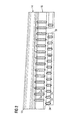
- FIG. 2 a plan view of the rear wall of the basic body of the aircraft system carrier element according to FIG. 1 ,
- FIG. 3 a three-dimensional representation of a basic body of an aircraft system carrier element with a rear wall and an air-conditioning duct cover
- FIG. 4 a three-dimensional representation of an aircraft system carrier element having a basic body that comprises a rear wall, an air-conditioning duct cover and a line duct cover,
- FIG. 5 a three-dimensional representation of an aircraft system carrier element according to FIG. 4 in the mounted state on an aircraft compartment wall
- FIG. 6 a further three-dimensional representation of the aircraft system carrier element according to FIG. 4 in the mounted state on an aircraft compartment wall.
- An aircraft system carrier element 10 shown in the figures comprises a basic body 12 , which is made of a sound- and heat-insulating foam, such as for example PU foam, PF foam or PMI foam, or of a wood material, such as for example Baltek®.
- the basic body 12 comprises a rear wall 13 , which comprises a half-shell of an air conditioning duct 14 and a half-shell of a line duct 16 .
- the rear wall 13 is glued to an air-conditioning duct cover 18 .
- An inner surface of the air conditioning duct 14 is provided with a coating to guarantee that the surface roughness of the inner surface of the air conditioning duct does not exceed a predetermined value.
- the coating applied to the inner surface of the air conditioning duct prevents a disturbance of the air flow through the air conditioning duct 14 .
- the coating applied to the inner surface of the air conditioning duct 14 moreover seals the air conditioning duct 14 , this being particularly advantageous if the basic body 12 of the aircraft system carrier element 10 is made of a porous foam material.
- a series of lines 20 such as for example electric lines and oxygen lines, are installed.
- the lines 20 are used, like the air conditioning duct 14 , to supply an aircraft compartment 22 .
- a plurality of receivers 24 are disposed in the line duct 16 .
- the receivers 24 are used to mount line-fastening devices (not shown in the figures) for installing the lines 20 at a desired distance from one another in the line duct 16 .
- the line duct 16 is closed by means of a line duct cover 26 that is fastened detachably to the rear wall 13 (see FIGS. 4 to 6 ).
- the lines 20 installed in the line duct 16 are therefore well protected against environmental effects. For maintenance purposes the lines 20 are however easily accessible as a result of the detachable fastening of the line duct cover 26 .
- the air conditioning duct 14 as well as the lines 20 led through the line duct 16 are used to supply the aircraft compartment 22 .
- the air conditioning duct 14 is connected to a conditioned-air inlet opening (not shown in the figures) that is formed in an aircraft compartment wall.
- the lines 20 led through the line duct 16 are connected to corresponding consumers disposed in the aircraft compartment 22 .
- the lines 20 are led out of the aircraft system carrier element 10 through leadthroughs (not shown in the figures) that are formed in the rear wall 13 of the basic body 12 in the region of the line duct 16 . In the mounted state of the aircraft system carrier element 10 on an aircraft compartment wall, the leadthroughs formed in the rear wall 13 of the basic body 12 of the aircraft system carrier element 10 are flush with corresponding leadthroughs in the aircraft compartment wall.
- the aircraft system carrier element 10 further comprises two side walls 28 , 30 , which are connected to the basic body 12 in the region of the line duct 16 and hence laterally close the line duct 16 .
- corresponding leadthroughs 32 are provided for leading the lines 20 into the line duct 16 and/or out of the line duct 16 .
- the aircraft system carrier element 10 extends over a large area along a wall of the aircraft compartment 22 and therefore provides optimum sound- and heat insulation of the aircraft compartment 22 . It is therefore possible to dispense with additional sound- and heat insulation of the aircraft compartment 22 .
- the basic body 12 of the aircraft system carrier element 10 is provided with cutouts 34 , 36 , 38 , 40 which, in the mounted state of the aircraft system carrier element 10 on the aircraft compartment wall, receive appropriate holders 42 , 44 for fastening the aircraft compartment 22 to the aircraft structure.
- First cutouts 34 , 36 are formed in the rear wall 13 of the basic body 12 .
- Second cutouts 38 , 40 extend in the line duct cover 26 and the air-conditioning duct cover 18 and comprise in each case a portion that fully penetrates the line duct cover 26 as well as a portion in the form of a recess formed in the line duct cover 26 and the air-conditioning duct cover 18 .
Landscapes
- Engineering & Computer Science (AREA)
- Mechanical Engineering (AREA)
- Aviation & Aerospace Engineering (AREA)
- Duct Arrangements (AREA)
- Soundproofing, Sound Blocking, And Sound Damping (AREA)
- Air-Conditioning For Vehicles (AREA)
Abstract
Description
Claims (9)
Priority Applications (1)
| Application Number | Priority Date | Filing Date | Title |
|---|---|---|---|
| US12/997,497 US9096306B2 (en) | 2008-06-10 | 2009-06-09 | Aircraft system carrier element |
Applications Claiming Priority (6)
| Application Number | Priority Date | Filing Date | Title |
|---|---|---|---|
| US6022108P | 2008-06-10 | 2008-06-10 | |
| DE102008027604.9 | 2008-06-10 | ||
| DE102008027604 | 2008-06-10 | ||
| DE102008027604A DE102008027604A1 (en) | 2008-06-10 | 2008-06-10 | Aircraft system carrier element |
| PCT/EP2009/004150 WO2009149904A2 (en) | 2008-06-10 | 2009-06-09 | Aircraft system carrier element |
| US12/997,497 US9096306B2 (en) | 2008-06-10 | 2009-06-09 | Aircraft system carrier element |
Publications (2)
| Publication Number | Publication Date |
|---|---|
| US20110226377A1 US20110226377A1 (en) | 2011-09-22 |
| US9096306B2 true US9096306B2 (en) | 2015-08-04 |
Family
ID=41319822
Family Applications (1)
| Application Number | Title | Priority Date | Filing Date |
|---|---|---|---|
| US12/997,497 Expired - Fee Related US9096306B2 (en) | 2008-06-10 | 2009-06-09 | Aircraft system carrier element |
Country Status (6)
| Country | Link |
|---|---|
| US (1) | US9096306B2 (en) |
| EP (1) | EP2288538B1 (en) |
| CN (1) | CN102056794B (en) |
| CA (1) | CA2727211A1 (en) |
| DE (1) | DE102008027604A1 (en) |
| WO (1) | WO2009149904A2 (en) |
Families Citing this family (2)
| Publication number | Priority date | Publication date | Assignee | Title |
|---|---|---|---|---|
| US9758233B2 (en) * | 2015-08-31 | 2017-09-12 | The Boeing Company | Support system having a crown integration panel (CIP) |
| FR3090573A1 (en) * | 2018-12-20 | 2020-06-26 | Airbus Operations | Aircraft wallcovering panel with integrated insulation |
Citations (18)
| Publication number | Priority date | Publication date | Assignee | Title |
|---|---|---|---|---|
| US2355629A (en) * | 1939-08-12 | 1944-08-15 | Carrier Corp | Air conditioning system |
| US2581709A (en) * | 1950-01-21 | 1952-01-08 | William J Rogers | Air cooling system for tents or canopies |
| US3482505A (en) * | 1968-04-10 | 1969-12-09 | Robertson Co H H | Air distributing acoustical ceiling units and insulating batts therefor |
| US3964377A (en) * | 1974-11-22 | 1976-06-22 | Lael Ogden Chapman | Insulated closures for attic fans, and seals therefor |
| US4101700A (en) * | 1976-03-12 | 1978-07-18 | Johns-Manville Corporation | Thermally insulating duct liner |
| GB2272749A (en) | 1992-11-21 | 1994-05-25 | Insoleq Limited | Acoustic and thermal insulation panel, e.g. for aircraft |
| US5556332A (en) * | 1993-01-22 | 1996-09-17 | Daimler-Benz Aerospace Airbus Gmbh | Air duct for a position adjustable service panel |
| US5704175A (en) * | 1995-03-23 | 1998-01-06 | H.G. Kalish Inc. | Multi-channel raceway for electric wires, cables and other elongated utility lines |
| US6191363B1 (en) * | 1999-04-29 | 2001-02-20 | Ronald E. Samuels | Conduit concealing baseboard molding |
| US20020145236A1 (en) | 1998-07-16 | 2002-10-10 | Wandyez Gloria D. | Blow molded headliner |
| US6504093B1 (en) * | 2002-01-11 | 2003-01-07 | The Boeing Company | Aircraft cable raceway |
| US20040174044A1 (en) * | 2001-06-15 | 2004-09-09 | Stephane Nicolier | Method for acoustic insulation of a hollow body such as part of a motor vehicle body shell |
| EP1510454A1 (en) | 2003-08-28 | 2005-03-02 | The Boeing Company | Interior panel integrated with insulation and air ducts |
| US6991276B2 (en) * | 2003-05-20 | 2006-01-31 | Mccauley Alvin D | Luggage loft assembly |
| US20060261223A1 (en) * | 2005-05-18 | 2006-11-23 | Orndorff Paxton W Ii | Wall-supporting device |
| US20070139941A1 (en) * | 2005-11-16 | 2007-06-21 | Bryan Eric A | Ceiling illumination for aircraft interiors |
| WO2008022752A1 (en) | 2006-08-22 | 2008-02-28 | Airbus Deutschland Gmbh | Frame element, aircraft air-conditioning system and method for the installation of a frame element in an aircraft |
| DE102006050534A1 (en) | 2006-10-26 | 2008-04-30 | Airbus Deutschland Gmbh | Electrical/optical line system for aircraft, has electrical lines that are integral parts of aircraft component having fuselage sections to form fuselage cells, and wing shells, where lines are connected between components by coupling unit |
Family Cites Families (5)
| Publication number | Priority date | Publication date | Assignee | Title |
|---|---|---|---|---|
| JP2513500B2 (en) * | 1988-10-03 | 1996-07-03 | 株式会社ブリヂストン | Interior materials for automobiles |
| US6749255B2 (en) * | 2002-06-21 | 2004-06-15 | Lear Corporation | Blow molded multiple function assemblies for vehicle headliners |
| CN2632904Y (en) * | 2003-07-07 | 2004-08-11 | 深圳金粤幕墙装饰工程有限公司 | Multicavity comprehensive wiring channel |
| CN1817691A (en) * | 2005-02-09 | 2006-08-16 | 株式会社日立制作所 | Heat insulating acoustical structure and carbody shell structure using the same |
| BRPI0621653A2 (en) * | 2006-05-30 | 2011-12-20 | Airbus Gmbh | sandwich element for transport sound absorbing inner liner, especially for aircraft fuselage cell sound absorbing inner liner |
-
2008
- 2008-06-10 DE DE102008027604A patent/DE102008027604A1/en not_active Ceased
-
2009
- 2009-06-09 WO PCT/EP2009/004150 patent/WO2009149904A2/en not_active Ceased
- 2009-06-09 CN CN200980122035.XA patent/CN102056794B/en not_active Expired - Fee Related
- 2009-06-09 US US12/997,497 patent/US9096306B2/en not_active Expired - Fee Related
- 2009-06-09 CA CA2727211A patent/CA2727211A1/en not_active Abandoned
- 2009-06-09 EP EP09761467A patent/EP2288538B1/en not_active Not-in-force
Patent Citations (19)
| Publication number | Priority date | Publication date | Assignee | Title |
|---|---|---|---|---|
| US2355629A (en) * | 1939-08-12 | 1944-08-15 | Carrier Corp | Air conditioning system |
| US2581709A (en) * | 1950-01-21 | 1952-01-08 | William J Rogers | Air cooling system for tents or canopies |
| US3482505A (en) * | 1968-04-10 | 1969-12-09 | Robertson Co H H | Air distributing acoustical ceiling units and insulating batts therefor |
| US3964377A (en) * | 1974-11-22 | 1976-06-22 | Lael Ogden Chapman | Insulated closures for attic fans, and seals therefor |
| US4101700A (en) * | 1976-03-12 | 1978-07-18 | Johns-Manville Corporation | Thermally insulating duct liner |
| GB2272749A (en) | 1992-11-21 | 1994-05-25 | Insoleq Limited | Acoustic and thermal insulation panel, e.g. for aircraft |
| US5556332A (en) * | 1993-01-22 | 1996-09-17 | Daimler-Benz Aerospace Airbus Gmbh | Air duct for a position adjustable service panel |
| US5704175A (en) * | 1995-03-23 | 1998-01-06 | H.G. Kalish Inc. | Multi-channel raceway for electric wires, cables and other elongated utility lines |
| US20020145236A1 (en) | 1998-07-16 | 2002-10-10 | Wandyez Gloria D. | Blow molded headliner |
| US6191363B1 (en) * | 1999-04-29 | 2001-02-20 | Ronald E. Samuels | Conduit concealing baseboard molding |
| US20040174044A1 (en) * | 2001-06-15 | 2004-09-09 | Stephane Nicolier | Method for acoustic insulation of a hollow body such as part of a motor vehicle body shell |
| US6504093B1 (en) * | 2002-01-11 | 2003-01-07 | The Boeing Company | Aircraft cable raceway |
| US6991276B2 (en) * | 2003-05-20 | 2006-01-31 | Mccauley Alvin D | Luggage loft assembly |
| EP1510454A1 (en) | 2003-08-28 | 2005-03-02 | The Boeing Company | Interior panel integrated with insulation and air ducts |
| US20050044712A1 (en) * | 2003-08-28 | 2005-03-03 | Gideon David E. | Sidewall panel integrated with insulation and air ducts |
| US20060261223A1 (en) * | 2005-05-18 | 2006-11-23 | Orndorff Paxton W Ii | Wall-supporting device |
| US20070139941A1 (en) * | 2005-11-16 | 2007-06-21 | Bryan Eric A | Ceiling illumination for aircraft interiors |
| WO2008022752A1 (en) | 2006-08-22 | 2008-02-28 | Airbus Deutschland Gmbh | Frame element, aircraft air-conditioning system and method for the installation of a frame element in an aircraft |
| DE102006050534A1 (en) | 2006-10-26 | 2008-04-30 | Airbus Deutschland Gmbh | Electrical/optical line system for aircraft, has electrical lines that are integral parts of aircraft component having fuselage sections to form fuselage cells, and wing shells, where lines are connected between components by coupling unit |
Non-Patent Citations (2)
| Title |
|---|
| European Patent Office, International Search Report, PCT/EP2009/004150, Form PCT/ISA/210, PCT/ISA/237, Feb. 23, 2010. |
| State Intellectual Property Office of P. R. China, Office Action, Jun. 13, 2013 (English Language Translation, 4 pgs.) (Chinese Language 6 pgs.). |
Also Published As
| Publication number | Publication date |
|---|---|
| EP2288538A2 (en) | 2011-03-02 |
| CN102056794A (en) | 2011-05-11 |
| DE102008027604A1 (en) | 2010-05-27 |
| WO2009149904A2 (en) | 2009-12-17 |
| WO2009149904A4 (en) | 2010-06-03 |
| WO2009149904A3 (en) | 2010-04-15 |
| US20110226377A1 (en) | 2011-09-22 |
| CN102056794B (en) | 2015-07-29 |
| CA2727211A1 (en) | 2009-12-17 |
| EP2288538B1 (en) | 2013-01-02 |
Similar Documents
| Publication | Publication Date | Title |
|---|---|---|
| JP4976421B2 (en) | Aircraft fuselage skin structure | |
| CN101687548B (en) | Modular hatrack for a passenger compartment of an aircraft | |
| EP2061696B1 (en) | Frame element, aircraft air-conditioning system and method for the installation of a frame element in an aircraft | |
| US8899377B2 (en) | Acoustically optimized air conditioning components | |
| US9067683B2 (en) | Support structure for use in an air supply arrangement and service supply system comprising said type of support structure and method for configuration | |
| EP2809580B1 (en) | System and method for mounting aircraft system components in the crown area of an aircraft | |
| US6743976B2 (en) | Conduit channel for insulated conductor lines and devices of an in-flight entertainment system in an aircraft | |
| JP2014151809A (en) | Vehicular air-conditioning duct and railway vehicle | |
| EP2313313B1 (en) | Combination ventilation and overhead stowage bin system | |
| US9096306B2 (en) | Aircraft system carrier element | |
| CN104246164A (en) | Device for lining the visible end of the exhaust tailpipe of a motor vehicle | |
| CN107444417A (en) | A kind of rail vehicle and its body construction | |
| US6390913B1 (en) | Vehicle with ventilation channel and lighting facility | |
| US20150144046A1 (en) | Cabin for a floating installation with lines which contribute to reinforcement | |
| JP2009507709A5 (en) | ||
| CN101495344A (en) | Vehicle for conveying passengers with a firewall | |
| US8573672B2 (en) | End wall arrangement for an engine compartment of a motor vehicle | |
| US20060240760A1 (en) | Air duct system | |
| EP3523197B1 (en) | Noise reducing air duct | |
| GB2340220A (en) | A covering | |
| WO2020124216A1 (en) | Air deflector and system including the air deflector | |
| JP2006076416A (en) | Assembling method of air-conditioning blower to vehicle | |
| JP2006335256A (en) | Air distribution module for vehicle and structuring device incorporating the same |
Legal Events
| Date | Code | Title | Description |
|---|---|---|---|
| AS | Assignment |
Owner name: AIRBUS OPERATIONS GMBH, GERMANY Free format text: ASSIGNMENT OF ASSIGNORS INTEREST;ASSIGNORS:SZARSZEWSKI, MAIK;WEBER, CHRISTOPH;VOELKNER, JOACHIM;SIGNING DATES FROM 20110124 TO 20110125;REEL/FRAME:025995/0183 |
|
| STCF | Information on status: patent grant |
Free format text: PATENTED CASE |
|
| FEPP | Fee payment procedure |
Free format text: PAYOR NUMBER ASSIGNED (ORIGINAL EVENT CODE: ASPN); ENTITY STATUS OF PATENT OWNER: LARGE ENTITY |
|
| AS | Assignment |
Owner name: DIEHL AIRCABIN GMBH, GERMANY Free format text: ASSIGNMENT OF ASSIGNORS INTEREST;ASSIGNOR:AIRBUS OPERATIONS GMBH;REEL/FRAME:044224/0475 Effective date: 20170720 |
|
| AS | Assignment |
Owner name: DIEHL AVIATION LAUPHEIM GMBH, GERMANY Free format text: CHANGE OF NAME;ASSIGNOR:DIEHL AIRCABIN GMBH;REEL/FRAME:046238/0463 Effective date: 20180411 |
|
| FEPP | Fee payment procedure |
Free format text: MAINTENANCE FEE REMINDER MAILED (ORIGINAL EVENT CODE: REM.); ENTITY STATUS OF PATENT OWNER: LARGE ENTITY |
|
| LAPS | Lapse for failure to pay maintenance fees |
Free format text: PATENT EXPIRED FOR FAILURE TO PAY MAINTENANCE FEES (ORIGINAL EVENT CODE: EXP.); ENTITY STATUS OF PATENT OWNER: LARGE ENTITY |
|
| STCH | Information on status: patent discontinuation |
Free format text: PATENT EXPIRED DUE TO NONPAYMENT OF MAINTENANCE FEES UNDER 37 CFR 1.362 |
|
| FP | Lapsed due to failure to pay maintenance fee |
Effective date: 20190804 |