US9045497B1 - Processes and intermediates in the preparation of morphine analogs via N-demethylation of N-oxides using cyclodehydration reagents - Google Patents
Processes and intermediates in the preparation of morphine analogs via N-demethylation of N-oxides using cyclodehydration reagents Download PDFInfo
- Publication number
- US9045497B1 US9045497B1 US14/591,382 US201514591382A US9045497B1 US 9045497 B1 US9045497 B1 US 9045497B1 US 201514591382 A US201514591382 A US 201514591382A US 9045497 B1 US9045497 B1 US 9045497B1
- Authority
- US
- United States
- Prior art keywords
- cycloalkyl
- alkylenec
- aryl
- formula
- compounds
- Prior art date
- Legal status (The legal status is an assumption and is not a legal conclusion. Google has not performed a legal analysis and makes no representation as to the accuracy of the status listed.)
- Expired - Fee Related
Links
- 238000000034 method Methods 0.000 title claims abstract description 38
- 239000003153 chemical reaction reagent Substances 0.000 title claims abstract description 25
- 230000008569 process Effects 0.000 title claims description 23
- BQJCRHHNABKAKU-KBQPJGBKSA-N morphine Chemical class O([C@H]1[C@H](C=C[C@H]23)O)C4=C5[C@@]12CCN(C)[C@@H]3CC5=CC=C4O BQJCRHHNABKAKU-KBQPJGBKSA-N 0.000 title abstract description 16
- 238000006210 cyclodehydration reaction Methods 0.000 title abstract description 14
- 238000010520 demethylation reaction Methods 0.000 title abstract description 7
- 238000002360 preparation method Methods 0.000 title description 9
- 150000001204 N-oxides Chemical class 0.000 title description 8
- 239000000543 intermediate Substances 0.000 title description 4
- 150000001875 compounds Chemical class 0.000 claims abstract description 178
- 125000006376 (C3-C10) cycloalkyl group Chemical group 0.000 claims description 53
- 125000000008 (C1-C10) alkyl group Chemical group 0.000 claims description 45
- 125000006239 protecting group Chemical group 0.000 claims description 43
- -1 C6-10aryl Chemical group 0.000 claims description 41
- 125000004435 hydrogen atom Chemical group [H]* 0.000 claims description 37
- 125000004429 atom Chemical group 0.000 claims description 31
- 230000000155 isotopic effect Effects 0.000 claims description 28
- 125000006717 (C3-C10) cycloalkenyl group Chemical group 0.000 claims description 27
- 125000006374 C2-C10 alkenyl group Chemical group 0.000 claims description 26
- 230000007062 hydrolysis Effects 0.000 claims description 22
- 238000006460 hydrolysis reaction Methods 0.000 claims description 22
- 125000004169 (C1-C6) alkyl group Chemical group 0.000 claims description 16
- 125000004850 cyclobutylmethyl group Chemical group C1(CCC1)C* 0.000 claims description 16
- 125000003392 indanyl group Chemical group C1(CCC2=CC=CC=C12)* 0.000 claims description 16
- 125000001624 naphthyl group Chemical group 0.000 claims description 16
- 125000001997 phenyl group Chemical group [H]C1=C([H])C([H])=C(*)C([H])=C1[H] 0.000 claims description 16
- 125000005913 (C3-C6) cycloalkyl group Chemical group 0.000 claims description 15
- 125000001995 cyclobutyl group Chemical group [H]C1([H])C([H])([H])C([H])(*)C1([H])[H] 0.000 claims description 15
- 125000000113 cyclohexyl group Chemical group [H]C1([H])C([H])([H])C([H])([H])C([H])(*)C([H])([H])C1([H])[H] 0.000 claims description 15
- 125000004210 cyclohexylmethyl group Chemical group [H]C([H])(*)C1([H])C([H])([H])C([H])([H])C([H])([H])C([H])([H])C1([H])[H] 0.000 claims description 15
- 125000001511 cyclopentyl group Chemical group [H]C1([H])C([H])([H])C([H])([H])C([H])(*)C1([H])[H] 0.000 claims description 15
- 125000004851 cyclopentylmethyl group Chemical group C1(CCCC1)C* 0.000 claims description 15
- 150000003839 salts Chemical class 0.000 claims description 15
- 239000012453 solvate Substances 0.000 claims description 11
- 239000002904 solvent Substances 0.000 claims description 11
- 125000003903 2-propenyl group Chemical group [H]C([*])([H])C([H])=C([H])[H] 0.000 claims description 8
- 125000000882 C2-C6 alkenyl group Chemical group 0.000 claims description 8
- 125000004186 cyclopropylmethyl group Chemical group [H]C([H])(*)C1([H])C([H])([H])C1([H])[H] 0.000 claims description 8
- 125000001559 cyclopropyl group Chemical group [H]C1([H])C([H])([H])C1([H])* 0.000 claims description 7
- 125000005843 halogen group Chemical group 0.000 claims description 7
- 229910052740 iodine Inorganic materials 0.000 claims description 7
- 230000002152 alkylating effect Effects 0.000 claims description 4
- 238000004519 manufacturing process Methods 0.000 claims description 3
- 230000001476 alcoholic effect Effects 0.000 claims description 2
- 238000006243 chemical reaction Methods 0.000 abstract description 34
- DQCKKXVULJGBQN-XFWGSAIBSA-N naltrexone Chemical compound N1([C@@H]2CC3=CC=C(C=4O[C@@H]5[C@](C3=4)([C@]2(CCC5=O)O)CC1)O)CC1CC1 DQCKKXVULJGBQN-XFWGSAIBSA-N 0.000 abstract description 13
- 229960003086 naltrexone Drugs 0.000 abstract description 12
- UZHSEJADLWPNLE-GRGSLBFTSA-N naloxone Chemical compound O=C([C@@H]1O2)CC[C@@]3(O)[C@H]4CC5=CC=C(O)C2=C5[C@@]13CCN4CC=C UZHSEJADLWPNLE-GRGSLBFTSA-N 0.000 abstract description 11
- 229960004127 naloxone Drugs 0.000 abstract description 10
- 238000003786 synthesis reaction Methods 0.000 abstract description 7
- 230000015572 biosynthetic process Effects 0.000 abstract description 5
- VANAVLBJMFLURS-MBPVOVBZSA-N (4r,4as,7ar,12bs)-3-(cyclobutylmethyl)-4a,9-dihydroxy-2,4,5,6,7a,13-hexahydro-1h-4,12-methanobenzofuro[3,2-e]isoquinoline-7-one Chemical compound N1([C@@H]2CC3=CC=C(C=4O[C@@H]5[C@](C3=4)([C@]2(CCC5=O)O)CC1)O)CC1CCC1 VANAVLBJMFLURS-MBPVOVBZSA-N 0.000 abstract description 3
- YMWUJEATGCHHMB-UHFFFAOYSA-N Dichloromethane Chemical compound ClCCl YMWUJEATGCHHMB-UHFFFAOYSA-N 0.000 description 98
- OKKJLVBELUTLKV-UHFFFAOYSA-N Methanol Chemical compound OC OKKJLVBELUTLKV-UHFFFAOYSA-N 0.000 description 97
- HEDRZPFGACZZDS-MICDWDOJSA-N Trichloro(2H)methane Chemical compound [2H]C(Cl)(Cl)Cl HEDRZPFGACZZDS-MICDWDOJSA-N 0.000 description 44
- 0 *N1CC[C@]23C4=C5C=CC(O)=C4O[C@H]2C(=O)CC[C@@]3(O)[C@H]1C5.CC(C)CC1CC1.CC(C)CC1CCC1.CC1=CC=C2[C@H]3CC4=C5C(=C(*O)C=C4)O[C@@H]1[C@@]25CCN3C.CN1CC[C@]23C4=C5C=CC(*O)=C4O[C@H]2C(=O)CC[C@@]3(O)[C@H]1C5.CN1CC[C@]23C4=C5C=CC(*O)=C4O[C@H]2[C@@H](O)C=C[C@@]3(O)[C@H]1C5 Chemical compound *N1CC[C@]23C4=C5C=CC(O)=C4O[C@H]2C(=O)CC[C@@]3(O)[C@H]1C5.CC(C)CC1CC1.CC(C)CC1CCC1.CC1=CC=C2[C@H]3CC4=C5C(=C(*O)C=C4)O[C@@H]1[C@@]25CCN3C.CN1CC[C@]23C4=C5C=CC(*O)=C4O[C@H]2C(=O)CC[C@@]3(O)[C@H]1C5.CN1CC[C@]23C4=C5C=CC(*O)=C4O[C@H]2[C@@H](O)C=C[C@@]3(O)[C@H]1C5 0.000 description 37
- YSHOWEKUVWPFNR-UHFFFAOYSA-N burgess reagent Chemical compound CC[N+](CC)(CC)S(=O)(=O)N=C([O-])OC YSHOWEKUVWPFNR-UHFFFAOYSA-N 0.000 description 35
- XEKOWRVHYACXOJ-UHFFFAOYSA-N Ethyl acetate Chemical compound CCOC(C)=O XEKOWRVHYACXOJ-UHFFFAOYSA-N 0.000 description 33
- 239000011541 reaction mixture Substances 0.000 description 23
- 239000007787 solid Substances 0.000 description 19
- 239000000203 mixture Substances 0.000 description 18
- 229960005118 oxymorphone Drugs 0.000 description 18
- ZMANZCXQSJIPKH-UHFFFAOYSA-N Triethylamine Chemical compound CCN(CC)CC ZMANZCXQSJIPKH-UHFFFAOYSA-N 0.000 description 17
- 239000000047 product Substances 0.000 description 17
- CSNNHWWHGAXBCP-UHFFFAOYSA-L Magnesium sulfate Chemical compound [Mg+2].[O-][S+2]([O-])([O-])[O-] CSNNHWWHGAXBCP-UHFFFAOYSA-L 0.000 description 16
- WYNCHZVNFNFDNH-UHFFFAOYSA-N Oxazolidine Chemical compound C1COCN1 WYNCHZVNFNFDNH-UHFFFAOYSA-N 0.000 description 16
- UQCNKQCJZOAFTQ-ISWURRPUSA-N Oxymorphone Chemical compound O([C@H]1C(CC[C@]23O)=O)C4=C5[C@@]12CCN(C)[C@@H]3CC5=CC=C4O UQCNKQCJZOAFTQ-ISWURRPUSA-N 0.000 description 15
- 238000001644 13C nuclear magnetic resonance spectroscopy Methods 0.000 description 13
- 238000005160 1H NMR spectroscopy Methods 0.000 description 13
- CSCPPACGZOOCGX-UHFFFAOYSA-N Acetone Chemical compound CC(C)=O CSCPPACGZOOCGX-UHFFFAOYSA-N 0.000 description 12
- QGZKDVFQNNGYKY-UHFFFAOYSA-N Ammonia Chemical compound N QGZKDVFQNNGYKY-UHFFFAOYSA-N 0.000 description 12
- VHUUQVKOLVNVRT-UHFFFAOYSA-N Ammonium hydroxide Chemical compound [NH4+].[OH-] VHUUQVKOLVNVRT-UHFFFAOYSA-N 0.000 description 12
- UIIMBOGNXHQVGW-UHFFFAOYSA-M Sodium bicarbonate Chemical compound [Na+].OC([O-])=O UIIMBOGNXHQVGW-UHFFFAOYSA-M 0.000 description 12
- 229940093499 ethyl acetate Drugs 0.000 description 11
- 235000019439 ethyl acetate Nutrition 0.000 description 11
- 239000007800 oxidant agent Substances 0.000 description 11
- 238000011282 treatment Methods 0.000 description 11
- NHQDETIJWKXCTC-UHFFFAOYSA-N 3-chloroperbenzoic acid Chemical compound OOC(=O)C1=CC=CC(Cl)=C1 NHQDETIJWKXCTC-UHFFFAOYSA-N 0.000 description 10
- 239000000908 ammonium hydroxide Substances 0.000 description 10
- 239000000243 solution Substances 0.000 description 9
- QTBSBXVTEAMEQO-UHFFFAOYSA-N Acetic acid Chemical compound CC(O)=O QTBSBXVTEAMEQO-UHFFFAOYSA-N 0.000 description 8
- XKRFYHLGVUSROY-UHFFFAOYSA-N Argon Chemical compound [Ar] XKRFYHLGVUSROY-UHFFFAOYSA-N 0.000 description 8
- RTZKZFJDLAIYFH-UHFFFAOYSA-N Diethyl ether Chemical compound CCOCC RTZKZFJDLAIYFH-UHFFFAOYSA-N 0.000 description 8
- SECXISVLQFMRJM-UHFFFAOYSA-N N-Methylpyrrolidone Chemical compound CN1CCCC1=O SECXISVLQFMRJM-UHFFFAOYSA-N 0.000 description 8
- 230000002378 acidificating effect Effects 0.000 description 8
- 229910052943 magnesium sulfate Inorganic materials 0.000 description 8
- KFZMGEQAYNKOFK-UHFFFAOYSA-N Isopropanol Chemical compound CC(C)O KFZMGEQAYNKOFK-UHFFFAOYSA-N 0.000 description 7
- 239000003638 chemical reducing agent Substances 0.000 description 7
- 125000000524 functional group Chemical group 0.000 description 7
- NETZHAKZCGBWSS-CEDHKZHLSA-N nalbuphine Chemical compound C([C@]12[C@H]3OC=4C(O)=CC=C(C2=4)C[C@@H]2[C@]1(O)CC[C@@H]3O)CN2CC1CCC1 NETZHAKZCGBWSS-CEDHKZHLSA-N 0.000 description 7
- 238000007254 oxidation reaction Methods 0.000 description 7
- XLYOFNOQVPJJNP-UHFFFAOYSA-N water Chemical compound O XLYOFNOQVPJJNP-UHFFFAOYSA-N 0.000 description 7
- WFDIJRYMOXRFFG-UHFFFAOYSA-N Acetic anhydride Chemical compound CC(=O)OC(C)=O WFDIJRYMOXRFFG-UHFFFAOYSA-N 0.000 description 6
- UHOVQNZJYSORNB-UHFFFAOYSA-N Benzene Chemical compound C1=CC=CC=C1 UHOVQNZJYSORNB-UHFFFAOYSA-N 0.000 description 6
- OKKJLVBELUTLKV-MZCSYVLQSA-N Deuterated methanol Chemical compound [2H]OC([2H])([2H])[2H] OKKJLVBELUTLKV-MZCSYVLQSA-N 0.000 description 6
- ZMXDDKWLCZADIW-UHFFFAOYSA-N N,N-Dimethylformamide Chemical compound CN(C)C=O ZMXDDKWLCZADIW-UHFFFAOYSA-N 0.000 description 6
- HLMSIZPQBSYUNL-IPOQPSJVSA-N Noroxymorphone Chemical compound O=C([C@@H]1O2)CC[C@@]3(O)[C@H]4CC5=CC=C(O)C2=C5[C@@]13CCN4 HLMSIZPQBSYUNL-IPOQPSJVSA-N 0.000 description 6
- BRUQQQPBMZOVGD-XFKAJCMBSA-N Oxycodone Chemical compound O=C([C@@H]1O2)CC[C@@]3(O)[C@H]4CC5=CC=C(OC)C2=C5[C@@]13CCN4C BRUQQQPBMZOVGD-XFKAJCMBSA-N 0.000 description 6
- WYURNTSHIVDZCO-UHFFFAOYSA-N Tetrahydrofuran Chemical compound C1CCOC1 WYURNTSHIVDZCO-UHFFFAOYSA-N 0.000 description 6
- YXFVVABEGXRONW-UHFFFAOYSA-N Toluene Chemical compound CC1=CC=CC=C1 YXFVVABEGXRONW-UHFFFAOYSA-N 0.000 description 6
- 125000000217 alkyl group Chemical group 0.000 description 6
- 229960000805 nalbuphine Drugs 0.000 description 6
- 239000012044 organic layer Substances 0.000 description 6
- 229960002085 oxycodone Drugs 0.000 description 6
- GXMDLXQESSRSFB-ZWKGOLINSA-N (4r,4as,7ar,12bs)-4a-hydroxy-9-methoxy-3-methyl-3-oxido-2,4,5,6,7a,13-hexahydro-1h-4,12-methanobenzofuro[3,2-e]isoquinoline-3-ium-7-one Chemical class C([C@@]1(O)[C@H]([N+](CC[C@@]112)(C)[O-])C3)CC(=O)[C@@H]1OC1=C2C3=CC=C1OC GXMDLXQESSRSFB-ZWKGOLINSA-N 0.000 description 5
- LFQSCWFLJHTTHZ-UHFFFAOYSA-N Ethanol Chemical compound CCO LFQSCWFLJHTTHZ-UHFFFAOYSA-N 0.000 description 5
- 229910021529 ammonia Inorganic materials 0.000 description 5
- 238000004458 analytical method Methods 0.000 description 5
- 239000000872 buffer Substances 0.000 description 5
- 125000004432 carbon atom Chemical group C* 0.000 description 5
- 239000012442 inert solvent Substances 0.000 description 5
- 239000010410 layer Substances 0.000 description 5
- 230000003647 oxidation Effects 0.000 description 5
- 239000002244 precipitate Substances 0.000 description 5
- 229910000030 sodium bicarbonate Inorganic materials 0.000 description 5
- 239000007858 starting material Substances 0.000 description 5
- 239000000725 suspension Substances 0.000 description 5
- LMBFAGIMSUYTBN-MPZNNTNKSA-N teixobactin Chemical compound C([C@H](C(=O)N[C@@H]([C@@H](C)CC)C(=O)N[C@@H](CO)C(=O)N[C@H](CCC(N)=O)C(=O)N[C@H]([C@@H](C)CC)C(=O)N[C@@H]([C@@H](C)CC)C(=O)N[C@@H](CO)C(=O)N[C@H]1C(N[C@@H](C)C(=O)N[C@@H](C[C@@H]2NC(=N)NC2)C(=O)N[C@H](C(=O)O[C@H]1C)[C@@H](C)CC)=O)NC)C1=CC=CC=C1 LMBFAGIMSUYTBN-MPZNNTNKSA-N 0.000 description 5
- YYROPELSRYBVMQ-UHFFFAOYSA-N 4-toluenesulfonyl chloride Chemical compound CC1=CC=C(S(Cl)(=O)=O)C=C1 YYROPELSRYBVMQ-UHFFFAOYSA-N 0.000 description 4
- 238000005481 NMR spectroscopy Methods 0.000 description 4
- VYPSYNLAJGMNEJ-UHFFFAOYSA-N Silicium dioxide Chemical compound O=[Si]=O VYPSYNLAJGMNEJ-UHFFFAOYSA-N 0.000 description 4
- WGLPBDUCMAPZCE-UHFFFAOYSA-N Trioxochromium Chemical compound O=[Cr](=O)=O WGLPBDUCMAPZCE-UHFFFAOYSA-N 0.000 description 4
- 125000002777 acetyl group Chemical group [H]C([H])([H])C(*)=O 0.000 description 4
- 125000002252 acyl group Chemical group 0.000 description 4
- 125000003342 alkenyl group Chemical group 0.000 description 4
- BHELZAPQIKSEDF-UHFFFAOYSA-N allyl bromide Chemical compound BrCC=C BHELZAPQIKSEDF-UHFFFAOYSA-N 0.000 description 4
- 229910052786 argon Inorganic materials 0.000 description 4
- 125000003118 aryl group Chemical group 0.000 description 4
- OROGSEYTTFOCAN-DNJOTXNNSA-N codeine Chemical compound C([C@H]1[C@H](N(CC[C@@]112)C)C3)=C[C@H](O)[C@@H]1OC1=C2C3=CC=C1OC OROGSEYTTFOCAN-DNJOTXNNSA-N 0.000 description 4
- 238000004440 column chromatography Methods 0.000 description 4
- 239000000463 material Substances 0.000 description 4
- 238000002844 melting Methods 0.000 description 4
- LYGJENNIWJXYER-UHFFFAOYSA-N nitromethane Chemical compound C[N+]([O-])=O LYGJENNIWJXYER-UHFFFAOYSA-N 0.000 description 4
- BWHMMNNQKKPAPP-UHFFFAOYSA-L potassium carbonate Chemical compound [K+].[K+].[O-]C([O-])=O BWHMMNNQKKPAPP-UHFFFAOYSA-L 0.000 description 4
- 238000003756 stirring Methods 0.000 description 4
- 239000000758 substrate Substances 0.000 description 4
- 125000003088 (fluoren-9-ylmethoxy)carbonyl group Chemical group 0.000 description 3
- WEVYAHXRMPXWCK-UHFFFAOYSA-N Acetonitrile Chemical compound CC#N WEVYAHXRMPXWCK-UHFFFAOYSA-N 0.000 description 3
- FJDKLMZDXNGJTC-ZWKGOLINSA-N CC1=C2O[C@H]3C(=O)CC[C@@]4(O)[C@H]5CC(=C2[C@@]34CC[N+]5(C)[O-])C=C1 Chemical compound CC1=C2O[C@H]3C(=O)CC[C@@]4(O)[C@H]5CC(=C2[C@@]34CC[N+]5(C)[O-])C=C1 FJDKLMZDXNGJTC-ZWKGOLINSA-N 0.000 description 3
- 239000004480 active ingredient Substances 0.000 description 3
- 239000005557 antagonist Substances 0.000 description 3
- AEILLAXRDHDKDY-UHFFFAOYSA-N bromomethylcyclopropane Chemical compound BrCC1CC1 AEILLAXRDHDKDY-UHFFFAOYSA-N 0.000 description 3
- 238000010924 continuous production Methods 0.000 description 3
- 125000004122 cyclic group Chemical group 0.000 description 3
- 125000000392 cycloalkenyl group Chemical group 0.000 description 3
- 125000000753 cycloalkyl group Chemical group 0.000 description 3
- RIFGWPKJUGCATF-UHFFFAOYSA-N ethyl chloroformate Chemical compound CCOC(Cl)=O RIFGWPKJUGCATF-UHFFFAOYSA-N 0.000 description 3
- OROGSEYTTFOCAN-UHFFFAOYSA-N hydrocodone Natural products C1C(N(CCC234)C)C2C=CC(O)C3OC2=C4C1=CC=C2OC OROGSEYTTFOCAN-UHFFFAOYSA-N 0.000 description 3
- 150000002440 hydroxy compounds Chemical class 0.000 description 3
- OKKJLVBELUTLKV-VMNATFBRSA-N methanol-d1 Chemical compound [2H]OC OKKJLVBELUTLKV-VMNATFBRSA-N 0.000 description 3
- 229960005181 morphine Drugs 0.000 description 3
- VLKZOEOYAKHREP-UHFFFAOYSA-N n-Hexane Chemical compound CCCCCC VLKZOEOYAKHREP-UHFFFAOYSA-N 0.000 description 3
- 229940127240 opiate Drugs 0.000 description 3
- YLQBMQCUIZJEEH-UHFFFAOYSA-N tetrahydrofuran Natural products C=1C=COC=1 YLQBMQCUIZJEEH-UHFFFAOYSA-N 0.000 description 3
- 208000007848 Alcoholism Diseases 0.000 description 2
- ATRRKUHOCOJYRX-UHFFFAOYSA-N Ammonium bicarbonate Chemical compound [NH4+].OC([O-])=O ATRRKUHOCOJYRX-UHFFFAOYSA-N 0.000 description 2
- CPELXLSAUQHCOX-UHFFFAOYSA-M Bromide Chemical compound [Br-] CPELXLSAUQHCOX-UHFFFAOYSA-M 0.000 description 2
- FXAPIHJHEJWHMY-YJARRQBMSA-N C=CC[N+]12CC[C@]34C5=C6C=CC(C)=C5O[C@H]3C(=O)CC[C@@]4(OC1)[C@H]2C6.CC1=C2O[C@H]3C(=O)CC[C@]45OCN6CC[C@]34C2=C(C=C1)C[C@@H]65.[Br-] Chemical compound C=CC[N+]12CC[C@]34C5=C6C=CC(C)=C5O[C@H]3C(=O)CC[C@@]4(OC1)[C@H]2C6.CC1=C2O[C@H]3C(=O)CC[C@]45OCN6CC[C@]34C2=C(C=C1)C[C@@H]65.[Br-] FXAPIHJHEJWHMY-YJARRQBMSA-N 0.000 description 2
- CBOSINVNFLJSAR-ZHLSDPQISA-N CC1=C2O[C@H]3C(=O)CC[C@@]4(O)[C@H]5CC(=C2[C@@]34CC[N+]5(C)[O-])C=C1.CC1=C2O[C@H]3C(=O)CC[C@]45OCN6CC[C@]34C2=C(C=C1)C[C@@H]65.CN1CC[C@]23C4=C5C=CC(O)=C4O[C@H]2C(=O)CC[C@@]3(O)[C@H]1C5 Chemical compound CC1=C2O[C@H]3C(=O)CC[C@@]4(O)[C@H]5CC(=C2[C@@]34CC[N+]5(C)[O-])C=C1.CC1=C2O[C@H]3C(=O)CC[C@]45OCN6CC[C@]34C2=C(C=C1)C[C@@H]65.CN1CC[C@]23C4=C5C=CC(O)=C4O[C@H]2C(=O)CC[C@@]3(O)[C@H]1C5 CBOSINVNFLJSAR-ZHLSDPQISA-N 0.000 description 2
- HEDRZPFGACZZDS-UHFFFAOYSA-N Chloroform Chemical compound ClC(Cl)Cl HEDRZPFGACZZDS-UHFFFAOYSA-N 0.000 description 2
- CWYNVVGOOAEACU-UHFFFAOYSA-N Fe2+ Chemical compound [Fe+2] CWYNVVGOOAEACU-UHFFFAOYSA-N 0.000 description 2
- MHAJPDPJQMAIIY-UHFFFAOYSA-N Hydrogen peroxide Chemical compound OO MHAJPDPJQMAIIY-UHFFFAOYSA-N 0.000 description 2
- 239000002841 Lewis acid Substances 0.000 description 2
- LRHPLDYGYMQRHN-UHFFFAOYSA-N N-Butanol Chemical compound CCCCO LRHPLDYGYMQRHN-UHFFFAOYSA-N 0.000 description 2
- 208000026251 Opioid-Related disease Diseases 0.000 description 2
- ZKLXUUYLEHCAMF-UUWFMWQGSA-N Oripavine Chemical compound C([C@@H](N(CC1)C)C2=CC=C3OC)C4=CC=C(O)C5=C4[C@@]21[C@H]3O5 ZKLXUUYLEHCAMF-UUWFMWQGSA-N 0.000 description 2
- ZKLXUUYLEHCAMF-UHFFFAOYSA-N Oripavine Natural products COC1=CC=C2C(N(CC3)C)CC4=CC=C(O)C5=C4C23C1O5 ZKLXUUYLEHCAMF-UHFFFAOYSA-N 0.000 description 2
- KFSLWBXXFJQRDL-UHFFFAOYSA-N Peracetic acid Chemical compound CC(=O)OO KFSLWBXXFJQRDL-UHFFFAOYSA-N 0.000 description 2
- 201000007930 alcohol dependence Diseases 0.000 description 2
- 125000005910 alkyl carbonate group Chemical group 0.000 description 2
- 230000029936 alkylation Effects 0.000 description 2
- 238000005804 alkylation reaction Methods 0.000 description 2
- 239000001099 ammonium carbonate Substances 0.000 description 2
- 239000000538 analytical sample Substances 0.000 description 2
- 239000002585 base Substances 0.000 description 2
- 238000010923 batch production Methods 0.000 description 2
- 230000008901 benefit Effects 0.000 description 2
- 230000036983 biotransformation Effects 0.000 description 2
- RMRJXGBAOAMLHD-CTAPUXPBSA-N buprenorphine Chemical compound C([C@]12[C@H]3OC=4C(O)=CC=C(C2=4)C[C@@H]2[C@]11CC[C@@]3([C@H](C1)[C@](C)(O)C(C)(C)C)OC)CN2CC1CC1 RMRJXGBAOAMLHD-CTAPUXPBSA-N 0.000 description 2
- 229910052799 carbon Inorganic materials 0.000 description 2
- PFKFTWBEEFSNDU-UHFFFAOYSA-N carbonyldiimidazole Chemical compound C1=CN=CN1C(=O)N1C=CN=C1 PFKFTWBEEFSNDU-UHFFFAOYSA-N 0.000 description 2
- QOPVNWQGBQYBBP-UHFFFAOYSA-N chloroethyl chloroformate Chemical compound CC(Cl)OC(Cl)=O QOPVNWQGBQYBBP-UHFFFAOYSA-N 0.000 description 2
- 238000004587 chromatography analysis Methods 0.000 description 2
- 229960004126 codeine Drugs 0.000 description 2
- 239000013058 crude material Substances 0.000 description 2
- 238000011161 development Methods 0.000 description 2
- 238000002474 experimental method Methods 0.000 description 2
- 229910052731 fluorine Inorganic materials 0.000 description 2
- 230000002538 fungal effect Effects 0.000 description 2
- ZXEKIIBDNHEJCQ-UHFFFAOYSA-N isobutanol Chemical compound CC(C)CO ZXEKIIBDNHEJCQ-UHFFFAOYSA-N 0.000 description 2
- 238000002955 isolation Methods 0.000 description 2
- 150000007517 lewis acids Chemical class 0.000 description 2
- FQXXSQDCDRQNQE-UHFFFAOYSA-N markiertes Thebain Natural products COC1=CC=C2C(N(CC3)C)CC4=CC=C(OC)C5=C4C23C1O5 FQXXSQDCDRQNQE-UHFFFAOYSA-N 0.000 description 2
- 229910052987 metal hydride Inorganic materials 0.000 description 2
- 150000004681 metal hydrides Chemical group 0.000 description 2
- BDAGIHXWWSANSR-UHFFFAOYSA-N methanoic acid Natural products OC=O BDAGIHXWWSANSR-UHFFFAOYSA-N 0.000 description 2
- 230000004048 modification Effects 0.000 description 2
- 238000012986 modification Methods 0.000 description 2
- 229930014626 natural product Natural products 0.000 description 2
- 229910000069 nitrogen hydride Inorganic materials 0.000 description 2
- 238000005580 one pot reaction Methods 0.000 description 2
- 125000000160 oxazolidinyl group Chemical group 0.000 description 2
- 150000002978 peroxides Chemical group 0.000 description 2
- 150000004965 peroxy acids Chemical class 0.000 description 2
- 150000002989 phenols Chemical class 0.000 description 2
- 229910000027 potassium carbonate Inorganic materials 0.000 description 2
- 230000035484 reaction time Effects 0.000 description 2
- 230000009467 reduction Effects 0.000 description 2
- 239000000741 silica gel Substances 0.000 description 2
- 229910002027 silica gel Inorganic materials 0.000 description 2
- 125000001981 tert-butyldimethylsilyl group Chemical group [H]C([H])([H])[Si]([H])(C([H])([H])[H])[*]C(C([H])([H])[H])(C([H])([H])[H])C([H])([H])[H] 0.000 description 2
- 125000000037 tert-butyldiphenylsilyl group Chemical group [H]C1=C([H])C([H])=C([H])C([H])=C1[Si]([H])([*]C(C([H])([H])[H])(C([H])([H])[H])C([H])([H])[H])C1=C([H])C([H])=C([H])C([H])=C1[H] 0.000 description 2
- 125000005931 tert-butyloxycarbonyl group Chemical group [H]C([H])([H])C(OC(*)=O)(C([H])([H])[H])C([H])([H])[H] 0.000 description 2
- FQXXSQDCDRQNQE-VMDGZTHMSA-N thebaine Chemical compound C([C@@H](N(CC1)C)C2=CC=C3OC)C4=CC=C(OC)C5=C4[C@@]21[C@H]3O5 FQXXSQDCDRQNQE-VMDGZTHMSA-N 0.000 description 2
- 229930003945 thebaine Natural products 0.000 description 2
- HWPKBAWXQLGRFP-BZUAXINKSA-N (1R,9R,10S)-10-hydroxy-17-azatetracyclo[7.5.3.01,10.02,7]heptadeca-2,4,6-trien-13-one Chemical class C1C(=O)CC[C@@]2(O)[C@]3([H])NCC[C@@]21C1=CC=CC=C1C3 HWPKBAWXQLGRFP-BZUAXINKSA-N 0.000 description 1
- 150000000180 1,2-diols Chemical class 0.000 description 1
- AZUYLZMQTIKGSC-UHFFFAOYSA-N 1-[6-[4-(5-chloro-6-methyl-1H-indazol-4-yl)-5-methyl-3-(1-methylindazol-5-yl)pyrazol-1-yl]-2-azaspiro[3.3]heptan-2-yl]prop-2-en-1-one Chemical compound ClC=1C(=C2C=NNC2=CC=1C)C=1C(=NN(C=1C)C1CC2(CN(C2)C(C=C)=O)C1)C=1C=C2C=NN(C2=CC=1)C AZUYLZMQTIKGSC-UHFFFAOYSA-N 0.000 description 1
- RRQYJINTUHWNHW-UHFFFAOYSA-N 1-ethoxy-2-(2-ethoxyethoxy)ethane Chemical class CCOCCOCCOCC RRQYJINTUHWNHW-UHFFFAOYSA-N 0.000 description 1
- HCKNRHBSGZMOOF-UHFFFAOYSA-N 1-methoxy-2-methylperoxyethane Chemical compound COCCOOC HCKNRHBSGZMOOF-UHFFFAOYSA-N 0.000 description 1
- YQTCQNIPQMJNTI-UHFFFAOYSA-N 2,2-dimethylpropan-1-one Chemical group CC(C)(C)[C]=O YQTCQNIPQMJNTI-UHFFFAOYSA-N 0.000 description 1
- OSWFIVFLDKOXQC-UHFFFAOYSA-N 4-(3-methoxyphenyl)aniline Chemical compound COC1=CC=CC(C=2C=CC(N)=CC=2)=C1 OSWFIVFLDKOXQC-UHFFFAOYSA-N 0.000 description 1
- 229910000013 Ammonium bicarbonate Inorganic materials 0.000 description 1
- PVIFJVYBXYTLTI-LCQSGGJNSA-N C=CCN1CC[C@]23C4=C5C=CC(O)=C4O[C@H]2C(=O)CC[C@@]3(O)[C@H]1C5.O=C1CC[C@@]2(O)[C@H]3CC4=C5C(=C(O)C=C4)O[C@@H]1[C@]52CCN3 Chemical compound C=CCN1CC[C@]23C4=C5C=CC(O)=C4O[C@H]2C(=O)CC[C@@]3(O)[C@H]1C5.O=C1CC[C@@]2(O)[C@H]3CC4=C5C(=C(O)C=C4)O[C@@H]1[C@]52CCN3 PVIFJVYBXYTLTI-LCQSGGJNSA-N 0.000 description 1
- YQVJTDXTKMBTRA-ZHNOVNCKSA-O C=CC[N+]12CCC34C5=C6OC3C(=O)CCC4(NC1)C2CC5=CC=C6O.C=CC[N+]12CCC34C5=C6OC3C(=O)CCC4(OC1)C2CC5=CC=C6[O-].C=CC[N+]12CC[C@]34C5=C6C=CC(C)=C5O[C@H]3C(=O)CC[C@@]4(OC1)[C@H]2C6.CC1=C2O[C@H]3C(=O)CC[C@]45OCN6CC[C@]34C2=C(C=C1)C[C@@H]65.[Br-].[OH-] Chemical compound C=CC[N+]12CCC34C5=C6OC3C(=O)CCC4(NC1)C2CC5=CC=C6O.C=CC[N+]12CCC34C5=C6OC3C(=O)CCC4(OC1)C2CC5=CC=C6[O-].C=CC[N+]12CC[C@]34C5=C6C=CC(C)=C5O[C@H]3C(=O)CC[C@@]4(OC1)[C@H]2C6.CC1=C2O[C@H]3C(=O)CC[C@]45OCN6CC[C@]34C2=C(C=C1)C[C@@H]65.[Br-].[OH-] YQVJTDXTKMBTRA-ZHNOVNCKSA-O 0.000 description 1
- QRHZUNBGGBTEBL-UHFFFAOYSA-M CC(=O)[N-]S(C)(=O)=O Chemical compound CC(=O)[N-]S(C)(=O)=O QRHZUNBGGBTEBL-UHFFFAOYSA-M 0.000 description 1
- DCYWDBVMYRFQGC-XFWGSAIBSA-N CC(Oc1ccc(C[C@H]2N(CC[N+]([O-])=O)CC[C@]34[C@]2(CC2)O)c3c1O[C@H]4C2=O)=O Chemical compound CC(Oc1ccc(C[C@H]2N(CC[N+]([O-])=O)CC[C@]34[C@]2(CC2)O)c3c1O[C@H]4C2=O)=O DCYWDBVMYRFQGC-XFWGSAIBSA-N 0.000 description 1
- ZZPDAPSJDGGMDG-GRGSLBFTSA-N CC(Oc1ccc(C[C@H]2N3CC[C@]45[C@]2(CC2)OC3)c4c1O[C@H]5C2=O)=O Chemical compound CC(Oc1ccc(C[C@H]2N3CC[C@]45[C@]2(CC2)OC3)c4c1O[C@H]5C2=O)=O ZZPDAPSJDGGMDG-GRGSLBFTSA-N 0.000 description 1
- LWKYPRBXRUEQCT-ONHRPZMOSA-N CC1=C2O[C@H]3C(=O)CC[C@@]4(O)[C@H]5CC(=C2[C@@]34CCN5CC[N+](=O)[O-])C=C1.CC1=C2O[C@H]3C(=O)CC[C@]45OCN6CC[C@]34C2=C(C=C1)C[C@@H]65 Chemical compound CC1=C2O[C@H]3C(=O)CC[C@@]4(O)[C@H]5CC(=C2[C@@]34CCN5CC[N+](=O)[O-])C=C1.CC1=C2O[C@H]3C(=O)CC[C@]45OCN6CC[C@]34C2=C(C=C1)C[C@@H]65 LWKYPRBXRUEQCT-ONHRPZMOSA-N 0.000 description 1
- IARFFZMYAQAHBZ-PZBHVLLVSA-N CC1=C2O[C@H]3C(=O)CC[C@@]4(O)[C@H]5CC(=C2[C@@]34CC[N+]5(C)[O-])C=C1.CC1=C2O[C@H]3C(=O)CC[C@]45OCN6CC[C@]34C2=C(C=C1)C[C@@H]65 Chemical compound CC1=C2O[C@H]3C(=O)CC[C@@]4(O)[C@H]5CC(=C2[C@@]34CC[N+]5(C)[O-])C=C1.CC1=C2O[C@H]3C(=O)CC[C@]45OCN6CC[C@]34C2=C(C=C1)C[C@@H]65 IARFFZMYAQAHBZ-PZBHVLLVSA-N 0.000 description 1
- VOFXTZVMONKUGG-PQNYSJAXSA-N CC1=C2O[C@H]3C(=O)CC[C@]45OCN6CC[C@]34C2=C(C=C1)C[C@@H]65.O=C1CC[C@@]2(O)[C@H]3CC4=C5C(=C(O)C=C4)O[C@@H]1[C@]52CCN3 Chemical compound CC1=C2O[C@H]3C(=O)CC[C@]45OCN6CC[C@]34C2=C(C=C1)C[C@@H]65.O=C1CC[C@@]2(O)[C@H]3CC4=C5C(=C(O)C=C4)O[C@@H]1[C@]52CCN3 VOFXTZVMONKUGG-PQNYSJAXSA-N 0.000 description 1
- UQGXNXVOFANORU-OUAKKFKJSA-N CC1=CC=C2[C@H]3CC4=C5C(=C(O)C=C4)O[C@@H]1[C@@]25CCN3C.CN1CC[C@]23C4=C5C=CC(O)=C4O[C@H]2C(=O)CC[C@@]3(O)[C@H]1C5.C[N+]1([O-])CC[C@]23C4=C5C=CC(O)=C4O[C@H]2C(=O)C=C[C@@]3(O)[C@H]1C5.O=C1C=C[C@@]2(O)[C@H]3CC4=C5C(=C(O)C=C4)O[C@@H]1[C@]52CCN3.O=C1C=C[C@]23OCN4CC[C@@]25C2=C(C=CC(O)=C2O[C@@H]15)C[C@@H]43 Chemical compound CC1=CC=C2[C@H]3CC4=C5C(=C(O)C=C4)O[C@@H]1[C@@]25CCN3C.CN1CC[C@]23C4=C5C=CC(O)=C4O[C@H]2C(=O)CC[C@@]3(O)[C@H]1C5.C[N+]1([O-])CC[C@]23C4=C5C=CC(O)=C4O[C@H]2C(=O)C=C[C@@]3(O)[C@H]1C5.O=C1C=C[C@@]2(O)[C@H]3CC4=C5C(=C(O)C=C4)O[C@@H]1[C@]52CCN3.O=C1C=C[C@]23OCN4CC[C@@]25C2=C(C=CC(O)=C2O[C@@H]15)C[C@@H]43 UQGXNXVOFANORU-OUAKKFKJSA-N 0.000 description 1
- BBANJQKJTQXCFL-XYQJDVBYSA-O CO[C@@]12CCC(=O)[C@@H]3OC4=C(O)C=CC5=C4[C@@]31CCN(CC1CC1)[C@@H]2C5.O=C1CC[C@@]2(O)[C@H]3CC4=C5C(=C(O)C=C4)O[C@@H]1[C@]52CCN3CC1CC1.O=C1CC[C@]23OC[N+]4(CC5CC5)CC[C@@]25C2=C(C=CC(O)=C2O[C@@H]15)C[C@H]34.[Br-] Chemical compound CO[C@@]12CCC(=O)[C@@H]3OC4=C(O)C=CC5=C4[C@@]31CCN(CC1CC1)[C@@H]2C5.O=C1CC[C@@]2(O)[C@H]3CC4=C5C(=C(O)C=C4)O[C@@H]1[C@]52CCN3CC1CC1.O=C1CC[C@]23OC[N+]4(CC5CC5)CC[C@@]25C2=C(C=CC(O)=C2O[C@@H]15)C[C@H]34.[Br-] BBANJQKJTQXCFL-XYQJDVBYSA-O 0.000 description 1
- UEWZGOZWVZQVGM-ZPQNSONZSA-N C[N+]1([O-])CC[C@]23C4=C5C=CC(O)=C4O[C@H]2C(=O)CC[C@@]3(O)[C@H]1C5.O=C1CC[C@]23OCN4CC[C@@]25C2=C(C=CC(O)=C2O[C@@H]15)C[C@@H]43 Chemical compound C[N+]1([O-])CC[C@]23C4=C5C=CC(O)=C4O[C@H]2C(=O)CC[C@@]3(O)[C@H]1C5.O=C1CC[C@]23OCN4CC[C@@]25C2=C(C=CC(O)=C2O[C@@H]15)C[C@@H]43 UEWZGOZWVZQVGM-ZPQNSONZSA-N 0.000 description 1
- OKTJSMMVPCPJKN-UHFFFAOYSA-N Carbon Chemical group [C] OKTJSMMVPCPJKN-UHFFFAOYSA-N 0.000 description 1
- BVKZGUZCCUSVTD-UHFFFAOYSA-L Carbonate Chemical compound [O-]C([O-])=O BVKZGUZCCUSVTD-UHFFFAOYSA-L 0.000 description 1
- 241000819038 Chichester Species 0.000 description 1
- 241001290628 Cunninghamella echinulata Species 0.000 description 1
- 102000018832 Cytochromes Human genes 0.000 description 1
- 108010052832 Cytochromes Proteins 0.000 description 1
- QOSSAOTZNIDXMA-UHFFFAOYSA-N Dicylcohexylcarbodiimide Chemical compound C1CCCCC1N=C=NC1CCCCC1 QOSSAOTZNIDXMA-UHFFFAOYSA-N 0.000 description 1
- OIFBSDVPJOWBCH-UHFFFAOYSA-N Diethyl carbonate Chemical compound CCOC(=O)OCC OIFBSDVPJOWBCH-UHFFFAOYSA-N 0.000 description 1
- LCGLNKUTAGEVQW-UHFFFAOYSA-N Dimethyl ether Chemical compound COC LCGLNKUTAGEVQW-UHFFFAOYSA-N 0.000 description 1
- 241000588724 Escherichia coli Species 0.000 description 1
- XEEYBQQBJWHFJM-UHFFFAOYSA-N Iron Chemical compound [Fe] XEEYBQQBJWHFJM-UHFFFAOYSA-N 0.000 description 1
- JHIVVAPYMSGYDF-UHFFFAOYSA-N O=C1CCCCC1 Chemical compound O=C1CCCCC1 JHIVVAPYMSGYDF-UHFFFAOYSA-N 0.000 description 1
- HVGJTRLVWZMJET-WVUOZXKISA-N O=C1CC[C@@]2(O)[C@H]3CC4=C5C(=C(O)C=C4)O[C@@H]1[C@]52CCN3.O=C1CC[C@@]2(O)[C@H]3CC4=C5C(=C(O)C=C4)O[C@@H]1[C@]52CCN3CC1CC1 Chemical compound O=C1CC[C@@]2(O)[C@H]3CC4=C5C(=C(O)C=C4)O[C@@H]1[C@]52CCN3.O=C1CC[C@@]2(O)[C@H]3CC4=C5C(=C(O)C=C4)O[C@@H]1[C@]52CCN3CC1CC1 HVGJTRLVWZMJET-WVUOZXKISA-N 0.000 description 1
- FOHLDBNSHLXMTJ-HCRGDXFLSA-N O=C1CC[C@@]2(O)[C@H]3CC4=C5C(=C(O)C=C4)O[C@@H]1[C@]52CCN3.O=C1CC[C@@]2(O)[C@H]3CC4=C5C(=C(O)C=C4)O[C@@H]1[C@]52CCN3CC1CCC1 Chemical compound O=C1CC[C@@]2(O)[C@H]3CC4=C5C(=C(O)C=C4)O[C@@H]1[C@]52CCN3.O=C1CC[C@@]2(O)[C@H]3CC4=C5C(=C(O)C=C4)O[C@@H]1[C@]52CCN3CC1CCC1 FOHLDBNSHLXMTJ-HCRGDXFLSA-N 0.000 description 1
- 208000012488 Opiate Overdose Diseases 0.000 description 1
- 208000030053 Opioid-Induced Constipation Diseases 0.000 description 1
- 229910018162 SeO2 Inorganic materials 0.000 description 1
- AQIDHBBTZDVVLB-QFQOKLKCSA-N [(1S,5R,13R,17S)-4-oxo-6,19-dioxa-14-azahexacyclo[12.4.2.01,13.05,18.07,17.011,17]icosa-8,10-dien-8-yl] acetate Chemical compound C1C[C@@]2(C34)C5O[C@H]4C(=O)CC[C@@]43OCN1[C@@H]4CC2=CC=C5OC(=O)C AQIDHBBTZDVVLB-QFQOKLKCSA-N 0.000 description 1
- 239000002253 acid Substances 0.000 description 1
- 238000005903 acid hydrolysis reaction Methods 0.000 description 1
- 150000007513 acids Chemical class 0.000 description 1
- 230000004913 activation Effects 0.000 description 1
- 239000000556 agonist Substances 0.000 description 1
- 150000001298 alcohols Chemical class 0.000 description 1
- 125000002947 alkylene group Chemical group 0.000 description 1
- 150000001412 amines Chemical class 0.000 description 1
- 235000012538 ammonium bicarbonate Nutrition 0.000 description 1
- 235000012501 ammonium carbonate Nutrition 0.000 description 1
- 150000001450 anions Chemical class 0.000 description 1
- 239000007864 aqueous solution Substances 0.000 description 1
- 239000012298 atmosphere Substances 0.000 description 1
- QVGXLLKOCUKJST-UHFFFAOYSA-N atomic oxygen Chemical compound [O] QVGXLLKOCUKJST-UHFFFAOYSA-N 0.000 description 1
- 239000013040 bath agent Substances 0.000 description 1
- 125000003236 benzoyl group Chemical group [H]C1=C([H])C([H])=C(C([H])=C1[H])C(*)=O 0.000 description 1
- 125000001797 benzyl group Chemical group [H]C1=C([H])C([H])=C(C([H])=C1[H])C([H])([H])* 0.000 description 1
- 125000001584 benzyloxycarbonyl group Chemical group C(=O)(OCC1=CC=CC=C1)* 0.000 description 1
- 239000012267 brine Substances 0.000 description 1
- 229910052794 bromium Inorganic materials 0.000 description 1
- FLHFTXCMKFVKRP-UHFFFAOYSA-N bromomethylcyclobutane Chemical compound BrCC1CCC1 FLHFTXCMKFVKRP-UHFFFAOYSA-N 0.000 description 1
- 239000007853 buffer solution Substances 0.000 description 1
- 229960001736 buprenorphine Drugs 0.000 description 1
- IRAQOCYXUMOFCW-CXTNEJHOSA-N cedrene Chemical compound C1[C@]23[C@H](C)CC[C@H]3C(C)(C)[C@H]1C(C)=CC2 IRAQOCYXUMOFCW-CXTNEJHOSA-N 0.000 description 1
- 238000001311 chemical methods and process Methods 0.000 description 1
- 239000007810 chemical reaction solvent Substances 0.000 description 1
- 239000003795 chemical substances by application Substances 0.000 description 1
- 229910052801 chlorine Inorganic materials 0.000 description 1
- WRJWRGBVPUUDLA-UHFFFAOYSA-N chlorosulfonyl isocyanate Chemical compound ClS(=O)(=O)N=C=O WRJWRGBVPUUDLA-UHFFFAOYSA-N 0.000 description 1
- 238000002425 crystallisation Methods 0.000 description 1
- 230000008025 crystallization Effects 0.000 description 1
- ATDGTVJJHBUTRL-UHFFFAOYSA-N cyanogen bromide Chemical compound BrC#N ATDGTVJJHBUTRL-UHFFFAOYSA-N 0.000 description 1
- 238000000354 decomposition reaction Methods 0.000 description 1
- 230000018044 dehydration Effects 0.000 description 1
- 238000006297 dehydration reaction Methods 0.000 description 1
- 230000017858 demethylation Effects 0.000 description 1
- WDEFBBTXULIOBB-WBVHZDCISA-N dextilidine Chemical compound C=1C=CC=CC=1[C@@]1(C(=O)OCC)CCC=C[C@H]1N(C)C WDEFBBTXULIOBB-WBVHZDCISA-N 0.000 description 1
- IRAQOCYXUMOFCW-UHFFFAOYSA-N di-epi-alpha-cedrene Natural products C1C23C(C)CCC3C(C)(C)C1C(C)=CC2 IRAQOCYXUMOFCW-UHFFFAOYSA-N 0.000 description 1
- XYYVYLMBEZUESM-UHFFFAOYSA-N dihydrocodeine Natural products C1C(N(CCC234)C)C2C=CC(=O)C3OC2=C4C1=CC=C2OC XYYVYLMBEZUESM-UHFFFAOYSA-N 0.000 description 1
- KPUWHANPEXNPJT-UHFFFAOYSA-N disiloxane Chemical class [SiH3]O[SiH3] KPUWHANPEXNPJT-UHFFFAOYSA-N 0.000 description 1
- 150000002019 disulfides Chemical class 0.000 description 1
- 239000003814 drug Substances 0.000 description 1
- 230000000694 effects Effects 0.000 description 1
- 238000010828 elution Methods 0.000 description 1
- 125000003754 ethoxycarbonyl group Chemical group C(=O)(OCC)* 0.000 description 1
- WHYVWQHDUOALSV-UMJMSJQKSA-N ethyl (1s,2r)-2-(dimethylamino)-1-phenylcyclohex-3-ene-1-carboxylate;hydrate;dihydrochloride Chemical compound O.Cl.Cl.C=1C=CC=CC=1[C@@]1(C(=O)OCC)CCC=C[C@H]1N(C)C.C=1C=CC=CC=1[C@@]1(C(=O)OCC)CCC=C[C@H]1N(C)C WHYVWQHDUOALSV-UMJMSJQKSA-N 0.000 description 1
- 125000001495 ethyl group Chemical group [H]C([H])([H])C([H])([H])* 0.000 description 1
- 238000013265 extended release Methods 0.000 description 1
- 125000001153 fluoro group Chemical group F* 0.000 description 1
- 235000019253 formic acid Nutrition 0.000 description 1
- 150000002391 heterocyclic compounds Chemical class 0.000 description 1
- LLPOLZWFYMWNKH-CMKMFDCUSA-N hydrocodone Chemical compound C([C@H]1[C@H](N(CC[C@@]112)C)C3)CC(=O)[C@@H]1OC1=C2C3=CC=C1OC LLPOLZWFYMWNKH-CMKMFDCUSA-N 0.000 description 1
- 229960000240 hydrocodone Drugs 0.000 description 1
- XLYOFNOQVPJJNP-UHFFFAOYSA-M hydroxide Chemical compound [OH-] XLYOFNOQVPJJNP-UHFFFAOYSA-M 0.000 description 1
- 125000004356 hydroxy functional group Chemical group O* 0.000 description 1
- 125000002887 hydroxy group Chemical group [H]O* 0.000 description 1
- 229940102213 injectable suspension Drugs 0.000 description 1
- 239000002608 ionic liquid Substances 0.000 description 1
- USSBDBZGEDUBHE-UHFFFAOYSA-L magnesium;2-oxidooxycarbonylbenzoate Chemical compound [Mg+2].[O-]OC(=O)C1=CC=CC=C1C([O-])=O USSBDBZGEDUBHE-UHFFFAOYSA-L 0.000 description 1
- 230000008018 melting Effects 0.000 description 1
- LULAYUGMBFYYEX-UHFFFAOYSA-N metachloroperbenzoic acid Natural products OC(=O)C1=CC=CC(Cl)=C1 LULAYUGMBFYYEX-UHFFFAOYSA-N 0.000 description 1
- NSPJNIDYTSSIIY-UHFFFAOYSA-N methoxy(methoxymethoxy)methane Chemical compound COCOCOC NSPJNIDYTSSIIY-UHFFFAOYSA-N 0.000 description 1
- 125000002496 methyl group Chemical group [H]C([H])([H])* 0.000 description 1
- 125000004170 methylsulfonyl group Chemical group [H]C([H])([H])S(*)(=O)=O 0.000 description 1
- 230000000813 microbial effect Effects 0.000 description 1
- CQDGTJPVBWZJAZ-UHFFFAOYSA-N monoethyl carbonate Chemical compound CCOC(O)=O CQDGTJPVBWZJAZ-UHFFFAOYSA-N 0.000 description 1
- INAXVFBXDYWQFN-XHSDSOJGSA-N morphinan Chemical class C1C2=CC=CC=C2[C@]23CCCC[C@H]3[C@@H]1NCC2 INAXVFBXDYWQFN-XHSDSOJGSA-N 0.000 description 1
- 229930013053 morphinan alkaloid Natural products 0.000 description 1
- UFWIBTONFRDIAS-UHFFFAOYSA-N naphthalene-acid Natural products C1=CC=CC2=CC=CC=C21 UFWIBTONFRDIAS-UHFFFAOYSA-N 0.000 description 1
- 229940065778 narcan Drugs 0.000 description 1
- 239000012299 nitrogen atmosphere Substances 0.000 description 1
- 239000012038 nucleophile Substances 0.000 description 1
- 238000010534 nucleophilic substitution reaction Methods 0.000 description 1
- 201000005040 opiate dependence Diseases 0.000 description 1
- 150000002917 oxazolidines Chemical class 0.000 description 1
- 239000001301 oxygen Substances 0.000 description 1
- 229910052760 oxygen Inorganic materials 0.000 description 1
- 125000006340 pentafluoro ethyl group Chemical group FC(F)(F)C(F)(F)* 0.000 description 1
- 125000000538 pentafluorophenyl group Chemical group FC1=C(F)C(F)=C(*)C(F)=C1F 0.000 description 1
- 238000011321 prophylaxis Methods 0.000 description 1
- 239000000376 reactant Substances 0.000 description 1
- 230000009257 reactivity Effects 0.000 description 1
- 238000011160 research Methods 0.000 description 1
- 238000007363 ring formation reaction Methods 0.000 description 1
- 229920006395 saturated elastomer Polymers 0.000 description 1
- 239000012047 saturated solution Substances 0.000 description 1
- JPJALAQPGMAKDF-UHFFFAOYSA-N selenium dioxide Chemical compound O=[Se]=O JPJALAQPGMAKDF-UHFFFAOYSA-N 0.000 description 1
- 238000007086 side reaction Methods 0.000 description 1
- 239000000377 silicon dioxide Substances 0.000 description 1
- 239000002002 slurry Substances 0.000 description 1
- 235000017557 sodium bicarbonate Nutrition 0.000 description 1
- HPALAKNZSZLMCH-UHFFFAOYSA-M sodium;chloride;hydrate Chemical compound O.[Na+].[Cl-] HPALAKNZSZLMCH-UHFFFAOYSA-M 0.000 description 1
- 229940053209 suboxone Drugs 0.000 description 1
- 239000000126 substance Substances 0.000 description 1
- ILMRJRBKQSSXGY-UHFFFAOYSA-N tert-butyl(dimethyl)silicon Chemical group C[Si](C)C(C)(C)C ILMRJRBKQSSXGY-UHFFFAOYSA-N 0.000 description 1
- 150000003512 tertiary amines Chemical class 0.000 description 1
- CIHOLLKRGTVIJN-UHFFFAOYSA-N tert‐butyl hydroperoxide Chemical compound CC(C)(C)OO CIHOLLKRGTVIJN-UHFFFAOYSA-N 0.000 description 1
- 125000001412 tetrahydropyranyl group Chemical group 0.000 description 1
- CZDYPVPMEAXLPK-UHFFFAOYSA-N tetramethylsilane Chemical compound C[Si](C)(C)C CZDYPVPMEAXLPK-UHFFFAOYSA-N 0.000 description 1
- 150000003573 thiols Chemical class 0.000 description 1
- 229960001402 tilidine Drugs 0.000 description 1
- 125000002088 tosyl group Chemical group [H]C1=C([H])C(=C([H])C([H])=C1C([H])([H])[H])S(*)(=O)=O 0.000 description 1
- LLPOLZWFYMWNKH-UHFFFAOYSA-N trans-dihydrocodeinone Natural products C1C(N(CCC234)C)C2CCC(=O)C3OC2=C4C1=CC=C2OC LLPOLZWFYMWNKH-UHFFFAOYSA-N 0.000 description 1
- 230000009261 transgenic effect Effects 0.000 description 1
- YSHOWEKUVWPFNR-UHFFFAOYSA-O triethyl(methoxycarbonylsulfamoyl)azanium Chemical compound CC[N+](CC)(CC)S(=O)(=O)NC(=O)OC YSHOWEKUVWPFNR-UHFFFAOYSA-O 0.000 description 1
- 125000004044 trifluoroacetyl group Chemical group FC(C(=O)*)(F)F 0.000 description 1
- 125000002023 trifluoromethyl group Chemical group FC(F)(F)* 0.000 description 1
- 125000001889 triflyl group Chemical group FC(F)(F)S(*)(=O)=O 0.000 description 1
- 125000000026 trimethylsilyl group Chemical group [H]C([H])([H])[Si]([*])(C([H])([H])[H])C([H])([H])[H] 0.000 description 1
- 238000001665 trituration Methods 0.000 description 1
- 125000002221 trityl group Chemical group [H]C1=C([H])C([H])=C([H])C([H])=C1C([*])(C1=C(C(=C(C(=C1[H])[H])[H])[H])[H])C1=C([H])C([H])=C([H])C([H])=C1[H] 0.000 description 1
- 125000004417 unsaturated alkyl group Chemical group 0.000 description 1
- 229940057739 vivitrol Drugs 0.000 description 1
- 238000005945 von Braun degradation reaction Methods 0.000 description 1
Classifications
-
- C—CHEMISTRY; METALLURGY
- C07—ORGANIC CHEMISTRY
- C07D—HETEROCYCLIC COMPOUNDS
- C07D498/00—Heterocyclic compounds containing in the condensed system at least one hetero ring having nitrogen and oxygen atoms as the only ring hetero atoms
- C07D498/12—Heterocyclic compounds containing in the condensed system at least one hetero ring having nitrogen and oxygen atoms as the only ring hetero atoms in which the condensed system contains three hetero rings
- C07D498/20—Spiro-condensed systems
-
- C—CHEMISTRY; METALLURGY
- C07—ORGANIC CHEMISTRY
- C07D—HETEROCYCLIC COMPOUNDS
- C07D498/00—Heterocyclic compounds containing in the condensed system at least one hetero ring having nitrogen and oxygen atoms as the only ring hetero atoms
- C07D498/22—Heterocyclic compounds containing in the condensed system at least one hetero ring having nitrogen and oxygen atoms as the only ring hetero atoms in which the condensed system contains four or more hetero rings
-
- C—CHEMISTRY; METALLURGY
- C07—ORGANIC CHEMISTRY
- C07D—HETEROCYCLIC COMPOUNDS
- C07D498/00—Heterocyclic compounds containing in the condensed system at least one hetero ring having nitrogen and oxygen atoms as the only ring hetero atoms
- C07D498/12—Heterocyclic compounds containing in the condensed system at least one hetero ring having nitrogen and oxygen atoms as the only ring hetero atoms in which the condensed system contains three hetero rings
- C07D498/18—Bridged systems
-
- C—CHEMISTRY; METALLURGY
- C07—ORGANIC CHEMISTRY
- C07D—HETEROCYCLIC COMPOUNDS
- C07D489/00—Heterocyclic compounds containing 4aH-8, 9 c- Iminoethano-phenanthro [4, 5-b, c, d] furan ring systems, e.g. derivatives of [4, 5-epoxy]-morphinan of the formula:
- C07D489/06—Heterocyclic compounds containing 4aH-8, 9 c- Iminoethano-phenanthro [4, 5-b, c, d] furan ring systems, e.g. derivatives of [4, 5-epoxy]-morphinan of the formula: with a hetero atom directly attached in position 14
- C07D489/08—Oxygen atom
-
- Y—GENERAL TAGGING OF NEW TECHNOLOGICAL DEVELOPMENTS; GENERAL TAGGING OF CROSS-SECTIONAL TECHNOLOGIES SPANNING OVER SEVERAL SECTIONS OF THE IPC; TECHNICAL SUBJECTS COVERED BY FORMER USPC CROSS-REFERENCE ART COLLECTIONS [XRACs] AND DIGESTS
- Y02—TECHNOLOGIES OR APPLICATIONS FOR MITIGATION OR ADAPTATION AGAINST CLIMATE CHANGE
- Y02P—CLIMATE CHANGE MITIGATION TECHNOLOGIES IN THE PRODUCTION OR PROCESSING OF GOODS
- Y02P20/00—Technologies relating to chemical industry
- Y02P20/50—Improvements relating to the production of bulk chemicals
- Y02P20/55—Design of synthesis routes, e.g. reducing the use of auxiliary or protecting groups
Definitions
- the present application relates to new processes and intermediates useful in the preparation of morphine analogs, such as naltrexone, naloxone and nalbuphine.
- the process begins with oxymorphone or oxycodone N-oxides and includes the formation of an oxazolidine intermediate using a cyclodehydration reagent.
- naltrexone naloxone
- nalbuphine Various morphine antagonists such as naltrexone, naloxone, and nalbuphine are available by semi-synthesis from the natural opiates such as morphine, codeine, thebaine or oripavine, Scheme 1. These compounds are used extensively in medicine as antagonists (naltrexone and naloxone) and mixed agonist/antagonist (nalbuphine).
- Naltrexone has long been used for the treatment of alcoholism, and is the active ingredient in Vivitrol®, an extended release injectable suspension for the treatment of alcoholism and opioid dependence.
- Naloxone is the active ingredient in Narcan® for the reversal of opioid overdose and is used to mitigate side effects in combination with buprenorphine (Suboxone®) for the treatment of opioid addiction, with tilidine (Valoron N®) for the treatment of pain and with oxycodone (Targin®) for the prophylaxis and/or treatment of opioid-induced bowel dysfunction during the treatment of pain.
- Nalbuphine is the active ingredient in Nubain® and is used for the treatment of pain in very low doses particularly in women.
- the present application includes a process for the preparation of a compound of Formula I:
- R 1 and R 2 are independently selected from C 1-10 alkyl, C 6-10 aryl, C 3-10 cycloalkyl, C 1-10 alkyleneC 6-10 aryl, C 1-10 alkyleneC 3-10 cycloalkyl and PG, except when O represents ⁇ O, then R 2 is not present; and PG is a protecting group; and wherein in the compounds of Formulae I, II and III, one or more available hydrogens in R 1 and R 2 is/are optionally replaced with F and/or one or more of available atoms in R 1 and R 2 is/are optionally replaced with an isotopic label.
- the compounds of Formula I are useful for the preparation of several different classes of morphine analogs.
- the present application also includes a process for preparing compounds of Formula V:
- R 1 and R 2 are independently selected from C 1-10 alkyl, C 6-10 aryl, C 3-10 cycloalkyl, C 1-10 alkyleneC 6-10 aryl, C 1-10 alkyleneC 3-10 cycloalkyl and PG, except when O represents ⁇ O, then R 2 is not present;
- PG is a protecting group;
- R 3 is selected from C 3-10 cycloalkyl, C 3-10 cycloalkenyl, C 1-10 alkyl, C 2-10 alkenyl, C 6-10 aryl, C 1-10 alkyleneC 6-10 aryl and C 1-10 alkyleneC 3-10 cycloalkyl;
- X is a counteranion, comprising reacting a compound of Formula I:
- R 1 and R 2 are independently selected from C 1-10 alkyl, C 6-10 aryl, C 3-10 cycloalkyl, C 1-10 alkyleneC 6-10 aryl, C 1-10 alkyleneC 3-10 cycloalkyl and PG, except when O represents ⁇ O, then R 2 is not present; and PG is a protecting group, with an alkylating reagent of Formula VI: R 3 -LG VI, wherein R 3 is selected from C 3-10 cycloalkyl, C 3-10 cycloalkenyl, C 1-10 alkyl, C 2-10 alkenyl, C 6-10 aryl, C 1-10 alkyleneC 6-10 aryl and C 1-10 alkyleneC 3-10 cycloalkyl and LG is a leaving group, under conditions to provide the compound of Formula V, wherein in the compounds of Formulae I, V and VI, one or more available hydrogens in R 1 , R 2 and
- the oxazolidine ring in the compounds of Formula V can be cleaved under reducing or hydrolysis conditions to provide further morphine analogs.
- the reduction of the compounds of Formula V provides the corresponding 14-O-methylated compounds or 14-OH compounds.
- Hydrolysis of the compounds of Formula V provides the corresponding 14-OH, 17-NH compounds.
- R 8 and R 9 are independently selected from C 1-10 alkyl, C 6-10 aryl, C 3-10 cycloalkyl, C 1-10 alkyleneC 6-10 aryl, C 1-10 alkyleneC 3-10 cycloalkyl and PG, except when O represents ⁇ O, then R 9 is not present; or R 8 and R 9 are H, if in the compound of Formula I, R 1 and R 2 are a PG that is removed under the hydrolysis conditions; and PG is a protecting group, wherein in the compounds of Formula X, one or more available hydrogens in R 8 and R 9 is/are optionally replaced with F and/or one or more of available atoms in R 8 and R 9 is/are optionally replaced with an isotopic label.
- Compounds of Formula X can be selectively alkylated at the 17-N to provide a wide variety of morphine analogs.
- the present application includes compounds of Formula V:
- R 1 and R 2 are independently selected from C 1-10 alkyl, C 6-10 aryl, C 3-10 cycloalkyl, C 1-10 alkyleneC 6-10 aryl, C 1-10 alkyleneC 3-10 cycloalkyl and PG, except when O represents ⁇ O, then R 2 is not present;
- PG is a protecting group;
- R 3 is selected from C 3-10 cycloalkyl, C 3-10 cycloalkenyl, C 1-10 alkyl, C 2-10 alkenyl, C 6-10 aryl, C 1-10 alkyleneC 6-10 aryl and C 1-10 alkyleneC 3-10 cycloalkyl;
- X is a counteranion, and one or more available hydrogens in R 1 , R 2 and R 3 is/are optionally replaced with F and/or one or more of available atoms in R 1 , R 2 and R 3 is/are optionally replaced with an isotopic label,
- R 3 is selected from C 3-10 cycloalkyl, C 3-10 cycloalkenyl, C 2-10 alkenyl, C 6-10 aryl, C 1-10 alkyleneC 6-10 aryl and C 1-10 alkyleneC 3-10 cycloalkyl;
- X is a counteranion; and one or more available hydrogens in R 3 is/are optionally replaced with F and/or one or more of available atoms in R 3 is/are optionally replaced with an isotopic label, or a salt or solvate thereof.
- R 3 is selected from C 3-10 cycloalkyl, C 3-10 cycloalkenyl, C 1-10 alkyl, C 2-10 alkenyl, C 6-10 aryl, C 1-10 alkyleneC 6-10 aryl and C 1-10 alkyleneC 3-10 cycloalkyl;
- R 4 and R 5 are independently selected from H, C 6-10 aryl, C 3-10 cycloalkyl, C 1-10 alkyleneC 6-10 aryl, C 1-10 alkyleneC 3-10 cycloalkyl and PG, except when O represents ⁇ O, then R 5 is not present;
- PG is a protecting group; and one or more available hydrogens in R 3 , R 4 and R 5 is/are optionally replaced with F and/or one or more of available atoms in R 3 , R 4 and R 5 is/are optionally replaced with an isotopic label, or a salt or solvate thereof.
- an oxidizing agent should be understood to present certain aspects with one oxidizing agent, or two or more additional oxidizing agents.
- the second component as used herein is chemically different from the other components or first component.
- a “third” component is different from the other, first, and second components, and further enumerated or “additional” components are similarly different.
- suitable means that the selection of the particular compound or conditions would depend on the specific synthetic manipulation to be performed, and the identity of the molecule(s) to be transformed, but the selection would be well within the skill of a person trained in the art. All process/method steps described herein are to be conducted under conditions sufficient to provide the product shown. A person skilled in the art would understand that all reaction conditions, including, for example, reaction solvent, reaction time, reaction temperature, reaction pressure, reactant ratio and whether or not the reaction should be performed under an anhydrous or inert atmosphere, can be varied to optimize the yield of the desired product and it is within their skill to do so.
- the compounds described herein have at least one asymmetric centre. Where compounds possess more than one asymmetric centre, they may exist as diastereomers. It is to be understood that all such isomers and mixtures thereof in any proportion are encompassed within the scope of the present application. It is to be further understood that while the stereochemistry of the compounds may be as shown in any given compound listed herein, such compounds may also contain certain amounts (e.g. less than 20%, suitably less than 10%, more suitably less than 5%) of compounds of the application having alternate stereochemistry.
- the term “comprising” and its derivatives, as used herein, are intended to be open ended terms that specify the presence of the stated features, elements, components, groups, integers, and/or steps, but do not exclude the presence of other unstated features, elements, components, groups, integers and/or steps.
- the foregoing also applies to words having similar meanings such as the terms, “including”, “having” and their derivatives.
- the term “consisting” and its derivatives, as used herein, are intended to be closed terms that specify the presence of the stated features, elements, components, groups, integers, and/or steps, but exclude the presence of other unstated features, elements, components, groups, integers and/or steps.
- cyclodehydration reagent refers to a reagent that facilitates the cyclization of a compound of Formula III to a compound of Formula I via the loss of one equivalent of H 2 O under suitable conditions.
- the selection of a suitable cyclodehydration reagent can be made by a person skilled in the art.
- the cyclodehydration reagent is selected from Burgess reagent, TsCl, CrO 3 , DCC, XtalFluorTM and carbonyldiimidazole. It is an embodiment that the cyclodehydration reagent is Burgess reagent.
- reagent refers to a reagent of the formula:
- methyl N-(triethylammoniumsulfonyl)carbamate also known as methyl N-(triethylammoniumsulfonyl)carbamate.
- This reagent is commercially available (for example from Sigma Aldrich, St. Louis, Mo., USA) or may be prepared from chlorosulfonylisocyanate by treatment with methanol, followed by triethylamine in benzene.
- counteranion refers to a negatively charged species consisting of a single element, or a negatively charged species consisting of a group of elements connected by ionic and/or covalent bonds.
- acyl as used herein, whether it is used alone or as part of another group, means straight or branched chain, saturated acyl groups.
- C 1-6 acyl means an acyl group having 1, 2, 3, 4, 5 or 6 carbon atoms (i.e. C(O)C 1-5 alkyl). It is an embodiment of the application that, in the acyl groups, one or more, including all of the available hydrogen atoms are optionally replaced with F or 2 H and thus include, for example trifluoroacetyl and the like.
- alkyl as used herein, whether it is used alone or as part of another group, means straight or branched chain, saturated alkyl groups.
- C 1-6 alkyl means an alkyl group having 1, 2, 3, 4, 5, or 6 carbon atoms. It is an embodiment of the application that, in the alkyl groups, one or more, including all, of the hydrogen atoms are optionally replaced with F or 2 H and thus include, for example trifluoromethyl, pentafluoroethyl and the like.
- alkylene as used herein, whether it is used alone or as part of another group, refers to a bivalent alkyl group.
- alkenyl as used herein, whether it is used alone or as part of another group, means straight or branched chain, unsaturated alkenyl groups.
- C 2-6 alkenyl means an alkenyl group having 2, 3, 4, 5, or 6 carbon atoms and at least one double bond. It is an embodiment of the application that, in the alkenyl groups, one or more, including all, of the hydrogen atoms are optionally replaced with F or 2 H and thus include, for example trifluoroethenyl, pentafluoropropenyl and the like.
- cycloalkyl as used herein, whether it is used alone or as part of another group, means cyclic, saturated alkyl groups.
- C 3-10 cycloalkyl means a cycloalkyl group having 3, 4, 5, 6, 7, 8, 9 or 10 carbon atoms. It is an embodiment of the application that, in the cycloalkyl groups, one or more, including all, of the hydrogen atoms are optionally replaced with F or 2 H.
- cycloalkenyl as used herein, whether it is used alone or as part of another group, means cyclic, unsaturated alkyl groups.
- C 3-10 cycloalkenyl means a cycloalkenyl group having 3, 4, 5, 6, 7, 8, 9 or 10 carbon atoms and at least one double bond. It is an embodiment of the application that, in the cycloalkenyl groups, one or more, including all, of the hydrogen atoms are optionally replaced with F or 2 H.
- aryl refers to cyclic groups that contain at least one aromatic ring.
- the aryl group contains 6, 9 or 10 atoms, such as phenyl, naphthyl or indanyl. It is an embodiment of the application that, in the aryl groups, one or more, including all, of the hydrogen atoms are optionally replaced with F or 2 H and thus include, for example pentafluorophenyl and the like.
- halo refers to a halogen atom and includes F, Cl, Br and I.
- oxidizing agent means any compound or combination of compounds that oxidizes a desired functional group(s) but does not otherwise react with or degrade the substrate comprising the functional group(s). An oxidizing agent results in the overall loss of electrons, or in the case of organic chemistry, hydrogen atoms from the functional group.
- reducing agent means any compound or combination of compounds that reduces a desired functional group(s) but does not otherwise react with or degrade the substrate comprising the functional group(s).
- a reducing agent results in the overall gain of electrons, or in the case of organic chemistry, hydrogen atoms to the functional group. It is an embodiment of the application that the reducing agent is a metal hydride reducing agent.
- inert solvent means a solvent that does not interfere with or otherwise inhibit a reaction. Accordingly, the identity of the inert solvent will vary depending on the reaction being performed. The selection of inert solvent is within the skill of a person in the art. Examples of inert solvents include, but are not limited to, benzene, toluene, tetrahydrofuran, ethyl ether, ethyl acetate, dimethyl formamide (DMF), acetonitrile, C 1-6 alkylOH (e.g.
- DMSO dimethylslfoxide
- aqueous solutions such as water and dilute acids and bases, and ionic liquids, provided that such solvents do not interfere with the reaction.
- solvent includes both a single solvent and a mixture comprising two or more solvents.
- available refers to atoms that would be known to a person skilled in the art to be capable of replacement by either a fluorine atom (in the case of hydrogen atoms) or isotopic labels (in the case of all atoms) using methods known in the art.
- t-Boc refers to the group t-butyloxycarbonyl.
- Ac as used herein refers to the group acetyl.
- Ts (tosyl) as used herein refers to the group p-toluenesulfonyl
- Ms as used herein refers to the group methanesulfonyl
- TBDMS as used herein refers to the group t-butyldimethylsilyl.
- TBDPS as used herein refers to the group t-butyldiphenylsilyl.
- TMS as used herein refers to the group trimethylsilyl.
- Tf as used herein refers to the group trifluoromethanesulfonyl.
- Ns as used herein refers to the group naphthalene sulphonyl.
- Bn as used herein refers to the group benzyl.
- Fmoc as used herein refers to the group fluorenylmethoxycarbonyl.
- mCPBA as used herein refers to meta-chloroperbenzoic acid.
- LG refers to a group that is readily displaceable by a nucleophile, for example, under nucleophilic substitution reaction conditions.
- suitable leaving groups include, but are not limited to, halo, Ms, Ts, Ns, Tf, C 1-6 acyl, and the like.
- protecting group or “protecting group” or “PG” or the like as used herein refer to a chemical moiety which protects or masks a reactive portion of a molecule to prevent side reactions in those reactive portions of the molecule, while manipulating or reacting a different portion of the molecule. After the manipulation or reaction is complete, the protecting group is removed under conditions that do not degrade or decompose the remaining portions of the molecule.
- a suitable protecting group can be made by a person skilled in the art. Many conventional protecting groups are known in the art, for example as described in “Protective Groups in Organic Chemistry” McOmie, J. F. W. Ed., Plenum Press, 1973, in Greene, T. W. and Wuts, P. G.
- protecting groups include, but are not limited to t-Boc, Ac, Ts, Ms, silyl ethers such as TMS, TBDMS, TBDPS, Tf, Ns, Bn, Fmoc, dimethoxytrityl, methoxyethoxymethyl ether, methoxymethyl ether, pivaloyl, p-methyoxybenzyl ether, tetrahydropyranyl, trityl, ethoxyethyl ethers, carbobenzyloxy, benzoyl and the like.
- the present application includes a process for the preparation of a compound of Formula I:
- R 1 and R 2 are independently selected from C 1-10 alkyl, C 6-10 aryl, C 3-10 cycloalkyl, C 1-10 alkyleneC 6-10 aryl, C 1-10 alkyleneC 3-10 cycloalkyl and PG, except when O represents ⁇ O, then R 2 is not present; and PG is a protecting group; and wherein in the compounds of Formulae I, II and III, one or more available hydrogens in R 1 and R 2 is/are optionally replaced with F and/or one or more of available atoms in R 1 and R 2 is/are optionally replaced with an isotopic label.
- R 1 and R 2 are independently selected from C 1-6 alkyl, phenyl, naphthyl, indanyl, C 3-6 cycloalkyl, C 1-6 alkyleneC 6-10 aryl, C 1-6 alkyleneC 3-6 cycloalkyl and PG.
- R 1 and R 2 are independently selected from Me, Et, Ph, cyclobutyl, cyclopentyl, cyclohexyl, Bn, cyclobutylmethyl, cyclopentylmethyl, cyclohexylmethyl and PG.
- PG is an alkyl acetate, such as acetyl.
- the compound of Formula II is selected from a compound of Formula II(a), II(b) and II(c):
- R 1 and R 2 are independently selected from C 1-10 alkyl, C 6-10 aryl, C 3-10 cycloalkyl, C 1-10 alkyleneC 6-10 aryl, C 1-10 alkyleneC 3-10 cycloalkyl and PG, and PG is a protecting group, which provide, respectively, a compound of the Formula I(a), I(b) and I(c) using the process of the present application:
- R 1 and R 2 are independently selected from C 1-10 alkyl, C 6-10 aryl, C 3-10 cycloalkyl, C 1-10 alkyleneC 6-10 aryl, C 1-10 alkyleneC 3-10 cycloalkyl and PG, and PG is a protecting group; and wherein in the compounds of Formulae I(a), I(b), I(c), II(a), II(b) and II(c), one or more available hydrogens in R 1 and R 2 is/are optionally replaced with F and/or one or more of available atoms in R 1 and R 2 is/are optionally replaced with an isotopic label.
- Oxidation of the compounds of Formula II to the compounds of Formula III is performed using any suitable oxidizing agent.
- the oxidizing agent is a peroxide or a peracid.
- the peracid is m-chloroperbenzoic acid (mCPBA).
- mCPBA m-chloroperbenzoic acid
- Conditions to oxidize tertiary amines to the corresponding N-oxides are known in the art.
- Other exemplary oxidizing agents include hydrogen peroxide, peracetic acid, t-butylhydroperoxide and magnesium monoperoxyphthalate.
- the cyclodehydration reagent is Burgess reagent.
- Other cyclodehydration agents were examined in the place of the Burgess reagent.
- oxycodone-N-oxide also yielded oxazolidine on treatment with TsCl (30%), CrO 3 (44%) and DCC (50%).
- Treatment of the N-oxide with CS 2 or SeO 2 resulted only in its re-conversion to oxycodone.
- Other reagents that may be used in place of Burgess reagent are XtalFluorTM and carbonyldiimidazole, both of which are commercially available, for example from Sigma-Aldrich, USA.
- the conditions to provide the compounds of Formula I from the compounds of Formula III using a cyclodehydration reagent comprise a temperature of about ⁇ 50° C. to about 50° C., in an inert solvent or mixture of solvents for a time for the conversion of the compound of Formula III to the compound of Formula Ito proceed to a sufficient extent, for example from about 0.5 hours to about 48 hours, or about 2 hours to about 10 hours.
- the molar ratio of cyclodehydration reagent to the compound of Formula III is about 1.5:1 to about 1:1.
- R 1 and R 2 are independently selected from C 1-10 alkyl, C 6-10 aryl, C 3-10 cycloalkyl, C 1-10 alkyleneC 6-10 aryl, C 1-10 alkyleneC 3-10 cycloalkyl and PG, except when O represents ⁇ O, then R 2 is not present;
- PG is a protecting group;
- R 3 is selected from C 3-10 cycloalkyl, C 3-10 cycloalkenyl, C 2-10 alkenyl, C 6-10 aryl, C 1-10 alkyleneC 6-10 aryl and C 1-10 alkyleneC 3-10 cycloalkyl; and
- X is a counteranion, comprising reacting a compound of Formula I:
- R 1 and R 2 are independently selected from C 1-10 alkyl, C 6-10 aryl, C 3-10 cycloalkyl, C 1-10 alkyleneC 6-10 aryl, C 1-10 alkyleneC 3-10 cycloalkyl and PG, except when O represents ⁇ O, then R 2 is not present; and PG is a protecting group, with an alkylating reagent of Formula VI: R 3 -LG VI, wherein R 3 is selected from C 3-10 cycloalkyl, C 3-10 cycloalkenyl, C 1-10 alkyl, C 2-10 alkenyl, C 6-10 aryl, C 1-10 alkyleneC 6-10 aryl and C 1-10 alkyleneC 3-10 cycloalkyl, and LG is a leaving group, under conditions to provide the compound of Formula V, wherein in the compounds of Formulae I, V and VI, one or more available hydrogens in R 1 , R 2
- R 3 in the compounds of Formula V and VI is selected from C 1-6 alkyl, C 2-6 alkenyl, phenyl, naphthyl, indanyl, C 3-6 cycloalkyl, C 3-6 cycloalkenyl, C 1-6 alkyleneC 6-10 aryl, and C 1-6 alkyleneC 3-6 cycloalkyl.
- R 3 is selected from Me, Et, allyl, Ph, cyclopropyl, cyclobutyl, cyclopentyl, cyclohexyl, Bn, cyclopropylmethyl, cyclobutylmethyl, cyclopentylmethyl and cyclohexylmethyl.
- LG in the compounds of Formula VI is any suitable leaving group, for example, halo, Ms, Ts, Ns, Tf, C 1-6 acyl, and the like.
- LG is halo, such as Br.
- X is the anion of LG, for example Br.
- X is LG ⁇ and the process further comprises a hydrolysis step to convert LG ⁇ to OH ⁇ .
- Hydrolysis can be performed, for example, by treating the compound of Formula V with a base in an aqueous, alcoholic solvent system.
- the compound of Formula V is selected from a compound of Formula V(a), V(b) and V(c):
- R 1 and R 2 are independently selected from C 1-10 alkyl, C 6-10 aryl, C 3-10 cycloalkyl, C 1-10 alkyleneC 6-10 aryl, C 1-10 alkyleneC 3-10 cycloalkyl and PG, and PG is a protecting group;
- R 3 is selected from C 3-10 cycloalkyl, C 3-10 cycloalkenyl, C 1-10 alkyl, C 2-10 alkenyl, C 6-10 aryl, C 1-10 alkyleneC 6-10 aryl and C 1-10 alkyleneC 3-10 cycloalkyl;
- X is a counteranion, and one or more available hydrogens in R 1 , R 2 and R 3 is/are optionally replaced with F and/or one or more of available atoms in R 1 , R 2 and R 3 is/are optionally replaced with an isotopic label.
- R 3 is selected from C 3-10 cycloalkyl, C 3-10 cycloalkenyl, C 1-10 alkyl, C 2-10 alkenyl, C 6-10 aryl, C 1-10 alkyleneC 6-10 aryl and C 1-10 alkyleneC 3-10 cycloalkyl;
- X is a counteranion; and one or more available hydrogens in R 3 is/are optionally replaced with F and/or one or more of available atoms in R 3 is/are optionally replaced with an isotopic label.
- the oxazolidine ring in the compounds of Formula V can be cleaved using either reducing or hydrolysis (acidic or basic) conditions. Under reducing conditions, the compounds of the Formula V provide compounds of the Formula VIII:
- R 3 is selected from C 3-10 cycloalkyl, C 3-10 cycloalkenyl, C 1-10 alkyl, C 2-10 alkenyl, C 6-10 aryl, C 1-10 alkyleneC 6-10 aryl and C 1-10 alkyleneC 3-10 cycloalkyl;
- R 4 and R 5 are independently selected from C 1-10 alkyl, C 6-10 aryl, C 3-10 cycloalkyl, C 1-10 alkyleneC 6-10 aryl, C 1-10 alkyleneC 3-10 cycloalkyl and PG, except when O represents ⁇ O, then R 5 is not present, or R 4 and R 5 are H if, in the compounds of Formula V, R 1 and R 2 are a PG that is removed under the reducing conditions; PG is a protecting group that is not removed under the reducing conditions, and one or more available hydrogens in R 3 , R 4 and R 5 is/are optionally
- the compounds of the Formula V can provide compounds of the Formula VIII(d):
- R 3 is selected from C 3-10 cycloalkyl, C 3-10 cycloalkenyl, C 1-10 alkyl, C 2-10 alkenyl, C 6-10 aryl, C 1-10 alkyleneC 6-10 aryl and C 1-10 alkyleneC 3-10 cycloalkyl;
- R 4 and R 5 are independently selected from C 1-10 alkyl, C 6-10 aryl, C 3-10 cycloalkyl, C 1-10 alkyleneC 6-10 aryl, C 1-10 alkyleneC 3-10 cycloalkyl and PG, except when O represents ⁇ O, then R 5 is not present, or R 4 and R 5 are H if, in the compounds of Formula V, R 1 and R 2 are a PG that is removed under the reducing conditions; PG is a protecting group that is not removed under the reducing conditions, and one or more available hydrogens in R 3 , R 4 and R 5 is/are optionally
- R 4 and R 5 in the compounds of Formula VIII(d) are independently selected from C 1-6 alkyl, phenyl, naphthyl, indanyl, C 3-6 cycloalkyl, C 1-6 alkyleneC 6-10 aryl, C 1-6 alkyleneC 3-6 cycloalkyl and PG.
- R 4 and R 5 are independently selected from Me, Et, Ph, cyclobutyl, cyclopentyl, cyclohexyl, Bn, cyclobutylmethyl, cyclopentylmethyl, cyclohexylmethyl and PG.
- R 3 is selected from C 3-10 cycloalkyl, C 3-10 cycloalkenyl, C 1-10 alkyl, C 2-10 alkenyl, C 6-10 aryl, C 1-10 alkyleneC 6-10 aryl and C 1-10 alkyleneC 3-10 cycloalkyl;
- R 6 and R 7 are independently selected from C 1-10 alkyl, C 6-10 aryl, C 3-10 cycloalkyl, C 1-10 alkyleneC 6-10 aryl, C 1-10 alkyleneC 3-10 cycloalkyl and PG, except when O represents ⁇ O, then R 7 is not present, or R 6 and R 7 are H if, in the compounds of Formula V, R 1 and R 2 are a PG that is removed under the hydrolysis conditions; PG is a protecting group that is not removed under the hydrolysis conditions, and one or more available hydrogens in R 3 , R 6 and R 7 is/are optionally
- R 6 and R 7 in the compounds of Formula IX are independently selected from C 1-6 alkyl, phenyl, naphthyl, indanyl, C 3-6 cycloalkyl, C 1-6 alkyleneC 6-10 aryl, C 1-6 alkyleneC 3-6 cycloalkyl and PG.
- R 6 and R 7 are independently selected from Me, Et, Ph, cyclobutyl, cyclopentyl, cyclohexyl, Bn, cyclobutylmethyl, cyclopentylmethyl, cyclohexylmethyl and PG.
- the reducing conditions to provide the compounds of Formula VIII comprise treating the compounds of Formula V with a suitable reducing agent, such as metal hydride reducing agents, optionally in the presence of a Lewis acid, for a time and temperature for the conversion of the compound of Formula V to the compound of Formula VIII to proceed to a sufficient extent, for example at about ⁇ 100° C. to about 100° C. for about 0.5 hours to about 48 hours.
- a suitable reducing agent such as metal hydride reducing agents
- the hydrolysis conditions to provide the compounds of Formula IX comprise treating the compounds of Formula V under suitable acidic (for example acetic acid/ammonia buffer) or basic (for example ammonium bicarbonate/ammonia) conditions for a time and temperature for the conversion of the compound of Formula V to the compound of Formula IX to proceed to a sufficient extent, for example at about ⁇ 100° C. to about 100° C. for about 0.5 hours to about 48 hours.
- suitable acidic for example acetic acid/ammonia buffer
- basic for example ammonium bicarbonate/ammonia
- PG is a protecting group that is removed under conditions to hydrolyze the compound of Formula V to the compound of Formula IX.
- PG is an alkyl carbonate
- hydrolysis under basic conditions hydrolyzes the oxazolidine and removes the protecting group simultaneously.
- hydrolysis under acidic conditions hydrolyzes the oxazolidine and removes the protecting group simultaneously.
- a person skilled in the art would appreciate that other protecting groups removable under reducing, acidic or basic conditions compatible with the compounds of Formula V, VIII and IX can also be used.
- R 1 and R 2 in the compounds of Formula V are not a PG that is removed under the reducing or hydrolysis conditions, and the compounds of Formula VIII and IX are further treated under conditions to remove the PG group to provide the corresponding free hydroxy compounds (i.e. compounds of Formula VIII wherein R 4 and R 5 are H and compounds of Formula IX wherein R 6 and R 7 are H).
- R 8 and R 9 are independently selected from C 1-10 alkyl, C 6-10 aryl, C 3-10 cycloalkyl, C 1-10 alkyleneC 6-10 aryl, C 1-10 alkyleneC 3-10 cycloalkyl and PG, except when O represents ⁇ O, then R 9 is not present; or R 8 and R 9 are H, if in the compound of Formula I, R 1 and R 2 are a PG that is removed under the hydrolysis conditions; and PG is a protecting group, wherein in the compounds of Formula X, one or more available hydrogens in R 8 and R 9 is/are optionally replaced with F and/or one or more of available atoms in R 8 and R 9 is/are optionally replaced with an isotopic label.
- R 8 and R 9 in the compounds of Formula X are independently selected from C 1-6 alkyl, phenyl, naphthyl, indanyl, C 3-6 cycloalkyl, C 1-6 alkyleneC 6-10 aryl, C 1-6 alkyleneC 3-6 cycloalkyl and PG.
- R 8 and R 9 are independently selected from Me, Et, Ph, cyclobutyl, cyclopentyl, cyclohexyl, Bn, cyclobutylmethyl, cyclopentylmethyl, cyclohexylmethyl and PG.
- PG in the compounds of Formula I is a protecting group that is removed under conditions to hydrolyze the compound of Formula I to the compound of Formula X.
- PG is an alkyl carbonate
- hydrolysis under basic conditions hydrolyzes the oxazolidine and removes the protecting group simultaneously.
- PG is an alkyl acetate
- hydrolysis under acidic conditions hydrolyzes the oxazolidine and removes the protecting group simultaneously.
- PG is a protecting group that is not removed under conditions to hydrolyze the compound of Formula I to the compound of Formula X and is optionally removed in a separate step after the preparation of the compound of Formula X.
- the compounds of Formula X are selectively alkylated at N-17 by reaction with a compound of the Formula R 10 -LG 1 (XI), wherein LG 1 is a leaving group and R 10 is selected from C 3-10 cycloalkyl, C 3-10 cycloalkenyl, C 1-10 alkyl, C 2-10 alkenyl, C 6-10 aryl, C 1-10 alkyleneC 6-10 aryl and C 1-10 alkyleneC 3-10 cycloalkyl under standard alkylation conditions to provide compounds of Formula XII:
- R 8 and R 9 are independently selected from H, C 6-10 aryl, C 3-10 cycloalkyl, C 1-10 alkyleneC 6-10 aryl, C 1-10 alkyleneC 3-10 cycloalkyl and PG, except when O represents ⁇ O, then R 9 is not present; PG is a protecting group; R 10 is selected from C 3-10 cycloalkyl, C 3-10 cycloalkenyl, C 1-10 alkyl, C 2-10 alkenyl, C 6-10 aryl, C 1-10 alkyleneC 6-10 aryl and C 1-10 alkyleneC 3-10 cycloalkyl; and one or more available hydrogens in R 8 , R 9 and R 10 is/are optionally replaced with F and/or one or more of available atoms in R 8 , R 9 and R 10 is/are optionally replaced with an isotopic label.
- R 10 in the compounds of Formula XII is selected from C 1-6 alkyl, C 2-6 alkenyl, phenyl, naphthyl, indanyl, C 3-6 cycloalkyl, C 3-6 cycloalkenyl, C 1-6 alkyleneC 6-10 aryl, and C 1-6 alkyleneC 3-6 cycloalkyl.
- R 10 is selected from Me, Et, allyl, Ph, cyclopropyl, cyclobutyl, cyclopentyl, cyclohexyl, Bn, cyclopropylmethyl, cyclobutylmethyl, cyclopentylmethyl and cyclohexylmethyl.
- R 8 and/or R 9 in the compounds of Formula XII is PG
- the compounds of Formula XII are further treated under conditions to remove the PG to provide the corresponding free hydroxy compounds (I.e. compounds of Formula XII wherein R 8 and/or R 9 are H).
- naltrexone (R 10 is cyclopropylmethyl), nalbuphine (R 10 is cyclobutylmethyl) and naloxone (R 10 is allyl).
- R 1 is H
- R 2 is not present and ring C (i.e. the bottom ring) has the structure:
- oxymorphone was converted to naltrexone or naloxone in just three operations in an overall yield of 55-65% using a process of the present application.
- the processes of the present application may be performed using continuous or batch processes.
- continuous processes are suitable.
- Methods of performing chemical processes in continuous or batch modes are known in the art.
- the reaction temperature and/or pressure may be higher than those used in batch processes.
- the present application includes compounds of Formula V:
- R 1 and R 2 are independently selected from C 1-10 alkyl, C 6-10 aryl, C 3-10 cycloalkyl, C 1-10 alkyleneC 6-10 aryl, C 1-10 alkyleneC 3-10 cycloalkyl and PG, except when O represents ⁇ O, then R 2 is not present;
- PG is a protecting group;
- R 3 is selected from C 3-10 cycloalkyl, C 3-10 cycloalkenyl, C 1-10 alkyl, C 2-10 alkenyl, C 6-10 aryl, C 1-10 alkyleneC 6-10 aryl and C 1-10 alkyleneC 3-10 cycloalkyl;
- X is a counteranion, and
- one or more available hydrogens in R 1 , R 2 and R 3 is/are optionally replaced with F and/or one or more of available atoms in R 1 , R 2 and R 3 is/are optionally replaced with an isotopic label, or a salt or solvate thereof.
- R 1 and R 2 in the compounds of Formula V are independently selected from C 1-6 alkyl, phenyl, naphthyl, indanyl, C 3-6 cycloalkyl, C 1-6 alkyleneC 6-10 aryl, C 1-6 alkyleneC 3-6 cycloalkyl and PG.
- R 1 and R 2 are independently selected from Me, Et, Ph, cyclobutyl, cyclopentyl, cyclohexyl, Bn, cyclobutylmethyl, cyclopentylmethyl, cyclohexylmethyl and PG.
- PG is an alkyl acetate, such as acetyl.
- R 3 in the compounds of Formula V is selected from C 1-6 alkyl, C 2-6 alkenyl, phenyl, naphthyl, indanyl, C 3-6 cycloalkyl, C 3-6 cycloalkenyl, C 1-6 alkyleneC 6-10 aryl, and C 1-6 alkyleneC 3-6 cycloalkyl.
- R 3 is selected from Me, Et, allyl, Ph, cyclopropyl, cyclobutyl, cyclopentyl, cyclohexyl, Bn, cyclopropylmethyl, cyclobutylmethyl, cyclopentylmethyl and cyclohexylmethyl.
- X in the compounds of Formula V is OH ⁇ , Br ⁇ or Cl ⁇ .
- the compound of Formula V is selected from a compound of Formula V(a), V(b) and V(c):
- R 1 and R 2 are independently selected from C 1-10 alkyl, C 6-10 aryl, C 3-10 cycloalkyl, C 1-10 alkyleneC 6-10 aryl, C 1-10 alkyleneC 3-10 cycloalkyl and PG, and PG is a protecting group;
- R 3 is selected from C 3-10 cycloalkyl, C 3-10 cycloalkenyl, C 1-10 alkyl, C 2-10 alkenyl, C 6-10 aryl, C 1-10 alkyleneC 6-10 aryl and C 1-10 alkyleneC 3-10 cycloalkyl;
- X is a counteranion, and one or more available hydrogens in R 1 , R 2 and R 3 is/are optionally replaced with F and/or one or more of available atoms in R 1 , R 2 and R 3 is/are optionally replaced with an isotopic label, or a salt or solvate thereof.
- R 3 is selected from C 3-10 cycloalkyl, C 3-10 cycloalkenyl, C 2-10 alkenyl, C 6-10 aryl, C 1-10 alkyleneC 6-10 aryl and C 1-10 alkyleneC 3-10 cycloalkyl;
- X is a counteranion; and one or more available hydrogens in R 3 is/are optionally replaced with F and/or one or more of available atoms in R 3 is/are optionally replaced with an isotopic label, or a salt or solvate thereof.
- R 3 in the compounds of Formula VII is selected from C 1-6 alkyl, C 2-6 alkenyl, phenyl, naphthyl, indanyl, C 3-6 cycloalkyl, C 3-6 cycloalkenyl, C 1-6 alkyleneC 6-10 aryl, and C 1-6 alkyleneC 3-6 cycloalkyl.
- R 3 is selected from Me, Et, allyl, Ph, cyclopropyl, cyclobutyl, cyclopentyl, cyclohexyl, Bn, cyclopropylmethyl, cyclobutylmethyl, cyclopentylmethyl and cyclohexylmethyl.
- X in the compounds of Formula VII is OH ⁇ , Br ⁇ or Cl ⁇ .
- the compounds of Formula VII are selected from a compound of Formula VII(a), VII(b) and VII(c):
- R 3 is selected from C 3-10 cycloalkyl, C 3-10 cycloalkenyl, C 1-10 alkyl, C 2-10 alkenyl, C 6-10 aryl, C 1-10 alkyleneC 6-10 aryl and C 1-10 alkyleneC 3-10 cycloalkyl;
- X is a counteranion; and one or more available hydrogens in R 3 is/are optionally replaced with F and/or one or more of available atoms in R 3 is/are optionally replaced with an isotopic label, or a salt or solvate thereof.
- R 3 is selected from C 3-10 cycloalkyl, C 3-10 cycloalkenyl, C 2-10 alkenyl, C 6-10 aryl, C 1-10 alkyleneC 6-10 aryl and C 1-10 alkyleneC 3-10 cycloalkyl;
- R 4 and R 5 are independently selected from H, C 6-10 aryl, C 3-10 cycloalkyl, C 1-10 alkyleneC 6-10 aryl, C 1-10 alkyleneC 3-10 cycloalkyl and PG, except when O represents ⁇ O, then R 5 is not present;
- PG is a protecting group; and one or more available hydrogens in R 3 , R 4 and R 5 is/are optionally replaced with F and/or one or more of available atoms in R 3 , R 4 and R 5 is/are optionally replaced with an isotopic label, or a salt or solvate thereof.
- R 3 in the compounds of Formula VIII is selected from C 1-6 alkyl, C 2-6 alkenyl, phenyl, naphthyl, indanyl, C 3-6 cycloalkyl, C 3-6 cycloalkenyl, C 1-6 alkyleneC 6-10 aryl, and C 1-6 alkyleneC 3-6 cycloalkyl.
- R 3 is selected from Me, Et, allyl, Ph, cyclopropyl, cyclobutyl, cyclopentyl, cyclohexyl, Bn, cyclopropylmethyl, cyclobutylmethyl, cyclopentylmethyl and cyclohexylmethyl.
- R 4 and R 5 in the compounds of Formula VIII are independently selected from H, C 1-6 alkyl, phenyl, naphthyl, indanyl, C 3-6 cycloalkyl, C 1-6 alkyleneC 6-10 aryl, C 1-6 alkyleneC 3-6 cycloalkyl and PG.
- R 4 and R 5 are independently selected from H, Me, Et, Ph, cyclobutyl, cyclopentyl, cyclohexyl, Bn, cyclobutylmethyl, cyclopentylmethyl, cyclohexylmethyl and PG.
- PG is an alkyl acetate, such as acetyl.
- the compounds of Formula VIII are selected from a compound of Formula VIII(a), VIII(b) and VIII(c):
- R 3 is selected from C 3-10 cycloalkyl, C 3-10 cycloalkenyl, C 1-10 alkyl, C 2-10 alkenyl, C 6-10 aryl, C 1-10 alkyleneC 6-10 aryl and C 1-10 alkyleneC 3-10 cycloalkyl;
- R 4 and R 5 are independently selected from H, C 1-10 alkyl, C 6-10 aryl, C 3-10 cycloalkyl, C 1-10 alkyleneC 6-10 aryl, C 1-10 alkyleneC 3-10 cycloalkyl and PG;
- PG is a protecting group; and one or more available hydrogens in R 3 , R 4 and R 5 is/are optionally replaced with F and/or one or more of available atoms in R 3 , R 4 and R 5 is/are optionally replaced with an isotopic label, or a salt or solvate thereof.
- Oxymorphone (100 mg, 0.33 mmol) was suspended in ethyl acetate (1 mL) and ethylchloroformate (32 ⁇ L, 33 mmol) was added dropwise prior to addition of triethylamine (46 ⁇ L, 33 mmol).
- the reaction mixture (white suspension) was stirred for 1 hour at room temperature.
- Oxycodone N-oxide (Example 1a, 150 mg; 0.45 mmol) was dissolved in dichloromethane (10 mL). The reaction mixture was cooled to ⁇ 20 to ⁇ 25° C. in an acetone/N 2 (I) bath and Burgess reagent (150 mg; 0.63 mmol) was added as a solid in one portion. The reaction mixture was stirred for 5 hours and allowed to warm to room temperature. At ⁇ 5° C. the color of the reaction mixture changed from colorless to yellowish. The mixture was then diluted with dichloromethane (50 mL) and washed with NaHCO 3 (2 ⁇ 10 mL).
- the aqueous layer was re-extracted with dichloromethane (15 mL) and the combined organic layers were dried with MgSO 4 and concentrated to yield 157 mg of the titled oxazolidine as a yellow solid.
- the compound was not stable on silica, low-melting, hygroscopic solid; data was collected at 90% purity.
- Oxymorphone (600 mg; 1.99 mmol) was dissolved in tetrahydrofuran (8 mL). Solid K 2 CO 3 (275 mg; 1.99 mmol) and acetic anhydride (188 ⁇ L, 1.99 mmol) were then added and the reaction mixture was stirred at room temperature for 1.5 hours. TLC (95/5 dichloromethane:methanol, double development) showed only traces of starting material. The reaction mixture was then cooled to ⁇ 4° C. in an ice-bath, and a cold (4° C.) solution of mCPBA (446 mg; 1.99 mmol; 77% purity) in dichloromethane (6 mL) was added dropwise over a period of 1 minute.
- mCPBA 446 mg; 1.99 mmol; 77% purity
- the solution of mCPBA was prepared by dissolving 669 mg mCPBA (77%) in dichloromethane (9 mL) and adding MgSO 4 (670 mg). The mixture was agitated several times over a period of 30 min and cooled in an ice-bath to 4° C.]. After 1 hour stirring, a white precipitate of N-oxide formed and the reaction mixture was cooled to ⁇ 20° C. Burgess reagent (593 mg, 2.49 mmol) in dichloromethane (7 mL) was then cannulated at ⁇ 20° C. into the reaction mixture over a period of 2 minutes. The reaction mixture was allowed to warm to 10° C.
- Oxymorphone (100 mg, 0.33 mmol) was suspended in ethyl acetate (1 mL) and ethylchloroformate (32 ⁇ L, 33 mmol) was added dropwise prior to addition of triethylamine (46 ⁇ L, 33 mmol).
- the reaction mixture (white suspension) was stirred for one hour at room temperature.
- TLC analysis (dichloromethane/methanol/ammonia (90:8:2)) showed essentially a clean conversion to the ethyl carbonate-protected oxymorphone.
- reaction mixture was then cooled to ⁇ 25° C. and Burgess reagent was added in one portion as a solid. The mixture was then allowed to reach room temperature in approximately 2-3 hours as the color changed from a white to a yellow suspension.
- the reaction mixture was then diluted with ethyl acetate (10 mL), washed with NaHCO 3 (2 ⁇ 4 mL), and the aqueous layer was re-extracted with ethyl acetate (5 mL). The combined organic layers were dried over MgSO 4 and concentrated to yield 125 mg of crude oxazolidine (85-90% purity) in ⁇ 84% yield as a low melting solid:
- Analytical samples of intermediates (protected oxymorphone and protected oxymorphone N-oxide) were prepared in a stepwise manner and purified by column chromatography.
- An analytical sample of the oxazolidine from Example 4 was prepared from the protected oxymorphone.
- the N-oxidation and treatment with the Burgess reagent was performed in two steps in 95% yield (95% purity). Crystallization of the product from Example 4 was not possible because it is a low-melting hygroscopic solid).
- Acetic acid buffer The oxazolidine from Example 3 (0.1 g, 0.29 mmol) was suspended in AcOH/NH 3 buffer (pH 9, 10% w/w, 1.5 mL) and heated for 16 hours at 50° C. The reaction mixture was then cooled to room temperature and stirred for an additional two hours. A light-brown precipitate of product was filtered off and dried to yield 69 mg (82%) of noroxymorphone as a brownish solid. m.p. >300° C. (lit >300° C.). xvi
- Ammonium carbonate buffer The oxazolidine from Example 3 (0.2 g, 0.57 mmol) was suspended in NH 4 HCO 3 /NH 3 buffer (pH 9, 10% w/w, 1 mL) and heated for 16 hours at 50° C. The reaction mixture was then cooled to room temperature and stirred for an additional two hours. The light brown precipitate of product was filtered off and dried to yield 131 mg (78%) of noroxymorphone as a brownish solid. m.p. >300° C.
- Example 3 The compound of Example 3 (25.5 mg, 0.075 mmol) was stirred with 3 eq allyl bromide (19.0 ⁇ L, 0.224 mmol) in 0.3 mL nitromethane. After stirring for two hours, the solvents were evaporated to yield 36 mg of the title compound in essentially quantitative yield.
- Example 3 The compound of Example 3 (60 mg, 0.176 mmol) was dissolved in nitromethane (0.6 mL) and allyl bromide (0.15 mL, 1.759 mmol) was added to the mixture. The solution was stirred at room temperature for two hours, when TLC (DCM/MeOH/NH 4 OH 90/9/1) indicated only the formation of the product. No precipitate was observed at that time and the mixture was allowed to stir overnight. TLC after 12 hours was identical with the one from the day before. Solvents were evaporated under a stream of argon, and an NMR of the crude material was obtained. NMR showed 10% of “solvated” product.
- Example 3 The compound of Example 3 (59 mg, 0.173 mmol) was dissolved in nitromethane (0.6 mL) and cyclopropylmethyl bromide (50.0 ⁇ L, 0.519 mmol) was added to the mixture. The solution was stirred at room temperature for 7 hours at which time TLC analysis (DCM/MeOH/NH 4 OH 90/9/1) indicated no progress and the mixture was heated at 50° C. overnight. After this time, TLC analysis showed traces of starting material and additional cyclopropylmethyl bromide (50.0 ⁇ L, 0.519 mmol, 3 equiv) was added. After 6 hours of stirring at room temperature, the solvents were evaporated under a stream of argon.
- TLC analysis DCM/MeOH/NH 4 OH 90/9/1
Landscapes
- Chemical & Material Sciences (AREA)
- Organic Chemistry (AREA)
- Pharmaceuticals Containing Other Organic And Inorganic Compounds (AREA)
- Nitrogen And Oxygen Or Sulfur-Condensed Heterocyclic Ring Systems (AREA)
Abstract
Description


comprising:
(a) reacting a compound of Formula II with an oxidizing agent under conditions to provide a compound of Formula III:

and
(b) reacting the compound of Formula III with a cyclodehydration reagent under conditions to provide the compound of Formula I,
wherein

R1 and R2 are independently selected from C1-10alkyl, C6-10aryl, C3-10cycloalkyl, C1-10alkyleneC6-10aryl, C1-10alkyleneC3-10cycloalkyl and PG, except when

PG is a protecting group; and
wherein in the compounds of Formulae I, II and III, one or more available hydrogens in R1 and R2 is/are optionally replaced with F and/or one or more of available atoms in R1 and R2 is/are optionally replaced with an isotopic label.

wherein

R1 and R2 are independently selected from C1-10alkyl, C6-10aryl, C3-10cycloalkyl, C1-10alkyleneC6-10aryl, C1-10alkyleneC3-10cycloalkyl and PG, except when

PG is a protecting group;
R3 is selected from C3-10cycloalkyl, C3-10cycloalkenyl, C1-10alkyl, C2-10alkenyl, C6-10aryl, C1-10alkyleneC6-10aryl and C1-10alkyleneC3-10cycloalkyl; and
X is a counteranion,
comprising
reacting a compound of Formula I:

wherein
R1 and R2 are independently selected from C1-10alkyl, C6-10aryl, C3-10cycloalkyl, C1-10alkyleneC6-10aryl, C1-10alkyleneC3-10cycloalkyl and PG, except when
PG is a protecting group,
with an alkylating reagent of Formula VI:
R3-LG VI,
wherein R3 is selected from C3-10cycloalkyl, C3-10cycloalkenyl, C1-10alkyl, C2-10alkenyl, C6-10aryl, C1-10alkyleneC6-10aryl and C1-10alkyleneC3-10cycloalkyl and LG is a leaving group, under conditions to provide the compound of Formula V, wherein in the compounds of Formulae I, V and VI, one or more available hydrogens in R1, R2 and R3 is/are optionally replaced with F and/or one or more of available atoms in R1, R2 and R3 is/are optionally replaced with an isotopic label.

wherein
R8 and R9 are independently selected from C1-10alkyl, C6-10aryl, C3-10cycloalkyl, C1-10alkyleneC6-10aryl, C1-10alkyleneC3-10cycloalkyl and PG, except when
R8 and R9 are H, if in the compound of Formula I, R1 and R2 are a PG that is removed under the hydrolysis conditions; and
PG is a protecting group,
wherein in the compounds of Formula X, one or more available hydrogens in R8 and R9 is/are optionally replaced with F and/or one or more of available atoms in R8 and R9 is/are optionally replaced with an isotopic label.

wherein
R1 and R2 are independently selected from C1-10alkyl, C6-10aryl, C3-10cycloalkyl, C1-10alkyleneC6-10aryl, C1-10alkyleneC3-10cycloalkyl and PG, except when
PG is a protecting group;
R3 is selected from C3-10cycloalkyl, C3-10cycloalkenyl, C1-10alkyl, C2-10alkenyl, C6-10aryl, C1-10alkyleneC6-10aryl and C1-10alkyleneC3-10cycloalkyl;
X is a counteranion, and
one or more available hydrogens in R1, R2 and R3 is/are optionally replaced with F and/or one or more of available atoms in R1, R2 and R3 is/are optionally replaced with an isotopic label,
or a salt or solvate thereof.

wherein
R3 is selected from C3-10cycloalkyl, C3-10cycloalkenyl, C2-10alkenyl, C6-10aryl, C1-10alkyleneC6-10aryl and C1-10alkyleneC3-10cycloalkyl;
X is a counteranion; and
one or more available hydrogens in R3 is/are optionally replaced with F and/or
one or more of available atoms in R3 is/are optionally replaced with an isotopic label, or
a salt or solvate thereof.

wherein
R3 is selected from C3-10cycloalkyl, C3-10cycloalkenyl, C1-10alkyl, C2-10alkenyl, C6-10aryl, C1-10alkyleneC6-10aryl and C1-10alkyleneC3-10cycloalkyl;
R4 and R5 are independently selected from H, C6-10aryl, C3-10cycloalkyl, C1-10alkyleneC6-10aryl, C1-10alkyleneC3-10cycloalkyl and PG, except when
PG is a protecting group; and
one or more available hydrogens in R3, R4 and R5 is/are optionally replaced with F and/or one or more of available atoms in R3, R4 and R5 is/are optionally replaced with an isotopic label, or
a salt or solvate thereof.

also known as methyl N-(triethylammoniumsulfonyl)carbamate. This reagent is commercially available (for example from Sigma Aldrich, St. Louis, Mo., USA) or may be prepared from chlorosulfonylisocyanate by treatment with methanol, followed by triethylamine in benzene.xv

comprising:
(a) reacting a compound of Formula II with an oxidizing agent under conditions to provide a compound of Formula III:

and
(b) reacting the compound of Formula III with a cyclodehydration reagent under conditions to provide the compound of Formula I,
wherein
R1 and R2 are independently selected from C1-10alkyl, C6-10aryl, C3-10cycloalkyl, C1-10alkyleneC6-10aryl, C1-10alkyleneC3-10cycloalkyl and PG, except when
PG is a protecting group; and
wherein in the compounds of Formulae I, II and III, one or more available hydrogens in R1 and R2 is/are optionally replaced with F and/or one or more of available atoms in R1 and R2 is/are optionally replaced with an isotopic label.

wherein
R1 and R2 are independently selected from C1-10alkyl, C6-10aryl, C3-10cycloalkyl, C1-10alkyleneC6-10aryl, C1-10alkyleneC3-10cycloalkyl and PG, and PG is a protecting group, which provide, respectively, a compound of the Formula I(a), I(b) and I(c) using the process of the present application:

wherein
R1 and R2 are independently selected from C1-10alkyl, C6-10aryl, C3-10cycloalkyl, C1-10alkyleneC6-10aryl, C1-10alkyleneC3-10cycloalkyl and PG, and PG is a protecting group; and wherein in the compounds of Formulae I(a), I(b), I(c), II(a), II(b) and II(c), one or more available hydrogens in R1 and R2 is/are optionally replaced with F and/or one or more of available atoms in R1 and R2 is/are optionally replaced with an isotopic label.

wherein

wherein
R1 and R2 are independently selected from C1-10alkyl, C6-10aryl, C3-10cycloalkyl, C1-10alkyleneC6-10aryl, C1-10alkyleneC3-10cycloalkyl and PG, except when
PG is a protecting group;
R3 is selected from C3-10cycloalkyl, C3-10cycloalkenyl, C2-10alkenyl, C6-10aryl, C1-10alkyleneC6-10aryl and C1-10alkyleneC3-10cycloalkyl; and
X is a counteranion,
comprising
reacting a compound of Formula I:

wherein
R1 and R2 are independently selected from C1-10alkyl, C6-10aryl, C3-10cycloalkyl, C1-10alkyleneC6-10aryl, C1-10alkyleneC3-10cycloalkyl and PG, except when
PG is a protecting group,
with an alkylating reagent of Formula VI:
R3-LG VI,
wherein
R3 is selected from C3-10cycloalkyl, C3-10cycloalkenyl, C1-10alkyl, C2-10alkenyl, C6-10aryl, C1-10alkyleneC6-10aryl and C1-10alkyleneC3-10cycloalkyl, and
LG is a leaving group, under conditions to provide the compound of Formula V, wherein in the compounds of Formulae I, V and VI, one or more available hydrogens in R1, R2 and R3 is/are optionally replaced with F and/or one or more of available atoms in R1, R2 and R3 is/are optionally replaced with an isotopic label.

wherein
R1 and R2 are independently selected from C1-10alkyl, C6-10aryl, C3-10cycloalkyl, C1-10alkyleneC6-10aryl, C1-10alkyleneC3-10cycloalkyl and PG, and PG is a protecting group;
R3 is selected from C3-10cycloalkyl, C3-10cycloalkenyl, C1-10alkyl, C2-10alkenyl, C6-10aryl, C1-10alkyleneC6-10aryl and C1-10alkyleneC3-10cycloalkyl;
X is a counteranion, and
one or more available hydrogens in R1, R2 and R3 is/are optionally replaced with F and/or one or more of available atoms in R1, R2 and R3 is/are optionally replaced with an isotopic label.

wherein
R3 is selected from C3-10cycloalkyl, C3-10cycloalkenyl, C1-10alkyl, C2-10alkenyl, C6-10aryl, C1-10alkyleneC6-10aryl and C1-10alkyleneC3-10cycloalkyl;
X is a counteranion; and
one or more available hydrogens in R3 is/are optionally replaced with F and/or one or more of available atoms in R3 is/are optionally replaced with an isotopic label.

wherein
R3 is selected from C3-10cycloalkyl, C3-10cycloalkenyl, C1-10alkyl, C2-10alkenyl, C6-10aryl, C1-10alkyleneC6-10aryl and C1-10alkyleneC3-10cycloalkyl;
R4 and R5 are independently selected from C1-10alkyl, C6-10aryl, C3-10cycloalkyl, C1-10alkyleneC6-10aryl, C1-10alkyleneC3-10cycloalkyl and PG, except when
R4 and R5 are H if, in the compounds of Formula V, R1 and R2 are a PG that is removed under the reducing conditions;
PG is a protecting group that is not removed under the reducing conditions, and one or more available hydrogens in R3, R4 and R5 is/are optionally replaced with F and/or one or more of available atoms in R3, R4 and R5 is/are optionally replaced with an isotopic label.

wherein
R3 is selected from C3-10cycloalkyl, C3-10cycloalkenyl, C1-10alkyl, C2-10alkenyl, C6-10aryl, C1-10alkyleneC6-10aryl and C1-10alkyleneC3-10cycloalkyl;
R4 and R5 are independently selected from C1-10alkyl, C6-10aryl, C3-10cycloalkyl, C1-10alkyleneC6-10aryl, C1-10alkyleneC3-10cycloalkyl and PG, except when
R4 and R5 are H if, in the compounds of Formula V, R1 and R2 are a PG that is removed under the reducing conditions;
PG is a protecting group that is not removed under the reducing conditions, and one or more available hydrogens in R3, R4 and R5 is/are optionally replaced with F and/or one or more of available atoms in R3, R4 and R5 is/are optionally replaced with an isotopic label.

wherein
R3 is selected from C3-10cycloalkyl, C3-10cycloalkenyl, C1-10alkyl, C2-10alkenyl, C6-10aryl, C1-10alkyleneC6-10aryl and C1-10alkyleneC3-10cycloalkyl;
R6 and R7 are independently selected from C1-10alkyl, C6-10aryl, C3-10cycloalkyl, C1-10alkyleneC6-10aryl, C1-10alkyleneC3-10cycloalkyl and PG, except when
R6 and R7 are H if, in the compounds of Formula V, R1 and R2 are a PG that is removed under the hydrolysis conditions;
PG is a protecting group that is not removed under the hydrolysis conditions, and one or more available hydrogens in R3, R6 and R7 is/are optionally replaced with F and/or one or more of available atoms in R3, R6 and R7 is/are optionally replaced with an isotopic label.

wherein
R8 and R9 are independently selected from C1-10alkyl, C6-10aryl, C3-10cycloalkyl, C1-10alkyleneC6-10aryl, C1-10alkyleneC3-10cycloalkyl and PG, except when
R8 and R9 are H, if in the compound of Formula I, R1 and R2 are a PG that is removed under the hydrolysis conditions; and
PG is a protecting group,
wherein in the compounds of Formula X, one or more available hydrogens in R8 and R9 is/are optionally replaced with F and/or one or more of available atoms in R8 and R9 is/are optionally replaced with an isotopic label.

wherein
R8 and R9 are independently selected from H, C6-10aryl, C3-10cycloalkyl, C1-10alkyleneC6-10aryl, C1-10alkyleneC3-10cycloalkyl and PG, except when
PG is a protecting group;
R10 is selected from C3-10cycloalkyl, C3-10cycloalkenyl, C1-10alkyl, C2-10alkenyl, C6-10aryl, C1-10alkyleneC6-10aryl and C1-10alkyleneC3-10cycloalkyl; and one or more available hydrogens in R8, R9 and R10 is/are optionally replaced with F and/or one or more of available atoms in R8, R9 and R10 is/are optionally replaced with an isotopic label.


wherein
R1 and R2 are independently selected from C1-10alkyl, C6-10aryl, C3-10cycloalkyl, C1-10alkyleneC6-10aryl, C1-10alkyleneC3-10cycloalkyl and PG, except when
PG is a protecting group;
R3 is selected from C3-10cycloalkyl, C3-10cycloalkenyl, C1-10alkyl, C2-10alkenyl, C6-10aryl, C1-10alkyleneC6-10aryl and C1-10alkyleneC3-10cycloalkyl;
X is a counteranion, and
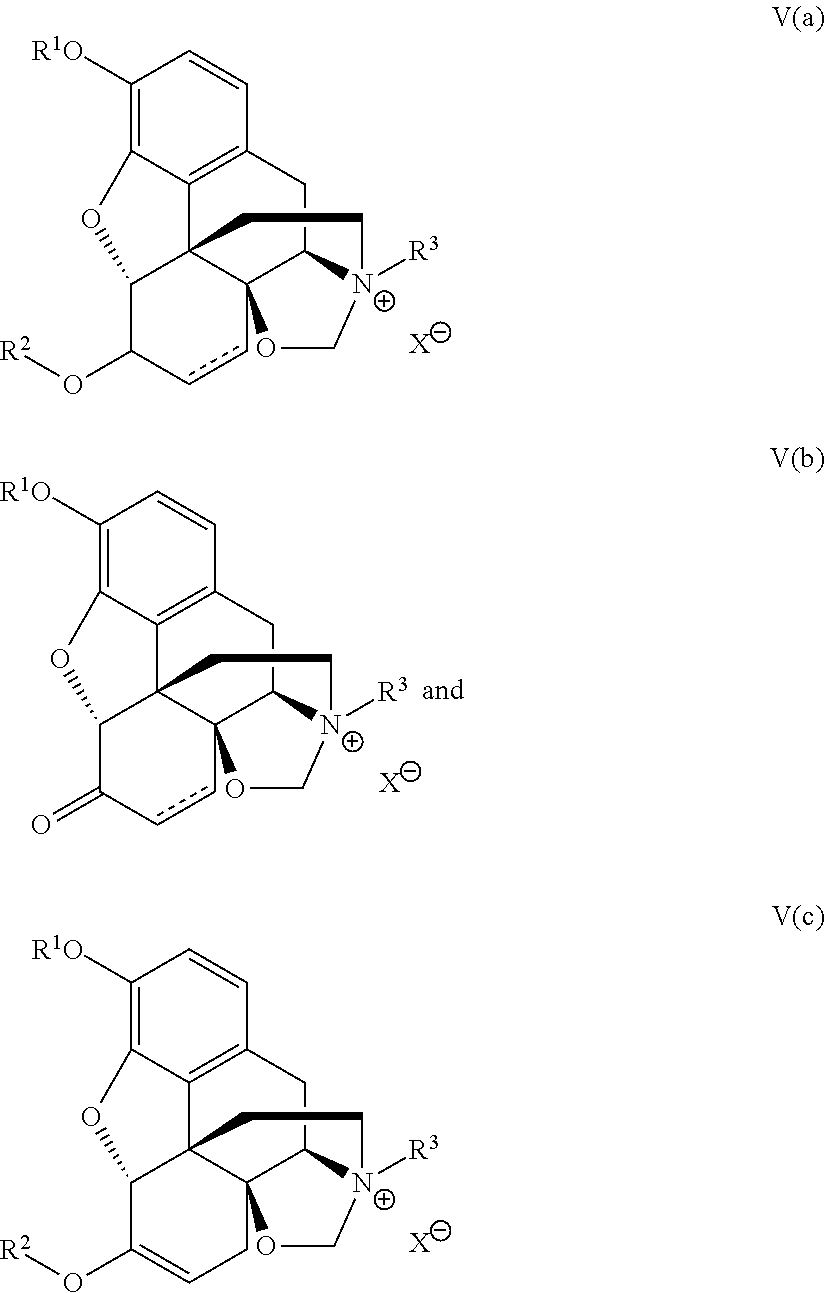
wherein
R1 and R2 are independently selected from C1-10alkyl, C6-10aryl, C3-10cycloalkyl, C1-10alkyleneC6-10aryl, C1-10alkyleneC3-10cycloalkyl and PG, and PG is a protecting group;
R3 is selected from C3-10cycloalkyl, C3-10cycloalkenyl, C1-10alkyl, C2-10alkenyl, C6-10aryl, C1-10alkyleneC6-10aryl and C1-10alkyleneC3-10cycloalkyl;
X is a counteranion, and
one or more available hydrogens in R1, R2 and R3 is/are optionally replaced with F and/or one or more of available atoms in R1, R2 and R3 is/are optionally replaced with an isotopic label,
or a salt or solvate thereof.

wherein
R3 is selected from C3-10cycloalkyl, C3-10cycloalkenyl, C2-10alkenyl, C6-10aryl, C1-10alkyleneC6-10aryl and C1-10alkyleneC3-10cycloalkyl;
X is a counteranion; and
one or more available hydrogens in R3 is/are optionally replaced with F and/or one or more of available atoms in R3 is/are optionally replaced with an isotopic label, or
a salt or solvate thereof.

wherein
R3 is selected from C3-10cycloalkyl, C3-10cycloalkenyl, C1-10alkyl, C2-10alkenyl, C6-10aryl, C1-10alkyleneC6-10aryl and C1-10alkyleneC3-10cycloalkyl;
X is a counteranion; and
one or more available hydrogens in R3 is/are optionally replaced with F and/or
one or more of available atoms in R3 is/are optionally replaced with an isotopic label, or
a salt or solvate thereof.

wherein
R3 is selected from C3-10cycloalkyl, C3-10cycloalkenyl, C2-10alkenyl, C6-10aryl, C1-10alkyleneC6-10aryl and C1-10alkyleneC3-10cycloalkyl;
R4 and R5 are independently selected from H, C6-10aryl, C3-10cycloalkyl, C1-10alkyleneC6-10aryl, C1-10alkyleneC3-10cycloalkyl and PG, except when
PG is a protecting group; and
one or more available hydrogens in R3, R4 and R5 is/are optionally replaced with F and/or one or more of available atoms in R3, R4 and R5 is/are optionally replaced with an isotopic label, or
a salt or solvate thereof.

wherein
R3 is selected from C3-10cycloalkyl, C3-10cycloalkenyl, C1-10alkyl, C2-10alkenyl, C6-10aryl, C1-10alkyleneC6-10aryl and C1-10alkyleneC3-10cycloalkyl;
R4 and R5 are independently selected from H, C1-10alkyl, C6-10aryl, C3-10cycloalkyl, C1-10alkyleneC6-10aryl, C1-10alkyleneC3-10cycloalkyl and PG;
PG is a protecting group; and
one or more available hydrogens in R3, R4 and R5 is/are optionally replaced with F and/or one or more of available atoms in R3, R4 and R5 is/are optionally replaced with an isotopic label, or
a salt or solvate thereof.


- i von Braun, J.; Chem. Ber., 1900, 33, 1438.
- ii Cooley, J. H.; Evain, E. J.; Synthesis 1989, 1.
- ill Olofson, R. A.; Martz, J. T.; Senet, J.-P.; Piteau, M.; Malfroot, T. J. Org. Chem. 1984, 49, 2081.
- iv (a) K. M. Madyastha, Proc. Indian Acad. Sci. 1994, 106, 1203; (b) K. M. Madyastha, G. V. B. Reddy, J. Chem. Soc. Perkin Trans. 1 1994, 911.
- v Chaudhary, V; Leisch, H.; Moudra, A.; Allen, B.; De Luca, V.; Cox, D. P.; Hudlicky, T. Collect. Czech. Chem. Commun. 2009, 74, 1179-1193.
- vi (a) G. Kok, T. D. Asten, P. J. Scammells, Adv. Synth. Catal. 2009, 351, 283; (b) Z. Dong, P. J. Scammells, J. Org. Chem. 2007, 72, 9881.
- vii Smith, C.; Purcell, S.; Waddell, L.; Hayes, N.; Ritchie, J.; WO 2005/028483.
- viii Rinner, U.; Adams, D. R.; dos Santos, M. L.; Hudlicky, T. Synlett 2003, 1247-1252.
- ix (a) Nicolaou, K. C.; Snyder, S. A.; Nalbandian, A. Z.; Longbottom, D. A. J. Am. Chem. Soc. 2004, 126, 6234; (b) Nicolaou, K. C.; Huang, X.; Snyder, S. A.; Rao, P. B.; Bella, M.; Reddy, M. V. Angew. Chem. Int. Ed. Engl. 2002, 41, 834; (c) Nicolaou, K. C.; Longbottom, D. A.; Snyder, S. A.; Nalbandian, A. Z.; Huang, X. Angew. Chem. Int. Ed. Engl. 2002, 41, 3866.
- x Banfield, S. C.; Omori, A. T.; Leisch, H.; Hudlicky, T. J. Org. Chem. 2007, 72, 4989-4992.
- Xi (a) For a recent summary of new applications of the Burgess reagent see: Leisch, H.; Sullivan, B.; Fonovic, B.; Dudding, T.; Hudlicky, T. Eur. J. Org. Chem. 2009, 2806-2819; Reviews of applications of the Burgess reagent: (b) Santra, S. Synlett 2009, 852; (c) Nicolaou, K. C.; Snyder, S. A.; Longbottom, D. A.; Nalbandian, A. Z.; Huang, X. Chem. Eur. J. 2004, 10, 5581; (d) Khapli, S.; Dey, S.; Mal, D. J. Ind. Inst. Sci. 2001, 81, 461; (e) Burckhardt, S. Synlett 2000, 559; (f) Lamberth, C. J. Prakt. Chem. 2000, 342, 518; (g) Taibe, P.; Mobashery, S. in Encyclopedia of Reagents in Organic Synthesis, vol. 5, Paquette, L. A., Ed., Wiley, Chichester, 1995, p. 3345.
- xii Metcalf, T. A.; Simionescu, R.; Hudlicky, T. J. Org. Chem. 2010, 75, 3447-3450.
- xiii Leisch, H.; Saxon, R.; Sullivan, B.; Hudlicky, T. Synlett 2006, 445-449.
- xiv Use of the Burgess reagent in natural product synthesis: a) cedrene: Rigby, J. H.; Kirova-Snover, M. Tetrahedron Lett. 1997, 38, 8153; b) narciclasine: Rigby, J. H.; Mateo, M. E. J. Am. Chem. Soc. 1997, 119, 12655; c) taxol: Holton, R. A.; Kim, H. B.; Sonoza, C.; Liang, F.; Biediger, R. J.; Boatman, P. D.; Shindo, M.; Smith, C. C.; Kim, S.; Nadizadeh, H.; Suzuki, Y.; Tao, C.; Vu, P.; Tang, S.; Zhang, P.; Murthi, K. K.; Gentile, L. N.; Liu, J. H. J. Am. Chem. Soc. 1994, 116, 1599; d) efrotomycin: Dolle, R. E.; Nicolaou, K. C. J. Am. Chem. Soc. 1985, 107, 1691; e) pravastatin: Daniewski, A. R.; Wovkulich, P. M.; Uskokovic, M. R. J. Org. Chem. 1992, 57, 7133; f) balanol: Sullivan, B.; Gilmet, J.; Leisch, H.; Hudlicky, T. J. Nat. Prod. 2008, 71, 346-350.
- xv Edward M. Burgess, Harold R. Penton Jr., and E. A. Taylor. “Thermal reactions of alkyl N-carbomethoxysulfamate esters”. J. Org. Chem. 1973, 38(I):26-31.
- xvi Olofson, R. A.; Schnur, R. C.; Bunes, L.; Pepe, J. Tetrahedron Lett. 1977, 18, 1567.
- xvii (a) Pillai, O.; Hamad, M. O.; Crooks, P. A.; Stinchcomb, A. L. Pharm. Res., 2004, 21, 1146; (b) Hamad, M. O.; Kiptoo, P. K.; Stinchcomb, A. L.; Crooks, P. A.; Bioorg. Med. Chem. 2006, 14, 7051.
- xviii Naltrexone mp reference: Olofson et al. U.S. Pat. No. 4,141,897 (1976).
- xix Ukrainets, I. V.; Tkach, A. A.; Gorokhova, O. V.; Turov, A. V.; Linsky, I. V.; in Chemistry of Heterocyclic Compounds (New York, N.Y., United States), 2009, vol. 45, #4, p. 405.
- xx Andre, J.; Dormoy, J.; Haymes, A. Synth. Comm., 1992, 22, 2313.
- xxi (a) Lewenstein et al. U.S. Pat. No. 3,254,088 (1966); (b) Sankyo, Belg. Pat. No. 615,009 (1962).
- xxii Research Corp. Patent: U.S. Pat. No. 4,161,597, 1979; Chem. Abstr. vol. 92, #22671.
Claims (19)


R3-LG VI,


Priority Applications (1)
| Application Number | Priority Date | Filing Date | Title |
|---|---|---|---|
| US14/591,382 US9045497B1 (en) | 2011-05-02 | 2015-01-07 | Processes and intermediates in the preparation of morphine analogs via N-demethylation of N-oxides using cyclodehydration reagents |
Applications Claiming Priority (3)
| Application Number | Priority Date | Filing Date | Title |
|---|---|---|---|
| US201161481359P | 2011-05-02 | 2011-05-02 | |
| US13/462,059 US8957072B2 (en) | 2011-05-02 | 2012-05-02 | Processes and intermediates in the preparation of morphine analogs via N-demethylation of N-oxides using cyclodehydration reagents |
| US14/591,382 US9045497B1 (en) | 2011-05-02 | 2015-01-07 | Processes and intermediates in the preparation of morphine analogs via N-demethylation of N-oxides using cyclodehydration reagents |
Related Parent Applications (1)
| Application Number | Title | Priority Date | Filing Date |
|---|---|---|---|
| US13/462,059 Division US8957072B2 (en) | 2011-05-02 | 2012-05-02 | Processes and intermediates in the preparation of morphine analogs via N-demethylation of N-oxides using cyclodehydration reagents |
Publications (2)
| Publication Number | Publication Date |
|---|---|
| US20150133665A1 US20150133665A1 (en) | 2015-05-14 |
| US9045497B1 true US9045497B1 (en) | 2015-06-02 |
Family
ID=47090666
Family Applications (2)
| Application Number | Title | Priority Date | Filing Date |
|---|---|---|---|
| US13/462,059 Expired - Fee Related US8957072B2 (en) | 2011-05-02 | 2012-05-02 | Processes and intermediates in the preparation of morphine analogs via N-demethylation of N-oxides using cyclodehydration reagents |
| US14/591,382 Expired - Fee Related US9045497B1 (en) | 2011-05-02 | 2015-01-07 | Processes and intermediates in the preparation of morphine analogs via N-demethylation of N-oxides using cyclodehydration reagents |
Family Applications Before (1)
| Application Number | Title | Priority Date | Filing Date |
|---|---|---|---|
| US13/462,059 Expired - Fee Related US8957072B2 (en) | 2011-05-02 | 2012-05-02 | Processes and intermediates in the preparation of morphine analogs via N-demethylation of N-oxides using cyclodehydration reagents |
Country Status (10)
| Country | Link |
|---|---|
| US (2) | US8957072B2 (en) |
| EP (2) | EP2705043B1 (en) |
| JP (2) | JP6046119B2 (en) |
| KR (1) | KR20140057204A (en) |
| CN (2) | CN105924455A (en) |
| AU (1) | AU2012250451B9 (en) |
| BR (1) | BR112013027976A2 (en) |
| CA (1) | CA2833283A1 (en) |
| WO (1) | WO2012149633A1 (en) |
| ZA (1) | ZA201309199B (en) |
Families Citing this family (8)
| Publication number | Priority date | Publication date | Assignee | Title |
|---|---|---|---|---|
| US8981098B2 (en) | 2012-02-03 | 2015-03-17 | Brock University | Process for the preparation of morphine analogs via the reaction of organometallic reagents with an oxazolidine derived from morphinans |
| GB201313915D0 (en) * | 2013-08-02 | 2013-09-18 | Johnson Matthey Plc | Process |
| US9701687B2 (en) * | 2014-05-05 | 2017-07-11 | Noramco, Inc. | Process for the preparation of opioid compounds |
| US9701688B2 (en) * | 2014-05-05 | 2017-07-11 | Noramco, Inc. | Process for the preparation of opioid compounds |
| US20190127389A1 (en) * | 2016-04-22 | 2019-05-02 | Noramco, Inc. | Processes And Oxazolidine-Containing Intermediates For The Preparation Of Morphine Analogs And Derivatives |
| WO2017184979A1 (en) | 2016-04-22 | 2017-10-26 | Noramco, Inc. | N-demethylation of morphinan alkaloids |
| CN109641974B (en) | 2017-01-20 | 2021-11-02 | 营养株式会社 | Highly dispersible dextrin and method for producing the same |
| CN114573508B (en) * | 2020-12-01 | 2024-07-23 | 绍兴赜军生物医药科技有限公司 | Oxycodone compound, intermediate and preparation method thereof |
Citations (6)
| Publication number | Priority date | Publication date | Assignee | Title |
|---|---|---|---|---|
| DE341272C (en) | 1920-07-01 | 1921-09-29 | Bohn & Herber | Ink extraction device for printing machines |
| DE3412727A1 (en) | 1984-04-04 | 1985-10-17 | Helmut Dr. Innsbruck Schmidhammer | 14-Alkoxy-N-methylmorphinan-6-ones, process for their preparation, and medicaments containing these compounds |
| WO2005028433A2 (en) | 2003-09-15 | 2005-03-31 | Research Development Foundation | CRIPTO ANTAGONISM OF ACTIVIN AND TGF-β SIGNALING |
| WO2008070462A2 (en) | 2006-11-22 | 2008-06-12 | Progenics Pharmaceuticals, Inc. | N-oxides of 4,5-epoxy-morphinanium analogs |
| US20100081819A1 (en) | 2008-09-30 | 2010-04-01 | Mallinckrodt Inc. | Processes for the synthesis of tertiary amines |
| WO2012013671A1 (en) | 2010-07-27 | 2012-02-02 | Universität Innsbruck | Processes for the production of 14 - oxygenated morphinan - 6 - ones |
Family Cites Families (13)
| Publication number | Priority date | Publication date | Assignee | Title |
|---|---|---|---|---|
| BE615009A (en) | 1961-03-14 | 1962-07-02 | Sankyo Co | Novel Morphinone Compounds and Method for Preparing Them |
| US3254088A (en) | 1961-03-14 | 1966-05-31 | Lewenstein | Morphine derivative |
| US4141897A (en) | 1976-12-20 | 1979-02-27 | Research Corporation | N-dealkylation of N-alkyl-14-hydroxymorphinans and derivatives thereof |
| US4161597A (en) | 1976-12-20 | 1979-07-17 | Research Corporation | N-alkyl-14-hydroxymorphinans and derivatives |
| US4203900A (en) | 1977-01-03 | 1980-05-20 | The Dow Chemical Company | Process for preparing 2-oxazolines |
| US4176186A (en) | 1978-07-28 | 1979-11-27 | Boehringer Ingelheim Gmbh | Quaternary derivatives of noroxymorphone which relieve intestinal immobility |
| US4667037A (en) | 1985-06-06 | 1987-05-19 | E. I. Du Pont De Nemours And Company | Dealkylation of opioid ethers |
| ES2226569B1 (en) | 2003-07-04 | 2006-06-01 | Pedro Monagas Asensio | ELEMENT OF LAMINARY PROTECTION. |
| HUE034668T2 (en) * | 2003-09-22 | 2018-02-28 | Glaxosmithkline Australia Pty Ltd | Process for the synthesis of morphinane compounds and intermediates thereof |
| EP2101773A2 (en) * | 2006-11-22 | 2009-09-23 | Progenics Pharmaceuticals, Inc. | (r)-n-stereoisomers of 7,8-saturated-4,5-epoxy-morphinanium analogs |
| DE102009000253A1 (en) * | 2009-01-15 | 2010-07-22 | Zf Friedrichshafen Ag | Method for operating a transmission device |
| CN102459275A (en) * | 2009-04-24 | 2012-05-16 | 布鲁克大学 | Processes for preparation of morphinane and morphinone compounds |
| CN101570539B (en) * | 2009-06-01 | 2012-01-11 | 漆又毛 | Morphinone quaternary ammonium salt derivatives and preparation method thereof |
-
2012
- 2012-05-02 BR BR112013027976A patent/BR112013027976A2/en not_active IP Right Cessation
- 2012-05-02 CN CN201610267205.5A patent/CN105924455A/en active Pending
- 2012-05-02 JP JP2014508654A patent/JP6046119B2/en not_active Expired - Fee Related
- 2012-05-02 AU AU2012250451A patent/AU2012250451B9/en not_active Ceased
- 2012-05-02 EP EP12779589.6A patent/EP2705043B1/en not_active Revoked
- 2012-05-02 CA CA2833283A patent/CA2833283A1/en not_active Abandoned
- 2012-05-02 EP EP16154522.3A patent/EP3042908A1/en not_active Withdrawn
- 2012-05-02 WO PCT/CA2012/000384 patent/WO2012149633A1/en not_active Ceased
- 2012-05-02 KR KR1020137031906A patent/KR20140057204A/en not_active Withdrawn
- 2012-05-02 US US13/462,059 patent/US8957072B2/en not_active Expired - Fee Related
- 2012-05-02 CN CN201280021543.0A patent/CN103596962B/en not_active Expired - Fee Related
-
2013
- 2013-11-28 ZA ZA2013/09199A patent/ZA201309199B/en unknown
-
2015
- 2015-01-07 US US14/591,382 patent/US9045497B1/en not_active Expired - Fee Related
-
2016
- 2016-08-17 JP JP2016159886A patent/JP2017008083A/en active Pending
Patent Citations (6)
| Publication number | Priority date | Publication date | Assignee | Title |
|---|---|---|---|---|
| DE341272C (en) | 1920-07-01 | 1921-09-29 | Bohn & Herber | Ink extraction device for printing machines |
| DE3412727A1 (en) | 1984-04-04 | 1985-10-17 | Helmut Dr. Innsbruck Schmidhammer | 14-Alkoxy-N-methylmorphinan-6-ones, process for their preparation, and medicaments containing these compounds |
| WO2005028433A2 (en) | 2003-09-15 | 2005-03-31 | Research Development Foundation | CRIPTO ANTAGONISM OF ACTIVIN AND TGF-β SIGNALING |
| WO2008070462A2 (en) | 2006-11-22 | 2008-06-12 | Progenics Pharmaceuticals, Inc. | N-oxides of 4,5-epoxy-morphinanium analogs |
| US20100081819A1 (en) | 2008-09-30 | 2010-04-01 | Mallinckrodt Inc. | Processes for the synthesis of tertiary amines |
| WO2012013671A1 (en) | 2010-07-27 | 2012-02-02 | Universität Innsbruck | Processes for the production of 14 - oxygenated morphinan - 6 - ones |
Non-Patent Citations (20)
Also Published As
| Publication number | Publication date |
|---|---|
| EP3042908A1 (en) | 2016-07-13 |
| KR20140057204A (en) | 2014-05-12 |
| CN105924455A (en) | 2016-09-07 |
| ZA201309199B (en) | 2015-02-25 |
| US20120283443A1 (en) | 2012-11-08 |
| BR112013027976A2 (en) | 2016-08-09 |
| CN103596962A (en) | 2014-02-19 |
| JP6046119B2 (en) | 2016-12-14 |
| EP2705043B1 (en) | 2016-11-30 |
| AU2012250451B2 (en) | 2016-12-15 |
| JP2017008083A (en) | 2017-01-12 |
| WO2012149633A1 (en) | 2012-11-08 |
| EP2705043A1 (en) | 2014-03-12 |
| CA2833283A1 (en) | 2012-11-08 |
| EP2705043A4 (en) | 2014-09-24 |
| US20150133665A1 (en) | 2015-05-14 |
| AU2012250451A1 (en) | 2013-11-28 |
| CN103596962B (en) | 2017-02-15 |
| JP2014514338A (en) | 2014-06-19 |
| US8957072B2 (en) | 2015-02-17 |
| AU2012250451B9 (en) | 2017-02-02 |
Similar Documents
| Publication | Publication Date | Title |
|---|---|---|
| US8957072B2 (en) | Processes and intermediates in the preparation of morphine analogs via N-demethylation of N-oxides using cyclodehydration reagents | |
| US10155772B2 (en) | Process for the synthesis of substituted morphinans | |
| US9533993B2 (en) | Process for the preparation of morphine analogs via metal catalyzed N-demethylation/functionalization and intramolecular group transfer | |
| US8981098B2 (en) | Process for the preparation of morphine analogs via the reaction of organometallic reagents with an oxazolidine derived from morphinans | |
| AU2009260121C1 (en) | Process for the synthesis of N-demethylated morphinane compounds | |
| HK1178081A (en) | Process for the synthesis of substituted morphinans |
Legal Events
| Date | Code | Title | Description |
|---|---|---|---|
| AS | Assignment |
Owner name: BROCK UNIVERSITY, CANADA Free format text: ASSIGNMENT OF ASSIGNORS INTEREST;ASSIGNORS:HUDLICKY, TOMAS;WERNER, LUKAS;MACHARA, ALES;AND OTHERS;SIGNING DATES FROM 20110812 TO 20110824;REEL/FRAME:034820/0773 |
|
| STCF | Information on status: patent grant |
Free format text: PATENTED CASE |
|
| FEPP | Fee payment procedure |
Free format text: MAINTENANCE FEE REMINDER MAILED (ORIGINAL EVENT CODE: REM.); ENTITY STATUS OF PATENT OWNER: LARGE ENTITY |
|
| LAPS | Lapse for failure to pay maintenance fees |
Free format text: PATENT EXPIRED FOR FAILURE TO PAY MAINTENANCE FEES (ORIGINAL EVENT CODE: EXP.); ENTITY STATUS OF PATENT OWNER: LARGE ENTITY |
|
| STCH | Information on status: patent discontinuation |
Free format text: PATENT EXPIRED DUE TO NONPAYMENT OF MAINTENANCE FEES UNDER 37 CFR 1.362 |
|
| FP | Lapsed due to failure to pay maintenance fee |
Effective date: 20190602 |