US9044481B2 - Lipidated oxoadenine derivatives - Google Patents

Lipidated oxoadenine derivatives Download PDF

Info

Publication number
US9044481B2
US9044481B2 US13/389,307 US201013389307A US9044481B2 US 9044481 B2 US9044481 B2 US 9044481B2 US 201013389307 A US201013389307 A US 201013389307A US 9044481 B2 US9044481 B2 US 9044481B2
Authority
US
United States
Prior art keywords
alkyl
integer
alkoxy
alkoxyc
acyl
Prior art date
Legal status (The legal status is an assumption and is not a legal conclusion. Google has not performed a legal analysis and makes no representation as to the accuracy of the status listed.)
Active, expires
Application number
US13/389,307
Other versions
US20120135963A1 (en
Inventor
David Johnson
Current Assignee (The listed assignees may be inaccurate. Google has not performed a legal analysis and makes no representation or warranty as to the accuracy of the list.)
GlaxoSmithKline Biologicals SA
Original Assignee
GlaxoSmithKline Biologicals SA
Priority date (The priority date is an assumption and is not a legal conclusion. Google has not performed a legal analysis and makes no representation as to the accuracy of the date listed.)
Filing date
Publication date
Application filed by GlaxoSmithKline Biologicals SA filed Critical GlaxoSmithKline Biologicals SA
Priority to US13/389,307 priority Critical patent/US9044481B2/en
Assigned to GLAXOSMITHKLINE BIOLOGICALS SA reassignment GLAXOSMITHKLINE BIOLOGICALS SA ASSIGNMENT OF ASSIGNORS INTEREST (SEE DOCUMENT FOR DETAILS). Assignors: JOHNSON, DAVID
Publication of US20120135963A1 publication Critical patent/US20120135963A1/en
Application granted granted Critical
Publication of US9044481B2 publication Critical patent/US9044481B2/en
Active legal-status Critical Current
Adjusted expiration legal-status Critical

Links

Images

Classifications

    • AHUMAN NECESSITIES
    • A61MEDICAL OR VETERINARY SCIENCE; HYGIENE
    • A61KPREPARATIONS FOR MEDICAL, DENTAL OR TOILETRY PURPOSES
    • A61K31/00Medicinal preparations containing organic active ingredients
    • A61K31/33Heterocyclic compounds
    • A61K31/395Heterocyclic compounds having nitrogen as a ring hetero atom, e.g. guanethidine or rifamycins
    • A61K31/495Heterocyclic compounds having nitrogen as a ring hetero atom, e.g. guanethidine or rifamycins having six-membered rings with two or more nitrogen atoms as the only ring heteroatoms, e.g. piperazine or tetrazines
    • A61K31/505Pyrimidines; Hydrogenated pyrimidines, e.g. trimethoprim
    • A61K31/519Pyrimidines; Hydrogenated pyrimidines, e.g. trimethoprim ortho- or peri-condensed with heterocyclic rings
    • A61K31/52Purines, e.g. adenine
    • AHUMAN NECESSITIES
    • A61MEDICAL OR VETERINARY SCIENCE; HYGIENE
    • A61KPREPARATIONS FOR MEDICAL, DENTAL OR TOILETRY PURPOSES
    • A61K31/00Medicinal preparations containing organic active ingredients
    • A61K31/33Heterocyclic compounds
    • A61K31/395Heterocyclic compounds having nitrogen as a ring hetero atom, e.g. guanethidine or rifamycins
    • A61K31/495Heterocyclic compounds having nitrogen as a ring hetero atom, e.g. guanethidine or rifamycins having six-membered rings with two or more nitrogen atoms as the only ring heteroatoms, e.g. piperazine or tetrazines
    • A61K31/505Pyrimidines; Hydrogenated pyrimidines, e.g. trimethoprim
    • A61K31/519Pyrimidines; Hydrogenated pyrimidines, e.g. trimethoprim ortho- or peri-condensed with heterocyclic rings
    • A61K31/52Purines, e.g. adenine
    • A61K31/522Purines, e.g. adenine having oxo groups directly attached to the heterocyclic ring, e.g. hypoxanthine, guanine, acyclovir
    • A61K47/48053
    • A61K47/48123
    • A61K47/48815
    • AHUMAN NECESSITIES
    • A61MEDICAL OR VETERINARY SCIENCE; HYGIENE
    • A61KPREPARATIONS FOR MEDICAL, DENTAL OR TOILETRY PURPOSES
    • A61K47/00Medicinal preparations characterised by the non-active ingredients used, e.g. carriers or inert additives; Targeting or modifying agents chemically bound to the active ingredient
    • A61K47/50Medicinal preparations characterised by the non-active ingredients used, e.g. carriers or inert additives; Targeting or modifying agents chemically bound to the active ingredient the non-active ingredient being chemically bound to the active ingredient, e.g. polymer-drug conjugates
    • A61K47/51Medicinal preparations characterised by the non-active ingredients used, e.g. carriers or inert additives; Targeting or modifying agents chemically bound to the active ingredient the non-active ingredient being chemically bound to the active ingredient, e.g. polymer-drug conjugates the non-active ingredient being a modifying agent
    • A61K47/54Medicinal preparations characterised by the non-active ingredients used, e.g. carriers or inert additives; Targeting or modifying agents chemically bound to the active ingredient the non-active ingredient being chemically bound to the active ingredient, e.g. polymer-drug conjugates the non-active ingredient being a modifying agent the modifying agent being an organic compound
    • A61K47/543Lipids, e.g. triglycerides; Polyamines, e.g. spermine or spermidine
    • A61K47/544Phospholipids
    • AHUMAN NECESSITIES
    • A61MEDICAL OR VETERINARY SCIENCE; HYGIENE
    • A61KPREPARATIONS FOR MEDICAL, DENTAL OR TOILETRY PURPOSES
    • A61K47/00Medicinal preparations characterised by the non-active ingredients used, e.g. carriers or inert additives; Targeting or modifying agents chemically bound to the active ingredient
    • A61K47/50Medicinal preparations characterised by the non-active ingredients used, e.g. carriers or inert additives; Targeting or modifying agents chemically bound to the active ingredient the non-active ingredient being chemically bound to the active ingredient, e.g. polymer-drug conjugates
    • A61K47/51Medicinal preparations characterised by the non-active ingredients used, e.g. carriers or inert additives; Targeting or modifying agents chemically bound to the active ingredient the non-active ingredient being chemically bound to the active ingredient, e.g. polymer-drug conjugates the non-active ingredient being a modifying agent
    • A61K47/54Medicinal preparations characterised by the non-active ingredients used, e.g. carriers or inert additives; Targeting or modifying agents chemically bound to the active ingredient the non-active ingredient being chemically bound to the active ingredient, e.g. polymer-drug conjugates the non-active ingredient being a modifying agent the modifying agent being an organic compound
    • A61K47/554Medicinal preparations characterised by the non-active ingredients used, e.g. carriers or inert additives; Targeting or modifying agents chemically bound to the active ingredient the non-active ingredient being chemically bound to the active ingredient, e.g. polymer-drug conjugates the non-active ingredient being a modifying agent the modifying agent being an organic compound the modifying agent being a steroid plant sterol, glycyrrhetic acid, enoxolone or bile acid
    • AHUMAN NECESSITIES
    • A61MEDICAL OR VETERINARY SCIENCE; HYGIENE
    • A61KPREPARATIONS FOR MEDICAL, DENTAL OR TOILETRY PURPOSES
    • A61K47/00Medicinal preparations characterised by the non-active ingredients used, e.g. carriers or inert additives; Targeting or modifying agents chemically bound to the active ingredient
    • A61K47/50Medicinal preparations characterised by the non-active ingredients used, e.g. carriers or inert additives; Targeting or modifying agents chemically bound to the active ingredient the non-active ingredient being chemically bound to the active ingredient, e.g. polymer-drug conjugates
    • A61K47/69Medicinal preparations characterised by the non-active ingredients used, e.g. carriers or inert additives; Targeting or modifying agents chemically bound to the active ingredient the non-active ingredient being chemically bound to the active ingredient, e.g. polymer-drug conjugates the conjugate being characterised by physical or galenical forms, e.g. emulsion, particle, inclusion complex, stent or kit
    • A61K47/6905Medicinal preparations characterised by the non-active ingredients used, e.g. carriers or inert additives; Targeting or modifying agents chemically bound to the active ingredient the non-active ingredient being chemically bound to the active ingredient, e.g. polymer-drug conjugates the conjugate being characterised by physical or galenical forms, e.g. emulsion, particle, inclusion complex, stent or kit the form being a colloid or an emulsion
    • A61K47/6911Medicinal preparations characterised by the non-active ingredients used, e.g. carriers or inert additives; Targeting or modifying agents chemically bound to the active ingredient the non-active ingredient being chemically bound to the active ingredient, e.g. polymer-drug conjugates the conjugate being characterised by physical or galenical forms, e.g. emulsion, particle, inclusion complex, stent or kit the form being a colloid or an emulsion the form being a liposome
    • AHUMAN NECESSITIES
    • A61MEDICAL OR VETERINARY SCIENCE; HYGIENE
    • A61PSPECIFIC THERAPEUTIC ACTIVITY OF CHEMICAL COMPOUNDS OR MEDICINAL PREPARATIONS
    • A61P25/00Drugs for disorders of the nervous system
    • A61P25/08Antiepileptics; Anticonvulsants
    • AHUMAN NECESSITIES
    • A61MEDICAL OR VETERINARY SCIENCE; HYGIENE
    • A61PSPECIFIC THERAPEUTIC ACTIVITY OF CHEMICAL COMPOUNDS OR MEDICINAL PREPARATIONS
    • A61P37/00Drugs for immunological or allergic disorders
    • A61P37/02Immunomodulators
    • AHUMAN NECESSITIES
    • A61MEDICAL OR VETERINARY SCIENCE; HYGIENE
    • A61PSPECIFIC THERAPEUTIC ACTIVITY OF CHEMICAL COMPOUNDS OR MEDICINAL PREPARATIONS
    • A61P37/00Drugs for immunological or allergic disorders
    • A61P37/02Immunomodulators
    • A61P37/04Immunostimulants
    • AHUMAN NECESSITIES
    • A61MEDICAL OR VETERINARY SCIENCE; HYGIENE
    • A61PSPECIFIC THERAPEUTIC ACTIVITY OF CHEMICAL COMPOUNDS OR MEDICINAL PREPARATIONS
    • A61P43/00Drugs for specific purposes, not provided for in groups A61P1/00-A61P41/00
    • CCHEMISTRY; METALLURGY
    • C07ORGANIC CHEMISTRY
    • C07DHETEROCYCLIC COMPOUNDS
    • C07D403/00Heterocyclic compounds containing two or more hetero rings, having nitrogen atoms as the only ring hetero atoms, not provided for by group C07D401/00
    • C07D403/02Heterocyclic compounds containing two or more hetero rings, having nitrogen atoms as the only ring hetero atoms, not provided for by group C07D401/00 containing two hetero rings
    • C07D403/06Heterocyclic compounds containing two or more hetero rings, having nitrogen atoms as the only ring hetero atoms, not provided for by group C07D401/00 containing two hetero rings linked by a carbon chain containing only aliphatic carbon atoms

Definitions

  • the present invention relates to novel adjuvant compounds, processes for their preparation, compositions containing them, and their use as vaccine adjuvants.
  • TLRs toll-like receptors
  • PAMPs pathogen-associated patterns
  • TLRs 1, 2, 4, 5, 6 are associated with the recognition of bacterial components
  • TLRs 3, 7, 8, 9 appear to be restricted to cytoplasmic compartments and are involved in the detection of viral RNA (TLRs 3, 7, 8) and unmethylated DNA (TLR9)
  • TLRs 3, 7, 8 are associated with the recognition of bacterial components
  • TLRs 3, 7, 8 appear to be restricted to cytoplasmic compartments and are involved in the detection of viral RNA
  • TLRs 3, 7, 8) and unmethylated DNA TLR9
  • TLR9 unmethylated DNA
  • Activation of TLRs regulates intracellular signaling pathways and leads to gene expression via interaction with intracellular adapter molecules such as MyD88, TRIF, TIRAP, and TRAM (Akira, S. Nat Rev Immunol 2004, 4, 499; Takeda, K. Semin Immunol 2004, 16, 3).
  • cytokines/chemokines and type I interferons can differentially regulate the expression of inflammatory cytokines/chemokines and type I interferons (IFN ⁇ / ⁇ ), which can lead to the preferential enhancement of antigen-specific humoral and cell-mediated immune responses (Zughaier, S. Infect Immun 2005, 73, 2940).
  • Humoral immunity is the major line of defense against bacterial pathogens, whereas the induction of cytotoxic T lymphocytes (CTLs) appears to be crucial for protective immunity in the case of viral disease and cancer.
  • CTLs cytotoxic T lymphocytes
  • TLR7 and TLR8 activation a few different classes of small molecule mimetics of the natural (U- and/or G-rich) viral ssRNA ligands have been identified. These include certain antiviral compounds related to oxidized guanosine metabolites (oxoguanosines), which primarily interact with TLR7 (Heil, F. Eur J Immunol 2003, 33, 2987; Hemmi, 2002) and derivatives of adenine which engage TLR7 and/or TLR8. The immune stimulating ability of these compounds has been attributed to the TLR/MyD88-dependent signaling pathways and the production of cytokines, including IL-6 and type I (particularly interferon- ⁇ ) and II interferons.
  • oxoguanosines oxidized guanosine metabolites
  • TLR7 or TLR8 activation leads to the upregulation of co-stimulatory molecules (e.g. CD-40, CD-80, CD-86) and class I and II MHC molecules on dendritic cells (DCs).
  • DCs are the principal cells of the immune system involved in uptake and presentation of antigens to T lymphocytes.
  • Plasmacytoid dendritic cells (pDCs), which preferentially express TLR7, are professional interferon- ⁇ producing cells; whereas mDCs express TLR8 only.
  • TLR8 activation on mDCs leads to the preferential production of pro-inflammatory cytokines such as IL-12, TNF- ⁇ , and IFN- ⁇ and cell-mediated immunity (CMI).
  • TLR7 agonists are more effective at generating IFN- ⁇ and INF-regulated cytokines
  • TLR8 agonists which lead to the reversal of CD4+ regulatory (Treg) cell function, are more effective at inducing proinflammatory cytokines such as TNF- ⁇ and IL-12, suggesting that TLR7 activation may be more important for antibody responses (Th2-type responses) while TLR8 activation should induce CMI or Th1-type immune responses (Gordon J Immunol 2005, 1259).
  • the oxoadenines typically contain a hydroxyl group in the 8-position of the adenine ring (often shown in 8-keto/oxo tautomeric form), various substituents at the 2- and 9-positions, and an unsubstituted aromatic amino group in the 4-position.
  • an unsubstituted aromatic amino group is thought to be essential for IFN-inducing activity.
  • oxoadenines which were initially developed to overcome certain side effects associated with the imidazoquinolines, have been shown to be considerably more potent than prototypical imidazoquinolines such as imiquimod and resiquimod with respect to IFN-inducing activity in vitro and in vivo but devoid of emetic activity, a major clinical side effect with imidazoquinolines.
  • the oxoadenine SM360320 is currently under preclinical development against HCV and has been shown to suppress the replication of HCV in human hepatocytes by type I IFN induction as well as through an IFN-independent mechanism (Lee PNAS 2006, 103, 1828).
  • TLR7/8 agonists Since most of the TLR7/8 agonists currently under development often display toxic properties, are unstable, and/or have insubstantial immunostimulatory effects, the discovery and development of effective and safe vaccine adjuvants that activate TLR7 and/or TLR8 is essential for improving the safety and efficacy of existing and new vaccines.
  • novel lipidated oxoadenines comprising a nitrogen heterocyclyl-substituted oxoadenine molecule covalently linked to a phospho- or phosphonolipid in such a manner so as to facilitate uptake into immune cells and enhance endosomal TLR7/8 activation and antigen presentation when administered alone or in depot formulation with an antigen.
  • Enhanced immune responses with compounds of the subject invention are possibly due to direct interaction of compounds of formula (I) with endosomal TLR7 and/or TLR8 or other molecular receptors and/or interaction of an active metabolite after enzymatic action with TLR7 and/or TLR8 or other molecular receptors.
  • the compounds of the invention have been shown to be inducers of interferon- ⁇ and other immunostimulatory cytokines and may possess an improved activity-toxicity profile in comparison to known cytokine inducers when used as adjuvants for vaccine antigens in the therapeutic or prophylactic treatment of infectious diseases and cancer. These compounds are also novel per se.
  • FIG. 1 shows a protocol for evaluating vaccines comprising lipidated oxoadenines in C57BU6 mice.
  • FIG. 2 shows Proinflamatory cytokines detected within sera following injection.
  • FIG. 3 shows Proinflamatory cytokines detected within sera following injection.
  • FIG. 4 shows Chemokines detected within sera following injection.
  • Alkyl refers to monovalent saturated aliphatic hydrocarbyl groups having from 1 to 14 carbon atoms and, in some embodiments, from 1 to 6 carbon atoms.
  • (C x- C y )alkyl refers to alkyl groups having from x to y carbon atoms.
  • This term includes, by way of example, linear and branched hydrocarbyl groups such as methyl (CH 3 —), ethyl (CH 3 CH 2 —), n-propyl (CH 3 CH 2 CH 2 —), isopropyl ((CH 3 ) 2 CH—), n-butyl (CH 3 CH 2 CH 2 CH 2 —), isobutyl ((CH 3 ) 2 CHCH 2 —), sec-butyl ((CH 3 )(CH 3 CH 2 )CH—), t-butyl ((CH 3 ) 3 C—), n-pentyl (CH 3 CH 2 CH 2 CH 2 CH 2 —), and neopentyl ((CH 3 ) 3 CCH 2 —).
  • linear and branched hydrocarbyl groups such as methyl (CH 3 —), ethyl (CH 3 CH 2 —), n-propyl (CH 3 CH 2 CH 2 —), isopropyl ((CH 3 ) 2 CH—),
  • Alkoxy refers to the group —O-alkyl wherein alkyl is defined herein. Alkoxy includes, by way of example, methoxy, ethoxy, n-propoxy, isopropoxy, n-butoxy, t-butoxy, sec-butoxy, and n-pentoxy.
  • Acyl refers to the groups H—C(O)—, alkyl-C(O) and alkenyl-C(O).
  • Amino refers to the group —NHR 4 where R 4 is independently selected from hydrogen, alkyl, alkenyl, alkynyl, aryl, cycloalkyl, heteroaryl and heterocyclic.
  • Cycloalkyl refers to a saturated or partially saturated cyclic group of from 3 to 14 carbon atoms and no ring heteroatoms.
  • substituents that are not explicitly defined herein are arrived at by naming the terminal portion of the functionality followed by the adjacent functionality toward the point of attachment.
  • substituent “arylalkyloxycarbonyl” refers to the group (aryl)-(alkyl)-O—C(O)—. It is understood that the above definitions are not intended to include impermissible substitution patterns (e.g., methyl substituted with 5 fluoro groups). Such impermissible substitution patterns are well known to the skilled artisan.
  • the compounds of the subject invention are adjuvant molecules that comprise a nitrogen heterocyclyl-substituted oxoadenine molecule covalently linked to a phospho- or phosphonolipid group.
  • the compounds of the subject invention are described generally by Formula (I):
  • R 2 ⁇ H or saturated or unsaturated C 4 -C 24 alkyl or acyl
  • R 3 saturated or unsaturated C 4 -C 24 alkyl or acyl
  • TLR7 ligands We evaluated the capacity of TLR7 ligands to promote various aspects of the immune response in mice. Innate immunity was specifically investigated to conclude whether lipidated TLR7 compounds were able to induce innate chemokines and pro-inflammatory cytokines. This innate immune response provides the body with initial, non-specific protection against pathogens. Among these innate chemokines and cytokines, type I IFN is thought to be required for the programming of na ⁇ ve CD8 T-cell with respect to survival, differentiation and memory development. Mice studies have also suggested that the magnitude and duration of inflammation regulates the rate at which CD8+ T-cells acquire memory characteristics.
  • a swelling step was carried out in order to further increase the phospholipid hydration, it consists of incubating the preparation at room temperature.
  • the suspension was then pre-homogenized using a rotor-stator homogenizer (X620 CAT) for 12 min at 8000 rpm.
  • X620 CAT rotor-stator homogenizer
  • Microfluidization was then carried out using a microfluidizer (Model 110S-Serial 90181-Microfluidics Corporation) at 6 bars while keeping the microfluidization chamber at about 40° C. Sterile filtration was achieved on a PES filter (GD/X 0.2 ⁇ m, 25 mm, Whatman).
  • Lipidated molecules A3 and A1 were evaluated in vivo.
  • the SIV-p27-containing formulations summarized in Table 1 were used to vaccinate 6-8 week old C57BL/6 female mice (10/group). The mice received two intramuscular injections of 50 ⁇ l, 14 days apart and were bled at different time points after prime and boost as illustrated in FIG. 1 .
  • the innate and adaptive immune responses induced by the formulations containing the TLR7 agonists and the proprietary AS01B adjuvant (QS21+MPL) were also compared to the one induced by the corresponding AS01B-containing formulations and empty DPPC liposomes.
  • TNF- ⁇ and IL-6 were enhanced when A3 or A1 were present in the formulations, A1 being more potent than A3 ( FIG. 2 ).
  • the chemokine MCP-1 was also enhanced in the presence of both compounds ( FIG. 3 ).

Landscapes

  • Health & Medical Sciences (AREA)
  • Chemical & Material Sciences (AREA)
  • Life Sciences & Earth Sciences (AREA)
  • Public Health (AREA)
  • General Health & Medical Sciences (AREA)
  • Animal Behavior & Ethology (AREA)
  • Pharmacology & Pharmacy (AREA)
  • Medicinal Chemistry (AREA)
  • Veterinary Medicine (AREA)
  • Organic Chemistry (AREA)
  • Epidemiology (AREA)
  • Bioinformatics & Cheminformatics (AREA)
  • Engineering & Computer Science (AREA)
  • Immunology (AREA)
  • General Chemical & Material Sciences (AREA)
  • Nuclear Medicine, Radiotherapy & Molecular Imaging (AREA)
  • Molecular Biology (AREA)
  • Chemical Kinetics & Catalysis (AREA)
  • Biophysics (AREA)
  • Botany (AREA)
  • Dispersion Chemistry (AREA)
  • Pain & Pain Management (AREA)
  • Biomedical Technology (AREA)
  • Neurology (AREA)
  • Neurosurgery (AREA)
  • Pharmaceuticals Containing Other Organic And Inorganic Compounds (AREA)
  • Medicines Containing Antibodies Or Antigens For Use As Internal Diagnostic Agents (AREA)

Abstract

Provided are novel lipidated oxoadenines which are useful as immunostimulators and adjuvants and are shown to be inducers of interferon-a and other immunostimulatory cytokines.

Description

This application is filed pursuant to 35 U.S.C. §371 as a United States National Phase Application of International Patent Application Serial No. PCT/US2010/0447038 filed Jun. 8, 2010, which claims priority to U.S. Provisional Application No. 61/232,132 filed 7 Aug. 2009 the contents of which are incorporated herein by reference.
BACKGROUND OF THE INVENTION
The present invention relates to novel adjuvant compounds, processes for their preparation, compositions containing them, and their use as vaccine adjuvants.
The refinement and simplification of microbial vaccines and the use of synthetic and recombinant subunit antigens to improve vaccine manufacturability and safety has resulted in a decrease in vaccine potency. This has led to studies on the co-administration of adjuvants with antigens to potentiate vaccine activity and the weak immunogenicity of synthetic and recombinant epitopes. Adjuvants are additives that enhance humoral and/or cell-mediated immune responses to a vaccine antigen. The design of vaccine adjuvants, however, has historically been difficult because of the complex nature of the molecular mechanisms involved in immune system function. Although the addition of microbial components has long been known to enhance adaptive immune responses, only recently was it shown that toll-like receptors (TLRs) on cells involved in immune surveillance, such as epithelial and dendritic cells, engage many of these microbial products via so-called “pathogen-associated patterns” or PAMPs. Many vaccine adjuvants and stand-alone immunomodulators appear to interact with members of the TLR family.
Of the 10 known TLRs that have been identified in humans, five are associated with the recognition of bacterial components (TLRs 1, 2, 4, 5, 6) and four others (TLRs 3, 7, 8, 9) appear to be restricted to cytoplasmic compartments and are involved in the detection of viral RNA (TLRs 3, 7, 8) and unmethylated DNA (TLR9) (Iwasaki, A., Nat Immunol 2004, 5, 987) Activation of TLRs regulates intracellular signaling pathways and leads to gene expression via interaction with intracellular adapter molecules such as MyD88, TRIF, TIRAP, and TRAM (Akira, S. Nat Rev Immunol 2004, 4, 499; Takeda, K. Semin Immunol 2004, 16, 3). These adapter molecules can differentially regulate the expression of inflammatory cytokines/chemokines and type I interferons (IFNα/β), which can lead to the preferential enhancement of antigen-specific humoral and cell-mediated immune responses (Zughaier, S. Infect Immun 2005, 73, 2940). Humoral immunity is the major line of defense against bacterial pathogens, whereas the induction of cytotoxic T lymphocytes (CTLs) appears to be crucial for protective immunity in the case of viral disease and cancer.
In the case of TLR7 and TLR8 activation, a few different classes of small molecule mimetics of the natural (U- and/or G-rich) viral ssRNA ligands have been identified. These include certain antiviral compounds related to oxidized guanosine metabolites (oxoguanosines), which primarily interact with TLR7 (Heil, F. Eur J Immunol 2003, 33, 2987; Hemmi, 2002) and derivatives of adenine which engage TLR7 and/or TLR8. The immune stimulating ability of these compounds has been attributed to the TLR/MyD88-dependent signaling pathways and the production of cytokines, including IL-6 and type I (particularly interferon-α) and II interferons. TLR7 or TLR8 activation leads to the upregulation of co-stimulatory molecules (e.g. CD-40, CD-80, CD-86) and class I and II MHC molecules on dendritic cells (DCs). DCs are the principal cells of the immune system involved in uptake and presentation of antigens to T lymphocytes. Plasmacytoid dendritic cells (pDCs), which preferentially express TLR7, are professional interferon-α producing cells; whereas mDCs express TLR8 only. TLR8 activation on mDCs leads to the preferential production of pro-inflammatory cytokines such as IL-12, TNF-α, and IFN-γ and cell-mediated immunity (CMI). It has been shown that TLR7 agonists are more effective at generating IFN-α and INF-regulated cytokines, whereas TLR8 agonists, which lead to the reversal of CD4+ regulatory (Treg) cell function, are more effective at inducing proinflammatory cytokines such as TNF-α and IL-12, suggesting that TLR7 activation may be more important for antibody responses (Th2-type responses) while TLR8 activation should induce CMI or Th1-type immune responses (Gordon J Immunol 2005, 1259).
One class of TLR-active adenine derivatives that has received a considerable amount of attention are the oxoadenines. The oxoadenines typically contain a hydroxyl group in the 8-position of the adenine ring (often shown in 8-keto/oxo tautomeric form), various substituents at the 2- and 9-positions, and an unsubstituted aromatic amino group in the 4-position. As with other IFN-inducing adenine derivatives such as the imidazoquinolines, an unsubstituted aromatic amino group is thought to be essential for IFN-inducing activity. Many of the oxoadenines, which were initially developed to overcome certain side effects associated with the imidazoquinolines, have been shown to be considerably more potent than prototypical imidazoquinolines such as imiquimod and resiquimod with respect to IFN-inducing activity in vitro and in vivo but devoid of emetic activity, a major clinical side effect with imidazoquinolines. For example, the oxoadenine SM360320 is currently under preclinical development against HCV and has been shown to suppress the replication of HCV in human hepatocytes by type I IFN induction as well as through an IFN-independent mechanism (Lee PNAS 2006, 103, 1828). Nevertheless, despite the fact that the oxoadenine class appears to exhibit better overall toxicity/bioactivity profiles than imidazoquinolines, administration of SM360320 to mice by various routes leads to systemic sickness response, mediated in part by inflammatory cytokines released by mast cells (Hayashi Am J Physiol Regul Integr Comp Physiol 2008, 295, R123). In fact, the large immunological “footprint” of TLR7 agonists in general has led to concerns over toxicity and to suspension of clinical trials in many cases (Strominger Brain Res Bull 2001, 55, 445; Schmidt Nat Biotech 2007, 25, 825).
Since most of the TLR7/8 agonists currently under development often display toxic properties, are unstable, and/or have insubstantial immunostimulatory effects, the discovery and development of effective and safe vaccine adjuvants that activate TLR7 and/or TLR8 is essential for improving the safety and efficacy of existing and new vaccines.
BRIEF DESCRIPTION OF THE INVENTION
Herein we describe novel lipidated oxoadenines comprising a nitrogen heterocyclyl-substituted oxoadenine molecule covalently linked to a phospho- or phosphonolipid in such a manner so as to facilitate uptake into immune cells and enhance endosomal TLR7/8 activation and antigen presentation when administered alone or in depot formulation with an antigen. Enhanced immune responses with compounds of the subject invention are possibly due to direct interaction of compounds of formula (I) with endosomal TLR7 and/or TLR8 or other molecular receptors and/or interaction of an active metabolite after enzymatic action with TLR7 and/or TLR8 or other molecular receptors.
The compounds of the invention have been shown to be inducers of interferon-α and other immunostimulatory cytokines and may possess an improved activity-toxicity profile in comparison to known cytokine inducers when used as adjuvants for vaccine antigens in the therapeutic or prophylactic treatment of infectious diseases and cancer. These compounds are also novel per se.
BRIEF DESCRIPTION OF THE DRAWINGS
FIG. 1 shows a protocol for evaluating vaccines comprising lipidated oxoadenines in C57BU6 mice.
FIG. 2 shows Proinflamatory cytokines detected within sera following injection.
FIG. 3 shows Proinflamatory cytokines detected within sera following injection.
FIG. 4 shows Chemokines detected within sera following injection.
DETAILED DESCRIPTION OF REPRESENTATIVE EMBODIMENTS
Throughout this application, references are made to various embodiments relating to compounds, compositions, and methods. The various embodiments described are meant to provide a variety of illustrative examples and should not be construed as descriptions of alternative species. Rather it should be noted that the descriptions of various embodiments provided herein may be of overlapping scope. The embodiments discussed herein are merely illustrative and are not meant to limit the scope of the present invention.
It is to be understood that the terminology used herein is for the purpose of describing particular embodiments only and is not intended to limit the scope of the present invention. In this specification and in the claims that follow, reference will be made to a number of terms that shall be defined to have the following meanings.
“Alkyl” refers to monovalent saturated aliphatic hydrocarbyl groups having from 1 to 14 carbon atoms and, in some embodiments, from 1 to 6 carbon atoms. “(Cx-Cy)alkyl” refers to alkyl groups having from x to y carbon atoms. This term includes, by way of example, linear and branched hydrocarbyl groups such as methyl (CH3—), ethyl (CH3CH2—), n-propyl (CH3CH2CH2—), isopropyl ((CH3)2CH—), n-butyl (CH3CH2CH2CH2—), isobutyl ((CH3)2CHCH2—), sec-butyl ((CH3)(CH3CH2)CH—), t-butyl ((CH3)3C—), n-pentyl (CH3CH2CH2CH2CH2—), and neopentyl ((CH3)3CCH2—).
“Alkoxy” refers to the group —O-alkyl wherein alkyl is defined herein. Alkoxy includes, by way of example, methoxy, ethoxy, n-propoxy, isopropoxy, n-butoxy, t-butoxy, sec-butoxy, and n-pentoxy.
“Acyl” refers to the groups H—C(O)—, alkyl-C(O) and alkenyl-C(O).
“Amino” refers to the group —NHR4 where R4 is independently selected from hydrogen, alkyl, alkenyl, alkynyl, aryl, cycloalkyl, heteroaryl and heterocyclic.
“Cycloalkyl” refers to a saturated or partially saturated cyclic group of from 3 to 14 carbon atoms and no ring heteroatoms.
Unless indicated otherwise, the nomenclature of substituents that are not explicitly defined herein are arrived at by naming the terminal portion of the functionality followed by the adjacent functionality toward the point of attachment. For example, the substituent “arylalkyloxycarbonyl” refers to the group (aryl)-(alkyl)-O—C(O)—. It is understood that the above definitions are not intended to include impermissible substitution patterns (e.g., methyl substituted with 5 fluoro groups). Such impermissible substitution patterns are well known to the skilled artisan.
The compounds of the subject invention are adjuvant molecules that comprise a nitrogen heterocyclyl-substituted oxoadenine molecule covalently linked to a phospho- or phosphonolipid group. The compounds of the subject invention are described generally by Formula (I):
Figure US09044481-20150602-C00001
  • wherein
  • R1═C1-6alkyl, C1-6alkylamino, C1-6alkoxy, C3-6cycloalkylC1-6alkyl, C3-6cycloalkylC1-6alkylamino, C3-6cycloalkylC1-6alkoxy, C1-6alkoxyC1-6alkyl, C1-6alkoxyC1-6alkylamino, C1-6alkoxyC1-6alkoxy; and optionally terminally substituted with a hydroxyl, amino, thio, hydrazino, hydrazido, azido, acetylenyl, carboxyl, or maleimido group;
  • n=0-6;
  • Het is a four-, five-, or six-membered saturated nitrogen heterocycle wherein
  • X, Y═CH or N, and at least one of X and Y is a nitrogen atom;
  • Q=O, NH, or covalent bond;
  • Z═O, CH2, CF2 or covalent bond;
  • W═O, S;
  • m=0-6;
  • p=1 or 2;
  • q=0 or 1;
  • A=
Figure US09044481-20150602-C00002
  • wherein
R2═H or saturated or unsaturated C4-C24 alkyl or acyl;
R3=saturated or unsaturated C4-C24 alkyl or acyl;
  • or a pharmaceutically acceptable salt thereof.
  • In one preferred embodiment, the compounds of the subject invention are described generally by Formula II:
Figure US09044481-20150602-C00003
  • wherein
  • R1=C1-6alkylamino, C1-6alkoxy, C1-6alkoxy, C3-6cycloalkylC1-6alkyl, C3-6cycloalkylC1-6alkylamino, C3-6cycloalkylC1-6alkoxy, C1-6alkoxyC1-6alkyl, C1-6alkoxyC1-6alkylamino, C1-6alkoxyC1-6alkoxy; branched or unbranched;
  • n=0-6;
  • X=CH or N;
  • Q=O, NH, or covalent bond;
  • Z=O, CH2, CF2 or covalent bond;
  • W=O, S;
  • m=0-6;
  • p=1 or 2;
  • q=0 or 1;
  • R2=H or saturated or unsaturated C4-C24 alkyl or acyl;
  • R3=saturated or unsaturated C4-C24 alkyl or acyl;
  • or pharmaceutically acceptable salts thereof.
The compounds of the subject invention are prepared from known oxoadenine intermediates III as shown in one embodiment in Scheme 1 by (1) alkylation of III with a suitably protected nitrogen heterocyclyl alkyl bromide IV, (2) simultaneous deprotection of the N- and O-protecting groups of V under acidic conditions, and (3) either direct phosphatidylation of the N-heterocyclic substituent of VI (m=0, Q=single bond) with VII to give compounds of the subject invention VIII wherein m=0 and Q=single bond; or, alternatively, N-alkylation of VI with an N- or O-protected amino- or hydroxy-alkyl bromide followed by deprotection and O- or N-phosphatidylation with VII to give compounds of the subject invention VIII wherein m=2-6 and Q=O or NH.
Figure US09044481-20150602-C00004
  • In one further aspect, the invention comprises a compound according to the structure of Formula IX,
Figure US09044481-20150602-C00005
  • wherein
  • R1 is selected from the group consisting of C1-6alkyl, C1-6alkylamino, C1-6alkoxy, C1-6alkoxyC1-6alkylamino, C1-6alkoxyC1-6alkoxy;
  • n is 0-2;
  • X is CH or N
  • Q is O, NH, or covalent bond;
  • m is 0-2;
  • q is 0;
  • R2 is H or saturated or unsaturated C4-C24 alkyl or acyl, and
  • R3 is saturated or unsaturated C4-C24 alkyl or acyl;
  • or pharmaceutically acceptable salts thereof.
  • In another aspect, the invention comprises a compound according to the structure of Formula IX, wherein
  • R1 is C1-6alkoxy,
  • n is 0-2
  • X is CH or N;
  • Q is O, NH
  • m is 0-2
  • q is 0
  • R2 is H or saturated or unsaturated C4-C24 alkyl or acyl, and
  • R3 is saturated or unsaturated C4-C24 alkyl or acyl;
  • or pharmaceutically acceptable salts thereof.
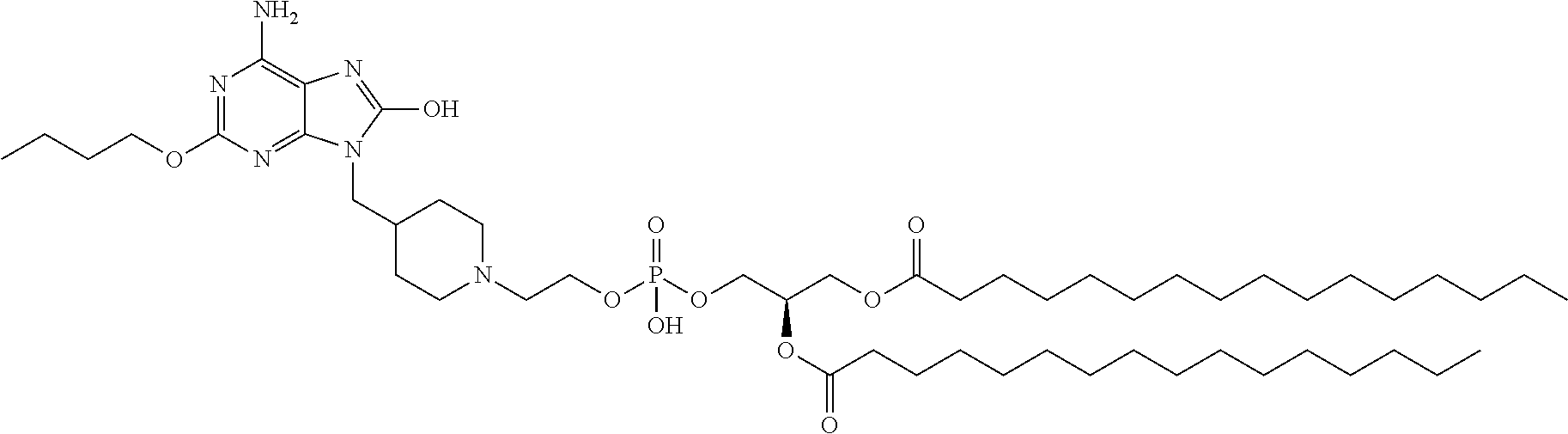
EXAMPLE 1 Compound A1 Preparation of 6-Amino-2-butoxy-9-[N-(2-(1,2-dipalmitoyl-sn-glycero-3-phospho)ethyl)-4-piperidinylmethyl]-8-hydroxypurine (Compound (II), R1=n-butoxy, n=1, X=CH, Q=O, Z=O, W=O, m=2, p=1, R1═R2=n-C15H31CO)
Figure US09044481-20150602-C00006
    • (1) Potassium carbonate (0.65 g) was added to a solution of 6-amino-2-butoxy-8-methoxypurine (0.55 g) in dry N,N-dimethylformamide (DMF, 5.5 mL) and the resulting reaction mixture was heated at 60° C. for 1 h. 1,1-Dimethylethyl 4-(bromomethyl)-1-piperidinecarboxylate (0.5 g) was added using additional DMF (1.5 mL) to transfer the residual bromide and the reaction mixture was stirred at 50° C. for 3 h. After 16 h at room temperature, heating was continued at 50° C. for another 5 h to complete the reaction. Water was then added and the resulting mixture was extracted with three times with ethyl acetate (EtOAc). The combined organic extracts were washed with water, dried (Na2SO4), and concentrated. Flash chromatography on silica gel with MeOH—CHCl3 (gradient elution; 1:99→2.5:97.5) afforded 0.64 g (94%) of 1,1-dimethylethyl 4-[6-amino-2-butoxy-8-methoxy-purin-9-yl]methyl-1-piperidinecarboxylate as a yellow solid. 1H NMR (CDCl3): δ 5.14 (s, 2H), 4.27 (t, 2H), 4.11 (s, 3H), 3.81 (d, 2H), 2.65 (m, 2H), 2.03 (m, 1H), 1.77 (p, 3H), 1.57-1.45 (m, 14H), 1.26-1.17 (m, 2H), 0.97 (t, 3H).
    • (2) To a solution of the compound prepared in (1) above (0.63 g) in MeOH (16 mL) was added a 4.0 M HCl in dioxane (5.3 mL). After stirring 4.5 h at room temperature, the reaction mixture was concentrated and dried under high vacuum. Flash chromatography on silica gel with CHCl3-MeOH—H2O (gradient elution; 90:10:1→75:25:1) afforded 0.404 g (85%) of 6-amino-2-butoxy-9-(4-piperidinylmethyl)-8-hydroxypurine hydrochloride as a white solid. 1H NMR (CDCl3): δ 4.84 (s, 5H), 4.27 (t, 2H), 3.79 (d, 2H), 3.40 (d, 2H), 2.96 (t, 2H), 2.21 (m, 1H), 1.92 (d, 2H), 1.75 (m, 2H), 1.60-1.47 (m, 4H), 1.00 (t, 3H
    • (3) To a solution of the compound prepared in (2) above (1.24 g) in DMF (12.6 mL; 0.25 M) was added K2CO3 (1.74 g). The resulting mixture was heated to 60° C. for 1 h, treated with 2-bromoethoxy-tert-butyldimethylsilane (0.81 mL), and then heated at 50° C. for 18 h. The cooled reaction mixture was quenched with water, transferred to a separatory funnel, and extracted three times with EtOAc. The combined organic layers were dried (Na2SO4) and concentrated. Flash chromatography on silica gel afforded 1.25 g (83%) of 6-amino-2-butoxy-9-[N-(2-O-tert-butyldimethylsilyl)ethyl)-4-piperidinylmethyl-]-8-hydroxypurine as an off-white solid. NMR (CDCl3—CD3OD, 400 MHz): δ 4.26 (m, 4H), 3.75 (m, 4H), 3.36 (m, 2H), 2.96 (m, 2H), 2.54 (t, 2H), 1.92 (bs, 1H), 1.73 (m, 2H), 1.66 (m, 2H), 1.40-1.51 (m, 5H), 0.98 (t, 3H), 0.89 (m, 9H), 0.06 (s, 6H).
    • (4) To a solution of the compound prepared in (3) above (2.74 g) in MeOH (41 mL) was added a 4.0 M HCl in dioxane (5.7 mL). After stirring 0.5 h at room temperature, the reaction mixture was concentrated and dried under high vacuum. Flash chromatography on silica gel with CHCl3-MeOH—H2O (gradient elution; 90:10:1→75:25:1) afforded 2.29 g (100%) of 6-amino-2-butoxy-9-(N-(2-hydroxyethyl)-4-piperidinylmethyl)-8-hydroxypurine hydrochloride as a white solid. 1H NMR (CD3OD, 400 MHz): δ 4.53 (t, 2H), 3.87 (m, 4H), 3.66 (d, 2H), 3.22 (m, 2H), 3.01 (t, 2H), 2.21 (m, 1H), 1.98 (d, 2H), 1.81 (m, 2H), 1.68 (m, 2H), 1.52 (m, 2H), 1.01 (t, 3H).
    • (5) A solution of the compound prepared in (4) above (51 mg) and 1,2-dipalmitoyl-sn-glyceryl hydrogenphosphonate (93 mg; compound V1, R1═R2=palmitoyl) in pyridine (6.4 mL) was treated pivaloyl chloride (0.047 mL) and the resulting reaction mixture was stirred at room temperature for 6 h. A solution of iodine (129 mg) in pyridine-water (19:1, v/v) was then added and the reaction mixture was stirred at room temperature for 1 h, diluted with CHCl3, and then quenched with 1 M Na2S2O5. The aqueous layer was extracted twice with CHCl3 and the combined organic layers were washed with 1 M triethylammonium borate (pH 8). The organic layer was dried (Na2SO4) and concentrated. Flash chromatography on silica gel with CHCl3-MeOH-Et3N (gradient elution; 90:10:1→75:25:1) afforded 38 mg (30%) of 6-amino-2-butoxy-9-[N-(2-(1,2-dipalmitoyl-sn-glycero-3-phospho)ethyl-4-piperidinylmethyl]-8-hydroxypurine as an off-white solid. 1H NMR (CDCl3—CD3OD, 400 MHz): δ 5.17 (bs, 1H), 4.32 (dd, 1H), 4.20-4.09 (m, 5H), 3.98 (br t, 2H), 3.69 (br d, 3H), 3.23 (br s, 1H), 1.86 (br s, 4H), 1.69 (m, 2H), 1.53 (br s, 4H), 1.42 (dd, 2H), 1.20 (m, 48H), 0.91 (t, 3H), 0.83 (t, 6H); HRMS calcd for [M−H] C52H94N6O10P 993.6768. found 993.6782.
EXAMPLE 2 Compound A2
Preparation of 6-Amino-2-butoxy-9-[N-(2-(1,2-dipalmitoyl-sn-glycero-3-phosphoramido)ethyl)-4-piperidinylmethyl]-8-hydroxypurine (Compound (II), R1=n-butoxy, n=1, X=CH, Q=NH, Z=O, W=O, m=2, p=1, R1═R2=n-C15H31CO)
Figure US09044481-20150602-C00007
    • (1) In the same manner as described in Example 1-(3), the compound prepared in Example 1-(2) (107 mg) was alklyated in DMF (1.1 mL) with 2-(tert-butoxycarbonylamino)ethyl bromide (67 mg) in the presence of K2CO3 to give 84 mg (67%) of 1,1-dimethylethyl 4-[6-amino-2-butoxy-8-methoxy-purin-9-yl]methyl-1-piperidinylethylaminylcarboxylate as an off-white solid. 1H NMR (CDCl3—CD3OD, 400 MHz): δ 4.25 (t, 2H), 3.73 (d, 2H), 3.38 (m, 2H), 3.20 (m, 2H), 2.89 (m, 2H), 2.44 (m, 2H), 1.97 (t, 3H), 1.75 (m, 2H), 1.66 (m, 2H), 1.42-1.51 (m, 11H), 0.97 (t, 3H).
    • (2) In the same manner as described in Example 1-(4), the compound prepared in (1) above (83 mg) was N-deprotected with 4 N HCl in dioxane to give 58 mg (74%) of 6-amino-2-butoxy-9-[N-(2-aminoethyl)4-piperidinylmethyl]-8-hydroxypurine dihydrochloride as a an off-white solid. 1H NMR (DMSO-d6, 400 MHz): δ 4.15 (t, 2H), 3.58 (d, 2H), 2.88 (t, 2H), 2.81 (d, 2H), 2.46 (t, 2H), 1.91 (t, 2H), 1.79 (m, 1H), 1.64 (m, 2H), 1.52 (m, 2H), 1.39 (dd, 2H), 1.28 (m, 2H), 0.91 (t, 3H).
    • (3) A solution of 1,2-dipalmitoyl-sn-glyceryl hydrogenphosphonate (167 mg; compound V1, R1═R2=palmitoyl) in pyridine (11.3 mL) was treated with chlorotrimethylsilane (0.087 mL) and triethylamine (0.126 mL) and the resulting reaction mixture was stirred at room temperature for 0.5 h. A suspension of the compound prepared in (2) above (37 mg) and triethylamine (0.126 mL) in pyridine (2.3 mL) was added to the reaction mixture followed by the addition of. iodine (75 mg) The reaction mixture was stirred at room temperature for 2 h, concentrated, and co-evaporated twice with toluene. Flash chromatography on silica gel with CHCl3-MeOH-Et3N (gradient elution; 90:10:1→75:25:1) afforded 39 mg (18%) of 6-amino-2-butoxy-9-[N-(2-(1,2-dipalmitoyl-sn-glycero-3-phosphoramido)ethyl-4-piperidinylmethyl]-8-hydroxypurine as an orange glassy solid. Rf (CHCl3—CH3OH—H2O—NH4OH)=0.68.
EXAMPLE 3 Compound A3 Preparation of 6-Amino-2-butoxy-9-[1-(1,2-dipalmitoyl-sn-glycero-3-phosphoramido)-4-piperazinylethyl]-8-hydroxypurine (Compound (II), R1=n-butoxy, n=2, X=N, Q=single bond, Z=O, W=O, m=0, p=1, R1═R2=n-C15H31CO)
Figure US09044481-20150602-C00008
    • (1) In the same manner as described in Example 1-(1), 6-amino-2-butoxy-8-methoxypurine (131 mg) was alkylated in DMF with 1,1-dimethylethyl 4-(bromoethyl)-1-piperazinecarboxylate (120 mg) in the presence of K2CO3 to give 124 mg (74%) of 1,1-dimethylethyl 4-[6-amino-2-butoxy-8-methoxy-purin-9-yl]ethyl-1-piperazinecarboxylate as a light yellow solid. 1H NMR (CDCl3—CD3OD, 400 MHz): δ 5.66 (d, 2H), 4.25 (t, 2H), 4.05 (t, 2H), 4.10 (s, 3H), 3.35 (bs, 4H), 2.71 (t, 2H), 2.46 (bs, 4H), 1.76 (m, 2H), 1.48 (m, 2H), 1.45 (s, 9H), 0.96 (t, 3H).
    • (2) In the same manner as described in Example 1-(2), the compound prepared in (1) above (124 mg) was N-deprotected with 4.0 M HCl in dioxane to give 87 mg (77%) of 6-amino-2-butoxy-9-(4-piperazinylethyl)-8-hydroxypurine hydrochloride as an off-white solid. 1H NMR (CD3OD, 400 MHz) δ 4.26 (t, 2H), 3.96 (m, 2H), 3.11 (m, 5H), 2.78 (m, 7H), 1.73 (m, 2H), 1.48 (m, 2H), 1.38 (m, 1H), 0.98 (t, 3H); 13C NMR 161.8, 155.6, 150.8, 149.7, 100.1, 68.8, 55.9, 50.8, 44.2, 37.7, 31.9, 20.1, 14.1; HRMS calcd for [M+H]+ C15H25N7O2 336.2136, found 336.2148.
    • (3) In the same manner as described in Example 2-(3), the compound prepared in (2) above (288 mg) was phosphatidylated with 1,2-dipalmitoyl-sn-glyceryl hydrogenphosphonate (518 mg) to give 313 mg (46%) of 6-amino-2-butoxy-9-[1-(1,2-dipalmitoyl-sn-glycero-3-phosphoramido)-4-piperazinylethyl]-8-hydroxypurine as a tan solid. 1H NMR (CDCl3—CD3OD, 400 MHz): δ 5.11 (br s, 1H), 4.28 (d, 1H), 4.12-4.01 (m, 5H), 3.76 (br s, 2H), 3.60-2.60 (m, 11H), 2.21 (m, 4H), 1.65 (m, 2H), 1.49 (m, 4H), 1.39 (q, 2H), 1.17 (m, 48H), 0.88 (t, 3H), 0.81 (t, 6H); HRMS calcd for [M−H] C50H92N7O9P 964.6616, found 964.6600.
We evaluated the capacity of TLR7 ligands to promote various aspects of the immune response in mice. Innate immunity was specifically investigated to conclude whether lipidated TLR7 compounds were able to induce innate chemokines and pro-inflammatory cytokines. This innate immune response provides the body with initial, non-specific protection against pathogens. Among these innate chemokines and cytokines, type I IFN is thought to be required for the programming of naïve CD8 T-cell with respect to survival, differentiation and memory development. Mice studies have also suggested that the magnitude and duration of inflammation regulates the rate at which CD8+ T-cells acquire memory characteristics.
EXAMPLE 4 TLR7-DPPC Liposome Preparation
10.4 ml of lipidated-TLR7-L A1 at 10 mg/ml in chloroform were transferred into a round-bottomed glass vial. To this vial were added 18.4 ml of DPPC solubilised in chloroform at 100 mg/ml. 21.9 ml of lipidated-TLR7-L compound A3 solubilized at 5 mg/ml in chloroform were transferred into a round-bottomed glass vial. To this vial were added 20 ml of DPPC solubilised in chloroform at 100 mg/ml. Chloroform was evaporated in a Büchi Rotavapor under slow decrease of pressure. The obtained film was further dessicated at least overnight in a dessicator under vacuum. After that, the lipid film was slowly hydrated on an orbital shaker (maximal speed: 250 rpm) using 50 mM PO4-100 mM NaCl, pH 7 buffer pre-heated at 60° C.
After completion of resuspension, a swelling step was carried out in order to further increase the phospholipid hydration, it consists of incubating the preparation at room temperature. The suspension was then pre-homogenized using a rotor-stator homogenizer (X620 CAT) for 12 min at 8000 rpm.
Microfluidization was then carried out using a microfluidizer (Model 110S-Serial 90181-Microfluidics Corporation) at 6 bars while keeping the microfluidization chamber at about 40° C. Sterile filtration was achieved on a PES filter (GD/X 0.2 μm, 25 mm, Whatman).
EXAMPLE 5 20080672: SIV-p27 Model—DPPC Liposomes—A3 and A1
Lipidated molecules A3 and A1 were evaluated in vivo. The SIV-p27-containing formulations summarized in Table 1 were used to vaccinate 6-8 week old C57BL/6 female mice (10/group). The mice received two intramuscular injections of 50 μl, 14 days apart and were bled at different time points after prime and boost as illustrated in FIG. 1.
The innate and adaptive immune responses induced by the formulations containing the TLR7 agonists and the proprietary AS01B adjuvant (QS21+MPL) were also compared to the one induced by the corresponding AS01B-containing formulations and empty DPPC liposomes.
TABLE 1
SUMMARY TABLE OF THE FORMULATIONS CONTENT
Vaccinated groups SIV-p27 MPL QS21 A3* A1* DPPC CpG
p27
1B + empty DPPC 5 5 5 3970
p27 1B + 200 μg A3-DPPC 5 5 5 200 3235
p27 1B + 45 μg A3-DPPC 5 5 5 45 726
p27 1B + 4.5 μg A3-DPPC 5 5 5 4.5 73
p27 1B + 200 μg A1-DPPC 5 5 5 200 2519
p27 1B + 45 μg A1-DPPC 5 5 5 45 566
p27 1B + 4.5 μg A1-DPPC 5 5 5 4.5 57
p27 1B + CpG 5 5 5 42
naive
All compounds are in μg unless otherwise stated.
*Doses are based on the amount of TLR7-L used to manufacture the A1-DPPC and A3-DPPC liposomes. The real injected doses might be lower due to loss during filtration
Different profiles of cytokines were observed between the AS01B reference group and the groups immunized with TLR7-L containing formulations. Shortly after injection (3 h), IFN-alpha was detected in a dose-dependent manner in the sera of mice immunized with both TLR7-L when they were formulated within a DPPC-liposome (FIG. 1). Such seric IFNa innate response was not observed when the TLR7-L were formulated in a DOPS/DOPC-liposome (data not shown).
Other inflammatory cytokines such as TNF-α and IL-6 were enhanced when A3 or A1 were present in the formulations, A1 being more potent than A3 (FIG. 2). The chemokine MCP-1 was also enhanced in the presence of both compounds (FIG. 3). Altogether, these data show that the TLR7-L lipidated molecules are effective at inducing type I IFN and at enhancing the pro-inflammatory cytokine responses when combined to MPL/QS21 based formulation.
The TLR7-L molecules used here did not further enhanced the adaptative T-cell response as compared to the AS01 reference group (data not shown)

Claims (12)

What is claimed is:
1. A compound according to the structure of Formula (I) comprising:
Figure US09044481-20150602-C00009
wherein
R1 is selected from the group consisting of: C1-6alkyl, C1-6alkylamino, C1-6alkoxy, C3-6cycloalkylC1-6alkyl, C3-6cycloalkylC1-6alkylamino, C3-6cycloalkylC1-6alkoxy, C1-6alkoxyC1-6alkyl, C1-6alkoxyC1-6alkylamino, C1-6alkoxyC1-6alkoxy; and optionally terminally substituted with a hydroxyl, amino, thio, hydrazino, hydrazido, azido, acetylenyl, carboxyl, or maleimido group;
n is 0 or an integer from 1-6;
Het is a four-, five-, or six-membered saturated heterocycle wherein
X, Y is CH or N, and at least one of X and Y is a nitrogen atom;
Q is O, NH, or covalent bond;
Z is O, CH2, CF2 or covalent bond;
W is O, S;
m is 0 or an integer from 1-6;
p is an integer from 1-2;
q is 0 or the integer 1;
A is
Figure US09044481-20150602-C00010
wherein
R2 is H or straight, branched or unsaturated C4-C24 alkyl or acyl;
R3 is straight, branched or unsaturated C4-C24 alkyl or acyl;
or a pharmaceutically acceptable salt thereof.
2. The compound according to the structure of Formula II:
Figure US09044481-20150602-C00011
wherein
R1 is selected from the group consisting of C1-6alkyl, C1-6alkylamino, C1-6alkoxy, C3-6cycloalkylC1-6alkyl, C3-6cycloalkylC1-6alkylamino, C3-6cycloalkylC1-6alkoxy, C1-6alkoxyC1-6alkyl, C1-6alkoxyC1-6alkylamino, C1-6alkoxyC1-6alkoxy;
n is 0 or an integer from 1-6;
X is CH or N;
Q is O, NH, or covalent bond;
Z is O, CH2, CF2 or covalent bond;
W is O, S;
m is 0 or an integer from 1-6;
p is an integer from 1-2;
q is 0 or the integer 1;
R2 is H or straight, branched, or unsaturated C4-C24 alkyl or acyl;
R3 is straight, branched or unsaturated C4-C24 alkyl or acyl; or pharmaceutically acceptable salts thereof.
3. A compound according to the structure of Formula IX,
Figure US09044481-20150602-C00012
wherein
R1 is selected from the group consisting of C1-6alkyl, C1-6alkylamino, C1-6alkoxy, C1-6alkoxyC1-6alkylamino, C1-6alkoxyC1-6alkoxy;
n is 0 or an integer between 1-2;
X is CH or N;
Q is O, NH, or covalent bond
m is 0 or an integer from 1-2;
q is 0
R2 is H or straight, branched, or unsaturated C4-C24 alkyl or acyl, and
R3 is straight, branched or unsaturated C4-C24 alkyl or acyl;
or pharmaceutically acceptable salts thereof.
4. The compound of claim 3 wherein
R1 is C1-6alkoxy or C1-6alkoxyC1-6alkyl
Q is O, NH
m is 0 or an integer from 1-2;
q is 0;
R2 is H or straight, branched, or unsaturated C4-C24 alkyl or acyl, and
R3 is straight, branched or unsaturated C4-C24 alkyl or acyl;
or pharmaceutically acceptable salts thereof.
5. A compound selected from the group consisting of
Figure US09044481-20150602-C00013
or pharmaceutically acceptable salts thereof.
6. A compound according to the structure
Figure US09044481-20150602-C00014
or pharmaceutically acceptable salts thereof.
7. A compound according to the structure
Figure US09044481-20150602-C00015
or pharmaceutically acceptable salts thereof.
8. A compound according to the structure:
Figure US09044481-20150602-C00016
or pharmaceutically acceptable salts thereof.
9. A method of inducing an innate immune response in a mammal comprising administering a compound of claim 1.
10. The method of claim 9 wherein the response comprises inducing type 1 IFN.
11. The method of claim 9 wherein the response comprises enhancing pro-inflamatory cytokines.
12. The compound of claim 1 for use in a method of inducing an innate immune response, inducing a type 1 IFN response or enhancing pro-inflamatory cytokines.
US13/389,307 2009-08-07 2010-08-06 Lipidated oxoadenine derivatives Active 2031-09-25 US9044481B2 (en)

Priority Applications (1)

Application Number Priority Date Filing Date Title
US13/389,307 US9044481B2 (en) 2009-08-07 2010-08-06 Lipidated oxoadenine derivatives

Applications Claiming Priority (3)

Application Number Priority Date Filing Date Title
US23213209P 2009-08-07 2009-08-07
PCT/US2010/044703 WO2011017611A1 (en) 2009-08-07 2010-08-06 Lipidated oxoadenine derivatives
US13/389,307 US9044481B2 (en) 2009-08-07 2010-08-06 Lipidated oxoadenine derivatives

Publications (2)

Publication Number Publication Date
US20120135963A1 US20120135963A1 (en) 2012-05-31
US9044481B2 true US9044481B2 (en) 2015-06-02

Family

ID=43544685

Family Applications (1)

Application Number Title Priority Date Filing Date
US13/389,307 Active 2031-09-25 US9044481B2 (en) 2009-08-07 2010-08-06 Lipidated oxoadenine derivatives

Country Status (15)

Country Link
US (1) US9044481B2 (en)
EP (2) EP3199159B1 (en)
JP (1) JP5759992B2 (en)
KR (1) KR20120055623A (en)
CN (1) CN102469790B (en)
AU (1) AU2010279299B2 (en)
BR (1) BR112012002349A2 (en)
CA (1) CA2768195A1 (en)
EA (1) EA023536B1 (en)
ES (1) ES2732999T3 (en)
MX (1) MX2012001524A (en)
SG (1) SG178237A1 (en)
TR (1) TR201909600T4 (en)
WO (1) WO2011017611A1 (en)
ZA (1) ZA201200646B (en)

Cited By (2)

* Cited by examiner, † Cited by third party
Publication number Priority date Publication date Assignee Title
WO2020237164A1 (en) * 2019-05-23 2020-11-26 The University Of Montana Vaccine adjuvants based on tlr receptor ligands
US20220119428A1 (en) * 2015-12-14 2022-04-21 Glaxosmithkline Biologicals Sa Phospholipidation of imidazoquinolines and oxoadenines

Families Citing this family (34)

* Cited by examiner, † Cited by third party
Publication number Priority date Publication date Assignee Title
US8563717B2 (en) * 2008-08-11 2013-10-22 Glaxosmithkline Llc Adenine derivatives
US8802684B2 (en) 2008-08-11 2014-08-12 Glaxosmithkline Llc Adenine derivatives
UA103195C2 (en) 2008-08-11 2013-09-25 Глаксосмитклайн Ллк PURCHASE DERIVATIVES FOR THE APPLICATION IN THE TREATMENT OF ALLERGIES, INFLAMMATORY AND INFECTIOUS DISEASES
WO2010018131A1 (en) * 2008-08-11 2010-02-18 Smithkline Beecham Corporation Purine derivatives for use in the treatment of allergic, inflammatory and infectious diseases
WO2010088924A1 (en) 2009-02-06 2010-08-12 Telormedix Sa Pharmaceutical compositions comprising imidazoquinolin(amines) and derivatives thereof suitable for local administration
CN102666541B (en) 2009-10-22 2015-11-25 吉里德科学公司 Derivatives of purines or deazapurines for use in the treatment, especially of viral infections
WO2011098451A1 (en) * 2010-02-10 2011-08-18 Glaxosmithkline Llc Purine derivatives and their pharmaceutical uses
EP2563401A1 (en) * 2010-04-30 2013-03-06 Telormedix SA Methods for inducing an immune response
CA2797315C (en) 2010-04-30 2018-09-11 Telormedix Sa Phospholipid drug analogs
US9050319B2 (en) 2010-04-30 2015-06-09 Telormedix, Sa Phospholipid drug analogs
BR112014001425A2 (en) 2011-07-22 2017-11-21 Glaxosmithkline Llc pharmaceutical dosage form, pharmaceutical composition, and compound (i) or pharmaceutically acceptable salt thereof
EP2674170B1 (en) * 2012-06-15 2014-11-19 Invivogen Novel compositions of TLR7 and/or TLR8 agonists conjugated to lipids
MY175676A (en) 2012-08-24 2020-07-06 Glaxosmithkline Llc Pyrazolopyrimidine compounds
PL2922549T3 (en) 2012-11-20 2017-11-30 Glaxosmithkline Llc Novel compounds
JP6216386B2 (en) 2012-11-20 2017-10-18 グラクソスミスクライン・リミテッド・ライアビリティ・カンパニーGlaxoSmithKline LLC New compounds
AU2013348217B2 (en) 2012-11-20 2016-10-06 Glaxosmithkline Llc Novel compounds
US9295732B2 (en) 2013-02-22 2016-03-29 Invivogen Conjugated TLR7 and/or TLR8 and TLR2 polycationic agonists
WO2015036044A1 (en) * 2013-09-13 2015-03-19 Telormedix Sa Cationic lipid vehicles for delivery of tlr7 agonists for specific targeting of human cd14+ monocytes in whole blood
AR100137A1 (en) 2014-04-22 2016-09-14 Hoffmann La Roche 4-AMINO-IMIDAZOQUINOLINE COMPOUNDS
JP2017533925A (en) 2014-11-13 2017-11-16 グラクソスミスクライン バイオロジカルズ ソシエテ アノニム Adenine derivatives useful for the treatment of allergic diseases or other inflammatory conditions
MX364223B (en) 2015-03-06 2019-04-16 Hoffmann La Roche Benzazepine dicarboxamide compounds.
EP3268036A1 (en) * 2015-03-10 2018-01-17 GlaxoSmithKline Biologicals S.A. Compositions and uses
JP6893501B2 (en) 2015-09-17 2021-06-23 エフ・ホフマン−ラ・ロシュ・アクチェンゲゼルシャフト Sulfinylphenyl or sulfonimideylphenyl benzazepine
ES2805724T3 (en) 2015-09-29 2021-02-15 Sumitomo Dainippon Pharma Co Ltd Conjugated adenine compounds and their use as vaccine adjuvants
US10632192B2 (en) 2015-10-07 2020-04-28 Sumitomo Dainippon Pharma Co., Ltd. Pyrimidine compounds and their use as vaccine adjuvants
JP7022702B2 (en) 2016-05-23 2022-02-18 エフ・ホフマン-ラ・ロシュ・アクチェンゲゼルシャフト Benzazepine dicarboxamide compound having a secondary amide group
EP3464245B1 (en) 2016-05-23 2020-10-14 H. Hoffnabb-La Roche Ag Benzazepine dicarboxamide compounds with tertiary amide function
WO2017216054A1 (en) 2016-06-12 2017-12-21 F. Hoffmann-La Roche Ag Dihydropyrimidinyl benzazepine carboxamide compounds
WO2019197598A1 (en) 2018-04-13 2019-10-17 Glaxosmithkline Biologicals Sa Tlr7 and / or tlr8 agonists
CN115710266B (en) 2018-07-03 2024-09-13 江苏恒瑞医药股份有限公司 Pyridopyrimidine derivative, preparation method thereof and application thereof in medicines
PH12021550175A1 (en) 2018-07-23 2022-07-11 Japan As Represented By Director General Of Nat Institute Of Infectious Diseases Composition containing influenza vaccine
CA3140708A1 (en) 2019-06-18 2020-12-24 Helen Horton Combination of hepatitis b virus (hbv) vaccines and pyridopyrimidine derivatives
KR20220123437A (en) 2020-01-02 2022-09-06 지앙수 헨그루이 파마슈티컬스 컴퍼니 리미티드 Crystalline form of pyridopyrimidine derivative and method for preparing same
KR102549083B1 (en) 2021-02-01 2023-06-29 주식회사 에이티솔루션 Propagation delay apparatus and method for minimizing the distance of the target generated from the radar electronic target generator

Citations (7)

* Cited by examiner, † Cited by third party
Publication number Priority date Publication date Assignee Title
US6028076A (en) 1996-07-03 2000-02-22 Japan Energy Corporation Purine derivative
US20060189550A1 (en) 2002-02-04 2006-08-24 Biomira Inc. Immunostimulatory, Covalently lipidated oligonucleotides
US20080008682A1 (en) 2006-07-07 2008-01-10 Chong Lee S Modulators of toll-like receptor 7
WO2008114008A1 (en) 2007-03-19 2008-09-25 Astrazeneca Ab 9-substituted-8-oxo-adenine compounds as toll-like receptor (tlr7 ) modulators
US20090192153A1 (en) 2005-09-22 2009-07-30 Dainippon Sumitomo Pharma Co., Ltd. a corporation of Japan Novel adenine compound
US20110135671A1 (en) * 2008-08-11 2011-06-09 Glaxosmithkline Llc Purine derivatives for use in the treatment of allergic, inflammatory and infectious diseases
US20110135670A1 (en) * 2008-08-11 2011-06-09 Glaxosmithkline Llc Purine derivatives for use in the treatment of allergic, inflammatory and infectious diseases

Family Cites Families (2)

* Cited by examiner, † Cited by third party
Publication number Priority date Publication date Assignee Title
JP3042540B2 (en) * 1990-08-20 2000-05-15 ミヨシ油脂株式会社 Adenosine monophosphate trimer containing 8-hydroxyadenosine-5'-phosphate, method for producing the same, and protein synthesis inhibitor comprising the compound
JPH093091A (en) * 1995-06-21 1997-01-07 Rikagaku Kenkyusho Nucleoside derivative substance, its production method and antitumor agent

Patent Citations (7)

* Cited by examiner, † Cited by third party
Publication number Priority date Publication date Assignee Title
US6028076A (en) 1996-07-03 2000-02-22 Japan Energy Corporation Purine derivative
US20060189550A1 (en) 2002-02-04 2006-08-24 Biomira Inc. Immunostimulatory, Covalently lipidated oligonucleotides
US20090192153A1 (en) 2005-09-22 2009-07-30 Dainippon Sumitomo Pharma Co., Ltd. a corporation of Japan Novel adenine compound
US20080008682A1 (en) 2006-07-07 2008-01-10 Chong Lee S Modulators of toll-like receptor 7
WO2008114008A1 (en) 2007-03-19 2008-09-25 Astrazeneca Ab 9-substituted-8-oxo-adenine compounds as toll-like receptor (tlr7 ) modulators
US20110135671A1 (en) * 2008-08-11 2011-06-09 Glaxosmithkline Llc Purine derivatives for use in the treatment of allergic, inflammatory and infectious diseases
US20110135670A1 (en) * 2008-08-11 2011-06-09 Glaxosmithkline Llc Purine derivatives for use in the treatment of allergic, inflammatory and infectious diseases

Non-Patent Citations (3)

* Cited by examiner, † Cited by third party
Title
Bell et al., Proceedings of the National Academy of Science, The molecular structure of the Toll-like receptor 3 ligand-binding domain, Proceedings of the National Academy of Science, vol. 102, pp. 10976-10980, (2005).
Chan, Michael et al; Synthesis and Immunological Characterization of Toll-Like Receptor 7 Agonists Conjugates; Bioconjugates Chem, 2009, Vo. 20, pp. 1194-1200.
European Office Action dated Oct. 16, 2013.

Cited By (4)

* Cited by examiner, † Cited by third party
Publication number Priority date Publication date Assignee Title
US20220119428A1 (en) * 2015-12-14 2022-04-21 Glaxosmithkline Biologicals Sa Phospholipidation of imidazoquinolines and oxoadenines
WO2020237164A1 (en) * 2019-05-23 2020-11-26 The University Of Montana Vaccine adjuvants based on tlr receptor ligands
US11964014B2 (en) 2019-05-23 2024-04-23 The University Of Montana Vaccine adjuvants based on TLR receptor ligands
US12496340B2 (en) 2019-05-23 2025-12-16 The University Of Montana Vaccine adjuvants based on TLR receptor ligands

Also Published As

Publication number Publication date
EP2461690A4 (en) 2013-03-27
JP2013501730A (en) 2013-01-17
KR20120055623A (en) 2012-05-31
US20120135963A1 (en) 2012-05-31
EP3199159B1 (en) 2019-04-10
EA201290036A1 (en) 2012-12-28
EP2461690A1 (en) 2012-06-13
TR201909600T4 (en) 2019-07-22
ZA201200646B (en) 2013-06-26
CN102469790B (en) 2014-12-03
MX2012001524A (en) 2012-02-29
CA2768195A1 (en) 2011-02-10
CN102469790A (en) 2012-05-23
AU2010279299A1 (en) 2012-03-29
SG178237A1 (en) 2012-03-29
ES2732999T3 (en) 2019-11-27
EP3199159A1 (en) 2017-08-02
BR112012002349A2 (en) 2015-10-13
AU2010279299B2 (en) 2015-10-01
WO2011017611A1 (en) 2011-02-10
JP5759992B2 (en) 2015-08-05
EA023536B1 (en) 2016-06-30

Similar Documents

Publication Publication Date Title
US9044481B2 (en) Lipidated oxoadenine derivatives
US8624029B2 (en) Lipidated imidazoquinoline derivatives
AU2008227128B2 (en) Conjugates of synthetic TLR agonists and uses therefor
JP6453855B2 (en) Compositions and methods for activating "interferon gene stimulator" dependent signaling
WO2019197598A1 (en) Tlr7 and / or tlr8 agonists
HK1219024B (en) Compositions and methods for activating "stimulator of interferon gene"-dependent signalling
HK1138767B (en) Conjugates of synthetic tlr agonists and uses therefor
HK1177886B (en) Conjugates of synthetic tlr agonists and uses therefor

Legal Events

Date Code Title Description
AS Assignment

Owner name: GLAXOSMITHKLINE BIOLOGICALS SA, BELGIUM

Free format text: ASSIGNMENT OF ASSIGNORS INTEREST;ASSIGNOR:JOHNSON, DAVID;REEL/FRAME:027508/0652

Effective date: 20120104

STCF Information on status: patent grant

Free format text: PATENTED CASE

MAFP Maintenance fee payment

Free format text: PAYMENT OF MAINTENANCE FEE, 4TH YEAR, LARGE ENTITY (ORIGINAL EVENT CODE: M1551); ENTITY STATUS OF PATENT OWNER: LARGE ENTITY

Year of fee payment: 4

MAFP Maintenance fee payment

Free format text: PAYMENT OF MAINTENANCE FEE, 8TH YEAR, LARGE ENTITY (ORIGINAL EVENT CODE: M1552); ENTITY STATUS OF PATENT OWNER: LARGE ENTITY

Year of fee payment: 8

CC Certificate of correction