US9032408B2 - System and method for intelligent timer services - Google Patents
System and method for intelligent timer services Download PDFInfo
- Publication number
- US9032408B2 US9032408B2 US13/606,089 US201213606089A US9032408B2 US 9032408 B2 US9032408 B2 US 9032408B2 US 201213606089 A US201213606089 A US 201213606089A US 9032408 B2 US9032408 B2 US 9032408B2
- Authority
- US
- United States
- Prior art keywords
- timer
- timers
- slots
- available
- vector
- Prior art date
- Legal status (The legal status is an assumption and is not a legal conclusion. Google has not performed a legal analysis and makes no representation as to the accuracy of the status listed.)
- Active, expires
Links
Images




Classifications
-
- G—PHYSICS
- G06—COMPUTING OR CALCULATING; COUNTING
- G06F—ELECTRIC DIGITAL DATA PROCESSING
- G06F9/00—Arrangements for program control, e.g. control units
- G06F9/06—Arrangements for program control, e.g. control units using stored programs, i.e. using an internal store of processing equipment to receive or retain programs
- G06F9/46—Multiprogramming arrangements
- G06F9/48—Program initiating; Program switching, e.g. by interrupt
- G06F9/4806—Task transfer initiation or dispatching
- G06F9/4843—Task transfer initiation or dispatching by program, e.g. task dispatcher, supervisor, operating system
- G06F9/4881—Scheduling strategies for dispatcher, e.g. round robin, multi-level priority queues
-
- G—PHYSICS
- G06—COMPUTING OR CALCULATING; COUNTING
- G06F—ELECTRIC DIGITAL DATA PROCESSING
- G06F1/00—Details not covered by groups G06F3/00 - G06F13/00 and G06F21/00
- G06F1/04—Generating or distributing clock signals or signals derived directly therefrom
- G06F1/14—Time supervision arrangements, e.g. real time clock
-
- G—PHYSICS
- G06—COMPUTING OR CALCULATING; COUNTING
- G06F—ELECTRIC DIGITAL DATA PROCESSING
- G06F9/00—Arrangements for program control, e.g. control units
- G06F9/06—Arrangements for program control, e.g. control units using stored programs, i.e. using an internal store of processing equipment to receive or retain programs
- G06F9/46—Multiprogramming arrangements
- G06F9/48—Program initiating; Program switching, e.g. by interrupt
- G06F9/4806—Task transfer initiation or dispatching
- G06F9/4812—Task transfer initiation or dispatching by interrupt, e.g. masked
- G06F9/4825—Interrupt from clock, e.g. time of day
-
- G—PHYSICS
- G06—COMPUTING OR CALCULATING; COUNTING
- G06F—ELECTRIC DIGITAL DATA PROCESSING
- G06F9/00—Arrangements for program control, e.g. control units
- G06F9/06—Arrangements for program control, e.g. control units using stored programs, i.e. using an internal store of processing equipment to receive or retain programs
- G06F9/46—Multiprogramming arrangements
- G06F9/48—Program initiating; Program switching, e.g. by interrupt
- G06F9/4806—Task transfer initiation or dispatching
- G06F9/4812—Task transfer initiation or dispatching by interrupt, e.g. masked
- G06F9/4831—Task transfer initiation or dispatching by interrupt, e.g. masked with variable priority
-
- G—PHYSICS
- G06—COMPUTING OR CALCULATING; COUNTING
- G06F—ELECTRIC DIGITAL DATA PROCESSING
- G06F9/00—Arrangements for program control, e.g. control units
- G06F9/06—Arrangements for program control, e.g. control units using stored programs, i.e. using an internal store of processing equipment to receive or retain programs
- G06F9/46—Multiprogramming arrangements
- G06F9/48—Program initiating; Program switching, e.g. by interrupt
- G06F9/4806—Task transfer initiation or dispatching
- G06F9/4812—Task transfer initiation or dispatching by interrupt, e.g. masked
- G06F9/4831—Task transfer initiation or dispatching by interrupt, e.g. masked with variable priority
- G06F9/4837—Task transfer initiation or dispatching by interrupt, e.g. masked with variable priority time dependent
Definitions
- the present invention relates to efficiently scheduling timer events within an Operating System (OS).
- OS Operating System
- Typical real-time OS implementations offer various timer services that can be used for a variety of applications and services. These timers can be used to trigger events such as notifications, alerts and signals.
- Some recent protocols require a very large number of timers with relatively small periods along with timer or periodic events with significantly longer periods.
- the context switching associated with the handling of these timers can overwhelm most OS very quickly, especially when the capabilities of the hardware platform cannot be expanded for various reasons, including but not limited to cost.
- Another problem area occurs when multiple timers (periodic or not) are set to expire at the exact same time, although they belong to unrelated processes, services or applications.
- the state of the art approach often results in peaks of timer activity followed by relatively quiet periods for the next immediate timer tick.
- FIG. 1 shows the distribution of timers assuming that there are 3000 of these 3-OS-tick timers.
- a method for efficiently scheduling timer events within an operating system by allocating a plurality of timers, each of which has an expiry time, to a set of available timer slots.
- the method defines a timer spread value that denotes the allowed variance of the expiry times of each of the timers, calculates a set of available timer slots for each of the timers based on the timer spread value, and adjusts the expiry times of the timers so as to insert and evenly spread the timers across the set of available timer slots.
- the set of available timer slots is located in a timer wheel existing within the operating system, and the timer wheel uses a plurality of timer vectors arranged into successively increasing levels, beginning with level zero.
- Each timer vector may contain a plurality of timer slots defined by a slot size based on the level of the timer vector, the timer slots being evenly spaced by a number of timer ticks corresponding with the slot size.
- the slot size for the lowest level timer vector may be set to one, with the slot size for each successive higher level timer vector being based on the slot size of the level of the preceding timer vector.
- Calculating the set of available timer slots may include applying a maximum positive spread and a maximum negative spread, and the sum of the maximum positive spread and the maximum negative spread may be equal to the calculated timer spread value.
- the maximum positive spread and the maximum negative spread may also be equal to each other.
- One of the timers may be a periodic timer, which does not elapse earlier than the original unadjusted expiry time, and calculating the set of available timer slots includes applying a maximum positive spread and a maximum negative spread, where the maximum negative spread is zero, and upper bounding the set of available slots.
- adjusting the expiry times further includes selecting from the set of available timer slots a slot containing the fewest number of existing timers and/or adjusting the expiry times further comprises selecting a timer slot randomly from the set of available slots.
- FIG. 1 illustrates a graphic example of a typical timer distribution in time.
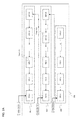
- FIG. 2A illustrates the placing of timers 301 and 302 within the Timer wheel.
- FIG. 2B illustrates a sub-slot for slot 203 - 1 .
- FIG. 3 illustrates a graphic example of evenly spread timer distribution using timer spreading.
- the specification details a system and method to distribute timers in order to reduce the overhead due to processing tasks generated on ticks of timers.
- a periodic timer is repeatedly triggered over a period of time with the same timing interval. For instance, a periodic timer may be aligned with the system Real Time Clock (RTC) and triggered every 15 minutes, that is, the timing interval is 15 minutes.
- RTC Real Time Clock
- a non-periodic timer may be set to elapse at any point in time and is not repeatedly triggered with the same period. For instance, a session recovery timer may be set to elapse after 10 minutes of inactivity and will be restarted before it elapses as long as activity is detected during the timeout period.
- a Timer Wheel (TW) 200 is shown.
- the aim of a TW is to reduce the number of entries in a list of timer by aggregating timers based on the number of ticks before they elapse.
- Timers that are due to elapse at the next 1 to N ticks are stored in timer vector zero. Since the slot size in timer vector zero is 1, there are N slots in timer vector zero.
- Timers due to elapse at a number of ticks greater than N ticks are stored in other timer vectors.
- timer vector one is used to store all timers due to elapse at the next (N+1) to N 2 timer ticks, where the slot size of timer vector one is N ticks.
- Timer vector 2 is used to store all timers due to elapse at the next (N 2 +1) to N 3 ticks and are spaced every N 2 ticks.
- there are (N ⁇ 1) slots in timer vector two there are (N ⁇ 1) slots in timer vector two.
- the t_tick of the timer is compared to the range of ticks occupied by each timer vector, and finally each slot in the timer vector to appropriately place it. If the timer level is greater than zero, then the remainder is calculated by subtracting the lower edge of the selected slot from t_tick.
- Each timer vector contains an index which represents the current slot inside of the timer vector.
- the index for a vector indicates that the timers contained within the slot pointed to by the index will expire at the next tick.
- the timers contained within the slot are to be processed, and any new timer to be inserted in a given timer vector shall be inserted at the calculated offset from the current value of the index for a timer vector.
- Timer vector zero increases its index at each timer tick.
- Timer vector one increases its index after N ticks of timer vector zero and timer vector two increases its index after N ticks of timer vector one corresponding to N 2 ticks of timer vector zero.
- the index is reset to 1.
- the TW is implemented using an array of pointers. Each pointer within the array points to a slot.
- the index of the timer vector is used to reference the array, and is incremented at every tick. Then, when the index reaches the end of the array, it is returned to the start at the next tick.
- the TW is implemented using a circular linked list. Then, the index will “wrap around” to point to the slot it pointed to N ticks ago.
- the timers in the specific slot pointed to by the index are triggered if they belong to timer vector zero. If the timers are in another higher level timer vector, then when the index is increased, the remainder tick value of the timer is then checked to see if it will expire at the next tick, that is, the number of remaining ticks is 0. Otherwise, the timer needs to be moved to a lower-level timer vector and slot.
- timer vector zero all timers in the first slot will elapse at the next timer tick. Timers in the next slot will elapse in 2 timer ticks and so on for the other slots in timer vector zero.
- timer vector one every N timer ticks, all of the timers in the slot of timer vector one at the current index for that timer vector will have their remainders checked to see if it will expire at the next tick, that is, the number of remaining ticks is 0. If not, they are moved to timer vector zero, and placed in a slot corresponding to the remainder.
- timer vector two every N 2 timer ticks, all of the timers in the slot of timer vector one at the current index for that timer vector will have their remainders checked to see if it will expire at the next tick, that is, the number of remaining ticks is 0. If not, they are moved either to timer vector one or timer vector zero, and placed in a slot corresponding to the remainder. The same is carried out for timer vectors at the higher levels.
- a TW may be defined with the required number of timer vectors to handle the largest timer value allowed by the OS.
- Timer vector 201 corresponds to timer vector zero; timer vector 202 corresponds to timer vector one; and timer vector 203 corresponds to timer vector two.
- Timer vector 201 will store timers due to elapse in the next 32 ticks.
- Timer vector 202 will store timers due to elapse in the next 32 to 1023 ticks.
- Timer vector 203 will store timers due to elapse in the next 1024 to 32767 ticks.
- Table 1 shows the number of ticks remaining for each of the slots in timer vector 201
- Table 2 shows the number of ticks remaining for each of the slots in timer vector 202
- Table 3 shows the number of ticks remaining for each of the slots in timer vector 203 .
- slot 201 - 1 of timer vector 201 represents the slot at the current index value
- slot 201 - 5 represents the slot at the (current index value +4) position. The same is applicable for each timer vector.
- zero ticks remaining indicates that the timer will expire at the next tick
- 1 tick remaining indicates that the timer will expire at the 2nd tick after the current instant, and so on.
- timer vector 201 increases its index 201 - 99 by one. Then index 201 - 99 will be moved to point to slot 201 - 2 .
- index 201 - 99 will be moved to point to slot 201 - 2 .
- all of the timers in slot 202 - 1 (indexed by 202 - 99 ) will be moved to timer vector 201 .
- the timers will be moved to an appropriate slot in timer vector 201 using the calculated remainder of each timer in the slot unless the calculated remainder is zero where the timer will be triggered immediately.
- Index 201 - 99 will return to point to slot 201 - 1 .
- Timer vector 202 will then increase its index 202 - 99 by one.
- timer vector 203 After (N ⁇ 1) ticks of timer vector 202 , all of the timers in slot 203 - 1 (indexed by 203 - 99 ) will be moved to an appropriate slot in either timer vector 201 or timer vector 202 using the calculated remainder of each timer in the slot unless the calculated remainder is zero where the timer will be triggered immediately. Index 202 - 99 will return to point to slot 202 - 1 .
- Timer vector 203 increases its index 203 - 99 by one, corresponding to N 2 ticks of timer vector 201 . After (N ⁇ 1) ticks of timer vector 203 , corresponding to the number of slots in timer vector 201 , index 203 - 99 will return to point to slot 203 - 1 .
- FIG. 2A shows 2 example timers 301 and 302 .
- timer 301 is first placed in timer vector 201 , and then in slot 201 - 3 .
- Timer 302 is first placed in timer vector 202 , since 600 falls between 32 and 1023 ticks, then in slot 202 - 18 , which contains timers in the range 576 to 607 ticks remaining, as shown in FIG. 2A .
- the length of time during which the timer will be repeatedly triggered is specified.
- the remainder is then calculated. This is given by deducting the lower edge of the current slot from t_tick. In this case, as shown in Table 2 the lower edge of the current slot 202 - 18 is 576 , and t_tick is 600. Then the remainder is 24 ticks.
- timer vector 202 After 32 ticks have elapsed, the index advances by one in timer vector 202 . After 576 timer ticks elapse, the timer will be transferred into slot 201 - 25 of timer vector 201 since there remains another 24 timer ticks before the timer is due to elapse.
- a TW is an efficient implementation to reduce the time needed to process a large number of timers, but in itself, it does not address the issue raised as shown in FIG. 1 where the expiry of timers often occurs at the exact same time resulting in peaks of processing followed by significantly less busy periods. It is therefore useful to spread the elapsing of timers over an acceptable range to reduce the peak levels.
- the range of spreading is system dependent and may depend on the granularity of timers (duration of a timer tick) and the applications using these timers.
- TW method By combining the TW method with a load balancing/timer spreading method, it is possible to significantly improve the scheduling of timer events and the overall performance of the system without adding a significant burden or delay to the period of a timer. For instance, when implementing certain functions, it is possible to handle a very large number of concurrent timer requests (in the order of several thousands and potential more) while being able to handle very short timeouts of a few milliseconds.
- the spreading of the timers inside a TW takes place when timers are down to the lowest granularity since timers with higher granularity have a significantly longer timeout left and are therefore not about to be triggered.
- timers in a higher timer vector ( 202 and 203 ) due to expire in more than 32 ticks become candidates for being spread once they are ready to be moved to a slot in timer vector 201 .
- a sub-slot of size N ticks is created within a slot of a higher timer vector, as shown in FIG. 2B .
- the lower edge of the sub-slot corresponds to the lower edge of the slot. For example, consider slot 203 - 1 , as shown in FIG. 2B . From Table 2 this slot corresponds to 1024 to 2047 ticks remaining. Then, the lower edge of sub-slot 203 - 1 A is 1024, and the sub-slot range is from 1024 to (N +1023) or 1055 ticks remaining.
- the t_tick corresponding to each timer is checked against the upper edge of the sub-slot, to see whether the timer falls into this sub-slot. If the timer falls into this sub-slot, then the timer is a candidate for spreading. This way, the system does not wait until the timer falls into the lowest granularity timer vector before carrying out timer spreading.
- the OS adjusts the expiry time of the timer, such that the adjusted expiry time is within a Timer Spread (TS) value of slots.
- the TS value is a measure of the variance of expiry times for a timer.
- the OS sets the TS value.
- timer vector 201 Applying to the example of timer vector 201 , then the timer would have been placed into slot 201 - 31 if the expiry time was unadjusted. Based on the above example, the expiry time of the timer will be adjusted so that the timer is then inserted in one of the slots from the set of available slots ⁇ 201 - 29 , 201 - 30 , 201 - 31 , 201 - 32 , 201 - 1 ⁇ . As will be seen below, several selection algorithms can be used to select a slot within the acceptable range obtained above.
- an asymmetric spreading mechanism can be used.
- timer vector 201 Applying to the example of timer vector 201 , then the timer would have been placed into slot 201 - 31 if the expiry time was unadjusted. Based on the above example, the expiry time of the timer will be adjusted so that the timer is then inserted in one of the slots from the set of acceptable slots ⁇ 201 - 31 , 201 - 32 , 201 - 1 ⁇ .
- each timer may have its own TS value. It is possible that a timer may have its own TS of 0, that is, the timer is not allowed to be shifted to a less busy spot.
- timers are allocated to the slot in the set of available slots which has the lowest number of timers already assigned to it. For example, in the previous example where the set of acceptable slots is ⁇ 201 - 29 , 201 - 30 , 201 - 31 , 201 - 32 , 201 - 1 ⁇ , assume that slot 201 - 29 has 4 timers assigned, slot 201 - 30 has 5 timers assigned, slot 201 - 31 has 5 timers assigned, slot 201 - 32 has 5 timers and slot 201 - 1 has 6 timers assigned.
- a new timer will be assigned to slot 201 - 29 since it has the lowest number of timers already assigned to it.
- various tie breakers can be used, including but not limited to random selection, lowest index first and highest index first.
- a timer can be allocated to a slot which is randomly selected from the set of available slots.
- FIG. 3 shows an example of even spreading of the timers from FIG. 1 .
- the system will spread the number of interrupts 301 smoothly over time to 1001 interrupts per tick.
- TS should be in order of a “few” slots.
- TS could be limited to a number of slots.
- the TS is constrained in the following manner: If the TS is applied to the ticks of a periodic timer, then the maximum negative spread is zero, and the upper bounding operation detailed above is used. Then, the resulting slot number should only be forward in time from its original unadjusted expiry time. This is needed when it is not acceptable to have a periodic timer elapse prior to its original unadjusted expiry time.
- the TS can be set so as that a periodic timer expires earlier than its original unadjusted expiry time.
- this is resolved by making sure that periodic timers are restarted at the unadjusted expiry time, although the actual triggering of the instance of the period timer will take place based on the specific slot where the instance of the periodic timer will be inserted.
- triggering and restart of the periodic timer occur at the same time, but only a certain amount of jitter is tolerated in either the positive or negative direction.
- the set of available slots will be upper and/or lower bounded depending on the jitter tolerance.
- this jitter tolerance is set by the system. In another embodiment, this jitter tolerance is set by the application for which the timer is being used.
- an OS can determine the expiry time in OS ticks for the timer.
- a Timer Spread can be set by the OS or the timer itself.
- the timer may have a jitter tolerance, which is set by the OS or an application.
- the timer restart can be set so that it differs from the timer expiry, so that jitter accumulation does not occur, as explained previously.
- the OS can calculate a set of available slots during which the timer can expire. It can then adjust the expiry time of the timer. In one embodiment, it adjusts the expiry time by analyzing the distribution of timer expirations in the set of available slots. It then selects the slot with the least timer expirations, and adjusts the expiry time so that the timer expires during the selected slot.
- various tie breakers can be used, including but not limited to random selection, lowest index first and highest index first. In another embodiment, it randomly selects a slot from the set of available slots.
Landscapes
- Engineering & Computer Science (AREA)
- Theoretical Computer Science (AREA)
- Software Systems (AREA)
- Physics & Mathematics (AREA)
- General Engineering & Computer Science (AREA)
- General Physics & Mathematics (AREA)
- Mobile Radio Communication Systems (AREA)
Abstract
Description
timer_tick period=5000 μs
t=1666 μs (OS tick period)
t_tick=time_value/t
then t_tick=5000/1666=3 ticks
-
- that is, the timer would have to be triggered every 3 OS ticks
Slot size=Πi=1 i=Timer Vector Level N i
-
- where Ni=slot multiplier for Timer Vector Level i
- For example, if N1=32, then the slot size for
timer vector 1 is 32. If N2 is 48, then the slot size fortimer vector 2 is N1×N2=32×48=1536.
Slot Size(Timer Vector Level)=N (Timer Vector Level)
t_tick=timer_tick/t
-
- where
- timer_tick=timer interval
- t=OS tick period
- t_tick=timer interval in number of OS ticks
| TABLE 1 |
| Slots for |
| Slot | Number of ticks remaining | ||
| 201-1 | 0 | ||
| 201-2 | 1 | ||
| 201-3 | 2 | ||
| 201-4 | 3 | ||
| 201-5 | 4 | ||
| 201-6 | 5 | ||
| 201-7 | 6 | ||
| 201-8 | 7 | ||
| 201-9 | 8 | ||
| 201-10 | 9 | ||
| 201-11 | 10 | ||
| 201-12 | 11 | ||
| 201-13 | 12 | ||
| 201-14 | 13 | ||
| 201-15 | 14 | ||
| 201-16 | 15 | ||
| 201-17 | 16 | ||
| 201-18 | 17 | ||
| 201-19 | 18 | ||
| 201-20 | 19 | ||
| 201-21 | 20 | ||
| 201-22 | 21 | ||
| 201-23 | 22 | ||
| 201-24 | 23 | ||
| 201-25 | 24 | ||
| 201-26 | 25 | ||
| 201-27 | 26 | ||
| 201-28 | 27 | ||
| 201-29 | 28 | ||
| 201-30 | 29 | ||
| 201-31 | 30 | ||
| 201-32 | 31 | ||
| TABLE 2 |
| Slots for |
| Slot | Lower Edge | Upper Edge | ||
| 202-1 | 32 | 63 | ||
| 202-2 | 64 | 95 | ||
| 202-3 | 96 | 127 | ||
| 202-4 | 128 | 159 | ||
| 202-5 | 160 | 191 | ||
| 202-6 | 192 | 223 | ||
| 202-7 | 224 | 255 | ||
| 202-8 | 256 | 287 | ||
| 202-9 | 288 | 319 | ||
| 202-10 | 320 | 351 | ||
| 202-11 | 352 | 383 | ||
| 202-12 | 384 | 415 | ||
| 202-13 | 416 | 447 | ||
| 202-14 | 448 | 479 | ||
| 202-15 | 480 | 511 | ||
| 202-16 | 512 | 543 | ||
| 202-17 | 544 | 575 | ||
| 202-18 | 576 | 607 | ||
| 202-19 | 608 | 639 | ||
| 202-20 | 640 | 671 | ||
| 202-21 | 672 | 703 | ||
| 202-22 | 704 | 735 | ||
| 202-23 | 736 | 767 | ||
| 202-24 | 768 | 799 | ||
| 202-25 | 800 | 831 | ||
| 202-26 | 832 | 863 | ||
| 202-27 | 864 | 895 | ||
| 202-28 | 896 | 927 | ||
| 202-29 | 928 | 959 | ||
| 202-30 | 960 | 991 | ||
| 202-31 | 992 | 1023 | ||
| TABLE 3 |
| Slots for |
| Slot | Lower Edge | Upper Edge | ||
| 203-1 | 1024 | 2047 | ||
| 203-2 | 2048 | 3071 | ||
| 203-3 | 3072 | 4095 | ||
| 203-4 | 4096 | 5119 | ||
| 203-5 | 5120 | 6143 | ||
| 203-6 | 6144 | 7167 | ||
| 203-7 | 7168 | 8191 | ||
| 203-8 | 8192 | 9215 | ||
| 203-9 | 9216 | 10239 | ||
| 203-10 | 10240 | 11263 | ||
| 203-11 | 11264 | 12287 | ||
| 203-12 | 12288 | 13311 | ||
| 203-13 | 13312 | 14335 | ||
| 203-14 | 14336 | 15359 | ||
| 203-15 | 15360 | 16383 | ||
| 203-16 | 16384 | 17407 | ||
| 203-17 | 17408 | 18431 | ||
| 203-18 | 18432 | 19455 | ||
| 203-19 | 19456 | 20479 | ||
| 203-20 | 20480 | 21503 | ||
| 203-21 | 21504 | 22527 | ||
| 203-22 | 22528 | 23551 | ||
| 203-23 | 23552 | 24575 | ||
| 203-24 | 24576 | 25599 | ||
| 203-25 | 25600 | 26623 | ||
| 203-26 | 26624 | 27647 | ||
| 203-27 | 27648 | 28671 | ||
| 203-28 | 28672 | 29695 | ||
| 203-29 | 29696 | 30719 | ||
| 203-30 | 30720 | 31743 | ||
| 203-31 | 31744 | 32767 | ||
timer_tick period=3333 μs
t=1666 μs (OS tick period)
t_tick=time_value/t
then t_tick=3333/1666=2 ticks
timer_tick period=1000123 μs
t=1666 μs (OS tick period)
t_tick=time_value/t
then t_tick=1000123/1666=600 ticks
S 1=[(s+TS/2)]modulo N
S 2=[(s−TS/2)]modulo N
-
- and if either S1 or S2 are equal to 0, then they are set to N
- where:
- s is the slot in
timer vector 201 that matches the remaining number of timer ticks for the timer; - TS is the allowable spread in OS timer ticks, and is an even number.
- S1 is the slot after applying the maximum positive spread
- S2 is the slot after applying the maximum negative spread
S 1=[31+(4/2)]modulo 32=1
S 2=[31−(4/2)]modulo 32=29
S 1=(s+n 1)modulo N
S 2=(s−n 2)modulo N
-
- and if either S1 or S2 are equal to 0, then they are set to N
n 1 ,n 2≧0
n 1 +n 2 =TS - where:
- s is the slot in timer vector zero that matches the remaining number of timer ticks for the timer;
- TS is the allowable spread in OS timer ticks, and it can be either even or odd.
- S1 is the slot after applying the maximum positive spread
- S2 is the slot after applying the maximum negative spread
- n1 is the maximum positive spread in OS timer ticks;
- n2 is the maximum negative spread in OS timer ticks;
- and if either S1 or S2 are equal to 0, then they are set to N
S 1=(31+2)modulo 32=1
S 2=(31−0)modulo 32=31
S 1=min[N,(s+n i)], and/or
S 2=max[1,(s−n 2)]
-
- Then the set of available slots will be upper bounded by N and/or lower bounded by 1.
Claims (20)
Priority Applications (3)
| Application Number | Priority Date | Filing Date | Title |
|---|---|---|---|
| US13/606,089 US9032408B2 (en) | 2012-09-07 | 2012-09-07 | System and method for intelligent timer services |
| US14/691,726 US9367352B2 (en) | 2012-09-07 | 2015-04-21 | System and method for intelligent timer services |
| US15/156,480 US9910703B2 (en) | 2012-09-07 | 2016-05-17 | System and method for intelligent timer services |
Applications Claiming Priority (1)
| Application Number | Priority Date | Filing Date | Title |
|---|---|---|---|
| US13/606,089 US9032408B2 (en) | 2012-09-07 | 2012-09-07 | System and method for intelligent timer services |
Related Child Applications (1)
| Application Number | Title | Priority Date | Filing Date |
|---|---|---|---|
| US14/691,726 Continuation US9367352B2 (en) | 2012-09-07 | 2015-04-21 | System and method for intelligent timer services |
Publications (2)
| Publication Number | Publication Date |
|---|---|
| US20140075238A1 US20140075238A1 (en) | 2014-03-13 |
| US9032408B2 true US9032408B2 (en) | 2015-05-12 |
Family
ID=50234634
Family Applications (3)
| Application Number | Title | Priority Date | Filing Date |
|---|---|---|---|
| US13/606,089 Active 2033-05-24 US9032408B2 (en) | 2012-09-07 | 2012-09-07 | System and method for intelligent timer services |
| US14/691,726 Active US9367352B2 (en) | 2012-09-07 | 2015-04-21 | System and method for intelligent timer services |
| US15/156,480 Active 2032-12-24 US9910703B2 (en) | 2012-09-07 | 2016-05-17 | System and method for intelligent timer services |
Family Applications After (2)
| Application Number | Title | Priority Date | Filing Date |
|---|---|---|---|
| US14/691,726 Active US9367352B2 (en) | 2012-09-07 | 2015-04-21 | System and method for intelligent timer services |
| US15/156,480 Active 2032-12-24 US9910703B2 (en) | 2012-09-07 | 2016-05-17 | System and method for intelligent timer services |
Country Status (1)
| Country | Link |
|---|---|
| US (3) | US9032408B2 (en) |
Cited By (2)
| Publication number | Priority date | Publication date | Assignee | Title |
|---|---|---|---|---|
| US20150234419A1 (en) * | 2014-02-14 | 2015-08-20 | Freescale Semiconductor, Inc. | Methods and apparatus for adaptive time keeping for multiple timers |
| US10140131B2 (en) | 2016-08-11 | 2018-11-27 | International Business Machines Corporation | Shielding real-time workloads from OS jitter due to expedited grace periods |
Families Citing this family (6)
| Publication number | Priority date | Publication date | Assignee | Title |
|---|---|---|---|---|
| US9288670B2 (en) | 2013-04-19 | 2016-03-15 | T-Mobile Usa, Inc. | Dynamic distribution of authentication sessions |
| US10324728B2 (en) * | 2015-12-17 | 2019-06-18 | International Business Machines Corporation | Lightweight interrupts for condition checking |
| CN107102892B (en) * | 2017-03-28 | 2018-07-03 | 北京华云网际科技有限公司 | The treating method and apparatus of timer |
| CN107844367A (en) * | 2017-10-25 | 2018-03-27 | 上海斐讯数据通信技术有限公司 | The management method and system of a kind of multitask |
| CN109901896A (en) | 2018-12-06 | 2019-06-18 | 华为技术有限公司 | Multi-task processing method in a kind of man-machine interactive system and man-machine interactive system |
| CN110297700B (en) * | 2018-12-28 | 2021-05-18 | 利尔达科技集团股份有限公司 | Multi-event low-power-consumption scheduling method |
Citations (2)
| Publication number | Priority date | Publication date | Assignee | Title |
|---|---|---|---|---|
| US5838957A (en) * | 1996-02-01 | 1998-11-17 | International Business Machines Corporation | Multi-stage timer implementation for telecommunications transmission |
| US6718479B1 (en) * | 2000-09-08 | 2004-04-06 | International Business Machines Corporation | Method, system, program, and data structures for managing hierarchical timing wheels |
-
2012
- 2012-09-07 US US13/606,089 patent/US9032408B2/en active Active
-
2015
- 2015-04-21 US US14/691,726 patent/US9367352B2/en active Active
-
2016
- 2016-05-17 US US15/156,480 patent/US9910703B2/en active Active
Patent Citations (2)
| Publication number | Priority date | Publication date | Assignee | Title |
|---|---|---|---|---|
| US5838957A (en) * | 1996-02-01 | 1998-11-17 | International Business Machines Corporation | Multi-stage timer implementation for telecommunications transmission |
| US6718479B1 (en) * | 2000-09-08 | 2004-04-06 | International Business Machines Corporation | Method, system, program, and data structures for managing hierarchical timing wheels |
Non-Patent Citations (4)
| Title |
|---|
| "Hashed and Hierarchical Timing Wheels: Efficient Data Structures for Implementing a Timer Facility", by George Varghese and Anthony Lauck, in IEEE/ACM Transactions on Networking, vol. 5, Dec. 1997. * |
| Hrtimers and Beyond: Transforming the Linux Time Subsystems, by Thomas Gleixner and Douglas Niehaus, Proceedings of the Linux Symposium, vol. One, Jul. 19-22, 2006, Ottawa, Ontario, Canada (16 pages). |
| Kernel/timer.c Design, Roman Zippel, from https://org/lkml/2005/10/19/46, Oct. 19, 2005 (7 pages). |
| Rate-based Real-Time Scheduler for the Linux kernel on multicore systems, Released for LKML, Master Thesis TTK4900, Dedicated Computer Systems, by Henrik Austad, Norweigian University of Science and Technology, Department of Engineering Cybernetics, Jul. 10, 2009 (171 pages). |
Cited By (4)
| Publication number | Priority date | Publication date | Assignee | Title |
|---|---|---|---|---|
| US20150234419A1 (en) * | 2014-02-14 | 2015-08-20 | Freescale Semiconductor, Inc. | Methods and apparatus for adaptive time keeping for multiple timers |
| US9678531B2 (en) * | 2014-02-14 | 2017-06-13 | Nxp Usa, Inc. | Methods and apparatus for adaptive time keeping for multiple timers |
| US10140131B2 (en) | 2016-08-11 | 2018-11-27 | International Business Machines Corporation | Shielding real-time workloads from OS jitter due to expedited grace periods |
| US10162644B2 (en) | 2016-08-11 | 2018-12-25 | International Business Machines Corporation | Shielding real-time workloads from OS jitter due to expedited grace periods |
Also Published As
| Publication number | Publication date |
|---|---|
| US9910703B2 (en) | 2018-03-06 |
| US20150242239A1 (en) | 2015-08-27 |
| US9367352B2 (en) | 2016-06-14 |
| US20160259666A1 (en) | 2016-09-08 |
| US20140075238A1 (en) | 2014-03-13 |
Similar Documents
| Publication | Publication Date | Title |
|---|---|---|
| US9910703B2 (en) | System and method for intelligent timer services | |
| Daglis et al. | Rpcvalet: Ni-driven tail-aware balancing of µs-scale rpcs | |
| US10838777B2 (en) | Distributed resource allocation method, allocation node, and access node | |
| US8843606B2 (en) | Method, system and apparatus for managing load in a server | |
| CN104333465B (en) | A method, device and system for setting heartbeat interval | |
| CN111782414A (en) | Delay message processing method and system | |
| CN103268247B (en) | Method and device for executing task and adjusting number of remaining threads in thread pool | |
| CN107743137B (en) | File uploading method and device | |
| Lin et al. | {RingLeader}: efficiently offloading {Intra-Server} orchestration to {NICs} | |
| Feng et al. | Scaling large production clusters with partitioned synchronization | |
| CN109547282B (en) | Overload protection method and device, computer readable storage medium and server | |
| WO2021104178A1 (en) | Dynamic message pushing method and system and vehicle diagnosis server | |
| CN107193649B (en) | Task scheduling method and device based on NUMA system | |
| US20090177779A1 (en) | Methods and Apparatus for Randomization of Periodic Behavior in Communication Network | |
| EP2551767A1 (en) | Method and device for adjusting clock interrupt cycle | |
| CN110781387A (en) | Pushing method of stock market snapshot, stock trading system and storage medium | |
| US7533188B1 (en) | System and method for staggering the start time of scheduled actions for a group of networked computers | |
| CN114579275A (en) | Distributed task push method and device, electronic device, and storage medium | |
| Patke et al. | Hierarchical autoscaling for large language model serving with chiron | |
| US8972767B2 (en) | Method and apparatus for synchronizing the time reference of a dynamically activated processor to the system time reference | |
| US20180032580A1 (en) | Accelerating rocksdb multi-instance performance by introducing random initiation for compaction | |
| Jajoo et al. | Saath: Speeding up coflows by exploiting the spatial dimension | |
| WO2017091963A1 (en) | Information processing method and apparatus | |
| CN111897667A (en) | Asynchronous communication method and device based on event driving and lua corotation | |
| EP2381643A1 (en) | Method, system and apparatus for managing load in a server |
Legal Events
| Date | Code | Title | Description |
|---|---|---|---|
| AS | Assignment |
Owner name: ACCEDIAN NETWORKS INC., CANADA Free format text: ASSIGNMENT OF ASSIGNORS INTEREST;ASSIGNORS:DUPONT, ANDRE;DECORTE, THIERRY;SIGNING DATES FROM 20120905 TO 20120906;REEL/FRAME:028912/0709 |
|
| STCF | Information on status: patent grant |
Free format text: PATENTED CASE |
|
| AS | Assignment |
Owner name: SILICON VALLEY BANK, CALIFORNIA Free format text: SECURITY INTEREST;ASSIGNOR:LES RESEAUX ACCEDIAN INC. / ACCEDIAN NETWORKS INC.;REEL/FRAME:046413/0496 Effective date: 20180622 |
|
| MAFP | Maintenance fee payment |
Free format text: PAYMENT OF MAINTENANCE FEE, 4TH YR, SMALL ENTITY (ORIGINAL EVENT CODE: M2551); ENTITY STATUS OF PATENT OWNER: SMALL ENTITY Year of fee payment: 4 |
|
| AS | Assignment |
Owner name: BGC LENDER REP LLC, NEW YORK Free format text: SECURITY AGREEMENT;ASSIGNOR:LES RESEAUX ACCEDIAN INC. / ACCEDIAN NETWORKS INC.;REEL/FRAME:057184/0296 Effective date: 20210813 |
|
| AS | Assignment |
Owner name: SILICON VALLEY BANK, CALIFORNIA Free format text: SECURITY INTEREST;ASSIGNOR:LES RESEAUX ACCEDIAN INC. / ACCEDIAN NETWORKS INC.;REEL/FRAME:057192/0787 Effective date: 20210813 |
|
| MAFP | Maintenance fee payment |
Free format text: PAYMENT OF MAINTENANCE FEE, 8TH YR, SMALL ENTITY (ORIGINAL EVENT CODE: M2552); ENTITY STATUS OF PATENT OWNER: SMALL ENTITY Year of fee payment: 8 |
|
| AS | Assignment |
Owner name: LES RESEAUX ACCEDIAN INC. / ACCEDIAN NETWORKS INC., CANADA Free format text: RELEASE OF SECURITY INTEREST FILED AUGUST 13, 2021 AT REEL/FRAME 057184/0296;ASSIGNOR:BGC LENDER REP LLC;REEL/FRAME:065178/0452 Effective date: 20230929 |
|
| AS | Assignment |
Owner name: LES RESEAUX ACCEDIAN INC. / ACCEDIAN NETWORKS INC., CANADA Free format text: RELEASE BY SECURED PARTY;ASSIGNOR:SILICON VALLEY BANK, A DIVISION OF FIRST-CITIZENS BANK & TRUST COMPANY;REEL/FRAME:065192/0909 Effective date: 20231002 Owner name: LES RESEAUX ACCEDIAN INC. / ACCEDIAN NETWORKS INC., CANADA Free format text: RELEASE OF SECURITY INTEREST;ASSIGNOR:SILICON VALLEY BANK, A DIVISION OF FIRST-CITIZENS BANK & TRUST COMPANY;REEL/FRAME:065192/0909 Effective date: 20231002 |
|
| FEPP | Fee payment procedure |
Free format text: ENTITY STATUS SET TO UNDISCOUNTED (ORIGINAL EVENT CODE: BIG.); ENTITY STATUS OF PATENT OWNER: LARGE ENTITY |