US9012899B2 - Electroluminescent metal complexes with nucleophilic carbene ligands - Google Patents
Electroluminescent metal complexes with nucleophilic carbene ligands Download PDFInfo
- Publication number
- US9012899B2 US9012899B2 US13/915,745 US201313915745A US9012899B2 US 9012899 B2 US9012899 B2 US 9012899B2 US 201313915745 A US201313915745 A US 201313915745A US 9012899 B2 US9012899 B2 US 9012899B2
- Authority
- US
- United States
- Prior art keywords
- och
- alkyl
- perfluoroalkyl
- aryl
- group
- Prior art date
- Legal status (The legal status is an assumption and is not a legal conclusion. Google has not performed a legal analysis and makes no representation as to the accuracy of the status listed.)
- Active, expires
Links
- 0 *.B.C.CC12([C]CCCC1)CCC=N2.[2HH] Chemical compound *.B.C.CC12([C]CCCC1)CCC=N2.[2HH] 0.000 description 51
- VKCKARSCRIUQAO-UHFFFAOYSA-N C.[CH]CC Chemical compound C.[CH]CC VKCKARSCRIUQAO-UHFFFAOYSA-N 0.000 description 7
- WDIYOTFWEUWYPF-FJFXEJAUSA-N C/C=C\C=C/C.C/C=C\C=C/C Chemical compound C/C=C\C=C/C.C/C=C\C=C/C WDIYOTFWEUWYPF-FJFXEJAUSA-N 0.000 description 6
- VNQPCYIGVZRSTL-YSMBQZINSA-N *.B.CCC/C=N\C Chemical compound *.B.CCC/C=N\C VNQPCYIGVZRSTL-YSMBQZINSA-N 0.000 description 4
- ATUOYWHBWRKTHZ-UHFFFAOYSA-N *.CCC Chemical compound *.CCC ATUOYWHBWRKTHZ-UHFFFAOYSA-N 0.000 description 3
- ODTHUNILWVQTOI-UHFFFAOYSA-N B.C=CC Chemical compound B.C=CC ODTHUNILWVQTOI-UHFFFAOYSA-N 0.000 description 3
- YCUDJVDWIOAXBP-IEOVAKBOSA-N CCC.[2HH] Chemical compound CCC.[2HH] YCUDJVDWIOAXBP-IEOVAKBOSA-N 0.000 description 3
- KWECCKLTKGWDLV-UHFFFAOYSA-N C1=CC=C(C2=NN3C4=C(C=CC=C4)[Ir]4(C5=C(SC6=C5C=CC=C6)C5=CC=CC=N54)C3N2C2=CC=CC=C2)C=C1.C1=CC=C(C2=NN3C4=C(C=CC=C4)[Ir]4(C5=CC=CC=C5C5=N4C4=C(C=CC=C4)S5)C3N2C2=CC=CC=C2)C=C1.C1=CC=C(C2=NN3C4=C(C=CC=C4)[Ir]4(C5=CC=CC=C5N5C=CC=N54)C3N2C2=CC=CC=C2)C=C1.C1=CC=C(C2=NN3C4=C(C=CC=C4)[Ir]4(C5=CC=CC=C5N5N=C6C=CC=CC6=N54)C3N2C2=CC=CC=C2)C=C1 Chemical compound C1=CC=C(C2=NN3C4=C(C=CC=C4)[Ir]4(C5=C(SC6=C5C=CC=C6)C5=CC=CC=N54)C3N2C2=CC=CC=C2)C=C1.C1=CC=C(C2=NN3C4=C(C=CC=C4)[Ir]4(C5=CC=CC=C5C5=N4C4=C(C=CC=C4)S5)C3N2C2=CC=CC=C2)C=C1.C1=CC=C(C2=NN3C4=C(C=CC=C4)[Ir]4(C5=CC=CC=C5N5C=CC=N54)C3N2C2=CC=CC=C2)C=C1.C1=CC=C(C2=NN3C4=C(C=CC=C4)[Ir]4(C5=CC=CC=C5N5N=C6C=CC=CC6=N54)C3N2C2=CC=CC=C2)C=C1 KWECCKLTKGWDLV-UHFFFAOYSA-N 0.000 description 2
- UAEPNZWRGJTJPN-UHFFFAOYSA-N CC1CCCCC1 Chemical compound CC1CCCCC1 UAEPNZWRGJTJPN-UHFFFAOYSA-N 0.000 description 2
- FOTXAJDDGPYIFU-UHFFFAOYSA-N CCC1CC1 Chemical compound CCC1CC1 FOTXAJDDGPYIFU-UHFFFAOYSA-N 0.000 description 2
- OMVZNUHTJNGWAT-UHFFFAOYSA-N C.C.C.C#CC1=CN(C)=C(C2=C(C)C=C(SC(C)(C)C)C=C2)C=C1.C=CC1=CC(C)=C(C2=N(C)C=CC(C(C)=O)=C2)C=C1[N+](=O)[O-].CC1=C(C2=N(C)C=C(C#N)C=C2)C=C2C(=O)OCC2=C1Cl.CCOC(=O)C1=CC(C)=C(C2=N(C)C(C)=CC(F)=C2)S1 Chemical compound C.C.C.C#CC1=CN(C)=C(C2=C(C)C=C(SC(C)(C)C)C=C2)C=C1.C=CC1=CC(C)=C(C2=N(C)C=CC(C(C)=O)=C2)C=C1[N+](=O)[O-].CC1=C(C2=N(C)C=C(C#N)C=C2)C=C2C(=O)OCC2=C1Cl.CCOC(=O)C1=CC(C)=C(C2=N(C)C(C)=CC(F)=C2)S1 OMVZNUHTJNGWAT-UHFFFAOYSA-N 0.000 description 1
- GGDYGITUXOSGBK-UHFFFAOYSA-N C.C.C.C.C.C.CC1=C(C2=N(C)C=CC=C2)C=C2/C=C\C=C/C2=C1.CC1=C(C2=N(C)C=CC=C2)C=CC=C1.CC1=C(C2=N(C)C=CC=C2)OC2=C1C=CC=C2.CC1=C(C2=N(C)C=CC=C2)OC=C1.CC1=C(C2=N(C)C=CC=C2)SC2=C1C=CC=C2.CC1=C(C2=N(C)C=CC=C2)SC=C1 Chemical compound C.C.C.C.C.C.CC1=C(C2=N(C)C=CC=C2)C=C2/C=C\C=C/C2=C1.CC1=C(C2=N(C)C=CC=C2)C=CC=C1.CC1=C(C2=N(C)C=CC=C2)OC2=C1C=CC=C2.CC1=C(C2=N(C)C=CC=C2)OC=C1.CC1=C(C2=N(C)C=CC=C2)SC2=C1C=CC=C2.CC1=C(C2=N(C)C=CC=C2)SC=C1 GGDYGITUXOSGBK-UHFFFAOYSA-N 0.000 description 1
- UJUUQQSKRNJBBJ-UHFFFAOYSA-N C.C.C.C.C.CC1=C(C2=N(C)C(C)(C)CO2)C=CC=C1.CC1=C(C2=N(C)C3=C(C=CC=C3)N2)C=CC(C(F)(F)F)=C1.CC1=C(C2=N(C)C3=C(C=CC=C3)N2)C=CC=C1.CC1=C(C2=N(C)C3=C(C=CC=C3)N2CC2=CC=CC=C2)C=CC=C1.CC1=C(C2=N(C)C3=C(C=CC=C3)O2)C=CC=C1 Chemical compound C.C.C.C.C.CC1=C(C2=N(C)C(C)(C)CO2)C=CC=C1.CC1=C(C2=N(C)C3=C(C=CC=C3)N2)C=CC(C(F)(F)F)=C1.CC1=C(C2=N(C)C3=C(C=CC=C3)N2)C=CC=C1.CC1=C(C2=N(C)C3=C(C=CC=C3)N2CC2=CC=CC=C2)C=CC=C1.CC1=C(C2=N(C)C3=C(C=CC=C3)O2)C=CC=C1 UJUUQQSKRNJBBJ-UHFFFAOYSA-N 0.000 description 1
- ULYAAZYJZDGREE-UHFFFAOYSA-N C.C.C.C.C.CC1=C(C2=N(C)C3=CC=CC=C3C=C2)OC(CO)=C1.CC1=C(C2=N(C)C=C(C(F)(F)F)C=C2)C=C(COC=O)C=C1.CC1=C(C2=N(C)C=CC=C2)C=C(F)C=C1F.CC1=C(C2=N(C)C=CC=C2)C=CC2=C1C=CC=C2.CCOC1=CC(C2=C(C)C=C3C(=O)C=CC(=O)C3=C2)=N(C)C=C1 Chemical compound C.C.C.C.C.CC1=C(C2=N(C)C3=CC=CC=C3C=C2)OC(CO)=C1.CC1=C(C2=N(C)C=C(C(F)(F)F)C=C2)C=C(COC=O)C=C1.CC1=C(C2=N(C)C=CC=C2)C=C(F)C=C1F.CC1=C(C2=N(C)C=CC=C2)C=CC2=C1C=CC=C2.CCOC1=CC(C2=C(C)C=C3C(=O)C=CC(=O)C3=C2)=N(C)C=C1 ULYAAZYJZDGREE-UHFFFAOYSA-N 0.000 description 1
- SGPUXMBIIRNBPP-UHFFFAOYSA-N C.C.C.C.C.CC1=C(C2=N(C)C=CC(C(C)(C)C)=C2)C=C2OCOC2=C1.CC1=C(C2=N(C)C=CC=C2)C(F)=CC(F)=C1.CC1=CC(C)=C(C2=N(C)C=CC=C2)C=C1.CC1=CC=CC2=C1C1=N(C)C=CC=C1C=C2.COC1=CC(C)=C(C2=N(C)C=C(C(F)(F)F)C=C2)C=C1 Chemical compound C.C.C.C.C.CC1=C(C2=N(C)C=CC(C(C)(C)C)=C2)C=C2OCOC2=C1.CC1=C(C2=N(C)C=CC=C2)C(F)=CC(F)=C1.CC1=CC(C)=C(C2=N(C)C=CC=C2)C=C1.CC1=CC=CC2=C1C1=N(C)C=CC=C1C=C2.COC1=CC(C)=C(C2=N(C)C=C(C(F)(F)F)C=C2)C=C1 SGPUXMBIIRNBPP-UHFFFAOYSA-N 0.000 description 1
- PFQLTGRVIAOXGW-UHFFFAOYSA-N C.C.C.C.C.CC1=C(C2=N(C)C=CC(C3=CC=CC=C3)=C2)C=CC=C1.CC1=C(C2=N(C)C=CC=C2)C2=C(C=CC=C2)S1.CC1=CC2=C(C=CO2)C=C1C1=N(C)C=CC(F)=C1.CC1=CN(C)=C(C2=C(C)C=C(C#N)S2)C=C1COC=O.COC1=CC(C)=C(C2=N(C)C=CC=C2)C=C1 Chemical compound C.C.C.C.C.CC1=C(C2=N(C)C=CC(C3=CC=CC=C3)=C2)C=CC=C1.CC1=C(C2=N(C)C=CC=C2)C2=C(C=CC=C2)S1.CC1=CC2=C(C=CO2)C=C1C1=N(C)C=CC(F)=C1.CC1=CN(C)=C(C2=C(C)C=C(C#N)S2)C=C1COC=O.COC1=CC(C)=C(C2=N(C)C=CC=C2)C=C1 PFQLTGRVIAOXGW-UHFFFAOYSA-N 0.000 description 1
- NSJQDBJLODTACX-UHFFFAOYSA-N C.C.C.C.CC1=C(C2=N(C)C(C3=CC=CC=C3)=CC=C2)C=CC=C1.CC1=C(C2=N(C)C3=C(C=CC=C3)S2)C=CC=C1.CC1=C(N2C=C3C=CC=CC3=N2C)C=CC=C1.CC1=C(N2C=CC=N2C)C=CC=C1 Chemical compound C.C.C.C.CC1=C(C2=N(C)C(C3=CC=CC=C3)=CC=C2)C=CC=C1.CC1=C(C2=N(C)C3=C(C=CC=C3)S2)C=CC=C1.CC1=C(N2C=C3C=CC=CC3=N2C)C=CC=C1.CC1=C(N2C=CC=N2C)C=CC=C1 NSJQDBJLODTACX-UHFFFAOYSA-N 0.000 description 1
- LCIJIUUQOKNNDP-UHFFFAOYSA-N C.C.C.C.CC1=C(C2=N(C)C3=C(C=CC=C3)N2)C=C(C(F)(F)F)C=C1.CC1=C(C2=N(C)C=C(C(F)(F)F)C=C2)C=CC(F)=C1.COC1=CC(C2=C(C)C=C(F)C=C2F)=N(C)C=C1 Chemical compound C.C.C.C.CC1=C(C2=N(C)C3=C(C=CC=C3)N2)C=C(C(F)(F)F)C=C1.CC1=C(C2=N(C)C=C(C(F)(F)F)C=C2)C=CC(F)=C1.COC1=CC(C2=C(C)C=C(F)C=C2F)=N(C)C=C1 LCIJIUUQOKNNDP-UHFFFAOYSA-N 0.000 description 1
- BHWRKTJIHFAXQC-UHFFFAOYSA-N C.C.C.C.CC1=C(C2=N(C)C=CC([N+](=O)[O-])=C2)C2=C(C=CC=C2)S1.CC1=C(C2=N(C)C=CC=C2)C=CC(C2=CC=CC=C2)=C1.CCOC1=CN(C)=C(C2=C(C)C=C3CCCCC3=C2)C=C1.COC1=CC(C2=N(C)C=C(Cl)C=C2Cl)=C(C)O1 Chemical compound C.C.C.C.CC1=C(C2=N(C)C=CC([N+](=O)[O-])=C2)C2=C(C=CC=C2)S1.CC1=C(C2=N(C)C=CC=C2)C=CC(C2=CC=CC=C2)=C1.CCOC1=CN(C)=C(C2=C(C)C=C3CCCCC3=C2)C=C1.COC1=CC(C2=N(C)C=C(Cl)C=C2Cl)=C(C)O1 BHWRKTJIHFAXQC-UHFFFAOYSA-N 0.000 description 1
- MVDDZDPBYFYAGM-LNEBIHCTSA-K C.C.C/C([O-])=C/C1=NC2=C(C=CC(N3C4=CC=CC=C4C4=C3C=CC=C4)=C2)S1.C1=CC=C(C2=NN=C(C3=NC=CC=C3)[N-]2)C=C1.C=P([N-]P(=O)(C1=CC=CC=C1)C1=CC=CC=C1)(C1=CC=CC=C1)C1=CC=CC=C1.CC(F)(F)S(=O)(=O)[N-]S(=O)(=O)C(F)(F)F.COC1=CC2=C(C=C1)N=C(/C=C(/C)[O-])S2.COC1=CC2=C(C=C1)SC(/C=C(/C)[O-])=N2.C[PH]([N-]P(=S)(C1=CC=CC=C1)C1=CC=CC=C1)(C1=CC=CC=C1)C1=CC=CC=C1 Chemical compound C.C.C/C([O-])=C/C1=NC2=C(C=CC(N3C4=CC=CC=C4C4=C3C=CC=C4)=C2)S1.C1=CC=C(C2=NN=C(C3=NC=CC=C3)[N-]2)C=C1.C=P([N-]P(=O)(C1=CC=CC=C1)C1=CC=CC=C1)(C1=CC=CC=C1)C1=CC=CC=C1.CC(F)(F)S(=O)(=O)[N-]S(=O)(=O)C(F)(F)F.COC1=CC2=C(C=C1)N=C(/C=C(/C)[O-])S2.COC1=CC2=C(C=C1)SC(/C=C(/C)[O-])=N2.C[PH]([N-]P(=S)(C1=CC=CC=C1)C1=CC=CC=C1)(C1=CC=CC=C1)C1=CC=CC=C1 MVDDZDPBYFYAGM-LNEBIHCTSA-K 0.000 description 1
- TUMUWUOTUNBULD-UHFFFAOYSA-N C.C.CC(=O)C1=CN(C2=C(C)C=CC=C2)N(C)=C1.CC(F)(F)CC(F)(F)C1=NN(C2=CC=CC=C2)C(F)=C1C(F)(F)F.CC1=C(C2=CN=C(C3=CC=CC=C3)C=C2)C(F)=C(F)C(F)=C1F.CC1=C(N2C=C(Cl)C=N2C)C=CC=C1.CC1=C(N2C=CC(C)=N2C)C=CC=C1 Chemical compound C.C.CC(=O)C1=CN(C2=C(C)C=CC=C2)N(C)=C1.CC(F)(F)CC(F)(F)C1=NN(C2=CC=CC=C2)C(F)=C1C(F)(F)F.CC1=C(C2=CN=C(C3=CC=CC=C3)C=C2)C(F)=C(F)C(F)=C1F.CC1=C(N2C=C(Cl)C=N2C)C=CC=C1.CC1=C(N2C=CC(C)=N2C)C=CC=C1 TUMUWUOTUNBULD-UHFFFAOYSA-N 0.000 description 1
- LYFATDDFXIMTLM-UHFFFAOYSA-N C.C.CC1=C(N2C=CC=N2C)C=CC=C1.CC1=CC=CC=C1C1=N(C)C2=C(C=CC=C2)[Y]1 Chemical compound C.C.CC1=C(N2C=CC=N2C)C=CC=C1.CC1=CC=CC=C1C1=N(C)C2=C(C=CC=C2)[Y]1 LYFATDDFXIMTLM-UHFFFAOYSA-N 0.000 description 1
- MEKPGKMYNNPZKR-UHFFFAOYSA-N C.CC1=CC=C(N2CCN3C4=C(C=C(C)C=C4)[Ir]C23)C=C1.COC1=CC=C(N2CCN3C4=C(C=C(OC)C=C4)[Ir]C23)C=C1 Chemical compound C.CC1=CC=C(N2CCN3C4=C(C=C(C)C=C4)[Ir]C23)C=C1.COC1=CC=C(N2CCN3C4=C(C=C(OC)C=C4)[Ir]C23)C=C1 MEKPGKMYNNPZKR-UHFFFAOYSA-N 0.000 description 1
- NOCNGQDCLYJDPA-UHFFFAOYSA-M C.CC1CC(C)O[Pt]2(O1)C1=C(C=CC=C1)N1CCN(C3=CC=CC=C3)C12.C[Pt]1(C)C2=C(C=CC=C2)N2CCN(C3=CC=CC=C3)C21.C[Pt]1(I)C2=C(C=CC=C2)N2CCN(C3=CC=CC=C3)C21 Chemical compound C.CC1CC(C)O[Pt]2(O1)C1=C(C=CC=C1)N1CCN(C3=CC=CC=C3)C12.C[Pt]1(C)C2=C(C=CC=C2)N2CCN(C3=CC=CC=C3)C21.C[Pt]1(I)C2=C(C=CC=C2)N2CCN(C3=CC=CC=C3)C21 NOCNGQDCLYJDPA-UHFFFAOYSA-M 0.000 description 1
- KSFCVJGQIZITSE-UHFFFAOYSA-N C.CI.C[Ir]1Cl[Ir](C)Cl1.C[Ir]C Chemical compound C.CI.C[Ir]1Cl[Ir](C)Cl1.C[Ir]C KSFCVJGQIZITSE-UHFFFAOYSA-N 0.000 description 1
- VIJRVZIMJWXWMP-UHFFFAOYSA-N C.C[C]CCCCC Chemical compound C.C[C]CCCCC VIJRVZIMJWXWMP-UHFFFAOYSA-N 0.000 description 1
- XGGFGKVYDQJSBK-FCHARDOESA-N C.C[C]CCCCC.[2HH] Chemical compound C.C[C]CCCCC.[2HH] XGGFGKVYDQJSBK-FCHARDOESA-N 0.000 description 1
- APPOKADJQUIAHP-GLIMQPGKSA-N C/C=C\C=C/C Chemical compound C/C=C\C=C/C APPOKADJQUIAHP-GLIMQPGKSA-N 0.000 description 1
- REYWXSRWOLLKJN-UHFFFAOYSA-N C1=CC=C(C2=NN3C4=C(C=CC=C4)[Ir]4(C5=C(SC6=C5C=CC=C6)C5=CC=CC=N54)C3N2C2=CC=CC=C2)C=C1 Chemical compound C1=CC=C(C2=NN3C4=C(C=CC=C4)[Ir]4(C5=C(SC6=C5C=CC=C6)C5=CC=CC=N54)C3N2C2=CC=CC=C2)C=C1 REYWXSRWOLLKJN-UHFFFAOYSA-N 0.000 description 1
- JJVLODZUZHJBCL-UHFFFAOYSA-N C1=CC=C(C2=NN3C4=C(C=CC=C4)[Ir]4(C5=CC=C6C=CC=CC6=C5C5=N4C=CC4=CC=CC=C45)C3N2C2=CC=CC=C2)C=C1 Chemical compound C1=CC=C(C2=NN3C4=C(C=CC=C4)[Ir]4(C5=CC=C6C=CC=CC6=C5C5=N4C=CC4=CC=CC=C45)C3N2C2=CC=CC=C2)C=C1 JJVLODZUZHJBCL-UHFFFAOYSA-N 0.000 description 1
- GEOXCBTVFOJAJK-UHFFFAOYSA-N C1=CC=C(C2=NN3C4=C(C=CC=C4)[Ir]4(C5=CC=CC=C5C5=N4C4=C(C=CC=C4)S5)C3N2C2=CC=CC=C2)C=C1 Chemical compound C1=CC=C(C2=NN3C4=C(C=CC=C4)[Ir]4(C5=CC=CC=C5C5=N4C4=C(C=CC=C4)S5)C3N2C2=CC=CC=C2)C=C1 GEOXCBTVFOJAJK-UHFFFAOYSA-N 0.000 description 1
- PAQVSJKFQSEJSG-UHFFFAOYSA-N C1=CC=C(C2=NN3C4=C(C=CC=C4)[Ir]4(C5=CC=CC=C5C5=N4C4=CC=CC=C4C=C5)C3N2C2=CC=CC=C2)C=C1 Chemical compound C1=CC=C(C2=NN3C4=C(C=CC=C4)[Ir]4(C5=CC=CC=C5C5=N4C4=CC=CC=C4C=C5)C3N2C2=CC=CC=C2)C=C1 PAQVSJKFQSEJSG-UHFFFAOYSA-N 0.000 description 1
- HPCKOOSDQKZRFO-UHFFFAOYSA-N C1=CC=C(C2=NN3C4=C(C=CC=C4)[Ir]4(C5=CC=CC=C5C5=N4C=CC4=CC=CC=C45)C3N2C2=CC=CC=C2)C=C1 Chemical compound C1=CC=C(C2=NN3C4=C(C=CC=C4)[Ir]4(C5=CC=CC=C5C5=N4C=CC4=CC=CC=C45)C3N2C2=CC=CC=C2)C=C1 HPCKOOSDQKZRFO-UHFFFAOYSA-N 0.000 description 1
- INYHXICCDINTMS-UHFFFAOYSA-N C1=CC=C(C2=NN3C4=C(C=CC=C4)[Ir]4(C5=CC=CC=C5C5=N4C=CC=C5)C3N2C2=CC=CC=C2)C=C1 Chemical compound C1=CC=C(C2=NN3C4=C(C=CC=C4)[Ir]4(C5=CC=CC=C5C5=N4C=CC=C5)C3N2C2=CC=CC=C2)C=C1 INYHXICCDINTMS-UHFFFAOYSA-N 0.000 description 1
- JNRWOLOLADTMFY-UHFFFAOYSA-N C1=CC=C(C2=NN3C4=C(C=CC=C4)[Ir]4(C5=CC=CC=C5N5C=CC=N54)C3N2C2=CC=CC=C2)C=C1 Chemical compound C1=CC=C(C2=NN3C4=C(C=CC=C4)[Ir]4(C5=CC=CC=C5N5C=CC=N54)C3N2C2=CC=CC=C2)C=C1 JNRWOLOLADTMFY-UHFFFAOYSA-N 0.000 description 1
- ZOOGSBDYXQCKOZ-UHFFFAOYSA-N C1=CC=C(C2=NN3C4=C(C=CC=C4)[Ir]4(C5=CC=CC=C5N5N=C6C=CC=CC6=N54)C3N2C2=CC=CC=C2)C=C1 Chemical compound C1=CC=C(C2=NN3C4=C(C=CC=C4)[Ir]4(C5=CC=CC=C5N5N=C6C=CC=CC6=N54)C3N2C2=CC=CC=C2)C=C1 ZOOGSBDYXQCKOZ-UHFFFAOYSA-N 0.000 description 1
- DPISYVHDEWNLFV-UHFFFAOYSA-N C1=CC=C(C2=NN3C4=C(C=CC=C4)[Pt]4(C5=CC=CC=C5C5=N4C=CC=C5)C3N2C2=CC=CC=C2)C=C1 Chemical compound C1=CC=C(C2=NN3C4=C(C=CC=C4)[Pt]4(C5=CC=CC=C5C5=N4C=CC=C5)C3N2C2=CC=CC=C2)C=C1 DPISYVHDEWNLFV-UHFFFAOYSA-N 0.000 description 1
- PWKQDAVVOICUKK-UHFFFAOYSA-M C1=CC=C(N2C3=C(C=CC=C3)N3C4=C(C=CC=C4)[Ir]C23)C=C1.C1=CC=C(N2C=CN3C4=C(C=CC=C4)[Ir]C23)C=C1.CC1=CC=C(N2C=CN3C4=C(C=C(C)C=C4)[Ir]C23)C=C1.CC1CC(C)O[Pt]2(O1)C1=C(C=CC=C1)N1CCN(C3=CC=CC=C3)C12.C[Pt]1(C)C2=C(C=CC=C2)N2CCN(C3=CC=CC=C3)C21.C[Pt]1(I)C2=C(C=CC=C2)N2CCN(C3=CC=CC=C3)C21 Chemical compound C1=CC=C(N2C3=C(C=CC=C3)N3C4=C(C=CC=C4)[Ir]C23)C=C1.C1=CC=C(N2C=CN3C4=C(C=CC=C4)[Ir]C23)C=C1.CC1=CC=C(N2C=CN3C4=C(C=C(C)C=C4)[Ir]C23)C=C1.CC1CC(C)O[Pt]2(O1)C1=C(C=CC=C1)N1CCN(C3=CC=CC=C3)C12.C[Pt]1(C)C2=C(C=CC=C2)N2CCN(C3=CC=CC=C3)C21.C[Pt]1(I)C2=C(C=CC=C2)N2CCN(C3=CC=CC=C3)C21 PWKQDAVVOICUKK-UHFFFAOYSA-M 0.000 description 1
- KKUNWPMEOWNWBS-UHFFFAOYSA-N C1=CC=C2C(=C1)C1=N(C=CC=C1)[Pt]21Cl[Pt]2(Cl1)C1=CC=CC=C1C1=N2C=CC=C1 Chemical compound C1=CC=C2C(=C1)C1=N(C=CC=C1)[Pt]21Cl[Pt]2(Cl1)C1=CC=CC=C1C1=N2C=CC=C1 KKUNWPMEOWNWBS-UHFFFAOYSA-N 0.000 description 1
- IBJAKSOKMRBNQC-UHFFFAOYSA-N CC(=O)C(CC1=C2C=CC=CC2=CC2=CC=CC=C21)C(C)=O.CC(=O)C1=C(O)N(C2=CC=CC=C2)N=C1C.CC1=NN(C2=CC=CC=C2)C(O)=C1C(=O)C(C)(C)C.CC1=NN(C2=CC=CC=C2)C(O)=C1C(=O)C1=CC=CC=C1.O=C(CC(=O)C1=CC=CO1)C1=CC=CC=C1.O=C(CC(=O)C1=CC=CO1)C1=CC=CO1.O=C(CC(=O)C1=CC=CS1)C1=CC=CC=C1.O=C(CC(=O)C1=CC=CS1)C1=CC=CS1 Chemical compound CC(=O)C(CC1=C2C=CC=CC2=CC2=CC=CC=C21)C(C)=O.CC(=O)C1=C(O)N(C2=CC=CC=C2)N=C1C.CC1=NN(C2=CC=CC=C2)C(O)=C1C(=O)C(C)(C)C.CC1=NN(C2=CC=CC=C2)C(O)=C1C(=O)C1=CC=CC=C1.O=C(CC(=O)C1=CC=CO1)C1=CC=CC=C1.O=C(CC(=O)C1=CC=CO1)C1=CC=CO1.O=C(CC(=O)C1=CC=CS1)C1=CC=CC=C1.O=C(CC(=O)C1=CC=CS1)C1=CC=CS1 IBJAKSOKMRBNQC-UHFFFAOYSA-N 0.000 description 1
- PCNQPDOZQZKBFB-UHFFFAOYSA-N CC(=O)C1=C(O)C=C(C(F)(F)F)C=C1.CC(=O)C1=C(O)C=CC=C1 Chemical compound CC(=O)C1=C(O)C=C(C(F)(F)F)C=C1.CC(=O)C1=C(O)C=CC=C1 PCNQPDOZQZKBFB-UHFFFAOYSA-N 0.000 description 1
- LZUGYTMBPAEOIN-UHFFFAOYSA-N CC(=O)CC(=O)C(C)(C)C.CC(=O)CC(=O)C(C)C.CC(=O)CC(=O)CC(C)C.CC(=O)CC(C)=O.CC(C)(C)C(=O)CC(=O)C(C)(C)C.CC(C)(C)C(=O)CC(=O)C(F)(F)C(F)(F)C(F)(F)F.CC(C)(C)C(=O)CC(=O)C(F)(F)F.CC(C)(C)C(=O)CC(=O)C1=CC=CC=C1.CC(F)(F)C(=O)C(F)C(=O)C(F)(F)F.CC(F)(F)C(=O)CC(=O)C(F)(F)F.O=C(CC(=O)C(F)(F)F)C1=CC=CO1.O=C(CC(=O)C(F)(F)F)C1=CC=CS1.O=C(CC(=O)C1=CC=CC=C1)C1=CC=CC=C1 Chemical compound CC(=O)CC(=O)C(C)(C)C.CC(=O)CC(=O)C(C)C.CC(=O)CC(=O)CC(C)C.CC(=O)CC(C)=O.CC(C)(C)C(=O)CC(=O)C(C)(C)C.CC(C)(C)C(=O)CC(=O)C(F)(F)C(F)(F)C(F)(F)F.CC(C)(C)C(=O)CC(=O)C(F)(F)F.CC(C)(C)C(=O)CC(=O)C1=CC=CC=C1.CC(F)(F)C(=O)C(F)C(=O)C(F)(F)F.CC(F)(F)C(=O)CC(=O)C(F)(F)F.O=C(CC(=O)C(F)(F)F)C1=CC=CO1.O=C(CC(=O)C(F)(F)F)C1=CC=CS1.O=C(CC(=O)C1=CC=CC=C1)C1=CC=CC=C1 LZUGYTMBPAEOIN-UHFFFAOYSA-N 0.000 description 1
- BOAAPVLVRAKEEV-UHFFFAOYSA-N CC(C)(C)C1=CC=C(C2=NN3C4=C(C=CC=C4)[Ir]4(C5=CC=CC=C5C5=N4C=CC=C5)C3N2C2=CC=CC=C2)C=C1 Chemical compound CC(C)(C)C1=CC=C(C2=NN3C4=C(C=CC=C4)[Ir]4(C5=CC=CC=C5C5=N4C=CC=C5)C3N2C2=CC=CC=C2)C=C1 BOAAPVLVRAKEEV-UHFFFAOYSA-N 0.000 description 1
- IHPXJGBVRWFEJB-UHFFFAOYSA-N CC(C)CCC(C)C(C)C Chemical compound CC(C)CCC(C)C(C)C IHPXJGBVRWFEJB-UHFFFAOYSA-N 0.000 description 1
- SBBKNHBQKVDJIX-UHFFFAOYSA-N CC(C)N(C(C)C)P(C)C[Si](C)(C)C.CC(C)N(C)CN1CCCC1.CC(C)N(C)CN1CCCCC1.CC(C)N(C)[C]N(C(C)C)C(C)C.CC1CCN(CN(C)C(C)C)CC1.CC1CCN(CN(C)C)CC1.CN(C)CN(C)C.CN(C)CN1CCCC1.CN(C)CN1CCCCC1.COCN(C)C.CP(C[Si](C)(C)C)C1CCCCC1.CP(C[Si](C)(C)C)N(C1CCCCC1)C1CCCCC1.CSCSC.CSCSC1=CC=CC=C1 Chemical compound CC(C)N(C(C)C)P(C)C[Si](C)(C)C.CC(C)N(C)CN1CCCC1.CC(C)N(C)CN1CCCCC1.CC(C)N(C)[C]N(C(C)C)C(C)C.CC1CCN(CN(C)C(C)C)CC1.CC1CCN(CN(C)C)CC1.CN(C)CN(C)C.CN(C)CN1CCCC1.CN(C)CN1CCCCC1.COCN(C)C.CP(C[Si](C)(C)C)C1CCCCC1.CP(C[Si](C)(C)C)N(C1CCCCC1)C1CCCCC1.CSCSC.CSCSC1=CC=CC=C1 SBBKNHBQKVDJIX-UHFFFAOYSA-N 0.000 description 1
- RTWYGTFVJMTDAX-UHFFFAOYSA-N CC1=C(F)C(C2=CC=C(C3=NC=CC=C3)C=C2)=C(F)C(F)=C1F.CC1=CC(C(F)(F)F)=CC=C1C1=NC=CC=C1.CC1=CC(C2=NC=CC=C2)=CC(C(F)(F)F)=C1.FC1=C(F)C(F)=C(C2=CC(C3=CC=CC=C3)=CC=C2)C(F)=C1F.FC1=C(F)C(F)=C(C2=CC=CC(C3=CC=CC=C3)=C2)C(F)=C1F Chemical compound CC1=C(F)C(C2=CC=C(C3=NC=CC=C3)C=C2)=C(F)C(F)=C1F.CC1=CC(C(F)(F)F)=CC=C1C1=NC=CC=C1.CC1=CC(C2=NC=CC=C2)=CC(C(F)(F)F)=C1.FC1=C(F)C(F)=C(C2=CC(C3=CC=CC=C3)=CC=C2)C(F)=C1F.FC1=C(F)C(F)=C(C2=CC=CC(C3=CC=CC=C3)=C2)C(F)=C1F RTWYGTFVJMTDAX-UHFFFAOYSA-N 0.000 description 1
- MWUGEKXYVAKJPW-UHFFFAOYSA-N CC1=C2C(=CC=C1)/C=C\C1=CC=CN(C)=C12 Chemical compound CC1=C2C(=CC=C1)/C=C\C1=CC=CN(C)=C12 MWUGEKXYVAKJPW-UHFFFAOYSA-N 0.000 description 1
- CJNXTGDBVMQQOW-UHFFFAOYSA-N CC1=CC=CC=C1C1=N(C)C2=C(C=CC=C2)S1 Chemical compound CC1=CC=CC=C1C1=N(C)C2=C(C=CC=C2)S1 CJNXTGDBVMQQOW-UHFFFAOYSA-N 0.000 description 1
- FUVAVVOQMUARPM-UHFFFAOYSA-N CC1=CC=CC=C1C1=N(C)C2=C(C=CC=C2)[Y]1 Chemical compound CC1=CC=CC=C1C1=N(C)C2=C(C=CC=C2)[Y]1 FUVAVVOQMUARPM-UHFFFAOYSA-N 0.000 description 1
- OOLWPMCUBQZBMM-UHFFFAOYSA-N CCC1=C(F)C=CC=C1F.CCC1=CC(Cl)=CC(C)=C1.CCC1=CC(F)=CC(C)=C1.CCC1=CC=C(C)C=C1.CCC1=CC=C(F)C=C1.CCC1=CC=CC=C1 Chemical compound CCC1=C(F)C=CC=C1F.CCC1=CC(Cl)=CC(C)=C1.CCC1=CC(F)=CC(C)=C1.CCC1=CC=C(C)C=C1.CCC1=CC=C(F)C=C1.CCC1=CC=CC=C1 OOLWPMCUBQZBMM-UHFFFAOYSA-N 0.000 description 1
- ASVJBLOJNHAWJE-UHFFFAOYSA-N CN1C=CN2C3=C(C=CC=C3)[Ir]3(C4=CC=CC=C4C4=N3C=CC=C4)C12 Chemical compound CN1C=CN2C3=C(C=CC=C3)[Ir]3(C4=CC=CC=C4C4=N3C=CC=C4)C12 ASVJBLOJNHAWJE-UHFFFAOYSA-N 0.000 description 1
- UXEDACLPIWTVMF-UHFFFAOYSA-N COC1=CC2=N(C=C1)[Ir]1(C3=CC(F)=CC(F)=C32)C2=C(C=CC=C2)N2N=C(C(F)(F)F)N(C3=CC=CC=C3)C21 Chemical compound COC1=CC2=N(C=C1)[Ir]1(C3=CC(F)=CC(F)=C32)C2=C(C=CC=C2)N2N=C(C(F)(F)F)N(C3=CC=CC=C3)C21 UXEDACLPIWTVMF-UHFFFAOYSA-N 0.000 description 1
- AMPIDYLSWAVFTB-UHFFFAOYSA-N COC1=CC2=N(C=C1)[Ir]1(C3=CC(F)=CC(F)=C32)C2=C(C=CC=C2)N2N=C(C3=CC=CC=C3)N(C3=CC=CC=C3)C21 Chemical compound COC1=CC2=N(C=C1)[Ir]1(C3=CC(F)=CC(F)=C32)C2=C(C=CC=C2)N2N=C(C3=CC=CC=C3)N(C3=CC=CC=C3)C21 AMPIDYLSWAVFTB-UHFFFAOYSA-N 0.000 description 1
- ZHTDEOGIMVODOP-UHFFFAOYSA-N FC1=CC(F)=C2C(=C1)[Ir]1(C3=C(C=CC=C3)N3N=C(C4=CC=CC=C4)N(C4=CC=CC=C4)C31)N1=C2C=CC=C1 Chemical compound FC1=CC(F)=C2C(=C1)[Ir]1(C3=C(C=CC=C3)N3N=C(C4=CC=CC=C4)N(C4=CC=CC=C4)C31)N1=C2C=CC=C1 ZHTDEOGIMVODOP-UHFFFAOYSA-N 0.000 description 1
- UOKBTSFTXIFYQY-UHFFFAOYSA-N FC1=CC=C2C(=C1)[Ir]1(C3=C(C=CC=C3)N3N=C(C4=CC=CC=C4)N(C4=CC=CC=C4)C31)N1=C2C=CC(C(F)(F)F)=C1 Chemical compound FC1=CC=C2C(=C1)[Ir]1(C3=C(C=CC=C3)N3N=C(C4=CC=CC=C4)N(C4=CC=CC=C4)C31)N1=C2C=CC(C(F)(F)F)=C1 UOKBTSFTXIFYQY-UHFFFAOYSA-N 0.000 description 1
- JBYLSYFXNXVQLY-UHFFFAOYSA-N [H]C1=C([H])C2=C(C(C)=C1[H])N(C)[C]O2.[H]C1=C([H])C2=C(C([H])=C1[H])N(C)[C]S2 Chemical compound [H]C1=C([H])C2=C(C(C)=C1[H])N(C)[C]O2.[H]C1=C([H])C2=C(C([H])=C1[H])N(C)[C]S2 JBYLSYFXNXVQLY-UHFFFAOYSA-N 0.000 description 1
Classifications
-
- H01L51/0067—
-
- H—ELECTRICITY
- H10—SEMICONDUCTOR DEVICES; ELECTRIC SOLID-STATE DEVICES NOT OTHERWISE PROVIDED FOR
- H10K—ORGANIC ELECTRIC SOLID-STATE DEVICES
- H10K85/00—Organic materials used in the body or electrodes of devices covered by this subclass
- H10K85/60—Organic compounds having low molecular weight
- H10K85/649—Aromatic compounds comprising a hetero atom
- H10K85/654—Aromatic compounds comprising a hetero atom comprising only nitrogen as heteroatom
-
- C—CHEMISTRY; METALLURGY
- C07—ORGANIC CHEMISTRY
- C07F—ACYCLIC, CARBOCYCLIC OR HETEROCYCLIC COMPOUNDS CONTAINING ELEMENTS OTHER THAN CARBON, HYDROGEN, HALOGEN, OXYGEN, NITROGEN, SULFUR, SELENIUM OR TELLURIUM
- C07F15/00—Compounds containing elements of Groups 8, 9, 10 or 18 of the Periodic Table
- C07F15/0006—Compounds containing elements of Groups 8, 9, 10 or 18 of the Periodic Table compounds of the platinum group
- C07F15/0033—Iridium compounds
-
- C—CHEMISTRY; METALLURGY
- C07—ORGANIC CHEMISTRY
- C07F—ACYCLIC, CARBOCYCLIC OR HETEROCYCLIC COMPOUNDS CONTAINING ELEMENTS OTHER THAN CARBON, HYDROGEN, HALOGEN, OXYGEN, NITROGEN, SULFUR, SELENIUM OR TELLURIUM
- C07F15/00—Compounds containing elements of Groups 8, 9, 10 or 18 of the Periodic Table
- C07F15/0006—Compounds containing elements of Groups 8, 9, 10 or 18 of the Periodic Table compounds of the platinum group
- C07F15/0086—Platinum compounds
-
- C—CHEMISTRY; METALLURGY
- C09—DYES; PAINTS; POLISHES; NATURAL RESINS; ADHESIVES; COMPOSITIONS NOT OTHERWISE PROVIDED FOR; APPLICATIONS OF MATERIALS NOT OTHERWISE PROVIDED FOR
- C09K—MATERIALS FOR MISCELLANEOUS APPLICATIONS, NOT PROVIDED FOR ELSEWHERE
- C09K11/00—Luminescent materials, e.g. electroluminescent or chemiluminescent
- C09K11/06—Luminescent materials, e.g. electroluminescent or chemiluminescent containing organic luminescent materials
-
- H01L51/0071—
-
- H01L51/0072—
-
- H01L51/0074—
-
- H01L51/0085—
-
- H01L51/0087—
-
- H—ELECTRICITY
- H05—ELECTRIC TECHNIQUES NOT OTHERWISE PROVIDED FOR
- H05B—ELECTRIC HEATING; ELECTRIC LIGHT SOURCES NOT OTHERWISE PROVIDED FOR; CIRCUIT ARRANGEMENTS FOR ELECTRIC LIGHT SOURCES, IN GENERAL
- H05B33/00—Electroluminescent light sources
- H05B33/12—Light sources with substantially two-dimensional [2D] radiating surfaces
- H05B33/14—Light sources with substantially two-dimensional [2D] radiating surfaces characterised by the chemical or physical composition or the arrangement of the electroluminescent material, or by the simultaneous addition of the electroluminescent material in or onto the light source
-
- H—ELECTRICITY
- H10—SEMICONDUCTOR DEVICES; ELECTRIC SOLID-STATE DEVICES NOT OTHERWISE PROVIDED FOR
- H10K—ORGANIC ELECTRIC SOLID-STATE DEVICES
- H10K85/00—Organic materials used in the body or electrodes of devices covered by this subclass
- H10K85/30—Coordination compounds
- H10K85/341—Transition metal complexes, e.g. Ru(II)polypyridine complexes
- H10K85/342—Transition metal complexes, e.g. Ru(II)polypyridine complexes comprising iridium
-
- H—ELECTRICITY
- H10—SEMICONDUCTOR DEVICES; ELECTRIC SOLID-STATE DEVICES NOT OTHERWISE PROVIDED FOR
- H10K—ORGANIC ELECTRIC SOLID-STATE DEVICES
- H10K85/00—Organic materials used in the body or electrodes of devices covered by this subclass
- H10K85/30—Coordination compounds
- H10K85/341—Transition metal complexes, e.g. Ru(II)polypyridine complexes
- H10K85/346—Transition metal complexes, e.g. Ru(II)polypyridine complexes comprising platinum
-
- H—ELECTRICITY
- H10—SEMICONDUCTOR DEVICES; ELECTRIC SOLID-STATE DEVICES NOT OTHERWISE PROVIDED FOR
- H10K—ORGANIC ELECTRIC SOLID-STATE DEVICES
- H10K85/00—Organic materials used in the body or electrodes of devices covered by this subclass
- H10K85/60—Organic compounds having low molecular weight
- H10K85/649—Aromatic compounds comprising a hetero atom
- H10K85/657—Polycyclic condensed heteroaromatic hydrocarbons
-
- H—ELECTRICITY
- H10—SEMICONDUCTOR DEVICES; ELECTRIC SOLID-STATE DEVICES NOT OTHERWISE PROVIDED FOR
- H10K—ORGANIC ELECTRIC SOLID-STATE DEVICES
- H10K85/00—Organic materials used in the body or electrodes of devices covered by this subclass
- H10K85/60—Organic compounds having low molecular weight
- H10K85/649—Aromatic compounds comprising a hetero atom
- H10K85/657—Polycyclic condensed heteroaromatic hydrocarbons
- H10K85/6572—Polycyclic condensed heteroaromatic hydrocarbons comprising only nitrogen in the heteroaromatic polycondensed ring system, e.g. phenanthroline or carbazole
-
- H—ELECTRICITY
- H10—SEMICONDUCTOR DEVICES; ELECTRIC SOLID-STATE DEVICES NOT OTHERWISE PROVIDED FOR
- H10K—ORGANIC ELECTRIC SOLID-STATE DEVICES
- H10K85/00—Organic materials used in the body or electrodes of devices covered by this subclass
- H10K85/60—Organic compounds having low molecular weight
- H10K85/649—Aromatic compounds comprising a hetero atom
- H10K85/657—Polycyclic condensed heteroaromatic hydrocarbons
- H10K85/6576—Polycyclic condensed heteroaromatic hydrocarbons comprising only sulfur in the heteroaromatic polycondensed ring system, e.g. benzothiophene
-
- C—CHEMISTRY; METALLURGY
- C09—DYES; PAINTS; POLISHES; NATURAL RESINS; ADHESIVES; COMPOSITIONS NOT OTHERWISE PROVIDED FOR; APPLICATIONS OF MATERIALS NOT OTHERWISE PROVIDED FOR
- C09K—MATERIALS FOR MISCELLANEOUS APPLICATIONS, NOT PROVIDED FOR ELSEWHERE
- C09K2211/00—Chemical nature of organic luminescent or tenebrescent compounds
- C09K2211/10—Non-macromolecular compounds
- C09K2211/1018—Heterocyclic compounds
- C09K2211/1025—Heterocyclic compounds characterised by ligands
- C09K2211/1029—Heterocyclic compounds characterised by ligands containing one nitrogen atom as the heteroatom
-
- C—CHEMISTRY; METALLURGY
- C09—DYES; PAINTS; POLISHES; NATURAL RESINS; ADHESIVES; COMPOSITIONS NOT OTHERWISE PROVIDED FOR; APPLICATIONS OF MATERIALS NOT OTHERWISE PROVIDED FOR
- C09K—MATERIALS FOR MISCELLANEOUS APPLICATIONS, NOT PROVIDED FOR ELSEWHERE
- C09K2211/00—Chemical nature of organic luminescent or tenebrescent compounds
- C09K2211/10—Non-macromolecular compounds
- C09K2211/1018—Heterocyclic compounds
- C09K2211/1025—Heterocyclic compounds characterised by ligands
- C09K2211/1029—Heterocyclic compounds characterised by ligands containing one nitrogen atom as the heteroatom
- C09K2211/1037—Heterocyclic compounds characterised by ligands containing one nitrogen atom as the heteroatom with sulfur
-
- C—CHEMISTRY; METALLURGY
- C09—DYES; PAINTS; POLISHES; NATURAL RESINS; ADHESIVES; COMPOSITIONS NOT OTHERWISE PROVIDED FOR; APPLICATIONS OF MATERIALS NOT OTHERWISE PROVIDED FOR
- C09K—MATERIALS FOR MISCELLANEOUS APPLICATIONS, NOT PROVIDED FOR ELSEWHERE
- C09K2211/00—Chemical nature of organic luminescent or tenebrescent compounds
- C09K2211/10—Non-macromolecular compounds
- C09K2211/1018—Heterocyclic compounds
- C09K2211/1025—Heterocyclic compounds characterised by ligands
- C09K2211/1059—Heterocyclic compounds characterised by ligands containing three nitrogen atoms as heteroatoms
-
- C—CHEMISTRY; METALLURGY
- C09—DYES; PAINTS; POLISHES; NATURAL RESINS; ADHESIVES; COMPOSITIONS NOT OTHERWISE PROVIDED FOR; APPLICATIONS OF MATERIALS NOT OTHERWISE PROVIDED FOR
- C09K—MATERIALS FOR MISCELLANEOUS APPLICATIONS, NOT PROVIDED FOR ELSEWHERE
- C09K2211/00—Chemical nature of organic luminescent or tenebrescent compounds
- C09K2211/10—Non-macromolecular compounds
- C09K2211/1018—Heterocyclic compounds
- C09K2211/1025—Heterocyclic compounds characterised by ligands
- C09K2211/1092—Heterocyclic compounds characterised by ligands containing sulfur as the only heteroatom
-
- C—CHEMISTRY; METALLURGY
- C09—DYES; PAINTS; POLISHES; NATURAL RESINS; ADHESIVES; COMPOSITIONS NOT OTHERWISE PROVIDED FOR; APPLICATIONS OF MATERIALS NOT OTHERWISE PROVIDED FOR
- C09K—MATERIALS FOR MISCELLANEOUS APPLICATIONS, NOT PROVIDED FOR ELSEWHERE
- C09K2211/00—Chemical nature of organic luminescent or tenebrescent compounds
- C09K2211/18—Metal complexes
- C09K2211/185—Metal complexes of the platinum group, i.e. Os, Ir, Pt, Ru, Rh or Pd
-
- H01L51/5016—
-
- H01L51/5048—
-
- H—ELECTRICITY
- H10—SEMICONDUCTOR DEVICES; ELECTRIC SOLID-STATE DEVICES NOT OTHERWISE PROVIDED FOR
- H10K—ORGANIC ELECTRIC SOLID-STATE DEVICES
- H10K2101/00—Properties of the organic materials covered by group H10K85/00
- H10K2101/10—Triplet emission
-
- H—ELECTRICITY
- H10—SEMICONDUCTOR DEVICES; ELECTRIC SOLID-STATE DEVICES NOT OTHERWISE PROVIDED FOR
- H10K—ORGANIC ELECTRIC SOLID-STATE DEVICES
- H10K50/00—Organic light-emitting devices
- H10K50/10—OLEDs or polymer light-emitting diodes [PLED]
- H10K50/11—OLEDs or polymer light-emitting diodes [PLED] characterised by the electroluminescent [EL] layers
-
- H—ELECTRICITY
- H10—SEMICONDUCTOR DEVICES; ELECTRIC SOLID-STATE DEVICES NOT OTHERWISE PROVIDED FOR
- H10K—ORGANIC ELECTRIC SOLID-STATE DEVICES
- H10K50/00—Organic light-emitting devices
- H10K50/10—OLEDs or polymer light-emitting diodes [PLED]
- H10K50/14—Carrier transporting layers
Definitions
- This invention relates to electroluminescent metal complexes with nucleophilic carbene ligands, a process for their preparation, electronic devices comprising the metal complexes and their use in electronic devices, especially organic light emitting diodes (OLEDs), as oxygen sensitive indicators, as phosphorescent indicators in bioassays, and as catalysts.
- OLEDs organic light emitting diodes
- Organic electronic devices that emit light, such as light-emitting diodes that make up displays, are present in many different kinds of electronic equipment.
- an organic active layer is sandwiched between two electrical contact layers. At least one of the electrical contact layers is light-transmitting so that light can pass through the electrical contact layer.
- the organic active layer emits light through the light-transmitting electrical contact layer upon application of electricity across the electrical contact layers.
- organic electroluminescent compounds As the active component in light-emitting diodes. Simple organic molecules such as anthracene, thiadiazole derivatives, and coumarin derivatives are known to show electroluminescence. Semiconductive conjugated polymers have also been used as electroluminescent components, as has been disclosed in, for example, in U.S. Pat. No. 5,247,190, U.S. Pat. No. 5,408,109 and EP-A-443 861.
- ring C represents an acyclic carbene, or a cyclic carbene (ring C), which can optionally contain heteroatoms, the ring D,
- n1 is an integer of 1 to 3
- m1 is an integer of 0, 1 or 2
- m2 is an integer 0, or 1
- M 1 is a metal with an atomic weight of greater than 40
- L 3 is a monodentate ligand, or a bidentate ligand
- Y is —C( ⁇ O)—, or —C(X 1 ) 2 —, wherein X 1 is hydrogen, or C 1-4 alkyl, especially hydrogen, and y is 0, or 1, especially 0; with the proviso that the following compounds
- OLEDs organic light emitting diodes
- the metal complexes of the present invention are characterized in that at least one ligand is derived from a nucleophilic carbene.
- the metal is generally a metal M 1 with an atomic weight of greater than 40,
- the metal M 1 is selected from Tl, Pb, Bi, In, Sn, Sb, Te, especially Mo, Cr, Mn, Ta, V, Cu, Fe, Ru, Ni, Co, Ir, Pt, Pd, Rh, Re, Os, Ag and Au.
- the metal is selected from Ir and Ru as well as Ag, Au, Pt and Pd, wherein Ir and Pt are most preferred.
- Nucleophilic carbene ligand in the context of the present invention means typical G-donor ligands that can substitute classical 2e ⁇ onor ligands. They can be cyclic or acyclic. They can have no or several different heteroatoms or several heteroatoms of the same kind.
- carbenes are, for example, diarylcarbenes, cyclic diaminocarbenes, imidazol-2-ylidenes, imidazolidin-2-ylidene, 1,2,4-triazol-3-yildenes, 1,3-thiazol-2-ylidenes, acyclic diaminocarbenes, acyclic aminooxycarbenes, acyclic aminothiocarbenes, cyclic diborylcarbenes, acyclic diborylcarbenes, phosphinosilyl-carbenes, phosphinophosphonio-carbenes, sulfenyl-trifluormethylcarbenes, sulfenylpentafluorothiocarbenes etc.
- ligand is intended to mean a molecule, ion, or atom that is attached to the coordination sphere of a metallic ion.
- complex when used as a noun, is intended to mean a compound having at least one metallic ion and at least one ligand.
- group is intended to mean a part of a compound, such a substituent in an organic compound or a ligand in a complex.
- bond is intended to mean one isomer of a complex, Ma 3 b3, having octahedral geometry, in which the three “a” groups are all adjacent, i.e. at the corners of one triangular face of the octahedron.
- the term “meridional” is intended to mean one isomer of a complex, Ma 3 b3, having octahedral geometry, in which the three “a” groups occupy three positions such that two are trans to each other, i.e. the three “a” groups sit in three coplanar positions, forming an arc across the coordination sphere that can be thought of as a meridion.
- the phrase “adjacent to,” when used to refer to layers in a device, does not necessarily mean that one layer is immediately next to another layer.
- photoactive refers to any material that exhibits electroluminescence and/or photosensitivity.
- M 1 is Co, or Fe, especially Ir, or Rh, n1 is preferably 3, more preferably 1.
- M 1 is Ni, Rh, or Ru, especially Pd, or Pt, n1 is preferably 2, more preferably 1.
- compounds of formula I are preferred, wherein M 1 is Co, or Fe, especially Ir, or Rh, m2 is 0, n1 is 1 and m1 is 2.
- compounds of formula I are preferred, wherein M 1 is Ni, Rh, or Ru, especially Pd, or Pt, m2 is 0, n1 is 1 and m1 is 1.
- X 1 is N, or P and Y 1 is S, or O; >SiX 2 X 3 , or >CZ 5 Z 3 , wherein X 2 and X 3 are independently of each other C 1 -C 4 alkyl and R 5 , Z 3 , Z 4 , Z 5 and Z 6 are as defined below.
- R 1 to R 4 are substitutents and can be taken together to form a ring.
- ring C are preferred against acyclic carbenes.
- Examples of a ring C are as follows:
- R 5 is a substitutent, such as hydrogen, C 1 -C 24 alkyl, C 2 -C 24 alkenyl, C 2 -C 24 alkynyl, C 2 -C 24 alkoxycarbonyl, C 1 -C 24 carboxylate, C 1 -C 24 alkoxy, C 2 -C 24 alkenyloxy, C 2 -C 24 alkynyloxy, or aryloxy, which can optionally be substituted with C 1 -C 8 alkyl, halogen, C 1 -C 8 alkoxy, or with a phenyl group, which can be substituted with halogen, C 1 -C 8 alkyl, or C 1 -C 8 alkoxy, especially aryl, which can optionally be substituted; and R 6 , Z 1 , Z 2 , Z 3 , Z 4 , Z 5 and Z 6 are independently of each other selected from the group consisting of hydrogen, C 1 -C 24 alkyl, C 1 -C 24 alky
- (L 1 ) is preferably a group of formula
- R 1 to R 4 are substitutents and can be taken together to form a ring, y is 0, or 1, especially 0, the group C,
- R 5 is a substitutent, especially hydrogen, C 1 -C 24 alkyl, C 2 -C 24 alkenyl, C 2 -C 24 alkynyl, C 2 -C 24 alkoxycarbonyl, C 1 -C 24 -carboxylate, C 1 -C 24 alkoxy, C 2 -C 24 alkenyloxy, C 2 -C 24 alkynyloxy, or aryloxy, which can optionally be substituted with C 1 -C 8 alkyl, halogen, C 1 -C 8 alkoxy, or with a phenyl group, which can be substituted with halogen, C 1 -C 8 alkyl, or C 1 -C 8 alkoxy, especially aryl, which can optionally be substituted; and Z 1 , Z 2 , Z 3 , Z 4 , Z 5 and Z 6 are independently of each other selected from the group consisting of hydrogen, C 1 -C 24 alkyl, C 1 -C 24 halogen
- R 1 , R 2 , R 3 and R 4 are independently of each other hydrogen, halogen, especially F, or Cl; nitro, cyano, C 1 -C 4 alkyl, C 1 -C 4 perfluoroalkyl, or C 1 -C 4 alkoxy, —S—C 1 -C 4 alkyl, —O—C 1 -C 4 perfluoroalkyl, —SO 2 X 22 , —CO 2 H, —CO 2 X 22 , wherein X 22 is C 1 -C 4 alkyl; C 6 H 4 CF 3 , cyclohexyl, optionally substituted C 6 -C 10 aryl, especially phenyl, optionally substituted —O—CH 2 —C 6 -C 10 aryl, especially benzyloxy, or optionally substituted —O—C 6 -C 10 aryl, especially phenoxy.
- R 1 is preferably hydrogen, halogen, especially F, or Cl; nitro, cyano, C 1 -C 4 alkyl, C 1 -C 4 perfluoroalkyl, or C 1 -C 4 alkoxy.
- R 2 is preferably hydrogen, halogen, especially F, or Cl; nitro, cyano, C 1 -C 4 alkyl, C 1 -C 4 perfluoroalkyl, C 1 -C 4 alkoxy, —S—C 1 -C 4 alkyl, —O—C 1 -C 4 perfluoroalkyl, —SO 2 X 22 , —CO 2 X 22 , wherein X 22 is C 1 -C 4 alkyl; C 6 H 4 CF 3 , or optionally substituted —O—C 6 -C 10 aryl, especially phenoxy.
- R 3 is preferably hydrogen, halogen, especially F, or Cl; nitro, cyano, C 1 -C 4 alkyl, C 1 -C 4 perfluoroalkyl, C 1 -C 4 alkoxy, —S—C 1 -C 4 alkyl, or —O—C 1 -C 4 perfluoroalkyl.
- R 4 is preferably hydrogen, halogen, especially F, or Cl.
- the metal complexes comprise at least a nucleophilic carbene ligand, i.e. it may comprise two or three (or more) nucleophilic carbene ligands (L 1 ).
- ring C Especially preferred examples of ring C are
- R 5 , Z 1 , Z 2 , Z 3 , and Z 4 are as defined above.
- R 5 is preferably optionally substituted C 6 -C 10 aryl, especially phenyl.
- Z 1 is preferably C 1 -C 4 perfluoroalkyl, or optionally substituted C 6 -C 10 aryl, especially phenyl.
- R 5 is optionally substituted C 6 -C 10 aryl, especially phenyl and Z 1 is C 1 -C 4 perfluoroalkyl.
- An optionally substituted C 6 -C 10 aryl group is especially a phenyl group, which is substituted by one or more C 1 -C 4 alkyl groups, C 1 -C 4 perfluoroalkyl groups and/or fluorine atoms.
- X can be O, or S are
- ligands L 1 are Especially preferred examples of ligands L 1 .
- R 1 is hydrogen, halogen, especially F, or Cl; nitro, cyano, C 1 -C 4 alkyl, C 1 -C 4 perfluoroalkyl, or C 1 -C 4 alkoxy
- R 2 is hydrogen, halogen, especially F, or Cl; nitro, cyano, C 1 -C 4 alkyl, C 1 -C 4 perfluoroalkyl, C 1 -C 4 alkoxy, —S—C 1 -C 4 alkyl, —O—C 1 -C 4 perfluoroalkyl, —SO 2 X 22 , —CO 2 X 22 , wherein X 22 is C 1 -C 4 alkyl; C 6 H 4 CF 3 , or optionally substituted —O—C 6 -C 10 aryl, especially phenoxy, R 3 is hydrogen, halogen, especially F, or Cl; nitro, cyano, C 1 -C 4 alkyl, C 1 -C 4 perfluor
- the present invention is directed to metal complexes comprising at least one ligand derived from a nucleophilic carbene (L) and at least one ligand of formula
- the preferred ring B includes a phenyl group, a substituted phenyl group, a naphthyl group, a substituted naphthyl group, a furyl group, a substituted furyl group, a benzofuryl group, a substituted benzofuryl group, a thienyl group, a substituted thienyl group, a benzothienyl group, a substituted benzothienyl group, and the like.
- the substitutent on the substituted phenyl group, substituted naphthyl group, substituted furyl group, substituted benzofuryl group, substituted thienyl group, and substituted benzothienyl group include C 1 -C 24 alkyl groups, C 2 -C 24 alkenyl groups, C 2 -C 24 alkynyl groups, aryl groups, heteroaryl groups, C 1 -C 24 alkoxy groups, C 1 -C 24 alkylthio groups, a cyano group, C 2 -C 24 acyl groups, C 1 -C 24 alkyloxycarbonyl groups, a nitro group, halogen atoms, alkylenedioxy groups, and the like.
- R 6 , R 7 , R 8 , and R 9 are independently of each other hydrogen, C 1 -C 24 alkyl, C 2 -C 24 alkenyl, C 2 -C 24 alkynyl, aryl, heteroaryl, C 1 -C 24 alkoxy, C 1 -C 24 alkylthio, cyano, acyl, alkyloxycarbonyl, a nitro group, or a halogen atom; or two substituents R 6 , R 7 , R 8 , and R 9 , which are adjacent to each other, together form a group
- R 205 , R 206 , R 207 and R 208 are independently of each other H, or C 1 -C 8 alkyl
- the ring A represents an optionally substituted aryl or heteroaryl group; or the ring A may be taken with the pyridyl group binding to the ring A to form a ring; the alkyl group, alkenyl group, alkynyl group, aryl group, heteroaryl group, alkoxy group, alkylthio group, acyl group, and alkyloxycarbonyl group represented by R 6 , R 7 , R 8 , and R 9 may be substituted.
- Y is S, O, NR 200 , wherein R 200 is hydrogen, cyano, C 1 -C 4 alkyl, C 2 -C 4 alkenyl, optionally substituted C 6 -C 10 aryl, especially phenyl, —(CH 2 ) r —Ar, wherein Ar is an optionally substituted C 6 -C 10 aryl, especially
- a group —(CH 2 ) r′ X 20 wherein r′ is an integer of 1 to 5, X 20 is halogen, especially F, or Cl; hydroxy, cyano, —O—C 1 -C 4 alkyl, di(C 1 -C 4 alkyl)amino, amino, or cyano; a group —(CH 2 ) r OC(O)(CH 2 )r′′CH 3 , wherein r is 1, or 2, and r′′ is 0, or 1;
- Q 1 and Q 2 are independently of each other hydrogen, C 1 -C 24 alkyl, or C 6 -C 18 aryl, A 21 is hydrogen, A 22 is hydrogen, or C 6 -C 10 aryl, A 23 is hydrogen, or C 6 -C 10 aryl, A 24 is hydrogen, or A 23 and A 24 , or A 23 and A 24 together form a group
- R 205 , R 206 , R 207 and R 208 are independently of each other H, or C 1 -C 8 alkyl
- R 42 is H, F, C 1 -C 4 alkyl, C 1 -C 8 alkoxy, or C 1 -C 4 perfluoroalkyl
- R 43 is H, F, C 1 -C 4 alkyl, C 1 -C 8 alkoxy, C 1 -C 4 perfluoroalkyl, or C 6 -C 10 aryl
- R 44 is H, F, C 1 -C 4 alkyl, C 1 -C 8 alkoxy, or C 1 -C 4 perfluoroalkyl
- R 45 is H, F, C 1 -C 4 alkyl, C 1 -C 8 alkoxy, or C 1 -C 4 perfluoroalkyl.
- Another preferred class of ligands L 2 is a compound of formula
- R 6 is hydrogen, halogen, especially F, or Cl; nitro, C 1 -C 4 alkyl, C 1 -C 4 perfluoroalkyl, C 1 -C 4 alkoxy, or optionally substituted C 6 -C 10 aryl, especially phenyl
- R 7 is hydrogen, halogen, especially F, or Cl
- R 8 is hydrogen, C 1 -C 4 alkyl, C 1 -C 8 alkoxy, C 1 -C 4 perfluoroalkyl, optionally substituted C 6 -C 10 aryl, especially phenyl, or optionally substituted C 6 -C 10 perfluoroaryl, especially C 6 F 5
- R 9 is hydrogen, halogen, especially F,
- L 2 are the following compounds (VI-1) to (VI-50):
- the ligand L 3 is preferably a (monoanionic) bidentate ligand.
- these ligands have N, O, P, or S as coordinating atoms and form 5- or 6-membered rings when coordinated to the iridium.
- Suitable coordinating groups include amino, imino, amido, alkoxide, carboxylate, phosphino, thiolate, and the like.
- Suitable parent compounds for these ligands include ⁇ -dicarbonyls ( ⁇ -enolate ligands), and their N and S analogs; amino carboxylic acids(aminocarboxylate ligands); pyridine carboxylic acids (iminocarboxylate ligands); salicylic acid derivatives (salicylate ligands); hydroxyquinolines (hydroxyquinolinate ligands) and their S analogs; and diarylphosphinoalkanols (diarylphosphinoalkoxide ligands).
- R 11 and R 15 are independently of each other hydrogen, C 1 -C 8 alkyl, C 6 -C 18 aryl, C 2 -C 10 heteroaryl, or C 1 -C 8 perfluoroalkyl
- R 12 and R 16 are independently of each other hydrogen, or C 1 -C 8 alkyl
- R 13 and R 17 are independently of each other hydrogen, C 1 -C 8 alkyl, C 6 -C 18 aryl, C 2 -C 10 heteroaryl, C 1 -C 8 perfluoroalkyl, or C 1 -C 8 alkoxy
- R 14 is C 1 -C 8 alkyl, C 6 -C 10 aryl, C 7 -C 11 aralkyl, or C 1 -C 8 alkoxy
- R 18 is C 6 -C 10 aryl
- R 19 is C 1 -C 8 alkyl
- R 20 is C 1 -C 8 alkyl, or C 6 -C 10 aryl
- R 21 is hydrogen
- hydroxyquinoline parent compounds HL 3
- HL 3 can be substituted with groups such as alkyl or alkoxy groups which may be partially or fully fluorinated.
- hydroxyquinolinate ligands examples include:
- M 1 is Co, or Fe, especially Ir, or Rh
- R 1 , R 2 , R 3 and R 4 are hydrogen, or halogen, especially F, or Cl
- R 5 is optionally substituted C 6 -C 10 aryl, C 1 -C 4 alkyl, C 1 -C 4 perfluoroalkyl, C 1 -C 4 alkoxy, or —O—C 1 -C 4 perfluoroalkyl, especially phenyl
- R 6 is hydrogen, halogen, especially F, or Cl
- R 7 is hydrogen, halogen, especially F, or Cl
- Examples of specific compounds are compounds A-1 to A-254 and A′-1 to A′-254 (see claim 7 ).
- M 1 is Co, or Fe, especially Ir, or Rh
- R 1 , R 2 , R 3 and R 4 are hydrogen, or halogen, especially F, or Cl
- R 5 is optionally substituted C 6 -C 10 aryl, C 1 -C 4 alkyl, C 1 -C 4 perfluoroalkyl, C 1 -C 4 alkoxy, or —O—C 1 -C 4 perfluoroalkyl, especially phenyl
- R 6 is hydrogen, halogen, especially F, or Cl
- R 7 is hydrogen, halogen, especially F, or Cl
- Examples of specific compounds are compounds B-1 to B-83 (see claim 7 ).
- M 1 is Co, or Fe, especially Ir, or Rh
- R 1 , R 2 , R 3 and R 4 are hydrogen, or halogen, especially F, or Cl
- R 5 is optionally substituted C 6 -C 10 aryl, C 1 -C 4 alkyl, C 1 -C 4 perfluoroalkyl, C 1 -C 4 alkoxy, or —O—C 1 -C 4 perfluoroalkyl, especially phenyl
- R 6 is hydrogen, halogen, especially F, or Cl
- R 7 is hydrogen, halogen, especially F, or Cl
- Examples of specific compounds are compounds C-1 to C-79 (see claim 7 ).
- M 1 is Co, or Fe, especially Ir, or Rh
- R 1 is hydrogen, halogen, especially F, or Cl
- R 2 is hydrogen, halogen, especially F, or Cl
- Examples of specific compounds are compounds D-1 to D-90 (see claim 7 ).
- M 1 is Co, or Fe, especially Ir, or Rh
- R 1 is hydrogen, halogen, especially F, or Cl
- R 2 is hydrogen, halogen, especially F, or Cl
- Examples of specific compounds are compounds E-1 to E-90 (see claim 7 ).
- M 1 is Co, or Fe, especially Ir, or Rh
- R 1 is hydrogen, halogen, especially F, or Cl
- R 2 is hydrogen, halogen, especially F, or Cl
- Z 1 and Z 2 optionally being substituted with C 1 -C 8 alkyl, halogen, C 1 -C 8 alkoxy, or with a phenyl group, which can optionally be substituted with halogen, C 1 -C 8 alkyl, or C 1 -C 8 alkoxy, or Z 1 and Z 2 , if possible, form an aromatic or heteroaromatic ring.
- Z 1 is preferably C 1 -C 4 perfluoroalkyl, or optionally substituted C 6 -C 10 aryl, especially phenyl.
- Examples of specific compounds are compounds F-1 to F-30 (see claim 7 ).
- M 1 is Co, or Fe, especially Ir, or Rh
- R 1 is hydrogen, halogen, especially F, or Cl
- R 2 is hydrogen, halogen, especially F, or Cl
- Examples of specific compounds are compounds G-1 to G-30 (see claim 7 ).
- M 1 is Ni, Rh, or Ru, especially Pd, or Pt
- R 1 , R 2 , R 3 and R 4 are hydrogen, or halogen, especially F, or Cl
- R 5 is optionally substituted C 6 -C 10 aryl, C 1 -C 4 alkyl, C 1 -C 4 perfluoroalkyl, C 1 -C 4 alkoxy, or —O—C 1 -C 4 perfluoroalkyl, especially phenyl
- R 6 is hydrogen, halogen, especially F, or Cl
- R 7 is hydrogen, halogen, especially F, or Cl
- Examples of specific compounds are compounds H-1 to H-251 and H′-1 to H′-251 (see claim 7 ).
- M 1 is Ni, Rh, or Ru, especially Pd, or Pt
- R 1 , R 2 , R 3 and R 4 are hydrogen, or halogen, especially F, or Cl
- R 5 is optionally substituted C 6 -C 10 aryl, C 1 -C 4 alkyl, C 1 -C 4 perfluoroalkyl, C 1 -C 4 alkoxy, or —O—C 1 -C 4 perfluoroalkyl, especially phenyl
- R 6 is hydrogen, halogen, especially F, or Cl
- R 7 is hydrogen, halogen, especially F, or Cl
- each of Z 1 and Z 2 optionally being substituted with C 1 -C 8 alkyl, halogen, C 1 -C 8 alkoxy, or with a phenyl group, which can optionally be substituted with halogen, C 1 -C 8 alkyl, or C 1 -C 8 alkoxy, or Z 1 and Z 2 , if possible, form an aromatic or heteroaromatic ring.
- Examples of specific compounds are compounds I-1 to I-83 (see claim 7 ).
- M 1 is Ni, Rh, or Ru, especially Pd, or Pt
- R 1 , R 2 , R 3 and R 4 are hydrogen, or halogen, especially F, or Cl
- R 5 is optionally substituted C 6 -C 10 aryl, C 1 -C 4 alkyl, C 1 -C 4 perfluoroalkyl, C 1 -C 4 alkoxy, or —O—C 1 -C 4 perfluoroalkyl, especially phenyl
- R 6 is hydrogen, halogen, especially F, or Cl
- R 7 is hydrogen, halogen, especially F, or Cl
- Examples of specific compounds are compounds J-1 to J-83 (see claim 7 ).
- R 1 is hydrogen, halogen, especially F, or Cl; nitro, cyano, C 1 -C 4 alkyl, C 1 -C 4 perfluoroalkyl, or C 1 -C 4 alkoxy
- R 2 is hydrogen, halogen, especially F, or Cl; nitro, cyano, C 1 -C 4 alkyl, C 1 -C 4 perfluoroalkyl, C 1 -C 4 alkoxy, —S—C 1 -C 4 alkyl, —O—C 1 -C 4 perfluoroalkyl, —SO 2 X 22 , —CO 2 X 22 , wherein X 22 is C 1 -C 4 alkyl; C 6 H 4 CF 3 , or optionally substituted —O—C 6 -C 10 aryl, especially phenoxy, R 3 is hydrogen, halogen, especially F, or Cl; nitro, cyano, C 1 -C 4 alkyl, C 1 -C 4 perfluor
- Examples of specific compounds are compounds K-1 to K-90 and K′-1 to K′-90 (see claim 7 ).
- M 1 is Ni, Rh, or Ru, especially Pd, or Pt
- R 1 is hydrogen, halogen, especially F, or Cl
- R 2 is hydrogen, halogen, especially F, or Cl
- X 22 is C 1 -C 4 alkyl; C 6 H 4 CF 3 , or optionally substituted —O—C 6 -C 10 aryl, especially phenoxy
- R 3 is hydrogen, halogen, especially F, or Cl
- Z 1 and Z 2 optionally being substituted with C 1 -C 8 alkyl, halogen, C 1 -C 8 alkoxy, or with a phenyl group, which can optionally be substituted with halogen, C 1 -C 8 alkyl, or C 1 -C 8 alkoxy, or Z 1 and Z 2 , if possible, form an aromatic or heteroaromatic ring.
- Z 1 is preferably C 1 -C 4 perfluoroalkyl, or optionally substituted C 6 -C 10 aryl, especially phenyl.
- Examples of specific compounds are compounds L-1 to L-30 (see claim 7 ).
- M 1 is Ni, Rh, or Ru, especially Pd, or Pt
- R 1 is hydrogen, halogen, especially F, or Cl
- R 2 is hydrogen, halogen, especially F, or Cl
- X 22 is C 1 -C 4 alkyl; C 6 H 4 CF 3 , or optionally substituted —O—C 6 -C 10 aryl, especially phenoxy
- R 3 is hydrogen, halogen, especially F, or Cl
- Examples of specific compounds are compounds M-1 to M-30 (see claim 7 ).
- Halogen is fluorine, chlorine, bromine and iodine.
- C 1 -C 24 alkyl is a branched or unbranched radical such as for example methyl, ethyl, propyl, isopropyl, n-butyl, sec-butyl, isobutyl, tert-butyl, 2-ethylbutyl, n-pentyl, isopentyl, 1-methylpentyl, 1,3-dimethylbutyl, n-hexyl, 1-methylhexyl, n-heptyl, isoheptyl, 1,1,3,3-tetramethylbutyl, 1-methylheptyl, 3-methylheptyl, n-octyl, 2-ethylhexyl, 1,1,3-trimethylhexyl, 1,1,3,3-tetramethylpentyl, nonyl, decyl, undecyl, 1-methylundecyl, dodecyl, 1,1,3,3,3,
- C 1 -C 24 perfluoroalkyl is a branched or unbranched radical such as for example —CF 3 , —CF 2 CF 3 , —CF 2 CF 2 CF 3 , —CF(CF 3 ) 2 , —(CF 2 ) 3 CF 3 , and —C(CF 3 ) 3 .
- C 1 -C 24 alkoxy radicals are straight-chain or branched alkoxy radicals, e.g. methoxy, ethoxy, n-propoxy, isopropoxy, n-butoxy, sec-butoxy, tert-butoxy, amyloxy, isoamyloxy or tert-amyloxy, heptyloxy, octyloxy, isooctyloxy, nonyloxy, decyloxy, undecyloxy, dodecyloxy, tetradecyloxy, pentadecyloxy, hexadecyloxy, heptadecyloxy and octadecyloxy.
- C 2 -C 24 alkenyl radicals are straight-chain or branched alkenyl radicals, such as e.g. vinyl, allyl, methallyl, isopropenyl, 2-butenyl, 3-butenyl, isobutenyl, n-penta-2,4-dienyl, 3-methyl-but-2-enyl, n-oct-2-enyl, n-dodec-2-enyl, isododecenyl, n-dodec-2-enyl or n-octadec-4-enyl.
- alkenyl radicals such as e.g. vinyl, allyl, methallyl, isopropenyl, 2-butenyl, 3-butenyl, isobutenyl, n-penta-2,4-dienyl, 3-methyl-but-2-enyl, n-oct-2-enyl, n-dode
- C 2-24 alkynyl is straight-chain or branched and preferably C 2-8 alkynyl, which may be unsubstituted or substituted, such as, for example, ethynyl, 1-propyn-3-yl, 1-butyn-4-yl, 1-pentyn-5-yl, 2-methyl-3-butyn-2-yl, 1,4-pentadiyn-3-yl, 1,3-pentadiyn-5-yl, 1-hexyn-6-yl, cis-3-methyl-2-penten-4-yn-1-yl, trans-3-methyl-2-penten-4-yn-1-yl, 1,3-hexadiyn-5-yl, 1-octyn-8-yl, 1-nonyn-9-yl, 1-decyn-10-yl, or 1-tetracosyn-24-yl.
- C 4 -C 18 cycloalkyl is preferably C 5 -C 12 cycloalkyl or said cycloalkyl substituted by one to three C 1 -C 4 alkyl groups, such as, for example, cyclopentyl, methyl-cyclopentyl, dimethylcyclopentyl, cyclohexyl, methylcyclohexyl, dimethylcyclohexyl, trimethyl-cyclohexyl, tert-butylcyclohexyl, cycloheptyl, cyclooctyl, cyclononyl, cyclodecyl, cyclododecyl, 1-adamantyl, or 2-adamantyl. Cyclohexyl, 1-adamantyl and cyclopentyl are most preferred.
- C 4 -C 18 cycloalkyl which is interrupted by S, O, or NR 5 , are piperidyl, piperazinyl and morpholinyl.
- Aryl is usually C 6 -C 30 aryl, preferably C 6 -C 24 aryl, which optionally can be substituted, such as, for example, phenyl, 4-methylphenyl, 4-methoxyphenyl, naphthyl, biphenylyl, 2-fluorenyl, phenanthryl, anthryl, tetracyl, pentacyl, hexacyl, terphenylyl or quadphenylyl; or phenyl substituted by one to three C 1 -C 4 alkyl groups, for example o-, m- or p-methylphenyl, 2,3-dimethylphenyl, 2,4-dimethylphenyl, 2,5-dimethylphenyl, 2,6-dimethylphenyl, 3,4-dimethylphenyl, 3,5-dimethylphenyl, 2-methyl-6-ethylphenyl, 4-tert-butylphenyl, 2-ethylphenyl or 2,6-die
- C 7 -C 24 aralkyl radicals are preferably C 7 -C 15 aralkyl radicals, which may be substituted, such as, for example, benzyl, 2-benzyl-2-propyl, ⁇ -phenethyl, ⁇ -methylbenzyl, ⁇ , ⁇ -dimethylbenzyl, ⁇ -phenyl-butyl, ⁇ -phenyl-octyl, ⁇ -phenyl-dodecyl; or phenyl-C 1 -C 4 alkyl substituted on the phenyl ring by one to three C 1 -C 4 alkyl groups, such as, for example, 2-methylbenzyl, 3-methylbenzyl, 4-methylbenzyl, 2,4-dimethylbenzyl, 2,6-dimethylbenzyl or 4-tert-butylbenzyl.or 3-methyl-5-(1′,1′,3′,3′-tetramethyl-butyl)-benzyl.
- Heteroaryl is typically C 2 -C 26 heteroaryl, i.e. a ring with five to seven ring atoms or a condensed rig system, wherein nitrogen, oxygen or sulfur are the possible hetero atoms, and is typically an unsaturated heterocyclic radical with five to 30 atoms having at least six conjugated t-electrons such as thienyl, benzo[b]thienyl, dibenzo[b,d]thienyl, thianthrenyl, furyl, furfuryl, 2H-pyranyl, benzofuranyl, isobenzofuranyl, dibenzofuranyl, phenoxythienyl, pyrrolyl, imidazolyl, pyrazolyl, pyridyl, bipyridyl, triazinyl, pyrimidinyl, pyrazinyl, pyridazinyl, indolizinyl, isoindolyl, indolyl,
- C 6 -C 18 cycloalkoxy is, for example, cyclopentyloxy, cyclohexyloxy, cycloheptyloxy or cyclooctyloxy, or said cycloalkoxy substituted by one to three C 1 -C 4 alkyl, for example, methylcyclopentyloxy, dimethylcyclopentyloxy, methylcyclohexyloxy, dimethylcyclohexyloxy, trimethylcyclohexyloxy, or tert-butylcyclohexyloxy.
- C 6 -C 24 aryloxy is typically phenoxy or phenoxy substituted by one to three C 1 -C 4 alkyl groups, such as, for example o-, m- or p-methylphenoxy, 2,3-dimethylphenoxy, 2,4-dimethylphenoxy, 2,5-dimethylphenoxy, 2,6-dimethylphenoxy, 3,4-dimethylphenoxy, 3,5-dimethylphenoxy, 2-methyl-6-ethylphenoxy, 4-tert-butylphenoxy, 2-ethylphenoxy or 2,6-diethylphenoxy.
- C 6 -C 24 aralkoxy is typically phenyl-C 1 -C 9 alkoxy, such as, for example, benzyloxy, ⁇ -methylbenzyloxy, ⁇ , ⁇ -dimethylbenzyloxy or 2-phenylethoxy.
- C 1 -C 24 alkylthio radicals are straight-chain or branched alkylthio radicals, such as e.g. methylthio, ethylthio, propylthio, isopropylthio, n-butylthio, isobutylthio, pentylthio, isopentyl-thio, hexylthio, heptylthio, octylthio, decylthio, tetradecylthio, hexadecylthio or octadecylthio.
- Examples of a ring formed by Z 3 , Z 4 , Z 5 and Z 6 are cycloalkanes having from 3 to 7 carbon atoms or heterocycloalkanes having from 3 to 6 carbon atoms which can have one or more additional hetero atoms selected from nitrogen, oxygen and sulfur, for example, cyclopentane, cyclohexane, pyrrolidine, pyrimidine, or morpholine, which can optionally be substituted by one or more C 1 -C 8 alkyl groups.
- Examples of a ring formed by Z 1 and Z 2 are aryl groups having from 6 to 10 carbon atoms which can have one or more additional hetero atoms selected from nitrogen, oxygen and sulfur, and which can optionally be substituted by, for example, one or more C 1 -C 8 alkyl groups, such as benzene.
- Possible substituents of the above-mentioned groups are C 1 -C 8 alkyl, a hydroxyl group, a mercapto group, C 1 -C 8 alkoxy, C 1 -C 8 alkylthio, halogen, halo-C 1 -C 8 alkyl, a cyano group, an aldehyde group, a ketone group, a carboxyl group, an ester group, a carbamoyl group, an amino group, a nitro group or a silyl group.
- haloalkyl means groups given by partially or wholly substituting the above-mentioned alkyl group with halogen, such as trifluoromethyl etc.
- the “aldehyde group, ketone group, ester group, carbamoyl group and amino group” include those substituted by an C 1 -C 24 alkyl group, a C 4 -C 18 cycloalkyl group, an C 6 -C 30 aryl group, an C 7 -C 24 aralkyl group or a heterocyclic group, wherein the alkyl group, the cycloalkyl group, the aryl group, the aralkyl group and the heterocyclic group may be unsubstituted or substituted.
- sil group means a group of formula —SiR 105 R 106 R 107 , wherein R 105 , R 106 and R 107 are independently of each other a C 1 -C 8 alkyl group, in particular a C 1 -C 4 alkyl group, a C 6 -C 24 aryl group or a C 7 -C 12 aralkyl group, such as a trimethylsilyl group.
- a substituent occurs more than one time in a group, it can be different in each occurrence.
- the synthesis of the tetrakis-(C ⁇ N)- ⁇ -(dichloro)-diiridium(III) complexes can, for example, be done according to the procedure described in M. Nonoyama, Bull. Chem. Soc. Jp. 1974, 47, 767, or M. E. Thompson et al., J. Am. Chem. Soc., 2001, 123, 4304.
- the (C ⁇ N) ligand (L 2 ) is stirred in the presence of iridium(III) chloride in a mixture of ethanol/water at 120° C. for 8 to 24 hours. After filtration a product is obtained which is used in the next step of the synthesis without further purification.
- the carbene is created from 5-methoxy-1,3,4-triphenyl-1,2,4(5H)-triazoline, it is obtained by heating of 5-methoxy-1,3,4-triphenyl-1,2,4(5H)-triazoline at 80° C. for 8 to 24 hours.
- the iridium dimer of formula X is added to a solution of the carbene in toluene, whereby the iridium complex of formula XI is obtained.
- the iridium complex of formula XI can be purified by chromatography, or precipitation, for example, in hexane.
- 5-methoxy-1,3,4-triphenyl-1,2,4(5H)-triazoline is commercially available or can be prepared according to the procedure described in gemass D. Ender et al., Synthesis 2003, 8, 1292.
- the synthesis of the tris-cyclometalated Ir(III) complexes can be done according to the procedure by M. E. Thompson et al., J. Am. Chem. Soc., 2003, 125, 7377, by heating the tetrakis-(C ⁇ )- ⁇ -(dichloro)-diiridium(III) complexes in the presence of appropriate cyclometalating ligand and a base, like potassium carbonate in glycerol or by the reaction of cyclometalating ligand in the presence if Ir(acac) 3 at elevated temperature as described by S. Kwon et al. in Eur. J. Inorg. Chem. 2004, 3415 or by R. J.
- the tris-cyclometalated Ir(III) complexes can be prepared as described by M. C. DeRosa et al. in J. Am. Chem. Soc., 2004, 126, 7619, by the reaction of the tetrakis-(C ⁇ )- ⁇ -(dichloro)-diiridium(III) with silver triflate and subsequent treatment with the appropriate cyclometalating ligand.
- Dichloride-bridged dimers of the general structure C ⁇ NPt( ⁇ -Cl) 2 PtC ⁇ N can be done according to the procedure described by M. E. Thompson et al. in Inorg. Chem., 2002, 41 (12), 3055 by the reaction of potassium tetrachloroplatinate with a cyclometalating ligand precursor (HC ⁇ N) in 2-ethoxyethanol.
- the dimers can be dissociated in the presence of a base and appropriate cyclometalating ligands as described by M. E. Thompson et al., Inorg. Chem., 2002, 41 (12), 3055.
- the present invention is also directed to an electronic device comprising the metal complex and its fabrication process.
- the electronic device can comprise at least one organic active material positioned between two electrical contact layers, wherein at least one of the layers of the device includes the metallic complex compound.
- the electronic device can comprise an anode layer (a), a cathode layer (e), and an active layer (c). Adjacent to the anode layer (a) is an optional hole-injecting/transport layer (b), and adjacent to the cathode layer (e) is an optional electron-injection/transport layer (d). Layers (b) and (d) are examples of charge transport layers.
- the active layer (c) can comprise at least approximately 1 weight percent of metal complex previously described.
- the active layer (c) may be substantially 100% of the metal complex because a host charge transporting material, such as Alq 3 is not needed.
- substantially 100% it is meant that the metal complex is the only material in the layer, with the possible exception of impurities or adventitious by-products from the process to form the layer.
- the metal complex may be a dopant within a host material, which is typically used to aid charge transport within the active layer (c).
- the active layer (c), including any of the metal complexes, can be a small molecule active material.
- the device may include a support or substrate (not shown) adjacent to the anode layer (a) or the cathode layer (e). Most frequently, the support is adjacent the anode layer (a).
- the support can be flexible or rigid, organic or inorganic. Generally, glass or flexible organic films are used as a support.
- the anode layer (a) is an electrode that is more efficient for injecting holes compared to the cathode layer (e).
- the anode can include materials containing a metal, mixed metal, alloy, metal oxide or mixed-metal oxide. Suitable metal elements within the anode layer (a) can include the Groups 4, 5, 6, and 8-11 transition metals.
- anode layer (a) is to be light transmitting
- mixed-metal oxides of Groups 12, 13 and 14 metals such as indium-tin-oxide
- materials for anode layer (a) include indium-tin-oxide (“ITO”), aluminum-tin-oxide, gold, silver, copper, nickel, and selenium.
- the anode layer (a) may be formed by a chemical or physical vapor deposition process or spin-cast process.
- Chemical vapor deposition may be performed as a plasma-enhanced chemical vapor deposition (“PECVD”) or metal organic chemical vapor deposition (“MOCVD”).
- PECVD plasma-enhanced chemical vapor deposition
- MOCVD metal organic chemical vapor deposition
- Physical vapor deposition can include all forms of sputtering (e.g., ion beam sputtering), e-beam evaporation, and resistance evaporation.
- physical vapor deposition examples include rf magnetron sputtering or inductively-coupled plasma physical vapor deposition (“ICP-PVD”). These deposition techniques are well-known within the semiconductor fabrication arts.
- a hole-transport layer (b) may be adjacent the anode. Both hole transporting small molecule compounds and polymers can be used.
- hole transporting molecules include: polyvinyl-carbazol, N,N′-diphenyl-N,N′-bis(3-methylphenyl)-[1,1′-biphenyl]-4,4′-diamine (TPD), 1,1-bis[(di-4-tolylamino)phenyl]cyclohexane (TAPC), N,N′-bis(4-methylphenyl)-N,N′-bis(4-ethylphenyl)-[1,1′-(3,3′-dimethyl)biphenyl]4,4′-diamine (ETPD), tetrakis-(3-methylphenyl)-N,N,N′,N′-2,5-phenylenediamine (PDA), a-phenyl-4-N,N-diphenylaminostyrene (TPS), p-(diethylamino)benzaldehydediphenylhydrazone (DEH), tripheny
- hole transporting polymers are polyvinylcarbazole, (phenylmethyl)polysilane, poly(3,4-ethylendioxythiophene) (PEDOT), and polyaniline.
- Hole-transporting polymers can be obtained by doping hole-transporting molecules such as those mentioned above into polymers such as polystyrene and polycarbonate.
- the hole-injection/transport layer (b) can be formed using any conventional means, including spin-coating, casting, and printing, such as gravure printing.
- the layer can also be applied by ink jet printing, thermal patterning, or chemical, or physical vapor deposition.
- the anode layer (a) and the hole-injection/transport layer (b) are patterned during the same lithographic operation.
- the pattern may vary as desired.
- the layers can be formed in a pattern by, for example, positioning a patterned mask or resist on the first flexible composite barrier structure prior to applying the first electrical contact layer material.
- the layers can be applied as an overall layer (also called blanket deposit) and subsequently patterned using, for example, a patterned resist layer and wet-chemical or dry-etching techniques. Other processes for patterning that are well known in the art can also be used.
- the anode layer (a) and hole injection/transport layer (b) typically are formed into substantially parallel strips having lengths that extend in substantially the same direction.
- the active layer (c) may comprise the metal complexes described herein. The particular material chosen may depend on the specific application, potentials used during operation, or other factors.
- the active layer (c) may comprise a host material capable of transporting electrons and/or holes, doped with an emissive material that may trap electrons, holes, and/or excitons, such that excitons relax from the emissive material via a photoemissive mechanism.
- Active layer (c) may comprise a single material that combines transport and emissive properties. Whether the emissive material is a dopant or a major constituent, the active layer may comprise other materials, such as dopants that tune the emission of the emissive material.
- Active layer (c) may include a plurality of emissive materials capable of, in combination, emitting a desired spectrum of light.
- phosphorescent emissive materials include the metal complexes of the present invention.
- fluorescent emissive materials include DCM and DMQA.
- host materials include Alq 3 , CBP and mCP. Examples of emissive and host materials are disclosed in U.S. Pat. No. 6,303,238, which is incorporated by reference in its entirety.
- the active layer (c) can be applied from solutions by any conventional technique, including spin coating, casting, and printing.
- the active organic materials can be applied directly by vapor deposition processes, depending upon the nature of the materials.
- Optional layer (d) can function both to facilitate electron injection/transport, and also serve as a buffer layer or confinement layer to prevent quenching reactions at layer interfaces. More specifically, layer (d) may promote electron mobility and reduce the likelihood of a quenching reaction if layers (c) and (e) would otherwise be in direct contact.
- optional layer (d) examples include metal-cheated oxinoid compounds (e.g., tris(8-hydroxyquinolato)aluminum (Alq 3 ) or the like); phenanthroline-based compounds (e.g., 2,9-dimethyl-4,7-diphenyl-1,10-phenanthroline (“DDPA”), 4,7-diphenyl-1,10-phenanthroline (“DPA”), or the like; azole compounds (e.g., 2-(4-biphenylyl)-5-(4-t-butylphenyl)-1,3,4-oxadiazole (“PBD”) or the like, 3-(4-biphenylyl)-4-phenyl-5-(4-t-butylphenyl)-1,2,4-triazole (“TAZ”) or the like; other similar compounds; or any one or more combinations thereof.
- optional layer (d) may be inorganic and comprise BaO, LiF, Li 2 O, or the like.
- the electron injection/transport layer (d) can be formed using any conventional means, including spin-coating, casting, and printing, such as gravure printing.
- the layer can also be applied by ink jet printing, thermal patterning, or chemical or physical vapor deposition.
- the cathode layer (e) is an electrode that is particularly efficient for injecting electrons or negative charge carriers.
- the cathode layer (e) can be any metal or nonmetal having a lower work function than the first electrical contact layer (in this case, the anode layer (a)).
- Materials for the second electrical contact layer can be selected from alkali metals of Group 1 (e.g., Li, Na, K, Rb, Cs), the Group 2 (alkaline earth) metals, the Group 12 metals, the rare earths, the lanthanides (e.g., Ce, Sm, Eu, or the like), and the actinides.
- Li-containing organometallic compounds, LiF, and Li 2 O can also be deposited between the organic layer and the cathode layer to lower the operating voltage.
- Specific non-limiting examples of materials for the cathode layer (e) include barium, lithium, cerium, cesium, europium, rubidium, yttrium, magnesium, or samarium.
- the cathode layer (e) is usually formed by a chemical or physical vapor deposition process.
- the cathode layer will be patterned, as discussed above in reference to the anode layer (a) and optional hole injecting layer (b). If the device lies within an array, the cathode layer (e) may be patterned into substantially parallel strips, where the lengths of the cathode layer strips extend in substantially the same direction and substantially perpendicular to the lengths of the anode layer strips.
- Pixels are formed at the cross points (where an anode layer strip intersects a cathode layer strip when the array is seen from a plan or top view).
- additional layer (s) may be present within organic electronic devices.
- a layer (not shown) between the hole injecting layer (b) and the active layer (c) may facilitate positive charge transport, band-gap matching of the layers, function as a protective layer, or the like.
- additional layers (not shown) between the electron injecting layer (d) and the cathode layer (e) may facilitate negative charge transport, band-gap matching between the layers, function as a protective layer, or the like.
- Layers that are known in the art can be used. Some or all of the layers may be surface treated to increase charge carrier transport efficiency. The choice of materials for each of the component layers may be determined by balancing the goals of providing a device with high device efficiency with the cost of manufacturing, manufacturing complexities, or potentially other factors.
- the charge transport layers (b) and (d) are generally of the same type as the active layer (c). More specifically, if the active layer (c) has a small molecule compound, then the charge transport layers (b) and (d), if either or both are present, can have a different small molecule compound. If the active layer (c) has a polymer, the charge transport layers (b) and (d), if either or both are present, can also have a different polymer. Still, the active layer (c) may be a small molecule compound, and any of its adjacent charge transport layers may be polymers.
- Each functional layer may be made up of more than one layer.
- the cathode layer may comprise a layer of a Group I metal and a layer of aluminum.
- the Group I metal may lie closer to the active layer (c), and the aluminum may help to protect the Group I metal from environmental contaminants, such as water.
- the different layers may have the following range of thicknesses: inorganic anode layer (a), usually no greater than approximately 500 nm, for example, approximately 50-200 nm; optional hole-injecting layer (b), usually no greater than approximately 100 nm, for example, approximately 50-200 nm; active layer (c), usually no greater than approximately 100 nm, for example, approximately 10-80 nm; optional electron-injecting layer (d), usually no greater than approximately 100 nm, for example, approximately 10-80 nm; and cathode layer (e), usually no greater than approximately 1000 nm, for example, approximately 30-500 nm. If the anode layer (a) or the cathode layer (e) needs to transmit at least some light, the thickness of such layer may not exceed approximately 100 nm.
- the location of the electron-hole recombination zone in the device, and thus the emission spectrum of the device, can be affected by the relative thickness of each layer.
- a potential light-emitting compound such as Alq 3
- the electron-hole recombination zone can lie within the Alq 3 layer.
- the thickness of the electron-transport layer should be chosen so that the electron-hole recombination zone lies within the light-emitting layer (i.e., active layer (c)).
- the desired ratio of layer thicknesses can depend on the exact nature of the materials used.
- the efficiency of the devices made with metal complexes can be further improved by optimizing the other layers in the device.
- more efficient cathodes such as Ca, Ba, Mg/Ag, or LiF/Al can be used.
- Shaped substrates and hole transport materials that result in a reduction in operating voltage or increase quantum efficiency are also applicable.
- Additional layers can also be added to tailor the energy levels of the various layers and facilitate electroluminescence.
- the active layer (c) can be a light-emitting layer that is activated by a signal (such as in a light-emitting diode) or a layer of material that responds to radiant energy and generates a signal with or without an applied potential (such as detectors or voltaic cells).
- a signal such as in a light-emitting diode
- a layer of material that responds to radiant energy and generates a signal with or without an applied potential (such as detectors or voltaic cells).
- Examples of electronic devices that may respond to radiant energy are selected from photoconductive cells, photoresistors, photoswitches, phototransistors, and phototubes, and photovoltaic cells. After reading this specification, skilled artisans will be capable of selecting material (s) that for their particular applications.
- the electroluminescent devices may be employed for full color display panels in, for example, mobile phones, televisions and personal computer screens. Accordingly the present invention relates also to a device selected from stationary and mobile displays, such as displays for computers, mobile phones, laptops, pdas, TV sets, displays in printers, kitchen equipment, billboards, lightings, information boards and destination boards in trains and buses, containing an organic light emitting diode according to the present invention.
- stationary and mobile displays such as displays for computers, mobile phones, laptops, pdas, TV sets, displays in printers, kitchen equipment, billboards, lightings, information boards and destination boards in trains and buses, containing an organic light emitting diode according to the present invention.
- OLEDs electrons and holes, injected from the cathode (e) and anode (a) layers, respectively, into the photoactive layer (c), form negative and positively charged polarons in the active layer (c). These polarons migrate under the influence of the applied electric field, forming a polaron exciton with an oppositely charged species and subsequently undergoing radiative recombination.
- a sufficient potential difference between the anode and cathode usually less than approximately 20 volts, and in some instances no greater than approximately 5 volts, may be applied to the device. The actual potential difference may depend on the use of the device in a larger electronic component.
- the anode layer (a) is biased to a positive voltage and the cathode layer (e) is at substantially ground potential or zero volts during the operation of the electronic device.
- a battery or other power source (s) may be electrically connected to the electronic device as part of a circuit.
- the metal complex compound can be used as a charge transport material in layer (b) or (d).
- the compound does not need to be in a solid matrix diluent (e.g., host charge transport material) when used in layer (b) (c), or (d) in order to be effective.
- a layer greater than approximately 1% by weight of the metal complex compound, based on the total weight of the layer, and up to substantially 100% of the complex compound can be used as the active layer (c).
- Additional materials can be present in the active layer (c) with the complex compound. For example, a fluorescent dye may be present to alter the color of emission.
- a diluent may also be added.
- the diluent can be a polymeric material, such as poly (N-vinyl carbazole) and polysilane. It can also be a small molecule, such as 4,4′-N,N′-dicarbazole biphenyl or tertiary aromatic amines.
- the complex compound is generally present in a small amount, usually less than 20% by weight, preferably less than 10% by weight, based on the total weight of the layer.
- the metallic complexes may be used in applications other than electronic devices.
- the complexes may be used as catalysts or indicators (e.g., oxygen-sensitive indicators, phosphorescent indicators in bioassays, or the like).
- the crude product is prepared according to the procedure described in Example 1, purified by column chromatography and crystallized from dichloromethane/hexane giving 0.09 g (27%) of the product.
- ITO anode, 150 nm
- PEDOT:PSS 100 nm
- electro luminescent-polymer consisting of PVK, PBD, TPD, and 5% of the corresponding emitter (80 nm)
- barium 5 nm
- aluminum cathode, 100 nm
Landscapes
- Chemical & Material Sciences (AREA)
- Organic Chemistry (AREA)
- Engineering & Computer Science (AREA)
- Materials Engineering (AREA)
- Physics & Mathematics (AREA)
- Inorganic Chemistry (AREA)
- Crystallography & Structural Chemistry (AREA)
- Spectroscopy & Molecular Physics (AREA)
- Electroluminescent Light Sources (AREA)
- Organic Low-Molecular-Weight Compounds And Preparation Thereof (AREA)
- Other In-Based Heterocyclic Compounds (AREA)
- Pyridine Compounds (AREA)
- Plural Heterocyclic Compounds (AREA)
- Addition Polymer Or Copolymer, Post-Treatments, Or Chemical Modifications (AREA)
Abstract

wherein the ring A,

represents an optionally substituted aryl group which can optionally contain heteroatoms,
- the ring B,

represents an optionally substituted nitrogen containing aryl group, which can optionally contain further heteroatoms, or the ring A may be taken with the ring B binding to the ring A to form a ring;
- the group C,

represents an acyclic carbene, or a cyclic carbene (ring C), which can optionally contain heteroatoms,
- the ring D,

represents an optionally substituted aryl group which can optionally contain heteroatoms,
- n1 is an integer of 1 to 3, m1 is an integer of 0, 1 or 2, m2 is an integer 0 or 1,
- M1 is a metal with an atomic weight of greater than 40,
- L3 is a monodentate ligand or a bidentate ligand,
- Y is —C(═O)— or —C(X1)2—, wherein X1 is hydrogen or C1-4alkyl, especially hydrogen and
- y is 0 or 1, especially 0; a process for their preparation, electronic devices comprising the metal complexes and their use in electronic devices, especially organic light emitting diodes (OLEDs), as oxygen sensitive indicators, as phosphorescent indicators in bioassays and as catalysts.
Description


wherein L-L=η4-η4-1,5-cyclooctadiene; Ar=2,6-diisopropylphenyl.

wherein
the ring A,

represents an optionally substituted aryl group which can optionally contain heteroatoms,
the ring B,

represents an optionally substituted nitrogen containing aryl group, which can optionally contain further heteroatoms, or the ring A may be taken with the ring B binding to the ring A to form a ring;
the group C,

represents an acyclic carbene, or a cyclic carbene (ring C), which can optionally contain heteroatoms,
the ring D,

represents an optionally substituted aryl group which can optionally contain heteroatoms,
n1 is an integer of 1 to 3,
m1 is an integer of 0, 1, or 2,
m2 is an integer 0, or 1,
M1 is a metal with an atomic weight of greater than 40,
L3 is a monodentate ligand, or a bidentate ligand,
Y is —C(═O)—, or —C(X1)2—, wherein X1 is hydrogen, or C1-4alkyl, especially hydrogen, and
y is 0, or 1, especially 0; with the proviso that the following compounds


wherein L-L=η4-1,5-cyclooctadiene; Ar=2,6-diisopropylphenyl, are excluded; a process for their preparation, electronic devices comprising the metal complexes and their use in electronic devices, especially organic light emitting diodes (OLEDs), as oxygen sensitive indicators, as phosphorescent indicators in bioassays, and as catalysts.

represents an acyclic nucleophilic carbene it is preferably a group of the following formula

wherein X=Y=N, B, or P;

wherein X1 is N, or P and Y1 is S, or O; >SiX2X3, or >CZ5Z3, wherein X2 and X3 are independently of each other C1-C4alkyl and R5, Z3, Z4, Z5 and Z6 are as defined below.

is preferably a group of formula

wherein R1 to R4 are substitutents and can be taken together to form a ring.


(ring C), are preferred against acyclic carbenes. Examples of a ring C are as follows:

especially

wherein
R5 is a substitutent, such as hydrogen, C1-C24alkyl, C2-C24alkenyl, C2-C24alkynyl, C2-C24alkoxycarbonyl, C1-C24carboxylate, C1-C24alkoxy, C2-C24alkenyloxy, C2-C24alkynyloxy, or aryloxy, which can optionally be substituted with C1-C8alkyl, halogen, C1-C8alkoxy, or with a phenyl group, which can be substituted with halogen, C1-C8alkyl, or C1-C8alkoxy, especially aryl, which can optionally be substituted; and
R6, Z1, Z2, Z3, Z4, Z5 and Z6 are independently of each other selected from the group consisting of hydrogen, C1-C24alkyl, C1-C24halogenalkyl, especially C1-C8 perfluoroalkyl, C2-C24alkenyl, C2-C24alkynyl, C2-C24alkoxycarbonyl, aryl, which can optionally be substituted, C1-C24carboxylate, C1-C24alkoxy, C2-C24alkenyloxy, C2-C24alkynyloxy, or aryloxy, wherein each of Z1, Z2, Z3 and Z4 optionally being substituted with C1-C8alkyl, halogen, C1-C8alkoxy, or with a phenyl group, which can optionally be substituted with halogen, C1-C8alkyl, or C1-C8alkoxy, or
Z1 and Z2, if possible, form an aromatic or heteroaromatic ring, and/or
Z3, Z4, Z5 and Z6, if possible, form an alkyl or heteroalkyl ring.

(ring C), are preferred, wherein ring C is represented by the following formula:


(ring C), are preferred, wherein ring C is represented by the following formula:


(L1), is preferably a group of formula

wherein
R1 to R4 are substitutents and can be taken together to form a ring,
y is 0, or 1, especially 0,
the group C,

is a group (nucleophilic carbene) of the following formula

especially

very especially

wherein
R5 is a substitutent, especially hydrogen, C1-C24alkyl, C2-C24alkenyl, C2-C24alkynyl, C2-C24alkoxycarbonyl, C1-C24-carboxylate, C1-C24alkoxy, C2-C24alkenyloxy, C2-C24alkynyloxy, or aryloxy, which can optionally be substituted with C1-C8alkyl, halogen, C1-C8alkoxy, or with a phenyl group, which can be substituted with halogen, C1-C8alkyl, or C1-C8alkoxy, especially aryl, which can optionally be substituted; and
Z1, Z2, Z3, Z4, Z5 and Z6 are independently of each other selected from the group consisting of hydrogen, C1-C24alkyl, C1-C24halogenalkyl, especially C1-C8 perfluoroalkyl, C2-C24alkenyl, C2-C24alkynyl, C2-C24alkoxycarbonyl, aryl, which can optionally be substituted, C1-C24carboxylate, C1-C24alkoxy, C2-C24alkenyloxy, C2-C24alkynyloxy, or aryloxy, wherein each of Z1, Z2, Z3 and Z4 optionally being substituted with C1-C8alkyl, halogen, C1-C8alkoxy, or with a phenyl group, which can optionally be substituted with halogen, C1-C8alkyl, or C1-C8alkoxy, or
Z1 and Z2, if possible, form an aromatic or heteroaromatic ring, and/or
Z3, Z4, Z5 and Z6, if possible, form an alkyl or heteroalkyl ring.

wherein R5, Z1, Z2, Z3, and Z4 are as defined above. R5 is preferably optionally substituted C6-C10aryl, especially phenyl. Z1 is preferably C1-C4 perfluoroalkyl, or optionally substituted C6-C10aryl, especially phenyl. In a preferred embodiment R5 is optionally substituted C6-C10aryl, especially phenyl and Z1 is C1-C4 perfluoroalkyl.


wherein X can be O, or S are


wherein
R1 is hydrogen, halogen, especially F, or Cl; nitro, cyano, C1-C4alkyl, C1-C4 perfluoroalkyl, or C1-C4alkoxy,
R2 is hydrogen, halogen, especially F, or Cl; nitro, cyano, C1-C4alkyl, C1-C4 perfluoroalkyl, C1-C4alkoxy, —S—C1-C4alkyl, —O—C1-C4 perfluoroalkyl, —SO2X22, —CO2X22, wherein X22 is C1-C4alkyl; C6H4CF3, or optionally substituted —O—C6-C10aryl, especially phenoxy,
R3 is hydrogen, halogen, especially F, or Cl; nitro, cyano, C1-C4alkyl, C1-C4 perfluoroalkyl, C1-C4alkoxy, —S—C1-C4alkyl, or —O—C1-C4 perfluoroalkyl,
R4 is hydrogen, halogen, especially F, or Cl;
R5 is optionally substituted C6-C10aryl, C1-C4alkyl, C1-C4 perfluoroalkyl, C1-C4alkoxy, or —O—C1-C4 perfluoroalkyl, especially phenyl, and
Z1 is C1-C4 perfluoroalkyl, or optionally substituted C6-C10aryl, especially phenyl.


is preferably a group of formula

wherein R6, R7, R8, and R9 are independently of each other hydrogen, C1-C24alkyl, C2-C24alkenyl, C2-C24alkynyl, aryl, heteroaryl, C1-C24alkoxy, C1-C24alkylthio, cyano, acyl, alkyloxycarbonyl, a nitro group, or a halogen atom; or
two substituents R6, R7, R8, and R9, which are adjacent to each other, together form a group

wherein R205, R206, R207 and R208 are independently of each other H, or C1-C8alkyl,
the ring A represents an optionally substituted aryl or heteroaryl group; or the ring A may be taken with the pyridyl group binding to the ring A to form a ring; the alkyl group, alkenyl group, alkynyl group, aryl group, heteroaryl group, alkoxy group, alkylthio group, acyl group, and alkyloxycarbonyl group represented by R6, R7, R8, and R9 may be substituted.

especially

wherein Y is S, O, NR200, wherein R200 is hydrogen, cyano, C1-C4alkyl, C2-C4alkenyl, optionally substituted C6-C10aryl, especially phenyl, —(CH2)r—Ar, wherein Ar is an optionally substituted C6-C10aryl, especially

a group —(CH2)r′X20, wherein r′ is an integer of 1 to 5, X20 is halogen, especially F, or Cl; hydroxy, cyano, —O—C1-C4alkyl, di(C1-C4alkyl)amino, amino, or cyano; a group —(CH2)rOC(O)(CH2)r″CH3, wherein r is 1, or 2, and r″ is 0, or 1;

—NH-Ph, —C(O)CH3, —CH2—O—(CH2)2—Si(CH3)3, or


wherein
Q1 and Q2 are independently of each other hydrogen, C1-C24alkyl, or C6-C18aryl, A21 is hydrogen,
A22 is hydrogen, or C6-C10aryl,
A23 is hydrogen, or C6-C10aryl,
A24 is hydrogen, or
A23 and A24, or A23 and A24 together form a group

wherein R205, R206, R207 and
R208 are independently of each other H, or C1-C8alkyl,
R42 is H, F, C1-C4alkyl, C1-C8alkoxy, or C1-C4 perfluoroalkyl,
R43 is H, F, C1-C4alkyl, C1-C8alkoxy, C1-C4 perfluoroalkyl, or C6-C10aryl,
R44 is H, F, C1-C4alkyl, C1-C8alkoxy, or C1-C4 perfluoroalkyl, and
R45 is H, F, C1-C4alkyl, C1-C8alkoxy, or C1-C4 perfluoroalkyl.

wherein R6 is hydrogen, halogen, especially F, or Cl; nitro, C1-C4alkyl, C1-C4 perfluoroalkyl, C1-C4alkoxy, or optionally substituted C6-C10aryl, especially phenyl,
R7 is hydrogen, halogen, especially F, or Cl; C1-C4alkyl, C1-C4 perfluoroalkyl, optionally substituted C6-C10aryl, especially phenyl, or optionally substituted C6-C10 perfluoroaryl, especially C6F5,
R8 is hydrogen, C1-C4alkyl, C1-C8alkoxy, C1-C4 perfluoroalkyl, optionally substituted C6-C10aryl, especially phenyl, or optionally substituted C6-C10 perfluoroaryl, especially C6F5,
R9 is hydrogen, halogen, especially F, or Cl; nitro, cyano, C1-C4alkyl, C1-C4 perfluoroalkyl, C1-C4alkoxy, or optionally substituted C6-C10aryl, especially phenyl,
A10 is hydrogen, halogen, especially F, or Cl; nitro, cyano, C1-C4alkyl, C2-C4alkenyl, C1-C4 perfluoroalkyl, —O—C1-C4 perfluoroalkyl, tri(C1-C4alkyl)silanyl, especially tri(methyl)silanyl, optionally substituted C6-C10aryl, especially phenyl, or optionally substituted C6-C10 perfluoroaryl, especially C6F5,
A11 is hydrogen, halogen, especially F, or Cl; nitro, cyano, C1-C4alkyl, C2-C4alkenyl, C1-C4 perfluoroalkyl, —O—C1-C4 perfluoroalkyl, tri(C1-C4alkyl)silanyl, especially tri(methyl)silanyl, optionally substituted C6-C10aryl, especially phenyl, or optionally substituted C6-C10 perfluoroaryl, especially C6F5,
A12 is hydrogen, halogen, especially F, or Cl; nitro, hydroxy, mercapto, amino, C1-C4alkyl, C2-C4alkenyl, C1-C4 perfluoroalkyl, C1-C4alkoxy, —O—C1-C4 perfluoroalkyl, —S—C1-C4alkyl, a group —(CH2)rX20, wherein r is 1, or 2, X20 is halogen, especially F, or Cl; hydroxy, cyano, —O—C1-C4alkyl, di(C1-C4alkyl)amino, —CO2X21, wherein X21 is H, or C1-C4alkyl; —CH═CHCO2X22, wherein X22 is C1-C4alkyl; —CH(O), —SO2X23, —SOX23, —NC(O)X23, —NSO2X23, —NHX23, —N(X23)2, wherein X23 is C1-C4alkyl; tri(C1-C4alkyl)siloxanyl, optionally substituted —O—C6-C10aryl, especially phenoxy, cyclohexyl, optionally substituted C6-C10aryl, especially phenyl, or optionally substituted C6-C10 perfluoroaryl, especially C6F5, and
A13 is hydrogen, nitro, cyano, C1-C4alkyl, C2-C4alkenyl, C1-C4 perfluoroalkyl, —O—C1-C4 perfluoroalkyl, tri(C1-C4alkyl)silanyl, or optionally substituted C6-C10aryl.


wherein
R11 and R15 are independently of each other hydrogen, C1-C8alkyl, C6-C18aryl, C2-C10heteroaryl, or C1-C8 perfluoroalkyl,
R12 and R16 are independently of each other hydrogen, or C1-C8alkyl, and
R13 and R17 are independently of each other hydrogen, C1-C8alkyl, C6-C18aryl, C2-C10heteroaryl, C1-C8 perfluoroalkyl, or C1-C8alkoxy, and
R14 is C1-C8alkyl, C6-C10aryl, C7-C11aralkyl, or C1-C8alkoxy,
R18 is C6-C10aryl,
R19 is C1-C8alkyl,
R20 is C1-C8alkyl, or C6-C10aryl,
R21 is hydrogen, C1-C8alkyl, or C1-C8alkoxy, which may be partially or fully fluorinated,
R22 and R23 are independently of each other Cn(H+F)2+1, or C6(H+F)5,
R24 can be the same or different at each occurrence and is selected from H, or Cn(H+F)2n+1,
p is 2, or 3, and
R46 is C1-C8alkyl, C6-C18aryl, or C6-C18aryl, which is substituted by C1-C8alkyl.

are listed below:
- 3-(diphenylphosphino)-1-oxypropane [dppO]
- 1,1-bis(trifluoromethyl)-2-(diphenylphosphino)-ethoxide [tfmdpeO].

from which the ligands L3 are derived, include
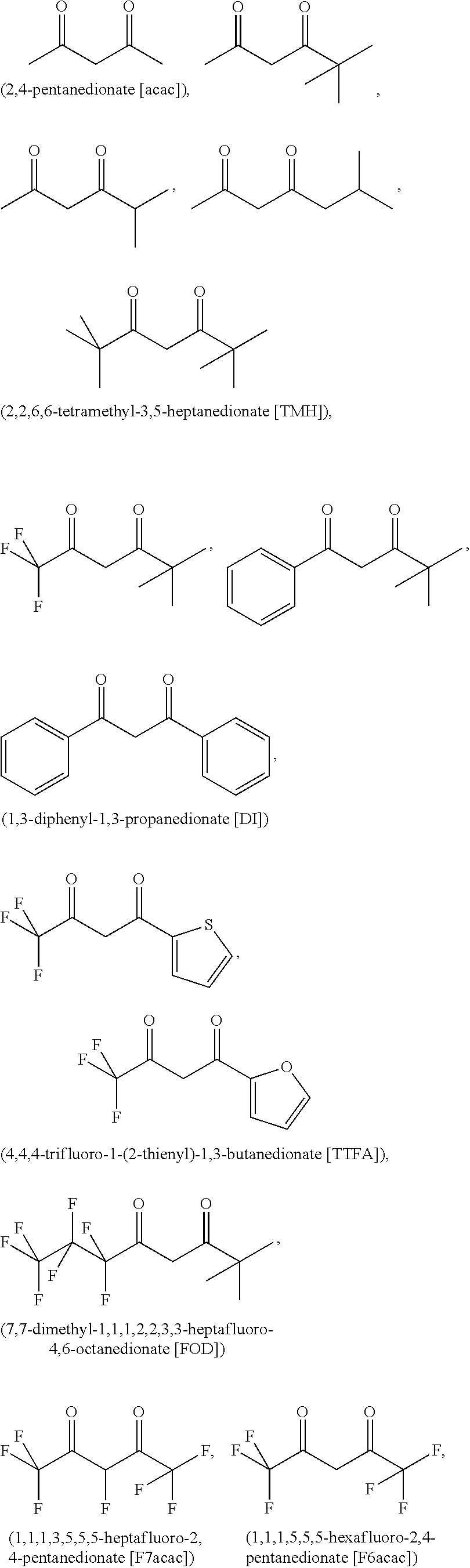

- (1-phenyl-3-methyl-4-1-butyryl-pyrazolinonate [FMBP]),

- 8-hydroxyquinolinate [8hq]
- 2-methyl-8-hydroxyquinolinate [Me-8hq]
- 10-hydroxybenzoquinolinate [10-hbq].

wherein
M1 is Co, or Fe, especially Ir, or Rh,
R1, R2, R3 and R4 are hydrogen, or halogen, especially F, or Cl;
R5 is optionally substituted C6-C10aryl, C1-C4alkyl, C1-C4 perfluoroalkyl, C1-C4alkoxy, or —O—C1-C4 perfluoroalkyl, especially phenyl,
R6 is hydrogen, halogen, especially F, or Cl; nitro, C1-C4alkyl, C1-C4 perfluoroalkyl, C1-C4alkoxy, or optionally substituted C6-C10aryl, especially phenyl,
R7 is hydrogen, halogen, especially F, or Cl; C1-C4alkyl, C1-C4 perfluoroalkyl, optionally substituted C6-C10aryl, especially phenyl, or optionally substituted C6-C10 perfluoroaryl, especially C6F5,
R8 is hydrogen, C1-C4alkyl, C1-C8alkoxy, C1-C4 perfluoroalkyl, optionally substituted C6-C10aryl, especially phenyl, or optionally substituted C6-C10 perfluoroaryl, especially C6F5,
R9 is hydrogen, halogen, especially F, or Cl; nitro, cyano, C1-C4alkyl, C1-C4 perfluoroalkyl, C1-C4alkoxy, or optionally substituted C6-C10aryl, especially phenyl,
A10 is hydrogen, halogen, especially F, or Cl; nitro, cyano, C1-C4alkyl, C2-C4alkenyl, C1-C4 perfluoroalkyl, —O—C1-C4 perfluoroalkyl, tri(C1-C4alkyl)silanyl, especially tri(methyl)silanyl, optionally substituted C6-C10aryl, especially phenyl, or optionally substituted C6-C10 perfluoroaryl, especially C6F5,
A11 is hydrogen, halogen, especially F, or Cl; nitro, cyano, C1-C4alkyl, C2-C4alkenyl, C1-C4 perfluoroalkyl, —O—C1-C4 perfluoroalkyl, tri(C1-C4alkyl)silanyl, especially tri(methyl)silanyl, optionally substituted C6-C10aryl, especially phenyl, or optionally substituted C6-C10 perfluoro-aryl, especially C6F5,
A12 is hydrogen, halogen, especially F, or Cl; nitro, hydroxy, mercapto, amino, C1-C4alkyl, C2-C4alkenyl, C1-C4 perfluoroalkyl, C1-C4alkoxy, —O—C1-C4 perfluoroalkyl, —S—C1-C4alkyl, a group —(CH2)rX20, wherein r is 1, or 2, X20 is halogen, especially F, or Cl; hydroxy, cyano, —O—C1-C4alkyl, di(C1-C4alkyl)amino, —CO2X21, wherein X21 is H, or C1-C4alkyl; —CH═CHCO2X22, wherein X22 is C1-C4alkyl; —CH(O), —SO2X23, —SOX23, —NC(O)X23, —NSO2X23, —NHX23, —N(X23)2, wherein X23 is C1-C4alkyl; tri(C1-C4alkyl)siloxanyl, optionally substituted —O—C6-C10aryl, especially phenoxy, cyclohexyl, optionally substituted C6-C10aryl, especially phenyl, or optionally substituted C6-C10 perfluoroaryl, especially C6F5,
A13 is hydrogen, nitro, cyano, C1-C4alkyl, C2-C4alkenyl, C1-C4 perfluoroalkyl, —O—C1-C4 perfluoroalkyl, tri(C1-C4alkyl)silanyl, or optionally substituted C6-C10aryl, especially phenyl, and Z1 is C1-C4 perfluoroalkyl, or optionally substituted C6-C10aryl, especially phenyl.

wherein
M1 is Co, or Fe, especially Ir, or Rh,
R1, R2, R3 and R4 are hydrogen, or halogen, especially F, or Cl;
R5 is optionally substituted C6-C10aryl, C1-C4alkyl, C1-C4 perfluoroalkyl, C1-C4alkoxy, or —O—C1-C4 perfluoroalkyl, especially phenyl,
R6 is hydrogen, halogen, especially F, or Cl; nitro, C1-C4alkyl, C1-C4 perfluoroalkyl, C1-C4alkoxy, or optionally substituted C6-C10aryl, especially phenyl,
R7 is hydrogen, halogen, especially F, or Cl; C1-C4alkyl, C1-C4 perfluoroalkyl, optionally substituted C6-C10aryl, especially phenyl, or optionally substituted C6-C10 perfluoroaryl, especially C6F5,
R8 is hydrogen, C1-C4alkyl, C1-C8alkoxy, C1-C4 perfluoroalkyl, optionally substituted C6-C10aryl, especially phenyl, or optionally substituted C6-C10 perfluoroaryl, especially C6F5,
R9 is hydrogen, halogen, especially F, or Cl; nitro, cyano, C1-C4alkyl, C1-C4 perfluoroalkyl, C1-C4alkoxy, or optionally substituted C6-C10aryl, especially phenyl,
A10 is hydrogen, halogen, especially F, or Cl; nitro, cyano, C1-C4alkyl, C2-C4alkenyl, C1-C4 perfluoroalkyl, —O—C1-C4 perfluoroalkyl, tri(C1-C4alkyl)silanyl, especially tri(methyl)silanyl, optionally substituted C6-C10aryl, especially phenyl, or optionally substituted C6-C10perfluoroaryl, especially C6F5,
A11 is hydrogen, halogen, especially F, or Cl; nitro, cyano, C1-C4alkyl, C2-C4alkenyl, C1-C4 perfluoroalkyl, —O—C1-C4 perfluoroalkyl, tri(C1-C4alkyl)silanyl, especially tri(methyl)silanyl, optionally substituted C6-C10aryl, especially phenyl, or optionally substituted C6-C10perfluoroaryl, especially C6F5,
A12 is hydrogen, halogen, especially F, or Cl; nitro, hydroxy, mercapto, amino, C1-C4alkyl, C2-C4alkenyl, C1-C4 perfluoroalkyl, C1-C4alkoxy, —O—C1-C4 perfluoroalkyl, —S—C1-C4alkyl, a group —(CH2)rX20, wherein r is 1, or 2, X20 is halogen, especially F, or Cl; hydroxy, cyano, —O—C1-C4alkyl, di(C1-C4alkyl)amino, —CO2X21, wherein X21 is H, or C1-C4alkyl; —CH═CHCO2X22, wherein X22 is C1-C4alkyl; —CH(O), —SO2X23, —SOX23, —NC(O)X23, —NSO2X23, —NHX23, —N(X23)2, wherein X23 is C1-C4alkyl; tri(C1-C4alkyl)siloxanyl, optionally substituted —O—C6-C10aryl, especially phenoxy, cyclohexyl, optionally substituted C6-C10aryl, especially phenyl, or optionally substituted C6-C10 perfluoroaryl, especially C6F5,
A13 is hydrogen, nitro, cyano, C1-C4alkyl, C2-C4alkenyl, C1-C4 perfluoroalkyl, —O—C1-C4 perfluoroalkyl, tri(C1-C4alkyl)silanyl, or optionally substituted C6-C10aryl, especially phenyl, and Z1 and Z2 are independently of each other C1-C4 perfluoroalkyl, or optionally substituted C6-C10aryl, especially hydrogen.

wherein
M1 is Co, or Fe, especially Ir, or Rh,
R1, R2, R3 and R4 are hydrogen, or halogen, especially F, or Cl;
R5 is optionally substituted C6-C10aryl, C1-C4alkyl, C1-C4 perfluoroalkyl, C1-C4alkoxy, or —O—C1-C4 perfluoroalkyl, especially phenyl,
R6 is hydrogen, halogen, especially F, or Cl; nitro, C1-C4alkyl, C1-C4 perfluoroalkyl, C1-C4alkoxy, or optionally substituted C6-C10aryl, especially phenyl,
R7 is hydrogen, halogen, especially F, or Cl; C1-C4alkyl, C1-C4 perfluoroalkyl, optionally substituted C6-C10aryl, especially phenyl, or optionally substituted C6-C10 perfluoroaryl, especially C6F5,
R8 is hydrogen, C1-C4alkyl, C1-C8alkoxy, C1-C4 perfluoroalkyl, optionally substituted C6-C10aryl, especially phenyl, or optionally substituted C6-C10 perfluoroaryl, especially C6F5,
R9 is hydrogen, halogen, especially F, or Cl; nitro, cyano, C1-C4alkyl, C1-C4 perfluoroalkyl, C1-C4alkoxy, or optionally substituted C6-C10aryl, especially phenyl,
A10 is hydrogen, halogen, especially F, or Cl; nitro, cyano, C1-C4alkyl, C2-C4alkenyl, C1-C4 perfluoroalkyl, —O—C1-C4 perfluoroalkyl, tri(C1-C4alkyl)silanyl, especially tri(methyl)silanyl, optionally substituted C6-C10aryl, especially phenyl, or optionally substituted C6-C10 perfluoroaryl, especially C6F5,
A11 is hydrogen, halogen, especially F, or Cl; nitro, cyano, C1-C4alkyl, C2-C4alkenyl, C1-C4 perfluoroalkyl, —O—C1-C4 perfluoroalkyl, tri(C1-C4alkyl)silanyl, especially tri(methyl)silanyl, optionally substituted C6-C10aryl, especially phenyl, or optionally substituted C6-C10 perfluoroaryl, especially C6F5,
A12 is hydrogen, halogen, especially F, or Cl; nitro, hydroxy, mercapto, amino, C1-C4alkyl, C2-C4alkenyl, C1-C4 perfluoroalkyl, C1-C4alkoxy, —O—C1-C4 perfluoroalkyl, —S—C1-C4alkyl, a group —(CH2)rX20, wherein r is 1, or 2, X20 is halogen, especially F, or Cl; hydroxy, cyano, —O—C1-C4alkyl, di(C1-C4alkyl)amino, —CO2X21, wherein X21 is H, or C1-C4alkyl; —CH═CHCO2X22, wherein X22 is C1-C4alkyl; —CH(O), —SO2X23, —SOX23, —NC(O)X23, —NSO2X23, —NHX23, —N(X23)2, wherein X23 is C1-C4alkyl; tri(C1-C4alkyl)siloxanyl, optionally substituted —O—C6-C10aryl, especially phenoxy, cyclohexyl, optionally substituted C6-C10aryl, especially phenyl, or optionally substituted C6-C10 perfluoroaryl, especially C6F5,
A13 is hydrogen, nitro, cyano, C1-C4alkyl, C2-C4alkenyl, C1-C4 perfluoroalkyl, —O—C1-C4 perfluoroalkyl, tri(C1-C4alkyl)silanyl, or optionally substituted C6-C10aryl, especially phenyl, and Z1, Z2, Z3, Z4, Z5 and are independently of each other selected from the group consisting of hydrogen, C1-C24alkyl, C1-C24halogenalkyl, C1-C8 perfluoroalkyl, C2-C24alkenyl, C2-C24alkynyl, C2-C24alkoxycarbonyl, aryl, which can optionally be substituted, C1-C24carboxylate, C1-C24alkoxy, C2-C24alkenyloxy, C2-C24alkynyloxy, or aryloxy, wherein each of Z1, Z2, Z3 and Z4 optionally being substituted with C1-C8alkyl, halogen, C1-C8alkoxy, or with a phenyl group, which can optionally be substituted with halogen, C1-C8alkyl, or C1-C8alkoxy, or Z1 and Z2, if possible, form an aromatic or heteroaromatic ring, and/or Z3, Z4, Z5 and Z6, if possible, form an alkyl or heteroalkyl ring.

wherein M1 is Co, or Fe, especially Ir, or Rh, R1 is hydrogen, halogen, especially F, or Cl; nitro, cyano, C1-C4alkyl, C1-C4 perfluoroalkyl, or C1-C4alkoxy,
R2 is hydrogen, halogen, especially F, or Cl; nitro, cyano, C1-C4alkyl, C1-C4 perfluoroalkyl, C1-C4alkoxy, —S—C1-C4alkyl, —O—C1-C4 perfluoroalkyl, —SO2X22, —CO2X22, wherein X22 is C1-C4alkyl; C6H4CF3, or optionally substituted —O—C6-C10aryl, especially phenoxy,
R3 is hydrogen, halogen, especially F, or Cl; nitro, cyano, C1-C4alkyl, C1-C4 perfluoroalkyl, C1-C4alkoxy, —S—C1-C4alkyl, or —O—C1-C4 perfluoroalkyl,
R4 is hydrogen, halogen, especially F, or Cl;
R5 is optionally substituted C6-C10aryl, C1-C4alkyl, C1-C4 perfluoroalkyl, C1-C4alkoxy, or —O—C1-C4 perfluoroalkyl, especially phenyl, and
Z1 is C1-C4 perfluoroalkyl, or optionally substituted C6-C10aryl, especially phenyl.

wherein M1 is Co, or Fe, especially Ir, or Rh, R1 is hydrogen, halogen, especially F, or Cl; nitro, cyano, C1-C4alkyl, C1-C4 perfluoroalkyl, or C1-C4alkoxy,
R2 is hydrogen, halogen, especially F, or Cl; nitro, cyano, C1-C4alkyl, C1-C4 perfluoroalkyl, C1-C4alkoxy, —S—C1-C4alkyl, —O—C1-C4 perfluoroalkyl, —SO2X22, —CO2X22, wherein X22 is C1-C4alkyl; C6H4CF3, or optionally substituted —O—C6-C10aryl, especially phenoxy,
R3 is hydrogen, halogen, especially F, or Cl; nitro, cyano, C1-C4alkyl, C1-C4 perfluoroalkyl, C1-C4alkoxy, —S—C1-C4alkyl, or —O—C1-C4 perfluoroalkyl,
R4 is hydrogen, halogen, especially F, or Cl;
R5 is optionally substituted C6-C10aryl, C1-C4alkyl, C1-C4 perfluoroalkyl, C1-C4alkoxy, or —O—C1-C4 perfluoroalkyl, especially phenyl, and
Z1 is C1-C4 perfluoroalkyl, or optionally substituted C6-C10aryl, especially phenyl.

wherein M1 is Co, or Fe, especially Ir, or Rh, R1 is hydrogen, halogen, especially F, or Cl; nitro, cyano, C1-C4alkyl, C1-C4 perfluoroalkyl, or C1-C4alkoxy,
R2 is hydrogen, halogen, especially F, or Cl; nitro, cyano, C1-C4alkyl, C1-C4 perfluoroalkyl, C1-C4alkoxy, —S—C1-C4alkyl, —O—C1-C4 perfluoroalkyl, —SO2X22, —CO2X22, wherein X22 is C1-C4alkyl; C6H4CF3, or optionally substituted —O—C6-C10aryl, especially phenoxy,
R3 is hydrogen, halogen, especially F, or Cl; nitro, cyano, C1-C4alkyl, C1-C4 perfluoroalkyl, C1-C4alkoxy, —S—C1-C4alkyl, or —O—C1-C4 perfluoroalkyl,
R4 is hydrogen, halogen, especially F, or Cl;
R5 is optionally substituted C6-C10aryl, C1-C4alkyl, C1-C4 perfluoroalkyl, C1-C4alkoxy, or —O—C1-C4 perfluoroalkyl, especially phenyl, and
Z1 and Z2 are independently of each other selected from the group consisting of hydrogen, C1-C24alkyl, C1-C24halogenalkyl, C1-C8perfluoroalkyl, C2-C24alkenyl, C2-C24alkynyl, C2-C24alkoxycarbonyl, aryl, aryl which can be substituted, C1-C24carboxylate, C1-C24alkoxy, C2-C24alkenyloxy, C2-C24alkynyloxy, or aryloxy. wherein each of Z1 and Z2 optionally being substituted with C1-C8alkyl, halogen, C1-C8alkoxy, or with a phenyl group, which can optionally be substituted with halogen, C1-C8alkyl, or C1-C8alkoxy, or Z1 and Z2, if possible, form an aromatic or heteroaromatic ring. Z1 is preferably C1-C4 perfluoroalkyl, or optionally substituted C6-C10aryl, especially phenyl.

wherein M1 is Co, or Fe, especially Ir, or Rh, R1 is hydrogen, halogen, especially F, or Cl; nitro, cyano, C1-C4alkyl, C1-C4 perfluoroalkyl, or C1-C4alkoxy,
R2 is hydrogen, halogen, especially F, or Cl; nitro, cyano, C1-C4alkyl, C1-C4 perfluoroalkyl, C1-C4alkoxy, —S—C1-C4alkyl, —O—C1-C4 perfluoroalkyl, —SO2X22, —CO2X22, wherein X22 is C1-C4alkyl; C6H4CF3, or optionally substituted —O—C6-C10aryl, especially phenoxy,
R3 is hydrogen, halogen, especially F, or Cl; nitro, cyano, C1-C4alkyl, C1-C4 perfluoroalkyl, C1-C4alkoxy, —S—C1-C4alkyl, or —O—C1-C4 perfluoroalkyl,
R4 is hydrogen, halogen, especially F, or Cl;
R5 is optionally substituted C6-C10aryl, C1-C4alkyl, C1-C4 perfluoroalkyl, C1-C4alkoxy, or —O—C1-C4 perfluoroalkyl, especially phenyl, and
Z1, Z2, Z3, Z4, and Z5 are independently of each other selected from the group consisting of hydrogen, C1-C24alkyl, C1-C24halogenalkyl, C1-C8perfluoroalkyl, C2-C24alkenyl, C2-C24alkynyl, C2-C24alkoxycarbonyl, aryl, which can optionally be substituted, C1-C24carboxylate, C1-C24alkoxy, C2-C24alkenyloxy, C2-C24alkynyloxy, or aryloxy, wherein each of Z1, Z2, Z3 and Z4 optionally being substituted with C1-C8alkyl, halogen, C1-C8alkoxy, or with a phenyl group, which can optionally be substituted with halogen, C1-C8alkyl, or C1-C8alkoxy, or Z1 and Z2, if possible, form an aromatic or heteroaromatic ring, and/or Z3, Z4, Z5 and Z6, if possible, form an alkyl or heteroalkyl ring. Z1 is preferably C1-C4 perfluoroalkyl, or optionally substituted C6-C10aryl, especially phenyl.

wherein
M1 is Ni, Rh, or Ru, especially Pd, or Pt,
R1, R2, R3 and R4 are hydrogen, or halogen, especially F, or Cl;
R5 is optionally substituted C6-C10aryl, C1-C4alkyl, C1-C4 perfluoroalkyl, C1-C4alkoxy, or —O—C1-C4 perfluoroalkyl, especially phenyl,
R6 is hydrogen, halogen, especially F, or Cl; nitro, C1-C4alkyl, C1-C4 perfluoroalkyl, C1-C4alkoxy, or optionally substituted C6-C10aryl, especially phenyl,
R7 is hydrogen, halogen, especially F, or Cl; C1-C4alkyl, C1-C4 perfluoroalkyl, optionally substituted C6-C10aryl, especially phenyl, or optionally substituted C6-C10 perfluoroaryl, especially C6F5,
R8 is hydrogen, C1-C4alkyl, C1-C8alkoxy, C1-C4 perfluoroalkyl, optionally substituted C6-C10aryl, especially phenyl, or optionally substituted C6-C10 perfluoroaryl, especially C6F5,
R9 is hydrogen, halogen, especially F, or Cl; nitro, cyano, C1-C4alkyl, C1-C4 perfluoroalkyl, C1-C4alkoxy, or optionally substituted C6-C10aryl, especially phenyl, A10 is hydrogen, halogen, especially F, or Cl; nitro, cyano, C1-C4alkyl, C2-C4alkenyl, C1-C4 perfluoroalkyl, —O—C1-C4 perfluoroalkyl, tri(C1-C4alkyl)silanyl, especially tri(methyl)silanyl, optionally substituted C6-C10aryl, especially phenyl, or optionally substituted C6-C10 perfluoroaryl, especially C6F5,
A11 is hydrogen, halogen, especially F, or Cl; nitro, cyano, C1-C4alkyl, C2-C4alkenyl, C1-C4 perfluoroalkyl, —O—C1-C4 perfluoroalkyl, tri(C1-C4alkyl)silanyl, especially tri(methyl)silanyl, optionally substituted C6-C10aryl, especially phenyl, or optionally substituted C6-C10 perfluoroaryl, especially C6F5,
A12 is hydrogen, halogen, especially F, or Cl; nitro, hydroxy, mercapto, amino, C1-C4alkyl, C2-C4alkenyl, C1-C4 perfluoroalkyl, C1-C4alkoxy, —O—C1-C4 perfluoroalkyl, —S—C1-C4alkyl, a group —(CH2)rX20, wherein r is 1, or 2, X20 is halogen, especially F, or Cl; hydroxy, cyano, —O—C1-C4alkyl, di(C1-C4alkyl)amino, —CO2X21, wherein X21 is H, or C1-C4alkyl; —CH═CHCO2X22, wherein X22 is C1-C4alkyl; —CH(O), —SO2X23, —SOX23, —NC(O)X23, —NSO2X23, —NHX23, —N(X23)2, wherein X23 is C1-C4alkyl; tri(C1-C4alkyl)siloxanyl, optionally substituted —O—C6-C10aryl, especially phenoxy, cyclohexyl, optionally substituted C6-C10aryl, especially phenyl, or optionally substituted C6-C10 perfluoroaryl, especially C6F5,
A13 is hydrogen, nitro, cyano, C1-C4alkyl, C2-C4alkenyl, C1-C4 perfluoroalkyl, —O—C1-C4 perfluoroalkyl, tri(C1-C4alkyl)silanyl, or optionally substituted C6-C10aryl, especially phenyl, and Z1 is C1-C4 perfluoroalkyl, or optionally substituted C6-C10aryl, especially phenyl.

wherein
M1 is Ni, Rh, or Ru, especially Pd, or Pt,
R1, R2, R3 and R4 are hydrogen, or halogen, especially F, or Cl;
R5 is optionally substituted C6-C10aryl, C1-C4alkyl, C1-C4 perfluoroalkyl, C1-C4alkoxy, or —O—C1-C4 perfluoroalkyl, especially phenyl,
R6 is hydrogen, halogen, especially F, or Cl; nitro, C1-C4alkyl, C1-C4 perfluoroalkyl, C1-C4alkoxy, or optionally substituted C6-C10aryl, especially phenyl,
R7 is hydrogen, halogen, especially F, or Cl; C1-C4alkyl, C1-C4 perfluoroalkyl, optionally substituted C6-C10aryl, especially phenyl, or optionally substituted C6-C10 perfluoroaryl, especially C6F5,
R8 is hydrogen, C1-C4alkyl, C1-C8alkoxy, C1-C4 perfluoroalkyl, optionally substituted C6-C10aryl, especially phenyl, or optionally substituted C6-C10 perfluoroaryl, especially C6F5,
R9 is hydrogen, halogen, especially F, or Cl; nitro, cyano, C1-C4alkyl, C1-C4 perfluoroalkyl, C1-C4alkoxy, or optionally substituted C6-C10aryl, especially phenyl,
A10 is hydrogen, halogen, especially F, or Cl; nitro, cyano, C1-C4alkyl, C2-C4alkenyl, C1-C4 perfluoroalkyl, —O—C1-C4 perfluoroalkyl, tri(C1-C4alkyl)silanyl, especially tri(methyl)silanyl, optionally substituted C6-C10aryl, especially phenyl, or optionally substituted C6-C10 perfluoroaryl, especially C6F5,
A11 is hydrogen, halogen, especially F, or Cl; nitro, cyano, C1-C4alkyl, C2-C4alkenyl, C1-C4 perfluoroalkyl, —O—C1-C4 perfluoroalkyl, tri(C1-C4alkyl)silanyl, especially tri(methyl)silanyl, optionally substituted C6-C10aryl, especially phenyl, or optionally substituted C6-C10 perfluoroaryl, especially C6F5,
A12 is hydrogen, halogen, especially F, or Cl; nitro, hydroxy, mercapto, amino, C1-C4alkyl, C2-C4alkenyl, C1-C4 perfluoroalkyl, C1-C4alkoxy, —O—C1-C4 perfluoroalkyl, —S—C1-C4alkyl, a group —(CH2)rX20, wherein r is 1, or 2, X20 is halogen, especially F, or Cl; hydroxy, cyano, —O—C1-C4alkyl, di(C1-C4alkyl)amino, —CO2X21, wherein X21 is H, or C1-C4alkyl; —CH═CHCO2X22, wherein X22 is C1-C4alkyl; —CH(O), —SO2X23, —SOX23, —NC(O)X23, —NSO2X23, —NHX23, —N(X23)2, wherein X23 is C1-C4alkyl; tri(C1-C4alkyl)siloxanyl, optionally substituted —O—C6-C10aryl, especially phenoxy, cyclohexyl, optionally substituted C6-C10aryl, especially phenyl, or optionally substituted C6-C10 perfluoroaryl, especially C6F5,
A13 is hydrogen, nitro, cyano, C1-C4alkyl, C2-C4alkenyl, C1-C4 perfluoroalkyl, —O—C1-C4 perfluoroalkyl, tri(C1-C4alkyl)silanyl, or optionally substituted C6-C10aryl, especially phenyl, and Z1 and Z2 are independently of each other selected from the group consisting of hydrogen, C1-C24alkyl, C1-C24halogenalkyl, C1-C8 perfluoroalkyl, C2-C24alkenyl, C2-C24alkynyl, C2-C24alkoxycarbonyl, aryl, aryl which can be substituted, C1-C24carboxylate, C1-C24alkoxy, C2-C24alkenyloxy, C2-C24alkynyloxy, or aryloxy. wherein each of Z1 and Z2 optionally being substituted with C1-C8alkyl, halogen, C1-C8alkoxy, or with a phenyl group, which can optionally be substituted with halogen, C1-C8alkyl, or C1-C8alkoxy, or Z1 and Z2, if possible, form an aromatic or heteroaromatic ring.

wherein
M1 is Ni, Rh, or Ru, especially Pd, or Pt,
R1, R2, R3 and R4 are hydrogen, or halogen, especially F, or Cl;
R5 is optionally substituted C6-C10aryl, C1-C4alkyl, C1-C4 perfluoroalkyl, C1-C4alkoxy, or —O—C1-C4 perfluoroalkyl, especially phenyl,
R6 is hydrogen, halogen, especially F, or Cl; nitro, C1-C4alkyl, C1-C4 perfluoroalkyl, C1-C4alkoxy, or optionally substituted C6-C10aryl, especially phenyl,
R7 is hydrogen, halogen, especially F, or Cl; C1-C4alkyl, C1-C4 perfluoroalkyl, optionally substituted C6-C10aryl, especially phenyl, or optionally substituted C6-C10 perfluoroaryl, especially C6F5,
R8 is hydrogen, C1-C4alkyl, C1-C8alkoxy, C1-C4 perfluoroalkyl, optionally substituted C6-C10aryl, especially phenyl, or optionally substituted C6-C10 perfluoroaryl, especially C6F5,
R9 is hydrogen, halogen, especially F, or Cl; nitro, cyano, C1-C4alkyl, C1-C4 perfluoroalkyl, C1-C4alkoxy, or optionally substituted C6-C10aryl, especially phenyl,
A10 is hydrogen, halogen, especially F, or Cl; nitro, cyano, C1-C4alkyl, C2-C4alkenyl, C1-C4 perfluoroalkyl, —O—C1-C4 perfluoroalkyl, tri(C1-C4alkyl)silanyl, especially tri(methyl)silanyl, optionally substituted C6-C10aryl, especially phenyl, or optionally substituted C6-C10 perfluoroaryl, especially C6F5,
A11 is hydrogen, halogen, especially F, or Cl; nitro, cyano, C1-C4alkyl, C2-C4alkenyl, C1-C4 perfluoroalkyl, —O—C1-C4 perfluoroalkyl, tri(C1-C4alkyl)silanyl, especially tri(methyl)silanyl, optionally substituted C6-C10aryl, especially phenyl, or optionally substituted C6-C10 perfluoroaryl, especially C6F5,
A12 is hydrogen, halogen, especially F, or Cl; nitro, hydroxy, mercapto, amino, C1-C4alkyl, C2-C4alkenyl, C1-C4 perfluoroalkyl, C1-C4alkoxy, —O—C1-C4 perfluoroalkyl, —S—C1-C4alkyl, a group —(CH2)rX20, wherein r is 1, or 2, X20 is halogen, especially F, or Cl; hydroxy, cyano, —O—C1-C4alkyl, di(C1-C4alkyl)amino, —CO2X21, wherein X21 is H, or C1-C4alkyl; —CH═CHCO2X22, wherein X22 is C1-C4alkyl; —CH(O), —SO2X23, —SOX23, —NC(O)X23, —NSO2X23, —NHX23, —N(X23)2, wherein X23 is C1-C4alkyl; tri(C1-C4alkyl)siloxanyl, optionally substituted —O—C6-C10aryl, especially phenoxy, cyclohexyl, optionally substituted C6-C10aryl, especially phenyl, or optionally substituted C6-C10 perfluoroaryl, especially C6F5,
A13 is hydrogen, nitro, cyano, C1-C4alkyl, C2-C4alkenyl, C1-C4 perfluoroalkyl, —O—C1-C4 perfluoroalkyl, tri(C1-C4alkyl)silanyl, or optionally substituted C6-C10aryl, especially phenyl, and Z1, Z2, Z3, and Z4 are independently of each other selected from the group consisting of hydrogen, C1-C24alkyl, C1-C24halogenalkyl, C1-C8perfluoroalkyl, C2-C24alkenyl, C2-C24alkynyl, C2-C24alkoxycarbonyl, aryl, aryl which can be substituted, C1-C24carboxylate, C1-C24alkoxy, C2-C24alkenyloxy, C2-C24alkynyloxy, or aryloxy, wherein each of Z1, Z2, Z3 and Z4 optionally being substituted with C1-C8alkyl, halogen, C1-C8alkoxy, or with a phenyl group, which can optionally be substituted with halogen, C1-C8alkyl, or C1-C8alkoxy, or Z1 and Z2, if possible, form an aromatic or heteroaromatic ring, and/or Z3 and Z4, if possible, form an alkyl or heteroalkyl ring.

wherein
R1 is hydrogen, halogen, especially F, or Cl; nitro, cyano, C1-C4alkyl, C1-C4 perfluoroalkyl, or C1-C4alkoxy,
R2 is hydrogen, halogen, especially F, or Cl; nitro, cyano, C1-C4alkyl, C1-C4 perfluoroalkyl, C1-C4alkoxy, —S—C1-C4alkyl, —O—C1-C4 perfluoroalkyl, —SO2X22, —CO2X22, wherein X22 is C1-C4alkyl; C6H4CF3, or optionally substituted —O—C6-C10aryl, especially phenoxy,
R3 is hydrogen, halogen, especially F, or Cl; nitro, cyano, C1-C4alkyl, C1-C4 perfluoroalkyl, C1-C4alkoxy, —S—C1-C4alkyl, or —O—C1-C4 perfluoroalkyl,
R4 is hydrogen, halogen, especially F, or Cl;
R5 is optionally substituted C6-C10aryl, C1-C4alkyl, C1-C4 perfluoroalkyl, C1-C4alkoxy, or —O—C1-C4 perfluoroalkyl, especially phenyl, and
Z1 is C1-C4 perfluoroalkyl, or optionally substituted C6-C10aryl, especially phenyl.

wherein
M1 is Ni, Rh, or Ru, especially Pd, or Pt,
R1 is hydrogen, halogen, especially F, or Cl; nitro, cyano, C1-C4alkyl, C1-C4 perfluoroalkyl, or C1-C4alkoxy,
R2 is hydrogen, halogen, especially F, or Cl; nitro, cyano, C1-C4alkyl, C1-C4 perfluoroalkyl, C1-C4alkoxy, —S—C1-C4alkyl, —O—C1-C4 perfluoroalkyl, —SO2X22, —CO2X22, wherein X22 is C1-C4alkyl; C6H4CF3, or optionally substituted —O—C6-C10aryl, especially phenoxy,
R3 is hydrogen, halogen, especially F, or Cl; nitro, cyano, C1-C4alkyl, C1-C4 perfluoroalkyl, C1-C4alkoxy, —S—C1-C4alkyl, or —O—C1-C4 perfluoroalkyl,
R4 is hydrogen, halogen, especially F, or Cl;
R5 is optionally substituted C6-C10aryl, C1-C4alkyl, C1-C4 perfluoroalkyl, C1-C4alkoxy, or —O—C1-C4 perfluoroalkyl, especially phenyl, and
Z1 and Z2 are independently of each other selected from the group consisting of hydrogen, C1-C24alkyl, C1-C24halogenalkyl, C1-C8 perfluoroalkyl, C2-C24alkenyl, C2-C24alkynyl, C2-C24alkoxycarbonyl, aryl, aryl which can be substituted, C1-C24carboxylate, C1-C24alkoxy, C2-C24alkenyloxy, C2-C24alkynyloxy, or aryloxy. wherein each of Z1 and Z2 optionally being substituted with C1-C8alkyl, halogen, C1-C8alkoxy, or with a phenyl group, which can optionally be substituted with halogen, C1-C8alkyl, or C1-C8alkoxy, or Z1 and Z2, if possible, form an aromatic or heteroaromatic ring. Z1 is preferably C1-C4 perfluoroalkyl, or optionally substituted C6-C10aryl, especially phenyl.

wherein
M1 is Ni, Rh, or Ru, especially Pd, or Pt,
R1 is hydrogen, halogen, especially F, or Cl; nitro, cyano, C1-C4alkyl, C1-C4 perfluoroalkyl, or C1-C4alkoxy,
R2 is hydrogen, halogen, especially F, or Cl; nitro, cyano, C1-C4alkyl, C1-C4 perfluoroalkyl, C1-C4alkoxy, —S—C1-C4alkyl, —O—C1-C4 perfluoroalkyl, —SO2X22, —CO2X22, wherein X22 is C1-C4alkyl; C6H4CF3, or optionally substituted —O—C6-C10aryl, especially phenoxy,
R3 is hydrogen, halogen, especially F, or Cl; nitro, cyano, C1-C4alkyl, C1-C4 perfluoroalkyl, C1-C4alkoxy, —S—C1-C4alkyl, or —O—C—C4 perfluoroalkyl,
R4 is hydrogen, halogen, especially F, or Cl;
R5 is optionally substituted C6-C10aryl, C1-C4alkyl, C1-C4 perfluoroalkyl, C1-C4alkoxy, or —O—C1-C4 perfluoroalkyl, especially phenyl, and
Z1, Z2, Z3 and Z4 are independently of each other selected from the group consisting of hydrogen, C1-C24alkyl, C1-C24halogenalkyl, C1-C8 perfluoroalkyl, C2-C24alkenyl, C2-C24alkynyl, C2-C24alkoxycarbonyl, aryl, which can optionally be substituted, C1-C24carboxylate, C1-C24alkoxy, C2-C24alkenyloxy, C2-C24alkynyloxy, or aryloxy, wherein each of Z1, Z2, Z3 and Z4 optionally being substituted with C1-C8alkyl, halogen, C1-C8alkoxy, or with a phenyl group, which can optionally be substituted with halogen, C1-C8alkyl, or C1-C8alkoxy, or Z1 and Z2, if possible, form an aromatic or heteroaromatic ring, and/or Z3, Z4, Z5 and Z6, if possible, form an alkyl or heteroalkyl ring. Z1 is preferably C1-C4 perfluoroalkyl, or optionally substituted C6-C10aryl, especially phenyl.


K2PtCl4+HC^N->C^NPt(μ-Cl)2PtC^N


| Emission | Ex. Quantum | |||
| maximum | Efficiency | CIE | Efficiency | |
| Compound | (nm) | (cd/A) | Coordinates | [%] |
| A-1 | 527 | 4.4 | 0.30/0.57 | 1.2 |
| A-80 | 487 | 0.31 | 0.26/0.33 | 0.16 |
| A-82 | 610 | 3.2 | 0.65/0.34 | 3.1 |
| A-81 | 487 | 0.28 | 0.31/0.36 | 0.15 |
| A-164 | 487 | 0.28 | 0.31/0.36 | 0.15 |
Claims (15)


Priority Applications (1)
| Application Number | Priority Date | Filing Date | Title |
|---|---|---|---|
| US13/915,745 US9012899B2 (en) | 2004-12-23 | 2013-06-12 | Electroluminescent metal complexes with nucleophilic carbene ligands |
Applications Claiming Priority (6)
| Application Number | Priority Date | Filing Date | Title |
|---|---|---|---|
| EP04106916.2 | 2004-12-23 | ||
| EP04106916 | 2004-12-23 | ||
| EP04106916 | 2004-12-23 | ||
| PCT/EP2005/056767 WO2006067074A1 (en) | 2004-12-23 | 2005-12-14 | Electroluminescent metal complexes with nucleophilic carbene ligands |
| US79351311A | 2011-01-28 | 2011-01-28 | |
| US13/915,745 US9012899B2 (en) | 2004-12-23 | 2013-06-12 | Electroluminescent metal complexes with nucleophilic carbene ligands |
Related Parent Applications (3)
| Application Number | Title | Priority Date | Filing Date |
|---|---|---|---|
| US11/793,513 Continuation US8492749B2 (en) | 2004-12-23 | 2005-12-14 | Electroluminescent metal complexes with nucleophilic carbene ligands |
| PCT/EP2005/056767 Continuation WO2006067074A1 (en) | 2004-12-23 | 2005-12-14 | Electroluminescent metal complexes with nucleophilic carbene ligands |
| US79351311A Continuation | 2004-12-23 | 2011-01-28 |
Publications (2)
| Publication Number | Publication Date |
|---|---|
| US20130292660A1 US20130292660A1 (en) | 2013-11-07 |
| US9012899B2 true US9012899B2 (en) | 2015-04-21 |
Family
ID=34930139
Family Applications (2)
| Application Number | Title | Priority Date | Filing Date |
|---|---|---|---|
| US11/793,513 Active 2029-01-02 US8492749B2 (en) | 2004-12-23 | 2005-12-14 | Electroluminescent metal complexes with nucleophilic carbene ligands |
| US13/915,745 Active 2026-06-07 US9012899B2 (en) | 2004-12-23 | 2013-06-12 | Electroluminescent metal complexes with nucleophilic carbene ligands |
Family Applications Before (1)
| Application Number | Title | Priority Date | Filing Date |
|---|---|---|---|
| US11/793,513 Active 2029-01-02 US8492749B2 (en) | 2004-12-23 | 2005-12-14 | Electroluminescent metal complexes with nucleophilic carbene ligands |
Country Status (11)
| Country | Link |
|---|---|
| US (2) | US8492749B2 (en) |
| EP (2) | EP2080796A1 (en) |
| JP (1) | JP5100395B2 (en) |
| KR (1) | KR101269497B1 (en) |
| CN (1) | CN101087863B (en) |
| AT (1) | ATE430789T1 (en) |
| BR (1) | BRPI0519375A2 (en) |
| CA (1) | CA2589711A1 (en) |
| DE (1) | DE602005014391D1 (en) |
| TW (1) | TW200628478A (en) |
| WO (1) | WO2006067074A1 (en) |
Cited By (1)
| Publication number | Priority date | Publication date | Assignee | Title |
|---|---|---|---|---|
| US10916714B2 (en) | 2016-09-27 | 2021-02-09 | Samsung Display Co., Ltd. | Organometallic compound and organic light-emitting device including the same |
Families Citing this family (227)
| Publication number | Priority date | Publication date | Assignee | Title |
|---|---|---|---|---|
| JP5046548B2 (en) * | 2005-04-25 | 2012-10-10 | 富士フイルム株式会社 | Organic electroluminescence device |
| DE102005032332A1 (en) | 2005-07-08 | 2007-01-11 | Merck Patent Gmbh | metal complexes |
| JP2007045742A (en) * | 2005-08-10 | 2007-02-22 | Mitsubishi Chemicals Corp | Process for producing transition metal complex and transition metal complex |
| JPWO2007058104A1 (en) * | 2005-11-17 | 2009-04-30 | 出光興産株式会社 | Metal complex compound and organic electroluminescence device using the same |
| CN101415718B (en) | 2006-02-10 | 2013-05-29 | 通用显示公司 | Cyclometallated imidazo[1,2-f]phenanthridine and diimidazo[1,2-a:1',2'-c]quinazoline ligands and their isoelectronic and benzocyclization analogs metal complexes |
| CN103880891A (en) * | 2006-04-04 | 2014-06-25 | 巴斯夫欧洲公司 | Transition metal complexes comprising one noncarbene ligand and one or two carbene ligands and their use in oleds |
| JP5556014B2 (en) * | 2006-09-20 | 2014-07-23 | コニカミノルタ株式会社 | Organic electroluminescence device |
| JP5644050B2 (en) * | 2006-09-20 | 2014-12-24 | コニカミノルタ株式会社 | Organic electroluminescence element material |
| JP5606075B2 (en) | 2007-02-14 | 2014-10-15 | ビーエーエスエフ ソシエタス・ヨーロピア | Electroluminescent metal complex |
| CN101720330B (en) * | 2007-06-22 | 2017-06-09 | Udc爱尔兰有限责任公司 | Light emitting cu (I) complex compound |
| JP5804703B2 (en) | 2007-07-05 | 2015-11-04 | ビーエーエスエフ ソシエタス・ヨーロピアBasf Se | Organic light emitting diode comprising at least one disilyl compound selected from disilylcarbazole, disilyldibenzofuran, disilyldibenzothiophene, disilyldibenzophosphole, disilyldibenzothiophene S-oxide and disilyldibenzothiophene S, S-dioxide |
| JP5014036B2 (en) * | 2007-09-18 | 2012-08-29 | 富士フイルム株式会社 | Organic electroluminescence device |
| US8384068B2 (en) | 2007-10-02 | 2013-02-26 | Basf Se | Use of acridine derivatives as matrix materials and/or electron blockers in OLEDs |
| US8067100B2 (en) * | 2007-10-04 | 2011-11-29 | Universal Display Corporation | Complexes with tridentate ligands |
| JP5279234B2 (en) | 2007-11-02 | 2013-09-04 | キヤノン株式会社 | Platinum complex and organic light emitting device using the same |
| US8410270B2 (en) | 2008-06-10 | 2013-04-02 | Basf Se | Transition metal complexes and use thereof in organic light-emitting diodes V |
| US8377332B2 (en) | 2008-06-10 | 2013-02-19 | Basf Se | Transition metal complexes and use thereof in organic light emitting diodes—III |
| EP2301091B1 (en) | 2008-06-20 | 2013-08-21 | Basf Se | Use of cyclic phosphazene compounds in organic light emitting diodes |
| JP5661635B2 (en) | 2008-10-07 | 2015-01-28 | オスラム オプト セミコンダクターズ ゲゼルシャフト ミット ベシュレンクテル ハフツングOsram Opto Semiconductors GmbH | Siloles substituted with fused ring systems and their use in organic electronics |
| DE102008053107B4 (en) | 2008-10-24 | 2022-05-12 | Cynora Gmbh | Use of differently charged metal complexes as absorbers in organic solar cells and organic solar cells comprising them |
| WO2010097433A1 (en) | 2009-02-26 | 2010-09-02 | Basf Se | Quinone compounds as dopants in organic electronics |
| DE102009031683A1 (en) * | 2009-07-03 | 2011-03-24 | Siemens Aktiengesellschaft | Phophorescent metal complex compound, process for the preparation thereof and radiation-emitting component |
| JP5733560B2 (en) * | 2009-07-29 | 2015-06-10 | 国立大学法人東京工業大学 | Metal complex and light emitting device using the same |
| US9108998B2 (en) * | 2009-10-14 | 2015-08-18 | Basf Se | Dinuclear platinum-carbene complexes and the use thereof in OLEDs |
| US20120205645A1 (en) | 2009-10-28 | 2012-08-16 | Basf Se | Heteroleptic carbene complexes and the use thereof in organic electronics |
| US8288187B2 (en) | 2010-01-20 | 2012-10-16 | Universal Display Corporation | Electroluminescent devices for lighting applications |
| JP5734411B2 (en) * | 2010-04-16 | 2015-06-17 | ビーエーエスエフ ソシエタス・ヨーロピアBasf Se | Bridged benzimidazole carbene complexes and their use in OLEDs |
| US8691401B2 (en) | 2010-04-16 | 2014-04-08 | Basf Se | Bridged benzimidazole-carbene complexes and use thereof in OLEDS |
| DE112011101526T5 (en) | 2010-04-30 | 2013-05-16 | Arizona Board Of Regents Acting For And On Behalf Of Arizona State University | Synthesis of four-coordinate palladium complexes and their applications in light-emitting devices |
| CN102947416B (en) | 2010-06-18 | 2016-04-13 | 巴斯夫欧洲公司 | Comprise the organic electronic devices of the layer of diphenylene-oxide compound and oxine root conjunction alkaline-earth metal or alkali metal complex |
| KR101877581B1 (en) | 2010-06-18 | 2018-07-11 | 유디씨 아일랜드 리미티드 | Organic electronic devices comprising a layer of a pyridine compound and a 8-hydroxyquinolinolato earth alkaline metal, or alkali metal complex |
| US9142792B2 (en) | 2010-06-18 | 2015-09-22 | Basf Se | Organic electronic devices comprising a layer comprising at least one metal organic compound and at least one metal oxide |
| US8530687B2 (en) | 2010-09-07 | 2013-09-10 | University Of Florida Research Foundation, Inc. | Catalysts, methods of making catalysts, and methods of use |
| US9079872B2 (en) | 2010-10-07 | 2015-07-14 | Basf Se | Phenanthro[9, 10-B]furans for electronic applications |
| KR102001685B1 (en) | 2010-10-07 | 2019-07-18 | 유디씨 아일랜드 리미티드 | Phenanthro[9,10-b]furans for electornic applications |
| US8269317B2 (en) * | 2010-11-11 | 2012-09-18 | Universal Display Corporation | Phosphorescent materials |
| WO2012070596A1 (en) * | 2010-11-26 | 2012-05-31 | Semiconductor Energy Laboratory Co., Ltd. | Organometallic complex, light-emitting element, light-emitting device, electronic device, and lighting device |
| KR101979693B1 (en) | 2010-12-13 | 2019-05-17 | 유디씨 아일랜드 리미티드 | Bispyrimidines for electronic applications |
| US8362246B2 (en) | 2010-12-13 | 2013-01-29 | Basf Se | Bispyrimidines for electronic applications |
| JP5812014B2 (en) * | 2011-01-17 | 2015-11-11 | コニカミノルタ株式会社 | ORGANIC ELECTROLUMINESCENT ELEMENT, DISPLAY DEVICE, LIGHTING DEVICE, AND ORGANIC ELECTROLUMINESCENT ELEMENT MATERIAL |
| US9806270B2 (en) | 2011-03-25 | 2017-10-31 | Udc Ireland Limited | 4H-imidazo[1,2-a]imidazoles for electronic applications |
| JP6072760B2 (en) | 2011-03-25 | 2017-02-01 | ユー・ディー・シー アイルランド リミテッド | 4H-imidazo [1,2-a] imidazole for electronics applications |
| WO2012142387A1 (en) | 2011-04-14 | 2012-10-18 | Arizona Board Of Regents Acting For And On Behalf Of Arizona State University | Pyridine-oxyphenyl coordinated iridium (iii) complexes and methods of making and using |
| WO2012162488A1 (en) | 2011-05-26 | 2012-11-29 | Arizona Board Of Regents Acting For And On Behalf Of Arizona State University | Synthesis of platinum and palladium complexes as narrow-band phosphorescent emitters for full color displays |
| EP3473634B1 (en) * | 2011-06-08 | 2020-07-22 | Universal Display Corporation | Heteroleptic iridium carbene complexes and light emitting device using them |
| CN108440531B (en) | 2011-11-10 | 2021-11-02 | Udc 爱尔兰有限责任公司 | 4H-imidazo [1,2-a ] imidazoles for electronic applications |
| KR102012047B1 (en) | 2012-01-06 | 2019-08-19 | 유니버셜 디스플레이 코포레이션 | Highly efficient phosphorescent materials |
| US9386657B2 (en) | 2012-03-15 | 2016-07-05 | Universal Display Corporation | Organic Electroluminescent materials and devices |
| US9725476B2 (en) * | 2012-07-09 | 2017-08-08 | Universal Display Corporation | Silylated metal complexes |
| CN104395316B (en) | 2012-07-10 | 2018-01-19 | Udc 爱尔兰有限责任公司 | Benzimidazo[1,2‑A]benzimidazole derivatives for electronic applications |
| US9540329B2 (en) | 2012-07-19 | 2017-01-10 | Universal Display Corporation | Organic electroluminescent materials and devices |
| WO2014031977A1 (en) * | 2012-08-24 | 2014-02-27 | Arizona Board Of Regents For And On Behalf Of Arizona State University | Metal compounds and methods and uses thereof |
| WO2014044722A1 (en) | 2012-09-20 | 2014-03-27 | Basf Se | Azadibenzofurans for electronic applications |
| WO2014047616A1 (en) | 2012-09-24 | 2014-03-27 | Arizona Board Of Regents For And On Behalf Of Arizona State University | Metal compounds, methods, and uses thereof |
| US9252363B2 (en) | 2012-10-04 | 2016-02-02 | Universal Display Corporation | Aryloxyalkylcarboxylate solvent compositions for inkjet printing of organic layers |
| WO2014109814A2 (en) | 2012-10-26 | 2014-07-17 | Arizona Board Of Regents Acting For And On Behalf Of Arizona State University | Metal complexes, methods, and uses thereof |
| JP6491099B2 (en) | 2012-11-06 | 2019-03-27 | ユー・ディー・シー アイルランド リミテッド | Phenoxacillin based compounds for electronic applications |
| US9196860B2 (en) | 2012-12-04 | 2015-11-24 | Universal Display Corporation | Compounds for triplet-triplet annihilation upconversion |
| US8716484B1 (en) | 2012-12-05 | 2014-05-06 | Universal Display Corporation | Hole transporting materials with twisted aryl groups |
| US9653691B2 (en) | 2012-12-12 | 2017-05-16 | Universal Display Corporation | Phosphorescence-sensitizing fluorescence material system |
| JP5626384B2 (en) * | 2013-02-06 | 2014-11-19 | コニカミノルタ株式会社 | ORGANIC ELECTROLUMINESCENT ELEMENT MATERIAL, ORGANIC ELECTROLUMINESCENT ELEMENT, DISPLAY DEVICE AND LIGHTING DEVICE |
| US10400163B2 (en) | 2013-02-08 | 2019-09-03 | Universal Display Corporation | Organic electroluminescent materials and devices |
| JP6377718B2 (en) | 2013-03-20 | 2018-08-22 | ユー・ディー・シー アイルランド リミテッド | Azabenzimidazolecarbene complex as a high efficiency booster in OLED |
| CN105073763B (en) * | 2013-04-29 | 2019-03-01 | Udc 爱尔兰有限责任公司 | Transition metal complexes with carbene ligands and their use in OLEDs |
| KR102349659B1 (en) * | 2013-06-10 | 2022-01-11 | 아리조나 보드 오브 리젠츠 온 비하프 오브 아리조나 스테이트 유니버시티 | Phosphorescent tetradentate metal complexes having modified emission spectra |
| KR102305557B1 (en) | 2013-07-02 | 2021-09-29 | 유디씨 아일랜드 리미티드 | Monosubstituted diazabenzimidazole carbene metal complexes for use in organic light emitting diodes |
| KR101532228B1 (en) * | 2013-07-30 | 2015-06-30 | 주식회사 네패스 | Iridium electroluminescent compounds having bis trifluoromethyl substituents and organic electroluminescent device using the same |
| KR102226202B1 (en) * | 2013-07-31 | 2021-03-12 | 유디씨 아일랜드 리미티드 | Luminescent diazabenzimidazole carbene metal complexes |
| JP6804823B2 (en) * | 2013-10-14 | 2020-12-23 | アリゾナ・ボード・オブ・リージェンツ・オン・ビハーフ・オブ・アリゾナ・ステイト・ユニバーシティーArizona Board of Regents on behalf of Arizona State University | Platinum complex and device |
| US20150115250A1 (en) | 2013-10-29 | 2015-04-30 | Universal Display Corporation | Organic electroluminescent materials and devices |
| EP3063153B1 (en) | 2013-10-31 | 2018-03-07 | Idemitsu Kosan Co., Ltd. | Azadibenzothiophenes for electronic applications |
| US10033000B2 (en) | 2013-11-15 | 2018-07-24 | Universal Display Corporation | Organic electroluminescent materials and devices |
| US9876173B2 (en) | 2013-12-09 | 2018-01-23 | Universal Display Corporation | Organic electroluminescent materials and devices |
| US10020455B2 (en) | 2014-01-07 | 2018-07-10 | Arizona Board Of Regents On Behalf Of Arizona State University | Tetradentate platinum and palladium complex emitters containing phenyl-pyrazole and its analogues |
| US10056567B2 (en) | 2014-02-28 | 2018-08-21 | Arizona Board Of Regents On Behalf Of Arizona State University | Chiral metal complexes as emitters for organic polarized electroluminescent devices |
| CN115160373A (en) | 2014-03-31 | 2022-10-11 | Udc 爱尔兰有限责任公司 | Metal complexes and their use in organic light-emitting diodes |
| US9450198B2 (en) | 2014-04-15 | 2016-09-20 | Universal Display Corporation | Organic electroluminescent materials and devices |
| US9941479B2 (en) | 2014-06-02 | 2018-04-10 | Arizona Board Of Regents On Behalf Of Arizona State University | Tetradentate cyclometalated platinum complexes containing 9,10-dihydroacridine and its analogues |
| CN105185806B (en) * | 2014-06-20 | 2018-11-30 | 上海和辉光电有限公司 | Display panel and its packaging method comprising potting colored indicator |
| US9923155B2 (en) | 2014-07-24 | 2018-03-20 | Arizona Board Of Regents On Behalf Of Arizona State University | Tetradentate platinum (II) complexes cyclometalated with functionalized phenyl carbene ligands and their analogues |
| WO2016016791A1 (en) | 2014-07-28 | 2016-02-04 | Idemitsu Kosan Co., Ltd (Ikc) | 2,9-functionalized benzimidazolo[1,2-a]benzimidazoles as hosts for organic light emitting diodes (oleds) |
| US9502671B2 (en) | 2014-07-28 | 2016-11-22 | Arizona Board Of Regents On Behalf Of Arizona State University | Tridentate cyclometalated metal complexes with six-membered coordination rings |
| US9818959B2 (en) | 2014-07-29 | 2017-11-14 | Arizona Board of Regents on behlaf of Arizona State University | Metal-assisted delayed fluorescent emitters containing tridentate ligands |
| EP2982676B1 (en) | 2014-08-07 | 2018-04-11 | Idemitsu Kosan Co., Ltd. | Benzimidazo[2,1-B]benzoxazoles for electronic applications |
| US10793546B2 (en) | 2014-08-15 | 2020-10-06 | Arizona Board Of Regents On Behalf Of Arizona State University | Non-platinum metal complexes for excimer based single dopant white organic light emitting diodes |
| US11329244B2 (en) | 2014-08-22 | 2022-05-10 | Arizona Board Of Regents On Behalf Of Arizona State University | Organic light-emitting diodes with fluorescent and phosphorescent emitters |
| EP2993215B1 (en) | 2014-09-04 | 2019-06-19 | Idemitsu Kosan Co., Ltd. | Azabenzimidazo[2,1-a]benzimidazoles for electronic applications |
| EP3015469B1 (en) | 2014-10-30 | 2018-12-19 | Idemitsu Kosan Co., Ltd. | 5-(benzimidazol-2-yl)benzimidazo[1,2-a]benzimidazoles for electronic applications |
| US10033003B2 (en) | 2014-11-10 | 2018-07-24 | Arizona Board Of Regents On Behalf Of Arizona State University | Tetradentate metal complexes with carbon group bridging ligands |
| US9865825B2 (en) | 2014-11-10 | 2018-01-09 | Arizona Board Of Regents On Behalf Of Arizona State University | Emitters based on octahedral metal complexes |
| WO2016079667A1 (en) | 2014-11-17 | 2016-05-26 | Idemitsu Kosan Co., Ltd. | Indole derivatives for electronic applications |
| WO2016079169A1 (en) | 2014-11-18 | 2016-05-26 | Basf Se | Pt- or pd-carbene complexes for use in organic light emitting diodes |
| EP3034506A1 (en) | 2014-12-15 | 2016-06-22 | Idemitsu Kosan Co., Ltd | 4-functionalized carbazole derivatives for electronic applications |
| EP3034507A1 (en) | 2014-12-15 | 2016-06-22 | Idemitsu Kosan Co., Ltd | 1-functionalized dibenzofurans and dibenzothiophenes for organic light emitting diodes (OLEDs) |
| EP3054498B1 (en) | 2015-02-06 | 2017-09-20 | Idemitsu Kosan Co., Ltd. | Bisimidazodiazocines |
| EP3053918B1 (en) | 2015-02-06 | 2018-04-11 | Idemitsu Kosan Co., Ltd. | 2-carbazole substituted benzimidazoles for electronic applications |
| US9929361B2 (en) | 2015-02-16 | 2018-03-27 | Universal Display Corporation | Organic electroluminescent materials and devices |
| EP3061759B1 (en) | 2015-02-24 | 2019-12-25 | Idemitsu Kosan Co., Ltd | Nitrile substituted dibenzofurans |
| US11056657B2 (en) | 2015-02-27 | 2021-07-06 | University Display Corporation | Organic electroluminescent materials and devices |
| EP3070144B1 (en) | 2015-03-17 | 2018-02-28 | Idemitsu Kosan Co., Ltd. | Seven-membered ring compounds |
| EP3072943B1 (en) | 2015-03-26 | 2018-05-02 | Idemitsu Kosan Co., Ltd. | Dibenzofuran/carbazole-substituted benzonitriles |
| EP3075737B1 (en) | 2015-03-31 | 2019-12-04 | Idemitsu Kosan Co., Ltd | Benzimidazolo[1,2-a]benzimidazole carrying aryl- or heteroarylnitril groups for organic light emitting diodes |
| US20160293855A1 (en) | 2015-04-06 | 2016-10-06 | Universal Display Corporation | Organic Electroluminescent Materials and Devices |
| US11818949B2 (en) | 2015-04-06 | 2023-11-14 | Universal Display Corporation | Organic electroluminescent materials and devices |
| US11495749B2 (en) | 2015-04-06 | 2022-11-08 | Universal Display Corporation | Organic electroluminescent materials and devices |
| US9859510B2 (en) | 2015-05-15 | 2018-01-02 | Universal Display Corporation | Organic electroluminescent materials and devices |
| US10418568B2 (en) | 2015-06-01 | 2019-09-17 | Universal Display Corporation | Organic electroluminescent materials and devices |
| US9879039B2 (en) | 2015-06-03 | 2018-01-30 | Arizona Board Of Regents On Behalf Of Arizona State University | Tetradentate and octahedral metal complexes containing naphthyridinocarbazole and its analogues |
| CN106317122A (en) * | 2015-07-03 | 2017-01-11 | 季昀 | Platinum complex having carbene structure and organic light emitting diode using the same |
| US11127905B2 (en) | 2015-07-29 | 2021-09-21 | Universal Display Corporation | Organic electroluminescent materials and devices |
| US10158091B2 (en) | 2015-08-04 | 2018-12-18 | Arizona Board Of Regents On Behalf Of Arizona State University | Tetradentate platinum (II) and palladium (II) complexes, devices, and uses thereof |
| US10361381B2 (en) | 2015-09-03 | 2019-07-23 | Universal Display Corporation | Organic electroluminescent materials and devices |
| EP3150606B1 (en) | 2015-10-01 | 2019-08-14 | Idemitsu Kosan Co., Ltd. | Benzimidazolo[1,2-a]benzimidazoles carrying benzofurane or benzothiophene groups for organic light emitting diodes |
| WO2017056053A1 (en) | 2015-10-01 | 2017-04-06 | Idemitsu Kosan Co., Ltd. | Benzimidazolo[1,2-a]benzimidazole carrying benzimidazolo[1,2-a]benzimidazolyl groups, carbazolyl groups, benzofurane groups or benzothiophene groups for organic light emitting diodes |
| EP3150604B1 (en) | 2015-10-01 | 2021-07-14 | Idemitsu Kosan Co., Ltd. | Benzimidazolo[1,2-a]benzimidazole carrying benzimidazolo[1,2-a]benzimidazolylyl groups, carbazolyl groups, benzofurane groups or benzothiophene groups for organic light emitting diodes |
| EP3356369B1 (en) | 2015-10-01 | 2022-05-04 | Idemitsu Kosan Co., Ltd | Benzimidazolo[1,2-a]benzimidazole carrying triazine groups for organic light emitting diodes |
| KR20180079328A (en) | 2015-11-04 | 2018-07-10 | 이데미쓰 고산 가부시키가이샤 | Benzimidazole condensed heteroaryl |
| WO2017093958A1 (en) | 2015-12-04 | 2017-06-08 | Idemitsu Kosan Co., Ltd. | Benzimidazolo[1,2-a]benzimidazole derivatives for organic light emitting diodes |
| US20180370981A1 (en) | 2015-12-21 | 2018-12-27 | Idemitsu Kosan Co., Ltd. | Hetero-condensed phenylquinazolines and their use in electronic devices |
| CN105503961B (en) * | 2015-12-24 | 2019-02-12 | 石家庄诚志永华显示材料有限公司 | A range of phosphorescent OLED materials |
| US20170229663A1 (en) | 2016-02-09 | 2017-08-10 | Universal Display Corporation | Organic electroluminescent materials and devices |
| CN107151258A (en) * | 2016-03-03 | 2017-09-12 | 上海和辉光电有限公司 | A kind of organic compound and OLED display |
| KR102359117B1 (en) * | 2016-03-29 | 2022-02-08 | 유니베이션 테크놀로지즈, 엘엘씨 | metal complex |
| US10236456B2 (en) | 2016-04-11 | 2019-03-19 | Universal Display Corporation | Organic electroluminescent materials and devices |
| US10968229B2 (en) | 2016-04-12 | 2021-04-06 | Idemitsu Kosan Co., Ltd. | Seven-membered ring compounds |
| US11335865B2 (en) | 2016-04-15 | 2022-05-17 | Arizona Board Of Regents On Behalf Of Arizona State University | OLED with multi-emissive material layer |
| CN107474071A (en) * | 2016-06-07 | 2017-12-15 | 季昀 | Platinum complex, organic light emitting diode and device capable of emitting visible light or near infrared light |
| US10862054B2 (en) | 2016-06-20 | 2020-12-08 | Universal Display Corporation | Organic electroluminescent materials and devices |
| US10672997B2 (en) | 2016-06-20 | 2020-06-02 | Universal Display Corporation | Organic electroluminescent materials and devices |
| US11482683B2 (en) | 2016-06-20 | 2022-10-25 | Universal Display Corporation | Organic electroluminescent materials and devices |
| JP2019521995A (en) | 2016-06-22 | 2019-08-08 | 出光興産株式会社 | Benzofuro- or benzothienoquinoline substituted at specific positions for organic light-emitting diodes |
| US10177323B2 (en) | 2016-08-22 | 2019-01-08 | Arizona Board Of Regents On Behalf Of Arizona State University | Tetradentate platinum (II) and palladium (II) complexes and octahedral iridium complexes employing azepine functional groups and their analogues |
| US10608186B2 (en) | 2016-09-14 | 2020-03-31 | Universal Display Corporation | Organic electroluminescent materials and devices |
| US10680187B2 (en) | 2016-09-23 | 2020-06-09 | Universal Display Corporation | Organic electroluminescent materials and devices |
| US11196010B2 (en) | 2016-10-03 | 2021-12-07 | Universal Display Corporation | Organic electroluminescent materials and devices |
| US11011709B2 (en) | 2016-10-07 | 2021-05-18 | Universal Display Corporation | Organic electroluminescent materials and devices |
| KR102888327B1 (en) | 2016-10-12 | 2025-11-18 | 아리조나 보드 오브 리젠츠 온 비하프 오브 아리조나 스테이트 유니버시티 | Narrow band red phosphorescent tetradentate platinum (ii) complexes |
| KR102671041B1 (en) | 2016-10-20 | 2024-06-03 | 삼성디스플레이 주식회사 | Cyclometallic compound and organic light emitting device comprising the same |
| US12317745B2 (en) | 2016-11-09 | 2025-05-27 | Universal Display Corporation | Organic electroluminescent materials and devices |
| US10680188B2 (en) | 2016-11-11 | 2020-06-09 | Universal Display Corporation | Organic electroluminescent materials and devices |
| US11183670B2 (en) | 2016-12-16 | 2021-11-23 | Arizona Board Of Regents On Behalf Of Arizona State University | Organic light emitting diode with split emissive layer |
| US11780865B2 (en) | 2017-01-09 | 2023-10-10 | Universal Display Corporation | Organic electroluminescent materials and devices |
| US11708385B2 (en) | 2017-01-27 | 2023-07-25 | Arizona Board Of Regents On Behalf Of Arizona State University | Metal-assisted delayed fluorescent emitters employing pyrido-pyrrolo-acridine and analogues |
| JP6934164B2 (en) * | 2017-03-10 | 2021-09-15 | 国立大学法人群馬大学 | New iridium complex, oxygen concentration measuring reagent, oxygen concentration measuring method and synthetic intermediate |
| US10844085B2 (en) | 2017-03-29 | 2020-11-24 | Universal Display Corporation | Organic electroluminescent materials and devices |
| US10944060B2 (en) | 2017-05-11 | 2021-03-09 | Universal Display Corporation | Organic electroluminescent materials and devices |
| US11038115B2 (en) * | 2017-05-18 | 2021-06-15 | Universal Display Corporation | Organic electroluminescent materials and device |
| US10516117B2 (en) | 2017-05-19 | 2019-12-24 | Arizona Board Of Regents On Behalf Of Arizona State University | Metal-assisted delayed fluorescent emttters employing benzo-imidazo-phenanthridine and analogues |
| US11101435B2 (en) | 2017-05-19 | 2021-08-24 | Arizona Board Of Regents On Behalf Of Arizona State University | Tetradentate platinum and palladium complexes based on biscarbazole and analogues |
| US12098157B2 (en) | 2017-06-23 | 2024-09-24 | Universal Display Corporation | Organic electroluminescent materials and devices |
| US11228010B2 (en) | 2017-07-26 | 2022-01-18 | Universal Display Corporation | Organic electroluminescent materials and devices |
| US11678499B2 (en) * | 2017-07-27 | 2023-06-13 | Universal Display Corporation | Use of singlet-triplet gap hosts for increasing stability of blue phosphorescent emission |
| US11744142B2 (en) | 2017-08-10 | 2023-08-29 | Universal Display Corporation | Organic electroluminescent materials and devices |
| EP3466954A1 (en) | 2017-10-04 | 2019-04-10 | Idemitsu Kosan Co., Ltd. | Fused phenylquinazolines bridged with a heteroatom |
| US11594688B2 (en) | 2017-10-17 | 2023-02-28 | Arizona Board Of Regents On Behalf Of Arizona State University | Display and lighting devices comprising phosphorescent excimers with preferred molecular orientation as monochromatic emitters |
| US11647643B2 (en) | 2017-10-17 | 2023-05-09 | Arizona Board Of Regents On Behalf Of Arizona State University | Hole-blocking materials for organic light emitting diodes |
| US12180230B2 (en) | 2017-11-28 | 2024-12-31 | University Of Southern California | Carbene compounds and organic electroluminescent devices |
| EP3492480B1 (en) | 2017-11-29 | 2021-10-20 | Universal Display Corporation | Organic electroluminescent materials and devices |
| US11937503B2 (en) | 2017-11-30 | 2024-03-19 | Universal Display Corporation | Organic electroluminescent materials and devices |
| US11542289B2 (en) | 2018-01-26 | 2023-01-03 | Universal Display Corporation | Organic electroluminescent materials and devices |
| US12037348B2 (en) | 2018-03-09 | 2024-07-16 | Arizona Board Of Regents On Behalf Of Arizona State University | Blue and narrow band green and red emitting metal complexes |
| US11165028B2 (en) | 2018-03-12 | 2021-11-02 | Universal Display Corporation | Organic electroluminescent materials and devices |
| KR102637792B1 (en) | 2018-03-22 | 2024-02-19 | 삼성디스플레이 주식회사 | Organic light emitting device and electronic device including the same |
| KR102661471B1 (en) | 2018-04-27 | 2024-04-29 | 삼성디스플레이 주식회사 | Organometallic compound and organic light emitting device comprising the same |
| WO2020018476A1 (en) | 2018-07-16 | 2020-01-23 | Jian Li | Fluorinated porphyrin derivatives for optoelectronic applications |
| EP3604477A1 (en) | 2018-07-30 | 2020-02-05 | Idemitsu Kosan Co., Ltd. | Polycyclic compound, organic electroluminescence device, and electronic device |
| EP3608319A1 (en) | 2018-08-07 | 2020-02-12 | Idemitsu Kosan Co., Ltd. | Condensed aza cycles as organic light emitting device and materials for use in same |
| US12453279B2 (en) | 2018-08-22 | 2025-10-21 | Universal Display Corporation | Organic electroluminescent materials and devices |
| US11737349B2 (en) | 2018-12-12 | 2023-08-22 | Universal Display Corporation | Organic electroluminescent materials and devices |
| US11834459B2 (en) | 2018-12-12 | 2023-12-05 | Universal Display Corporation | Host materials for electroluminescent devices |
| US11878988B2 (en) | 2019-01-24 | 2024-01-23 | Arizona Board Of Regents On Behalf Of Arizona State University | Blue phosphorescent emitters employing functionalized imidazophenthridine and analogues |
| US11594691B2 (en) | 2019-01-25 | 2023-02-28 | Arizona Board Of Regents On Behalf Of Arizona State University | Light outcoupling efficiency of phosphorescent OLEDs by mixing horizontally aligned fluorescent emitters |
| US11780829B2 (en) | 2019-01-30 | 2023-10-10 | The University Of Southern California | Organic electroluminescent materials and devices |
| US12477890B2 (en) | 2019-02-01 | 2025-11-18 | Universal Display Corporation | Organic electroluminescent materials and devices |
| JP2020158491A (en) | 2019-03-26 | 2020-10-01 | ユニバーサル ディスプレイ コーポレイション | Organic electroluminescence materials and devices |
| KR102804493B1 (en) * | 2019-04-30 | 2025-05-09 | 삼성디스플레이 주식회사 | Organic light emitting device |
| US12281128B2 (en) | 2019-07-30 | 2025-04-22 | Universal Display Corporation | Organic electroluminescent materials and devices |
| US12139501B2 (en) | 2019-08-16 | 2024-11-12 | Universal Display Corporation | Organic electroluminescent materials and devices |
| US11785838B2 (en) | 2019-10-02 | 2023-10-10 | Arizona Board Of Regents On Behalf Of Arizona State University | Green and red organic light-emitting diodes employing excimer emitters |
| US20210135130A1 (en) | 2019-11-04 | 2021-05-06 | Universal Display Corporation | Organic electroluminescent materials and devices |
| US12538698B2 (en) | 2020-01-06 | 2026-01-27 | Universal Display Corporation | Organic electroluminescent materials and devices |
| US12426495B2 (en) | 2020-01-28 | 2025-09-23 | Universal Display Corporation | Organic electroluminescent materials and devices |
| CN113683625B (en) | 2020-05-19 | 2025-06-10 | 亚利桑那州立大学董事会 | Metal-assisted delayed fluorescence emitters for organic light emitting diodes |
| US11945985B2 (en) | 2020-05-19 | 2024-04-02 | Arizona Board Of Regents On Behalf Of Arizona State University | Metal assisted delayed fluorescent emitters for organic light-emitting diodes |
| EP3937268B1 (en) | 2020-07-10 | 2025-05-07 | Universal Display Corporation | Plasmonic oleds and vertical dipole emitters |
| EP4672933A3 (en) | 2020-09-18 | 2026-03-11 | Samsung Display Co., Ltd. | Organic electroluminescent device |
| US12187748B2 (en) | 2020-11-02 | 2025-01-07 | Universal Display Corporation | Organic electroluminescent materials and devices |
| US20220158096A1 (en) | 2020-11-16 | 2022-05-19 | Universal Display Corporation | Organic electroluminescent materials and devices |
| US20220165967A1 (en) | 2020-11-24 | 2022-05-26 | Universal Display Corporation | Organic electroluminescent materials and devices |
| US12325717B2 (en) | 2020-11-24 | 2025-06-10 | Universal Display Corporation | Organic electroluminescent materials and devices |
| US12575316B2 (en) | 2021-02-03 | 2026-03-10 | Universal Display Corporation | Organic electroluminescent materials and devices |
| EP4059915B1 (en) | 2021-02-26 | 2025-12-24 | Universal Display Corporation | Organic electroluminescent materials and devices |
| EP4060758A3 (en) | 2021-02-26 | 2023-03-29 | Universal Display Corporation | Organic electroluminescent materials and devices |
| US12624055B2 (en) | 2021-03-01 | 2026-05-12 | Universal Display Corporation | Organic electroluminescent materials and devices |
| US12606582B2 (en) | 2021-03-05 | 2026-04-21 | Universal Display Corporation | Organic electroluminescent materials and devices |
| US12428599B2 (en) | 2021-03-09 | 2025-09-30 | Universal Display Corporation | Organic electroluminescent materials and devices |
| US20220298190A1 (en) | 2021-03-12 | 2022-09-22 | Universal Display Corporation | Organic electroluminescent materials and devices |
| US12421262B2 (en) | 2021-03-15 | 2025-09-23 | Universal Display Corporation | Organic electroluminescent materials and devices |
| US20220340607A1 (en) | 2021-04-05 | 2022-10-27 | Universal Display Corporation | Organic electroluminescent materials and devices |
| US12480042B2 (en) | 2021-04-09 | 2025-11-25 | Universal Display Corporation | Organic electroluminescent materials and devices |
| EP4075531A1 (en) | 2021-04-13 | 2022-10-19 | Universal Display Corporation | Plasmonic oleds and vertical dipole emitters |
| US20220352478A1 (en) | 2021-04-14 | 2022-11-03 | Universal Display Corporation | Organic eletroluminescent materials and devices |
| US20220407020A1 (en) | 2021-04-23 | 2022-12-22 | Universal Display Corporation | Organic electroluminescent materials and devices |
| US20230006149A1 (en) | 2021-04-23 | 2023-01-05 | Universal Display Corporation | Organic electroluminescent materials and devices |
| US20230133787A1 (en) | 2021-06-08 | 2023-05-04 | University Of Southern California | Molecular Alignment of Homoleptic Iridium Phosphors |
| US12550611B2 (en) | 2021-08-03 | 2026-02-10 | Universal Display Corporation | Organic electroluminescent materials and devices |
| EP4151699A1 (en) | 2021-09-17 | 2023-03-22 | Universal Display Corporation | Organic electroluminescent materials and devices |
| US12473318B2 (en) | 2021-10-08 | 2025-11-18 | Universal Display Corporation | Organic electroluminescent materials and devices |
| US20240057470A1 (en) * | 2021-10-12 | 2024-02-15 | Universal Display Corporation | Organic electroluminescent materials and devices |
| US20230147066A1 (en) * | 2021-10-12 | 2023-05-11 | Universal Display Corporation | Organic electroluminescent materials and devices |
| US12509628B2 (en) | 2021-12-16 | 2025-12-30 | Universal Display Corporation | Organic electroluminescent materials and devices |
| CN114213468B (en) * | 2022-01-11 | 2023-11-03 | 河南省科学院高新技术研究中心 | A metal iridium complex and its application in the synthesis of increased amine production |
| EP4231804A3 (en) | 2022-02-16 | 2023-09-20 | Universal Display Corporation | Organic electroluminescent materials and devices |
| US20230292592A1 (en) | 2022-03-09 | 2023-09-14 | Universal Display Corporation | Organic electroluminescent materials and devices |
| US20230337516A1 (en) | 2022-04-18 | 2023-10-19 | Universal Display Corporation | Organic electroluminescent materials and devices |
| US20230389421A1 (en) | 2022-05-24 | 2023-11-30 | Universal Display Corporation | Organic electroluminescent materials and devices |
| EP4293001A1 (en) | 2022-06-08 | 2023-12-20 | Universal Display Corporation | Organic electroluminescent materials and devices |
| US20240016051A1 (en) | 2022-06-28 | 2024-01-11 | Universal Display Corporation | Organic electroluminescent materials and devices |
| US20240107880A1 (en) | 2022-08-17 | 2024-03-28 | Universal Display Corporation | Organic electroluminescent materials and devices |
| US20240188319A1 (en) | 2022-10-27 | 2024-06-06 | Universal Display Corporation | Organic electroluminescent materials and devices |
| US20240180025A1 (en) | 2022-10-27 | 2024-05-30 | Universal Display Corporation | Organic electroluminescent materials and devices |
| US20240188316A1 (en) | 2022-10-27 | 2024-06-06 | Universal Display Corporation | Organic electroluminescent materials and devices |
| US20240196730A1 (en) | 2022-10-27 | 2024-06-13 | Universal Display Corporation | Organic electroluminescent materials and devices |
| US20240188419A1 (en) | 2022-10-27 | 2024-06-06 | Universal Display Corporation | Organic electroluminescent materials and devices |
| US20240247017A1 (en) | 2022-12-14 | 2024-07-25 | Universal Display Corporation | Organic electroluminescent materials and devices |
| US20250204239A1 (en) | 2023-12-15 | 2025-06-19 | Universal Display Corporation | Organic electroluminescent materials and devices |
| US20250204238A1 (en) | 2023-12-15 | 2025-06-19 | Universal Display Corporation | Organic electroluminscent materials and devices |
Citations (14)
| Publication number | Priority date | Publication date | Assignee | Title |
|---|---|---|---|---|
| US6160267A (en) | 1999-01-05 | 2000-12-12 | Regents Of The University Of Minnesota | Vapochromic led |
| US20010019782A1 (en) | 1999-12-27 | 2001-09-06 | Tatsuya Igarashi | Light-emitting material comprising orthometalated iridium complex, light-emitting device, high efficiency red light-emitting device, and novel iridium complex |
| EP1191612A2 (en) | 2000-09-26 | 2002-03-27 | Canon Kabushiki Kaisha | Luminescence device, display apparatus and metal coordination compound |
| US20020182441A1 (en) | 2000-08-11 | 2002-12-05 | Trustee Of Princeton University | Organometallic compounds and emission-shifting organic electrophosphorescence |
| WO2005019373A2 (en) | 2003-08-19 | 2005-03-03 | Basf Aktiengesellschaft | Transition metal complexes comprising carbene ligands serving as emitters for organic light-emitting diodes (oled's) |
| US20050260441A1 (en) | 2004-05-18 | 2005-11-24 | Thompson Mark E | Luminescent compounds with carbene ligands |
| WO2005113704A2 (en) | 2004-05-18 | 2005-12-01 | The University Of Southern California | Luminescent compounds with carbene ligands |
| US20060025564A1 (en) | 2002-10-30 | 2006-02-02 | Craig Michael R | Novel polymers for use in optical devices |
| WO2006056418A2 (en) | 2004-11-25 | 2006-06-01 | Basf Aktiengesellschaft | Use of transition metal carbene complexes in organic light-emitting diodes (oleds) |
| WO2007018067A1 (en) | 2005-08-05 | 2007-02-15 | Idemitsu Kosan Co., Ltd. | Transition metal complex compound and organic electroluminescent device using same |
| US20070043204A1 (en) | 2003-05-05 | 2007-02-22 | Jonathan Rogers | Novel polymers comprising benzotriazole for use in optical devices |
| JP2007084635A (en) | 2005-09-21 | 2007-04-05 | Konica Minolta Holdings Inc | ORGANIC ELECTROLUMINESCENT ELEMENT MATERIAL, ORGANIC ELECTROLUMINESCENT ELEMENT, DISPLAY DEVICE AND LIGHTING DEVICE |
| WO2007058255A1 (en) | 2005-11-17 | 2007-05-24 | Idemitsu Kosan Co., Ltd. | Transition metal complex compound |
| US20070282076A1 (en) | 2004-08-18 | 2007-12-06 | Basf Aktiengesellschaft | Transition Metal Carbene Complexes Embedded in Polymer Matrices for Use in Oleds |
Family Cites Families (9)
| Publication number | Priority date | Publication date | Assignee | Title |
|---|---|---|---|---|
| GB8909011D0 (en) | 1989-04-20 | 1989-06-07 | Friend Richard H | Electroluminescent devices |
| EP0443861B2 (en) | 1990-02-23 | 2008-05-28 | Sumitomo Chemical Company, Limited | Organic electroluminescence device |
| US5408109A (en) | 1991-02-27 | 1995-04-18 | The Regents Of The University Of California | Visible light emitting diodes fabricated from soluble semiconducting polymers |
| US5552678A (en) | 1994-09-23 | 1996-09-03 | Eastman Kodak Company | AC drive scheme for organic led |
| US6303238B1 (en) | 1997-12-01 | 2001-10-16 | The Trustees Of Princeton University | OLEDs doped with phosphorescent compounds |
| JP3929689B2 (en) * | 2000-03-28 | 2007-06-13 | 富士フイルム株式会社 | Highly efficient red light emitting device, light emitting device material comprising iridium complex and novel iridium complex |
| US7250512B2 (en) | 2001-11-07 | 2007-07-31 | E. I. Du Pont De Nemours And Company | Electroluminescent iridium compounds having red-orange or red emission and devices made with such compounds |
| JP3969132B2 (en) * | 2002-03-12 | 2007-09-05 | コニカミノルタホールディングス株式会社 | Organic electroluminescence element and display device using the same |
| US7232616B2 (en) | 2002-06-13 | 2007-06-19 | Tsinghua University | Organic electroluminescent materials and devices made from such materials |
-
2005
- 2005-12-14 AT AT05817212T patent/ATE430789T1/en not_active IP Right Cessation
- 2005-12-14 BR BRPI0519375-3A patent/BRPI0519375A2/en not_active IP Right Cessation
- 2005-12-14 EP EP09153071A patent/EP2080796A1/en not_active Withdrawn
- 2005-12-14 KR KR1020077016762A patent/KR101269497B1/en not_active Expired - Lifetime
- 2005-12-14 US US11/793,513 patent/US8492749B2/en active Active
- 2005-12-14 DE DE602005014391T patent/DE602005014391D1/en not_active Expired - Lifetime
- 2005-12-14 CN CN2005800441639A patent/CN101087863B/en not_active Expired - Lifetime
- 2005-12-14 CA CA002589711A patent/CA2589711A1/en not_active Abandoned
- 2005-12-14 JP JP2007547457A patent/JP5100395B2/en not_active Expired - Lifetime
- 2005-12-14 EP EP05817212A patent/EP1841834B1/en not_active Expired - Lifetime
- 2005-12-14 WO PCT/EP2005/056767 patent/WO2006067074A1/en not_active Ceased
- 2005-12-22 TW TW094145842A patent/TW200628478A/en unknown
-
2013
- 2013-06-12 US US13/915,745 patent/US9012899B2/en active Active
Patent Citations (18)
| Publication number | Priority date | Publication date | Assignee | Title |
|---|---|---|---|---|
| US6338977B1 (en) | 1999-01-05 | 2002-01-15 | Regents Of The University Of Minnesota | Vapochromic LED |
| US6160267A (en) | 1999-01-05 | 2000-12-12 | Regents Of The University Of Minnesota | Vapochromic led |
| US20010019782A1 (en) | 1999-12-27 | 2001-09-06 | Tatsuya Igarashi | Light-emitting material comprising orthometalated iridium complex, light-emitting device, high efficiency red light-emitting device, and novel iridium complex |
| US20020182441A1 (en) | 2000-08-11 | 2002-12-05 | Trustee Of Princeton University | Organometallic compounds and emission-shifting organic electrophosphorescence |
| EP1191612A2 (en) | 2000-09-26 | 2002-03-27 | Canon Kabushiki Kaisha | Luminescence device, display apparatus and metal coordination compound |
| US20020063516A1 (en) | 2000-09-26 | 2002-05-30 | Akira Tsuboyama | Limuninescence device, display apparatus and metal coordination compound |
| US20060025564A1 (en) | 2002-10-30 | 2006-02-02 | Craig Michael R | Novel polymers for use in optical devices |
| US20070043204A1 (en) | 2003-05-05 | 2007-02-22 | Jonathan Rogers | Novel polymers comprising benzotriazole for use in optical devices |
| US20060258043A1 (en) | 2003-08-19 | 2006-11-16 | Basf Aktiengesellschaft | Transition metal complexes comprising carbene ligands serving as emitters for organic light-emitting diodes (oled's) |
| WO2005019373A2 (en) | 2003-08-19 | 2005-03-03 | Basf Aktiengesellschaft | Transition metal complexes comprising carbene ligands serving as emitters for organic light-emitting diodes (oled's) |
| WO2005113704A2 (en) | 2004-05-18 | 2005-12-01 | The University Of Southern California | Luminescent compounds with carbene ligands |
| US20050260441A1 (en) | 2004-05-18 | 2005-11-24 | Thompson Mark E | Luminescent compounds with carbene ligands |
| US20070282076A1 (en) | 2004-08-18 | 2007-12-06 | Basf Aktiengesellschaft | Transition Metal Carbene Complexes Embedded in Polymer Matrices for Use in Oleds |
| WO2006056418A2 (en) | 2004-11-25 | 2006-06-01 | Basf Aktiengesellschaft | Use of transition metal carbene complexes in organic light-emitting diodes (oleds) |
| US20080018221A1 (en) | 2004-11-25 | 2008-01-24 | Basf Aktiengesellschaft | Use Of Transition Metal Carbene Complexes In Organic Light-Emitting Diodes (Oleds) |
| WO2007018067A1 (en) | 2005-08-05 | 2007-02-15 | Idemitsu Kosan Co., Ltd. | Transition metal complex compound and organic electroluminescent device using same |
| JP2007084635A (en) | 2005-09-21 | 2007-04-05 | Konica Minolta Holdings Inc | ORGANIC ELECTROLUMINESCENT ELEMENT MATERIAL, ORGANIC ELECTROLUMINESCENT ELEMENT, DISPLAY DEVICE AND LIGHTING DEVICE |
| WO2007058255A1 (en) | 2005-11-17 | 2007-05-24 | Idemitsu Kosan Co., Ltd. | Transition metal complex compound |
Non-Patent Citations (14)
| Title |
|---|
| A. Chianese et al., Organometallics (2003), vol. 22, pp. 1663-1667. |
| Danopoulos et al., J. Chem. Soc. Dalton Trans., No. 16, (2002), pp. 3090-3091. |
| English language abstract of WO 2006/056418 Jun. 1, 2006. |
| Hiraki et al., Bull. Chem. Soc. Japan, vol. 53, pp. 1976-1981 (1980). |
| Hiraki et al., Journal of Organometallic Chemistry, vol. 201, pp. 469-475 (1980). |
| Hiraki et al., Journal of Organometallic Chemistry, vol. 216 (1981) pp. 413-419. |
| Hitchcock et al., Journal of Organometallic Chemistry vol. 239, (1982) pp. C26-C30. |
| Patent Abstracts of Japan Pub. No. 2007-084635. |
| S. Grundemann et al., J. Am. Chem. Soc., vol. 124, (2002) pp. 10473-10481. |
| S. Lai et al., Angew. Chem. Int. Ed. (1998) vol. 37, No. 1/2 pp. 182-184. |
| S. Lai et al., Journal of Organometallic Chemistry 617-618 (2001) pp. 133-140. |
| V. Yam et al., J. Chem. Soc. Dalton Trans. (2001) pp. 1911-1919. |
| W. Xue et al., Organometallics (1998), vol. 17 pp. 1622-1630. |
| Weskamp et al., Journal of Organometallic Chemistry, vol. 582 (1999) pp. 362-365. |
Cited By (1)
| Publication number | Priority date | Publication date | Assignee | Title |
|---|---|---|---|---|
| US10916714B2 (en) | 2016-09-27 | 2021-02-09 | Samsung Display Co., Ltd. | Organometallic compound and organic light-emitting device including the same |
Also Published As
| Publication number | Publication date |
|---|---|
| DE602005014391D1 (en) | 2009-06-18 |
| EP1841834A1 (en) | 2007-10-10 |
| WO2006067074A1 (en) | 2006-06-29 |
| KR101269497B1 (en) | 2013-05-31 |
| US20130292660A1 (en) | 2013-11-07 |
| US20110114922A1 (en) | 2011-05-19 |
| TW200628478A (en) | 2006-08-16 |
| JP5100395B2 (en) | 2012-12-19 |
| ATE430789T1 (en) | 2009-05-15 |
| CN101087863A (en) | 2007-12-12 |
| CA2589711A1 (en) | 2006-06-29 |
| KR20070091355A (en) | 2007-09-10 |
| JP2008525366A (en) | 2008-07-17 |
| CN101087863B (en) | 2012-06-20 |
| US8492749B2 (en) | 2013-07-23 |
| BRPI0519375A2 (en) | 2009-01-20 |
| EP2080796A1 (en) | 2009-07-22 |
| EP1841834B1 (en) | 2009-05-06 |
Similar Documents
| Publication | Publication Date | Title |
|---|---|---|
| US20130292660A1 (en) | Electroluminescent metal complexes with nucleophilic carbene ligands | |
| US8471248B2 (en) | Electroluminiscent metal complexes with dibenzo[f,h] quinoxalines | |
| KR101761223B1 (en) | Phenanthroazole compounds as hole transporting materials for electro luminescent devices | |
| KR101531615B1 (en) | Compound for organic optoelectronic device, organic light emitting diode including the same and display including the organic light emitting diode | |
| EP3027630B1 (en) | Luminescent diaza- monoaza- and benzimidazole metal carbene complexes for use in electronic devices such as oleds | |
| KR101977163B1 (en) | Composition for organic optoelectric device, organic optoelectric device and display device | |
| EP2802594B1 (en) | Metal complexes with dibenzo[f,h]quinoxalines | |
| KR101288567B1 (en) | Compound for organic photoelectric device and organic photoelectric device including the same | |
| CN104137289B (en) | Light emitting element | |
| KR101272490B1 (en) | Electroluminescent metal complexes with triazoles and benzotriazoles | |
| KR101830592B1 (en) | Azapyrenes for electronic applications | |
| JP2003077674A (en) | Organic electroluminescent device | |
| TW201623218A (en) | Organic electroluminescent element | |
| CN101351450A (en) | Metal complex compound and organic electroluminescent device using the same | |
| TW201704219A (en) | Composition for organic optoelectronic device, organic optoelectronic device and display device | |
| CN111032620B (en) | Compound, light-emitting element, display device, and lighting device using the compound | |
| TW200803615A (en) | Organic electroluminescence element | |
| JP2003192691A (en) | Organic iridium complex and organic electroluminescent device | |
| KR101658111B1 (en) | COMPOUND FOR OPTOELECTRIC DEVICE, ORGANIC LiGHT EMITTING DIODE INCLUDING THE SAME AND DISPLAY INCLUDING THE ORGANIC LiGHT EMITTING DIODE | |
| KR102087659B1 (en) | Composition for organic optoelectric device, organic optoelectric device and display device | |
| CN101331145A (en) | Metal complex compound and organic electroluminescent device using the same |
Legal Events
| Date | Code | Title | Description |
|---|---|---|---|
| AS | Assignment |
Owner name: BASF SE, GERMANY Free format text: ASSIGNMENT OF ASSIGNORS INTEREST;ASSIGNORS:PRETOT, ROGER;VAN DER SCHAAF, PAUL ADRIAAN;SCHMIDT, JEMIMA;AND OTHERS;SIGNING DATES FROM 20130625 TO 20130808;REEL/FRAME:031535/0822 |
|
| STCF | Information on status: patent grant |
Free format text: PATENTED CASE |
|
| AS | Assignment |
Owner name: UDC IRELAND LIMITED, IRELAND Free format text: ASSIGNMENT OF ASSIGNORS INTEREST;ASSIGNOR:BASF SE;REEL/FRAME:039460/0615 Effective date: 20160628 |
|
| AS | Assignment |
Owner name: UDC IRELAND LIMITED, IRELAND Free format text: CORRECTIVE ASSIGNMENT TO CORRECT THE INCORRECT APPL. NO. 14/901,736 PREVIOUSLY RECORDED AT REEL: 039460 FRAME: 0615. ASSIGNOR(S) HEREBY CONFIRMS THE ASSIGNMENT;ASSIGNOR:BASF SE;REEL/FRAME:042740/0222 Effective date: 20160628 |
|
| MAFP | Maintenance fee payment |
Free format text: PAYMENT OF MAINTENANCE FEE, 4TH YEAR, LARGE ENTITY (ORIGINAL EVENT CODE: M1551); ENTITY STATUS OF PATENT OWNER: LARGE ENTITY Year of fee payment: 4 |
|
| MAFP | Maintenance fee payment |
Free format text: PAYMENT OF MAINTENANCE FEE, 8TH YEAR, LARGE ENTITY (ORIGINAL EVENT CODE: M1552); ENTITY STATUS OF PATENT OWNER: LARGE ENTITY Year of fee payment: 8 |