US8996179B2 - Movement simulator - Google Patents
Movement simulator Download PDFInfo
- Publication number
- US8996179B2 US8996179B2 US13/182,807 US201113182807A US8996179B2 US 8996179 B2 US8996179 B2 US 8996179B2 US 201113182807 A US201113182807 A US 201113182807A US 8996179 B2 US8996179 B2 US 8996179B2
- Authority
- US
- United States
- Prior art keywords
- workspace
- washout
- platform
- acceleration
- predicted
- Prior art date
- Legal status (The legal status is an assumption and is not a legal conclusion. Google has not performed a legal analysis and makes no representation as to the accuracy of the status listed.)
- Active, expires
Links
- 230000006978 adaptation Effects 0.000 claims abstract description 42
- 238000004422 calculation algorithm Methods 0.000 claims abstract description 42
- 230000009466 transformation Effects 0.000 claims abstract description 7
- 230000001133 acceleration Effects 0.000 claims description 74
- 238000004458 analytical method Methods 0.000 claims description 20
- 238000000034 method Methods 0.000 claims description 20
- 238000002156 mixing Methods 0.000 claims description 11
- 239000011159 matrix material Substances 0.000 claims description 10
- 238000011217 control strategy Methods 0.000 claims description 9
- 230000010354 integration Effects 0.000 claims description 7
- 230000008859 change Effects 0.000 claims description 6
- 230000003044 adaptive effect Effects 0.000 claims description 5
- 238000004590 computer program Methods 0.000 claims description 4
- 230000002085 persistent effect Effects 0.000 claims description 2
- 238000010586 diagram Methods 0.000 description 5
- 230000004069 differentiation Effects 0.000 description 3
- 230000000694 effects Effects 0.000 description 3
- 238000005457 optimization Methods 0.000 description 3
- 238000004364 calculation method Methods 0.000 description 2
- 230000010355 oscillation Effects 0.000 description 2
- 238000004886 process control Methods 0.000 description 2
- 238000004088 simulation Methods 0.000 description 2
- 230000007704 transition Effects 0.000 description 2
- 230000009471 action Effects 0.000 description 1
- 238000013459 approach Methods 0.000 description 1
- 230000001419 dependent effect Effects 0.000 description 1
- 238000006073 displacement reaction Methods 0.000 description 1
- 230000008569 process Effects 0.000 description 1
- 230000002035 prolonged effect Effects 0.000 description 1
- 238000012827 research and development Methods 0.000 description 1
- 239000000126 substance Substances 0.000 description 1
- 238000012549 training Methods 0.000 description 1
- 238000013519 translation Methods 0.000 description 1
Images



Classifications
-
- B—PERFORMING OPERATIONS; TRANSPORTING
- B25—HAND TOOLS; PORTABLE POWER-DRIVEN TOOLS; MANIPULATORS
- B25J—MANIPULATORS; CHAMBERS PROVIDED WITH MANIPULATION DEVICES
- B25J9/00—Programme-controlled manipulators
- B25J9/16—Programme controls
- B25J9/1615—Programme controls characterised by special kind of manipulator, e.g. planar, scara, gantry, cantilever, space, closed chain, passive/active joints and tendon driven manipulators
-
- G—PHYSICS
- G05—CONTROLLING; REGULATING
- G05B—CONTROL OR REGULATING SYSTEMS IN GENERAL; FUNCTIONAL ELEMENTS OF SUCH SYSTEMS; MONITORING OR TESTING ARRANGEMENTS FOR SUCH SYSTEMS OR ELEMENTS
- G05B2219/00—Program-control systems
- G05B2219/30—Nc systems
- G05B2219/50—Machine tool, machine tool null till machine tool work handling
- G05B2219/50162—Stewart platform, hexapod construction
Definitions
- This disclosure relates to a movement simulator, comprising a base; a platform movable relative to said base; actuators having a controllable length, said actuators being coupled with said base and carrying said platform, wherein the dimensions of the base, platform and the variable lengths of the actuators determine a workspace within which the platform can move; and a controller operable to provide a motion cueing algorithm having a demanded state as output and a washout controller having a washout adaptation as output, which washout controller keeps the platform within its workspace by adapting the demanded state to a commanded state using the washout adaptation, wherein the commanded state controls the length of the actuators.
- a Stewart Platform which comprises a fixed base, moving platform and 6 actuators.
- An example of such a Stuart Platform is described in EP-A-446786.
- a Stewart Platform is a kind of parallel manipulator using an octahedral assembly of struts.
- a Stewart platform has six degrees of freedom (x, y, z, pitch, roll, & yaw), also referred to as the platform domain coordinates.
- the status of the platform can also be expressed by the actual length of the legs. This is referred to as the so-called actuator domain and is different from the platform domain coordinates.
- US-A-2009/0047636 describes a method for controlling the movements of a flight simulator, wherein a 2nd order high pass filter and a conventional 1st order washout filter are used. Such a washout filter will act irrespective of the actual position of the platform. This results in that the washout filter will also act when the platform itself is not far away from its central position and therefore no washout action is actually required.
- the present invention aims at providing a movement-simulator which has a more optimal washout filter.
- the following movement simulator comprising a base; a platform movable relative to said base; actuators having a controllable length, said actuators being coupled with said base and carrying said platform, wherein the dimensions of the base, platform and the variable lengths of the actuators determine a workspace within which the platform can move; and a controller operable to provide a motion cueing algorithm having a demanded platform state as output and a washout controller having a washout adaptation as output, which washout controller keeps the platform within its workspace by adapting the demanded platform state to a commanded platform state using the washout adaptation, wherein the commanded platform state controls, via a kinematic transformation, the length of the actuators and wherein the washout adaptation is calculated using a model predictive control algorithm comprising a cost-minimizing control strategy for position, velocity and washout acceleration of the platform and wherein the model predictive control algorithm continuously uses the demanded platform state and current washout adaptation as inputs to compute a predicted platform state at t+ ⁇ t, subsequently the algorithm quantifies the first and
- the disclosure is also directed to a method to operate a movement simulator comprising a base, a platform movable relative to said base, actuators having a controllable length, said actuators being coupled with said base and carrying said platform, and wherein the dimensions of the base, platform and the variable lengths of the actuators determine a workspace within which the platform can move, wherein a motion cueing algorithm provides a demanded platform state as output, wherein a washout controller keeps the platform within its workspace by adapting the demanded platform state to a commanded platform state using a washout adaptation, which washout adaptation is calculated using a model predictive control algorithm adaptation, and wherein the lengths of the actuators are controlled by the commanded platform state via a kinematic transformation.
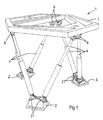
- FIG. 1 illustrates a movement simulator having a base, a platform movable relative to said base, and 6 actuators having a controllable length.
- FIG. 2 is a block diagram illustrating how the demanded platform state is adapted to a commanded platform state by the method according to the disclosure.
- FIG. 3 is a block diagram of details of the model predicted control algorithm.
- FIG. 4 shows cross-sectional plots of a platform workspace that is formed when 4 of the 6 degrees of freedom are fixed.
- FIG. 5 shows a single Degree of Freedom (DOF) excursion wherein 5 of the 6 degrees of freedom are fixed and only one degree of freedom remains.
- DOF Degree of Freedom
- the movement simulator may be any system having from 1 to and including 6 degrees of freedom, wherein the degrees of freedom (DOF) can be any of x, y, z, pitch, roll & yaw.
- a preferred movement simulator has 6 degrees of freedom.
- the description will illustrate a movement-simulator having 6 degrees of freedom. A skilled person can easily understand how this disclosure will work for a movement simulator having fewer degrees of freedom based on said description.
- FIG. 1 illustrates an example of a movement simulator 1 having 6 degrees of freedom.
- the illustrated movement simulator is also referred to as Stewart Platform or six-axis platform.
- Stewart Platforms are well known and for example described in the afore mentioned EP-A-446786 or US-A-2009/0047636.
- the movement simulator of FIG. 1 comprises a base 2 placed on the floor, and a platform 3 movable relative to that base 2 , on which platform e.g. a cockpit (not shown) with a seat for a user may be fixed.
- the base may be a single frame or separate elements individually fixed to the floor.
- the cockpit may be for example an airplane cockpit, a helicopter cockpit, a space shuttle cockpit, a (race) automobile cockpit, or a cockpit for a train, metro, or tram.
- the cockpit may be used for recreation or for professional training applications.
- the platform 3 is movably carried by the base 3 by means of six hydraulic cylinders, which all for the sake of convenience are referred to with the numeral 4 .
- These hydraulic cylinders are connected with a non-shown central controller and a hydraulic system.
- the lengths of the hydraulic cylinders can be varied at will by the central controller which is not shown in FIG. 1 .
- the actuators shown in FIG. 1 are hydraulic cylinders.
- the actuators may be electric actuators, pneumatic cylinders or any other actuators which length can be varied.
- FIG. 2 is a block diagram illustrating how the demanded platform state is adapted to a commanded platform state by the method and simulator according to the invention.
- the motion cueing algorithm receives input from a computer program which describes the simulation, for example a aircraft flight simulation program. Motion cueing algorithms are well known. The above referred to US-A-2009/0047636 discloses an example of a possible motion cueing algorithm which can be used.
- the demanded platform state comprises of a demanded acceleration, demanded velocity and demanded position for the platform 3 .
- the demanded acceleration, velocity and position are subsequently adapted by a washout controller resulting in a commanded platform state.
- the commanded platform state as expressed in commanded acceleration, velocity and position are translated to an actuator state.
- the actual required lengths of actuators are calculated to achieve the commanded platform state. By instructing the actuators to vary their lengths platform 3 will move according to the commanded platform state.
- FIG. 2 shows an MPC washout filter which stands for washout filter using a model predictive control algorithm (MPC).
- MPC is a well known method of process control that has been in use in the process industries such as chemical plants and oil refineries since the 1980s. MPC is based on iterative, finite horizon optimization of a model of the apparatus to be controlled.
- the apparatus of the present disclosure is the movement simulator.
- the model predictive control algorithm samples at time t the current platform platform state and subsequently computes a cost minimizing control strategy (via a numerical minimization algorithm) for a relatively short time horizon in the future t+ ⁇ t.
- an online or on-the-fly calculation is used to predict the state of the platform that emanates from the current commanded platform state, and to find a cost-minimizing control strategy until time t+ ⁇ t. Only the first computational step (after time period dt) of the control strategy is implemented to the commanded platform state. Then the platform state is sampled again and the calculations are repeated starting from the now current platform state, yielding a new commanded platform state and new predicted platform state path. The prediction horizon keeps being shifted forward, and for this reason the term “receding horizon control” is also used to describe this method of process control.
- platform state is expressed in the platform domain position coordinates.
- the number of different platform domain position coordinates used will preferably be the same as the number of degrees of freedom of the movement simulator itself.
- the demanded and commanded platform states are preferably expressed in terms of position, velocity and acceleration. Using the same coordinates, relative platform position can be expressed with respect to the positive or negative workspace boundaries or with respect to the workspace center.
- the model predictive control algorithm comprises a cost-minimizing control strategy for relative platform position, platform velocity and platform washout acceleration. More preferably the model predictive control algorithm continuously uses the demanded platform state and current washout adaptation as inputs to compute a commanded platform state. The commanded platform state is then used to predict a platform state at t+ ⁇ t (the predicted platform state); subsequently the algorithm quantifies the first and second order gradient of the costs J. In this manner an optimal washout adaptation is obtained which results in minimal total costs.
- minimal total costs does not relate to money. It is a term often used in MPC to describe the difference between the optimal platform state and the best achievable platform state at t+ ⁇ t.
- the washout adaptation is used to continuously modify the demanded platform state to a commanded platform state for a next computational step t+dt, wherein dt is smaller than ⁇ t.
- ⁇ t can for example be 0.5 seconds and dt can for example be 2 milliseconds.
- FIG. 3 shows a block diagram of the washout controller in more detail.
- the washout controller is part of the central controller.
- FIG. 3 shows how the predicted platform state at t+ ⁇ t is calculated starting from a demanded state and a current platform washout adaptation.
- ⁇ t is a adjustable parameter shown as one of the DWM parameters.
- the predicted platform state forms the input for a so-called Single DOF Excursion analysis (SDE analysis) for the predicted position, which will be described in detail below.
- SDE analysis predicts a workspace for the predicted platform state.
- the costs derivatives are the first and second order gradient of the costs J with washout acceleration.
- the predicted platform state in the workspace and preferred adjustable weight factors will influence the calculated first and second order gradient of the costs J.
- weight functions which use weight factors and use the predicted workspace as inputs, the first and second order gradient of the costs J are subsequently calculated.
- weight functions is advantageous because they allow the weight to be a function of, for example, position, where higher weight and thus costs result when the platform state is near the workspace boundary and lower weight and thus cost result when the platform is near its central position.
- the weight factors will have adjustable constants which are shown as one of the DWM parameters in FIG. 3 .
- the weight function can also be made time dependant, shown as the optional feed forward in FIG. 3 .
- weight factors can be temporarily adjusted resulting in that the platform is brought into a position that allows the prolonged acceleration of said Formula One start.
- the optimal change in washout is obtained at minimal costs.
- optimum washout acceleration is obtained.
- double integration the optimal washout adaptation at minimal total costs is obtained.
- state integration at dt only the first computational step (after time period dt) of the control strategy is implemented as the washout adaptation to the commanded platform state.
- washout adaptation is the integration of washout acceleration which is preferably calculated by the following equation:
- J is the total costs.
- J is a summation of Jp, Jv and Ja, wherein Jp is position cost, Jv is velocity cost and Ja is acceleration cost.
- J is the summation of Jp which is derived from the relative position in the workspace, Jv which is derived from the velocity through the workspace and Ja which is derived from the washout acceleration through the workspace.
- K is a constant which will, in an ideal mathematical situation, be equal to ⁇ 1. Applicants believe that K may vary while still achieving the benefits of the present invention.
- Jp is the result of multiplying the predicted position relative to the workspace center with a position weight function which uses the position relative to the workspace center and the position relative to a positive and negative workspace boundary as inputs.
- Jv is the result of multiplying the predicted velocity with a velocity weight function which uses the position relative to the workspace center and the position relative to a positive and negative workspace boundary as inputs.
- Ja is the result of multiplying the predicted washout acceleration with an acceleration weight function.
- the weight function may be a constant or alternatively be a function which uses the position relative to the workspace center and the position relative to a positive and negative workspace boundary as inputs.
- the objective of using non-constant position dependent weight functions is to implement adaptive dynamic behavior of the washout optimization for various areas of the workspace.
- the acceleration cost Ja depends on the difference between demanded and commanded platform acceleration.
- the demanded platform acceleration is the acceleration as computed by the motion cueing algorithm.
- the commanded acceleration refers to the platform acceleration as computed by the washout controller.
- the value of the acceleration cost function is minimal when the commanded acceleration closely follows the demanded acceleration.
- the demanded acceleration represents the acceleration cue where the difference between demanded and commanded acceleration represents the washout.
- the washout optimization For each predicted value of platform position, the washout optimization, and more specifically, the cost function J requires computation of the workspace boundaries and center. Additionally the first and second order derivatives of J require computation of the first and second order derivative of the predicted workspace boundaries and center for variations of the washout acceleration.
- the used algorithm preferably integrates a method for efficiently computing these quantities as will be described below.
- x, y and z are the position coordinates for platform translation and ⁇ , ⁇ and ⁇ are the platform angular position in pitch, roll & yaw.
- An index e i is added as a subscript to indicate the DOF of the coordinate system, i.e., e i is the excursion value for the i-th DOF, wherein for 6 degrees of freedom (DOF) i runs from 1 to 6 for x, y, z, pitch, roll, & yaw respectively.
- DOF degrees of freedom
- e i + and e i ⁇ are the positive and negative excursion limits for the i-th DOF, where e i c is the center excursion for the i-th degree of freedom.
- Coordinates ⁇ right arrow over (e) ⁇ representing combinations of degrees of freedom, i.e. the possible platform position coordinates x, y, z, ⁇ , ⁇ and ⁇ , that can be realized by the platform 3 , are mapped within the workspace.
- a coordinate is mapped outside of the workspace, one or more of the actuators 4 are either too long or too short.
- the outside surface of the workspace is continuous but not completely smooth. It is characterized by adjacent patches. On each of these patches a single combination of one or multiple actuators 4 are at their excursion limit.
- the surface of each patch is continuous and smooth; however, when moving from one patch to another, a different set of actuators 4 becomes the limiting factor and a discontinuous transition occurs in the gradient of the surface. At some places the transition between two adjacent workspace surface areas will be relatively smooth. At other places sharp edges are present.
- FIG. 4 shows images of two degrees of freedom workspaces that are formed when 4 of the 6 degrees of freedom are fixed. No combinations of the 2 “free” degrees of freedom exist which can bring the platform to a position outside these lines. This is because that would require that one or both of the actuators 4 would have a length which is higher or lower than the possible variation of the length of the actuator 4 .
- FIG. 5 shows an image of a single DOF excursion (SDE) workspace that is formed when 5 of the 6 degrees of freedom are fixed and only one degree of freedom remains.
- the resulting SDE workspace is represented by a line with boundaries e ⁇ and e + . All values of the remaining degree of freedom that can be realized are mapped on this line segment. Excursions that require one or more actuators 4 to be either too long or too short are mapped outside of the indicated boundaries.
- the coordinate value at the center of the workspace is specified by the coordinate e c which is given by:
- the minimum, maximum and center coordinate values of the SDE workspace for any degree of freedom are determined by the values of the other degrees of freedom which are assumed to be fixed. In practical cases where a platform is moving through its workspace, the minimum, maximum and center values of the SDE workspaces will constantly change.
- the SDE workspaces are sequentially computed for each degree of freedom using an SDE analysis which allows the platform only to move in the analyzed free degree of freedom while keeping the remaining 5 degrees of freedom fixed at their value e i .
- an iterative method can be used where the platform is moved stepwise along its free degree of freedom until a position is found where one or more actuators is either fully extended or fully retracted.
- Each step requires a Forward Kinematics analysis in which actuators' lengths are computed for a defined platform position.
- the more preferred method for SDE analysis makes use of two persistent SDE estimators for each degree of freedom, one estimating the minimum excursion and one estimating the maximum excursion, and each having its own Jacobian matrix. While the motion system is moving through its workspace, the fixed degrees of freedom of the SDE estimators need to be aligned with the predicted position of the motion system at the fixed time horizon ⁇ t. At each cycle of the algorithm, each estimator copies the values of the fixed degrees of freedom from current predicted position e i which leads to a new position of the estimator, possible slightly away from the workspace boundary. A Forward Kinematics analysis is then used to update the Jacobian matrix for the new position and to adjust the free degree of freedom such that the estimator is repositioned accurately on the workspace boundary. This leads to 12 platform extreme positions, 2 per degree of freedom (either e + or e ⁇ ) in just one iteration step per degree of freedom. Subsequently, the center of the workspace is computed using equation (3).
- the SDE workspace acceleration derivatives are defined as the partial derivatives of the SDE workspaces maximum, minimum and center values for variations of the platform acceleration applied during the finite time horizon ⁇ t. They are noted as ⁇ e i + / ⁇ a j , ⁇ e i ⁇ / ⁇ a j and ⁇ e i c / ⁇ a j in which index i defines the degree of freedom of the SDE workspace, and index j defines the degree of freedom of the acceleration perturbation.
- the SDE workspace position derivatives are defined as the partial derivatives of the SDE workspaces maximum, minimum and center values for variations of the predicted platform position due to variations of the platform acceleration during the finite time horizon ⁇ t. They are notated as ⁇ e i + / ⁇ a j , ⁇ e i ⁇ / ⁇ a j and ⁇ e i c / ⁇ a j in which index i defines the degree of freedom of the SDE workspace, and index j defines the degree of freedom of the position perturbation.
- the SDE workspace acceleration derivatives can be computed from the SDE workspace position derivatives using:
- partial derivative ⁇ e j / ⁇ a j represents the partial derivative of the predicted platform position for the j-th degree with platform acceleration in the same degree of freedom.
- the SDE workspace position derivatives can be obtained numerically by numerical differentiation of the SDE analysis for the current predicted platform position. This, however, required 120 SDE analyses per time step dt which is generally too much to be done in real-time.
- FIG. 4 shows that that the derivatives of the single DOF workspace limits can be expected sometimes to vary in a discontinuous manner when the platform moves through its workspace.
- the critical actuator 4 that determines the workspace limit jumps discretely from one actuator 4 to another.
- the problem is that these large discontinuous changes of the SDE workspace position derivatives may cause oscillations or discontinuities in the washout adaptation.
- applicants have found a solution wherein preferably mathematically the edges of the workspace, at places where the limiting actuator changes index, are smoothed off, also referred to as an “edge blending solution.”
- a tuneable edge blending distance is as small as possible.
- a too large edge blending distance will limit the available workspace, while a too small distance will not avoid the non-desirable oscillation.
- a skilled person may by trial and error determine the optimal edge blending distance.
- An example of a typical value for a typical platform is 10 mm. This edge blending solution thus allows actuators 4 that are not yet critical to influence the outcome of the washout controller according to the invention.
- the position derivative of the SDE workspace center is the average of the derivative for the positive and negative SDE workspace limits:
- the position weight function P is chosen to be a fully diagonal matrix. In this way, a cost is assigned to usage of workspace for each degree of freedom separately. This is advantageous because it allows tuning of the algorithm.
- the velocity weight function is chosen to be a fully diagonal matrix. In this way, a cost is assigned to platform velocity for each degree of freedom separately. This is advantageous because it allows tuning of the algorithm.
- V [ V x ⁇ ( e x ) V y ⁇ ( e y ) 0 V z ⁇ ( e z ) V ⁇ ⁇ ( e ⁇ ) 0 V ⁇ ⁇ ( e ⁇ ) V ⁇ ⁇ ( e ⁇ ) ] ( 13 )
- A is a weight function which is chosen to be a fully diagonal matrix. In this way, a cost is assigned to deviation from demanded platform acceleration for each degree of freedom separately.
- the weight function is preferably independent of the position in the workspace.
- the disclosure is also directed to a computer-readable recording medium that stores a computer program for use as a washout controller according to the present disclosure.
- the computer program has a washout adaptation as output which is calculated using a model predictive control algorithm.
- the computer readable recording medium is suitably used as part of a controller of a motion-system as described above.
Landscapes
- Engineering & Computer Science (AREA)
- Health & Medical Sciences (AREA)
- General Health & Medical Sciences (AREA)
- Orthopedic Medicine & Surgery (AREA)
- Robotics (AREA)
- Mechanical Engineering (AREA)
- Feedback Control In General (AREA)
Abstract
Description
{right arrow over (e)}=(x y z φ θ ψ)T =e i (2)
JcΔe i +JcΔe j={right arrow over (0)} (5)
J p ={right arrow over (C)} p ·{right arrow over (C)} p=(P({right arrow over (e)})({right arrow over (e)}−{right arrow over (e)} c))·(P({right arrow over (e)})({right arrow over (e)}−{right arrow over (e)} c)) (8)
{right arrow over (e)}=e i(x y z φ θ ψ)predicted T (9)
J v ={right arrow over (C)} v ·{right arrow over (C)} V=(V({right arrow over (e)}){right arrow over (ė)})·(V({right arrow over (e)}){right arrow over (ė)})· (11)
{right arrow over (ė)}=ė i({dot over (x)} {dot over (y)} ż {dot over (φ)} {dot over (θ)} {dot over (ψ)})predicted T (12)
J a ={right arrow over (C)} a ·{right arrow over (C)} a=(A({right arrow over (e)}){right arrow over (a)} WO)·(A({right arrow over (e)}){right arrow over (a)} WO) (14)
{right arrow over (ë)}=ë i=({umlaut over (x)} ÿ {umlaut over (φ)} {umlaut over (θ)} {umlaut over (ψ)})predicted T (15)
Claims (20)
JcΔe i +JcΔe j={right arrow over (0)}
Applications Claiming Priority (3)
| Application Number | Priority Date | Filing Date | Title |
|---|---|---|---|
| NL2005174A NL2005174C2 (en) | 2010-07-29 | 2010-07-29 | Movement-simulator. |
| NLNL2005174 | 2010-07-29 | ||
| NL2005174 | 2010-07-29 |
Publications (2)
| Publication Number | Publication Date |
|---|---|
| US20120029703A1 US20120029703A1 (en) | 2012-02-02 |
| US8996179B2 true US8996179B2 (en) | 2015-03-31 |
Family
ID=43663520
Family Applications (1)
| Application Number | Title | Priority Date | Filing Date |
|---|---|---|---|
| US13/182,807 Active 2033-11-22 US8996179B2 (en) | 2010-07-29 | 2011-07-14 | Movement simulator |
Country Status (4)
| Country | Link |
|---|---|
| US (1) | US8996179B2 (en) |
| EP (1) | EP2412496B1 (en) |
| CA (1) | CA2744444C (en) |
| NL (1) | NL2005174C2 (en) |
Cited By (2)
| Publication number | Priority date | Publication date | Assignee | Title |
|---|---|---|---|---|
| EP3249632A1 (en) | 2016-05-26 | 2017-11-29 | E2M Technologies B.V. | A movement platform system |
| EP3489932A1 (en) | 2017-11-23 | 2019-05-29 | E2M Technologies B.V. | A movement platform system |
Families Citing this family (15)
| Publication number | Priority date | Publication date | Assignee | Title |
|---|---|---|---|---|
| DE102012006352B4 (en) * | 2012-03-28 | 2014-07-17 | Mbda Deutschland Gmbh | Device for testing and / or operating an active unit |
| DE102012103870B4 (en) * | 2012-04-19 | 2016-10-13 | Deutsches Zentrum für Luft- und Raumfahrt e.V. | Movement system state |
| US9259657B2 (en) | 2012-12-03 | 2016-02-16 | Dynamic Motion Group Gmbh | Motion simulation system and associated methods |
| US9242181B2 (en) | 2012-12-03 | 2016-01-26 | Dynamic Motion Group Gmbh | Amusement park elevator drop ride system and associated methods |
| US9536446B2 (en) * | 2012-12-03 | 2017-01-03 | Dynamic Motion Group Gmbh | Motion simulation system controller and associated methods |
| ES2404666T3 (en) | 2012-12-12 | 2017-12-20 | Moog B.V. | Simulator |
| DE102013224510B4 (en) * | 2013-11-29 | 2021-12-30 | Bayerische Motoren Werke Aktiengesellschaft | Motion cueing for evaluating driving dynamics |
| DE102014116845B4 (en) * | 2014-11-18 | 2016-07-14 | Deutsches Zentrum für Luft- und Raumfahrt e.V. | Method for determining a movement limit |
| EP3121685A1 (en) | 2015-07-21 | 2017-01-25 | Thomson Licensing | Signal for carrying washout request in haptic audiovisual content, related method and device |
| CN106710364A (en) * | 2017-01-24 | 2017-05-24 | 山东科技大学 | Parallel type flight training simulator |
| FR3095544B1 (en) | 2019-04-23 | 2021-07-30 | Renault Sas | Process of restitution of movement for simulator with commands generated by real-time systems. |
| FR3105547B1 (en) | 2019-12-20 | 2022-05-13 | Renault Sas | Lateral acceleration prediction method for driving simulator |
| ES1261416Y (en) * | 2020-12-03 | 2021-05-21 | Eliance Global Services S L | SANITARY HELICOPTER SIMULATOR |
| US11989356B2 (en) * | 2021-04-28 | 2024-05-21 | POSTECH Research and Business Development Foundation | Method and device for transforming degree of freedom in mulsemedia system |
| WO2023057916A1 (en) * | 2021-10-05 | 2023-04-13 | Geninvest | Proprioception system for a driving simulator |
Citations (3)
| Publication number | Priority date | Publication date | Assignee | Title |
|---|---|---|---|---|
| US5623878A (en) * | 1993-08-19 | 1997-04-29 | The Walt Disney Company | Dynamic ride vehicle |
| US5752834A (en) * | 1995-11-27 | 1998-05-19 | Ling; Shou Hung | Motion/force simulators with six or three degrees of freedom |
| US20100279255A1 (en) * | 2007-02-16 | 2010-11-04 | Ohio University | Vehicle simulator system |
Family Cites Families (2)
| Publication number | Priority date | Publication date | Assignee | Title |
|---|---|---|---|---|
| EP0446786A1 (en) | 1990-03-14 | 1991-09-18 | Fokker Aircraft B.V. | Movement-simulator |
| ATE462163T1 (en) | 2005-10-12 | 2010-04-15 | Filip Vanbiervliet | METHOD FOR CONTROLLING THE MOVEMENTS OF A FLIGHT SIMULATOR AND FLIGHT SIMULATOR IMPLEMENTING SUCH METHOD |
-
2010
- 2010-07-29 NL NL2005174A patent/NL2005174C2/en not_active IP Right Cessation
-
2011
- 2011-06-22 CA CA2744444A patent/CA2744444C/en active Active
- 2011-06-24 EP EP11171334.3A patent/EP2412496B1/en active Active
- 2011-07-14 US US13/182,807 patent/US8996179B2/en active Active
Patent Citations (3)
| Publication number | Priority date | Publication date | Assignee | Title |
|---|---|---|---|---|
| US5623878A (en) * | 1993-08-19 | 1997-04-29 | The Walt Disney Company | Dynamic ride vehicle |
| US5752834A (en) * | 1995-11-27 | 1998-05-19 | Ling; Shou Hung | Motion/force simulators with six or three degrees of freedom |
| US20100279255A1 (en) * | 2007-02-16 | 2010-11-04 | Ohio University | Vehicle simulator system |
Non-Patent Citations (7)
| Title |
|---|
| Chang et al.; "Optimal motion cueing for 5-DOF motion simulations via a 3-DOF motion simulator"; Control Engineering Practice; Pergamon Press, Oxford, GB; Jan. 1, 2009; pp. 170-184; XP025535015. |
| Chen et al.; "Predictive washout filter design using the forward kinematics and a Kalman filter"; Intelligent Control; IEEE 22nd International Symposiu M ON, IEEE, PI; Oct. 1, 2007; pp. 420-425; XP031151850. |
| Hwang et al.; "Adaptive motion washout filter desing by using self-tuning fuzzy control"; Advanced Intelligent Mechatronics, 2009; IEEE/ASME International Conference on, IEEE, Piscataway, NJ, USA; Jul. 14, 2009; pp. 811-815; XP031524110. |
| Nehaoua et al., Motion Cueing Algorithms for Small Driving Simulator, Proceedings of the 2006 IEEE International Conference on Robotics and Automation, Orlando, Florida-May 2006, p. 3189-3194. * |
| Nehaoua et al., Motion Cueing Algorithms for Small Driving Simulator, Proceedings of the 2006 IEEE International Conference on Robotics and Automation, Orlando, Florida—May 2006, p. 3189-3194. * |
| Nehaoua et al.; "Design and control of a small-clearance driving simulator"; IEEE Transactions on Vehicular Technology; IEEE Service Center; Piscataway, NJ, USA; Mar. 1, 2008; pp. 736-746; XP011201791. |
| Search Report from the Dutch Patent Office on co-pending NL application (NL2005174) dated Mar. 21, 2011. |
Cited By (3)
| Publication number | Priority date | Publication date | Assignee | Title |
|---|---|---|---|---|
| EP3249632A1 (en) | 2016-05-26 | 2017-11-29 | E2M Technologies B.V. | A movement platform system |
| WO2017202920A1 (en) | 2016-05-26 | 2017-11-30 | E2M Technologies B.V. | A movement platform system |
| EP3489932A1 (en) | 2017-11-23 | 2019-05-29 | E2M Technologies B.V. | A movement platform system |
Also Published As
| Publication number | Publication date |
|---|---|
| NL2005174C2 (en) | 2012-01-31 |
| EP2412496B1 (en) | 2014-12-03 |
| US20120029703A1 (en) | 2012-02-02 |
| CA2744444C (en) | 2016-01-26 |
| CA2744444A1 (en) | 2012-01-29 |
| EP2412496A1 (en) | 2012-02-01 |
Similar Documents
| Publication | Publication Date | Title |
|---|---|---|
| US8996179B2 (en) | Movement simulator | |
| Yan et al. | Model predictive control of autonomous underwater vehicles for trajectory tracking with external disturbances | |
| US7912584B2 (en) | Power consumption estimation apparatus | |
| US20150005941A1 (en) | Dynamic Predictor for Articulated Mechanisms | |
| JP6577522B2 (en) | Control device and machine learning device | |
| JP2017206154A (en) | Underwater sailing body control device, underwater sailing system, underwater sailing body control method and program | |
| Wang et al. | A novel bilateral impedance controls for underwater tele-operation systems | |
| Feng | Online Hierarchical Optimization for Humanoid Control. | |
| CN113428218A (en) | Vehicle steering control method, device, equipment and storage medium | |
| CN112987568A (en) | Parallel processing robot feeding speed planning method and device | |
| Velagić et al. | Design of LQR controller for 3D trajectory tracking of octocopter unmanned aerial vehicle | |
| Felix-Rendon et al. | Control of differential-drive mobile robots for soft object deformation | |
| Kim et al. | Adaptive impedance control of a cleaning unit for a novel wall-climbing mobile robotic platform (ROPE RIDE) | |
| RU2406103C1 (en) | Method of contolling movement of dynamic object on path | |
| Szymak | Course control of unmanned surface vehicle | |
| CN119794590A (en) | Lithium battery multi-axis linkage rotary laser processing control method and related equipment | |
| EP4607293A1 (en) | Universal control policy for machine actuators | |
| KR20180097532A (en) | A robot equipped with a control system for manually inputting position and / or posture discontinuously | |
| WO2019117202A1 (en) | Control device | |
| Kolagar et al. | Combining Deep Reinforcement Learning with a Jerk-Bounded Trajectory Generator for Kinematically Constrained Motion Planning | |
| Al-saedi et al. | Intelligent controller of a flexible hybrid robot machine for ITER assembly and maintenance | |
| CN111052001B (en) | control device | |
| Guthikonda et al. | Shape servoing of deformable objects using model estimation and barrier Lyapunov function | |
| Zaychik et al. | Introspective Control Systems: Fast Model Predictive Control with Explicit Optimization Search, Nonlinear Models, and On-line Learning | |
| Do et al. | Hybrid adaptive input shaping and active disturbance rejection control for underactuated overhead crane with varying cable length |
Legal Events
| Date | Code | Title | Description |
|---|---|---|---|
| AS | Assignment |
Owner name: E2M TECHNOLOGIES B.V., NETHERLANDS Free format text: ASSIGNMENT OF ASSIGNORS INTEREST;ASSIGNOR:VELTENA, MARINUS C.;REEL/FRAME:026591/0404 Effective date: 20110621 |
|
| STCF | Information on status: patent grant |
Free format text: PATENTED CASE |
|
| MAFP | Maintenance fee payment |
Free format text: PAYMENT OF MAINTENANCE FEE, 4TH YR, SMALL ENTITY (ORIGINAL EVENT CODE: M2551); ENTITY STATUS OF PATENT OWNER: SMALL ENTITY Year of fee payment: 4 |
|
| MAFP | Maintenance fee payment |
Free format text: PAYMENT OF MAINTENANCE FEE, 8TH YR, SMALL ENTITY (ORIGINAL EVENT CODE: M2552); ENTITY STATUS OF PATENT OWNER: SMALL ENTITY Year of fee payment: 8 |