US8993575B2 - [1,3,4] oxadiazole derivative and application thereof - Google Patents
[1,3,4] oxadiazole derivative and application thereof Download PDFInfo
- Publication number
- US8993575B2 US8993575B2 US14/008,693 US201214008693A US8993575B2 US 8993575 B2 US8993575 B2 US 8993575B2 US 201214008693 A US201214008693 A US 201214008693A US 8993575 B2 US8993575 B2 US 8993575B2
- Authority
- US
- United States
- Prior art keywords
- oxadiazole
- propylthio
- group
- pharmaceutically acceptable
- compound
- Prior art date
- Legal status (The legal status is an assumption and is not a legal conclusion. Google has not performed a legal analysis and makes no representation as to the accuracy of the status listed.)
- Active
Links
- 0 CC1=NN=C([Y]CCCN2CCC(C3=NCC4=C3C=CC=C4)CC2)O1.[1*]C Chemical compound CC1=NN=C([Y]CCCN2CCC(C3=NCC4=C3C=CC=C4)CC2)O1.[1*]C 0.000 description 7
- CXCUBZJGGQAXFK-UHFFFAOYSA-N FC1=CC2=C(C=C1)C(C1CCN(CCCSC3=NN=C(C4=CC=NC=C4)O3)CC1)=NO2 Chemical compound FC1=CC2=C(C=C1)C(C1CCN(CCCSC3=NN=C(C4=CC=NC=C4)O3)CC1)=NO2 CXCUBZJGGQAXFK-UHFFFAOYSA-N 0.000 description 2
- RDKZRXQYRZRDTP-UHFFFAOYSA-N C1=CC2=C(C=C1)C(N1CCN(CCCSC3=NN=C(C4=CC=NC=C4)O3)CC1)=NS2 Chemical compound C1=CC2=C(C=C1)C(N1CCN(CCCSC3=NN=C(C4=CC=NC=C4)O3)CC1)=NS2 RDKZRXQYRZRDTP-UHFFFAOYSA-N 0.000 description 1
- LXNUADAGVJQPRD-UHFFFAOYSA-N C1=CC2=CC=CC(C3=NN=C(SCCCN4CCN(C5=NSC6=C5C=CC=C6)CC4)O3)=C2C=C1 Chemical compound C1=CC2=CC=CC(C3=NN=C(SCCCN4CCN(C5=NSC6=C5C=CC=C6)CC4)O3)=C2C=C1 LXNUADAGVJQPRD-UHFFFAOYSA-N 0.000 description 1
- MLSXBRAPVUGKEG-UHFFFAOYSA-N C1=CC=C(C2=NN=C(SCCCN3CCN(C4=NSC5=C4C=CC=C5)CC3)O2)C=C1 Chemical compound C1=CC=C(C2=NN=C(SCCCN3CCN(C4=NSC5=C4C=CC=C5)CC3)O2)C=C1 MLSXBRAPVUGKEG-UHFFFAOYSA-N 0.000 description 1
- FGMAJCMUPFQKOO-UHFFFAOYSA-N C1=CSC(C2=NN=C(SCCCN3CCN(C4=NSC5=C4C=CC=C5)CC3)O2)=C1 Chemical compound C1=CSC(C2=NN=C(SCCCN3CCN(C4=NSC5=C4C=CC=C5)CC3)O2)=C1 FGMAJCMUPFQKOO-UHFFFAOYSA-N 0.000 description 1
- MBQUSHQMIYGBNX-UHFFFAOYSA-N CC1=CC=C(C2=NN=C(SCCCN3CCC(C4=NOC5=C4C=CC(F)=C5)CC3)O2)C=C1 Chemical compound CC1=CC=C(C2=NN=C(SCCCN3CCC(C4=NOC5=C4C=CC(F)=C5)CC3)O2)C=C1 MBQUSHQMIYGBNX-UHFFFAOYSA-N 0.000 description 1
- IWFMXVGIOLDSKP-UHFFFAOYSA-N CC1=CC=C(C2=NN=C(SCCCN3CCN(C4=NSC5=C4C=CC=C5)CC3)O2)C=C1 Chemical compound CC1=CC=C(C2=NN=C(SCCCN3CCN(C4=NSC5=C4C=CC=C5)CC3)O2)C=C1 IWFMXVGIOLDSKP-UHFFFAOYSA-N 0.000 description 1
- PABSBUFWPJIEPI-UHFFFAOYSA-N ClC1=CC=C(C2=NN=C(SCCCN3CCN(C4=NSC5=C4C=CC=C5)CC3)O2)C=C1 Chemical compound ClC1=CC=C(C2=NN=C(SCCCN3CCN(C4=NSC5=C4C=CC=C5)CC3)O2)C=C1 PABSBUFWPJIEPI-UHFFFAOYSA-N 0.000 description 1
- QIGIRCWITRQCMF-UHFFFAOYSA-N FC1=CC2=C(C=C1)C(C1CCN(CCCSC3=NN=C(C4=CC=C(Cl)C=C4)O3)CC1)=NO2 Chemical compound FC1=CC2=C(C=C1)C(C1CCN(CCCSC3=NN=C(C4=CC=C(Cl)C=C4)O3)CC1)=NO2 QIGIRCWITRQCMF-UHFFFAOYSA-N 0.000 description 1
- RJLMJOFMDSMGMZ-UHFFFAOYSA-N FC1=CC2=C(C=C1)C(C1CCN(CCCSC3=NN=C(C4=CC=CC5=C4C=CC=C5)O3)CC1)=NO2 Chemical compound FC1=CC2=C(C=C1)C(C1CCN(CCCSC3=NN=C(C4=CC=CC5=C4C=CC=C5)O3)CC1)=NO2 RJLMJOFMDSMGMZ-UHFFFAOYSA-N 0.000 description 1
- BBMXWRHDQBRZBC-UHFFFAOYSA-N FC1=CC2=C(C=C1)C(C1CCN(CCCSC3=NN=C(C4=CC=CC=C4)O3)CC1)=NO2 Chemical compound FC1=CC2=C(C=C1)C(C1CCN(CCCSC3=NN=C(C4=CC=CC=C4)O3)CC1)=NO2 BBMXWRHDQBRZBC-UHFFFAOYSA-N 0.000 description 1
- QPJAUUYZHBNCQN-UHFFFAOYSA-N FC1=CC2=C(C=C1)C(N1CCN(CCCSC3=NN=C(C4=CC=CS4)O3)CC1)=NO2 Chemical compound FC1=CC2=C(C=C1)C(N1CCN(CCCSC3=NN=C(C4=CC=CS4)O3)CC1)=NO2 QPJAUUYZHBNCQN-UHFFFAOYSA-N 0.000 description 1
- XDTZXEAFKMWOGI-UHFFFAOYSA-N FC1=CC=C(C2=NN=C(SCCCN3CCC(C4=NOC5=C4C=CC(F)=C5)CC3)O2)C=C1 Chemical compound FC1=CC=C(C2=NN=C(SCCCN3CCC(C4=NOC5=C4C=CC(F)=C5)CC3)O2)C=C1 XDTZXEAFKMWOGI-UHFFFAOYSA-N 0.000 description 1
- IGEQMPDBINRYKY-UHFFFAOYSA-N FC1=CC=C(C2=NN=C(SCCCN3CCN(C4=NSC5=C4C=CC=C5)CC3)O2)C=C1 Chemical compound FC1=CC=C(C2=NN=C(SCCCN3CCN(C4=NSC5=C4C=CC=C5)CC3)O2)C=C1 IGEQMPDBINRYKY-UHFFFAOYSA-N 0.000 description 1
- BMSHNLPBZJBDFW-UHFFFAOYSA-N Fc(cc1)ccc1-c([o]1)nnc1SCCCNCCNc1n[s]c2ccccc12 Chemical compound Fc(cc1)ccc1-c([o]1)nnc1SCCCNCCNc1n[s]c2ccccc12 BMSHNLPBZJBDFW-UHFFFAOYSA-N 0.000 description 1
- WLENIHIIUXPWCA-UHFFFAOYSA-N OCC1=CC=C(C2=NN=C(SCCCN3CCC(C4=NOC5=C4C=CC(F)=C5)CC3)O2)C=C1 Chemical compound OCC1=CC=C(C2=NN=C(SCCCN3CCC(C4=NOC5=C4C=CC(F)=C5)CC3)O2)C=C1 WLENIHIIUXPWCA-UHFFFAOYSA-N 0.000 description 1
- SYHLTTRTCYEDBJ-UHFFFAOYSA-N OCC1=CC=C(C2=NN=C(SCCCN3CCN(C4=NSC5=C4C=CC=C5)CC3)O2)C=C1 Chemical compound OCC1=CC=C(C2=NN=C(SCCCN3CCN(C4=NSC5=C4C=CC=C5)CC3)O2)C=C1 SYHLTTRTCYEDBJ-UHFFFAOYSA-N 0.000 description 1
Classifications
-
- C—CHEMISTRY; METALLURGY
- C07—ORGANIC CHEMISTRY
- C07D—HETEROCYCLIC COMPOUNDS
- C07D417/00—Heterocyclic compounds containing two or more hetero rings, at least one ring having nitrogen and sulfur atoms as the only ring hetero atoms, not provided for by group C07D415/00
- C07D417/02—Heterocyclic compounds containing two or more hetero rings, at least one ring having nitrogen and sulfur atoms as the only ring hetero atoms, not provided for by group C07D415/00 containing two hetero rings
- C07D417/12—Heterocyclic compounds containing two or more hetero rings, at least one ring having nitrogen and sulfur atoms as the only ring hetero atoms, not provided for by group C07D415/00 containing two hetero rings linked by a chain containing hetero atoms as chain links
-
- A—HUMAN NECESSITIES
- A61—MEDICAL OR VETERINARY SCIENCE; HYGIENE
- A61P—SPECIFIC THERAPEUTIC ACTIVITY OF CHEMICAL COMPOUNDS OR MEDICINAL PREPARATIONS
- A61P25/00—Drugs for disorders of the nervous system
- A61P25/18—Antipsychotics, i.e. neuroleptics; Drugs for mania or schizophrenia
-
- C—CHEMISTRY; METALLURGY
- C07—ORGANIC CHEMISTRY
- C07D—HETEROCYCLIC COMPOUNDS
- C07D413/00—Heterocyclic compounds containing two or more hetero rings, at least one ring having nitrogen and oxygen atoms as the only ring hetero atoms
- C07D413/14—Heterocyclic compounds containing two or more hetero rings, at least one ring having nitrogen and oxygen atoms as the only ring hetero atoms containing three or more hetero rings
-
- C—CHEMISTRY; METALLURGY
- C07—ORGANIC CHEMISTRY
- C07D—HETEROCYCLIC COMPOUNDS
- C07D417/00—Heterocyclic compounds containing two or more hetero rings, at least one ring having nitrogen and sulfur atoms as the only ring hetero atoms, not provided for by group C07D415/00
- C07D417/14—Heterocyclic compounds containing two or more hetero rings, at least one ring having nitrogen and sulfur atoms as the only ring hetero atoms, not provided for by group C07D415/00 containing three or more hetero rings
Definitions
- the invention relates to the medicinal chemistry field.
- the invention relates to a novel [1,3,4]oxadiazole derivate, the preparing method thereof and the use thereof for the treatment of psychoneurosis.
- Schizophrenia is a type of disease characterized in severely schizophrenic cognition and emotion, presenting as the influence on the basic behavior of a human, such as language, thinking, feeling, self-perception or the like.
- This disease encompasses a large variety of disorders, such as those involved in psyche, e.g. delusion, paranoia, illusion or the like.
- Typical anti-psychosis drug e.g.
- chlorpromazine, haloperidol blocks the dopamine D 2 receptor, and severe blocking of dopamine receptor leads to extrapyramidal system (EPS) side effects, including tardive dyskinesia and increased prolactin secretion.
- EPS extrapyramidal system
- the typical anti-schizophrenia drug is not effective for negative symptoms.
- the “non-typical” anti-psychosis drug such as clozapine and risperidone, has low possibility of extrapyramidal system (EPS) side effects and tardive dyskinesia side effects etc. Moreover, it can effectively improve negative symptoms and cognitive disorders.
- EPS extrapyramidal system
- these drugs have the side effects of extended QT interval, hyperprolactinemia, weight gain or the like. Therefore, it is important to find new anti-psychosis drug, which is effective for schizophrenia and has fewer side effect.
- D 2 , D 3 , 5-HT 1A , 5-HT 2A and 5-HT 2C The distribution of D 3 receptor in brain mainly locates specifically at limbic system, and this system is closely related with human psychic activity.
- the gene variation frequency of D 3 receptor in a patient with schizophrenia is significantly higher than that in control population, which is also closely related with the response to drug therapy.
- D 3 receptor There are two major DA neural pathways for D 3 receptor in brain: one is nigrostriatal pathway regulating the motion function, while the other is mesencephalic ventral tegmental area-accumbens nucleus-prefrontal cortex DA pathway closely associated with learning cognition and emotion behavior, of which the disorder will lead to schizophrenia. This DA pathway is the main pathway of reward effect in brain. D 3 receptor is distributed in both of the DA neural pathways, and has complex interactions with other DA receptor subtypes, and thus may be the target of anti-psychosis drug therapy. Selective D 3 receptor antagonism can reduce the negative and cognitive symptoms of schizophrenia, which additionally can prevent extrapyramidal system side effects, including tardive dyskinesia, Parkinson's disease or the like.
- 5-hydroxy tryptamine system plays an important role in modulating the function of prefrontal cortex (PFC), including emotion control, cognitive behavior and working memory.
- PFC prefrontal cortex
- the pyramidal neurons and GABA interneurons of PFC contain several 5-hydroxy tryptamine receptor subtypes 5-HT 1A and 5-HT 2A in high density. It has been shown recently that PFC and NMDA receptor channels are the targets of 5-HT 1A receptor, and these two receptors modulate the excitatory neuron of cerebral cortex, thereby affecting the cognitive function. In fact, various preclinical data have shown that 5-HT 1A receptor may be the new target of the development of anti-psychosis drug. The 5-HT 1A receptor affinity has contributed to non-typical anti-psychosis drug (e.g.
- 5-HT 1A agonist is associated with non-typical anti-psychosis drug therapy, which can improve negative symptoms and cognitive disorders.
- 5-HT 2A plays an important role in various aspects, including cognition, emotion regulation and motion control.
- the blocking of 5-HT 2A receptor can normalize the release of dopamine, exerting the effect of anti-psychosis.
- 5-HT 2C receptor is closely related with weight gain.
- Q is O, S or N
- Y is O or S
- Z is N or CH
- n 1, 2 or 3;
- R1 is H, halogen, cyano, C 1-5 alkoxy, C 1-5 alkyl, said C 1-5 alkyl being unsubstituted or substituted by one or more substituents selected from the group consisting of amino, hydroxyl and halogen;
- Ar 1 is the group of formula (II), formula (III) or formula (IV),
- L is CH or N
- X is O, NH, S or CH 2 ;
- R2, R3 and R4 are each independently H, halogen, cyano, aromatic ring, hydroxyl, C 1-5 alkoxy, C 1-5 alkyl, said C 1-5 alkyl being unsubstituted or substituted by one or more substituents selected from the group consisting of amino, hydroxyl and halogen (such as F).
- R1, R2, R3 and R4 are each independently H, halogen, C 1-5 alkoxy, C 1-5 alkyl or fluorinated C 1-5 alkyl. More preferably, R1 is H or halogen, and R2, R3 and R4 are each independently H, methoxy, Cl, F or trifluoromethyl. Most preferably, R1 is at 6-position. Most preferably, R2 is at 4-position.
- Q is O or S; Y is S; n is 1; X is S.
- R1 and R2 are each independently selected from the group consisting of H, halogen, cyano, aromatic ring, hydroxyl, C 1-5 alkyl, fluorinated C 1-5 alkyl or C 1-5 alkoxy; L is selected from the group consisting of CH or N; Q is selected from group consisting of O, S and N; Z is N or CH; n is 1, 2 or 3; Y is selected from group consisting of O or S.
- Ar 1 is the group of formula (II), more preferably, Q is O or S; Y is S; Z is N or CH; n is 1; L is CH or N; R1 and R2 are each independently H, methoxy, Cl, F or trifluoromethyl.
- R1 and R3 are each independently selected from the group consisting of H, halogen, cyano, aromatic ring, hydroxyl, C 1-5 alkyl, C 1-5 alkoxy; Q is selected from the group consisting of O, S or N; Z is selected from the group consisting of N or CH; n is an integer of 1-3; Y is O or S.
- Q is O or S; Y is S; Z is N or CH; n is 1; R1 and R3 are each independently H or F.
- R1 and R4 are each independently selected from the group consisting of H, halogen, cyano, aromatic ring, hydroxyl, C 1-5 alkyl, C 1-5 alkoxy;
- X is selected from the group consisting of O, NH, S or CH 2 ;
- Z is selected from the group consisting of N or CH;
- n is an integer of 1-3;
- Y is O or S.
- Q is O or S; Y is S; Z is N or CH; n is 1;
- R1 and R4 are each independently selected from the group consisting of H or F.
- Z is preferably CH; when Q is S, then Z is preferably N.
- R1 is H, then Y is S; n is 1; Q is S; Z is N; L is CH; R2 is H, methoxy, Cl, trifluoromethyl or F; when R1 is F, then Y is S; n is 1; Q is O; Z is CH; L is CH; R2 is H, methoxy, Cl, trifluoromethyl or F; when R1 and R2 are both H, then Y is S; n is 1; Q is S; Z is N; L is N; or when R1 is F, then Y is S; n is 1; Q is O; Z is CH; L is N.
- R1 is H or F; Y is S; n is 1; Q is S or O; Z is N or CH; R3 is H. More preferably, when R1 is H, then Y is S; n is 1; Q is S; Z is N; R3 is H; or when R1 is F, then Y is S; n is 1; Q is O; Z is CH; R3 is H.
- R1 is H or F; Y is S; n is 1; Q is S or O; Z is N or CH; X is S. More preferably, when R1 is H, then Y is S; n is 1; Q is S; Z is N; X is S; or when R1 is F, then Y is S; n is 1; Q is O; Z is CH; X is S.
- the compounds of formula (I) according to the invention are selected from the group consisting of the following compounds or the pharmaceutically acceptable salts thereof:
- C 1-5 alkyl refers to a linear or branched alkyl containing 1, 2, 3, 4, or 5 carbon atoms.
- a C 1-5 alkyl may be methyl, ethyl, n-propyl, isopropyl, n-butyl, isobutyl, t-butyl, n-pentyl, isopentyl, neopentyl or the like.
- C 1-5 alkoxy refers to the above-defined C 1-5 alkyl, which is attached to the rest of the molecule via an oxygen atom.
- unsubstituted or substituted means the group defined with this term may be unsubstituted or substituted by one or more designated substituents.
- aromatic ring refers to an aromatic ring group having 5-14 carbon ring atoms, preferably 5-10 or 6-10 carbon ring atoms, for example, phenyl or naphthyl. Any aryl defined herein may be substituted by one, two or more substituents preferably selected from the group consisting of halogen, hydroxyl, cyano, amino, C 1-5 alkyl (e.g. methyl or ethyl) and C 1 -C 5 alkoxy (e.g. methoxy).
- halogen refers to F (fluorine), Cl (chlorine), Br (bromine) or I (iodine).
- the invention provides use of the compounds according to the invention and the pharmaceutical composition consisting of such compounds in the manufacture of a medicament for the treatment or prevention of central nervous system disorders selected from the group consisting of mental disorder, anxiety, personality disorder, depression, mania, migraine, epilepsy or spasticity disorder, childhood disorder, Parkinson's disease, cognitive disorder, neural degeneration, neurotoxicity and ischemia, preferably schizophrenia
- the invention provides a pharmaceutical composition, comprising the compound of formula (I) or the pharmaceutically acceptable salt thereof, and pharmaceutically acceptable adjuvant (e.g. carrier and/or excipient).
- the pharmaceutical composition is a anti-psychosis composition comprising the compound according to the invention in an amount sufficient to exert anti-psychosis effect.
- the effective dose of the present compounds can be orally administrated with, for example, inert diluent or some carriers. It can be encapsulated in a gelatin capsule or compressed into a tablet.
- the compounds according to the invention can be used with excipients and in the forms of tablet, troche, capsule, suspension, syrup or the like.
- These formulation should contain the active compounds according to the invention in an amount of at least 0.5 wt %, but such an amount can vary according to particular formulations, and the amount of 4-70% by weight will be beneficial.
- the active compounds should be present in a suitable dosage in such compositions.
- the oral unit dose of the preferable composition and formulation according to the invention contains 1.0-300 mg of the active compounds according to the invention.
- the compound provided herein i.e. the compound of formula (I) and the pharmaceutically acceptable salt, solvate and hydrate thereof can be combined with pharmaceutically acceptable carrier or diluent to form a pharmaceutical formulation.
- the pharmaceutically acceptable carrier comprises inert solid filler or diluent and sterile aqueous solution or organic solution.
- the dosage of the compound according to the invention depends on the type and severity of the disease or disorder, and the nature of the subject, for example, general health, age, gender, weight and drug tolerance. A person skilled in the art can determine the suitable dosage according to these or other factors. Generally, the effective dosage for a central nervous system drug is well known to a person skilled in the art. The total daily dosage is generally about 0.05 mg-2000 mg.
- the invention relates to a pharmaceutical composition, which can provide about 0.01-1000 mg active ingredient per unit dose.
- the composition can be administrated in any suitable route, for example, oral administration in a capsule, parenteral administration in an injection, topical administration in an ointment or a lotion, rectal administration in a suppository, or transdermal administration in a patch.
- the compounds according to the invention can be combined with suitable solid or liquid carrier or diluent to form capsule, tablet, pill, powder, syrup, solution or the like.
- the tablet, pill, capsule or the like contains about 0.01% to about 99% by weight of active ingredients, and binder, such as gelatin, maize starch, arabic gum etc; excipient, such as calcium hydrophosphate; disintegrant, such as maize starch, potato starch or alginic acid; lubricant, such as magnesium stearate; and sweetener, such as sucrose, lactose.
- binder such as gelatin, maize starch, arabic gum etc
- excipient such as calcium hydrophosphate
- disintegrant such as maize starch, potato starch or alginic acid
- lubricant such as magnesium stearate
- sweetener such as sucrose, lactose.
- liquid carrier for example, grease.
- the compounds according to the invention can be combined with sterile water or organic medium to form injectable solution or suspension.
- the compounds according to the invention may contain a chiral center(s), thereby be present in the forms of different enantiomers or diastereomers. Accordingly, the invention relates to all the optical isomers and all the stereoisomers of the present compounds, in the forms of racemic mixture and respective enantiomers and diastereomers. Moreover, the invention relates to the above defined compounds or all the pharmaceutical compositions containing or using the same as well as the therapeutical method using the same.
- the compound of general formula (I) can form a pharmaceutically acceptable salt with an acid.
- the pharmaceutically acceptable salt may be hydrochloride, hydrobromide, hydriodate, nitrate, sulfate or bisulfate, phosphate or acid phosphate, acetate, lactate, citrate, tartrate, maleate, fumarate, mesylate, gluconate, saccharate, benzoate, ethanesulfonate, benzenesulfonate, p-toluenesulfonate or the like.
- the compounds according to the invention have relatively higher affinities for dopamine D 2 , D 3 , 5-HT 1A and 5-HT 2A receptors, while lower affinities for 5-HT 2C (reduce the risk of obesity under long term therapy) so as to increase the efficacy of the drug (e.g. improve the negative symptoms) and reduce the side effects (e.g. EPS, increased prolactin, weight gain and extended QI interval).
- step 4) To the product of step 4) were added 3-(1-piperazinyl)-1,2-benzisothiazole hydrochloride, anhydrous potassium carbonate, potassium iodide and acetonitrile, and the mixture was heated under reflux for 24 hours, and then cooled to room temperature and filtrated. The solvent was distilled to give yellowish oil, which was passed through a column to give white solid.
- step 4) To the product of step 4) were added 6-fluoro-3-(4-piperidyl)-1,2-benzisoxazole hydrochloride, anhydrous potassium carbonate, potassium iodide and acetonitrile, and the mixture was heated under reflux for 24 hours, then cooled to room temperature and filtrated. The solvent was distilled to give yellowish oil, which was passed through a column to give white solid.
- the target compound was obtained according to the procedures of Example 1, using p-methoxybenzoic acid as starting material.
- the target compound was obtained according to the procedures of Example 2, using p-methoxybenzoic acid as starting material.
- the target compound was obtained according to the procedures of Example 1, using p-chlorobenzoic acid as starting material.
- the target compound was obtained according to the procedures of Example 2, using p-chlorobenzoic acid as starting material.
- the target compound was obtained according to the procedures of Example 1, using p-trifluoromethylbenzoic acid as starting material.
- the target compound was obtained according to the procedures of Example 2, using p-trifluoromethylbenzoic acid as starting material.
- the target compound was obtained according to the procedures of Example 1, using p-fluorobenzoic acid as starting material.
- the target compound was obtained according to the procedures of Example 2, using p-fluorobenzoic acid as starting material.
- the target compound was obtained according to the procedures of Example 1, using 1-naphthoic acid as starting material.
- the target compound was obtained according to the procedures of Example 2, using 1-naphthoic acid as starting material.
- the target compound was obtained according to the procedures of Example 1, using thiophene-2-carboxylic acid as starting material.
- the target compound was obtained according to the procedures of Example 2, using thiophene-2-carboxylic acid as starting material.
- the target compound was obtained according to the procedures of Example 1, using 4-picolinic acid as starting material.
- the target compound was obtained according to the procedures of Example 2, using 4-picolinic acid as starting material.
- Rats were sacrificed by cervical dislocation on ice. Brain mantle was rapidly taken, and 2 brain mantles were combined into a centrifuge tube, to which 3 ml of buffer (0.05 M Tris-HCl buffer, containing 0.1% ascorbic acid, 10 ⁇ m pargyline and 4 mM CaCl 2 ) was added. Homogenization was conducted for 3-4 s at level 4 for four times, and then 5 ml of buffer was added (0.05 M Tris-HCl buffer, containing 0.1% ascorbic acid, 10 ⁇ m pargyline and 4 mM CaCl 2 ). Incubation at 37° C. was conducted for 10 min, the weight of the tubes were adjusted using a balance after incubation.
- buffer 0.05 M Tris-HCl buffer, containing 0.1% ascorbic acid, 10 ⁇ m pargyline and 4 mM CaCl 2
- Centrifugation was conducted at 12000 r, 4° C. for 20 min, the supernatant was discarded, and 3 ml of buffer was added (0.05 M Tris-HCl buffer, containing 0.1% ascorbic acid, 10 ⁇ m pargyline and 4 mM CaCl 2 ). Vortex mixer was used for blending, and then 5 ml of buffer was added (0.05 M Tris-HCl buffer, containing 0.1% ascorbic acid, 10 ⁇ m pargyline and 4 mM CaCl 2 ). Centrifugation was conducted and repeated 3 times. After the centrifugations, the supernatant was discarded, and the pellets were stored at ⁇ 80° C. for future use.
- Isotope ligand 3 H-8-OH-DPAT (67.0 Ci/mmol) was purchased from PerkinElmer Company; 5-HT was purchased from RBI Company; GF/C glass fiber filter paper was purchased from Whatman Company; Tris was imported and divided into aliquots; PPO, POPOP were purchased from Shanghai No. 1 Reagent Factory; lipid-soluble scintillation solution. Beckman LS-6500 Multi-function Liquid Scintillation Counter was used.
- the prepared membrane was first applied with appropriate amount of buffer (0.05 M Tris-HCl buffer, containing 0.1% ascorbic acid, 10 ⁇ m pargyline and 4 mM CaCl 2 ), and homogenizer was used for evenly dispersing. 15 tubes were mixed into a 100 ml container, and appropriate amount of homogenized liquid was added to give 50 ml of membrane suspension, which was reserved for future use.
- buffer 0.05 M Tris-HCl buffer, containing 0.1% ascorbic acid, 10 ⁇ m pargyline and 4 mM CaCl 2
- Rats were sacrificed by cervical dislocation on ice. Brain mantle was rapidly taken, and 2 brain mantles were combined into a centrifuge tube, to which 3 ml of buffer (0.05 M Tris-HCl buffer: 6.05 g of Tris was dissolved in 1000 ml of double-distilled water, and concentrated HCl was used to adjust to pH 7.5) was added, homogenization was conducted for 3-4 s at level 4 for four times, and then 5 ml of buffer was added. Incubation at 37° C. was conducted for 10 min, the weight of the tubes were adjusted using a balance after incubation. Centrifugation was conducted at 12000 r, 4° C.
- buffer 0.05 M Tris-HCl buffer: 6.05 g of Tris was dissolved in 1000 ml of double-distilled water, and concentrated HCl was used to adjust to pH 7.5
- Isotope ligand [ 3 H]-Ketanserin (67.0 Ci/mmol) was purchased from PerkinElmer Company; Methysergide was purchased from RBI Company; GF/C glass fiber filter paper was purchased from Whatman Company; Tris was imported and divided into aliquots; PPO, POPOP were purchased from Shanghai No. 1 Reagent Factory; lipid-soluble scintillation solution. Beckman LS-6500 Multi-function Liquid Scintillation Counter was used.
- the prepared membrane was first applied with appropriate amount of buffer (0.05 M Tris-HCl buffer: 6.05 g of Tris was dissolved in 1000 ml of double-distilled water, and concentrated HCl was used to adjust to pH 7.5), and homogenizer was used for evenly dispersing. 15 tubes were mixed into a 100 ml container, and appropriate amount of homogenized liquid was added to give 50 ml of membrane suspension, which was reserved for future use.
- buffer 0.05 M Tris-HCl buffer: 6.05 g of Tris was dissolved in 1000 ml of double-distilled water, and concentrated HCl was used to adjust to pH 7.5
- homogenizer was used for evenly dispersing.
- 15 tubes were mixed into a 100 ml container, and appropriate amount of homogenized liquid was added to give 50 ml of membrane suspension, which was reserved for future use.
- Rats were sacrificed by cervical dislocation on ice. Brain striatum was rapidly taken, and 2 brain striatums were combined into a centrifuge tube, to which 3 ml of buffer (0.05 M Tris-HCl buffer, containing NaCl 120 mM, KCl 5 mM, MgCl 2 1 mM, CaCl 2 1 mM) was added, homogenization was conducted for 3-4 s at level 4 for four times, and then 5 ml of buffer was then added. The weight of the homogenized tubes were adjusted using a balance, and centrifugation was conducted at 12000 r, 4° C. for 20 min.
- buffer 0.05 M Tris-HCl buffer, containing NaCl 120 mM, KCl 5 mM, MgCl 2 1 mM, CaCl 2 1 mM
- the supernatant was discarded, and 3 ml of buffer was added (0.05 M Tris-HCl buffer, containing NaCl 120 mM, KCl 5 mM, MgCl 2 1 mM, CaCl 2 1 mM). Vortex mixer was used for blending, and then 5 ml of buffer was added (0.05 M Tris-HCl buffer, containing NaCl 120 mM, KCl 5 mM, MgCl 2 1 mM, CaCl 2 1 mM). Centrifugation was conducted and repeated 3 times. After the centrifugations, the supernatant was discarded, and the pellets were stored at ⁇ 80° C. for future use.
- Isotope ligand 3 H-Spiperone (67.0 Ci/mmol) was purchased from PerkinElmer Company; Butaclamol was purchased from RBI Company; GF/C glass fiber filter paper was purchased from Whatman Company; Tris was imported and divided into aliquots; PPO, POPOP were purchased from Shanghai No. 1 Reagent Factory; lipid-soluble scintillation solution. Beckman LS-6500 Multi-function Liquid Scintillation Counter was used.
- the prepared membrane was first applied with appropriate amount of buffer (0.05 M Tris-HCl buffer, containing NaCl 120 mM, KCl 5 mM, MgCl 2 1 mM, CaCl 2 1 mM), and homogenizer was used for evenly dispersing. 15 tubes were mixed into a 100 ml container, and appropriate amount of homogenized liquid was added to give 50 ml of membrane suspension, which was reserved for future use.
- buffer 0.05 M Tris-HCl buffer, containing NaCl 120 mM, KCl 5 mM, MgCl 2 1 mM, CaCl 2 1 mM
- D 3 receptor isotope ligand [3H]-Spiperone was purchased from AmersHam Company; (+)Butaclamol was purchased from RBI Company; GF/C glass fiber filter paper was purchased from Whatman Company; lipid-soluble scintillation solution. Tris was divided into aliquots by Genetimes Technology Inc.
- Inhibition rate( I %) [(Total binding tube cpm ⁇ compound cpm)/(Total binding tube cpm ⁇ non-specific binding tube cpm)] ⁇ 100%
- Rats were sacrificed by cervical dislocation on ice. Brain mantle was rapidly taken, and 2 brain mantles were combined into a centrifuge tube, to which 3 ml of buffer (0.05 M Tris-HCl buffer, 6.05 g of Tris was dissolved in 1000 ml of double-distilled water, and concentrated HCl was used to adjust to pH 7.5) was added, homogenization was conducted for 3-4 s at level 4 for four times, and then 5 ml of buffer was added. Incubation at 37° C. was conducted for 10 min, the weight of the tubes were adjusted using a balance after the incubation. Centrifugation was conducted at 12000 r, 4° C.
- buffer 0.05 M Tris-HCl buffer, 6.05 g of Tris was dissolved in 1000 ml of double-distilled water, and concentrated HCl was used to adjust to pH 7.5
- Isotope ligand [ 3 H]-mesulergine (67.0 Ci/mmol) was purchased from PerkinElmer Company; mianserin was purchased from RBI Company; GF/C glass fiber filter paper was purchased from Whatman Company; Tris was imported and divided into aliquots; PPO, POPOP were purchased from Shanghai No. 1 Reagent Factory; lipid-soluble scintillation solution. Beckman LS-6500 Multi-function Liquid Scintillation Counter was used.
- the prepared membrane was first applied with appropriate amount of buffer (0.05 M Tris-HCl buffer: 6.05 g of Tris was dissolved in 1000 ml of double-distilled water, and concentrated HCl was used to adjust to pH 7.5), and homogenizer was used for evenly dispersing. 15 tubes were mixed into a 100 ml container, and appropriate amount of homogenized liquid was added to give 50 ml of membrane suspension, which was reserved for future use.
- buffer 0.05 M Tris-HCl buffer: 6.05 g of Tris was dissolved in 1000 ml of double-distilled water, and concentrated HCl was used to adjust to pH 7.5
- homogenizer was used for evenly dispersing.
- 15 tubes were mixed into a 100 ml container, and appropriate amount of homogenized liquid was added to give 50 ml of membrane suspension, which was reserved for future use.
- Ascorbic acid was provided by Sinopharm Chemical Reagent Co. Ltd.
- MK-801 was produced by Sigma Company, USA; the formulation method: 0.1% vitamin C was used to formulate a 1 mg/ml solution.
- Test positive drugs haloperidol, clozapine, risperidone, olanzapine, aripiprazole, ziprasidone, quetiapine.
- mice with qualified body weight were selected, and randomly divided into blank group, model group, positive control group (risperidone group) and drug group.
- 10% Tween was administered intragastrically to the blank group and the model group at 0.1 ml/10 g; risperidone was administered intragastrically to the positive control group at 0.1 mg/kg; and corresponding amounts of drugs were administered intragastrically to the drug groups, respectively.
- 0.1% of ascorbic acid was intraperitoneally injected to the blank group at 0.1 ml/10 g; and the model group, the positive control group (30 min) and the drug group were intraperitoneally injected the MK-801 solution at 0.1 mg/kg. Subsequently, the spontaneous activities of the mice of each group in 90 min were measured. The results are listed in Table 3.
- Test positive drugs haloperidol, clozapine, risperidone, olanzapine, aripiprazole, ziprasidone, quetiapine.
- Apomorphine provided by Sigma Company was dissolved in 0.9% NaCl (containing 0.1% vitamin C) before use, and was freshly formulated before use.
- Vitamin C F20061113, was provided by Sinopharm Chemical Reagent Co. Ltd.
- Instruments self-made clambering cage, chronograph.
- mice KM mice male, with body weight of 18-22 g were randomly divided into negative control group, model group, positive drug groups for each dosage (risperidone, aripiprazole, ziprasidone, quetiapine, olanzapine, haloperidol, clozapine), and compound groups for each dosage (the specific dosages are listed in Table 2 below), with 10 mice in each group.
- Corresponding solvent double-distilled water was administered intragastrically to the negative control group and the model group, corresponding positive drugs were administered intragastrically to the positive drug groups (a small amount of acetic acid was first added and then double-distilled water was added when dissolving), and corresponding dosages of compounds were administered intragastrically to the compound groups for each dosage, with the volume for intragastric administration as 0.1 ml/10 g. 1 H after the intragastric administration, apomorphine was subcutaneously injected (1 mg/kg), with the volume as 0.1 ml/10 g. After the injection of apomorphine, the mice were immediately put into the clambering cages.
- mice at 10-11, 20-21, 30-31 min after the injection of apomorphine were observed.
- the total clambering distances were significantly reduced, which are significant in statistics when compared to the blank control group and the model group (P ⁇ 0.01).
- the results are listed in Table 2 below.
- Main reagents the test drugs, haloperidol, clozapine, risperidone, olanzapine, aripiprazole, ziprasidone.
- mice half male and half female, with body weight of 20-24 g were randomly divided into negative control group, model group, positive drug groups for each dosage (risperidone, aripiprazole, ziprasidone, quetiapine, olanzapine, haloperidol, clozapine), and compound groups for each dosage, with 10 mice in each group.
- Corresponding solvent double-distilled water was administered intragastrically to the negative control group and the model group, corresponding positive drugs were administered intragastrically to the positive drug groups (a small amount of acetic acid was first added and then double-distilled water was added when dissolving), and corresponding dosages of compounds were administered intragastrically to the compound groups for each dosage, with the volume for intragastric administration as 0.1 ml/10 g.
- the two forepaws of the mice were gently placed on the bars (which were 20 cm in length, 0.3 cm in diameter, and 5.5 cm above the bench), and the hindpaws of the animals were placed on the bottom of the box.
- mice The durations for the mice to maintain the posture with the two forepaws on the bars were recorded, and 30 s of spasticity without moving was considered as the positive response. In the case the forepaws of the mice were not put down persistently, the observation was terminated at 60 s. The numbers of animals with positive response in each of the compound dosage groups were counted.
- mice half male and half female were randomly divided into several groups (with 2-5 mice in each group), which were respectively the 2000 mg/kg groups for each compound, and the solvent group. 0.2 ml/10 g were administered intragastrically. The death of the animals in 3 days were observed. (In the case 3 or more animals survived in 3 days without notable abnormity in their life states, the observation was continued until the assay was completed in 7 days. In the case 3 or more animals died in 3 days, the median lethal dose method was used to determine the LD 50 ).
- mice half male and half female were randomly divided into several groups (with 4 mice in each group), which were respectively the 1500 mg/kg, 1000 mg/kg, 500 mg/kg groups for each compound, and the solvent group. 0.2 ml/10 g were administered intragastrically, and the death of the animals in 1-3 days were observed.
- mice The LD 50 of single intragastric administration in mice was higher than 2000 mg/kg, which was comparable to aripiprazole (1400 mg/kg) and ziprasidone (2000 mg/kg), showing far lower toxicity than risperidone (82.1 mg/kg). These results indicated a relatively low acute toxicity.
- compound 4 may be replaced by equivalent amount of any compound according to the invention, especially any exemplary compounds in an equivalent amount.
- the aqueous suspension for oral administration was prepared, 1 ml of which contains 1-5 mg of the compound of any one of said Examples, 50 mg of sodium carboxymethyl cellulose, 1 mg of sodium benzoate, 500 mg of sorbitol and water (made up to 1 ml).
- the parenteral composition was prepared by placing 1.5 wt % of the active ingredient of the invention in 10% (by volume) propylene glycol and water with stirring.
- the mixture containing 20 mg of the active ingredient of formula (I) was melt with 100 g of soybean lecithin and 1400 g of cocoa butter, and then poured into a mould and was allowed to be cooled. Each suppository contains 20 mg of active ingredient.
Landscapes
- Chemical & Material Sciences (AREA)
- Organic Chemistry (AREA)
- Health & Medical Sciences (AREA)
- Engineering & Computer Science (AREA)
- Bioinformatics & Cheminformatics (AREA)
- Medicinal Chemistry (AREA)
- Life Sciences & Earth Sciences (AREA)
- Neurology (AREA)
- Chemical Kinetics & Catalysis (AREA)
- General Chemical & Material Sciences (AREA)
- Biomedical Technology (AREA)
- Nuclear Medicine, Radiotherapy & Molecular Imaging (AREA)
- Psychiatry (AREA)
- Pharmacology & Pharmacy (AREA)
- Neurosurgery (AREA)
- Animal Behavior & Ethology (AREA)
- General Health & Medical Sciences (AREA)
- Public Health (AREA)
- Veterinary Medicine (AREA)
- Pharmaceuticals Containing Other Organic And Inorganic Compounds (AREA)
- Heterocyclic Carbon Compounds Containing A Hetero Ring Having Nitrogen And Oxygen As The Only Ring Hetero Atoms (AREA)
- Plural Heterocyclic Compounds (AREA)
Abstract

Description


- 2-((3-(4-(3-benzisothiazole)-1-piperazinyl)propylthio)-5-phenyl-1,3,4-oxadiazole;
- 2-((3-(4-(3-(6-fluoro-benzisoxazole))-1-piperidyl)propylthio)-5-phenyl-1,3,4-oxadiazole;
- 2-((3-(4-(3-benzisothiazole)-1-piperazinyl)propylthio)-5-(4-methoxyphenyl)-1,3,4-oxadiazole;
- 2-((3-(4-(3-(6-fluoro-benzisoxazole))-1-piperidyl)propylthio)-5-(4-methoxyphenyl)-1,3,4-oxadiazole;
- 2-((3-(4-(3-benzisothiazole)-1-piperazinyl)propylthio)-5-(4-chlorophenyl)-1,3,4-oxadiazole;
- 2-((3-(4-(3-(6-fluoro-benzisoxazole))-1-piperidyl)propylthio)-5-(4-chlorophenyl)-1,3,4-oxadiazole;
- 2-((3-(4-(3-benzisothiazole)-1-piperazinyl)propylthio)-5-(4-trifluoromethyl)phenyl)-1,3,4-oxadiazole;
- 2-((3-(4-(3-(6-fluoro-benzisoxazole))-1-piperidyl)propylthio)-5-(4-trifluoromethyl)phenyl)-1,3,4-oxadiazole;
- 2-((3-(4-(3-benzisothiazole)-1-piperazinyl)propylthio)-5-(4-fluoro)phenyl)-1,3,4-oxadiazole;
- 2-((3-(4-(3-(6-fluoro-benzisoxazole))-1-piperidyl)propylthio)-5-(4-fluoro)phenyl)-1,3,4-oxadiazole;
- 2-((3-(4-(3-benzisothiazole)-1-piperazinyl)propylthio)-5-(1-naphthyl)-1,3,4-oxadiazole;
- 2-((3-(4-(3-(6-fluoro-benzisoxazole))-1-piperidyl)propylthio)-5-(1-naphthyl)-1,3,4-oxadiazole;
- 2-((3-(4-(3-benzisothiazole)-1-piperazinyl)propylthio)-5-(2-thienyl)-1,3,4-oxadiazole;
- 2-((3-(4-(3-(6-fluoro-benzisoxazole))-1-piperidyl)propylthio)-5-(2-thienyl)-1,3,4-oxadiazole;
- 2-((3-(4-(3-benzisothiazole)-1-piperazinyl)propylthio)-5-(4-pyridyl)-1,3,4-oxadiazole; and
- 2-((3-(4-(3-(6-fluoro-benzisoxazole))-1-piperidyl)propylthio)-5-(4-pyridyl)-1,3,4-oxadiazole.

Inhibition rate(I %)=[(Total binding tube cpm−compound cpm)/(Total binding tube cpm−non-specific binding tube cpm)]×100%
Inhibition rate(I %)=[(Total binding tube cpm−compound cpm)/(Total binding tube cpm−non-specific binding tube cpm)]×100%
Inhibitory rate(1%)=[(Total binding tube cpm−compound cpm)/(Total binding tube cpm−non-specific binding tube cpm)]×100%
Inhibition rate(I %)=[(Total binding tube cpm−compound cpm)/(Total binding tube cpm−non-specific binding tube cpm)]×100%
Inhibition rate(I %)=[(Total binding tube cpm−compound cpm)/(Total binding tube cpm−non-specific binding tube cpm)]×100%
| TABLE 1 |
| Inhibition % or IC50 of the compounds for each receptor |
| 5HT1A | 5HT2A | |||||
| Inhibition | Inhibition | D3 | 5HT2C | |||
| D2 | % or (IC50, | % or (IC50, | Inhibition | Inhibition | ||
| No. | Compound Structure | Inhibition % | nM) | nM) | % | % |
| 1 |
 |
62.4% | 17.9% | 87.1% | — | — |
| 2 |
 |
77.5% | 6.1% | 11.0% | — | — |
| 3 |
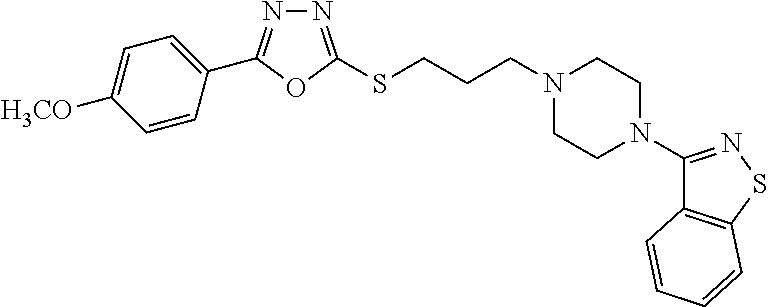 |
108.4% | 8.82a | 2.27a | 99.5% | 98.5% |
| 4 |
 |
112.6% | 12.7a | 0.51a | 101.1% | 82.1% |
| 5 |
 |
92.7% | 26.9a | 62.5a | 98.7% | 56.5% |
| 6 |
 |
103.7% | 19.9a | 15.1a | 101.3% | 68.1% |
| 7 |
 |
80.6% | 112.8% | 98.8% | — | — |
| 8 |
 |
105.2% | 20.8% | 100.9% | — | — |
| 9 |
 |
84.8% | 106.6% | 103.3% | — | — |
| 10 |
 |
88.6% | 56.4% | 117.3% | — | — |
| 11 |
 |
25.7% | 45.8% | 91.0% | — | — |
| 12 |
 |
98.4% | 175a | 122.2a | 100.4% | 60.6% |
| 13 |
 |
47.8% | 95.9% | 100.9% | — | — |
| 14 |
 |
110.7% | 89.7% | 101.9% | — | — |
| 15 |
 |
88.1% | 114.3% | 95.1% | — | — |
| 16 |
 |
45.9% | 86.7% | 107.0% | — | — |
| aripiprazole | 94.9% | 3.35a | 11.51a | 99.50% | 99.8% | |
| Note: | ||||||
| arepresents IC50 value. | ||||||
| TABLE 2 |
| Influence of the compounds on the moving distance |
| of MK-801 high activity mice within 90 min |
| Compound | Dosage (mg/kg) | Total moving distance (cm) |
| Model Group | — | 25445.72 ± 6888.12# |
| Blank Group | — | 9221.86 ± 5118.11 |
| Compound 6 | 30 | 8454.72 ± 7864.50** |
| 20 | 6741.35 ± 2251.52** | |
| 10 | 12997.51 ± 7859.06** | |
| 5 | 15745.74 ± 5475.41** | |
| 3 | 20912.66 ± 9887.01 | |
| Compound 4 | 100 | 6954.61 ± 4931.26** |
| 30 | 7773.56 ± 3681.67** | |
| 10 | 13574.51 ± 5340.38** | |
| 5 | 22872.82 ± 10538.51 | |
| 3 | 24988.83 ± 7617.21 | |
| Compound 12 | 100 | 5665.86 ± 1799.20** |
| 50 | 10298.82 ± 4269.95** | |
| 30 | 16163.49 ± 7769.48* | |
| 20 | 12936.50 ± 3627.24** | |
| 10 | 20521.27 ± 7898.02 | |
| Note: | ||
| **p < 0.01, | ||
| *p < 0.05 compared to model group; | ||
| #p < 0.01 compared to blank group | ||
| TABLE 3 |
| Results of the in vivo animal model of the preferable compounds |
| MK-801 induced high | apomorphine induced | |||||
| Compound | LD50 | activity | clambering | catalepsy | catalepsy/ | |
| No. | (po, mg/kg) | (ED50, po, mg/kg) | (ED50, po, mg/kg) | (ED50, po, mg/kg) | MK-801 | catalepsy/apomorphine |
| 4 | >2000 | 15.41 | 1.62 | 640.38 | 41.56 | 395.30 |
| 6 | >2000 | 3.31 | 4.1 | 92.73 | 28.02 | 22.62 |
| 12 | >2000 | 15.00 | 4.03 | 300.00 | 20.00 | 74.44 |
| risperidone | 82.1 | 0.01 | 0.02 | 0.3 | 15 | 30 |
| Compound 4 | 5-50 | mg | ||
| dicalcium phosphate | 20 | mg | ||
| lactose | 30 | mg | ||
| magnesium stearate | 5 | mg | ||
| starch | made up to 200 mg | ||
Claims (15)


Applications Claiming Priority (4)
| Application Number | Priority Date | Filing Date | Title |
|---|---|---|---|
| CN201110082555.1A CN102180872B (en) | 2011-04-01 | 2011-04-01 | [1, 3 and 4] oxadiazoles derivative and application thereof |
| CN201110082555.1 | 2011-04-01 | ||
| CN201110082555 | 2011-04-01 | ||
| PCT/CN2012/073470 WO2012130183A1 (en) | 2011-04-01 | 2012-04-01 | [1,3,4] oxadiazole derivative and application thereof |
Publications (2)
| Publication Number | Publication Date |
|---|---|
| US20140024656A1 US20140024656A1 (en) | 2014-01-23 |
| US8993575B2 true US8993575B2 (en) | 2015-03-31 |
Family
ID=44567186
Family Applications (1)
| Application Number | Title | Priority Date | Filing Date |
|---|---|---|---|
| US14/008,693 Active US8993575B2 (en) | 2011-04-01 | 2012-04-01 | [1,3,4] oxadiazole derivative and application thereof |
Country Status (3)
| Country | Link |
|---|---|
| US (1) | US8993575B2 (en) |
| CN (1) | CN102180872B (en) |
| WO (1) | WO2012130183A1 (en) |
Families Citing this family (4)
| Publication number | Priority date | Publication date | Assignee | Title |
|---|---|---|---|---|
| CN102180872B (en) * | 2011-04-01 | 2014-04-02 | 华中科技大学 | [1, 3 and 4] oxadiazoles derivative and application thereof |
| CN103242219B (en) * | 2012-02-13 | 2016-02-24 | 江苏恩华药业股份有限公司 | 2,6-diketone-piperazine (piperidines) analog derivative and application thereof |
| US11171898B2 (en) | 2019-10-30 | 2021-11-09 | Amazon Technologies, Inc. | Extensible framework for reporting automated workflow analytics |
| KR20240144259A (en) * | 2022-01-29 | 2024-10-02 | 수벤 라이프 사이언시스 리미티드 | Benzoisothiazole and benzoxazole compounds for the treatment of mental disorders |
Family Cites Families (5)
| Publication number | Priority date | Publication date | Assignee | Title |
|---|---|---|---|---|
| CN101166735A (en) * | 2005-04-26 | 2008-04-23 | 神经研究公司 | Novel oxadiazole derivatives and their medical use |
| GB0610657D0 (en) * | 2006-05-30 | 2006-07-05 | Glaxo Group Ltd | Compounds |
| TWI417100B (en) * | 2007-06-07 | 2013-12-01 | Astrazeneca Ab | Oxadiazole derivatives and their use as metabotropic glutamate receptor potentiators-842 |
| CN102884059B (en) * | 2010-03-11 | 2015-08-26 | 大日本住友制药株式会社 | N-acyl cyclic amine derivatives or pharmaceutically acceptable salts thereof |
| CN102180872B (en) * | 2011-04-01 | 2014-04-02 | 华中科技大学 | [1, 3 and 4] oxadiazoles derivative and application thereof |
-
2011
- 2011-04-01 CN CN201110082555.1A patent/CN102180872B/en active Active
-
2012
- 2012-04-01 WO PCT/CN2012/073470 patent/WO2012130183A1/en not_active Ceased
- 2012-04-01 US US14/008,693 patent/US8993575B2/en active Active
Non-Patent Citations (2)
| Title |
|---|
| English abstract for CN102180872 (Sep. 14, 2011). * |
| Yagcioglu, Turkish Journal of Psychiatry, vol. 18(4), p. 1-10 (2007). * |
Also Published As
| Publication number | Publication date |
|---|---|
| CN102180872A (en) | 2011-09-14 |
| WO2012130183A1 (en) | 2012-10-04 |
| US20140024656A1 (en) | 2014-01-23 |
| CN102180872B (en) | 2014-04-02 |
Similar Documents
| Publication | Publication Date | Title |
|---|---|---|
| US9315496B2 (en) | Benzopyrone derivative and use thereof | |
| KR102498741B1 (en) | Di-substituted pyrazole compounds for the treatment of disease | |
| JP2017537948A (en) | Amidothiadiazole derivatives as NADPH oxidase inhibitors | |
| BR112020020008A2 (en) | 6-AMINOISOQUINOLIN MONO ACID SALTS AND THEIR USES | |
| EP2968995B1 (en) | Inhibitors of lrrk2 kinase activity | |
| WO2010040274A1 (en) | Novel dopamine d3 receptor ligands, the preparation and use thereof | |
| US10501452B2 (en) | Lactam compound derivative and application thereof | |
| US20140024656A1 (en) | [1,3,4] oxadiazole derivative and application thereof | |
| US9018213B2 (en) | Alicyclic[c] benzopyrone derivatives and uses thereof | |
| JP3856829B2 (en) | Oxazolidinone derivatives, their production and therapeutic use | |
| JP6542236B2 (en) | Organic compound | |
| CN102807575A (en) | 3-aryl-5-thienyl-5H-thiazolo [3,2-a] pyrimidine derivative and application thereof | |
| CN105130960B (en) | 1,3,5- triazine derivatives and its application | |
| JP2018087173A (en) | Malignant brain tumor drug | |
| CN102796121B (en) | 3-aryl-7H-thiazol[3,2-b]-1,2,4-triazinyl-7-one derivatives and application thereof | |
| WO2014146553A1 (en) | Flavonoid derivatives and use thereof | |
| KR101978979B1 (en) | Novel phenylpiperazine aryl urea compounds and pharmaceutical composition comprising the same | |
| US12404268B2 (en) | 2-heteroaryl aminoquinazolinone derivative | |
| TW200804310A (en) | Benzoxazole and benzothiazole derivatives as 5-hydroxytryptamine-6 ligands | |
| WO2023046055A1 (en) | SUBSTITUTED HETEROCYCLIC COMPOUND CONTAINING α-KETONE FRAMEWORK, AND USE THEREOF | |
| KR20240042472A (en) | Muscarinic receptor 4 antagonists and methods of use | |
| WO2013017068A1 (en) | Substituted benzopyrone derivative and use thereof | |
| US20080167319A1 (en) | 7-(4-(4-[3-chloro-2-(trifluoromethyl)phenyl]piperazin-1-yl)butoxy)-[1,8]-naphthyridin-2(1h)-one | |
| CN109419802B (en) | Compounds having dopamine D3 receptor modulating activity and uses thereof | |
| CN102718758A (en) | Quinolinone derivative and application thereof as anti-schizophrenic drug |
Legal Events
| Date | Code | Title | Description |
|---|---|---|---|
| AS | Assignment |
Owner name: NHWA PHARMA CORPORATION, CHINA Free format text: ASSIGNMENT OF ASSIGNORS INTEREST;ASSIGNORS:ZHANG, GUISEN;CHEN, YIN;XU, XIANGQING;AND OTHERS;SIGNING DATES FROM 20130918 TO 20130922;REEL/FRAME:031308/0479 Owner name: HUAZHONG UNIVERSITY OF SCIENCE &TECHNOLOGY, CHINA Free format text: ASSIGNMENT OF ASSIGNORS INTEREST;ASSIGNORS:ZHANG, GUISEN;CHEN, YIN;XU, XIANGQING;AND OTHERS;SIGNING DATES FROM 20130918 TO 20130922;REEL/FRAME:031308/0479 |
|
| AS | Assignment |
Owner name: HUAZHONG UNIVERSITY OF SCIENCE & TECHNOLOGY, CHINA Free format text: CORRECTIVE ASSIGNMENT TO CORRECT THE INVENTOR NAME FROM QUI, YINLI TO QIU, YINLI PREVIOUSLY RECORDED ON REEL 031308 FRAME 0479. ASSIGNOR(S) HEREBY CONFIRMS THE QIU, YINLI;ASSIGNORS:ZHANG, GUISEN;CHEN, YIN;XU, XIANGQING;AND OTHERS;SIGNING DATES FROM 20130918 TO 20130922;REEL/FRAME:032086/0156 Owner name: NHWA PHARMA CORPORATION, CHINA Free format text: CORRECTIVE ASSIGNMENT TO CORRECT THE INVENTOR NAME FROM QUI, YINLI TO QIU, YINLI PREVIOUSLY RECORDED ON REEL 031308 FRAME 0479. ASSIGNOR(S) HEREBY CONFIRMS THE QIU, YINLI;ASSIGNORS:ZHANG, GUISEN;CHEN, YIN;XU, XIANGQING;AND OTHERS;SIGNING DATES FROM 20130918 TO 20130922;REEL/FRAME:032086/0156 |
|
| STCF | Information on status: patent grant |
Free format text: PATENTED CASE |
|
| MAFP | Maintenance fee payment |
Free format text: PAYMENT OF MAINTENANCE FEE, 4TH YEAR, LARGE ENTITY (ORIGINAL EVENT CODE: M1551); ENTITY STATUS OF PATENT OWNER: LARGE ENTITY Year of fee payment: 4 |
|
| MAFP | Maintenance fee payment |
Free format text: PAYMENT OF MAINTENANCE FEE, 8TH YEAR, LARGE ENTITY (ORIGINAL EVENT CODE: M1552); ENTITY STATUS OF PATENT OWNER: LARGE ENTITY Year of fee payment: 8 |
|
| MAFP | Maintenance fee payment |
Free format text: PAYMENT OF MAINTENANCE FEE, 12TH YEAR, LARGE ENTITY (ORIGINAL EVENT CODE: M1553); ENTITY STATUS OF PATENT OWNER: LARGE ENTITY Year of fee payment: 12 |