US8993569B2 - Diarylpyridazinone derivatives, preparation thereof, and use thereof for the treatment of humans - Google Patents

Diarylpyridazinone derivatives, preparation thereof, and use thereof for the treatment of humans Download PDF

Info

Publication number
US8993569B2
US8993569B2 US13/823,671 US201113823671A US8993569B2 US 8993569 B2 US8993569 B2 US 8993569B2 US 201113823671 A US201113823671 A US 201113823671A US 8993569 B2 US8993569 B2 US 8993569B2
Authority
US
United States
Prior art keywords
phenyl
ethyl
compound
hydroxy
pyridazin
Prior art date
Legal status (The legal status is an assumption and is not a legal conclusion. Google has not performed a legal analysis and makes no representation as to the accuracy of the status listed.)
Expired - Fee Related, expires
Application number
US13/823,671
Other versions
US20130267520A1 (en
Inventor
Elisabeth Dupont-Passelaigue
Isabelle Le Roy
Samuel Mialhe
Christophe Pignier
Current Assignee (The listed assignees may be inaccurate. Google has not performed a legal analysis and makes no representation or warranty as to the accuracy of the list.)
Pierre Fabre Medicament SA
Original Assignee
Pierre Fabre Medicament SA
Priority date (The priority date is an assumption and is not a legal conclusion. Google has not performed a legal analysis and makes no representation as to the accuracy of the date listed.)
Filing date
Publication date
Application filed by Pierre Fabre Medicament SA filed Critical Pierre Fabre Medicament SA
Assigned to PIERRE FABRE MEDICAMENT reassignment PIERRE FABRE MEDICAMENT ASSIGNMENT OF ASSIGNORS INTEREST (SEE DOCUMENT FOR DETAILS). Assignors: DUPONT-PASSELAIGUE, ELISABETH, LE ROY, ISABELLE, MIALHE, SAMUEL, PIGNIER, CHRISTOPHE
Publication of US20130267520A1 publication Critical patent/US20130267520A1/en
Application granted granted Critical
Publication of US8993569B2 publication Critical patent/US8993569B2/en
Expired - Fee Related legal-status Critical Current
Adjusted expiration legal-status Critical

Links

Classifications

    • CCHEMISTRY; METALLURGY
    • C07ORGANIC CHEMISTRY
    • C07DHETEROCYCLIC COMPOUNDS
    • C07D237/00Heterocyclic compounds containing 1,2-diazine or hydrogenated 1,2-diazine rings
    • C07D237/02Heterocyclic compounds containing 1,2-diazine or hydrogenated 1,2-diazine rings not condensed with other rings
    • C07D237/06Heterocyclic compounds containing 1,2-diazine or hydrogenated 1,2-diazine rings not condensed with other rings having three double bonds between ring members or between ring members and non-ring members
    • C07D237/10Heterocyclic compounds containing 1,2-diazine or hydrogenated 1,2-diazine rings not condensed with other rings having three double bonds between ring members or between ring members and non-ring members with hetero atoms or with carbon atoms having three bonds to hetero atoms with at the most one bond to halogen, e.g. ester or nitrile radicals, directly attached to ring carbon atoms
    • C07D237/14Oxygen atoms
    • AHUMAN NECESSITIES
    • A61MEDICAL OR VETERINARY SCIENCE; HYGIENE
    • A61KPREPARATIONS FOR MEDICAL, DENTAL OR TOILETRY PURPOSES
    • A61K31/00Medicinal preparations containing organic active ingredients
    • A61K31/33Heterocyclic compounds
    • A61K31/395Heterocyclic compounds having nitrogen as a ring hetero atom, e.g. guanethidine or rifamycins
    • A61K31/495Heterocyclic compounds having nitrogen as a ring hetero atom, e.g. guanethidine or rifamycins having six-membered rings with two or more nitrogen atoms as the only ring heteroatoms, e.g. piperazine or tetrazines
    • A61K31/50Pyridazines; Hydrogenated pyridazines
    • AHUMAN NECESSITIES
    • A61MEDICAL OR VETERINARY SCIENCE; HYGIENE
    • A61PSPECIFIC THERAPEUTIC ACTIVITY OF CHEMICAL COMPOUNDS OR MEDICINAL PREPARATIONS
    • A61P29/00Non-central analgesic, antipyretic or antiinflammatory agents, e.g. antirheumatic agents; Non-steroidal antiinflammatory drugs [NSAID]
    • AHUMAN NECESSITIES
    • A61MEDICAL OR VETERINARY SCIENCE; HYGIENE
    • A61PSPECIFIC THERAPEUTIC ACTIVITY OF CHEMICAL COMPOUNDS OR MEDICINAL PREPARATIONS
    • A61P3/00Drugs for disorders of the metabolism
    • A61P3/12Drugs for disorders of the metabolism for electrolyte homeostasis
    • AHUMAN NECESSITIES
    • A61MEDICAL OR VETERINARY SCIENCE; HYGIENE
    • A61PSPECIFIC THERAPEUTIC ACTIVITY OF CHEMICAL COMPOUNDS OR MEDICINAL PREPARATIONS
    • A61P35/00Antineoplastic agents
    • AHUMAN NECESSITIES
    • A61MEDICAL OR VETERINARY SCIENCE; HYGIENE
    • A61PSPECIFIC THERAPEUTIC ACTIVITY OF CHEMICAL COMPOUNDS OR MEDICINAL PREPARATIONS
    • A61P43/00Drugs for specific purposes, not provided for in groups A61P1/00-A61P41/00
    • AHUMAN NECESSITIES
    • A61MEDICAL OR VETERINARY SCIENCE; HYGIENE
    • A61PSPECIFIC THERAPEUTIC ACTIVITY OF CHEMICAL COMPOUNDS OR MEDICINAL PREPARATIONS
    • A61P9/00Drugs for disorders of the cardiovascular system
    • A61P9/06Antiarrhythmics
    • CCHEMISTRY; METALLURGY
    • C07ORGANIC CHEMISTRY
    • C07DHETEROCYCLIC COMPOUNDS
    • C07D231/00Heterocyclic compounds containing 1,2-diazole or hydrogenated 1,2-diazole rings
    • C07D231/02Heterocyclic compounds containing 1,2-diazole or hydrogenated 1,2-diazole rings not condensed with other rings
    • C07D231/10Heterocyclic compounds containing 1,2-diazole or hydrogenated 1,2-diazole rings not condensed with other rings having two or three double bonds between ring members or between ring members and non-ring members
    • C07D231/14Heterocyclic compounds containing 1,2-diazole or hydrogenated 1,2-diazole rings not condensed with other rings having two or three double bonds between ring members or between ring members and non-ring members with hetero atoms or with carbon atoms having three bonds to hetero atoms with at the most one bond to halogen, e.g. ester or nitrile radicals, directly attached to ring carbon atoms
    • C07D231/18One oxygen or sulfur atom
    • C07D231/20One oxygen atom attached in position 3 or 5

Definitions

  • the present invention concerns diarylpyridazinone derivatives, preparation thereof and uses thereof for the treatment of humans, as blockers of the potassium Kv channels and more specifically the Kv 1.5, Kv4.3 and Kv 11.1 channels.
  • the potassium channels represent the largest family of ion channels in the human genome with approximately 80 genes (Tamargo et al, Cardiovasc. Res.
  • potassium channels may be subdivided into 3 subfamilies: potential or voltage-activated channels (K v channels) and calcium-activated channels (K ca channels), inwardly rectifying channels (K ir ) and 2-pore potassium channels (K 2p ).
  • K v channels potential or voltage-activated channels
  • K ca channels calcium-activated channels
  • K ir inwardly rectifying channels
  • K 2p 2-pore potassium channels
  • the subfamily of potential-activated channels is the most widespread in the human body with virtually ubiquitous distribution in excitable cells (cardiac cells, neurones, striated or smooth muscle cells) and non-excitable cells such as pancreatic, prostatic and parathyroid cells, etc. (for review, Gutman G et al, Pharmacol. Rev. 2005, 57: 473-508).
  • Kv potassium channels in excitable cells The main function of Kv potassium channels in excitable cells is to control the resting membrane potential and the action potential duration (Nerbonne et Kass, Physiol. Rev.2005; 85:1205-1253). In this respect, several Kv channels are involved in this control, both in the cardiac auricles and ventricles.
  • the Kv4.3 channels in conjunction with the KChIP 2 subunits form the current I to which is involved in the early repolarisation phase of the action potential (AP); the KVLQT1/MinK and hERG channels are involved in the late polarisation phase of the AP (respectively generating the currents I Ks and I Kr ). Aforesaid channels are uniformly distributed between the cardiac auricles and ventricles.
  • AF atrial fibrillation
  • AF is a serious arrhythmia involving completely desynchronised activity of the atrial myocytes resulting in uninterrupted, rapid and irregular electrical activity.
  • AF is induced by the appearance of re-entrant electrical circuits in atrial tissue (Miyasaka Y et al, Circulation 2006, 114: 119-125).
  • No specific antiarrhythmic treatment of the atrial level currently exists in order to reduce the incidence of AF, which therefore represents a major medical necessity (Page et Roden, Nat. Rev. Drug Discov. 2005, 4: 899-910).
  • the rapid changes in the membrane potential are well known in excitable cells, but slow variations in potential are observed in all cells and are associated with control of the cell cycle.
  • the cell cycle is a key parameter in cell behaviour which needs to be regulated and coordinated for development, tissue regeneration and cell proliferation (Pardo, Physiology, 2004; 19:285-292; Blackistion et al, Cell Cylce, 2009; 8-21: 3527-3536).
  • blocking of the potassium channels leads to a decrease in proliferation in physiological models (such as in lymphocytes) and pathological models (cancer).
  • the role of the potassium channels in regulating the cell cycle was demonstrated in many cell types, whether physiological or pathological (cancerous lines or tumours) derived from human melanoma, lung cancer, lymphoma, mesothelioma, hepatocarcinoma, lymphocytes and monocytes (for review Pardo et al, J. Membr. Biol, 2005; 205: 115-124).
  • Kv indicates the potential-dependent family of potassium channels and comprises different subfamilies (Kv1., Kv2., Kv3 . . . ) among which the Kv1.1, Kv1.2 and Kv1.3 . . . channels are to be found.
  • a Kv channel blocker denotes a molecule that reduces or blocks the K + ion flow through the channel.
  • salts refers to the inorganic acid and base addition salts of the compounds of the present invention.
  • the salts are preferably pharmaceutically acceptable, i.e. they are non-toxic to the patient to whom they are administered.
  • pharmaceutically acceptable refers to molecular entities and compositions which do not result in any adverse or allergic effect or any other undesirable reaction when administered to an animal or human.
  • pharmaceutically acceptable excipient includes any diluent, adjuvant or excipient, such as preservative agents, filling agents, disintegrating, wetting, emulsifying, dispersing, antibacterial or antifungal agents, or furthermore agents allowing delay of absorption or intestinal and digestive resorption.
  • treatment means preventing or inhibiting occurrence or progression of the disorder to which the term applies or indeed one or several symptoms of this disorder.
  • the subject of the present invention is diarylpyridazinone derivatives that block the potassium Kv channels (more specifically the Kv 1.5, Kv4.3 and Kv 11.1 channels) and use thereof for the treatment of humans.
  • R 1 and R 2 simultaneously or independently represent one or several groups chosen from: halogen such as F, Br, Cl, linear or branched C1-C4 alkyl, hydroxy, linear or branched C 1 -C 4 alkoxy, nitrile or arylsulfonamido the aryl of which is optionally substituted by a linear or branched C 1 -C 4 alkyl group, as well as the different enantiomers and their mixtures in all proportions, and their pharmaceutically acceptable salts.
  • halogen such as F, Br, Cl, linear or branched C1-C4 alkyl, hydroxy, linear or branched C 1 -C 4 alkoxy, nitrile or arylsulfonamido the aryl of which is optionally substituted by a linear or branched C 1 -C 4 alkyl group, as well as the different enantiomers and their mixtures in all proportions, and their pharmaceutically acceptable salts.
  • the aryl group designates hydrocarbonated aromatic 5- or 6-membered monocycles.
  • the compounds of general formula I are those for which:
  • R 1 represents a hydroxy, methoxy or cyano group
  • R 2 represents several groups chosen from: halogen such as F, Br, Cl, linear or branched C 1 -C 4 alkyl, hydroxy, linear or branched C 1 -C 4 alkoxy, nitrile; as well as the different enantiomers and their mixtures in all proportions, and their pharmaceutically acceptable salts.
  • the compounds of general formula I are those for which:
  • the compounds of general formula I are those for which:
  • R 1 represents a hydroxy group located in para position (position 4) on the phenyl which it substitutes
  • R 2 represents several groups chosen from: Cl, methyl, hydroxy, methoxy, nitrile; as well as the different enantiomers and their mixtures in all proportions, and their pharmaceutically acceptable salts.
  • the present invention concerns the compounds of general formula I, characterised in that they are chosen from:
  • the present invention also covers the different enantiomers of the compounds of general formula I, as well as their mixtures in all proportions.
  • the mixtures of the enantiomers in all proportions also include racemic mixtures.
  • the subject-matter of the invention likewise concerns the different enantiomers and their mixtures in all proportions of the compounds of general formula I as well as the pharmaceutically acceptable salts.
  • the present invention also covers the processes for chemical preparation of the compounds of general formula I as well as the different enantiomers and their mixtures in all proportions.
  • the two enantiomers may be prepared enantioselectively from the (R)- or (S)-1-phenylethanols respectively. Furthermore, based on the racemic, it is possible to obtain both enantiomers by preparative HPLC separation on a chiral column (for example Chiralpack AD-H, eluent: heptane/EtOH/diethylamine).
  • the present invention likewise concerns the compounds of general formula I as well as different enantiomers and their mixtures in all proportions and their pharmaceutically acceptable salts for use thereof as blockers of the potassium Kv channels and more specifically the Kv 1.5, Kv4.3 and Kv 11.1 channels.
  • the present invention likewise concerns the compounds of general formula I as well as the different enantiomers and their mixtures in all proportions and the pharmaceutically acceptable salts thereof for use thereof as a medicament.
  • the invention also concerns the compounds of general formula I as well as different enantiomers and their mixtures in all proportions and their pharmaceutically acceptable salts for use thereof as a medicament intended for treatment and/or prevention of diseases requiring blockers of potassium Kv channels and more specifically the Kv 1.5, Kv4.3 and Kv 11.1 channels.
  • the invention also concerns the compounds of general formula I as well as the different enantiomers and their mixtures in all proportions and the pharmaceutically acceptable salts thereof for their use as a medicine intended for treatment and/or prevention of diseases such as atrial fibrillation and auricular and/or ventricular cardiac arrhythmias, but also diseases in which the cell cycle, cell proliferation and regeneration are modified (cancer, chronic inflammation).
  • diseases such as atrial fibrillation and auricular and/or ventricular cardiac arrhythmias, but also diseases in which the cell cycle, cell proliferation and regeneration are modified (cancer, chronic inflammation).
  • compositions characterised in that they contain as the active substance a compound of general formula I or one of the enantiomers thereof and their mixtures in all proportions, or one of the pharmaceutically acceptable salts thereof.
  • the invention also concerns a pharmaceutical composition characterised in that it contains a compound of general formula I or one of the enantiomers thereof and their mixtures in all proportions or one of the pharmaceutically acceptable salts thereof in combination with any pharmaceutically acceptable excipient.
  • compositions according to the invention may be administered via the oral, sublingual, subcutaneous, intramuscular, intravenous, transdermal, local or rectal route.
  • the active substance may be administered in unit forms of administration, in a mixture with conventional pharmaceutical carrier, to animals or humans.
  • Appropriate unit forms of administration comprise forms via the oral route such as tablets, capsules, powders, granules and oral solutions or suspensions, sublingual and buccal forms of administration, subcutaneous, topical, intramuscular, intravenous, intranasal or intraocular forms of administration and rectal forms of administration.
  • the appropriate formulations for the chosen form of administration are known to the person skilled in the art and are described for example in: Remington, The science and Practice of Pharmacy, 19th edition, 1995, Mack Publishing Company.
  • the dosages of the compounds of formula I in the compositions of the invention may be adjusted in order to obtain a quantity of active substance that is effective in order to obtain the desired therapeutic response for a composition specific to the method of administration.
  • the effective dose of a compound according to the invention varies depending on a large number of parameters such as for example the selected route of administration, weight, age, sex and nature of the disease in addition to the sensitivity of the person to be treated. Consequently, the optimum dosage needs to be determined by the specialist in the subject as a function of the parameters deemed relevant.
  • the compounds of the present invention may be synthesised using the synthetic routes described below or by using synthetic methods known to the person skilled in the art.
  • This method of synthesis of the compounds of general formula I (FIG. 1) is characterised in that a dibromo or dichloro pyridazinone of general formula II is condensed for which X represents either a chlorine atom or a bromine atom,
  • step 2 The intermediate VI is then reacted again (step 2):
  • the intermediate and final compounds may, if desired, be purified according to one or several purification methods chosen from extraction, filtration, chromatography on silica gel, normal phase or reverse phase or chiral preparative HPLC and crystallisation.
  • the 4,5-dichloropyridazin-3(2H)-one (1.35 g, 8.2 mmol) is placed in 30 mL of THF in the presence of (R)-1-phenylethanol (1 g, 8.2 mmol) and triphenylphosphine (2.15 g, 8.2 mmol) to which ethyl diethylazodicarboxylate is added (1.71 g, 9.82 mmol.
  • the reaction medium is stirred overnight at ambient temperature and subsequently concentrated to dryness. The residue is taken up with water and is extracted with dichloromethane on an SPE column (diatomaceous earth).
  • the compound 1 is prepared according to the following method of synthesis:
  • Step 1 the intermediate 1a (8.7 g, 32.3 mmol) is placed in presence of tetrakis(triphenylphosphine)palladium(0) (1.12 g, 0.97 mmol) and sodium carbonate (6.85 g, 64.7 mmol) in a mixture of 50 mL of toluene and 50 mL of ethanol and the mixture is heated to 80° C. 1.2 equivalent of 4-hydroxyphenylboronic acid is added and the mixture is heated under reflux for 5 h and 1.2 additional equivalent of 4-hydroxyphenylboronic acid is added and the reflux is maintained throughout the night. Following concentration to dryness, the residue is taken up with water and is extracted using AcOEt.
  • Step 2 this substituted mono product is reacted again under the conditions described for step 1 (2.4 equivalents of 4-hydroxyphenylboronic acid, reflux overnight). Following treatment of the reaction medium, the residue obtained is purified by flash chromatography (CH 2 Cl 2 -MeOH, gradient 100-0 to 98-2 over 20 min.). The residue is triturated in a mixture of diethylether-CH 2 Cl 2 -MeOH: 40-5-2 and the compound 1 (solid) obtained is isolated by filtration (7.2g, yield 78%).
  • Compound 2 is prepared according to the method of synthesis described for example 1 from the intermediate 1c (yield: 85%).
  • Chiral HPLC Chiral HPLC: Chiralpack column AD-H 250*4.6 mm DAI, eluent (1 mL/min.): heptane/EtOH/diethylamine: 80/20/0.1, retention time: 8.92 min.
  • Compound 3 is prepared according to the method of synthesis described for example 1 from the intermediate lb (yield: 43%).
  • Chiral HPLC Chiral HPLC: Chiralpack column AD-H 250*4.6 mm DAI, eluent (1 mL/min.): heptane/EtOH/diethylamine: 80/20/0.1 , retention time: 7.23 min.
  • Compound 4 is prepared from the intermediate 1a and 2-(4,4,5,5-tetramethyl-1,3,2-dioxaborolan-2-yl)benzonitrile according to step 1 of the method of synthesis using PdCl 2 /2PPh 3 , Na 2 CO 3 and a mixture of water/acetonitrile: 1/1.
  • the minor product formed corresponds to compound 4 (yield: 3.4%).
  • Compound 5 is prepared from intermediate 1a and 3-cyanophenylboronic acid under the conditions described for example 4.
  • the minor product formed (solid) corresponds to compound 4 (yield:7.4%).
  • Compound 6 is prepared from intermediate 1a and 4-methoxyphenylboronic acid under the conditions described for example 1 using tetrakis(triphenylphosphine)palladium(0), K 2 CO 3 and a mixture of dioxane/water: 3/1. Compound 6 is isolated in solid form (yield: 71%).
  • Compound 7 is prepared from intermediate 1a and 4-methyl-N-(3-(4,4,5,5-tetramethyl-1,3,2-dioxaborolan-2-yl)phenyl) benzenesulfonamide under the conditions described for example 6. Compound 7 is isolated in solid form (yield: 74%).
  • Compound 8 is prepared from intermediate 1a and 3-cyanophenylboronic acid according to step 1 of the method of synthesis using PdCl 2 /2PPh 3 , Na 2 CO 3 and a mixture of water/acetonitrile: 1/1.
  • the major product formed (1.96 g, 3-(5-chloro-6-oxo-1-(1-phenylethyl)-1,6-dihydropyridazin-4-yl)benzonitrile, yield: 19%) is isolated and subsequently introduced into step 2 of the method of synthesis using 4-methoxyphenylboronic acid with tetrakis(triphenylphosphine)palladium(0), K 2 CO 3 and a mixture of dioxane/water: 2/1.
  • Compound 8 is isolated in solid form (yield: 62%).
  • Compound 9 is prepared from intermediate 1a and 2-(4,4,5,5-tetramethyl-1,3,2-dioxaborolan-2-yl)benzonitrile according to step 1 of the method of synthesis using PdCl 2 /2PPh 3 , Na 2 CO 3 and a mixture of water/acetonitrile: 1/1.
  • the major product formed (1.5 g, 2-(5-chloro-6-oxo-1-(1-phenylethyl)-1,6-dihydropyridazin-4-yl) benzonitrile, yield: 16%) is isolated and subsequently introduced into step 2 of the method of synthesis with 4-methoxyphenylboronic acid using tetrakis(triphenylphosphine)palladium(0), K 2 CO 3 and a mixture of dioxane/water: 2/1.
  • Compound 9 is isolated in solid form (yield: 71%).
  • Compound 10 is prepared from intermediate 1a and 4-methyl-N-(4-(4,4,5,5-tetramethyl-1,3,2-dioxaborolan-2-yl)phenyl)benzenesulfonamide according to step 1 of the method of synthesis using PdCl 2 /2PPh 3 , Na 2 CO 3 and a mixture of water/acetonitrile: 1/1.
  • the major product formed (-N-(3-(5-chloro-6-oxo-1-(5g, 1-phenylethyl)-1,6-dihydropyridazin-4-yl)phenyl)-4-methylbenzenesulfonamide, yield: 62%) is isolated and subsequently introduced into step 2 of the method of synthesis with 3,4-dimethylphenylboronic acid using tetrakis(triphenylphosphine)palladium(0), K 2 CO 3 and a mixture of dioxane/water: 2/1. Compound 10 is isolated in solid form (yield: 67%).
  • Compound 11 is prepared from intermediate 1a and 3,4-dichlorophenylboronic acid under the conditions described for example 1 using tetrakis(triphenylphosphine)palladium(0), K 2 CO 3 and a mixture of dioxane/water: 7/3.
  • Compound 12 is isolated in solid form (yield: 54%).
  • the pharmacological assessment of the compounds on the Kv1.5 potassium channel was performed in a 96-well plate in FLIPR technology by thallium ion measurement.
  • the HEK293 cells stably transfected with the human isoform of the Kv1.5 channels, are seeded 24 h before experimentation in 96-well plates (15 10 6 cells/plate, 200 ⁇ l/well) polylysinated in the following culture medium: DMEM, 10% SVF, Penicillin/Streptomycin, G418 as the selection antibiotic.
  • the experimentation in FLIPR is performed using the “FLIPR Potassium Ion Channel Assay Kit) as indicated by the manufacturer (Molecular Devices).
  • the culture medium is replaced by the solution containing the thallium marker for 90 min at 37° C.
  • the compounds to be tested are added to a final concentration of 10 ⁇ M in the well for 15 min at 37° C.
  • the basic fluorescence is subsequently read for 60 secs.
  • the addition of a depolarising medium (20 mM of potassium and 3 mM of final thallium) opens the potassium channels and induces an increase in the fluorescence of the fluorophore thallium corresponding to an influx of thallium ions through the hKv1.5 channels.
  • the measurement is performed 30 secs after injection of the depolarising solution.
  • Application of 10 ⁇ M of DPO Tocris, Kv1.5 channel blocker) allows normalisation of the fluorescence.
  • BMS394136 is a Kv1.5 channel blocker under development at Bristol - Myers Squibb (Abstract, D. Xing et al. Circulation 2009, 120 (18S3): 2515).
  • the compounds of general formula (I) may be used as Kv1.5 channel blockers.

Landscapes

  • Chemical & Material Sciences (AREA)
  • Organic Chemistry (AREA)
  • Health & Medical Sciences (AREA)
  • General Health & Medical Sciences (AREA)
  • Veterinary Medicine (AREA)
  • Public Health (AREA)
  • Medicinal Chemistry (AREA)
  • Animal Behavior & Ethology (AREA)
  • Life Sciences & Earth Sciences (AREA)
  • Pharmacology & Pharmacy (AREA)
  • Nuclear Medicine, Radiotherapy & Molecular Imaging (AREA)
  • General Chemical & Material Sciences (AREA)
  • Chemical Kinetics & Catalysis (AREA)
  • Bioinformatics & Cheminformatics (AREA)
  • Engineering & Computer Science (AREA)
  • Epidemiology (AREA)
  • Heart & Thoracic Surgery (AREA)
  • Diabetes (AREA)
  • Hematology (AREA)
  • Obesity (AREA)
  • Pain & Pain Management (AREA)
  • Rheumatology (AREA)
  • Cardiology (AREA)
  • Pharmaceuticals Containing Other Organic And Inorganic Compounds (AREA)
  • Low-Molecular Organic Synthesis Reactions Using Catalysts (AREA)
  • Plural Heterocyclic Compounds (AREA)

Abstract

The present invention relates to diarylpyridazinone derivatives that block the potassium Kv channels (specifically the Kv1.5, Kv4.3, and Kv11.1 channels) and to the use thereof for the treatment of humans. Said compounds have the general formula (I), where R1 and R2 are simultaneously or independently one or more groupings such as: halogen, such as F, Br, Cl, a straight or branched C1-C4 alkyl, hydroxy, a straight or branched C1-C4 alkoxy, arylsulfonamido, in which the aryl is optionally replaced with a straight or branched C1-C4 alkyl, or nitrile, as well as the various enantiomers and the mixtures thereof in any proportion, and the pharmaceutically acceptable salts thereof.

Description

The present invention concerns diarylpyridazinone derivatives, preparation thereof and uses thereof for the treatment of humans, as blockers of the potassium Kv channels and more specifically the Kv 1.5, Kv4.3 and Kv 11.1 channels.
The potassium channels represent the largest family of ion channels in the human genome with approximately 80 genes (Tamargo et al, Cardiovasc. Res.
2004, 62: 9-33). These potassium channels may be subdivided into 3 subfamilies: potential or voltage-activated channels (Kv channels) and calcium-activated channels (Kca channels), inwardly rectifying channels (Kir) and 2-pore potassium channels (K2p). The subfamily of potential-activated channels is the most widespread in the human body with virtually ubiquitous distribution in excitable cells (cardiac cells, neurones, striated or smooth muscle cells) and non-excitable cells such as pancreatic, prostatic and parathyroid cells, etc. (for review, Gutman G et al, Pharmacol. Rev. 2005, 57: 473-508).
The main function of Kv potassium channels in excitable cells is to control the resting membrane potential and the action potential duration (Nerbonne et Kass, Physiol. Rev.2005; 85:1205-1253). In this respect, several Kv channels are involved in this control, both in the cardiac auricles and ventricles. The Kv4.3 channels in conjunction with the KChIP 2 subunits form the current Ito which is involved in the early repolarisation phase of the action potential (AP); the KVLQT1/MinK and hERG channels are involved in the late polarisation phase of the AP (respectively generating the currents IKs and IKr). Aforesaid channels are uniformly distributed between the cardiac auricles and ventricles. Two other types of potassium channel however display a distribution solely in the auricles. The potential-dependent potassium channels (Kv1.5) responsible for the current IKur and the inwardly rectifying channels activated by acetylcholine (Kir3.1 and Kir3.4 responsible for the current IK-ACh).
Changes in membrane electrical activity are observed in many disorders, particularly cardiac disorders involving arrhythmias. Among the latter, atrial fibrillation (AF) is a serious arrhythmia involving completely desynchronised activity of the atrial myocytes resulting in uninterrupted, rapid and irregular electrical activity. AF is induced by the appearance of re-entrant electrical circuits in atrial tissue (Miyasaka Y et al, Circulation 2006, 114: 119-125). No specific antiarrhythmic treatment of the atrial level currently exists in order to reduce the incidence of AF, which therefore represents a major medical necessity (Page et Roden, Nat. Rev. Drug Discov. 2005, 4: 899-910).
The presence of a large number of simultaneously activated micro-re-entrant circuits explains the anarchic nature of the electrical activity observed both via the endocavitary route and on the ECG. This arrhythmia generally develops against a background of an atrial myocardium which is pathological from the electrophysiological point of view, the refractory periods of which are too short and highly uneven in relation to one another and hence highly vulnerable to the slightest extrasystole. These abnormalities fall within the context of a phenomenon of myocardial remodelling, following pressure overload or stretching causing morphological changes (hypertrophy, dilation, fibrosis) in addition to modifications in transmembrane ionic current regulation, modifying the electrophysiological characteristics of the atrial myocytes. Given that each bout of AF maintains or even worsens this process of mechanical and electrophysiological remodelling, it is understandable that AF has a high potential for recurrence and its natural evolution is towards chronicity. Conversely, instances of AF of the focal type have recently been identified, originating at a specific point which is almost always observed to be an extension of the atrial myocardium into the pulmonary veins. These fairly rare cases of AF adopt a fairly monomorphic character, at any rate comparable to the atrial extrasystoles at the outset of the bout or intermittently observed between the attacks. In all cases, loss of the atrial systole results in a reduction in cardiac output varying between 20 and 30% and all the more pronounced in that the latter is diminished in the basal state. In parallel, existence of blood stasis in the atrial cavities, particularly in some culs-de-sac such as the auricles, accounts for the thromboembolitic risk. However, the risk of embolism is only partly influenced by the mere presence of AF, with the atrial stasis also being related to the increase in the intracavitary pressures (systolic or diastolic left ventricular dysfunction, valvulopathy or prosthetic valve).
Electrical remodelling therefore constitutes the major substrate of the genesis of AF; it is the result of a reduction in the activity of the L-type calcium channels, allowing the Kv1.5 potassium channels to fully exercise their repolarising role by means of the ultra-rapid potassium current (Bhakta et Miller, Expert Opin. Ther. Targets 2007, 11: 1161-1178). The result is a dramatic reduction in the refractory period which represents the precipitating factor for the micro-re-entries. With the knowledge that the Kv1.5 potassium channels are not functionally expressed at the ventricular level, a blocker of these channels will therefore represent a selective antiarrhythmic of the atrial level without affecting ventricular electrophysiology. Its pharmacological effect manifests itself in an extension of the refractory period and therefore less effect of the micro-re-entrant circuits. A number of experimental data obtained with reference products confirm the value of Kv1.5 blocking as a therapeutic target (Gogelein et al, Naunyn Schmiedeberg's Arch Pharmacol 2004, 370: 183-192, Regan et al, J Pharmacol Exp Ther 2008, 324: 322-330).
The rapid changes in the membrane potential are well known in excitable cells, but slow variations in potential are observed in all cells and are associated with control of the cell cycle. The cell cycle is a key parameter in cell behaviour which needs to be regulated and coordinated for development, tissue regeneration and cell proliferation (Pardo, Physiology, 2004; 19:285-292; Blackistion et al, Cell Cylce, 2009; 8-21: 3527-3536). Generally speaking, blocking of the potassium channels leads to a decrease in proliferation in physiological models (such as in lymphocytes) and pathological models (cancer). The role of the potassium channels in regulating the cell cycle was demonstrated in many cell types, whether physiological or pathological (cancerous lines or tumours) derived from human melanoma, lung cancer, lymphoma, mesothelioma, hepatocarcinoma, lymphocytes and monocytes (for review Pardo et al, J. Membr. Biol, 2005; 205: 115-124).
As used above, the term “Kv” indicates the potential-dependent family of potassium channels and comprises different subfamilies (Kv1., Kv2., Kv3 . . . ) among which the Kv1.1, Kv1.2 and Kv1.3 . . . channels are to be found.
“A Kv channel blocker” denotes a molecule that reduces or blocks the K+ ion flow through the channel.
As used herein, the term “salts” refers to the inorganic acid and base addition salts of the compounds of the present invention. The salts are preferably pharmaceutically acceptable, i.e. they are non-toxic to the patient to whom they are administered. The term “pharmaceutically acceptable” refers to molecular entities and compositions which do not result in any adverse or allergic effect or any other undesirable reaction when administered to an animal or human. When used herein, the term” pharmaceutically acceptable excipient” includes any diluent, adjuvant or excipient, such as preservative agents, filling agents, disintegrating, wetting, emulsifying, dispersing, antibacterial or antifungal agents, or furthermore agents allowing delay of absorption or intestinal and digestive resorption. Use of these media or vectors is well known to the art. Unless the agent is chemically incompatible with a diarylpyridazinone derivative, its use in pharmaceutical compositions with the compounds according to the invention is envisaged. Within the context of the invention, the term “treatment” as used herein means preventing or inhibiting occurrence or progression of the disorder to which the term applies or indeed one or several symptoms of this disorder.
The subject of the present invention is diarylpyridazinone derivatives that block the potassium Kv channels (more specifically the Kv 1.5, Kv4.3 and Kv 11.1 channels) and use thereof for the treatment of humans.
These compounds correspond to the general formula
Figure US08993569-20150331-C00001
wherein
R1 and R2 simultaneously or independently represent one or several groups chosen from: halogen such as F, Br, Cl, linear or branched C1-C4 alkyl, hydroxy, linear or branched C1-C4 alkoxy, nitrile or arylsulfonamido the aryl of which is optionally substituted by a linear or branched C1-C4 alkyl group, as well as the different enantiomers and their mixtures in all proportions, and their pharmaceutically acceptable salts.
Within the context of the present invention, the aryl group designates hydrocarbonated aromatic 5- or 6-membered monocycles.
According to an embodiment of the invention, the compounds of general formula I are those for which:
Figure US08993569-20150331-C00002
R1 represents a hydroxy, methoxy or cyano group; R2 represents several groups chosen from: halogen such as F, Br, Cl, linear or branched C1-C4 alkyl, hydroxy, linear or branched C1-C4 alkoxy, nitrile; as well as the different enantiomers and their mixtures in all proportions, and their pharmaceutically acceptable salts.
According to another embodiment of the invention, the compounds of general formula I are those for which:
Figure US08993569-20150331-C00003
  • R1 represents a hydroxy group,
  • R2 represents several groups chosen from: halogen such as F, Cl, linear or branched C1-C4 alkyl, hydroxy, linear or branched C1-C4 alkoxy, nitrile; as well as the different enantiomers and their mixtures in all proportions, and their pharmaceutically acceptable salts.
According to another embodiment of the invention, the compounds of general formula I are those for which:
Figure US08993569-20150331-C00004
R1 represents a hydroxy group located in para position (position 4) on the phenyl which it substitutes, R2 represents several groups chosen from: Cl, methyl, hydroxy, methoxy, nitrile; as well as the different enantiomers and their mixtures in all proportions, and their pharmaceutically acceptable salts.
The present invention concerns the compounds of general formula I, characterised in that they are chosen from:
1. 4,5-Bis-(4-hydroxy-phenyl)-2-(1-phenyl-ethyl)-2H-pyridazin-3-one
2. 4,5-Bis-(4-hydroxy-phenyl)-2-((S)-1-phenyl-ethyl)-2H-pyridazin-3-one
3. 4,5-Bis-(4-hydroxy-phenyl)-2-((R)-1-phenyl-ethyl)-2H-pyridazin-3-one
4. 2,2′-(6-oxo-1-(1-phenyl-ethyl)-1,6-dihydropyridazine-4,5-diyl) dibenzonitrile
5. 3,3′-(6-oxo-1-(1-phenyl-ethyl)-1,6-dihydropyridazine-4,5-diyl) dibenzonitrile
6. 4,5-Bis-(4-methoxy-phenyl)-2-(1-phenyl-ethyl)-2H-pyridazin-3-one
7. N,N′-(3,3′-(6-oxo-1-(1-phenyl-ethyl)-1,6-dihydropyridazine-4,5-diyl) bis(3, 1- phenylene))bis(4-methylbenzenesulfonamide)
8. 3-(5-(4-methoxy-phenyl)-6-oxo-1-(1-phenylethyl)-1,6-dihydropyridazin-4-yl) benzonitrile
9. 2-[5-(4-Methoxy-phenyl)-6-oxo-1-(1-phenyl-ethyl)-1,6-dihydro-pyridazin-4-yl]-benzonitrile
10. N-{3-[5-(3,4-Dimethyl-phenyl)-6-oxo-1-(1-phenyl-ethyl)-1,6-dihydropyridazin-4-yl]-phenyl}-4-methyl -benzenesulfonamide
11. 4,5-Bis-(3,4-dichloro-phenyl)-2-(1-phenyl-ethyl)-2H -pyridazin-3-one
The present invention also covers the different enantiomers of the compounds of general formula I, as well as their mixtures in all proportions.
The mixtures of the enantiomers in all proportions also include racemic mixtures.
The subject-matter of the invention likewise concerns the different enantiomers and their mixtures in all proportions of the compounds of general formula I as well as the pharmaceutically acceptable salts.
The present invention also covers the processes for chemical preparation of the compounds of general formula I as well as the different enantiomers and their mixtures in all proportions.
The two enantiomers may be prepared enantioselectively from the (R)- or (S)-1-phenylethanols respectively. Furthermore, based on the racemic, it is possible to obtain both enantiomers by preparative HPLC separation on a chiral column (for example Chiralpack AD-H, eluent: heptane/EtOH/diethylamine).
The present invention likewise concerns the compounds of general formula I as well as different enantiomers and their mixtures in all proportions and their pharmaceutically acceptable salts for use thereof as blockers of the potassium Kv channels and more specifically the Kv 1.5, Kv4.3 and Kv 11.1 channels.
The present invention likewise concerns the compounds of general formula I as well as the different enantiomers and their mixtures in all proportions and the pharmaceutically acceptable salts thereof for use thereof as a medicament.
The invention also concerns the compounds of general formula I as well as different enantiomers and their mixtures in all proportions and their pharmaceutically acceptable salts for use thereof as a medicament intended for treatment and/or prevention of diseases requiring blockers of potassium Kv channels and more specifically the Kv 1.5, Kv4.3 and Kv 11.1 channels.
The invention also concerns the compounds of general formula I as well as the different enantiomers and their mixtures in all proportions and the pharmaceutically acceptable salts thereof for their use as a medicine intended for treatment and/or prevention of diseases such as atrial fibrillation and auricular and/or ventricular cardiac arrhythmias, but also diseases in which the cell cycle, cell proliferation and regeneration are modified (cancer, chronic inflammation).
The invention also covers the compositions characterised in that they contain as the active substance a compound of general formula I or one of the enantiomers thereof and their mixtures in all proportions, or one of the pharmaceutically acceptable salts thereof.
The invention also concerns a pharmaceutical composition characterised in that it contains a compound of general formula I or one of the enantiomers thereof and their mixtures in all proportions or one of the pharmaceutically acceptable salts thereof in combination with any pharmaceutically acceptable excipient.
The pharmaceutical compositions according to the invention may be administered via the oral, sublingual, subcutaneous, intramuscular, intravenous, transdermal, local or rectal route. In this case, the active substance may be administered in unit forms of administration, in a mixture with conventional pharmaceutical carrier, to animals or humans. Appropriate unit forms of administration comprise forms via the oral route such as tablets, capsules, powders, granules and oral solutions or suspensions, sublingual and buccal forms of administration, subcutaneous, topical, intramuscular, intravenous, intranasal or intraocular forms of administration and rectal forms of administration. The appropriate formulations for the chosen form of administration are known to the person skilled in the art and are described for example in: Remington, The science and Practice of Pharmacy, 19th edition, 1995, Mack Publishing Company.
The dosages of the compounds of formula I in the compositions of the invention may be adjusted in order to obtain a quantity of active substance that is effective in order to obtain the desired therapeutic response for a composition specific to the method of administration. The effective dose of a compound according to the invention varies depending on a large number of parameters such as for example the selected route of administration, weight, age, sex and nature of the disease in addition to the sensitivity of the person to be treated. Consequently, the optimum dosage needs to be determined by the specialist in the subject as a function of the parameters deemed relevant.
Synthesis
The compounds of the present invention may be synthesised using the synthetic routes described below or by using synthetic methods known to the person skilled in the art.
This method of synthesis of the compounds of general formula I (FIG. 1) is characterised in that a dibromo or dichloro pyridazinone of general formula II is condensed for which X represents either a chlorine atom or a bromine atom,
Figure US08993569-20150331-C00005
with a derivative of general formula III,
Figure US08993569-20150331-C00006
for which
    • when A represents a halogen atom such as a chlorine or a bromine atom, a base such as Cs2CO3 is used in a solvent such as dimethylformamide.
    • when A represents OH, Mitsunobu coupling conditions are used such as in presence of ethyl diethylazodicarboxylate and triphenylphosphine in a solvent such as THF. These conditions are in particular applicable to enantioselective synthesis of compounds of general formula I from the (R) or (S)-1-phenylethanol.
The intermediate IV obtained
Figure US08993569-20150331-C00007
is then coupled (step 1) with a boron derivative
Figure US08993569-20150331-C00008
for which R1 is as defined in the general formula I and U represents
Figure US08993569-20150331-C00009
in a mixture of solvents such as toluene/ethanol or water/acetonitrile or dioxane/water in the presence of a base such as sodium or potassium carbonate and a catalyst such as tetrakis(triphenylphosphine)palladium or PdCl2/2PPh3.
These operating conditions mainly lead to formation of compound VI and minimally result in formation of compound VII.
The intermediate VI is then reacted again (step 2):
    • either with the boron derivative V under the coupling conditions described above, yielding compound VII.
    • or with the boron derivative VIII
Figure US08993569-20150331-C00010
for which R2 is as defined in the general formula I and U is as defined above in the coupling conditions previously described for step 1 in order to yield the compound IX.
Figure US08993569-20150331-C00011
The intermediate and final compounds may, if desired, be purified according to one or several purification methods chosen from extraction, filtration, chromatography on silica gel, normal phase or reverse phase or chiral preparative HPLC and crystallisation.
The starting materials used in the processes described above are commercially available or are readily accessible to the person skilled in the art according to processes described in the literature.
The following examples illustrate the invention without limiting the scope thereof.
The elemental analyses and the mass and NMR spectra confirm the structures of the compounds.
EXAMPLES
A) Intermediates
Intermediates 1:
a) 4,5-dichloro-2-(1-phenylethyl)pyridazin-3(2H)-one (1a)
Figure US08993569-20150331-C00012

The 4,5-dichloropyridazin-3(2H)-one (20 g, 121 mmol) is placed in presence of 1-bromoethyl)benzene (33.7 g, 182 mmol) and cesium carbonate (47.4 g, 145 mmol) in 100 mL of DMF at ambient temperature for 4 h. Following concentration to dryness, the residue is taken up with water and is extracted using ethyl acetate. The organic layers are dried and subsequently concentrated to dryness. The residue obtained is purified by flash chromatography on silica (Petroleum ether-AcOEt: 95-5). 31g of clear oil is obtained (yield 95%). TLC silica gel 60 F 254 Merck, Petroleum ether-AcOEt: 90-10, Rf=0.50.
b) 4,5-Dichloro-2-((S)-1-phenyl-ethyl)-2H-pyridazin-3-one (1b)
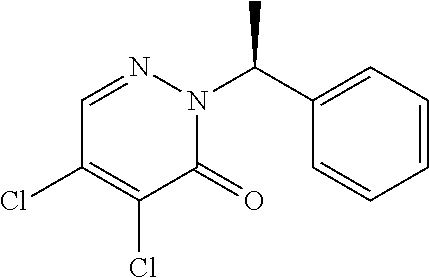
Figure US08993569-20150331-C00013
The 4,5-dichloropyridazin-3(2H)-one (1.35 g, 8.2 mmol) is placed in 30 mL of THF in the presence of (R)-1-phenylethanol (1 g, 8.2 mmol) and triphenylphosphine (2.15 g, 8.2 mmol) to which ethyl diethylazodicarboxylate is added (1.71 g, 9.82 mmol. The reaction medium is stirred overnight at ambient temperature and subsequently concentrated to dryness. The residue is taken up with water and is extracted with dichloromethane on an SPE column (diatomaceous earth). The organic layers are concentrated to dryness and the residue obtained is purified by flash chromatography on silica (CH2Cl2). 2.1 g of yellow oil is isolated (yield 80%). TLC silica gel 60 F 254 Merck, CH2Cl2-MeOH:95-5, Rf=0. 66.
c) 4,5-Dichloro-2-((R)-1-phenyl-ethyl)-2H-pyridazin-3-one (1c)
Figure US08993569-20150331-C00014
The intermediate 1 c (oil) is prepared from (S)-1-phenylethanol according to the operating method described for the intermediate lb (77%). TLC silica gel 60 F 5 254 Merck, CH2Cl2-MeOH:90-10, Rf=0.82.
B) Compounds According to the Invention
Example 1 4,5-Bis-(4-hydroxy-phenyl)-2-(1-phenyl-ethyl)-2H-pyridazin-3-one (1)
Figure US08993569-20150331-C00015
The compound 1 is prepared according to the following method of synthesis:
Step 1: the intermediate 1a (8.7 g, 32.3 mmol) is placed in presence of tetrakis(triphenylphosphine)palladium(0) (1.12 g, 0.97 mmol) and sodium carbonate (6.85 g, 64.7 mmol) in a mixture of 50 mL of toluene and 50 mL of ethanol and the mixture is heated to 80° C. 1.2 equivalent of 4-hydroxyphenylboronic acid is added and the mixture is heated under reflux for 5 h and 1.2 additional equivalent of 4-hydroxyphenylboronic acid is added and the reflux is maintained throughout the night. Following concentration to dryness, the residue is taken up with water and is extracted using AcOEt. After drying the organic layers and concentration to dryness, the residue obtained is purified by flash chromatography (CH2Cl2-MeOH, gradient 100-0 to 97-3 over 40 min.). 0.7g of minority compound 1 is obtained and 8.2g of solid corresponding to the majority substituted mono product 4-chloro-5-(4-hydroxyphenyl)-2-(1-phenylethyl)-pyridazin-3(2H)-one is obtained (yield:78%).
Step 2: this substituted mono product is reacted again under the conditions described for step 1 (2.4 equivalents of 4-hydroxyphenylboronic acid, reflux overnight). Following treatment of the reaction medium, the residue obtained is purified by flash chromatography (CH2Cl2-MeOH, gradient 100-0 to 98-2 over 20 min.). The residue is triturated in a mixture of diethylether-CH2Cl2-MeOH: 40-5-2 and the compound 1 (solid) obtained is isolated by filtration (7.2g, yield 78%).
TLC silica gel 60 F 254 Merck, CH2Cl2-MeOH: 95-5, Rf=0.35. F=160° C.
NMR 1H (DMSO-d6) ppm: 9.56 (m, 2H), 8.02 (s, 1H), 7.39 (m, 5H), 6.96 (m, 4H), 6.63 (m, 4H), 6.24 (m,1 H), 1.72 (d, 3H).
MS (+ESI) m/z 385 (MH+)
Example 2 4,5-Bis-(4-hydroxy-phenyl)-2-((S)-1-phenyl-ethyl)-2H-pyridazin-3-one (2)
Figure US08993569-20150331-C00016
Compound 2 is prepared according to the method of synthesis described for example 1 from the intermediate 1c (yield: 85%).
TLC silica gel 60 F 254 Merck, CH2Cl2-MeOH: 90-10, Rf=0.60.
F=168° C.
NMR 1H (DMSO-d6) ppm: 9.70 (s, 1H), 9.54 (s, 1H), 8.02 (s, 1H), 7.39 (m, 5H), 6.97 (m, 4H), 6.63 (m, 4H), 6.24 (m,1 H), 1.72 (d, 3H).
MS (+ESI) m/z 385 (MH+)
αcalc (MeOH)=−256.5°
Chiral HPLC: Chiralpack column AD-H 250*4.6 mm DAI, eluent (1 mL/min.): heptane/EtOH/diethylamine: 80/20/0.1, retention time: 8.92 min.
Example 3 4,5-Bis-(4-hydroxy-phenyl)-2-((R)-1-phenyl-ethyl)-2H-pyridazin-3-one (3)
Figure US08993569-20150331-C00017
Compound 3 is prepared according to the method of synthesis described for example 1 from the intermediate lb (yield: 43%).
TLC silica gel 60 F 254 Merck, CH2Cl2-MeOH: 90-10, Rf=0.60.
F=222° C.
NMR 1H (DMSO-d6) ppm: 9.70 (s, 1H), 9.54 (s, 1H), 8.02 (s, 1H), 7.39 (m, 5H), 6.97 (m, 4H), 6.63 (m, 4H), 6.24 (m,1 H), 1.72 (d, 3H).
MS (+ESI) m/z 385 (MH+)
αcalc (MeOH)=272.2°
Chiral HPLC: Chiralpack column AD-H 250*4.6 mm DAI, eluent (1 mL/min.): heptane/EtOH/diethylamine: 80/20/0.1 , retention time: 7.23 min.
Example 4 2,2′-(6-oxo-1-(1-phenylethyl)-1,6-dihydropyridazine-4,5- diyl)dibenzonitrile (4)
Figure US08993569-20150331-C00018
Compound 4 is prepared from the intermediate 1a and 2-(4,4,5,5-tetramethyl-1,3,2-dioxaborolan-2-yl)benzonitrile according to step 1 of the method of synthesis using PdCl2/2PPh3, Na2CO3 and a mixture of water/acetonitrile: 1/1. The minor product formed corresponds to compound 4 (yield: 3.4%).
TLC silica gel 60 F 254 Merck, CH2Cl2, Rf=0.23.
F=200° C.
NMR 1H (DMSO-d6) ppm: 8,19 (s, 1H), 7.80 (d, 2H), 7.75 (d, 2H), 7.36 (m, 9H), 6.27 (q, 1H), 1.76 (d, 3H).
MS (+ESI) m/z 403 (MH+)
Example 5 3,3′-(6-oxo-1-(1-phenylethyl)-1,6-dihydropyridazine-4,5-diyl) dibenzonitrile (5)
Figure US08993569-20150331-C00019
Compound 5 is prepared from intermediate 1a and 3-cyanophenylboronic acid under the conditions described for example 4. The minor product formed (solid) corresponds to compound 4 (yield:7.4%).
TLC silica gel 60 F 254 Merck, CH2Cl2, Rf=0.11.
F=202° C.
NMR 1H (DMSO-d6) ppm: 8.23 (s, 1H), 7.78 (m, 3H), 7.72 (s, 1H), 7.40 (m, 9H), 6.28 (q, 1H), 1.77 (d, 3H).
MS (+ESI) m/z 403 (MH+)
Example 6 4,5-Bis-(4-methoxy-phenyl)-2-(1-phenyl-ethyl)-2H-pyridazin-3-one (6)
Figure US08993569-20150331-C00020
Compound 6 is prepared from intermediate 1a and 4-methoxyphenylboronic acid under the conditions described for example 1 using tetrakis(triphenylphosphine)palladium(0), K2CO3 and a mixture of dioxane/water: 3/1. Compound 6 is isolated in solid form (yield: 71%).
TLC silica gel 60 F 254 Merck, Petroleum ether-AcOEt:80-20, Rf=0.20.
NMR 1H (CDCl3) ppm: 7.88 (s, 1H), 7.53 (d, 2H), 7.37-7.31 (m, 2H), 7.30-7.26 (m, 1H), 7.14-7.13 (d, 2H), 7.06-7.02 (d, 2H), 6.80-6.75 (m, 4H), 6.47-6.40 (m, 1H), 3.78 (s, 3H), 3.77 (s, 3H), 1.83 (s, 3H).
MS (+ESI) m/z 413 (MH+)
Example 7 N,N′-(3,3′-(6-oxo-1-(1-phenylethyl)-1,6-dihydropyridazine-4,5-diyl)bis(3,1-phenylene))bis(4-methylbenzenesulfonamide) (7)
Figure US08993569-20150331-C00021
Compound 7 is prepared from intermediate 1a and 4-methyl-N-(3-(4,4,5,5-tetramethyl-1,3,2-dioxaborolan-2-yl)phenyl) benzenesulfonamide under the conditions described for example 6. Compound 7 is isolated in solid form (yield: 74%).
TLC silica gel 60 F 254 Merck, Petroleum ether-AcOEt: 50-50, Rf=0.46.
F=202° C.
NMR 1H (DMSO) ppm: 10.26 (s, 1H), 10.14 (s, 1H), 7.92 (s, 1H), 7.53 (d, 4H), 7.42-7.25 (m, 9H), 7.08-6.88 (m, 6H), 6.52 (dd, 2H), 6.26-6.18 (m, 1H), 2.31 (s, 6H), 1.74 (d, 3H).
MS (+ESI) m/z 691 (MH+)
Example 8 3-(5-(4-methoxyphenyl)-6-oxo-1-(1-phenylethyl)-1,6- dihydropyridazin-4-yl)benzonitrile
Figure US08993569-20150331-C00022
Compound 8 is prepared from intermediate 1a and 3-cyanophenylboronic acid according to step 1 of the method of synthesis using PdCl2/2PPh3, Na2CO3 and a mixture of water/acetonitrile: 1/1. The major product formed (1.96 g, 3-(5-chloro-6-oxo-1-(1-phenylethyl)-1,6-dihydropyridazin-4-yl)benzonitrile, yield: 19%) is isolated and subsequently introduced into step 2 of the method of synthesis using 4-methoxyphenylboronic acid with tetrakis(triphenylphosphine)palladium(0), K2CO3 and a mixture of dioxane/water: 2/1. Compound 8 is isolated in solid form (yield: 62%).
TLC silica gel 60 F 254 Merck, Petroleum ether-AcOEt: 50-50, Rf=0.53.
F=198° C.
TLC silica gel 60 F 254 Merck, Petroleum ether-AcOEt: 50-50, Rf=0.53.
NMR 1H (DMSO-d6) ppm: 8.13 (s, 1H), 7.77 (m, 2H), 7.38 (m, 7H), 7.09 (d, 2H), 6.81 (d, 2H), 6.28 (q, 1H), 3.71 (s, 3H), 1.75 (d, 3H).
MS (+ESI) m/z 408 (MH+)
Example 9 2-[5-(4-Methoxy-phenyl)-6-oxo-1-(1-phenyl-ethyl)-1,6-dihydro-pyridazin-4-yl]-benzonitrile
Figure US08993569-20150331-C00023
Compound 9 is prepared from intermediate 1a and 2-(4,4,5,5-tetramethyl-1,3,2-dioxaborolan-2-yl)benzonitrile according to step 1 of the method of synthesis using PdCl2/2PPh3, Na2CO3 and a mixture of water/acetonitrile: 1/1. The major product formed (1.5 g, 2-(5-chloro-6-oxo-1-(1-phenylethyl)-1,6-dihydropyridazin-4-yl) benzonitrile, yield: 16%) is isolated and subsequently introduced into step 2 of the method of synthesis with 4-methoxyphenylboronic acid using tetrakis(triphenylphosphine)palladium(0), K2CO3 and a mixture of dioxane/water: 2/1. Compound 9 is isolated in solid form (yield: 71%).
TLC silica gel 60 F 254 Merck, Petroleum ether-AcOEt: 70-30, Rf=0.45.
F=1760C
TLC silica gel 60 F 254 Merck, Petroleum ether-AcOEt: 50-50, Rf=0.53.
NMR 1H (DMSO-d6) ppm: 8.09 (s, 1H), 7.79 (d, 2H), 7.40 (m, 7H), 7.08 (d, 2H), 6.81 (d, 2H), 6.28 (q, 1H), 3.71 (s, 3H), 1.75 (d, 3H).
MS (+ESI) m/z 408 (MH+)
Example 10 N-{3-[5-(3,4-Dimethyl-phenyl)-6-oxo-1-(1-phenyl-ethyl)-1,6-dihydro-pyridazin-4-yl]-phenyl}-4-methyl-benzenesulfonamide (10)
Figure US08993569-20150331-C00024
Compound 10 is prepared from intermediate 1a and 4-methyl-N-(4-(4,4,5,5-tetramethyl-1,3,2-dioxaborolan-2-yl)phenyl)benzenesulfonamide according to step 1 of the method of synthesis using PdCl2/2PPh3, Na2CO3 and a mixture of water/acetonitrile: 1/1. The major product formed (-N-(3-(5-chloro-6-oxo-1-(5g, 1-phenylethyl)-1,6-dihydropyridazin-4-yl)phenyl)-4-methylbenzenesulfonamide, yield: 62%) is isolated and subsequently introduced into step 2 of the method of synthesis with 3,4-dimethylphenylboronic acid using tetrakis(triphenylphosphine)palladium(0), K2CO3 and a mixture of dioxane/water: 2/1. Compound 10 is isolated in solid form (yield: 67%).
TLC silica gel 60 F 254 Merck, CH2Cl2-MeOH: 97.5-2.5, Rf=0.65.
NMR 1H (DMSO) ppm: 10.24 (s, 1H), 7.92 (s, 1H), 7.54 (d, 2H), 7.41-7.26 (m, 7H), 7,10 (t, 1H), 7.04 (s, 1H), 6.96-6.91 (m, 2H), 6.88 (d, 1H), 6.72 (d, 1H), 6.62 (d, 1H), 6.27-6.20 (m, 1H), 2.34 (s, 3H), 2.15 (s, 3H), 2.06 (s, 3H), 1.73 (d, 3H).
MS (+ESI) m/z 550 (MH+)
Example 11 4,5-Bis-(3,4-dichloro-phenyl)-2-(1-phenyl-ethyl)-2H-pyridazin-3-one (11)
Figure US08993569-20150331-C00025
Compound 11 is prepared from intermediate 1a and 3,4-dichlorophenylboronic acid under the conditions described for example 1 using tetrakis(triphenylphosphine)palladium(0), K2CO3 and a mixture of dioxane/water: 7/3. Compound 12 is isolated in solid form (yield: 54%).
F=92° C.
TLC silica gel 60 F 254 Merck, Petroleum ether-AcOEt: 80-20, Rf=0.54.
NMR 1H (DMSO) ppm: 8.19 (s, 1H), 7.64 (d, 1H), 7.61-7.57 (m, 2H), 7.54 (d, 1H), 7.44-7.26 (m, 5H), 7.13 (dd, 1H), 7.07 (dd, 1H), 6.30-6.22 (m, 1H), 1.75 (d, 3H)
MS (+ESI) m/z 491 (MH+)
C) Pharmacological Assessment
The pharmacological assessment of the compounds on the Kv1.5 potassium channel was performed in a 96-well plate in FLIPR technology by thallium ion measurement.
The HEK293 cells, stably transfected with the human isoform of the Kv1.5 channels, are seeded 24 h before experimentation in 96-well plates (15 106 cells/plate, 200 μl/well) polylysinated in the following culture medium: DMEM, 10% SVF, Penicillin/Streptomycin, G418 as the selection antibiotic.
The experimentation in FLIPR is performed using the “FLIPR Potassium Ion Channel Assay Kit) as indicated by the manufacturer (Molecular Devices).
Briefly, the culture medium is replaced by the solution containing the thallium marker for 90 min at 37° C. Following this step, the compounds to be tested are added to a final concentration of 10 μM in the well for 15 min at 37° C. The basic fluorescence is subsequently read for 60 secs. The addition of a depolarising medium (20 mM of potassium and 3 mM of final thallium), opens the potassium channels and induces an increase in the fluorescence of the fluorophore thallium corresponding to an influx of thallium ions through the hKv1.5 channels. The measurement is performed 30 secs after injection of the depolarising solution. Application of 10 μM of DPO (Tocris, Kv1.5 channel blocker) allows normalisation of the fluorescence.
TABLE 1
Examples % inhibition at 10 μM
BMS394136 99.6
1 100
2 100
3 43.3
4 54.9
5 93.6
6 94.2
7 54.9
8 88
9 60.1
*BMS394136 is a Kv1.5 channel blocker under development at Bristol - Myers Squibb (Abstract, D. Xing et al. Circulation 2009, 120 (18S3): 2515).
The results obtained show that the compounds of general formula (I) block the Kv1.5 channel.
The compounds of general formula (I) may be used as Kv1.5 channel blockers.
D) Abbreviations
TLC Thin Layer Chromatography
DMF Dimethylformamide
DMSO Dimethylsulfoxide
DPO (2-isopropyl-5-methyl-cyclohexyl) diphenylphosphine oxide
HPLC High Performance Liquid Chromatography
Rf Reference front
NMR Nuclear magnetic resonance
THF Tetrahydrofuran

Claims (14)

The invention claimed is:
1. Compounds of formula I:
Figure US08993569-20150331-C00026
wherein
R1 and R2 simultaneously or independently represent one or two groups chosen from: halogen, linear or branched C1-C4 alkyl, hydroxyl, linear or branched C1-C4 alkoxy, nitrile or arylsulfonamido the aryl of which is optionally substituted b a linear or branched C1-C4 alkyl group, as well as the different enantiomers and their mixtures in all proportions, and their pharmaceutically acceptable salts.
2. Compounds of formula I according to claim 1 wherein
Figure US08993569-20150331-C00027
R1 represents a hydroxy, methoxy or cyano group;
R2 represents one or two groups chosen from: halogen such as F, Br, Cl, linear or branched C1-C4 alkyl, hydroxy, linear or branched C1-C4 alkoxy, nitrile;
as well as the different enantiomers and their mixtures in all proportions, and their pharmaceutically acceptable salts.
3. Compounds of general formula I according to claim 1 or 2 wherein:
Figure US08993569-20150331-C00028
R1 represents a hydroxy group;
R2 represents one or two groups chosen from: halogen such as F, Cl, linear or branched C1-C4 alkyl, hydroxy, linear or branched C1-C4 alkoxy, nitrile;
as well as the different enantiomers and their mixtures in all proportions, and their pharmaceutically acceptable salts.
4. Compounds of general formula I according to claim 1 wherein:
Figure US08993569-20150331-C00029
R1 represents a hydroxy group located in para position (position 4) on the phenyl which it substitutes;
R2 represents one or two groups chosen from: CL, methyl, hydroxy, methoxy, nitrile;
as well as the different enantiomers and their mixtures in all proportions and their pharmaceutically acceptable salts.
5. Compounds of general formula I according to claim 1 wherein they are chosen from: 4,5-Bis-(4-hydroxy-phenyl)-2-(1-phenyl-ethyl)-2H-pyridazin-3-one,
4,5-Bis-(4-hydroxy-phenyl)-2-((S)-1-phenyl-ethyl)-2H-pyridazin-3-one
4,5-Bis-(4-hydroxy-phenyl)-2-((R)-1-phenyl-ethyl)-2H-pyridazin-3-one,
2,2,′-(6-oxo-1-(1-phenyl-ethyl)-1,6-dihydropyridazine-4,5-diyl)dibenzonitrile,
3,3′-(6-oxo-1-(1-phenyl-ethyl)-1,6-dihydropyridazine-4,5-diyl) dibenzonitrile
4,5-Bis-(4-methoxy-phenyl)-2-(1-phenyl-ethyl)-2H-pyridazin-3-one,
N,N′-(3,3′-(6-oxo-1-(1-phenylethyl)-1,6-dihydropyridazine-4,5-diyl)bis(3, phenylene))bis(4-methylbenzenesulfonamide),
3-(5-(4-methoxyphenyl)-6-oxo-1-(1-phenylethyl-ethyl)-1,6-dihydropyridazin-4-yl) benzonitrile,
2-[5-(4-Methoxy-phenyl)-6-oxo-1-(1-phenyl-ethyl)-1,6-dihydro-pyridazin-4-yl]-benzonitrile,
N-{3-[5-(3,4-Dimethyl-phenyl)-6-oxo-1-(1-phenyl-ethyl)-1,6-dihydro- pyridazin-4-yl]-phenyl}-4-methyl-benzenesulfonamide, or
4,5-Bis-(3,4-dichloro-phenyl)-2-(1-phenyl-ethyl)-2H-pyridazin-3-on.
6. Process for preparation of a chemical compounds of formula 1 according to claim 1 wherein a dibromo or dichloro pyridazinone of formula 11 is condensed,
Figure US08993569-20150331-C00030
for which X represents either a chlorine atom or a bromine atom,
with a derivative of formula III,
Figure US08993569-20150331-C00031
for which:
when A represents a halogen atom, a base is used in a solvent
when A represents OH, Mitsunobu coupling conditions are used; the intermediate IV obtained
Figure US08993569-20150331-C00032
is subsequently coupled (step 1) with a boron derivative V
Figure US08993569-20150331-C00033
for Which R1 as defined in claim 1 and U represents
Figure US08993569-20150331-C00034
B(OH)2 or
in a mixture of solvents selected from the group consisting of toluene/ethanol or water/acetonitrile or dioxane/water, in the presence of a base and a palladium catalyst;
and wherein compound VI is obtained as a major compound and compound VII is obtained as a minor compound;
Figure US08993569-20150331-C00035
the intermediate VI being subsequently reacted again:
either with the boron derivative V in the coupling conditions previously described in order to yield the compound VII
Figure US08993569-20150331-C00036
or with the boron derivative VIII
Figure US08993569-20150331-C00037
for which R2, is as defined in claim 1 and U is as defined above in e coupling conditions previously described for step 1 in order to yield the compound IX
Figure US08993569-20150331-C00038
7. Method of treatment comprising administering to a patient in need thereof a compound according to claim 1, wherein the patient suffers from atrial fibrillation, or auricular and/or ventricular cardiac arrhythmias.
8. Method of blocking potassium channels comprising administering to a patient in need thereof a compound according to claim 1.
9. Pharmaceutical composition comprising a compound of general formula I according. to claim 1 in combination with at least one pharmaceutically acceptable excipient.
10. The method of claim 8, wherein the potassium channels are the Kv 1.5, Kv4.3 or Kv 11.1 channels.
11. The compound of claim 1 or 2, wherein the halogen is F, Cl or Br.
12. The process of claim 6, wherein, when condensation of pyridazone II with derivative III occurs under Mitsunobu conditions, said conditions include the presence of ethyl diethylazodicarboxylate and triphenylphosphinc, and the reaction is carried out in THF as the solvent.
13. The process of claim 6, wherein when A represents a halogen atom in derivative III, the base is Cs2CO3 and the solvent is DMF in the condensation reaction with pyridazone II.
14. The process of claim 6, wherein, in the coupling of intermediate IV with boron derivative V, the base is sodium carbonate or potassium carbonate, and the catalyst is tetrakis(triphenylphosphine)palladium or PdCl2/2PPh3.
US13/823,671 2010-12-22 2011-12-20 Diarylpyridazinone derivatives, preparation thereof, and use thereof for the treatment of humans Expired - Fee Related US8993569B2 (en)

Applications Claiming Priority (3)

Application Number Priority Date Filing Date Title
FR1061021 2010-12-22
FR1061021A FR2969606B1 (en) 2010-12-22 2010-12-22 DERIVATIVES OF DIARYLPYRIDAZINONES, THEIR PREPARATION AND THEIR APPLICATION IN HUMAN THERAPEUTICS
PCT/EP2011/073476 WO2012085001A1 (en) 2010-12-22 2011-12-20 Diarylpyridazinone derivatives, preparation thereof, and use thereof for the treatment of humans

Publications (2)

Publication Number Publication Date
US20130267520A1 US20130267520A1 (en) 2013-10-10
US8993569B2 true US8993569B2 (en) 2015-03-31

Family

ID=43734025

Family Applications (1)

Application Number Title Priority Date Filing Date
US13/823,671 Expired - Fee Related US8993569B2 (en) 2010-12-22 2011-12-20 Diarylpyridazinone derivatives, preparation thereof, and use thereof for the treatment of humans

Country Status (28)

Country Link
US (1) US8993569B2 (en)
EP (1) EP2654752B1 (en)
JP (1) JP5931912B2 (en)
KR (1) KR101939855B1 (en)
CN (1) CN103269703B (en)
AU (1) AU2011347431B2 (en)
BR (1) BR112013016165A2 (en)
CA (1) CA2820135C (en)
CY (1) CY1116822T1 (en)
DK (1) DK2654752T3 (en)
ES (1) ES2545896T3 (en)
FR (1) FR2969606B1 (en)
HR (1) HRP20150886T1 (en)
HU (1) HUE025380T2 (en)
IL (1) IL226939A (en)
MA (1) MA34877B1 (en)
MX (1) MX2013007100A (en)
MY (1) MY161191A (en)
NZ (1) NZ612082A (en)
PL (1) PL2654752T3 (en)
PT (1) PT2654752E (en)
RS (1) RS54195B1 (en)
RU (1) RU2584680C2 (en)
SI (1) SI2654752T1 (en)
TN (1) TN2013000238A1 (en)
UA (1) UA110709C2 (en)
WO (1) WO2012085001A1 (en)
ZA (1) ZA201304035B (en)

Families Citing this family (1)

* Cited by examiner, † Cited by third party
Publication number Priority date Publication date Assignee Title
CN103772352B (en) * 2014-01-16 2017-01-18 四川百利药业有限责任公司 Pyridazinone derivatives and preparation method and application thereof

Citations (2)

* Cited by examiner, † Cited by third party
Publication number Priority date Publication date Assignee Title
WO1998041511A1 (en) 1997-03-14 1998-09-24 Merck Frosst Canada & Co. Pyridazinones as inhibitors of cyclooxygenase-2
WO2006136304A1 (en) 2005-06-22 2006-12-28 Sanofi-Aventis Substituted heterocycles, their use as medicament, and pharmaceutical preparations comprising them

Family Cites Families (4)

* Cited by examiner, † Cited by third party
Publication number Priority date Publication date Assignee Title
HU214320B (en) * 1991-12-20 1998-03-02 EGIS Gyógyszergyár Rt. Process for the preparation of novel 3 (2H) -pyridazinone derivatives and pharmaceutical compositions containing them
AU741317B2 (en) * 1997-08-22 2001-11-29 Abbott Laboratories Arylpyridazinones as prostaglandin endoperoxide H synthase biosynthesis inhibitors
HUP0105248A3 (en) * 1998-10-27 2002-09-30 Abbott Lab Prostaglandin endoperoxide h synthase biosynthesis inhibitors pyridazinone-derivatives, pharmaceutical compositions containing them as active inaredient and process for preparation the compounds
JP4719745B2 (en) * 2004-07-29 2011-07-06 メルク・シャープ・エンド・ドーム・コーポレイション Potassium channel inhibitor

Patent Citations (2)

* Cited by examiner, † Cited by third party
Publication number Priority date Publication date Assignee Title
WO1998041511A1 (en) 1997-03-14 1998-09-24 Merck Frosst Canada & Co. Pyridazinones as inhibitors of cyclooxygenase-2
WO2006136304A1 (en) 2005-06-22 2006-12-28 Sanofi-Aventis Substituted heterocycles, their use as medicament, and pharmaceutical preparations comprising them

Non-Patent Citations (14)

* Cited by examiner, † Cited by third party
Title
Bhakta et al., "Pharmacologic Targets for Atrial Fibrillation", Expert Opinion on Therapeutic Targets, vol. 11, No. 9, Sep. 2007, pp. 1161-1178.
Blackiston et al., "Bioelectric controls of cell proliferation-Ion channels, membrane voltage and the cell cycle", Cell Cycle, vol. 8, No. 21, Nov. 1, 2009, pp. 3527-3536.
Dörwald, F. Zaragoza. (Side Reactions in Organic Synthesis: A Guide to Successful Synthesis Design, Weinheim: Wiley-VCH Verlag GmbH & Co. KGaA, 2005, Preface). *
Gögelein et al., "Effects of the atrial antiarrhythmic drug AVE0118 on cardiac ion channels", Naunyn-Schmiedeberg's Arch Pharmacol, vol. 370, 2004 (published online Aug. 31, 2004), pp. 183-192.
Gutman et al., "International Union of Pharmacology. LIII. Nomenclature and Molecular Relationships of Voltage-Gated Potassium Channels", Pharmacological Reviews, vol. 57, No. 4, 2005, pp. 473-508.
International Search Report, dated Feb. 6, 2012, for International Application No. PCT/EP2011/073476.
Jordan, V. C. (Nature Reviews: Drug Discovery, 2, 2003, 205-213). *
Miyasaka et al., "Secular Trends in Incidence of Atrial Fibrillation in Olmsted County, Minnesota, 1980 to 2000, and Implications on the Projections for Future Prevalence", Circulation, Journal of the American Heart Association, vol. 114, 2006 (originally published online Jul. 3, 2006), pp. 119-125.
Nerbonne et al., "Molecular Physiology of Cardiac Repolarization", Physiol Rev., vol. 85, 2005, pp. 1205-1253.
Page et al., "Drug Therapy for Atrial Fibrillation: Where Do We Go From Here?", Nature Reviews, vol. 4, Nov. 2005, pp. 899-910.
Pardo et al., "Role of Voltage-gated Potassium Channels in Cancer", Journal of Membrane Biology, vol. 205, No. 3, Jun. 2005, pp. 115-124.
Pardo, "Voltage-Gated Potassium Channels in Cell Proliferation", Physiology, vol. 19, 2004, pp. 285-292.
Regan et al., "Atrial Antifibrillatory Effects of Structurally Distinct IKur Blockers 3-[(Dimethylamino) methyl]-6-methoxy-2-methyl-4-phenylisoquinolin-1(2H)-one and 2-Phenyl-1,1-dipyridin-3-yl-2-pyrrolidin-1-yl-ethanol in Dogs with Underlying Heart Failure", JPET, vol. 324, No. 1, 2008, pp. 322-330.
Tamargo et al., "Pharmacology of cardiac potassium channels", Cardiovascular Research, vol. 62, 2004, pp. 9-33.

Also Published As

Publication number Publication date
PL2654752T3 (en) 2015-11-30
TN2013000238A1 (en) 2014-11-10
MX2013007100A (en) 2013-08-08
FR2969606B1 (en) 2013-01-11
KR20130133229A (en) 2013-12-06
MY161191A (en) 2017-04-14
AU2011347431B2 (en) 2015-10-29
CA2820135A1 (en) 2012-06-28
ZA201304035B (en) 2014-02-26
ES2545896T3 (en) 2015-09-16
NZ612082A (en) 2014-10-31
SI2654752T1 (en) 2015-10-30
KR101939855B1 (en) 2019-01-17
HK1188565A1 (en) 2014-05-09
RS54195B1 (en) 2015-12-31
EP2654752A1 (en) 2013-10-30
IL226939A (en) 2016-03-31
WO2012085001A1 (en) 2012-06-28
CN103269703B (en) 2015-06-10
EP2654752B1 (en) 2015-05-27
RU2013132896A (en) 2015-01-27
HRP20150886T1 (en) 2015-09-25
PT2654752E (en) 2015-10-12
RU2584680C2 (en) 2016-05-20
MA34877B1 (en) 2014-02-01
CN103269703A (en) 2013-08-28
DK2654752T3 (en) 2015-08-24
BR112013016165A2 (en) 2018-07-17
JP2014505044A (en) 2014-02-27
JP5931912B2 (en) 2016-06-08
AU2011347431A1 (en) 2013-07-11
HUE025380T2 (en) 2016-02-29
CY1116822T1 (en) 2017-03-15
US20130267520A1 (en) 2013-10-10
CA2820135C (en) 2018-10-30
UA110709C2 (en) 2016-02-10
FR2969606A1 (en) 2012-06-29

Similar Documents

Publication Publication Date Title
EP1611129B1 (en) Cyclic sulfamides for inhibition of gamma-secretase
US9156834B2 (en) Derivatives of heteroarylsulfonamides, their preparation and their application in human therapy
RU2188188C2 (en) Trisubstituted phenyl derivatives
AU677294B2 (en) Styryl derivatives, their preparation and use as PDE-IV inhibitors
AU2018311725B2 (en) 1,3-di-substituted ketene compound and application thereof
KR100467668B1 (en) 1,2,4-Triazole derivatives, processes for the preparation thereof, and pharmaceutical compositions containing the same
US9255093B2 (en) Polycyclic HERG activators
US8993569B2 (en) Diarylpyridazinone derivatives, preparation thereof, and use thereof for the treatment of humans
US11332457B2 (en) Aromatic compound, pharmaceutical composition and use thereof
OA16462A (en) Diarylpyridazinone derivatives, preparation thereof and use thereof for the treatment of humans.
HK1188565B (en) Diarylpyridazinone derivatives, preparation thereof, and use thereof for the treatment of humans
WO2025082533A1 (en) Fused-ring compounds, preparation therefor and use thereof

Legal Events

Date Code Title Description
AS Assignment

Owner name: PIERRE FABRE MEDICAMENT, FRANCE

Free format text: ASSIGNMENT OF ASSIGNORS INTEREST;ASSIGNORS:DUPONT-PASSELAIGUE, ELISABETH;LE ROY, ISABELLE;MIALHE, SAMUEL;AND OTHERS;REEL/FRAME:030115/0353

Effective date: 20130307

STCF Information on status: patent grant

Free format text: PATENTED CASE

CC Certificate of correction
MAFP Maintenance fee payment

Free format text: PAYMENT OF MAINTENANCE FEE, 4TH YEAR, LARGE ENTITY (ORIGINAL EVENT CODE: M1551); ENTITY STATUS OF PATENT OWNER: LARGE ENTITY

Year of fee payment: 4

FEPP Fee payment procedure

Free format text: MAINTENANCE FEE REMINDER MAILED (ORIGINAL EVENT CODE: REM.); ENTITY STATUS OF PATENT OWNER: LARGE ENTITY

LAPS Lapse for failure to pay maintenance fees

Free format text: PATENT EXPIRED FOR FAILURE TO PAY MAINTENANCE FEES (ORIGINAL EVENT CODE: EXP.); ENTITY STATUS OF PATENT OWNER: LARGE ENTITY

STCH Information on status: patent discontinuation

Free format text: PATENT EXPIRED DUE TO NONPAYMENT OF MAINTENANCE FEES UNDER 37 CFR 1.362

FP Lapsed due to failure to pay maintenance fee

Effective date: 20230331