US8988422B1 - System and method for augmenting hand animation with three-dimensional secondary motion - Google Patents
System and method for augmenting hand animation with three-dimensional secondary motion Download PDFInfo
- Publication number
- US8988422B1 US8988422B1 US12/972,126 US97212610A US8988422B1 US 8988422 B1 US8988422 B1 US 8988422B1 US 97212610 A US97212610 A US 97212610A US 8988422 B1 US8988422 B1 US 8988422B1
- Authority
- US
- United States
- Prior art keywords
- dimensional
- animation
- motion
- motion data
- dimensional animation
- Prior art date
- Legal status (The legal status is an assumption and is not a legal conclusion. Google has not performed a legal analysis and makes no representation as to the accuracy of the status listed.)
- Active, expires
Links
Images




Classifications
-
- G—PHYSICS
- G06—COMPUTING OR CALCULATING; COUNTING
- G06T—IMAGE DATA PROCESSING OR GENERATION, IN GENERAL
- G06T13/00—Animation
- G06T13/20—Three-dimensional [3D] animation
- G06T13/40—Three-dimensional [3D] animation of characters, e.g. humans, animals or virtual beings
-
- G—PHYSICS
- G06—COMPUTING OR CALCULATING; COUNTING
- G06T—IMAGE DATA PROCESSING OR GENERATION, IN GENERAL
- G06T13/00—Animation
- G06T13/80—Two-dimensional [2D] animation, e.g. using sprites
Definitions
- Embodiments of the present invention relate to the field of computer graphics and, in particular, to augmenting hand-drawn animation with three-dimensional (3D) secondary motion.
- Secondary motion is the motion of scene elements in response to the movement of the primary character. Secondary motion is often used to amplify the character's motion and personality via effects that appear to be driven by his motion. Examples of secondary motion include the swishing of a robe, or the sloshing of water in a pail. The animation of these effects is done after the character motion is finalized, either as a separate layer in hand-animation, or as a simulation in 3D animation. These elements do not, in general, have a distinct character or personality of their own, i.e., they are passive, not animate.
- 3D animation may take advantage of simulated effects when a character's location and pose in 3D space is known and can be used as a driving signal to simulate the cloth, fluids, or particles.
- Hand, or two-dimensional (2D) animation cannot directly benefit from the techniques developed for 3D animation as the motion of the character is only determined on the image plane, not in the full three dimensions required to drive and interact with a physical simulation.
- Tarzan's Deep Canvas where a 3D background is mixed with a 2D hand animated foreground character.
- the techniques used to produce works such as Tarzan's Deep Canvas did not enable the kind of physical interaction between the hand-drawn elements and the 3D elements needed to create secondary motion; for example, ripples when Tarzan steps into a pool of water.
- the 3D scene elements did not physically interact with the 2D scene elements.
- Embodiments of the invention provide techniques for augmenting hand-drawn animation with 3D secondary motion to allow an animated character to drive the motion of 3D scene elements.
- Secondary motion or the motion of objects in response to that of the primary character, is widely used to amplify the audience's response to the character's motion and to provide a connection to the environment.
- These 3D effects are largely passive and tend to be time consuming to animate by hand, yet most are very effectively simulated in current animation software.
- the techniques enable hand-drawn characters to interact with simulated objects such as cloth and clothing, balls and particles, and fluids.
- the driving points or volumes for the secondary motion are tracked in two dimensions, reconstructed into three dimensions, and used to drive and collide with the simulated objects. User interaction that can be reasonably integrated into the traditional animation pipeline of drawing, cleanup, inbetweening, and labeling is employed to generate the driving points and volumes.
- One embodiment of the invention includes a method for constructing a three-dimensional animation.
- This method may generally include receiving a human-generated two-dimensional animation depicting an object in one or more scenes and receiving existing three-dimensional motion data that is generated from a separate source than the two-dimensional animation and stored in a library of three-dimensional motion data.
- a three-dimensional animation is constructed using image plane coordinates from the two-dimensional animation and depth coordinates from the three-dimensional motion data.
- Another embodiment of the invention includes a method for constructing a two-dimensional animation augmented with secondary motion.
- This method may generally include receiving a human-generated two-dimensional animation and receiving depth values from computer-generated three-dimensional motion data.
- a collision volume of an object in the two-dimensional animation is constructed and a simulated three-dimensional object that interacts with the collision volume is rendered to generate a rendered three-dimensional object with secondary motion.
- the two-dimensional animation is combined with the rendered three-dimensional object to generate the two-dimensional animation augmented with secondary motion.
- inventions include, without limitation, a computer-readable medium that includes instructions that enable a processing unit to implement one or more aspects of the disclosed methods as well as a system configured to implement one or more aspects of the disclosed methods.
- FIG. 1A is a block diagram of a system configured to implement one or more aspects of the present invention.
- FIG. 1B is a block diagram of the animation components of FIG. 1A that are configured to implement one or more aspects of the present invention.
- FIG. 1C is a flowchart of method steps describing the augmenting hand animation with 3D secondary motion, according to one embodiment of the invention.
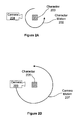
- FIG. 2A illustrates an example of composite motion ambiguity between a camera and a character.
- FIG. 2B illustrates another example of composite motion ambiguity between a camera and a character.
- FIG. 2C illustrates an example of depth ambiguity of a 2D projected path.
- FIG. 3A is a diagram illustrating a hand-drawn character that is annotated with virtual markers, according to one embodiment of the invention.
- FIG. 3B is a diagram illustrating annotations of virtual markers and bounding boxes for the hand-drawn character shown in FIG. 3A , according to one embodiment of the invention.
- FIG. 3C is a flowchart of a method step shown in FIG. 2C , according to one embodiment of the invention.
- FIG. 4A is a diagram illustrating a back-projection of the 2D image into 3D space, according to one embodiment of the invention.
- FIG. 4B is a diagram illustrating details of the back-projection of the 2D image into 3D space, according to one embodiment of the invention.
- FIG. 5A illustrating a pose of the hand-drawn character augmented with secondary motion, according to one embodiment of the invention.
- FIG. 5B illustrating another pose of the hand-drawn character augmented with secondary motion, according to on embodiment of the invention.
- FIGS. 5C-5F illustrate examples of animation frames rendered with a hand-drawn character augmented with secondary motion of water in a puddle, according to one embodiment of the invention.
- Embodiments of the invention provide techniques for augmenting hand-drawn animation with 3D secondary motion to allow a traditionally animated character to drive the motion of 3D scene elements.
- Secondary motion or the motion of objects in response to that of the primary character, is widely used to amplify the audience's response to the character's motion and to provide a connection to the environment.
- These 3D effects are largely passive and tend to be time consuming to animate by hand, yet most are very effectively simulated in current animation software.
- the techniques enable hand-drawn characters to interact with simulated objects such as cloth and clothing, balls and particles, and fluids.
- driving points or volumes for the secondary motion are tracked in two dimensions, reconstructed into three dimensions, and used to drive and collide with the simulated objects. User interaction that can be reasonably integrated into the traditional animation pipeline of drawing, cleanup, inbetweening, and labeling is employed to generate the driving points and volumes.
- One embodiment of the invention provides a computer-implemented method for determining depth data for a two-dimensional animation.
- the method includes receiving the two-dimensional animation, receiving annotations including virtual markers of (x,y) positions of the two-dimensional animation, and receiving three-dimensional motion data that is generated from a separate source than the two-dimensional animation.
- the virtual markers in the two-dimensional animation with (x,y,z) are associated with positions of the three-dimensional motion data.
- a z coordinate of a first (x,y) position of a first marker is determined based on a first (x,y,z) position of the three-dimensional motion data that is associated with the first marker as a depth value of the first marker.
- the techniques for adding secondary motion onto a hand-animated character preserve the animator's original lines, add secondary motion via existing simulation methods, and integrate well into the standard animator's pipeline.
- Three technical contributions enable the addition of secondary motion to hand animations.
- Second, plausible collision volumes are created in 3D. These collision volumes corresponding to the animated character can interact with the desired physical simulation to produce the secondary motions when 3D computer generated objects are rendered.
- Third, for the interaction to look believable the rendered objects (or simulations) are composited with the hand-drawn frames while maintaining relative depth ordering.
- FIG. 1A is a diagram illustrating an example system 100 for animation generation and/or animation playback.
- the system 100 may be configured to generate animation sequences in real-time or for playback.
- the system 100 may also be configured to execute a game and to generate animations during execution of the game.
- the system 100 is further configured to accept and process input from a user and to provide data for displaying the results of such user input.
- the user inputs commands using input devices 108 .
- the input devices 108 may be any device that allows the user to interact with the system 100 .
- the input device 108 may comprise a keyboard, a joystick, a controller, a microphone, a camera, a keypad, or a series of buttons, among other devices and features.
- the system 100 outputs graphics and animations to a display device 110 , the display device 110 may be any device that receives data for display and presents it visually to the user.
- the display device 110 may include a cathode ray tube, a plurality of light emitting diodes (LEDs), a liquid crystal display (LCD), a portable video game console, or a projector, among other devices and features.
- LEDs light emitting diodes
- LCD liquid crystal display
- portable video game console or a projector
- the system 100 includes a central processing unit (CPU) 102 that is in communication with the input devices 108 through an input/output (I/O) bridge 107 .
- the CPU 102 communicates with a graphics processing unit (GPU) 112 through a memory bridge 105 to generate images that are output to the display device 110 .
- graphics processing unit (GPU) 112 In some embodiments, one or more of the GPU 112 , CPU 102 , I/O bridge 107 , and memory bridge 105 are integrated into a single device.
- the system 100 may further include a system memory 104 in communication with the CPU 102 through the memory bridge 105 .
- the CPU 102 is configured to retrieve and execute programming instructions stored in the system memory 104 and system disk 114 .
- the CPU 102 is configured to store and retrieve application data residing in the system memory 104 and system disk 114 .
- the system memory 104 may comprise certain types of random access memory (RAM) such as dynamic random access memory (DRAM) or static random access memory (SRAM), or may comprise any other type of volatile memory.
- RAM random access memory
- DRAM dynamic random access memory
- SRAM static random access memory
- the volatile memory 104 may be used to store data and/or instructions during operation of the CPU 102 .
- the system memory 104 may store animation components 103 that are used to generate animations that include secondary motion.
- the animation components 103 are stored in the system disk 114 Those skilled in the art will recognize other types of memory and uses thereof.
- the system 100 may further include a non-volatile system disk 114 that is in communication with the CPU 102 through the I/O bridge 107 and memory bridge 105 .
- the system disk 114 may include flash memory, magnetic storage devices, hard disks, or read-only memory (ROM) such as erasable programmable read-only memory (EPROM), or any other type of non-volatile memory.
- ROM read-only memory
- EPROM erasable programmable read-only memory
- the system disk 114 may be used to store games, instructions, character information, game status information, or any other information that is to be retained if power to the system 100 is removed.
- the system 100 may comprise an interface to install or temporarily locate additional non-volatile memory. Those skilled in the art will recognize other types of non-volatile memory and uses thereof.
- the GPU 112 is configured to render data supplied by the CPU 102 for display on the display device 110 .
- the GPU 112 may be configured to perform any number of functions related to providing data for display on the display device 110 .
- the GPU 112 may be configured to render a plurality of polygons, apply shading or texture, create data representative of a three-dimensional environment, or convert between coordinate spaces, among other functions.
- Those skilled in the art will recognize other configurations and functionalities of the GPU 110 .
- the system 100 may further include a disc drive 115 in communication with the CPU 102 .
- the CPU 102 may read data from a disc inserted into the disc drive 115 .
- the system 100 is configured to record data on the disc using the disc drive 115 . In this way, data relating to animation may be transported to or from the system 100 . Alternatively, animation data may be transmitted to/from system 100 via a network.
- the system 100 is not limited to the devices, configurations, and functionalities described above.
- a single volatile memory 106 , non-volatile memory 108 , GPU 110 , disc drive 112 , input device 114 , and display device 116 are illustrated, a plurality of any of these devices may be implemented internal or external to the system 100 .
- the system 100 may comprise a power supply or a network access device.
- Other components (not explicitly shown), including USB or other port connections, CD drives, DVD drives, film recording devices, and the like, may also be connected to I/O bridge 107 . Communication paths interconnecting the various components in FIG.
- PCI Peripheral Component Interconnect
- PCI-Express PCI-Express
- AGP Accelerated Graphics Port
- HyperTransport or any other bus or point-to-point communication protocol(s), and connections between different devices may use different protocols as is known in the art.
- Graphics and animations for display by the system 100 can be created using any number of methods and devices.
- a variety of commercially available modeling software may be used to generate graphics and animations representing a three-dimensional environment.
- an animator can create objects and simulations of objects that can be used by the game engine of the system 100 to provide data for display on the display device 110 .
- FIG. 1B is a block diagram of the animation components 103 of FIG. 1A that are configured to implement one or more aspects of the present invention.
- the animation components 103 comprises an animation application 125 including instructions or data that can be used to generate animation.
- the animation application 125 may be configured to augment hand-drawn animation with 3D secondary motion.
- Inputs to the animation application 125 may include hand animation data 120 , motion data 122 , back-projected depth data 124 , collision volume data 126 .
- secondary motion animation data 128 are generated.
- the secondary motion animation data 128 may be combined with the hand animation data 120 to generate augmented animation that is stored in the system memory 104 or dedicated graphics memory associated with the GPU 112 .
- the hand animation data 120 comprises hand-drawn 2D images or characters and annotations that are added to the hand-drawn images or characters by a user.
- a character may be an object or element with human characteristics and behaviors, such as an animated broom, car, or animal.
- the user-provided annotations may include virtual markers, bounding boxes, and segmentation of portions of the character, as described in conjunction with FIGS. 3A and 3B .
- the motion data 122 comprises motion capture poses that are selected by a user to provide z-depth information for the hand-drawn 3D characters.
- the motion data 122 may be selected from a library of three-dimensional motion data.
- the back-projected depth data 124 comprises estimated z-depth values corresponding to the virtual markers.
- the collision volume data 126 comprises collision volumes that are constructed based on the virtual markers and the bounding boxes to simulate a 3D model of the character.
- the secondary motion animation data 128 comprises motion of rendered portions of the image resulting from interactions with the 3D model of the character.
- FIG. 1C is a flowchart of method steps describing the augmenting hand animation with 3D secondary motion, according to one embodiment of the invention.
- Persons skilled in the art would understand that, even though the method is described in conjunction with the systems of FIGS. 1A-2D , any system configured to perform the method steps, in any order, is within the scope of embodiments of the invention.
- the method begins at step 170 , where a processing unit, such as the processing unit that executes the animation application 125 , receives the hand-drawn images or characters included in the hand animation data 120 .
- the processing unit receives the input needed for depth recovery, such as the user-provided annotations included in the hand animation data 120 and the motion data 122 .
- the processing unit generates the 3D driving signal based on the hand animation data 120 and the motion data 122 .
- the 3D driving signal is stored as the back-projected depth data 124 .
- the processing unit generates the collision volumes for the hand animation based on the hand animation data 120 .
- the processing unit performs depth compositing using the back-projected depth data 124 to combine the hand animation with simulated objects to generate secondary motion that responds to the collision volumes and 3D driving signal.
- the animator's original lines may be preserved while adding secondary motion via existing simulation methods, and the techniques integrate well into the standard animator's pipeline.
- the user interaction needed to provide the annotations and specify the motion data 122 can be reasonably integrated into the traditional animation workflow.
- a user (layman or artist) annotates the joint locations of a hand-drawn 2D animation character with ‘dots’ for virtual markers and labels the various body parts.
- the different body parts are then segmented out based on the labels; for example, when colors are used to encode the different labels, all red pixels may be filed out from the non-red pixels to obtain the left arm.
- This user input fits well with the animation pipeline because each layer is already modified multiple times as it passes through the pipeline, and the required annotation is not a significant additional burden.
- the user selects a motion capture segment from a database and the motion capture segment is stored as the motion data 122 .
- the selected motion capture segment should have depth information that is similar to the hand-drawn sequence when viewed from the same point of view.
- the selected motion capture segment is combined (using interpolation or other functions) with one or more additional motion capture segments to produce the motion data 122 .
- the selected motion capture segment is processed or filtered in a manner that modifies the z values to produce the motion data 122 .
- the 3D poses in the motion capture segment provide z-depth information. Frames that are drawn by an artist contain only the perspective view of the animated character. As a result, the motion of the animated character in 3D is not known.
- the ambiguity in 3D motion has two components—depth ambiguity and composite camera-character motion ambiguity.
- the motion capture segment resolves the depth ambiguity and the composite camera-character motion ambiguity.
- the hand-drawn 2D animation may then be “lifted” from two to three dimensions by performing a back-projection of the 2D animation into 3D space, as described in conjunction with FIGS. 4A and 4B .
- FIG. 2A illustrates a first example of composite motion ambiguity between a camera 204 and a character 200 .
- the composite motion ambiguity occurs because the hand-drawn frames do not contain sufficient information to disambiguate the motion of the camera 204 from the motion of the character 200 .
- the camera 204 is stationary and the character 200 moves according to the trajectory shown by character motion 202 .
- FIG. 2B illustrates a second example of composite motion ambiguity between a camera 209 and a character 205 .
- the character 205 is stationary and the camera 209 moves according to the trajectory shown by camera motion 207 .
- the first example and the second example are equivalent.
- secondary motion e.g. a simulated ponytail
- the first example and the second example do not produce the same secondary motion.
- a simulated ponytail should swoosh in an arc, lagging behind the character in time.
- the character 205 is stationary the simulated ponytail should also be stationary. User selection of the motion is used in order to automatically generate the “correct” dynamic motion of the ponytail.
- FIG. 2C illustrates an example of depth ambiguity of a 2D projected path shown as a driving signal in 2D 212 that is coincident with an image plane 220 .
- the depth ambiguity occurs because multiple 3D paths can yield the same 2D projected path viewed from a camera 210 .
- Different 3D paths that each produce the same driving signal in 2D 212 are shown as possible driving signals in 3D 214 , 216 , and 218 .
- An assumption may be made that the character moves according to the user-selected motion capture segment, and that any remaining motion is camera motion.
- the camera motion may also be specified and included as part of the motion data 122 along with the selected motion capture segment.
- information about camera moves may be obtained from a shot exposure sheet or from annotations about the world coordinate frame added by an artist during the process of animating.
- the selected motion capture segment may differ from the hand-animation in timing, in which case the selected motion capture segment may be preprocessed to synchronize with the hand animation using techniques known to those skilled in the art, such as the Dynamic Time Warp algorithm.
- the composite motion ambiguity may be resolved by registering the selected motion capture sequence with the 2D hand animation.
- the specific points having positions that are preserved are identified by a user as virtual markers.
- These virtual markers may be located at points of attachment where a simulated object connects to a hand-drawn character.
- the string of a balloon may connect at a virtual marker on a character's hand.
- the top of a skirt may connect at one or more virtual markers along a character's waist.
- Other virtual markers that may be identified are collision points that, like the attachment points, may also produce secondary motion.
- virtual markers may be located on a character's knees to interact with a simulated skirt.
- a virtual marker may be located on a character's foot to interact with simulated water in a puddle.
- FIG. 3A is a diagram illustrating a hand-drawn character 300 that is annotated with virtual markers 302 , according to one embodiment of the invention.
- a user who can be a lay person annotates the skeleton of the hand-drawn character with N virtual markers and an approximate bounding box for every limb with four markers each. The annotating is performed for each frame of an input 2D hand-drawn animation.
- the virtual markers 302 are found automatically rather than being identified by a user.
- locations of the virtual markers are determined by eroding a silhouette of an object to identify anatomic landmarks of the character.
- the user may also provide a segmentation of the different body parts by labeling portions of the hand-drawn figure.
- each arm may be labeled with a different color
- each leg may be labeled with different colors
- the torso may be labeled with another color
- the head may be labeled with still another color.
- the specification of the annotations may be performed during a traditional 2D animation workflow process.
- the virtual markers may be identified when the cleanup or inbetweening artist re-touches frames of the animated sequence.
- the labeling of different segments may be performed as part of the ink and paint process without requiring additional effort.
- FIG. 3B is a diagram illustrating annotations of virtual markers 302 and bounding boxes 304 for the hand-drawn character shown in FIG. 3A , according to one embodiment of the invention.
- the virtual markers 302 from FIG. 3A are shown in FIG. 3B , however, only some of the virtual markers 302 are labeled in FIG. 3B .
- a user (who can be a lay person) annotates each frame of the input 2D hand-drawn animation with an approximate bounding box for different objects or portions of a character. Each corner of the bounding box corresponds with one of the virtual markers.
- the user may also select the motion data 122 that is used to generate the 3D driving signal.
- the motion data 122 may include motion capture data or computer generated motion data.
- the motion data may be adjusted in time (time warped) to better match the movement of the character and the time warped may also be stored as part of motion data 122 .
- Points in the motion data 122 are associated with the virtual markers to register the motion data 122 .
- the motion data 122 is adapted to the positions of the virtual markers in the image plane. In other words, the positions of the virtual markers are preserved in order to retain the original poses of the objects and characters in the 2D animation that were drawn by an artist.
- FIG. 3C is a flowchart of the method step 275 shown in FIG. 2C to receive user input needed for depth recovery, according to one embodiment of the invention.
- Persons skilled in the art would understand that, even though the method is described in conjunction with the systems of FIGS. 1A-2D , any system configured to perform the method steps, in any order, is within the scope of embodiments of the invention.
- the method step 310 begins at step 310 , where a processing unit, such as the processing unit that executes the animation application 125 , receives motion capture data or computer generated motion data as part of the motion data 122 .
- the processing unit time warps the motion capture data or computer generated motion data to approximate the movement of the character to generate time-warped motion data.
- the selected motion capture data does need not be an exact match for the motion of the hand-drawn animated character.
- the processing unit determines if the camera motion is known, i.e., is included in the motion data 122 . If, at step 325 , the camera motion is not known, then at step 330 the camera motion is defined. Any motion of a character that is not caused by user-selected motion capture data or computer generated motion data, may be defined as camera motion. If, at step 325 , the camera motion is known, then the processing unit proceeds directly to step 335 .
- the processing unit receives the positions of user-specified virtual markers that are added to the hand-drawn animation.
- the processing unit receives definitions of user-specified bounding boxes that are added to the hand-drawn animation.
- the processing unit receives user-specified segmentation information (labeling) for the hand-drawn animation.
- the processing unit receives the positions of points in the time-warped motion data that are associated with the virtual markers. The association of particular points in the time-warped motion data by a user enables registration of the poses of the time-warped motion data to the virtual markers.
- depth values for at least some of the virtual markers may be generated at step 180 by lifting the 2D animation into 3D space based on the motion data 122 , including the time-warped motion data that is associated with the virtual markers.
- FIG. 4A is a diagram illustrating a back-projection 400 of the 2D image into 3D space, according to one embodiment of the invention.
- the virtual markers (not shown) located in the image plane 404 are back-projected from the camera 402 viewpoint into 3D space to generate the 3D virtual markers 405 .
- Back-projection rays originating at the camera pass through each virtual marker in the image plane 404 and end at one of the back-projected virtual markers 405 .
- the z-depth (z coordinate value) of each respective back-projected virtual marker provides the z-depth for the virtual marker in the image plane 404 .
- Depth values of the registered virtual markers are recovered by estimating a 2D to 3D projection matrix M.
- the 3D marker positions are computed across a moving window of K frames around the frame i.
- the primary objective for good registration between points in the time-warped motion data and the virtual markers, is to minimize the geometric projection error
- domain specific constraints are included: skew and tilt are assumed to be zero, the scale factors are computed from the image resolution, the focal length may be pre-specified.
- ⁇ * ( i ) arg ⁇ min ⁇ ⁇ r ⁇ ( ⁇ 1 ⁇ e p + ⁇ 2 ⁇ e g + ⁇ 3 ⁇ e r + ⁇ 4 ⁇ e s ) , ( equation ⁇ ⁇ 1 ) where ⁇ 1 , ⁇ 2 , ⁇ 3 and + ⁇ 4 are the associated weights.
- ⁇ ⁇ M [ m 1 T m 2 T m 3 T ] , are known matrices.
- m i T are the rows of the projection matrix M.
- the z-depth for each virtual marker may then be estimated in order to determine the corresponding depth coordinate for each virtual marker.
- the least squares solution to the following stacked linear system is solved for a window of K frames,
- W is the weight matrix that describes the relative weights between the geometric constraints and the smoothing terms.
- FIG. 4B is a diagram illustrating details of the projection of the 2D image into 3D space, according to one embodiment of the invention.
- the space between the virtual markers is filled with collision volumes 415 , modeled as tapered cylinders connected by spherical joints.
- collision volumes are described as tapered cylinders, spheres and other shapes would be equally easy to register with the hand animation.
- Each cylinder must project to the image plane bounding box (p 1 ,p 2 ,p 3 ,p 4 ) for that limb. These bounding boxes are obtained as part of the user input.
- a semi-automatic routine looks for the boundary as defined by the first black pixel in the direction perpendicular to the line joining markers A and B.
- the routine may incorrectly mark the boundary of the arm as the torso boundary. These cases may be corrected by a user.
- the quadrilateral (p 1 ,p 2 ,p 3 ,p 4 ) is back-projected to the same z-depth as the 3D markers A and B. Then, the quadrilateral is rotated about the axis AB and the surface of revolution defines the collision volume for the limb AB.
- the axis vector ⁇ right arrow over (a) ⁇ x and its magnitude (height) h are determined from the 3D world positions (X A and X B ) for the markers A and B.
- FIG. 4B illustrates these quantities.
- the radii r 1 and r 2 for the faces of the tapered cylinder may then be determined.
- CMP q p g .
- the frame-by-frame 3D markers and collision volumes can be imported into a 3D modeling and animation software package.
- the collision volumes for the hand-drawn character in FIG. 4B may be generated for the skeleton and the character's skirt and hair may be rendered 3D elements.
- the hair and skirt can interact with other objects in the scene.
- a hand-drawn character may be composited with rendered 3D pompoms attached to the character's hands and a rendered skirt attached to the character's waist.
- the character may be imported into a 3D modeling and animation software package.
- a dynamics engine may be used to physically simulate the motion of the pompoms and the skirt, and their interaction with the 3D collision volumes of the hand-drawn character.
- the 3D modeling and animation software package may also used for rendering.
- a depth map and an occlusion map may also be rendered for the 3D elements.
- depth ordering should be maintained during compositing.
- the depth map ⁇ i2 for the rendered scene element is obtained from the 3D modeling and animation software package.
- the depth map ⁇ i1 for the hand-drawn image is computed by linearly interpolating known depths.
- the pixels belonging to a given limb may be obtained by segmentation (label annotations provided by a user).
- segmentation label annotations provided by a user.
- the dark pixels are segmented out by thresholding inside an oriented window along the limb v.
- Every pixel ⁇ tilde over (p) ⁇ ( ⁇ tilde over (p) ⁇ x , ⁇ tilde over (p) ⁇ y ) belonging to the limb is assigned the same depth as the point p closest to it on l.
- This interpolation is performed for every limb to obtain the depth ⁇ i h , and then scale it to match the units of ⁇ i r .
- ⁇ i h be the occlusion map for the hand-drawn frame
- ⁇ i r be the occlusion map for the rendered scene elements.
- FIG. 5A illustrates a pose of the hand-drawn character 502 augmented with secondary motion in a composited scene 500 , according to one embodiment of the invention.
- Two scarves are attached to the wrists of the hand-drawn character 502 .
- a cloth simulation of the two scarves is driven by the three-dimensional trajectory of virtual markers on the wrists of the hand-drawn character 502 .
- the two scarves interact with collision volumes for the body of the hand-drawn character 502 to produce simulated animations 508 and 506 .
- a hand-drawn skirt is attached to virtual markers on the waist of the hand-drawn character 502 .
- FIG. 5B illustrating another pose of the hand-drawn character 512 augmented with secondary motion in a composited scene 510 , according to one embodiment of the invention.
- the two scarves interact with collision volumes for the body of the hand-drawn character 512 to produce simulated animations 518 and 516 .
- FIGS. 5C-5E illustrate examples of animation frames rendered with a hand-drawn character augmented with secondary motion of water in a puddle, according to one embodiment of the invention.
- the techniques that add secondary motion onto a hand-animated character successfully preserve the animator's original lines while enabling the integration of simulated objects that interact with the hand-animated character.
- These techniques integrate well into the standard animator's pipeline.
- the 2D hand animation is “lifted” into 3D by employing user input and by using motion capture data of similar behaviors.
- positions of the hand-drawn animation in the image plane are preserved and z-depth values are determined to generate collision volumes.
- the collision volumes may interact with the simulated 3D elements to produce the secondary motion.
- Various embodiments of the invention may be implemented as a program product for use with a computer system.
- the program(s) of the program product define functions of the embodiments (including the methods described herein) and can be contained on a variety of computer-readable storage media.
- Illustrative computer-readable storage media include, but are not limited to: (i) non-writable storage media (e.g., read-only memory devices within a computer such as CD-ROM disks readable by a CD-ROM drive, flash memory, ROM chips or any type of solid-state non-volatile semiconductor memory) on which information is permanently stored; and (ii) writable storage media (e.g., floppy disks within a diskette drive or hard-disk drive or any type of solid-state random-access semiconductor memory) on which alterable information is stored.
- non-writable storage media e.g., read-only memory devices within a computer such as CD-ROM disks readable by a CD-ROM drive, flash memory,
Landscapes
- Physics & Mathematics (AREA)
- General Physics & Mathematics (AREA)
- Engineering & Computer Science (AREA)
- Theoretical Computer Science (AREA)
- Processing Or Creating Images (AREA)
Abstract
Description
{tilde over (x)} i =[{tilde over (x)} 1 ,{tilde over (y)} 1 ,{tilde over (x)} 2 ,{tilde over (y)} 2 . . . {tilde over (x)} N ,{tilde over (y)} N]T.
The 3D marker positions for the time-warped motion data are
{tilde over (X)} i =[{tilde over (X)} 1 ,{tilde over (Y)} 1 ,{tilde over (Z)} 1,1,{tilde over (X)} 2 ,{tilde over (Y)} 2 ,{tilde over (Z)} 2,1, . . . ,{tilde over (X)} N ,{tilde over (Y)} N ,{tilde over (Z)} N,1,]T,
expressed in homogeneous world coordinates. To increase robustness, the 3D marker positions are computed across a moving window of K frames around the frame i.
Because the projection matrix will also be used to render 3D simulated elements, domain specific constraints are included: skew and tilt are assumed to be zero, the scale factors are computed from the image resolution, the focal length may be pre-specified. The remaining unknown parameters are denoted ρ(i)=(θx(i),θy(i),θz(i),tx(i),ty(i),tz(i))T.
where ω1, ω2, ω3 and +ω4 are the associated weights.
{tilde over (x)} ij ≅MX ij w.
The congruence relation may be rewritten, using a Direct Linear Transform (DLT) algorithm, as
{tilde over (x)} ij ×MX ij w=0. (equation 2)
On rearranging the cross product as a matrix operation,
where
are known matrices. mi T are the rows of the projection matrix M. The z-depth for each virtual marker may then be estimated in order to determine the corresponding depth coordinate for each virtual marker.
m 3 T {tilde over (X)} ij =m 3 T {tilde over (X)} ij w ∀j=1, . . . ,N. (equation 4)
Normalization constraints are added to fix the scale factors in homogenous coordinates to unity.
[0,0,0,1]X ij w=1 ∀j=1, . . . ,N (equation 5)
Stacking the constraints in Equations 3, 4 and 5 yields a linear system for each frame,
A ij X ij w =b ij. (equation 6)
Finally, we add a smoothing term by minimizing ∥Xij w−X(i+1)j w∥2, for all virtual markers j. The least squares solution to the following stacked linear system is solved for a window of K frames,
WA full X full w =b full, (equation 8)
CMP q =p g. (equation 9)
The z-depth of Pq is assumed equal to the z-depth of the corresponding limb marker,
M(3,:)P q =M(3,:)X A for q=1 and 4, (equation 10)
M(3,:)P q =M(3,:)X B for q=2 and 3. (equation 11)
The final constraint sets the scale factor to unity,
[0,0,0,1]P q=1. (equation 12)
Every pixel {tilde over (p)}=({tilde over (p)}x,{tilde over (p)}y) belonging to the limb is assigned the same depth as the point p closest to it on l.
γgray h=0.298γi
α=(255−γgray h)/255. (equation 15)
To incorporate depth ordering, for all pixels p where ηi n(p)=1,
α=α if Δi h<Δi r, 0 otherwise. (equation 16)
The final composited image Ifinal is
I final
Claims (30)
Priority Applications (1)
| Application Number | Priority Date | Filing Date | Title |
|---|---|---|---|
| US12/972,126 US8988422B1 (en) | 2010-12-17 | 2010-12-17 | System and method for augmenting hand animation with three-dimensional secondary motion |
Applications Claiming Priority (1)
| Application Number | Priority Date | Filing Date | Title |
|---|---|---|---|
| US12/972,126 US8988422B1 (en) | 2010-12-17 | 2010-12-17 | System and method for augmenting hand animation with three-dimensional secondary motion |
Publications (1)
| Publication Number | Publication Date |
|---|---|
| US8988422B1 true US8988422B1 (en) | 2015-03-24 |
Family
ID=52683318
Family Applications (1)
| Application Number | Title | Priority Date | Filing Date |
|---|---|---|---|
| US12/972,126 Active 2034-01-22 US8988422B1 (en) | 2010-12-17 | 2010-12-17 | System and method for augmenting hand animation with three-dimensional secondary motion |
Country Status (1)
| Country | Link |
|---|---|
| US (1) | US8988422B1 (en) |
Cited By (13)
| Publication number | Priority date | Publication date | Assignee | Title |
|---|---|---|---|---|
| US20130257877A1 (en) * | 2012-03-30 | 2013-10-03 | Videx, Inc. | Systems and Methods for Generating an Interactive Avatar Model |
| US20140043332A1 (en) * | 2012-02-13 | 2014-02-13 | Total Immersion | Method, device and system for generating a textured representation of a real object |
| CN107481305A (en) * | 2017-08-18 | 2017-12-15 | 苏州歌者网络科技有限公司 | How to make game animation |
| US20180329503A1 (en) * | 2015-11-09 | 2018-11-15 | Carnegie Mellon University | Sensor system for collecting gestural data in two-dimensional animation |
| CN109643334A (en) * | 2016-09-15 | 2019-04-16 | 宝洁公司 | Reverse simulation of multiple fibers |
| US10586367B2 (en) | 2017-01-04 | 2020-03-10 | Samsung Electronics Co., Ltd. | Interactive cinemagrams |
| US10600225B2 (en) * | 2013-11-25 | 2020-03-24 | Autodesk, Inc. | Animating sketches via kinetic textures |
| US10713832B2 (en) * | 2016-05-17 | 2020-07-14 | Disney Enterprises, Inc. | Precomputed environment semantics for contact-rich character animation |
| US20210192681A1 (en) * | 2019-12-18 | 2021-06-24 | Ati Technologies Ulc | Frame reprojection for virtual reality and augmented reality |
| CN113658301A (en) * | 2021-07-29 | 2021-11-16 | 网易(杭州)网络有限公司 | Method and device for detecting interpenetration of animation model |
| US20210390733A1 (en) * | 2020-06-12 | 2021-12-16 | Google Llc | Pose Empowered RGB-Flow Net |
| CN114053696A (en) * | 2021-11-15 | 2022-02-18 | 完美世界(北京)软件科技发展有限公司 | Image rendering processing method and device and electronic equipment |
| CN115082600A (en) * | 2022-06-02 | 2022-09-20 | 网易(杭州)网络有限公司 | Animation production method, animation production device, computer equipment and computer readable storage medium |
Citations (5)
| Publication number | Priority date | Publication date | Assignee | Title |
|---|---|---|---|---|
| US7864181B1 (en) * | 2006-06-08 | 2011-01-04 | Pixar | Shape friction: shape preservation of simulated objects in computer animation |
| US7872653B2 (en) * | 2007-06-18 | 2011-01-18 | Microsoft Corporation | Mesh puppetry |
| US7937253B2 (en) * | 2004-03-05 | 2011-05-03 | The Procter & Gamble Company | Virtual prototyping system and method |
| US8269778B1 (en) * | 2006-06-08 | 2012-09-18 | Pixar | Shape preservation of simulated objects in computer animation |
| US8599197B1 (en) * | 2009-10-02 | 2013-12-03 | Pixar | Annotation-based mesh modification |
-
2010
- 2010-12-17 US US12/972,126 patent/US8988422B1/en active Active
Patent Citations (5)
| Publication number | Priority date | Publication date | Assignee | Title |
|---|---|---|---|---|
| US7937253B2 (en) * | 2004-03-05 | 2011-05-03 | The Procter & Gamble Company | Virtual prototyping system and method |
| US7864181B1 (en) * | 2006-06-08 | 2011-01-04 | Pixar | Shape friction: shape preservation of simulated objects in computer animation |
| US8269778B1 (en) * | 2006-06-08 | 2012-09-18 | Pixar | Shape preservation of simulated objects in computer animation |
| US7872653B2 (en) * | 2007-06-18 | 2011-01-18 | Microsoft Corporation | Mesh puppetry |
| US8599197B1 (en) * | 2009-10-02 | 2013-12-03 | Pixar | Annotation-based mesh modification |
Non-Patent Citations (48)
| Title |
|---|
| [BLCD02] Bregler C., Loeb L., Chuang E., Deshpande H.: "Turning to the Masters: Motion Capturing Cartoons". ACM Transactions on Graphics 21, 3 (Jul. 2002), 9 pgs. |
| Agarwal A., Triggs B.: "Recovering 3D Human Pose From Monocular Images". Pattern Analysis and Machine Intelligence, IEEE Transactions on 28, 1 (2006), p. 1-15. |
| Anjyo K.: "Bridging the Gap Between 2D and 3D: A Stream of Digital Animation Techniques". In Computer Graphics and Applications, 2001. Proceedings. Ninth Pacific Conference on (2001), 4 pgs. |
| Baran I., Vlasic D., Grinspun E., Popovi'C J.: "Semantic Deformation Transfer". ACM Transactions on Graphics 28, 3 (Jul. 2009), 36:1-36:6. 6 pgs. |
| Bourdev L., Malik J.: "Poselets: Body Part Detectors Trained using 3D Human Pose Annotations". In International Conference on Computer Vision (Sep. 2009). 8 pgs. |
| Bregler C., Malik J.: "Tracking People with Twists and Exponential Maps". IEEE Conference on Computer Vision and Pattern Recognition (1998). 8 pgs. |
| Cooper D.: 2D/13D Hybrid Character Animation on "Spirit". In ACM SIGGRAPH '02 (2002), 1 pg. |
| Corrêa W. T., Jensen R. J., Thayer C. E., Finkelstein A.: "Texture Mapping for Cel Animation". In ACM SIGGRAPH '98 (1998), 12 pgs. |
| Culhane S.: "Animation from Script to Screen". St.Martin's Press, New York, 1990. p. 17 and p. 19, 5 pgs. |
| Daniels E.: "Deep Canvas in Disney's Tarzan". In ACM SIGGRAPH '99 (1999), ACM Press / ACM SIGGRAPH, 3 pgs. |
| Davis J., Agrawala M., Chuang E., Popovic Z., Salesin D. H.: "A Sketching Interface for Articulated Figure Animation". In ACM SIGGRAPH/Eurographics Symposium on Computer Animation (2003), 10 pgs. |
| Demirdjian D., Ko T., Darrel T.: "Constraining Human Body Tracking". IEEE International Conference on Computer Vision (2003). p. 1-8. |
| Elgammal A., Lee C.: "Inferring 3D Body Pose From Silhouettes Using Activity Manifold Learning". IEEE Conference on Computer Vision and Pattern Recognition (2004) 8 pgs. |
| Ellis D.: "Dynamic Time Warp" (dtw) in matlab. Web resource, available: http://www.ee.columbia.edu/ dpwe/resources/matlabidtw/, 2003. 5 pgs. |
| Gleicher M.: "Retargetting Motion to New Characters". In ACM SIGGRAPH '98 (Jul. 1998), Computer Graphics Proceedings, Annual Conference Series, p. 1-10. |
| Gonzales R., Woods R.: "Digital Image Processing", 2 ed. Prentice Hall, 2002. 2 pgs. |
| Hartley R., Zisserman A.: "Multiple View Geometry in Computer Vision", 2 ed. Cambridge University Press, 2003. p. 88-90 section 4.1, 6 pgs. |
| Herda L., Urtasun R., Fua P.: "Hierarchical Implicit Surface Joint Limits to Constrain Video-Based Motion Capture". European Conference on Computer Vision (2004), p. 1-14. |
| Hornung A., Dekkers E., Kobbelt L.: "Character Animation From 2D Pictures and 3D Motion Data". ACM Transactions on Graphics 26, 1 (Jan. 2007), 1:1-1:9. 9 pgs. |
| Ikemoto L., Arikan O., Forsyth D.: "Generalizing Motion Edits with Gaussian Processes". ACM Transactions on Graphics 28, 1 (Jan. 2009), 1:1-1:12. 12 pgs. |
| Jain E., Sheikh Y., Hodgins J. K.: "Leveraging the Talent of Hand Animators to Create Three-Dimensional Animation". In ACM SIGGRAPH/Eurographics Symposium on Computer Animation (Aug. 2009). 10 pgs. |
| Johnston O., Thomas F.: "The Illusion of Life: Disney Animation". Disney Editions; Rev Sub edition, 1981. p. 229-284, 58 pgs. |
| Johnston S. F.: Lumo: "Illumination for Cel Animation". In NPAR 2002: Second International Symposium on Non Photorealistic Rendering (Jun. 2002), pp. 45-52 & 156, 9 pgs. |
| Lee H. J., Chen Z.: "Determination of 3D Human Body Postures from a Single View". Computer Vision, Graphics, and Image Processing 30 (1985), 148-168, 21 pgs. |
| Lee J., Chai J., Reitsma P. S. A., Hodgins J. K., Pollard N. S.: "Interactive Control of Avatars Animated with Human Motion Data". ACM SIGGRAPH 2002 21, 3 (Jul. 2002), 10 pgs. |
| Li Y., Gleicher M., Xu Y.-Q., Shum H.-Y.: "Stylizing Motion with Drawings". In ACM SIGGRAPH/Eurographics Symposium on Computer Animation (2003), 11 pgs. |
| Moeslund T. B., Granum E.: "A Survey of Computer Vision-Based Human Motion Capture". Computer Vision and Image Understanding: CVIU 81, (2001), 231-268, 38 pgs. |
| O'Brien J. F., Zordan V. B., Hodgins J. K.: "Combining Active and Passive Simulations for Secondary Motion". IEEE Comput. Graph. Appl. 20, 4 (2000), 86-96, 11 pgs. |
| Petrovi'C L., Fujito B., Williams L, Finkelstein A.: "Shadows for Cel Animation". In ACM SIGGRAPH 2000 (Jul. 2000), 6 pgs. |
| Ramanan D., Forsyth D., Zisserman A.: "Tracking People by Learning Their Appearance". IEEE Transactions on Pattern Analysis and Machine Intelligence 29, (Jan. 2007), 65-81, 17 pgs. |
| Rosenhahn B., Brox T., Cremers D., Seidel H.-P.: "Online Smoothing for Markerless Motion Capture". Pattern recognition-Proc. DAGM 4713. p. 163-172, 10 pgs. |
| Rosenhahn B., Brox T., Cremers D., Seidel H.-P.: "Staying Well Grounded in Markerless Motion Capture". Pattern recognition- Proc. DAGM 5096 (2008), 385-395, 11 pgs. |
| Rosenhahn B., Brox T., Cremers D., Seidel H.-P.: "Online Smoothing for Markerless Motion Capture". Pattern recognition—Proc. DAGM 4713. p. 163-172, 10 pgs. |
| Rosenhahn B., Brox T., Cremers D., Seidel H.-P.: "Staying Well Grounded in Markerless Motion Capture". Pattern recognition— Proc. DAGM 5096 (2008), 385-395, 11 pgs. |
| Rosenhahn B., Brox T., Seidel H.-P.: "Scaled Motion Dynamics for Markerless Motion Capture". IEEE Conference on Computer Vision and Pattern Recognition (2007). 8 pgs. |
| Sakoe H., Chiba S.: "Dynamic Programming Algorithm Optimization for Spoken Word Recognition". IEEE transactions on acoustics, speech and signal processing. vol. ASSP-26, No. 1 Feb. 1978. Readings in speech recognition (1978), p. 43-49, 7 pgs. |
| Sidenbladh H., Black M. J., Fleet D. J.: "Stochastic Tracking of 3D Human Figures Using 2D Image Motion". In European Conference on Computer Vision (2000), Springer-Verlag, pp. 702-718. |
| Sidenbladh H., Black M., Sigal L.: "Implicit Probabilistic Models of Human Motion for Synthesis and Tracking". European Conference on Computer Vision (2002). p. 784- 800, 17pgs. |
| Sminchisescu C., Kanaujia A., Metaxas D.: "Discriminative Density Propagation for 3D Human Motion Estimation". IEEE Conference on Computer Vision and Pattern Recognition (2005). p. 1-8. |
| Sminchisescu C., Triggs B.: "Estimating Articulated Human Motion with Covariance Scaled Sampling". International Journal of Robotics Research. IEEE Conference on Computer Vision and Pattern Recognition (2003). 24 pgs. |
| Sykora D., Sedlack D., Jinchao S., Dingliana J., Collins S.: "Adding Depth to Cartoons Using Sparse Depth (in)Equalities". In Eurographics (2010), vol. 29, 8 pgs. |
| Taylor C. J.: "Reconstruction of Articulated Objects from Point Correspondences in a Single Uncalibrated Image". Computer Vision and Image Understanding 80. Jul. 14, 1999, 16 pgs. |
| Urtasun R., Fleet D. J., Fua P.: "Temporal Motion Models for Monocular and Multiview 3-D Human Body Tracking". Computer Vision and Image Understanding 104, (2006), 36 pgs. |
| Wei X., Chai J.: "Modeling 3D Human Poses from Uncalibrated Monocular Images". IEEE International Conference on Computer Vision (2009), 8 pgs. |
| Wood D. N., Finkelstein A., Hughes J. F., Thayer C. E., Salesin D. H.:"Multiperspective Panoramas for Cel Animation". In ACM SIGGRAPH '97 (Aug. 1997), Computer Graphics Proceedings, Annual Conference Series, 8 pgs. |
| Wu Y., Hua G., Yu T.: "Tracking Articulated Body by Dynamic Markov Network". IEEE International Conference on Computer Vision (2003), 8 pgs. |
| Zhao L., Safonova A.: :"Achieving Good Connectivity-in Motion Graphs". Eurographics/ACM SIGGRAPH Symposium on Computer Animation (2008), 10 pgs. |
| Zhao L., Safonova A.: :"Achieving Good Connectivity—in Motion Graphs". Eurographics/ACM SIGGRAPH Symposium on Computer Animation (2008), 10 pgs. |
Cited By (21)
| Publication number | Priority date | Publication date | Assignee | Title |
|---|---|---|---|---|
| US20140043332A1 (en) * | 2012-02-13 | 2014-02-13 | Total Immersion | Method, device and system for generating a textured representation of a real object |
| US20130257877A1 (en) * | 2012-03-30 | 2013-10-03 | Videx, Inc. | Systems and Methods for Generating an Interactive Avatar Model |
| US10600225B2 (en) * | 2013-11-25 | 2020-03-24 | Autodesk, Inc. | Animating sketches via kinetic textures |
| US20180329503A1 (en) * | 2015-11-09 | 2018-11-15 | Carnegie Mellon University | Sensor system for collecting gestural data in two-dimensional animation |
| US10656722B2 (en) * | 2015-11-09 | 2020-05-19 | Carnegie Mellon University | Sensor system for collecting gestural data in two-dimensional animation |
| US10713832B2 (en) * | 2016-05-17 | 2020-07-14 | Disney Enterprises, Inc. | Precomputed environment semantics for contact-rich character animation |
| CN109643334B (en) * | 2016-09-15 | 2024-02-27 | 宝洁公司 | Simulate multiple fibers in reverse |
| CN109643334A (en) * | 2016-09-15 | 2019-04-16 | 宝洁公司 | Reverse simulation of multiple fibers |
| US10586367B2 (en) | 2017-01-04 | 2020-03-10 | Samsung Electronics Co., Ltd. | Interactive cinemagrams |
| CN107481305A (en) * | 2017-08-18 | 2017-12-15 | 苏州歌者网络科技有限公司 | How to make game animation |
| CN107481305B (en) * | 2017-08-18 | 2021-02-09 | 苏州歌者网络科技有限公司 | Game cartoon making method |
| US20210192681A1 (en) * | 2019-12-18 | 2021-06-24 | Ati Technologies Ulc | Frame reprojection for virtual reality and augmented reality |
| US12148120B2 (en) * | 2019-12-18 | 2024-11-19 | Ati Technologies Ulc | Frame reprojection for virtual reality and augmented reality |
| US20210390733A1 (en) * | 2020-06-12 | 2021-12-16 | Google Llc | Pose Empowered RGB-Flow Net |
| US11776156B2 (en) * | 2020-06-12 | 2023-10-03 | Google Llc | Pose empowered RGB-flow net |
| US12354304B2 (en) | 2020-06-12 | 2025-07-08 | Google Llc | Pose empowered RGB-flow net |
| CN113658301A (en) * | 2021-07-29 | 2021-11-16 | 网易(杭州)网络有限公司 | Method and device for detecting interpenetration of animation model |
| CN113658301B (en) * | 2021-07-29 | 2024-03-22 | 网易(杭州)网络有限公司 | Method and device for detecting penetration of animation model |
| CN114053696A (en) * | 2021-11-15 | 2022-02-18 | 完美世界(北京)软件科技发展有限公司 | Image rendering processing method and device and electronic equipment |
| CN114053696B (en) * | 2021-11-15 | 2023-01-10 | 完美世界(北京)软件科技发展有限公司 | Image rendering processing method, device and electronic equipment |
| CN115082600A (en) * | 2022-06-02 | 2022-09-20 | 网易(杭州)网络有限公司 | Animation production method, animation production device, computer equipment and computer readable storage medium |
Similar Documents
| Publication | Publication Date | Title |
|---|---|---|
| Huang et al. | Arch: Animatable reconstruction of clothed humans | |
| Starck et al. | Model-based multiple view reconstruction of people | |
| Sinha et al. | Interactive 3D architectural modeling from unordered photo collections | |
| Habermann et al. | Hdhumans: A hybrid approach for high-fidelity digital humans | |
| Ichim et al. | Dynamic 3D avatar creation from hand-held video input | |
| US20150178988A1 (en) | Method and a system for generating a realistic 3d reconstruction model for an object or being | |
| US9224245B2 (en) | Mesh animation | |
| Bhat et al. | High fidelity facial animation capture and retargeting with contours | |
| Guo et al. | Handnerf: Neural radiance fields for animatable interacting hands | |
| CN108876814B (en) | A method for generating pose flow images | |
| Vicente et al. | Balloon shapes: Reconstructing and deforming objects with volume from images | |
| Huang et al. | Hybrid skeletal-surface motion graphs for character animation from 4d performance capture | |
| Li et al. | Animated 3D human avatars from a single image with GAN-based texture inference | |
| CN115496863B (en) | Short video generation method and system for scene interaction of movie and television intelligent creation | |
| Shugrina et al. | Creative flow+ dataset | |
| Pighin et al. | Realistic facial animation using image-based 3D morphing | |
| CN119941944B (en) | Method, apparatus, equipment and medium for generating 2D face animation driven by mesh sequence | |
| Eisert et al. | Volumetric video–acquisition, interaction, streaming and rendering | |
| Huang et al. | Global temporal registration of multiple non-rigid surface sequences | |
| Jain et al. | Three-dimensional proxies for hand-drawn characters | |
| Tejera et al. | Animation control of surface motion capture | |
| Gomes et al. | Do as I do: Transferring human motion and appearance between monocular videos with spatial and temporal constraints | |
| Queiroz et al. | A framework for generic facial expression transfer | |
| KR20130117668A (en) | Method of generating 3d volumetric data | |
| Ruhl et al. | Interactive scene flow editing for improved image-based rendering and virtual spacetime navigation |
Legal Events
| Date | Code | Title | Description |
|---|---|---|---|
| AS | Assignment |
Owner name: DISNEY ENTERPRISES, INC., CALIFORNIA Free format text: ASSIGNMENT OF ASSIGNORS INTEREST;ASSIGNOR:HODGINS, JESSICA KATE;REEL/FRAME:027187/0504 Effective date: 20111107 |
|
| STCF | Information on status: patent grant |
Free format text: PATENTED CASE |
|
| MAFP | Maintenance fee payment |
Free format text: PAYMENT OF MAINTENANCE FEE, 4TH YEAR, LARGE ENTITY (ORIGINAL EVENT CODE: M1551); ENTITY STATUS OF PATENT OWNER: LARGE ENTITY Year of fee payment: 4 |
|
| MAFP | Maintenance fee payment |
Free format text: PAYMENT OF MAINTENANCE FEE, 8TH YEAR, LARGE ENTITY (ORIGINAL EVENT CODE: M1552); ENTITY STATUS OF PATENT OWNER: LARGE ENTITY Year of fee payment: 8 |