US8981038B2 - Dinitro monomer, diamine monomer, polyimide and modified polyimide - Google Patents
Dinitro monomer, diamine monomer, polyimide and modified polyimide Download PDFInfo
- Publication number
- US8981038B2 US8981038B2 US13/726,552 US201213726552A US8981038B2 US 8981038 B2 US8981038 B2 US 8981038B2 US 201213726552 A US201213726552 A US 201213726552A US 8981038 B2 US8981038 B2 US 8981038B2
- Authority
- US
- United States
- Prior art keywords
- polyimide
- formula
- monomer
- modified
- modified polyimide
- Prior art date
- Legal status (The legal status is an assumption and is not a legal conclusion. Google has not performed a legal analysis and makes no representation as to the accuracy of the status listed.)
- Active, expires
Links
- 239000004642 Polyimide Substances 0.000 title claims abstract description 110
- 229920001721 polyimide Polymers 0.000 title claims abstract description 110
- 239000000178 monomer Substances 0.000 title claims description 27
- 150000004985 diamines Chemical class 0.000 title claims description 20
- ZXVONLUNISGICL-UHFFFAOYSA-N 4,6-dinitro-o-cresol Chemical group CC1=CC([N+]([O-])=O)=CC([N+]([O-])=O)=C1O ZXVONLUNISGICL-UHFFFAOYSA-N 0.000 title claims description 11
- 229910052736 halogen Inorganic materials 0.000 claims abstract description 11
- 125000005843 halogen group Chemical group 0.000 claims abstract description 10
- 229910052794 bromium Inorganic materials 0.000 claims description 7
- 229910052801 chlorine Inorganic materials 0.000 claims description 6
- 229910052731 fluorine Inorganic materials 0.000 claims description 6
- 238000012360 testing method Methods 0.000 description 28
- 239000000243 solution Substances 0.000 description 16
- IJGRMHOSHXDMSA-UHFFFAOYSA-N Atomic nitrogen Chemical compound N#N IJGRMHOSHXDMSA-UHFFFAOYSA-N 0.000 description 14
- SECXISVLQFMRJM-UHFFFAOYSA-N N-Methylpyrrolidone Chemical class CN1CCCC1=O SECXISVLQFMRJM-UHFFFAOYSA-N 0.000 description 13
- RLSSMJSEOOYNOY-UHFFFAOYSA-N m-cresol Chemical compound CC1=CC=CC(O)=C1 RLSSMJSEOOYNOY-UHFFFAOYSA-N 0.000 description 10
- OKKJLVBELUTLKV-UHFFFAOYSA-N Methanol Chemical compound OC OKKJLVBELUTLKV-UHFFFAOYSA-N 0.000 description 9
- WYURNTSHIVDZCO-UHFFFAOYSA-N Tetrahydrofuran Chemical compound C1CCOC1 WYURNTSHIVDZCO-UHFFFAOYSA-N 0.000 description 9
- 238000006243 chemical reaction Methods 0.000 description 9
- 150000001875 compounds Chemical class 0.000 description 9
- 125000000524 functional group Chemical group 0.000 description 9
- 238000010438 heat treatment Methods 0.000 description 9
- IAZDPXIOMUYVGZ-WFGJKAKNSA-N Dimethyl sulfoxide Chemical compound [2H]C([2H])([2H])S(=O)C([2H])([2H])[2H] IAZDPXIOMUYVGZ-WFGJKAKNSA-N 0.000 description 8
- FXHOOIRPVKKKFG-UHFFFAOYSA-N N,N-Dimethylacetamide Chemical compound CN(C)C(C)=O FXHOOIRPVKKKFG-UHFFFAOYSA-N 0.000 description 8
- ARSQGXMVKOHBTJ-UHFFFAOYSA-N CC1(C)C(C)(C)C(C)(C)C1(C)C.CC12CCCCC1(C)C1(C)CCCCC21C.CC1=C2=C(C)/C=C\C3=C2=C(C=C1)C1=C2=C3C=CC(C)=C2=C(C)/C=C\1.CC1=C2=C(C)C=CC(C)=C2=C(C)C=C1.CC1=CC(C)=C(C)C=C1C.CC1=CC=C(C2=CC(C)=C(C)C=C2)C=C1C.CC1=CC=C(OC2=CC=C(C(C)(C)C3=CC=C(OC4=CC=C(C)C(C)=C4)C=C3)C=C2)C=C1C.CC1C(C)C2C=CC1C(C)C2C.CC1CC(C)C(C)CC1C Chemical compound CC1(C)C(C)(C)C(C)(C)C1(C)C.CC12CCCCC1(C)C1(C)CCCCC21C.CC1=C2=C(C)/C=C\C3=C2=C(C=C1)C1=C2=C3C=CC(C)=C2=C(C)/C=C\1.CC1=C2=C(C)C=CC(C)=C2=C(C)C=C1.CC1=CC(C)=C(C)C=C1C.CC1=CC=C(C2=CC(C)=C(C)C=C2)C=C1C.CC1=CC=C(OC2=CC=C(C(C)(C)C3=CC=C(OC4=CC=C(C)C(C)=C4)C=C3)C=C2)C=C1C.CC1C(C)C2C=CC1C(C)C2C.CC1CC(C)C(C)CC1C ARSQGXMVKOHBTJ-UHFFFAOYSA-N 0.000 description 7
- SBXJDCVISFGWEX-UHFFFAOYSA-N CC1=CC=C(C(=O)C2=CC(C)=C(C)C=C2)C=C1C.CC1=CC=C(C(=O)OCCOC(=O)C2=CC(C)=C(C)C=C2)C=C1C.CC1=CC=C(C(C2=CC(C)=C(C)C=C2)(C(F)(F)F)C(F)(F)F)C=C1C.CC1=CC=C(OC2=CC(C)=C(C)C=C2)C=C1C.CC1=CC=C(OC2=CC(C)=C(C3=CC=C(OC4=CC(C)=C(C)C=C4)C=C3C)C=C2)C=C1C.CC1=CC=C(S(=O)(=O)C2=CC(C)=C(C)C=C2)C=C1C.CC1C(C)C(C)C1C.CC1CC(C)C(C)C1C.CCC(C)C(C)CC Chemical compound CC1=CC=C(C(=O)C2=CC(C)=C(C)C=C2)C=C1C.CC1=CC=C(C(=O)OCCOC(=O)C2=CC(C)=C(C)C=C2)C=C1C.CC1=CC=C(C(C2=CC(C)=C(C)C=C2)(C(F)(F)F)C(F)(F)F)C=C1C.CC1=CC=C(OC2=CC(C)=C(C)C=C2)C=C1C.CC1=CC=C(OC2=CC(C)=C(C3=CC=C(OC4=CC(C)=C(C)C=C4)C=C3C)C=C2)C=C1C.CC1=CC=C(S(=O)(=O)C2=CC(C)=C(C)C=C2)C=C1C.CC1C(C)C(C)C1C.CC1CC(C)C(C)C1C.CCC(C)C(C)CC SBXJDCVISFGWEX-UHFFFAOYSA-N 0.000 description 7
- FWQBSZCDYWGOLG-UHFFFAOYSA-N CC1=CC=C(C2=CC(C3=CC=C(N4C(=O)C5(C(=O)N(C)C5=O)C4=O)C=C3)=NC(C3=CC=C(C)C=C3)=C2)C=C1 Chemical compound CC1=CC=C(C2=CC(C3=CC=C(N4C(=O)C5(C(=O)N(C)C5=O)C4=O)C=C3)=NC(C3=CC=C(C)C=C3)=C2)C=C1 FWQBSZCDYWGOLG-UHFFFAOYSA-N 0.000 description 7
- 238000010521 absorption reaction Methods 0.000 description 7
- 238000000354 decomposition reaction Methods 0.000 description 7
- 239000000463 material Substances 0.000 description 7
- 229910052757 nitrogen Inorganic materials 0.000 description 7
- 230000000052 comparative effect Effects 0.000 description 6
- 229940125782 compound 2 Drugs 0.000 description 6
- 239000003960 organic solvent Substances 0.000 description 6
- IAZDPXIOMUYVGZ-UHFFFAOYSA-N Dimethylsulphoxide Chemical compound CS(C)=O IAZDPXIOMUYVGZ-UHFFFAOYSA-N 0.000 description 5
- ZMXDDKWLCZADIW-UHFFFAOYSA-N N,N-Dimethylformamide Chemical compound CN(C)C=O ZMXDDKWLCZADIW-UHFFFAOYSA-N 0.000 description 5
- 125000003118 aryl group Chemical group 0.000 description 5
- 239000013067 intermediate product Substances 0.000 description 5
- LFQSCWFLJHTTHZ-UHFFFAOYSA-N Ethanol Chemical compound CCO LFQSCWFLJHTTHZ-UHFFFAOYSA-N 0.000 description 4
- CDBYLPFSWZWCQE-UHFFFAOYSA-L Sodium Carbonate Chemical compound [Na+].[Na+].[O-]C([O-])=O CDBYLPFSWZWCQE-UHFFFAOYSA-L 0.000 description 4
- 238000004458 analytical method Methods 0.000 description 4
- 238000002844 melting Methods 0.000 description 4
- 230000008018 melting Effects 0.000 description 4
- 238000006011 modification reaction Methods 0.000 description 4
- 238000000425 proton nuclear magnetic resonance spectrum Methods 0.000 description 4
- 238000005979 thermal decomposition reaction Methods 0.000 description 4
- 238000002411 thermogravimetry Methods 0.000 description 4
- 238000005160 1H NMR spectroscopy Methods 0.000 description 3
- WFDIJRYMOXRFFG-UHFFFAOYSA-N Acetic anhydride Chemical compound CC(=O)OC(C)=O WFDIJRYMOXRFFG-UHFFFAOYSA-N 0.000 description 3
- UHOVQNZJYSORNB-UHFFFAOYSA-N Benzene Chemical compound C1=CC=CC=C1 UHOVQNZJYSORNB-UHFFFAOYSA-N 0.000 description 3
- PAMAHRIRBJJLMS-UHFFFAOYSA-N C1=CC=C2C=CC=CC2=C1.CC1=C2C=CC3=CC=C/C4=C/C=C(/C=C1)C2=C34.CC1=CC(N)=CC=C1.CC1=CC=C(C2=CC(C3=NC=CC=C3)=NC(C3=CC=CC=N3)=C2)C=C1.CC1C2=C(C=CC=C2)C2=C\C=C/C=C\21.COC1=C(OC)C=C(C)C=C1.COC1=CC=C(C)C=C1 Chemical compound C1=CC=C2C=CC=CC2=C1.CC1=C2C=CC3=CC=C/C4=C/C=C(/C=C1)C2=C34.CC1=CC(N)=CC=C1.CC1=CC=C(C2=CC(C3=NC=CC=C3)=NC(C3=CC=CC=N3)=C2)C=C1.CC1C2=C(C=CC=C2)C2=C\C=C/C=C\21.COC1=C(OC)C=C(C)C=C1.COC1=CC=C(C)C=C1 PAMAHRIRBJJLMS-UHFFFAOYSA-N 0.000 description 3
- IJTOIWUHBJMHQL-UHFFFAOYSA-N CC1=CC=C(C2=CC(C3=CC=C(Br)C=C3)=CC(C3=CC=C(N4C(=O)C5=C(C=C(C(C6=CC=C7C(=O)N(C)C(=O)C7=C6)(C(F)(F)F)C(F)(F)F)C=C5)C4=O)C=C3)=N2)C=C1 Chemical compound CC1=CC=C(C2=CC(C3=CC=C(Br)C=C3)=CC(C3=CC=C(N4C(=O)C5=C(C=C(C(C6=CC=C7C(=O)N(C)C(=O)C7=C6)(C(F)(F)F)C(F)(F)F)C=C5)C4=O)C=C3)=N2)C=C1 IJTOIWUHBJMHQL-UHFFFAOYSA-N 0.000 description 3
- CVTZVTIRZDQILV-UHFFFAOYSA-N CC1=CC=C(C2=CC(C3=CC=C(Br)C=C3)=CC(C3=CC=C(N4C(=O)C5=C(C=C(OC6=CC=C7C(=O)N(C)C(=O)C7=C6)C=C5)C4=O)C=C3)=N2)C=C1 Chemical compound CC1=CC=C(C2=CC(C3=CC=C(Br)C=C3)=CC(C3=CC=C(N4C(=O)C5=C(C=C(OC6=CC=C7C(=O)N(C)C(=O)C7=C6)C=C5)C4=O)C=C3)=N2)C=C1 CVTZVTIRZDQILV-UHFFFAOYSA-N 0.000 description 3
- ZPTFXAPQHMYBIT-UHFFFAOYSA-N CC1=CC=C(C2=CC(C3=CC=C(C)C=C3)=NC(C3=CC=C(N)C=C3)=C2)C=C1 Chemical compound CC1=CC=C(C2=CC(C3=CC=C(C)C=C3)=NC(C3=CC=C(N)C=C3)=C2)C=C1 ZPTFXAPQHMYBIT-UHFFFAOYSA-N 0.000 description 3
- VXYPMDMKWRAYOT-UHFFFAOYSA-N CC1=CC=C(C2=CC(C3=CC=C(C)C=C3)=NC(C3=CC=C([N+](=O)[O-])C=C3)=C2)C=C1 Chemical compound CC1=CC=C(C2=CC(C3=CC=C(C)C=C3)=NC(C3=CC=C([N+](=O)[O-])C=C3)=C2)C=C1 VXYPMDMKWRAYOT-UHFFFAOYSA-N 0.000 description 3
- XEKOWRVHYACXOJ-UHFFFAOYSA-N Ethyl acetate Chemical compound CCOC(C)=O XEKOWRVHYACXOJ-UHFFFAOYSA-N 0.000 description 3
- 238000004566 IR spectroscopy Methods 0.000 description 3
- 238000001460 carbon-13 nuclear magnetic resonance spectrum Methods 0.000 description 3
- 229940125898 compound 5 Drugs 0.000 description 3
- 238000000921 elemental analysis Methods 0.000 description 3
- 230000009477 glass transition Effects 0.000 description 3
- -1 mechanical industry Substances 0.000 description 3
- GINQYTLDMNFGQP-UHFFFAOYSA-N n,n-dimethylformamide;methylsulfinylmethane Chemical compound CS(C)=O.CN(C)C=O GINQYTLDMNFGQP-UHFFFAOYSA-N 0.000 description 3
- 239000012074 organic phase Substances 0.000 description 3
- 239000000047 product Substances 0.000 description 3
- 230000009257 reactivity Effects 0.000 description 3
- 239000010409 thin film Substances 0.000 description 3
- 0 *c(cc1)ccc1-c1cc(-c(cc2)ccc2N)nc(-c(cc2)ccc2[N+])c1 Chemical compound *c(cc1)ccc1-c1cc(-c(cc2)ccc2N)nc(-c(cc2)ccc2[N+])c1 0.000 description 2
- 238000001644 13C nuclear magnetic resonance spectroscopy Methods 0.000 description 2
- QTBSBXVTEAMEQO-UHFFFAOYSA-N Acetic acid Chemical compound CC(O)=O QTBSBXVTEAMEQO-UHFFFAOYSA-N 0.000 description 2
- VPOYASJVZKXUBY-UHFFFAOYSA-N COC1=CC=C(C2=CC=C(C3=CC(C4=CC=C(N5C(=O)C6=C(C=C(C(C7=CC=C8C(=O)N(C)C(=O)C8=C7)(C(F)(F)F)C(F)(F)F)C=C6)C5=O)C=C4)=NC(C4=CC=C(C)C=C4)=C3)C=C2)C=C1OC Chemical compound COC1=CC=C(C2=CC=C(C3=CC(C4=CC=C(N5C(=O)C6=C(C=C(C(C7=CC=C8C(=O)N(C)C(=O)C8=C7)(C(F)(F)F)C(F)(F)F)C=C6)C5=O)C=C4)=NC(C4=CC=C(C)C=C4)=C3)C=C2)C=C1OC VPOYASJVZKXUBY-UHFFFAOYSA-N 0.000 description 2
- ZEDCCJAOFZTMNO-UHFFFAOYSA-N COC1=CC=C(C2=CC=C(C3=CC(C4=CC=C(N5C(=O)C6=C(C=C(C(C7=CC=C8C(=O)N(CC9=CC=C(C%10=CC(C%11=CC=C(Br)C=C%11)=CC(C%11=CC=C(N%12C(=O)C%13=C(C=C(C(C%14=CC=C%15C(=O)N(C)C(=O)C%15=C%14)(C(F)(F)F)C(F)(F)F)C=C%13)C%12=O)C=C%11)=N%10)C=C9)C(=O)C8=C7)(C(F)(F)F)C(F)(F)F)C=C6)C5=O)C=C4)=NC(C4=CC=C(C)C=C4)=C3)C=C2)C=C1OC Chemical compound COC1=CC=C(C2=CC=C(C3=CC(C4=CC=C(N5C(=O)C6=C(C=C(C(C7=CC=C8C(=O)N(CC9=CC=C(C%10=CC(C%11=CC=C(Br)C=C%11)=CC(C%11=CC=C(N%12C(=O)C%13=C(C=C(C(C%14=CC=C%15C(=O)N(C)C(=O)C%15=C%14)(C(F)(F)F)C(F)(F)F)C=C%13)C%12=O)C=C%11)=N%10)C=C9)C(=O)C8=C7)(C(F)(F)F)C(F)(F)F)C=C6)C5=O)C=C4)=NC(C4=CC=C(C)C=C4)=C3)C=C2)C=C1OC ZEDCCJAOFZTMNO-UHFFFAOYSA-N 0.000 description 2
- JUJWROOIHBZHMG-UHFFFAOYSA-N Pyridine Chemical compound C1=CC=NC=C1 JUJWROOIHBZHMG-UHFFFAOYSA-N 0.000 description 2
- UIIMBOGNXHQVGW-UHFFFAOYSA-M Sodium bicarbonate Chemical compound [Na+].OC([O-])=O UIIMBOGNXHQVGW-UHFFFAOYSA-M 0.000 description 2
- 238000006069 Suzuki reaction reaction Methods 0.000 description 2
- HEDRZPFGACZZDS-MICDWDOJSA-N Trichloro(2H)methane Chemical compound [2H]C(Cl)(Cl)Cl HEDRZPFGACZZDS-MICDWDOJSA-N 0.000 description 2
- 230000015572 biosynthetic process Effects 0.000 description 2
- 238000010586 diagram Methods 0.000 description 2
- 238000000113 differential scanning calorimetry Methods 0.000 description 2
- 238000011156 evaluation Methods 0.000 description 2
- 229910052739 hydrogen Inorganic materials 0.000 description 2
- 239000001257 hydrogen Substances 0.000 description 2
- 125000000956 methoxy group Chemical group [H]C([H])([H])O* 0.000 description 2
- 230000004048 modification Effects 0.000 description 2
- 238000012986 modification Methods 0.000 description 2
- 229920000642 polymer Polymers 0.000 description 2
- 238000002360 preparation method Methods 0.000 description 2
- 238000001953 recrystallisation Methods 0.000 description 2
- 239000004065 semiconductor Substances 0.000 description 2
- 229910000029 sodium carbonate Inorganic materials 0.000 description 2
- 239000007787 solid Substances 0.000 description 2
- 238000003786 synthesis reaction Methods 0.000 description 2
- YLQBMQCUIZJEEH-UHFFFAOYSA-N tetrahydrofuran Natural products C=1C=COC=1 YLQBMQCUIZJEEH-UHFFFAOYSA-N 0.000 description 2
- 238000001757 thermogravimetry curve Methods 0.000 description 2
- XLYOFNOQVPJJNP-UHFFFAOYSA-N water Chemical compound O XLYOFNOQVPJJNP-UHFFFAOYSA-N 0.000 description 2
- RCVDPBFUMYUKPB-UHFFFAOYSA-N (3,4-dimethoxyphenyl)boronic acid Chemical compound COC1=CC=C(B(O)O)C=C1OC RCVDPBFUMYUKPB-UHFFFAOYSA-N 0.000 description 1
- ZRYZBQLXDKPBDU-UHFFFAOYSA-N 4-bromobenzaldehyde Chemical compound BrC1=CC=C(C=O)C=C1 ZRYZBQLXDKPBDU-UHFFFAOYSA-N 0.000 description 1
- YQYGPGKTNQNXMH-UHFFFAOYSA-N 4-nitroacetophenone Chemical compound CC(=O)C1=CC=C([N+]([O-])=O)C=C1 YQYGPGKTNQNXMH-UHFFFAOYSA-N 0.000 description 1
- QHHKLPCQTTWFSS-UHFFFAOYSA-N 5-[2-(1,3-dioxo-2-benzofuran-5-yl)-1,1,1,3,3,3-hexafluoropropan-2-yl]-2-benzofuran-1,3-dione Chemical compound C1=C2C(=O)OC(=O)C2=CC(C(C=2C=C3C(=O)OC(=O)C3=CC=2)(C(F)(F)F)C(F)(F)F)=C1 QHHKLPCQTTWFSS-UHFFFAOYSA-N 0.000 description 1
- USFZMSVCRYTOJT-UHFFFAOYSA-N Ammonium acetate Chemical compound N.CC(O)=O USFZMSVCRYTOJT-UHFFFAOYSA-N 0.000 description 1
- 239000005695 Ammonium acetate Substances 0.000 description 1
- GPAFUBAIPIGEDK-UHFFFAOYSA-N CC(=O)C1=CC=C(C)C=C1.O=[N+]([O-])C1=CC=C(C2=CC(C3=CC=C(Br)C=C3)=CC(C3=CC=C([N+](=O)[O-])C=C3)=N2)C=C1.[H]C(=O)C1=CC=C(Br)C=C1 Chemical compound CC(=O)C1=CC=C(C)C=C1.O=[N+]([O-])C1=CC=C(C2=CC(C3=CC=C(Br)C=C3)=CC(C3=CC=C([N+](=O)[O-])C=C3)=N2)C=C1.[H]C(=O)C1=CC=C(Br)C=C1 GPAFUBAIPIGEDK-UHFFFAOYSA-N 0.000 description 1
- ULOYWYBYRQLHFE-UHFFFAOYSA-N CC1=CC=C(C2=CC(C3=CC=C(Br)C=C3)=CC(C3=CC=C(N4C(=O)C5=C(C=C(C(C6=CC=C7C(=O)N(C)C(=O)C7=C6)(C(F)(F)F)C(F)(F)F)C=C5)C4=O)C=C3)=N2)C=C1.CCC(=O)C1=CC(C(C2=CC(C(=O)CC3=CC=C(C4=NC(C5=CC=C(C)C=C5)=CC(C5=CC=C(Br)C=C5)=C4)C=C3)=C(C(=O)O)C=C2)(C(F)(F)F)C(F)(F)F)=CC=C1C(=O)O Chemical compound CC1=CC=C(C2=CC(C3=CC=C(Br)C=C3)=CC(C3=CC=C(N4C(=O)C5=C(C=C(C(C6=CC=C7C(=O)N(C)C(=O)C7=C6)(C(F)(F)F)C(F)(F)F)C=C5)C4=O)C=C3)=N2)C=C1.CCC(=O)C1=CC(C(C2=CC(C(=O)CC3=CC=C(C4=NC(C5=CC=C(C)C=C5)=CC(C5=CC=C(Br)C=C5)=C4)C=C3)=C(C(=O)O)C=C2)(C(F)(F)F)C(F)(F)F)=CC=C1C(=O)O ULOYWYBYRQLHFE-UHFFFAOYSA-N 0.000 description 1
- AZILEMPDACUYRE-UHFFFAOYSA-N CC1=CC=C(C2=CC(C3=CC=C(Br)C=C3)=CC(C3=CC=C(N4C(=O)C5=C(C=C(C(C6=CC=C7C(=O)N(C)C(=O)C7=C6)(C(F)(F)F)C(F)(F)F)C=C5)C4=O)C=C3)=N2)C=C1.COC1=CC=C(B(O)O)C=C1OC.COC1=CC=C(C2=CC=C(C3=CC(C4=CC=C(N5C(=O)C6=C(C=C(C(C7=CC=C8C(=O)N(C)C(=O)C8=C7)(C(F)(F)F)C(F)(F)F)C=C6)C5=O)C=C4)=NC(C4=CC=C(C)C=C4)=C3)C=C2)C=C1OC Chemical compound CC1=CC=C(C2=CC(C3=CC=C(Br)C=C3)=CC(C3=CC=C(N4C(=O)C5=C(C=C(C(C6=CC=C7C(=O)N(C)C(=O)C7=C6)(C(F)(F)F)C(F)(F)F)C=C5)C4=O)C=C3)=N2)C=C1.COC1=CC=C(B(O)O)C=C1OC.COC1=CC=C(C2=CC=C(C3=CC(C4=CC=C(N5C(=O)C6=C(C=C(C(C7=CC=C8C(=O)N(C)C(=O)C8=C7)(C(F)(F)F)C(F)(F)F)C=C6)C5=O)C=C4)=NC(C4=CC=C(C)C=C4)=C3)C=C2)C=C1OC AZILEMPDACUYRE-UHFFFAOYSA-N 0.000 description 1
- MUDFAPPADGTXKW-UHFFFAOYSA-N CC1=CC=C(C2=CC(C3=CC=CC=C3)=CC(C3=CC=C(N4C(=O)C5=C(C=C(C(C6=CC=C7C(=O)N(C)C(=O)C7=C6)(C(F)(F)F)C(F)(F)F)C=C5)C4=O)C=C3)=N2)C=C1 Chemical compound CC1=CC=C(C2=CC(C3=CC=CC=C3)=CC(C3=CC=C(N4C(=O)C5=C(C=C(C(C6=CC=C7C(=O)N(C)C(=O)C7=C6)(C(F)(F)F)C(F)(F)F)C=C5)C4=O)C=C3)=N2)C=C1 MUDFAPPADGTXKW-UHFFFAOYSA-N 0.000 description 1
- PEFAVHNKUOQEFU-UHFFFAOYSA-N CCC(=O)C1=CC(C(C2=CC(C(=O)CC3=CC=C(C4=NC(C5=CC=C(C)C=C5)=CC(C5=CC=C(Br)C=C5)=C4)C=C3)=C(C(=O)O)C=C2)(C(F)(F)F)C(F)(F)F)=CC=C1C(=O)O.NC1=CC=C(C2=CC(C3=CC=C(Br)C=C3)=CC(C3=CC=C(N)C=C3)=N2)C=C1.O=C1OC(=O)C2=CC(C(C3=CC=C4C(=O)OC(=O)C4=C3)(C(F)(F)F)C(F)(F)F)=CC=C12 Chemical compound CCC(=O)C1=CC(C(C2=CC(C(=O)CC3=CC=C(C4=NC(C5=CC=C(C)C=C5)=CC(C5=CC=C(Br)C=C5)=C4)C=C3)=C(C(=O)O)C=C2)(C(F)(F)F)C(F)(F)F)=CC=C1C(=O)O.NC1=CC=C(C2=CC(C3=CC=C(Br)C=C3)=CC(C3=CC=C(N)C=C3)=N2)C=C1.O=C1OC(=O)C2=CC(C(C3=CC=C4C(=O)OC(=O)C4=C3)(C(F)(F)F)C(F)(F)F)=CC=C12 PEFAVHNKUOQEFU-UHFFFAOYSA-N 0.000 description 1
- 238000005653 Chichibabin synthesis reaction Methods 0.000 description 1
- SUSINFQRAIQGOI-UHFFFAOYSA-N NC1=CC=C(C2=CC(C3=CC=C(Br)C=C3)=CC(C3=CC=C(N)C=C3)=N2)C=C1.O=[N+]([O-])C1=CC=C(C2=CC(C3=CC=C(Br)C=C3)=CC(C3=CC=C([N+](=O)[O-])C=C3)=N2)C=C1 Chemical compound NC1=CC=C(C2=CC(C3=CC=C(Br)C=C3)=CC(C3=CC=C(N)C=C3)=N2)C=C1.O=[N+]([O-])C1=CC=C(C2=CC(C3=CC=C(Br)C=C3)=CC(C3=CC=C([N+](=O)[O-])C=C3)=N2)C=C1 SUSINFQRAIQGOI-UHFFFAOYSA-N 0.000 description 1
- NFHFRUOZVGFOOS-UHFFFAOYSA-N Pd(PPh3)4 Substances [Pd].C1=CC=CC=C1P(C=1C=CC=CC=1)C1=CC=CC=C1.C1=CC=CC=C1P(C=1C=CC=CC=1)C1=CC=CC=C1.C1=CC=CC=C1P(C=1C=CC=CC=1)C1=CC=CC=C1.C1=CC=CC=C1P(C=1C=CC=CC=1)C1=CC=CC=C1 NFHFRUOZVGFOOS-UHFFFAOYSA-N 0.000 description 1
- GTDPSWPPOUPBNX-UHFFFAOYSA-N ac1mqpva Chemical compound CC12C(=O)OC(=O)C1(C)C1(C)C2(C)C(=O)OC1=O GTDPSWPPOUPBNX-UHFFFAOYSA-N 0.000 description 1
- 229960000583 acetic acid Drugs 0.000 description 1
- 150000007824 aliphatic compounds Chemical class 0.000 description 1
- 230000029936 alkylation Effects 0.000 description 1
- 238000005804 alkylation reaction Methods 0.000 description 1
- 229940043376 ammonium acetate Drugs 0.000 description 1
- 235000019257 ammonium acetate Nutrition 0.000 description 1
- 239000007864 aqueous solution Substances 0.000 description 1
- 150000001491 aromatic compounds Chemical class 0.000 description 1
- 238000004891 communication Methods 0.000 description 1
- 239000006184 cosolvent Substances 0.000 description 1
- 239000012043 crude product Substances 0.000 description 1
- 238000006210 cyclodehydration reaction Methods 0.000 description 1
- 239000012153 distilled water Substances 0.000 description 1
- 238000005516 engineering process Methods 0.000 description 1
- 238000002474 experimental method Methods 0.000 description 1
- 239000012362 glacial acetic acid Substances 0.000 description 1
- 150000002367 halogens Chemical class 0.000 description 1
- 125000005462 imide group Chemical group 0.000 description 1
- 229910052740 iodine Inorganic materials 0.000 description 1
- 239000000203 mixture Substances 0.000 description 1
- 230000005693 optoelectronics Effects 0.000 description 1
- 230000003647 oxidation Effects 0.000 description 1
- 238000007254 oxidation reaction Methods 0.000 description 1
- 238000012856 packing Methods 0.000 description 1
- 238000006068 polycondensation reaction Methods 0.000 description 1
- 239000002861 polymer material Substances 0.000 description 1
- 239000002244 precipitate Substances 0.000 description 1
- 238000012545 processing Methods 0.000 description 1
- 230000005588 protonation Effects 0.000 description 1
- UMJSCPRVCHMLSP-UHFFFAOYSA-N pyridine Natural products COC1=CC=CN=C1 UMJSCPRVCHMLSP-UHFFFAOYSA-N 0.000 description 1
- 238000006722 reduction reaction Methods 0.000 description 1
- 238000010992 reflux Methods 0.000 description 1
- 229910000030 sodium bicarbonate Inorganic materials 0.000 description 1
- 235000017557 sodium bicarbonate Nutrition 0.000 description 1
- 239000000126 substance Substances 0.000 description 1
- 239000000758 substrate Substances 0.000 description 1
- QAOWNCQODCNURD-UHFFFAOYSA-N sulfuric acid Substances OS(O)(=O)=O QAOWNCQODCNURD-UHFFFAOYSA-N 0.000 description 1
- 230000002194 synthesizing effect Effects 0.000 description 1
- 238000010998 test method Methods 0.000 description 1
- 229920006259 thermoplastic polyimide Polymers 0.000 description 1
- FWPIDFUJEMBDLS-UHFFFAOYSA-L tin(II) chloride dihydrate Chemical compound O.O.Cl[Sn]Cl FWPIDFUJEMBDLS-UHFFFAOYSA-L 0.000 description 1
- 238000005406 washing Methods 0.000 description 1
Images


Classifications
-
- C—CHEMISTRY; METALLURGY
- C08—ORGANIC MACROMOLECULAR COMPOUNDS; THEIR PREPARATION OR CHEMICAL WORKING-UP; COMPOSITIONS BASED THEREON
- C08G—MACROMOLECULAR COMPOUNDS OBTAINED OTHERWISE THAN BY REACTIONS ONLY INVOLVING UNSATURATED CARBON-TO-CARBON BONDS
- C08G73/00—Macromolecular compounds obtained by reactions forming a linkage containing nitrogen with or without oxygen or carbon in the main chain of the macromolecule, not provided for in groups C08G12/00 - C08G71/00
- C08G73/06—Polycondensates having nitrogen-containing heterocyclic rings in the main chain of the macromolecule
- C08G73/10—Polyimides; Polyester-imides; Polyamide-imides; Polyamide acids or similar polyimide precursors
- C08G73/1003—Preparatory processes
- C08G73/1007—Preparatory processes from tetracarboxylic acids or derivatives and diamines
-
- C—CHEMISTRY; METALLURGY
- C07—ORGANIC CHEMISTRY
- C07D—HETEROCYCLIC COMPOUNDS
- C07D213/00—Heterocyclic compounds containing six-membered rings, not condensed with other rings, with one nitrogen atom as the only ring hetero atom and three or more double bonds between ring members or between ring members and non-ring members
- C07D213/02—Heterocyclic compounds containing six-membered rings, not condensed with other rings, with one nitrogen atom as the only ring hetero atom and three or more double bonds between ring members or between ring members and non-ring members having three double bonds between ring members or between ring members and non-ring members
- C07D213/04—Heterocyclic compounds containing six-membered rings, not condensed with other rings, with one nitrogen atom as the only ring hetero atom and three or more double bonds between ring members or between ring members and non-ring members having three double bonds between ring members or between ring members and non-ring members having no bond between the ring nitrogen atom and a non-ring member or having only hydrogen or carbon atoms directly attached to the ring nitrogen atom
- C07D213/24—Heterocyclic compounds containing six-membered rings, not condensed with other rings, with one nitrogen atom as the only ring hetero atom and three or more double bonds between ring members or between ring members and non-ring members having three double bonds between ring members or between ring members and non-ring members having no bond between the ring nitrogen atom and a non-ring member or having only hydrogen or carbon atoms directly attached to the ring nitrogen atom with substituted hydrocarbon radicals attached to ring carbon atoms
- C07D213/26—Radicals substituted by halogen atoms or nitro radicals
-
- C—CHEMISTRY; METALLURGY
- C07—ORGANIC CHEMISTRY
- C07D—HETEROCYCLIC COMPOUNDS
- C07D213/00—Heterocyclic compounds containing six-membered rings, not condensed with other rings, with one nitrogen atom as the only ring hetero atom and three or more double bonds between ring members or between ring members and non-ring members
- C07D213/02—Heterocyclic compounds containing six-membered rings, not condensed with other rings, with one nitrogen atom as the only ring hetero atom and three or more double bonds between ring members or between ring members and non-ring members having three double bonds between ring members or between ring members and non-ring members
- C07D213/04—Heterocyclic compounds containing six-membered rings, not condensed with other rings, with one nitrogen atom as the only ring hetero atom and three or more double bonds between ring members or between ring members and non-ring members having three double bonds between ring members or between ring members and non-ring members having no bond between the ring nitrogen atom and a non-ring member or having only hydrogen or carbon atoms directly attached to the ring nitrogen atom
- C07D213/24—Heterocyclic compounds containing six-membered rings, not condensed with other rings, with one nitrogen atom as the only ring hetero atom and three or more double bonds between ring members or between ring members and non-ring members having three double bonds between ring members or between ring members and non-ring members having no bond between the ring nitrogen atom and a non-ring member or having only hydrogen or carbon atoms directly attached to the ring nitrogen atom with substituted hydrocarbon radicals attached to ring carbon atoms
- C07D213/36—Radicals substituted by singly-bound nitrogen atoms
- C07D213/38—Radicals substituted by singly-bound nitrogen atoms having only hydrogen or hydrocarbon radicals attached to the substituent nitrogen atom
-
- C—CHEMISTRY; METALLURGY
- C08—ORGANIC MACROMOLECULAR COMPOUNDS; THEIR PREPARATION OR CHEMICAL WORKING-UP; COMPOSITIONS BASED THEREON
- C08G—MACROMOLECULAR COMPOUNDS OBTAINED OTHERWISE THAN BY REACTIONS ONLY INVOLVING UNSATURATED CARBON-TO-CARBON BONDS
- C08G73/00—Macromolecular compounds obtained by reactions forming a linkage containing nitrogen with or without oxygen or carbon in the main chain of the macromolecule, not provided for in groups C08G12/00 - C08G71/00
- C08G73/06—Polycondensates having nitrogen-containing heterocyclic rings in the main chain of the macromolecule
- C08G73/10—Polyimides; Polyester-imides; Polyamide-imides; Polyamide acids or similar polyimide precursors
- C08G73/1067—Wholly aromatic polyimides, i.e. having both tetracarboxylic and diamino moieties aromatically bound
-
- C—CHEMISTRY; METALLURGY
- C08—ORGANIC MACROMOLECULAR COMPOUNDS; THEIR PREPARATION OR CHEMICAL WORKING-UP; COMPOSITIONS BASED THEREON
- C08G—MACROMOLECULAR COMPOUNDS OBTAINED OTHERWISE THAN BY REACTIONS ONLY INVOLVING UNSATURATED CARBON-TO-CARBON BONDS
- C08G73/00—Macromolecular compounds obtained by reactions forming a linkage containing nitrogen with or without oxygen or carbon in the main chain of the macromolecule, not provided for in groups C08G12/00 - C08G71/00
- C08G73/06—Polycondensates having nitrogen-containing heterocyclic rings in the main chain of the macromolecule
- C08G73/10—Polyimides; Polyester-imides; Polyamide-imides; Polyamide acids or similar polyimide precursors
- C08G73/1075—Partially aromatic polyimides
- C08G73/1078—Partially aromatic polyimides wholly aromatic in the diamino moiety
-
- C—CHEMISTRY; METALLURGY
- C08—ORGANIC MACROMOLECULAR COMPOUNDS; THEIR PREPARATION OR CHEMICAL WORKING-UP; COMPOSITIONS BASED THEREON
- C08G—MACROMOLECULAR COMPOUNDS OBTAINED OTHERWISE THAN BY REACTIONS ONLY INVOLVING UNSATURATED CARBON-TO-CARBON BONDS
- C08G73/00—Macromolecular compounds obtained by reactions forming a linkage containing nitrogen with or without oxygen or carbon in the main chain of the macromolecule, not provided for in groups C08G12/00 - C08G71/00
- C08G73/06—Polycondensates having nitrogen-containing heterocyclic rings in the main chain of the macromolecule
- C08G73/10—Polyimides; Polyester-imides; Polyamide-imides; Polyamide acids or similar polyimide precursors
- C08G73/1085—Polyimides with diamino moieties or tetracarboxylic segments containing heterocyclic moieties
Definitions
- the invention relates to a dinitro monomer, a diamine monomer, a polyimide, and a modified polyimide.
- polyimide is a polymer material obtained from the polycondensation reaction between a diamine monomer and a dianhydride monomer.
- Polyimide contains an imide group, and may be divided into aliphatic and aromatic compounds.
- aromatic polyimides have good chemical resistance, mechanical property, and thermal stability, and therefore are widely applied to the semiconductor industry, optoelectronics industry, aeronautical materials, biomedical materials, auto industry, communication materials, mechanical industry, and thin film industry.
- polyimide due to the superior electrical property of polyimide, polyimide is utilized in the semiconductor substrates and in packing materials, and has become an integral material in the cutting-edge technology industry.
- polyimide still has some problems in processing and preparation.
- the melting temperature of polyimide is very high, polyimide may not be processed by hot melting.
- the solubility of polyimide in organic solvents is poor, and even some of the aromatic polyimides may only be dissolved in concentrated sulfuric acid. Since the poor solubility is not conductive to the processability of aromatic polyimides, increasing the processability and applicability of aromatic polyimides by preparing a soluble or thermoplastic polyimide is a current issue that those skilled in the art urgently need to solve.
- the invention provides a dinitro monomer having a heterocyclic pyridine structure.
- the invention provides a diamine monomer having a heterocyclic pyridine structure.
- the invention provides a polyimide having a reactive group.
- the invention provides a modified polyimide having a modified group.
- the modified polyimide has good processability and thermal stability.
- the invention provides a dinitro monomer including the structure shown in Formula I:
- the invention provides a diamine monomer including the structure shown in Formula II:
- the invention provides a polyimide including the structure shown in Formula III:
- a 1 is selected from one of Formula 1 to Formula 18, and n is 2 to 500,
- the invention provides a modified polyimide including the structure shown in Formula VI:
- a 1 is selected from one of Formula 1 to Formula 18, A 2 is selected from one of Formula 19 to Formula 25, and n is 2 to 500,
- the diamine monomer may be synthesized from the dinitro monomer of the invention, and the polyimide having a reactive group may be synthesized from the diamine monomer, wherein the polyimide having the reactive group may introduce different functional groups to obtain the modified polyimide.
- the modified polyimide of the invention has good thermal stability and superior processability.
- FIG. 1 is a 1 H-NMR spectrum of diamine compound 2.
- FIG. 2 is a 13 C-NMR spectrum of diamine compound 2.
- FIG. 3 is a 1 H-NMR spectrum of polyimide compound 4.
- FIG. 4 is a 13 C-NMR spectrum of polyimide compound 4.
- FIG. 5 is a 13 C-NMR spectrum of polyimide compound 4.
- FIG. 6 is a 1 H-NMR spectrum of modified polyimide compound 5.
- FIG. 7 is a TGA curve diagram obtained from the thermal gravimetric analysis of embodiment 1 in nitrogen and air.
- the diamine monomer of the present embodiment is obtained from the synthesis of the dinitro monomer, and therefore includes the structure shown in Formula II:
- the polyimide of the present embodiment is obtained from the synthesis of the diamine monomer, and therefore includes the structure shown in Formula III:
- a 1 is selected from one of Formula 1 to Formula 18, and n is 2 to 500,
- X is F, Cl, Br, or I.
- Halogen is a group with good reactivity, and the reactive group may facilitate further reactions of the polyimide, so that the position of the reactive group may be substituted by a functional group. Accordingly, the characteristics of the polyimide may be modified, such as solubility, thermal stability, oxidation resistance, protonation, alkylation, electron affinity, photochemical and electronic properties, or electron transporting property.
- the polyimide is as shown in Formula IV:
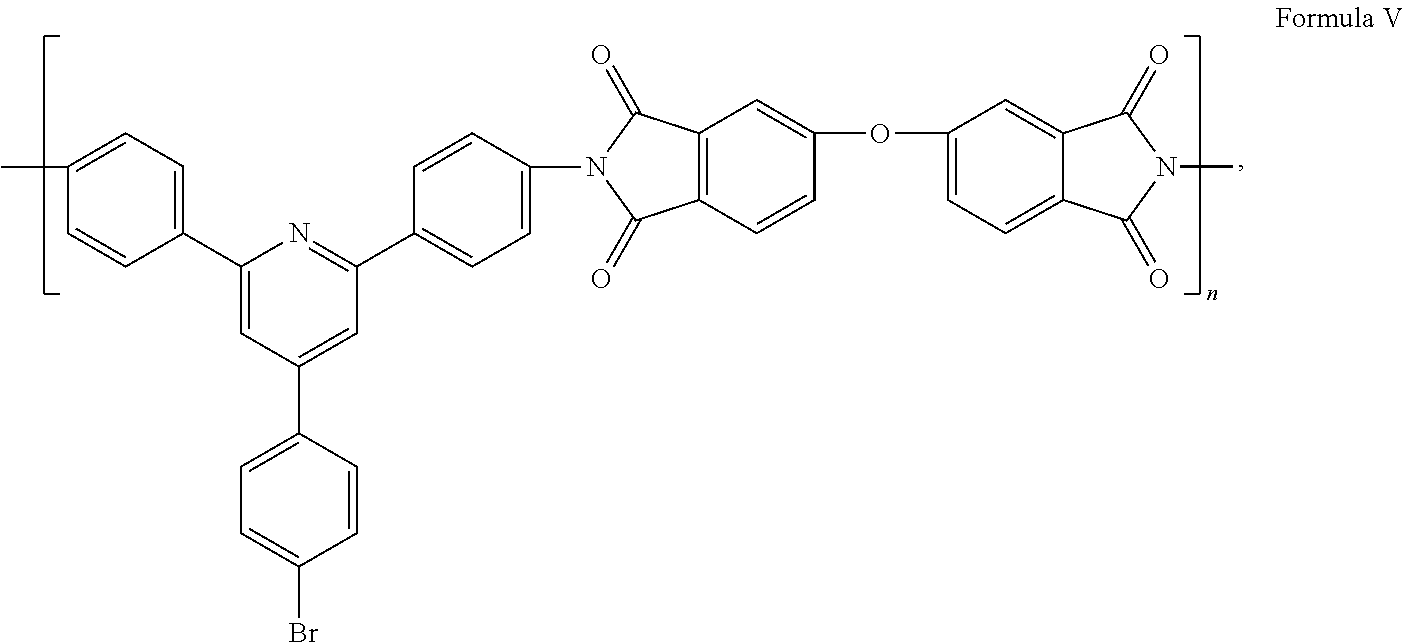
- the polyimide is as shown in Formula V:
- the modified polyimide of the present embodiment is obtained from the modification reaction of the polyimide having a reactive group.
- a functional group may be introduced into the polyimide frame by the modification reaction to obtain a modified polyimide.
- the modification reaction is, for instance, Suzuki coupling reaction or another appropriate chemical reaction.
- the X of the polyimide is preferably Br or I.
- a 1 is selected from one of Formula 1 to Formula 18, A 2 is selected from one of Formula 19 to Formula 25, and n is 2 to 500,
- the thermal decomposition temperature (T d ) of the modified polyimide in nitrogen is 400° C. to 650° C. In an embodiment, the thermal decomposition temperature of the modified polyimide in nitrogen is 530° C. to 545° C. (as shown in Table 6).
- the thermal decomposition temperature of the modified polyimide in air is 400° C. to 650° C. In an embodiment, the thermal decomposition temperature of the modified polyimide in air is 514° C. to 523° C. (as shown in Table 6). It is acquired that the modified polyimide of the present embodiment has good thermal stability. It should be noted that, the decomposition temperature (T d ) of the present embodiment refers to the heating temperature when 10% by weight of the test sample is lost in the thermogravimetry analysis (TGA).
- the modified polyimide is as shown in Formula VII,
- the modified polyimide is as shown in Formula VIII,
- the modified polyimide of the present embodiment by synthesizing the monomer molecules.
- the polyimide having a reactive group is modified so that a modified polyimide with the desired properties may be more readily obtained.
- DSC Differential scanning calorimetry
- the characteristic absorption peak of the C ⁇ N ring is at 1593 cm ⁇ 1
- the characteristic absorption peak of the N ⁇ O is at 1342 cm ⁇ 1 .
- the asymmetric stretch characteristic absorption peak of the N—H is at 3438 cm ⁇ 1
- the symmetric stretch characteristic absorption peak of the N—H is at 3344 cm ⁇ 1
- the characteristic absorption peak of the C ⁇ N ring is at 1593 cm ⁇ 1 .
- step (3) 0.5 ml of pyridine and 1.0 ml of acetic anhydride are added to the solution of step (3) to react for 1 hour at room temperature. Then, the solution is heated to 100° C. and reacted in an environment at 100° C. for 4 hours for a cyclodehydration reaction in order to obtain polyimide compound 4. The yield is 97%. The following qualitative tests are performed on polyimide compound 4.
- Infrared spectroscopy the characteristic absorption peaks of the C ⁇ O are at 1785 and 1725 cm ⁇ 1 , and the characteristic absorption peak of the C—N is at 1370 cm ⁇ 1 .
- modified polyimide compound 5 has an aromatic hydrogen signal and a methoxy hydrogen signal, thereby proving that polyimide compound 4 may indeed achieve the purpose of modification by experimental methods.
- modified polyimide compound 5 has an aromatic hydrogen signal and a methoxy hydrogen signal, thereby proving that polyimide compound 4 may indeed achieve the purpose of modification by experimental methods.
- FIG. 6 please refer to the structure shown in Formula VIII and the integral value of the signal of FIG. 6 , wherein x reaches 99%. In other words, the introduction ratio of an electron donating group containing a methoxy group into polyimide compound 4 may reach 99%.
- polyimide compound 4 as embodiment 1, the following test structure is obtained after testing.
- the inherent viscosity is 0.603 dL/g
- the molecular weight is 2.9 ⁇ 10 4
- the tensile strength is 68 MPa
- the elongation at break value is 9%
- the initial modulus is 1.87 GPa.
- FIG. 7 is a TGA curve diagram obtained from the thermal gravimetric analysis of embodiment 1 in nitrogen and air, wherein the decomposition temperature refers to the heating temperature when 10% by weight of the test sample is lost.
- the decomposition temperature of embodiment 1 in nitrogen is 545° C.
- the decomposition temperature of embodiment 1 in air is 530° C. It is acquired that the polyimide of embodiment 1 has good thermal stability.
- ++ represents soluble at room temperature
- + represents soluble after heating
- + ⁇ represents partial soluble after heating
- ⁇ represents insoluble after heating.
- NMP is N-methyl-2-pyrrolidone.
- DMAc is N,N-dimethyl acetamide.
- DMF is dimethyl formamide.
- DMSO is dimethyl sulfoxide.
- THF is tetrahydrofuran.
- m-cresol 3-methylphenol.
- Embodiment 1 to embodiment 13 are framed by the structure shown in Formula II, wherein X is Br and A 1 is the polyimide formed by Formula 1 to Formula 13.
- Table 3 shows the solubility test results of embodiment 1 to embodiment 13.
- Embodiment 14 to embodiment 20 are framed by the structure shown in Formula V, wherein A 1 is the structure shown in Formula 1, and A 2 is the modified polyimide formed by Formula 19 to Formula 25.
- Table 4 shows the solubility test results of embodiment 14 to embodiment 20.
- a relative viscosity ( ⁇ rel ) test and an inherent viscosity ( ⁇ inh ) test are performed on the polyimide of each of embodiments 1 to 6 and embodiments 12 to 13 and the modified polyimide of each of embodiments 14 to 20, wherein each test sample is tested by dissolving in DMAc at a concentration of 0.5 g/dL and at 30° C.
- the test results are as shown in Table 5.
- Embodiment 1 1.353 0.603 Embodiment 2 1.201 0.550 Embodiment 3 1.166 0.562 Embodiment 4 1.214 0.568 Embodiment 5 1.167 0.590 Embodiment 6 1.385 0.651 Embodiment 12 1.058 0.549 Embodiment 13 1.027 0.542 Embodiment 14 1.342 0.583 Embodiment 15 1.338 0.593 Embodiment 16 1.356 0.602 Embodiment 17 1.344 0.597 Embodiment 18 1.352 0.589 Embodiment 19 1.320 0.579 Embodiment 20 1.311 0.573
- a glass transition temperature (T g ) test and a decomposition temperature (T d ) test are performed on the polyimide of each of embodiments 1 to 7 and the modified polyimide of each of embodiments 14 to 20, wherein the decomposition temperature refers to the heating temperature when 10% by weight of the test sample is lost.
- the test results are as shown in Table 6.
- a mechanical property test is performed on the polyimide of each of embodiments 1 to 13 and the modified polyimide of each of embodiments 14 to 20, such as the tests of tensile strength, elongation at break value, and tensile modulus.
- the test method is: a thin film is formed by dissolving the polyimide of each of embodiments 1 to 13 and the modified polyimide of each of embodiments 14 to 20 in DMAc. A mechanical property test is then performed on each thin film. The test results are as shown in Table 7.
- a polyimide having a reactive group may be synthesized from the diamine monomer of the invention, and a modified polyimide may be obtained by introducing a functional group via the reaction of the polyimide having a reactive group.
- a modified polyimide having the desired properties may be obtained. Accordingly, the modified polyimide of the invention may have good solubility, thermal stability, superior processability, and mechanical property.
Landscapes
- Chemical & Material Sciences (AREA)
- Organic Chemistry (AREA)
- Health & Medical Sciences (AREA)
- Chemical Kinetics & Catalysis (AREA)
- Medicinal Chemistry (AREA)
- Polymers & Plastics (AREA)
- Macromolecular Compounds Obtained By Forming Nitrogen-Containing Linkages In General (AREA)
Abstract

wherein X is halogen, A1 is selected from one of Formula 1 to Formula 18, and n is from 2 to 500,


Description


-
- wherein X is halogen. In other embodiments, X is F, Cl, Br, or I. The dinitro monomer of the present embodiment is a dinitro compound containing a heterocyclic pyridine structure.
<Diamine Monomer>
- wherein X is halogen. In other embodiments, X is F, Cl, Br, or I. The dinitro monomer of the present embodiment is a dinitro compound containing a heterocyclic pyridine structure.

-
- wherein X is halogen. In other embodiments, X is F, Cl, Br, or I. The diamine monomer of the present embodiment is a diamine compound containing a heterocyclic pyridine structure.
<Polyimide>
- wherein X is halogen. In other embodiments, X is F, Cl, Br, or I. The diamine monomer of the present embodiment is a diamine compound containing a heterocyclic pyridine structure.


-
- wherein n is 2 to 500. The polyimide of the present embodiment has a bromic group and therefore has good solubility in organic solvents. As a result, the polyimide has good processability. Moreover, since the bromic group of the polyimide of the present embodiment has good reactivity, the bromic group may facilitate further reactions and introduce a functional group to adjust the properties of the desired polyimide.
-
- wherein n is 2 to 500. The polyimide of the present embodiment has a bromic group and therefore has good solubility in organic solvents. As a result, the polyimide has good processability. Moreover, since the bromic group of the polyimide of the present embodiment has good reactivity, the bromic group may facilitate further reactions to introduce a functional group in order to adjust the properties of the desired polyimide.
<Modified Polyimide>
- wherein n is 2 to 500. The polyimide of the present embodiment has a bromic group and therefore has good solubility in organic solvents. As a result, the polyimide has good processability. Moreover, since the bromic group of the polyimide of the present embodiment has good reactivity, the bromic group may facilitate further reactions to introduce a functional group in order to adjust the properties of the desired polyimide.


-
- wherein n is 2 to 500. The modified polyimide of the present embodiment has good solubility in organic solvents. Moreover, in the present embodiment, an electron donating group is used to substitute the reactive group in polyimide, so that the modified polyimide has stable charge transferability. Therefore, the modified polyimide is suitable as a material for write once read many (WORM) memory devices. Of course, the invention is not limited thereto. In other embodiments, different functional groups may also be used to adjust the characteristics of the modified polyimide.

-
- wherein x is 0% to 100%, y is 0% to 100%, and wherein x and y are not both 0%. When y is 100%, unmodified polyimide is represented. When x is 100%, all of the reactive groups of the polyimide are modified into electron donating groups with each having a methoxy group. Similar to the above embodiment, the modified polyimide of the present embodiment has good solubility and stable charge transferability toward organic solvents, and is suitable as a material for WORM memory devices. Of course, the invention is not limited thereto. In other embodiments, different functional groups may also be used to adjust the characteristics of the modified polyimide.


| TABLE 1 |
 |
| |
 |
| |
 |
| Comparative Example 1 |
| TABLE 2 | |||||||
| NMP | DMAc | DMF | DMSO | THF | m- | ||
| Embodiment |
| 1 | ++ | ++ | ++ | ++ | ++ | ++ |
| |
++ | ++ | ++ | +− | +− | ++ |
| Comparative | ++ | ++ | + | + | N/A | − |
| Example 1 | ||||||
| TABLE 3 | |||||||
| NMP | DMAc | DMF | DMSO | THF | m- | ||
| Embodiment |
| 1 | ++ | ++ | ++ | ++ | ++ | ++ |
| |
++ | ++ | ++ | +− | +− | ++ |
| Embodiment 3 | ++ | ++ | ++ | ++ | +− | ++ |
| |
++ | ++ | ++ | ++ | +− | +− |
| Embodiment 5 | ++ | ++ | ++ | +− | +− | +− |
| |
++ | ++ | ++ | ++ | +− | +− |
| |
++ | ++ | ++ | + | +− | +− |
| Embodiment 8 | ++ | ++ | ++ | ++ | +− | ++ |
| Embodiment 9 | ++ | ++ | ++ | +− | +− | ++ |
| |
++ | ++ | ++ | ++ | + | ++ |
| |
++ | ++ | ++ | ++ | +− | ++ |
| |
++ | ++ | ++ | +− | +− | +− |
| |
++ | ++ | ++ | ++ | −− | +− |
| TABLE 4 | |||||||
| NMP | DMAc | DMF | DMSO | THF | m- | ||
| Embodiment |
| 14 | ++ | ++ | ++ | ++ | ++ | ++ |
| |
++ | ++ | ++ | ++ | +− | +− |
| |
++ | ++ | ++ | ++ | +− | ++ |
| |
++ | ++ | ++ | ++ | ++ | ++ |
| |
++ | ++ | ++ | ++ | ++ | ++ |
| |
++ | ++ | ++ | ++ | +− | +− |
| |
++ | ++ | ++ | ++ | +− | +− |
| TABLE 5 | |||
| ηrel (dL/g) | ηinh (dL/g) | ||
| |
1.353 | 0.603 | ||
| |
1.201 | 0.550 | ||
| Embodiment 3 | 1.166 | 0.562 | ||
| |
1.214 | 0.568 | ||
| Embodiment 5 | 1.167 | 0.590 | ||
| |
1.385 | 0.651 | ||
| |
1.058 | 0.549 | ||
| |
1.027 | 0.542 | ||
| |
1.342 | 0.583 | ||
| |
1.338 | 0.593 | ||
| |
1.356 | 0.602 | ||
| |
1.344 | 0.597 | ||
| |
1.352 | 0.589 | ||
| |
1.320 | 0.579 | ||
| |
1.311 | 0.573 | ||
| TABLE 6 | |||
| Td (° C.) | |||
| Tg (° C.) | In nitrogen | In | ||
| Embodiment |
| 1 | — | 545 | 530 | |
| |
— | 505 | 497 | |
| Embodiment 3 | — | 518 | 505 | |
| |
— | 520 | 509 | |
| Embodiment 5 | — | 507 | 498 | |
| |
— | 509 | 501 | |
| |
— | 505 | 494 | |
| |
231 | 533 | 516 | |
| |
247 | 541 | 519 | |
| |
205 | 530 | 514 | |
| |
220 | 535 | 517 | |
| |
221 | 532 | 517 | |
| |
244 | 543 | 520 | |
| |
253 | 545 | 523 | |
| “—” of the table: represents that glass transition temperature is not determined within 340° C. |
| TABLE 7 | ||||
| Tensile | Elongation at | Tensile | ||
| strength | break value | modulus | ||
| (MPa) | (%) | (GPa) | ||
| |
68 | 9 | 1.87 | ||
| |
69 | 8 | 1.77 | ||
| Embodiment 3 | 68 | 8 | 1.75 | ||
| |
68 | 9 | 1.82 | ||
| Embodiment 5 | 65 | 10 | 1.77 | ||
| |
72 | 13.5 | 2.23 | ||
| |
69 | 10 | 2.01 | ||
| Embodiment 8 | 67 | 8 | 1.92 | ||
| Embodiment 9 | 66 | 7 | 1.85 | ||
| |
66 | 7 | 1.83 | ||
| |
65 | 7 | 1.79 | ||
| |
65 | 8 | 1.75 | ||
| |
65 | 7 | 1.72 | ||
| |
68 | 9 | 1.87 | ||
| |
68 | 8 | 1.85 | ||
| |
67 | 8 | 1.80 | ||
| |
66 | 10 | 1.77 | ||
| |
66 | 11 | 1.75 | ||
| |
66 | 7 | 1.73 | ||
| |
66 | 7 | 1.70 | ||
Claims (11)


Priority Applications (1)
| Application Number | Priority Date | Filing Date | Title |
|---|---|---|---|
| US13/726,552 US8981038B2 (en) | 2012-12-25 | 2012-12-25 | Dinitro monomer, diamine monomer, polyimide and modified polyimide |
Applications Claiming Priority (1)
| Application Number | Priority Date | Filing Date | Title |
|---|---|---|---|
| US13/726,552 US8981038B2 (en) | 2012-12-25 | 2012-12-25 | Dinitro monomer, diamine monomer, polyimide and modified polyimide |
Publications (2)
| Publication Number | Publication Date |
|---|---|
| US20140179878A1 US20140179878A1 (en) | 2014-06-26 |
| US8981038B2 true US8981038B2 (en) | 2015-03-17 |
Family
ID=50975364
Family Applications (1)
| Application Number | Title | Priority Date | Filing Date |
|---|---|---|---|
| US13/726,552 Active 2033-05-28 US8981038B2 (en) | 2012-12-25 | 2012-12-25 | Dinitro monomer, diamine monomer, polyimide and modified polyimide |
Country Status (1)
| Country | Link |
|---|---|
| US (1) | US8981038B2 (en) |
Families Citing this family (3)
| Publication number | Priority date | Publication date | Assignee | Title |
|---|---|---|---|---|
| JP6252752B2 (en) * | 2013-04-09 | 2017-12-27 | Jsr株式会社 | Liquid crystal alignment agent |
| CN105237466B (en) * | 2015-10-26 | 2017-08-25 | 南阳师范学院 | A kind of method for synthesizing three substituted pyridine derivatives |
| KR102273366B1 (en) * | 2019-12-10 | 2021-07-06 | 주식회사 오플렉스 | Colorless polyimide manufactured by single pot synthesizing |
-
2012
- 2012-12-25 US US13/726,552 patent/US8981038B2/en active Active
Non-Patent Citations (4)
| Title |
|---|
| Liaw et al., "Synthesis and Characterization of Novel Diamine and Polyimides Containing Pyridine Heterocyclic and Bromic Functional Groups," The 60th Annual Report of CITE, Dec. 15, 2012, pp. 417-424. |
| Liu et al., "New Liquid-Crystal Alignment Agents Based on Fluorinated Polyimides with Trifluoromethyl-Substituted Benzene or Diphenylether in the Side Chain," Journal of Polymer Science: Part A: Polymer Chemistry 40(10), May 15, 2002, pp. 1583-1593. |
| Tamami et al., "Preparation and Properties of Novel Polyimides Derived from 4-Aryl-2,6 Bis(4-amino phenyl) pyridine," Journal of Polymer Science: Part A: Polymer Chemistry 39(21), Nov. 1, 2001, pp. 3826-3831. |
| Zhang et al., "Study on synthesis and characterization of novel polyimides derived from 2,6-Bis(3-aminobenzoyl) pyridine," European Polymer Journal 41(5), May 2005, pp. 1097-1107. |
Also Published As
| Publication number | Publication date |
|---|---|
| US20140179878A1 (en) | 2014-06-26 |
Similar Documents
| Publication | Publication Date | Title |
|---|---|---|
| Wang et al. | High glass transition and thermal stability of new pyridine-containing polyimides: effect of protonation on fluorescence | |
| Zhang et al. | Study on synthesis and characterization of novel polyimides derived from 2, 6-bis (3-aminobenzoyl) pyridine | |
| Yang et al. | Organosoluble and light-colored fluorinated polyimides derived from 2, 3-bis (4-amino-2-trifluoromethylphenoxy) naphthalene and aromatic dianhydrides | |
| Ghaemy et al. | Synthesis of soluble and thermally stable polyimides from unsymmetrical diamine containing 2, 4, 5-triaryl imidazole pendent group | |
| Liaw et al. | Synthesis and properties of new polyimides derived from 1, 1-bis [4-(4-aminophenoxy) phenyl] cyclododecane | |
| US6013760A (en) | Soluble polyimide resin for liquid crystal alignment layer and process of preparation of the same | |
| Yan et al. | Soluble polyimides based on a novel pyridine-containing diamine m, p-PAPP and various aromatic dianhydrides | |
| Ma et al. | Synthesis and characterization of soluble polyimides based on a new fluorinated diamine: 4-Phenyl-2, 6-bis [3-(4′-amino-2′-trifluoromethyl-phenoxy) phenyl] pyridine | |
| US20140179878A1 (en) | Dinitro monomer, diamine monomer, polyimide and modified polyimide | |
| Yao et al. | Highly optical transparency and thermally stable polyimides containing pyridine and phenyl pendant | |
| US6046303A (en) | Soluble polyimide resin having alkoxy substituents and the preparation method thereof | |
| JP7390754B2 (en) | Bis(amino or nitrophenoxy)benzene compound, method for producing the same, and polyimide | |
| Hsiao et al. | A novel class of organosoluble and light-colored fluorinated polyamides derived from 2, 2′-bis (4-amino-2-trifluoromethylphenoxy) biphenyl or 2, 2′-bis (4-amino-2-trifluoromethylphenoxy)-1, 1′-binaphthyl | |
| CN100503583C (en) | Diaminobenzene compound | |
| TWI602853B (en) | Polyadimide containing adamantane imine preparation | |
| Maktouf et al. | Polyimides based on furanic diamines and aromatic dianhydrides: synthesis, characterization and properties | |
| Toiserkani | Modified poly (ether–imide–amide) s with pendent benzazole structures: synthesis and characterization | |
| CN103896829B (en) | Dinitrogen monomer, diamine monomer, polyimide and modified polyimide | |
| Behniafar et al. | New heat stable and processable poly (amide–ether–imide) s derived from 5-(4-trimellitimidophenoxy)-1-trimellitimido naphthalene and various diamines | |
| Tan et al. | Synthesis, characterization, and properties of novel aromatic polyamides containing phthalazinone moiety | |
| US7282553B2 (en) | Flexible isopropylidene and tetramethyl-containing fluoropolyamide and fluoropolymide and preparation method thereof | |
| Kang et al. | Synthesis and characterization of polyimides from unsymmetrical diamine with cyano groups | |
| Saeed Butt et al. | Synthesis and characterization of some Schiff-base-containing polyimides | |
| Ghaemy et al. | Organosoluble and thermally stable polyimides derived from a new diamine containing bulky-flexible triaryl pyridine pendent group | |
| Ma et al. | Synthesis and characterization of novel polyimides derived from 4-phenyl-2, 6-bis [3-(4-aminophenoxy)-phenyl]-pyridine diamine and aromatic dianhydrides |
Legal Events
| Date | Code | Title | Description |
|---|---|---|---|
| AS | Assignment |
Owner name: TAIWAN TEXTILE RESEARCH INSTITUTE, TAIWAN Free format text: ASSIGNMENT OF ASSIGNORS INTEREST;ASSIGNORS:LIAW, DER-JANG;CHEN, WEN-HSIANG;HUANG, YING-CHI;AND OTHERS;REEL/FRAME:029525/0249 Effective date: 20121220 |
|
| STCF | Information on status: patent grant |
Free format text: PATENTED CASE |
|
| MAFP | Maintenance fee payment |
Free format text: PAYMENT OF MAINTENANCE FEE, 4TH YR, SMALL ENTITY (ORIGINAL EVENT CODE: M2551); ENTITY STATUS OF PATENT OWNER: SMALL ENTITY Year of fee payment: 4 |
|
| MAFP | Maintenance fee payment |
Free format text: PAYMENT OF MAINTENANCE FEE, 8TH YR, SMALL ENTITY (ORIGINAL EVENT CODE: M2552); ENTITY STATUS OF PATENT OWNER: SMALL ENTITY Year of fee payment: 8 |