US8980148B2 - Method of manufacturing a track membrane - Google Patents
Method of manufacturing a track membrane Download PDFInfo
- Publication number
- US8980148B2 US8980148B2 US13/442,799 US201213442799A US8980148B2 US 8980148 B2 US8980148 B2 US 8980148B2 US 201213442799 A US201213442799 A US 201213442799A US 8980148 B2 US8980148 B2 US 8980148B2
- Authority
- US
- United States
- Prior art keywords
- membrane matrix
- holder
- water
- particles
- membrane
- Prior art date
- Legal status (The legal status is an assumption and is not a legal conclusion. Google has not performed a legal analysis and makes no representation as to the accuracy of the status listed.)
- Expired - Fee Related, expires
Links
Images



Classifications
-
- B—PERFORMING OPERATIONS; TRANSPORTING
- B01—PHYSICAL OR CHEMICAL PROCESSES OR APPARATUS IN GENERAL
- B01D—SEPARATION
- B01D67/00—Processes specially adapted for manufacturing semi-permeable membranes for separation processes or apparatus
- B01D67/0002—Organic membrane manufacture
- B01D67/0023—Organic membrane manufacture by inducing porosity into non porous precursor membranes
- B01D67/0032—Organic membrane manufacture by inducing porosity into non porous precursor membranes by elimination of segments of the precursor, e.g. nucleation-track membranes, lithography or laser methods
-
- B—PERFORMING OPERATIONS; TRANSPORTING
- B01—PHYSICAL OR CHEMICAL PROCESSES OR APPARATUS IN GENERAL
- B01D—SEPARATION
- B01D71/00—Semi-permeable membranes for separation processes or apparatus characterised by the material; Manufacturing processes specially adapted therefor
- B01D71/06—Organic material
- B01D71/26—Polyalkenes
-
- B—PERFORMING OPERATIONS; TRANSPORTING
- B01—PHYSICAL OR CHEMICAL PROCESSES OR APPARATUS IN GENERAL
- B01D—SEPARATION
- B01D71/00—Semi-permeable membranes for separation processes or apparatus characterised by the material; Manufacturing processes specially adapted therefor
- B01D71/06—Organic material
- B01D71/26—Polyalkenes
- B01D71/261—Polyethylene
-
- B—PERFORMING OPERATIONS; TRANSPORTING
- B01—PHYSICAL OR CHEMICAL PROCESSES OR APPARATUS IN GENERAL
- B01D—SEPARATION
- B01D71/00—Semi-permeable membranes for separation processes or apparatus characterised by the material; Manufacturing processes specially adapted therefor
- B01D71/06—Organic material
- B01D71/26—Polyalkenes
- B01D71/262—Polypropylene
-
- B—PERFORMING OPERATIONS; TRANSPORTING
- B01—PHYSICAL OR CHEMICAL PROCESSES OR APPARATUS IN GENERAL
- B01D—SEPARATION
- B01D71/00—Semi-permeable membranes for separation processes or apparatus characterised by the material; Manufacturing processes specially adapted therefor
- B01D71/06—Organic material
- B01D71/30—Polyalkenyl halides
- B01D71/32—Polyalkenyl halides containing fluorine atoms
- B01D71/36—Polytetrafluoroethene
-
- B—PERFORMING OPERATIONS; TRANSPORTING
- B01—PHYSICAL OR CHEMICAL PROCESSES OR APPARATUS IN GENERAL
- B01D—SEPARATION
- B01D2323/00—Details relating to membrane preparation
- B01D2323/44—Relaxation steps
Definitions
- This invention relates to a process of manufacturing track membranes by deep penetration of a working substance into and through the matrix of a polymer material.
- the working substance interacts with the matrix in the form of a high-speed jet generated and energized by an explosion of an explosive material.
- U.S. Pat. No. 4,960,430 issued on Oct. 2, 1990 to Koerber, et al. discloses a treatment of synthetic polymeric materials by contacting endless sheet-like, ribbon-shaped or filiform polymeric products with 0.1 to 2 mm size particles of sand, glass, corundum or a metal by directing onto the surface a stream of gas carrying the aforesaid particles.
- a method of treating a surface of a polymeric article by impact implantation with particulate material to attain hardening, abrasion resistance or other altered surface characteristics is described in U.S. Pat. No. 5,330,790 issued to Calkins in 1994.
- High-pressure treatment with a slurry of a liquid mixed with a ceramic particulate material ranging in size from 66 to 350 ⁇ m, methods of ultrasonic and mechanical particle implantation are disclosed.
- impact implantation with electrically conductive or magnetic materials can be employed to attain a conductive surface or a surface having electromagnetic radiation absorption characteristics.
- said particulate material can be driven by shock waves created by detonation of a sheet explosive material.
- the invention may be practiced with the commercially available plastic materials, including the common thermoplastic such as the nylons, polyimides and polyetheretherketones, the polyolefins such as polyethylene and polypropylene, the fluoroplastics, polyamide-imides, polycarbonates, ABS, and others as well as thermoset plastics, and including filled, reinforced and composite variations of these materials.
- Ceramic macro particle for implantation was selected from the group consisting of electro-corundum (Al2O3), boron-carbide (BC), silicone-carbide (SiC), titanium diboride (TiB2), boron nitride (BN), quartz (SiO2), garnet, zirconium, or a mixture of the above.
- Russian Pat. RU 2,425,912 issued to Ulyanitsky et al. in 2011 discloses a procedure for metallization of polymer materials by detonation sputtering. Preliminary modification of surface of polymer material is performed by acceleration of particles of metal with a shock wave formed before detonation front causing their penetration into surface of polymer material. A metal layer is applied on modified surface with flow of these particles accelerated with products of detonation of gas mixture.
- the explosive methods described above are surface treatment methods which are not suitable for producing track membranes. What is needed is a method for new material treatment involving deep penetration.
- One method of deep penetration is described in detail by S. Usherenko in U.S. Pat. No. 7,897,204 issued on Mar. 1, 2011. It is a process of strengthening the matrix of a high-speed steel for forming a composite tool material by SDP (Super Deep Penetration) of reinforcing particles into and through the matrix of the tool material.
- the particles interact with the matrix in the form of a high-speed jet generated and energized by an explosion of an explosive material that contains the premixed powdered components of the working medium composed of particles of a hard material and ductile metal, and if necessary, with an addition of a process liquid.
- the particles of the working medium material have dimensions ranging from 1 to 100 ⁇ m.
- the jet has a pulsating nature with the velocity in the range of 200 to 6000 m/sec and a temperature in the range 100 to 2000 C.
- the steel matrix is reinforced by elongated zones of the working material particles which are oriented in the direction of the jet and occupy less than 1 vol. % of the matrix material, while less than 10 vol. % is occupied by the zones of the matrix restructured as a result of interaction with the particles of the super-high velocity jet.
- the inventive methodology is directed to methods and systems that substantially obviate one or more of the above and other problems associated with conventional techniques for manufacturing track membranes.
- a method for manufacturing track membranes by deep penetration of a material is carried out by using a matrix material of the membrane and special working substances which interact with the matrix in the form of a high-speed jet generated and energized by an explosion of an explosive material.
- the special working substance comprises a saturated or supersaturated aqueous solution or solutions of water soluble organic salts, or a saturated or supersaturated aqueous solution or solutions of water soluble inorganic salts.
- the matrix material comprises an organic polymer material in the form of a solid plate.
- a device for practicing of the method comprises a shell in the form of a tube one end of which contains a cartridge with an explosive material and a working substance in the form of a solution of a water-soluble salt or salts.
- a holder Inserted freely into the other end of the shell is a holder that contains a membrane matrix to be treated, which has a shape of a plate.
- the open end of the holder is closed by a cover which is attached to the holder, e.g. by screws, whereby the membrane matrix is secured in the holder.
- the shell with the cartridge that contains the explosive material and the working substance as well as the holder with the matrix of the material to be treated is placed into an explosion-proof chamber, and the explosive material is detonated to cause and explosion.
- the working substance is expelled from the cartridge by an explosive wave in the form of a high-speed jet and penetrates deep into and through the polymer material of the plate.
- the holder with the polymer plate and cover is ejected from the shell into the explosion-proof chamber.
- the cover is disconnected from the holder, the matrix is extracted, and is subjected to treatments with water that dissolves the water-soluble particles or washes them out from the membrane matrix thus forming microscopic openings that pass through the polymer plate.
- the polymer plate is sliced into thin pieces that can be used, e.g., as filter plates.
- FIG. 1 is a vertical sectional view of a device that can be used for realization of the method of the invention.
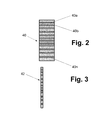
- FIG. 2 is a diametric sectional view of a polymer plate obtained by the method of the invention.
- FIG. 3 is a diametric sectional view of a track membrane produced by the method of the invention.
- FIGS. 4A and 4B are microphotographs of sections of treated samples obtained on a Multimode V Atomic Force Microscope (Veeco).
- the method of one or more embodiments of the invention is aimed at manufacturing track membranes.
- a track membrane is a thin polymer film with through pores which are formed by penetrating a special substance into and through the material of a polymer plate and then removing the traces of penetrated particles from the matrix material thus forming pores.
- the track membrane may find use in various fields of industry as conventional membrane filters for purification of liquid substances from solid contaminants. In view of low manufacturing cost and only a slight deviation of the holes from the rated diameter (within the limits of 10 to 20%), the track membrane of the invention may be advantageously used as a dialysis filter.
- a method of one or more embodiments of the invention comprises forming membrane with through openings by piercing a membrane matrix located in a tubular shell with particles of an oversaturated aqueous soluble solution of a water-soluble salt or salts contained in a high-speed jet generated by explosion of an explosive material detonated in the same shell.
- the obtained membrane is suitable for use as a filter for separating liquids from solid particles that may be contained in such liquids.
- the method of one or more embodiments of the invention comprises the steps of:
- a cartridge that is secured at the first end of the shell and contains a detonatable explosive material and a working substance in the form of at least one supersaturated solution of at least one water-soluble salt;
- the method further comprises the step of disconnecting the cover from the holder, removing the membrane matrix having residual water-soluble particles of the working substance from the cavity of the retainer, and treating the membrane matrix with water for dissolving the residual particles or washing them out from the membrane matrix and for forming a membrane with through openings.
- the polymer plate is sliced into thin pieces of a require thickness that can be used, e.g., as filter plates.
- the thin pieces again are subjected to a second water treatment for final rinse.
- the membrane matrix material is an organic polymer material such as polyolefin (polyethylene, polypropylene, etc.), polyvinylchloride, fluorinated polyolefin (polytetrafluoroethylene, polyvinylidene fluoride, etc.), polyamide, polycarbonate, polyester, polysulfone, etc.
- organic polymer material such as polyolefin (polyethylene, polypropylene, etc.), polyvinylchloride, fluorinated polyolefin (polytetrafluoroethylene, polyvinylidene fluoride, etc.), polyamide, polycarbonate, polyester, polysulfone, etc.
- the working substance may also contain at least one saturated solution of water soluble salts and may be selected from the group consisting of saturated aqueous solution of at least one water-soluble organic salt, a supersaturated aqueous solution of at least one water-soluble organic salt, a saturated aqueous solution of at least one water soluble inorganic salt, and a supersaturated aqueous solution of at least one water-soluble inorganic salt.
- the organic salts are selected from the group comprising tartrates, acetates, salicylates, benzoates of alkali metals, for example potassium tartrate, sodium acetate, sodium salicylate.
- the inorganic salts are selected from the group comprising halides of the alkali metals and alkaline earth metals, for example sodium chloride, sodium bromide, potassium fluoride, calcium chloride.
- the solid plate of the matrix polymer materials may have a total thickness in the range of 10 to 20 mm. After piercing with the particles the plate is sliced into track membranes having a thickness of 5 to 50 ⁇ m by means of a microtome.
- the through holes formed in the track membrane by the method of the invention may have diameters ranging from 80 nm to 100,000 nm.
- the actual diameters and the range of the diameters of the holes depend mainly on the velocity of the particles, diameter of the shell, and a distance from the cartridge with the explosive material and the particles to the membrane matrix material in the holder.
- the through holes produced in the track membrane by the method of the invention are oriented in the direction of the jet of particles and occupy from 10 to 20 vol. % of the membrane material volume.
- the explosion wave that has a detonating nature imparts to the particles of the working substance a velocity in the range of 3800 to 4200 m/sec.
- removal of the residual trace particles of the substance from the membrane may be carried out in the running flow of water.
- FIG. 1 is a vertical sectional view of the device.
- the device which as a whole is designated by reference numeral 20 contains a tubular shell 22 made, e.g., of a plastic material such as polyvinylchloride.
- the tubular shell 22 has open ends 22 a and 22 b .
- the device 20 also contains a cartridge 24 with the aforementioned detonatable explosive material 26 and the working substance 28 in the form of a saturated/supersaturated solution of at least one water-soluble salt.
- the cartridge is inserted into the open end 22 a of the tubular holder 22 .
- Reference numeral 29 designates a detonator that is used for detonation of the explosive material 26 .
- the device 20 contains a membrane holder 30 with an open-bottom cavity 30 a for receiving a membrane matrix 32 that can be inserted into the cavity 30 a of the holder 30 so that when the holder 30 is inserted into the shell 22 , a major part of the membrane surface remains exposed to the interior of the tubular shell.
- the membrane holder 30 is provided with a cover 33 attachable to the holder 30 , e.g., by fasteners, such as studs 35 a and 35 b shown in FIG. 1 , for covering the membrane matrix 32 .
- the holder 30 with the membrane matrix 32 and the cover 33 is freely inserted into the opposite end 22 b of the tubular shell 22 .
- the shell 22 with the holder 30 and the cartridge 24 is placed into an explosion-proof chamber 36 .
- the explosive material 26 when the explosive material 26 is detonated by the detonator 29 , this generates an explosion inside the shell 22 .
- the particles of the working material substance 28 that comprises the high-speed jet of the water-soluble salt, formed from the saturated/supersaturated aqueous solution of water soluble organic or inorganic salts will be directed toward the surface of the membrane matrix 32 exposed to the high-speed flow of the particles, in view of high kinetic velocity (3800 to 4200 m/sec) imparted to the particles of the working substance.
- some particles will deeply penetrate into the membrane matrix material and some particles will pierce the body of the membrane matrix 32 from its exposed side.
- the holder 30 together with the membrane matrix 32 and the cover 33 will be expelled from the shell 22 into the explosion-proof chamber 36 .
- the shell 22 and cartridge 24 will collapse.
- the cover 33 is then disconnected from the holder 30 , and the treated membrane matrix 32 is extracted from the holder 30 .
- the membrane matrix 32 will still contain residue of the water-soluble particles of the working substance 28 .
- the membrane matrix material 32 is then washed with water, whereby the residue of the water-soluble particles of the working substance 28 is dissolved or washed out from the membrane matrix leaving a plurality of small-diameter holes.
- a polymer plate 40 shown in FIG. 2 with a plurality of small holes 40 a , 40 b , . . . 40 n is obtained.
- the diameters of the holes may be selected within the range of 80 nm to 100,000 nm. However, deviations of the hole diameters from the rated value is insignificant and may be within the range of 10% to 20%.
- the solid plate 40 of the matrix polymer materials may have a total thickness in the range of 10 to 20 mm. After removal of the residue of the working substance, the solid plate 40 is sliced into track membranes having a thickness of 5 to 50 ⁇ m by means of a microtome. As a result, track membranes, one of which, i.e., a track membrane 42 is shown in FIG. 3 , are obtained.
- Samples of the track membranes produced by a method of an embodiment of the invention were observed under a Multimode V Atomic Force Microscope (Veeco), and micropictures were taken (see FIGS. 4A and 4B ).
- the pictures show sections of samples taken parallel to the diameter of the polymeric cylinder by means of microtome.
- the black dots in the photographs represent the pores of the sliced samples.
- Specimen 1 of a polymer plate produced by the method of an embodiment of the invention comprised a 15 mm-thick circular plate made from a shock-resistant polyethylene.
- the working substance comprised a supersaturated aqueous solution of potassium tartrate having concentration of 60% by weight.
- the test was conducted with the use of the device of the type described above and shown in FIG. 1 .
- Length of the shell 22 was 200 mm
- explosive material 26 was 25 g of ammonite #6 (79% w/w of ammonium nitrate and 21% w/w of TNT; density 0.8-0.9 g/cm3).
- the velocity of particles of potassium tartrate developed under the effect of the explosive wave and by flash evaporation of water was 3800 m/s.
- the results are shown in the microphotography presented by FIG. 4A , where the pores formed in the matrix material after washing out the residue of the potassium tartrate particles are seen as black spots.
- the rated diameter of the holes was 22 ⁇ m with deviations from the value of 22 ⁇ m in the range of 13%.
- Specimen 2 of a polymer plate produced by a method of an embodiment of the invention comprised a 15 mm-thick circular plate made from a polytetrafluoroethylene.
- the working substance comprised a 30% w/w aqueous solution of sodium chloride.
- the test was conducted with the use of the device of the type described above and shown in FIG. 1 .
- Length of the shell 22 was 200 mm
- explosive material 26 was 25 g of ammonite #6 (79% w/w of ammonium nitrate and 21% w/w of TNT; density 0.8-0.9 g/cm3).
- the velocity of particles of sodium chloride developed under the effect of the explosive wave and by flash evaporation of water was 4200 m/s.
- the results are shown in the microphotography presented by FIG. 4B , where the pores formed in the matrix material after washing out the residue of the sodium chloride particles are seen as black spots.
- the rated diameter of the holes was 25 ⁇ m with deviations from the value of 25 ⁇ m in the range of 19%.
Landscapes
- Chemical & Material Sciences (AREA)
- Chemical Kinetics & Catalysis (AREA)
- Physics & Mathematics (AREA)
- Optics & Photonics (AREA)
- Engineering & Computer Science (AREA)
- Manufacturing & Machinery (AREA)
- Physical Or Chemical Processes And Apparatus (AREA)
Abstract
Description
Claims (18)
Priority Applications (1)
| Application Number | Priority Date | Filing Date | Title |
|---|---|---|---|
| US13/442,799 US8980148B2 (en) | 2012-04-09 | 2012-04-09 | Method of manufacturing a track membrane |
Applications Claiming Priority (1)
| Application Number | Priority Date | Filing Date | Title |
|---|---|---|---|
| US13/442,799 US8980148B2 (en) | 2012-04-09 | 2012-04-09 | Method of manufacturing a track membrane |
Publications (2)
| Publication Number | Publication Date |
|---|---|
| US20130264737A1 US20130264737A1 (en) | 2013-10-10 |
| US8980148B2 true US8980148B2 (en) | 2015-03-17 |
Family
ID=49291670
Family Applications (1)
| Application Number | Title | Priority Date | Filing Date |
|---|---|---|---|
| US13/442,799 Expired - Fee Related US8980148B2 (en) | 2012-04-09 | 2012-04-09 | Method of manufacturing a track membrane |
Country Status (1)
| Country | Link |
|---|---|
| US (1) | US8980148B2 (en) |
Cited By (2)
| Publication number | Priority date | Publication date | Assignee | Title |
|---|---|---|---|---|
| RU2637230C1 (en) * | 2016-10-26 | 2017-12-01 | Федеральное государственное автономное образовательное учреждение высшего образования "Национальный исследовательский Томский политехнический университет" | Method of forming polymeric track membrane with cavity of given curvature and device for its implementation |
| RU2687921C1 (en) * | 2018-05-03 | 2019-05-16 | Закрытое Акционерное Общество "Владисарт" | Filtering element for separation and concentration of liquid media |
Citations (9)
| Publication number | Priority date | Publication date | Assignee | Title |
|---|---|---|---|---|
| US3303085A (en) | 1962-02-28 | 1967-02-07 | Gen Electric | Molecular sieves and methods for producing same |
| US3770532A (en) | 1971-02-16 | 1973-11-06 | Gen Electric | Porous bodies and method of making |
| US3802972A (en) | 1968-06-27 | 1974-04-09 | Gen Electric | Process for making cylindrical holes in a sheet material |
| US4960430A (en) | 1987-05-13 | 1990-10-02 | Veb Greika Greiz Weberei Und Veredlung | Method for manufacturing of mat and rough, laminar, ribbon-shaped or fibrous polymeric products with a stream of particles |
| US5330790A (en) | 1992-02-07 | 1994-07-19 | Calkins Noel C | Impact implantation of particulate material into polymer surfaces |
| US7001501B2 (en) | 2000-09-08 | 2006-02-21 | Gesellschaft für Schwerionenforschung mbH | Method for etching at least one ion track to a pore in a membrane and electrolyte cell for preparing the membrane |
| US7597815B2 (en) | 2003-05-29 | 2009-10-06 | Dressel Pte. Ltd. | Process for producing a porous track membrane |
| US7897204B2 (en) | 2009-01-29 | 2011-03-01 | Nanotech Industries, Inc. | Method of strengthening tool material by penetration of reinforcing particles |
| RU2425912C2 (en) | 2009-08-04 | 2011-08-10 | Институт гидродинамики им. М.А. Лаврентьева Сибирского отделения Российской академии наук (ИГиЛ СО РАН) | Procedure for metallisation of part of polymer material by detonation sputtering |
-
2012
- 2012-04-09 US US13/442,799 patent/US8980148B2/en not_active Expired - Fee Related
Patent Citations (9)
| Publication number | Priority date | Publication date | Assignee | Title |
|---|---|---|---|---|
| US3303085A (en) | 1962-02-28 | 1967-02-07 | Gen Electric | Molecular sieves and methods for producing same |
| US3802972A (en) | 1968-06-27 | 1974-04-09 | Gen Electric | Process for making cylindrical holes in a sheet material |
| US3770532A (en) | 1971-02-16 | 1973-11-06 | Gen Electric | Porous bodies and method of making |
| US4960430A (en) | 1987-05-13 | 1990-10-02 | Veb Greika Greiz Weberei Und Veredlung | Method for manufacturing of mat and rough, laminar, ribbon-shaped or fibrous polymeric products with a stream of particles |
| US5330790A (en) | 1992-02-07 | 1994-07-19 | Calkins Noel C | Impact implantation of particulate material into polymer surfaces |
| US7001501B2 (en) | 2000-09-08 | 2006-02-21 | Gesellschaft für Schwerionenforschung mbH | Method for etching at least one ion track to a pore in a membrane and electrolyte cell for preparing the membrane |
| US7597815B2 (en) | 2003-05-29 | 2009-10-06 | Dressel Pte. Ltd. | Process for producing a porous track membrane |
| US7897204B2 (en) | 2009-01-29 | 2011-03-01 | Nanotech Industries, Inc. | Method of strengthening tool material by penetration of reinforcing particles |
| RU2425912C2 (en) | 2009-08-04 | 2011-08-10 | Институт гидродинамики им. М.А. Лаврентьева Сибирского отделения Российской академии наук (ИГиЛ СО РАН) | Procedure for metallisation of part of polymer material by detonation sputtering |
Cited By (2)
| Publication number | Priority date | Publication date | Assignee | Title |
|---|---|---|---|---|
| RU2637230C1 (en) * | 2016-10-26 | 2017-12-01 | Федеральное государственное автономное образовательное учреждение высшего образования "Национальный исследовательский Томский политехнический университет" | Method of forming polymeric track membrane with cavity of given curvature and device for its implementation |
| RU2687921C1 (en) * | 2018-05-03 | 2019-05-16 | Закрытое Акционерное Общество "Владисарт" | Filtering element for separation and concentration of liquid media |
Also Published As
| Publication number | Publication date |
|---|---|
| US20130264737A1 (en) | 2013-10-10 |
Similar Documents
| Publication | Publication Date | Title |
|---|---|---|
| Han et al. | Water reclamation from emulsified oily wastewater via effective forward osmosis hollow fiber membranes under the PRO mode | |
| Scott | The role of salt in whitecap persistence | |
| US8980148B2 (en) | Method of manufacturing a track membrane | |
| ES2396510T3 (en) | Semi-permeable composite membrane, its production process, and element, fluid separation equipment and method for water treatment using the same | |
| EP3616778B1 (en) | Semipermeable composite membrane and method for producing same | |
| KR20140122944A (en) | Method and apparatus for manufacturing graphite oxide | |
| Zhu et al. | Boosting membrane distillation lifespan: Superhydrophobic micro-nano surface construction and concentrate concentration management | |
| Juang et al. | Surface modification of PVDF ultrafiltration membranes by remote argon/methane gas mixture plasma for fouling reduction | |
| Zahedi et al. | Separation study of Mg+ 2 from seawater and RO brine through a facilitated bulk liquid membrane transport using 18-Crown-6 | |
| Awolayo et al. | Impact of multi-ion interactions on oil mobilization by smart waterflooding in carbonate reservoirs | |
| WO2015100087A1 (en) | Pressurized forward osmosis process and system | |
| Wu et al. | Preparation of positively charged acid-resistant hollow fiber nanofiltration membrane with excellent separation performance by surface modification | |
| Liu et al. | Discarded cigarette butts regenerated hydrophobic-oleophilic materials for both immiscible and emulsified oil/water separation through a wettability reversal strategy | |
| Issar | The rate of flushing as a major factor in determining the chemistry of water in fossil aquifers in southern Israel | |
| Figovsky et al. | Production of polymer nanomembranes by super deep penetration method | |
| JP2687142B2 (en) | Method for manufacturing porous polyimide film | |
| CN108472596B (en) | Composite semipermeable membrane and method for producing composite semipermeable membrane | |
| Omichi et al. | Application of ion beams to synthesis of environmentally responsive track membranes | |
| AU2023266319B2 (en) | PREPARATION METHOD OF FLUORINE-FREE Ti3C2Tx MXene-MODIFIED POLYAMIDE (PA) REVERSE OSMOSIS (RO) MEMBRANE | |
| Jeon et al. | Development of thin-film composite PRO membranes with high power density | |
| Zhang et al. | Smart Janus titanium mesh used as a diode for both liquid droplet and air bubble transport | |
| Eliasson et al. | Dynamics of whistler spheromaks in magnetized plasmas | |
| Фиговский | ADVANCED METHODS OF NANOMEMBRANES’PRODUCING | |
| JP6214091B2 (en) | Method for producing water containing nanobubbles | |
| Salazar et al. | Nanostructuring of material surfaces by laser ablation |
Legal Events
| Date | Code | Title | Description |
|---|---|---|---|
| AS | Assignment |
Owner name: NANOTECH INDUSTRIES, INC., CALIFORNIA Free format text: ASSIGNMENT OF ASSIGNORS INTEREST;ASSIGNORS:FIGOVSKY, OLEG;GOTLIB, ELENA;PASHIN, DMITRY;AND OTHERS;REEL/FRAME:028015/0711 Effective date: 20120405 Owner name: POLYMATE, LTD., ISRAEL Free format text: ASSIGNMENT OF ASSIGNORS INTEREST;ASSIGNORS:FIGOVSKY, OLEG;GOTLIB, ELENA;PASHIN, DMITRY;AND OTHERS;REEL/FRAME:028015/0711 Effective date: 20120405 |
|
| STCF | Information on status: patent grant |
Free format text: PATENTED CASE |
|
| FEPP | Fee payment procedure |
Free format text: MAINTENANCE FEE REMINDER MAILED (ORIGINAL EVENT CODE: REM.); ENTITY STATUS OF PATENT OWNER: SMALL ENTITY |
|
| LAPS | Lapse for failure to pay maintenance fees |
Free format text: PATENT EXPIRED FOR FAILURE TO PAY MAINTENANCE FEES (ORIGINAL EVENT CODE: EXP.); ENTITY STATUS OF PATENT OWNER: SMALL ENTITY |
|
| STCH | Information on status: patent discontinuation |
Free format text: PATENT EXPIRED DUE TO NONPAYMENT OF MAINTENANCE FEES UNDER 37 CFR 1.362 |
|
| FP | Lapsed due to failure to pay maintenance fee |
Effective date: 20190317 |
|
| AS | Assignment |
Owner name: NANOTECH INDUSTRIES INC., CALIFORNIA Free format text: ASSIGNMENT OF ASSIGNORS INTEREST;ASSIGNOR:POLYMATE LTD.;REEL/FRAME:050646/0019 Effective date: 20191007 |
|
| AS | Assignment |
Owner name: LIFSCHITZ, YAKOV MARK, CALIFORNIA Free format text: ASSIGNMENT OF ASSIGNORS INTEREST;ASSIGNOR:NELLIS, DARIN;REEL/FRAME:050851/0276 Effective date: 20191029 |