US8974919B2 - Anthracene derivative and an organic electronic device using the same - Google Patents
Anthracene derivative and an organic electronic device using the same Download PDFInfo
- Publication number
- US8974919B2 US8974919B2 US13/003,457 US200913003457A US8974919B2 US 8974919 B2 US8974919 B2 US 8974919B2 US 200913003457 A US200913003457 A US 200913003457A US 8974919 B2 US8974919 B2 US 8974919B2
- Authority
- US
- United States
- Prior art keywords
- group
- substituted
- unsubstituted
- organic
- anthracene derivative
- Prior art date
- Legal status (The legal status is an assumption and is not a legal conclusion. Google has not performed a legal analysis and makes no representation as to the accuracy of the status listed.)
- Active, expires
Links
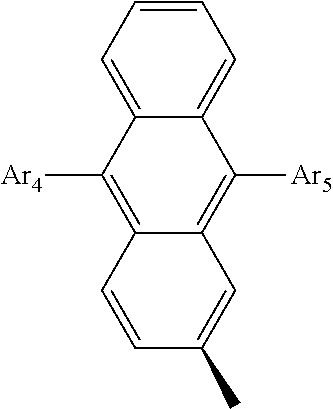
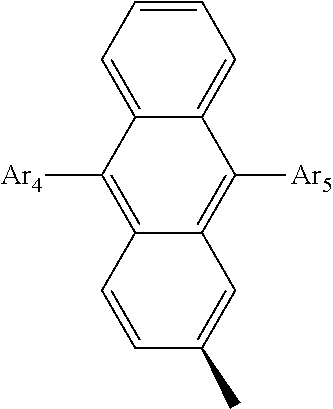
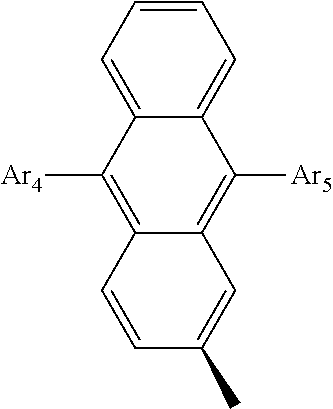
- MOIQUTBGCDOSDX-UHFFFAOYSA-N CC1=CC2=C([Ar])C3=CC=CC=C3C(C)=C2C=C1.[Ar].[Ar].[Ar].[Ar] Chemical compound CC1=CC2=C([Ar])C3=CC=CC=C3C(C)=C2C=C1.[Ar].[Ar].[Ar].[Ar] MOIQUTBGCDOSDX-UHFFFAOYSA-N 0.000 description 271
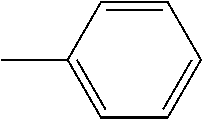
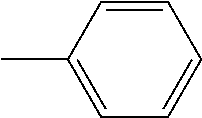
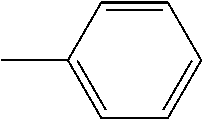
- YXFVVABEGXRONW-UHFFFAOYSA-N CC1=CC=CC=C1 Chemical compound CC1=CC=CC=C1 YXFVVABEGXRONW-UHFFFAOYSA-N 0.000 description 180
- QIMMUPPBPVKWKM-UHFFFAOYSA-N CC1=CC2=CC=CC=C2C=C1 Chemical compound CC1=CC2=CC=CC=C2C=C1 QIMMUPPBPVKWKM-UHFFFAOYSA-N 0.000 description 146
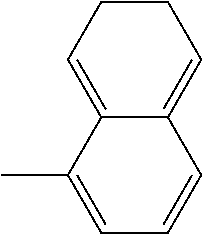
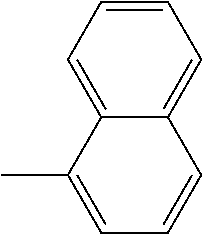
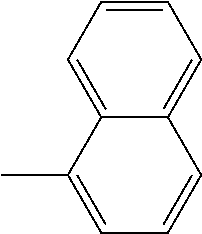
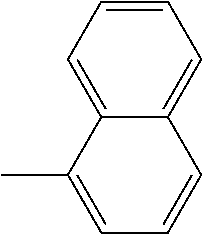
- QPUYECUOLPXSFR-UHFFFAOYSA-N CC1=CC=CC2=CC=CC=C12 Chemical compound CC1=CC=CC2=CC=CC=C12 QPUYECUOLPXSFR-UHFFFAOYSA-N 0.000 description 141
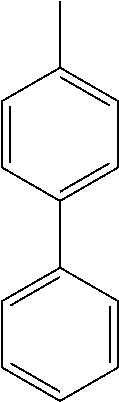
- ZZLCFHIKESPLTH-UHFFFAOYSA-N CC1=CC=C(C2=CC=CC=C2)C=C1 Chemical compound CC1=CC=C(C2=CC=CC=C2)C=C1 ZZLCFHIKESPLTH-UHFFFAOYSA-N 0.000 description 107
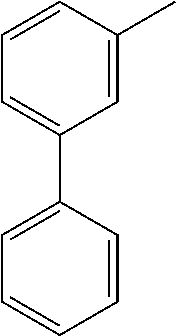
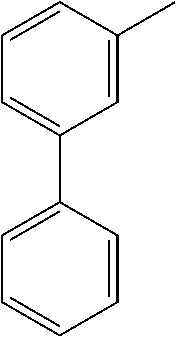
- NPDIDUXTRAITDE-UHFFFAOYSA-N CC1=CC(C2=CC=CC=C2)=CC=C1 Chemical compound CC1=CC(C2=CC=CC=C2)=CC=C1 NPDIDUXTRAITDE-UHFFFAOYSA-N 0.000 description 91
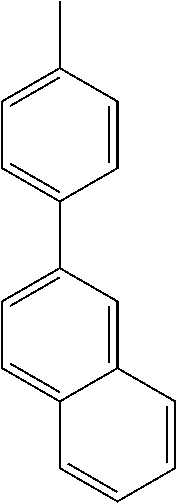
- ZXXGUXICWKNYJD-UHFFFAOYSA-N CC1=CC=C(C2=CC=C3C=CC=CC3=C2)C=C1 Chemical compound CC1=CC=C(C2=CC=C3C=CC=CC3=C2)C=C1 ZXXGUXICWKNYJD-UHFFFAOYSA-N 0.000 description 77
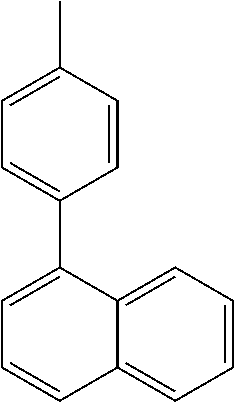
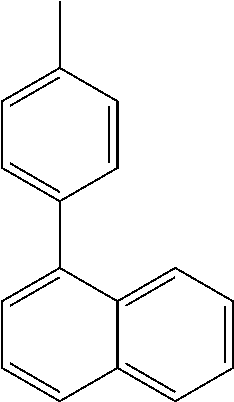
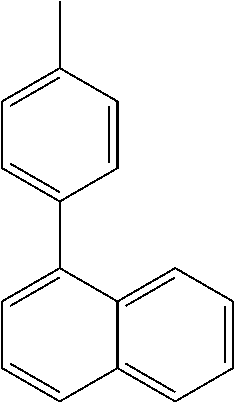
- JTZVTVSSLYYVAM-UHFFFAOYSA-N CC1=CC=C(C2=CC=CC3=CC=CC=C32)C=C1 Chemical compound CC1=CC=C(C2=CC=CC3=CC=CC=C32)C=C1 JTZVTVSSLYYVAM-UHFFFAOYSA-N 0.000 description 76
- OZVXBXKVMMIGDV-UHFFFAOYSA-N CC1=CC=C(N2C3=C(C=CC=C3)C3=C2/C=C\C=C/3)C=C1 Chemical compound CC1=CC=C(N2C3=C(C=CC=C3)C3=C2/C=C\C=C/3)C=C1 OZVXBXKVMMIGDV-UHFFFAOYSA-N 0.000 description 34
- NMADNDAHMZYNLH-UHFFFAOYSA-N CC1=CC=CC(C2=CC=C(C3=CC=CC=C3)S2)=C1 Chemical compound CC1=CC=CC(C2=CC=C(C3=CC=CC=C3)S2)=C1 NMADNDAHMZYNLH-UHFFFAOYSA-N 0.000 description 34
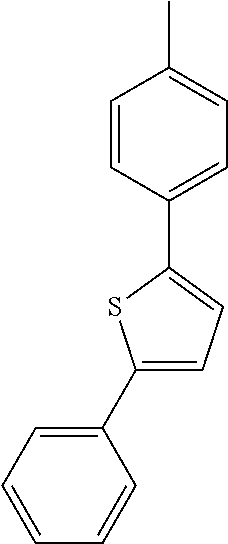
- SSVDKEWWZNAHSY-UHFFFAOYSA-N CC1=CC=C(C2=CC=C(C3=CC=CC=C3)S2)C=C1 Chemical compound CC1=CC=C(C2=CC=C(C3=CC=CC=C3)S2)C=C1 SSVDKEWWZNAHSY-UHFFFAOYSA-N 0.000 description 32
- 0 [1*]C1=C([7*])C([6*])=C2C([Ar])=C3C([5*])=C([4*])C([3*])=C([Ar])C3=C([2*])C2=C1[Ar].[Ar].[Ar].[Ar] Chemical compound [1*]C1=C([7*])C([6*])=C2C([Ar])=C3C([5*])=C([4*])C([3*])=C([Ar])C3=C([2*])C2=C1[Ar].[Ar].[Ar].[Ar] 0.000 description 32
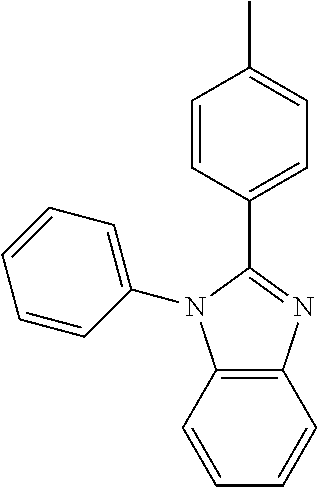
- YHWCJUIYQMFPBZ-UHFFFAOYSA-N CC1=CC=C(C2=NC3=C(C=CC=C3)N2C2=CC=CC=C2)C=C1 Chemical compound CC1=CC=C(C2=NC3=C(C=CC=C3)N2C2=CC=CC=C2)C=C1 YHWCJUIYQMFPBZ-UHFFFAOYSA-N 0.000 description 31
- FTOYZAKKQGOGDG-UHFFFAOYSA-N CC1=CC=CC(C2=NC3=C(C=CC=C3)N2C2=CC=CC3=CC=CC=C32)=C1 Chemical compound CC1=CC=CC(C2=NC3=C(C=CC=C3)N2C2=CC=CC3=CC=CC=C32)=C1 FTOYZAKKQGOGDG-UHFFFAOYSA-N 0.000 description 28
- POVNEKRWMLGDPI-UHFFFAOYSA-N CC1=CC=CC(C2=NC3=C(C=CC=C3)N2C2=CC=CC=C2)=C1 Chemical compound CC1=CC=CC(C2=NC3=C(C=CC=C3)N2C2=CC=CC=C2)=C1 POVNEKRWMLGDPI-UHFFFAOYSA-N 0.000 description 27
- NEKXRPVOSZHILM-UHFFFAOYSA-N CC1=CC=C(C2=CC=CC=C2)S1 Chemical compound CC1=CC=C(C2=CC=CC=C2)S1 NEKXRPVOSZHILM-UHFFFAOYSA-N 0.000 description 21
- RXLYTOFFWPAUGN-UHFFFAOYSA-N CC1=C(C2=CC=CC=C2)C2=C(C=CC=C2)S1 Chemical compound CC1=C(C2=CC=CC=C2)C2=C(C=CC=C2)S1 RXLYTOFFWPAUGN-UHFFFAOYSA-N 0.000 description 18
- BLZKSRBAQDZAIX-UHFFFAOYSA-N CC1=CC2=C(C=CC=C2)S1 Chemical compound CC1=CC2=C(C=CC=C2)S1 BLZKSRBAQDZAIX-UHFFFAOYSA-N 0.000 description 18
- AVPLCPIXXJOBHG-UHFFFAOYSA-N CC1=CC2=C(C=C1)N(C1=CC=CC=C1)C1=C2/C=C\C=C/1 Chemical compound CC1=CC2=C(C=C1)N(C1=CC=CC=C1)C1=C2/C=C\C=C/1 AVPLCPIXXJOBHG-UHFFFAOYSA-N 0.000 description 17
- VRMHYNMJDZEAJK-UHFFFAOYSA-N CC1=CC2=CC=C(N3C4=C(C=CC=C4)/N=C\3C3=CC=CC=C3)C=C2C=C1 Chemical compound CC1=CC2=CC=C(N3C4=C(C=CC=C4)/N=C\3C3=CC=CC=C3)C=C2C=C1 VRMHYNMJDZEAJK-UHFFFAOYSA-N 0.000 description 15
- DXYYSGDWQCSKKO-UHFFFAOYSA-N CC1=NC2=C(C=CC=C2)S1 Chemical compound CC1=NC2=C(C=CC=C2)S1 DXYYSGDWQCSKKO-UHFFFAOYSA-N 0.000 description 15
- DQSHFKPKFISSNM-UHFFFAOYSA-N CC1=NC2=C(C=CC=C2)O1 Chemical compound CC1=NC2=C(C=CC=C2)O1 DQSHFKPKFISSNM-UHFFFAOYSA-N 0.000 description 14
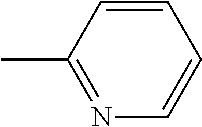
- BSKHPKMHTQYZBB-UHFFFAOYSA-N CC1=NC=CC=C1 Chemical compound CC1=NC=CC=C1 BSKHPKMHTQYZBB-UHFFFAOYSA-N 0.000 description 14
- ZRMDNMCLOTYRPK-UHFFFAOYSA-N CC1=CC=C2/C=C\C3=C(C)C=CC4=CC=C1C2=C43 Chemical compound CC1=CC=C2/C=C\C3=C(C)C=CC4=CC=C1C2=C43 ZRMDNMCLOTYRPK-UHFFFAOYSA-N 0.000 description 6
- COMZYCMBALOQRG-UHFFFAOYSA-N CN(C1=CC=CC=C1)C1=CC=C([Si](C)(C)C)C=C1 Chemical compound CN(C1=CC=CC=C1)C1=CC=C([Si](C)(C)C)C=C1 COMZYCMBALOQRG-UHFFFAOYSA-N 0.000 description 6
- DYFFAVRFJWYYQO-UHFFFAOYSA-N CN(C1=CC=CC=C1)C1=CC=CC=C1 Chemical compound CN(C1=CC=CC=C1)C1=CC=CC=C1 DYFFAVRFJWYYQO-UHFFFAOYSA-N 0.000 description 6
- IXPHIYGRFBMTLJ-UHFFFAOYSA-N CC1=CC=C(N(C)C2=CC=C(C)C=C2)C=C1 Chemical compound CC1=CC=C(N(C)C2=CC=C(C)C=C2)C=C1 IXPHIYGRFBMTLJ-UHFFFAOYSA-N 0.000 description 5
- RRSSPJVYNJWURW-UHFFFAOYSA-N CN(C1=CC=C(C2=CC=CC=C2)C=C1)C1=CC=C(C2=CC=CC=C2)C=C1 Chemical compound CN(C1=CC=C(C2=CC=CC=C2)C=C1)C1=CC=C(C2=CC=CC=C2)C=C1 RRSSPJVYNJWURW-UHFFFAOYSA-N 0.000 description 4
- YOJDHXBDFXWJSK-OUKQBFOZSA-N CN(C1=CC=CC=C1)C1=CC=C(/C=C/C2=CC=CC=C2)C=C1 Chemical compound CN(C1=CC=CC=C1)C1=CC=C(/C=C/C2=CC=CC=C2)C=C1 YOJDHXBDFXWJSK-OUKQBFOZSA-N 0.000 description 4
- YDBYUYLTFHZEHN-UHFFFAOYSA-N CN(C1=CC=CC=C1)C1=CC=C(C2=CC=CC=C2)C=C1 Chemical compound CN(C1=CC=CC=C1)C1=CC=C(C2=CC=CC=C2)C=C1 YDBYUYLTFHZEHN-UHFFFAOYSA-N 0.000 description 4
- WXXHOQJPLCZXLB-UHFFFAOYSA-N CN(C1=CC=CC=C1)C1=CC=C2C=CC=CC2=C1 Chemical compound CN(C1=CC=CC=C1)C1=CC=C2C=CC=CC2=C1 WXXHOQJPLCZXLB-UHFFFAOYSA-N 0.000 description 4
- IWXTUASNHNVLDV-UHFFFAOYSA-N CC1=C2C=CC=CC2=C([Ar])C2=CC=CC=C21.CC1=CC2=C([Ar])C3=CC=CC=C3C([Ar])=C2C=C1.CC1=CC=CC2=C([Ar])C3=CC=CC=C3C([Ar])=C12.[Ar].[Ar].[Ar].[Ar].[Ar].[Ar].[Ar].[Ar].[Ar].[Ar].[Ar].[Ar].[Ar].[Ar].[Ar].[Ar].[Ar] Chemical compound CC1=C2C=CC=CC2=C([Ar])C2=CC=CC=C21.CC1=CC2=C([Ar])C3=CC=CC=C3C([Ar])=C2C=C1.CC1=CC=CC2=C([Ar])C3=CC=CC=C3C([Ar])=C12.[Ar].[Ar].[Ar].[Ar].[Ar].[Ar].[Ar].[Ar].[Ar].[Ar].[Ar].[Ar].[Ar].[Ar].[Ar].[Ar].[Ar] IWXTUASNHNVLDV-UHFFFAOYSA-N 0.000 description 2
- DLMAIMLUPIDYFS-UHFFFAOYSA-N CC1=CC=C(C2=NC3=C(C=CC=C3)N2C2=CC=CC3=CC=CC=C32)C=C1 Chemical compound CC1=CC=C(C2=NC3=C(C=CC=C3)N2C2=CC=CC3=CC=CC=C32)C=C1 DLMAIMLUPIDYFS-UHFFFAOYSA-N 0.000 description 2
- IULUNTXBHHKFFR-UHFFFAOYSA-N CC1=CC=C(N(C2=CC=CC=C2)C2=CC=CC=C2)C=C1 Chemical compound CC1=CC=C(N(C2=CC=CC=C2)C2=CC=CC=C2)C=C1 IULUNTXBHHKFFR-UHFFFAOYSA-N 0.000 description 2
- JNALWSBORZXIPY-UHFFFAOYSA-N CC1=CC=CC(C2=NC3C=CC=CC3N2C2=CC=CC3=CC=CC=C32)=C1 Chemical compound CC1=CC=CC(C2=NC3C=CC=CC3N2C2=CC=CC3=CC=CC=C32)=C1 JNALWSBORZXIPY-UHFFFAOYSA-N 0.000 description 2
- CMEFIIBGXLUIJZ-UHFFFAOYSA-N CC1=CC=CC2=CCCC=C12 Chemical compound CC1=CC=CC2=CCCC=C12 CMEFIIBGXLUIJZ-UHFFFAOYSA-N 0.000 description 2
- VVOPCTUTHZIZDB-UHFFFAOYSA-N BrC1=C2C=CC=C(C3=CC4=CC=CC=C4C=C3)C2=CC2=C(C3=CC4=CC=CC=C4C=C3)C=CC=C12.BrC1=C2C=CC=C(C3=CC=CC=C3)C2=CC2=C(C3=CC=CC=C3)C=CC=C12.C1=CC=C(C2=CC=CC3=CC4=CC=CC(C5=CC=CC=C5)=C4C=C32)C=C1.C1=CC=C2C=C(C3=CC=CC4=CC5=CC=CC(C6=CC7=CC=CC=C7C=C6)=C5C=C43)C=CC2=C1.O=C1C2=C(C(=O)C3=C1C=CC=C3C1=CC3=CC=CC=C3C=C1)C(C1=CC3=CC=CC=C3C=C1)=CC=C2.O=C1C2=C(C(=O)C3=C1C=CC=C3C1=CC=CC=C1)C(C1=CC=CC=C1)=CC=C2 Chemical compound BrC1=C2C=CC=C(C3=CC4=CC=CC=C4C=C3)C2=CC2=C(C3=CC4=CC=CC=C4C=C3)C=CC=C12.BrC1=C2C=CC=C(C3=CC=CC=C3)C2=CC2=C(C3=CC=CC=C3)C=CC=C12.C1=CC=C(C2=CC=CC3=CC4=CC=CC(C5=CC=CC=C5)=C4C=C32)C=C1.C1=CC=C2C=C(C3=CC=CC4=CC5=CC=CC(C6=CC7=CC=CC=C7C=C6)=C5C=C43)C=CC2=C1.O=C1C2=C(C(=O)C3=C1C=CC=C3C1=CC3=CC=CC=C3C=C1)C(C1=CC3=CC=CC=C3C=C1)=CC=C2.O=C1C2=C(C(=O)C3=C1C=CC=C3C1=CC=CC=C1)C(C1=CC=CC=C1)=CC=C2 VVOPCTUTHZIZDB-UHFFFAOYSA-N 0.000 description 1
- PNFGWJCGBFTUFH-UHFFFAOYSA-N BrC1=C2C=CC=C(C3=CC=C(C4=NC5=C(C=CC=C5)N4C4=CC=CC=C4)C=C3)C2=CC2=C(C3=CC=C(C4=NC5=C(C=CC=C5)N4C4=CC=CC=C4)C=C3)C=CC=C12.BrC1=CC=CC2=CC3=CC=CC(Br)=C3C=C12.C1=CC=C(C2=CC=C(C3=CC=CC(C4=C5C=C6C(=CC5=CC=C4)C=CC=C6C4=CC=CC(C5=CC=C(C6=CC=CC=C6)S5)=C4)=C3)S2)C=C1.C1=CC=C(N2C(C3=CC=C(C4=CC=CC5=CC6=CC=CC(C7=CC=C(C8=NC9=C(C=CC=C9)N8C8=CC=CC=C8)C=C7)=C6C=C54)C=C3)=NC3=C2C=CC=C3)C=C1.O=C1C2=C(C(=O)C3=C1C=CC=C3Br)C(Br)=CC=C2 Chemical compound BrC1=C2C=CC=C(C3=CC=C(C4=NC5=C(C=CC=C5)N4C4=CC=CC=C4)C=C3)C2=CC2=C(C3=CC=C(C4=NC5=C(C=CC=C5)N4C4=CC=CC=C4)C=C3)C=CC=C12.BrC1=CC=CC2=CC3=CC=CC(Br)=C3C=C12.C1=CC=C(C2=CC=C(C3=CC=CC(C4=C5C=C6C(=CC5=CC=C4)C=CC=C6C4=CC=CC(C5=CC=C(C6=CC=CC=C6)S5)=C4)=C3)S2)C=C1.C1=CC=C(N2C(C3=CC=C(C4=CC=CC5=CC6=CC=CC(C7=CC=C(C8=NC9=C(C=CC=C9)N8C8=CC=CC=C8)C=C7)=C6C=C54)C=C3)=NC3=C2C=CC=C3)C=C1.O=C1C2=C(C(=O)C3=C1C=CC=C3Br)C(Br)=CC=C2 PNFGWJCGBFTUFH-UHFFFAOYSA-N 0.000 description 1
- NJBDKBXEDRZRCB-UHFFFAOYSA-N BrC1=C2C=CC=C(C3=CC=CC(C4=CC=C(C5=CC=CC=C5)S4)=C3)C2=CC2=C(C3=CC(C4=CC=C(C5=CC=CC=C5)S4)=CC=C3)C=CC=C12.BrC1=C2C=CC=C(C3=CC=CC=N3)C2=CC2=C(C3=NC=CC=C3)C=CC=C12.C1=CC=C(C2=CC=CC3=CC4=CC=CC(C5=NC=CC=C5)=C4C=C32)N=C1.CC1(C)OB(C2=CC3=C(C4=CC5=CC=CC=C5C=C4)C4=CC=CC=C4C(C4=CC5=CC=CC=C5C=C4)=C3C=C2)OC1(C)C.CC1(C)OB(C2=CC3=C(C4=CC=CC=C4)C4=CC=CC=C4C(C4=CC=CC=C4)=C3C=C2)OC1(C)C Chemical compound BrC1=C2C=CC=C(C3=CC=CC(C4=CC=C(C5=CC=CC=C5)S4)=C3)C2=CC2=C(C3=CC(C4=CC=C(C5=CC=CC=C5)S4)=CC=C3)C=CC=C12.BrC1=C2C=CC=C(C3=CC=CC=N3)C2=CC2=C(C3=NC=CC=C3)C=CC=C12.C1=CC=C(C2=CC=CC3=CC4=CC=CC(C5=NC=CC=C5)=C4C=C32)N=C1.CC1(C)OB(C2=CC3=C(C4=CC5=CC=CC=C5C=C4)C4=CC=CC=C4C(C4=CC5=CC=CC=C5C=C4)=C3C=C2)OC1(C)C.CC1(C)OB(C2=CC3=C(C4=CC=CC=C4)C4=CC=CC=C4C(C4=CC=CC=C4)=C3C=C2)OC1(C)C NJBDKBXEDRZRCB-UHFFFAOYSA-N 0.000 description 1
- VCLQZLGEJHTILE-UHFFFAOYSA-N Brc1c(cccc2-c3cccc(-c4ccc(-c5ccccc5)[s]4)c3)c2cc2c1cccc2-c1cc(-c2ccc(-c3ccccc3)[s]2)ccc1 Chemical compound Brc1c(cccc2-c3cccc(-c4ccc(-c5ccccc5)[s]4)c3)c2cc2c1cccc2-c1cc(-c2ccc(-c3ccccc3)[s]2)ccc1 VCLQZLGEJHTILE-UHFFFAOYSA-N 0.000 description 1
- BCCHBNSLLZRFMF-UHFFFAOYSA-N Brc1c(cccc2-c3ncccc3)c2cc2c1cccc2-c1ccccn1 Chemical compound Brc1c(cccc2-c3ncccc3)c2cc2c1cccc2-c1ccccn1 BCCHBNSLLZRFMF-UHFFFAOYSA-N 0.000 description 1
- IYDMICQAKLQHLA-UHFFFAOYSA-N C1=CC=C(/C2=C/C=C\C3=CC=CC=C32)C=C1 Chemical compound C1=CC=C(/C2=C/C=C\C3=CC=CC=C32)C=C1 IYDMICQAKLQHLA-UHFFFAOYSA-N 0.000 description 1
- IMJMZOMLIQUTDV-IJKDMPGWSA-N C1=CC=C(/C=C/C2=CC(C3=C4C=CC(N(C5=CC=CC=C5)C5=CC=CC=C5)=CC4=C(C4=CC=CC(/C=C/C5=CC=CC=C5)=C4)C4=CC=C(N(C5=CC=CC=C5)C5=CC=CC=C5)C=C43)=CC=C2)C=C1.C1=CC=C2/C=C(C3=CC4=C(C5=C/C6=CC=CC=C6/C=C\5)C5=CC=CC=C5C(C5=C/C6=CC=CC=C6/C=C\5)=C4C=C3)\C=C/C2=C1 Chemical compound C1=CC=C(/C=C/C2=CC(C3=C4C=CC(N(C5=CC=CC=C5)C5=CC=CC=C5)=CC4=C(C4=CC=CC(/C=C/C5=CC=CC=C5)=C4)C4=CC=C(N(C5=CC=CC=C5)C5=CC=CC=C5)C=C43)=CC=C2)C=C1.C1=CC=C2/C=C(C3=CC4=C(C5=C/C6=CC=CC=C6/C=C\5)C5=CC=CC=C5C(C5=C/C6=CC=CC=C6/C=C\5)=C4C=C3)\C=C/C2=C1 IMJMZOMLIQUTDV-IJKDMPGWSA-N 0.000 description 1
- CMCXMNBXKLTDED-UHFFFAOYSA-N CC1(C)OB(C2=CC3=C(\C4=CC=C(C5=CC=CC=C5)C=C4)C4=CC=CC=C4/C(C4=CC=C(C5=CC=CC=C5)C=C4)=C\3C=C2)OC1(C)C.CC1(C)OB(C2=CC3=C(\C4=CC=CC(C5=CC=C(C6=CC=CC=C6)S5)=C4)C4=CC=CC=C4/C(C4=CC=CC(C5=CC=C(C6=CC=CC=C6)S5)=C4)=C\3C=C2)OC1(C)C.CC1(C)OB(C2=CC=C(C3=NC4=C(C=CC=C4)N3C3=CC=CC=C3)C=C2)OC1(C)C Chemical compound CC1(C)OB(C2=CC3=C(\C4=CC=C(C5=CC=CC=C5)C=C4)C4=CC=CC=C4/C(C4=CC=C(C5=CC=CC=C5)C=C4)=C\3C=C2)OC1(C)C.CC1(C)OB(C2=CC3=C(\C4=CC=CC(C5=CC=C(C6=CC=CC=C6)S5)=C4)C4=CC=CC=C4/C(C4=CC=CC(C5=CC=C(C6=CC=CC=C6)S5)=C4)=C\3C=C2)OC1(C)C.CC1(C)OB(C2=CC=C(C3=NC4=C(C=CC=C4)N3C3=CC=CC=C3)C=C2)OC1(C)C CMCXMNBXKLTDED-UHFFFAOYSA-N 0.000 description 1
- VHILRXGSEHWEFX-UHFFFAOYSA-N CC1(C)OB(c2cc3c(-c4cc5ccccc5cc4)c(cccc4)c4c(-c4cc(cccc5)c5cc4)c3cc2)OC1(C)C Chemical compound CC1(C)OB(c2cc3c(-c4cc5ccccc5cc4)c(cccc4)c4c(-c4cc(cccc5)c5cc4)c3cc2)OC1(C)C VHILRXGSEHWEFX-UHFFFAOYSA-N 0.000 description 1
- QIQCEONGDKHJRN-UHFFFAOYSA-N CC1=C2C=CC=C(C3=CC4=CC=CC=C4C=C3)C2=CC2=C(C3=CC4=CC=CC=C4C=C3)C=CC=C12 Chemical compound CC1=C2C=CC=C(C3=CC4=CC=CC=C4C=C3)C2=CC2=C(C3=CC4=CC=CC=C4C=C3)C=CC=C12 QIQCEONGDKHJRN-UHFFFAOYSA-N 0.000 description 1
- DGDOSXZUMQDCFX-UHFFFAOYSA-N CC1=C2C=CC=C(C3=CC=CC=C3)C2=CC2=C(C3=CC=CC=C3)C=CC=C12 Chemical compound CC1=C2C=CC=C(C3=CC=CC=C3)C2=CC2=C(C3=CC=CC=C3)C=CC=C12 DGDOSXZUMQDCFX-UHFFFAOYSA-N 0.000 description 1
- ZQUBVDBFGXHVOR-UHFFFAOYSA-N CC1=CC2=CC=C(N3=C(C4=CC=CC=C4)NC4=C3C=CC=C4)C=C2C=C1 Chemical compound CC1=CC2=CC=C(N3=C(C4=CC=CC=C4)NC4=C3C=CC=C4)C=C2C=C1 ZQUBVDBFGXHVOR-UHFFFAOYSA-N 0.000 description 1
- KPPMUFWAALIZQG-UHFFFAOYSA-N CC1=CC=C(C2=NC3=C(C=CC=C3)C2C2=CC=CC=C2)C=C1 Chemical compound CC1=CC=C(C2=NC3=C(C=CC=C3)C2C2=CC=CC=C2)C=C1 KPPMUFWAALIZQG-UHFFFAOYSA-N 0.000 description 1
- JOROFPQPHOWHQX-UHFFFAOYSA-N CC1=CC=C(N2C3=C(C=C(C)C=C3)C3=C2/C=C\C=C/3)C=C1 Chemical compound CC1=CC=C(N2C3=C(C=C(C)C=C3)C3=C2/C=C\C=C/3)C=C1 JOROFPQPHOWHQX-UHFFFAOYSA-N 0.000 description 1
- RJRRDOUXZRXREH-UHFFFAOYSA-N CC1=CC=CC(C2=NC3=C(C=CC=C3)C2C2=CC=CC=C2)=C1 Chemical compound CC1=CC=CC(C2=NC3=C(C=CC=C3)C2C2=CC=CC=C2)=C1 RJRRDOUXZRXREH-UHFFFAOYSA-N 0.000 description 1
- KMGVRAOYNYQMEQ-UHFFFAOYSA-N OB(O)C1=CC(C2=CC=C(C3=CC=CC=C3)S2)=CC=C1 Chemical compound OB(O)C1=CC(C2=CC=C(C3=CC=CC=C3)S2)=CC=C1 KMGVRAOYNYQMEQ-UHFFFAOYSA-N 0.000 description 1
- WDONYFWAXDYISV-UHFFFAOYSA-N c1c(-c2ccccc2)[s]c(-c2cc(-c3cccc4cc5cccc(-c6cc(-c7ccc(-c8ccccc8)[s]7)ccc6)c5cc34)ccc2)c1 Chemical compound c1c(-c2ccccc2)[s]c(-c2cc(-c3cccc4cc5cccc(-c6cc(-c7ccc(-c8ccccc8)[s]7)ccc6)c5cc34)ccc2)c1 WDONYFWAXDYISV-UHFFFAOYSA-N 0.000 description 1
- GUIHFMPJACYFHS-UHFFFAOYSA-N c1ccnc(-c2cccc3cc4cccc(-c5ncccc5)c4cc23)c1 Chemical compound c1ccnc(-c2cccc3cc4cccc(-c5ncccc5)c4cc23)c1 GUIHFMPJACYFHS-UHFFFAOYSA-N 0.000 description 1
Images


Classifications
-
- C—CHEMISTRY; METALLURGY
- C07—ORGANIC CHEMISTRY
- C07C—ACYCLIC OR CARBOCYCLIC COMPOUNDS
- C07C15/00—Cyclic hydrocarbons containing only six-membered aromatic rings as cyclic parts
- C07C15/20—Polycyclic condensed hydrocarbons
- C07C15/27—Polycyclic condensed hydrocarbons containing three rings
- C07C15/28—Anthracenes
-
- C—CHEMISTRY; METALLURGY
- C07—ORGANIC CHEMISTRY
- C07C—ACYCLIC OR CARBOCYCLIC COMPOUNDS
- C07C15/00—Cyclic hydrocarbons containing only six-membered aromatic rings as cyclic parts
- C07C15/20—Polycyclic condensed hydrocarbons
- C07C15/38—Polycyclic condensed hydrocarbons containing four rings
-
- C—CHEMISTRY; METALLURGY
- C07—ORGANIC CHEMISTRY
- C07D—HETEROCYCLIC COMPOUNDS
- C07D209/00—Heterocyclic compounds containing five-membered rings, condensed with other rings, with one nitrogen atom as the only ring hetero atom
- C07D209/56—Ring systems containing three or more rings
- C07D209/80—[b, c]- or [b, d]-condensed
- C07D209/82—Carbazoles; Hydrogenated carbazoles
- C07D209/86—Carbazoles; Hydrogenated carbazoles with only hydrogen atoms, hydrocarbon or substituted hydrocarbon radicals, directly attached to carbon atoms of the ring system
-
- C—CHEMISTRY; METALLURGY
- C07—ORGANIC CHEMISTRY
- C07D—HETEROCYCLIC COMPOUNDS
- C07D213/00—Heterocyclic compounds containing six-membered rings, not condensed with other rings, with one nitrogen atom as the only ring hetero atom and three or more double bonds between ring members or between ring members and non-ring members
- C07D213/02—Heterocyclic compounds containing six-membered rings, not condensed with other rings, with one nitrogen atom as the only ring hetero atom and three or more double bonds between ring members or between ring members and non-ring members having three double bonds between ring members or between ring members and non-ring members
- C07D213/04—Heterocyclic compounds containing six-membered rings, not condensed with other rings, with one nitrogen atom as the only ring hetero atom and three or more double bonds between ring members or between ring members and non-ring members having three double bonds between ring members or between ring members and non-ring members having no bond between the ring nitrogen atom and a non-ring member or having only hydrogen or carbon atoms directly attached to the ring nitrogen atom
- C07D213/24—Heterocyclic compounds containing six-membered rings, not condensed with other rings, with one nitrogen atom as the only ring hetero atom and three or more double bonds between ring members or between ring members and non-ring members having three double bonds between ring members or between ring members and non-ring members having no bond between the ring nitrogen atom and a non-ring member or having only hydrogen or carbon atoms directly attached to the ring nitrogen atom with substituted hydrocarbon radicals attached to ring carbon atoms
-
- C—CHEMISTRY; METALLURGY
- C07—ORGANIC CHEMISTRY
- C07D—HETEROCYCLIC COMPOUNDS
- C07D235/00—Heterocyclic compounds containing 1,3-diazole or hydrogenated 1,3-diazole rings, condensed with other rings
- C07D235/02—Heterocyclic compounds containing 1,3-diazole or hydrogenated 1,3-diazole rings, condensed with other rings condensed with carbocyclic rings or ring systems
- C07D235/04—Benzimidazoles; Hydrogenated benzimidazoles
- C07D235/20—Two benzimidazolyl-2 radicals linked together directly or via a hydrocarbon or substituted hydrocarbon radical
-
- C—CHEMISTRY; METALLURGY
- C07—ORGANIC CHEMISTRY
- C07D—HETEROCYCLIC COMPOUNDS
- C07D333/00—Heterocyclic compounds containing five-membered rings having one sulfur atom as the only ring hetero atom
- C07D333/02—Heterocyclic compounds containing five-membered rings having one sulfur atom as the only ring hetero atom not condensed with other rings
- C07D333/04—Heterocyclic compounds containing five-membered rings having one sulfur atom as the only ring hetero atom not condensed with other rings not substituted on the ring sulphur atom
- C07D333/06—Heterocyclic compounds containing five-membered rings having one sulfur atom as the only ring hetero atom not condensed with other rings not substituted on the ring sulphur atom with only hydrogen atoms, hydrocarbon or substituted hydrocarbon radicals, directly attached to the ring carbon atoms
- C07D333/08—Hydrogen atoms or radicals containing only hydrogen and carbon atoms
-
- C—CHEMISTRY; METALLURGY
- C09—DYES; PAINTS; POLISHES; NATURAL RESINS; ADHESIVES; COMPOSITIONS NOT OTHERWISE PROVIDED FOR; APPLICATIONS OF MATERIALS NOT OTHERWISE PROVIDED FOR
- C09K—MATERIALS FOR MISCELLANEOUS APPLICATIONS, NOT PROVIDED FOR ELSEWHERE
- C09K11/00—Luminescent materials, e.g. electroluminescent or chemiluminescent
- C09K11/06—Luminescent materials, e.g. electroluminescent or chemiluminescent containing organic luminescent materials
-
- H01L51/0058—
-
- H—ELECTRICITY
- H10—SEMICONDUCTOR DEVICES; ELECTRIC SOLID-STATE DEVICES NOT OTHERWISE PROVIDED FOR
- H10K—ORGANIC ELECTRIC SOLID-STATE DEVICES
- H10K85/00—Organic materials used in the body or electrodes of devices covered by this subclass
- H10K85/60—Organic compounds having low molecular weight
- H10K85/615—Polycyclic condensed aromatic hydrocarbons, e.g. anthracene
- H10K85/626—Polycyclic condensed aromatic hydrocarbons, e.g. anthracene containing more than one polycyclic condensed aromatic rings, e.g. bis-anthracene
-
- C07C2103/50—
-
- C—CHEMISTRY; METALLURGY
- C07—ORGANIC CHEMISTRY
- C07C—ACYCLIC OR CARBOCYCLIC COMPOUNDS
- C07C2603/00—Systems containing at least three condensed rings
- C07C2603/02—Ortho- or ortho- and peri-condensed systems
- C07C2603/40—Ortho- or ortho- and peri-condensed systems containing four condensed rings
- C07C2603/42—Ortho- or ortho- and peri-condensed systems containing four condensed rings containing only six-membered rings
- C07C2603/50—Pyrenes; Hydrogenated pyrenes
-
- H01L51/0054—
-
- H01L51/0068—
-
- H01L51/0072—
-
- H01L51/5088—
-
- H—ELECTRICITY
- H10—SEMICONDUCTOR DEVICES; ELECTRIC SOLID-STATE DEVICES NOT OTHERWISE PROVIDED FOR
- H10K—ORGANIC ELECTRIC SOLID-STATE DEVICES
- H10K50/00—Organic light-emitting devices
- H10K50/10—OLEDs or polymer light-emitting diodes [PLED]
- H10K50/17—Carrier injection layers
-
- H—ELECTRICITY
- H10—SEMICONDUCTOR DEVICES; ELECTRIC SOLID-STATE DEVICES NOT OTHERWISE PROVIDED FOR
- H10K—ORGANIC ELECTRIC SOLID-STATE DEVICES
- H10K85/00—Organic materials used in the body or electrodes of devices covered by this subclass
- H10K85/60—Organic compounds having low molecular weight
- H10K85/615—Polycyclic condensed aromatic hydrocarbons, e.g. anthracene
- H10K85/622—Polycyclic condensed aromatic hydrocarbons, e.g. anthracene containing four rings, e.g. pyrene
-
- H—ELECTRICITY
- H10—SEMICONDUCTOR DEVICES; ELECTRIC SOLID-STATE DEVICES NOT OTHERWISE PROVIDED FOR
- H10K—ORGANIC ELECTRIC SOLID-STATE DEVICES
- H10K85/00—Organic materials used in the body or electrodes of devices covered by this subclass
- H10K85/60—Organic compounds having low molecular weight
- H10K85/649—Aromatic compounds comprising a hetero atom
- H10K85/655—Aromatic compounds comprising a hetero atom comprising only sulfur as heteroatom
-
- H—ELECTRICITY
- H10—SEMICONDUCTOR DEVICES; ELECTRIC SOLID-STATE DEVICES NOT OTHERWISE PROVIDED FOR
- H10K—ORGANIC ELECTRIC SOLID-STATE DEVICES
- H10K85/00—Organic materials used in the body or electrodes of devices covered by this subclass
- H10K85/60—Organic compounds having low molecular weight
- H10K85/649—Aromatic compounds comprising a hetero atom
- H10K85/657—Polycyclic condensed heteroaromatic hydrocarbons
- H10K85/6572—Polycyclic condensed heteroaromatic hydrocarbons comprising only nitrogen in the heteroaromatic polycondensed ring system, e.g. phenanthroline or carbazole
-
- Y—GENERAL TAGGING OF NEW TECHNOLOGICAL DEVELOPMENTS; GENERAL TAGGING OF CROSS-SECTIONAL TECHNOLOGIES SPANNING OVER SEVERAL SECTIONS OF THE IPC; TECHNICAL SUBJECTS COVERED BY FORMER USPC CROSS-REFERENCE ART COLLECTIONS [XRACs] AND DIGESTS
- Y02—TECHNOLOGIES OR APPLICATIONS FOR MITIGATION OR ADAPTATION AGAINST CLIMATE CHANGE
- Y02E—REDUCTION OF GREENHOUSE GAS [GHG] EMISSIONS, RELATED TO ENERGY GENERATION, TRANSMISSION OR DISTRIBUTION
- Y02E10/00—Energy generation through renewable energy sources
- Y02E10/50—Photovoltaic [PV] energy
- Y02E10/549—Organic PV cells
Definitions
- the present invention relates to a novel anthracene derivative and an organic electronic device using the same.
- organic electronic device refers to a device which requires electronic charge exchange between an electrode and an organic material by using holes and/or electrons.
- the organic electronic device can be largely classified into two types according to its operational principle as follows.
- One type is an electronic device having a configuration in which an exciton is formed in an organic material layer by photons flown from an external light source into the device and the exciton is separated into an electron and a hole, the electron and the hole formed are transported to a different electrode, respectively and used as a current source (voltage source), and the other type is an electric device having a configuration in which holes and/or electrons are injected into an organic material semiconductor forming an interface with an electrode by applying a voltage or current to two or more electrodes to allow the device to operate by means of the injected electron and hole.
- Examples of the organic electronic device comprise an organic light emitting device, an organic solar cell, an organic photoconductor (OPC) and an organic transistor, which all require a hole injecting or transporting material, an electron injecting or transporting material, or a light emitting material for driving the device.
- OPC organic photoconductor
- the organic light emitting device will be mainly and specifically described, but in the above-mentioned organic electronic devices, the hole injecting or transporting material, the electron injecting or transporting material, or the light emitting material functions according to a similar principle.
- organic light emitting phenomenon refers to a phenomenon in which electric energy is converted to light energy by means of an organic material.
- the organic light emitting device using the organic light emitting phenomenon has a structure usually comprising an anode, a cathode and an organic material layer interposed therebetween.
- the organic material layer may be mostly formed in a multilayer structure comprising layers of different materials, for example, the hole injecting layer, the hole transporting layer, the light emitting layer, the electron transporting layer, the electron injecting layer and the like, in order to improve efficiency and stability of the organic light emitting device.
- the organic light emitting device having such a structure, when a voltage is applied between two electrodes, holes from the anode and electrons from a cathode are injected into the organic material layer, the holes and the electrons injected are combined together to form excitons. Further, when the excitons drop to a ground state, lights are emitted.
- Such the organic light emitting device is known to have characteristics such as self-luminescence, high brightness, high efficiency, low drive voltage, wide viewing angle, high contrast and high-speed response.
- the materials used for the organic material layer of the organic light emitting device can be classified into a light emitting material and a charge-transporting material, for example, a hole injecting material, a hole transporting material, an electron transporting material and an electron injecting material, according to their functions.
- the light emitting materials can be divided into a high molecule light emitting material and a low molecule light emitting material according to the molecular weight thereof, and can be divided into a fluorescent material that is derived from a singlet excite state of electrons and a phosphorescence material that is derived from a triplet excite state of electrons according to the light emitting mechanism.
- the light emitting materials can be divided into a blue, green or red light emitting material and a yellow or orange light emitting material required for giving more natural color, according to a light emitting color.
- a host/dopant system can be used as the light emitting material for the purpose of enhancing the color purity and the light emitting efficiency through energy transfer. It is based on the principle that if a small amount of a dopant having a smaller energy gap than a host which forms a light emitting layer is mixed with the light emitting layer, excitons which are generated in the light emitting layer are transported to the dopant, thus emitting a light having a high efficiency.
- the wavelength of the host is moved according to the wavelength of the dopant, a light having a desired wavelength can be obtained according the kind of the dopant.
- a material constituting the organic material layer in the device for example, a hole injecting material, a hole transporting material, a light emitting material, an electron transporting material and an electron injecting material should be essentially composed of a stable and efficient material.
- a stable and efficient organic material layer material for the organic light emitting device has not yet been fully realized. Accordingly, the development of new materials is continuously desired. The need to develop the above material is the same as the case of the above-mentioned other organic electronic devices.
- the present inventors synthesized a novel anthracene derivative, and found that when these compounds are used in an organic material layer and a light emitting layer in an organic electronic device, efficiency of the organic electronic device is increased, the driving voltage is lowered, and the stability is increased, thereby accomplishing the present invention.
- the present invention provides an anthracene derivative that is represented by the following Formula 1:
- Ar 1 is selected from the group consisting of a 1-naphthyl group, an anthracenyl group, a pyrenyl group, and a perylenyl group, and may be substituted by one or more groups selected from the group consisting of deuterium, tritium, a C 1 ⁇ C 20 alkyl group, a C 2 ⁇ C 20 alkenyl group, a C 2 ⁇ C 20 alkynyl group, a C 3 ⁇ C 20 cycloalkyl group, a C 3 ⁇ C 20 heterocycloalkyl group, a C 6 ⁇ C 50 aryl group and an arylamine group,
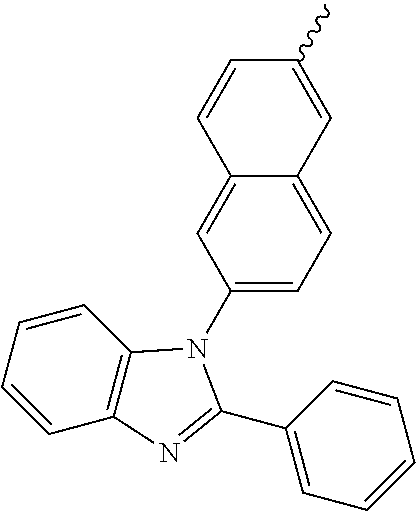
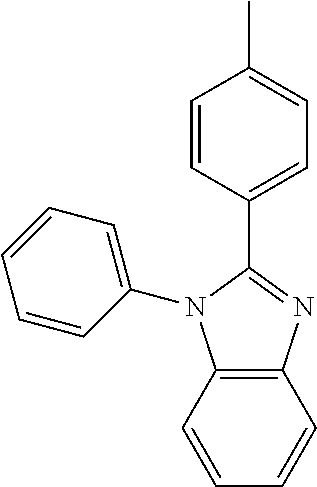
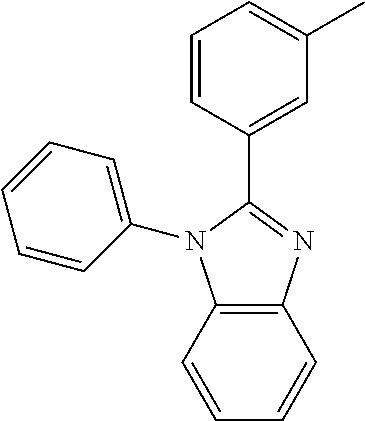
- Ar 2 and Ar 3 are the same as or different from each other, and are independently a substituted or unsubstituted nonfused ring aryl group having 6 to 50 carbon atoms; a substituted or unsubstituted fused ring aryl or heteroaryl group having 10 to 50 carbon atoms; or a substituted or unsubstituted arylamine group, and
- R1 to R7 are the same as or different from each other, and are independently selected from the group consisting of hydrogen, deuterium, tritium, a substituted or unsubstituted C 1 ⁇ C 20 alkyl group, a substituted or unsubstituted C 2 ⁇ C 20 alkenyl group, a substituted or unsubstituted C 2 ⁇ C 20 alkynyl group, a substituted or unsubstituted C 3 ⁇ C 20 cycloalkyl group, a substituted or unsubstituted C 3 ⁇ C 20 heterocycloalkyl group, a substituted or unsubstituted C 6 ⁇ C 20 aryl group, a substituted or unsubstituted C 5 ⁇ C 20 heteroaryl group, and a substituted or unsubstituted arylamine group.
- the present invention provides an organic electronic device, which comprises a first electrode, a second electrode, and one or more organic material layers that are disposed between the first electrode and the second electrode.
- One or more of the organic material layers comprise an anthracene derivative.
- a novel anthracene derivative according to the present invention may act as a light emitting host in an organic electronic device.
- the anthracene derivative may act as a hole injecting, hole transporting, electron injecting and transporting, or light emitting material in an organic light emitting device and an organic electronic device. Accordingly, the organic electronic device according to the present invention has excellent characteristics in views of efficiency, the driving voltage, and the stability.
- FIG. 1 is a view that illustrates a structure of an organic light emitting device according to an embodiment of the present invention.
- An anthracene derivative according to the present invention is represented by Formula 1.
- Ar 1 is selected from an anthracenyl group, and these groups may be substituted by one or more groups selected from the group consisting of deuterium, tritium, a C 1 ⁇ C 20 alkyl group, a C 2 ⁇ C 20 alkenyl group, a C 2 ⁇ C 20 alkynyl group, a C 3 ⁇ C 20 cycloalkyl group, a C 3 ⁇ C 20 heterocycloalkyl group, a C 6 ⁇ C 20 aryl group and an arylamine group.
- Ar 1 may be selected from the following Structural Formulas.
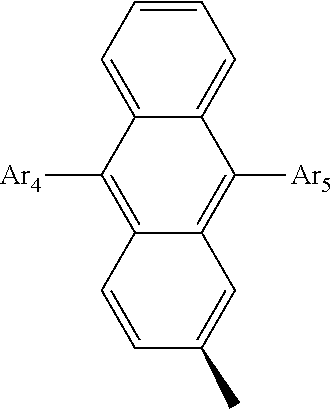
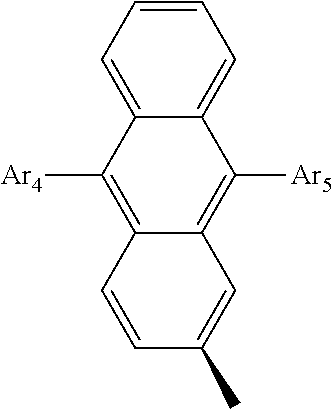
- Ar 4 and Ar 5 are each independently selected from the group consisting of deuterium, tritium, a C 1 ⁇ C 20 alkyl group, a C 2 ⁇ C 20 alkenyl group, a C 2 ⁇ C 20 alkynyl group, a C 3 ⁇ C 20 cycloalkyl group, a C 3 ⁇ C 20 heterocycloalkyl group, a C 6 ⁇ C 20 aryl group and an arylamine group.
- Ar 2 or Ar 3 is a phenyl group, a biphenyl group, a naphthalene group, an anthracenyl group, or a substituted or unsubstituted C 6 ⁇ C 50 aryl group.
- R 2 is selected from the group consisting of hydrogen, deuterium, tritium, a substituted or unsubstituted C 1 ⁇ C 20 alkyl group, a substituted or unsubstituted C 2 ⁇ C 20 alkenyl group, a substituted or unsubstituted C 2 ⁇ C 20 alkynyl group, a substituted or unsubstituted C 3 ⁇ C 20 cycloalkyl group, and a substituted or unsubstituted C 3 ⁇ C 20 heterocycloalkyl group.
- the alkyl group is preferably one having 1 to 20 carbon atoms. Specific examples thereof comprise, but not limited thereto, a methyl group, an ethyl group, a propyl group, an isopropyl group, a butyl group, a t-butyl group, a pentyl group, a hexyl group and a heptyl group.
- the alkenyl group is in the range of 2 to 20, and specific examples thereof comprise, but not limited thereto, a methenyl group, an ethenyl group, and a propylenyl group.
- the cycloalkyl group is preferably a cycloalkyl group having 3 to 20 carbon atoms, which does not give steric hindrance. More preferable specific examples thereof comprise, but not limited thereto, a cyclopentyl group and a cyclohexyl group.
- the heterocycloalkyl group is a cyclic group that comprises heteroelements such as N, S or O.
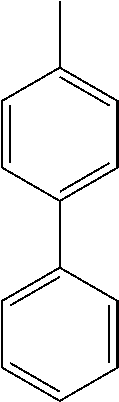
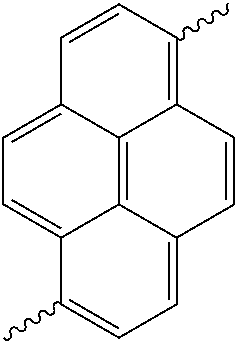
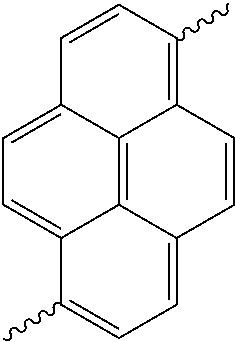
- aryl group examples comprise groups selected from the group consisting of a phenyl group, a naphthyl group, an anthracenyl group, a biphenyl group, a pyrenyl group, and a perylenyl group, but are not limited thereto.
- heteroaryl group there are groups selected from the group consisting of a pyridyl group, a bipyridyl group, an acrydyl group, a thiophene group, an imidazole group, an oxazole group, a thiazole group, a benzothiophene group, a benzothiazole group, a benzooxazole group and a quinolinyl group, but it is not limited thereto.
- the arylamine group is an amine group that is substituted by a C 6 ⁇ C 20 aryl group, and the aryl group may be substituted by the arylalkenyl group, but they are not limited thereto.
- substituted or unsubstituted means that substitution is carried out by at least one group that is selected from the group consisting of deuterium, tritium, a C 1 ⁇ C 20 alkyl group, a C 2 ⁇ C 20 alkenyl group, a C 2 ⁇ C 20 alkynyl group, a C 3 ⁇ C 20 cycloalkyl group, a C 3 ⁇ C 20 heterocycloalkyl group, a C 6 ⁇ C 50 aryl group and a C 5 ⁇ C 50 heteroaryl group, and an arylamine group.
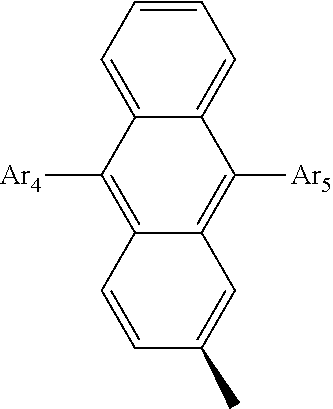
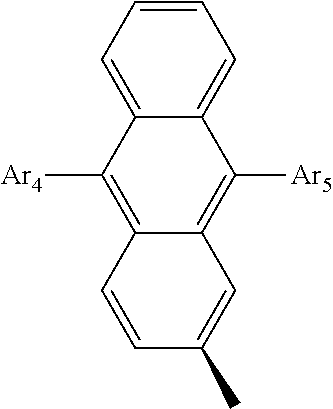
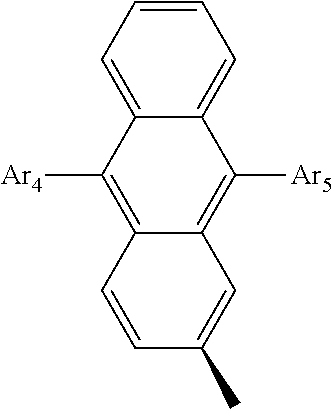
- the compound that is represented by Formula 1 may be a compound that is represented by the following Formula 2.
- Ar 4 and Ar 5 are the same as or different from each other, and are independently selected from the group consisting of hydrogen, deuterium, tritium, a substituted or unsubstituted C 1 ⁇ C 20 alkyl group, a substituted or unsubstituted C 2 ⁇ C 20 alkenyl group, a substituted or unsubstituted C 2 ⁇ C 20 alkynyl group, a substituted or unsubstituted C 3 ⁇ C 20 cycloalkyl group, a substituted or unsubstituted C 3 ⁇ C 20 heterocycloalkyl group, a substituted or unsubstituted C 6 ⁇ C 20 aryl group and a substituted or unsubstituted arylamine group, and
- Z is selected from the group consisting of hydrogen, deuterium, tritium, an aryl group and a hetero aryl group.
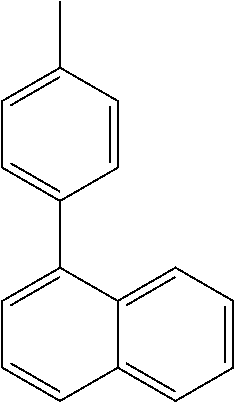
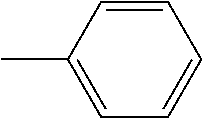
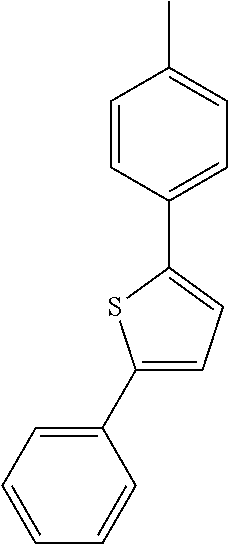
- Ar 4 and Ar 5 are selected from the group consisting of hydrogen, an aryl group such as a phenyl group, a biphenyl group, a naphthyl group, an anthryl group, a pyrenyl group, and a perylenyl group, and a heteroaryl group such as a pyridyl group, a bipyridyl group, a carbazole group, a thiophenyl group, a quinolinyl group, and an isoquinolinyl group.
- an aryl group such as a phenyl group, a biphenyl group, a naphthyl group, an anthryl group, a pyrenyl group, and a perylenyl group
- a heteroaryl group such as a pyridyl group, a bipyridyl group, a carbazole group, a thiophenyl group, a quinolinyl group, and an
- Z is selected from the group consisting of hydrogen, an aryl group such as a phenyl group, a biphenyl group, a naphthyl group, an anthryl group, a pyrenyl group, and a perylenyl group, and a heteroaryl group such as a pyridyl group, a bipyridyl group, a carbazole group, a thiophenyl group, a quinolinyl group, and an isoquinolinyl group.
- an aryl group such as a phenyl group, a biphenyl group, a naphthyl group, an anthryl group, a pyrenyl group, and a perylenyl group
- a heteroaryl group such as a pyridyl group, a bipyridyl group, a carbazole group, a thiophenyl group, a quinolinyl group, and an isoquinol
- the compound that is represented by Formula 1 may be a compound that is represented by the following Formula 3.
- Z is selected from the group consisting of hydrogen, deuterium, tritium, a substituted or unsubstituted C 1 ⁇ C 20 alkyl group, a substituted or unsubstituted C 2 ⁇ C 20 alkenyl group, a substituted or unsubstituted C 2 ⁇ C 20 alkynyl group, a substituted or unsubstituted C 3 ⁇ C 20 cycloalkyl group, a substituted or unsubstituted C 3 ⁇ C 20 heterocycloalkyl group, a substituted or unsubstituted C 6 ⁇ C 50 aryl group and a substituted or unsubstituted arylamine group.
- Z is selected from the group consisting of hydrogen, an aryl group such as a phenyl group, a biphenyl group, a naphthyl group, an anthryl group, a pyrenyl group, and a perylenyl group, and a heteroaryl group such as a pyridyl group, a bipyridyl group, a carbazole group, a thiophenyl group, a quinolinyl group, and an isoquinolinyl group.
- an aryl group such as a phenyl group, a biphenyl group, a naphthyl group, an anthryl group, a pyrenyl group, and a perylenyl group
- a heteroaryl group such as a pyridyl group, a bipyridyl group, a carbazole group, a thiophenyl group, a quinolinyl group, and an isoquinol
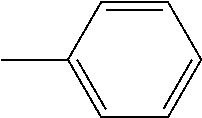
- Ar 2 and Ar 3 of Formula 1 are each independently a phenyl group, a biphenyl group, a naphthyl group, a thiophene group, a benzothiophene group, a benzothiazole group, a benzooxazole group or a pyridyl group.
- R1 to R7 of Formula 1 are hydrogen.
- Ar 4 and Ar 5 of Formula 2 are each independently a phenyl group, a naphthyl group, a biphenyl group, a thiophene group, a benzothiophene group, or a carbazole group.
- the anthracene derivative that is represented by Formula 1 according to the present invention can be synthesized by using a known synthesis method such as a Suzuki coupling reaction.
- the detailed preparation method is described in the following Preparative Examples, and the compound according to the present invention can be prepared by modifying the methods described in the following Preparative Examples by those who are skilled in the art.
- the organic electron device according to the present invention is characterized in that it uses the anthracene derivative that is represented by Formula 1.
- the organic electronic device of the present invention can be prepared by usual methods and materials for preparing an organic electronic device, except that the above-described compounds are used to form at least one organic material layer.
- the organic light emitting device will be described.
- the above-mentioned compounds according to the present invention can act as the light emitting material in the organic light emitting device, and can act as the light emitting host in conjunction with a predetermined light emitting dopant, or can act as the light emitting dopant in conjunction with a predetermined light emitting host.
- the organic light emitting device can have a structure comprising a first electrode, a second electrode, and organic material layers interposed therebetween.
- the organic light emitting device of the present invention can be prepared by usual methods and materials for preparing an organic light emitting device, except that the compounds according to the present invention are used to form at least one of the organic material layers of the organic light emitting device.
- the structure of the organic light emitting device according to the present invention is shown in FIG. 1 .
- the organic light emitting device according to the present invention can be prepared by depositing a metal, a metal oxide having conductivity or an alloy thereof on a substrate using a PVD (physical vapor deposition) process such as sputtering and e-beam evaporation to form an anode; forming an organic material layer comprising a hole injecting layer, a hole transporting layer, a light emitting layer and an electron transporting layer on the anode; and depositing a material, which can be used as a cathode, thereon.
- an organic light emitting device can be prepared by sequentially depositing a cathode material, an organic material layer, and an anode material on a substrate, thus preparing the above-described organic light emitting device.
- the organic material layer may have a multilayered structure that comprises the hole injection layer, the hole transport layer, the light emitting layer and the electron transport layer, but is not limited thereto, and the organic material layer may have a single layer structure. Further, the organic material layer can be prepared to have a fewer number of layers, using a variety of polymeric materials, by means of a solvent process rather than a deposit process, such as spin coating, dip coating, doctor blading, screen printing, ink jet printing, and heat transfer processes.
- the anode material is preferably a material having a large work function to facilitate hole injection usually to the organic material layers.
- Specific examples of the anode material which can be used in the present invention comprise metals such as vanadium, chromium, copper, zinc and gold, or an alloy thereof; metal oxides such as zinc oxide, indium oxide, indium-tin oxide (ITO), and indium zinc oxide (IZO); a combination of a metal and an oxide, such as ZnO:Al and SnO 2 :Sb; conductive polymers such as poly(3-methylthiophene), poly[3,4-(ethylene-1,2-dioxy)thiophene] (PEDT), polypyrrole and polyaniline, but are not limited thereto.
- the cathode material is preferably a material having a small work function to facilitate electron injecting usually to an organic material layer.
- Specific examples of the cathode material comprise metals such as magnesium, calcium, sodium, potassium, titanium, indium, yttrium, lithium, gadolinium, aluminum, silver, tin and lead, and an alloy thereof; and multilayered materials such as LiF/Al and LiO/Al, but are not limited thereto.
- the hole injecting material is a material facilitating hole injection from an anode at low voltage.
- the HOMO (highest occupied molecular orbital) of the hole injecting material is preferably located between the work function of the anode materials and the HOMO level of its neighboring organic material layer.
- Specific examples of the hole injecting material comprise organic materials of metal porphyrin, oligothiophene and arylamine series, organic materials of hexanitrile hexaazatriphenylene and quinacridone series, organic materials of perylene series, and conductive polymers of anthraquinone, polyaniline, and polythiophene series, but are not limited thereto.
- the hole transporting material is a material having high hole mobility, which can transfer holes from the anode or the hole injecting layer toward the light emitting layer.
- Specific examples thereof comprise organic materials of arylamine series, conductive polymers and block copolymers having both of the conjugated portions and the non-conjugated portions, but are not limited thereto.
- the light emitting material are a material capable of emitting visible light by accepting and recombining holes from the hole transporting layer and electrons from the electron transporting layer, preferably a material having high quantum efficiency for fluorescence and phosphorescence.
- Specific examples thereof comprise 8-hydroxyquinoline aluminum complex (Alq 3 ); compounds of carbazole series; dimerized styryl compounds; BAlq; 10-hydroxybenzoquinoline-metal compounds; compounds of benzoxazole, benzthiazole and benzimidazole series; polymers of poly(p-phenylenevinylene) (PPV) series; spiro compounds; and polyfluorene and rubrene compounds, but are not limited thereto.
- PV poly(p-phenylenevinylene)
- the electron transporting material is suitably a material having high electron mobility, which can easily receive electrons from the cathode and then transfer them to the light emitting layer.
- Specific examples thereof comprise an Alq complex of an 8-hydroxyquinoline aluminum complex; complexes comprising Alq3; organic radical compounds; and hydroxyflavone-metal complexes, but are not limited thereto.
- the organic light emitting device may be of a front-sided, back-sided or double-sided light emission according to the materials used.
- the compound according to the invention can also function in an organic electronic device comprising an organic solar cell, an organic photoconductor and an organic transistor, according to a principle similar to that applied to the organic light emitting device.
- the compound according to the present invention can be prepared by using a multistage chemical reaction.
- the preparation of the compounds is described in the following Examples.
- the compound according to the present invention can be prepared from an intermediate compound such as the following intermediate compounds A to H.
- “Br” can be substituted by predetermined other reactive atoms or functional groups.
- the compound A (11.2 g, 20.5 mmol) that was prepared in Preparative Example 1 was dispersed in the acetic acid (200 mL), 57% HI (500 mL) and 50% H 3 PO 2 (250 mL) were added thereto, and they were boiled for 4 days and agitated. After they were cooled to normal temperature, the layer separation was carried out by using chloroform, the organic layer was dried with magnesium sulfate, distilled under reduced pressure, and recrystallized with EtOH to obtain the compound C (58 g, 65%).
- the compound B (16 g, 34.7 mmol) that was prepared in Preparative Example 2 was dispersed in the acetic acid (750 mL), 57% HI (100 mL) and 50% H 3 PO 2 (50 mL) were added thereto, and they were refluxed and agitated for 3 days. After the reaction was finished, they were cooled to normal temperature, and the solid that was generated in the reaction was filtered, dissolved in chloroform, and treated with magnesium sulfate. This organic layer was distilled under reduced pressure, and recrystallized with EtOH to obtain the yellow solid compound D (7.96 g, 53%).
- the compound G (7.5 g, 20.5 mmol) that was prepared in Preparative Example 7 was dispersed in the acetic acid (200 mL), 57% HI (500 mL) and 50% H 3 PO 2 (250 mL) were added thereto, and they were boiled for 4 days and agitated. After they were cooled to normal temperature, the layer separation was carried out by using chloroform, the organic layer was dried with magnesium sulfate, distilled under reduced pressure, and recrystallized with EtOH to obtain the compound H (4.42 g, 65%).
- the compound H (4 g, 11.9 mmol) that was prepared in Preparative Example 8, the compound S (9.9 g, 24.9 mmol), Pd(PPh 3 ) 4 (0.4 g, 0.36 mmol) were put into the 2 M K 2 CO 3 aqueous solution (40 mL) and THF (80 mL), and refluxed and agitated for about 12 hours. After the reaction was finished, it was cooled to normal temperature, and the organic layer was separated from the reaction mixture solution, dried with magnesium sulfate, distilled under reduced pressure, and recrystallized with THF/EtOH to obtain the compound I (6.9 g, 82%).
- the compound H (4 g, 11.9 mmol) that was prepared in Preparative Example 8, the compound T (6.9 g, 24.9 mmol), and Pd(PPh 3 ) 4 (0.4 g, 0.36 mmol) were put into the 2 M K 2 CO 3 aqueous solution (40 mL) and THF (80 mL), and refluxed and agitated for about 12 hours. After the reaction was finished, it was cooled to normal temperature, and the organic layer was separated from the reaction mixture solution, dried with magnesium sulfate, distilled under reduced pressure, and recrystallized with THF/EtOH to obtain the compound K (6.0 g, 78%).
- the compound K (6.24 g, 9.66 mmol) that was prepared in Preparative Example 11 was dissolved in chloroform (500 mL), NBS (1.7 g, 18.48 mmol) was added thereto, and they were agitated at room temperature for 12 hours. After the reaction was finished, the solid that was generated in the reaction was filtered, washed with distilled water, and dried to obtain the compound L (3.5 g, 50%).
- the compound E (4 g, 9.7 mmol) that was prepared in Preparative Example 5, the compound O (4.9 g, 10.75 mmol), and Pd(PPh 3 ) 4 (0.3 g, 0.29 mmol) were put into the 2 M K 2 CO 3 aqueous solution (80 mL) and THF (120 mL), and refluxed and agitated for about 12 hours. After the reaction was finished, it was cooled to normal temperature, and the organic layer was separated from the reaction mixture solution, and filtered to obtain a solid. The obtained solid was recrystallized with THF and ethanol to obtain the compound 1-2 (3.8 g, 86%).
- the compound F (5 g, 9.8 mmol) that was prepared in Preparative Example 6, the compound O (4.9 g, 10.75 mmol), and Pd(PPh 3 ) 4 (0.3 g, 0.29 mmol) were put into the 2 M K 2 CO 3 aqueous solution (80 mL) and THF (120 mL), and refluxed and agitated for about 12 hours. After the reaction was finished, it was cooled to normal temperature, and the organic layer was separated from the reaction mixture solution, and filtered to obtain a solid. The obtained solid was recrystallized with THF and ethanol to obtain the compound 1-5 (5.2 g, 70%).
- the compound L (7.1 g, 9.8 mmol) that was prepared in Preparative Example 12, the compound O (4.9 g, 10.75 mmol), and Pd(PPh 3 ) 4 (0.3 g, 0.29 mmol) were put into the 2 M K 2 CO 3 aqueous solution (80 mL) and THF (120 mL), and refluxed and agitated for about 12 hours. After the reaction was finished; it was cooled to normal temperature, and the organic layer was separated from the reaction mixture solution, and filtered to obtain a solid. The obtained solid was recrystallized with THF and ethanol to obtain the compound 1-8 (7.7 g, 81%).
- the compound J (7.7 g, 9.8 mmol) that was prepared in Preparative Example 10, the compound O (4.9 g, 10.75 mmol), and Pd(PPh 3 ) 4 (0.3 g, 0.29 mmol) were put into the 2 M K 2 CO 3 aqueous solution (80 mL) and THF (120 mL), and refluxed and agitated for about 12 hours. After the reaction was finished, it was cooled to normal temperature, and the organic layer was separated from the reaction mixture solution, and filtered to obtain a solid. The obtained solid was recrystallized with THF and ethanol to obtain the compound 1-15 (8.2 g, 80%).
- the compound N (4.0 g, 9.8 mmol) that was prepared in Preparative Example 14, the compound O (4.9 g, 10.75 mmol), and Pd(PPh 3 ) 4 (0.3 g, 0.29 mmol) were put into the 2 M K 2 CO 3 aqueous solution (80 mL) and THF (120 mL), and refluxed and agitated for about 12 hours. After the reaction was finished, it was cooled to normal temperature, and the organic layer was separated from the reaction mixture solution, and filtered to obtain a solid. The obtained solid was recrystallized with THF and ethanol to obtain the compound 1-21 (5.2 g, 80%).
- the compound E (4 g, 9.7 mmol) that was prepared in Preparative Example 5, the compound P (6.0 g, 10.75 mmol), and Pd(PPh 3 ) 4 (0.3 g, 0.29 mmol) were put into the 2 M K 2 CO 3 aqueous solution (80 mL) and THF (120 mL), and refluxed and agitated for about 12 hours. After the reaction was finished, it was cooled to normal temperature, and the organic layer was separated from the reaction mixture solution, and filtered to obtain a solid. The obtained solid was recrystallized with THF and ethanol to obtain the compound 1-23 (6.3 g, 86%).
- the compound E (4 g, 9.7 mmol) that was prepared in Preparative Example 5, the compound Q (5.9 g, 10.75 mmol), and Pd(PPh 3 ) 4 (0.3 g, 0.29 mmol) were put into the 2 M K 2 CO 3 aqueous solution (80 mL) and THF (120 mL), and refluxed and agitated for about 12 hours. After the reaction was finished, it was cooled to normal temperature, and the organic layer was separated from the reaction mixture solution, and filtered to obtain a solid. The obtained solid was recrystallized with THF and ethanol to obtain the compound 1-67 (8.2 g, 85%).
- the compound E (4 g, 9.7 mmol) that was prepared in Preparative Example 5, the compound R (8.3 g, 10.75 mmol), and Pd(PPh 3 ) 4 (0.3 g, 0.29 mmol) were put into the 2 M K 2 CO 3 aqueous solution (80 mL) and THF (120 mL), and refluxed and agitated for about 12 hours. After the reaction was finished, it was cooled to normal temperature, and the organic layer was separated from the reaction mixture solution, and filtered to obtain a solid. The obtained solid was recrystallized with THF and ethanol to obtain the compound 1-240 (7.8 g, 83%).
- a glass substrate (corning 7059 glass) on which a thin film of ITO (indium tin oxide) was coated to a thickness of 1,000 ⁇ was immersed in distilled water having a dispersing agent dissolved therein to wash the substrate with ultrasonic waves.
- the dispersing agent as used herein was a product commercially available from Fisher Co. and the distilled water was one which had been twice filtered by using a filter commercially available from Millipore Co.
- ITO was washed for 30 minutes, and then washing with ultrasonic waves was repeated twice for 10 minutes by using distilled water. After the completion of washing with distilled water, washing with ultrasonic waves was carried out by using solvents such as isopropyl alcohol, acetone and methanol.
- solvents such as isopropyl alcohol, acetone and methanol.
- the resultant product was dried, and then transported to a plasma washing machine. Using an oxygen plasma, the substrate was washed for 5 minutes and then transported to a vacuum depositing machine.
- the host material (H1) was used as the comparative compound, and the amine compound D1 was used as the dopant material.
- Lithium fluoride (LiF) and aluminum were sequentially deposited on the electron transport layer in thicknesses of 12 ⁇ and 2,000 ⁇ respectively, to form a cathode and prepare the organic light emitting device.
- the deposition rate of the organic material was maintained at 0.4 to 0.7 ⁇ /sec and the deposition rate of lithium fluoride was maintained at 0.3 ⁇ /sec and the deposition rate of aluminum was maintained at 2 ⁇ /sec, respectively.
- the degree of vacuum upon deposition was maintained at 2 ⁇ 10 ⁇ 7 to 5 ⁇ 10 ⁇ 8 torr.
Landscapes
- Chemical & Material Sciences (AREA)
- Organic Chemistry (AREA)
- Engineering & Computer Science (AREA)
- Materials Engineering (AREA)
- Physics & Mathematics (AREA)
- Spectroscopy & Molecular Physics (AREA)
- Electroluminescent Light Sources (AREA)
- Organic Low-Molecular-Weight Compounds And Preparation Thereof (AREA)
Abstract
Description


| TABLE 1 | |||||||||||||
| Formula | Ar2 | Ar3 | Ar1 | Ar4 | Ar5 | R1 | R2 | R3 | R4 | R5 | R6 | R7 | Z |
| I-1 |
 |
 |
 |
H | H | H | H | H | H | H | H | ||
| I-2 |
 |
 |
 |
 |
 |
H | H | H | H | H | H | H | H |
| I-3 |
 |
 |
 |
 |
 |
H | H | H | H | H | H | H | H |
| I-4 |
 |
 |
 |
 |
 |
H | H | H | H | H | H | H | H |
| I-5 |
 |
 |
 |
 |
 |
H | H | H | H | H | H | H | H |
| I-6 |
 |
 |
 |
 |
 |
H | H | H | H | H | H | H | H |
| I-7 |
 |
 |
 |
 |
 |
H | H | H | H | H | H | H | H |
| I-8 |
 |
 |
 |
 |
 |
H | H | H | H | H | H | H | H |
| I-9 |
 |
 |
 |
 |
 |
H | H | H | H | H | H | H | H |
| I-10 |
 |
 |
 |
 |
 |
H | H | H | H | H | H | H | H |
| I-11 |
 |
 |
 |
 |
 |
H | H | H | H | H | H | H | H |
| I-12 |
 |
 |
 |
 |
 |
H | H | H | H | H | H | H | H |
| I-13 |
 |
 |
 |
 |
 |
H | H | H | H | H | H | H | H |
| I-14 |
 |
 |
 |
 |
 |
H | H | H | H | H | H | H | H |
| I-15 |
 |
 |
 |
 |
 |
H | H | H | H | H | H | H | H |
| I-16 |
 |
 |
 |
 |
 |
H | H | H | H | H | H | H | H |
| I-17 |
 |
 |
 |
 |
 |
H | H | H | H | H | H | H | H |
| I-18 |
 |
 |
 |
 |
 |
H | H | H | H | H | H | H | H |
| I-19 |
 |
 |
 |
 |
 |
H | H | H | H | H | H | H | H |
| I-20 |
 |
 |
 |
 |
 |
H | H | H | H | H | H | H | H |
| I-21 |
 |
 |
 |
 |
 |
H | H | H | H | H | H | H | H |
| I-22 |
 |
 |
 |
H | H | H | H | H | H | H | H | ||
| I-23 |
 |
 |
 |
 |
 |
H | H | H | H | H | H | H | H |
| I-24 |
 |
 |
 |
 |
 |
H | H | H | H | H | H | H | H |
| I-25 |
 |
 |
 |
 |
 |
H | H | H | H | H | H | H | H |
| I-26 |
 |
 |
 |
 |
 |
H | H | H | H | H | H | H | H |
| I-27 |
 |
 |
 |
 |
 |
H | H | H | H | H | H | H | H |
| I-28 |
 |
 |
 |
 |
 |
H | H | H | H | H | H | H | H |
| I-29 |
 |
 |
 |
 |
 |
H | H | H | H | H | H | H | H |
| I-30 |
 |
 |
 |
 |
 |
H | H | H | H | H | H | H | H |
| I-31 |
 |
 |
 |
 |
 |
H | H | H | H | H | H | H | H |
| I-32 |
 |
 |
 |
 |
 |
H | H | H | H | H | H | H | H |
| I-33 |
 |
 |
 |
 |
 |
H | H | H | H | H | H | H | H |
| I-34 |
 |
 |
 |
 |
 |
H | H | H | H | H | H | H | H |
| I-35 |
 |
 |
 |
 |
 |
H | H | H | H | H | H | H | H |
| I-36 |
 |
 |
 |
 |
 |
H | H | H | H | H | H | H | H |
| I-37 |
 |
 |
 |
 |
 |
H | H | H | H | H | H | H | H |
| I-38 |
 |
 |
 |
 |
 |
H | H | H | H | H | H | H | H |
| I-39 |
 |
 |
 |
 |
 |
H | H | H | H | H | H | H | H |
| I-40 |
 |
 |
 |
 |
 |
H | H | H | H | H | H | H | H |
| I-41 |
 |
 |
 |
 |
 |
H | H | H | H | H | H | H | H |
| I-42 |
 |
 |
 |
 |
 |
H | H | H | H | H | H | H | H |
| I-43 |
 |
 |
 |
 |
 |
H | H | H | H | H | H | H | H |
| I-44 |
 |
 |
 |
H | H | H | H | H | H | H | H | ||
| I-45 |
 |
 |
 |
 |
 |
H | H | H | H | H | H | H | H |
| I-46 |
 |
 |
 |
 |
 |
H | H | H | H | H | H | H | H |
| I-47 |
 |
 |
 |
 |
 |
H | H | H | H | H | H | H | H |
| I-48 |
 |
 |
 |
 |
 |
H | H | H | H | H | H | H | H |
| I-49 |
 |
 |
 |
 |
 |
H | H | H | H | H | H | H | H |
| I-50 |
 |
 |
 |
 |
 |
H | H | H | H | H | H | H | H |
| I-51 |
 |
 |
 |
 |
 |
H | H | H | H | H | H | H | H |
| I-52 |
 |
 |
 |
 |
 |
H | H | H | H | H | H | H | H |
| I-53 |
 |
 |
 |
 |
 |
H | H | H | H | H | H | H | H |
| I-54 |
 |
 |
 |
 |
 |
H | H | H | H | H | H | H | H |
| I-55 |
 |
 |
 |
 |
 |
H | H | H | H | H | H | H | H |
| I-56 |
 |
 |
 |
 |
 |
H | H | H | H | H | H | H | H |
| I-57 |
 |
 |
 |
 |
 |
H | H | H | H | H | H | H | H |
| I-58 |
 |
 |
 |
 |
 |
H | H | H | H | H | H | H | H |
| I-59 |
 |
 |
 |
 |
 |
H | H | H | H | H | H | H | H |
| I-60 |
 |
 |
 |
 |
 |
H | H | H | H | H | H | H | H |
| I-61 |
 |
 |
 |
 |
 |
H | H | H | H | H | H | H | H |
| I-62 |
 |
 |
 |
 |
 |
H | H | H | H | H | H | H | H |
| I-63 |
 |
 |
 |
 |
 |
H | H | H | H | H | H | H | H |
| I-64 |
 |
 |
 |
 |
 |
H | H | H | H | H | H | H | H |
| I-65 |
 |
 |
 |
 |
 |
H | H | H | H | H | H | H | H |
| I-66 |
 |
 |
 |
H | H | H | H | H | H | H | H | ||
| I-67 |
 |
 |
 |
 |
 |
H | H | H | H | H | H | H | H |
| I-68 |
 |
 |
 |
 |
 |
H | H | H | H | H | H | H | H |
| I-69 |
 |
 |
 |
 |
 |
H | H | H | H | H | H | H | H |
| I-70 |
 |
 |
 |
 |
 |
H | H | H | H | H | H | H | H |
| I-71 |
 |
 |
 |
 |
 |
H | H | H | H | H | H | H | H |
| I-72 |
 |
 |
 |
 |
 |
H | H | H | H | H | H | H | H |
| I-73 |
 |
 |
 |
 |
 |
H | H | H | H | H | H | H | H |
| I-74 |
 |
 |
 |
 |
 |
H | H | H | H | H | H | H | H |
| I-75 |
 |
 |
 |
 |
 |
H | H | H | H | H | H | H | H |
| I-76 |
 |
 |
 |
 |
 |
H | H | H | H | H | H | H | H |
| I-77 |
 |
 |
 |
 |
 |
H | H | H | H | H | H | H | H |
| I-78 |
 |
 |
 |
 |
 |
H | H | H | H | H | H | H | H |
| I-79 |
 |
 |
 |
 |
 |
H | H | H | H | H | H | H | H |
| I-80 |
 |
 |
 |
 |
 |
H | H | H | H | H | H | H | H |
| I-81 |
 |
 |
 |
 |
 |
H | H | H | H | H | H | H | H |
| I-82 |
 |
 |
 |
 |
 |
H | H | H | H | H | H | H | H |
| I-83 |
 |
 |
 |
 |
 |
H | H | H | H | H | H | H | H |
| I-84 |
 |
 |
 |
 |
 |
H | H | H | H | H | H | H | H |
| I-85 |
 |
 |
 |
 |
 |
H | H | H | H | H | H | H | H |
| I-86 |
 |
 |
 |
 |
 |
H | H | H | H | H | H | H | H |
| I-87 |
 |
 |
 |
 |
 |
H | H | H | H | H | H | H | H |
| I-88 |
 |
 |
 |
 |
 |
H | H | H | H | H | H | H | H |
| I-89 |
 |
 |
 |
 |
 |
H | H | H | H | H | H | H | H |
| I-90 |
 |
 |
 |
 |
 |
H | H | H | H | H | H | H | H |
| I-91 |
 |
 |
 |
 |
 |
H | H | H | H | H | H | H | H |
| I-92 |
 |
 |
 |
 |
 |
H | H | H | H | H | H | H | H |
| I-93 |
 |
 |
 |
 |
 |
H | H | H | H | H | H | H | H |
| I-94 |
 |
 |
 |
 |
 |
H | H | H | H | H | H | H | H |
| I-95 |
 |
 |
 |
 |
 |
H | H | H | H | H | H | H | H |
| I-96 |
 |
 |
 |
 |
 |
H | H | H | H | H | H | H | H |
| I-97 |
 |
 |
 |
 |
 |
H | H | H | H | H | H | H | H |
| I-98 |
 |
 |
 |
 |
 |
H | H | H | H | H | H | H | H |
| I-99 |
 |
 |
 |
 |
 |
H | H | H | H | H | H | H | H |
| I-100 |
 |
 |
 |
 |
 |
H | H | H | H | H | H | H | H |
| I-101 |
 |
 |
 |
 |
 |
H | H | H | H | H | H | H | H |
| I-102 |
 |
 |
 |
 |
 |
H | H | H | H | H | H | H | H |
| I-103 |
 |
 |
 |
 |
 |
H | H | H | H | H | H | H | H |
| I-104 |
 |
 |
 |
 |
 |
H | H | H | H | H | H | H | H |
| I-105 |
 |
 |
 |
 |
 |
H | H | H | H | H | H | H | H |
| I-106 |
 |
 |
 |
 |
 |
H | H | H | H | H | H | H | H |
| I-107 |
 |
 |
 |
 |
 |
H | H | H | H | H | H | H | H |
| I-108 |
 |
 |
 |
 |
 |
H | H | H | H | H | H | H | H |
| I-109 |
 |
 |
 |
H | H | H | H | H | H | H | H | ||
| I-110 |
 |
 |
 |
 |
 |
H | H | H | H | H | H | H | H |
| I-111 |
 |
 |
 |
 |
 |
H | H | H | H | H | H | H | H |
| I-112 |
 |
 |
 |
 |
 |
H | H | H | H | H | H | H | H |
| I-113 |
 |
 |
 |
 |
 |
H | H | H | H | H | H | H | H |
| I-114 |
 |
 |
 |
 |
 |
H | H | H | H | H | H | H | H |
| I-115 |
 |
 |
 |
 |
 |
H | H | H | H | H | H | H | H |
| I-116 |
 |
 |
 |
 |
 |
H | H | H | H | H | H | H | H |
| I-117 |
 |
 |
 |
 |
 |
H | H | H | H | H | H | H | H |
| I-118 |
 |
 |
 |
 |
 |
H | H | H | H | H | H | H | H |
| I-119 |
 |
 |
 |
 |
 |
H | H | H | H | H | H | H | H |
| I-120 |
 |
 |
 |
 |
 |
H | H | H | H | H | H | H | H |
| I-211 |
 |
 |
 |
 |
 |
H | H | H | H | H | H | H | H |
| I-212 |
 |
 |
 |
 |
 |
H | H | H | H | H | H | H | H |
| I-213 |
 |
 |
 |
 |
 |
H | H | H | H | H | H | H | H |
| I-214 |
 |
 |
 |
 |
 |
H | H | H | H | H | H | H | H |
| I-215 |
 |
 |
 |
 |
 |
H | H | H | H | H | H | H | H |
| I-216 |
 |
 |
 |
 |
 |
H | H | H | H | H | H | H | H |
| I-217 |
 |
 |
 |
 |
 |
H | H | H | H | H | H | H | H |
| I-218 |
 |
 |
 |
 |
 |
H | H | H | H | H | H | H | H |
| I-219 |
 |
 |
 |
 |
 |
H | H | H | H | H | H | H | H |
| I-220 |
 |
 |
 |
 |
 |
H | H | H | H | H | H | H | H |
| I-221 |
 |
 |
 |
 |
 |
H | H | H | H | H | H | H | H |
| I-222 |
 |
 |
 |
 |
 |
H | H | H | H | H | H | H | H |
| I-223 |
 |
 |
 |
 |
 |
H | H | H | H | H | H | H | H |
| I-224 |
 |
 |
 |
 |
 |
H | H | H | H | H | H | H | H |
| I-225 |
 |
 |
 |
 |
 |
H | H | H | H | H | H | H | H |
| I-226 |
 |
 |
 |
 |
 |
H | H | H | H | H | H | H | H |
| I-227 |
 |
 |
 |
 |
 |
H | H | H | H | H | H | H | H |
| I-228 |
 |
 |
 |
 |
 |
H | H | H | H | H | H | H | H |
| I-229 |
 |
 |
 |
 |
 |
H | H | H | H | H | H | H | H |
| I-230 |
 |
 |
 |
 |
 |
H | H | H | H | H | H | H | H |
| I-231 |
 |
 |
 |
 |
 |
H | H | H | H | H | H | H | H |
| I-232 |
 |
 |
 |
 |
 |
H | H | H | H | H | H | H | H |
| I-233 |
 |
 |
 |
 |
 |
H | H | H | H | H | H | H | H |
| I-234 |
 |
 |
 |
 |
 |
H | H | H | H | H | H | H | H |
| I-235 |
 |
 |
 |
 |
 |
H | H | H | H | H | H | H | H |
| I-236 |
 |
 |
 |
 |
 |
H | H | H | H | H | H | H | H |
| I-237 |
 |
 |
 |
 |
 |
H | H | H | H | H | H | H | H |
| I-238 |
 |
 |
 |
 |
 |
H | H | H | H | H | H | H | H |
| I-239 |
 |
 |
 |
 |
 |
H | H | H | H | H | H | H | H |
| I-240 |
 |
 |
 |
 |
 |
H | H | H | H | H | H | H | H |
| I-241 |
 |
 |
 |
 |
 |
H | H | H | H | H | H | H | H |
| I-242 |
 |
 |
 |
 |
 |
H | H | H | H | H | H | H | H |
| I-243 |
 |
 |
 |
 |
 |
H | H | H | H | H | H | H | H |
| I-244 |
 |
 |
 |
 |
 |
H | H | H | H | H | H | H | H |
| I-245 |
 |
 |
 |
 |
 |
H | H | H | H | H | H | H | H |
| I-246 |
 |
 |
 |
 |
 |
H | H | H | H | H | H | H | H |
| I-247 |
 |
 |
 |
 |
 |
H | H | H | H | H | H | H | H |
| I-248 |
 |
 |
 |
 |
 |
H | H | H | H | H | H | H | H |
| I-249 |
 |
 |
 |
 |
 |
H | H | H | H | H | H | H | H |
| I-250 |
 |
 |
 |
 |
 |
H | H | H | H | H | H | H | H |
| I-251 |
 |
 |
 |
 |
 |
H | H | H | H | H | H | H | H |
| I-252 |
 |
 |
 |
 |
 |
H | H | H | H | H | H | H | H |
| I-253 |
 |
 |
 |
 |
 |
H | H | H | H | H | H | H | H |
| I-254 |
 |
 |
 |
 |
 |
H | H | H | H | H | H | H | H |
| I-255 |
 |
 |
 |
 |
 |
H | H | H | H | H | H | H | H |
| I-256 |
 |
 |
 |
 |
 |
H | H | H | H | H | H | H | H |
| I-257 |
 |
 |
 |
 |
 |
H | H | H | H | H | H | H | H |
| I-258 |
 |
 |
 |
 |
 |
H | H | H | H | H | H | H | H |
| I-259 |
 |
 |
 |
 |
 |
H | H | H | H | H | H | H | H |
| I-260 |
 |
 |
 |
 |
 |
H | H | H | H | H | H | H | H |
| I-261 |
 |
 |
 |
 |
 |
H | H | H | H | H | H | H | H |
| I-262 |
 |
 |
 |
 |
 |
H | H | H | H | H | H | H | H |
| I-263 |
 |
 |
 |
 |
 |
H | H | H | H | H | H | H | H |
| I-264 |
 |
 |
 |
 |
 |
H | H | H | H | H | H | H | H |
| I-265 |
 |
 |
 |
 |
 |
H | H | H | H | H | H | H | H |
| I-266 |
 |
 |
 |
 |
 |
H | H | H | H | H | H | H | H |
| I-267 |
 |
 |
 |
 |
 |
H | H | H | H | H | H | H | H |
| I-268 |
 |
 |
 |
 |
 |
H | H | H | H | H | H | H | H |
| I-269 |
 |
 |
 |
 |
 |
H | H | H | H | H | H | H | H |
| I-270 |
 |
 |
 |
 |
 |
H | H | H | H | H | H | H | H |
| I-271 |
 |
 |
 |
 |
 |
H | H | H | H | H | H | H | H |
| I-272 |
 |
 |
 |
 |
 |
H | H | H | H | H | H | H | H |
| I-273 |
 |
 |
 |
 |
 |
H | H | H | H | H | H | H | H |
| I-274 |
 |
 |
 |
 |
 |
H | H | H | H | H | H | H | H |
| I-275 |
 |
 |
 |
 |
 |
H | H | H | H | H | H | H | H |
| I-276 |
 |
 |
 |
 |
 |
H | H | H | H | H | H | H | H |
| I-277 |
 |
 |
 |
 |
 |
H | H | H | H | H | H | H | H |
| I-278 |
 |
 |
 |
 |
 |
H | H | H | H | H | H | H | H |
| I-279 |
 |
 |
 |
 |
 |
H | H | H | H | H | H | H | H |
| I-280 |
 |
 |
 |
 |
 |
H | H | H | H | H | H | H | H |
| I-281 |
 |
 |
 |
 |
 |
H | H | H | H | H | H | H | H |
| I-282 |
 |
 |
 |
 |
 |
H | H | H | H | H | H | H | H |
| I-283 |
 |
 |
 |
 |
 |
H | H | H | H | H | H | H | H |
| I-284 |
 |
 |
 |
 |
 |
H | H | H | H | H | H | H | H |
| I-285 |
 |
 |
 |
 |
 |
H | H | H | H | H | H | H | H |
| I-286 |
 |
 |
 |
 |
 |
H | H | H | H | H | H | H | H |
| I-287 |
 |
 |
 |
 |
 |
H | H | H | H | H | H | H | H |
| I-288 |
 |
 |
 |
 |
 |
H | H | H | H | H | H | H | H |
| I-289 |
 |
 |
 |
 |
 |
H | H | H | H | H | H | H | H |
| I-290 |
 |
 |
 |
 |
 |
H | H | H | H | H | H | H | H |
| I-291 |
 |
 |
 |
 |
 |
H | H | H | H | H | H | H | H |
| TABLE 2 | |||||||||||
| Formula | Ar2 | Ar3 | Ar1 | R1 | R2 | R3 | R4 | R5 | R6 | R7 | Z |
| 2-1 |
 |
 |
 |
H | H | H | H | H | H | H | H |
| 2-2 |
 |
 |
 |
H | H | H | H | H | H | H | H |
| 2-3 |
 |
 |
 |
H | H | H | H | H | H | H | H |
| 2-4 |
 |
 |
 |
H | H | H | H | H | H | H | H |
| 2-5 |
 |
 |
 |
H | H | H | H | H | H | H |
 |
| 2-6 |
 |
 |
 |
H | H | H | H | H | H | H |
 |


| TABLE 3 | ||||||
| Current | Luminous | Color | ||||
| Experimental | Host | Dopant | Voltage | efficiency | efficiency | coordinate |
| Example No. | material | material | (V) | (cd/A) | (lm/W) | (x, y) |
| 1 | compound 1-1 | D1 | 7.67 | 20.88 | 8.58 | (0.289, 0.662) |
| 2 | compound 1-2 | D1 | 7.63 | 27.16 | 11.17 | (0.294, 0.659) |
| 3 | compound 1-5 | D1 | 7.67 | 28.24 | 11.61 | (0.304, 0.662) |
| 4 | compound 1-8 | D1 | 7.69 | 27.12 | 11.58 | (0.316, 0.672) |
| 5 | compound 1-22 | D1 | 7.16 | 23.18 | 9.95 | (0.302, 0.657) |
| 6 | compound 1-23 | D1 | 7.62 | 27.52 | 11.19 | (0.290, 0.654) |
| 7 | compound 1-67 | D1 | 7.63 | 27.01 | 11.14 | (0.291, 0.660) |
| 8 | compound | D1 | 7.69 | 26.99 | 11.01 | (0.312, 0.651) |
| 1-240 | ||||||
| 9 | Comparative | D1 | 7.73 | 20.15 | 8.51 | (0.286, 0.643) |
| compound | ||||||
Claims (10)














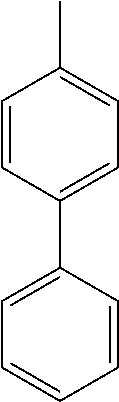


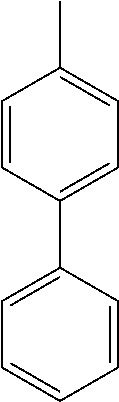




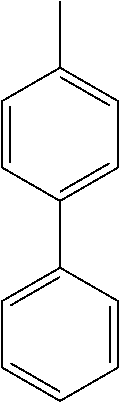


















Applications Claiming Priority (3)
| Application Number | Priority Date | Filing Date | Title |
|---|---|---|---|
| KR10-2008-0067363 | 2008-07-11 | ||
| KR20080067363 | 2008-07-11 | ||
| PCT/KR2009/003801 WO2010005268A2 (en) | 2008-07-11 | 2009-07-10 | A new anthracene derivative and an organic electronic device using the same |
Publications (2)
| Publication Number | Publication Date |
|---|---|
| US20110108826A1 US20110108826A1 (en) | 2011-05-12 |
| US8974919B2 true US8974919B2 (en) | 2015-03-10 |
Family
ID=41507601
Family Applications (1)
| Application Number | Title | Priority Date | Filing Date |
|---|---|---|---|
| US13/003,457 Active 2030-06-30 US8974919B2 (en) | 2008-07-11 | 2009-07-10 | Anthracene derivative and an organic electronic device using the same |
Country Status (3)
| Country | Link |
|---|---|
| US (1) | US8974919B2 (en) |
| KR (1) | KR101132462B1 (en) |
| WO (1) | WO2010005268A2 (en) |
Families Citing this family (12)
| Publication number | Priority date | Publication date | Assignee | Title |
|---|---|---|---|---|
| KR101115255B1 (en) * | 2008-07-11 | 2012-02-15 | 주식회사 엘지화학 | Novel anthracene derivatives and organic electronic devices using the same |
| EP2436679B1 (en) | 2009-05-29 | 2016-01-06 | Idemitsu Kosan Co., Ltd. | Anthracene derivative and organic electroluminescent element using the same |
| US9312500B2 (en) | 2012-08-31 | 2016-04-12 | Idemitsu Kosan Co., Ltd. | Organic electroluminescence device |
| KR20150119431A (en) | 2013-02-22 | 2015-10-23 | 이데미쓰 고산 가부시키가이샤 | Anthracene derivative, material for organic electroluminescent elements, organic electroluminescent element, and electronic device |
| EP2924029B1 (en) | 2013-03-15 | 2018-12-12 | Idemitsu Kosan Co., Ltd | Anthracene derivative and organic electroluminescence element using same |
| KR102104637B1 (en) * | 2013-06-28 | 2020-04-27 | 삼성디스플레이 주식회사 | Organic Light Emitting Diode Device |
| US10700288B2 (en) * | 2015-07-24 | 2020-06-30 | Semiconductor Energy Laboratory Co., Ltd. | Light-emitting element, light-emitting device, electronic device, lighting device, and lighting system |
| KR102100008B1 (en) * | 2016-04-12 | 2020-04-10 | 주식회사 엘지화학 | Anthracene based compound and organic light emitting device comprising the same |
| KR20180010136A (en) * | 2016-07-20 | 2018-01-30 | 가부시키가이샤 한도오따이 에네루기 켄큐쇼 | Organic compound, light-emitting element, light-emitting device, electronic device, and lighting device |
| KR102030887B1 (en) * | 2016-09-23 | 2019-10-10 | 주식회사 엘지화학 | Anthracene based compound and organic light emitting device comprising the same |
| CN106800526B (en) * | 2016-12-15 | 2019-01-29 | 中节能万润股份有限公司 | It is a kind of using cyclic diketones as the electroluminescent organic material of core and its application |
| US12239016B2 (en) * | 2017-09-19 | 2025-02-25 | Lg Chem, Ltd. | Organic light emitting element |
Citations (7)
| Publication number | Priority date | Publication date | Assignee | Title |
|---|---|---|---|---|
| JP2005206551A (en) | 2004-01-26 | 2005-08-04 | Mitsui Chemicals Inc | Anthracene compound and organic electroluminescent element containing the same anthracene compound |
| US20050233166A1 (en) * | 2004-04-14 | 2005-10-20 | Eastman Kodak Company | OLED device using reduced drive voltage |
| WO2006003842A1 (en) * | 2004-07-02 | 2006-01-12 | Chisso Corporation | Luminescent material and organic electroluminescent device utilizing the same |
| US20060019116A1 (en) | 2004-07-22 | 2006-01-26 | Eastman Kodak Company | White electroluminescent device with anthracene derivative host |
| JP2007186449A (en) | 2006-01-13 | 2007-07-26 | Canon Inc | Aminobisanthryl derivative-substituted compound and organic light-emitting device using the same |
| JP2007238500A (en) | 2006-03-08 | 2007-09-20 | Mitsui Chemicals Inc | Anthracene compound and organic electroluminescent element containing the compound |
| US20090242877A1 (en) * | 2008-03-25 | 2009-10-01 | Eastman Kodak Company | Oled device with hole-transport and electron-transport materials |
-
2009
- 2009-07-10 KR KR1020090062965A patent/KR101132462B1/en not_active Expired - Fee Related
- 2009-07-10 WO PCT/KR2009/003801 patent/WO2010005268A2/en not_active Ceased
- 2009-07-10 US US13/003,457 patent/US8974919B2/en active Active
Patent Citations (9)
| Publication number | Priority date | Publication date | Assignee | Title |
|---|---|---|---|---|
| JP2005206551A (en) | 2004-01-26 | 2005-08-04 | Mitsui Chemicals Inc | Anthracene compound and organic electroluminescent element containing the same anthracene compound |
| US20050233166A1 (en) * | 2004-04-14 | 2005-10-20 | Eastman Kodak Company | OLED device using reduced drive voltage |
| WO2006003842A1 (en) * | 2004-07-02 | 2006-01-12 | Chisso Corporation | Luminescent material and organic electroluminescent device utilizing the same |
| KR20070033383A (en) | 2004-07-02 | 2007-03-26 | 짓쏘 가부시끼가이샤 | Luminescent Materials and Organic Electroluminescent Devices Using The Same |
| US20100025661A1 (en) * | 2004-07-02 | 2010-02-04 | Guofang Wang | Luminescent material and organic electroluminescent device using the same |
| US20060019116A1 (en) | 2004-07-22 | 2006-01-26 | Eastman Kodak Company | White electroluminescent device with anthracene derivative host |
| JP2007186449A (en) | 2006-01-13 | 2007-07-26 | Canon Inc | Aminobisanthryl derivative-substituted compound and organic light-emitting device using the same |
| JP2007238500A (en) | 2006-03-08 | 2007-09-20 | Mitsui Chemicals Inc | Anthracene compound and organic electroluminescent element containing the compound |
| US20090242877A1 (en) * | 2008-03-25 | 2009-10-01 | Eastman Kodak Company | Oled device with hole-transport and electron-transport materials |
Also Published As
| Publication number | Publication date |
|---|---|
| US20110108826A1 (en) | 2011-05-12 |
| WO2010005268A2 (en) | 2010-01-14 |
| WO2010005268A3 (en) | 2010-04-29 |
| KR101132462B1 (en) | 2012-03-30 |
| KR20100007791A (en) | 2010-01-22 |
Similar Documents
| Publication | Publication Date | Title |
|---|---|---|
| US8974919B2 (en) | Anthracene derivative and an organic electronic device using the same | |
| CN112961147B (en) | Nitrogen-containing compound and organic electroluminescent device thereof | |
| CA2492692A1 (en) | Charge transport compositions which are quinazoline derivatives and electronic devices made with such compositions | |
| KR20130094222A (en) | Light-emitting device material and light-emitting device | |
| TWI500605B (en) | Novel compound and organic electronic device using same | |
| CN114784212B (en) | Organic electroluminescent device and electronic device comprising same | |
| CN107017348A (en) | Organic optoelectronic device and display device | |
| CN111253302A (en) | A Novel Compound and Its Application in Organic Electroluminescent Devices | |
| CN114773286A (en) | Nitrogen-containing heterocyclic organic compound and organic light-emitting device thereof | |
| CN113421980B (en) | Organic electroluminescent device and electronic apparatus including the same | |
| CN115557956B (en) | A large fused-ring organic compound and its applications, and organic electroluminescent devices containing it. | |
| CN111635421B (en) | Organic material with multi-heterocyclic structure and application thereof | |
| CN119504715B (en) | Organic compound, organic electroluminescent device and electronic apparatus | |
| CN112614954A (en) | Organic electroluminescent device and display device | |
| CN115894462B (en) | Organic compound, organic electroluminescent device and electronic apparatus | |
| CN108017646A (en) | A kind of perimidine derivative and its application | |
| KR20150015252A (en) | Compound, organic optoelectric device and display device | |
| CN115873003A (en) | Polycyclic aromatic compound, material for organic device, organic electroluminescent element, display device, and lighting device | |
| CN116462625A (en) | An organic compound and an organic electroluminescent device comprising the compound | |
| KR20150041508A (en) | Compound, organic optoelectronic device and display device | |
| CN114149456A (en) | Polycyclic aromatic compound and application thereof | |
| TW202442094A (en) | Organic electroluminescent device, semiconducting material, semiconducting layer, compound, electronic device and display device | |
| CN111961063B (en) | Oxygen-containing multi-heterocyclic compound and application thereof | |
| CN119343035B (en) | Organic electroluminescent devices and electronic devices | |
| CN115232097B (en) | An organic compound and its application, and an organic electroluminescent device containing the same |
Legal Events
| Date | Code | Title | Description |
|---|---|---|---|
| AS | Assignment |
Owner name: LG CHEM LTD., KOREA, REPUBLIC OF Free format text: ASSIGNMENT OF ASSIGNORS INTEREST;ASSIGNORS:JANG, HYE-YOUNG;SON, SE-HWAN;BAE, JAE-SOON;AND OTHERS;REEL/FRAME:025611/0178 Effective date: 20110105 |
|
| FEPP | Fee payment procedure |
Free format text: PAYOR NUMBER ASSIGNED (ORIGINAL EVENT CODE: ASPN); ENTITY STATUS OF PATENT OWNER: LARGE ENTITY |
|
| STCF | Information on status: patent grant |
Free format text: PATENTED CASE |
|
| MAFP | Maintenance fee payment |
Free format text: PAYMENT OF MAINTENANCE FEE, 4TH YEAR, LARGE ENTITY (ORIGINAL EVENT CODE: M1551); ENTITY STATUS OF PATENT OWNER: LARGE ENTITY Year of fee payment: 4 |
|
| MAFP | Maintenance fee payment |
Free format text: PAYMENT OF MAINTENANCE FEE, 8TH YEAR, LARGE ENTITY (ORIGINAL EVENT CODE: M1552); ENTITY STATUS OF PATENT OWNER: LARGE ENTITY Year of fee payment: 8 |