US8940186B2 - Insulating layer composition for substrate, and prepreg and substrate using the same - Google Patents
Insulating layer composition for substrate, and prepreg and substrate using the same Download PDFInfo
- Publication number
- US8940186B2 US8940186B2 US13/657,296 US201213657296A US8940186B2 US 8940186 B2 US8940186 B2 US 8940186B2 US 201213657296 A US201213657296 A US 201213657296A US 8940186 B2 US8940186 B2 US 8940186B2
- Authority
- US
- United States
- Prior art keywords
- insulating layer
- group
- layer composition
- graphene oxide
- liquid crystal
- Prior art date
- Legal status (The legal status is an assumption and is not a legal conclusion. Google has not performed a legal analysis and makes no representation as to the accuracy of the status listed.)
- Active, expires
Links
- 239000000203 mixture Substances 0.000 title claims abstract description 61
- 239000000758 substrate Substances 0.000 title claims abstract description 42
- OKTJSMMVPCPJKN-UHFFFAOYSA-N Carbon Chemical compound [C] OKTJSMMVPCPJKN-UHFFFAOYSA-N 0.000 claims abstract description 87
- 229920001187 thermosetting polymer Polymers 0.000 claims abstract description 75
- 239000004973 liquid crystal related substance Substances 0.000 claims abstract description 74
- 229910021389 graphene Inorganic materials 0.000 claims abstract description 70
- -1 alkoxide compound Chemical class 0.000 claims abstract description 60
- 229910052751 metal Inorganic materials 0.000 claims abstract description 55
- 239000002184 metal Substances 0.000 claims abstract description 55
- 239000003822 epoxy resin Substances 0.000 claims description 26
- 229920000647 polyepoxide Polymers 0.000 claims description 26
- 239000011256 inorganic filler Substances 0.000 claims description 24
- 229910003475 inorganic filler Inorganic materials 0.000 claims description 24
- 150000001875 compounds Chemical class 0.000 claims description 15
- 239000002131 composite material Substances 0.000 claims description 14
- 125000003118 aryl group Chemical group 0.000 claims description 13
- 229910052799 carbon Inorganic materials 0.000 claims description 12
- 238000006243 chemical reaction Methods 0.000 claims description 12
- 125000000524 functional group Chemical group 0.000 claims description 10
- 125000000962 organic group Chemical group 0.000 claims description 9
- QVGXLLKOCUKJST-UHFFFAOYSA-N atomic oxygen Chemical compound [O] QVGXLLKOCUKJST-UHFFFAOYSA-N 0.000 claims description 7
- 239000001301 oxygen Substances 0.000 claims description 7
- 229910052760 oxygen Inorganic materials 0.000 claims description 7
- 125000003178 carboxy group Chemical group [H]OC(*)=O 0.000 claims description 4
- 238000006482 condensation reaction Methods 0.000 claims description 4
- 125000003700 epoxy group Chemical group 0.000 claims description 4
- 150000001408 amides Chemical class 0.000 claims description 3
- 150000002148 esters Chemical class 0.000 claims description 3
- RTZKZFJDLAIYFH-UHFFFAOYSA-N ether Substances CCOCC RTZKZFJDLAIYFH-UHFFFAOYSA-N 0.000 claims description 3
- 125000002887 hydroxy group Chemical group [H]O* 0.000 claims description 3
- 229910052742 iron Inorganic materials 0.000 claims description 3
- 125000005641 methacryl group Chemical group 0.000 claims description 3
- 229910052759 nickel Inorganic materials 0.000 claims description 3
- 229910052758 niobium Inorganic materials 0.000 claims description 3
- 229910052702 rhenium Inorganic materials 0.000 claims description 3
- 229910052715 tantalum Inorganic materials 0.000 claims description 3
- 125000003396 thiol group Chemical group [H]S* 0.000 claims description 3
- 229910052719 titanium Inorganic materials 0.000 claims description 3
- 229910052721 tungsten Inorganic materials 0.000 claims description 3
- 229910052720 vanadium Inorganic materials 0.000 claims description 3
- 125000000391 vinyl group Chemical group [H]C([*])=C([H])[H] 0.000 claims description 3
- 229910052727 yttrium Inorganic materials 0.000 claims description 3
- 229910052726 zirconium Inorganic materials 0.000 claims description 3
- 239000012774 insulation material Substances 0.000 abstract description 6
- 230000008859 change Effects 0.000 abstract description 2
- 239000010410 layer Substances 0.000 description 51
- 229920000642 polymer Polymers 0.000 description 20
- 239000000463 material Substances 0.000 description 12
- 230000000052 comparative effect Effects 0.000 description 10
- 239000003365 glass fiber Substances 0.000 description 9
- 0 [1*]C1=C([2*])C(=O)N(C2=CC=C([Ar]C3=CC=C(N4C(=O)C([1*])=C([2*])C4=O)C=C3)C=C2)C1=O Chemical compound [1*]C1=C([2*])C(=O)N(C2=CC=C([Ar]C3=CC=C(N4C(=O)C([1*])=C([2*])C4=O)C=C3)C=C2)C1=O 0.000 description 8
- 150000004703 alkoxides Chemical class 0.000 description 8
- 239000004744 fabric Substances 0.000 description 8
- 239000011810 insulating material Substances 0.000 description 8
- 238000000034 method Methods 0.000 description 8
- RYGMFSIKBFXOCR-UHFFFAOYSA-N Copper Chemical compound [Cu] RYGMFSIKBFXOCR-UHFFFAOYSA-N 0.000 description 7
- 239000000945 filler Substances 0.000 description 7
- 239000011159 matrix material Substances 0.000 description 7
- 239000002952 polymeric resin Substances 0.000 description 7
- 229920005989 resin Polymers 0.000 description 7
- 239000011347 resin Substances 0.000 description 7
- 229920003002 synthetic resin Polymers 0.000 description 7
- 239000004593 Epoxy Substances 0.000 description 6
- 239000000654 additive Substances 0.000 description 6
- 239000010949 copper Substances 0.000 description 6
- 239000011521 glass Substances 0.000 description 6
- VNWKTOKETHGBQD-UHFFFAOYSA-N methane Chemical group C VNWKTOKETHGBQD-UHFFFAOYSA-N 0.000 description 6
- 229910052802 copper Inorganic materials 0.000 description 5
- 239000000843 powder Substances 0.000 description 5
- 239000002904 solvent Substances 0.000 description 5
- OTMSDBZUPAUEDD-UHFFFAOYSA-N Ethane Chemical group CC OTMSDBZUPAUEDD-UHFFFAOYSA-N 0.000 description 4
- SECXISVLQFMRJM-UHFFFAOYSA-N N-Methylpyrrolidone Chemical compound CN1CCCC1=O SECXISVLQFMRJM-UHFFFAOYSA-N 0.000 description 4
- ATUOYWHBWRKTHZ-UHFFFAOYSA-N Propane Chemical group CCC ATUOYWHBWRKTHZ-UHFFFAOYSA-N 0.000 description 4
- VYPSYNLAJGMNEJ-UHFFFAOYSA-N Silicium dioxide Chemical compound O=[Si]=O VYPSYNLAJGMNEJ-UHFFFAOYSA-N 0.000 description 4
- 125000000217 alkyl group Chemical group 0.000 description 4
- 125000006615 aromatic heterocyclic group Chemical group 0.000 description 4
- 150000001721 carbon Chemical group 0.000 description 4
- 229910002804 graphite Inorganic materials 0.000 description 4
- 239000010439 graphite Substances 0.000 description 4
- 125000002496 methyl group Chemical group [H]C([H])([H])* 0.000 description 4
- 238000002156 mixing Methods 0.000 description 4
- 230000001590 oxidative effect Effects 0.000 description 4
- CDAWCLOXVUBKRW-UHFFFAOYSA-N 2-aminophenol Chemical class NC1=CC=CC=C1O CDAWCLOXVUBKRW-UHFFFAOYSA-N 0.000 description 3
- ZMXDDKWLCZADIW-UHFFFAOYSA-N N,N-Dimethylformamide Chemical compound CN(C)C=O ZMXDDKWLCZADIW-UHFFFAOYSA-N 0.000 description 3
- 230000000996 additive effect Effects 0.000 description 3
- 230000003247 decreasing effect Effects 0.000 description 3
- 230000000694 effects Effects 0.000 description 3
- 238000009413 insulation Methods 0.000 description 3
- 238000004519 manufacturing process Methods 0.000 description 3
- 230000008569 process Effects 0.000 description 3
- 239000012744 reinforcing agent Substances 0.000 description 3
- 230000003746 surface roughness Effects 0.000 description 3
- IJGRMHOSHXDMSA-UHFFFAOYSA-N Atomic nitrogen Chemical compound N#N IJGRMHOSHXDMSA-UHFFFAOYSA-N 0.000 description 2
- ATNUUARPZGHQSH-UHFFFAOYSA-N CC(=O)O[Ar]N1C(=O)[Ar]2(C1=O)C(=O)N([Ar]OC(C)=O)C2=O.CC(=O)O[Ar]OC(C)=O.COC(=O)[Ar]C(=O)OC.COC(=O)[Ar]N1C(=O)[Ar]2(C1=O)C(=O)N([Ar]C(=O)OC)C2=O.CO[Ar]C(C)=O.CO[Ar]OC.CO[Ar]OC(=O)[Ar]C(C)=O.[Ar].[Ar].[Ar].[Ar].[Ar].[Ar].[Ar].[Ar].[Ar].[Ar].[Ar].[Ar].[Ar].[Ar].[Ar].[Ar].[Ar].[Ar].[Ar].[Ar].[Ar].[Ar].[Ar].[Ar].[Ar].[Ar].[Ar].[Ar].[Ar].[Ar].[Ar].[Ar].[Ar].[Ar].[Ar].[Ar].[Ar].[Ar].[Ar].[Ar].[Ar].[Ar].[Ar].[Ar].[Ar].[Ar].[Ar].[Ar].[Ar].[Ar].[Ar].[Ar].[Ar].[Ar].[Ar].[Ar].[Ar].[Ar].[Ar].[Ar].[Ar].[Ar].[Ar].[Ar].[Ar].[Ar].[Ar].[Ar].[Ar].[Ar].[Ar].[Ar].[Ar].[Ar].[Ar].[Ar].[Ar].[Ar].[Ar].[Ar].[Ar].[Ar].[Ar].[Ar].[Ar].[Ar].[Ar].[Ar].[Ar].[Ar].[Ar].[Ar].[Ar].[Ar].[Ar].[Ar].[Ar].[Ar].[Ar].[Ar].[Ar].[H]N(C)[Ar]C(=O)O[Ar]C(C)=O.[H]N(C)[Ar]C(C)=O.[H]N(C)[Ar]N([H])C(=O)[Ar]C(=O)O[Ar]OC(=O)[Ar]C(C)=O.[H]N(C)[Ar]N([H])C(=O)[Ar]C(C)=O.[H]N(C)[Ar]OC(=O)[Ar]C(=O)N([H])[Ar]N([H])C(=O)[Ar]C(C)=O.[H]N(C)[Ar]OC(=O)[Ar]C(=O)O[Ar]OC(=O)[Ar]C(C)=O.[H]N([Ar]N([H])C(C)=O)C(C)=O.[H]N([Ar]OC(C)=O)C(C)=O Chemical compound CC(=O)O[Ar]N1C(=O)[Ar]2(C1=O)C(=O)N([Ar]OC(C)=O)C2=O.CC(=O)O[Ar]OC(C)=O.COC(=O)[Ar]C(=O)OC.COC(=O)[Ar]N1C(=O)[Ar]2(C1=O)C(=O)N([Ar]C(=O)OC)C2=O.CO[Ar]C(C)=O.CO[Ar]OC.CO[Ar]OC(=O)[Ar]C(C)=O.[Ar].[Ar].[Ar].[Ar].[Ar].[Ar].[Ar].[Ar].[Ar].[Ar].[Ar].[Ar].[Ar].[Ar].[Ar].[Ar].[Ar].[Ar].[Ar].[Ar].[Ar].[Ar].[Ar].[Ar].[Ar].[Ar].[Ar].[Ar].[Ar].[Ar].[Ar].[Ar].[Ar].[Ar].[Ar].[Ar].[Ar].[Ar].[Ar].[Ar].[Ar].[Ar].[Ar].[Ar].[Ar].[Ar].[Ar].[Ar].[Ar].[Ar].[Ar].[Ar].[Ar].[Ar].[Ar].[Ar].[Ar].[Ar].[Ar].[Ar].[Ar].[Ar].[Ar].[Ar].[Ar].[Ar].[Ar].[Ar].[Ar].[Ar].[Ar].[Ar].[Ar].[Ar].[Ar].[Ar].[Ar].[Ar].[Ar].[Ar].[Ar].[Ar].[Ar].[Ar].[Ar].[Ar].[Ar].[Ar].[Ar].[Ar].[Ar].[Ar].[Ar].[Ar].[Ar].[Ar].[Ar].[Ar].[Ar].[Ar].[Ar].[H]N(C)[Ar]C(=O)O[Ar]C(C)=O.[H]N(C)[Ar]C(C)=O.[H]N(C)[Ar]N([H])C(=O)[Ar]C(=O)O[Ar]OC(=O)[Ar]C(C)=O.[H]N(C)[Ar]N([H])C(=O)[Ar]C(C)=O.[H]N(C)[Ar]OC(=O)[Ar]C(=O)N([H])[Ar]N([H])C(=O)[Ar]C(C)=O.[H]N(C)[Ar]OC(=O)[Ar]C(=O)O[Ar]OC(=O)[Ar]C(C)=O.[H]N([Ar]N([H])C(C)=O)C(C)=O.[H]N([Ar]OC(C)=O)C(C)=O ATNUUARPZGHQSH-UHFFFAOYSA-N 0.000 description 2
- TUXCIRNDEIVVNW-UHFFFAOYSA-N CC1=CC(C)=C(C)C=C1C.CC1=CC=C(C(=O)C2=CC(C)=C(C)C=C2)C=C1C.CC1=CC=C(C(C)(C)C2=CC=C(C)C=C2)C=C1.CC1=CC=C(C(C)(C2=CC(C)=C(C)C=C2)C(F)(F)F)C=C1C.CC1=CC=C(C)C=C1.CC1=CC=C(C2=CC(C)=C(C)C=C2)C=C1C.CC1=CC=C(C2=CC=C(C)C=C2)C=C1.CC1=CC=C(CC2=CC=C(C)C=C2)C=C1.CC1=CC=C(OC2=CC(C)=C(C)C=C2)C=C1C.CC1=CC=C(OC2=CC=C(C(C)(C)C3=CC=C(OC4=CC=C(C)C=C4)C=C3)C=C2)C=C1.CC1=CC=C(OC2=CC=C(C)C=C2)C=C1.CC1=CC=C(OC2=CC=C(OC3=CC=C(C)C=C3)C=C2)C=C1.CC1=CC=C(S(=O)(=O)C2=CC=C(C)C=C2)C=C1.CC1=CC=C(S(=O)C2=CC(C)=C(C)C=C2)C=C1C.CC1=CC=C2C=C(C)C=CC2=C1.CC1=CC=C2C=CC(C)=CC2=C1.CC1=CC=CC(C)=C1 Chemical compound CC1=CC(C)=C(C)C=C1C.CC1=CC=C(C(=O)C2=CC(C)=C(C)C=C2)C=C1C.CC1=CC=C(C(C)(C)C2=CC=C(C)C=C2)C=C1.CC1=CC=C(C(C)(C2=CC(C)=C(C)C=C2)C(F)(F)F)C=C1C.CC1=CC=C(C)C=C1.CC1=CC=C(C2=CC(C)=C(C)C=C2)C=C1C.CC1=CC=C(C2=CC=C(C)C=C2)C=C1.CC1=CC=C(CC2=CC=C(C)C=C2)C=C1.CC1=CC=C(OC2=CC(C)=C(C)C=C2)C=C1C.CC1=CC=C(OC2=CC=C(C(C)(C)C3=CC=C(OC4=CC=C(C)C=C4)C=C3)C=C2)C=C1.CC1=CC=C(OC2=CC=C(C)C=C2)C=C1.CC1=CC=C(OC2=CC=C(OC3=CC=C(C)C=C3)C=C2)C=C1.CC1=CC=C(S(=O)(=O)C2=CC=C(C)C=C2)C=C1.CC1=CC=C(S(=O)C2=CC(C)=C(C)C=C2)C=C1C.CC1=CC=C2C=C(C)C=CC2=C1.CC1=CC=C2C=CC(C)=CC2=C1.CC1=CC=CC(C)=C1 TUXCIRNDEIVVNW-UHFFFAOYSA-N 0.000 description 2
- VTYYLEPIZMXCLO-UHFFFAOYSA-L Calcium carbonate Chemical compound [Ca+2].[O-]C([O-])=O VTYYLEPIZMXCLO-UHFFFAOYSA-L 0.000 description 2
- IAZDPXIOMUYVGZ-UHFFFAOYSA-N Dimethylsulphoxide Chemical compound CS(C)=O IAZDPXIOMUYVGZ-UHFFFAOYSA-N 0.000 description 2
- UFWIBTONFRDIAS-UHFFFAOYSA-N Naphthalene Chemical compound C1=CC=CC2=CC=CC=C21 UFWIBTONFRDIAS-UHFFFAOYSA-N 0.000 description 2
- PPBRXRYQALVLMV-UHFFFAOYSA-N Styrene Chemical compound C=CC1=CC=CC=C1 PPBRXRYQALVLMV-UHFFFAOYSA-N 0.000 description 2
- MCMNRKCIXSYSNV-UHFFFAOYSA-N Zirconium dioxide Chemical compound O=[Zr]=O MCMNRKCIXSYSNV-UHFFFAOYSA-N 0.000 description 2
- PNEYBMLMFCGWSK-UHFFFAOYSA-N aluminium oxide Inorganic materials [O-2].[O-2].[O-2].[Al+3].[Al+3] PNEYBMLMFCGWSK-UHFFFAOYSA-N 0.000 description 2
- 150000005415 aminobenzoic acids Chemical class 0.000 description 2
- WPYMKLBDIGXBTP-UHFFFAOYSA-N benzoic acid Chemical compound OC(=O)C1=CC=CC=C1 WPYMKLBDIGXBTP-UHFFFAOYSA-N 0.000 description 2
- 238000012662 bulk polymerization Methods 0.000 description 2
- 239000002041 carbon nanotube Substances 0.000 description 2
- 229910021393 carbon nanotube Inorganic materials 0.000 description 2
- 239000011248 coating agent Substances 0.000 description 2
- 238000000576 coating method Methods 0.000 description 2
- 239000000470 constituent Substances 0.000 description 2
- 239000011889 copper foil Substances 0.000 description 2
- 239000006185 dispersion Substances 0.000 description 2
- 238000010528 free radical solution polymerization reaction Methods 0.000 description 2
- 230000009477 glass transition Effects 0.000 description 2
- 239000011229 interlayer Substances 0.000 description 2
- QQVIHTHCMHWDBS-UHFFFAOYSA-N isophthalic acid Chemical compound OC(=O)C1=CC=CC(C(O)=O)=C1 QQVIHTHCMHWDBS-UHFFFAOYSA-N 0.000 description 2
- 150000002736 metal compounds Chemical class 0.000 description 2
- 238000000465 moulding Methods 0.000 description 2
- 239000007800 oxidant agent Substances 0.000 description 2
- 238000007254 oxidation reaction Methods 0.000 description 2
- 239000002861 polymer material Substances 0.000 description 2
- 239000004065 semiconductor Substances 0.000 description 2
- 239000000377 silicon dioxide Substances 0.000 description 2
- 238000003756 stirring Methods 0.000 description 2
- 239000010936 titanium Substances 0.000 description 2
- CYSGHNMQYZDMIA-UHFFFAOYSA-N 1,3-Dimethyl-2-imidazolidinon Chemical compound CN1CCN(C)C1=O CYSGHNMQYZDMIA-UHFFFAOYSA-N 0.000 description 1
- LNETULKMXZVUST-UHFFFAOYSA-N 1-naphthoic acid Chemical compound C1=CC=C2C(C(=O)O)=CC=CC2=C1 LNETULKMXZVUST-UHFFFAOYSA-N 0.000 description 1
- SVONRAPFKPVNKG-UHFFFAOYSA-N 2-ethoxyethyl acetate Chemical compound CCOCCOC(C)=O SVONRAPFKPVNKG-UHFFFAOYSA-N 0.000 description 1
- QTWJRLJHJPIABL-UHFFFAOYSA-N 2-methylphenol;3-methylphenol;4-methylphenol Chemical compound CC1=CC=C(O)C=C1.CC1=CC=CC(O)=C1.CC1=CC=CC=C1O QTWJRLJHJPIABL-UHFFFAOYSA-N 0.000 description 1
- FJKROLUGYXJWQN-UHFFFAOYSA-N 4-hydroxybenzoic acid Chemical compound OC(=O)C1=CC=C(O)C=C1 FJKROLUGYXJWQN-UHFFFAOYSA-N 0.000 description 1
- GZVHEAJQGPRDLQ-UHFFFAOYSA-N 6-phenyl-1,3,5-triazine-2,4-diamine Chemical compound NC1=NC(N)=NC(C=2C=CC=CC=2)=N1 GZVHEAJQGPRDLQ-UHFFFAOYSA-N 0.000 description 1
- 239000005995 Aluminium silicate Substances 0.000 description 1
- 239000005711 Benzoic acid Substances 0.000 description 1
- ZDTUJDWBCOLUCS-UHFFFAOYSA-N CC(=O)OCN1C(=O)[Ar]2(C1=O)C(=O)N([Ar]OC(C)=O)C2=O.CC(=O)O[Ar]OC(C)=O.COC(=O)CN1C(=O)[Ar]2(C1=O)C(=O)N([Ar]C(=O)OC)C2=O.COC(=O)[Ar]C(=O)OC.CO[Ar]C(C)=O.CO[Ar]OC.CO[Ar]OC(=O)[Ar]C(C)=O.[Ar].[Ar].[Ar].[Ar].[Ar].[Ar].[Ar].[Ar].[Ar].[Ar].[Ar].[Ar].[Ar].[Ar].[Ar].[Ar].[Ar].[Ar].[Ar].[Ar].[Ar].[Ar].[Ar].[Ar].[Ar].[Ar].[Ar].[Ar].[Ar].[Ar].[Ar].[Ar].[Ar].[Ar].[Ar].[Ar].[Ar].[Ar].[Ar].[Ar].[Ar].[Ar].[Ar].[Ar].[Ar].[Ar].[Ar].[Ar].[Ar].[Ar].[Ar].[Ar].[Ar].[Ar].[Ar].[Ar].[Ar].[Ar].[Ar].[Ar].[Ar].[Ar].[Ar].[Ar].[Ar].[Ar].[Ar].[Ar].[Ar].[Ar].[Ar].[Ar].[Ar].[Ar].[Ar].[Ar].[Ar].[Ar].[Ar].[Ar].[Ar].[Ar].[Ar].[Ar].[Ar].[Ar].[Ar].[Ar].[Ar].[Ar].[Ar].[Ar].[Ar].[Ar].[Ar].[Ar].[Ar].[Ar].[Ar].[Ar].[Ar].[Ar].[Ar].[H]N(C)[Ar]C(=O)O[Ar]C(C)=O.[H]N(C)[Ar]C(C)=O.[H]N(C)[Ar]N([H])C(=O)[Ar]C(=O)O[Ar]OC(=O)[Ar]C(C)=O.[H]N(C)[Ar]N([H])C(=O)[Ar]C(C)=O.[H]N(C)[Ar]OC(=O)[Ar]C(=O)N([H])[Ar]N([H])C(=O)[Ar]C(C)=O.[H]N(C)[Ar]OC(=O)[Ar]C(=O)O[Ar]OC(=O)[Ar]C(C)=O.[H]N([Ar]N([H])C(C)=O)C(C)=O.[H]N([Ar]OC(C)=O)C(C)=O Chemical compound CC(=O)OCN1C(=O)[Ar]2(C1=O)C(=O)N([Ar]OC(C)=O)C2=O.CC(=O)O[Ar]OC(C)=O.COC(=O)CN1C(=O)[Ar]2(C1=O)C(=O)N([Ar]C(=O)OC)C2=O.COC(=O)[Ar]C(=O)OC.CO[Ar]C(C)=O.CO[Ar]OC.CO[Ar]OC(=O)[Ar]C(C)=O.[Ar].[Ar].[Ar].[Ar].[Ar].[Ar].[Ar].[Ar].[Ar].[Ar].[Ar].[Ar].[Ar].[Ar].[Ar].[Ar].[Ar].[Ar].[Ar].[Ar].[Ar].[Ar].[Ar].[Ar].[Ar].[Ar].[Ar].[Ar].[Ar].[Ar].[Ar].[Ar].[Ar].[Ar].[Ar].[Ar].[Ar].[Ar].[Ar].[Ar].[Ar].[Ar].[Ar].[Ar].[Ar].[Ar].[Ar].[Ar].[Ar].[Ar].[Ar].[Ar].[Ar].[Ar].[Ar].[Ar].[Ar].[Ar].[Ar].[Ar].[Ar].[Ar].[Ar].[Ar].[Ar].[Ar].[Ar].[Ar].[Ar].[Ar].[Ar].[Ar].[Ar].[Ar].[Ar].[Ar].[Ar].[Ar].[Ar].[Ar].[Ar].[Ar].[Ar].[Ar].[Ar].[Ar].[Ar].[Ar].[Ar].[Ar].[Ar].[Ar].[Ar].[Ar].[Ar].[Ar].[Ar].[Ar].[Ar].[Ar].[Ar].[Ar].[Ar].[H]N(C)[Ar]C(=O)O[Ar]C(C)=O.[H]N(C)[Ar]C(C)=O.[H]N(C)[Ar]N([H])C(=O)[Ar]C(=O)O[Ar]OC(=O)[Ar]C(C)=O.[H]N(C)[Ar]N([H])C(=O)[Ar]C(C)=O.[H]N(C)[Ar]OC(=O)[Ar]C(=O)N([H])[Ar]N([H])C(=O)[Ar]C(C)=O.[H]N(C)[Ar]OC(=O)[Ar]C(=O)O[Ar]OC(=O)[Ar]C(C)=O.[H]N([Ar]N([H])C(C)=O)C(C)=O.[H]N([Ar]OC(C)=O)C(C)=O ZDTUJDWBCOLUCS-UHFFFAOYSA-N 0.000 description 1
- TVLCKXCZEUOUHE-UHFFFAOYSA-N CC1=CC(C)=C(C)C=C1C.CC1=CC=C(C(=O)C2=CC(C)=C(C)C=C2)C=C1C.CC1=CC=C(C(C)(C)C2=CC=C(C)C=C2)C=C1.CC1=CC=C(C)C=C1.CC1=CC=C(C2=CC(C)=C(C)C=C2)C=C1C.CC1=CC=C(C2=CC=C(C)C=C2)C=C1.CC1=CC=C(CC2=CC=C(C)C=C2)C=C1.CC1=CC=C(OC2=CC(C)=C(C)C=C2)C=C1C.CC1=CC=C(OC2=CC=C(C(C)(C)C3=CC=C(OC4=CC=C(C)C=C4)C=C3)C=C2)C=C1.CC1=CC=C(OC2=CC=C(C)C=C2)C=C1.CC1=CC=C(OC2=CC=C(OC3=CC=C(C)C=C3)C=C2)C=C1.CC1=CC=C(S(=O)(=O)C2=CC=C(C)C=C2)C=C1.CC1=CC=C2C=C(C)C=CC2=C1.CC1=CC=C2C=CC(C)=CC2=C1.CC1=CC=CC(C)=C1 Chemical compound CC1=CC(C)=C(C)C=C1C.CC1=CC=C(C(=O)C2=CC(C)=C(C)C=C2)C=C1C.CC1=CC=C(C(C)(C)C2=CC=C(C)C=C2)C=C1.CC1=CC=C(C)C=C1.CC1=CC=C(C2=CC(C)=C(C)C=C2)C=C1C.CC1=CC=C(C2=CC=C(C)C=C2)C=C1.CC1=CC=C(CC2=CC=C(C)C=C2)C=C1.CC1=CC=C(OC2=CC(C)=C(C)C=C2)C=C1C.CC1=CC=C(OC2=CC=C(C(C)(C)C3=CC=C(OC4=CC=C(C)C=C4)C=C3)C=C2)C=C1.CC1=CC=C(OC2=CC=C(C)C=C2)C=C1.CC1=CC=C(OC2=CC=C(OC3=CC=C(C)C=C3)C=C2)C=C1.CC1=CC=C(S(=O)(=O)C2=CC=C(C)C=C2)C=C1.CC1=CC=C2C=C(C)C=CC2=C1.CC1=CC=C2C=CC(C)=CC2=C1.CC1=CC=CC(C)=C1 TVLCKXCZEUOUHE-UHFFFAOYSA-N 0.000 description 1
- LCOWKTMSHPEUFU-UHFFFAOYSA-N CC1=CC=C(C(C)(C2=CC(C)=C(C)C=C2)C(F)(F)F)C=C1C.CC1=CC=C(S(=O)C2=CC(C)=C(C)C=C2)C=C1C Chemical compound CC1=CC=C(C(C)(C2=CC(C)=C(C)C=C2)C(F)(F)F)C=C1C.CC1=CC=C(S(=O)C2=CC(C)=C(C)C=C2)C=C1C LCOWKTMSHPEUFU-UHFFFAOYSA-N 0.000 description 1
- 229920000877 Melamine resin Polymers 0.000 description 1
- 239000004640 Melamine resin Substances 0.000 description 1
- FXHOOIRPVKKKFG-UHFFFAOYSA-N N,N-Dimethylacetamide Chemical compound CN(C)C(C)=O FXHOOIRPVKKKFG-UHFFFAOYSA-N 0.000 description 1
- SUAKHGWARZSWIH-UHFFFAOYSA-N N,N‐diethylformamide Chemical compound CCN(CC)C=O SUAKHGWARZSWIH-UHFFFAOYSA-N 0.000 description 1
- GRYLNZFGIOXLOG-UHFFFAOYSA-N Nitric acid Chemical compound O[N+]([O-])=O GRYLNZFGIOXLOG-UHFFFAOYSA-N 0.000 description 1
- BOTDANWDWHJENH-UHFFFAOYSA-N Tetraethyl orthosilicate Chemical compound CCO[Si](OCC)(OCC)OCC BOTDANWDWHJENH-UHFFFAOYSA-N 0.000 description 1
- GWEVSGVZZGPLCZ-UHFFFAOYSA-N Titan oxide Chemical compound O=[Ti]=O GWEVSGVZZGPLCZ-UHFFFAOYSA-N 0.000 description 1
- 229920001807 Urea-formaldehyde Polymers 0.000 description 1
- 239000006096 absorbing agent Substances 0.000 description 1
- 239000000853 adhesive Substances 0.000 description 1
- 230000001070 adhesive effect Effects 0.000 description 1
- 230000002776 aggregation Effects 0.000 description 1
- 238000004220 aggregation Methods 0.000 description 1
- 125000003545 alkoxy group Chemical group 0.000 description 1
- 235000012211 aluminium silicate Nutrition 0.000 description 1
- 239000003963 antioxidant agent Substances 0.000 description 1
- 230000003078 antioxidant effect Effects 0.000 description 1
- 239000002216 antistatic agent Substances 0.000 description 1
- 230000008901 benefit Effects 0.000 description 1
- 235000010233 benzoic acid Nutrition 0.000 description 1
- 239000004841 bisphenol A epoxy resin Substances 0.000 description 1
- 229910000019 calcium carbonate Inorganic materials 0.000 description 1
- 235000010216 calcium carbonate Nutrition 0.000 description 1
- 239000001506 calcium phosphate Substances 0.000 description 1
- 229910000389 calcium phosphate Inorganic materials 0.000 description 1
- 235000011010 calcium phosphates Nutrition 0.000 description 1
- 125000004432 carbon atom Chemical group C* 0.000 description 1
- 239000001913 cellulose Substances 0.000 description 1
- 229920002678 cellulose Polymers 0.000 description 1
- 239000003795 chemical substances by application Substances 0.000 description 1
- 239000003086 colorant Substances 0.000 description 1
- 229930003836 cresol Natural products 0.000 description 1
- 238000004132 cross linking Methods 0.000 description 1
- 238000003618 dip coating Methods 0.000 description 1
- 238000009826 distribution Methods 0.000 description 1
- 229920001971 elastomer Polymers 0.000 description 1
- 238000002848 electrochemical method Methods 0.000 description 1
- NKSJNEHGWDZZQF-UHFFFAOYSA-N ethenyl(trimethoxy)silane Chemical compound CO[Si](OC)(OC)C=C NKSJNEHGWDZZQF-UHFFFAOYSA-N 0.000 description 1
- 230000007717 exclusion Effects 0.000 description 1
- LNEPOXFFQSENCJ-UHFFFAOYSA-N haloperidol Chemical compound C1CC(O)(C=2C=CC(Cl)=CC=2)CCN1CCCC(=O)C1=CC=C(F)C=C1 LNEPOXFFQSENCJ-UHFFFAOYSA-N 0.000 description 1
- 239000012760 heat stabilizer Substances 0.000 description 1
- 150000005165 hydroxybenzoic acids Chemical class 0.000 description 1
- 230000006872 improvement Effects 0.000 description 1
- 238000011065 in-situ storage Methods 0.000 description 1
- 229910003471 inorganic composite material Inorganic materials 0.000 description 1
- NLYAJNPCOHFWQQ-UHFFFAOYSA-N kaolin Chemical compound O.O.O=[Al]O[Si](=O)O[Si](=O)O[Al]=O NLYAJNPCOHFWQQ-UHFFFAOYSA-N 0.000 description 1
- 238000003475 lamination Methods 0.000 description 1
- 239000004611 light stabiliser Substances 0.000 description 1
- 239000000314 lubricant Substances 0.000 description 1
- 238000005259 measurement Methods 0.000 description 1
- 239000012046 mixed solvent Substances 0.000 description 1
- 238000012986 modification Methods 0.000 description 1
- 230000004048 modification Effects 0.000 description 1
- AJFDBNQQDYLMJN-UHFFFAOYSA-N n,n-diethylacetamide Chemical compound CCN(CC)C(C)=O AJFDBNQQDYLMJN-UHFFFAOYSA-N 0.000 description 1
- NEVPGZLSKXATIM-UHFFFAOYSA-N n-dimethoxyphosphoryl-n-methylmethanamine Chemical compound COP(=O)(OC)N(C)C NEVPGZLSKXATIM-UHFFFAOYSA-N 0.000 description 1
- QJQAMHYHNCADNR-UHFFFAOYSA-N n-methylpropanamide Chemical compound CCC(=O)NC QJQAMHYHNCADNR-UHFFFAOYSA-N 0.000 description 1
- 229910017604 nitric acid Inorganic materials 0.000 description 1
- 229910052757 nitrogen Inorganic materials 0.000 description 1
- 239000004843 novolac epoxy resin Substances 0.000 description 1
- 239000012766 organic filler Substances 0.000 description 1
- 230000003647 oxidation Effects 0.000 description 1
- 239000005022 packaging material Substances 0.000 description 1
- 239000002245 particle Substances 0.000 description 1
- 230000000704 physical effect Effects 0.000 description 1
- 239000004014 plasticizer Substances 0.000 description 1
- 239000003880 polar aprotic solvent Substances 0.000 description 1
- 239000004848 polyfunctional curative Substances 0.000 description 1
- 238000006116 polymerization reaction Methods 0.000 description 1
- 239000011148 porous material Substances 0.000 description 1
- 239000012286 potassium permanganate Substances 0.000 description 1
- 230000001105 regulatory effect Effects 0.000 description 1
- 229910052814 silicon oxide Inorganic materials 0.000 description 1
- 239000000126 substance Substances 0.000 description 1
- OGIDPMRJRNCKJF-UHFFFAOYSA-N titanium oxide Inorganic materials [Ti]=O OGIDPMRJRNCKJF-UHFFFAOYSA-N 0.000 description 1
- QORWJWZARLRLPR-UHFFFAOYSA-H tricalcium bis(phosphate) Chemical compound [Ca+2].[Ca+2].[Ca+2].[O-]P([O-])([O-])=O.[O-]P([O-])([O-])=O QORWJWZARLRLPR-UHFFFAOYSA-H 0.000 description 1
- 239000002966 varnish Substances 0.000 description 1
Images


Classifications
-
- H—ELECTRICITY
- H01—ELECTRIC ELEMENTS
- H01B—CABLES; CONDUCTORS; INSULATORS; SELECTION OF MATERIALS FOR THEIR CONDUCTIVE, INSULATING OR DIELECTRIC PROPERTIES
- H01B3/00—Insulators or insulating bodies characterised by the insulating materials; Selection of materials for their insulating or dielectric properties
- H01B3/18—Insulators or insulating bodies characterised by the insulating materials; Selection of materials for their insulating or dielectric properties mainly consisting of organic substances
-
- H—ELECTRICITY
- H05—ELECTRIC TECHNIQUES NOT OTHERWISE PROVIDED FOR
- H05K—PRINTED CIRCUITS; CASINGS OR CONSTRUCTIONAL DETAILS OF ELECTRIC APPARATUS; MANUFACTURE OF ASSEMBLAGES OF ELECTRICAL COMPONENTS
- H05K1/00—Printed circuits
- H05K1/02—Details
- H05K1/03—Use of materials for the substrate
- H05K1/0313—Organic insulating material
- H05K1/0353—Organic insulating material consisting of two or more materials, e.g. two or more polymers, polymer + filler, + reinforcement
-
- C—CHEMISTRY; METALLURGY
- C08—ORGANIC MACROMOLECULAR COMPOUNDS; THEIR PREPARATION OR CHEMICAL WORKING-UP; COMPOSITIONS BASED THEREON
- C08G—MACROMOLECULAR COMPOUNDS OBTAINED OTHERWISE THAN BY REACTIONS ONLY INVOLVING UNSATURATED CARBON-TO-CARBON BONDS
- C08G73/00—Macromolecular compounds obtained by reactions forming a linkage containing nitrogen with or without oxygen or carbon in the main chain of the macromolecule, not provided for in groups C08G12/00 - C08G71/00
- C08G73/06—Polycondensates having nitrogen-containing heterocyclic rings in the main chain of the macromolecule
- C08G73/10—Polyimides; Polyester-imides; Polyamide-imides; Polyamide acids or similar polyimide precursors
- C08G73/12—Unsaturated polyimide precursors
- C08G73/123—Unsaturated polyimide precursors the unsaturated precursors comprising halogen-containing substituents
-
- C—CHEMISTRY; METALLURGY
- C08—ORGANIC MACROMOLECULAR COMPOUNDS; THEIR PREPARATION OR CHEMICAL WORKING-UP; COMPOSITIONS BASED THEREON
- C08G—MACROMOLECULAR COMPOUNDS OBTAINED OTHERWISE THAN BY REACTIONS ONLY INVOLVING UNSATURATED CARBON-TO-CARBON BONDS
- C08G73/00—Macromolecular compounds obtained by reactions forming a linkage containing nitrogen with or without oxygen or carbon in the main chain of the macromolecule, not provided for in groups C08G12/00 - C08G71/00
- C08G73/06—Polycondensates having nitrogen-containing heterocyclic rings in the main chain of the macromolecule
- C08G73/10—Polyimides; Polyester-imides; Polyamide-imides; Polyamide acids or similar polyimide precursors
- C08G73/12—Unsaturated polyimide precursors
- C08G73/125—Unsaturated polyimide precursors the unsaturated precursors containing atoms other than carbon, hydrogen, oxygen or nitrogen in the main chain
-
- C—CHEMISTRY; METALLURGY
- C08—ORGANIC MACROMOLECULAR COMPOUNDS; THEIR PREPARATION OR CHEMICAL WORKING-UP; COMPOSITIONS BASED THEREON
- C08G—MACROMOLECULAR COMPOUNDS OBTAINED OTHERWISE THAN BY REACTIONS ONLY INVOLVING UNSATURATED CARBON-TO-CARBON BONDS
- C08G73/00—Macromolecular compounds obtained by reactions forming a linkage containing nitrogen with or without oxygen or carbon in the main chain of the macromolecule, not provided for in groups C08G12/00 - C08G71/00
- C08G73/06—Polycondensates having nitrogen-containing heterocyclic rings in the main chain of the macromolecule
- C08G73/10—Polyimides; Polyester-imides; Polyamide-imides; Polyamide acids or similar polyimide precursors
- C08G73/12—Unsaturated polyimide precursors
- C08G73/126—Unsaturated polyimide precursors the unsaturated precursors being wholly aromatic
-
- C—CHEMISTRY; METALLURGY
- C08—ORGANIC MACROMOLECULAR COMPOUNDS; THEIR PREPARATION OR CHEMICAL WORKING-UP; COMPOSITIONS BASED THEREON
- C08G—MACROMOLECULAR COMPOUNDS OBTAINED OTHERWISE THAN BY REACTIONS ONLY INVOLVING UNSATURATED CARBON-TO-CARBON BONDS
- C08G73/00—Macromolecular compounds obtained by reactions forming a linkage containing nitrogen with or without oxygen or carbon in the main chain of the macromolecule, not provided for in groups C08G12/00 - C08G71/00
- C08G73/06—Polycondensates having nitrogen-containing heterocyclic rings in the main chain of the macromolecule
- C08G73/10—Polyimides; Polyester-imides; Polyamide-imides; Polyamide acids or similar polyimide precursors
- C08G73/12—Unsaturated polyimide precursors
- C08G73/128—Unsaturated polyimide precursors the unsaturated precursors containing heterocyclic moieties in the main chain
-
- C—CHEMISTRY; METALLURGY
- C08—ORGANIC MACROMOLECULAR COMPOUNDS; THEIR PREPARATION OR CHEMICAL WORKING-UP; COMPOSITIONS BASED THEREON
- C08J—WORKING-UP; GENERAL PROCESSES OF COMPOUNDING; AFTER-TREATMENT NOT COVERED BY SUBCLASSES C08B, C08C, C08F, C08G or C08H
- C08J5/00—Manufacture of articles or shaped materials containing macromolecular substances
- C08J5/24—Impregnating materials with prepolymers which can be polymerised in situ, e.g. manufacture of prepregs
-
- C—CHEMISTRY; METALLURGY
- C08—ORGANIC MACROMOLECULAR COMPOUNDS; THEIR PREPARATION OR CHEMICAL WORKING-UP; COMPOSITIONS BASED THEREON
- C08J—WORKING-UP; GENERAL PROCESSES OF COMPOUNDING; AFTER-TREATMENT NOT COVERED BY SUBCLASSES C08B, C08C, C08F, C08G or C08H
- C08J5/00—Manufacture of articles or shaped materials containing macromolecular substances
- C08J5/24—Impregnating materials with prepolymers which can be polymerised in situ, e.g. manufacture of prepregs
- C08J5/241—Impregnating materials with prepolymers which can be polymerised in situ, e.g. manufacture of prepregs using inorganic fibres
- C08J5/244—Impregnating materials with prepolymers which can be polymerised in situ, e.g. manufacture of prepregs using inorganic fibres using glass fibres
-
- C—CHEMISTRY; METALLURGY
- C08—ORGANIC MACROMOLECULAR COMPOUNDS; THEIR PREPARATION OR CHEMICAL WORKING-UP; COMPOSITIONS BASED THEREON
- C08K—Use of inorganic or non-macromolecular organic substances as compounding ingredients
- C08K3/00—Use of inorganic substances as compounding ingredients
- C08K3/02—Elements
- C08K3/04—Carbon
-
- C—CHEMISTRY; METALLURGY
- C08—ORGANIC MACROMOLECULAR COMPOUNDS; THEIR PREPARATION OR CHEMICAL WORKING-UP; COMPOSITIONS BASED THEREON
- C08K—Use of inorganic or non-macromolecular organic substances as compounding ingredients
- C08K5/00—Use of organic ingredients
- C08K5/0091—Complexes with metal-heteroatom-bonds
-
- C—CHEMISTRY; METALLURGY
- C08—ORGANIC MACROMOLECULAR COMPOUNDS; THEIR PREPARATION OR CHEMICAL WORKING-UP; COMPOSITIONS BASED THEREON
- C08K—Use of inorganic or non-macromolecular organic substances as compounding ingredients
- C08K5/00—Use of organic ingredients
- C08K5/04—Oxygen-containing compounds
- C08K5/05—Alcohols; Metal alcoholates
- C08K5/057—Metal alcoholates
-
- C—CHEMISTRY; METALLURGY
- C08—ORGANIC MACROMOLECULAR COMPOUNDS; THEIR PREPARATION OR CHEMICAL WORKING-UP; COMPOSITIONS BASED THEREON
- C08K—Use of inorganic or non-macromolecular organic substances as compounding ingredients
- C08K5/00—Use of organic ingredients
- C08K5/54—Silicon-containing compounds
- C08K5/541—Silicon-containing compounds containing oxygen
- C08K5/5415—Silicon-containing compounds containing oxygen containing at least one Si—O bond
-
- C—CHEMISTRY; METALLURGY
- C08—ORGANIC MACROMOLECULAR COMPOUNDS; THEIR PREPARATION OR CHEMICAL WORKING-UP; COMPOSITIONS BASED THEREON
- C08L—COMPOSITIONS OF MACROMOLECULAR COMPOUNDS
- C08L63/00—Compositions of epoxy resins; Compositions of derivatives of epoxy resins
-
- C—CHEMISTRY; METALLURGY
- C09—DYES; PAINTS; POLISHES; NATURAL RESINS; ADHESIVES; COMPOSITIONS NOT OTHERWISE PROVIDED FOR; APPLICATIONS OF MATERIALS NOT OTHERWISE PROVIDED FOR
- C09D—COATING COMPOSITIONS, e.g. PAINTS, VARNISHES OR LACQUERS; FILLING PASTES; CHEMICAL PAINT OR INK REMOVERS; INKS; CORRECTING FLUIDS; WOODSTAINS; PASTES OR SOLIDS FOR COLOURING OR PRINTING; USE OF MATERIALS THEREFOR
- C09D167/00—Coating compositions based on polyesters obtained by reactions forming a carboxylic ester link in the main chain; Coating compositions based on derivatives of such polymers
- C09D167/02—Polyesters derived from dicarboxylic acids and dihydroxy compounds
-
- C—CHEMISTRY; METALLURGY
- C09—DYES; PAINTS; POLISHES; NATURAL RESINS; ADHESIVES; COMPOSITIONS NOT OTHERWISE PROVIDED FOR; APPLICATIONS OF MATERIALS NOT OTHERWISE PROVIDED FOR
- C09D—COATING COMPOSITIONS, e.g. PAINTS, VARNISHES OR LACQUERS; FILLING PASTES; CHEMICAL PAINT OR INK REMOVERS; INKS; CORRECTING FLUIDS; WOODSTAINS; PASTES OR SOLIDS FOR COLOURING OR PRINTING; USE OF MATERIALS THEREFOR
- C09D177/00—Coating compositions based on polyamides obtained by reactions forming a carboxylic amide link in the main chain; Coating compositions based on derivatives of such polymers
-
- C—CHEMISTRY; METALLURGY
- C09—DYES; PAINTS; POLISHES; NATURAL RESINS; ADHESIVES; COMPOSITIONS NOT OTHERWISE PROVIDED FOR; APPLICATIONS OF MATERIALS NOT OTHERWISE PROVIDED FOR
- C09D—COATING COMPOSITIONS, e.g. PAINTS, VARNISHES OR LACQUERS; FILLING PASTES; CHEMICAL PAINT OR INK REMOVERS; INKS; CORRECTING FLUIDS; WOODSTAINS; PASTES OR SOLIDS FOR COLOURING OR PRINTING; USE OF MATERIALS THEREFOR
- C09D177/00—Coating compositions based on polyamides obtained by reactions forming a carboxylic amide link in the main chain; Coating compositions based on derivatives of such polymers
- C09D177/10—Polyamides derived from aromatically bound amino and carboxyl groups of amino carboxylic acids or of polyamines and polycarboxylic acids
-
- C—CHEMISTRY; METALLURGY
- C09—DYES; PAINTS; POLISHES; NATURAL RESINS; ADHESIVES; COMPOSITIONS NOT OTHERWISE PROVIDED FOR; APPLICATIONS OF MATERIALS NOT OTHERWISE PROVIDED FOR
- C09D—COATING COMPOSITIONS, e.g. PAINTS, VARNISHES OR LACQUERS; FILLING PASTES; CHEMICAL PAINT OR INK REMOVERS; INKS; CORRECTING FLUIDS; WOODSTAINS; PASTES OR SOLIDS FOR COLOURING OR PRINTING; USE OF MATERIALS THEREFOR
- C09D179/00—Coating compositions based on macromolecular compounds obtained by reactions forming in the main chain of the macromolecule a linkage containing nitrogen, with or without oxygen, or carbon only, not provided for in groups C09D161/00 - C09D177/00
- C09D179/04—Polycondensates having nitrogen-containing heterocyclic rings in the main chain; Polyhydrazides; Polyamide acids or similar polyimide precursors
- C09D179/08—Polyimides; Polyester-imides; Polyamide-imides; Polyamide acids or similar polyimide precursors
- C09D179/085—Unsaturated polyimide precursors
-
- C—CHEMISTRY; METALLURGY
- C09—DYES; PAINTS; POLISHES; NATURAL RESINS; ADHESIVES; COMPOSITIONS NOT OTHERWISE PROVIDED FOR; APPLICATIONS OF MATERIALS NOT OTHERWISE PROVIDED FOR
- C09K—MATERIALS FOR MISCELLANEOUS APPLICATIONS, NOT PROVIDED FOR ELSEWHERE
- C09K19/00—Liquid crystal materials
- C09K19/04—Liquid crystal materials characterised by the chemical structure of the liquid crystal components, e.g. by a specific unit
- C09K19/06—Non-steroidal liquid crystal compounds
- C09K19/34—Non-steroidal liquid crystal compounds containing at least one heterocyclic ring
- C09K19/3441—Non-steroidal liquid crystal compounds containing at least one heterocyclic ring having nitrogen as hetero atom
- C09K19/3483—Non-steroidal liquid crystal compounds containing at least one heterocyclic ring having nitrogen as hetero atom the heterocyclic ring being a non-aromatic ring
-
- C—CHEMISTRY; METALLURGY
- C09—DYES; PAINTS; POLISHES; NATURAL RESINS; ADHESIVES; COMPOSITIONS NOT OTHERWISE PROVIDED FOR; APPLICATIONS OF MATERIALS NOT OTHERWISE PROVIDED FOR
- C09K—MATERIALS FOR MISCELLANEOUS APPLICATIONS, NOT PROVIDED FOR ELSEWHERE
- C09K19/00—Liquid crystal materials
- C09K19/04—Liquid crystal materials characterised by the chemical structure of the liquid crystal components, e.g. by a specific unit
- C09K19/38—Polymers
- C09K19/3804—Polymers with mesogenic groups in the main chain
- C09K19/3823—Polymers with mesogenic groups in the main chain containing heterocycles having at least one nitrogen as ring hetero atom
-
- H—ELECTRICITY
- H01—ELECTRIC ELEMENTS
- H01B—CABLES; CONDUCTORS; INSULATORS; SELECTION OF MATERIALS FOR THEIR CONDUCTIVE, INSULATING OR DIELECTRIC PROPERTIES
- H01B17/00—Insulators or insulating bodies characterised by their form
- H01B17/56—Insulating bodies
- H01B17/62—Insulating-layers or insulating-films on metal bodies
-
- H—ELECTRICITY
- H05—ELECTRIC TECHNIQUES NOT OTHERWISE PROVIDED FOR
- H05K—PRINTED CIRCUITS; CASINGS OR CONSTRUCTIONAL DETAILS OF ELECTRIC APPARATUS; MANUFACTURE OF ASSEMBLAGES OF ELECTRICAL COMPONENTS
- H05K1/00—Printed circuits
- H05K1/02—Details
- H05K1/03—Use of materials for the substrate
- H05K1/05—Insulated conductive substrates, e.g. insulated metal substrate
-
- C—CHEMISTRY; METALLURGY
- C08—ORGANIC MACROMOLECULAR COMPOUNDS; THEIR PREPARATION OR CHEMICAL WORKING-UP; COMPOSITIONS BASED THEREON
- C08J—WORKING-UP; GENERAL PROCESSES OF COMPOUNDING; AFTER-TREATMENT NOT COVERED BY SUBCLASSES C08B, C08C, C08F, C08G or C08H
- C08J2367/00—Characterised by the use of polyesters obtained by reactions forming a carboxylic ester link in the main chain; Derivatives of such polymers
- C08J2367/02—Polyesters derived from dicarboxylic acids and dihydroxy compounds
-
- H—ELECTRICITY
- H05—ELECTRIC TECHNIQUES NOT OTHERWISE PROVIDED FOR
- H05K—PRINTED CIRCUITS; CASINGS OR CONSTRUCTIONAL DETAILS OF ELECTRIC APPARATUS; MANUFACTURE OF ASSEMBLAGES OF ELECTRICAL COMPONENTS
- H05K1/00—Printed circuits
- H05K1/02—Details
- H05K1/03—Use of materials for the substrate
- H05K1/0313—Organic insulating material
- H05K1/032—Organic insulating material consisting of one material
- H05K1/0346—Organic insulating material consisting of one material containing N
-
- H—ELECTRICITY
- H05—ELECTRIC TECHNIQUES NOT OTHERWISE PROVIDED FOR
- H05K—PRINTED CIRCUITS; CASINGS OR CONSTRUCTIONAL DETAILS OF ELECTRIC APPARATUS; MANUFACTURE OF ASSEMBLAGES OF ELECTRICAL COMPONENTS
- H05K1/00—Printed circuits
- H05K1/02—Details
- H05K1/03—Use of materials for the substrate
- H05K1/0313—Organic insulating material
- H05K1/0353—Organic insulating material consisting of two or more materials, e.g. two or more polymers, polymer + filler, + reinforcement
- H05K1/0366—Organic insulating material consisting of two or more materials, e.g. two or more polymers, polymer + filler, + reinforcement reinforced, e.g. by fibres, fabrics
-
- H—ELECTRICITY
- H05—ELECTRIC TECHNIQUES NOT OTHERWISE PROVIDED FOR
- H05K—PRINTED CIRCUITS; CASINGS OR CONSTRUCTIONAL DETAILS OF ELECTRIC APPARATUS; MANUFACTURE OF ASSEMBLAGES OF ELECTRICAL COMPONENTS
- H05K2201/00—Indexing scheme relating to printed circuits covered by H05K1/00
- H05K2201/01—Dielectrics
- H05K2201/0137—Materials
- H05K2201/0141—Liquid crystal polymer [LCP]
Definitions
- the present invention relates to an insulating layer composition for a substrate, and a prepreg and a substrate using the same.
- a printed circuit board has continuously been requested to have a low weight, a thin thickness, and a small size day by day.
- wirings of the printed circuit board becomes more complex and further densified. Therefore, electric, thermal, and mechanical stabilities of the substrate act as more important factors.
- a coefficient of thermal expansion (CTE) is one of the important factors determining reliability at the time of manufacturing the printed circuit board.
- the printed circuit board is made of mainly copper for circuit wirings and polymer for interlayer insulation.
- the polymer constituting an insulating layer has a very high coefficient of thermal expansion, as compared with copper.
- a surface roughness of the insulating layer also has been important. Therefore, the size of the added inorganic filler gets smaller and smaller in order to secure this surface roughness. However, the size of the inorganic filler gets smaller, which causes problems in uniform dispersibility. Therefore, uniform dispersion of nano-scaled inorganic filler becomes a big problem.
- FIG. 1 shows a structure of a printed circuit board, which is made of copper serving as a circuit wiring and polymer serving as an inter insulating layer.
- the copper (Cu) circuit wiring has a coefficient of thermal expansion of 10 ⁇ 20 ppm/° C.
- a normal polymer material used in the insulating layer has a coefficient of thermal expansion (CTE(a1)) of 50 ⁇ 80 ppm/° C. Since the coefficient of thermal expansion of the polymer is largely increased at a glass transition temperature (Tg, 150 to 200° C.) or higher, a coefficient of thermal expansion (a2) at a high temperature of the polymer reaches 150 to 180 ppm/° C.
- Tg glass transition temperature
- a coefficient of thermal expansion (a2) at a high temperature of the polymer reaches 150 to 180 ppm/° C.
- One type is a prepreg made by impregnating woven glass fabric (or woven glass cloth) with a polymer composite insulation material, followed by B-staging at a temperature of a glass transition temperature (Tg) of the material or lower, as shown in FIG. 2 .
- Tg glass transition temperature
- the other type is a film produced by using only the polymer composite insulation material not containing woven glass cloth, as shown in FIG. 3 .
- a polymer composite insulation material, an inorganic filler, a hardener, a solvent, an additive, a hardening promoter, and the like are blended at an optimum blending ratio, followed by mixing and dispersing, and then post-cased in a film type.
- a polymer composite insulation material for forming an insulating layer of the existing printed circuit board is mainly an epoxy resin.
- a CTE of the epoxy resin itself is approximately 70 to 100 ppm/° C.
- the epoxy resin is impregnated with woven glass fiber, or a large amount of inorganic filler having a small CTE is added into an epoxy matrix as shown in FIG. 4 , thereby realizing a low CTE of epoxy resin.
- the CTE value is mostly decreased in a linear type according to the added amount of filler.
- a large amount of filler is added in order to lower the CTE, dispersibility of the inorganic filler within the matrix is largely degraded, and thus, aggregation of the filler may occur and surface roughness of the printed circuit board may be largely increased.
- viscosity of epoxy is easily increased rapidly, molding of products is difficult.
- interlayer binding may be often impossible.
- the kind, size, and shape as well as the added amount of the inorganic filler affect the CTE of the epoxy resin, and thus, miniaturization of the added inorganic filler, that is, a nano-scaled inorganic filler is requested in order to realize ultrafine patterns.
- a nano-scaled inorganic filler is requested in order to realize ultrafine patterns.
- the nano-scaled inorganic filler is added, there are still difficulties in obtaining a homogenous molding film through uniform filler dispersion.
- An object of the present invention is to provide an insulating layer composition for a substrate having a lower coefficient of thermal expansion than the existing insulating layer material, thereby solving the problem that thermal stability of the insulating layer material is deteriorated due to a high coefficient of thermal expansion thereof.
- Another object of the present invention is to provide an insulating prepreg or an insulating film using the insulating layer composition.
- Still another object of the present invention is to provide a substrate including the insulating prepreg or the insulating film.
- an insulating layer composition for a substrate comprising a soluble type liquid crystal thermosetting oligomer, a metal alkoxide compound, and graphene oxide.
- the soluble type liquid crystal thermosetting oligomer may be a compound expressed by Formula 1,
- R 1 and R 2 each represent CH 3 or H, and at least one of R 1 and R 2 represents CH 3 ,
- Ar 1 represents a bivalent aromatic organic group having a molecular weight of 5,000 or less, which includes one or more structural units selected from the group consisting of ester, amide, ester amide, ester imide, and ether imide,
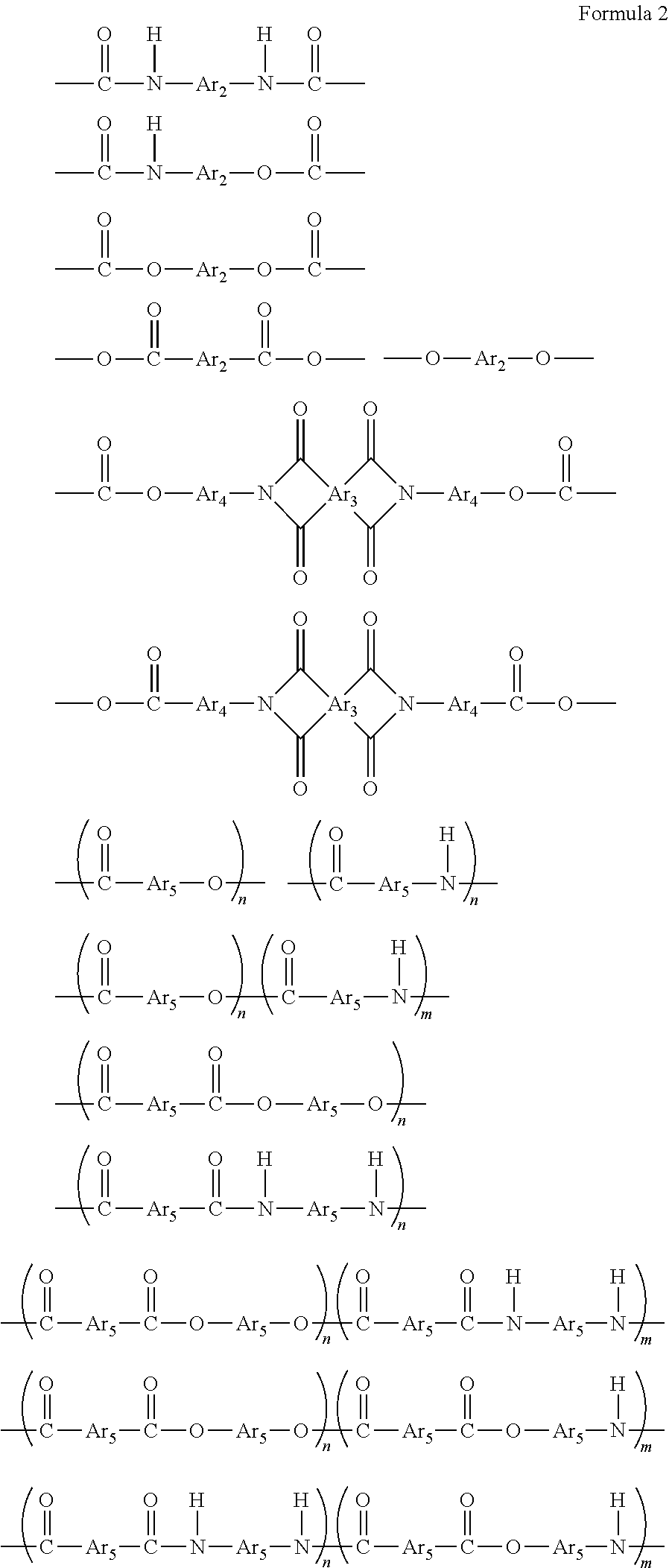
- Ar 1 includes one or more structural units selected from the group consisting of compounds expressed by Formula 2,
- Ar 2 , Ar 4 , Ar 5 and Ar 6 each represent a bivalent aromatic organic group, which includes one or more structural units selected from the group consisting of compounds expressed by Formula 3,
- Ar 3 represents a tetravalent aromatic organic group, which includes one ore more structural units selected from the group consisting of compounds expressed by Formula 4, and
- n and m each represent an integer of 1 to 100.
- the soluble type liquid crystal thermosetting oligomer may have a number average molecular weight of 500 to 15,000.
- the metal alkoxide compound may include a reactive group covalently bondable with a thermosetting group contained in the soluble type liquid crystal thermosetting oligomer.
- the reactive group may be at least one selected from the group consisting of a vinyl group, an acryl group, a methacryl group, a mercapto group, and a combination thereof.
- a metal of the metal alkoxide compound may be at least one selected from the group consisting of Ti, Al, Ge, Co, Ca, Hf, Fe, Ni, Nb, Mo, La, Re, Sc, Si, Ta, W, Y, Zr and V.
- the graphene oxide may have at least one function group of a hydroxy group, a carboxyl group, and an epoxy group on a surface and an edge thereof.
- the graphene oxide may have a ratio of carbon to oxygen (carbon/oxygen ratio) of 1 to 20.
- the composition may include 0.01 to 50 parts by weight of the metal alkoxide compound based on the soluble type liquid crystal thermosetting oligomer, and 0.01 to 50 parts by weight of the graphene oxide based on a mixed weight of the soluble type liquid crystal thermosetting oligomer and the metal alkoxide compound.
- the soluble type liquid crystal thermosetting oligomer may further include epoxy resin in a backbone thereof.
- the epoxy resin may be contained in 0.01 to 50 parts by weight based on 100 parts by weight of the soluble type liquid crystal thermosetting oligomer.
- the soluble type liquid crystal thermosetting oligomer, metal alkoxide compound, and graphene oxide may form covalent bonds with each other by a hardening reaction, to provide an organic/inorganic hybrid structure.
- the covalent bonds may be formed between the soluble type liquid crystal thermosetting oligomer and the graphene oxide, between the epoxy resin and the graphene oxide, between the metal alkoxide compound and the graphene oxide, and between the graphene oxide and the graphene oxide.
- the metal alkoxide compound and the graphene oxide may be separately added into the insulating layer composition, or the metal alkoxide compound and the graphene oxide may be added as a composite nano inorganic filler produced by a condensation reaction.
- an insulating prepreg or an insulating film using the insulating layer composition for a substrate there is provided an insulating prepreg or an insulating film using the insulating layer composition for a substrate.
- a substrate including the insulating prepreg or the insulating film.
- FIG. 1 shows a part of a structure of a normal printed circuit board
- FIG. 2 shows a prepreg type insulating layer for a printed circuit board
- FIG. 3 shows a film type insulating layer for a printed circuit board
- FIG. 4 is a conceptual view of an inorganic filler-added epoxy matrix according to the related art
- FIG. 5 shows a structure of a metal alkoxide compound having groups for covalent bonding
- FIG. 6 shows a structure of graphene oxide
- FIG. 7 is a conceptual view of a graphene oxide cluster having groups for covalent bonding
- FIG. 8 is a conceptual view of an organic/inorganic hybrid structure composed of graphene oxide, a metal alkoxide compound, and a soluble type liquid crystal thermosetting oligomer, according to an exemplary embodiment of the present invention
- FIG. 9 is a conceptual view showing a process of impregnating an insulating layer composition according to an exemplary embodiment of the present invention.
- FIG. 10 shows TMA results of insulating materials according to Comparative Examples 2 and 3 and Example 1.
- the present invention is directed to an insulating layer composition for a printed circuit board, which has high rigidity and a low coefficient of thermal expansion by hardening graphene oxide and metal alkoxide together with a soluble type liquid crystal thermosetting oligomer and a polymer.
- a soluble type liquid crystal thermosetting oligomer having excellent thermal (CTE), electric, and mechanical stabilities, or a soluble type liquid crystal thermosetting oligomer containing a small amount of epoxy in the backbone thereof is used as a polymer according to the present invention.
- This soluble type liquid crystal thermosetting oligomer of the present invention may be expressed by Formula 1.
- R 1 and R 2 each represent CH 3 or H, and at least one of R 1 and R 2 represents CH 3 ,
- Ar 1 represents a bivalent aromatic organic group having a molecular weight of 5,000 or less, which includes one or more structural units selected from the group consisting of ester, amide, ester amide, ester imide, and ether imide.
- Ar 1 includes one or more structural units selected from the group consisting of compounds expressed by Formula 2,
- Ar 2 , Ar 4 , Ar 5 and Ar 6 each represent a bivalent aromatic organic group, which includes one or more structural units selected from the group consisting of compounds expressed by Formula 3,
- Ar 3 represents a tetravalent aromatic organic group, which includes one or more structural units selected from the group consisting of compounds expressed by Formula 4,
- n and m each represent an integer of 1 to 100.
- the solubility liquid crystal thermosetting oligomer expressed by Formula 1 has a number average molecular weight of 500 to 15,000. If the molecular weight of the soluble type liquid crystal thermosetting oligomer is below 500, a cross-linking density gets higher, and thus physical properties thereof may become brittle. If the molecular weight thereof is above 15,000, viscosity of the solution gets higher, and this may be disadvantageous at the time of impregnating with woven glass fiber.
- the soluble type liquid crystal thermosetting oligomer containing an epoxy resin in the backbone thereof may be used.
- the epoxy resin may be contained in 0.01 to 50 parts by weight based on 100 parts by weight of the soluble type liquid crystal thermosetting oligomer.
- examples of the epoxy resin may include, but are not particularly limited to, for example, bisphenol A epoxy resin, naphthalene modified epoxy resin, cresol novolac epoxy resin, rubber modified epoxy resin, and the like. They may be used alone or a mixture of two or more, but not particularly limited thereto.
- One example of the soluble type liquid crystal thermosetting oligomer according to the present invention is expressed by Formula 5.
- the soluble type liquid crystal thermosetting oligomer according to the present invention includes a soluble structure (A) which is soluble in one or more solvents, and a group (B) having excellent processability in a backbone thereof, so that it is soluble in a general solvent.
- the soluble type liquid crystal thermosetting oligomer according to the present invention also has a functional group (C) capable of realizing liquid crystal characteristics, and has functional groups (D) at both ends thereof, which are thermally settable.
- a method for preparing the soluble type liquid crystal thermosetting oligomer according to the present invention is not particularly limited, and may be prepared by reacting compounds capable of preparing a liquid crystal oligomer including soluble structural units by polymerization and compounds capable of introducing a thermosetting group.
- the compounds capable of preparing a liquid crystal oligomer including soluble structural units are not particularly limited.
- they may be selected from the group consisting of one or more aromatic, aromatic heterocyclic, or aliphatic dicarboxylic acids; aromatic, aromatic heterocyclic, or aliphatic diols; aromatic, aromatic heterocyclic, or aliphatic diamines; amino phenols; hydroxy benzoic acids; and aminobenzoic acids, and preferably, one or more of aromatic, aromatic heterocyclic, or aliphatic diols; amino phenols; and aminobenzoic acids may be used.
- the liquid crystal thermosetting oligomer may be prepared by solution polymerization or bulk polymerization.
- the solution polymerization and the bulk polymerization may be performed within one reactor tank with appropriate stirring members.
- the soluble type liquid crystal thermosetting oligomer having the above structure has a much lower coefficient of thermal expansion than the epoxy resin used as the existing insulating polymer and includes various functional groups, and thus, is advantageous in forming a hybrid composite structure together with other components contained in the insulating layer composition.
- an inorganic filler using graphene oxide and metal alkoxide may be used together with the soluble type liquid crystal thermosetting oligomer.
- the graphene oxide and metal alkoxide used as the additives all have a functional group covalently bondable with a soluble type liquid crystal thermosetting oligomer, and thus they may become a hybrid type insulating material.
- metal alkoxide compounds having a covalently bondable reactive group may include compounds expressed by Formulas 6 to 9 below, but are not particularly limited thereto.
- R 3 to R 5 each independently may represent an alkyl group having at least one carbon atom, which may be for example a methane group, an ethane group, a propane group, or the like.
- R 6 to R 8 each independently may represent an alkyl group having at least one carbon atom, which may be for example a methane group, an ethane group, a propane group, or the like.
- R 9 to R 11 each independently may represent an alkyl group having at least one carbon atom, which may be for example a methane group, an ethane group, a propane group, or the like.
- R 12 ⁇ R 14 each independently may represent an alkyl group having at least one carbon atom, which may be for example a methane group, an ethane group, a propane group, or the like.
- the metal alkoxide compound of the present invention preferably includes a reactive group covalently bondable with a thermosetting group contained in the soluble type liquid crystal thermosetting oligomer.
- each metal compound having a single reactive group may be used alone, or a combination of respective metal compounds having several reactive groups may be used.
- the reactive group may be at least one selected from the group consisting of a vinyl group, an acryl group, a methacryl group, a mercapto group, and a combination thereof.
- a metal of the metal alkoxide compound may be at least one selected from the group consisting of Ti, Al, Ge, Co, Ca, Hf, Fe, Ni, Nb, Mo, La, Re, Sc, Si, Ta, W, Y, Zr and V.
- This metal alkoxide compound is preferably contained in 0.01 to 50 parts by weight based on the weight of the soluble type liquid crystal thermosetting oligomer. If the content of the metal alkoxide compound is below 0.01 parts by weight, an effect of decreasing the coefficient of thermal expansion is slight. If the content thereof is above 50 parts by weight, the insulating layer may be brittle, resulting in cracks.
- the structure of the metal alkoxide compound according to the present invention is shown in FIG. 5 , and it consists of a seed cluster (a portion inside the circle) generated from metal alkoxide and surface functional groups (a portion outside the circle) each capable of forming a covalent bond with the thermosetting group of the soluble type liquid crystal thermosetting group.
- a heterogeneous film may be formed by forming only seed clusters without surface functional groups and then dispersing them in the soluble type liquid crystal thermosetting oligomer.
- the metal alkoxide compound is used to form nano-scale inorganic clusters in a soluble type liquid crystal thermosetting oligomer in situ, and covalent bonds between the generated cluster and the groups existing at both ends of the soluble type liquid crystal thermosetting oligomer are formed.
- the reactive groups strongly covalently bonded to the generated cluster directly participates in the reaction, thereby forming strong covalent bonds between the soluble type liquid crystal thermosetting oligomer matrix and the inorganic cluster (see, FIG. 8 ).
- This strong covalent bond with the inorganic cluster causes mobility of a polymer chain, which is a main cause of thermal expansion, to be extremely lowered.
- the graphene oxide is added into the insulating layer composition of the present invention, together with the metal alkoxide compound.
- the graphene oxide has a low coefficient of thermal expansion and excellent mechanical properties. Therefore, properties of the polymer resin can be improved even through addition of a small amount thereof, as compared with an inorganic filler such as silica or the like, which is generally added in order to improve mechanical rigidity of the polymer resin.
- the graphene oxide may be prepared by oxidizing graphite, and the graphite has a layered structure in which plate graphene structures each composed of carbon atoms linked in hexagonal shapes are laminated. Since a distance between layers is 3.35 and carbon nanotubes are stretched out in a plate type, the graphite has high electric conductivity corresponding to that of carbon nanotubes and has excellent mechanical properties.
- graphite powder is oxidized, respective layers of the graphite is oxidized while the layered structure thereof is maintained, thereby obtaining graphene oxide powder onto which a hydroxy group, a carboxyl group, an epoxy group, or the like is attached.
- the graphene oxide powder may be prepared by oxidizing the graphite powder with using an oxidizing agent or through an electrochemical method.
- the oxidizing agent may include, but not limited to, for example, nitric acid, NaClO 3 , KMnO 4 , or the like, and they may be used alone or a mixture of two or more thereof.
- sufficiently oxidized graphene oxide is used in order to prevent insulating properties of the polymer resin from being deteriorated.
- a ratio of carbon to oxygen (carbon/oxygen) in graphene oxide may be changed depending on the degree of oxidation, and is preferably, for example, 1 to 20.
- FIGS. 6 and 7 each schematically show a part of the graphene oxide according to the present invention.
- a plurality of epoxy groups and carboxyl groups are included on a surface and edges thereof.
- the kind and number of functional groups may be changed depending on the oxidizing method or oxidizing degree of graphene oxide.
- the graphene oxide may be physically dispersed in a cured product of the soluble type liquid crystal thermosetting oligomer resin, and form chemical bonds with the polymer resin by the functional groups.
- the graphene oxide having the functional groups may form covalent bonds with the soluble type liquid crystal thermosetting oligomer resin by a hardening reaction, and thus, there may be formed a composite in which the graphene oxide is organically linked with the soluble type liquid crystal thermosetting oligomer resin.
- the graphene oxide Similar to the metal alkoxide cluster, the graphene oxide also is mixed with and dispersed in a main material or a main material containing additives while omitting a covalent bonding procedure, thereby forming a heterogeneous film.
- the graphene oxide is preferably contained in 0.01 to 50 parts by weight based on a weight of a mixture of the soluble type liquid crystal thermosetting oligomer and the metal alkoxide compound. If the content of the graphene oxide is below 0.01 parts by weight, an effect of decreasing the coefficient of thermal expansion is slight. If the content thereof is above 50 parts by weight, viscosity of a solution gets lowered, resulting in an extremely thin thickness of a film.
- the graphene oxide having an insulating property is further added, thereby increasing the critical added amount of an inorganic filler additive.
- the graphene oxide has a wider particle size distribution than the inorganic filler additive used in the related art, that is, from nanometers (nm) to microns ( ⁇ m).
- the inorganic filler of alkoxide needs to be formed to have a nanometer size in the liquid crystal thermosetting oligomer.
- the graphene oxide having a size from nanometers (nm) to microns ( ⁇ m) is added to generate more pores among the main material and the metal alkoxide as compared with the related art, thereby increasing the critical added amount of the inorganic filler.
- the soluble type liquid crystal thermosetting oligomer, the metal alkoxide compound, and the graphene oxide contained in the insulating layer composition of the present invention may form covalent bonds therebetween by the hardening reaction, resulting in a hybrid structure.
- the organic-inorganic insulating material for a printed circuit board of the present invention is a homogeneous organic-inorganic composite material in which metal clusters, which are generated by a condensation reaction between graphene oxide (Graphene Oxide Cluster) and metal alkoxide compound (SiO x R′ 1-x Cluster), form covalent bonds with an LCT matrix (Formula 1, LCP Resin), as confirmed in FIG. 8 .
- the covalent bonds may be formed between the soluble type liquid crystal thermosetting oligomer and the graphene oxide, between the epoxy resin and the graphene oxide, between the metal alkoxide compound and the graphene oxide, and between the graphene oxide and the graphene oxide.
- respective the insulating layer composition according to the present invention has a network structure in which respective components are organically linked.
- the metal alkoxide compound and the graphene oxide may be separately added into the insulating layer composition, or may be added as a composite nano inorganic filler produced by the condensation reaction.
- a solvent used at the time of preparing the insulating layer composition according to the present invention is not particularly limited, but a polar aprotic solvent may be used.
- the solvent may be selected from the group consisting of N, N-dimethylacetamide, N-methyl pyrrolidone (NMP), N-methyl caprolactone, N, N-dimethyl formamide, N, N-diethyl formamide, N, N-diethyl acetamide, N-methyl propionamide, dimethyl sulfoxide, ⁇ -butyl lactone, dimethyl imidazolidinone, tetramethyl phosphoric amid, and ethyl cellosolve acetate, and optionally, a mixed solvent of two or more thereof may be used.
- the insulating layer composition of the present invention may further include one or more additives selected from a filler, a softener, a plasticizer, a lubricant, a anti-static agent, a colorant, an antioxidant, a heat stabilizer, a light stabilizers, and a UV absorber, as necessary.
- a filler may include organic fillers such as epoxy resin powder, melamine resin powder, urea resin powder, benzoguanamine resin powder, and styrene resin powder; and inorganic fillers such as silica, alumina, titanium oxide, zirconia, kaolin, calcium carbonate, and calcium phosphate.
- the present invention may provide a substrate including the insulating layer composition as an insulating material.
- the insulating layer composition according to the present invention which is a organic-inorganic hybrid structure composite material, has excellent thermal, mechanical, and electric properties, and thus applicability thereof to the substrate is high.
- the insulating material is in a prepreg type where the insulating layer composition is impregnated with woven glass fiber.
- the insulating layer material is processed into a buildup film itself, which is used as the insulating material.
- FIG. 9 is a conceptual view showing a process of impregnating an insulating layer composition according to the present invention.
- a soluble type liquid crystal thermosetting oligomer resin, graphene oxide, and a metal alkoxide compound are mixed to prepare an insulating layer composition.
- the reinforcing agent used herein is not particularly limited, but examples thereof may include woven glass cloth, woven alumina glass cloth, nonwoven glass cloth, nonwoven cellulose, woven carbon cloth, polymer cloth, and the like.
- dip coating, roll coating, and the like may be employed, or any other normal impregnating method may be employed.
- the prepreg is dried at an appropriate temperature for an appropriate time, and laid-up with a copper foil or the like, followed by hardening, and thus, a sheet type product may be manufactured.
- the insulating layer composition according to the present invention has high adhesive strength with a copper foil, excellent heat resistance, low expansibility, and excellent mechanical properties, and thus, it can be used as a superior packaging material.
- the insulating layer composition may be molded on the substrate, may be impregnated, or may be used to form varnish for coating.
- the composition may be applied to a printed circuit board, respective layers of a multilayer substrate, a copper-clad laminate (for example, RCC, CCL), or a film for TAB, but the usage of the insulating layer composition is not limited thereto.
- soluble type liquid crystal thermosetting oligomer (a number average molecular weight of 7500 to 9000) having a structure of Formula 5 and 25 g of N-methyl-2-pyrolidone (NMP) were put into a 100 ml flask with a condenser and a stirrer, and then stirred while the temperature was gently raised up to 90° C., resulting in dissolving the soluble type liquid crystal thermosetting oligomer.
- NMP N-methyl-2-pyrolidone
- the soluble type liquid crystal thermosetting oligomer prepared by mixing aminophenol, isophthalic acid, naphthoic acid, hydroxybenzoic acid, nadimido benzoic acid at a molecular mole ratio of 2.1:2:2:2, followed by reaction, was used.
- the insulating layer composition was impregnated with woven glass fiber (1080 glass fiber) to prepare a prepreg.
- Example 1 Only the soluble type liquid crystal thermosetting oligomer of Example 1 was impregnated with woven glass fiber to prepare a prepreg, which was then used as Comparative Example 1.
- the insulating layer composition made of only the soluble type liquid crystal thermosetting oligomer and the metal alkoxide compound in Example 1 was impregnated with woven glass fiber to prepare a prepreg, which was then used as Example 2.
- Example 1 The prepreg prepared in each of Example 1, Reference Example, Comparative Examples 1 and 2 was compressed to obtain a film type product, and then thermal characteristics and a coefficient of thermal expansion (CTE) thereof were measured by using TMA Q400 from TA Company. The results are shown in Table 1 and FIG. 10 .
- the measurement was conducted at a temperature rise rate of 10° C./min while nitrogen was purged.
- the low-temperature coefficient of thermal expansion was obtained by an average value of a section of 50 to 100° C.
- Example 1 of the present invention which includes all the soluble type liquid crystal thermosetting oligomer, metal alkoxide compound, and graphene oxide, can be further lowered by 1 ⁇ 2 times than the material on the market.
- Example 1 of the present invention was much more superior to Comparative Examples 1 and 2 in view of thermal stability of the insulating material.
- a soluble type liquid crystal thermosetting oligomer, an insulation type graphene oxide, and a metal alkoxide compound were included and the respective components participate in a hardening reaction or a covalent bonding reaction with each other, thereby forming an organic/inorganic hybrid structure composite material in which the graphene oxide, polymer resin, and metal alkoxide are organically linked, and this structure can effectively lower the coefficient of thermal expansion.
- the present invention does not employ an epoxy resin generally used, but a soluble type liquid crystal thermosetting oligomer having a much lower CTE than the epoxy resin or a soluble type liquid crystal thermosetting oligomer containing a small amount of epoxy in the backbone thereof, as the main matrix, and the present invention further includes the insulation type of graphene oxide and metal alkoxide compound in order to further lower the CTE thereof.
- an epoxy polymer and a hardening agent are added to the composition, following by a hardening reaction, hardening of the soluble type liquid crystal thermosetting oligomer occurs, and also, a hardening reaction or a covalent bonding reaction occurs between the soluble type liquid crystal thermosetting oligomer and the graphene oxide, between the epoxy resin and the graphene oxide, between the metal alkoxide compound and the graphene oxide, and between the graphene oxide and the graphene oxide, thereby forming a hybrid structure composite material in which graphene oxide, polymer resin, and metal alkoxy are organically linked.
- the composite material having a low coefficient of thermal expansion is used as an insulating material of a substrate, resulting in minimizing a dimensional change, thereby manufacturing a substrate having improved thermal stability.
Landscapes
- Chemical & Material Sciences (AREA)
- Organic Chemistry (AREA)
- Chemical Kinetics & Catalysis (AREA)
- Engineering & Computer Science (AREA)
- Materials Engineering (AREA)
- Health & Medical Sciences (AREA)
- Medicinal Chemistry (AREA)
- Polymers & Plastics (AREA)
- Life Sciences & Earth Sciences (AREA)
- Wood Science & Technology (AREA)
- Crystallography & Structural Chemistry (AREA)
- Microelectronics & Electronic Packaging (AREA)
- Manufacturing & Machinery (AREA)
- Inorganic Chemistry (AREA)
- Physics & Mathematics (AREA)
- Spectroscopy & Molecular Physics (AREA)
- Compositions Of Macromolecular Compounds (AREA)
- Reinforced Plastic Materials (AREA)
- Epoxy Resins (AREA)
- Addition Polymer Or Copolymer, Post-Treatments, Or Chemical Modifications (AREA)
- Inorganic Insulating Materials (AREA)
- Polymerisation Methods In General (AREA)
Abstract
Description




| TABLE 1 | ||
| Unit: μm/° C. (ppm/° C.) | ||
| Reference | Comparative | Comparative | |||
| Example | Example 1 | Example 2 | Example 1 | ||
| Low-temperature | 15 | 10.3 | 8.4 | 7.3 |
| coefficient of | ||||
| thermal expansion | ||||
| a1(50~100° C.) | ||||
Claims (17)


Applications Claiming Priority (2)
| Application Number | Priority Date | Filing Date | Title |
|---|---|---|---|
| KR1020110109373A KR102004758B1 (en) | 2011-10-25 | 2011-10-25 | Insulating composition for substrate, prepreg and substrate using the same |
| KR10-2011-0109373 | 2011-10-25 |
Publications (2)
| Publication Number | Publication Date |
|---|---|
| US20130099149A1 US20130099149A1 (en) | 2013-04-25 |
| US8940186B2 true US8940186B2 (en) | 2015-01-27 |
Family
ID=48135222
Family Applications (1)
| Application Number | Title | Priority Date | Filing Date |
|---|---|---|---|
| US13/657,296 Active 2032-12-15 US8940186B2 (en) | 2011-10-25 | 2012-10-22 | Insulating layer composition for substrate, and prepreg and substrate using the same |
Country Status (4)
| Country | Link |
|---|---|
| US (1) | US8940186B2 (en) |
| JP (1) | JP6116856B2 (en) |
| KR (1) | KR102004758B1 (en) |
| CN (1) | CN103073849B (en) |
Cited By (2)
| Publication number | Priority date | Publication date | Assignee | Title |
|---|---|---|---|---|
| US20140170412A1 (en) * | 2012-12-18 | 2014-06-19 | Samsung Electro-Mechanics Co., Ltd. | Insulating composition, substrate including insulating layer using the same, and method for manufacturing the substrate |
| US20150028498A1 (en) * | 2013-07-29 | 2015-01-29 | Samsung Electro-Mechanics Co., Ltd. | Molding composition for semiconductor package and semiconductor package using the same |
Families Citing this family (11)
| Publication number | Priority date | Publication date | Assignee | Title |
|---|---|---|---|---|
| KR20120058127A (en) * | 2010-11-29 | 2012-06-07 | 삼성전기주식회사 | An insulating resin composition for multilayer wiring board and a multilayer wiring board comprising the same |
| KR102004758B1 (en) * | 2011-10-25 | 2019-07-30 | 삼성전기주식회사 | Insulating composition for substrate, prepreg and substrate using the same |
| US9145469B2 (en) | 2012-09-27 | 2015-09-29 | Ticona Llc | Aromatic polyester containing a biphenyl chain disruptor |
| ITBO20130215A1 (en) * | 2013-05-10 | 2014-11-11 | Univ Bologna Alma Mater | COMPOSITE COMPONENT COMPONENT FOR AUTOMOTIVE APPLICATIONS AND PRODUCTION METHOD OF THE COMPOSITE MATERIAL |
| KR20150025245A (en) * | 2013-08-28 | 2015-03-10 | 삼성전기주식회사 | Copper clad laminate for printed circuit board and manufacturing method thereof |
| TWI526129B (en) * | 2014-11-05 | 2016-03-11 | Elite Material Co Ltd | Multilayer printed circuit boards with dimensional stability |
| KR101994745B1 (en) * | 2014-12-16 | 2019-09-30 | 삼성전기주식회사 | Low temperature sintering dielectric composition and multilayer cderamic capacitor |
| CN105419237A (en) * | 2015-12-17 | 2016-03-23 | 广东生益科技股份有限公司 | Thermosetting resin composition, prepreg containing same, laminated board and printed circuit board |
| GB2565048B (en) * | 2017-07-26 | 2023-04-19 | Talga Tech Limited | Functionalised graphene composition |
| CN109135552A (en) * | 2018-07-05 | 2019-01-04 | 常州思宇知识产权运营有限公司 | A kind of preparation method of high-strength high temperature-resistant type impregnating varnish |
| KR102059813B1 (en) * | 2019-01-29 | 2019-12-27 | 삼성전기주식회사 | Molding composition for semiconductor package and semiconductor package using the same |
Citations (2)
| Publication number | Priority date | Publication date | Assignee | Title |
|---|---|---|---|---|
| US7931830B2 (en) | 2004-03-31 | 2011-04-26 | Endicott Interconnect Technologies, Inc. | Dielectric composition for use in circuitized substrates and circuitized substrate including same |
| US20130099149A1 (en) * | 2011-10-25 | 2013-04-25 | Samsung Electro-Mechanics Co., Ltd. | Insulating layer composition for substrate, and prepeg and substrate using the same |
Family Cites Families (5)
| Publication number | Priority date | Publication date | Assignee | Title |
|---|---|---|---|---|
| JPH08174775A (en) * | 1994-12-22 | 1996-07-09 | Toyo Ink Mfg Co Ltd | Polymer films and substrate films for liquid crystal display devices |
| TW200738076A (en) * | 2005-11-03 | 2007-10-01 | Endicott Interconnect Tech Inc | Dielectric composition for use in circuitized substrates and circuitized substrate including same |
| KR20100056344A (en) | 2008-11-18 | 2010-05-27 | 삼성전자주식회사 | Thermoset composition and printed circuit board using the same |
| KR101077303B1 (en) | 2009-05-06 | 2011-10-26 | 삼성전기주식회사 | Composition for forming substrate, and prepreg and substrate using the same |
| KR101128003B1 (en) | 2009-10-15 | 2012-03-29 | 삼성전기주식회사 | Method for Preparing Nanocomposite Materials comprising Surface-Modified Nanofiller for Substrates |
-
2011
- 2011-10-25 KR KR1020110109373A patent/KR102004758B1/en active Active
-
2012
- 2012-10-22 US US13/657,296 patent/US8940186B2/en active Active
- 2012-10-23 JP JP2012233506A patent/JP6116856B2/en not_active Expired - Fee Related
- 2012-10-25 CN CN201210413325.3A patent/CN103073849B/en not_active Expired - Fee Related
Patent Citations (2)
| Publication number | Priority date | Publication date | Assignee | Title |
|---|---|---|---|---|
| US7931830B2 (en) | 2004-03-31 | 2011-04-26 | Endicott Interconnect Technologies, Inc. | Dielectric composition for use in circuitized substrates and circuitized substrate including same |
| US20130099149A1 (en) * | 2011-10-25 | 2013-04-25 | Samsung Electro-Mechanics Co., Ltd. | Insulating layer composition for substrate, and prepeg and substrate using the same |
Cited By (3)
| Publication number | Priority date | Publication date | Assignee | Title |
|---|---|---|---|---|
| US20140170412A1 (en) * | 2012-12-18 | 2014-06-19 | Samsung Electro-Mechanics Co., Ltd. | Insulating composition, substrate including insulating layer using the same, and method for manufacturing the substrate |
| US20150028498A1 (en) * | 2013-07-29 | 2015-01-29 | Samsung Electro-Mechanics Co., Ltd. | Molding composition for semiconductor package and semiconductor package using the same |
| US9390990B2 (en) * | 2013-07-29 | 2016-07-12 | Samsung Electro-Mechanics Co., Ltd. | Molding composition for semiconductor package and semiconductor package using the same |
Also Published As
| Publication number | Publication date |
|---|---|
| KR20130044974A (en) | 2013-05-03 |
| CN103073849B (en) | 2016-12-21 |
| JP2013091791A (en) | 2013-05-16 |
| KR102004758B1 (en) | 2019-07-30 |
| CN103073849A (en) | 2013-05-01 |
| JP6116856B2 (en) | 2017-04-19 |
| US20130099149A1 (en) | 2013-04-25 |
Similar Documents
| Publication | Publication Date | Title |
|---|---|---|
| US8940186B2 (en) | Insulating layer composition for substrate, and prepreg and substrate using the same | |
| US9045646B2 (en) | Insulating composition for substrate, and prepreg and substrate using the same | |
| JP6309264B2 (en) | Insulating material, insulating layer composition containing the same, and substrate using the insulating layer composition | |
| CN102844350B (en) | Resin composition, prepreg and laminate | |
| CN103827038B (en) | Molybdenum compound powder, prepreg and plywood | |
| US20140170412A1 (en) | Insulating composition, substrate including insulating layer using the same, and method for manufacturing the substrate | |
| US20140080940A1 (en) | Resin composition for insulation, insulating film, prepreg, and printed circuit board. | |
| JP5692062B2 (en) | Method for storing resin solution, and method for producing prepreg and laminate | |
| US20140076198A1 (en) | Epoxy resin composition for insulation, insulating film, prepreg, and printed circuit board | |
| CN103917596A (en) | Resin composition, and prepreg and laminated sheet each produced using same | |
| WO2013187303A1 (en) | Resin composition, prepreg, metal foil-clad laminate and printed wiring board | |
| JP6405981B2 (en) | Resin composition, prepreg, metal foil-clad laminate and printed wiring board | |
| WO2011152402A1 (en) | Resin composition, and prepreg and laminated sheet using same | |
| JPWO2013146700A1 (en) | Resin composition, prepreg and laminate | |
| JP2018204037A (en) | Prepreg, metal foil-clad laminate and printed wiring board | |
| JP2014019868A (en) | Epoxy resin composition for build-up insulating film, insulating film formed therefrom, and multilayer printed circuit board having the same | |
| TWI688644B (en) | Thermosetting resin composition for semiconductor pakage, prepreg and metal clad laminate | |
| CN1890286B (en) | Thermosetting resin composition, resin sheet, and resin sheet for insulating substrate | |
| TWI790989B (en) | Fiber-reinforced plastic precursor, laminate, metal-clad laminate, printed circuit board, semiconductor package, and manufacturing method thereof | |
| CN102762663B (en) | Resin composition, prepreg, and metal-clad laminate | |
| US20140367149A1 (en) | Resin composition for printed circuit board, build-up film, prepreg and printed circuit board | |
| KR102059824B1 (en) | Insulating resin composition for photo curing and printed circuit board using the same | |
| JP4806279B2 (en) | Insulating substrate containing glass cloth | |
| JP2025175468A (en) | Resin composition, resin sheet, prepreg, metal foil-clad laminate, and printed wiring board | |
| TW201632528A (en) | The thermal expansion property adjuster, the use as a thermal expansion property adjuster, a thermosetting resin composition, an insulating material containing the thermosetting resin composition, a sealing material, a conductive paste, and a cured product obtained by curing the thermosetting resin composition, and having the thermosetting property a substrate material of a resin composition, a prepreg obtained by impregnating the substrate with the thermosetting resin composition, a member obtained by curing the thermosetting resin composition of the prepreg, a method for adjusting a coefficient of thermal expansion, and a method for adjusting the same Manufactured material |
Legal Events
| Date | Code | Title | Description |
|---|---|---|---|
| AS | Assignment |
Owner name: SAMSUNG ELECTRO-MECHANICS CO., LTD., KOREA, REPUBL Free format text: ASSIGNMENT OF ASSIGNORS INTEREST;ASSIGNORS:JI, SOO YOUNG;HAM, SUK JIN;KIM, SEUNG HWAN;AND OTHERS;SIGNING DATES FROM 20121015 TO 20121016;REEL/FRAME:029341/0674 |
|
| FEPP | Fee payment procedure |
Free format text: PAYOR NUMBER ASSIGNED (ORIGINAL EVENT CODE: ASPN); ENTITY STATUS OF PATENT OWNER: LARGE ENTITY |
|
| STCF | Information on status: patent grant |
Free format text: PATENTED CASE |
|
| CC | Certificate of correction | ||
| MAFP | Maintenance fee payment |
Free format text: PAYMENT OF MAINTENANCE FEE, 4TH YEAR, LARGE ENTITY (ORIGINAL EVENT CODE: M1551) Year of fee payment: 4 |
|
| MAFP | Maintenance fee payment |
Free format text: PAYMENT OF MAINTENANCE FEE, 8TH YEAR, LARGE ENTITY (ORIGINAL EVENT CODE: M1552); ENTITY STATUS OF PATENT OWNER: LARGE ENTITY Year of fee payment: 8 |