US8937236B2 - Guitar neck assembly and process therefor - Google Patents

Guitar neck assembly and process therefor Download PDF

Info

Publication number
US8937236B2
US8937236B2 US13/694,515 US201213694515A US8937236B2 US 8937236 B2 US8937236 B2 US 8937236B2 US 201213694515 A US201213694515 A US 201213694515A US 8937236 B2 US8937236 B2 US 8937236B2
Authority
US
United States
Prior art keywords
fingerboard
neck
grooves
along
lateral edges
Prior art date
Legal status (The legal status is an assumption and is not a legal conclusion. Google has not performed a legal analysis and makes no representation as to the accuracy of the status listed.)
Expired - Fee Related, expires
Application number
US13/694,515
Other versions
US20140157968A1 (en
Inventor
Robert M. Kunstadt
Current Assignee (The listed assignees may be inaccurate. Google has not performed a legal analysis and makes no representation or warranty as to the accuracy of the list.)
Individual
Original Assignee
Individual
Priority date (The priority date is an assumption and is not a legal conclusion. Google has not performed a legal analysis and makes no representation as to the accuracy of the date listed.)
Filing date
Publication date
Application filed by Individual filed Critical Individual
Priority to US13/694,515 priority Critical patent/US8937236B2/en
Publication of US20140157968A1 publication Critical patent/US20140157968A1/en
Application granted granted Critical
Publication of US8937236B2 publication Critical patent/US8937236B2/en
Expired - Fee Related legal-status Critical Current
Adjusted expiration legal-status Critical

Links

Images

Classifications

    • GPHYSICS
    • G10MUSICAL INSTRUMENTS; ACOUSTICS
    • G10DSTRINGED MUSICAL INSTRUMENTS; WIND MUSICAL INSTRUMENTS; ACCORDIONS OR CONCERTINAS; PERCUSSION MUSICAL INSTRUMENTS; AEOLIAN HARPS; SINGING-FLAME MUSICAL INSTRUMENTS; MUSICAL INSTRUMENTS NOT OTHERWISE PROVIDED FOR
    • G10D3/00Details of, or accessories for, stringed musical instruments, e.g. slide-bars
    • G10D3/06Necks; Fingerboards, e.g. fret boards
    • GPHYSICS
    • G10MUSICAL INSTRUMENTS; ACOUSTICS
    • G10DSTRINGED MUSICAL INSTRUMENTS; WIND MUSICAL INSTRUMENTS; ACCORDIONS OR CONCERTINAS; PERCUSSION MUSICAL INSTRUMENTS; AEOLIAN HARPS; SINGING-FLAME MUSICAL INSTRUMENTS; MUSICAL INSTRUMENTS NOT OTHERWISE PROVIDED FOR
    • G10D1/00General design of stringed musical instruments
    • G10D1/04Plucked or strummed string instruments, e.g. harps or lyres
    • G10D1/05Plucked or strummed string instruments, e.g. harps or lyres with fret boards or fingerboards
    • G10D1/08Guitars
    • GPHYSICS
    • G10MUSICAL INSTRUMENTS; ACOUSTICS
    • G10DSTRINGED MUSICAL INSTRUMENTS; WIND MUSICAL INSTRUMENTS; ACCORDIONS OR CONCERTINAS; PERCUSSION MUSICAL INSTRUMENTS; AEOLIAN HARPS; SINGING-FLAME MUSICAL INSTRUMENTS; MUSICAL INSTRUMENTS NOT OTHERWISE PROVIDED FOR
    • G10D3/00Details of, or accessories for, stringed musical instruments, e.g. slide-bars
    • G10D3/22Material for manufacturing stringed musical instruments; Treatment of the material
    • YGENERAL TAGGING OF NEW TECHNOLOGICAL DEVELOPMENTS; GENERAL TAGGING OF CROSS-SECTIONAL TECHNOLOGIES SPANNING OVER SEVERAL SECTIONS OF THE IPC; TECHNICAL SUBJECTS COVERED BY FORMER USPC CROSS-REFERENCE ART COLLECTIONS [XRACs] AND DIGESTS
    • Y10TECHNICAL SUBJECTS COVERED BY FORMER USPC
    • Y10TTECHNICAL SUBJECTS COVERED BY FORMER US CLASSIFICATION
    • Y10T29/00Metal working
    • Y10T29/49Method of mechanical manufacture
    • Y10T29/4957Sound device making
    • Y10T29/49574Musical instrument or tuning fork making

Definitions

  • This invention relates to the field of necks for stringed musical instruments known as guitars, including bass guitars.
  • the fingerboard is slidably engaged with the instrument's neck, preferably by means of flanges that engage corresponding grooves provided along the lateral edges of the neck.
  • FIG. 1 is a cross-section of an assembled guitar neck according to the PRIOR ART.
  • FIG. 2 is a cross-section of an assembled guitar neck according to an embodiment of the invention, taken at A-A of FIG. 6 .
  • FIG. 3 is a cross-section of a fingerboard according to said embodiment of the invention, prior to assembly.
  • FIG. 4 is a partial cross-section of an assembled guitar neck according to another embodiment of the invention.
  • FIG. 5 is a partial cross-section of an assembled guitar neck according to yet another embodiment of the invention.
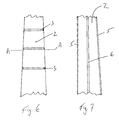
  • FIG. 6 is a top plan view of a segment of a fingerboard according to an embodiment of the invention.
  • FIG. 7 is a bottom plan view of a segment of a fingerboard according to an embodiment of the invention.
  • FIG. 8 is a cross-section of an assembled guitar neck according to an another embodiment of the invention, taken at A-A of FIG. 6 .
  • FIGS. 1-8 the invention will be described in detail.
  • Neck 1 is provided with fingerboard 2 , generally held together by adhesive means such as hide glue.
  • Fingerboard 2 is provided with a plurality of frets 3 , generally friction-fit into fingerboard 2 .
  • the assembly shown in FIG. 1 is a classical guitar, since there is no radius on the fingerboard.
  • Steel-string guitars generally have a radius, e.g., 12′′.
  • Neck 1 is provided with fingerboard 2 which is slidably engagable therewith. Said sliding engagement may be accomplished by means of the grooves 4 provided along each of the left and right lateral edges of neck 1 .
  • Corresponding flanges 5 are provided upon fingerboard 2 , which matingly engage grooves 4 .
  • Boss 6 extends along the centerline of fingerboard 2 and serves to elevate it to form a central ridge that provides a radius to the top of said fingerboard 2 .
  • Frets 3 may be provided integral with fingerboard 2 .
  • fingerboard 2 is flat. The fact that it is deformed slightly in order to force it into mating engagement with grooves 4 of neck 1 (as seen in FIG. 2 ), insures that fingerboard 2 can retain its position upon neck 1 by the force of spring tension, without need for fasteners, adhesives, or the like.
  • Boss 6 may be of a height chosen to be sufficient to impart the desired radius to the naturally-flat fingerboard 2 , upon its assembly onto neck 1 .
  • neck 1 may be made from aluminum; and fingerboard 2 (including its integral frets 3 ) may be made from an ABS blank (made by 3D printing) which is plated with nickel (for resistance to abrasion from string wear).
  • Fingerboard 2 can be manipulated to slide on (and off) of neck 1 , for example for purposes of changing the radius.
  • an alternate embodiment may have a neck 1 of wood. Fingerboard 2 may be affixed thereto by adhesive; and it may be positioned in a groove 4 having an open top (rather than a closed top as shown in FIG. 2 ).
  • FIG. 5 another alternate embodiment may have a neck 1 of wood. Fingerboard 2 may be positioned in groove 4 having a closed top (in an outwardly-angled configuration) for retaining fingerboard 2 upon neck 1 .
  • Frets 3 may be formed integral with fingerboard 2 as a unit, starting with a plastic blank made by 3D printing, then plated with metal such as nickel for durability to resist abrasion from the strings of a guitar.
  • Boss 6 may run substantially the length of fingerboard 2 , or it may be interrupted. Boss 6 may be chosen of a height sufficient to impart the desired radius to frets 3 , when assembled on neck 2 .
  • the natural relaxed state of fingerboard 2 with its frets 3 may be flat on top.
  • fingerboard 2 is bent in a radius when it is slid onto neck 1 , and the action of bending it deforms it—thereby setting up an internal spring force by which it attempts to resume its natural relaxed configuration.
  • Such internal spring force may, according to an embodiment of the invention, serve as the means for retaining fingerboard 3 on neck 1 —without need for screws, adhesive or other fastener means.
  • a simple hand tool such as a light wooden mallet may advantageously be employed in the process of sliding it on and off, by gentle taps upon one end or the other.
  • neck 1 may be of wood and it may be provided with inlays 7 , retained by screws 8 in beds 9 routed into neck 1 for receiving inlays 7 .
  • closed tops for grooves 4 may advantageously be provided by inlays 7 , which may be made of metal such as aluminum, steel or titanium; or plastic such as nylon or teflon. Thereby, the risk of splitting the wood of neck 1 is minimized.
  • adhesive may be utilized.

Landscapes

  • Engineering & Computer Science (AREA)
  • Physics & Mathematics (AREA)
  • Acoustics & Sound (AREA)
  • Multimedia (AREA)
  • Manufacturing & Machinery (AREA)
  • Stringed Musical Instruments (AREA)

Abstract

In a stringed instrument such as a guitar, a fingerboard is slidably engaged with the instrument's neck, preferably by means of flanges that engage with corresponding grooves along the lateral edges of the neck.

Description

FIELD OF THE INVENTION
This invention relates to the field of necks for stringed musical instruments known as guitars, including bass guitars.
SUMMARY OF THE INVENTION
In the present invention, the fingerboard is slidably engaged with the instrument's neck, preferably by means of flanges that engage corresponding grooves provided along the lateral edges of the neck.
DESCRIPTION OF THE DRAWINGS
FIG. 1 is a cross-section of an assembled guitar neck according to the PRIOR ART.
FIG. 2 is a cross-section of an assembled guitar neck according to an embodiment of the invention, taken at A-A of FIG. 6.
FIG. 3 is a cross-section of a fingerboard according to said embodiment of the invention, prior to assembly.
FIG. 4 is a partial cross-section of an assembled guitar neck according to another embodiment of the invention.
FIG. 5 is a partial cross-section of an assembled guitar neck according to yet another embodiment of the invention.
FIG. 6 is a top plan view of a segment of a fingerboard according to an embodiment of the invention.
FIG. 7 is a bottom plan view of a segment of a fingerboard according to an embodiment of the invention.
FIG. 8 is a cross-section of an assembled guitar neck according to an another embodiment of the invention, taken at A-A of FIG. 6.
DETAILED DESCRIPTION OF THE INVENTION
Referring now to FIGS. 1-8, the invention will be described in detail.
Referring now to FIG. 1, some typical parts of a prior art neck assembly can be seen. Neck 1 is provided with fingerboard 2, generally held together by adhesive means such as hide glue. Fingerboard 2 is provided with a plurality of frets 3, generally friction-fit into fingerboard 2. The assembly shown in FIG. 1 is a classical guitar, since there is no radius on the fingerboard. Steel-string guitars generally have a radius, e.g., 12″.
Referring now to FIG. 2, an embodiment of the invention is shown in cross-section. Neck 1 is provided with fingerboard 2 which is slidably engagable therewith. Said sliding engagement may be accomplished by means of the grooves 4 provided along each of the left and right lateral edges of neck 1. Corresponding flanges 5 are provided upon fingerboard 2, which matingly engage grooves 4.
Boss 6 extends along the centerline of fingerboard 2 and serves to elevate it to form a central ridge that provides a radius to the top of said fingerboard 2. Frets 3 may be provided integral with fingerboard 2.
Referring now to FIG. 3, it may be appreciated that the natural relaxed state of fingerboard 2 is flat. The fact that it is deformed slightly in order to force it into mating engagement with grooves 4 of neck 1 (as seen in FIG. 2), insures that fingerboard 2 can retain its position upon neck 1 by the force of spring tension, without need for fasteners, adhesives, or the like.
The fact that the shape is flat is significant in the case of manufacture by 3D printing, since the tops of flat frets are smooth when 3D printed, for example by the process of fused deposition modeling (FDM). If one tried to 3D print a curved radius by FDM, the tops of the fretboard and the tops of the frets would be discontinuous—due to layering into slices by the printer resulting in “jaggies”—and therefore rough to the touch and unsatisfactory for use in a guitar which is necessarily fingered by the player and hence is expected to feel smooth.
Boss 6 may be of a height chosen to be sufficient to impart the desired radius to the naturally-flat fingerboard 2, upon its assembly onto neck 1.
In a preferred embodiment, neck 1 may be made from aluminum; and fingerboard 2 (including its integral frets 3) may be made from an ABS blank (made by 3D printing) which is plated with nickel (for resistance to abrasion from string wear).
Fingerboard 2 can be manipulated to slide on (and off) of neck 1, for example for purposes of changing the radius.
Referring now to FIG. 4, an alternate embodiment may have a neck 1 of wood. Fingerboard 2 may be affixed thereto by adhesive; and it may be positioned in a groove 4 having an open top (rather than a closed top as shown in FIG. 2).
Referring now to FIG. 5, another alternate embodiment may have a neck 1 of wood. Fingerboard 2 may be positioned in groove 4 having a closed top (in an outwardly-angled configuration) for retaining fingerboard 2 upon neck 1.
As used herein, “closed” as applied to the top of groove 4, means that flange 5 cannot escape upwardly from groove 4.
Referring now to FIG. 6, a segment of a fingerboard according to the invention may be seen. Frets 3 may be formed integral with fingerboard 2 as a unit, starting with a plastic blank made by 3D printing, then plated with metal such as nickel for durability to resist abrasion from the strings of a guitar.
Referring now to FIG. 7, a segment of fingerboard 2 according to the invention may be seen from the bottom. Boss 6 may run substantially the length of fingerboard 2, or it may be interrupted. Boss 6 may be chosen of a height sufficient to impart the desired radius to frets 3, when assembled on neck 2.
Note that as shown in FIG. 3, the natural relaxed state of fingerboard 2 with its frets 3 may be flat on top. However, fingerboard 2 is bent in a radius when it is slid onto neck 1, and the action of bending it deforms it—thereby setting up an internal spring force by which it attempts to resume its natural relaxed configuration. Such internal spring force may, according to an embodiment of the invention, serve as the means for retaining fingerboard 3 on neck 1—without need for screws, adhesive or other fastener means. When it is desired to remove fingerboard 2 from neck 1, it may be slid off. A simple hand tool such as a light wooden mallet may advantageously be employed in the process of sliding it on and off, by gentle taps upon one end or the other.
Referring now to FIG. 8, neck 1 may be of wood and it may be provided with inlays 7, retained by screws 8 in beds 9 routed into neck 1 for receiving inlays 7. In this embodiment, closed tops for grooves 4 may advantageously be provided by inlays 7, which may be made of metal such as aluminum, steel or titanium; or plastic such as nylon or teflon. Thereby, the risk of splitting the wood of neck 1 is minimized. Instead of or in addition to screws 8, adhesive may be utilized.
By utilizing expedients such as shown and described, it may be possible to mass-produce assembled guitar necks, ready to play, that are light in weight; comfortable to hold; resistant to warping and string wear; uniformly and consistently well-intonated; with low action; and easy for both experts and beginners to play well. Due to the resonant properties of such necks, they may provide superior tonal quality including long sustain; even response at all fret positions; and singing high overtones optimized to “cut through the mix” in live band performances and on recordings.
The invention is not limited to the exact embodiments shown and described, and may be realized in such other ways as will be apparent to the skilled artisan, utilizing the teachings of the invention.

Claims (6)

The invention claimed is:
1. An assembly of a guitar neck with a fingerboard having frets, said fingerboard being provided with flanges along its lateral edges; said neck being provided with grooves along its lateral edges; said flanges being slidably engageable in said grooves; said fingerboard being provided with at least one boss along its underside; said boss being of a height sufficient to radius said fingerboard.
2. An assembly according to claim 1, said neck being aluminum and said fingerboard being nickel-plated plastic.
3. A fingerboard for a guitar, said fingerboard being provided with flanges along its lateral edges; and said fingerboard being provided on its underside with at least one boss substantially down its centerline.
4. An assembly of a guitar neck with a fingerboard having frets, said fingerboard being provided with flanges along its lateral edges; said neck being provided with grooves along its lateral edges; said flanges being slidably engageable in said grooves; said neck having first and second lateral edges; said neck being provided with a first closed-top groove along said first lateral edge and a second closed-top groove along said second lateral edge.
5. A process comprising preparing a flat blank for a fingerboard; plating said blank; deforming said fingerboard to form a radius; and affixing said deformed fingerboard to a neck; in which said plating is nickel plating; said neck is laterally provided with closed-top grooves; and said affixation is by the resilience of said fingerboard applied to said grooves.
6. The process of claim 5, in which said fingerboard is deformed by a boos to form a radius.
US13/694,515 2012-12-07 2012-12-07 Guitar neck assembly and process therefor Expired - Fee Related US8937236B2 (en)

Priority Applications (1)

Application Number Priority Date Filing Date Title
US13/694,515 US8937236B2 (en) 2012-12-07 2012-12-07 Guitar neck assembly and process therefor

Applications Claiming Priority (1)

Application Number Priority Date Filing Date Title
US13/694,515 US8937236B2 (en) 2012-12-07 2012-12-07 Guitar neck assembly and process therefor

Publications (2)

Publication Number Publication Date
US20140157968A1 US20140157968A1 (en) 2014-06-12
US8937236B2 true US8937236B2 (en) 2015-01-20

Family

ID=50879559

Family Applications (1)

Application Number Title Priority Date Filing Date
US13/694,515 Expired - Fee Related US8937236B2 (en) 2012-12-07 2012-12-07 Guitar neck assembly and process therefor

Country Status (1)

Country Link
US (1) US8937236B2 (en)

Cited By (4)

* Cited by examiner, † Cited by third party
Publication number Priority date Publication date Assignee Title
US9134139B1 (en) * 2014-07-18 2015-09-15 Behrooz Compani-Tabrizi Compani bridge, nut, and fingerboard combination designs for stringed musical instruments
US9478198B1 (en) 2015-06-18 2016-10-25 Brian H. Daley Recessed concave fingerboard
US10984769B2 (en) 2019-07-02 2021-04-20 Daniel Ingolf SPRIEWALD Reinforcement system to alleviate guitar neck breakage
US20250356823A1 (en) * 2024-05-15 2025-11-20 Mariann Uleberg-Cohen Apparatus for trimming tangs for a stringed instrument, and related methods

Families Citing this family (2)

* Cited by examiner, † Cited by third party
Publication number Priority date Publication date Assignee Title
US9524704B2 (en) * 2014-05-02 2016-12-20 Stephen McSwain Stringed instrument with fingerboard support
RU2754982C1 (en) * 2020-07-29 2021-09-08 Александр Ильич Гнездилов Plucked musical instrument

Citations (5)

* Cited by examiner, † Cited by third party
Publication number Priority date Publication date Assignee Title
US5631432A (en) 1995-09-12 1997-05-20 Muncy; Gary O. Stringed instrument
US6350940B1 (en) * 2000-10-23 2002-02-26 N. Roger Upchurch Fretted/fretless stringed musical instrument
US20030164081A1 (en) * 2002-03-01 2003-09-04 Booker Paul Everard Method of determining the fret positions for a fingerboard
US20060174748A1 (en) * 2005-02-04 2006-08-10 Bryan Buhoveckey Guitar fret board overlays and method for making overlays
US7256336B2 (en) 2005-01-14 2007-08-14 Muncy Gary O Stringed instrument and associated fret mapping method

Patent Citations (5)

* Cited by examiner, † Cited by third party
Publication number Priority date Publication date Assignee Title
US5631432A (en) 1995-09-12 1997-05-20 Muncy; Gary O. Stringed instrument
US6350940B1 (en) * 2000-10-23 2002-02-26 N. Roger Upchurch Fretted/fretless stringed musical instrument
US20030164081A1 (en) * 2002-03-01 2003-09-04 Booker Paul Everard Method of determining the fret positions for a fingerboard
US7256336B2 (en) 2005-01-14 2007-08-14 Muncy Gary O Stringed instrument and associated fret mapping method
US20060174748A1 (en) * 2005-02-04 2006-08-10 Bryan Buhoveckey Guitar fret board overlays and method for making overlays

Cited By (4)

* Cited by examiner, † Cited by third party
Publication number Priority date Publication date Assignee Title
US9134139B1 (en) * 2014-07-18 2015-09-15 Behrooz Compani-Tabrizi Compani bridge, nut, and fingerboard combination designs for stringed musical instruments
US9478198B1 (en) 2015-06-18 2016-10-25 Brian H. Daley Recessed concave fingerboard
US10984769B2 (en) 2019-07-02 2021-04-20 Daniel Ingolf SPRIEWALD Reinforcement system to alleviate guitar neck breakage
US20250356823A1 (en) * 2024-05-15 2025-11-20 Mariann Uleberg-Cohen Apparatus for trimming tangs for a stringed instrument, and related methods

Also Published As

Publication number Publication date
US20140157968A1 (en) 2014-06-12

Similar Documents

Publication Publication Date Title
US8937236B2 (en) Guitar neck assembly and process therefor
US8273973B2 (en) Bow hold training device
US10803840B1 (en) Linear dovetail neck joint for musical instrument
US5952593A (en) Removable frets for fretted stringed musical instruments
US8653345B1 (en) Replaceable nut
US9255815B2 (en) Fingertip slides for guitar playing
US8642864B2 (en) Multi-purpose plectrum
AU2007315930B2 (en) Chin-rest for a violin
JP2025087709A (en) Bowed String Instruments
US9564109B2 (en) Bass guitar to enhance the musical performance of a user
US8168871B1 (en) Bow attachment
US9524704B2 (en) Stringed instrument with fingerboard support
EP1027696B1 (en) Device for forming chords
US20120266734A1 (en) Guitar neck
WO2021061557A1 (en) Acoustic stringed instrument body with partial taper soundboard recurve
US5345851A (en) Articulated fingerboard for a stringed musical instrument
US8754312B2 (en) Necks for string instruments
US5696337A (en) Concave finger board for stringed instruments
US8404956B2 (en) Fingerboard for stringed musical instrument
US6965066B1 (en) Elongated string support for a stringed musical instrument
US20120291608A1 (en) Banjo bridge base plate
US8927837B1 (en) Decorative guitar tailpiece cover
US10482852B2 (en) Button fretboard assembly for an instrument
US20160071499A1 (en) D-pick
US20120144972A1 (en) Stringed instrument

Legal Events

Date Code Title Description
STCF Information on status: patent grant

Free format text: PATENTED CASE

MAFP Maintenance fee payment

Free format text: PAYMENT OF MAINTENANCE FEE, 4TH YR, SMALL ENTITY (ORIGINAL EVENT CODE: M2551)

Year of fee payment: 4

FEPP Fee payment procedure

Free format text: MAINTENANCE FEE REMINDER MAILED (ORIGINAL EVENT CODE: REM.); ENTITY STATUS OF PATENT OWNER: SMALL ENTITY

LAPS Lapse for failure to pay maintenance fees

Free format text: PATENT EXPIRED FOR FAILURE TO PAY MAINTENANCE FEES (ORIGINAL EVENT CODE: EXP.); ENTITY STATUS OF PATENT OWNER: SMALL ENTITY

STCH Information on status: patent discontinuation

Free format text: PATENT EXPIRED DUE TO NONPAYMENT OF MAINTENANCE FEES UNDER 37 CFR 1.362

FP Lapsed due to failure to pay maintenance fee

Effective date: 20230120