US8934840B1 - Method and apparatus for performing arbitration among a plurality of driver circuits in a communication device - Google Patents
Method and apparatus for performing arbitration among a plurality of driver circuits in a communication device Download PDFInfo
- Publication number
- US8934840B1 US8934840B1 US13/717,884 US201213717884A US8934840B1 US 8934840 B1 US8934840 B1 US 8934840B1 US 201213717884 A US201213717884 A US 201213717884A US 8934840 B1 US8934840 B1 US 8934840B1
- Authority
- US
- United States
- Prior art keywords
- packets
- source
- thermal management
- management mode
- transmit
- Prior art date
- Legal status (The legal status is an assumption and is not a legal conclusion. Google has not performed a legal analysis and makes no representation as to the accuracy of the status listed.)
- Active, expires
Links
Images




Classifications
-
- G—PHYSICS
- G06—COMPUTING OR CALCULATING; COUNTING
- G06F—ELECTRIC DIGITAL DATA PROCESSING
- G06F1/00—Details not covered by groups G06F3/00 - G06F13/00 and G06F21/00
- G06F1/26—Power supply means, e.g. regulation thereof
- G06F1/32—Means for saving power
- G06F1/3203—Power management, i.e. event-based initiation of a power-saving mode
- G06F1/3234—Power saving characterised by the action undertaken
- G06F1/329—Power saving characterised by the action undertaken by task scheduling
-
- H—ELECTRICITY
- H04—ELECTRIC COMMUNICATION TECHNIQUE
- H04W—WIRELESS COMMUNICATION NETWORKS
- H04W28/00—Network traffic management; Network resource management
- H04W28/02—Traffic management, e.g. flow control or congestion control
- H04W28/0215—Traffic management, e.g. flow control or congestion control based on user or device properties, e.g. MTC-capable devices
- H04W28/0221—Traffic management, e.g. flow control or congestion control based on user or device properties, e.g. MTC-capable devices power availability or consumption
-
- G—PHYSICS
- G06—COMPUTING OR CALCULATING; COUNTING
- G06F—ELECTRIC DIGITAL DATA PROCESSING
- G06F1/00—Details not covered by groups G06F3/00 - G06F13/00 and G06F21/00
- G06F1/16—Constructional details or arrangements
- G06F1/20—Cooling means
- G06F1/206—Cooling means comprising thermal management
-
- G—PHYSICS
- G06—COMPUTING OR CALCULATING; COUNTING
- G06F—ELECTRIC DIGITAL DATA PROCESSING
- G06F1/00—Details not covered by groups G06F3/00 - G06F13/00 and G06F21/00
- G06F1/26—Power supply means, e.g. regulation thereof
- G06F1/32—Means for saving power
- G06F1/3203—Power management, i.e. event-based initiation of a power-saving mode
- G06F1/3206—Monitoring of events, devices or parameters that trigger a change in power modality
-
- H—ELECTRICITY
- H04—ELECTRIC COMMUNICATION TECHNIQUE
- H04W—WIRELESS COMMUNICATION NETWORKS
- H04W84/00—Network topologies
- H04W84/18—Self-organising networks, e.g. ad-hoc networks or sensor networks
-
- H—ELECTRICITY
- H04—ELECTRIC COMMUNICATION TECHNIQUE
- H04W—WIRELESS COMMUNICATION NETWORKS
- H04W52/00—Power management, e.g. Transmission Power Control [TPC] or power classes
- H04W52/02—Power saving arrangements
- H04W52/0209—Power saving arrangements in terminal devices
-
- Y—GENERAL TAGGING OF NEW TECHNOLOGICAL DEVELOPMENTS; GENERAL TAGGING OF CROSS-SECTIONAL TECHNOLOGIES SPANNING OVER SEVERAL SECTIONS OF THE IPC; TECHNICAL SUBJECTS COVERED BY FORMER USPC CROSS-REFERENCE ART COLLECTIONS [XRACs] AND DIGESTS
- Y02—TECHNOLOGIES OR APPLICATIONS FOR MITIGATION OR ADAPTATION AGAINST CLIMATE CHANGE
- Y02D—CLIMATE CHANGE MITIGATION TECHNOLOGIES IN INFORMATION AND COMMUNICATION TECHNOLOGIES [ICT], I.E. INFORMATION AND COMMUNICATION TECHNOLOGIES AIMING AT THE REDUCTION OF THEIR OWN ENERGY USE
- Y02D10/00—Energy efficient computing, e.g. low power processors, power management or thermal management
-
- Y—GENERAL TAGGING OF NEW TECHNOLOGICAL DEVELOPMENTS; GENERAL TAGGING OF CROSS-SECTIONAL TECHNOLOGIES SPANNING OVER SEVERAL SECTIONS OF THE IPC; TECHNICAL SUBJECTS COVERED BY FORMER USPC CROSS-REFERENCE ART COLLECTIONS [XRACs] AND DIGESTS
- Y02—TECHNOLOGIES OR APPLICATIONS FOR MITIGATION OR ADAPTATION AGAINST CLIMATE CHANGE
- Y02D—CLIMATE CHANGE MITIGATION TECHNOLOGIES IN INFORMATION AND COMMUNICATION TECHNOLOGIES [ICT], I.E. INFORMATION AND COMMUNICATION TECHNOLOGIES AIMING AT THE REDUCTION OF THEIR OWN ENERGY USE
- Y02D30/00—Reducing energy consumption in communication networks
- Y02D30/70—Reducing energy consumption in communication networks in wireless communication networks
Definitions
- WLAN wireless local area network
- LTE long term evolution
- NFC near field communication
- Driver circuits supporting each of these communication protocols are included within a cell phone, often on the same system-on-chip. Thermal management becomes an issue when multiple driver circuits are operating simultaneously, especially during high-power transmission operations.
- this specification discloses an apparatus for performing arbitration among a plurality of driver circuits in a communication device.
- the apparatus includes a first source, a second source, and an arbiter logic.
- the first source is configured to transmit first packets.
- the second source is configured to transmit second packets.
- the arbiter logic is configured to input a thermal management mode by which each of the first source and the second source is to respectively transmit the first packets and the second packets.
- the thermal management mode is selected based, at least in part, on a thermal consequence of simultaneous transmission of the first packets from the first source and the second packets from the second source.
- the arbiter logic is configured to select either i) the first packets, ii) the second packets, or iii) both the first packets and the second packets for transmission based, at least in part, on the thermal management mode input by the arbiter logic.
- this specification discloses a method for performing arbitration among a plurality of driver circuits in a communication device.
- the method includes receiving a first request from a first source to transmit first packets.
- the method includes receiving a second request from a second source to transmit second packets.
- the method includes inputting a thermal management mode by which each of the first source and the second source is to respectively transmit the first packets and the second packets.
- the thermal management mode is selected based, at least in part, on a thermal consequence of simultaneous transmission of the first packets from the first source and the second packets from the second source.
- the method includes selectively transmitting either i) the first packets, ii) the second packets, or iii) both the first packets and the second packets for transmission based, at least in part, on the thermal management mode.
- this specification discloses an integrated circuit for performing arbitration among a plurality of driver circuits in a communication device.
- the integrated includes a first source configured to transmit first packets and second source configured to transmit second packets.
- the integrated circuit includes an arbiter logic configured to input a thermal management mode by which each of the first source and the second source is to respectively transmit first packets and second packets, respectively.
- the thermal management mode is selected based, at least in part, on a thermal consequence of simultaneous transmission of the first packets from the first source and the second packets from the second source.
- the arbiter logic is further configured to selectively transmit either i) the first packets, ii) the second packets, or iii) both the first packets and the second packets for transmission based, at least in part, on the thermal management mode.
- FIG. 1 illustrates one embodiment of an apparatus associated with packet arbitration for thermal management.
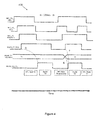
- FIG. 2 illustrates a timing diagram that outlines one embodiment of packet arbitration for thermal management.
- FIG. 3 illustrates a timing diagram that outlines one embodiment of packet arbitration for thermal management.
- FIG. 4 illustrates a timing diagram that outlines one embodiment of packet arbitration for thermal management.
- FIG. 5 illustrates a timing diagram that outlines one embodiment of packet arbitration for thermal management.
- FIG. 6 illustrates one embodiment of a method associated with packet arbitration for thermal management.
- FIG. 7 illustrates one embodiment of an device that provides packet arbitration for thermal management.
- FIG. 8 illustrates a timing diagram that outlines one embodiment of packet arbitration for thermal management.
- packet arbitration for thermal management corresponds to preventing simultaneous transmission of packets when such simultaneous transmission of packets is likely to cause overheating of a communication device. Excessive heat within a communication device may damage hardware and affect electrical connections within the device. Simultaneous transmission of multiple packets may cause undesirable heating in a communication device.
- a device in one embodiment, includes an arbiter logic that can be placed in a thermal management mode when simultaneous transmission of packets may result in excessive heating of the device.
- the arbiter logic When not in thermal management mode, the arbiter logic allows simultaneous transmission and/or reception of packets from multiple sources. However, when in thermal management mode, the arbiter logic selects and orders packets for transmission such that packets from multiple sources are not simultaneously transmitted. When not in thermal management mode, the arbiter logic allows transmission of packets from multiple sources simultaneously. In this manner, overheating of the communication device can be avoided.
- FIG. 1 illustrates one embodiment of a wireless communication device 100 that performs packet arbitration for thermal management.
- the device 100 includes a first source 110 that is configured to transmit packets and a second source 120 that is configured to transmit packets.
- the first source 110 includes a first antenna 110 A for transmitting packets from the first source.
- the second source 120 includes a second antenna 120 A for transmitting packets from the second source.
- the wireless communication device 100 is implemented on a chip including one or more integrated circuits configured to perform one or more of the functions described herein.
- the first source 110 and second source 120 are driver circuits associated with one or more of an NFC driver, a WLAN driver, a Bluetooth driver, and an LTE driver.
- the first source 110 is an NFC driver and the second source 120 is a WLAN driver.
- the NFC driver and the WLAN driver generally consume more power during transmission of packets, and thus generate more heat.
- the NFC driver provides radio frequency (rf) energy to a passive NFC tag to energize the tag so that the NFC tag sends a signal to the NFC driver circuit.
- the NFC driver periodically transmits packets that include the rf energy to used to energize a passive NFC tag.
- the NFC consumes about 250 mW of power.
- the WLAN driver typically draws around 250 mA per antenna during transmission.
- a WLAN driver operating with two antennas consumes 2 watts of power.
- the NFC driver When the NFC driver is in reader mode and the WLAN driver is transmitting packets, significant heat is generated. Depending on ambient temperature and the length of time the NFC driver and WLAN driver simultaneously transmit packages, components in the device may be exposed to temperatures above the recommended operating range. Some devices separate the NFC driver/antenna from the WLAN driver/antenna. This distributes the heating affects of the two drivers, but may not prevent overheating in all cases.
- the device 100 includes an arbiter logic 130 .
- the arbiter logic 130 coordinates the transmission of packets from the first source 110 and second source 120 .
- the arbiter logic 130 receives and grants transmit requests from the first source 110 and the second source 120 .
- the arbiter logic 130 also receives a priority associated with the transmit requests.
- the arbiter logic 130 is a Bluetooth Coexistence Arbiter (BCA).
- a thermal management mode selection is made by a device component that is cognizant of the likelihood of overheating of the device 100 .
- the thermal management mode selection is made by a processor that is monitoring an ambient temperature within the device 100 . When the ambient temperature exceeds a predetermined limit, the processor makes a thermal management mode selection that activates thermal management mode.
- the arbiter logic 130 is configured to receive the thermal management mode selection and to operate in thermal management mode when the thermal management mode is active.
- the arbiter logic 130 When the arbiter logic 130 operates in thermal management mode, transmit requests are selectively granted so that packets are selectively transmitted to reduce heating of the device 100 .
- the arbiter logic 130 When in thermal management mode, the arbiter logic 130 follows a thermal management protocol.
- a thermal management protocol is outlined in FIGS. 2-5 .
- the thermal management protocol provides rules for prioritizing packets such that the arbiter logic 130 grants transmit requests to only a single source at any given time.
- the thermal management mode is not active, the arbiter logic 130 grants transmit requests without the same thermal considerations of thermal management mode, meaning that in some instances both the first source 110 (e.g., NFC driver) and the second source 120 WLAN driver) are simultaneously granted permission to transmit packets.
- FIG. 2 illustrates a timing diagram 200 that outlines an aspect of one embodiment of a thermal management protocol performed by the arbiter logic 130 ( FIG. 1 ) when the thermal management mode is active.
- an NFC driver e.g., first source 110 , FIG. 1
- the transmit request is a request to transmit packets from the communication device. If WLAN packets are being transmitting when the NFC transmit request is made, the NFC transmit request is not granted until the transmission have completed as shown by dashed line A on the bottom waveform.
- the NFC driver continues to assert the transmit request for the entire period, even though the request is not immediately granted.
- the NFC driver then transmits packets as shown by dashed line B until an end of the periodic transmit request as shown by dashed line C.
- the length of time the NEC driver is allowed to transmit packets will vary (e.g., between 1 and 200 ms) depending on the duration of the WLAN packet transmission.
- the thermal management protocol grants permission for a single packet source at a time. This avoids the simultaneous transmission of packets from multiple sources thereby reducing the heating affects inside the device of packet transmission.
- FIG. 3 illustrates another timing diagram 300 that outlines an aspect of one embodiment of a thermal management protocol performed by the arbiter logic 130 ( FIG. 1 ) when the thermal management mode is active.
- the NFC driver requests permission to transmit packets.
- T1 transmission of any WLAN packets that are being transmitted is completed.
- the NEC driver is granted permission to transmit.
- the NFC driver determines whether the transmission of packets should be assigned a high priority based on a response to initial packets that were sent. For example, if a tag is identified and is being read by the NEC driver, the NFC driver would assert transmit priority at the end of T4.
- WLAN transmit requests may or may not be granted, depending on the specific thermal management protocol. If a WLAN transmit request is granted, the NFC transmit request would be denied.
- the NFC driver asserts transmit priority.
- WLAN transmit requests may be denied and the NEC driver transmits packets.
- the NFC transmit request remains granted after the end of the transmit request during T3.
- T3 is typically relatively short, on the order of 100 ns. In this manner, a high priority transmit request can prevent other transmit requests from being granted until the high priority transmission is complete.
- a WLAN transmission always has a higher priority than NFC transmissions and WLAN transmissions are never blocked by NFC transmissions.
- FIG. 4 illustrates another timing diagram 400 that outlines an aspect of one embodiment of a thermal management protocol performed by the arbiter logic 130 ( FIG. 1 ) when the thermal management mode is active.
- priority may be assigned to both the NFC transmit request and the WLAN transmit request and a high priority WLAN is given preference over NFC.
- the NFC driver generates a transmit request and the request is granted.
- the NFC driver assigns a high priority to the transmit request. While the NFC transmit priority is high, a WLAN transmit request is made.
- the WLAN transmit request has a low ( 00 ) priority, so (as shown by dashed line D) the WLAN transmit request is not granted until the NFC transmit request is complete.
- the NFC driver generates a second transmit request 333 ms after the first NFC transmit request.
- the second transmit request is granted.
- the NFC driver assigns a high priority to the transmit request. While the NFC transmit priority is high, a WLAN transmit request is made.
- the WLAN transmit request has a high (11) priority, so (as shown by dashed line E) the NFC transmit grant is terminated and NFC transmission ceases.
- the WLAN transmit request is immediately granted as shown by dashed line F and the high priority WLAN packets are transmitted. In this manner the WLAN driver is given preference over the NFC driver such that a high priority transmit request from the WLAN driver can cause an early transmit abort of high priority NFC packets.
- FIG. 5 illustrates another timing diagram 500 that outlines an aspect of one embodiment of a thermal management protocol performed by the arbiter logic 130 ( FIG. 1 ) when the thermal management mode is active.
- FIG. 5 illustrates how the early transmit abort of a high priority NFC transmit request is handled.
- the NFC transmit grant is terminated according to the thermal management protocol because a high priority transmit request is received from the WLAN driver.
- the NFC driver continues to assert both the transmit request and the high priority.
- the NFC transmit request is again granted and the NFC driver resumes transmission of packets.
- FIG. 6 illustrates one embodiment of a method 600 for performing packet arbitration for thermal management.
- the method includes receiving a first request from a first source to transmit first packets.
- the method includes, while transmitting the first packets, receiving a second request from a second source to transmit second packets.
- the method includes determining a present thermal management mode. The thermal management mode is based, at least in part, on a thermal consequence of simultaneous transmission of packets from the first source and the second source.
- the method includes selectively transmitting packets based, at least in part, on the thermal management mode.
- the thermal management mode may be determined based on power that is typically consumed during transmission of packets from the first source combined with power that is typically consumed during transmission of packets from the second source.
- the thermal management mode may also be determined based on an ambient temperature.
- the method when the thermal management mode is not active, the method includes transmitting both the first and second packets simultaneously. In one embodiment, when the thermal management mode is active, the method includes transmitting either the first packets or the second packets, such that the first packets and the second packets are not transmitted simultaneously.
- packets may be selectively transmitted, based, at least in part, on i) a first priority that is associated with the first packets and ii) a second priority that is associated with the second packets.
- the method includes determining a first priority associated with the first packets and determining a second priority associated with the second packets.
- the method includes ceasing transmission of the first packets and transmitting the second packets.
- the method includes i) continuing transmission of the first packets and ii) delaying transmitting the second packets until the transmitting of the first packets is complete.
- the method includes selecting either the first packets or the second packets for transmission based on a thermal management protocol that prioritizes either the first source or the second source.
- FIG. 7 illustrates one embodiment of a system on chip 700 that performs packet arbitration for thermal management.
- packet arbitration for thermal management corresponds to preventing simultaneous transmission of packets from multiple sources when simultaneous transmission of packets is likely to cause excessive heating within a device (e.g., silicon degradation).
- the system on chip 700 includes a first integrated circuit 710 that includes a WLAN driver circuit 715 and one or more WLAN antennas 710 A.
- the system on chip 700 includes a second integrated circuit 720 that includes an NFC driver circuit 725 and one or more NFC antennas 720 A.
- the system on chip 700 includes third integrated circuit 730 that includes an arbiter logic circuit 735 .
- the arbiter logic 735 is configured to receive a thermal management mode selection input from a central processing unit 745 on a fourth integrated circuit 740 .
- the arbiter logic circuit 735 coordinates transmission of packets from the WLAN driver circuit 715 and the NFC driver circuit 725 based on the selected thermal management mode as described above with respect to FIGS. 1-6 .
- the CPU 745 determines whether to select thermal management mode for the arbiter logic circuit 725 based on a thermal consequence of simultaneous transmission of packets from the WLAN driver circuit 715 and the NFC driver circuit 725 . In one embodiment, the CPU 745 determines the thermal consequence of simultaneous packet transmission based on an ambient temperature provided by a temperature sensor 750 . The CPU 745 may perform any suitable algorithm to determine whether to activate thermal management mode. The CPU 745 may consider typical power consumption for the WLAN driver circuit 715 and the NFC driver circuit 725 instead of or in addition to the ambient temperature. The CPU 745 may calculate a predicted resultant surface temperature of the system-on-chip based on the ambient temperature, a thermal coefficient for a substrate of the system on chip, and the power consumed simultaneous transmission of packets. If the predicted resultant temperature exceeds a predetermined limit (e.g., 125° C.), the CPU may select thermal management mode.
- a predetermined limit e.g., 125° C.
- FIG. 8 illustrates another timing diagram 800 that outlines an aspect of one embodiment of a thermal management protocol performed by the arbiter logic 130 ( FIG. 1 ) when the thermal management mode is active.
- FIG. 8 illustrates a coexistence window that may be enabled to allow simultaneous transmission of a short, high priority WLAN during NFC packet transmission.
- a relatively short coexistence window is created early in the time period in which NFC transmission is occurring. At this time during NFC transmission, heating effects have not yet become significant.
- the WLAN packets are allowed to be transmitted.
- the coexistence window is not active, a request to transmit WLAN packets is denied.
- the priority of WLAN packets that will be allowed to transmit during the coexistence window may be programmable.
- a non-transitory computer-readable medium is configured with stored computer executable instructions that when executed by a machine (e.g., arbiter logic 130 , arbiter logic circuit 735 , CPU 745 , processor, computer, and so on) cause the machine (and/or associated components) to execute the thermal management protocol described in FIGS. 1-8 .
- a machine e.g., arbiter logic 130 , arbiter logic circuit 735 , CPU 745 , processor, computer, and so on
- references to “one embodiment”, “an embodiment”, “one example”, “an example”, and so on, indicate that the embodiment(s) or example(s) so described may include a particular feature, structure, characteristic, property, element, or limitation, but that not every embodiment or example necessarily includes that particular feature, structure, characteristic, property, element or limitation. Furthermore, repeated use of the phrase “in one embodiment” does not necessarily refer to the same embodiment, though it may.
- Logic includes a computer or electrical hardware component(s), firmware, a non-transitory computer readable medium that stores instructions, and/or combinations of these components configured to perform a function(s) or an action(s), and/or to cause a function or action from another logic, method, and/or system.
- Logic may include a microprocessor controlled by an algorithm to perform one or more of the disclosed functions/methods, a discrete logic (e.g., ASIC), an analog circuit, a digital circuit, a programmed logic device, a memory device containing instructions, and so on.
- Logic may include one or more gates, combinations of gates, or other circuit components. Where multiple logics are described, it may be possible to incorporate the multiple logics into one physical logic component. Similarly, where a single logic component is described, it may be possible to distribute that single logic component between multiple physical logic components. In some embodiments, one or more of the components and functions described herein are implemented using one or more of the logic components.
- illustrated methodologies are shown and described as a series of blocks. The methodologies are not limited by the order of the blocks as some blocks can occur in different orders and/or concurrently with other blocks from that shown and described. Moreover, less than all the illustrated blocks may be used to implement an example methodology. Blocks may be combined or separated into multiple components. Furthermore, additional and/or alternative methodologies can employ additional, not illustrated blocks.
Landscapes
- Engineering & Computer Science (AREA)
- Theoretical Computer Science (AREA)
- Physics & Mathematics (AREA)
- General Engineering & Computer Science (AREA)
- General Physics & Mathematics (AREA)
- Computer Networks & Wireless Communication (AREA)
- Signal Processing (AREA)
- Human Computer Interaction (AREA)
- Mobile Radio Communication Systems (AREA)
Abstract
Description
Claims (20)
Priority Applications (1)
| Application Number | Priority Date | Filing Date | Title |
|---|---|---|---|
| US13/717,884 US8934840B1 (en) | 2011-12-20 | 2012-12-18 | Method and apparatus for performing arbitration among a plurality of driver circuits in a communication device |
Applications Claiming Priority (2)
| Application Number | Priority Date | Filing Date | Title |
|---|---|---|---|
| US201161578197P | 2011-12-20 | 2011-12-20 | |
| US13/717,884 US8934840B1 (en) | 2011-12-20 | 2012-12-18 | Method and apparatus for performing arbitration among a plurality of driver circuits in a communication device |
Publications (1)
| Publication Number | Publication Date |
|---|---|
| US8934840B1 true US8934840B1 (en) | 2015-01-13 |
Family
ID=52247820
Family Applications (1)
| Application Number | Title | Priority Date | Filing Date |
|---|---|---|---|
| US13/717,884 Active 2033-07-15 US8934840B1 (en) | 2011-12-20 | 2012-12-18 | Method and apparatus for performing arbitration among a plurality of driver circuits in a communication device |
Country Status (1)
| Country | Link |
|---|---|
| US (1) | US8934840B1 (en) |
Cited By (2)
| Publication number | Priority date | Publication date | Assignee | Title |
|---|---|---|---|---|
| US20140200046A1 (en) * | 2013-01-16 | 2014-07-17 | Qualcomm Incorporated | Apparatus and method for mitigating voltage droop in dual-transceiver wireless communication device |
| US11678404B2 (en) * | 2017-10-05 | 2023-06-13 | Sony Corporation | User equipment overheating handling during LTE-new radio simultaneous UL transmission |
Citations (5)
| Publication number | Priority date | Publication date | Assignee | Title |
|---|---|---|---|---|
| US20040116075A1 (en) * | 2002-12-17 | 2004-06-17 | Texas Instruments Incorporated | Dual platform communication controller, method of controlling a dual platform communication and wireless communication system employing the same |
| US20100285828A1 (en) * | 2009-05-08 | 2010-11-11 | Qualcomm Incorporated | Throttling transmit power in a wwan device based upon thermal input |
| US20100316027A1 (en) * | 2009-06-16 | 2010-12-16 | Qualcomm Incorporated | Method and apparatus for dynamic and dual antenna bluetooth (bt)/wlan coexistence |
| US8718029B1 (en) * | 2007-09-07 | 2014-05-06 | Marvell International Ltd. | Method and apparatus for wireless arbiter power saving |
| US20140233444A1 (en) * | 2013-02-20 | 2014-08-21 | Qualcomm Incorporated | Systems and methods for wireless coexistence |
-
2012
- 2012-12-18 US US13/717,884 patent/US8934840B1/en active Active
Patent Citations (5)
| Publication number | Priority date | Publication date | Assignee | Title |
|---|---|---|---|---|
| US20040116075A1 (en) * | 2002-12-17 | 2004-06-17 | Texas Instruments Incorporated | Dual platform communication controller, method of controlling a dual platform communication and wireless communication system employing the same |
| US8718029B1 (en) * | 2007-09-07 | 2014-05-06 | Marvell International Ltd. | Method and apparatus for wireless arbiter power saving |
| US20100285828A1 (en) * | 2009-05-08 | 2010-11-11 | Qualcomm Incorporated | Throttling transmit power in a wwan device based upon thermal input |
| US20100316027A1 (en) * | 2009-06-16 | 2010-12-16 | Qualcomm Incorporated | Method and apparatus for dynamic and dual antenna bluetooth (bt)/wlan coexistence |
| US20140233444A1 (en) * | 2013-02-20 | 2014-08-21 | Qualcomm Incorporated | Systems and methods for wireless coexistence |
Cited By (5)
| Publication number | Priority date | Publication date | Assignee | Title |
|---|---|---|---|---|
| US20140200046A1 (en) * | 2013-01-16 | 2014-07-17 | Qualcomm Incorporated | Apparatus and method for mitigating voltage droop in dual-transceiver wireless communication device |
| KR20150110617A (en) * | 2013-01-16 | 2015-10-02 | 퀄컴 인코포레이티드 | Apparatus and method for mitigating voltage droop in dual-transceiver wireless communication device |
| US9167446B2 (en) * | 2013-01-16 | 2015-10-20 | Qualcomm Incorporated | Apparatus and method for mitigating voltage droop in a dual-transceiver wireless communication device |
| US11678404B2 (en) * | 2017-10-05 | 2023-06-13 | Sony Corporation | User equipment overheating handling during LTE-new radio simultaneous UL transmission |
| US12213215B2 (en) | 2017-10-05 | 2025-01-28 | Sony Group Corporation | User equipment overheating handling during LTE-new radio simultaneous UL transmission |
Similar Documents
| Publication | Publication Date | Title |
|---|---|---|
| JP5805855B2 (en) | Airlink selection according to temperature in multi-mode wireless devices | |
| US20160291665A1 (en) | Method for controlling circuit modules within chip and associated system on chip | |
| US9131520B1 (en) | Packet exchange arbitration for coexisting radios | |
| KR102367005B1 (en) | Discontinuous reception method, terminal device and network device | |
| US10736038B2 (en) | Channel monitoring method and device | |
| US10251124B2 (en) | Extending sleep mode in wireless device | |
| WO2012121784A3 (en) | Techniques for managing idle state activity in mobile devices | |
| JP2014131284A5 (en) | ||
| JP2013546214A (en) | Method and apparatus for touch temperature management based on power consumption history | |
| EP3001725B1 (en) | Secondary cell state activation and deactivation of gaps | |
| WO2015034495A1 (en) | Techniques for wireless communication between a terminal computing device and a wearable computing device | |
| KR20150121042A (en) | Systems and methods for wireless coexistence | |
| JP2016025687A5 (en) | ||
| US8934840B1 (en) | Method and apparatus for performing arbitration among a plurality of driver circuits in a communication device | |
| WO2014126195A1 (en) | Communication system, control apparatus, application server and device | |
| FI4329354T3 (en) | CHANNEL ACCESS METHOD FOR TRANSMISSION IN AN UNLICENSED FREQUENCY BAND AND DEVICE USING THE METHOD | |
| WO2008033605A2 (en) | Method and apparatus for aligned transmissions in a wireless network | |
| KR20180103890A (en) | Bus Ownership Handoff Techniques | |
| US11256642B2 (en) | Envelope tracking amplifier apparatus incorporating single-wire peer-to-peer bus | |
| US20130145030A1 (en) | Control device, terminal apparatus, and communication system | |
| CN105027659B (en) | Method for being communicated by the network equipment and the network equipment | |
| RU2015147872A (en) | MOBILE STATION, BASIC STATION, MOBILE COMMUNICATION SYSTEM, TRANSMISSION METHOD AND RECEPTION MANAGEMENT METHOD | |
| US10736031B2 (en) | Access point energy saving method and access point | |
| RU2017130698A (en) | METHOD FOR PROCESSING INFORMATION AND DEVICE FOR PROCESSING INFORMATION | |
| EP3113374B1 (en) | Reduction of the time to start up a second communication unit |
Legal Events
| Date | Code | Title | Description |
|---|---|---|---|
| AS | Assignment |
Owner name: MARVELL SEMICONDUCTOR, INC., CALIFORNIA Free format text: ASSIGNMENT OF ASSIGNORS INTEREST;ASSIGNORS:YEUNG, KEN;MISHRA, ASHUTOSH;RAMAMURTHY, HARISH;AND OTHERS;REEL/FRAME:029570/0544 Effective date: 20121217 Owner name: MARVELL INTERNATIONAL LTD., BERMUDA Free format text: ASSIGNMENT OF ASSIGNORS INTEREST;ASSIGNOR:MARVELL SEMICONDUCTOR, INC.;REEL/FRAME:029570/0599 Effective date: 20121218 |
|
| STCF | Information on status: patent grant |
Free format text: PATENTED CASE |
|
| MAFP | Maintenance fee payment |
Free format text: PAYMENT OF MAINTENANCE FEE, 4TH YEAR, LARGE ENTITY (ORIGINAL EVENT CODE: M1551) Year of fee payment: 4 |
|
| AS | Assignment |
Owner name: CAVIUM INTERNATIONAL, CAYMAN ISLANDS Free format text: ASSIGNMENT OF ASSIGNORS INTEREST;ASSIGNOR:MARVELL INTERNATIONAL LTD.;REEL/FRAME:052918/0001 Effective date: 20191231 |
|
| AS | Assignment |
Owner name: MARVELL ASIA PTE, LTD., SINGAPORE Free format text: ASSIGNMENT OF ASSIGNORS INTEREST;ASSIGNOR:CAVIUM INTERNATIONAL;REEL/FRAME:053475/0001 Effective date: 20191231 |
|
| MAFP | Maintenance fee payment |
Free format text: PAYMENT OF MAINTENANCE FEE, 8TH YEAR, LARGE ENTITY (ORIGINAL EVENT CODE: M1552); ENTITY STATUS OF PATENT OWNER: LARGE ENTITY Year of fee payment: 8 |