US8926940B2 - Device and method for generating hydrogen from an ammonia borane-based compound hydrogen reservoir, a catalyst used with the same, and a device for using emitted hydrogen - Google Patents
Device and method for generating hydrogen from an ammonia borane-based compound hydrogen reservoir, a catalyst used with the same, and a device for using emitted hydrogen Download PDFInfo
- Publication number
- US8926940B2 US8926940B2 US13/704,804 US201013704804A US8926940B2 US 8926940 B2 US8926940 B2 US 8926940B2 US 201013704804 A US201013704804 A US 201013704804A US 8926940 B2 US8926940 B2 US 8926940B2
- Authority
- US
- United States
- Prior art keywords
- hydrogen
- ammonia borane
- methyl
- catalyst
- substituted
- Prior art date
- Legal status (The legal status is an assumption and is not a legal conclusion. Google has not performed a legal analysis and makes no representation as to the accuracy of the status listed.)
- Active
Links
- 0 [1*]P([2*])C([5*])C([6*])P([3*])[4*] Chemical compound [1*]P([2*])C([5*])C([6*])P([3*])[4*] 0.000 description 3
Images


Classifications
-
- C—CHEMISTRY; METALLURGY
- C01—INORGANIC CHEMISTRY
- C01B—NON-METALLIC ELEMENTS; COMPOUNDS THEREOF; METALLOIDS OR COMPOUNDS THEREOF NOT COVERED BY SUBCLASS C01C
- C01B3/00—Hydrogen; Gaseous mixtures containing hydrogen; Separation of hydrogen from mixtures containing it; Purification of hydrogen; Reversible storage of hydrogen
- C01B3/02—Production of hydrogen; Production of gaseous mixtures containing hydrogen
- C01B3/04—Production of hydrogen; Production of gaseous mixtures containing hydrogen by decomposition of inorganic compounds
-
- B—PERFORMING OPERATIONS; TRANSPORTING
- B01—PHYSICAL OR CHEMICAL PROCESSES OR APPARATUS IN GENERAL
- B01J—CHEMICAL OR PHYSICAL PROCESSES, e.g. CATALYSIS OR COLLOID CHEMISTRY; THEIR RELEVANT APPARATUS
- B01J8/00—Chemical or physical processes in general, conducted in the presence of fluids and solid particles; Apparatus for such processes
-
- C—CHEMISTRY; METALLURGY
- C01—INORGANIC CHEMISTRY
- C01B—NON-METALLIC ELEMENTS; COMPOUNDS THEREOF; METALLOIDS OR COMPOUNDS THEREOF NOT COVERED BY SUBCLASS C01C
- C01B3/00—Hydrogen; Gaseous mixtures containing hydrogen; Separation of hydrogen from mixtures containing it; Purification of hydrogen; Reversible storage of hydrogen
- C01B3/02—Production of hydrogen; Production of gaseous mixtures containing hydrogen
-
- C—CHEMISTRY; METALLURGY
- C01—INORGANIC CHEMISTRY
- C01B—NON-METALLIC ELEMENTS; COMPOUNDS THEREOF; METALLOIDS OR COMPOUNDS THEREOF NOT COVERED BY SUBCLASS C01C
- C01B3/00—Hydrogen; Gaseous mixtures containing hydrogen; Separation of hydrogen from mixtures containing it; Purification of hydrogen; Reversible storage of hydrogen
- C01B3/02—Production of hydrogen; Production of gaseous mixtures containing hydrogen
- C01B3/06—Production of hydrogen; Production of gaseous mixtures containing hydrogen by reaction of inorganic compounds containing electro-positively bound hydrogen with inorganic reducing agents
- C01B3/065—Production of hydrogen; Production of gaseous mixtures containing hydrogen by reaction of inorganic compounds containing electro-positively bound hydrogen with inorganic reducing agents by reaction of inorganic compounds with hydrides
-
- H—ELECTRICITY
- H01—ELECTRIC ELEMENTS
- H01M—PROCESSES OR MEANS, e.g. BATTERIES, FOR THE DIRECT CONVERSION OF CHEMICAL ENERGY INTO ELECTRICAL ENERGY
- H01M8/00—Fuel cells; Manufacture thereof
- H01M8/04—Auxiliary arrangements, e.g. for control of pressure or for circulation of fluids
- H01M8/04082—Arrangements for control of reactant parameters, e.g. pressure or concentration
- H01M8/04201—Reactant storage and supply, e.g. means for feeding, pipes
- H01M8/04216—Reactant storage and supply, e.g. means for feeding, pipes characterised by the choice for a specific material, e.g. carbon, hydride, absorbent
-
- H—ELECTRICITY
- H01—ELECTRIC ELEMENTS
- H01M—PROCESSES OR MEANS, e.g. BATTERIES, FOR THE DIRECT CONVERSION OF CHEMICAL ENERGY INTO ELECTRICAL ENERGY
- H01M8/00—Fuel cells; Manufacture thereof
- H01M8/06—Combination of fuel cells with means for production of reactants or for treatment of residues
- H01M8/0606—Combination of fuel cells with means for production of reactants or for treatment of residues with means for production of gaseous reactants
- H01M8/065—Combination of fuel cells with means for production of reactants or for treatment of residues with means for production of gaseous reactants by dissolution of metals or alloys; by dehydriding metallic substances
-
- B—PERFORMING OPERATIONS; TRANSPORTING
- B01—PHYSICAL OR CHEMICAL PROCESSES OR APPARATUS IN GENERAL
- B01J—CHEMICAL OR PHYSICAL PROCESSES, e.g. CATALYSIS OR COLLOID CHEMISTRY; THEIR RELEVANT APPARATUS
- B01J2231/00—Catalytic reactions performed with catalysts classified in B01J31/00
- B01J2231/70—Oxidation reactions, e.g. epoxidation, (di)hydroxylation, dehydrogenation and analogues
- B01J2231/76—Dehydrogenation
-
- B—PERFORMING OPERATIONS; TRANSPORTING
- B01—PHYSICAL OR CHEMICAL PROCESSES OR APPARATUS IN GENERAL
- B01J—CHEMICAL OR PHYSICAL PROCESSES, e.g. CATALYSIS OR COLLOID CHEMISTRY; THEIR RELEVANT APPARATUS
- B01J2531/00—Additional information regarding catalytic systems classified in B01J31/00
- B01J2531/80—Complexes comprising metals of Group VIII as the central metal
- B01J2531/82—Metals of the platinum group
- B01J2531/824—Palladium
-
- B—PERFORMING OPERATIONS; TRANSPORTING
- B01—PHYSICAL OR CHEMICAL PROCESSES OR APPARATUS IN GENERAL
- B01J—CHEMICAL OR PHYSICAL PROCESSES, e.g. CATALYSIS OR COLLOID CHEMISTRY; THEIR RELEVANT APPARATUS
- B01J2531/00—Additional information regarding catalytic systems classified in B01J31/00
- B01J2531/80—Complexes comprising metals of Group VIII as the central metal
- B01J2531/84—Metals of the iron group
- B01J2531/842—Iron
-
- B—PERFORMING OPERATIONS; TRANSPORTING
- B01—PHYSICAL OR CHEMICAL PROCESSES OR APPARATUS IN GENERAL
- B01J—CHEMICAL OR PHYSICAL PROCESSES, e.g. CATALYSIS OR COLLOID CHEMISTRY; THEIR RELEVANT APPARATUS
- B01J2531/00—Additional information regarding catalytic systems classified in B01J31/00
- B01J2531/80—Complexes comprising metals of Group VIII as the central metal
- B01J2531/84—Metals of the iron group
- B01J2531/845—Cobalt
-
- B—PERFORMING OPERATIONS; TRANSPORTING
- B01—PHYSICAL OR CHEMICAL PROCESSES OR APPARATUS IN GENERAL
- B01J—CHEMICAL OR PHYSICAL PROCESSES, e.g. CATALYSIS OR COLLOID CHEMISTRY; THEIR RELEVANT APPARATUS
- B01J2531/00—Additional information regarding catalytic systems classified in B01J31/00
- B01J2531/80—Complexes comprising metals of Group VIII as the central metal
- B01J2531/84—Metals of the iron group
- B01J2531/847—Nickel
-
- B—PERFORMING OPERATIONS; TRANSPORTING
- B01—PHYSICAL OR CHEMICAL PROCESSES OR APPARATUS IN GENERAL
- B01J—CHEMICAL OR PHYSICAL PROCESSES, e.g. CATALYSIS OR COLLOID CHEMISTRY; THEIR RELEVANT APPARATUS
- B01J31/00—Catalysts comprising hydrides, coordination complexes or organic compounds
- B01J31/16—Catalysts comprising hydrides, coordination complexes or organic compounds containing coordination complexes
- B01J31/24—Phosphines, i.e. phosphorus bonded to only carbon atoms, or to both carbon and hydrogen atoms, including e.g. sp2-hybridised phosphorus compounds such as phosphabenzene, phosphole or anionic phospholide ligands
- B01J31/2404—Cyclic ligands, including e.g. non-condensed polycyclic ligands, the phosphine-P atom being a ring member or a substituent on the ring
- B01J31/2409—Cyclic ligands, including e.g. non-condensed polycyclic ligands, the phosphine-P atom being a ring member or a substituent on the ring with more than one complexing phosphine-P atom
-
- F—MECHANICAL ENGINEERING; LIGHTING; HEATING; WEAPONS; BLASTING
- F17—STORING OR DISTRIBUTING GASES OR LIQUIDS
- F17C—VESSELS FOR CONTAINING OR STORING COMPRESSED, LIQUEFIED OR SOLIDIFIED GASES; FIXED-CAPACITY GAS-HOLDERS; FILLING VESSELS WITH, OR DISCHARGING FROM VESSELS, COMPRESSED, LIQUEFIED, OR SOLIDIFIED GASES
- F17C11/00—Use of gas-solvents or gas-sorbents in vessels
- F17C11/005—Use of gas-solvents or gas-sorbents in vessels for hydrogen
-
- Y—GENERAL TAGGING OF NEW TECHNOLOGICAL DEVELOPMENTS; GENERAL TAGGING OF CROSS-SECTIONAL TECHNOLOGIES SPANNING OVER SEVERAL SECTIONS OF THE IPC; TECHNICAL SUBJECTS COVERED BY FORMER USPC CROSS-REFERENCE ART COLLECTIONS [XRACs] AND DIGESTS
- Y02—TECHNOLOGIES OR APPLICATIONS FOR MITIGATION OR ADAPTATION AGAINST CLIMATE CHANGE
- Y02E—REDUCTION OF GREENHOUSE GAS [GHG] EMISSIONS, RELATED TO ENERGY GENERATION, TRANSMISSION OR DISTRIBUTION
- Y02E60/00—Enabling technologies; Technologies with a potential or indirect contribution to GHG emissions mitigation
- Y02E60/30—Hydrogen technology
- Y02E60/32—Hydrogen storage
-
- Y02E60/321—
-
- Y—GENERAL TAGGING OF NEW TECHNOLOGICAL DEVELOPMENTS; GENERAL TAGGING OF CROSS-SECTIONAL TECHNOLOGIES SPANNING OVER SEVERAL SECTIONS OF THE IPC; TECHNICAL SUBJECTS COVERED BY FORMER USPC CROSS-REFERENCE ART COLLECTIONS [XRACs] AND DIGESTS
- Y02—TECHNOLOGIES OR APPLICATIONS FOR MITIGATION OR ADAPTATION AGAINST CLIMATE CHANGE
- Y02E—REDUCTION OF GREENHOUSE GAS [GHG] EMISSIONS, RELATED TO ENERGY GENERATION, TRANSMISSION OR DISTRIBUTION
- Y02E60/00—Enabling technologies; Technologies with a potential or indirect contribution to GHG emissions mitigation
- Y02E60/30—Hydrogen technology
- Y02E60/36—Hydrogen production from non-carbon containing sources, e.g. by water electrolysis
-
- Y02E60/362—
-
- Y02E60/364—
-
- Y—GENERAL TAGGING OF NEW TECHNOLOGICAL DEVELOPMENTS; GENERAL TAGGING OF CROSS-SECTIONAL TECHNOLOGIES SPANNING OVER SEVERAL SECTIONS OF THE IPC; TECHNICAL SUBJECTS COVERED BY FORMER USPC CROSS-REFERENCE ART COLLECTIONS [XRACs] AND DIGESTS
- Y02—TECHNOLOGIES OR APPLICATIONS FOR MITIGATION OR ADAPTATION AGAINST CLIMATE CHANGE
- Y02E—REDUCTION OF GREENHOUSE GAS [GHG] EMISSIONS, RELATED TO ENERGY GENERATION, TRANSMISSION OR DISTRIBUTION
- Y02E60/00—Enabling technologies; Technologies with a potential or indirect contribution to GHG emissions mitigation
- Y02E60/30—Hydrogen technology
- Y02E60/50—Fuel cells
Definitions
- the present disclosure relates to an apparatus and a method for generating hydrogen from an ammonia borane-based compound as a hydrogen reservoir, a catalyst used for same and an apparatus for using the generated hydrogen.
- Fuel cells and hydrogen combustion devices use hydrogen as reactive gas. To utilize the fuel cells and hydrogen combustion devices, for example, in automobiles or electronic products, stable and consistent supply and storage of hydrogen are necessary.
- hydrogen may be supplied from a separately equipped hydrogen tank when necessary.
- compressed hydrogen or liquefied hydrogen may be used to store hydrogen.
- hydrogen may be generated from reaction of the materials and then supplied to the apparatus using hydrogen.
- materials for the method for example, metal hydride, adsorption on carbon, chemical hydrogen storage, or the like have been suggested.
- Ammonia borane (AB; NH 3 BH 3 ) has the highest hydrogen storage capacity among the currently known materials. It has a hydrogen storage capacity of 3 equivalents, i.e. 19.6%. To fully utilize the hydrogen storage capacity of 19.6%, the 3 equivalents of hydrogen should be released over long period of time at high temperatures of 100° C., 150° C. and 1400° C., for each equivalent of hydrogen. Such a hydrogen releasing operated at high temperatures for long time may be a big obstacle to the application of the hydrogen reservoir to an apparatus using hydrogen.
- the present disclosure is directed to providing an apparatus for generating hydrogen from an ammonia borane-based compound as a hydrogen reservoir, capable of releasing 2 equivalents of hydrogen, i.e. 13% of hydrogen storage capacity, from the hydrogen reservoir, a catalyst used for same and an apparatus for using the released hydrogen.
- the present disclosure provides a method for generating hydrogen from a hydrogen reservoir, comprising releasing 2 equivalents of hydrogen from a total of 3 equivalents of hydrogen from an ammonia borane or an ammonia borane derivative, which is a hydrogen reservoir, by providing a first catalyst to the ammonia borane or the ammonia borane derivative.
- the present disclosure provides an apparatus for generating hydrogen including a hydrogen generating reactor releasing 2 equivalents of hydrogen from a total of 3 equivalents of hydrogen from an ammonia borane or an ammonia borane derivative, which is a hydrogen reservoir, by dehydrogenating the ammonia borane or the ammonia borane derivative in the presence of a first catalyst.
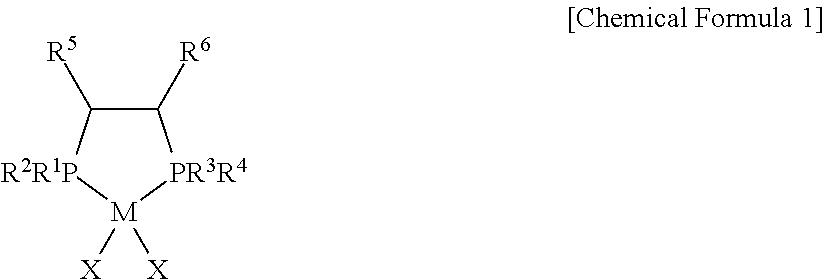
- a complex catalyst represented by Chemical Formula 1 is used as the first catalyst.
- M is a central metal of the complex.
- M may be all known metals;
- R 1 , R 2 , R 3 and R 4 are independently hydrogen, hydrocarbyl, substituted hydrocarbyl, heterohydrocarbyl or substituted heterohydrocarbyl;
- R 5 and R 6 are independently hydrocarbyl excluding hydrogen or substituted hydrocarbyl excluding hydrogen;
- X's attached to M are the same or different from each other and are independently selected or selected at least two at the same time from a group consisting of a halogen atom, a C 1 -C 20 alkyl group, a C 7 -C 30 arylalkyl group, an alkoxy group having a C 1 -C 20 alkyl group, a C 3 -C 20 alkyl-substituted siloxy group and an amido group having a C 1 -C 20 hydrocarbon group.
- the present disclosure provides an apparatus using hydrogen, including the apparatus for generating hydrogen.
- ammonia borane-based compound which is a representative hydrogen reservoir
- 2 equivalents of hydrogen i.e. 13% of the total hydrogen storage capacity, can be released (discharged) at low temperature, e.g. room temperature (25° C.), in a short time, e.g. within 1 minute.
- FIG. 1 schematically illustrates an apparatus for generating hydrogen according to an exemplary embodiment of the present invention.
- FIG. 2 shows a result of measuring hydrogen generation in an example of the present invention.
- FIG. 3 shows a result of quadrupole mass analysis of a generated gas in an example of the present invention.
- FIG. 4 shows a result of measuring 11 B-NMR peaks in an example of the present invention.
- FIG. 5 shows an FT/IR spectrum of polyiminoborane (BNH x ) in an example of the present invention.
- a hydrogen reservoir refers to a compound capable of generating hydrogen through a chemical reaction.
- an ammonia borane-based compound refers to ammonia borane or a derivative thereof.
- an apparatus using hydrogen includes an apparatus which receives hydrogen and combusts hydrogen or produces electricity or an apparatus powered by such an electricity-producing apparatus.
- 2 equivalents of hydrogen may be released from an ammonia borane-based compound, i.e. ammonia borane or an ammonia borane derivative (a derivative having one or more substituent at amine or borane of ammonia borane) as a hydrogen reservoir using a catalyst described below at low temperature, e.g. room temperature.
- an ammonia borane-based compound i.e. ammonia borane or an ammonia borane derivative (a derivative having one or more substituent at amine or borane of ammonia borane) as a hydrogen reservoir using a catalyst described below at low temperature, e.g. room temperature.
- 2 equivalents of hydrogen (corresponding to 13% of hydrogen storage capacity) can be released from ammonia borane or an ammonia borane derivative using a homogeneous, first catalyst. That is to say, 2 equivalents of hydrogen can be released at low temperature, e.g. room temperature, using the first catalyst. This means that 13% of hydrogen stored in ammonia borane or a derivative thereof can be released at low temperature, e.g. room temperature.
- polyiminoborane may be produced from ammonia borane or its derivative (see Scheme 1).
- ammonia borane NH 3 BH 3
- an ammonia borane derivative having one or more substituent at amine or borane of ammonia borane may be used.
- ammonia borane derivatives represented by Chemical Formulas 2-4 may be used.
- R1, R2, R3, R4, R5, R6 and R7 are independently a hydrogen atom, a halogen atom, a C 1 -C 20 linear or branched alkyl group optionally substituted (i.e., substituted or unsubstituted) with one or more halogen atom, a silyl group having a C 1 -C 20 linear or branched alkyl group optionally substituted with one or more halogen atom, a C 6 -C 30 aryl group optionally substituted with one or more halogen atom, a C 7 -C 31 aralkyl group optionally substituted with one or more halogen atom, an alkoxy group having a C 1 -C 20 alkyl group optionally substituted with one or more halogen atom, a C 3 -C 20 alkyl group or a C 6 -C 20 aryl-substituted siloxy group, and these substituents may be optionally connected to
- the first catalyst is a homogeneous catalyst.
- the homogeneous catalyst is a complex wherein a central metal is bound to one or more ligand stabilizing the central metal.
- the central metal may be any known metal.
- Non-limiting examples of the metal include: an alkali metal such as Li, Na, K, Rb, Cs and Fr; an alkaline earth metal such as Be, Mg, Ca, Sr, Ba and Ra; a p-block metal in the periodic table such as Al, Ga, In, Sn, Tl, Ph and Bi; a b-block metal in the periodic table such as Sc, Ti, V, Cr, Mn, Fe, Co, Ni, Cu, Zn, Y, Zr, Nb, Mo, Tc, Ru, Pd, Ag, Cd, Hf, Ta, W, Re, Os, Ir, Pt, Au and Hg; a lanthanide such as La, Ce, Pr, Nd, Pm, Sm, Eu, Gd, Tb, Dy, Ho, Er, Tm and Yb; and an actinide such as Ac, Th, Pa, U, Np, Pu and Am.
- a transition metal may be used. More specifically, Co, Ni, Pd or Pt may be used
- the first catalyst may be a complex catalyst represented by Chemical Formula 1.
- M is the central metal of the complex and may be any known metal.
- R 1 , R 2 , R 3 and R 4 are independently hydrogen, hydrocarbyl, substituted hydrocarbyl, heterohydrocarbyl or substituted heterohydrocarbyl, and R 5 and R 6 are independently hydrocarbyl or substituted hydrocarbyl excluding hydrogen.
- X's attached to M are the same or different from each other and are independently selected or selected at least two at the same time from a group consisting of a halogen atom, a C 1 -C 20 alkyl group, a C 7 -C 30 arylalkyl group, an alkoxy group having a C 1 -C 20 alkyl group, a C 3 -C 20 alkyl-substituted siloxy group and an amido group having a C 1 -C 20 hydrocarbon group.
- the ligand that may form the complex with the central metal may be represented by Chemical Formula 5 and its backbone structure may be represented, for example, by Chemical Formulas 6-8.
- Chemical Formula 6 represents an (S,S)-enantiomer [(S,S)—R 1 R 2 PCH(R 5 )CH(R 6 )PR 3 R 4 ]
- Chemical Formula 7 represents an (R,R)-enantiomer [(R,R)—R 1 R 2 PCH(R)CH(R 6 )PR 3 R 4 and
- Chemical Formula 8 represents a meso diastereomer [meso-R 1 R 2 PCH(R 5 )CH(R 6 )PR 3 R 4 ].
- R 1 , R 2 , R 3 and R 4 are independently hydrocarbyl, substituted hydrocarbyl, heterohydrocarbyl or substituted heterohydrocarbyl, and R 5 and R 6 are independently hydrocarbyl excluding hydrogen or substituted hydrocarbyl excluding hydrogen.
- R 1 , R 2 , R 3 and R 4 may be independently selected from a group consisting of phenyl, benzyl, naphthyl, anthracenyl, mesityl, xylenyl, methyl, ethyl, ethylenyl, propyl, propenyl, propynyl, butyl, cyclohexyl, 4-methylcyclohexyl, 4-ethylcyclohexyl, 4-isopropylcyclohexyl, tolyl, xylyl, 4-methylphenyl, 4-ethylphenyl, 4-isopropylphenyl, 4-t-butylphenyl, 4-methoxyphenyl, 4-isopropoxyphenyl, cumyl, methoxy, ethoxy, phenoxy, tolyloxy, dimethylamino, thiomethyl, trimethylsilyl, dimethylhydrazyl, 2-methylcyclohexy
- R 1 , R 2 , R 3 and R 4 may be independently selected from a group consisting of independently phenyl, tolyl, biphenyl, naphthyl, cyclohexyl, 4-methylphenyl, 4-ethylphenyl, 4-isopropylphenyl, 4-t-butylphenyl, 4-methoxyphenyl, 4-isopropoxyphenyl, 2-methylcyclohexyl, 2-ethylcyclohexyl, 2-isopropylcyclohexyl, o-methylphenyl, o-ethylphenyl, o-isopropylphenyl, o-t-butylphenyl, o-methoxyphenyl and o-isopropoxyphenyl.
- R 5 and R 6 are independently hydrocarbyl excluding hydrogen or substituted hydrocarbyl excluding hydrogen. Specifically, R 5 and R 6 may be independently selected from a group consisting of alkyl, aryloxy, halogen, nitro, alkoxycarbonyl, carbonyloxy, alkoxy, aminocarbonyl, carbonylamino, dialkylamino, derivatives thereof and aryl substituted with any arbitary substituent.
- the ligand having the P—C—C—P backbone structure may have a configuration of (S,S)— or (R,R)—(R 1 )(R 2 )P—(R 5 )CHCH(R 6 )—P(R 3 )(R 4 ) or a mixture thereof.
- Examples of the steroisomeric ligand having the P—C—C—P backbone structure for stably maintaining reaction activity include (S,S)— or (R,R)-(phenyl) 2 P—CH(methyl)CH(methyl)-P (Phenyl) 2 , (S,S)— or (R,R)-(4-methoxyphenyl) 2 P—CH(methyl)CH(methyl)-P(4-methoxyphenyl) 2 , (S,S)— or (R,R)-(4-methylphenyl) 2 P—CH(methyl)CH(methyl)-P(4-methylphenyl) 2 , (S,S)— or (R,R)-(4-ethylphenyl) 2 P—CH(methyl)CH(methyl)-P(phenyl) 2 , (S,S)— or (R,R)-(4-ethylphenyl) 2 P—CH(methyl)CH(methyl)-P(phenyl) 2
- the steroisomeric P—C—C—P backbone structure of the ligand is different from that of the previously known)(R) n PN(R′)P(R) m hetero ligand since phosphorus (P) is the only heteroatom in the backbone structure.
- the ligand used in the first catalyst has a carbon-carbon backbone structure and lacks a nitrogen atom between two phosphorus atoms.
- X may be, for example, Cl and M may be specifically Co, Ni, Pd or Pt.
- M may be specifically Co, Ni, Pd or Pt.
- these compounds are named as KH14, KH15, KH16 and KH17, respectively. Their chemical structures are as follows.
- the catalyst may be prepared, for example, as follows. A solution of (S,S)-(phenyl) 2 PCH(methyl)CH(methyl)P(phenyl) 2 in anhydrous ethanol is slowly added dropwise to a solution of M (central metal, e.g. cobalt(II)) chloride in anhydrous ethanol under nitrogen atmosphere. When the color of the solution changes, the solution is refluxed at a predetermined temperature for a predetermined time. After cooling to room temperature followed by filtering, the catalyst may be obtained by drying the ethanol solution.
- M central metal, e.g. cobalt(II)
- heterogeneous catalyst may also be used.
- the heterogeneous catalyst may be prepared using the homogeneous catalyst.
- the homogeneous catalyst may be reduced to form a metal cluster.
- the metal cluster may be a nanocluster and may have a size of, for example, 2 nm or smaller.
- the method for generating hydrogen comprises releasing 2 equivalents of hydrogen from a total of 3 equivalents of hydrogen from ammonia borane or the ammonia borane derivative which is a hydrogen reservoir by providing the first catalyst to the hydrogen reservoir.
- an apparatus for generating hydrogen comprises a hydrogen generating reactor releasing 2 equivalents of hydrogen from a total of 3 equivalents of hydrogen from ammonia borane or an ammonia borane derivative which is a hydrogen reservoir.
- the ammonia borane or the ammonia borane derivative which is the hydrogen reservoir may be provided together with a solvent for dehydrogenation.
- a solvent for dehydrogenation include: a hydrocarbon-based solvent such as n-pentane, n-hexane, n-heptane, n-octane, decane, dodecane, cyclohexane, cyclooctane, styrene, dicyclopentane, benzene, toluene, xylene, cumene, durene, indene, tetrahydronaphthalene, decahydronaphthalene, squalene, etc.; an ether-based solvent such as diethyl ether, dipropyl ether, ethylene glycol dimethyl ether, ethylene glycol diethyl ether, ethylene glycol methyl ethyl ether, diethylene glycol dimethyl ether, diethylene glyco
- FIG. 1 schematically illustrates an apparatus for generating hydrogen according to an exemplary embodiment.
- the hydrogen generating reactor is a 50-mL double jacketed glass reactor.
- the top of the reactor is connected with a 3-legged connector such that inflow of argon gas and flow of generated hydrogen toward a mass flow meter (MFM; a device for measuring gas flow; connected with a computer and allows real-time monitoring) can occur freely.
- MFM mass flow meter
- This apparatus for generating hydrogen is configured such that reaction can occur without inflow of air from outside.
- the reaction temperature can be monitored with a thermocouple (connected with and controlled by a computer) equipped in the reactor and is maintained and controlled by a temperature controller provided outside the reactor.
- argon gas is flown into the reactor for 30 minutes to minimize inflow of oxygen and water into the reactor. While argon is flown into the reactor, an ammonia borane (AB) solution is injected through a catalyst inlet.
- AB ammonia borane
- a first catalyst solution is injected through the catalyst inlet using a syringe. Hydrogen is generated simultaneously with the injection.
- the gas generation amount is monitored in real time using a monitor connected to the MFM and recorded automatically.
- a cold trap provided between the reactor and the MFM is maintained at ⁇ 78° C. using dry ice-acetone slurry and traps the solvent or ammonia gas other than hydrogen.
- the hydrogen generated by the method for generating hydrogen using the apparatus for generating hydrogen described above may be used in an apparatus using hydrogen.
- the apparatus using hydrogen comprises an apparatus which receives hydrogen and combusts it or produces electricity or an apparatus powered by such an electricity-producing apparatus.
- the apparatus using hydrogen may be a fuel cell.
- the fuel cell may be a polymer electrolyte membrane fuel cell.
- the apparatus using hydrogen may be an automobile powered by the fuel cell or an electronic product requiring a (especially, mobile) power supply such as a mobile phone, a notebook computer, a robot, etc.
- ammonia borane (1.46 mmol) was added to a 50-mL three-necked flask. After injecting a tetrahydrofuran solvent (2 mL) into the flask, ammonia borane was dissolved by stirring. The catalyst prepared above (3 mol %) was dissolved in a nitromethane solvent (0.5 mL). As soon as the catalyst was added dropwise to the ammonia borane solution in the flask, hydrogen (70 mL, 2 equivalents) was generated at room temperature.
- the generation amount of hydrogen was measured using a mass flow meter (MFM) (see FIG. 2 ). After drying the solvent, polyiminoborane in which the heterogeneous catalyst was dispersed could be obtained. The generated gas was subjected to quadrupole mass analysis. The gas was mostly hydrogen, with a trace amount of ammonia (see FIG. 3 ). After the generation of hydrogen was completed, the component dissolved in the solution was subjected to 11 B-NMR measurement (The change of 11 B-NMR peaks was measured with time). It was confirmed that ammonia borane was consumed completely (see FIG. 4 ). FIG. 4 shows the 11 B-NMR peaks before injection of the catalyst (a), 30 seconds after the injection of the catalyst (b) and after completion of the reaction (c). When the component insoluble in the solvent was subjected to FT/IR measurement, all the boron hydrogen peaks of the ammonia borane disappeared (see FIG. 5 ).
- MFM mass flow meter
- Embodiments of the present invention provide an apparatus and a method for generating hydrogen from an ammonia borane-based compound as a hydrogen reservoir, a catalyst used in same and an apparatus for using the generated hydrogen.
Landscapes
- Chemical & Material Sciences (AREA)
- Organic Chemistry (AREA)
- Engineering & Computer Science (AREA)
- Chemical Kinetics & Catalysis (AREA)
- Combustion & Propulsion (AREA)
- Inorganic Chemistry (AREA)
- Life Sciences & Earth Sciences (AREA)
- Manufacturing & Machinery (AREA)
- Sustainable Development (AREA)
- Sustainable Energy (AREA)
- Electrochemistry (AREA)
- General Chemical & Material Sciences (AREA)
- General Health & Medical Sciences (AREA)
- Health & Medical Sciences (AREA)
- Catalysts (AREA)
- Hydrogen, Water And Hydrids (AREA)
Abstract
Description


R1NH2BR2H2 [Chemical Formula 2]
R32NHBR4H2 [Chemical Formula 3]
H2R5BNH2R6NH2BR7H2 [Chemical Formula 4]


Claims (2)
Applications Claiming Priority (3)
| Application Number | Priority Date | Filing Date | Title |
|---|---|---|---|
| KR1020100056516A KR101095103B1 (en) | 2010-06-15 | 2010-06-15 | Apparatus and method for generating hydrogen from ammonia borane compound hydrogen storage body, catalysts used therein, apparatus for using released hydrogen |
| KR10-2010-0056516 | 2010-06-15 | ||
| PCT/KR2010/003873 WO2011158979A1 (en) | 2010-06-15 | 2010-06-16 | Device and method for generating hydrogen from an ammonia borane-based compound hydrogen reservoir, a catalyst used with the same, and a device for using emitted hydrogen |
Publications (2)
| Publication Number | Publication Date |
|---|---|
| US20130089493A1 US20130089493A1 (en) | 2013-04-11 |
| US8926940B2 true US8926940B2 (en) | 2015-01-06 |
Family
ID=45348360
Family Applications (1)
| Application Number | Title | Priority Date | Filing Date |
|---|---|---|---|
| US13/704,804 Active US8926940B2 (en) | 2010-06-15 | 2010-06-16 | Device and method for generating hydrogen from an ammonia borane-based compound hydrogen reservoir, a catalyst used with the same, and a device for using emitted hydrogen |
Country Status (4)
| Country | Link |
|---|---|
| US (1) | US8926940B2 (en) |
| JP (1) | JP5620575B2 (en) |
| KR (1) | KR101095103B1 (en) |
| WO (1) | WO2011158979A1 (en) |
Families Citing this family (5)
| Publication number | Priority date | Publication date | Assignee | Title |
|---|---|---|---|---|
| CN103586020B (en) * | 2013-11-22 | 2015-12-30 | 吉林大学 | A kind of flexible nano fiber base ammonia borane hydrolytic hydrogen production Catalysts and its preparation method |
| WO2017065924A1 (en) * | 2015-10-16 | 2017-04-20 | Sabic Global Technologies B.V. | Adsorption process for the recovery of ammonia from a mixed gas stream |
| CN107930697A (en) * | 2017-11-18 | 2018-04-20 | 桂林电子科技大学 | A kind of 67 composite materials of Pt/ZIF for being used to be catalyzed ammonia borane hydrolysis hydrogen manufacturing |
| US11485633B2 (en) * | 2018-06-08 | 2022-11-01 | The Board Of Trustees Of The University Of Alabama | Phase-changing borane containing fuel |
| KR102469255B1 (en) | 2020-02-21 | 2022-11-23 | 한국가스공사 | Hydrogen storage system and manufacturing method thereof |
Citations (7)
| Publication number | Priority date | Publication date | Assignee | Title |
|---|---|---|---|---|
| US6025295A (en) * | 1996-12-23 | 2000-02-15 | Seton Hall University | Supported catalysts |
| US20070128475A1 (en) * | 2005-11-04 | 2007-06-07 | Blacquiere Johanna M | Base metal dehydrogenation of amine-boranes |
| US20070172417A1 (en) | 2005-06-28 | 2007-07-26 | Qinglin Zhang | Hydrogen generation catalysts and systems for hydrogen generation |
| WO2008132057A1 (en) * | 2007-04-25 | 2008-11-06 | Basf Se | Method for synthesizing optically active carbonyl compounds |
| WO2008141439A1 (en) | 2007-05-18 | 2008-11-27 | Kanata Chemical Technologies Inc. | Method for the production of hydrogen from ammonia borane |
| WO2009124169A1 (en) | 2008-04-04 | 2009-10-08 | Los Alamos National Security, Llc | Hydrogen production using ammonia borane |
| KR20100012716A (en) | 2008-07-29 | 2010-02-08 | 한국과학기술원 | Transition metal based catalysts including phosphorus for hydrogen generation from hydrolysis of ammonia-borane and manufacturing method thereof |
Family Cites Families (3)
| Publication number | Priority date | Publication date | Assignee | Title |
|---|---|---|---|---|
| JP2000256235A (en) * | 1999-03-09 | 2000-09-19 | Nippon Nohyaku Co Ltd | Method for producing optically active 1-phenylethanols |
| KR101074202B1 (en) * | 2007-01-18 | 2011-10-14 | 에스케이종합화학 주식회사 | Ethylene tetramerization catalyst systems and method for preparing 1-octene using the same |
| JP2011116681A (en) * | 2009-12-02 | 2011-06-16 | Osaka Prefecture Univ | Complex and hydrogen generation method |
-
2010
- 2010-06-15 KR KR1020100056516A patent/KR101095103B1/en active Active
- 2010-06-16 WO PCT/KR2010/003873 patent/WO2011158979A1/en not_active Ceased
- 2010-06-16 US US13/704,804 patent/US8926940B2/en active Active
- 2010-06-16 JP JP2013515247A patent/JP5620575B2/en active Active
Patent Citations (10)
| Publication number | Priority date | Publication date | Assignee | Title |
|---|---|---|---|---|
| US6025295A (en) * | 1996-12-23 | 2000-02-15 | Seton Hall University | Supported catalysts |
| US20070172417A1 (en) | 2005-06-28 | 2007-07-26 | Qinglin Zhang | Hydrogen generation catalysts and systems for hydrogen generation |
| US20070128475A1 (en) * | 2005-11-04 | 2007-06-07 | Blacquiere Johanna M | Base metal dehydrogenation of amine-boranes |
| US20100152494A1 (en) * | 2007-04-23 | 2010-06-17 | Basf Se | Method for synthesizing optically active carbonyl compounds |
| WO2008132057A1 (en) * | 2007-04-25 | 2008-11-06 | Basf Se | Method for synthesizing optically active carbonyl compounds |
| WO2008141439A1 (en) | 2007-05-18 | 2008-11-27 | Kanata Chemical Technologies Inc. | Method for the production of hydrogen from ammonia borane |
| KR20100017878A (en) | 2007-05-18 | 2010-02-16 | 카나타 케미컬 테크놀로지스 인코포레이티드 | Process for producing hydrogen from ammonia borane |
| US8518368B2 (en) * | 2007-05-18 | 2013-08-27 | Kanata Chemical Technologies Inc. | Method for the production of hydrogen from ammonia borane |
| WO2009124169A1 (en) | 2008-04-04 | 2009-10-08 | Los Alamos National Security, Llc | Hydrogen production using ammonia borane |
| KR20100012716A (en) | 2008-07-29 | 2010-02-08 | 한국과학기술원 | Transition metal based catalysts including phosphorus for hydrogen generation from hydrolysis of ammonia-borane and manufacturing method thereof |
Also Published As
| Publication number | Publication date |
|---|---|
| JP5620575B2 (en) | 2014-11-05 |
| US20130089493A1 (en) | 2013-04-11 |
| KR101095103B1 (en) | 2011-12-16 |
| JP2013531601A (en) | 2013-08-08 |
| WO2011158979A1 (en) | 2011-12-22 |
Similar Documents
| Publication | Publication Date | Title |
|---|---|---|
| US8926940B2 (en) | Device and method for generating hydrogen from an ammonia borane-based compound hydrogen reservoir, a catalyst used with the same, and a device for using emitted hydrogen | |
| KR101819036B1 (en) | Redox flow battery | |
| CN113241452B (en) | Three-dimensional porous platinum catalyst and preparation method thereof | |
| KR100921212B1 (en) | Organometallic complexes as hydrogen storage materials and a method of preparing the same | |
| CN104891435B (en) | Hydrogen production method by using proton-responsive iridium complex for catalysis of ammonia borane hydrolysis | |
| Zhang et al. | Di and trinuclear rare-earth metal complexes supported by 3-amido appended indolyl ligands: synthesis, characterization and catalytic activity towards isoprene 1, 4-cis polymerization | |
| KR20120078397A (en) | Redox flow battery | |
| CN107501309B (en) | A kind of condensate Schiff base rare-earth ytterbium iodide and its preparation method and application | |
| CN108298499B (en) | A kind of method that water-soluble metal complex catalyzes formic acid to decompose hydrogen | |
| Maity et al. | One-dimensional water cages with repeat units of (H 2 O) 24 resembling pagodane trapped in a 3D coordination polymer: proton conduction and tunable luminescence emission by adsorption of anionic dyes | |
| Xu et al. | A novel copper metal–organic framework catalyst for the highly efficient conversion of CO 2 with propargylic amines | |
| CN103151542A (en) | Nano electrocatalyst based on composite carrier and preparation method thereof | |
| CN105366667A (en) | Method for preparing doped graphene from supercritical fluid | |
| CN114361485A (en) | Bis-phenanthroline imidazolyl multi-element co-doped carbon-zinc air battery catalyst and preparation method and application thereof | |
| CN104624218A (en) | Preparation method of transition metal oxide reduction reaction catalyst | |
| Wang et al. | A pyrenetetrayl/phenanthroline-based one-dimensional covalent organic framework for metal-free photocatalytic organic conversion | |
| CN103204882A (en) | Multi-benzimidazole iron complex, as well as preparation method and application thereof | |
| KR20130129827A (en) | Process for the production of hydrogen | |
| CN103170366A (en) | Lithium air battery catalyst based on metal organic frameworks (MOFs), and method for preparing lithium air battery catalyst | |
| Kang et al. | Two cyclotriveratrylene metal–organic frameworks as effective catalysts for Knoevenagel condensation and CO 2 cycloaddition with epoxides | |
| KR101233790B1 (en) | Method for generating hydrogen from ammonia borane using metal nanocatalysis prepared using Glyme | |
| KR101156407B1 (en) | Catalyst for dehydrogenation of ammonia borane compound and method for generating hydrogen using the same | |
| CN113265059B (en) | Metal organic framework compound, preparation method and application thereof | |
| Zhou et al. | Enhanced light harvesting ability in zeolitic imidazolate frameworks through energy transfer from CdS nanowires | |
| CN116284058A (en) | A kind of sulfur nitrogen precise co-doped graphyne and preparation method thereof |
Legal Events
| Date | Code | Title | Description |
|---|---|---|---|
| AS | Assignment |
Owner name: YOUL CHON CHEMICAL CO. L TO., KOREA, REPUBLIC OF Free format text: ASSIGNMENT OF ASSIGNORS INTEREST;ASSIGNORS:SHIN, DONG YUN;SONG, NOK JUNG;KIM, SUNG KWAN;REEL/FRAME:033755/0754 Effective date: 20121210 |
|
| AS | Assignment |
Owner name: YOUL CHON CHEMICAL CO. LTD., KOREA, REPUBLIC OF Free format text: CORRECTIVE ASSIGNMENT TO CORRECT THE ASSIGNEE'S NAME PREVIOUSLY RECORDED AT REEL: 033755 FRAME: 0754. ASSIGNOR(S) HEREBY CONFIRMS THE ASSIGNMENT;ASSIGNORS:SHIN, DONG YUN;SONG, NOK JUNG;KIM, SUNG KWAN;REEL/FRAME:033794/0699 Effective date: 20121210 |
|
| STCF | Information on status: patent grant |
Free format text: PATENTED CASE |
|
| MAFP | Maintenance fee payment |
Free format text: PAYMENT OF MAINTENANCE FEE, 4TH YEAR, LARGE ENTITY (ORIGINAL EVENT CODE: M1551) Year of fee payment: 4 |
|
| MAFP | Maintenance fee payment |
Free format text: PAYMENT OF MAINTENANCE FEE, 8TH YEAR, LARGE ENTITY (ORIGINAL EVENT CODE: M1552); ENTITY STATUS OF PATENT OWNER: LARGE ENTITY Year of fee payment: 8 |