US8909511B2 - Bilingual information retrieval apparatus, translation apparatus, and computer readable medium using evaluation information for translation - Google Patents
Bilingual information retrieval apparatus, translation apparatus, and computer readable medium using evaluation information for translation Download PDFInfo
- Publication number
- US8909511B2 US8909511B2 US13/245,278 US201113245278A US8909511B2 US 8909511 B2 US8909511 B2 US 8909511B2 US 201113245278 A US201113245278 A US 201113245278A US 8909511 B2 US8909511 B2 US 8909511B2
- Authority
- US
- United States
- Prior art keywords
- information
- language construct
- pieces
- language
- construct information
- Prior art date
- Legal status (The legal status is an assumption and is not a legal conclusion. Google has not performed a legal analysis and makes no representation as to the accuracy of the status listed.)
- Expired - Fee Related, expires
Links
Images




Classifications
-
- G06F17/2827—
-
- G—PHYSICS
- G06—COMPUTING OR CALCULATING; COUNTING
- G06F—ELECTRIC DIGITAL DATA PROCESSING
- G06F40/00—Handling natural language data
- G06F40/40—Processing or translation of natural language
- G06F40/42—Data-driven translation
- G06F40/45—Example-based machine translation; Alignment
-
- G06F17/2863—
-
- G—PHYSICS
- G06—COMPUTING OR CALCULATING; COUNTING
- G06F—ELECTRIC DIGITAL DATA PROCESSING
- G06F40/00—Handling natural language data
- G06F40/40—Processing or translation of natural language
- G06F40/53—Processing of non-Latin text
Definitions
- the present invention relates to a bilingual information retrieval apparatus, a translation apparatus, and a computer readable medium.
- a bilingual information retrieval apparatus including an input text acquisition unit, a first memory, a first language construct information selection unit, a second memory, and a second language construct information selection unit.
- the input text acquisition unit acquires input text in a first language.
- the first memory stores plural pieces of first language construct information indicating a construct of text in the first language. Each of the plural pieces of first language construct information includes a fixed item indicating a fixed character string in the text and a variable item, indicating a variable character string in the text.
- the first language construct information selection unit selects a piece of first language construct information corresponding to the input text from among the plural pieces of stored first language construct information.
- the second memory stores plural pieces of second language construct information indicating a construct of text in a second language corresponding to the selected piece of first language construct information.
- Each of the plural pieces of second language construct information includes a fixed item indicating a fixed character string in the text and a variable item indicating a variable character string in the text.
- the second language construct information selection unit selects a piece of second language construct information from among the plural pieces of second language construct information stored in the second memory on the basis of evaluation information associated with the plural pieces of first language construct information and the plural pieces of second language construct information.
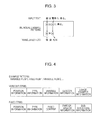
- FIG. 1 illustrates an example configuration of a translation apparatus according to an exemplary embodiment of the present invention
- FIG. 2 is a functional block diagram illustrating functions implemented by the translation apparatus according to the exemplary embodiment of the present invention
- FIG. 3 illustrates an example in which input text in the source language is translated using a bilingual example pattern
- FIG. 4 illustrates the data structure of one example pattern
- FIG. 5 illustrates an exemplary bilingual example pattern
- FIG. 6 illustrates an exemplary process flow of a source-language construct information selection unit
- FIG. 7 illustrates an exemplary process flow of the distance calculation unit
- FIG. 8 illustrates an exemplary calculation process of the distance calculation unit
- FIG. 9A illustrates an exemplary process flow of the mapping extraction unit
- FIG. 9B illustrates an exemplary process flow of the mapping extraction unit
- FIG. 9C illustrates an exemplary process flow of the mapping extraction unit
- FIG. 10 illustrates exemplary bilingual example patterns when plural bilingual example patterns exist for selected source-language construct information
- FIG. 11 illustrates an exemplary process flow of a target-language construct information selection unit
- FIG. 12A illustrates a process flow of calculating an evaluation value using a first evaluation criterion
- FIG. 12B illustrates a process flow of calculating an evaluation value using a second evaluation criterion
- FIG. 12C illustrates a process flow of calculating an evaluation value using a third evaluation criterion
- FIG. 12D illustrates a process flow of calculating an evaluation value using a fourth evaluation criterion
- FIG. 12E illustrates a process flow of calculating an evaluation value using a fifth evaluation criterion
- FIG. 13 illustrates an exemplary lexicon
- FIG. 14 illustrates an exemplary bilingual example
- FIG. 15 illustrates an example of how to select a target-language example pattern from candidates illustrated in FIG. 10 ;
- FIG. 16 illustrates an example of a translation generated by using the calculation based on the fourth evaluation criterion.
- FIG. 1 illustrates an example configuration of a translation apparatus 1 according to an exemplary embodiment of the present invention.
- the translation apparatus 1 includes a central processing unit (CPU) 11 , a storage unit 12 , a communication unit 13 , and an input/output unit 14 .
- the translation apparatus 1 may be, for example, a personal computer, a server, or a similar apparatus.
- the CPU 11 operates in accordance with a program stored in the storage unit 12 .
- the program may be provided by being stored in an information recording medium such as a compact disc read-only memory (CD-ROM) or a digital versatile disc read-only memory (DVD-ROM), or may be provided via a network such as the Internet.
- CD-ROM compact disc read-only memory
- DVD-ROM digital versatile disc read-only memory
- the storage unit 12 may be a memory element such as a random access memory (RAM) or a ROM, a hard disk drive, or a similar device.
- the storage unit 12 stores the program described above.
- the storage unit 12 also stores information input from the individual units and computational results.
- the communication unit 13 may be a communication medium or the like that is connected to another device to establish communication.
- the communication unit 13 inputs information received from another device to the CPU 11 or the storage unit 12 under control of the CPU 11 , and transmits the information to another device.
- the input/output unit 14 may be a unit that controls a display output unit such as a monitor and an input unit such as a keyboard or a mouse, or a similar device.
- the input/output unit 14 outputs image data or any other suitable data to a monitor or the like under control of the CPU 11 , and acquires information from an operator through a keyboard or a mouse.
- FIG. 2 is a functional block diagram illustrating functions implemented by the translation apparatus 1 according to the exemplary embodiment of the present invention.
- the translation apparatus 1 functionally includes an input text acquisition unit 51 , a morphological analysis unit 52 , a source-language construct information candidate retrieval unit 53 , a source-language construct information selection unit 54 , a target-language construct information selection unit 55 , a translated text output unit 56 , and a dictionary unit 57 .
- the source-language construct information selection unit 54 functionally includes a distance calculation unit 61 , a mapping extraction unit 62 , and an optimum mapping selection unit 63 .
- the above functions may be implemented by executing, by the CPU 11 , the program stored in the storage unit 12 and controlling the communication unit 13 and the input/output unit 14 .
- the translation apparatus 1 may perform translation using bilingual information.
- the bilingual information includes bilingual example patterns including source-language example patterns indicating patterns of text in the source language and target-language example patterns indicating patterns of text in the target language to which the text in the source language is translated.
- FIG. 3 illustrates an example in which input text in the source language is translated using a bilingual example pattern.
- “[v]” represent a variable item indicating that corresponding one or plural words are variable.
- translated text illustrated in FIG. 3 may be obtained.
- the translation apparatus 1 retrieves an optimum bilingual example pattern including a source-language example pattern “[v] [v] ([v] ride/rides [v].)” that matches the input text, and applies the translated terms of the words in the input text corresponding to [v] in the source-language example pattern to the [v] portions in “[v] [v]” which is the target-language example pattern in the bilingual example pattern to obtain translated text.
- the above translation technique is called pattern-based translation. Since both a source-language example pattern and a target-language example pattern represent text using a variable character string and a fixed character string in combination, example patterns in both languages are hereinafter referred to collectively as “example patterns”.
- the input text acquisition unit 51 the morphological analysis unit 52 , the source-language construct information candidate retrieval unit 53 , the source-language construct information selection unit 54 , and the target-language construct information selection unit 55 perform the process described above for retrieving a bilingual example pattern.
- a mechanism including the above components may be used as a bilingual information retrieval apparatus.
- FIG. 4 illustrates the data structure of one example pattern.
- the example pattern may be information indicating the constructs of text in a certain language.
- the example pattern includes plural items each of which corresponds to one or multiple character strings among character strings making up the text, and the items may be divided into fixed items and variable items.
- Each fixed item represents a uniquely determined fixed character string as a corresponding character string in the text
- each variable item represents, as a corresponding character string in the text, a variable character string including the number of characters.
- character string represents a word or a phrase having plural words.
- One example pattern includes one or multiple fixed items and one or multiple variable items. In FIG. 4 , fixed items and variable items are arranged in order, starting from those to be located at the beginning of the text.
- Each variable item includes position information, type information, variable information, lexicon information, and usage-example information.
- Each fixed item includes position information, type information, fixed content, part-of-speech information, and sub-structure information.
- Position information is included in both a fixed item and a variable item, and may represent the position in which the corresponding item appears in the text, where the position is represented as a sequential number.
- the type information may be information indicating whether the corresponding item is a variable item or a fixed item, and may be set as “f” for a fixed item and to “v” for a variable item.
- the variable information may be information indicating the part of speech of a variable item.
- the lexicon information may be information indicating the lexicon of a word included in a variable item.
- the usage-example information may be information indicating usage examples of a word included in a variable item in the example pattern.
- the fixed content may be information indicating a character string of a fixed item, and the part-of-speech information may be information indicating the part of speech of a word set as a fixed item. For example, a fixed item with part-of-speech information “61” represents a Japanese particle.
- the sub-structure information indicates information about each of plural words making up a fixed item.
- language construct information information indicating the presence of a variable item and information about the fixed content of a fixed item, which may be characteristic in an example pattern, are referred to as “language construct information”.
- the language construct information may correspond to position information and type information in a variable item and position information, type information, and fixed content in a fixed item.
- source-language construct information language construct information included in a source-language example pattern
- target-language construct information language construct information included in a target-language example pattern
- FIG. 5 illustrates an example of a bilingual example pattern.
- the bilingual example pattern includes a source-language example pattern, a target-language example pattern, and alignment information.
- a delimiter between a fixed item and a variable item is a space
- a delimiter between pieces of information included in a fixed item and a variable item is a forward slash (/).
- position information is represented by the order in which fixed items and variable items are arranged, instead of using any mark in an individual variable item or fixed item.
- v/NP/ / which is the first item in the source-language example pattern, indicates that the item is a variable item having a variable indicating that this part of speech is a noun, a lexicon “ ” (persons), and no usage examples set therein.
- the character string “ ” is composed of sub-structures “ (kaisen (re-election))” and “ (suru (to do))”, in which attributes change.
- the alignment information may be interlanguage correspondence information including correspondences between variable items in the source language and variable items in the target language and correspondences between fixed items in the source language and fixed items in the target language.
- “3:” indicates that three associations are present, “1-1;” indicates that the first item in the source-language example pattern is associated with the first item in the target-language example pattern, and “501, 502-2;” indicates that the first and second sub-items of the fifth item in the source-language example pattern are associated with the second item in the target-language example pattern.
- “501” indicates the first sub-item of the fifth item in the source-language example pattern.
- the dictionary unit 57 may be implemented by the CPU 11 and the storage unit 12 .
- the dictionary unit 57 may store plural bilingual example patterns, a word dictionary, a bilingual example dictionary, and any other suitable information.
- the input text acquisition unit 51 may be implemented by the CPU 11 , the storage unit 12 , the communication unit 13 , and the input/output unit 14 .
- the input text acquisition unit 51 acquires information about input text that is text input in the source language from information about the operation of a keyboard, which is acquired through the input/output unit 14 , information acquired from the storage unit 12 , or information received from a client device connected via a network.
- the morphological analysis unit 52 may be implemented by the CPU 11 and the storage unit 12 .
- the morphological analysis unit 52 applies morphological analysis to the input text to obtain plural words making up the input text and part-of-speech information about each of the words.
- the morphological analysis unit 52 may obtain five words, “ (he)”, “ ”, “ (a train)”, “ ”, and “ (rides)”, and also obtain part-of-speech information about the respective words, i.e., a noun, a Japanese particle, a noun, a Japanese particle, and a verb.
- the source-language construct information candidate retrieval unit 53 may be implemented by the CPU 11 and the storage unit 12 .
- the source-language construct information candidate retrieval unit 53 retrieves source-language construct information candidates from plural bilingual example patterns stored in the dictionary unit 57 .
- the source-language construct information selection unit 54 selects source-language construct information from the candidates. Once a candidate of source-language construct information is retrieved, a source-language example pattern including the source-language construct information and a bilingual example pattern including the source-language example pattern may also be specified.
- the source-language construct information candidate retrieval unit 53 retrieves a source-language construct information candidate with a degree of similarity Sim and a cover rate Cov between the input text and a fixed item in the source-language construct information being greater than respective thresholds.
- the source-language construct information candidate retrieval unit 53 determines bigrams (S) in a character string in the input text and bigrams (A) in a character string in the source-language construct information, and calculates the degree of similarity Sim and the cover rate Cov from the bigrams (S) and bigrams (A).
- ), and Cov
- the source-language construct information selection unit 54 may be implemented by the CPU 11 and the storage unit 12 .
- the source-language construct information selection unit 54 selects a piece of source-language construct information corresponding to the input text from plural pieces of source-language construct information that indicate the constructs of a source language text.
- Each of the plural pieces of source-language construct information includes a fixed item indicating a fixed character string in the text and a variable item indicating a variable character string in the text.
- the source-language construct information selection unit 54 selects a piece of source-language construct information that is the closest to the input text from plural pieces of source-language construct information candidates retrieved by the source-language construct information candidate retrieval unit 53 , and further acquires mapping information indicating correspondences between character strings included in the input text and variable items and fixed items in the source-language construct information.
- mapping information indicating correspondences between character strings included in the input text and variable items and fixed items in the source-language construct information.
- a source-language example pattern and a bilingual example pattern including the selected piece of source-language construct information may also substantially be selected.
- the source-language construct information selection unit 54 may select plural pieces of source-language construct information if plural pieces of source-language construct information are the closest to the input text.
- FIG. 6 illustrates an exemplary process flow of the source-language construct information selection unit 54 .
- the distance calculation unit 61 in the source-language construct information selection unit 54 determines a distance between each source-language construct information candidate and input text (step S 101 ). This process is performed by the distance calculation unit 61 in the source-language construct information selection unit 54 .
- the processing of step S 101 will be described hereinafter with reference to the process flow of the distance calculation unit 61 .
- the distance calculation unit 61 may be implemented by the CPU 11 and the storage unit 12 .
- FIG. 7 illustrates an exemplary process flow of the distance calculation unit 61 .
- FIG. 7 only a process flow of calculating a distance between input text and one source-language construct information candidate is illustrated. In actuality, the illustrated process flow is repeated a number of times corresponding to the number of source-language construct information candidates.
- the distance calculation unit 61 sequentially stores words (the number of which is presented by m) in the input text, which is divided by the morphological analysis unit 52 , in data strings s 1 to sm (step S 111 ).
- the distance calculation unit 61 determines, for each of variable items and fixed items (the total number of which is represented by n) in one source-language construct information candidate, an information set including information indicating whether or not the item is a variable item and information about a character string of fixed content when the item is a fixed item, and sequentially stores the information sets in data strings a 1 to an in order, starting from the item with the smallest value of position information (step S 112 ).
- s 0 and a 0 are also used, which represent the beginnings of the input text and the source-language construct information, respectively, and correspond to null character strings.
- the distance between input text and source-language construct information may depend on the correspondences between individual words in the input text and variable items and fixed items in the source-language construct information.
- the distance between the input text and the source-language construct information may be determined by determining a conversion weight for each of plural potential correspondences between the input text and the source-language construct information and setting the smallest conversion weight among the determined conversion weights as the distance.
- a conversion weight for a certain correspondence may be determined by integrating a weight between each of variable items and fixed items and a corresponding word and a weight between a word and an item when the word and the item do not correspond to each other. More specifically, for example, it is assumed that ai (where is 1 to n) corresponds to sj (where j is 1 to m).
- the editing weight may be 0 because no editing may be required. If ai and sj represent different words, replacement may be required and therefore the editing weight may be p. If no sj corresponding to ai exists, the addition of a word to the input text may be required and therefore the editing weight may be q. Conversely, if no ai corresponding to sj exists, the deletion of a word from the input text may be required and therefore the editing weight may be r. Resulting weights are integrated.
- p, q, and r are positive constants.
- the correspondences may satisfy the condition that the words in the source-language construct information are not reordered or the words in the input text are not reordered and the condition that a variable item may correspond to plural words in the input text.
- the former condition is that, for example, if ai and sj correspond to each other, a(i+1) and s(j ⁇ 1) do not correspond to each other.
- the latter condition is generated because a variable item may be a phrase including plural words.
- the minimum distance d(i, j) among all the correspondences between a 1 to ai in the source-language construct information and s 1 to sj in the input text may be determined if all the d(i ⁇ 1, j ⁇ 1), d(i ⁇ 1, j), and d(i, j ⁇ 1) and the relationship between ai and sj are obtained.
- a calculation method using the above rules will be described.
- the distance calculation unit 61 initializes a two-dimensional (n+1) ⁇ (m+1) array d storing distance values, and an n ⁇ m array PathFlag indicating which of d(i ⁇ 1, j ⁇ 1), d(i ⁇ 1, j), and d(i, j ⁇ 1) is to be used to obtain the distance d(i, j) (step S 113 ).
- the array d has d(0, 0) to d(n, m), and d(i, j) denotes the distance between the character string segments a 1 , a 2 , . . . , ai and s 1 , s 2 , . . . , sj.
- d(i, j) may be calculated by the following method:
- d ( i,j ) min ⁇ d ( i ⁇ 1 ,j ⁇ 1)+ w ( ai,sj ), d ( i ⁇ 1 ,j )+ q,d ( i,j ⁇ 1) ⁇ .
- d ( i,j ) min ⁇ d ( i ⁇ 1 ,j ⁇ 1)+ w ( ai,sj ), d ( i ⁇ 1 ,j )+ q,d ( i,j ⁇ 1)+ r ⁇ .
- w(ai, sj) is 0 if ai is a variable item. For example, if ai is a fixed item, w(ai, sj) is 0 when ai and sj are equal, and is p when ai and sj are not equal. If plural distances among d(i ⁇ 1, j ⁇ 1), d(i ⁇ 1, j), and d(i, j ⁇ 1) are minimum, information about all the distances is stored in PathFlag(i, j).
- the distance calculation unit 61 increase j by 1 (step S 116 ). If j is less than or equal to m (YES in step S 117 ), the process repeats from step S 115 . If j is not less than or equal to m (NO in step S 117 ), the distance calculation unit 61 increases i by 1 (step S 118 ), and determines whether or not i is less than or equal to n (step S 119 ). If i is less than or equal to n (YES in step S 119 ), the process repeats from step S 115 .
- the distance calculation unit 61 stores the distance variable d(n, m) and the array PathFlag in association with the source-language example pattern (step S 120 ). Then, the process ends.
- FIG. 8 illustrates an exemplary calculation process of the distance calculation unit 61 .
- each cell has a value representing the value of a corresponding one of the cells of the array d, and arrows represent through which cells among cells from upper left to lower right, cells from left to right, and cells from up to down calculation is performed to obtain a distance.
- a distance is calculated for input text “ (i am an employee of Fuji Xerox)” and a source-language construct information candidate “[v] [v] ([v] am/are/is [v])”, by way of example.
- the array PathFlag represents the relationship between words in the input text and variable items and fixed items when a distance is calculated.
- the source-language construct information selection unit 54 selects a source-language construct information candidate with the minimum distance from among the source-language construct information candidates (step S 102 ).
- the number of pieces of source-language construct information to be selected is not limited to one. Regardless of whether the number of types of source-language construct information with a minimum distance is one, for example, if plural bilingual example patterns having the same source-language construct information exist, a number of pieces of source-language construct information corresponding to the number of bilingual example patterns may be selected.
- the source-language construct information selection unit 54 determines a correspondence (hereinafter referred to as a “mapping”) between each of fixed items and variable items of the selected source-language construct information and a character string in the input text (step S 103 ).
- the processing of step S 103 may be performed by the mapping extraction unit 62 in the source-language construct information selection unit 54 .
- the processing of step S 103 will be described hereinafter with reference to a process flow of the mapping extraction unit 62 .
- the mapping extraction unit 62 may be implemented using the CPU 11 and the storage unit 12 .
- FIGS. 9A to 9C illustrate an exemplary process flow of the mapping extraction unit 62 .
- the mapping extraction unit 62 acquires an array PathFlag stored in association with the selected source-language construct information, and also acquires data strings a 1 to an in which information about variable items and fixed items included in the source-language construct information is stored in order indicated by position information (step S 131 ).
- the information about the variable items and the fixed items includes information as to whether or not the item is a variable item and information about a character string of fixed content when the item is a fixed item.
- mapping extraction unit 62 initializes an array Mat including n lists each storing one or multiple words corresponding to each variable item and fixed item in the selected source-language construct information, and pushes (n, m), 0, and the array Mat in a stack (step S 132 ).
- the mapping extraction unit 62 pops the above values from the stack, and stores the values in a set of variables (i, j), a variable u, and the array Mat (step S 133 ). If the set of variables (i, j) is (0, 0) (YES in step S 134 ), a mapping has been determined, and therefore the array Mat is added to a mapping list Fset (step S 135 ). If any stack remains (YES in step S 136 ), the process repeats from step S 133 . If no stack remains (NO in step S 136 ), the process ends.
- step S 134 If it is determined in step S 134 that the set of variables (i, j) is not (0, 0) (NO in step S 134 ), it is determined whether or not the variable i is 0 (step S 137 ). If the variable i is 0 (YES in step S 137 ), the j-th word in the input text is missing and therefore is added to the list Mat(0) (step S 138 ). The set of variables (i, j ⁇ 1), 0, and the array Mat are pushed (step S 139 ). Then, the process repeats from step S 133 .
- step S 140 it is determined whether or not ai is a fixed item (step S 140 ). If ai is a fixed item (YES in step S 140 ), determination for the PathFlag(i, j) is performed (step S 141 ). If the PathFlag(i, j) indicates that d(i, j) has been determined from d(i ⁇ 1, j ⁇ 1) (YES in step S 141 ), the j-th word is added to the list Mat(i) (step S 142 ), and the set of variables (i ⁇ 1, j ⁇ 1), 0, and the array Mat are pushed (step S 143 ).
- the PathFlag(i, j) indicating that d(i, j) has been determined from d(i ⁇ 1, j ⁇ 1) is hereinafter referred to as “the PathFlag(i, j) passing through (i ⁇ 1, j ⁇ 1)”. Further, the PathFlag(i, j) indicating that d(i, j) has been determined from d(i, j ⁇ 1) and d(i ⁇ 1, j) is hereinafter referred to as “the PathFlag(i, j) passing through (i, j ⁇ 1)” and “the PathFlag(i, j) passing through (i ⁇ 1, j)”, respectively.
- step S 141 If it is determined in step S 141 that the PathFlag(i, j) does not pass through (i ⁇ 1, j ⁇ 1) (NO in step S 141 ) and after the processing of step S 143 , it is determined whether or not the PathFlag(i, j) passes through (i, j ⁇ 1) (step S 144 ). If the PathFlag(i, j) passes through (i, j ⁇ 1) (YES in step S 144 ), this means that the addition of a word may be required and therefore the j-th word is added to the list Mat(i) (step S 145 ), and the set of variables (i, j ⁇ 1), 0, and the array Mat are pushed (step S 146 ). If it is determined in step S 144 that the PathFlag(i, j) does not pass through (i, j ⁇ 1) (NO in step S 144 ) and after the processing of step S 146 , the process proceeds to step S 153 .
- step S 140 If it is determined in step S 140 that ai is a variable item (NO in step S 140 ), it is determined whether or not the PathFlag(i, j) passes through (i ⁇ 1, j ⁇ 1) (step S 147 ). If the PathFlag(i, j) passes through (i ⁇ 1, j ⁇ 1) (YES in step S 147 ), the j-th to (j+u)-th words are added to the list Mat(i) (step S 148 ), and the set of variables (i ⁇ 1, j ⁇ 1), 0, and the array Mat are pushed (step S 149 ).
- step S 147 If it is determined in step S 147 that the PathFlag(i, j) does not pass through (i ⁇ 1, j ⁇ 1) (NO in step S 147 ) and after the processing of step S 149 , it is determined whether or not the PathFlag(i, j) passes through (i, j ⁇ 1) (step S 150 ). If the PathFlag(i, j) passes through (i, j ⁇ 1) (YES in step S 150 ), u is increased by 1 (step S 151 ), and the set of variables (i, j ⁇ 1), the variable u, and the array Mat are pushed (step S 152 ). If it is determined in step S 150 that the PathFlag(i, j) does not pass through (i, j ⁇ 1) (NO in step S 150 ) and after the processing of step S 152 , the process proceeds to step S 153 .
- step S 153 it is determined whether or not the PathFlag(i, j) passes through (i ⁇ 1, j). If the PathFlag(i, j) passes through (i ⁇ 1, j) (YES in step S 153 ), this means that word missing has occurred. Thus, the list Mat(i) is emptied (step S 154 ), and the set of variables (i ⁇ 1, j), 0, and the array Mat are pushed (step S 155 ). If it is determined in step S 153 that the PathFlag(i, j) does not pass through (i ⁇ 1, j) (NO in step S 153 ) and after the processing of step S 155 , the process repeats from step S 133 . With the above processes, a mapping list Fset is acquired. The use of a stack allows plural mappings to be obtained.
- the source-language construct information selection unit 54 checks whether or not plural mappings exist. If plural mappings exist, one of the mappings is selected (step S 104 ). The processing of step S 104 may be performed by the optimum mapping selection unit 63 .
- the optimum mapping selection unit 63 may be implemented by the CPU 11 and the storage unit 12 . If plural mappings exist, the optimum mapping selection unit 63 evaluates, for each mapping, a phrase including words that are variable items in accordance with some standards, and selects one mapping from the total assessment of the obtained evaluations. Examples of the standards for evaluation include whether or not the phrase is found in a dictionary, and whether or not the phrase includes a verb, a particle, or an auxiliary verb.
- the target-language construct information selection unit 55 may be implemented by the CPU 11 and the storage unit 12 .
- the target-language construct information selection unit 55 selects one piece of target-language construct information, based on evaluation information associated with source-language construct information and target-language construct information, from among plural pieces of target-language construct information indicating the constructs of target language text corresponding to the selected source-language construct information.
- Each of the plural pieces of target-language construct information includes a fixed item indicating a fixed character string in the text and a variable item indicating a variable character string in the text.
- the evaluation information may refer to a portion of a bilingual example pattern, from which source-language construct information is excluded.
- the bilingual example pattern includes a source-language example pattern and a target-language example pattern, and is therefore associated with source-language construct information and target-language construct information. Further, the variable information (part-of-speech information), lexicon, and usage-example information in a variable item in the source-language example pattern, and the interlanguage correspondence information, bilingual example information, etc., in the bilingual example pattern are also associated with the source-language construct information. The variable information (part-of-speech information), lexicon, and usage-example information in a variable item are information indicating the attributes of the variable item. Selecting target-language construct information may be substantially equivalent to also selecting a target-language example pattern and a bilingual example pattern.
- the target-language construct information selection unit 55 selects one piece of target-language construct information and one bilingual example pattern from among the plural pieces of target-language construct information corresponding to the selected source-language construct information.
- FIG. 10 illustrates exemplary bilingual example patterns when plural bilingual example patterns exist for selected source-language construct information.
- “ (he rides a train)” is given as input text
- source-language construct information “[v] [v] ([v] ride/rides [v])” ([v] represents a variable item) is selected.
- three bilingual example patterns including the source-language construct information may exist.
- the first bilingual example pattern means that a person travels in a vehicle.
- the second bilingual example pattern means that a person dances to the rhythm or gets carried away tune.
- the third bilingual example pattern means that a person sits on and controls an animal or the like.
- a common number is assigned to variable information in a variable item in the source-language example pattern and variable information in a variable item in the target-language example pattern to show the correspondence between the variable item in the source-language example pattern and the variable item in the target-language example pattern.
- Other elements are represented in accordance with the same notation as that in the data structure of bilingual example patterns illustrated in FIG. 5 .
- the target-language construct information selection unit 55 acquires a set of bilingual example patterns including the selected source-language construct information, calculates, for each of the bilingual example patterns, evaluation values Sep 1 to Sep 5 based on five evaluation criteria, and selects a bilingual example pattern on the basis of a comprehensive evaluation value SepP obtained by taking the weighted sum of the evaluation values Sep 1 to Sep 5 .
- FIG. 11 illustrates an exemplary process flow of the target-language construct information selection unit 55 .
- FIGS. 12A to 12D illustrate only a process for one bilingual example pattern.
- the target-language construct information selection unit 55 may select one piece of target-language construct information on the basis of the attributes of a character string in the input text corresponding to a variable item in source-language construct information and on the basis of information that associates the attributes of a variable item in the source-language construct information with the target-language construct information.
- the target-language construct information selection unit 55 selects one piece of target-language construct information on the basis of information that associates part-of-speech information about a word in the input text, the part of speech of a variable item included in the selected source-language construct information, and target-language construct information.
- the target-language construct information selection unit 55 acquires information about variable items (the number which is represented by h) in a source-language example pattern included in a certain bilingual example pattern, stores the information in SP 1 to SPh, and initializes variables FS 1 to FSh that store the results of processing the respective variable items (step S 211 ).
- the target-language construct information selection unit 55 acquires an influential word from a character string (one or multiple words) in the input text corresponding to each of SP 1 to SPh, and stores the influential words in variables SW 1 to SWh (step S 212 ).
- the term “influential word”, as used here, is a word among one or multiple words corresponding to a variable item, which is connected to another fixed item or variable item. In the Japanese language, the last word may be an influential word. Then, the target-language construct information selection unit 55 substitutes 1 for the variable i (step S 213 ).
- the target-language construct information selection unit 55 checks whether or not information (variable information) about the set of parts of speech has been set in the i-th variable item SPi (step S 214 ). If the information has not been set (NO in step S 214 ), the target-language construct information selection unit 55 substitutes 1 for the variable Fsi (step S 215 ). If the information has been set (YES in step S 214 ), it is determined whether or not the set of parts of speech includes the part of speech of SWi (step S 216 ). The part of speech of SWi may be acquired from the process results of the morphological analysis unit 52 .
- the target-language construct information selection unit 55 substitutes 1 for the variable FSi (step S 215 ). If the set of parts of speech does not include the part of speech of SWi (NO in step S 216 ), the target-language construct information selection unit 55 substitutes 0 for the variable FSi (step S 217 ). After substituting some value for the variable Fsi, the target-language construct information selection unit 55 increases the variable i by 1 (step S 218 ). If the value i is less than or equal to h (YES in step S 219 ), the process repeats from step S 214 .
- step S 219 If the value i exceeds h (NO in step S 219 ), the average of FS 1 to FSh is acquired, and is set as the evaluation value Sep 1 based on the first evaluation criterion for the bilingual example pattern (step S 220 ). The processing of steps S 211 to S 220 is performed for all the selected bilingual example patterns.
- evaluation value Sep 1 is 1.
- the target-language construct information selection unit 55 selects one piece of target-language construct information on the basis of information that associates a character string in the input text corresponding to a variable item in the source-language construct information, a lexicon, and target-language construct information.
- the target-language construct information selection unit 55 stores information about variable items (the number which is represented by h) in a source-language example pattern included in a certain bilingual example pattern in SP 1 to SPh, and initializes variables FS 1 to FSh (step S 231 ).
- the target-language construct information selection unit 55 acquires an influential word from a character string (one or multiple words) in the input text corresponding to each of SP 1 to SPh, and stores the influential words in variables SW 1 to SWh (step S 232 ). Then, the target-language construct information selection unit 55 substitutes 1 for the variable (step S 233 ).
- the target-language construct information selection unit 55 checks whether or not lexicon information has been set in the i-th variable item SPi (step S 234 ). If the lexicon information has not been set (NO in step S 234 ), the target-language construct information selection unit 55 substitutes 1 for the variable FSi (step S 235 ). If the lexicon information has been set (YES in step S 234 ), it is determined whether or not the lexicon indicated by the lexicon information includes the word SWi (step S 236 ). If the lexicon includes the word SWi (YES in step S 236 ), the target-language construct information selection unit 55 substitutes 1 for the variable FSi (step S 235 ).
- the target-language construct information selection unit 55 substitutes 0 for the variable FSi (step S 237 ). After substituting some value for variable FSi, the target-language construct information selection unit 55 increases the variable i by 1 (step S 238 ). If the value i is less than or equal to h (YES in step S 239 ), the process repeats from step S 234 . If the value i exceeds h (NO in step S 239 ), the average of FS 1 to FSh is acquired, and is set as the evaluation value Sep 2 based on the second evaluation criterion for the bilingual example pattern (step S 240 ). The processing of steps S 231 to S 240 is performed for all the selected bilingual example patterns.
- FIG. 13 illustrates an example of a lexicon.
- “ (he rides a train)” is acquired as input text
- “ (he)” that is the word corresponding to the first variable item in the source-language construct information is included in the lexicon “persons”.
- “ (a train)” that is the word corresponding to the second variable item is included in the lexicon “vehicles”. Therefore, the evaluation value Sep 2 is 1 for the bilingual example patterns 1 and 3 in which information about the above lexicons has been set, and the evaluation value Sep 2 is 0.5 for the bilingual example pattern in which only the lexicon “persons”, which corresponds to the former lexicon information, is set.
- the target-language construct information selection unit 55 selects one piece of target-language construct information on the basis of information that associates a character string in the input text corresponding to a variable item in the source-language construct information, the usage example information, and the target-language construct information.
- the target-language construct information selection unit 55 stores information about variable items (the number which is represented by h) in a source-language example pattern included in a certain bilingual example pattern in SP 1 to SPh, and initializes variables FS 1 to FSh (step S 251 ).
- the target-language construct information selection unit 55 acquires an influential word from a character string (one or multiple words) in the input text corresponding to each of SP 1 to SPh, and stores the influential words in variables SW 1 to SWh (step S 252 ). Then, the target-language construct information selection unit 55 substitutes 1 for the variable i (step S 253 ).
- the target-language construct information selection unit 55 checks whether or not usage-example information in SPi has been set (step S 254 ). If the usage-example information has not been set (NO in step S 254 ), the target-language construct information selection unit 55 substitutes 1 for the variable FSi (step S 255 ). If the usage-example information has been set (YES in step S 254 ), the target-language construct information selection unit 55 acquires the set of usage examples SPE from the usage-example information in SPi (step S 256 ). Then, the target-language construct information selection unit 55 calculates the degree of similarity SimW between SWi and SPE, and stores the degree of similarity SimW in the variable FSi (step S 256 ).
- the degree of similarity SimW may be determined by, first, determining a degree of similarity Sim between SWi and a word in an individual usage example included in the set of usage examples.
- the target-language construct information selection unit 55 After substituting some value for the variable FSi, the target-language construct information selection unit 55 increases the variable i by 1 (step S 258 ). If the value i is less than or equal to h (YES in step S 259 ), the process repeats from step S 254 . If the value i exceeds h (NO in step S 259 ), the average of FS 1 to FSh is acquired, and is set as the evaluation value Sep 3 based on the third evaluation criterion for the bilingual example pattern (step S 260 ). The processing of steps S 251 to S 260 is performed for all the selected bilingual example patterns.
- the target-language construct information selection unit 55 selects one piece of target-language construct information on the basis of the generation probability of translated text generated using the selected source-language construct information and interlanguage correspondence information. First, the target-language construct information selection unit 55 acquires an influential word from a character string (one or multiple words) in the input text corresponding to each of variable items (the number which is represented by h) in a source-language example pattern included in a certain bilingual example pattern, and stores the influential words in arrays SW 1 to SWh (step S 271 ).
- the target-language construct information selection unit 55 determines a translated word list for each of SW 1 to SWh by using a word dictionary stored in the dictionary unit 57 , and stores the translated word lists in TW 1 to TWh (step S 272 ).
- the word dictionary may have one-to-many relationships between the source language and the target language. Therefore, each of TW 1 to TWh may include plural translated words.
- the target-language construct information selection unit 55 determines all possible combinations for selecting a single translated word from each of the translated word lists in TW 1 to TWh (step S 273 ). Determining all possible combinations may correspond to determining combinations of translated words to be substituted for a variable item in the target-language construct information.
- each of the translated words included in each combination is substituted for a corresponding one of the variable items in the target-language example pattern, and is added to a fixed item to generate a translation (step S 274 ).
- a translated word of a variable item represents only a translated word of an influential word, and the generated translation may be simpler than the intended translated text.
- the generation probability of the translation is generated using an N-gram model of a word for each of the translations generated for the respective combinations (step S 275 ). The largest generation probability is set as the evaluation value Sep 4 based on the fourth evaluation criterion for the bilingual example pattern (step S 276 ). The processing of steps S 271 to S 276 is performed for all the selected bilingual example patterns.
- FIG. 16 illustrates translations generated using the bilingual example pattern 1 , the bilingual example pattern 2 , and the bilingual example pattern 3 when “ (he rides a train)” is acquired as input text in the example illustrated in FIG. 10 .
- Information indicating the probability of occurrence of the N-th word from (N ⁇ 1)-th words in the N-gram model is stored in the dictionary unit 57 .
- a bilingual example dictionary stored in the dictionary unit 57 may also be used as evaluation information, in addition to the correspondence between a source-language example pattern and a target-language example pattern.
- the bilingual example dictionary includes plural bilingual examples.
- An individual bilingual example includes an example in the source language that matches any of plural pieces of source-language construct information and an example in the target language that matches any of plural pieces of target-language construct information.
- FIG. 14 illustrates an exemplary bilingual example.
- An example in the source language included in the bilingual example and an example in the target language included in the bilingual example may be character strings, and may not necessarily include information about morphological analysis results.
- the association between the bilingual example and source-language construct information or target-language construct information may be stored in advance.
- the target-language construct information selection unit 55 selects one piece of target-language construct information on the basis of the number of bilingual examples including examples in the source language that match the selected source-language construct information and examples in the target language that match the target-language construct information corresponding to the selected source-language construct information. First, the target-language construct information selection unit 55 sequentially acquires one bilingual example pattern among a set of bilingual example patterns including the selected source-language construct information (step S 291 ).
- the target-language construct information selection unit 55 acquires the set of bilingual examples BSS including examples in the source language that match the selected source-language construct information from the bilingual example dictionary (step S 292 ), and acquires the set of bilingual examples BST including examples in the target language that match target-language construct information of the acquired example pattern from the bilingual example dictionary (step S 293 ). Then, the target-language construct information selection unit 55 determines and stores the number of common bilingual examples included in the sets BSS and BST (step S 294 ). If all the bilingual example patterns have not been acquired (NO in step S 295 ), the process repeats from step S 291 .
- the target-language construct information selection unit 55 determines a value normalized so that the maximum number of bilingual examples in each bilingual example pattern may become 1, and stores the value as the evaluation value Sep 5 based on the fifth evaluation criterion for each bilingual example pattern (step S 296 ).
- the evaluation value Sep 5 may be a value obtained by dividing the number of bilingual examples in each bilingual example pattern by the sum of the numbers of bilingual examples in all the bilingual example patterns.
- the target-language construct information selection unit 55 calculates the comprehensive evaluation value SepP of the respective bilingual example patterns (step S 176 ).
- the target-language construct information selection unit 55 selects one bilingual example pattern with the largest comprehensive evaluation value SepP (step S 177 ).
- the selected bilingual example pattern includes one piece of target-language construct information, and one piece of target-language construct information has been selected.
- FIG. 15 illustrates an example of how to select a target-language example pattern from the candidates illustrated in FIG. 10 .
- the values k 1 to k 5 may be any other experimentally determined value.
- the translated text output unit 56 may be implemented by the CPU 11 , the storage unit 12 , the communication unit 13 , and the input/output unit 14 .
- the translated text output unit 56 outputs translated text of the input text to an output unit connected to the input/output unit 14 , a client device connected via the communication unit 13 and a network, or the storage unit 12 in accordance with the selected target-language construct information and selected source-language construct information corresponding to the target-language construct information.
- a word in input text corresponding to each of variable items included in source-language construct information is translated using a word dictionary to generate a translated word, and the translated word is substituted into the corresponding variable item in a target-language example pattern.
- translated words substituted into the variable items in the order indicated by position information and a character string of fixed content are output.
- translated text is output. If a certain variable item corresponds to a phrase including plural words, a source-language example pattern and a bilingual example pattern, which match the content of the phrase, are selected, and a translated word is translated.
- the translation apparatus 1 may not necessarily be dedicated to the translation of text.
- the translation apparatus 1 may be incorporated in a translation-aid system.
Landscapes
- Engineering & Computer Science (AREA)
- Theoretical Computer Science (AREA)
- Health & Medical Sciences (AREA)
- Artificial Intelligence (AREA)
- Audiology, Speech & Language Pathology (AREA)
- Computational Linguistics (AREA)
- General Health & Medical Sciences (AREA)
- Physics & Mathematics (AREA)
- General Engineering & Computer Science (AREA)
- General Physics & Mathematics (AREA)
- Machine Translation (AREA)
Abstract
Description




Sim=(2×|S∩A|)/(|S|+|A|), and
Cov=|S∩A|/|S|,
where |S| denotes the number of bigrams included in the input text, |A| denotes the number of bigrams in the source-language construct information, and |S∩A| denotes the number of bigrams common to the input text and the source-language construct information.
d(i,j)=min{d(i−1,j−1)+w(ai,sj),d(i−1,j)+q,d(i,j−1)}.
d(i,j)=min{d(i−1,j−1)+w(ai,sj),d(i−1,j)+q,d(i,j−1)+r}.


SimW=max{sim(1),sim(2), . . . ,sim(t)}.
SimW={sim(1)+sim(2)+ . . . +sim(t)}/t.
SepP=k1×FS1+k2×FS2+k3×FS3+k4×FS4+k5×FS5.
Claims (9)
Applications Claiming Priority (2)
| Application Number | Priority Date | Filing Date | Title |
|---|---|---|---|
| JP2011000513A JP5747508B2 (en) | 2011-01-05 | 2011-01-05 | Bilingual information search device, translation device, and program |
| JP2011-000513 | 2011-01-05 |
Publications (2)
| Publication Number | Publication Date |
|---|---|
| US20120173223A1 US20120173223A1 (en) | 2012-07-05 |
| US8909511B2 true US8909511B2 (en) | 2014-12-09 |
Family
ID=46381531
Family Applications (1)
| Application Number | Title | Priority Date | Filing Date |
|---|---|---|---|
| US13/245,278 Expired - Fee Related US8909511B2 (en) | 2011-01-05 | 2011-09-26 | Bilingual information retrieval apparatus, translation apparatus, and computer readable medium using evaluation information for translation |
Country Status (3)
| Country | Link |
|---|---|
| US (1) | US8909511B2 (en) |
| JP (1) | JP5747508B2 (en) |
| CN (1) | CN102591898B (en) |
Cited By (1)
| Publication number | Priority date | Publication date | Assignee | Title |
|---|---|---|---|---|
| US10460036B2 (en) * | 2017-04-23 | 2019-10-29 | Voicebox Technologies Corporation | Multi-lingual semantic parser based on transferred learning |
Families Citing this family (6)
| Publication number | Priority date | Publication date | Assignee | Title |
|---|---|---|---|---|
| JP2014075073A (en) * | 2012-10-05 | 2014-04-24 | Fuji Xerox Co Ltd | Translation processor and program |
| CN104731774B (en) * | 2013-12-24 | 2018-02-02 | 哈尔滨工业大学 | Towards the personalized interpretation method and device of general machine translation engine |
| KR102463567B1 (en) | 2016-05-06 | 2022-11-07 | 이베이 인크. | Using meta-information in neural machine translation |
| CN108664477B (en) * | 2016-06-28 | 2022-04-01 | 大连民族大学 | Translation method of transaction information multi-language machine translation subsystem |
| KR20190047685A (en) * | 2016-09-09 | 2019-05-08 | 파나소닉 아이피 매니지먼트 가부시키가이샤 | Translation device and translation method |
| JP6631930B2 (en) * | 2017-02-07 | 2020-01-15 | パナソニックIpマネジメント株式会社 | Translation apparatus and translation method |
Citations (14)
| Publication number | Priority date | Publication date | Assignee | Title |
|---|---|---|---|---|
| JPH05204968A (en) | 1992-01-13 | 1993-08-13 | Nec Corp | Translated word selector |
| JPH06290210A (en) | 1993-04-01 | 1994-10-18 | Sharp Corp | Translating device for natural language |
| US20040002848A1 (en) * | 2002-06-28 | 2004-01-01 | Ming Zhou | Example based machine translation system |
| US20060004560A1 (en) * | 2004-06-24 | 2006-01-05 | Sharp Kabushiki Kaisha | Method and apparatus for translation based on a repository of existing translations |
| US20060206304A1 (en) * | 2005-03-14 | 2006-09-14 | Fuji Xerox Co., Ltd. | Multilingual translation memory, translation method, and translation program |
| US20070174040A1 (en) * | 2006-01-23 | 2007-07-26 | Fuji Xerox Co., Ltd. | Word alignment apparatus, example sentence bilingual dictionary, word alignment method, and program product for word alignment |
| US20080059146A1 (en) * | 2006-09-04 | 2008-03-06 | Fuji Xerox Co., Ltd. | Translation apparatus, translation method and translation program |
| US20080126074A1 (en) | 2006-11-23 | 2008-05-29 | Sharp Kabushiki Kaisha | Method for matching of bilingual texts and increasing accuracy in translation systems |
| US20090106018A1 (en) * | 2005-02-24 | 2009-04-23 | Fuji Xerox Co., Ltd. | Word translation device, translation method, and computer readable medium |
| US20090132235A1 (en) * | 2007-11-20 | 2009-05-21 | Fuji Xerox Co., Ltd. | Translation device, computer readable medium, computer data signal, and information processing method |
| US20090271177A1 (en) * | 2004-11-04 | 2009-10-29 | Microsoft Corporation | Extracting treelet translation pairs |
| JP2010152419A (en) * | 2008-12-23 | 2010-07-08 | Fuji Xerox Co Ltd | Translation device and translation program |
| JP2010152420A (en) | 2008-12-23 | 2010-07-08 | Fuji Xerox Co Ltd | Example matching translation device, program, and phrase translation device configured to include translation device |
| JP2010244385A (en) | 2009-04-08 | 2010-10-28 | Nec Corp | Machine translation device, machine translation method, and program |
Family Cites Families (4)
| Publication number | Priority date | Publication date | Assignee | Title |
|---|---|---|---|---|
| CN100474301C (en) * | 2005-09-08 | 2009-04-01 | 富士通株式会社 | System and method for obtaining words or phrases unit translation information based on data excavation |
| JP5082374B2 (en) * | 2006-10-19 | 2012-11-28 | 富士通株式会社 | Phrase alignment program, translation program, phrase alignment device, and phrase alignment method |
| JP5057916B2 (en) * | 2007-09-28 | 2012-10-24 | 日本電信電話株式会社 | Named entity extraction apparatus, method, program, and recording medium |
| CN101520779A (en) * | 2009-04-17 | 2009-09-02 | 哈尔滨工业大学 | Automatic diagnosis and evaluation method for machine translation |
-
2011
- 2011-01-05 JP JP2011000513A patent/JP5747508B2/en not_active Expired - Fee Related
- 2011-09-26 US US13/245,278 patent/US8909511B2/en not_active Expired - Fee Related
- 2011-11-09 CN CN201110353121.0A patent/CN102591898B/en active Active
Patent Citations (15)
| Publication number | Priority date | Publication date | Assignee | Title |
|---|---|---|---|---|
| JPH05204968A (en) | 1992-01-13 | 1993-08-13 | Nec Corp | Translated word selector |
| JPH06290210A (en) | 1993-04-01 | 1994-10-18 | Sharp Corp | Translating device for natural language |
| US20040002848A1 (en) * | 2002-06-28 | 2004-01-01 | Ming Zhou | Example based machine translation system |
| US20060004560A1 (en) * | 2004-06-24 | 2006-01-05 | Sharp Kabushiki Kaisha | Method and apparatus for translation based on a repository of existing translations |
| US20090271177A1 (en) * | 2004-11-04 | 2009-10-29 | Microsoft Corporation | Extracting treelet translation pairs |
| US20090106018A1 (en) * | 2005-02-24 | 2009-04-23 | Fuji Xerox Co., Ltd. | Word translation device, translation method, and computer readable medium |
| US20060206304A1 (en) * | 2005-03-14 | 2006-09-14 | Fuji Xerox Co., Ltd. | Multilingual translation memory, translation method, and translation program |
| US20070174040A1 (en) * | 2006-01-23 | 2007-07-26 | Fuji Xerox Co., Ltd. | Word alignment apparatus, example sentence bilingual dictionary, word alignment method, and program product for word alignment |
| US20080059146A1 (en) * | 2006-09-04 | 2008-03-06 | Fuji Xerox Co., Ltd. | Translation apparatus, translation method and translation program |
| US20080126074A1 (en) | 2006-11-23 | 2008-05-29 | Sharp Kabushiki Kaisha | Method for matching of bilingual texts and increasing accuracy in translation systems |
| JP2008152768A (en) | 2006-11-23 | 2008-07-03 | Sharp Corp | Method for improving accuracy by matching bilingual texts in a translation system |
| US20090132235A1 (en) * | 2007-11-20 | 2009-05-21 | Fuji Xerox Co., Ltd. | Translation device, computer readable medium, computer data signal, and information processing method |
| JP2010152419A (en) * | 2008-12-23 | 2010-07-08 | Fuji Xerox Co Ltd | Translation device and translation program |
| JP2010152420A (en) | 2008-12-23 | 2010-07-08 | Fuji Xerox Co Ltd | Example matching translation device, program, and phrase translation device configured to include translation device |
| JP2010244385A (en) | 2009-04-08 | 2010-10-28 | Nec Corp | Machine translation device, machine translation method, and program |
Non-Patent Citations (5)
| Title |
|---|
| "Application of Translation Knowledge Acquired by Hierarchical Phrase Alignment for Pattern-based MT" Kenji Imamura. * |
| "Example-based machine translation using DP-matching between word sequences" Eiichiro Sumita. * |
| "MARS: A Statistical Semantic Parsing and Generation-Based Multilingual Automatic tRanslation System" Yuqing Gao. * |
| Japanese Office Action issued May 7, 2014 in Japanese Patent Application No. 2011-000513. |
| Sato et al., "Memory Based Translation," Information Processing Society of Japan, Special Interest Group Technical Reports, Jan. 20, 1989, vol. 89, No. 6, pp. 70.9-1-70.9.8. |
Cited By (1)
| Publication number | Priority date | Publication date | Assignee | Title |
|---|---|---|---|---|
| US10460036B2 (en) * | 2017-04-23 | 2019-10-29 | Voicebox Technologies Corporation | Multi-lingual semantic parser based on transferred learning |
Also Published As
| Publication number | Publication date |
|---|---|
| JP2012141879A (en) | 2012-07-26 |
| JP5747508B2 (en) | 2015-07-15 |
| US20120173223A1 (en) | 2012-07-05 |
| CN102591898A (en) | 2012-07-18 |
| CN102591898B (en) | 2017-04-26 |
Similar Documents
| Publication | Publication Date | Title |
|---|---|---|
| CN109582972B (en) | Optical character recognition error correction method based on natural language recognition | |
| US7346487B2 (en) | Method and apparatus for identifying translations | |
| JP5346279B2 (en) | Annotation by search | |
| US20120173223A1 (en) | Bilingual information retrieval apparatus, translation apparatus, and computer readable medium | |
| US20110270815A1 (en) | Extracting structured data from web queries | |
| CN113673252B (en) | A data table automatic join recommendation method based on field semantics | |
| US20150199567A1 (en) | Document classification assisting apparatus, method and program | |
| KR101544690B1 (en) | Word division device, word division method, and word division program | |
| EP1949261A1 (en) | Apparatus, method, and storage medium storing program for determining naturalness of array of words | |
| CN112131341A (en) | Text similarity calculation method and device, electronic equipment and storage medium | |
| JP3847273B2 (en) | Word classification device, word classification method, and word classification program | |
| CN114723073B (en) | Language model pre-training method, product searching method, device and computer equipment | |
| JP6303508B2 (en) | Document analysis apparatus, document analysis system, document analysis method, and program | |
| JP2008282328A (en) | Text classification device, text classification method, text classification program, and recording medium recording the program | |
| CN119903178A (en) | System and method for highlighting key words and phrases from answers | |
| KR101400548B1 (en) | An automatic device for training and classifying documents based on N-gram statistics and An automatic method for training and classifying documents based on N-gram statistics therefor | |
| US20130080148A1 (en) | Information processing apparatus, information processing method, and computer readable medium | |
| JP2007079730A (en) | Word similarity decision device and method and program | |
| JP3682915B2 (en) | Natural sentence matching device, natural sentence matching method, and natural sentence matching program | |
| JP2010152420A (en) | Example matching translation device, program, and phrase translation device configured to include translation device | |
| JP5521670B2 (en) | Pattern matching device, translation device, translation system, and translation program | |
| JP4705430B2 (en) | Language processing device based on the concept of distance | |
| JP4206266B2 (en) | Full-text search device, processing method, processing program, and recording medium | |
| JP5521669B2 (en) | Pattern matching device, translation device, translation system, and translation program | |
| JP2002015001A (en) | Concept search apparatus, concept search method, recording medium storing concept search program, and computer program |
Legal Events
| Date | Code | Title | Description |
|---|---|---|---|
| AS | Assignment |
Owner name: FUJI XEROX, CO., LTD., JAPAN Free format text: ASSIGNMENT OF ASSIGNORS INTEREST;ASSIGNOR:LIU, SHAOMING;REEL/FRAME:026993/0163 Effective date: 20110501 |
|
| STCF | Information on status: patent grant |
Free format text: PATENTED CASE |
|
| MAFP | Maintenance fee payment |
Free format text: PAYMENT OF MAINTENANCE FEE, 4TH YEAR, LARGE ENTITY (ORIGINAL EVENT CODE: M1551) Year of fee payment: 4 |
|
| AS | Assignment |
Owner name: FUJIFILM BUSINESS INNOVATION CORP., JAPAN Free format text: CHANGE OF NAME;ASSIGNOR:FUJI XEROX CO., LTD.;REEL/FRAME:058287/0056 Effective date: 20210401 |
|
| FEPP | Fee payment procedure |
Free format text: MAINTENANCE FEE REMINDER MAILED (ORIGINAL EVENT CODE: REM.); ENTITY STATUS OF PATENT OWNER: LARGE ENTITY |
|
| LAPS | Lapse for failure to pay maintenance fees |
Free format text: PATENT EXPIRED FOR FAILURE TO PAY MAINTENANCE FEES (ORIGINAL EVENT CODE: EXP.); ENTITY STATUS OF PATENT OWNER: LARGE ENTITY |
|
| STCH | Information on status: patent discontinuation |
Free format text: PATENT EXPIRED DUE TO NONPAYMENT OF MAINTENANCE FEES UNDER 37 CFR 1.362 |
|
| FP | Lapsed due to failure to pay maintenance fee |
Effective date: 20221209 |