US8901707B2 - Capacitor and register of semiconductor device, memory system including the semiconductor device, and method of manufacturing the semiconductor device - Google Patents

Capacitor and register of semiconductor device, memory system including the semiconductor device, and method of manufacturing the semiconductor device Download PDF

Info

Publication number
US8901707B2
US8901707B2 US13/616,439 US201213616439A US8901707B2 US 8901707 B2 US8901707 B2 US 8901707B2 US 201213616439 A US201213616439 A US 201213616439A US 8901707 B2 US8901707 B2 US 8901707B2
Authority
US
United States
Prior art keywords
layers
edge regions
resistor
central region
slits
Prior art date
Legal status (The legal status is an assumption and is not a legal conclusion. Google has not performed a legal analysis and makes no representation as to the accuracy of the status listed.)
Active
Application number
US13/616,439
Other versions
US20130154055A1 (en
Inventor
Sun Mi Park
Sang Hyun Oh
Sang Bum Lee
Current Assignee (The listed assignees may be inaccurate. Google has not performed a legal analysis and makes no representation or warranty as to the accuracy of the list.)
SK Hynix Inc
Original Assignee
SK Hynix Inc
Priority date (The priority date is an assumption and is not a legal conclusion. Google has not performed a legal analysis and makes no representation as to the accuracy of the date listed.)
Filing date
Publication date
Application filed by SK Hynix Inc filed Critical SK Hynix Inc
Assigned to SK Hynix Inc. reassignment SK Hynix Inc. ASSIGNMENT OF ASSIGNORS INTEREST (SEE DOCUMENT FOR DETAILS). Assignors: LEE, SANG BUM, OH, SANG HYUN, PARK, SUN MI
Publication of US20130154055A1 publication Critical patent/US20130154055A1/en
Priority to US14/527,170 priority Critical patent/US9000563B2/en
Application granted granted Critical
Publication of US8901707B2 publication Critical patent/US8901707B2/en
Active legal-status Critical Current
Anticipated expiration legal-status Critical

Links

Images

Classifications

    • HELECTRICITY
    • H10SEMICONDUCTOR DEVICES; ELECTRIC SOLID-STATE DEVICES NOT OTHERWISE PROVIDED FOR
    • H10DINORGANIC ELECTRIC SEMICONDUCTOR DEVICES
    • H10D1/00Resistors, capacitors or inductors
    • H10D1/60Capacitors
    • H10D1/68Capacitors having no potential barriers
    • H10D1/692Electrodes
    • H10D1/711Electrodes having non-planar surfaces, e.g. formed by texturisation
    • H10D1/716Electrodes having non-planar surfaces, e.g. formed by texturisation having vertical extensions
    • HELECTRICITY
    • H10SEMICONDUCTOR DEVICES; ELECTRIC SOLID-STATE DEVICES NOT OTHERWISE PROVIDED FOR
    • H10BELECTRONIC MEMORY DEVICES
    • H10B12/00Dynamic random access memory [DRAM] devices
    • H10B12/01Manufacture or treatment
    • HELECTRICITY
    • H10SEMICONDUCTOR DEVICES; ELECTRIC SOLID-STATE DEVICES NOT OTHERWISE PROVIDED FOR
    • H10BELECTRONIC MEMORY DEVICES
    • H10B43/00EEPROM devices comprising charge-trapping gate insulators
    • H10B43/20EEPROM devices comprising charge-trapping gate insulators characterised by three-dimensional arrangements, e.g. with cells on different height levels
    • H10B43/23EEPROM devices comprising charge-trapping gate insulators characterised by three-dimensional arrangements, e.g. with cells on different height levels with source and drain on different levels, e.g. with sloping channels
    • H10B43/27EEPROM devices comprising charge-trapping gate insulators characterised by three-dimensional arrangements, e.g. with cells on different height levels with source and drain on different levels, e.g. with sloping channels the channels comprising vertical portions, e.g. U-shaped channels
    • HELECTRICITY
    • H10SEMICONDUCTOR DEVICES; ELECTRIC SOLID-STATE DEVICES NOT OTHERWISE PROVIDED FOR
    • H10BELECTRONIC MEMORY DEVICES
    • H10B43/00EEPROM devices comprising charge-trapping gate insulators
    • H10B43/40EEPROM devices comprising charge-trapping gate insulators characterised by the peripheral circuit region
    • HELECTRICITY
    • H10SEMICONDUCTOR DEVICES; ELECTRIC SOLID-STATE DEVICES NOT OTHERWISE PROVIDED FOR
    • H10BELECTRONIC MEMORY DEVICES
    • H10B99/00Subject matter not provided for in other groups of this subclass
    • HELECTRICITY
    • H10SEMICONDUCTOR DEVICES; ELECTRIC SOLID-STATE DEVICES NOT OTHERWISE PROVIDED FOR
    • H10DINORGANIC ELECTRIC SEMICONDUCTOR DEVICES
    • H10D1/00Resistors, capacitors or inductors
    • H10D1/01Manufacture or treatment
    • H10D1/041Manufacture or treatment of capacitors having no potential barriers
    • H10D1/042Manufacture or treatment of capacitors having no potential barriers using deposition processes to form electrode extensions
    • HELECTRICITY
    • H10SEMICONDUCTOR DEVICES; ELECTRIC SOLID-STATE DEVICES NOT OTHERWISE PROVIDED FOR
    • H10DINORGANIC ELECTRIC SEMICONDUCTOR DEVICES
    • H10D1/00Resistors, capacitors or inductors
    • H10D1/60Capacitors
    • H10D1/68Capacitors having no potential barriers
    • H10D1/692Electrodes
    • HELECTRICITY
    • H10SEMICONDUCTOR DEVICES; ELECTRIC SOLID-STATE DEVICES NOT OTHERWISE PROVIDED FOR
    • H10DINORGANIC ELECTRIC SEMICONDUCTOR DEVICES
    • H10D84/00Integrated devices formed in or on semiconductor substrates that comprise only semiconducting layers, e.g. on Si wafers or on GaAs-on-Si wafers
    • H10D84/201Integrated devices formed in or on semiconductor substrates that comprise only semiconducting layers, e.g. on Si wafers or on GaAs-on-Si wafers characterised by the integration of only components covered by H10D1/00 or H10D8/00, e.g. RLC circuits
    • H10D84/204Integrated devices formed in or on semiconductor substrates that comprise only semiconducting layers, e.g. on Si wafers or on GaAs-on-Si wafers characterised by the integration of only components covered by H10D1/00 or H10D8/00, e.g. RLC circuits of combinations of diodes or capacitors or resistors
    • H10D84/212Integrated devices formed in or on semiconductor substrates that comprise only semiconducting layers, e.g. on Si wafers or on GaAs-on-Si wafers characterised by the integration of only components covered by H10D1/00 or H10D8/00, e.g. RLC circuits of combinations of diodes or capacitors or resistors of only capacitors
    • HELECTRICITY
    • H10SEMICONDUCTOR DEVICES; ELECTRIC SOLID-STATE DEVICES NOT OTHERWISE PROVIDED FOR
    • H10DINORGANIC ELECTRIC SEMICONDUCTOR DEVICES
    • H10D89/00Aspects of integrated devices not covered by groups H10D84/00 - H10D88/00

Definitions

  • Embodiments of this disclosure generally relate to a semiconductor device and a method of manufacturing the same and, more particularly, to the capacitor and resistor of a semiconductor device, a memory system including the semiconductor device, and a method of manufacturing the semiconductor device.
  • a nonvolatile memory device retains data stored therein although the supply of power is cut off.
  • a 3-D nonvolatile memory device in which memory cells are vertically stacked in multiple layers from a silicon substrate.
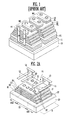
  • FIG. 1 is a perspective view illustrating the structure of a known 3-D nonvolatile memory device.
  • the known 3-D nonvolatile memory device includes pipe gates PG formed by etching conductive layers and interlayer insulating layers 11 , 12 , and 13 which are alternately stacked over a substrate 10 , word lines WL, and select lines SL.
  • the known 3-D nonvolatile memory device further includes U-shaped channels CH, each including a pipe channel buried within the pipe gate PG and a pair of channels coupled to the pipe channel and formed to penetrate the interlayer insulating layers 12 and the word lines WL.
  • the U-shaped channel CH is substantially surrounded by a tunnel insulating layer, a charge trap layer, and a charge blocking layer 14 .
  • the 3-D nonvolatile memory device includes memory blocks MB formed of multi-layered layers stacked over the substrate 10 in a cell region, and a transistor, a capacitor, and a resistor disposed in a peripheral circuit region have a single layer structure.
  • a step between the cell region and the peripheral circuit region is great. Accordingly, the difficulty of a manufacture process is great, and there is a high probability that a failure may occur.
  • An embodiment of this disclosure relates to the capacitor and resistor of a semiconductor device which are capable of reducing a step between a cell region and a peripheral circuit region, a memory system including the semiconductor device, and a method of manufacturing the semiconductor device.
  • the capacitor of a semiconductor device includes a capacitor structure on which edge regions each stepwise patterned and a central region disposed between the edge regions are defined, and configured to include electrode layers and dielectric layers alternately stacked; sacrificial layers disposed within the respective electrode layers in the edge regions of the capacitor structure; support plugs formed in the central region of the capacitor structure and configured to penetrate the electrode layers and the dielectric layers; first slits formed in the central region of the capacitor structure and each disposed between the support plugs, one or more second slits formed in the edge regions of the capacitor structure; and an insulating layer buried in the first slits and the one or more second slits.
  • the resistor of a semiconductor device includes a resistor structure on which edge regions each stepwise patterned and a central region disposed between the edge regions are defined, and configured to include resistor layers and interlayer insulating layers alternately stacked; sacrificial layers disposed within the respective resistor layers in the edge regions of the resistor structure; support plugs formed in the central region of the resistor structure and configured to penetrate the resistor layers and the interlayer insulating layers; first slits formed in the central region of the resistor structure and each disposed between the support plugs; and one or more second slits formed in the edge regions of the resistor structure.
  • a method of forming the capacitor of a semiconductor device includes forming a capacitor structure on which edge regions each stepwise patterned and a central region disposed between the edge regions are defined, and configured to include sacrificial layers and dielectric layers alternately stacked and support plugs placed in the central region; forming first slits, each placed between the support plugs of the central region, and one or more second slits placed in the edge regions by etching the sacrificial layers and the dielectric layers; etching the sacrificial layers exposed to the inner walls of the first slits and the second slits so that the sacrificial layers of the central region are fully removed and the sacrificial layers of the edge regions remain partially; and forming electrode layers for the capacitor by filling the etched regions of the sacrificial layers with a conductive layer.
  • a method of forming the resistor of a semiconductor device includes forming a resistor structure on which edge regions each stepwise patterned and a central region disposed between the edge regions are defined, and configured to include sacrificial layers and interlayer insulating layers alternately stacked and support plugs placed in the central region; forming first slits, each placed between the support plugs of the central region, and one or more second slits placed in the edge regions by etching the sacrificial layers and the interlayer insulating layers; etching the sacrificial layers exposed to the inner walls of the first slits and the second slits so that the sacrificial layers of the central region are fully removed and the sacrificial layers of the edge regions remain partially; and forming resistor layers by filling the etched regions of the sacrificial layers with a conductive layer.
  • FIG. 1 is a perspective view illustrating the structure of a known 3-D nonvolatile memory device
  • FIGS. 2A and 2B are a perspective view and cross-sectional view showing the capacitor structure of a 3-D nonvolatile memory device according to an embodiment of this disclosure
  • FIGS. 3A and 3B are a perspective view and cross-sectional view showing the resistor structure of a 3-D nonvolatile memory device according to an embodiment of this disclosure
  • FIGS. 4A to 4C are layout diagrams showing capacitor structures or resistor structures according to various embodiments of this disclosure.
  • FIGS. 5A to 9B are cross-sectional views illustrating a method of manufacturing a semiconductor device according to an embodiment of this disclosure
  • FIG. 10 shows the construction of a memory system according to an embodiment of this disclosure.
  • FIG. 11 shows the construction of a computing system according to an embodiment of this disclosure.
  • FIGS. 2A and 2B are a perspective view and cross-sectional view showing the capacitor structure of a 3-D nonvolatile memory device according to an embodiment of this disclosure.
  • the 3-D nonvolatile memory device may include a capacitor structure A.
  • the capacitor structure A may include first to fourth electrode layers E 1 ⁇ E 4 and interlayer insulating layers 21 alternately stacked over a substrate 20 in which desired underlying structures may be formed.
  • the underlying structures may include an isolation layer, a transistor, and a pipe gate.
  • the capacitor structure A may include edge regions ER 1 and ER 2 and a central region CR disposed between the edge regions ER 1 and ER 2 .
  • the contact pads of the first to fourth electrode layers E 1 ⁇ E 4 may be formed in each of the edge regions ER 1 and ER 2 .
  • the interlayer insulating layers 21 on the upper side and the first to fourth electrode layers E 1 ⁇ E 4 on the lower side are stepwise patterned in pairs in each of the edge regions ER 1 and ER 2 .
  • Sacrificial layers SC may be disposed in the first to fourth electrode layers E 1 ⁇ E 4 , respectively, in part of the edge regions ER 1 and ER 2 of the capacitor structure A. That is, the capacitor structure A may include the sacrificial layers SC formed in the same layers as the first to fourth electrode layers E 1 ⁇ E 4 . The sacrificial layers SC may be substantially surrounded by the first to fourth electrode layers E 1 ⁇ E 4 , respectively. The sacrificial layer SC may be a nitride layer.
  • Support plugs SP may be disposed in the central region CR of the capacitor structure A and may be formed to penetrate the first to fourth electrode layers E 1 ⁇ E 4 and the interlayer insulating layers 21 .
  • the support plugs SP may be arranged in a matrix form and formed of semiconductor layers, such as polysilicon layers. Each of the support plugs SP may be substantially surrounded by an insulating layer (not shown).
  • the insulating layer may include a tunnel insulating layer, a charge trap layer, and a charge blocking layer for forming the memory cells of the cell region.
  • the support plug SP is shown as having a pillar form in which the central part of the support plug SP is fully filled, an insulating layer may be buried in the central part of the support plug SP.
  • a first slit S 1 is disposed between the support plugs SP in the central region CR of the capacitor structure A.
  • One or more second slits S 2 may be disposed in the edge regions ER 1 and ER 2 of the capacitor structure A.
  • a third slit S 3 is disposed between the capacitor structures A adjacent to each other.
  • the first slits S 1 and the third slits S 3 may be extended in one direction and configured in a line form.
  • the first slits S 1 and the third slits S 3 may be extended in parallel in the same direction or may be extended to cross each other.
  • Each of the second slits S 2 may have a hole form so that the second slits S 2 may be formed in the respective layers of the edge regions ER 1 and ER 2 .
  • the second slits S 2 may be arranged in zigzags.
  • An insulating layer, such as an oxide layer, is buried in the first to third slits S 1 ⁇ S 3 .
  • At least one contact plug CP is coupled to each of the first to fourth electrode layers E 1 ⁇ E 4 disposed in the respective layers.
  • the contact plug CP may be formed of a conductive layer.
  • the 3-D nonvolatile memory device further may include first and second lines L 1 ⁇ L 4 coupled to the respective contact plugs CP.
  • the first and the second lines L 1 ⁇ L 4 may be divided into and disposed in the first edge region ER 1 and the second edge region ER 2 .
  • the first lines L 1 may be disposed in the first edge region ER 1 and coupled to the first electrode layer E 1 and the fourth electrode layer E 4 , respectively.
  • the first lines L 2 may be disposed in the second edge region ER 2 and coupled to the second electrode layer E 2 and the third electrode layer E 3 , respectively.
  • the 3-D nonvolatile memory device further may include the second line L 3 coupling the first lines L 1 of the first edge region ER 1 and the second line L 4 coupling the first lines L 2 of the second edge region ER 2 .
  • the first electrode layer E 1 , the second electrode layer E 2 , and the interlayer insulating layer 21 disposed between the first and the second electrode layers E 1 and E 2 form a first capacitor.
  • the third electrode layer E 3 , the fourth electrode layer E 4 , and the interlayer dielectric layer 21 disposed between the third and the fourth electrode layer E 3 and E 4 form a second capacitor.
  • the first and the second capacitors are stacked to form one capacitor structure A.
  • the degree of integration of 3-D nonvolatile memory devices can be improved because an area occupied by capacitors in the 3-D nonvolatile memory device is reduced.
  • a desired bias can be supplied to the first to fourth electrode layers E 1 ⁇ E 4 of the capacitors through the lines L 1 ⁇ L 4 .
  • the capacitor structure according to an embodiment associated with FIGS. 2A and 2B is applied to a 3-D nonvolatile memory device including a plurality of memory cells that are stacked along channels protruded from a substrate, a level difference between a cell region and a peripheral circuit region can be reduced. Furthermore, the cost of production can be reduced because the memory cells disposed in the cell region, together with the capacitors, can be formed.
  • FIGS. 3A and 3B are a perspective view and cross-sectional view showing the resistor structure of a 3-D nonvolatile memory device according to an embodiment of this disclosure.
  • the 3-D nonvolatile memory device may include a resistor structure B.
  • the resistor structure B may include first to fourth resistor layers R 1 ⁇ R 4 and interlayer insulating layers 31 alternately stacked over a substrate 30 in which desired underlying structures may be formed.
  • the underlying structures may include an isolation layer, a transistor, and a pipe gate.
  • the resistor structure B may include edge regions ER 1 and ER 2 and a central region CR disposed between the edge regions ER 1 and ER 2 .
  • the contact pads of the first to fourth resistor layers R 1 ⁇ R 4 may be formed in each of the edge regions ER 1 and ER 2 .
  • the interlayer insulating layers 31 and the first to fourth resistor layers R 1 ⁇ R 4 of the edge regions ER 1 and ER 2 are stepwise patterned, and each tiers of the resistor structure may include one interlayer insulating layer 31 and one resistor layer R 1 ⁇ R 4 formed under the interlayer insulating layer 31 .
  • Sacrificial layers SC may be disposed in the respective resistor layers R 1 ⁇ R 4 in part of the edge regions ER 1 and ER 2 of the resistor structure B. That is, the resistor structure B may include the sacrificial layers SC formed in the same layers as the first to fourth resistor layers R 1 ⁇ R 4 . The sacrificial layers SC may be substantially surrounded by the first to fourth resistor layers R 1 ⁇ R 4 , respectively. The sacrificial layer SC may be a nitride layer.
  • Support plugs SP may be disposed in the central region CR of the resistor structure B and may be formed to penetrate the first to fourth resistor layers R 1 ⁇ R 4 and the interlayer insulating layers 31 .
  • the support plugs SP may be arranged in a matrix form and formed of semiconductor layers, such as polysilicon layers. Each of the support plugs SP may be substantially surrounded by an insulating layer (not shown).
  • the insulating layer may include a tunnel insulating layer, a charge trap layer, and a charge blocking layer for forming the memory cells of the cell region.
  • the support plug SP is shown as having a pillar form in which the central part of the support plug SP is fully filled, an insulating layer may be buried in the central part of the support plug SP.
  • a first slit S 1 is disposed between the support plugs SP in the central region CR of the resistor structure B.
  • One or more second slits S 2 may be disposed in the edge regions ER 1 and ER 2 of the resistor structure B.
  • a third slit S 3 is disposed between the resistor structures B adjacent to each other.
  • the first slits S 1 and the third slits S 3 may be extended in one direction and configured in a line form.
  • the first slits S 1 and the third slits S 3 may be extended in parallel in the same direction or may be extended to cross each other.
  • Each of the second slits S 2 may have a hole form so that the second slits S 2 may be formed in the respective layers of the edge regions ER 1 and ER 2 .
  • the second slits S 2 may be arranged in zigzags.
  • An insulating layer, such as an oxide layer, is buried in the first to third slits S 1 ⁇ S 3 .
  • each contact plug CP is coupled to each of the first to fourth resistor layers R 1 ⁇ R 4 disposed in the respective layers.
  • the contact plug CP may be formed of a conductive layer.
  • each of the first to fourth resistor layers R 1 ⁇ R 4 is coupled to two contact plugs CP which are placed in the first edge region ER 1 and the second edge region ER 2 .
  • the 3-D nonvolatile memory device further may include first to fourth lines L 1 ⁇ L 4 coupled the contact plugs CP.
  • the first lines L 1 are coupled to the respective contact pads of the first to fourth resistor layers R 1 ⁇ R 4 , formed in the first edge region ER 1 and the second edge region ER 2 , through the contact plugs CP.
  • the first lines L 1 formed in the first edge region ER 1 may be coupled by the third lines L 3
  • the second lines L 2 formed in the second edge region ER 2 may be coupled by the fourth lines L 4 .
  • the first to fourth resistor layers R 1 ⁇ R 4 are stacked to form one resistor structure B. Accordingly, the degree of integration of 3-D nonvolatile memory devices can be improved because an area occupied by resistors is reduced in the 3-D nonvolatile memory device. Furthermore, a variety of resistance values can be obtained by coupling a desired number of the resistor layers R 1 ⁇ R 4 using the lines L 1 ⁇ L 4 .
  • the resistor structure according to an embodiment associated with FIGS. 3A and 3B is applied to a 3-D nonvolatile memory device including a plurality of memory cells that are stacked along channels protruded from a substrate, a level difference between a cell region and a peripheral circuit region can be reduced. Furthermore, the cost of production can be reduced because the memory cells of the cell region, together with the capacitors, can be formed.
  • FIGS. 4A to 4C are layout diagrams showing capacitor structures or resistor structures according to an embodiment of this disclosure.
  • a capacitor structure A (or a resistor structure B) according to an embodiment of this disclosure may include electrode layers E 1 ⁇ E 4 (or resistor layers R 1 ⁇ R 4 ) stacked over the substrate 20 or 30 (see FIGS. 2 and 3 ).
  • Support plugs SP are arranged in a matrix form in the central region CR of the capacitor structure A (or the resistor structure B).
  • the support plugs SP may be arranged in the same form as the channels of the memory cells disposed in the cell region.
  • First slits S 1 may be disposed in the central region CR of the capacitor structure A (or the resistor structure B) and may be formed a line form between the support plugs SP. Furthermore, second slits S 2 may be disposed in the edge regions ER 1 and ER 2 of the capacitor structure A (or the resistor structure B) and may be formed in a hole form. A third slit S 3 is disposed in a line form between the capacitor structures A adjacent to each other (or the resistor structures B adjacent to each other).
  • the second slits S 2 may be formed in a hole form in the respective tiers of capacitor structure A (see a dotted line in the figures). In various embodiments, the second slits S 2 may be formed in a line form. Furthermore, the second slits S 2 may be disposed on opposite sides in upper and lower layers. The second slits S 2 and the first slits S 1 may be arranged on the same line.
  • the first slit S 1 and the third slit S 3 are illustrated as being extended in the same direction, but may be extended so that they cross each other.
  • sacrificial layers SC may be disposed in the edge regions ER 1 and ER 2 of the capacitor structure A (or the resistor structure B).
  • the electrode layers E 1 ⁇ E 4 (or the resistor layer R 1 ⁇ R 4 ) may be formed by etching the sacrificial layer SC exposed to the inner walls of the first to third slits S 1 ⁇ S 3 and filling the etched regions with a conductive layer.
  • the sacrificial layers SC formed in regions spaced apart from the slits S 1 ⁇ S 3 at a specific interval remains intact without being etched.
  • the sacrificial layers SC may be disposed instead of the electrode layers E 1 ⁇ E 4 (or the resistor layers R 1 ⁇ R 4 ) in part of the edge regions ER 1 and ER 2 .
  • the sacrificial layers SC that remain in respective layers may be substantially surrounded by the electrode layers E 1 ⁇ E 4 (or the resistor layers R 1 ⁇ R 4 ), respectively.
  • Contact plugs CP may be disposed in the edge regions ER 1 and ER 2 of the capacitor structure A (or the resistor structure B).
  • the contact plugs CP are coupled to the electrode layers E 1 ⁇ E 4 (or the resistor layers R 1 ⁇ R 4 ), respectively, in each of the edge regions ER 1 and ER 2 .
  • the contact plugs CP may be formed in the edge regions ER 1 and ER 2 except the regions where the sacrificial layers SC may be formed.
  • a capacitor structure A (or the resistor structure B) according to an embodiment of this disclosure may include a plurality of second slits S 2 _ 1 and S 2 _ 2 in the tiers of the capacitor structure A stepwise patterned.
  • the second slits S 2 _ 1 may be formed on opposite sides in upper and lower layers, and the remaining second slits S 2 _ 2 may be formed between the second slits S 2 _ 1 . Furthermore, some of the second slits S 2 _ 1 may be arranged on the same line as the first slits S 1 , and the remaining second slits S 2 _ 2 may be arranged to cross the first slit S 1 . In various embodiments, the second slits S 2 may be arranged in various forms in upper and lower layers, such as a zigzag form. Accordingly, an area of the electrode layers E 1 ⁇ E 4 or the register layers R 1 ⁇ R 4 can be increased by increasing the number of second slits S 2 .
  • FIGS. 5A to 9B are cross-sectional views illustrating a method of manufacturing a semiconductor device according to an embodiment of this disclosure.
  • a method of manufacturing a 3-D nonvolatile memory device to which the capacitor and resistor structures according to the various embodiments associated with FIGS. 2A to 3B of this disclosure are applied is described as an example with reference to FIGS. 5A to 9B .
  • ‘A’ in each of FIGS. 5A to 9B shows a figure corresponding to a cell region
  • ‘B’ in each of FIGS. 5A to 9B shows a figure corresponding to a peripheral circuit region.
  • a first interlayer insulating layer (not shown) is formed on a substrate (not shown) in which the cell region and the peripheral circuit region are defined.
  • a first conductive layer 50 is formed on the first interlayer insulating layer.
  • the cell region is a region in which memory cells will be formed
  • the peripheral circuit region is a region in which a capacitor, a resistor, etc. will be formed.
  • the cell region may include a central region in which the memory cells will be formed and edge regions in which the contact pads of word lines will be formed
  • the peripheral circuit region may include a central region in which the capacitor, the resistor, etc. will be formed and edge regions in which the contact pads of electrode layers or resistor layers will be formed.
  • the first conductive layer 50 is used to form the pipe gate of the cell region.
  • the first conductive layer 50 formed in the peripheral circuit region may be used as the gate of a transistor.
  • a first insulating layer 51 is formed in the etched region. This process is for forming the pipe gate by separating the first conductive layer 50 of the cell region by the memory block.
  • the first conductive layer 50 of the peripheral circuit region may be patterned according to circumstances.
  • first trenches may be formed by etching the first conductive layer 50 of the cell region.
  • the first trenches are filled with a first sacrificial layer 52 .
  • the first sacrificial layer may be formed of a nitride layer.
  • the first trenches are illustrated as being formed only in the cell region, but the first trenches may be formed in the peripheral circuit region at need.
  • the first conductive layer 50 may be additionally formed on the first conductive layer 50 in which the first sacrificial layers 52 are filled. In this case, a cell current can be improved because the pipe gate of the cell region surrounds the pipe channel fully.
  • Second sacrificial layers 53 and second insulating layers 54 are alternately stacked over the first conductive layer 50 .
  • the second sacrificial layers 53 formed in the cell region are used to secure regions in which word lines or select lines will be formed in subsequent processes, and the second sacrificial layers 53 formed in the peripheral circuit region are used to secure regions in which the electrode layers of the capacitor or the resistor layers of the resistor will be formed.
  • the second insulating layers 54 formed in the cell region are used as interlayer insulating layers for isolating stacked word lines and select lines from one another electrically.
  • the second insulating layers 54 formed in the peripheral circuit region may be used as dielectric layers, each disposed between the stacked electrode layers of the capacitor, or interlayer insulating layers for isolating stacked resistor layers from one another.
  • second trenches may be formed by etching the second sacrificial layers 53 and the second insulating layers 54 .
  • the second trenches may be arranged in a matrix form. Furthermore, in the cell region, each of the first trenches is coupled to a pair of second trenches.
  • the first sacrificial layers 52 exposed at the bottoms of the second trenches formed in the cell region are removed.
  • a plurality of substantially U-shaped trenches, each including a pair of the second trenches and the first trench, is formed in the cell region.
  • An insulating layer 55 is formed on the inner faces of the substantially U-shaped trenches in the cell region and the second trenches in the peripheral circuit region.
  • the insulating layer 55 formed in the cell region is used as the charge blocking layer, the charge trap layer, and the tunnel insulating layer of the memory cells.
  • a semiconductor layer 56 is formed on the insulating layer 55 .
  • the semiconductor layer 56 formed in the cell region is used as the channels CH of the memory cells, and the semiconductor layer 56 formed in the peripheral circuit region is used as support plugs SP.
  • the semiconductor layer 56 may be formed of a polysilicon layer.
  • the central parts of the substantially U-shaped trenches formed in the cell region and the second trenches formed in the peripheral circuit region are illustrated as being fully filled with the semiconductor layer 56 , but the central part of the semiconductor layer 56 may be opened and the opened central part may be filled with an additional insulating layer.
  • the second sacrificial layers and the second insulating layers that are etched in the process of forming the second trenches are denoted by ‘ 53 A’ and ‘ 54 A’, respectively.
  • edge regions are stepwise patterned by etching the second sacrificial layers 53 A and the second insulating layers 54 A. This process is for forming the contact pads of word lines stacked in the cell region and the contact pads of electrode layers or resistor layers stacked in the peripheral circuit region.
  • first to third slits S 1 ⁇ S 3 may be formed by etching by etching the second sacrificial layers 53 A and the second insulating layers 54 A.
  • the first to third slits S 1 ⁇ S 3 may be formed simultaneously or individually.
  • the third slits S 3 may be formed by etching the second sacrificial layers 53 A and the second insulating layers 54 A formed in the cell region and are configured to separate adjacent memory blocks from each other. Furthermore, the third slits S 3 may be formed by etching the second sacrificial layers 53 A and the second insulating layers 54 A formed in the peripheral circuit region and are configured to separate the capacitor structures A adjacent to each other or the resistor structures B adjacent to each other.
  • Each of the first slits S 1 formed in the cell region is formed between the channels CH formed in the central region of the memory block. Furthermore, each of the first slits S 1 formed in the peripheral circuit region is formed between the support plugs SP disposed in the central region of the capacitor structure A or the resistor structure B.
  • the one or more second slits S 2 may be further formed in the peripheral circuit region and disposed in the edge regions ER 1 and ER 2 of the capacitor structure A or the resistor structure B.
  • the second slits S 2 may be stepwise patterned in a hole form and formed in the respective layers.
  • the one or more second slits S 2 may be arranged in staggered form.
  • the etched second sacrificial layers are denoted by ‘ 53 B’, and the etched second insulating layers are denoted by ‘ 54 B’.
  • the second sacrificial layers 53 B exposed to the inner walls of the first to third slits S 1 ⁇ S 3 are etched.
  • the second sacrificial layers 53 B are etched so that the second sacrificial layers 53 B of the central regions disposed in the cell region and the peripheral circuit region are fully removed, but the second sacrificial layers 53 B remain in part of the edge regions disposed in the cell region and the peripheral circuit region, for example, the central parts of the edge regions.
  • the second insulating layers 54 B in the edge regions are supported by the remaining second sacrificial layers 53 C.
  • the etched regions of the second sacrificial layers 53 B are filled with a second conductive layer 57 , and the first to third slits S 1 ⁇ S 3 are then filled with a third insulating layer 58 .
  • the second conductive layer 57 buried in the cell region are used as word lines WL and select lines SL.
  • the select line SL may be used as the select line SL, and the remaining conductive layers 57 may be used as the word lines WL.
  • the second conductive layers 57 buried in the peripheral circuit region may be used as the electrode layers E 1 ⁇ E 4 of the capacitor or the resistor layers R 1 ⁇ R 4 .
  • the memory block of the cell region and the capacitor structure A and the resistor structure B of the peripheral circuit region have the same stack structure. Accordingly, only conductive layers corresponding to the word lines included in the memory block may be used as the electrode layers and the resistor layers, or all the conductive layers corresponding to the word lines and the select lines may be used as the electrode layers and the resistor layers.
  • a second interlayer insulating layer is formed on the entire structure including the results in which the second conductive layers 57 and the third insulating layers 58 may be formed.
  • Contact holes through which surfaces of the word lines, the electrode layers, or the resistor layers are exposed may be formed by etching the second interlayer insulating layer and the second insulating layers 54 B.
  • Contact plugs may be formed in the respective contact holes by filling the contact holes with a conductive layer.
  • the contact plugs formed in the cell region are coupled to the respective contact pads of the word lines WL, and the contact plugs CP formed in the peripheral circuit region are coupled to the respective contact pads of the electrode layers E 1 ⁇ E 4 or the resistor layers R 1 ⁇ R 4 . Lines may be formed and coupled to the contact plugs formed in the cell region and the peripheral circuit region.
  • the memory cells of the cell region and the capacitors or the resistor of the peripheral circuit region can be formed at the same time. Accordingly, a level difference between the cell region and the peripheral circuit region can be reduced, and a process of manufacturing a 3-D nonvolatile memory device can be simplified.
  • FIG. 10 shows the construction of a memory system according to an embodiment of this disclosure.
  • the memory system 100 may include a nonvolatile memory device 120 and a memory controller 110 .
  • the nonvolatile memory device 120 is configured to include the capacitor structures described with reference to the various embodiments associated with FIGS. 2A , 2 B, and 4 A to 9 B or the resistor structures described with reference to the various embodiments associated with FIGS. 3A to 9B .
  • the non-volatile memory device 120 may be a multi-chip package including a plurality of flash memory chips.
  • the memory controller 110 is configured to control the nonvolatile memory device 120 , and it may include SRAM 111 , a central processing unit (CPU) 112 , a host interface (I/F) 113 , an error correction code (ECC) circuit 114 , and a memory interface (I/F) 115 .
  • the SRAM 111 is used as the operating memory of the CPU 112 .
  • the CPU 112 performs an overall control operation for the data exchange of the memory controller 110 .
  • the host I/F 113 is equipped with the data exchange protocol of a host that accesses the memory system 100 .
  • the ECC circuit 114 circuit detects and corrects errors included in data read from the nonvolatile memory device 120 .
  • the memory I/F 115 performs an interface with the nonvolatile memory device 120 .
  • the memory controller 110 may further include ROM for storing code data for an interface with the host.
  • the memory system 100 configured as described above may be a memory card or a solid state disk (SSD) in which the nonvolatile memory device 120 and the controller 110 are combined.
  • the memory controller 110 may communicate with the outside (for example, a host) through one of various interface protocols, such as a USB, MMC, PCI-E, SATA, PATA, SCSI, ESDI, and IDE.
  • FIG. 11 shows the construction of a computing system according to an embodiment of this disclosure.
  • the computing system 200 may include a CPU 220 , RAM 230 , a user interface 240 , a modem 250 , and a memory system 210 all of which are electrically coupled to a system bus 260 . If the computing system 200 is a mobile device, the computing system 200 may further include a battery for supplying operating voltages to the computing system 200 . The computing system 200 may further include application chipsets, a camera image processor (CIS), mobile DRAM, and so on.
  • CIS camera image processor
  • the memory system 210 may include a non-volatile memory device 212 and a memory controller 211 , such as those described with reference to FIG. 10 .
  • the nonvolatile memory and the memory controller may be mounted using various forms of packages.
  • the nonvolatile memory and the memory controller may be mounted using a package on package (PoP), ball grid arrays (BGAs), chip scale packages (CSPs), a plastic leaded chip carrier (PLCC), a plastic dual in-Kine package (PDIP), a chip on board (COB), a ceramic dual in-line package (CERDIP), a plastic metric quad flat pack (P-MQFP), thin quad flatpack (TQFP), a small outline package (SOP), a shrink small outline package (SSOP), a thin small outline package (TSOP), a thin quad flatpack (TQFP), a system in package (SIP), a multi-chip package (MCP), a wafer-level fabricated package (WFP), or a wafer-level processed stack package (WSP).
  • PoP package on package
  • BGAs ball grid arrays
  • CSPs chip scale packages
  • PLCC plastic leaded chip carrier
  • a level difference between the cell region and the peripheral circuit region can be reduced by forming the capacitor of a 3-D nonvolatile memory device including the electrode layers and the dielectric layers which are alternately stacked. Furthermore, a level difference between the cell region and the peripheral circuit region can be reduced by forming the resistor of a 3-D nonvolatile memory device including the electrode layers and the dielectric layers which are alternately stacked.

Landscapes

  • Engineering & Computer Science (AREA)
  • Manufacturing & Machinery (AREA)
  • Semiconductor Memories (AREA)

Abstract

A capacitor of a semiconductor device includes a capacitor structure configured to include electrode layers and dielectric layers alternately stacked, edge regions each stepwise patterned, and a central region disposed between the edge regions, sacrificial layers disposed within the respective electrode layers in the edge regions of the capacitor structure, and support plugs formed in the central region of the capacitor structure and configured to penetrate the electrode layers and the dielectric layers.

Description

CROSS-REFERENCE TO RELATED APPLICATION
Priority to Korean patent application number 10-2011-0137339 filed on Dec. 19, 2011, the entire disclosure of which is incorporated by reference herein, is claimed.
BACKGROUND
1. Technical Field
Embodiments of this disclosure generally relate to a semiconductor device and a method of manufacturing the same and, more particularly, to the capacitor and resistor of a semiconductor device, a memory system including the semiconductor device, and a method of manufacturing the semiconductor device.
2. Related Art
A nonvolatile memory device retains data stored therein although the supply of power is cut off. As the recent improvement of the degree of integration of 2-D memory devices in which memory cells are formed in a single layer over a silicon substrate reaches the limit, there is proposed a 3-D nonvolatile memory device in which memory cells are vertically stacked in multiple layers from a silicon substrate.
The structure of a known 3-D nonvolatile memory device and problems thereof are described in detail below.
FIG. 1 is a perspective view illustrating the structure of a known 3-D nonvolatile memory device.
As shown in FIG. 1, the known 3-D nonvolatile memory device includes pipe gates PG formed by etching conductive layers and interlayer insulating layers 11, 12, and 13 which are alternately stacked over a substrate 10, word lines WL, and select lines SL. The known 3-D nonvolatile memory device further includes U-shaped channels CH, each including a pipe channel buried within the pipe gate PG and a pair of channels coupled to the pipe channel and formed to penetrate the interlayer insulating layers 12 and the word lines WL. The U-shaped channel CH is substantially surrounded by a tunnel insulating layer, a charge trap layer, and a charge blocking layer 14.
In accordance with the known technology, the 3-D nonvolatile memory device includes memory blocks MB formed of multi-layered layers stacked over the substrate 10 in a cell region, and a transistor, a capacitor, and a resistor disposed in a peripheral circuit region have a single layer structure. Thus, a step between the cell region and the peripheral circuit region is great. Accordingly, the difficulty of a manufacture process is great, and there is a high probability that a failure may occur.
BRIEF SUMMARY
An embodiment of this disclosure relates to the capacitor and resistor of a semiconductor device which are capable of reducing a step between a cell region and a peripheral circuit region, a memory system including the semiconductor device, and a method of manufacturing the semiconductor device.
In an embodiment of this disclosure, the capacitor of a semiconductor device includes a capacitor structure on which edge regions each stepwise patterned and a central region disposed between the edge regions are defined, and configured to include electrode layers and dielectric layers alternately stacked; sacrificial layers disposed within the respective electrode layers in the edge regions of the capacitor structure; support plugs formed in the central region of the capacitor structure and configured to penetrate the electrode layers and the dielectric layers; first slits formed in the central region of the capacitor structure and each disposed between the support plugs, one or more second slits formed in the edge regions of the capacitor structure; and an insulating layer buried in the first slits and the one or more second slits.
In an embodiment of this disclosure, the resistor of a semiconductor device includes a resistor structure on which edge regions each stepwise patterned and a central region disposed between the edge regions are defined, and configured to include resistor layers and interlayer insulating layers alternately stacked; sacrificial layers disposed within the respective resistor layers in the edge regions of the resistor structure; support plugs formed in the central region of the resistor structure and configured to penetrate the resistor layers and the interlayer insulating layers; first slits formed in the central region of the resistor structure and each disposed between the support plugs; and one or more second slits formed in the edge regions of the resistor structure.
In an embodiment of this disclosure, a method of forming the capacitor of a semiconductor device includes forming a capacitor structure on which edge regions each stepwise patterned and a central region disposed between the edge regions are defined, and configured to include sacrificial layers and dielectric layers alternately stacked and support plugs placed in the central region; forming first slits, each placed between the support plugs of the central region, and one or more second slits placed in the edge regions by etching the sacrificial layers and the dielectric layers; etching the sacrificial layers exposed to the inner walls of the first slits and the second slits so that the sacrificial layers of the central region are fully removed and the sacrificial layers of the edge regions remain partially; and forming electrode layers for the capacitor by filling the etched regions of the sacrificial layers with a conductive layer.
In an embodiment of this disclosure, a method of forming the resistor of a semiconductor device includes forming a resistor structure on which edge regions each stepwise patterned and a central region disposed between the edge regions are defined, and configured to include sacrificial layers and interlayer insulating layers alternately stacked and support plugs placed in the central region; forming first slits, each placed between the support plugs of the central region, and one or more second slits placed in the edge regions by etching the sacrificial layers and the interlayer insulating layers; etching the sacrificial layers exposed to the inner walls of the first slits and the second slits so that the sacrificial layers of the central region are fully removed and the sacrificial layers of the edge regions remain partially; and forming resistor layers by filling the etched regions of the sacrificial layers with a conductive layer.
BRIEF DESCRIPTION OF THE DRAWINGS
FIG. 1 is a perspective view illustrating the structure of a known 3-D nonvolatile memory device;
FIGS. 2A and 2B are a perspective view and cross-sectional view showing the capacitor structure of a 3-D nonvolatile memory device according to an embodiment of this disclosure;
FIGS. 3A and 3B are a perspective view and cross-sectional view showing the resistor structure of a 3-D nonvolatile memory device according to an embodiment of this disclosure;
FIGS. 4A to 4C are layout diagrams showing capacitor structures or resistor structures according to various embodiments of this disclosure;
FIGS. 5A to 9B are cross-sectional views illustrating a method of manufacturing a semiconductor device according to an embodiment of this disclosure;
FIG. 10 shows the construction of a memory system according to an embodiment of this disclosure; and
FIG. 11 shows the construction of a computing system according to an embodiment of this disclosure.
DESCRIPTION OF EMBODIMENTS
Hereinafter, some various embodiments of the present disclosure will be described in detail with reference to the accompanying drawings. The figures are provided to allow those having ordinary skill in the art to understand the scope of the embodiments of the disclosure.
FIGS. 2A and 2B are a perspective view and cross-sectional view showing the capacitor structure of a 3-D nonvolatile memory device according to an embodiment of this disclosure.
As shown in FIGS. 2A and 2B, the 3-D nonvolatile memory device according to an embodiment of this disclosure may include a capacitor structure A. The capacitor structure A may include first to fourth electrode layers E1˜E4 and interlayer insulating layers 21 alternately stacked over a substrate 20 in which desired underlying structures may be formed. The underlying structures may include an isolation layer, a transistor, and a pipe gate.
The capacitor structure A may include edge regions ER1 and ER2 and a central region CR disposed between the edge regions ER1 and ER2. The contact pads of the first to fourth electrode layers E1˜E4 may be formed in each of the edge regions ER1 and ER2. The interlayer insulating layers 21 on the upper side and the first to fourth electrode layers E1˜E4 on the lower side are stepwise patterned in pairs in each of the edge regions ER1 and ER2.
Sacrificial layers SC may be disposed in the first to fourth electrode layers E1˜E4, respectively, in part of the edge regions ER1 and ER2 of the capacitor structure A. That is, the capacitor structure A may include the sacrificial layers SC formed in the same layers as the first to fourth electrode layers E1˜E4. The sacrificial layers SC may be substantially surrounded by the first to fourth electrode layers E1˜E4, respectively. The sacrificial layer SC may be a nitride layer.
Support plugs SP may be disposed in the central region CR of the capacitor structure A and may be formed to penetrate the first to fourth electrode layers E1˜E4 and the interlayer insulating layers 21. The support plugs SP may be arranged in a matrix form and formed of semiconductor layers, such as polysilicon layers. Each of the support plugs SP may be substantially surrounded by an insulating layer (not shown). The insulating layer may include a tunnel insulating layer, a charge trap layer, and a charge blocking layer for forming the memory cells of the cell region. Furthermore, although the support plug SP is shown as having a pillar form in which the central part of the support plug SP is fully filled, an insulating layer may be buried in the central part of the support plug SP.
A first slit S1 is disposed between the support plugs SP in the central region CR of the capacitor structure A. One or more second slits S2 may be disposed in the edge regions ER1 and ER2 of the capacitor structure A. Furthermore, a third slit S3 is disposed between the capacitor structures A adjacent to each other.
The first slits S1 and the third slits S3 may be extended in one direction and configured in a line form. The first slits S1 and the third slits S3 may be extended in parallel in the same direction or may be extended to cross each other. Each of the second slits S2 may have a hole form so that the second slits S2 may be formed in the respective layers of the edge regions ER1 and ER2. The second slits S2 may be arranged in zigzags. An insulating layer, such as an oxide layer, is buried in the first to third slits S1˜S3.
In the edge regions ER1 and ER2 of the capacitor structure A, at least one contact plug CP is coupled to each of the first to fourth electrode layers E1˜E4 disposed in the respective layers. The contact plug CP may be formed of a conductive layer.
The 3-D nonvolatile memory device further may include first and second lines L1˜L4 coupled to the respective contact plugs CP. The first and the second lines L1˜L4 may be divided into and disposed in the first edge region ER1 and the second edge region ER2. For example, the first lines L1 may be disposed in the first edge region ER1 and coupled to the first electrode layer E1 and the fourth electrode layer E4, respectively. The first lines L2 may be disposed in the second edge region ER2 and coupled to the second electrode layer E2 and the third electrode layer E3, respectively. The 3-D nonvolatile memory device further may include the second line L3 coupling the first lines L1 of the first edge region ER1 and the second line L4 coupling the first lines L2 of the second edge region ER2.
In accordance with an embodiment associated with FIGS. 2A and 2B, the first electrode layer E1, the second electrode layer E2, and the interlayer insulating layer 21 disposed between the first and the second electrode layers E1 and E2 form a first capacitor. The third electrode layer E3, the fourth electrode layer E4, and the interlayer dielectric layer 21 disposed between the third and the fourth electrode layer E3 and E4 form a second capacitor. The first and the second capacitors are stacked to form one capacitor structure A. In this structure, the degree of integration of 3-D nonvolatile memory devices can be improved because an area occupied by capacitors in the 3-D nonvolatile memory device is reduced. Furthermore, a desired bias can be supplied to the first to fourth electrode layers E1˜E4 of the capacitors through the lines L1˜L4.
Additionally, if the capacitor structure according to an embodiment associated with FIGS. 2A and 2B is applied to a 3-D nonvolatile memory device including a plurality of memory cells that are stacked along channels protruded from a substrate, a level difference between a cell region and a peripheral circuit region can be reduced. Furthermore, the cost of production can be reduced because the memory cells disposed in the cell region, together with the capacitors, can be formed.
FIGS. 3A and 3B are a perspective view and cross-sectional view showing the resistor structure of a 3-D nonvolatile memory device according to an embodiment of this disclosure.
As shown in FIGS. 3A and 3B, the 3-D nonvolatile memory device according to an embodiment of this disclosure may include a resistor structure B. The resistor structure B may include first to fourth resistor layers R1˜R4 and interlayer insulating layers 31 alternately stacked over a substrate 30 in which desired underlying structures may be formed. The underlying structures may include an isolation layer, a transistor, and a pipe gate.
The resistor structure B may include edge regions ER1 and ER2 and a central region CR disposed between the edge regions ER1 and ER2. The contact pads of the first to fourth resistor layers R1˜R4 may be formed in each of the edge regions ER1 and ER2. The interlayer insulating layers 31 and the first to fourth resistor layers R1˜R4 of the edge regions ER1 and ER2 are stepwise patterned, and each tiers of the resistor structure may include one interlayer insulating layer 31 and one resistor layer R1˜R4 formed under the interlayer insulating layer 31.
Sacrificial layers SC may be disposed in the respective resistor layers R1˜R4 in part of the edge regions ER1 and ER2 of the resistor structure B. That is, the resistor structure B may include the sacrificial layers SC formed in the same layers as the first to fourth resistor layers R1˜R4. The sacrificial layers SC may be substantially surrounded by the first to fourth resistor layers R1˜R4, respectively. The sacrificial layer SC may be a nitride layer.
Support plugs SP may be disposed in the central region CR of the resistor structure B and may be formed to penetrate the first to fourth resistor layers R1˜R4 and the interlayer insulating layers 31. The support plugs SP may be arranged in a matrix form and formed of semiconductor layers, such as polysilicon layers. Each of the support plugs SP may be substantially surrounded by an insulating layer (not shown). The insulating layer may include a tunnel insulating layer, a charge trap layer, and a charge blocking layer for forming the memory cells of the cell region. Furthermore, although the support plug SP is shown as having a pillar form in which the central part of the support plug SP is fully filled, an insulating layer may be buried in the central part of the support plug SP.
A first slit S1 is disposed between the support plugs SP in the central region CR of the resistor structure B. One or more second slits S2 may be disposed in the edge regions ER1 and ER2 of the resistor structure B. Furthermore, a third slit S3 is disposed between the resistor structures B adjacent to each other.
The first slits S1 and the third slits S3 may be extended in one direction and configured in a line form. The first slits S1 and the third slits S3 may be extended in parallel in the same direction or may be extended to cross each other. Each of the second slits S2 may have a hole form so that the second slits S2 may be formed in the respective layers of the edge regions ER1 and ER2. The second slits S2 may be arranged in zigzags. An insulating layer, such as an oxide layer, is buried in the first to third slits S1˜S3.
In the edge regions ER1 and ER2 of the resistor structure B, at least one contact plug CP is coupled to each of the first to fourth resistor layers R1˜R4 disposed in the respective layers. The contact plug CP may be formed of a conductive layer. For example, each of the first to fourth resistor layers R1˜R4 is coupled to two contact plugs CP which are placed in the first edge region ER1 and the second edge region ER2.
The 3-D nonvolatile memory device further may include first to fourth lines L1˜L4 coupled the contact plugs CP. The first lines L1 are coupled to the respective contact pads of the first to fourth resistor layers R1˜R4, formed in the first edge region ER1 and the second edge region ER2, through the contact plugs CP. Furthermore, the first lines L1 formed in the first edge region ER1 may be coupled by the third lines L3, and the second lines L2 formed in the second edge region ER2 may be coupled by the fourth lines L4.
In accordance with the an embodiment associated with FIGS. 3A and 3B, the first to fourth resistor layers R1˜R4 are stacked to form one resistor structure B. Accordingly, the degree of integration of 3-D nonvolatile memory devices can be improved because an area occupied by resistors is reduced in the 3-D nonvolatile memory device. Furthermore, a variety of resistance values can be obtained by coupling a desired number of the resistor layers R1˜R4 using the lines L1˜L4.
If the resistor structure according to an embodiment associated with FIGS. 3A and 3B is applied to a 3-D nonvolatile memory device including a plurality of memory cells that are stacked along channels protruded from a substrate, a level difference between a cell region and a peripheral circuit region can be reduced. Furthermore, the cost of production can be reduced because the memory cells of the cell region, together with the capacitors, can be formed.
FIGS. 4A to 4C are layout diagrams showing capacitor structures or resistor structures according to an embodiment of this disclosure.
As shown in FIG. 4A, a capacitor structure A (or a resistor structure B) according to an embodiment of this disclosure may include electrode layers E1˜E4 (or resistor layers R1˜R4) stacked over the substrate 20 or 30 (see FIGS. 2 and 3).
Support plugs SP are arranged in a matrix form in the central region CR of the capacitor structure A (or the resistor structure B). The support plugs SP may be arranged in the same form as the channels of the memory cells disposed in the cell region.
First slits S1 may be disposed in the central region CR of the capacitor structure A (or the resistor structure B) and may be formed a line form between the support plugs SP. Furthermore, second slits S2 may be disposed in the edge regions ER1 and ER2 of the capacitor structure A (or the resistor structure B) and may be formed in a hole form. A third slit S3 is disposed in a line form between the capacitor structures A adjacent to each other (or the resistor structures B adjacent to each other).
The second slits S2 may be formed in a hole form in the respective tiers of capacitor structure A (see a dotted line in the figures). In various embodiments, the second slits S2 may be formed in a line form. Furthermore, the second slits S2 may be disposed on opposite sides in upper and lower layers. The second slits S2 and the first slits S1 may be arranged on the same line.
The first slit S1 and the third slit S3 are illustrated as being extended in the same direction, but may be extended so that they cross each other.
Additionally, sacrificial layers SC may be disposed in the edge regions ER1 and ER2 of the capacitor structure A (or the resistor structure B). In accordance with an embodiment of this disclosure, the electrode layers E1˜E4 (or the resistor layer R1˜R4) may be formed by etching the sacrificial layer SC exposed to the inner walls of the first to third slits S1˜S3 and filling the etched regions with a conductive layer. Thus, the sacrificial layers SC formed in regions spaced apart from the slits S1˜S3 at a specific interval remains intact without being etched. Accordingly, the sacrificial layers SC may be disposed instead of the electrode layers E1˜E4 (or the resistor layers R1˜R4) in part of the edge regions ER1 and ER2. The sacrificial layers SC that remain in respective layers may be substantially surrounded by the electrode layers E1˜E4 (or the resistor layers R1˜R4), respectively.
Contact plugs CP may be disposed in the edge regions ER1 and ER2 of the capacitor structure A (or the resistor structure B). The contact plugs CP are coupled to the electrode layers E1˜E4 (or the resistor layers R1˜R4), respectively, in each of the edge regions ER1 and ER2. The contact plugs CP may be formed in the edge regions ER1 and ER2 except the regions where the sacrificial layers SC may be formed.
As shown in FIGS. 4B and 4C, a capacitor structure A (or the resistor structure B) according to an embodiment of this disclosure may include a plurality of second slits S2_1 and S2_2 in the tiers of the capacitor structure A stepwise patterned.
Some of the second slits S2_1 may be formed on opposite sides in upper and lower layers, and the remaining second slits S2_2 may be formed between the second slits S2_1. Furthermore, some of the second slits S2_1 may be arranged on the same line as the first slits S1, and the remaining second slits S2_2 may be arranged to cross the first slit S1. In various embodiments, the second slits S2 may be arranged in various forms in upper and lower layers, such as a zigzag form. Accordingly, an area of the electrode layers E1˜E4 or the register layers R1˜R4 can be increased by increasing the number of second slits S2.
FIGS. 5A to 9B are cross-sectional views illustrating a method of manufacturing a semiconductor device according to an embodiment of this disclosure. A method of manufacturing a 3-D nonvolatile memory device to which the capacitor and resistor structures according to the various embodiments associated with FIGS. 2A to 3B of this disclosure are applied is described as an example with reference to FIGS. 5A to 9B. ‘A’ in each of FIGS. 5A to 9B shows a figure corresponding to a cell region, and ‘B’ in each of FIGS. 5A to 9B shows a figure corresponding to a peripheral circuit region.
As shown in FIGS. 5A and 5B, a first interlayer insulating layer (not shown) is formed on a substrate (not shown) in which the cell region and the peripheral circuit region are defined. A first conductive layer 50 is formed on the first interlayer insulating layer.
The cell region is a region in which memory cells will be formed, and the peripheral circuit region is a region in which a capacitor, a resistor, etc. will be formed. Furthermore, the cell region may include a central region in which the memory cells will be formed and edge regions in which the contact pads of word lines will be formed, and the peripheral circuit region may include a central region in which the capacitor, the resistor, etc. will be formed and edge regions in which the contact pads of electrode layers or resistor layers will be formed.
The first conductive layer 50 is used to form the pipe gate of the cell region. The first conductive layer 50 formed in the peripheral circuit region may be used as the gate of a transistor.
After patterning the first conductive layer 50, a first insulating layer 51 is formed in the etched region. This process is for forming the pipe gate by separating the first conductive layer 50 of the cell region by the memory block. Here, the first conductive layer 50 of the peripheral circuit region may be patterned according to circumstances.
Next, first trenches may be formed by etching the first conductive layer 50 of the cell region. The first trenches are filled with a first sacrificial layer 52. The first sacrificial layer may be formed of a nitride layer. The first trenches are illustrated as being formed only in the cell region, but the first trenches may be formed in the peripheral circuit region at need.
The first conductive layer 50 may be additionally formed on the first conductive layer 50 in which the first sacrificial layers 52 are filled. In this case, a cell current can be improved because the pipe gate of the cell region surrounds the pipe channel fully.
Second sacrificial layers 53 and second insulating layers 54 are alternately stacked over the first conductive layer 50. The second sacrificial layers 53 formed in the cell region are used to secure regions in which word lines or select lines will be formed in subsequent processes, and the second sacrificial layers 53 formed in the peripheral circuit region are used to secure regions in which the electrode layers of the capacitor or the resistor layers of the resistor will be formed. Furthermore, the second insulating layers 54 formed in the cell region are used as interlayer insulating layers for isolating stacked word lines and select lines from one another electrically. The second insulating layers 54 formed in the peripheral circuit region may be used as dielectric layers, each disposed between the stacked electrode layers of the capacitor, or interlayer insulating layers for isolating stacked resistor layers from one another.
As shown in FIGS. 6A and 6B, second trenches may be formed by etching the second sacrificial layers 53 and the second insulating layers 54. The second trenches may be arranged in a matrix form. Furthermore, in the cell region, each of the first trenches is coupled to a pair of second trenches.
The first sacrificial layers 52 exposed at the bottoms of the second trenches formed in the cell region are removed. As a result, a plurality of substantially U-shaped trenches, each including a pair of the second trenches and the first trench, is formed in the cell region.
An insulating layer 55 is formed on the inner faces of the substantially U-shaped trenches in the cell region and the second trenches in the peripheral circuit region. The insulating layer 55 formed in the cell region is used as the charge blocking layer, the charge trap layer, and the tunnel insulating layer of the memory cells.
A semiconductor layer 56 is formed on the insulating layer 55. The semiconductor layer 56 formed in the cell region is used as the channels CH of the memory cells, and the semiconductor layer 56 formed in the peripheral circuit region is used as support plugs SP. For example, the semiconductor layer 56 may be formed of a polysilicon layer.
The central parts of the substantially U-shaped trenches formed in the cell region and the second trenches formed in the peripheral circuit region are illustrated as being fully filled with the semiconductor layer 56, but the central part of the semiconductor layer 56 may be opened and the opened central part may be filled with an additional insulating layer.
In the figures, the second sacrificial layers and the second insulating layers that are etched in the process of forming the second trenches are denoted by ‘53A’ and ‘54A’, respectively.
As shown in FIGS. 7A and 7B, edge regions are stepwise patterned by etching the second sacrificial layers 53A and the second insulating layers 54A. This process is for forming the contact pads of word lines stacked in the cell region and the contact pads of electrode layers or resistor layers stacked in the peripheral circuit region.
Next, first to third slits S1˜S3 may be formed by etching by etching the second sacrificial layers 53A and the second insulating layers 54A. Here, the first to third slits S1˜S3 may be formed simultaneously or individually.
The third slits S3 may be formed by etching the second sacrificial layers 53A and the second insulating layers 54A formed in the cell region and are configured to separate adjacent memory blocks from each other. Furthermore, the third slits S3 may be formed by etching the second sacrificial layers 53A and the second insulating layers 54A formed in the peripheral circuit region and are configured to separate the capacitor structures A adjacent to each other or the resistor structures B adjacent to each other.
Each of the first slits S1 formed in the cell region is formed between the channels CH formed in the central region of the memory block. Furthermore, each of the first slits S1 formed in the peripheral circuit region is formed between the support plugs SP disposed in the central region of the capacitor structure A or the resistor structure B.
Although not shown in the figures, the one or more second slits S2 may be further formed in the peripheral circuit region and disposed in the edge regions ER1 and ER2 of the capacitor structure A or the resistor structure B. The second slits S2 may be stepwise patterned in a hole form and formed in the respective layers. The one or more second slits S2 may be arranged in staggered form.
In the figures, the etched second sacrificial layers are denoted by ‘53B’, and the etched second insulating layers are denoted by ‘54B’.
As shown in FIGS. 8A and 8B, the second sacrificial layers 53B exposed to the inner walls of the first to third slits S1˜S3 are etched. Here, the second sacrificial layers 53B are etched so that the second sacrificial layers 53B of the central regions disposed in the cell region and the peripheral circuit region are fully removed, but the second sacrificial layers 53B remain in part of the edge regions disposed in the cell region and the peripheral circuit region, for example, the central parts of the edge regions. Accordingly, the second insulating layers 54B in the edge regions are supported by the remaining second sacrificial layers 53C.
As shown in FIGS. 9A and 9B, the etched regions of the second sacrificial layers 53B are filled with a second conductive layer 57, and the first to third slits S1˜S3 are then filled with a third insulating layer 58. Here, the second conductive layer 57 buried in the cell region are used as word lines WL and select lines SL. For example, at least one of the second conductive layers 57, formed at the top, may be used as the select line SL, and the remaining conductive layers 57 may be used as the word lines WL. Furthermore, the second conductive layers 57 buried in the peripheral circuit region may be used as the electrode layers E1˜E4 of the capacitor or the resistor layers R1˜R4.
Additionally, the memory block of the cell region and the capacitor structure A and the resistor structure B of the peripheral circuit region have the same stack structure. Accordingly, only conductive layers corresponding to the word lines included in the memory block may be used as the electrode layers and the resistor layers, or all the conductive layers corresponding to the word lines and the select lines may be used as the electrode layers and the resistor layers.
Although not shown in the figures, a second interlayer insulating layer is formed on the entire structure including the results in which the second conductive layers 57 and the third insulating layers 58 may be formed. Contact holes through which surfaces of the word lines, the electrode layers, or the resistor layers are exposed may be formed by etching the second interlayer insulating layer and the second insulating layers 54B. Contact plugs may be formed in the respective contact holes by filling the contact holes with a conductive layer. The contact plugs formed in the cell region are coupled to the respective contact pads of the word lines WL, and the contact plugs CP formed in the peripheral circuit region are coupled to the respective contact pads of the electrode layers E1˜E4 or the resistor layers R1˜R4. Lines may be formed and coupled to the contact plugs formed in the cell region and the peripheral circuit region.
In accordance with an embodiment, the memory cells of the cell region and the capacitors or the resistor of the peripheral circuit region can be formed at the same time. Accordingly, a level difference between the cell region and the peripheral circuit region can be reduced, and a process of manufacturing a 3-D nonvolatile memory device can be simplified.
FIG. 10 shows the construction of a memory system according to an embodiment of this disclosure.
As shown in FIG. 10, the memory system 100 according to an embodiment of this disclosure may include a nonvolatile memory device 120 and a memory controller 110.
The nonvolatile memory device 120 is configured to include the capacitor structures described with reference to the various embodiments associated with FIGS. 2A, 2B, and 4A to 9B or the resistor structures described with reference to the various embodiments associated with FIGS. 3A to 9B. In various embodiments, the non-volatile memory device 120 may be a multi-chip package including a plurality of flash memory chips.
The memory controller 110 is configured to control the nonvolatile memory device 120, and it may include SRAM 111, a central processing unit (CPU) 112, a host interface (I/F) 113, an error correction code (ECC) circuit 114, and a memory interface (I/F) 115. The SRAM 111 is used as the operating memory of the CPU 112. The CPU 112 performs an overall control operation for the data exchange of the memory controller 110. The host I/F 113 is equipped with the data exchange protocol of a host that accesses the memory system 100. Furthermore, the ECC circuit 114 circuit detects and corrects errors included in data read from the nonvolatile memory device 120. The memory I/F 115 performs an interface with the nonvolatile memory device 120. The memory controller 110 may further include ROM for storing code data for an interface with the host.
The memory system 100 configured as described above may be a memory card or a solid state disk (SSD) in which the nonvolatile memory device 120 and the controller 110 are combined. For example, if the memory system 100 is an SSD, the memory controller 110 may communicate with the outside (for example, a host) through one of various interface protocols, such as a USB, MMC, PCI-E, SATA, PATA, SCSI, ESDI, and IDE.
FIG. 11 shows the construction of a computing system according to an embodiment of this disclosure.
As shown in FIG. 10, the computing system 200 according to an embodiment of this disclosure may include a CPU 220, RAM 230, a user interface 240, a modem 250, and a memory system 210 all of which are electrically coupled to a system bus 260. If the computing system 200 is a mobile device, the computing system 200 may further include a battery for supplying operating voltages to the computing system 200. The computing system 200 may further include application chipsets, a camera image processor (CIS), mobile DRAM, and so on.
The memory system 210 may include a non-volatile memory device 212 and a memory controller 211, such as those described with reference to FIG. 10.
Additionally, the nonvolatile memory and the memory controller according to an embodiment of this disclosure may be mounted using various forms of packages. For example, the nonvolatile memory and the memory controller may be mounted using a package on package (PoP), ball grid arrays (BGAs), chip scale packages (CSPs), a plastic leaded chip carrier (PLCC), a plastic dual in-Kine package (PDIP), a chip on board (COB), a ceramic dual in-line package (CERDIP), a plastic metric quad flat pack (P-MQFP), thin quad flatpack (TQFP), a small outline package (SOP), a shrink small outline package (SSOP), a thin small outline package (TSOP), a thin quad flatpack (TQFP), a system in package (SIP), a multi-chip package (MCP), a wafer-level fabricated package (WFP), or a wafer-level processed stack package (WSP).
In accordance with this technology, a level difference between the cell region and the peripheral circuit region can be reduced by forming the capacitor of a 3-D nonvolatile memory device including the electrode layers and the dielectric layers which are alternately stacked. Furthermore, a level difference between the cell region and the peripheral circuit region can be reduced by forming the resistor of a 3-D nonvolatile memory device including the electrode layers and the dielectric layers which are alternately stacked.

Claims (20)

What is claimed is:
1. A capacitor of a semiconductor device, comprising:
edge regions and a central region disposed between the edge regions;
dielectric layers stacked in the central region and the edge regions;
electrode layers interposed between the dielectric layers in the central region and a part of the edge regions;
sacrificial layers interposed between the dielectric layers in a remaining part of the edge regions; and
support plugs formed in the central region and configured to penetrate the electrode layers and the dielectric layers.
2. The capacitor of claim 1, further comprising:
contact plugs coupled to the electrode layers at the part of the edge regions; and
lines coupled to the respective contact plugs.
3. The capacitor of claim 1, further comprising:
first slits formed in the central region, passing through the dielectric layers and the electrode layers and each disposed between the support plugs;
one or more second slits formed in the part of the edge regions and passing through the dielectric layers and the gate electrode layers; and
insulating layers buried in the first slits and the one or more second slits.
4. The capacitor of claim 3, wherein:
each of the first slit has a line form, and
each of the second slits has a hole form.
5. A resistor of a semiconductor device, comprising:
edge regions and a central region disposed between the edge regions;
interlayer insulating layers stacked in the central region and the edge regions;
resistor layers interposed between the interlayer insulating layers in the central region and a part of the edge regions;
sacrificial layers interposed between the interlayer insulating layers in a remaining part of the edge regions; and
support plugs formed in the central region and configured to penetrate the resistor layers and the interlayer insulating layers.
6. The resistor of claim 5, further comprising:
contact plugs coupled to the resistor layers at the part of the edge regions; and
lines configured to couple the contact plugs formed in two consecutive layers.
7. The resistor of claim 5, further comprising:
first slits formed in the central region, passing the resistor layers and the interlayer insulating layers and each disposed between the support plugs;
one or more second slits formed in the edge regions and passing through the resistor layers and the interlayer insulating layers; and
insulating layers buried in the first slits and the one or more second slits.
8. The resistor of claim 7, wherein:
each of the first slit has a line form, and
each of the second slits has a hole form.
9. A memory system, comprising:
a nonvolatile memory device configured to comprise a capacitor, the capacitor comprising edge regions and a central region disposed between the edge regions, dielectric layers stacked in the central region and the edge regions, electrode layers interposed between the dielectric layers in the central region and a part of the edge regions, sacrificial layers interposed between the dielectric layers in a remaining part of the edge regions, and support plugs formed in the central region and configured to penetrate the electrode layers and the dielectric layers; and
a memory controller configured to control the nonvolatile memory device.
10. A memory system, comprising:
a nonvolatile memory device configured to comprise a resistor, the resistor comprising edge regions and a central region disposed between the edge regions, interlayer insulating layers stacked in the central region and the edge regions, resistor layers interposed between the interlayer insulating layers in the central region and a part of the edge regions, sacrificial layers interposed between the interlayer insulating layers in a remaining part of the edge regions, and support plugs formed in the central region and configured to penetrate the resistor layers and the interlayer insulating layers; and
a memory controller configured to control the nonvolatile memory device.
11. The capacitor of claim 1, wherein an upper surface and a lower surface of each of the sacrificial layers contact with the dielectric layers, and a sidewall of each of the sacrificial layers is surrounded by the corresponding electrode layer.
12. The capacitor of claim 1, wherein each of the electrode layers has an opening at the part of the edge regions and the each of the sacrificial layers is filled in the opening of the corresponding electrode layer.
13. The capacitor of claim 1, wherein the dielectric layers, the electrode layers and the sacrificial layers formed in the edge regions are stepwise patterned.
14. The resistor of claim 5, wherein an upper surface and a lower surface of each of the sacrificial layers contact with the interlayer insulating layers, and a sidewall of each of the sacrificial layers is surrounded by the corresponding resistor layer.
15. The resistor of claim 5, wherein each of the resistor layers has an opening at the part of the edge regions and the each of the sacrificial layers is filled in the opening of the corresponding electrode layer.
16. The resistor of claim 5, wherein the interlayer insulating layers, the resistor layers and the sacrificial layers formed in the edge regions are stepwise patterned.
17. The memory system of claim 9, wherein an upper surface and a lower surface of each of the sacrificial layers contact with the dielectric layers, and a sidewall of each of the sacrificial layers is surrounded by the corresponding electrode layer.
18. The memory system of claim 9, wherein each of the electrode layers has an opening at the part of the edge regions and the each of the sacrificial layers is filled in the opening of the corresponding electrode layer.
19. The memory system of claim 10, wherein an upper surface and a lower surface of each of the sacrificial layers contact with the interlayer insulating layers, and a sidewall of each of the sacrificial layers is surrounded by the corresponding resistor layer.
20. The memory system of claim 10, wherein each of the resistor layers has an opening at the part of the edge regions and the each of the sacrificial layers is filled in the opening of the corresponding electrode layer.
US13/616,439 2011-12-19 2012-09-14 Capacitor and register of semiconductor device, memory system including the semiconductor device, and method of manufacturing the semiconductor device Active US8901707B2 (en)

Priority Applications (1)

Application Number Priority Date Filing Date Title
US14/527,170 US9000563B2 (en) 2011-12-19 2014-10-29 Capacitor and register of semiconductor device, memory system including the semiconductor device, and method of manufacturing the semiconductor device

Applications Claiming Priority (2)

Application Number Priority Date Filing Date Title
KR1020110137339A KR20130070153A (en) 2011-12-19 2011-12-19 Capacitor and resistor of semiconductor device, memory system and method for manufacturing the same
KR10-2011-0137339 2011-12-19

Related Child Applications (1)

Application Number Title Priority Date Filing Date
US14/527,170 Division US9000563B2 (en) 2011-12-19 2014-10-29 Capacitor and register of semiconductor device, memory system including the semiconductor device, and method of manufacturing the semiconductor device

Publications (2)

Publication Number Publication Date
US20130154055A1 US20130154055A1 (en) 2013-06-20
US8901707B2 true US8901707B2 (en) 2014-12-02

Family

ID=48588567

Family Applications (2)

Application Number Title Priority Date Filing Date
US13/616,439 Active US8901707B2 (en) 2011-12-19 2012-09-14 Capacitor and register of semiconductor device, memory system including the semiconductor device, and method of manufacturing the semiconductor device
US14/527,170 Active US9000563B2 (en) 2011-12-19 2014-10-29 Capacitor and register of semiconductor device, memory system including the semiconductor device, and method of manufacturing the semiconductor device

Family Applications After (1)

Application Number Title Priority Date Filing Date
US14/527,170 Active US9000563B2 (en) 2011-12-19 2014-10-29 Capacitor and register of semiconductor device, memory system including the semiconductor device, and method of manufacturing the semiconductor device

Country Status (3)

Country Link
US (2) US8901707B2 (en)
KR (1) KR20130070153A (en)
CN (1) CN103165619B (en)

Cited By (4)

* Cited by examiner, † Cited by third party
Publication number Priority date Publication date Assignee Title
US20150118853A1 (en) * 2010-12-14 2015-04-30 Lam Research Corporation Method for forming stair-step structures
US20150371988A1 (en) * 2014-04-16 2015-12-24 SK Hynix Inc. Semiconductor device, resistor and manufacturing method of the same
US11393755B2 (en) 2018-12-14 2022-07-19 Samsung Electronics Co, , Ltd. Three-dimensional semiconductor memory devices
EP4432804A1 (en) * 2023-03-17 2024-09-18 Samsung Electronics Co., Ltd. Semiconductor device, electronic system including the same, and method of fabricating the same

Families Citing this family (41)

* Cited by examiner, † Cited by third party
Publication number Priority date Publication date Assignee Title
KR20130023995A (en) * 2011-08-30 2013-03-08 에스케이하이닉스 주식회사 Semiconductor device and manufacturing method thereof
FR2980302A1 (en) * 2011-09-20 2013-03-22 St Microelectronics Crolles 2 METHOD FOR PROTECTING A LAYER OF A VERTICAL STACK AND CORRESPONDING DEVICE
KR20140062636A (en) * 2012-11-14 2014-05-26 에스케이하이닉스 주식회사 Semiconductor device and method for manufacturing the same
KR20140089793A (en) * 2013-01-07 2014-07-16 에스케이하이닉스 주식회사 Semiconductor device and method of manufacturing the same
JP2014187324A (en) * 2013-03-25 2014-10-02 Toshiba Corp Nonvolatile semiconductor storage device and method of manufacturing nonvolatile semiconductor storage device
KR102083483B1 (en) * 2013-08-12 2020-03-02 에스케이하이닉스 주식회사 Semiconductor memory device and method of manufacturing the same
KR20150073251A (en) * 2013-12-20 2015-07-01 에스케이하이닉스 주식회사 Semiconductor device and method of manufacturing the same
KR102244219B1 (en) 2014-09-29 2021-04-27 삼성전자주식회사 Memory device and manufacturing method of the same
KR102421767B1 (en) 2015-08-07 2022-07-18 삼성전자주식회사 Semiconductor device
US9818753B2 (en) * 2015-10-20 2017-11-14 Toshiba Memory Corporation Semiconductor memory device and method for manufacturing the same
US9853050B2 (en) * 2016-03-14 2017-12-26 Toshiba Memory Corporation Semiconductor memory device and method for manufacturing the same
US9768244B1 (en) * 2016-03-17 2017-09-19 Taiwan Semiconductor Manufacturing Company Ltd. Semiconductor device
USRE50657E1 (en) * 2016-09-21 2025-11-04 Kioxia Corporation Semiconductor device for preventing an increase in resistance difference of an electrode layer
JP2018157106A (en) * 2017-03-17 2018-10-04 東芝メモリ株式会社 Storage device and capacitive element
KR20180129457A (en) * 2017-05-26 2018-12-05 에스케이하이닉스 주식회사 Semiconductor device and manufacturing method thereof
US11489038B2 (en) 2017-08-29 2022-11-01 Micron Technology, Inc. Capacitors having vertical contacts extending through conductive tiers
CN107946237A (en) * 2017-11-23 2018-04-20 长江存储科技有限责任公司 Three-dimensional storage organization bus connection method, storage organization, memory and electronic equipment
US10847452B2 (en) 2018-07-05 2020-11-24 Sandisk Technologies Llc Non-volatile memory with capacitors using metal under signal line or above a device capacitor
US10825827B2 (en) 2018-07-05 2020-11-03 Sandisk Technologies Llc Non-volatile memory with pool capacitor
US10818685B2 (en) 2018-07-05 2020-10-27 Sandisk Technologies Llc Non-volatile memory with pool capacitor
US10789992B2 (en) * 2018-07-05 2020-09-29 Sandisk Technologies Llc Non-volatile memory with capacitors using metal under pads
KR102683652B1 (en) * 2018-11-09 2024-07-11 에스케이하이닉스 주식회사 Vertical memory device and method for manufacturing the same
KR102710363B1 (en) 2018-12-13 2024-09-27 삼성전자주식회사 Three-dimensional semiconductor memory devices
KR102678190B1 (en) * 2019-07-15 2024-06-25 미미르아이피 엘엘씨 Semiconductor memory device and method for fabricating the same
KR102709627B1 (en) * 2019-10-11 2024-09-26 에스케이하이닉스 주식회사 Semiconductor memory device and manufacturing method thereof
KR102825706B1 (en) 2019-11-12 2025-06-25 삼성전자주식회사 Semiconductor memory device inclduing capacitor
US11527473B2 (en) 2019-11-12 2022-12-13 Samsung Electronics Co., Ltd. Semiconductor memory device including capacitor
KR102671791B1 (en) 2020-01-13 2024-06-04 에스케이하이닉스 주식회사 Semiconductor device and manufacturing method thereof
KR102811039B1 (en) * 2020-02-04 2025-05-21 에스케이하이닉스 주식회사 Semiconductor device
CN114078854B (en) * 2020-08-21 2024-07-16 长鑫存储技术有限公司 Semiconductor device and method of forming the same
CN114078780B (en) * 2020-08-21 2024-06-07 长鑫存储技术有限公司 Semiconductor structure and manufacturing method thereof
CN112840453B (en) * 2020-10-09 2022-09-06 长江存储科技有限责任公司 Memory device and method of manufacturing the same
US12120862B2 (en) * 2020-11-02 2024-10-15 Changxin Memory Technologies, Inc. Semiconductor structure and method for forming semiconductor structure
US11690223B2 (en) * 2021-01-27 2023-06-27 Macronix International Co., Ltd. 3D memory device and manufacturing method thereof
US11744086B2 (en) 2021-02-09 2023-08-29 Micron Technology, Inc. Methods of forming electronic devices, and related electronic devices
US12148789B2 (en) 2021-03-26 2024-11-19 Micron Technology, Inc. Stacks of electrically resistive materials and related systems and apparatuses
US11646262B2 (en) * 2021-06-21 2023-05-09 Nanya Technology Corporation Semiconductor device with horizontally arranged capacitor and method for fabricating the same
KR20230125607A (en) 2022-02-21 2023-08-29 에스케이하이닉스 주식회사 Semiconductor device having capacitor and fabricating method thereof
KR20240005291A (en) 2022-07-05 2024-01-12 에스케이하이닉스 주식회사 Semiconductor memory device and manufacturing method of the same
EP4415010A1 (en) * 2023-02-09 2024-08-14 Murata Manufacturing Co., Ltd. An electrical device comprising a monolithic diamond region comprising a capacitor
US20250107110A1 (en) * 2023-09-21 2025-03-27 Macronix International Co., Ltd. Capacitor structure

Citations (8)

* Cited by examiner, † Cited by third party
Publication number Priority date Publication date Assignee Title
US20070252201A1 (en) * 2006-03-27 2007-11-01 Masaru Kito Nonvolatile semiconductor memory device and manufacturing method thereof
US20080067583A1 (en) * 2006-09-15 2008-03-20 Masaru Kidoh Nonvolatile semiconductor memory device and manufacturing method thereof
US20090224309A1 (en) * 2008-03-04 2009-09-10 Kabushiki Kaisha Toshiba Nonvolatile semiconductor storage device and manufacturing method thereof
US20090310425A1 (en) * 2008-06-11 2009-12-17 Samsung Electronics Co., Ltd. Memory devices including vertical pillars and methods of manufacturing and operating the same
US20100038703A1 (en) * 2008-08-12 2010-02-18 Kabushiki Kaisha Toshiba Non-volatile semiconductor storage device
US20100207195A1 (en) * 2007-12-11 2010-08-19 Kabushiki Kaisha Toshiba Non-volatile semiconductor storage device and method of manufacturing the same
US20110049608A1 (en) * 2009-09-02 2011-03-03 Kabushiki Kaisha Toshiba Nonvolatile semiconductor memory device and method of manufacturing the same
US20120003831A1 (en) * 2010-07-05 2012-01-05 Daehyuk Kang Methods of Forming Nonvolatile Memory Devices Using Nonselective and Selective Etching Techniques to Define Vertically Stacked Word Lines

Family Cites Families (8)

* Cited by examiner, † Cited by third party
Publication number Priority date Publication date Assignee Title
US5004956A (en) * 1988-08-23 1991-04-02 Westinghouse Electric Corp. Thin film electroluminescent edge emitter structure on a silcon substrate
JP3651689B2 (en) * 1993-05-28 2005-05-25 株式会社東芝 NAND type nonvolatile semiconductor memory device and manufacturing method thereof
US5745335A (en) * 1996-06-27 1998-04-28 Gennum Corporation Multi-layer film capacitor structures and method
JP5193551B2 (en) * 2007-10-05 2013-05-08 株式会社東芝 Nonvolatile semiconductor memory device and manufacturing method thereof
JP4468433B2 (en) * 2007-11-30 2010-05-26 株式会社東芝 Nonvolatile semiconductor memory device
US7910973B2 (en) * 2008-03-17 2011-03-22 Kabushiki Kaisha Toshiba Semiconductor storage device
JP2011035228A (en) * 2009-08-04 2011-02-17 Toshiba Corp Nonvolatile semiconductor storage device and method for manufacturing the same
US8547720B2 (en) * 2010-06-08 2013-10-01 Sandisk 3D Llc Non-volatile memory having 3D array of read/write elements with efficient decoding of vertical bit lines and word lines

Patent Citations (8)

* Cited by examiner, † Cited by third party
Publication number Priority date Publication date Assignee Title
US20070252201A1 (en) * 2006-03-27 2007-11-01 Masaru Kito Nonvolatile semiconductor memory device and manufacturing method thereof
US20080067583A1 (en) * 2006-09-15 2008-03-20 Masaru Kidoh Nonvolatile semiconductor memory device and manufacturing method thereof
US20100207195A1 (en) * 2007-12-11 2010-08-19 Kabushiki Kaisha Toshiba Non-volatile semiconductor storage device and method of manufacturing the same
US20090224309A1 (en) * 2008-03-04 2009-09-10 Kabushiki Kaisha Toshiba Nonvolatile semiconductor storage device and manufacturing method thereof
US20090310425A1 (en) * 2008-06-11 2009-12-17 Samsung Electronics Co., Ltd. Memory devices including vertical pillars and methods of manufacturing and operating the same
US20100038703A1 (en) * 2008-08-12 2010-02-18 Kabushiki Kaisha Toshiba Non-volatile semiconductor storage device
US20110049608A1 (en) * 2009-09-02 2011-03-03 Kabushiki Kaisha Toshiba Nonvolatile semiconductor memory device and method of manufacturing the same
US20120003831A1 (en) * 2010-07-05 2012-01-05 Daehyuk Kang Methods of Forming Nonvolatile Memory Devices Using Nonselective and Selective Etching Techniques to Define Vertically Stacked Word Lines

Cited By (6)

* Cited by examiner, † Cited by third party
Publication number Priority date Publication date Assignee Title
US20150118853A1 (en) * 2010-12-14 2015-04-30 Lam Research Corporation Method for forming stair-step structures
US9275872B2 (en) * 2010-12-14 2016-03-01 Lam Research Corporation Method for forming stair-step structures
US20150371988A1 (en) * 2014-04-16 2015-12-24 SK Hynix Inc. Semiconductor device, resistor and manufacturing method of the same
US9761579B2 (en) * 2014-04-16 2017-09-12 SK Hynix Inc. C-shaped resistor and semiconductor device including the same
US11393755B2 (en) 2018-12-14 2022-07-19 Samsung Electronics Co, , Ltd. Three-dimensional semiconductor memory devices
EP4432804A1 (en) * 2023-03-17 2024-09-18 Samsung Electronics Co., Ltd. Semiconductor device, electronic system including the same, and method of fabricating the same

Also Published As

Publication number Publication date
KR20130070153A (en) 2013-06-27
US20150050796A1 (en) 2015-02-19
US9000563B2 (en) 2015-04-07
CN103165619A (en) 2013-06-19
CN103165619B (en) 2017-04-12
US20130154055A1 (en) 2013-06-20

Similar Documents

Publication Publication Date Title
US8901707B2 (en) Capacitor and register of semiconductor device, memory system including the semiconductor device, and method of manufacturing the semiconductor device
US12046512B2 (en) Manufacturing method of three-dimensional semiconductor device including contact plugs
US9837436B2 (en) Semiconductor device and method of manufacturing the same
US11257843B2 (en) Semiconductor memory device and manufacturing method of the semiconductor memory device
US9825047B2 (en) 3-D structured non-volatile memory device and method of manufacturing the same
US9171859B2 (en) Semiconductor device and method of manufacturing the same
US8829599B2 (en) Semiconductor device and method of manufacturing the same
US9281316B2 (en) Semiconductor device and method of manufacturing the same
US9524978B2 (en) 3D non-volatile memory device and method of manufacturing the same
KR102581038B1 (en) Semiconductor device
US20150263011A1 (en) Semiconductor device and method for manufacturing the same
US9379133B1 (en) Semiconductor device and method of manufacturing the same
KR20180052331A (en) Manufacturing method of semiconductor device
US9947684B2 (en) Three-dimensional semiconductor device
KR20150017600A (en) Semiconductor memory device
US10396168B2 (en) Semiconductor device and manufacturing method thereof
US12302580B2 (en) Semiconductor devices and data storage systems including the same
US9929170B2 (en) Semiconductor device
KR102871045B1 (en) Semiconductor memory device and manufacturing method of the same
US9331089B2 (en) Semiconductor memory device and method of fabricating the same

Legal Events

Date Code Title Description
AS Assignment

Owner name: SK HYNIX INC., KOREA, REPUBLIC OF

Free format text: ASSIGNMENT OF ASSIGNORS INTEREST;ASSIGNORS:PARK, SUN MI;OH, SANG HYUN;LEE, SANG BUM;REEL/FRAME:028967/0474

Effective date: 20120828

STCF Information on status: patent grant

Free format text: PATENTED CASE

FEPP Fee payment procedure

Free format text: PAYOR NUMBER ASSIGNED (ORIGINAL EVENT CODE: ASPN); ENTITY STATUS OF PATENT OWNER: LARGE ENTITY

MAFP Maintenance fee payment

Free format text: PAYMENT OF MAINTENANCE FEE, 4TH YEAR, LARGE ENTITY (ORIGINAL EVENT CODE: M1551)

Year of fee payment: 4

MAFP Maintenance fee payment

Free format text: PAYMENT OF MAINTENANCE FEE, 8TH YEAR, LARGE ENTITY (ORIGINAL EVENT CODE: M1552); ENTITY STATUS OF PATENT OWNER: LARGE ENTITY

Year of fee payment: 8