US8901347B1 - Absorbable polyurethanes and methods of use thereof - Google Patents
Absorbable polyurethanes and methods of use thereof Download PDFInfo
- Publication number
- US8901347B1 US8901347B1 US13/275,902 US201113275902A US8901347B1 US 8901347 B1 US8901347 B1 US 8901347B1 US 201113275902 A US201113275902 A US 201113275902A US 8901347 B1 US8901347 B1 US 8901347B1
- Authority
- US
- United States
- Prior art keywords
- polymer
- moiety
- coo
- acid
- group
- Prior art date
- Legal status (The legal status is an assumption and is not a legal conclusion. Google has not performed a legal analysis and makes no representation as to the accuracy of the status listed.)
- Active, expires
Links
- 229920002635 polyurethane Polymers 0.000 title claims description 78
- 239000004814 polyurethane Substances 0.000 title claims description 78
- 238000000034 method Methods 0.000 title abstract description 75
- 229920000642 polymer Polymers 0.000 claims abstract description 87
- 239000000463 material Substances 0.000 claims abstract description 35
- 150000001875 compounds Chemical class 0.000 claims abstract description 32
- 239000000178 monomer Substances 0.000 claims abstract description 26
- 210000001519 tissue Anatomy 0.000 claims abstract description 24
- 238000000576 coating method Methods 0.000 claims abstract description 19
- 238000012377 drug delivery Methods 0.000 claims abstract description 18
- 210000000988 bone and bone Anatomy 0.000 claims abstract description 15
- 229940079593 drug Drugs 0.000 claims abstract description 15
- 239000006260 foam Substances 0.000 claims abstract description 15
- 239000000945 filler Substances 0.000 claims abstract description 14
- 229920001247 Reticulated foam Polymers 0.000 claims abstract description 8
- 239000002537 cosmetic Substances 0.000 claims abstract description 7
- 239000003106 tissue adhesive Substances 0.000 claims abstract description 7
- 230000002265 prevention Effects 0.000 claims abstract description 6
- 210000004369 blood Anatomy 0.000 claims abstract description 5
- 239000008280 blood Substances 0.000 claims abstract description 5
- 229940075469 tissue adhesives Drugs 0.000 claims abstract description 5
- 230000029663 wound healing Effects 0.000 claims abstract description 5
- 239000011800 void material Substances 0.000 claims abstract description 4
- 230000004888 barrier function Effects 0.000 claims abstract description 3
- 239000013583 drug formulation Substances 0.000 claims abstract description 3
- 238000001802 infusion Methods 0.000 claims abstract description 3
- 238000009512 pharmaceutical packaging Methods 0.000 claims abstract description 3
- 238000013271 transdermal drug delivery Methods 0.000 claims abstract description 3
- 239000000203 mixture Substances 0.000 claims description 68
- -1 diamine compound Chemical class 0.000 claims description 57
- 239000000047 product Substances 0.000 claims description 39
- AEMRFAOFKBGASW-UHFFFAOYSA-N Glycolic acid Chemical group OCC(O)=O AEMRFAOFKBGASW-UHFFFAOYSA-N 0.000 claims description 36
- JVTAAEKCZFNVCJ-UHFFFAOYSA-N lactic acid Chemical group CC(O)C(O)=O JVTAAEKCZFNVCJ-UHFFFAOYSA-N 0.000 claims description 33
- 125000003118 aryl group Chemical group 0.000 claims description 28
- 239000011159 matrix material Substances 0.000 claims description 28
- 125000005442 diisocyanate group Chemical group 0.000 claims description 23
- PAPBSGBWRJIAAV-UHFFFAOYSA-N ε-Caprolactone Chemical group O=C1CCCCCO1 PAPBSGBWRJIAAV-UHFFFAOYSA-N 0.000 claims description 21
- VPVXHAANQNHFSF-UHFFFAOYSA-N 1,4-dioxan-2-one Chemical group O=C1COCCO1 VPVXHAANQNHFSF-UHFFFAOYSA-N 0.000 claims description 16
- 239000004952 Polyamide Substances 0.000 claims description 16
- 239000004310 lactic acid Substances 0.000 claims description 16
- 235000014655 lactic acid Nutrition 0.000 claims description 16
- 229920002647 polyamide Polymers 0.000 claims description 16
- 229910052739 hydrogen Inorganic materials 0.000 claims description 10
- 229920000728 polyester Polymers 0.000 claims description 10
- 230000001225 therapeutic effect Effects 0.000 claims description 9
- 125000002947 alkylene group Chemical group 0.000 claims description 8
- 239000001257 hydrogen Substances 0.000 claims description 8
- 239000011248 coating agent Substances 0.000 claims description 7
- 150000003673 urethanes Chemical class 0.000 claims description 7
- 150000001732 carboxylic acid derivatives Chemical class 0.000 claims description 6
- 150000002596 lactones Chemical class 0.000 claims description 6
- 239000000758 substrate Substances 0.000 claims description 6
- 239000000599 controlled substance Substances 0.000 claims description 5
- 238000001727 in vivo Methods 0.000 claims description 5
- RKDVKSZUMVYZHH-UHFFFAOYSA-N 1,4-dioxane-2,5-dione Chemical compound O=C1COC(=O)CO1 RKDVKSZUMVYZHH-UHFFFAOYSA-N 0.000 claims description 4
- 239000013543 active substance Substances 0.000 claims description 4
- 125000003545 alkoxy group Chemical group 0.000 claims description 4
- 229910052736 halogen Inorganic materials 0.000 claims description 4
- 150000002367 halogens Chemical class 0.000 claims description 4
- JJTUDXZGHPGLLC-UHFFFAOYSA-N lactide Chemical compound CC1OC(=O)C(C)OC1=O JJTUDXZGHPGLLC-UHFFFAOYSA-N 0.000 claims description 4
- 229920006149 polyester-amide block copolymer Polymers 0.000 claims description 4
- 230000035755 proliferation Effects 0.000 claims description 4
- 125000000449 nitro group Chemical group [O-][N+](*)=O 0.000 claims description 3
- 239000000565 sealant Substances 0.000 claims description 3
- YFHICDDUDORKJB-UHFFFAOYSA-N trimethylene carbonate Chemical compound O=C1OCCCO1 YFHICDDUDORKJB-UHFFFAOYSA-N 0.000 claims description 3
- 239000002639 bone cement Substances 0.000 claims description 2
- 235000015872 dietary supplement Nutrition 0.000 claims description 2
- 238000000338 in vitro Methods 0.000 claims description 2
- 125000001424 substituent group Chemical group 0.000 claims description 2
- 239000002184 metal Substances 0.000 claims 2
- 239000002407 tissue scaffold Substances 0.000 claims 2
- 125000004435 hydrogen atom Chemical group [H]* 0.000 claims 1
- 238000004806 packaging method and process Methods 0.000 claims 1
- 229920002988 biodegradable polymer Polymers 0.000 abstract description 5
- 239000004621 biodegradable polymer Substances 0.000 abstract description 2
- 125000001570 methylene group Chemical group [H]C([H])([*:1])[*:2] 0.000 description 77
- YXFVVABEGXRONW-UHFFFAOYSA-N Toluene Chemical compound CC1=CC=CC=C1 YXFVVABEGXRONW-UHFFFAOYSA-N 0.000 description 75
- 230000015572 biosynthetic process Effects 0.000 description 40
- XEKOWRVHYACXOJ-UHFFFAOYSA-N Ethyl acetate Chemical compound CCOC(C)=O XEKOWRVHYACXOJ-UHFFFAOYSA-N 0.000 description 39
- 239000002904 solvent Substances 0.000 description 37
- OKKJLVBELUTLKV-UHFFFAOYSA-N Methanol Chemical compound OC OKKJLVBELUTLKV-UHFFFAOYSA-N 0.000 description 36
- CSCPPACGZOOCGX-UHFFFAOYSA-N Acetone Chemical compound CC(C)=O CSCPPACGZOOCGX-UHFFFAOYSA-N 0.000 description 30
- 238000006467 substitution reaction Methods 0.000 description 30
- XLYOFNOQVPJJNP-UHFFFAOYSA-N water Substances O XLYOFNOQVPJJNP-UHFFFAOYSA-N 0.000 description 30
- MTHSVFCYNBDYFN-UHFFFAOYSA-N diethylene glycol Chemical compound OCCOCCO MTHSVFCYNBDYFN-UHFFFAOYSA-N 0.000 description 29
- 238000002360 preparation method Methods 0.000 description 29
- 238000003786 synthesis reaction Methods 0.000 description 29
- 150000002148 esters Chemical class 0.000 description 27
- 230000007062 hydrolysis Effects 0.000 description 27
- 238000006460 hydrolysis reaction Methods 0.000 description 27
- RYHBNJHYFVUHQT-UHFFFAOYSA-N 1,4-Dioxane Chemical compound C1COCCO1 RYHBNJHYFVUHQT-UHFFFAOYSA-N 0.000 description 25
- 238000005160 1H NMR spectroscopy Methods 0.000 description 24
- 150000001934 cyclohexanes Chemical class 0.000 description 24
- 150000004985 diamines Chemical class 0.000 description 24
- 230000008569 process Effects 0.000 description 24
- 239000004970 Chain extender Substances 0.000 description 21
- 239000003814 drug Substances 0.000 description 21
- PMZURENOXWZQFD-UHFFFAOYSA-L Sodium Sulfate Chemical compound [Na+].[Na+].[O-]S([O-])(=O)=O PMZURENOXWZQFD-UHFFFAOYSA-L 0.000 description 18
- 239000011541 reaction mixture Substances 0.000 description 18
- 229920002396 Polyurea Polymers 0.000 description 17
- 238000002844 melting Methods 0.000 description 17
- 230000008018 melting Effects 0.000 description 17
- HEDRZPFGACZZDS-UHFFFAOYSA-N Chloroform Chemical compound ClC(Cl)Cl HEDRZPFGACZZDS-UHFFFAOYSA-N 0.000 description 16
- 239000000843 powder Substances 0.000 description 16
- LYCAIKOWRPUZTN-UHFFFAOYSA-N Ethylene glycol Chemical compound OCCO LYCAIKOWRPUZTN-UHFFFAOYSA-N 0.000 description 15
- VLKZOEOYAKHREP-UHFFFAOYSA-N n-Hexane Chemical compound CCCCCC VLKZOEOYAKHREP-UHFFFAOYSA-N 0.000 description 15
- ZMANZCXQSJIPKH-UHFFFAOYSA-N Triethylamine Chemical compound CCN(CC)CC ZMANZCXQSJIPKH-UHFFFAOYSA-N 0.000 description 14
- 229920000162 poly(ureaurethane) Polymers 0.000 description 14
- 229920005862 polyol Polymers 0.000 description 14
- 150000003077 polyols Chemical class 0.000 description 14
- BTJIUGUIPKRLHP-UHFFFAOYSA-N 4-nitrophenol Chemical compound OC1=CC=C([N+]([O-])=O)C=C1 BTJIUGUIPKRLHP-UHFFFAOYSA-N 0.000 description 12
- UFHFLCQGNIYNRP-UHFFFAOYSA-N Hydrogen Chemical compound [H][H] UFHFLCQGNIYNRP-UHFFFAOYSA-N 0.000 description 12
- ZMXDDKWLCZADIW-UHFFFAOYSA-N N,N-Dimethylformamide Chemical compound CN(C)C=O ZMXDDKWLCZADIW-UHFFFAOYSA-N 0.000 description 12
- UIIMBOGNXHQVGW-UHFFFAOYSA-M Sodium bicarbonate Chemical compound [Na+].OC([O-])=O UIIMBOGNXHQVGW-UHFFFAOYSA-M 0.000 description 12
- 230000015556 catabolic process Effects 0.000 description 12
- 238000006731 degradation reaction Methods 0.000 description 12
- 238000004821 distillation Methods 0.000 description 12
- UCPYLLCMEDAXFR-UHFFFAOYSA-N triphosgene Chemical compound ClC(Cl)(Cl)OC(=O)OC(Cl)(Cl)Cl UCPYLLCMEDAXFR-UHFFFAOYSA-N 0.000 description 12
- 239000000872 buffer Substances 0.000 description 11
- RTZKZFJDLAIYFH-UHFFFAOYSA-N Diethyl ether Chemical compound CCOCC RTZKZFJDLAIYFH-UHFFFAOYSA-N 0.000 description 10
- 235000001014 amino acid Nutrition 0.000 description 10
- 238000006243 chemical reaction Methods 0.000 description 10
- 150000002009 diols Chemical class 0.000 description 10
- 238000001914 filtration Methods 0.000 description 10
- 231100000252 nontoxic Toxicity 0.000 description 10
- 230000003000 nontoxic effect Effects 0.000 description 10
- BWHMMNNQKKPAPP-UHFFFAOYSA-L potassium carbonate Chemical compound [K+].[K+].[O-]C([O-])=O BWHMMNNQKKPAPP-UHFFFAOYSA-L 0.000 description 10
- 150000001413 amino acids Chemical class 0.000 description 9
- 239000003054 catalyst Substances 0.000 description 9
- 239000012948 isocyanate Substances 0.000 description 9
- FVAUCKIRQBBSSJ-UHFFFAOYSA-M sodium iodide Chemical compound [Na+].[I-] FVAUCKIRQBBSSJ-UHFFFAOYSA-M 0.000 description 9
- 229910052938 sodium sulfate Inorganic materials 0.000 description 9
- 235000011152 sodium sulphate Nutrition 0.000 description 9
- 0 *(COC1=CC=CC=C1)COC1=CC=CC=C1.C1=CC=C(CCC2=CC=CC=C2)C=C1.C1=CC=C(COC2=CC=CC=C2)C=C1.C1CCC(COC2CCCCC2)CC1.CC.CN=C=O.CN=C=O.CN=C=O.CN=C=O.CN=C=O.CN=C=O.CN=C=O.CN=C=O.CN=C=O.COC#N.COC#N.COC#N.COC#N.COC#N.COC#N.COC#N.COC#N.COC#N.C[Rn].C[Rn].C[Rn].C[Rn].C[Rn].C[Rn].C[Rn].C[Rn].C[Rn].C[Rn].C[Rn].C[Rn].C[Rn].C[Rn].C[Rn].C[Rn].C[Rn].O=C(*COCC1=CC=CC=C1)CC1=CC=CC=C1.O=C(CCC1=CC=CC=C1)C1=CC=CC=C1.O=C(OCCC1CCCCC1)C1CCCCC1.OOC(C*COC1=CC=CC=C1)C1=CC=CC=C1.OOC(CC1=CC=CC=C1)C1=CC=CC=C1 Chemical compound *(COC1=CC=CC=C1)COC1=CC=CC=C1.C1=CC=C(CCC2=CC=CC=C2)C=C1.C1=CC=C(COC2=CC=CC=C2)C=C1.C1CCC(COC2CCCCC2)CC1.CC.CN=C=O.CN=C=O.CN=C=O.CN=C=O.CN=C=O.CN=C=O.CN=C=O.CN=C=O.CN=C=O.COC#N.COC#N.COC#N.COC#N.COC#N.COC#N.COC#N.COC#N.COC#N.C[Rn].C[Rn].C[Rn].C[Rn].C[Rn].C[Rn].C[Rn].C[Rn].C[Rn].C[Rn].C[Rn].C[Rn].C[Rn].C[Rn].C[Rn].C[Rn].C[Rn].O=C(*COCC1=CC=CC=C1)CC1=CC=CC=C1.O=C(CCC1=CC=CC=C1)C1=CC=CC=C1.O=C(OCCC1CCCCC1)C1CCCCC1.OOC(C*COC1=CC=CC=C1)C1=CC=CC=C1.OOC(CC1=CC=CC=C1)C1=CC=CC=C1 0.000 description 8
- KDLHZDBZIXYQEI-UHFFFAOYSA-N Palladium Chemical compound [Pd] KDLHZDBZIXYQEI-UHFFFAOYSA-N 0.000 description 8
- 239000012043 crude product Substances 0.000 description 8
- 239000000835 fiber Substances 0.000 description 8
- 150000002513 isocyanates Chemical class 0.000 description 8
- 150000002540 isothiocyanates Chemical group 0.000 description 8
- DNIAPMSPPWPWGF-UHFFFAOYSA-N monopropylene glycol Natural products CC(O)CO DNIAPMSPPWPWGF-UHFFFAOYSA-N 0.000 description 8
- 150000003839 salts Chemical class 0.000 description 8
- 229940124597 therapeutic agent Drugs 0.000 description 8
- FYSNRJHAOHDILO-UHFFFAOYSA-N thionyl chloride Chemical compound ClS(Cl)=O FYSNRJHAOHDILO-UHFFFAOYSA-N 0.000 description 8
- 102000004190 Enzymes Human genes 0.000 description 7
- 108090000790 Enzymes Proteins 0.000 description 7
- 125000004432 carbon atom Chemical group C* 0.000 description 7
- 229920001971 elastomer Polymers 0.000 description 7
- 239000000806 elastomer Substances 0.000 description 7
- 229940088598 enzyme Drugs 0.000 description 7
- 239000007787 solid Substances 0.000 description 7
- 239000006188 syrup Substances 0.000 description 7
- 235000020357 syrup Nutrition 0.000 description 7
- MYBNLYKOCXKMBF-UHFFFAOYSA-N 2-[2-(6-bromohexanoyloxy)ethoxy]ethyl 6-bromohexanoate Chemical compound BrCCCCCC(=O)OCCOCCOC(=O)CCCCCBr MYBNLYKOCXKMBF-UHFFFAOYSA-N 0.000 description 6
- 206010052428 Wound Diseases 0.000 description 6
- 208000027418 Wounds and injury Diseases 0.000 description 6
- 239000012298 atmosphere Substances 0.000 description 6
- 239000003610 charcoal Substances 0.000 description 6
- BNIILDVGGAEEIG-UHFFFAOYSA-L disodium hydrogen phosphate Chemical compound [Na+].[Na+].OP([O-])([O-])=O BNIILDVGGAEEIG-UHFFFAOYSA-L 0.000 description 6
- 235000019800 disodium phosphate Nutrition 0.000 description 6
- 239000000543 intermediate Substances 0.000 description 6
- 239000012299 nitrogen atmosphere Substances 0.000 description 6
- 150000002989 phenols Chemical class 0.000 description 6
- NLKNQRATVPKPDG-UHFFFAOYSA-M potassium iodide Chemical compound [K+].[I-] NLKNQRATVPKPDG-UHFFFAOYSA-M 0.000 description 6
- 235000017557 sodium bicarbonate Nutrition 0.000 description 6
- 229910000030 sodium bicarbonate Inorganic materials 0.000 description 6
- ZWZVWGITAAIFPS-UHFFFAOYSA-N thiophosgene Chemical class ClC(Cl)=S ZWZVWGITAAIFPS-UHFFFAOYSA-N 0.000 description 6
- ZJTAOPVJQSDQTJ-UHFFFAOYSA-N 4-nitrocyclohexan-1-ol Chemical class OC1CCC([N+]([O-])=O)CC1 ZJTAOPVJQSDQTJ-UHFFFAOYSA-N 0.000 description 5
- 150000001412 amines Chemical class 0.000 description 5
- 210000004027 cell Anatomy 0.000 description 5
- 238000003776 cleavage reaction Methods 0.000 description 5
- 229910000397 disodium phosphate Inorganic materials 0.000 description 5
- 239000012467 final product Substances 0.000 description 5
- DBVLYSUNWRLNSO-UHFFFAOYSA-N methyl 2-(4-nitrophenoxy)propanoate Chemical compound COC(=O)C(C)OC1=CC=C([N+]([O-])=O)C=C1 DBVLYSUNWRLNSO-UHFFFAOYSA-N 0.000 description 5
- CVEFTEADWHWATB-UHFFFAOYSA-N methyl 6-(4-nitrophenoxy)hexanoate Chemical compound COC(=O)CCCCCOC1=CC=C([N+]([O-])=O)C=C1 CVEFTEADWHWATB-UHFFFAOYSA-N 0.000 description 5
- 238000006116 polymerization reaction Methods 0.000 description 5
- 229910000027 potassium carbonate Inorganic materials 0.000 description 5
- 230000008439 repair process Effects 0.000 description 5
- 230000007017 scission Effects 0.000 description 5
- 239000001488 sodium phosphate Substances 0.000 description 5
- 239000000126 substance Substances 0.000 description 5
- VPAKSRGBFUDASG-UHFFFAOYSA-N (4-isocyanatophenyl) 2-(4-isocyanatophenoxy)propanoate Chemical compound CC(Oc1ccc(cc1)N=C=O)C(=O)Oc1ccc(cc1)N=C=O VPAKSRGBFUDASG-UHFFFAOYSA-N 0.000 description 4
- FDJJBNPXAPITRA-UHFFFAOYSA-N (4-isocyanatophenyl) 6-(4-isocyanatophenoxy)hexanoate Chemical compound O=C=Nc1ccc(OCCCCCC(=O)Oc2ccc(cc2)N=C=O)cc1 FDJJBNPXAPITRA-UHFFFAOYSA-N 0.000 description 4
- OYYFEDUOOFSUGM-UHFFFAOYSA-N 2-(4-nitrophenoxy)propanoic acid Chemical compound OC(=O)C(C)OC1=CC=C([N+]([O-])=O)C=C1 OYYFEDUOOFSUGM-UHFFFAOYSA-N 0.000 description 4
- HMTPTJJAOZAOSQ-UHFFFAOYSA-N 2-[2-(2-chloroacetyl)oxyethoxy]ethyl 2-chloroacetate Chemical compound ClCC(=O)OCCOCCOC(=O)CCl HMTPTJJAOZAOSQ-UHFFFAOYSA-N 0.000 description 4
- NVEZIQHBHDDFDE-UHFFFAOYSA-N 2-[2-(2-chloropropanoyloxy)ethoxy]ethyl 2-chloropropanoate Chemical compound CC(Cl)C(=O)OCCOCCOC(=O)C(C)Cl NVEZIQHBHDDFDE-UHFFFAOYSA-N 0.000 description 4
- DOYSOUZWOVZROQ-UHFFFAOYSA-N 2-[2-[2-(4-aminophenoxy)acetyl]oxyethoxy]ethyl 2-(4-aminophenoxy)acetate Chemical compound Nc1ccc(OCC(=O)OCCOCCOC(=O)COc2ccc(N)cc2)cc1 DOYSOUZWOVZROQ-UHFFFAOYSA-N 0.000 description 4
- RWRYQPFXSDMKCI-UHFFFAOYSA-N 2-[2-[2-(4-aminophenoxy)propanoyloxy]ethoxy]ethyl 2-(4-aminophenoxy)propanoate Chemical compound NC1=CC=C(OC(C(=O)OCCOCCOC(C(C)OC2=CC=C(C=C2)N)=O)C)C=C1 RWRYQPFXSDMKCI-UHFFFAOYSA-N 0.000 description 4
- ZJMJKSNJIWSJLI-UHFFFAOYSA-N 2-[2-[2-(4-isocyanatophenoxy)propanoyloxy]ethoxy]ethyl 2-(4-isocyanatophenoxy)propanoate Chemical compound N(=C=O)C1=CC=C(OC(C(=O)OCCOCCOC(C(C)OC2=CC=C(C=C2)N=C=O)=O)C)C=C1 ZJMJKSNJIWSJLI-UHFFFAOYSA-N 0.000 description 4
- AKSGGBXWSJNAMA-UHFFFAOYSA-N 2-[2-[2-(4-nitrophenoxy)propanoyloxy]ethoxy]ethyl 2-(4-nitrophenoxy)propanoate Chemical compound [N+](=O)([O-])C1=CC=C(OC(C(=O)OCCOCCOC(C(C)OC2=CC=C(C=C2)[N+](=O)[O-])=O)C)C=C1 AKSGGBXWSJNAMA-UHFFFAOYSA-N 0.000 description 4
- CBGMWECDHJVKNO-UHFFFAOYSA-N 2-[2-[6-(4-aminophenoxy)hexanoyloxy]ethoxy]ethyl 6-(4-aminophenoxy)hexanoate Chemical compound NC1=CC=C(OCCCCCC(=O)OCCOCCOC(CCCCCOC2=CC=C(C=C2)N)=O)C=C1 CBGMWECDHJVKNO-UHFFFAOYSA-N 0.000 description 4
- SSFHTIKBQWULIU-UHFFFAOYSA-N 6-(4-nitrophenoxy)hexanoic acid Chemical compound OC(=O)CCCCCOC1=CC=C([N+]([O-])=O)C=C1 SSFHTIKBQWULIU-UHFFFAOYSA-N 0.000 description 4
- CURLTUGMZLYLDI-UHFFFAOYSA-N Carbon dioxide Chemical compound O=C=O CURLTUGMZLYLDI-UHFFFAOYSA-N 0.000 description 4
- XDTMQSROBMDMFD-UHFFFAOYSA-N Cyclohexane Chemical compound C1CCCCC1 XDTMQSROBMDMFD-UHFFFAOYSA-N 0.000 description 4
- 125000001931 aliphatic group Chemical group 0.000 description 4
- 125000000217 alkyl group Chemical group 0.000 description 4
- 238000010533 azeotropic distillation Methods 0.000 description 4
- WPYMKLBDIGXBTP-UHFFFAOYSA-N benzoic acid Chemical compound OC(=O)C1=CC=CC=C1 WPYMKLBDIGXBTP-UHFFFAOYSA-N 0.000 description 4
- 230000004071 biological effect Effects 0.000 description 4
- WERYXYBDKMZEQL-UHFFFAOYSA-N butane-1,4-diol Chemical compound OCCCCO WERYXYBDKMZEQL-UHFFFAOYSA-N 0.000 description 4
- 239000000470 constituent Substances 0.000 description 4
- 125000004122 cyclic group Chemical group 0.000 description 4
- 238000001704 evaporation Methods 0.000 description 4
- 238000009472 formulation Methods 0.000 description 4
- 239000007789 gas Substances 0.000 description 4
- 238000005227 gel permeation chromatography Methods 0.000 description 4
- 239000007943 implant Substances 0.000 description 4
- 238000012792 lyophilization process Methods 0.000 description 4
- 238000004519 manufacturing process Methods 0.000 description 4
- 125000004430 oxygen atom Chemical group O* 0.000 description 4
- 235000013772 propylene glycol Nutrition 0.000 description 4
- 150000003254 radicals Chemical class 0.000 description 4
- JOXIMZWYDAKGHI-UHFFFAOYSA-N toluene-4-sulfonic acid Chemical compound CC1=CC=C(S(O)(=O)=O)C=C1 JOXIMZWYDAKGHI-UHFFFAOYSA-N 0.000 description 4
- QVXNYHKMMDVWOA-UHFFFAOYSA-N (4-aminophenyl) 2-(4-aminophenoxy)propanoate Chemical compound C=1C=C(N)C=CC=1OC(=O)C(C)OC1=CC=C(N)C=C1 QVXNYHKMMDVWOA-UHFFFAOYSA-N 0.000 description 3
- IHPFFDHQNHUKRU-UHFFFAOYSA-N (4-aminophenyl) 6-(4-aminophenoxy)hexanoate Chemical compound C1=CC(N)=CC=C1OCCCCCC(=O)OC1=CC=C(N)C=C1 IHPFFDHQNHUKRU-UHFFFAOYSA-N 0.000 description 3
- RWIPICHSONKYAJ-UHFFFAOYSA-N (4-nitrophenyl) 2-(4-nitrophenoxy)propanoate Chemical compound CC(Oc1ccc(cc1)[N+]([O-])=O)C(=O)Oc1ccc(cc1)[N+]([O-])=O RWIPICHSONKYAJ-UHFFFAOYSA-N 0.000 description 3
- VLLDXJDJEXXTJA-UHFFFAOYSA-N (4-nitrophenyl) 6-(4-nitrophenoxy)hexanoate Chemical compound [O-][N+](=O)c1ccc(OCCCCCC(=O)Oc2ccc(cc2)[N+]([O-])=O)cc1 VLLDXJDJEXXTJA-UHFFFAOYSA-N 0.000 description 3
- IKYPKKNPZHHIJS-UHFFFAOYSA-N 2-(4-nitrophenoxy)propanoyl chloride Chemical compound ClC(=O)C(C)OC1=CC=C([N+]([O-])=O)C=C1 IKYPKKNPZHHIJS-UHFFFAOYSA-N 0.000 description 3
- LGJXLQGJPYGBLR-UHFFFAOYSA-N 2-[2-[2-(4-nitrophenoxy)acetyl]oxyethoxy]ethyl 2-(4-nitrophenoxy)acetate Chemical compound [N+](=O)([O-])C1=CC=C(OCC(=O)OCCOCCOC(COC2=CC=C(C=C2)[N+](=O)[O-])=O)C=C1 LGJXLQGJPYGBLR-UHFFFAOYSA-N 0.000 description 3
- HPSKENSAJFXKTL-UHFFFAOYSA-N 2-[2-[6-(4-nitrophenoxy)hexanoyloxy]ethoxy]ethyl 6-(4-nitrophenoxy)hexanoate Chemical compound [N+](=O)([O-])C1=CC=C(OCCCCCC(=O)OCCOCCOC(CCCCCOC2=CC=C(C=C2)[N+](=O)[O-])=O)C=C1 HPSKENSAJFXKTL-UHFFFAOYSA-N 0.000 description 3
- DHMCOJWKDQQMKT-UHFFFAOYSA-N 6-(4-nitrophenoxy)hexanoyl chloride Chemical compound [O-][N+](=O)c1ccc(OCCCCCC(Cl)=O)cc1 DHMCOJWKDQQMKT-UHFFFAOYSA-N 0.000 description 3
- YMWUJEATGCHHMB-UHFFFAOYSA-N Dichloromethane Chemical compound ClCCl YMWUJEATGCHHMB-UHFFFAOYSA-N 0.000 description 3
- ZAFNJMIOTHYJRJ-UHFFFAOYSA-N Diisopropyl ether Chemical compound CC(C)OC(C)C ZAFNJMIOTHYJRJ-UHFFFAOYSA-N 0.000 description 3
- PEDCQBHIVMGVHV-UHFFFAOYSA-N Glycerine Chemical compound OCC(O)CO PEDCQBHIVMGVHV-UHFFFAOYSA-N 0.000 description 3
- OFOBLEOULBTSOW-UHFFFAOYSA-N Malonic acid Chemical compound OC(=O)CC(O)=O OFOBLEOULBTSOW-UHFFFAOYSA-N 0.000 description 3
- 229920003171 Poly (ethylene oxide) Polymers 0.000 description 3
- 239000002202 Polyethylene glycol Substances 0.000 description 3
- 229920000954 Polyglycolide Polymers 0.000 description 3
- 238000010521 absorption reaction Methods 0.000 description 3
- 239000002253 acid Substances 0.000 description 3
- 239000000654 additive Substances 0.000 description 3
- 239000000853 adhesive Substances 0.000 description 3
- 230000001070 adhesive effect Effects 0.000 description 3
- 125000003277 amino group Chemical group 0.000 description 3
- 229920000249 biocompatible polymer Polymers 0.000 description 3
- 238000005266 casting Methods 0.000 description 3
- 239000002026 chloroform extract Substances 0.000 description 3
- 239000002131 composite material Substances 0.000 description 3
- 238000001035 drying Methods 0.000 description 3
- 125000004185 ester group Chemical group 0.000 description 3
- 239000004744 fabric Substances 0.000 description 3
- 230000009969 flowable effect Effects 0.000 description 3
- 239000003102 growth factor Substances 0.000 description 3
- 125000005843 halogen group Chemical group 0.000 description 3
- 125000002887 hydroxy group Chemical group [H]O* 0.000 description 3
- IQPQWNKOIGAROB-UHFFFAOYSA-N isocyanate group Chemical group [N-]=C=O IQPQWNKOIGAROB-UHFFFAOYSA-N 0.000 description 3
- 238000012986 modification Methods 0.000 description 3
- 230000004048 modification Effects 0.000 description 3
- 238000000465 moulding Methods 0.000 description 3
- 230000000399 orthopedic effect Effects 0.000 description 3
- 229920001223 polyethylene glycol Polymers 0.000 description 3
- 239000004633 polyglycolic acid Substances 0.000 description 3
- 238000010992 reflux Methods 0.000 description 3
- 235000009518 sodium iodide Nutrition 0.000 description 3
- 125000004434 sulfur atom Chemical group 0.000 description 3
- 239000003894 surgical glue Substances 0.000 description 3
- 238000012360 testing method Methods 0.000 description 3
- DNIAPMSPPWPWGF-VKHMYHEASA-N (+)-propylene glycol Chemical compound C[C@H](O)CO DNIAPMSPPWPWGF-VKHMYHEASA-N 0.000 description 2
- DNIAPMSPPWPWGF-GSVOUGTGSA-N (R)-(-)-Propylene glycol Chemical compound C[C@@H](O)CO DNIAPMSPPWPWGF-GSVOUGTGSA-N 0.000 description 2
- YPFDHNVEDLHUCE-UHFFFAOYSA-N 1,3-propanediol Substances OCCCO YPFDHNVEDLHUCE-UHFFFAOYSA-N 0.000 description 2
- KKGSHHDRPRINNY-UHFFFAOYSA-N 1,4-dioxan-2-one Chemical compound O=C1COCCO1.O=C1COCCO1 KKGSHHDRPRINNY-UHFFFAOYSA-N 0.000 description 2
- JAUYDEBCHZOIJZ-UHFFFAOYSA-N 2-[2-[2-(4-isocyanatophenoxy)acetyl]oxyethoxy]ethyl 2-(4-isocyanatophenoxy)acetate Chemical compound C1=CC(N=C=O)=CC=C1OCC(=O)OCCOCCOC(=O)COC1=CC=C(N=C=O)C=C1 JAUYDEBCHZOIJZ-UHFFFAOYSA-N 0.000 description 2
- AUHABBGMMTUMAC-UHFFFAOYSA-N 2-[2-[6-(4-isocyanatophenoxy)hexanoyloxy]ethoxy]ethyl 6-(4-isocyanatophenoxy)hexanoate Chemical compound N(=C=O)C1=CC=C(OCCCCCC(=O)OCCOCCOC(CCCCCOC2=CC=C(C=C2)N=C=O)=O)C=C1 AUHABBGMMTUMAC-UHFFFAOYSA-N 0.000 description 2
- NBGAYCYFNGPNPV-UHFFFAOYSA-N 2-aminooxybenzoic acid Chemical class NOC1=CC=CC=C1C(O)=O NBGAYCYFNGPNPV-UHFFFAOYSA-N 0.000 description 2
- CDAWCLOXVUBKRW-UHFFFAOYSA-N 2-aminophenol Chemical class NC1=CC=CC=C1O CDAWCLOXVUBKRW-UHFFFAOYSA-N 0.000 description 2
- GAWAYYRQGQZKCR-UHFFFAOYSA-N 2-chloropropionic acid Chemical compound CC(Cl)C(O)=O GAWAYYRQGQZKCR-UHFFFAOYSA-N 0.000 description 2
- NVRVNSHHLPQGCU-UHFFFAOYSA-N 6-bromohexanoic acid Chemical compound OC(=O)CCCCCBr NVRVNSHHLPQGCU-UHFFFAOYSA-N 0.000 description 2
- 239000005711 Benzoic acid Substances 0.000 description 2
- MHZKHQGLNNNXQA-UHFFFAOYSA-N C1=CC=C(COC2=CC=CC=C2)C=C1.C1=CC=C(COC2=CC=CC=C2)C=C1.CN.CN.CN.CN.CN=C=O.CN=C=O.COC#N.COC#N.C[Rn].C[Rn].C[Rn].C[Rn].C[Rn].C[Rn].C[Rn].C[Rn].OOC(CC1=CC=CC=C1)C1=CC=CC=C1.OOC(CC1=CC=CC=C1)C1=CC=CC=C1 Chemical compound C1=CC=C(COC2=CC=CC=C2)C=C1.C1=CC=C(COC2=CC=CC=C2)C=C1.CN.CN.CN.CN.CN=C=O.CN=C=O.COC#N.COC#N.C[Rn].C[Rn].C[Rn].C[Rn].C[Rn].C[Rn].C[Rn].C[Rn].OOC(CC1=CC=CC=C1)C1=CC=CC=C1.OOC(CC1=CC=CC=C1)C1=CC=CC=C1 MHZKHQGLNNNXQA-UHFFFAOYSA-N 0.000 description 2
- ULGZDMOVFRHVEP-RWJQBGPGSA-N Erythromycin Chemical compound O([C@@H]1[C@@H](C)C(=O)O[C@@H]([C@@]([C@H](O)[C@@H](C)C(=O)[C@H](C)C[C@@](C)(O)[C@H](O[C@H]2[C@@H]([C@H](C[C@@H](C)O2)N(C)C)O)[C@H]1C)(C)O)CC)[C@H]1C[C@@](C)(OC)[C@@H](O)[C@H](C)O1 ULGZDMOVFRHVEP-RWJQBGPGSA-N 0.000 description 2
- 206010019909 Hernia Diseases 0.000 description 2
- VEXZGXHMUGYJMC-UHFFFAOYSA-N Hydrochloric acid Chemical compound Cl VEXZGXHMUGYJMC-UHFFFAOYSA-N 0.000 description 2
- 229920001730 Moisture cure polyurethane Polymers 0.000 description 2
- AKINMXCFPNRKNV-UHFFFAOYSA-N N#COC1=CC=C(OCC(=O)OCCOCCOC(=O)COC2=CC=C(N=C=O)C=C2)C=C1.NC1=CC=C(OCC(=O)OCCOCCOC(=O)COC2=CC=C(N)C=C2)C=C1 Chemical compound N#COC1=CC=C(OCC(=O)OCCOCCOC(=O)COC2=CC=C(N=C=O)C=C2)C=C1.NC1=CC=C(OCC(=O)OCCOCCOC(=O)COC2=CC=C(N)C=C2)C=C1 AKINMXCFPNRKNV-UHFFFAOYSA-N 0.000 description 2
- OMYARCUEZMRQET-UHFFFAOYSA-N N=C=O.N=C=O.O=C1OCCCCC1 Chemical compound N=C=O.N=C=O.O=C1OCCCCC1 OMYARCUEZMRQET-UHFFFAOYSA-N 0.000 description 2
- RQNONUKDTVDNMO-UHFFFAOYSA-N O=C(CCCCCBr)OCCOCCOC(=O)CCCCCBr.O=C(O)CCCCCBr Chemical compound O=C(CCCCCBr)OCCOCCOC(=O)CCCCCBr.O=C(O)CCCCCBr RQNONUKDTVDNMO-UHFFFAOYSA-N 0.000 description 2
- ALQSHHUCVQOPAS-UHFFFAOYSA-N Pentane-1,5-diol Chemical compound OCCCCCO ALQSHHUCVQOPAS-UHFFFAOYSA-N 0.000 description 2
- ISWSIDIOOBJBQZ-UHFFFAOYSA-N Phenol Chemical compound OC1=CC=CC=C1 ISWSIDIOOBJBQZ-UHFFFAOYSA-N 0.000 description 2
- 239000004793 Polystyrene Substances 0.000 description 2
- 229920005830 Polyurethane Foam Polymers 0.000 description 2
- NPXOKRUENSOPAO-UHFFFAOYSA-N Raney nickel Chemical compound [Al].[Ni] NPXOKRUENSOPAO-UHFFFAOYSA-N 0.000 description 2
- 229910000564 Raney nickel Inorganic materials 0.000 description 2
- UIIMBOGNXHQVGW-DEQYMQKBSA-M Sodium bicarbonate-14C Chemical compound [Na+].O[14C]([O-])=O UIIMBOGNXHQVGW-DEQYMQKBSA-M 0.000 description 2
- WNLRTRBMVRJNCN-UHFFFAOYSA-N adipic acid Chemical compound OC(=O)CCCCC(O)=O WNLRTRBMVRJNCN-UHFFFAOYSA-N 0.000 description 2
- 125000004450 alkenylene group Chemical group 0.000 description 2
- 125000004419 alkynylene group Chemical group 0.000 description 2
- 229940061720 alpha hydroxy acid Drugs 0.000 description 2
- 150000001280 alpha hydroxy acids Chemical class 0.000 description 2
- 150000005415 aminobenzoic acids Chemical class 0.000 description 2
- 230000003872 anastomosis Effects 0.000 description 2
- 239000003242 anti bacterial agent Substances 0.000 description 2
- 229940088710 antibiotic agent Drugs 0.000 description 2
- 150000004982 aromatic amines Chemical class 0.000 description 2
- 235000010233 benzoic acid Nutrition 0.000 description 2
- 125000001797 benzyl group Chemical group [H]C1=C([H])C([H])=C(C([H])=C1[H])C([H])([H])* 0.000 description 2
- 239000012620 biological material Substances 0.000 description 2
- 239000000316 bone substitute Substances 0.000 description 2
- 239000001569 carbon dioxide Substances 0.000 description 2
- 229910002092 carbon dioxide Inorganic materials 0.000 description 2
- 150000001735 carboxylic acids Chemical class 0.000 description 2
- 239000000969 carrier Substances 0.000 description 2
- 230000001413 cellular effect Effects 0.000 description 2
- 239000000812 cholinergic antagonist Substances 0.000 description 2
- PMMYEEVYMWASQN-IMJSIDKUSA-N cis-4-Hydroxy-L-proline Chemical compound O[C@@H]1CN[C@H](C(O)=O)C1 PMMYEEVYMWASQN-IMJSIDKUSA-N 0.000 description 2
- 238000009833 condensation Methods 0.000 description 2
- 230000005494 condensation Effects 0.000 description 2
- 238000001816 cooling Methods 0.000 description 2
- 229920001577 copolymer Polymers 0.000 description 2
- 238000004132 cross linking Methods 0.000 description 2
- 239000013078 crystal Substances 0.000 description 2
- 125000000113 cyclohexyl group Chemical group [H]C1([H])C([H])([H])C([H])([H])C([H])(*)C([H])([H])C1([H])[H] 0.000 description 2
- NUUPJBRGQCEZSI-UHFFFAOYSA-N cyclopentane-1,3-diol Chemical compound OC1CCC(O)C1 NUUPJBRGQCEZSI-UHFFFAOYSA-N 0.000 description 2
- 230000000593 degrading effect Effects 0.000 description 2
- 239000002552 dosage form Substances 0.000 description 2
- 230000000694 effects Effects 0.000 description 2
- 238000001125 extrusion Methods 0.000 description 2
- 235000013305 food Nutrition 0.000 description 2
- 238000007710 freezing Methods 0.000 description 2
- 230000008014 freezing Effects 0.000 description 2
- 125000000524 functional group Chemical group 0.000 description 2
- 238000007306 functionalization reaction Methods 0.000 description 2
- 238000007429 general method Methods 0.000 description 2
- 230000012010 growth Effects 0.000 description 2
- XXMIOPMDWAUFGU-UHFFFAOYSA-N hexane-1,6-diol Chemical compound OCCCCCCO XXMIOPMDWAUFGU-UHFFFAOYSA-N 0.000 description 2
- 238000002513 implantation Methods 0.000 description 2
- 210000003734 kidney Anatomy 0.000 description 2
- 239000007788 liquid Substances 0.000 description 2
- 210000004185 liver Anatomy 0.000 description 2
- 235000018977 lysine Nutrition 0.000 description 2
- 210000004373 mandible Anatomy 0.000 description 2
- 238000010128 melt processing Methods 0.000 description 2
- 238000002156 mixing Methods 0.000 description 2
- OEIJHBUUFURJLI-UHFFFAOYSA-N octane-1,8-diol Chemical compound OCCCCCCCCO OEIJHBUUFURJLI-UHFFFAOYSA-N 0.000 description 2
- 229910052760 oxygen Inorganic materials 0.000 description 2
- 239000002245 particle Substances 0.000 description 2
- 239000008194 pharmaceutical composition Substances 0.000 description 2
- 125000001997 phenyl group Chemical group [H]C1=C([H])C([H])=C(*)C([H])=C1[H] 0.000 description 2
- 230000000704 physical effect Effects 0.000 description 2
- 229920000747 poly(lactic acid) Polymers 0.000 description 2
- 229920002959 polymer blend Polymers 0.000 description 2
- 235000013824 polyphenols Nutrition 0.000 description 2
- 229920001451 polypropylene glycol Polymers 0.000 description 2
- 229920002223 polystyrene Polymers 0.000 description 2
- 229920000166 polytrimethylene carbonate Polymers 0.000 description 2
- 239000011496 polyurethane foam Substances 0.000 description 2
- 239000002243 precursor Substances 0.000 description 2
- 238000012545 processing Methods 0.000 description 2
- 230000001737 promoting effect Effects 0.000 description 2
- 230000009467 reduction Effects 0.000 description 2
- 230000008929 regeneration Effects 0.000 description 2
- 238000011069 regeneration method Methods 0.000 description 2
- 229920006395 saturated elastomer Polymers 0.000 description 2
- 230000001150 spermicidal effect Effects 0.000 description 2
- 238000003756 stirring Methods 0.000 description 2
- 229910052717 sulfur Inorganic materials 0.000 description 2
- 230000008467 tissue growth Effects 0.000 description 2
- 231100000419 toxicity Toxicity 0.000 description 2
- 230000001988 toxicity Effects 0.000 description 2
- 230000002792 vascular Effects 0.000 description 2
- 238000005406 washing Methods 0.000 description 2
- 238000004383 yellowing Methods 0.000 description 2
- KIUKXJAPPMFGSW-DNGZLQJQSA-N (2S,3S,4S,5R,6R)-6-[(2S,3R,4R,5S,6R)-3-Acetamido-2-[(2S,3S,4R,5R,6R)-6-[(2R,3R,4R,5S,6R)-3-acetamido-2,5-dihydroxy-6-(hydroxymethyl)oxan-4-yl]oxy-2-carboxy-4,5-dihydroxyoxan-3-yl]oxy-5-hydroxy-6-(hydroxymethyl)oxan-4-yl]oxy-3,4,5-trihydroxyoxane-2-carboxylic acid Chemical compound CC(=O)N[C@H]1[C@H](O)O[C@H](CO)[C@@H](O)[C@@H]1O[C@H]1[C@H](O)[C@@H](O)[C@H](O[C@H]2[C@@H]([C@@H](O[C@H]3[C@@H]([C@@H](O)[C@H](O)[C@H](O3)C(O)=O)O)[C@H](O)[C@@H](CO)O2)NC(C)=O)[C@@H](C(O)=O)O1 KIUKXJAPPMFGSW-DNGZLQJQSA-N 0.000 description 1
- VOXZDWNPVJITMN-ZBRFXRBCSA-N 17β-estradiol Chemical compound OC1=CC=C2[C@H]3CC[C@](C)([C@H](CC4)O)[C@@H]4[C@@H]3CCC2=C1 VOXZDWNPVJITMN-ZBRFXRBCSA-N 0.000 description 1
- KHICUSAUSRBPJT-UHFFFAOYSA-N 2-(2-octadecanoyloxypropanoyloxy)propanoic acid Chemical compound CCCCCCCCCCCCCCCCCC(=O)OC(C)C(=O)OC(C)C(O)=O KHICUSAUSRBPJT-UHFFFAOYSA-N 0.000 description 1
- CPTAWIKLJZKYSK-UHFFFAOYSA-N 2-hydroxypropanoic acid;octadecanoic acid;propane-1,2,3-triol Chemical compound CC(O)C(O)=O.OCC(O)CO.CCCCCCCCCCCCCCCCCC(O)=O CPTAWIKLJZKYSK-UHFFFAOYSA-N 0.000 description 1
- OTLNPYWUJOZPPA-UHFFFAOYSA-N 4-nitrobenzoic acid Chemical compound OC(=O)C1=CC=C([N+]([O-])=O)C=C1 OTLNPYWUJOZPPA-UHFFFAOYSA-N 0.000 description 1
- LRFVTYWOQMYALW-UHFFFAOYSA-N 9H-xanthine Chemical class O=C1NC(=O)NC2=C1NC=N2 LRFVTYWOQMYALW-UHFFFAOYSA-N 0.000 description 1
- 208000031504 Asymptomatic Infections Diseases 0.000 description 1
- LJAPIPFWIRBTFC-UHFFFAOYSA-N BC(C)C(=O)OC.CC(OC1=CC=C(N)C=C1)C(=O)OC1=CC=C(N)C=C1.CC(OC1=CC=C(OC#N)C=C1)C(=O)OC1=CC=C(N=C=O)C=C1.CC(OC1=CC=C([N+](=O)[O-])C=C1)C(=O)Cl.CC(OC1=CC=C([N+](=O)[O-])C=C1)C(=O)OC1=CC=C([N+](=O)[O-])C=C1.COC(=O)C(C)OC1=CC=C([N+](=O)[O-])C=C1.COC(=O)C(C)OC1=CC=C([N+](=O)[O-])C=C1.O=S(Cl)Cl Chemical compound BC(C)C(=O)OC.CC(OC1=CC=C(N)C=C1)C(=O)OC1=CC=C(N)C=C1.CC(OC1=CC=C(OC#N)C=C1)C(=O)OC1=CC=C(N=C=O)C=C1.CC(OC1=CC=C([N+](=O)[O-])C=C1)C(=O)Cl.CC(OC1=CC=C([N+](=O)[O-])C=C1)C(=O)OC1=CC=C([N+](=O)[O-])C=C1.COC(=O)C(C)OC1=CC=C([N+](=O)[O-])C=C1.COC(=O)C(C)OC1=CC=C([N+](=O)[O-])C=C1.O=S(Cl)Cl LJAPIPFWIRBTFC-UHFFFAOYSA-N 0.000 description 1
- 239000004604 Blowing Agent Substances 0.000 description 1
- NIYNIKOBBOBWJC-UHFFFAOYSA-N CC(C(O)=O)O.N=C=O.N=C=O Chemical class CC(C(O)=O)O.N=C=O.N=C=O NIYNIKOBBOBWJC-UHFFFAOYSA-N 0.000 description 1
- XEMVRDPEZALPQV-UHFFFAOYSA-N CC(Cl)C(=O)O.CC(Cl)C(=O)OCCOCCOC(=O)C(C)Cl Chemical compound CC(Cl)C(=O)O.CC(Cl)C(=O)OCCOCCOC(=O)C(C)Cl XEMVRDPEZALPQV-UHFFFAOYSA-N 0.000 description 1
- SCMISXRIONPUQR-UHFFFAOYSA-N CC(Cl)C(=O)O.CC(Cl)C(=O)OCCOCCOC(=O)C(C)Cl.CC(OC1=CC=C([N+](=O)[O-])C=C1)C(=O)OCCOCCOC(=O)C(C)OC1=CC=C([N+](=O)[O-])C=C1.CC(OC1=CC=C([N+](=O)[O-])C=C1)C(=O)OCCOCCOC(=O)C(C)OC1=CC=C([N+](=O)[O-])C=C1.CC(OC1=CC=C([N+](=O)[O-])C=C1)C(=O)OCCOCCOC(=O)C(C)OC1=CC=C([N+](=O)[O-])C=C1 Chemical compound CC(Cl)C(=O)O.CC(Cl)C(=O)OCCOCCOC(=O)C(C)Cl.CC(OC1=CC=C([N+](=O)[O-])C=C1)C(=O)OCCOCCOC(=O)C(C)OC1=CC=C([N+](=O)[O-])C=C1.CC(OC1=CC=C([N+](=O)[O-])C=C1)C(=O)OCCOCCOC(=O)C(C)OC1=CC=C([N+](=O)[O-])C=C1.CC(OC1=CC=C([N+](=O)[O-])C=C1)C(=O)OCCOCCOC(=O)C(C)OC1=CC=C([N+](=O)[O-])C=C1 SCMISXRIONPUQR-UHFFFAOYSA-N 0.000 description 1
- NASKCLSTGIEDML-UHFFFAOYSA-N CC(Cl)C(=O)OCCOCCOC(=O)C(C)Cl.CC(OC1=CC=C([N+](=O)[O-])C=C1)C(=O)OCCOCCOC(=O)C(C)OC1=CC=C([N+](=O)[O-])C=C1 Chemical compound CC(Cl)C(=O)OCCOCCOC(=O)C(C)Cl.CC(OC1=CC=C([N+](=O)[O-])C=C1)C(=O)OCCOCCOC(=O)C(C)OC1=CC=C([N+](=O)[O-])C=C1 NASKCLSTGIEDML-UHFFFAOYSA-N 0.000 description 1
- LMDTUVPKLUFSEC-UHFFFAOYSA-N CC(OC1=CC=C(N)C=C1)C(=O)OC1=CC=C(N)C=C1.CC(OC1=CC=C(OC#N)C=C1)C(=O)OC1=CC=C(N=C=O)C=C1 Chemical compound CC(OC1=CC=C(N)C=C1)C(=O)OC1=CC=C(N)C=C1.CC(OC1=CC=C(OC#N)C=C1)C(=O)OC1=CC=C(N=C=O)C=C1 LMDTUVPKLUFSEC-UHFFFAOYSA-N 0.000 description 1
- YZGBJGMFBDWFDQ-UHFFFAOYSA-N CC(OC1=CC=C(N)C=C1)C(=O)OC1=CC=C(N)C=C1.CC(OC1=CC=C([N+](=O)[O-])C=C1)C(=O)OC1=CC=C([N+](=O)[O-])C=C1 Chemical compound CC(OC1=CC=C(N)C=C1)C(=O)OC1=CC=C(N)C=C1.CC(OC1=CC=C([N+](=O)[O-])C=C1)C(=O)OC1=CC=C([N+](=O)[O-])C=C1 YZGBJGMFBDWFDQ-UHFFFAOYSA-N 0.000 description 1
- NARVQARWIKGQLE-UHFFFAOYSA-N CC(OC1=CC=C(N)C=C1)C(=O)OCCOCCOC(=O)C(C)OC1=CC=C(N)C=C1.CC(OC1=CC=C([N+](=O)[O-])C=C1)C(=O)OCCOCCOC(=O)C(C)OC1=CC=C([N+](=O)[O-])C=C1 Chemical compound CC(OC1=CC=C(N)C=C1)C(=O)OCCOCCOC(=O)C(C)OC1=CC=C(N)C=C1.CC(OC1=CC=C([N+](=O)[O-])C=C1)C(=O)OCCOCCOC(=O)C(C)OC1=CC=C([N+](=O)[O-])C=C1 NARVQARWIKGQLE-UHFFFAOYSA-N 0.000 description 1
- KZBFYWHXJKTNOM-UHFFFAOYSA-N CC(OC1=CC=C([N+](=O)[O-])C=C1)C(=O)Cl.CC(OC1=CC=C([N+](=O)[O-])C=C1)C(=O)O.O=S(Cl)Cl Chemical compound CC(OC1=CC=C([N+](=O)[O-])C=C1)C(=O)Cl.CC(OC1=CC=C([N+](=O)[O-])C=C1)C(=O)O.O=S(Cl)Cl KZBFYWHXJKTNOM-UHFFFAOYSA-N 0.000 description 1
- CVHGOEXAZMQBIP-UHFFFAOYSA-N CC(OC1=CC=C([N+](=O)[O-])C=C1)C(=O)Cl.CC(OC1=CC=C([N+](=O)[O-])C=C1)C(=O)OC1=CC=C([N+](=O)[O-])C=C1 Chemical compound CC(OC1=CC=C([N+](=O)[O-])C=C1)C(=O)Cl.CC(OC1=CC=C([N+](=O)[O-])C=C1)C(=O)OC1=CC=C([N+](=O)[O-])C=C1 CVHGOEXAZMQBIP-UHFFFAOYSA-N 0.000 description 1
- MZQFHLMYGAGNLW-UHFFFAOYSA-N CC(OC1=CC=C([N+](=O)[O-])C=C1)C(=O)O.COC(=O)C(C)OC1=CC=C([N+](=O)[O-])C=C1 Chemical compound CC(OC1=CC=C([N+](=O)[O-])C=C1)C(=O)O.COC(=O)C(C)OC1=CC=C([N+](=O)[O-])C=C1 MZQFHLMYGAGNLW-UHFFFAOYSA-N 0.000 description 1
- NSDPMUNADROQFZ-UHFFFAOYSA-N CC1=CC=C(C(=O)OC(C)C(=O)OC2=CC=C(N)C=C2)C=C1.CC1=CC=C(C(=O)OCC(=O)OC2=CC=C(N)C=C2)C=C1.CC1=CC=C(C(=O)OCCCCCC(=O)OC2=CC=C(N)C=C2)C=C1.CC1=CC=C(C(=O)OCCOCC(=O)OC2=CC=C(N)C=C2)C=C1 Chemical compound CC1=CC=C(C(=O)OC(C)C(=O)OC2=CC=C(N)C=C2)C=C1.CC1=CC=C(C(=O)OCC(=O)OC2=CC=C(N)C=C2)C=C1.CC1=CC=C(C(=O)OCCCCCC(=O)OC2=CC=C(N)C=C2)C=C1.CC1=CC=C(C(=O)OCCOCC(=O)OC2=CC=C(N)C=C2)C=C1 NSDPMUNADROQFZ-UHFFFAOYSA-N 0.000 description 1
- LCJFNCVIDISMJX-UHFFFAOYSA-N CC1=CC=C(C(=O)OC(C)C(=O)OC2=CC=C(OC#N)C=C2)C=C1.CC1=CC=C(C(=O)OCC(=O)OC2=CC=C(OC#N)C=C2)C=C1.CC1=CC=C(C(=O)OCCCCCC(=O)OC2=CC=C(OC#N)C=C2)C=C1.CC1=CC=C(C(=O)OCCOCC(=O)OC2=CC=C(OC#N)C=C2)C=C1 Chemical compound CC1=CC=C(C(=O)OC(C)C(=O)OC2=CC=C(OC#N)C=C2)C=C1.CC1=CC=C(C(=O)OCC(=O)OC2=CC=C(OC#N)C=C2)C=C1.CC1=CC=C(C(=O)OCCCCCC(=O)OC2=CC=C(OC#N)C=C2)C=C1.CC1=CC=C(C(=O)OCCOCC(=O)OC2=CC=C(OC#N)C=C2)C=C1 LCJFNCVIDISMJX-UHFFFAOYSA-N 0.000 description 1
- MSNGYRBCTPFTRM-UHFFFAOYSA-N CC1=CC=C(C(=O)OC(C)C(=O)OCCOCCOC(=O)C(C)OC(=O)C2=CC=C(N)C=C2)C=C1.CC1=CC=C(C(=O)OCC(=O)OCCOCCOC(=O)COC(=O)C2=CC=C(N)C=C2)C=C1.CC1=CC=C(C(=O)OCCCCCC(=O)OCCOCCOC(=O)CCCCCOC(=O)C2=CC=C(N)C=C2)C=C1.CC1=CC=C(C(=O)OCCOCC(=O)OCCOCCOC(=O)COCCOC(=O)C2=CC=C(N)C=C2)C=C1 Chemical compound CC1=CC=C(C(=O)OC(C)C(=O)OCCOCCOC(=O)C(C)OC(=O)C2=CC=C(N)C=C2)C=C1.CC1=CC=C(C(=O)OCC(=O)OCCOCCOC(=O)COC(=O)C2=CC=C(N)C=C2)C=C1.CC1=CC=C(C(=O)OCCCCCC(=O)OCCOCCOC(=O)CCCCCOC(=O)C2=CC=C(N)C=C2)C=C1.CC1=CC=C(C(=O)OCCOCC(=O)OCCOCCOC(=O)COCCOC(=O)C2=CC=C(N)C=C2)C=C1 MSNGYRBCTPFTRM-UHFFFAOYSA-N 0.000 description 1
- PXIOZOYXVVGNBM-UHFFFAOYSA-N CC1=CC=C(C(=O)OC(C)C(=O)OCCOCCOC(=O)C(C)OC(=O)C2=CC=C(OC#N)C=C2)C=C1.CC1=CC=C(C(=O)OCC(=O)OCCOCCOC(=O)COC(=O)C2=CC=C(OC#N)C=C2)C=C1.CC1=CC=C(C(=O)OCCCCCC(=O)OCCOCCOC(=O)CCCCCOC(=O)C2=CC=C(OC#N)C=C2)C=C1.CC1=CC=C(C(=O)OCCOCC(=O)OCCOCCOC(=O)COCCOC(=O)C2=CC=C(OC#N)C=C2)C=C1 Chemical compound CC1=CC=C(C(=O)OC(C)C(=O)OCCOCCOC(=O)C(C)OC(=O)C2=CC=C(OC#N)C=C2)C=C1.CC1=CC=C(C(=O)OCC(=O)OCCOCCOC(=O)COC(=O)C2=CC=C(OC#N)C=C2)C=C1.CC1=CC=C(C(=O)OCCCCCC(=O)OCCOCCOC(=O)CCCCCOC(=O)C2=CC=C(OC#N)C=C2)C=C1.CC1=CC=C(C(=O)OCCOCC(=O)OCCOCCOC(=O)COCCOC(=O)C2=CC=C(OC#N)C=C2)C=C1 PXIOZOYXVVGNBM-UHFFFAOYSA-N 0.000 description 1
- OPQQQVOSXPJAPH-UHFFFAOYSA-N CC1=CC=C(OC(=O)C(C)OC(=O)C2=CC=C(N)C=C2)C=C1.CC1=CC=C(OC(=O)C(C)OC2=CC=C(N)C=C2)C=C1.CC1=CC=C(OC(=O)CCCCCOC(=O)C2=CC=C(N)C=C2)C=C1.CC1=CC=C(OC(=O)CCCCCOC2=CC=C(N)C=C2)C=C1.CC1=CC=C(OC(=O)COC(=O)C2=CC=C(N)C=C2)C=C1.CC1=CC=C(OC(=O)COC2=CC=C(N)C=C2)C=C1.CC1=CC=C(OC(=O)COCCOC(=O)C2=CC=C(N)C=C2)C=C1.CC1=CC=C(OC(=O)COCCOC2=CC=C(N)C=C2)C=C1 Chemical compound CC1=CC=C(OC(=O)C(C)OC(=O)C2=CC=C(N)C=C2)C=C1.CC1=CC=C(OC(=O)C(C)OC2=CC=C(N)C=C2)C=C1.CC1=CC=C(OC(=O)CCCCCOC(=O)C2=CC=C(N)C=C2)C=C1.CC1=CC=C(OC(=O)CCCCCOC2=CC=C(N)C=C2)C=C1.CC1=CC=C(OC(=O)COC(=O)C2=CC=C(N)C=C2)C=C1.CC1=CC=C(OC(=O)COC2=CC=C(N)C=C2)C=C1.CC1=CC=C(OC(=O)COCCOC(=O)C2=CC=C(N)C=C2)C=C1.CC1=CC=C(OC(=O)COCCOC2=CC=C(N)C=C2)C=C1 OPQQQVOSXPJAPH-UHFFFAOYSA-N 0.000 description 1
- GYUARHNSJBZDOK-UHFFFAOYSA-N CC1=CC=C(OC(=O)C(C)OC(=O)C2=CC=C(OC#N)C=C2)C=C1.CC1=CC=C(OC(=O)C(C)OC2=CC=C(OC#N)C=C2)C=C1.CC1=CC=C(OC(=O)CCCCCOC(=O)C2=CC=C(OC#N)C=C2)C=C1.CC1=CC=C(OC(=O)CCCCCOC2=CC=C(OC#N)C=C2)C=C1.CC1=CC=C(OC(=O)COC(=O)C2=CC=C(OC#N)C=C2)C=C1.CC1=CC=C(OC(=O)COC2=CC=C(OC#N)C=C2)C=C1.CC1=CC=C(OC(=O)COCCOC(=O)C2=CC=C(OC#N)C=C2)C=C1.CC1=CC=C(OC(=O)COCCOC2=CC=C(OC#N)C=C2)C=C1 Chemical compound CC1=CC=C(OC(=O)C(C)OC(=O)C2=CC=C(OC#N)C=C2)C=C1.CC1=CC=C(OC(=O)C(C)OC2=CC=C(OC#N)C=C2)C=C1.CC1=CC=C(OC(=O)CCCCCOC(=O)C2=CC=C(OC#N)C=C2)C=C1.CC1=CC=C(OC(=O)CCCCCOC2=CC=C(OC#N)C=C2)C=C1.CC1=CC=C(OC(=O)COC(=O)C2=CC=C(OC#N)C=C2)C=C1.CC1=CC=C(OC(=O)COC2=CC=C(OC#N)C=C2)C=C1.CC1=CC=C(OC(=O)COCCOC(=O)C2=CC=C(OC#N)C=C2)C=C1.CC1=CC=C(OC(=O)COCCOC2=CC=C(OC#N)C=C2)C=C1 GYUARHNSJBZDOK-UHFFFAOYSA-N 0.000 description 1
- ZVCMLOZJQBLTAO-UHFFFAOYSA-N CC1=CC=C(OC(=O)C(C)OC2=CC=C(N)C=C2)C=C1.CC1=CC=C(OC(=O)CCCCCOC2=CC=C(N)C=C2)C=C1.CC1=CC=C(OC(=O)COC2=CC=C(N)C=C2)C=C1.CC1=CC=C(OC(=O)COCCOC2=CC=C(N)C=C2)C=C1 Chemical compound CC1=CC=C(OC(=O)C(C)OC2=CC=C(N)C=C2)C=C1.CC1=CC=C(OC(=O)CCCCCOC2=CC=C(N)C=C2)C=C1.CC1=CC=C(OC(=O)COC2=CC=C(N)C=C2)C=C1.CC1=CC=C(OC(=O)COCCOC2=CC=C(N)C=C2)C=C1 ZVCMLOZJQBLTAO-UHFFFAOYSA-N 0.000 description 1
- NAOTUYLLXQIUJY-UHFFFAOYSA-N CC1=CC=C(OC(=O)C(C)OC2=CC=C(OC#N)C=C2)C=C1.CC1=CC=C(OC(=O)CCCCCOC2=CC=C(OC#N)C=C2)C=C1.CC1=CC=C(OC(=O)COC2=CC=C(OC#N)C=C2)C=C1.CC1=CC=C(OC(=O)COCCOC2=CC=C(OC#N)C=C2)C=C1 Chemical compound CC1=CC=C(OC(=O)C(C)OC2=CC=C(OC#N)C=C2)C=C1.CC1=CC=C(OC(=O)CCCCCOC2=CC=C(OC#N)C=C2)C=C1.CC1=CC=C(OC(=O)COC2=CC=C(OC#N)C=C2)C=C1.CC1=CC=C(OC(=O)COCCOC2=CC=C(OC#N)C=C2)C=C1 NAOTUYLLXQIUJY-UHFFFAOYSA-N 0.000 description 1
- DPAPQKCHUSLHLJ-UHFFFAOYSA-N CC1=CC=C(OC(C)C(=O)OCCOCCOC(=O)C(C)OC2=CC=C(N)C=C2)C=C1.CC1=CC=C(OCC(=O)OCCOCCOC(=O)COC2=CC=C(N)C=C2)C=C1.CC1=CC=C(OCCCCCC(=O)OCCOCCOC(=O)CCCCCOC2=CC=C(N)C=C2)C=C1.CC1=CC=C(OCCOCC(=O)OCCOCCOC(=O)COCCOC2=CC=C(N)C=C2)C=C1 Chemical compound CC1=CC=C(OC(C)C(=O)OCCOCCOC(=O)C(C)OC2=CC=C(N)C=C2)C=C1.CC1=CC=C(OCC(=O)OCCOCCOC(=O)COC2=CC=C(N)C=C2)C=C1.CC1=CC=C(OCCCCCC(=O)OCCOCCOC(=O)CCCCCOC2=CC=C(N)C=C2)C=C1.CC1=CC=C(OCCOCC(=O)OCCOCCOC(=O)COCCOC2=CC=C(N)C=C2)C=C1 DPAPQKCHUSLHLJ-UHFFFAOYSA-N 0.000 description 1
- ILLFRRSOLBGNJE-UHFFFAOYSA-N CC1=CC=C(OC(C)C(=O)OCCOCCOC(=O)C(C)OC2=CC=C(OC#N)C=C2)C=C1.CC1=CC=C(OCC(=O)OCCOCCOC(=O)COC2=CC=C(OC#N)C=C2)C=C1.CC1=CC=C(OCCCC(=O)OCCOCCOC(=O)CCCCCOC2=CC=C(OC#N)C=C2)C=C1.CC1=CC=C(OCCOCC(=O)OCCOCCOC(=O)COCCOC2=CC=C(OC#N)C=C2)C=C1 Chemical compound CC1=CC=C(OC(C)C(=O)OCCOCCOC(=O)C(C)OC2=CC=C(OC#N)C=C2)C=C1.CC1=CC=C(OCC(=O)OCCOCCOC(=O)COC2=CC=C(OC#N)C=C2)C=C1.CC1=CC=C(OCCCC(=O)OCCOCCOC(=O)CCCCCOC2=CC=C(OC#N)C=C2)C=C1.CC1=CC=C(OCCOCC(=O)OCCOCCOC(=O)COCCOC2=CC=C(OC#N)C=C2)C=C1 ILLFRRSOLBGNJE-UHFFFAOYSA-N 0.000 description 1
- QKJOWXQTMFXWKR-UHFFFAOYSA-N CCCOC(=O)C1CCCCC1.CCCOC(=O)C1CCCCC1.CCOC1CCCCC1.CCOC1CCCCC1.CN.CN.CN.CN=C=O.CN=C=O.CN=C=O.C[Rn].C[Rn].C[Rn].C[Rn].C[Rn].C[Rn].C[Y]OC1CCCCC1.C[Y]OC1CCCCC1 Chemical compound CCCOC(=O)C1CCCCC1.CCCOC(=O)C1CCCCC1.CCOC1CCCCC1.CCOC1CCCCC1.CN.CN.CN.CN=C=O.CN=C=O.CN=C=O.C[Rn].C[Rn].C[Rn].C[Rn].C[Rn].C[Rn].C[Y]OC1CCCCC1.C[Y]OC1CCCCC1 QKJOWXQTMFXWKR-UHFFFAOYSA-N 0.000 description 1
- JTFRHCWAEGIAFW-UHFFFAOYSA-N CN.O=C(O)COC1=CC=CC=C1 Chemical compound CN.O=C(O)COC1=CC=CC=C1 JTFRHCWAEGIAFW-UHFFFAOYSA-N 0.000 description 1
- PTIUEAQCWXAHDR-UHFFFAOYSA-N COC(=O)C(C)OC1=CC=C([N+](=O)[O-])C=C1.O=[N+]([O-])C1=CC=C(O)C=C1 Chemical compound COC(=O)C(C)OC1=CC=C([N+](=O)[O-])C=C1.O=[N+]([O-])C1=CC=C(O)C=C1 PTIUEAQCWXAHDR-UHFFFAOYSA-N 0.000 description 1
- LXGLVDMSFRCVGV-UHFFFAOYSA-N COC(=O)CCCCCOC1=CC=C([N+](=O)[O-])C=C1.N#COC1=CC=C(OCCCCCC(=O)OC2=CC=C(N=C=O)C=C2)C=C1.NC1=CC=C(OCCCCCC(=O)OC2=CC=C(N)C=C2)C=C1.O=C(CCCCCOC1=CC=C([N+](=O)[O-])C=C1)OC1=CC=C([N+](=O)[O-])C=C1.O=C(Cl)CCCCCOC1=CC=C([N+](=O)[O-])C=C1.O=C(O)CCCCCOC1=CC=C([N+](=O)[O-])C=C1.O=S(Cl)Cl.O=[N+]([O-])C1=CC=C(O)C=C1 Chemical compound COC(=O)CCCCCOC1=CC=C([N+](=O)[O-])C=C1.N#COC1=CC=C(OCCCCCC(=O)OC2=CC=C(N=C=O)C=C2)C=C1.NC1=CC=C(OCCCCCC(=O)OC2=CC=C(N)C=C2)C=C1.O=C(CCCCCOC1=CC=C([N+](=O)[O-])C=C1)OC1=CC=C([N+](=O)[O-])C=C1.O=C(Cl)CCCCCOC1=CC=C([N+](=O)[O-])C=C1.O=C(O)CCCCCOC1=CC=C([N+](=O)[O-])C=C1.O=S(Cl)Cl.O=[N+]([O-])C1=CC=C(O)C=C1 LXGLVDMSFRCVGV-UHFFFAOYSA-N 0.000 description 1
- FLBAASGBQFHIRM-UHFFFAOYSA-N COC(=O)CCCCCOC1=CC=C([N+](=O)[O-])C=C1.O=C(O)CCCCCOC1=CC=C([N+](=O)[O-])C=C1 Chemical compound COC(=O)CCCCCOC1=CC=C([N+](=O)[O-])C=C1.O=C(O)CCCCCOC1=CC=C([N+](=O)[O-])C=C1 FLBAASGBQFHIRM-UHFFFAOYSA-N 0.000 description 1
- BRQGXTMPJUWQCV-UHFFFAOYSA-N COC(=O)CCCCCOC1=CC=C([N+](=O)[O-])C=C1.O=[N+]([O-])C1=CC=C(O)C=C1 Chemical compound COC(=O)CCCCCOC1=CC=C([N+](=O)[O-])C=C1.O=[N+]([O-])C1=CC=C(O)C=C1 BRQGXTMPJUWQCV-UHFFFAOYSA-N 0.000 description 1
- VAIYRRQHSRNFAA-UHFFFAOYSA-N COC(=O)NC1=CC=C(OC(C)C(=O)OCCOCCOC(=O)C(C)OC2=CC=C(NC(=O)OC)C=C2)C=C1 Chemical compound COC(=O)NC1=CC=C(OC(C)C(=O)OCCOCCOC(=O)C(C)OC2=CC=C(NC(=O)OC)C=C2)C=C1 VAIYRRQHSRNFAA-UHFFFAOYSA-N 0.000 description 1
- LGSQJEHLMULSSA-UHFFFAOYSA-N COC(=O)NC1=CC=C(OCC(=O)O)C=C1 Chemical compound COC(=O)NC1=CC=C(OCC(=O)O)C=C1 LGSQJEHLMULSSA-UHFFFAOYSA-N 0.000 description 1
- QSWAIJZELKGSBL-UHFFFAOYSA-N COC(=O)NC1=CC=C(OCC(=O)OCCOCCOC(=O)COC2=CC=C(NC(=O)OC)C=C2)C=C1 Chemical compound COC(=O)NC1=CC=C(OCC(=O)OCCOCCOC(=O)COC2=CC=C(NC(=O)OC)C=C2)C=C1 QSWAIJZELKGSBL-UHFFFAOYSA-N 0.000 description 1
- DNEMAEAYXSVFBF-UHFFFAOYSA-N COC(=O)NC1=CC=C(OCCCCCC(=O)OCCOCCOC(=O)CCCCCOC2=CC=C(NC(=O)OC)C=C2)C=C1 Chemical compound COC(=O)NC1=CC=C(OCCCCCC(=O)OCCOCCOC(=O)CCCCCOC2=CC=C(NC(=O)OC)C=C2)C=C1 DNEMAEAYXSVFBF-UHFFFAOYSA-N 0.000 description 1
- 229940127291 Calcium channel antagonist Drugs 0.000 description 1
- 108091006146 Channels Proteins 0.000 description 1
- 102000008186 Collagen Human genes 0.000 description 1
- 108010035532 Collagen Proteins 0.000 description 1
- 102000007644 Colony-Stimulating Factors Human genes 0.000 description 1
- 108010071942 Colony-Stimulating Factors Proteins 0.000 description 1
- QEVGZEDELICMKH-UHFFFAOYSA-N Diglycolic acid Chemical compound OC(=O)COCC(O)=O QEVGZEDELICMKH-UHFFFAOYSA-N 0.000 description 1
- 102000016942 Elastin Human genes 0.000 description 1
- 108010014258 Elastin Proteins 0.000 description 1
- 102000009024 Epidermal Growth Factor Human genes 0.000 description 1
- 101800003838 Epidermal growth factor Proteins 0.000 description 1
- LFQSCWFLJHTTHZ-UHFFFAOYSA-N Ethanol Chemical compound CCO LFQSCWFLJHTTHZ-UHFFFAOYSA-N 0.000 description 1
- VGGSQFUCUMXWEO-UHFFFAOYSA-N Ethene Chemical compound C=C VGGSQFUCUMXWEO-UHFFFAOYSA-N 0.000 description 1
- 239000005977 Ethylene Substances 0.000 description 1
- IAYPIBMASNFSPL-UHFFFAOYSA-N Ethylene oxide Chemical compound C1CO1 IAYPIBMASNFSPL-UHFFFAOYSA-N 0.000 description 1
- 102000018233 Fibroblast Growth Factor Human genes 0.000 description 1
- 108050007372 Fibroblast Growth Factor Proteins 0.000 description 1
- 102000016359 Fibronectins Human genes 0.000 description 1
- 108010067306 Fibronectins Proteins 0.000 description 1
- CEAZRRDELHUEMR-URQXQFDESA-N Gentamicin Chemical compound O1[C@H](C(C)NC)CC[C@@H](N)[C@H]1O[C@H]1[C@H](O)[C@@H](O[C@@H]2[C@@H]([C@@H](NC)[C@@](C)(O)CO2)O)[C@H](N)C[C@@H]1N CEAZRRDELHUEMR-URQXQFDESA-N 0.000 description 1
- 229930182566 Gentamicin Natural products 0.000 description 1
- FADKMVWORSHBKJ-UHFFFAOYSA-N Glyceryl lactopalmitate Chemical compound COC1=CC=CC(OC)=C1C(S1)=NN2C1=NN=C2C1=CC(C=2C=CC=CC=2)=NN1 FADKMVWORSHBKJ-UHFFFAOYSA-N 0.000 description 1
- 102000002068 Glycopeptides Human genes 0.000 description 1
- 108010015899 Glycopeptides Proteins 0.000 description 1
- 102000003886 Glycoproteins Human genes 0.000 description 1
- 108090000288 Glycoproteins Proteins 0.000 description 1
- 101000947178 Homo sapiens Platelet basic protein Proteins 0.000 description 1
- 102000014150 Interferons Human genes 0.000 description 1
- 108010050904 Interferons Proteins 0.000 description 1
- 102100020873 Interleukin-2 Human genes 0.000 description 1
- 108010002350 Interleukin-2 Proteins 0.000 description 1
- GUBGYTABKSRVRQ-QKKXKWKRSA-N Lactose Natural products OC[C@H]1O[C@@H](O[C@H]2[C@H](O)[C@@H](O)C(O)O[C@@H]2CO)[C@H](O)[C@@H](O)[C@H]1O GUBGYTABKSRVRQ-QKKXKWKRSA-N 0.000 description 1
- 102000004895 Lipoproteins Human genes 0.000 description 1
- 108090001030 Lipoproteins Proteins 0.000 description 1
- KDXKERNSBIXSRK-UHFFFAOYSA-N Lysine Natural products NCCCCC(N)C(O)=O KDXKERNSBIXSRK-UHFFFAOYSA-N 0.000 description 1
- 239000004472 Lysine Substances 0.000 description 1
- 108060003100 Magainin Proteins 0.000 description 1
- RUUBWDQHTPXETR-UHFFFAOYSA-N N#COC1=CC=C(C(=O)OCCCCCC(=O)OCCOCCOC(=O)CCCCCOC(=O)C2=CC=C(N=C=O)C=C2)C=C1.NC1=CC=C(C(=O)OCCCCCC(=O)OCCOCCOC(=O)CCCCCOC(=O)C2=CC=C(N)C=C2)C=C1 Chemical compound N#COC1=CC=C(C(=O)OCCCCCC(=O)OCCOCCOC(=O)CCCCCOC(=O)C2=CC=C(N=C=O)C=C2)C=C1.NC1=CC=C(C(=O)OCCCCCC(=O)OCCOCCOC(=O)CCCCCOC(=O)C2=CC=C(N)C=C2)C=C1 RUUBWDQHTPXETR-UHFFFAOYSA-N 0.000 description 1
- RPIOBKANFXMCDL-UHFFFAOYSA-N N#COC1=CC=C(C(=O)OCCCCCC(=O)OCCOCCOC(=O)CCCCCOC(=O)C2=CC=C(N=C=O)C=C2)C=C1.NC1=CC=C(C(=O)OCCCCCC(=O)OCCOCCOC(=O)CCCCCOC(=O)C2=CC=C(N)C=C2)C=C1.O=C(CCCCCBr)OCCOCCOC(=O)CCCCCBr.O=C(CCCCCOC(=O)C1=CC=C([N+](=O)[O-])C=C1)OCCOCCOC(=O)CCCCCOC(=O)C1=CC=C([N+](=O)[O-])C=C1.O=C(O)CCCCCBr Chemical compound N#COC1=CC=C(C(=O)OCCCCCC(=O)OCCOCCOC(=O)CCCCCOC(=O)C2=CC=C(N=C=O)C=C2)C=C1.NC1=CC=C(C(=O)OCCCCCC(=O)OCCOCCOC(=O)CCCCCOC(=O)C2=CC=C(N)C=C2)C=C1.O=C(CCCCCBr)OCCOCCOC(=O)CCCCCBr.O=C(CCCCCOC(=O)C1=CC=C([N+](=O)[O-])C=C1)OCCOCCOC(=O)CCCCCOC(=O)C1=CC=C([N+](=O)[O-])C=C1.O=C(O)CCCCCBr RPIOBKANFXMCDL-UHFFFAOYSA-N 0.000 description 1
- MUSMROFELUCOCS-UHFFFAOYSA-N N#COC1=CC=C(OCC(=O)OCCOCCOC(=O)COC2=CC=C(N=C=O)C=C2)C=C1.NC1=CC=C(OCC(=O)OCCOCCOC(=O)COC2=CC=C(N)C=C2)C=C1.O=C(CCl)OCCOCCOC(=O)CCl.O=C(COC1=CC=C([N+](=O)[O-])C=C1)OCCOCCOC(=O)COC1=CC=C([N+](=O)[O-])C=C1.O=C(O)CCl Chemical compound N#COC1=CC=C(OCC(=O)OCCOCCOC(=O)COC2=CC=C(N=C=O)C=C2)C=C1.NC1=CC=C(OCC(=O)OCCOCCOC(=O)COC2=CC=C(N)C=C2)C=C1.O=C(CCl)OCCOCCOC(=O)CCl.O=C(COC1=CC=C([N+](=O)[O-])C=C1)OCCOCCOC(=O)COC1=CC=C([N+](=O)[O-])C=C1.O=C(O)CCl MUSMROFELUCOCS-UHFFFAOYSA-N 0.000 description 1
- BOYYQUSEAJVMKM-UHFFFAOYSA-N N#COC1=CC=C(OCCCCCC(=O)OC2=CC=C(N=C=O)C=C2)C=C1.NC1=CC=C(OCCCCCC(=O)OC2=CC=C(N)C=C2)C=C1 Chemical compound N#COC1=CC=C(OCCCCCC(=O)OC2=CC=C(N=C=O)C=C2)C=C1.NC1=CC=C(OCCCCCC(=O)OC2=CC=C(N)C=C2)C=C1 BOYYQUSEAJVMKM-UHFFFAOYSA-N 0.000 description 1
- DXWBOKBJBZTFBP-UHFFFAOYSA-N N#COC1=CC=C(OCCCCCC(=O)OCCOCCOC(=O)CCCCCOC2=CC=C(N=C=O)C=C2)C=C1.NC1=CC=C(OCCCCCC(=O)OCCOCCOC(=O)CCCCCOC2=CC=C(N)C=C2)C=C1 Chemical compound N#COC1=CC=C(OCCCCCC(=O)OCCOCCOC(=O)CCCCCOC2=CC=C(N=C=O)C=C2)C=C1.NC1=CC=C(OCCCCCC(=O)OCCOCCOC(=O)CCCCCOC2=CC=C(N)C=C2)C=C1 DXWBOKBJBZTFBP-UHFFFAOYSA-N 0.000 description 1
- SGHHVLVJABUGPP-UHFFFAOYSA-N N#COC1=CC=C(OCCCCCC(=O)OCCOCCOC(=O)CCCCCOC2=CC=C(N=C=O)C=C2)C=C1.NC1=CC=C(OCCCCCC(=O)OCCOCCOC(=O)CCCCCOC2=CC=C(N)C=C2)C=C1.O=C(CCCCCBr)OCCOCCOC(=O)CCCCCBr.O=C(CCCCCOC1=CC=C([N+](=O)[O-])C=C1)OCCOCCOC(=O)CCCCCOC1=CC=C([N+](=O)[O-])C=C1.O=C(O)CCCCCBr Chemical compound N#COC1=CC=C(OCCCCCC(=O)OCCOCCOC(=O)CCCCCOC2=CC=C(N=C=O)C=C2)C=C1.NC1=CC=C(OCCCCCC(=O)OCCOCCOC(=O)CCCCCOC2=CC=C(N)C=C2)C=C1.O=C(CCCCCBr)OCCOCCOC(=O)CCCCCBr.O=C(CCCCCOC1=CC=C([N+](=O)[O-])C=C1)OCCOCCOC(=O)CCCCCOC1=CC=C([N+](=O)[O-])C=C1.O=C(O)CCCCCBr SGHHVLVJABUGPP-UHFFFAOYSA-N 0.000 description 1
- SECXISVLQFMRJM-UHFFFAOYSA-N N-Methylpyrrolidone Chemical compound CN1CCCC1=O SECXISVLQFMRJM-UHFFFAOYSA-N 0.000 description 1
- AKPKQINNHCVKFM-UHFFFAOYSA-N NC1=CC=C(C(=O)OCCCCCC(=O)OCCOCCOC(=O)CCCCCOC(=O)C2=CC=C(N)C=C2)C=C1 Chemical compound NC1=CC=C(C(=O)OCCCCCC(=O)OCCOCCOC(=O)CCCCCOC(=O)C2=CC=C(N)C=C2)C=C1 AKPKQINNHCVKFM-UHFFFAOYSA-N 0.000 description 1
- NYFWJVYGDXMQCE-UHFFFAOYSA-N NC1=CC=C(C(=O)OCCCCCC(=O)OCCOCCOC(=O)CCCCCOC(=O)C2=CC=C(N)C=C2)C=C1.O=C(CCCCCOC(=O)C1=CC=C([N+](=O)[O-])C=C1)OCCOCCOC(=O)CCCCCOC(=O)C1=CC=C([N+](=O)[O-])C=C1 Chemical compound NC1=CC=C(C(=O)OCCCCCC(=O)OCCOCCOC(=O)CCCCCOC(=O)C2=CC=C(N)C=C2)C=C1.O=C(CCCCCOC(=O)C1=CC=C([N+](=O)[O-])C=C1)OCCOCCOC(=O)CCCCCOC(=O)C1=CC=C([N+](=O)[O-])C=C1 NYFWJVYGDXMQCE-UHFFFAOYSA-N 0.000 description 1
- CVKDHQYIXGXGGG-UHFFFAOYSA-N NC1=CC=C(OCC(=O)OCCOCCOC(=O)COC2=CC=C(N)C=C2)C=C1.O=C(COC1=CC=C([N+](=O)[O-])C=C1)OCCOCCOC(=O)COC1=CC=C([N+](=O)[O-])C=C1 Chemical compound NC1=CC=C(OCC(=O)OCCOCCOC(=O)COC2=CC=C(N)C=C2)C=C1.O=C(COC1=CC=C([N+](=O)[O-])C=C1)OCCOCCOC(=O)COC1=CC=C([N+](=O)[O-])C=C1 CVKDHQYIXGXGGG-UHFFFAOYSA-N 0.000 description 1
- LUEBKDYIMMWJQS-UHFFFAOYSA-N NC1=CC=C(OCCCCCC(=O)OC2=CC=C(N)C=C2)C=C1.O=C(CCCCCOC1=CC=C([N+](=O)[O-])C=C1)OC1=CC=C([N+](=O)[O-])C=C1 Chemical compound NC1=CC=C(OCCCCCC(=O)OC2=CC=C(N)C=C2)C=C1.O=C(CCCCCOC1=CC=C([N+](=O)[O-])C=C1)OC1=CC=C([N+](=O)[O-])C=C1 LUEBKDYIMMWJQS-UHFFFAOYSA-N 0.000 description 1
- DZMCTQCBGRXGDM-UHFFFAOYSA-N NC1=CC=C(OCCCCCC(=O)OCCOCCOC(=O)CCCCCOC2=CC=C(N)C=C2)C=C1.O=C(CCCCCOC1=CC=C([N+](=O)[O-])C=C1)OCCOCCOC(=O)CCCCCOC1=CC=C([N+](=O)[O-])C=C1 Chemical compound NC1=CC=C(OCCCCCC(=O)OCCOCCOC(=O)CCCCCOC2=CC=C(N)C=C2)C=C1.O=C(CCCCCOC1=CC=C([N+](=O)[O-])C=C1)OCCOCCOC(=O)CCCCCOC1=CC=C([N+](=O)[O-])C=C1 DZMCTQCBGRXGDM-UHFFFAOYSA-N 0.000 description 1
- QLFNMNOSSCOTNY-UHFFFAOYSA-N O=C(CCCCCBr)OCCOCCOC(=O)CCCCCBr.O=C(CCCCCOC(=O)C1=CC=C([N+](=O)[O-])C=C1)OCCOCCOC(=O)CCCCCOC(=O)C1=CC=C([N+](=O)[O-])C=C1 Chemical compound O=C(CCCCCBr)OCCOCCOC(=O)CCCCCBr.O=C(CCCCCOC(=O)C1=CC=C([N+](=O)[O-])C=C1)OCCOCCOC(=O)CCCCCOC(=O)C1=CC=C([N+](=O)[O-])C=C1 QLFNMNOSSCOTNY-UHFFFAOYSA-N 0.000 description 1
- CIRVQKZTCNFQBK-UHFFFAOYSA-N O=C(CCCCCBr)OCCOCCOC(=O)CCCCCBr.O=C(CCCCCOC1=CC=C([N+](=O)[O-])C=C1)OCCOCCOC(=O)CCCCCOC1=CC=C([N+](=O)[O-])C=C1 Chemical compound O=C(CCCCCBr)OCCOCCOC(=O)CCCCCBr.O=C(CCCCCOC1=CC=C([N+](=O)[O-])C=C1)OCCOCCOC(=O)CCCCCOC1=CC=C([N+](=O)[O-])C=C1 CIRVQKZTCNFQBK-UHFFFAOYSA-N 0.000 description 1
- DIVVUUQSXHUHLE-UHFFFAOYSA-N O=C(CCCCCOC1=CC=C([N+](=O)[O-])C=C1)OC1=CC=C([N+](=O)[O-])C=C1.O=C(Cl)CCCCCOC1=CC=C([N+](=O)[O-])C=C1 Chemical compound O=C(CCCCCOC1=CC=C([N+](=O)[O-])C=C1)OC1=CC=C([N+](=O)[O-])C=C1.O=C(Cl)CCCCCOC1=CC=C([N+](=O)[O-])C=C1 DIVVUUQSXHUHLE-UHFFFAOYSA-N 0.000 description 1
- ODIOPQOJRMKQKC-UHFFFAOYSA-N O=C(CCl)OCCOCCOC(=O)CCl.O=C(COC1=CC=C([N+](=O)[O-])C=C1)OCCOCCOC(=O)COC1=CC=C([N+](=O)[O-])C=C1 Chemical compound O=C(CCl)OCCOCCOC(=O)CCl.O=C(COC1=CC=C([N+](=O)[O-])C=C1)OCCOCCOC(=O)COC1=CC=C([N+](=O)[O-])C=C1 ODIOPQOJRMKQKC-UHFFFAOYSA-N 0.000 description 1
- XZBQNEGGGMTUSG-UHFFFAOYSA-N O=C(CCl)OCCOCCOC(=O)CCl.O=C(O)CCl Chemical compound O=C(CCl)OCCOCCOC(=O)CCl.O=C(O)CCl XZBQNEGGGMTUSG-UHFFFAOYSA-N 0.000 description 1
- KIEIVGWWOHPLRH-UHFFFAOYSA-N O=C(Cl)CCCCCOC1=CC=C([N+](=O)[O-])C=C1.O=C(O)CCCCCOC1=CC=C([N+](=O)[O-])C=C1.O=S(Cl)Cl Chemical compound O=C(Cl)CCCCCOC1=CC=C([N+](=O)[O-])C=C1.O=C(O)CCCCCOC1=CC=C([N+](=O)[O-])C=C1.O=S(Cl)Cl KIEIVGWWOHPLRH-UHFFFAOYSA-N 0.000 description 1
- 102000035195 Peptidases Human genes 0.000 description 1
- 108091005804 Peptidases Proteins 0.000 description 1
- 102100036154 Platelet basic protein Human genes 0.000 description 1
- 102000010780 Platelet-Derived Growth Factor Human genes 0.000 description 1
- 108010038512 Platelet-Derived Growth Factor Proteins 0.000 description 1
- 229920002732 Polyanhydride Polymers 0.000 description 1
- 239000007868 Raney catalyst Substances 0.000 description 1
- FAPWRFPIFSIZLT-UHFFFAOYSA-M Sodium chloride Chemical compound [Na+].[Cl-] FAPWRFPIFSIZLT-UHFFFAOYSA-M 0.000 description 1
- KDYFGRWQOYBRFD-UHFFFAOYSA-N Succinic acid Natural products OC(=O)CCC(O)=O KDYFGRWQOYBRFD-UHFFFAOYSA-N 0.000 description 1
- QAOWNCQODCNURD-UHFFFAOYSA-L Sulfate Chemical compound [O-]S([O-])(=O)=O QAOWNCQODCNURD-UHFFFAOYSA-L 0.000 description 1
- NINIDFKCEFEMDL-UHFFFAOYSA-N Sulfur Chemical group [S] NINIDFKCEFEMDL-UHFFFAOYSA-N 0.000 description 1
- 102000019197 Superoxide Dismutase Human genes 0.000 description 1
- 108010012715 Superoxide dismutase Proteins 0.000 description 1
- 239000000150 Sympathomimetic Substances 0.000 description 1
- 208000007536 Thrombosis Diseases 0.000 description 1
- 102000003978 Tissue Plasminogen Activator Human genes 0.000 description 1
- 108090000373 Tissue Plasminogen Activator Proteins 0.000 description 1
- XSTXAVWGXDQKEL-UHFFFAOYSA-N Trichloroethylene Chemical compound ClC=C(Cl)Cl XSTXAVWGXDQKEL-UHFFFAOYSA-N 0.000 description 1
- 108060008682 Tumor Necrosis Factor Proteins 0.000 description 1
- 102000000852 Tumor Necrosis Factor-alpha Human genes 0.000 description 1
- 102000003990 Urokinase-type plasminogen activator Human genes 0.000 description 1
- 108090000435 Urokinase-type plasminogen activator Proteins 0.000 description 1
- 239000001361 adipic acid Substances 0.000 description 1
- 235000011037 adipic acid Nutrition 0.000 description 1
- 150000001299 aldehydes Chemical class 0.000 description 1
- 229920003232 aliphatic polyester Polymers 0.000 description 1
- 230000004075 alteration Effects 0.000 description 1
- 239000002269 analeptic agent Substances 0.000 description 1
- 230000000202 analgesic effect Effects 0.000 description 1
- 229940035676 analgesics Drugs 0.000 description 1
- 230000000578 anorexic effect Effects 0.000 description 1
- 239000000730 antalgic agent Substances 0.000 description 1
- 230000000507 anthelmentic effect Effects 0.000 description 1
- 239000000921 anthelmintic agent Substances 0.000 description 1
- 230000003288 anthiarrhythmic effect Effects 0.000 description 1
- 230000002456 anti-arthritic effect Effects 0.000 description 1
- 230000001142 anti-diarrhea Effects 0.000 description 1
- 230000001387 anti-histamine Effects 0.000 description 1
- 230000002924 anti-infective effect Effects 0.000 description 1
- 229940121363 anti-inflammatory agent Drugs 0.000 description 1
- 239000002260 anti-inflammatory agent Substances 0.000 description 1
- 230000000845 anti-microbial effect Effects 0.000 description 1
- 230000000118 anti-neoplastic effect Effects 0.000 description 1
- 229940035678 anti-parkinson drug Drugs 0.000 description 1
- 230000001139 anti-pruritic effect Effects 0.000 description 1
- 230000001754 anti-pyretic effect Effects 0.000 description 1
- 230000002921 anti-spasmodic effect Effects 0.000 description 1
- 239000003416 antiarrhythmic agent Substances 0.000 description 1
- 229940124346 antiarthritic agent Drugs 0.000 description 1
- 239000000924 antiasthmatic agent Substances 0.000 description 1
- 229940065524 anticholinergics inhalants for obstructive airway diseases Drugs 0.000 description 1
- 229940125681 anticonvulsant agent Drugs 0.000 description 1
- 239000001961 anticonvulsive agent Substances 0.000 description 1
- 239000000935 antidepressant agent Substances 0.000 description 1
- 229940005513 antidepressants Drugs 0.000 description 1
- 229940125714 antidiarrheal agent Drugs 0.000 description 1
- 239000003793 antidiarrheal agent Substances 0.000 description 1
- 229940124538 antidiuretic agent Drugs 0.000 description 1
- 239000003160 antidiuretic agent Substances 0.000 description 1
- 229940125715 antihistaminic agent Drugs 0.000 description 1
- 239000000739 antihistaminic agent Substances 0.000 description 1
- 229940030600 antihypertensive agent Drugs 0.000 description 1
- 239000002220 antihypertensive agent Substances 0.000 description 1
- 229960005475 antiinfective agent Drugs 0.000 description 1
- 239000004599 antimicrobial Substances 0.000 description 1
- 229940005486 antimigraine preparations Drugs 0.000 description 1
- 239000002579 antinauseant Substances 0.000 description 1
- 239000002246 antineoplastic agent Substances 0.000 description 1
- 229940034982 antineoplastic agent Drugs 0.000 description 1
- 239000003908 antipruritic agent Substances 0.000 description 1
- 239000000164 antipsychotic agent Substances 0.000 description 1
- 229940005529 antipsychotics Drugs 0.000 description 1
- 239000002221 antipyretic Substances 0.000 description 1
- 229940125716 antipyretic agent Drugs 0.000 description 1
- 229940124575 antispasmodic agent Drugs 0.000 description 1
- 239000003443 antiviral agent Substances 0.000 description 1
- 150000008430 aromatic amides Chemical class 0.000 description 1
- 239000011324 bead Substances 0.000 description 1
- 230000008901 benefit Effects 0.000 description 1
- 125000000051 benzyloxy group Chemical group [H]C1=C([H])C([H])=C(C([H])=C1[H])C([H])([H])O* 0.000 description 1
- 239000002876 beta blocker Substances 0.000 description 1
- 229940097320 beta blocking agent Drugs 0.000 description 1
- 239000000227 bioadhesive Substances 0.000 description 1
- 239000003462 bioceramic Substances 0.000 description 1
- 229920000229 biodegradable polyester Polymers 0.000 description 1
- 239000004622 biodegradable polyester Substances 0.000 description 1
- 239000005312 bioglass Substances 0.000 description 1
- 210000001124 body fluid Anatomy 0.000 description 1
- 239000010839 body fluid Substances 0.000 description 1
- 230000008468 bone growth Effects 0.000 description 1
- 230000010478 bone regeneration Effects 0.000 description 1
- KDYFGRWQOYBRFD-NUQCWPJISA-N butanedioic acid Chemical compound O[14C](=O)CC[14C](O)=O KDYFGRWQOYBRFD-NUQCWPJISA-N 0.000 description 1
- 239000000480 calcium channel blocker Substances 0.000 description 1
- 239000001506 calcium phosphate Substances 0.000 description 1
- 125000003178 carboxy group Chemical group [H]OC(*)=O 0.000 description 1
- 210000000845 cartilage Anatomy 0.000 description 1
- 230000030833 cell death Effects 0.000 description 1
- 230000003915 cell function Effects 0.000 description 1
- 230000010261 cell growth Effects 0.000 description 1
- 230000002490 cerebral effect Effects 0.000 description 1
- 235000013351 cheese Nutrition 0.000 description 1
- 239000007810 chemical reaction solvent Substances 0.000 description 1
- FOCAUTSVDIKZOP-UHFFFAOYSA-N chloroacetic acid Chemical compound OC(=O)CCl FOCAUTSVDIKZOP-UHFFFAOYSA-N 0.000 description 1
- 229940106681 chloroacetic acid Drugs 0.000 description 1
- 229920001436 collagen Polymers 0.000 description 1
- 238000004440 column chromatography Methods 0.000 description 1
- 238000000748 compression moulding Methods 0.000 description 1
- 239000003246 corticosteroid Substances 0.000 description 1
- 229960001334 corticosteroids Drugs 0.000 description 1
- 229940037530 cough and cold preparations Drugs 0.000 description 1
- 230000008878 coupling Effects 0.000 description 1
- 238000010168 coupling process Methods 0.000 description 1
- 238000005859 coupling reaction Methods 0.000 description 1
- 229920006037 cross link polymer Polymers 0.000 description 1
- 239000003431 cross linking reagent Substances 0.000 description 1
- 231100000135 cytotoxicity Toxicity 0.000 description 1
- 230000003013 cytotoxicity Effects 0.000 description 1
- 239000000850 decongestant Substances 0.000 description 1
- 229940124581 decongestants Drugs 0.000 description 1
- 206010061428 decreased appetite Diseases 0.000 description 1
- 230000001419 dependent effect Effects 0.000 description 1
- 238000013461 design Methods 0.000 description 1
- 230000001627 detrimental effect Effects 0.000 description 1
- 239000003085 diluting agent Substances 0.000 description 1
- 239000002934 diuretic Substances 0.000 description 1
- 229940030606 diuretics Drugs 0.000 description 1
- 239000003937 drug carrier Substances 0.000 description 1
- 230000009977 dual effect Effects 0.000 description 1
- 235000013399 edible fruits Nutrition 0.000 description 1
- 230000002526 effect on cardiovascular system Effects 0.000 description 1
- 229920002549 elastin Polymers 0.000 description 1
- 239000003480 eluent Substances 0.000 description 1
- 239000003995 emulsifying agent Substances 0.000 description 1
- 230000007613 environmental effect Effects 0.000 description 1
- 229940116977 epidermal growth factor Drugs 0.000 description 1
- 229960003276 erythromycin Drugs 0.000 description 1
- 238000005886 esterification reaction Methods 0.000 description 1
- 229960005309 estradiol Drugs 0.000 description 1
- 229930182833 estradiol Natural products 0.000 description 1
- 125000005678 ethenylene group Chemical group [H]C([*:1])=C([H])[*:2] 0.000 description 1
- 230000001815 facial effect Effects 0.000 description 1
- 238000000855 fermentation Methods 0.000 description 1
- 230000004151 fermentation Effects 0.000 description 1
- 229940126864 fibroblast growth factor Drugs 0.000 description 1
- 238000004108 freeze drying Methods 0.000 description 1
- 230000006870 function Effects 0.000 description 1
- 229920001002 functional polymer Polymers 0.000 description 1
- 239000000499 gel Substances 0.000 description 1
- 239000011521 glass Substances 0.000 description 1
- 230000009477 glass transition Effects 0.000 description 1
- 150000004676 glycans Chemical class 0.000 description 1
- 239000008187 granular material Substances 0.000 description 1
- 230000035876 healing Effects 0.000 description 1
- 230000023597 hemostasis Effects 0.000 description 1
- 229920006158 high molecular weight polymer Polymers 0.000 description 1
- 230000013632 homeostatic process Effects 0.000 description 1
- 239000012456 homogeneous solution Substances 0.000 description 1
- 239000005556 hormone Substances 0.000 description 1
- 229940088597 hormone Drugs 0.000 description 1
- 229920002674 hyaluronan Polymers 0.000 description 1
- 229960003160 hyaluronic acid Drugs 0.000 description 1
- 150000002431 hydrogen Chemical group 0.000 description 1
- 230000003301 hydrolyzing effect Effects 0.000 description 1
- WGCNASOHLSPBMP-UHFFFAOYSA-N hydroxyacetaldehyde Natural products OCC=O WGCNASOHLSPBMP-UHFFFAOYSA-N 0.000 description 1
- 229910052588 hydroxylapatite Inorganic materials 0.000 description 1
- 239000003326 hypnotic agent Substances 0.000 description 1
- 230000000147 hypnotic effect Effects 0.000 description 1
- 239000012729 immediate-release (IR) formulation Substances 0.000 description 1
- 210000000987 immune system Anatomy 0.000 description 1
- 229940125721 immunosuppressive agent Drugs 0.000 description 1
- 208000015181 infectious disease Diseases 0.000 description 1
- 239000004615 ingredient Substances 0.000 description 1
- 229940079322 interferon Drugs 0.000 description 1
- 238000005304 joining Methods 0.000 description 1
- 235000015138 kumis Nutrition 0.000 description 1
- 239000008101 lactose Substances 0.000 description 1
- 210000003041 ligament Anatomy 0.000 description 1
- 231100000053 low toxicity Toxicity 0.000 description 1
- 229940083747 low-ceiling diuretics xanthine derivative Drugs 0.000 description 1
- 150000002669 lysines Chemical class 0.000 description 1
- 230000014759 maintenance of location Effects 0.000 description 1
- JLEJCNOTNLZCHQ-UHFFFAOYSA-N methyl 2-chloropropanoate Chemical compound COC(=O)C(C)Cl JLEJCNOTNLZCHQ-UHFFFAOYSA-N 0.000 description 1
- KYLVAMSNNZMHSX-UHFFFAOYSA-N methyl 6-bromohexanoate Chemical compound COC(=O)CCCCCBr KYLVAMSNNZMHSX-UHFFFAOYSA-N 0.000 description 1
- 239000004005 microsphere Substances 0.000 description 1
- 230000005012 migration Effects 0.000 description 1
- 238000013508 migration Methods 0.000 description 1
- 210000001616 monocyte Anatomy 0.000 description 1
- 210000003205 muscle Anatomy 0.000 description 1
- 229940035363 muscle relaxants Drugs 0.000 description 1
- 231100000219 mutagenic Toxicity 0.000 description 1
- 230000003505 mutagenic effect Effects 0.000 description 1
- 239000003158 myorelaxant agent Substances 0.000 description 1
- 238000000655 nuclear magnetic resonance spectrum Methods 0.000 description 1
- 238000011275 oncology therapy Methods 0.000 description 1
- 210000000056 organ Anatomy 0.000 description 1
- 239000001301 oxygen Substances 0.000 description 1
- 239000005022 packaging material Substances 0.000 description 1
- 230000002445 parasympatholytic effect Effects 0.000 description 1
- 239000006201 parenteral dosage form Substances 0.000 description 1
- 239000011236 particulate material Substances 0.000 description 1
- XYJRXVWERLGGKC-UHFFFAOYSA-D pentacalcium;hydroxide;triphosphate Chemical compound [OH-].[Ca+2].[Ca+2].[Ca+2].[Ca+2].[Ca+2].[O-]P([O-])([O-])=O.[O-]P([O-])([O-])=O.[O-]P([O-])([O-])=O XYJRXVWERLGGKC-UHFFFAOYSA-D 0.000 description 1
- 230000002093 peripheral effect Effects 0.000 description 1
- 239000000546 pharmaceutical excipient Substances 0.000 description 1
- 125000000843 phenylene group Chemical group C1(=C(C=CC=C1)*)* 0.000 description 1
- PHUTUTUABXHXLW-UHFFFAOYSA-N pindolol Chemical compound CC(C)NCC(O)COC1=CC=CC2=NC=C[C]12 PHUTUTUABXHXLW-UHFFFAOYSA-N 0.000 description 1
- 229960002508 pindolol Drugs 0.000 description 1
- 229920000233 poly(alkylene oxides) Polymers 0.000 description 1
- 229920001610 polycaprolactone Polymers 0.000 description 1
- 239000004632 polycaprolactone Substances 0.000 description 1
- 238000006068 polycondensation reaction Methods 0.000 description 1
- 239000004626 polylactic acid Substances 0.000 description 1
- 239000002952 polymeric resin Substances 0.000 description 1
- 229920001282 polysaccharide Polymers 0.000 description 1
- 239000005017 polysaccharide Substances 0.000 description 1
- 231100000683 possible toxicity Toxicity 0.000 description 1
- 230000002035 prolonged effect Effects 0.000 description 1
- 125000006410 propenylene group Chemical group 0.000 description 1
- QQONPFPTGQHPMA-UHFFFAOYSA-N propylene Natural products CC=C QQONPFPTGQHPMA-UHFFFAOYSA-N 0.000 description 1
- 125000004805 propylene group Chemical group [H]C([H])([H])C([H])([*:1])C([H])([H])[*:2] 0.000 description 1
- 235000018102 proteins Nutrition 0.000 description 1
- 102000004169 proteins and genes Human genes 0.000 description 1
- 108090000623 proteins and genes Proteins 0.000 description 1
- 229940024999 proteolytic enzymes for treatment of wounds and ulcers Drugs 0.000 description 1
- 239000003368 psychostimulant agent Substances 0.000 description 1
- 230000005855 radiation Effects 0.000 description 1
- 230000004044 response Effects 0.000 description 1
- 238000007151 ring opening polymerisation reaction Methods 0.000 description 1
- 229940125723 sedative agent Drugs 0.000 description 1
- 239000000932 sedative agent Substances 0.000 description 1
- 150000003384 small molecules Chemical class 0.000 description 1
- 238000000807 solvent casting Methods 0.000 description 1
- 235000021262 sour milk Nutrition 0.000 description 1
- 239000003381 stabilizer Substances 0.000 description 1
- 230000001954 sterilising effect Effects 0.000 description 1
- 238000004659 sterilization and disinfection Methods 0.000 description 1
- 150000003431 steroids Chemical class 0.000 description 1
- 239000004616 structural foam Substances 0.000 description 1
- 125000000446 sulfanediyl group Chemical group *S* 0.000 description 1
- 239000011593 sulfur Chemical group 0.000 description 1
- 239000000829 suppository Substances 0.000 description 1
- 239000004094 surface-active agent Substances 0.000 description 1
- 230000002459 sustained effect Effects 0.000 description 1
- 230000001975 sympathomimetic effect Effects 0.000 description 1
- 229940064707 sympathomimetics Drugs 0.000 description 1
- 229920001059 synthetic polymer Polymers 0.000 description 1
- 210000002435 tendon Anatomy 0.000 description 1
- 239000004753 textile Substances 0.000 description 1
- 230000017423 tissue regeneration Effects 0.000 description 1
- 239000003204 tranquilizing agent Substances 0.000 description 1
- 230000002936 tranquilizing effect Effects 0.000 description 1
- 238000011282 treatment Methods 0.000 description 1
- QORWJWZARLRLPR-UHFFFAOYSA-H tricalcium bis(phosphate) Chemical compound [Ca+2].[Ca+2].[Ca+2].[O-]P([O-])([O-])=O.[O-]P([O-])([O-])=O QORWJWZARLRLPR-UHFFFAOYSA-H 0.000 description 1
- 229940078499 tricalcium phosphate Drugs 0.000 description 1
- 229910000391 tricalcium phosphate Inorganic materials 0.000 description 1
- 235000019731 tricalcium phosphate Nutrition 0.000 description 1
- ZIBGPFATKBEMQZ-UHFFFAOYSA-N triethylene glycol Chemical compound OCCOCCOCCO ZIBGPFATKBEMQZ-UHFFFAOYSA-N 0.000 description 1
- 210000003932 urinary bladder Anatomy 0.000 description 1
- VBEQCZHXXJYVRD-GACYYNSASA-N uroanthelone Chemical compound C([C@@H](C(=O)N[C@H](C(=O)N[C@@H](CS)C(=O)N[C@@H](CC(N)=O)C(=O)N[C@@H](CS)C(=O)N[C@H](C(=O)N[C@@H]([C@@H](C)CC)C(=O)NCC(=O)N[C@@H](CC=1C=CC(O)=CC=1)C(=O)N[C@@H](CO)C(=O)NCC(=O)N[C@@H](CC(O)=O)C(=O)N[C@@H](CCCNC(N)=N)C(=O)N[C@@H](CS)C(=O)N[C@@H](CCC(N)=O)C(=O)N[C@@H]([C@@H](C)O)C(=O)N[C@@H](CCCNC(N)=N)C(=O)N[C@@H](CC(O)=O)C(=O)N[C@@H](CC(C)C)C(=O)N[C@@H](CCCNC(N)=N)C(=O)N[C@@H](CC=1C2=CC=CC=C2NC=1)C(=O)N[C@@H](CC=1C2=CC=CC=C2NC=1)C(=O)N[C@@H](CCC(O)=O)C(=O)N[C@@H](CC(C)C)C(=O)N[C@@H](CCCNC(N)=N)C(O)=O)C(C)C)[C@@H](C)O)NC(=O)[C@H](CO)NC(=O)[C@H](CC(O)=O)NC(=O)[C@H](CC(C)C)NC(=O)[C@H](CO)NC(=O)[C@H](CCC(O)=O)NC(=O)[C@@H](NC(=O)[C@H](CC=1NC=NC=1)NC(=O)[C@H](CCSC)NC(=O)[C@H](CS)NC(=O)[C@@H](NC(=O)CNC(=O)CNC(=O)[C@H](CC(N)=O)NC(=O)[C@H](CC(C)C)NC(=O)[C@H](CS)NC(=O)[C@H](CC=1C=CC(O)=CC=1)NC(=O)CNC(=O)[C@H](CC(O)=O)NC(=O)[C@H](CC=1C=CC(O)=CC=1)NC(=O)[C@H](CO)NC(=O)[C@H](CO)NC(=O)[C@H]1N(CCC1)C(=O)[C@H](CS)NC(=O)CNC(=O)[C@H]1N(CCC1)C(=O)[C@H](CC=1C=CC(O)=CC=1)NC(=O)[C@H](CO)NC(=O)[C@@H](N)CC(N)=O)C(C)C)[C@@H](C)CC)C1=CC=C(O)C=C1 VBEQCZHXXJYVRD-GACYYNSASA-N 0.000 description 1
- 229940124549 vasodilator Drugs 0.000 description 1
- 239000003071 vasodilator agent Substances 0.000 description 1
- 239000004034 viscosity adjusting agent Substances 0.000 description 1
- 235000013618 yogurt Nutrition 0.000 description 1
Classifications
-
- C—CHEMISTRY; METALLURGY
- C07—ORGANIC CHEMISTRY
- C07C—ACYCLIC OR CARBOCYCLIC COMPOUNDS
- C07C265/00—Derivatives of isocyanic acid
- C07C265/14—Derivatives of isocyanic acid containing at least two isocyanate groups bound to the same carbon skeleton
-
- C—CHEMISTRY; METALLURGY
- C07—ORGANIC CHEMISTRY
- C07C—ACYCLIC OR CARBOCYCLIC COMPOUNDS
- C07C265/00—Derivatives of isocyanic acid
- C07C265/12—Derivatives of isocyanic acid having isocyanate groups bound to carbon atoms of six-membered aromatic rings
-
- A—HUMAN NECESSITIES
- A61—MEDICAL OR VETERINARY SCIENCE; HYGIENE
- A61K—PREPARATIONS FOR MEDICAL, DENTAL OR TOILETRY PURPOSES
- A61K47/00—Medicinal preparations characterised by the non-active ingredients used, e.g. carriers or inert additives; Targeting or modifying agents chemically bound to the active ingredient
- A61K47/06—Organic compounds, e.g. natural or synthetic hydrocarbons, polyolefins, mineral oil, petrolatum or ozokerite
- A61K47/08—Organic compounds, e.g. natural or synthetic hydrocarbons, polyolefins, mineral oil, petrolatum or ozokerite containing oxygen, e.g. ethers, acetals, ketones, quinones, aldehydes, peroxides
- A61K47/14—Esters of carboxylic acids, e.g. fatty acid monoglycerides, medium-chain triglycerides, parabens or PEG fatty acid esters
-
- A—HUMAN NECESSITIES
- A61—MEDICAL OR VETERINARY SCIENCE; HYGIENE
- A61K—PREPARATIONS FOR MEDICAL, DENTAL OR TOILETRY PURPOSES
- A61K47/00—Medicinal preparations characterised by the non-active ingredients used, e.g. carriers or inert additives; Targeting or modifying agents chemically bound to the active ingredient
- A61K47/06—Organic compounds, e.g. natural or synthetic hydrocarbons, polyolefins, mineral oil, petrolatum or ozokerite
- A61K47/16—Organic compounds, e.g. natural or synthetic hydrocarbons, polyolefins, mineral oil, petrolatum or ozokerite containing nitrogen, e.g. nitro-, nitroso-, azo-compounds, nitriles, cyanates
-
- A—HUMAN NECESSITIES
- A61—MEDICAL OR VETERINARY SCIENCE; HYGIENE
- A61K—PREPARATIONS FOR MEDICAL, DENTAL OR TOILETRY PURPOSES
- A61K47/00—Medicinal preparations characterised by the non-active ingredients used, e.g. carriers or inert additives; Targeting or modifying agents chemically bound to the active ingredient
- A61K47/30—Macromolecular organic or inorganic compounds, e.g. inorganic polyphosphates
- A61K47/34—Macromolecular compounds obtained otherwise than by reactions only involving carbon-to-carbon unsaturated bonds, e.g. polyesters, polyamino acids, polysiloxanes, polyphosphazines, copolymers of polyalkylene glycol or poloxamers
-
- A—HUMAN NECESSITIES
- A61—MEDICAL OR VETERINARY SCIENCE; HYGIENE
- A61L—METHODS OR APPARATUS FOR STERILISING MATERIALS OR OBJECTS IN GENERAL; DISINFECTION, STERILISATION OR DEODORISATION OF AIR; CHEMICAL ASPECTS OF BANDAGES, DRESSINGS, ABSORBENT PADS OR SURGICAL ARTICLES; MATERIALS FOR BANDAGES, DRESSINGS, ABSORBENT PADS OR SURGICAL ARTICLES
- A61L15/00—Chemical aspects of, or use of materials for, bandages, dressings or absorbent pads
- A61L15/16—Bandages, dressings or absorbent pads for physiological fluids such as urine or blood, e.g. sanitary towels, tampons
- A61L15/22—Bandages, dressings or absorbent pads for physiological fluids such as urine or blood, e.g. sanitary towels, tampons containing macromolecular materials
- A61L15/26—Macromolecular compounds obtained otherwise than by reactions only involving carbon-to-carbon unsaturated bonds; Derivatives thereof
-
- A—HUMAN NECESSITIES
- A61—MEDICAL OR VETERINARY SCIENCE; HYGIENE
- A61L—METHODS OR APPARATUS FOR STERILISING MATERIALS OR OBJECTS IN GENERAL; DISINFECTION, STERILISATION OR DEODORISATION OF AIR; CHEMICAL ASPECTS OF BANDAGES, DRESSINGS, ABSORBENT PADS OR SURGICAL ARTICLES; MATERIALS FOR BANDAGES, DRESSINGS, ABSORBENT PADS OR SURGICAL ARTICLES
- A61L17/00—Materials for surgical sutures or for ligaturing blood vessels ; Materials for prostheses or catheters
- A61L17/06—At least partially resorbable materials
- A61L17/10—At least partially resorbable materials containing macromolecular materials
-
- A—HUMAN NECESSITIES
- A61—MEDICAL OR VETERINARY SCIENCE; HYGIENE
- A61L—METHODS OR APPARATUS FOR STERILISING MATERIALS OR OBJECTS IN GENERAL; DISINFECTION, STERILISATION OR DEODORISATION OF AIR; CHEMICAL ASPECTS OF BANDAGES, DRESSINGS, ABSORBENT PADS OR SURGICAL ARTICLES; MATERIALS FOR BANDAGES, DRESSINGS, ABSORBENT PADS OR SURGICAL ARTICLES
- A61L24/00—Surgical adhesives or cements; Adhesives for colostomy devices
- A61L24/04—Surgical adhesives or cements; Adhesives for colostomy devices containing macromolecular materials
- A61L24/046—Surgical adhesives or cements; Adhesives for colostomy devices containing macromolecular materials obtained otherwise than by reactions only involving carbon-to-carbon unsaturated bonds
-
- A—HUMAN NECESSITIES
- A61—MEDICAL OR VETERINARY SCIENCE; HYGIENE
- A61L—METHODS OR APPARATUS FOR STERILISING MATERIALS OR OBJECTS IN GENERAL; DISINFECTION, STERILISATION OR DEODORISATION OF AIR; CHEMICAL ASPECTS OF BANDAGES, DRESSINGS, ABSORBENT PADS OR SURGICAL ARTICLES; MATERIALS FOR BANDAGES, DRESSINGS, ABSORBENT PADS OR SURGICAL ARTICLES
- A61L27/00—Materials for grafts or prostheses or for coating grafts or prostheses
- A61L27/14—Macromolecular materials
- A61L27/18—Macromolecular materials obtained otherwise than by reactions only involving carbon-to-carbon unsaturated bonds
-
- A—HUMAN NECESSITIES
- A61—MEDICAL OR VETERINARY SCIENCE; HYGIENE
- A61L—METHODS OR APPARATUS FOR STERILISING MATERIALS OR OBJECTS IN GENERAL; DISINFECTION, STERILISATION OR DEODORISATION OF AIR; CHEMICAL ASPECTS OF BANDAGES, DRESSINGS, ABSORBENT PADS OR SURGICAL ARTICLES; MATERIALS FOR BANDAGES, DRESSINGS, ABSORBENT PADS OR SURGICAL ARTICLES
- A61L27/00—Materials for grafts or prostheses or for coating grafts or prostheses
- A61L27/50—Materials characterised by their function or physical properties, e.g. injectable or lubricating compositions, shape-memory materials, surface modified materials
- A61L27/56—Porous materials, e.g. foams or sponges
-
- A—HUMAN NECESSITIES
- A61—MEDICAL OR VETERINARY SCIENCE; HYGIENE
- A61L—METHODS OR APPARATUS FOR STERILISING MATERIALS OR OBJECTS IN GENERAL; DISINFECTION, STERILISATION OR DEODORISATION OF AIR; CHEMICAL ASPECTS OF BANDAGES, DRESSINGS, ABSORBENT PADS OR SURGICAL ARTICLES; MATERIALS FOR BANDAGES, DRESSINGS, ABSORBENT PADS OR SURGICAL ARTICLES
- A61L27/00—Materials for grafts or prostheses or for coating grafts or prostheses
- A61L27/50—Materials characterised by their function or physical properties, e.g. injectable or lubricating compositions, shape-memory materials, surface modified materials
- A61L27/58—Materials at least partially resorbable by the body
-
- A—HUMAN NECESSITIES
- A61—MEDICAL OR VETERINARY SCIENCE; HYGIENE
- A61L—METHODS OR APPARATUS FOR STERILISING MATERIALS OR OBJECTS IN GENERAL; DISINFECTION, STERILISATION OR DEODORISATION OF AIR; CHEMICAL ASPECTS OF BANDAGES, DRESSINGS, ABSORBENT PADS OR SURGICAL ARTICLES; MATERIALS FOR BANDAGES, DRESSINGS, ABSORBENT PADS OR SURGICAL ARTICLES
- A61L31/00—Materials for other surgical articles, e.g. stents, stent-grafts, shunts, surgical drapes, guide wires, materials for adhesion prevention, occluding devices, surgical gloves, tissue fixation devices
- A61L31/04—Macromolecular materials
- A61L31/06—Macromolecular materials obtained otherwise than by reactions only involving carbon-to-carbon unsaturated bonds
-
- A—HUMAN NECESSITIES
- A61—MEDICAL OR VETERINARY SCIENCE; HYGIENE
- A61L—METHODS OR APPARATUS FOR STERILISING MATERIALS OR OBJECTS IN GENERAL; DISINFECTION, STERILISATION OR DEODORISATION OF AIR; CHEMICAL ASPECTS OF BANDAGES, DRESSINGS, ABSORBENT PADS OR SURGICAL ARTICLES; MATERIALS FOR BANDAGES, DRESSINGS, ABSORBENT PADS OR SURGICAL ARTICLES
- A61L31/00—Materials for other surgical articles, e.g. stents, stent-grafts, shunts, surgical drapes, guide wires, materials for adhesion prevention, occluding devices, surgical gloves, tissue fixation devices
- A61L31/08—Materials for coatings
- A61L31/10—Macromolecular materials
-
- A—HUMAN NECESSITIES
- A61—MEDICAL OR VETERINARY SCIENCE; HYGIENE
- A61L—METHODS OR APPARATUS FOR STERILISING MATERIALS OR OBJECTS IN GENERAL; DISINFECTION, STERILISATION OR DEODORISATION OF AIR; CHEMICAL ASPECTS OF BANDAGES, DRESSINGS, ABSORBENT PADS OR SURGICAL ARTICLES; MATERIALS FOR BANDAGES, DRESSINGS, ABSORBENT PADS OR SURGICAL ARTICLES
- A61L31/00—Materials for other surgical articles, e.g. stents, stent-grafts, shunts, surgical drapes, guide wires, materials for adhesion prevention, occluding devices, surgical gloves, tissue fixation devices
- A61L31/14—Materials characterised by their function or physical properties, e.g. injectable or lubricating compositions, shape-memory materials, surface modified materials
- A61L31/148—Materials at least partially resorbable by the body
-
- C—CHEMISTRY; METALLURGY
- C07—ORGANIC CHEMISTRY
- C07C—ACYCLIC OR CARBOCYCLIC COMPOUNDS
- C07C211/00—Compounds containing amino groups bound to a carbon skeleton
- C07C211/43—Compounds containing amino groups bound to a carbon skeleton having amino groups bound to carbon atoms of six-membered aromatic rings of the carbon skeleton
- C07C211/44—Compounds containing amino groups bound to a carbon skeleton having amino groups bound to carbon atoms of six-membered aromatic rings of the carbon skeleton having amino groups bound to only one six-membered aromatic ring
- C07C211/45—Monoamines
- C07C211/46—Aniline
-
- C—CHEMISTRY; METALLURGY
- C07—ORGANIC CHEMISTRY
- C07C—ACYCLIC OR CARBOCYCLIC COMPOUNDS
- C07C219/00—Compounds containing amino and esterified hydroxy groups bound to the same carbon skeleton
- C07C219/34—Compounds containing amino and esterified hydroxy groups bound to the same carbon skeleton having amino groups and esterified hydroxy groups bound to carbon atoms of six-membered aromatic rings of the same carbon skeleton
-
- C—CHEMISTRY; METALLURGY
- C07—ORGANIC CHEMISTRY
- C07C—ACYCLIC OR CARBOCYCLIC COMPOUNDS
- C07C229/00—Compounds containing amino and carboxyl groups bound to the same carbon skeleton
- C07C229/52—Compounds containing amino and carboxyl groups bound to the same carbon skeleton having amino and carboxyl groups bound to carbon atoms of six-membered aromatic rings of the same carbon skeleton
- C07C229/54—Compounds containing amino and carboxyl groups bound to the same carbon skeleton having amino and carboxyl groups bound to carbon atoms of six-membered aromatic rings of the same carbon skeleton with amino and carboxyl groups bound to carbon atoms of the same non-condensed six-membered aromatic ring
- C07C229/56—Compounds containing amino and carboxyl groups bound to the same carbon skeleton having amino and carboxyl groups bound to carbon atoms of six-membered aromatic rings of the same carbon skeleton with amino and carboxyl groups bound to carbon atoms of the same non-condensed six-membered aromatic ring with amino and carboxyl groups bound in ortho-position
-
- C—CHEMISTRY; METALLURGY
- C07—ORGANIC CHEMISTRY
- C07C—ACYCLIC OR CARBOCYCLIC COMPOUNDS
- C07C229/00—Compounds containing amino and carboxyl groups bound to the same carbon skeleton
- C07C229/52—Compounds containing amino and carboxyl groups bound to the same carbon skeleton having amino and carboxyl groups bound to carbon atoms of six-membered aromatic rings of the same carbon skeleton
- C07C229/54—Compounds containing amino and carboxyl groups bound to the same carbon skeleton having amino and carboxyl groups bound to carbon atoms of six-membered aromatic rings of the same carbon skeleton with amino and carboxyl groups bound to carbon atoms of the same non-condensed six-membered aromatic ring
- C07C229/60—Compounds containing amino and carboxyl groups bound to the same carbon skeleton having amino and carboxyl groups bound to carbon atoms of six-membered aromatic rings of the same carbon skeleton with amino and carboxyl groups bound to carbon atoms of the same non-condensed six-membered aromatic ring with amino and carboxyl groups bound in meta- or para- positions
-
- C—CHEMISTRY; METALLURGY
- C08—ORGANIC MACROMOLECULAR COMPOUNDS; THEIR PREPARATION OR CHEMICAL WORKING-UP; COMPOSITIONS BASED THEREON
- C08G—MACROMOLECULAR COMPOUNDS OBTAINED OTHERWISE THAN BY REACTIONS ONLY INVOLVING UNSATURATED CARBON-TO-CARBON BONDS
- C08G18/00—Polymeric products of isocyanates or isothiocyanates
- C08G18/02—Polymeric products of isocyanates or isothiocyanates of isocyanates or isothiocyanates only
-
- C—CHEMISTRY; METALLURGY
- C08—ORGANIC MACROMOLECULAR COMPOUNDS; THEIR PREPARATION OR CHEMICAL WORKING-UP; COMPOSITIONS BASED THEREON
- C08G—MACROMOLECULAR COMPOUNDS OBTAINED OTHERWISE THAN BY REACTIONS ONLY INVOLVING UNSATURATED CARBON-TO-CARBON BONDS
- C08G18/00—Polymeric products of isocyanates or isothiocyanates
- C08G18/06—Polymeric products of isocyanates or isothiocyanates with compounds having active hydrogen
- C08G18/28—Polymeric products of isocyanates or isothiocyanates with compounds having active hydrogen characterised by the compounds used containing active hydrogen
-
- C—CHEMISTRY; METALLURGY
- C08—ORGANIC MACROMOLECULAR COMPOUNDS; THEIR PREPARATION OR CHEMICAL WORKING-UP; COMPOSITIONS BASED THEREON
- C08G—MACROMOLECULAR COMPOUNDS OBTAINED OTHERWISE THAN BY REACTIONS ONLY INVOLVING UNSATURATED CARBON-TO-CARBON BONDS
- C08G18/00—Polymeric products of isocyanates or isothiocyanates
- C08G18/06—Polymeric products of isocyanates or isothiocyanates with compounds having active hydrogen
- C08G18/70—Polymeric products of isocyanates or isothiocyanates with compounds having active hydrogen characterised by the isocyanates or isothiocyanates used
- C08G18/72—Polyisocyanates or polyisothiocyanates
- C08G18/74—Polyisocyanates or polyisothiocyanates cyclic
- C08G18/76—Polyisocyanates or polyisothiocyanates cyclic aromatic
- C08G18/7657—Polyisocyanates or polyisothiocyanates cyclic aromatic containing two or more aromatic rings
-
- C—CHEMISTRY; METALLURGY
- C08—ORGANIC MACROMOLECULAR COMPOUNDS; THEIR PREPARATION OR CHEMICAL WORKING-UP; COMPOSITIONS BASED THEREON
- C08G—MACROMOLECULAR COMPOUNDS OBTAINED OTHERWISE THAN BY REACTIONS ONLY INVOLVING UNSATURATED CARBON-TO-CARBON BONDS
- C08G63/00—Macromolecular compounds obtained by reactions forming a carboxylic ester link in the main chain of the macromolecule
- C08G63/68—Polyesters containing atoms other than carbon, hydrogen and oxygen
- C08G63/685—Polyesters containing atoms other than carbon, hydrogen and oxygen containing nitrogen
-
- C—CHEMISTRY; METALLURGY
- C08—ORGANIC MACROMOLECULAR COMPOUNDS; THEIR PREPARATION OR CHEMICAL WORKING-UP; COMPOSITIONS BASED THEREON
- C08G—MACROMOLECULAR COMPOUNDS OBTAINED OTHERWISE THAN BY REACTIONS ONLY INVOLVING UNSATURATED CARBON-TO-CARBON BONDS
- C08G69/00—Macromolecular compounds obtained by reactions forming a carboxylic amide link in the main chain of the macromolecule
- C08G69/40—Polyamides containing oxygen in the form of ether groups
-
- C—CHEMISTRY; METALLURGY
- C08—ORGANIC MACROMOLECULAR COMPOUNDS; THEIR PREPARATION OR CHEMICAL WORKING-UP; COMPOSITIONS BASED THEREON
- C08G—MACROMOLECULAR COMPOUNDS OBTAINED OTHERWISE THAN BY REACTIONS ONLY INVOLVING UNSATURATED CARBON-TO-CARBON BONDS
- C08G69/00—Macromolecular compounds obtained by reactions forming a carboxylic amide link in the main chain of the macromolecule
- C08G69/44—Polyester-amides
-
- C—CHEMISTRY; METALLURGY
- C09—DYES; PAINTS; POLISHES; NATURAL RESINS; ADHESIVES; COMPOSITIONS NOT OTHERWISE PROVIDED FOR; APPLICATIONS OF MATERIALS NOT OTHERWISE PROVIDED FOR
- C09D—COATING COMPOSITIONS, e.g. PAINTS, VARNISHES OR LACQUERS; FILLING PASTES; CHEMICAL PAINT OR INK REMOVERS; INKS; CORRECTING FLUIDS; WOODSTAINS; PASTES OR SOLIDS FOR COLOURING OR PRINTING; USE OF MATERIALS THEREFOR
- C09D175/00—Coating compositions based on polyureas or polyurethanes; Coating compositions based on derivatives of such polymers
- C09D175/04—Polyurethanes
-
- A—HUMAN NECESSITIES
- A61—MEDICAL OR VETERINARY SCIENCE; HYGIENE
- A61K—PREPARATIONS FOR MEDICAL, DENTAL OR TOILETRY PURPOSES
- A61K9/00—Medicinal preparations characterised by special physical form
- A61K9/10—Dispersions; Emulsions
- A61K9/12—Aerosols; Foams
-
- C—CHEMISTRY; METALLURGY
- C08—ORGANIC MACROMOLECULAR COMPOUNDS; THEIR PREPARATION OR CHEMICAL WORKING-UP; COMPOSITIONS BASED THEREON
- C08G—MACROMOLECULAR COMPOUNDS OBTAINED OTHERWISE THAN BY REACTIONS ONLY INVOLVING UNSATURATED CARBON-TO-CARBON BONDS
- C08G2230/00—Compositions for preparing biodegradable polymers
Definitions
- Biodegradable polymers have become increasingly important for a variety of biomedical applications including tissue engineering scaffolds, surgical adhesives, sutures, medical device coatings and drug delivery matrices, etc.
- Isocyanate-based adhesive/sealant compositions are known.
- U.S. Pat. Nos. 6,894,140; 5,173,301; 4,994,542; and 4,740,534 provide disclosure of such compositions, the disclosures of all of which are incorporated herein by reference in their entirety.
- the prior art compositions suffer from a number of shortcomings including a slow rate of degradation, and potential toxicity problems due to their reduced degradability.
- the present invention overcomes the problems that are characteristic of the prior art polymeric moieties. It is the object of the present invention to provide novel materials and methods of making such materials which would ultimately be useful for drug delivery, tissue engineering, tissue adhesives, adhesion prevention and other implantable medical devices.
- novel aromatic amine-containing monomeric units are disclosed.
- Another embodiment is directed to bioabsorbable and biodegradable polyamides containing repeating units, including the presently disclosed novel aromatic amine-containing monomeric units.
- novel methods for preparing such biodegradable and biocompatible polyamides, their respective prepolymers, intermediates, and compositions thereof are disclosed.
- novel biodegradable and biocompatible polymers having a controllable degradation profile are disclosed, for medicinal and therapeutic uses, such as tissue engineering.
- novel biodegradable and biocompatible aliphatic and cyclic aliphatic diisocyanates are disclosed. Another embodiment is directed to bioabsorbable and biodegradable polyurethane and polyurethane esters containing repeating units having the structure of the disclosed aliphatic and cyclic aliphatic diisocyanate-containing monomeric units.
- novel methods for preparing such biodegradable and biocompatible aliphatic polyurethanes and polyurethane esters, their respective prepolymers, intermediates, and compositions thereof are disclosed.
- the novel biodegradable and biocompatible polymers are directed to medicinal and therapeutic uses, including but not limited to tissue engineering, reticulated foams for wound healing and drug delivery, bone hemostats and bone fillers.
- the present invention is directed to the application of novel hydrolysable isocyanates, amines, biodegradable and biocompatible polyurethanes and polyamides described in the present patent application, optionally in combination with those described in patents/patent publications U.S. Pat. No. 7,772,352, US 2010/0260702 A1, US 2009/0292029 A1, US 2009/0082540, US 2006/0288547 A1, EP 1937182 B1, EP 2298235 A1, EP 1937182 A4, EP 1937182 A2, and WO 2007030464 A2, all of which have been assigned to Bezwada Biomedical, and U.S. Pat. No.
- the present invention is directed to absorbable polyurethane foams with open and closed cell structures, including but not limited to reticulated foams, foams with vertical channels, architecturally gradient foams, trans-compositional foams and trans-structural foams and the process of preparing these absorbable foams using the novel hydrolysable isocyanates, amines, biodegradable and biocompatible polyurethanes described in the present patent application, optionally in combination with those described in patents/patent publications U.S. Pat. No.
- isocyanates of the present invention provide a true reticulated, flexible, resilient, bioabsorbable elastomeric matrix, suitable for implantation and having sufficient porosity to encourage cellular ingrowth and proliferation in vivo.
- the present invention also provides a polymerization process for preparing an absorbable reticulated elastomeric matrix, the process comprising the steps of:
- ingredients are present in quantities and the elastomeric matrix is prepared under conditions so as to:
- the invention is directed to a lyophilization process for preparing a reticulated elastomeric matrix comprising lyophilizing a flowable polymeric material.
- the polymeric material comprises a solution of a solvent-soluble bioabsorbable elastomer in a solvent.
- the flowable polymeric material is subjected to a lyophilization process comprising solidifying the flowable polymeric material to form a solid, e.g., by cooling a solution, then removing the non-polymeric material, e.g., by evaporating the solvent from the solid under reduced pressure, to provide an at least partially reticulated elastomeric matrix.
- a solution of a bioabsorbable elastomer in a solvent is substantially, but not necessarily completely, solidified, then the solvent is evaporated from that material to provide an at least partially reticulated elastomeric matrix.
- the temperature to which the solution is cooled is below the freezing temperature of the solution. In another embodiment, the temperature to which the solution is cooled is above the apparent glass transition temperature of the solid and below the freezing temperature of the solution.
- the invention is directed to a lyophilization process for producing an elastomeric matrix having a reticulated structure, the process comprising the steps of:
- Another embodiment of the invention is directed to a process for preparing a reticulated composite elastomeric implantable device for implantation into a patient, the process comprising surface coating or endoporously coating a bioabsorbable reticulated elastomeric matrix with a coating material selected to encourage cellular ingrowth and proliferation.
- the coating material can, for example, comprise a foamed coating of bioabsorbable polyurethane, optionally, collagen, fibronectin, elastin, hyaluronic acid or a mixture thereof.
- the coating comprises bioabsorbable polyurethane and an inorganic component.
- Another object of the present invention is to provide novel safe, biocompatible and bioabsorbable aromatic isocyanate-based adhesives. More particularly, such adhesives are metabolically-acceptable surgical adhesives and have controllable degradation profiles. In yet another aspect of the present invention, methods for closing wounds in living tissue by use of novel, metabolically-acceptable surgical adhesives having low toxicity are disclosed.
- the present invention provides new classes of amines, isocyanates and bioabsorbable urethanes, aromatic amides and esterurethane compounds and their respective polymerized moieties, polyurethanes, polyamides and polyesterurethanes.
- the resultant absorbable polymers are useful for drug delivery as matrices, fillers, coatings, etc; tissue engineering complexes and scaffoldings; tissue adhesives, foams, including reticulated foams, adhesion prevention matrices and other implantable medical devices.
- these absorbable polymers are characterized by having a controllable degradation profile.
- bioabsorbable is defined as readily reacting or enzymatically degrading upon exposure to bodily tissue for a relatively short period of time, thus providing a significant loss of the original material in that short time period.
- Complete bioabsorption should take place within twelve months, although preferably within three to nine months.
- bioabsorption is complete within nine months, and most preferably within six months. Therefore, the polymers of the invention can be fabricated into medical and surgical devices, foams, bioadhesives, coatings, etc., which are useful for a vast array of applications requiring complete absorption within the relatively short time periods as defined above.
- bioabsorbable polymers of this invention used to form the device or part thereof, as measured by its absorption rate and its breaking strength retention in vivo (BSR), can be adjusted to suit the needs of the particular application for which the fabricated medical device or component is intended. Those of ordinary skill in the art can appreciate that modifications in the ratios of the specific components will affect the degradation rate.
- the term “elastomer” is defined as a material which at room temperature can be stretched repeatedly to at least twice its original length and, upon immediate release of the stress, will return with force to its approximate original length.
- prepolymer is defined as a low molecular weight polymer usually an intermediate between that of the monomer and the final polymer that is capable of further polymerization.
- polymer is defined as a molecule that is formed by joining repeating monomeric units.
- the polymers of the present invention can be, without limitation, linear, branced, star or comb polymers.
- the polymer from which a medical device or a component of the device is formed exhibits a percent elongation greater than about 200, preferably greater than about 500. It will also exhibit a modulus (Young's Modulus) of less than about 40,000 psi, preferably less than about 20,000 psi. These properties, which measure the degree of elasticity of the bioabsorbable elastomer, are achieved while maintaining a tensile strength greater than about 500 psi, preferably greater than about 1,000 psi, and a tear strength of greater than about 50 lbs/inch, preferably greater than about 80 lbs/inch
- the functionality of the aromatic monomers is selected from amine- and/or carboxylic acid-containing phenols, such as amino phenols and amino salicylic acids, and from amino benzoic acids, as summarized below.
- Glycolic acid is used as a functionalization moiety for purposes of illustration.
- glycolic acid and lactic acid are known as alpha-hydroxy acids (AHAs) and are present in fruits and other foods.
- the chemical formula of glycolic acid is HOCH 2 COOH. This compound is biodegradable. When glycolic acid is heated it readily loses water by self-esterification to form polyglycolic acid. Glycolic acid can function as both an acid and an alcohol. This dual functionality leads to a variety of chemical reactions and valuable physical properties. Many surgical devices are made from polyglycolic acid. The process of attaching a glycolic acid moiety to a phenolic compound is defined as glycolation.
- Lactic acid is a fermentation product of lactose. It is present in sour milk, koumiss, leban, yogurt, and cottage cheese. Lactic acid is also produced in the muscles during intense activity. Many surgical and orthopedic devices are made from polylactic acid.
- the esters of lactic acid are useful as emulsifying agents in baking foods; examples include stearoyl-2-lactylate, glyceryl lactostearate, and glyceryl lactopalmitate.
- the process of attaching a lactic acid moiety to a phenolic compound is defined as lactolation.
- Epsilon-caprolactone is a reactive cyclic monomer, and the polymers derived therefrom are useful for tailoring specialty polyols and hydroxy-functional polymer resins with enhanced flexibility.
- the monomer polymerizes under mild conditions to give low viscosity products superior to conventional aliphatic polyesters.
- Copolymers of caprolactone with glycolide and lactide exhibit unique physical and biological properties as well as different hydrolysis profiles based on the composition of the monomers.
- the process of attaching an open chain ⁇ -caprolactone moiety to a phenolic compound is defined as caprolation.
- p-Dioxanone (1,4-dioxan-2-one) is a cyclic monomer, and polymers are made therefrom via ring opening polymerization. Polyesters derived from this monomer are used in making absorbable surgical devices with a longer absorption profile (slower hydrolysis) compared to polyglycolic acid. The absorbable surgical devices made from 1,4-dioxan-2-one have proved to be biologically safe, and biocompatible. The process of attaching an open chain p-dioxanone moiety to a phenolic compound is defined as dioxonation.
- phenolic amino acids reacted with the above functionalization moieties have been shown to be safe and biocompatible.
- Embodiments of the new functionalized phenolics have controllable hydrolysis profiles, improved bioavailability, improved efficacy and enhanced functionality.
- the disclosed difunctional compounds can readily polymerize into biodegradable polyesters, polyester amides, polyurethanes, polydiamides, and polyanhydrides, which are useful for many applications, including biomedical applications, foodstuffs, nutritional supplements, cosmetics, medicaments, coatings and others readily apparent to one skilled in the art.
- At least one aspect of the present invention focuses on novel compounds and monomeric units that can be used to form the backbone of a polymer. Accordingly, one aspect of the present invention is directed to compounds comprising at least one unit selected from the group consisting of formulas (1)-(15):
- each X represents a member independently selected from the group consisting of: —CH 2 COO— (glycolic acid moiety); —CH(CH 3 )COO— (lactic acid moiety); —CH 2 CH 2 OCH 2 COO— (dioxanone moiety); —CH 2 CH 2 CH 2 CH 2 COO— (caprolactone moiety); —(CH 2 ) y COO— where y is one of the numbers 2, 3, 4 and 6-24 inclusive; and —(CH 2 CH 2 O) z′ CH 2 COO— where z′ is an integer between 2 and 24, inclusive; each X′ represents a member independently selected from the group consisting of: —OOCCH 2 — (glycolic acid moiety); —OOC(CH 3 )CH— (lactic acid moiety); —OOCCH 2 OCH 2 CH 2 — (dioxanone moiety); —OOCCH 2 CH 2 CH 2 CH 2 — (caprolactone moiety); ——CH 2 COO
- the alkylene, alkenylene or alkynylene group may also optionally be cyclic, represented by 1,4-cyclohexylidine or cyclohexane-1,4-methylene (—CH 2 -c-C 6 H 10 —CH 2 —), or the corresponding 1,2- or 1,3-isomers, for example, and optionally containing the above groups.
- R may be phenylene or 1,4-xylylene (—CH 2 —C 6 H 4 —CH 2 —), or the corresponding 1,2- or 1,3-isomers, for example, optionally containing the above groups.
- R can also be an organic moiety derived from alkyl, benzyl, ethylene glycol, organic ether, carboxylic acid, dicarboxylic acid, or substituted or thio derivatives thereof, carrying one, two or three free valences in the form of mono-, di- or tri-valent radicals, including but not limited to methylene (—CH 2 —), ethylene (—CH2CH2-), propylene (—CH2CH2CH2-), vinylene (—CH ⁇ CH—), propenylene (—CH ⁇ CHCH2-), and the like.
- R is derived from a polyol, alkylene glycol, ethylene glycol, diethylene glycol, triethylene glycol, polyethylene glycol (polyethyl ether), diethyl ether, or optionally substituted analogs thereof.
- R is a group derived from a diacid, including but not limited to succinic acid, adipic acid, malonic acid, diglycolic acid, or optionally substituted derivatives thereof.
- R may be a bioabsorbable, biodegradable, and/or di-, tri- or multi-valant radical containing at least one oxygen, sulfur or halogen atom; where the R-groups are optionally substituted with alkyl, alkoxy and/or halogen.
- the aromatic substituents, Rn represent one or more moieties selected from the group consisting of H, alkoxy, phenoxy, benzyloxy, formyl (—CHO), halogen, carboxylic acid and —NO 2 , which are attached directly to an aromatic ring, or indirectly via an alkylene chain to form a substituted aromatic moiety.
- the alkylene chain contains 1-24 carbon atoms, more preferably 1-12 carbon atoms, still more preferably 1-6 carbon atoms, and most preferably 1-3 carbon atoms.
- the alkylene chain can be linear or branched.
- the substituents Rn can be selected such that the precursors are derived from amine- and/or carboxylic acid-containing phenols, including but not limited to amino phenols (ortho-, meta- or para-) and amino salicylic acids (ortho-, meta- or para-), and can also be derived from amino benzoic acids(ortho-, meta- or para-).
- a further aspect of the invention is directed to monomers wherein the isocyanate groups are replaced with isothiocyanates; and polymers produced therefrom. Specifically, this aspect of the invention is directed to isothiocyanate analogs of (1)-(15), above.
- novel biodegradable and biocompatible aliphatic and cyclic aliphatic diisocyanate-based monomers are disclosed.
- Preferred cyclic aliphatic diisocyanate-based monomers are the cyclohexane-containing compounds (8)-(15), which are related to their aromatic counterparts (1)-(7) formally by reduction of the benzene rings to cyclohexane rings.
- the polymers prepared from such saturated monomers have beneficially reduced color, improved transparency and are non-yellowing.
- X is selected from the group consisting of:
- X′ is selected from the group consisting of:
- X′′ is selected from the group consisting of:
- Y is selected from the group consisting of:
- Y′ is selected from the group consisting of:
- each R is a straight-chained, branched or cyclic alkylene group containing 1-24 carbon atoms, optionally containing one or more oxygen atoms, sulfur atoms, ester groups, halogen atoms, or aromatic groups.
- each p is independently an integer between 0 and 4, inclusive;
- Z is O or S or NH
- Rn represents one or more members selected from the group consisting of H, alkoxy, benzyloxy, aldehyde, halogen, carboxylic acid and —NO 2 , and Rn is attached directly to the aromatic rings or attached through an alkylene chain.
- Another aspect of the present invention focus on absorbable polyurethanes derived from at least one unit selected from the group consisting of formulas (1)-(15).
- tissue adhesive composition comprising at least one monomer selected from the group consisting of formulas (1)-(15).
- Another aspect of the present invention is directed to the preparation absorbable polyamide, polyester amides and polyureas containing compounds having at least one unit selected from the group consisting of formulas (16)-(30).
- Preferred cyclic aliphatic diamine-based monomers are the cyclohexane-containing compounds (23)-(30), which are related to their aromatic counterparts (16)-(22) formally by reduction of the benzene rings to cyclohexane rings.
- the polymers prepared from such saturated diamine monomers have beneficially reduced color, improved transparency and are non-yellowing.
- Another aspect of the present invention is directed to methods of preparing diamines and diisocyanates containing only monomeric units containing (X)p, where p is 1, and which contain at least one compound having formula (16), (17), (1), or (2):
- Polyamides can be prepared by self condensation or by reacting with another amino acid (HOOC—R—NH 2 ).
- polyamides can be prepared by self condensation or by reacting with a different amino acid (HOOC—R—NH 2 ).
- the monomer compounds of the invention can be used to polymerize biocompatible, biodegradable polyurethanes, polyester urethanes, and polyamides useful in a variety of applications where delivery of a biologically active compound is desired. Examples of such applications include, but are not limited to, medical, dental and cosmetic uses.
- copolymers of the absorbable polymers of this invention can be prepared by preparing a prepolymer under melt poly-condensation conditions, followed by adding at least one lactone monomer or lactone prepolymer. The mixture is then subjected to the desired conditions of temperature and time to copolymerize the prepolymer with the lactone monomers.
- the polymers of the invention are prepared in accordance with methods commonly employed in the field of synthetic polymers to produce a variety of useful products with valuable physical and chemical properties.
- the polymers are readily processed into pastes or can be solvent cast to yield films, coatings, microspheres and fibers with different geometric shapes for the design of various medical implants, and may also be processed by compression molding and extrusion.
- Polyurethanes, polyester urethanes, and polyamides prepared in accordance with the present invention have average molecular weights of about 1500 to about 100,000 calculated by Gel Permeation Chromatography (GPC) relative to narrow molecular weight polystyrene standards.
- Preferred polyurethanes, polyester urethanes, and polyamides have average molecular weights of about 1500 up to about 100,000 calculated by Gel Permeation Chromatography (GPC) relative to narrow molecular weight polystyrene standards.
- Preferred Polyurethanes, polyester urethanes, and polyamides have average molecular weights of about 1500 up to about 40,000.
- the diamines can also be reacted with diisocyanates (OCN—R—NCO) to prepare biodegradable polyureas.
- OCN—R—NCO diisocyanates
- Chain Extenders the nature of the chain extender group “R” in the polymers of the invention is not very critical provided that the polymer of the invention possesses acceptable mechanical properties and release kinetics for the selected therapeutic application.
- the chain extender group R is typically a divalent organic radical having a molecular weight of about 60 to about 5000. More preferably, R has a molecular weight of about 100 to about 1000, and may contain oxygen atoms, sulfur atoms and/or ester groups.
- the chain extender group may be biologically inactive, or may itself possess biological activity.
- the chain extender group can also be a polyalkylene oxide, such as polyethylene oxide.
- the chain extender group can also be a polyester derived from at least one lactone monomer, such as glycolide, lactide, p-dioxanone, trimethylenecarbonate, or caprolactone.
- the chain extender group can also comprise other functional groups (including hydroxy groups, amine groups, carboxylic acids, and the like) that can be used to modify the properties of the polymer (e.g. for branching, for cross linking).
- the mechanical properties, such as ultimate tensile strength, of the polyurethanes of the present invention can in some cases be influenced primarily by the polyol component as opposed to the hard segment as in typical segmented polyurethanes.
- Suitable diols or polydiols for use in the present invention are diol or diol repeating units with up to 8 carbon atoms.
- suitable diols include diols selected from 1,2-ethanediol (ethylene glycol), 1,2-propanediol (propylene glycol), 1,3-propanediol, 1,4-butanediol, 1,5-pentanediol, 1,3-cyclopentanediol, 1,6-hexanediol, 1,4-cyclohexanediol, 1,8-octanediol and combinations thereof.
- preferred polydiols include polydiols selected from polyethylene glycol and polypropylene glycol with molecular weights of 500-10000.
- the polyurethane is of the type known as a segmented polyurethane, which is characterized by a formation of repeating soft and hard blocks formed from a polyol component, a diisocyanate component and an optional chain extender, and can occur in a linear, branched or networked form.
- chain extender is intended to refer to a multi-functional molecule which may be reacted with the previously synthesized pre-polymer to generate a high molecular weight polymer, a polyurethane for example.
- the formation of polyurethanes may also be carried out using such processes as a single step process involving reaction of the chain extender together with the diisocyanate and the polyol, without the formation of a prepolymer.
- the polyol component is selected according to the component's toxicity, which is liberated when the polymer is broken down.
- Two examples of appropriate polyols are polyethylene oxide and polycaprolactone diol. Others may be suitable in some cases.
- the constituents making up the polyurethane can be selected so as to be biodegradable to substantially nontoxic constituents.
- substantially non-toxic is intended to refer to materials which when present in the body are physically tolerated and, more specifically, do not cause appreciable cell death (cytotoxicity) or detrimental alteration of normal cell function (such as a mutagenic response). This would of course depend on where and how the material is applied. Detailed in vivo tests may be appropriate to determine the effect of the material on the neighboring cells.
- these cleavable sites may be regularly spaced along the length of the chain extender, thereby giving the segmented polyurethane a biodegradability which is, by some measure, predictable. Biodegradability is influenced by a number of factors, including the number of susceptible sites, and crystallinity.
- the hydrophilicity of the polymer may also influence the degradability.
- the access of water to the surface of the matrix should increase the rate at which the enzyme can catalyze the reaction between water and the hydrolyzable cleavage sites.
- the number of cleavage sites also influences biodegradability. The higher the number of sites generally, the greater the rate of degradation.
- the cleavable site is an ester site and, more preferably, the cleavable ester site is adjacent one or more amino acids. This provides segmented polyurethanes with cleavable sites in its chain extender that may be engineered to be recognizable by an enzyme.
- the diisocyanate is reacted with the polyol under suitable conditions to form a prepolymer; the prepolymer is then reacted with the chain extender, again under suitable conditions, to form the polyurethane.
- multi-functional components can be employed to produce a cross-linked network, and hence non-linear, segmented polyurethane. This could be achieved by the use of a branched complex bearing more than two hydroxyl groups, such as for example a triol, for example.
- certain amino acids may also contribute to the formation of a networked polymer. Lysine for example, having an amine group on its side chain, may be reacted with such sites as a isocyanate group on the diisocyanate. Additionally, several lysines may be present in the amino acid segment thereby providing potential bonding sites between each corresponding amine and another site such as an isocyanate group.
- substantially non-toxic degradable polyurethanes can be formed from amino acids and substantially non-toxic diols, in such a manner, to be useful as biomaterials for a variety of applications such as artificial skin, wound dressings, tissue engineering scaffolds and the like.
- the polyurethane materials may be formed by melt or solvent processing techniques such as dissolving the polymer into a solvent, pouring the mixture onto a flat sheet or into a mold and evaporating the solvent, with the polymer remaining therein.
- Other melt processing techniques may be available by melting a blank of polyurethane and manipulating it into a shape as desired, including tubes or fibers.
- a porous polyurethane may be formed in a number of ways, including the addition of a gas (typically carbon dioxide) into the polymerization reaction, and trapping the gas into the polymer structure.
- a gas typically carbon dioxide
- salt crystals can be added to the solvent polymer mixture during casting wherein the salt is not dissolved. The mixture may be deposited into a dish causing the solvent to evaporate, with the salt material being removed by subsequent washing with water.
- One embodiment of the invention is directed to a polymer containing at least one repeating unit of at least one of the compounds (1)-(30), above, wherein each X is independently selected from the group consisting of:
- each X′ represents a member independently selected from the group consisting of:
- each X′′ represents a member independently selected from the group consisting of:
- each Y is independently selected from the group consisting of:
- each Y′ represents a member independently selected from the group consisting of:
- compositions and articles comprising the above polymers.
- the present invention is directed to absorbable polyurethanes comprising at least one cyclohexane-based compound selected from structural formulas (8)-(15).
- Another aspect of the present invention is directed to an absorbable polymer comprising at least one compound selected from cyclohexane-based diamines (23)-(30).
- yet another aspect of the present invention is directed to the preparation of an absorbable polymer derived from at least one compound selected from:
- each X represents a member independently selected from —CH 2 COO— (glycolic acid moiety); —CH(CH 3 )COO— (lactic acid moiety); —CH 2 CH 2 OCH 2 COO— (dioxanone moiety); —CH 2 CH 2 CH 2 CH 2 COO— (caprolactone moiety); —(CH 2 ) y COO— where y is one of the numbers 2, 3, 4 or 6-24 inclusive, and —(CH 2 CH 2 ) z′ CH 2 COO— where z′ is an integer between 2 and 24 inclusive; each Y represents a member independently selected from: —COCH 2 O— (glycolic ester moiety); —COCH(CH 3 )O— (lactic ester moiety); —COCH 2 OCH 2 CH 2 O— (dioxanone ester moiety); —COCH 2 CH 2 CH 2 CH 2 O— (caprolactone ester moiety); —CO(CH 2 ) m O
- the polymers prepared by reacting the above amines or isocyanates with diols, such as HO—R—OH, or with diacids, such as HOOC—R—COOH, can include, without limitation, polyurethanes, polyamides, polyesterurethanes and polyesteramides.
- the R group can be biologically inactive, or can itself possess biological activity.
- the R group can also be a polyethylene oxide, a polyester derived from at least one lactone monomer, such as glycolide, lactide, p-dioxanone, trimethylenecarbonate, or caprolactone; other functional groups (including hydroxy groups, amine groups, carboxylic acids, etc), or diols or polyols having up to 8 carbon atoms, such as 1,2-ethanediol (ethylene glycol), 1,2-propanediol (propylene glycol), 1,3-propanediol, 1,4-butanediol, 1,5-pentanediol, 1,3-cyclopentanediol, 1,6-hexanediol, 1,4-cyclohexanediol, 1,8-octanediol and combinations thereof.
- lactone monomer such as glycolide, lactide, p-dioxanone, trimethylenecarbonate, or caprolactone
- polydiols examples include polydiols selected from polyethylene glycol and polypropylene glycol with molecular weights of 500-10000, all of which can modify the properties of the polymer (e.g. for branching or for cross linking).
- the Rn and R groups are selected independently to minimize the risk of toxicity when broken down or otherwise liberated.
- a more preferred embodiment of the present invention comprises absorbable polymers containing at least one repeating unit having the structure of any of formulas (I)-(IV). Another more preferred embodiment comprises methods of preparing such units:
- absorbable polymers are disclosed containing at least one repeating unit having the structure of any of formulas (V)-(VIII):
- Still another aspect of the present invention comprises the preparation of absorbable polymers containing at least one repeating unit having the structure of any of formulas (IX)-(XII):
- Yet another aspect of the present invention comprises the preparation of absorbable polymers containing at least one repeating unit having the structure of any of formulas (XIII)-(XVI):
- Another aspect of the present invention comprises the preparation of absorbable polymers containing at least one repeating unit having the structure of any of formulas (XVII)-(XX):
- Still another aspect of the present invention comprises the preparation of absorbable polymers containing at least one repeating unit having the structure of any of formulas (XXI)-(XXIV):
- absorbable polymers are described containing at least one repeating unit having the structure of any of formulas (XXV)-(XXVIII):
- Another aspect of the present invention comprises the preparation of absorbable polymers containing at least one repeating unit having the structure of any of formulas (XXIX)-(XXXII):
- Another aspect of the present invention is directed to a polymer comprising at least one repeating unit of at least one compound (I)-(XXXII). Further aspects of the invention comprise compositions and articles comprising the above polymers.
- Yet another aspect of the present invention is directed to methods and processes for preparing the biodegradable and bioabsorbable polymers of the invention from the monomers disclosed, vide supra, with or without the inclusion of other monomers.
- the polymerization processes typically used for the formation of polyurethanes, polyamides, etc., are well-known to those skilled in the art. Representative processes are provided in U.S. Pat. No. 7,773,352, which is incorporated herein by reference in its entirety.
- Monocaprolactone diisocyanate can be prepared according to Scheme 1.
- DSP disodium phosphate
- TEA triethylamine
- Another aspect of the present invention focuses on the hydrophilicity of the polymer which may also influence the degradability, that is, the extent to which water is accessible to the polymer matrix.
- the access of the water to the surface of the matrix should increase the rate at which an enzyme can catalyze the reaction between water and the hydrolyzable cleavage sites.
- the number of cleavage sites also influences biodegradability. The higher the number of sites generally, the greater the rate of degradation.
- the cleavable site is an ester site and, more preferably, the cleavable ester site is adjacent to one or more amino acids. This provides segmented polyurethanes with cleavable sites in its chain extender that may be arranged to be recognizable by enzymes. In this aspect of the invention, the rate of degradation is controlled to achieve the preferred therapeutic indication.
- the diisocyanate is reacted with a polyol, under suitable conditions to form a prepolymer; and the prepolymer is then reacted with the R group, again under suitable conditions, to form the polyurethane.
- substantially non-toxic biodegradable polyurethanes can be formed from amino acids and substantially non-toxic diols, in such a manner so as to be useful as biomaterials for a variety of applications such as artificial skin, wound dressings, tissue engineering scaffolds and the like.
- the polyurethane materials may be formed by solvent processing techniques such as dissolving the polymer into a solvent, pouring the mixture onto a flat sheet or into a mold and evaporating the solvent, with the polymer remaining therein.
- Melt processing techniques can include, for example, melting a blank of polyurethane and manipulating it into shapes, such as tubes and fibers, as desired.
- a porous polyurethane is formed in a number of ways, including the addition of a gas (typically carbon dioxide) into the polymerization reaction, and trapping the gas into the polymer structure.
- a gas typically carbon dioxide
- salt crystals can be added to the solvent polymer mixture during casting wherein the salt is not dissolved. The mixture is deposited into a dish causing the solvent to evaporate, with the salt material being removed by washing with water.
- the polyurethane materials disclosed herein may be used in a number of different forms and in a range of applications, both in the biomedical field and others.
- the material can be fabricated by casting or other molding techniques to form a substrate, which can be used alone or combined with other substrates to form homogenous multi-layered materials.
- Such multilayered homogeneous polyurethane materials may be formed with layers having different degrees of degradability.
- Such substrates may range in thickness from about 1 micron to about 5 millimeters for applications suitable for skin repair and the like, and more particularly from about 10 microns to about 3.5 millimeters, and still more particularly from about 50 microns to about 2 millimeters. The thinner the substrate, the more care is needed in handling it.
- the polyurethane material may range in thickness from about 1 cm to about 5 cm or more, depending on the specific application, including the dimensions of the bone being regenerated.
- the thickness is about 1 cm to about 5 cm.
- the polyurethanes are of the segmented variety which are bioabsorbable.
- the mechanical properties, such as ultimate tensile strength, of the polyurethanes can, in some cases, be influenced primarily by the polyol as opposed to the hard segment, as for typical segmented polyurethanes.
- such polyurethanes are of the type which is characterized by the formation of repeating soft and hard blocks formed from such intermediates as a polyol, a diisocyanate and a chain extender, R, and can occur in a linear, branched or networked form.
- Chain extenders may include multi-functional molecules which may be reacted with the previously synthesized pre-polymer to generate a high molecular weight polyurethane for example.
- the formation of polyurethanes may also be carried out using such processes as a single step process involving reaction of the chain extender with the diisocyanate and the polyol, which process does not require the formation of a prepolymer.
- the polymers of the present invention may contain a cleavable site which is preferably an ester site and, more preferably, the cleavable ester site is adjacent one or more amino acids.
- a cleavable site which is preferably an ester site and, more preferably, the cleavable ester site is adjacent one or more amino acids.
- the inventive polymers can be used as a pharmaceutical carrier in a drug delivery matrix.
- the matrix is formed by mixing the polymer with a therapeutic agent.
- therapeutic agents administered via the pharmaceutical compositions of the invention include, without limitation antiinfectives such as antibiotics and antiviral agents; analgesics and analgesic combinations; anorexics; antihelmintics; antiarthritics; anti-asthmatic agents; anticonvulsants; antidepressants; antidiuretic agents; antidiarrheals; antihist-amines; antiinflammatory agents; antimigraine preparations; antinauseants; antineo-plastics; antiparkinsonism drugs; antipruritics; antipsychotics; antipyretics, antispas-modics; anticholinergics; sympathomimetics; xanthine derivatives; cardiovascular preparations including calcium channel blockers and beta-blockers such as pin
- the drug delivery matrix may be administered in any suitable dosage form such as oral, parenteral, subcutaneously as an implant, vaginally or as a suppository.
- Matrix formulations containing polymers of the invention is formulated by mixing one or more therapeutic agents with the polymer.
- the therapeutic agent may be present as a liquid, a finely divided solid, or any other appropriate physical form.
- the matrix will include one or more additives, e.g., nontoxic auxiliary substances such as diluents, carriers, excipients, stabilizers or the like. However, the presence of such additives is entirely optional.
- Other suitable additives may be formulated with the polymers of this invention and pharmaceutically active agents or compounds, however, if water is to be used it should be added immediately before administration.
- the amount of therapeutic agent will be dependent upon the particular drug employed and medical condition being treated. Typically, the amount of drug represents about 0.001% to about 70%, more typically about 0.01% to about 50%, and most typically about 0.1% to about 20% by weight of the matrix.
- the quantity and type of polymer incorporated into a parenteral dosage form will vary depending on the release profile desired and the amount of drug employed.
- the product may contain blends of polymers of this invention to provide the desired release profile or consistency to a given formulation.
- the polymers of this invention upon contact with body fluids including blood or the like, undergoes gradual degradation (mainly through hydrolysis) with concomitant release of the dispersed drug for a sustained or extended period (as compared to the release from an isotonic saline solution). This can result in prolonged delivery (over one to 2,000 hours, preferably two to 800 hours) of effective amounts (0.0001 mg/kg/hour to 10 mg/kg/hour) of the drug.
- This dosage form can be administered as necessary depending on the subject being treated, the severity of the affliction, the judgment of the prescribing physician, and the like.
- a drug could be formulated with a polymer of this invention and orally administered to an animal.
- the drug release profile is monitored by appropriate means, such as by taking blood samples at specific times and assaying the samples for drug concentration. Following this or similar procedures, those skilled in the art are able to formulate a variety of formulations having the desired release profile.
- polyurethanes, polyureas, polyamideurethanes, and/or polyureaurethanes of the invention may be formed into various articles for surgical and medical uses including, without limitation:
- k. clips e.g., for vena cava
- n. bone substitutes e.g., mandible prosthesis
- o. intrauterine devices e.g., spermicidal devices
- the polyurethanes, polyureas, polyamideurethanes, and/or polyureaurethanes of the invention may be formed into surgical articles using any known technique, such as, for example, extrusion, molding and/or solvent casting.
- the polyurethanes, polyureas, polyamideurethanes, and/or polyureaurethanes may be used alone, blended with other bioabsorbable compositions, or in combination with non-bioabsorbable components.
- a wide variety of surgical articles may be manufactured from the polyurethanes, polyureas, polyamideurethanes, and/or polyureaurethanes described herein.
- stents include but are not limited to clips and other fasteners, staples, sutures, pins, screws, prosthetic devices, wound dressings or coverings, burn dressings or coverings, drug delivery devices, anastomosis rings, stents, stent coatings, films, scaffolds, polyurethane foams, reticulated foams and other implantable medical devices.
- medical implantable devices include prosthetic devices, stents, sutures, staples, clips and other fasteners, screws, pins, films, meshes, drug delivery devices or systems, anastomosis rings, surgical dressings and the like.
- the surgical articles or components thereof include stents, stent coatings, wound coverings, burn coverings, foams, tissue engineering scaffolds, films, implantable medical devices, and/or controlled drug delivery systems, more preferably stents, stent coatings, wound and/or burn coverings, and/or controlled delivery systems.
- the surgical articles or components thereof include sutures, ligatures, needle and suture combinations, surgical clips, surgical staples, surgical prosthetic devices, textile structures, couplings, tubes, supports, screws, or pins.
- the systems comprise a polyurethane, polyurea, polyamideurethane, and/or polyureaurethane in admixture with a biologically or pharmaceutically active agent.
- Non-limiting examples of polymeric carriers in such drug delivery systems and/or pharmaceutical compositions include self-supporting films, hollow tubes, beads, and/or gels.
- Other preferred uses of the surgical articles include their use as scaffolds for tissue engineering comprising a porous structure for the attachment and proliferation of cells.
- the surgical and medical uses of the filaments, films, and molded articles of the present invention include, but are not necessarily limited to knitted products, woven or non-woven, and molded products including, burn dressings, hernia patches, medicated dressings, facial substitutes, gauze, fabric, sheet, felt or sponge for liver homeostasis, gauze bandages, arterial graft or substitutes, bandages for skin surfaces, suture knot clip, orthopedic pins, clamps, screws, and plates, clips (e.g., for vena cava), staples, hooks, buttons, and snaps, bone substitutes (e.g., mandible prosthesis), bone void fillers, bone cements, intrauterine devices (e.g., spermicidal devices), draining or testing tubes or capillaries, surgical instruments, vascular implants or supports, vertebral discs, extracorporeal tubing for kidney and heart-lung machines, artificial skin and others.
- polyurethanes, polyureas, polyamideurethanes, and/or polyureaurethanes disclosed herein may also be used to fabricate degradable containers and packaging materials which can degrade in landfills in contrast to existing non-degradable materials which present environmental concerns.
- the polyurethane material is believed to be especially useful for use as a tissue engineering scaffold, i.e., as a structure for the growth or regeneration of tissue.
- Polyurethanes may lend themselves to such uses since enzyme-catalyzed degradation may in some cases occur concurrently with the migration or growth of cells into the material, while desirably degrading in the process into its substantially non-toxic constituents. It is also possible, in some cases, that cells migrating into or located adjacent the matrix may themselves exude proteolytic enzymes that will mediate hydrolytic cleavage.
- Such tissue engineering scaffolds may have applications in the regeneration of skin and other organs, bone, cartilage, ligaments, tendons, bladder and other tissues.
- the polyurethane material may also be useful in the production of sutures, which require good mechanical strength, as well as in the production of drug release matrices, in view of their need for degradation to non-toxic materials.
- the polyurethane material may also be useful for non-biomedical applications, where degradability into substantially non-toxic constituents is an asset.
- the polyurethane material lends itself to sterilization by such techniques as gamma radiation and ethylene oxide treatments.
- Fibers made from the present polyurethanes, polyureas, polyamideurethanes, and/or polyureaurethanes can be knitted or woven with other fibers, either bioabsorbable or non-bioabsorbable, to form meshes or fabrics. Compositions including these polyurethanes, polyureas, polyamideurethanes, and/or polyureaurethanes may also be used as bioabsorbable coatings for surgical devices.
- compositions containing the polyurethanes, polyureas, polyamideurethanes, and/or polyureaurethanes described herein which may be used to make reinforced composites.
- the polyurethane, polyurea, polyamideurethane, and/or polyureaurethane composition may form the matrix of the composite and may be reinforced with bioabsorbable or non-bioabsorbable fibers or particles.
- a matrix of any bioabsorbable or non-bioabsorbable polymer composition may be reinforced with fibers or particulate material made from compositions containing the polyurethanes, polyureas, polyamideurethanes, and/or polyureaurethanes described herein.
- the polyurethanes, polyureas, polyamideurethanes, and/or polyureaurethanes described herein may be admixed with a filler.
- the filler may be in any particulate form, including granulate or staple fibers. While any known filler may be used, hydroxyapatite, tricalcium phosphate, bioglass or other bioceramics are the preferred fillers. Normally, from about 10 grams to about 400 grams of filler are mixed with about 100 grams of polymer. The filled, cross-linked polymers are useful, for example, as molding compositions.
- one or more medico-surgically useful substances may be incorporated into compositions containing the polyurethanes, polyureas, polyamideurethanes, and/or polyureaurethanes described herein.
- medico-surgically useful substances include, for example and without limitation, those which accelerate or beneficially modify the healing process when particles are applied to a surgical repair site.
- articles made from compositions containing the presently disclosed polyurethanes, polyureas, polyamideurethanes, and/or polyureaurethanes may carry a therapeutic agent which will be deposited at the repair site.
- the therapeutic agent may be chosen for its antimicrobial properties, capability for promoting repair or reconstruction and/or new tissue growth.
- Antimicrobial agents such as broad spectrum antibiotics, for example and without limitation, gentamycin sulfate, erythromycin, or derivatized glycopeptides which are slowly released into the tissue, may be applied in this manner to aid in combating clinical and sub-clinical infections in a tissue repair site.
- growth promoting factors may be introduced into the articles, e.g., fibroblast growth factor, bone growth factor, epidermal growth factor, platelet-derived growth factor, macrophage-derived growth factor, alveolar-derived growth factor, monocyte-derived growth factor, magainin, and the like.
- therapeutic indications include, without limitation, glycerol with tissue or kidney plasminogen activator to cause thrombosis, superoxide dismutase to scavenge tissue-damaging free radicals, tumor necrosis factor for cancer therapy or colony stimulating factor and interferon, interleukin-2 or other lymphokine to enhance the immune system.
- 6-(4-nitrophenoxy)-hexanoic acid 4-nitrophenyl ester (20 g) was dissolved in ethyl acetate (150 ml) in a pressure vessel. Palladium on carbon (50% wet, 3 grams) was added as a catalyst and the mixture was stirred under an atmosphere of hydrogen (5 Kg) for 1 hour. The catalyst was removed by filtration and the solvent was distilled off under reduced pressure, and the residue was triturated with cold hexane, filtered, and dried to give pure 6-(4-aminophenoxy)-hexanoic acid 4-amino-phenyl ester (11 grams) as off-white powder with a melting point of 99-101° C.
- the product was characterized by 1 H NMR (CDCl 3 ) ⁇ 1.60 (m, 2H, CH 2 ), 1.85 (m, 6H, CH 2 X2), 2.55 (t, 2H, CH 2 ), 3.50 (bs, 4H, NH 2 ), 3.90 (t, 2H, CH 2 ), 6.60 to 6.90 (m, 8H, Ar).
- 6-(4-Aminophenoxy)-hexanoic acid 4-amino-phenyl ester (10 g) was dissolved in dry 1,4-dioxane (160 ml) under nitrogen atmosphere, cooled to 10° C. and a solution of triphosgene (16 g) in dry 1,4-dioxane (40 ml) was added in one lot. The mixture was heated slowly to 80° C. and maintained at that temperature for 2 hours. The condenser was then arranged for distillation and solvent was removed by distillation at atmospheric pressure until the volume of the reaction mixture was reduced to approximately one third. Fresh dry 1,4-dioxane (50 ml) was added and distilled off under vacuum.
- substitution of thiophosgene for triphosgene provides the isothiocyanate analog, according to procedures known to those skilled in the art. Also, preparation of the non-aromatic (reduced) analog is achieved by substitution of the corresponding cyclohexane analog, according to procedures known to those skilled in the art.
- the diurethane of the above diisocyanate was prepared by reaction with methanol. 0.5 g of the diurethane was subjected to hydrolysis in 50 ml of pH 9.0 buffer at 50° C. The diamine was hydrolyzed in 4 hours.
- monolactate diisocyanate compounds and the polymeric moieties obtained therefrom in Scheme 2, above are prepared according to the steps described in examples 7-12.
- the product was characterized by 1 H NMR (CDCl 3 ) ⁇ 1.70 (d, 3H, CH 3 ), 3.78 (s, 3H, Ester), 4.85 (q, 1H, CH), 6.92 (d, 2H, Ar), 8.20 (d, 2H, Ar).
- the product has a melting point of 83-84° C.
- 2-(4-nitrophenoxy)-propionic acid 4-nitrophenyl ester (30 grams, 90.28 mmoles) was dissolved in ethyl acetate (600 ml) in a pressure vessel, palladium on carbon (50% wet, 6 grams) was added and the mixture stirred under an atmosphere of Hydrogen (5 Kg) for 30 minutes. The catalyst was removed by filtration and the solvent distilled off under reduced pressure. The residue was triturated in cold diisopropyl ether, filtered and dried to give pure 2-(4-aminophenoxy)-propionic acid 4-amino-phenyl ester (15 grams) as off-white powder. The product has a melting point of 109-111° C.
- 2-(4-Aminophenoxy)-propionic acid 4-amino-phenyl ester (6 g) was dissolved in dry 1,4-dioxane (100 ml) under nitrogen atmosphere. The reaction mixture was cooled to 10° C. and a solution of triphosgene (12 g) in dry 1,4-dioxane (30 ml) was added. The mixture was heated slowly to 100° C. and maintained at that temperature for 2 hours. The condenser was then arranged for distillation and solvent was removed by distillation under atmospheric pressure until the volume of the reaction mixture had been reduced to approximately one third. Fresh dry 1,4-dioxane (30 ml) was added. The solvent was distilled off under vacuum.
- the diurethane of the above diisocyanate was prepared by reaction with methanol.
- 0.5 g of the diurethane compound (a white powder having a melting point of 145-147° C.) was subjected to hydrolysis studies in 50 ml of pH 9 buffer at 50° C. for 4 hours, followed by four hours at 80° C. The diurethane was completely hydrolyzed during the course of the 8 hour period.
- substitution of thiophosgene for triphosgene provides the isothiocyanate analog.
- preparation of the non-aromatic (reduced) analog is achieved by substitution of the corresponding cyclohexane analog, according to procedures known to those skilled in the art.
- the diurethane of the above diisocyanate was prepared by reaction with methanol.
- diethylene glycol dilactate diisocyanate phenols (4-isocyanato-phenoxy)-propionic acid 2- ⁇ 2-[2-(4-isocyanato-phenoxy)-propionyloxy]-ethoxy ⁇ -ethyl ester; are described in the Scheme 4 and synthesized according to the following steps of examples 17-21.
- the toluene layer was dried over anhydrous anhydrous sodium sulphate, and distilled to obtain 2-chloropropionic acid 2-[2-(2-chloropropionyloxy)-ethoxy]-ethyl ester (3.3 Kg) as light yellow oil.
- the product was characterized by 1 H NMR (CDCl 3 ) ⁇ 1.65 (d, 3H, CH 3 ), 3.75 (t, 2H, CH 2 ), 4.40 (t, 2H, CH 2 ), 4.48 (q, 1H, CH)
- the product was characterized by 1 H NMR (CDCl 3 ) ⁇ 1.60 (d, 3H, CH 3 ), 3.20 (bs, 2H, NH 2 ), 3.60 (t, 2H, CH 2 ), 4.25 (t, 2H, CH 2 ), 4.65 (q, 1H, CH), 6.60 (d, 2H, Ar), 6.75 (d, 2H, Ar).
- Solvents were distilled off under vacuum. The residue was re-evaporated two times from dry 1,4-dioxane (1200 ml). Dry toluene (600 ml) and charcoal (50 g) was added. The solution was filtered hot and toluene was distilled off under vacuum to give pure (4-isocyanato-phenoxy)-propionic acid 2- ⁇ 2-[2-(4-isocyanato-phenoxy)-propionyloxy]-ethoxy ⁇ -ethyl ester (165 g) as a light yellow syrup.
- substitution of thiophosgene for triphosgene provides the isothiocyanate analog.
- preparation of the non-aromatic (reduced) analog is achieved by substitution of the corresponding cyclohexane analog, according to procedures known to those skilled in the art.
- the diurethane of the above diisocyanate was prepared by reaction with methanol.
- the toluene layer was dried over anhydrous sodium sulphate, filtered and distilled to obtain 6-bromohexanoic acid 2-[2-(6-bromohexanoyloxy)-ethoxy]-ethyl ester (400 g) as light yellow oil.
- the chloroform layer was dried over anhydrous sodium sulphate and distilled, and the final product was precipitated by adding diisopropyl ether.
- the crude product was isolated by filtration and drying.
- the final product was recrystallized using a mixture of ethyl acetate and diisopropyl ether (1:3) to give pure 6-(4-nitrophenoxy)-hexanoic acid 2- ⁇ 2-[6-(4-nitrophenoxy)-hexanoyloxy]-ethoxy ⁇ -ethyl ester (100 grams) as a white powder.
- the product was characterized by 1 H NMR (CDCl 3 ) ⁇ 1.50 (m, 2H, CH 2 ), 1.70 (m, 2H, CH 2 ), 1.82 (m, 2H, CH 2 ), 2.38 (t, 2H, CH 2 ), 3.74 (t, 2H, CH 2 ), 4.08 (t, 2H, CH 2 ), 4.26 (t, 2H, CH 2 ), 6.92 (d, 2H, Ar), 8.20 (d, 2H, Ar).
- the product has a melting point of 60-62° C.
- 6-(4-Nitrophenoxy)-hexanoic acid 2- ⁇ 2-[6-(4-nitrophenoxy)-hexanoyloxy]-ethoxy ⁇ -ethyl ester (12 g) was dissolved in ethyl acetate (200 ml) in a pressure vessel.
- 5% Palladium on carbon (50% wet, 3 g) was added and the mixture was stirred under an atmosphere of hydrogen (5 Kg) for 1.5 hours.
- the catalyst was removed by filtration, and the solvent was distilled off under reduced pressure to obtain the crude product which self crystallized over a period of time in the cold.
- the final product was characterized by 1 H NMR (CDCl 3 ) ⁇ 1.52 (m, 2H, CH 2 ), 1.65 (m, 4H, 2 ⁇ CH 2 ), 2.37 (t, 2H, CH 2 ), 3.20 (bs, 2H, NH 2 ), 3.70 (t, 2H, CH 2 ), 3.88 (t, 2H, CH 2 ), 4.24 (t, 2H, CH 2 ), 6.64 (d, 2H, Ar), 6.74 (d, 2H, Ar).
- the product has a melting point of 56-58° C.
- 6-(4-Aminophenoxy)-hexanoic acid 2- ⁇ 2-[6-(4-aminophenoxy)-hexanoyloxy]-ethoxy ⁇ -ethyl ester 5 g was dissolved in dry 1,4-dioxane (80 ml) under nitrogen atmosphere. The solution was cooled to below 10° C. A solution of triphosgene (4.8 g) in dry 1,4-dioxane (20 ml) was added. The mixture was heated slowly to 80° C. and maintained at that temperature for 2 hours. The condenser was then arranged for distillation and the solvent was removed by distillation at atmospheric pressure until the volume of the reaction mixture had been reduced to approximately one third.
- substitution of thiophosgene for triphosgene provides the isothiocyanate analog.
- preparation of the non-aromatic (reduced) analog is achieved by substitution of the corresponding cyclohexane analog, according to procedures known to those skilled in the art.
- the diurethane of the above diisocyanate was prepared by reaction with methanol.
- diurethane 0.5 g was subjected to hydrolysis in 50 ml of pH 9.0 buffer at 100° C. The diamine was hydrolyzed in 8 hours.
- diethylene glycol caprolactone diisocyanate benzoic acid described in the Scheme 6 is synthesized according to the following steps of examples 25-28.
- the product was characterized by 1 H NMR (CDCl 3 ) ⁇ 1.48 (m, 2H, CH 2 ), 1.70 (m, 4H, 2 ⁇ CH 2 ), 2.35 (t, 2H, CH 2 ), 3.65 (t, 2H, CH 2 ), 4.10 (bs, 2H, NH 2 ), 4.25 (m, 4H, 2 ⁇ CH 2 ), 6.60 (d, 2H, Ar), 7.85 (d, 2H, Ar).
- compositions in accordance with this disclosure can be blended with other biocompatible, bioabsorbable or non-bioabsorbable materials. Therefore, the above description should not be construed as limiting, but merely as an exemplification of preferred embodiments. Those skilled in the art may envision other modifications within the scope and spirit of the claims provided herein.
Landscapes
- Chemical & Material Sciences (AREA)
- Health & Medical Sciences (AREA)
- Organic Chemistry (AREA)
- Life Sciences & Earth Sciences (AREA)
- Veterinary Medicine (AREA)
- Epidemiology (AREA)
- Animal Behavior & Ethology (AREA)
- General Health & Medical Sciences (AREA)
- Public Health (AREA)
- Chemical Kinetics & Catalysis (AREA)
- Medicinal Chemistry (AREA)
- Polymers & Plastics (AREA)
- Engineering & Computer Science (AREA)
- Surgery (AREA)
- Vascular Medicine (AREA)
- Materials Engineering (AREA)
- Pharmacology & Pharmacy (AREA)
- Transplantation (AREA)
- Oral & Maxillofacial Surgery (AREA)
- Dermatology (AREA)
- Heart & Thoracic Surgery (AREA)
- Proteomics, Peptides & Aminoacids (AREA)
- Inorganic Chemistry (AREA)
- General Chemical & Material Sciences (AREA)
- Oil, Petroleum & Natural Gas (AREA)
- Wood Science & Technology (AREA)
- Hematology (AREA)
- Dispersion Chemistry (AREA)
- Materials For Medical Uses (AREA)
- Polyurethanes Or Polyureas (AREA)
Abstract
Description
-
- a) a polyol component,
- b) an isocyanate component,
- c) a blowing agent,
- d) optionally, a crosslinking agent,
- e) optionally, a chain extender,
- f) optionally, one or more catalysts,
- g) optionally, one or more cell openers,
- h) optionally, a surfactant, and
- i) optionally, a viscosity modifier;
to provide a crosslinked elastomeric matrix, and


wherein each X represents a member independently selected from the group consisting of:
—CH2COO— (glycolic acid moiety);
—CH(CH3)COO— (lactic acid moiety);
—CH2CH2OCH2COO— (dioxanone moiety);
—CH2CH2CH2CH2CH2COO— (caprolactone moiety);
—(CH2)yCOO— where y is one of the numbers 2, 3, 4 and 6-24 inclusive; and
—(CH2CH2O)z′CH2COO— where z′ is an integer between 2 and 24, inclusive;
each X′ represents a member independently selected from the group consisting of:
—OOCCH2— (glycolic acid moiety);
—OOC(CH3)CH— (lactic acid moiety);
—OOCCH2OCH2CH2— (dioxanone moiety);
—OOCCH2CH2CH2CH2CH2— (caprolactone moiety);
—OOC(CH2)y— where y is one of the numbers 2, 3, 4 and 6-24 inclusive; and
—OOCCH2(OCH2CH2)z′- where z′ is an integer between 2 and 24, inclusive;
each X″ represents a member independently selected from the group consisting of:
—OCH2CO— (glycolic acid moiety);
—OCH(CH3)CO— (lactic acid moiety);
—OCH2CH2OCH2CO— (dioxanone moiety);
—OCH2CH2CH2CH2CH2CO— (caprolactone moiety);
—O(CH2)yCO— where y is one of the numbers 2, 3, 4 and 6-24 inclusive; and
—O(CH2CH2O)z′CH2CO— where z′ is an integer between 2 and 24, inclusive;
each Y represents a member independently selected from the group consisting of:
—COCH2O— (glycolic ester moiety);
—COCH(CH3)O— (lactic ester moiety);
—COCH2OCH2CH2O— (dioxanone ester moiety);
—COCH2CH2CH2CH2CH2O— (caprolactone ester moiety);
—CO(CH2)mO— where m is an integer between 2-4 and 6-24 inclusive; and
—COCH2—O—(CH2CH2O)n— where n is an integer between 2 and 24, inclusive;
each Y′ represents a member independently selected from the group consisting of:
—OCH2OC— (glycolic ester moiety);
—O(CH3)CHOC— (lactic ester moiety);
—OCH2CH2OCH2OC— (dioxanone ester moiety);
—OCH2CH2CH2CH2CH2OC— (caprolactone ester moiety);
—O(CH2)mOC— where m is an integer between 2-4 and 6-24 inclusive; and
—(OCH2CH2)nOCH2OC— where n is an integer between 2 and 24 inclusive;
wherein Z is —O— or —S— or —NH—;
wherein R is an alkylene, alkenylene or alkynylene group which may be straight-chained or branched, and can optionally contain one or more oxygen atoms, sulfur atoms, ester groups, aromatic groups or halogen atoms. The alkylene, alkenylene or alkynylene group may also optionally be cyclic, represented by 1,4-cyclohexylidine or cyclohexane-1,4-methylene (—CH2-c-C6H10—CH2—), or the corresponding 1,2- or 1,3-isomers, for example, and optionally containing the above groups. Further, R may be phenylene or 1,4-xylylene (—CH2—C6H4—CH2—), or the corresponding 1,2- or 1,3-isomers, for example, optionally containing the above groups. R can also be an organic moiety derived from alkyl, benzyl, ethylene glycol, organic ether, carboxylic acid, dicarboxylic acid, or substituted or thio derivatives thereof, carrying one, two or three free valences in the form of mono-, di- or tri-valent radicals, including but not limited to methylene (—CH2—), ethylene (—CH2CH2-), propylene (—CH2CH2CH2-), vinylene (—CH═CH—), propenylene (—CH═CHCH2-), and the like. In yet another embodiment, R is derived from a polyol, alkylene glycol, ethylene glycol, diethylene glycol, triethylene glycol, polyethylene glycol (polyethyl ether), diethyl ether, or optionally substituted analogs thereof. In yet another embodiment, R is a group derived from a diacid, including but not limited to succinic acid, adipic acid, malonic acid, diglycolic acid, or optionally substituted derivatives thereof. In still another embodiment R may be a bioabsorbable, biodegradable, and/or di-, tri- or multi-valant radical containing at least one oxygen, sulfur or halogen atom; where the R-groups are optionally substituted with alkyl, alkoxy and/or halogen.


wherein each X, X′, X″, Y, Y′, y, n, z′, Rn and R are as defined above.

wherein each X, and Rn are as defined above.
Polymeric Moieties and Methods of Preparation Thereof


wherein each X represents a member independently selected from
—CH2COO— (glycolic acid moiety);
—CH(CH3)COO— (lactic acid moiety);
—CH2CH2OCH2COO— (dioxanone moiety);
—CH2CH2CH2CH2CH2COO— (caprolactone moiety);
—(CH2)yCOO— where y is one of the numbers 2, 3, 4 or 6-24 inclusive, and
—(CH2CH2)z′CH2COO— where z′ is an integer between 2 and 24 inclusive;
each Y represents a member independently selected from:
—COCH2O— (glycolic ester moiety);
—COCH(CH3)O— (lactic ester moiety);
—COCH2OCH2CH2O— (dioxanone ester moiety);
—COCH2CH2CH2CH2CH2O— (caprolactone ester moiety);
—CO(CH2)mO— where m is an integer between 2-4 and 6-24 inclusive, and
—COCH2—O—(CH2CH2O)n— where n is an integer between 2 and 24, inclusive;
each R′ is hydrogen, benzyl or an alkyl group, the alkyl group being either straight-chained or branched; and p is an integer between 1 and 4, inclusive.


where DSP is disodium phosphate, and TEA is triethylamine.


Hydrolysis of Diurethane


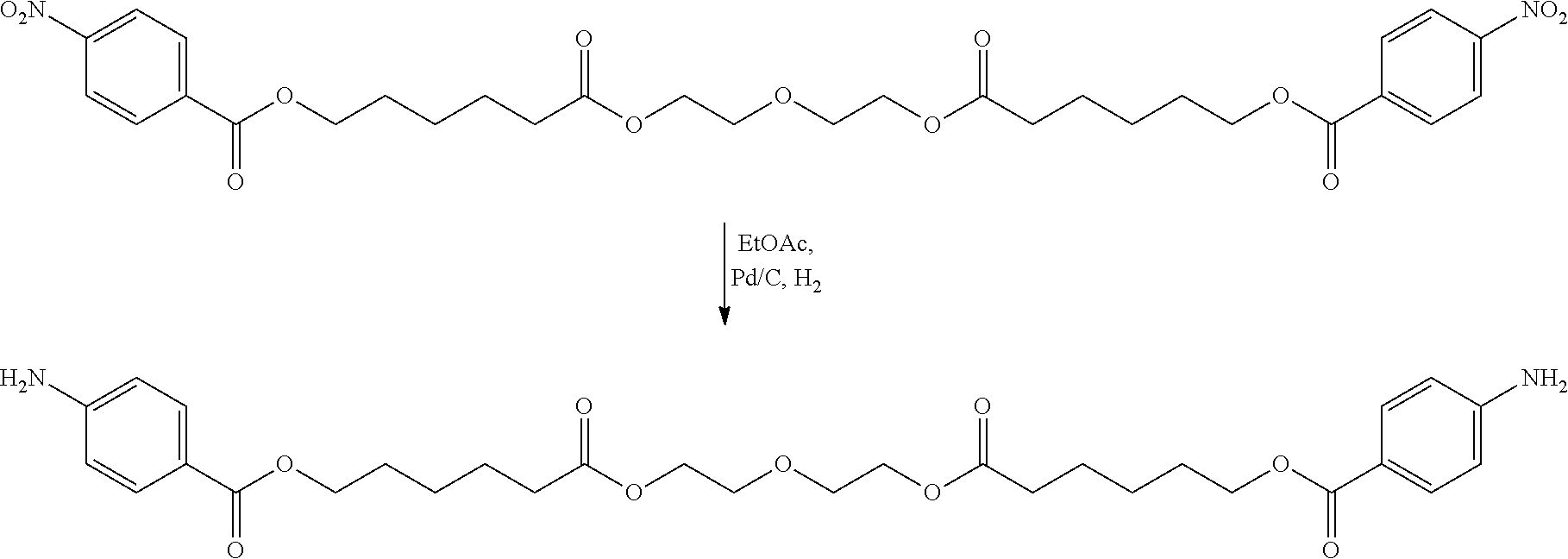


Claims (20)


Priority Applications (3)
| Application Number | Priority Date | Filing Date | Title |
|---|---|---|---|
| US13/275,902 US8901347B1 (en) | 2010-12-13 | 2011-10-18 | Absorbable polyurethanes and methods of use thereof |
| US14/549,509 US20150080301A1 (en) | 2010-12-13 | 2014-11-20 | Absorbable polyurethanes and methods of use thereof |
| US14/874,387 US20160023997A1 (en) | 2010-12-13 | 2015-10-03 | Absorbable polyurethanes and methods of use thereof |
Applications Claiming Priority (2)
| Application Number | Priority Date | Filing Date | Title |
|---|---|---|---|
| US42244710P | 2010-12-13 | 2010-12-13 | |
| US13/275,902 US8901347B1 (en) | 2010-12-13 | 2011-10-18 | Absorbable polyurethanes and methods of use thereof |
Related Child Applications (1)
| Application Number | Title | Priority Date | Filing Date |
|---|---|---|---|
| US14/549,509 Continuation US20150080301A1 (en) | 2010-12-13 | 2014-11-20 | Absorbable polyurethanes and methods of use thereof |
Publications (1)
| Publication Number | Publication Date |
|---|---|
| US8901347B1 true US8901347B1 (en) | 2014-12-02 |
Family
ID=51948329
Family Applications (3)
| Application Number | Title | Priority Date | Filing Date |
|---|---|---|---|
| US13/275,902 Active 2032-09-11 US8901347B1 (en) | 2010-12-13 | 2011-10-18 | Absorbable polyurethanes and methods of use thereof |
| US14/549,509 Abandoned US20150080301A1 (en) | 2010-12-13 | 2014-11-20 | Absorbable polyurethanes and methods of use thereof |
| US14/874,387 Abandoned US20160023997A1 (en) | 2010-12-13 | 2015-10-03 | Absorbable polyurethanes and methods of use thereof |
Family Applications After (2)
| Application Number | Title | Priority Date | Filing Date |
|---|---|---|---|
| US14/549,509 Abandoned US20150080301A1 (en) | 2010-12-13 | 2014-11-20 | Absorbable polyurethanes and methods of use thereof |
| US14/874,387 Abandoned US20160023997A1 (en) | 2010-12-13 | 2015-10-03 | Absorbable polyurethanes and methods of use thereof |
Country Status (1)
| Country | Link |
|---|---|
| US (3) | US8901347B1 (en) |
Cited By (3)
| Publication number | Priority date | Publication date | Assignee | Title |
|---|---|---|---|---|
| US9012677B2 (en) | 2011-02-11 | 2015-04-21 | Bezwada Biomedical, Llc | Amino acid derivatives and absorbable polymers therefrom |
| US9328192B2 (en) | 2014-03-12 | 2016-05-03 | Bezwada Biomedical, Llc | Bio-based monomers and polymers |
| US11110197B2 (en) * | 2016-02-24 | 2021-09-07 | Georgia Tech Research Corporation | Surgical suture materials with porous sheaths for drug delivery |
Citations (12)
| Publication number | Priority date | Publication date | Assignee | Title |
|---|---|---|---|---|
| US3492332A (en) | 1966-12-20 | 1970-01-27 | Upjohn Co | Isocyanato alkyl esters of aromatic acids |
| US4740534A (en) | 1985-08-30 | 1988-04-26 | Sanyo Chemical Industries, Ltd. | Surgical adhesive |
| EP0295055A2 (en) | 1987-06-09 | 1988-12-14 | Biomedical Polymers International, Ltd. | Biodegradable polymeric materials based on polyether glycols, processes for the preparation thereof and surgical articles made therefrom |
| US4829099A (en) | 1987-07-17 | 1989-05-09 | Bioresearch, Inc. | Metabolically acceptable polyisocyanate adhesives |
| US4994542A (en) | 1988-03-07 | 1991-02-19 | Asahi Glass Co., Ltd. | Surgical adhesive |
| US5173301A (en) | 1990-11-27 | 1992-12-22 | Sanyo Chemical Industries, Ltd. | Surgical adhesive |
| US5552507A (en) | 1994-05-17 | 1996-09-03 | Bayer Aktiengesellschaft | Diisocyanates and processes for their production and use |
| US6894140B2 (en) | 2002-10-28 | 2005-05-17 | Tyco Healthecare Gropu Lp | Fast curing compositions |
| US20060288547A1 (en) | 2005-06-23 | 2006-12-28 | 3M Innovative Properties Company | Zoned stretching of a web |
| WO2007030464A2 (en) | 2005-09-06 | 2007-03-15 | Bezwada Biomedical Llc | Bioabsorbable and biocompatible polyurethanes and polyamides for medical devices |
| US20090082540A1 (en) | 2007-09-17 | 2009-03-26 | Bezwada Biomedical, Llc | Hydrolysable linkers and cross-linkers for absorbable polymers |
| US20090292029A1 (en) | 2008-05-23 | 2009-11-26 | Bezwada Biomedical, L.L.C | Bioabsorbable polymers from bioabsorbable polyisocyanates and uses thereof |
Family Cites Families (1)
| Publication number | Priority date | Publication date | Assignee | Title |
|---|---|---|---|---|
| US7968668B2 (en) * | 2005-01-10 | 2011-06-28 | Ethicon Inc. | Diisocyanate terminated macromer and formulation thereof for use as an internal adhesive or sealant |
-
2011
- 2011-10-18 US US13/275,902 patent/US8901347B1/en active Active
-
2014
- 2014-11-20 US US14/549,509 patent/US20150080301A1/en not_active Abandoned
-
2015
- 2015-10-03 US US14/874,387 patent/US20160023997A1/en not_active Abandoned
Patent Citations (16)
| Publication number | Priority date | Publication date | Assignee | Title |
|---|---|---|---|---|
| US3492332A (en) | 1966-12-20 | 1970-01-27 | Upjohn Co | Isocyanato alkyl esters of aromatic acids |
| US4740534A (en) | 1985-08-30 | 1988-04-26 | Sanyo Chemical Industries, Ltd. | Surgical adhesive |
| EP0295055A2 (en) | 1987-06-09 | 1988-12-14 | Biomedical Polymers International, Ltd. | Biodegradable polymeric materials based on polyether glycols, processes for the preparation thereof and surgical articles made therefrom |
| US4829099A (en) | 1987-07-17 | 1989-05-09 | Bioresearch, Inc. | Metabolically acceptable polyisocyanate adhesives |
| US4994542A (en) | 1988-03-07 | 1991-02-19 | Asahi Glass Co., Ltd. | Surgical adhesive |
| US5173301A (en) | 1990-11-27 | 1992-12-22 | Sanyo Chemical Industries, Ltd. | Surgical adhesive |
| US5552507A (en) | 1994-05-17 | 1996-09-03 | Bayer Aktiengesellschaft | Diisocyanates and processes for their production and use |
| US6894140B2 (en) | 2002-10-28 | 2005-05-17 | Tyco Healthecare Gropu Lp | Fast curing compositions |
| US7772352B2 (en) | 2005-01-28 | 2010-08-10 | Bezwada Biomedical Llc | Bioabsorbable and biocompatible polyurethanes and polyamides for medical devices |
| US20100260702A1 (en) | 2005-01-28 | 2010-10-14 | Bezwada Biomedical Llc | Bioabsorbable and biocompatible polyurethanes and polyamides for medical devices |
| US20060288547A1 (en) | 2005-06-23 | 2006-12-28 | 3M Innovative Properties Company | Zoned stretching of a web |
| WO2007030464A2 (en) | 2005-09-06 | 2007-03-15 | Bezwada Biomedical Llc | Bioabsorbable and biocompatible polyurethanes and polyamides for medical devices |
| EP1937182B1 (en) | 2005-09-06 | 2010-12-15 | Bezwada Biomedical LLC | Bioabsorbable and biocompatible polyurethanes and polyamides for medical devices |
| EP2298235A1 (en) | 2005-09-06 | 2011-03-23 | Bezwada Biomedical LLC | Bioabsorbable and biocompatible polyurethanes and polyamides for medical devices |
| US20090082540A1 (en) | 2007-09-17 | 2009-03-26 | Bezwada Biomedical, Llc | Hydrolysable linkers and cross-linkers for absorbable polymers |
| US20090292029A1 (en) | 2008-05-23 | 2009-11-26 | Bezwada Biomedical, L.L.C | Bioabsorbable polymers from bioabsorbable polyisocyanates and uses thereof |
Non-Patent Citations (5)
| Title |
|---|
| Bezwada et al., "Poly(p-dioxanone) and its copolymers," Handbook of Biodegradable Polymers, pp. 29-30. |
| Bezwada, Rao S., "Synthetic Absorbable Polyesters," Technical White Paper (Jul. 2008). |
| Bezwada, Rao. S., "Absorbable Polyurethanes," Technical White Paper (Jul. 2008). |
| Bruin et al., "Design and synthesis of biodegradable poly(ester-urethane) elastomer networks composed of non-toxic building blocks," Makromol. Chem., Rapid Commun. (1988), vol. 9, pp. 589-894. |
| Extended Search Report for EP 06814181.1 issued Jun. 17, 2009. |
Cited By (6)
| Publication number | Priority date | Publication date | Assignee | Title |
|---|---|---|---|---|
| US9012677B2 (en) | 2011-02-11 | 2015-04-21 | Bezwada Biomedical, Llc | Amino acid derivatives and absorbable polymers therefrom |
| US9868696B2 (en) | 2011-02-11 | 2018-01-16 | Bezwada Biomedial, LLC | Amino acid derivatives and absorbable polymers therefrom |
| US10550072B2 (en) | 2011-02-11 | 2020-02-04 | Bezwada Biomedical, Llc | Amino acid derivatives and absorbable polymers therefrom |
| US10689330B2 (en) | 2011-02-11 | 2020-06-23 | Bezwada Biomedical, Llc | Amino acid derivatives and absorbable polymers therefrom |
| US9328192B2 (en) | 2014-03-12 | 2016-05-03 | Bezwada Biomedical, Llc | Bio-based monomers and polymers |
| US11110197B2 (en) * | 2016-02-24 | 2021-09-07 | Georgia Tech Research Corporation | Surgical suture materials with porous sheaths for drug delivery |
Also Published As
| Publication number | Publication date |
|---|---|
| US20150080301A1 (en) | 2015-03-19 |
| US20160023997A1 (en) | 2016-01-28 |
Similar Documents
| Publication | Publication Date | Title |
|---|---|---|
| US8143325B2 (en) | Bioabsorbable and biocompatible polyurethanes and polyamides for medical devices | |
| US8551519B2 (en) | Bioabsorbable surgical articales or components thereof | |
| US8436201B2 (en) | Functionalized diphenolics and absorbable polymers therefrom | |
| Park et al. | Catalyst-free synthesis of high elongation degradable polyurethanes containing varying ratios of isosorbide and polycaprolactone: physical properties and biocompatibility | |
| US8519175B2 (en) | Functionalized amino acids and absorbable polymers therefrom | |
| US10689330B2 (en) | Amino acid derivatives and absorbable polymers therefrom | |
| US8461372B2 (en) | Amino acid derivatives and absorbable polymers therefrom | |
| US9328192B2 (en) | Bio-based monomers and polymers | |
| US20110313057A1 (en) | Difunctionalized aromatic compounds and polymers therefrom | |
| US8901347B1 (en) | Absorbable polyurethanes and methods of use thereof | |
| US8754135B2 (en) | Functionalized non-phenolic amino acids and absorbable polymers therefrom | |
| US8846845B2 (en) | Bioabsorbable and biocompatible polyurethanes and polyamides for medical devices |
Legal Events
| Date | Code | Title | Description |
|---|---|---|---|
| AS | Assignment |
Owner name: BEZWADA BIOMEDICAL, LLC, NEW JERSEY Free format text: ASSIGNMENT OF ASSIGNORS INTEREST;ASSIGNOR:BEZWADA, RAO S.;REEL/FRAME:033878/0101 Effective date: 20140923 |
|
| STCF | Information on status: patent grant |
Free format text: PATENTED CASE |
|
| CC | Certificate of correction | ||
| MAFP | Maintenance fee payment |
Free format text: PAYMENT OF MAINTENANCE FEE, 4TH YR, SMALL ENTITY (ORIGINAL EVENT CODE: M2551) Year of fee payment: 4 |
|
| MAFP | Maintenance fee payment |
Free format text: PAYMENT OF MAINTENANCE FEE, 8TH YR, SMALL ENTITY (ORIGINAL EVENT CODE: M2552); ENTITY STATUS OF PATENT OWNER: SMALL ENTITY Year of fee payment: 8 |