US8899044B2 - Surface tension mediated conversion of light to work - Google Patents
Surface tension mediated conversion of light to work Download PDFInfo
- Publication number
- US8899044B2 US8899044B2 US13/069,131 US201113069131A US8899044B2 US 8899044 B2 US8899044 B2 US 8899044B2 US 201113069131 A US201113069131 A US 201113069131A US 8899044 B2 US8899044 B2 US 8899044B2
- Authority
- US
- United States
- Prior art keywords
- fluid
- absorptive material
- light absorptive
- highly light
- carbon nanotubes
- Prior art date
- Legal status (The legal status is an assumption and is not a legal conclusion. Google has not performed a legal analysis and makes no representation as to the accuracy of the status listed.)
- Active, expires
Links
Images




Classifications
-
- B—PERFORMING OPERATIONS; TRANSPORTING
- B82—NANOTECHNOLOGY
- B82Y—SPECIFIC USES OR APPLICATIONS OF NANOSTRUCTURES; MEASUREMENT OR ANALYSIS OF NANOSTRUCTURES; MANUFACTURE OR TREATMENT OF NANOSTRUCTURES
- B82Y15/00—Nanotechnology for interacting, sensing or actuating, e.g. quantum dots as markers in protein assays or molecular motors
-
- F—MECHANICAL ENGINEERING; LIGHTING; HEATING; WEAPONS; BLASTING
- F03—MACHINES OR ENGINES FOR LIQUIDS; WIND, SPRING, OR WEIGHT MOTORS; PRODUCING MECHANICAL POWER OR A REACTIVE PROPULSIVE THRUST, NOT OTHERWISE PROVIDED FOR
- F03G—SPRING, WEIGHT, INERTIA OR LIKE MOTORS; MECHANICAL-POWER PRODUCING DEVICES OR MECHANISMS, NOT OTHERWISE PROVIDED FOR OR USING ENERGY SOURCES NOT OTHERWISE PROVIDED FOR
- F03G6/00—Devices for producing mechanical power from solar energy
- F03G6/003—Devices for producing mechanical power from solar energy having a Rankine cycle
-
- B—PERFORMING OPERATIONS; TRANSPORTING
- B82—NANOTECHNOLOGY
- B82Y—SPECIFIC USES OR APPLICATIONS OF NANOSTRUCTURES; MEASUREMENT OR ANALYSIS OF NANOSTRUCTURES; MANUFACTURE OR TREATMENT OF NANOSTRUCTURES
- B82Y30/00—Nanotechnology for materials or surface science, e.g. nanocomposites
-
- C—CHEMISTRY; METALLURGY
- C08—ORGANIC MACROMOLECULAR COMPOUNDS; THEIR PREPARATION OR CHEMICAL WORKING-UP; COMPOSITIONS BASED THEREON
- C08K—Use of inorganic or non-macromolecular organic substances as compounding ingredients
- C08K3/00—Use of inorganic substances as compounding ingredients
- C08K3/02—Elements
- C08K3/04—Carbon
- C08K3/041—Carbon nanotubes
-
- Y—GENERAL TAGGING OF NEW TECHNOLOGICAL DEVELOPMENTS; GENERAL TAGGING OF CROSS-SECTIONAL TECHNOLOGIES SPANNING OVER SEVERAL SECTIONS OF THE IPC; TECHNICAL SUBJECTS COVERED BY FORMER USPC CROSS-REFERENCE ART COLLECTIONS [XRACs] AND DIGESTS
- Y02—TECHNOLOGIES OR APPLICATIONS FOR MITIGATION OR ADAPTATION AGAINST CLIMATE CHANGE
- Y02E—REDUCTION OF GREENHOUSE GAS [GHG] EMISSIONS, RELATED TO ENERGY GENERATION, TRANSMISSION OR DISTRIBUTION
- Y02E10/00—Energy generation through renewable energy sources
- Y02E10/40—Solar thermal energy, e.g. solar towers
- Y02E10/46—Conversion of thermal power into mechanical power, e.g. Rankine, Stirling or solar thermal engines
Definitions
- the present invention relates to the field of energy conversion, particularly to conversion of radiant energy (light) into mechanical energy (movement).
- Sunlight provides a vast resource that has spurred the development of various methods to convert photons into work: photovoltaics for conversion to electricity, solar thermal for water heating, fast growing plants to produce bio-fuels, and solar water splitting to produce hydrogen and oxygen (Ref. 1). Though useful, these disparate methods are often based on complicated, capital intensive, multistage processes: (Ref. 2) light is collected and converted to a high energy intermediate (e.g., electrical potential, thermal loading, or chemical fuel), which is then used to run a process, such as an engine, that performs work.
- This multistage approach is ubiquitous and allows for a myriad of applications, but requires production, transportation, and possible storage of intermediates. Considerable effort has been devoted to improving energy collection, storage, and utilization (Ref. 2, 3); however, strategic simplification through the removal of the intermediates remains under-investigated and could provide reductions in capital costs.
- the invention described below comprises methods that couple optical heating with the capability of surface tension gradients to move objects on the surface of liquids or at the interface between two liquids.
- a direct means of converting light into useful work is realized, and a simple strategy for remotely powering and controlling small objects is demonstrated.
- a simple and robust solid/liquid interfacial system can convert light directly into useful work through thermal surface tension effects. This is demonstrated by the propulsion of objects on the surface of water. The simplicity of the system allows for controlled linear motion and rotational motion.
- the present invention comprises, in certain aspects, a method for producing physical motion using an object comprising a highly light absorptive material, where the object is described below in certain embodiments as a ‘boat” floating on a fluid, comprising the steps of: contacting the object with a fluid so as to create an interface with a surface of the fluid and permit relative movement between the object and the fluid, (referred to in certain embodiments as a “water line”); exposing to light said highly light absorptive material on one side, but not another side, of the object (where either the absorptive material or the light, or both, are only on one side or are on non-opposing sides); conducting heat from the highly light absorptive material to the interface to cause local heating of the fluid; and thereby causing physical motion of the object relative to the fluid by lowering surface tension of the fluid in the portion of the fluid having local heating.
- the light absorptive material may be constructed to be in proximate contact with the fluid, i.e. directly contacting the fluid or close enough to the fluid that heat is efficiently transferred to the fluid from the material.
- the highly light absorptive material extends across one side of the object, contacting and even being submerged beneath the supporting liquid. It is contemplated that the highly light absorptive material can be arranged in different patterns on the material. As shown below, the local heating of the fluid, caused by heat from the absorptive material, causes a drop in the surface tension in a localized area of fluid at one end or portion of the object. The fluid tends to pull together more strongly at the other (less heated) end, causing physical motion of or within the object, and thus direct conversion of light to work. The motion may comprise linear displacement of the object relative to the fluid.
- the present invention may comprise, in certain aspects, a method wherein the one side (or non-opposing sides) of highly light absorptive material exposed to light extends radially from the object and the motion comprises rotational motion, i.e., the object spins.
- the motion comprises rotational motion, i.e., the object spins.
- one may obtain rotational movement of a transducer harvesting the energy.
- the thermal gradient in the object, rather than being from front to back, will be from central to circumferential portions.
- the present invention may comprise, in certain aspects, a method or device wherein the object is formed of a silicon polymer.
- the object may be formed of a hydrophobic polymer.
- the object may comprise highly light absorptive material either in one or more selected portions or throughout the object (in this case, the object is lit and heated differentially to produce the gradient).
- the highly absorptive material may consist of or comprises carbon nanotubes embedded within a support matrix.
- the highly light absorptive material may either consist of or comprise carbon nanotubes embedded within the support matrix as vertically aligned carbon nanotubes, on one side, or non-opposing sides, of the object.
- the highly light absorptive material may in certain embodiments be selected from the group consisting of vertically aligned parallel carbon nanotubes, nanowires or nanoropes; parallel silica nanorods; carbon rings, fibers, and tubes, and carbon black. Either or both of single-walled or multi-walled nanotubes may be used.
- the present invention may comprise, in certain aspects, a method or device wherein the fluid is selected from one or more of glycerol, alcohols, DMF (dimethylformamide), fluorinated solvents, salt water, pure water and the boundary between immiscible liquids.
- the fluid is selected from one or more of glycerol, alcohols, DMF (dimethylformamide), fluorinated solvents, salt water, pure water and the boundary between immiscible liquids.
- the present invention may comprise, in certain aspects, a device for directly converting light energy to mechanical energy by modification of surface tension on a supporting fluid, comprising: a container for a fluid; an object comprising a highly light absorptive material placed on one side of the object to receive light and to contact the fluid at a surface of the fluid.
- the present invention may comprise, in certain aspects, a device for directly converting light energy to mechanical energy by modification of surface tension on a supporting fluid, comprising: a container for a fluid; a plurality of objects, where individual objects comprise a highly light absorptive material placed on one side of the object to receive light and to contact the fluid at a surface of the fluid, said plurality of objects coupled for combining forces of movement.
- a device for directly converting light energy to mechanical energy by modification of surface tension on a supporting fluid comprising: a container for a fluid; a plurality of objects, where individual objects comprise a highly light absorptive material placed on one side of the object to receive light and to contact the fluid at a surface of the fluid, said plurality of objects coupled for combining forces of movement.
- the presently exemplified devices may be scaled up to production size devices, capable of producing significant amounts of energy by coupling the mechanical output of the objects and/or by increasing the sizes of the objects.
- the device may comprise in certain aspects, a polyhedron, e.g., a cube (tetrahedron), and may be formed of a silicon polymer having a highly light absorptive surface on one side.
- the highly light absorptive material may comprise carbon nanotubes, and may cover one face of a polyhedron. For example, the entire face above the water line may be covered, and a small portion below the water line, or, for ease of manufacture, the entire face may be covered.
- the highly light absorptive material may comprise vertically aligned nanotubes, and may be arrayed in a two-dimensional “forest” where the tubes (“trees”) conduct heat to the fluid surface.
- the device may comprise, in certain aspects, a lens for focusing light on one region of the object. This would be important where the object has highly absorptive material in more than the region where surface tension is to be lowered.
- FIGS. 1A and 1B are diagrams showing light-based control of VANT-PDMS (vertically aligned carbon nanotubes on polymethylsiloxane) objects on a fluid medium supporting the object.
- VANT-PDMS vertically aligned carbon nanotubes on polymethylsiloxane
- FIGS. 1C and 1D are photographs showing light-based control of VANT-PDMS (vertically aligned carbon nanotubes on polymethylsiloxane) objects on a fluid support.
- VANT-PDMS vertically aligned carbon nanotubes on polymethylsiloxane
- FIG. 2 is a diagram showing selective placement of focused light heating one region of an object, surface tension heated (ST) and net motion. Surface tension unheated is shown by patterned arrows.
- FIG. 3 is a pair of graphs (a) and (b) showing location plots for a VANT-PDMS composite under collimated laser illumination.
- FIG. 3A shows the quenching effect of the addition of the surfactant, SDS, on the motion of the composite.
- FIG. 3B shows a motion curve depicting the distance traveled by VANT-PDMS composites in water, IPA or DMF filled troughs under nIR (near infrared) laser illumination.
- FIG. 4A-D is a series of photographs and a graph ( FIG. 4E ) showing nanotube—PDMS composites.
- FIG. 4A is a photograph of a VANT-PDMS with blow up scanning electron micrographs shown in FIG. 4B and inset, after exposure to water and isopropyl alcohol. Scale bar in inset is 10 um.
- FIG. 4C is a photograph of a 0.1 wt. % MWNT-PDMS composite, and FIG. 4D shows a VANT-PDMS composite that contains roughly 5 wt. % NTs localized at the back face.
- the graph in FIG. 4E shows motion curves for VANT-PDMS, 0.1 wt. % PDMS and pristine PDMS as illustrated in 4 A-D under collimated laser illumination. It can be seen that pristine PDMS did not move and the VANT-PDMS moved further in a given time period than 0.1% MWNT-PDMS
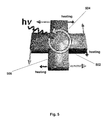
- FIG. 5 is a diagrammatic representation of a rotor design that can be fabricated with controlled architecture.
- a rotor is shown which can rotate counterclockwise as shown by the curved arrow.
- VANTs are selectively placed on the clockwise face of each fin, as shown at 502 , 504 and 506 .
- FIG. 6A-F is a series of images showing a VANT-PDMS rotor rotation with time. Schematic (top, FIGS. 6A and B) showing forces (gray arrows and with heating labeled as in FIG. 5 ) on PDMS rotor with absorbing material embedded on the clockwise face of each fin while dark and illuminated.
- the bottom series of four images ( FIG. 6C-F ) is a time line of a VANT-PDMS rotor floating on deionized water with embedded VANTs on clockwise face of each fin and irradiated with focused sunlight. The square remains stationary as the star follows one fin. A 360 degree rotation over a 1 second time interval is shown. Times are indicated in the panels C-F.
- FIG. 7 is a line graph showing the motion induced by the continuous irradiation of a VANT-PDMS composite with 450 mW of 785 nm laser light.
- the location data and fit with fit parameters are shown.
- m is in grams
- R is in grams/cm
- t o is in seconds
- Fl is in 10 ⁇ N
- C is in cm.
- the force on the object was roughly 16.5 ⁇ N.
- VANT is used herein in its art-recognized sense to refer to vertically aligned carbon nanotubes.
- These carbon nanotubes are, in the exemplary embodiments, multi-walled carbon nanotubes, but may be single-walled carbon tubes, or carbon nanorods or nanowires, etc. that are arranged in a “forest” of needle-like or rod-like members which extend in parallel from a surface, thereby populating a two dimensional area by end contacts on the surface.
- single walled CNTs extend from the surface at a distance of about 100 ⁇ m.
- Carbon nanotubes typically have a diameter between 0.5 nm and 100 nm.
- VANT may have a “forest” density of needle-like members per sq. cm on the order of 2 ⁇ 10 11 cm ⁇ 2 , e.g., 2 ⁇ 10 8 cm ⁇ 2 , 2 ⁇ 10 12 cm ⁇ 2 or denser.
- the term “vertically aligned carbon nanotube” is recognized in the art. Vertically aligned titania nanotubes are also known in the art.
- highly light absorptive material is used herein to refer to a material such as VANT which can absorb a high percentage (e.g., at least 80% or at least 90% or at least 99% of incident visible light). Carbon black, black paint and carbon nanotubes have also been used as highly light absorptive material, as described below. VANT are further described in Ref. 15 (Yang et al.) The presently exemplified VANT were grown by chemical vapor deposition of carbon nanotubes on silicon substrates. US 2009/0297428 entitled “System and method for broad-area synthesis of aligned and densely-packed carbon nanotubes” further describes methods for preparing VANT.
- Carbon nanotubes may also be prepared within aerogels for use as highly light absorptive material in the present invention.
- carbon containing gases are entered into the pores of silica aerogels and silica aerogels are doped with iron or nickel.
- Such aerogels are formed by deposition of uniform layers of carbon into silica aerogels, although the appearance of carbon rings, fibers, and tubes has also been seen under transmission electron microscopy (TEM) in silica aerogels after CVD with a flow of 25% acetylene 75% argon at a rate of 100-300 sccm (standard cubic centimeters per minute) at temperatures of 550-580° C.
- TEM transmission electron microscopy
- highly light absorptive material examples include niobiumnitride (NbN), as described in E. F. C. Driessena and M. J. A. de Dood, “The perfect absorber,” Applied Physics Letters , Online Apr. 29, 2009.
- NbN niobiumnitride
- Another example is an array formed by depositing silica nanorods at around 45° onto a thin film of aluminum nitride, as described in Xi et al., “Optical thin-film materials with low refractive index for broadband elimination of Fresnel reflection,” Nature Photonics, 1:176-179 (2007).
- PDMS polydimethylsiloxane. It is an optically clear silicone. It has the formula CH 3 [Si(CH 3 ) 2 O] n Si(CH3) 3 , where n is the number of repeating monomer [SiO(CH 3 ) 2 ] units. After polymerization and cross-linking, solid PDMS samples will present an external hydrophobic surface. In a typical PDMS, a distribution of chain lengths centers around an average molecular weight or size. Depending on how the polymer is manufactured, it may also contain some cyclic siloxane structures.
- support matrix means a polymeric or otherwise formable material which can assume a solid state and support a highly light absorptive material.
- the surface tensions of some common liquids are also listed below. Surface tension is due to the unbalanced force experienced by molecules at the surface of a liquid. As a result of surface tension, a drop of liquid tends to form a sphere, because a sphere offers the smallest area for a definite volume. Water, with extensive hydrogen bonding, has a relatively high surface tension.
- the methods and devices described below show that with a highly light absorptive material capable of locally converting light energy into heat, concentrated light can be used to selectively generate thermal surface tension gradients and move objects on the surface of a liquid, such as water ( FIG. 1A-B , FIG. 3 ).
- This approach combines energy collection and utilization into one material.
- the interfacial system allows control to be readily enacted in two ways: (i) selectively focusing light on different regions of the absorber to affect the direction of the exerted forces ( FIG. 1A-B ); and (ii) through device design providing specific orientations of the light absorbing material within the device. This versatility gives access to work in the form of controlled linear motion and rotational motion.
- FIGS. 1A and B illustrate a basic design and operation of the present device.
- a three-dimensional object shown as a block 102 , having four surfaces, has an opto-thermal surface on one side, 102 a that is non-parallel (e.g., essentially orthogonal) to the surface of a liquid on which the block floats.
- the liquid creates a “water line” 104 or interface between the block 102 above and below the liquid surface, i.e., at the surface of the illustrated liquid.
- the interface may be on a liquid surface and air, or an interface between two immiscible liquids. Heat is delivered to a portion of the block at the interface.
- the opto-thermal surface comprises a highly light absorptive material (e.g., VANT) accessible to incident light, shown as hv in the figures.
- VANT highly light absorptive material
- the block 102 is supported by the liquid so that is free to move about in the liquid. Light striking near the lateral center of opto-thermal surface, comprising highly light absorptive material, 102 a causes movement in the direction of arrow 106 , essentially opposite from the opto-thermal surface receiving the light.
- FIG. 1C-D of a VANT-PDMS composite in a water filled trough show the linear propulsion described in FIGS. 1A and B.
- the VANT-PDMS object was briefly irradiated at time zero with focused near-IR light (450 mW) on the left ( FIGS. 1C and D), absorbing face of the object.
- the laser source was roughly 13 cm away, with the beam nearly grazing the surface of the water, and the focus set to coincide with the absorbing face of the object.
- VANTs vertically aligned carbon nanotubes
- the VANT area extends below the surface of the liquid as one way of accomplishing this.
- Low density VANTs, with very high surface roughness, have recently been reported to be the blackest known material, absorbing greater than 99.9% of incident visible light (Ref. 15).
- Thermal relaxation of excited electrons converts absorbed light into heat, thus making VANTs ideal light-activated thermal switches, which can heat the surrounding liquid and maximize surface tension gradients (Ref. 16).
- FIG. 4A is a photograph of a PDMS block with VANT on one end. The VANT occupies only a portion of one end of the PDMS block.
- FIG. 4B is a micrograph showing details of the VANT surface.
- Polydimethylsiloxane (PDMS) was employed for four reasons: (i) it is optically transparent, focusing absorption on the thin nanotube surface layer; (ii) it has a density similar to that of water; (iii) it strongly adheres to the VANTs; and (iv) it provides elasticity while maintaining the nanoscale roughness and macroscopic structure of the forests.
- the VANT-PDMS composites (FIG. 4 A,B) are stable to water and solvents, are superhydrophobic (Ref. 17) with contact angles of >155° and can be created with various shapes and orientations.
- polystyrene polystyrene
- polyesters polyethylene naphthalate
- polyolefins such as metallocened polyolefins, such as polypropylene (PP) and high-density polyethylene (HDPE) and low-density polyethylene (LDPE)
- polyvinyls such as plasticized polyvinyl chloride (PVC), polyvinylidene chloride, poly(vinyl acetate) and its derivatives such as poly(vinyl alcohol), acrylic and acrylate polymers such as methacrylate polymers, poly(methyl methacrylate) (PMMA), methacrylate copolymers, polyamides and polyimides, polyacetals, phenolic resins, aminoplastics such as urea-formaldehy
- Support materials may be hydrophobic polymers such as those of the poly alkyl (acrylate) family, polydiene family, poly imidazole family, polylactone and polylactide family, polyolefin family, polysiloxane family, etc. They may be transparent or translucent to allow light to strike the highly absorptive material through the object.
- Such a design may be visualized like a water wheel, a multi-finned system where rotation of the wheel turns a shaft, and rotation of one surface brings into working alignment a following surface.
- the surface tension-driven objects may be designed to move in a circular path and be tethered on one side.
- a number of surface tension-driven objects may be harnessed together. It is contemplated that a number of the differentially absorptive objects will be harnessed together in an array for cooperative force.
- the objects may be coupled to each other individually. They may be coupled in a linear or parallel fashion. They may be coupled to any one of a variety of common force transducers, such as a turbine, pulley, shaft, wheel, lever, piston, etc. Hundreds or thousands or more surface tension-driven objects may be coupled.
- an object designed to achieve a thermal gradient is floated on a liquid, and surface tension is modified by heating on one aspect of the object at the surface or interface between two liquid surfaces.
- the object will have a density less than the liquid, so that it does not sink.
- Alternative embodiments are possible where, instead of the object moving through the liquid, the liquid moves through the object.
- the object may be fixed in a fluid circuit and/or provided with channels in the form of grooves or holes through which the liquid will move.
- the moving liquid may be harnessed to produce mechanical work.
- VANTs Vertically aligned carbon nanotubes
- silicon substrates with ⁇ 1.5 nm Fe on 10 nm Al 2 O 3 as a catalyst system.
- the substrates were loaded into a 1′′ Linderberg/Blue M Mini-Mite Tube Furnace, heated to 450° C. under 200 standard cubic centimeters per minute (sccm) nitrogen, soaked in a reducing atmosphere (hydrogen 40 sccm: nitrogen 200 sccm) for 5 minutes, and then heated to 750° C.
- Ethylene (40 sccm) was introduced for 30 minutes along with 2 sccm of water saturated nitrogen.
- VANTs were characterized with scanning electron microscopy (SEM) conducted with a FEI Sirion XL30 SEM. The VANTs were hundreds of microns tall with average diameters of ⁇ 10 nm.
- composites were prepared by contact curing PDMS (Slygard 184 Silicone Elastomer Kit) on VANT substrates preheated to 200° C. This prevented the PDMS from fully impregnating the VANT substrate and left the bottom ends of the nanotubes exposed.
- the embedded forests emerge from the PDMS by ⁇ 100 ⁇ m ( FIG. 4B ) and are stable to solvents and mild mechanical pressure. Surface contact angles were measured on a Krüss Model G10 goniometer at room temperature and ambient relative humidity using 18 M ⁇ water according to the sessile drop method. Composites can be cut to any desired shape.
- composites because they comprise a plastic embedded with a carbon nanomaterial, can be formed in other ways not strictly considered composites. They may be shaped by molding or various other ways, and may be configured for ease of movement through the liquid in a given direction (i.e., streamlined).
- Alternative light absorbing materials such as homogenous carbon black-PDMS and MWNT-PDMS composites were made by thoroughly mixing the absorbing material (1-5 wt. %) with PDMS and curing at 100° C. in a box furnace for 2 hours.
- the composites were floated on various liquids including deionized water, brine, Fluorinert® liquid, FC-75, DMF, glycerol and irradiated with either focused sunlight using a Fresnel lens (Fresnel Tech, Inc), glass lens or a near-IR diode laser (450 mW B&W Tek, Inc 785-450E/55371). Illumination conditions varied, though motion was typically tested with the object near the focal point and roughly 5-20 cm away. Speed tests were performed in an aluminum trough filled with the appropriate liquid. Both continuous illumination and single pulse illumination experiments were undertaken. Objects tested ranged from 20 mg to 25 g and ⁇ 1 mm to multiple centimeters and showed light responses. Resulting motion was recorded using a Casio Exlim Pro EX-F1 at 30-1200 frames per second (fps).
- R 1 2 ⁇ ⁇ ⁇ ⁇ A ⁇ ⁇ C D ( 2 )
- Fnet the net force
- FL the force due to the light based modulation of the surface tension
- m the mass of the composite
- R is defined from the drag equation as in (2): v is the velocity, a is the acceleration, ⁇ is the density of the solution, A is the displaced area, and CD is the drag coefficient. Integrating equation 1 twice gives the location as a function of time (equation 3):
- X m R ⁇ log ⁇ [ cosh ⁇ ( F L * R m ⁇ ( t - t 0 ) ) ] + D ( 3 )
- X is the location, and to, and D are integration constants.
- FIG. 7 A typical location vs. time plot with fit is shown in FIG. 7 .
- VANT-PDMS composites When subjected to focused sunlight or a near-infrared laser (Ref. 18) (450 mW, 785 nm Diode Laser), the VANT-PDMS composites heat dramatically. Under static conditions, water droplets can be boiled and carbonaceous material on the VANTs can be burnt in air. When placed in a liquid, this dramatic heating of the VANTs leads to significant temperature gradients as the substrate transfers energy to the surrounding liquid.
- Ref. 18 near-infrared laser
- VANT-PDMS composites were floated on liquids and sunlight or laser light was focused on the light absorbing material.
- Light induced heating directly resulted in linear propulsion ( FIG. 1C-D ) without boiling (Ref. 19).
- a number of control experiments were performed. First, no response was observed when irradiating transparent PDMS objects lacking absorbing materials, as shown by the graphs in FIG. 4E Second, substantial heating of substrates was observed when irradiated (Ref. 20). Third, motion was quenched upon addition of surfactant, sodium dodecyl sulfate ( FIG. 3A ), which cuts surface tension effects (Ref. 21).
- Motion was not limited to the surface of water but was also demonstrated on liquids as varied as glycerol, alcohols, DMF, fluorinated solvents, (Fluorinert® FC-75 perfluoro(2-butyl-tetrahydrofurane) salt water, and even at the boundary between immiscible liquids (water and FC-75) (Ref. 25).
- the light-induced propulsion of the composites was quantified for water, isopropyl alcohol (IPA), and dimethyl formamide (DMF).
- IPA isopropyl alcohol
- DMF dimethyl formamide
- VANT-PDMS composite On water the VANT-PDMS composite produced an average force of 1.19 ⁇ 0.36 ⁇ N (error is reported as the 95% confidence interval over four samples). The composite was significantly less responsive when floating in IPA and DMF, with forces produced on the order of 0.23 ⁇ 0.12 ⁇ N and 0.13 ⁇ 0.03 ⁇ N respectively. The obtained solvent dependence on the generated force appears complicated and may be attributed to differences in the heat capacities, buoyancy, viscosity and the temperature dependence of the surface tension.
- VANT-PDMS composites were compared with homogenously mixed composites of multiwall carbon nanotubes and PDMS (MWNT-PDMS) as shown in FIG. 4E .
- Larger composites ( ⁇ 250 mg) were tested so as to normalize the effective absorbing area.
- Composites larger than the spot size of the laser were used to allow absorption to be focused solely on the back face. This resulted in larger forces being produced than when the spot size was larger than the back face of the composites. Incorporation of 1-5 wt.
- % MWNT illustrated by photographs in FIGS. 4C and D, produces an opaque black composite that performs similarly to the VANT-PDMS composite, with forces of 1.9 ⁇ 0.3 ⁇ N, 2.2 ⁇ 0.3 ⁇ N, 2.9 ⁇ 0.9 ⁇ N for the 1 wt. %, 5 wt. % and VANT composites respectively.
- Rotational motion can be achieved by introducing directionality into the device design. For instance, by placing light absorbing VANTs on the clockwise face of each fin of a rotor ( FIG. 5 ), localized heating produces surface tension forces that cause the object to rotate in the counterclockwise direction. Alternatively, flipping the object over affords clockwise rotation. As shown in FIGS. 5 and 6 , when placed under focused sunlight or irradiated with a near-IR laser these rotors spin at rates up to 70 rpm. Built-in directionality is particularly useful for sunlight powered motion, as it is relatively difficult to focus the sun on small moving objects. In this case, Fresnel lenses can be used to focus sunlight on floating rotors, resulting in continuous rotation. Rotors can also be mounted on an axel or stiff metal wire, which may increase the utility of the rotors with potential application for simple solar powered water pumps.
- FIG. 6 shows rotation of a VANT-PDMS rotor as a function of time.
- Pristine PDMS was found to have no response to laser illumination.
- MWNT (0.1, 1, and 5 wt. %)-PDMS composites were compared with a VANT-PDMS composite. All composites had masses of ⁇ 250 mg.
- larger composites were used so the collimated laser beam would only heat the back face of the object. Forces of 1.0 ⁇ 0.1 ⁇ N, 1.9 ⁇ 0.3 ⁇ N, 2.2 ⁇ 0.3 ⁇ N, 2.9 ⁇ 0.9 ⁇ N were obtained for 0.1, 1, 5 wt. % and VANT-PDMS composites respectively.
- latent heat of the objects, after testing, causes them to continue to be propelled forward. This is more obvious with the homogenous composites, which absorb throughout the material than with the VANT-PDMS composites. This suggests that the VANT-PDMS composites transfer heat more effectively to their surroundings then the homogenous composite.
- the ability to select the face that is illuminated in order to enact control is an advantage of the homogenously mixed composites (as described in FIG. 2 , where the black box represents a homogeneously mixed block). It is notable that since the absorbing material is only on one face of the VANT-PDMS composites (i.e., the back of the boat), absorption and forward propulsion can still be achieved with frontal laser irradiation, as the laser beam can pass through the transparent PDMS. This result suggests that radiation pressure from the incident light is not the dominant force.
- VANT-PDMS composites (3 mm ⁇ 10 mm ⁇ 1 mm) were floated on water in an aluminum trough (64 cm ⁇ 3.3 cm ⁇ 1.5 cm) and irradiated with nIR laser light to verify light induced motion.
- Sodium dodecyl sulfate ( ⁇ 70 mg) was dropped onto the surface of the solution and allowed to dissolve ( ⁇ 0.5 min).
- the composite was then irradiated with nIR light. No motion was observed even under the highest focus. When laser light was highly focused, bubbles formed as the water locally boiled, a phenomenon not observed when in pure water. If an intermediate amount of surfactant was used ( ⁇ 30 mg), light induced motion was retarded but not completely eliminated for highly focused irradiation.
- VANT-PDMS composites (3 mm ⁇ 10 mm ⁇ 1 mm, 36.2 mg) were floated on water, isopropyl alcohol, or DMF and the response was quantified. Small composites were used so as not to break the surface tension (particularly for the IPA) holding the object above the surface. The objects were then irradiated with nIR laser light at an angle of 45° and the motion recorded. In order to control illumination intensity, collimated laser conditions with a spot size of ⁇ 4.5 mm were used. Forces were determined as described above. In water, forces of 1.19 ⁇ 0.36 ⁇ N were observed over seven measurements, error is reported as plus or minus one standard deviation.
Landscapes
- Chemical & Material Sciences (AREA)
- Engineering & Computer Science (AREA)
- Nanotechnology (AREA)
- Crystallography & Structural Chemistry (AREA)
- Life Sciences & Earth Sciences (AREA)
- Health & Medical Sciences (AREA)
- Materials Engineering (AREA)
- General Physics & Mathematics (AREA)
- Condensed Matter Physics & Semiconductors (AREA)
- Composite Materials (AREA)
- General Health & Medical Sciences (AREA)
- Physics & Mathematics (AREA)
- Molecular Biology (AREA)
- Combustion & Propulsion (AREA)
- Chemical Kinetics & Catalysis (AREA)
- General Engineering & Computer Science (AREA)
- Mechanical Engineering (AREA)
- Sustainable Energy (AREA)
- Sustainable Development (AREA)
- Organic Chemistry (AREA)
- Polymers & Plastics (AREA)
- Medicinal Chemistry (AREA)
- Carbon And Carbon Compounds (AREA)
Abstract
Description
- Pollack et al., “Electrowetting-based actuation of droplets for integrated microfluidics,” Lab Chip, 2:96-101 (2002) describes the micromanipulation of discrete droplets of aqueous electrolyte by electrowetting. A series of electrodes are used to control drop merging and splitting.
- Darhuber et al. “Microfluidic Actuation by Modulation of Surface Stresses,” App. Phys. Lett., 82(4):657-659 (January 2003) discloses a microfluidic device that can be used to manipulate nanoliter liquid samples. The device uses hydrophilic lanes and specific heating elements.
- Okawa et al., “Surface Tension Mediated Conversion of Light to Work,” J. Am. Chem. Soc., 131(15): 5396-5398 (Mar. 27, 2009) is a description of the present work by inventors named herein.
| Surface Tension | |
| Liquid | N/m (room temperature, approx. 20 deg. C.) |
| Diethyl ether | 0.0728 |
| Chloroform | 0.0271 |
| Benzene | 0.0289 |
| Carbon tetrachloride | 0.0270 |
| Water | 0.0728 |
| Water (60 deg. C.) | 0.0662 |
| Water (100 deg. C.) | 0.0589 |
| Ethanol | 0.0228 |
| Mercury | 0.436 |
| Olive oil | 0.032 |
| Glycerol | 0.0634 |
where Fnet is the net force, FL is the force due to the light based modulation of the surface tension, m is the mass of the composite, R is defined from the drag equation as in (2): v is the velocity, a is the acceleration, ρ is the density of the solution, A is the displaced area, and CD is the drag coefficient. Integrating
where X is the location, and to, and D are integration constants. A typical location vs. time plot with fit is shown in
- (1) (Photovoltaic) Hagfeldt, A.; Gratzel, M. Acct. Chem. Res. 2000, 5, 269-277. (Solar Thermal) Cuomo, J. J.; Ziegler, J. F.; Woodall, J. M. Appl. Phys. Lett. 1975, 26, 557-559. (Bio-fuel) St. Clair, S.; Hillier, J.; Smith, P. Biomass & Bioenergy 2008, 32, 442-452. (Water splitting) Khan, S.; Al-Shahry, M.; Ingler, W. B. Science, 2002, 297, 2243-2245.
- (2) Basic Research Needs for Solar Energy Utilization, Report of the BES Workshop on Solar Energy Utilization Apr. 18-21, 2005.
- (3) Gratzel, M. Phil. Trans. R. Soc. A. 2007, 365, 993-1005. Burke, A. J. Power Sources 2000, 91, 37-50.
- (4) Forward, R. L. J. Spacecraft 1990, 27, 411-416.
- (5) Ashkin, A. Proc. Natl. Acad. Sci. 1997, 94, 4853-4860.
- (6) (a) Denninghoff, D. J.; Starman, L. A.; Kladitis, P. E.; Perry, C. IEEE Circuits and Systems
48th Midwest Symposium 2005, 1, 367-370. (b) Crookes, W. Phil. Trans. Roy. Soc. Of London 1874, 164, 501-527. - (7) Rybalko, S.; Magome, N.; Yoshikawa, K. Phys. Rev. E. 2004, 70, 046301.
- (8) (a) Brzoska, J. B.; Brochard-Wyart, F.; Rondelez, F. Langmuir, 1993, 9, 2220-2224. Brochard,
F. Langmuir 1989, 5, 432-438. (b) Farahi, R. H.; Passian, A.; Zahrai, S.; Lereu, A. L.; Ferrell, T. L.; Thundat,T. Ultramicroscopy 2006, 106, 815-821. - (9) Baroud, C. N.; de Saint Vincent, M. R.; Delville, J. P. Lab Chip 2007, 7, 1029-1033.
- (10) Schildknecht, H. Angew. Chem. Int. Ed. Engl. 1976, 15, 214-222.
- (11) Nakata, S.; Kirisaka, J.; Arima, Y.; Ishii, T. J. Phys. Chem. B. 2006, 110, 21131-21134.
- (12) Bush, J. W. M.; Hu, D. L. Annu. Rev. Fluid Mech. 2006, 38, 339-369.
- (13) (a) Kline, T. R.; Paxton, W. F.; Mallouk, T. E.; Sen, A. Catalytic, Angew. Chem. Int. Ed. 2005, 44, 744-746. (b) Ismagilov, R. F.; Schwartz, A.; Bowden, N.; Whitesides, G. M. Angew, Chem. Int. Ed. 2002, 41, 652-654.
- (14) Carbon black, multiwall carbon nanotubes, and black paint have all been shown to produce responses. 5% MWNT produces a similar response to the response of the VANT absorber
- (15) Yang, Z. P.; Ci, L.; Bur, J. A.; Lin, S. Y.; Ajayan, P. M. Nano Lett. 2008, 8, 446-451.
- (16) Pastine, S. J.; Okawa, D.; Kessler, B.; Rolandi, M.; Llorente, M.; Zettl, A.; Fréchet, J. M. J. J. Am. Chem. Soc. 2008, 130, 4238-4239.
- (17) In principle, any laser absorbed by the composite should be effective.
- (18) In principle any laser absorbed by the composite should be effective.
- (19) Discussed elsewhere herein.
- (20) Stable temperatures of 150° C. were observed under collimated laser illumination and measured with a thermocouple embedded in the PDMS.
- (21 Gugliotti, M.; Baptista, M. S.; Politi, M. J., Langmuir, 2002, 18, 9792-9798.
- (22) (a) Shapere, A.; Wilczek, F. Phys. Rev. Lett. 1987, 58, 2051-2054. (b) Chang, S. T.; Paunov, V. N.; Petsev, D. N.; Velev, O. D. Nat. Mater. 2007, 6, 235-240.
- (23) Forces were derived from location vs. time plots.
- (24) Luo C.; Luo, H.; Li, X.; Liu, J. Micromech. Microeng., 2008, 18, 1-6.
- (25) Discussion of the necessity for controllably moving small objects on a variety of noncaustic liquids: Wang, J., ACS Nano., 2009, 3, 4-9.
Claims (25)
Priority Applications (1)
| Application Number | Priority Date | Filing Date | Title |
|---|---|---|---|
| US13/069,131 US8899044B2 (en) | 2010-03-25 | 2011-03-22 | Surface tension mediated conversion of light to work |
Applications Claiming Priority (2)
| Application Number | Priority Date | Filing Date | Title |
|---|---|---|---|
| US31755210P | 2010-03-25 | 2010-03-25 | |
| US13/069,131 US8899044B2 (en) | 2010-03-25 | 2011-03-22 | Surface tension mediated conversion of light to work |
Publications (2)
| Publication Number | Publication Date |
|---|---|
| US20110272598A1 US20110272598A1 (en) | 2011-11-10 |
| US8899044B2 true US8899044B2 (en) | 2014-12-02 |
Family
ID=44901343
Family Applications (1)
| Application Number | Title | Priority Date | Filing Date |
|---|---|---|---|
| US13/069,131 Active 2033-08-03 US8899044B2 (en) | 2010-03-25 | 2011-03-22 | Surface tension mediated conversion of light to work |
Country Status (1)
| Country | Link |
|---|---|
| US (1) | US8899044B2 (en) |
Cited By (2)
| Publication number | Priority date | Publication date | Assignee | Title |
|---|---|---|---|---|
| US20140196435A1 (en) * | 2013-01-13 | 2014-07-17 | Eugenio Sanchez-Gil | Space Impulse Drive |
| US11078891B2 (en) * | 2019-09-24 | 2021-08-03 | National Central University | Light-driven rotor applied to a water surface |
Families Citing this family (3)
| Publication number | Priority date | Publication date | Assignee | Title |
|---|---|---|---|---|
| CN115232507B (en) * | 2022-07-27 | 2023-04-18 | 湖北铁神新材料有限公司 | Super-hydrophobic coating material with photo-thermal and sound absorption functions and preparation method thereof |
| WO2024205687A1 (en) * | 2023-03-27 | 2024-10-03 | Ecolab Usa Inc. | Motion based dynamic tensiometer for detecting the presence of surfactants |
| US20250263832A1 (en) * | 2024-02-15 | 2025-08-21 | Rtx Corporation | Local part masking for improved uniformity in ceramic matrix composites |
Citations (2)
| Publication number | Priority date | Publication date | Assignee | Title |
|---|---|---|---|---|
| US4397150A (en) * | 1980-05-09 | 1983-08-09 | Paller Marc S | Power generating apparatus using radiant energy |
| US20050097806A1 (en) * | 2003-11-07 | 2005-05-12 | Schumacher James F. | Cast - away bobber |
-
2011
- 2011-03-22 US US13/069,131 patent/US8899044B2/en active Active
Patent Citations (2)
| Publication number | Priority date | Publication date | Assignee | Title |
|---|---|---|---|---|
| US4397150A (en) * | 1980-05-09 | 1983-08-09 | Paller Marc S | Power generating apparatus using radiant energy |
| US20050097806A1 (en) * | 2003-11-07 | 2005-05-12 | Schumacher James F. | Cast - away bobber |
Non-Patent Citations (4)
| Title |
|---|
| Okawa, et al., "Surface Tension Mediated Conversion of Light to Work", Journal of the American Chemical Society, 2009, 131 (15), 5396-5398. |
| Panzer, et al., "Thermal Properties of Metal-Coated Vertically Aligned Single-Wall Nanotube Arrays", Journal of Heat Transfer, May 2008, vol. 130, 052401-1 to 052401-9. |
| Pasqua, et al., "Large-scale simulations of fluctuating biological membranes", The Journal of Chemical Physics, 132, 154107 (2010). |
| Xi, et al., "Optical thin-film materials with low refractive index for broadband elimination of Fresnel reflection", nature photonics, vol. 1, Mar. 2007, pp. 176-179. |
Cited By (2)
| Publication number | Priority date | Publication date | Assignee | Title |
|---|---|---|---|---|
| US20140196435A1 (en) * | 2013-01-13 | 2014-07-17 | Eugenio Sanchez-Gil | Space Impulse Drive |
| US11078891B2 (en) * | 2019-09-24 | 2021-08-03 | National Central University | Light-driven rotor applied to a water surface |
Also Published As
| Publication number | Publication date |
|---|---|
| US20110272598A1 (en) | 2011-11-10 |
Similar Documents
| Publication | Publication Date | Title |
|---|---|---|
| Wang et al. | Recent advances of green electricity generation: potential in solar interfacial evaporation system | |
| Okawa et al. | Surface tension mediated conversion of light to work | |
| kumar Balu et al. | Solar-driven interfacial evaporation: materials design and device assembly | |
| Zhang et al. | Nature-inspired interfacial engineering for energy harvesting | |
| Shin et al. | Thermoplasmonic and photothermal metamaterials for solar energy applications | |
| Xu et al. | Hierarchically promoted light harvesting and management in photothermal solar steam generation | |
| Chen et al. | Challenges and opportunities for solar evaporation | |
| Li et al. | Nanostructured black aluminum prepared by laser direct writing as a high-performance plasmonic absorber for photothermal/electric conversion | |
| US20110272598A1 (en) | Surface tension mediated conversion of light to work | |
| US7959969B2 (en) | Fabrication of anchored carbon nanotube array devices for integrated light collection and energy conversion | |
| US20080115817A1 (en) | Combined Energy Conversion | |
| US20080236652A1 (en) | Method or means to use or combine plasmonic, thermal, photovoltaic or optical engineering | |
| Opoku et al. | Advances in photothermal water evaporation: synthesis, mechanisms, and coupled techniques | |
| Zhou et al. | Flexible Janus black silicon photothermal conversion membranes for highly efficient solar-driven interfacial water purification | |
| Huang et al. | Surface‐Engineered Solar‐Driven Interfacial Evaporation: Innovations and Challenges | |
| JP2011520244A (en) | Design of nanostructured optoelectronic device host to improve performance | |
| Rizwan et al. | Nanomaterials in renewable energy: UV-Visible spectroscopy characterization and applications | |
| Qian et al. | Plant-leaf-inspired MXene-silk composite for intelligent solar steam generation combined with mechanical actuation | |
| Li et al. | Photothermal and hydrophobic surfaces with Nano-Micro structure: fabrication and their Anti-Icing properties | |
| On et al. | Rollable ultraviolet photodetector based on ZnAl‐layered double hydroxide/polyvinylidene fluoride membrane | |
| Komori et al. | Effect of Seebeck coefficient distribution across pn-junction in carbon nanotube films for photothermoelectric power generation by localized sunlight irradiation | |
| WO2008118234A2 (en) | A method or means to use or combine plasmonic, thermal, photovoltaic or optical engineering | |
| Chen et al. | Solar-driven steam generation on nitrogen-doped graphene in a 2D water path isolation system | |
| Jeon et al. | Recent advances in passive radiative cooling: Material design approaches | |
| Zhang et al. | SiO2 nanoparticles modified by bridged polysilsesquioxane-based protective coatings for moisture proofing and antireflection applications |
Legal Events
| Date | Code | Title | Description |
|---|---|---|---|
| AS | Assignment |
Owner name: UNITED STATE DEPARTMENT OF ENERGY, DISTRICT OF COL Free format text: CONFIRMATORY LICENSE;ASSIGNOR:REGENTS OF THE UNIVERSITY OF CALIFORNIA, THE;REEL/FRAME:026234/0544 Effective date: 20110412 |
|
| AS | Assignment |
Owner name: THE REGENTS OF THE UNIVERSITY OF CALIFORNIA, CALIF Free format text: ASSIGNMENT OF ASSIGNORS INTEREST;ASSIGNORS:OKAWA, DAVID;PASTINE, STEFAN J.;ZETTL, ALEXANDER;AND OTHERS;SIGNING DATES FROM 20110411 TO 20110725;REEL/FRAME:026664/0833 |
|
| FEPP | Fee payment procedure |
Free format text: PAYOR NUMBER ASSIGNED (ORIGINAL EVENT CODE: ASPN); ENTITY STATUS OF PATENT OWNER: SMALL ENTITY |
|
| STCF | Information on status: patent grant |
Free format text: PATENTED CASE |
|
| MAFP | Maintenance fee payment |
Free format text: PAYMENT OF MAINTENANCE FEE, 4TH YEAR, MICRO ENTITY (ORIGINAL EVENT CODE: M3551) Year of fee payment: 4 |
|
| FEPP | Fee payment procedure |
Free format text: ENTITY STATUS SET TO SMALL (ORIGINAL EVENT CODE: SMAL); ENTITY STATUS OF PATENT OWNER: SMALL ENTITY |
|
| MAFP | Maintenance fee payment |
Free format text: PAYMENT OF MAINTENANCE FEE, 8TH YR, SMALL ENTITY (ORIGINAL EVENT CODE: M2552); ENTITY STATUS OF PATENT OWNER: SMALL ENTITY Year of fee payment: 8 |
|
| MAFP | Maintenance fee payment |
Free format text: PAYMENT OF MAINTENANCE FEE, 12TH YR, SMALL ENTITY (ORIGINAL EVENT CODE: M2553); ENTITY STATUS OF PATENT OWNER: SMALL ENTITY Year of fee payment: 12 |