US8896337B2 - Apparatus and method for measurement of radiation intensity for testing reliability of solar cell, and method for testing reliability of solar cell - Google Patents
Apparatus and method for measurement of radiation intensity for testing reliability of solar cell, and method for testing reliability of solar cell Download PDFInfo
- Publication number
- US8896337B2 US8896337B2 US13/566,259 US201213566259A US8896337B2 US 8896337 B2 US8896337 B2 US 8896337B2 US 201213566259 A US201213566259 A US 201213566259A US 8896337 B2 US8896337 B2 US 8896337B2
- Authority
- US
- United States
- Prior art keywords
- solar cell
- temperature
- radiation
- intensity
- receive light
- Prior art date
- Legal status (The legal status is an assumption and is not a legal conclusion. Google has not performed a legal analysis and makes no representation as to the accuracy of the status listed.)
- Active, expires
Links
Images


Classifications
-
- G—PHYSICS
- G01—MEASURING; TESTING
- G01J—MEASUREMENT OF INTENSITY, VELOCITY, SPECTRAL CONTENT, POLARISATION, PHASE OR PULSE CHARACTERISTICS OF INFRARED, VISIBLE OR ULTRAVIOLET LIGHT; COLORIMETRY; RADIATION PYROMETRY
- G01J1/00—Photometry, e.g. photographic exposure meter
-
- H—ELECTRICITY
- H02—GENERATION; CONVERSION OR DISTRIBUTION OF ELECTRIC POWER
- H02S—GENERATION OF ELECTRIC POWER BY CONVERSION OF INFRARED RADIATION, VISIBLE LIGHT OR ULTRAVIOLET LIGHT, e.g. USING PHOTOVOLTAIC [PV] MODULES
- H02S50/00—Monitoring or testing of PV systems, e.g. load balancing or fault identification
- H02S50/10—Testing of PV devices, e.g. of PV modules or single PV cells
-
- G01R31/2605—
-
- G—PHYSICS
- G01—MEASURING; TESTING
- G01J—MEASUREMENT OF INTENSITY, VELOCITY, SPECTRAL CONTENT, POLARISATION, PHASE OR PULSE CHARACTERISTICS OF INFRARED, VISIBLE OR ULTRAVIOLET LIGHT; COLORIMETRY; RADIATION PYROMETRY
- G01J5/00—Radiation pyrometry, e.g. infrared or optical thermometry
- G01J5/10—Radiation pyrometry, e.g. infrared or optical thermometry using electric radiation detectors
- G01J5/28—Radiation pyrometry, e.g. infrared or optical thermometry using electric radiation detectors using photoemissive or photovoltaic cells
-
- G—PHYSICS
- G01—MEASURING; TESTING
- G01R—MEASURING ELECTRIC VARIABLES; MEASURING MAGNETIC VARIABLES
- G01R31/00—Arrangements for testing electric properties; Arrangements for locating electric faults; Arrangements for electrical testing characterised by what is being tested not provided for elsewhere
- G01R31/26—Testing of individual semiconductor devices
- G01R31/2642—Testing semiconductor operation lifetime or reliability, e.g. by accelerated life tests
-
- Y—GENERAL TAGGING OF NEW TECHNOLOGICAL DEVELOPMENTS; GENERAL TAGGING OF CROSS-SECTIONAL TECHNOLOGIES SPANNING OVER SEVERAL SECTIONS OF THE IPC; TECHNICAL SUBJECTS COVERED BY FORMER USPC CROSS-REFERENCE ART COLLECTIONS [XRACs] AND DIGESTS
- Y02—TECHNOLOGIES OR APPLICATIONS FOR MITIGATION OR ADAPTATION AGAINST CLIMATE CHANGE
- Y02E—REDUCTION OF GREENHOUSE GAS [GHG] EMISSIONS, RELATED TO ENERGY GENERATION, TRANSMISSION OR DISTRIBUTION
- Y02E10/00—Energy generation through renewable energy sources
- Y02E10/50—Photovoltaic [PV] energy
Definitions
- the present invention relates to an apparatus and method for measurement of radiation intensity for testing reliability of a solar cell and a method for testing reliability of the solar cell, and more particularly, to actinography technology for a solar cell to test deterioration of the solar cell with regard to a high intensity of radiation of 10 to 20 suns and technology for testing reliability of a solar cell using the same.
- a conventional actinometer for testing deterioration of a solar cell is used with respect to an intensity of radiation of 1 sun.
- this apparatus is directly applied to a solar cell for high intensity of radiation, it is difficult to measure the intensity of radiation due to linearity or limited quantity of electricity of the solar cell.
- a filter may be used to reduce a high intensity of radiation of 10 or 20 suns collected in a solar cell.
- the filter since linearity of the filter, transmission and reflection characteristics of the solar cell, and the like are not verified, the filter has low reliability.
- the limit of the filter itself and errors occurring in the solar cell in measurement of the intensity of radiation having passed through the filter cause uncertainty in measurement of the intensity of radiation. Therefore, the filter cannot be accepted as a reliable alternative.
- the present invention is directed to solving the problems of the related art as described above, and an aspect of the present invention is to provide a stable and reliable apparatus and method for measuring high intensity of radiation applied to a solar cell to test the degree of deterioration of the solar cell.
- the present invention provides an apparatus for measurement of radiation intensity for testing reliability of a solar cell, which includes: a first solar cell receiving a predetermined intensity of radiation or more to generate electricity; a second solar cell receiving a predetermined intensity of radiation or more to generate electricity; a temperature sensor sensing a temperature of the second solar cell; a cooler cooling the first solar cell; and a controller measuring the intensity of radiation applied to the first solar cell, and controlling the cooler to prevent the temperature of the first solar cell from increasing above a predetermined temperature depending on the temperature of the second solar cell sensed by the temperature sensor.
- the apparatus may further include: a cover covering the first solar cell not to be exposed to an outside, and a motor operating the cover.
- the controller controls the motor such that the first solar cell receives light.
- the apparatus may further include: a cover covering the first solar cell not to be exposed to an outside, and a motor moving the first solar cell.
- the controller controls the motor such that the first solar cell receives light.
- the cooler may be placed under the first solar cell.
- the apparatus may further include: a temperature sensing unit which senses the temperature of the first solar cell.
- the controller controls a temperature of the cooler depending on the temperature of the first solar cell sensed by the temperature sensing unit.
- the first solar cell and the second solar cell are capable of receiving an intensity of radiation of 10 suns (kW/m 2 ) or more.
- the present invention provides a method for measurement of radiation intensity for testing reliability of a solar cell, which includes: sensing a temperature of one of at least two solar cells which receives light in a reliability testing apparatus, with the other solar cell covered not to receive light; exposing the other solar cell to receive light; controlling a temperature of the other solar cell exposed to receive light according to the sensed temperature of the one solar cell; and measuring the intensity of radiation applied to the other solar cell.
- the exposing the other solar cell may include operating a cover to expose the other solar cell to receive light.
- the exposing the other solar cell may include moving the other solar cell to be exposed to receive light.
- the method may further include: sensing a temperature of the other solar cell exposed to receive light.
- the at least two solar cells are capable of receiving an intensity of radiation of 10 suns (kW/m 2 ) or more
- the present invention provides a method for testing reliability of a solar cell, which includes: measuring the intensity of radiation of a solar cell by a method for measurement of radiation intensity for testing reliability of the solar cell; and testing a degree of deterioration of the solar cell according to the measured intensity of radiation.
- the method for measurement of radiation intensity includes: sensing a temperature of one of at least two solar cells which receive light in a reliability testing apparatus, with the other solar cell covered not to receive light; exposing the other solar cell to receive light; controlling a temperature of the other solar cell exposed to receive light according to the sensed temperature of the one solar cell; and measuring the intensity of radiation applied to the other solar cell.
- the exposing the other solar cell may include operating a cover to expose the other solar cell to receive light.
- the exposing the other solar cell may include moving the other solar cell to be exposed to receive light.
- the method for measurement of radiation intensity may further include: sensing a temperature of the other solar cell exposed to receive light.
- the other solar cell is capable of receiving an intensity of radiation of 10 suns (kW/m 2 ) or more.
- a high intensity of radiation of 10 or 20 suns may be directly applied to the solar cell and measured, thereby enabling stable and reliable measurement of the radiation intensity while enhancing reliability in reliability testing of the solar cell. Further, since the solar cell capable of receiving high intensity of radiation may be directly used, linearity of the solar cell may be maintained with respect to high intensity of radiation, thereby enabling highly reliable testing.
- FIG. 1 is a side view of an apparatus for measurement of radiation intensity for testing reliability of a solar cell according to one embodiment of the present invention
- FIG. 2 is a perspective view of the apparatus for measurement of radiation intensity for testing reliability of a solar cell according to the embodiment of the present invention.
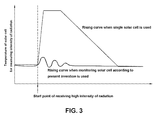
- FIG. 3 is a graph depicting a comparison result of temperatures measured using an apparatus for measurement of radiation intensity according to one embodiment of the present invention and a conventional actinometer.
- an apparatus for measurement of radiation intensity 100 for testing reliability of a solar cell includes a first solar cell 110 , a second solar cell 120 , a first temperature sensor 130 , a second temperature sensor 140 , a cooler 150 , a cover 160 , a motor 170 , and a controller 180 .
- the first and second solar cells 110 , 120 may receive a high intensity of radiation of 10 or 20 suns to generate electricity and are arranged in parallel to each other.
- the first and second temperature sensors 130 , 140 are disposed in the first and second solar cells 110 , 120 to measure the temperature of the first and second solar cells 110 , 120 , respectively.
- the cooler 150 is placed under the first solar cell 110 to lower the temperature of the first solar cell 110 .
- the cooler 150 receives electric power from outside and adjusts the temperature of the first solar cell corresponding to the electric power applied thereto.
- the cover 160 is placed above the first solar cell 110 to cover the first solar cell 110 such that the first solar cell 110 is not exposed to the outside. Further, the cover 160 is movable to expose the first solar cell 110 to the outside. That is, the cover 160 slides to cover or expose the first solar cell 110 , as shown in FIG. 2 .
- the cover 160 may have a various shape as needed.
- the motor 170 operates the cover 160 under control of the controller 180 .
- the motor 170 operates the cover 160 to slide, without being limited thereto.
- the motor 170 may move the first solar cell 110 to be placed below the cover 160 .
- the controller 180 measures the intensity of radiation applied to the first solar cell 110 . Further, the controller 180 receives data of temperatures sensed by the first and second temperature sensors 130 , 140 , and applies electric power to the cooler 150 and the motor 170 . The controller 180 receives the temperature sensed by the second temperature sensor 140 and controls electric current applied to the cooler 150 according to the sensed temperature. Therefore, it is possible to prevent the temperature of the first solar cell 110 from being suddenly increased when the first solar cell 110 is suddenly exposed to high intensity of radiation.
- the controller 180 may control the cover 160 to move by applying electric power to the motor 170 . That is, when the apparatus for measurement of radiation intensity 100 according to the embodiment is first exposed to light, the second solar cell 120 is exposed to the light, but the first solar cell 110 is not exposed to the light while being covered with the cover 160 . Then, the temperature of the second solar cell 120 increases by the light, and the controller 180 adjusts electric current applied to the cooler 150 corresponding to the temperature of the second solar cell 120 sensed by the second temperature sensor 140 . Next, the controller 180 applies electric power to the motor 170 and opens the cover 160 to expose the first solar cell 110 to the light.
- the first solar cell 110 exposed to the light may be prevented from increasing in temperature by the cooler 150 even though the first solar cell 110 suddenly receives high intensity of radiation when generating electricity based on the high intensity of radiation.
- the controller 180 continuously senses the temperature of the first solar cell 110 through the first temperature sensor 130 . This operation maintains the temperature of the first solar cell 110 which receives the high intensity of radiation.
- the first solar cell 110 varies in temperature as follows.
- electric power is applied to the cooler 150 depending on the temperature of the second solar cell 120 sensed by the second temperature sensor 140 .
- electric power applied to the cooler 150 is adjusted depending on the temperature of the first solar cell 110 sensed by the first temperature sensor 130 . As such, the first solar cell 110 is maintained at a constant temperature by maintaining the temperature of the cooler 150 .
- the solar cell undergoes sudden increase in temperature when receiving high intensity of radiation, as shown in FIG. 3 , and the cooler operates after the sudden temperature increase of the solar cell.
- the solar cell remains at high temperature for a certain period of time and is then lowered in temperature by the cooler to maintain the temperature of the solar cell.
- the temperature of the solar cell rapidly increases, not only is the solar cell overstrained, but also it takes considerable time to measure the degree of deterioration of the solar cell at a constant temperature since the temperature of the solar cell must be adjusted to a desired temperature.
- the present invention includes the first and second solar cells 110 , 120 , whereby the temperature of the first solar cell 110 may be previously adjusted, thereby preventing the temperature of the first solar cell 110 from suddenly increasing.
- variation in temperature of the first solar cell 110 is not severe. Therefore, it is possible to more quickly measure the intensity of radiation applied to the first solar cell 110 , and to prevent the first solar cell 110 from suddenly increasing in temperature, thereby allowing more accurate measurement of the solar radiation applied to the first solar cell 110 .
- the solar radiation measured by the foregoing method is used in testing reliability of the solar cell, thereby improving test reliability and stability.
Landscapes
- Physics & Mathematics (AREA)
- General Physics & Mathematics (AREA)
- Spectroscopy & Molecular Physics (AREA)
- Photovoltaic Devices (AREA)
Abstract
Description
Claims (16)
Applications Claiming Priority (2)
| Application Number | Priority Date | Filing Date | Title |
|---|---|---|---|
| KR1020110097984A KR101248139B1 (en) | 2011-09-28 | 2011-09-28 | Light intensity measuring device and method for testing reliability of solar cell, and device and method for testing reliability of solar cell |
| KR10-2011-0097984 | 2011-09-28 |
Publications (2)
| Publication Number | Publication Date |
|---|---|
| US20130076382A1 US20130076382A1 (en) | 2013-03-28 |
| US8896337B2 true US8896337B2 (en) | 2014-11-25 |
Family
ID=47910608
Family Applications (1)
| Application Number | Title | Priority Date | Filing Date |
|---|---|---|---|
| US13/566,259 Active 2033-07-25 US8896337B2 (en) | 2011-09-28 | 2012-08-03 | Apparatus and method for measurement of radiation intensity for testing reliability of solar cell, and method for testing reliability of solar cell |
Country Status (2)
| Country | Link |
|---|---|
| US (1) | US8896337B2 (en) |
| KR (1) | KR101248139B1 (en) |
Families Citing this family (5)
| Publication number | Priority date | Publication date | Assignee | Title |
|---|---|---|---|---|
| DE202011109424U1 (en) * | 2011-12-23 | 2012-01-20 | Grenzebach Maschinenbau Gmbh | Device for industrial wiring and final testing of photovoltaic concentrator modules |
| KR101748722B1 (en) | 2013-07-23 | 2017-06-19 | 엘에스산전 주식회사 | Temperature control system for solar cell module |
| KR101760209B1 (en) | 2016-03-23 | 2017-07-20 | 국방과학연구소 | Temperature measurement method using solar cells |
| CN110579276B (en) * | 2019-10-09 | 2024-02-09 | 腾色智能科技(南京)有限公司 | Illuminance detection device and method and terminal equipment of Internet of things |
| JP7673355B2 (en) * | 2021-02-25 | 2025-05-09 | 国立研究開発法人産業技術総合研究所 | Method for measuring high-temperature light-induced degradation and method for predicting the rate of output degradation of solar cells |
Citations (6)
| Publication number | Priority date | Publication date | Assignee | Title |
|---|---|---|---|---|
| US6441896B1 (en) * | 1999-12-17 | 2002-08-27 | Midwest Research Institute | Method and apparatus for measuring spatial uniformity of radiation |
| US6717519B2 (en) * | 1998-04-08 | 2004-04-06 | Canon Kabushiki Kaisha | Method and apparatus for detecting failure in solar cell module, and solar cell module |
| KR20090093318A (en) | 2008-02-29 | 2009-09-02 | (주)동양기술단 | Photovoltaic power generation system with safety connection control device of solar cell medule circuit |
| KR20100072457A (en) | 2008-12-22 | 2010-07-01 | 한국전기연구원 | Analysis device of solar cell module character, and thereof method |
| KR20100109126A (en) | 2009-03-31 | 2010-10-08 | 주식회사 맥사이언스 | Apparatus for solar cell reliability test |
| KR20110054651A (en) | 2009-11-18 | 2011-05-25 | 김응헌 | Solar power plant having solar tracking apparatus |
-
2011
- 2011-09-28 KR KR1020110097984A patent/KR101248139B1/en active Active
-
2012
- 2012-08-03 US US13/566,259 patent/US8896337B2/en active Active
Patent Citations (6)
| Publication number | Priority date | Publication date | Assignee | Title |
|---|---|---|---|---|
| US6717519B2 (en) * | 1998-04-08 | 2004-04-06 | Canon Kabushiki Kaisha | Method and apparatus for detecting failure in solar cell module, and solar cell module |
| US6441896B1 (en) * | 1999-12-17 | 2002-08-27 | Midwest Research Institute | Method and apparatus for measuring spatial uniformity of radiation |
| KR20090093318A (en) | 2008-02-29 | 2009-09-02 | (주)동양기술단 | Photovoltaic power generation system with safety connection control device of solar cell medule circuit |
| KR20100072457A (en) | 2008-12-22 | 2010-07-01 | 한국전기연구원 | Analysis device of solar cell module character, and thereof method |
| KR20100109126A (en) | 2009-03-31 | 2010-10-08 | 주식회사 맥사이언스 | Apparatus for solar cell reliability test |
| KR20110054651A (en) | 2009-11-18 | 2011-05-25 | 김응헌 | Solar power plant having solar tracking apparatus |
Also Published As
| Publication number | Publication date |
|---|---|
| US20130076382A1 (en) | 2013-03-28 |
| KR101248139B1 (en) | 2013-04-03 |
Similar Documents
| Publication | Publication Date | Title |
|---|---|---|
| Koehl et al. | Modelling of conditions for accelerated lifetime testing of Humidity impact on PV-modules based on monitoring of climatic data | |
| Brano et al. | On the experimental validation of an improved five-parameter model for silicon photovoltaic modules | |
| KR101369435B1 (en) | Apparatus for evaluating characteristics of solar cell | |
| US8224598B2 (en) | Method for forming optimal characteristic curves of solar cell and system thereof | |
| Müllejans et al. | Analysis and mitigation of measurement uncertainties in the traceability chain for the calibration of photovoltaic devices | |
| Huang et al. | Solar cell junction temperature measurement of PV module | |
| Schuss et al. | Detecting defects in photovoltaic panels with the help of synchronized thermography | |
| US20130076382A1 (en) | Apparatus and Method for Measurement of Radiation Intensity for Testing Reliability of Solar Cell, and Method for Testing Reliability of Solar Cell | |
| Dubey et al. | Measurement of temperature coefficient of photovoltaic modules in field and comparison with laboratory measurements | |
| US10742166B2 (en) | Method for the electrical characterization of a photovoltaic cell | |
| JP6806325B2 (en) | Photovoltaic system evaluation device, evaluation method, and program for evaluation device | |
| KR20100072457A (en) | Analysis device of solar cell module character, and thereof method | |
| KR101499761B1 (en) | Method for predict a generating energy of the solar module | |
| Dirnberger | Photovoltaic module measurement and characterization in the laboratory | |
| JP2019140784A (en) | Solar cell module characteristic measurement device, solar cell module temperature estimation method and solar cell module | |
| Campanelli et al. | Effective irradiance ratios to improve I–V curve measurements and diode modeling over a range of temperature and spectral and total irradiance | |
| Muller et al. | Determining outdoor CPV cell temperature | |
| CN104953949A (en) | Electric performance test method of solar cells and solar cell modules | |
| JP2019221083A (en) | Method and apparatus for diagnosing solar cell module | |
| Wheeler et al. | Degradation pathway models for photovoltaics module lifetime performance | |
| CN109787554B (en) | Testing device for key components of thermophotovoltaic power generation system | |
| Chahtou et al. | Quantifying Measurement Uncertainty in Photovoltaic Module Performance at Standard Test Conditions: A Machine-Based Approach | |
| BILLEWICZ et al. | Laboratory Stand for Examining the Influence of Environmental Conditions on Electrical Parameters of Photovoltaic Cells. | |
| Nikoletatos et al. | Standards, calibration, and testing of PV modules and solar cells | |
| JP7299749B2 (en) | Solar power generation output prediction device, solar power generation output prediction method, and program |
Legal Events
| Date | Code | Title | Description |
|---|---|---|---|
| AS | Assignment |
Owner name: KOREA INSTITUTE OF ENERGY RESEARCH, KOREA, REPUBLI Free format text: ASSIGNMENT OF ASSIGNORS INTEREST;ASSIGNORS:PARK, SANG-HYUN;GWAK, JIHYE;AHN, SEJIN;AND OTHERS;SIGNING DATES FROM 20120718 TO 20120723;REEL/FRAME:028720/0463 |
|
| STCF | Information on status: patent grant |
Free format text: PATENTED CASE |
|
| FEPP | Fee payment procedure |
Free format text: PAT HOLDER CLAIMS SMALL ENTITY STATUS, ENTITY STATUS SET TO SMALL (ORIGINAL EVENT CODE: LTOS); ENTITY STATUS OF PATENT OWNER: SMALL ENTITY |
|
| MAFP | Maintenance fee payment |
Free format text: PAYMENT OF MAINTENANCE FEE, 4TH YR, SMALL ENTITY (ORIGINAL EVENT CODE: M2551) Year of fee payment: 4 |
|
| MAFP | Maintenance fee payment |
Free format text: PAYMENT OF MAINTENANCE FEE, 8TH YR, SMALL ENTITY (ORIGINAL EVENT CODE: M2552); ENTITY STATUS OF PATENT OWNER: SMALL ENTITY Year of fee payment: 8 |
|
| MAFP | Maintenance fee payment |
Free format text: PAYMENT OF MAINTENANCE FEE, 12TH YR, SMALL ENTITY (ORIGINAL EVENT CODE: M2553); ENTITY STATUS OF PATENT OWNER: SMALL ENTITY Year of fee payment: 12 |