US8896033B2 - Electrochemical transistor - Google Patents

Electrochemical transistor Download PDF

Info

Publication number
US8896033B2
US8896033B2 US13/816,584 US201113816584A US8896033B2 US 8896033 B2 US8896033 B2 US 8896033B2 US 201113816584 A US201113816584 A US 201113816584A US 8896033 B2 US8896033 B2 US 8896033B2
Authority
US
United States
Prior art keywords
electrode
source
drain
drain electrode
source electrode
Prior art date
Legal status (The legal status is an assumption and is not a legal conclusion. Google has not performed a legal analysis and makes no representation as to the accuracy of the status listed.)
Expired - Fee Related
Application number
US13/816,584
Other versions
US20130140648A1 (en
Inventor
Tsuyoshi Hasegawa
Masakazu Aono
Kazuya Terabe
Tohru Tsuruoka
Yaomi Itoh
Current Assignee (The listed assignees may be inaccurate. Google has not performed a legal analysis and makes no representation or warranty as to the accuracy of the list.)
National Institute for Materials Science
Original Assignee
National Institute for Materials Science
Priority date (The priority date is an assumption and is not a legal conclusion. Google has not performed a legal analysis and makes no representation as to the accuracy of the date listed.)
Filing date
Publication date
Application filed by National Institute for Materials Science filed Critical National Institute for Materials Science
Assigned to NATIONAL INSTITUTE FOR MATERIALS SCIENCE reassignment NATIONAL INSTITUTE FOR MATERIALS SCIENCE ASSIGNMENT OF ASSIGNORS INTEREST (SEE DOCUMENT FOR DETAILS). Assignors: TERABE, KAZUYA, TSURUOKA, TOHRU, AONO, MASAKAZU, HASEGAWA, TSUYOSHI, ITOH, YAOMI
Publication of US20130140648A1 publication Critical patent/US20130140648A1/en
Application granted granted Critical
Publication of US8896033B2 publication Critical patent/US8896033B2/en
Expired - Fee Related legal-status Critical Current
Anticipated expiration legal-status Critical

Links

Images

Classifications

    • H01L29/78
    • HELECTRICITY
    • H10SEMICONDUCTOR DEVICES; ELECTRIC SOLID-STATE DEVICES NOT OTHERWISE PROVIDED FOR
    • H10DINORGANIC ELECTRIC SEMICONDUCTOR DEVICES
    • H10D30/00Field-effect transistors [FET]
    • H10D30/60Insulated-gate field-effect transistors [IGFET]
    • HELECTRICITY
    • H10SEMICONDUCTOR DEVICES; ELECTRIC SOLID-STATE DEVICES NOT OTHERWISE PROVIDED FOR
    • H10NELECTRIC SOLID-STATE DEVICES NOT OTHERWISE PROVIDED FOR
    • H10N99/00Subject matter not provided for in other groups of this subclass
    • GPHYSICS
    • G11INFORMATION STORAGE
    • G11CSTATIC STORES
    • G11C13/00Digital stores characterised by the use of storage elements not covered by groups G11C11/00, G11C23/00, or G11C25/00
    • G11C13/0002Digital stores characterised by the use of storage elements not covered by groups G11C11/00, G11C23/00, or G11C25/00 using resistive RAM [RRAM] elements
    • G11C13/0007Digital stores characterised by the use of storage elements not covered by groups G11C11/00, G11C23/00, or G11C25/00 using resistive RAM [RRAM] elements comprising metal oxide memory material, e.g. perovskites
    • GPHYSICS
    • G11INFORMATION STORAGE
    • G11CSTATIC STORES
    • G11C13/00Digital stores characterised by the use of storage elements not covered by groups G11C11/00, G11C23/00, or G11C25/00
    • G11C13/0002Digital stores characterised by the use of storage elements not covered by groups G11C11/00, G11C23/00, or G11C25/00 using resistive RAM [RRAM] elements
    • G11C13/0009RRAM elements whose operation depends upon chemical change
    • GPHYSICS
    • G11INFORMATION STORAGE
    • G11CSTATIC STORES
    • G11C13/00Digital stores characterised by the use of storage elements not covered by groups G11C11/00, G11C23/00, or G11C25/00
    • G11C13/0002Digital stores characterised by the use of storage elements not covered by groups G11C11/00, G11C23/00, or G11C25/00 using resistive RAM [RRAM] elements
    • G11C13/0009RRAM elements whose operation depends upon chemical change
    • G11C13/0011RRAM elements whose operation depends upon chemical change comprising conductive bridging RAM [CBRAM] or programming metallization cells [PMCs]
    • GPHYSICS
    • G11INFORMATION STORAGE
    • G11CSTATIC STORES
    • G11C13/00Digital stores characterised by the use of storage elements not covered by groups G11C11/00, G11C23/00, or G11C25/00
    • G11C13/02Digital stores characterised by the use of storage elements not covered by groups G11C11/00, G11C23/00, or G11C25/00 using elements whose operation depends upon chemical change
    • GPHYSICS
    • G11INFORMATION STORAGE
    • G11CSTATIC STORES
    • G11C14/00Digital stores characterised by arrangements of cells having volatile and non-volatile storage properties for back-up when the power is down
    • H01L45/085
    • H01L45/1206
    • H01L45/1226
    • H01L45/1266
    • H01L45/146
    • HELECTRICITY
    • H10SEMICONDUCTOR DEVICES; ELECTRIC SOLID-STATE DEVICES NOT OTHERWISE PROVIDED FOR
    • H10DINORGANIC ELECTRIC SEMICONDUCTOR DEVICES
    • H10D48/00Individual devices not covered by groups H10D1/00 - H10D44/00
    • H10D48/30Devices controlled by electric currents or voltages
    • HELECTRICITY
    • H10SEMICONDUCTOR DEVICES; ELECTRIC SOLID-STATE DEVICES NOT OTHERWISE PROVIDED FOR
    • H10DINORGANIC ELECTRIC SEMICONDUCTOR DEVICES
    • H10D62/00Semiconductor bodies, or regions thereof, of devices having potential barriers
    • H10D62/80Semiconductor bodies, or regions thereof, of devices having potential barriers characterised by the materials
    • H10D62/81Semiconductor bodies, or regions thereof, of devices having potential barriers characterised by the materials of structures exhibiting quantum-confinement effects, e.g. single quantum wells; of structures having periodic or quasi-periodic potential variation
    • HELECTRICITY
    • H10SEMICONDUCTOR DEVICES; ELECTRIC SOLID-STATE DEVICES NOT OTHERWISE PROVIDED FOR
    • H10NELECTRIC SOLID-STATE DEVICES NOT OTHERWISE PROVIDED FOR
    • H10N70/00Solid-state devices having no potential barriers, and specially adapted for rectifying, amplifying, oscillating or switching
    • H10N70/20Multistable switching devices, e.g. memristors
    • H10N70/24Multistable switching devices, e.g. memristors based on migration or redistribution of ionic species, e.g. anions, vacancies
    • H10N70/245Multistable switching devices, e.g. memristors based on migration or redistribution of ionic species, e.g. anions, vacancies the species being metal cations, e.g. programmable metallization cells
    • HELECTRICITY
    • H10SEMICONDUCTOR DEVICES; ELECTRIC SOLID-STATE DEVICES NOT OTHERWISE PROVIDED FOR
    • H10NELECTRIC SOLID-STATE DEVICES NOT OTHERWISE PROVIDED FOR
    • H10N70/00Solid-state devices having no potential barriers, and specially adapted for rectifying, amplifying, oscillating or switching
    • H10N70/20Multistable switching devices, e.g. memristors
    • H10N70/253Multistable switching devices, e.g. memristors having three or more electrodes, e.g. transistor-like devices
    • HELECTRICITY
    • H10SEMICONDUCTOR DEVICES; ELECTRIC SOLID-STATE DEVICES NOT OTHERWISE PROVIDED FOR
    • H10NELECTRIC SOLID-STATE DEVICES NOT OTHERWISE PROVIDED FOR
    • H10N70/00Solid-state devices having no potential barriers, and specially adapted for rectifying, amplifying, oscillating or switching
    • H10N70/801Constructional details of multistable switching devices
    • H10N70/821Device geometry
    • H10N70/823Device geometry adapted for essentially horizontal current flow, e.g. bridge type devices
    • HELECTRICITY
    • H10SEMICONDUCTOR DEVICES; ELECTRIC SOLID-STATE DEVICES NOT OTHERWISE PROVIDED FOR
    • H10NELECTRIC SOLID-STATE DEVICES NOT OTHERWISE PROVIDED FOR
    • H10N70/00Solid-state devices having no potential barriers, and specially adapted for rectifying, amplifying, oscillating or switching
    • H10N70/801Constructional details of multistable switching devices
    • H10N70/821Device geometry
    • H10N70/826Device geometry adapted for essentially vertical current flow, e.g. sandwich or pillar type devices
    • HELECTRICITY
    • H10SEMICONDUCTOR DEVICES; ELECTRIC SOLID-STATE DEVICES NOT OTHERWISE PROVIDED FOR
    • H10NELECTRIC SOLID-STATE DEVICES NOT OTHERWISE PROVIDED FOR
    • H10N70/00Solid-state devices having no potential barriers, and specially adapted for rectifying, amplifying, oscillating or switching
    • H10N70/801Constructional details of multistable switching devices
    • H10N70/841Electrodes
    • H10N70/8416Electrodes adapted for supplying ionic species
    • HELECTRICITY
    • H10SEMICONDUCTOR DEVICES; ELECTRIC SOLID-STATE DEVICES NOT OTHERWISE PROVIDED FOR
    • H10NELECTRIC SOLID-STATE DEVICES NOT OTHERWISE PROVIDED FOR
    • H10N70/00Solid-state devices having no potential barriers, and specially adapted for rectifying, amplifying, oscillating or switching
    • H10N70/801Constructional details of multistable switching devices
    • H10N70/881Switching materials
    • H10N70/883Oxides or nitrides
    • H10N70/8833Binary metal oxides, e.g. TaOx
    • GPHYSICS
    • G11INFORMATION STORAGE
    • G11CSTATIC STORES
    • G11C2213/00Indexing scheme relating to G11C13/00 for features not covered by this group
    • G11C2213/10Resistive cells; Technology aspects
    • G11C2213/11Metal ion trapping, i.e. using memory material including cavities, pores or spaces in form of tunnels or channels wherein metal ions can be trapped but do not react and form an electro-deposit creating filaments or dendrites
    • GPHYSICS
    • G11INFORMATION STORAGE
    • G11CSTATIC STORES
    • G11C2213/00Indexing scheme relating to G11C13/00 for features not covered by this group
    • G11C2213/30Resistive cell, memory material aspects
    • G11C2213/32Material having simple binary metal oxide structure
    • GPHYSICS
    • G11INFORMATION STORAGE
    • G11CSTATIC STORES
    • G11C2213/00Indexing scheme relating to G11C13/00 for features not covered by this group
    • G11C2213/50Resistive cell structure aspects
    • G11C2213/52Structure characterized by the electrode material, shape, etc.
    • GPHYSICS
    • G11INFORMATION STORAGE
    • G11CSTATIC STORES
    • G11C2213/00Indexing scheme relating to G11C13/00 for features not covered by this group
    • G11C2213/50Resistive cell structure aspects
    • G11C2213/53Structure wherein the resistive material being in a transistor, e.g. gate

Definitions

  • the present invention relates to a three-terminal device capable of operating while electrical connection and disconnection between source and drain electrodes are controlled using a gate voltage.
  • Non-Patent Publication 1 When it comes to a three-terminal device that operates while gaining control of electrical connection and disconnection between source and drain electrodes using a gate voltage, there has a field effect semiconductor transistor so far known in the art. With the field effect semiconductor transistor, the distribution of electrons and holes in the semiconductor is controlled using an electric field induced by a gate voltage so that electrical connection and disconnection between the source and drain electrodes can be controlled. For instance, the operation principles are described at great length in Non-Patent Publication 1.
  • Patent Publication 1 Another example is set forth in Non-Patent Publication 2.
  • a positive gate voltage is applied to supply copper ions from a gate electrode to a source/drain electrode side so that the device can be put on.
  • Patent Publication 2 For its detailed operation principles, see Patent Publication 2.
  • Patent Publication 1 that shows a typical one of them, rather than control of electrons and holes, the distribution of metal cations in an ionic conductor (ion diffusion material) is controlled to achieve certain amount of electron conduction in the ionic conductor. Although this results in source/drain currents depending on gate voltages, it has been found that a problem that sharp on-off operation cannot take place remains unsolved because there is a continuous change in the distribution of metal cations depending on field strength, resulting in the continuous change in the source/drain currents.
  • the metal ions are reduced on the source/drain electrodes, and metal filaments growing out of the source/drain electrodes couple together, achieving an on-state.
  • the moment the filaments couple together there is a decrease in the source/drain resistance, which results in the sharp on-off operation.
  • the growth rate of filaments formed by the precipitation of metal ions depends on the value of the applied gate voltage; the gate voltage value at which the on-state is achievable also depends on the operation conditions such as the scan speed of gate voltage. To achieve faster operation, there is a need for using higher gate voltage to boost up the growth rate of filaments.
  • continued application of the gate voltage causes a filament to be formed even between the gate electrode and the source electrode or the drain electrode, failing to make sure the insulation of the gate electrode.
  • Patent Publication 2 teaches that the spaces between the gate electrode, the source electrode and the drain electrode are controlled such that a filament is formed between the source/drain electrodes before a filament is formed between them and the gate electrode. Even with such an improvement, however, there is still the need for controlling the application time of the gate voltage or the like, because continued application of the gate voltage causes a filament to be formed between the gate electrode and the source/drain electrodes. To put it another way, a problem with Patent Publication 2 is that the device cannot be used as a logic device because of arbitrary application of gate voltage required in the logic operation, so it cannot be a possible replacement of field effect semiconductor transistors.
  • An object of the invention is to provide a three-terminal device “electrochemical transistor” that can overcome the aforesaid problems with the prior art, thereby making sure sharp on-off operation and the insulation of the gate electrode upon continued application of gate voltage.
  • an electrochemical transistor which is characterized by comprising an ion diffusion member, a gate electrode located on a first surface of said ion diffusion member, and a source electrode and a drain electrode, in which an insulator is interposed between them located on a second surface of said ion diffusion member that opposes to said first surface, wherein a gate voltage is applied to said gate electrode to diffuse metal ions in said ion diffusion member such that said metal ions are supersaturated on said source electrode and said drain electrode as well as on said insulator near said both electrodes to make electrical connection between said source electrode and said drain electrode by way of a metal precipitated by said supersaturation.
  • the thickness of said ion diffusion member between said first surface and said second surface may be 40 nanometers or less.
  • Said ion diffusion material may be a metal oxide or silicon oxide.
  • Said metal oxide may be a titanium oxide, a tantalum oxide, and a tungsten oxide or a mixed oxide thereof.
  • Said metal ions may be one or more species of ions selected from silver ions, copper ions and lithium ions, or mixed ions comprising multiple species thereof.
  • At least a part of said gate electrode may be formed of copper or silver.
  • Said metal ions may be such that metal atoms forming said gate electrode are ionized and diffused into said ion diffusion member.
  • a spacing distance between said source electrode and said drain electrode may be 20 nanometers or less.
  • a spacing distance between said source electrode and said drain electrode may range from 1 nanometer to 15 nanometers.
  • Silver ions and/or copper ions may be contained beforehand as metal ions in the material for said ion diffusion member.
  • nonvolatile electrical connection When a source/drain reference gate voltage defining said gate voltage lies in a positive area relative to said source electrode and said drain electrode, nonvolatile electrical connection may be made between said source electrode and said drain electrode, and when said source/drain reference gate voltage lies in a negative area, said nonvolatile electrical connection may be eliminated.
  • said precipitated metal may be ionized and diffused in said ion diffusion member toward said gate electrode to eliminate electrical connection between said source electrode and said drain electrode.
  • the amount of said metal diffused as ion in said ion diffusion member and precipitated on said drain electrode and said source electrode as well as on said insulator near said both electrodes may be smaller than the amount of said metal making electrical connection between said source electrode or said drain electrode and said gate electrode.
  • FIG. 1 is illustrative in schematic of the structure of Example 1 according to the invention.
  • FIG. 2 is indicative of the results of current measurement showing the on-off operation of the electro-chemical transistor of Example 1 according to the invention, and changes that take place correspondingly in the interior of the electrochemical transistor.
  • FIG. 3 is illustrative in schematic of the structure of the electrochemical transistor of Example 2 according to the invention.
  • FIG. 4 is indicative of the results of measurement of the gate voltage and field strength necessary for the achievement of an on-state in the electrochemical transistor of Example 2 according to the invention.
  • FIG. 5 is indicative of the results of measurement of drain current changes in the case of sweeping the gate voltage of the electrochemical transistor of Example 3 according to the invention.
  • FIG. 6 is indicative of the results of operation of Example 3 according to the invention wherein volatile and nonvolatile on-states are selectively controlled.
  • FIG. 7 is illustrative in schematic of the structure and operation of conventional electrochemical transistors without using any supersaturation state: Comparative Examples 1 and 2.
  • FIG. 8 is illustrative in schematic of the structure and operation principles of the electrochemical transistor of Example 4 according to the invention that ensures the insulation of the gate electrode to be kept even upon continued application of gate voltage.
  • FIG. 9 is illustrative in schematic of the operation of the electrochemical transistor of Comparative Example 3 wherein there is a wide spacing provided between the source electrode and the drain electrode.
  • FIG. 10 is indicative of the results of operation of the electrochemical transistor of Example 5 according to the invention wherein silver is used instead of copper.
  • the gate electrode is located on one surface of the ion diffusion member, and the source and drain electrodes mutually insulated by the insulator is located on another surface of the ion diffusion member.
  • FIG. 1 is illustrative of the schematic structure and operation principles of the electrochemical transistor of the first example according to the invention.
  • tantalum oxide Ti 2 O 5
  • Cu copper
  • Pt platinum
  • Silicon oxide SiO 2
  • SiO 2 is used as the material for the insulator that insulates between the source and drain electrodes.
  • the source/drain reference gate voltage relative to the source electrode and drain electrode; ditto As a positive gate voltage (the source/drain reference gate voltage relative to the source electrode and drain electrode; ditto) is applied to the gate electrode of the aforesaid arrangement, it causes the copper atoms forming the gate electrode to be oxidized (ionized) and supplied into the tantalum oxide that is the ion diffusion material ( FIG. 1( b )). The copper ions supplied into the tantalum oxide are then diffused in the tantalum oxide toward the source electrode and drain electrode by virtue of an electric field induced in the tantalum oxide as the gate voltage is applied ( FIG. 1( c )).
  • the copper ions increases in concentration near the source electrode and drain electrode, and at the time the gate voltage reaches a certain value, they are supersaturated and precipitated as copper atoms ( FIG. 1( d )).
  • the thickness of the silicon oxide film insulating between the source electrode and the drain electrode (the spacing between the source and drain electrodes) is made so small that copper atoms are precipitated by supersaturation on the insulator (silicon oxide), too, between the source/drain electrodes and near the source/drain electrodes. As a result, the source electrode and the drain electrode are electrically connected together.
  • a unique feature of the invention is that the precipitation of metal atoms by the supersaturation phenomenon enables sharp on-operation.
  • there is the need for applying an electric field of certain or larger magnitude to achieve the super-saturation phenomenon so there is a certain critical value (threshold) on the on-state enabling gate voltage, which means that the on-state is always achievable at the same gate voltage value without depending on the application time of the gate voltage and scan speed.
  • the invention is designed such that the diffusion and the oxidation-reduction reaction of the metal ions in the ion diffusion material are controlled by the gate voltage thereby controlling electrical connection and disconnection between the source/drain electrodes.
  • FIG. 2 is illustrative of one example of the results of operation of the electrochemical transistor shown in FIG. 1 .
  • the results of operation shown in FIG. 2 are those of an electrochemical transistor that is fabricated using a 50-nanometer thick copper thin film as the gate electrode, a 30-nanometer thick tantalum oxide as the ion diffusion material, a 50-nanometer thick platinum thin film as the source electrode, and the drain electrode, and a 15-nanometer wide silicon oxide thin film (film thickness is measured in the spacing direction between the source electrode and the drain electrode) as the insulator material for insulating between the source electrode and the drain electrode.
  • FIG. 2( a ) Shown in FIG. 2( a ) are source current changes with time. It is seen that after the lapse of a certain time, the current value reaches 2 microamperes. At the same timing, the drain current value ( FIG. 2( b )) reaches ⁇ 2 microamperes.
  • the gate current FIG.
  • FIG. 2( d ) is illustrative in schematic of the operation of the device corresponding to the current changes depicted in FIGS. 2( a ), 2 ( b ) and 2 ( c ).
  • a voltage of 4 V is applied on the copper gate electrode, it causes the copper atoms forming the gate electrode to be ionized and diffused into the tantalum oxide toward the source/drain electrode side.
  • copper ions diffused in the vicinity of the source electrode and drain electrode grow super-saturated, it allows them to be precipitated as copper atoms to provide electrical connection between the source electrode and the drain electrode.
  • the gate voltage of 4 V is applied, the gate current is on the order of a few tens of nanoamperes, meaning that the gate electrode is insulated on the order of gigaohm off the source/drain electrodes.
  • the invention could provide electrical connection and disconnection between source/drain electrodes by varying the polarity of the voltage applied on the gate electrode. As can be seen from FIGS. 2( a ), 2 ( b ), 2 ( e ) and 2 ( f ), the electrical connection and disconnection takes place momentarily. This is a unique feature of the invention making use of precipitation taking place at the moment the copper ions become supersaturated.
  • the 15-nanometer thick silicon oxide film is herein located between the drain electrode and the source electrode to space them away by that film thickness, it is to be understood that the device may run as an electrochemical transistor even when a distance as long as 20 nanometers is provided between both electrodes. To obtain good performance, however, it is preferable that the spacing distance between both electrodes is 15 nanometers or less. Note here that the distance between both electrodes becoming shorter than 1 nanometer is not that preferable because of increased leakage currents.
  • the inventive electrochemical transistor will be explained with reference to its more specific structure as well as its fabrication process. The performance of the fabricated electrochemical transistor as measured will be shown.
  • FIG. 3 is illustrative of an exemplary, more specific structure of the electrochemical transistor with which the invention is achievable.
  • FIG. 3( a ) is a sectional view inclusive of the gate electrode, ion diffusion member, source electrode, drain electrode, etc.
  • FIG. 3( b ) is a sectional view of FIG. 3( a ) as taken on A-A inclusive of interface sites between the ion diffusion member and the source electrode, drain electrode and insulator (insulator film).
  • the Ta 2 O 5 and Cu layers on the uppermost SiO 2 layer in FIG. 3( a ) are left out.
  • the device structure herein comprises an insulating substrate (SiO 2 ) and a multilayered structure stacked thereon in which a Pt/Ti layer providing the source electrode and a Pt/Ti layer providing the drain electrode are stacked with the insulating film layer (SiO 2 ) interposed between them. Further on that multilayered structure, there is another insulating film layer (SiO 2 ) formed so as to limit a copper atom-precipitation area to between the source/drain electrodes. In the absence of the uppermost SiO 2 layer, the copper ions supplied from the gate are supersaturated even on the Pt/Ti layer for precipitation.
  • the copper atoms (ions) that are forced to move for on-off operation increase in number, slowing down on-off operation; the supplied ions grow large in number, resulting in increases in the electronic conductivity of the ionic conduction layer, which give rise to a lowering of off-state resistance and on-off ratios; and so on.
  • the SiO 2 layer is provided on the uppermost portion of the structure of FIG. 3 too. If there is the gate only on the side of the source/drain, the uppermost SiO 2 layer might be dispensed with; however, such device structure formation would be still difficult because of the decreased device size.
  • a tantalum oxide layer is formed as the ion diffusion member on the side wall of this multilayered structure, and a copper thin-film layer is further formed as the gate electrode on the side wall of that ion diffusion member.
  • Those layers may be formed by a general thin-film formation method such as a sputtering or electron beam evaporation process and a generally patterning method such as photolithography or electron beam lithography.
  • FIG. 4 is indicative of the operation features of an exemplary electrochemical transistor device having the device structure depicted in FIG. 3 .
  • FIG. 4( a ) is indicative of the gate voltage value needed for making electrical connection between the source electrode and the drain electrode (or putting the instant transistor on). From FIG. 4( a ), it can be seen that the gate voltage value necessary for providing electrical connection between the source electrode and the drain electrode is changing depending on the thickness of the tantalum oxide (Ta 2 O 5 ) film. That is, the gate voltage value of 3 V on average is needed when the thickness of the tantalum oxide film is 30 nanometers, and as the thickness of the tantalum oxide film goes down to 20 nanometer and 10 nanometers, the necessary gate voltage value, too, falls down to 2 V ⁇ 1 V on average.
  • Ta 2 O 5 tantalum oxide
  • this gate voltage value is divided by the thickness of the tantalum oxide film or it is indicated in terms of field strength ( FIG. 4( b )), it is then found that whatever thickness, the necessary field strength is 0.1 V/nm on average. That is, the critical field strength for achieving the supersaturation of copper ions at the interfaces between the source and drain electrodes and the tantalum oxide becomes 0.1 V/nm. From this, it is found that if the tantalum oxide film is set at a thickness of 5 nm as an example, it is then possible to make electrical connection between the source electrode and the drain electrode at a gate voltage of 0.5 V.
  • this critical voltage value is for copper used as the gate electrode material, viz., the ion species to be diffused, and for tantalum oxide used as the ion diffusion material, and so it varies with the diffusion ion species and ion diffusion material used.
  • the thickness of the tantalum oxide film must be set at 40 nanometers or less for the purpose of achieving operation at a practical voltage of 20 V (used on an integrated circuit) or less.
  • Set forth in Example 1 is the operation of the device having a tantalum oxide film thickness of 30 nanometers. Its on-voltage is 4 V that roughly matches the aforesaid critical voltage value, whereas its off-voltage has a value of as high as ⁇ 20 V. The reason is that as the tantalum oxide film gains thickness, an area where super-saturation occurs upon nonvolatile switch-on operation grows wide, resulting in precipitation of the metal than required.
  • FIG. 5 is indicative of the results of measurements in the case where the tantalum oxide film thickness is set at 20 nanometers and copper is used as the gate electrode material.
  • the gate voltage was increased from 0 V up to 1.5 V, and swept again down to 0 V.
  • the drain current increases sharply at a gate voltage of 1.0 V.
  • the amount of change turns from 10 ⁇ 9 milliampere up to 10 ⁇ 3 milliampere, an astonishing six orders of magnitude.
  • the gate current was swept toward 0 V after increased up to 1.5 V, there was a sharp drain current down observed near 0.65 V. In the meantime, the gate current kept a magnitude of the order of nanoampere.
  • FIG. 5( b ) Shown in FIG. 5( b ) are the results of sweeping the gate voltage with its maximum value set at 3 V. It can be seen that as the gate voltage increased from 0 V, it caused a sharp increase in the drain current at around a gate electrode of 1.4 V, with its amount of change turning from 10 ⁇ 8 milliampere up to 10 ⁇ 2 milliampere, an astonishing change up to six orders of magnitude. Upon a further continued voltage sweeping, there was a sharp increase again observed in the drain current at a gate voltage of 2.7 V. After the gate voltage was swept up to 3 V, it was allowed to go down to 0 V.
  • FIGS. 5( a ) and 5 ( b ) there are some noticeable differences between FIGS. 5( a ) and 5 ( b ) in terms of the threshold gate voltage, the current values before/after on-operation, etc., because different electrochemical transistors were used for measurements in FIGS. 5( a ) and 5 ( b ).
  • an electrochemical transistor performs differently depending on variations in the sizes and physical properties of elements forming that electrochemical transistor, etc. Such variations would appear to be reduced through improvements in the fabrication process of electrochemical transistors and their size reductions.
  • the tantalum oxide film is considered to have had a thickness of about 28 nanometers.
  • on-states electrically connected states between the source electrode and the drain electrode
  • volatile and nonvolatile electrically connected states between the source electrode and the drain electrode
  • the magnitude of the applied gate voltage is controlled, it is then possible to achieve two such on-states selectively.
  • the tantalum oxide film has a thickness of 20 nm
  • the volatile on-state is achievable at a gate voltage of about 1 V to 1.5 V
  • a nonvolatile on-state is achievable at a gate voltage of about 2 V to 3 V.
  • FIG. 6 Such gate voltages as depicted on the lower side of FIG. 6 were applied to the device whose results are indicated in FIG. 5 . More specifically, a gate voltage of 0 V or 1.5 V was applied in Area I; 3 V, 0 V or ⁇ 3 V in Area II; 0 V or 1.5 V was again applied in Area III; 0 V or ⁇ 3 V in Area IV; and 0 V or 1.5 V in Area V. The values of currents flowing between the source electrode and the drain electrode in the meantime are indicated in the upper side of FIG. 6 .
  • Non-Patent Publication 2 there is a report about the operation of a three-terminal switch in which copper sulfide is used as the ionic conductor (ion diffusion material), copper as the material for the gate and source electrodes, and platinum as the drain electrode material.
  • a metal nano-filament made up of copper atoms is formed beforehand between the drain electrode and the source electrode ( FIG. 7( a )). Then, a proper voltage is applied between the source electrode and the drain electrode to cut off a part of the metal nano-filament ( FIG. 7( b )).
  • FIG. 7( d ) Similar switching operation is achieved in an electrolyte too, as shown schematically in FIG. 7( d ).
  • Precipitation of silver atoms causes the gold electrodes to gain thickness, eventually ending up with coupling of silver filaments extending out of two gold electrodes (see the sketch on the right upper portion of FIG. 7( d )).
  • the potential applied to the gate electrode is controlled, it is also possible to re-ionize the precipitated silver atoms to capture them in the silver nitrate solution for the achievement of the off-state.
  • on-off operation is controlled by way of precipitation and dissolution of the metal atoms on the surfaces of the source and drain electrodes, as shown schematically in FIGS. 7( e ), 7 ( f ) and 7 ( g ).
  • Precipitation and dissolution take place at a relatively small voltage (for instance, about 0.1 V for precipitation of copper out of the copper sulfide).
  • a relatively small voltage for instance, about 0.1 V for precipitation of copper out of the copper sulfide.
  • Patent Publication 2 teaches that to avoid this, it is desired to make the distance between the gate electrode and the source electrode or the drain electrode greater than the source/drain electrode spacing. Even with such contrivance, however, if the gate electrode remains applied, the gate electrode is going to be electrically connected to the source electrode or the drain electrode.
  • FIG. 8 shows a typical example of such an inventive electrochemical transistor.
  • a tantalum oxide (Ta 2 O 5 ) layer that is the ion diffusion member is formed on a source electrode and a drain electrode isolated by an insulating film (SiO 2 ), and further on that there are a copper thin-film layer and a platinum layer formed.
  • the copper thin-film layer and platinum layer define together a gate electrode ( FIG. 8( a )).
  • the copper thin-film layer has a thickness of roughly 1 nanometer to 5 nanometers, although depending on the tantalum oxide film thickness and device structure.
  • the gate electrode As a positive voltage is applied to the gate electrode, it causes copper ions to be supplied from the copper thin film forming the gate electrode into the tantalum oxide ( FIG. 8( b )), and the supplied copper ions are diffused into the source and drain electrodes ( FIG. 8( c )).
  • the diffused copper ions are supersaturated on the source and drain electrodes as well as on the insulating film (SiO 2 ) near them whereby they are precipitated as copper atoms, providing electrical connection between the source electrode and the drain electrode ( FIG. 8( d )).
  • the copper thin film forming the gate electrode is thin, it is not possible to supply the copper ions necessary for precipitation of copper atoms.
  • the insulation of the gate electrode can be well held, because it is unlikely that there is a metal filament formed by which the gate electrode is coupled to the source electrode or the drain electrode.
  • the optimum value for the copper thin film was roughly 1/10 of the tantalum oxide film thickness.
  • tantalum oxide film thickness of 20 nano-meters is used in combination with the copper thin-film thickness of about 2 nanometers, on-off operation would be achievable while the insulation of the gate electrode is still maintained.
  • the copper thin-film thickness is 0.1 nanometer or 10 nanometers, on-off operation could be achieved while the insulation of the gate electrode is still maintained.
  • the gate voltage value for achieving that varies depending on the copper thin-film thickness as described later.
  • a silicon oxide film that is an insulator having a film thickness of 30 nanometers (in the direction indicated by a double action arrow in FIG. 9( a )) provides insulation between the source electrode and the drain electrode.
  • the thickness of this insulator is set much larger than explained in Example 1.
  • Formed on that assembly are a 30-nanometer thick tantalum oxide (Ta 2 O 5 ) thin film and a copper gate electrode ( FIG. 9( a )).
  • As a positive gate voltage is applied to this device structure, it causes copper ions to be supplied from the gate electrode ( FIG. 9( b )), and they are diffused toward the source electrode as well as the drain electrode.
  • the diffusion of copper ions takes place along a potential gradient in the ion diffusion material (tantalum oxide); so when there is a wide spacing between the source electrode and the drain electrode as described herein, the concentration of copper ions grows high near the source and drain electrodes, but it does not in a wide intermediate area between both electrodes ( FIG. 9( c )). Consequently, the supersaturation is only achieved near each of the source and drain electrodes, and copper atoms are precipitated only on each electrode and the insulator (silicon oxide film) near it with the result that connection taking place on the insulator in the wide spacing between the source electrode and the drain electrode slows down, or that connection does not occur at all ( FIG. 9( d )).
  • the insulator silicon oxide film
  • the gate electrode material While copper is used as the gate electrode material in the foregoing examples, it is to be understood that other material, for instance, silver may also be used as the gate electrode material. In this case, silver ions are supplied into the ion diffusion material so that supersaturation is achieved on the source/drain electrode side whereby they are precipitated in the form of silver atoms to make electrical connection between the source electrode and the drain electrode. Other than copper and silver, for instance, lithium may also be used, or these metals may be used in combinations of two or three instead of being used alone.
  • FIG. 10( a ) Shown in FIG. 10( a ) are the results of operation of a device wherein a silver thin film has a thickness of 2 nanometers, a tantalum oxide film has a thickness of 20 nanometers, and a silicon oxide (SiO 2 ) film providing a separation and insulation between the source electrode and the drain electrode has a thickness of 10 nanometers.
  • a silicon oxide (SiO 2 ) film providing a separation and insulation between the source electrode and the drain electrode has a thickness of 10 nanometers.
  • the gate voltage value necessary for such volatile operation was measured for a device comprising a tantalum oxide film having a thickness of 20 nanometers and a silicon oxide (SiO 2 ) film providing a separation and insulation between the source electrode and the drain electrode and having a thickness of 10 nanometers with silver thin films varying in thickness.
  • the results are set out in FIG. 10( b ). From those results, it is found that when the silver thin film has a small thickness, the critical electric field necessary for creating super-saturation, viz., the gate voltage grows large because of a decreased amount of silver ions capable of being supplied into the tantalum oxide. Likewise, the gate voltage value for creating the nonvolatile on-state was measured. Consequently, it is found that the necessary gate voltage value changes depending on the thickness of the silver thin film ( FIG. 10( c )).
  • the thin film providing a silver or copper ion supply source is formed on the thin film of the ion diffusion material during device preparation, it is to be understood that such ions may be captured in the thin film of the ion diffusion material as by co-evaporation during film preparation.
  • metal ions capable of creating super-saturation such as silver ions, copper ions, and lithium ions be present in the device structure.
  • metal ions In order from the metal ion supply source to be loaded beforehand in the thin film of the ion diffusion material, such metal ions should preferably be captured in the form of ions from the outset, but not in the form of atoms.
  • tantalum oxide as an example, copper atoms (ions) are considered to be present as ions (rather than neutral atoms) in its lattice. If copper and tantalum oxide are concurrently formed in film form, it is then possible to form a thin film with copper contained as ion in tantalum oxide.
  • tantalum oxide is used as the ion diffusion material
  • the invention could be carried out with the diffusion of ions other than tantalum oxide.
  • an ion diffusion material includes metal oxides such as titanium oxide and tungsten oxide, and silicon oxide which may be used alone or in combinations of two, three or more.
  • the present invention successfully provides an electrochemical transistor that is best suited for on-off operation and easy to control with higher reliability than ever before.

Landscapes

  • Chemical & Material Sciences (AREA)
  • Engineering & Computer Science (AREA)
  • Materials Engineering (AREA)
  • Thin Film Transistor (AREA)
  • Electrodes Of Semiconductors (AREA)
  • Semiconductor Memories (AREA)

Abstract

The object of the invention is to provide a three-terminal switch (electrochemical transistor) capable of achieving sharp on-off operation.
A source electrode and a drain electrode are juxtaposed with an insulator interposed between them, and on the assembly there is an ion diffusion member such as Ta2O5 located. On the opposite surface of the ion diffusion member, there is a gate electrode located that is capable of supplying metal ions such as copper ions. By application of voltage to the gate electrode, the metal ions going out of the gate electrode are reversibly precipitated as metal on both source and drain electrodes as well as on the insulator near them, thereby controlling conduction and non-conduction between the source electrode and the drain electrode.

Description

RELATED APPLICATIONS
The present application is National Phase of International Application No. PCT/JP2011/070440 filed Sep. 8, 2011, and claims priority from Japanese Application No. 2010-211492, filed Sep. 22, 2010.
BACKGROUND OF THE INVENTION
1. Field of the Invention
The present invention relates to a three-terminal device capable of operating while electrical connection and disconnection between source and drain electrodes are controlled using a gate voltage.
2. Description of the Prior Art
When it comes to a three-terminal device that operates while gaining control of electrical connection and disconnection between source and drain electrodes using a gate voltage, there has a field effect semiconductor transistor so far known in the art. With the field effect semiconductor transistor, the distribution of electrons and holes in the semiconductor is controlled using an electric field induced by a gate voltage so that electrical connection and disconnection between the source and drain electrodes can be controlled. For instance, the operation principles are described at great length in Non-Patent Publication 1.
Among three-terminal devices that control the migration of ions for on-off operation, on the other hand, there has been a device known wherein a positive gate voltage is applied thereby moving metal cations to a source/drain electrode side so that an electrical connection can be made between source and drain electrodes. For its detailed operation principles, see Patent Publication 1. Another example is set forth in Non-Patent Publication 2. In this example, too, a positive gate voltage is applied to supply copper ions from a gate electrode to a source/drain electrode side so that the device can be put on. For its detailed operation principles, see Patent Publication 2.
With the aforesaid prior art field effect semiconductor transistors, any further improvement in performance would not been expectable, in part because there are much more increases in gate leakage currents as device size gets much smaller. For instance, the International Technology Roadmap for Semiconductor has revealed that field effect semiconductor transistors compatible with processing dimensions of less than 11 nanometers are very difficult to develop.
For this reason, three-terminal devices that may replace field effect semiconductor transistors are being enthusiastically developed. In the aforesaid Patent Publication 1 that shows a typical one of them, rather than control of electrons and holes, the distribution of metal cations in an ionic conductor (ion diffusion material) is controlled to achieve certain amount of electron conduction in the ionic conductor. Although this results in source/drain currents depending on gate voltages, it has been found that a problem that sharp on-off operation cannot take place remains unsolved because there is a continuous change in the distribution of metal cations depending on field strength, resulting in the continuous change in the source/drain currents.
According to the teachings of the aforesaid Patent Publication 2, by contrast, the metal ions are reduced on the source/drain electrodes, and metal filaments growing out of the source/drain electrodes couple together, achieving an on-state. In other words, the moment the filaments couple together, there is a decrease in the source/drain resistance, which results in the sharp on-off operation. However, there is another problem that the growth rate of filaments formed by the precipitation of metal ions depends on the value of the applied gate voltage; the gate voltage value at which the on-state is achievable also depends on the operation conditions such as the scan speed of gate voltage. To achieve faster operation, there is a need for using higher gate voltage to boost up the growth rate of filaments. In addition, continued application of the gate voltage causes a filament to be formed even between the gate electrode and the source electrode or the drain electrode, failing to make sure the insulation of the gate electrode.
To provide a solution to those problems, the aforesaid Patent Publication 2 teaches that the spaces between the gate electrode, the source electrode and the drain electrode are controlled such that a filament is formed between the source/drain electrodes before a filament is formed between them and the gate electrode. Even with such an improvement, however, there is still the need for controlling the application time of the gate voltage or the like, because continued application of the gate voltage causes a filament to be formed between the gate electrode and the source/drain electrodes. To put it another way, a problem with Patent Publication 2 is that the device cannot be used as a logic device because of arbitrary application of gate voltage required in the logic operation, so it cannot be a possible replacement of field effect semiconductor transistors.
LISTING OF THE PRIOR ARTS Patent Publications
  • Patent Publication 1: U.S. Pat. No. 4,156,880 entitled “Field Effect Transistors”
  • Patent Publication 2: JP(A) 2006-339667 entitled “Switching Device, Rewritable Logic Integrated Circuit, and Memory Device”
Non-Patent Publications
  • Non-Patent Publication 1: Physics of Semiconductor Devices (S. M. Sze, WiLeylnter-Science)
  • Non-Patent Publication 2: “Three-Terminal Nanometer Metal Switch Using Solid Electrolytes”, IEEJ Journal C, 128(6), 890-895 (2008)
SUMMARY OF THE INVENTION
An object of the invention is to provide a three-terminal device “electrochemical transistor” that can overcome the aforesaid problems with the prior art, thereby making sure sharp on-off operation and the insulation of the gate electrode upon continued application of gate voltage.
According to one aspect of the invention, there is an electrochemical transistor provided, which is characterized by comprising an ion diffusion member, a gate electrode located on a first surface of said ion diffusion member, and a source electrode and a drain electrode, in which an insulator is interposed between them located on a second surface of said ion diffusion member that opposes to said first surface, wherein a gate voltage is applied to said gate electrode to diffuse metal ions in said ion diffusion member such that said metal ions are supersaturated on said source electrode and said drain electrode as well as on said insulator near said both electrodes to make electrical connection between said source electrode and said drain electrode by way of a metal precipitated by said supersaturation.
The thickness of said ion diffusion member between said first surface and said second surface may be 40 nanometers or less.
Said ion diffusion material may be a metal oxide or silicon oxide.
Said metal oxide may be a titanium oxide, a tantalum oxide, and a tungsten oxide or a mixed oxide thereof.
Said metal ions may be one or more species of ions selected from silver ions, copper ions and lithium ions, or mixed ions comprising multiple species thereof.
At least a part of said gate electrode may be formed of copper or silver.
Said metal ions may be such that metal atoms forming said gate electrode are ionized and diffused into said ion diffusion member.
A spacing distance between said source electrode and said drain electrode may be 20 nanometers or less.
A spacing distance between said source electrode and said drain electrode may range from 1 nanometer to 15 nanometers.
Silver ions and/or copper ions may be contained beforehand as metal ions in the material for said ion diffusion member.
When said gate voltage lies in a positive area relative to said source electrode and said drain electrode, electrical connection or disconnection may be made between said source electrode and said drain electrode.
When a source/drain reference gate voltage defining said gate voltage lies in a positive area relative to said source electrode and said drain electrode, nonvolatile electrical connection may be made between said source electrode and said drain electrode, and when said source/drain reference gate voltage lies in a negative area, said nonvolatile electrical connection may be eliminated.
By application of said negative area of said source/drain reference gate electrode, said precipitated metal may be ionized and diffused in said ion diffusion member toward said gate electrode to eliminate electrical connection between said source electrode and said drain electrode.
When said source/drain reference gate voltage lies in a positive first area, electrical connection may be made between said source electrode and said drain electrode, and when said source/drain reference gate voltage is then decreased to a positive or zero second area lower than said first area, it may cause elimination of said electrical connection made by said source/drain reference gate voltage lying in said first area, and wherein when said source/drain reference gate voltage lies in a third area higher than said positive first area, said nonvolatile electrical connection takes place.
The amount of said metal diffused as ion in said ion diffusion member and precipitated on said drain electrode and said source electrode as well as on said insulator near said both electrodes may be smaller than the amount of said metal making electrical connection between said source electrode or said drain electrode and said gate electrode.
Advantages of the Invention
With the invention, it is possible to achieve a three-terminal device “electrochemical transistor” that is capable of sharp on-off operation, and makes sure the insulation of the gate electrode even upon continued application of gate voltage.
BRIEF DESCRIPTION OF THE DRAWINGS
FIG. 1 is illustrative in schematic of the structure of Example 1 according to the invention.
FIG. 2 is indicative of the results of current measurement showing the on-off operation of the electro-chemical transistor of Example 1 according to the invention, and changes that take place correspondingly in the interior of the electrochemical transistor.
FIG. 3 is illustrative in schematic of the structure of the electrochemical transistor of Example 2 according to the invention.
FIG. 4 is indicative of the results of measurement of the gate voltage and field strength necessary for the achievement of an on-state in the electrochemical transistor of Example 2 according to the invention.
FIG. 5 is indicative of the results of measurement of drain current changes in the case of sweeping the gate voltage of the electrochemical transistor of Example 3 according to the invention.
FIG. 6 is indicative of the results of operation of Example 3 according to the invention wherein volatile and nonvolatile on-states are selectively controlled.
FIG. 7 is illustrative in schematic of the structure and operation of conventional electrochemical transistors without using any supersaturation state: Comparative Examples 1 and 2.
FIG. 8 is illustrative in schematic of the structure and operation principles of the electrochemical transistor of Example 4 according to the invention that ensures the insulation of the gate electrode to be kept even upon continued application of gate voltage.
FIG. 9 is illustrative in schematic of the operation of the electrochemical transistor of Comparative Example 3 wherein there is a wide spacing provided between the source electrode and the drain electrode.
FIG. 10 is indicative of the results of operation of the electrochemical transistor of Example 5 according to the invention wherein silver is used instead of copper.
MODE FOR CARRYING OUT THE INVENTION
In the invention, there is a three-terminal structure formed wherein the gate electrode is located on one surface of the ion diffusion member, and the source and drain electrodes mutually insulated by the insulator is located on another surface of the ion diffusion member. In what follows, the operation principles of the inventive electrochemical transistor will be explained with reference to some examples.
EXAMPLES Example 1
FIG. 1 is illustrative of the schematic structure and operation principles of the electrochemical transistor of the first example according to the invention. In this example, tantalum oxide (Ta2O5) is used as the material for the ion diffusion member (hereinafter called the ion diffusion material), copper (Cu) as the gate electrode material, and platinum (Pt) as the material for the drain and source electrodes. Silicon oxide (SiO2) is used as the material for the insulator that insulates between the source and drain electrodes.
As a positive gate voltage (the source/drain reference gate voltage relative to the source electrode and drain electrode; ditto) is applied to the gate electrode of the aforesaid arrangement, it causes the copper atoms forming the gate electrode to be oxidized (ionized) and supplied into the tantalum oxide that is the ion diffusion material (FIG. 1( b)). The copper ions supplied into the tantalum oxide are then diffused in the tantalum oxide toward the source electrode and drain electrode by virtue of an electric field induced in the tantalum oxide as the gate voltage is applied (FIG. 1( c)). As a consequence, the copper ions increases in concentration near the source electrode and drain electrode, and at the time the gate voltage reaches a certain value, they are supersaturated and precipitated as copper atoms (FIG. 1( d)). The thickness of the silicon oxide film insulating between the source electrode and the drain electrode (the spacing between the source and drain electrodes) is made so small that copper atoms are precipitated by supersaturation on the insulator (silicon oxide), too, between the source/drain electrodes and near the source/drain electrodes. As a result, the source electrode and the drain electrode are electrically connected together.
A unique feature of the invention is that the precipitation of metal atoms by the supersaturation phenomenon enables sharp on-operation. In addition, there is the need for applying an electric field of certain or larger magnitude to achieve the super-saturation phenomenon, so there is a certain critical value (threshold) on the on-state enabling gate voltage, which means that the on-state is always achievable at the same gate voltage value without depending on the application time of the gate voltage and scan speed.
Then, as a negative gate voltage is applied, it causes the copper atoms precipitated near the source/drain electrodes to be oxidized (ionized), and again diffused into the tantalum oxide that is the ion diffusion material toward the gate electrode (FIG. 1( e)). Consequently, the copper atoms contributing to the electrical connection between the source/drain electrodes disappear, ending up with electrical disconnection between the source/drain electrodes (FIG. 1( f)). Upon further continued application of the gate voltage, the copper ions supplied into the tantalum oxide that is the ion diffusion material are again reduced on the gate electrode into copper atoms, and captured in the gate electrode (FIG. 1( g)). Thus, the invention is designed such that the diffusion and the oxidation-reduction reaction of the metal ions in the ion diffusion material are controlled by the gate voltage thereby controlling electrical connection and disconnection between the source/drain electrodes.
FIG. 2 is illustrative of one example of the results of operation of the electrochemical transistor shown in FIG. 1. The results of operation shown in FIG. 2 are those of an electrochemical transistor that is fabricated using a 50-nanometer thick copper thin film as the gate electrode, a 30-nanometer thick tantalum oxide as the ion diffusion material, a 50-nanometer thick platinum thin film as the source electrode, and the drain electrode, and a 15-nanometer wide silicon oxide thin film (film thickness is measured in the spacing direction between the source electrode and the drain electrode) as the insulator material for insulating between the source electrode and the drain electrode.
With 0 V applied on the source electrode and 5 mV on the drain electrode, 4 V was applied on the gate electrode. Note here that the voltage applied on the source electrode and drain electrode may be at the same potential or may have a larger potential difference. In this example, a slight potential difference (5 mV) is provided for the purpose of obtaining real-time measurements of changes in the resistance between the source/drain electrodes in association with the application of the gate voltage. Shown in FIG. 2( a) are source current changes with time. It is seen that after the lapse of a certain time, the current value reaches 2 microamperes. At the same timing, the drain current value (FIG. 2( b)) reaches −2 microamperes. On the other hand, the gate current (FIG. 2( c)) shows a current value of generally a few tens of nanoamperes, although there are sometimes spiked current increases measured. From this, it is found that the measured current of 2 microamperes flows between the source electrode and the drain electrode, meaning that at the aforesaid certain time, they are electrically connected together.
Referring to the instant example, it is noted that there is some limitation imposed on the measuring system such that the maximum current becomes 2 microamperes. FIG. 2( d) is illustrative in schematic of the operation of the device corresponding to the current changes depicted in FIGS. 2( a), 2(b) and 2(c). As a voltage of 4 V is applied on the copper gate electrode, it causes the copper atoms forming the gate electrode to be ionized and diffused into the tantalum oxide toward the source/drain electrode side. As copper ions diffused in the vicinity of the source electrode and drain electrode grow super-saturated, it allows them to be precipitated as copper atoms to provide electrical connection between the source electrode and the drain electrode. Although the gate voltage of 4 V is applied, the gate current is on the order of a few tens of nanoamperes, meaning that the gate electrode is insulated on the order of gigaohm off the source/drain electrodes.
Then, as −20 V are applied on the gate electrode, it causes the source current value (FIG. 2( e)) and the drain current value (FIG. 2( f)) to fall down to less than nano-ampere at the same time after the lapse of a certain time, as can been from the drawings. In the meantime, the gate current (FIG. 2( g)) takes hold of a current value of the order of nanoampere. The operation of the device is shown in FIG. 2( h). As can be seen, the copper atoms providing electrical connection between the source electrode and the drain electrode are ionized and diffused toward the gate electrode side thereby providing electrical disconnection between the source electrode and the drain electrode.
As described above, the invention could provide electrical connection and disconnection between source/drain electrodes by varying the polarity of the voltage applied on the gate electrode. As can be seen from FIGS. 2( a), 2(b), 2(e) and 2(f), the electrical connection and disconnection takes place momentarily. This is a unique feature of the invention making use of precipitation taking place at the moment the copper ions become supersaturated.
While the 15-nanometer thick silicon oxide film is herein located between the drain electrode and the source electrode to space them away by that film thickness, it is to be understood that the device may run as an electrochemical transistor even when a distance as long as 20 nanometers is provided between both electrodes. To obtain good performance, however, it is preferable that the spacing distance between both electrodes is 15 nanometers or less. Note here that the distance between both electrodes becoming shorter than 1 nanometer is not that preferable because of increased leakage currents.
Example 2
In this example, the inventive electrochemical transistor will be explained with reference to its more specific structure as well as its fabrication process. The performance of the fabricated electrochemical transistor as measured will be shown.
FIG. 3 is illustrative of an exemplary, more specific structure of the electrochemical transistor with which the invention is achievable. FIG. 3( a) is a sectional view inclusive of the gate electrode, ion diffusion member, source electrode, drain electrode, etc., and FIG. 3( b) is a sectional view of FIG. 3( a) as taken on A-A inclusive of interface sites between the ion diffusion member and the source electrode, drain electrode and insulator (insulator film). However, it is to be noted that the Ta2O5 and Cu layers on the uppermost SiO2 layer in FIG. 3( a) are left out.
The device structure herein comprises an insulating substrate (SiO2) and a multilayered structure stacked thereon in which a Pt/Ti layer providing the source electrode and a Pt/Ti layer providing the drain electrode are stacked with the insulating film layer (SiO2) interposed between them. Further on that multilayered structure, there is another insulating film layer (SiO2) formed so as to limit a copper atom-precipitation area to between the source/drain electrodes. In the absence of the uppermost SiO2 layer, the copper ions supplied from the gate are supersaturated even on the Pt/Ti layer for precipitation. There are thus problems that the copper atoms (ions) that are forced to move for on-off operation increase in number, slowing down on-off operation; the supplied ions grow large in number, resulting in increases in the electronic conductivity of the ionic conduction layer, which give rise to a lowering of off-state resistance and on-off ratios; and so on. For this reason, the SiO2 layer is provided on the uppermost portion of the structure of FIG. 3 too. If there is the gate only on the side of the source/drain, the uppermost SiO2 layer might be dispensed with; however, such device structure formation would be still difficult because of the decreased device size. A tantalum oxide layer is formed as the ion diffusion member on the side wall of this multilayered structure, and a copper thin-film layer is further formed as the gate electrode on the side wall of that ion diffusion member. Those layers may be formed by a general thin-film formation method such as a sputtering or electron beam evaporation process and a generally patterning method such as photolithography or electron beam lithography.
FIG. 4 is indicative of the operation features of an exemplary electrochemical transistor device having the device structure depicted in FIG. 3. FIG. 4( a) is indicative of the gate voltage value needed for making electrical connection between the source electrode and the drain electrode (or putting the instant transistor on). From FIG. 4( a), it can be seen that the gate voltage value necessary for providing electrical connection between the source electrode and the drain electrode is changing depending on the thickness of the tantalum oxide (Ta2O5) film. That is, the gate voltage value of 3 V on average is needed when the thickness of the tantalum oxide film is 30 nanometers, and as the thickness of the tantalum oxide film goes down to 20 nanometer and 10 nanometers, the necessary gate voltage value, too, falls down to 2 V→1 V on average. If this gate voltage value is divided by the thickness of the tantalum oxide film or it is indicated in terms of field strength (FIG. 4( b)), it is then found that whatever thickness, the necessary field strength is 0.1 V/nm on average. That is, the critical field strength for achieving the supersaturation of copper ions at the interfaces between the source and drain electrodes and the tantalum oxide becomes 0.1 V/nm. From this, it is found that if the tantalum oxide film is set at a thickness of 5 nm as an example, it is then possible to make electrical connection between the source electrode and the drain electrode at a gate voltage of 0.5 V. Note here that this critical voltage value is for copper used as the gate electrode material, viz., the ion species to be diffused, and for tantalum oxide used as the ion diffusion material, and so it varies with the diffusion ion species and ion diffusion material used.
It has also been found that when tantalum oxide is used as the ion diffusion material, the thickness of the tantalum oxide film must be set at 40 nanometers or less for the purpose of achieving operation at a practical voltage of 20 V (used on an integrated circuit) or less. Set forth in Example 1 is the operation of the device having a tantalum oxide film thickness of 30 nanometers. Its on-voltage is 4 V that roughly matches the aforesaid critical voltage value, whereas its off-voltage has a value of as high as −20 V. The reason is that as the tantalum oxide film gains thickness, an area where super-saturation occurs upon nonvolatile switch-on operation grows wide, resulting in precipitation of the metal than required. In other words, a large off-voltage is required to ionize a large amount of the precipitated metal atoms within a shorter period of time. There is a problem, too, that the operation speed is down for the reason that in order to achieve supersaturation, a larger amount of metal ions must be supplied into the ion diffusion material. It is thus preferable to set the film thickness of the ion diffusion member at 40 nanometers or less for the purpose of achieving good enough operation making sure both the on-voltage and the off-voltage become 20 V or less in terms of the absolute value.
Example 3
In this example, the device operation based on the invention is explained in details with reference to the result of measuring a drain current in the case of sweeping the gate voltage. FIG. 5 is indicative of the results of measurements in the case where the tantalum oxide film thickness is set at 20 nanometers and copper is used as the gate electrode material. Referring to FIG. 5( a), the gate voltage was increased from 0 V up to 1.5 V, and swept again down to 0 V. As a result, the drain current increases sharply at a gate voltage of 1.0 V. The amount of change turns from 10−9 milliampere up to 10−3 milliampere, an astonishing six orders of magnitude. As the gate voltage was swept toward 0 V after increased up to 1.5 V, there was a sharp drain current down observed near 0.65 V. In the meantime, the gate current kept a magnitude of the order of nanoampere.
From the above results, it is found that as the gate voltage increases, it causes electrical connection to be provided between the source electrode and the drain electrode at a gate voltage 1.0 V, and as the gate voltage decreases, it causes electrical disconnection to be provided between the source electrode and the drain electrode at a gate voltage 0.65 V. In other words, it is appreciated that electrical connection between the source electrode and the drain electrode is formed only when the gate voltage has a certain or larger value, resulting in volatile operation. Referring to FIG. 5( a), it is a dotted line that connects the maximum and minimum values in the voltage/current area for effecting the on-state/off-state transition: that line corresponds to the so-called S factor in the field effect semiconductor transistor (the gate voltage necessary for increasing the drain current by one order of magnitude. From the results of operation shown in FIG. 5( a), it can be seen that the S factor achieved herein is 70 mV/decade sharply contrast to 100 mV/decade obtained with semiconductor transistors currently available in the art.
Shown in FIG. 5( b) are the results of sweeping the gate voltage with its maximum value set at 3 V. It can be seen that as the gate voltage increased from 0 V, it caused a sharp increase in the drain current at around a gate electrode of 1.4 V, with its amount of change turning from 10−8 milliampere up to 10−2 milliampere, an astonishing change up to six orders of magnitude. Upon a further continued voltage sweeping, there was a sharp increase again observed in the drain current at a gate voltage of 2.7 V. After the gate voltage was swept up to 3 V, it was allowed to go down to 0 V. Resistances between the source electrode, the drain electrode and the gate electrode were measured at a voltage (2 mV) which is small enough to hold back any state changes. It was found that there was electrical connection provided between the source electrode and the drain electrode at a resistance of barely 200 ohms. On the other hand, there was insulation between the gate electrode and the source electrode, and between the gate electrode and the drain electrode at a gigaohm or higher resistance. From these results, it is appreciated that the electrochemical transistor described herein is held in a nonvolatile on-state (even with the gate voltage set at zero, there is electrical connection kept between the source electrode and the drain electrode).
Note here that there are some noticeable differences between FIGS. 5( a) and 5(b) in terms of the threshold gate voltage, the current values before/after on-operation, etc., because different electrochemical transistors were used for measurements in FIGS. 5( a) and 5(b). In other words, an electrochemical transistor performs differently depending on variations in the sizes and physical properties of elements forming that electrochemical transistor, etc. Such variations would appear to be reduced through improvements in the fabrication process of electrochemical transistors and their size reductions. Judging from the results of measurements, in the electrochemical transistor used for the measurement of FIG. 5( b), the tantalum oxide film is considered to have had a thickness of about 28 nanometers.
From the results as described above, it is found that in one embodiment based on the invention, there are two types of on-states (electrically connected states between the source electrode and the drain electrode): volatile and nonvolatile, and that if the magnitude of the applied gate voltage is controlled, it is then possible to achieve two such on-states selectively. For instance, it is appreciated that when the tantalum oxide film has a thickness of 20 nm, the volatile on-state is achievable at a gate voltage of about 1 V to 1.5 V, and a nonvolatile on-state is achievable at a gate voltage of about 2 V to 3 V.
The controlled operation of two types of on-states: volatile and nonvolatile is now explained with reference to FIG. 6. Such gate voltages as depicted on the lower side of FIG. 6 were applied to the device whose results are indicated in FIG. 5. More specifically, a gate voltage of 0 V or 1.5 V was applied in Area I; 3 V, 0 V or −3 V in Area II; 0 V or 1.5 V was again applied in Area III; 0 V or −3 V in Area IV; and 0 V or 1.5 V in Area V. The values of currents flowing between the source electrode and the drain electrode in the meantime are indicated in the upper side of FIG. 6. In Area I there is volatile operation running, and only as the gate electrode is 1.5 V, a current of as large as 1 milli-ampere is flowing between the source electrode and the drain electrode. In Area II there is nonvolatile operation running; and there is the on-state brought about by the application of the gate voltage of 3 V (a 10-milliampere current is flowing between the source electrode and the drain electrode), and that on-state is maintained even when the gate voltage goes down to 0 V. By letting the gate voltage down to −3 V, this on-state made a transition to the off-state (a current of 1 nano-ampere flowing between the source electrode and the drain electrode). In Area III the nonvolatile on-state remains constantly held irrespective of the gate voltage value, because the gate voltage necessary for volatile operation is applied to the device. In Area IV, by contrast, there is observed a transition to the off-state (the current value going from 10 milliamperes down to 1 nanoampere) because of the application of the gate voltage value necessary for nonvolatile operation (that is −3 V: a voltage for making a transition from the nonvolatile on-state to the off-state). In Area V, there was observed operation similar to that in Area I because of the application of the gate voltage necessary for volatile operation to the device lying in that off-state.
As described above, with the invention it is possible to control the magnitude of the applied gate voltage thereby gaining selective control of volatile operation and nonvolatile operation.
Comparative Examples 1 and 2
The operations of two prior art devices are now explained in the form of Comparative Examples 1 and 2.
In Non-Patent Publication 2, there is a report about the operation of a three-terminal switch in which copper sulfide is used as the ionic conductor (ion diffusion material), copper as the material for the gate and source electrodes, and platinum as the drain electrode material. In this example, a metal nano-filament made up of copper atoms is formed beforehand between the drain electrode and the source electrode (FIG. 7( a)). Then, a proper voltage is applied between the source electrode and the drain electrode to cut off a part of the metal nano-filament (FIG. 7( b)). Thereafter, a proper voltage is applied to between the gate electrode and the source/drain electrodes so that copper ions supplied from the gate electrode make reconnection between the cut metal nano-filaments thereby providing electrical connection between the source electrode and the drain electrode (FIG. 7( c)). This junction itself is finer than the filament formed between the source electrode and the drain electrode; as the voltage of opposite polarity is applied to it, it is preferentially cut, resulting again in the achievement of an off-state (FIG. 7( b)). In this example, additional copper atoms are precipitated on the surface of the copper filament formed between the source electrode and the drain electrode, resulting in re-coupling of the cut filaments. In a way, the filament grows thick or gets fine so that the filament is cut off at its fine portion or the cut filaments are re-coupled, resulting in the achievement of on-off operation.
Similar switching operation is achieved in an electrolyte too, as shown schematically in FIG. 7( d). In this example, there are two gold electrodes located in an aqueous solution containing silver nitrate, and voltage is again applied to a gate electrode located in an electrolyte to control a potential in the electrolyte thereby controlling precipitation of silver atoms on the surfaces of the gold electrodes. Precipitation of silver atoms causes the gold electrodes to gain thickness, eventually ending up with coupling of silver filaments extending out of two gold electrodes (see the sketch on the right upper portion of FIG. 7( d)). If the potential applied to the gate electrode is controlled, it is also possible to re-ionize the precipitated silver atoms to capture them in the silver nitrate solution for the achievement of the off-state.
In both comparative examples as described above, on-off operation is controlled by way of precipitation and dissolution of the metal atoms on the surfaces of the source and drain electrodes, as shown schematically in FIGS. 7( e), 7(f) and 7(g). Precipitation and dissolution take place at a relatively small voltage (for instance, about 0.1 V for precipitation of copper out of the copper sulfide). In the case of scanning the gate voltage, at what gate voltage a transition to the on-state is made depends largely on the scan speed of the gate voltage. Referring back to the comparative examples shown in FIGS. 7( a), 7(b) and 7(c), as the voltage remains applied to the gate electrode even after the achievement of electrical connection between the source electrode and the drain electrode, it will provide electrical connection between the gate electrode and the source or drain electrode too. In some cases, there is a problem that before electrical connection is formed between the source electrode and the drain electrode, electrical connection will be formed between the gate electrode and the source electrode or the gate electrode and the drain electrode. In this respect, Patent Publication 2 teaches that to avoid this, it is desired to make the distance between the gate electrode and the source electrode or the drain electrode greater than the source/drain electrode spacing. Even with such contrivance, however, if the gate electrode remains applied, the gate electrode is going to be electrically connected to the source electrode or the drain electrode.
Example 4
Set out below is an inventive example that enables the insulation of the gate electrode to be well held even as the gate voltage continues to be applied.
FIG. 8 shows a typical example of such an inventive electrochemical transistor. In this example, a tantalum oxide (Ta2O5) layer that is the ion diffusion member is formed on a source electrode and a drain electrode isolated by an insulating film (SiO2), and further on that there are a copper thin-film layer and a platinum layer formed. The copper thin-film layer and platinum layer define together a gate electrode (FIG. 8( a)). The copper thin-film layer has a thickness of roughly 1 nanometer to 5 nanometers, although depending on the tantalum oxide film thickness and device structure. However, when the areas of the source and drain electrodes is large relative to the gate electrode area, that thickness may grow large to about 20 nanometers, and when the areas of the source and drain electrode are small relative to the gate electrode area, on the contrary, that thickness may get small to about a few nanometers. In short, the proper copper thin-film thickness changes with the device structure used, as explained just below.
As a positive voltage is applied to the gate electrode, it causes copper ions to be supplied from the copper thin film forming the gate electrode into the tantalum oxide (FIG. 8( b)), and the supplied copper ions are diffused into the source and drain electrodes (FIG. 8( c)). The diffused copper ions are supersaturated on the source and drain electrodes as well as on the insulating film (SiO2) near them whereby they are precipitated as copper atoms, providing electrical connection between the source electrode and the drain electrode (FIG. 8( d)). At this time, if the copper thin film forming the gate electrode is thin, it is not possible to supply the copper ions necessary for precipitation of copper atoms. In other words, even as the gate voltage continues to be applied, the insulation of the gate electrode can be well held, because it is unlikely that there is a metal filament formed by which the gate electrode is coupled to the source electrode or the drain electrode. When the areas of the source and drain electrodes are equivalent to the gate electrode, the optimum value for the copper thin film was roughly 1/10 of the tantalum oxide film thickness. To put it another way, if tantalum oxide film thickness of 20 nano-meters is used in combination with the copper thin-film thickness of about 2 nanometers, on-off operation would be achievable while the insulation of the gate electrode is still maintained. Note here that even though the copper thin-film thickness is 0.1 nanometer or 10 nanometers, on-off operation could be achieved while the insulation of the gate electrode is still maintained. However, the gate voltage value for achieving that varies depending on the copper thin-film thickness as described later.
Comparative Example 3
The supersaturation of metal ions necessary for carrying out the invention is now explained with reference to FIG. 9. More specifically, reference is made to what happens when there is too large a spacing between the source electrode and the drain electrode.
As shown in FIG. 9, a silicon oxide film (SiO2) that is an insulator having a film thickness of 30 nanometers (in the direction indicated by a double action arrow in FIG. 9( a)) provides insulation between the source electrode and the drain electrode. The thickness of this insulator is set much larger than explained in Example 1. Formed on that assembly are a 30-nanometer thick tantalum oxide (Ta2O5) thin film and a copper gate electrode (FIG. 9( a)). As a positive gate voltage is applied to this device structure, it causes copper ions to be supplied from the gate electrode (FIG. 9( b)), and they are diffused toward the source electrode as well as the drain electrode. At this time, the diffusion of copper ions takes place along a potential gradient in the ion diffusion material (tantalum oxide); so when there is a wide spacing between the source electrode and the drain electrode as described herein, the concentration of copper ions grows high near the source and drain electrodes, but it does not in a wide intermediate area between both electrodes (FIG. 9( c)). Consequently, the supersaturation is only achieved near each of the source and drain electrodes, and copper atoms are precipitated only on each electrode and the insulator (silicon oxide film) near it with the result that connection taking place on the insulator in the wide spacing between the source electrode and the drain electrode slows down, or that connection does not occur at all (FIG. 9( d)). Even as additional copper ions are supplied, the precipitation of copper atoms occurs only on copper filaments growing from the respective electrodes; so even when there is a short circuit between the source or drain electrode and the gate electrode (FIG. 9( e)), electrical insulation still remains provided between the source electrode and the drain electrode.
With the conventional arrangement wherein precipitation occurs not by way of supersaturation as set forth in the prior art, a copper filament is allowed to grown in the lateral direction (the direction connecting the source electrode with the drain electrode) too, making it possible to achieve electrical connection between the source electrode and the drain electrode. Note here that the feature of that arrangement is that as explained with reference to Comparative Examples 1 and 2, there is no definite critical gate voltage value, because the gate voltage value for creating the on-state depends on the sweep speed of the gate voltage.
Example 5
While copper is used as the gate electrode material in the foregoing examples, it is to be understood that other material, for instance, silver may also be used as the gate electrode material. In this case, silver ions are supplied into the ion diffusion material so that supersaturation is achieved on the source/drain electrode side whereby they are precipitated in the form of silver atoms to make electrical connection between the source electrode and the drain electrode. Other than copper and silver, for instance, lithium may also be used, or these metals may be used in combinations of two or three instead of being used alone.
Shown in FIG. 10( a) are the results of operation of a device wherein a silver thin film has a thickness of 2 nanometers, a tantalum oxide film has a thickness of 20 nanometers, and a silicon oxide (SiO2) film providing a separation and insulation between the source electrode and the drain electrode has a thickness of 10 nanometers. As the gate voltage is swept from 0 V up to 3 V, there is a sharp rise observed in the drain current at 2.4 V. As the gate voltage is swept from 3 V down to 0 V, on the other hand, there is a sharp decrease observed in the drain current at 2.0 V, which indicates that the volatile on-off operation is achieved.
The gate voltage value necessary for such volatile operation was measured for a device comprising a tantalum oxide film having a thickness of 20 nanometers and a silicon oxide (SiO2) film providing a separation and insulation between the source electrode and the drain electrode and having a thickness of 10 nanometers with silver thin films varying in thickness. The results are set out in FIG. 10( b). From those results, it is found that when the silver thin film has a small thickness, the critical electric field necessary for creating super-saturation, viz., the gate voltage grows large because of a decreased amount of silver ions capable of being supplied into the tantalum oxide. Likewise, the gate voltage value for creating the nonvolatile on-state was measured. Consequently, it is found that the necessary gate voltage value changes depending on the thickness of the silver thin film (FIG. 10( c)).
While, in the foregoing example, the thin film providing a silver or copper ion supply source is formed on the thin film of the ion diffusion material during device preparation, it is to be understood that such ions may be captured in the thin film of the ion diffusion material as by co-evaporation during film preparation. In short, it is essentially required for carrying out the invention that metal ions capable of creating super-saturation such as silver ions, copper ions, and lithium ions be present in the device structure.
In order from the metal ion supply source to be loaded beforehand in the thin film of the ion diffusion material, such metal ions should preferably be captured in the form of ions from the outset, but not in the form of atoms. Referring to tantalum oxide as an example, copper atoms (ions) are considered to be present as ions (rather than neutral atoms) in its lattice. If copper and tantalum oxide are concurrently formed in film form, it is then possible to form a thin film with copper contained as ion in tantalum oxide.
While, in the foregoing examples, tantalum oxide is used as the ion diffusion material, it is a matter of course that given the material capable of achieving the diffusion of metal ions, the invention could be carried out with the diffusion of ions other than tantalum oxide. By way of example but not by way of limitation, such an ion diffusion material includes metal oxides such as titanium oxide and tungsten oxide, and silicon oxide which may be used alone or in combinations of two, three or more.
APPLICABILITY TO THE INDUSTRY
As described above in details, the present invention successfully provides an electrochemical transistor that is best suited for on-off operation and easy to control with higher reliability than ever before.
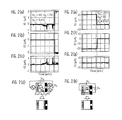
Claims (15)

What is claimed is:
1. An electrochemical transistor, comprising:
an ion diffusion member,
a gate electrode located on a first surface of said ion diffusion member, and
a source electrode and a drain electrode located on a second surface of said ion diffusion member that opposes to said first surface with an insulator interposed between said source electrode and said drain electrode, wherein a gate voltage is applied to said gate electrode to diffuse metal ions in said ion diffusion member such that said metal ions are super-saturated on said source electrode and said drain electrode as well as on said insulator near said both electrodes to make electrical connection between said source electrode and said drain electrode by way of a metal precipitated by said supersaturation,
wherein when a source/drain reference gate voltage lies in a positive first area, electrical connection is made between said source electrode and said drain electrode, and when said source/drain reference gate voltage is then changed over to a positive or zero second area lower than said positive first area, said electrical connection is eliminated by said first area of said source/drain reference gate voltage, and
wherein when said source/drain reference gate voltage lies in a third area higher than said positive first area, nonvolatile electrical connection occurs.
2. An electrochemical transistor as recited in claim 1, wherein a thickness of said ion diffusion member between said first surface and said second surface is 40 nanometers or less.
3. An electrochemical transistor as recited in claim 1, wherein a material for said ion diffusion member is a metal oxide or a silicon oxide.
4. An electrochemical transistor as recited in claim 3, wherein said metal oxide is a titanium oxide, a tantalum oxide, and a tungsten oxide or a mixture thereof.
5. An electrochemical transistor as recited in claim 1, wherein said metal ions are one or more ions species of ions selected from silver ions, copper ions, and lithium ions.
6. An electrochemical transistor as recited in claim 1, wherein at least a part of said gate electrode is formed of copper or silver.
7. An electrochemical transistor as recited in claim 1, wherein said metal ions are such that metal atoms forming said gate electrode are ionized and supplied into said ion diffusion member.
8. An electrochemical transistor as recited in claim 1, wherein a spacing distance between said source electrode and said drain electrode is 20 nanometers or less.
9. An electrochemical transistor as recited in claim 8, wherein the spacing distance between said source electrode and said drain electrode ranges from 1 nanometer to 15 nanometers.
10. An electrochemical transistor as recited in claim 1, wherein one or more species of ions selected from silver ions and copper ions are contained beforehand as said metal ions in the material for said ion diffusion member.
11. An electrochemical transistor as recited in claim 1, wherein when said gate voltage lies in a positive area relative to said source electrode and said drain electrode, electrical connection and disconnection is made between said source electrode and said drain electrode.
12. An electrochemical transistor as recited in claim 1, wherein when said source/drain reference gate voltage defining said gate voltage lies in a positive area relative to said source electrode and said drain electrode, said nonvolatile electrical connection is made between said source electrode and said drain electrode, and when said source/drain reference gate voltage lies in a negative area, said nonvolatile electrical connection is eliminated.
13. An electrochemical transistor as recited in claim 1, wherein by application of a negative area of source/drain reference gate electrode, said precipitated metal is ionized and diffused in said ion diffusion member toward said gate electrode to eliminate said electrical connection between said source electrode and said drain electrode.
14. An electrochemical transistor as recited in claim 1, wherein an amount of said metal diffused in said ion diffusion member and precipitated on said drain electrode and said source electrode as well as on said insulator near said both electrodes is smaller than an amount of said metal conducting between said source electrode or said drain electrode and said gate electrode.
15. An electrochemical transistor, comprising:
a multilayered structure having
a first insulator;
a source electrode;
a drain electrode;
a second insulator interposed between the source electrode and the drain electrode, wherein the source electrode, the drain electrode and the second insulator are stacked on the first insulator; and
a third insulator stacked on the source electrode, the drain electrode and the second insulator,
wherein a side wall of said multilayered structure is formed with an ion diffusion member, and a gate electrode is further formed on the side wall thereof,
wherein a gate voltage is applied to said gate electrode to diffuse metal ions in said ion diffusion member such that said metal ions are super-saturated on side surfaces of said source electrode, said drain electrode, and said second insulator to make electrical connection between said source electrode and said drain electrode by way of a metal precipitated by said supersaturation.
US13/816,584 2010-09-22 2011-09-08 Electrochemical transistor Expired - Fee Related US8896033B2 (en)

Applications Claiming Priority (3)

Application Number Priority Date Filing Date Title
JP2010-211492 2010-09-22
JP2010211492A JP5544621B2 (en) 2010-09-22 2010-09-22 Electrochemical transistor
PCT/JP2011/070440 WO2012039284A1 (en) 2010-09-22 2011-09-08 Electrochemical transistor

Publications (2)

Publication Number Publication Date
US20130140648A1 US20130140648A1 (en) 2013-06-06
US8896033B2 true US8896033B2 (en) 2014-11-25

Family

ID=45873773

Family Applications (1)

Application Number Title Priority Date Filing Date
US13/816,584 Expired - Fee Related US8896033B2 (en) 2010-09-22 2011-09-08 Electrochemical transistor

Country Status (5)

Country Link
US (1) US8896033B2 (en)
JP (1) JP5544621B2 (en)
KR (1) KR20140012025A (en)
TW (1) TWI548088B (en)
WO (1) WO2012039284A1 (en)

Families Citing this family (12)

* Cited by examiner, † Cited by third party
Publication number Priority date Publication date Assignee Title
EP3057148B1 (en) * 2013-11-11 2018-08-08 National Institute for Materials Science Electrical conduction element, electronic device, and method for operating electrical conduction element
JP6333566B2 (en) * 2014-02-03 2018-05-30 国立研究開発法人物質・材料研究機構 Neuron operating element
US10460804B2 (en) 2014-03-14 2019-10-29 Massachusetts Institute Of Technology Voltage-controlled resistive devices
WO2015139033A1 (en) 2014-03-14 2015-09-17 Massachusetts Institute Of Technology Voltage regulation of device functional properties
WO2016040792A1 (en) * 2014-09-11 2016-03-17 Massachusetts Institute Of Technology Voltage-controlled resistive devices
JP2017168661A (en) 2016-03-16 2017-09-21 東芝メモリ株式会社 Semiconductor memory device
US10340447B2 (en) * 2017-06-07 2019-07-02 International Business Machines Corporation Three-terminal metastable symmetric zero-volt battery memristive device
KR102411663B1 (en) * 2017-09-05 2022-06-21 삼성전자주식회사 Light modulating device and electronic apparatus including the same
KR102310913B1 (en) * 2020-04-21 2021-10-08 포항공과대학교 산학협력단 liquid resistive-switching memory device
US11568927B2 (en) * 2021-03-30 2023-01-31 International Business Machines Corporation Two-terminal non-volatile memory cell for decoupled read and write operations
US11569444B2 (en) * 2021-03-30 2023-01-31 International Business Machines Corporation Three-dimensional confined memory cell with decoupled read-write
WO2024191028A1 (en) * 2023-03-13 2024-09-19 한국재료연구원 Solid-electrolyte-based artificial synaptic electronic device, and manufacturing method therefor

Citations (7)

* Cited by examiner, † Cited by third party
Publication number Priority date Publication date Assignee Title
US6737316B2 (en) * 2001-10-30 2004-05-18 Promos Technologies Inc. Method of forming a deep trench DRAM cell
US6902942B2 (en) * 2002-10-09 2005-06-07 Nanya Technology Corporation Device and method for detecting alignment of deep trench capacitors and word lines in DRAM devices
US20060164880A1 (en) 2003-07-18 2006-07-27 Toshitsugu Sakamoto Switching element method of driving switching element rewritable logic integrated circuit and memory
US20080036508A1 (en) 2004-12-27 2008-02-14 Nec Corporation Switching Element, Switching Element Drive Method and Fabrication Method, Reconfigurable Logic Integrated Circuit, and Memory Element
JP4156880B2 (en) 2002-08-02 2008-09-24 独立行政法人科学技術振興機構 Field effect transistor
US20090020742A1 (en) * 2005-01-17 2009-01-22 Nec Corporation Solid electrolyte switching element, and fabrication method of the solid electrolyte element, and integrated circuit
US20100097735A1 (en) 2008-10-16 2010-04-22 Commissariat A L' Energie Atomique Method of protecting and dissipating electrostatic discharges in an integrated circuit

Patent Citations (7)

* Cited by examiner, † Cited by third party
Publication number Priority date Publication date Assignee Title
US6737316B2 (en) * 2001-10-30 2004-05-18 Promos Technologies Inc. Method of forming a deep trench DRAM cell
JP4156880B2 (en) 2002-08-02 2008-09-24 独立行政法人科学技術振興機構 Field effect transistor
US6902942B2 (en) * 2002-10-09 2005-06-07 Nanya Technology Corporation Device and method for detecting alignment of deep trench capacitors and word lines in DRAM devices
US20060164880A1 (en) 2003-07-18 2006-07-27 Toshitsugu Sakamoto Switching element method of driving switching element rewritable logic integrated circuit and memory
US20080036508A1 (en) 2004-12-27 2008-02-14 Nec Corporation Switching Element, Switching Element Drive Method and Fabrication Method, Reconfigurable Logic Integrated Circuit, and Memory Element
US20090020742A1 (en) * 2005-01-17 2009-01-22 Nec Corporation Solid electrolyte switching element, and fabrication method of the solid electrolyte element, and integrated circuit
US20100097735A1 (en) 2008-10-16 2010-04-22 Commissariat A L' Energie Atomique Method of protecting and dissipating electrostatic discharges in an integrated circuit

Non-Patent Citations (3)

* Cited by examiner, † Cited by third party
Title
Hisao Kawaura et al., "Three-Terminal Nanometer Metal Switch Utilizing Solid Electrolytes", IEEJ Journal C, vol. 128-C, No. 6, Jun. 2008, pp. 890-895.
PCT, "International Search Report for PCT/JP2011/070440", Oct. 25, 2011.
S. M. Sze, "Physics of Semiconductor Devices", WiLeyInter-Science.

Also Published As

Publication number Publication date
US20130140648A1 (en) 2013-06-06
KR20140012025A (en) 2014-01-29
WO2012039284A1 (en) 2012-03-29
TWI548088B (en) 2016-09-01
JP5544621B2 (en) 2014-07-09
TW201222813A (en) 2012-06-01
JP2012069612A (en) 2012-04-05

Similar Documents

Publication Publication Date Title
US8896033B2 (en) Electrochemical transistor
KR101963150B1 (en) Improved device switching using layered device structure
US7737428B2 (en) Memory component with memory cells having changeable resistance and fabrication method therefor
US8097874B2 (en) Programmable resistive memory cell with sacrificial metal
KR100676451B1 (en) Solid electrolyte switching element, FPA, memory element, and method for manufacturing solid electrolyte switching element using same
JP5776826B2 (en) Resistance change element utilizing electrochemical reaction, and manufacturing method and operating method thereof
US8987699B2 (en) Conductive bridge resistive memory device and method of manufacturing the same
US10936944B2 (en) Three-terminal neuromorphic vertical sensing
WO2011008651A1 (en) Pcmo non-volatile resitive memory with improved switching
US20130009128A1 (en) Nanoscale switching device
US8421049B2 (en) Metal atom migration switching device, drive and manufacturing methods for the same, integrated circuit device and memory device using same
US8487289B2 (en) Electrically actuated device
EP1329958B1 (en) Electronic device having controllable conductance
US8519372B2 (en) Electroforming-free nanoscale switching device
KR102310470B1 (en) Non-volatile memory device and method for manufacturing the same
KR20150047668A (en) Transistor and method for operating the same
JP2012216724A (en) Resistance storage device, and writing method thereof
US12527236B2 (en) Lateral programmable metallization cell devices
Zhang et al. Quantized current conduction in memristors and its physical model
Kozicki et al. Center for Solid State Electronics Research, Arizona State University, Tempe, AZ 85287-6206

Legal Events

Date Code Title Description
AS Assignment

Owner name: NATIONAL INSTITUTE FOR MATERIALS SCIENCE, JAPAN

Free format text: ASSIGNMENT OF ASSIGNORS INTEREST;ASSIGNORS:HASEGAWA, TSUYOSHI;AONO, MASAKAZU;TERABE, KAZUYA;AND OTHERS;SIGNING DATES FROM 20120510 TO 20120511;REEL/FRAME:029796/0711

FEPP Fee payment procedure

Free format text: MAINTENANCE FEE REMINDER MAILED (ORIGINAL EVENT CODE: REM.)

LAPS Lapse for failure to pay maintenance fees

Free format text: PATENT EXPIRED FOR FAILURE TO PAY MAINTENANCE FEES (ORIGINAL EVENT CODE: EXP.); ENTITY STATUS OF PATENT OWNER: LARGE ENTITY

STCH Information on status: patent discontinuation

Free format text: PATENT EXPIRED DUE TO NONPAYMENT OF MAINTENANCE FEES UNDER 37 CFR 1.362

FP Lapsed due to failure to pay maintenance fee

Effective date: 20181125