US8889855B2 - Preparation of maytansinoid esters - Google Patents
Preparation of maytansinoid esters Download PDFInfo
- Publication number
- US8889855B2 US8889855B2 US13/836,469 US201313836469A US8889855B2 US 8889855 B2 US8889855 B2 US 8889855B2 US 201313836469 A US201313836469 A US 201313836469A US 8889855 B2 US8889855 B2 US 8889855B2
- Authority
- US
- United States
- Prior art keywords
- alkyl
- hydrogen
- formula
- compound
- group
- Prior art date
- Legal status (The legal status is an assumption and is not a legal conclusion. Google has not performed a legal analysis and makes no representation as to the accuracy of the status listed.)
- Active
Links
- 0 *C(=O)OC1CC(=O)N([2*])C2=C(C)C(O[Y])=CC(=C2)C([1*])/C([3*])=C/C=C/C(CO)C2([4*])CC(OC(=C)N2)C(C)C2OC12C Chemical compound *C(=O)OC1CC(=O)N([2*])C2=C(C)C(O[Y])=CC(=C2)C([1*])/C([3*])=C/C=C/C(CO)C2([4*])CC(OC(=C)N2)C(C)C2OC12C 0.000 description 148
- LIRJDPJPEYLROB-UHFFFAOYSA-N CC(C)(C)C(=O)ON1C(=O)CCC1=O.CC(C)N1C(=O)C=CC1=O.CC(C)N1CC=CC1=O Chemical compound CC(C)(C)C(=O)ON1C(=O)CCC1=O.CC(C)N1C(=O)C=CC1=O.CC(C)N1CC=CC1=O LIRJDPJPEYLROB-UHFFFAOYSA-N 0.000 description 7
- YGWDYPFWBCHKSP-IFCXIRNMSA-N CO[C@@H]1/C=C/C=C(\C)CC2=CC(=C(C)C([Y]=O)=C2)N(C)C(=O)C[C@H](O)[C@]2(C)OC2[C@H](C)[C@@H]2C[C@@]1(O)NC(=O)O2 Chemical compound CO[C@@H]1/C=C/C=C(\C)CC2=CC(=C(C)C([Y]=O)=C2)N(C)C(=O)C[C@H](O)[C@]2(C)OC2[C@H](C)[C@@H]2C[C@@]1(O)NC(=O)O2 YGWDYPFWBCHKSP-IFCXIRNMSA-N 0.000 description 4
- XELULRVAMSKMRU-UHFFFAOYSA-N C=C1C=CC(=O)N1C(C)C.C=C1C=CCN1C(C)C.CC(C)(C)C(=O)ON1C(=O)CCC1=O Chemical compound C=C1C=CC(=O)N1C(C)C.C=C1C=CCN1C(C)C.CC(C)(C)C(=O)ON1C(=O)CCC1=O XELULRVAMSKMRU-UHFFFAOYSA-N 0.000 description 3
- QWPXBEHQFHACTK-JWIVQDQFSA-N COC1=CC2=CC(=C1Cl)N(C)C(=O)C[C@H](O)[C@]1(C)OC1[C@H](C)[C@@H]1C[C@@](O)(NC(=O)O1)[C@H](OC)/C=C/C=C(\C)C2 Chemical compound COC1=CC2=CC(=C1Cl)N(C)C(=O)C[C@H](O)[C@]1(C)OC1[C@H](C)[C@@H]1C[C@@](O)(NC(=O)O1)[C@H](OC)/C=C/C=C(\C)C2 QWPXBEHQFHACTK-JWIVQDQFSA-N 0.000 description 3
- UGBPANNIQRLRII-YJAYRAFTSA-N COC1=CC2=CC(=C1Cl)N(C)C(=O)C[C@H](OC(=O)[C@H](C)N(C)C(=O)CCCCCN1C(=O)C=CC1=O)[C@]1(C)OC1[C@H](C)[C@@H]1C[C@@](O)(NC(=O)O1)[C@H](OC)/C=C/C=C(\C)C2 Chemical compound COC1=CC2=CC(=C1Cl)N(C)C(=O)C[C@H](OC(=O)[C@H](C)N(C)C(=O)CCCCCN1C(=O)C=CC1=O)[C@]1(C)OC1[C@H](C)[C@@H]1C[C@@](O)(NC(=O)O1)[C@H](OC)/C=C/C=C(\C)C2 UGBPANNIQRLRII-YJAYRAFTSA-N 0.000 description 3
- MRLFQZZCESDTSL-JTQLQIEISA-N C[C@@H](C(=O)O)N(C)C(=O)CCCCCN1C(=O)C=CC1=O Chemical compound C[C@@H](C(=O)O)N(C)C(=O)CCCCCN1C(=O)C=CC1=O MRLFQZZCESDTSL-JTQLQIEISA-N 0.000 description 3
- FITWXPQJEPAJBI-UHFFFAOYSA-N C.C=C1C=CC(=O)N1C(C)C.C=C1C=CCN1C(C)C.CC(C)(C)C(=O)ON1C(=O)CCC1=O Chemical compound C.C=C1C=CC(=O)N1C(C)C.C=C1C=CCN1C(C)C.CC(C)(C)C(=O)ON1C(=O)CCC1=O FITWXPQJEPAJBI-UHFFFAOYSA-N 0.000 description 2
- RPGFBQPZFMKHNB-MDWCPACBSA-N C=C1N[C@]2(O)C[C@H](O1)[C@@H](C)C1O[C@@]1(C)[C@@H](OC(=O)[C@H](C)NC)CC(=O)N(C)C1=C(Cl)C(OC)=CC(=C1)C/C(C)=C/C=C/[C@H]2OC Chemical compound C=C1N[C@]2(O)C[C@H](O1)[C@@H](C)C1O[C@@]1(C)[C@@H](OC(=O)[C@H](C)NC)CC(=O)N(C)C1=C(Cl)C(OC)=CC(=C1)C/C(C)=C/C=C/[C@H]2OC RPGFBQPZFMKHNB-MDWCPACBSA-N 0.000 description 2
- DTTCUVGZRONMCH-XJFPJZBPSA-M CC1=C2C=C(C=C1O[Y])C/C(C)=C/C=C/C(CO)C1(O)CC(OC(=O)N1)C(C)C1OC1(C)C(O)CC(=O)N2C Chemical compound CC1=C2C=C(C=C1O[Y])C/C(C)=C/C=C/C(CO)C1(O)CC(OC(=O)N1)C(C)C1OC1(C)C(O)CC(=O)N2C DTTCUVGZRONMCH-XJFPJZBPSA-M 0.000 description 2
- YOKYXNXTKZIZKU-FKBBADOKSA-N CC1=C2C=C(C=C1[Y]=O)C/C(C)=C/C=C/C(CO)C1(O)CC(OC(=O)N1)C(C)C1OC1(C)C(O)CC(=O)N2C Chemical compound CC1=C2C=C(C=C1[Y]=O)C/C(C)=C/C=C/C(CO)C1(O)CC(OC(=O)N1)C(C)C1OC1(C)C(O)CC(=O)N2C YOKYXNXTKZIZKU-FKBBADOKSA-N 0.000 description 2
- QWPXBEHQFHACTK-KZVYIGENSA-N COC1=CC2=CC(=C1Cl)N(C)C(=O)CC(O)C1(C)OC1C(C)C1CC(O)(NC(=O)O1)C(OC)/C=C/C=C(\C)C2 Chemical compound COC1=CC2=CC(=C1Cl)N(C)C(=O)CC(O)C1(C)OC1C(C)C1CC(O)(NC(=O)O1)C(OC)/C=C/C=C(\C)C2 QWPXBEHQFHACTK-KZVYIGENSA-N 0.000 description 2
- JFXUDASUTGGZFD-UHFFFAOYSA-N O=C=O.[H]C(C)N(C)C Chemical compound O=C=O.[H]C(C)N(C)C JFXUDASUTGGZFD-UHFFFAOYSA-N 0.000 description 2
- CIHSLGNNLYEYPG-IONXNHGVSA-N C.C.C=C1C=CC(=O)N1CCCCCC(=O)N(C)[C@@H](C)C(=O)O.O=C=O.O=C=O.O=C=O.O=C=O.O=C=O.[H]C(C)N(C)C.[H]C(C)N(C)C(=O)CCC(C)(C)SSC.[H]C(C)N(C)C(=O)CCSSC.[H]C(CCS(C)=S)N(C)C(C)=O.[H]C(CS(C)=S)N(C)C(C)=O Chemical compound C.C.C=C1C=CC(=O)N1CCCCCC(=O)N(C)[C@@H](C)C(=O)O.O=C=O.O=C=O.O=C=O.O=C=O.O=C=O.[H]C(C)N(C)C.[H]C(C)N(C)C(=O)CCC(C)(C)SSC.[H]C(C)N(C)C(=O)CCSSC.[H]C(CCS(C)=S)N(C)C(C)=O.[H]C(CS(C)=S)N(C)C(C)=O CIHSLGNNLYEYPG-IONXNHGVSA-N 0.000 description 1
- DKBKGRVHHLMHAB-WXHPUVEVSA-N C.CN[C@@H](C)C(=O)O[C@H]1CC(=O)N(C)C2=C(Cl)C(OC)=CC(=C2)C/C(C)=C/C=C/[C@@H](OC)[C@@]2(O)C[C@H](OC(=O)N2)[C@@H](C)C2O[C@]21C.CN[C@H](C)C(=O)O[C@H]1CC(=O)N(C)C2=C(Cl)C(OC)=CC(=C2)C/C(C)=C/C=C/[C@@H](OC)[C@@]2(O)C[C@H](OC(=O)N2)[C@@H](C)C2O[C@]21C.COC1=CC2=CC(=C1Cl)N(C)C(=O)C[C@H](OC(=O)[C@@H](C)N(C)C(=O)CCC(C)(C)SSC)[C@]1(C)OC1[C@H](C)[C@@H]1C[C@@](O)(NC(=O)O1)[C@H](OC)/C=C/C=C(\C)C2.COC1=CC2=CC(=C1Cl)N(C)C(=O)C[C@H](OC(=O)[C@H](C)N(C)C(=O)CCC(C)(C)SSC)[C@]1(C)OC1[C@H](C)[C@@H]1C[C@@](O)(NC(=O)O1)[C@H](OC)/C=C/C=C(\C)C2.CS(=S)C(C)(C)CCC(=O)O.CSC.[2H][2H] Chemical compound C.CN[C@@H](C)C(=O)O[C@H]1CC(=O)N(C)C2=C(Cl)C(OC)=CC(=C2)C/C(C)=C/C=C/[C@@H](OC)[C@@]2(O)C[C@H](OC(=O)N2)[C@@H](C)C2O[C@]21C.CN[C@H](C)C(=O)O[C@H]1CC(=O)N(C)C2=C(Cl)C(OC)=CC(=C2)C/C(C)=C/C=C/[C@@H](OC)[C@@]2(O)C[C@H](OC(=O)N2)[C@@H](C)C2O[C@]21C.COC1=CC2=CC(=C1Cl)N(C)C(=O)C[C@H](OC(=O)[C@@H](C)N(C)C(=O)CCC(C)(C)SSC)[C@]1(C)OC1[C@H](C)[C@@H]1C[C@@](O)(NC(=O)O1)[C@H](OC)/C=C/C=C(\C)C2.COC1=CC2=CC(=C1Cl)N(C)C(=O)C[C@H](OC(=O)[C@H](C)N(C)C(=O)CCC(C)(C)SSC)[C@]1(C)OC1[C@H](C)[C@@H]1C[C@@](O)(NC(=O)O1)[C@H](OC)/C=C/C=C(\C)C2.CS(=S)C(C)(C)CCC(=O)O.CSC.[2H][2H] DKBKGRVHHLMHAB-WXHPUVEVSA-N 0.000 description 1
- XZIDNIZBDKGFLC-NHXSKJFGSA-N C.CN[C@@H](C)C(=O)O[C@H]1CC(=O)N(C)C2=C(Cl)C(OC)=CC(=C2)C/C(C)=C/C=C/[C@@H](OC)[C@@]2(O)C[C@H](OC(=O)N2)[C@@H](C)C2O[C@]21C.CN[C@H](C)C(=O)O[C@H]1CC(=O)N(C)C2=C(Cl)C(OC)=CC(=C2)C/C(C)=C/C=C/[C@@H](OC)[C@@]2(O)C[C@H](OC(=O)N2)[C@@H](C)C2O[C@]21C.COC1=CC2=CC(=C1Cl)N(C)C(=O)C[C@H](OC(=O)[C@@H](C)N(C)C(=O)CCCCCN1C(=O)C=CC1=O)[C@]1(C)OC1[C@H](C)[C@@H]1C[C@@](O)(NC(=O)O1)[C@H](OC)/C=C/C=C(\C)C2.COC1=CC2=CC(=C1Cl)N(C)C(=O)C[C@H](OC(=O)[C@H](C)N(C)C(=O)CCCCCN1C(=O)C=CC1=O)[C@]1(C)OC1[C@H](C)[C@@H]1C[C@@](O)(NC(=O)O1)[C@H](OC)/C=C/C=C(\C)C2.O=C(O)CCCCCN1C(=O)C=CC1=O Chemical compound C.CN[C@@H](C)C(=O)O[C@H]1CC(=O)N(C)C2=C(Cl)C(OC)=CC(=C2)C/C(C)=C/C=C/[C@@H](OC)[C@@]2(O)C[C@H](OC(=O)N2)[C@@H](C)C2O[C@]21C.CN[C@H](C)C(=O)O[C@H]1CC(=O)N(C)C2=C(Cl)C(OC)=CC(=C2)C/C(C)=C/C=C/[C@@H](OC)[C@@]2(O)C[C@H](OC(=O)N2)[C@@H](C)C2O[C@]21C.COC1=CC2=CC(=C1Cl)N(C)C(=O)C[C@H](OC(=O)[C@@H](C)N(C)C(=O)CCCCCN1C(=O)C=CC1=O)[C@]1(C)OC1[C@H](C)[C@@H]1C[C@@](O)(NC(=O)O1)[C@H](OC)/C=C/C=C(\C)C2.COC1=CC2=CC(=C1Cl)N(C)C(=O)C[C@H](OC(=O)[C@H](C)N(C)C(=O)CCCCCN1C(=O)C=CC1=O)[C@]1(C)OC1[C@H](C)[C@@H]1C[C@@](O)(NC(=O)O1)[C@H](OC)/C=C/C=C(\C)C2.O=C(O)CCCCCN1C(=O)C=CC1=O XZIDNIZBDKGFLC-NHXSKJFGSA-N 0.000 description 1
- JFDJXYCBKMEJKR-SXPJLBFZSA-N C.CN[C@@H](C)C(=O)O[C@H]1CC(=O)N(C)C2=C(Cl)C(OC)=CC(=C2)C/C(C)=C/C=C/[C@@H](OC)[C@@]2(O)C[C@H](OC(=O)N2)[C@@H](C)C2O[C@]21C.CN[C@H](C)C(=O)O[C@H]1CC(=O)N(C)C2=C(Cl)C(OC)=CC(=C2)C/C(C)=C/C=C/[C@@H](OC)[C@@]2(O)C[C@H](OC(=O)N2)[C@@H](C)C2O[C@]21C.COC1=CC2=CC(=C1Cl)N(C)C(=O)C[C@H](OC(=O)[C@@H](C)N(C)C(=O)CCSSC)[C@]1(C)OC1[C@H](C)[C@@H]1C[C@@](O)(NC(=O)O1)[C@H](OC)/C=C/C=C(\C)C2.COC1=CC2=CC(=C1Cl)N(C)C(=O)C[C@H](OC(=O)[C@H](C)N(C)C(=O)CCSSC)[C@]1(C)OC1[C@H](C)[C@@H]1C[C@@](O)(NC(=O)O1)[C@H](OC)/C=C/C=C(\C)C2.CS(=S)CCC(=O)O.CSC.[2H][2H] Chemical compound C.CN[C@@H](C)C(=O)O[C@H]1CC(=O)N(C)C2=C(Cl)C(OC)=CC(=C2)C/C(C)=C/C=C/[C@@H](OC)[C@@]2(O)C[C@H](OC(=O)N2)[C@@H](C)C2O[C@]21C.CN[C@H](C)C(=O)O[C@H]1CC(=O)N(C)C2=C(Cl)C(OC)=CC(=C2)C/C(C)=C/C=C/[C@@H](OC)[C@@]2(O)C[C@H](OC(=O)N2)[C@@H](C)C2O[C@]21C.COC1=CC2=CC(=C1Cl)N(C)C(=O)C[C@H](OC(=O)[C@@H](C)N(C)C(=O)CCSSC)[C@]1(C)OC1[C@H](C)[C@@H]1C[C@@](O)(NC(=O)O1)[C@H](OC)/C=C/C=C(\C)C2.COC1=CC2=CC(=C1Cl)N(C)C(=O)C[C@H](OC(=O)[C@H](C)N(C)C(=O)CCSSC)[C@]1(C)OC1[C@H](C)[C@@H]1C[C@@](O)(NC(=O)O1)[C@H](OC)/C=C/C=C(\C)C2.CS(=S)CCC(=O)O.CSC.[2H][2H] JFDJXYCBKMEJKR-SXPJLBFZSA-N 0.000 description 1
- HTZXKMCVPKJSCU-HTIOQFFFSA-N C.CN[C@@H](C)C(=O)O[C@H]1CC(=O)N(C)C2=C(Cl)C(OC)=CC(=C2)C/C(C)=C/C=C/[C@@H](OC)[C@@]2(O)C[C@H](OC(=O)N2)[C@@H](C)C2O[C@]21C.COC1=CC2=CC(=C1Cl)N(C)C(=O)C[C@H](OC(=O)[C@H](C)N(C)C(=O)CCC(C)(C)SSC)[C@]1(C)OC1[C@H](C)[C@@H]1C[C@@](O)(NC(=O)O1)[C@H](OC)/C=C/C=C(\C)C2.CS(=S)C(C)(C)CCC(=O)O Chemical compound C.CN[C@@H](C)C(=O)O[C@H]1CC(=O)N(C)C2=C(Cl)C(OC)=CC(=C2)C/C(C)=C/C=C/[C@@H](OC)[C@@]2(O)C[C@H](OC(=O)N2)[C@@H](C)C2O[C@]21C.COC1=CC2=CC(=C1Cl)N(C)C(=O)C[C@H](OC(=O)[C@H](C)N(C)C(=O)CCC(C)(C)SSC)[C@]1(C)OC1[C@H](C)[C@@H]1C[C@@](O)(NC(=O)O1)[C@H](OC)/C=C/C=C(\C)C2.CS(=S)C(C)(C)CCC(=O)O HTZXKMCVPKJSCU-HTIOQFFFSA-N 0.000 description 1
- CZOHMWPDPPNEDK-LJQMTLKTSA-N C.CN[C@@H](C)C(=O)O[C@H]1CC(=O)N(C)C2=C(Cl)C(OC)=CC(=C2)C/C(C)=C/C=C/[C@@H](OC)[C@@]2(O)C[C@H](OC(=O)N2)[C@@H](C)C2O[C@]21C.COC1=CC2=CC(=C1Cl)N(C)C(=O)C[C@H](OC(=O)[C@H](C)N(C)C(=O)CCCCCN1C(=O)C=CC1=O)[C@]1(C)OC1[C@H](C)[C@@H]1C[C@@](O)(NC(=O)O1)[C@H](OC)/C=C/C=C(\C)C2.O=C(O)CCCCCN1C(=O)C=CC1=O Chemical compound C.CN[C@@H](C)C(=O)O[C@H]1CC(=O)N(C)C2=C(Cl)C(OC)=CC(=C2)C/C(C)=C/C=C/[C@@H](OC)[C@@]2(O)C[C@H](OC(=O)N2)[C@@H](C)C2O[C@]21C.COC1=CC2=CC(=C1Cl)N(C)C(=O)C[C@H](OC(=O)[C@H](C)N(C)C(=O)CCCCCN1C(=O)C=CC1=O)[C@]1(C)OC1[C@H](C)[C@@H]1C[C@@](O)(NC(=O)O1)[C@H](OC)/C=C/C=C(\C)C2.O=C(O)CCCCCN1C(=O)C=CC1=O CZOHMWPDPPNEDK-LJQMTLKTSA-N 0.000 description 1
- KCGFVWDODNPGJS-PTARRPRRSA-N C.CN[C@@H](C)C(=O)O[C@H]1CC(=O)N(C)C2=C(Cl)C(OC)=CC(=C2)C/C(C)=C/C=C/[C@@H](OC)[C@@]2(O)C[C@H](OC(=O)N2)[C@@H](C)C2O[C@]21C.COC1=CC2=CC(=C1Cl)N(C)C(=O)C[C@H](OC(=O)[C@H](C)N(C)C(=O)CCSSC)[C@]1(C)OC1[C@H](C)[C@@H]1C[C@@](O)(NC(=O)O1)[C@H](OC)/C=C/C=C(\C)C2.CS(=S)CCC(=O)O Chemical compound C.CN[C@@H](C)C(=O)O[C@H]1CC(=O)N(C)C2=C(Cl)C(OC)=CC(=C2)C/C(C)=C/C=C/[C@@H](OC)[C@@]2(O)C[C@H](OC(=O)N2)[C@@H](C)C2O[C@]21C.COC1=CC2=CC(=C1Cl)N(C)C(=O)C[C@H](OC(=O)[C@H](C)N(C)C(=O)CCSSC)[C@]1(C)OC1[C@H](C)[C@@H]1C[C@@](O)(NC(=O)O1)[C@H](OC)/C=C/C=C(\C)C2.CS(=S)CCC(=O)O KCGFVWDODNPGJS-PTARRPRRSA-N 0.000 description 1
- JDMWSMLVPNBSFP-MWZFNKHUSA-N C=C1C=CC(=O)N1CCCCCC(=O)C[C@H](C(=O)N[C@@H](CCCNC(N)=O)C(=O)CC1=CC=C(COC(=O)N(C)[C@@H](C)C(=O)OC2CC(=O)N(C)C3=C(Cl)C(OC)=CC(=C3)C/C(C)=C/C=C/C(C)C3(O)CC(OC(=O)N3)C(C)C3OC23C)C=C1)C(C)C.C=C1C=CC(=O)N1CCCCCC(=O)C[C@H](C(=O)N[C@@H](CCCNC(N)=O)C(=O)N(C)[C@@H](C)C(=O)OC1CC(=O)N(C)C2=C(Cl)C(OC)=CC(=C2)C/C(C)=C/C=C/C(C)C2(O)CC(OC(=O)N2)C(C)C2OC12C)C(C)C.C=C1C=CC(=O)N1CCCCCCCC(=O)[C@H](CCCNC(N)=O)NC(=O)[C@@H](CC(=O)N(C)[C@@H](C)C(=O)OC1CC(=O)N(C)C2=C(Cl)C(OC)=CC(=C2)C/C(C)=C/C=C/C(C)C2(O)CC(OC(=O)N2)C(C)C2OC12C)C(C)C Chemical compound C=C1C=CC(=O)N1CCCCCC(=O)C[C@H](C(=O)N[C@@H](CCCNC(N)=O)C(=O)CC1=CC=C(COC(=O)N(C)[C@@H](C)C(=O)OC2CC(=O)N(C)C3=C(Cl)C(OC)=CC(=C3)C/C(C)=C/C=C/C(C)C3(O)CC(OC(=O)N3)C(C)C3OC23C)C=C1)C(C)C.C=C1C=CC(=O)N1CCCCCC(=O)C[C@H](C(=O)N[C@@H](CCCNC(N)=O)C(=O)N(C)[C@@H](C)C(=O)OC1CC(=O)N(C)C2=C(Cl)C(OC)=CC(=C2)C/C(C)=C/C=C/C(C)C2(O)CC(OC(=O)N2)C(C)C2OC12C)C(C)C.C=C1C=CC(=O)N1CCCCCCCC(=O)[C@H](CCCNC(N)=O)NC(=O)[C@@H](CC(=O)N(C)[C@@H](C)C(=O)OC1CC(=O)N(C)C2=C(Cl)C(OC)=CC(=C2)C/C(C)=C/C=C/C(C)C2(O)CC(OC(=O)N2)C(C)C2OC12C)C(C)C JDMWSMLVPNBSFP-MWZFNKHUSA-N 0.000 description 1
- ZJYRYUCABUNFFH-LTXJVPJLSA-N C=C1C=CC(=O)N1CCCCCC(=O)N(C)[C@@H](C)C(=O)O[C@H]1CC(=O)N(C)C2=C(Cl)C(OC)=CC(=C2)C/C(C)=C/C=C/[C@@H](OC)[C@@]2(O)C[C@H](OC(=O)N2)[C@@H](C)C2O[C@]21C Chemical compound C=C1C=CC(=O)N1CCCCCC(=O)N(C)[C@@H](C)C(=O)O[C@H]1CC(=O)N(C)C2=C(Cl)C(OC)=CC(=C2)C/C(C)=C/C=C/[C@@H](OC)[C@@]2(O)C[C@H](OC(=O)N2)[C@@H](C)C2O[C@]21C ZJYRYUCABUNFFH-LTXJVPJLSA-N 0.000 description 1
- XCQFMMDOHGHXFU-LMCJCPSMSA-N C=C1NC2(O)CC(O1)C(C)C1OC1(C)C(O)CC(=O)N(C)C1=C(C)C([Y]=O)=CC(=C1)C/C(C)=C/C=C/C2CO Chemical compound C=C1NC2(O)CC(O1)C(C)C1OC1(C)C(O)CC(=O)N(C)C1=C(C)C([Y]=O)=CC(=C1)C/C(C)=C/C=C/C2CO XCQFMMDOHGHXFU-LMCJCPSMSA-N 0.000 description 1
- MWKVAYORFOXDIM-XAYYUFBYSA-N C=C1N[C@]2(O)C[C@H](O1)[C@@H](C)C1O[C@@]1(C)[C@@H](O)CC(=O)N(C)C1=C(Cl)C(OC)=CC(=C1)C/C(C)=C/C=C/[C@H]2OC Chemical compound C=C1N[C@]2(O)C[C@H](O1)[C@@H](C)C1O[C@@]1(C)[C@@H](O)CC(=O)N(C)C1=C(Cl)C(OC)=CC(=C1)C/C(C)=C/C=C/[C@H]2OC MWKVAYORFOXDIM-XAYYUFBYSA-N 0.000 description 1
- AXCFWXUQGFNHRS-AEAZTXIBSA-N C=C1N[C@]2(O)C[C@H](O1)[C@@H](C)C1O[C@@]1(C)[C@@H](OC(=O)[C@H](C)N(C)C(C)=O)CC(=O)N(C)C1=C(Cl)C(CO)=CC(=C1)C/C(C)=C/C=C/[C@H]2OC Chemical compound C=C1N[C@]2(O)C[C@H](O1)[C@@H](C)C1O[C@@]1(C)[C@@H](OC(=O)[C@H](C)N(C)C(C)=O)CC(=O)N(C)C1=C(Cl)C(CO)=CC(=C1)C/C(C)=C/C=C/[C@H]2OC AXCFWXUQGFNHRS-AEAZTXIBSA-N 0.000 description 1
- BMVQGBYNNCCERB-GSJKXAQTSA-K CC(=O)O.COC1=CC2=CC(=C1Cl)N(C)C(=O)C[C@H](O)[C@]1(C)OC1[C@H](C)[C@@H]1C[C@@](O)(NC(=O)O1)[C@H](OC)/C=C/C=C(\C)C2.COC1=CC2=CC(=C1Cl)N(C)C(=O)C[C@H](OC(C)=O)[C@]1(C)OC1[C@H](C)[C@@H]1C[C@@](O)(NC(=O)O1)[C@H](OC)/C=C/C=C(\C)C2.O=S(=O)(O[Sc](OS(=O)(=O)C(F)(F)F)OS(=O)(=O)C(F)(F)F)C(F)(F)F Chemical compound CC(=O)O.COC1=CC2=CC(=C1Cl)N(C)C(=O)C[C@H](O)[C@]1(C)OC1[C@H](C)[C@@H]1C[C@@](O)(NC(=O)O1)[C@H](OC)/C=C/C=C(\C)C2.COC1=CC2=CC(=C1Cl)N(C)C(=O)C[C@H](OC(C)=O)[C@]1(C)OC1[C@H](C)[C@@H]1C[C@@](O)(NC(=O)O1)[C@H](OC)/C=C/C=C(\C)C2.O=S(=O)(O[Sc](OS(=O)(=O)C(F)(F)F)OS(=O)(=O)C(F)(F)F)C(F)(F)F BMVQGBYNNCCERB-GSJKXAQTSA-K 0.000 description 1
- YGIXUHCRZJCLRM-PLZWCHBISA-K CC(C)C(=O)O.COC1=CC2=CC(=C1Cl)N(C)C(=O)C[C@H](O)[C@]1(C)OC1[C@H](C)[C@@H]1C[C@@](O)(NC(=O)O1)[C@H](OC)/C=C/C=C(\C)C2.COC1=CC2=CC(=C1Cl)N(C)C(=O)C[C@H](OC(=O)C(C)C)[C@]1(C)OC1[C@H](C)[C@@H]1C[C@@](O)(NC(=O)O1)[C@H](OC)/C=C/C=C(\C)C2.O=S(=O)(O[Sc](OS(=O)(=O)C(F)(F)F)OS(=O)(=O)C(F)(F)F)C(F)(F)F Chemical compound CC(C)C(=O)O.COC1=CC2=CC(=C1Cl)N(C)C(=O)C[C@H](O)[C@]1(C)OC1[C@H](C)[C@@H]1C[C@@](O)(NC(=O)O1)[C@H](OC)/C=C/C=C(\C)C2.COC1=CC2=CC(=C1Cl)N(C)C(=O)C[C@H](OC(=O)C(C)C)[C@]1(C)OC1[C@H](C)[C@@H]1C[C@@](O)(NC(=O)O1)[C@H](OC)/C=C/C=C(\C)C2.O=S(=O)(O[Sc](OS(=O)(=O)C(F)(F)F)OS(=O)(=O)C(F)(F)F)C(F)(F)F YGIXUHCRZJCLRM-PLZWCHBISA-K 0.000 description 1
- DRXXRDYKQULMOM-UHFFFAOYSA-N CC(C)C1CCC2(CCCC2)CC1 Chemical compound CC(C)C1CCC2(CCCC2)CC1 DRXXRDYKQULMOM-UHFFFAOYSA-N 0.000 description 1
- VFMQXZOFGROHCZ-ADGNYLCFSA-N CCN(c(cc(C/C(/C)=C/C=C/[C@H]([C@@](C[C@@H]([C@@H](C)[C@@H]1O[C@@]1(C)[C@H](C1)OC(CN(C)C(C)=O)=O)O2)(NC2=O)O)[O](C)=C)cc2OC)c2Cl)C1=O Chemical compound CCN(c(cc(C/C(/C)=C/C=C/[C@H]([C@@](C[C@@H]([C@@H](C)[C@@H]1O[C@@]1(C)[C@H](C1)OC(CN(C)C(C)=O)=O)O2)(NC2=O)O)[O](C)=C)cc2OC)c2Cl)C1=O VFMQXZOFGROHCZ-ADGNYLCFSA-N 0.000 description 1
- JONYMYQNFPQYAB-QQGSLYAXSA-N CN[C@@H](C)C(=O)OC(C)(C)C.COC1=CC2=CC(=C1Cl)N(C)C(=O)C[C@H](O)[C@]1(C)OC1[C@H](C)[C@@H]1C[C@@](O)(NC(=O)O1)[C@H](OC)/C=C/C=C(\C)C2.COC1=CC2=CC(=C1Cl)N(C)C(=O)C[C@H](OC(=O)[C@@H](C)N(C)C(=O)CCCCCN1C(=O)C=CC1=O)[C@]1(C)OC1[C@H](C)[C@@H]1C[C@@](O)(NC(=O)O1)[C@H](OC)/C=C/C=C(\C)C2.COC1=CC2=CC(=C1Cl)N(C)C(=O)C[C@H](OC(=O)[C@H](C)N(C)C(=O)CCCCCN1C(=O)C=CC1=O)[C@]1(C)OC1[C@H](C)[C@@H]1C[C@@](O)(NC(=O)O1)[C@H](OC)/C=C/C=C(\C)C2.C[C@@H](C(=O)O)N(C)C(=O)CCCCCN1C(=O)C=CC1=O.C[C@@H](C(=O)OC(C)(C)C)N(C)C(=O)CCCCCN1C(=O)C=CC1=O.O=C(O)CCCCCN1C(=O)C=CC1=O.O=CO.[3H]B[U] Chemical compound CN[C@@H](C)C(=O)OC(C)(C)C.COC1=CC2=CC(=C1Cl)N(C)C(=O)C[C@H](O)[C@]1(C)OC1[C@H](C)[C@@H]1C[C@@](O)(NC(=O)O1)[C@H](OC)/C=C/C=C(\C)C2.COC1=CC2=CC(=C1Cl)N(C)C(=O)C[C@H](OC(=O)[C@@H](C)N(C)C(=O)CCCCCN1C(=O)C=CC1=O)[C@]1(C)OC1[C@H](C)[C@@H]1C[C@@](O)(NC(=O)O1)[C@H](OC)/C=C/C=C(\C)C2.COC1=CC2=CC(=C1Cl)N(C)C(=O)C[C@H](OC(=O)[C@H](C)N(C)C(=O)CCCCCN1C(=O)C=CC1=O)[C@]1(C)OC1[C@H](C)[C@@H]1C[C@@](O)(NC(=O)O1)[C@H](OC)/C=C/C=C(\C)C2.C[C@@H](C(=O)O)N(C)C(=O)CCCCCN1C(=O)C=CC1=O.C[C@@H](C(=O)OC(C)(C)C)N(C)C(=O)CCCCCN1C(=O)C=CC1=O.O=C(O)CCCCCN1C(=O)C=CC1=O.O=CO.[3H]B[U] JONYMYQNFPQYAB-QQGSLYAXSA-N 0.000 description 1
- ULLHLCXTFQUJID-AQNCUKRASA-N COC1=CC2=CC(=C1Cl)N(C)C(=O)CC(OC(=O)[C@H](C)N(C)C(=O)C(CCSC)NC(=O)CCCCCN1C(=O)C=CC1=O)C1(C)OC1C(C)C1CC(O)(NC(=O)O1)C(C)/C=C/C=C(\C)C2.COC1=CC2=CC(=C1Cl)N(C)C(=O)CC(OC(=O)[C@H](C)N(C)C(=O)C(CSC)NC(=O)CCCCCN1C(=O)C=CC1=O)C1(C)OC1C(C)C1CC(O)(NC(=O)O1)C(C)/C=C/C=C(\C)C2.COC1=CC2=CC(=C1Cl)N(C)C(=O)CC(OC(=O)[C@H](C)N(C)C(=O)C[C@@H](CSCC(=O)ON1C(=O)CCC1=O)C(=O)O)C1(C)OC1C(C)C1CC(O)(NC(=O)O1)C(C)/C=C/C=C(\C)C2 Chemical compound COC1=CC2=CC(=C1Cl)N(C)C(=O)CC(OC(=O)[C@H](C)N(C)C(=O)C(CCSC)NC(=O)CCCCCN1C(=O)C=CC1=O)C1(C)OC1C(C)C1CC(O)(NC(=O)O1)C(C)/C=C/C=C(\C)C2.COC1=CC2=CC(=C1Cl)N(C)C(=O)CC(OC(=O)[C@H](C)N(C)C(=O)C(CSC)NC(=O)CCCCCN1C(=O)C=CC1=O)C1(C)OC1C(C)C1CC(O)(NC(=O)O1)C(C)/C=C/C=C(\C)C2.COC1=CC2=CC(=C1Cl)N(C)C(=O)CC(OC(=O)[C@H](C)N(C)C(=O)C[C@@H](CSCC(=O)ON1C(=O)CCC1=O)C(=O)O)C1(C)OC1C(C)C1CC(O)(NC(=O)O1)C(C)/C=C/C=C(\C)C2 ULLHLCXTFQUJID-AQNCUKRASA-N 0.000 description 1
- RFWZMDOQCLHDES-GXVOSICYSA-N COC1=CC2=CC(=C1Cl)N(C)C(=O)CC(OC(=O)[C@H](C)N(C)C(=O)C(CCSC)NC(=O)[C@@H](CCCCN)CC(=O)CCN1C(=O)C=CC1=O)C1(C)OC1C(C)C1CC(O)(NC(=O)O1)C(C)/C=C/C=C(\C)C2.COC1=CC2=CC(=C1Cl)N(C)C(=O)CC(OC(=O)[C@H](C)N(C)C(=O)CC(CCSC)C(=O)NC(CC(N)=O)C(=O)NC(CCCCN)C(=O)NCCNC(=O)CCN1C(=O)C=CC1=O)C1(C)OC1C(C)C1CC(O)(NC(=O)O1)C(C)/C=C/C=C(\C)C2.COC1=CC2=CC(=C1Cl)N(C)C(=O)CC(OC(=O)[C@H](C)N(C)C(=O)CC(CCSC)C(=O)NC(CCCCN)C(=O)NCCNC(=O)CCN1C(=O)C=CC1=O)C1(C)OC1C(C)C1CC(O)(NC(=O)O1)C(C)/C=C/C=C(\C)C2 Chemical compound COC1=CC2=CC(=C1Cl)N(C)C(=O)CC(OC(=O)[C@H](C)N(C)C(=O)C(CCSC)NC(=O)[C@@H](CCCCN)CC(=O)CCN1C(=O)C=CC1=O)C1(C)OC1C(C)C1CC(O)(NC(=O)O1)C(C)/C=C/C=C(\C)C2.COC1=CC2=CC(=C1Cl)N(C)C(=O)CC(OC(=O)[C@H](C)N(C)C(=O)CC(CCSC)C(=O)NC(CC(N)=O)C(=O)NC(CCCCN)C(=O)NCCNC(=O)CCN1C(=O)C=CC1=O)C1(C)OC1C(C)C1CC(O)(NC(=O)O1)C(C)/C=C/C=C(\C)C2.COC1=CC2=CC(=C1Cl)N(C)C(=O)CC(OC(=O)[C@H](C)N(C)C(=O)CC(CCSC)C(=O)NC(CCCCN)C(=O)NCCNC(=O)CCN1C(=O)C=CC1=O)C1(C)OC1C(C)C1CC(O)(NC(=O)O1)C(C)/C=C/C=C(\C)C2 RFWZMDOQCLHDES-GXVOSICYSA-N 0.000 description 1
- SIPIVGVQBPJPQB-LFVJBVLDSA-N COC1=CC2=CC(=C1Cl)N(C)C(=O)CC(OC(=O)[C@H](C)N(C)C(=O)C(CSC)NC(=O)[C@@H](CCCCN)CC(=O)CCN1C(=O)C=CC1=O)C1(C)OC1C(C)C1CC(O)(NC(=O)O1)C(C)/C=C/C=C(\C)C2.COC1=CC2=CC(=C1Cl)N(C)C(=O)CC(OC(=O)[C@H](C)N(C)C(=O)CCCCCCCN1C(=O)C=CC1=O)C1(C)OC1C(C)C1CC(O)(NC(=O)O1)C(C)/C=C/C=C(\C)C2.COC1=CC2=CC(=C1Cl)N(C)C(=O)CC(OC(=O)[C@H](C)N(C)S(=O)(=O)CCCCCCN1C(=O)C=CC1=O)C1(C)OC1C(C)C1CC(O)(NC(=O)O1)C(C)/C=C/C=C(\C)C2 Chemical compound COC1=CC2=CC(=C1Cl)N(C)C(=O)CC(OC(=O)[C@H](C)N(C)C(=O)C(CSC)NC(=O)[C@@H](CCCCN)CC(=O)CCN1C(=O)C=CC1=O)C1(C)OC1C(C)C1CC(O)(NC(=O)O1)C(C)/C=C/C=C(\C)C2.COC1=CC2=CC(=C1Cl)N(C)C(=O)CC(OC(=O)[C@H](C)N(C)C(=O)CCCCCCCN1C(=O)C=CC1=O)C1(C)OC1C(C)C1CC(O)(NC(=O)O1)C(C)/C=C/C=C(\C)C2.COC1=CC2=CC(=C1Cl)N(C)C(=O)CC(OC(=O)[C@H](C)N(C)S(=O)(=O)CCCCCCN1C(=O)C=CC1=O)C1(C)OC1C(C)C1CC(O)(NC(=O)O1)C(C)/C=C/C=C(\C)C2 SIPIVGVQBPJPQB-LFVJBVLDSA-N 0.000 description 1
- UGBPANNIQRLRII-IAASLDMYSA-N COC1=CC2=CC(=C1Cl)N(C)C(=O)CC(OC(=O)[C@H](C)N(C)C(=O)CCCCCN1C(=O)C=CC1=O)C1(C)OC1C(C)C1CC(O)(NC(=O)O1)C(OC)/C=C/C=C(\C)C2 Chemical compound COC1=CC2=CC(=C1Cl)N(C)C(=O)CC(OC(=O)[C@H](C)N(C)C(=O)CCCCCN1C(=O)C=CC1=O)C1(C)OC1C(C)C1CC(O)(NC(=O)O1)C(OC)/C=C/C=C(\C)C2 UGBPANNIQRLRII-IAASLDMYSA-N 0.000 description 1
- DQQMEJPGPUICEW-PXRBOLAESA-N COC1=CC2=CC(=C1Cl)N(C)C(=O)CC(OC(=O)[C@H](C)N(C)C(=O)OCC1=CC=C(CC(=O)[C@H](CCCNC(N)=O)NC(=O)[C@@H](CS(=O)(=O)CCCCCCN3C(=O)C=CC3=O)C(C)C)C=C1)C1(C)OC1C(C)C1CC(O)(NC(=O)O1)C(C)/C=C/C=C(\C)C2.COC1=CC2=CC(=C1Cl)N(C)C(=O)CC(OC(=O)[C@H](C)N(C)C(=O)[C@H](CCCNC(N)=O)NC(=O)[C@@H](CS(=O)(=O)CCCCCCN1C(=O)C=CC1=O)C(C)C)C1(C)OC1C(C)C1CC(O)(NC(=O)O1)C(C)/C=C/C=C(\C)C2 Chemical compound COC1=CC2=CC(=C1Cl)N(C)C(=O)CC(OC(=O)[C@H](C)N(C)C(=O)OCC1=CC=C(CC(=O)[C@H](CCCNC(N)=O)NC(=O)[C@@H](CS(=O)(=O)CCCCCCN3C(=O)C=CC3=O)C(C)C)C=C1)C1(C)OC1C(C)C1CC(O)(NC(=O)O1)C(C)/C=C/C=C(\C)C2.COC1=CC2=CC(=C1Cl)N(C)C(=O)CC(OC(=O)[C@H](C)N(C)C(=O)[C@H](CCCNC(N)=O)NC(=O)[C@@H](CS(=O)(=O)CCCCCCN1C(=O)C=CC1=O)C(C)C)C1(C)OC1C(C)C1CC(O)(NC(=O)O1)C(C)/C=C/C=C(\C)C2 DQQMEJPGPUICEW-PXRBOLAESA-N 0.000 description 1
- FBYGMHPFXXJGAF-XMGJWXFZSA-K COC1=CC2=CC(=C1Cl)N(C)C(=O)C[C@H](O)[C@]1(C)OC1[C@H](C)[C@@H]1C[C@@](O)(NC(=O)O1)[C@H](OC)/C=C/C=C(\C)C2.COC1=CC2=CC(=C1Cl)N(C)C(=O)C[C@H](OC(=O)CCCCC(=O)OCC[Si](C)(C)C)[C@]1(C)OC1[C@H](C)[C@@H]1C[C@@](O)(NC(=O)O1)[C@H](OC)/C=C/C=C(\C)C2.C[Si](C)(C)CCOC(=O)CCCCOC=O.O=S(=O)(O[Sc](OS(=O)(=O)C(F)(F)F)OS(=O)(=O)C(F)(F)F)C(F)(F)F Chemical compound COC1=CC2=CC(=C1Cl)N(C)C(=O)C[C@H](O)[C@]1(C)OC1[C@H](C)[C@@H]1C[C@@](O)(NC(=O)O1)[C@H](OC)/C=C/C=C(\C)C2.COC1=CC2=CC(=C1Cl)N(C)C(=O)C[C@H](OC(=O)CCCCC(=O)OCC[Si](C)(C)C)[C@]1(C)OC1[C@H](C)[C@@H]1C[C@@](O)(NC(=O)O1)[C@H](OC)/C=C/C=C(\C)C2.C[Si](C)(C)CCOC(=O)CCCCOC=O.O=S(=O)(O[Sc](OS(=O)(=O)C(F)(F)F)OS(=O)(=O)C(F)(F)F)C(F)(F)F FBYGMHPFXXJGAF-XMGJWXFZSA-K 0.000 description 1
- ILHRLZNQPRXGKK-ULRCBFRSSA-K COC1=CC2=CC(=C1Cl)N(C)C(=O)C[C@H](O)[C@]1(C)OC1[C@H](C)[C@@H]1C[C@@](O)(NC(=O)O1)[C@H](OC)/C=C/C=C(\C)C2.COC1=CC2=CC(=C1Cl)N(C)C(=O)C[C@H](OC(=O)[C@@H](C)N(C)C(=O)CCC(C)(C)SSC)[C@]1(C)OC1[C@H](C)[C@@H]1C[C@@](O)(NC(=O)O1)[C@H](OC)/C=C/C=C(\C)C2.COC1=CC2=CC(=C1Cl)N(C)C(=O)C[C@H](OC(=O)[C@H](C)N(C)C(=O)CCC(C)(C)SSC)[C@]1(C)OC1[C@H](C)[C@@H]1C[C@@](O)(NC(=O)O1)[C@H](OC)/C=C/C=C(\C)C2.CSC.O=C=O.O=S(=O)(O[Sc](OS(=O)(=O)C(F)(F)F)OS(=O)(=O)C(F)(F)F)C(F)(F)F.[2H][2H].[H]C(C)N(C)C(=O)CCC(C)(C)SSC Chemical compound COC1=CC2=CC(=C1Cl)N(C)C(=O)C[C@H](O)[C@]1(C)OC1[C@H](C)[C@@H]1C[C@@](O)(NC(=O)O1)[C@H](OC)/C=C/C=C(\C)C2.COC1=CC2=CC(=C1Cl)N(C)C(=O)C[C@H](OC(=O)[C@@H](C)N(C)C(=O)CCC(C)(C)SSC)[C@]1(C)OC1[C@H](C)[C@@H]1C[C@@](O)(NC(=O)O1)[C@H](OC)/C=C/C=C(\C)C2.COC1=CC2=CC(=C1Cl)N(C)C(=O)C[C@H](OC(=O)[C@H](C)N(C)C(=O)CCC(C)(C)SSC)[C@]1(C)OC1[C@H](C)[C@@H]1C[C@@](O)(NC(=O)O1)[C@H](OC)/C=C/C=C(\C)C2.CSC.O=C=O.O=S(=O)(O[Sc](OS(=O)(=O)C(F)(F)F)OS(=O)(=O)C(F)(F)F)C(F)(F)F.[2H][2H].[H]C(C)N(C)C(=O)CCC(C)(C)SSC ILHRLZNQPRXGKK-ULRCBFRSSA-K 0.000 description 1
- RYDLDTXLZSFNAY-QTOJEFEZSA-N COC1=CC2=CC(=C1Cl)N(C)C(=O)C[C@H](O)[C@]1(C)OC1[C@H](C)[C@@H]1C[C@@](O)(NC(=O)O1)[C@H](OC)/C=C/C=C(\C)C2.COC1=CC2=CC(=C1Cl)N(C)C(=O)C[C@H](OC(=O)[C@@H](C)N(C)C(=O)CCCCC(=O)OCC[Si](C)(C)C)[C@]1(C)OC1[C@H](C)[C@@H]1C[C@@](O)(NC(=O)O1)[C@H](OC)/C=C/C=C(\C)C2.COC1=CC2=CC(=C1Cl)N(C)C(=O)C[C@H](OC(=O)[C@H](C)N(C)C(=O)CCCCC(=O)OCC[Si](C)(C)C)[C@]1(C)OC1[C@H](C)[C@@H]1C[C@@](O)(NC(=O)O1)[C@H](OC)/C=C/C=C(\C)C2.O=C=O.[2H-].[H]C(C)N(C)C(=O)CCCCC(=O)OCC[Si](C)(C)C Chemical compound COC1=CC2=CC(=C1Cl)N(C)C(=O)C[C@H](O)[C@]1(C)OC1[C@H](C)[C@@H]1C[C@@](O)(NC(=O)O1)[C@H](OC)/C=C/C=C(\C)C2.COC1=CC2=CC(=C1Cl)N(C)C(=O)C[C@H](OC(=O)[C@@H](C)N(C)C(=O)CCCCC(=O)OCC[Si](C)(C)C)[C@]1(C)OC1[C@H](C)[C@@H]1C[C@@](O)(NC(=O)O1)[C@H](OC)/C=C/C=C(\C)C2.COC1=CC2=CC(=C1Cl)N(C)C(=O)C[C@H](OC(=O)[C@H](C)N(C)C(=O)CCCCC(=O)OCC[Si](C)(C)C)[C@]1(C)OC1[C@H](C)[C@@H]1C[C@@](O)(NC(=O)O1)[C@H](OC)/C=C/C=C(\C)C2.O=C=O.[2H-].[H]C(C)N(C)C(=O)CCCCC(=O)OCC[Si](C)(C)C RYDLDTXLZSFNAY-QTOJEFEZSA-N 0.000 description 1
- XNISKWFFSWLHML-RSTJCEIMSA-K COC1=CC2=CC(=C1Cl)N(C)C(=O)C[C@H](O)[C@]1(C)OC1[C@H](C)[C@@H]1C[C@@](O)(NC(=O)O1)[C@H](OC)/C=C/C=C(\C)C2.COC1=CC2=CC(=C1Cl)N(C)C(=O)C[C@H](OC(=O)[C@@H](C)N(C)C(=O)CCSSC)[C@]1(C)OC1[C@H](C)[C@@H]1C[C@@](O)(NC(=O)O1)[C@H](OC)/C=C/C=C(\C)C2.COC1=CC2=CC(=C1Cl)N(C)C(=O)C[C@H](OC(=O)[C@H](C)N(C)C(=O)CCSSC)[C@]1(C)OC1[C@H](C)[C@@H]1C[C@@](O)(NC(=O)O1)[C@H](OC)/C=C/C=C(\C)C2.CSC.O=C=O.O=S(=O)(O[Sc](OS(=O)(=O)C(F)(F)F)OS(=O)(=O)C(F)(F)F)C(F)(F)F.[2H][2H].[H]C(C)N(C)C(=O)CCSSC Chemical compound COC1=CC2=CC(=C1Cl)N(C)C(=O)C[C@H](O)[C@]1(C)OC1[C@H](C)[C@@H]1C[C@@](O)(NC(=O)O1)[C@H](OC)/C=C/C=C(\C)C2.COC1=CC2=CC(=C1Cl)N(C)C(=O)C[C@H](OC(=O)[C@@H](C)N(C)C(=O)CCSSC)[C@]1(C)OC1[C@H](C)[C@@H]1C[C@@](O)(NC(=O)O1)[C@H](OC)/C=C/C=C(\C)C2.COC1=CC2=CC(=C1Cl)N(C)C(=O)C[C@H](OC(=O)[C@H](C)N(C)C(=O)CCSSC)[C@]1(C)OC1[C@H](C)[C@@H]1C[C@@](O)(NC(=O)O1)[C@H](OC)/C=C/C=C(\C)C2.CSC.O=C=O.O=S(=O)(O[Sc](OS(=O)(=O)C(F)(F)F)OS(=O)(=O)C(F)(F)F)C(F)(F)F.[2H][2H].[H]C(C)N(C)C(=O)CCSSC XNISKWFFSWLHML-RSTJCEIMSA-K 0.000 description 1
- JRJOYKMQXHQGRK-LICFFCQQSA-K COC1=CC2=CC(=C1Cl)N(C)C(=O)C[C@H](O)[C@]1(C)OC1[C@H](C)[C@@H]1C[C@@](O)(NC(=O)O1)[C@H](OC)/C=C/C=C(\C)C2.COC1=CC2=CC(=C1Cl)N(C)C(=O)C[C@H](OC(=O)[C@@H](C)N(C)C(=O)OCC1C3=C(C=CC=C3)C3=C1C=CC=C3)[C@]1(C)OC1[C@H](C)[C@@H]1C[C@@](O)(NC(=O)O1)[C@H](OC)/C=C/C=C(\C)C2.COC1=CC2=CC(=C1Cl)N(C)C(=O)C[C@H](OC(=O)[C@H](C)N(C)C(=O)OCC1C3=C(C=CC=C3)C3=C1C=CC=C3)[C@]1(C)OC1[C@H](C)[C@@H]1C[C@@](O)(NC(=O)O1)[C@H](OC)/C=C/C=C(\C)C2.O=C=O.O=S(=O)(O[Sc](OS(=O)(=O)C(F)(F)F)OS(=O)(=O)C(F)(F)F)C(F)(F)F.[H]C(C)N(C)C(=O)OCC1C2=C(C=CC=C2)C2=C1C=CC=C2 Chemical compound COC1=CC2=CC(=C1Cl)N(C)C(=O)C[C@H](O)[C@]1(C)OC1[C@H](C)[C@@H]1C[C@@](O)(NC(=O)O1)[C@H](OC)/C=C/C=C(\C)C2.COC1=CC2=CC(=C1Cl)N(C)C(=O)C[C@H](OC(=O)[C@@H](C)N(C)C(=O)OCC1C3=C(C=CC=C3)C3=C1C=CC=C3)[C@]1(C)OC1[C@H](C)[C@@H]1C[C@@](O)(NC(=O)O1)[C@H](OC)/C=C/C=C(\C)C2.COC1=CC2=CC(=C1Cl)N(C)C(=O)C[C@H](OC(=O)[C@H](C)N(C)C(=O)OCC1C3=C(C=CC=C3)C3=C1C=CC=C3)[C@]1(C)OC1[C@H](C)[C@@H]1C[C@@](O)(NC(=O)O1)[C@H](OC)/C=C/C=C(\C)C2.O=C=O.O=S(=O)(O[Sc](OS(=O)(=O)C(F)(F)F)OS(=O)(=O)C(F)(F)F)C(F)(F)F.[H]C(C)N(C)C(=O)OCC1C2=C(C=CC=C2)C2=C1C=CC=C2 JRJOYKMQXHQGRK-LICFFCQQSA-K 0.000 description 1
- NYOAJVUBWVGOMQ-FATKECHDSA-K COC1=CC2=CC(=C1Cl)N(C)C(=O)C[C@H](O)[C@]1(C)OC1[C@H](C)[C@@H]1C[C@@](O)(NC(=O)O1)[C@H](OC)/C=C/C=C(\C)C2.COC1=CC2=CC(=C1Cl)N(C)C(=O)C[C@H](OC(=O)[C@@H](C)N(C)C(C)=O)[C@]1(C)OC1[C@H](C)[C@@H]1C[C@@](O)(NC(=O)O1)[C@H](OC)/C=C/C=C(\C)C2.COC1=CC2=CC(=C1Cl)N(C)C(=O)C[C@H](OC(=O)[C@H](C)N(C)C(C)=O)[C@]1(C)OC1[C@H](C)[C@@H]1C[C@@](O)(NC(=O)O1)[C@H](OC)/C=C/C=C(\C)C2.O=C=O.O=S(=O)(O[Sc](OS(=O)(=O)C(F)(F)F)OS(=O)(=O)C(F)(F)F)C(F)(F)F.[H]C(C)N(C)C(C)=O Chemical compound COC1=CC2=CC(=C1Cl)N(C)C(=O)C[C@H](O)[C@]1(C)OC1[C@H](C)[C@@H]1C[C@@](O)(NC(=O)O1)[C@H](OC)/C=C/C=C(\C)C2.COC1=CC2=CC(=C1Cl)N(C)C(=O)C[C@H](OC(=O)[C@@H](C)N(C)C(C)=O)[C@]1(C)OC1[C@H](C)[C@@H]1C[C@@](O)(NC(=O)O1)[C@H](OC)/C=C/C=C(\C)C2.COC1=CC2=CC(=C1Cl)N(C)C(=O)C[C@H](OC(=O)[C@H](C)N(C)C(C)=O)[C@]1(C)OC1[C@H](C)[C@@H]1C[C@@](O)(NC(=O)O1)[C@H](OC)/C=C/C=C(\C)C2.O=C=O.O=S(=O)(O[Sc](OS(=O)(=O)C(F)(F)F)OS(=O)(=O)C(F)(F)F)C(F)(F)F.[H]C(C)N(C)C(C)=O NYOAJVUBWVGOMQ-FATKECHDSA-K 0.000 description 1
- NLFPCLWKXPEPBT-CEZFTFCXSA-K COC1=CC2=CC(=C1Cl)N(C)C(=O)C[C@H](O)[C@]1(C)OC1[C@H](C)[C@@H]1C[C@@](O)(NC(=O)O1)[C@H](OC)/C=C/C=C(\C)C2.COC1=CC2=CC(=C1Cl)N(C)C(=O)C[C@H](OC(=O)[C@@H](CCS(C)=S)N(C)C(C)=O)[C@]1(C)OC1[C@H](C)[C@@H]1C[C@@](O)(NC(=O)O1)[C@H](OC)/C=C/C=C(\C)C2.COC1=CC2=CC(=C1Cl)N(C)C(=O)C[C@H](OC(=O)[C@H](CCS(C)=S)N(C)C(C)=O)[C@]1(C)OC1[C@H](C)[C@@H]1C[C@@](O)(NC(=O)O1)[C@H](OC)/C=C/C=C(\C)C2.O=C=O.O=S(=O)(O[Sc](OS(=O)(=O)C(F)(F)F)OS(=O)(=O)C(F)(F)F)C(F)(F)F.[2H-].[H]C(CCS(C)=S)N(C)C(C)=O Chemical compound COC1=CC2=CC(=C1Cl)N(C)C(=O)C[C@H](O)[C@]1(C)OC1[C@H](C)[C@@H]1C[C@@](O)(NC(=O)O1)[C@H](OC)/C=C/C=C(\C)C2.COC1=CC2=CC(=C1Cl)N(C)C(=O)C[C@H](OC(=O)[C@@H](CCS(C)=S)N(C)C(C)=O)[C@]1(C)OC1[C@H](C)[C@@H]1C[C@@](O)(NC(=O)O1)[C@H](OC)/C=C/C=C(\C)C2.COC1=CC2=CC(=C1Cl)N(C)C(=O)C[C@H](OC(=O)[C@H](CCS(C)=S)N(C)C(C)=O)[C@]1(C)OC1[C@H](C)[C@@H]1C[C@@](O)(NC(=O)O1)[C@H](OC)/C=C/C=C(\C)C2.O=C=O.O=S(=O)(O[Sc](OS(=O)(=O)C(F)(F)F)OS(=O)(=O)C(F)(F)F)C(F)(F)F.[2H-].[H]C(CCS(C)=S)N(C)C(C)=O NLFPCLWKXPEPBT-CEZFTFCXSA-K 0.000 description 1
- YYKRFZSLLAOXMQ-BJMUDREZSA-K COC1=CC2=CC(=C1Cl)N(C)C(=O)C[C@H](O)[C@]1(C)OC1[C@H](C)[C@@H]1C[C@@](O)(NC(=O)O1)[C@H](OC)/C=C/C=C(\C)C2.COC1=CC2=CC(=C1Cl)N(C)C(=O)C[C@H](OC(=O)[C@@H](CS(C)=S)N(C)C(C)=O)[C@]1(C)OC1[C@H](C)[C@@H]1C[C@@](O)(NC(=O)O1)[C@H](OC)/C=C/C=C(\C)C2.COC1=CC2=CC(=C1Cl)N(C)C(=O)C[C@H](OC(=O)[C@H](CS(C)=S)N(C)C(C)=O)[C@]1(C)OC1[C@H](C)[C@@H]1C[C@@](O)(NC(=O)O1)[C@H](OC)/C=C/C=C(\C)C2.O=C=O.O=S(=O)(O[Sc](OS(=O)(=O)C(F)(F)F)OS(=O)(=O)C(F)(F)F)C(F)(F)F.[2H-].[H]C(CS(C)=S)N(C)C(C)=O Chemical compound COC1=CC2=CC(=C1Cl)N(C)C(=O)C[C@H](O)[C@]1(C)OC1[C@H](C)[C@@H]1C[C@@](O)(NC(=O)O1)[C@H](OC)/C=C/C=C(\C)C2.COC1=CC2=CC(=C1Cl)N(C)C(=O)C[C@H](OC(=O)[C@@H](CS(C)=S)N(C)C(C)=O)[C@]1(C)OC1[C@H](C)[C@@H]1C[C@@](O)(NC(=O)O1)[C@H](OC)/C=C/C=C(\C)C2.COC1=CC2=CC(=C1Cl)N(C)C(=O)C[C@H](OC(=O)[C@H](CS(C)=S)N(C)C(C)=O)[C@]1(C)OC1[C@H](C)[C@@H]1C[C@@](O)(NC(=O)O1)[C@H](OC)/C=C/C=C(\C)C2.O=C=O.O=S(=O)(O[Sc](OS(=O)(=O)C(F)(F)F)OS(=O)(=O)C(F)(F)F)C(F)(F)F.[2H-].[H]C(CS(C)=S)N(C)C(C)=O YYKRFZSLLAOXMQ-BJMUDREZSA-K 0.000 description 1
- CQBVNVHBMCVACC-WLIXJVKVSA-N COC1=CC2=CC(=C1Cl)N(C)C(=O)C[C@H](OC(=O)[C@H](C)N(C)S(=O)(=O)CCCCCCN1C(=O)C=CC1=O)[C@]1(C)OC1[C@H](C)[C@@H]1C[C@@](O)(NC(=O)O1)[C@H](OC)/C=C/C=C(\C)C2 Chemical compound COC1=CC2=CC(=C1Cl)N(C)C(=O)C[C@H](OC(=O)[C@H](C)N(C)S(=O)(=O)CCCCCCN1C(=O)C=CC1=O)[C@]1(C)OC1[C@H](C)[C@@H]1C[C@@](O)(NC(=O)O1)[C@H](OC)/C=C/C=C(\C)C2 CQBVNVHBMCVACC-WLIXJVKVSA-N 0.000 description 1
- MDWGCAMIGPHVMH-NPLFIAIBSA-M CO[C@@H]1/C=C/C=C(\C)CC2=CC(=C(C)C(O[Y])=C2)N(C)C(=O)C[C@H](O)[C@]2(C)OC2[C@H](C)[C@@H]2C[C@@]1(O)NC(=O)O2 Chemical compound CO[C@@H]1/C=C/C=C(\C)CC2=CC(=C(C)C(O[Y])=C2)N(C)C(=O)C[C@H](O)[C@]2(C)OC2[C@H](C)[C@@H]2C[C@@]1(O)NC(=O)O2 MDWGCAMIGPHVMH-NPLFIAIBSA-M 0.000 description 1
- WOJKKJKETHYEAC-UHFFFAOYSA-N O=C(O)CCCCCN1C(=O)C=CC1=O Chemical compound O=C(O)CCCCCN1C(=O)C=CC1=O WOJKKJKETHYEAC-UHFFFAOYSA-N 0.000 description 1
- GBKPNGVKZQBPCZ-UHFFFAOYSA-N O=C(O)CN1C(=O)C=CC1=O Chemical compound O=C(O)CN1C(=O)C=CC1=O GBKPNGVKZQBPCZ-UHFFFAOYSA-N 0.000 description 1
- BUGPPIZCNFYCRP-UHFFFAOYSA-N O=C1C=CC(=O)N1CCCCCCS(=O)(=O)Cl Chemical compound O=C1C=CC(=O)N1CCCCCCS(=O)(=O)Cl BUGPPIZCNFYCRP-UHFFFAOYSA-N 0.000 description 1
- XGSLPWQKJWFFHM-UHFFFAOYSA-N O=C1C=CC(=O)N1CS(=O)(=O)Cl Chemical compound O=C1C=CC(=O)N1CS(=O)(=O)Cl XGSLPWQKJWFFHM-UHFFFAOYSA-N 0.000 description 1
- QWPXBEHQFHACTK-FHPIDEJSSA-N [H][C@@]12C[C@@](O)(NC(=O)O1)[C@H](OC)/C=C/C=C(\C)CC1=CC(=C(Cl)C(OC)=C1)N(C)C(=O)C[C@H](O)[C@@]1(C)O[C@H]1[C@@H]2C Chemical compound [H][C@@]12C[C@@](O)(NC(=O)O1)[C@H](OC)/C=C/C=C(\C)CC1=CC(=C(Cl)C(OC)=C1)N(C)C(=O)C[C@H](O)[C@@]1(C)O[C@H]1[C@@H]2C QWPXBEHQFHACTK-FHPIDEJSSA-N 0.000 description 1
Classifications
-
- C—CHEMISTRY; METALLURGY
- C07—ORGANIC CHEMISTRY
- C07D—HETEROCYCLIC COMPOUNDS
- C07D498/00—Heterocyclic compounds containing in the condensed system at least one hetero ring having nitrogen and oxygen atoms as the only ring hetero atoms
- C07D498/12—Heterocyclic compounds containing in the condensed system at least one hetero ring having nitrogen and oxygen atoms as the only ring hetero atoms in which the condensed system contains three hetero rings
- C07D498/18—Bridged systems
-
- C—CHEMISTRY; METALLURGY
- C07—ORGANIC CHEMISTRY
- C07D—HETEROCYCLIC COMPOUNDS
- C07D498/00—Heterocyclic compounds containing in the condensed system at least one hetero ring having nitrogen and oxygen atoms as the only ring hetero atoms
- C07D498/02—Heterocyclic compounds containing in the condensed system at least one hetero ring having nitrogen and oxygen atoms as the only ring hetero atoms in which the condensed system contains two hetero rings
- C07D498/08—Bridged systems
Definitions
- the present invention relates to preparation of maytansinoid esters by direct coupling of maytansinol with a carboxylic acid.
- the invention relates to a catalytic method for preparation of maytansinoid C-3 chiral amino acid esters by direct coupling of maytansinol with a chiral amino acid derivative.
- the maytansinoid esters are useful in the preparation of maytansinoid conjugates useful in treating cancers.
- Maytansinoids are potent antimitotic agents that interfere with the formation of microtubules through the inhibition of the assembly of tubulin (Remillard, et al. (1975) Science 189: 1002-1005). It has been shown that maytansinoids are 100 to 1000 fold more cytotoxic than conventional cancer chemotherapeutic agents like methotrexate, daunorubicin, and vincristine (U.S. Pat. No. 3,896,111). However, use of maytansinoids in human clinical trials was intolerable because they displayed an inadequate therapeutic window in vivo. A much wider therapeutic window can be obtained when maytansinoids are conjugated with antibodies that target specific cells to form antibody-drug conjugates (ADCs).
- ADCs antibody-drug conjugates
- the current method for direct coupling of maytansinol with a carboxylic acid by DCC/ZnCl 2 has the drawbacks of low yields and poor reproducibility. Further, when chiral amino acid derivatives such as N-methyl-L-alanine derivatives are coupled with maytansinol, complete epimerization of side chain chiral center occurred giving L and D-aminoacyl ester in a 1:1 ratio. This greatly reduced the yield of the desired product in the total coupled products. Furthermore, tedious chromatographic separation (both column and HPLC) of the desired product from the unwanted diastereomer was needed. (U.S. Pat. Nos.
- the present invention provides an efficient method for esterification of a maytansinoid with a carboxylic acid to prepare a maytansinoid C-3 ester in high yield using a rare earth metal-based or trifluoromethanesulfonate-based Lewis acid catalyst and a base together with a coupling reagent.
- the present invention provides a method for stereoselective C-3 esterification of a maytansinoid with a chiral amino acid derivative, such as N-methyl-L-alanine, L-cysteine and L-methionine derivatives, to prepare a maytansinoid C-3 ester, such as maytansinoid C-3 N-methyl-L-alanine, L-cysteine or L-methionine ester, in high yield and high diastereo selectivity, which are useful in the preparation of cell-binding agent maytansinoid conjugates.
- a chiral amino acid derivative such as N-methyl-L-alanine, L-cysteine and L-methionine derivatives
- R 18 is halo or —O—R 19 , wherein R 19 is selected from the group consisting of —CH ⁇ CH 2 , -cyanomethyl, -pyridyl, halo or nitro substituted phenyl (e.g., 4-nitrophenyl, 2,4,6-trichlorophenyl, pentachlorophenyl, pentafluorophenyl), phthalimido, succinimido, N-benxotriazolyl, to form the compound of Formula III, or a salt thereof; wherein
- compositions and methods include the recited elements, but not excluding others.
- Consisting essentially of when used to define compositions and methods, shall mean excluding other elements of any essential significance to the combination. For example, a composition consisting essentially of the elements as defined herein would not exclude other elements that do not materially affect the basic and novel characteristic(s) of the claimed invention.
- Consisting of shall mean excluding more than trace amount of other ingredients and substantial method steps recited. Embodiments defined by each of these transition terms are within the scope of this invention.
- Maytansinoid refers to a maytansine analogue having a 3-hydroxy group. Maytansine can be isolated from plants of the genus Maytenus (U.S. Pat. No. 3,896,111). It is of the formula:
- Maytansinoids that can be used on the processes described herein are the 3-hydroxy derivatives of maytansine or a stereoisomer of maytansine such as a compound of the formula:
- X, Y, R 1 , R 2 , R 3 , and R 4 are as defined herein, including pure stereoisomers thereof.
- Certain maytansinoids are described in J. M. CASSADY, et al., Recent Developments in the Maytansinoid Antitumor Agents, Chem. Pharm. Bull. 52(1) 1-26 (2004), U.S. Pat. Nos. 4,256,746, 6,333,410, which are incorporated by reference in their entirety.
- the maytansinoid is of the formula:
- Maytansinol refers to a maytansinoid of the formula:
- Maytansinoid C-3 ester refers to the product of a coupling reaction of a maytansinoid with a carboxylic acid where the 3-hydroxy group of the maytansinoid is esterified by the carboxylic acid. Such a coupling reaction is also referred to as “maytansinoid C-3 esterification.”
- rare earth metal-based Lewis acid examples include, but are not limited to, lanthanide-based Lewis acid, such as lanthanide triflates (Ln(OTf) 3 ), ytterbium triflate, vanadyl triflate, and scandium-based Lewis acid such as scandium triflate (Sc(OTf) 3 ).
- lanthanide-based Lewis acid such as lanthanide triflates (Ln(OTf) 3 ), ytterbium triflate, vanadyl triflate, and scandium-based Lewis acid such as scandium triflate (Sc(OTf) 3 ).
- trifluoromethanesulfonate-based Lewis acid examples include, but are not limited to, lanthanide triflates, vanadyl triflate and scandium triflate.
- Coupling reagent refers to a reagent that may be used to form an ester bond between a hydroxy (OH) group and a carboxy group or an amide bond between an amino group and a carboxy group.
- Examples of coupling reagents include, but are not limited to, carbodiimides such as N—N′-dicyclohexylcarbodiimide (DCC), N—N′-diisopropylcarbodiimide (DIC), and 1-ethyl-3-(3′-dimethylaminopropyl)carbodiimide (EDCI); aminium compounds such as N-[(dimethylamino)-1H-1,2,3-triazolo[4,5-b]pyridine-1-ylmethylene]-N-methylmethanaminium hexafluorophosphate N-oxide (HATU), N-[(1H-benzotriazol-1-yl)(dimethylamino)methylene]-N-methylmethan
- Alkyl refers to monovalent saturated aliphatic hydrocarbyl groups having from 1 to 10 carbon atoms and preferably 1 to 6 carbon atoms.
- C v alkyl wherein v is an integer represents an alkyl having v carbons.
- This term includes, by way of example, linear and branched hydrocarbyl groups such as methyl (CH 3 —), ethyl (CH 3 CH 2 —), n-propyl (CH 3 CH 2 CH 2 —), isopropyl ((CH 3 ) 2 CH—), n-butyl (CH 3 CH 2 CH 2 CH 2 —), isobutyl ((CH 3 ) 2 CHCH 2 —), sec-butyl ((CH 3 )(CH 3 CH 2 )CH—), t-butyl ((CH 3 ) 3 C—), n-pentyl (CH 3 CH 2 CH 2 CH 2 CH 2 —), and neopentyl ((CH 3 ) 3 CCH 2 —).
- Alkylene is a divalent saturated aliphatic hydrocarbyl groups having from 1 to 10 carbon atoms and preferably 1 to 6 carbon atoms.
- Alkenyl refers to straight or branched hydrocarbyl groups having from 2 to 6 carbon atoms and preferably 2 to 4 carbon atoms and having at least 1 and preferably from 1 to 2 sites of vinyl (>C ⁇ C ⁇ ) unsaturation. Such groups are exemplified, for example, by vinyl, allyl, and but-3-en-1-yl. Included within this term are the cis and trans isomers or mixtures of these isomers.
- Alkynyl refers to straight or branched monovalent hydrocarbyl groups having from 2 to 6 carbon atoms and preferably 2 to 3 carbon atoms and having at least 1 and preferably from 1 to 2 sites of acetylenic (—C ⁇ C—) unsaturation. Examples of such alkynyl groups include acetylenyl (—C ⁇ CH), and propargyl (—CH 2 C ⁇ CH).
- Amino refers to the group —NR′R′′ where R′ and R′′ are independently selected from the group consisting of hydrogen, alkyl, substituted alkyl, alkenyl, substituted alkenyl, alkynyl, substituted alkynyl, aryl, substituted aryl, cycloalkyl, substituted cycloalkyl, cycloalkenyl, substituted cycloalkenyl, heteroaryl, substituted heteroaryl, heterocyclic, substituted heterocyclic, and wherein R′ and R′′ are optionally joined, together with the nitrogen bound thereto to form a heterocyclic or substituted heterocyclic group, provided that R′ and R′′ are both not hydrogen, and wherein alkyl, substituted alkyl, alkenyl, substituted alkenyl, alkynyl, substituted alkynyl, cycloalkyl, substituted cycloalkyl, cycloalkenyl, substituted cycloalkenyl, ary
- R′ is hydrogen and R′′ is alkyl
- the substituted amino group is sometimes referred to herein as alkylamino.
- R′ and R′′ are alkyl
- the substituted amino group is sometimes referred to herein as dialkylamino.
- —NH 2 is also referred as unsubstituted amino.
- R′ and R′′ is hydrogen but not both.
- R′ and R′′ are hydrogen.
- Amino protecting group is a group that prevents an amino group from interfering with a chemical reaction in which the amino group is not intended to participate, which group can be removed to release the free amino group when needed.
- Amino protecting groups are known in the field and illustrated by N-tert-butoxycarbonyl (t-Boc), 9-fluorenylmethoxycarbonyl (Fmoc), carboxybenzyl (Cbz), acetyl (Ac), benzoyl (Bz), p-methoxybenzyl carbonyl (Moz or MeOZ), benzyl (Bn), p-methoxybenzyl (PMB), 3,4-dimethoxybenzyl (DMPM), p-methoxyphenyl (PMP), etc, and others described in T. W. Greene and G. M. Wuts, Protecting Groups in Organic Synthesis , Third Edition, Wiley, New York, 1999, and references cited therein.
- Protected amino group is an unsubstituted amino or monosubstituted amino group wherein one or both of the hydrogen is replaced with an amino protecting group.
- amino acid refers any compound, whether natural, unnatural or synthetic, which includes both an amino group and a carboxy group.
- Examples of amino acid include, but are not limited to glycine (NH 2 CH 2 COOH), cysteine, alanine, N-methyl-L-alanine, including both the D and L optical isomers.
- Amino acid side chain refers to the substituent that replaces a hydrogen of the methylene group of glycine.
- Examples of an amino acid side chain include, but are not limited to the side chains of the natural amino acids, alkyl, substituted alkyl, alkenyl, substituted alkenyl, alkynyl, substituted alkynyl, aryl, substituted aryl, cycloalkyl, substituted cycloalkyl, cycloalkenyl, substituted cycloalkenyl, heteroaryl, substituted heteroaryl, heterocyclic, and substituted heterocyclic.
- N-protected amino acid refers to an amino acid wherein the amino group is protected with an amino protecting group.
- Aryl or “Ar” refers to a monovalent aromatic carbocyclic group of from 6 to 14 carbon atoms having a single ring (e.g., phenyl) or multiple condensed rings (e.g., naphthyl or anthryl) which condensed rings may or may not be aromatic (e.g., 2-benzoxazolinone, 2H-1,4-benzoxazin-3(4H)-one-7-yl, and the like) provided that the point of attachment is at an aromatic carbon atom.
- Preferred aryl groups include phenyl and naphthyl.
- Carbonyl refers to the divalent group —C(O)— which is equivalent to —C( ⁇ O)—.
- Carboxy or “carboxyl” refers to —COOH or CO 2 H, or salts thereof.
- Carboxylic acid refers to a compound having at least one carboxy.
- Cyano refers to the group —CN.
- Cycloalkyl refers to cyclic alkyl groups of from 3 to 10 carbon atoms having single or multiple cyclic rings including fused, bridged, and spiro ring systems. One or more of the rings can be aryl, heteroaryl, or heterocyclic provided that the point of attachment is through the non-aromatic, non-heterocyclic ring carbocyclic ring.
- suitable cycloalkyl groups include, for instance, cyclopropyl, cyclobutyl, cyclopentyl, and cyclooctyl.
- Other examples of cycloalkyl groups include bicycle[2,2,2,]octanyl, norbornyl, and spirobicyclo groups such as spiro[4.5]dec-8-yl:
- Cycloalkenyl refers to non-aromatic cyclic alkyl groups of from 3 to 10 carbon atoms having single or multiple cyclic rings and having at least one >C ⁇ C ⁇ ring unsaturation and preferably from 1 to 2 sites of >C ⁇ C ⁇ ring unsaturation.
- Haloalkyl refers to alkyl groups substituted with 1 to 5, 1 to 3, or 1 to 2 halo groups, wherein alkyl and halo are as defined herein.
- “Hydroxy” or “hydroxyl” refers to the group —OH.
- “Hydroxy protecting group” refers to a protecting group for an OH group. Suitable hydroxy protecting groups as well as suitable conditions for protecting and deprotecting particular functional groups are well known in the art. For example, numerous such protecting groups are described in T. W. Greene and P. G. M. Wuts, Protecting Groups in Organic Synthesis, Third Edition, Wiley, New York, 1999.
- Such hydroxy protecting groups include C 1-6 alkyl ethers, benzyl ethers, p-methoxybenzyl ethers, silyl ethers (—O—Si—R 21 R 21 R 21 (wherein each R 21 is independently selected from the group consisting of alkyl, alkenyl, alkynyl, aryl, cycloalkyl, cycloalkenyl, heteroaryl, and heterocyclic) such as trimethylsilyl (TMS), tert-butyldiphenylsilyl (TBDPS), tert-butyldimethylsilyl (TBS/TBDMS) and triisopropylsilyl (TIPS)), esters (—O—C( ⁇ O)R 21 ), carbonates (—O—C( ⁇ O)OR 21 ), and the like.
- TMS trimethylsilyl
- TDPS tert-butyldiphenylsilyl
- TIPS triisopropylsily
- Heteroaryl refers to an aromatic group of from 1 to 10 carbon atoms and 1 to 4 heteroatoms selected from the group consisting of oxygen, nitrogen and sulfur within the ring.
- Such heteroaryl groups can have a single ring (e.g., pyridinyl or furyl) or multiple condensed rings (e.g., indolizinyl or benzothienyl) wherein the condensed rings may or may not be aromatic and/or contain a heteroatom provided that the point of attachment is through an atom of the aromatic heteroaryl group.
- the heteroaryl is a 5- or 6-membered heteroaryl which has 5 or 6 ring atoms with 1 to 4 heteroatoms.
- the nitrogen and/or the sulfur ring atom(s) of the heteroaryl group are optionally oxidized to provide for the N-oxide (N ⁇ O), or sulfonyl moieties.
- Preferred heteroaryls include pyridinyl, pyrrolyl, indolyl, thiophenyl, and furanyl.
- Heterocycle or “heterocyclic” or “heterocycloalkyl” or “heterocyclyl” refers to a saturated or partially saturated, but not aromatic, group having from 3 to 10 ring carbon atoms and from 1 to 4 ring heteroatoms selected from the group consisting of nitrogen, sulfur, or oxygen.
- the heterocycle is a 5-, 6- or 7-membered heteroaryl which has 5, 6 or 7 ring atoms with 1 to 4 heteroatoms.
- Heterocycle encompasses single ring or multiple condensed rings, including fused bridged and spiro ring systems.
- Dithio refers to the group —S—S—R 20 or —S—S—R 21 .
- Stereoisomer or “stereoisomers” refer to compounds that differ in the chirality of one or more stereocenters. Stereoisomers include enantiomers and diastereomers.
- Tautomer refer to alternate forms of a compound that differ in the position of a proton, such as enol-keto and imine-enamine tautomers, or the tautomeric forms of heteroaryl groups containing a ring atom attached to both a ring —NH— moiety and a ring ⁇ N— moiety such as pyrazoles, imidazoles, benzimidazoles, triazoles, and tetrazoles.
- an efficient method for esterification of a maytansinoid with a carboxylic acid to prepare a maytansinoid C-3 ester in high yield using a rare earth metal-based or trifluoromethanesulfonate-based Lewis acid catalyst and a base together with a coupling reagent.
- the present invention provides a method of preparing a compound of Formula II, or a salt thereof:
- the carboxylic acid (or R—COOH) is:
- R is C 1 -C 6 alkyl, or C 1 -C 6 alkyl substituted with —Si(R 13 ) 3 .
- R is C 1 -C 6 alkyl substituted with —NR 11 Pr. In some embodiments, Pr is Fmoc. In some embodiments, R—COOH is
- R is C 1 -C 6 alkyl substituted with —NR 11 COR 13 and —S—S—R 13 , wherein R 11 and R 13 are as defined herein and R 13 can be the same or different.
- R 11 is C 1 -C 6 alkyl, for example, methyl.
- R 13 is C 1 -C 10 alkyl, for example, methyl.
- R 13 is heteroaryl, for example, pyridyl.
- R 13 is aryl, for example, phenyl.
- Pr is an amino protecting group
- n is 1 or 2
- R 13 is C 1 -C 6 alkyl, for example, methyl, or heteroaryl, for example, pyridyl
- R 15 is C 1 -C 10 alkyl, for example, methyl, or aryl, for example, phenyl.
- Pr is Fmoc.
- R—COOH is
- m is selected from an integer of 1 to 20, preferably 1 to 10, more preferably 5 to 10; n is 1 or 2; R 13 is C 1 -C 6 alkyl, for example, methyl, or heteroaryl, for example, pyridyl; R 15 is C 1 -C 6 alkyl, for example, methyl, or aryl, for example, phenyl; R 7 , R 8 and R 10 are as defined herein.
- R—COOH is an amino acid or amino acid derivative, such as N-methyl-L-alanine, L-cysteine or L-methionine or a derivative, wherein the amino group is protected by a Pr group. If the amino acid comprises two or more amino groups, such as lysine, the amino groups can be protected by the same or different Pr groups. If the amino acid comprises two or more carboxy groups, such as aspartic acid or glutamic acid, the other carboxy group(s) can be protected by a carboxy protecting group, such as alkyl ester, or a benzyl ester, leaving one free carboxy group for coupling with the maytansinoid.
- a carboxy protecting group such as alkyl ester, or a benzyl ester
- protecting groups are described in T. W. Greene and G. M. Wuts, Protecting Groups in Organic Synthesis, Third Edition, Wiley, New York, 1999, and references cited therein.
- R—COOH is selected from the group consisting of CH 3 COOH, (CH 3 ) 2 CHCOOH, and (CH 3 ) 3 Si(CH 2 ) 2 C( ⁇ O)(CH 2 ) 4 COOH.
- R—COOH is selected from the group consisting of
- the present invention provides a method for stereoselective C-3 esterification of a maytansinoid with a chiral amino acid derivative, such as N-methyl-L-alanine, L-cysteine and L-methionine derivatives, to prepare a maytansinoid C-3 ester, such as maytansinoid C-3 N-methyl-L-alanine, L-cysteine and L-methionine esters, in high yield and high diastereo selectivity, which are useful in the preparation of cell-binding agent maytansinoid conjugates.
- a chiral amino acid derivative such as N-methyl-L-alanine, L-cysteine and L-methionine derivatives
- X is hydrogen. In some embodiments, X is halo, for example, chloro. In some embodiments, Y is hydrogen. In some embodiments, Y is C 1 -C 6 alkyl, for example, methyl. In some embodiments, R 1 is hydrogen. In some embodiments, R 2 is hydrogen. In some embodiments, R 2 is methyl. In some embodiments, R 3 is methyl. In some embodiments, R 4 is —OH.
- the compound of formula I is:
- X is hydrogen or Cl
- Y is hydrogen or methyl
- R is as defined herein.
- the compound of Formula I-A is maytansinol.
- the present invention provides a method of preparing a compound of Formula III, or a salt thereof:
- the compound of Formula III is the isomer:
- the present invention provides a method of preparing a compound of Formula IV, or a salt thereof:
- X is hydrogen. In some embodiments, X is chloro. In some embodiments, Y is hydrogen. In some embodiments, Y is C 1 -C 6 alkyl, for example, methyl. In some embodiments, R 1 is hydrogen. In some embodiments, R 1 is —OC( ⁇ O)R 5 or —OR 5 . In some embodiments, R 2 is methyl. In some embodiments, R 3 is methyl. In some embodiments, R 3 is CH 2 OC( ⁇ O)R 6 , wherein R 6 is C 1 -C 6 alkyl, phenyl or benzyl. In some embodiments, R 4 is —OH. In some embodiments, R 7 is an amino acid side chain. In some embodiments, R 7 is methyl. In some embodiments, R 8 is methyl.
- L is unsubstituted C 1 -C 20 alkylene. In some embodiments, L is substituted C 1 -C 20 alkylene. In some embodiments, L is unsubstituted C 1 -C 10 alkylene. In some embodiments, L is substituted C 1 -C 10 alkylene. In some embodiments, L is —(CH 2 ) 5 —.
- L is unsubstituted C 1 -C 20 alkylene wherein one or two of the —CH 2 — group is independently replaced with C 3 -C 8 cycloalkylene, —O—, —S—, —NR 8 —, —C( ⁇ O)NR 8 —, —NR 8 C( ⁇ O)—, —SO 2 NR 8 —, or —NR 8 SO 2 —.
- L is substituted C 1 -C 20 alkylene wherein one or two of the —CH 2 — group is independently replaced with C 3 -C 8 cycloalkylene, —O—, —S—, —NR 8 —, —C( ⁇ O)NR 8 —, —NR 8 C( ⁇ O)—, —SO 2 NR 8 —, or —NR 8 SO 2 —.
- the present invention provides a method of preparing a compound of Formula V, or a salt thereof:
- the present invention provides a method of preparing a compound of Formula VI, or a salt thereof:
- the present invention provides a method of preparing N′ 2 -deacetyl-N′ 2 -(6-maleimido-1-oxo-hexyl)maytansine, named batansine, or a salt thereof.
- Batansine is represented by Formula VII:
- the carboxylic acid of Formula III-B is prepared by a method comprising contacting a compound of Formula III-C
- Pr 1 is a carboxy protecting group such as C 1 -C 6 alkyl or benzyl, with a compound of Formula III-D
- the coupling conditions to form the compound of Formula III-B comprises an coupling reagent, such as, but not limited to, N-[(dimethylamino)-1H-1,2,3-triazolo[4,5-b]pyridine-1-ylmethylene]-N-methylmethanaminium hexafluorophosphate N-oxide (HATU), N-[(1H-benzotriazol-1-yl)(dimethylamino)methylene]-N-methylmethanaminium hexafluorophosphate N-oxide (HBTU), N-[(1H-benzotriazol-1-yl)(dimethylamino)methylene]-N-methylmethanaminium tetrafluoroborate N-oxide (TBTU), benzotriazole-1-yl-oxy-tris-(dimethylamino)-phosphonium hexafluorophosphate (BOP), benzotriazol-1-yl-N-
- Carboxy protecting groups and methods of deprotection are known in the art, for example, those described in T. W. Greene and G. M. Wuts, Protecting Groups in Organic Synthesis , Third Edition, Wiley, New York, 1999, and references cited therein.
- carboxy protecting group including C 1 -C 6 alkyl, such as methyl or ethyl, which can be deprotected by hydrolysis with a base (e.g., sodium hydroxide or potassium carbonate), t-butyl (t-Bu) which can be deprotected by acid hydrolysis (e.g., hydrochloric acid (HCl) or trifluoroacetic acid (TFA)), or benzyl which can be deprotected by hydrogenation with hydrogen in the presence of a catalyst, such as palladium.
- a base e.g., sodium hydroxide or potassium carbonate
- t-Bu t-butyl
- acid hydrolysis e.g., hydrochloric acid (HCl) or trifluoroacetic acid (TFA)
- benzyl which can be deprotected by hydrogenation with hydrogen in the presence of a catalyst, such as palladium.
- the carboxylic acid of Formula IV-B, VI-B or VII-B can be prepared similarly using appropriate starting materials.
- the maytansinoid C-3 esters prepared by the methods described herein and the corresponding starting material maytansinoids are as in Table 1:
- At least one equivalent of the carboxylic acid can be used.
- the amount of the carboxylic acid used in the coupling reaction ranges from 3-20 equivalents per equivalent of maytansinol. The specific amount of carboxylic acid depends on the reaction condition applied.
- the rare earth metal-based or trifluoromethanesulfonate-based Lewis acid catalyst used in the coupling reaction of maytansinoid is highly active Lewis acid catalyst.
- the Lewis acid is a lanthanide, scandium or ytterbium compound.
- the Lewis acid is a trifluoromethanesulfonate (triflate) compound.
- the Lewis acid is a lanthanide trifluoromethanesulfonate (lanthanide triflate or Ln(OTf) 3 ).
- the Lewis acid is scandium triflate (Sc(OTf) 3 ) or vanadyl triflate.
- the Lewis acid is ytterbium triflate (Yb(OTf) 3 ). In some embodiments, the amount of the Lewis acid catalyst ranges from 0.1 to 1 equivalents or about 0.3-0.6 equivalents per equivalent of maytansinoid.
- Suitable base used in the coupling reaction includes, but is not limited to, 4-dialkylaminopyridine such as DMAP or 4-pyrrolidinopyridine.
- the amount of base ranges from 1-5 equivalents or about 3 equivalents per equivalent of maytansinoid.
- coupling reagents can be used for the coupling reaction.
- Examples of coupling reagents include, but not limited to, carbodiimide type reagents such as DCC (dicyclohexylcarbodiimide), DIC (diisopropylcarbodiimide), or EDC (1-ethyl-3-(3-dimethylaminopropyl)-dicarbodiimide).
- carbodiimide type reagents such as DCC (dicyclohexylcarbodiimide), DIC (diisopropylcarbodiimide), or EDC (1-ethyl-3-(3-dimethylaminopropyl)-dicarbodiimide).
- at least 1 equivalent of the coupling reagent per equivalent of carboxylic acid is used.
- the amount of the coupling reagent ranges from 1-2 equivalents per equivalent of carboxylic acid.
- the amount of the coupling reagent is 1.0-1.2 equivalents per
- the maytansinoid, the carboxylic acid, the Lewis acid catalyst and the base are stirred for a period of time, such as 10, 15, 20, 30 minutes, before the coupling reagent is added.
- the progress of the coupling reaction can be monitored by conventional analytical methods, such as HPLC or TLC.
- HPLC high-density liquid crystal
- TLC TLC-based liquid crystal phase chromatography
- a reaction is complete within a few hours depending on the reaction temperature and concentration of the reaction.
- the reaction temperature is in the range of ⁇ 10° C. to 20° C.
- Suitable solvents for the reaction include, but are not limited to, halohydrocarbon such as methylene chloride (CH 2 Cl 2 ) or chloroform (CHCl 3 ), ethers such tetrahydrofuran (THF), dimethoxyethane (DME), dioxane or a mixture thereof.
- halohydrocarbon such as methylene chloride (CH 2 Cl 2 ) or chloroform (CHCl 3 )
- ethers such tetrahydrofuran (THF), dimethoxyethane (DME), dioxane or a mixture thereof.
- the product can be isolated by conventional methods, for example, insoluble material in the reaction mixture, such as Sc(OTf) 3 , can be removed by filtration.
- the resulting filtrate can be washed with, for example, an acid such as hydrochloric acid and/or with a base such as sodium or potassium carbonate, sodium or potassium bicarbonate.
- the product can be further purified by column chromatography on silica gel or alumina, preparative reversed phase or normal phase HPLC or recrystallization.
- the carboxylic acid is a chiral amino acid derivative. Coupling of a maytansinoid, such as maytansinol, with a chiral amino acid derivative such as an N-methyl-L-alanine derivative, by DCC/ZnCl 2 typically results in formation of a mixture of 1:1 diastereomers.
- the present process is able to provide the coupling product with stereoselectivity. The percent of diastereomeric excess (% de) of desired product L-diastereomer over unwanted D-epimer depends on the amino acid and the reaction conditions employed. In some embodiments, the % de is in the range of about 3% de to more than 99% de.
- the % de is at least about 20%, about 30%, about 40%, about 50%, about 60% or about 70%. In some embodiments, the % de is at least about 80%. In some embodiments for direct coupling of maytansinol with Fmoc-N-Me-L-Ala, the % de of desired Fmoc-N-Me-L-Ala-MDC over the unwanted isomer was as low as 3%-9%.
- the two diastereomers can be separated by conventional methods, such as column chromatography, preparative reversed phase HPLC or preparative normal phase cyano-bonded HPLC column.
- both R 31 and R 32 are methyl.
- the methods further comprises converting one or more of —OR 17 to —OH.
- composition comprising a maytansinoid, a carboxylic acid and a rare earth metal-based or trifluoromethanesulfonate-based Lewis acid.
- the composition further comprises a base and a coupling reagent as described herein.
- the maytansinoid is a compound of any one of the maytansinoids described herein, for example, a compound of any one of Formula I-A, II-A, III-A, IV-A, V-A, VII-A, and those in Table 1.
- the maytansinoid is maytansinol.
- the carboxylic acid is any one of the carboxylic acids described herein, for example, a compound of the formula R—COOH as described herein, or a compound of any one of Formula III-B, IV-B, VI-B, and VII-B.
- the composition further comprises a suitable solvent.
- the solvent is halohydrocarbon such as methylene chloride (CH 2 Cl 2 ) or chloroform (CHCl 3 ), ethers such as tetrahydrofuran (THF), dimethoxyethane (DME), dioxane or a mixture thereof.
- compositions are useful in preparing maytansinoid C-3 esters.
- the maytansinoid C-3 esters such as Fmoc-N-Me-Ala-MDC, are useful as intermediates for the preparation of maytansinoid conjugates.
- the protecting group of Fmoc-N-Me-Ala-MDC can be removed to provide the free amino group N-Me-Ala-MDC in excellent yield, which can be coupled with another carboxylic acid.
- N-Me-Ala-MDC can also be prepared by deprotection of Boc-N-Me-Ala-MDC
- the yield for coupling of maytansinol with Boc-N-methyl-L-alanine to give Boc-N-Me-Ala-MDC is very very low (1.4%) and the yield for Boc deprotection of Boc-N-Me-Ala-MDC is very low too (12.1%) (EP 0021173).
- almost no coupled Boc-N-Me-Ala-MDC can be found under the reaction conditions we tried.
- Deprotection of Fmoc group of Fmoc-N-Me-Ala-MDC can be done under various conditions, such as in a solution comprising a base and a solvent.
- the solvent is selected from the group consisting of CH 3 CN, DMF, CH 2 Cl 2 , THF and MeOH, and a mixture thereof.
- the base is selected from the group consisting of piperidine, morpholine and diethylamine (Et 2 NH) and mixture thereof.
- Et 2 NH diethylamine
- deprotection of diastereo pure Fmoc-N-Me-L-Ala-MDC under the above conditions gives diastereo pure N-Me-L-Ala-MDC.
- the reaction is clean as monitored by HPLC.
- the resulting crude N-Me-Ala-MDC may be purified, for example using HPLC, or used directly in the next step.
- a variety of carboxylic acid can be used to couple with N-Me-Ala-MDC.
- an active ester form such as N-hydroxysuccinimide ester of the carboxylic acid may be used in the coupling reaction with N-Me-Ala-MDC.
- direct coupling of N-Me-Ala-MDC with carboxylic acid can be performed with a suitable coupling reagent such as, but not limited to, HATU, HBTU, TBTU, BOP, PyBOP, EDC and DCC.
- Pr is Fmoc and the deprotection is conducted under conditions comprising a base, such as diethylamine, piperidine, or morpholine.
- a base such as diethylamine, piperidine, or morpholine.
- the contacting of the compound of Formula X with the carboxylic acid of Formula III-G, its active ester, or RSO 2 Cl is in the presence of a base, such as triethylamine, DIEA, or pyridine, and a solvent such as halohydrocarbon such as methylene chloride (CH 2 Cl 2 ) or chloroform (CHCl 3 ), ethers such tetrahydrofuran (THF), dimethoxyethane (DME), dioxane or a mixture thereof.
- a base such as triethylamine, DIEA, or pyridine
- a solvent such as halohydrocarbon such as methylene chloride (CH 2 Cl 2 ) or chloroform (CHCl 3 ), ethers such tetrahydrofuran (THF), dimethoxyethane (DME), dioxane or a mixture thereof.
- the active ester is R 18 OC(O)R, wherein R 18 is halo or —O—R 19 , wherein R 19 is selected from the group consisting of —CH ⁇ CH 2 , -cyanomethyl, -pyridyl, halo or nitro substituted phenyl (e.g., 4-nitrophenyl, 2,4,6-trichlorophenyl, pentachlorophenyl, pentafluorophenyl), phthalimido, succinimido, N-benxotriazolyl.
- R 19 is selected from the group consisting of —CH ⁇ CH 2 , -cyanomethyl, -pyridyl, halo or nitro substituted phenyl (e.g., 4-nitrophenyl, 2,4,6-trichlorophenyl, pentachlorophenyl, pentafluorophenyl), phthalimido, succinimido, N-benxotriazolyl.
- the active ester is R 18 OC(O)-L-FG, wherein R 18 is halo or —O—R 19 , wherein R 19 is selected from the group consisting of —CH ⁇ CH 2 , -cyanomethyl, -pyridyl, halo or nitro substituted phenyl (e.g., 4-nitrophenyl, 2,4,6-trichlorophenyl, pentachlorophenyl, pentafluorophenyl), phthalimido, succinimido, N-benxotriazolyl.
- R 18 is halo or —O—R 19
- R 19 is selected from the group consisting of —CH ⁇ CH 2 , -cyanomethyl, -pyridyl, halo or nitro substituted phenyl (e.g., 4-nitrophenyl, 2,4,6-trichlorophenyl, pentachlorophenyl, pentafluorophenyl), phthalimido
- R 18 is halo or —O—R 19 , wherein R 19 is selected from the group consisting of —CH ⁇ CH 2 , -cyanomethyl, -pyridyl, halo or nitro substituted phenyl (e.g., 4-nitrophenyl, 2,4,6-trichlorophenyl, pentachlorophenyl, pentafluorophenyl), phthalimido, succinimido, N-benxotriazolyl, to form the compound of Formula III, or a salt thereof; wherein
- X is hydrogen. In some embodiments, X is chloro. In some embodiments, Y is hydrogen. In some embodiments, Y is C 1 -C 6 alkyl, for example, methyl. In some embodiments, R 1 is hydrogen. In some embodiments, R 1 is —OC( ⁇ O)R 5 or —OR 5 . In some embodiments, R 2 is methyl. In some embodiments, R 3 is methyl. In some embodiments, R 3 is CH 2 C( ⁇ O)R 6 , wherein R 6 is C 1 -C 6 alkyl, phenyl or benzyl. In some embodiments, R 4 is —OH. In some embodiments, R 7 is an amino acid side chain. In some embodiments, R 7 is methyl. In some embodiments, R 8 is methyl.
- L is unsubstituted C 1 -C 20 alkylene. In some embodiments, L is substituted C 1 -C 20 alkylene. In some embodiments, L is unsubstituted C 1 -C 10 alkylene. In some embodiments, L is substituted C 1 -C 10 alkylene. In some embodiments, L is —(CH 2 ) 5 —.
- L is unsubstituted C 1 -C 20 alkylene wherein one or two of the —CH 2 — group is independently replaced with C 3 -C 8 cycloalkylene, —O—, —S—, —NR 8 —, —C( ⁇ O)NR 8 —, —NR 8 C( ⁇ O)—, —SO 2 NR 8 —, or —NR 8 SO 2 —.
- L is substituted C 1 -C 20 alkylene wherein one or two of the —CH 2 — group is independently replaced with C 3 -C 8 cycloalkylene, —O—, —S—, —NR 8 —, —C( ⁇ O)NR 8 —, —NR 8 C( ⁇ O)—, —SO 2 NR 8 —, or —NR 8 SO 2 —.
- R is
- reaction of N-Me-D/L-Ala-MDC with 3-methyldithiopropanoic acid or 3-methyldithiopropanoic 1-hydroxysuccinimide ester gives a mixture of diastereomers of DM1-SMe. These diastereomers can be separated by preparative normal phase cyano-bonded HPLC to give both isomers in good yields.
- reaction of N-Me-D/L-Ala-MDC with 6-maleimidocaproic acid or 6-maleimidocaproic acid 1-hydroxysuccinimide ester gives a mixture of diastereomers of 3AA-MDC. These diastereomers can be separated by chromatography or preparative HPLC to give both isomers in good yields.
- reaction of diastereo pure N-Me-L-Ala-MDC with 3-methyldithiopropanoic acid or 3-methyldithiopropanoic 1-hydroxysuccinimide ester provides a single isomer of desired L-DM1-SMe.
- This method can also be applied to the preparation of, including but not limiting to, L-DM4-SMe by coupling with 4-methyl-4-methyldithiopentanoic acid.
- reaction of diastereo pure N-Me-L-Ala-MDC with 6-maleimidocaproic acid or 6-maleimidocaproic acid 1-hydroxysuccinimide ester provides a single isomer of desired L-3AA-MDC.
- reaction temperatures i.e., reaction temperatures, times, mole ratios of reactants, solvents, pressures, etc
- Optimum reaction conditions may vary with the particular reactants or solvent used, but such conditions can be determined by one skilled in the art by routine optimization procedures.
- protecting groups may be necessary to prevent certain functional groups from undergoing undesired reactions.
- Suitable protecting groups for various functional groups as well as suitable conditions for protecting and deprotecting particular functional groups are well known in the art. For example, numerous protecting groups are described in T. W. Greene and G. M. Wuts, Protecting Groups in Organic Synthesis , Third Edition, Wiley, New York, 1999, and references cited therein.
- the starting materials for the following reactions are generally known compounds or can be prepared by known procedures or obvious modifications thereof.
- many of the starting materials are available from commercial suppliers such as Aldrich Chemical Co. (Milwaukee, Wis., USA), Bachem (Torrance, Calif., USA), Emka-Chemce or Sigma (St. Louis, Mo., USA).
- the various starting materials, intermediates, and compounds described herein, including stereoisomers, may be isolated and purified where appropriate using conventional techniques such as precipitation, filtration, crystallization, evaporation, distillation, and chromatography. Characterization of these compounds may be performed using conventional methods such as by melting point, mass spectrum, nuclear magnetic resonance, and various other spectroscopic analyses.
- NMR specetra were recorded on a Bruker AM 400 (400 MHz) spectrometer. Chemical shifts in CDCl 3 are reported in ppm relative to residual CHCl 3 as an internal standard. UV spectra were recorded on a Beckman DU-640 spectrophotometer. Mass spectra were acquired on a ThermoFinnigan LCQ DECA XP+ instrument using electrospray ionization.
- Silica gel for flash column chromatography was from Branch of Qiangdao Haiyang Chemical Co., Ltd. Maytansinol was prepared from ansamitocin P-3 (which in turn was obtained from the fermentation of the microorganism Actinosynnema pretiosum ) as previously described (Widdison, et al. (2006) J. Med. Chem. 49: 4392-4408).
- Dichloromethane was dried by distillation over calcium hydride.
- Dimethylformamide was dried by distillation over calcium hydride under reduced pressure. All other solvents used are reagent grade or HPLC grade.
- the higher Rf fraction was determined to be the D-aminoacyl ester diastereomer (Fmoc-N-Me-D-Ala-MDC), while the lower Rf fraction was the desired L-aminoacyl ester (Fmoc-N-Me-L-Ala-MDC).
- Step 2 Deprotection of t-Bu ester of 3AA-tBu (3AA)
- Step 3 Esterification of Maytansinol with 3AA (L-3AA-MDC and D-3AA-MDC)
Landscapes
- Chemical & Material Sciences (AREA)
- Organic Chemistry (AREA)
- Pharmaceuticals Containing Other Organic And Inorganic Compounds (AREA)
- Organic Low-Molecular-Weight Compounds And Preparation Thereof (AREA)
Abstract
Description

comprising contacting a compound of Formula I-A:

with a carboxylic acid of the formula R—COOH in the presence of a coupling reagent, a rare earth metal-based or trifluoromethanesulfonate-based Lewis acid catalyst and a base to form the compound of Formula I, or a salt thereof;
wherein
-
- X is hydrogen or halo;
- Y is selected from the group consisting of hydrogen, C1-C6 alkyl, C3-C6 cycloalkyl, benzyl, and —C(═O)R5;
- R1 is hydrogen, —OH or —OR17;
- R2 is hydrogen or C1-C6 alkyl;
- R3 is methyl, —CH2OH or CH2OR17
- R4 is —OH, —OR17 or —SH;
- R5 is C1-C6 alkyl or benzyl;
- R17 is a hydroxy protecting group;
- R is selected from the group consisting of alkyl, aryl, cycloalkyl, cycloalkenyl, heteroaryl, and heterocyclic, wherein the alkyl, aryl, cycloalkyl, cycloalkenyl, heteroaryl, or heterocyclic is optionally substituted with one to three R10, or is

-
- L is selected from optionally substituted C1-C20 alkylene, C3-C8 cycloalkylene, optionally substituted C1-C20 alkylene wherein one or more of the —CH2— group is independently replaced with C3-C8 cycloalkylene, —O—, —S—, —NR8—, —C(O)—, —C(═O)NR8—, —NR8C(═O)—, —SO2NR8—, or —NR8SO2—;
- substituted C1-C20 alkylene is C1-C20 alkylene substituted with 1 to 4-SO3H, —P(O)(OH)2 or R23, wherein each R23 is independently C1-6 alkyl optionally substituted with 1 or 2 substituents independently selected from the group consisting of SH, S—C1-4 alkyl, —CONR11R11, and —NR11Pr;
- R7 is hydrogen, C1-C6 alkyl or an amino acid side chain;
- R8 is hydrogen or C1-6 alkyl;
- each R10 is independently selected from the group consisting of —NR11Pr, —NR11COCH2Br, —COOR12, —CONR11R11, NR11COR13,

-
- —S—S—R13, —Si(R13)3, alkyl, aryl, cycloalkyl, cycloalkenyl, heteroaryl, and heterocyclic;
- each R11 is independently hydrogen, alkyl, aryl, cycloalkyl, cycloalkenyl, heteroaryl, and heterocyclic, or the two R11 together with the nitrogen form a heterocyclic, wherein the heterocyclic is optionally substituted with one or two oxo;
- Pr is an amino protecting group;
- R12 is C1-C6 alkyl, or benzyl; and
- R13 is selected from the group consisting of alkyl, aryl, cycloalkyl, heteroaryl, and heterocyclic.

comprising contacting a compound of Formula II-A:

with a carboxylic acid of the formula R—COOH in the presence of a coupling reagent, a rare earth metal-based or trifluoromethanesulfonate-based Lewis acid catalyst and a base to form the compound of Formula II, or a salt thereof;
wherein
-
- X is hydrogen or halo;
- Y is selected from the group consisting of hydrogen, C1-C6 alkyl, C3-C6 cycloalkyl, benzyl, and —C(═O)R5;
- R1 is hydrogen, —OH or —OR17;
- R2 is hydrogen or C1-C6 alkyl;
- R3 is methyl, —CH2OH or CH2OR17;
- R4 is —OH, —OR17 or —SH;
- R5 is C1-C6 alkyl or benzyl;
- R17 is a hydroxy protecting group;
- R is selected from the group consisting of alkyl, aryl, cycloalkyl, cycloalkenyl, heteroaryl, and heterocyclic, wherein the alkyl, aryl, cycloalkyl, cycloalkenyl, heteroaryl, or heterocyclic is optionally substituted with one to three R10, or is

-
- L is selected from optionally substituted C1-C20 alkylene, C3-C8 cycloalkylene, optionally substituted C1-C20 alkylene wherein one or more of the —CH2— group is independently replaced with C3-C8 cycloalkylene, —O—, —S—, —NR8—, —C(O)—, —C(═O)NR8—, —NR8C(═O)—, —SO2NR8—, or —NR8SO2—;
- substituted C1-C20 alkylene is C1-C20 alkylene substituted with 1 to 4-SO3H, —P(O)(OH)2 or R23, wherein each R23 is independently C1-6 alkyl optionally substituted with 1 or 2 substituents independently selected from the group consisting of SH, S—C1-4 alkyl, —CONR11R11, and —NR11Pr;
- R7 is hydrogen, C1-C6 alkyl or an amino acid side chain;
- R8 is hydrogen or C1-6 alkyl;
- each R10 is independently selected from the group consisting of —NR11Pr, —NR11COCH2Br, —COOR12, —CONR11R11, —NR11COR13,

-
- —S—S—R13, —Si(R13)3, alkyl, aryl, cycloalkyl, cycloalkenyl, heteroaryl, and heterocyclic;
- each R11 is independently hydrogen, alkyl, aryl, cycloalkyl, cycloalkenyl, heteroaryl, and heterocyclic, or the two R11 together with the nitrogen form a heterocyclic, wherein the heterocyclic is optionally substituted with one or two oxo;
- Pr is an amino protecting group;
- R12 is C1-C6 alkyl, or benzyl; and
- R13 is selected from the group consisting of alkyl, aryl, cycloalkyl, heteroaryl, and heterocyclic.

comprising contacting a compound of Formula III-A:

with a carboxylic acid of Formula III-B

in the presence of a coupling reagent, a rare earth metal-based or trifluoromethanesulfonate-based Lewis acid catalyst and a base to form the compound of Formula III, or a salt thereof;
wherein
-
- X is hydrogen or halo;
- Y is selected from the group consisting of hydrogen, C1-C6 alkyl, C3-C6 cycloalkyl, and —C(═O)R5;
- R1 is selected from the group consisting of hydrogen, —OH, or —OR17;
- R2 is hydrogen or C1-C6 alkyl;
- R3 is methyl, —CH2OH, or —CH2OR17;
- R4 is —OH, —OR17 or —SH;
- R5 is C1-C6 alkyl or benzyl;
- R17 is a hydroxy protecting group;
- R7 is hydrogen, C1-C6 alkyl or an amino acid side chain;
- R8 is hydrogen or C1-6 alkyl; and
- L is selected from optionally substituted C1-C20 alkylene, C3-C8 cycloalkylene, and optionally substituted C1-C20 alkylene wherein one or more of the —CH2— group is independently replaced with C3-C8 cycloalkylene, —O—, —S—, —NR8—, —C(O)—, —C(═O)NR8—, —NR8C(═O)—, —SO2NR8—, or —NR8SO2—; wherein substituted C1-C20 alkylene is C1-C20 alkylene substituted with 1 to 4-SO3H, —P(O)(OH)2 or R23, wherein each R23 is independently C1-6 alkyl optionally substituted with 1 or 2 substituents independently selected from the group consisting of SH, S—C1-4 alkyl, —CONR11R11, and —NR11Pr.

comprising deprotection of a compound of Formula X-A:

wherein
-
- X is hydrogen or halo;
- Y is selected from the group consisting of hydrogen, C1-C6 alkyl, C3-C6 cycloalkyl, and —C(═O)R5;
- R1 is selected from the group consisting of hydrogen, —OH, and —OR17;
- R2 is hydrogen or C1-C6 alkyl;
- R3 is methyl, —CH2OH, or —CH2OR17;
- R4 is —OH, —OR17 or —SH;
- R5 is C1-C6 alkyl or benzyl;
- R17 is a hydroxy protecting group;
- R7 is hydrogen, C1-C6 alkyl or an amino acid side chain;
- R8 is hydrogen or C1-6 alkyl; and
- Pr is an amino protecting group, such as Boc or Fmoc.

or a salt thereof, comprising contacting a compound of Formula X:

with a carboxylic acid of Formula III-H

in the presence of a coupling reagent or directly with its active ester to form the compound of Formula XII, or a salt thereof;
wherein
-
- X is hydrogen or halo;
- Y is selected from the group consisting of hydrogen, C1-C6 alkyl, C3-C6 cycloalkyl, and —C(═O)R5;
- R1 is selected from the group consisting of hydrogen, —OH, and —OR17;
- R2 is hydrogen or C1-C6 alkyl;
- R3 is methyl, —CH2OH, or —CH2OR17;
- R4 is —OH, —OR17 or —SH;
- R5 is C1-C6 alkyl or benzyl;
- R17 is a hydroxy protecting group;
- R7 is hydrogen, C1-C6 alkyl or an amino acid side chain;
- R8 is hydrogen or C1-6 alkyl; and
- L is selected from optionally substituted C1-C20 alkylene, C3-C8 cycloalkylene, and optionally substituted C1-C20 alkylene wherein one or more of the —CH2— group is independently replaced with C3-C8 cycloalkylene, —O—, —S—, —C(O)—, —NR10—, —C(═O)NR10—, —NR10C(═O)—, —SO2NR10—, or —NR10SO2—;
- substituted C1-C20 alkylene is C1-C20 alkylene substituted with 1 to 4-SO3H, —P(O)(OH)2 or R23, wherein each R23 is independently C1-6 alkyl optionally substituted with 1 or 2 substituents independently selected from the group consisting of SH, S—C1-4 alkyl, —CONR11R11, and —NR11Pr;
- FG is independently selected from the group consisting of —NR11Pr, —NR11COCH2Br, —COOR12, CONR11R11, —NR11COR13,

-
- —S—S—R13, —Si(R13)3, alkyl, aryl, cycloalkyl, cycloalkenyl, heteroaryl, and heterocyclic;
- each R10 or R11 is independently hydrogen, alkyl, aryl, cycloalkyl, cycloalkenyl, heteroaryl, and heterocyclic, or the two R11 together with the nitrogen form a heterocyclic, wherein the heterocyclic is optionally substituted with one or two oxo;
- Pr is an amino protecting group;
- R12 is C1-C6 alkyl, or benzyl; and
- each R13 is independently selected from the group consisting of alkyl, aryl, cycloalkyl, heteroaryl, and heterocyclic.

comprising contacting a compound of Formula X:

with a carboxylic acid of Formula III-C

in the presence of a coupling reagent or
with a compound of Formula III-F

wherein R18 is halo or —O—R19, wherein R19 is selected from the group consisting of —CH═CH2, -cyanomethyl, -pyridyl, halo or nitro substituted phenyl (e.g., 4-nitrophenyl, 2,4,6-trichlorophenyl, pentachlorophenyl, pentafluorophenyl), phthalimido, succinimido, N-benxotriazolyl, to form the compound of Formula III, or a salt thereof;
wherein
-
- X is hydrogen or halo;
- Y is selected from the group consisting of hydrogen, C1-C6 alkyl, C3-C6 cycloalkyl, and —C(═O)R5;
- R1 is selected from the group consisting of hydrogen, —OH, and —OR17;
- R2 is hydrogen or C1-C6 alkyl;
- R3 is methyl, —CH2OH, or —CH2OR17;
- R4 is —OH, —OR17 or —SH;
- R5 is C1-C6 alkyl or benzyl;
- R17 is a hydroxy protecting group;
- R7 is hydrogen, C1-C6 alkyl or an amino acid side chain;
- R8 is hydrogen or C1-6 alkyl; and
- L is selected from optionally substituted C1-C20 alkylene, C3-C8 cycloalkylene, and optionally substituted C1-C20 alkylene wherein one or more of the —CH2— group is independently replaced with C3-C8 cycloalkylene, —O—, —S—, —NR8—, —C(O)—, —C(═O)NR8—, —NR8C(═O)—, —SO2NR8—, or —NR8SO2—; wherein substituted C1-C20 alkylene is C1-C20 alkylene substituted with 1 to 4-SO3H, —P(O)(OH)2 or R23, wherein each R23 is independently C1-6 alkyl optionally substituted with 1 or 2 substituents independently selected from the group consisting of SH, S—C1-4 alkyl, —CONR11R11, and —NR11Pr.

or a salt thereof, comprising contacting a compound of Formula X:

with a sulfonyl chloride of Formula XIV-A

in the presence of a base to form the compound of Formula XIV, or a salt thereof;
wherein
-
- X is hydrogen or halo;
- Y is selected from the group consisting of hydrogen, C1-C6 alkyl, C3-C6 cycloalkyl, and —C(═O)R5;
- R1 is selected from the group consisting of hydrogen, —OH, and —OR17;
- R2 is hydrogen or C1-C6 alkyl;
- R3 is methyl, —CH2OH, or —CH2OR17;
- R4 is —OH, —OR17 or —SH;
- R5 is C1-C6 alkyl or benzyl;
- R17 is a hydroxy protecting group;
- R7 is hydrogen, C1-C6 alkyl or an amino acid side chain;
- R8 is hydrogen or C1-6 alkyl; and
- L is selected from optionally substituted C1-C20 alkylene, C3-C8 cycloalkylene, and optionally substituted C1-C20 alkylene wherein one or more of the —CH2— group is independently replaced with C3-C8 cycloalkylene, —O—, —S—, —C(O)—, —NR10—, —C(═O)NR10—, —NR10C(═O)—, —SO2NR10—, or —NR10SO2—;
- substituted C1-C20 alkylene is C1-C20 alkylene substituted with 1 to 4-SO3H, —P(O)(OH)2 or R23, wherein each R23 is independently C1-6 alkyl optionally substituted with 1 or 2 substituents independently selected from the group consisting of SH, S—C1-4 alkyl, —CONR11R11, and —NR11Pr;
- FG is independently selected from the group consisting of —NR11Pr, —NR11COCH2Br, —COOR12, —CONR11R11, —NR11COR13,

-
- —S—S—R13, —Si(R13)3, alkyl, aryl, cycloalkyl, cycloalkenyl, heteroaryl, and heterocyclic;
- each R10 or R11 is independently hydrogen, alkyl, aryl, cycloalkyl, cycloalkenyl, heteroaryl, and heterocyclic, or the two R11 together with the nitrogen form a heterocyclic, wherein the heterocyclic is optionally substituted with one or two oxo;
- Pr is an amino protecting group;
- R12 is C1-C6 alkyl, or benzyl; and
- each R13 is independently selected from the group consisting of alkyl, aryl, cycloalkyl, heteroaryl, and heterocyclic.

comprising contacting a compound of Formula X:

with a sulfonyl chloride of Formula XV-A

in the presence of a base to form the compound of Formula XV, or a salt thereof;
wherein
-
- X is hydrogen or halo;
- Y is selected from the group consisting of hydrogen, C1-C6 alkyl, C3-C6 cycloalkyl, and —C(═O)R5;
- R1 is selected from the group consisting of hydrogen, —OH, and —OR17;
- R2 is hydrogen or C1-C6 alkyl;
- R3 is methyl, —CH2OH, or —CH2OR17;
- R4 is —OH, —OR17 or —SH;
- R5 is C1-C6 alkyl or benzyl;
- R17 is a hydroxy protecting group;
- R7 is hydrogen, C1-C6 alkyl or an amino acid side chain;
- R8 is hydrogen or C1-6 alkyl; and
L is selected from optionally substituted C1-C20 alkylene, C3-C8 cycloalkylene, and optionally substituted C1-C20 alkylene wherein one or more of the —CH2— group is independently replaced with C3-C8 cycloalkylene, —O, S, C(O)—, —NR8—, —C(═O)NR8—, —NR8C(═O)—, —SO2NR8—, or —NR8SO2—; wherein substituted C1-C20 alkylene is C1-C20 alkylene substituted with 1 to 4-SO3H, —P(O)(OH)2 or R23, wherein each R23 is independently C1-6 alkyl optionally substituted with 1 or 2 substituents independently selected from the group consisting of SH, S—C1-4 alkyl, —CONR11R11, and —NR11Pr.

Maytansinoids that can be used on the processes described herein are the 3-hydroxy derivatives of maytansine or a stereoisomer of maytansine such as a compound of the formula:

wherein X, Y, R1, R2, R3, and R4 are as defined herein, including pure stereoisomers thereof. Certain maytansinoids are described in J. M. CASSADY, et al., Recent Developments in the Maytansinoid Antitumor Agents, Chem. Pharm. Bull. 52(1) 1-26 (2004), U.S. Pat. Nos. 4,256,746, 6,333,410, which are incorporated by reference in their entirety. In some embodiments, the maytansinoid is of the formula:

including pure stereoisomers thereof. “Maytansinol” refers to a maytansinoid of the formula:


comprising contacting a maytansinoid compound of Formula I-A:
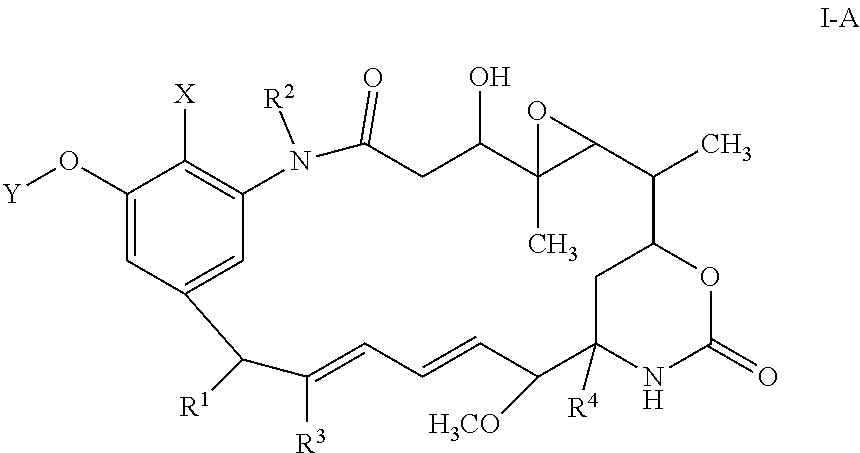
with a carboxylic acid of the formula R—COOH in the presence of a coupling reagent, a rare earth metal-based or trifluoromethanesulfonate-based Lewis acid catalyst and a base to form the compound of Formula I, or a salt thereof;
wherein
-
- X is hydrogen or halo;
- Y is selected from the group consisting of hydrogen, C1-C6 alkyl, C3-C6 cycloalkyl, and —C(═O)R5;
- R1 is selected from the group consisting of hydrogen, and —OR17;
- R2 is hydrogen or C1-C6 alkyl;
- R3 is methyl, —CH2OH, or —CH2OR17;
- R4 is —OH, —OR17 or —SH;
- R5 is C1-C6 alkyl or benzyl;
- R17 is a hydroxy protecting group;
- R is selected from the group consisting of alkyl, aryl, cycloalkyl, cycloalkenyl, heteroaryl, and heterocyclic, wherein the alkyl, aryl, cycloalkyl, cycloalkenyl, heteroaryl, or heterocyclic is optionally substituted with one to three R10, or is

-
- L is selected from optionally substituted C1-C20 alkylene, C3-C8 cycloalkylene, and optionally substituted C1-C20 alkylene wherein one or more of the —CH2— group is independently replaced with C3-C8 cycloalkylene, —O—, —S—, —NR8—, —C(O)—, —C(═O)NR8—, —NR8C(═O)—, —SO2NR8—, or —NR8SO2—;
- substituted C1-C20 alkylene is C1-C20 alkylene substituted with 1 to 4-SO3H, —P(O)(OH)2 or R23, wherein each R23 is independently C1-6 alkyl optionally substituted with 1 or 2 substituents independently selected from the group consisting of SH, S—C1-4 alkyl, —CONR11R11, and —NR11Pr;
- R7 is hydrogen, C1-C6 alkyl or an amino acid side chain;
- R8 is hydrogen or C1-6 alkyl;
- each R10 is independently selected from the group consisting of —NR11Pr, —NR11COCH2Br, —COOR12, —CONR11R11, —NR11COR13,

-
- —S—S—R13, —Si(R13)3, alkyl, aryl, cycloalkyl, cycloalkenyl, heteroaryl, and heterocyclic;
- each R11 is independently hydrogen, alkyl, aryl, cycloalkyl, cycloalkenyl, heteroaryl, and heterocyclic, or the two R11 together with the nitrogen form a heterocyclic, wherein the heterocyclic is optionally substituted with one or two oxo;
- Pr is an amino protecting group;
- R12 is C1-C6 alkyl, or benzyl; and
- R13 is selected from the group consisting of alkyl, aryl, cycloalkyl, heteroaryl, and heterocyclic.

comprising contacting a compound of Formula II-A:

with a carboxylic acid of the formula R—COOH in the presence of a coupling reagent, a rare earth metal-based or trifluoromethanesulfonate-based Lewis acid catalyst and a base to form the compound of Formula II, or a salt thereof;
wherein
-
- X is hydrogen or halo;
- Y is selected from the group consisting of hydrogen, C1-C6 alkyl, C3-C6 cycloalkyl, and —C(═O)R5;
- R1 is selected from the group consisting of hydrogen, —OH, and —OR17;
- R2 is hydrogen or C1-C6 alkyl;
- R3 is methyl, —CH2OH, or CH2OR17;
- R4 is —OH, —OR17 or —SH;
- R5 is C1-C6 alkyl or benzyl;
- R17 is a hydroxy protecting group;
- R is selected from the group consisting of alkyl, aryl, cycloalkyl, cycloalkenyl, heteroaryl, and heterocyclic, wherein the alkyl, aryl, cycloalkyl, cycloalkenyl, heteroaryl, or heterocyclic is optionally substituted with one to three R10, or is

-
- L is selected from optionally substituted C1-C20 alkylene, C3-C8 cycloalkylene, and optionally substituted C1-C20 alkylene wherein one or more of the —CH2— group is independently replaced with C3-C8 cycloalkylene, —O—, —S—, —NR8—, —C(O)—, —C(═O)NR8—, —NR8C(═O)—, —SO2NR8—, or —NR8SO2—;
- substituted C1-C20 alkylene is C1-C20 alkylene substituted with 1 to 4-SO3H, —P(O)(OH)2 or R23, wherein each R23 is independently C1-6 alkyl optionally substituted with 1 or 2 substituents independently selected from the group consisting of SH, S—C1-4 alkyl, —CONR11R11, and —NR11Pr;
- R7 is hydrogen, C1-C6 alkyl or an amino acid side chain;
- R8 is hydrogen or C1-6 alkyl;
- each R10 is independently selected from the group consisting of —NR11Pr, —NR11COCH2Br, —COOR12, —CONR11R11, —NR11COR13,

-
- —S—S—R13, —Si(R13)3, alkyl, aryl, cycloalkyl, cycloalkenyl, heteroaryl, and heterocyclic;
- each R11 is independently hydrogen, alkyl, aryl, cycloalkyl, cycloalkenyl, heteroaryl, and heterocyclic, or the two R11 together with the nitrogen form a heterocyclic, wherein the heterocyclic is optionally substituted with one or two oxo;
- Pr is an amino protecting group;
- R12 is C1-C6 alkyl, or benzyl; and
- R13 is selected from the group consisting of alkyl, aryl, cycloalkyl, heteroaryl, and heterocyclic.
-
- 1) simple carboxylic acid such as acetic acid, isobutric acid or adipic acid mono 2-trimethylsilylethyl ester (exemplified in Scheme 1);
- 2) N-protected amino acid, such as N-acylated-N-methyl-alanine derivatives (exemplified in Scheme 2) or N-Fmoc-N-methyl-alanine derivatives (exemplified in Example 10); or
- 3) N- and S-protected cysteine or methionine derivates (exemplified in Scheme 3).
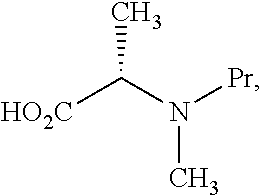
for example,


wherein L, R7, R8 and R10 are as defined herein, Pr is an amino protecting group, n is 1 or 2, R13 is C1-C6 alkyl, for example, methyl, or heteroaryl, for example, pyridyl, and R15 is C1-C10 alkyl, for example, methyl, or aryl, for example, phenyl. In some embodiments, Pr is Fmoc.

wherein m is selected from an integer of 1 to 20, preferably 1 to 10, more preferably 5 to 10; n is 1 or 2; R13 is C1-C6 alkyl, for example, methyl, or heteroaryl, for example, pyridyl; R15 is C1-C6 alkyl, for example, methyl, or aryl, for example, phenyl; R7, R8 and R10 are as defined herein.


and the compound of formula I-A is:

wherein X is hydrogen or Cl, Y is hydrogen or methyl, and R is as defined herein.

comprising contacting a compound of Formula III-A:

with a carboxylic acid of Formula III-B

in the presence of a coupling reagent, a rare earth metal-based or trifluoromethanesulfonate-based Lewis acid catalyst and a base to form the compound of Formula III, or a salt thereof;
wherein
-
- X is hydrogen or halo;
- Y is selected from the group consisting of hydrogen, C1-C6 alkyl, C3-C6 cycloalkyl, and —C(═O)R5;
- R1 is selected from the group consisting of hydrogen, —OH, and —OR17;
- R2 is hydrogen or C1-C6 alkyl;
- R3 is methyl, —CH2OH, or CH2OR17;
- R4 is —OH, —OR17 or —SH;
- R5 is C1-C6 alkyl or benzyl;
- R17 is a hydroxy protecting group;
- R7 is hydrogen, C1-C6 alkyl or an amino acid side chain;
- R8 is hydrogen or C1-6 alkyl; and
- L is selected from optionally substituted C1-C20 alkylene, C3-C8 cycloalkylene, and optionally substituted C1-C20 alkylene wherein one or more of the —CH2— group is independently replaced with C3-C8 cycloalkylene, —O—, —S—, —C(O)—, —NR8—, —C(═O)NR8—, —NR8C(═O)—, —SO2NR8—, or —NR8SO2—; wherein substituted C1-C20 alkylene is C1-C20 alkylene substituted with 1 to 4-SO3H, —P(O)(OH)2 or R23, wherein each R23 is independently C1-6 alkyl optionally substituted with 1 or 2 substituents independently selected from the group consisting of SH, S—C1-4 alkyl, —CONR11R11, and —NR11Pr.

and the carboxylic acid of Formula III-B is the isomer IV-B:


comprising contacting a compound of Formula IV-A:

with a carboxylic acid of Formula IV-B

in the presence of a coupling reagent, a rare earth metal-based or trifluoromethanesulfonate-based Lewis acid catalyst and a base to form the compound of Formula IV, or a salt thereof;
wherein
-
- X is hydrogen or halo;
- Y is selected from the group consisting of hydrogen, C1-C6 alkyl, C3-C6 cycloalkyl, and —C(═O)R5;
- R1 is selected from the group consisting of hydrogen, —OH, and —OR17;
- R2 is hydrogen or C1-C6 alkyl;
- R3 is methyl, —CH2OH, or CH2OR17;
- R4 is —OH, or —OR17 or —SH;
- R5 is C1-C6 alkyl or benzyl;
- R17 is a hydroxy protecting group;
- R7 is hydrogen, C1-C6 alkyl or an amino acid side chain;
- R8 is hydrogen or C1-6 alkyl; and
- L is selected from optionally substituted C1-C20 alkylene, C3-C8 cycloalkylene, and optionally substituted C1-C20 alkylene wherein one or more of the —CH2— group is independently replaced with C3-C8 cycloalkylene, —O—, —S—, —C(O)—, —NR8—, —C(═O)NR8—, —NR8C(═O)—, —SO2NR8—, or —NR8SO2—; wherein substituted C1-C20 alkylene is C1-C20 alkylene substituted with 1 to 4-SO3H, —P(O)(OH)2 or R23, wherein each R23 is independently C1-6 alkyl optionally substituted with 1 or 2 substituents independently selected from the group consisting of SH, S—C1-4 alkyl, —CONR11R11, and —NR11Pr.

comprising contacting a compound of Formula V-A:

with a carboxylic acid of Formula IV-B

in the presence of a coupling reagent, a rare earth metal-based or trifluoromethanesulfonate-based Lewis acid catalyst and a base to form the compound of Formula V, or a salt thereof;
wherein
-
- X is H or Cl;
- Y is H or methyl;
- R7 is hydrogen, C1-C6 alkyl or an amino acid side chain;
- R8 is hydrogen or C1-C6 alkyl; and
- L is selected from optionally substituted C1-C20 alkylene, C3-C8 cycloalkylene, and optionally substituted C1-C20 alkylene wherein one or more of the —CH2— group is independently replaced with C3-C8 cycloalkylene, —O—, —S—, —NR8—, —C(═O)NR8—, —NR8C(═O)—, —SO2NR8—, or —NR8SO2—; wherein substituted C1-C20 alkylene is C1-C20 alkylene substituted with 1 to 4 —SO3H, —P(O)(OH)2 or R23, wherein each R23 is independently C1-6 alkyl optionally substituted with 1 or 2 substituents independently selected from the group consisting of SH, S—C1-4 alkyl, —CONR11R11, and —NR11Pr.

comprising contacting a compound of Formula V-A:

with a carboxylic acid of Formula VI-B

in the presence of a coupling reagent, a rare earth metal-based or trifluoromethanesulfonate-based Lewis acid catalyst and a base to form the compound of Formula VI, or a salt thereof;
wherein
-
- X is H or Cl;
- Y is H or methyl;
- R7 is hydrogen or an amino acid side chain;
- R8 is hydrogen or C1-C6 alkyl; and
- m is an integer of 1 to 20, preferably 1 to 10, more preferably 5 to 10.


with a carboxylic acid of Formula VII-B

in the presence of a coupling reagent, a rare earth metal-based or trifluoromethanesulfonate-based Lewis acid catalyst and a base to form the compound of Formula VII or a salt thereof.

wherein Pr1 is a carboxy protecting group such as C1-C6 alkyl or benzyl, with a compound of Formula III-D

under coupling conditions to form the compound of Formula III-E:

and deprotecting the compound of Formula III-E to form the compound of Formula III-B.
| TABLE 1 | |
| maytansinoid C-3 ester | maytansinoid |
 |
 |
 |
 |
 |
 |
 |
 |
 |
 |
 |
 |
 |
 |
 |
 |


comprising deprotection of a compound of Formula X-A:

wherein
-
- X is hydrogen or halo;
- Y is selected from the group consisting of hydrogen, C1-C6 alkyl, C3-C6 cycloalkyl, and —C(═O)R5;
- R1 is selected from the group consisting of hydrogen, —OH, and —OR17;
- R2 is hydrogen or C1-C6 alkyl;
- R3 is methyl, —CH2OH, or —CH2OR17;
- R4 is —OH, —OR17 or —SH;
- R5 is C1-C6 alkyl or benzyl;
- R17 is a hydroxy protecting group;
- R7 is hydrogen, C1-C6 alkyl or an amino acid side chain;
- R8 is hydrogen or C1-6 alkyl; and
- Pr is an amino protecting group, such as Boc or Fmoc.

or a salt thereof,
comprising contacting a compound of Formula X:

with a carboxylic acid of Formula III-G

in the presence of a coupling reagent, or
with its active ester to form the compound of Formula XI, or a salt thereof;
wherein
-
- X is hydrogen or halo;
- Y is selected from the group consisting of hydrogen, C1-C6 alkyl, C3-C6 cycloalkyl, and —C(═O)R5;
- R1 is selected from the group consisting of hydrogen, —OH, and —OR17;
- R2 is hydrogen or C1-C6 alkyl;
- R3 is methyl, —CH2OH, or —CH2OR17;
- R4 is —OH, —OR17 or —SH;
- R5 is C1-C6 alkyl or benzyl;
- R17 is a hydroxy protecting group;
- R7 is hydrogen, C1-C6 alkyl or an amino acid side chain;
- R8 is hydrogen or C1-6 alkyl; and
- R is hydrogen, alkyl, aryl, cycloalkyl, cycloalkenyl, heteroaryl.

or a salt thereof,
comprising contacting a compound of Formula X:

with RSO2Cl to form the compound of Formula XIII, or a salt thereof;
wherein
-
- X is hydrogen or halo;
- Y is selected from the group consisting of hydrogen, C1-C6 alkyl, C3-C6 cycloalkyl, and —C(═O)R5;
- R1 is selected from the group consisting of hydrogen, —OH, and —OR17;
- R2 is hydrogen or C1-C6 alkyl;
- R3 is methyl, —CH2OH, or —CH2OR17;
- R4 is —OH, —OR17 or —SH;
- R5 is C1-C6 alkyl or benzyl;
- R17 is a hydroxy protecting group;
- R7 is hydrogen, C1-C6 alkyl or an amino acid side chain;
- R8 is hydrogen or C1-6 alkyl; and
- R is hydrogen, alkyl, aryl, cycloalkyl, cycloalkenyl, heteroaryl.

or a salt thereof, comprising contacting a compound of Formula X:

with a carboxylic acid of Formula III-H

in the presence of a coupling reagent or directly with its active ester to form the compound of Formula XII, or a salt thereof;
wherein
-
- X is hydrogen or halo;
- Y is selected from the group consisting of hydrogen, C1-C6 alkyl, C3-C6 cycloalkyl, and —C(═O)R5;
- R1 is selected from the group consisting of hydrogen, —OH, and —OR17;
- R2 is hydrogen or C1-C6 alkyl;
- R3 is methyl, —CH2OH, or —CH2OR17;
- R4 is —OH, —OR17 or —SH;
- R5 is C1-C6 alkyl or benzyl;
- R17 is a hydroxy protecting group;
- R7 is hydrogen, C1-C6 alkyl or an amino acid side chain;
- R8 is hydrogen or C1-6 alkyl; and
- L is selected from optionally substituted C1-C20 alkylene, C3-C8 cycloalkylene, and optionally substituted C1-C20 alkylene wherein one or more of the —CH2— group is independently replaced with C3-C8 cycloalkylene, —O—, —S—, —C(O)—, —NR10—, —C(═O)NR10—, —NR10C(═O)—, —SO2NR10—, or —NR10SO2—;
- substituted C1-C20 alkylene is C1-C20 alkylene substituted with 1 to 4-SO3H, —P(O)(OH)2 or R23, wherein each R23 is independently C1-6 alkyl optionally substituted with 1 or 2 substituents independently selected from the group consisting of SH, S—C1-4 alkyl, —CONR11R11, and —NR11Pr;
- FG is independently selected from the group consisting of —NR11Pr, —NR11COCH2Br, —COOR12, —CONR11R11, —NR11COR13,

-
- —S—S—R13, —Si(R13)3, alkyl, aryl, cycloalkyl, cycloalkenyl, heteroaryl, and heterocyclic;
- each R10 or R11 is independently hydrogen, alkyl, aryl, cycloalkyl, cycloalkenyl, heteroaryl, and heterocyclic, or the two R11 together with the nitrogen form a heterocyclic, wherein the heterocyclic is optionally substituted with one or two oxo;
- Pr is an amino protecting group;
- R12 is C1-C6 alkyl, or benzyl; and
- each R13 is independently selected from the group consisting of alkyl, aryl, cycloalkyl, heteroaryl, and heterocyclic.

comprising contacting a compound of Formula X:

with a carboxylic acid of Formula III-C

in the presence of a coupling reagent; or
with an active ester of the acid which is a compound of Formula III-F

wherein R18 is halo or —O—R19, wherein R19 is selected from the group consisting of —CH═CH2, -cyanomethyl, -pyridyl, halo or nitro substituted phenyl (e.g., 4-nitrophenyl, 2,4,6-trichlorophenyl, pentachlorophenyl, pentafluorophenyl), phthalimido, succinimido, N-benxotriazolyl, to form the compound of Formula III, or a salt thereof;
wherein
-
- X is hydrogen or halo;
- Y is selected from the group consisting of hydrogen, C1-C6 alkyl, C3-C6 cycloalkyl, and —C(═O)R5;
- R1 is selected from the group consisting of hydrogen, —OH, and —OR17;
- R2 is hydrogen or C1-C6 alkyl;
- R3 is methyl, —CH2OH, or —CH2OR17;
- R4 is —OH, —OR17 or —SH;
- R5 is C1-C6 alkyl or benzyl;
- R17 is a hydroxy protecting group;
- R7 is hydrogen, C1-C6 alkyl or an amino acid side chain;
- R8 is hydrogen or C1-6 alkyl; and
- L is selected from optionally substituted C1-C20 alkylene, C3-C8 cycloalkylene, and optionally substituted C1-C20 alkylene wherein one or more of the —CH2— group is independently replaced with C3-C8 cycloalkylene, —O—, —S—, —C(O)—, —NR8—, —C(═O)NR8—, —NR8C(═O)—, —SO2NR8—, or —NR8SO2—; wherein substituted C1-C20 alkylene is C1-C20 alkylene substituted with 1 to 4-SO3H, —P(O)(OH)2 or R23, wherein each R23 is independently C1-6 alkyl optionally substituted with 1 or 2 substituents independently selected from the group consisting of SH, S—C1-4 alkyl, —CONR11R11, and —NR11Pr.

or a salt thereof, comprising contacting a compound of Formula X:

with a sulfonyl chloride of Formula XIV-A

in the presence of a base to form the compound of Formula XIV, or a salt thereof;
wherein
-
- X is hydrogen or halo;
- Y is selected from the group consisting of hydrogen, C1-C6 alkyl, C3-C6 cycloalkyl, and —C(═O)R5;
- R1 is selected from the group consisting of hydrogen, —OH, and —OR17;
- R2 is hydrogen or C1-C6 alkyl;
- R3 is methyl, —CH2OH, or —CH2OR17;
- R4 is —OH, —OR17 or —SH;
- R5 is C1-C6 alkyl or benzyl;
- R17 is a hydroxy protecting group;
- R7 is hydrogen, C1-C6 alkyl or an amino acid side chain;
- R8 is hydrogen or C1-6 alkyl; and
- L is selected from optionally substituted C1-C20 alkylene, C3-C8 cycloalkylene, and optionally substituted C1-C20 alkylene wherein one or more of the —CH2— group is independently replaced with C3-C8 cycloalkylene, —O—, —S—, —C(O)—, —NR10—, —C(═O)NR10—, —NR10C(═O)—, —SO2NR10—, or —NR10SO2—;
- substituted C1-C20 alkylene is C1-C20 alkylene substituted with 1 to 4-SO3H, —P(O)(OH)2 or R23, wherein each R23 is independently C1-6 alkyl optionally substituted with 1 or 2 substituents independently selected from the group consisting of SH, S—C1-4 alkyl, —CONR11R11, and —NR11Pr;
- FG is independently selected from the group consisting of —NR11Pr, —NR11COCH2Br, —COOR12, CONR11R11, —NR11COR13,

-
- —S—S—R13, —Si(R13)3, alkyl, aryl, cycloalkyl, cycloalkenyl, heteroaryl, and heterocyclic;
- each R10 or R11 is independently hydrogen, alkyl, aryl, cycloalkyl, cycloalkenyl, heteroaryl, and heterocyclic, or the two R11 together with the nitrogen form a heterocyclic, wherein the heterocyclic is optionally substituted with one or two oxo;
- Pr is an amino protecting group;
- R12 is C1-C6 alkyl, or benzyl; and
- each R13 is independently selected from the group consisting of alkyl, aryl, cycloalkyl, heteroaryl, and heterocyclic.

comprising contacting a compound of Formula X:

with a sulfonyl chloride of Formula XV-A

in the presence of a base to form the compound of Formula XV, or a salt thereof;
wherein
-
- X is hydrogen or halo;
- Y is selected from the group consisting of hydrogen, C1-C6 alkyl, C3-C6 cycloalkyl, and —C(═O)R5;
- R1 is selected from the group consisting of hydrogen, —OH, and —OR17;
- R2 is hydrogen or C1-C6 alkyl;
- R3 is methyl, —CH2OH, or —CH2OR17;
- R4 is —OH, —OR17 or —SH;
- R5 is C1-C6 alkyl or benzyl;
- R17 is a hydroxy protecting group;
- R7 is hydrogen, C1-C6 alkyl or an amino acid side chain;
- R8 is hydrogen or C1-6 alkyl; and
- L is selected from optionally substituted C1-C20 alkylene, C3-C8 cycloalkylene, and optionally substituted C1-C20 alkylene wherein one or more of the —CH2— group is independently replaced with C3-C8 cycloalkylene, —O—, —S—, —C(O)—, —NR8—, —C(═O)NR8—, —NR8C(═O)—, —SO2NR8—, or —NR8SO2—; wherein substituted C1-C20 alkylene is C1-C20 alkylene substituted with 1 to 4-SO3H, —P(O)(OH)2 or R23, wherein each R23 is independently C1-6 alkyl optionally substituted with 1 or 2 substituents independently selected from the group consisting of SH, S—C1-4 alkyl, —CONR11R11, and —NR11Pr.


-
- ACN=acetonitrile
- Ala=alanine
- aq.=aqueous
- brs=broad singlet
- calc.=calculated
- d=doublet
- DCM=dichloromethane
- dd=double doublet
- DMAP=dimethylaminopyridine
- DMF=dimethylformamide
- DMSO=dimethylsulfoxide
- Et=ethanol
- EtOAc=ethyl acetate
- g=gram
- h=hour
- HCl=hydrochloric acid
- HPLC=high-pressure liquid chromatography
- Hz=hertz
- J=coupling constant
- LC-MS=liquid chromatography mass spectroscopy
- m=multiplet
- MDC=maytansinol
- Me=methyl
- MeOH=methanol
- MHz=megahertz
- min=minute
- mL=milliliter
- mm=millimeter
- m.p.=melting point
- OTf=triflate (trifluoromethanesulfonate)
- N=normal
- r.t.=room temperature
- Rt=retention time
- s=singlet
- t=triplet
- TLC=thin layer chromatography
- μm=micrometer


Step 1:


Claims (44)


Applications Claiming Priority (6)
| Application Number | Priority Date | Filing Date | Title |
|---|---|---|---|
| CN201210564206 | 2012-12-21 | ||
| CN201210564206 | 2012-12-21 | ||
| CN201210564206.8 | 2012-12-21 | ||
| CN201310081867 | 2013-03-14 | ||
| CN201310081867.X | 2013-03-14 | ||
| CN201310081867.XA CN103254213B (en) | 2012-12-21 | 2013-03-14 | Preparation method of maytenin-like ester and composition used in method |
Publications (2)
| Publication Number | Publication Date |
|---|---|
| US20140179917A1 US20140179917A1 (en) | 2014-06-26 |
| US8889855B2 true US8889855B2 (en) | 2014-11-18 |
Family
ID=48958474
Family Applications (1)
| Application Number | Title | Priority Date | Filing Date |
|---|---|---|---|
| US13/836,469 Active US8889855B2 (en) | 2012-12-21 | 2013-03-15 | Preparation of maytansinoid esters |
Country Status (3)
| Country | Link |
|---|---|
| US (1) | US8889855B2 (en) |
| CN (1) | CN103254213B (en) |
| WO (1) | WO2014094354A1 (en) |
Cited By (7)
| Publication number | Priority date | Publication date | Assignee | Title |
|---|---|---|---|---|
| US9737616B2 (en) | 2012-12-21 | 2017-08-22 | Bio-Thera Solutions, Ltd., Co. | Compounds and methods for the treatment of ERB B2/NEU positive diseases |
| US9950076B2 (en) | 2016-01-25 | 2018-04-24 | Regeneron Pharmaceuticals, Inc. | Maytansinoid derivatives, conjugates thereof, and methods of use |
| US10233212B2 (en) | 2015-11-03 | 2019-03-19 | Industrial Technology Research Institute | Compounds, linker-drugs and ligand-drug conjugates |
| US10526344B2 (en) | 2015-03-17 | 2020-01-07 | Regeneron Pharmaceuticals, Inc. | Amino acid acylation reagents and methods of using the same |
| US10570151B2 (en) | 2013-03-15 | 2020-02-25 | Regeneron Pharmaceuticals, Inc. | Biologically active molecules, conjugates thereof, and therapeutic uses |
| US11596635B2 (en) | 2013-08-26 | 2023-03-07 | Regeneron Pharmaceuticals, Inc. | Pharmaceutical compositions comprising macrolide diastereomers, methods of their synthesis and therapeutic uses |
| US12297207B2 (en) | 2015-03-27 | 2025-05-13 | Regeneron Pharmaceuticals, Inc. | Maytansinoid derivatives, conjugates thereof, and methods of use |
Families Citing this family (6)
| Publication number | Priority date | Publication date | Assignee | Title |
|---|---|---|---|---|
| CN103254213B (en) * | 2012-12-21 | 2015-02-25 | 百奥泰生物科技(广州)有限公司 | Preparation method of maytenin-like ester and composition used in method |
| WO2017148416A1 (en) * | 2016-03-03 | 2017-09-08 | 凯惠科技发展(上海)有限公司 | Method for preparing maytansine esters and intermediate thereof |
| GB201615725D0 (en) | 2016-09-15 | 2016-11-02 | Polytherics Ltd | Novel cytotoxic agents and conjugates thereof |
| US11420981B2 (en) * | 2019-04-18 | 2022-08-23 | Indena S.P.A. | Diasteroselective process for the preparation of thiol- or disulfide-containing maytansinoid esters and intermediates thereof |
| CN110156873B (en) * | 2019-06-25 | 2020-11-10 | 成都郑源生化科技有限公司 | Preparation method of Fmoc-D-Pro-D-Pro-OH |
| CN113461708A (en) * | 2021-07-22 | 2021-10-01 | 深圳市泰尔康生物医药科技有限公司 | Ansamitocin P-3 derivative and application thereof in preparation of drugs for treating gastric cancer |
Citations (9)
| Publication number | Priority date | Publication date | Assignee | Title |
|---|---|---|---|---|
| US3896111A (en) | 1973-02-20 | 1975-07-22 | Research Corp | Ansa macrolides |
| US4137230A (en) | 1977-11-14 | 1979-01-30 | Takeda Chemical Industries, Ltd. | Method for the production of maytansinoids |
| EP0021173A1 (en) | 1979-06-11 | 1981-01-07 | Takeda Chemical Industries, Ltd. | Maytansinoids, their production and use |
| US4256746A (en) | 1978-11-14 | 1981-03-17 | Takeda Chemical Industries | Dechloromaytansinoids, their pharmaceutical compositions and method of use |
| US4260608A (en) | 1978-11-14 | 1981-04-07 | Takeda Chemical Industries, Ltd. | Maytansinoids, pharmaceutical compositions thereof and methods of use thereof |
| US5208020A (en) | 1989-10-25 | 1993-05-04 | Immunogen Inc. | Cytotoxic agents comprising maytansinoids and their therapeutic use |
| US6333410B1 (en) | 2000-08-18 | 2001-12-25 | Immunogen, Inc. | Process for the preparation and purification of thiol-containing maytansinoids |
| US20060167245A1 (en) | 2005-01-21 | 2006-07-27 | Immunogen, Inc. | Method for the preparation of maytansinoid esters |
| US20120121615A1 (en) | 2010-11-17 | 2012-05-17 | Flygare John A | Alaninyl maytansinol antibody conjugates |
Family Cites Families (3)
| Publication number | Priority date | Publication date | Assignee | Title |
|---|---|---|---|---|
| JPS55164687A (en) * | 1979-06-11 | 1980-12-22 | Takeda Chem Ind Ltd | Novel maytansinoid compound and its preparation |
| ATE535529T1 (en) * | 2005-08-09 | 2011-12-15 | Millennium Pharm Inc | METHOD FOR ACYLATION OF MAYTANSINOL WITH CHIRAL AMINO ACIDS |
| CN103254213B (en) * | 2012-12-21 | 2015-02-25 | 百奥泰生物科技(广州)有限公司 | Preparation method of maytenin-like ester and composition used in method |
-
2013
- 2013-03-14 CN CN201310081867.XA patent/CN103254213B/en active Active
- 2013-03-15 US US13/836,469 patent/US8889855B2/en active Active
- 2013-11-29 WO PCT/CN2013/001478 patent/WO2014094354A1/en not_active Ceased
Patent Citations (10)
| Publication number | Priority date | Publication date | Assignee | Title |
|---|---|---|---|---|
| US3896111A (en) | 1973-02-20 | 1975-07-22 | Research Corp | Ansa macrolides |
| US4137230A (en) | 1977-11-14 | 1979-01-30 | Takeda Chemical Industries, Ltd. | Method for the production of maytansinoids |
| US4256746A (en) | 1978-11-14 | 1981-03-17 | Takeda Chemical Industries | Dechloromaytansinoids, their pharmaceutical compositions and method of use |
| US4260608A (en) | 1978-11-14 | 1981-04-07 | Takeda Chemical Industries, Ltd. | Maytansinoids, pharmaceutical compositions thereof and methods of use thereof |
| EP0021173A1 (en) | 1979-06-11 | 1981-01-07 | Takeda Chemical Industries, Ltd. | Maytansinoids, their production and use |
| US5208020A (en) | 1989-10-25 | 1993-05-04 | Immunogen Inc. | Cytotoxic agents comprising maytansinoids and their therapeutic use |
| US5416064A (en) | 1989-10-25 | 1995-05-16 | Immunogen, Inc. | Cytotoxic agents comprising maytansinoids and their therapeutic use |
| US6333410B1 (en) | 2000-08-18 | 2001-12-25 | Immunogen, Inc. | Process for the preparation and purification of thiol-containing maytansinoids |
| US20060167245A1 (en) | 2005-01-21 | 2006-07-27 | Immunogen, Inc. | Method for the preparation of maytansinoid esters |
| US20120121615A1 (en) | 2010-11-17 | 2012-05-17 | Flygare John A | Alaninyl maytansinol antibody conjugates |
Non-Patent Citations (22)
| Title |
|---|
| Cassady, John M., et al., Recent Developments in the Maytansinoid Antitumor Agents, Chem. Pharm. Bull., Jan. 2004, pp. 1-26, vol. 52, No. 1, Pharmaceutical Society of Japan. |
| Desmyter, Aline, et al., Crystal structure of a camel single-domain VH antibody fragment in complex with lysozyme, Nature Structural Biology, Sep. 1996, pp. 803-811, vol. 3, No. 9, Nature Publishing Group, http://www.nature.com/nsmb. |
| Greenberg, A.S., et al., A new antigen receptor gene family that undergoes rearrangement and extensive somatic diversification in sharks, Nature, Mar. 9, 1995, pp. 168-173, vol. 374. |
| Greene, T.W., et al., Protecting Groups in Organic Synthesis, 1999, Third Edition, Wiley, New York. |
| Hudziak, R.M., et al.,p185HER2 Monoclonal Antibody Has Antiproliferative Effects In Vitro and Sensitizes Human Breast Tumor Cells to Tumor Necrosis Factor, Molecular and Cellular Biology, Mar. 1989, pp. 1165-1172, vol. 9, No. 3, American Society for Microbiology. |
| Ishiyama, Munetaka, et al., A Combined Assay of Cell Viability and in Vitro Cytotoxicity with a Highly Water-Soluble Tetrazolium Salt, Neutral Red and Crystal Violet, Biol. Pharm. Bull. 1996, vol. 19, No. 11, Pharmaceutical Society of Japan. |
| Issel, B., et al., Maytansine, 5 Cancer Treatment Reviews, 1978, pp. 199-207. |
| Kawai, Akiyoshi, et al., Chemical Modification of Ansamitocins. III. Synthesis and Biological Effects of 3-Acyl Esters of Maytansinol, Chem. Pharm., Bull., 1984, Chem. Pharm. Bull., pp. 3441-3451, vol. 32, No. 9. |
| Kupchan, S.M., et al., Maytansine, a novel antileukemic ansa macrolide from Maytenus ovatus, J. Am. Chem. Soc., 1972, pp. 1354-1356, vol. 94, No. 4. |
| Mossner, Ekkehard, et al., Increasing the efficacy of CD290 antibody therapy through the engineering of a new type II anti-CD20 antibody with enhanced direct and immune effector cell-mediated B-cell cytotoxicity, Blood, Jun. 3, 2010, pp. 4393-4402, vol. 115, No. 22. |
| Nisonoff, A., et al., Separation of Univalent Fragments from the Bivalent Rabbit Antibody Molecule by Reduction of Disulfide Bonds, 1960, pp. 230-244, Archives of Biochemistry and Biophysics 89. |
| O'Keefe, Donald O., et al., Characterization of a Transferrin-Diphtheria Toxin Conjugate, The Journal of Biological Chemistry, 1985, pp. 932-937, vol. 260, No. 2, American Society of Biological Chemists, Inc. |
| Parham, Peter, On the Fragmentation of Monoclonal IgG1, IgG2a, and IgG2b from BALB/c Mice, The Journal of Immunology, Dec. 1983, pp. 2895-2902, vol. 131, No. 6, American Association of Immunologists. |
| Remillard, Stephen et al., Antimitotic Activity of the Potent Tumor Inhibitor Maytansine, Science, Sep. 1975, pp. 1002-1005, vol. 189,Dept. of Biology, University of Virginia. |
| Smith, C.R. Jr., et al., Alkaloids, 1984, ed. Pelletier, S.W., 2, pp. 149-204, Wiley, NY. |
| Spring, Susan B., et al., The Journal of Immunology, Aug. 1974, pp. 470-478, vol. 113, No. 2, The Williams & Wilkins Co. |
| Stanfield, Robyn L., et al., Crystal Structure of a Shark Single-Domain Antibody V Region in Complex with Lysozyme, Science, Sep. 17, 2004, pp. 1770-1773, vol. 305, www.sciencemag.org. |
| Stewart, Ross, et al., A variant human IgGl-Fc mediates improved ADCC, Protein Engineering, Design & Selection, May 18, 2011, pp. 671-678, vol. 24, No. 9, Oxford University Press, doi:10.1093/protein/gzr015. |
| Widdison, Wayne C., et al., Semisynthetic Maytansine Analogues for the Targeted Treatment of Cancer, J. Med. Chem., J. Med. Chem., 2006, pp. 4392-4408, vol. 49, American Chemical Society. |
| Wolpert-Defilippes, Mary K., et al., Initial Studies on Maytansine-Induced Metaphase Arrest in L1210 Murine Leukemia Cells, Biochemical Pharmacology, 1975, pp. 1735-1738, vol. 24, Pergamon Press, Great Britain. |
| Wood, Clive R., et al., High Level Synthesis of Immunoglobulins in Chinese Hamster Ovary Cells, Journal of Immunology, Nov. 1, 1990, pp. 3011-3016, vol. 145, No. 9, American Assn. of Immunologists. |
| Yu, Tin-Wein, et al., The biosynthetic gene cluster of the maytansinoid antitumor agent ansamitocin from Actinosynnema pretiosum, PNAS, Jun. 11, 2002, pp. 7968-7973, vol. 99, No. 12, www.pnas.org/cgi/doi/10.1073/pnas.092697199. |
Cited By (13)
| Publication number | Priority date | Publication date | Assignee | Title |
|---|---|---|---|---|
| US9737616B2 (en) | 2012-12-21 | 2017-08-22 | Bio-Thera Solutions, Ltd., Co. | Compounds and methods for the treatment of ERB B2/NEU positive diseases |
| US12378258B2 (en) | 2013-03-15 | 2025-08-05 | Regeneron Pharmaceuticals, Inc. | Biologically active molecules, conjugates thereof, and therapeutic uses |
| US10570151B2 (en) | 2013-03-15 | 2020-02-25 | Regeneron Pharmaceuticals, Inc. | Biologically active molecules, conjugates thereof, and therapeutic uses |
| US11345715B2 (en) | 2013-03-15 | 2022-05-31 | Regeneron Pharmaceuticals, Inc. | Biologically active molecules, conjugates thereof, and therapeutic uses |
| US11596635B2 (en) | 2013-08-26 | 2023-03-07 | Regeneron Pharmaceuticals, Inc. | Pharmaceutical compositions comprising macrolide diastereomers, methods of their synthesis and therapeutic uses |
| US10526344B2 (en) | 2015-03-17 | 2020-01-07 | Regeneron Pharmaceuticals, Inc. | Amino acid acylation reagents and methods of using the same |
| US12297207B2 (en) | 2015-03-27 | 2025-05-13 | Regeneron Pharmaceuticals, Inc. | Maytansinoid derivatives, conjugates thereof, and methods of use |
| US10233212B2 (en) | 2015-11-03 | 2019-03-19 | Industrial Technology Research Institute | Compounds, linker-drugs and ligand-drug conjugates |
| US10618935B2 (en) | 2015-11-03 | 2020-04-14 | Industrial Technology Research Institute | Antibody-drug conjugate (ADC) and method for forming the same |
| US10683327B2 (en) | 2015-11-03 | 2020-06-16 | Industrial Technology Research Institute | Compounds, linker-drugs and ligand-drug conjugates |
| US10463749B2 (en) | 2016-01-25 | 2019-11-05 | Regeneron Pharmaceuticals, Inc. | Maytansinoid derivatives, conjugates thereof, and methods of use |
| US11446389B2 (en) | 2016-01-25 | 2022-09-20 | Regeneron Pharmaceuticals, Inc. | Maytansinoid derivatives, conjugates thereof, and methods of use |
| US9950076B2 (en) | 2016-01-25 | 2018-04-24 | Regeneron Pharmaceuticals, Inc. | Maytansinoid derivatives, conjugates thereof, and methods of use |
Also Published As
| Publication number | Publication date |
|---|---|
| CN103254213B (en) | 2015-02-25 |
| US20140179917A1 (en) | 2014-06-26 |
| CN103254213A (en) | 2013-08-21 |
| WO2014094354A1 (en) | 2014-06-26 |
Similar Documents
| Publication | Publication Date | Title |
|---|---|---|
| US8889855B2 (en) | Preparation of maytansinoid esters | |
| US7598375B2 (en) | Method of acylating maytansinol with chiral amino acids | |
| US7301019B2 (en) | Method for the preparation of maytansinoid esters | |
| US8299268B2 (en) | Methods for preparing diazonamides | |
| US5496946A (en) | Production of pyrrolopyrimidines and intermediates therefor | |
| HU211556A9 (en) | Pyrroloindole derivatives related to dc-88a compound | |
| WO1997019085A1 (en) | Camptothecin compounds with combined topoisomerase i inhibition and dna alkylation properties | |
| Nagamura et al. | Synthesis and antitumor activity of duocarmycin derivatives: modification of segment A of duocarmycin B2 | |
| EP0820446A4 (en) | Synthesis of bis-indolylmaleimides | |
| JPH05247055A (en) | Staurosporine derivative and antiulcer effect enhancer containing the same derivative | |
| Nair et al. | Folate analogs altered in the C9-N10 bridge region. 14. 11-Oxahomofolic acid, a potential antitumor agent | |
| CA2417629C (en) | Derivatives of variolin b | |
| IE51358B1 (en) | 1,2,4-triazinylthiomethyl-3-cephem sulfoxides,process for their preparation and pharmaceutical compositions containing them | |
| JP6785780B2 (en) | Functionalized morpholinyl anthracycline derivative | |
| HU182482B (en) | Process for producing 3-comma above-alpha-hydroxy-3-comma above-beta-hydroxy- and 3-comma aaove-oxo-leurosine derivatives | |
| EP0188781B1 (en) | 1-oxa-1-dethia-cephalosporin compounds and antibacterial agent comprising the same | |
| JP2569358B2 (en) | New compound | |
| EP0193858A1 (en) | New 1-oxa-1-dethia-cephalosporin compounds and antibacterial agent comprising the same | |
| HU184623B (en) | Process for preparing new 4-deacetoxy-4-substituted-indole-dihydroindole derivatives | |
| Kim | Bioinspired Total Synthesis of Hyrtioseragamine A | |
| US6348454B1 (en) | Syntheses of new isodethiaazacephems and isodethiaazacephams, and use as potent antibacterial agents | |
| JPH04128287A (en) | Pyrrolo(2,3-d)pyrimidine derivative, its production, its use and intermediate therefor | |
| JP5313174B2 (en) | Transbound rearrangement of activated lactam. | |
| GB2090254A (en) | Oxazolidinedione sulfide compounds | |
| CS214794B2 (en) | Method of making the semiamids of dimeric indol-dihydroindole derivatives genus vinca connected by the bridge |
Legal Events
| Date | Code | Title | Description |
|---|---|---|---|
| AS | Assignment |
Owner name: BIO-THERA SOLUTIONS, LTD., CO., CHINA Free format text: ASSIGNMENT OF ASSIGNORS INTEREST;ASSIGNOR:DENG, XIAOBIN;REEL/FRAME:030015/0709 Effective date: 20130313 |
|
| STCF | Information on status: patent grant |
Free format text: PATENTED CASE |
|
| MAFP | Maintenance fee payment |
Free format text: PAYMENT OF MAINTENANCE FEE, 4TH YR, SMALL ENTITY (ORIGINAL EVENT CODE: M2551) Year of fee payment: 4 |
|
| AS | Assignment |
Owner name: BIO-THERA SOLUTIONS, LTD., CHINA Free format text: CHANGE OF NAME;ASSIGNOR:BIO-THERA SOLUTIONS, LTD., CO.;REEL/FRAME:049179/0171 Effective date: 20110919 |
|
| FEPP | Fee payment procedure |
Free format text: ENTITY STATUS SET TO UNDISCOUNTED (ORIGINAL EVENT CODE: BIG.); ENTITY STATUS OF PATENT OWNER: LARGE ENTITY |
|
| MAFP | Maintenance fee payment |
Free format text: PAYMENT OF MAINTENANCE FEE, 8TH YEAR, LARGE ENTITY (ORIGINAL EVENT CODE: M1552); ENTITY STATUS OF PATENT OWNER: LARGE ENTITY Year of fee payment: 8 |
|
| MAFP | Maintenance fee payment |
Free format text: PAYMENT OF MAINTENANCE FEE, 12TH YEAR, LARGE ENTITY (ORIGINAL EVENT CODE: M1553); ENTITY STATUS OF PATENT OWNER: LARGE ENTITY Year of fee payment: 12 |