US8887891B2 - Powertrain pressure and flow control system for dog clutches - Google Patents
Powertrain pressure and flow control system for dog clutches Download PDFInfo
- Publication number
- US8887891B2 US8887891B2 US13/166,853 US201113166853A US8887891B2 US 8887891 B2 US8887891 B2 US 8887891B2 US 201113166853 A US201113166853 A US 201113166853A US 8887891 B2 US8887891 B2 US 8887891B2
- Authority
- US
- United States
- Prior art keywords
- pressure
- mems
- valve
- pilot
- signal
- Prior art date
- Legal status (The legal status is an assumption and is not a legal conclusion. Google has not performed a legal analysis and makes no representation as to the accuracy of the status listed.)
- Expired - Fee Related, expires
Links
Images



Classifications
-
- F—MECHANICAL ENGINEERING; LIGHTING; HEATING; WEAPONS; BLASTING
- F16—ENGINEERING ELEMENTS AND UNITS; GENERAL MEASURES FOR PRODUCING AND MAINTAINING EFFECTIVE FUNCTIONING OF MACHINES OR INSTALLATIONS; THERMAL INSULATION IN GENERAL
- F16D—COUPLINGS FOR TRANSMITTING ROTATION; CLUTCHES; BRAKES
- F16D48/00—External control of clutches
- F16D48/02—Control by fluid pressure
-
- F—MECHANICAL ENGINEERING; LIGHTING; HEATING; WEAPONS; BLASTING
- F16—ENGINEERING ELEMENTS AND UNITS; GENERAL MEASURES FOR PRODUCING AND MAINTAINING EFFECTIVE FUNCTIONING OF MACHINES OR INSTALLATIONS; THERMAL INSULATION IN GENERAL
- F16D—COUPLINGS FOR TRANSMITTING ROTATION; CLUTCHES; BRAKES
- F16D23/00—Details of mechanically-actuated clutches not specific for one distinct type
- F16D23/02—Arrangements for synchronisation, also for power-operated clutches
- F16D23/04—Arrangements for synchronisation, also for power-operated clutches with an additional friction clutch
- F16D23/06—Arrangements for synchronisation, also for power-operated clutches with an additional friction clutch and a blocking mechanism preventing the engagement of the main clutch prior to synchronisation
-
- F—MECHANICAL ENGINEERING; LIGHTING; HEATING; WEAPONS; BLASTING
- F16—ENGINEERING ELEMENTS AND UNITS; GENERAL MEASURES FOR PRODUCING AND MAINTAINING EFFECTIVE FUNCTIONING OF MACHINES OR INSTALLATIONS; THERMAL INSULATION IN GENERAL
- F16H—GEARING
- F16H61/00—Control functions within control units of change-speed- or reversing-gearings for conveying rotary motion ; Control of exclusively fluid gearing, friction gearing, gearings with endless flexible members or other particular types of gearing
- F16H61/02—Control functions within control units of change-speed- or reversing-gearings for conveying rotary motion ; Control of exclusively fluid gearing, friction gearing, gearings with endless flexible members or other particular types of gearing characterised by the signals used
- F16H61/0202—Control functions within control units of change-speed- or reversing-gearings for conveying rotary motion ; Control of exclusively fluid gearing, friction gearing, gearings with endless flexible members or other particular types of gearing characterised by the signals used the signals being electric
- F16H61/0251—Elements specially adapted for electric control units, e.g. valves for converting electrical signals to fluid signals
-
- F—MECHANICAL ENGINEERING; LIGHTING; HEATING; WEAPONS; BLASTING
- F16—ENGINEERING ELEMENTS AND UNITS; GENERAL MEASURES FOR PRODUCING AND MAINTAINING EFFECTIVE FUNCTIONING OF MACHINES OR INSTALLATIONS; THERMAL INSULATION IN GENERAL
- F16D—COUPLINGS FOR TRANSMITTING ROTATION; CLUTCHES; BRAKES
- F16D23/00—Details of mechanically-actuated clutches not specific for one distinct type
- F16D23/02—Arrangements for synchronisation, also for power-operated clutches
- F16D23/04—Arrangements for synchronisation, also for power-operated clutches with an additional friction clutch
- F16D23/06—Arrangements for synchronisation, also for power-operated clutches with an additional friction clutch and a blocking mechanism preventing the engagement of the main clutch prior to synchronisation
- F16D2023/0693—Clutches with hydraulic actuation
-
- F—MECHANICAL ENGINEERING; LIGHTING; HEATING; WEAPONS; BLASTING
- F16—ENGINEERING ELEMENTS AND UNITS; GENERAL MEASURES FOR PRODUCING AND MAINTAINING EFFECTIVE FUNCTIONING OF MACHINES OR INSTALLATIONS; THERMAL INSULATION IN GENERAL
- F16D—COUPLINGS FOR TRANSMITTING ROTATION; CLUTCHES; BRAKES
- F16D48/00—External control of clutches
- F16D48/02—Control by fluid pressure
- F16D2048/0209—Control by fluid pressure characterised by fluid valves having control pistons, e.g. spools
-
- F—MECHANICAL ENGINEERING; LIGHTING; HEATING; WEAPONS; BLASTING
- F16—ENGINEERING ELEMENTS AND UNITS; GENERAL MEASURES FOR PRODUCING AND MAINTAINING EFFECTIVE FUNCTIONING OF MACHINES OR INSTALLATIONS; THERMAL INSULATION IN GENERAL
- F16D—COUPLINGS FOR TRANSMITTING ROTATION; CLUTCHES; BRAKES
- F16D48/00—External control of clutches
- F16D48/02—Control by fluid pressure
- F16D2048/0221—Valves for clutch control systems; Details thereof
-
- F—MECHANICAL ENGINEERING; LIGHTING; HEATING; WEAPONS; BLASTING
- F16—ENGINEERING ELEMENTS AND UNITS; GENERAL MEASURES FOR PRODUCING AND MAINTAINING EFFECTIVE FUNCTIONING OF MACHINES OR INSTALLATIONS; THERMAL INSULATION IN GENERAL
- F16D—COUPLINGS FOR TRANSMITTING ROTATION; CLUTCHES; BRAKES
- F16D48/00—External control of clutches
- F16D48/02—Control by fluid pressure
- F16D2048/0257—Hydraulic circuit layouts, i.e. details of hydraulic circuit elements or the arrangement thereof
- F16D2048/0281—Complex circuits with more than two valves in series or special arrangements thereof not provided for in previous groups
-
- F—MECHANICAL ENGINEERING; LIGHTING; HEATING; WEAPONS; BLASTING
- F16—ENGINEERING ELEMENTS AND UNITS; GENERAL MEASURES FOR PRODUCING AND MAINTAINING EFFECTIVE FUNCTIONING OF MACHINES OR INSTALLATIONS; THERMAL INSULATION IN GENERAL
- F16D—COUPLINGS FOR TRANSMITTING ROTATION; CLUTCHES; BRAKES
- F16D2500/00—External control of clutches by electric or electronic means
- F16D2500/30—Signal inputs
- F16D2500/302—Signal inputs from the actuator
- F16D2500/3024—Pressure
-
- F—MECHANICAL ENGINEERING; LIGHTING; HEATING; WEAPONS; BLASTING
- F16—ENGINEERING ELEMENTS AND UNITS; GENERAL MEASURES FOR PRODUCING AND MAINTAINING EFFECTIVE FUNCTIONING OF MACHINES OR INSTALLATIONS; THERMAL INSULATION IN GENERAL
- F16D—COUPLINGS FOR TRANSMITTING ROTATION; CLUTCHES; BRAKES
- F16D2500/00—External control of clutches by electric or electronic means
- F16D2500/70—Details about the implementation of the control system
- F16D2500/706—Strategy of control
- F16D2500/7061—Feed-back
-
- F—MECHANICAL ENGINEERING; LIGHTING; HEATING; WEAPONS; BLASTING
- F16—ENGINEERING ELEMENTS AND UNITS; GENERAL MEASURES FOR PRODUCING AND MAINTAINING EFFECTIVE FUNCTIONING OF MACHINES OR INSTALLATIONS; THERMAL INSULATION IN GENERAL
- F16H—GEARING
- F16H61/00—Control functions within control units of change-speed- or reversing-gearings for conveying rotary motion ; Control of exclusively fluid gearing, friction gearing, gearings with endless flexible members or other particular types of gearing
- F16H61/26—Generation or transmission of movements for final actuating mechanisms
- F16H61/28—Generation or transmission of movements for final actuating mechanisms with at least one movement of the final actuating mechanism being caused by a non-mechanical force, e.g. power-assisted
- F16H61/2807—Generation or transmission of movements for final actuating mechanisms with at least one movement of the final actuating mechanism being caused by a non-mechanical force, e.g. power-assisted using electric control signals for shift actuators, e.g. electro-hydraulic control therefor
Definitions
- This disclosure relates to hydraulic control of powertrains, transmissions, and the hydraulically-controlled components thereof.
- Vehicle powertrains may include transmissions to transfer power and torque from an engine to the vehicle output (axles or wheels).
- Hybrid powertrains may include multiple primary movers, including internal combustion engines or alternative power sources, such as one or more electric machines coupled with an energy storage device.
- the transmission may also transfer torque and power from the electric machine to provide traction for the vehicle.
- Fixed gears or speed ratios of the transmission allow the engine to operate within a narrow range of speeds while providing a wide range of output speeds to the powertrain.
- Different gears or operating modes of the transmission provide different, selectable speed ratios or gear ratios, and also different levels of torque multiplication.
- Changing the speed ratio of the transmission generally changes the ratio of input speed to the output speed and changes the torque multiplication between the input and the output.
- Selection of speed ratios may occur through actuation of hydraulic components controlled by one or more hydraulic valves. The hydraulic pressure and flow regulated or provided by these valves selects the requested speed ratio.
- a pressure and flow control system for a dog clutch includes a pilot valve, a regulating valve, and a selector.
- the pilot valve includes a first valve, and is configured to produce a pilot signal.
- the first valve is a Micro Electro Mechanical Systems (MEMS) microvalve.
- the regulating valve is in fluid communication with the pilot valve. The regulating valve is configured to receive the pilot signal from the pilot valve and is configured to output a control signal, which controls the selector.
- MEMS Micro Electro Mechanical Systems
- the regulating valve may be a MEMS-based spool valve or may be a small mechanical spool valve.
- the pilot valve may further include a second valve, and the regulating valve may be a conventional mechanical regulating valve.
- the second valve may be a MEMS-based spool valve or may be a small mechanical spool valve.
- the selector may be configured to engage and disengage the dog clutch in response to an on/off signal.
- the control signal from the regulating valve may be configured as the on/off signal.
- an on/off valve may be disposed between the regulating valve and the selector, and the on/off valve may be configured to convert the control signal to the on/off signal.
- FIG. 1 is a schematic cross-sectional view of a Micro Electro Mechanical Systems (MEMS) microvalve actuator
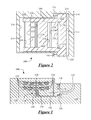
- FIG. 2 is a schematic cross-sectional view of a MEMS spool valve which may be used alone or in conjunction with the MEMS microvalve actuator shown in FIG. 1 ;
- FIG. 3A is a schematic diagram of a powertrain having a transmission with at least one synchronized dog clutch, into which one or more pressure/flow control systems may be incorporated;
- FIG. 3B shows a schematic isometric view of a synchronized dog clutch controlled by a selector fork, which may be incorporated into the transmission 300 shown in FIG. 3A ;
- FIG. 3C shows a schematic partial-cutaway, exploded isometric view of a synchronized dog clutch controlled by an axial piston, which may be incorporated into the transmission 300 shown in FIG. 3A ;
- FIG. 4 is a schematic box diagram of a first option for a pressure/flow control system for a hydraulically-controlled component within the powertrain;
- FIG. 5 is a schematic box diagram of a second option for a pressure/flow control system for the hydraulically-controlled component within the powertrain;
- FIG. 6 is a schematic box diagram of a third option for a pressure/flow control system for the hydraulically-controlled component within the powertrain.
- FIG. 7 is a schematic box diagram of a fourth option for a pressure/flow control system for the hydraulically-controlled component within the powertrain.
- FIG. 1 schematic cross-sectional view of a Micro Electro Mechanical Systems (MEMS) microvalve actuator 100 .
- MEMS Micro Electro Mechanical Systems
- the MEMS microvalve 100 may be used to effect hydraulic control—by controlling pressure or flow of a fluid—over one or more hydraulic components, such as those within a transmission.
- the MEMS microvalve 100 shown is only one type of MEMS device that may be used as a control valve or control actuator for the hydraulic components, and others, discussed herein.
- the MEMS microvalve 100 may also be referred to as a pressure differential actuator or a pilot direct actuating valve (PDA).
- PDA pilot direct actuating valve
- MEMS may be considered a class of systems that are physically small, having features with sizes in the micrometer range. MEMS systems may have both electrical and mechanical components. MEMS devices are produced through micromachining processes.
- micromachining generally refers to the production of three-dimensional structures and moving parts through processes including modified integrated circuit (computer chip) fabrication techniques (such as chemical etching) and materials (such as silicon semiconductor material).
- microvalve as used herein generally refers to a valve having features with sizes in the micrometer range, and thus by definition is at least partially formed by micromachining.
- microvalve device as used in this application means a device that includes a microvalve, and that may include other components. MEMS devices may be operating in conjunction with other MEMS (micromachined) devices or components or may be used with standard sized (larger) components, such as those produced by mechanical machining processes.
- the MEMS microvalve 100 includes a housing or body 110 .
- the MEMS microvalve 100 may be formed from several layers of material, such as semi-conductor wafers.
- the body 110 may also be formed from multiple layers. For example, and without limitation, the cross-sectioned portions shown may be taken through a middle layer of the MEMS microvalve 100 , with two other layers existing behind and in front of (relative to the view in FIG. 1 ) the middle layer.
- the other layers of the body 110 may include solid covers, port plates, or electrical control plates. However, each of the layers is generally considered part of the body 110 , except where separately identified.
- the MEMS microvalve 100 includes a beam 112 actuated by a valve actuator 114 . Selective control of the actuator 114 causes the beam 112 to alter the flow of fluid between an inlet port 116 and an outlet port 118 . By varying the fluid flow between the inlet port 116 and the outlet port 118 , the MEMS microvalve 100 varies the pressure in a pilot port 120 . As described herein, the pilot port 120 may be connected to additional valves or devices in order to effect hydraulic control thereof through a pilot signal, which varies based upon the pressure and flow communicated through the pilot port 120 .
- the inlet port 116 is connected to a source of high-pressure fluid such as a pump (not shown).
- the outlet port 118 is connected to a low-pressure reservoir, sump, or fluid return (not shown).
- the outlet port 118 may be considered to be at ambient pressure, and acts as a ground or zero state in the MEMS microvalve 100 .
- the beam 112 moves in a continuously variable manner between a first position, illustrated in FIG. 1 , a second position (not shown), and myriad intermediate positions. In the first position, the beam 112 does not completely block the inlet port 116 . However, in the second position, the beam 112 blocks the inlet port 116 to prevent substantially all flow from the high-pressure fluid source.
- a first chamber 122 is in fluid communication with both the inlet port 116 and the outlet port 118 . However, communication between the outlet port 118 and the first chamber 122 (and also the inlet port 116 ) is restricted by an outlet orifice 124 . High pressure or fast fluid flow through the outlet orifice 124 causes a pressure differential to build between the first chamber 122 and the outlet port 118 .
- the beam 112 is pivotally mounted to a fixed portion of the body 110 by a flexure pivot 126 .
- the opposite portion of the beam 112 from the flexure pivot 126 is a movable end 128 , which moves up and down (as viewed in FIG. 1 ) to selectively and variably cover and uncover the inlet port 116 .
- the beam 112 When the beam 112 is in the second position, it allows little or no flow from the inlet port 116 to the first chamber 122 . Any pressurized fluid in the first chamber 122 bleeds off through the outlet orifice 124 to the outlet port 118 . As the beam 112 of the MEMS microvalve 100 is moved toward the first (open) position, the inlet port 116 is progressively uncovered, allowing faster flows of fluid from the inlet port 116 into the first chamber 122 . The fast-flowing fluid cannot all be drained through the outlet orifice 124 and causes a pressure differential to form as the fluid flows through the outlet orifice 124 , raising pressure in the first chamber 122 .
- the inlet port 116 As the inlet port 116 is further opened to the first position (as shown in FIG. 1 ), fluid gradually flows faster through the outlet orifice 124 , causing a larger pressure differential and further raising the pressure in the first chamber 122 .
- the pressure in the first chamber 122 can be controlled by controlling the rate of flow from the inlet port 116 through the first chamber 122 and the outlet orifice 124 to the outlet port 118 .
- the position of the beam 112 controls the rate of flow of the fluid from the inlet port 116 , and thus the pressure in the first chamber 122 .
- the valve actuator 114 selectively positions the beam 112 .
- the actuator 114 includes an elongated spine 130 attached to the beam 112 .
- the actuator 114 further includes a plurality of first ribs 132 and a plurality of second ribs 134 , which are generally located on opposing sides of the elongated spine 130 .
- Each of the first ribs 134 has a first end attached to a first side of the elongated spine 130 and a second end attached to the body 110 .
- each of the second ribs 134 has a first end attached to the elongated spine 130 and a second end attached to the fixed portion of the body 110 .
- the elongated spine 130 , the first ribs 132 , and the second ribs 134 are formed from the same material and are connected to the body 110 at some point, but are configured to allow relative movement of the elongated spine 130 .
- the connection may be below the cross-sectioned plane shown in FIG. 1 .
- the elongated spine 130 , the first ribs 132 , and the second ribs 134 may be considered the moving portions of the actuator 114 .
- the first ribs 132 and the second ribs 134 are configured to thermally expand (elongate) and contract (shrink) in response to temperature changes within the first ribs 132 and the second ribs 134 .
- Electrical contacts (not shown) are adapted for connection to a source of electrical power to supply electrical current flowing through the first ribs 132 and the second ribs 134 to thermally expand the first ribs 132 and the second ribs 134 .
- the actuator 114 is adapted to be controlled by an electronic control unit (ECU) or other programmable device (not shown in FIG. 1 ) which supplies variable current to the first ribs 132 and the second ribs 134 .
- ECU electronice control unit
- the elongated spine 130 moves, slides, or stretches downward (as viewed in FIG. 1 ), causing the beam 112 to rotate in the generally counter-clockwise direction.
- the resulting movement of the beam 112 causes the moveable end 128 to move upward (as viewed in FIG. 1 ) and progressively block more of the inlet port 116 .
- Closing the inlet port 116 allows less (and eventually no) fluid to flow into the first chamber 122 , decreasing the pressure therein as the fluid drains to the outlet port 118 .
- the MEMS microvalve 100 is in the second position (not shown), and no pilot signal is being communicated through the pilot port 120 .
- the first ribs 132 and the second ribs 134 contract and the elongated spine 130 moves upward (as viewed in FIG. 1 ), causing the beam 112 to rotate in the generally clockwise direction.
- the resulting movement of the beam 112 causes the moveable end 128 to move downward (as viewed in FIG. 1 ) and progressively open more of the inlet port 116 .
- Opening the inlet port 116 allows more fluid to flow into the first chamber 122 , increasing the pressure therein as the fluid flow overcomes the ability of the outlet port 118 to drain fluid from the first chamber 122 .
- the micro-electrical-mechanical system (MEMS) based device may include any device that has one or more electronic elements fabricated through an integrated circuit technique (e.g., etching on a silicon wafer) and one or more mechanical elements fabricated through a micromachining process (e.g., forming structures and moving parts with dimensions in the micrometer range).
- the electronic and mechanical elements may also be formed by other processes.
- the MEMS-based device may include other elements with dimensions in the micrometer range, such as an electromagnetic field actuator, a piezoelectric amplifier, a thermal actuator, a pressure sensor, a gyroscope, an optical switch, other MEMS-based devices, or any combination thereof.
- an electromagnetic field actuator such as an electromagnetic field actuator, a piezoelectric amplifier, a thermal actuator, a pressure sensor, a gyroscope, an optical switch, other MEMS-based devices, or any combination thereof.
- the MEMS-based spool valve 200 includes a housing or body 210 .
- the MEMS-based spool valve 200 may be formed from several layers of material, such as semi-conductor wafers.
- the body 210 may also be formed from multiple layers. For example, and without limitation, the cross-sectioned portions shown may be taken through a middle layer of the MEMS-based spool valve 200 , with two other layers existing behind and in front of (relative to the view in FIG. 2 ) the middle layer.
- the MEMS-based spool valve 200 includes a slider 212 configured to be movable to the left and to the right (as viewed in FIG. 2 ) within a cavity 214 defined by the body 210 .
- the slider 212 is actuated by fluid pressure on a piloted surface 216 , which is in fluid communication with a piloted chamber 220 of the cavity 214 .
- Selective variation of pressure within the piloted chamber 220 alters the force applied to the piloted surface 216 .
- the piloted chamber 220 may be in fluid communication with a pilot signal, such as the pilot signal produced by the pilot port 120 of the MEMS microvalve 100 shown in FIG. 1 .
- the slider 212 is formed with an elongated plate having a pair of oppositely disposed arms extending perpendicularly at a first end of the body so that the slider 212 is generally a T-shape, having the piloted surface 216 at a wider longitudinal end of the slider 212 , and a counter surface 222 at a relatively-narrower opposing longitudinal end of the slider 212 .
- the cavity 214 is also generally a T-shape.
- the body 210 defines a number of ports connecting with the cavity 214 , some of which may be formed in the cross-sectioned layer and some of which may be formed in other layers.
- the ports include a supply port 224 , which is adapted to be connected to a source of high pressure fluid, such as a transmission pump (not shown).
- the supply port 224 may be connected to the same source of high-pressure fluid as the inlet port 116 of the MEMS microvalve 100 shown in FIG. 1 .
- the body 210 also defines a tank port 226 , which is connected to a low-pressure reservoir or fluid return (not shown).
- the tank port 226 may be connected to the same source of low-pressure fluid as the outlet port 118 of the MEMS microvalve 100 shown in FIG. 1 .
- a first load port 228 and a second load port 230 are formed in the body and communicate with the cavity 214 .
- the first load port 228 and the second load port 230 are disposed on opposite sides of the supply port 224 .
- the first load port 228 and the second load port 230 are adapted to be connected together to supply pressurized fluid to a hydraulically-operated component of the transmission or powertrain, as described herein.
- Additional ports, channels, or troughs may be formed on the upper surface of the cavity 214 opposite the first load port 228 and the tank port 226 . The additional troughs help balance flow forces acting on the slider 212 .
- the slider 212 shown includes three openings therethrough.
- a first opening 232 close to the piloted surface 216 , is defined through the slider 212 to permit the fluid volume to equalize through the trough above the tank port 226 with the pressure at the tank port 226 , balancing forces acting vertically (into and out of the view shown in FIG. 2 ) on the slider 212 .
- a second opening 234 through the slider 212 forms an internal volume that is always in communication with the second load port 230 .
- a web 236 between the second opening 234 and the first opening 232 permits or prevents flow between the second load port 230 and the tank port 226 depending upon the position of the slider 212 .
- the web 236 prevents flow between the second load port 230 and the tank port 226 .
- a fluid pathway between the second load port 230 and the tank port 226 is opened, venting any pressure present at the second load port 230 to the low pressure reservoir connected to the tank port 226 .
- a third opening 238 through the slider 212 permits the fluid volume in the trough above the first load port 228 to equalize with the pressure at the first load port 228 , which balances forces acting vertically (into and out of the view shown in FIG. 2 ) on the slider 212 .
- a web 240 between the second opening 234 and the third opening 238 prevents flow between the supply port 224 and the second load port 230 in all positions of the slider 212 .
- a web 242 between the third opening 238 and the counter surface 222 permits or prevents flow between the supply port 224 and the first load port 228 , depending upon the position of the slider 212 . In the illustrated position, the web 242 prevents flow between the supply port 224 and the first load port 228 .
- a fluid pathway opens between the supply port 224 and the first load port 228 , supplying pressurized fluid to the load connected to the first load port 228 .
- the slider 212 cooperates with the walls of the cavity 214 to define the piloted chamber 220 between the piloted surface 222 and the opposing wall of the cavity 214 .
- a counter chamber 244 is defined between the counter surface 222 and the opposing wall of the cavity 214 .
- the counter chamber 244 is in fluid communication with the first load port 228 at all times.
- two volumes 246 and 248 may be defined between respective pairs of shoulders of the T-shaped plate forming the slider 212 and the shoulders of the T-shaped cavity 214 .
- the volumes 246 and 248 are in communication with the tank port 226 at all times. In this manner, a hydraulic lock of the slider 212 is prevented.
- the total area of the piloted surface 216 of the slider 212 is larger than the total area of the counter surface 222 of the slider 212 . Therefore, when the pressures in the piloted chamber 220 and the counter chamber 244 are equal, the resultant unbalanced net force acting on the slider 212 will urge the slider 212 to the left (as viewed in FIG. 2 ).
- the exact configuration of the ports and openings shown in the MEMS-based spool valve 200 and the slider 212 is not required.
- the MEMS-based spool valve 200 is configured to receive a relatively-small pilot signal, such as the pilot signal from the MEMS microvalve 100 , and output a stronger signal (either for control or further piloting) to the load.
- a relatively-small pilot signal such as the pilot signal from the MEMS microvalve 100
- a stronger signal either for control or further piloting
- FIG. 3A shows a schematic diagram of the transmission 300 having at least one dog clutch mechanism 310 .
- FIG. 3B shows a schematic isometric view of a synchronized dog clutch 330 which may be used within the dog clutch mechanism 310 of the transmission 300 shown in FIG. 3A .
- the selector for the synchronized dog clutch 330 is a selector fork 332 .
- FIG. 3C shows a schematic partial-cutaway, exploded, isometric view of a synchronized dog clutch 350 which may be used within the dog clutch mechanism 310 of the transmission 300 shown in FIG. 3A .
- the selector for the synchronized dog clutch 350 is an axial piston 352 .
- the dog clutch mechanism 310 and, more specifically, the synchronized dog clutch 330 and the synchronized dog clutch 350 —may be controlled by a pressure/flow control system 312 .
- Options for the pressure/flow control system 312 are shown in FIGS. 4-7 .
- One or more additional pressure/flow control systems 312 may be incorporated into the transmission 300 or the dog clutch mechanism 310 .
- the transmission 300 transfers torque from an engine (not shown) to the vehicle output (not shown), such as a final drive or a differential. By selecting a gear ratio or operating mode, the transmission 300 varies the speed ratio and torque multiplication between a transmission input member 314 coupled to the engine and a transmission output member 316 coupled to the vehicle output.
- the transmission 300 may be a dual-clutch transmission (DCT), a manual transmission, an automatic-manual transmission, an automatic transmission, or a hybrid transmission.
- DCT dual-clutch transmission
- One or more dog clutch mechanisms 310 are used to select the different gear ratios of the transmission 300 .
- a controller 318 may control actuation of the dog clutch mechanisms 310 with the pressure/flow control system 312 to engage the operating mode selection of the speed ratio of the transmission 300 .
- the dog clutch mechanism 310 may also be used in transfer cases, four-wheel drive selection, or other situations requiring selective coupling of two or more rotating shafts or members.
- the controller 318 may include multiple devices and may include distributed controller architecture, such as the microprocessor-based electronic control unit (ECU).
- the controller 318 may include one or more components with a storage medium and a suitable amount of programmable memory, which are capable of storing and executing one or more algorithms or methods to effect control of the transmission 300 or components thereof.
- the controller 318 may be configured to provide the electric current which selectively and variably actuates the MEMS microvalve 100 shown in FIG. 1 .
- the transmission 300 may include a lube regulating valve (not shown) configured to control the flow of hydraulic fluid for lubrication of the transmission 300 .
- the lube regulating valve may also control the flow of hydraulic fluid for cooling of the transmission 300 .
- the transmission 300 may also include a line pressure control valve (not shown) configured to control the base pressure of hydraulic fluid in the transmission 300 .
- the line pressure control valve provides consistently-pressurized fluid from the pump to many components of the transmission 300 .
- the dog clutch mechanism 310 may include different types of torque transmitting mechanisms, such as the synchronized dog clutch 330 shown in FIG. 3B and the synchronized dog clutch 350 shown in FIG. 3C .
- dog clutches provide non-slip coupling of, and torque transfer between, two rotating members. Unlike friction plate clutches, for example, dog clutches may not be intended for slipping engagement.
- the dog clutch mechanism 310 shown in FIG. 3A may be the synchronized dog clutch 330 , the synchronized dog clutch 350 , or another type of dog clutch mechanism.
- the dog clutch mechanism 310 may be controlled by the pressure/flow control system 312 and any of the options the pressure/flow control system 312 described herein with respect to FIGS. 4-7 .
- the synchronized dog clutch 330 uses the selector fork 332 to selectively mechanically couple a dog input 334 to a dog output 336 .
- the dog input 334 and the dog output 336 rotate about a common axis in the configuration shown in FIG. 3B .
- Engagement of the synchronized dog clutch 330 occurs through intermeshing sets of teeth (dog teeth) which are rotating in common with the dog input 334 and with the dog output 336 .
- a synchronizer 338 (also referred to as a synchromesh) is attached to the selector fork 332 and brings the dog input 334 and the dog output 336 to substantially similar rotating speeds before final engagement.
- the synchronizer 338 allows limited slipping engagement while the dog input 334 and the dog output 336 are being synchronized or aligned. This may occur through gradual frictional engagement of cones within the synchronizer 338 . As the cones of the synchronizer 338 come into contact, friction brings the rotation of the dog input 334 and the dog output 336 to substantially the same speed, such that the dog input 334 and the dog output 336 are synchronized.
- the selector fork 332 is actuated along the common axis of the dog input 334 and the dog output 336 by a fork piston 340 .
- the fork piston 340 is in fluid communication with the pressure/flow control system 312 .
- either engagement or disengagement of the synchronized dog clutch 330 may occur in response to increased pressure within the fork piston 340 .
- the synchronized dog clutch 330 may include a return spring (not shown) to oppose the movement created by increased pressure within the fork piston 340 .
- the fork piston 340 may be configured to provide both engagement and disengagement by selectively pressurizing opposing chambers within the fork piston 340 to selectively move the selector fork 332 in opposing directions.
- the synchronized dog clutch 330 may be used to selectively couple the dog input 334 to one of two or more different dog outputs.
- control of the fork piston 340 may be through an on/off signal, as opposed to a regulated signal.
- the fork piston 340 may be coupled to an on/off valve (not shown), or the pressure/flow control system 312 may be configured to directly provide the on/off signal.
- the synchronized dog clutch 350 uses the axial piston 352 to selectively mechanically couple a dog input 354 to a dog output 356 .
- the dog input 354 and the dog output 356 rotate about a common axis in the configuration shown in FIG. 3C .
- Engagement of the synchronized dog clutch 350 occurs through intermeshing sets of teeth (dog teeth) which are rotating in common with the dog input 354 and with the dog output 356 .
- the dog clutch mechanism 310 will be unloaded, such that it is not carrying substantial amounts of torque across the synchronized dog clutch 350 .
- the dog input 354 and the dog output 356 may need to be rotating at substantially the same speed.
- a synchronizer 358 (or synchromesh) is disposed between the dog input 354 and the dog output 356 and may include multiple components. As the axial piston 352 is actuated, the synchronizer 358 brings the dog input 354 and the dog output 356 to substantially similar rotating speeds before final engagement.
- the synchronizer 358 may allow some slipping engagement while the dog input 354 and the dog output 356 are being synchronized or aligned. This may occur through gradual frictional engagement of cones within the synchronizer 358 . As the cones of the synchronizer 358 come into contact, friction brings the rotation of the dog input 354 and the dog output 356 to substantially the same speed, such that the dog input 354 and the dog output 356 are synchronized.
- the axial piston 352 is actuated along the common axis of the dog input 354 and the dog output 356 by fluid pressure acting on the axial piston 352 .
- either engagement or disengagement of the synchronized dog clutch 350 may occur in response to increased pressure transferred to the axial piston 352 from an adjacent chamber (not shown).
- the synchronized dog clutch 350 may include a return spring (not shown) to oppose the movement created by increased pressure on the axial piston 352 .
- control of the axial piston 352 may be through an on/off signal, as opposed to a regulated signal.
- the axial piston 352 may be coupled to the on/off valve (not shown), or the pressure/flow control system 312 may be configured to directly provide the on/off signal.
- FIGS. 4-7 there are shown schematic box diagrams of options for pressure/flow control systems for dog clutches, such as the dog clutch mechanism 310 shown in FIG. 3A , the synchronized dog clutch 330 shown in FIG. 3B , and the synchronized dog clutch 350 shown in FIG. 3C .
- Each of the plurality of options for pressure/flow control systems shown and described may be used for operation and control of the dog clutch mechanism 310 .
- Each of the options may be substituted into the pressure/flow control systems 312 diagrammatically shown in FIG. 3A to control the dog clutch mechanism 310 and, more specifically, the synchronized dog clutch 330 and the synchronized dog clutch 350 .
- FIG. 4 shows a first option 400 for a pressure/flow control system for a hydraulically-actuated component 410 within the transmission 300 .
- the first option 400 includes a pilot valve 412 controlling a regulating valve 414 .
- the regulating valve 414 is in fluid communication with the pilot valve 412 .
- the pilot valve 412 includes a first valve 416 producing a pilot signal.
- the regulating valve 414 is configured to receive the pilot signal and the regulating valve 414 is configured to output a control signal which controls the hydraulically-actuated component 410 .
- the hydraulically-controlled component 410 may be either of the synchronized dog clutch 330 and the synchronized dog clutch 350 shown in FIGS. 3B and 3C , respectively.
- the control signal from the regulating valve 414 may be sent directly to the fork piston 340 or the axial piston 352 .
- the control signal from the regulating valve 414 may be sent to the on/off valve, where the control signal is converted to the on/off signal before being sent to the fork piston 340 or the axial piston 352 .
- engagement and disengagement are controlled based upon the control signal from the regulating valve 414 , which is produced in response to the pilot signal from the pilot valve 412 .
- the first valve 416 may include the MEMS microvalve 100 shown in FIG. 1
- the regulating valve 414 may include the MEMS-based spool valve 200 . Therefore, as described herein, the MEMS microvalve 100 produces the pilot signal and communicates through the pilot port 120 to the piloted chamber 220 of the MEMS-based spool valve 200 .
- the MEMS microvalve 100 when the MEMS microvalve 100 is combined with the MEMS-based spool valve 200 , either by attaching the two directly together or by fluidly connecting the pilot port 120 and the piloted chamber 220 , the MEMS microvalve 100 acts on the MEMS-based spool valve 200 to alter the fluid flow and pressure to the first load port 228 and the second load port 230 .
- the inlet port 116 in the MEMS microvalve 100 is relatively small in comparison to the supply port 224 and the first load port 228 of the MEMS-based spool valve 200 .
- the beam 112 of the MEMS microvalve 100 uncovers the inlet port 116 , and fluid flows through the inlet port 116 , the first chamber 122 , and the outlet orifice 124 to the outlet port 118 .
- the inlet port 116 may act as an additional orifice in this flow path.
- the pressure in the counter chamber 244 may achieve a higher pressure (at or near pump outlet pressure) than may be achieved in the piloted chamber 220 , owing to the larger openings of the supply port 224 and the first load port 228 of the MEMS-based spool valve 200 , and resultant low pressure drop when fluid flows through these ports.
- the surface area of the piloted surface 216 is greater than the surface area of the counter surface 222 , the slider 212 can still be moved leftward (as viewed in FIG. 2 ) even if the pressure in the piloted chamber 220 acting on the piloted surface 216 is less than the pressure in the counter chamber 244 .
- the MEMS-based spool valve 200 has three principal zones or positions of operation: a pressure increase position, a pressure hold position, and a pressure decrease position.
- the MEMS-based spool valve 200 is shown in FIG. 2 in the pressure hold position, such that the MEMS-based spool valve 200 is holding pressurized fluid on the hydraulically-actuated component 410 (the load).
- the MEMS-based spool valve 200 is in the pressure decrease position. This is accomplished when the controller 318 commands the MEMS microvalve 100 to close, by increasing electric current supplied to the actuator 114 .
- the first and second ribs 132 and 134 of the actuator 114 expand, causing the beam 112 to pivot counter-clockwise (bending the flexure pivot 126 ) and cover more of the inlet port 116 .
- Flow decreases through the first chamber 122 from the inlet port 116 to the outlet port 118 .
- the pressure drop across the outlet orifice 124 decreases.
- the MEMS microvalve 100 shown defaults to the open position, which may be referred to as a “normally high” or “normally on” valve.
- the MEMS microvalve 100 may be configured close by decreasing the electric current supplied to the actuator 114 , such that the MEMS microvalve 100 would default to the closed position, which may be referred to as a “normally low” or “normally off” valve.
- Pressure in the first chamber 122 and the pilot port 120 also decreases. Because the pilot port 120 is in direct fluid communication with the piloted chamber 220 , this results in an imbalance of the forces acting on the slider 212 .
- the decreased force acting on the piloted surface 216 (due to the lowered pressure in the piloted chamber 220 ) is now less than the unchanged force acting on the counter surface 222 due to the pressure in the counter chamber 244 (connected to the load).
- the force imbalance urges the slider 212 of the MEMS-based spool valve 200 to the right (as viewed in FIG. 2 ).
- the web 236 is thus moved rightward, permitting flow of pressurized fluid from the hydraulically-controlled component 410 , through the second load port 230 and through the second opening 234 in the slider 212 . From there, some of the flow passes directly out of the tank port 226 , while some flow may pass up into the trough above the tank port 226 , over the top of the web 236 , down through the first opening 232 and out the tank port 226 . In this manner, pressure is released from the hydraulically-controlled component 410 and vented to the low pressure reservoir connected to the tank port 226 .
- the slider 212 of the MEMS-based spool valve 200 will move back to the pressure hold position when the pressure in the counter chamber 244 (acting through the first load port 228 ) is decreased such that forces acting on the slider 212 urge the slider 212 leftward (as viewed in FIG. 2 ). With forces equalized, the slider 212 of the MEMS-based spool valve 200 will stop in the pressure hold position. Thus, the pressure at the load (as sensed through the first load port 228 and the second load port 230 ) will be proportionate to the electrical signal (current) supplied to the actuator 114 .
- the controller 318 decreases current flow through the ribs of the actuator 114 and the beam 112 of the MEMS microvalve 100 pivots clockwise to uncover more of the inlet port 116 . This results in a pressure increase in the piloted chamber 220 , while the pressure in the counter chamber 244 remains constant.
- the slider 212 is moved leftward (as viewed in FIG. 2 ) due to the resultant imbalance of forces acting on the slider 212 . If the MEMS-based spool valve 200 was in the pressure decrease position, the leftward movement moves the slider valve back to the pressure hold position shown in FIG. 2 .
- the controller 318 further decreases current flow and causes the MEMS microvalve 100 to open further, the pressure in the piloted chamber 220 further increases, urging the slider 212 of the MEMS-based spool valve 200 further leftward (as viewed in FIG. 2 ) into the pressure increase position.
- the web 242 is moved leftward, permitting flow of pressurized fluid from the supply port 224 through the third opening 238 in the slider 212 . From the third opening 238 , some of the flow passes directly out of the first load port 228 , while some flow may pass up into the trough over the top of the web 242 , through the second counter chamber 244 and out of the first load port 228 . In this manner, pressure is directed from the source of high-pressure fluid connected to the supply port 224 and applied to the load connected to the first load port 228 (e.g., the hydraulically-operated component 410 ).
- the control signal produced by the MEMS-base spool valve 200 may have sufficient pressure and flow characteristics to control the hydraulically-controlled component 410 with a relatively-short response time.
- the pilot signal produced by the MEMS microvalve 100 may be able to directly control the hydraulically-controlled component 410 without amplification.
- the response times from directly controlling the hydraulically-controlled component 410 with the MEMS microvalve 100 may be relatively slower than when combined with the MEMS-based spool valve 200 or another amplifying valve (through increases in flow).
- the first option 400 further includes a MEMS pressure transducer 420 .
- the MEMS pressure transducer 420 is optional. However, when used, the MEMS pressure transducer 420 is configured to sense the pressure profile of the control signal from the regulating valve 414 .
- the controller 318 or other control device, may be configured to receive input from the MEMS pressure transducer 420 and to provide output to the MEMS microvalve 100 in the pilot valve 412 to regulate the system pressure in response to input from the MEMS pressure transducer 420 . Therefore, with the MEMS pressure transducer 420 and the controller 318 , the first option 400 may be configured for closed-loop feedback and adjustment of the control signal sent to the hydraulically-controlled component 410 . Alternatively, since the dog clutch mechanism 310 may use on-off actuation, the MEMS Pressure transducer 420 may be used to determine if the on pressure has reached the desired level to move and hold the selector fork 332 or the axial piston 352 .
- FIG. 5 shows a second option 500 for a pressure/flow control system for a hydraulically-actuated component 510 within the transmission 300 .
- the second option 500 includes a pilot valve 512 controlling a regulating valve 514 .
- the regulating valve 514 is in fluid communication with the pilot valve 512 .
- the pilot valve 512 includes a first valve 516 producing a pilot signal. However, unlike the first option 400 shown in FIG. 4 , in the second option 500 the pilot valve 512 also includes a second valve 518 , which steps up or amplifies the pilot signal to an amplified pilot signal.
- the regulating valve 514 is configured to receive the amplified pilot signal and the regulating valve 514 is configured to output a control signal, which controls the hydraulically-actuated component 510 .
- the first valve 516 may include the MEMS microvalve 100 shown in FIG. 1 and the second valve 518 may include the MEMS-based spool valve 200 . Therefore, as already described herein, the MEMS microvalve 100 selectively produces the pilot signal and communicates through the pilot port 120 to the piloted chamber 220 of the MEMS-based spool valve 200 . However, with the second option 500 , the output of the MEMS-based spool valve 200 is the amplified pilot signal, which is then used by the regulating valve 514 .
- the regulating valve 514 is a conventional mechanical regulating valve.
- the conventional mechanical regulating valve is a regulating valve produced by mechanical machining processes, as opposed to the micromachining processes used to produce MEMS-based devices. Based upon the amplified pilot signal provided by the pilot valve 512 , the conventional mechanical regulating valve provides the control signal for the hydraulically-actuated component 510 .
- the amplified pilot signal produced by the pilot valve 512 may have sufficient pressure and flow characteristics to control the conventional mechanical regulating valve, which may then control the hydraulically-controlled component 510 .
- the pilot signal produced by the first valve 516 (the MEMS microvalve 100 ) of the pilot valve 512 may not be able to directly pilot the conventional mechanical regulating valve without delaying the response time.
- the MEMS microvalve 100 may be able to directly control the hydraulically-controlled component 510
- the response time may be limited due to the limited flow passing through the MEMS microvalve 100 .
- the conventional mechanical regulating valve further increases the pressure and flow characteristics used to control the hydraulically-controlled component 510 , as compared to the first option 400 shown in FIG. 4 .
- the second option 500 may further include one or more optional MEMS pressure transducers 520 .
- the MEMS pressure transducers 520 are configured to sense the pressure profile of the amplified pilot signal from the pilot valve 512 or of the control signal from the regulating valve 514 . In most configurations, only one of the MEMS pressure transducers 520 will be used. If used to sense the pressure profile of the pilot signal, the MEMS pressure transducer 520 may be packaged into a single package along with the MEMS microvalve 100 and the MEMS-based spool valve 200 for the pilot valve 512 .
- the controller 318 is configured to receive input from one or more of the MEMS pressure transducers 520 and to provide output to the MEMS microvalve 100 in the pilot valve 512 to regulate the system pressure in response to input from one of the MEMS pressure transducers 520 . Therefore, the MEMS pressure transducers 520 provide closed-loop feedback and adjustment of the control signal sent to the hydraulically-controlled component 510 .
- the hydraulically-controlled component 510 may be either of the synchronized dog clutch 330 and the synchronized dog clutch 350 shown in FIGS. 3B and 3C , respectively.
- the control signal from the regulating valve 514 may be sent directly to the fork piston 340 or the axial piston 352 .
- the control signal from the regulating valve 514 may be sent to the on/off valve, where the control signal is converted to the on/off signal before being sent to the fork piston 340 or the axial piston 352 .
- engagement and disengagement are controlled based upon the control signal from the regulating valve 514 , which is produced in response to the amplified pilot signal from the pilot valve 512 .
- FIG. 6 shows a third option 600 for a pressure/flow control system for a hydraulically-actuated component 610 within the transmission 300 .
- the third option 600 includes a pilot valve 612 controlling a regulating valve 614 .
- the regulating valve 614 is in fluid communication with the pilot valve 612 .
- the pilot valve 612 includes a first valve 616 producing a pilot signal.
- the regulating valve 614 is configured to receive the pilot signal and the regulating valve 614 is configured to output a control signal, which controls the hydraulically-actuated component 610 .
- the first valve 616 may include the MEMS microvalve 100 shown in FIG. 1 , but there is no additional valve forming the pilot valve 612 . Therefore, unlike the first option 400 shown in FIG. 4 and in the second option 500 shown in FIG. 5 , the MEMS microvalve 100 communicates the pilot signal directly to the regulating valve 614 , which is a small mechanical spool valve.
- the small mechanical spool valve is a regulating valve produced by mechanical machining processes, but on a smaller scale than the conventional mechanical regulating valve. Based upon the (un-amplified) pilot signal provided by the pilot valve 612 , the small mechanical spool valve provides the control signal for the hydraulically-actuated component 610 . Compared to the conventional mechanical regulating valve used in the second option 500 shown in FIG. 5 , the small mechanical spool valve is, for example, on the order half of the size of the conventional mechanical regulating valve.
- the pilot signal produced by the pilot valve 612 may have sufficient pressure and flow characteristics to control the small mechanical spool valve used for the regulating valve 614 with relatively quick response times. While the MEMS microvalve 100 alone may be capable of directly controlling the conventional mechanical regulating valve used in the second option 500 , the response times for actuation may be delayed.
- the small mechanical spool valve used for the regulating valve 614 in the third option 600 may be used to amplify the signal from the MEMS microvalve 100 , such that the small mechanical spool valve may control the hydraulically-controlled component 610 .
- the third option 600 may further include one or more optional MEMS pressure transducers 620 .
- the MEMS pressure transducers 620 are configured to sense the pressure profile of the pilot signal from the pilot valve 612 or of the control signal from the regulating valve 614 . In most configurations, only one of the MEMS pressure transducers 620 will be used. If used to sense the pressure profile of the pilot signal, the MEMS pressure transducer 620 may be packaged into a single package along with the MEMS microvalve 100 for the pilot valve 612 .
- the controller 318 is configured to receive input from one or more of the MEMS pressure transducers 620 and to provide output to the MEMS microvalve 100 in the pilot valve 612 to regulate the system pressure in response to input from one of the MEMS pressure transducers 620 . Therefore, the MEMS pressure transducers 620 provide closed-loop feedback and adjustment of the control signal sent to the hydraulically-controlled component 610 .
- the hydraulically-controlled component 610 may be either of the synchronized dog clutch 330 and the synchronized dog clutch 350 shown in FIGS. 3B and 3C , respectively.
- the control signal from the regulating valve 614 may be sent directly to the fork piston 340 or the axial piston 352 .
- the control signal from the regulating valve 614 may be sent to the on/off valve, where the control signal is converted to the on/off signal before being sent to the fork piston 340 or the axial piston 352 .
- engagement and disengagement are controlled based upon the control signal from the regulating valve 614 , which is produced in response to the pilot signal from the pilot valve 612 .
- FIG. 7 shows a fourth option 700 for a pressure/flow control system for a hydraulically-actuated component 710 within the transmission 300 .
- the fourth option 700 includes a pilot valve 712 controlling a regulating valve 714 .
- the regulating valve 714 is in fluid communication with the pilot valve 712 .
- the pilot valve 712 includes a first valve 716 producing a pilot signal. Similar to the second option 500 shown in FIG. 5 , the pilot valve 712 also includes a second valve 718 , which steps up, or amplifies, the pilot signal to an amplified pilot signal.
- the regulating valve 714 is again configured to receive the amplified pilot signal and the regulating valve 714 is configured to output a control signal, which controls the hydraulically-actuated component 710 .
- the first valve 716 may include the MEMS microvalve 100 shown in FIG. 1 .
- the second valve 718 is a small mechanical spool valve.
- the regulating valve 714 is again a conventional mechanical regulating valve. Based upon the amplified pilot signal provided by the pilot valve 712 , the conventional mechanical regulating valve provides the control signal for the hydraulically-actuated component 710 .
- the MEMS microvalve 100 selectively produces the pilot signal and communicates through the pilot port 120 to the small mechanical spool valve.
- the output of the small mechanical spool valve is the amplified pilot signal, which is then used by the regulating valve 714 .
- the small mechanical spool valve used as the second valve 718 functions similarly to the MEMS-based spool valve 200 used as the second valve 518 in the second option 500 shown in FIG. 5 .
- the small mechanical spool valve used as the second valve 718 for the fourth option 700 may be at least one-hundred times larger than the MEMS-based spool valve 200 used for the second valve 518 in the second option 500 .
- the amplified pilot signal produced by the pilot valve 712 (including both the first valve 716 and the second valve 718 ) has sufficient pressure and flow characteristics to control the conventional mechanical regulating valve, which may then control the hydraulically-controlled component 710 .
- the pilot signal produced by the first valve 716 alone may not be able to directly pilot the conventional mechanical regulating valve or may not be able to directly control the hydraulically-controlled component 710 without causing a delayed response due to the low-volume flow from the MEMS microvalve 100 .
- the conventional mechanical regulating valve further increases the pressure and flow characteristics used to control the hydraulically-controlled component 710 .
- the fourth option 700 may further include one or more MEMS pressure transducers 720 .
- the MEMS pressure transducers 720 are again optional. However, when used, the MEMS pressure transducers 720 are configured to sense the pressure profile of the amplified pilot signal from the pilot valve 712 or of the control signal from the regulating valve 714 . In most configurations, only one of the MEMS pressure transducers 720 will be used.
- the controller 318 is configured to receive input from one or more of the MEMS pressure transducers 720 and to provide output to the MEMS microvalve 100 in the pilot valve 712 to regulate the system pressure in response to input from one of the MEMS pressure transducers 720 . Therefore, the MEMS pressure transducers 720 provide closed-loop feedback and adjustment of the control signal sent to the hydraulically-controlled component 710 .
- the hydraulically-controlled component 710 may be either of the synchronized dog clutch 330 and the synchronized dog clutch 350 shown in FIGS. 3B and 3C , respectively.
- the control signal from the regulating valve 714 may be sent directly to the fork piston 340 or the axial piston 352 .
- the control signal from the regulating valve 714 may be sent to the on/off valve, where the control signal is converted to the on/off signal before being sent to the fork piston 340 or the axial piston 352 .
- engagement and disengagement are controlled based upon the control signal from the regulating valve 714 , which is produced in response to the pilot signal from the pilot valve 712 .
Landscapes
- Engineering & Computer Science (AREA)
- General Engineering & Computer Science (AREA)
- Mechanical Engineering (AREA)
- Physics & Mathematics (AREA)
- Fluid Mechanics (AREA)
- Fluid-Driven Valves (AREA)
- Multiple-Way Valves (AREA)
- Sliding Valves (AREA)
Abstract
Description
Claims (8)
Priority Applications (3)
| Application Number | Priority Date | Filing Date | Title |
|---|---|---|---|
| US13/166,853 US8887891B2 (en) | 2010-10-15 | 2011-06-23 | Powertrain pressure and flow control system for dog clutches |
| DE201110115576 DE102011115576A1 (en) | 2010-10-15 | 2011-10-11 | Pressure and flow control system for dog clutch mounted in powertrain of vehicle, has pilot valve to produce pilot signal, and regulating valve to receive pilot signal and output control signal |
| CN201110312485.4A CN102563047B (en) | 2010-10-15 | 2011-10-14 | Powertain pressure and flow control system for dog clutches |
Applications Claiming Priority (2)
| Application Number | Priority Date | Filing Date | Title |
|---|---|---|---|
| US39339310P | 2010-10-15 | 2010-10-15 | |
| US13/166,853 US8887891B2 (en) | 2010-10-15 | 2011-06-23 | Powertrain pressure and flow control system for dog clutches |
Publications (2)
| Publication Number | Publication Date |
|---|---|
| US20120090945A1 US20120090945A1 (en) | 2012-04-19 |
| US8887891B2 true US8887891B2 (en) | 2014-11-18 |
Family
ID=45933142
Family Applications (1)
| Application Number | Title | Priority Date | Filing Date |
|---|---|---|---|
| US13/166,853 Expired - Fee Related US8887891B2 (en) | 2010-10-15 | 2011-06-23 | Powertrain pressure and flow control system for dog clutches |
Country Status (2)
| Country | Link |
|---|---|
| US (1) | US8887891B2 (en) |
| CN (1) | CN102563047B (en) |
Cited By (1)
| Publication number | Priority date | Publication date | Assignee | Title |
|---|---|---|---|---|
| US20120090426A1 (en) * | 2010-10-15 | 2012-04-19 | GM Global Technology Operations LLC | Micro electro-mechanical system (mems) based hydraulic control system for full hybrid vehicles |
Families Citing this family (8)
| Publication number | Priority date | Publication date | Assignee | Title |
|---|---|---|---|---|
| US8935971B2 (en) * | 2010-10-15 | 2015-01-20 | GM Global Technology Operations LLC | Micro-electro-mechanical-systems based hydraulic control for a powertrain |
| US8794411B2 (en) * | 2010-10-15 | 2014-08-05 | GM Global Technology Operations LLC | Powertrain pressure control system |
| US8936141B2 (en) * | 2010-10-15 | 2015-01-20 | GM Global Technology Operations LLC | Micro-electro-mechanical-systems based hydraulic control for a powertrain |
| US8794417B2 (en) * | 2010-10-15 | 2014-08-05 | GM Global Technology Operations LLC | Powertrain pressure and flow control system for a torque converter clutch |
| GB2506174A (en) | 2012-09-24 | 2014-03-26 | Wolfson Microelectronics Plc | Protecting a MEMS device from excess pressure and shock |
| US8747270B1 (en) * | 2012-12-06 | 2014-06-10 | GM Global Technology Operations LLC | Transmission with MEMS-based hydraulic circuit |
| EP2746584A1 (en) * | 2012-12-20 | 2014-06-25 | Wabco Automotive UK Limited | Disconnectable Drive For A Vacuum Pump |
| SE537660C2 (en) * | 2013-04-03 | 2015-09-22 | Borgwarner Torqtransfer Systems Ab | Hydraulic system with a clockwise coupling |
Citations (6)
| Publication number | Priority date | Publication date | Assignee | Title |
|---|---|---|---|---|
| US4487304A (en) * | 1981-06-25 | 1984-12-11 | Automotive Products Plc | Control system for a fluid pressure engaged clutch |
| US6494804B1 (en) * | 2000-06-20 | 2002-12-17 | Kelsey-Hayes Company | Microvalve for electronically controlled transmission |
| DE10134115A1 (en) | 2001-07-13 | 2003-01-23 | Volkswagen Ag | Hydraulic circuit for controlling dual clutch gearbox, especially for motor vehicle, has central distributing valve device between switching cylinders and pressure valves |
| US6540203B1 (en) | 1999-03-22 | 2003-04-01 | Kelsey-Hayes Company | Pilot operated microvalve device |
| US20090250310A1 (en) * | 2008-04-08 | 2009-10-08 | Zf Friedrichshafen Ag | Transmission apparatus comprising at least one positive shifting element hydraulically actuated by way of a hydraulic system |
| US8156962B2 (en) * | 2006-12-15 | 2012-04-17 | Dunan Microstaq, Inc. | Microvalve device |
Family Cites Families (4)
| Publication number | Priority date | Publication date | Assignee | Title |
|---|---|---|---|---|
| US6694998B1 (en) * | 2000-03-22 | 2004-02-24 | Kelsey-Hayes Company | Micromachined structure usable in pressure regulating microvalve and proportional microvalve |
| JP3922549B2 (en) * | 2002-07-10 | 2007-05-30 | スズキ株式会社 | Vehicle control device |
| JP2004278713A (en) * | 2003-03-17 | 2004-10-07 | Toyota Motor Corp | Hybrid vehicle control device |
| CN101675280B (en) * | 2007-03-30 | 2013-05-15 | 盾安美斯泰克公司(美国) | Pilot-operated miniature spool valve |
-
2011
- 2011-06-23 US US13/166,853 patent/US8887891B2/en not_active Expired - Fee Related
- 2011-10-14 CN CN201110312485.4A patent/CN102563047B/en not_active Expired - Fee Related
Patent Citations (8)
| Publication number | Priority date | Publication date | Assignee | Title |
|---|---|---|---|---|
| US4487304A (en) * | 1981-06-25 | 1984-12-11 | Automotive Products Plc | Control system for a fluid pressure engaged clutch |
| US6540203B1 (en) | 1999-03-22 | 2003-04-01 | Kelsey-Hayes Company | Pilot operated microvalve device |
| US6494804B1 (en) * | 2000-06-20 | 2002-12-17 | Kelsey-Hayes Company | Microvalve for electronically controlled transmission |
| US20030092526A1 (en) | 2000-06-20 | 2003-05-15 | Hunnicutt Harry A. | Microvalve for electronically controlled transmission |
| US6755761B2 (en) | 2000-06-20 | 2004-06-29 | Kelsey-Hayes Company | Microvalve for electronically controlled transmission |
| DE10134115A1 (en) | 2001-07-13 | 2003-01-23 | Volkswagen Ag | Hydraulic circuit for controlling dual clutch gearbox, especially for motor vehicle, has central distributing valve device between switching cylinders and pressure valves |
| US8156962B2 (en) * | 2006-12-15 | 2012-04-17 | Dunan Microstaq, Inc. | Microvalve device |
| US20090250310A1 (en) * | 2008-04-08 | 2009-10-08 | Zf Friedrichshafen Ag | Transmission apparatus comprising at least one positive shifting element hydraulically actuated by way of a hydraulic system |
Cited By (2)
| Publication number | Priority date | Publication date | Assignee | Title |
|---|---|---|---|---|
| US20120090426A1 (en) * | 2010-10-15 | 2012-04-19 | GM Global Technology Operations LLC | Micro electro-mechanical system (mems) based hydraulic control system for full hybrid vehicles |
| US9358867B2 (en) * | 2010-10-15 | 2016-06-07 | GM Global Technology Operations LLC | Micro electro-mechanical system (MEMS) based hydraulic control system for full hybrid vehicles |
Also Published As
| Publication number | Publication date |
|---|---|
| CN102563047B (en) | 2015-06-24 |
| CN102563047A (en) | 2012-07-11 |
| US20120090945A1 (en) | 2012-04-19 |
Similar Documents
| Publication | Publication Date | Title |
|---|---|---|
| US8794411B2 (en) | Powertrain pressure control system | |
| US8887891B2 (en) | Powertrain pressure and flow control system for dog clutches | |
| US8925699B2 (en) | Powertrain pressure and flow control system for automatic transmissions | |
| US8844702B2 (en) | Powertrain pressure control system | |
| US9194490B2 (en) | Micro-electro-mechanical-systems based hydraulic control system for a wet dual clutch transmission | |
| US8844694B2 (en) | Micro-electro-mechanical-systems based hydraulic control system for a dry dual clutch transmission | |
| US8794417B2 (en) | Powertrain pressure and flow control system for a torque converter clutch | |
| US8936141B2 (en) | Micro-electro-mechanical-systems based hydraulic control for a powertrain | |
| US8695774B2 (en) | Powertrain pressure control system | |
| US8845491B2 (en) | Micro-electro-mechanical-system (MEMS) based hydraulic control system for automated manual transmissions | |
| EP1295054B1 (en) | Microvalve for electronically controlled transmission | |
| US8935971B2 (en) | Micro-electro-mechanical-systems based hydraulic control for a powertrain | |
| US9358867B2 (en) | Micro electro-mechanical system (MEMS) based hydraulic control system for full hybrid vehicles | |
| US8800404B2 (en) | Micro-electro-mechanical-system (MEMS) based hydraulic control system for mild hybrid vehicles | |
| US9291214B2 (en) | Hydraulic system for double piston | |
| CN115516231B (en) | Hydraulic circuit for a dual-clutch transmission and method for operating the hydraulic circuit | |
| US8747270B1 (en) | Transmission with MEMS-based hydraulic circuit | |
| DE102011115573B4 (en) | Powertrain Pressure Control System | |
| DE102011115559B4 (en) | POWERTRAIN PRESSURE CONTROL SYSTEM | |
| DE102011115572A1 (en) | Wet dual clutch transmission for vehicle, has regulating valve operably connected to pilot valve and hydraulic component, where regulating valve directs fluid to hydraulic component when actuated by pilot valve | |
| DE102011115560A1 (en) | Pressure and flow control system for automatic transmission of hybrid powertrain of vehicle, has control valve which receives pilot signal from pilot valve and outputs control signal to control hydraulically-controlled component | |
| DE102011115576A1 (en) | Pressure and flow control system for dog clutch mounted in powertrain of vehicle, has pilot valve to produce pilot signal, and regulating valve to receive pilot signal and output control signal | |
| DE102011115575A1 (en) | Powertrain system for e.g. passenger vehicle, has pilot valve including micro-electro-mechanical system-based device connected to hydraulic device, and regulating valve directing fluid to hydraulic device based on actuation of pilot valve | |
| WO2012108013A1 (en) | Hydraulic control valve |
Legal Events
| Date | Code | Title | Description |
|---|---|---|---|
| AS | Assignment |
Owner name: GM GLOBAL TECHNOLOGY OPERATIONS LLC, MICHIGAN Free format text: ASSIGNMENT OF ASSIGNORS INTEREST;ASSIGNORS:LEE, CHUNHAO J.;SAMIE, FARZAD;KAO, CHI-KUAN;AND OTHERS;SIGNING DATES FROM 20110617 TO 20110620;REEL/FRAME:026487/0802 |
|
| AS | Assignment |
Owner name: WILMINGTON TRUST COMPANY, DELAWARE Free format text: SECURITY AGREEMENT;ASSIGNOR:GM GLOBAL TECHNOLOGY OPERATIONS LLC;REEL/FRAME:028466/0870 Effective date: 20101027 |
|
| FEPP | Fee payment procedure |
Free format text: PAYOR NUMBER ASSIGNED (ORIGINAL EVENT CODE: ASPN); ENTITY STATUS OF PATENT OWNER: LARGE ENTITY |
|
| STCF | Information on status: patent grant |
Free format text: PATENTED CASE |
|
| AS | Assignment |
Owner name: GM GLOBAL TECHNOLOGY OPERATIONS LLC, MICHIGAN Free format text: RELEASE BY SECURED PARTY;ASSIGNOR:WILMINGTON TRUST COMPANY;REEL/FRAME:034186/0776 Effective date: 20141017 |
|
| MAFP | Maintenance fee payment |
Free format text: PAYMENT OF MAINTENANCE FEE, 4TH YEAR, LARGE ENTITY (ORIGINAL EVENT CODE: M1551) Year of fee payment: 4 |
|
| FEPP | Fee payment procedure |
Free format text: MAINTENANCE FEE REMINDER MAILED (ORIGINAL EVENT CODE: REM.); ENTITY STATUS OF PATENT OWNER: LARGE ENTITY |
|
| LAPS | Lapse for failure to pay maintenance fees |
Free format text: PATENT EXPIRED FOR FAILURE TO PAY MAINTENANCE FEES (ORIGINAL EVENT CODE: EXP.); ENTITY STATUS OF PATENT OWNER: LARGE ENTITY |
|
| STCH | Information on status: patent discontinuation |
Free format text: PATENT EXPIRED DUE TO NONPAYMENT OF MAINTENANCE FEES UNDER 37 CFR 1.362 |
|
| FP | Lapsed due to failure to pay maintenance fee |
Effective date: 20221118 |