US8883958B2 - Conjugated polymers and their use in optoelectronic devices - Google Patents
Conjugated polymers and their use in optoelectronic devices Download PDFInfo
- Publication number
- US8883958B2 US8883958B2 US13/843,277 US201313843277A US8883958B2 US 8883958 B2 US8883958 B2 US 8883958B2 US 201313843277 A US201313843277 A US 201313843277A US 8883958 B2 US8883958 B2 US 8883958B2
- Authority
- US
- United States
- Prior art keywords
- group
- independently
- occurrence
- polymer
- alkyl group
- Prior art date
- Legal status (The legal status is an assumption and is not a legal conclusion. Google has not performed a legal analysis and makes no representation as to the accuracy of the status listed.)
- Active
Links
- 230000005693 optoelectronics Effects 0.000 title claims abstract 3
- 229920000547 conjugated polymer Polymers 0.000 title 1
- 229920000642 polymer Polymers 0.000 claims abstract 22
- 150000001875 compounds Chemical class 0.000 claims abstract 6
- 239000004065 semiconductor Substances 0.000 claims abstract 5
- 230000003287 optical effect Effects 0.000 claims abstract 2
- 125000001188 haloalkyl group Chemical group 0.000 claims 9
- 125000003837 (C1-C20) alkyl group Chemical group 0.000 claims 7
- 125000003342 alkenyl group Chemical group 0.000 claims 7
- 125000000217 alkyl group Chemical group 0.000 claims 6
- 125000000304 alkynyl group Chemical group 0.000 claims 6
- 229910052739 hydrogen Inorganic materials 0.000 claims 4
- 229910052760 oxygen Inorganic materials 0.000 claims 3
- 229910052717 sulfur Inorganic materials 0.000 claims 3
- 125000006708 (C5-C14) heteroaryl group Chemical group 0.000 claims 2
- 125000005915 C6-C14 aryl group Chemical group 0.000 claims 2
- 125000004432 carbon atom Chemical group C* 0.000 claims 2
- 125000001072 heteroaryl group Chemical group 0.000 claims 2
- 125000005462 imide group Chemical group 0.000 claims 2
- 239000011229 interlayer Substances 0.000 claims 2
- 239000000463 material Substances 0.000 claims 2
- 239000000203 mixture Substances 0.000 claims 2
- 229910052757 nitrogen Inorganic materials 0.000 claims 2
- 238000013086 organic photovoltaic Methods 0.000 claims 2
- 229910052711 selenium Inorganic materials 0.000 claims 2
- 125000006570 (C5-C6) heteroaryl group Chemical group 0.000 claims 1
- 150000004945 aromatic hydrocarbons Chemical group 0.000 claims 1
- 229910003472 fullerene Inorganic materials 0.000 claims 1
- -1 fullerene compound Chemical class 0.000 claims 1
- 229910052736 halogen Inorganic materials 0.000 claims 1
- 150000002367 halogens Chemical class 0.000 claims 1
- UFWIBTONFRDIAS-UHFFFAOYSA-N naphthalene-acid Natural products C1=CC=CC2=CC=CC=C21 UFWIBTONFRDIAS-UHFFFAOYSA-N 0.000 claims 1
- 125000001624 naphthyl group Chemical group 0.000 claims 1
- 125000003367 polycyclic group Chemical group 0.000 claims 1
- 238000006116 polymerization reaction Methods 0.000 claims 1
- 230000005669 field effect Effects 0.000 abstract 2
- 238000006243 chemical reaction Methods 0.000 abstract 1
- 238000004519 manufacturing process Methods 0.000 abstract 1
- 238000000034 method Methods 0.000 abstract 1
- 239000002904 solvent Substances 0.000 abstract 1
- 0 *C1=[V]C2=C(*C3=CC=C[W]3)C3=C(C=C(C)C3)C(*C3=CC=C[W]3)=C2[U]1.*C1=[V]C2=C(*C3=CC=C[W]3)C3=C(CC(C)=C3)C(*C3=CC=C[W]3)=C2[U]1.*C1=[V]C2=C(CC)C3=C(CC(C)=C3)C(CC)=C2[U]1.CCC1=C2[V]=C(C)[U]C2=C(CC)C2=C1CC(C)=C2 Chemical compound *C1=[V]C2=C(*C3=CC=C[W]3)C3=C(C=C(C)C3)C(*C3=CC=C[W]3)=C2[U]1.*C1=[V]C2=C(*C3=CC=C[W]3)C3=C(CC(C)=C3)C(*C3=CC=C[W]3)=C2[U]1.*C1=[V]C2=C(CC)C3=C(CC(C)=C3)C(CC)=C2[U]1.CCC1=C2[V]=C(C)[U]C2=C(CC)C2=C1CC(C)=C2 0.000 description 65
- SXAMQOLXUBXQOW-UHFFFAOYSA-N CC1=CC=CS1.CC1=CC=CS1 Chemical compound CC1=CC=CS1.CC1=CC=CS1 SXAMQOLXUBXQOW-UHFFFAOYSA-N 0.000 description 3
- SAVYGXKURJOCHB-UHFFFAOYSA-N C.CC1=CC2=C(C=C3/C=C\C=C/C3=C2)S1.CC1=CC2=C(C=C3/C=C\SC3=C2)S1.CC1=CC2=C(C=C3S/C=C\C3=C2)S1.CC1=CC2=C(C=CC2)S1.CC1=CC2=C(C=CC=C2)S1.CC1=CC2=C(S1)C1=C(C=CC=C1)C2.CC1=CC2=C(S1)C1=C(C=CS1)C2.CC1=CC2=C(S1)C1=CSC=C1C2.CC1=CC2=C(S1)SC1=C2C=CC=C1.CC1=CC2=C(S1)SC1=C2C=CS1.CC1=CC2=C(S1)SC1=CSC=C12.CC1=CC2=C(SC=C2)S1 Chemical compound C.CC1=CC2=C(C=C3/C=C\C=C/C3=C2)S1.CC1=CC2=C(C=C3/C=C\SC3=C2)S1.CC1=CC2=C(C=C3S/C=C\C3=C2)S1.CC1=CC2=C(C=CC2)S1.CC1=CC2=C(C=CC=C2)S1.CC1=CC2=C(S1)C1=C(C=CC=C1)C2.CC1=CC2=C(S1)C1=C(C=CS1)C2.CC1=CC2=C(S1)C1=CSC=C1C2.CC1=CC2=C(S1)SC1=C2C=CC=C1.CC1=CC2=C(S1)SC1=C2C=CS1.CC1=CC2=C(S1)SC1=CSC=C12.CC1=CC2=C(SC=C2)S1 SAVYGXKURJOCHB-UHFFFAOYSA-N 0.000 description 2
- MDXJULAISCFLFV-UHFFFAOYSA-N B=NS.C.ClC1=C(Br)C2=N/S/N=C\2C(Br)=C1Cl.ClC1=CC2=N/S/N=C\2C=C1Cl Chemical compound B=NS.C.ClC1=C(Br)C2=N/S/N=C\2C(Br)=C1Cl.ClC1=CC2=N/S/N=C\2C=C1Cl MDXJULAISCFLFV-UHFFFAOYSA-N 0.000 description 1
- BEMDJGPYQUPZLM-UHFFFAOYSA-N B=NS.C.FC1=C(Br)C2=NSN=C2C(Br)=C1.FC1=CC2=NSN=C2C=C1 Chemical compound B=NS.C.FC1=C(Br)C2=NSN=C2C(Br)=C1.FC1=CC2=NSN=C2C=C1 BEMDJGPYQUPZLM-UHFFFAOYSA-N 0.000 description 1
- YECODFPKEHFSSB-UHFFFAOYSA-N B=NS.C1CCOC1.CCCCCCCCCCCCC1=C(Br)SC(C2=CC(F)=C(C3=CC(CCCCCCCCCCCC)=C(Br)S3)C3=NSN=C23)=C1.CCCCCCCCCCCCC1=CSC(C2=CC(F)=C(C3=CC(CCCCCCCCCCCC)=CS3)C3=NSN=C23)=C1 Chemical compound B=NS.C1CCOC1.CCCCCCCCCCCCC1=C(Br)SC(C2=CC(F)=C(C3=CC(CCCCCCCCCCCC)=C(Br)S3)C3=NSN=C23)=C1.CCCCCCCCCCCCC1=CSC(C2=CC(F)=C(C3=CC(CCCCCCCCCCCC)=CS3)C3=NSN=C23)=C1 YECODFPKEHFSSB-UHFFFAOYSA-N 0.000 description 1
- LPVZFLJDCPKAMB-UHFFFAOYSA-N B=NS.CC1=C(Cl)C2=C(S1)C(C)=C1C(Cl)=C([Sn](C)(C)C)SC1=C2C.CC1=C2C=C(Br)SC2=C(C)C2=C1SC(Br)=C2.CC1=C2C=CSC2=C(C)C2=C1SC=C2.CC1=C2SC(Br)=C(Cl)C2=C(C)C2=C1C(Cl)=C(Br)S2.CC1=CSC=C1Cl.CCNCC.ClC1=CSC2=C1C(C1=CC=CS1)=C1SC=C(Cl)C1=C2C1=CC=CS1.O=C(Cl)C1=CSC=C1Cl.O=C1C2=C(C(=O)C3=C1C(Cl)=CS3)C(Cl)=CS2.O=C1C=CC(=O)N1Cl.[Li]C1=CC=CS1 Chemical compound B=NS.CC1=C(Cl)C2=C(S1)C(C)=C1C(Cl)=C([Sn](C)(C)C)SC1=C2C.CC1=C2C=C(Br)SC2=C(C)C2=C1SC(Br)=C2.CC1=C2C=CSC2=C(C)C2=C1SC=C2.CC1=C2SC(Br)=C(Cl)C2=C(C)C2=C1C(Cl)=C(Br)S2.CC1=CSC=C1Cl.CCNCC.ClC1=CSC2=C1C(C1=CC=CS1)=C1SC=C(Cl)C1=C2C1=CC=CS1.O=C(Cl)C1=CSC=C1Cl.O=C1C2=C(C(=O)C3=C1C(Cl)=CS3)C(Cl)=CS2.O=C1C=CC(=O)N1Cl.[Li]C1=CC=CS1 LPVZFLJDCPKAMB-UHFFFAOYSA-N 0.000 description 1
- GBENGVWNFUUCTJ-UHFFFAOYSA-N B=NS.CCCCCCCCCCCCC1=C(Br)SC(C2=CC(Cl)=C(C3=CC(CCCCCCCCCCCC)=C(Br)S3)C3=NSN=C23)=C1.CCCCCCCCCCCCC1=CSC(C2=CC(Cl)=C(C3=CC(CCCCCCCCCCCC)=CS3)C3=NSN=C23)=C1 Chemical compound B=NS.CCCCCCCCCCCCC1=C(Br)SC(C2=CC(Cl)=C(C3=CC(CCCCCCCCCCCC)=C(Br)S3)C3=NSN=C23)=C1.CCCCCCCCCCCCC1=CSC(C2=CC(Cl)=C(C3=CC(CCCCCCCCCCCC)=CS3)C3=NSN=C23)=C1 GBENGVWNFUUCTJ-UHFFFAOYSA-N 0.000 description 1
- NXMLTMCTNIVUJF-UHFFFAOYSA-N B=NS.ClC1=C(Br)C2=NSN=C2C(Br)=C1.ClC1=CC2=NSN=C2C=C1.O=S(=O)(O)O Chemical compound B=NS.ClC1=C(Br)C2=NSN=C2C(Br)=C1.ClC1=CC2=NSN=C2C=C1.O=S(=O)(O)O NXMLTMCTNIVUJF-UHFFFAOYSA-N 0.000 description 1
- JDTDIVQDKKNCNF-UHFFFAOYSA-N B=NS.ClC1=C(C2=CC=C(Br)S2)C2=NSN=C2C(C2=CC=C(Br)S2)=C1.ClC1=C(C2=CC=CS2)C2=NSN=C2C(C2=CC=CS2)=C1 Chemical compound B=NS.ClC1=C(C2=CC=C(Br)S2)C2=NSN=C2C(C2=CC=C(Br)S2)=C1.ClC1=C(C2=CC=CS2)C2=NSN=C2C(C2=CC=CS2)=C1 JDTDIVQDKKNCNF-UHFFFAOYSA-N 0.000 description 1
- QGYSEMGPWYOQGO-UHFFFAOYSA-N B=NS.FC1=C(Br)C2=NSN=C2C(Br)=C1F.FC1=CC2=NSN=C2C=C1F Chemical compound B=NS.FC1=C(Br)C2=NSN=C2C(Br)=C1F.FC1=CC2=NSN=C2C=C1F QGYSEMGPWYOQGO-UHFFFAOYSA-N 0.000 description 1
- GJOLLDWPOJEQDD-UHFFFAOYSA-N BrB(Br)Br.BrBr.CC1=C(Cl)C2=C(S1)C(C1=CC=CS1)=C1C(Cl)=C([Sn](C)(C)C)SC1=C2C1=CC=CS1.CCN(CC)C(=O)C1=CSC=C1Cl.CCNCC.COC1=C2SC(Br)=C(Cl)C2=C(OC)C2=C1C(Cl)=C(Br)S2.COC1=C2SC=C(Cl)C2=C(OC)C2=C1C(Cl)=CS2.ClC1=C(Br)SC2=C1C(C1=CC=CS1)=C1SC(Br)=C(Cl)C1=C2C1=CC=CS1.ClCCl.O=C(O)C1=CSC=C1Cl.O=C1C2=C(C(=O)C3=C1C(Cl)=CS3)C(Cl)=CS2 Chemical compound BrB(Br)Br.BrBr.CC1=C(Cl)C2=C(S1)C(C1=CC=CS1)=C1C(Cl)=C([Sn](C)(C)C)SC1=C2C1=CC=CS1.CCN(CC)C(=O)C1=CSC=C1Cl.CCNCC.COC1=C2SC(Br)=C(Cl)C2=C(OC)C2=C1C(Cl)=C(Br)S2.COC1=C2SC=C(Cl)C2=C(OC)C2=C1C(Cl)=CS2.ClC1=C(Br)SC2=C1C(C1=CC=CS1)=C1SC(Br)=C(Cl)C1=C2C1=CC=CS1.ClCCl.O=C(O)C1=CSC=C1Cl.O=C1C2=C(C(=O)C3=C1C(Cl)=CS3)C(Cl)=CS2 GJOLLDWPOJEQDD-UHFFFAOYSA-N 0.000 description 1
- BFKYUNJPRRXIIV-UHFFFAOYSA-N BrB(Br)Br.C.C.C1=CSC=C1.C1CCOC1.CCCCCCCCC(CCCCCC)CC1=CC=C(C(=O)Cl)S1.CCCCCCCCC(CCCCCC)CC1=CC=C(C(=O)Cl)S1.CCCCCCCCC(CCCCCC)CC1=CC=C(C(=O)O)S1.CCCCCCCCC(CCCCCC)CC1=CC=C(C(=O)OC2=C3C=C(Br)SC3=C(OC(=O)C3=CC=C(CC(CCCCCC)CCCCCCCC)S3)C3=C2SC(Br)=C3)S1.CCCCCCCCC(CCCCCC)CC1=CC=CS1.CCCCCCCCC(CI)CCCCCC.CCCCCCCCC(CI)CCCCCC.CCCCCCCCC(CO)CCCCCC.CCN(CC)CC.COC1=C2C=C(Br)SC2=C(OC)C2=C1SC(Br)=C2.COC1=C2C=CSC2=C(OC)C2=C1SC=C2.ClCCl.O=C(Cl)C(=O)Cl.O=C1C2=C(SC=C2)C(=O)C2=C1SC=C2.OC1=C2C=C(Br)SC2=C(O)C2=C1SC(Br)=C2.OC1=C2C=C(Br)SC2=C(O)C2=C1SC(Br)=C2 Chemical compound BrB(Br)Br.C.C.C1=CSC=C1.C1CCOC1.CCCCCCCCC(CCCCCC)CC1=CC=C(C(=O)Cl)S1.CCCCCCCCC(CCCCCC)CC1=CC=C(C(=O)Cl)S1.CCCCCCCCC(CCCCCC)CC1=CC=C(C(=O)O)S1.CCCCCCCCC(CCCCCC)CC1=CC=C(C(=O)OC2=C3C=C(Br)SC3=C(OC(=O)C3=CC=C(CC(CCCCCC)CCCCCCCC)S3)C3=C2SC(Br)=C3)S1.CCCCCCCCC(CCCCCC)CC1=CC=CS1.CCCCCCCCC(CI)CCCCCC.CCCCCCCCC(CI)CCCCCC.CCCCCCCCC(CO)CCCCCC.CCN(CC)CC.COC1=C2C=C(Br)SC2=C(OC)C2=C1SC(Br)=C2.COC1=C2C=CSC2=C(OC)C2=C1SC=C2.ClCCl.O=C(Cl)C(=O)Cl.O=C1C2=C(SC=C2)C(=O)C2=C1SC=C2.OC1=C2C=C(Br)SC2=C(O)C2=C1SC(Br)=C2.OC1=C2C=C(Br)SC2=C(O)C2=C1SC(Br)=C2 BFKYUNJPRRXIIV-UHFFFAOYSA-N 0.000 description 1
- SOQFEUOYYXTUBI-UHFFFAOYSA-N BrBr.BrBr.BrC1=CC=C(Br)/C2=N/S/N=C\12.BrC1=CC=C(Br)/C2=N/S/N=C\12.C[Sn](C)(C)C1=C(Cl)C=CS1.C[Sn](C)(C)C1=CC(Cl)=CS1.ClC1=C(Br)SC(C2=CC=C(C3=CC(Cl)=C(Br)S3)/C3=N/S/N=C\23)=C1.ClC1=C(Br)SC=C1.ClC1=C(C2=CC=C(C3=C(Cl)C=C(Br)S3)/C3=N/S/N=C\23)SC(Br)=C1.ClC1=C(C2=CC=C(C3=C(Cl)C=CS3)/C3=N/S/N=C\23)SC=C1.ClC1=CSC(Br)=C1.ClC1=CSC(C2=CC=C(C3=CC(Cl)=CS3)/C3=N/S/N=C\23)=C1 Chemical compound BrBr.BrBr.BrC1=CC=C(Br)/C2=N/S/N=C\12.BrC1=CC=C(Br)/C2=N/S/N=C\12.C[Sn](C)(C)C1=C(Cl)C=CS1.C[Sn](C)(C)C1=CC(Cl)=CS1.ClC1=C(Br)SC(C2=CC=C(C3=CC(Cl)=C(Br)S3)/C3=N/S/N=C\23)=C1.ClC1=C(Br)SC=C1.ClC1=C(C2=CC=C(C3=C(Cl)C=C(Br)S3)/C3=N/S/N=C\23)SC(Br)=C1.ClC1=C(C2=CC=C(C3=C(Cl)C=CS3)/C3=N/S/N=C\23)SC=C1.ClC1=CSC(Br)=C1.ClC1=CSC(C2=CC=C(C3=CC(Cl)=CS3)/C3=N/S/N=C\23)=C1 SOQFEUOYYXTUBI-UHFFFAOYSA-N 0.000 description 1
- ATBLNIMSVCAVHP-UHFFFAOYSA-N BrC1=C(Br)C(Br)=C(Br)S1.BrC1=C(C2=C(Br)C=CS2)SC=C1.BrC1=CSC=C1.C1=CC2=C(S1)C1=C(C=CS1)S2.C1=CC2=C(S1)C1=C(C=CS1)S2.C1=CC2=C(S1)C1=C(C=CS1)S2.CCOC(=O)C1=CC2=C(S1)C1=C(C=C(CC)S1)S2.CCOC(=O)CS.COC1=C(Br)C(Br)=C(C=O)S1.O=C=O.O=CN1CCCCC1.O=COC1=CC2=C(S1)C1=C(C=C(C(=O)O)S1)S2.[Li]C1=CSC=C1 Chemical compound BrC1=C(Br)C(Br)=C(Br)S1.BrC1=C(C2=C(Br)C=CS2)SC=C1.BrC1=CSC=C1.C1=CC2=C(S1)C1=C(C=CS1)S2.C1=CC2=C(S1)C1=C(C=CS1)S2.C1=CC2=C(S1)C1=C(C=CS1)S2.CCOC(=O)C1=CC2=C(S1)C1=C(C=C(CC)S1)S2.CCOC(=O)CS.COC1=C(Br)C(Br)=C(C=O)S1.O=C=O.O=CN1CCCCC1.O=COC1=CC2=C(S1)C1=C(C=C(C(=O)O)S1)S2.[Li]C1=CSC=C1 ATBLNIMSVCAVHP-UHFFFAOYSA-N 0.000 description 1
- IMZYKZQVGLCKBE-UHFFFAOYSA-N BrC1=CC2=NSN=C2C=C1.NC1=C(N)C=C(Br)C=C1 Chemical compound BrC1=CC2=NSN=C2C=C1.NC1=C(N)C=C(Br)C=C1 IMZYKZQVGLCKBE-UHFFFAOYSA-N 0.000 description 1
- NLPCRHCJIHWOMV-UHFFFAOYSA-N C.C.C.C.C.C.C.C.C.C.C.C.C.C.C.C.C.C.C.C.C.C.C.CC.CC.CC.CC.CCC.CCC.CCC.CCC.CCC.CC[Ar]C.CC[Ar]C.CC[Ar]CC.C[Ar]C.C[Ar]C.C[Ar]C.C[Ar]C.C[Ar]C.C[Ar]C[Ar]C Chemical compound C.C.C.C.C.C.C.C.C.C.C.C.C.C.C.C.C.C.C.C.C.C.C.CC.CC.CC.CC.CCC.CCC.CCC.CCC.CCC.CC[Ar]C.CC[Ar]C.CC[Ar]CC.C[Ar]C.C[Ar]C.C[Ar]C.C[Ar]C.C[Ar]C.C[Ar]C[Ar]C NLPCRHCJIHWOMV-UHFFFAOYSA-N 0.000 description 1
- NFFVOHLNZCELMQ-UHFFFAOYSA-N C.C.C.C.C.C.CC.CC.CC.CC.CC.CC.CC1=C(Cl)C2=C(CC3=CC=CC=C3)C3=C(C(Cl)=C(C)S3)C(CC3=CC=CC=C3)=C2S1.CC1=C(Cl)C2=C(OC3=CC=CC=C3)C3=C(C(Cl)=C(C)S3)C(OC3=CC=CC=C3)=C2S1.CC1=C(Cl)C2=C(SC3=CC=CC=C3)C3=C(C(Cl)=C(C)S3)C(SC3=CC=CC=C3)=C2S1 Chemical compound C.C.C.C.C.C.CC.CC.CC.CC.CC.CC.CC1=C(Cl)C2=C(CC3=CC=CC=C3)C3=C(C(Cl)=C(C)S3)C(CC3=CC=CC=C3)=C2S1.CC1=C(Cl)C2=C(OC3=CC=CC=C3)C3=C(C(Cl)=C(C)S3)C(OC3=CC=CC=C3)=C2S1.CC1=C(Cl)C2=C(SC3=CC=CC=C3)C3=C(C(Cl)=C(C)S3)C(SC3=CC=CC=C3)=C2S1 NFFVOHLNZCELMQ-UHFFFAOYSA-N 0.000 description 1
- WIVTVDAGYZXOJH-UHFFFAOYSA-N C.C.C.C.C.C.CC.CC.CC.CC.CC.CC.CC1=CC2=C(S1)C(CC1=CC=CC=C1)=C1C=C(C)SC1=C2CC1=CC=CC=C1.CC1=CC2=C(S1)C(OC1=CC=CC=C1)=C1C=C(C)SC1=C2OC1=CC=CC=C1.CC1=CC2=C(S1)C(SC1=CC=CC=C1)=C1C=C(C)SC1=C2SC1=CC=CC=C1 Chemical compound C.C.C.C.C.C.CC.CC.CC.CC.CC.CC.CC1=CC2=C(S1)C(CC1=CC=CC=C1)=C1C=C(C)SC1=C2CC1=CC=CC=C1.CC1=CC2=C(S1)C(OC1=CC=CC=C1)=C1C=C(C)SC1=C2OC1=CC=CC=C1.CC1=CC2=C(S1)C(SC1=CC=CC=C1)=C1C=C(C)SC1=C2SC1=CC=CC=C1 WIVTVDAGYZXOJH-UHFFFAOYSA-N 0.000 description 1
- JOGXDPIHOKUVSX-UHFFFAOYSA-N C.C.C.CC.CC.CC.CC.CC.CC.CC1=C(Cl)C2=C(OC(=O)C3=CC=CC=C3)C3=C(C(Cl)=C(C)S3)C(OC(=O)C3=CC=CC=C3)=C2S1.CC1=CC2=C(S1)C(C(=O)OC1=CC=CC=C1)=C1C=C(C)SC1=C2C(=O)OC1=CC=CC=C1.CC1=CC2=C(S1)C(OC(=O)C1=CC=CC=C1)=C1C=C(C)SC1=C2OC(=O)C1=CC=CC=C1 Chemical compound C.C.C.CC.CC.CC.CC.CC.CC.CC1=C(Cl)C2=C(OC(=O)C3=CC=CC=C3)C3=C(C(Cl)=C(C)S3)C(OC(=O)C3=CC=CC=C3)=C2S1.CC1=CC2=C(S1)C(C(=O)OC1=CC=CC=C1)=C1C=C(C)SC1=C2C(=O)OC1=CC=CC=C1.CC1=CC2=C(S1)C(OC(=O)C1=CC=CC=C1)=C1C=C(C)SC1=C2OC(=O)C1=CC=CC=C1 JOGXDPIHOKUVSX-UHFFFAOYSA-N 0.000 description 1
- ZYPMIHHERPVXME-UHFFFAOYSA-N C.C.C[Ar]C Chemical compound C.C.C[Ar]C ZYPMIHHERPVXME-UHFFFAOYSA-N 0.000 description 1
- JCJZXFRMMSBOAN-UHFFFAOYSA-N C.CC(C)=CCCC(C)CCC(C)(C)C.CC(C)CCCC(C)CCC(C)(C)C.CCC(C)C(C)(C)C.CCCC(C)C(C)(C)C.CCCCC(C)C(C)(C)C.CCCCC(CC)C(C)(C)C.CCCCC(CC)CC(C)(C)C.CCCCC(CCCC)CC(C)(C)C.CCCCCCC(C)C(C)(C)C.CCCCCCC(CCCCCC)C(C)(C)C.CCCCCCCCC(CCCCCC)CC(C)(C)C.CCCCCCCCCCC(CCCCCCCC)CC(C)(C)C Chemical compound C.CC(C)=CCCC(C)CCC(C)(C)C.CC(C)CCCC(C)CCC(C)(C)C.CCC(C)C(C)(C)C.CCCC(C)C(C)(C)C.CCCCC(C)C(C)(C)C.CCCCC(CC)C(C)(C)C.CCCCC(CC)CC(C)(C)C.CCCCC(CCCC)CC(C)(C)C.CCCCCCC(C)C(C)(C)C.CCCCCCC(CCCCCC)C(C)(C)C.CCCCCCCCC(CCCCCC)CC(C)(C)C.CCCCCCCCCCC(CCCCCCCC)CC(C)(C)C JCJZXFRMMSBOAN-UHFFFAOYSA-N 0.000 description 1
- OBLPISIHQLFPFT-UHFFFAOYSA-N C.CC.CC.CC1=C(Cl)C2=C(S1)C(C(=O)OC1=CC=CC=C1)=C1C(Cl)=C(C)SC1=C2C(=O)OC1=CC=CC=C1 Chemical compound C.CC.CC.CC1=C(Cl)C2=C(S1)C(C(=O)OC1=CC=CC=C1)=C1C(Cl)=C(C)SC1=C2C(=O)OC1=CC=CC=C1 OBLPISIHQLFPFT-UHFFFAOYSA-N 0.000 description 1
- ZEXVJAXKYFXZOU-UHFFFAOYSA-N C.CC1=CC2=C(C=C3/C=C\C=C/C3=C2)S1.CC1=CC2=C(C=C3/C=C\CC3=C2)S1.CC1=CC2=C(C=C3C/C=C\C3=C2)S1.CC1=CC2=C(C=CC2)S1.CC1=CC2=C(C=CC=C2)S1.CC1=CC2=C(CC3=C2C=CC3)S1.CC1=CC2=C(CC3=C2C=CC=C3)S1.CC1=CC2=C(CC3=CCC=C32)S1.CC1=CC2=C(CC=C2)S1.CC1=CC2=C(S1)C1=C(C=CC1)C2.CC1=CC2=C(S1)C1=C(C=CC=C1)C2.CC1=CC2=C(S1)C1=CCC=C1C2 Chemical compound C.CC1=CC2=C(C=C3/C=C\C=C/C3=C2)S1.CC1=CC2=C(C=C3/C=C\CC3=C2)S1.CC1=CC2=C(C=C3C/C=C\C3=C2)S1.CC1=CC2=C(C=CC2)S1.CC1=CC2=C(C=CC=C2)S1.CC1=CC2=C(CC3=C2C=CC3)S1.CC1=CC2=C(CC3=C2C=CC=C3)S1.CC1=CC2=C(CC3=CCC=C32)S1.CC1=CC2=C(CC=C2)S1.CC1=CC2=C(S1)C1=C(C=CC1)C2.CC1=CC2=C(S1)C1=C(C=CC=C1)C2.CC1=CC2=C(S1)C1=CCC=C1C2 ZEXVJAXKYFXZOU-UHFFFAOYSA-N 0.000 description 1
- QOMKDSFMYIADRT-UHFFFAOYSA-N C.CC1=CC=C(Br)S1.OC1=C2SC(Br)=C(Cl)C2=C(O)C2=C1C(Cl)=C(Br)S2 Chemical compound C.CC1=CC=C(Br)S1.OC1=C2SC(Br)=C(Cl)C2=C(O)C2=C1C(Cl)=C(Br)S2 QOMKDSFMYIADRT-UHFFFAOYSA-N 0.000 description 1
- NIAYEIQJFIHIMS-UHFFFAOYSA-N C.CCCCCCCCC(CCCCCC)CC1=CC=C(C(=O)OC2=C3C=C([Sn](C)(C)C)SC3=C(OC(=O)C3=CC=C(CC(CCCCCC)CCCCCCCC)S3)C3=C2SC([Sn](C)(C)C)=C3)S1 Chemical compound C.CCCCCCCCC(CCCCCC)CC1=CC=C(C(=O)OC2=C3C=C([Sn](C)(C)C)SC3=C(OC(=O)C3=CC=C(CC(CCCCCC)CCCCCCCC)S3)C3=C2SC([Sn](C)(C)C)=C3)S1 NIAYEIQJFIHIMS-UHFFFAOYSA-N 0.000 description 1
- PWPHUTBLGWFYNA-UHFFFAOYSA-N C.CCCCCCCCCCCCC1=CSC(C2=C(Cl)C(Cl)=C(Br)/C3=N/S/N=C\23)=C1.CCCCCCCCCCCCC1=CSC(C2=C(Cl)C(Cl)=C(C3=CC(CCCCCCCCCCCC)=CS3)/C3=N/S/N=C\23)=C1.CCCCCCCCCCCCC1=CSC([Sn](C)(C)C)=C1 Chemical compound C.CCCCCCCCCCCCC1=CSC(C2=C(Cl)C(Cl)=C(Br)/C3=N/S/N=C\23)=C1.CCCCCCCCCCCCC1=CSC(C2=C(Cl)C(Cl)=C(C3=CC(CCCCCCCCCCCC)=CS3)/C3=N/S/N=C\23)=C1.CCCCCCCCCCCCC1=CSC([Sn](C)(C)C)=C1 PWPHUTBLGWFYNA-UHFFFAOYSA-N 0.000 description 1
- KFIGPCPQIGUONY-UHFFFAOYSA-N C.CCCCCCCCCCCCC1=CSC(C2=C(Cl)C(Cl)=C(Br)/C3=N/S/N=C\23)=C1.CCCCCCCCCCCCC1=CSC([Sn](C)(C)C)=C1.ClC1=C(Br)C2=N/S/N=C\2C(Br)=C1Cl Chemical compound C.CCCCCCCCCCCCC1=CSC(C2=C(Cl)C(Cl)=C(Br)/C3=N/S/N=C\23)=C1.CCCCCCCCCCCCC1=CSC([Sn](C)(C)C)=C1.ClC1=C(Br)C2=N/S/N=C\2C(Br)=C1Cl KFIGPCPQIGUONY-UHFFFAOYSA-N 0.000 description 1
- ARTDMYNOPBGBRJ-UHFFFAOYSA-N C.CCCCCCCCCCCCC1=CSC(C2=C(F)C(F)=C(C3=CC(CCCCCCCCCCCC)=CS3)C3=NSN=C32)=C1.CCCCCCCCCCCCC1=CSC([Sn](C)(C)C)=C1.FC1=C(Br)C2=NSN=C2C(Br)=C1F Chemical compound C.CCCCCCCCCCCCC1=CSC(C2=C(F)C(F)=C(C3=CC(CCCCCCCCCCCC)=CS3)C3=NSN=C32)=C1.CCCCCCCCCCCCC1=CSC([Sn](C)(C)C)=C1.FC1=C(Br)C2=NSN=C2C(Br)=C1F ARTDMYNOPBGBRJ-UHFFFAOYSA-N 0.000 description 1
- OFGVHWVAIQIBKQ-UHFFFAOYSA-N C.CCCCCCCCCCCCC1=CSC(C2=CC(F)=C(C3=CC(CCCCCCCCCCCC)=CS3)C3=NSN=C23)=C1.CCCCCCCCCCCCC1=CSC([Sn](C)(C)C)=C1.FC1=C(Br)C2=NSN=C2C(Br)=C1 Chemical compound C.CCCCCCCCCCCCC1=CSC(C2=CC(F)=C(C3=CC(CCCCCCCCCCCC)=CS3)C3=NSN=C23)=C1.CCCCCCCCCCCCC1=CSC([Sn](C)(C)C)=C1.FC1=C(Br)C2=NSN=C2C(Br)=C1 OFGVHWVAIQIBKQ-UHFFFAOYSA-N 0.000 description 1
- GTWMDCRNURGYSL-BNWZAPGPSA-N C/C(C#N)=C(/C)C#N.C/C=C(/C)C#N.C/C=C/C.C/N=N/C.CC#CC Chemical compound C/C(C#N)=C(/C)C#N.C/C=C(/C)C#N.C/C=C/C.C/N=N/C.CC#CC GTWMDCRNURGYSL-BNWZAPGPSA-N 0.000 description 1
- YFBOVOHYXAEPJP-KYLFQLGESA-N C1=CC=NC=C1.C1=CC=NN=C1.C1=CN=CC=N1.C1=CN=CN=C1.C1=CN=NN=C1.C1=NC=NN=C1.[3H]1C=CC2=C1C=CC=C2.[3H]1C=CC2=C1C=CC=N2.[3H]1C=CC2=C1C=CN=C2.[3H]1C=CC2=C1C=NC=C2.[3H]1C=CC2=C1N=CC=C2.[3H]1C=CC=C1.[3H]1C=CC=N1.[3H]1C=CN=C1.[3H]1C=CN=N1.[3H]1C=NC2=C1C=CC=C2.[3H]1C=NC2=C1C=CC=N2.[3H]1C=NC2=C1C=CN=C2.[3H]1C=NC2=C1C=NC=C2.[3H]1C=NC2=C1N=CC=C2.[3H]1C=NC=N1.[3H]1C=NN=C1.[3H]1C=NN=N1.[3H]1N=CC2=C1C=CC=C2.[3H]1N=CC2=C1C=CC=N2.[3H]1N=CC2=C1C=CN=C2.[3H]1N=CC2=C1C=NC=C2.[3H]1N=CC2=C1N=CC=C2.[3H]1N=CC=N1 Chemical compound C1=CC=NC=C1.C1=CC=NN=C1.C1=CN=CC=N1.C1=CN=CN=C1.C1=CN=NN=C1.C1=NC=NN=C1.[3H]1C=CC2=C1C=CC=C2.[3H]1C=CC2=C1C=CC=N2.[3H]1C=CC2=C1C=CN=C2.[3H]1C=CC2=C1C=NC=C2.[3H]1C=CC2=C1N=CC=C2.[3H]1C=CC=C1.[3H]1C=CC=N1.[3H]1C=CN=C1.[3H]1C=CN=N1.[3H]1C=NC2=C1C=CC=C2.[3H]1C=NC2=C1C=CC=N2.[3H]1C=NC2=C1C=CN=C2.[3H]1C=NC2=C1C=NC=C2.[3H]1C=NC2=C1N=CC=C2.[3H]1C=NC=N1.[3H]1C=NN=C1.[3H]1C=NN=N1.[3H]1N=CC2=C1C=CC=C2.[3H]1N=CC2=C1C=CC=N2.[3H]1N=CC2=C1C=CN=C2.[3H]1N=CC2=C1C=NC=C2.[3H]1N=CC2=C1N=CC=C2.[3H]1N=CC=N1 YFBOVOHYXAEPJP-KYLFQLGESA-N 0.000 description 1
- HLEQXGZHXOLHQY-UHFFFAOYSA-K C1=CSC(C2=C3C=CSC3=C(C3=CC=CS3)C3=C2SC=C3)=C1.C1=CSC=C1.C1CCOC1.C1CCOC1.C[Sn](C)(C)C1=CC2=C(S1)C(C1=CC=CS1)=C1C=C([Sn](C)(C)C)SC1=C2C1=CC=CS1.C[Sn](C)(C)Cl.Cl[Sn]Cl.O=C1C2=C(SC=C2)C(=O)C2=C1SC=C2.[Li]CCCC.[Li]CCCC Chemical compound C1=CSC(C2=C3C=CSC3=C(C3=CC=CS3)C3=C2SC=C3)=C1.C1=CSC=C1.C1CCOC1.C1CCOC1.C[Sn](C)(C)C1=CC2=C(S1)C(C1=CC=CS1)=C1C=C([Sn](C)(C)C)SC1=C2C1=CC=CS1.C[Sn](C)(C)Cl.Cl[Sn]Cl.O=C1C2=C(SC=C2)C(=O)C2=C1SC=C2.[Li]CCCC.[Li]CCCC HLEQXGZHXOLHQY-UHFFFAOYSA-K 0.000 description 1
- HHUUNZPSSIIOCN-UHFFFAOYSA-N C1CCOC1.CCCCCCCCCCCCC1=C(Br)SC(C2=C(Cl)C(Cl)=C(C3=CC(CCCCCCCCCCCC)=C(Br)S3)/C3=N/S/N=C\23)=C1.CCCCCCCCCCCCC1=CSC(C2=C(Cl)C(Cl)=C(C3=CC(CCCCCCCCCCCC)=CS3)/C3=N/S/N=C\23)=C1.O=C1CCC(=O)N1Br Chemical compound C1CCOC1.CCCCCCCCCCCCC1=C(Br)SC(C2=C(Cl)C(Cl)=C(C3=CC(CCCCCCCCCCCC)=C(Br)S3)/C3=N/S/N=C\23)=C1.CCCCCCCCCCCCC1=CSC(C2=C(Cl)C(Cl)=C(C3=CC(CCCCCCCCCCCC)=CS3)/C3=N/S/N=C\23)=C1.O=C1CCC(=O)N1Br HHUUNZPSSIIOCN-UHFFFAOYSA-N 0.000 description 1
- KYORUPVPHLQTRZ-UHFFFAOYSA-N C1CCOC1.CCCCCCCCCCCCC1=C(Br)SC(C2=C(F)C(F)=C(C3=CC(CCCCCCCCCCCC)=C(Br)S3)C3=NSN=C32)=C1.CCCCCCCCCCCCC1=CSC(C2=C(F)C(F)=C(C3=CC(CCCCCCCCCCCC)=CS3)C3=NSN=C32)=C1.O=C1CCC(=O)N1Br Chemical compound C1CCOC1.CCCCCCCCCCCCC1=C(Br)SC(C2=C(F)C(F)=C(C3=CC(CCCCCCCCCCCC)=C(Br)S3)C3=NSN=C32)=C1.CCCCCCCCCCCCC1=CSC(C2=C(F)C(F)=C(C3=CC(CCCCCCCCCCCC)=CS3)C3=NSN=C32)=C1.O=C1CCC(=O)N1Br KYORUPVPHLQTRZ-UHFFFAOYSA-N 0.000 description 1
- RZWYLGGKHMTFEX-UHFFFAOYSA-N C1CCOC1.FC1=C(C2=CC=C(Br)S2)C2=NSN=C2C(C2=CC=C(Br)S2)=C1F.FC1=C(C2=CC=CS2)C2=NSN=C2C(C2=CC=CS2)=C1F.O=C1CCC(=O)N1Br Chemical compound C1CCOC1.FC1=C(C2=CC=C(Br)S2)C2=NSN=C2C(C2=CC=C(Br)S2)=C1F.FC1=C(C2=CC=CS2)C2=NSN=C2C(C2=CC=CS2)=C1F.O=C1CCC(=O)N1Br RZWYLGGKHMTFEX-UHFFFAOYSA-N 0.000 description 1
- IWHMTMSAWXWRAR-UHFFFAOYSA-N CC(C)/C1=C/C2=C/C(C(C)(C)C)=C3C4=C2C2=C5/C6=C(/C=C(C(C)C)\C(=C/46)/C=C\3C(C)(C)C)\C=C(C(C)(C)C)\C5=C(C(C)(C)C)\C=C\21.CC(C)C1=C2C=C(C(C)(C)C)C(C(C)(C)C)=CC2=C(C(C)C)C2=CC(C(C)(C)C)=C(C(C)(C)C)C=C21.CC(C)C1=CC(C(C)(C)C)=C2C(=C1C(C)(C)C)C(C(C)(C)C)=CC(C(C)C)=C2C(C)(C)C.CC(C)C1=CC(C(C)(C)C)=C2C(C(C)(C)C)=CC(C(C)C)=C3C2=C1C1=C2C(=C(C(C)(C)C)C=C1)/C(C(C)(C)C)=C\C=C/23.CC(C)C1=CC(C(C)(C)C)=C2C3=C1C1=C4C(=C(C(C)(C)C)C=C1)C(C(C)(C)C)=CC(C(C)C)=C4/C3=C/C=C\2C(C)(C)C.CC(C)C1=CC2=C(S1)/C1=C/C(C(C)(C)C)=C3C4=C1C1=C5/C6=C(\C=C(C(C)(C)C)/C5=C(C(C)(C)C)/C=C/21)C1=C(C=C(C(C)C)S1)C(=C/46)/C=C\3C(C)(C)C Chemical compound CC(C)/C1=C/C2=C/C(C(C)(C)C)=C3C4=C2C2=C5/C6=C(/C=C(C(C)C)\C(=C/46)/C=C\3C(C)(C)C)\C=C(C(C)(C)C)\C5=C(C(C)(C)C)\C=C\21.CC(C)C1=C2C=C(C(C)(C)C)C(C(C)(C)C)=CC2=C(C(C)C)C2=CC(C(C)(C)C)=C(C(C)(C)C)C=C21.CC(C)C1=CC(C(C)(C)C)=C2C(=C1C(C)(C)C)C(C(C)(C)C)=CC(C(C)C)=C2C(C)(C)C.CC(C)C1=CC(C(C)(C)C)=C2C(C(C)(C)C)=CC(C(C)C)=C3C2=C1C1=C2C(=C(C(C)(C)C)C=C1)/C(C(C)(C)C)=C\C=C/23.CC(C)C1=CC(C(C)(C)C)=C2C3=C1C1=C4C(=C(C(C)(C)C)C=C1)C(C(C)(C)C)=CC(C(C)C)=C4/C3=C/C=C\2C(C)(C)C.CC(C)C1=CC2=C(S1)/C1=C/C(C(C)(C)C)=C3C4=C1C1=C5/C6=C(\C=C(C(C)(C)C)/C5=C(C(C)(C)C)/C=C/21)C1=C(C=C(C(C)C)S1)C(=C/46)/C=C\3C(C)(C)C IWHMTMSAWXWRAR-UHFFFAOYSA-N 0.000 description 1
- CJUWADYPORHVBL-UHFFFAOYSA-N CC1=CC2=C(C=C3C=CC=CC3=C2)S1.CC1=CC2=C(C=C3C=CSC3=C2)S1.CC1=CC2=C(C=C3SC=CC3=C2)S1.CC1=CC2=C(C=CC2)S1.CC1=CC2=C(C=CC=C2)S1.CC1=CC2=C(S1)C1=C(C=CC=C1)C2.CC1=CC2=C(S1)C1=C(C=CS1)C2.CC1=CC2=C(S1)C1=CSC=C1C2.CC1=CC2=C(S1)SC1=C2C=CC=C1.CC1=CC2=C(S1)SC1=C2C=CS1.CC1=CC2=C(S1)SC1=CSC=C12.CC1=CC2=C(SC=C2)S1 Chemical compound CC1=CC2=C(C=C3C=CC=CC3=C2)S1.CC1=CC2=C(C=C3C=CSC3=C2)S1.CC1=CC2=C(C=C3SC=CC3=C2)S1.CC1=CC2=C(C=CC2)S1.CC1=CC2=C(C=CC=C2)S1.CC1=CC2=C(S1)C1=C(C=CC=C1)C2.CC1=CC2=C(S1)C1=C(C=CS1)C2.CC1=CC2=C(S1)C1=CSC=C1C2.CC1=CC2=C(S1)SC1=C2C=CC=C1.CC1=CC2=C(S1)SC1=C2C=CS1.CC1=CC2=C(S1)SC1=CSC=C12.CC1=CC2=C(SC=C2)S1 CJUWADYPORHVBL-UHFFFAOYSA-N 0.000 description 1
- HMQSKZFXWYMOPI-UHFFFAOYSA-N CC1=CC2=C(C=CS2)S1.CC1=CC=CS1.CC1=CC=CS1 Chemical compound CC1=CC2=C(C=CS2)S1.CC1=CC=CS1.CC1=CC=CS1 HMQSKZFXWYMOPI-UHFFFAOYSA-N 0.000 description 1
- PPCHAKCKSRYWJX-UHFFFAOYSA-N CC1=CC=C(O)C=C1.CC1=CC=C(OC2=C3SC(Br)=C(Cl)C3=C(OC3=CC=C(C)S3)C3=C2C(Cl)=C(Br)S3)S1.CC1=CC=C(OC2=C3SC([Sn](C)(C)C)=C(Cl)C3=C(OC3=CC=C(C)S3)C3=C2C(Cl)=C(C)S3)S1.O.O=C(O)C1=C2SC=C(Cl)C2=C(C(=O)O)C2=C1C(Cl)=CS2.O=C1C2=C(C(=O)C3=C1C(Cl)=CS3)C(Cl)=CS2.O=CC1=C2SC=C(Cl)C2=C(C=O)C2=C1C(Cl)=CS2.[H][C-]1SCCS1 Chemical compound CC1=CC=C(O)C=C1.CC1=CC=C(OC2=C3SC(Br)=C(Cl)C3=C(OC3=CC=C(C)S3)C3=C2C(Cl)=C(Br)S3)S1.CC1=CC=C(OC2=C3SC([Sn](C)(C)C)=C(Cl)C3=C(OC3=CC=C(C)S3)C3=C2C(Cl)=C(C)S3)S1.O.O=C(O)C1=C2SC=C(Cl)C2=C(C(=O)O)C2=C1C(Cl)=CS2.O=C1C2=C(C(=O)C3=C1C(Cl)=CS3)C(Cl)=CS2.O=CC1=C2SC=C(Cl)C2=C(C=O)C2=C1C(Cl)=CS2.[H][C-]1SCCS1 PPCHAKCKSRYWJX-UHFFFAOYSA-N 0.000 description 1
- BWUKKTFWPJHIJM-UHFFFAOYSA-N CC1=CC=C(OC(=O)C2=C3SC([Sn](C)(C)C)=C(Cl)C3=C(C(=O)OC3=CC=C(C)C=C3)C3=C2C(Cl)=C(C)S3)C=C1.CC1=CC=C(OC(=O)C2=C3SC=C(Cl)C3=C(C(=O)OC3=CC=C(C)C=C3)C3=C2C(Cl)=CS3)C=C1 Chemical compound CC1=CC=C(OC(=O)C2=C3SC([Sn](C)(C)C)=C(Cl)C3=C(C(=O)OC3=CC=C(C)C=C3)C3=C2C(Cl)=C(C)S3)C=C1.CC1=CC=C(OC(=O)C2=C3SC=C(Cl)C3=C(C(=O)OC3=CC=C(C)C=C3)C3=C2C(Cl)=CS3)C=C1 BWUKKTFWPJHIJM-UHFFFAOYSA-N 0.000 description 1
- GPNMOZNMTGBYLT-UHFFFAOYSA-N CCCCCCCCCCCCC1=CSC(C2=CC(Cl)=C(C3=CC(CCCCCCCCCCCC)=CS3)C3=NSN=C23)=C1.CCCCCCCCCCCCC1=CSC([Sn](C)(C)C)=C1.ClC1=C(Br)C2=NSN=C2C(Br)=C1 Chemical compound CCCCCCCCCCCCC1=CSC(C2=CC(Cl)=C(C3=CC(CCCCCCCCCCCC)=CS3)C3=NSN=C23)=C1.CCCCCCCCCCCCC1=CSC([Sn](C)(C)C)=C1.ClC1=C(Br)C2=NSN=C2C(Br)=C1 GPNMOZNMTGBYLT-UHFFFAOYSA-N 0.000 description 1
- CAKZDQFBCGLDOW-UHFFFAOYSA-N CCCC[Sn](CCCC)(CCCC)C1=CC=CS1.ClC1=C(Br)C2=NSN=C2C(Br)=C1.ClC1=C(C2=CC=CS2)C2=NSN=C2C(C2=CC=CS2)=C1 Chemical compound CCCC[Sn](CCCC)(CCCC)C1=CC=CS1.ClC1=C(Br)C2=NSN=C2C(Br)=C1.ClC1=C(C2=CC=CS2)C2=NSN=C2C(C2=CC=CS2)=C1 CAKZDQFBCGLDOW-UHFFFAOYSA-N 0.000 description 1
- QKSIJCNLWRSUGP-UHFFFAOYSA-N CCCC[Sn](CCCC)(CCCC)C1=CC=CS1.FC1=C(Br)C2=NSN=C2C(Br)=C1F.FC1=C(C2=CC=CS2)C2=NSN=C2C(C2=CC=CS2)=C1F Chemical compound CCCC[Sn](CCCC)(CCCC)C1=CC=CS1.FC1=C(Br)C2=NSN=C2C(Br)=C1F.FC1=C(C2=CC=CS2)C2=NSN=C2C(C2=CC=CS2)=C1F QKSIJCNLWRSUGP-UHFFFAOYSA-N 0.000 description 1
- XGHHHJCNHKAUFJ-UHFFFAOYSA-N CCN(CC)CC.ClC(Cl)Cl.FC1=CC2=NSN=C2C=C1.NC1=C(N)C=C(F)C=C1 Chemical compound CCN(CC)CC.ClC(Cl)Cl.FC1=CC2=NSN=C2C=C1.NC1=C(N)C=C(F)C=C1 XGHHHJCNHKAUFJ-UHFFFAOYSA-N 0.000 description 1
- PNGZFQXXIVSOLR-UHFFFAOYSA-N ClC1=CC2=NSN=C2C=C1Cl.NC1=CC(Cl)=C(Cl)C=C1N Chemical compound ClC1=CC2=NSN=C2C=C1Cl.NC1=CC(Cl)=C(Cl)C=C1N PNGZFQXXIVSOLR-UHFFFAOYSA-N 0.000 description 1
- XZWOATRJMYYWPS-UHFFFAOYSA-N Clc(cc(c1n[s]nc11)Br)c1Br Chemical compound Clc(cc(c1n[s]nc11)Br)c1Br XZWOATRJMYYWPS-UHFFFAOYSA-N 0.000 description 1
- VRNJWKISMWDTAY-UHFFFAOYSA-N Clc1cc2n[s]nc2cc1 Chemical compound Clc1cc2n[s]nc2cc1 VRNJWKISMWDTAY-UHFFFAOYSA-N 0.000 description 1
- WYNKIPJJUDICOI-UHFFFAOYSA-N FC1=CC2=N/S/N=C\2C=C1F.NC1=CC(F)=C(F)C=C1N Chemical compound FC1=CC2=N/S/N=C\2C=C1F.NC1=CC(F)=C(F)C=C1N WYNKIPJJUDICOI-UHFFFAOYSA-N 0.000 description 1
- KVZDYOVYIHJETJ-UHFFFAOYSA-N Fc(cc(c1n[s]nc11)Br)c1Br Chemical compound Fc(cc(c1n[s]nc11)Br)c1Br KVZDYOVYIHJETJ-UHFFFAOYSA-N 0.000 description 1
- LNZHAYNBUMVVBK-UHFFFAOYSA-N Fc1cc2n[s]nc2cc1 Chemical compound Fc1cc2n[s]nc2cc1 LNZHAYNBUMVVBK-UHFFFAOYSA-N 0.000 description 1
Images


Classifications
-
- H—ELECTRICITY
- H10—SEMICONDUCTOR DEVICES; ELECTRIC SOLID-STATE DEVICES NOT OTHERWISE PROVIDED FOR
- H10K—ORGANIC ELECTRIC SOLID-STATE DEVICES
- H10K85/00—Organic materials used in the body or electrodes of devices covered by this subclass
- H10K85/10—Organic polymers or oligomers
- H10K85/111—Organic polymers or oligomers comprising aromatic, heteroaromatic, or aryl chains, e.g. polyaniline, polyphenylene or polyphenylene vinylene
- H10K85/113—Heteroaromatic compounds comprising sulfur or selene, e.g. polythiophene
-
- H01L51/0036—
-
- H01L51/0035—
-
- H01L51/0043—
-
- H—ELECTRICITY
- H10—SEMICONDUCTOR DEVICES; ELECTRIC SOLID-STATE DEVICES NOT OTHERWISE PROVIDED FOR
- H10K—ORGANIC ELECTRIC SOLID-STATE DEVICES
- H10K85/00—Organic materials used in the body or electrodes of devices covered by this subclass
- H10K85/10—Organic polymers or oligomers
- H10K85/111—Organic polymers or oligomers comprising aromatic, heteroaromatic, or aryl chains, e.g. polyaniline, polyphenylene or polyphenylene vinylene
-
- H—ELECTRICITY
- H10—SEMICONDUCTOR DEVICES; ELECTRIC SOLID-STATE DEVICES NOT OTHERWISE PROVIDED FOR
- H10K—ORGANIC ELECTRIC SOLID-STATE DEVICES
- H10K85/00—Organic materials used in the body or electrodes of devices covered by this subclass
- H10K85/10—Organic polymers or oligomers
- H10K85/151—Copolymers
-
- H01L51/4253—
-
- H—ELECTRICITY
- H10—SEMICONDUCTOR DEVICES; ELECTRIC SOLID-STATE DEVICES NOT OTHERWISE PROVIDED FOR
- H10K—ORGANIC ELECTRIC SOLID-STATE DEVICES
- H10K30/00—Organic devices sensitive to infrared radiation, light, electromagnetic radiation of shorter wavelength or corpuscular radiation
- H10K30/30—Organic devices sensitive to infrared radiation, light, electromagnetic radiation of shorter wavelength or corpuscular radiation comprising bulk heterojunctions, e.g. interpenetrating networks of donor and acceptor material domains
-
- H—ELECTRICITY
- H10—SEMICONDUCTOR DEVICES; ELECTRIC SOLID-STATE DEVICES NOT OTHERWISE PROVIDED FOR
- H10K—ORGANIC ELECTRIC SOLID-STATE DEVICES
- H10K30/00—Organic devices sensitive to infrared radiation, light, electromagnetic radiation of shorter wavelength or corpuscular radiation
- H10K30/50—Photovoltaic [PV] devices
-
- H—ELECTRICITY
- H10—SEMICONDUCTOR DEVICES; ELECTRIC SOLID-STATE DEVICES NOT OTHERWISE PROVIDED FOR
- H10K—ORGANIC ELECTRIC SOLID-STATE DEVICES
- H10K85/00—Organic materials used in the body or electrodes of devices covered by this subclass
- H10K85/20—Carbon compounds, e.g. carbon nanotubes or fullerenes
- H10K85/211—Fullerenes, e.g. C60
- H10K85/215—Fullerenes, e.g. C60 comprising substituents, e.g. PCBM
-
- Y—GENERAL TAGGING OF NEW TECHNOLOGICAL DEVELOPMENTS; GENERAL TAGGING OF CROSS-SECTIONAL TECHNOLOGIES SPANNING OVER SEVERAL SECTIONS OF THE IPC; TECHNICAL SUBJECTS COVERED BY FORMER USPC CROSS-REFERENCE ART COLLECTIONS [XRACs] AND DIGESTS
- Y02—TECHNOLOGIES OR APPLICATIONS FOR MITIGATION OR ADAPTATION AGAINST CLIMATE CHANGE
- Y02E—REDUCTION OF GREENHOUSE GAS [GHG] EMISSIONS, RELATED TO ENERGY GENERATION, TRANSMISSION OR DISTRIBUTION
- Y02E10/00—Energy generation through renewable energy sources
- Y02E10/50—Photovoltaic [PV] energy
- Y02E10/549—Organic PV cells
Definitions
- OLEDs organic photovoltaics
- OLETs organic light-emitting transistors
- BHJ solar cells commonly are considered the most promising OPV structures because they can be fabricated using roll-to-roll and large-scale production.
- BHJ solar cells include a photoactive layer disposed between an anode and a cathode, where the photoactive layer is composed of a blend film including a “donor” material and an “acceptor” material.
- Donor material
- acceptor material
- State-of-the-art BHJ solar cells use fullerene-based compounds as the acceptor material.
- Typical fullerenes include C60 or C70 “bucky ball” compounds functionalized with solubilizing szzide chains such as [6,6]-phenyl-C 61 -butyric acid methyl ester (C60-PCBM) or [6,6]-phenyl-C 71 -butyric acid methyl ester (C70-PCBM).
- C60-PCBM poly(3-hexylthiophene)
- P3HT poly(3-hexylthiophene)
- the present teachings provide certain polymeric compounds that can be used as organic semiconductor materials. Also provided are associated devices and related methods for the preparation and use of these compounds.
- the present compounds can exhibit properties such as optimized optical absorption, good charge transport characteristics and chemical stability in ambient conditions, low-temperature processability, large solubility in common solvents, and processing versatility (e.g., via various solution processes).
- optoelectronic devices such as solar cells that incorporate one or more of the present compounds as a photoactive layer can exhibit high performance in ambient conditions, for example, demonstrating one or more of low band-gap, high fill factor, high open circuit voltage, and high power conversion efficiency, and preferably all of these criteria.
- other organic semiconductor-based devices such as OLETs can be fabricated efficiently using the organic semiconductor materials described herein.
- the present teachings also provide methods of preparing such compounds and semiconductor materials, as well as various compositions, composites, and devices that incorporate the compounds and semiconductor materials disclosed herein.
- FIG. 1 illustrates a representative bulk-heterojunction (BHJ) organic photovoltaic device (also known as a solar cell) structure, which can incorporate one or more compounds of the present teachings as its photoactive layer (as donor and/or acceptor materials).
- BHJ bulk-heterojunction
- solar cell organic photovoltaic device
- FIG. 2 shows the UV-vis spectra of a polymer according to the present teachings in thin film form and as a solution in chloroform.
- FIGS. 3A and 3B show the JV curves and the EQE spectrum of representative photovoltaic devices based upon a bulk heterojunction photoactive layer including a polymer according to the present teachings as the donor material and C 70 PCBM as the acceptor material.
- FIGS. 4A and 4B show the JV curves and the EQE spectrum of representative photovoltaic devices based upon a bulk heterojunction photoactive layer including a polymer according to the present teachings as the donor material and poly ⁇ [N,N′-bis(2-hexyldecyl)-1,4,5,8-naphthalene diimide-2,6-diyl]-alt-5,5′-(2,2′-bithiophene) ⁇ [P(NDI2HD-T2)] as the acceptor material.
- the present teachings provide polymeric compounds based upon at least one repeating unit having a formula selected from:
- Ar 1 , Ar 2 , Ar 3 , Ar 4 , L, L 1 , U, U′, V, V′, W and W′ are as defined herein.
- Compounds of the present teachings can exhibit semiconductor behavior such as optimized light absorption/charge separation in a photovoltaic device; charge transport/recombination/light emission in a light-emitting device; and/or high carrier mobility and/or good current modulation characteristics in a field-effect device.
- the present compounds can possess certain processing advantages such as solution-processability and/or good stability (e.g., air stability) in ambient conditions.
- the compounds of the present teachings can be used to prepare either p-type (donor or hole-transporting), n-type (acceptor or electron-transporting), or ambipolar semiconductor materials, which in turn can be used to fabricate various organic or hybrid optoelectronic articles, structures and devices, including organic photovoltaic devices and organic light-emitting transistors.
- compositions are described as having, including, or comprising specific components, or where processes are described as having, including, or comprising specific process steps, it is contemplated that compositions of the present teachings also consist essentially of, or consist of, the recited components, and that the processes of the present teachings also consist essentially of, or consist of, the recited process steps.
- a “p-type semiconductor material” or a “donor” material refers to a semiconductor material, for example, an organic semiconductor material, having holes as the majority current or charge carriers.
- a p-type semiconductor material when deposited on a substrate, it can provide a hole mobility in excess of about 10 ⁇ 5 cm 2 /Vs.
- a p-type semiconductor In the case of field-effect devices, a p-type semiconductor also can exhibit a current on/off ratio of greater than about 10.
- an “n-type semiconductor material” or an “acceptor” material refers to a semiconductor material, for example, an organic semiconductor material, having electrons as the majority current or charge carriers.
- an n-type semiconductor material when deposited on a substrate, it can provide an electron mobility in excess of about 10 ⁇ 5 cm 2 /Vs. In the case of field-effect devices, an n-type semiconductor also can exhibit a current on/off ratio of greater than about 10.
- mobility refers to a measure of the velocity with which charge carriers, for example, holes (or units of positive charge) in the case of a p-type semiconductor material and electrons (or units of negative charge) in the case of an n-type semiconductor material, move through the material under the influence of an electric field.
- charge carriers for example, holes (or units of positive charge) in the case of a p-type semiconductor material and electrons (or units of negative charge) in the case of an n-type semiconductor material. This parameter, which depends on the device architecture, can be measured using a field-effect device or space-charge limited current measurements.
- a compound can be considered “ambient stable” or “stable at ambient conditions” when a transistor incorporating the compound as its semiconducting material exhibits a carrier mobility that is maintained at about its initial measurement when the compound is exposed to ambient conditions, for example, air, ambient temperature, and humidity, over a period of time.
- ambient stable if a transistor incorporating the compound shows a carrier mobility that does not vary more than 20% or more than 10% from its initial value after exposure to ambient conditions, including, air, humidity and temperature, over a 3 day, 5 day, or 10 day period.
- Fill factor is a key parameter in evaluating the performance of solar cells. Commercial solar cells typically have a fill factor of about 0.60% or greater.
- V oc the open-circuit voltage
- the power conversion efficiency (PCE) of a solar cell is the percentage of power converted from absorbed light to electrical energy.
- the PCE of a solar cell can be calculated by dividing the maximum power point (P m ) by the input light irradiance (E, in W/m 2 ) under standard test conditions (STC) and the surface area of the solar cell (A c in m 2 ).
- STC typically refers to a temperature of 25° C. and an irradiance of 1000 W/m 2 with an air mass 1.5 (AM 1.5) spectrum.
- a component such as a thin film layer
- a component can be considered “photoactive” if it contains one or more compounds that can absorb photons to produce excitons for the generation of a photocurrent.
- solution-processable refers to compounds (e.g., polymers), materials, or compositions that can be used in various solution-phase processes including spin-coating, printing (e.g., inkjet printing, gravure printing, offset printing and the like), spray coating, electrospray coating, drop casting, dip coating, and blade coating.
- a “semicrystalline polymer” refers to a polymer that has an inherent tendency to crystallize at least partially either when cooled from a melted state or deposited from solution, when subjected to kinetically favorable conditions such as slow cooling, or low solvent evaporation rate and so forth.
- the crystallization or lack thereof can be readily identified by using several analytical methods, for example, differential scanning calorimetry (DSC) and/or X-ray diffraction (XRD).
- annealing refers to a post-deposition heat treatment to the semicrystalline polymer film in ambient or under reduced/increased pressure for a time duration of more than 100 seconds
- annealing temperature refers to the maximum temperature that the polymer film is exposed to for at least 60 seconds during this process of annealing.
- DSC differential scanning calorimetry
- XRD X-ray diffraction
- a “polymeric compound” refers to a molecule including a plurality of one or more repeating units connected by covalent chemical bonds.
- a polymeric compound can be represented by the general formula: * M * wherein M is the repeating unit or monomer.
- the polymeric compound can have only one type of repeating unit as well as two or more types of different repeating units. When a polymeric compound has only one type of repeating unit, it can be referred to as a homopolymer. When a polymeric compound has two or more types of different repeating units, the term “copolymer” or “copolymeric compound” can be used instead.
- a copolymeric compound can include repeating units * M a * and * M b *, where M a and M b represent two different repeating units.
- the assembly of the repeating units in the copolymer can be head-to-tail, head-to-head, or tail-to-tail.
- the copolymer can be a random copolymer, an alternating copolymer, or a block copolymer.
- the general formula: * M a x -M b y * can be used to represent a copolymer of M a and M b having x mole fraction of M a and y mole fraction of M b in the copolymer, where the manner in which comonomers M a and M b is repeated can be alternating, random, regiorandom, regioregular, or in blocks.
- a polymeric compound can be further characterized by its degree of polymerization (n) and molar mass (e.g., number average molecular weight (M n ) and/or weight average molecular weight (M w ) depending on the measuring technique(s)).
- halo or “halogen” refers to fluoro, chloro, bromo, and iodo.
- oxo refers to a double-bonded oxygen (i.e., ⁇ O).
- alkyl refers to a straight-chain or branched saturated hydrocarbon group.
- alkyl groups include methyl (Me), ethyl (Et), propyl (e.g., n-propyl and iso-propyl), butyl (e.g., n-butyl, iso-butyl, sec-butyl, tert-butyl), pentyl groups (e.g., n-pentyl, iso-pentyl, neo-pentyl), hexyl groups, and the like.
- an alkyl group can have 1 to 40 carbon atoms (i.e., C 1-40 alkyl group), for example, 1-20 carbon atoms (i.e., C 1-20 alkyl group).
- an alkyl group can have 1 to 6 carbon atoms, and can be referred to as a “lower alkyl group.” Examples of lower alkyl groups include methyl, ethyl, propyl (e.g., n-propyl and iso-propyl), and butyl groups (e.g., n-butyl, iso-butyl, sec-butyl, tert-butyl).
- alkyl groups can be substituted as described herein.
- An alkyl group is generally not substituted with another alkyl group, an alkenyl group, or an alkynyl group.
- haloalkyl refers to an alkyl group having one or more halogen substituents.
- a haloalkyl group can have 1 to 40 carbon atoms (i.e., C 1-40 haloalkyl group), for example, 1 to 20 carbon atoms (i.e., C 1-20 haloalkyl group).
- Examples of haloalkyl groups include CF 3 , C 2 F 5 , CHF 2 , CH 2 F, CCl 3 , CHCl 2 , CH 2 Cl, C 2 Cl 5 , and the like.
- Perhaloalkyl groups i.e., alkyl groups where all of the hydrogen atoms are replaced with halogen atoms (e.g., CF 3 and C 2 F 5 ), are included within the definition of “haloalkyl.”
- a C 1-40 haloalkyl group can have the formula —C s H 2s+1 ⁇ t X 0 t , where X 0 , at each occurrence, is F, Cl, Br or I, s is an integer in the range of 1 to 40, and t is an integer in the range of 1 to 81, provided that t is less than or equal to 2s+1.
- Haloalkyl groups that are not perhaloalkyl groups can be substituted as described herein.
- alkoxy refers to —O-alkyl group.
- alkoxy groups include, but are not limited to, methoxy, ethoxy, propoxy (e.g., n-propoxy and isopropoxy), t-butoxy, pentoxyl, hexoxyl groups, and the like.
- the alkyl group in the —O-alkyl group can be substituted as described herein.
- alkylthio refers to an —S-alkyl group.
- alkylthio groups include, but are not limited to, methylthio, ethylthio, propylthio (e.g., n-propylthio and isopropylthio), t-butylthio, pentylthio, hexylthio groups, and the like.
- the alkyl group in the —S-alkyl group can be substituted as described herein.
- alkenyl refers to a straight-chain or branched alkyl group having one or more carbon-carbon double bonds.
- alkenyl groups include ethenyl, propenyl, butenyl, pentenyl, hexenyl, butadienyl, pentadienyl, hexadienyl groups, and the like.
- the one or more carbon-carbon double bonds can be internal (such as in 2-butene) or terminal (such as in 1-butene).
- an alkenyl group can have 2 to 40 carbon atoms (i.e., C 2-40 alkenyl group), for example, 2 to 20 carbon atoms (i.e., C 2-20 alkenyl group).
- alkenyl groups can be substituted as described herein.
- An alkenyl group is generally not substituted with another alkenyl group, an alkyl group, or an alkynyl group.
- alkynyl refers to a straight-chain or branched alkyl group having one or more triple carbon-carbon bonds.
- alkynyl groups include ethynyl, propynyl, butynyl, pentynyl, hexynyl, and the like.
- the one or more triple carbon-carbon bonds can be internal (such as in 2-butyne) or terminal (such as in 1-butyne).
- an alkynyl group can have 2 to 40 carbon atoms (i.e., C 2-40 alkynyl group), for example, 2 to 20 carbon atoms (i.e., C 2-20 alkynyl group).
- alkynyl groups can be substituted as described herein.
- An alkynyl group is generally not substituted with another alkynyl group, an alkyl group, or an alkenyl group.
- a “cyclic moiety” can include one or more (e.g., 1-6) carbocyclic or heterocyclic rings.
- the cyclic moiety can be a cycloalkyl group, a heterocycloalkyl group, an aryl group, or a heteroaryl group (i.e., can include only saturated bonds, or can include one or more unsaturated bonds regardless of aromaticity), each including, for example, 3-24 ring atoms and optionally can be substituted as described herein.
- the “monocyclic moiety” can include a 3-14 membered aromatic or non-aromatic, carbocyclic or heterocyclic ring.
- a monocyclic moiety can include, for example, a phenyl group or a 5- or 6-membered heteroaryl group, each of which optionally can be substituted as described herein.
- the cyclic moiety is a “polycyclic moiety”
- the “polycyclic moiety” can include two or more rings fused to each other (i.e., sharing a common bond) and/or connected to each other via a spiro atom, or one or more bridged atoms.
- a polycyclic moiety can include an 8-24 membered aromatic or non-aromatic, carbocyclic or heterocyclic ring, such as a C 8-24 aryl group or an 8-24 membered heteroaryl group, each of which optionally can be substituted as described herein.
- a “fused ring” or a “fused ring moiety” refers to a polycyclic ring system having at least two rings where at least one of the rings is aromatic and such aromatic ring (carbocyclic or heterocyclic) has a bond in common with at least one other ring that can be aromatic or non-aromatic, and carbocyclic or heterocyclic.
- aromatic ring or heterocyclic
- These polycyclic ring systems can be highly t-conjugated and optionally substituted as described herein.
- cycloalkyl refers to a non-aromatic carbocyclic group including cyclized alkyl, alkenyl, and alkynyl groups.
- a cycloalkyl group can have 3 to 24 carbon atoms, for example, 3 to 20 carbon atoms (e.g., C 3-14 cycloalkyl group).
- a cycloalkyl group can be monocyclic (e.g., cyclohexyl) or polycyclic (e.g., containing fused, bridged, and/or spiro ring systems), where the carbon atoms are located inside or outside of the ring system.
- cycloalkyl groups include cyclopropyl, cyclobutyl, cyclopentyl, cyclohexyl, cycloheptyl, cyclopentenyl, cyclohexenyl, cyclohexadienyl, cycloheptatrienyl, norbornyl, norpinyl, norcaryl, adamantyl, and spiro[4.5]decanyl groups, as well as their homologs, isomers, and the like.
- cycloalkyl groups can be substituted as described herein.
- heteroatom refers to an atom of any element other than carbon or hydrogen and includes, for example, nitrogen, oxygen, silicon, sulfur, phosphorus, and selenium.
- cycloheteroalkyl refers to a non-aromatic cycloalkyl group that contains at least one ring heteroatom selected from O, S, Se, N, P, and Si (e.g., O, S, and N), and optionally contains one or more double or triple bonds.
- a cycloheteroalkyl group can have 3 to 24 ring atoms, for example, 3 to 20 ring atoms (e.g., 3-14 membered cycloheteroalkyl group).
- N, P, S, or Se atoms in a cycloheteroalkyl ring may be oxidized (e.g., morpholine N-oxide, thiomorpholine S-oxide, thiomorpholine S,S-dioxide).
- nitrogen or phosphorus atoms of cycloheteroalkyl groups can bear a substituent, for example, a hydrogen atom, an alkyl group, or other substituents as described herein.
- Cycloheteroalkyl groups can also contain one or more oxo groups, such as oxopiperidyl, oxooxazolidyl, dioxo-(1H,3H)-pyrimidyl, oxo-2(1H)-pyridyl, and the like.
- oxo groups such as oxopiperidyl, oxooxazolidyl, dioxo-(1H,3H)-pyrimidyl, oxo-2(1H)-pyridyl, and the like.
- cycloheteroalkyl groups include, among others, morpholinyl, thiomorpholinyl, pyranyl, imidazolidinyl, imidazolinyl, oxazolidinyl, pyrazolidinyl, pyrazolinyl, pyrrolidinyl, pyrrolinyl, tetrahydrofuranyl, tetrahydrothiophenyl, piperidinyl, piperazinyl, and the like.
- cycloheteroalkyl groups can be substituted as described herein.
- aryl refers to an aromatic monocyclic hydrocarbon ring system or a polycyclic ring system in which two or more aromatic hydrocarbon rings are fused (i.e., having a bond in common with) together or at least one aromatic monocyclic hydrocarbon ring is fused to one or more cycloalkyl and/or cycloheteroalkyl rings.
- An aryl group can have 6 to 24 carbon atoms in its ring system (e.g., C 6-20 aryl group), which can include multiple fused rings.
- a polycyclic aryl group can have 8 to 24 carbon atoms. Any suitable ring position of the aryl group can be covalently linked to the defined chemical structure.
- aryl groups having only aromatic carbocyclic ring(s) include phenyl, 1-naphthyl(bicyclic), 2-naphthyl(bicyclic), anthracenyl(tricyclic), phenanthrenyl(tricyclic), pentacenyl(pentacyclic), and like groups.
- polycyclic ring systems in which at least one aromatic carbocyclic ring is fused to one or more cycloalkyl and/or cycloheteroalkyl rings include, among others, benzo derivatives of cyclopentane (i.e., an indanyl group, which is a 5,6-bicyclic cycloalkyl/aromatic ring system), cyclohexane (i.e., a tetrahydronaphthyl group, which is a 6,6-bicyclic cycloalkyl/aromatic ring system), imidazoline (i.e., a benzimidazolinyl group, which is a 5,6-bicyclic cycloheteroalkyl/aromatic ring system), and pyran (i.e., a chromenyl group, which is a 6,6-bicyclic cycloheteroalkyl/aromatic ring system).
- aryl groups include benzodioxanyl, benzodioxolyl, chromanyl, indolinyl groups, and the like.
- aryl groups can be substituted as described herein.
- an aryl group can have one or more halogen substituents, and can be referred to as a “haloaryl” group.
- Perhaloaryl groups i.e., aryl groups where all of the hydrogen atoms are replaced with halogen atoms (e.g., —C 6 F 5 ), are included within the definition of “haloaryl.”
- an aryl group is substituted with another aryl group and can be referred to as a biaryl group.
- Each of the aryl groups in the biaryl group can be substituted as disclosed herein.
- arylalkyl refers to an -alkyl-aryl group, where the arylalkyl group is covalently linked to the defined chemical structure via the alkyl group.
- An arylalkyl group is within the definition of a —Y—C 6-14 aryl group, where Y is as defined herein.
- An example of an arylalkyl group is a benzyl group (—CH 2 —C 6 H 5 ).
- An arylalkyl group can be optionally substituted, i.e., the aryl group and/or the alkyl group, can be substituted as disclosed herein.
- heteroaryl refers to an aromatic monocyclic ring system containing at least one ring heteroatom selected from oxygen (O), nitrogen (N), sulfur (S), silicon (Si), and selenium (Se) or a polycyclic ring system where at least one of the rings present in the ring system is aromatic and contains at least one ring heteroatom.
- Polycyclic heteroaryl groups include those having two or more heteroaryl rings fused together, as well as those having at least one monocyclic heteroaryl ring fused to one or more aromatic carbocyclic rings, non-aromatic carbocyclic rings, and/or non-aromatic cycloheteroalkyl rings.
- a heteroaryl group as a whole, can have, for example, 5 to 24 ring atoms and contain 1-5 ring heteroatoms (i.e., 5-20 membered heteroaryl group).
- the heteroaryl group can be attached to the defined chemical structure at any heteroatom or carbon atom that results in a stable structure.
- heteroaryl rings do not contain O—O, S—S, or S—O bonds.
- one or more N or S atoms in a heteroaryl group can be oxidized (e.g., pyridine N-oxide, thiophene S-oxide, thiophene S,S-dioxide).
- heteroaryl groups include, for example, the 5- or 6-membered monocyclic and 5-6 bicyclic ring systems shown below:
- T is O, S, NH, N-alkyl, N-aryl, N-(arylalkyl) (e.g., N-benzyl), SiH 2 , SiH(alkyl), Si(alkyl) 2 , SiH(arylalkyl), Si(arylalkyl) 2 , or Si(alkyl)(arylalkyl).
- N-alkyl N-aryl, N-(arylalkyl) (e.g., N-benzyl)
- SiH 2 SiH(alkyl), Si(alkyl) 2 , SiH(arylalkyl), Si(arylalkyl) 2 , or Si(alkyl)(arylalkyl).
- heteroaryl rings examples include pyrrolyl, furyl, thienyl, pyridyl, pyrimidyl, pyridazinyl, pyrazinyl, triazolyl, tetrazolyl, pyrazolyl, imidazolyl, isothiazolyl, thiazolyl, thiadiazolyl, isoxazolyl, oxazolyl, oxadiazolyl, indolyl, isoindolyl, benzofuryl, benzothienyl, quinolyl, 2-methylquinolyl, isoquinolyl, quinoxalyl, quinazolyl, benzotriazolyl, benzimidazolyl, benzothiazolyl, benzisothiazolyl, benzisoxazolyl, benzoxadiazolyl, benzoxazolyl, cinnolinyl, 1H-indazolyl, 2H-indazolyl
- heteroaryl groups include 4,5,6,7-tetrahydroindolyl, tetrahydroquinolinyl, benzothienopyridinyl, benzofuropyridinyl groups, and the like. In some embodiments, heteroaryl groups can be substituted as described herein.
- compounds of the present teachings can include a “divalent group” defined herein as a linking group capable of forming a covalent bond with two other moieties.
- compounds of the present teachings can include a divalent C 1-20 alkyl group (e.g., a methylene group), a divalent C 2-20 alkenyl group (e.g., a vinylyl group), a divalent C 2-20 alkynyl group (e.g., an ethynylyl group).
- a divalent C 6-14 aryl group e.g., a phenylyl group
- a divalent 3-14 membered cycloheteroalkyl group e.g., a pyrrolidylyl
- a divalent 5-14 membered heteroaryl group e.g., a thienylyl group
- a chemical group e.g., —Ar—
- —Ar— is understood to be divalent by the inclusion of the two bonds before and after the group.
- an “electron-withdrawing group” (“EWG”) or an “electron-accepting group” or an “electron-acceptor” refers to a functional group that draws electrons to itself more than a hydrogen atom would if it occupied the same position in a molecule.
- electron-withdrawing groups include, but are not limited to, halogen or halo (e.g., F, Cl, Br, I), —NO 2 , —CN, —NC, —S(R 0 ) 2 + , —N(R 0 ) 3 + , —SO 3 H, —SO 2 R 0 , —SO 3 R 0 , —SO 2 NHR 0 , —SO 2 N(R 0 ) 2 , —COOH, —COR 0 , —COOR 0 , —CONHR 0 , —CON(R 0 ) 2 , C 1-40 haloalkyl groups, C 6-14 aryl groups, and 5-14 membered electron-poor heteroaryl groups; where R 0 is a C 1-20 alkyl group, a C 2-20 alkenyl group, a C 2-20 alkynyl group, a C 1-20 haloalkyl group, a C 1-20
- each of the C 1-20 alkyl group, the C 2-20 alkenyl group, the C 2-20 alkynyl group, the C 1-20 haloalkyl group, the C 1-20 alkoxy group, the C 6-14 aryl group, the C 3-14 cycloalkyl group, the 3-14 membered cycloheteroalkyl group, and the 5-14 membered heteroaryl group can be optionally substituted with 1-5 small electron-withdrawing groups such as F, Cl, Br, —NO 2 , —CN, —NC, —S(R 0 ) 2 + , —N(R) 3 + , —SO 3 H, —SO 2 R 0 , —SO 3 R 0 , —SO 2 NHR 0 , —SO 2 N(R 0 ) 2 , —COOH, —COR 0 , —COOR 0 , —CONHR 0 , and —CON(R 0 ) 2
- an “electron-donating group” can be used synonymously herein with “electron donor”.
- an “electron-donating group” or an “electron-donor” refers to a functional group that donates electrons to a neighboring atom more than a hydrogen atom would if it occupied the same position in a molecule.
- electron-donating groups include —OH, —OR 0 , —NH 2 , —NHR 0 , —N(R 0 ) 2 , and 5-14 membered electron-rich heteroaryl groups, where R 0 is a C 1-20 alkyl group, a C 2-20 alkenyl group, a C 2-20 alkynyl group, a C 6-14 aryl group, or a C 3-14 cycloalkyl group.
- Various unsubstituted heteroaryl groups can be described as electron-rich (or ⁇ -excessive) or electron-poor (or ⁇ -deficient). Such classification is based on the average electron density on each ring atom as compared to that of a carbon atom in benzene.
- electron-rich systems include 5-membered heteroaryl groups having one heteroatom such as furan, pyrrole, and thiophene; and their benzofused counterparts such as benzofuran, benzopyrrole, and benzothiophene.
- Examples of electron-poor systems include 6-membered heteroaryl groups having one or more heteroatoms such as pyridine, pyrazine, pyridazine, and pyrimidine; as well as their benzofused counterparts such as quinoline, isoquinoline, quinoxaline, cinnoline, phthalazine, naphthyridine, quinazoline, phenanthridine, acridine, and purine.
- Mixed heteroaromatic rings can belong to either class depending on the type, number, and position of the one or more heteroatom(s) in the ring. See Katritzky, A. R and Lagowski, J. M., Heterocyclic Chemistry (John Wiley & Sons, New York, 1960).
- C 1-6 alkyl is specifically intended to individually disclose C 1 , C 2 , C 3 , C 4 , C 5 , C 6 , C 1 -C 6 , C 1 -C 5 , C 1 -C 4 , C 1 -C 3 , C 1 -C 2 , C 2 -C 6 , C 2 -C 5 , C 2 -C 4 , C 2 -C 3 , C 3 -C 6 , C 3 -C 5 , C 3 -C 4 , C 4 -C 6 , C 4 -C 5 , and C 5 -C 6 alkyl.
- an integer in the range of 0 to 40 is specifically intended to individually disclose 0, 1, 2, 3, 4, 5, 6, 7, 8, 9, 10, 11, 12, 13, 14, 15, 16, 17, 18, 19, 20, 21, 22, 23, 24, 25, 26, 27, 28, 29, 30, 31, 32, 33, 34, 35, 36, 37, 38, 39, and 40, and an integer in the range of 1 to 20 is specifically intended to individually disclose 1, 2, 3, 4, 5, 6, 7, 8, 9, 10, 11, 12, 13, 14, 15, 16, 17, 18, 19, and 20.
- phrases “optionally substituted with 1-5 substituents” is specifically intended to individually disclose a chemical group that can include 0, 1, 2, 3, 4, 5, 0-5, 0-4, 0-3, 0-2, 0-1, 1-5, 1-4, 1-3, 1-2, 2-5, 2-4, 2-3, 3-5, 3-4, and 4-5 substituents.
- asymmetric atom also referred as a chiral center
- some of the compounds can contain two or more asymmetric atoms or centers, which can thus give rise to optical isomers (enantiomers) and geometric isomers (diastereomers).
- the present teachings include such optical and geometric isomers, including their respective resolved enantiomerically or diastereomerically pure isomers (e.g., (+) or ( ⁇ ) stereoisomer) and their racemic mixtures, as well as other mixtures of the enantiomers and diastereomers.
- optical isomers can be obtained in enantiomerically enriched or pure form by standard procedures known to those skilled in the art, which include, for example, chiral separation, diastereomeric salt formation, kinetic resolution, and asymmetric synthesis.
- the present teachings also encompass cis- and trans-isomers of compounds containing alkenyl moieties (e.g., alkenes, azo, and imines). It also should be understood that the compounds of the present teachings encompass all possible regioisomers in pure form and mixtures thereof.
- the preparation of the present compounds can include separating such isomers using standard separation procedures known to those skilled in the art, for example, by using one or more of column chromatography, thin-layer chromatography, simulated moving-bed chromatography, and high-performance liquid chromatography.
- column chromatography thin-layer chromatography
- simulated moving-bed chromatography simulated moving-bed chromatography
- high-performance liquid chromatography mixtures of regioisomers can be used similarly to the uses of each individual regioisomer of the present teachings as described herein and/or known by a skilled artisan.
- LG refers to a charged or uncharged atom (or group of atoms) that can be displaced as a stable species as a result of, for example, a substitution or elimination reaction.
- leaving groups include, but are not limited to, halogen (e.g., Cl, Br, I), azide (N 3 ), thiocyanate (SCN), nitro (NO 2 ), cyanate (CN), water (H 2 O), ammonia (NH 3 ), and sulfonate groups (e.g., OSO 2 —R, wherein R can be a C 1-10 alkyl group or a C 6-14 aryl group each optionally substituted with 1-4 groups independently selected from a C 1-10 alkyl group and an electron-withdrawing group) such as tosylate (toluenesulfonate, OTs), mesylate (methanesulfonate, OMs), brosylate (p-bro
- the present teachings relate to polymeric compounds that can be used as organic semiconductor materials.
- the present compounds can have good solubility in various common solvents and good stability in air.
- optical or optoelectronic devices including, but not limited to, photovoltaic or solar cells, light emitting diodes, and light emitting transistors
- the present compounds can confer various desirable performance properties.
- the solar cell can exhibit very high power conversion efficiency (e.g., about 3.0% or greater).
- the present teachings provide polymeric compounds (or polymers) having a repeating unit (M 1a ) of the formula selected from:
- M 1b a repeating unit having a formula selected from:
- Ar 1 and Ar 2 independently are an optionally substituted C 6-14 aryl group or an optionally substituted 5-14 membered heteroaryl group;
- Ar 3 and Ar 4 independently are an optionally substituted phenyl group or an optionally substituted 5- or 6-membered heteroaryl group;
- L at each occurrence, independently is selected from —O—, —S—, —Se—, —OC(O)—, —C(O)O—, a divalent C 1-20 alkyl group, a divalent C 1-20 haloalkyl group, and a covalent bond;
- L 1 at each occurrence, independently is selected from —O—, —S—, —Se—, —OC(O)—, —C(O)O—, a divalent C 1-20 alkyl group, and a divalent C 1-20 haloalkyl group;
- U and U′ independently are selected from —O—, —S—, and —Se—;
- V and V′ independently are —CR ⁇ or —N ⁇ ;
- W at each occurrence, independently is selected from —O—, —S—, and —Se—;
- W′ at each occurrence, independently is —CR ⁇ or —N ⁇ ;
- R at each occurrence, independently is selected from H, a halogen, —CN, and L′R′, wherein L′, at each occurrence, is selected from —O—, —S—, —Se—, —C(O)—, —OC(O)—, —C(O)O—, and a covalent bond; and R′, at each occurrence, independently is selected from a C 1-40 alkyl group, a C 2-40 alkenyl group, a C 2-40 alkynyl group, and a C 1-40 haloalkyl group.
- the present polymers can have a degree of polymerization in the range of 3 to 10,000.
- each of U, U′ and W can be —S—. Accordingly, certain embodiments of the present polymers can have a repeating unit (M 1a ) of the formula:
- V, V′ and W′ independently can be selected from —CH ⁇ , —CCl ⁇ and —N ⁇ .
- each of V, V′ and W′ can be —CH ⁇ or —CCl ⁇ , thus providing a repeating unit (M 1a ) having a formula selected from:
- L can be selected from —O—, —S—, —OC(O)—, a divalent C 1-20 alkyl group, and a covalent bond; and L 1 can be selected from —O—, —S—, —OC(O)—, and a divalent C 1-20 alkyl group.
- V′′ at each occurrence, independently is —CR ⁇ or —N ⁇
- Z at each occurrence, independently is selected from —O—, —S—, and —Se—
- Z′ at each occurrence, independently is —CR ⁇ or —N ⁇
- R at each occurrence, independently is selected from H, a halogen, —CN, and L′R′, wherein L′, at each occurrence, is selected from —O—, —S—, —Se—, —C(O)—, —OC(O)—, —C(O)O—, a divalent C 1-20 alkyl group, a divalent C 1-20 haloalkyl group, and a covalent bond; and R′, at each occurrence, independently is selected from H, a C 1-40 alkyl group, a C 2-40 alkenyl group, a C 2-40 alkynyl group, a C 1-40 haloalkyl group, an optionally substituted
- any of the carbon atoms optionally can be substituted with F, Cl, —CN, or L′R′, wherein L′, at each occurrence, is selected from —O—, —S—, —Se—, —C(O)—, —OC(O)—, —C(O)O—, a divalent C 1-20 alkyl group, a divalent C 1-20 haloalkyl group, and a covalent bond; and R′, at each occurrence, independently is selected from H, a C 1-40 alkyl group, a C 2-40 alkenyl group, a C 2-40 alkynyl group, a C 1-40 haloalkyl group, an optionally substituted C 6-14 aryl group and an optionally substituted 5-14 membered heteroaryl group.
- L 1 can be selected from —O—, —S—, —OC(O)—, and a divalent C 1-20 alkyl group; while Ar 3 and Ar 4 can be selected from a phenyl group, a thienyl group, a thiazolyl group, an isothiazolyl group, a thiadiazolyl group, a furyl group, an oxazolyl group, an isoxazolyl group, an oxadiazolyl group, a pyrrolyl group, a triazolyl group, a tetrazolyl group, a pyrazolyl group, an imidazolyl group, a pyridyl group, a pyrimidyl group, a pyridazinyl group, and a pyrazinyl group, each of which optionally can be substituted with 1-4 groups independently selected from a halogen, —CN,
- L 1 can be selected from the group consisting of —O—, —S—, —CH 2 —, and —OC(O)—.
- the repeating unit (M 1b ) can have a formula selected from:
- R c at each occurrence, independently can be selected from F, Cl, —CN, and L′′R′′, wherein L′′, at each occurrence, can be selected from —O—, —S—, —Se—, —C(O)—, —OC(O)—, —C(O)O—, and a covalent bond; and R′′, at each occurrence, independently can be selected from a C 1-40 alkyl group, a C 2-40 alkenyl group, a C 2-40 alkynyl group, and a C 1-40 haloalkyl group; and d, at each occurrence, independently can be 1, 2, 3, 4 or 5.
- repeating unit (M 1b ) can have a formula selected from:
- R c at each occurrence, independently is selected from F, Cl, —CN, and L′′R′′, wherein L′′, at each occurrence, is selected from —O—, —S—, —Se—, —C(O)—, —OC(O)—, —C(O)O—, and a covalent bond; and R′′, at each occurrence, independently is selected from a C 1-40 alkyl group, a C 2-40 alkenyl group, a C 2-40 alkynyl group, and a C 1-40 haloalkyl group; and d, at each occurrence, independently is 1, 2 or 3.
- repeating unit (M 1b ) can have a formula selected from:
- R′′ is a C 1-40 alkyl group or a C 1-40 haloalkyl group.
- certain embodiments of the present polymers can have a second repeating unit (M 2 ) that is different from the repeating units (M 1a ) and (M 1b ).
- certain embodiments of the present polymers can contain alternating donor-acceptor units, where the repeating unit(s) (M 1a ) and/or (M 1b ) can function as an electron donor unit, while the second repeating unit (M 2 ) can function as an electron acceptor unit.
- the second repeating unit (M 2 ) can include an electron-poor polycyclic heteroaryl group.
- the electron-poor polycyclic heteroaryl group optionally can be substituted with one or more electron-withdrawing groups.
- electron-withdrawing groups include F, Cl, CN, an acyl group, and a haloalkyl group.
- repeating unit (M 2 ) can have the formula:
- Ar at each occurrence, independently can be an optionally substituted 5-8 membered heteroaryl group
- X at each occurrence, independently can be selected from —O—, —S—, and —Se—
- X′ at each occurrence, independently can be —CR ⁇ or —N ⁇
- X 1 can be —CR a ⁇ or —N ⁇
- X 2 can be —CR b ⁇ or —N ⁇
- R at each occurrence, independently can be selected from H, a halogen, —CN, and L′R′, wherein L′, at each occurrence, is selected from —O—, —S—, —Se—, —C(O)—, —OC(O)—, —C(O)O—, and a covalent bond
- R′ at each occurrence, independently can be selected from a C 1-40 alkyl group, a C 2-40 alkenyl group, a C 2-40 alkynyl group, and
- the repeating unit (M 2 ) can include a benzo[c][1,2,5]thiadiazole (2,13-benzothiadiazole) or a thiadiazolo[3,4-c]pyridine, i.e.,
- the present polymeric compounds can be represented by the formula:
- ⁇ and ⁇ ′ are identical or different and independently have a formula selected from:
- the present polymeric compounds generally can have a molecular weight in the range of about 3,000 to about 300,000.
- the present compounds can be represented the formula:
- the type of cyclic moieties, the number of cyclic moieties, and/or the substitution of at least one of the cyclic moieties can be different.
- Embodiments of the present compounds including different first unit and second unit can have the two units repeated in a random or alternating manner.
- the first unit and the second unit independently can include at least one of Ar/Ar′ and ⁇ / ⁇ ′, i.e., at least one of m, m′, and a is 1, and at least one of n, n′, and b is 1, provided that at least one of the first unit and the second unit includes ⁇ or ⁇ ′.
- Various embodiments of the present compounds can be a copolymer of M 1a /M 1b and M 2 , where (i) M 1a /M 1b (i.e., ⁇ and ⁇ ′), (ii) if present, the Ar/Ar′ group in M 2 , and/or (iii) the electron-poor polycyclic heteroaryl group in M 2 is chlorinated.
- M 1a /M 1b i.e., ⁇ and ⁇ ′
- the Ar/Ar′ group in M 2 if present, the Ar/Ar′ group in M 2 , and/or (iii) the electron-poor polycyclic heteroaryl group in M 2 is chlorinated.
- the present compounds can be represented by formula (I):
- Ar and Ar′ are identical or different optionally substituted 5-8 membered heteroaryl groups;
- R 1 is selected from F, Cl, —C(O)R 5 , —CF 2 R 5 , and CN;
- R 3 and R 4 independently are selected from H, F, Cl, —C(O)R 5 , CN, R 5 , OR 5 , and SR 5 , wherein R 5 , at each occurrence, independently is selected from a C 1-20 alkyl group and a C 1-20 haloalkyl group;
- X is O, S, or NR 6 , wherein R 6 is selected from H and a C 1-20 alkyl group;
- a and b independently are 0 or 1, provided that at least one of a and b is 1;
- c is 0, 1 or 2;
- m and m′ are 0, 1, or 2;
- n and n′ are 0, 1, or 2;
- x and y are real numbers representing mole fractions, wherein
- c can be 1 or 2, and R 1 can be Cl.
- at least one of Ar and Ar′ can be present (i.e., m and m′ and/or n and n′ are 1 or 2), where Ar and Ar′ are 5-8 membered heteroaryl groups substituted with one or more chloro groups.
- ⁇ and ⁇ ′ can be selected from:
- Ar 1 , Ar 2 , Ar 3 , Ar 4 , L, and L 1 are as defined herein.
- X can be S or O. Accordingly, these embodiments can be represented by formula (II) or (III):
- Ar, Ar′, ⁇ , ⁇ ′, R 1 , R 3 , R 4 , m, m′, n, n′, a, b, c, x and y are as defined herein.
- R 1 , R 2 , R 3 , and R 4 can be identical, and each of R 1 , R 2 , R 3 , and R 4 can be an electron-withdrawing group selected from F, Cl, CN, a —C(O)—C 1-10 alkyl group, a —CF 2 —C 1-10 alkyl group, and a —CF 2 —C 1-10 haloalkyl group.
- R 1 , R 2 , R 3 , and R 4 can be identical, and each of R 1 , R 2 , R 3 , and R 4 can be an electron-withdrawing group selected from F, Cl, CN, a —C(O)—C 1-10 alkyl group, a —CF 2 —C 1-10 alkyl group, and a —CF 2 —C 1-10 haloalkyl group.
- Ar, Ar′, ⁇ , ⁇ ′, m, m′, n, n′, a, b, x and y are as defined herein.
- R 1 and R 2 can be identical, R 3 and R 4 can be identical, but R 1 /R 2 is different from R 3 /R 4 .
- each of R 1 and R 2 can be an electron-withdrawing group selected from F, Cl, CN, a —C(O)—C 1-10 alkyl group, a —CF 2 —C 1-10 alkyl group, and a —CF 2 —C 1-10 haloalkyl group; while R 3 and R 4 can be H.
- R 1 /R 2 and R 3 /R 4 can be different electron-withdrawing groups. Accordingly, for example, certain embodiments of the present compounds can be represented by formula (IVd), (IVe), or (IVf):
- Ar, Ar′, ⁇ , ⁇ ′, m, m′, n, n′, a, b, x and y are as defined herein.
- the electron-poor bicyclic heteroaryl group can be monosubstituted.
- certain embodiments of the present compounds can be represented by formula (Va), (Vb), (Vc), (Vd), (Ve) or (Vf):
- Ar, Ar′, ⁇ , ⁇ ′, m, m′, n, n′, a, b, x and y are as defined herein.
- both the first unit and the second unit can include ⁇ and ⁇ ′ (i.e., both a and b are 1). Accordingly, certain embodiments of the present compounds can be represented by formula (VI):
- Ar′, ⁇ , ⁇ ′, R 1 , c, n, n′, x and y are as defined herein.
- the first and second unit can include different ⁇ and ⁇ ′ groups. For example, it can be selected from
- ⁇ ′ can be selected from
- L 1 can be selected from —O—, —S—, —OC(O)—, and a divalent C 1-20 alkyl group
- Ar 3 and Ar 4 can be selected from a phenyl group, a thienyl group, a thiazolyl group, an isothiazolyl group, a thiadiazolyl group, a furyl group, an oxazolyl group, an isoxazolyl group, an oxadiazolyl group, a pyrrolyl group, a triazolyl group, a tetrazolyl group, a pyrazolyl group, an imidazolyl group, a pyridyl group, a pyrimidyl group, a pyridazinyl group, and a pyrazinyl group, each of which optionally is substituted with 1-4 groups independently selected from a halogen, —CN, and L′′R′′, wherein L′′, at each
- Ar and Ar′ can be identical or different optionally substituted phenyl or thienyl groups.
- certain compounds according to the present teachings can be represented by formula (VII):
- R 13 and R 14 independently are selected from H, F, Cl, R 15 , OR 15 , and SR 15 , wherein R 15 , at each occurrence, independently is selected from a C 1-20 alkyl group, a C 1-20 alkenyl group, and a C 1-20 haloalkyl group; and ⁇ , ⁇ ′, R 1 , R 3 , R 4 , c, m, m′, n, n′, x and y are as defined herein.
- R 13 and R 14 can be different.
- one of R 13 and R 14 can be H, while the other of R 13 and R 14 can be selected from F, Cl, a C 1-20 alkyl group, a C 1-20 alkoxy group, and a C 1-20 alkylthio group.
- R 14 can be selected from F, Cl, R 15 , OR 15 , and SR 15 , wherein R 15 is a C 1-20 alkyl group; and ⁇ , ⁇ ′, R 1 , R 3 , R 4 , c, x and y are as defined herein.
- R 1 can be selected from F and Cl.
- R 3 and R 4 can be the same as R 1 .
- R 3 and R 4 can be H.
- R 13 and R 14 can be the same and can be selected from F, Cl, R 15 , OR 15 , and SR 15 , wherein R 15 is a C 1-20 alkyl group; and ⁇ , ⁇ ′, R 1 , c, x and y are as defined herein.
- only one of the first unit and the second unit includes optionally substituted thienyl groups.
- certain compounds can be represented by formula (VIIc):
- R 14 can be selected from F, Cl, R 15 , OR 15 , and SR 15 , wherein R 15 is a C 1-20 alkyl group; and ⁇ , ⁇ ′, R 1 , R 3 , R 4 , c, x and y are as defined herein.
- R 3 and R 4 can be the same as R 1 . In other embodiments, R 3 and R 4 can be H.
- any of the carbon atoms optionally can be substituted with a halogen, —CN, or L′R′, wherein L′, at each occurrence, can be selected from —O—, —S—, —Se—, —C(O)—, —OC(O)—, —C(O)O—, and a covalent bond; and R′, at each occurrence, independently can be selected from a C 1-40 alkyl group, a C 2-40 alkenyl group, a C 2-40 alkynyl group, and a C 1-40 haloalkyl group; R 13 and R 14 independently can be selected from H, F, Cl, R 15 , OR 15 , and SR 15 ; wherein R 15 , at each occurrence, independently can be selected from a C 1-20 alkyl group, a C 1-20 alkenyl group, and a C 1-20 haloalkyl group; c can be 0, 1 or 2; and x and y are real numbers representing
- each R independently can be H or Cl;
- R c at each occurrence, independently is selected from F, Cl, —CN, and L′′R′′, wherein L′′, at each occurrence, is selected from —O—, —S—, —Se—, —C(O)—, —OC(O)—, —C(O)O—, and a covalent bond;
- R′′ at each occurrence, independently is selected from a C 1-40 alkyl group, a C 2-40 alkenyl group, a C 2-40 alkynyl group, and a C 1-40 haloalkyl group;
- R 1 , R 3 and R 4 independently can be selected from H, F, Cl, and CN;
- R 13 and R 14 independently can be selected from H, F, Cl, R 15 , OR 15 , and SR 15 ; wherein R 15 , at each occurrence, independently can be selected from a C 1-20 alkyl group, a C 1-20 alkenyl group, and
- Particular embodiments of the present polymer can be represented by formula (VIIIg), (VIIIh), (VIIIi), (VIIIj) or (VIIIk):
- each R′′ can be a C 1-40 alkyl group or a C 1-40 haloalkyl group
- R 1 , R 3 , and R 4 independently can be selected from H, F, Cl, —CN, and L′R′, wherein L′, at each occurrence, can be selected from —O—, —S—, —Se—, —C(O)—, —OC(O)—, —C(O)O—, a divalent C 1-20 alkyl group, a divalent C 1-20 haloalkyl group, and a covalent bond; and R′, at each occurrence, independently can be selected from H, a C 1-40 alkyl group, a C 2-40 alkenyl group, a C 2-40 alkynyl group, a C 1-40 haloalkyl group, an optionally substituted C 6-14 aryl group and an optionally substituted 5-14 membered heteroaryl group; R 13 and R 14 independently can be selected from H
- the first unit and the second unit can be different, and the two units can be repeated in a random manner.
- the mole fraction of the two units can be between about 0.05 and about 0.95, for example, between about 0.1 and about 0.9, between about 0.2 and about 0.8, between about 0.3 and about 0.7, or between about 0.4 and about 0.6.
- the present compounds can be prepared from commercially available starting materials, compounds known in the literature, or via other readily prepared intermediates, by employing standard synthetic methods and procedures known to those skilled in the art.
- Standard synthetic methods and procedures for the preparation of organic molecules and functional group transformations and manipulations can be readily obtained from the relevant scientific literature or from standard textbooks in the field. It will be appreciated that where typical or preferred process conditions (i.e., reaction temperatures, times, mole ratios of reactants, solvents, pressures, etc.) are given, other process conditions can also be used unless otherwise stated.
- Optimum reaction conditions can vary with the particular reactants or solvent used, but such conditions can be determined by one skilled in the art by routine optimization procedures. Those skilled in the art of organic synthesis will recognize that the nature and order of the synthetic steps presented can be varied for the purpose of optimizing the formation of the compounds described herein.
- Suitable solvents typically are substantially nonreactive with the reactants, intermediates, and/or products at the temperatures at which the reactions are carried out, i.e., temperatures that can range from the solvent's freezing temperature to the solvent's boiling temperature.
- a given reaction can be carried out in one solvent or a mixture of more than one solvent.
- suitable solvents for a particular reaction step can be selected.
- a compound can be considered electrically “ambient stable” or “stable at ambient conditions” when a transistor incorporating the compound as its semiconducting material exhibits a carrier mobility that is maintained at about its initial measurement when the compound is exposed to ambient conditions, for example, air, ambient temperature, and humidity, over a period of time.
- ambient stable if a transistor incorporating the compound shows a carrier mobility that does not vary more than 20% or more than 10% from its initial value after exposure to ambient conditions, including, air, humidity and temperature, over a 3 day, 5 day, or 10 day period.
- a compound can be considered ambient stable if the optical absorption of the corresponding film does not vary more than 20% (preferably, does not vary more than 10%) from its initial value after exposure to ambient conditions, including air, humidity and temperature, over a 3 day, 5 day, or 10 day period.
- semiconductor materials e.g., compositions and composites
- semiconductor materials incorporating one or more compounds of the present teachings can exhibit p-type semiconductor activity, ambipolar activity, light absorption, and/or light emission.
- the present teachings therefore, further provide methods of preparing a semiconductor material.
- the methods can include preparing a composition (e.g., a solution or dispersion) that includes one or more compounds disclosed herein dissolved or dispersed in a liquid medium such as a solvent or a mixture of solvents, depositing the composition on a substrate to provide a semiconductor material precursor, and processing (e.g., heating) the semiconductor precursor to provide a semiconductor material (e.g., a photoactive layer) that includes a compound disclosed herein.
- the liquid medium can be an organic solvent, an inorganic solvent such as water, or combinations thereof.
- the composition can further include one or more additives independently selected from viscosity modulators, detergents, dispersants, binding agents, compatibilizing agents, curing agents, initiators, humectants, antifoaming agents, wetting agents, pH modifiers, biocides, and bacteriostats.
- additives independently selected from viscosity modulators, detergents, dispersants, binding agents, compatibilizing agents, curing agents, initiators, humectants, antifoaming agents, wetting agents, pH modifiers, biocides, and bacteriostats.
- surfactants and/or polymers e.g., polystyrene, polyethylene, poly-alpha-methylstyrene, polyisobutene, polypropylene, polymethylmethacrylate, and the like
- dispersant e.g., polystyrene, polyethylene, poly-alpha-methylstyrene, polyisobutene, polypropylene, polymethylmethacrylate,
- the depositing step can be carried out by printing, including inkjet printing and various contact printing techniques (e.g., screen-printing, gravure printing, offset printing, pad printing, lithographic printing, flexographic printing, and microcontact printing).
- the depositing step can be carried out by spin coating, slot coating, drop-casting, zone casting, dip coating, blade coating, or spraying.
- articles of manufacture such as the various devices described herein can be an optical or optoelectronic device including a first electrode, a second electrode, and a photoactive component disposed between the first electrode and the second electrode, where the photoactive component includes a compound of the present teachings.
- the optical or optoelectronic device can be configured as a solar cell, in particular, a bulk heterojunction solar cell.
- Compounds of the present teachings can exhibit broad optical absorption and/or a tuned redox properties and bulk carrier mobilities, making them desirable for such applications.
- the bulk heterojunction solar cells according to the present teachings can incorporate a blend material (e.g., a blended film) including a compound of the present teachings as the donor material and an acceptor material as the photoactive layer.
- the thickness of the blended film often is limited to about 100 nm or less (to obtain good device performance)
- the inventors have observed comparable performance with films prepared from the copolymers described herein in a broad thickness range, specifically, with thin films having a thickness of about 100 nm or less, as well as films having a thickness greater than about 200 nm.
- Typical acceptor materials include fullerene-based compounds.
- Fullerenes useful in the present teachings can have a broad range of sizes (number of carbon atoms per molecule).
- the term fullerene as used herein includes various cage-like molecules of pure carbon, including Buckministerfullerene (C 60 ) “bucky ball” and the related “spherical” fullerenes as well as carbon nanotubes.
- Fullerenes can be selected from those known in the art ranging from, for example, C20-C1000. In certain embodiments, the fullerene can be selected from the range of C60 to C96.
- the fullerene can be C60 or C70, such as C60-[6,6]-phenyl-C 61 -butyric acid methyl ester (C60-PCBM) or C70-PCBM.
- C60-PCBM C60-[6,6]-phenyl-C 61 -butyric acid methyl ester
- C70-PCBM C70-PCBM
- chemically modified fullerenes can be used, provided that the modified fullerene retains acceptor-type and electron mobility characteristics.
- Other acceptor materials can be used in place of fullerenes, provided that they have the required acceptor-type and electron mobility characteristics.
- the acceptor material can be various organic small molecules, polymers, carbon nanotubes, or inorganic particles (quantum dots, quantum rods, quantum tripods, TiO 2 , ZnO etc.).
- the acceptor material can be an electron-transporting (n-type) polymer.
- the electron-transporting polymer can comprise a bis(imide)arene unit.
- the arene group in the bis(imide)arene unit can be a fused-ring (hetero)aromatic moiety (referred to as ⁇ -1 and ⁇ -1′ below) selected from:
- the electron-transporting polymer can be an alternating polymer including a bis(imide)arene unit and an M a co-unit.
- the alternating polymer can be represented by Formula 1:
- ⁇ -1 is an optionally substituted fused ring moiety
- R 1 is selected from the group consisting of a C 1-30 alkyl group, a C 2-30 alkenyl group, a C 1-30 haloalkyl group, a C 6-20 aryl group and a 5-14 membered heteroaryl group, wherein the C 6-20 aryl group and the 5-14 membered heteroaryl group optionally are substituted with a C 1-30 alkyl group, a C 2-30 alkenyl group, or a C 1-30 haloalkyl group
- M a is a repeat unit comprising one or more conjugated moieties that does not include a bis(imide)arene unit (arylene diimide); and n is an integer in the range of 2 to 5,000.
- the one or more conjugated moieties in the co-repeat unit M a and M a′ can be represented by Ar, ⁇ -2, and Z, wherein Ar is an optionally substituted monocyclic aryl or heteroaryl group, ⁇ -2 is an optionally substituted 8-24 membered polycyclic conjugated moiety, and Z is a conjugated linear linker.
- M a and M a′ can have a formula selected from:
- ⁇ -2 can be a polycyclic moiety including one or more optionally substituted thienyl, thiazolyl, or phenyl groups.
- ⁇ -2 can be selected from:
- each Ar can be independently a 5- or 6-membered aryl or heteroaryl group.
- each Ar can be selected from a phenyl group, a thienyl group, a furyl group, a pyrrolyl group, an isothiazolyl group, a thiazolyl group, a 1,2,4-thiadiazolyl group, a 1,3,4-thiadiazolyl group, and a 1,2,5-thiadiazolyl group, wherein each group can be divalent or monovalent, and optionally can be substituted with 1-4 substituents independently selected from a halogen, —CN, an oxo group, a C 1-6 alkyl group, a C 1-6 alkoxy group, a C 1-6 haloalkyl group, NH 2 , NH(C 1-16 alkyl) and N(C 1-6 alkyl) 2 .
- each Ar can be selected from a thienyl group, an isothiazolyl group, a thiazolyl group, a 1,2,4-thiadiazolyl group, a 1,3,4-thiadiazolyl group, a 1,2,5-thiadiazolyl group, a phenyl group, and a pyrrolyl group, wherein each group optionally can be substituted with 1-2 substituents independently selected from a halogen, —CN, an oxo group, a C 1-6 alkyl group, a C 1-6 alkoxy group, a C 1-6 haloalkyl group, NH 2 , NH(C 1-6 alkyl) and N(C 1-6 alkyl) 2 .
- Ar can be unsubstituted.
- Ar can be a thienyl group, an isothiazolyl group, a thiazolyl group, a 1,2,4-thiadiazolyl group, a 1,3,4-thiadiazolyl group, and a 1,2,5-thiadiazolyl group, wherein each optionally is substituted with 1-2 C 1-6 alkyl groups.
- the linker Z can be a conjugated system by itself (e.g., including two or more double or triple bonds) or can form a conjugated system with its neighboring components.
- Z can be a divalent ethenyl group (i.e., having one double bond), a divalent ethynyl group (i.e., having one tripe bond), a C 4-40 alkenyl or alkynyl group that includes two or more conjugated double or triple bonds, or some other non-cyclic conjugated systems that can include heteroatoms such as Si, N, P, and the like.
- Z can be selected from:
- M a and M a′ can include at least one optionally substituted monocylic aryl or heteroaryl group.
- M a and M a′ can have the formula:
- R 1 and R 1′ can be identical or different and independently are selected from the group consisting of a C 1-30 alkyl group, a C 2-30 alkenyl group, a C 1-30 haloalkyl group, a C 6-20 aryl group and a 5-14 membered heteroaryl group, wherein the C 6-20 aryl group and the 5-14 membered heteroaryl group optionally are substituted with a C 1-30 alkyl group, a C 2-30 alkenyl group, or a C 1-30 haloalkyl group;
- p and q independently are a real number, wherein 0.1 ⁇ p ⁇ 0.9, 0.1 ⁇ q ⁇ 0.9, and the sum of p and q is about 1; and n is an integer in the range of 2 to 5,000.
- a photoactive component according to the present teachings can be prepared as a blended film deposited from a solution or dispersion containing a mixture of one or more of the present compounds and an acceptor compound such as fullerene (e.g., PCBM) or a polymeric acceptor described herein.
- the ratio of the present polymer to the acceptor compound can range from about 10:1 to about 1:10 by weight; for example, from about 5:1 to about 1:5 by weight, from about 3:1 to about 1:3 by weight, or from about 2:1 to about 1:2 by weight.
- the photoactive layer also can contain a polymeric binder, which can be present from about 5 to about 95% by weight.
- Such optically non-active components can include alkanethiols (e.g., alkanedithiols) and other ⁇ , ⁇ -functionalized alkanes (e.g., diiodoalkanes) as known in the art. See e.g., U.S. Pat. No. 8,227,691.
- alkanethiols e.g., alkanedithiols
- ⁇ , ⁇ -functionalized alkanes e.g., diiodoalkanes
- the blend composition can be deposited on a substrate (e.g., an electrode-substrate) preferably via a solution-phase process, followed by removal of the solvent or mixture of solvents to provide the photoactive layer.
- a substrate e.g., an electrode-substrate
- the blend composition can be deposited as an intimate mixture of the present polymer and an acceptor compound, bulk heterojunctions are created upon removal of the solvent (optionally under reduced pressure and/or elevated temperature), during which nanoscale phase separation of the present donor polymers and the acceptor compound takes place.
- the depositing step can be carried out by printing, including inkjet printing and various contact printing techniques (e.g., screen-printing, gravure printing, offset printing, pad printing, lithographic printing, flexographic printing, and microcontact printing).
- the depositing step can be carried out by spin coating, slot-die coating, drop-casting, zone casting, dip coating, blade coating, or spraying.
- the spin speed can range from about 300 rpm to about 6000 rpm, or from about 500 rpm to about 2000 rpm.
- Subsequent processing steps can include thermal annealing or irradiation of the deposited film.
- the blended film can be annealed from about 50° C. to about 300° C., preferably from about 70° C. to about 200° C., more preferably from about 90° C. to about 180° C. for about 1 min to about 20 minutes.
- FIG. 1 illustrates a representative structure of a bulk-heterojunction organic solar cell which can incorporate one or more compounds of the present teachings as the donor material.
- a representative solar cell generally includes a substrate 20 , an anode 22 , a cathode 26 , and a photoactive layer 24 between the anode and the cathode that can incorporate one or more compounds of the present teachings as the electron donor (p-channel) material.
- an optional smoothing layer can be present between the anode and the photoactive layer.
- the substrate can be a solid, rigid or flexible layer designed to provide robustness to the device.
- the substrate can be transparent or semi-transparent in the spectral region of interest.
- a material is considered “transparent” when it has transmittance over 50%, and a material is considered “semi-transparent” when it has transmittance between about 50% and about 5%.
- the substrate can comprise any suitable material known in the art such as glass or a flexible plastic (polymer) film.
- the first and second electrodes should have different work functions, with the electrode having the higher work function at or above about 4.5 eV (the “high work function electrode”) serving as the hole-injecting electrode or anode, and the electrode having the lower work function at or below about 4.3 eV (the “low work function electrode”) serving as the electron-injecting electrode.
- the high work function electrode or anode typically is composed of a transparent conducting metal oxide or metal sulfide such as indium tin oxide (ITO), gallium indium tin oxide (GITO), and zinc indium tin oxide (ZITO), or a thin, transparent layer of gold or silver.
- the solar cell can include one or more optional interface layers (“interlayers”) between the anode and the photoactive layer and/or between the cathode and the photoactive layer.
- an optional smoothing layer e.g., a film of 3,4-polyethylenedioxythiophene (PEDOT), or 3,4-polyethylenedioxythiophene:polystyrene-sulfonate (PEDOT:PSS)
- PEDOT 3,4-polyethylenedioxythiophene
- PSS 3,4-polyethylenedioxythiophene:polystyrene-sulfonate
- the optional interlayer(s) can perform other functions such as reducing the energy barrier between the photoactive layer and the electrode, forming selective contacts for a single type of carrier (e.g., a hole-blocking layer), modifying the work function of the adjacent electrode, and/or protecting the underlying photoactive layer.
- a transition metal oxide layer such as V 2 O 5 , MoO 3 , WO 3 and NiO can be deposited on top of the ITO anode, instead of using PEDOT or PEDOT:PSS as the p-type buffer.
- an n-type buffer composed of LiF, CsF or similar fluorides can be provided between the cathode and the photoactive layer.
- n-type buffer materials include TiO x , ZnO x and Cs-doped TiO x .
- the interlayers can be solution-processed (e.g., sol-gel deposition, self-assembled monolayers) or deposited by vacuum processes such as thermal evaporation or sputtering.
- a solar cell according to the present teachings can include a transparent glass substrate onto which an electrode layer (anode) made of indium tin oxide (ITO) is applied.
- This electrode layer can have a relatively rough surface, and a smoothing layer made of a polymer, typically PEDOT:PSS made electrically conductive through doping, can be applied on top of the electrode layer to enhance its surface morphology.
- PEDOT:PSS made electrically conductive through doping
- Other similar interlayers can be optionally present between the anode and the photoactive layer for improving mechanical, chemical, and/or electronic properties of the device.
- the photoactive layer is composed of an all-polymer blend as described above, and can have a layer thickness of, e.g., about 80 nm to a few ⁇ m.
- an electrically insulating transition layer can be applied onto the photoactive layer.
- This transition layer can be made of an alkali halide, e.g., LiF, and can be vapor-deposited in vacuum.
- alkali halide e.g., LiF
- other similar interlayers can be optionally present between the photoactive layer and the cathode for improving mechanical, chemical, and/or electronic properties of the device.
- a solar cell according to the present teachings can have an inverted device structure, where a modified ITO film is used as the cathode.
- the ITO can be modified by n-type metal oxides or metal carbonates such as TiO x , ZnO x , Cs-doped TiO x , and caesium carbonate.
- the inverted OPV can include a solution-processed ZnO x n-type interface layer as described in Lloyd et al., “Influence of the hole-transport layer on the initial behavior and lifetime of inverted organic photovoltaics,” Solar Energy Materials and Solar Cells, 95 (5): 1382-1388 (2011).
- the article of manufacture can be an electronic or optoelectronic device (e.g., an organic light-emitting transistor) including a first electrode, a second electrode, and a semiconducting component in contact with the first electrode and the second electrode, where the semiconducting component includes a compound of the present teachings.
- an electronic or optoelectronic device e.g., an organic light-emitting transistor
- the semiconducting component includes a compound of the present teachings.
- These devices can include a composite having a semiconducting component (or semiconductor material) of the present teachings and a substrate component and/or a dielectric component.
- the substrate component can be selected from doped silicon, an indium tin oxide (ITO), ITO-coated glass, ITO-coated polyimide or other plastics, aluminum or other metals alone or coated on a polymer or other substrate, a doped polythiophene, and the like.
- ITO indium tin oxide
- ITO-coated glass ITO-coated polyimide or other plastics
- aluminum or other metals alone or coated on a polymer or other substrate aluminum or other metals alone or coated on a polymer or other substrate, a doped polythiophene, and the like.
- the dielectric component can be prepared from inorganic dielectric materials such as various oxides (e.g., SiO 2 , Al 2 O 3 , HfO 2 ), organic dielectric materials such as various polymeric materials (e.g., polycarbonate, polyester, polystyrene, polyhaloethylene, polyacrylate), and self-assembled superlattice/self-assembled nanodielectric (SAS/SAND) materials (e.g., as described in Yoon, M-H. et al., PNAS, 102 (13): 4678-4682 (2005), the entire disclosure of which is incorporated by reference herein), as well as hybrid organic/inorganic dielectric materials (e.g., described in U.S. patent application Ser. No.
- inorganic dielectric materials such as various oxides (e.g., SiO 2 , Al 2 O 3 , HfO 2 )
- organic dielectric materials such as various polymeric materials (e.g., polycarbonate, polyester, polystyrene,
- the dielectric component can include the crosslinked polymer blends described in U.S. patent application Ser. Nos. 11/315,076, 60/816,952, and 60/861,308, the entire disclosure of each of which is incorporated by reference herein.
- the composite also can include one or more electrical contacts.
- reagents were purchased from commercial sources and used without further purification unless otherwise noted. Specifically, dioxane, dichlorobenzene (DCB), chloroform (CHCl 3 ), and other chlorinated hydrocarbons (CHCs) used for dielectric and semiconductor formulations were purchased from Sigma Aldrich and distilled before use. Anhydrous tetrahydrofuran (THF) was distilled from Na/benzophenone. Conventional Schlenk techniques were used and reactions were carried out under N 2 unless otherwise noted.
- DCB dichlorobenzene
- CHCl 3 chloroform
- CHCs chlorinated hydrocarbons
- Characterization data are provided in some cases by 1 H-NMR, 13 C-NMR, and/or elemental analysis. NMR spectra were recorded on an Inova 500 NMR spectrometer ( 1 H, 500 MHz). Elemental analyses were performed by Midwest Microlab, LLC. Polymer molecular weights were determined on a Waters GPC system (Waters Pump 510) in THF at room temperature versus polystyrene standards.
- Step 1 4,7-Bis-(4-dodecyl-thiophen-2-yl)-5,6-difluoro-benzo[1,2,5]thiadiazole
- Step 2 4,7-Bis-(5-bromo-4-dodecyl-thiophen-2-yl)-5,6-difluoro-benzo[1,2,5]thiadiazole
- the product was further purified by silica gel column with dichloromethane/hexane (v/v, 1/4) as the eluent. Removal of the solvent offered the final product (0.81 g, 47.0% yield) as a red powder after being dried in vacuo.
- Step 1 4, 7-Bis(2-thienyl)-5-chloro-2,1,3-benzothiadiazole
- Step 2 4, 7-Bis(5-bromo-2-thienyl)-5-chloro-2,1,3-benzothiadiazole
- Step 1 4-(4-Dodecyl-thiophen-2-yl)-5,6-dichloro-7-bromo-benzo[1,2,5]thiadiazole
- Step 3 4,7-Bis-(5-bromo-4-dodecyl-thiophen-2-yl)-5,6-dichloro-benzo[1,2,5]thiadiazole
- triphenylphosphine 107.44 g, 410 mmol, 1.19 equiv.
- imidazole 28.9 g, 424 mmol, 1.23 equiv.
- 2-Hexyl-1-decanol 100 mL, 345 mmol., 1.00 equiv.
- Iodine 103.6 g, 408 mmol., 1.18 equiv. was added portion-wise over 1 hour, after which the suspension was stirred at 0° C. for an additional hour, and then at ambient temperature for 18 hours.
- Benzo[1,2-b:4,5-b′]dithiophene-4,8-dione (7.50 g, 34.0 mmol., 1.00 equiv.), ethanol (45 mL) and water (45 mL) were added to a 250 mL 2-neck round-bottom flask fitted with a reflux condenser.
- NaBH 4 (3.89 g, 102 mmol., 3.00 equiv.) was then added portion-wise cautiously.
- the reaction mixture was heated to reflux for 1 hour.
- the flask was removed from the heat bath and potassium hydroxide (4.39 g, 78.2 mmol., 2.30 equiv.) was added slowly to the reaction mixture with vigorous stirring.
- the suspension was stirred at reflux for 30 minutes before adding dimethyl sulfate (16 mL, 170 mmol., 5.0 equiv.), and the suspension was refluxed for 64 hours.
- the reaction mixture was cooled to room temperature and diluted with water (75 mL) and diethyl ether (500 mL) and more water (300 mL).
- the organic layer was washed with brine (200 mL), dried with MgSO 4 and concentrated.
- the crude material was purified by silica gel column chromatography (solid loading, gradient of 1:1 to 1:2 hexanes-dichloromethane) to give a white solid (5.314 g, 62% yield).
- Chlorinated repeating units can be prepared according to the schemes below.
- repeating units (M 1a ) can be prepared as follows. Briefly, an appropriate thieno-fused starting compound can be reacted with n-butyl lithium in THF at room temperature for about 1-1.5 hours before 1,5-dithia-s-indacene-4,8-dione is added. The mixture then can be heated at about 50-60° C. for 1-2 hours before cooling to room temperature. This is followed by the addition of a solution of SnCl 2 in HCl/H 2 O, which is heated at about 50-60° C. for about 1-3 hours before cooling to room temperature. To functionalize the repeating unit (M 1a ) with trimethylstannanyl groups, n-butyl lithium again is added (room temperature, about 2 hours), before trimethyltin chloride is added in portions (room temperature).
- Both substituted and unsubstituted naphthothiophenes can be prepared from an appropriate phthalic anhydride using the synthetic route described in JP2010053094 (reproduced above), the entire disclosure of which is incorporated by reference herein.
- Substituted and unsubstituted benzodithiophenes can be prepared via the synthetic routes provided above.
- Unsubstituted dithienothiophenes can be prepared via synthetic route (a), (b) or (c) as described, respectively, in Chem. Commun. 2002, 2424; J. Mater. Chem. 2003, 13, 1324; and Chem. Commun. 2009, 1846, the entire disclosure of each of which is incorporated by reference herein.
- Substituted dithienothiophenes can be prepared via synthetic route (d), (e) or (f) as described, respectively, in J. Mater. Chem. 2007, 17, 4972; Chem. Mater. 2007, 19, 4925; and Syn. Met. 1999, 987, the entire disclosure of each of which is incorporated by reference herein.
- Substituted thienothiophenes can be prepared using the synthetic route described above.
- Substituted benzothiophenes can be prepared using the synthetic routes described below.
- Polymers of formula (I) can be prepared by reacting a trimethylstannanyl derivative of repeating unit (M 1a ) or (M 1b ) with a brominated repeating unit such as the building blocks described in Examples 1A-1J in the presence of Pd 2 (dba) 3 and P(o-Tol) 3 .
- FIG. 2 shows the UV-vis spectra of the polymer in thin film form and as a solution in chloroform.
- Photovoltaic devices having the architecture ITO/MoO 3 (8 nm)/photoactive layer/LiF (0.6 nm)/Al (100 nm) were fabricated with the polymer from Example 3A as the donor material and C 70 PCBM as the acceptor material.
- the photoactive layer was spin-coated from a solution of the polymer and C 70 PCBM (5:10 mg) in a CHCl 3 :DCB (9:1) solvent mixture.
- the current density-voltage (J-V) curves were obtained using a Keithley 2400 source-measure unit.
- the photocurrent was measured under simulated AM 1.5G irradiation (100 mW cm ⁇ 2 ) using a xenon-lamp-based solar simulator (Newport 91160A 300W Class-A Solar Simulator, 2 inch by 2 inch uniform beam) with air mass 1.5 global filter.
- the light intensity was set using an NREL calibrated silicon photodiode with a color filter.
- Photovoltaic devices having the inverted architecture ITO/ZnO/photoactive layer/MoO 3 (8 nm)/Ag (120 nm) were fabricated with the polymer from Example 3A as the donor material and poly ⁇ [N,N′-bis(2-hexyldecyl)-1,4,5,8-naphthalene diimide-2,6-diyl]-alt-5,5′-(2,2′-bithiophene) ⁇ [P(NDI2HD-T2)] as the acceptor material.
- the photoactive layer was spin-coated from a solution of the polymer and P(NDI2HD-T2)] (6:6 mg/ml) in CHCl 3 .
- the current density-voltage (J-V) curves were obtained using a Keithley 2400 source-measure unit.
- the photocurrent was measured under simulated AM1.5G irradiation (100 mW cm ⁇ 2 ) using a xenon-lamp-based solar simulator (Newport 91160A 300W Class-A Solar Simulator, 2 inch by 2 inch uniform beam) with air mass 1.5 global filter.
- the light intensity was set using an NREL calibrated silicon photodiode with a color filter.
Landscapes
- Chemical & Material Sciences (AREA)
- Engineering & Computer Science (AREA)
- Materials Engineering (AREA)
- Photovoltaic Devices (AREA)
- Polyoxymethylene Polymers And Polymers With Carbon-To-Carbon Bonds (AREA)
- Electroluminescent Light Sources (AREA)
- Thin Film Transistor (AREA)
Abstract
Description

wherein Ar1, Ar2, Ar3, Ar4, L, L1, U, U′, V, V′, W and W′ are as defined herein.
F=(V mp *J mp)/(J sc *V oc)
where Jmp and Vmp represent the current density and voltage at the maximum power point (Pm), respectively, this point being obtained by varying the resistance in the circuit until J*V is at its greatest value; and Jsc and Voc represent the short circuit current and the open circuit voltage, respectively. Fill factor is a key parameter in evaluating the performance of solar cells. Commercial solar cells typically have a fill factor of about 0.60% or greater.
*


wherein M is the repeating unit or monomer. The polymeric compound can have only one type of repeating unit as well as two or more types of different repeating units. When a polymeric compound has only one type of repeating unit, it can be referred to as a homopolymer. When a polymeric compound has two or more types of different repeating units, the term “copolymer” or “copolymeric compound” can be used instead. For example, a copolymeric compound can include repeating units
*
where Ma and Mb represent two different repeating units. Unless specified otherwise, the assembly of the repeating units in the copolymer can be head-to-tail, head-to-head, or tail-to-tail. In addition, unless specified otherwise, the copolymer can be a random copolymer, an alternating copolymer, or a block copolymer. For example, the general formula:
*
can be used to represent a copolymer of Ma and Mb having x mole fraction of Ma and y mole fraction of Mb in the copolymer, where the manner in which comonomers Ma and Mb is repeated can be alternating, random, regiorandom, regioregular, or in blocks. In addition to its composition, a polymeric compound can be further characterized by its degree of polymerization (n) and molar mass (e.g., number average molecular weight (Mn) and/or weight average molecular weight (Mw) depending on the measuring technique(s)).

where T is O, S, NH, N-alkyl, N-aryl, N-(arylalkyl) (e.g., N-benzyl), SiH2, SiH(alkyl), Si(alkyl)2, SiH(arylalkyl), Si(arylalkyl)2, or Si(alkyl)(arylalkyl). Examples of such heteroaryl rings include pyrrolyl, furyl, thienyl, pyridyl, pyrimidyl, pyridazinyl, pyrazinyl, triazolyl, tetrazolyl, pyrazolyl, imidazolyl, isothiazolyl, thiazolyl, thiadiazolyl, isoxazolyl, oxazolyl, oxadiazolyl, indolyl, isoindolyl, benzofuryl, benzothienyl, quinolyl, 2-methylquinolyl, isoquinolyl, quinoxalyl, quinazolyl, benzotriazolyl, benzimidazolyl, benzothiazolyl, benzisothiazolyl, benzisoxazolyl, benzoxadiazolyl, benzoxazolyl, cinnolinyl, 1H-indazolyl, 2H-indazolyl, indolizinyl, isobenzofuyl, naphthyridinyl, phthalazinyl, pteridinyl, purinyl, oxazolopyridinyl, thiazolopyridinyl, imidazopyridinyl, furopyridinyl, thienopyridinyl, pyridopyrimidinyl, pyridopyrazinyl, pyridopyridazinyl, thienothiazolyl, thienoxazolyl, thienoimidazolyl groups, and the like. Further examples of heteroaryl groups include 4,5,6,7-tetrahydroindolyl, tetrahydroquinolinyl, benzothienopyridinyl, benzofuropyridinyl groups, and the like. In some embodiments, heteroaryl groups can be substituted as described herein.

and/or a repeating unit (M1b) having a formula selected from:

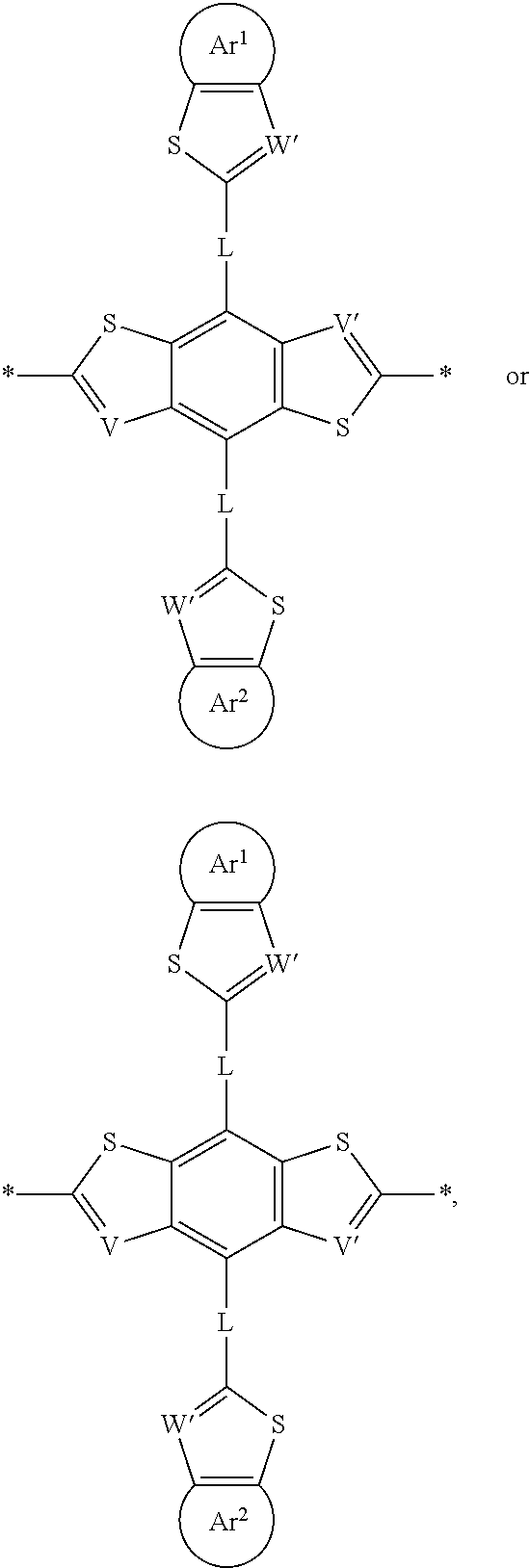
and/or a repeating unit (M1b) of the formula:

wherein Ar1, Ar2, Ar3, Ar4, L, L1, V, V′ and W′ are as defined herein. In particular embodiments, V, V′ and W′ independently can be selected from —CH═, —CCl═ and —N═. For example, each of V, V′ and W′ can be —CH═ or —CCl═, thus providing a repeating unit (M1a) having a formula selected from:


and a repeating unit (M1b) having a formula selected from:

wherein Ar1, Ar2, Ar3, Ar4, L and L1 are as defined herein. To illustrate, L can be selected from —O—, —S—, —OC(O)—, a divalent C1-20 alkyl group, and a covalent bond; and L1 can be selected from —O—, —S—, —OC(O)—, and a divalent C1-20 alkyl group.

can be selected from:

wherein:
V″, at each occurrence, independently is —CR═ or —N═;
Z, at each occurrence, independently is selected from —O—, —S—, and —Se—;
Z′, at each occurrence, independently is —CR═ or —N═; and
R, at each occurrence, independently is selected from H, a halogen, —CN, and L′R′, wherein
L′, at each occurrence, is selected from —O—, —S—, —Se—, —C(O)—, —OC(O)—, —C(O)O—, a divalent C1-20 alkyl group, a divalent C1-20 haloalkyl group, and a covalent bond; and R′, at each occurrence, independently is selected from H, a C1-40 alkyl group, a C2-40 alkenyl group, a C2-40 alkynyl group, a C1-40 haloalkyl group, an optionally substituted C6-14 aryl group and an optionally substituted 5-14 membered heteroaryl group.

independently can be selected from:

wherein any of the carbon atoms optionally can be substituted with F, Cl, —CN, or L′R′, wherein L′, at each occurrence, is selected from —O—, —S—, —Se—, —C(O)—, —OC(O)—, —C(O)O—, a divalent C1-20 alkyl group, a divalent C1-20 haloalkyl group, and a covalent bond; and R′, at each occurrence, independently is selected from H, a C1-40 alkyl group, a C2-40 alkenyl group, a C2-40 alkynyl group, a C1-40 haloalkyl group, an optionally substituted C6-14 aryl group and an optionally substituted 5-14 membered heteroaryl group.


wherein Rc, at each occurrence, independently can be selected from F, Cl, —CN, and L″R″, wherein L″, at each occurrence, can be selected from —O—, —S—, —Se—, —C(O)—, —OC(O)—, —C(O)O—, and a covalent bond; and R″, at each occurrence, independently can be selected from a C1-40 alkyl group, a C2-40 alkenyl group, a C2-40 alkynyl group, and a C1-40haloalkyl group; and d, at each occurrence, independently can be 1, 2, 3, 4 or 5.


wherein Rc, at each occurrence, independently is selected from F, Cl, —CN, and L″R″, wherein L″, at each occurrence, is selected from —O—, —S—, —Se—, —C(O)—, —OC(O)—, —C(O)O—, and a covalent bond; and R″, at each occurrence, independently is selected from a C1-40 alkyl group, a C2-40 alkenyl group, a C2-40 alkynyl group, and a C1-40 haloalkyl group; and d, at each occurrence, independently is 1, 2 or 3.


wherein R″ is a C1-40 alkyl group or a C1-40 haloalkyl group.

wherein:
Ar, at each occurrence, independently can be an optionally substituted 5-8 membered heteroaryl group;
X, at each occurrence, independently can be selected from —O—, —S—, and —Se—;
X′, at each occurrence, independently can be —CR═ or —N═;
X1 can be —CRa═ or —N═;
X2 can be —CRb═ or —N═;
R, at each occurrence, independently can be selected from H, a halogen, —CN, and L′R′, wherein L′, at each occurrence, is selected from —O—, —S—, —Se—, —C(O)—, —OC(O)—, —C(O)O—, and a covalent bond; and R′, at each occurrence, independently can be selected from a C1-40 alkyl group, a C2-40 alkenyl group, a C2-40 alkynyl group, and a C1-40 haloalkyl group;
Ra and Rb independently can be selected from H, a halogen, —CN, and L′R′, or alternatively, Ra and Rb together with their respective adjacent carbon atom form an optionally substituted C6-14 aryl or 5-14 membered heteroaryl group; and
m and m′ are 0, 1, or 2.

each of which optionally can be substituted as described herein.

wherein:
π and π′ are identical or different and independently have a formula selected from:

-
- wherein:
- Ar1 and Ar2 independently are an optionally substituted C6-14 aryl group or an optionally substituted 5-14 membered heteroaryl group;
- Ar3 and Ar4 independently are an optionally substituted phenyl group or an optionally substituted 5- or 6-membered heteroaryl group;
- L, at each occurrence, independently is selected from —O—, —S—, —Se—, —OC(O)—, —C(O)O—, a divalent C1-20 alkyl group, a divalent C1-20 haloalkyl group, and a covalent bond;
- L1, at each occurrence, independently is selected from —O—, —S—, —Se—, —OC(O)—, —C(O)O—, a divalent C1-20 alkyl group, and a divalent C1-20 haloalkyl group;
- U and U′ independently are selected from —O—, —S—, and —Se—;
- V and V′ independently are —CR═ or —N═;
- W, at each occurrence, independently is selected from —O—, —S—, and —Se—;
- W′, at each occurrence, independently is —CR═ or —N═;
- R, at each occurrence, independently is selected from H, a halogen, —CN, and L′R′,
- wherein L′, at each occurrence, is selected from —O—, —S—, —Se—, —C(O)—, —OC(O)—, —C(O)O—, and a covalent bond; and R′, at each occurrence, independently is selected from a C1-40 alkyl group, a C2-40 alkenyl group, a C2-40 alkynyl group, and a C1-40 haloalkyl group;
Ar and Ar′ are identical or different optionally substituted 5-8 membered heteroaryl groups;
X1 is N or CR1;
X2 is N or CR2;
X3 is N or CR3;
X4 is N or CR4;
R1, R2, R3 and R4 independently are selected from H, F, Cl, —C(O)R5, CN, R5, OR5, and SR5, wherein R5, at each occurrence, independently is selected from a C1-20 alkyl group, and a C1-20 haloalkyl group;
X is O, S, or NR6, wherein R6 is selected from H and a C1-20 alkyl group;
a and b are 0 or 1, provided that at least one of a and b is 1;
m, m′, n and n′ are 0, 1, or 2; and
x and y are real numbers representing mole fractions, wherein 0.05≦x≦0.95, 0.05≦y≦0.95, and the sum of x and y is about 1.

that is, when Ar is identical to Ar′, it is identical to π′; X1 is identical to X3; X2 is identical to X4; m is identical to n; m′ is identical to n′; and a is identical to b. In other embodiments, the first unit and the second unit

are different from each other in one or more ways. For example, the type of cyclic moieties, the number of cyclic moieties, and/or the substitution of at least one of the cyclic moieties can be different. Embodiments of the present compounds including different first unit and second unit can have the two units repeated in a random or alternating manner. In most embodiments of the present polymers, the first unit and the second unit independently can include at least one of Ar/Ar′ and π/π′, i.e., at least one of m, m′, and a is 1, and at least one of n, n′, and b is 1, provided that at least one of the first unit and the second unit includes π or π′.

wherein:
Ar and Ar′ are identical or different optionally substituted 5-8 membered heteroaryl groups;
R1 is selected from F, Cl, —C(O)R5, —CF2R5, and CN;
R3 and R4 independently are selected from H, F, Cl, —C(O)R5, CN, R5, OR5, and SR5,
wherein R5, at each occurrence, independently is selected from a C1-20 alkyl group and a C1-20 haloalkyl group;
X is O, S, or NR6, wherein R6 is selected from H and a C1-20 alkyl group;
a and b independently are 0 or 1, provided that at least one of a and b is 1;
c is 0, 1 or 2;
m and m′ are 0, 1, or 2;
n and n′ are 0, 1, or 2;
x and y are real numbers representing mole fractions, wherein 0.05≦x≦0.95, 0.05≦y≦0.95, and the sum of x and y is about 1; and
π and π′ are as defined herein. In certain embodiments of the compounds represented by formula (I), c can be 1 or 2, and R1 can be Cl. In certain embodiments, at least one of Ar and Ar′ can be present (i.e., m and m′ and/or n and n′ are 1 or 2), where Ar and Ar′ are 5-8 membered heteroaryl groups substituted with one or more chloro groups. In certain embodiments, π and π′ can be selected from:

where Ar1, Ar2, Ar3, Ar4, L, and L1 are as defined herein.

where Ar, Ar′, π, π′, R1, R3, R4, m, m′, n, n′, a, b, c, x and y are as defined herein.

wherein Ar, Ar′, π, π′, m, m′, n, n′, a, b, x and y are as defined herein.

wherein Ar, Ar′, π, π′, m, m′, n, n′, a, b, x and y are as defined herein.

where Ar, Ar′, π, π′, m, m′, n, n′, a, b, x and y are as defined herein.

where Ar, Ar′, π, π′, R1, R3, R4, c, m, m′, n, n′, x and y are as defined herein, provided that the first unit and the second unit are different in one or more ways. For example, in embodiments where π and π′ are identical, Ar can be absent in the first unit, in which case, the compound can be represented by formula (VIa):

where Ar′, π, π∝0, R1, R3, R4, c, x and y are as defined herein. In certain embodiments, the substitution of the 2,1,3-benzothiadiazole units can be different. For example, certain compounds of the present teachings can be represented by formula (VIb):

wherein Ar′, π, π′, R1, c, n, n′, x and y are as defined herein.

while π′ can be selected from

wherein L1 can be selected from —O—, —S—, —OC(O)—, and a divalent C1-20 alkyl group; and Ar3 and Ar4 can be selected from a phenyl group, a thienyl group, a thiazolyl group, an isothiazolyl group, a thiadiazolyl group, a furyl group, an oxazolyl group, an isoxazolyl group, an oxadiazolyl group, a pyrrolyl group, a triazolyl group, a tetrazolyl group, a pyrazolyl group, an imidazolyl group, a pyridyl group, a pyrimidyl group, a pyridazinyl group, and a pyrazinyl group, each of which optionally is substituted with 1-4 groups independently selected from a halogen, —CN, and L″R″, wherein L″, at each occurrence, is selected from —O—, —S—, —Se—, —C(O)—, —OC(O)—, —C(O)O—, and a covalent bond; and R″, at each occurrence, independently is selected from a C1-40 alkyl group, a C2-40 alkenyl group, a C2-40 alkynyl group, and a C1-40 haloalkyl group.

wherein:
R13 and R14 independently are selected from H, F, Cl, R15, OR15, and SR15, wherein R15, at each occurrence, independently is selected from a C1-20 alkyl group, a C1-20 alkenyl group, and a C1-20 haloalkyl group; and
π, π′, R1, R3, R4, c, m, m′, n, n′, x and y are as defined herein.

wherein R14 can be selected from F, Cl, R15, OR15, and SR15, wherein R15 is a C1-20 alkyl group; and π, π′, R1, R3, R4, c, x and y are as defined herein. In some embodiments, R1 can be selected from F and Cl. In certain embodiments R3 and R4 can be the same as R1. In alternative embodiments, R3 and R4 can be H.

wherein:
R13 and R14 can be the same and can be selected from F, Cl, R15, OR15, and SR15, wherein R15 is a C1-20 alkyl group; and
π, π′, R1, c, x and y are as defined herein.

where R14 can be selected from F, Cl, R15, OR15, and SR15, wherein R15 is a C1-20 alkyl group; and π, π′, R1, R3, R4, c, x and y are as defined herein. In some embodiments, R3 and R4 can be the same as R1. In other embodiments, R3 and R4 can be H.

wherein:
each R independently can be H or Cl;
R1, R3 and R4 independently can be selected from H, F, Cl, and CN;
each R9 can be selected from:

wherein any of the carbon atoms optionally can be substituted with a halogen, —CN, or L′R′, wherein L′, at each occurrence, can be selected from —O—, —S—, —Se—, —C(O)—, —OC(O)—, —C(O)O—, and a covalent bond; and R′, at each occurrence, independently can be selected from a C1-40 alkyl group, a C2-40 alkenyl group, a C2-40 alkynyl group, and a C1-40 haloalkyl group;
R13 and R14 independently can be selected from H, F, Cl, R15, OR15, and SR15; wherein R15, at each occurrence, independently can be selected from a C1-20 alkyl group, a C1-20 alkenyl group, and a C1-20 haloalkyl group;
c can be 0, 1 or 2; and
x and y are real numbers representing mole fractions, wherein 0.05≦x≦0.95, 0.05≦y≦0.95, and the sum of x and y is about 1.


wherein:
each R independently can be H or Cl;
Rc, at each occurrence, independently is selected from F, Cl, —CN, and L″R″, wherein L″, at each occurrence, is selected from —O—, —S—, —Se—, —C(O)—, —OC(O)—, —C(O)O—, and a covalent bond; and R″, at each occurrence, independently is selected from a C1-40 alkyl group, a C2-40 alkenyl group, a C2-40 alkynyl group, and a C1-40 haloalkyl group;
R1, R3 and R4 independently can be selected from H, F, Cl, and CN;
R13 and R14 independently can be selected from H, F, Cl, R15, OR15, and SR15; wherein R15, at each occurrence, independently can be selected from a C1-20 alkyl group, a C1-20 alkenyl group, and a C1-20 haloalkyl group;
c can be 0, 1 or 2;
d can be 1, 2 or 3; and
x and y are real numbers representing mole fractions, wherein 0.05≦x≦0.95, 0.05≦y≦0.95, and the sum of x and y is about 1.


wherein:
each R″ can be a C1-40 alkyl group or a C1-40 haloalkyl group;
R1, R3, and R4, independently can be selected from H, F, Cl, —CN, and L′R′, wherein L′, at each occurrence, can be selected from —O—, —S—, —Se—, —C(O)—, —OC(O)—, —C(O)O—, a divalent C1-20 alkyl group, a divalent C1-20 haloalkyl group, and a covalent bond; and R′, at each occurrence, independently can be selected from H, a C1-40 alkyl group, a C2-40 alkenyl group, a C2-40 alkynyl group, a C1-40 haloalkyl group, an optionally substituted C6-14 aryl group and an optionally substituted 5-14 membered heteroaryl group;
R13 and R14 independently can be selected from H, F, Cl, R15, OR15, and SR15; R15, at each occurrence, independently can be selected from a C1-20 alkyl group, a C1-20 alkenyl group, and a C1-20 haloalkyl group;
c can be 0, 1 or 2; and
x and y are real numbers representing mole fractions, wherein 0.05≦x≦0.95, 0.05≦y≦0.95, and the sum of x and y is about 1.

In preferred embodiments, the arene group can be naphthalene.

wherein:
π-1 is an optionally substituted fused ring moiety;
R1 is selected from the group consisting of a C1-30 alkyl group, a C2-30 alkenyl group, a C1-30 haloalkyl group, a C6-20 aryl group and a 5-14 membered heteroaryl group, wherein the C6-20 aryl group and the 5-14 membered heteroaryl group optionally are substituted with a C1-30 alkyl group, a C2-30 alkenyl group, or a C1-30 haloalkyl group;
Ma is a repeat unit comprising one or more conjugated moieties that does not include a bis(imide)arene unit (arylene diimide); and
n is an integer in the range of 2 to 5,000.

wherein:
π-1 and π-1′ can be identical or different and independently are an optionally substituted fused ring moiety;
R1 and R1′ can be identical or different and independently are selected from the group consisting of a C1-30 alkyl group, a C2-30 alkenyl group, a C1-30 haloalkyl group, a C6-20 aryl group and a 5-14 membered heteroaryl group, wherein the C6-20 aryl group and the 5-14 membered heteroaryl group optionally are substituted with a C1-30 alkyl group, a C2-30 alkenyl group, or a C1-30 haloalkyl group;
Ma and Ma′ can be identical or different and independently are a repeat unit comprising one or more conjugated moieties that does not include arylene diimide;
p and q independently are a real number, wherein 0.1≦p≦0.9, 0.1≦q≦0.9, and the sum of p and q is about 1; and
n is an integer in the range of 2 to 5,000;
provided that at least one of the following is true: (a) π-1′ is different from π-1, (b) R1′ is different from R1, or (c) Ma′ is different from Ma.

wherein m, m′ and m″ independently are 0, 1, 2, 3, 4, 5 or 6.


wherein R2 can be selected from H, a C1-20 alkyl group, a C1-20 alkoxy group, and a C1-20 haloalkyl group.


wherein m″ is selected from 1, 2, 3, 4, 5, or 6; and Ar is as defined herein. For example, Ar can be an optionally substituted thienyl group.

wherein:
π-1 and π-1′ can be identical or different and independently are an optionally substituted fused ring moiety;
R1 and R1′ can be identical or different and independently are selected from the group consisting of a C1-30 alkyl group, a C2-30 alkenyl group, a C1-30 haloalkyl group, a C6-20 aryl group and a 5-14 membered heteroaryl group, wherein the C6-20 aryl group and the 5-14 membered heteroaryl group optionally are substituted with a C1-30 alkyl group, a C2-30 alkenyl group, or a C1-30 haloalkyl group;
R′ and R″ can be identical or different and independently are selected from the group consisting of H, F, Cl, —CN, and -L-R, wherein L, at each occurrence, independently is selected from the group consisting of —O—, —S—, —C(O), —C(O)O—, and a covalent bond; and
R, at each occurrence, independently can be selected from the group consisting of a C6-20 alkyl group, a C6-20 alkenyl group, and a C6-20 haloalkyl group;
m and m′ independently can be 1, 2, 3, 4, 5 or 6; and
p and q independently are a real number, wherein 0.1≦p≦0.9, 0.1≦q≦0.9, and the sum of p and q is about 1; and
n is an integer in the range of 2 to 5,000;
provided that at least one of the following is true: (a) π-1′ is different from π-1, (b) R1′ is different from R1, or (c) R″ is different from R′.

wherein:
R1 and R1′ can be identical or different and independently are selected from the group consisting of a C1-30 alkyl group, a C2-30 alkenyl group, a C1-30 haloalkyl group, a C6-20 aryl group and a 5-14 membered heteroaryl group, wherein the C6-20 aryl group and the 5-14 membered heteroaryl group optionally are substituted with a C1-30 alkyl group, a C2-30 alkenyl group, or a C1-30 haloalkyl group;
p and q independently are a real number, wherein 0.1≦p≦0.9, 0.1≦q≦0.9, and the sum of p and q is about 1; and
n is an integer in the range of 2 to 5,000.


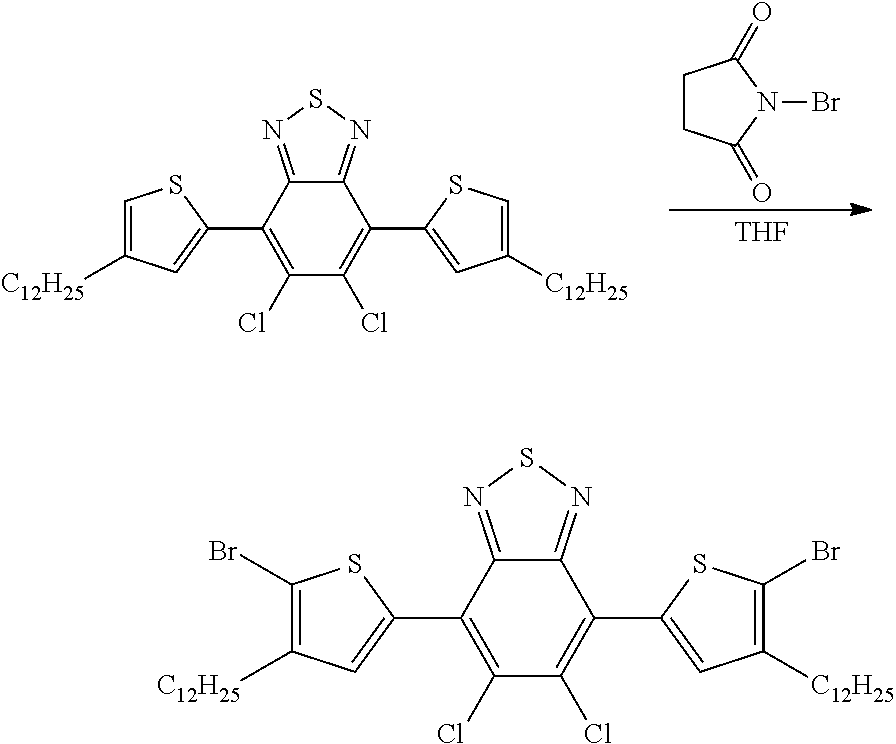


Claims (20)


Priority Applications (4)
| Application Number | Priority Date | Filing Date | Title |
|---|---|---|---|
| US13/843,277 US8883958B2 (en) | 2012-03-22 | 2013-03-15 | Conjugated polymers and their use in optoelectronic devices |
| EP13719635.8A EP2828904B1 (en) | 2012-03-22 | 2013-03-22 | Conjugated polymers and their use in optoelectronic devices |
| PCT/US2013/033591 WO2013142835A1 (en) | 2012-03-22 | 2013-03-22 | Conjugated polymers and their use in optoelectronic devices |
| JP2015501941A JP6173425B2 (en) | 2012-03-22 | 2013-03-22 | Conjugated polymers and their use in optoelectronic devices |
Applications Claiming Priority (3)
| Application Number | Priority Date | Filing Date | Title |
|---|---|---|---|
| US201261614302P | 2012-03-22 | 2012-03-22 | |
| US201261724140P | 2012-11-08 | 2012-11-08 | |
| US13/843,277 US8883958B2 (en) | 2012-03-22 | 2013-03-15 | Conjugated polymers and their use in optoelectronic devices |
Publications (2)
| Publication Number | Publication Date |
|---|---|
| US20130247990A1 US20130247990A1 (en) | 2013-09-26 |
| US8883958B2 true US8883958B2 (en) | 2014-11-11 |
Family
ID=49210633
Family Applications (1)
| Application Number | Title | Priority Date | Filing Date |
|---|---|---|---|
| US13/843,277 Active US8883958B2 (en) | 2012-03-22 | 2013-03-15 | Conjugated polymers and their use in optoelectronic devices |
Country Status (4)
| Country | Link |
|---|---|
| US (1) | US8883958B2 (en) |
| EP (1) | EP2828904B1 (en) |
| JP (1) | JP6173425B2 (en) |
| WO (1) | WO2013142835A1 (en) |
Families Citing this family (17)
| Publication number | Priority date | Publication date | Assignee | Title |
|---|---|---|---|---|
| US11309499B2 (en) | 2012-02-14 | 2022-04-19 | Next Energy Technologies, Inc. | Electronic devices using organic small molecule semiconducting compounds |
| WO2013123508A2 (en) | 2012-02-17 | 2013-08-22 | Next Energy Technologies, Inc. | Organic semiconducting compounds for use in organic electronic devices |
| US8835598B2 (en) | 2012-03-22 | 2014-09-16 | Polyera Corporation | Conjugated polymers and their use in optoelectronic devices |
| US20130247989A1 (en) * | 2012-03-23 | 2013-09-26 | The Regents Of The University Of California | Inert solution-processable molecular chromophores for organic electronic devices |
| US9005357B2 (en) * | 2012-05-24 | 2015-04-14 | Agency For Science, Technology And Research | Method of preparing molybdenum oxide films |
| BR112017008501A2 (en) * | 2014-11-19 | 2017-12-26 | Merck Patent Gmbh | semiconductor mixtures |
| GB2535699A (en) * | 2015-02-18 | 2016-08-31 | Cambridge Display Tech Ltd | Organic light-emitting polymer and device |
| EP3275026B1 (en) | 2015-03-26 | 2022-02-16 | Next Energy Technologies, Inc. | Fluorinated dye compounds for organic solar cells |
| CN107586379A (en) * | 2016-07-07 | 2018-01-16 | 南方科技大学 | Conjugated polymer containing chlorobenzothiadiazole, preparation method thereof and organic solar cell device |
| KR102106204B1 (en) * | 2017-05-16 | 2020-04-29 | 주식회사 엘지화학 | Organic photodiode and photoelectric plethysmography sensor comprising the same |
| KR102106669B1 (en) * | 2017-05-18 | 2020-05-04 | 주식회사 엘지화학 | Organic solar cell |
| WO2019030382A1 (en) * | 2017-08-11 | 2019-02-14 | Merck Patent Gmbh | Organic semiconducting polymer |
| WO2019156204A1 (en) | 2018-02-09 | 2019-08-15 | 日産化学株式会社 | Polymer composition |
| JP7284128B2 (en) * | 2020-07-17 | 2023-05-30 | 住友化学株式会社 | Photoelectric conversion element and manufacturing method thereof |
| JP2022019424A (en) * | 2020-07-17 | 2022-01-27 | 住友化学株式会社 | Photoelectric conversion element and method for manufacturing the same |
| US12384914B2 (en) * | 2021-04-23 | 2025-08-12 | Phillips 66 Company | Polymers for photovoltaic applications |
| CN115651169B (en) * | 2022-09-30 | 2024-11-26 | 广州大学 | A multi-component organic semiconductor material and its preparation method and application |
Citations (9)
| Publication number | Priority date | Publication date | Assignee | Title |
|---|---|---|---|---|
| US20050258398A1 (en) | 2004-05-18 | 2005-11-24 | Takasago International Corporation | Dithia-s-indacene derivative |
| US7524922B2 (en) | 2003-10-15 | 2009-04-28 | Merck Patent Gesellschaft Mit Beschrankter Haftung | Poly(benzodithiophenes) |
| US7820782B2 (en) | 2006-10-25 | 2010-10-26 | Xerox Corporation | Poly(dithienylbenzo[1,2-b:4,5-b′]dithiophene) polymers |
| US20100307594A1 (en) | 2009-05-21 | 2010-12-09 | Zhengguo Zhu | Conjugated Polymers and Their Use in Optoelectronic Devices |
| CN102050940A (en) | 2011-01-28 | 2011-05-11 | 华南理工大学 | Organic semiconductor material containing 6-R group- [1, 2, 5] thiazole [3, 4-g] benzotriazole and application thereof |
| CN102286142A (en) * | 2011-06-24 | 2011-12-21 | 中国科学院宁波材料技术与工程研究所 | Dibenzofuran and derivatives, preparation method and application thereof |
| CN103159941A (en) | 2013-04-01 | 2013-06-19 | 苏州大学 | All-conjugate side-chain polymer and application thereof in polymer solar devices |
| US20130200354A1 (en) | 2010-10-22 | 2013-08-08 | Polyera Corporation | Conjugated Polymers and Their Use in Optoelectronic Devices |
| WO2013116643A1 (en) | 2012-02-03 | 2013-08-08 | The University Of Chicago | Semiconducting polymers |
Family Cites Families (3)
| Publication number | Priority date | Publication date | Assignee | Title |
|---|---|---|---|---|
| US8227691B2 (en) | 2007-10-31 | 2012-07-24 | The Regents Of The University Of California | Processing additives for fabricating organic photovoltaic cells |
| JP2010053094A (en) | 2008-08-29 | 2010-03-11 | Tokyo Institute Of Technology | Bis-naphthothiophene derivative and electric field effect transistor |
| JP5847800B2 (en) * | 2010-04-19 | 2016-01-27 | メルク パテント ゲゼルシャフト ミット ベシュレンクテル ハフツングMerck Patent Gesellschaft mit beschraenkter Haftung | Polymers of benzodithiophenes and their use as organic semiconductors |
-
2013
- 2013-03-15 US US13/843,277 patent/US8883958B2/en active Active
- 2013-03-22 EP EP13719635.8A patent/EP2828904B1/en active Active
- 2013-03-22 JP JP2015501941A patent/JP6173425B2/en not_active Expired - Fee Related
- 2013-03-22 WO PCT/US2013/033591 patent/WO2013142835A1/en not_active Ceased
Patent Citations (11)
| Publication number | Priority date | Publication date | Assignee | Title |
|---|---|---|---|---|
| US7524922B2 (en) | 2003-10-15 | 2009-04-28 | Merck Patent Gesellschaft Mit Beschrankter Haftung | Poly(benzodithiophenes) |
| US20050258398A1 (en) | 2004-05-18 | 2005-11-24 | Takasago International Corporation | Dithia-s-indacene derivative |
| US7820782B2 (en) | 2006-10-25 | 2010-10-26 | Xerox Corporation | Poly(dithienylbenzo[1,2-b:4,5-b′]dithiophene) polymers |
| US20100307594A1 (en) | 2009-05-21 | 2010-12-09 | Zhengguo Zhu | Conjugated Polymers and Their Use in Optoelectronic Devices |
| US20130098448A1 (en) | 2009-05-21 | 2013-04-25 | Zhengguo Zhu | Conjugated Polymers and Their Use in Optoelectronic Devices |
| US20130200354A1 (en) | 2010-10-22 | 2013-08-08 | Polyera Corporation | Conjugated Polymers and Their Use in Optoelectronic Devices |
| US20130200355A1 (en) | 2010-10-22 | 2013-08-08 | Polyera Corporation | Conjugated Polymers and Their Use in Optoelectronic Devices |
| CN102050940A (en) | 2011-01-28 | 2011-05-11 | 华南理工大学 | Organic semiconductor material containing 6-R group- [1, 2, 5] thiazole [3, 4-g] benzotriazole and application thereof |
| CN102286142A (en) * | 2011-06-24 | 2011-12-21 | 中国科学院宁波材料技术与工程研究所 | Dibenzofuran and derivatives, preparation method and application thereof |
| WO2013116643A1 (en) | 2012-02-03 | 2013-08-08 | The University Of Chicago | Semiconducting polymers |
| CN103159941A (en) | 2013-04-01 | 2013-06-19 | 苏州大学 | All-conjugate side-chain polymer and application thereof in polymer solar devices |
Non-Patent Citations (1)
| Title |
|---|
| Braunecker et al. (Chem. Mater. 2012, 24, 1346-1356). * |
Also Published As
| Publication number | Publication date |
|---|---|
| US20130247990A1 (en) | 2013-09-26 |
| JP2015518066A (en) | 2015-06-25 |
| JP6173425B2 (en) | 2017-08-02 |
| EP2828904B1 (en) | 2019-06-12 |
| EP2828904A1 (en) | 2015-01-28 |
| WO2013142835A1 (en) | 2013-09-26 |
Similar Documents
| Publication | Publication Date | Title |
|---|---|---|
| US8883958B2 (en) | Conjugated polymers and their use in optoelectronic devices | |
| US8723028B2 (en) | Conjugated polymers and their use in optoelectronic devices | |
| US8841409B2 (en) | Conjugated polymers and their use in optoelectronic devices | |
| US8598449B2 (en) | Conjugated polymers and their use in optoelectronic devices | |
| US8598450B2 (en) | Conjugated polymers and their use in optoelectronic devices | |
| US9711728B1 (en) | Fused thiophene-based conjugated polymers and their use in optoelectronic devices | |
| US10381567B2 (en) | Organic semiconducting compounds and related optoelectronic devices |
Legal Events
| Date | Code | Title | Description |
|---|---|---|---|
| AS | Assignment |
Owner name: POLYERA CORPORATION, ILLINOIS Free format text: ASSIGNMENT OF ASSIGNORS INTEREST;ASSIGNORS:FACCHETTI, ANTONIO;USTA, HAKAN;PAN, HUALONG;AND OTHERS;SIGNING DATES FROM 20130617 TO 20130619;REEL/FRAME:032965/0926 |
|
| AS | Assignment |
Owner name: RAYNERGY TEK INC., TAIWAN Free format text: ASSIGNMENT OF ASSIGNORS INTEREST;ASSIGNOR:POLYERA CORPORATION;REEL/FRAME:033725/0895 Effective date: 20140911 |
|
| STCF | Information on status: patent grant |
Free format text: PATENTED CASE |
|
| AS | Assignment |
Owner name: RAYNERGY TEK INC., TAIWAN Free format text: ASSIGNMENT OF ASSIGNORS INTEREST;ASSIGNOR:RAYNERGY TEK INC.;REEL/FRAME:036028/0454 Effective date: 20150622 |
|
| MAFP | Maintenance fee payment |
Free format text: PAYMENT OF MAINTENANCE FEE, 4TH YR, SMALL ENTITY (ORIGINAL EVENT CODE: M2551) Year of fee payment: 4 |
|
| MAFP | Maintenance fee payment |
Free format text: PAYMENT OF MAINTENANCE FEE, 8TH YR, SMALL ENTITY (ORIGINAL EVENT CODE: M2552); ENTITY STATUS OF PATENT OWNER: SMALL ENTITY Year of fee payment: 8 |